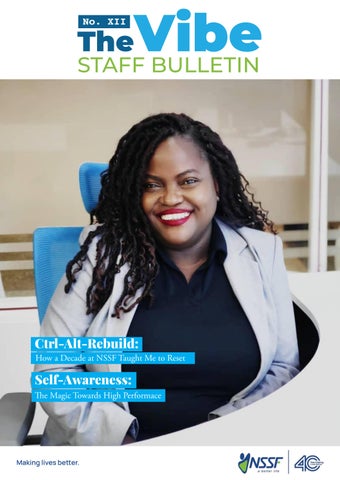
Vibe STAFF BULLETIN No. XII
The
Ctrl-Alt-Rebuild: How a Decade at NSSF Taught Me to Reset
Self-Awareness: The Magic Towards High Performace
Making lives better.
Table of
Content Pg. 3
CAREERS
Pg. 3 Pg. 9 Pg. 11 Pg. 15
Ctrl-Alt-Rebuild... Forty and Fired Up The Power of 1 Hour a Day Inside the Making of the First-Ever All Africa Pension Summit A Decade of Growth Self-Awareness...
Pg. 18 Pg. 20
Pg. 23 LIFESTYLE & WELLNESS Pg. 23 Pg. 25
Wellness: Embracing a Timeless Concept Guarding Against Taking Offence...
1
Foreword are becoming more ambitious. Meeting these expectations will require adaptability, collaboration, and a continued commitment to excellence - but I am confident just as you are that, together, we are more than capable of rising to the challenge.
“
Your interest in staying informed, as well as your willingness to contribute to ideas, stories and insights is what makes the bulletin meaningful and relevant.
Dear Colleagues, As we begin a new year, I would like to sincerely thank each one of you for the commitment, professionalism, and heart you continue to bring to your work. Your dedication to advancing the Fund’s vision does not go unnoticed, and it remains central to the progress we have made together over the years. Equally important is your continued focus on personal growth and self-development, which strengthens our culture and equips us to serve our members even better.
As we move forward into the year ahead, let us remain focused, supportive of one another, and open to learning and growth. I wish you all a happy, healthy, and fulfilling New Year, and I look forward to all that we will achieve together.
I would also like to thank you for your consistent support of the Vibe Staff Bulletin. Your interest in staying informed, as well as your willingness to contribute ideas, stories, and insights, is what makes the bulletin meaningful and relevant. It has become a platform that not only shares information, but also connects us, celebrates our achievements, and reflects who we are as a community.
Remigious Kaggwa Engagement Specialist
As we mark 40 years of the Fund’s journey, we have every reason to feel proud. This milestone represents decades of hard work, resilience, and shared purpose. Each of you has played a role in shaping this legacy, and your contributions continue to build a strong foundation for the future. At the same time, this moment invites us to look ahead. The environment we operate in is changing quickly, and member expectations 2
Careers Ctrl-Alt-Rebuild: How a Decade at NSSF Taught Me to Reset, Lead, and Laugh Through the Errors
By Alexandra Nankunda
Former NSSF Staff in the Enterprise and Growth Department
O
Shortly after joining, I received my first reality check. I was suspended for two weeks without pay for disrespecting my supervisor. Yes, suspended. Two weeks of unpaid soul-searching and realizing that mouthing off doesn’t pay the bills. Consider it my crash course in humility.
riginally, I dreamed of studying law. When I first visited Uganda Christian University Mukono, and learned from a friend that law students were required to sit for a preentry exam, I panicked. Yep..full-on panic. In a split-second decision that would make any career counsellor twitch, I abandoned my legal dreams and pivoted straight to Uganda Martyrs University Nkozi, where I pursued a bachelor’s degree in information technology. The plan? Study IT, then swing back into law with a twist—cyber forensics. Genius, right?
By November 2014, I had joined the benefits section of NSSF. I became a full-time employee (hello, benefits and job security!) and part of the pioneering team that developed a USSD code for benefits claims. It reduced queues, improved customer satisfaction, and ironically, anchored me more deeply than I’d ever planned.
Well, life had other plans. Right after graduation, I joined the National Social Security Fund (NSSF) in 2014 as a customer service officer, a role completely unrelated to either IT or law. But I embraced it, telling myself, “I’ll only be here for three years.” That promise didn’t age well.
It was here I met my first mentor, Berna. We shared a Namagunga legacy, though from different years and she saw right through my chaotic, party-hard exterior. She sat me down and gave the pep talk of a lifetime, reminding 3
I didn’t hit any targets. I didn’t get bonus. And honestly, I didn’t care.
me that Namagunga girls don’t just exist, we excel. With her encouragement, I enrolled in law school. Three years later, I dropped out but not before regaining some of the ambition I’d nearly drowned in Jack Daniels. When Berna was transferred, I defaulted hard. Without her guidance, I slipped into rebellion mode. I became the kind of employee managers whisper about in closed-door meetings. Disrespectful, defiant, and proud of it. In 2019, I was transferred to the data profiling section, an exciting opportunity to segment customers and improve experiences. But not for me. I saw it as a punishment. Instead of rising to the occasion, I whined, underperformed, and practically hosted a pity party. Then two things happened: I met my second mentor, Alvin (my now husband), and COVID-19 happened.
Enter Pathfinder—a personal development program recommended by friends and Alvin. I joined reluctantly, but it changed everything. Listening to women with stories like mine lit a fire I hadn’t felt in years. I learned I was a RED (naturally), embraced vulnerability, and met my coach, Abdul Makubuya.
“
This next chapter was my villain origin story, if villains cried a lot and ate too much junk food. I refused accountability, bathed in victimhood, and clashed with every manager brave enough to supervise me. I even gamed the BSC: if Section A was on fire, who cared about Section B?
Alvin, my rock, coach, and unofficial IT tutor, pushed me to learn Python and SQL, which I did grudgingly. He believed in me even when I was being a certified mess. During lockdown, I created a roadmap for the data profiling unit. When the world reopened, I was transferred again because, shocker, prior poor performance catches up eventually. It was here I learned my first life lesson: the world will not wait for you. This next chapter was my villain origin story, if villains cried a lot and ate too much junk food. I refused accountability, bathed in victimhood, and clashed with every manager brave enough to supervise me. I even gamed the BSC: if Section A was on fire, who cared about Section B?
One day, in the middle of what I thought was a life-changing coaching session (and it was), Abdul hit me with a metaphor I didn’t see coming. He told me about a grandmother who was asked by her grandkids to tell them a story about her life. Then he turned to me and said, “So... what kind of grandmother do you want to be? A cowardly one or a brave one?” I blinked. Twice. And laughed awkwardly. But that one question, wrapped in a parable and delivered like a challenge, changed the lens through which I viewed my entire journey. I mean, no one wants to be the grandma with a boring backstory, right?
In 2022, the bombshell dropped—NSSF restructured. While others panicked, I felt invincible. “I’m too good to lose this job,” I told myself. Spoiler: I was not. I tanked every interview. By the end, I was prepared to exit... until one manager refused to sign my voluntary exit form. He believed in me more than I believed in myself. And just like that, I was hired as a Voluntary Relationship Manager. Sounds fancy, right? The catch: I couldn’t sell to save my life. So, I clung to work-from-home like a toddler to a blankie.
By this time, I had made up my mind that I had given the Fund my all and decided to return to school because in our household, a bachelor’s
4
managers—Becky and Penny—the kind of leaders who believe in you before you fully believe in yourself. They didn’t just manage me; they patiently debugged my career one attitude at a time. Becky turned chaos into clarity, and Penny mastered the art of tough love delivered with a calm smile. Without their faith (and frequent reminders to breathe), I’d probably still be blaming the Wi-Fi whenever things got tough. Every bit of confidence I carry today has traces of their coaching hidden in the code.
degree is considered the academic equivalent of owning a flip phone in the iPhone era. I’d received five offers from U.S. universities. Abdul looked me straight in the eye and said, “Someone told me you were brilliant. But they don’t know what happened to you.” Ouch. That one hit. But it also healed. The U.S. plans didn’t pan out, and I nearly spiraled into despair. But Pathfinder had taught me resilience. I read Nice Girls Don’t Get the Corner Office (shoutout to Olivia Newbold for gifting it to me) and decided to take back control.
And no, I didn’t forget about school. Every morning, I showed up early and made myself visible. I knew my manager was swamped, so I volunteered, helped, and stayed present. Every evening, I switched gears—GRE prep, applications, Coursera, Udacity. My laptop needed therapy. It was Alvin who also introduced me to Mind valley—yes, hero of the decade—where I learned how to reset my mental game.
One of the moments that tested this bravery was my presentation at the NSSF Book Club. Let’s just say it was… memorable but not in a good way. Abdul looked me straight in the eye afterward and told me, “You just sold them rotten tomatoes.” Ouch. But the truth stung for a reason. I asked for a second chance and poured my soul into that next presentation. I was determined to leave a legacy, not a stench. Thankfully, I got my redemption arc. But it reminded me that life doesn’t always hand out second chances. When it does, you show up like it’s the only stage you’ll ever get.
Eventually, the efforts paid off. I got into the University of Essex and won the Dean’s Award. Boom. At work, I branded myself the “data analytics person.” Did I know it all? No t
I applied for and secured the role of Account Manager in the newly formed Enterprise and Growth department in August 2024. It was here that I met two powerhouse
5
even close. But I reached out to a former supervisor ( Davis), devoured every Excel, Power BI, and SQL lesson, and faked confidence until I built real skill. Before long, the data section was mine.
straight from the tub while questioning all my life choices. Didn’t work for two days. But work kept coming, and people kept expecting. Suddenly, I forgot how to design a dashboard. I stared at Power BI like it owed me money.
Cue the imposter syndrome. Every board report made me second-guess myself. I would call Davis to double-check every chart, Alvin for pep talks, and occasionally cry because… well, Excel formulas don’t hug back. I constantly reflected on the days I was every manager’s nightmare. Some days I wanted to email them all and say, “My bad.”
But here’s the thing, when people see you as capable, you don’t get the luxury of wallowing. As Abdul once told me: “Showing your emotions is like bleeding in an ocean of sharks.” So, I dried my tears, wore my big girl pants, and showed up. Looking back, I realize I wasn’t ready to pursue an MBA last year—not mentally, not emotionally. I lacked the maturity and emotional intelligence that this kind of program demands. But hindsight is 20/20, and today, I feel equipped to embrace the leadership this MBA will require.
But something shifted. People started seeing me differently. Some gave me respect. Others couldn’t let go of my past. Either way, I kept proving them wrong.
“
And now, as I close out my ten-year journey at the Fund and prepare to start a new chapter as a student, I carry not just qualifications, but battle scars, breakthroughs, and the realization that even the most rebellious, comfortable employee can rewrite their story. And eat the ice cream too.
One of the moments that tested this bravery was my presentation at the NSSF Book Club. Let’s just say it was… memorable but not in a good way. Abdul looked me straight in the eye afterward and told me, “You just sold them rotten tomatoes.”
Here are the 32 lessons I’ve picked up along the way (written under the influence of caffeine and with zero writer’s block—for once):
I was mentored by Becky and Penny—and believe it or not, I started mentoring others too. One fine morning, Becky looked up from her laptop and said, “You’re now managing both Shared Services and Mass Markets.” I smiled politely, went home, and ate ice cream 6
1.
It’s lonely at the top. I’ve been the officer, and now I’ve walked a mile in a manager’s shoes. I understand the pressure, the expectations, and yes—the weight of leadership. Be kind to your bosses; they’re winging it too. Also, I now understand why they sigh so much.
2.
You are allowed to start over as many times as it takes. Don’t be afraid to admit you messed up. I did. Repeatedly. But I kept showing up.
3.
Be so good they don’t second-guess you. Excel doesn’t lie. If your dashboard makes the manager say “hmm,” you’ve won. If it makes the manager ask, “What’s this spike in 2098?”, maybe open a new workbook.
4. 5.
Comfort zones are prisons with great Wi-Fi. Step out. The growth is outside.
6.
Victimhood is addictive but empowerment is healing. It feels easy to blame everyone else. It’s harder and more freeing to own your journey.
7.
8.
9.
promoted.
Have a partner who believes in you. Shoutout to Alvin. Legend.
17. Look for opportunity in every problem – Becky taught me this. Every crisis is a disguised opening. 18. You need a tribe – Get yourself people who see your potential even when you’re blind to it.(Hi Teddy and AnnaMaria) 19. Don’t get suspended for disrespecting your supervisor – Or you’ll end up telling that story ten years later in an article and call it a “lesson.” (But hey, we grow.)
Coaching is not just for athletes. Find someone who can tell you the hard truths without sugarcoating. Then listen. Abdul didn’t just coach me. He held up a mirror.
20. Don’t sell rotten tomatoes – Especially not in book clubs. And if you do, ask for another shot—and serve a feast.
You don’t have to be the expert, you just have to be willing to learn. Most of us are winging it at first. The trick is in the effort.
21. Always ask for help – You don’t have all the answers.
Imposter syndrome is a liar. If you’re in the room, you belong. Full stop.
22. Leadership is service, not status. Sometimes leadership means fetching the projector cable yourself because everyone else “thought IT would handle it.”
10. A mentor is gold. Two mentors? Platinum. But mentoring someone else? That’s when the real growth happens.
23. Feedback isn’t an attack—it’s a mirror. Sure, it stings—but at least it’s not HR calling you for a “quick chat.”
11. Read the book. Then do what it says. Nice Girls Don’t Get the Corner Office didn’t just sit pretty on my shelf—It’s career therapy in paperback.
24. Adaptability beats ambition. Life will change your job title before HR updates your contract. Learn to pivot faster than an Excel chart.
12. Progress > perfection. Some days you’ll feel brilliant. Other days, you’ll eat ice cream in silence. Both are valid.
25. Gratitude is rocket fuel. Say thank you to the tough seasons—they gave you the plot twist you now tell proudly in presentations.
13. Rewrite your story. You’re the author—even if you once thought you were the antagonist. 14. You are not that special. Everyone is carrying something. Everyone has their own silent battles. So get over yourself, show up, and be kind.
26. Mentorship goes both ways. One day you’re the mentee taking notes; next day, you’re the mentor Googling the answer mid-session.
15. Meditate. Mindvalley helped me fix the clutter in my head when nothing else would. Mental fitness is a real thing do the work.
27. Confidence is built, not born. You fake it, you panic-Google it, and one day you actually know it. 28. Celebrate small wins. Survived Monday? That’s a victory. Found the missing bracket in your SQL code? Champagne-worthy.
16. Emotional intelligence is a superpower. Technical skills will open the door, but EQ will keep you in the room and probably get you 7
If there’s anything my ten-year ride at NSSF taught me, it’s that growth rarely comes wrapped in comfort. You’ll cry over Excel formulas, lose mentors, gain faith, and still make progress.
29. Silence is also communication. Sometimes the best response is sipping your tea and letting the spreadsheet do the talking.
30. Growth is seasonal. Some seasons So, if you ever catch me on a stage talking about bloom; others feel like dial-up internet. leadership, just remember I once thought “pivot table” was a yoga pose. Still, keep buffering. The moral of the story? You can start as office chaos and end up as office wisdom. Just don’t burn bridges, double-check your Excel formulas, and always keep snacks for emotional support.
31. Legacy isn’t a title—it’s impact. Be the person they quote in meetings… preferably for something wise, not your suspension story.
Because in the grand data dashboard of life, 32. Don’t burn bridges. People talk—and some of us weren’t built to play it safe—we were sometimes they build the next bridge you’ll need to cross. That ex-supervisor built to make spreadsheets emotional. might just become your future reference (plot twist).
“
Celebrate small wins. Survived Monday? That’s a victory. Found the missing bracket in your SQL code? Champagne-worthy. 8
Forty and Fired Up! A Celebration of Growth and Impact.
By Amanda Achieng Owori Area Manager
F
a paper punch. The systems were basic and processes were manual.
orty years ago, when shoulder pads were wide enough to block traffic and bellbottoms could sweep a whole room, NSSF Uganda began a journey fueled by a very clear purpose: to make lives better by making saving a way of life.
Today: 40 Years Young Fast-forward to today, and the Fund stands tall as one of East Africa’s most respected social security institutions.
What began in 1985 as a bold promise to protect the future of Ugandan workers has grown into a powerhouse of financial security, innovation, and national transformation.
From manual processes to digital marvels. From long queues to smart self-service. From “please hold while we find your file” to “your statement is ready in seconds.”
“
Every milestone we celebrate today carries fingerprints of employees past and present; those who laid the foundation, those who built on it and those who continue to push boundaries. Flashback to 1985 Think of where you were 40 years ago - okay, even if you were not born yet, imagine it! Now think of an institution that has walked through many major eras of Uganda’s modern history. Still breathing, still running, and now looking fabulous at 40.
Every milestone we celebrate today carries fingerprints of employees past and present; those who laid the foundation, those who built on it and those who continue to push boundaries.
NSSF most likely started small - like, “everyone fits in one group photo” small. The most advanced thing in the office was probably 9
When I joined the Fund, I was amazed to learn that people no longer needed to walk into the branches to fill forms for registration.
Forty and Fearless
If the 1985 team walked into today’s NSSF, they would probably say, “Eh, are you sure this is the same Fund?”
The Fund is old enough to be wise and young enough to be bold.
The best part about turning 40?
Uganda is growing. Businesses are booming. Young workers are stepping in with ambition. NSSF is entering the next decade like “We did not come this far to come this far.”
Keeping up with the times Let us be honest, the NSSF of today is not our great grandparents’ pension scheme. It is faster, digitalized, and laser-focused on value.
Together we can continue to help build the Uganda we want: A Uganda where growing old does not mean suffering, but means soft life (or at least softer life).
Serving as a records assistant in the records section gave me the opportunity to understand and appreciate where the Fund was years ago, and where it wanted to be. The dusty boxes, rebellious rubber bands, and staple wires with anger issues were all worth it. The Fund’s transition from paper to digital has greatly enhanced business processes.
Takeaway It is humbling to know that everything we do has a ripple effect on generations to come. Forty years of service have shown that excellence is not an accident. It is a result of commitment and wholehearted work.
A Celebration of the People behind the Fund
It is key for us to reaffirm the call to give our best, knowing that work done with purpose and integrity builds lasting change. Regardless of the department, simple acts of kindness and love in our work can change lives forever.
People have held the Fund together. The members, the staff, the innovators, the partners, the policymakers, and the ordinary Ugandans who believe in the promise of a secure future. The people who have poured energy, ideas, laughter, sweat, and occasional confusion into building something remarkable.
Colossians 3:23 - “Whatever you do, work at it with all your heart, as working for the Lord, not for men.”
This 40-year celebration is a salute to: • The saver who puts away a little every month. • The employers who fulfill their obligation with integrity. • The leaders who dared to transform the Fund. • The teams that wake up every day ready to make someone’s future brighter.
10
The Power of 1 Hour a Day
By Robert Muwanga
Senior Manager Innovation Services
H
that are waaaay below what your phone is telling you (I recommend you read up on the “Dunning–Kruger Effect”).
i there! Thanks for reading this short piece. I’m hoping you find it not only interesting (with bits of humour sprinkled around) but also one that inspires action. But, before we get started, I would like you to do me a favour. Do you know how much time you spend on your phone? Before you run to your phone to check, just estimate a number that you think is close enough. I’ll wait…
Here are a couple of interesting facts: • The average person spends up to 6 hours daily on their phone, with GenZ’s spending up to 7 hours whilst Millennials spend up to 3.4 hours .
Done? Great. Now, let’s check our phones. If you are on Samsung (or on most Android devices), you will be looking for a feature called “Digital Wellbeing” under Settings > Digital Wellbeing and Parental Controls. If you are on iPhone, you would look for Apple’s “Screen Time” app that you can find under Settings > Screen Time.
• The average person spends over 2 hours on social media daily , with this varying by age and demographics (check your own usage!). • The average person checks their phone over 140 times per day (approximately every 10 minutes) often out of habit.
Now I need you not just to look at “today’s” usage but scroll back slowly for at least a week, a day at a time. Look at how much time you spend on the phone and across the various apps.
• Over 60% of individuals are Nomophobic – have a fear of being without a mobile phone often characterised by anxiety (please have yourself checked).
Are you surprised yet? I’m hoping that you are. Statistically, most of you should have estimates 12
of your favourite shows – Damalie, Sanyu, Prestige, Game of Thrones, …) you steal only 1 hour from that time to invested in watching shows that improve your career or your general knowledge? I’ll give you a couple of examples:
DID YOU KNOW?
• If you wanted to learn how to manage your “side hustle” finances better, a simple search on YouTube can help you find playlists on how to manage your finances for business. I did a simple search and came across a 36hour playlist. If I spent an hour a day on this playlist, within a month I would be able to dramatically this skill (and be able to challenge my accountant if I had one!).
Your cell phone is 10x DIRTIER than the typical toilet seat?
• Let’s think about career. Ever wanted to learn the basics of coding so you can keep up with your kids or pivot your career? I did a simple YouTube search and came across a playlist on coding done by an Associate Professor in Michigan State University. His playlist is just 14 hours. So, in less than a fortnight, I would be possible to learn the basics of coding. You will not be a master by any means, but you would be able to position yourself to pivot your career and learn more towards mastery. • What about improving your general knowledge? You can do the exact same search and dedicate just one hour a day to learn something new – philosophy, medicine, arts, nature, science and engineering… The more you know and learn, the deeper your conversations become and the more opportunities that you will unlock. Learning something new doesn’t always have to be about work.
So, what does all this have to do with this article? I’m glad you asked. Consider the amount of time we spend on our mobile phones. A typical day has 24 hours. On average, if we assume each day is fairly average (including weekends and public holidays), 8 hours is spent sleeping. 16 hours of our time is spent awake of which we dedicate 6 hours to just the phone – if we follow the earlier mentioned statistics.
“
So, on average, about 38% of your waking life is spent on the phone. With the average Ugandan lifespan at around 68 years, this means you spend 25 years of your life staring at a screen!
Isn’t it funny how day by day nothing changes but, when we look back, everything is different?
That’s a lot of time to be spent on a screen. The question is, “Are you using this time effectively to learn something new?”. Now, imagine if you just used 1 hour of that time where, instead of watching things on social media that won’t improve your life (think
C.S. Lewis
13
So, as the Fund turns 40, think about how much change the Fund has gone through and how much change it will go through. Think about how you participated in this journey and what new possibilities and opportunities are being born. And think about how, from just 1 hour a day, you can re-think your career, your potential and your value, to position yourself for new opportunities in (and outside) the Fund.
14
Inside the Making of the First-Ever All Africa Pension Summit: A Proud Chapter in NSSF’s 40-Year Journey
By David Masiko
Senior Manager Planning and Analytics
A
mix of strengths. Five workstreams were created: Content, Logistics & Programs, Engagement, Technology, and Finance, and the real work began.
s NSSF marks 40 years, I’ve found myself reflecting on the moments that show who we are as a Fund. Our resilience, our innovation, and the collective spirit that have shaped our journey. For me, the first-ever All Africa Pension Summit quietly became one of those defining moments. It wasn’t designed as an anniversary event, yet everything about the process carried the energy of a Fund stepping into its next chapter with confidence.
The Workstreams: A Tapestry of Effort The Content Workstream shaped the intellectual backbone of the Summit, developing the storyline, reviewing material, and ensuring Africa’s pension challenges and solutions were addressed meaningfully.
Where It All Began
The Logistics & Programs Workstream handled what most people will never see: VIP protocols, security coordination, venue setup, translation, medical arrangements, exhibitor spaces, Secretariat support, dry runs, immigration engagements, and more. Their role carried the same discipline and operational strength that has anchored NSSF’s brand for four decades.
The Summit was sparked by a bold idea from our Managing Director, Mr Patrick Ayota. He envisioned a space where pension fund leaders from across Africa could connect directly with global finance institutions, development partners, private equity players, venture capitalists, and policy leaders to rethink how pension capital is mobilised for Africa’s development. It was the kind of idea that fits perfectly into a 40-year milestone. The kind that asks, What future do we want to shape next?
The Engagement Workstream created the Summit’s public face. From ads, media partnerships, influencer engagement, photography, videography, and exhibition design. Their work reminded us how far our
Turning that vision into reality meant assembling a diverse project team with the right 15
institutional voice has grown over the years. The Technology Workstream handled the digital backbone: the Summit app, website, UI/ UX design, payments integration, and dedicated internet. It felt like a glimpse into where NSSF is heading over the next decade. And then there was the Finance Workstream, which I led. We developed budgets, built revenue models, set delegate pricing, structured sponsorship tiers, handled exhibitor fees, ensured tax compliance, and projected breakeven points. We were accountable for every shilling, and in a year marking 40 years of service to members, that responsibility carried even more weight. The Real Behind-the-Scenes: Where the Story Truly Lives Our preparation began in April with Monday meetings at 2:30pm. These soon became a permanent fixture in our week, eventually happening twice weekly as the Summit drew closer. Many of us placed our BAU work aside to focus fully on this project. Collaboration became second nature.
Like many first-time endeavours, we ran into our share of mishaps. Our early revenue projections hinged on early bird registrations, but the systems needed to support payments were not ready. Partnerships with banks, telecoms, and app stores moved slower than expected. UAT didn’t always give us the greenlight we hoped for. Some speakers cancelled; some suppliers missed timelines. But the spirit surrounding NSSF@40, one of unity, pride, and renewed momentum showed up in the way we worked. Whenever one door closed, someone found another to open. We leaned on each other. We shared contacts. We shared ideas. We pushed through. A month to the Summit, the urgency kicked in fully. Registrations surged, sponsors confirmed, and payments flooded in, many in the last two weeks, as is typical in our culture. Even on the eve of the Summit, the calls kept coming. The Eve of the Summit During the final walkthrough, only one of the two halls was ready. The second hall was still occupied by another event and only became
Patrick Ayota, Managing Director of NSSF, addressing delegates at the AAPS
16
still helped them connect with the people they wanted to meet.
available in the early morning hours. The setup team worked through the night, and by dawn, although not everything was perfect, we were ready enough to take a deep breath and begin.
And that’s where the NSSF@40 theme slipped beautifully into my reflections. This Summit, built from scratch by a committed team, became a quiet but powerful celebration of who we are after four decades. Our teamwork mirrored the spirit of our staff. Our discipline reflected the strength of our brand. Our financial stewardship honoured our members. And our ambition spoke clearly about our future.
A few hiccups carried into the morning. Some delegates lacked tags and lanyards, and a few setups were still being finalised, but overall, the Summit was standing. The Moment It All Came Together
“
When the first two delegates, Ms. Joan Mugenzi and Mr. Martin Owiny, walked through the doors, the mood shifted. The hall was beautiful. The sound and visuals were crisp. The MC tested the mic. The lights settled. And all at once, it felt like the months of preparation had been worth it.
When the first two delegates, Ms. Joan Mugenzi and Mr. Martin Owiny, walked through the doors, the mood shifted. The hall was beautiful. The sound and visuals were crisp. The MC tested the mic. The lights settled. And all at once, it felt like the months of preparation had been worth it.
Day 1 carried the weight of high-level attendance. We hosted the Rt. Hon. Prime Minister of Uganda, Robinah Nabbanja, Hon. Betty Amongi Ongom, the Minister for Gender, Labor, and Social Development and members of our Board. The energy at the foyer during networking teas was electric. Delegates exceeded our projections. The evening cocktail, animated by the Ndere troupe, added a cultural flair that felt deeply fitting for a continental gathering. Day 2 allowed us to correct Day 1’s stumbles. Tags and lanyards were sorted. The exhibition hall stood out as one of the biggest attractions. The content continued to impress. The Gala dinner dazzled many of our international guests. Day 3 followed the global pattern of lighter attendance, but the closing remarks by Hon. Matia Kasaija, the minister for Finance, Planning and Economic Development, wrapped the Summit with a sense of purpose. Feedback from delegates reassured us that the event was indeed a success. Looking Back at NSSF@40 Through the Lens of the All Africa Pension Summit
Being part of the organising committee of the first-ever All Africa Pension Summit is an honour I’ll carry with me. As we celebrate 40 years of NSSF, this experience reminded me that our growth is not just measured in years, but in the bold steps we take and the stories we create along the way.
As organisers, we naturally saw everything that didn’t go as planned. Delegates, however, saw the Fund delivering at a high standard. Even the delays in publishing the Summit app didn’t dampen their experience, as the workaround 17
A Decade of Growth: My Journey at NSSF Uganda
By Phiona Mbeiza
Accounting and Control Manager
T
was being intentional: celebrating my wins, preparing thoroughly, leaning on mentors, and reframing my story to see the strengths I bring as a servant leader. Speaking openly about those doubts turned them into fuel. I learned that leadership isn’t about being flawless — it’s about being real and making an impact.
en years ago, I walked into the Fund with grit, curiosity, and a hunger to learn. I couldn’t have imagined how much those first steps would shape me. Today, as NSSF celebrates 40 years, I find myself looking back on my own decade here — a journey filled with challenges, lessons, and growth that has changed not just my career, but me as a person.
The Power of People
Growing in a High Performance Space
If there’s one thing I know for sure, it’s that growth is never a solo journey. My coach gave me clarity, my accountability partner kept me grounded, my colleagues challenged me, and my mentor offered me wisdom when I needed it most. And my friends and familyThey reminded me to laugh, to celebrate, and to keep going. This circle of support has been my anchor, helping me rise stronger after every challenge.
Working in an organization where excellence is the norm has taught me that growth isn’t a straight line. It’s messy, it’s demanding, and it requires courage. I’ve had to stretch beyond technical skills, learning how to serve and support others while still delivering results. For me, growth has meant moving beyond the balanced scorecard to focus on people — building trust, nurturing teamwork, and creating space where everyone feels they matter.
Serving Through Sustainability
Facing and Owning My Doubts
One of the most meaningful parts of my journey has been contributing to NSSF’s sustainability reporting. I didn’t see it as a task — I saw it as a way to serve and tell the Fund’s journey through lenses of value, and social impact.
As a woman in finance, I’ve wrestled with imposter syndrome more times than I can count. There were moments I wondered if I truly belonged, even when my achievements said otherwise. What helped me push through 18
“
Lessons I Carry Forward Looking back, three lessons stand out: • Own Your Story: Your path is yours alone — don’t measure it against anyone else’s.
Working in an organization where excellence is the norm has taught me that growth isn't a straight line. It's messy, it's demanding and it requires courage.
• Lead with Empathy: Numbers matter, but people and impact drive results. • Stay Resilient: Challenges will come, but resilience is what helps you rise again. Looking Ahead As NSSF marks 40 years, I’m proud to be part of its story. My decade here reflects not just the Fund’s commitment to excellence, but also the power of perseverance, service, and belief in oneself. For women stepping into finance, sustainability, or any demanding field, the road may be tough — but it is deeply rewarding. With clear intentions, strong support systems, and the courage to keep showing up, we can make meaningful contributions to institutions like NSSF Uganda and beyond.
Coordinating inputs, amplifying colleagues’ voices, and ensuring our reports reflected both performance and impact gave me a chance to live out my passion for ESG. It reminded me that finance isn’t just about numbers; it’s about responsibility and about protecting the future we all share.
As my mentor often reminds me through the words of Doc Rivers “I can’t be all I can be, unless you are all you can be.” That truth captures the heart of servant leadership- our growth is bound together, and success is sweetest when shared.
“
My journey has been filled with challenges, lessons, and growth that have changed not just my career, but me as a person.
19
Self-Awareness: The Magic Towards High Performance
By Solomon Jackson Kobwemi Area Manager
H
describe you.
ave you ever stopped to wonder what others truly see in you—qualities, quirks, or strengths you might be missing?
2. Ask for Feedback: Invite friends, colleagues, or teammates to select the adjectives they think describe you.
Most of us have blind spots, hidden talents, or strengths we take for granted. Yet these are things that would help us move to another level in our lives, workspace, relationships and career lives.
3. Compare and Reflect: Lay out the results to reveal four key areas: • Open Area: Traits everyone agrees on—your strengths in plain sight.
What if you could shine a light on those unseen parts of yourself and use them to grow, lead, and connect more deeply with others?
• Blind Spots: Qualities others notice, but you might not see in yourself. • Hidden Area: The parts you keep private— your untapped strengths or vulnerabilities.
Enter the Johari Window: Your Mirror for Self-Awareness
• Unknown Area: Aspects yet to be discovered by anyone (the space for growth and surprises!).
The Johari Window is more than just a psychology tool—it’s a powerful framework for boosting self-awareness, leadership skills, and emotional intelligence. Imagine it as a fourpaneled mirror that reveals how you see yourself and how others perceive you.
Why Should Leaders and Teams Use the Johari Window? Leaders who embrace the Johari Window foster trust, improve communication, and accelerate personal and professional growth. By understanding your blind spots and hidden talents, you can:
How Does It Work? 1. Pick Adjectives: Start by choosing a handful of adjectives from a set list that you feel best 20
• Build stronger, more authentic relationships
Ready to Level Up?
• Communicate with greater clarity and empathy
Try the Johari Window exercise with your team, friends, or even family. You might be surprised by what you learn—and how much more connected and confident you feel.
• Unlock new areas for growth and development
21
Lifestyle & Wellness Wellness: Embracing a Timeless Concept By Deus O Kasirye Mugwanya Compliance Auditor
W
of physician Halbert L. Dunn, who introduced the concept of High-Level Wellness in 1961. Although initially overlooked, Dunn’s ideas gained momentum in the 1970s, embraced by a group of American physicians and thinkers such as Dr. John Travis, Don Ardell, and Dr. Bill Hettler—who came to be known as the “fathers of the wellness movement.” Their writings and leadership have profoundly shaped how we understand and talk about wellness today.
ellness is undoubtedly one of the values many of us hold dear. Today, wellness, a buzz word of sorts, takes centre stage in various agendas, whether organizational or personal. It’s often a key goal we aim to achieve as part of our annual objectives, yet it’s also one of the most overlooked or abandoned as the year goes on. Why has wellness become such a crucial topic today? This question sparked my curiosity and led me to explore the origins and growing popularity of this concept. I discovered that wellness is not just a modern trend; its roots are ancient. Many aspects of wellness are deeply embedded in intellectual, religious, and medical movements from the 19th century in the United States and Europe. The principles of wellness can be traced back to the ancient civilizations of Greece, Rome, and Asia—cultures whose traditions continue to influence the modern wellness movement.
“
At the Fund, Wellness initiatives aim to inspire staff to take charge of their physical, mental and emotional wellbeing, embrace healthy lifestyles to prevent lifestyle-related illnesses, and contribute to a vibrant and positive workplace culture.
According to the Global Wellness Institute, “wellness” is a relatively modern term with deep historical foundations. The word began to be used in the 1950s, notably in the work 23
fall into poverty annually due to healthcare expenses, with 800 million spending at least 10% of their household budgets on health care. This disproportionally affects the poorest. Outof-pocket healthcare costs are rising worldwide, pushing 1.3 billion people into poverty in 2019 alone.
While there are many wellness issues to address, this article will focus on physical and mental wellness. Simply put, physical wellness involves taking care of oneself, maintaining good health, and preventing disease. At the Fund, Wellness initiatives aim to inspire staff to take charge of their physical, mental & emotional wellbeing, embrace healthy lifestyles to prevent lifestylerelated illnesses, and contribute to a vibrant and positive workplace culture.
Here in Uganda, the World Bank’s 23rd Uganda Economic Update reveals that close to a million Ugandans – representing 206,405 households – are pushed into poverty each year due to costly out-of-pocket health expenses. Much of this spending is linked to non-communicable diseases, many of which are preventable through healthier lifestyles. In a way, such spending on healthcare impedes people’s ability to save and undoubtedly sick people cannot work productively.
Achieving physical wellness requires consistent healthy lifestyle choices. It’s interesting to note that, with obesity and diabetes on the rise, between 2011 and 2018, many countries introduced taxes on sugary drinks to curb consumption. However, this alone has not significantly improved health outcomes. The real key to physical wellness lies in the personal choices we make every day. Thirdparty initiatives can support these efforts, but lasting change depends on personal behavioural adjustments.
Social health protection is not yet a universal reality. Through wellness and related campaigns, each of us has an opportunity to contribute meaningfully to our communities by serving as wellness ambassadors within our families, workplaces, and neighbourhoods. Just as financial literacy is championed, the Fund’s commitment to promoting physical and mental wellness can be amplified externally to raise awareness and improve the lives of many members. After all, social health protection is a vital component of social security. Wellness is a journey we must all embrace and embark on and best time to start is now.
Small but important lifestyle changes – such as eating a balanced diet, engaging in regular physical activity, maintaining a healthy weight, getting adequate sleep, staying hydrated, and avoiding tobacco and excessive alcohol – can make a tremendous difference in boosting one’s immunity, energy, and overall wellbeing. At the Fund, the leadership is intentional about promoting the physical wellbeing of staff. Initiatives like staff access to gym services, aerobics, step challenges, nutrition programs, stretch breaks, and the wellness hour on Wednesdays, we are fostering a culture that values health and productivity. It feels proud to say that wellness is now an integral part of our workplace culture at the Fund.
“A Healthy Lifestyle for A Better Life.”
Physical wellness not only enhances quality of life but also reduces stress and strengthens our health. Importantly, it positively impacts mental and emotional wellness. Therefore, adopting healthy habits is essential for maintaining both physical and mental fitness. The availability of counselling and support services from experts further contributes to improved mental wellbeing. According to the ILO’s World Social Protection Report 2020-22, globally, 100 million people 24
Guarding Against Taking Offence: A Path to Reducing Stress By Irene Doreen Ankunda Service Quality Officer
Y
ou’ve probably heard the adage, “Don’t sweat the small stuff.” In today’s fast-paced and interconnected world, stress is a frequent companion. While work pressures, financial concerns, and health issues are well-known stressors, one subtle yet powerful source of stress is taking offence—a reaction to perceived slights, criticisms, or misunderstandings.
A person’s wisdom yields patience; it is to one’s glory to overlook an offence. – Proverbs 19:11 (NIV) –
Guarding against offence isn’t about suppressing emotions or tolerating disrespect. It’s about cultivating emotional resilience, perspective, and self-awareness to protect our mental wellbeing.
The Link Between Offence and Stress
Understanding the Nature of Offence
Stress is the body’s response to perceived threats. When we take offence, we often interpret a situation as a personal attack, triggering the fight-or-flight response. This leads to increased heart rate, muscle tension, and the release of stress hormones like cortisol.
Taking offence is deeply personal. What offends one person may be trivial to another. It often stems from our expectations, values, past wounds, or insecurities. When someone’s words or actions clash with our sense of self, we may feel hurt or disrespected.
Frequent offence keeps the body in a heightened state of alert, contributing to chronic stress, insomnia, high blood pressure, and weakened immunity. It also strains relationships and creates emotional fatigue through rumination— replaying the incident, analyzing every word, and imagining worst-case scenarios.
Importantly, offence is not always intentional. People communicate differently, and misunderstandings are inevitable. Recognizing this can help us pause and reflect before reacting.
25
Why Guarding Against Offence Matters
• Strengthen Self-Esteem
It is a form of emotional self-care and helps us:
People with strong self-esteem are less likely to take offence. They are secure in their identity and less affected by criticism. Building selfesteem involves recognizing your worth and accepting imperfections.
• Maintain inner peace: We emotional balance.
preserve
• Enhance relationships: We become more empathetic and open.
• Practice Mindfulness
• Improve decision-making: A calm mind responds wisely.
Mindfulness helps us observe thoughts and emotions without judgment. It keeps us present and prevents us from spiraling into negativity. Practices like journaling, meditation, or deep breathing promote calmness.
• Boost resilience: We navigate challenges without being derailed.
• Set Healthy Boundaries
Do not be quickly provoked in your spirit, for anger resides in the lap of fools.
Guarding against offence doesn’t mean tolerating disrespect. If someone repeatedly crosses your boundaries, address it assertively and respectfully.
— Ecclesiastes 7:9 (NIV)
Not every slight deserves a response. Ask yourself: “Is this worth my energy?” If not, let it go. This isn’t passivity—it’s wisdom.
Suggested ways to Guard Against Taking Offence
“A fool shows his annoyance at once, but a prudent man overlooks an insult.” — Proverbs 12:16 (NIV)
• Choose Your Battles
• Seek Clarification
• Pause and Reflect,when offended, take a moment to breathe and assess: • Could it be a misunderstanding?
If unsure about someone’s intent, ask: “What did you mean by that?” This can prevent misunderstandings and foster constructive dialogue.
• Am I reacting from past wounds?
• Focus on the Bigger Picture
This pause allows for rational thinking and prevents impulsive reactions.
Life is too short to dwell on minor offences. Focus on your goals, passions, and relationships. When you keep your eyes on the bigger picture, small irritations lose their power.
• Was it intentional?
• Cultivate Empathy Try to understand the other person’s perspective. They may be stressed, unaware, or expressing themselves poorly. Empathy doesn’t excuse bad behavior, but it helps us respond with compassion.
The Role of Forgiveness Forgiveness is a powerful antidote to offence. It doesn’t mean condoning hurtful behaviour—it means releasing the emotional burden. Holding onto offence is like carrying a heavy backpack; forgiveness allows us to set it down and move forward. It frees us from resentment and opens the path to healing.
“Be kind and compassionate to one another, forgiving each other, just as in Christ God forgave you.” — Ephesians 4:32 (NIV) 26
is a collective effort. In workplaces, families, and communities, we can foster open communication, celebrate diversity, and encourage empathy. When people feel heard and valued, offences are less likely to occur.
“Get rid of all bitterness, rage and anger… be kind and compassionate to one another, forgiving each other, just as in Christ God forgave you.” — Ephesians 4:31–32 (NIV) Forgiveness also benefits the forgiver. Research and experience show that those who forgive enjoy lower stress, better mental health, and stronger relationships. It’s a gift we give ourselves.
Leaders play a crucial role in setting the tone. By modeling respectful behaviour, addressing conflicts constructively, and promoting emotional intelligence, they create spaces where people feel safe and supported.
“Above all, love each other deeply, because love covers over a multitude of sins.” — 1 Peter 4:8 (NIV) Creating a Culture of Respect While guarding against offence is a personal responsibility, creating a respectful environment
Conclusion Guarding against taking offence is not about being indifferent— it’s about being emotionally intelligent. It’s a conscious choice to protect our peace, reduce stress, and build healthier relationships. In a world where offence is easy to take and hard to let go, choosing grace over grievance is a radical act of selfcare. By practicing empathy, mindfulness, and forgiveness, we empower ourselves to rise above petty provocations and focus on what truly matters. In doing so, we not only reduce stress but also contribute to a more compassionate and understanding world.
27