MESSAGE FROM THE PREMIER On behalf of the Government of Newfoundland and Labrador, I am delighted to extend warm congratulations and best wishes to the Newfoundland Symphony Orchestra as it embarks on its 2026-2027 season. This year’s program promises an inspiring journey through beloved masterworks, celebrated guest artists, cherished seasonal traditions, and exciting new musical experiences for audiences across our province. The NSO continues to enrich Newfoundland and Labrador’s cultural landscape by bringing people together through the transformative power of music. Your commitment to artistic excellence, community engagement, and accessibility ensures that audiences of all ages and backgrounds can experience the joy and wonder of live orchestral performance. As musicians, Hon. Tony Wakeham staff, volunteers, supporters, and patrons gather for another remarkable season, Premier of Newfoundland and Labrador we wish you continued success both on and off the stage. May this year be filled with memorable performances, standing ovations, and meaningful connections forged through music. Congratulations on an exciting season ahead, and thank you for the invaluable contribution you make to the cultural life of our province.
NANT GOVERNOR MESSAGE FROM THE LIEUTE
As Honorary Patron of the Newfoundland Symphony Orchestra, I am so pleased to extend greetings and very best wishes for the 2026-2027 season. A wonderful variety of performances are planned, and the NSO will once again delight audiences and profile many of the exceptional artists we have in our province. The NSO’s orchestral music is an integral part of the fabric of the arts in our province and is truly a gift to us all. I hope you enjoy each show that the NSO has in store this year. To everyone involved: the musicians, staff, crew, and all who contribute to producing each performance, thank you. I look forward to this season!
Joan Marie J. Aylward, O.N.L Lieutenant Governor of Newfoundland and Labrador
OR MESSAGE FROM THE MAY On behalf of St. John’s City Council, it is my pleasure to welcome audiences to another exciting season of the Newfoundland Symphony Orchestra. The NSO has long been an important part of the cultural fabric of our city, bringing people together through the power of music and creating memorable experiences for residents and visitors alike. We are proud to support the NSO and its ongoing efforts to make music accessible, engaging, and meaningful. Best wishes for a successful and inspiring season.
Danny Breen Mayor of St. John’s
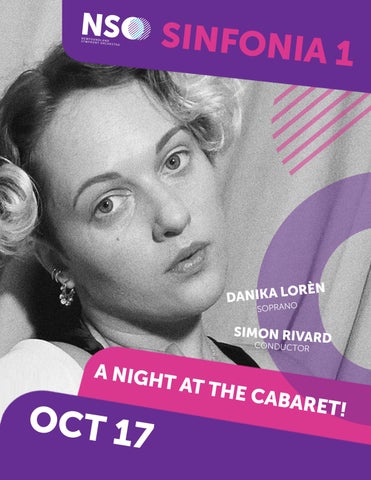
SINFONIA 1: A NIGHT AT THE CABAR ET!
2
We acknowledge the province of Newfoundland and Labrador as the traditional territory of diverse Indigenous groups, and we acknowledge with respect the distinct histories and cultures of the Beothuk, Mi’kmaq, Innu, and Inuit of this province. We strive for respectful relationships with all the peoples of this province as we search for collective healing and true reconciliation and honour this beautiful land together.
SINFONIA 1
A NIGHT AT THE CABARET! Saturday, October 17, 2026 • D.F. Cook Recital Hall Presented by Quidi Vidi Brewery
PROGRAMME
Danika Lorèn, soprano
Simon Rivard, conductor
Kander/Ebb Cabaret from Cabaret
4 min.
arr. Simon Rivard
William Bolcom
Cabaret Songs
10 min.
(b. 1938) Amor Toothbrush Time The Total Stranger in the Garden At the Last Lousy Moments of Love
Kurt Weill Suite from Threepenny Opera
20 min.
(1900-1950) arr. Simon Rivard I. Overture II. The Ballad of Mack the Knife III. Instead-of Song IV. Ballad of the Easy Life V. Polly’s Song VI. Tango-Ballade VII. Cannon Song VIII. Threepenny Finale
William Bolcom
Cabaret Songs
10 min.
(b. 1938) Surprise! Song of Black Max The Actor George
Dmitri Shostakovich
Waltz from Suite for Variety Orchestra
4 min.
(1906-1975) arr. Simon Rivard
Jacques Ibert
Divertissement
(1890-1962) I. II. III. IV. V. VI.
15 min.
Introduction Cortège Nocturne Valse Parade Finale
SINFONIA 1: A NIGHT AT THE CABAR ET!
3
CONDUCTOR
SIMON RIVARD Simon Rivard is the Music Director of the Newfoundland Symphony Orchestra and Principal Conductor of The Happenstancers. In the 2026/27 season, Simon will lead Mahler’s First Symphony, Haendel’s Messiah, and Verdi’s La traviata with the Newfoundland Symphony Orchestra. Other season highlights include his début with the National Arts Centre Orchestra, and a return to the podium at Opéra de Montréal for a new production of Verdi’s Rigoletto. He has conducted orchestras across North America and Europe, including Orchestre symphonique de Montréal, Orchestre Métropolitain, Orchestre symphonique de Québec, and the Lapland Chamber Orchestra (Finland), among others. He has collaborated with artists such as Barbara Hannigan, Kerson Leong, Daniel Lozakovich, Matt Haimovitz, and Charles Richard-Hamelin. Operatic repertoire remains central to Simon’s artistic focus. He served, for three seasons, as Edmonton Opera’s inaugural music director. From 2018 to 2022, he was Resident Conductor of the Toronto Symphony Orchestra, where he was mentored by Gustavo Gimeno and Sir Andrew Davis. He was also the Conductor of the Toronto Symphony Youth Orchestra (2018-2024), and the Associate Conductor of the Toronto Mendelssohn Choir (2020- 2022). Born in Montréal, he studied violin performance and orchestral conducting at the Conservatoire de musique de Montréal and McGill University.
GUEST T ARTIS
DANIKA LORÈN soprano
Danika Lorèn is a multi-disciplinary creative force based in Toronto, known for their bold fusion of classical tradition and contemporary innovation. Danika brings a distinctive voice to both performance and composition, creating work that is emotionally rich, theatrically compelling, and technically virtuosic. As a composer, Lorèn’s work has been showcased internationally at Wigmore Hall, the Leeds Lieder Festival, National Sawdust, Cincinnati Song Initiative and the Muziekgebouw aan ‘t IJ. Within Canada, their compositions have been featured by the Canadian Opera Company, Soundstreams, the Canadian Art Song Project, the Women’s Musical Club of Toronto, Pacific Opera Victoria, the Saskatoon Symphony Orchestra, Thunder Bay Symphony Orchestra and the CBC. Danika’s musical style is marked by an intimate, text-driven approach that blends their intimate knowledge of the classical voice with a modern emotional nuance. Though Danika is largely self-taught, they have also received mentorship in composition from Lori Laitman through the National Association of Teachers of Singing (NATS). As a performer, Danika’s repertoire encompasses intimate art song, contemporary chamber works, and traditional opera. They regularly perform with the Happenstancers, a leading voice in Toronto’s contemporary chamber scene, and have given many Canadian and North American debuts of living composers including Tansy Davies, Shawn Jaeger and Thierry Tidrow. Danika is a skilled interpreter of new music and a keen explorer of extended techniques, with a particular focus on developing the acoustic/unamplified voic through improvisation. This exploration was greatly inspired by Danika’s time at Westben’s Performer/Composer residency (2024). Danika is an alum of Barbara Hannigan’s Equilibrium Young Artists and graduate of the Canadian Opera Company’s Ensemble studio. They completed a Bachelor of Vocal Performance with J. Patrick Raftery and Master in Opera Performance with Wendy Nielsen, both from University of Toronto. Danika began their music journey at a young age under the guidance of Marilyn Whitehead (voice) and Penny Joynt (piano) in their hometown of Saskatoon, SK.
SINFONIA 1: A NIGHT AT THE CABAR ET!
5
VIOLIN 1 Heather Kao (concertmaster) Dominic Greene (asst. concertmaster) Andy Kao Anastasia Kiseleva Jacquelyn Redmond
MUSICIANS
BASS
VIOLIN 2 Nancy Case-Oates (principal) Carole Bestvater Elena Vigna Amanda Yee (OCP)
Frank Fusari (principal)
FLUTE Michelle Cheramy (principal)
TRUMPET
VIOLA
OBOE/ ENGLISH HORN
TROMBONE
Kate Read (principal) Ema Shiroma-Chao Chantelle Jubenville
Annie Corrigan (principal)
Darren McDonald (principal)
CLARINET
PERCUSSION
CELLO Nathan Cook (principal) Amy Collyer-Holmes Leah Mezo-Willingham
Glenn Rice (principal)
BASSOON Grant Etchegary (principal)
Katie Sullivan (principal)
Rob Power (principal) Etienne Gendron Craig Thorne
PIANO/CELESTE Jenny Griffioen (principal)
HORN Emily Dunsmore (principal)
HARP Sarah Veber (principal)
SINFONIA 1: A NIGHT AT THE CABAR ET!
6
PROGRAM NOTES
SINFONIA 1: A Night at the Cabaret! Program Notes provided by: Dr. Annalise Smith
As a musical idea, cabaret is both evocative and hard to define. In an essay titled “What is a Cabaret Song?” lyricist Arnold Weinstein- who penned the lyrics for the William Bolcolm (b. 1938) songs on tonight’s program- landed on the definition of a “form of theater-poetrylieder-pop-tavernacular prayer.” While we can trace aspects of the cabaret back to Parisian salons and café culture in the eighteenth century, the cabaret reached its zenith by the late nineteenth century in venues such as the “Chat noir” in Paris and the “Überbrettl” in Berlin. These theatres-cum-restaurants would flourish until the 1930s, when the rise of fascist regimes put an end to the freedom of speech and expressive experimentation one came to expect from the cabaret. The end of cabaret culture is captured in John Kander (b. 1927) and Fred Ebb’s (19282004) musical Cabaret (1966). We see here the familiar trappings of cabaret—the Master of Ceremonies who leads the audience from one act to another, the intimate connection fostered between audience and performers, the consumption of food and drink as part of the experience. But the Kit Kat Klub is also a second-rate version of cabaret as it existed in the early twentieth century- Sally Bowles, despite her charm, is canonically not a particularly good performer. While the primary goal of the cabaret was to entertain, its adherents believed that high art could also flourish in these spaces. Many classical composers, including Erik Satie and Arnold Schönberg, wrote for the cabaret, and the top performers were renowned for their musical and acting abilities. Cabaret is best defined as a set of artistic and social activities, rather than a specific musical style. Nevertheless, certain kinds of music became associated with the genre. Kurt Weill (1900-1950) never officially wrote for the cabaret, but singers frequently borrowed his music, particularly songs from “The Threepenny Opera,” for their acts. Weill himself arranged some of this opera’s most famous numbers, including “The Ballad of Mack the Knife” and
SINFONIA 1: A NIGHT AT THE CABAR ET!
7
PROGRAM NOTES (cont’d)
the “Cannon Song” into the Suite from the Threepenny Opera in 1929, just a year after the opera’s premiere. Much of the music used for cabaret had theatrical connections. Jacques Ibert’s (1890-1962) Divertissement (1930), a six-movement suite for chamber orchestra, was adapted by the composer from incidental music written for the stage play “The Italian Straw Hat,” in which a wedding day is thrown into chaos when the groom’s horse eats the titular hat, leading to a series of misadventures as he attempts to replace it. Ibert’s suite was not designed for the cabaret, but his music certainly reflects a certain burlesque style, mixing the chaotic, grotesque, and melodic to paint an evocative picture of the comedy of errors. Dmitri Shostakovich (1906-1975) also evokes popular entertainment in his Waltz from Suite for Variety Orchestra No. 1 (1956) with an instrumentation that conjures up a sultry dance hall. While the era of cabaret has passed, the idea of cabaret continues to inspire composers to try their hand at the genre. Best known today is William Bolcolm who released twenty-four Cabaret Songs in the second half of the twentieth century. The texts by Weinstein range from echoes of Weill in “Song of Black Max,” to the trials of relationships in “Toothbrush Time,” to the ridiculous power of love in “Amor.”
SINFONIA 1: A NIGHT AT THE CABAR ET!
8
UPCOMING CONCERTS
A STANDING
OVATION
FOR OUR SUPPORTERS