MESSAGE FROM THE PREMIER On behalf of the Government of Newfoundland and Labrador, I am delighted to extend warm congratulations and best wishes to the Newfoundland Symphony Orchestra as it embarks on its 2026-2027 season. This year’s program promises an inspiring journey through beloved masterworks, celebrated guest artists, cherished seasonal traditions, and exciting new musical experiences for audiences across our province. The NSO continues to enrich Newfoundland and Labrador’s cultural landscape by bringing people together through the transformative power of music. Your commitment to artistic excellence, community engagement, and accessibility ensures that audiences of all ages and backgrounds can experience the joy and wonder of live orchestral performance. As musicians, Hon. Tony Wakeham staff, volunteers, supporters, and patrons gather for another remarkable season, Premier of Newfoundland and Labrador we wish you continued success both on and off the stage. May this year be filled with memorable performances, standing ovations, and meaningful connections forged through music. Congratulations on an exciting season ahead, and thank you for the invaluable contribution you make to the cultural life of our province.
NANT GOVERNOR MESSAGE FROM THE LIEUTE
As Honorary Patron of the Newfoundland Symphony Orchestra, I am so pleased to extend greetings and very best wishes for the 2026-2027 season. A wonderful variety of performances are planned, and the NSO will once again delight audiences and profile many of the exceptional artists we have in our province. The NSO’s orchestral music is an integral part of the fabric of the arts in our province and is truly a gift to us all. I hope you enjoy each show that the NSO has in store this year. To everyone involved: the musicians, staff, crew, and all who contribute to producing each performance, thank you. I look forward to this season!
Joan Marie J. Aylward, O.N.L Lieutenant Governor of Newfoundland and Labrador
OR MESSAGE FROM THE MAY On behalf of St. John’s City Council, it is my pleasure to welcome audiences to another exciting season of the Newfoundland Symphony Orchestra. The NSO has long been an important part of the cultural fabric of our city, bringing people together through the power of music and creating memorable experiences for residents and visitors alike. We are proud to support the NSO and its ongoing efforts to make music accessible, engaging, and meaningful. Best wishes for a successful and inspiring season.
Danny Breen Mayor of St. John’s
MASTERWORKS 1: TITANS AWAKEN
2
We acknowledge the province of Newfoundland and Labrador as the traditional territory of diverse Indigenous groups, and we acknowledge with respect the distinct histories and cultures of the Beothuk, Mi’kmaq, Innu, and Inuit of this province. We strive for respectful relationships with all the peoples of this province as we search for collective healing and true reconciliation and honour this beautiful land together.
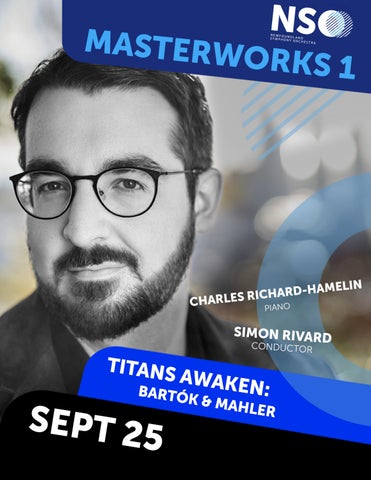
MASTERWORKS 1
TITANS AWAKEN Friday, September 25, 2026 • St. John’s Arts & Culture Centre Presented by the City of St. John’s
Charles Richard-Hamelin, piano Simon Rivard, conductor
PROGRAMME Béla Bartók
Piano Concerto No. 3
23 min.
I. Allegretto II. Adagio religioso III. Allegro vivace INTERMISSION
Gustav Mahler
Symphony No. 1, “Titan”
50 min.
Reduction by Erwin Stein I. Langsam schleppend II. Kräftig bewegt III. Feierlich und gemessen IV. Stürmisch bewegt
MASTERWORKS 1: TITANS AWAKEN
3
CONDUCTOR
SIMON RIVARD Simon Rivard is the Music Director of the Newfoundland Symphony Orchestra and Principal Conductor of The Happenstancers. In the 2026/27 season, Simon will lead Mahler’s First Symphony, Haendel’s Messiah, and Verdi’s La traviata with the Newfoundland Symphony Orchestra. Other season highlights include his début with the National Arts Centre Orchestra, and a return to the podium at Opéra de Montréal for a new production of Verdi’s Rigoletto. He has conducted orchestras across North America and Europe, including Orchestre symphonique de Montréal, Orchestre Métropolitain, Orchestre symphonique de Québec, and the Lapland Chamber Orchestra (Finland), among others. He has collaborated with artists such as Barbara Hannigan, Kerson Leong, Daniel Lozakovich, Matt Haimovitz, and Charles Richard-Hamelin. Operatic repertoire remains central to Simon’s artistic focus. He served, for three seasons, as Edmonton Opera’s inaugural music director. From 2018 to 2022, he was Resident Conductor of the Toronto Symphony Orchestra, where he was mentored by Gustavo Gimeno and Sir Andrew Davis. He was also the Conductor of the Toronto Symphony Youth Orchestra (2018-2024), and the Associate Conductor of the Toronto Mendelssohn Choir (2020- 2022). Born in Montréal, he studied violin performance and orchestral conducting at the Conservatoire de musique de Montréal and McGill University.
C H A R L E S RICHARDT S E U G HAMELIN, piano ARTIST Silver medalist and winner of the Krystian Zimerman Prize at the 2015 International Chopin Piano Competition, pianist Charles Richard-Hamelin has emerged as one of the most important pianists of his generation. Recipient of the Ordre des arts et des lettres du Québec and of the prestigious Career Development Award conferred by the Women’s Musical Club of Toronto, he was awarded the Prix Denise-Pelletier in November 2022, becoming the youngest recipient in the history of the Prix du Québec. He has been invited to many major festivals such as La Roque d’Anthéron and the Nohant Festival in France, the Prague Spring Festival, the Chopin and his Europe Festival in Warsaw, the Lanaudière Festival and the George Enescu Festival in Bucarest. As a soloist, he has performed with many ensembles including the major Canadian symphony orchestras (Montreal, Toronto, Ottawa, Metropolitan, Quebec City, Edmonton, Calgary, etc.) as well as the Warsaw Philharmonic Orchestra, Sinfonia Varsovia, Tokyo Metropolitan Symphony Orchestra, Singapore Symphony Orchestra, Korean Symphony Orchestra, OFUNAM (Mexico), Les Violons du Roy and I Musici de Montréal. He has worked with such renowned conductors as Kent Nagano, Rafael Payare, Bernard Labadie, Antoni Wit, Vasily Petrenko, Jacek Kaspszyk, Aziz Shokhakimov, Peter Oundjian, Jacques Lacombe, Fabien Gabel, Carlo Rizzi, John Storgårds, Alexander Prior, Giancarlo Guerrero, Christoph Campestrini, Lan Shui, Otto Tausk, Jean-Marie Zeitouni, Kazuki Yamada, Yannick Nézet-Séguin and Jonathan Cohen. Charles Richard-Hamelin is also active as a chamber musician. He has performed with Andrew Wan, James Ehnes, Marie-Nicole Lemieux, Marc-André Hamelin, the Dover Quartet, the New Orford Quartet, the Apollon Musagète Quartet and the Meccore Quartet, among others. A graduate of McGill University, the Yale School of Music and the Conservatoire de musique de Montréal, he studied with Paul Surdulescu, Sara Laimon, Boris Berman, André Laplante and Jean Saulnier. Charles Richard-Hamelin has recorded eleven albums, all released on the Analekta label (Outhere Music). Five of these are dedicated primarily to the solo piano works of Frédéric Chopin; there are also four recordings with Andrew Wan, concertmaster of the OSM. He has also recorded concertante works: both Chopin piano concertos with the Orchestre symphonique de Montréal, conducted by Kent Nagano, and Mozart’s Piano Concertos nos. 22 and 24 with Les Violons du Roy, conducted by Jonathan Cohen. Six Félix awards (ADISQ) and a JUNO in 2022 saluted the quality of these albums, which have been received widespread acclaim from critics around the world.
MASTERWORKS 1: TITANS AWAKEN
5
VIOLIN 1 Heather Kao (concertmaster) Dominic Greene (asst. concertmaster) Andy Kao Anastasia Kiseleva Gabriel Brodeur Lauren Smee BASS Amanda Yee (OCP) Frank Fusari (principal) Rachael Hammond (OCP) Denise Lear Nick Howlett VIOLIN 2 Matthew Hardy Nancy Case-Oates (principal) Ethan Gough Carole Bestvater Elena Vigna FLUTE Jacquelyn Redmond Michelle Cheramy (principal) Natalie Finn Sarah Comerford Claire Boudreau Karen Hawkin OBOE/
MUSICIANS
VIOLA Kate Read (principal) Ema Shiroma-Chao Chantelle Jubenville Samuel Farquharson Norma Noseworthy Jonathan Stevenson
CELLO Nathan Cook (principal) Amy Collyer-Holmes Leah Mezo-Willingham Sandra Pope Nancy Bannister Katherine Shipley
ENGLISH HORN
Annie Corrigan (principal) Valerie Holden
TRUMPET Katie Sullivan (principal) Jill Dawe Christian Berglander Michael O’Keefe
TROMBONE Darren McDonald (principal) Erin Sullivan
BASS TROMBONE
CLARINET
Andrew Cooper (principal)
Glenn Rice (principal) Brenda Gatherall Lucas Upward
TUBA
BASSOON
PERCUSSION
Grant Etchegary (principal) Nicole Hand
HORN Emily Dunsmore (principal) Doug Vaughan Michelle Stevenson David Natsheh Mara Pellerin
Jo Dashney (principal) Rob Power (principal) Etienne Gendron J Benson (OCP) Noah Mercer (OCP)
HARP Sarah Veber (principal)
MASTERWORKS 1: TITANS AWAKEN
6
PROGRAM NOTES MASTERWORKS 1: Titans Awaken Program Notes provided by: Dr. Annalise Smith
Our brains are programmed to remember firsts and lasts. Tonight’s concert features works that bookend the lives of two composers: Gustav Mahler’s first major orchestral work, Symphony No. 1 (1889), and Béla Bartók’s Piano concerto No. 3 (1945), the last work the composer wrote before he died.
Mahler (1860-1911) was better known as a conductor when his first symphony was premiered in 1889. Mahler published very few of his early works; Dutch conductor Willem Mengelberg, a friend of Mahler’s and frequent conductor of his works, thought the work so sophisticated that he suspected the composer had written earlier orchestral works he simply hadn’t released. The symphony’s initial reception, however, was rather negative, perhaps in part due to the work’s confusing presentation. Mahler originally called it a “tone poem in symphonic form,” a genre designation that suggests an extramusical context to the work. Mahler, however, did not provide the audience any kind of program or description. At the second and third performances, he titled the work “Titan” and provided program notes that alluded to images such as the emergence of spring (mvt. 1), a ship under full sail (mvt. 2), a funeral march (mvt. 3), and the transcendent journey from heaven to hell (mvt. 4). Revisions continued until 1896, the symphony reaching its ultimate form when Mahler jettisoned the original second movement, reducing the work down to four, and removing any programmatic context. Though an early work, the first symphony hearkens to Mahler’s mature form—the expansive orchestration; the large scale of the overall work; references to other pieces, including here compositions by Brahms, Wagner, and Liszt, folk songs (listen for the minor version of “Frère Jacques” in the third movement) and Mahler’s own song cycle “Songs of the Wayfarer; and the mix of musical styles, such as the inclusion of klezmer.
MASTERWORKS 1: TITANS AWAKEN
7
PROGRAM NOTES (cont’d) While Mahler died on the eve of World War I, v lived just long enough to see the end of World War II, and thus the radical shift in Western classical music from the lushness of late nineteenth–century music to the avant garde styles that characterized the first half of the twentieth century. Though Bartok was devoted to his home country of Hungary (he would spend much of his career collecting folk songs), the country’s alliance with the Axis Powers in World War II led the composer, a staunch anti-fascist, to flee Hungary and settle in New York City. Bartók’s modernist music struggled to find a foothold in America, and it was only in the few years before his death from leukemia that he returned to composition. Compared to earlier works, Bartók’s third piano concerto is more accessible, backing away from some of the composer’s more adventurous musical tendencies, yet still reflecting his musical interests. Melodies inspired by Hungarian folk music appear in the first and third movements, combined with explorations of post-tonal harmony. The middle section of the second movement features Bartók’s oft-used night music style, in which atmospheric chords are combined with evocations of birds and other nocturnal creatures. Piano concerto No. 3 was intended as a birthday present for Bartók’s wife Ditta, with the intention that she could perform the work herself (and financially benefit from its performance). Seventeen measures remained unwritten when Bartók passed; the concerto was ultimately completed by his pupil Tibor Serly.
MASTERWORKS 1: TITANS AWAKEN
8
UPCOMING CONCERTS
A STANDING
OVATION
FOR OUR SUPPORTERS