North Shore RapidBus to Metrotown fast-tracked to September
ARTS14
Photolithics
Exhibition features ‘one of the most important artists working in Canada’
SPORTS21
Downhillfast
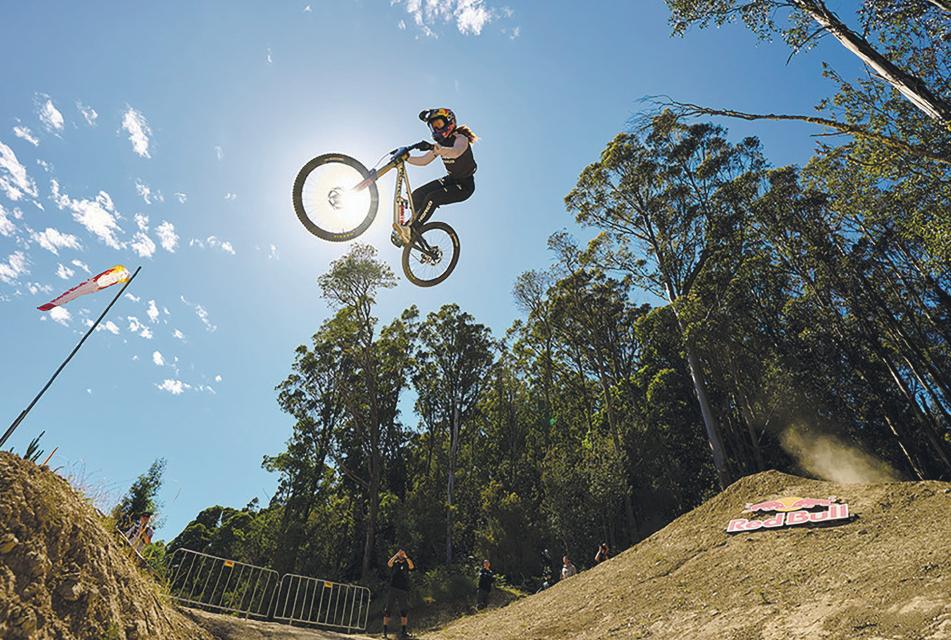
High-flying Red Bull mountain bike event coming to Cypress Mountain
DNV council rejects Chemtrade chlorine proposal
BRENT RICHTER
brichter@nsnews.com
District of North Vancouver council has voted to stop a major waterfront industrial business from producing liquid chlorine at its site.
Chemtrade and its predecessors have been making the chemical at the Amherst Avenue plant in Maplewood since 1957.
Under their lease with the Vancouver Fraser Port Authority though, Chemtrade is required to stop producing, storing and transporting liquid chlorine on port land by July 2030. The company intended to move those activities onto a separate portion of the property that is under the jurisdiction of the District of North Vancouver’s zoning bylaw, which prohibits the manufacture of hazardous substances
A split council voted 4-3 Monday to deny that request.
The vote followed a controversial public consultation process with residents and industry officials raising lifeand-death concerns about the risk associated with chlorine, which can be fatal in high enough concentrations.
A peer-reviewed quantitative risk assessment found that Chemtrade’s proposed safety upgrades for the site would reduce both the likelihood of a spill and the potential consequences of one compared to its operations today, and that off-site individual and societal risks would remain below applicable thresholds.
Continued on A20
BodwellRealWorld Academiesgivestudentshands-on experience that impresses universities
StudentsatBodwell High School aregaining hands-on experience in STEM andmedia that helps them standout in university applications andbeyond
Many familiesthink that universitypreparation in high school follows afamiliar formula: earn strong grades, submit an application andget accepted.Theyhopethat’s enough.
Fortoday’s students preparing to professionallyenter ourrapidly changing world, it oftenisn’t
University acceptances arebased on more than just marks. It’s critical that students share tangible,portfolio-quality evidenceoftheir learningand aptitudetoproperlycompete for thelimitedspots available in high-demand programs.
Launching in fall 2026,Bodwell High School’s Real World Academies, developed with inputfromthe University of Torontoand other partners, offersGrade 10-12students specializeduniversitypathwaysinSTEM and media.
Bodwell’snew programisprimedto further support theirstudentsto standout in their university applicationsbycombiningstrong academicswithhands-onlearning.
Themodel is simple:learn, apply, produce, showcase.
Unlike conventional academic programs, studentsdomorethanonlystudy concepts. They build robotics,develop code, film projects, edit content andworkin teams.
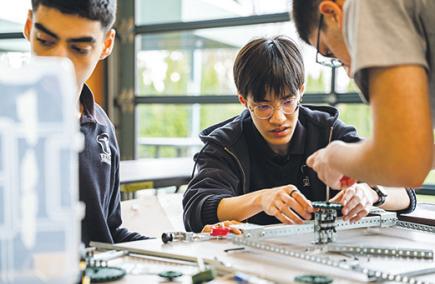
Students in Bodwell High School’s Real World Academiesgain hands-on experience in STEM and mediaprojectswhile building skills for university and future careers.Photovia Bodwell High School
Adifferenthighschoolmodel
Amongthe strongest university-preparatory schoolsinthe LowerMainland,Bodwell is an independent high school in NorthVancouver, serving both localCanadian andinternational students in Grades8-12, with day,weekday boardingand full boardingoptionsinone learningcommunity.
Aftergaining admission, qualifying Grade 10-12studentsare invitedtoapply to oneof twoacademies. Theseacademiessit within abroader academic model, includingIB Middle YearsProgram (Grades8–10), the BC Graduation Programand Advanced Placementcourses
Each semester,admittedstudentscombine theiracademic courseswithanacademy block,workshops, team projects andpublic showcasesincludingtechfairsand film festivals.
Bodwell studentstakefivecoursesper semester, making this academymodel possible. As acampuswithboarding options, that advantage expandsfurther. With structured time available afterthe school day, both day and boarding studentshavemore opportunities to collaborate,practiceand refine theirwork.
What universities are reallylooking for University admissionsare increasinglyabout evidence, not just marks.
Real WorldAcademies aredesignedaround the questions: what has this student created, what problemshavetheytackled and whereis the proofofinitiativeand collaboration.
Theproof of this approach is already there. Recent graduate AlanaDamon earned a combined$1.3million in scholarships from severalU.S. universitiesin2026. Her documentary work and portfolio, created with mentorshipfromfaculty and participation inBodwell’s MediaClub,werecentral to thatoutcome
Whilemanystudents follow similaracademic paths, academies buildonBodwell’s established clubs in STEM and mediatogive admitted studentshands-on experiencewith industry tools in real-world settings. In fields like engineering,computerscience, mediaand marketing,strong portfolios cangivestudents aclear advantage.
Bodwell’spartnership with University of Toronto
Bodwell’sapproach is further reinforced through itspartnership with theUniversity of Toronto, whereapproximately one-third of Bodwell graduates applyeachyear,witha highacceptancerate
“Wewelcome applicationsfromBodwell studentsbecause they develop thequalities we look forinstrong applicants: intellectual curiosity, critical thinking,resilience, and evidence-basedproblem solving,” says KenWithers,director, University Student RecruitmentatU of T.
As partof this select partnership,UofT guarantees at leastone scholarship valued between $100,000and $180,000 to an admitted Bodwellgraduate each year
STEM Academy
In theSTEM Academy,students progress from foundational skills to advanced programming, engineering design and systemsdevelopment. They design,build, test and improvereal systems.
Trevor Yu,a participant of Bodwell’srobotics team,shareshis experiencecompeting in VEXRoboticscompetitionsagainst otherhigh schools. “Hands-on engineering is something that Ibelieve is not really taughtinclassrooms,” says Yu.“Robotics involves both mechatronics and software engineering and you can’tbe involved as asingleperson team.Without teamwork and collaboration,wewouldn’t even have such results.”
The STEM Academy is best suitedfor students interested in applying for programs in engineering, computer science, AI &Machine Learning, Data Science, Software engineering andApplied Mathematicsatcompetitive Canadian and International universities.
StudentsinBodwell’s STEM Academydesign and test real engineeringsystems while buildingteamwork skillsthrough robotics and advanced programming. Photovia Bodwell High School
InnovativeMedia Academy
In theInnovativeMedia Academy, students develop practicalcreativeskillsinfilmmaking, digitalmarketing and storytelling.
They create documentaries,shortfilms and campaignswhile learning howideas connect with audiences
Students arementoredbyeducatorsand practitioners including JesseBlaskovits, coachofBodwell’s StudentMedia Team “Whatmakes thedifferenceisthatstudents areproducing real work,not just completing assignments,”saysBlaskovits. “Theyleave with abodyofworktheycan actuallyshow to universities, to collaboratorsand to theworld.”
TheMedia Academyisbestsuitedfor students interested in applying forprograms in film and mediastudies, marketing and branding,communications, and business and entrepreneurship
Aclearer path forward
For familiesand students acrossNorth Vancouver,WestVancouver,Burnaby and Vancouver whoare seeking competitive pathways to Canadian and International universities, thehighschool youchoose needstodomorethansimplyprepareyou to graduate.
Real WorldAcademies aredesignedfor students whoare motivated to builda transcriptand learning evidencethataligns closelywithwhatuniversitiesare looking for.
For theBodwell admissionsteam,prior experiencein mediaand STEM is less important than interest,curiosity and a willingness to try.
Interested families areencouragedtobook acampustour and conversation by emailing aBodwell admissionsrepresentativeat admissions@bodwell.edu. LimitedAcademy spaces areavailable and applying early is recommended.
Bodwell High School is afully accredited BC independentschool serving both localand international students in North Vancouver.Their waterfront campusbrings together learners from BritishColumbia and over 40 countries in one inclusive, forward-thinking community.Theyoffer IB MiddleYears in Grades8–9,and the BC curriculum with Advanced Placement optionsinsenior grades.
StudentsatBodwell High School arebuilding real-world skills andstanding outwiththe new Real WorldAcademieslaunching Fall 2026.Photovia BodwellHigh School
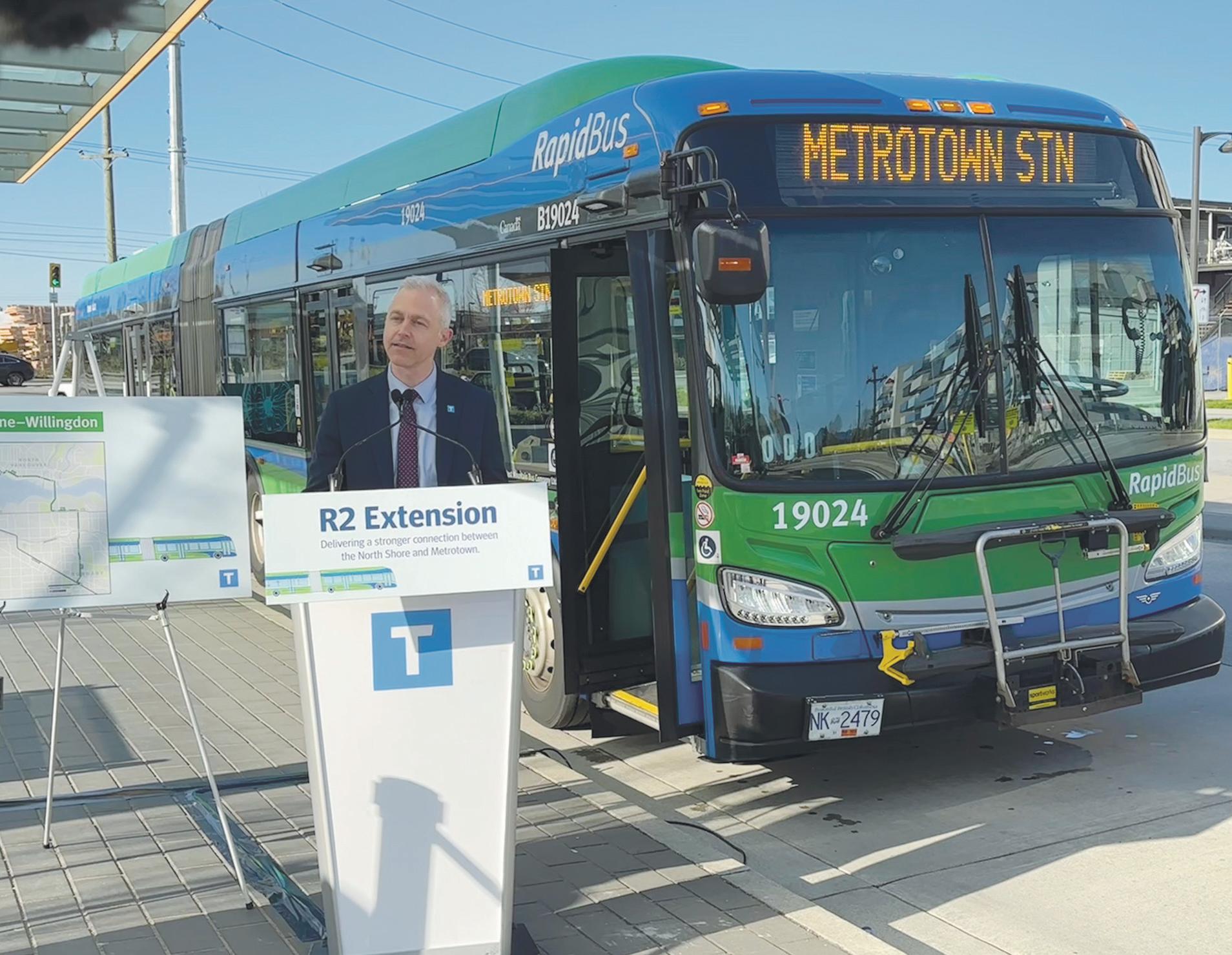
North Shore RapidBus to Metrotown fast-tracked to September
BRENT RICHTER brichter@nsnews.com
For once, it’s a good thing when your bus arrives ahead of schedule.
TransLink announced Wednesday, April 8, that the R2 RapidBus extension from the North Shore to Metrotown will begin operating this September, well ahead of the previously announced target of 2027.
“For people who rely on this corridor every day, that was just too far away Too many customers have dealt with overcrowded buses, multiple transfers, and honestly, long waits just to get where they need to go,” said TransLink CEO Kevin Quinn at the announcement at Phibbs Exchange. “We heard that We worked with our partners, and we moved and we pushed faster.”
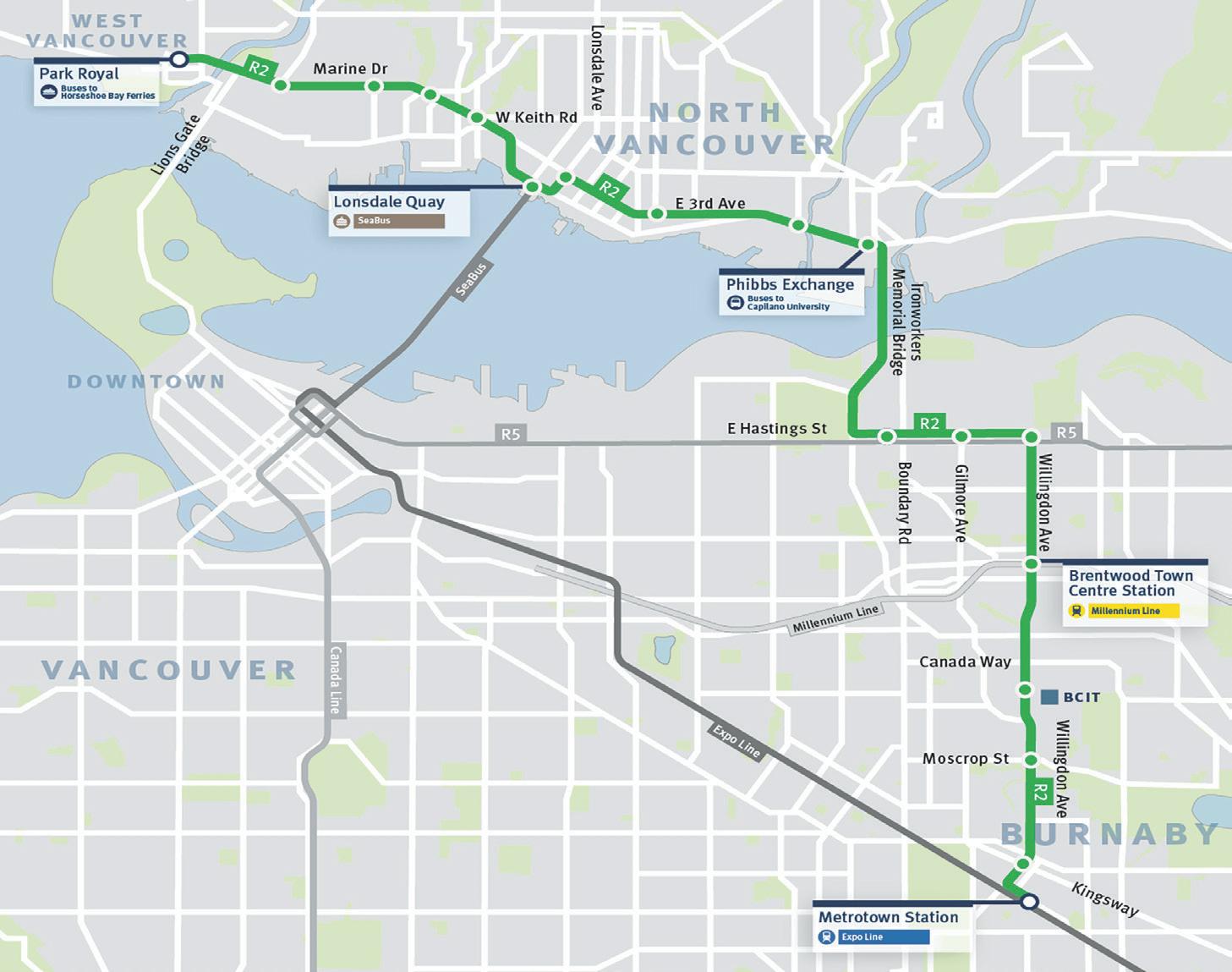
The R2 Marine–Willingdon RapidBus, as it will be renamed, follows the same route with the same stops that the R2 does on the North Shore today, but instead of terminating at Phibbs, it will continue on over the Ironworkers Memorial Second Narrows Crossing to Hastings Street through Burnaby Heights to Willingdon Avenue before arriving at Metrotown Station.
When the R2 extension comes into effect, TransLink will stop running the 222 express bus, which follows a similar route between Metrotown and Phibbs but only operates during weekday rush hours
The R2 runs later in the evening and more frequently during peak hours
Quinn said an end-to-end trip on the extended R2 route will take between 50 and 70 minutes, depending on the time of day. Making that trip along the same route during rush hour today with a transfer at Phibbs would take about an hour and
VEHICLES IMPOUNDED
a half, according to Google Maps estimates.
“This is a big deal for commuters along this corridor,” Quinn said. “It will mean a direct one-seat ride. It will mean faster, more frequent and more reliable service that people can count on every day.”
According to TransLink stats, the 222 had 946,000 boardings in 2024 – an average of 3,790 per day The R2 RapidBus currently has more than 1.9 million boardings per year About 18,000 passengers use Phibbs Exchange per day
District of North Vancouver Mike Little said the announcement will go some way to addressing two of the most critical issues on the North Shore – transportation and congestion.
“We’ve also seen a massive increase in the number of workers coming to the North Shore in the last 20 years and it’s resulted in a lot more people needing this transit service to be able to get them through the corridor,” he said. “It deeply impacts our ability to get around and live
in this area. And the only real solution to it in the short term is going to be to provide fast and reliable transit services in order to be able to help people make the decision to get out of their car.”
The R2 extensions was made possible through funding from TransLink Mayors’ Council and the province. North Vancouver-Lonsdale MLA Bowinn Ma also noted the increase in commuters who come to the North Shore because they cannot afford to live here and stressed that the entire transportation system in Metro Vancouver would benefit.
“It will serve not only those people who currently use transit, but also those people who might now use transit because of the one-seat connection between the North Shore and the main rapid transit system. It will also be a boon for people who need to drive their cars,” she said.
City of North Vancouver Mayor Linda Buchanan called the update a “major milestone” in addressing a pressing need. But she also took the occasion to push senior levels of government to commit to funding a Bus Rapid Transit system, which should provide even faster service.
“If we are expected to deliver more housing and strengthen the economy, that investment must follow,” she said. “Because delays have real costs, not just in dollars, but in lost opportunity for people and our economy The North Shore cannot wait any longer.”
North Vancouver Chamber CEO Patrick Stafford-Smith shared similar sentiments.
“We urgently need more We need sustained funding commitments from the province and federal government to deliver
North Vancouver RCMP put the brakes on five excessive speeders
JANE SEYD
jseyd@nsnews.com
A drive in the balmy spring weather turned very expensive for several drivers in North Vancouver over the Easter weekend.
Police officers issued five tickets for excessive speeding in one four-hour period on Saturday, April 4. Drivers were clocked going anywhere
from 120 kilometres per hour to 153 km/h in an 80 km/h stretch of highway between Lonsdale Avenue and Westview Road. All drivers had their rides impounded for seven days.
Fines for excessive speeding –depending on how fast the vehicle was going – ranged from $368 to $483. Excessive speeding tickets also come with penalty points requiring drivers to
pay additional fines.
Cpl. Mansoor Sahak said RCMP warned drivers on social media prior to the blitz they would be out on the weekend doing speed enforcement.
He added there’s a high likelihood of officers being out again to nab speeders.
“We’re going to be out there every weekend,” he said. “Our tactics have not changed.”
North Vancouver RCMP nabbed five excessive speeders April 4. NICK LABA / NSN FILES
TransLink CEO Kevin Quinn announces the extension of the R2 RapidBus from the North Shore to Metrotown in Burnaby at a press event held at North Vancouver’s Phibbs Exchange on Wednesday, April 8. BRENT RICHTER / NSN
Black bears at risk from drivers, advocates warn
BRENT RICHTER brichter@nsnews.com
The North Shore Black Bear Society is calling on drivers to tap the brakes as sleepy bears and their cubs are starting to emerge from their dens.
The biggest risk to bears at this time of year is vehicle traffic. Based on the number of yearlings around last year, it’s possible there will be some babies tagging along with sows this spring, said Holly Reisner, executive director of the Black Bear Society
After months of hibernation, bears are drawn to boulevards for an easy meal of grass and other greens – a natural food source that helps get their digestive systems going again. (Incidentally, this also means larger piles of bear scat this time of year, so watch your step while the bruins engage in a little “spring cleaning.”)
And much like the rest of us, bears are a bit groggy after waking up from a long winter’s nap.
“It takes them a week or so to fully get back up to speed. During this time, they are a little bit slow and dopey,” Reisner said.
Already, the society is aware of one bear that was struck on Dollarton Road. Reisner said the bear rolled and then ran off into the bushes. It’s possible the bear could be surviving with injuries – something they are known to do. There are two other bears with obvious limps making their way around North Shore neighbourhoods, including one with a broken leg, Reisner said.
“We are hopeful that it will heal,” she said. “Bears are very resilient animals and they often heal well from even terrible injuries.”
In B.C., it is not legal to provide veterinary care for bears over the age of one year, but it appears the injured bears in question are able to find food and water for themselves.
“So we can only monitor them and give them lots of space,” she said
On the subject of spring cleaning, Reisner said it’s now time for the rest of us to ensure we aren’t luring bears into bad habits or danger with non-natural food sources. That means garbage, compost, bird feeders, pet food, barbecues, tree fruit, grease traps and anything else around residential properties that smells appealing to a hungry bear
The Black Bear Society always recommends cleaning out garbage, compost and
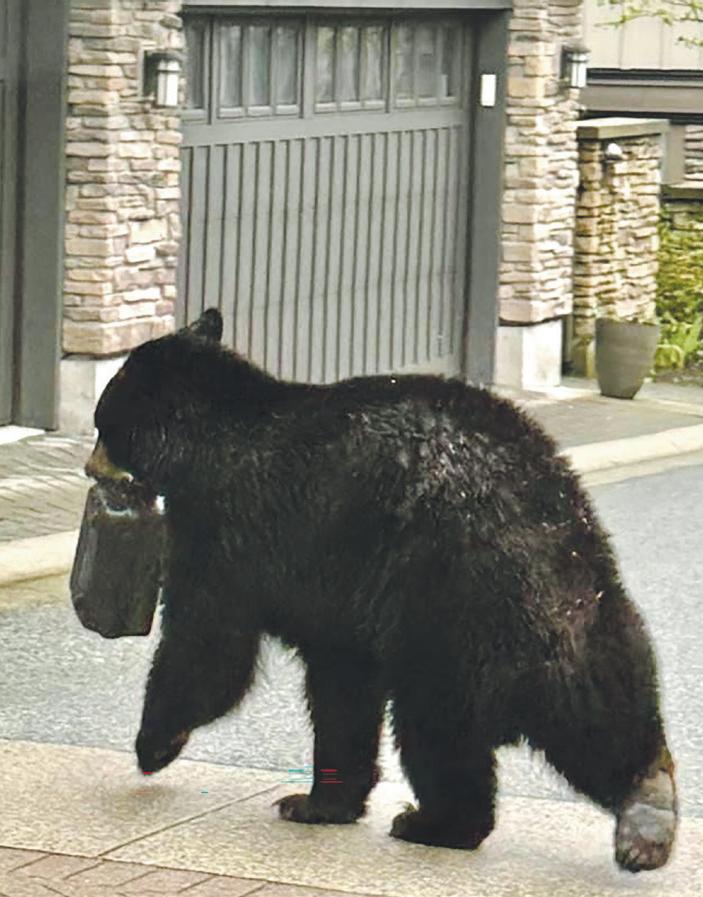
A Blueridge area black bear makes off with a worker’s lunch on April 2. The North Shore Black Bear Society is urging North Vancouver and West Vancouver residents to clean up their acts as bears emerge from hibernation. SABRINA MARINE
recycling bins, washing out food packaging before disposing of it and freezing organics before taking them to the curb.
“A bear’s sense of smell is about 2,000 times more sensitive than ours – eight times that of a bloodhound – and they use this and their amazing memories to find food,” Reisner said.“Odour control is by far the most effective way to prevent bears accessing our waste.”
Ground level doors, windows and garage doors should be kept closed unless someone is closely monitoring them.
Reisner is also asking the public to report bear sightings to the Black Bear Society When a bear is active in a neighbourhood, word tends to spread on local Facebook groups but people are reluctant to report it to anyone official, worrying it may draw the attention of the B.C. Conservation Officer Service.
Reisner said any reports the Black Bear Society gets are confidential and the information is used to help the them keep tabs on wildlife movements and target their public education efforts accordingly
“It all helps towards our mission of reducing the number of bears that are killed on the North Shore every year, and will not lead to any harm to a bear.”
Those reports can be made at northshorebears.com/report or via text or voice message to 604-317-4911.
NowopenMon-Sat11am-9pm +Sundays10am-9pm. Brunch runs from opening until 2pm daily.
Province overrules West Van council to approve housing density
JANE SEYD jseyd@nsnews.com
West Vancouver’s local area plan for the Ambleside centre has been made official – but not in the usual manner.
The plan, which details the municipality’s future vision for how development will unfold in the key commercial area, was brought into force Tuesday, April 7, by a provincial order-in-council.
A modified version of the plan – which eliminated taller towers on two key properties – had been set to move forward after a council vote on March 30.
Instead, the province approved the plan with a stroke of a pen, essentially bringing the hammer down on Victoria’s requirement that municipalities dramatically step up building housing
It’s the first time the province has stepped in to overrule the municipal council since West Vancouver began sparring with the province over its requirements that local governments enact bylaws paving the way for greater density and more housing.
Last year, the province told the district it was expected to meet three key “directives” towards that goal, including passing the Ambleside plan, changing the Official
Community Plan to increase density in the Park Royal-Taylor Way area and doing the same to increase density in residential areas of Ambleside and Dundarave.
The province gave West Vancouver a deadline of December 2025 to meet that goal – or risk having those changes imposed by Victoria.
West Vancouver Mayor Mark Sager said he first learned that the municipality’s plan for Ambleside centre had been unilaterally approved by Victoria in a phone call with Housing Minister Christine Boyle Tuesday morning.
“It’s a first, that’s for sure,” said Sager
Sager said the Ambleside centre plan has been a difficult one because the 3-3 split vote on council meant the plan did not have enough support to move forward Sager has not been able to vote on the plan because he owns commercial property within the plan area.
“The province has just cast the deciding vote,” said Sager
A year ago, council refused to move the plan forward after three council members balked at the higher density proposed for two key sites.
As of last week’s order in council, however, the plan is official, without any further
council votes or public hearings.
Sager said that despite the way the plan was approved, “The minister said to me that they were very impressed with the staff work on it. They felt it was a well-deserved plan and that there was plenty of public consultation.”
The plan to revitalize the commercial area prioritizes low-rise buildings along the Marine Drive corridor But it also allows for more housing on two key sites – the 1600 to 1700 block between Marine Drive and Bellevue Avenue known as the Fresh Street Market site, and three-quarters of a block in the 1400 block of Clyde Avenue, known as the Village Square site.
The plan allows for up to 16 storeys on the part of the Fresh Street Market site fronting 17th Street and up to 14 storeys in the centre of the Clyde Avenue “Village Square” site.
Maureen O’Brien, executive director of the Ambleside Dundarave Business Improvement Association, said her group welcomes provincial approval of the plan. Many existing buildings in the area are at the end of their lifespans and need to be redeveloped, she said.
“Our commercial core also needs more
The plan for West Vancouver’s Ambleside commercial area has been unilaterally approved by the province. DWV
District must give province progress reports
residents, not just visitors, to create the kind of consistent, year-round activity that local businesses rely on,” said O’Brien, noting there are currently few options for “downsizers, young families or first-time buyers.”
In addition to fast-tracking the Ambleside plan, the province will now require West Vancouver to provide progress reports every three months on the two other goals set by the province – amending the official community plan to increase housing density in the Park RoyalTaylor Way area and doing the same to allow increased future density in single-family and duplex neighbourhoods adjacent to Ambleside and Dundarave.
Sager said “there really isn’t a lot of disagreement around the council table” on increasing density in the Park Royal area, “but we do need to properly plan this area out.”
The biggest sticking point has been the province’s desire to add density with highrises in neighbourhoods near Ambleside and Dundarave, said Sager
Sager said last week Housing
Minister Christine Boyle has agreed “we can look for alternative ways to show that housing can be accommodated without it being in that form in that area.”
The province first ordered West Vancouver to increase allowable housing densities last summer, following a two-month review by planner and Capilano University instructor Ron Mattiussi.
Mattiussi’s report noted there are limited opportunities for developers to consider “any reasonable profit margin,” due to extremely high land values and building costs in West Van.
But at the same time, “West Vancouver’s long history of not supporting increased density has reduced the interest in the development community as they prefer municipalities that support development,” the report stated. The report also pointed to “the unusually slow completion of sub-area [local] plans” in the district as having “stymied development.”
On April 7, the province noted West Vancouver has only completed 58 of the 220 new homes set as a target by the province.
West Vancouver and other local
councils have argued economic conditions play a much bigger role than municipal decisions on the pace of construction.
“There’s nobody rushing forward to do developments these days,” said Sager
Sager said following unilateral approval of the Ambleside plan last week, mayors in other communities will be watching closely
“It’s going to make for an interesting discussion with my fellow mayors,” said Sager
The provincial government has the power to overrule most municipal decisions.
Sager said he doubted last week’s action by the province will cause West Vancouver councillors to make decisions any differently.
“Council’s got to act in what we collectively believe is the best interest of the community And I think that the council will continue to do that,” he said.
In terms of whether West Vancouver is being singled out by the provincial government, Sager commented, “I guess they aren’t worried about losing a seat in the future.”
Youcan
Water works
The rain falling this week may make it hard to see right now, but water conservation will soon be an issue again. The snowpack in our watersheds is low this year
just slightly more than half the historical average The snowpack numbers are important, because ideally melting snow tops up our reservoirs later in the summer when water use is high and rainfall is low
Water supply involves a complex interplay of factors. Many of those – how warm it is and how soon temperatures rise, how much rain we get – are beyond our control.
But other important ones aren’t.
Despite increases in population, Metro has managed to keep overall water use steady in recent decades, by lowering the amount each person uses.
Not that we should be resting on our laurels. Each Lower Mainlander still uses
more water daily – 384 litres per person per day – than people in the rest of Canada. Metro aims to get that down to 320 litres daily by 2035. There are good reasons for this While we have an enviable water system, it isn’t limitless. One of the measures Metro “encourages” municipalities to adopt is more water metering.
So far, to its credit, West Vancouver is one of the few municipalities to actually adopt it.
Installing meters is expensive compared to the cheap cost of water It also works. Nothing is quite as persuasive as a hit to the pocketbook.
By conserving water now, Metro kicks the can down the road on the water mega projects that will one day be needed for a larger population.
That’s something to consider when turning on the tap this summer.
Phyllis Munday never met a mountain she didn’t want to climb
EVE LAZARUS
Contributing writer
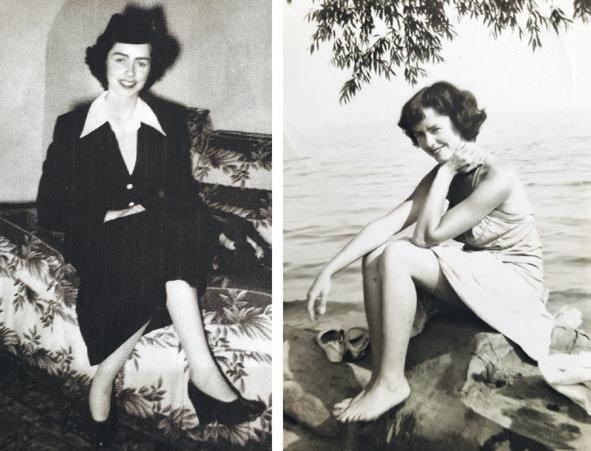
Phyllis Munday died on April 11, 1990, and lived much of her 95 years in a sweet little two-bedroom house on Tempe Crescent in North Vancouver. She was born in Ceylon (Sri Lanka) in 1894 – her father managed Lipton’s tea estates – and the family moved to Vancouver when she was 13. Every chance she got, Phyl would travel to the North Shore mountains, and in 1912 she led her Girl Guides troop to the top of Grouse Mountain. Decades later she told writer and historian Chuck Davis: “I thought I’d conquered the world.”
She met Don Munday, a writer and a wounded soldier who served at Vimy and who was a patient at the hospital where she worked. She discovered that they shared a love of mountains, and they married in 1920.
Two hours after their 9 a.m. wedding, they were in their climbing gear and trekking up a local mountain. The birth of Edith the following year didn’t slow them down; they simply strapped her to Don’s back and kept on climbing.
The Mundays lived first in a tent on Grouse Mountain and later in a cabin, thinking nothing of scrambling up and down the mountain whenever they needed supplies or to attend meetings. When Edith turned six in 1927, they bought the Tempe Crescent house.
Don died in 1950 and Phyl lived in the house for the next four decades, surrounded by photographs that she had taken of her mountains.
A reporter once asked her if she’d ever been really frightened during all her years of climbing mountains
“Thunderstorms,” she told him. “I hated thunderstorms.”
What she didn’t mention was the time she saved Don’s life from a grizzly bear by charging at it with an ice axe; when she regularly carted 27 kilograms of backpack over flood-swollen creeks; the times she had to avoid quicksand and avalanches and hidden crevasses.
“It was just something you had to do to get to the mountain,” she once said. “Once you got above the line it was beautiful.”
In 1955, Phyl accompanied Sir Edmund Hillary, of Mount Everest fame, on a helicopter tour of British Columbia’s coastal mountains. Three decades before that she and Don had headed up the expedition that led to the discovery of Mount Waddington, the highest peak in the province, at 4,019 metres. The Mundays called it Mystery
Mountain.
In 1924, Phyl was the first woman to reach the summit at Mount Robson, the highest mountain in the Canadian Rockies. She and Don scaled more than 100 peaks together and clocked up other firsts. They were the first to ascend Mount Coquitlam and Golden Ears. In the 1930s, they were the first to explore the Klinaklini glacier fields. B.C.’s Mount Munday, only a few kilometres southeast of Mount Waddington, is named after them.
Back in the 1920s, the B.C. coastal mountains were a vast, unknown and virtually unmapped area. The Mundays attempted to conquer Mount Waddington three times, and although they never reached the summit, Munday’s skills as a scientist, cartographer and adventurer opened up the
MAILBOX
CHEMTRADE REJECTION GOES AGAINST NATIONAL PUBLIC INTEREST
Dear Editor:
I am writing in response to your article District of North Vancouver Rejects Chemtrade Chlorine Proposal (online April 13 at nsnews.com). While your reporting clearly laid out both sides of the issue, I feel compelled to express my strong disagreement with the council’s decision and the broader implications it carries.
The Maplewood facility is not just another industrial operation – it produces approximately 70 per cent of the chlorine used for drinking water purification in Western Canada. That makes it a piece of critical national infrastructure. Decisions affecting such an operation should be grounded in rigorous, evidence-based analysis, not in what appears to be a preference for hypothetical worst-case scenarios over quantified, peer-reviewed risk.
As your article highlights, a peerreviewed quantitative risk assessment concluded that Chemtrade’s proposed upgrades would reduce both the likelihood and consequences of an incident compared to current operations, and that risks would remain below accepted thresholds. In other words, the company was not only compliant, it was actively improving safety. Rejecting such a proposal raises serious questions about the decision-making framework employed by council.
Moreover, several of the justifications cited, ranging from generalized fears of catastrophic events to speculative geopolitical targeting, appear detached from the empirical findings presented. At the same time, dissenting councillors correctly pointed out the facility’s essential
role in safeguarding drinking water and supporting high-quality local employment. That perspective, in my view, aligns far more closely with a rational assessment of public interest.
To be transparent, my indignation is not purely altruistic. I am a shareholder in Chemtrade. However, that is a deliberate choice – I invest exclusively in Canadian equities because I believe in supporting strong Canadian companies that provide essential services. This decision by the District of North Vancouver erased roughly 20 per cent of the value of my investment – money earned through hard work and placed, in good faith, into what I considered a responsible and nationally important enterprise.
Beyond personal financial impact, this decision strikes me as deeply prejudicial and, frankly, damaging to public confidence in our institutions. When elected officials disregard robust technical evidence in favour of perceived or politically expedient risks, it undermines the integrity of the democratic process. It also reinforces a growing cynicism – particularly toward municipal governance – that decisions are not always made in a transparent, rational, or economically responsible manner
At a minimum, this situation warrants further scrutiny. If a facility so central to public health and regional infrastructure can be curtailed despite meeting – and improving upon – established safety standards, it raises serious questions about how similar decisions will be made in the future.
Thank you for your reporting on this matter I hope you will continue to investigate the broader implications of this decision.
Dom Cava Quebec
Explorer made Grouse her home
Continued from A8
area for others.
Phyl moved to Nanaimo when she was 93 to live with family She took her two favourite possessions – a chair that she always sat in and a framed photograph of Mount Robson Some years ago, Deborah Munday told me that not reaching the top of Mount Waddington was something that her aunt always regretted.
“It was important to her,” she said, “When they filmed this show called Thrill of a Lifetime, they took her to the glacier near Mount Waddington and when she came
down she said, ‘If I could die, I would die up there, that’s where I wanted to be.’”
Phyl was commemorated with a postage stamp in 1998 and received an honorary doctorate in law from the University of Victoria.
She received the Order of Canada in 1973 and told a reporter: “I haven’t a clue why they gave me the Canada medal. I must admit it surprised me because there must be hundreds of people far more worthy than I.”
Eve Lazarus is a North Vancouver resident and author Her latest book is Beneath Dark Waters: The Legacy of the Empress of Ireland Shipwreck eve@evelazarus.com
Regular Hours Mon to Sat 10am-6pm Sunday11am-5pm Minutes East of Lonsdale Ave Easy Parking
HowFryingpan Expressisheating up North Vancouver
With fivelevels of heat, fresh halal ingredients and Korean-inspired dishes, this local spot is serving comfort food with akick
CrispyNashvillehot chickenwith aKoreantwist tells abiggerstory of theculture,community andone owner’sjourney from financetoflavourat Fryingpan Express. Photovia Fryingpan Express
North Vancouver woman awarded $5,000 for cannabis eviction
BRENT RICHTER brichter@nsnews.com
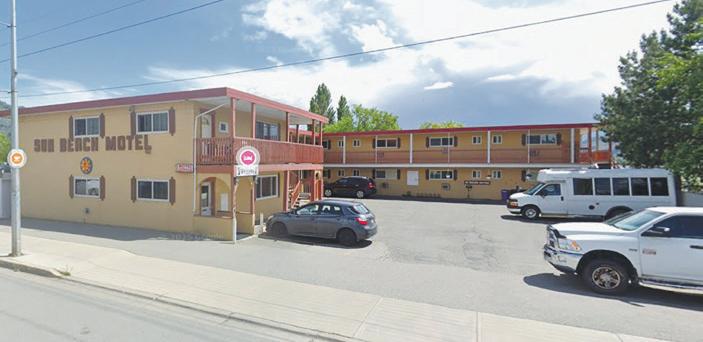
An Osoyoos motel must pay a North Vancouver woman $5,000 after the BC Human Rights Tribunal found the business violated her rights by kicking her out for leaving a cannabis roach in her ashtray.
According to the written ruling, Vicky Arvanitis booked a stay at the Sun Beach Motel in the summer of 2020. The day after she and a friend checked in, she walked to a nearby park to smoke a joint, which she used for treatment of disabilities, the ruling notes. Because the weather was hot and dry, she brought the roach back to the motel and placed it in the ashtray left outside her room.
There was “largely conflicting evidence” about what happened after, tribunal member Theressa Etmanski acknowledged in her decision. Arvanitis alleged the manager found the roach in the ashtray and confronted her, saying “we don’t want people like you at our motel.” The manager laughed when Arvanitis told her it was medicinal cannabis, the ruling states.
In an affidavit, the manager said Arvanitis “became very loud, yelled that she was a lawyer and said that she knew the law and
must pay a North Van woman $5,000 for evicting her for possessing cannabis GOOGLE EARTH
was being discriminated against.”
The manager subsequently informed Arvanitis she was being evicted from the motel and the RCMP were called in to “keep the peace” during the eviction.
The motel refunded Arvanitis’s friend for two nights’ stay at the motel. They were unable to find anywhere else in the area to stay and had to make the five-hour drive back to North Vancouver
It was a difficult drive for Arvanitis who was already tired and in pain, the ruling notes.
Arvanitis later took her complaint to the BC Human Rights Tribunal arguing that the motel had discriminated against her based on a physical disability
Following a car crash in 2007, Arvanitis
Thank You!
On April9th we gathered to celebratea majormilestonefor our organization- Five decadesofcommunity,advocacy, andsupport
Because of your generosity andcommitment, theNorth Shore DisabilityResourceCentrecontinuestoempower individuals, removebarriers, andcreateopportunitiesfor people of allabilities.
We aredeeply grateful forthe support of oursponsors, donors, staff, participants, familiesand community forstanding with us on this importantjourney.
was left with fibromyalgia, musculoskeletal injuries, a mood disorder, numbness in her right hand and a traumatic brain injury, according to medical documents she submitted to the tribunal. A 2019 letter from her family doctor stated Arvanitis was experiencing insomnia, running thoughts, anxiety, nausea and vomiting.
“These conditions are serious, persistent, and create barriers to her full participation in certain areas of life,” Etmanski wrote.
Arvanitis had been given numerous prescriptions for cannabis over the years, the most recent being about 10 weeks before the motel incident, which she had received from a doctor she was seeing for pain management.
Using cannabis for treatment is “stigmatized,” Etmanski wrote, and the motel’s conduct was informed by that stigma.
A lawyer for the motel argued that the eviction was not discriminatory because staff alleged Arvanitis had been smoking in her room – a violation of the motel’s policy barring cannabis in rooms, “smoking or otherwise.”
“Please leave your marijuana in your vehicle. There is a designated area which we will gladly point out. Anyone smoking marijuana in the rooms or common area may be
asked to leave. There will be no refunds,” the policy states.
Prohibiting guests from smoking in their rooms is a reasonable policy, the tribunal found, but Etmanski did not accept the management’s evidence that Arvanitis had been smoking inside. And there was no rationale for banning the possession of cannabis or disposing of a roach in an ashtray provided for cigarette smokers.
“I have found that the motel evicted Ms Arvanitis at least in part based on their policy governing cannabis possession and use. This adversely impacted Ms Arvanitis in connection with her disabilities,” Etmanski wrote. “It is egregious in the sense that it involved a false accusation leading to the termination of the service, and the RCMP were called to enforce the eviction.”
Arvanitis had asked the tribunal for an award of $20,000 for injuries to her dignity flowing from the motel’s discrimination. The motel argued the fine should not be more than $1,500. Etmanski settled on $5,000.
“While I accept that this was a humiliating experience for Ms. Arvanitis and the drive home was stressful given the circumstance and her disabilities, it was also a single occurrence and isolated from her daily life,” she wrote.
TITLESPONSOR
CHAMPION SPONSORDREAM BUILDERSPONSOR
ADVOCATE SPONSORS
MEDIA SPONSOR COMMUNITY SPONSORS RENTAL/CATERING SPONSORS
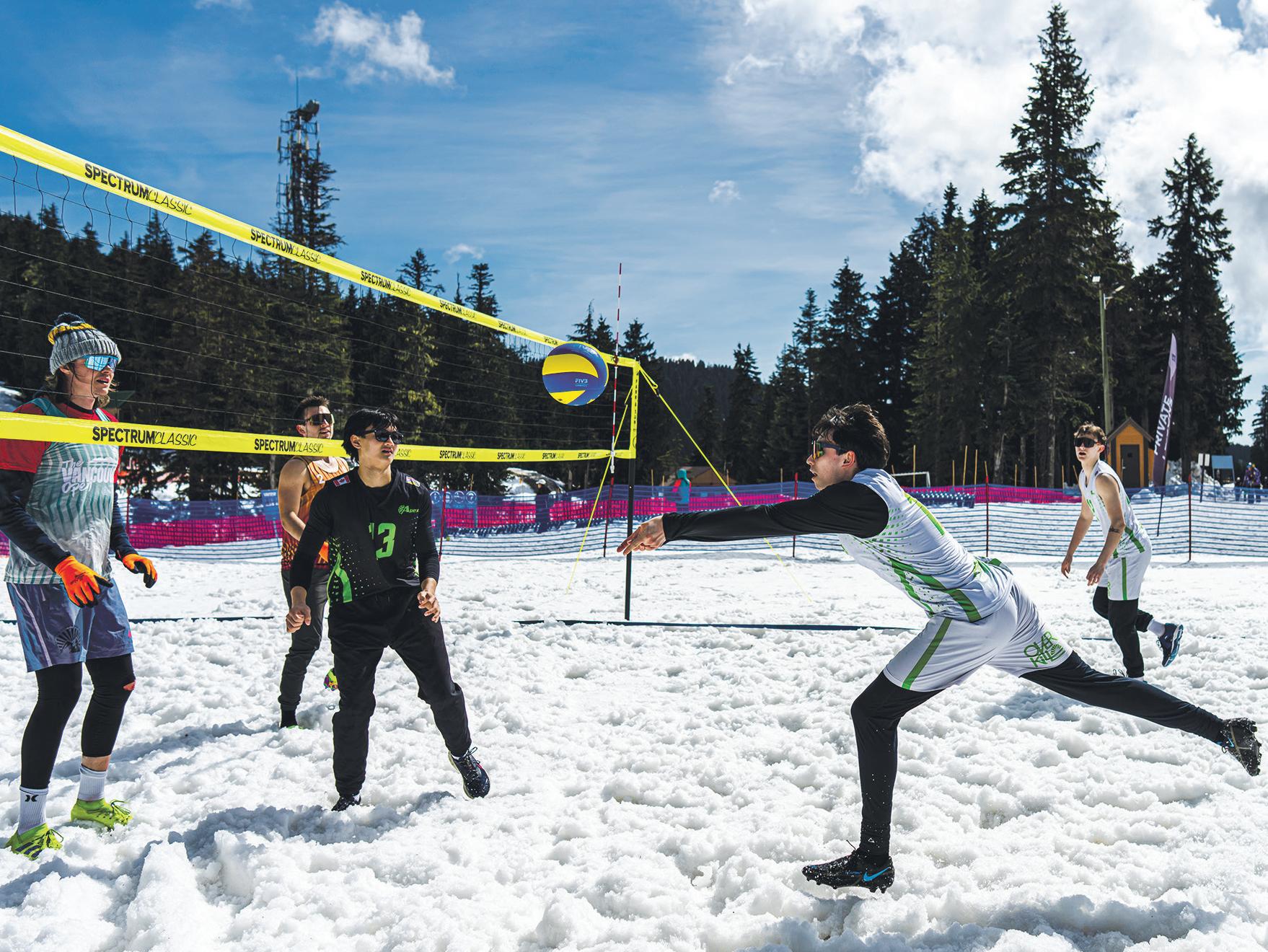
Snow volleyball makes its debut at Cypress Mountain
BRENT RICHTER brichter@nsnews.com
There were bluebird conditions at Cypress Mountain on the Easter long weekend, but it wasn’t the skiing anyone was talking about after.
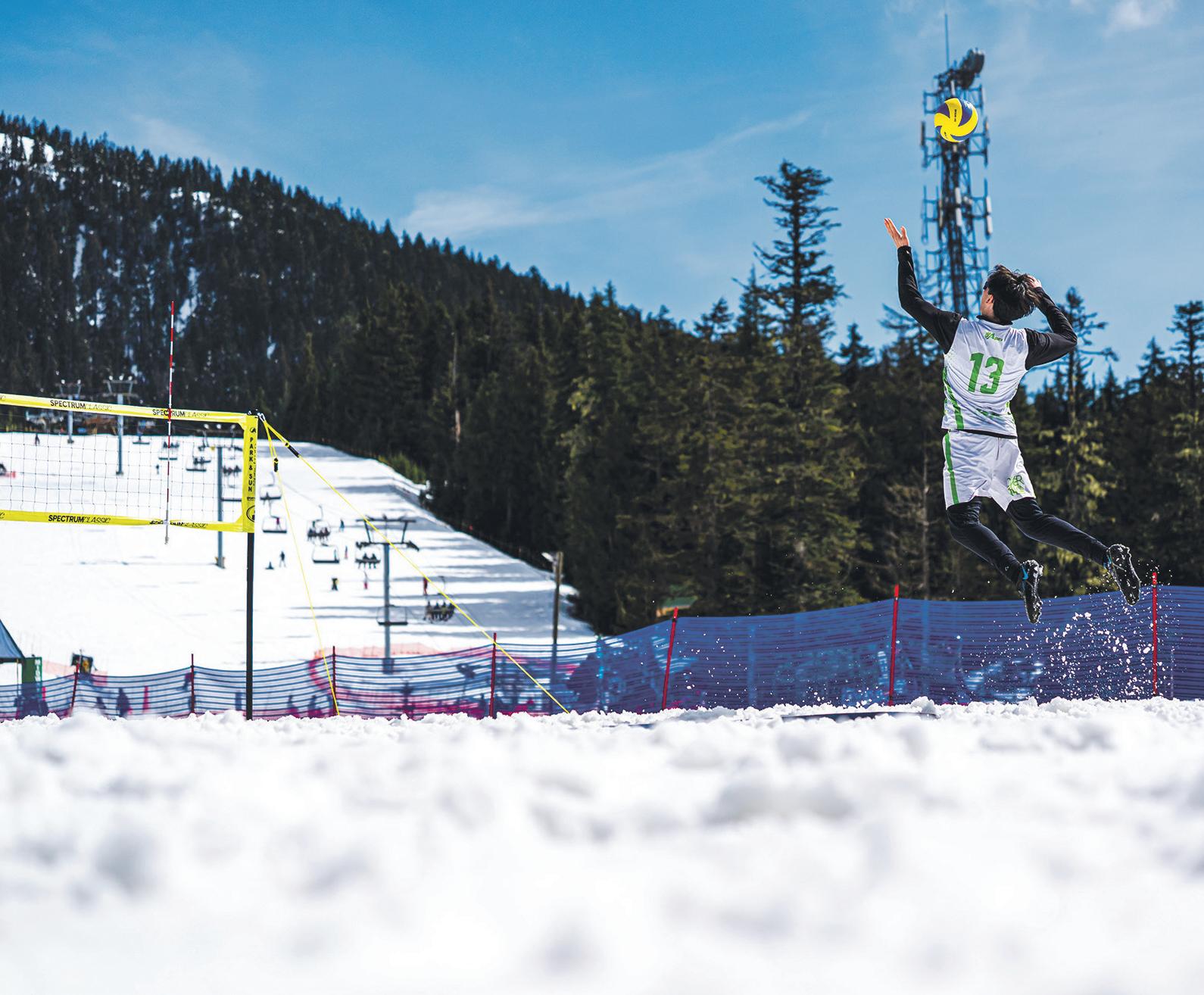
On Saturday, April 4, the resort hosted one of the first ever Canadian tournaments of snow volleyball – a chilly version of the sport now rapidly heating up.
The inaugural tournament was organized by Daniel Cravioto-Ross and Owen Lam, both varsity volleyball players for the UBC Thunderbirds.
“It was really fun,” Cravioto-Ross said. “It was amazing. Honestly, I was very surprised.”
There are pictures of people playing volleyball in the snow dating back more than 100 years, but the three-on-three game was first played formally in Austria in 2008. In 2011, the European Volleyball Association recognized it as a sport and became its first governing body.
“It’s been slowly making its way around the world. I’ve done lots of research and this is the first in Western Canada,” Cravioto-Ross said. “It has exploded a lot with social media.”
It almost goes without saying, but snow provides a much different tactile experience than any other surface for the game and it varies greatly based on the temperature and how compact the snow is.
“It was kind of interesting to see the players play because it wasn’t like beach volleyball, but it also wasn’t like grass volleyball. It was its own kind of game,” he said. “It was fun to watch the players as
well because diving on the snow, obviously you slide like a penguin.… I think the level of volleyball there was really high as well.”
Typically, snow volleyball is played with full arm and leg coverings and gloves to keep the players warm and protect their skin, but Cravioto-Ross said conditions were so balmy on Cypress that many teams were in tank tops by the
end of the day
If anyone was hurting, they didn’t complain about it.
“I’m sure those little snow crystals sometimes do get in places you don’t really want them to,” he said.
Cravioto-Ross said he wanted to repatriate his beloved sport to the North Shore where he grew up, but didn’t have many
options for competitive play.
Cypress Mountain’s leadership were “super supportive” of allowing the event to be hosted right outside their chalet, Cravioto-Ross said, with the resort providing fences, speakers and music.
Over the course of six hours, six teams went through pool play, double knockout rounds and finals.
The team that won bragging rights as champions of the first-ever Western Canada snow volleyball tournament dubbed themselves “It’s Not Small, It’s Cold.” Their winnings: $100.
The entire event came together very quickly, Cravioto-Ross said, but it was primarily a test run for a much more ambitious vision going forward. Starting next winter, Cravioto-Ross said he wants to see a full season with more teams and regular tournaments and playoffs held at mountains around the province.
Red Bull’s student ambassadors were on site to offer the athletes energy drinks but, as word is getting out, more potential sponsors are now stepping forward hoping to help grow the sport.
Based on the response they had on Cypress, Cravioto-Ross said he expects interest in snow volleyball is about to spike “All the skiers that were passing by were just super intrigued and taking videos and pictures and asking questions,” he said. “They’d never seen anything like this. It was very, very fun and interesting to share.”
Details about the league and its next season will eventually be posted to instagram.com/vansnowvolley
JAZZ VESPERS WITH ARSEN SHOMAKHOV
APRIL 26 AT 4:00PM -5:00PM
St. Andrew’sUnited Church
1044 Saint Georges Ave., North Vancouver
This month at St. Andrew’s, join us for Jazz Vespers with blues guitarist and singer Arsen Shomakhov.Arsen is known for his fiery guitar,soulful vocals, and captivating live performances, which he has shared nationally and internationally
CAREGIVER EXPO
SATURDAY, MAY2,2026 12:00 -4:00PM
At Silver Harbour Centre
144 East 22nd St, North Vancouver
PRESENTED BY IN PARTNERSHIP FREE TO ATTEND
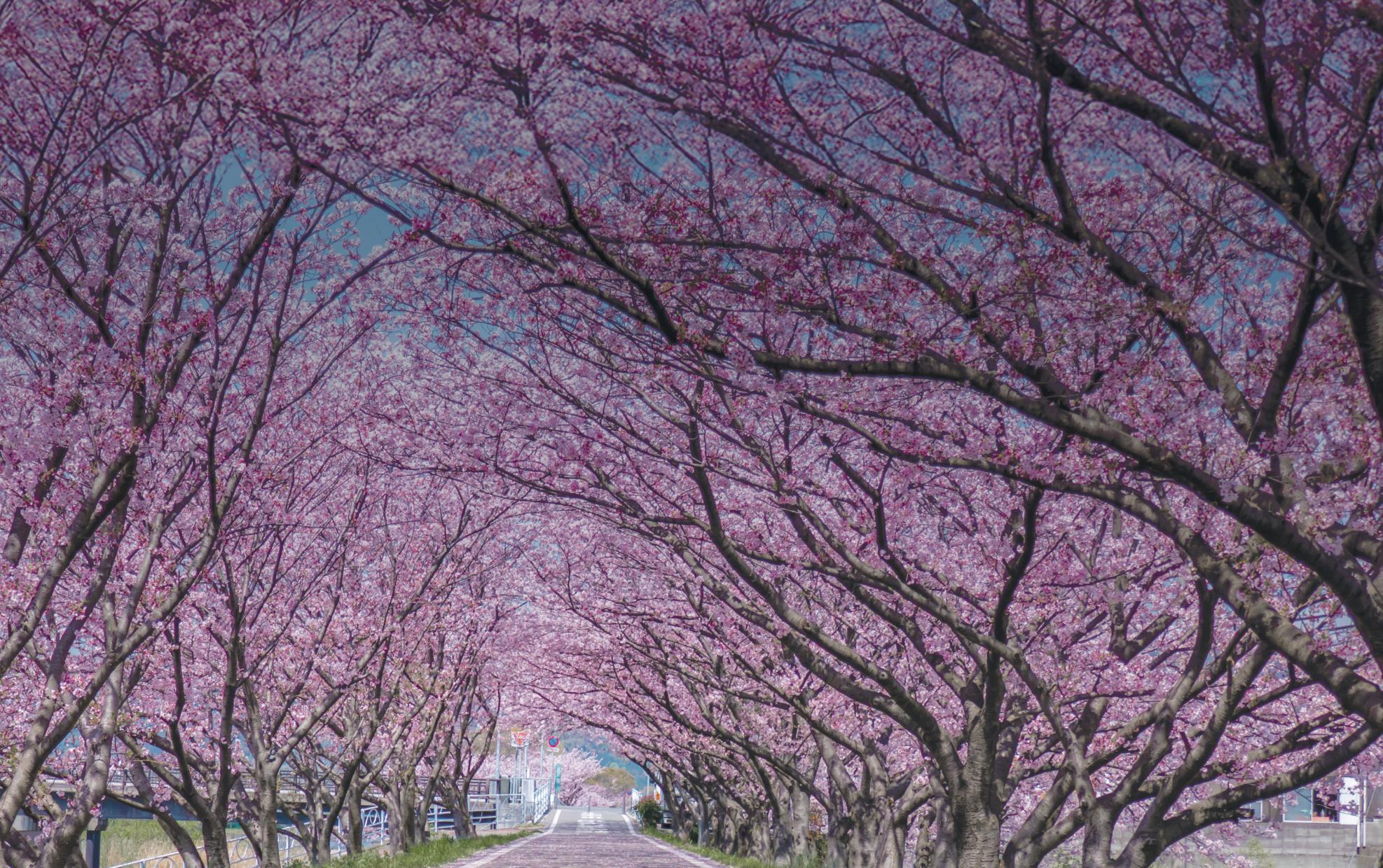
CHERRYBLOSSOMS: ATEXTILE TRANSLATION 2026
ON NOW TIL -MAY 3AT4:00PM
Silk Purse ArtsCentre, 1570 Argyle Avenue, West Vancouver
Celebrate spring with the return of the ever popular‘Cherry Blossoms: ATextile Translation’,the 17th annualexhibition of textile art inspired by the cherry blossom, featuring 27 artists. https://westvanartscouncil.ca/event-6512354?
utm_source=nsnews.com&utm_medium=referral
On view now
The Polygon Gallery
101 CarrieCates Court
Territories of theSquamish and Tsleil-WaututhNations, and theMusqueam Band
@polygongallery |thepolygon.ca
PresentingSponsor
theseries Through and Through,2025–ongoing.
LIGHT AND STONE
Polygon exhibition explores photos as tools of (de)colonization
ABBY LUCIANO
aluciano@nsnews.com
Local Journalism Initiative Reporter
Opening the doors of the Polygon Gallery, the work of Tania Willard is the first thing you’ll see.
Willard’s photographs taken through crystals are on the wall just inside the North Vancouver gallery, while others of her Secwépemc homelands and historical snapshots recreated through sandpaper are also located nearby.
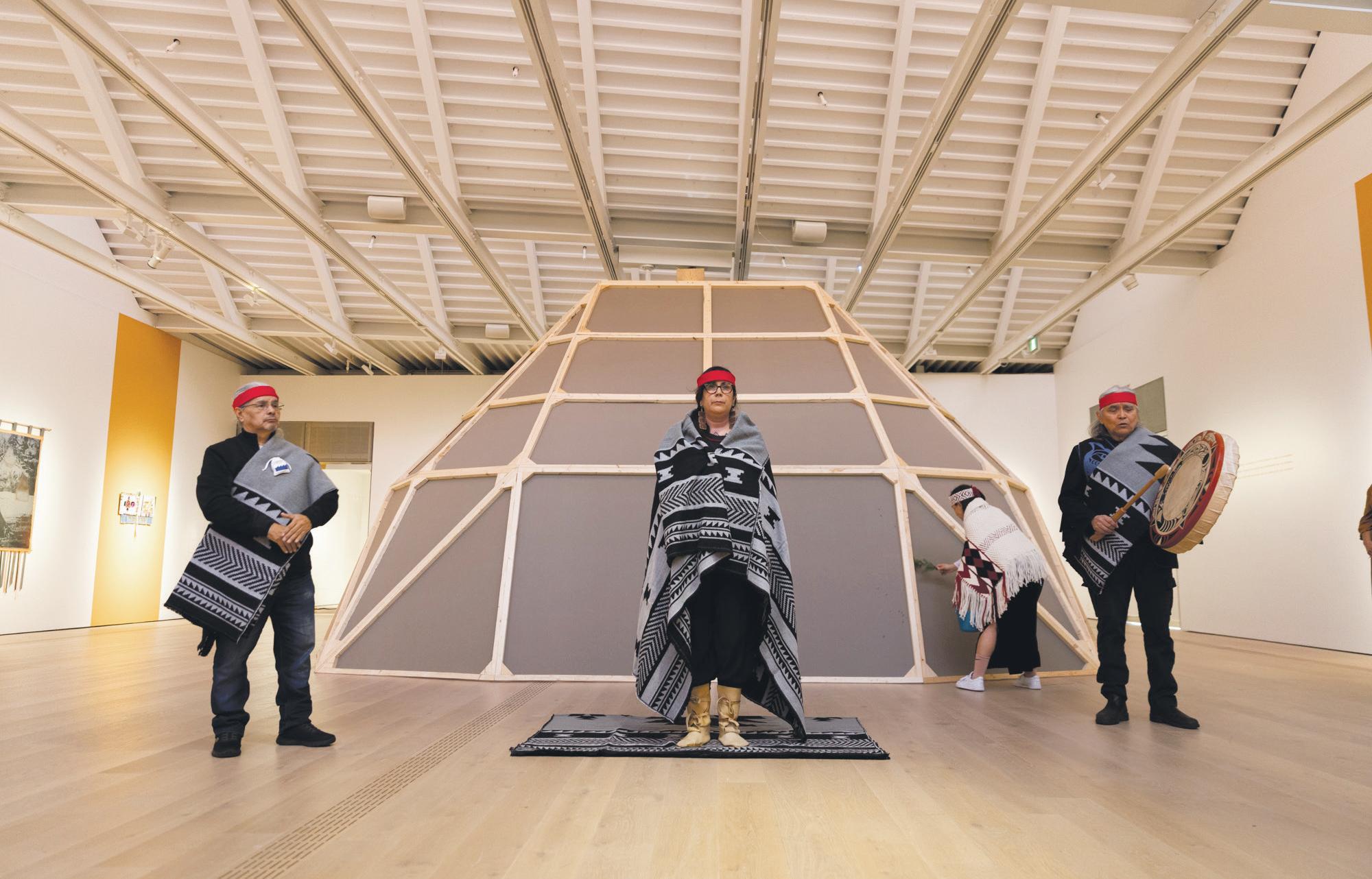
Those are part of Willard’s latest exhibition, Photolithics, featuring her photography and showcasing her eye for photographic printing and inventive presentation techniques. The name Photolithics combines the ancient words for light and stone, while the exhibition follows a 10-year survey of Willard’s exploration of photos as both a tool of colonization and decolonization.
“In some ways, they all point to questioning the authority of an image, really thinking about the ways in which an image can be deconstructed, broken up, undermined,” Willard said. “I’m doing that because of a strong history of photography being used of Indigenous people, but not by Indigenous people.”
Willard is a mixed Secwépemc and Scottish-settler artist “whose research intersects with land-based art practices,” according to a release from the Polygon. Her work as an artist and curator has appeared in art galleries in Vancouver, Burnaby, Kamloops and southern Alberta
as well as the Anchorage Museum in Alaska. She is also the 2025 recipient of the Sobey Art Award, which is one of Canada’s highest honours for contemporary artists.
In 2016, Willard co-curated Nanitch (meaning “to watch” or “to look” in the Chinook trade language) at the former Presentation House Gallery. The exhibition included a selection of postcards featuring Secwépemc people in the Uno Langmann Family Collection of BC Photographs. The collection spans from the 1860s to 1920s, a time during the smallpox epidemic, the Chilcotin Uprising, Canada’s Confederation, the Klondike goldrush and the enforcement of the potlatch ban. Willard wrote an essay to go with the collection.
“It was a difficult project because so many images depicted the cultural genocide of Indigenous peoples in B.C. – it was enraging,” she said. “Photography has historically been used in largely harmful ways, with documentary impulses steeped in the salvage anthropology of the time. So I had to find new ways to look at these images and consider them.”
As she began to study them as documents of light, Willard started to think about geological time and the idea of exposure.
“I wanted to assert the validity of stones and earth as documentary sources that speak about the deep relationships with our lands since time immemorial,” she said.
Alroy ‘Bucky’ Baker (left), Tania Willard, Joelle Johnston, and Xwalacktun gather at the opening of Willard’s ‘Photolithics’ exhibition at The Polygon Gallery. ALISON BOULIER
Crystals soften sensitive subjects
That idea plays out in the Photolithics exhibition through her pieces Vestige, Votive and Visiting – three monumental scale postcards of Secwépemc people using sheets of tiled garnet and corundum sandpaper.
“I’m essentially thinking about abrasiveness of histories, discomfort, but also labour, the work we have to do to understand an image from that time,” Willard said.
Crystals and the use of light are also a main feature in the exhibit. Through and Through shows photographs the artist took of her Secwépemc homelands rendered in bright latex ink on fringed canvas through ulexite crystals
“Tania has a way of showing you very sensitive materials, such as archival photographs of her relations, while also partly shielding them through the use of crystals,” said curator Monika Szewczyk.
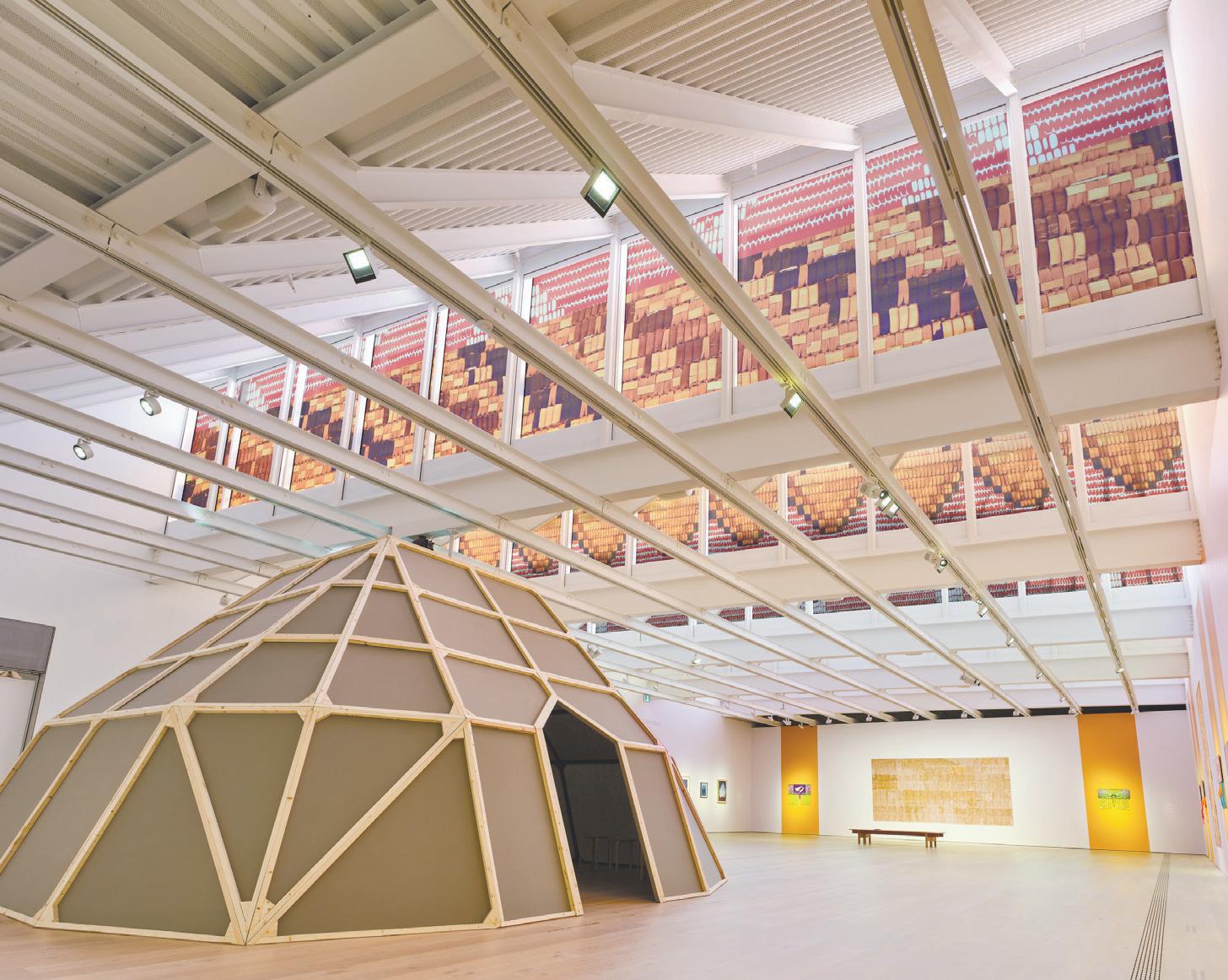
Alongside photos, there are physical elements of the exhibition. Willard and the Polygon’s installation team worked together to transform the gallery into a “lens.” In the gallery space there is a kekuli, historically used by Indigenous communities within the Plateau region of Canada, creating a home to display Willard’s work Only Available Light. Inside, the film The Shuswap Indians of British Columbia from 1928 plays through a set of rotating quartz crystals.
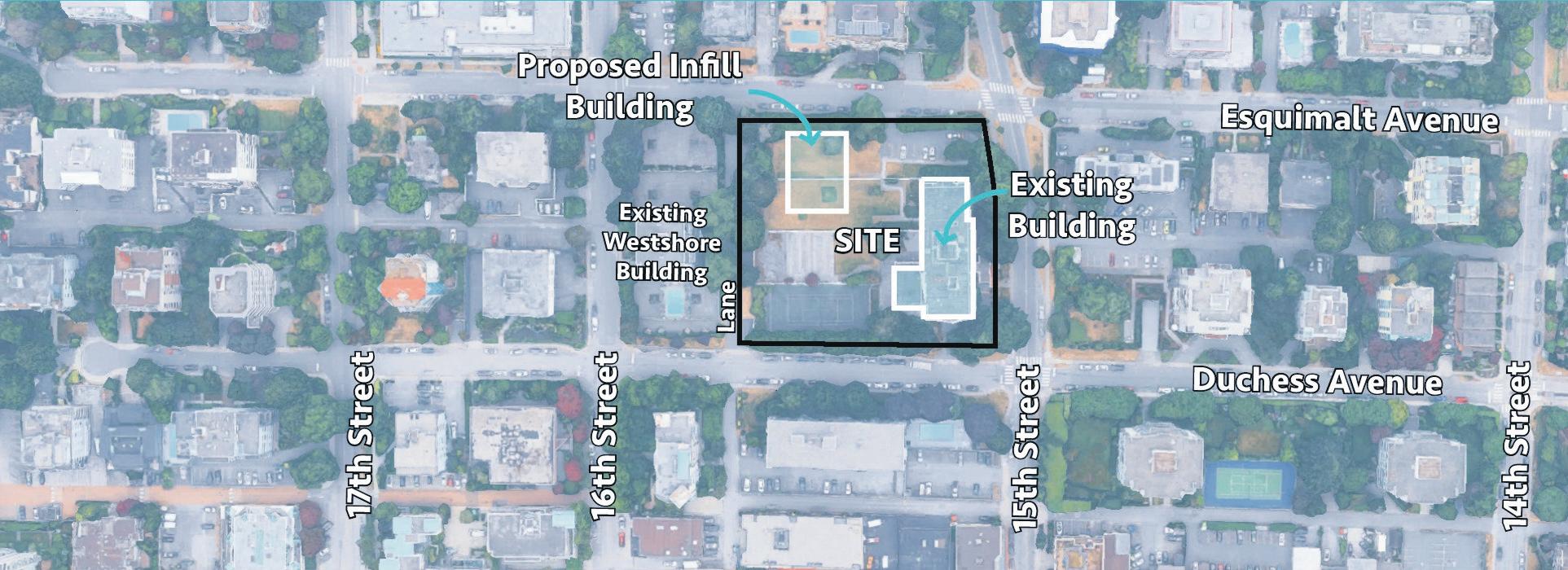
Wall Financial Corporation (Wall) has submitteda developmentproposal fora residential infill building at 1552 EsquimaltAvenue. The application proposes anew 19-storey residential towerwith 126 homes. The existing 185 homerental building on the property willremain andbesecured as rental in perpetuity.Atotal of 336 parkingstalls areproposedfor the twobuildings.
Join us on April 16 fora Public Information Meeting where we will introduce the project team, shareour vision forthe site, answer questions, and gather your feedback.
EVENT DETAILS
Date: Thursday,April 16, 2026
“Willard takes an image that was aimed at extracting and consuming her people and renders it as a flickering warmth in a place of togetherness, evoking a fire that might be gathered around,” the exhibit brochure reads.
One of the more striking features of the exhibit is Safelight, a piece in which Willard covered the gallery’s skylight windows with basket patterns, each layered with yellow and red ochre designs.
‘Overwhelming positive’ response, curator says
Willard’s work has been well-received since its unveiling in the North Vancouver space, Szewczyk said.
“People are inspired by the crystal clarity and variety of work that they can see from Tania,” she said, adding that she has been following Willard’s work for years and is ecstatic to bring her to the Polygon.
“I think she is one of the most important artists working in Canada and internationally today,” she said, adding that she would like people to “understand the fullness of her practice and how she is able to weave together historical time, geological time and dream time.”
Photolithics is on display at the Polygon Gallery until May 24.
Abby Luciano is the Indigenous and civic affairs reporter for the North Shore News. This reporting beat is made possible by the Local Journalism Initiative.
Location: Cedar Room, West Vancouver Community Centre,2121 Marine Drive Time: Drop-in formatbetween6:00pm -8:00pm, no presentation Project website: www.1552esquimalt.com
Join us forthe eighthannual NorthShore Seniors’ Health Expo on Friday,June 19,2026, featuringexhibitors, innovativespeakersand researchersfocusingon cognitive, physical, social,financial,and nutritionalwell-being.
Continued from A14
The ‘Photolithics’ exhibition by Tania Willard at The Polygon Gallery is co-curated by Monika Szewczyk and Serena Steel. DENNIS HA
ADOPT-A-FISH
Salmon Releaseand StorytimeI AllAges
Saturday,April 25
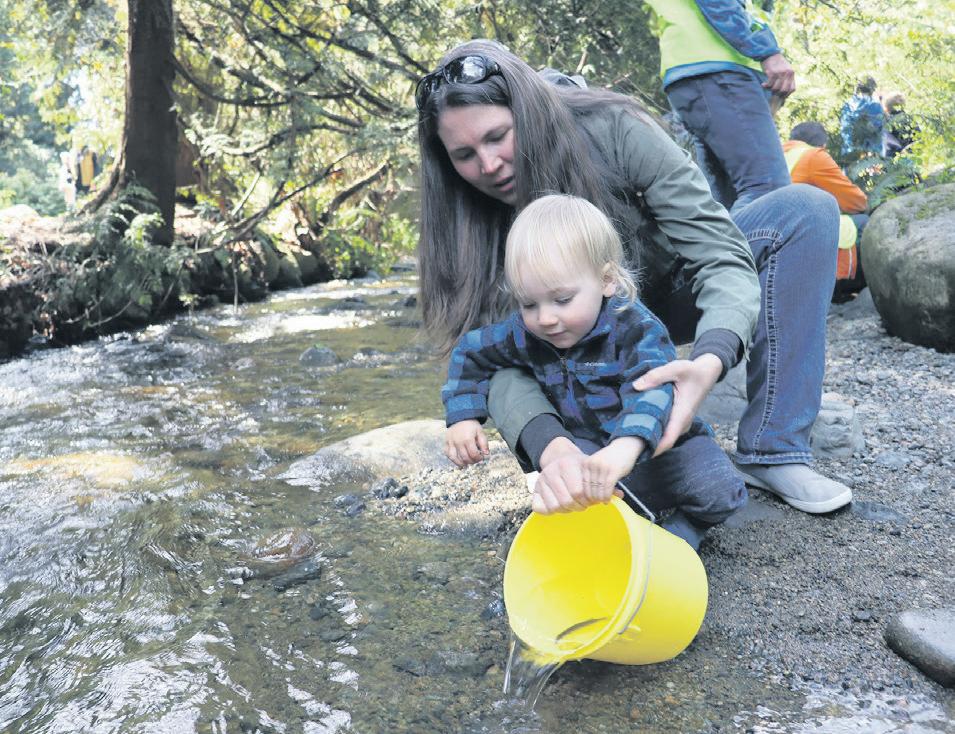
Startyourmorning with a fishythemed storytimeatthe Library andthenheadtoMemorial Parktorelease ajuvenile Coho Salmon into thewild!
1950 Marine Drive, West Vancouver 604.925.7408 | youth@westvanlibrary.ca
Snowpack in watersheds serving Metro Vancouver sits at 55 per cent of average
JANE SEYD jseyd@nsnews.com
Snowpack in the local watersheds is much lower than normal heading into the summer, raising potential concerns about drought if the Lower Mainland has an especially hot summer.
As of April 1, snowpack in the watersheds serving the Lower Mainland averaged 55 per cent of the historical average, according to Metro Vancouver
The snowpack is considerably lower than it was this time last year, when the average was 88 per cent of normal.
The situation mirrors low snowpack levels seen across many parts of southern British Columbia, where an atmospheric river in mid-March melted snowpack in many watersheds. It’s also similar to the situation in Metro two years ago, when snowpack levels averaged 56 per cent.
April 1 is considered one of the key dates in assessing water supply conditions around B.C., according to the BC Rivers Forecast Centre, as 97 per cent of the annual snowpack has usually accumulated by that date.
Although this winter was predicted to be a La Nina – which usually means colder temperatures – those weren’t seen in the Lower Mainland, with most areas around Vancouver recording a rare “no snow” winter
Environment Canada’s seasonal outlook for the April to June period has also pointed to an increased likelihood of above normal temperatures across much of the province.
The spring snowpack levels are just one part of Metro’s water juggling act.
Also key is “the timing of when it melts and how quickly it melts,” said Linda Parkinson, director of policy, planning, and analysis with Metro’s water services. Temperatures in May and June also influence how quickly people start to use more water and how quickly the reservoirs get drawn down.
To cut down on non-essential water use – which increases by 50 per cent in summer – lawn watering restrictions start across Metro Vancouver on May 1, limiting watering to one early morning a week.
Average daily water use in Metro Vancouver has remained relatively stable over the past 25 years, hovering at about one billion litres a day, despite a population that grew by more than one million people, according to a recent report on the region’s water supply
More efficient plumbing, increased housing density and stricter watering restrictions have all resulted in lowering the per capita water use by residential users. (About 35 per cent of the water use in the Lower Mainland is used for industrial, commercial and institutional use.)
In summer, however, water use soars.
In 2025, 1.49 billion litres were used on the system’s “peak day” of July 13. Almost all of the additional water use is for outdoor watering, said Parkinson.
Automatic irrigation systems set to come on every day remain a problem, she said – trackable through the additional summer “bump” in water use between 5 a.m. and 7 a.m. across the region.
“I don’t think people are getting up and hand watering their lawn at five a.m.,” she said.
Municipalities buy water from Metro Vancouver at a wholesale
rate, which is higher in the summer months.
According to statistics from Metro, the three North Shore municipalities account for less than 10 per cent of the average water use in the region. In contrast, the three municipalities of Vancouver, Surrey and Burnaby accounted for more than half of the water use.
West Vancouver is one of the few municipalities in the Lower Mainland that also has its own water supply which provides for some of the district’s needs. The Eagle Lake reservoir and Montizambert Creek typically provide between 40 and 45 per cent of the district’s water.
Metro Vancouver water comes from three watersheds: the Capilano, Seymour and Coquitlam.
In addition to water stored in the main reservoirs, both the Capilano and Seymour water systems also include damned alpine lakes at high elevation – including Palisade Lake, Burwell Lake and Loch Lomond –which can be drawn down in the driest months of the summer
But those lakes hold much smaller volumes of water than the main reservoirs.
About two-thirds of the region’s
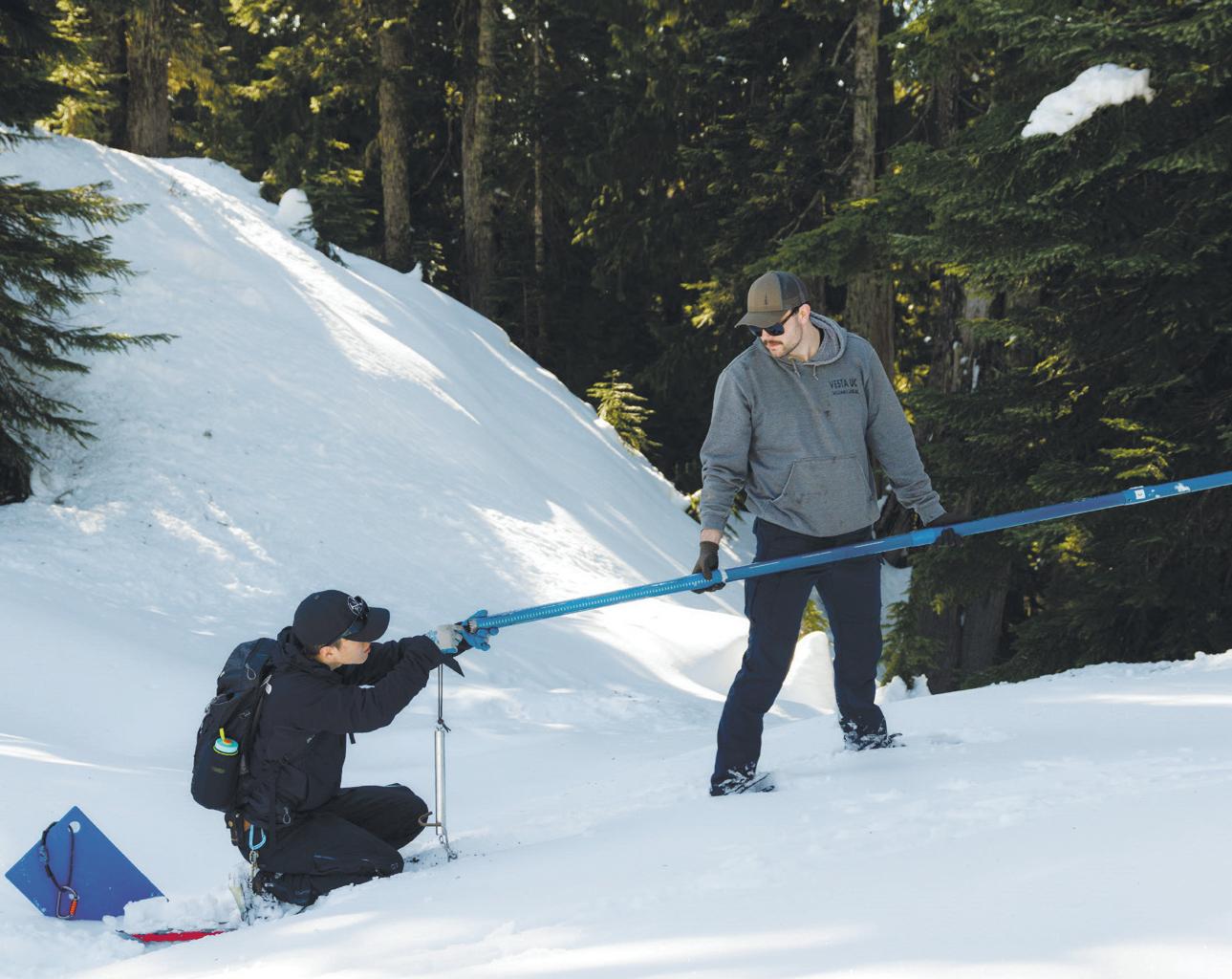
Metro Vancouver staff conduct a snow survey in the watershed to measure snowpack levels heading out of winter and into spring. METRO VANCOUVER
Bigger Seymour dam an option
water comes from the two North Shore reservoirs The other third comes from the Coquitlam Reservoir, where both BC Hydro and Metro Vancouver hold provincial water licenses.
Every year, Metro buys extra water stored in the Coquitlam Reservoir from BC Hydro. According to a recent report on Metro’s drinking water supply, in 2025, Metro Vancouver bought an extra 56 billion litres from BC Hydro to meet drinking water needs
Water planners at Metro are targeting the Coquitlam water supply to provide
more water in the future A planned new water intake – which Parkinson said will allow Metro to draw water from a deeper part of the lake – a water supply tunnel and water treatment plant are expected to double Metro’s capacity to draw water from that source.
Among long term options for increasing the water supply as the population grows, building a higher dam at Seymour Falls has been flagged by Metro as the most likely project for providing water for the next 100 years But the longer the region can put off that kind of mega project, the better, said Parkinson
We all have arole to playincaring forour environment and keeping our beautiful riding of North Vancouver–Capilano green forour community and futuregenerations. Let’sall playour partin protecting ecosystems and preserving biodiversity Every effort counts.
JONATHAN WILKINSON Member of Parliament NorthVancouver -Capilano (604)775-6333
Jonathan.wilkinson@parl.gc.ca @JonathanWNV
Continued from A16
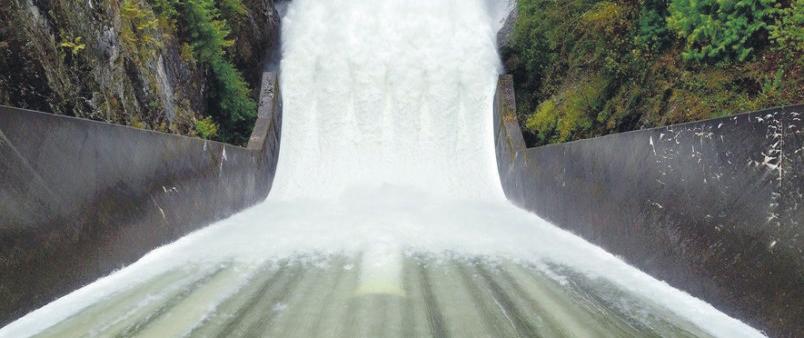
Water flows over the spillway at the Cleveland Dam. MIKE WAKEFIELD / NSN FILES
Feds renew $413-million project to save Pacific salmon
BRENT RICHTER brichter@nsnews.com
The federal government is putting up $412.9 million in funding and renewing the Pacific Salmon Strategy Initiative for another five years.
The program funds hatcheries, salmon habitat protection and restoration, research and efforts to combat illegal fishing.
Joanne Thompson, Minister of Fisheries, Oceans and the Canadian Coast Guard, made the announcement in North Vancouver on Tuesday, April 7. Thompson said the funding builds on the initial $647 million the feds put up for the initiative in 2021. The influx of money comes from the new $3.8 billion Force of Nature protection strategy announced by Prime Minister Mark Carney on March 31.
“When we know more about nature we care more and then in turn we act differently,” Thompson said. “This is significant because when we protect keystone species like wild Pacific salmon, we are protecting everything they touch throughout the lifecycle – other species, local ecosystems, culture and identity, the health and well-being of our families and communities, and of course the many jobs
and businesses that rely on healthy and abundant salmon stocks.”
Thompson made the announcement at the Capilano River Hatchery, which is itself embarking on a $49-million rebuild and modernization project.
Michael Meneer, president and CEO of the Pacific Salmon Foundation, said
two-thirds of wild Pacific salmon stocks are in a state of historical decline, however there are indications that efforts by the government and non-profits in the salmon strategy are starting to work.
“We are seeing positive trend lines with chinook, with sockeye, particularly in the Lower Fraser, and we know that when Mother Nature and these kinds of investments work together, the salmon will return,” he said. “There is so much still to learn and salmon are so critical to us as people here in British Columbia.”
Stu Barnes, executive director of the First Nations Fisheries Council of B.C., welcomed the funding on behalf of Indigenous people whose sustenance is tied to healthy salmon returns.
“When salmon struggle, our people struggle. For First Nations, salmon are not a file or a season. They are food, culture, and law,” he said. “This renewal matters because salmon recovery is long-term work. It requires sustained investment, real partnership, and the ability to plan beyond a single funding cycle.”
Zoann Morten, executive director of the Pacific Streamkeepers Federation, said the funds appear to be targeted mainly for big-ticket items like hatcheries, but
she said a lot of good work is getting done by volunteers working on smaller local creeks.
Before conservation groups like the Streamkeepers are allowed to do any work they must first get DFO approval, but funding for their liaisons to Fisheries and Oceans Canada has become precarious, Morten said.
“We need these people to share with us the best science for taking care of these fish and where to put them and why,” she said.
West Vancouver Streamkeepers Society president Mike Perley said he hopes to see some of the funding flow to smaller creeks like the ones that feed into the Capilano River where his stewardship group is also finding a turnaround in local salmon stocks.
“We put a lot of time, energy and effort into our local creeks. And sometimes we were a little discouraged or surprised that in some years, the fish show up and in other years they don’t show up. I think there is a positive trend for more productivity out of our creeks,” he said. “When we do our salmon counts, there seems to be a recovery that’s currently going on. The more help, the better.”
Sean Nightingale of the Seymour Salmonid Society shows off a massive salmon before it gets clipped and released. BRENT RICHTER / NSN
ROUTE ALTERNATIVES
District of North Vancouver council considers expanding Mountain Highway
ABBY LUCIANO aluciano@nsnews.com Local Journalism Initiative Reporter
Drivers and commuters could see big changes on Mountain Highway in the future.
In a council workshop March 30, staff looked for input from District of North Vancouver council on five design suggestions that would aim to improve the arterial near the Highway 1 interchange.
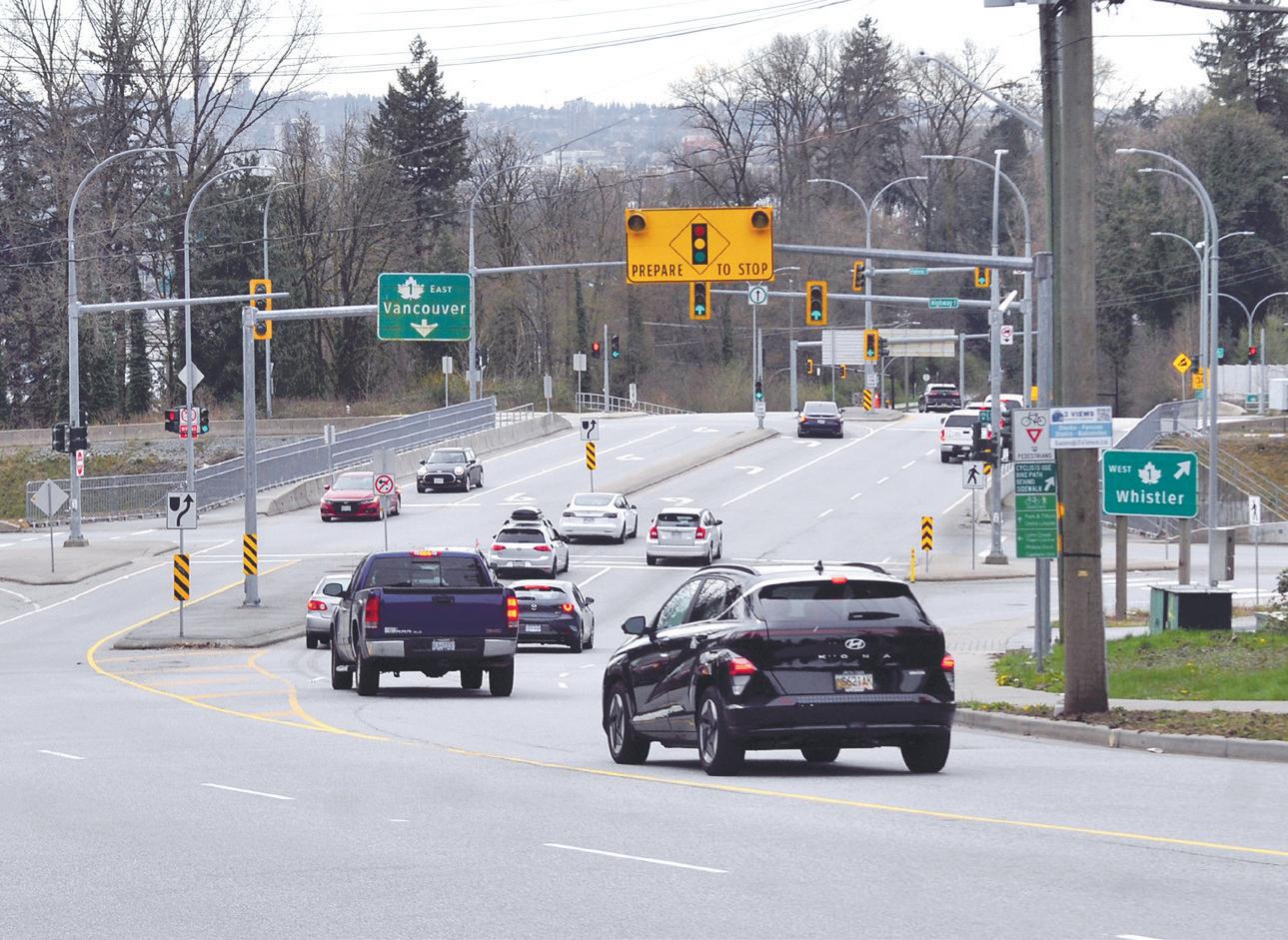
One change proposed by staff is the widening of Mountain Highway from three to four lanes between Highway 1 and Arborlynn Drive, providing two lanes in each direction.
Staff also suggested reallocating roughly 100 metres of road space north of Arborlynn Drive to provide two southbound lanes and one northbound lane, the opposite of what is there now This transition point would mean drivers can pass buses while they are picking up and dropping off passengers, reducing the risk of vehicle queues and spillover traffic onto nearby intersections, staff said.
Other design proposals include restricting southbound left turns onto Arborlynn Drive; retaining the northbound slip lane from Mountain Highway onto Arborlynn Drive; and constructing multi-use pathways between Highway 1 and Arborlynn Drive.
The changes aim to reduce congestion heading to Highway 1, improve local access for residents travelling across the overpass, enhance safety and comfort for all road users, and close a key gap in the district’s active transportation network, a staff report said.
Staff estimate the project to cost between $2.5 to $3 million, depending on details of the design The project is eligible for up to $1.5 million in funding from TransLink to cover the cycling components like the multi-use pathways. Staff would bring forward a funding plan as part of next year’s budget for council’s consideration.
Construction is targeted for summer 2027 or 2028, depending on approvals and funding, staff said.
In December 2021, the district identified Mountain Highway as a priority corridor for safety and
mobility improvements due to the high number of pedestrian and cyclist-involved collisions, including one pedestrian death in 2019 at the East 18th Street intersection, according to a staff report.
At the March 30 workshop, most council members said they’re generally supportive of the designs and gave staff feedback to refine the plan.
Mayor Mike Little asked if staff could move the 100 metre transition point back to East 14th Street to ease traffic.
“Otherwise I think it’s still going to fail frequently,” Little said.
“Where the highway backup extends beyond where you’re doing the lane switch, I think 14th provides you 90 per cent of the time success and maybe once in a while you’ll have a backup well beyond that.”
He added that the bus stop at East 14th Street should be moved so traffic can flow more smoothly.
“It is one of our steepest hills on an arterial road,” he said. “You’re now losing the bypass, so whenever a bus stops, everybody stops.”
Staff said they could see if that’s possible
Coun. Betty Forbes, who lives in the area, agreed with moving the transition point to East 14th Street. Her biggest concern, however, was
that there’s not enough distance on Mountain Highway to get over to Arborlynn Drive and vice-versa.
“You’re dodging the oncoming traffic coming up Mountain Highway, and you’re trying to watch in front of you, that the person in front of you hasn’t stopped because they want to get over there too, but they can’t,” Forbes said. “So you almost rear end somebody and now you’re going to have two lanes that are trying to go back and forth, it’s just not enough room there for that.”
Couns. Jim Hanson, Herman Mah and Jordan Back said the proposed changes can make a positive impact for both drivers and cyclists.
“I think the [multi-use pathways] will be well appreciated,” Back said. “As somebody who rides up here regularly and even though that’s a fairly short stretch, it’s very unpleasant to ride through there, so I think anything that’s going to increase safety there for people on bikes, people walking, will be welcome.”
Staff plan to report back with an updated design and costing at a later date.
Abby Luciano is the Indigenous and civic affairs reporter for the North Shore News. This reporting beat is made possible by the Local Journalism Initiative
The District of North Vancouver is considering five potential changes that would aim to improve safety and traffic flow of Mountain Highway near the Highway 1 interchange. PAUL MCGRATH / NSN
Company will look at ‘all possible avenues’ to continue operation
But for the majority on council, that risk remained simply too high.
“The consequences of a chlorine release can be catastrophic. Low-probability chlorine releases can cause deaths, long-term health impacts and large-scale evacuations,” said Coun. Betty Forbes, who was joined by Mayor Mike Little and Couns. Catherine Pope and Lisa Muri in voting down the rezoning.
Pope noted that chemical plants are now seen as targets in war and added that the Maplewood area faces risk from earthquakes and other unpredictable events. She said senior levels of government should be looking to transition chlorine supply operations of the plant “to a safe, more appropriate location, in a remote area – a federal or provincial site, away from homes, schools and families.”
“Because history has shown us again and again that the unthinkable does happen. And when it does, it is communities like ours that pay the price,” she said.
Mayor Mike Little spoke highly of Chemtrade’s reputation as a corporate citizen with a clean safety record But he lamented that future councils would be legally unable to revisit the decision once it has been made.
“I can’t accept the condition that the municipality would no longer have the ability to review safety standards going forward. We would no longer have the ability to change the nature of the business at that site,” he said. “And as we continue to grow as a municipality, that is going to be an increasing conflict and risk for the municipality that we can’t bear with the tools that we have.”
Coun. Lisa Muri expressed similar sentiment and said municipal officials were told more than two decades ago that chlorine operations at the site would eventually be wound down.
“Perpetuity is a long time,” she said.
It’s not clear what the denial will mean for the company or the Maplewood industrial property. The plant supplies about 70 per cent of chlorine used for water purification in Western Canada. It also ships the product to the United States.
Chemtrade issued a press release the following morning expressing disappointment in council’s decision. The company is looking at “all possible avenues” to continue operations of the plant, including engaging with provincial and federal officials and potential legal action.
“As the largest producer of liquid chlorine for drinking water treatment in
Canada, our closure could have significant impacts which would be felt across the country Without chlorine production from our facility, Canada could become reliant on foreign trading partners to secure additional production of chlorine, a product critical to the health and safety of millions,” said Scott Rook, president and CEO of Chemtrade.
“Throughout the two and half year engagement with the district and the local community, we have received overwhelmingly positive feedback and support. We believe this decision is not in the best interest of district residents or Canadians,” he said.
Couns. Jordan Back, Herman Mah and Jim Hanson dissented in the vote, arguing the proposal met all of the safety standards set out for it.
“At the same time, I’m aware that this facility plays an important role in manufacturing liquid chlorine that is used to keep our drinking water safe,” Hanson said. “In this way, in my view, the ongoing manufacture of liquid chlorine at 100 Amherst can be seen to contribute to the health and safety of district residents.”
Back also raised what was at stake economically if council were to reject Chemtrade’s application.
“This is about allowing this business to continue to modernize and increase safety standards, which I feel are already at a level that I’m comfortable with in terms of level of risk for the surrounding community,” he said. “This facility represents a number of significant, well-paying jobs and contributes to a diverse local economy here on the North Shore and in the District of North Vancouver. And those types of jobs are not easily replaced.”
The district held two nights of public hearings in February, at which nearby residents, industry officials, activists and engineers weighed in on the proposal.
Supporters included North VancouverSeymour’s MLA, the North Vancouver Chamber, the Vancouver Fraser Port Authority, North Vancouver and East Vancouver residents as well as current and former chemical industry members.
Detractors included nearby residents, industrial safety experts, activists, a victim of the 2023 train derailment disaster in East Palestine, Ohio, and representatives of K2 Pure Solutions – a chemical industry competitor of Chemtrade’s that funded a covert lobbying campaign against the rezoning.
Chemtrade’s share price fell more than 18 per cent when the markets opened on Tuesday morning.
Cypress set to host Red Bull downhill race
ANDY PREST aprest@nsnews.com
Downhill mountain bike racing will be pushed to the extreme in West Vancouver this year with an adrenaline-pumping event coming to Cypress Mountain.
On Thursday the North Shore resort announced it will play host to the first ever Canadian edition of Red Bull Hardline, an invitation-only competition that puts elite male and female riders to the test in what is billed as “the world’s toughest downhill race.”
According to event organizers, the course setup will include many features that aren’t permitted in traditional World Cup races, including “massive jumps and gap sections, sheer drops exceeding 10 metres, technical rock gardens, and descents steep enough to make even the seasoned pros think twice.”
The Cypress race, only the third location in the history of the Hardline series, is scheduled for Oct. 17.
“This event will introduce Cypress Mountain’s terrain to a global audience of riders who’ve never seen what this mountain is capable of,” stated Cypress Mountain general manager Matt Davies in a release. “Red Bull Hardline is a statement moment for Cypress, and we think it’s the beginning of a much bigger story for biking on this mountain.”
The Cypress course is being crafted with the help of top Canadian downhill riders Jackson Goldstone from Squamish and Sechelt’s Gracey Hemstreet. Goldstone won his first Red Bull Hardline title in 2022 and went on to win the 2025 UCI Downhill World Cup Overall title, while Hemstreet is the first woman ever to win two Red Bull
Hardline events.
“Bringing Red Bull Hardline to Canada is something everyone has wanted, and it’s super exciting it’s finally happening,” stated Hemstreet, adding that she likes what she has seen taking shape at Cypress.
“After walking the future Red Bull Hardline track, I’m pretty intimidated but excited – I think this will be the best one yet. Everyone’s going to be so stoked, and the crowd is going to be huge.”
The event will be open to spectators with jumps and drop zones visible from on-site viewing areas. Ticket information will be released in the coming months.
Belowmarketrentalhousing in North &WestVancouver foradults55+.
Rentsstart at $1200for studios and$1400 for1 bedroomunits.
See kiwanisnorthshorehousing.org for moreinfo or call604-926-0102
Sechelt’s Gracey Hemstreet gets some air during a Red Bull event in Australia Feb. 4. BRETT HEMMINGS / RED BULL CONTENT POOL
PUBLIC HEARING NOTICE
ProposedAmbleside CentreLocal Area Plan
WHEN: 5p.m., April 27,2026 |WHERE: Municipal Hall Council Chamber,750 17th Street,and via electronic communicationfacilities
SUBJECT BYLAW: Apublic hearing will be heldregarding proposed Official CommunityPlan BylawNo. 4985, 2018, Amendment BylawNo. 5386, 2026.
SUBJECT LANDS: Thesubjectlandsare shownblue on the map
PROPOSED OFFICIAL COMMUNITY PLAN BYLAWNO. 4985, 2018, AMENDMENT BYLAWNO. 5386,2026: would adopt the Ambleside CentreLocalAreaPlan to guide decisions on land use andthe form and character of development in thedesignated area.
BELLEVUEAVENUE
The public hearing is your opportunitytospeak to Council if you feel your interests will be affected by the proposed bylaw.
ATTEND THE PUBLIC HEARING AS AN
OBSERVER
1.Watch online
Visit youtube.com/@WestVanDistrict at thescheduled starttime of the public hearing.
2. Watchinperson
Visit Municipal Hall Council Chamber at thescheduled starttime of the public hearing. Advanceregistration is notrequired to attend apublichearing.
QUESTIONS? Moreinformation on theproposed bylaw, including staff reports and other supportingdocuments, maybeviewed from April 10 to 27,2026at westvancouver.ca/news/notices and at Municipal Hall during businesshours, 8:30 a.m. to 4:30 p.m., MondaytoFriday, excluding statutory holidays
PARTICIPATEINTHE PUBLIC HEARING
1. Speak in person
Municipal Hall Council Chamber Persons mayaddressCouncil during the publichearing foruptofiveminutes at atime.
2. Speak via Zoom (electronic communication facilities)Please call 604-925-7004 on April 27,2026tobeadded to the speakerslist. Instructions on howtoparticipateare available at westvancouver.ca/ph.
3. Provide awritten submission
• email: correspondence@westvancouver.ca
• mail: addressed to LegislativeServices, 75017th Street, West Vancouver BC V7V 3T3
• drop box: addresstoLegislativeServices; boxes locatedatthe north and west the entrances to Municipal Hall
Written submissions must be received by noon on April 27,2026toensure their inclusion in the public information packagefor Council’sconsideration. To ensureafairprocess,Council cannot consider anysubmissions received afterthe public hearing has ended.
Starting in September of 2026, the R2 RapidBus will follow this route from Park Royal in West Vancouver to Metrotown in Burnaby. TRANSLINK
No
R2 extension past Park Royal
Continued from A4
the broader rapid transit solutions that have been planned and promised,” he said. Quinn said fast-tracking the bus service was made possible by quick agreements with the five municipalities the R2 will travel through on things like co-ordinating road access, expediting permits and adjusting traffic management plans Between now and September, TransLink will have to construct three new bus stops with updates to the curbs and surrounding pedestrian infrastructure, lengthen some
existing stops to accommodate the 60-foot articulated buses, and build a new layover station near Metrotown.
At that announcement, West Vancouver Mayor Mark Sager said there are no plans to allow the “one-seat” commuters to go beyond Park Royal and into Ambleside and Dundarave on the R2.
“That was quite well canvassed about four years ago,” he said. “We do see Park Royal as the transit hub that is really essential in the long-term planning for that area.”
Marriage Commissioner
TheVital Statistics Agency, MinistryofCitizens’Services,islooking foran individual toserve as aMarriageCommissionerfor the communityofNorth Vancouver.The individual will perform civil marriageceremonies within their communityonbehalf of the Agency.Applicants must reside within the communityofNorth Vancouver to be considered forthe position Forinformation andanapplicationformplease visit gov.bc.ca/becoming-a-marriage-commissioner
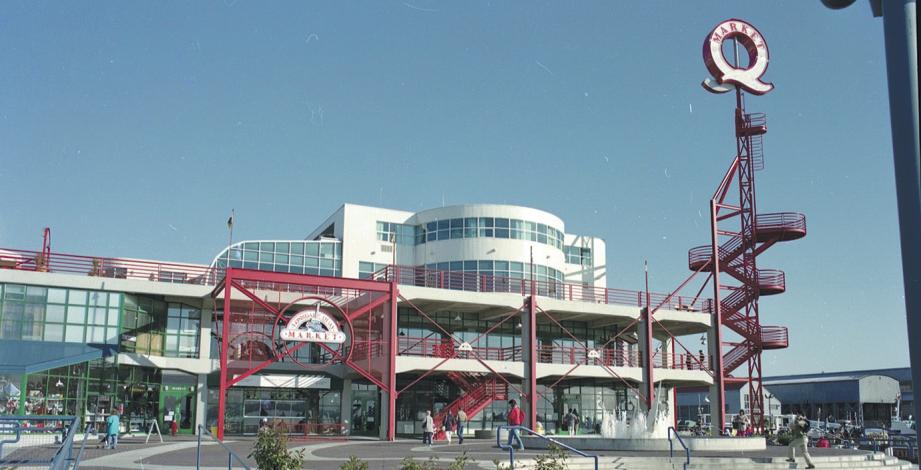
LonsdaleQuayturns40
Photo: Bruce Flanagan, NVMA, F160-295
The official opening of Lonsdale Quay was celebrated 40 years ago this month, on April 12, 1986.
The plans to develop the 25 acres surrounding the SeaBus terminal were unveiledin October 1979, and included thecreation of Waterfront Park, the building of amarine training institute and the ICBC office building, as well as other commercial and residential facilities.
After anewspaper piece mentioned the possibility of apublic market, hundreds of locals called and wrote letters in support of the idea. The market itself opened to the public on Valentine’sDay 1986. What memories do you have of Lonsdale Quay?
Discover more of theNorth Shore’srichhistory at MONOVA. Startplanning your visitat monova.ca. Do youhavea storytotell? Getintouch viaarchives@monova.ca
GARDEN TO TABLE
Healthy soil will help keep grass green during dry months
LAURA MARIE NEUBERT Contributing writer
Grass is greener on the lawn alternative side of the fence.
Lawn watering restrictions go into effect May 1, but that doesn’t mean that we must resign ourselves to another summer coloured by brown fields of prickly stubble.
There are small things we can do to increase the water-holding capacity of our so-called “lawns” that will help preserve green space, maintain soil biology and increase pollinator habitat.
I have no doubt that thirsty, chemically dependent golf-green turf will eventually become a badge of dishonour, much like Hummers and vanity plates, but until then we can chip away at our conscience and grow our understanding.
Soil should be the first place we look to understand how much water is being retained by our lawns. Dead, compacted, sandy, and bare soil cannot hold water, so no amount of it will keep lawns green between once-weekly waterings during drought.
Healthy soil is a living ecosystem containing; roughly 45 per cent minerals (that is the inorganic foundation of sand, silt and clay in various proportions); 25 per cent air which is essential for aerobic microorganisms and circulation of nutrients and energy; 25 per cent water which is essential for transport of nutrients, microbial life and energy; and the all important soil organic matter (SOM) which is like a bank account of fuel that requires regular deposits. Increasing SOM by just one per cent can increase the water-holding capacity of one cubic foot of soil by 1.5 litres.
The system is difficult to illustrate and even harder to fully understand. Thankfully, we don’t have to because nature has provided us a perfect model to emulate. Natural ecosystems like un-managed forests and even native grasslands and wetlands create their own SOM by perpetually recycling dead and dying biomass and all manner of living things.
The very process of decomposition is a dynamic depository of nutrition that keeps the water flowing and food on the table. Keeping that in mind, it is no surprise that traditional lawns don’t fit the model of ecosystem health. Still, we are modern humans, and we value a lovely soft patch of green to play and picnic on.
So what can we do to keep things green? We can reduce the size and burden of care dedicated to lawns. We can stop using
English daisies within an alternative lawn mix of hardy groundcovers wake up early in the spring.
synthetic fertilizers and herbicides that kill soil biology along with water-holding capacity We can aerate then top-dress with sifted living soil rich in organic compost. We can chop-and-drop lawn clippings and leaf mulch during mowing and leave them in place to decompose, and we can feed the soil biology and encourage decomposition and nutrient cycling by foliar spraying or watering with dechlorinated water (left in a bucket for 24 hours to off-gas chlorine) enriched with compost tea (a cup of compost stuffed into a sock and steeped in water overnight will do) and effective microorganisms. The latter should be done the evening before watering, or early the morning before.
Ultimately, we can replace traditional turf with one of the many lawn alternatives that have been proven to be tough enough for children, pets and recreation, and resilient enough to withstand watering restrictions. Transition is a commitment, but like most things worth doing, the reward is worth the work.
My family finally bit the bullet and replaced the last vestiges of lawn entirely, with Bee Turf, a pollinator-friendly and hardy alternative lawn blend created by West Coast Seeds for the City of Richmond. We started late last summer, taking advantage of still-warm soil to support germination throughout the fall. There were humidity hiccups, squirrel digs, bird feasts, repeated spot repairs and assorted other frustrations but, fingers crossed, we are well on our way to healthier soil and a prettier “lawn.”
Laura Marie Neubert is a West Vancouverbased urban permaculture designer Email: hello@upfrontandbeautiful.com
LAURA MARIE NEUBERT
Poke fun at
Balloon input
37.Had popcorn
together
47.Sharpbark 49.Resort 50.Gained victory
Crosswordpuzzle answers use American spelling
ARIES March21-April 19
Your confidence will help you express your ideas clearly and convincingly.This attitude will reinforce your credibility and earn you greater respect, strengthening your leadership skills and helping you perform better on your projects.
TAURUS April 20-May20
To strengthen your relationship, break with the old routine and trymoreopen communication. The idea of moving in together or taking ameaningful step forward could deepen your emotions and solidify your bond.
GEMINI May21-June 20
Adynamic period has begun! It’sall about action this week. New challenges, stimulating experiences and professional opportunities will drive your intellectual and spiritual growth, paving the way for major career progress.
CANCER June 21-July 22
Taking astep back can give your path moreclarity.Make informed financial or relationship decisions to help restorebalance. Your creativity will flow freely this week. The artist within you will find inspiration to create remarkable works.
SUDOKU
LEO July 23-Aug. 22
Your careeristhriving, bringing awelcome boost in income. Your love lifeisalso on the upswing. Your partneroranadmirer will show unexpected affection, boosting your confidence and deepening your happiness together.
VIRGO Aug. 23-Sept.22
Apowerful revelation will guide your upcoming choices, illuminating the path towardyour goals. Now’sthe perfect time to startanew project that’sclose to your heart, symbolizing renewal and unwavering motivation for your future.
LIBRA Sept.23-Oct. 22
Atransformative training course will open new perspectives and broaden your horizons. This experience will rekindle your enthusiasm and self-confidence, filling your life with inspiring discoveries and promising ventures.
SCORPIO Oct. 23-Nov. 21
Preparefor alot of intense emotions this week as awave of passion will sweep through your life. If you’reina new relationship, you’ll receive a clear sign of commitment. These positive changes will bring you happiness and mark the startofa bright new chapter
SAGITTARIUS Nov. 22-Dec.21
Beforemaking amajor decision, consider the repercussions. Your generosity will strengthen your emotional bonds and inspire your loved ones. Sharing your joy comes naturally,highlighting the relationships that matter most and reinforcing your personal values.
CAPRICORN Dec. 22-Jan. 19
Small dietaryadjustments could boost your well-being. In love, an open conversation will prevent misunderstandings and strengthen your relationship. Simple gestures and tenderness will nurtureyour emotional connection.
AQUARIUS Jan. 20-Feb.18
Aselfless gesture, such as listening, lending ahand or offering support, will strengthen your position with others. At work, your good mood will lighten the atmosphereand spread optimism, earning respect from those around you.
PISCES Feb. 19-March 20
Moving is becoming increasingly important to you. You’ll start looking for aplace that truly fits your needs and those of your loved ones to create amore harmonious space conducive to comfortand sharing.
HOWTOPLAY: Fill in thegridsothat everyrow,every column and every3 x3box contains the numbers 1through 9only once Each 3x3box is outlined with a darker line. Youalready have a fewnumbers to get youstarted. Remember:you mustnot repeat the numbers 1through 9inthe same line, column or 3x3 box.
SATURDAY MAY2,2026 12-4PM FREE TO ATTEND
SPONSOR BRONZE SPONSORS
VENUE SPONSORS
Community
MARKETPLACE
Call or email to place your ad, Monday through Friday 8:00am to 4:00pm 236-889-6595
ahogan@lodestarmedia.ca
Book your ad online anytime at glc.navigahub.com/portal/classified/glc/nsn/entry nsnews.com/classifieds
Thesky awaits us,when we breakfreeand follow you, in our dreams.
- Friends
Breakthrough
by Nel de Keijzer Santa
Barbara, California
It is with hearts full of sorrow that we announce the passing of Carolyn Bielby Survived by her beloved husband of 65 years, Don; her adored children, Trevor (Carmen), Karyn (Andrew), Scott, and Kristin; three grandsons; and one great-grandchild
Carol and Don spent most of their lives in North Vancouver, where Carol was a “stay-at-home Mum” for several years She went back to work as a Paralegal, then pursued a new career in Real Estate for 22 years She loved the work and meeting new people Upon retirement, Lawn Bowling became her passion, thoroughly enjoying the game and the socialization aspect Many fun-filled vacations were spent with family and friends in the Okanagan, including houseboating, as well as trips to San Diego, San Francisco, Arizona, Hawaii, and cruising the Mexican coastline and Panama Canal
There will be no service by request As an expression of sympathy, donations may be made to a charity of your choice Carol will be loved and missed by many and will remain in our hearts and memories forever
The Austin family is heartbroken by the loss of Darcy He will be deeply missed and forever loved
Darcy was a kind, compassionate, and loving man who cared deeply for others, touching countless lives with his warmth and generosity Family was at the centre of his life and a constant source of joy and pride
He was a devoted husband to Senait; a beloved father to Jonah, Nathaniel, and Daniel; a cherished son of Scott and Kelly; a dear brother to Devon and Sean (Alex); and an extraordinary friend to many Darcy will also be missed by many aunts, uncles, nieces, nephews, and extended family members
As we grieve his loss, we are reminded of the kindness Darcy showed to all, and we hope to carry that spirit forward in our own lives
Ourbeautiful Momtook her final flight on March 15th, 2026. Shewas an RN, TCAflight attendant and laterreturnedtonursing on theneurosurgeryunitat LGHfor 25 years. Afterretirement,she lovedplaying tennis and walkingthe West Vanseawall.
Predeceased by both parents, threebrothers, husband Grant,daughter Lynn and sonGerry Survived by her daughter Jo-Lue,sons Sheldon and James, sevengrandchildren, threegreatgrandchildren, many nieces,nephews and friends.
BornonafarminStarCity, Saskatchewan, the youngest of four children. Herparentswerepartofa generation that headed West to find theirfortune Mom'sbrothersEarland MacSmith went offtofight in WW2 and lived to tell.
To theend, Momfaced deathasshe had lived her life, with unwavering courage and wisdom.Her favouriteexpression was“it's laterthan youthink”, never take lifefor granted.
She left in Spring,a time of eternal renewaland growth.She will be forevermissedand lovingly remembered as thematriarch of theBloomer clan.
Rest easy, Mom
It is with deep sadnessthat we announce the passing of Harvey WilliamHill on March3,2026, following abrief illness.
Harvey wasbornand raised in Toronto, Ontario, wherehegraduated from Humberside Collegiate andeventually earned hisCharteredAccountant designation. He began hisprofessional career at SmithNixon, CharteredAccountantsinToronto, wherehesoon becameapartner.In1975, Harvey met hiswife, Renata, and they movedtoVancouver, whereheacquiredanaccountingpracticeinWest Vancouver,which he successfully operated until his retirement in 2020. Shortlyafter theirmove, they also welcomed theirdaughters, Andrea and Laura.
Harvey pursued many interests, including travelling, skiing, and gardening.Hewas alifelong member of theWestVancouver Rotary Club and valued thetime spent with friends at thenow-defunctParkRoyal Hotel Pub. An avid golfer, he spent many years dedicatedtothe sport.
Harvey waspredeceased by hisparents, Elisabeth andWilliamHill, and hissister, Margot.Heislovingly remembered by hiswife, Renata, hisdaughters Andrea (Serdar)and Laura(Frank), hisniece Susie Wang-Moore, and grandchildrenTristan, Aiden, and Holland.
Ourfamilywishes to expresssincere gratitude to the nursingstaff at Lions Gate Hospital forthe exceptional care Harvey received duringhis final weeks.
Nina Louise Tysonpassedawaypeacefully,aged 94, in theearly hoursofMarch 7thatAmica Edgemont Village,North Vancouver,withher daughter Carolather bedside. Herhealth had been decliningfor some time,but with characteristically brave determination, and thankfullynopain, Nina waspresent with much warmth and wituntil her final fewdays. In addition to thecomfort and supportofher daughter Caroland husband Ian, shehad enjoyed regular visits from her grandson Martin,his wife Veronica,and adored great-granddaughter,Edith.Her younger daughter Nicola flew in from NewYorktovisit whenevershe could.
Born Nina TownsononMay 9, 1931, in Barrow-in-Furness, Cumbria(then Lancashire), shewas theonlychild of Nina and CharlesTownson. Charleswas a successful localcontractor and builtthe houseinDalton-in-Furnessinwhich she grewup, and whereher mother lived until shediedaged 100in2000.
Nina attended theGreen School in Dalton-in-Furness, UlverstonGrammar School,and then went on to study teaching at S. Katherine’sCollege,Liverpool, from 1949-1951.She taught in Barrow-in-Furnessfor afew yearsbeforemarrying Alec Coward Tyson, of Kirkby-in-Furness, in 1954. They made thebolddecisionto move southtothe suburbsofWestLondon, buying theirfirst houseinGreenford, Middlesex.Alecwas employed as Assistant Experimental Engineer at AEC in Southhall, specializinginthe development of trucks and buses, and Nina taught at Ruislip Gardens PrimarySchool until 1958, when theirfirst daughter,Carol, wasborn, followedbyNicolatwo yearslater
In1962, Alec‘s jobtookthem alltoBuenos AiresinArgentina, wheretheylived for ayear.Itwas ahuge adventurefor thewholefamilyand fondlyremembered by Nina. Once backinthe UK,theymoved into anew homeinNortholt, whereshe and Alec were to livefor thenextforty years. Nina established abeautiful garden on thesurrounding acre -gardening being her passion, in addition to birdwatching and reading widely. From1971–1989, shetaught full-time at St.George’s Firstand MiddleSchool in nearby Harrow. Always independent and forward-thinking, she took an Open University course in Reading Development in thelate1970s and coached childrenprivately from home. It gaveher immensesatisfactiontohelp thesechildrenbecomeproficient readers.
In1983, Carolmarried and emigrated to Vancouver,Canada, and in 1989, Nicola moved to NewYorkCitytopursueasuccessful career in thearts. Alec and Nina planned to join Caroland emigrate to Vancouver upon retiring,but sadly, Alec fell unexpectedlyill and died in 2002. Nevertheless, Nina made themovealone in 2005, becomingaCanadian citizenin2009. Shesettled happily into her newlife in BritishColumbia, getting involved with theWestVancouver SeniorsCentre, travellingagreat deal,and volunteeringatthe West Vancouver Memorial Library for10years.She made lastingfriendships boththereand at theLioncrest apartment building, whereshe lived formanyyearsbeforemovingtoAmica Edgemont Village in 2023.
Thefamilywouldliketothank allthe staffatAmica forthe exceptional supportand kindnessshown to Nina duringher time there.
at 604-653-7851 or nmather@glaciermedia.ca
Contact Adam at 236-889-6595 ahogan@glaciermedia.ca Contact Adam at 236-889-6595 ahogan@lodestarmedia.ca
It is with heavy hearts that we announce the passing of Ingetrud Veltman on March 14, 2026, surrounded by family, at North Shore Hospice Born May 11, 1935, in Germany, Ingetrud Koepcke immigrated to Canada in 1958 In 1985, she married the love of her life, Johan Veltman They shared 40 blissful years in West Vancouver For 27 years, Inge was a beloved hostess at White Spot, Cordova St , Vancouver, and received numerous accolades, including the CKNW's Super-Service Award in August 1976 Her gift for conversation and her genuine interest in people touched the lives of many Ingetrud enjoyed knitting, crocheting, and needlepoint She had a curiosity for political and news events, which she loved to discuss with friends Her legacy lives on with nephew John Blake (September), four stepchildren, nine grandchildren, and nine greatgrandchildren
Shannon Shobridge Mirhashemiwas bornonJuly 28,1970, in NorthVancouver,B.C.and passedaway on December 15,2025, in Whiterock, B.C. surrounded by theloveofher family
Shannon graduated from Argyle SecondarySchool as amember of theclass of 1988.
Shannon wasa devotedwifeand mother.She is remembered by Eric and her sons Josh &Jordan as well her stepson Jayden.
Herfamilywas thecenter of her lifeand shetook great prideincaringfor and supporting them. Shannon will beremembered forher strength, commitment to her family and thelasting impression shemade on thosethat knew her
Celebrate the lives of loved ones with your stories, photographs and tributes
As you share the stories and the memories of how they lived their lives and how very much they meant, may you find comfort