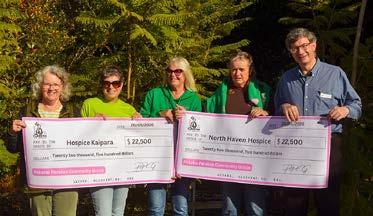
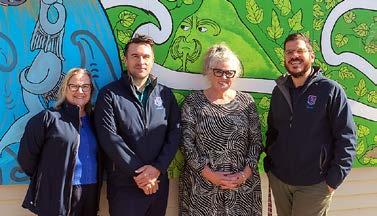
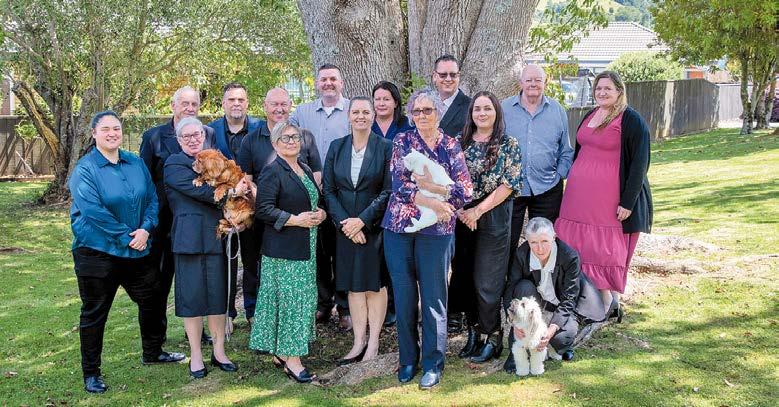
The Pakōtai Parakao Community Group donated a total of $45,000 to North Haven and Kaipara Hospice last week, following its biggest horse trek …
Creativity wins
The Fosters Silage Bale Painting Art winners were awarded their prizes last week, with Kaihū Valley School gaining favour as the People’s Choice …
Firefighting leader is top citizen
u by Andy Bryenton
The Rotary Club of Dargaville bestows only a single citizen’s award each year, making it a rare and prestigious accolade for the recipient.
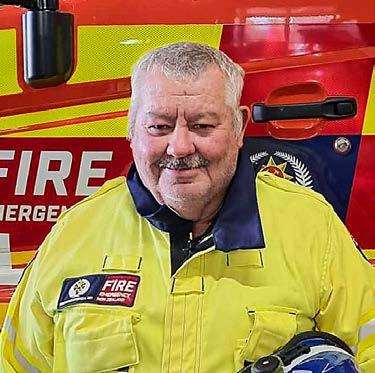
This year, the pro-social community group conferred this honour on a man who has exemplified service to his fellow citizens, in a career which began in 1980. Former chief fire officer of the Dargaville Volunteer Fire Brigade, Jeffrey Palmer, was lauded for his many years of service in often dangerous circumstances; a legacy ongoing under the tenure of current CFO Jason Campbell.
‘Every time that siren goes off, whether it be day or night, a firefighter responds,’ read the official dissertation, which accompanied the award. It also noted Mr Palmer had found time in his busy schedule to support other local groups, including the Scouts, the Dargaville Club and Selwyn Park School, where he served on the board of trustees.
Jeffrey has served 46 years in the boots and protective garb of a firefighter, and is still an intrinsic part of the firefighting team safeguarding people and property
out of the Dargaville station. As station officer, he’s worked in every level of the brigade, coming up from trainee to leader of the local firefighters.
Jeffrey says that his initial inspiration came from Barry Searle, who was CFO of the Te Kōpuru brigade in 1980. His obvious passion for the job and his dedication to helping others in their time of need sparked, he says, “my enthusiasm to get out there and do my best.”
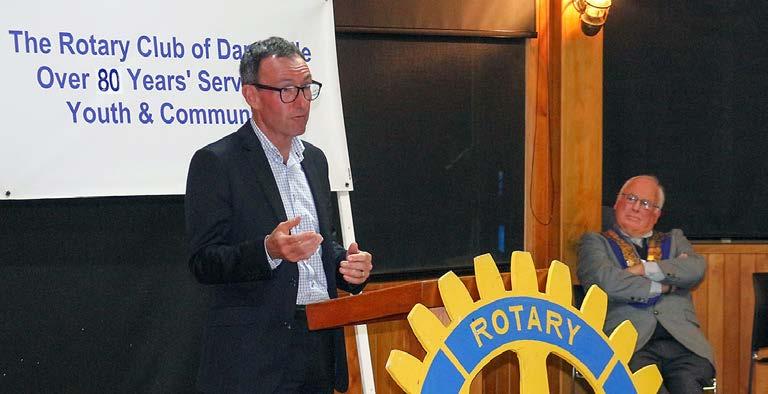
While Mr Palmer could not attend personally, due to family commitments, the rest of the engagement was filled with further surprises. Rotary leader Brian Burnett took the time to thank those who had assisted with the many projects the group undertook in the preceding 12 months, before inviting some special guest speakers to take the podium.
“It has been a real privilege this year to see so many aspects of our work to which you have contributed,” he said.
Those singled out for specific praise were the team that delivered Northland Field Days’ operational support, the helpers who hosted the Dargaville Christmas Parade, school reading programme participants, colleagues in social philanthropy the Lions, and donors Mercury Energy. The firm behind the big Kaiwaikawe wind farm project was represented on stage by Katie Scoullar, while Rotary exchange student Alina Servaye, a guest from Belgium, also gave an engaging address about her experiences in New Zealand.
The keynote speaker of the night was Karl Le Quesne, the top electoral official in New Zealand, who shared his candid thoughts on the massive job of planning for the forthcoming general election. His insights into the mechanism of democracy were followed by a round of illuminating questions from the audience. ¢
p Leading electoral official Karl Le Quesne and Rotarian Brian Burnett
p Award winner Jeffrey Palmer, Dargaville firefighting veteran
CLEVER ENDEAVOURS
Audit Office announces KDC inquiry
u by Andy Bryenton
The Audit Office has announced an inquiry into aspects of the Kaipara District Council’s approach to procurement.
‘We have decided to carry out an inquiry into Kaipara District Council’s procurement, contract management and governance practices,’ wrote the Audit Office, formerly the Office of the Auditor General, last week, in an official statement.
‘All public spending must be able to withstand scrutiny. The principles that apply to all use of public funds include accountability, openness, value for money, lawfulness, fairness and integrity.
‘The annual audit has highlighted weaknesses in the council’s approach to procurement,’ read the statement. ‘In recent years, we have also received several requests to inquire into the council’s spending decisions, including questions about the council’s procurement processes and how it identifies and manages potential conflicts of interest relating to roading contracts.’
The KDC replied to news of the inquiry with an official statement as follows:
‘Council acknowledges the inquiry by the Office of the Auditor-General under section 18(1) of the Public Audit Act 2001 (the act) into KDC’s procurement, contract management and governance practices in relation to roading contracts. We will be cooperating fully with the OAG and will not be commenting further on the inquiry while it is underway.’
The Audit Office regularly tests the resilience and robustness of council
processes through such inquiries. In May, it returned a report on Auckland Council’s Māngere water projects, while in March, engaged with the Chatham Islands Council on spending and procurement.
The recently announced KDC inquiry is reported to focus on roading, with specific mention being made to the emergency procurement processes utilised in the wake of Cyclone Gabrielle.
‘Our inquiry will focus on how the council procures and manages its roading contracts. To do this, we will inquire into a sample of the council’s roading procurement activity,’ says the Audit Office.
The processes and practices supporting council decision-making, how the council documents its decisions, how it achieves value for money, and how conflicts of interest are identified and managed are all mentioned in the summary of the inquiry. However, the Audit Office also stated that ‘we may broaden the scope of our work to cover other types of governance, procurement, and contract management activity if we consider it necessary to do so.’
The inquiry is, for reasons of fairness and impartiality, conducted on a confidential basis. When complete, the Audit Office may, at its discretion, publish a report or forward its findings to parliament. ¢
Horses for hospice
u by Amy Fifita
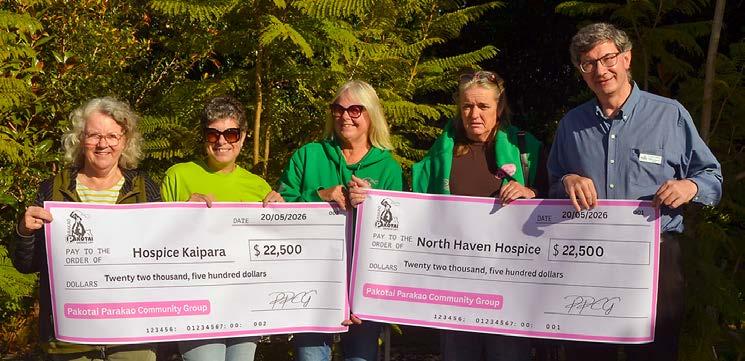
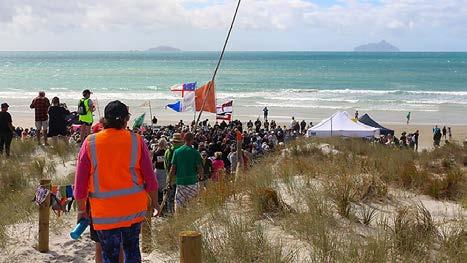
The Pakōtai Parakao Community Group donated a total of $45,000 to North Haven and Kaipara Hospice last week, following its biggest horse trek fundraiser to date.
The event harnessed the support of 163 horses and riders, dozens of volunteers, celebrity chef Al Brown and multiple sponsors. Gathered in Tangowahine Valley, participants were welcomed by five generous landowners and got to enjoy a front-row seat to some of Northland’s spectacular vistas.
“It is fantastic that they thought of both hospices that cover this area. For us, it means we can add to the equipment and provide extra support with supplies,” said Kaipara lead clinical care coordinator Annette Olsen. Together, in their support for the good work that Hospice NZ does, the Saddle Up 4 Hospice horse trek was a huge success. The PPCG has been running an annual fundraiser for just over 20 years, and has contributed
to local initiatives and amenities from each event. Representing North Haven, Dr Antonio Noguera accepted its share of $22,500.
“This donation is more than money; it is what we can use to do things better, and it strengthens bonds. The real relevancy is the importance of the community and how they have recognised our work,” said Dr Noguera.
Being only partially funded by the government, Hospice NZ relies on donations to continue providing its invaluable care.
“Our biggest trek yet was an amazing show of community spirit. From riders to volunteers to landowners and supporters, it took everyone coming together to make it such a success,” organiser Diane Vuletich said. ¢
Phone: 09 945 0890
Email:
p Annette Olsen, Samantha Hopkin, Diane Vuletich, Kim Lawrence and Dr Antonio Noguera all met last week to acknowledge the work each does in, and for, the community
Olive Grove and Orchard Equipment
Loved by the century
u by Amy Fifita
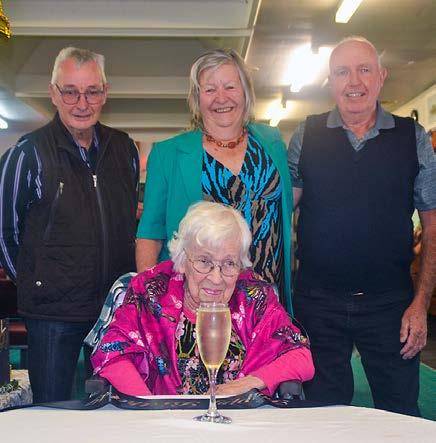
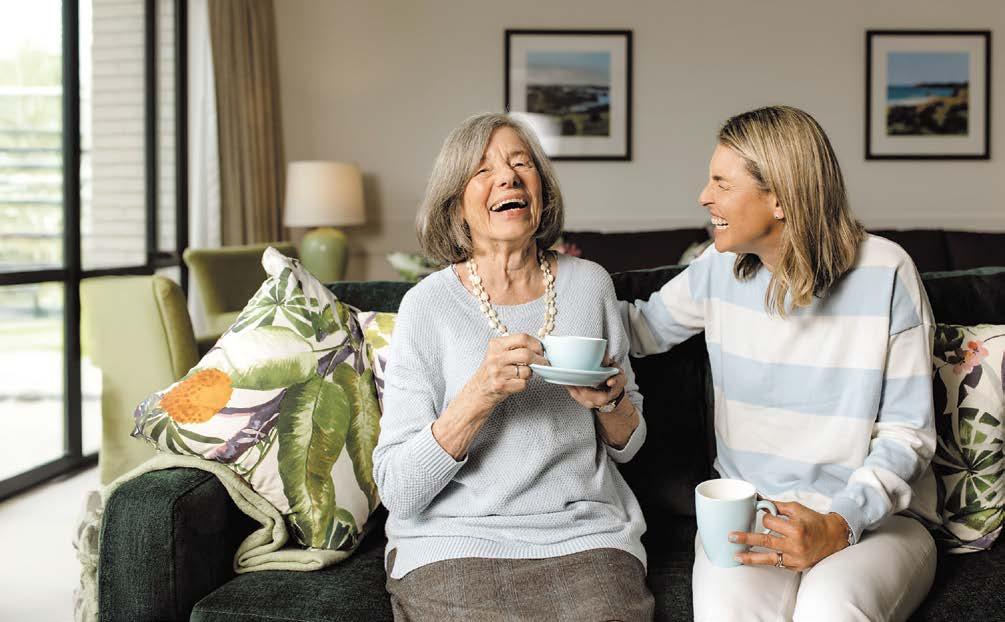
Born on May 17 1926, Elaine Aiken celebrated a century surrounded by family and friends and looks back at her century filled with many fond family memories.
Children, grandchildren and even great-grandchildren celebrated the special day with Elaine. The daughter of William and Margaret Frost, Elaine was born in Kaipara, but after the sale of her father’s Mititai store, her family relocated to Manawarū, Waikato, in 1927.
“Grandad Frost lived with us until uncle Roy married aunt Shelia, and they lived across the road. The Napier earthquake even affected our store,” said Elaine.
“I can remember the pots and pans, which were hanging up in the store, rattling on February 3 1931. After some years, the store was sold, and our family moved to Bruntwood, where we were very happy and attended Hautapu School. Uncle Roy bought a farm at Ngākuru.”
In 1936, William died of pneumonia, and the family eventually made their way back to Mititai. Elaine then attended Arapohue School until she was about 15 years old before beginning her banking career at the BNZ in Dargaville.
Married on June 28 1947 to Aubrey Martin George Aiken, they lived at the dairy farm at Turiwiri before moving to a farm in Tangiterōria.
“It was jolly hard, and we didn’t have much money, and family was always very important to us.”
A life dedicated to family, relatives from New Zealand and overseas joined together to celebrate her 100th birthday at the Northern Wairoa RSA. ¢
Playground changes Pahi waterfront
u by Paul Campbell
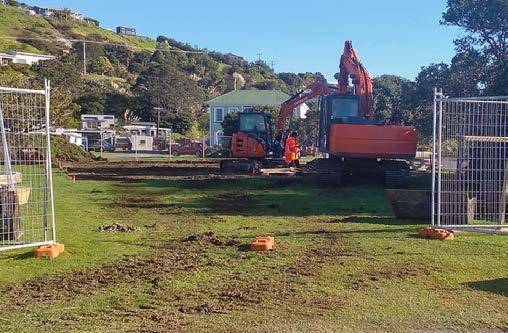
A new children’s playground is on the way which will change the face of the Pahi waterfront as it replaces the 1950s-style facility beneath towering aged Bunyabunya pines at the reserve entrance.
Kaipara District Council says the new area is designed to be ‘safer, more accessible and packed with opportunities for imaginative play, replacing the existing play area and will make room for essential water infrastructure for the public toilets’.
“This work is about maintaining and improving our playgrounds so they stay safe, functional and enjoyable for local families,” says mayor Jonathan Larsen. “Pahi is a special part of Kaipara with a strong community spirit, and it’s great to see a vibrant new space for the community and visitors to enjoy.”
The new playground has been designed to suit a wide range of ages, featuring natural play elements. It includes a timber swing set with infant and duo rope swing, timber climbing wall, swinging boat, seesaw, dual sand diggers, mud kitchen, and free-play features that encourage kids to explore and have fun. The main feature will be a 3-metre-high lookout tower with a tube slide.
Construction got under last week and is expected to take three to four weeks to complete. While locals are generally supportive there has been a less positive reaction from regular visitors, including foreshore users and fishermen who say that traditional parking and picnic space has now disappeared, reducing what was formerly available and well utilised.
“I guess it’s called progress but I don’t suppose the kids will worry about that,” said John, a fishing regular as diggers moved in last week. “However, it’s covering a much bigger area than I expected, and that for me is simply robbing one lot to pay another. It’s a pity, I think.” ¢
p The Pahi play area under construction
p Rodney, Adele and Grant enjoyed celebrating 100 years with their mother Elaine Aiken
Creativity wins Former chairs express concerns
The Fosters Silage Bale Painting Art winners were awarded their prizes last week, with Kaihū Valley School gaining favour as the People’s Choice and Dargaville Primary School being the Sponsor’s Choice in the group category.
u by Andy Bryenton
The former chairs of both Northland and Waikato’s regional councils, Mark Farnsworth and Peter Buckley, have written to the AuditorGeneral with concerns over local government reform, in a missive raising several important points.
‘We wish to draw your attention to two matters relating to the coalition government’s local government reform agenda that causes us considerable concern and which in our humble view requires your urgent intervention,’ wrote Mr Buckley and Mr Farnsworth, to AuditorGeneral Grant Taylor.
‘It is self-evident that any reform of local government has the potential to impact the socio-economic fabric of the motu. Careful due diligence is required. The needs and inputs of tangata whenua, residents and ratepayers are all required.
‘The current process is overly rushed. The fast-track process as advocated has the real potential to create more problems going forward than just addressing and resolving the reasons the Department of Internal Affairs put forward to justify the review.’
While opining that local government reform is required, the two experienced regional council veterans go on to question the template adopted; that of the Auckland super city.
They call the current call for a threemonth path to reform ‘driven by a thinly disguised agenda that unitary councils
are the order of the day. The unproven Auckland super city is held up as the model example of good practice. The Auckland model is urban-centric, and the efficiencies have been hard to determine.’
Perhaps the most cutting argument in the letter by Mr Farnsworth and Mr Buckley involves the potential conflict of interest experienced by mayors who face losing their positions due to amalgamation.
‘It has been fascinating to watch the public manoeuvring of mayors across the motu. It is difficult to differentiate between informed comment and political motivation. It is very evident that many have their own clear agendas,’ wrote the former chairs.
‘If the basic tenets of natural justice were applied to the process, then the mayors should be excluded from the process as they would be deemed to hold a perceived interest in the outcomes greater than that of the general public. They are more than potentially conflicted as many will be motivated by patch protection and prospect of increased power and influence.’
The letter in its entirety was delivered to the office of the Auditor-General, one of the highest authorities in the land for scrutinising the processes of governance. ¢
p Northland Field Days’ Luciana Schwarz and Kaipara Lifestyler’s John Pickworth awarded the talented young artists from Kaihū Valley School with their cash prizes
p Celebrated by their peers, the creative students from Dargaville Primary School were given their rewards for their winning artwork
u by Paul Campbell
Gallery mounts exhibition Support for stroke survivors
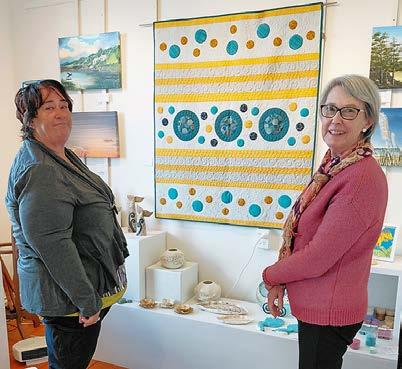
A fresh exhibition is being curated at Matakohe’s White Rock Gallery and opens on June 1 in its annexe of The Kauri Museum, where a vibrant collection of art, craft and jewellery is seeking new exhibitor members.
“Come and join us in our small vibrant gallery, we’d love to hear from you,” says chair Kathy Reynolds.
“Perhaps you’re a painter? If you’re a Kaipara-resident artist or artisan who would like to exhibit and sell your work, do have a think about joining us.”
White Rock is located in The Kauri Museum’s post and telegraph office opposite Gumdiggers Cafe in Matakohe.
“It’s an ideal location with oodles of visitors, including coaches bringing tourists from all over. The Kaipara community supports the gallery by ‘buying local’ and bringing their visitors for a great coffee and lunch at Gumdiggers and to check out the latest offerings,” says Kathy.
buzz of conversation, curiosity and a shared appreciation for art has made the summer-autumn season our most successful yet.
u by Andy Bryenton
With approximately 89,000 Kiwis living with the effects of a stroke, the condition is one which deserves recognition, and the sharing of knowledge to prevent unnecessary risks.
That’s part of the ongoing mission of Stroke Aotearoa NZ, the charitable organisation working in communities across the nation to help reduce the risk of strokes and assist the families of those who have survived them.
To spread the word, and share support for those who have been affected, Stroke Aotearoa NZ will host a Life After Stroke workshop in Dargaville on Thursday, June 18, at the Church of Jesus Christ of Latter Day Saints, 60 Montgomery Avenue from 10am.
The gallery has operated as a volunteer collective since first opening in Paparoa 11 years ago. Membership fees/subs/ commission covers lease of premises, gallery running costs, and eftpos/credit card fees.
“It’s been fantastic to see so many visitors passing through the doors, from travellers discovering the west coast for the first time to familiar local faces returning with friends and family. The
“If you’re looking for a unique and meaningful gift or if you just love to look at artwork and highly original quality craftsmanship, White Rock warmly welcomes you to drop in and explore at your leisure.
“We want to thank everyone — near and far — who support us. Your encouragement, interest and enthusiasm keeps our creative space alive and thriving.” ¢
“The purpose of this workshop is to bring awareness to the wider community, so this half-day event provides a forum to discuss topics relevant to stroke survivors and their whānau,” says Stroke Aotearoa NZ spokesperson Lynelle Ngakuru.
“It’s also a chance to connect with other stroke survivors — you are not alone.”
A big aspect of the knowledge that will be shared is about preventing secondary strokes, and it’s valuable to know; it’s estimated that 90 per cent of strokes
HERE TO HELP.
are preventable. While a major focus of the workshop will be by and for those who have survived a stroke and wish to maximise their quality of life, there’s also plenty to learn for the family and loved ones of people who want to live well, beyond a stroke diagnosis.
There’s a huge and fact-packed resource hub online at stroke.org.nz/ resource-hub if you’d like to find out more ahead of attending the workshop, and of course, the good work of Stroke Aotearoa NZ is kept moving by donations from the public, so if you visit, please click the button to give a little to the cause. ¢
p Tina McCullough and Lorraine Littler take in White Rock’s new exhibition offerings
p Practical advice to reduce stroke risk is just part of the information on hand from Stroke Aotearoa New Zealand
Review a vote of confidence Sand mining panel demands details
u by Andy Bryenton
Ruawai College has received a very positive report from the Education Review Office, following its visit earlier this year.
Principal Aidyn Rasmussen welcomed the team of reviewers from the ERO, saying he was very open to their professional input on how the school was performing. The office inspects all schools on a regular basis and, after three years, Mr Rasmussen was keen to see how his administration stacked up, on the list of more than 100 aspects of teaching that are assessed.
“They go over your teaching pathways with a fine-tooth comb,” he says. “Our good news was that this gave us a very solid report. They commented on the way in which we set high expectations. These are so important — expectations shape ideas of the future.”
Feedback to the ERO team did not just come from teachers; workshops were held with students, too. What came through was the positive impact of Ruawai College’s curriculum pathways approach, giving many options for study, as well as the way in which the tight-knit rural school built trusting relationships between teachers and students.
“Every decision we make is for our students, from the classroom to wider school culture,” says Mr Rasmussen. “It came out in the student voice that teachers care for them and want them to do well.”
Recommendations by the ERO to Ruawai College focus on the two areas all secondary schools in New Zealand have been asked to maximise: attendance and core literacy and numeracy skills. Additionally, Ruawai’s faculty is working on implementing an AI policy which allows the use of the technology as an ethical, safe tool, not a replacement for critical thinking. ¢
u by Andy Bryenton
Fifty-two groups and parties have been invited to comment on the application by sand mining firm McCallum Bros to extract eight million cubic metres of sand from the seafloor at Bream Bay.
The Bream Bay Guardians Society, which opposes the proposal, are just one of these groups that will front up to an expert panel formed to decide whether the enterprise should go ahead. A similar operation by the same company, in Pākiri and Te Ārai, was denied resource consent by the Environment Court, but this current application is through the government’s new fasttrack legislative process.
Throughout late April and early May, the panel issued three separate lists of questions to the applicant, spanning 11 pages. These covered issues such as the impact on marine life, alternative sources of sand for the concrete industry, and the hardware deployed on the sand mining vessel the William Fraser by McCallum Bros.
‘Please summarise the new or different technologies to be employed on the William Fraser compared to those employed during operations at Pākiri. Which particular actual or potential impacts are likely to be reduced or changed as a result?’ asked the panel,
in one of a series of questions asking for clarity.
The Bream Bay Guardians stated that the long list of questions, and their technical nature, highlights the significance and complexity of the proposal. Their main concerns include the alleged ‘sand shortage’ in Auckland, uncertainty around economic benefits, the reliability of coastal process modelling, and adverse impacts on the recovering ecology of Bream Bay.
The BBGS will be submitting several reports from independent experts examining the potential impacts of the sand mining. Those reports are expected to be released publicly later this month. ¢
Te Korowai o Poutama kete is a response to the karanga of whānau to take care of their own loved ones when the time comes.
Our Kaiārahi will come to you and provide whānau the resources, advice, and assistance needed for preparation and ongoing cares throughout the tangihanga. We will also facilitate the logistics of ensuring all regulatory requirements of the whānau are met
p The senior educators and administrators of Ruawai College are heartened by a review from the ERO which has praised the school’s performance
p Sand mining protestors flocked to Bream Bay this summer to protest the proposal to mine eight million cubic metres of seafloor sand
A sporting renaissance Water milestone reached
u by Andy Bryenton
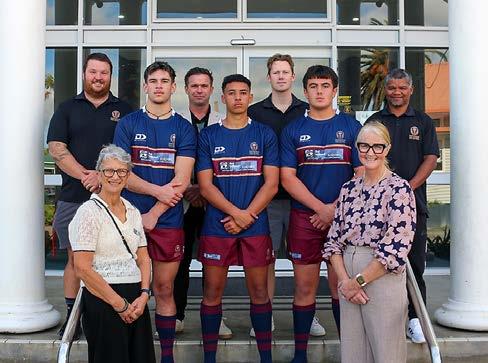
After a hiatus of two decades, first XV competitive rugby has returned to Dargaville High School, alongside a similar resurgence of rugby league in an academy-style training programme which is a source of pride on and off the field.
“This is what the public wanted. They told us they would like to see more sports at the top level here. We are the servants of the public, and we are pleased to make it happen,” said principal Curtis Gaylor, who was himself a member of the school’s first XV during his school days.
When he stepped up to become principal, Mr Gaylor shared in his inaugural address that becoming principal had been a dream of his, when he was a student at Dargaville High School. As part of the school’s top rugby team, part of that dream would have been fostering the next generation to wear the kauri badge and proud school colours on the field.
Now that’s a reality, thanks in part to a motivated faculty and coaching team, and furthermore due to the generosity of local real estate professionals First National Kaipara. This company funded
the tailoring of a new, modern uniform adopting the old traditional livery of DHS, alongside their sponsor’s logo in pride of place.
Competition has only just begun for the season, which is three games deep, and while pride in the school’s sporting history would naturally prompt a wish for immediate glory, the principal and coaching team say that this first year back is all about building and growing the team in terms of cohesion, fundamentals and strategy. ¢
u by Amy Fifita
Northland Waters is one step closer towards establishment, following all three Northland district councils having approved key governance and transfer agreements.
With representatives from the Far North, Whangārei and Kaipara District Councils, a shareholder representative group has been formed. This group includes FNC’s mayor Moko Tepania and councillor John Vujcich, WDC’s mayor Ken Couper and councillor David Baldwin, and KDC’s mayor Jonathan Larsen and councillor Luke Canton.
“This programme of work has been intensive, involving deep engagement with technical detail, robust discussion and a strong commitment to reaching a well-considered regional solution, all within a very compressed timeframe,” said mayor Couper.
With each council holding an equal share, a shareholder’s agreement has been established. The group will oversee NW’s establishment and transition, and will also appoint an independent chairperson.
As the next stage approaches, people can expect to see transitional and operational activities commence ahead of the service delivery and responsibilities goal for July 2027.
The previous Establishment Advisory Group is the first board of directors for the emerging water organisation, chaired by Murray Bain. Board members consist of
“The milestone is an important step in establishing a dedicated, regionallyfocussed water organisation for Northland,” said chair Bain.
“Our focus now is on building a strong, capable organisation that can deliver reliable, resilient water services for communities, while planning effectively for the future.”
Its first meeting is open to the public and will take place on Tuesday, 9 June at The Orchard, 35 Walton Street, Whangārei. ¢
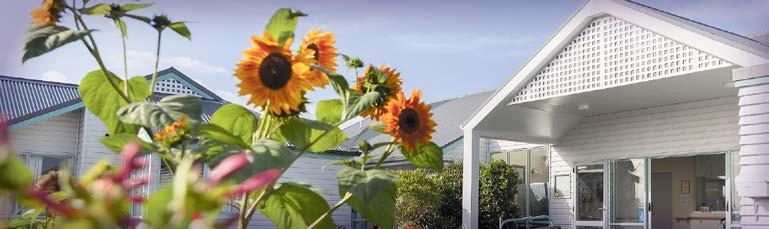
A retirement village that feels like a village, not a retirement city.
Bupa Merrivale Retirement Village is warm and welcoming Our one bedroom serviced apartments feature an ensuite, kitchen, and open plan living Enjoy the freedom of independent living with a domestic services package, which includes weekly housekeeping, linen laundry, and a midday meal daily
• Fixed or variable weekly fees available
• Small and friendly
• Care Home located on site (subject to availability) Enquiries over $410,000^
• 24/7 emergency alarm system (monitored off site)
Contact Karen on 09 942 7461 or visit bupa.co.nz/merrivale for more information.
Bupa Merrivale Retirement Village | 61 Winger Crescent, Te Kamo
David Rankin, Steve Couper, Michael Sage and Marlon Bridge.
p The new DHS first XV rugby uniform carries the original colours into a new era, thanks to the team, coaches and sponsors
p Kaipara District councillor Luke Canton will join mayor Jonathan Larsen on the Northland Waters Shareholder Representative Group
Literary success in Te Kōpuru
u by Andy Bryenton
The Te Kōpuru Library has taken possession of a trove of awardwinning Kiwi literature, as the winners of the recent 2026 Ockham New Zealand awards have joined their collection.
While Reading Room writer Steve Braunias was unable to attend in person as planned, it was a festive occasion last week as members of the Te Kōpuru community welcomed the arrival of a wealth of prose and poetry from some of the biggest luminaries in Kiwi letters.
The win came after the Kaipara-based library was chosen from among more than 400 entrants to take home the stack of bestsellers, following a letter sent to the Ockham committee by library stalwart Jocelyn Righton.
‘The library has never been blessed with a new book, so this is a huge opportunity for our readers to get their mitts on not one, but 16,’ wrote Jocelyn. ‘The library measures just three metres by four metres, but room will be made for your stash.’
The missive struck a chord with the Ockham organisers, who shortlisted the Te Kōpuru Library and eventually made the community initiative the supreme winner. Other winners of the awards for 2016 were the top authors, with former prime minister Jacinda Ardern’s A Different Kind of Power narrowly beating
Catherine Chidgey’s latest novel, The Book of Guilt.
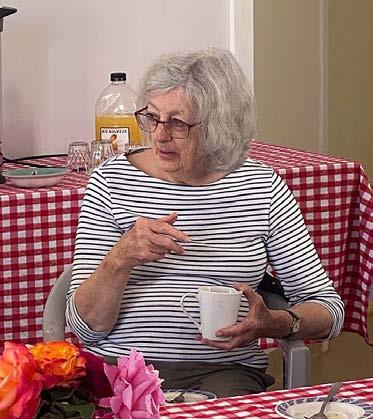
Library helpers and well-wishers gathered for a morning tea celebration as the 16 top books, as judged by the Ockham panel, arrived and were unwrapped ready for display. All present were full of praise for Jocelyn and her initiative in entering the contest and representing one of the nation’s smallest libraries, all the way to the top of the literary scene. ¢
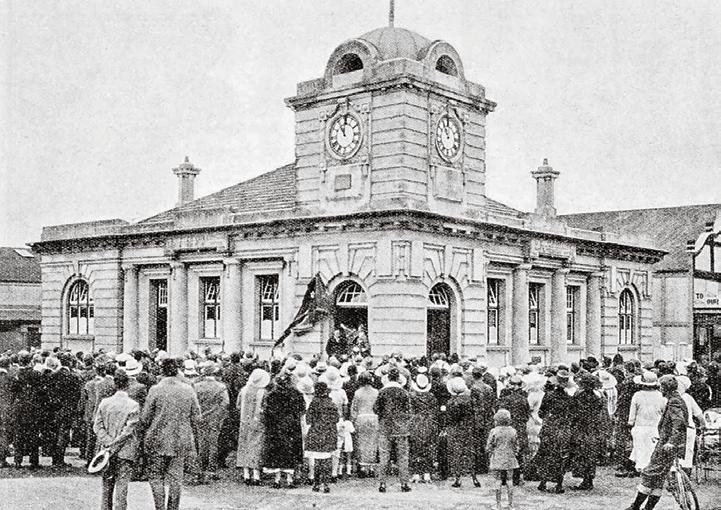
Times Gone By
There was a large attendance for the starting of the town clock, presented to Dargaville by Mr EN Hayes, as a memorial to his late partner, Mr Charles Darling, and other fallen soldiers. Mr Hayes presented the clock to the Hon JG Coates, Postmaster-General, for the department, and Mrs Hayes pulled the ribbon which started the clock. Mr Coates gave a resume of the local post office business since it was first opened in 1871, the Hon E Mitchelson being the first postmaster. In 1877 there was a twice-weekly mail; now it was daily from Auckland. In 1913 the telephone subscribers numbered 116, now 380; a small increase, owing to the opposition of a private exchange. On behalf of the citizens, the mayor, Mr Hornblow, thanked Mr Hayes for his magnificent gift to the town.
New Zealand Herald, March 10 1925 Image credit: Auckland Libraries Heritage Collections
p Jocelyn (Joss) Righton enjoying morning tea at the Te Kōpuru Library and community drop-in
Gift of post office clock
Stay exactly where you belong
Mangawhai isn’t somewhere you arrive by accident. It’s a place you’ ve chosen, and built your life around. So when it’s time to think about what’s next, why leave?
The Tides is Mangawhai’s first retirement village, designed to help you stay connected to the place you love An all-villa village, offers thoughtfully designed homes with space, privacy, and a real sense of independence. With everything close at hand, it’s a place where you can keep living the Mangawhai lifestyle you know and enjoy
Find a village that feels like home
Contact Leanne to book a tour, or scan the QR code to find out more Call 09 222 1348 or email leannem@metlifecare co nz 15 Sailrock Drive, Mangawhai | metlifecare.co.nz
Villa features
Choice of two or three-bedrooms with a variety of layouts and outlooks
Modern kitchens with whitewashed oak cabinetry and quality appliances
Seamless indoor-outdoor living, with patio
Priced from $925,000^
Council amalgamation Te Kōpuru Hospital
Finally, crunch time for local authorities. The government has stopped waiting for district and regional councils to take the hint and bluntly stated that either they all merge into unitary councils, (which would include both district and regional council functions), or the government will do it for them. This seems to be based on the assumption — not based on evidence by the way — that larger units of government will be more efficient and save costs for ratepayers.
The trade-off will likely be a loss of representation at the local level. Apart from local government tragics like me, I think most people are more excited by the size of their rates bill than just about anything else related to their local council.
My starting point is that the government should serve the people, not the other way round, and that the principle of subsidiarity should guide the reform process. Surely, that was what the National Party was referring to when it used the term ‘localism’ in its last election campaign.
Funding of local government activities should be a key issue; it
does not appear to be addressed as part of the reform package. You might ask your local MP why this is so. While you’re at it you could ask them if the government would be prepared to promise not to add responsibilities to local government without providing the funds to implement them.
In my presentation to the Kaipara District Council at its February meeting, I proposed a simple solution for a new structure for Northland. That is, the four Northland councils are replaced by a Northland District Council (or Northland Council for short).
I have since had a further thought: What about focussing on unifying council ‘back office’ functions in a central secretariat, and leave the ‘front of house’ largely intact so that the current levels of representation could be retained, in principle at least.
Mark Vincent Whakapirau
Mr Vincent is a former Kaipara District councillor who served under multiple mayoral administrations.
The Te Kōpuru Hospital is in danger of closing for good, and if it’s lost to the community it will never come back. In fact, it’s likely to be demolished. I have been maintaining the grounds personally for the past five years at my own expense, and I know the potential and the problems which come with this historic place.
I can also see what could be achieved for the good of everyone by keeping this asset in public ownership, not held by those who might seek to exclude others, but those who want to welcome them. We could grow enough food to feed hundreds. We could help promote the education initiatives recently reported via Professor Sutton of Massey University.
I am the last person who manages the trust, which owns the title to the hospital land, and we’re in desperate urgent need for other people to step up and join the trust.
Without this assistance, it won’t be possible to continue on. Right now, we’re providing emergency housing for people who have nowhere else to go, and there’s more which could be done with this major community asset, if the trust could be reformed. All the particulars and paperwork are ready, we are only in need of volunteers.
Lastly, I’d ask that those influential or important people who were born at Te Kōpuru Hospital consider standing up and speaking for
BY PROFESSIONALS IN YOUR COMMUNITY NOT “EXPERTS” ONLINE
it to be restored, and kept in community hands. Where are our MPs, our councillors and community leaders when they are needed?
Kade Tiro
Representative of the Maungarongo Foundation Trust
June 1 is Moving Day for farmers all across New Zealand, a tradition from long ago which still brings new neighbours to the regions in
For many years, the traditional moving day for farmers went by the title of Gypsy Day. It’s a moniker with little to do with the real Roma people except the old English
misnomer, which came from misinformed locals thinking they originally hailed from Egypt. Other names for the event include walking the long acre or the modern marketing pun of Moo-ving Day.
The older rural slang is said to be no insult, but rather a favourable comparison. It is a gentle nudge at the farmers and sharemilkers themselves, taking their whole household to the open road to move farms in a way infinitely less graceful or ordered than the convoys of Roma or the Irish travellers. Some say Northland broadcaster Goldie Wardell popularised the term to the wider public in the late 20th century, making it part of the Kiwi farming lexicon.
p Farms on the move mean a busy time in rural New Zealand around late May and early June
spending a frantic week, and an even more frantic June 1, making sure that manual paperwork for thousands of farms was put to right in an era before computers.
There’s some evidence that the selection of June 1 as a day for all rural transactions and contracts to take effect was decided when the State Advances Corporation came into being in 1894. Stories abound of clerks in Wellington
Others note June 1 might have been chosen because legal papers sent back from New Zealand to England, to confirm the purchase of farms, would need to be sent mid-year to make it to the courts in London and be processed by year’s end.
Even earlier on, farms changed hands on June 1 in mediaeval England for a
very important reason. In the world of livestock, the most important resource for a farmer was hay. The productivity of a farming area was measured by how much hay could be mown to tide cattle over the cold winters.
June 1 was the traditional beginning of the hay harvest when peasants with scythes went into the fields to reap fodder for their animals. Before this harvest was the best time to buy a farm, and assess its worth. The date was kept by the local priest, who kept track of the calendar to observe important religious holidays and the phases of the farming cycle.
This year, sharemilkers and new farm owners on the move for June 1 were echoing those days of yore. In modern times, the start of June also brings International Milk Appreciation Day, which fits in nicely with this old farming tradition. ¢
Funding for a vibrant Northland
u by Andy Bryenton
The annual grants round from Northland Community Foundation is now open, with funding available from the Northland Fund, the Northern Wairoa Fund, and The Tindall Foundation.
The threefold funding call offers a chance for community groups and charities across Te Tai Tokerau to secure funding for projects that make a difference in local communities. Applications for the funding round are open until June 7.
“Funding is prioritised for groups that are working towards a more vibrant, equitable and connected Northland,” says NCF communications and marketing manager Mae Lewis.
Grants are available for projects across Northland which focus on a range of areas, including whānau wellbeing, environmental work, arts and culture, youth development and grassroots community services.
The Northern Wairoa Fund was started in 2016 by donations from generous local donors in the Northern Wairoa region.
The initial donations were invested, and each year the interest from the fund is available as a small grant to community
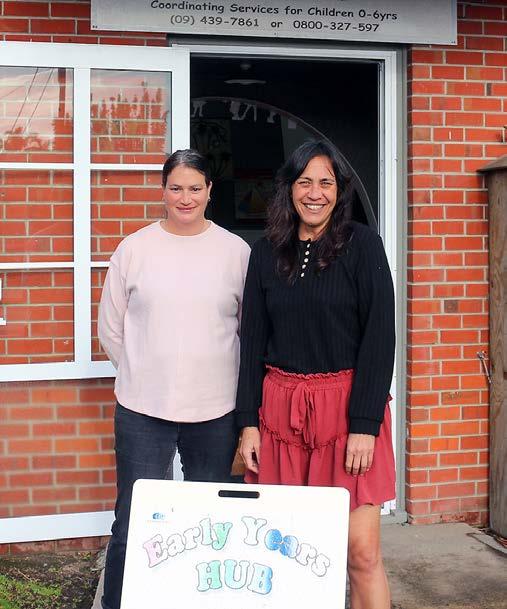
groups. In recent years, the fund has given grants to the Ruawai Community Sports Club accessible toilets project, The Early Years Hub in Dargaville and the Dargaville Dalmatian Cultural Club.
Locals can help to grow the Northern Wairoa Fund so that it can provide more grants for local community groups by contributing a one-off or regular donation, or by leaving a gift to the fund in your will, and leaving a legacy for Northern Wairoa, forever.
If your group or organisation is helping to build a brighter future for Northland and needs help, visit northlandcommunityfoundation. org.nz/grants to find out what the foundation can and can’t fund. If you’re interested in helping to grow the Northern Wairoa Fund, contact Jane Stearns on 021 558 224, or janes@ northlandcommunityfoundation.org.nz or visit northlandcommunityfoundation. org.nz/fund/northern-wairoa-fund. ¢
p Dargaville’s Early Years Hub is a former recipient of Northern Wairoa Fund disbursements
A dog’s tail …
All change ona proppitty soon
Gidday readas, it’s me Billy Borda Colly an’ guess wot, eye gonna be home alone in charge ofa farm, but tha Boss’s mum gonna be hear for me tucker. Yep, Boss an’ his gerlfren’ Sharlene are takin’ off for tha Feel Daze ina Whykato.
We has havin’ smoko ona woolshed steps wen Sharlene tole Boss they were off ina nek couple of weeks. “Time for a break froma farm work Deah,” she sed. “Gypsy Day means a change atta dairy
run-off an’ a new sharemilka arrivin’. He gotta wife an’ kids, so they’ll soon be ina house ana new heard moved ona flats. An’ when they all settild in, we kin leave the farm ter Billy and yer Mum and head to Mistry Creek an’ hava look. Stay ina pub in Hamilton, too. Bita room service eh? I made a booking already.”
Well readas wen Boss gets that sorta messige he gotta say yes. If he didint Sharlene wood have lots to say about things an’ wen she does he’ only got one ansa, an’ that’s always ‘Yeh Deah Yes!’
people, animals, equipment and entire households.”
Boss pored more cupptees, an’ guess wot, he give me the rest of his pikelit. Wow, he mus’ be a bit wurried to answer Sharlene’s plan. But he hada think an’ sed, “If you already booked we better go,” soundin’ a bit cool. But he didint fool me eh readas. I know tha Boss, an’ he wus thinkin’ about alla goodies atta show. New tractas, an’ new stuff fer farmers ter use.
found out can rilly mean “No deah.” But anyway readas, Feel Daze meens a good time ona proppitty. New neighbours ona dairy run-off, an’ that mite mean sum new doggy residents, so I will havta make sure they no who is in charge on a proppitty. Me. Mine you, the last sharemilker hada rather nice lady labrador, but they hada sent it to tha vets ’cos they reckined I got too friendly. But she wus friendly, too? Itsa dog’s life sumtimes.
•
But he sed “Wot’s Movin’ Day. I thort it was Gypsy Day. So Sharlene had her lappytiop open an’’ read in her skoolteecher voice: “Moving Day used to be old-fashioned Gypsy Day when sharemilkers, contract milkers, farm staff and their families move to new farms ahead of the new dairy season. It’s a big logistical undertaking involving
Well, Sharlene wasint slow onna uptake. “Yes deah, but you gonna hava budgit. We both gonna decide wot ter buy, ’cos last yeer it was automatic gate opiners, ana automatic calf feeder, ana laser fense line thingy that’s all still unner tha woolshed today.”
Boss lookt sheepish like Sharlene says but I dunno why. No wool eh? But he sed, “Yes Deah”, witch I have
Sharlene give me a pat ana last pikelit ona cuppatees tray. “You can take care of things ona farm Billy, an’ Mum will be stayin’ to make sure ya get a feed.”
Now that’s a reel bonus fer bein’ home alone readas. Mum does roast pork cracklin’ special for me, too. Take ya time atta feel Daze Boss. No hurry back eh?
All unner control hear. See ya readas — Billy ¢
Gypsy Day means major movement
u by Paul Campbell
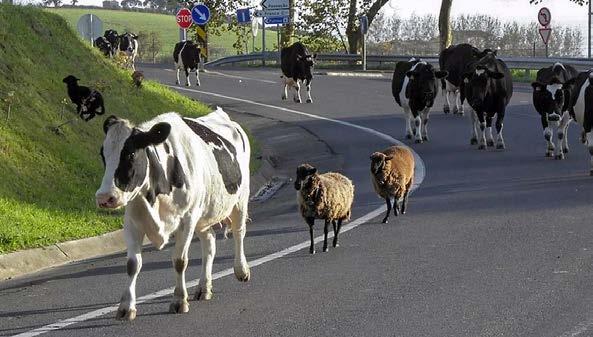
It’s time to move in the dairy industry and for sharemilkers and farmers, new faces and new stock are heading to new pastures, as each year, on June 1, rural New Zealand experiences one of the biggest coordinated rural transitions in the farming calendar.
Known as Moving Day or Gypsy Day, sharemilkers, contract milkers, farm staff and their families move to new farms ahead of the new dairy season, involving people, animals, equipment and households.
The date marks the start of the new dairy season, and for many sharemilking agreements, it’s the official handover date. Cows are usually dry in late autumn and early winter, which makes it the most practical time to move stock without disrupting milking.
The most common movers on this day are those who own herds and contract to other farms, as well as staff and others in supporting jobs, and usually take to the road because contracts have ended and new opportunities arise to further the farming vocation. It allows farmers to build equity and work their way toward farm ownership over time that requires a huge amount of planning leading up to the day, or similar close dates for those choosing to take an early lead.
Families move house, and that also involves packing farm equipment and organising herd transport, either walked nearby or trucked over a long distance. Trucking companies and rural service providers have usually been booked in advance.
Schools, vets, banks and councils are familiar with the rhythm of Moving Day and are ready to support the many families and animals in transit. Gypsy Day, or just Moving Day, offers the chance to grow, take on new challenges, and move ahead in New Zealand’s primary industry.
So across Kaipara and Northland, we may see any number of trucks and new faces as visitors build up the regional farming industry, or perhaps say a farewell to neighbours as new horizons beckon somewhere else along the road. Trucks and trailers might roll out quietly in the early morning hours to signal the start of a new season and the progression of our highly-competitive and internationallyrecognised dairy industry. ¢
p Gypsy Day herds are on the move
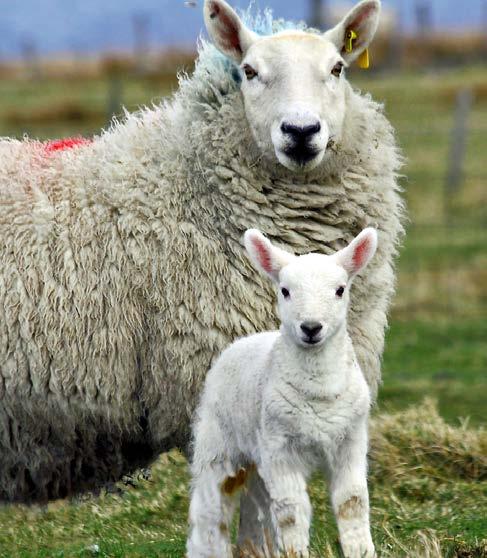
Hairy monsters — super sheep
u by Liz Clark
When Francis Dry began research into a mutation that caused sheep’s wool to be particularly hairy, it developed into a breed named in his honour — the Drysdale.
The development of the breed began in 1930, when Dry was given an unusual Romney ram with an almost pure hairy coat — an undesirable trait that breeders culled out of their flocks. The ram
was born on the farm of Mr P Neilson at Longburn.
The ram was bred to an experimental flock at Massey College (now Massey University) to produce the wool trait that wasn’t seen again in the flock the foundation ram was sourced from.
we’re ready for the new season!
What Dry started as an experiment would become the foundation of a New Zealand-developed carpet wool breed that would profoundly change the carpet manufacturing industry.
By 1950, the Federation of British Carpet Manufacturers had taken an interest in Drysdale wool and asked the New Zealand Wool Board to experiment and increase its production. However, the board took no action with the view that the hairiness should be removed as an uncontrolled fault in Romney wool.
By 1967, however, headlines were appearing in print media of a ‘new and distinctive breed’ that would solve the nation’s wool supply for carpet manufacturers. That year, almost all of the wool used in the making of wool carpets had been imported from Britain. The
Drysdale’s wool was hailed as far superior and higher quality than the Scottish Blackface product that was mixed in with the local wool clip.
The following year, 34 farmers were running Drysdale to increase the availability of carpet wool so imports from Britain could be reduced. Marlin Carpets at its annual general meeting in Christchurch in 1968 reported to its shareholders that ‘the project would vastly increase in the years to come and would become a new national asset for New Zealand’.
The flocks continued to expand, making that prediction of a new national asset a reality. High prices were paid for superior Drysdale wool, and wellknown carpet manufacturers Bremworth used it extensively in its product range. At its peak, flock numbers reached 600,000 head. However, market forces worked against this unique breed developed to remove the need for imported wool.
Wool prices began to crash by the 1980s. Despite a campaign targeting
the high-end user market for top-quality carpets, the lifting of import tariffs flooded the market with cheaper synthetic flooring options. Being no longer commercially viable, the Drysdale flock began to reduce — in 2026, the breed is no longer found in the country. Only 34 animals remain in one location at a stud in Australia. ¢
but are you ready in the office?
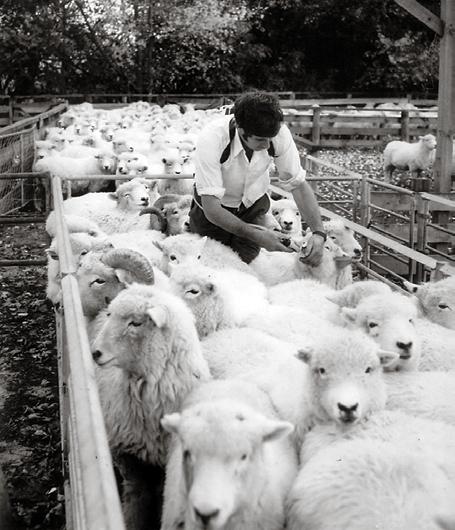
p Drenching Drysdale sheep in the 1960s Image credit: Archives New Zealand
Innovation in the spotlight
u by Andy Bryenton
The National Fieldays will once again bring out the best new ideas in
attracting a competitive field of genius-level intellects.
“The Innovation Awards continue to attract exceptional entries that shape the future of agriculture and food production, and this is something we are proud to support and advocate for,” said Agritech New Zealand CEO Brendan O’Connell, one of the panel members convened to judge the awards.
“The Fieldays Innovation Awards are the leading showcase of primary sector innovation in New Zealand. Many of our members have taken part, and we’re using our global relationships to bring international innovators and their ideas to the New Zealand audience through Fieldays.”
There’s a long history of the awards promoting new thought and debuting new ideas. Last year saw winners across four categories push the boundaries with inventions to help in horticulture, livestock and arable cropping.
The prototype award went to Ruminant Biotech, a company that has developed a new slow-release bolus called Emitless, which delivers a more than 75 per cent
methane output reduction in cattle, lasting 100 days from a single treatment.
Alps2Ocean Food Tapui won the early-stage award, with its product Mīti, designed to process excess dairy calves into a world-first, shelf-stable protein snack.
CropX took out the growth and scale award, with the expansion of the CropX platform and the development and incorporation of the Evato1 evapotranspiration sensor. With more data available to farmers through this system, the judges praised CropX for facilitating smarter, more efficient practices.
Finally, students from St Paul’s Collegiate School’s KiwiPrune team won the Fieldays Young Innovator Award for their idea to simplify the labour-intensive task of removing plastic clips used to secure kiwifruit vines.
“Each year, we see practical problemsolving from people who understand the pressures and opportunities in the primary industries,” says New Zealand
National Fieldays Society programme manager Steve Chappell.
“The Innovation Awards are about connecting those innovators to the people and opportunities that can take their ideas further, in New Zealand and beyond.” This year, prizes totalling more
than $75,000 are up for grabs across the same range of categories, as well as a people’s choice award. The ultimate goal for innovators showcasing their wares at the Fieldays is the recognition of a global market, and the opportunity to turn smart concepts into multimillion-dollar industryleading success stories. ¢
p Penny Ranger’s Mark-It sheep drenching identification system was a previous top Fieldays innovation
STEVE WOOD CONTRACTING
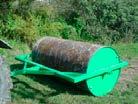
Grandma’s broom
u by Liz Clark
Many years ago, my grandparents had a big old farmhouse, complete with draughty corners and big
that went right around.
Beyond was the garden full of fruit trees and rose bushes, all lovingly pruned with every colour a rose bloom could ever be found in. Grandma was very proud of her house and her garden.
Being very house proud, Grandma, of course, had a broom. It wasn’t just any broom she had beside the farm kitchen door. It was a special willow broom made by Grandpa’s own steady hands, just for Grandma to use. Woe betide anyone else who touched Grandma’s special broom. There it would sit, beside the farm kitchen door seemingly unused, and yet the floors were always swept clean.
As youngsters, we were never allowed to touch that sacred broom. No matter how much we asked and pleaded to use that big old broom, it was always the same. “Don’t you dare touch my special broom!”
One fine day, when Grandma was in the kitchen, a big bull jumped over the fence straight into her prized rose garden. Those roses were her pride and joy, but as all bulls can, and do, those roses were soon being turned into mashed-up compost. He tore, he ripped, he stomped and he
snorted those roses into the ground. Just for good measure, that big old bull gave a few more a good belting with his big heavy head.
He was almost done with the roses when Grandma saw him through the kitchen window. Her bellow could be heard clear to the next town. “Out of there!” she shouted, running towards the kitchen door. On the way out, Grandma armed herself with her special broom, never mind she still had her dressing gown and slippers on — after that bull, she went.
Now, it was the bull that bellowed with all of his might. Off he went, with Grandma and her broom in hot pursuit. Through the fence went the bull, and so did Grandma, who gave that bull two hard
wallops as a reminder to never mess with her and that broom.
It wasn’t the first time that bull had come, and it wouldn’t be the last time, either. At last, the truth about that broom came out. It wasn’t to sweep the dust off the floor — it was to sweep the bull out of the garden. ¢
Risks and benefits weighed up
u by Andy Bryenton
Red tape binding up the delivery pathways for new veterinary
changes, says Associate Agriculture Minister Andrew Hoggard.
“The changes proposed in the Agricultural Compounds and Veterinary Medicines (ACVM) Amendment Bill, introduced on May 11, reduce barriers to innovative new products while making sure any associated risks are dealt with proportionately,” said Mr Hoggard.
“The amendments remove avoidable complexity and focus regulators on real risks and speed up the process for considering novel products.”
In many cases, new innovations in vet medicine and the chemicals used to boost productivity and reduce pest strike in agriculture happen on the global stage. This means the nations, where they are invented and initially trialled, have already poured time and money into researching the risks and benefits of each product. Many of those nations adopt a stricter stance on the safety of such products than New Zealand.
“One way the bill will achieve this is by enabling greater reliance on the
assessments of trusted overseas regulators when evaluating risks and benefits. I consider there is no good reason our primary sector should be waiting on work that has already been done by other reputable agencies outside of New Zealand.
“The changes will also focus regulators on what matters so that products that are known to pose a lower risk will get a quicker pathway to authorisation by exemption and not require registration.”
and
Mr Hoggard said the current regime of regulations has served New Zealand well in preventing risk and damage, but a review by the newly-formed Ministry for Regulation last year found room for improvement. Getting products to market faster helps protect New Zealand’s edge and advantage globally. Its small size and innovative outlook should allow the rural sector to pivot toward new and effective medicines and products faster.
The ACVM Amendment Bill works in tandem with the Hazardous Substances and New Organisms (HSNO) Amendment Bill, also introduced earlier in May. Novel products cannot be registered under the ACVM Act until they have approval under the HSNO Act.
“Together, the bills will establish a more adaptive regulatory framework that maintains safety, supports trade competitiveness, and aligns with international best practices, while improving timely access to agricultural and horticultural products,” Hoggard said. The bill enacting these changes is
expected to undergo public consultation soon and return to parliament for its final readings late in 2026. ¢
p New medicines may be easier to source for Kiwi rural vets and the farmers they serve, thanks to changes put forward by the government this month
Collaboration for breeding purposes
Beef + Lamb New Zealand has just released its online genetic tool, nProve, to help sheep and beef farmers make more informed decisions when breeding.
The nProve Tracker provides farmers a clearer picture of where their flock sits, where there is room to improve and how ram buying decisions can influence performance over time. The tool was
developed through the joint B+LNZ and the Ministry for Primary Industries’ Cool Sheep® Programme and unveiled to sheep breeders at B+LNZ’s Sheep Breeder Forum earlier this month.
“The nProve Tracker tool has been developed to make flock genetics easier to see and use on commercial sheep farms,” says B+LNZ head of genetics Dr Jason Archer.
“It will help farmers understand the value genetics can bring to productivity, efficiency and profitability. Using ram purchase and mating information, it builds a reliable picture of a flock’s average genetic merit.
“Over time, farmers can see where their flock sits overall, giving them a benchmark to compare genetic potential with what they are seeing on-farm. That will help farmers focus on the right next step by showing where the biggest opportunity is, whether
p A collaboration between B+LNZ and the Ministry of Primary Industries, the nProve Tracker tool helps farmers with decisions when buying rams for breeding purposes that’s in management decisions, genetics or both.
“We know farmers are already investing in good rams, and this tool will help show
what that investment is building in the flock over time. It will give them something practical they can use to back up decisions and spot where the next gains might come from.”
Dr Archer says the tool could also help farmers better show the value in their flock over time.
“A clearer picture of flock genetics will help recognise the investment made in quality rams and provide useful information when selling surplus stock or making longer-term business decisions.”
B+LNZ chair Kate Acland says nProve Tracker is part of a broader suite of practical tools B+LNZ is developing for farmers.
“It’s a practical example of how B+LNZ is using farmer levies to deliver value back to the sector, giving sheep farmers useful tools to make genetics part of everyday farm decisions.”
Visit nprovetracker.nz for more information about the tool. The Cool Sheep® Programme is supported by the Ministry for Primary Industries and a range of organisations, including B+LNZ. ¢
Mow, Rake, Bale
Four kings for King’s Birthday
u by Andy Bryenton
Keen for a long weekend read, or a deep dive into the fascinating, sometimes violent, often gloriously over-the-top history of the British royals? These four books will sometimes teach you a bit of history as well as weaving tales of war, love, treachery and power.
Richard the Lionheart was king in 1189, and the story of this military genius, his family, and the willpower, which drove him to be a crusader and a war leader, is one with plenty of depth and a cast of some of history’s greatest heroes and villains. Sharon Penman covers the clash between Richard and his respected enemy in war Saladin in her novel, Lionheart, which culminates in the treachery of his brother John, who conspires to steal the throne. There’s a sequel, A King’s Ransom, in which the Lionheart fights his way back to England to confront his usurping brother, too. Solid research and depth of detail make this legendary king come to life.
Richard III ended up being given history’s most egregious bad press by William Shakespeare, but the eventual loser of the Battle of Bosworth Field and the Wars of the Roses was more complex than the twisted murderer of the Bard’s creation. Both he and Henry Tudor take pride of place in Conn Iggulden’s Wars of the Roses series of novels, wrapping up the deceit, plotting, warfare and intrigue of Game of Thrones in real-life stories. The
queens who were equally instrumental in the Wars of the Roses have their own great series, too, in The Cousins War by Philippa Gregory.
Edward VIII abdicated the throne to marry Wallis Simpson, and there are two excellent records of that world-changing romance and its political aftermath, some say had a direct impact on the second world war. Once a King: The Lost Memoir of Edward VIII by Jane Marguerite Tippett reveals the private, personal manuscript written by the man himself, while there’s a dramatic retelling in Wallis: The Novel by Anne Edwards, putting the focus on the king’s ‘scandalous’ lover.
Arthur Pendragon is more of a legend than a historical figure, but he looms large in the imagination as the most famous king in the lore of Britain. Bernard Cornwell reimagines the Arthurian cast of characters in his exciting Warlord Trilogy, with a densely woven narrative. It’s seen through the eyes of Derfel, not a shining chivalrous knight, but a realistically gritty and fierce warrior living in real historic times; the age when Briton and Saxon clashed for rulership of the land. ¢
WHAT’S ON?
May
New Residents Welcome Event — Tuesday, 26th May at the Lighthouse Function Centre 10am–noon. New to the area? Come along, meet your community, and start feeling at home. Please RSVP to suec@dcdb.nz for catering purposes.
Pop-Up Museum — 30 & 31 May at the Te Kopuru Community Hall held by the Te Kopuru Community Trust. Start 10am–2pm. Contact Rachel 021 133 7560.
June
Dargaville Grant Funding Expo — Thursday, 11th June at the Lighthouse Function Centre 10am–noon. Meet with funding organisations that support local community groups, ask questions, discuss options, and connect with their representatives. Please register at suec@dcdb.nz.
Volunteering Northland — Thu 11 June at the Lighthouse Function Centre, 1pm–3pm, RSVP by 5th June. Volunteer Tea shout out dedicated to celebrating our awesome volunteers who make a difference across Aotearoa. Contact 09 945 4984 or 0800 865 268.
July
Tunatahi Matariki Festival — Fri 10th July @ Dargaville High School, 10am–3pm. Zero Waste, Alcohol and Smoke Free. The Wellbeing of One, The Wellbeing of All. Email vera.r@xtra.co.nz.
Best Practice Grants Workshop — Wednesday, 22nd July for Community Organisations. A morning workshop, bookings essential, $20 per person. Learn best practice processes, further expectations, application writing tips and have a clear plan on where your community organisation needs to focus its attention to improve grants success. suec@dcdb.nz.
Matakohe Community Potluck Dinner — Saturday 18th July, 5.30pm. All welcome.
Markets
Kaihu Hall Market — 4th Saturday each month 10am–noon. Phone Robin 09 439 4878.
Monthly Market — 1st Saturday of each month, 8am–noon at the Kaipara Community Centre, Hokianga Road (opposite the Town Hall).
POUTO
POINT
THE KAIPARA LIFESTYLER IS
Phone: 09 439 6933 or 0800 466 793 Email: info@rml.nz
Postal Address: PO Box 474, Dargaville Physical Address: 107 River Road, Dargaville
Editor: Andy Bryenton
Journalists: Andy Bryenton 021 439 947 | Amy Fifita 027 259 6455 | Paul Campbell
Advertising: Olivia Green 027 525 8197 | Sue Girven 027 525 7984
Classifieds: 09 439 6933 | info@rml.nz
Production: Gavin Bainbridge | Marnie Fuller | Daniel Foster | Liz Clark
Paparoa Farmers’ Market — Saturdays 9am–noon. Genuine local produce, vegetables, seafood, olive oils, meats, patisserie, plants and more. Village Green, Paparoa. Te Kopuru Market — 2nd Saturday of each month, 9am–noon at Coronation Hall. Stall holders ring Rachel on 021 133 7560.
p Richard the Lionheart’s real life was more thrilling than most action movies, and he and his fellow kings make great main characters in some excellent winter reads THE SECRET AGENT
PUZZLE TIME
judgement (10)
68 Homing bird (6)
69 Populate (6)
71 Triggered off (9)
76 Floor covering (6)
77 Reluctant (9)
79 Marzipan ingredient (7)
81 Tune (3)
84 Senior group member (5)
85 Prepared for crops (10)
86 Merge (5)
27 Shedding tears (6)
28 Arrival (6)
33 Fanciful hopes (4,6)
35 Welding spark (3)
36 Fairy (6)
37 Space (4)
39 Ignited (3)
41 Saved sum (4,3)
42 Cook too long (6)
45 Chief support (8)
50 In the role of (2)
51 Industrial city in England (8)
55 Bind (5)
58 Somnambulate (9) 59 Mollycoddle (6)
60 Feathers (7)
61 Signal (3)
63 Hurried (4)
64 Skin depression (6)
65 Beer (3)
66 Showing good
87 Fertile spot in desert (5)
88 Completely naked (2,3,10)
89 Commerce (5) DOWN
2 Dress (6)
3 Shoplifter (5)
5 Tiny particle (4)
6 Breathtaking (7)
7 Impervious to light (6)
8 Group of eight (5)
9 Diversification (7)
10 Ladder step (4)
11 Referee (6)
12 Unrefined (5)
13 Keyboard player (7)
14 Deadly poison (7)
18 Direct and plainspoken (10)
23 Adult female (5)
24 Sluggishness (7)
26 Left on plate (7)
27 One-eyed giant (7)
29 Self-centred person (7)
30 Film theatre (6)
31 Scottish estate owner (5)
32 Cement wall coating (6)
34 Rescue (4)
36 Fixed look (5)
38 Humid (5)
40 Leg joint (4)
45 Face disguises (5)
46 Floating cold chunk (7)
47 Enervates (4)
48 Musically, slowly (6)
49 Ceasefire (5)
50 Placate (7)
52 Open to attack (10)
53 Candidate (7)
54 Turbulent (6)
55 Captain (7)
56 Traffic light (5)
57 Heavy metal (4)
62 Up and about (5)
67 Concerns (7)
68 Sunshade (7)
70 Universal remedy (7)
72 Touch (7)
73 Muscle attachment (6)
74 Airborne (6)
75 Checked and corrected (6)
76 Hard covering (5)
78 Estuary (5)
80 Proprietor (5)
82 Curve (4)
83 Yield possession of (4)
Fill the grid so that every column, every row and every 3x3 box contains the digits 1 to 9.
and five down. More than one solution may be possible.
DARGAVILLE 28 Plunket Street
Classic Charm, Modern Comfort, Prime Location
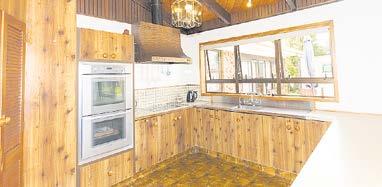
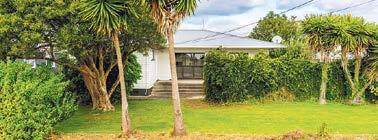
Set on an elevated 809m² section, this solid 1940s brick and tile home at 28 Plunket Street, Dargaville blends classic charm with modern comfort Currently set up as an office, it can easily transform back to a family home. It offers three double bedrooms plus one single, heat pumps throughout, upgraded wiring and newer flooring. The modernised kitchen provides excellent bench space and light, with laundry off the kitchen. Extras include a double carport, near new single garage and a versatile studio with heat pump and deck Fully fenced and close to schools and town. 4 1 3 ENQUIRIES OVER $599,000 VIEW 11.00-11.30am, Saturday 30 May
M 021 716 388 Erin Grbin
E erin.grbin@pggwrightson.co.nz
pggwre.co.nz/DAG43543
DARGAVILLE 242 Baylys Coast Road
Solid, Spacious & Perfectly Positioned
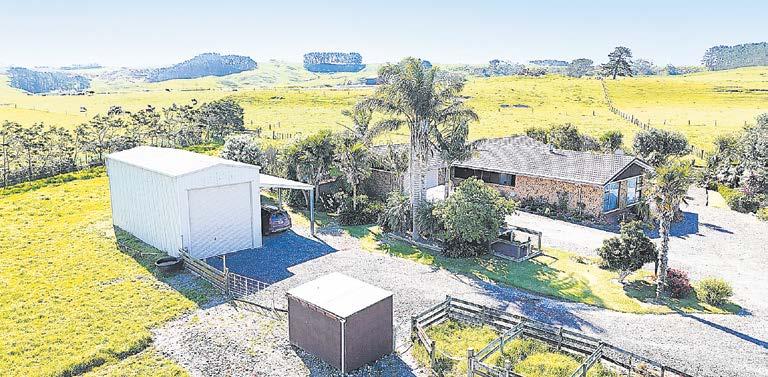
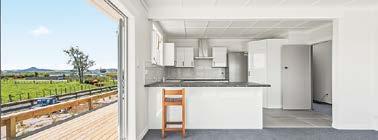
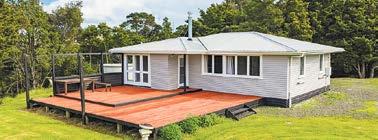
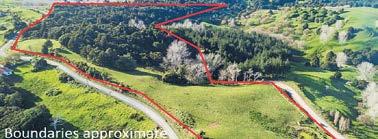
This solid brick and tile home has truly stood the test of time, offering generous living spaces that open to a sheltered, private courtyard -perfect for relaxing or entertaining year round. With three spacious bedrooms, a large family bathroom with wet area shower, excellent garaging, motorhome shedding and extra sheds, there’s room for it all. Set on easy care land with paddocks for animals, kids and bikes, town water plus rainwater collection, fertile coastal soils and no flooding. Perfectly positioned midway between Dargaville and Baylys Beach (approx. 7 km), with a school bus at the gate.
pggwre.co.nz/DAG43593
GST Inclusive VIEW By Appointment Only E cindy.younger@pggwrightson.co.nz
KAIPARA SERVICE DIRECTORY
FOR SALE
CARAVAN EWOF (and marine). Call your local inspector today at A+ Electrical Inspections and Security on 021 240 6764.
TOP SOIL, conditioned top quality. 100% suitable for vege gardens or new lawns. $95 per m³ onto your trailer, or truck deliveries available for larger orders. Phone 021 132 4107 or 09 439 5141.
TRAILER, FITS 15–17′ runabout. New loom, lights, plug. Has rego. Needs rollers & winch and some welding for WOF or convert to flatbed farm trailer. $500. John 027 525 8189.
CHURCH NOTICES
DARGAVILLE CHURCH OF THE NAZARENE, 4 Grey Street. Church service on every Sunday at 3pm. Bible study/prayer Wednesday from 4.30pm–7pm, call Moses 021 248 8910. Support group: Celebrate Recovery from all addictions. Friday 5.30pm–8pm, call Gary 021 174 8737.
FENCING
FENCING, ALL types of fencing, pool, stockyards, post & rail, boundary plus… call Jeff 027 476 5458.
FOR RENT
CLOSE TO Town three bedroom house, two bathrooms, two toilets, two heat pumps with double internal garage. References required. Four weeks bond. $550 per week. Phone 027 249 7527.
PERSONAL
SINGLE? OVER 40? Meet other interesting, intelligent, genuine people just like yourself. Dine out ‘Dinner for Six’. Phone 021 639 552.
TREE SERVICES
TREE REMOVAL, pruning, chipping & stump grinding. Qualified & insured. Phone Scott 0800 468 9663 Arborcare Tree Maintenance.
ENTERTAINMENT
FAMILY FUN Day on King’s Birthday Weekend 30/31 May–1 June. Book your hosted 30-minute time slot for youth activities at Abilene Park, 17 Sarich Road. Visit www.abilenepark.com for costs, further details or call 022 390 8191.
NURSERIES & PLANTS
GOT2GO PLANTS – Bottlebrush, hedging strong and tough mixed colours 1 metre + only $8 including white. Coloured manuka in flower now from $6. Pittosporum karo ready now from $1. Manuka only 50 cents each. Got2Go Plants, 55 West Coast Road, Te Kopuru. 10am to 4pm, Tuesday to Saturday. Eftpos available. Phone 09 439 5556 or 027 488 3400.
PROPERTY MAINTENANCE
SECURE YOUR Home — security doors, grills, locks, bolts, stays, latches — supplied and installed. Phone 027 275 0918 or 09 439 6458 — Kevin Sowter or visit my website: www.windowanddoors.co.nz — Window & Door Services Ltd.
SECURITY
SECURE YOUR Home — security doors, grills, locks, bolts, stays, latches — supplied and installed. Phone 027 275 0918 or 09 439 6458 — Kevin Sowter or visit my website: www.windowanddoors.co.nz — Window & Door Services Ltd.
SEPTIC TANK SERVICES
KAIPARA SEPTIC Services – Commercial and Domestic Septic Tank cleaning. Fully compliant with Kaipara and Whangarei Councils. Prompt, Professional service. Phone 027 246 8791.
MAGIC PROPERTY Services Ltd. SEPTIC TANK CLEANING. UNDER NEW OWNERSHIP. DON’T WAIT UNTIL IT’S POO LATE! PH: 021 290 0442.
St Joseph’s School is seeking a reliable and capable Caretaker to assist with general maintenance and upkeep of the school grounds and facilities. This is a part-time position, working approximately 10+ hours per week, with flexibility around days and times. Previous maintenance or caretaking experience is an advantage but not essential. A satisfactory Police Vetting check will be required. Please send your CV and brief cover letter to office@saintjosephs.school.nz
TRADES & SERVICES
CARPENTER/RENOVATOR specialising in General Repairs & Maintenance, and Kitchen Installs. (30yrs senior experience). Contact Mark 027 603 8323 or info@alteredestates.co.nz.
CARPET CLEANING, repairs, re-stretching, and patching. Flood drying and small carpet laying work and upholstery cleaning. Very fussy and reasonable prices. Phone Darren, Alltrades Carpet Services 0800 425 587 or 027 286 8584. Dargaville & surrounds.
ETC, Kitchens and Bath, Any and All. 52 Years of Making People Smile.
WANTED TO BUY
IF ANYONE has any unwanted paint. We would like to use it on the Dargaville Club. White Exterior please. Happy to pay. Phone 022 342 8183. This Friday is Jam night. Call in.