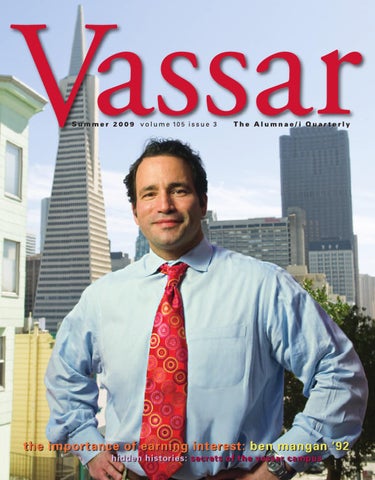
S u m m e r 2 0 0 9 v o l u m e 10 5 i s s u e 3
The Alumnae/ i Quarterly
the importance of earning interest: ben mangan ’92 hidden histories: secrets of the vassar campus
When you think “summer theater,” think Vassar & New York Stage and Film’s Powerhouse Theater 25th anniversary season featuring new work from Lewis Black, Keith Bunin, Anton Dudley ’96, Beth Henley, John Patrick Shanley, and many other extraordinary artists. And when you think “weekend getaway,” think Alumnae House — now featuring a weekend prix fixe dinner by Gigi Hudson Valley. Put it all together and a weekend at Vassar could be just the ticket!
Powerhouse tickets are available online at powerhouse.vassar.edu or by calling the box office at 845.437.7235. For Alumnae House reservations, call 845.437.7100. (Don’t forget to mention discount code AHPH09.)
Tickets: David Franklin; Alumnae House: Jim Smith; Coutesy of Gigi; Powerhouse: Tamar Thibodeau
{This ticket has your name on it.}
Tickets: David Franklin; Alumnae House: Jim Smith; Coutesy of Gigi; Powerhouse: Tamar Thibodeau
contents features 8
The Importance of Earning Interest: Ben Mangan ’92
Ben Mangan ’92 always wanted to do something that mattered — and as president, CEO, and cofounder of Earned Assets Resource Network (EARN), a nonprofit dedicated to helping low-wage workers lift themselves up out of poverty, he’s doing the work he’s been preparing for his entire life. By Amy Wilensky ’92
12 Hidden Histories Every location on campus has a million stories — some well known, some less so. For this issue we’ve dug up a few chestnuts, with help from Special Collections and the online Vassar Encyclopedia, among other sources.
8
Special College Insert: Global Citizenship at Vassar
5
16
departments 2 Letters 4 President’s Page 5 Vassar Today 16 Beyond Vassar 20 Vassar Yesterday 21 Class Notes 59 Announcements 60 The Last Page
on the cover Ben Mangan in the San Francisco financial district. Photo by
Alain McLaughlin
12 VA S S A R S U M M E R - 2 0 09
1
Vassar T h e
A l u m n a e / i
S U M M E R
2 0 0 9
Q u a r t e r l y
V O L U M E 105
M I S S I O N S TAT E M E N T
Vassar, the Alumnae/i Quarterly is to keep alumnae/i in touch with the living, working Vassar, so that even the most distant alumnae/i know of the changes in equipment, in curriculum, in regulations, in student thought and life, and may thus realize that the college is not static but progressive, meeting new problems as human beings do, and that on its success in solving them depends its value to the coming generations. Its mission is also to give to alumnae/i a meeting place in thought, a place where we may learn of each other’s interests, opinions, and achievements, and through them of the world’s work and thought, and so judge of the dynamic value of the Vassar spirit. 1916; reaffirmed 1992 PUBLISHER AAVC
845.437.5445 Meg Venecek Johnson ’84, president Patricia Duane Lichtenberg ’90, executive director EDITORIAL OFFICE
845.437.5448, fax 845.437.7425 Alumnae House 161 College Avenue Poughkeepsie, NY 12603 INTERIM DIRECTOR OF ALUMNAE/I C O M M U N I C AT I O N S A N D I N T E R I M EDITOR
I S S U E 3
A AV C Alumnae House 161 College Avenue Poughkeepsie, New York 12603 www.aavc.vassar.edu 845.437.5445
AAVC Board of Directors P R E S I D E N T A N D A AV C T R U S T E E
Meg Venecek Johnson ’84, Pennsylvania DIRECTOR FOR BOARD GOVERNANCE
S E C R E TA R Y
Ufasaha Matthews Yarish ’94, New York FINANCIAL ADVISER
Steven Mangle Williams ’94, Virginia A AV C T R U S T E E S
Brooke Duncan ’74, Louisiana Diane Downing ’77, Ohio Judith Axenzow Lewittes ’63, New York Jean Bronson Mahoney ’52, Florida Jean McKee ’51, Connecticut FUND ADVISORY CHR.
Nicky Benz Carpenter ’57, Minnesota HOUSE COMMITTEE CHR.
Karen Strain Smythe ’82, New York N O M I N AT I N G C O M M I T T E E C H R .
Karen Dowd ’84, New York
Rebecca Hyde ’92
ALUMNAE/I RECOGNITION CHR.
ADMISSIONS ADVISER
Joseph Heissan ’87, New York
Nesnadny+Schwartz, Cleveland+New York+Toronto VQ ADVISORY COMMITTEE
Alex Bhattacharji ’92 Leslie Granston ’88 Sally Kilbridge ‘78 David McGoldrick ‘75 Nancy Riley Newhouse ’58 Mary Peacock ’64 Nina Feldman Smiley ’73 Meg Venecek Johnson ’84, ex officio Articles reflect the opinions of the writers and not those of the magazine, AAVC, or Vassar College. Vassar, the Alumnae/i Quarterly, USPS 657-080, is published in the winter, spring, summer, and fall by the Alumnae and Alumni of Vassar College (AAVC). Unsolicited manuscripts must be accompanied by a self-addressed, stamped envelope. Copyright © 2009 by AAVC. P O S T M A S T E R : Send address changes to Central Records, Box 14, Vassar College, 124 Raymond Avenue, Poughkeepsie, NY 12604. Nonprofit Periodical postage paid at Poughkeepsie, NY, and additional entry post offices. Yearly subscriptions $15 . Single copies $3.
Printed on recycled paper
2
VA S S A R S U M M E R - 2 0 09
the Schalks and their battle with Alzheimer’s disease. Unfortunately, it’s a story I know all too well. My mother, Darlene Bishop, was diagnosed with youngeronset Alzheimer’s in 2000 at the
Tanya Odom ’92, New York
CLASS NOTES EDITOR
DESIGN
HANKS TO THE QUARTERLY AND
DIRECTOR FOR STRATEGIC PLANNING
Ellen McPhillips Baumann ’63, New York
Sarah E. Brown ’09 Baize Buzan ’10
T writer Elizabeth Kaledin for the very moving feature on
intricate system of caregiving” fell to me. I never expected, in my thirties, to be juggling my mother’s caregiving needs with those of my young family. It was overwhelming! In 2005, while feeling utterly helpless and hopeless watching Alzheimer’s consume my bright, beautiful, and beloved mother, I joined the Alzheimer’s Association as an advocate (I am now on the
Eric Ort ’86, Connecticut
Thomas Hopkins thhopkins@vassar.edu
E D I T O R I A L A S S I S TA N T S
Re: “Love and Loss: Living with Alzheimer’s Disease,” Spring 2009
COMMUNICATIONS ADVISER
Leslie Granston ’88, New York D I R E C T O R S - AT- L A R G E
Jason Baumgarten ’98, Washington Lise Nussbaum O’Haire ’79, Georgia Mary Holl Oldshue ’73, Oregon
AAVC Staff Executive Director Patricia Duane Lichtenberg ’90 Director, Alumnae/i Relations for Operations Willa McCarthy ’92 Director, Alumnae/i Relations for Programs Catherine Lunn Assistant Director, Alumnae/i Relations Mariah Moody Assistant Director, Alumnae/i Education Kathy Knauss Director, Alumnae/i Information Services Nancy Wanzer Associate Director, Alumnae/i Web Services Susan Brkich ’86 Assistant Director, Communications Tiffanie Duncan Alumnae House Manager Martha Gouse Barry ’86
age of only 56. At the time, she was still working full time as a medical social worker, active in her church, with many friends and hobbies. Most tragically to me, the year before her diagnosis, she became a grandmother for the first time to my firstborn children, twin boys. When she died in 2006 (at age 62), she left behind five grandsons ages six and under (three of them mine) whom she hardly got to know and love. Alzheimer’s robbed her of the grandmother experience. Many parts of the Schalks’ story echo my own family’s experiences: “the small indignities” leading up to a diagnosis of Alzheimer’s, the post-diagnosis stigma, and the challenges of caregiving. Unlike the Schalks, however, my mother did not have a partner on whom to lean (my parents divorced over twenty years before her diagnosis and she never remarried). Setting up “an
Board of the Northern California and Northern Nevada Chapter where I chair the Advocacy and Public Policy committee). Like the Schalks, I have traveled to my State Capitol to educate my state elected officials on Alzheimer’s disease and to advocate for crucial services for people with Alzheimer’s, their families, and caregivers. In late March, I headed to Washington, DC for my fourth trip to Capitol Hill to speak with members of Congress about increasing funding for Alzheimer’s research and other important issues. This year, the Alzheimer’s Association’s National Public Policy Office profiled my family’s story on their website: www.alz.org/publicpolicyforum/0 9/overview.asp. I am so grateful to the Alzheimer’s Association for helping me to find my voice, for empowering me when I felt powerless, and for providing me with community during a very lonely time. Thank you to Eliza-
letters beth Kaledin for referencing the Alzheimer’s Association in her article. They are an incomparable resource to anyone embarking on an Alzheimer’s journey. I only wish I’d discovered them earlier in mine. Thank you also to the Schalks for sharing their story and for raising awareness about this insidious disease. LESLIE BISHOP FRANCO ’89
Oakland, California
The Achievements of ’51
LGriffinin the springpresidentissue.of OVED THE INTERVIEW WITH PHIL
’79,
MSNBC,
2009
However, I must offer a small comment/correction on your final question: “Will there ever be a Vassar alum in the White House?” (Of course his answer is “Yeah! Why not?”) You need to remember that there has already been a Vassar alum in the White House. Jacqueline Bouvier Kennedy Onassis ’51 lived there for more than two years. Speaking of our class, I was delighted by the story on my friend and classmate Frances Sternhagen ’51, the wonderful actress who received this year’s AAVC Award for Distinguished Achievement. I’d like to share with my fellow alums an email I received from Frannie recounting this occasion: “I spent a lovely weekend at Vassar doing a reading about Elizabeth Bishop [’34], and speaking with students in the drama department, and meeting some really good teachers in that department. I received a beautiful award Saturday night from the trustees, and had to deliver a speech. I thought, ‘Help! What?’ — when it came to me my memory of our freshman year: an arts conference. 1947 was a year when there were quite a lot of Marxists in all the colleges, and when a young man from Queens
VQ In-Box
shouted out at the artists that they were ‘elitist’ and that ‘we should bring art down to the people!,’ [Barbara] Bibs Muhs [Walker ’48], who was our student government president, and who used to go around campus in her black gown (so she could wear her pajamas underneath if she had an eight o’clock), stood up and said, ‘Excuse me, but who are “the people”? I am a person — one of “the people,” I think — and I don’t want art brought down to me, I want to reach up to art, I want art to be something I aspire to.’ Huge applause, and the guy from Queens had no more to say. I knew then why I had come to Vassar.” M A R I A N H E AT H M U N D Y- H O O P E R ’51
Mendham, New Jersey
Artifact Check
IVassar Yesterday photograph in the spring issue. I wanted to let
AM ONE OF THE STUDENTS IN THE
you know that the picture’s description is not quite correct in two ways. First, two names have been reversed: I am standing on the left, and Martha Getty Wallender ’41 is on the right. Also, the photograph was not taken in the spring, in advance of our summer archaeological expedition, but rather in the fall, after we had already completed it. In 1939 the Carnegie Foundation gave Vassar $5,000 for the first scientific archaeology in the Hudson Valley. The project was directed by
Dr. Mary Butler, Ph.D., University of Pennsylvania, a professional archaeologist who had led several expeditions to South America. We were informed of the plan when we were students in Zoology 154b, Anthropology, and offered an opportunity to join the project. No academic credit was offered, and the pay was $50 for three months, but the training and experience were invaluable. An introductory laboratory class was given which was the digging up of a skeleton that had been buried for teaching practice behind the Vassar Observatory, for this purpose. We worked at various sites both up and down the Hudson River, including Rogers Island (Catskill), Magdalen Island (Tivoli), Crugers Island (Annandale), and other sites further downstream. We learned professional methods of procedures by laying out grids of squares and then digging vertically down, with soil layers. At each layer the loose soil was carefully brushed
a small silver coin about the size of a U.S. dime, with the head of Philip II of Spain. Shortly after, an irregular object protruding from the vertical side of the square dig area proved to be a scraper of slate. This was reported by Dr. Butler later to be from an Eskimo culture, preceding the Indian culture. This was indicated by slate being more primitive than flint. All the finds were brought back to the New England Building where we were taught to catalogue them by standard museum methods. They were placed in the glass display cases and are visible behind us in this photo. ELEANOR LIVINGSTON ’41
B o u l d e r, C o l o r a d o
Corrections Close readers of the VQ may have noticed that the spring issue of the magazine erroneously announced Reunion 2004. While in some ways we wish we were making an announcement in the spring of five years ago — the market was bullish; the housing bubble had not yet burst; the phrase “collateralized debt obligation” was one most of us were not yet familiar with — we are also grateful that we’re not about to spend an entire summer watching political advertisements involving windsurfing. The Quarterly regrets the error. The spring issue also neglected to properly attribute “Serving Locally,” Beth Trickett’s article on Jimmy Kelly ’09. This story was originally published in the winter 2008 issue of What’s Happening at Vassar? We apologize for the omission.
aside and photos were taken. Finds included English coins, Dutch clay pipe shards, and many Indian arrowheads. I found
U n f o r t u n a t e l y, n o t a l l s u b m i s s i o n s c a n b e i n c l u d e d i n t h i s s p a c e . P l e a s e v i s i t w w w. a a v c . v a s s a r. e d u / v q / d e p a r t m e n t s / l e t t e r s / t o r e a d a l l l e t t e r s t o t h e e d i t o r. VA S S A R S U M M E R - 2 0 09
3
president’spage A Lasting Influence
When I was a young faculty member at Williams College, my teaching and research interests turned to the questions of poverty reduction and macroeconomic policies in the developing world. As is so often the case in academic settings, I was influenced by older and wiser minds, notably in this instance Professor Henry Bruton. The influence of Henry’s interest in how to improve the well-being of the world’s poorest people, particularly in Africa, eventually led me to a three-year residence in Zambia, where I applied my interests and talents directly to the problem. There, as one might expect, I was also influenced by people with more experience, and I learned as much about development economics as I contributed. Again, because colleagues encouraged me to become involved in the running of the college, including admissions and financial aid, I began at the mid-point of my academic career to consider the implications for our society of the question of accessibility to higher education by students and families in the lower half of the income distribution in America. Here I was fortunate to collaborate with another mentor, Professor Gordon Winston, whose research focused on important economic issues affecting higher education in the United States, especially at highly selective colleges. I took the influence of that work on access and affordability with me to Vassar. President Hill greets Professor Gordon Winston Two years ago, after at her inauguration in 2006. several years of strong financial returns on our endowment, we decided to return the college to a “need-blind” admissions policy that considers applicants without regard to their ability to pay. This decision, encouraging greater socioeconomic diversity of the student body, is philosophically sound but certainly economically challenging.
4
VA S S A R S U M M E R - 2 0 09
(When it comes to big decisions, I’ll note that Vassar’s timing has been worse. Matthew Vassar founded the college in February of 1861, about a month before the bombing of Fort Sumter and the start of the Civil War. What looked like a great idea in February seemed more daunting by April, but the college successfully opened in 1865.) We, and other institutions of higher education, are at a perilous juncture. We need to adjust to the new economic realities while maintaining our commitment to access and affordability. Not to do so would risk the public’s trust and future support. Development economics and higher education accessibility share one fundamental: they both ask us how we can take the resources of a world where wealth is limited and unevenly distributed, and adjust that to the benefit of everyone. The world would be safer and stronger if every nation enjoyed more prosperity and if every talented student, regardless of income, could attend college or university. Gordon and Henry, fellow economists, friends, and colleagues, have influenced my career path from economist and professor, to provost at Williams, to president at Vassar. Retired now from teaching but still going into the office, both are quintessential college professors — active researchers, superb teachers, and committed to the ideals of a liberal arts education. Both have an amazing ability to ask the important questions and then make progress on discovering the answers. I think of them often as we work through extremely complex issues in these uncertain times.
Catharine Hill, President
President Hill with Professor Winston: Spencer Ainsley; Mark Mann
Editor’s note: As this issue of the magazine was going to press, eager applicants to Vassar’s Class of 2013 were starting to hear from our Office of Admission — and The Wall Street Journal decided to turn the tables a bit on the presidents of ten of the nation’s top colleges. Just like the students applying to their schools, each president was asked to write a short personal essay; but instead of getting to choose from a list of topics, each president had to write about a topic chosen by the Journal — a topic gleaned from the list that the president’s own college offers to its applicants. President Hill’s topic was: “Indicate a person who has had a significant influence on you, and describe that influence.” Her essay was published in full in the online edition and was excerpted in the print edition of the May 9, 2009 Journal. The full essay is reprinted below. It may well remind you of your own experience with a favorite professor at Vassar.
Sponsoring the Source
W
ith its buttressed walls and crowned towers, the physical presence alone of Thompson Library is enough to take the breath away of any passerby. But behind the Gothic facade of one of Vassar’s most famous buildings lies another awe-inspiring spectacle: the approximately 25,000 books that make up the college’s rare-book collection.
Jim Papp, courtesy of Special Collections, Vassar College Libraries
President Hill with Professor Winston: Spencer Ainsley; Mark Mann
vassartoday
libraries,” he notes, “and it was natural for us to turn to them for assistance.” The elements of the Adopt-a-Book program were established with Vassar’s longstanding ethos of “going to the source” in mind, as it seeks to restore and preserve the very “sources” that make the practice possible. As Patkus points out, such an endeavor is crucial for maintaining this tradition: “One can go so far as to say that if we do not properly conserve our treasures, in a very real way this ‘going to the source’ approach will be threatened.”
Ranging from literature to cookbooks to artifacts in need of very specific assistance. atlases, Vassar’s rare books date from as Operating as a collaborative effort with early as the fourteenth century to the present. alumnae/i, Adopt-a-Book will allow inter(The collection also includes leaves of ested alums their choice of title from 25 manuscripts dating back to the eleventh century, first-century papyrus, and 4,000year-old Babylonian tablets.) But these artifacts aren’t just slumbering “in the cool comfort of 69 degrees Fahrenheit and 49 percent relative humidity,” as Ron Patkus, associate director of the libraries for special collections and adjunct associate proLeft to right: a volume from the collected works of Martin Luther, published in 1556; a French Hours of the Virgin, circa 1500; fessor of history, and a 1760 reprinting of Sir Isaac Newton’s Philosophiæ Naturalis Principia Mathematica. wrote in this magaStarting this summer, alumnae/i will be zine (“Rare Books and the Vassar Curricu- books and manuscripts that have been lum,” Winter 2004). “Books are meant to be selected for repairs. In recognition of their able to browse detailed descriptions of the 25 used, and Vassar’s librarians continually look support, a special bookplate in each chosen selected books at the Adopt-a-Book website, adoptabook.vassar.edu. Patkus is hopeful that for ways to integrate rare books into the book will acknowledge its adopters. Patkus, one of the creators of the Adopt- all of the inaugural books will find adopters, college curriculum.” But to use a book, of course, means the possibility of wear and tear a-Book program, modeled his idea after sim- and that interest will demand another round — and so, in recent years, librarians have ilar programs already established at several — preserving the legacy of not only the old wondered how best to bring more attention institutions in both the U.S. and abroad, volumes themselves, but also the tenets of a to the conservation requirements of not just including the British Library, the Grolier Vassar education. To recommit to a “primary Club, and the Michigan State University sources” teaching philosophy through a “partowning rare books, but using them. With this challenge in mind, Special Col- Library. The decision to partner exclusively nership between the libraries and alumnae/i,” lections is launching a new program called with Vassar’s alumnae/i was, for Patkus, an Patkus says, “links two key groups in their Adopt-a-Book in an effort to establish direct obvious one: “Alumnae/i have traditionally shared support of students for the future.” •v support for the conservation of valuable been great supporters and friends of the — Baize Buzan ’10 VA S S A R S U M M E R - 2 0 09
5
vassartoday The Very Model of a Major Modern Architect One thing is for sure: Emma Hartman Noyes House is like no other dorm on campus. Its rounded shape, repetitive windows, and pod entrances have their own charm. But the building, which turned 50 years old in 2008, still feels a little bit out of place among Vassar’s more traditional ivy and bricks. From June 2 through September 6, the Frances Lehman Loeb Art Center will host an exhibit to showcase the original Eero Saarinen model of Noyes, a rare treasure discovered by chance in the basement of Main Building two years ago. The model will serve as a point of departure to tell the story of Noyes and its famous architect, and how the two came to be at Vassar. Vanessa Beloyianis ’08, who wrote an award-winning senior thesis on Saarinen’s time at Vassar, says many students she knew as an undergraduate weren’t fond of Noyes — basically, they didn’t like how it looked, and they wanted to live in a more charming
370 with Professor Nicholas Adams. The
focus of the class was Vassar’s buildings, and each student chose a building to research. Beloyianis, who spent her junior year studying architecture in Denmark, chose Noyes; it was she and Adams who discovered Saarinen’s model in December 2007. “It was almost fate,” Beloyianis recalls. “My roommate was at a party, and someone mentioned breaking into the basement of Main and finding a completely destroyed model, and maybe it was Noyes.” Based on the rumor, Adams called Buildings and Grounds and asked that they be let into the basement.
An Eero Saarinen sampler: the original model for Noyes House; MIT’s Kresge Auditorium; the TWA terminal at John F. Kennedy International; St. Louis’s Gateway Arch.
quad dorm or Main. She would explain to them how Saarinen was indeed trying to design a building that fit with its surroundings; she points to abstract references in Noyes’s design to Gothic and Classical architecture on campus, and references to the history of the space as a garden and athletic field. “You can’t blame anyone for not seeing that right away. But if you explain it, there’s an ‘oh, wow’ moment. They see it in a different way,” she says. Beloyianis became interested in the Finnish-American Saarinen while taking Art 6
VA S S A R S U M M E R - 2 0 09
“It was really quite an adventure to be wandering through the dark and dirty basement of Main Building, searching for something that was only rumored to exist there, and then to actually find it!” Beloyianis says. Adams agrees: “It had a real ‘treasure hunt’ feel. I mean, there are some rather unpleasant rats and mice in the basement under Main; it is not well lit — and certainly not the place to keep something like this.” The model was in poor shape. Lehman Loeb Art Center Director James Mundy ’74 says it had been turned up on its side, it was
filthy and unglued, and parts were lost. The college has since brought in two conservators from the Museum of Modern Art to put it back together. Noyes is just one part of the story of Saarinen’s collaboration with Vassar. Saarinen spent several years, from 1954 to 1958, working with the college. “President Sarah Blanding wanted to enlarge Vassar’s physical plant, and she was convinced to bring in Saarinen to do a master plan for the campus,” Mundy says. “The thenhead of the art department, Agnes Claflin, who moved in elite modern art circles, sold Blanding on the idea of Saarinen.” Saarinen, who had experience working on other college campuses, had a number of ideas for Vassar. One proposal was to move the administrative offices out of Main and make Main solely a dormitory. When that didn’t go over well, he proposed two buildings that fit together to form a semicircle on the north end of campus — and the original architectural model shows this layout. In the end, however, the college could afford to build only one of the two buildings (see page 15), and that building is the Noyes we know today. “The original model is different than what ended up being built — that’s one reason why it’s not understood the way it should be,” Beloyianis says. “If you see the entire design and what Saarinen was trying to do, you look at the building in a new way.” Beloyianis, whose thesis on Saarinen won her the Frances Daly Fergusson Prize, set her sights on being an architect from an early age. She was an art history major at Vassar, and took most of her classes in architectural history. “There’s a little chunk of us who are really interested in architecture,” says Beloyianis, who is now in graduate school studying interior architecture. Up until now, the Lehman Loeb Art Center hasn’t done very many exhibits looking at architectural history. “Some people would like us to do more,” Mundy says. “This will be a nice way to start.” •v — Rebecca Hyde ’92
vassartoday Shooting for the Stars
I
John Rizzo
n 1878, Maria Mitchell, Vassar’s first astronomy professor, and several female Vassar students battled July’s intense heat as they journeyed over 2,000 miles by train to Colorado to observe a solar eclipse firsthand. Other astronomers traveled from around the world to witness the event, but except for a few of their wives, the Vassar crew was the only group of women. Mitchell, who also discovered a comet, was the first professional woman astronomer in the US.
Perhaps it was this anecdote that initially sparked Claire Webb ’10 to do a sixth-grade research project on Maria Mitchell. After spending nights peering at the heavens through her own telescope, Webb eventually set her sights on Vassar, where a campus job at the observatory reaffirmed her love of astronomy. Then, last summer, Webb was presented with her own unique opportunity — the chance to don a space suit and work on a mission with NASA. Webb, an astronomy major, first learned of SETI (the Search for Extraterrestrial Intelligence) as a first-year student in Astronomy Professor Deborah Elmegreen’s Life in the Universe class. Intrigued by the nonprofit’s research and partnership with NASA, Webb applied for an internship the following year and was accepted. “It was amazing to be a part of this experience,” says Webb, adding how impressed she was to work one-on-one with Jill Tarter (the movie Contact was based on her work). Webb spent the summer in California working with SETI. But just as the internship was coming to an end, another opportunity came her way, and Webb was asked to be part of a SETI airborne campaign. This meant that Webb and a crew of scientists would fly over Tahiti to observe and film the ATV-1 Jules Verne, an automated transfer vehicle, as it re-entered and burned up in the atmosphere, an event similar to a meteor shower.
“I felt so lucky to be a part of this mission, and it was so exciting to work with scientists from all over the world,” she says, explaining how the mission began on a base near Los Angeles, where they worked on the DC-8 airborne laboratory that would be used for the mission. “It’s basically a gutted plane and you wear a headset to talk to each other.” All the
seats on one side were taken out and filled with imaging equipment and cameras. One of the two youngest members on board, Webb went through her own NASA initiation of sorts. “They had me up on a cherry picker, 60 feet from the plane, and we were communicating on walkie-talkies,” she says, explaining how she had to point lights and filters at each window to calibrate the instruments. “They told me it would take an hour, but it ended up taking five.” After all the tweaks were made, the crew set off for Tahiti. Just as Maria Mitchell had traveled across the country to gaze at the nearly three-minutelong eclipse, Webb’s crew had spent months preparing for four minutes of Jules Verne footage. “There was such a feeling of anticipation as the plane took off that night,” recalls Webb. “All the instruments had to be in a cold environment, so it was freezing in there”— and pitch-black. “We could only hear each other,” she says, “because in order to block out the light, we put flame-retardant black cloths up. I had a video headset on and a high resolution spectrometer that we pointed at the object. Everyone was thrilled as it finally came over the horizon.” According to Webb, this mission, and the previous summer she spent studying a massive black hole through Vassar’s observatory as part of a project for URSI (Undergraduate Research Summer Institute), “really confirmed that astronomy is what I want to do.” Webb, who dreams of working as an astronaut, is now one step closer, having worn a flight suit and earned mission badges. “My classes made it easy to gain an appreciation for an event like this,” she says. “Learning from professors who are working astronomers instills a sense of excitement, and then to actually be able to work in an observatory and do a mission, is the manifestation of everything I’ve learned.” •v — Beth Trickett This article originally appeared in the spring 2009 issue of What’s Happening at Vassar? VA S S A R S U M M E R - 2 0 09
7
the importance
of
earning interest BY Y A AM MY Y W W II LL EE N NS SK KY Y ’’ 99 22 B
When Ben Mangan was a senior at Vassar, he lived in the Town Houses with four fiercely independent, strong-willed friends (one of whom, full disclosure, is authoring this profile). From day one it was clear that Ben was going to be the force for peacekeeping, the pillar of dignity around which his housemates circled, in near-constant negotiations over the just distribution of deli meats. His distinctive confluence of personality traits — including an unusual mix of wild abandon and an almost anachronistic earnestness — was the saving grace of TH E-10, class of 1992.
Alain McLaughlin
st
I met Ben when we were freshmen, though, long before we nearly came to blows over roast beef, and that earnest quality struck me immediately. I always had the sense that somehow, amidst so many of our privileged and even jaded peers who had arrived in Poughkeepsie as a matter of course, Ben was there to squeeze every atom of meaning out of the experience, in every possible manner. In all his passionate pursuits—race relations to cooking, social justice to rugby—he never did anything halfway. More than twenty years later, it is safe to say that Ben has kept squeezing every drop out of every experience, in ways that reverberate far beyond his immediate sphere of home and work. Today he is the president, CEO, and cofounder of Earned Assets Resource Network (EARN), a San Francisco-based nonprofit organization that, through
“money-management training, access to financial services, and 401k-like matched accounts,” helps low-wage workers lift themselves up out of poverty. As such, he is able to put his passion to work for the benefit of thousands of grateful families — people who, like Ben, are willing to work for what they want and understand the incomparable value of doing so.
9
The so-called ivory tower was not a familiar place for Ben when he arrived at Vassar in the fall of 1988 from a gritty, working-class Brooklyn neighborhood that had little in common with many of his classmates’ notions of renovated brownstones with marble mantles and fountains in the garden yard. In fact, although Ben was a top student throughout high school, spurred on by his determined mother, it is something of a miracle that he ended up at Vassar at all.
u
ntil an older friend from his high school enrolled at Vassar and came back raving about it, Ben had planned on applying only to more affordable state schools. But when he heard his friend
the most obvious way to combine his abilities with his desire to combat socioeconomic inequality with practical tools — including education, which had been his own path out of poverty. But the legal internships he’d pursued during college had not sparked him in the way he’d expected. (One, he recalls, was at a firm specializing in divorce law. He found himself poring over photographs taken by private investigators to catch spouses in the act of infidelity. Justice? Not the kind he was interested in.) He decided to try living and working in a different country, where he could test some of his burgeoning ideas about racial inequality. After turning down prestigious job offers, such as one from the DA’s office in Manhattan, he
regions were New York City (all boroughs except Manhattan), northern California and the Pacific Northwest, and states such as Idaho, Montana, and Nebraska, which historically have sent few students to Vassar. Ben had always been interested in Native American history. He convinced the dean of admissions to let him visit Indian schools in his region, making a case that in spite of its new multicultural center, Vassar was woefully underrepresented by Native Americans. “I knew firsthand that there were schools that never got a visit from Vassar, kids who had never heard of Vassar. I wanted to change that,” he explains. But at the second school he visited, after noticing the flat reactions he was getting from
“I knew at Vassar that I wanted to do something that mattered, that was different and would create opportunities for people, but the idea really came together in grad school,” says Ben. “I had thought I would focus on education but instead studied economic development, real estate, and finance—on some level I knew I needed hard skills. I realized this was yet another situation where I didn’t know what I didn’t know.” But whatever those unknown unknowns were, Ben says, he knew he needed them “if I was to move forward.” wax rhapsodic about the premium placed on intellectual discourse and ideas, the dynamism, and the focus on social justice at this exclusive private college, Ben decided to throw his hat into the ring, hoping the admissions office would deem him worthy of receiving aid. “It was not cool to be smart at my high school,” Ben explains. “The way my friend talked about Vassar seemed different.” Because of his background, Ben never took Vassar for granted. Instead, he became fascinated and then convinced by the notion that education could actually change people’s lives. A history major, Ben had thought he would go to law school after graduating from Vassar. It seemed like the most direct path to his goals, 10
moved to Argentina and switched gears by teaching history to middle-schoolers. His own education at Vassar had given him a different vista; he thought perhaps he could somehow facilitate this transformation for others. Discouraged by the inequalities in the school he worked in, where the children of wealthy families were favored and the children of poorer families ignored, Ben decided to take his newfound ideas about education back home. He accepted a position in Vassar’s admissions office, traveling the country and explaining to high-school students just why Vassar could change their lives. It was on this job that Ben learned one of the most significant lessons of his career. His
students, a guidance counselor pulled him aside and said, “You seem like a nice guy, so I’m going to lay this on you straight. It’s offensive to me that you’re here — just another white person trying to get these Indian kids to go 3,000 miles away where there will be no community for them, leave them high and dry. It would be unthinkable for me to advise anybody from here to do that.” Ben was chagrined, but emerged wiser — and all the more determined to find a way to work for justice from the inside, using his life experience and personal values to change people’s lives from the bottom up. He took the experience as “a powerful touchstone for how ideology can trump pragmatism,”
and wrote about it in his application essays for graduate school. He soon found himself at Harvard’s Kennedy School of Government, again surrounded by people who had never known what it was to have no safety net, no reserves. “I knew at Vassar that I wanted to do something that mattered, that was different and would create opportunities for people, but the idea really came together in grad school,” says Ben. “I had thought I would focus on education but instead studied economic development, real estate, and finance — on some level I knew I needed hard skills. I realized this was yet another situation where I didn’t know what I didn’t know.” But whatever those unknown unknowns were, Ben says, he knew he needed them “if I was to move forward.”
extent, for the next generation. EARN’s success hinges on the belief that what predicts economic prosperity is the presence of assets in a household beyond or other than a savings account. As Ben puts it, “Do your parents have a college education? Is your home owned? Has your family created wealth?” And EARN is changing lives, one family at a time. The state of California agrees; it has replicated EARN’s plan to get “unbanked” citizens—people without any kind of bank account — into the financial system. So has Bill Clinton’s foundation. EARN is rooted in the notion of microfinance — that for a small
Alain McLaughlin
a
fter a post-grad school stint as a management consultant at Ernst and Young in Chicago, Ben felt an increasing desire to go west. He had always viewed California’s Bay Area as a place for dreamers, so he took a job at a dot-com, but his heart wasn’t in it. When he received an email from a friend about a group of people who wanted to do something different to create prosperity for the working poor, it was as though the stars had finally aligned. This project, which was to become EARN, was the work Ben had been preparing himself for, on some level, all his life. He got in touch with the organizers, prominent leaders in San Francisco’s business world and nonprofit sector, and told them he wanted to run their company. “I was 30, had no connections in San Francisco, so I tried to make it clear that this was a match on a values level. I told them this issue was personal for me, explained that I had lived in public housing, been on welfare when I was a kid.” He got the job. Today EARN has served more than 2,500 families. The organization’s core work is matching people’s savings so they can buy their first home, get an education, or start a small business — in short, acquire assets. Being a part of EARN requires sacrifice and determination, deferring prosperity, to a certain
amount of money you can bring people into the financial mainstream and have a huge impact on the people you help. It’s a way of shifting the landscape for the children in a household who would otherwise never have such opportunity. The facts speak for themselves. EARN savers now number nearly 2,000, making it one of the two largest individual development account (IDA) programs in the nation, along with Lenders for Community Development
in San Jose. More than 200 people have saved the maximum allowed in their IDAs. EARN was the 2005 winner of the Fast Company Magazine/Monitor Group Social Capitalist of the Year Award, and was named one of ten finalists in the 2005 Amazon.com Nonprofit Innovation Award. The current economic crisis is taking its toll on EARN, but Ben is optimistic. “Sure, the people we serve are the most vulnerable to job loss or reduced work hours, but the silver lining is that folks who need money-management training, people who have worked with us or have accounts with us, are better able to weather this distress,” he says. EARN has helped over a hundred families buy their own homes, with only two defaults — and in both cases, because of foreclosure due to job loss, not subprime financing. The organization is seeing a decline in donations, but Ben says he’s tackling that problem head-on— in spite of a recent lack of sleep. Just this spring, he and his wife, Wileen Chang, welcomed their firstborn: Alex Rafael Mangan Chang. Ben has thought a great deal about what his son means in the continuum of his family history, and it is impossible not to contemplate how fatherhood will influence his life’s work. “I think about how hard people in my life worked to position me to succeed,” he says, “and I feel like I have a new challenge, ensuring that Alex is never complacent about the things he will have that I did not.” I have known Ben now for over twenty years. I have seen him whip up a mean stir-fry, look imposing in a pin-striped suit or wild-eyed in a rugby scrum, get fired up about a controversial novel — and once, apocryphally, I saw him sporting a bright red thong. But I have never seen him complacent. I think I speak for all of TH E-10 at the very least when I say I can’t wait to see how Alex, like his father, takes on the world, one hardfought victory at a time. •v Amy Wilensky ’92 is a writer whose most recent book is The Weight of It. She lives in New York City with her husband, Ben Hohn ’92, and their daughters Lily, 5, and Annika, 1.
11
H I D DE N H
I
S
T
O
R
I
E
S
Every location on campus has a million stories — some well known, some less so. Here are a few chestnuts we’ve recently dug up, with help from Special Collections and the online Vassar Encyclopedia, among other sources. (A full list of citations can be found on page 58.) — The Editors
Built in 1928, the design included classrooms, labs, studios, and a special accomodation for the building’s donor, Minnie Cumnock Blodgett, class of 1884: a “model apartment for the study of interior design and efficient housekeeping” — which was also intended to be “Blodgett’s residence when she visited the campus.”3
Russell Monk
WELCOME HOME Blodgett Hall — or “the Euthenics Building,”1 as it was once called — began life with grand plans. Along with Cushing, Kenyon, and Wimpfheimer, it housed Vassar’s ambitious but doomed program in “euthenics,” the science of “the development of human well-being through the improvement of living conditions.”2
12
OKAY, SMART GUY In 1940, a Vassar girl had “a sure-fire way to mystify a Harvard man.” She would take him to the “betting bridge” over the stream between Sunset Lake “and the service building outlet. Ordinarily, the stream would flow south” — but service-building steam “bubbles into a fountain in the middle of Sunset Lake, which, spouting hot water, forces the surface current back up north. When Johnny Harvard wagers that it flows south, Vassar triumphantly throws a twig in the water and watches it borne in the opposite direction.”4 Whether bafflement was intrinsic to wooing remains unclear.
Russell Monk
A CLEAN HISTORY Many campus buildings have lived through various incarnations, and Swift Hall — originally Swift Infirmary — is no different. (In its first life, students nicknamed it “Swift Recovery.”5) When the history department moved in in 1941, the Misc called the change “a complete revamping,” noting that the “three old wards” had become “big classrooms,” and “Venetian blinds” had been added “‘to give the modern touch.’” Perhaps especially important for a building that had recently housed the unwell, though, was the important detail that “[i]nside, the walls [had] been washed.”6 Always a good idea.
13
BURIED SECRETS? In Vassar’s early years, the class tree ceremony was “a cultlike event held in secret with elaborate costumes and dances” that “culminated in the burial of the class records and relics next to or under the tree.”7 The plaque by this London plane tree claims it for the Class of 1906; are their records entombed here? Maybe, but horticulturalist Jeff Horst suspects that any lost treasures would have been “pushed up and out of the ground” by the tree’s roots. (Horst can confirm the practice, however, having discovered a buried metal box while relocating a class tree; its contents, he says, were “completely deteriorated.”)8
JOSS BEACHHEAD Two years after the end of the Great War, France gave Vassar a tank. (This was 35 years after the Statue of Liberty arrived in New York harbor; France doesn’t give presents like it used to.) The tank sat on the lawn in front of Josselyn House “until the summer of 1934, when it was dismantled.”9 While being taken apart, “workmen found in the tank an unexploded fuse cap and a considerable amount of benzene”10 — so if the legend of students secreting themselves within the 40-ton Saint-Charmond for an illicit cigarette is true, then “the smokers were lucky indeed.”11
4 14
DOUBLE VISION Noyes House “was intended to be the first of two identical building units” which would form “a semicircle along the northern side”12 of what was, before the dorm was completed in 1958, simply called “The Circle.”13 Architect Eero Saarinen’s plan is clearly visible in his model (see page 6) — so why was his vision never fulfilled? Vanessa Beloyianis ’08 says she found the answer in “Executive Committee meeting minutes and President Blanding’s personal papers”: money. “[T]he cost to construct the single wing,” she wrote in her thesis, “totaled $1.4 million — double the original budget for the entire project.”14
OTTOMAN RHAPSODY Skinner contains many treasures — even treasures within treasures, such as the contents of the Historical Musical Instrument Collection, kept on rotating display on the third floor of the music library. The collection includes an early-1800s Giraffe Piano, so-called “because of its asymmetrical, curvaceous case,” like “a grand piano standing on end.”15 (Henry Ford wanted it; Vassar got it.16) One of its many pedals is for a bell “which lent exotic color to popular music such as Turkish marches, much in vogue at the time.”17 Less portable than an iPod — but a lot more impressive.
GARDEN MIX Vassar has a long history of interdisciplinary studies — including early joint work between the humanities and the sciences. The plan for the Shakespeare Garden “originated with Miss Winifred Smith and Miss Emmeline Moore of the Departments of English and Botany, and the first planting of pansies was made by the Shakespeare and Botany classes” on April 24, 1916 — “the day after the anniversary of the poet’s death.”18 Perhaps current classes in, say, T.S. Eliot and Ecology could derive inspiration from their example (a “Waste Land Garden,” anyone?).
15
beyondvassar Lincoln Launch
Lincoln, as a young state congressman, had played an important role in getting a bill passed to build a canal connecting Lake Michigan to the Mississippi — a canal that “would transform the entire state of Illinois,” not to mention the town of Lockport, home to the canal’s first lock. “Bob had seen some of my artwork,” Ostro says, and “he asked me to build him a monument of Lincoln that would sew together the history of his hometown.” Ostro told Carr that he was “obscenely underqualified” for the commission, “lacking experience in figurative sculpture and bronze casting” — but Carr persisted. “I didn't know 16
VA S S A R S U M M E R - 2 0 09
what to say,” Ostro says. “So I said yes.” The statue, which represents two and half years of research, planning, and sculpting, was cast at the Tallix Foundry in Beacon, New York. It was unveiled in Lockport on February 12, 2009, in honor of the 200th anniversary of Lincoln’s birth. The unveiling was part of the dedication of Lincoln Landing, a new interpretive park in the town. The sculpture sits on the original site of the canal’s wall, and represents the young congressman in three poses: dipping his hand into the water, standing up, striding off purposefully — a man of thought and action. Ostro’s
hope, he says, is “that it would not only bring his personality to life, but also the heavy, frozen bronze as well.” Ostro harbors fond memories of producing art under the guidance of faculty and peers at Vassar. He particularly misses the biweekly art critiques — “a time when Gina Ruggeri, George Rush, Richard Bosman, Laura Newman, Peter Charlap, and Harry Roseman felt less like teachers and more like fun-loving aunts and uncles,” he says. Ostro now lives in Brooklyn. He is available, he adds, for new commissions. •v — Sarah E. Brown ’09
Photographs courtesy of David Ostro ’06
While a senior majoring in studio art at Vassar, David Ostro ’06 got a phone call from a former employer and family friend, Bob Carr. Carr is the CEO of Heartland Payment Systems, cofounder with his wife, Jill, of the Give Something Back Foundation, and “an amateur historian.” Carr told Ostro his dream to bring to light the history of the birth of Carr’s hometown, Lockport, Illinois, “for which Abraham Lincoln was partly responsible,” Ostro says.
Running Away from the Circus to Join Vassar
F
or centuries, the idea of running away with the circus has enticed young dreamers with its promises of big tops, popcorn, and awesome acrobatic feats. But for Lorenzo Pisoni ’97, the dream of joining the circus was an impossibility — he was born into one.
Pisoni’s parents were co-founders of the Pickle Family Circus, a small San Franciscobased troupe that shed big, traditional circus elements like three rings and elephants and focused more on juggling, miming, and clowning. Pisoni, the youngest in his family, began performing at age two. By the time he was 14, he had established himself as an accomplished acrobat, juggler, aerialist, and clown, and spent time touring with other circuses through Europe and Japan. Pisoni took some time off from his various performance commitments to attend Vassar, where he danced with VRDT, majored in film, and managed to graduate in three years. Shortly after he left Poughkeepsie, he was off to Las Vegas, starring as the Ringmaster in
Cirque du Soleil’s Mystère. And when that was done, Pisoni retired from the circus at age 23. Such a decision may seem a little premature. But Pisoni was far from done with performing. After his circus retirement, he moved to New York City, where he has worked ever since as a successful actor at such theaters as Lincoln Center, The Public, the New York Shakespeare Festival, and Second Stage. This past fall, he made his Broadway debut as lead horse Nugget in the extremely popular revival of Equus that starred Harry Potter’s Daniel Radcliffe. Despite the fact that his résumé was starting to look more like it belonged to a distinguished, classically trained actor rather than a retired clown, Pisoni never forgot his roots.
Finding time amidst Equus performances last year, he teamed with friend, collaborator, and fellow Vassar alum Erica Schmidt ’97 to co-
create a one-man original show based on his childhood with the Pickle Family Circus titled Humor Abuse. The piece, an exploration of Pisoni’s extraordinary upbringing, not only delights in the sheer entertainment of his clowning talents but also delves into the more personal complexities of his relationship with his father, Larry Pisoni, one of the leading Pickle Family clowns. The show, directed by Schmidt and starring Pisoni, opened in February at Manhattan Theater Club to rave reviews, completing an extended two-month run in April. Critics for The New York Times, Variety, the New York Post, and more all praised Pisoni for his physical and emotional capabilities, citing the show as hitting all the emotional marks of a compelling coming-of-age story, but also packing in all the fun of a night at the circus. Both Schmidt and Pisoni are hopeful for a commercial run of Humor Abuse in the future, as well as potentially moving the show to a different city. But for now? Pisoni is on vacation. “While this is a quality problem to have as an actor, I’ve been working six days per week since August when Equus began rehearsal,” Pisoni explains — “so I’m a wee bit tired.” •v — Baize Buzan ’10
Joan Marcus
Photographs courtesy of David Ostro 06
beyondvassar
VA S S A R S U M M E R - 2 0 09
17
beyondvassar A New, Old Kind of Chocolate
Alumnae Making News…
Americans will spend close to $3 million on premium chocolate this year — an 11 percent increase from 2008, according to market-research firm Mintel. As our taste for fine, dark chocolate continues to expand, Alex Whitmore ’99 is confident we’re ready for something new — or rather, something old.
18
VA S S A R S U M M E R - 2 0 09
As we were finishing this issue, we learned of two remarkable alumnae accomplishments. On April 20, the Pulitzer Prize for public-service journalism was “[a]warded to the Las Vegas Sun, and notably the courageous reporting of Alexandra Berzon,” class of 2001, “for the exposure of the high death rate among construction workers on the Las Vegas strip amid lax enforcement of regulations, leading to changes in policy and improved safety conditions.” An urban studies major at Vassar, Berzon was co-news editor on the Misc with frequent VQ contributor Veronika Ruff ’01.
…and Making History
On May 8, Vicki Miles-LaGrange ’74 was formally recognized as Chief Judge of the United States District Court for the Western District of Oklahoma, the first African American to hold this position. Her investiture as judge follows a long line of other distinguished achievements, including her appointment by President Clinton as U.S. Attorney for the Western District of Oklahoma, making her the first woman to hold that position. “She is tough as nails,” Richard Roberts ’74, U.S. district judge for the District of Columbia, told The Oklahoman, “but fair.” Congratulations to both! •v
Michael Piazza; Steve Marcus/Las Vega Sun; Jaconna Aguirre/Copyright 2009, OPUBCO Communications Group
Taza Chocolate, Whitmore’s Somerville, Massachusetts-based “bean-to-bar” chocolate company, is the only American outfit making small batches of 100 percent stoneground, organic dark chocolate in the Mexican tradition. This results in texture and flavor characteristics decidedly distinct from chocolate made in the European tradition, which most of us are used to. Since cacao beans are indigenous to the Americas, the Mexican approach to chocolate is much older and simpler, requiring less processing, Whitmore says. “Europeans applied modern refining techniques, such as conching, resulting in ultra-smooth chocolate, often with candy or confection additions,” he explains. “We don’t do that.” After selling its first bar in February 2007, Taza has grown steadily with a focused product line now sold at 550 outlets in the U.S. and Canada — largely specialty and natural food stores, as well as bookstores, wine and cheese shops, and, of course, Whole Foods. Though Whitmore and his business partner (his former boss at another successful Boston startup, Zipcar) have quickly expanded the business — hiring 15 full-time employees and taking over more factory space — they are still intimately involved in each step of the process.
Whitmore, an anthropology major, says that he applies the ethnographic skills and “whole-person education” he got at Vassar to his efforts in running a socially responsible business. He sources his ingredients directly from farmers or farmer-owned cooperatives in the Dominican Republic, Mexico, and Costa Rica, paying a premium above even fair-trade prices as an incentive for the highest quality ingredients. Taza imports cacao beans in special doubled bags Whitmore found to maintain ultimate freshness — they’re usually used to ship grains, not cacao. He also dresses the granite millstones used to grind the cacao, a secret artisanal process he learned by studying under a molinero (a stone miller) in Oaxaca. It’s the rough surface of these stones that allows unrefined cacao and sugar to remain in the finished products, giving Taza chocolate its unique, granular textures and intense flavors. Taza employees roast, winnow, grind, temper, mold, and wrap their chocolate by hand in their energy-efficient factory; and whenever possible, deliveries are made via bicycle. You can order yours at tazachocolate.com. •v — Veronika Ruff ’01
Back to Africa: Alison Church Hyde ’59 Alison Church Hyde ’59 describes herself as a “freelance educator and volunteer.” She has spent her entire career — from kindergarten teacher to educational resource consultant to member of the board of directors of the New York State School Boards Association — focusing on advocacy and betterment of programs for children and families through education. It is this tireless commitment to building a better world for others that led Hyde to cofound the Crossroads Springs Institute of Hamisi, Kenya, and that also makes her an exemplary recipient of the 2009 Spirit of Vassar Award, honoring Vassar alumnae/i for extraordinary volunteer service.
Hyde first traveled to Africa in the summer of 1962 with new spouse Arthur Hyde on a work project with Operation Crossroads Africa (an organization described by President Kennedy as the “progenitor of the Peace Corps”). “We went to Kenya with the advice ‘expect the unexpected’ ringing in our ears,” Hyde recalls. Most unexpectedly, the experience moved the young couple so much that they became eager to teach and live in Africa. A year later, Arthur and Alison returned, and this time, stayed for six years, during which time Hyde worked as a teacher at both a preschool she started and a teacher training college in Zambia. In 2003, when Hyde learned how seriously the AIDS epidemic was affecting the area in Kenya where she had previously worked, she contacted Dr. Meshack Isiaho, a Kenyan friend who told her of his plan to help rescue
children who had lost one or both parents to AIDS. Hyde wanted to do more than just donate to his efforts — she wanted to be a part of that effort. And so, in September of 2004, Hyde returned to Africa, this time to help build an educational and care center for the hundreds of children who had been orphaned by AIDS in that area of Kenya alone. Thus began the Crossroads Springs Institute, now in its fifth year. Formed through the
collaborative efforts of Hyde, her husband Arthur, and Dr. Isiaho, the institute aims to provide health services, nourishment, care, and an education to orphans so that they can learn happily in an environment that fosters future leadership and strength for Kenya. Upon its inception, 40 children were enrolled. Now, 250 children are learning at Crossroads Springs, with 40 of the neediest children living there. In addition to her personal contributions, Hyde warmly notes that her hard work has been “full of Vassar serendipity,” thanks to the involvement of classmates, alums, and the greater Vassar community. Her next challenge: fundraising to complete the construction of what she describes as a “desperately needed” new classroom building at Crossroads Springs. As she looks toward the future, Hyde notes the way in which her Vassar education influenced all that she has accomplished: “The spirit of Vassar has been prevalent in my work and in my life,” she says. Her advice to fellow alums? “Take risks! Serve! Think outside the box!” •v — Baize Buzan ’10 For more information about the Crossroads Springs Institute, visit www.crossroadssprings.org.
Mixed Media NONFICTION
Crafternoon: A Guide to Getting Artsy and Crafty With Your Friends All Year Long by Maura Madden ’93 Simon Spotlight Entertainment, 2008 Dog: Pure Awareness by Margot Lasher ’60 Twilight Times Books, 2008 Conserving the Commonwealth: The Early Years of the Environmental Movement in Virginia by Margaret [Totten] Peters ’60 University of Virginia Press, 2008
Courtesy of Allison Church Hyde ’59
Michael Piazza; Steve Marcus/Las Vega Sun; Jaconna Aguirre/Copyright 2009, OPUBCO Communications Group
beyondvassar
Faulkner and Love: The Women Who Shaped His Art by Judith [Levin] Sensibar ’63 Yale University Press, 2009 Uncommon Women: Gender and Representation in NineteenthCentury U.S. Women’s Writing
by Laura Laffrado ’79 Ohio State University Press, 2009 The Truth About Search Engine Optimization by Rebecca Lieb ’81 FT Press, 2009 Rediscovering Mordecai Gorelik: Scene Design and the American Theater by Anne Fletcher ’75 Southern Illinois University Press, 2009
For the Rock Record: Geologists on Intelligent Design edited by Jill S. Schneiderman, professor of earth science, and Warren D. Allmon University of California Press, 2009 C H I L D R E N ’ S / Y O U N G A D U LT
The Doll Shop Downstairs by Yona Zeldis McDonough ’79 Viking, 2009
Hippo in a Tutu: Dancing in Disney Animation by Mindy Aloff ’69 Disney Editions, 2009 FICTION
A Room Without Toys by Suzanne Person ’61 AuthorHouse, 2008 My Life With Stella Kane by Linda Morganstein ’74 Regal Crest Enterprises, 2009 Moonlight on Diamonds by Nicole Coady ’89 [writing as Lydia Storm] The Wild Rose Press, 2009 Circulation by Tim Horvath ’93 sunnyoutside, 2009 POETRY
by Vera [Savin] Schwarcz ’69 Antrim House, 2009 Brief Rest in the Garden of Flourishing Grace: Poems of Remembrance and Loss by the Manchu Prince Yihuan by Vera [Savin] Schwarcz ’69 Red Heifer Press, 2009 Reading the Tao at Eighty by Ann B. Knox ’46 Finishing Line Press, 2008 FILM
Skills Like This written by and starring Spencer Berger ’01 and Gabriel Tigerman ’02 Dewey-Obenchain Films, 2007 Finding Face by Patti Duncan ’92 and Skye Fitzgerald Spin Film, 2009
Chisel of Remembrance VA S S A R S U M M E R - 2 0 09
19
Special Collections, Vassar College Libraries
vassaryesterday
LICE HUYLER RAMSEY, CLASS OF 1907, WAS THE FIRST WOMAN TO DRIVE ACROSS THE United States. In Veil, Duster, and Tire Iron (1961), her picture-filled memoir, Ramsey tells the story of her 1909 adventure from New York City to San Francisco. Ramsey and her three female companions (none of whom could drive) spent 41 days on the road, facing such challenges as mud holes in Nebraska and run-ins with prairie dogs in Utah. (“We had our share of ‘flats,’” reads the caption to this photograph.) Travel accommodations were often austere — Ramsey “occasionally slept with feet on dash, wheel poking me in the abdomen” — but she does mention a comfortable pit stop at her alma mater along the way. Those dreaming of the open road might be curious to know that a young woman named Emily Anderson plans to retrace Ramsey’s exact journey in a rebuilt 1909 Maxwell DA starting June 9, 2009, in honor of the hundredth anniversary of her epic transcontinental feat. As of this writing, one of the four spots in the car, as part of Anderson’s team’s plan to support the endeavor, is a “rotating donation-based seat.” Care to go for a drive? For more information, visit aliceramsey.org. — S.E.B.
A 20
VA S S A R S U M M E R - 2 0 09
global citizenship at vassar
Summer 09
Global Citizenship at Vassar
“Vassar’s student body, past and present, represents a cross-section of the world. We want the College to prepare our students for the world as it is.” Lucy Sun ’74, Chair, President’s International Advisory Council
lucy sun ’74 truStee
Rafael molina ’91 alumnuS
Vassar Trustee Lucy Sun ’74 has lived roughly a third of her life in Asia, a third in Europe, and another third in the United States, so she was a logical choice to chair the new President’s International Advisory Council, which held its second meeting in London in February. Then again, she is quick to note that all of the Council’s members reflect her alma mater’s global reach. “The College has educated an incredible number of highly successful, renowned leaders who either started their lives or are now living overseas,” Sun says. “The biographies are just incredible. We’ve got 28 members living on four continents and in 11 countries, representing a whole range of academia, business, industry, technology and entrepreneurs. You name it, we’ve got somebody doing it—and always in an interesting way.” Since its founding last year, the Council has worked closely with President Hill on the goal of educating Vassar’s students to be global citizens. “We look at all aspects,” says Sun, “curriculum, recruiting, teaching—and not just for international students, but also for U.S. students.” In the wake of its
13%
of Vassar students are citizens of countries other than, or in addition to, the U.S.
Jamie stevenson ’10 Student
david kennett faculty
London meeting, the Council also has committed itself to funding two scholarships for international students. Vassar’s reach has long been a global one. Two young women from Japan, including the first from her country to earn a college degree, were members of the Class of 1882; and as far back as 1927, the Vassar course catalogue mentions opportunities for Americans studying abroad to earn academic credit. This rich exchange—not to mention a broad worldview that spans the curriculum—continues to change the course of many young lives. Sun, who came to the College from her native Taiwan, explains why she is so deeply committed to Vassar: “The U.S. private college and university system is the crown jewel of American society. Nobody has a system like we have here. It’s the main force in the U.S. for social justice, and internationally higher education is the greatest export the U.S. has historically produced—much more persuasive and forceful in educating the world’s leaders than anything else.” Sun and Rafael Molina ’91 came to the College on scholarship nearly a generation apart. Both achieved distinguished
44%
of the Class of 2008 spent at least one semester studying abroad.
“A truly international education enables our students to bring a different set of reflexes to questions.”
Adds Molina, “One thing Vassar taught me is that I can do whatever I want—if you’re thrown into the deep end, you will learn how to survive. It helped me to catapult myself forward, to look for new experiences, and that allows you to continue to grow.” He calls the question of global citizenship a very real one for his family; his young daughter could potentially hold passports from four nations—the U.S., the UK, Colombia, and his wife’s home country of Brazil. Though nowadays he works in London helping nations to restructure their financial systems, Molina recalls that he “never really knew what economics was” before meeting Professor of Economics David Kennett, who served as director of Vassar’s International Studies program for 15 years. Kennett speaks in the accent of his native Buxton, England—“The fact I’m not an American provides a different viewpoint to start with,” he notes—and is articulate about the value of cross-cultural exchanges in the Vassar classroom: “The very presence of international students brings a very different perspective. For the American students, it’s interesting to listen and learn that some of the truths which some Americans hold to be self-evident are not self-evident to others. For
36%
of Vassar courses focus on “a culture other than one’s own” and/or a foreign language.
international students, Americans are their ‘other,’ and that can be a real flashpoint for discussion.” Kennett says he particularly enjoys teaching the International Studies senior seminar, because “you get people almost all of whom have been away for junior year, both from overseas and from America. Whatever their original birthplace, you get good conversations on a whole series of important issues that people who aspire to some kind of global citizenship should give thought to.” One Vassar student currently making the most of the opportunity to study abroad is Jamie Stevenson ’10. She grew up in Poughkeepsie and had connections to campus (her mother is an alumna who works at Vassar; her grandmother, Class of 1940, was the College’s physician for many years). When the time came for Stevenson to consider colleges, she recalls being drawn to explore further afield; but, she says, “As I was looking at schools, I kept thinking, ‘This place is OK, but I wish it was more like Vassar.’” Stevenson could not have foreseen that the interests she would develop on campus would lead her much further afield indeed, to dividing her junior year between study in Yaoundé, capital of the West African nation of Cameroon, and a stint as a visiting student at the UK’s famed Oxford University. The focus of Stevenson’s study abroad is an independent research project on the Union de Populacion de Cameroun (UPC), that country’s first indigenous party, from 1948 to 1967—a period that encompasses Cameroon’s achieving independence from France, and nation building in the aftermath of colonialism. “Something Vassar has always reinforced for me is wanting to bring my academic and non-academic life together,” says Stevenson. “I’m always trying to engage people, and that has led to some really interesting friendships. Through a series of social accidents, I’ve actually had the chance to interview the current secretary general of the UPC, and the wife of the first president!”
4%
of Vassar alumnae/i, both U.S. and foreign-born, currently live outside the United States.
global citizenShip at vaSSar
careers in international finance—and both use exactly the same words to describe Vassar’s effect on their lives: “It taught me to be self-reliant.” Molina grew up in Colombia and arrived in New York City at the age of 19 with very little money in his pocket and even less knowledge of English. Within a few months, he had worked his way into the community college system, where he heard about a then-new program called Exploring Transfer. After a transformative summer at Vassar, he soon found himself a full-time student at the College. “I was terrified,” he recalls, “but the support network at Vassar—you can’t beat it anywhere else. Vassar has really changed my life, and propelled me to where I am today.”
Summer 09
David Kennett, Professor of Economics
Summer 09
For more than a century, Vassar has been attracting talented students from all corners of the globe.
“I love that mantra of ‘going to the source.’ It’s about looking at both sides of the coin, because looking at only one side leads you to be myopic.” Rishad Gambhir ’09
global citizenShip at vaSSar
“Everything has fit into place for me at Vassar,” says Rishad Gambhir ’09— but he also allows there can be culture shocks for overseas students at the College. During his first semester, he turned in a paper with the kind of wordy, dense paragraphs he’d been taught to write back home in Calcutta, India, only to find that at Vassar, “You must know how to write precisely, smartly and well, in fluid sentences.” He quickly adapted to that, and also to the American way of conversation—“in and out, shuttling back and forth, instead of one lengthy conversation on one subject.” Gambhir came to Vassar intending to major in economics, and indeed he has found that department to be as strong as he had hoped. On the other hand, his second major came about as a complete surprise: “When I was doing pre-registration, I got a tiny flyer about Art 105-106. The very subject of art history is not recognized at high school in India, and I found it intriguing.” Since he took the famous course, there’s been “no looking back.” In terms of cross-cultural understanding on campus, he notes, “There are surprising revelations both ways. I’ve heard some very stereotyped notions, and at the same time, I’ve found people who are quite knowledgeable about India.” Gambhir intends to pursue work as an economics consultant after Vassar. “I love the emphasis here on critical thinking,” he says. “Now, I look for the reasons behind what happens, because understanding root causes is important if you want to make a difference and change things.”
Vassar College • Office of Development • 124 Raymond Avenue • Poughkeepsie, New York 12604 Phone 800.443.8196 • Fax 845.437.7008 • Web development.vassar.edu
announcements Sanibel Island, FL Fabulous lagoon and bay views from the 2 patios and most rooms. 3 bedrooms, 2 bathrooms. Spacious and fully equipped. 2-5 minute walk to either bay or gulf beaches. Great biking, walking, shelling, shopping, birding. Great restaurants. Delightful year-round. Contact Jessica Pearson ’96 at pearsonj23@hotmail.com or 860.651.7449.
—
Summer Tech Fun This summer, send your child to a fun, educational technology camp right on Vassar’s beautiful campus. iD Tech Camps provide week-long, day, and overnight technology programs for ages 7-18 at Vassar and over 60 other university campuses nationwide. Students create websites, video games, robots, and more. Visit internalDrive.com or call 888.709.8324 for more information. Vassar alumnae/i, save $25 when registering with code FF99.
—
Lakeville, CT Charming one-story on country lane, close to town. 3 bedrooms; fireplace; landscaped; spacious deck overlooking stream. New basement “in-law” apartment. $375,000. Contact Rae Eastman ’46 at Raeeastman@att.net or 860.435.1338.
—
Paris Tours Pamela Grant ’84 has been living the belle vie in Paris for 18 years. While making a living as a subtitler and translator, she studied for the French national exam guide-interprète and became an accredited tour guide so she could share her passion for the history of France with other visitors. After working for walking and bus tour companies, she started her own company, parisperspectives.com, offering a wide variety of entertaining private tours of nearly all aspects of Paris. When planning your next visit, contact pamela.grant@noos.fr or 011 33 6 20 61 12 74.
—
West Coast of Florida For sale: 2bedroom, 2-bathroom condo in Tarpon Springs, FL (approx. 15 mi. NW of Tampa). Condo in building closest to the Gulf of Mexico, approx. 30 min. from Tampa International Airport. LR, DR, lanai, kitchen, breakfast nook. Condo association includes pool, club-
house, small gym. Asking $185,000 unfurnished. If interested, contact Deb Takes ’72 at dmtakes@hotmail.com.
able. Prefer 2-week minimum. No pets/smokers. Contact Lisa Fairman Heher ’62 at lheher333@verizon.net.
Maine Coast Charming 2-bedroom
Rome, Italy A painting by Sanford
cape on Great Cranberry Island. Sleeps
Robinson Gifford in the FLLAC shows Roman aqueducts around 1850. This intact, peaceful view is a 10-minute walk from our apartment, which is also well connected to the city by metro. 13 minutes to Rome’s central train station; 18 minutes to the Spanish Steps. Available September to May for short periods. Contact Professor Francesco Caruso at caruso@vassar.edu. See also vspace.vassar.edu/caruso/aqueducts.
—
1-4. Short ferry ride from Mt. Desert
Island, Bar Harbor, Acadia National Park. Sunny, convenient location near the shore. Fully equipped; antiques; wood-burning fireplace. $725/wk. for July or August. Contact Ruth Freeman Swain ’73 at rufsw@yahoo.com.
—
Siesta Key, FL Quiet, bayside 2bedroom, 2-bath condo. Tastefully furnished, fully equipped, ca. 1,500 square feet. Top (fifth) floor in beautiful Gulfto-Bay complex. 2 heated pools, 3 tennis courts, fitness center, sauna, patio grills, boat dock, private beach, etc. Organized activities: tennis, bridge, water aerobics. Available Feb. 2010. 1 mo. minimum rental $5,500; $1,000 each additional week (includes FL tourism tax). Small pets welcome. Contact Tatiana Staats ’68 at tajstaats@comcast.net or 941.312.9554.
—
—
—
French Provinces Rent our lovely rustic farmhouse in southwestern France. Midway between Dordogne and Lot rivers. Quiet picturesque farming village near Figeac and St. Céré; 45 minutes to Sarlat, capital of the Dordogne Valley; 70 km to Cahors and its vineyards. Well located for those interested in prehistory, medieval history, gastronomy, hiking, and canoeing. For information contact Professor Geoffrey Jehle at 845.437.5210, or visit http://nadal.objectis.net.
—
Martha’s Vineyard
Large, 100year-old Lower Makonikey home with multiple decks. Short walk to a private beach. Sleeps 9-10. 2 rooms with queen beds; 1 with double; 1 with 2 singles; 2 with 1 single. Spacious living room. Eat-in kitchen seats 4-6; French doors open the kitchen to a circular screened porch (seats 8-10). High-speed Internet; washer/dryer; 3 bathrooms/3 showers (1 outdoor); TV/VCR. No smoking. Please contact Grace Greminger Barile ’45-4 via her son, Matthew Barile, at mbarile@henleyco.net.
—
Bretton Woods, NH Summer or fall rental. Heart of White Mountains. Ground-floor 3-bedroom, 2-bath condo. Off fifth hole of the famed Mt. Washington Hotel golf course. Great room with open kitchen, dining, living areas. Beautiful fireplace, central air, front porch, back deck. Photos avail-
Lake Champlain Waterfront cabins, Essex, NY. 2 full-housekeeping cabins sleep 2 or 4. Swimming/boating dock. Glorious views. Weekly or monthly. Contact Pat Parsons ’51 at 802.658.5123 or patp5@comcast.net.
—
Wedgewood Plates 12 green-andwhite dinner plates, 11 cups, and 10 saucers with scenes of Vassar College. I got them from my mother, Barbara Osborne Miller ’45-4, but they may have come from my grandmother, Mabel Palliser Osbrone, class of 1910. Please contact me, Marguerite Cunningham Wilson ’70, at marguerite@cybermesa.com or 505.992.8206.
—
Santa Fe, NM
Summer rental July 1 – July 29. 2 bedrooms, 2 bathrooms. Music, opera, hiking, native
dances. East side. Excellent location. Walk to Plaza. Sleeps 4. $2,500. Please contact Eslee Kessler ’66 at ekessler@cybermesa.com.
—
Faculty Author Series The Vassar College Bookstore has launched a new reading series in which current and emeritae/i Vassar faculty share their published work. Events are free and open to the public. For a calendar of bookstore events, please contact bookstore assistant manager Susan Vinett at suvinett@vassar.edu or 845.437.5870.
—
Vassar Scarf Limited quantity. 9”x 48” silk Vassar scarves. Grey with burgundy border. Color pictures of campus trees and buildings. Designed for ’48/’49 60th reunion without class indentification. $35. Contact June Marks ’49 at jmarkstennis@hotmail.com for details.
—
Privacy and Community Sawyer Hill Eco-Village. Condominium units clustered around a spacious Common House. Family-friendly design, multigenerational community. Green design: super-insulated homes save on heating and cooling. Rich Kramer ’88, an owner in the community, has been a member of the group for 3 years, helping to design, finance, and supervise construction. Contact him to learn more at friendlyrich @verizon.net or 617.666.8697.
—
Garden Research Dorothy Wurman requests any photographs or snapshots of the Dutchess County Botanical Gardens on Vassar College campus (not the Shakespeare Garden), before 1960, and preferably before 1940. 28 Upper Sylvan St., Stockton Springs, ME 04981, or 207.567.6202.
—
’48 to ’67 I am a writer doing research on former Dean Marion Tait and am interested in hearing from Vassar alumnae, classes c. ’48–’67, and colleagues who knew her (reminiscences, anecdotes, etc.). Please contact David Menary at drmenary@sympatico.ca.
Vassar faculty, students, alumnae/i, and staff are invited to submit items to announcements. Publication is as space permits. Submissions may be edited for length and style. Deadlines for announcements are Dec. 20 for spring, March 20 for summer, June 20 for fall, and Sept. 20 for winter. Fax: 845.437.7425; email: vq@vassar.edu. More listings can be found or posted to AAVC’s Classifieds and Discussion Groups. Visit www.aavc.vassar.edu and click on “Connecting with Alumnae/i.“ VA S S A R S U M M E R - 2 0 09
59
thelastpage Charities of Fire BY JAIME-ALEXIS FOWLER ’04 In college, I rowed. I did not run. In fact, I hated running. When Mike, our coach, switched up a practice by taking us off the ergs and out for a few laps around campus, I was all grimaces, groans, and barely audible grunts. You couldn’t pay me to run.
Two years later, I can only imagine how surprised Mike must have been to receive my first marathon fundraising email. I have to presume that my former coach, as well as several family members and friends, giggled at the thought of me lumbering along, attempting to run any distance — much less 26.2 miles. I signed up for the Big Sur Marathon in January 2006 after talking with fellow Vassar grads training for the prestigious — and competitive — Boston Marathon. (I live in Boston, but the marathon has strict rules requiring runners to either qualify by meeting time guidelines or raising a minimum of $3,000 for registered charities before they can sign up.) Inspired by the Vassar runners’ dedication, perseverance, and — most importantly — the incredible money they were raising for charities, I was bitten by the marathon bug. If people were willing to fork out anywhere from ten bucks to thousands to help others, and all I had to do was sweat for a few hours, I was in. I went from zero to 26.2 overnight — well, almost. I had always wanted to do something to raise awareness and money for stroke research. Stroke is a silent, sneaky killer that intrudes with no warning, but with powerful, deadly force. Stroke has struck my mom on multiple occasions, first when she was 26, and then again in her late thirties. Each time she survived — and thrived. But with each stroke she endured long recoveries, relearning how to walk, talk, and even swallow. In 2006, my mom received some negative test results regarding another health obstacle — her rare vascular disease, fibromuscular dysplasia — and I needed to do something. I needed to let out my frustration at all she had undergone, and to try to help. I couldn’t heal my mom, but I could improve the prospects for others. Marathon running gave me the perfect opportunity. But not being a runner, I needed a little advice. (After all, most people don’t decide to run a marathon only a few months before, having virtually no running experience!) Luckily, the Vassar grads who originally inspired me — many of whom I had known only tangentially in college — jumped in to lend a hand. On training runs, we would pass each other struggling up Heartbreak Hill or maneuvering Boston’s icy streets and share high fives. Monday nights, we’d gather for trivia at a local 60
VA S S A R S U M M E R - 2 0 09
bar and tell our latest stories of falls, sore muscles, or strong training runs. With fellow alums, I shared everything from steaming post-run chocolate chip pancakes to band-aids and well-wishing text messages. We also shared stories about what inspired us. Whether it was stroke or leukemia, children’s literacy or athletics in Boston, each runner had a reason he or she was waking up at 5:30 and staying in on a Friday night before a long mileage workout. Many were former varsity athletes. Chris Shukie ’03, Tim Reinhardt ’04, and Aaron Beatty ’04 all played baseball; Caitlin DeschenesDesmond ’04 swam; Christina Sheehan ’05 ran. And a wide array of Vassar grads, friends who weren’t actually preparing to run, supported us so that we could. On Patriot’s Day, 2006, I cheered Shukie, Tim, Aaron, Christina, and Caitlin up Heartbreak Hill in Boston. The next weekend, I completed my first marathon in California, flanked for the last three miles by my dad, a graduate school friend, and my fellow Vassar rower Sara Gale ’04. I signed up for my next marathon the very next day. I’ve crossed the finish lines of Big Sur, Chicago, and last year, Boston — each marathon bringing with it more stories (and more Vassar runners) than the next. Since I started running, I’ve met other Vassar grads striving for the finish line — some for personal bests, but many just for the pure joy of helping others. And without fail, they all have incredible fellow alums supporting them. One long run last spring, I started to wonder if there was something in the Poughkeepsie water. What was in the dorms, the gym, or ACDC that led these grads to dedicate hours on end, powering through miles of city terrain, or to spend hours in the cold, waiting to hand a Gatorade to their friends as they sped by? And then I felt my phone buzz. Pulling it from my running belt, a text: “Girl, I almost cried today. So inspired by our speaker — a leukemia survivor. Have to tell you. Pancakes?” There, in just a few words, and I knew. It’s not what was in the water for those four years, but what drew us to Vassar in the first place, and why, throughout life, we trek on across the miles, looking for the next finish line. •v Jaime-Alexis Fowler ’04 is a writer, editor, and online strategist for Pathfinder International, a nonprofit dedicated to increasing access to quality reproductive health.
A single act of kindness throws out roots in all directions, and the roots spring up and make new trees. — Amelia Earhart
Contributions to Vassar’s Annual Fund come from a variety of people, for a variety of purposes. Each and every gift is a vote of confidence in the Vassar mission and vision, and in the strength and potential of our students. Your gifts to the Annual Fund help ensure that every qualified student, regardless of financial means, is given equal access to a Vassar education. It’s not too late to make a gift to the Annual Fund before the end of the College’s fiscal year on June 30. Please give today to Vassar’s Annual Fund.
Photo by Andrew Moore
The future is in your hands.
It’s the act of giving. The Annual Fund. development.vassar.edu (800) 443-8196 Box 725, Vassar College Poughkeepsie, New York 12604
AAVC AAVC CONGRATULATES CONGRATULATES
2009
The Vassar alumnae/i community welcomes you!
Visit commencement.vassar.edu to read commencement addresses and view photos.
Todd Shapera ’79
The Class of