Volume 6 | No. 5 | September/October 2018
A PUBLICATION OF THE NATIONAL SPORTING GOODS ASSOCIATION
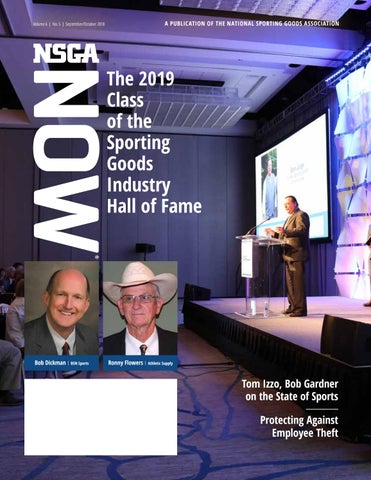
The 2019 Class of the Sporting Goods Industry Hall of Fame
Bob Dickman | BSN Sports
Ronny Flowers | Athletic Supply
Tom Izzo, Bob Gardner on the State of Sports Protecting Against Employee Theft NSGA NOW®
September/October 2018 | 1
STAHLS’ HELPS YOU WIN From our earliest tradition of durable felt lettering to today’s technologically advanced heat printing equipment and innovative materials for performance wear and sublimated jerseys, we have what you need to personalize quickly and profitably.
stahls.com | 800.478.2457
BUILD YOUR BUSINESS WITH STAHLS’ espanol.stahls.com | 800.521.4384
TABLE OF CONTENTS
8 Addressing the Challenges of Finding the Right Candidate for Employment
4 5 6 10 12 16 19
CEO Now
Hall of Fame is a Wonderful Source of Recognition
Association Now
PHIT Act Takes Major Step Forward
Team Now
Q&As On the State of Sports With Michigan State Basketball Coach Tom Izzo and Recently Retired NFHS Executive Director Bob Gardner
Insights Now
A Look at Running/Jogging Cross Participation
Recognition Now
The 2019 Class of the Sporting Goods Industry Hall of Fame: Bob Dickman and Ronny Flowers
Industry Now
Ways to Prevent Internal Theft
Locker Room Now
ADA and NBS Merge; NOCSAE Revised Football Helmet Standard Pushed Back
NSGA NOW®
September/October 2018 | 3
CEO NOW
There is something special about a Hall of Fame induction ceremony. We see it every summer with two of the most prestigious Halls of Fame in sports. The baseball induction in Cooperstown, New York, and the football induction in Canton, Ohio, draw thousands of fans for a celebration of the greatest of their games.
NSGA OFFICERS Chairman of the Board David Labbe
Kittery Trading Post, Kittery, ME
Treasurer/Chairman-Elect Cathy Pryor
Hibbett Sports, Birmingham, AL
Past Chairman Randy Nill
Nill Bros. Sporting Goods, Kansas City, KS
BOARD OF DIRECTORS Kevin Bezanson
Cleve’s Source for Sports, Halifax, Nova Scotia, Canada
Pat Donnelley
Donnelley Sports, Twin Falls, ID
Rhett Johnson
Johnson-Lambe Co., Raleigh, NC
Greg Miller
Universal Athletic, Bozeman, MT
Jeff Miller
Scholastic Sports Sales, Ltd., Manlius, NY
John Oehler
Dunham’s Sports, Troy, MI
Jerry Williams
Schuylkill Valley Sports, Pottstown, PA
NSGA TEAM LEADERS Matt Carlson
President & CEO
Marty Maciaszek
Director, Team Dealer Division and HDA
Julie Pitts
Director, Business Development and Research
Larry Weindruch
Director, Public Affairs
Dan Wiersma
Chief Financial Officer
It is wonderful to see the outpouring of emotion and passion for people who have dedicated so much of their lives to their craft. Not only from the new Hall of Famers themselves, but from their families, fans, former teammates and opponents and business colleagues. NSGA is fortunate to be involved in a similarly rewarding process and event with the Sporting Goods Industry Hall of Fame. A lot goes into joining the more than 160 men and women who have received this prestigious honor since 1956. It starts with nominations submitted to a Sporting Goods Industry Hall of Fame committee. Fifteen people from a variety of sectors of the industry take a hard look at the lifetime body of work for all the candidates. There is discussion before the votes are cast and NSGA does not have a vote in the process. All of it culminates in the Hall of Fame dinner and induction ceremony at NSGA’s annual Management Conference and Team Dealer Summit. The next two people to celebrate their induction into the Sporting Goods Industry Hall of Fame are Bob Dickman and Ronny Flowers. These men have devoted significant parts of their lives to help make our industry better. Bob Dickman and Ronny Flowers are two men with successful careers on the team dealer side of the industry. Sporting goods has been a family for both of them and so has their support to the industry. Dickman served NSGA as Chairman of the Board and Chairman of the Hall of Fame Committee and Flowers served on the NSGA Board. Dickman’s father Cliff was inducted into the Sporting Goods Industry Hall of Fame in 1995 for his successful career at Kesslers Sport Shop in basketball-crazed Richmond, Indiana. Dickman was just one of the family members to follow in his father’s footsteps and start a long career in the business that now has him working for BSN Sports. Flowers, along with his sons Ted and Tim and brother Fudd, have made Athletic Supply one of the country’s most successful team dealers in football hotbed Odessa, Texas. The company started in 1946 and Ronny Flowers has been in charge since the mid-1970s. He helped Athletic Supply grow and expand its reach from West Texas to the entire state. Bob Dickman and Ronny Flowers will be inducted into the Sporting Goods Industry Hall of Fame on May 21, 2019 during the 55th Annual NSGA Management Conference and 21st Annual Team Dealer Summit in Braselton, Georgia. NSGA congratulates them on being selected by a group of their peers for this tremendous honor. Best regards, Matt Carlson | President & CEO
NSGA NOW® (ISSN 1045-2087) is published bi-monthly for members of the National Sporting Goods Association, 1601 Feehanville Dr., Suite 300, Mount Prospect, IL 60056-6035; Phone: (847) 296-NSGA (6742); Fax: (847) 391-9827. Subscription price of $50 per year is included in membership fee. Non-member subscription information available from publisher. Periodical postage paid at Mount Prospect, IL 60056 and additional mailing offices. POSTMASTER: Send address changes to NSGA NOW,® 1601 Feehanville Dr., Suite 300, Mount Prospect, IL 60056-6035. © by NSGA 2018. Printed in the USA.
4 | NSGA NOW ®
September/October 2018
ASSOCIATION NOW
NSGA Applauds House for Passing Legislation Including PHIT Act By Larry Weindruch, NSGA Director of Public Affairs
NSGA commended the U.S. House of Representatives for including legislation to encourage physical activity in the Health Savings Account (HSA) reform package that passed a House vote by a 277–142 margin. The Personal Health Investment Today (PHIT) Act (H.R. 6312) was part of that package. It is a compromise version of the original bill, which NSGA has supported and urged passage of since its introduction a decade ago. The bill would allow Americans to use dollars in their HSAs to pay for physical activity items such as health club memberships, fitness and activity lessons and classes, equipment needed for certain sports and activities, and league and team signup fees for youth and school sports teams.
“ Our thanks go to Rep. Ron Kind (D-WI), who has been the champion and lead sponsor for PHIT since its inception, to Rep. Jason Smith (R-MO), who introduced the current bill, and to the 135 bi-partisan co-sponsors who helped make its passage possible,” said NSGA President & CEO Matt Carlson. “NSGA has been an active proponent of the PHIT Act, attending dozens of meetings on Capitol Hill in support of this bill over the years and contributing significant resources to the PHIT Coalition’s efforts,” Carlson said. The bill goes to the Senate, where its version of the bill, S. 482, was introduced by Sen. John Thune (R-SD). “A number of items found in the original PHIT Act were removed or amended during the House Ways & Means Committee markup,” Carlson said. “It is our hope that the Senate will restore those important features that made it a stronger bill.” Among the changes: The dollar cap was cut in half to $500 per person and $1,000 per family; equipment purchases were restricted to “safety” equipment, eliminating home exercise equipment; exercise videos were removed; and several activities including golf were removed from the list of eligible expenses. “We urge the Senate to restore the PHIT Act to its original wording,” Carlson said. “PHIT’s greatest benefit is removing cost as a barrier to participating in physical activity.”
NSGA members can contact their U.S. Senators to urge their support by going to //nsga.org/advocacy/legislative-advocacy/phit-act-passed by-house/. For more information on the PHIT Act, please contact NSGA Director of Public Affairs Larry Weindruch, lweindruch@nsga.org, or call (847) 296-6742, Ext. 1290.
NSGA NOW®
September/October 2018 | 5
TEAM NOW Q: How much has the landscape of youth sports changed? A: I have seen it change significantly.
On the AAU basketball scene, you’ve got some real good coaches and programs for basketball and some real concerns as we’ve seen lately (with the FBI investigation). What is distorting these kids, is that by the time they come in to college they think they’re NBA players. It’s a problem because a lot of people are telling them what they want to hear.
Q&A with Tom Izzo, Head Men’s Basketball Coach, Michigan State University Tom Izzo is one of the most recognizable figures in coaching in American sports. In his 23 years as head coach of the Michigan State University men’s basketball program, his teams won an NCAA National Championship in 2000, made seven Final Four appearances and made a Big Ten Conference record 21 straight NCAA tournament appearances. The 2016 Naismith Memorial Basketball Hall of Fame inductee has also watched 85 percent of his players who completed their eligibility leave Michigan State with a degree. Izzo was the keynote speaker at the 2018 NSGA Management Conference & Team Dealer Summit and he took a few moments to talk with NSGA NOW about youth and amateur sports.
6 | NSGA NOW ®
September/October 2018
(Chairman of NCAA Commission on College Basketball) Condoleeza Rice said it best that we’re trying to bring it back so the high school coach has more involvement. There are some good AAU coaches but when you get out of high school that’s not good. It’s a shame. We’re going to survive and high schools are going to survive but the kids are the ones who aren’t going to survive.
Q: What concerns you about the direction youth sports is going? A: Staying with high school being
like it’s supposed to be, somehow, someway we’ve got to get back to better coaches putting more time in. It’s pretty evident because fundamentals are not good. We have to borrow some of the European theory of working on fundamentals more, the way they do it in the lower grades. It’s all in a system of third grade through high school. Everyone is so transient now (high school coaches) that’s harder to control that.
Q: Is there enough emphasis on just participating in sports? A: What you have are kids who don’t
want to play if they aren’t starting and starring. To go around and be on a team, these things develop. A lot of great chemistry and discipline develop and the way to do that is with programs that stay consistent from third grade through senior year. There aren’t enough high school coaches in it long enough to develop that system.
Q: How concerned are you about specialization in sports? A: I think when you specialize at too
young of an age you lose a lot of very good athletes who could play more than one sport. Specializing has pluses and minuses, but you’re not coached by different people. I’m a big proponent of the multi-sport athlete, which I catch some flak on sometimes. Gary Harris (who has played four years in the NBA with Denver) was a great football player. So was Mateen Cleaves (point guard on Michigan State’s 2000 NCAA national championship team).
Q: What do you see coming down the road for college sports? A: With everything going on, it’s in
flux a little bit right now. Thank God we’ve got our arms around it a little bit with what Condoleeza Rice has done.
Phase one is to try and figure out what the problems are and the suggestions to fix them. Now the fixes have to become implemented. The next couple of years are going to be very important. We have great games but there are things that are definitely concerns.
Q: What is it that makes college sports so special for you? A: To me there is nothing like college
sports. I had the chance to go to the pros a couple of times, but there’s nothing like a Saturday football game or a crowd of students when a school gets behind you. Playing for your school and country seems to be more important in some ways. We have to make sure we don’t eat ourselves up and that’s what people thought was happening. I’m looking to be part of the solution instead of part of the problem.
Q: How much have high school athletics changed since you started? A: It has changed a great deal. When I started as a teacher and coach kids naturally played multiple sports. Somehow we got this thing twisted where the reason kids want to play is so they can get a scholarship. You have a to pick a sport at an early age today and focus your efforts on that despite the fact research is proving otherwise.
Q: Have high school sports become more inclusive over the years? A: I feel good about that coming
Q&A with Bob Gardner, Recently Retired Executive Director of the National Federation of State High School Associations Watching his father and grandfather teach and coach gave Bob Gardner an early direction toward his career path. After participating in four sports in high school and playing football and running track at Evansville University, Gardner embarked on a 48-year career in secondary education. Gardner just retired this summer after 18 years with the National Federation of State High School Associations (NFHS) and the last eight as the NFHS Executive Director. Before his retirement, Gardner took some time with NSGA NOW to reflect on the changes he has seen in high school sports.
out of an era where girls didn’t play organized sports and played intramurals one day a week. I’m so pleased they have the opportunities to participate. And you look at what state associations are doing to be much more inclusive with adaptive sports and those with intellectual disabilities.
Q: In some ways have youth sports, with the emphasis on elite, travel and select teams, become more exclusive? A: Everybody appreciates competition
and wants to play good competition. With travel teams, it’s expensive and it’s made it difficult for certain families to give opportunities to young people. With baseball, many urban cities have lost Little League programs. Those kids don’t have that opportunity to get with travel teams and stay with it.
Q: Football is still one of the biggest participation sports in high school. What concerns you most about the direction of the sport at the high school and youth levels? A: We’re always concerned about
minimizing risk and I think we’ve turned the corner on education. We’ve worked hard to try to educate people about concussions and being properly equipped and following heat and hydration guidelines.
I don’t think there is any question that the emphasis on risk minimization far exceeds anything we did 50 years ago. Coaches are more attuned to protect student-athletes and make sure they are getting their proper rest. Parents should feel good about it.
Q: The college basketball scandal and response could have a trickle-down effect on high school and youth sports. What are some concerns that don’t quite fit with the overall objectives of high school sports? A: Our concern is we really feel the
best place for recruiting and the integrity of the game is to go through the high school coach. The shift through travel teams and the emphasis on the travel coaches has proven that it’s not been good. I don’t disagree with some of the findings but where I disagree is looking at the showcases. I think the showcases could be run with high school coaches. When you talk about an agent, that gives us some concern about when does he get connected to a kid? Does it take away from his high school teams? I’m pleased we’re at the table and on the surface I think the Rice Commission did a pretty good job. Now the devil is in the details.
Q: Was there any reservation considering the feeling that video games are a reason cited for kids not being as involved in sports as they used to be? A: It’s always a concern. Maintaining a balance is always something the organization tries to strike. We’ll keep a watchful eye on it. We look at participation numbers continuing to grow and overall numbers are good so kids still see the value in participating in three sports at the high school level.
Q: How much have changes in equipment and sporting goods affected high school sports in terms of safety and performance? A: We’ve seen the research and
development of better equipment all the time and I’m grateful for that. That’s a really significant piece and I hope that continues. The committed team dealer is still an integral part of most high schools in this country. Somebody who takes care of serving the high school to be equipped properly is vital. Hopefully we never lose that. NSGA NOW®
September/October 2018 | 7
OPERATIONS NOW
Addressing the Challenges of “Hiring Right” By Marty Maciaszek, NSGA Team Dealer Director Larry Ryan, right, discusses some of the top techniques for hiring new employees during a discussion at the NSGA Management Conference & Team Dealer Summit with NSGA Board Member Rhett Johnson of Johnson-Lambe Co.
The process of hiring new employees can be daunting and disconcerting. Is the candidate a “job-hopper” and will I be back in this position a year from now? Is the candidate truly portrayed on his or her resume? Those were among the questions addressed during the session “Hire Right: Best Recruiting Practices” at the 2018 NSGA Management Conference & Team Dealer Summit in Bonita Springs, Florida. Larry Ryan, the founder of Roberts & Ryan, an executive search firm in Chicago, has conducted job searches for multiple industries at a variety of levels and he shared his insights. Ryan said there is a way to screen and determine if the candidate views your company as a long-term destination. “I start every interview with every single candidate by asking ‘What is prompting you to consider moving right now,’” Ryan said during the session moderated by NSGA Board Member Rhett Johnson. “’Why are you here.’ “You want to find out what prompted them to leave where they are at. You need to ask what happened and what changed in their current job to find out what motivates a candidate.” There is also the concern of, as one of the attendees asked, avoiding hiring someone’s resume and ending up with an employee who didn’t come close to how he or she was portrayed on paper. 8 | NSGA NOW ®
July/August 2018
“You work through it by assuming what is said on the resume isn’t fact,” Ryan said. “It’s your job to dig deeper. Reference checking is a major part of it.” Ryan said behavioral testing as part of the interview process has become popular. He cautioned against using it as an “end-all” to finding the right candidate. The prepared candidate will surely ask some pointed questions about the company. It is important to have everyone involved in interviewing the candidate on the same page. “It goes back to a candidate feeling recruited rather than just screened,” Ryan said. “It’s OK to mention what the warts are and where the challenges are. Candidates appreciate that more than anything. “I like a combination of team and oneon-one interviews. The team brings in more people and it’s an easy way to make the team feel important. One word of caution is to make sure everyone is consistent in their message.” Then it’s time to deliver the news — good or bad — to the candidates who were interviewed. Ryan believes it is important to have the right balance of not calling back 10 minutes after the interview and not waiting until weeks have passed. “If it takes 3 weeks to get any feedback they aren’t feeling good about it. Constant communication is critical,” Ryan said. “Sometimes we see clients move too fast and that can turn some people off.
“The optimal process is you want to follow up with (all) candidates. The ones who didn’t get the job — you want them to appreciate how they were followed up with.” Especially because that candidate could be a good fit for a different position in your organization in the future. Ryan also said it’s important when you come across someone who is talented to keep that person in mind for future openings. Ryan said posting job openings in different languages can make sense if another language is important for the organization. He also talked about non-compete clauses. “We can talk to hundreds of people and you’ll probably get a 50-50 split on how effective they will be,” Ryan said. “Most attorneys will tell you they are unenforceable.” Ryan also said it isn’t necessary to do a deep-dive of a candidate’s social media usage. If something on the surface is a concern then follow up on it. But social media can be an important tool in the recruiting process. “The modern-day cocktail party is the phone and social media,” Ryan said. “That’s going on daily. You need to get to the point where you are communicating more than you used to and it will pay off.
Introducing UD Achilles Support A scientific combination of functional clothing and injury prevention
Your achilles heel shouldn’t be your weakest spot
Eases symptoms of two of the most common endurance injuries Achilles Tendinitis & Shin Splints Provides pain relief to the entire achilles and shin area Targeted warming zones to the areas associated with these problems Prevents recurring injuries
Result: Pain relief and prevention of recurring injuries.
Reflectors for increased visibility Carefully constructed for a perfect fit and functionality Breathable material with quick dry properties
Classified as a medical device
NSGA NOWÂŽ
September/October 2018 | 9
INSIGHTS NOW
Here are the Top 5 Sports/Activities Most Likely to be Participated in by Running/Jogging Participants Compared with the Average Population: 1
2
3
4
5
PILATES
MOUNTAIN BIKING (OFF ROAD)
SOFTBALL
WEIGHTLIFTING
VOLLEYBALL
Source: 2018 NSGA Cross Participation report. | Icons made by Freepik from flaticon.com.
Data Drives Decisions
2018 EDITIONS OF NSGA RESEARCH AVAILABLE NOW NSGA KNOWS RESEARCH For more than 30 years, NSGA has provided reliable research and information to the sporting goods industry Uncover trends in participation for sports + recreational activities and sporting goods sales Determine feasibility, market size and composition Support sales forecasting, inventory management and target marketing
THE
SPORTS PARTICIPATION IN THE UNITED STATES www.nsga.org
CROSS PARTICIPATION PLEASE VISIT nsga.org/research FOR MORE INFORMATION September/October 2018
A statistical study of retail purchases in 2017 for representative categories of sporting goods ISSN: 0193-8401
SPORTS PARTICIPATION
10 | NSGA NOW ®
SPORTING GOODS MARKET
www.nsga.org
www.nsga.org
NSGA NOW ®
September/October 2018 | 11
RECOGNITION NOW
Bob Dickman Senior Vice President BSN Sports
12 | NSGA NOW ®
September/October 2018
Sporting goods was in Bob Dickman’s blood. Once Dickman was old enough to push a broom he was doing it at Kesslers Sport Shop in Richmond, Indiana, which was run by his father Cliff. Bob worked at Kesslers through high school and college and moved into the business full-time in 1976. Bob is following in his father’s footsteps once again as part of the Class of 2019 of the Sporting Goods Industry Hall of Fame. Cliff was inducted into the Hall of Fame in 1995 — the same year he retired and sold Kesslers to Bob and his brothers Phil and Dan. Bob began full time in the business in 1976, first in retail, then traveling to area schools for team sales. He was also responsible for purchasing and interaction with the company’s buying group. Cliff entered politics at that time, with brother-in-law Bob Luerman managing the business. The untimely death of Luerman in 1982 left Bob in charge of the company at the age of 24. When Bob joined the business, Kesslers had sales of approximately $1 million annually, one location, and one outside salesman. By the early 1990s the focus of the business began to shift toward a team sales platform and less emphasis was placed on the retail side of the business. Bob guided Kesslers on a historic expansion of the team sales division that led the company to reach nine states, with 20 sales offices and 75 sales pros. In 2002, Kesslers was recognized as the largest team dealer in the country, with sales exceeding $30 million.
In 2004, Bob and his brothers, Phil and Dan, who were partners in Kesslers, were looking to further the accelerated growth rate for the company and its 220 employees. They decided to be acquired by Collegiate Pacific, a publicly traded company in the sporting goods catalog business. Collegiate Pacific merged with Sport Supply Group to form what is now BSN Sports. BSN is one of the largest suppliers of team uniforms and equipment in the United States. Bob Dickman served as Chairman of the NSGA Board in 2009 and 2010. He was Chairman of the Sporting Goods Industry Hall of Fame Committee from 2011–2014. Bob is currently Senior Vice President at BSN Sports. Bob and his wife Rhonda who married in 1980 have three children and five grandchildren.
Nominations Open for 2020 Class of the Sporting Goods Industry Hall of Fame Nominations for the 2020 Class of the Sporting Goods Industry Hall of Fame are being accepted through Feb. 22, 2019. Nominees can come from any segment of the industry — general sporting goods, outdoor sports, snow sports, shooting sports, etc… Nominees must have been engaged in the business for at least 20 years.
or more information or to complete F a nomination form go to nsga.org/events/recognition/hall-of-fame.
NSGA NOW ®
September/October 2018 | 13
RECOGNITION NOW
Ronny Flowers
President Athletic Supply
14 | NSGA NOW ®
September/October 2018
Fifty years ago, Ronny Flowers was set to finish his degree at Texas Tech University and he needed a job and place to live in Lubbock. Flowers applied at an auto parts store and then with the sporting goods road salesman who served the school where he taught and coached. Flowers first job with T & D Sporting Goods was knocking down a wall. That humble beginning started a career where he has been with Athletic Supply in football crazy Odessa, Texas for the last 46 years and is part of the 2019 Class of the Sporting Goods Industry Hall of Fame. Flowers has made a significant impact on the sporting goods industry in building Athletic Supply in annual sales from $500,000 to $30 million. He has been inducted into the Texas High School Football and Odessa Business halls of fame and served on the Board of Directors for the National Sporting Goods Association. Sports has always been a big part of life for the native Texan. He was the valedictorian at Guthrie High School, the quarterback for the school’s 1964 regional championship football team and a member of the Texas 8-man all-star game. In the fall of 1967, at age 20, he became a teacher and coach of all boys sports at a small school near his hometown.
closet/ladies’ restroom. In his first year there he met his wife of a half-century when she came to the store to buy a pair of tube socks. In the fall of 1970, Flowers had the opportunity to become a roadman for T & D, but he was just three hours short of graduation and his wife was pregnant. She wasn’t happy but he told her, “I think this might be a great opportunity and if it doesn’t work out, I’ll finish school, you can teach and I can coach.” Flowers never looked back and in the fall of 1972, the aging owners of Athletic Supply, Joe Coleman and F.O. Scroggins, were looking for a young roadman. He thought there might be an opportunity for ownership in the business and a year later that materialized when he was part of a group which bought Athletic Supply. Athletic Supply grew into a fixture throughout Texas but it also became a family business. Flowers’ brother Fudd and his sons Tim and Ted are among the nearly 50 employees. Flowers has also made sure Athletic Supply supports the communities and people it serves. In 1980 he created the Athletic Supply Scholarship for Texas high school male and female athletes and he has also helped struggling businesses. His generosity, sense of humor, determination and hard work have made him one of the most respected figures in Texas high school athletics and the sporting goods industry.
The decision to go back to Lubbock and complete his degree led him to T & D, where he became a shipping clerk while living in the store’s storage
“Both 2019 inductees (Bob Dickman and Ronny Flowers) have been successful in building their respective businesses. We welcome them to the Hall of Fame and look forward to next May’s induction ceremony.” — Ken Meehan, Hall of Fame Chairman and Executive Advisor to the CEO of Dunham’s Sports
NSGA NOW ®
September/October 2018 | 15
INDUSTRY NOW
Trust Everyone — But be Alert By William J. Lynott
It is only natural for you to place a great deal of trust in your employees. “We’re like one big family,” is a refrain often heard in entrepreneurial ranks. That’s as it should be — but it’s important to keep your guard up. Unfortunately, employee theft is a growing national problem, and our difficult economy isn’t making things any easier. According to the FBI, “...employee theft is the fastest growing crime in America.” Arguably, there is no business more susceptible to the harmful effects of employee dishonesty than a retail store. Employee theft occurs when a worker steals merchandise, money or property while on the job. From a strictly legal perspective, a theft is committed when an employee takes something with the intent of depriving the merchant of the stolen item’s value. More important than legal consideration is the devastating damage to the business that can result from employee dishonesty. Even if you are confident employee theft is not a problem in your store, it’s important to recognize the telltale signs and know how to build and maintain an environment that will help your staff to avoid temptation.
The Importance of Hiring Procedures
According to Joseph T. Wells, Founder and President of Association of Certified Fraud Examiners, minimizing the chances of employee theft begins with the hiring process. “Before hiring anyone,” he suggests, “you should conduct a background check to find out as much as you can about the employee’s previous experience with employers and law enforcement. “At a minimum, you should check the background of any prospective employee who will have constant access to cash, checks, credit card numbers, or any other items that are easily stolen. In a retail store, that covers nearly everyone. Before hiring an employee, you should check as many of the following as possible.” Past Employment Verification: Most employers will only verify position and dates of employment but you can often tell by their tone of voice what they think of the employee. Ask whether the applicant is eligible for rehire. Criminal Conviction Checks: Most public records services (such as Nexis or ChoicePoint) have criminal conviction records for almost every large county. Or, you may go to the courthouse and search the criminal conviction records in the criminal courts division of the employee’s county of residence. Drug Screening: Many business owners are now conducting drug screenings for potential hires as well as current employees. Frequent drug users can be more prone to theft or fraud.
16 | NSGA NOW ®
September/October 2018
Reference Checks: Surprisingly, very few employers bother to call the references a candidate provides, apparently operating on the assumption that an applicant wouldn’t provide a bad reference. However, many times applicants will list important-sounding individuals as references with the hope that you won’t call. Always Obtain Consent of Applicant: Numerous federal and state laws, such as the Fair Credit Reporting Act, govern the gathering and use of information for pre-employment purposes. Many of these laws require that you obtain written consent from the applicant before gaining some of the types of information listed above.
Policies and Procedures that Help to Deter Fraud
“Developing anti-fraud programs can be one of the most important things that you can do for your business,” says Wells. “Prevention, in the long run, is always cheaper than recovering your losses.” He suggests these precautions: Perception of Detection: Employees who perceive they will be caught engaging in fraud and abuse are far less likely to commit it. Increasing the perception of detection may well be the most effective fraud prevention method. Employee Education: Every business should have some mechanism designed to educate all employees about the serious consequences of internal fraud. Any education efforts should be positive and non-accusatory. It’s important to emphasize that illegal conduct in any form eventually costs everyone, including employees, through lost profits, adverse publicity, decreased morale and lower productivity.
Enforcement of Mandatory Vacations: Many internal frauds require constant manual intervention and are often discovered when the perpetrator is away on vacation. The enforcement of mandatory vacations will aid in the prevention of some frauds.
• An employee who habitually returns to the work area after others have left to retrieve something supposedly left behind • Watch for gifts or favors to employees from vendors or customers
Job Rotation: Some frauds are detected during sickness or unexpected absences of the perpetrator because they require continuous, manual intervention by the offender. It can be helpful to rotate potentially sensitive jobs whenever possible.
If You Suspect Theft
Split Responsibility: Wherever possible don’t allow the same person who handles incoming cash and checks to do the paperwork accounting for that money. Trash Control: Make random checks of dumpsters and trash bins for goods that may have been placed there for later pickup. Use clear trash bags for easy inspection and keep lids of outside dumpsters locked after business hours. Conduct Frequent Inventories: Do product inventories often and at random times. Examine records of purchases and sales daily. Assigning inventory control responsibilities to specific individuals helps to establish accountability. That, in turn, helps to discourage theft. Consider Video Surveillance: Technological advancement has greatly reduced the cost of video surveillance by putting it in the reach of even small retail operations. Installing strategically placed cameras can be a strong deterrent to employee theft.
Watch for These Signs of Possible Employee Theft
Despite the best of internal programs, it’s important to keep yourself aware of early warning signals of possible employee dishonesty. Watch for such signs as: • Any hint of substance abuse. This is one of the most common scenarios in employee theft cases. • An employee with a disgruntled, belligerent attitude, often complaining about management or job to others • Bad temper or unpleasant behavior that tends to discourage or avoid questions • Inconsistencies in explaining discrepancies or errors in paperwork or cash-register accountings • Excessive loitering around the business by off-duty employees, ex-employees or friends • Secretive conversations among employees, phone conversations that stop abruptly when you approach • An employee living a lifestyle that appears to be in excess of what the salary could be expected to support.
Despite the fact sensible precautions can greatly reduce the likelihood of theft by employees, there are no foolproof ways to prevent it. If you suspect or have evidence of employee theft, call your local police department. Handling the matter on your own could lead to false or impossible-to-prove accusations, which could expose you to serious legal liability. In a business such as sporting goods retailing with loyal and trusted employees, some of whom may be relatives or friends, it’s only natural for you to dismiss any thoughts of employee dishonesty. Still, both you and your employees will benefit from a policy that creates an environment that openly discourages dishonest behavior.
Shoplifting
While employee theft is the biggest cause of inventory shrinkage in most retail stores, it’s not the only one. Shoplifting by customers still poses a big risk in most retail operations. According to the National Retail Federation (NRF), shoplifting is costing the retail industry approximately $50 billion per year. While there is no way to guarantee your store will be completely free of shoplifting, there are easy and inexpensive steps you can take to lower your risk. I nstall Security Cameras: Surveillance cameras installed for protection against employee theft are also one of the best ways to prevent shoplifting. While the installation of security cameras requires an investment, when properly done, they can provide protection for the entire store, day and night, especially when a prominently displayed sign calls attention to their use. Use Mirrors: When cameras are beyond your financial reach, the use of mirrors, mounted ceiling-high in the corners are an inexpensive but effective way to reduce shoplifting. Use Signs: Properly-done signage is another inexpensive but effective way to reduce the risk of shoplifting. Other tips: Enlist employees for their help. Watch for suspicious behavior such as customers wearing large baggy sweatshirts or carrying very large purses or bags. Keep product displays neat and organized. Reducing inventory shrinkage is not a passive responsibility. It calls for vigilance and being proactive. While complete protection cannot be guaranteed, your vigilance will go a long way toward achieving that end.
NSGA NOW ®
September/October 2018 | 17
PATRICK PETERSON DB, ARIZONA
LIGHTWEIGHT POWER
Super-strong TPU fibers woven into the ultra-light upper for vicious speed.
FAST & COOL
Flexible knit collar & tongue so you’re cool, quick & uncatchable.
SLASH & BURN
UA SlashPlate Traction for jaw-dropping cuts & maximum separation.
18 | NSGA NOW ®
September/October 2018
LOCKER ROOM NOW
ADA and NBS Merge The Athletic Dealers of America (ADA) and Nation’s Best Sports (NBS) announced a merger which took effect September 1, 2018. The ADA has agreed to join the NBS group to build a stronger team dealer organization and this combination of dealers will allow the combined organization to double the size of its team dealer count. NBS was established in 1956 and is comprised of more than 375 independent retail members with more than 1,200 storefronts in the U.S., Canada and Puerto Rico. NBS brings the ADA Dealers a diverse portfolio of buying opportunities in all categories of outdoor sports and general sporting goods. The ADA has been in existence for 38 years and brings significant experience in the athletic team and institutional industry. The combination of these two organizations, the significant benefits and staff experience will combine to make the two organizations stronger. “We are pleased to join forces with the ADA Dealers,” said NBS President Jim Chandley. “This merger will enhance the opportunities for both our members and make doing business with our combined groups more cost-effective for the vendor community. We look forward to welcoming the ADA Dealers to our merged show in Arlington, Texas in November.” NBS and ADA held co-located shows last November in Oklahoma City, Oklahoma and in July in Jacksonville, Florida. “I’m looking forward to working closely with the NBS staff to improve the profitability of our combined membership,” said ADA President Peter Schneider. “We must continue to improve the value we provide to our membership to help them compete in a constantly changing retail and team environment.”
NOCSAE Revised Football Helmet Standard Pushed Back to November 2019 The effective date of the NOCSAE revised football helmet standard to limit rotational accelerations was pushed back to November 2019 from November 2018 after a software issue that led to inaccurate data was discovered. The NOCSAE Standards Committee voted in a public online meeting August 14 to revise the pneumatic ram testing and establish the new effective date of Nov. 1, 2019. The latest delay came after the NOCSAE Standards Committee voted June 22 at the NOCSAE Summer Standards Meeting in San Diego to move the effective date to May 2019 to allow time to investigate and address the issue.
Youth Specific Football Helmet Standard For more than 10 years, NOCSAE has worked to develop a youth football helmet standard that is evidence-based. NOCSAE’s existing football helmet standard applies to players of all sizes and helmets that are small enough to be worn by “youth players” are required to be tested on a biofidelic head form that replicates the head of a 50th percentile 10-year-old male. Currently, there is insufficient data to suggest a distinct helmet mass limit for youth or other similar performance changes would provide more injury protection or would protect against injury risks not already addressed. Last year, NOCSAE convened a Scientific Advisory Committee to explore the latest scientific support for a standard and authorized funding for two research initiatives. Specific objectives of the research include (among others) describing the magnitude and frequency of head impacts for youth football players ages 5–10 and 11–14 years old and identifying relationships between head/helmet mass and neck strength for youth players to inform helmet performance requirements. Cheek-Flap Add-On Products for Baseball Helmets In May, NOCSAE issued a statement on Certification to NOCSAE Standards and Add-On Helmet Products to clarify that additions to a baseball batter’s helmet such as a C-Flap create a new and untested model, as defined in the NOCSAE standards. When this happens, the manufacturer has the right to declare its certification void. NOCSAE stated that no cheek-flap products meet the NOCSAE standard for face protection. This applies to separate addon products sold by a third party, products designed by a manufacturer to be used with their batter’s helmets, or batter’s helmets that include a permanent, built-in cheekflap. While the batter’s helmet may be certified to NOCSAE standards, the cheek-flap portion is not included in that certification, is not tested, and does not meet the NOCSAE standard for face protection.
NSGA NOW ®
September/October 2018 | 19
HIKING
WWW.INSOLE.COM
20 | NSGA NOW ®
September/October 2018
LOCKER ROOM NOW
NFHS Softball, Track and Field Rule Changes
Baseball Reminders
Equipment rules designed to reduce risk of injury, related to eye shields for defensive face/head protection and adjustable bat knobs, are among the high school softball rules changes for the 2019 season. Rule 1-8-4 permits an eye shield to be worn attached to the face/head protection only if it is constructed of a molded, rigid material that is clear and permits 100 percent (no tint) allowable light transmission. This change aligns with other softball equipment rules that currently prohibit tinted eye shields. Among other rules changes was a clarification to Rule 1-52a, which permits a softball bat to have an adjustable knob, provided the knob is permanently fastened by the manufacturer. Any devices, attachments or wrappings that cause the knob to become flush with the handle are also permitted. Track and Field/Cross Country
The implementation date for NFHS-approved high school baseballs to meet the new NOCSAE standard was pushed back to January 1, 2020. All current baseballs with the NFHS Authenticating Mark stamp will be permitted for use during the 2018–19 season. Catchers will be required to wear a chest protector that meets the NOCSAE standard at the time of manufacture, effective Jan. 1, 2020. The NOCSAE standard has been developed to protect the heart and the cardiac silhouette from commotio cordis, which is one of the leading causes of sudden cardiac death in young athletes in baseball and lacrosse.
NCAA Track and Field Changes
Further simplification of the uniform rule in track and field, and clarification on the method of determining the order of finish in cross country highlight 2019 rules changes in those two high school sports. In Rule 4-3-1, the interpretation of a foundation garment was expanded to include any item worn under the uniform top and/or bottom. The rule now states that “any visible garment worn underneath the uniform top and/or bottom is considered a foundation garment. A foundation garment is not subject to logo/trademark/reference or color restrictions.” In addition, Rule 4-3-2 was rewritten to allow schools more options in meeting the uniform rule. The rule now states that “all relay and cross country team members must wear uniforms clearly indicating, through predominant color, school logo and color combination of all outer garments worn as a uniform, that members are from the same team.”
The NCAA Men’s and Women’s Track and Field Rules Committee has recommended all members of teams must wear the same uniforms, starting in the 2018–19 academic year. The committee has proposed that the uniforms must be the same primary color and have the same school logo on any day of competition. If single-color body suits are worn, it must be the primary color of the team and have the same school logo of the top garment as the rest of the team on any given day. If an athlete is found to be noncompliant with the rule, he or she will not be able to compete in an event until they meet the uniform policy. Committee members believe it should be easy to distinguish which team everyone represents during track meets. Committee members also received similar feedback via a survey of track coaches from around the country. The committee didn’t want to disqualify athletes who violate this proposed rule, but they also want to make it clear that competition will not be delayed for athletes who break the rule.
NSGA NOW ®
September/October 2018 | 21
SaaS POS & eCommerce for Sporting Goods Retailers AFFORDABLE & POWERFUL
Manage your entire business with Cumulus Retail, a new, affordable SaaS solution by CAM Commerce, offering: vendor catalog imports, 3-dimensional color/size matrix, automated purchase orders, loyalty rewards, buying clubs, gift cards, integrated eCommerce, drop shipping, marketplace integrations and email marketing.
New SaaS Retail Software: 1st Month FREE! Point of Sale Inventory Fulfillment eCommerce Drop Shipping Email Automation
cumulusretail.com | (714) 338 - 0200 22 | NSGA NOW ÂŽ
September/October 2018
NSGA NOW ®
September/October 2018 | 23
55TH ANNUAL Management Conference & 21ST ANNUAL Team Dealer Summit
May 19–21, 2019
Château Élan Winery & Resort | Braselton, Georgia 24 | NSGA NOW ®
September/October 2018