Volume 5 | No. 5 | September/October 2017
A PUBLICATION OF THE NATIONAL SPORTING GOODS ASSOCIATION
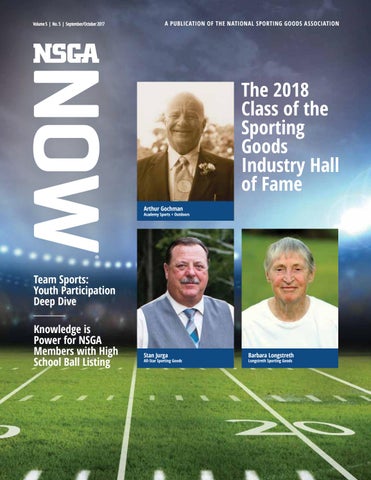
The 2018 Class of the Sporting Goods Industry Hall of Fame Arthur Gochman
Academy Sports + Outdoors
Team Sports: Youth Participation Deep Dive Knowledge is Power for NSGA Members with High School Ball Listing
Stan Jurga
All-Star Sporting Goods
Barbara Longstreth Longstreth Sporting Goods
RESEARCH • ADVOCACY • NETWORKING
WHAT NSGA DOES FOR YOU OUR MISSION is to grow your business and advocate on your behalf.
NETWORKING
EDUCATION
ADVOCACY
BUSINESS SOLUTIONS
RESEARCH & INSIGHTS
PERSONALIZED SUPPORT
nsga.org/membership
membership@nsga.org
/NSGASportingGds
(847) 296-6742
/nsgasports
Search NSGA
TABLE OF CONTENTS
4 5 6 8
10
CEO Now
Congratulating the Hall of Fame inductees; NSGA Initiatives You Need to Know About
Association Now
Former NSGA Board Member Recognized; NSGA Team Participates in Hurricane Harvey Relief Efforts
Technology Now
The Productivity Paradox and Technology
Insights Now
Team Sports: Youth Participation Deep Dive
Operations Now
Knowledge is Power for NSGA Members with High School Ball Listing
12
Recognition Now
18
Participation Now
20
Team Now
22
Locker Room Now
The 2018 Class of the Sporting Goods Industry Hall of Fame
Back to School Tips for A Successful Sports Year
Kentucky, Missouri High Schools Require Face Protection for Fast-Pitch Softball Players
Russell Athletic Exiting Team Uniform Business, ADA & NBS Combine Shows, Rules Changes and More
NSGA NOW ®
September/October 2017 | 3
CEO NOW
NSGA OFFICERS Chairman of the Board David Labbe
Kittery Trading Post, Kittery, ME
Treasurer/Chairman-Elect Cathy Pryor
Hibbett Sports, Birmingham, AL
Past Chairman Randy Nill
Nill Bros. Sporting Goods, Kansas City, KS
BOARD OF DIRECTORS Kevin Bezanson
Cleve’s Source for Sports, Halifax, Novia Scotia, Canada
Pat Donnelley
Donnelley Sports, Twin Falls, ID
Rhett Johnson
Johnson-Lambe Co., Raleigh, NC
Greg Miller
Universal Athletic, Bozeman, MT
Jeff Miller
Scholastic Sports Sales, Ltd., Manlius, NY
John Oehler
Dunham’s Sports, Troy, MI
Jerry Williams
Schuylkill Valley Sports, Pottstown, PA
NSGA TEAM LEADERS Matt Carlson
President & CEO
Meghan Beach
Director, Membership & Education
Katie Bruce
Director, Marketing & Communications
Dustin Dobrin
Director, Research & Information
Marty Maciaszek
NSGA is pleased to feature the 2018 class of the Sporting Goods Industry Hall of Fame in this issue of NSGA NOW.® A civil rights lawyer, safety equipment innovator and women’s sports participant, advocate and coach, this year’s inductees are a truly diverse group. The three members of the Sporting Goods Industry Hall of Fame class of 2018 are the late Arthur Gochman of Academy Sports + Outdoors, Stan Jurga of All-Star Sporting Goods and Barbara Longstreth of Longstreth Sporting Goods. They will be inducted during the NSGA Management Conference & Team Dealer Summit. Gochman, Jurga and Longstreth contributed in a variety of ways to the industry, whether it was coaching, providing the essentials for an athlete to perform their best or innovating to create the safest equipment. The 2018 inductees made a difference in the industry but also for the individual athlete. Learn more about Gochman, Jurga and Longstreth’s contributions later in the magazine. The induction dinner and ceremony will be held on Tuesday, May 22, capping off the NSGA 54th Annual Management Conference & 20th Annual Team Dealer Summit in Bonita Springs, Florida. Don’t miss an opportunity to recognize industry leaders. Save the date for the event today! Congratulations to these three deserving individuals and their families! NSGA is committed to helping our members and the industry. Recently, NSGA researched, compiled and distributed the Official State Ball List. The list includes the official balls used by each state high school athletic association during championship competitions. This members-only feature is a helpful resource that contains the brands and models used and the expiration dates of the agreements. We hope that the list serves as a guide for your inventory and helps you prepare when a change may occur. NSGA will continue to monitor and update the list and a link will be provided to members in the bi-weekly NSGA Scoreboard. You can also login and view the list at nsga.org/stateballslist (please note, if you are a member who has not yet created a website account, you will be prompted to do so). The NSGA Scoreboard is comprised of industry news, research insights and helpful information to better your business. As a member, you have special access to certain features of the newsletter. Like the e-newsletter, NSGA Now ® includes features content that drives creativity, new ideas and insights about your business. You will find everything from research to technology to information on industry recognition. If there is something you would like to see in the NSGA Scoreboard or NSGA Now,® we encourage you to let the NSGA team know!
Director, Team Dealer Division and HDA
Julie Pitts
Director, Business Development
Larry Weindruch
Best regards, Matt Carlson President & CEO
Director, Public Affairs
Dan Wiersma
Chief Financial Officer
Katie Bruce | Editor/Publisher NSGA NOW® (ISSN 1045-2087) is published bi-monthly for members of the National Sporting Goods Association, 1601 Feehanville Dr., Suite 300, Mount Prospect, IL 60056-6035; Phone: (847) 296-NSGA (6742); Fax: (847) 391-9827. Subscription price of $50 per year is included in membership fee. Non-member subscription information available from publisher. Periodical postage paid at Mount Prospect, IL 60056 and additional mailing offices. POSTMASTER: Send address changes to NSGA NOW,® 1601 Feehanville Dr., Suite 300, Mount Prospect, IL 60056-6035. © by NSGA 2017. Printed in the USA.
4 | NSGA NOW ®
September/October 2017
ASSOCIATION NOW
Former NSGA Board Member Recognized for Contributions
NSGA Team Answers Call to Help Victims of Hurricane Harvey The NSGA team responded to a public request from University of Houston men’s basketball Coach Kelvin Sampson. The team gathered shirts, shoes and hats and shipped them down to Texas to help those affected by Hurricane Harvey. Sampson’s request began as a call to his coaching counterparts to donate 10 pairs of shoes and 20 shirts to victims who lost everything. The call has already been answered and NSGA is happy to contribute.
The Howard County Sports Hall of Fame in Indiana announced the 2017 class that included former National Sporting Goods Association Board member Dick Sanburn Jr., longtime owner of Dick Sanburn Sporting Goods in Kokomo. Sanburn retired in 2013 after 54 years. He once estimated he sold more than 10,000 pairs of tennis shoes. He supported youth baseball and other athletic teams through donations and sponsorships, including the Kokomo Post 6 American Legion baseball squad. Sanburn also spent 17 seasons as the catcher on the powerful Punchy’s Radiator fast-pitch softball team. Sanburn will be inducted with the rest of the class on October 28 at the Creative Financial Centre.
NSGA NOW ®
September/October 2017 | 5
TECHNOLOGY NOW
The Productivity Paradox and Technology By Adam Gassensmith, Account Manager, Peters & Associates
One of the most popular terms that technology companies like to throw around these days, Microsoft included, is “Productivity.” This word is used with such frequency, its definition contorted in marketing and sales presentations, that it’s hard to pin down a single meaning. However, as manufacturing organizations likely know, productivity has a very real definition. Economists define productivity as output divided by labor input. In simple terms, a factory that produces 20,000 items with 40 labor-hours is more productive than a factory that produces 10,000 items with 40 labor hours. Of course, this is a simplified definition and understanding the industry or the complexity of a given product is required context for understanding this index. Regardless of this caveat, businesses are seeking to increase their productivity. There is also a popular term in economics called “The Productivity Paradox.” Multiple authors have written about this over the past few decades. Each author has put a slightly different spin on it, but a 101-level definition could be: The failure of productivity to rise when conditions or actions suggest that it should. One specific field of study within the Productivity Paradox is how technology improvements fail to render productivity improvements. We’ll explore some of the reasons for this in this article.
6 | NSGA NOW ®
September/October 2017
Case Study: Electricity in Manufacturing
This phenomenon was discussed in a podcast, “Freakonomics.” In this particular episode, the host was interviewing a man named Charles Duhigg, a writer for The New York Times. Some of you may recognize his name as the author of the popular book, “The Power of Habit.” On this episode, Duhigg had been asked to speak about productivity, a topic he had covered in his newest book “Smarter Faster Better: The Secrets of Being Productive in Life and Business.” In the interview (you can find a link to the recording and transcript in the end notes) Duhigg cites a specific example of technology improvements resulting in flat productivity — the advent of electricity. Duhigg states this better than it can be paraphrased. Duhigg explains:
When electricity was first popularized, there was this huge wave of factories that replaced their steam engines with electrical engines. And almost none of the productivity of those factories rose initially. This has been referred to in economics literature as the productivity paradox. And as researchers went back and they tried to figure out why, what they found is that all the factory managers had arrayed all of the machines, had lined them up on the factory floor, so that they could have these steam pipes that would run from machine to machine. And when they electrified the plants, they left all the machines in the same places; they just replaced the pipes with wires. It took about 20 or 25 years for plant managers to start saying, “Look, the strength of electricity isn’t simply a new power source. It’s that we can move these machines in ways that we can have workers work more efficiently or we can use less people or we can create an assembly line.” And that’s where the productivity increase really came from. And the same thing is happening today. In other words, the reason that electricity did not have an immediate, positive impact on productivity is because organizations needed to learn how to work differently to implement this technological advantage.
Lessons Learned
So how does the transition from steam power to electric motors inform our businesses today? The greatest lesson that we can take from this is that making a digital transformation means more than just plugging in a new technology to your work processes. A digital transformation requires us to evaluate the problem that a given technology is uniquely qualified to solve and understand how that technology might also change the process by which we execute a task. A couple of years ago, during a seminar on automation technology, a speaker said, “automating a bad business process does not make it a good process.� Introducing a technological improvement gives us the opportunity to optimize our process to fit the strengths of the technology. So, whether you are introducing a new workflow automation tool, a Business Intelligence dashboard, or a new way for your employees to communicate; remember how technology really impacts productivity. After all, the real strength of the electric motor was not that it was a new power source, it was the flexibility that it provided factories to better use their space.
here are many other layers to this puzzle. As you T approach your digital transformation, if you need a helping hand, Peters & Associates is happy to help you navigate the Productivity Paradox. For this and any other technology questions, you can reach Adam at adam.gassensmith@peters.com or (630) 592-6252.
If you would like to read more about the Productivity Paradox, this Harvard Business Review article from 1986 provides some good insight: hbr.org/1986/07/the-productivity-paradox
If you would like to listen to the podcast that is referenced in this article, you can find the recording and transcript here: freakonomics.com/podcast/ how-to-be-more-productive/
You can also find Tech Tips in the NSGA Scoreboard, sent every other Tuesday electronically.
NSGA NOW ÂŽ
September/October 2017 | 7
INSIGHTS NOW
Team Sports: Youth Participation Deep Dive By Nick Rigitano, NSGA Research Analyst
Nearly 1 in 2. That is the number of children ages 7–17 in the U.S. participating in team sports. Out of a total base of roughly 46 million kids, it appears that there is ample opportunity for retailers and manufacturers to capitalize on this market. Of course, that is just one figure. A closer look at the data is needed to understand the whole story and allow organizations to adjust to the current state of the segment while proactively strategizing for the future using information on current trends. To begin, it is important to understand why there is a focus being placed on the youth segment of team sports. As stated above and shown in Figure 1, nearly 47% of kids ages 7–17 in the U.S. participated in team sports during 2016. This was tops among the 10 sports/activity segments tracked by NSGA. The next closest segments were Individual Sports (39%) and Fitness Activities (35%). Clearly, team sports have remained a large part of youth sports/activities. It is true, however, that youth sports are experiencing lower participation levels during this decade compared to previous ones (Figure 2). Since the 1990s, youth participation in team sports has decreased in both the 2000s and 2010s. During the 2000s, participation decreased 12% vs. the 1990s and has continued to fall an additional 17% thus far during the 2010s. As a reminder, NSGA measures sports participation based on total participation points (TPPs), a measurement that looks not only at the number of participants (reach of participation), but also the number of sports each participant is involved in (depth of participation). Looking at participation in this way better measures the opportunities that sporting goods organizations have to sell to customers. Although team sports participation has decreased over the last few decades, the immediate outlook for sales opportunities is not bleak. During the last five years, youth participation in team sports (based on the TPP measurement) has increased almost 9% (Figure 3). During this time, 9 out of the 11 team sports tracked by NSGA have experienced growth among youth. Leading the way was Ice Hockey (39%) followed
8 | NSGA NOW ®
September/October 2017
by Volleyball (26%), Cheerleading (21%), Softball (17%), Touch Football (12%), Soccer (11%), Baseball (6%), Lacrosse (3%), and Basketball (1%). The sports experiencing slight declines were Flag Football (-1%) and Tackle Football (-1%). During this same time period, the overall number of participants in team sports decreased 5%. This suggests that kids remaining in the segment are participating in a wider variety of team sports, making up for the loss in the overall number of participants. In other words, the number of selling opportunities for sporting goods organizations has increased over the last 5 years despite the declines in the number of participants. In breaking down the data one step further, one can see that the 9% increase in selling opportunities is primarily being driven by boys (Figure 3). Looking at specific sports within the segment, the data shows that boys are also the major drivers of the increases among basketball, touch football, ice hockey, soccer, softball and volleyball, along with the decrease in tackle football. Girls were responsible for the increase in cheerleading and also the decrease in flag football. The sports of baseball and lacrosse saw gains from both boys and girls. In the end, youth participation has been and will continue to be the biggest driver of the team sports segment. While participation levels of today may not be where they were in previous decades, there is still an undeniable amount of children in the US participating in team sports. Also encouraging is the number of team sports that have experienced increases in participation over the last 5 years, suggesting that perhaps the overall segment declines have bottomed out and will continue trending upward for the near future. Comparing this trend to overall participation, the percentage of Americans that are sedentary (those who do not participate in any of the 55 sports/activities that NSGA tracks) has remained flat, holding steady at 22% from 2014–2016. It will be important for manufacturers and retailers to keep these trends in mind as they look to maximize their potential for the future.
FIGURE 1 | Percent of Kids (Ages 7–17) in U.S. Participating in Sports/Activities | 2016 60 50
Team Individual
47%
40
Fitness
39%
Wheel
36%
Outdoor
28%
30
Shooting
28%
Indoor Games Open Water
20
15%
Personal Contact
9%
10
9%
8%
Snow
5%
0 FIGURE 2 Total Participation in Youth Team Sports (Ages 7–17)
12%
1990s
17%
2000s
2010s
FIGURE 3
% Change vs 2012
Main Driver
All Team Sports
9%
Boys
Baseball
6%
Boys & Girls
Basketball
1%
Boys
Cheerleading
21%
Girls
Flag Football
1%
Girls
Tackle Football
1%
Boys
Touch Football
12%
Boys
Ice Hockey
39%
Boys
Lacrosse
3%
Boys & Girls
Soccer
11%
Boys
Softball
17%
Boys
Volleyball
26%
Boys
Sport
Youth Participation in Team Sports: Changes and Drivers
NSGA NOW ®
September/October 2017 | 9
OPERATIONS NOW
Knowledge is Power for NSGA Members with High School Ball Listing By Marty Maciaszek, NSGA Team Dealer Director
10 | NSGA NOW ®
September/October 2017
High school sports have turned into a brand new ball game. Each state association has certain products that are considered approved for use in their postseason or state championship play. Some states have agreements with one brand for all sports and others utilize a variety of brands.
Most states require the use of their official balls only for the postseason. But in many instances, teams want to use the same ball in their practices and regular-season games so it’s not unfamiliar to their players when they get to the playoffs or a state championship.
NSGA is helping members find the information they need with the creation of the Official State High School Ball Listing. The list was published for the first time this spring and is updated regularly as new information is available.
NSGA compiled the listing through information from state association websites or public documents and with the cooperation of numerous state association executives. There are some cases where NSGA is still trying to compile information and it will continue to do so to ensure the list is as up-to-date as possible.
“This is an excellent resource for NSGA members — especially team dealers and retailers who work closely with high schools on their equipment needs,” said NSGA President & CEO Matt Carlson. “We believe it will help our members manage their inventory since they will be prepared for potential changes in agreements with states. It also saves our members valuable time since the information is easily accessible through the NSGA website.” For each state association’s sport, the listing includes the brand and model of the ball used and when the agreement is set to expire. There are also notes which include the specific model numbers, details on specific state logos or ball colors which may be required, the requirements of use and the typical length of time of the agreements.
SGA members can access the Official N State High School Ball Listing at nsga.org/stateballslist. If you have any questions or information about the list, please contact NSGA Team Dealer Director Marty Maciaszek at mmaciaszek@nsga.org or (847) 296-NSGA (6742), ext. 1260.
NSGA NOW®
September/October 2017 | 11
RECOGNITION NOW
Arthur Gochman Former CEO, Academy Sports + Outdoors
12 | NSGA NOW ®
September/October 2017
Arthur Gochman was not only a lawyer and businessman who battled for equitable funding for poor schools, but he also turned six military surplus stores into a leading sporting goods retailer now known as Academy Sports + Outdoors. Gochman’s professional start began in the legal world; he practiced law in San Antonio, focusing on antitrust and civil rights. Gochman was extremely active in the civil rights community and in the 1950s and 1960s he helped desegregate several establishments. Throughout his life, family and friends said Gochman remained dedicated to social justice. In front of the U.S. Supreme Court, Gochman brought the landmark school funding case San Antonio Independent School District v. Rodriguez, in which he argued that school funding based on property taxes was inherently discriminatory against poor and minority children. In addition to his dedication to social and civil Justice, Gochman was in the Army. When he was finishing up his military service, his father Max Gochman had implored him to join his Army-Navy store, Academy Surplus. The store originally started as Academy Tire Shop in 1938. In 1973, Gochman bought Southern Sales, six Army surplus stores in Houston that were much like his father’s store in Austin. He closed two of the stores and renamed the remaining four Academy Surplus. His theory was that because Houston was home to many University of Texas alumni, people who had shopped Max’s stores as students in Austin would recognize the name and continue to shop at them in Houston. Sales in 1973 were around $1 million. Academy continued to grow.
In the 1980s, Academy gradually switched its inventory mix from military surplus to sporting goods. Eventually the name was changed to Academy Sports + Outdoors. Gochman’s background as a civil rights attorney impacted his running and ownership of the Academy Sports + Outdoors Employees say he always loved to visit the stores and talk to hourly associates to find out their opinions; he would always return to the corporate office to implement changes to correct any issues. He made employees feel like they were part of the team, which is an integral part of the company’s success. Academy Sports + Outdoors has more than 230 stores in 16 states, supported by more than 23,000 team members throughout the South, Southeast and Midwest. Mr. Gochman passed away in 2010.
In the late 1980s, Gochman began centralized distribution, a system by which Academy shipped inventory to its stores every day from its warehouse in Katy, Texas. Gochman believed the strategy for his stores was heavy sales and low prices. His legacy stands today with Academy’s everyday low-price format, great selection and great customer service. Gochman remained active in the company in various roles until his death in 2010.
NSGA NOW®
September/October 2017 | 13
RECOGNITION NOW
Stan Jurga President & CEO, All-Star Sporting Goods
14 | NSGA NOW ®
September/October 2017
“Being inducted into the NSGA Hall of Fame is truly an honor and something I never dreamed of,” commented Jurga, “I'd like to thank the NSGA Hall of Fame Committee for selecting me, as well as my friends and associates who spoke on my behalf.”
Safety is an essential theme in Jurga’s success story. Jurga led All-Star Sporting Goods from a small manufacturing company to a leader in baseball, softball and football equipment. As an innovator in the sporting goods industry, his company sells products for all ages — little leagues to Major League Baseball (MLB) players. Stan Jurga joined George Frost Company in 1972 as Assistant Plant Manager. George Frost Co., founded in 1869, was the parent company of All-Star Sporting Goods, which was founded in 1960. He became the National Sales Manager of All-Star Sporting Goods in 1977 and was promoted to Vice President of Sales in 1980. Dave Holden and Jurga purchased the All-Star Division of George Frost in October of 1988 under the corporate name of Ampac Enterprises Inc. Jurga became President of All-Star in 1993 and the CEO title was added with the passing of Holden in 2011. Jurga holds five patents in protective equipment for catchers. The most prominent is for hockey style catcher's headgear, which revolutionized the baseball protective market. He was the first to offer full team colors in catcher’s protective gear to MLB catchers and the first to offer MLB team color equipment in youth sizes for all ages.
Other innovations include over the shoulder molded foam and plastic extended padding on chest protectors, neck padding on chest protectors with a plastic insert for better throat protection, wrap around contoured shin plastic for leg guards and chest protectors with low rebound “wedged” foam for protection and better control for catchers. Through his association with Major League catchers he developed the CM3000, which is the most popular mitt used today by professional catchers. Other equipment he developed was I-bar steel for both standard face masks and headgear as well as for batter’s face guards, PVC molded tabs for elastic baseball belts, resulting in zero returns for defective tabs in more than 15 million belts sold. In 1992, All-Star Sporting Goods became the first official supplier for MLB catchers gear and field equipment. Jurga continues to serve as President/CEO of All-Star Sporting Goods and is active in the sporting goods industry. Jurga is a longtime attendee and supporter of the NSGA Management Conference & Team Dealer Summit. While continually growing, All-Star remains a substantial family operation. Jurga is proud to have his two sons, Stan Jr. and Brad, working along with him, as well as his wife Carol and all the employees who are part of the All-Star family.
NSGA NOW®
September/October 2017 | 15
RECOGNITION NOW
Barbara Longstreth Founder and CEO, Longstreth Sporting Goods Barbara Longstreth wants to see women get involved in the sporting goods industry. In fact, she’d like her induction into the 2018 class of the Sporting Goods Industry Hall of Fame and experience in the industry to be a motivator for women. Seeking no praise and humbled by this selection, she is a coach, advocate and businesswoman who has made a tremendous impact on the industry. Longstreth grew up in suburban Philadelphia in one of the few areas of the country that provided sports for girls in the early 1950s. She played field hockey, basketball and lacrosse in high school and at Beaver College (now Arcadia University). Longstreth went on to teach physical education and coach at the high school level, while continuing to participate in field hockey and lacrosse professionally. During her career as an athlete, she was named to two US Field Hockey Teams and to 10 US Women’s Lacrosse Teams, going on touring teams to Europe in both sports. 16 | NSGA NOW ®
September/October 2017
In 1976 at age 40, after marriage and the arrival of three children, Longstreth moved her family to California to coach field hockey at Long Beach State. Before moving from Pennsylvania, she attended a field hockey clinic where people were selling a new brand of hockey sticks. A pivotal moment in Longstreth’s career, she decided she could purchase the sticks and sell them to the field hockey community in California. She began selling sticks out of the trunk of her car, and along the way became friends with Mohinder Gill, who was doing the same thing. During the next several years, Gill and Longstreth worked together, as he had the contacts for importing field hockey equipment from abroad, and she knew many people across the country in the field hockey community. They produced a small catalog in 1977, and Longstreth Sporting Goods was born. While in southern California, Longstreth introduced lacrosse to both college and field hockey club players in the area. The next year, she was hired to coach field hockey at Stanford University and took over the club lacrosse program. For the next four years Barbara coached a Division I field hockey program, sold hockey equipment at local tournaments, organized lacrosse in northern California and added lacrosse equipment to her sporting goods business. In 1981, Longstreth and her family moved back to Pennsylvania, where she became Athletic Director at Springside High School, and sold field hockey and lacrosse equipment out of her home. As the business grew, she asked for help from her brother Richard (Dick) Heylmun, who was a teacher and Wharton School graduate from the University of Pennsylvania. He had the business knowledge and Longstreth had the public relations background. Together, they combined their talents to grow the company. They found a barn property an hour west of Philadelphia, and established a small warehouse, business office and retail space. By 1986 both Longstreth and Heylmun could leave their school positions and devote themselves full time to Longstreth Sporting Goods, Longstreth as president and Heylmun as vice-president.
During this period, they had secured the United States rights to several brands of field hockey sticks and equipment. This allowed Longstreth Sporting Goods to become a major player in the field hockey market, and it expanded the lacrosse business with a separate catalog. In 1991, it added women’s fastpitch softball to the business. It also purchased additional property adjacent to their primary location, adding warehouse space, along with office areas and a silk screen operation. Under Longstreth’s leadership for 30 years, Longstreth Sporting Goods was a successful business selling to a “niche” female market. The core of the business was (and still is) nationwide mail order to schools, colleges and individuals, along with a destination store that has attracted customers from across the United States and from other countries. Longstreth and Heylmun sold the business in 2007, and Longstreth Sporting Goods is still going strong.
Now in her 80th year, Longstreth remembers her 30 years of building the business servicing the women’s sports community as “a labor of love.” In addition to her upcoming induction in the Sporting Goods Industry Hall of Fame, she is a member of the US Lacrosse, Pennsylvania Lacrosse, Northern California Lacrosse and Arcadia University Athletic Hall of Fames. She is namesake of the US Field Hockey “Barbara Longstreth Sportsmanship Award,” and has received the Pennsylvania Human Relations Ethnic Harmony Award and YWCA Tri-County Lifetime Achievement Award. Longstreth continues to serve her community as a tutor at a local elementary school, as a longtime member of the mission committee at her church and as a member of the Board of Directors of the Pottstown Education Foundation.
NSGA NOW®
September/October 2017 | 17
PARTICIPATION NOW
Back to School Tips for A Successful Sports Year By Taylor Lydon, Positive Coaching Alliance Business Development Associate
The dog days of summer are over and school is back in session, meaning a fresh start to the sports season, and Positive Coaching Alliance is here to ensure this is the best year yet! A major key to a successful sports year is ensuring your Development Zone culture is ready to roll. A “Development Zone” is an ecosystem comprised of four important sectors; administrators, coaches, parents and student-athletes (the reason we are all here!). These four groups should be working together to focus on what is best for the student-athletes’ long-term development as a healthy contributor to their community and society as a whole. It also creates an environment where everyone is having fun and learning life lessons while pursuing competitive excellence. Here are a few tips for each zone on how to ensure you are doing your part to make your culture fire on all cylinders throughout the year. We also offer thousands more resources on PCADevZone.org to help with just that.
18 | NSGA NOW ®
September/October 2017
Administrators: Single-Goal Leader
• Goal: to create and introduce the Development Zone culture, focus on the long-term development of the student-athletes and ensure they are healthy contributors to the community. • Set expectations with the other zones (parents, coaches and athletes) early and often. • FIX BROKEN WINDOWS: Immediately correct violations of the norms established within the organization.
Coaches: Double-Goal Coach
• Goal: to pursue both wins and the more important goal of teaching life lessons through sports. • Be sure to have a practice plan set well before practice each day; sometimes it is best to plan the week out on Sunday. • With this plan, have activities that keep the athletes engaged; move from activity to activity quickly so they stay focused. Do not stay in one drill too long or the athletes will become less interested.
Parent: Second-Goal Parent
• Goal: focus on the second of the two goals; the life lessons your child can learn through sport. • Ease your child’s anxiety by assuring them that their athletic success does not define them or how much you care about them as a person. • Know how your child likes to communicate; whether they enjoy breaking down the game with you afterwards or if they need some time to decompress on their own.
Student-Athletes: Triple-Impact Competitor
• Goal: commit to making yourself better, the game better and your teammates better every day. • Always remember the “Big Three;” studies, social life and sport. Sport is last for a reason, without managing studies and social life successfully you cannot achieve sport success. • Take the time to plan and look at your week ahead. This will allow you to manage your time much more effectively throughout the year. The Development Zone environment can help your school or organization attract and retain the coaches, parents and players necessary to make your programs run smoothly... with fewer on-field conflicts, better coach-parent relationships and avid support for the program from all involved and the community at large. NSGA members can distribute these resources to coaches and administrators who are customers and utilize them in their own lives for coaching and parenting. Utilize these tools to develop not only better athletes and better people, but better customers. NSGA has entered a relationship with Positive Coaching Alliance (PCA), a national non-profit developing Better Athletes, Better People through youth and high school sports. The collaboration further solidifies NSGA’s interest in increasing team sports participation and keeping youth participants active. To learn more information, contact Katie Bruce at (847) 296-6742 ext. 1070.
To learn more about partnering with PCA and doing workshops for coaches, parents, leaders and student-athletes, visit positivecoach.org/partner. NSGA NOWÂŽ
September/October 2017 | 19
TEAM NOW
Kentucky, Missouri High Schools Require Face Protection for Fast-Pitch Softball Players By Marty Maciaszek, NSGA Team Dealer Director
Softball might be one of the biggest misnomers for a sport since there is nothing soft about the ball being used in fast-pitch competition at the high school and collegiate levels. The combination of short distances, where the pitcher is only 43 feet from home plate in high school and the distance between bases is only 60 feet, bigger and stronger players and livelier bats prompted the Kentucky and Missouri high school associations to mandate the use of facial protection by certain defensive players starting this season. The Kentucky High School Athletic Association (KHSAA) will require pitchers, first basemen and third basemen to wear face protection at all levels of play beginning with the 2018 season. The Missouri State High School Activities Association (MSHSAA) mandated pitchers and encouraged first and third basemen to wear face protection this fall. The KHSAA recommended the use of face protection in July 2014 and submitted a proposal to amend the National Federation of State High School Associations (NFHS) rules this summer. The proposal was not approved. “While I was disappointed with the NFHS Rules Committee action in not approving the proposal, it was not altogether surprising as there will always be disagreement when required equipment issues are debated,” KHSAA Commissioner Julian Tackett said in a statement. “However, we cannot sit idly by any longer when obvious solutions exist to protect the young ladies in the Commonwealth who want to play this great and continually growing game where the talent and ability levels continue to improve. “The marketplace will guide folks through the many already existing alternatives for face protection, along with the rules book requirement across the board in all NFHS sports that require equipment to be worn as intended by the manufacturer. “I am thankful our Board decided to act now rather than wait until the issue reaches critical mass and other entities find themselves in the position of needing to be reactive rather than proactive in this area. Our experience the last few years has left us with multiple anecdotal and documented reports of incidents within our state that leave us no option but to leave our national rules-making body behind in terms of waiting for change. Our students deserve only the best protection decisions that we, as rules and policy makers, can develop.” 20 | NSGA NOW ®
September/October 2017
Sandy Searcy, the NFHS Director of Sports who oversees softball, said its rules are permissive so head and face protection can be worn if it is mandated by schools or state associations. Searcy said NFHS monitors the issue with injury surveillance and RIO (Internet-based data collection tool) reports and its softball rules and Sports Medicine Advisory committees review the rule every year. Searcy said one of the issues facing NFHS is a lack of a NOCSAE standard for face protection without a helmet. “Without certification we can’t mandate it, unless it has been tested by a recognized testing organization,” Searcy said. “We will circle back with Kentucky and Missouri and find out how the mandate worked and see if they are happy with the rule. We make every attempt to be out front in safety issues. We’re continuing to monitor it and have conversations about it.
“The most important thing is kids can wear it and schools and state associations can insist young ladies wear it. As far as establishing a mandate for that type of piece of equipment we need an entity to establish a standard. We keep watching and tell the manufacturers and injury surveillance folks that we’re trying to keep in front of the topic. It’s not as easy as it appears from the outside.” NOCSAE Executive Director Mike Oliver understands the concern some have in the softball community regarding face protection. Oliver’s daughter played competitive fast-pitch softball through college. The challenge is finding a product that meets NOCSAE safety standards. Oliver said the general answer is face protection should be attached to a helmet. A stand-alone catcher’s mask passes the NOCSAE test as face protection because of substantial padding, but that style of mask would be very unwieldy to be worn by a player out in the field.
At the NCAA level, Ashlee Follis, the assistant director for championships and alliances who oversees softball, said there have not been any rule proposals for face protection. Follis said she has not heard of any push from NCAA membership or any questions being asked about face protection. “People are hesitant to implement a piece of equipment that doesn’t have a standard to it,” Follis said. “Nothing prohibits a player from wearing it. A defensive player may wear it whether it’s attached to a helmet or not, but I don’t know of anyone wearing a mask in the field.” The coaches on the MSHSAA softball advisory committee voted unanimously a year ago to require face protection for pitchers in Missouri, which plays its season in the fall. Some coaches in the state have required their pitchers to wear face protection and have also strongly recommended it for all their infielders. Yancey Little, the athletic director at Ozark High School in southwest Missouri, coached softball for 16 years and is part of the committee that pushed the change. “The biggest argument is the bats are still as hot as they’ve ever been and the ball isn’t soft by any means,” Little said. “There are a few naysayers like everyone else but all of the softball players have to wear (masks) when they are hitting now.” Little said players now are more athletic and he doesn’t see as many dominant pitchers as he did in the past so the likelihood of harder-hit balls has increased. He said the MSHSAA softball advisory committee wanted to start with pitchers for mandated face protection before making a push to include corner infielders. “If your daughter is playing it only takes that one time,” Little said. “If you see somebody get hit in the face and we can prevent that, why wouldn’t you do that? “You always have a risk playing sports but if we can reduce some of those things we should. A line drive off the head or face could be catastrophic.”
“We have yet to see one that provides any level of protection from a batted ball over 40 to 45 mph,” Oliver said. “I don’t know what the answer is going to be and we’re still working on it. “I would love to say we’ve developed a standard that would result in a product that is acceptable from an aesthetic standpoint, not look like a catcher’s helmet and provide a level of risk that is acceptable. So far we have not seen that yet.”
NSGA NOW®
September/October 2017 | 21
LOCKER ROOM NOW Russell Athletic Exiting Team Uniform Business To Emphasize Consumer Retail Russell Athletic announced Sept. 28 that it will begin transitioning away from the team uniform business to put greater emphasis on the consumer retail market. Russell said in a message to its team dealer customers it will continue to offer high-quality athletic lifestyle and performance apparel for distribution through multiple retail and wholesale channels, including non-uniform apparel through the team dealer network. Russell, which has been in business for more than 115 years, said it will fulfill all current open orders and work with any customers where there may be a fulfillment issue. Russell will stop accepting new make to order and other decorated orders for decorated uniforms and other decorated apparel Dec. 15. All orders will be shipped on current committed delivery dates and no later than March 1, 2018. Russell owns inventory levels of stock uniforms from lower cost assortments to its highest performance options. This inventory will be offered through 2018 as it is available. Russell will honor agreements with schools through 2017 and if this decision causes a disruption in any agreements still in effect in 2018, the company said it will proactively work to offer alternatives and solutions toward an amicable resolution.
ADA, NBS Partner To Combine Fall Buying Shows
the alternate two-piece uniform, in hopes of increasing boys and girls participation in wrestling, after receiving favorable results from experimentation and positive comments from schools, students, coaches and officials. The compression shorts or shorts designed for wrestling shall be school-issued and shall have a minimum 4-inch inseam that does not extend below the knee. The form-fitted compression shirt shall not cover or extend below the elbow and shall have a minimum 3-inch tail. The shirt may be worn under a singlet or with compression shorts or shorts designed for wrestling. Specific language was developed regarding undergarment requirements for female contestants wearing a one-piece singlet or a form-fitted compression shirt, as well as for male contestants wearing shorts designed for wrestling. USA Baseball’s new USABat standard goes into effect Jan. 1, 2018 for bats used at the youth levels of play below the NCAA and NFHS. Achieving a more “wood-like” standard brings youth bats more in line with NCAA and NFHS BBCOR standards as it reduces the “trampoline effect” of how quickly the ball comes off the bat. New bats with a USABat licensing mark will be permitted for use in leagues and tournaments of participating youth organizations. USA Baseball National Member Organizations following the new USABat standard include the American Amateur Baseball Congress (AABC), Amateur Athletic Union (AAU), Babe Ruth Baseball/Cal Ripken Baseball, Dixie Youth Baseball, Little League Baseball and PONY Baseball. USSSA, which caters primarily to travel or tournament players, is not adopting the new standard.
The Athletic Dealers of America (ADA) and Nation’s Best Sports (NBS) have partnered to combine their 2017 Fall shows Nov. 10–12 in Oklahoma City, Oklahoma. ADA and NBS will each maintain its own identity during the event at the Renaissance Hotel and Convention Center. The collaboration of the two groups allows show exhibitors to save travel time and expenses by attending one event and members of ADA and NBS will benefit from seeing more industry vendors in one location.
Reminders on High School Wrestling Uniforms; Youth Baseball Bats The use of an alternate two-piece high school wrestling uniform consisting of compression shorts, or shorts designed for wrestling, and a form-fitted compression shirt has been approved for the 2017–18 season by the NFHS. Wrestlers will have the option of wearing the traditional one-piece singlet or the new two-piece uniform. The revision to Rule 4-1-1 was recommended by the NFHS Wrestling Rules Committee in early April and was approved by the NFHS Board of Directors. The committee approved 22 | NSGA NOW ®
September/October 2017
NCAA Baseball, Softball Approve Bat Rule Changes The NCAA Playing Rules Oversight Panel approved two rule changes regarding baseball and softball bats. In softball, bats with data tracking sensors embedded into the knob can be used during games. However, the data cannot be transmitted or accessed during a game. In baseball, the barrel of the bat will be required to be a color that contrasts with the ball from 18 inches above the knob to the end cap, effective in 2020. In response to increased concerns over baseball bat tampering, the NCAA approved regular-season bat testing
starting in 2020 for Division I and 2021 for Divisions II and III. The delay gives schools time to purchase the testing equipment, which currently costs around $1,500. Bats will be tested before the first game of a series or before each midweek game to ensure compliance. However, a proposal to make bat testing a regular-season rule in 2020 was returned to the Baseball Rules Committee for further discussion because Division II and III schools voiced concerns about the cost of purchasing testing equipment and the necessity of testing in those divisions. In other news, an experimental rule for wireless communication between the dugout and catcher will be conducted to see if it improves the pace of play. Catchers will wear an earpiece to hear the type of pitch the coaching staff wants thrown. Many teams currently communicate with wristbands containing numerical codes.
NFHS Makes Boys Lacrosse Rules Changes The 2018 NFHS boys lacrosse rule changes include better definition for home and away jerseys, clarifications to stick alignment and the use of visibly contrasting gloves and shafts. Rule 1-9-1g(8) better defines home and away jerseys. The jerseys shall be of contrasting colors for opposing teams and the home team shall wear light jerseys and the visiting team shall wear dark-colored jerseys. The visiting team is responsible for avoidance of similar colors, but if there is a doubt, the referee may require the home team to change jerseys. Beginning in 2022, the home team will be required to wear white jerseys and the visiting team will be required to wear non-white jerseys. Stick alignment clarification as part of Rule 4-3-3d now states that during faceoffs the reverse surfaces of crosses must match evenly so the top of one head lines up with the throat of the other and they are perpendicular to the ground. A note was added to Rule 4-3-3n to add flexibility in achieving color contrast between the shaft, glove and head. However, the rule now specifically states the circumference of the shaft shall not exceed 3.5 inches and a contrasting color between the head and the top of the glove must be visible on the shaft during faceoffs. For the second straight year the committee made a point to clarify proper mouthpiece usage. Rule 6-5-2x states a penalty will occur if a mouthpiece isn’t properly worn inside a player’s mouth and it must not “fish-hook” outside the mouth. Rule 1-7-5 allows crosse pockets of manufactured non-traditional synthetic material. NCAA men’s lacrosse will experiment with a 60-second shot clock this fall.
US Lacrosse Announces Rules for Box Lacrosse US Lacrosse announced a new set of standardized rules for box, or indoor, lacrosse for men and women at all levels from ages 6U and up. The rules went into effect in mid-October. Bicep and rib pads will be required equipment in box lacrosse. They are optional in field lacrosse. NOCSAE certified lacrosse helmets are also required. Body checks that are reckless or attempt to deliberately injure an opponent will result in a match penalty. The National Lacrosse League (NLL) endorsed the new US Lacrosse Box Rules and was part of a task force of organizations to produce the standardized indoor rules. “The development of US Lacrosse rules for domestic box play is a natural extension of our organization’s evolving and increased commitment to the indoor game,” said US Lacrosse President and CEO Steve Stenersen. “In recent years, we’ve increased our commitment to our U.S. Indoor Team, advocated for the value of small-sided play through our Lacrosse Athlete Development Model and forged stronger relationships with a number of regional and national box lacrosse organizations.”
USA Weightlifting Partners with NFHS USA Weightlifting has entered a three-year partnership with the National Federation of State High School Associations (NFHS). USA Weightlifting will serve as a partner of the NFHS Coach Education Program and look to expand state championship opportunities across the country. Weightlifting is a sanctioned sport in Florida and the Florida High School Athletic Association sponsors a state championship for boys and girls. Several other states have schools with weightlifting programs and USA Weightlifting expects continued growth.
54th Annual NSGA Management Conference & 20th Annual Team Dealer Summit
SAVE THE DATE MAY 20 – 22, 2018
Hyatt Regency Coconut Point Resort & Spa Bonita Springs, FL