Volume 4 | No. 5 | September/October 2016
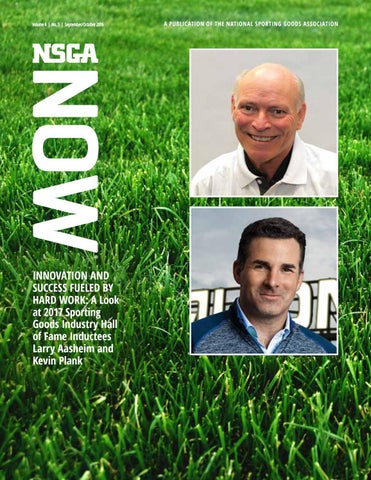
INNOVATION AND SUCCESS FUELED BY HARD WORK: A Look at 2017 Sporting Goods Industry Hall of Fame Inductees Larry Aasheim and Kevin Plank
A PUBLICATION OF THE NATIONAL SPORTING GOODS ASSOCIATION
Payment solutions that get your business in gear. Every sporting goods retailer is different, but all share a common ambition: to succeed. And it starts by serving customers better. Synchrony Financial delivers payment solutions that help drive traffic, increase average transaction size, and build repeat business. Whatever your business is working forward to, we can help make it happen. Engage with us at synchronybusiness.com/sport or 1-855-433-5624.
What are you working forward to?
ENROLL & COMPLETE
NEW PARTNER TRAINING BY
DECEMBER 31, 2016 TO RECEIVE A VISA GIFT CARD!**
300
$
*One-time incentive. Limit one gift card per store. Only new credit applications are eligible; applications previously submitted to Synchrony Bank or any other lender are not eligible. To qualify, merchants must have enrolled and completed new partner training by 12/31/2016. The Visa gift card is issued by The Bancorp Bank pursuant to a license from Visa U.S.A. Inc. Offer valid only on new partner enrollments. Not applicable for program transfers. Credit is extended by Synchrony Bank.
TABLE OF CONTENTS
4 5
Recognition in the industry
Association Now
6 8
Conference Now
16 18
Innovation and Success Fueled by Hard Work:
Nominate a deserving company for the NSGA All-Star Awards
Insights Now
10
12
CEO Corner
A Look at 2017 Sporting Goods Industry Hall of Fame Inductees Larry Aasheim and Kevin Plank
Demographic trends influencing sports participation
Industry Innovations: The second panel recap from the 2016 Management Conference & Team Dealer Summit
Membership Now
With shipping costs rising, PartnerShip can help businesses cut costs
Innovations Now
2016 NSGA Innovations Arena exhibitors Triflare and VERT’s revolutionary products make their mark on Summer Olympics
Advocacy Now
Now is the time to show your support for issues critical to retailers and dealers
20
Operations Now
22
Locker Room Now
Really, millennials are just like you and me
NFHS softball, volleyball, track and field rule changes and more NSGA NOWÂŽ
September/October 2016 | 3
CEO CORNER
NSGA OFFICERS
Sometimes we get so busy we forget to recognize the great things going on around us. The sporting goods industry is changing fast and your business requires time and attention to operate successfully. NSGA is not only here to help make it easier for you to do business, but to highlight accomplishments, achievements and growth in the industry. NSGA is your resource to discover industry news and accomplishments.
Chairman of the Board David Labbe
Kittery Trading Post, Kittery, ME
Treasurer/Chairman-Elect Cathy Pryor
Hibbett Sports, Birmingham, AL
Past Chairman Randy Nill
Nill Bros. Sporting Goods, Kansas City, KS
BOARD OF DIRECTORS Dale Donaldson
Mallard’s Source for Sports, Castlegar, British Columbia, Canada
Pat Donnelley
Donnelley Sports, Twin Falls, ID
Rhett Johnson
Johnson-Lambe Co., Raleigh, NC
Jeff Miller
Scholastic Sports Sales, Ltd., Manlius, NY
John Oehler
Dunham’s Sports, Troy, MI
Rob Summerfield
MC Sports, Grand Rapids, MI
Jerry Williams
Schuylkill Valley Sports, Pottstown, PA
NSGA TEAM Matt Carlson
Veneese Pippens
Meghan Beach
Julie Pitts
President & CEO Director, Membership & Education
Database Manager Business Development
Mary Reibel
Katie Bruce
Director, Marketing & Communications
Dustin Dobrin
Director, Research & Information
Lucia Hale
The Sporting Goods Industry Hall of Fame was created in 1955 to recognize leaders who built the sporting goods industry and to recognize and encourage excellence. Aasheim and Plank personify outstanding achievement in our industry. We look forward to celebrating them and their accomplishments throughout the coming year. NSGA recently opened the NSGA All-Star Awards nomination period. The awards recognize outstanding accomplishments and contributions made within the sporting goods industry throughout the year. Categories for the All-Star Awards include Community Collaboration and Industry Catalyst. The nomination process for the 2017 awards has been streamlined and is now easier than ever. Get your nominations in before the November 1 deadline. If you see something great going on in the industry, we encourage you to let us know. Submit a nomination for the Sporting Goods Industry Hall of Fame, nominate a company for the NSGA All-Star Awards, or share your story with us. One way you can provide news and updates with NSGA is through the NSGA Scoreboard. Simply click the “Share Your News” button on the right side of the email.
Accounting/ Executive Assistant
Best regards,
Nick Rigitano
Matt Carlson President & CEO
Research & Information Analyst
Brad Thompson
Information Systems Manager
Administrative Assistant
Larry Weindruch
Elvira Lopez
Member Services
Director, Public Affairs
Marty Maciaszek
Dan Wiersma
Director of Team Dealer Division/HDA Director
Chief Financial Officer
Angela Mennecke Marketing & Communications Coordinator
4 | NSGA NOW ®
In this issue of NSGA NOW® we are pleased to showcase the two individuals who will be inducted into the Sporting Goods Industry Hall of Fame in 2017. Larry Aasheim of Universal Athletic and Kevin Plank of Under Armour will be honored during the NSGA 53rd Annual Management Conference & 19th Annual Team Dealer Summit in Scottsdale, Arizona. While the two come from different spaces within the industry, they are shining examples that hard work, innovation and leadership can lead to unimaginable success.
September/October 2016
Katie Bruce | Editor/Publisher NSGA NOW® (ISSN 1045-2087) is published bi-monthly for members of the National Sporting Goods Association, 1601 Feehanville Dr., Suite 300, Mount Prospect, IL 60056-6035; Phone: (847) 296-6742; Fax: (847) 391-9827. Subscription price of $50 per year is included in membership fee. Non-member subscription information available from publisher. Periodical postage paid at Mount Prospect, IL 60056 and additional mailing offices. POSTMASTER: Send address changes to NSGA NOW,® 1601 Feehanville Dr., Suite 300, Mount Prospect, IL 60056-6035. © by NSGA 2016. Printed in the USA.
ASSOCIATION NOW
2017 All-Star Awards Nomination Period Opens Celebrate the accomplishments and contributions made within the sporting goods industry this year. Nominations for the 2017 NSGA All-Star Awards run through November 1, 2016. The All-Star Awards focus on two categories: the Community Collaboration All-Star Award, recognizing businesses that go above and beyond in their support of community activities, and the Industry Catalyst All-Star Award, recognizing companies that implement measures to advance and spark innovation in the sporting goods industry. The 2017 All-Star Awards will be presented at the annual NSGA Management Conference & Team Dealer Summit, May 21–24, 2017 at the Hyatt Regency Scottsdale Resort & Spa, Scottsdale, AZ. The winners will be recognized during the event and will have their initiatives highlighted on the NSGA website and in NSGA publications. TO SUBMIT A NOMINATION FOR THE 2017 PROGRAM or for more information on past All-Star Award recipients, please visit nsga.org/allstarawards or email awards@nsga.org.
Left: Garnet Alexander, Bauer Hockey Director, Research and Development, accepts the Industry Catalyst Award at the 2015 NSGA Management Conference & Team Dealer Summit. Middle: From left to right, 2014 All-Star Award winners Kent McKeaigg of OrderMyGear, 2014 NSGA Board Chairman Ken Meehan and Luke Rowe of Fleet Feet Sports. Right: From left to right, Gail Kirkland, Retail Director of the Southwest, REI; Randy Nill, NSGA 2016 Board Chairman; and Tony Titus, Vice President of Marketing, VICIS, at the 2016 NSGA Management Conference & Team Dealer Summit.
NSGA NOWÂŽ
September/October 2016 | 5
INSIGHTS NOW
Demographic Trends Influencing Sports Participation By Dustin Dobrin, NSGA Director, Research & Information
In the July/August issue of NSGA NOW,ÂŽ NSGA introduced a unique way to evaluate sports participation through a new measure called Total Participation Points (TPPs). The benefit of TPPs is a more complete view of participation because both the number of people participating in each sport segment (reach) and the number of sports each person is participating in (depth) are taken into account. NSGA also explored trends among a variety of sport segments (i.e. team sports, fitness activities, wheel sports, etc.). In this issue, NSGA will shift focus toward emerging key demographic trends. As a benchmark, take a look at overall participation trends over the past 25 years. As shown in Exhibit 1, participation levels have fluctuated since the 1990s. Participation grew 3% from the 1990s to the 2000s, however, those gains reversed from the 2000s to the 2010s. Participation has now dropped back to levels experienced in the 1990s, even as the overall U.S. population continues to grow.
Two key demographic trends have emerged since the 1990s, one providing strength to the industry and the other a key concern.
EXHIBIT 1
Total Sports/Activities TPPs (in millions)
6 | NSGA NOW ÂŽ
September/October 2016
825
850
826
1990s
2000s
2010s
The strength has been continued growth within the female segment. Exhibit 2 illustrates that while male participation has followed the same pattern as overall trends (with growth in the 2000s and decline in the 2010s), female participation has continued to show consistent growth. Females represent a greater proportion of overall participation now (47%) than in the 1990s (43%). In the previous issue of NSGA NOW ® we discussed the fitness activities segment as a key growth area. Females are a large contributor to this growth. Female participation in fitness activities has increased 48% from the 1990s to the 2010s.
While increased female participation is a strength, perhaps the biggest weakness has been declining youth participation.
EXHIBIT 2
TPPs by Gender (in millions) Total Sports/Activities
466
474 358
1990s
Being knowledgeable of the prevailing trends can help you play to the industry strengths and adjust accordingly to the weaknesses. Added focus toward a product mix that takes into account female fitness participation is a clear opportunity. In addition, broader offerings that take adult participation into consideration is another opportunity. Although it will take a larger industry effort to reverse youth participation declines, asking the right questions could lead to answers that will better position your business to weather the trends. Questions like, “Are there little things that you can do to adjust the business with the knowledge that youth participation has been on the decline?” Or, “Are there ways that you can contribute to increasing sports participation in your area?” NSGA has performed additional research on reasons why kids are participating in fewer team sports than in the past and was included in the August 2014 issue of NSGA NOW.® If you would like a refresher on this research or would like to discuss this topic further, contact NSGA Research and Information Director Dustin Dobrin at ddobrin@nsga.org or (800) 815-5422, ext. 1170.
2000s
440
386
2010s
1990s vs. 2010s -6%
8%
MALES Exhibit 3 shows youth participation has declined 24% since the 1990s. In the past, team sports was the focal point of the decline; however, the team sports segment is not alone. Youth participation declines are being experienced across a variety of segments, such as wheel sports, outdoor activities, snow sports and individual sports.
376
FEMALES
* Sub-segments may not equal the total due to rounding.
EXHIBIT 3
TPPs by Age (in millions) Total Sports/Activities
662
637
608 217
213
1990s
2000s
165
2010s
1990s vs. 2010s -24%
YOUTH
9%
ADULTS
* Sub-segments may not equal the total due to rounding.
NSGA NOW®
September/October 2016 | 7
RULES NOW CONTINUED CONFERENCE NOW
Industry Innovations By Katie Bruce, NSGA Marketing & Communications Director and Angela Mennecke, NSGA Marketing & Communications Coordinator
The Industry Innovations panel at the NSGA Management Conference and Team Dealer Summit shared some key thoughts on product innovation and planning for success. The panel explored how to protect your innovation and what investors look for when deciding to support a new product. A few key takeaways came from the discussion between Art Chou, Co-founder and Managing Director at Stadia Ventures; Paul O’Brien, Senior SAP Retail Consultant and Vice President of Service Delivery at Savantis Group; and Kara Specht, Patent Attorney at Finnegan, Henderson, Farabow, Garrett and Dunner LLP.
I nventors struggle with supply and distribution. They must have a game plan for managing both issues. Startups are all offense, investors are more defense. Investors look for recurring revenue, scalability and the team behind the product and their experience. I nventors need to take steps to protect themselves. Some small businesses overlook the importance of valuing their intellectual property. Businesses or inventors can take steps to protect the idea.
8 | NSGA NOW ®
September/October 2016
MAJOR STEPS IN APPLYING FOR A PATENT: 1. I dentify what your idea is and what similar companies are doing. Examine what makes your idea different. Look long-term at what makes your idea innovative. 2. R each out to a patent attorney to begin the process. 3. D o not show your invention at a trade show or in a public forum without patent protection. The process for a patent can be a long one but it is important not to expose yourself and risk your intellectual property being stolen.
Find software tools to help you succeed in your business. Businesses should evaluate their needs and find a software solution to address their biggest challenges. Software is not one-size-fits-all.
The panelists also took a look at what is around the corner in the sporting goods industry. Some of the conversation highlighted that there is a shift from equipment to data and data acquisition. There is more technology and software being developed. In addition, the panelists agree 3-D printing may have a potentially big impact on the industry over time.
Moderator Matt Carlson, NSGA President & CEO and panelists Art Chou, Co-founder and Managing Director of Stadia Ventures; Paul O’Brien, Senior SAP Retail Consultant and Vice President of Service Delivery at Savantis Group; and Kara Specht, Patent Attorney at Finnegan, Henderson, Farabow, Garrett and Dunner LLP discuss industry innovations during the 2016 NSGA Management Conference & Team Dealer Summit.
You have a passion for sports. We have a passion for eCommerce. Together, we'll craft a winning online experience for your customers. LYONSCG is an eCommerce digital agency. Our experts design, build, and market world-class online stores. We will empower you to realize your full online potential. Contact us today to see why LYONSCG is eCommerce Realized!
DS
EI
Digital Strategy
eCommerce Implementation
XD
AH
Experience Design
Application Hosting
www.lyonscg.com +1 312-506-2020
AS Application Support
DM Digital Marketing
NSGA NOW ÂŽ
September/October 2016 | 9
MEMBERSHIP NOW
With Shipping Costs Rising, PartnerShip Can Help Businesses Cut Costs By Harry L. Centa, Jr., PartnerShip® Senior Program Manager and Angela Mennecke, NSGA Marketing & Communications Coordinator
Sports retailers’ shipping costs are often ranked as the third-highest budget item — but lowering them can be an intimidating process. Harry Centa Jr., senior program manager for third-party freight broker PartnerShip, says joining the NSGA Shipping Program can help curb ballooning freight expenses and lend the negotiating power few independent retailers possess. “Independent retailers typically don’t have that buying power, but together we’ve been able to leverage competitive shipping rates,” Centa says. “NSGA members saved more than $450,000 over the last 12 months, an average of more than $1,700 per participant.” INDUSTRY TRENDS TO CONSIDER: The average independent retailer spends between 1% and 6% of total sales on freight — figures that are annually on the rise. For a company with $5 million annual sales, this can range between $50,000 and $300,000 each year! Inbound freight accounts for 60% to 80% of total freight spending for retailers. Since FedEx and UPS began applying dimensional (DIM) weight pricing to all ground shipments in 2015, retail shippers have seen an average increase of 17% in their ground shipping costs.
“The DIM change has caused some shippers to see a significant increase in costs,” explains Centa. “DIM will continue to be a major factor when budgeting for freight. Shippers must be efficient with packaging to help eliminate unused space and save from added costs.”
The good news, Centa points out, is careful control of inbound shipments can save retailers 10% or more on freight spending — all while improving delivery performance and shipping visibility. “Often retailers pay for two-day air shipping, when they can spend significantly less on ground and still get the product in two days,” Centa says. “They are throwing money away.” If you want to tackle this process by yourself, collect as much data about your freight costs as you can and beware of “free freight.” “Free freight means your shipping costs are just buried in the invoice,” Centa explains. “Ask the vendor to separate out the freight cost so you can negotiate it. Similarly, ‘Prepay and Add’ means the shipping is paid by the vendor and added to your purchase invoice. Ideally, arrange ‘Inbound and Collect,’ which means you directly pay the freight company in negotiated terms, at your discounted rate.”
Centa notes that retailers can really benefit from third-party brokers such as PartnerShip, which has worked with NSGA since 1995. “Independent retailers’ core competency is buying and selling industry product,” notes Centa. “Ours is working with businesses to help negotiate freight savings. Our team of logistics experts will help simplify your shipping processes, saving valuable time and money.”
10 | NSGA NOW ®
September/October 2016
SMALL PACKAGE SHIPPING
Save up to
30% off of select services.
Save up to
25% off of select services.
Save up to
10% off of select services.
FREIGHT SHIPPING Less-Than-Truckload (LTL)
Truckload
Tradeshow
Expedited
Save at least 70% on LTL freight shipments with leading national and regional freight carriers.
Obtain the most competitive rates on full and partial truck shipments in one place.
Receive discounted rates on exhibit shipments to and from trade shows and related events.
PartnerShip has alliances with world-class freight carriers and expeditors to ensure every need and speed is met.
WHAT NSGA MEMBERS HAVE TO SAY... “ The Program has worked well for us. The discounts are hard to beat. We have taken advantage of the program for many years and love the money we save on an annual basis.”
“ PartnerShip has been great to work with. We are very happy to have a partner like this and we will continue to use PartnerShip for all our LTL shipping needs.” — Jessica Rose, Director of Purchasing, Denver Athletic
— Rick Blackford, President, Sports World
NSGA NOW ®
September/October 2016 | 11
RECOGNITION NOW
Innovation and Success Fueled by Hard Work: 2017 Sporting Goods Industry Hall of Fame Inductees By Katie Bruce, NSGA Marketing & Communications Director
Relationships Led Larry Aasheim to Success in the Sporting Goods Industry In 1971, at the age of 24 and fresh out of Montana State University and National Guard basic training, Larry Aasheim and his close college friend Dick Harte discussed an idea that came out of a high school business class Harte was teaching. It was a team sporting goods business that would provide athletic equipment to high schools and colleges in Montana. With no knowledge or experience in the industry and no resources to speak of, but with lots of enthusiasm and a real passion for athletics, Aasheim and Harte decided to try their idea and that was the genesis of Universal Athletic Service. They started working out of the back seat of their cars and, with no experience selling sporting goods, they began selling themselves. This strategy formed relationships with high school coaches and athletic directors that they hoped one day would lead to a business transaction. It was a slow process, but persistence and the relationships they created started to pay off, and as time went by, sales started to grow. Resources became available to add salesmen and locations and the company grew.
12 | NSGA NOW ÂŽ
September/October 2016
Forty-five years later, that back seat startup operation is Universal Athletic, a regional retail and team dealer headquartered in Bozeman, Montana. With 13 locations and 50 team salesmen working in 11 Midwest and Western States, it is one of the largest independent team dealers in the country. The company has made great strides and has a strategic plan in place to continue growing. As Universal’s first employee, Aasheim’s primary responsibility was team salesmen and he made the first sale for the company in the spring of 1971. He worked in all facets of the startup the first few years and became its first stockholder in 1973. As Universal grew, he took on more management duties and when Harte left the company in 1989, Aasheim was named President and Chairman of the Board, a position he held for the next 26 years until he retired as President in 2015. He was involved in facilitating the growth of the company and built a work environment and culture that has attracted, and helped retain, the outstanding employees who continue to be the key ingredient of the company’s success.
Aasheim has three children and four granddaughters. He is extremely active in the Bozeman community and in his role in support of the athletic program at Montana State. He has received several awards, including the Bozeman area Chamber of Commerce Community Service Award, the North Dakota Coaches Association Service Award, the Montana Coaches Association Service Award and the Order of TAG Award. Those fortunate enough to have worked with Aasheim say that no one has cared about their employees quite as much as him. Aasheim is like family to many former and current Universal employees. He creates an atmosphere and work environment of comfort and fun, and he is the first to acknowledge when great work is done by an employee. The numerous employees who have been with Universal for 10, 15, 20 and 30 plus years are a testament to Aasheim as a leader and a person, and the culture he has created which he terms the Universal Spirit.
Aasheim’s determination and success have led to industry-wide recognition and his induction in the Sporting Goods Industry Hall of Fame.
Aasheim oversaw the financing required for both the growth of the company operations and the facilities. He was involved in evaluating opportunities, projections and business plans associated with these opportunities. He was instrumental in understanding the need for the company to become proactive in the world of technology and then allowing the right people to take on that project. In addition, Aasheim oversaw the diversification of the company into the fitness industry and the development of two fitness centers which have added to the profitability and value of the company. He was a large contributor in the growth of the TAG Buying Group as Universal was one of the early members. Aasheim was a member of the TAG Advisory Board and led Universal’s move to the Sports Inc. group in 2013.
NSGA NOW ®
September/October 2016 | 13
RECOGNITION NOW
Kevin Plank Used Innovation to Change the Sports Performance Gear Landscape It started in 1995. Kevin Plank was special teams captain on the University of Maryland football team and noticed the cotton T-shirts they wore under their pads were soaked and heavy with sweat, affecting their performance. This frustration launched him into a search for an alternative T-shirt material, and led him on the path to what would become a revolution in performance gear in the sporting goods industry. He wasted no time getting started. After graduation, Plank set out on a journey to make a superior T-shirt. He drove through the night to New York’s famous garment district for fabric samples, built his first prototype and brought it to his Maryland teammates and friends who had gone on to play in the NFL. Plank took their feedback and created a new T-shirt built from microfibers that wicked moisture and kept athletes cool, dry and light. The recent graduate now needed the funds to launch his apparel line. He maxed out his credit cards and set up a company in his grandmother’s basement in Washington, DC. He traveled up and down the East Coast selling his revolutionary new product out of the trunk of his car. By the end of 1996, he made his first team sale to Georgia Tech. That first purchase set off a chain reaction and many major Division I teams followed, along with two dozen NFL teams. Plank moved the headquarters out of his grandmother’s basement to South Baltimore, where the now-famous gear lines HeatGear,® ColdGear® and AllSeasonGear® were developed.
In 1999, Warner Brothers contracted Under Armour to outfit actors for two upcoming football movies, “Any Given Sunday” and “The Replacements.” The goal was authenticity, and Under Armour delivered. The brand launched its first television commercial in 2003, which introduced the rallying cry PROTECT THIS HOUSE.® Plank and Under Armour continue to provide innovative performance products. From footwear to apparel to equipment, you can find Under Armour on fields, in gyms and everywhere in between. Just as Plank’s passion for sports fuels him to make better products for athletes, his passion for entrepreneurism has helped him empower young businessmen and women around the world to follow their dreams and turn their ideas into a business. He is an active supporter of the University of Maryland’s Robert H. Smith School of Business and the Dingman Center for Entrepreneurship. He is also a member of the University’s Board of Trustees and has played an essential role in the development of an endowment fund that the Dingman Center uses to invest in viable startup businesses. In 2006, Plank launched the Cupid’s Cup Entrepreneurship Competition
14 | NSGA NOW ®
September/October 2016
named after the Valentine’s Day rose business he started as an undergrad at Maryland. This initiative encourages young entrepreneurs to compete for a chance to build their business. Plank is also committed to Maryland and global communities and it is reflected in Under Armour’s Give Back initiatives and his own work with local organizations. For example, through Under Armour’s Give Back initiatives, Plank, Under Armour and its thousands of teammates extend their resources, products and time to help community empowerment organizations in Baltimore — the city that Under Armour calls home. In 2015, Plank and Under Armour launched WIN Baltimore, an initiative designed to spark social change in underserved communities. He currently sits on the Board of Trustees of the University of Maryland, Start Up America, National Football Foundation, the Board of Johns Hopkins Medicine and the Greater Baltimore Committee, among others. Another of Plank’s passions is horse racing. Driven by this, he purchased historic Sagamore Farm in 2007 with a long-term plan to restore the facility and bring the legacy of winning thoroughbred racing back to Maryland.
The Under Armour brand mission statement, “Make all athletes better through passion, design, and the relentless pursuit of innovation,” speaks to the qualities of a Sporting Goods Industry Hall of Fame inductee. Kevin Plank’s innovation, determination and achievements in the sporting goods industry make him welldeserving of this recognition.
Aasheim and Plank will be inducted at the 2017 Sporting Goods Industry Hall of Fame dinner and induction ceremony during the 2017 NSGA Management Conference & Team Dealer Summit in Scottsdale, Arizona on Tuesday, May 23. For more information on the Sporting Goods Industry Hall of Fame please visit nsga.org/halloffame.
INNOVATIONS NOW
2016 NSGA Innovations Arena Exhibitors Triflare and VERT’s Revolutionary Products Make Their Mark on Summer Olympics Companies who showcased ground-breaking products at the 2016 NSGA Innovations Arena played an essential role for the United States in the Summer Olympics in Rio de Janeiro. By Angela Mennecke, NSGA Marketing & Communications Coordinator
16 | NSGA NOW ®
September/October 2016
Triflare Suits Up 2016 USA Synchronized Swim Team with Femininity and Power Triflare, a St. Louis-based startup that makes sportswear for triathletes, inked a deal with the USA Synchronized Swimming team to create swimsuits as they compete through their 2017 season. Triflare, headed by CEO & Founder Andrea Robertson and Creative Director Kim Mclean, gained traction in 2013 after winning an Arch Grant, which is awarded to local entrepreneurs in the St. Louis area. With a critical investment, the company began sponsoring professional triathlete Alicia Kay, who went on to win the Lifetime Pro Triathlon Series and the Lifetime Triple Crown Series while wearing Triflare suits. With increased exposure in the triathlon world, Triflare caught the eye of the executive director of the USA Synchronized Swimming team. Soon after, Triflare signed a contract to provide the team with competition suits at the Olympics and throughout their 2017 season.
Robertson and Mclean take a systematic approach to Triflare designs, which emphasize bold colors, femininity and high-performance with, of course, a dash of flair. “We are excited for the increased exposure Triflare gained from being on a world stage at the Olympics,” said Robertson. “In addition, we get the opportunity to produce performance attire that is both feminine and strong. Looking strong and bold can increase passion for the sport.” The 2016 NSGA Innovations Arena provided a unique platform for Robertson and Mclean to showcase their women’s active swimming and triathlon apparel to markets they have always wanted to tap into. “At the Conference, we found that there were a lot of established companies that are trying to stay relevant and competitive within the industry,” commented Robertson. “With the growing trend of women’s athletic apparel, Triflare can really help businesses stay relevant and appeal to the female demographic.” Robertson says she looks forward to building her relationships with the companies she met at the NSGA Conference & Summit as well as cultivating new ones with NSGA members.
VERT Gives Team USA Volleyball a Leg Up VERT wearable jump technology is the official wearable device partner for Team USA Volleyball (USAV). Players used the data during their practices while training for the Summer Olympics in Rio de Janeiro. VERT technology allows players and coaches to see real-time jump height and jump count data anywhere and anytime. The wearable jump monitor is integrated in apparel or strapped around the waist, similar to a heart-rate monitor. The information is then stored and can be accessed at any time through an app compatible with a smartphone or tablet. Not only is VERT technology being used to enhance USAV’s performance, it is also being used as a tool to prevent injuries. “VERT’s original core objective was to measure jump counts and jump height, but now it is becoming revolutionary in injury prevention,” said Martin Matak, VERT Founder and CEO. “Players and coaches will often set a jump limit for each player per practice. When a player reaches their jump limit, they stop playing to avoid over-exertion injuries.” USAV player Christa Harmotto Dietzen utilizes VERT technology to avoid strain after recent shoulder and knee surgeries. Using data from the wearable sensor, Dietzen’s coaches determined that her right knee weakens by the fourth day of jump-intensive workouts. Now, she trains off the court on the fourth day and limits her jumps to 125 per practice. “The women’s USA Volleyball team using VERT technology to train for the Olympics is a dream come true,” said Matak. “It is extremely rewarding to know that we are a huge player in injury prevention and performance enhancement for one of the greatest teams in the US.”
With VERT technology taking the volleyball world by storm, Matak is excited to launch G-VERT in October, a new technology that measures exertion, intensity, stress and effort put forth by an athlete training for any sport. “This is going to be revolutionary in wearables,” commented Matak. “G-VERT can be used for training in any sport, on any appendage.”
“ Innovation is what drives opportunities and progress. VERT was honored to showcase our latest wearable technology innovations to NSGA members who are staying ahead of a rapidly changing market.” — Martin Matak, Founder and CEO, VERT
PAGE 16: Left: Andrea Robertson, CEO & Founder of Triflare, showing off Triflare suits to Candace Bingham of Johnny Mac’s, while exhibiting at the 2016 NSGA Innovations Arena at the NSGA Management Conference & Team Dealer Summit. Right: Andrea Robertson, CEO & Founder of Triflare, and Kim Mclean, Creative Director of Triflare, directing a photo shoot showcasing their newest USA swimsuits. Bottom: Triflare will provide the USA Synchronized Swimming team swimsuits as they compete through their 2017 season. PAGE 17: Left: VERT is the official jump technology for Team USA Volleyball. Right: Kip Cobb, Director of Sales at VERT, networking with Andrew Hampel, CEO of Seiva Technologies, at the 2016 NSGA Innovations Arena.
NSGA NOW ®
September/October 2016 | 17
ADVOCACY NOW
Now Is the Time to Step Up to the Plate: Support Issues Critical to Retailers and Dealers By Larry Weindruch, NSGA Director of Public Affairs
With campaign season in full swing and members of Congress spending much of their time away from Washington, now is a good time for an update on NSGA’s advocacy on important retailer and dealer issues.
Sales Tax Fairness
While your elected officials are in their districts, attend a campaign appearance, a town hall meeting or any other opportunity to ask the candidates where they stand on the following issues:
WHILE CONGRESS IS WAITING:
• Sales Tax Fairness Legislation • Promoting Activity and Fitness through the PHIT Act • Youth Sports Concussion Legislation
NSGA has advocated for sales tax fairness since 2010, and in that time, we have seen much progress in the U.S. Senate. In 2013, the Senate passed the Marketplace Fairness Act with a strong bipartisan majority. Unfortunately, the U.S. House of Representatives has not been as responsive, due in great measure to the opposition of House Judiciary Committee Chairman Bob Goodlatte (R-VA), whose committee controls the bill, (H.R. 2775), known as the Remote Transactions Parity Act (RTPA). Senate Majority Leader Sen. Mitch McConnell (R-KY) has promised a vote when the House sends it a bill to consider, but the House continues to ignore the wishes of a majority of its members as well as the needs of their constituents.
tates are trying to find another way. In the last year alone, 16 states have S introduced more than 40 different e-fairness bills.
S tates are imposing new taxes. To make up for revenue lost to the online sales tax loophole, states and municipalities are considering new measures, including additional sales tax hikes and increasing the price of water and electrical services.
Congress is forcing businesses to deal with a patchwork of state laws. In the last four years, state legislatures have passed more than 70 different e-fairness bills including purchase reporting requirements for businesses and consumers. tate action creates an uncertainty. Until Congress acts on e-fairness, job S creators will have to deal with a confusing, uncertain and disruptive business environment and an uneven playing field.
Now is the time for Congress to act. Contact your Senators and Representative(s) and urge them to support e-fairness. Visit efairness.org/get-involved/index.html to send the message to Washington that the time has come to pass e-fairness legislation.
18 | NSGA NOW ®
September/October 2016
PHIT Act NSGA is at the forefront of advocating on behalf of the Personal Health Investment Today (PHIT) Act, which recently reached 100 co-sponsors across both chambers. The bill, which NSGA has supported from its inception, would encourage people to engage in fitness activities by allowing them to use their own pre-tax Health Savings Accounts (HSAs) for such items as home exercise equipment, membership fees in health clubs, the cost of required equipment for youth sports, and the cost of “pay to play” fees for youth sports.
Youth Sports Concussion Advertising Bills have been introduced in both the Senate and House that would strengthen the Federal Trade Commission’s existing powers by specifically declaring it unlawful to make deceptive claims regarding the ability of protective equipment to prevent or reduce concussions. The original version of the bill targeted the seller of the protective equipment, but after several meetings with Senate and House legislative staff, the bill’s language was changed to eliminate the seller’s liability as long as the seller isn’t making deceptive claims. NSGA continues to work — along with other stakeholders — to fine tune the bill with Congressional staff to narrow the scope of the bill to target product advertising claims and to provide reasonable limits to the power of states to initiate civil prosecution when there are deceptive claims.
An Approaching Regulatory Requirement NSGA has put together several sources of information to help you comply with a new Department of Labor rule regarding overtime. This rule raises the standard salary level required for exemption from overtime rules to $47,476 annually and takes effect on December 1, 2016. In addition, for the first time, the Labor Department will index future salary thresholds to inflation. Every three years, the threshold will rise to the 40th wage percentile for fulltime salaried workers in the country’s lowest-wage region, currently the Southeast. NSGA recently sent an alert to all members with a link to our Overtime Compliance Information Hub, which contains links to several valuable sources of information to assist you in complying with the new rule. For more information, go to nsga.org/overtimerules. You will need to login, since this information is available only to NSGA members.
Join NSGA in Washington in 2017 NSGA delegations have traveled to Washington twice to advocate for issues impacting retailers and dealers. If you would like to be considered for the 2017 NSGA Lobbying Day, please contact NSGA Director of Public Affairs Larry Weindruch, lweindruch@nsga.org.
NSGA NOW ®
September/October 2016 | 19
OPERATIONS NOW
Really, Millennials Are Just Like You and Me By Mara Devitt, Partner, McMillanDoolittle, LLP
Millennials seem to get all of the attention these days — and for good reason. Spanning the ages between about 21 and 39, they represent a powerful constituency of U.S. consumers, with about 22% of the total population and $1.7 trillion in spending power. This group will only become more important in the future as their buying power increases. It is critical that they are understood and marketed to for any company that wants to be relevant now, and into the future.
So what makes this group unique? They are a consumer group like any other, which means they are diverse, complex and resistant to any stereotypes we throw on them.
20 | NSGA NOW ÂŽ
September/October 2016
A FEW FACTS: FACT
#1
They span a broad age range and tend to defer key life stage decisions.
The difference between a 21-year-old Millennial just graduating from college versus a Millennial in her mid-30s with children is significant. We prefer to think of life-stages being the critical differentiator rather than just age. Yes, they are deferring some of these key life stage decisions (getting married, having children, etc.) to later in life but they still pass through the same life stages as every other consumer group.
FACT
#2
They are ethnically diverse.
42% are from ethnic populations (Black, Asian or Hispanic) and fully 38% are bilingual. Clearly, this creates the need to be communicated to in different ways and will also profoundly shape their tastes and preferences. They are truly diverse.
FACT
#3
They are digital natives.
They have grown up with technology and are far more likely to adopt new behaviors faster than older consumer groups. This includes using social media and peer reviews to form opinions, shopping online or shopping from a mobile device and incorporating new digital tools (price comparisons, reviews, digital ads, etc.) into their shopping routines. Nearly 70% of
Millennials won’t make a major decision without running it by their network first, and prefer brands with a well-developed social and mobile media presence.
FACT
#4
They are drivers of the shared economy.
They have different motivations than older groups and are less driven by ownership. Access is key to them. (Note the meteoric growth of Uber, AirBnB, Netflix, Spotify and Instacart).
FACT
#5
They sparked crowdfunding.
Their enthusiasm for technology has transformed the traditional marketplace. The world’s largest crowdfunding platform, Kickstarter, has facilitated more than $2 billion in project pledges since 2009. Today’s entrepreneurs and activists are raising capital and awareness by leveraging social networks rather than relying on traditional sources.
FACT
#6
They care about provenance, authenticity, sustainability and local.
They want more transparency from those with whom they do business. This is driving the meteoric rise of “craft” and “artisanal” products that stress ingredient purity, uniqueness and a message. Footwear, eyeglasses, beer, chocolate, etc., are now being elevated to new levels with a focus on the story behind the products.
FACT
#7
They are dedicated to wellness, devoting time and money to exercising and eating right.
Their active lifestyle influences trends in everything from food & drink to fashion.
If you find yourself nodding along to many of these trends, you will also recognize that many, if not all, of their behaviors are also being adopted by other generational groups as well. And yes, Millennials are also subject to the same concerns of every other generation: They must raise families, get by on limited budgets and struggle to find jobs, balance in their lives, etc. It should be no surprise that Millennials count Walmart and Target among their favorite brands along with perhaps more predictable ones like Apple and Nike. The biggest difference and the biggest threat is that, unlike in previous generations, having their needs met at a traditional retail store is certainly not a given. A diverse range of formats have emerged that are also trying to cater to this consumer and they can also freely choose among digital and brick and mortar alternatives. They will shop a diverse variety of stores or websites to meet their needs.
Millennials are just like you and me, only younger. They are smart, savvy consumers who aren’t afraid to let their wallets speak.
NSGA NOW ®
September/October 2016 | 21
LOCKER ROOM NOW
NFHS Softball Rule Changes; Bat Certification Updates
New NFHS Volleyball Jersey Rules Now In Effect
The National Federation of State High School Associations (NFHS) announced its softball rules changes for the 2017 season.
The NFHS requirement for boys and girls volleyball teams to have regular players in contrasting solid-colored jerseys from the libero went into effect July 1. The NFHS announced this change a few years ago to give manufacturers, team dealers and teams the time they needed to prepare for the change. To see an updated PowerPoint on volleyball jerseys go to nfhs.org/media/1017136/solid-colored-uniform.pdf.
Rule 3-2-7: Exposed undergarments, if worn, are considered part of the official uniform. All exposed undergarments shall be a solid single color: black, white, gray or a school color. For individual players, exposed upper-body undergarments do not have to be the same color as exposed lower-body undergarments. For all team members, exposed upper-body undergarments shall be the same solid single color and all exposed lowerbody undergarments shall be the same solid single color. Garments other than team uniforms such as arm sleeves, leg sleeves and tights are permissible. Anything worn on the arm or leg is a sleeve, except a brace, and shall meet the color restrictions. Rule 3-2-1: State associations may, on an individual basis, allow a player to participate while wearing a different-style uniform because of inclement weather. Players have been allowed to participate in a different uniform for religious reasons. Rule 1-5-2c: Taper. The taper is the transition area which connects the narrower handle to the wider barrel portion of the bat. The taper shall have a conical shape. Its length and material may vary. The NFHS eliminated language that the taper “shall have a solid surface” to bring the NFHS in line with other rules codes regarding the surface of the taper. Easton Softball Bat Certification Update The Amateur Softball Association (ASA)/USA Softball announced that Easton has voluntarily removed 18 softball bat models from the ASA/USA list of certified bats. The bats no longer certified are: SCN1, SCN11BH, SCN1B, SCN2B, SCN3, SCN4B, SCN5, SCN5B, SCN6B, SCN7, SCN7B, SCN8, SCN8B, SCN9, SCX14, SCX14B, SCX24B and SCX3. The National Federation of State High School Associations (NFHS) Softball Rules Book specifically states the bat must contain the 2000 or 2004 ASA certification mark and not be on the ASA non-approved list. These bats are no longer permitted in NFHS contests. The NCAA, NAIA and NJCAA also use ASA’s bat performance standards. ASA/USA Softball, the national governing body of softball in the United States, also announced the rebranding to USA Softball, effective January 1, 2017. USA Softball will also use a new logo. 22 | NSGA NOW ®
September/October 2016
NCAA, NFHS Track and Field Rule Changes NCAA: The NCAA Playing Rules Oversight Panel approved a change for the 2016–17 track and field season which requires all team members, in a single day of competition, to wear uniforms clearly indicating — through color, logo and combination of all outer garments worn as a uniform — they are from the same team. Teams may change uniform colors from one day to another for multiple-day meets. Men’s and women’s programs are considered separate teams and are not required to have uniforms of identical color. The NCAA Track and Field Rules Committee believes requiring teams to wear uniforms of the same color and style allows spectators, media, officials, coaches and competitors to more easily identify the competing teams and athletes of each school. The NCAA rules panel also approved a rule requiring all indoor track facilities to have curbing of suitable material on the curves of their tracks by December 1, 2018. Schools may add curbing to their tracks before that date. Currently, some facilities are using cones on inside curves instead of suitable material such as metal piping. This can lead to unfair advantages in trying to attain qualifying performances, according to the committee. NFHS: NFHS approved rule changes for the 2016–17 season which were recommended by the NFHS Track and Field Rules Committee: Rule 4-3-1b(5), the note was removed, which contradicts the rule by limiting the placement of the American flag to one piece of uniform apparel. Rule 9-1-3b for cross country states the race course should include directional flags and/or directional signposts.
portfolio of nationally recognized and respected retail and e-commerce brands,” said David Nectow, President of TSG, in a release. “The acquisition gives us access to exciting new markets such as Missouri, Illinois, Minnesota, Michigan, Maryland, Utah and Colorado, and also enables us to strengthen our presence in existing markets.”
NCAA Ice Hockey The NCAA rules panel approved a rule that requires all officials and players to wear helmets anytime they are on the ice. The only exception is during the playing of the national anthem.
NCAA Recommends Football Practice Contact Reduction The NCAA Division I Football Oversight Committee endorsed a proposed guideline to reduce the number of live-contact practices teams conduct each week from two to one. The practice guidelines take effect six days before each team’s 2016 regular-season opening game and go through the final regular-season or conference championship game. The guidelines allow players who don’t compete in a game in a particular week to participate in an additional live-contact practice to work on skill development and master proper techniques. The committee made the recommendation in an effort to improve player safety, believing it could decrease athlete exposure to concussion, including repeat concussions and overall head impact exposure. Live-contact practices are defined as any practice that involves live tackling to the ground and/or full-speed blocking. A live-contact practice may occur in full or half pads. The Committee on Competitive Safeguards and Medical Aspects of Sports is expected to recommend the same practice guidelines for Division II and III programs.
Pure Hockey Completes Purchase of Total Hockey TSG Enterprises, which owns Pure Hockey, received court approval of its purchase of bankrupt Total Hockey for $22.5 million. TSG was the only buyer after Total Hockey filed for bankruptcy in July. TSG will now operate 54 retail locations across the United States and seven e-commerce sites focused on hockey, lacrosse and goalie equipment. TSG also owns Hockey Giant, Pure Goalie and Commonwealth Lacrosse. “We are very excited to add Total Hockey into our existing
Football Numbers Encouraging as High School Sports Participation Increases for 27th Consecutive Year An encouraging report in football participation nationwide highlighted an increase in the number of participants in high school sports for the 27th consecutive year in 2015–16, according to the annual High School Athletics Participation Survey conducted by the National Federation of State High School Associations (NFHS). Based on figures from the 51 NFHS member state high school associations, which includes the District of Columbia, the number of participants in high school sports reached an all-time high of 7,868,900 — an increase of 61,853 from the previous year. After a decline of almost 10,000 participants in football the previous year, the number of boys playing 11-player football in 2015 was almost identical to 2014 with a drop of just 309 — from 1,083,617 to 1,083,308. While some states reported a decline in football participation in 2015, 24 states registered increases in boys participation in 11-player football. When combining boys and girls participation in 6-, 8-, 9- and 11-player football, the number of participants increased 138 — from 1,114,253 to 1,114,391. “The NFHS and its member state associations have taken significant steps over the past 10 years to minimize the risk of participation in football and all high school sports, so this report on the continued strong interest and participation in high school football is very encouraging,” said Bob Gardner, NFHS executive director. “With the adoption of state laws and protocols for concussion management in place, we continue to believe that the sport of football at the high school level is as safe as it has been since the first rules were written in 1932 — and we believe this year’s participation report is confirmation of that belief.” After a decline the previous year, boys participation increased about 25,000 to an all-time high of 4,544,574, while girls participation increased for the 27th consecutive year with an additional 36,591 participants and set an all-time high of 3,324,326. Track and field registered the largest increase in participants for both boys and girls, with an additional 12,501 boys and 7,243 girls. Track and field ranks second to football in boys participants with 591,133, and remains the most popular sport for girls with 485,969 participants.
EDITIONS OF NSGA RESEARCH AVAILABLE NOW!
Trusted and reliable industry research for over 30 years Have the most up-to-date information from the sporting goods industry at your fingertips! Take advantage of Member Pricing and Sports Participation Bundles Please visit www.nsga.org/research for more information