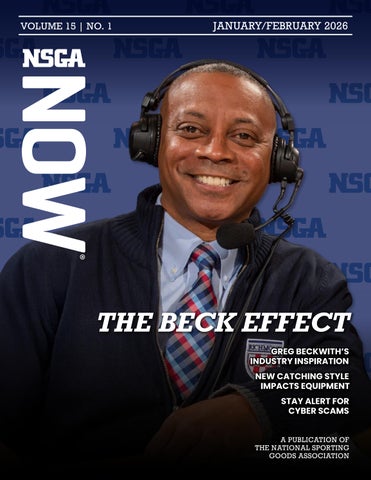
VOLUME 15 | NO. 1
JANUARY/FEBRUARY 2026
THE BECK EFFECT GREG BECKWITH’S INDUSTRY INSPIRATION NEW CATCHING STYLE IMPACTS EQUIPMENT STAY ALERT FOR CYBER SCAMS A PUBLICATION OF THE NATIONAL SPORTING GOODS ASSOCIATION
G - FORM IS A N OFFICIA L PROTECTIVE EQUIPMENT SUPPLIER OF MLB
Major League Baseball trademarks and copyrights are used with permission of Major League Baseball. Visit MLB.com.
TABLE OF CONTENTS
4
6
CEO NOW Stepping Up to the Plate in Tough Times
10
20 28 34 39
INDUSTRY NOW The Impact of One-Knee Catching on the “Tools of Ignorance”
ASSOCIATION NOW A Look at the Life of Greg Beckwith and His Vision to Help the Industry
PERATIONS NOW O C ybersecurity Vigilance Never Takes a Holiday
28
34
RULES NOW NSGA’s Annual Update of National Sports Organization Rule Changes
NEWS NOW Remembering Brian Stahl of STAHLS’ and Other News Updates from the Industry
MEMBER SPOTLIGHT NOW Give Me Five With Bob Olson, Viking Ski Shop
>> ON THE COVER
Greg Beckwith broadcasting a University of Richmond basketball game. All photos of Greg Beckwith playing or broadcasting basketball are courtesy of the University of Richmond and Jason Vida, Associate Athletic Director for Strategic Communications.
JANUARY/ FEBRUARY 2026
<<3
CEO NOW
N
ew Year’s resolutions are typically personal and include things like eating better, exercising more, losing weight, reconnecting with friends and not procrastinating. I could use a bit of all of those! In some ways, the resolutions are connected to others in our lives. But how often do we specifically resolve to do something to help others?
We have had some excellent examples in recent years of people in the sporting goods industry stepping up to the plate and coming through against the equivalent of an 0–2 pitch against 2025 Cy Young Award winners Paul Skenes of the Pittsburgh Pirates and Tarik Skubal of the Detroit Tigers. They came through with the big hit under the toughest circumstances. When Hurricane Helene powered into the east coast in late September 2024 few could have envisioned the devastation it would leave well inland in the mountains of western North Carolina, Tennessee and Virginia. The heavy rainfall led to catastrophic flooding that caused hundreds of deaths and billions of dollars in damage and losses. NSGA member retailers/team dealers Cook’s and Johnson-Lambe and NSSRA member Ski Country Sports were among those who stepped up by requesting and facilitating donations for those affected in their communities. They made sure people had the clothing they needed for the upcoming fall
NSGA OFFICERS CHAIRMAN OF THE BOARD
and winter and had some gifts for children for Christmas.
GORDON GEIGER Geiger’s, Lakewood, OH
Last summer, on July 4, the Hill Country of central Texas was hit by devastating flash flooding that resulted in nearly 150 fatalities. Most of them occurred in Kerr County, where NSGA member Fitness First Sports has been a fixture in the community of Kerrville since 1978.
TREASURER/CHAIRMAN-ELECT
Fitness First owners Harold and Gina Buell stepped up to help those in need by facilitating donations of clothes and shoes from industry manufacturers. The Buells also used their Kerr Screen Graphics business to create a line of T-shirts where all the proceeds went to flooding relief funds in the Kerrville area. These examples, along with the Beckwith Foundation described later in this issue, are just a few instances of NSGA members stepping up to the plate to help others. If you have a similar story you would like to share, please let us know. There’s nothing better than spotlighting the good in sporting goods. And as we begin a new year, we should resolve to collaborate when others need help. Then we can make an even bigger impact when we follow the slogan of being stronger together. We hope you had a great holiday season and look forward to serving you in 2026.
PAST CHAIRMAN PAT DONNELLEY Twin Falls, ID BOARD OF DIRECTORS KEVIN BEZANSON Cleve’s Source for Sports, Halifax, Nova Scotia, Canada JOHN DAVENPORT Play It Again Sports, Minneapolis, MN
COLE JOHNSON Johnson-Lambe Sporting Goods Raleigh, NC JUSTIN MILLER Scholastic Sports Sales, Manlius, NY
JESSICA ROSE-HUGGINS Denver Athletic Supply, Englewood, CO
RON RUGAL B&R Sporting Goods, Shelby Charter Township, MI JOHN SCIPIO SV Sports, Pottstown, PA
NSGA TEAM LEADERS MATT CARLSON President & CEO
HAYLEY FANSLER Director, Business Development MARTY MACIASZEK Director, Team Dealer Division, Communications JULIE PITTS Director, Public Affairs and President, NSSRA
NICK RIGITANO Director, Insights and Analysis JENNIFER SHAFFER Chief Financial Officer
Best regards, MATT CARLSON
PRESIDENT & CEO
NSGA NOW (ISSN 1045-2087) is published bi-monthly for members of the National Sporting Goods Association, 3041 Woodcreek Drive, Suite 210, Downers Grove, IL 60515. Phone: (847) 296-NSGA (6742). Subscription price of $50 per year is included in membership fee. Non-member subscription information available from publisher. Periodical postage paid at Downers Grove, IL 60515 and additional mailing offices. POSTMASTER: Send address changes to NSGA NOW,® 3041 Woodcreek Drive, Suite 210, Downers Grove, IL 60515. © NSGA 2026 all rights reserved. Printed in the USA.
4>> NSGA NOW®
BOB FAWLEY Capitol Varsity Sports, Oxford, OH
NSGA is a member of the Americans for Free Trade (AFT) coalition that is united against tariffs.
2027
CALL FOR
NOMINATIONS Submissions accepted until MARCH 31, 2026
Nominate a deserving individual for the 2027 Class of the Sporting Goods Industry Hall of Fame Learn more and nominate at nsga.org/hall-of-fame The Sporting Goods Industry Hall of Fame was created in 1955 by the NSGA Board of Directors to honor the pioneers, innovators and leaders who built the sporting goods industry and to help recognize and encourage excellence within the industry.
OPERATIONS NOW
IMPORTANT TO STAY ON HIGH ALERT
FOR BUSINESS CYBER SCAMS BY MARTY MACIASZEK NSGA DIRECTOR OF COMMUNICATIONS
‘T
was the season to be on the lookout for fraudsters interested in giving small business owners big headaches by taking them for a scam.
They were trying to catch you when you’re busy, so it’s important, not just for the holidays but all year round, to stay awake to those hoping to give themselves a big financial gift. It could be bogus emails that look like the real thing or people trying to place fake orders.
“You should be very careful at all times, but especially this time of year,” said Erik Person, the owner and founder of TeamLogic IT in suburban Chicago, in early December.
6>> NSGA NOW®
Take the case of phishing emails. In the past, someone “offshore” would use screengrabs where the quality of a logo and grammar in the messaging weren’t good. Artificial Intelligence (AI) has been a game-changer and not necessarily for the better if you’re a business owner. Person said TeamLogic IT is seeing multiple cases every week of bogus emails enhanced by AI. “Today they’re running them through an AI filter that cleans them up and
you can’t tell the difference,” Person said. “It’s scary how accurate they are. It allows hackers to create messaging that is spot-on.” Names of people who legitimately work at the companies are often used in the fake correspondence. It’s imperative to check the sender’s URL address in an email because AI can’t adjust those addresses, according to Person, and if you don’t recognize it, that’s a red flag. Requests for payment or changes in the payment method should also be treated with extreme caution.
“Anything requesting payment
authentication systems may seem like an inconvenience at times but they can prevent a really inconvenient situation. It’s also important to have someone you can trust to contact with questions and concerns.
• Watch for any unusual activity across your accounts.
But you don’t want to call a phone number that may be listed in an email or attachment where you’re not sure of its validity. The scammers may get you to call a fake number and make it seem the request is real, so you want to use a number you know is legitimate from your contacts list.
Person said the stringent security measures a business owner uses for their facility and its contents are just as important for intellectual property or “essentially you have a screen door on corporate data.”
• Never share personal data such as birthdates, social security numbers and passwords in emails.
Cybersecurity training for small business owners and their employees is more important than ever. Multi-factor
•D on’t download or open attachments, applications or zip files from unknown senders.
details is automatically suspect,” Person said. “If you get an email
always voice-verify with somebody you know within the company.”
Other suggested protective measures include:
• Never click on links embedded in unsolicited emails. Check the source first.
• Use strong passwords, change them periodically and don’t write them down.
If you have questions you can contact Erik Person at TeamLogic IT at eperson@teamlogicit.com. TeamLogic IT is the technology partner of NSGA.
JANUARY/ FEBRUARY 2026
<<7
THE BETTER WAY TO
BUILD ONLINE STORES Organize & Manage Exceed customer expectations with flexible tools that simplify workflows, accelerate production, and keep your shop running at peak performance. Drive Sales Intuitive, mobile-friendly stores put your customers first with features like e-certs and countdown clocks. Integrate & Automate Auto-art placement, inventory feeds, one-click purchasing, and other must-have tools keep you on track.
GET STARTED TODAY!
CHIPPLY.COM TEAMCHIPPLY@CHIPPLY.COM 262-202-8129
INDUSTRY NOW
CATCHING ON: ONE-KNEE STYLE’S SUBSTANTIVE IMPACT ON EQUIPMENT
T
BY BRUCE MILES here has been a fast-moving revolution in baseball over the past five years. And yes, the revolution has been televised, day after day, night after night from late March through the end of the World Series.
The next time you crack open a cold one to watch a ballgame, take a good look at the catcher. For time immemorial, the man behind the plate would squat down, assume his stance, flash the signal and get ready to receive the pitch. But in recent years, the squat has been supplanted by something different. As the pitch is being delivered, almost every catcher in the big leagues (and many in the minors, amateur ball and women’s softball, too) will drop down to one knee to snag the object that’s been fired at upwards of 100-plus miles per hour.
10>> NSGA NOW®
One-knee-down catching is here to stay, and it’s presenting myriad challenges and a world of opportunity to sporting goods dealers. One prominent NSGA member can trace the beginning of the one-knee down stance. Like every in-the-know follower of the national pastime, he realizes this is more than a passing fancy. Let’s begin our journey with All-Star Sports in Shirley, Massachusetts, about 30 miles northwest of Boston. Stan Jurga Sr., who was instrumental in All-Star’s growth and prominence in
the industry, is a 2018 inductee in the Sporting Goods Industry Hall of Fame. “Go back to spring training 2020,” said Stan Jurga Jr., VP of Product Development at All-Star Sports. “Every year, my brother (Brad) and I go to spring training, either Florida or Arizona. We alternate back and forth. I was covering Arizona in spring 2020. That was the first year where every team I visited had their catchers on one knee. And it was overnight. It was dramatic. In 2019, there were maybe a couple of catchers experimenting with it, mostly in the Yankees organization. “But by 2020, honestly, over the off-season something happened where every catcher on every team was dropping to
one knee. And they were still trying to figure out the mechanics. Is it going to be one knee down on the left side or the right side? How do you block balls? How do you throw balls? But it was clear that this was a revolution that was happening very, very fast. And 2020 was interrupted because of COVID. “But since then, we’ve had five full seasons of guys dropping a knee, and it’s here to stay.” There are many benefits to the one-knee-down catching stance. It certainly saves wear and tear on a catcher’s legs. From a baseball standpoint, it allows catchers to better “frame” pitches and perhaps get the umpire to call a pitch slightly outside of the strike zone a strike instead of a ball. Early research is showing, too, that the one-knee-down setup has no ill effect on catchers blocking balls in the dirt or throwing out would-be base stealers. Jurga also points out that there is some early — albeit anecdotal at this point — evidence that the one-knee-down stance is lessening the chance of concussions because catchers’ heads are lower and thus out of the path of most foul tips that can strike them. Like most industries, baseball is a copycat one. Knowing that one knee down is here to stay is clarifying a key challenge to those in the sporting goods industry. “That was something we were really wondering about because, ‘Is this just a fad?’” Jurga said. “We try to build product that will be in the market for at least three seasons if not longer because we have to invest in injection molds with the plastic shells. We want to make sure we get our money’s worth out of these capital investments. With our position of being at the forefront of catching technology, we want to make sure we’re doing the right functional designs that work for these players and how their bodies are moving. “So we were trying to be very attentive to what’s happening, like, ‘Is this going to happen for the long haul?’ There was a lot of criticism, everything from people saying catchers are getting lazy because they’re getting down on a knee. A lot of people said you can’t block a wild pitch well while you’re on one knee. People were saying you can’t throw if you’re on one knee.
Lance Parrish, top image, an eight-time Major League Baseball all-star and three-time Gold Glove winner, with the traditional catching style when he played for the Detroit Tigers in the mid-1980s. The 2025 All-Star catalog cover, bottom image, showcases the newer one-knee catching style.
“But all of that has basically been proven wrong at this point. You can block very, very well from one knee. Some coaches even say the metrics are better when a catcher is down on one knee because you’re already on the ground. You’re not wasting a fraction of a second to drop from your feet from your knees. You’re already down low. Most of the balls you’re blocking, if you think of a bell curve around a catcher, most of the balls they’re blocking are within a couple of feet, left or right. It’s very rare that you’re diving out beyond three or four feet. So you’re blocking more efficiently in the higher-probability areas where you need to block. And certainly guys are throwing really well.” Continued on page 12
JANUARY/ FEBRUARY 2026
<<11
INDUSTRY NOW working on their hip mobility and really dropping their butts to pretty close to the ground and really collapsing one of their knees as tight as possible, it was putting a lot of extra strain on the hinge and all the knee components because we never designed leg guards to bend that much. There’s a bit of resistance when you started bending past a certain angle.
All-Star Sports’ Stan Jurga Sr., was inducted into the Sporting Goods Industry Hall of Fame in 2018. At his induction, from left, Brad Jurga and his wife Carly, Carol and Stan Sr., and Stan Jr.
Continued from page 11 Jurga said that All-Star Sports has “on contract between major league and minor leagues, roughly 100 catchers.” He says communication is a big key when working with catchers in taking advantage of the opportunities presented by the one-knee-down trend when it comes to designing and keeping clientele happy with equipment. “That’s kind of the biggest thing that I do,” he said. “This goes back to our dad (Stan Sr.). He started going into major league clubhouses 45 years ago. At that time, catchers were very confused because my dad is coming in and saying, ‘Hey, what do you want different in your catcher’s gear?’ And the catchers were like, ‘What do you mean? I just get it from the clubby (clubhouse manager), and I wear it.’ They didn’t have a choice of anything. “Rich Gedman, Red Sox catcher in the ‘80s, is at the Triple-A affiliate down the street from us in Worcester (Mass.) as a hitting coach. You talk to him about the state of gear when he was a pro, his Red Sox gear that was issued to him was basically painted red, and the red paint was flaking off, and there was royal blue underneath. It was basically hand-me downs. Our dad did simple listening, like, ‘Hey, if you could have
12>> NSGA NOW®
whatever you wanted, what would it be?’ The catchers would give him some honest feedback. He’d come back, work on some prototypes, go back a couple of weeks later and say, ‘What do you think of this?’ And the catchers would say, ‘Wow, that’s cool. Can you tweak this?’ My brother and I do the same thing now.” The opportunities in front of the sporting goods industry because of oneknee-down catching seem limitless. Jurga ticked off a few of the ways he and his team are trying to meet those opportunities. “In 2020 and 2021 and up to 2023, we had a leg guard being used that was really at the forefront of technology in terms of the knee area because it had a hinge,” he said. “This was something we developed, really, out of more comfort, better mobility and even better protection. What we started seeing with pro players first leading the charge with the one-knee down stance and the amateurs following were some warranty issues. We were seeing early wear of this hinged knee that we hadn’t seen in years prior. “What it came down to with the oneknee-down stance, the players were just bending their knees into much deeper angles. When they started
“When my co-workers and I started working on designs for a new generation of leg guards, we were definitely looking at one-knee-down stances because one of the main functional requirements was we didn’t want to have any resistance when a catcher bent his knee especially in really deep, deep bends.” Communication and innovation are two keys to success for Jurga and AllStar Sports, especially when it comes to serving catchers in this new era. Jurga says there is something else equally important. “To put it simply: We really care,” he said. “We’re a family business. We don’t make any product that we wouldn’t wear ourselves or have our children wear or have a family member wear. When I work with these pro players, in a lot of ways they’re an extension of our family. I really worry about them. They’re exposed to very high velocity objects coming at their heads, and I want to make sure they stay healthy and can have a long career. “We listen intently to these guys, and that’s how we keep succeeding.”
BRUCE MILES Bruce Miles covered the Chicago Cubs for the Daily Herald in suburban Chicago from 1998–2019. He says his own tools of ignorance are the laptop, notepad and voice recorder. This is his ninth piece for NSGA NOW.
i8530
Setting the Standard for
Flexfit® Full Fabric Performance Cap
ON-FIELD
Headwear i8501 Flexfit® Performance Trucker Cap
30 COLORS AVAILABLE
i8503 Flexfit® Perforated Performance Cap
41 COLORS AVAILABLE
i8504 Flexfit® Wool Blend Performance Cap
19 COLORS AVAILABLE
i8508 Flexfit® Aerated Performance Cap
19 COLORS AVAILABLE
i8530 Flexfit® Full Fabric Performance Cap
21 COLORS AVAILABLE
Discover our best-selling on-field caps featuring Flexfit® technology. Each cap is engineered to offer flexible sizing, lasting comfort, and the perfect balance of performance and style.
INDUSTRY NOW
MAJOR EVOLUTIONS IN
‘TOOLS OF IGNORANCE’ BY BRUCE MILES The term is one of the most cruelly ironic in all of sports: the tools of ignorance. That phrase has been tossed about to describe the equipment used by baseball catchers, who willingly get behind the plate and absorb all kinds of physical abuse. It was allegedly coined in the 1920s by Herold “Muddy” Ruel, himself a catcher and a practicing attorney. The fact is that the catching fraternity has turned out some of the most astute minds in baseball history, from Bruce Bochy to Joe Girardi to Joe Maddon to Johnny Bench to Yadier Molina to Pudge Rodriguez to Carlton “Pudge” Fisk to a fellow named Roger Bresnahan, who in addition to catching and managing
14>> NSGA NOW®
in the major leagues was an innovator, having experimented with a rudimentary catcher’s helmet and “inventing” shin guards in the early 20th century. As the elegant baseball essayist Roger Angell wrote, the catcher “must be large, brave, intelligent, alert, stolid, foresighted, resilient, fatherly, quick, efficient, intuitive and impregnable.” “I think it (“tools of ignorance”) really does go back to old times,” said Stan Jurga Jr., VP of Product Development at All-Star Sports. “Catchers really weren’t protected in the early days of baseball.
It took time, really through injuries, for them to start developing face protection, even better catcher’s mitts and chest protectors and leg guards. So in a lot of ways, it was the tools of ignorance. “But that (Angell) quote is on point. Catchers are fascinating because they have to be so athletic. They’re in every play of the game. They have to be intelligent. They’re running the team from their vantage point. They’re communicating with the pitcher on what to throw. They have to be in tune with the batter and the baserunners. They have to be psychologists to work with their pitching staff, especially if they’re struggling.”
For more than a century, catchers and sporting goods professionals have worked hand-in-hand — or mitt-in-mitt — to innovate and provide catchers with the best and safest equipment to help them perform the toughest job on the baseball diamond. In the early days of baseball, catchers had no real protective gear to speak of, and they stood back from home plate and received pitches on a bounce. As the game became organized into leagues, protective equipment became more commonplace. The wire mask came about at the same time as the formation of the National League (1876) and quickly gained acceptance. Along came padded fingerless gloves to protect the hands, even though the two-handed catching approach, which didn’t begin to change until the late 1960s, made the catcher’s right, or throwing, hand vulnerable to foul tips. Rudimentary chest protectors came along in the 1880s. Bresnahan, then catching for the New York Giants and widely considered to be the finest receiver of the dead-ball era, first experimented with a protective headgear around 1905. It was called the Reach Pneumatic Head Protector, and it was something akin to the old leather football helmets. Reports have it Bresnahan showed up on Opening Day 1907 sporting a pair of shin guards, which resembled the leg guards worn by cricket players. Like many inventions designed to improve player safety, the shin guards were met with some ridicule and protests that they could injure a runner sliding into home plate. But they quickly caught on. Bresnahan also gets credit for adding rolls of padding to the wire facemask to help absorb the shock of foul tips to the mask. For most of the 20th Century, catchers donned their masks and wore their baseball caps backward while behind the plate. There were small
Charlie O’Brien, who caught for eight teams in a 15-year big-league career, developed the hockey-style catcher’s mask with All-Star's Stan Jurga Sr.
advancements in headgear in the 1920s and ‘30s, but because of size and comfort factors, they did not catch on. Things began to change in head protection in the 1960s. During the Chicago White Sox home opener in 1966, catcher John Romano was hit on the head by the bat of the California Angels’ Jose Cardenal on his backswing and knocked unconscious. The story goes that White Sox manager Eddie Stanky had the brainstorm of cutting the bill of a batting helmet and instructing his catchers to wear it behind the plate. Soon after Romano was struck,
American League catchers Bill Freehan of Detroit and Andy Etchebarren of Baltimore were hit by bats. Reports in the Chicago Tribune said that “Stanky has ordered his receivers to wear a helmet or inner lining of the regular cap while back of the plate.” Along about this time, the hinged catcher’s mitt made one-handed catching popular, with Randy Hundley of the Chicago Cubs and Hall of Famer Johnny Bench of the Cincinnati Reds leading the charge in that direction. Continued on page 16
JANUARY/ FEBRUARY 2026
<<15
INDUSTRY NOW Continued from page 15 Modern gear uses advanced materials such as foam rubber and plastic injection molding, which have the benefits of being lighter and more flexible while being more impact absorbent. One source of pride for Jurga is the hockey-goalie-style helmet. Popular credit for the helmet goes to Charlie O’Brien, a defensive specialist who played for eight major league teams and became a favorite receiver of such pitchers as Dwight Gooden and Greg Maddux. By the late 1990s, O’Brien wanted better protection than what the standard mask offered, and thus came the origin of the masks we see catchers use today. It might represent the biggest leap in the evolution of catching equipment. “I’m going to say the hockey-style helmet, but you’ve got to take it with a grain of salt because it was my dad (Stan Jurga Sr.) who basically co-invented it with Charlie O’Brien,” Jurga said. “So I’m very biased. You just have more coverage around your entire head. “That’s something we began looking at before one-kneedown. We probably started noticing probably close to 10 years ago that catchers were getting hit with bats more often. It was really anecdotal. With us being so close to catchers, you start talking to them and asking them how they’re feeling. And they’re like, ‘Oh, yeah, we’re definitely getting hit more.’” The rapid change to one-knee-down catching also has led to subtle changes in catcher’s mitts because catchers are rotating their thumbs downward from a position of 3 o’clock to 6 o’clock. “The last two years, we’ve been working on mitt design to address how catchers are catching the ball now,” Jurga said. “That 90-degree rotation of the mitt kind of ties in with one-knee-down. You’re basically trying to meet the pitch on plane. You’re trying to catch the ball perpendicular to its path. With these pitchers throwing these crazy pitches that are just breaking in really insane ways, you really need to get under the ball. That’s why we see the catchers start with their mitt down low and they’re coming up at the ball. Of course, coming up at the ball is a fantastic way to fake the umpire out. That’s definitely the art of the position. “But because the catcher’s mitt is basically rotated 90 degrees now, we’ve had to look at redesigned mitts to catch balls better. It’s a really fun time to be in baseball focusing on catcher’s gear because, really, the last six seasons have been wild with one-knee-down, catchers changing how they rotate their mitts. Everything is different. Six years ago, I never would have guessed that catchers would be doing what they’re doing now. It’s just totally different.”
16>> NSGA NOW®
All-Star covers from 1960 and 1986 showcase the evolution of catcher’s gear and sporting goods. All-Star photos courtesy of Stan Jurga Jr.
EFFORTLESS COLLECTION
223391
223392
momentecbrands.com
223393
ASSOCIATION NOW
‘BECK EFFECT’
CONTINUES TO HAVE WIDE-RANGING IMPACT BY NICK VLAHOS
A
lmost two years after Greg Beckwith’s unexpected death, the “Beck Effect” still is in effect. Beckwith’s family and friends want to keep it that way.
Beginning as a basketball player in the mid-1980s at the University of Richmond and continuing in his sporting-goods career and his avocation as a broadcaster at his alma mater, Beckwith appeared to make his mark. But what his closest associates remember best about “Beck” were his interpersonal skills.
And in their memory banks, that quality appears to have superseded Beckwith’s significant career milestones. Those included basketball school records at Richmond and almost a quarter-century working at adidas, where Beckwith rose to become Eastern Region sales manager, and then S&S Activewear. “He was a one-of-a-kind personality. And anyone who ever met him liked him,” said Matt Smith, a Richmond football and basketball broadcaster. “You didn’t have to meet him for long to have that feeling he was a special kind of guy and someone that you wanted to be around.
They said Beckwith always took plenty of time to have meaningful conversations with people, even those he just met. That happened on the road with Richmond, at the arena and on the job. “The ‘Beck Effect’ was positive on everybody,” Black said. “It was caring, it was genuine and in many cases it was time-consuming for him. But that’s who he was… Probably the most personable, friendly, outgoing guy that you could ever imagine. He was basically the brother I never had.” Now, they and others — including Beckwith’s widow, Julie, and their two children — seek to preserve and promote his legacy. The main avenue is through The Greg Beckwith Foundation, established following Beckwith’s unexpected death in May 2024. The 60-year-old had a family history of heart disease.
The foundation offers college scholarships and internships for young professionals seeking a start in the sporting-goods business. The National Sporting Goods Association (NSGA) collaborates with the foundation in helping college juniors and seniors, minority students in particular, gain first-hand experience and exposure to the industry. “The things that mattered most to him are the things that are being done through the foundation,” Smith said. “Whether it’s helping a minority student getting started in a career in the sporting-goods industry, or having someone have success at the University of Richmond.” Beckwith certainly had his share of success on the basketball court. A lot of it began in Black’s first season on the Richmond microphone, 1983–84. That was when Richmond made its first appearance in the NCAA men’s basketball tournament.
“Whether he was the point guard on the basketball court making a great pass or a professional in the sports-apparel industry helping a young new person make connections that would help jump-start their career, he was always about making that play, making that connection and helping.” Former Beckwith teammate and ex-Richmond coach Bill Dooley echoed Smith’s sentiments. So did longtime Richmond play-by-play broadcaster Bob Black, who teamed on air with Beckwith for two decades.
20>> NSGA NOW®
Greg Beckwith and Bob Black broadcast University of Richmond basketball games for two decades.
“He loved it,” Black said. “He was thrilled that it happened, but everybody approached him and said, ‘You made it happen on your way out.’ He said the last school he would get involved in negotiations with was his alma mater. But he kind of reaped the benefits, because we got our fair share of adidas gear. “When we were with Nike and he was with adidas, the team gave us travel suits. He found a little felt stick-on of a basketball and a net and he put it on his Nike sweatsuit and covered up the swoosh. I’ll never forget him proudly walking around.” Greg Beckwith gets Richmond into its offense during the first NCAA tournament game in program history against Rider in 1984. Richmond upset Auburn and Charles Barkley in its next tourney game.
Led by Beckwith and future NBA player Johnny Newman, among others, the 12th-seeded Spiders upset future NBA legend Charles Barkley and fifthseeded Auburn in the first round. Beckwith helped guide Richmond back to the Big Dance as a senior in 1986. He finished as the all-time program leader in career assists and steals. “He was the type of point guard that everybody wanted to play with,” said Dooley, who was a Richmond senior when Beckwith was a freshman. “He’d put the ball on you at the right time. He could handle pressure. Defended. Great decision-maker. Really high-IQ player. We got along great.” So did Beckwith and Black. He said Beckwith was a great interview as a player and knew that would extend to the broadcast booth, if that’s what he wanted to do. Eventually, Beckwith did, but not before he scratched his sporting-goods itch. Beckwith’s career began with AJD Cap Co. and Sports Specialties, Inc., and continued in 1998 to adidas. In 2022, Beckwith joined S&S Activewear. Black found the timing ironic, considering Richmond was switching its brand affiliation from Nike to adidas just as Beckwith was leaving that company.
Reminiscences like those sustain those who knew Beckwith, whose death came out of a clear, blue sky, according to Black. The foundation is another source of sustenance. One of the primary foundation fundraisers is the second annual golf tournament May 3–4, 2026 at the Richmond-area Independence Golf Club. The first was a success, according to Dooley. The guest speaker was Gene Steratore, a former NFL field official and current rules analyst for CBS Sports. According to Dooley, Steratore and Beckwith attended high school together and were teammates in their hometown of Uniontown, Pennsylvania. “People were more than happy to get involved at one level or another,” Dooley said. “All these industry people stepped up, starting with adidas and a few of these other companies. The gear that was given out was like I’ve not seen at a golf tournament before.” Unique, perhaps. Just like his friends say Beckwith was. And it wasn’t just them, apparently. Dooley recalled a eulogy Beckwith teammate John Davis gave at Beckwith’s memorial service. One year during a school break, Beckwith accompanied Davis to his North Carolina home and hung out with him and his friends. It might have been a textbook example of the “Beck Effect.”
The jersey designed by Richmond and adidas to honor Greg Beckwith. They were inspired by the 1985-86 uniforms and debuted in January 2025 at the first Greg Beckwith Alumni Weekend game.
“The next holiday, Beck wasn’t there, and all of JD’s friends were like, ‘Where’s Beck? We wanted to see him,’” Dooley said. “That kind of illustrated the essence of Greg. “Sometimes when people pass away, it gets colored maybe a little more than it was, but with Beck you couldn’t do that. People from little kids to people 85 years old — everybody was really happy to see him. He just had a great way about him. And he is sorely, really missed.”
For More Information The Greg Beckwith Foundation website is www.beckeffect.org.
NICK VLAHOS Nick Vlahos has spent most of the last 40-plus years covering sports for newspapers in Illinois, Missouri and North Dakota. He was a columnist and high school sports editor at the Peoria (Illinois) Journal Star, where he worked for more than 34 years. Vlahos is a graduate of Bradley University and the University of Missouri. He also is a hopeless Chicago Cubs fan, as if there is any other kind.
JANUARY/ FEBRUARY 2026
<<21
ASSOCIATION NOW
Kendall Whitley of S&S Activewear, a longtime colleague and friend of Greg Beckwith, discusses the Beckwith Foundation initiative at the NSGA 2025 Leadership Conference.
CARRYING FORWARD THE ‘BECK EFFECT’
G
BY TOM VAN JACOBS HDA MANAGING DIRECTOR
reg Beckwith left a lasting mark on the sporting goods industry. Known for his passion, energy and drive to bring new people into the field, Beckwith believed in opening doors and welcoming fresh perspectives at places such as adidas and S&S Activewear.
Following his passing in May 2024 at age 60, longtime friend and colleague Kendall Whitley is leading the effort to ensure that vision continues through the Greg Beckwith Foundation. Whitley worked with Beckwith at adidas, was in charge of the team division at Nation’s Best Sports (NBS) and moved over to S&S Activewear.
22>> NSGA NOW®
At the NSGA 2025 Leadership Conference, Whitley described the foundation’s mission: create opportunities for young people, strengthen the industry and promote diversity and inclusion. “Somebody took a chance on you,” Whitley told attendees. He stated that it is now our turn to do the same, for Beckwith, and for the future of our industry.
Breaking into sporting goods is not easy. Access often depends on networking and exposure, which many talented individuals don’t have or know about. The Greg Beckwith Foundation is working to change that by sponsoring up to 10 individuals each year to attend the NSGA Leadership Conference. Travel and lodging are covered, and participants will receive an introduction to different parts of the sporting goods industry while shadowing mentors during the event.
The foundation also funds scholarships for student-athletes pursuing higher education and provides internships for rising college juniors and seniors. These internships connect young people with NSGA partners and companies across the industry, offering valuable hands-on experience. Whitley said the goal is simple: to “pay it forward” by giving deserving young people the same chance many in the industry once received. While the foundation supports individuals, its broader aim is to benefit the entire sporting goods community. By connecting businesses with fresh talent, companies gain new perspectives in areas such as social media, consumer habits and product trends. “The youth of today have a lot to offer our business,” Whitley said. “The industry
just has to be willing to give them the chance to contribute.”
but also strengthens member companies by creating a pipeline of new talent.
One of Beckwith’s strongest legacies was his belief in inclusion. As an African American in the industry, he knew firsthand the importance of representation. Whitley addressed the imbalance directly at the conference by saying that there are not enough minorities and women in this business.
Beyond scholarships and internships, the foundation partners with the University of Richmond, where Beckwith played basketball and was a coach and broadcaster, and supports youth through summer leagues.
Whitley said if we want our industry to reflect the athletes and communities we serve, we need to create those opportunities. The foundation is committed to recruiting diverse candidates, so the industry better mirrors the customers it supports. The foundation will work with NSGA, ensuring involvement from businesses connected to the association. This approach not only supports individuals
As Whitley reminded the audience, every person in the room once relied on someone willing to take a chance on them. The Greg Beckwith Foundation is built on giving that same chance to the next generation. As Whitley said in closing: “We can be part of the ‘Beck Effect.’” As a group, we can change the game together. To learn more or get involved, visit www.beckeffect.org.
Greg Beckwith, center, and Jim Watkins, right, of S&S Activewear during a Speed Networking session at the NSGA Leadership Conference.
JANUARY/ FEBRUARY 2026
<<23
ASSOCIATION NOW
Q&A:
BRINGING NEW TALENT INTO THE SPORTING GOODS INDUSTRY
Lynn Burghardt
Mykayla Goodwin
Lindsey Naber
Jessica Rose-Huggins
Pat Weber
Burghardt’s Sporting Goods/Chipply
OrderMyGear
Rawlings
Denver Athletic
GameOne
VP Strategy and Marketing
Senior Director, Brand Marketing
COO
President/CEO
President
T
he importance of infusing new talent into the sporting goods industry is a consistent discussion topic. NSGA’s Marty Maciaszek asked a couple of questions to members of the industry:
Q:
WHY IS IT IMPORTANT TO BRING MORE YOUTH AND DIVERSITY INTO THE INDUSTRY? Burghardt: Having grown up in a family business that’s now in its sixth generation, I’ve seen how important it is to keep our industry evolving. The sporting goods industry thrives on energy, innovation, and connection and that comes from inviting in new voices, perspectives and experiences. Youth and diversity are important for our industry’s growth and essential for staying relevant to the athletes and communities we serve. Goodwin: The way people buy, connect and express themselves is changing fast and younger, more diverse voices help us see those shifts before everyone else does. They bring fresh ideas, new technology habits and different
24>> NSGA NOW®
cultural perspectives that can open up markets and opportunities we might otherwise miss. We also have to remember this industry is all about belonging and identity. If the companies shaping it, our companies, don’t reflect the diversity of the communities we serve, our products and services risk feeling out of touch. Attracting young, diverse talent pushes us to be better leaders. It challenges us to modernize how we recruit, communicate and build culture. That’s good for business and for people. Naber: The future generation will be the torchbearers for our industry and will help ensure the health of it for years to come, so it only makes sense to include them and proactively encourage their involvement. I’m a big believer in seeking out diversity of thought as a
method of challenging our own ideas and processes to improve our industry. The more voices we hear from, the better, as collectively, they will modernize our business and industry. Rose-Huggins: We truly value the positive contributions of all of our team members. We have also noticed that many members of the new generation of salespeople in their 20s and 30s are hungry, ambitious, willing to work and really want to work hard to achieve personal and company growth. Our sales have increased as a result. They’ve also energized us to keep up with technology to help us realize how much more efficient we can be. Weber: Bringing more youth and diversity into our industry is vital to its future. Sports connect people from every background, and our businesses should reflect that same inclusiveness. At Game One, we’ve seen how younger voices and diverse perspectives lead to new ideas, stronger relationships and a more vibrant, sustainable industry.
Q:
WHAT DOES THE INDUSTRY NEED TO DO TO MAKE IT MORE APPEALING OR MORE “TOP OF MIND” TO YOUNGER PEOPLE?
Burghardt: We need to show young people that the sporting goods industry is about more than just products or sales. It’s about people, passion and impact. Creating opportunities for mentorship, internships and hands-on experiences in local stores or teams can help them see this as a career where they can make a difference. The more we tell the stories behind what we do, about how sports build confidence, inclusion, and community, the more we’ll inspire the next generation to be a part of it. Goodwin: We need to build awareness. Before joining OrderMyGear (OMG), I didn’t know this industry existed — and neither did anyone in my network. We need to broaden our recruitment channels beyond the company website and LinkedIn. Post open roles on multiple job boards, community and social
platforms where ideal candidates hang out, hold an open house, and go to college job fairs. We also need to tell a better story about what this industry really is. It’s not just about uniforms or gear. It’s about helping teams and communities create a shared identity and express who they are. There’s creativity, technology, and purpose in that, but we don’t always show it. Young professionals want to be part of something that feels forward-looking and meaningful. This industry is full of opportunity and has an incredible story to tell. We just need to tell the story to a bigger audience and in a way that connects with what the next generation values most. Naber: I think weaving the business of sports into collegiate curriculums is a great way to encourage increased representation of younger people within our industry. Additionally, offering internships is a mutually beneficial option to give younger people a true glimpse of the sports industry while creating a
“farm system” of talent to choose from in the process. Demonstrating a pattern of evolution helps, too — whether that’s the sports we represent, the brands used to play them, the people that work for them — showcasing forward progression makes what we do appear even more exciting to a younger generation. Rose-Huggins: Just getting out there to let people know about the industry. When I started 32 years ago I had no idea this existed. For those who don’t know the industry exists, we have to highlight how much fun it can be and it really is fun. Weber: To connect with younger people, we need to show them the purpose behind what we do. This industry isn’t just about uniforms and gear — it’s about building confidence, community and belonging. When we highlight those values and create clear pathways for growth, we make this field both meaningful and exciting for the next generation.
JANUARY/ FEBRUARY 2026
<<25
RULES NOW
NATIONAL ORGANIZATION RULE CHANGES FOR 2026
T
BY MARTY MACIASZEK NSGA TEAM DEALER DIRECTOR
he National Sporting Goods Association conducted its annual check of rules changes by national and regional sports organizations. Organizations that did not have any changes impacting uniforms or equipment or did not respond to multiple requests as of December 17, 2025 are also listed.
ORGANIZATIONS WITH CHANGES/UPDATES FOR 2026
BASEBALL/SOFTBALL Babe Ruth Softball Eligible players must be at least 4 years old and no older than 18 as of August 31, 2025. Dixie Youth Baseball Bats stamped for Tee Ball play cannot be used in AAA, Majors or “O”Zone play. It is recommended that bats stamped for Tee Ball play be used only with low compression baseballs in 8U or 6U play. A bat which does not meet the specifications in Rule 1.10 (a) and Rule 1.10 (b) shall be deemed an illegal bat. A batter who uses an illegal bat shall be called out and all runners shall return to the bases occupied by them at the time such batter took his position in the batter’s box if protested by the opposing team manager, or discovered by an umpire, prior to the first pitch to the next batter. The bat becomes illegal when the batter receives the first pitch during his turn at bat. He does not have
28>> NSGA NOW®
to hit the ball. The batter shall be called out and any runners must return to the base they occupied prior to the first pitch to the batter. 2nd Penalty: After the first occurrence that a batter is called out for using an illegal bat, if a second batter is called out for using an illegal bat in the same game by the same team the team manager shall be ejected from the game. 3rd Penalty: If a bat previously removed from the game by the umpires is used again during that game, the batter shall be declared out, all runners shall return to the bases they occupied at the time such batter took his position in the batter’s box with the bat, and the manager shall be ejected from the game. After one warning per team for slinging the bat, the next incident of a batter slinging the bat and every subsequent batter, after the warning, who slings the bat will be called out, a dead ball called, and no runners shall advance. Dixie Softball The 6-and-under girls age level is no longer hitting off a batting tee.
Little League Baseball/Softball Rule changes have not been publicly announced as of December 17, 2025. National Amateur Baseball Federation (NABF) College and Unlimited Age Divisions will be allowed to swing a wood composite bat. PONY Baseball/Softball Single-piece wooden, metal, graphite or ceramic bats manufactured for baseball play, which are round and not more than 2-5/8ths inches in diameter at the thickest part, not more than 42 inches in length, are acceptable. No bat shall be used if dented, cracked, modified, or misshaped. The bat’s knob may be solid or hollowed to house an embedded metric sensor. If a sensor is used, it shall not affect performance, be secured by a locking mechanism and a back-up mechanism to keep it in place and have a distinguishing “off-line” mode to prevent data from being accessed during a game. Bats manufactured specifically for use in tee ball, shall not be used when the ball is pitched by a pitcher, coach or pitching machine, unless a Level 5 or less safety ball is used. Continued on page 30
RULES NOW Continued from page 28 Coach-pitch bats with the USA Baseball mark will only be used in coach-pitch using a safety ball. The penalty is removal of the bat only. With the exception of the minus-3 bat (BBCOR certified), all bats must be certified with the USA Baseball mark on the bat in order to be used for league and tournament play. 2-¾ inch barrel bats are prohibited in all divisions of PONY Baseball.
Dixie Youth Baseball’s Safety Committee discussed the double first base at its last national board meeting but did not take any action. Little League Baseball and Softball has no plans to require use of a double/ safety first base at the local level during the regular season. The double/safety first base was utilized at World Series and Regional tournaments. NABF doesn’t require a double/safety first base.
COLT 16U and PALOMINO 19U are only allowed to use 2-5/8 , minus-3 BBCOR certified bats.
PONY Baseball/Softball approves use of a double/safety first base but it isn’t required.
THOROBRED 23U League must use wooden bats only as specified by Major League Baseball.
FOOTBALL
The rule prohibiting jewelry was eliminated. Players may not use cell phones and pagers and any other types of communications devices wearable or handheld cannot be used on the field of play with the exception of medical devices. The field of play includes bullpens, dugouts, coaches’ boxes and other such areas where the coaches, players and umpires have access. USA Softball Clarifying that the knob of the bat shall have a diameter of at least 1.6 inches with no sharp edges. The knob will be permanently attached to the bat and may be covered with grip tape. The use of an internal or external bat sensor is allowed provided that the sensor is properly attached.
USA Football Following a comprehensive research initiative conducted by USA Football and Oakley, the Official Eyewear Partner of USA Football and Team USA Football®, USA Football’s Flag Football Competition Committee (FFCC) has unanimously approved the use of protective eyewear during the organization’s sanctioned 5-on-5 flag football competitions. The research showed clear benefits to high-performance eyewear that meets a rigorous ASTM F803 safety standard — the industry’s most demanding benchmark for protective eyewear — including measurable performance advantages in vision and comfort. Under this new rule, athletes may choose to wear any protective eyewear with a visible marking that indicates standard compliance.
Babe Ruth discussed it at the board level but there will be no movement on it for 2026.
As a result of the rule change, approved eyewear — including Oakley’s products — are now eligible to be used in USA Football tentpole events such as Summer Series, a series of competitions showcasing top junior and men’s and women’s athletes from across the globe. Players involved in testing at the 2025 Summer Series showed a strong preference for eyewear that merges elite optics with protection.
CABA — Double first base is permissible but not required.
Oakley spearheaded testing and validation efforts, presenting extensive
Rules Regarding the Use of a Double/ Safety First Base American Amateur Baseball Congress (AABC) said it will implement the rule if Major League Baseball does.
30>> NSGA NOW®
data and product evaluations to USA Football’s Medical Advisory Panel and the FFCC. The Medical Advisory Panel and its national leaders in medicine, child development and athlete development supported the rule change after reviewing the research findings. The panel is charged with delivering leading athlete health and safety standards to athletes at every level, from grassroots to Team USA Football. Surveys and on-field feedback from athletes who tested Oakley eyewear at USA Football’s Summer Series in June 2025, including the Junior International Cup, International Bowl and Select Bowl events, reinforced research findings and results.
GYMNASTICS USA Gymnastics/AAU Gymnastics Allow (if available on an event) an alternate skill cushion made of softer foam (minimum of 4 ft. x 6 ft. x 8 in.) to be used in warm-ups at all sanctioned competitions. (already permitted in Rules Modifications 6.1.n). The placement of a springboard on the vaulting table is strictly prohibited at all times, including during open stretch and warm-up periods. The Meet Director is responsible for enforcing this rule. For competitions held in non-USA Gymnastics/AAU Gymnastics facilities, the area to the right and left of the Balance Beam dismount area MUST be padded with a minimum of 4 feet by 4 feet of padding. Acceptable padding options include (but are not limited to) unfolded panel mats, carpet bonded foam, or other such matting. The matting MUST extend a minimum of four (4) feet out from the side edge of the Beam dismount area and extend a minimum of four (4) feet from the end of the under-Beam matting. Every attempt should be made to match the height of the CLM’s to this additional padding to remove the possibility of athlete injury from uneven surfaces. Continued on page 32
CHOOSE HOTRONIX MADE IN THE USA THERE’S A DIFFERENCE
✓ Precision Guaranteed ✓ UL, ULC, & CE Certified ✓ In Stock & Ready to Ship
Start Smart. Stay Ahead.
®
RULES NOW Continued from page 30 The padding should be attached (with Velcro or something similar) to the floor (concrete, foam, carpet, etc.) to avoid separating or slipping.
LACROSSE USA Lacrosse Rule changes have not been publicly announced as of December 17, 2025.
SWIMMING USA Swimming For swimwear design, no Technical Suits shall be worn by any 12 & Under athlete in competition at any sanctioned, approved or observed meet. Exceptions to the foregoing restriction are only for Junior Nationals, U.S. Open, National Championships, and Olympic Trials. A Technical Suit is one that has the following components: a. Any suit with any bonded or taped seams regardless of its fabric or silhouette; or b. Any suit with woven fabric extending past the hips. Any suit which includes any woven fabric and which extends past the hips. (Note: A suit with woven fabric and sewn seams that does not extend below the hips is permitted.) (Note: — A suit with knit fabric and sewn seams not extending below the knees is permitted.) A swimmer in the 500/1,000/1,650yard or 800/1,500 400/800/1,500 Short Course Meter or 800/1,500 Long Course Meter freestyle, or other long distance pool event, may appoint one counter to call lengths or indicate lengths by visual sign.
TRACK AND FIELD USA Track and Field World Athletics has a new spec on the 700g (grams) Javelin. Effective April 1, 2025, the following will be in force for the 700g implement: Overall length minimum is 2400mm; Overall length maximum is 2500mm; Distance from
32>> NSGA NOW®
tip to CG minimum 850mm; Distance from tip to CG maximum 990mm. Amended in September 2025 for the hammer, a small section of clear vinyl tubing, up to 50mm long with an internal diameter of 5mm, may be placed over the twisted end of the hammer wire to reduce the chance of the implement becoming caught in the cage netting. Clear plastic is required.
VOLLEYBALL AAU Volleyball Boys volleyball realigned its rules with the rest of the sports at AAU. Boys are no longer able to compete where they choose as they must now compete with a club within their respective district or adjacent district to the respective district they currently live in.
WRESTLING USA Wrestling USA Wrestling modified its singlet color requirements at its regional and national championships. Previously, United World Wrestling (UWW), the international federation for wrestling, allowed for six base colors on red singlets (red, pink, orange, yellow, white and brown) and six colors on blue singlets (blue, green, purple, black, silver and grey) with the prescribed color bands on the legs and back. UWW updated its language to make it a suggestion to use those base colors, so USA Wrestling singlet requirements now state this: Predominantly red or predominantly blue singlets are allowed, as well as singlets mimicking the UWW color scheme. All singlets utilizing the UWW color scheme shall have a total of three (3) markings consisting of: · Two 7 cm bands, one on each leg, shall be positioned across the bottom edge of the leg. For clear distinction, the marking shall cover the circumference of the leg. · One 7 cm band positioned on the backside of the upper torso. The band
shall be exclusively placed on the back half of the singlet (not visible on the front half). · The three markings must remain untouched from any graphic, logo or third-party identification. The red markings shall be Pantone 2347C and blue markings shall be Pantone 299C.
ORGANIZATIONS WITH NO CHANGES FOR 2026 • American Amateur Baseball Congress (AABC) • AAU Baseball • AAU Football • AAU Hockey • AAU Soccer • AAU Track and Field • American Baseball Coaches Association (ABCA) • Continental Amateur Baseball Association (CABA) • National High School Baseball Coaches Association (NHSBCA) • US Youth Soccer • USA Baseball • USA Gymnastics • USSSA Soccer • USSSA Volleyball
ORGANIZATIONS THAT DID NOT RESPOND • AAU Basketball • AAU Golf • AAU Swimming • AAU Wrestling • American Legion Baseball • American Youth Football and Cheer • American Youth Soccer Organization (AYSO) • Dixie Boys/Majors Baseball • Dizzy Dean Baseball • National Youth Football 7-on-7 (NYF) • Pop Warner Football • USA Basketball • USA Hockey • US Soccer • USSSA Baseball • USSSA Basketball • USSSA Softball
NEWS NOW STAHLS’ CO-FOUNDER BRIAN STAHL PASSES AWAY
building the foundation that allowed STAHLS’ to scale while maintaining uncompromising quality standards. He was widely known throughout the industry from trade shows, customer visits, and behind-the-scenes work that customers rarely saw — but always felt. “Brian was indispensable to the foundational success of STAHLS’,” said Ted Stahl. “He built the operational backbone of our company with an unwavering focus on quality, customer satisfaction, and efficiency. He cared deeply about doing things the right way and believed that quality only mattered if the customer agreed. He also brought humor, generosity, and heart into everything he did.”
Brian Arthur Stahl, a decorated Vietnam veteran, proud Eagle Scout, co-founder and longtime operations leader at STAHLS’, passed away November 22, 2025, in Wilmington, North Carolina. He was 78. Born and raised in the Detroit, Michigan area, Brian was the son of Ernest and Murice Stahl. He carried a lifelong commitment to service, discipline, and integrity — values that shaped both his personal life and his decades-long impact on the decorated apparel industry. Brian attended Adrian College and in the mid-1970s, he joined his brother, Ted Stahl, in purchasing the family business from their parents. What began decades earlier in a Detroit garage cutting felt letters and numbers grew, under their leadership, into STAHLS’ — now a global leader in custom apparel decoration technology “Although he retired from STAHLS’ in 2003, we still have many team members who remember Brian as an important mentor and teacher, especially when it comes to quality standards still in place today,” said STAHLS’ CEO Carleen Gray. As Head of Operations for more than 30 years, Brian was instrumental in
34>> NSGA NOW®
Brian’s leadership helped drive many of the operational practices that became hallmarks of the STAHLS’ brand, including advancements in water-jet cutting for twill and sports applications, the implementation of systematic production flow and quality monitoring, the creation of the company’s internal “Quality College,” and the push for same-day shipping and fast turnaround long before speed became an industry expectation. Brian is survived by his wife, Janice Galasso Stahl; his brother, Ted Stahl, and wife Mary; his adopted son, Michael Stahl, and wife Brooke; and grandchildren Grady and Mia. He is also survived by his niece, Sarah Free, her husband Travis, and their children Evan and Reese, as well as 12 nieces and nephews and 20 great-nieces and great-nephews. In honor of his military service, Brian will be inurned with full military honors at Arlington National Cemetery. Celebrations of Life will be held in Michigan and North Carolina. STAHLS’ is a longtime member and supporter of NSGA. Ted Stahl is a member of the Sporting Goods Industry Hall of Fame.
NCAA EXTENDS WATER POLO BALL AGREEMENT WITH KAP7
The NCAA extended its relationship with KAP7 International Inc. as its official water polo ball supplier through the 2028 season. Since 2011, KAP7 has been a trusted supplier of the NCAA, providing the KAP7 105 HydroGrip Championship Series (men’s) and KAP7 104 HydroGrip Championship Series (women’s) as the official water polo championship game balls. These balls are designed to meet the highest standards of competition, featuring superior grip, durability and precision to enhance gameplay. Under this official supplier relationship, KAP7 will continue supplying custom NCAA-branded game balls for the water polo championships. Additionally, KAP7 will support NCAA events with event participation and grassroots initiatives to further the growth of collegiate water polo.
UNDER ARMOUR NAMES NEW CFO
Under Armour announced that Reza Taleghani will join the company as Executive Vice President (EVP) and Chief Financial Officer (CFO) in February 2026. He will succeed David Bergman, a 21year Under Armour veteran, who will step down as CFO and remain with the company through the first quarter of fiscal 2027 to ensure a seamless transition. Under Armour President, CEO and Founder Kevin Plank is a member of the Sporting Goods Industry Hall of Fame. Continued on page 36
MAKE WINNING ™ POSSIBLE. We’re proud to announce the acquisition of Proper Pitch, Inc. We’re honored to carry on this legacy and welcome Proper Pitch to the Trigon Sports family. C H E C K OU T O U R N E W C ATALOG .
NEWS NOW Continued from page 34
TRIGON SPORTS ANNOUNCES ACQUISITION OF PROPER PITCH, INC.
Trigon Sports announced the acquisition of Proper Pitch, Inc., headquartered in Fuquay-Varina, North Carolina. Following the acquisition, Trigon Sports will transition all manufacturing operations of Proper Pitch products to its Memphis, Tennessee facility. This consolidation will enable Trigon Sports to enhance production efficiency while maintaining the same level of quality and craftsmanship that customers have come to expect from the Proper Pitch brand. Trigon Sports is a member and supporter of NSGA.
SPORTS DISTRIBUTORS OF CANADA HOSTS LARGEST SHOW IN HISTORY
Sports Distributors of Canada (SDC) hosted its bi-annual Buying and Marketing Show at the Scotiabank Convention Centre in Niagara Falls, Ontario from November 10-12, 2025. During the show, a vendor reception was held and the “Hockey Vendor of the Year” award was presented to Bauer Hockey and the “Hockey Accessory Vendor of the Year” awarded to GAMEWEAR GROUP. Recognizing their outstanding vendor partners Brad Hause, President of SDC and Matt Brassard, Chairman of the Board of SDC, presented the awards. SDC is a longtime NSGA collaborator and member.
36>> NSGA NOW®
COLUMBIA SPORTSWEAR ANNOUNCES LEADERSHIP SUCCESSION PLAN
Columbia Sportswear Company announced that as part of its ongoing process to advance its succession plans, it has implemented some changes to its senior leadership team. The Board of Directors appointed Peter J. Bragdon and Joseph P. Boyle as co-presidents, effective November 12, 2025. Bragdon has been appointed President of Columbia Sportswear Company and will oversee all its international businesses, the Mountain Hardwear brand, the prAna brand, and the SOREL brand, while continuing his existing executive oversight of certain administrative and international distributor sales functions. Boyle has been appointed President, Columbia Brand and will continue to oversee the Columbia Sportswear Company brand, including the North America business, which was recently consolidated under him in Summer 2025. Timothy P. Boyle is part of the Sporting Goods Industry Hall of Fame Class of 2026 and his mother Gert Boyle is also a Hall of Fame inductee.
G-FORM WINS MANUFACTURING AWARD
G-Form received a Providence Business News Manufacturing Award for 2025 in the category of Product Innovation and Design. The award winners were announced in November.
The PBN Manufacturing Awards recognizes manufacturers in multiple award categories, including Lean Manufacturing, Exporting, Workforce Development, Product Innovation and Design and Supply Chain Management. Two individuals also received a Leadership & Strategy & Manufacturing Champion Award. G-Form is a member and supporter of NSGA.
STAHLS’ PARTNERS WITH SISER
STAHLS’ announced a new partnership with Siser®, officially becoming a Siser® North American distributor. Through this partnership, STAHLS’ will offer Siser® products directly on stahls. com, including the heat transfer vinyl EasyWeed®, expanding the range of high-quality products and service available to businesses of all sizes, allin-one place.
DICK’S NAMES BARNES PRESIDENT OF FOOT LOCKER INTERNATIONAL
DICK’S Sporting Goods announced the appointment of Matthew Barnes as President of Foot Locker International, effective December 3, 2025. Barnes will lead the Foot Locker business’ international operations with a focus on driving strategic growth, accelerating business momentum and executing targeted turnaround strategies. Ed Stack of Dick’s Sporting Goods and Floyd Huff and Ralph Parks of Foot Locker are members of the Sporting Goods Industry Hall of Fame. Continued on page 38
Elite Model Shown
SCHUTTSPORTS DESIGNED AND BUILT FOR THE ATHLETE
The F7 AiR Varsity carries forward the popular look of the F7 Pro, now built for every level of play. With the onboard AiR-Lock System, lighter weight, sleek rear diffuser, Tektonic Mohawk, and Virginia Tech 5-Star safety rating, it delivers F7 Pro-inspired style with advanced fit, performance, and protection. FEATURES
ELITE UPGRADES IN BLUE
Virginia Tech 5-Star Rated | Onboard AiR-Lock System | Automotive-Inspired Rear Diffuser
Tektonic Mohawk | RFLX-S Impact Layer | Fusion Hardcup Chincup | Exclusive Oakley™ Switch Visor (Clear) | ANKR Locks Quarter-Turn Safety Hardware | Titanium Pro Style Facemask | Fusion Elite Hardcup Chincup
Switch Visor
INCLUDED
NOW AVAILABLE
SCHUTTSPORTS.COM
NEWS NOW Continued from page 36
NCAA PARTNERS WITH ZEPHYR ON CHAMPIONSHIP HEADWEAR
The NCAA has named Zephyr the official provider of on-court/on-field headwear celebration products for all NCAA Championships, excluding Division I men’s and women’s basketball. Zephyr is a division of Lakeshirts, a U.S. manufacturer of custom-decorated apparel and accessories.
REI, INTREPID TRAVEL PARTNER ON TRAVEL EXPERIENCES
Specialty outdoor retailer REI Co-op and Intrepid Travel have joined forces to offer small-group active travel to destinations around the globe that started in January 2026. Two collections of locally guided adventures have launched in January that inspire curiosity, learning and responsible tourism for REI members and customers — REI Exclusive and REI Recommended. REI is a long-time member of NSGA.
ACADEMY SPORTS + OUTDOORS APPOINTS THREE TO ITS BOARD OF DIRECTORS
Academy Sports and Outdoors, Inc. announced that Michael Dastugue, Shannon Hennessy, and Clay Johnson have been appointed to its Board of Directors, and Dastugue to the Audit Committee, effective December 1, 2025.
38>> NSGA NOW®
As Academy continues to make progress on its long-range plans, the addition of industry veterans Dastugue, Hennessy and Johnson to its Board reinforces the strength of the business and its strategies for continued growth. In addition, it bolsters Academy’s capabilities in digital transformation, artificial intelligence, accounting, finance and real estate which align with the Company’s strategic imperatives. Academy Sports and Outdoors is a member of NSGA.
WORLD PARA ICE HOCKEY ANNOUNCES PARTNERSHIP WITH CCM HOCKEY AS OFFICIAL EQUIPMENT SUPPLIER
World Para Ice Hockey, the international federation responsible for overseeing and developing the sport of Para ice hockey, has announced a partnership with CCM Hockey as its Official Supplier for the 2026 calendar year. Under the agreement, CCM will provide uniforms and equipment for all World Para Ice Hockey officiating crews at the sport’s three major events in 2026: the Milano-Cortina Paralympic Winter Games, the Women’s World Championships, and the World Championships C-Pool.
TRUE SPORTS APPOINTS FORMER NHL GOALTENDER GEOFF SARJEANT AS PRESIDENT
TRUE Sports has moved to strengthen its executive ranks as it names former NHL goaltender and long-time hockey industry executive Geoff Sarjeant as its new president. Along with Sarjeant’s appointment, TRUE Sports announced two additional senior
hires that will bolster global product innovation and operations infrastructure. Paul Gibson joins as executive vice-president and chief operations officer, bringing more than 30 years of experience from Bauer and Adam Gans, appointed executive vice-president of product, adds nearly three decades of expertise in high-performance product design and composite materials.
AMERICAN ASSOCIATION OF PROFESSIONAL BASEBALL AND CHAMPRO EXPAND PARTNERSHIP CHAMPRO announced an expansion of its partnership with the American Association of Professional Baseball (AAPB). This evolution solidifies CHAMPRO’s position as a key uniform and equipment supplier across multiple facets of the leading MLB Partner league in North America. Specifically, CHAMPRO will become the Official On-field/Athleisure Partner of All-Star Weekend, the Official uniform supplier of the All-Star Game and the Official Umpire uniform partner. CHAMPRO will also be the preferred supplier for catcher’s gear and bases going forward. This expanded role complements its previous and continued involvement, which included being the presenting partner of the Rising Players Combine during the AAPB’s 2025 All-Star Game. CHAMPRO is a member and supporter of NSGA. CHAMPRO founder Bill Hunt is a member of the Sporting Goods Industry Hall of Fame.
For the latest news and a deeper look at the stories featured in this issue, visit the News section by scanning QR code or go to nsga.org/news/ or check out the NSGA Scoreboard sent out weekly.
MEMBER SPOTLIGHT NOW
GIVE
ME
5
WITH
BOB OLSON
Owner, VIKING SKI SHOP | Chicago, Illinois
1
BIG BREAK INTO THE BUSINESS
Carol and I married in 1962 and I was an electrician. I went skiing and I broke the wood skis I had been using. I went to a local shop in Chicago to have them repaired and broke them again! I subsequently did some electrical work for the ski shop and in 1965 they moved to the location we are now at and I started to work part-time here in 1966. The shop was smaller then, more of an outlet store. In 1970, I bought part of the business, had business partners for about 20 years and now own the entire company. So, I’ve been doing this for 59 years.
2
4
KEYS AND ADVICE FOR SUCCESS
We are in the best business! Overall, the customers and suppliers are phenomenal. We take care of people the best that we can and the best we can afford. Customers are more price-conscious today: they research the products and that is good shopping. We treat people fairly and will price match on some things. We have great people who work here — in some cases employees have been with us for 20–55 years. It’s getting harder to find and keep good mechanics and techs. This is a problem for the future of the industry.
To anyone starting out, get good people to help you. However, like any business, if it’s right, you’ll make it work.
PARTNERSHIPS AND WHAT’S AHEAD IN 2026
It’s a two-way street — we both (retailers and manufacturers) have to make money. We are fair and pay our bills. We are lucky because we have many long-term relationships.
3
If it is a decent snow year — everything will be fine (in the 2025–26 season). There is too much product in the market right now. As an industry we are trying to raise prices and this includes tariffs. Our business does not sell necessities. If a refrigerator fails, you have to replace it. In our case, customers may think, “I can wait another year to buy.”
HELPING GROW THE SPORT
Ski clubs are a big thing in the Chicago area and there are varying degrees of programs. We have worked with local areas such as Wilmot and Alpine Valley (in southern Wisconsin) on programs. As a shop owner, there is not a lot of time to invest in these programs. Many places offer great opportunities to bring new participants to skiing. Utah, Pennsylvania, and Michigan have done a great job bringing younger, more diverse participants to try skiing. Minnesota has a great racing program.
5
BENEFITS OF NSSRA MEMBERSHIP
I used to be on the NSSRA Board of Directors and I appreciate the annual Combined Indemnified Bindings List!
JANUARY/ FEBRUARY 2026
<<39
Register Today!
nsga.org/conference2026