Volume 4 | No. 3 | May/June 2016
A PUBLICATION OF THE NATIONAL SPORTING GOODS ASSOCIATION
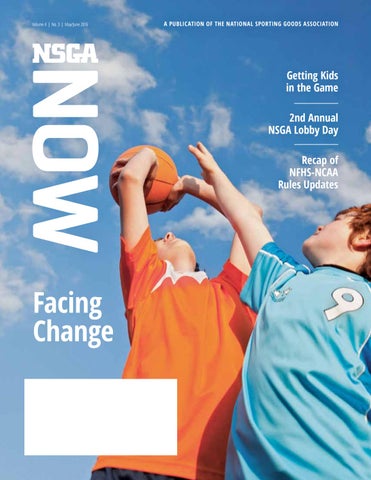
Getting Kids in the Game 2nd Annual NSGA Lobby Day Recap of NFHS-NCAA Rules Updates
Facing Change
Š 2016 Payment Alliance International, Inc. All rights reserved. Other marks are trademarks or registered trademarks of their respective owner..
NSGA_PMP-PR_0416
TABLE OF CONTENTS
10 Getting Kids in the Game Panel to Discuss Youth Participation at Management Conference
4 6 8 12 15 21
CEO Corner
Addressing the Issues
Insights Now
Gain Industry Insight through NSGA Research
Membership Now
NSGA Event Kit preview
Advocacy Now
NSGA members take to Capitol Hill for 2nd annual Lobby Day
Rules Now
Recap of NFHS and NCAA rules updates
Locker Room Now
Study shows poor-fitting helmets increase concussion risks, NHL to reduce size of goalie equipment
NSGA NOW
May/June 2016 | 3
CEO CORNER
NSGA OFFICERS
Every industry goes through change and encounters its own set of unique issues. The sporting goods industry is no exception, but by being a member of NSGA you have a historically recognized and proven effective coalition working on your behalf to resolve issues that affect you. We provide solutions that help you adapt to the ever-changing industry.
Chairman of the Board Randy Nill
Nill Bros. Sporting Goods, Kansas City, KS
Treasurer/Chairman-Elect David Labbe
Kittery Trading Post, Kittery, ME
Past Chairman Ken Meehan
Dunham’s Sports, Troy, MI
BOARD OF DIRECTORS Dale Donaldson
Mallard’s Source for Sports, Castlegar, British Columbia, Canada
Pat Donnelley
Donnelley Sports, Twin Falls, ID
Rhett Johnson
Johnson-Lambe Co., Raleigh, NC
Jeff Miller
Scholastic Sports Sales, Ltd., Manlius, NY
Cathy Pryor
Hibbett Sports, Birmingham, AL
Pete Schneider
Athletic Dealers of America, Viera, FL
Rob Summerfield
MC Sports, Grand Rapids, MI
STAFF Matt Carlson
President & CEO
Meghan Beach
Director, Membership
Dustin Dobrin
Director, Research & Information
Darlene King
Director, Business Development
Marty Maciaszek
Director, Team Dealer Division/HDA
Angela Mennecke
Marketing & Communications Coordinator
NSGA recently held its second annual Lobby Day in Washington, DC. Members and staff had a packed meeting schedule, encouraging members of the House and Senate to act on legislation affecting their business and the industry. Along with our lobbying partners at Lobbyit.com, the group supported passage of H.R. 1218, the Personal Health Investment Today Act (PHIT), and H.R. 2775, the Remote Transactions Parity Act (RTPA). RTPA, or a similar measure, would level the playing field so that local merchants with brick-and-mortar stores would be able to compete fairly with online sellers. One of the best places we can address concerns in the industry is during our annual Management Conference & Team Dealer Summit. During this year’s event we will hear from a panel invested in increasing sports participation, including Bob Gardner of the National Federation of State High School Associations, Mike Hoyer of the American Youth Soccer Organization and Jim Thompson of the Positive Coaching Alliance, about great ideas working all over the country. We expect this to be a great conversation about issues and solutions in sports participation. You can read a preview of the panelists’ thoughts on page 10. In this issue of NSGA Now we also introduce a new resource tailored for retailers and dealers. The NSGA Event Kit will be a tool to help your business put on store, philanthropic and other events. It includes a variety of templates and instructions to help produce successful events. We have produced our own timelines, media releases and planning tools to create a comprehensive kit tailored to a variety of events just for our members. Please let us know if we can help in any way. Best regards, Matt Carlson President & CEO
Veneese Mollison Database Manager
Katie Nemec
Director, Marketing & Communications
Nick Rigitano
Research & Information Analyst
Larry Weindruch
Director, Public Affairs
Dan Wiersma
Chief Financial Officer
4 | NSGA NOW
May/June 2016
Katie Nemec | Editor/Publisher NSGA NOW (ISSN 1045-2087) is published bi-monthly for members of the National Sporting Goods Association, 1601 Feehanville Dr., Suite 300, Mount Prospect, IL 60056-6035; Phone: (847) 296-6742; Fax: (847) 391-9827. Subscription price of $50 per year is included in membership fee. Non-member subscription information available from publisher. Periodical postage paid at Mount Prospect, IL 60056 and additional mailing offices. POSTMASTER: Send address changes to NSGA NOW, 1601 Feehanville Dr., Suite 300, Mount Prospect, IL 60056-6035. © by NSGA 2016. Printed in the USA. In the March/April issue of NSGA Now, in “Lansing Sports Shop Says Show Me the Money” the correct website for Lansing Sports Shop is lansingsportshop.com.
EDITIONS OF NSGA RESEARCH AVAILABLE NOW!
Trusted and reliable industry research for over 30 years Have the most up-to-date information from the sporting goods industry at your fingertips! Take advantage of Discounted Member Fees and Sports Participation Bundles Please visit www.nsga.org/research for more information NSGA NOW
May/June 2016 | 5
INSIGHTS NOW
Gain Industry Insight Through NSGA Research! NSGA released the latest editions of the Sports Participation and the Sporting Goods Market Retail Purchase Reports. These industry-leading, longstanding studies are essential tools in understanding participation and market trends, drivers of participation and purchases, and category adjacency and cross-promotional opportunities. NSGA’s highly successful Sports Participation study has been published for more than 30 years and is highly respected in the industry. NSGA’s participation data has been sourced in leading media such as US News and World Report, The Wall Street Journal, and Reuters. The newest edition will measure the annual number of participants in a variety of sports/recreational activities and the frequency of participation during 2015.
6 | NSGA NOW
May/June 2016
SPORTS PARTICIPATION IN THE UNITED STATES www.nsga.org
How can the Sports Participation Report be used? ESEARCH SPORT-SPECIFIC DATA for more than 50 sports/ R recreational activities ROVIDE STATISTICAL PARTICIPATION INFORMATION P to make educated decisions about participants, including market size and composition I DEAL FOR MANUFACTURERS, RETAILERS, FINANCIAL INSTITUTIONS AND ACADEMICS to determine how organizations should evolve in response to changing participation in sports and recreational activities In addition to the Sports Participation in the US Report, NSGA’s participation research includes Cross Participation, Lifecycle Demographics and Single Sport reports.
THE
SPORTING GOODS MARKET
Research Trivia!
Athletic and Sport Equipment Product Category XYZ Dollar Sales (in millions) $74.3
$76.8
$73.3
$76.7
$79.5
$84.2
$87.6
$92.6
$72.1
Year 2
Year 3
Year 4
Year 5
Year 6
Year 7
Year 8
Year 9
Year 10
4.9
5.0
Year 8
Year 9
$66.5
Year 1
Which of the following participation segments has experienced consistent growth since the 1990s?
Unit Sales (in millions) 5.1
5.0
Year 1
4.9
4.7
4.6
Year 2
Year 3
Year 4
Year 5
4.5
4.6
Year 6
Year 7
5.2
Year 10
Channel of Purchase Mail Order 0.1% Department 3.5% Warehouse Club 0.6%
Dollar Share On-line 4.2%
Other Outlets 0.7%
Discount 29.3%
A statistical study of retail purchases in 2015 for representative categories of sporting goods ISSN: 0193-8401
Brand/Mfr 1.2% Pro Shop 0.0%
Mail Order 0.2% Department 3.5% Warehouse Club 0.4%
Sporting Goods 55.0%
Unit Share
Sporting Goods 47.2%
Discount 37.7%
Brand/Mfr 0.8% Pro Shop 0.0%
Specialty Sport 5.4%
www.nsga.org
Other Outlets 1.0%
On-line 4.0%
Specialty Sport 5.2%
Average Price
Sporting Goods
Specialty Sport
Pro Shop
Brand/Mfr. Store
Discount Store
Warehouse Club
Dept. Store
Mail Order
On-line
Other Outlets
$20.69
*
*
*
$13.39
*
*
*
$17.66
*
National Sporting Goods Association
NSGA’s Sporting Goods Market Report is the most comprehensive, original research on consumer-reported retail purchases of sports equipment and footwear. Based on an annual consumer survey, the report tracks retail sales for more than 90 types of sporting goods equipment and 20+ styles of athletic footwear, including demographics of these product users.
How can the Sporting Goods Market Report be used?
A
B
RESEARCH-CATEGORY SPECIFIC DATA for more than 80 types of sporting goods equipment and 20+ styles of footwear NCOVER LONG-TERM TRENDS within segments and categories using U 10-year history of overall sales (when available) XPOSE USER DEMOGRAPHICS including household income, age and gender E of major user, education of household head and region of country for targeted marketing
C
D
Team Sports
(i.e. Baseball, Soccer, etc.)
Fitness Activities (i.e. Running, Exercise Walking, etc.)
Wheel Sports
(i.e. Biking, Skateboarding, etc.)
Outdoor Activities
(i.e. Camping, Fishing, etc.)
EXAMINE RETAIL SALES by channel of purchase (for calendar year 2015) NALYZING CONSUMER-REPORTED PURCHASES to support sales forecasting, A inventory management and market sizing As part of NSGA’s research offerings, an easy-to-understand quick view snapshot is provided for each sport/activity. As an example, the Sports Participation Report includes a snapshot for each sport/activity that allows users to easily see a 10-year participation trend (when available) in addition to key demographic and geographic drivers of participation.
Find out the answer by visiting nsga.org/trivia.
Visit nsga.org/research to view the latest editions of the Sports Participation and the Sporting Goods Market Retail Purchase Reports.
NSGA NOW
May/June 2016 | 7
MEMBERSHIP NOW
Event Timeline Organizing and holding an event for your business takes planning. Whether it’s a fundraiser, awards dinner or a tent sale, your event’s success is in the details. When planning your next event, use these helpful tips to ensure a successful result. This article is a preview of a complete Event Kit that will become available to NSGA members soon.
3–4 Months Before
Ask yourself, “What are the goals of this event?” Is it to gain more customers, is it to show your employees that you appreciate their hard work, or are you thanking customers for their loyalty? Determine where and when your event will take place. Create a publicity timeline. The NSGA Event Kit includes a detailed publicity timeline tailored to any event.
8 | NSGA NOW
May/June 2016
2–3 Months Before
Find someone to create flyers, posters, web ads and other promotional materials. Many NSGA members have in-house design capabilities to help you create t-shirts, signs and more. Mail or email save-the-date cards. If you are renting equipment (i.e. tent, chairs, tables, stage, podium, Audio/Visual, etc.), contact vendors.
6 Weeks Before
1 Month Before
Send all promotional materials and signage to printer.
Schedule staff for event.
Plan the layout of the event. Where will the furniture and merchandise be located? If your event is outside, have a backup plan in case of bad weather. If sending out print invitations, put them in the mailbox no later than six weeks prior to event. Continue advertising the event on your business’ website and social media platforms.
If there is a presentation or speech, begin drafting. Reach out to local businesses to inquire if they will place ads in their stores. Contact local radio and TV stations as well. Send electronic invitations. Use a custom hashtag on social media to create buzz for your event.
2 Weeks Before
Meet with vendors onsite to finalize and review plans. Review staff assignments. Schedule staff before, during and after event. Create a seating chart if needed. Send a reminder email to your contacts. In addition to social media posts, don’t forget about word-of-mouth advertising!
1 Week Before
Confirm arrangements with vendors. Pick up signage if you have not already done so. If venue is in your location, begin cleaning, arranging merchandise, etc. Create a management “Day of Schedule” that clearly illustrates the breakdown of the event by time and person. Create an event box with all supplies you might need (tape, scissors, stapler, string, pens, clip boards, etc.).
1 Day Before
Day of Event
Send out one final reminder about your event on your social media pages.
Examine venue. Ensure tent, tables, merchandise, etc. are in place.
If event is outside, prepare a back-up plan.
Bring event box and extra copies of event schedule.
Get a good night’s sleep!
Set up signage and decorations. Conduct Audio/Visual checks. Take photos/ videos and stay active on social media throughout the event.
Day After Event
Write thankyou notes to vendors and special guests. Send out press release recapping event to appropriate news outlets. Hold event review meeting with staff. Is there room for improvement?
NSGA’s Event Kit can help your business, big or small, tackle your next event with custom templates, publicity and production timelines, and helpful tips to make your event a success.
Member Perk! Receive your Event Kit for free. Pre-order your Event Kit today! Email Director of Marketing & Communications, Katie Nemec, at knemec@nsga.org. NSGA can connect you with an NSGA member in your area to provide event materials. This information represents ideas for your consideration. Check with your attorney and/or insurance agent for specific advice to protect your interests.
Relax, and have fun!
Icons made by Freepik from flaticon.com.
NSGA NOW
May/June 2016 | 9
SPORTS PARTICIPATION PANEL
Getting Kids in the Game By Marty Maciaszek NSGA Team Dealer Director
Panel to Discuss Participation at Management Conference Pittsburgh Steelers linebacker James Harrison sparked a debate last August about the value of everyone getting a trophy in youth sports. Harrison’s beliefs were clear when he made his two sons return so-called “participation trophies” they received from their youth team. The rewards kids receive from participating in sports is another story. Staying active and healthy, learning how to compete and how to be part of a team are among the major benefits. Sports participation, particularly at the youth level, is an important topic for members of the sporting goods industry. It should produce a lively discussion and exchange of ideas with a panel of youth sports experts during the Tuesday morning May 24 session of the NSGA Management Conference and Team Dealer Summit in Hilton Head Island, South Carolina.
Jim Thompson (JT), the founder of Positive Coaching Alliance, Bob Gardner (BG), the Executive Director of the National Federation of State High School Associations (NFHS) and Mike Hoyer (MH), the Acting Executive Director of the American Youth Soccer Organization (AYSO), understand the value of participating in sports and have concerns about the declines they observe. They took time to answer questions about the topic with NSGA NOW.
10 | NSGA NOW
May/June 2016
What do you see as some of the biggest obstacles to sports participation? JT: Kids need to feel connected to their coach and teammates. When they don’t feel this connection, especially at a young age, they tend to not enjoy the experience and then they often drop out. This is why positive coaching is so important — it’s about performance. You get better results from athletes when you as a coach are positive. Kids just don’t commit to give their all to their sport if they don’t feel that connection with their coach and teammates. Positive Coaching Alliance gave (San Francisco Giants manager) Bruce Bochy our lifetime achievement award at a dinner during which he said a baseball season is long and no matter how good you are, you are going to have slumps. The key to resilience is staying positive. BG: The rush to identify elite players is something paralyzing all sports. MH: We have to get a lot of kids away from their game consoles and other electronic devices. That’s part of the battle. Part of it also goes back to balance of activity in the child’s schedule and parental expectations. As an example, we encourage parents not to coach their kids on the way home from soccer, but to talk about something else. What are the long-term benefits of participating in sports? JT: One of the things that makes sports such a great character-building experience for kids is the fear and challenge involved, the opportunity to rise to the occasion. Kids know that sports matter in this society so they feel pressure, which a positive coach can help them learn to deal with. That can help them deal with pressure in their adult life beyond sports. Where do people learn character in our country? They learn it in sports. You can’t practice getting up if you don’t get knocked down. BG: That’s the value of education-based programs. You learn some values you carry on beyond that. That doesn’t mean you won’t learn them in a club-based program, and in the good ones you do, but in the school-focused programs that’s what it’s all about. MH: We understand the majority of our customer base wants to play soccer for fun under the age group of 12. Three-quarters of the kids leave the game by the time they are 14, so what can we do to keep them involved a little longer and hope they remain physically active the rest of their lives? We hear a lot about the demise of the multi-sport athlete. Why are kids focusing their attention on one sport at younger and younger ages and what are some of the possible drawbacks? JT: The typical Division I and pro athlete played a lot of sports before they specialized. One of the things pro
athletes are good at is competing. When you play different sports you learn how to compete. Another great thing about multiple sports is you have fewer repetitive stress injuries and less burnout. BG: We have a lot of concerns about the direction youth sports is taking with the pressure on the athletes and parents now to specialize. It’s a little bit of a mixed bag. There is a body of research beginning to grow that an adolescent athlete playing one sport year-round is probably not a good idea. It’s the age-old question. Do you put all of your eggs in one basket? If you do it at an early age development may peak early. Keep your options open, participate in more things and later you can always specialize. MH: Another concern is parents driving the decision to earlier specialization. Not just in sports but in all activities. You see it more and more creeping into middle school with the additional commitments kids have to make with activities inside and outside of school. There is no time to go out and kick a ball around for free play. If you want to do a couple of different sports, how does that work with the extended or year-long participation expectations and associated costs? We’ve worked it into our coaching curriculum to have other activities that develop hand-eye coordination. What are some of the changes occurring with youth sports participation? BG: We see numbers remaining strong and see some continual growth in girls’ sports. The interesting thing, when you look at the shifting population a little bit and look at the changing demographics of high schools, is what does it mean in terms of sports offered? Much of the world plays soccer and our soccer numbers remain really good. Lacrosse continues to climb. When you look at the challenge of some of the ‘foundational sports’ baseball is one that has seen some challenges. Little League has dwindled and some of our urban schools are struggling to field softball and baseball teams. There is a generation of young people who haven’t started playing it yet and when we grew up that’s the first thing we played. How important is it for people not to equate participation with an “everybody gets a trophy” mentality? JT: I don’t think ‘everybody gets a trophy’ is anywhere near the biggest problem in youth sports. That said, positive coaching is not all happy talk, it’s about learning to compete, which includes learning to win and lose with class. For that you have to keep score. You just don’t want to ever forget that youth sports is about, as PCA’s mission statement says, developing Better Athletes, Better People!
NSGA NOW
May/June 2016 | 11
ADVOCACY NOW
NSGA on Capitol Hill: NSGA’s Second Lobby Day Leads to Action By Katie Nemec, NSGA Director of Marketing & Communications and Larry Weindruch, NSGA Director of Public Affairs
NSGA members and staff made their presence known in Washington, DC on April 13, walking the halls of Capitol Hill to garner support for legislation that would provide sales tax fairness and encourage fitness-related activity. The second annual NSGA Lobby Day saw an increase in participation and in meetings, leading to an even wider reach. NSGA group ready to take on Lobby Day
The NSGA delegation met with the following Senate and House offices. *Indicates the meeting was with the member of Congress. Other meetings were with staff.
Rep. Earl Blumenauer, OR
*Rep. Bill Huizenga, MI
Rep. Jim Bridenstine, OK
*Rep. Chellie Pingree, ME
Rep. Jason Chaffetz, UT
Rep. Erik Paulsen, MN
Rep. Katherine Clark, MA
Rep. David Price, NC
*Rep. Bob Dold, IL
Rep. Tom Price, GA
Rep. Donna Edwards, MD
Rep. Cedric Richmond, LA
Rep. Kay Granger, TX
Rep. Peter Roskam, IL
Rep. Darrell Issa, CA
Rep. Mike Simpson, ID
Rep. Lynn Jenkins, KS
Rep. Mike Thompson, CA
Rep. Sam Johnson, TX
Rep. Pat Tiberi, OH
Rep. John Katko, NY
Rep. Ann Wagner, MO
Rep. Ron Kind, WI
12 | NSGA NOW
May/June 2016
*Rep. Kevin Yoder, KS
The NSGA delegation more than doubled the size of the first fly-in day in 2015, including retailer and team dealer members as well as NSGA staff. The group participated in 24 meetings along with NSGA’s lobbying partners from Lobbyit.com. The delegation’s mission was to rally support for H.R. 2775, the Remote Transactions Parity Act (RTPA), and H.R. 1218, the Personal Health Investment Today Act (PHIT). Comprising the delegation were NSGA Chairman of the Board Randy Nill, Nill Bros. Sporting Goods, Kansas City, KS; NSGA Treasurer/Chairman-Elect David Labbe, Kittery Trading Post, Kittery, ME; NSGA Director Pat Donnelley, Donnelley Sports, Twin Falls, ID; NSGA Director Rhett and Marci Johnson, Johnson-Lambe Company, Raleigh, NC; NSGA Director Jeff Miller, Scholastic Sports Sales, Manlius, NY; NSGA Director Rob Summerfield, MC Sports, Grand Rapids, MI; Paul Albrecht, Marlow Sports, Forestville, MD; Dan Carey, Carey’s Sporting Goods, Fort Worth, TX; Bob McArthur, Johnny Mac’s Sporting Goods, St. Louis, MO; Mark Williams, Williams Ski & Patio, Highland Park, IL; Teddy Schiavoni, Summit Ski & Snowboard, Framingham, MA; NSGA President & CEO Matt Carlson, Director of Marketing & Communications Katie Nemec and Director of Public Affairs Larry Weindruch.
The RTPA, or a similar measure, would level the playing field so local merchants with brick-and-mortar stores can compete with out-of-state online sellers. The unfair sales tax advantage held by online-only sellers is driving traditional retailers of all sizes out of the marketplace. “Brick-and-mortar retailers of all sizes clearly are at an unfair disadvantage compared to e-commerce sites that have a 5–10% price and profit advantage,” said Mark Williams, owner of Williams Ski & Patio in Highland Park, IL. “Everyone needs to push their local U.S. Representatives to make this happen. [The Representatives] need to have the clear picture that by their inaction on this, everyday jobs and all the taxes associated with a healthy economy and district, are being lost at home.” PHIT would allow participants of Flexible Spending Accounts or Health Savings Account programs to use those funds to purchase fitness and exercise equipment or cover fees to belong to health club facilities. Passage of PHIT would contribute to the health of our nation by building generations of fit Americans, thus relieving some of the burden on our healthcare system. It would also allow those funds to be used for registration fees for “pay-to-play” school and youth sports teams. As a result of one meeting, a commitment was made from Idaho Congressman Mike Simpson to co-sponsor the PHIT Act. While many of the discussions in the meetings are encouraging, a commitment shows that visits, a phone call or a letter can help resolve the issues that impact your business and the industry. “The meetings I attended were all positive and productive,” commented Teddy Schiavoni, owner of Summit Ski & Snowboard in Framingham, MA. “We were able to share our concerns and our experiences with the appropriate Congressmen and Congresswomen and their staffers.” The hope is that some of these meetings result in in-district visits where the representative can see first-hand the businesses affected by this legislation.
How can you help?
To make your voice heard in support of either of these important issues, go to senate.gov/senators/contact/ to reach out to your U.S. Senator and house.gov/ representatives/find/ to locate your Representative. Tell your story. How long have you been in business? How many people do you employ? Most importantly, let Washington know how you feel about these issues. A great way to share your views is to invite your Senator or Representative to your place of business. Show them around and ask them to support H.R. 2775 (S. 698 is the Senate’s companion bill) and H.R. 1218 (S. 2218 in the Senate).
Top: Representative Chellie Pingree of Maine with NSGA Treasurer/Chairman-Elect David Labbe, Kittery Trading Post. Middle: Representative Kevin Yoder of Kansas discusses the legislation with NSGA Chairman Randy Nill, Nill Bros. Sporting Goods. Bottom: Representative Bill Huizenga of Michigan with NSGA Board Member Rob Summerfield, MC Sports.
NSGA NOW
May/June 2016 | 13
14 | NSGA NOW
May/June 2016
RULES NOW
NFHS-NCAA Rules Update By Marty Maciaszek NSGA Team Dealer Director
The 10th annual NFHS (National Federation of State High School Associations) and NCAA Sports Rules Conference was held April 12 in Indianapolis. Below is a recap of some of the changes occurring or under consideration, which could have an impact on team dealers and retailers.
FOOTBALL
NFHS — Two NFHS rule proposals have been approved for the 2016 season: Tooth and mouth protectors that are completely clear or completely white are now permitted. NFHS football director Bob Colgate said other sports may follow suit. Football gloves are now permitted for game play if they meet specifications from NOCSAE or SFIA. The gloves must have a visible seal of approval from NOCSAE or SFIA on the outside of the wrist. Uniforms and Equipment: Colgate emphasized that shoulder pads and all pads worn above the waist on the torso must be completely covered by the jersey. Parts of the shoulder pads cannot be sticking out and the back pads cannot be sticking out from the jersey. The jersey must be long enough to cover the top of the pant and it must be tucked in if necessary. The body of the jersey shall be white for visiting teams and the body of the jersey shall not be white for home teams. The visiting team is responsible for avoiding similar colors, but if there is doubt, the referee may require the home team to change jerseys. The front and back of the jersey may contain the school name, team logo, school nickname and player name. Team nicknames such as Hitters or Red Swarm and team slogans such as Legacy, Pride or Brotherhood are illegal on the front or back of the jersey. Designs on the shoulder pads, such as the stars and stripes of the flag, are also illegal. Football pants must cover the knee at the high-school level and players must wear knee pads. The NFHS Football Jersey Rules (1-5-1 and 1-5-3) are available in their entirety at nfhs.org/media/1016566/nfhs_football_ jersey_rule_2016.pdf. Overbuilt facemasks are still permissible at the high school level. They are illegal in the NCAA and NFL. General: Colgate said there may be a jump in participation in 8- and 9-player football — and a decline in 11-player football — because some schools are having difficulty finding enough players to have a traditional-sized team.
NCAA — Uniforms and Equipment: The mascot name is appropriate for use on the jersey but no slogans are allowed. The NCAA’s Ty Halpin said it will probably stay this way longterm. As long as the jersey number is discernible and clear it is appropriate. Halpin said some conferences are looking at being more restrictive with uniforms and that is permitted with the NCAA. Halpin reiterated the reasons for not allowing overbuilt facemasks — the potential for finger injuries and problems with a mercenary-type “Gladiator” look.
VOLLEYBALL
NFHS — Uniforms: The new standards for boys and girls jerseys go into effect July 1 in order for officials to distinguish the libero from the rest of the team. Either the libero or the other team members are required to be in a solid colored jersey of contrasting colors. This helps determine the libero’s legality when playing the ball because identification can be difficult if a team is wearing multi-colored jerseys.
If an entire team is wearing solid-colored jerseys, the libero or the rest of the team must be wearing contrasting colors. These standards went into effect for the NCAA in 2013 and USA Volleyball in 2014. The webinar slides on the 2016 volleyball uniform standards can be viewed at nfhs.org/media/882333/webinar-pptupdate.pdf. Soft helmets: Wearing a soft helmet in a game is not permitted by rule and to wear one, a student-athlete would request for permission through a school or state association. Becky Oakes of NFHS said this is to prevent a player from wearing anything they would like in an actual game. Players may wear a hair device that is soft and no wider than 3 inches, on the head or in the hair, and it does not have to match the uniform color. Beach and adaptive volleyball: Oakes said there are discussions on whether sand/beach volleyball will come into play since it is becoming an NCAA scholarship sport. Sitting volleyball could become an adapted team sport, which would require lower nets and net systems such as the standard-size Paralympic net. NSGA NOW
May/June 2016 | 15
RULES NOW CONTINUED NCAA — Uniforms and Equipment: Player jerseys must be marked with an Arabic numeral. This was added to provide a better definition of the jersey numeral — making sure numeral styles that are difficult to discern are not used.
General: US Lacrosse is studying box (indoor) lacrosse and possibly incorporating it at the NCAA level. Seewald said there is also a lot of growth in the women’s game in the western United States.
Effective in 2019, the jersey number must be a color in distinct contrast from the color of the jersey, irrespective of any border around the number. A jersey may contain a single conference logo not to exceed 3x5 or 4x4 square inches. The logo must not obstruct a player’s number.
BASEBALL
The NCAA’s Rachel Seewald said there is no push from coaches to make any changes with volleyballs. The NCAA will also not allow bikini bottoms to be worn in beach volleyball. They were allowed by the AVCA (American Volleyball Coaches Association) but not the NCAA since beach volleyball became an emerging sport.
LACROSSE
NFHS — Uniforms: Sleeves must cover the shoulder pads on boys lacrosse uniforms. All of the boys lacrosse uniform standards can be found at nfhs.org/activities-sports/ lacrosse-boys/. Equipment: This is Year 2 of the phasing-in stage of boys lacrosse sticks to align with NCAA specifications. Those specifications take effect in 2018 and can be found at nfhs.org/sports-resource-content/boys-lacrosse-ruleschanges-2016/. There is no rule prohibiting colored mesh, but NFHS’s Susie Knoblauch anticipates it will be a rule proposal this year, since some coaches believe the colored mesh impedes the ability to see the ball. Knoblauch said there will be future discussion for boys on chest protectors and if the requirements of shoulder pads need to be more specific and outlined for coverage and efficacy. Knoblauch said girls lacrosse is entering a joint effort with U.S. Lacrosse to collaborate on development of a rules manual. NCAA — Uniforms: Men’s jerseys must have light-colored numbers on dark-colored jerseys. Women’s shorts must be a dominant, solid, school color. Equipment: NCAA’s Ty Halpin said there is currently no push to make changes to the pocket depth of the sticks. The color of the pocket is white but Halpin said there is interest in having it the same color as a team’s colors. Women’s eye protection by 2017 must meet the most current ASTM standard. NCAA’s Rachel Seewald said there is no rule on using headgear but it will be discussed in June. If the change is made for health and safety purposes it can go into effect immediately.
16 | NSGA NOW
May/June 2016
NCAA — Uniforms: The NCAA’s Ben Brownlee said players must wear compression sleeves consistent with a team undershirt — one color and the same length on each arm for pitchers. Equipment: Brownlee said one of the hottest topics is bat tampering. Coaches have discussed certain bats being tampered with but Brownlee said there was no formal action to be considered right now. Brownlee also said there is not much discussion to mandate the use of flat-seamed baseballs in all NCAA games. Flatseamed baseballs are currently used in NCAA postseason play. A pace-of-play pitch clock was not adopted as an experimental rule last summer.
ICE HOCKEY
NCAA — This is a rule-change year in early June and NCAA’s Ty Halpin said they would like to a see an increased amount of scoring chances — although goal-scoring was up this year. Halpin said Division I men’s coaches have regular discussions about the NHL’s plan to cut down on the size of goalie equipment. Halpin said D-I coaches want to be on the same page with the NHL’s plans. HECC has a task force with the CSA in Canada to develop a national test for ice hockey helmets. Halpin and the NFHS’s Dan Schuster said they have received no inquiries regarding the Virginia Tech helmet rankings from last year. NFHS — The rules committee met at the end of April and NFHS’s Dan Schuster said there are no proposals on equipment changes for this year. Schuster said they are satisfied with the current state of helmets but are pushing for an emphasis on proper fitting of helmets and facemeasks. Schuster said there are no NHL-type proposals about the size of goalie equipment and it’s not a direction the NFHS can go for a number of reasons. General: HECC (Hockey Equipment Certification Council) representative Terry Smith said they have formed a task force with the CSA Group in Canada to develop a national test for ice hockey helmets. Schuster and Halpin said they have received no inquiries regarding the Virginia Tech hockey helmet test ratings done in 2015.
W E T N S Y E T L S H T ATAOF FA E C V A E W V T X A E WTHE N *Runner’s World is a registered trademark of Rodale, Inc. All rights reserved. *Runner’s World is a registered trademark of Rodale, Inc. All rights reserved. 16-00467RUN 2/16
16-00476RUN 3/16
NSGA NOW
May/June 2016 | 17
LEADING THE PACK FOR 70 YEARS Proud supporter of the Team Dealer
FALL/WINTER 2016 CATALOG
NOW AVAILABLE
HOLLOWAYUSA.COM • 1.800.331.5156 18 | NSGA NOW
May/June 2016
PERFORMANCE IN ACTION.
®
RULES NOW CONTINUED WRESTLING NFHS — Proposals for making MMA style uniforms an option were sent back to the wrestling rules committee for further discussion and to determine if manufacturers could produce enough product. It will be on the agenda for April 2017.
GENERAL NOCSAE — NOCSAE Executive Director Mike Oliver conducted a separate breakout session this year and one of the primary topics was the proposed chest protector standard to prevent commotio cordis that was introduced in January. “Any sport with a likelihood of the athlete being struck with a projectile has the risk of commotio cordis,” Oliver said. “The design of products to protect against commotio cordis has to cover the cardiac silhouette and not just be symmetrical. Right now everything is on the table.” NFHS Injury Report — NFHS’s Bob Colgate relayed some of the information compiled by Dr. Dawn Comstock, who has been analyzing high school athletic injury data for 10 years. In 2014–15, the highest injury rate per 1,000 athletic exposures was football competition. All reported sports had higher injury rates in competition than in practice except boys swimming. With reported changing injury patterns, head and face injuries are up from 12.3% of all injuries in 2005–06 to 27.4% in 2014–15. Diagnosed concussions are up from 9.1% in 2005–06 to 24.5% in 2014–15 — but Comstock believes this number has peaked. Football concussion rates rose from 2008–09 to 2012–13 and Colgate said girls do a better job of reporting concussions than boys. Concussion rates per 10,000 exposures show football, girls soccer and boys ice hockey as the top three in competition with football and cheerleading the top two in practice. Ankle and knee injuries and strains, sprains and fractures have declined since 2005–06. In wrestling, 31 percent of skin infections occur in the head and face. The injury patterns were also higher for concussions, ACL sprains, surgery and time loss on artificial turf than natural turf.
NCAA Injury Report — Dr. Zachary Kerr presented information from the NCAA injury surveillance program that more than half of all injuries occur in practice. Ankle sprains and concussions are the top two injuries. Kerr said ACL tears are decreasing at the NCAA level. The four sports with the highest concussion rates are wrestling, men’s and women’s ice hockey and football. Kerr added that the NCAA considers the sporting goods industry as a way of injury intervention through safer equipment. He cited a change of gymnastics apparatus designs leading to reduced injury rates. NCAA — Dan Calandro, the NCAA Director of Playing Rules and Officiating, said there is some discussion about men’s college basketball games changing from halves to quarters. Women’s basketball now plays its games in quarters. With regard to uniforms, Calandro said the bottom line is people must be able to see the number and have a contrast between the colors so the number is visible. Calandro said the NCAA rules committee is debating what to do with wearable technology and they are having a hard time on whether to allow it and how to allow it. Calandro said there are safety concerns and use of information concerns. Safety Programs for High School Team Sports — Bill Curran, the Director of Student Activities and Athletics for Fairfax County Public Schools in Virginia, made a presentation on an initiative started in his district a few years ago to address safety in high school sports programs. Curran started with the district’s 25 football programs to look at being more proactive instead of reactive. Curran said “we knew it would be challenging and we couldn’t mandate it to coaches.” He said they considered all options and concluded the coaches would have to own and lead this initiative for it to be successful. They started working with USA Football on Heads-Up Football and the coaches decided to adopt it. The initiative re-engaged their coaches association. The initial results in Year 1 saw concussions and injuries go up but they stuck to the program and have now seen a 15% reduction in overall injuries. They have expanded the program to other sports, including lacrosse and soccer. “At Parent Nights the No. 1 thing a parent says is, ‘I don’t want my child to have a concussion playing football,”’ Curran said. “We know programs are getting safer. Perspective is critical and parents and athletes need to know injuries will happen.”
NSGA NOW
May/June 2016 | 19
ALEX MORGAN 2015 World Cup Champion Chooses Mueller MWrap® and Kinesiology Tape
WHERE THERE’S SPORT, THERE’S MUELLER™ MUELLERSPORTSMED.COM
20 | NSGA NOW
May/June 2016
©2016 Mueller Sports Medicine, Inc.
LOCKER ROOM NOW
Surgeons Study Shows Poor-Fitting Helmets Increase Concussion Risks for High School Football Players High school football players with poor-fitting helmets are at greater risk for more severe concussions, according to a study presented at the 2016 Annual Meeting of the American Academy of Orthopaedic Surgeons (AAOS). “This study suggests that incorrect helmet fit may be one variable that predisposes a football player to sustain a more severe concussion,” said senior study author Joseph Torg, MD, an orthopaedic surgeon specializing in sports medicine at Temple University Health System, who has identified acceptable tackle techniques for the NFL. This study is the first to single out the impact of helmet fit, based on a long period of study covering nine sports seasons, from 2005 to 2014. Orthopaedic sports medicine experts analyzed information from 4,580 athletes ranging in age from 13 to 19. Data was obtained from the National High School Sports-Related Injury Surveillance System for players with first-time concussions. Athletes who suffered concussions due to improper-fitting helmets had higher rates of drowsiness, hyper-excitability and sensitivity to noise. Many of these athletes experienced more than one of the 13 concussive symptoms reviewed retrospectively in the study. In addition, athletes wearing helmets lined with air bladders suffered concussions that lasted longer.
NHL to Reduce Size of Goalie Equipment for 2016–17 NHL goaltenders will be cut down to size to start the 2016–17 season. A presentation to require goalies to wear equipment better suited to their body size was delivered at the NHL’s annual General Managers’ meetings in mid-March. The initiative will reduce the sizes of pants and upper-body equipment and eliminate some of the unnecessary extra padding which does not protect goalies but may give them an unfair advantage. Some of the NHL’s top goalies pushed for the change to make the position more about skill and less about using large equipment to stop shots. Goalies not in compliance with the rules would face fines and/or a two-game suspension, which is already in effect but will be enforced more rigidly next season. “If it takes a little more skill to play the position so be it,” former NHL goalie and senior director of hockey operations Kay Whitmore said. “Does this make scoring go up? I don’t know. That’s to be seen and that’s not why we did it. This was done (because) we felt there were inequities within the goalies themselves and the best goalies have come out and said that. And that’s what’s driving the bus here.” Whitmore said manufacturers of goalie gear will have enough sizes to make the streamlined equipment necessary for the change. The new equipment is expected to be ready in the summer and it could be used in the World Cup in Toronto in mid-September.
“Correct helmet fit varies with helmet design, and players are encouraged to fit their equipment according to manufacturers’ instructions,” said study co-author Dustin Greenhill, MD, an orthopaedic surgery resident at Temple. Dr. Greenhill explained that when helmets don’t fit correctly, an athlete’s cervical muscles in their neck and head may not be able to reduce the force of impact on the brain, especially when parts of the body rotate during high-speed hits. Helmet fit can change and evolve during the season and games, due to sweat, hairstyle, rain, cold weather clothing and other factors. “The risk factor of poor helmet fit should be minimized through mandated adult supervision and midseason spot checks,” Dr. Greenhill said.
NSGA NOW
May/June 2016 | 21
LOCKER ROOM NOW CONTINUED
Ex-NBA Player Believes eSports Will Surpass NHL
Schutt to Collaborate on Head Collision Monitoring Technology
Former NBA player and Toronto native Rick Fox believes the NHL will not be considered one of North America’s “big four” professional sports within two years. Fox told TMZ Sports that within two years eSports and not the NHL will be alongside MLB, the NFL and the NBA.
Schutt Sports will develop its head collision monitoring technology through a collaboration with GForce Tracker Inc. The new technology will be placed into helmet chinstraps so users can observe velocity and severity of impacts and predict athlete energy reserves.
Fox owns eSports team Echo Fox, which competes in the North American League of Legends Championship Series. Former NBA star Shaquille O’Neal and baseball star Alex Rodriguez own eSports franchises and ESPN has started live broadcasts of tournaments.
“Anyone involved in the care of our athletes can now make an informed decision to implement head impact and performance monitoring,” said Robert Erb, President and CEO of Schutt Sports. “Whether it’s the schools, clubs, parents, certified athletic trainers or coaches; it’s as simple as using this new SMART Chin Guard.”
“It’s in that conversation now,” Fox said in a story by The Hockey News. “It’s just fifth right now. We’re in fifth place. It’s coming... in two years, it’ll be on par with the NHL.” Editorial Note: We should ask ourselves the question, “What are we as a trade association going to do about this?” 22 | NSGA NOW
May/June 2016
Through the GFT partnership, Schutt will be able to gather and analyze data in real time through the Eye in the Sky software-monitoring platform.
Wilson Partners with Florida High Franklin Becomes Official Batting Schools; Extends Volleyball Partnership Glove of Babe Ruth League
Wilson partners with 37 high school athletic associations for their championship tournaments. “We selected Wilson as our partner based on their commitment to and legacy in youth sports,” said Dr. Roger Dearing, FHSAA Executive Director. “We are excited to see our student-athletes, all around the state, now compete with the most advanced game balls available today and, in many cases, the same game ball technology that is played with at the collegiate and pro levels. We think this is a great advantage.” Wilson and the Association of Volleyball Professionals extended their partnership through 2020. Wilson will provide the AVP with a newly redesigned AVP-branded beach volleyball to be used during the 2016 AVP Pro Beach Volleyball Tour. “Beach volleyball is the fastest-growing sport in the U.S. and we are excited to see the popularity of the Pro Beach Volleyball Tour contributing to that growth,” said Donald Sun, the Managing Partner of AVP. “Wilson has been a long-standing supporter of our sport and organization. They understand what our players need from their volleyball — greater control when setting, serving and hitting — and have designed the AVP ball to do just that. It’s particularly appropriate that Wilson is based in Chicago, home of our 2016 Championship finals.” Wilson has provided the official game volleyball of the AVP Tour since 1996. As part of its partnership, Wilson also provides the official volleyball of AVP Next and AVP First, which are nationwide programs designed to increase beach volleyball participation and create a path for athletes looking to play on the AVP Tour.
Photo courtesy of BabeRuthLeague.org.
Wilson will become the official supplier of game balls for Florida High School championships in eight sports starting with the 2016–17 school year. Every Florida High School Athletic Association member school will use the Wilson ball in football, basketball, baseball, softball, soccer, golf, volleyball and tennis.
Franklin Sports has signed on as the Official Batting Glove of the Babe Ruth League. Franklin will provide all members of the Babe Ruth League with special offers and discounts to purchase a variety of customized and in-stock batting gloves. Franklin has been the official batting glove of Major League Baseball for 27 years. The company has created a custom batting glove website — FranklinSports.com/custom — to allow anyone to customize a pro-quality batting glove the same way Major League Baseball players do.
Clemson Tests New Football Helmet During Spring The Clemson football program, which finished second in the country last season, tested a new Riddell helmet during spring practices that is designed to enhance safety and player performance. The helmets use Riddell’s SpeedFlex technology, which is designed to reduce the risk of head injury. The SpeedFlex features flexibility engineered into the helmet’s shell, face mask and face mask attachment system to reduce impact force transfer to the player. A variety of other features are designed to increase safety and player performance.
Adidas Produces Commemorative Cleats Honoring Jackie Robinson Adidas Baseball produced a set of commemorative cleats in honor of the great Jackie Robinson. Inspired by his achievement of breaking baseball’s color barrier in 1947 with the Brooklyn Dodgers, the adidas design team reimagined the adizero Afterburner 2 and Energy Icon Boost 2, respectively. Both of the silhouettes — each lightweight and breaking conformity in modern cleat design and performance — highlight references to Robinson by way of newspaper headlines and his iconic number 42.
WHEN YOUR NAME IS ON THE LINE…
WE MAKE IT PERSONAL. Stahls’ is identity from start to finish. From names to numbers, practice apparel to uniforms, training rooms to playing fields, Stahls’ is your source for personalization.
STAHLS.COM | 800.4.STAHLS