VOLUME 3 NO. 5 SEPTEMBER/OCTOBER 2015
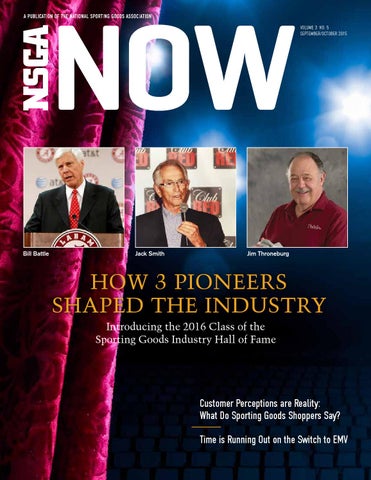
Bill Battle
Jack Smith
Jim Throneburg
HOW 3 PIONEERS SHAPED THE INDUSTRY Introducing the 2016 Class of the Sporting Goods Industry Hall of Fame
Customer Perceptions are Reality: What Do Sporting Goods Shoppers Say? Time is Running Out on the Switch to EMV
Select software provider for the National Sporting Goods Association.
Retail, Wholesale & Distribution Software Solutions FINANCIAL MANAGEMENT • Accounts Payable • Accounts Receivable • Collections • General Ledger • Payroll • Fixed Assets • Cash Flow • Business Intelligence SALES & E-COMMERCE • Complete CRM • Order Management Portals • Complete Online Shopping Cart • Integration With Existing Systems
SouthWare offers a complete modern business system for sporting goods wholesale, distribution and retail operations, supported by Advanced Systems Group, the Select Software Provider for the National Sporting Goods Association. We make companies more profitable!
POINT OF SALE • Paperless Credit Card Processing • Customer Purchase History Tracking • Product Images • Barcode Scanning • Special Order Management • Advanced Gift & Loyalty PRODUCTION & DISTRIBUTION • Inventory Control • Purchasing • Return Authorization • Production Management • Artwork File Management • Assembly & MRP • Vendor Catalog & Price Import • Shipping & Freight Management
SouthWare business software is easily scaled from small to large systems so your business will not outgrow your software. AthleticDealerSoftware.com 888-627-0200
ADVANCED SYSTEMS GROUP, INC. [ CONSULT TRAIN IMPLEMENT SUPPORT ]
PAGE 10
TABLE OF CONTENTS
INNOVATORS, PIONEERS AND ICONS Introducing the 2016 Class of the Sporting Goods Industry Hall of Fame
2
CEO CORNER
3
ASSOCIATION NEWS NOW
4
INSIGHTS NOW
6
ADVOCACY NOW
9
GLOBAL NOW
14
OPERATIONS NOW
16
OPERATIONS NOW
18
FOR YOUR BUSINESS
A look at the Sporting Goods Industry Hall of Fame and its newest members NSGA supports Personal Health Investment Today (PHIT) Act; NSGA launches new online resource Customer perceptions are reality: What do sporting goods shoppers say? NSGA orchestrated first-ever Hill Day to meet members of Congress to advocate for sporting goods industry The impact of digital extends well beyond e-commerce Confessions of a Sales Associate Time is running out on the switch to EMV Five questions to ask before applying for a sporting goods patent
NSGA NOW September/October 2015
1
CEO CORNER Celebrating Progress in the Sporting Goods Industry The Sporting Goods Industry Hall of Fame Committee has elected three industry leaders, innovators and pioneers for the 2016 Class of the Hall of Fame: Bill Battle, founder of Collegiate Licensing Company, Jack Smith, founder of The Sports Authority, and Jim Throneburg, CEO and owner of THORLO, Inc. Each of this year’s three inductees truly exemplifies passion, ingenuity and, perhaps most of all, dedication to the betterment of the sporting goods industry during their illustrious careers.
NSGA OFFICERS CHAIRMAN OF THE BOARD Randy Nill Nill Bros. Sports, Kansas City, KS
TREASURER/CHAIRMAN-ELECT David Labbe Kittery Trading Post, Kittery, ME
PAST CHAIRMAN Ken Meehan Dunham’s Sports, Troy, MI
BOARD OF DIRECTORS Dale Donaldson Mallard’s Source for Sports, Castlegar, British Columbia, Canada
Pat Donnelley Donnelley Sports, Twin Falls, ID
Rhett Johnson Johnson-Lambe Co., Raleigh, NC
Jeff Miller Scholastic Sports Sales, Ltd, Manlius, NY
Cathy Pryor Hibbett Sports, Birmingham, AL
Pete Schneider Athletic Dealers of America, Viera, FL
Rob Summerfield MC Sports, Grand Rapids, MI
STAFF Matt Carlson President & CEO
Meghan Beach Director, Membership
Dustin Dobrin Director, Research & Information
Marty Maciaszek Director of Team Dealer Divison/HDA Director
Katie Nemec Director of Marketing & Communications
Angela Mennecke Marketing & Communications Coordinator
Darlene King Director, Business Development
Nick Rigitano Research and Information Analyst
Battle, Smith and Throneburg join the iconic list of more than 160 men and women inducted into the Sporting Goods Hall of Fame since its inception in 1955. You will get the opportunity to take a more detailed look at the accomplishments and lives of Battle, Smith and Throneburg in this issue of NSGA NOW. Although all three men have worked in different areas of the industry, they understood that surrounding themselves with high-quality, knowledgeable people and focusing on top-notch customer service was critical to success. Bill Battle is the founder of the Collegiate Licensing Company (CLC), and arguably the founder of the concept of collegiate licensing itself. Collegiate licensing became a 4.3 billion dollar industry, and Battle was able to develop the first label that signified “officially licensed collegiate products.” Under Battle’s guidance, the CLC grew to represent more than 200 schools, conferences and bowl games, as well as NASCAR and the PGA Tour. Through Jack Smith’s hard work, dedication, marketing strategies and innovative ideas, he founded The Sports Authority in 1987, turning the company into a national success with instant brand recognition. His previous experience as CEO of Herman’s World of Sports gave him the idea to bring the comprehensive megastore concept to the sporting goods industry, while still providing excellent customer service. Smith went on to serve as Chief Executive Officer for 11 years and as Chairman for 12 years. Jim Throneburg invented the first-ever padded foot protection. Subsequently, he invented the term, “activity-specific” padded sock to include all the individual activities for which a padded sock was designed. In 1980, the company changed its name to THORLO, Inc. and introduced the Thorlos® brand of padded foot protection. He followed two guiding principles -- being the best in the world at foot protection and sustainability of the company beyond his own lifetime. On behalf of the NSGA Membership, Board of Directors, and Staff, a hearty congratulations is extended to the entire Battle, Smith and Throneburg families. In addition, we owe our gratitude to the Sporting Goods Industry Hall of Fame committee for their careful nomination consideration. The committee takes its responsibilities very seriously and maintains significance for what it means to be inducted into the Sporting Goods Industry Hall of Fame. We hope you can join us at the Induction Ceremony for Mr. Battle, Mr. Smith and Mr. Throneburg on the evening of Tuesday, May 24 at the 52nd Annual NSGA Management Conference & 18th Annual Team Dealer Summit in Hilton Head Island, South Carolina. It is a very special event for everyone in our industry and you won’t want to miss it. Best regards, Matt Carlson President & CEO
Chuck Suritz Director, Education & Strategic Planning
Larry Weindruch Director of Public Affairs
Dan Wiersma Chief Financial Officer
2
Katie Nemec
Matt Carlson
Editor/Publisher
President & CEO
NSGA NOW (ISSN 1045-2087) is published bi-monthly for members of the National Sporting Goods Association, 1601 Feehanville Dr., Suite 300, Mount Prospect, IL 60056-6035; Phone: (847) 296-6742; Fax: (847) 391-9827. Subscription price of $50 per year is included in membership fee. Non-member subscription information available from publisher. Periodical postage paid at Mount Prospect, IL 60056 and additional mailing offices. POSTMASTER: Send address changes to NSGA NOW, 1601 Feehanville Dr., Suite 300, Mount Prospect, IL 60056-6035. © by NSGA 2013. Printed in the USA.
September/October 2015 NSGA NOW
ASSOCIATION NEWS NOW
NSGA Commits Support to Personal Health Investment Today (PHIT) Act members about the PHIT Act via social media, email and other avenues. NSGA encourages individuals to speak up on behalf of this resolution and take action to contact their Congress person. Visit www. nsga.org/PHITact for more information and to contact your member of Congress today.
NSGA has committed $100,000 to the Personal Health Investment Today (PHIT) Act lobbying coalition. NSGA has continued to show support of initiatives that combat the inactivity pandemic in the United States and this commitment further solidifies the organization’s desire to help eradicate inactivity and increase participation. The money provided by NSGA will help fund lobbying efforts in favor of the PHIT Act. For the last several years in March,
NSGA staff members have joined the Sports and Fitness Industry Association (SFIA) in Washington, D.C. at their National Health Through Fitness Day, for an in-person opportunity to meet with several members of United States Congress to help push legislation forward. NSGA staff met with members of the SFIA staff to sharpen strategy and build a plan for further action.
The PHIT Act, House Resolution 1218 (H.R. 1218) is legislation pending in Congress which will allow Americans to use Pre-Tax Medical Accounts to pay for physical activity expenses. The resolution amends the Internal Revenue Code to allow a medical care tax deduction for up to $1,000 ($2,000 for a joint return or a head of household) of qualified sports and fitness expenses. The legislation currently defines “qualified sports and fitness expenses” as amounts paid for fitness facility memberships, physical exercise programs and exercise equipment. Passage of this legislation would help retailers and team dealers potentially sell more and broaden their customer base. If individuals and families can afford to participate, they’ll need the necessary equipment. More information on this advocacy issue as well as others NSGA is working on can be found on page 6 of this issue.
In addition to in-person participation, NSGA has pushed messaging out to
New NSGA Online Publication to Deliver News with Ease
NSGA recently launched a new resource to deliver news to members and friends in the industry. The NSGA Scoreboard, an e-newsletter, will be delivered two times a month and will include up-to-date news subscribers have continuously expected. The e-newsletter includes all of the news previously included in the following NSGA publications; The Huddle, NSGA Research Insights and Team Line-Up, plus will have even more timely announcements. If you subscribed to any of the NSGA e-newsletters, please be on the lookout for this new vehicle to receive all of the news you need in a condensed, streamlined format. If you are not receiving the NSGA Scoreboard, you can subscribe by visiting www.nsga.org/scoreboard.
NSGA NOW September/October 2015
3
INSIGHTS NOW
Customer Perceptions are Reality: What do Sporting Goods Shoppers Say? By Nick Rigitano, Research and Information Analyst
As mentioned in the last edition of NSGA NOW, according to NSGA’s first sporting goods shopper insight study, nine out of every 10 sporting goods shoppers visit a physical store before purchasing a product. This is a good sign for retailers and would lead you to believe shoppers must, on some level, regard sporting goods outlets in a positive manner. But just how positive is positive? And how much room is there for improvement? 4
As part of the aforementioned shopper insight study, we wanted to find out how various retail outlets were generally perceived among sporting goods shoppers. To do so, participants in the study were asked to rate sporting goods outlets on a variety of attributes based on a 5-point scale (5 = excellent, 1 = poor). The percentage of shoppers providing a rating of 4 or 5 (referred to as “Top-2 Box”) for overall satisfaction equaled 87%, a very
high score. In fact, across the 19 attributes studied (as seen in Figure 1), none received a Top-2 Box score lower than 70%. Positive perceptions make it tougher to generate growth opportunities, but it is important to note that pockets of opportunity do exist. Although the overall scores were high, the study revealed there are plenty of shoppers avoiding certain retail outlets because of negative perceptions. September/October 2015 NSGA NOW
Below is a summary of the negative perceptions for each outlet, along with a quote reflecting those perceptions.
FIGURE 1
Retailer Ratings: % Top-2 Box (5/4) (5=Excellent, 1 = Poor)
Full-Line Sporting Goods Stores Negative Perceptions: can be overwhelming, not always the best prices “The big lumberjack…. Big, strong, and intimidating.”
Specialty Stores Negative Perceptions: arrogant, push aligned brands, expensive
Your overall satisfaction with the store/website
OVERALL SATISFACTION: 87%
(IN STORE) Convenient hours for your schedule
88%
Offering brands you trust
87%
(IN STORE) Keeping their stores neat and clean
84%
Offering high quality merchandise/products that last
84%
(IN STORE) Ease of finding what you need in the store, (ONLINE) Ease of finding what you need
84%
(IN STORE) Convenient locations
83%
(IN STORE) Ease of navigation/moving around comfortably in the store
82%
Negative Perceptions: Overwhelming, chaotic, no expertise
Reasonable/competitive prices
82%
“The crazy cousin you would never ask advice from.”
Providing a wide selection of choices within product type
80%
Well-stocked/availability of merchandise
79%
Clearly indicating which items are on sale/discounted
79%
(IN STORE) Sufficiently staffed checkout lanes to prevent long wait times, (ONLINE) Easy check out process
78%
Offering good sales/deals
78%
(IN STORE) Friendliness of store associates, (ONLINE) Customer service support
78%
“Your Uncle Jim… single, hoards stuff, but has a thing or two that is cool.”
Discount Stores Negative Perceptions: generic, less selection, low end and unreliable products, no expertise “That rich family that loves their big house, yet has all cheap things inside that mansion.”
Warehouse Stores
Department Stores Negative Perceptions: no expertise, limited selection “The prissy poser… wears cute clothes but their yoga pants have never been to yoga!” By overcoming these negative perceptions, organizations may be able to attract new customers or bring back previously lost customers. Remember, your customers’ perceptions are your reality! It is important to note, however, that overcoming negative perceptions is not the only opportunity that exists for retailers to maximize their potential. Specifically, the NSGA Shopper Playbook identifies six key shopping behaviors and provides recommendations to help you start thinking about ways in which your business can capitalize on the insights. For more information, please visit www.nsga.org/nsgashopperplaybook or call the NSGA Research Department at 800-815-5422.
NSGA NOW September/October 2015
Ease of returning items when needed
75%
(IN STORE) Knowledge and expertise of store associates, (ONLINE) Customer service support
73%
(IN STORE) Availability of store associates, (ONLINE) Customer service support
72%
Frequency of offering sales/deals
70%
5
ADVOCACY NOW
NSGA Advocates for Members on Capitol Hill By Larry Weindruch, NSGA Director of Public Affairs
Parity Act (RTPA), and H.R. 1218, The Personal Health Investment Today Act (PHIT). The groups thanked the staff and members of Congress already listed as co-sponsors for their support of these bills and asked uncommitted members to sign on as co-sponsors. Typically, staff or members of Congress who are uncommitted do not make a decision to support a bill during these meetings, but Idaho Congressman Mike Simpson immediately said yes when asked by constituent Donnelley to support RTPA. Results like this prove that a visit, a phone call or a letter can help resolve the issues that impact your business. “I really enjoyed my experience on the Hill,” Donnelley said. “It’s given me a
NSGA President & CEO Matt Carlson, right, and Director of Public Affairs Larry Weindruch, left, met with Rep. Jason Chaffetz, R-UT, center, during their July visit to Washington in support of H.R. 2775, the Remote Transactions Parity Act of 2015, which Chaffetz introduced in June.
July was a busy month for NSGA’s advocacy efforts. In addition to participating in conference calls for the Marketplace Fairness Coalition and the PHIT Coalition, NSGA orchestrated its first Hill Day in Washington, D.C. to meet with members of Congress to generate more support for legislation that would provide sales tax fairness and encourage fitness-related activity. NSGA President & CEO Matt Carlson and Director of Public Affairs Larry Weindruch escorted retailers and team dealers from key Congressional districts. Participants were specifically selected based upon the need to communicate with Congressional representatives on Marketplace Fairness and PHIT. Members taking part in the Capitol Hill meetings were Brian Davis, Kimmel Athletic Supply Company, Spokane, WA; Pat Donnelley, Donnelley Sports, Twin Falls, ID; Steve Hauff, Hauff Mid-America Sports/Dakota Sports, Sioux Falls, SD; Jeff Miller, Scholastic Sports Sales, Manlius, NY; Rob Summerfield, MC Sports, Grand Rapids, MI; and Ken West, Eastbay/Foot Locker, Wausau, WI. Don6
nelley, Miller and Summerfield are members of the NSGA Board of Directors. Accompanied on the meetings by NSGA’s lobbying partners from Lobbyit.com in Washington, the NSGA contingent attended 16 meetings on Capitol Hill, three in Senate offices and the remainder with the House of Representatives. The bills supported by the NSGA group are H.R. 2775, The Remote Transactions
The NSGA delegation met with the following Senate and House offices. *Indicates the meeting was with the member of Congress. Other meetings were with staff.
Senator Dick Durbin, IL Senator Maria Cantwell, WA Senator Lindsey Graham, SC *Rep. Kristi Noem, SD Rep. John Katko, NY Rep. Bill Huizenga, MI Rep. Jeff Duncan, SC *Rep. Mike Simpson, ID *Rep. Ron Kind, WI Rep. Sean Duffy, WI *Rep. Steve Womack, AR *Rep. Cathy McMorris-Rodgers, WA *Rep. Jason Chaffetz, UT
From left: NSGA President & CEO Matt Carlson joined Pat Donnelley, Donnelley Sports, Twin Falls, ID; Rob Summerfield, MC Sports, Grand Rapids, MI; and Ken West, Eastbay/ Foot Locker, Wausau, WI, for Capitol Hill meetings in Washington.
*Rep. Bob Dold, IL Rep. Kay Granger, TX *Rep. Joe Barton, TX September/October 2015 NSGA NOW
new perspective on Capitol Hill and NSGA. I appreciate the opportunity to be involved and am ready to do it again if I’m needed.” Another Hill meeting produced an in-district follow-up visit to Kimmel Athletic Supply. After meeting with his Representative in Washington, D.C., Davis invited Rep. Cathy McMorris-Rodgers to visit, and the meeting was held August 3 in Spokane. “Advocacy activities like this prove that hearing from their constituents can be more powerful in Washington than all of the high-priced lobbyists,” Carlson said. “Your voice is stronger than you may think, and your representatives in Washington do listen.” Later in July, Weindruch visited Washington again as part of the National Retail Federation’s Advocacy Summit and met with Illinois Senator Mark Kirk, Illinois Rep. Bobby Rush and staff from the offices of Senator Dick Durbin and Rep. David Trott of Michigan, again to advocate for sales tax fairness and the PHIT Act. Senator Kirk voiced immediate support for PHIT.
SUMMARY OF THE REMOTE TRANSACTIONS PARITY ACT OF 2015 The Remote Transactions Parity Act (H.R. 2775) requires states to make simplifications to their tax code before they can collect sales and use taxes from remote sellers. There are two pathways for them to do that. First, they can join the Streamlined Sales and Use Tax Agreement (SSUTA). Twenty-four (24) states are currently full members. Those that don’t agree to SSUTA would be required to create one entity to collect from and audit remote sellers on behalf of the entire state. States will also be required to provide free certified software to remote sellers. The legislation provides for a small seller exemption or transition period; those who sell $10 million or less are exempted the first year the state collects remote sales tax, those who sell $5 million or less are exempted the second year, and those who sell $1 million or less are exempted the third year. There are also liability and audit protections for remote sellers. There’s no word yet on whether House Judiciary Chairman Bob Goodlatte – who has been unable to gain any support for his online sales tax bill – will take up the Chaffetz bill, but there is already “broad bipartisan support” for the bill, including among members of the Judiciary committee.
SUMMARY OF THE PERSONAL HEALTH INVESTMENT TODAY ACT OF 2015
Brian Davis of Kimmel Athletic Supply in Spokane, WA, hosted Congresswoman Cathy McMorris-Rodgers during the August House recess. Davis gave the Congresswoman a tour of Kimmel’s facilities and told her how a change in sales tax legislation would level the playing field for brick and mortar retailers and team dealers competing against outof-state online sellers.
HOW CAN YOU HELP? To make your voice heard in support of either of these important issues, go to: www.senate.gov/senators/contact/ to reach out to your U.S. Senator www.house.gov/representatives/find/ to locate your Representative Tell your story, how long you’ve been in business, how many people you employ, and most importantly, let Washington know how you feel about these issues. A great way to share your views is to invite your Senator or Representative to your place of business. Show them around and ask them to support H.R. 2775 and H.R. 1218. NSGA NOW September/October 2015
H.R. 1218 would expand the allowable expenses for which pre-tax health savings account funds (HSAs) may be used, including health club fees, home exercise equipment, required youth sports equipment and “pay to play” fees for interscholastic and youth sports. The goal is to encourage Americans to be more active. More people die from inactivity (5.3 million) each year in America than from smoking (5.0 million). In fact, according to the Journal of Clinical Nutrition, inactivity was found in a survey of 300,000 people to be responsible for twice as many early deaths as obesity. According to the World Health Organization’s Health & Development Through Physical Activity & Sport Report, “investing in physical activity programs will lead to economic savings. In the U.S. an investment of $1 in physical activity (time and equipment) leads to $3.20 in medical cost savings.” 7
GLOBAL NEWS NOW
Why Online Is Not Just Online By John Rand, Senior Vice President, Kantar Retail
There is no question consumers are going online for an ever-increasing share of their purchasing. According to the U.S. Department of Commerce and our own projections here at Kantar Retail, e-commerce captured about 13 percent of total U.S. sporting goods volume and should top 25 percent by the end of this decade. Many of the operators and retail brands reading this already know this and are well-advanced in presenting the shopper an array of websites and apps to supplement the store offering. And you are probably aware this will continue to transfer some volume from store-based fulfillment to online fulfillment. We estimate about 2.5 percentage points of future compound growth that would have come from sporting goods and apparel stores will be transferred to e-commerce.
brick-and-mortar stores differently. They expect different things from the store, even when they prefer not to go online. We call this the 10/50/100 pattern (see below).
that your digitally-savvy consumer is still digital even while standing in front of you and shopping in your store. Make sure you have an adequate in-store network.
Even though digital may be roughly 10 percent of sales, it has assumed a position of critical influence over WHAT people buy and the impact approaches 100 percent on how consumers perceive the shopping experience.
Check yourself against competition using your own smartphone every day or at least every week. And think of how you provide information at the point of purchase that matches what a shopper would look for while online on their mobile device. Because online buying is everywhere, all the time, even when it is not online.
Shoppers may want to know where the item was made, and by whom, and whether they approve of that company. They increasingly want product reviews and ratings by peer users and purchasers. They want to know what is popular with other shoppers. And they absolutely will use the ubiquitous smartphone to compare price, features and availability with other outlets and websites even while in the aisle.
Digital Impact: 100% Digital is about marketing and communi-
As important as this trend may be, it makes it all too easy to overlook a companion effect – once people are accustomed to shop online, they shop in regular
cations as well as e-commerce. That has been clear for a while. But don’t forget
About the author: John Rand is the Senior Vice President of Retail Insights for Kantar Retail, one of the leading retail consulting firms. Rand focuses on supermarket, club and value discounter channels and advises retailers and suppliers with nearly five decades of experience in store operations and 1 design, branded product sales, purchasing, merchandising, marketing, category management and consulting.
The impact of digital extends well beyond eCommerce
Source: Kantar Retail analysis Š Kantar Retail
NSGA NOW September/October 2015
9
FEATURE
Bill Battle: Licensing Icon Founder, Collegiate Licensing Company (CLC) By Angela Mennecke, NSGA Marketing & Communications Coordinator
$250 million in retail sales in 1981 to more than $4.6 billion in 2014. The major successes and growth of CLC never changed Battle’s belief that he should treat his employees like family. “We have always been inspired by the way Bill managed his company with a family atmosphere as opposed to a corporate mentality, so much so it is how we have chosen to run our company,” said Scott Schuler, President of Top of the World. In 2007, Battle sold CLC to IMG, but he remains active in the company. He serves as its chairman and his son, Pat, oversees the day-to-day operations as president. Bill Battle leveraged his experiences as a star football player for Paul “Bear” Bryant at the University of Alabama, and as a head coach at Tennessee, to build the Collegiate Licensing Company (CLC) from the ground up and turn it into a $4 billion collegiate merchandise market. Battle was a true visionary who strongly believed schools, licensees and retailers would mutually benefit if they joined together. With a passion for collegiate athletics and a strong interest in marketing, Battle went door-to-door convincing college administrators of a goal where all trademarks were regulated and available in one place. In 1981, Battle launched Golden Eagle Enterprises and landed Bryant and the University of Alabama as his first licensing client. By 1983, Battle had signed eight other colleges and renamed Golden Eagle Enterprises to Collegiate Licensing Company. Now, the nation’s oldest and largest collegiate licensing company, CLC represents more than 200 colleges, universities, bowls and conferences as clients (including the NCAA, the College Football Playoff and the Heisman Trophy), representing more than 75 percent of the current annual market. CLC was also instrumental in growing the U.S. retail market for collegiate merchandise from approximately
10
“Bill’s leadership and impact on the business of sports transcended his role with CLC, impacting many other facets of sports industries, as well as sports-related organizations,” said Tammy Purves, the Senior Communications and Create Services Director of CLC. Through all of Battle’s success, he never strayed from his passion for college sports. Battle’s foundation for CLC began with football. A member of Bryant’s first national championship team in 1961, Battle followed his playing career by entering the coaching profession as an assistant at the University of Oklahoma. From 1964-1965, he served at the U.S. Military Academy and worked as an assistant football coach. He then arrived at the University of Tennessee in 1966 as an assistant to Hall of Fame Coach Doug Dickey. In 1970, at 28 years old, he became the youngest head coach at the time and compiled a 59-22-2 record with five consecutive bowl appearances and three teams finishing in the Top Ten national rankings. Battle remains one of the most quietly influential figures in college athletics today. Working as CLC’s chairman and adviser at the age of 70, Battle is still essential to client relations. In fact, athletic directors
still respect and call upon him, whether they have a question about business or they’re looking to fill a position. Battle is the go-to guy.
“I cannot think of any finer example of a leader, both in the sporting goods industry and in the collegiate industry as a player, coach and athletic director,” said Mickey Newsome, who was the long-time Chairman of Hibbett Sporting Goods. Battle has been recognized for his tremendous leadership capabilities and the large impact he had on all facets of the sporting goods industry by several organizations throughout his career. He received a National Football Foundation award in 2008 for Outstanding Contributions to Amateur Football. In 2010, Battle was inducted into the National Association of Collegiate Marketing Administrators’ (NACMA) Hall of Fame. He was inducted into the Tennessee Sports Hall of Fame and received its Lifetime Achievement Award in 2011. Battle currently serves on the boards of the Bryant-Jordan Student-Athlete Foundation, The University of Alabama A-Club Educational & Charitable Foundation, the Crimson Tide Foundation and the National Football Foundation. “In addition to Bill’s accomplishments, just knowing how he conducts himself is an example for all of us in regards to ethics, modesty and leadership,” Seth Chapman, President of Weezabi, LLC. said. “Our industry is better as a result of Bill Battle.”
September/October 2015 NSGA NOW
FEATURE
Jack Smith: Thinking Big Box Founder, The Sports Authority By Angela Mennecke, NSGA Marketing & Communications Coordinator
stores in Japan, with about $1 billion in annual revenue, and prepared for their entrance into China. “No one had ever seen anything like The Sports Authority before and that’s what I wanted,” Smith explains. “But we had ‘authority’ in our name and that meant service was essential. When we opened our first store in Fort Lauderdale, we did a million dollars in the first month. I knew I had a tiger by the tail, and I made a promise to myself that we may be a big-box operator, but we would never lack for service.” To Smith, big box did not mean warehouse. “My apparel departments had carpets, we had fixtures,” Smith explains. “When the customer walked into our big stores, they could’ve been walking into Saks Fifth Avenue - the ambience was perfect.” Jack Smith, a born retailer, is known for fast thinking, fast talking and fast acting. With incredible instinct, Smith turned a small idea into one of the largest entrepreneurial successes in America. Smith’s idea behind The Sports Authority, which became the nation’s largest sporting goods chain in just five years, came from the experience he garnered as COO of Herman’s World of Sports, a chain of 7,000-square foot stores selling sporting goods. “I soon realized for certain markets, successful retailing was evolving into big-box formats,” Smith said. “I just knew sports retailing would thrive in a 40,000-square feet environment. I’d seen first-hand how lack of space stifled opportunity, and to me sports was ripe for the big-box format.” While at Herman’s, Smith watched the company increase stores, sales and profitability. While his instincts told him to bring the comprehensive megastore concept that had fueled the tremendous growth of Toys “R” Us, Office Depot and Home Depot to the sporting goods industry, he NSGA NOW September/October 2015
could not achieve this at Herman’s. With the backing of a group of venture capitalists, Smith got another chance and set out to build his own sporting goods giant. With the goals of extensive selection of quality brand merchandise, competitive prices, premium customer service, heavily stocked shelves and convenient locations, Smith set out to create The Sports Authority. Through Smith’s hard work, dedication, marketing strategies and innovative ideas, he founded The Sports Authority in 1987, turning the company into a national success with instant brand recognition. Smith went on to serve as Chief Executive Officer for 11 years and as Chairman for 12 years.
True to his retailing and leadership instincts, Smith always made it clear how much he valued the people on the shop floor. “In meetings, I’d ask—Is it the managers or buyers who are critical to our success? Neither I’d say—it is people on the shop floor, they’re who customers relate to … especially the cashiers, they’re the last people our customers see. It needs to be perfect,” Smith explained. Delivering on his big promise to make The Sports Authority unique from its competitors, he put careful consideration into choosing his employees. He knew his business would only continue to expand Continued on page 12
After Smith opened his first store in 1987 in Fort Lauderdale, Florida, he sold it 18 months and eight stores later for $75 million. The store then grew to more than 150 locations. Smith eventually re-acquired the company, and in 2010, the business turned over $3.5 billion and held 330 stores in the United States. At that time, the company also held an additional 50 11
with the right, disciplined staff who understood what was needed and who was prepared to deliver it. It was also important to him to make sure all new store management concluded a four-week experience at an established store before moving to their assigned store. Smith grew his business with people who believed in his mission and created a phenomenally successful and visionary business by being different. Not just different in size or price, but different in almost every dimension. He was loyal to his employees, and he prided himself on the fact that he has frequently visited every store to make sure employees know what is expected of them.
FEATURE
Jim Throneburg: Caretaker of the World’s Feet Founder and CEO, THORLO, Inc. By Angela Mennecke, NSGA Marketing & Communications Coordinator
the best foot protection in the world and sustainability of the company beyond his own lifetime. With a strong desire to serve their loyal customers, THORLO developed a corporate culture that empowers staff to go “above and beyond” to satisfy customers—even when it means spending hours on the phone with one customer or designing a special sock at no cost for a boy who lost his foot.
“We started making it a point to promote from within,” Smith said. “They’d proven they could be trusted, it was good for morale and we saved millions on recruitment fees.” Smith also knew the importance of employee integrity, therefore making each employee of a Sports Authority pass a drug test before stepping on the service floor, himself included. In recognition of Sports Authority’s drug-free workplace initiative, Smith was invited by former President George W. Bush for a White House briefing, launching the President’s Drug Advisory Council’s “Drugs Don’t Work” program. As a result of Smith’s fierce leadership skills, Smith proudly served on the board of directors of the National Sporting Goods Association for more than eight years and served as Chairman of the Board from 1997 to 1999. In addition, SportStyle Magazine in 1994 voted Smith among the top 100 Most Influential People in the Sporting Goods Industry, nearly topping the list at number two. What Smith did 25 years ago has now been copied—the concept of big-box format retailing and cheap prices. “Think back 20 years ago and ask yourself where the industry was versus where it is today,” said Ralph Parks, President of RT Parks, Inc. “Jack Smith was the person that helped change the face of our industry.” Smith stepped down as CEO in 2000 to enjoy his time to serve on the Board of Directors for other major corporations, including Fiesta Restaurant Group, Carrols Restaurant Group and Darden Restaurants, Inc. He currently serves as the President of SMAT, Inc., a Fort Worth-based website development firm that specializes in small business consumer services. 12
“Jim’s leadership can be felt in the prod-ucts THORLO offers and the relationships THORLO engenders with retailers and most importantly the sporting goods consumer,” said Stephen Brinkley, Executive Vice President of Sports Authority. “Jim’s integrity is embraced and exemplified by his leadership team. It is the cornerstone in the foundation of ethics for the Thorlos brand.”
Jim Throneburg says walking saved his life. More than 40 years ago, Throneburg was admitted into Duke University’s weight loss program because of excessive weight gain that caused him to suffer from life-threating illnesses. Walking was an essential component to his daily exercise regimen— how he ultimately obtained and retained a healthy weight—yet his feet caused him severe pain when doing so. Throneburg decided to take matters into his own hands and began working with his father’s company, Throneburg Hosiery Mill, in designing and strategically allocating variable density padding along the ball and the heel of the foot. Thus, the first padded sock was born. Subsequently, he invented the term, “activity-specific” padded sock to include all the individual activities for which a padded sock was designed. In 1980, the company changed its name to THORLO, Inc. and introduced the Thorlos brand of padded foot protection, driven by two guiding principles: being
Thorlos’ mission is simple: to make your feet feel better no matter what type of activity. Their goal is to power an individual’s passion to achieve, allowing the person to experience more of what he/she loves to do. Whether that be a high school basketball player during a high intensity game, a rock climber, or a retiree focused on staying active, this is how the THORLO team thinks about feet. Not only are feet the foundation to a healthy lifestyle, feet allow people to do what they love. “If you’d ask Jim today, he would wholeheartedly agree that his team takes pride in not only making the best products possible in the U.S., but perhaps more importantly, they care equally as much about the people who wear them,” said Sally Kay, CEO of The Hosiery Association. Today, THORLO, Inc., located in Statesville, North Carolina, is a $35 million dollar business with more than 250 employees and features a line of activity specific September/October 2015 NSGA NOW
products that are distributed throughout the U.S., as well as 35 countries globally. Thorlos produces more than 30 activity specific types of socks, including sport, outdoor, winter, workplace, military and everyday use.
THORLO is one of the few remaining sock manufacturers in America that continues to make 100% of its products in the U.S. In 2008, THORLO launched the Experia Brand, which is now the largest single pair running sock sold in the U.S. Thorlos and Experia are sold in more than 7,500 domestic U.S. retailers. Early in Throneburg’s career, he received hundreds of letters from consumers suggesting that Thorlos padding designs were not only protecting feet for sports and activities, but were also resolving other foot issues. People began crediting Thorlos for reducing pressure and arthritic foot pain, as well as reducing the threat of liaisons. To scientifically verify these numerous consumer claims, Thorlos donated padded sock designs to a number of clinical studies, the results of which have appeared in many peer-reviewed, published
medical journals. The research showed that several Thorlos padding designs were effective in reducing blisters, pain, pressures and moisture contributing to healthier feet. Throneburg’s belief in serving people’s foot health is not just about making money. Realizing that millions of people around the world were suffering from foot pain, he founded The Institute for Preventive Foot Health, a non-profit foundation dedicated to research and education related to preventive foot health and other foot issues. He also wanted to inspire others to lead healthier lives. Therefore, he founded the Academy for Self-Discovery Leadership, a non-profit education organization, to prepare tomorrow’s transformation leaders today by providing a safe environment for self-discovery. “The common theme running throughout all educational programs offered is the development and practice of being selfaware: first and foremost with themselves - including with their bodies and with food - as well as with others,” Throneburg explains. Throneburg holds more than 25 patents in the U.S. and many foreign countries and, as such, is one of the most prolific inventors in the sock, insole and shoe
NOMINATE THE 2017 CLASS OF LEADERS, INNOVATORS & INDUSTRY ICONS The Sporting Goods Industry Hall of Fame includes more than 150 of the industry’s pioneers and leaders. Do you know an industry icon who should be recognized for their outstanding contributions to the sporting goods industry? Nominate them for the 2017 class of the Hall of Fame! Deadline is March 18, 2016 Visit www.nsga.org/halloffame for all of the information today!
industries. The Thorlos brand has been nominated by consumers nationwide as a prestigious “Lovemark,” an extremely high achievement, and doubly special for a sock product with little or no consumer advertising. “Jim has changed the sporting goods landscape like no other,” Marty Lillis, Founder of Franklin Retail Solutions, said. “He is an unsung hero in my book.”
“When I first learned of this award, I must say that I was greatly humbled. It overwhelmed me knowing the number of people who made it possible, yet they do not receive the credit. I plan to take the time to thank each one of them personally. I believe the loyalty of our employees and our customers is ultimately responsible for our success.” - Jim Throneburg, Founder and CEO, THORLO, Inc.
OPERATIONS NOW
Confessions of a Sales Associate By Inga Johnson, Senior Vice President of Marketing, Experticity
insights gleaned from other customers. A choice navigator Adds value for customers by reducing decision frustration and increasing satisfaction by helping customers understand product options and the pros/cons of each. A needs identifier Helps customers uncover unfelt or latent needs using skillful inquiry and intuition to ensure the customer gets what they actually need.
Perhaps more than any other product, shopping for sporting goods demands a visit to a brick-and-mortar store. Consumers appreciate, even crave, the in-store experience because it gives them the opportunity to talk to a sales associate who can answer questions and provide recommendations. Statistics show that 40 percent of consumers remain open to persuasion once they enter a store, despite undertaking extensive product research on their own. One in three consumers regularly need assistance from associates, and more alarmingly for retailers, 75 percent of consumers will walk out of a store if there are not enough knowledgeable associates available. However, left to their own devices, sales associates are more often than not unprepared and unable to answer basic questions about the wide array of products on the shelves. The sales associate can become the most powerful brand advocate and marketing tool your company can leverage to increase sales, build long-term customer loyalty, and do the same for your retail partners. However, too often marketing campaigns focus only on raising brand awareness and driving foot traffic, and that’s why they fail to increase sales and grow customer loyalty even as they succeed in meeting their objectives. 14
Why Focus on the Sales Associate? Despite evidence pointing to the value of educated store associates, you may wonder whether investing in sales associate education and incentivizing programs will pay off in the long run. In an article for “Harvard Business Review,” brand-building expert Denise Lee Yohn acknowledges that the role of the sales associate in the marketing and sales process is evolving, but not at all diminishing. She cites a study by Integer Group that found family, friends, and online reviewers are considered trustworthy at twice the rate of sales associates. Sixtyone percent said they believe shoppers are better connected to product information than their in-store associates.1 Yohn recommends sales associates no longer simply play the role of a product expert or information gatekeeper. Instead, they can become even more valuable to consumers by serving a number of new roles that will “require substantive changes in the way salespeople are recruited, trained, and compensated.” These roles include: A decision validator Adds a personal insight about why the selection is a smart one; draw from past experience with the product or
An insights collector Gleans customer insights for the company through ongoing, face-to-face interactions with customers. These are often more timely and accurate — and less expensive — means for understanding trends. In fact, Yohn adds that perhaps the name of the role itself needs to change from “sales associate” to “customer associate.”
Motivate your retail partners Your retail partners should welcome your plans to help turn their sales associates into experts on your brand and products for two primary reasons: higher sales and lower turnover. Associates who engage with knowledgebuilding content sell 69 percent more than their peers, and those who actively engage in becoming more knowledgeable on a specific brand sell 87 percent more of that brand than their peers. Considering those numbers, perhaps it’s not surprising that some larger retailers are turning their stores into a collection of mini-stores that focus on individual brands, essentially creating the equivalent of having multiple specialty retailers like Golfsmith or a Nike Store under one roof. “Retail Drive” reports Dick’s Sporting Goods has had success with its hit storewithin-a-store concept. Dick’s Sporting Goods stores feature “Nike Field House” and “Under Armour All-American” concept stores within them. Christopher Svezi, an analyst at Susquehanna Financial Group, says the brands within these bigger stores September/October 2015 NSGA NOW
enjoy higher returns on investment and sales per square foot, as well as better margins.2
Four steps to success Marketing professionals must actively help their retail partners train associates to be more knowledgeable, motivated to sell and committed to creating great in-store experiences for customers. There are four key steps to follow: 1. Find out who is talking about your brand: It’s your marketing team’s job to find the influencers among millions of social media users and brand advocates and pinpoint who’s driving these conversations both online and offline. Armed with the right information, they can exert measurable influence in your target market(s). 2. Educate and engage influencers: Target retail associates with a defined campaign and convert them to
dedicated brand advocates who can both speak knowledgeably about product features why they prefer a specific brand. Using programs such as retail education and product seeding, brands can connect with these experts in measurable ways that have been proven to increase sell-through at retail. 3. Make it easy for them to use your stuff: Reward your most important influencers by offering discounts and giveaways is a no-brainer and moves them from the “passive sellers” category to the “passionate user” category. 4. Measure success: Engagement is measurable, and once you know who’s engaging with your brand and how, you can better direct your educational efforts. Get a product into their hands, give them a chance to learn about it and use it, and then their purchasing influence
becomes not only substantial, but also quantifiable. Engaged, enthusiastic advocates on the sales floor are truly invaluable to brands who want to cut through the noise and reach customers quickly, efficiently and effectively. And while consumers may be educating themselves online in record numbers, McKinsey research indicates that as many as 40 percent of them remain open to persuasion once they enter a store. Taking simple steps to create your own army of brand advocates can give you a better chance of getting a customer out the door with that new piece of gear. Inga Johnson has worked to champion the power of data and brand advocates in organizations ranging from Ancestry, to Columbia Sportswear. She currently heads up brand and marketing for Experticity, a network of category and retail influencers. Experticity engages and rewards brand advocates with its 3Point5.com network.
Denise Lee Yohn, “What Retail Sales Associates Still Do Better than Websites,” Harvard Business Review, December 15, 2014. https://hbr.org/2014/12/what-retail-sales-associates-still-do-better-than-websites
1
Daphne Howland, “Dick’s Sporting Goods’ winning strategy,” Retail Dive, April 1, 2015. http://www.retaildive.com/news/dicks-sporting-goods-winning-strategy/377768/
2
NSGA NOW September/October 2015
15
OPERATIONS NOW
Time is Running Out on the Switch to EMV By Meghan Beach, NSGA Membership Director
16
September/October 2015 NSGA NOW
On October 1, retailers will become liable for 100% of the expenses incurred surrounding fraudulent purchases, unless payment terminals are transitioned to Europay, MasterCard and Visa (EMV) pin-enabled machines. The fees associated with card fraud can add up to tens of thousands of dollars in net losses for business owners who are not prepared. However, retailers have been hesitant to make the switch because of heavy upfront costs associated with switching over current machinery.
Why Does this Matter to Me? Today, most card fraud is absorbed by the bank or issuer. Liability will shift on October 1 to the party that has the least secure form of EMV technology (excluding fuel dispensers). In other words, liability falls on the party that has not adopted, or provided the ability to process chip technology by that time. As a result, if you have not done anything yet to adopt the new, more protected technology – and a breach occurs or smart card fraud is found – liability will fall entirely on your business. Your liability diminishes as you begin the transition to the new devices.
Don’t Wait Processors do speculate a possible delay in the certification process for EMV-ready terminals as demand potentially picks up closer to the deadline. There are multiple steps retailers must take in order to become fully EMV ready. The terminals must be able to handle EMV chip technology, the terminals must then be certified with the retailer’s processor, and the software loaded into the EMV-ready terminals must be certified as well. In addition, certain high-end terminals made by a select few manufacturers – for example, terminals specific for Apple Pay – may experience delays in delivery as demand surges closer to October. This delay will be due to having less choices for who can provide the Apple Pay equipment.
The NSGA Advantage The National Sporting Goods Association (NSGA) entered into extensive negotiations for more highly favorable deals with payments process providers to help members purchase EMV-ready terminals at an affordable price. In addition, NSGA took this opportunity to renegotiate per transaction fees to provide further longterm cost-savings for members.
NSGA NOW September/October 2015
We now have the ability to offer terminals to our members at practically no cost, with lower-than-market transaction rates, the assurance that EMV-ready terminals will be made available without delay and with highly personalized consulting throughout the certification process. Our recommended processor is prepared for the surge of orders and has programing in place to help minimize any predictable delays, particularly with high-end terminals. We have also found a vendor that is able to provide smart business knowledge to keep you ahead of the game in terms of payment processing technology and rule changes.
Your Solution Payment Alliance International (PAI) is a financial services provider that offers credit card processing, ATM machines, check services and more. PAI focuses on relationship building with every client. They support their services with real-time customer-service, analytical solutions and resources to help keep users informed of changing regulations and trends related to payment transactions. PAI services 80,000 businesses, 550 financial institutions with more than 60,000 ATM locations, and is a recipient of multiple awards, including “Inc. 5000” Company every year. PAI shares NSGA’s mission to “constantly seek simple ways to grow your business, increase revenue and surpass your customer’s expectations.” PAI focuses on helping the little guy, providing business owners with financial services that help owners stay competitive even with limited resources. According to PAI, “smart growth means adding products and services that you can deliver confidently, without worrying about overextending your business operationally or financially.” PAI strives to be a powerful partner in “finding new, innovative ways to help you increase profits with every financial transaction.” They can help you open up new revenue streams, provide revenue producing products, expand payment options, build e-Marketing and Loyalty programs, create ATM branding solutions, offer report analysis and more.
Exclusive Offerings to NSGA Members
new terminals at-cost, providing a 50% discount in most cases. All members will also receive a $100 rebate on their next monthly statement in addition to the halfoff discount. PAI will also be offering NSGA members the lowest per transaction rate fees possible – which you won’t be able to find anywhere individually as a customer. You will also receive an additional 35% monthly NSGA member rebate in addition to the cut-rate prices PAI is providing. As a result, you can lower your credit card transaction rates, saving you additional costs every day. To learn more about our new credit card processor and additional discounts offered exclusively to NSGA members, please go to www.nsga.org/PAI.
It’s Not Too Late Banks have been issuing EMV-enabled credit cards for some time now. However, there is still time for you to make the transition to get your business ready. Banks are now issuing EMV cards with both chip and magnetic-stripe functions so consumers can use either payment method while retailers conduct the switch. It is estimated that 70% of credit cards and only 40% of debit cards in the U.S. will support EMV by the end of 2015. Often banks are waiting until card expiration dates before issuing the more expensive chip card to consumers. In addition, because the U.S. market is so fragmented and widespread, processors are predicting the EMV deadline may be pushed back to the first quarter of 2016 if not enough retailers, processors and software providers are ready in time. However, if the deadline is not extended, retailers may become liable for any counterfeit smart card transactions or breaches on non-EMV compliant machinery. It is best to be prepared now rather than spending thousands of dollars in fees if a breach is found. And NSGA is here to help mitigate the costs associated with transitioning your machinery. If you would like more information on the new discounts PAI can provide, please go to www.nsga.org/PAI or contact Meghan Beach, NSGA Membership Director at mbeach@nsga.org or by phone at (800) 815-5422 x1280.
For anyone seeking EMV-ready terminals, PAI is willing to offer NSGA members the
17
FOR YOUR BUSINESS
Five Questions to Ask Before Applying for a Sporting Goods Patent By David Lilenfeld, Founder of Lilenfeld PC
nature). Also, it can’t merely be an abstract theory. For example, you could never patent the idea that “Stronger facemasks offer better protection.”
helmet might help to prevent head injuries. You don’t need to show hard data necessarily, but there must be a credible rationale for why your invention is useful.
This requirement is typically met easily in the sporting goods industry. Most manufacturers won’t need to worry about it.
There is one exception where you don’t need to show utility. If your invention is purely ornamental in nature – a soccer uniform with a rad new color scheme – then you don’t need to show utility. Instead, you would apply for a “design patent.” This offers less protection than a normal (utility) patent, but it’s also easier to get.
It must be novel
Let’s face it, in the world of sporting goods, innovation is king. Every manufacturer wants to produce a product that is lighter, stronger or simply more effective than what their competitor is making. And when it comes to protecting these inventions, getting a patent is often the go-to solution. A patent essentially gives you a 20-year monopoly on your product innovation. This can lead to licensing deals, serious brand exposure and higher revenue. Does this mean you should apply for a patent every time you have a great product idea? Probably not. Patent applications require a significant investment of time and money. You’re also required to disclose product details, often even before you are ready to go to market. There’s no rigid formula that tells you when a patent application makes sense. However, by asking yourself the four crucial questions below, you should feel good about your eventual decision.
1. Is your invention really eligible for a patent? The United States Patent and Trademark Office has certain requirements that must be met before it will issue a patent. Here are the legal hurdles your invention needs to clear:
It must involve “patentable” subject matter This basically means your invention has to be man-made (as opposed to a product of 18
Legally, an innovation is “novel” if it’s different from all previous inventions and existing knowledge. That sounds pretty strict, but if your invention differs physically in some way from what’s come before, it will likely be considered new. So, “novelty” is another requirement that is, is most cases, not too tough to satisfy.
It must be non-obvious This one’s a little trickier. Even if your innovation is technically “novel,” it can’t just be an obvious variation of existing equipment. This might seem a little vague at first, so let’s look at a concrete example. Suppose a new style of golf club goes on the market and it’s a big hit across the country. It has a distinctive shape that really improves shot accuracy. Then, you come along and say, “Hey, I’ve got an idea for a golf club that’s the exact same, except it has a graphite shaft instead of steel.” Time to run to the patent office, right? Unfortunately, you’ll probably be denied. If someone of ordinary skill in your field would consider your invention obvious, it can’t be patented. In this scenario, steel and graphite are both common golf club materials. Simply substituting one for the other will be seen as an obvious modification of the new club design.
It must be useful (with one exception) Last but not least, your invention must provide a specific and substantial benefit to users. For example, a thicker football
So, did your new idea pass all the legal tests? If it did, let’s talk about timing next.
2. Is the timing right to apply for a patent? When it comes to patent applications, timing is everything. And what do I mean by that?
Make sure it’s not too early Is your product idea developed enough to be patented? This doesn’t mean you need to create a prototype. In fact, it’s okay if some details of your invention haven’t even been worked out yet. What does need to be in place is your “inventive element.” This refers to the big differentiator that sets your invention apart from similar products. If you haven’t had your “light bulb” or “aha!” moment yet, you might need to work on your idea a bit more.
Make sure it’s not too late One important rule to keep in mind is the “one-year bar.” Once you publicly disclose your invention – by, for example, selling it, displaying it at a trade show, or publishing details in a journal – a one-year clock starts ticking. If a year goes by and you still haven’t applied for a patent, you’ll essentially be prohibited from ever filing. Another time concern is your product might be obsolete by the time you’re granted a patent. It can take two years or longer to get a patent application filed and approved. If you’re in a fast-moving sector, September/October 2015 NSGA NOW
your invention could become passé in the meantime.
• The cost of getting the product to market
There’s one final timing consideration to go over. In 2013, the United States switched from a “first-to-invent” patent system to a “first-to-file” system.
• Your potential selling price and mark-up • And so on…
So, let’s suppose you invent a new hockey stick. Competitor Y comes up with the same idea a year later. If Competitor Y applies for a patent before you do, you’ll be out of luck – even though you invented the hockey stick first.
If you invest some time, you can probably get most of the answers on your own. Or you can just commission a study! Whichever method you choose, make sure you also look into the product’s longevity. Will the product be a passing fad, or is there potential for long-term demand?
The lesson? Even though rushing into a patent application is a bad idea, you don’t want to wait too long.
4. Have you done a “knockout” search?
3. Is the product commercially viable?
Your invention might be incredible, but you need to make sure no one has beaten you to the punch. If the exact same product has already been patented, you’ll be wasting time and money by applying.
This is a complex inquiry, but it’s worth delving into. Here are some of the financial factors you should think about before filing: • The demand for your product (and the market size) • The cost of production • Whether you’ll make the product yourself or license the patent to a third party
NSGA NOW September/October 2015
That’s why it’s important to conduct your own preliminary patent search – also known as a “knockout” search. Use any sources you’re familiar with to poke around the marketplace for identical products. You can also search the United States Patent and Trademark Office’s database by visiting www.google.com/ patents.
A professional can conduct a more thorough search later on, but this is a critical first step that can potentially save you a lot of expense.
Conclusion In the end, the decision to apply for a patent is a judgment call. Even if you think a patent is attainable, you have to weigh the time and money investment against the potential upside. So, learn more about the application process and the costs involved. You can always ask a professional for more information. If you remain undeterred after all that, then go ahead and swing for the fences! After all, innovation is the name of the game. About the author: David Lilenfeld is an intellectual property attorney and the founder of Lilenfeld PC in Atlanta, Georgia. This article is provided for general informational purposes only and is not legal advice. Being general in nature, the information and materials provided may not apply to any specific factual and/or legal set of circumstances. For tailored legal advice, you should consult an intellectual property attorney.
19
LOCKER ROOM NOW
NCAA Rules updates Softball The NCAA Playing Rules Oversight Panel approved a series of rule proposals for next season by the NCAA Softball Rules Committee. They include: • Players are prohibited from wearing batting helmets that have highly reflective or mirror-like chrome finishes. The Softball Rules Committee believed these types of batting helmets are distracting to the defense because of the reflection of light. • Players cannot use a bat with a barrel that is yellow or non-contrasting to the ball. • Foul poles should be a single color and extend at least 10 feet, but preferably 20 feet, from the ground. However, in 2018, foul poles on a team’s campus playing field will be required to extend at least 10 feet and be painted white or optic orange. • Dugouts must have protective netting or fencing extending at least six feet from the floor. This rule will be a requirement in 2018. • Teams will be able to review video and access information entered into electronic equipment during competition.
Women’s lacrosse Beginning next season, officials will conduct stick checks of every goal-scoring stick following each goal scored. The rule is currently used in international play. There will also be more extensive stick checks before each game starts, with officials examining more than just the pocket depth. Coaches will maintain their three stickcheck requests and will be allowed to use them before any faceoff, during timeouts, at halftime and before the start of any overtime periods. If a player is found to be using a stick that doesn’t meet specifications, the player will be given a yellow card and must serve a two-minute, non-releasable penalty. A visible 90-second clock will be added to the by 2017 for Division I and 2018 in Divisions II and III. Delaying the implementation provides schools time to budget for any financial implications. The Women’s Lacrosse Rules Committee is recommending the use of two clocks, one at each end of the field, but one clock located at the scorer’s table will be allowed.
NFHS News Tom Welter is the new president of the National Federation of State High School Associations for 2015-16. Welter, the executive director of the Oregon School Activities Association, is the 56th president of the NFHS and began his one-year term July 3. Gary Musselman, the executive director of the Kansas State High School Association, was elected by the NFHS Board of Directors to the president-elect position for 2015-16. Jim Tenopir did not stay retired for long after serving as the NFHS Chief Operating Officer since July 2010. Tenopir began his duties as the interim executive director of the Nebraska School Activities Association (NSAA) in August. Tenopir, who participated in a panel discussion at the 2013 NSGA Management Conference and Team Dealer Summit, was the NSAA executive director for nine years before going to work for NFHS.
20
September/October 2015 NSGA NOW
Russell Showcases Little League Uniform Combinations Russell Athletic continued its relationship of 30-plus years with Little League Baseball and Softball by featuring unique shoulder sublimation for the second consecutive year. Russell outfitted the eight U.S. regional teams and the eight International teams competing for the Little League World Series as well as the teams in the other eight Little League World Series Tournaments. Each team uniform was represented by a distinct color tailored exclusively to their region. The U.S. regional teams’ jerseys featured unique sublimation with the states represented in each region. International teams had their region displayed in a similar pattern. The uniforms match the innovations and trends of college and professional team uniforms where designs and decorations have been fully sublimated into the jerseys. This eliminates the weight associated with twill numbers and lettering. The jersey material is breathable, lightweight stretch fabric used by many Division I universities and Minor League teams. The official Little League Keystone patch is sewn on the left sleeve of the jersey.
Dick’s Sporting Goods Foundation Enters Partnership to Help Youth Sports The Dick’s Sporting Goods Foundation announced a partnership with DonorsChoose.org, a leader in crowdfunding for U.S. public schools. For the first time, DonorsChoose.org will feature a dedicated “Team Sports” section supporting public school athletic programs. The Dick’s Sporting Goods Foundation, through its Sports Matter program, will match dollar-for-dollar, up to $1.5 million, once each team is funded 50 percent. It is part of a $25 million multi-year commitment by the Dick’s Sporting Goods Foundation to fund youth sports programs facing budget shortfalls. An estimated 27 percent of U.S. public high schools will not have any sports programs by 2020, according to a Dick’s news release. Dick’s hosted a panel discussion on the state of underfunded youth athletics in July, which was moderated by Monday Night Football color commentator and former NFL head coach Jon Gruden and featured New York Jets wide receiver Brandon Marshall and NBA No. 1 draft pick Karl Anthony Towns.
NSGA NOW September/October 2015
21
Save Date THE
MANAGEMENT CONFERENCE TEAM DEALER SUMMIT
&
22 25 MAY 2016