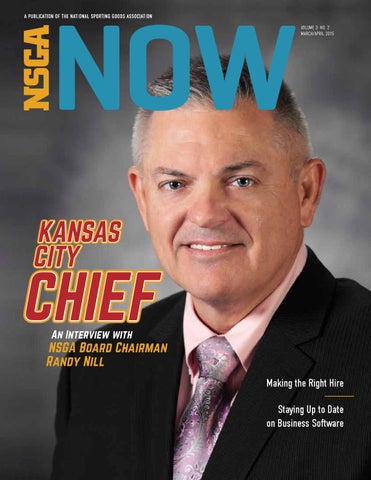
VOLUME 3 NO. 2 MARCH/APRIL 2015
KANSAS CITY
CHIEF An Interview with
NSGA Board Chairman Randy Nill Making the Right Hire Staying Up to Date on Business Software
NOMINATE THE 2016 CLASS OF LEADERS, INNOVATORS & INDUSTRY ICONS The Sporting Goods Industry Hall of Fame includes more than 150 of the industry’s pioneers and leaders. Do you know an industry icon who should be recognized for their outstanding contributions to the sporting goods industry? Nominate them for the 2016 class of the Hall of Fame! Deadline is March 16, 2015 Visit www.nsga.org/halloffame for all of the information today!
page 10
table of contents
The Smithsonian Called About Your Software Why upgrading will have long-term dividends for your business
2
ceo corner
3
GLOBAL now
4
INSIGHTS NOW
6
ASSOCIATION NOW
13
OPERATIONS NOW
17
LOCKER ROOM NOW
19
INDUSTRY NOW
Thinking Spring should also have you thinking about the Management Conference & Team Dealer Summit Cybersecurity is an issue that is not going away and NSGA has the solution through its alliance with Sword & Shield A look at the new online Research Center and all of its resources; The 2015 Cost of Doing Business Survey is now available Randy Nill brings a lifetime of experience in the sporting goods industry to his role as NSGA Chairman of the Board. He shares his thoughts on a variety of topics in this Q & A Some simple techniques to ensure you are making the right hire for a job opening Former NSGA Board Member and Olympia Sporting Goods founder Bill Joiner passes away; Updates on NCAA and NFHS rule changes Pop Warner study yields encouraging results on concussions; Bauer unveils plan to open retail stores in United States and Canada
NSGA NOW March/April 2015
1
CEO CORNER
NSGA OFFICERS
Although we hope it was a busy and successful time for our friends in the snow sports and winter sports categories, many of us who do not live in warm-weather areas are probably tired of shoveling snow and putting on layer after layer of clothes to battle the cold.
CHAIRMAN OF THE BOARD Randy Nill Nill Bros. Sports, Kansas City, KS
TREASURER/CHAIRMAN-ELECT David Labbe Kittery Trading Post, Kittery, ME
PAST CHAIRMAN Ken Meehan Dunham’s Sports, Troy, MI
BOARD OF DIRECTORS Salvador Colom Deportes Salvador Colom, San Juan, PR
Dale Donaldson Mallard’s Source for Sports, Castlegar, British Columbia, Canada
Pat Donnelley Donnelley Sports, Twin Falls, ID
Rhett Johnson Johnson-Lambe Co., Raleigh, NC
Cathy Pryor Hibbett Sports, Birmingham, AL
Pete Schneider Athletic Dealers of America, Viera, FL
Rob Summerfield MC Sports, Grand Rapids, MI
STAFF Matt Carlson President & CEO
Meghan Beach Marketing and Membership Program Manager
Dustin Dobrin Director, Research & Information
Marty Maciaszek Director, Communications
Katie Nemec Director, Marketing, Social Media & Special Events
Darlene King Director, Business Development
Nick Rigitano Research and Information Analyst
Chuck Suritz
We are ready to come out of hibernation and see green grass and trees again. It will be nice to get outside regularly and see friends and neighbors, go for a walk and engage in your favorite activities. The approach of spring is also a perfect time to think about a visit to Austin, Texas on May 3-6 for the 51st Annual NSGA Management Conference & 17th Annual Team Dealer Summit at the Omni Barton Creek Resort & Spa. It is a great way to renew old friendships and build new ones at an event that will inspire you in a number of ways. If you enjoy baseball then you will love having the chance to hear from one of the game’s legends in Monday morning speaker Cal Ripken, Jr. If you like golf, Tuesday will be a big day with dynamic and outspoken analyst David Feherty speaking in the morning and the annual NSGA tournament in the afternoon. Those big names are just a part of what will be taking place this year. Experts on retail, technology and time management will provide their insight to help you grow your business. Team dealers do not want to miss sessions on attracting younger talent to the business, meeting the challenges of change, how to get more from using social media and generating more sales. We will celebrate the best the industry has to offer with the Sporting Goods Industry Hall of Fame Dinner and Induction Ceremony and the All-Star Awards Luncheon. The tennis clinic and Mr. Newsome’s Neighborhood Walk with Hall of Famer Mickey Newsome are just a couple of the ways get out and get active. The numerous networking opportunities include a Monday night “Heart of Texas” reception. We have a couple of exciting additions to this year’s Management Conference. The NSGA INNOVATIONS ARENA will give companies with a new sporting goods or retail technology product the opportunity to get valuable exposure with industry executives looking for the next big hit in their stores. Our Wednesday sendoff will be a great way for attendees to give back to those who help make our industry so successful. Participants will work with volunteers from the Austin Parks and Recreation Department to help spruce up a popular local park and its athletic fields. Once again it will be a great time for everyone in the sporting goods industry. If you have already registered to attend the conference we’re excited about seeing you in Austin. If you have not registered yet, we hope you will go to www.nsga.org/ conference and do so today because we know you will not be disappointed. Best regards, Matt Carlson President & CEO
Director, Education & Strategic Planning
Larry Weindruch Director, Team Dealer Division
Dan Wiersma Chief Financial Officer
2
Marty Maciaszek
Matt Carlson
Editor/Publisher
President & CEO
NSGA NOW (ISSN 1045-2087) is published bi-monthly for members of the National Sporting Goods Association, 1601 Feehanville Dr., Suite 300, Mount Prospect, IL 60056-6035; Phone: (847) 296-6742; Fax: (847) 391-9827. Subscription price of $50 per year is included in membership fee. Non-member subscription information available from publisher. Periodical postage paid at Mount Prospect, IL 60056 and additional mailing offices. POSTMASTER: Send address changes to NSGA NOW, 1601 Feehanville Dr., Suite 300, Mount Prospect, IL 60056-6035. © by NSGA 2013. Printed in the USA.
March/April 2015 NSGA NOW
GLOBAL NOW
NSGA Program with Sword & Shield Enhances Data Security Through this alliance, Sword & Shield will provide the most up-to-date education and training resources for NSGA members.
NSGA has stepped in to help members minimize risk and stay ahead of cybercriminals through its alliance with Sword & Shield Enterprise Security. Members-only discounted rates are available for highly sought-after cybersecurity solutions. Sword & Shield has protected critical data since it was founded in Knoxville, Tennessee in 1997 and is the premier holistic information security provider. They deliver evaluation, remediation and ongoing monitoring and management to ensure you maintain the most comprehensive security posture possible.
NSGA NOW March/April 2015
They will also work with you personally to build or enhance your cybersecurity efforts to anticipate threats, find vulnerabilities and create information management plans. Their security experts are willing to work with every cyber need small or large, to take the time to find the right solution for every budget and to build long-term relationships at a discount. Sword & Shield is unlike many consulting firms as it specializes in three distinct, connected areas: information security, compliance and managed services. Their consultants are certified, experienced professionals and their security services
are comprehensive, allowing them to be a single-stop consulting solution. Small to mid-sized business owners often believe their information technology networks are too boring of a target for an aspiring hacker. However, most breaches affect businesses with less than 500 employees. Larger corporations have invested heavily in sophisticated security strategies and that has forced cybercriminals to look for other ways in and focus their attention on smaller companies. With all of the public attention on cybersecurity, now is the time more than ever to take the steps toward protection. To learn more go to www.swordshield.com/alliances/nsga.
3
INSIGHTS NOW
Introducing the New Research Center Section of NSGA’s Website By Nick Rigitano, NSGA Research and Information Analyst
In addition, members visiting the Research Center page can view topline industry figures derived from NSGA’s annual research reports. Predominantly featured are overall participation figures from NSGA’s Sports Participation in the US report, as well as topline consumer reported retail sales figures from NSGA’s Sporting Goods Market report. NSGA recently unveiled a new website with a new look and updated functionality. As part of the new website, NSGA is excited to introduce the Research Center. The vision for the Research Center is to provide a dynamic go-to resource for members looking to utilize NSGA’s industry information. In the NSGA Research Center, members can easily access complimentary reports, research webinars conducted by the NSGA research team, topline industry figures featured in NSGA’s annual research reports and insight papers providing tips to help businesses reach their maximum potential. In the complimentary reports section, members can quickly and easily download the complimentary report(s) specific to their NSGA membership. All members have to do to access the reports is login
to their NSGA account and click the “PDF Download” link. Also found in the Research Center are webinars conducted by the NSGA research team. These brief webinars explain how business owners can apply NSGA research to their business decision-making. They cover three key types of research data from NSGA’s 2014 editions of the Sports Participation and Consumer Retail Purchase studies: • Trended Participation and Sales Data • Demographic Data • Sports/Recreational Activity Cross Participation Data These exclusive webinars will also cover how to interpret the data efficiently by introducing common research measurements, including index benchmarking and cross-correlation relationships.
Lastly, members can discover tips on various business aspects through the Insight Papers section. Topics currently covered include driving impulse sales at retail, measuring advertising impact, understanding unplanned purchases and utilizing cross participation data for merchandising. While the vast majority of the Research Center web page is dedicated to members, there is a small section viewable to the public. This section contains US Economic Census-based data on the number of sporting goods stores by U.S. region as well as a Sporting Goods Industry-related FAQ document. Visit www.nsga.org to explore the new website!
Now Available: 2015 Edition of NSGA Cost of Doing Business Survey By Nick Rigitano, NSGA Research and Information Analyst
NSGA is excited to announce the availability of the 2015 edition of the Cost of Doing Business Financial Survey results.
and financial management measures. Also included are detailed margins and turnover data for equipment, footwear and clothing.
This report provides the most up-to-date comparative financial information in the industry. It also provides the ability to benchmark financial data to assess operating strengths and opportunities.
The 2015 edition of this report is a complimentary benefit of being a retailer/team dealer member of NSGA. NSGA retailer/ team dealer members can quickly and easily download this report at the Research Center page of the NSGA website. The report is also available to other NSGA members for $295 and to non-members for $395.
Along with balance sheet and income statement data, the survey includes a wide variety of profitability, productivity
4
March/April 2015 NSGA NOW
NSGA members save on shipping through the NSGA Shipping Program! There are no obligations and no minimum shipping requirements – just great savings!
SMALL PACKAGE Save up to
30
%*
on select FedEx services ®
LTL FREIGHT Save at least
70
%
off LTL carriers’ base rates
TRUCKLOAD For the best rates in the industry visit PartnerShip.com/Quote
... and many others
enroll online today at
PartnerShip.com/06NSGA 29077 Clemens Rd. • Cleveland, OH 44145 • 800-599-2902 • sales@PartnerShip.com *Includes a bonus 5% online processing discount. Full details available at www.PartnerShip.com/06NSGA/FedExdiscounts.
ASSOCIATION now
Randy Nill, President and CEO, Nill Bros. Sports By Marty Maciaszek, NSGA Director of Communications
and colleges. Their mother, Martha, was the bookkeeper and their grandfather ran the small retail store. Randy and Stan Nill grew their business from one store in 1978 to six retail/team stores in the 1980s and 1990s. Stan left the company 12 years ago to pursue his dream of working for his church, but Randy has stayed with it even as the influx of bigger chains has cut Nill Bros. to three locations with nine outside school salesmen and four inside team salesmen.
Randy Nill saw his career in the sporting goods industry take an interesting turn during his freshman year at Wichita State University. Nill had worked in the family business, Nill Bros. Sporting Goods in Kansas City, Kan., since he was 5 years old. He went to Wichita State to become part of the school’s first collegiate wrestling team but the program never got off the ground. An attempt to make the golf team didn’t work out for Nill. So, he went to work for Wichita Sporting Goods, which was owned by former NSGA Chairman of the Board Frank Woolf.
Nill has seen first-hand how the industry has changed in the 55 years he has been involved with the family business. Now he is using that experience to help the industry as NSGA’s Chairman. In this Q&A, Nill shares his thoughts on a variety of topics affecting the industry, team dealers and NSGA. NOW: What appealed to you about getting into the sporting goods industry? RN: My father Bill started Nill Bros. Sports in 1960 when my brother Stan was 7 years old and I was 5. My mother was the bookkeeper so the business was a daily part of our lives. We started going to work with dad four years later during the summers,
sweeping floors, filling school orders and stringing tennis rackets. My brother and I felt an obligation to mom and dad to take over the business when we got out of college so they could retire and enjoy life without the pressures of running a business. I’ve been running the business ever since. The smart one, my brother, left the business 12 years ago to pursue his dream of working for his church. NOW: Nill Bros. Sports serves schools in the Kansas City Metro area and a 200-mile radius surrounding Kansas City. What makes that area such a hotbed for sports? RN: There is a great mix of the Royals and Chiefs at the big-league level and that fervor for sports extends to college, high school and youth sports as well. People in this area have a passion not just for watching sports but they also understand the value and benefits of getting out and participating in sports. NOW: How has Nill Bros. been able to succeed with all of the changes in the industry? RN: It has not been easy. It takes a lot of effort and hard work. We face many chal-
Nill is now in the same position as the man he once worked for more than 40 years ago. He is in his first year as the leader of the NSGA Board and he brings a vast amount of experience to the position thanks to his father Bill’s decision not to uproot his family. Bill Nill worked in sales for Carter Waters, a Midwest construction supply company, when he was asked to move to Chicago to run its Chicago operation. Nill opted to stay in Kansas City and start a sporting goods business in 1960. Randy Nill grew up in the family business with his older brother Stan by doing all kinds of tasks in the summer while their dad sold sporting goods to high schools 6
The original location of Nill Bros. Sporting Goods in Kansas City.
March/April 2015 NSGA NOW
actual face-to-face conversation and that has its challenges with a greater potential for miscommunication. I think when you combine the advances in technology with some old-school personal attention it works out great for the team dealer and the customer. NOW: Marketplace Fairness is one of the major advocacy issues NSGA has taken on in recent years. How important is it to retailers and team dealers to have the marketplace fairness issue resolved?
Roy Williams, one of the most successful coaches in college basketball history, was working at the University of Kansas when he visited with the Nills in the 1990s. From left, Stan Nill, Martha Nill, Williams, Bill Nill and Randy Nill.
lenges today in our industry that all the other independent team dealers are facing from the national chains, to Internet sales, to competing against our own vendors. We know that today’s consumers have so much information available on their smart phone or mobile device and we have to be able to respond quickly and knowledgably. Quality customer service still matters to people and we try to make sure our customers are treated right. With the schools and teams we work with, we try to keep up with how they are doing so they know we have a personal interest in their programs. NOW: How important do you feel it is for you to provide a prominent voice to the team dealer community with so much uncertainty on that side of the industry? RN: There have been so many changes in the team dealer community the last decade with consolidation in the industry and more and more manufacturers selling direct. I believe I can use my role as NSGA chairman to provide knowledge and support to the team dealers who are battling the many challenges they face. The team dealers need to understand they continue to play a vital and important role by the way they serve their schools, their communities and their youth sports teams, leagues and organizations. It still feels good to buy and support local businesses. NOW: What needs to happen today for the sporting goods industry to be vibrant 10 to 20 years down the road? NSGA NOW March/April 2015
RN: We need to keep looking for solutions to combat the declines in participation at all ages in sports. There are a lot of reasons we are seeing people drop out of sports and we have to realize it is an issue that directly affects our businesses. Innovative products that are affordable will be extremely important since athletes are looking for anything to give them even the slightest edge, which for the athlete is as important as it has ever been. Technology is a perfect example of the need to anticipate and embrace change. We really have to stay on top of what the technological trends are because our customers walk into our stores with so much knowledge and purchasing power. Our employees have to be extremely knowledgeable in order to build that relationship with a customer. It’s pretty easy for them to go find what they want on-line, but we have to make them aware of the value they can receive by coming into our stores, and give them an experience that will keep bringing them back. NOW: How has technology changed the landscape for team dealers? RN: Coaches, athletic directors, players and parents have immediate access to the products and uniform styles they want so the knowledge they have has increased and we have to respond to that with a higher level of technological savviness. Newer and younger coaches are used to dealing with people more through text messages and emails than
RN: It is vital for the brick-and-mortar retailers and that’s why so many of us have been happy to see NSGA put in the time and effort it has to get the Marketplace Fairness issue resolved. It isn’t right to have a tax system that favors one portion of the marketplace over another. I think it is important for people to know this isn’t a new tax but the enforcement of a tax code that has been in place for years. If passed, this bill would ensure that all businesses, online or offline, large or small, would all play by the same sets of rules in regards to sales tax. NOW: What does NSGA need to do to be more relevant to retailers and team dealers? RN: I think NSGA is doing an excellent job of exploring the many different areas where we need help – short of adding a few hours to each day! Staying on top of the latest technological advances is important. Addressing the issues of data continued on page 8
Randy Nill’s Favorite Things Attending sporting events (youth or pros), reading, spending time with family Movie: Remember the Titans Food: Filet Mignon Oscar Style Vacation destination: Vail, Colorado Sport to play: Golf Sports to watch: NFL football; high school and college wrestling Sports teams: Kansas City Royals, Kansas City Chiefs, University of Kansas Book/Author: A Time To Kill, John Grisham 7
breaches – and making all of the NSGA members understand they could be affected – will really help us. Continuing to find services that can help us from a business standpoint is huge. NSGA’s work with Advanced Systems Group to make the SouthWare Team Sports program available to members has been a huge benefit. To have a reasonably priced option which provides point of sale data and helps with inventory and financial management is fantastic. Those who are using it save a lot of time and are definitely operating more efficiently.
NOW: You have been attending the Management Conference and Team Dealer Summit for 15 years. What makes it such a special and important event? RN: The Management Conference is a great place to catch up with dealers and vendors and find out what is happening in all the different areas of the industry. The speakers always provide some great
portant to be there if you want to maintain that edge on the competition. Plus, it is always at a great venue that my wife and I always enjoy. I can’t wait for Austin, Texas, beginning May 3rd. NOW: What have you learned about the sporting goods industry through your service on the NSGA Board and now as chairman?
It is important for NSGA to keep us informed on what is happening not only in the industry, but in other areas that can have an impact on our ability to run a successful business. Staying on top of possible rule changes and partnerships the NCAA, NFHS and other sports organizations are making and forming – and getting that information out to the membership – is critical to our success as well. What NSGA has done in the research area is making a big difference in how we operate. NSGA has gone from good to great with what it offers from sports participation trends to sporting goods market data. NSGA continues to be a go-to source for industry insights and that includes new and unique information which we may not have realized was important to our success. NOW: What are the most important things you want to see NSGA accomplish during your term as chairman? RN: NSGA has a big challenge in serving a wide variety of people throughout the industry. The continued push it is making for Marketplace Fairness would help so many of us who are part of NSGA. The development of the program with Sword & Shield to deal with the issues of cybersecurity is a huge benefit for all NSGA members. It will also be important for NSGA to remain at the forefront of the constant changes in technology and how they are impacting the way we advertise and market our businesses. One of the best aspects of being the NSGA Chairman right now is we have a diverse and active board that wants to make sure NSGA continues to be the leader for the industry. It is a great group of people to work with and I know some of the newest members of our board are going to bring some great ideas that will help all of our members.
8
Randy Nill had the chance to visit with another college basketball coaching legend, Duke’s Mike Krzyzewski, at the 2013 Management Conference & Team Dealer Summit.
educational and inspirational messages that help myself and others who attend when we get back to work. We find out more about the latest trends in the sporting goods industry, and on a larger scale, in retailing. There are also so many great social opportunities at the conference like the golf tournament and Hall of Fame ceremony and dinner. Every aspect of the Management Conference & Team Dealer Summit makes it a very valuable event. NOW: What would you tell team dealers who have never attended the Management Conference or haven’t attended in years? RN: It is worth the time and effort you make to get there. Every year there are great sessions geared solely to the team dealers and they have helped me succeed. There is nothing else in the industry like this for team dealers where we can learn and share ideas and concerns in professional and social settings. Some of the new initiatives such as the NSGA INNOVATIONS ARENA, which will give new companies and startups the chance to showcase their products, add tremendous value to the event. Our side of the business is also very competitive and it is im-
RN: We have a very diverse group of people with many different needs. The big box chains have challenges that are different from the smaller team dealer. But in the end, what’s great about the sporting goods industry is we all want the same thing, more kids and adults participating in sports. Sports and physical fitness are what keeps our nation healthy and vibrant. NOW: In regard to becoming relevant again, how excited were you to see the Royals return to baseball’s postseason after 29 years and finally make it back to the World Series? RN: To see how everyone in Kansas City got caught up in baseball again was great, and it definitely didn’t hurt us from a business standpoint. It was a lot like the 1970s and ‘80s when they were regularly winning division titles and the World Series (in 1985). It was disappointing to see them come close and just miss winning it all, but hopefully it is just the start of long stretch of success so we don’t have to wait another 29 years to be really busy in October again. Now if the Chiefs could just win a playoff game every now and again!
March/April 2015 NSGA NOW
Durably Waterproof
GREAT
DAY
FOR
A
RUN
52º
47º
35º
28º
33º
Highly Breathable
With GORE-TEX Footwear Technology ®
Experience more
Your favorite running shoes just got better, the weather app on your phone less relevant, and your run better protected from the elements. Because the most trusted brands in running have integrated durably waterproof, windproof, and breathable GORE-TEX ® footwear technology in some of their most iconic road running styles. So any day can be a great day for a run. gore-tex.com © 2014 W. L. Gore & Associates, Inc. GORE-TEX®, GORE®, GUARANTEED TO KEEP YOU DRY® and designs are trademarks of W. L. Gore & Associates
NSGA NOW March/April 2015
9 11
OPERATIONS NOW
The Smithsonian Called About Your Software Upgrading Has Long-Term Dividends for Business Owners By Scott Gaspar, Advanced Systems Group
Ancient History It all started thousands of years ago. At least that is the oldest record we have of competitive sports. The ESPN of the day was nothing more than sketches on cave walls. The sporting goods business was simple. Trading a goat for a pair of sandals required little of the business owner. Centuries would pass before the sporting goods industry would become complex enough to require a system of accounting and inventory. With the birth of small business computers in the 1970s, the world changed, as accounting and inventory systems were transitioned from paper to screen. It was also during this time that transactional data and information, previously used to simply manage accounting, began to provide competitive advantages. Computers, and their ability to do in seconds what used to take bookkeepers days, could now deliver vision in the form of performance reporting and resource forecasting. The result was a huge reduction in the labor cost of doing business and an increase in the speed of all business transactions.
On the other end of the spectrum, the business owners who made the leap early were clearly nuts, but they did so because they recognized the reality of a changing business landscape that would require modern tools to compete. Today, most of these lunatics are retired, or have other crazy people who manage their empire of stores, distribution plants and manufacturing operations. The transition from pencil to screen is similar to surgery without anesthetic. Sure, the doctor is trying to save your life, but it hurts a lot, and once it’s over, you never want to do it again. But the results can be miraculous and are well worth the pain.
Others meandered along for decades, like hermit crabs refusing to move into a larger shell. They remained frozen in time, bound by all of the things that kept them busy but didn’t make them any more profitable. Some of these companies still survive in dark lonely corners of the industry, reliant on a dwindling population of aging accounts. 10
Another characteristic of the early transactional systems was that they were “appliance” based, much like a toaster or dishwasher. Basically, “appliance” business systems include hardware and software that one purchases, installs, configures and then uses for years, or even decades without much improvement. Over time, these static systems become worn down and less efficient. Thankfully, technology has changed. The concept of business systems as a transactional appliance no longer exists. Instead of static environments, the new systems are designed to evolve with a business and an industry. The functions of the software change as the business does and provide a never-ending stream of new features and tools, designed to deliver competitive advantages from nearly every angle.
These new technologies were expensive and they were also big. A computer powerful enough to run a business was the size of a small file cabinet, yet still had less computing power than the Fitbit on your wrist. However, the increase in efficiency paid for the investment several times over. As with any change, the computer age represented a painful process for most sporting goods companies. Some business owners could not see past the investment, and without modern tools to grow, they could no longer compete. Their customers became low-hanging fruit, easily plucked by competitors.
were designed to manage accounting and inventory, and generate paper support for transactions (invoices, picking tickets, purchase orders, returns, etc.). The user was required to mine data in the system for useful information, and the design of new reports required the services of a developer (usually at a hefty cost).
The Next Leap Because modern technology is so different, the process of moving to new software is not as painful as it used to be. In the early days of business software, companies migrated to transactional systems. Unless a business owner has upgraded in the past 6 to 10 years, this is likely what they use today. These systems
These modern systems are updated frequently and allow for updates and customization without significant investment, and without hindering the ability to update in the future. As a result, the majority of software companies no longer offer upgrades every couple of years, but instead provide “subscription” updates that the owners can choose to run at any time. This allows their users to evolve with the system and take more of an active role in providing feedback and improvement. Basically, the users become part of the improvement process, and the software provider becomes a partner in making the small incremental changes that deliver immediate value. All of this change sounds scary, especially when one thinks back to the horror of their first software conversion, but in reality, this modern approach offers very little to fear. Users gradually get new tools with March/April 2015 NSGA NOW
little or no interruption of current business processes. The cost of staying current is reduced, and the threat of business interruption, posed by a traditional software upgrade, is eliminated. Another advantage of today’s business software is what is technically referred to as “versioned data deduplication.” Basically, this is a smart-technology that can view and understand changes in data and can differentiate it from data that remains the same. This means that systems now offer the ability to safeguard copies of all data off-site in a secure, up-to-date status without requiring massive amounts of storage (the old tape-drives), or super-fast Internet connections. Think of it this way; if an owner’s building burns down tonight, their software provider can usually have them up and running on their system, with all of their data, in less than a day, without losing a single order, invoice or purchase. The owner also gets the ability to do “versioned” restorations of data in case someone accidentally hits the wrong button and deletes important files. Of course the biggest advantage offered by current systems is the modern toolset they deliver. Tasks that used to take days, hours or even minutes now take only seconds. Likewise, business owners now have access to live data related to sales, purchasing, production and profitability, giving owners the ability to make critical business decisions backed by real data instead of acting on hunches, generalizations or flawed calculations. The new systems can also be paperless and infinitely mobile, meaning that businesses have access to the entire system from their laptop, tablet or other connected mobile device. Businesses can communicate with other systems through data exchange and email, and they can digitally store all of their paperwork, artwork and business-related documents with the orders and purchases they relate to in the system. This means no more filing cabinets, and a business owner can access all of the files from anywhere with an Internet connection. Technology has come a long way since the first business software. For those who haven’t advanced with it, they have some catching up to do.
The Threat of Doing Nothing For business owners who are ready, but just fear the unknown, let’s examine some of the most common obstacles to movNSGA NOW March/April 2015
ing forward. These are the freeze-rays that make it nearly impossible to make a technology decision.
“If everyone is moving forward together, then success takes care of itself.” - Henry Ford
How long does one wait? One can answer this with another question: “Are you on a software that can grow and evolve with your business?” If the answer is yes, then that is great news for you. If however, the answer is no, then perhaps it is wise to consider what is available to your industry and talk to some of your colleagues about the systems they use. View some software demos. One may find features they had no idea they needed, but that offer solutions to problems that were never considered solvable. A good software provider will be very familiar with the challenges a business owner faces and most likely have already helped others overcome many of the same obstacles. There is no cost to sit in on a demo except time, and a demo is always worth someone’s time!
What are the risks? What is the risk of doing nothing, and what is the risk of doing the wrong thing? The risk of doing nothing is that competitors, who already take advantage of new tools and technologies, will quickly gobble up customers by providing more service, more accurate production and a better marketable inventory with less effort and at a higher margin. The competition will also present an internal threat, because they become more attractive to employees, especially a sales staff, who feel threatened by the reluctance of their business to show progress and the opportunity it represents. This is an industry with a great deal of peer-to-peer mentoring, and there are groups such as NSGA whose sole purpose is to act as an advocate for the industry, through the vetting of various products and services. Business owners are also very likely a member of a buying group that is active in evaluating business products for their members. These are their best resources, each with a vested interest in pointing the owner in the right direction. Another risk to consider is the issue of business’ transition and continuity. What happens if an outdated system fails and is no longer supported by anyone who can
help implement a recovery from such a failure? Is there a paper plan? When one passes the business to the next generation of ownership, are they being left with obstacles that prevent their success? Business owners have been doing this for a long time, and even though the owner may not be the most technologically advanced person, they are likely better prepared, from a business standpoint, to manage a software transition than those to whom they intend to pass or sell their business to.
When is the right time? “Indecision is a virus that can run through an army and destroy its will to win, or even to survive.” - John Wayne from In Harm’s Way (1965) Those who have taken the time to read this article know that the right time is now. An owner is either working on an antiquated system, a system that does not fit their business, or worse, they are one of the few holdouts with no business system, just using some “quick” off-therack accounting software to get by. Those owners have been watching their competition and colleagues take advantage of technology to grow and they don’t know where to start. The best option for them is to call NSGA or their buying group, ask them who they recommend and then schedule some demos. Keep in mind that a comfortable transition will take 6090 days, so visualize that on a business calendar. Don’t rush; give plenty of time to vet the company and research whether or not they have a track record of failure or success.
How much will it cost? Technology is not cheap, and you can expect the services related to the transition to cost about as much as the actual software product. Different companies also use different pricing models, but in the end, they all come out to be very similar in total investment. There are some very important things to look for, though. An owner wants a company that has a high degree of participation and investment in their industry. They should be able to quickly provide “total investment” pricing that includes all software, hardware, services, training, and support, as well as any ongoing expense. A good rule of thumb is to expect the software to cost around $2,500-$3,000 per user. continued on page 12
11
Be aware that in the software industry, there are two distinct types of companies: sales organizations and service organizations.
• They will need to adopt new technology to survive.
The sales organizations make the majority of their revenue from the sale of software and the conversion process. For these companies, ongoing support is a liability, so they typically outsource to call centers and third parties. These companies need to sell software quickly and then move on to the next prospect. Unfortunately, this is a very successful model and therefore makes up the majority of the software industry. They typically employ large sales teams, use relentless closing tactics, and provide complex documentation designed to move people through a very scripted sales process. They will also cast a broad net, with companies in hundreds of different industries. This forces them to offer a generalized product and be very resistant to any customization for an owner or their industry.
• The cost of doing nothing exceeds the investment.
The other type of company is the service organization. These are typically smaller software developers and specialized resellers that focus on an industry or group of vertical industries. They profit from the long-term relationships with each client and the specialized industries they serve. These companies work to become experts in an owner’s business, and acquire specific experience working with companies in an industry such as sporting goods. They’ve seen the good, the bad, and the ugly parts of that industry, and have built tools into their systems to manage the most unmanageable. Almost all of their new business comes from referral and industry specific relationships, so they don’t waste much money on advertising, fancy brochures or telemarketing. Their focus is to offer a very specific product and regard clients as partners rather than just customers. No matter what type of company one feels comfortable working with, the investment in a new system is going to be significant. However, if the system is configured and implemented correctly, it will pay for itself several times over.
The Choice To Make Today I suppose things were much easier when people could just trade sandals for goats but those days are long gone. A business owner has likely already gone through at least one technology conversion and today faces the prospect of another. When the owner chooses to move forward is up to them, but they must face the following truths: 12
• It will not be cheap. • The transition will not be without pain.
• The longer the wait, the more difficult and expensive the transition will become. No matter what the commercial says, there is no easy button in business. Technology evolves, and either a business evolves with it or gets left behind. But no one is alone in this regard. Many have already blazed the path and industry associations have done a good job of vetting providers and negotiating on their members’ behalf. The rest is up to you.
Scott Gaspar is in his sixth year with Advanced Systems Group and is currently the Enterprise Business Software Consultant. He was also Director of Outside Resources for a large wholesale distribution company which worked directly with retail chains across the United States. Gaspar has more than 20 years of experience working with a wide range of ERP, CRM and logistics software platforms and his first computer was a Heathkit.
Select software provider for the National Sporting Goods Association.
Retail, Wholesale & Distribution Software Solutions FINANCIAL MANAGEMENT • Accounts Payable • Accounts Receivable • Collections • General Ledger • Payroll • Fixed Assets • Cash Flow • Business Intelligence SALES & E-COMMERCE • Complete CRM • Order Management Portals • Complete Online Shopping Cart • Integration With Existing Systems
SouthWare offers a complete modern business system for sporting goods wholesale, distribution and retail operations, supported by Advanced Systems Group, the Select Software Provider for the National Sporting Goods Association. We make companies more profitable!
POINT OF SALE • Paperless Credit Card Processing • Customer Purchase History Tracking • Product Images • Barcode Scanning • Special Order Management • Advanced Gift & Loyalty PRODUCTION & DISTRIBUTION • Inventory Control • Purchasing • Return Authorization • Production Management • Artwork File Management • Assembly & MRP • Vendor Catalog & Price Import • Shipping & Freight Management
SouthWare business software is easily scaled from small to large systems so your business will not outgrow your software. AthleticDealerSoftware.com 888-627-0200
ADVANCED SYSTEMS GROUP, INC. [ CONSULT TRAIN IMPLEMENT SUPPORT ]
March/April 2015 NSGA NOW
OPERATIONS NOW
How to Hire the Right Person And Stay Out of Trouble While You’re Doing It By William J. Lynott
On the surface, it appears to be a routine chore. There is a job to fill, so applicants are interviewed and the most promising one is selected. In truth, interviewing job candidates today is far from a routine task. One of the toughest issues to resolve with new hires, especially in a retail business, is measuring the applicant’s relevant skills. How can one tell if a prospective employee has the level of experience and dedication that is necessary? Everyone has probably developed their own methods for measuring hard skills in new applicants. Still, it’s important to remember, there are other qualifications that may be at least as important. NSGA NOW March/April 2015
“There has never been a time when preemployment interviewing skills have been more important,” says Therese A. Hoehne, Director of Human Resources at Aurora University in suburban Chicago. “You must keep in mind that there are many complex laws that govern the interviewing/hiring process. Today’s legal constraints have made a tough job more complex and more risky than ever.” Fortunately, there are simple techniques that can help interviewers negotiate that difficult path. NSGA NOW asked several experts to give us their best advice. Here’s what they told us:
Talk Less; Listen More “Most interviewers talk too much,” said Emory Mulling, chairman of The Mulling Companies (Atlanta, Ga.) and author of The Mulling Factor: Get Back Your Life by Taking Control of Your Career (DC Press, March 2002). “The interviewer’s role is to get information from the candidate. Too often, interviewers spend too much time talking about the job and themselves and not enough time asking relevant questions of the candidate.” Human resources professionals agree that talking too much during an interview is a common mistake. Remember, the goal continued on page 14 13
during a pre-employment interview is to obtain as much meaningful information from the potential employee as possible. The interviewer can’t listen when he or she is talking.
Examine Résumés and Applications Carefully While complete honesty on a job application may not be the norm today, most experts advise employers to question the obvious. Time gaps between jobs often signal the need for a closer look at an applicant’s employment history. “Look for ‘short-timer-itis’ -- the person who seems to switch jobs every 12 months,” Hoehne said. “If the applicant is new to the job market and has already had two or three jobs, this may or may not be a warning sign. However, if the applicant has 10 years experience and 10 jobs, you will want to discuss the reasons. This could indicate a ‘job-hopper’ at best and a serious problem employee at worst.” Take a careful look at recommendations from former employers. There are many reasons for an employer to provide favorable recommendations for a former employee; not all of them are as sincere as they might appear.
14
Keep the Interview on Track As with any conversation, a pre-employment interview can stray far off its proper path if not carefully controlled. “If I had a friend conducting an interview, I would advise him to ask only those jobrelated questions that he needs to ask to make a lawful hiring decision,” said Labor Attorney John C. Romeo of Philadelphia. “I would advise him to pay close attention to the direction the conversation takes during the interview. An interview can easily turn into a conversation about family, religion or national origin. “If the interviewer sees the conversation going in this direction, he should make a strong effort to stop and switch gears -- get the conversation onto a proper and legal topic.”
Prepare a Written List of Questions A retailer may have to deal with applicants of both sexes in their store. If they do, they must not ask different questions of males and females. To do so is to risk violation of discrimination laws. “I usually create a list of questions to ask all candidates before the interview process starts,” said Hoehne. “I then put those questions on a sheet of paper with space between them to take notes.”
James Walsh, author of Rightful Termination: Defensive Strategies for Hiring and Firing in the Lawsuit-Happy 90s (Merritt Publishing, 1994) also advises starting with what hiring experts call structured questions. “Ask them of every candidate and base your comparisons on their answers.” He suggests using a simple worksheet to do this, checking off each applicant’s strengths against the job skills required for the position. Bob Dickson, former Director of Labor Relations & Personnel, Merck & Co., West Point, Pa., also believes in using a carefully structured set of questions prepared in advance of the interview. “I recommend that you summarize what you have learned immediately after the interview,” Dickson said. “One way to do this is to list relevant answers and information next to each question on your list.”
Listen Carefully to the Answers “Even after asking the right questions, some interviewers make the wrong choice because they didn’t listen carefully to the answers,” said Mulling. “Don’t kid yourself into thinking you can overcome potential conflicts and make someone fit in just because you like the way they look or because their technical skills or past experience are a perfect match for the job.”
March/April 2015 NSGA NOW
Be Aware of Incompatibility
Don’t Focus Exclusively On Hard Skills
“Ask questions about the candidate’s preferred management style to determine if he or she will fit with your own,” said Mulling. “For example, a candidate who likes to work independently won’t fit with a boss who’s a picky micro-manager.”
“Some interviewers take a résumé point by point and discuss only the candidate’s relevant experience or hard skills,” said Mulling. “Technical skills and experience are not always the best indicators of success on the job. The candidate must also be a good fit for the boss and the work environment. Two candidates can be equally qualified in experience, but vastly different in terms of personality and workstyle preferences.
Keep in mind that retailers are looking for a person who will fit in comfortably with the existing culture in the store.
Places You Don’t Want to Go Don’t Get Tripped Up By Illegal Questions In the early 1990s, courts outlawed the use of questions which provided answers that could be used to discriminate against applicants in the hiring process. Now, an interviewer who asks them may face a discrimination lawsuit. “The Americans with Disabilities Act and the Civil Rights Act of 1991 make hiring a potential nightmare,” said Walsh. It is in an interviewer’s best interest to know what questions may lead to litigation. Interviewers must not ask any questions concerning so-called protected classes, including race, sex, age, national origin, religion, or disabilities. In general, the law also prohibits questions about workers’ compensation or health history. See the sidebar for examples of specific questions that should not be asked of an applicant. In Rightful Termination, author Walsh cautions that this list of pitfalls is likely to grow over the years as the courts seek to gauge the meaning of vaguely worded discrimination laws. “I suggest that interviewers think of it this way,” said Romeo. “Don’t ask a question if you cannot lawfully base a hiring decision on the answer. You cannot discriminate based on information you do not have. So, if you don’t need to know, don’t ask.”
As They Say In a Courtroom, “Don’t Lead The Witness.” Mulling cautions interviewers not to give away too many details of what they are looking for in a candidate. “If you do that,” he said, “the candidate will mold his or her answers to what the interviewer wants to hear. That can result in the candidate being hired, qualified or not.”
NSGA NOW March/April 2015
“Many technical skills can be taught to the right applicant but you can’t teach a person how to be friendly or adaptable.”
Avoid Any Statement That Implies a Promise of Permanent Employment “The employer’s vulnerability in a wrongful discharge suit begins in the early stages of the relationship,” said Walsh. “The courts sometimes find a contractual relationship in seemingly harmless statements about job security or advancement opportunities. Even an oral promise of a wage review after a specified length of time should be avoided; the courts may find a contract of employment for that length of time in any such promise.”
Make Sure Pre-Employment Tests Measure Only Relevant and Important Skills A 1971 Supreme Court decision, Griggs v. Duke Power, provided a major precedent in pre-employment testing. In that case, an applicant for a janitorial job was required to take an intelligence test and show a high school diploma. When the company did not hire him, the applicant sued and took his case all the way to the Supreme Court. The court ruled that a high school diploma was irrelevant to the janitorial position in question. The court also ruled that pre-employment testing must measure only skills directly related to performance on the job being sought. While pre-employment tests are still widely used, most have been carefully designed to comply with that 1971 Supreme Court decision. One should never take pre-employment interviewing lightly. “Interviewing is perhaps the most critical part of the employment process,” Dickson said. “It’s a responsibility that you will want to prepare for carefully. The information you obtain from the candidates will become the most important factor in your final decision.”
Questions An Interviewer Should Never Ask an Applicant 1. Avoid questions about pregnancy. Except in very limited circumstances (e.g., health reasons), employers cannot make hiring decisions based on an applicant’s pregnancy. If an interviewer was to ask a female applicant whether she was -- or planned to be -- pregnant, the employer is setting itself up for a discrimination claim. 2. Interviewers must not ask any questions concerning so-called protected classes, including race, sex, age, national origin, religion, or disabilities. In general, the law also prohibits questions about workers’ compensation or health history. 3. Watch out for questions that seem harmless but lead to information that could be used to discriminate against the applicant. For example, asking an applicant what year she graduated from high school can give rise to an age discrimination claim since the applicant could allege that the employer used the information to figure out the applicant’s age. A better question is, simply, “Did you graduate from high school?” 4. Avoid these specific questions: • Are you planning to have a family? • Do you have children? • Have you ever been injured on the job? • What year were you born? • Do you have a disability?
15
locker room now
Former NSGA Board Member Bill Joiner Passes Away at 83 Founder of Olympia Sporting Goods Served Two Terms from 1993-98
which became a success on the team dealer side of the industry. Joiner, who also served two terms on the NSGA Board of Directors from 1993-98, passed away Feb. 1 at age 83. He kept working for Olympia until he sold the company last May. “We are deeply saddened about the passing of Bill Joiner and we extend our sincerest condolences to his family,” said NSGA President and CEO Matt Carlson. “Mr. Joiner impacted so many lives as a championship-winning athlete, a coach, and as a successful sporting goods business owner. He was a tremendous supporter of NSGA and our industry and will be missed.” Bill Joiner knew what it took to build a successful team. Joiner coached Sidney Lanier High School in Montgomery, Ala., to four boys basketball state championships. In 1973, he made the transition into sporting goods and founded Olympia Sporting Goods,
Joiner was born in Montgomery and played on Lanier’s 1949 state basketball championship team. He played football, baseball and basketball at Troy State University and eventually returned to lead Lanier to four basketball titles from 1962-67.
Joiner was also Lanier’s head football coach and athletic director from 196973 and the school named its gymnasium Walker-Joiner Gymnasium during the 1980s. He was inducted into the Alabama High School Athletic Association Hall of Fame in 2004. “As much as I knew my dad was a great man, it hits even more, the lives that he touched,” Joiner’s son Allen told the Montgomery Advertiser. “I’ve had more people tell me, other than their dad, he was the most important person in their lives by teaching them hard work, discipline and teamwork.” Those values also led to Olympia becoming successful in the team sales side of the sporting goods industry as Allen and his sister Leslie worked with Bill Joiner. Joiner is survived by his wife of 63 years, Joyce; Allen and Leslie; two grandchildren and one great-grandchild.
Rule Changes and Updates
NCAA Baseball The 2015 baseball season will be the first where the NCAA uses flat-seamed baseballs during its postseason tournaments at Divisions I, II and III. The change was made in response to a decrease in offense and home runs at the Division I College World Series (CWS). 16
When the change was announced, according to the NCAA, research testing by Rawlings, the official supplier of NCAA championship baseballs, and Washington State University, determined the flat-seamed balls could travel an average of 20 feet farther than ones with raised seams. Committee chair Dennis Farrell said health and safety would not be an issue since the core of the ball and the bat-exit speed won’t change.
The National Junior College Athletic Association (NJCAA) will switch to flat-seamed baseballs for its 2016 postseason tournaments.
Only 3 homers were hit in the 2013 CWS at TD Ameritrade Park in Omaha, Neb., after 10 were hit in 2012 and 9 in 2011, which was the first year under standards to make metal bats perform more like wood bats. There were 32 homers hit in the 2010 CWS in its final year at Rosenblatt Stadium in Omaha.
NCAA Men’s and Women’s Track and Field and Cross Country
Rule 1-2-b: Foul poles shall be painted fluorescent yellow for new construction or repainting of existing foul poles. Any existing foul poles that don’t conform to being fluorescent yellow shall be repainted prior to the 2016 season.
Rule 4-3-4-b: The use of additional numbers usually affixed to the uniform to aid in the placing of competitors in a race shall be allowed. Placement shall be on the hip or outer upper leg. Institution and sponsor logos shall not be obscured and uniform requirements shall be observed. March/April 2015 NSGA NOW
Rationale: Hip numbers should not obscure team or sponsorship logos. Specifying the location of additional numbers will ensure consistent placement and can also aid in student-athletes’ familiarity with meet procedures between competitions. Rule 5-1-2.: All races shall be started as a result of the starter activating a signal. The signal shall be the report of a pistol that can be cocked, or an electronic tone of at least 112 dB at 15 feet. The pistol shall be not less than .32-caliber, together with a simultaneous flash/smoke generated by a pistol or an electronic flash/strobe, clearly visible to the timers whenever Manual Timing is used. A .22-caliber pistol may be used for Fully Automatic Timing and for indoor events. A misfire shall not be a start. Rationale: With automatic timing it is not necessary to have the flash or smoke. Rule 6-1-8: Throwing Aids: a. For the purposes of this rule, the following shall be considered assistance, and therefore not allowed: 1) The use of gloves except in the Hammer Throw and the Weight Throw. For these two events, the gloves shall be smooth on the back and on the front and the tips of the glove fingers, other than the thumb, shall be open. An additional layer of leather may be affixed to the palm of the glove for additional protection. 2) The taping of two or more fingers together. If taping is used on the hands and fingers, it may be continuous provided that as a result no two or more fingers are taped together in such a way that the fingers cannot move individually. The taping must be shown to the head event judge before the event starts. 3) The spraying or spreading by a competitor of any substance onto the throwing surface of the circle or onto the bottom of their shoes, except for water as a cleaning agent, nor the roughening of the surface of the circle. b. For the purposes of this rule, the following shall not be considered assistance, and therefore allowed: 1) The use, in order to obtain a better grip, of a suitable substance on the hands only or in the case of the Hammer Throw and Weight
NSGA NOW March/April 2015
Throw, on the gloves. Such substances may be used on the neck in the Shot Put. 2) The use of chalk or a similar substance applied directly on the implement. Any such substances shall be easily removable using a wet cloth and shall not leave any residue. 3) The use of taping on the hands and fingers that is not in contravention of section a.(2) of this Rule. Rationale: Make all taping allowances and restrictions the same across all rule books (IAAF and USATF) and have consistency in all cases where competitions involving NCAA competitors may occur. Wound protection and support belts are already allowed in Rule 4-3.6b(5). Incorporates all elements of the deleted rules into one rule.
NCAA Water polo Swim Cap section moved from 4-5 to 4-2 and added: The only item allowed to be worn under a water polo cap is a swim cap. Rationale: No padded caps are allowed. Cap needs to conform closely to scalp.
NCAA Softball Bats To view the approved softball bat list as of Dec. 8, 2014 go to www.ncaa.org/ sites/default/files/Approved_Softball_Bat_ List_120814.pdf.
NFHS Equipment and Uniform Football Rule Change Proposals for 2015 Two equipment-related high school football rules proposals for the 2015 season are currently under review by the NFHS Football Rules Committee. Rules 1-5-1b (2) and 1-5-1b (3) would read: One American flag, not to exceed 2 inches by 3 inches, may be worn or occupy space on each item of uniform apparel. By state association adoption, to allow for special occasions, commemorative or memorial patches, not to exceed 4 square inches, may be worn on jerseys
without compromising the integrity of the uniform. Rationale: This clarifies and standardizes the rules language in all NFHS rules books for 2015-16. Rule 1-3-2 would read: Each team shall provide at least one legal game ball to the referee at the time the game officials assume authority for the contest. Only legal game balls approved by the referee may be used during the contest. The game balls may not be altered. This includes the use of any ball-drying substance. Mechanical ball-drying devices are not permitted. Each team may use any referee-approved game ball of its choice to free kick or start a new series of downs. If a touchdown occurs following a change of possession and the scoring team did not put the game ball in play, any referee-approved ball may be used for the try. Rationale: Once the game balls are given to the referee, they cannot be altered because of the weather conditions during the game. If you have any concerns or questions about these proposed changes, please contact Larry Weindruch at lweindruch@ nsga.org or Marty Maciaszek at mmaciaszek@nsga.org. The final session of discussion by the NFHS Football Rules Committee took place in January.
Pole Vault Planting Box Padding Changes Take Effect for NFHS in 2015 Season With the track and field season around the corner, this is a reminder that the National Federation of State High School Associations (NFHS) will require installation of pole vault planting box padding meeting the applicable ASTM Specification Standards for the 2014-15 high school season. The rule went into effect by the NCAA in December 2013. Padding can be incorporated into the design of the planting box or can be added to an existing planting box. The change was made to minimize the risk of injury to pole vaulters. NFHS started to allow the use of padding that met the ASTM Standard in the spring of 2013.
17
INDUSTRY now
Pop Warner Football Study Brings Encouraging Concussion Results learned by playing the great game of football and bring greater peace of mind to parents.” Pop Warner is currently working on aligning with a medical research organization and will begin the third party testing of the Unequal Gyro in the 2015-2016 season.
First Bauer Retail Experiences to Open in Boston, Minneapolis Areas
Following positive results from a 2014 season-long pilot study testing Unequal® supplemental head padding, where there were more than 11,000 athletic exposures among 20 Pop Warner football teams in two states, Pop Warner Little Scholars Executive Director Jon Butler announced Pop Warner is planning to conduct a larger study with more Pop Warner teams and players using Unequal in the 2015-16 season, to be conducted by an independent research firm. “Pop Warner is constantly exploring all avenues to make football better and safer for its players. In addition to advanced coaching education and some of the most progressive rule changes in the sport, we regularly work with equipment and technology companies to improve the player experience,” Butler said. “Over the course of the 2014 season, 546 players participated in a pilot project using the Gyro®, Unequal’s supplemental head padding for football helmets. The results of this initial testing period were encouraging. Concussions among participating teams appeared to have decreased significantly. We look forward to continued testing of Unequal’s Gyro in a broader study monitored by a third party medical research organization.” Rob Vito, CEO of Unequal said, “We are pleased by the decrease in concussions in this study and how Unequal improved the safety of Pop Warner’s football players involved. But I am not surprised at the results, given other field data that also 18
shows a significant decrease in the concussion rate of players using Unequal as compared to players not using Unequal. Of course nothing can prevent concussions. Our goal is to significantly reduce the risk of concussions.” Dr. Julian Bailes, Chairman of the Pop Warner Medical Advisory Board, sees a larger study as a logical next step. “We see the need to better understand the potential for Unequal to impact concussions and player safety,” Bailes said. “Unequal has many patents which involve military-grade materials which were originally designed to stop high speed projectiles, and we are interested to see how that technology may transfer to sports safety.” Joe Theismann, a Super Bowl Champion quarterback and member of the College Football Hall of Fame from Notre Dame, is on the advisory board of Unequal Technologies and has seen Unequal evolve over the past few years. Theismann presented the benefits of Unequal to Pop Warner’s medical board before the initial study was conducted, stating, “What happens in Pop Warner will determine the future of football. I had multiple concussions in my playing days and know the importance of safety. Unequal’s and Pop Warner’s goal to make football safer for our youth will help allow kids to continue to enjoy the life lessons
Bauer Hockey sent shockwaves through the hockey industry with its January announcement that it will open its first Bauer Hockey “Own The Moment” retail experiences in 2015. Bauer’s first retail experience will open this summer in the Boston suburb of Burlington, Mass., and its second store will open in the Minneapolis area in the fall. Bauer believes its retail stores will elevate the Bauer brand, deliver an unmatched consumer educational experience and serve as the ultimate Bauer brand and product showcase. “We’ve been elevating player performance at every level of the game since 1927, and today we’re excited to take this innovation to new heights by giving consumers an in-store BAUER experience that they’ve never seen before in the industry,” said Rich Wuerthele, Bauer’s executive vice president for hockey. “Similar to other premium brands that have entered retail, offering the full depth and breadth of our products in one place allows us to tell our unique stories in a way that only we can and helps strengthen the surrounding hockey retail environment. The Bauer Hockey ‘Own The Moment’ retail experiences will be living representations of our brand.” Future phases are currently expected to include the opening of an additional six to eight Bauer retail experiences over the next several years in key hockey markets across the U.S. and Canada. Bauer is looking to have stores in the NHL’s Original Six cities (Boston, Chicago, New York, Detroit, Montreal and Toronto) and also plans to have one in Los Angeles, Vancouver or Edmonton. The company expects its retail operations to grow its overall business and be profitable in the next 18-24 months. March/April 2015 NSGA NOW
Longtime Sales Agent Bob Wood Passes Away
From left, Bob Dickman, Don Lucas of Luke’s Locker, and Bob Wood at the 2012 Sporting Goods Industry Hall of Fame Induction Ceremony.
Bauer President and CEO Kevin Davis
Bauer’s “Own The Moment” retail experiences will have an indoor ice rink to give consumers the opportunity to try new products on the ice. The company plans to test various retail strategies and share the findings with its authorized retail partners throughout the world in order to improve the consumer experience at all retail destinations and elevate the Bauer brand.
Schuylkill Valley Sports Announces Two Promotions Greg Baldwin and Jen Alles, two longtime employees at Schuylkill Valley Sports, have been promoted to help lay the strategic foundation for the organization and its retail operations. Baldwin, former Vice President of Merchandising, has been promoted to VP of Retail Sales and Merchandising. Baldwin has been working in the sporting goods industry for more than 30 years and more than two decades with Schuylkill Valley. With his newly revised role, Baldwin will be overseeing every aspect of retail including purchasing, merchandising, marketing and operations. Alles, former District Manager, has been promoted to Director of Retail Operations and will be working closely with Baldwin overseeing the retail operations for the current 18 locations, directing policy, procedure and personnel. Alles has been with the company for 16 years, starting as a sales associate.
NSGA NOW March/April 2015
Schuylkill Valley President Jerry Williams was enthusiastic about these changes. “Both Greg and Jen have been with SVS for many years and are both creative leaders with excellent retail vision,” Williams said. “Schuylkill Valley Sports is excited about what these changes can do for our company and our customers in the future of Retail Operations.”
Sheehan Joins Mizuno USA Running Division Mark Sheehan was appointed as the Mizuno USA Vice President – Product Management, Running Division. Sheehan comes to Mizuno with 28 years of experience in the running business and began his career as a co-owner of a Running Specialty store in 1986. Sheehan also worked in product management with Nike, Puma, Reebok and K-Swiss and was recently president of his own firm, Material Concept Group. Sheehan is also an accomplished runner. He qualified for the U.S. Olympic trials and worked as a track and cross country coach at the University of South Florida. “I am thrilled to be part of the Mizuno brand that has a very aspirational purpose to impact the world through the transformative power of sports,” Sheehan said. “Through its superior products and highly emotional brand message, Mizuno has built incredible loyalty and evangelism among runners. I look forward to working with the team to deliver that brand experience to even more runners.”
Bob Wood, who was a major supporter of the sporting goods industry and sales agents, passed away on Feb. 8 after a battle with pancreatic cancer at 67. Wood started Bob Wood & Associates in Dallas, Texas in 1985 and his team represented many brands including adidas, Badger, Fila, Gatorade, Johnson & Johnson, Nokona, Spalding and Under Armour. He developed a loyal customer base of retailers, high schools and professional teams. Wood began his career as a sporting goods manufacturer’s representative with H.B. Hughes and Company in Dallas. He was inducted into the Sporting Goods Agents Association Hall of Fame and served on NSGA’s Sporting Goods Industry Hall of Fame Committee. He graduated from Texas Tech University and was a big supporter of the school’s football program. Wood rarely missed a game and was frequently seen on the sidelines watching the Red Raiders. Wood is survived by his wife of 39 years, Pat, his son Grant and daughter Sandy, and three grandchildren. 19
Drive Business Growth in the Omnichannel Era Savvy consumers expect a consistent shopping experience, regardless of where they shop – online or in store. Align your brand across your entire supply chain with solutions that support the fundamental threads of omnichannel retail: Sourcing
Assortment
Fulfillment
Analytics
Let SPS Commerce help you grow your business. Scan for more information
www.spscommerce.com/edi-resources/ omnichannel-101/
20
March/April 2015 NSGA NOW