VOLUME 2 NO.4 AUGUST 2014
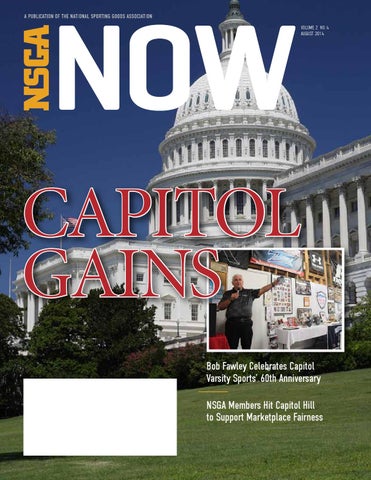
CAPITOL GAINS Bob Fawley Celebrates Capitol Varsity Sports’ 60th Anniversary NSGA Members Hit Capitol Hill to Support Marketplace Fairness
NOMINATE THE 2016 CLASS OF LEADERS, INNOVATORS & INDUSTRY ICONS The Sporting Goods Industry Hall of Fame includes more than 150 of the industry’s pioneers and leaders. Do you know an industry icon who should be recognized for their outstanding contributions to the sporting goods industry? Nominate them for the 2016 class of the Hall of Fame! Deadline is March 16, 2015 Visit www.nsga.org/halloffame for all of the information today!
page 8
table of contents
A Celebration for Capitol Varsity Sports Ohio-based team dealer and retailer enjoys 60th anniversary.
2
ceo corner
3
ADVOCACY NOW
4
INSIGHTS NOW
10
ASSOCIATION NOW
12
RECOGNITION NOW
14
industry NOW
15
PHILANTHROPY NOW
16
EMERGING SPORTS NOW
18
LOCKER ROOM NOW
How we are not alone in the challenges we face NSGA members travel to Washington, D.C. to garner support for Marketplace Fairness Will the 2014 World Cup have an impact on soccer participation? NSGA creates new Job Board Nomination process opens for NSGA All-Star Awards The importance of giving back to the Sporting Goods Industry through the Get In The Game Program Former NSGA Executive Director Marvin Shutt leaves lasting legacy at Blackburn College A look at the growth of Quidditch Updates for Team Dealers on NCAA and NFHS rule changes
NSGA NOW August 2014
1
CEO CORNER
NSGA OFFICERS
We all have plenty of moments where we feel as if we are the only ones experiencing a certain dilemma or problem.
CHAIRMAN OF THE BOARD Randy Nill Nill Bros. Sports, Kansas City, KS
TREASURER/CHAIRMAN-ELECT David Labbe Kittery Trading Post, Kittery, ME
PAST CHAIRMAN Ken Meehan Dunham’s Sports, Troy, MI
BOARD OF DIRECTORS
Eventually we find out we are not alone. We realize there are many others experiencing the same issues and challenges. That was one of the underlying themes that came out of a meeting this summer in Chicago of executives and staff members from a variety of associations. Some of the frequently asked questions were: • How do we remain relevant? • How do we bring in younger members?
Salvador Colom
• How do we get our members engaged and involved?
Deportes Salvador Colom, San Juan, PR
• How do we get more people to our conferences and meetings?
Dale Donaldson Mallard’s Source for Sports, Castlegar, British Columbia, Canada
Pat Donnelley Donnelley Sports, Twin Falls, ID
Rhett Johnson Johnson-Lambe Co., Raleigh, NC
Cathy Pryor Hibbett Sports, Birmingham, AL
Pete Schneider Athletic Dealers of America, Melbourne, FL
Rob Summerfield MC Sports, Grand Rapids, MI
STAFF Matt Carlson President & CEO
Meghan Beach Marketing and Membership Program Manager
Dustin Dobrin Director, Research & Information
Marty Maciaszek Director, Communications
Katie Nemec Director, Marketing, Social Media & Special Events
Darlene Plunkett Director, Business Development
Nick Rigitano Research and Information Analyst
Chuck Suritz
These are questions we regularly ask ourselves at NSGA. It leads to a lot of internal and external discussions as we try to produce the right answers. We also find the questions and potential answers are all intertwined. For example, one of the goals of the new Job Board started by NSGA is to give members an easier way of attracting and finding potential new candidates to become part of the Industry. The Get In the Game Program gives members of the Industry the chance to talk to college students about the great opportunities for success that are out there. Sharing your stories of success and how the Industry benefitted you can have a significant impact on the aspirations of young men and women who are still trying to determine their career paths. We had NSGA members take advantage of opportunities to support our some of our current advocacy efforts regarding issues that are of major importance to your businesses. A couple of them took the time to participate in a fly-in to Washington, D.C., to talk to Congressmen on Capitol Hill about Marketplace Fairness. A number signed letters pushing for a conclusion to West Coast Ports labor issues. The first three questions regarding relevance, youth and engagement all tie in to getting more people to the annual Management Conference & Team Dealer Summit. We are constantly looking at speakers who can address some of the hottest topics that affect your business. What new ways can we give attendees what they want socially and professionally? There is no doubt that you have moments where you believe you are the only one with a certain problem related to your business. That is usually not true. One of the great aspects of being a part of NSGA is the ability to find members from the Industry who are willing to help. Members who share or have experienced the same concerns and issues you have. Best regards, Matt Carlson President & CEO
Director, Education & Strategic Planning
Larry Weindruch Director, Team Dealer Division
Dan Wiersma Chief Financial Officer
2
Marty Maciaszek
Matt Carlson
Editor/Publisher
President & CEO
NSGA NOW (ISSN 1045-2087) is published bi-monthly for members of the National Sporting Goods Association, 1601 Feehanville Dr., Suite 300, Mount Prospect, IL 60056-6035; Phone: (847) 296-6742; Fax: (847) 391-9827. Subscription price of $50 per year is included in membership fee. Non-member subscription information available from publisher. Periodical postage paid at Mount Prospect, IL 60056 and additional mailing offices. POSTMASTER: Send address changes to NSGA NOW, 1601 Feehanville Dr., Suite 300, Mount Prospect, IL 60056-6035. © by NSGA 2013. Printed in the USA.
August 2014 NSGA NOW
advocacy now
Marketplace Fairness Attracts NSGA Members to Nation’s Capitol By Marty Maciaszek
General Manager of Hopkins Sporting Goods in Des Moines, Iowa, arrived at the nation’s capitol on a business mission. The NSGA members took part in a fly-in to talk with members of Congress about garnering support for various issues – including the Marketplace Fairness Act.
Don Bates with Duke basketball coach Mike Krzyzewski at the 2013 NSGA Management Conference & Team Dealer Summit.
Don Bates and Mike McClintock didn’t go to Washington, D.C., as tourists in early June. Bates, who owns Allen Sports Center in Seminole, Fla., and McClintock, the
“It was really interesting to see how that process works,” Bates said. “Going to talk to congressmen was easier than I thought it would be. They listened to your concerns about things you’re interested in.” Bates said he met with a total of five people from Florida – including the staff of Democratic Senator Bill Nelson and Republican Representative David Jolly. Bates said the level of interest varied in a bill that would level the playing field for brickand-mortar retailers by requiring states to
collect taxes on Internet sales. “One of them was really interested and said, ‘That just makes sense,’” Bates said. “That’s kind of what we’ve been saying.” Bates said it was important to make the trip and make connections that could be valuable in the future. “One guy wound up being a customer of ours,” Bates said. “To have a local contact and some idea of who that person is, is very important. “Now we can be involved with our local government and nationally. It makes sense to make a trip like that. It’s a logical process that needs to be done.”
Here are some of the issues NSGA has been working on and monitoring this summer: Internet Tax Fairness While the U.S. House of Representatives was still considering its own approach to this fairness issue, a bipartisan group of Senators introduced a new bill, S. 2609, on July 15, combining e-tax fairness – already passed by the Senate in May 2013 – with extended freedom from taxation of Internet access, a permanent version of which was passed by voice vote in the House on July 16. Summary of the New Senate Bill: The e-tax fairness elements of the bill – The Marketplace and Internet Tax Fairness Act -- clarify and simplify wording in several sections of the original bill, while the Internet tax freedom portion of the bill would extend the current Internet Tax Freedom Act and the grandfather clause under that act 10 years to 2024. Current Status: Bill S. 2609 is not expected to be brought to the Senate floor for debate and a vote until the first week of September.
NSGA NOW August 2014
West Coast Port Contract Negotiations The International Longshore and Warehouse Union (ILWU) and the Pacific Maritime Association (PMA) announced that no talks would take place between July 28 to Aug. 1 so the ILWU could resume unrelated contract negotiations in the Pacific Northwest. The previous labor contract covering nearly 20,000 longshore workers at 29 West Coast ports expired July 1. Although there is no contract extension in place, both parties have pledged to keep cargo moving to avoid any work slowdowns or stoppages that would affect the Holiday shopping season.
Canadian Port Truckers Threaten Strike
if officials didn’t crack down on companies that were undercutting the mimimum pay rates set to end the last strike, which was settled last Spring. Port Metro Vancouver said it was already taking steps to enforce minimum pay rates by creating a complaint phone line and was asking truckers to be patient. Unionized truckers were reported to be frustrated by the slow progress of the federal and provincial governments to enforce a minimum rate of pay for all drivers.
You can go to www.nsga.org for the latest updates on NSGA’s advocacy efforts and to learn more about ways you can get involved. You can also contact Larry Weindruch at (800) 815-5422, ext. 1290 or at lweindruch@nsga.org.
Several hundred unionized truck drivers servicing Vancouver, BC container terminals were threatening to strike again
3
insights now
Will the World Cup Increase Soccer Participation? By Dustin Dobrin, NSGA Director of Research
increased exposure helped to temporarily bring soccer participation to new heights. Examples (highlighted in green in Exhibit 1) include 1994 when the US hosted the men’s World Cup, 1996 when Atlanta hosted the Olympics and the women won their first Gold medal, and 2002 when the men’s team advanced to the quarterfinals of the World Cup. However, these jumps in participation were temporary and growth has not been sustained.
“Soccer is the next big thing” “World Cup fever will translate to increased participation in the US” “Soccer is primed for explosive participation growth” These are all examples of headlines seen this summer as soccer’s premier event, the World Cup, progressed. Although the optimistic nature of these statements is commendable, past participation figures clearly demonstrate the industry cannot simply ride the halo of the media coverage and patriotism that overtook the United States in June and July. The halo from the World Cup coverage can help in the short
run, but more work needs to be done to minimize the obstacles preventing greater participation in order to create sustained growth. This year the World Cup experienced record viewership in the United States and is the primary driver behind many of the statements about how soccer participation will undoubtedly grow as a result. Increased viewership can serve as a catalyst to build participation, but exposure by itself will not guarantee consistent growth. Historical soccer participation figures (Exhibit 1) simply do not support the viewpoint that increased exposure to the World Cup will translate to greater long-term participation. In some cases it appears that
The record viewership of this year’s World Cup represents an opportunity for the Sporting Goods Industry to convert some of this exposure to participation, particularly among the youth that represent the future of the sport. In order to maintain growth, the industry must address the obstacles that prevent participation. Earlier this year, NSGA conducted a survey that identified obstacles to participation and shed some light on why kids are participating in fewer team sports than in the past. The results, representing more than 1,000 kids between the ages of 7-17, identified that there were a variety of reasons for declining participation (Exhibit 2). Among the numerous answers provided, six reasons tended to rise to the top. Simply no longer liking the sport (17% of total responses) was the No. 1 answer provided, although underlying drivers of this response are likely, which would require additional qualitative research.
13.3
14.1 14.0 13.8 13.9 13.7 13.5 13.6 13.5
2005
14.5
12.8
2013
2012
2011
2010
2009
2008
2007
2006
2003
2002
2001
2000
1999
1998
1997
11.1
1996
12.0
1995
1994
1993
10.6 10.3
1992
1990
1989 4
10.0
1991
12.5 11.2 10.9
13.9 13.9 13.7 13.2 13.2 12.9
2004
Exhibit 1: Soccer Participation 1989 - 2013 (in millions) Ages 7+
August 2014 NSGA NOW
Some of the possible reasons for this response could include burnout, potential issues with coaches or players, a lack of success, or simply preferring another sport. Other common survey responses included: • A lack of time (15%) • No desire or interest/lazy (14%) • Financial reasons (13%) • Shifted to individual-based activities (9%) • Increased dedication to certain sports (9%) Some of these are intertwined as the increased time demands toward a yearround emphasis on a specific sport can lead to more specialization and fewer multi-sport athletes. To grow participation, solutions need to be developed to address the obstacles that rise to the top; themes revolving around maintaining the fun of the sport, keeping it from being too time-consuming, and making it financially affordable. Some in the Industry might say that strategies and tactics have already been implemented to address these obstacles, but the results of NSGA’s survey demonstrate that, at the very least, perceptions still exist that continue to prevent participation. In summary, the exposure the World Cup provides for soccer represents a great opportunity. Bridging from exposure to
sustained participation growth represents the challenge. Obstacles to participation, whether real or perceived, do exist and it will take an Industry-wide effort to minimize these barriers. Creating strategies and tactics to address the more common obstacles will be a key component to growing participation. Exposure creates valuable awareness of the great game of soccer; removing obstacles to participation will instigate growth.
“The largest amount of soccer participation in 2013 was in the 7- to 11-year-old category at 4.3 million. The next largest group of participants was 12- to 17-year-olds at 2.6 million.
Exhibit 2: Reasons for Kids Participating in Fewer Team Sports (% of Responses) 17%
No longer like the sport 15%
Lack of time 14%
No desire or interest/lazy
13%
Financial reasons Shifted to individual-based activities
9%
Increased dedication to certain sports
9% 6%
Program/league no longer available Getting older/fewer opportunities
5%
Too much travel involved
5% 3%
Health issues Concern about getting injured
2%
Other
2%
NSGA NOW August 2014
5
Serving the Sporting Goods Industry Since 1929
2014 Sporting Goods Industry Research Now Available! NSGA’s Sports Participation Series: 2014 Edition
Sports Participation: Historical Participation Member: $395* Non-Member: $595*
Sports Participation in the United States Member: $395 Non-Member: $595
Sports Participation: Lifecycle Demographics Member: $295 Non-Member: $395
Sports Participation: Cross Participation Member: $195 Non-Member: $295
Sports Participation: Single Sport Member: $195 Non-Member: $295
Discount Bundle Pricing Also Available! • Sports Participation in the U.S. & Cross Participation: Member $445, Non-Member $695 • Sports Participation in the U.S. & Lifecycle Demographics: Member $495, Non-Member $745 • Sports Participation in the U.S., Cross Participation & Lifecycle Demographics: Member $545, Non-Member $795 Generate the Following Key Insights & More! • Participation Reach: Are more or less people participating in a sport/recreational activity? Historical participation figures are provided back to the 1980’s when available! • Participation Frequency: Are people participating in a sport/recreational activity more or less frequently? • Demographics/Geographic/Socioeconomics: Who and what parts of the U.S. are driving participation in a sport/recreational activity? • Cross Participation: Which sports/recreational activities tend to be participated in by the same person? Cross Participation figures can be used to identify category adjacency and cross promotional opportunities! *Only available for sale to purchasers of Sports Participation in the United States 2014 Edition
NSGA’s Retail Sales/Financial/Other Custom Research
Sporting Goods Market 2014 Edition Member: $295 Non-Member: $395
• Consumer-reported retail sales of 91 types of equipment and 25 styles of athletic footwear; also includes demographics
Sporting Goods Market Historical Consumer Purchases Member: $395* Non-Member: $595*
• Consumer-reported retail sales back to the 1980's (when available); figures provided in an Excel file
2013 Cost of Doing Business Survey Member: - Retailer: Free - Team Dealer: Free - Other Member: $295 Non-Member: $395 • Most up to date comparative financial benchmarks within the industry for use by sporting goods stores and financial firms
2013 Team Dealer Outside Sales Compensation Survey Member: - Retailer: Free - Team Dealer: Free - Other Member: $95 Non-Member: $195 • Benchmarks compensation and benefits among team dealers with outside sales associates
*Only available for sale to purchasers of Sporting Goods Market 2014 Edition
For additional details, please visit www.nsga.org/research, call (847) 296-6742, ext. 1170, or email ddobrin@nsga.org.
insights now
Cost of Doing Business Survey: Benchmark Your Organization! Confidentiality is of utmost importance:
THE COST OF DOING BUSINESS FINANCIAL SURVEY EDITION
for Sporting Goods Stores, Specialty Shops and Team Dealers
www.nsga.org
• The study is 100% anonymous and all data is reported in aggregate form. • Each organization’s data is destroyed after it is compiled with the data from other organizations. By participating in the survey, you will: • Receive a FREE personalized report that compares your organization to an aggregate of similar organizations in the Industry.
ISSN: 0736-0703
NSGA is excited to announce to Sporting Goods Retailers and Team Dealers that the biennial Cost of Doing Business survey is now being conducted. Benchmark your organization’s financial and operating performance by participating in this study! By participating, you will gain access to: • The most up-to-date comparative financial/operating information in the Industry. • A tool to evaluate your performance in areas including profitability, productivity (i.e. space, personnel, and assets), and sales growth. • Valuable insights that could cost thousands of dollars if you paid a CPA to prepare; as a participant in this survey you receive it for FREE!
NSGA NOW August 2014
• The study is compiled by an independent audit firm, Industry Insights.
• Be entered into a drawing for a chance at one of three cash prizes: one winner will receive $500 and two additional winners will receive $250 each.
Participate by going to the following web address: www.NSGAsurvey.com Collection of survey responses is still open. Please feel free to contact Dustin Dobrin, NSGA Director of Research & Information, at ddobrin@nsga.org or (800) 815-5422 for more information.
NSGA Webinar on Using Market Research to Benefit Your Business Now Available NSGA Director of Research and Information Dustin Dobrin and NSGA Research Analyst Nick Rigitano conducted an exclusive NSGA research webinar where you can learn how to use research data to improve your business. The 30-minute webinar is available in the Learning Center at www.nsga.org only to NSGA members. This brief webinar will explain how you can apply NSGA research to your business decision-making. It covers three key types of research data from NSGA’s recently released 2014 editions of the Sports Participation and Consumer Retail Purchase studies: • Trended Participation and Sales Data • Demographic Data • Sports/Recreational Activity Cross Participation Data NSGA wants to give you the tools for long-term success. This exclusive webinar will also cover how to interpret the data efficiently by introducing common research measurements, including index benchmarking and cross-correlation relationships. Please join the NSGA Research Team as they take you through an easy-tounderstand approach to working with these types of data, featuring NSGA’s innovative research reports.
7
feature
Capitol-izing on Six Decades of Success
Ohio-based Capitol Varsity Sports Celebrates 60th Anniversary By Megan Santoro
From left, James Skidmore and Kent McKeaigg of OrderMyGear with Kathy and Bob Fawley before the Hall of Fame Dinner at the 2014 Management Conference and Team Dealer Summit.
Capitol Varsity Sports is celebrating its 60th anniversary as a sports equipment restoration company and sporting goods retailer in Oxford, Ohio. The company originally formed in 1954 as a spinoff from Capitol Dry Cleaning Company, which did some work with the restoration of old shoes and cleats. Today the company is licensed by the National Operating Committee on Standards for Athletic Equipment (NOCSAE) to restore all different types of sporting goods equipment. Most notably, the company is known for its restoration of helmets for football, lacrosse, softball and baseball. “We get helmet shipments in from the entire Midwest and central parts of the United States,” said Bob Fawley, the owner of Capitol Varsity Sports.
8
Fawley came to work for the company in 1985 and eventually bought it with his wife, Kathy, in 1997. Three years ago, the pair also bought a second retail outlet called “Clark’s Sporting Goods,” which is located about 40 minutes down the road from Oxford in Hamilton, Ohio. After graduating college with a teaching certificate, Fawley went to work for a County Recreation Director’s Office. It was here that he first dealt with sporting goods companies and realized he wanted to get into the Industry. Fawley was instantly attracted to the sales side of the Sporting Goods Industry for the opportunity to control his own time and days. “You had to be self-motivated, there was nobody there telling you how much you
were going to make - that was up to you,” he said. Having seen every angle of the business, from sales to management, Fawley is still motivated to succeed on a daily basis. “I still get a thrill out of a big sale; you have to have those competitive juices to be successful,” Fawley said. Fawley’s continued passion for the Sporting Goods Industry has led to several positive outcomes for the store in an age where technology plays such a powerful role in our society. One may ask the question: “When new football cleats or helmets are only a click away, how do stores such as Capitol Varsity Sports continue to thrive in the shadow of the ever-convenient Internet?” August 2014 NSGA NOW
Fawley credits the customer service his shop provides, “We have always been big into serving our customers hands on.” On top of great customer service, Fawley recognizes the huge benefit of how his company has been able to maintain its margins without giving in to marginal pressure. “We have worked hard to find vendors we could make money with,” said Fawley. Modernization has also played a factor in maintaining the success of the company. Fawley said: “We are not the most techsavvy company, but we are managing old school with new school.” With new computer programs and online ordering, the company has embraced today’s technological essentials for a modern company. “We are online as an informational site and our customers have the ability to order online with ‘OrderMyGear,’” said Fawley.
“We have our reputation because of our customer service; our consistency and continuity has built up this reputation,” Capitol Varsity Sports owner Bob Fawley said. Another key part of their modernization was the upgrade of their paint facility last December, where the company restores football equipment. “We have become a state of the art facility that uses selfcontained air, which has increased our efficiency,” said Fawley. “We are lucky enough to have the ability to be able to afford to do some of this stuff.” One pressing question that remains is how Capitol Varsity Sports, and all brick-andmortar shops, deal with competition from the Internet. According to Fawley, people quickly recognize the difference between an actual store and the Internet. “We realize we lose customers to the Internet, but we get them back because of that hands-on personal service that the Internet does not have,” he said.
Capitol Varsity Sports owner Bob Fawley has worked for the company since 1985 and bought it with his wife Kathy in 1997.
Indianapolis, Northern Ohio and even parts of Kentucky,” said Fawley. Road salesmen are kept motivated and up-to-date through a 3- to 4-hour monthly sales meeting. “We manage a mix, most of our salesmen have been with us a long time, over 10 years, and some even 20 to 30 years, but we do have a few newer guys who have been here for less than five,” said Fawley. At each meeting there are manufacturers brought in on a rotation as well. “The manufacturers we work with have been stable for years,” said Fawley. The sustained success of Capitol Varsity Sports comes down to one underlying, continuous point Fawley talks about: customer service. “We have our reputation because of our customer service; our consistency and continuity has built up this reputation,” he said.
Capitol Varsity Sports’ painter Russ Hawkins applies custom striping to helmets. Hawkins has been with the company for 57 years.
Megan Santoro was the 2014 summer intern at NSGA.
The team composition of Capitol Varsity Sports is another reason for the sustained success of the company. The company has a total of nine road salesmen who each deal with around 75 schools. “They work within a 2 ½ - to 3-hour radius from Oxford, which allows us to reach schools located in areas like Columbus,
NSGA NOW August 2014
9 11
association now
NSGA Introduces Job Board for Sporting Goods Industry
Finding the ideal candidate for a job opening is rarely easy. Employers want a return of hiring that right person for their investment of time and effort in the search process. Job seekers also know how challenging it can be to find what they are looking for in their career choice. They can send out hundreds of resumes that result in a lot of rejection and dejection. The National Sporting Goods Association is trying to make the process more effective and worthwhile through the launch of its NSGA Job Board, a new online career center geared specifically to connect employers and job seekers in the Sporting Goods Industry. The Job Board is powered by JobTarget, a leading provider of job websites and career centers for organizations that serve niche audiences, and it can be found at www.nsga.org/jobs. “The NSGA Job Board will be an excellent resource for everyone looking for the right employment fit in the Sporting 10
Goods Industry,” said Matt Carlson, NSGA President and CEO. “It will be easier for job seekers to find the right opportunities and it will be a cost-saver for employers searching for the right candidates to fill positions. The Job Board will be a very beneficial service to our Industry.” The service is free of charge for job seekers and member organizations to post jobs. The NSGA Job Board, similar to many of the nearly 1,500 JobTarget-powered career centers, distinguishes itself from generalist job boards in a number of ways; including: • A highly targeted focus on employment opportunities in the sporting goods sector. • The ability for employers to easily post jobs for 30-60 days for free, track activity on those postings, send job opportunities to NSGA members via email, generate brand exposure, expose jobs via NSGA’s social media channels, and more.
• The ability for job seekers to utilize anonymous resumé posting and job application—enabling candidates to stay connected to the employment market while maintaining full control over their confidential information. • Access to industry-specific jobs and top-quality candidates—often not seen on the mass job boards. To visit the Career Center, log onto the NSGA website www.nsga.org and click Jobs in the top navigation. Once there, member companies can post job openings free of charge. Other web advertising services charge more than $400 for one month. Job candidates can post resumés at no cost as well.
If you have any questions or problems setting up your account, please contact us at (800) 815-5422 or membership@nsga.org.
August 2014 NSGA NOW
78 new styles. REQUEST A NEW CATALOG. WOW your customers with innovative new styles in their team color. Combine that with industry leading customer service and product availability for a solution guaranteed to deliver. Visit us at hollowayusa.com and experience it for yourself.
1-800-331-5156
hOLLOWAyUSA.COm
NSGA-HW-newCatalog.indd 1
6/30/14 3:07 PM
13
recognition now
Know Someone Charitable? Nominate Your Industry Peers Today for the Fourth Annual NSGA All-Star Awards By Meghan Beach
Community Collaboration All-Star Award The Community Collaboration All-Star Award is given to Retailers and/or Team Dealers who have demonstrated a strong record of financially supporting local causes and by organizing or participating in activities meant to support a cause that builds community in their area. Their involvement has a measureable impact on the organizations and events they have supported. Recipients: 2014: Fleet Feet Sports and New Balance for their collaboration on No Boundaries. Created in 2008, No Boundaries is a 5K training program for beginners designed to inspire new runners and walkers to get active and become more fit and healthy. 2013: Charles River Apparel for its support of Wellness Warriors, a Bostonbased dragon boat racing team for cancer survivors and caregivers. 2012: BSN Sports for its Victory Grant Program, providing free sporting goods equipment and uniforms to programs in need. When nominated, BSN had already given away more than $250,000 in awards to programs in more than 20 states, including programs at public and private schools, YMCAs and community-based centers.
Industry Catalyst All-Star Award Displaying the inaugural NSGA All-Star Awards in 2012 were, clockwise from top left, Gary Barfield (Russell Athletic), Adam Blumenfeld (BSN Sports), Louis Talamantes (Buddy’s AllStars), Robert Parish (Rawlings) and Denise Corey (Fleet Feet).
Each year NSGA honors companies that go above and beyond the call of duty with the annual NSGA All-Star Awards. Recipients inspire communities into action or develop innovative new technologies and business strategies that benefit the Sporting Goods Industry as a whole. NSGA is proud to provide the opportunity to
12
celebrate the Industry’s accomplishments and honor those who break the mold. Now is the time to nominate your peers for the Fourth Annual NSGA All-Star Awards and to help recognize a job well done. There are two categories in which you can nominate your peers’ good deeds:
The Industry Catalyst All-Star Award recognizes companies that implement measures to advance and spark innovation in the Sporting Goods Industry. Recipients have a dramatic impact on the industry and raise the standards of excellence through innovative products, use of technology, and culture or dedication to encouraging sports participation in new ways. Recipients: 2014: OrderMyGear for its big impact on modernizing the Industry – parAugust 2014 NSGA NOW
ticularly on the Team Dealer side. It has eliminated the inefficiencies and headaches of processing orders on paper and instead, created customizable software that meets the needs of sales representatives, teams, clubs and schools. Ultimately, OrderMyGear has directly helped local team dealers leverage their relationships to sell more and save time. 2013: Hibbett Sports for its Operation Sports Renovation program, which provides aid to schools in need because of a natural disaster or difficult economic conditions. 2012: Rawlings Sporting Goods Co., Inc., for its dedication to innovation and to moving the conversation forward through the creation of the National Sports Concussion Cooperative (NSCC) in collaboration with the American Football Coaches Association and the University of North Carolina’s Sport-Related Traumatic Brain Injury Research Center. The NSCC was formed to explore the different factors involved in sport-related head injuries with a pledge to consider changes to minimize those risks.
Jeff Rosenthal (Hibbett Sports), center, accepts the 2013 Industry Catalyst All-Star Award with Rob Piscetta (Wilson Sporting Goods), left, and Ken Meehan (Dunham’s Sports).
If you are interested in nominating a fellow peer for their inspiring work, please visit www.nsga.org/allstarawards. The nomination period for the 2015 All-Star Awards began Aug. 4. Award winners are chosen by a committee of NSGA members. Winners will be presented with their awards at the 51st Annual NSGA Management Conference & 16th Annual Team Dealer Summit, May 3-6, 2015 in Austin, Texas.
Ken Meehan (Dunham’s Sports) and Kelley MacPhee of Charles River Apparel, which won the 2013 Community Collaboration All-Star Award.
NSGA NOW August 2014
15 13
industry now
Program Helps College Students By Marty Maciaszek
the next steps to take to break into the industry. Silverberg said he will even talk to students about the importance of using social media properly so it doesn’t have an adverse effect on their job prospects. “Everyone is different, and some people don’t like the public speaking side, but I enjoy it and do it every day,” Silverberg said. “Some people may not look at what they do as beneficial or wonder if they’re helping someone, but I’m at a point in my career where I try to give back.” Many college students following a sports management-related course of study see their future as the next Billy Beane or Theo Epstein. But jobs as a Major League Baseball General Manager of the Oakland A’s or Chicago Cubs, or leader of any bigleague sports franchise, are few and not exactly readily available. Not many of those same students may be aware of the opportunities to become a leader in the Sporting Goods Industry. That’s why the six-year-old Get In the Game Careers (GITG) program has become such a valuable way to make college students aware of all of the career possibilities in Sporting Goods. “Everyone in sports management thinks they need to go out and get in with a team in the NFL, Major League Baseball or the NBA,” said Charlie Silverberg, who has been with New Balance for 17 years and is currently a Midwest-area sales rep. “There is so much more in the Sporting Goods Industry and that’s where I can lend my perspective and knowledge. “You don’t need to pigeonhole yourself to be the next GM of the Cubs. I give them a whole different perspective of where I came from and what I’ve been able to accomplish.” Silverberg has made a pair of presentations with NSGA’s Larry Weindruch at Loyola University-Chicago and took part in a panel discussion at Cardinal Stritch University in Milwaukee. Silverberg also made
14
a presentation in the southeast when he lived in Georgia. Don Bates, who owns Allen Sports Center in Seminole, Fla., made two presentations to a business class of sports management at the University of Tampa. “Everyone wants to be an agent and thinks that’s the place they ought to be,” Bates said. “It’s interesting to show them a different alternative. Some of them had no clue other things were available other than being a sports agent.” Bates understands the value of making presentations, not only from his perspective in the Sporting Goods Industry, but also from earning his college degree in education. “Any time you can get in front of an audience like that, it’s important because our Industry is struggling to find young people who want to make a career out of it,” Bates said. “So, it’s a good thing to do. “We need young people because we’re all getting older. Every person should give a presentation to that kind of class because this Industry has done a lot for us.” Silverberg grew up in the Industry and was selling in retail when he was in high school and college. He found post-college employment in the Industry by networking at the old NSGA trade shows.
With students getting ready to return to their college campuses, NSGA and the GITG Advisory Board would like to have as many members as possible give back by sharing their career story at a college or university near you. More schools continue to request presentations and NSGA and GITG are looking to get them set up for the fall. Anyone in the Sporting Goods Industry, active or retired, is welcome to present to college students. It doesn’t have to be in a classroom setting, either, as presentations have been made to sports marketing clubs and symposiums for business students. NSGA reaches out to more than 325 college and universities and the GITG website (www.getinthegamecareers.org) provides information about the program for college students, professors and department heads who may wish to contact NSGA for more information.
If you would like more information about the Get In the Game Careers program, please contact Larry Weindruch, the Director of the NSGA’s Team Dealer Division, by phone at (800) 815-5422, ext. 1290 or by email at lweindruch@nsga.org.
After Silverberg completes a presentation, he is usually asked by students about
August 2014 NSGA NOW
PHILANTHROPY now
Gift from Former NSGA Executive Director Marvin Shutt Will Benefit Blackburn College Students By Marty Maciaszek
The scholarship was established through NSGA, where Shutt started working in 1948 and spent 25 years as Executive Director. With the scholarship fund now totaling almost $1 million, this scholarship has the ability to assist countless financially disadvantaged Blackburn students. “Mrs. Shutt’s incredible estate gift of $960,000 represents a lifetime of association with Marvin and Barbara Shutt and Blackburn College,” said Glen Krupica, Blackburn’s Vice President for Institutional Advancement. “With the Shutt Scholarship Fund now having a principal of 1 million dollars, many more deserving Blackburn students will benefit from their generosity.”
Former National Sporting Goods Association Executive Director Marvin Shutt clearly had great memories of his time at Blackburn College.
Shutt graduated from Blackburn in 1937 and went on to earn a bachelor’s degree in Journalism from the University of Illinois, where he met his wife Barbara. After earning his degree, Shutt returned to Blackburn as the school’s first field representative, hired by famed president, Dr. William Hudson. As a field representative, he acted as both an admissions counselor
and a development officer. After Blackburn, Shutt took a position as dean of the Department of Journalism at the University of North Dakota. Under Shutt’s leadership at NSGA, the Sporting Goods Industry went through tremendous growth — from $1 billion to $5.5 billion at the time of his death in 1982. Barbara Shutt also had a successful career as an executive for the Marshall Field’s corporation. Blackburn is one of seven work colleges in the U.S., but it is the only one with a student-managed Work Program. Blackburn was also ranked by US News as the 2012 No. 2 Best Value College in the Midwest and The Washington Monthly ranked the school as No. 17 among baccalaureate colleges, nationally, and best in Illinois in 2013. Marvin Shutt and his wife Barbara did their part to give young adults the opportunity to experience why Blackburn College is so highly regarded.
Shutt graduated in 1937 when Blackburn was just a two-year school celebrating its 100th anniversary. But his fondness for Blackburn will be evident for years to come at what is now a four-year, Presbyterian-related, co-ed liberal arts college in the small southern Illinois town of Carlinville. Blackburn received a gift this summer of $960,000 from the estate of Shutt and his wife Barbara (Laube) Shutt. The G. Marvin Shutt Memorial Scholarship is the result of a gift received in 2012 after Mrs. Shutt’s death. It was given in gratitude to Blackburn College for its strong Christian influence on the education and work ethics of their students, and in loving memory of former President Dr. William Hudson, to be used to assist students financially. The scholarship was first endowed for $40,000 after Marvin Shutt’s death in 1982 and it provides funds to high-achieving students in need of financial assistance.
NSGA NOW August 2014
Hudson Hall on the campus of Blackburn College is named after former President Dr. William Hudson, who gave former NSGA Executive Director Marvin Shutt his first post-collegiate job. Shutt’s estate recently left nearly $1 million to Blackburn to provide financial assistance to students in need. 17 15
emerging sports now
More and More People Swept Away by Quidditch By Marty Maciaszek
Quidditch is still a long way from breaking into the NSGA’s annual Sports Participation reports.
playing and was swept away by a sport where players have to run with a hand on a broom that is between their legs.
but post-college teams are picking up in urban areas and high school teams are also forming.
But as Quidditch has grown from its infancy in 2005, so has the number of participants in a sport inspired by the Harry Potter books. The Quidditch World Cup has been capped at 80 teams and there are now more than 4,000 players, according to Alex Benepe, the President, CEO and Commissioner of the U.S. Quidditch Association.
“What I loved about Quidditch is I found the sport so imaginative and dynamic and exciting,” said Benepe, who grew up competing in track and field, cross country and crew. “I loved the community around it and how outgoing and friendly all of the players were.
“We’ve definitely had steady growth every year with lots of new teams popping up every year,” Benepe said. “A lot of people at a lot of schools that don’t have teams at their school or a school near them are still interested in playing.
Not a bad jump considering Quidditch’s humble beginnings. A few friends at Middlebury College in Vermont started playing in 2005 and that led to a seven-team intramural tournament. During Benepe’s freshman year at Middlebury he started 16
“I loved the dynamics of the sport and the culture of the people involved. That firsttime experience, it is an amazing experience.” Benepe said there are now Quidditch teams in more than 30 states. The bulk of them are at the college or university level
“We’re still trying to find the best way to incorporate the high schools into our long-term plan. We still have our hands full dealing with the collegiate division.” Benepe said one of their solutions to what could be considered a good problem is to pair local college teams with a high school or youth team. August 2014 NSGA NOW
Equipment for playing Quidditch continues to be an area of opportunity for the Sporting Goods Industry. Benepe said there is a company that makes the brooms, which need to be of a certain weight and length, and there is a recommended ball for various spots. Players also wear goggles, gloves and mouthpieces. “It’s definitely a challenge to put together equipment for a new sport like this,” Benepe said. “But people are rising to the challenge to make equipment.” Benepe said most of the interest has been in creating uniforms for teams. Teams are now outfitted in high-quality uniforms with wicking capabilities and sublimation and they are usually combined with matching socks and shoes. “It looks really great and it really legitimizes the sport,” Benepe said. “When we get kids playing it’s always extremely popular and we get amazing feedback,” Benepe said. “It’s definitely a little complicated for a young child, but between the ages of 8 to 18, they pick it up very well. “I think it’s actually pretty easy to pick up quickly. You can show up having never played before and get the basics and get playing in 20 minutes. Even little kids can pick it up quickly but it’s harder to master, which adds to its allure.” Quidditch uses co-ed teams of seven players (five men and two women) and they play on a 30-by-50-meter oval field with three scoring hoops on each side.
NSGA NOW August 2014
Teams have three offensive players called Chasers, who run down the field and throw balls through hoops to score, two Beaters, who basically throw dodge balls to stop opponents, a Keeper to defend the hoops, and a Seeker who runs and tries to get the Snitch, a small ball carried by a cross country runner. The team that recovers the Snitch gets 30 points and wins the game. The Snitch used to be able to run all over the school campus where the game was played, but Benepe said there will be an experimental rule for the coming season where the Snitch doesn’t enter the game until the 18th minute (games are usually 30-40 minutes long) and doesn’t leave the field.
Changes continue to occur as the U.S. Quidditch Association has changed its name from the International Quidditch Association. It is also working on a different name for the World Cup. The six regional tournaments played in November and February have seen a significant increase in popularity. Will Quidditch grow to a point where you see a bunch of kids at the park running around with brooms and balls? “I know the first time I started playing it, I thought it was a fantastic game and it would go very far,” Benepe said. “I never sat down in my head and quantified it, but I don’t think I anticipated it growing this quickly.”
17
locker room now
College Rule Changes NCAA Will Experiment With Softer, Livelier Softball three NCAA divisions and would also affect other organizations which play by its rules such as NAIA, NJCAA and California Junior Colleges. “We’re asking coaches to try it out in the fall and give us feedback,” said NCAA Softball Secretary-Rules Editor Dee Abrahamson. “We are interested in the ball, because it is the ball used in the bat certification process done at Washington State University’s Sport Science Laboratory and has several attractive properties.” That includes its use in cold weather. Softballs currently used in NCAA play are made with a polyurethane core and leather cover and they become harder when the temperature drops.
The NCAA Playing Rules Oversight Panel approved an experimental rule allowing the use of a new softball for the 2014 fall nontraditional season. The new softball is softer but livelier than the current ball being used in NCAA championships. The NCAA Softball Rules Committee, which recommended trying the new softball, is interested to see how coaches and players feel about playing
with the newly developed softball and if it improves the game. The coefficient of restitution for the new ball, which measures its liveliness, increased to 0.52 from 0.47. The compression, which measures the hardness of the ball, is 275 pounds per square inch, which is reduced from 350 pounds per square inch for the old softball. The NCAA Playing Rules Oversight Panel approved the Softball Rules Committee’s recommendation in late July. The Softball Rules Committee meets at the Women’s College World Series in June 2015 to vote on the proposal. It would apply to all
Also attractive is a lower severity index. When a ball strikes a player it will do less tissue damage than if the player was struck with the fastpitch softball currently used. “We have people who complain about breaking their bats in February when they are playing in the cold,” Abrahamson said. “With the new ball, whether you are playing in Arizona or North Dakota, there should not be much of a difference in the softball’s performance.” According to Abrahamson, the Softball Rules Committee used a small sample of softballs in practice in the spring, which led to the purchase of 100 dozen for more extensive use this fall.
NCAA Emphasizes Football Jerseys Meeting Requirements The NCAA Football Rules Committee has continued to express its concern about a proliferation of jerseys not meeting requirements stated in the playing rules at the Division I, II and III levels. If there is a uniform that may be in question, designs should be shared by teams with their conference coordinator of officials. The coordinator will communicate questions and concerns to NCAA Secretary-Rules Editor Rogers Redding before responding. 18
Jersey Color - Home Team: The home team must wear colored jerseys. White jerseys are allowed for the home team only if the two teams agreed in writing before the season. The home jersey must be of a color clearly and unquestionably in distinct contrast with the white jersey worn by the visiting team. Gray and light yellow jerseys, for example, are very likely not to comply with the rule.
August 2014 NSGA NOW
Jersey Color - Visiting Team: The visiting team must wear white jerseys, unless the visiting team agreed in writing before the season that the home team may wear white jerseys. In this case the visitors must wear colored jerseys.
front of the jersey and at least 10 inches on the back. Numerals on any other part of the jersey must correspond to the mandatory front and back numerals.
If the teams agreed in writing before the season that both teams will wear colored jerseys, the conference of the home team must certify the visiting team’s jersey is of a contrasting color. If at the start of each half the visiting team is wearing a colored jersey that doesn’t meet these conditions, there will be a 15-yard unsportsmanlike conduct penalty on each opening kickoff.
The numerals must be of a color that clearly and distinctly contrasts with the color of the jersey and this applies to the numeral itself, irrespective of any border around it. If there is any question about the colors of the numerals contrasting with the color of the jersey, they are deemed to NOT contrast. A white jersey should have dark colored numerals and a colored jersey should have white or light-colored numerals.
Jersey Numerals: The jersey must have clearly visible, permanent Arabic numerals measuring at least eight inches on the
Jersey numerals not conforming to the rules constitute illegal equipment. A player wearing illegal equipment may not
be allowed to play and his team shall be charged with a timeout. Beginning with the 2014 season, if a team is wearing jerseys with numerals that don’t clearly and distinctly contrast with the color of the jersey, the team will be asked to change into compliant jerseys before the game and before the start of each quarter until the jerseys are changed. Officials shall charge a team timeout at the start of each quarter in which the non-compliant jerseys are worn.
NJCAA Switching to Flat-Seamed Baseballs in 2016 The National Junior College Athletic Association (NJCAA) will switch to flat-seamed baseballs for its 2016 postseason tournaments. The NJCAA change follows the switch made by the NCAA for all divisions of its postseason tournaments in 2015.
Lawson named new CEO of GroupeSTAHL GroupeSTAHL has announced the appointment of Chris Lawson as Chief Executive Officer. Lawson replaces Brian Sukarukoff, who retired. “We are more than confident that Chris’ proven financial, operations, leadership and business building skills will take GroupeSTAHL into the future,” said GroupeSTAHL Executive Chairman Ted Stahl. “His mission is to unify the efforts of GroupeSTAHL companies around the globe, strengthening our ability to bring you the textile printing products and services you need to grow your business.” As the former CFO and Executive Vice-President of Ross Roy Advertising, a $1.0 billion (billing) private advertising/marketing services company, Lawson led the development and execution of a strategic growth plan that helped this regional company become one of the top 5 in its industry in the United States. Lawson also brings extensive entrepreneurial experience to the table, as the former managing partner of a real estate sub-development team for Palmetto Bluff, a 23,000 acre master planned golf community and resort, and also as an investor/owner-representative in the development of the Ford Plantation, an exclusive private outdoor sporting community near Savannah, Ga.
Martin Sales Partners with Catholic Sports Association Martin Sales, Inc., has partnered with the Catholic Sports Association and Faith Sports Media to create a buying group for its readership. The mission of the CSA buying group is to provide answers through Martin Sales to any questions about team sports uniforms, equipment or services that members may be looking to purchase for sports programs. Martin Sales is nearing its 25th year as a full-service team sporting goods dealer in New Hampshire. Faith Sports Media publishes Christian Sports Today and Catholic Sports Today, which reaches nearly 300,000 members through its on-line monthly magazines. For more information, contact Douglas Martin at teamuniforms@martinsales.biz. NSGA NOW August 2014
19
locker room now
High School Rule Changes Florida Requires Helmets for Girls Lacrosse Association’s Board of Directors in June. The FHSAA hopes to decide by the fall if it will require soft or hard helmets. “We just wanted to protect the kids without changing the actual game, and that’s the intent of this mandate,” FSHAA spokesperson Corey Sobers told The Washington Post.
High school girls lacrosse players in Florida will be required to wear helmets for the 2015 season after a mandate was passed by the Florida High School Athletic
U.S. Lacrosse, the game’s governing board, did not agree with the FHSAA decision. U.S. Lacrosse’s rules say soft headgear may be worn by all players and facemasks are not allowed. Most players wear required goggles to protect the eyes
but don’t cover the rest of their face or head. Rules prohibit contact to the head. In a statement, U.S. Lacrosse Vice President of Lacrosse Operations Ann Kitt Carpenetti called FHSAA’s decision “irresponsible.” She said U.S. Lacrosse is concerned about mandating helmets not designed and manufactured specifically to minimize the mechanism of a head injury in girls lacrosse. U.S. Lacrosse hopes to identify and approve consensus headgear by the fall. Efforts to require girls lacrosse players to wear helmets in New York in 2012 and Maryland in 2013 were unsuccessful.
Change in Protocol for Colors of Basketballs NSGA has been informed that the 2014-15 National High School Federation (NFHS) Basketball Rules Book will announce a change in protocol for the color of basketballs used at the high school level. The change would take effect in the 2019-20 season. The NFHS change for basketballs will go from simple colors to the use of Pantone
Matching System (PMS) numbers for colors to those being used by the NCAA. The colors for high school basketballs will be PMS Orange 151, Red-Orange 173 or Brown 1535. If you have any questions or concerns about this change, please contact Larry Weindruch at lweindruch@nsga.org or Marty Maciaszek at mmaciaszek@nsga.org.
Other Sports Updates Basketball: Arm sleeves, knee sleeves, lower leg sleeves and tights are permissible. • Anything worn on the arm and/or leg is a sleeve, except a knee brace, and shall meet the color restrictions. • The sleeves/tights shall be black, white, beige or the predominant color of the uniform and the same color sleeves/tights shall be worn by teammates. • All sleeves/tights shall be the same solid color and meet the logo requirements. In general, a brace is defined as anything that contains hinges and/or straps or an opening over the kneecap. 18
Baseball: The Baseball Rules Committee approved a change where batting helmets must be consistent with helmets used by field players and have a non-glare surface that meets the NOCSAE standard at the time of manufacture. Beginning with the 2015 high school baseball season, teams will be allowed to use video monitoring or replay equipment for coaching purposes during games.
colored uniform top.
Boys lacrosse: Effective in 2017-18, double zero, 01, 02, 03, etc.... are not legal numbers.
Wrestling: The hair cover shall be attached to the ear guards beginning with the 2014-15 season. The wrestling rules committee is not in favor of going to a two-piece uniform.
Volleyball: Effective July 1, 2016, the libero shall wear a uniform top immediately recognized from all angles as being in clear contrast and distinct from the other members of the team. The libero and/ or his/her teammates shall wear a solid-
Softball: The batting helmet and catcher’s helmet shall have a non-glare (not mirrorlike) surface. Track and field: Pole vault planting box padding meeting the ASTM standard will be required for the start of the 2014-15 season.
Water polo: Effective July 1, 2015, only school logos and mascots can be placed on the players caps. Required numbering includes a number on the middle portion of the cap. August 2014 NSGA NOW
SAVEMayTHE DATE 3-6, 2015 Management Conference & Team Dealer Summit
OMNI BARTON CREEK RESORT & SPA
AUSTIN, TEXAS