Volume 36 | No. 2 | Fall - Winter 2026
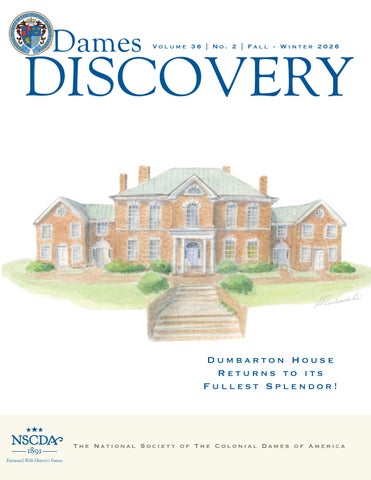
Dumbarton House Returns to its Fullest Splendor!
The National Society of The Colonial Dames of America Dames Discovery | Fall - Winter | Page 1
A Commemorative Pendant Especially for Dames
Introducing the Colonial Courage Dame Pendant — created to celebrate America’s 250th Anniversary. She is a symbol of courage, sisterhood and shared beginnings, honoring the brave women whose devotion helped shape our nation. Worn with pride, she celebrates our bond as Dames and inspires connection, conversation and the continued growth of our Society. Each pendant is individually crafted and may be customized in a variety of metals, with or without stones, to reflect personal preference and comes with optional 18” chain. Optional bail enhancers are available for purchase to clip over pearls or wider chains. A pin option is also offered. Engraving is available. Pendant size: 1.25 inch or custom. Due to current fluctuations in metal markets, pricing will be quoted at the time of order. Ten percent (10%) of each pendant purchased will be added as a donation to the NSCDA. Donations will be capped at $250 per item. Let’s celebrate our heritage together! To place an order or request a personalized quote, please contact: Thomas Makowski T. Makowski Company https://tmakowski.com Email: service@tmakowski.com Note: Prior to any purchase your membership must be verified by our National Registrar Gail Faherty. Damesregistrar@gmail.com Please email Gail with your name, address, Society and national number for verification to email jeweler.
Dames Discovery | Fall - Winter 2026 | Page 2
DISCOVER
Inside this issue
President Mary Heyward Mundy
Features
Executive Director Gloria E. Kenyon Editor Jennie Kinkead Leavell Copy Editors Jean Perkins Margie Martin Email jkl@qx.net
Attracting Young Members p. 8
Young George Washtington p. 14
A 10-Part Docuseries on Colonial Women p. 16
Semiquincentennial Treasures 250 p. 20
WEB www.nscda.org Please follow the NSCDA on your favorite social media. Dames Discovery is published in spring and fall for the members of The National Society of The Colonial Dames of America. Submission deadline: Spring issue | February 1 Fall issue | August 1
Dames Discovery accepts
submissions from Corporate Societies.NSCDA assumes no responsibility for statements made or opinions expressed by contributing writers and artists. While every care is taken to ensure information is correct at time of printing, it is subject to change and NSDCA takes no responsibility for omissions or errors. NSCDA reserves the right to edit and place all content.
President’s Message.................................................................4 Editor’s Notes..........................................................................5 Report from Headquarters......................................................5 Focus on Increasing Membership...........................................6 Secrets on How to Engage Younger Members........................8 Rocking Out! Combining Culture and Development...........9 National Projects Local Mission Impacts.............................10 Patriotism in Action..............................................................11 Founding Females of the Written Word..............................12 Young George Washington: A Reading................................14 The History Connection Podcast.........................................15 For the Common Good Docuseries..........................................16 A Sparkling Night for History...............................................17 Strategic Plan Update............................................................18 Puppies for Progress.............................................................19 Semiquincentennial Tresasures............................................20 The Verses Project Celebrates The End..............................24 Relics and Mementos of Bygone Days..................................25 Mary Harrison McKee...........................................................26 Dames’ Investments in Education........................................30 Dames Socials........................................................................31
Dames Discovery | Fall - Winter | Page 3
President’s Message Editor’s Notes Jennie K. Leavell Mary Heyward Mundy
Dear Dames: I am still energized by our 66th Biennial! Dames from across the country gathered to celebrate accomplishments, renew friendships and make decisions about our future. Our theme, Shaping the Future of Our Legacy Together!, captured the spirit of the gathering beautifully. What struck me most was the pride we share in our Society and the things we accomplish when we work together.
our nation’s history, inspiring organizations across the country to undertake special commemorative projects. For the NSCDA, however, historic preservation, education and patriotic service are not anniversary activities. They are the work we have been doing since 1891. The Semiquincentennial provided an opportunity to share our work with a broader audience, but our commitment did not begin with the 250th, and it certainly will not end there.
Most of us experience being a Dame through our Corporate Societies. That is where we build friendships, participate in programs and contribute to our communities. But I hope Biennial reminded those who attended, and this issue of Dames Discovery reminds all of us, that we belong to something larger.
At Biennial, we celebrated the fact that every Corporate Society participated in at least one national program during the past two years. Think about what that represents! Across the country, thousands of Dames are contributing to a shared purpose, extending our reach and multiplying our impact.
I call that the National Advantage. As we begin a new biennium, I hope every Dame will appreciate what it means to be part of the NSCDA. Whether your involvement is primarily within your own Corporate Society or extends to national programs and initiatives, you share in something remarkable. Every historic property preserved, every scholarship awarded, every veteran honored and every story brought to light is an accomplishment in which we can all take pride. These are OUR achievements. That is the National Advantage: the opportunity to share in the collective impact of thousands of women working toward a common purpose.
As you read this issue, you will find many examples of that advantage. Our Membership Committee has outlined the array of programs, resources and opportunities available to every Dame. From educational programming and national projects to Great American Treasures, scholarships and opportunities to connect with Dames across the country, our national federation makes possible things that no individual Corporate Society could accomplish alone. But the National Advantage is not simply a collection of benefits provided by the National Society. It is the collective strength of our Corporate Societies, each bringing its own talents, resources and enthusiasm to our shared mission. The innovative programs described in these pages demonstrate how much we can learn from one another.
Our founders understood the power of women joining together. One hundred thirty-five years later, that principle remains the foundation of our success. Our Corporate Societies give us our roots. Our national federation gives us extraordinary reach. Together, we give our mission its strength.
America’s 250th anniversary has brought renewed attention to
Thank you for being a Dame,
X Dames Discovery | Fall - Winter 2026 | Page 4
Editor’sNotes Notes Editor’s JennieJennie Kinkead Leavell, Kentucky Society K. Leavell Welcome to another issue of Dames Discovery! There is much to discover in this journal, dedicated to Dames and all the wonderful initiatives that we are involved in. In this issue, we cover membership which remains a challenge as many Dames age but there are ideas and strategies for attracting new Dames on pages 6-8. With development and fun in mind, the Kentucky staff mounted a folk and country music festival to celebrate America’s 250th just before the fourth of July and it was very successful. This is the last issue that we will hear about professions of our female colonial ancestors and this focus is on women who were writers. Over the last four issues, we have covered women in medicine, women entrepreneurs and ancestors who were Quaker ministers. There are lots of creative initiatives in which Dames have been involved. They include a reading about young George Washington, a fundraiser at the Westminster Dog Show for America’s VetDogs, and a fantastic 10-part docuseries, For the Common Good: The Women Who Shaped Our Nation. Then there are the Treasures 250, an initiative to highlight 250 items across our collective house museums and their contents. There was a well-attended and sparkling night for the Dames when Dumbarton House opened its doors again after an extensive renovation which included a brand new HVAC system. It’s a mighty fine issue but I now want to call attention to the staff. My experience is limited to the national offices and the Kentucky offices and some societies may differ from these two examples, but let me explain. Earlier this year, I attended a modest gathering for new dames in my town of Lexington, KY.
In attendance was John Walker, our curator. John spoke about our collection, its importance and how they are using it to the advantage of our historic homes. But what was most striking about his talk was at the end when he said the whole staff are under 40 years of age and they are dedicated to and enthusiastic about their jobs! The national office has some pretty exceptional staff too where over the years we get to deal with Augie and Emily and Isabella who are steadily producing wonderful work for us Dames. Augie is all about that which relates to Great American Treasures, our collective houses. Emily does the tri-monthly eblasts and the national online presence, among other things. I’ve just returned from the NSCDA Biennial convention and there were no glitches in technology. Kudos to Gloria and the staff! At the Biennial, I had the pleasure of meeting Dumbarton House curator Isabella Kiedrowski. Isabella is a graduate from St. John’s College and has a Museum Studies Certificate from Northwestern University. Her undergraduate courses consisted of the widest form of liberal arts studies. She not only is fluent in German, Polish and French but also is an accomplished watercolor artist. In addition to curatorial duties, Isabella has set out to watercolor all 100 of our Dames historic homes and the cover art of Dumbarton House for this issue is by her. So far, she has completed 68 watercolor renditions and I am proud to know such a multi-talented young person whose talents serve to benefit our organization. The fact that we have so many dynamic young people on our staff, speaks loudly to the validity of our mission and the value of our assets. X
Editor’sfrom Notes Report Headquarters Jennie K. Leavell Executive Director, Gloria E. Kenyon Dumbarton House was sparkling for the Semiquincentennial on September 18! After over a year of being closed and eight months of HVAC replacement work, staff welcomed Dames, friends and neighbors back into Dumbarton House to celebrate the 250th birthday of the United States. We were also happy to showcase our period rooms, with the furniture reinstalled and set to tell the story of the early Federal period of the United States. Over the last year, Dumbarton House underwent a massive transformation that is not visible, but can be felt in the comfort of the spaces. The walls were taken apart, old pipes were pulled out, and a new system was put in place. The house is now comfortable and
the collections are being maintained at a proper temperature and relative humidity—key to their longevity. Staff is excited to return to the offices and continue our work together in person after working remotely for such a long time. At our celebration on September 18, we made a toast to the reopening of Dumbarton House and our next chapter. We can now open our doors as an event space and host select public programs. As I write this, our very first Jane Austen Film Festival date sold out in under 5 minutes! We are just as eager as our patrons to welcome people back to Dumbarton House.
Dames Discovery | Fall - Winter | Page 5
X
The Focus on Increasing Membership Membership is a vital component of the NSCDA. A growing, active and engaged membership allows us to build community and to fulfill our mission objectives. No matter how large or small a corporate society, membership in some form or another -- is an issue for all of us. Our current Strategic Plan reflects this, with Goal 1, focusing on membership.
Caroline Hazard Goedhart Membership Committee Chair NSCDA
Membership Goal 1 of our Strategic Plan has three goals: Streamlined, effective and consistent membership process (1A), Tools to engage and retain members (1B) and Development of a NSCDA Value Proposition (1C). The NSCDA Membership Committee has been working on the last two goals. Our major accomplishment around goal 1B incorporates tools to engage and retain members. Initiatives include: •
Creation of a Membership Affinity Group which meets every two months and discusses membership and retention • Development of literature to support corporate societies: national palm cards, prospective member tri-fold and more! • New NSCDA orientation video • Membership workshops in Charleston, SC and 2026 Biennial • Over 10 Dames Socials planned in the 2025-2026 year supported by Mary Carter and Kathryn Lynch • Young Dames trips to New York and Savannah, GA • Support of Valentines for Vets program, led by Emily Griffin and Liz Bohannan • Record number of Dames added to the Honor Roll by the Corporate societies and recognized by the NSCDA under the guidance of Mimi Hurst The National Registrar will be sending out a questionnaire this fall and kicking off a Legacy Program to identify potential legacy members. The Membership committee continues to listen to our Corporate societies and help with gaining and retaining members. We
continue to hear about the importance of community and how borders are becoming more fluid with travel as families are more spread out. The Committee has also been working on goal 1C, Development of a Value Proposition. The Value Proposition provides a brief statement of the value that national provides to our members and corporate societies. Over the last several months a small team of corporate society presidents, staff and membership committee members have worked together to develop the following Value Proposition, along with the membership committee. We credit our collective strength to promote historic preservation, education and patriotic service. Through meaningful activities, celebration of historic sites and collaboration across our state societies, we grow our national presence, deepen civic understanding and increase community engagement to ensure that the legacy of our nation’s founding remains relevant and accessible today. We Accomplish this Through: Our national society provides the following tools to strengthen our corporate societies along with the opportunity to interact with and build relationships with women who have a passion for American history education, patriotic service and preservation. The National Board and Corporate society Boards provide support and training for strategic planning, by-laws modeling, membership processing and more.
Dames Discovery | Fall - Winter 2026 | Page 6
Building and retaining our membership takes time and effort and is the responsibility of all of us. So, look around and see who among your friends might be a good addition to the organization, reach out to your relatives, volunteer and get involved. Remember there is nothing like a DAME!
Genealogy Support • Register of Ancestors • Training and guidance on archival and digital research techniques and development of lineage papers for more accurate lineage submissions • Support for digital preservation and security Historic Preservation Support to 95+ historic sites Ownership of Dumbarton House, home of Great American Treasures (GAT) and our National Headquarters Education/Communication • Virtual Programming – Book Groups, Lecture Series, Great American Treasures’ GAT Treasure Hunt - an opportunity to learn more about the many GAT sites the NSCDA supports across the country • American Indian Medical Scholarships (100th year anniversary in 2027) • Congressional Essay Contest (60th year anniversary in 2027) • Biennial and National Conferences • Dames Discover Live Workshops for all Dames • Training for committee chairs (Treasurers, Registrars, etc.) • Affinity Groups (Presidents, Membership and Treasurer) • Monthly Newsletters - eDispatch, News Across the Nation, Upcoming Events • Semi-annual Dames Discovery Magazine • Museum Alliance Grant Opportunities and Virtual Roundtables
National Programs • Local participation in national programs – some examples: Done in a Day!, Valentines for Vets, America’s VetDogs, Veteran’s Oral Histories and NSCDA Oral Histories Membership Discounts/Travel Opportunities • Historic Hotels of America - discount of up to 30% off the best available room rate at participating Historic Hotels of America and Historic Hotels Worldwide (discount code NHP) • Dames Socials – over eight Dames Socials located across the country, open to all members • Young Dames trip – annual Young Dames trip for Dames between 21 and 50 • GAT Passport to Preservation, a public-facing program designed to highlight our network of sites, encourage visitation and engage broader audiences with American history—particularly during the 250th anniversary commemorations • Discount on tours at our three national properties: Dumbarton House Museum (D.C.), Sulgrave Manor (UK), and Gunston Hall (VA) I encourage you to go to our national website and the Membership Committee page to look for additional resources for gaining and retaining new members. In addition, please contact me if you have any membership related questions.
Dames Discovery | Fall - Winter | Page 7
Secrets of How to Engage Younger Members By Julia Jackson Membership Chair Illinois Society Nearly three quarters of the Illinois Society’s members under age 50 have joined since 2020. That was the year our now President, Courtenay Wood, invited then 10 -year-old Emma Jackson to become our very first Junior Dame. It took a little time — and many meeting announcements encouraging members to propose their daughters and granddaughters — but eventually we had enough girls to begin building real Junior Dame programming.
art fair. We’ve learned that these smaller social gatherings help Young Dames feel comfortable attending larger Society events and often spark deeper involvement in leadership.
Over the past three years, we’ve hosted a variety of hands-on, creative events: a holiday wreathmaking workshop, a decoupage party led by one of our artist members, a sewing afternoon where everyone made patriotic pillows and a sampler-themed gathering where the girls learned about early American needlework before trying their own crossstitch project. Guests are always welcome, and the girls love bringing friends along.
Busy young women and moms appreciate the support just as much as our older candidates. We’ve also welcomed several Junior Dames through members of the Illinois Society of Colonial Wars, many of whom have daughters or granddaughters with qualifying Dames ancestors.
Whenever Junior Dames (under age 21) attend an event, their mothers usually come too — and many of those moms fall into our Young Dames category (under 55 for Illinois, under 50 nationally). One of our newer members, Katie Moor, joined with all three of her daughters. She’s understandably proud to have her Colonial American ancestor’s service documented for the next generation. Another new member, Sarah Helfers, joined with her daughter Claire, who adores crafts. Together they’ve found meaning in our annual Valentines for Veterans party. This year, our group made more than 100 valentines, most of which were delivered to homebound veterans through our partnership with the American Legion. Young Dames also enjoy spending time together without little ones in tow. Emily Ackerman, who attended the National Young Dames trip to Savannah, recently hosted a Young Dames outing to a Chicago
Another key to our success is our dedicated candidate helper team. They guide candidates through every step — from identifying a qualifying ancestor to researching and typing lineage papers.
When we realized that not every Young or Junior Dame had a mother who qualified for membership, Illinois Society member Julia Jackson worked with national leadership to expand the Friends of Dames program. Thanks to her efforts, mothers and grandmothers can now participate even without lineage eligibility. We’re proud to have three active Friends of the Illinois Society.
Key Take-aways from Our Growth •
Encourage members to propose their daughters and granddaughters.
•
Plan simple, hands on events that use the talents and resources already within your membership.
•
Lean on your candidate helper team to support new applicants through the process.
•
Look to other lineage societies, such as the Society of Colonial Wars, for potential new members.
•
Consider establishing a Friends of Dames program to welcome supportive family members.
Dames Discovery | Fall - Winter 2026 | Page 8
X
Rocking Out!
X
Combining Culture and Development at Liberty Hall By Sam Dunn Executive Director Liberty Hall Historic Site NSCDA-Kentucky
Over 3500 people attended Liberty Hall-er: An America 250 Music Festival on July 3, 2026. Two stages, six artists, plenty of local vendors and food trucks. Thousands of visitors – despite the extreme heat of July in Kentucky!
other regional non-profits (Visit Frankfort and Downtown Frankfort Inc.). Liberty Hall-er was also funded through a federal grant from the National Endowment for the Arts. This allowed organizers to present the concert for free, lowering barriers to entry and attracting people from surrounding regions. As Liberty Hall has seen, financial accessibility plays an increasingly important role in visitor decision-making.
Liberty Hall Historic Site, the home of John Brown, Kentucky’s first U.S. Senator, features two historic houses (built in 1796 and 1835) and almost five acres of ornamental gardens. These gardens, continuously cultivated since 1796, are among the oldest in the nation. They alone are worth a visit. Between these outdoor spaces, the allure of the historic architecture and the fascinating array of artifacts in the collection, Liberty Hall welcomes thousands of guests every year. Despite these successes, the staff at Liberty Hall know that public interest must be continuously renewed. In order for these historic spaces to continue to thrive, to grow to new heights, new avenues of collaboration and revenue must be explored. To that end, the Liberty Hall team has prioritized far-reaching cultural programming. These efforts, which include a regular series called Music in the Garden, have already resulted in increased public awareness and new opportunities for development. The Liberty Hall-er Festival offers itself as a case study of this approach. Presented as a nod to both Liberty Hall and the famous Kentucky “hollers” that have produced so many iconic Kentucky musicians, the festival was planned over several years with the City of Frankfort (Kentucky’s capital city) and several
Crucially, the festival took advantage of the organizational strengths of each partner. The City of Frankfort assisted with grant writing and donated the use of their stage. Other partners were able to assist with marketing, logistics and various other needs. Liberty Hall staff designed merchandise, coordinated with artists and sponsors and offered historical programming. Importantly, each organizational partner was willing and able to assist the others as necessary. The festival spread across a full city block and featured both a local and main stage. Local businesses, several of which Liberty Hall had no prior relationship with, sponsored the stages. Local vendors and nonprofits set up tables, creating a face-to-face space from which they could share their own missions and programs. In the final accounting of Liberty Hall-er, thousands of people were introduced to the historic site, significant sponsorships were generated and new relationships were formed. As early as a few weeks after the festival, these relationships have already resulted in additional partnerships and development opportunities. Thanks to a spirit of collaboration, and some great music, the seeds of future growth have already begun to sprout.
Dames Discovery | Fall - Winter | Page 9
National Projects, Local Mission Impact: We Shine Brightly Together… and Proudly By Elsie Smith National Vice President Mission Initiatives Vermont Society President George H. W. Bush once described America’s volunteers as “a thousand points of light.” I’ve always loved that image because it reminds me that each of our contributions is important, but we are strongest when we are part of something larger. That is exactly what I see when I think about the mission work of The National Society of the Colonial Dames of America. The real strength of our national projects isn’t found in any one of us—it’s found in all of us. When 14,500 women from 43 corporate societies come together with the same purpose, our individual acts of service add up to something extraordinary: a powerful force for preserving our nation’s history and investing in its future. Just look at what we’ve accomplished together: • • • • • • •
More than 700 Veterans History Project interviews completed for the Library of Congress, making NSCDA one of the program’s largest volunteer partners Close to 2500 Congressional Essay Contest scholarships awarded, encouraging young Americans to think deeply about citizenship and civic responsibility Hundreds of American Indian Medical Scholarships awarded to students preparing to serve their communities More than 50 America’s VetDogs puppies sponsored—representing over $300,000 and countless lives changed for veterans and first responders More than 95 member sites sharing America’s story through Great American Treasures More than 350 Founding Females recognized in our growing register of remarkable women More than 250 artifacts preserved in our Treasures 250 collection for generations to come
Our collective impact reaches far beyond our own organization and into communities across the nation. Through the American Heritage Local Impact Awards, corporate societies have contributed $100,000 to organizations dedicated to preserving local history and strengthening civic life. The Museum Alliance Grant Fund has distributed $130,000 since it was established five years ago — 15 grant awards to 15 different GAT sites in 15 different state societies, helping museums and historic properties preserve and share America’s story. During the America 250 commemoration, Dames also took an active role in celebrating our nation’s founding. They participated in naturalization ceremonies and partnered with museums, historical societies, schools and state organizations to create meaningful educational programs and community events. Together, these efforts preserve our heritage, strengthen civic pride and inspire future generations to learn about, cherish and carry forward the story of our nation. To me, that’s patriotism in action. Yes, patriotism is found not only in parades, speeches and waving the flag—important as those traditions are—it is also found in giving our time, sharing our talents, preserving our history and investing in the generations that will follow us. As you read the stories in this issue, I hope you’ll see more than a list of projects. I hope you’ll recognize your own contribution—and the contributions of thousands of fellow Dames whose quiet acts of service add up to something extraordinary. One light is lovely. Together we brighten the world. Dames Discovery | Fall - Winter 2026 | Page 10
What is the NSCDA Mission Outreach Committee? Patriotism in Action By Marianna MacIntyre National Mission Outreach Chair South Carolina Society We are seven project committees with over 17 ways for our entire membership to be involved to help remind us and others of our wonderful country. Through patriotism and love of country, these National project opportunities lift your spirits for an hour, for a day, for several days for as long as you’d like to be involved. Dames are indeed doers and we like to offer you optional ways to stay connected, to help, to be engaged and to actively be a part of this terrific national organization!
Mission Outreach Committees Veterans History Project Dames in Conversation (Dames’ Histories) NSCDA Presents (Virtual Lecture Series) America’s 250th, Celebrating Together America’s VetDogs Naturalization Ceremonies Done in a Day! With tenacity, Dames work mightily to preserve, to educate and to celebrate: together. One hundred percent of our Societies have reported wonderful and unique ways they are celebrating this landmark year, our semiquincentennial! During this once in a lifetime milestone, our country’s 250th Anniversary, patriotism shows up in a myriad of Dames' project celebrations.
return to a fulfilling life with increased confidence after their military service, we record their stories and we sponsor service dogs (64 and counting!) for Veterans’ continued healing. We put flags on the graves of our fallen, we “Light our Porch” for July 4th, we send Valentines and personal needs to living Veterans. This is Patriotism.
Perhaps you experienced the swell of emotion while singing our patriotic songs, with Anna Duff on the piano. How about hearing and singing “The Star Spangled Banner” before a sporting event, does it touch your patriotic spirit? Maybe you’ve attended a Naturalization Ceremony and felt the pride of our newest citizens, (who have worked much harder than us, just to become Americans). Did you record a Dame’s story for posterity or is your “thing” our NSCDA virtual programing, including programs on our historic properties and preservation? This year, when you tune into our Dames Book Club, you’ll glean information on America’s Colonial Period and early heroines’ patriotism. This may renew pride for your ancestors’ service to our country. These projects are Patriotism!
Our partners from the Library of Congress, Veterans History Project and America’s VetDogs report that our work helps their efforts reach further and reach more citizens. They tell us we help to “weave the tapestry of our nation" into a beautiful quilt. This is indeed Patriotism.
Dames are devoted to veterans, those in our families and those we do not know. We are empathic to their changing needs; as they have given much to us and to our country. To help veterans
When Dames gather together, you feel this love of country emanating throughout our committees and our families. Through our projects and our 42 Societies, our members spread this love across our vast country. Aren’t we Patriotic Service at its best? Thank you all, for engaging in the seven Mission Outreach project opportunities of The National Society of The Colonial Dames of America. Collectively, your efforts make an immeasurable, positive impact on our unique country…America, still home of the brave and the free and it is a better place with you and the NSCDA in it. This is truly Patriotism.
In gratitude for all Dames’ commitment to and love of America, Dames Discovery | Fall - Winter | Page 11
Our Founding Females of the Written Word By Molly Jordan Carey & Lisa Baker Liles Co-Chairs 250 by 250 Founding Females Initiative Virginia and Indiana Societies In previous articles, we celebrated our Founding Females of religion, medicine and business and established the fact that colonial American women accomplished amazing feats on a daily basis. Operating within a heavily patriarchal time when women had no legal rights, they served their communities as leaders in many important areas that contributed to the development of our nation. As President Mary Mundy wrote in her July 6th eDispatch letter, our female ancestors were “extraordinary women whose courage, perseverance and quiet determination helped sustain a new nation…… much of what they accomplished was never recorded in official documents, yet their influence shaped our nation’s story in countless ways.” Today we focus on our Founding Females of the written word. Female authors in colonial America were more prevalent than we might imagine, and they composed literature of all types, including poetry, political critiques, plays, diaries and historical chronicles, all the while navigating a society that frequently discouraged female literacy. Obviously, “for a woman to dare enter public discourse was a radical act of rebellion. To write and be published at a time when women had few legal or economic rights was just short of miraculous. To avoid censure, some occasionally wrote under pseudonyms, while others used their own names, consequences be damned!”1 Female poets in Colonial America were pivotal in carving out an American literary voice and expanding public discourse while providing firsthand historical perspectives of the events in their lives. Anne Dudley Bradstreet who lived in the Massachusetts Bay Colony, is recognized as America’s first female poet. She was a wife, mother of eight children and a Puritan who left a life of luxury in England to come to America for religious freedom. She is considered the most important poet of the American colonial
period. Her poems were published in 1650 as The Tenth Muse Lately Sprung Up in America, which is considered the first book of original poetry written in colonial America. Martha Wadsworth Brewster of Connecticut is known as the first American born woman to publish using her own name. Her poems on Divers [sic} Subjects was her major work. In all, she wrote 21 poems, which covered a wide range of topics beyond the traditional “women’s subjects” of home and family. Her poems offered personal counsel to her children but also engaged in the broader cultural and social issues of her time. Her work has been recognized both for its literary merit and for its role in representing the voice of colonial women, cementing her place in American literary history. Annis Boudinot Stockton grew up in Philadelphia. Her earliest known poem was written when she was 16 and her first published poems appeared when she was 21. Although some of her poems were destroyed when the British looted her home in Princeton, New Jersey, more than 100 of her poems survive. Most of her poems were shared privately with friends and relatives, but she is still considered one of the most published female poets of her generation. A death notice in the Philadelphia Gazette said she was “distinguished for her literary talents, and deservedly esteemed and beloved, for her piety, and many amiable virtues.” Mercy Otis Warren of Massachusetts was a published poet, political playwright and satirist during the build up to and during the American Revolution. The daughter of a highly educated and politically active family, she was encouraged to pursue education, writing, activism and patriotism. She regularly corresponded with George and Martha Washington, Abigail and John Adams, Hannah Winthrop, Patrick Henry and other prominent patriots. In one letter, she wrote, “...every domestic enjoyment depends on
Dames Discovery | Fall - Winter 2026 | Page 12
the unimpaired possession of civil and religious liberty...” Her first published satire in 1772 “The Adulator” was published anonymously in the Massachusetts Spy newspaper. Two additional plays continued to criticize British colonial leaders, Defeat (1773) and The Group (1775.) Mercy’s career did not end with the American Revolution, as she continued to publish plays, poems, and histories. It is through diaries of our colonial women that we learn the unfiltered, intimate glimpses of daily life and survival, social dynamics and cultural history of the times. They reveal women as economic pillars of colonial households and farms offering primary evidence of community networks, child-rearing and health practices, and religious beliefs. Diaries provide a rare window into the inner lives, emotional struggles and intellectual thoughts of colonial women. Elizabeth Sandwith Drinker of Pennsylvania wrote her diary and legacy between 1758 and 1807. When published it was in four parts: Youth and courtship; Young wife and mother; Middle age in years of crisis; and Grandmother. Her extremely detailed diary covers topics of every sort and gives the reader an in-depth view of life in colonial Pennsylvania through the lens of politics, war, changes in medicine, family life, personal relationships, community, Quakerism and more.
Captivity narratives were a significant and relatively new genre of literature that began in colonial America, particularly during the 17th and 18th Centuries. While stories of captivity existed before, the specific form of narratives focusing on Europeans held captive by Native Americans, gained considerable popularity and established itself as a distinct genre. Mary White Rowlandson Talcott of Massachusetts was captured by the natives in 1676 and published her captivity narrative in 1682. It is considered by the New York Times the first and most influential captivity narrative, establishing the genre’s framework and themes.
Susannah Willard Johnson was captured with her family during an Indian raid on Charlestown, New Hampshire in August 1754. After her release in 1758, Susannah records a full account of her ordeal. Her harrowing memoir is still being republished and is available on ...we learn the unfilAmazon today.
tered, intimate glimpses of daily life and survival, social dynamics and cultural history of the times. They reveal women as economic pillars of colonial households and farms, offering primary evidence of community networks, child-rearing and health practices, and religious beliefs... !
Ann Cooper Whittall of New Jersey was a devout Quaker who kept a lengthy spiritual diary which she began at the age of 44 in February 1760. She wrote until 1770. In the diary she recorded the daily activities of her family and her spiritual insights, which she called “meditations.” Her diary discussions focus on details of Quaker meetings, child-rearing practices, treatments of illnesses in her community and family and how well she, her family and friends were faring as disciples of Christ in the world “filled with evil.” Margaret Hill Morris kept a lengthy journal detailing her life activities in New Jersey and Philadelphia prior to the Revolutionary War. Her writing skill indicates a secular and religious education. Beginning in 1770 she describes a happy married life of a colonial merchant and his family until his death in 1766. Afterwards, she records years of struggling to support her family by treating the wounded with her medical practices and by dispensing medicines through her own retail shop. She describes in great detail the troop movements and battles surrounding her home on the “Green Back” and her treatment of injured soldiers.
Mary Draper Ingles of Virginia dictated her capture of 1755 and escape narrative to her children, as she was illiterate. On February 16, 1756, an article appeared in the New York Mercury describing her ordeal.
Elizabeth Timothy is recognized as America’s first female newspaper editor and publisher and one of the world’s first female journalists. After the death of her husband, Elizabeth assumed control of the family printing operation in Charleston and published the very next weekly issue of the South Carolina Gazette on January 4, 1739, which carried the announcement that she was now editing the paper. This established her as America’s first woman editor/publisher. However, the publisher, who must be a male, was listed as her son Peter Timothy. The NSCDA Register of Ancestors records many female publishers and printers who were undoubtedly editors in practice without name. The Founding Females Initiative came to a close at the October 2026 Biennial. However, the NSCDA will continue to seek out and add qualifying females to the Register of Ancestors. We will celebrate the initiative’s success in the next issue of Dames Discovery.
Reference
1. literaryladiesguide.com, Nava Atlas, 8-25-2018, Updated 12-282023.
Dames Discovery | Fall - Winter | Page 13
A Reading to Celebrate America’s 250 By Arrington Cox Chair, Buncombe County Committee North Carolina Society
The Buncombe County Committee of NSCDA-NC sponsored a reading of Mark R Sumners’s “Young George Washington,” by the Montford Park Players of Asheville, NC, as our contribution to the celebration of the 250th anniversary of the founding of our country. The reading was free to the public and held during Asheville’s most beautiful and enticing time of the year, mid- October. Publicity by the Dames included articles in the Dames Dispatch and The NC Pinecone, letters to each county committee chair, NC State Board members and info@ncdames.org. We also had spots on our western North Carolina public radio station. The Montford Park Players had contacts of their own, and our event was
included in each of their monthly flyers from June until October. We hoped to draw as many Dames as possible to our celebration, not only to discover “Young George,” but to enjoy the many other attractions that the area offers. As Asheville continues to struggle to recover from Hurricane Helene, an influx of Dames visiting the Biltmore Estate, the River Arts District, the Asheville Museum, dining and shopping in Historic Biltmore Village provided a unique effort towards our mission of historic preservation. And after that, the drive on our beautiful mountain roads added to the experience with fall colors at their height.
Dames Discovery | Fall - Winter 2026 | Page 14
The History Connection Podcast setEditor’s oN s’rotiNotes dE llevaeL .K einneJ
Jennie K. Leavell
By Rebecca Eddins Georgia Society
In celebration of America 250, the Andrew Low House Museum launched “History Connection,” a public-facing podcast series hosted on the museum’s social media platforms to further its educational mission and expand access to local history. To date, the series has featured two episodes: Faith in Silence: The Irish in 18th Century Savannah, released in March, and Deep Foundations: History of the Andrew Low House Site, released in May. The series is hosted by Andrew Low House Museum staff members Frank Marro and Danielle Oke.
Revolutionary-era battlefield. This approach emphasizes that historic places contain layers of history, with each period contributing to the significance of the site as it exists today.
The inaugural episode, Faith in Silence: The Irish in 18th Century Savannah, explores the experiences and contributions of Irish people in 18th Century Savannah. By focusing on a specific community and its historical experiences, the episode offers audiences a deeper understanding of the diverse people and cultural influences that shaped Savannah during its early history. It also highlights the importance of examining lesser-known stories and perspectives as part of a more complete understanding of the past. The second episode, Deep Foundations: History of the Andrew Low House Site, turns attention to the land beneath and surrounding the historic house. Rather than beginning with the construction of the Andrew Low House, the episode examines the earlier history of the site, including its use as a jail and its connection to a
The third episode in the series will examine the lives and contributions of Tom and Mosianna Milledge, enslaved and later free servants, and their family. The episode will explore their workspaces in and around the home, including the raised basement that originally housed the kitchen, children’s dining room, laundry and additional servants’ quarters. It will feature rarely seen spaces and images of the Andrew Low House Museum’s work floor and service staircase, offering perspectives on the spaces where domestic labor took place. This episode will address questions frequently asked by museum visitors about the servants and enslaved people who worked in the home and will highlight their essential contributions to the operation of the household. Hosted by museum staff and distributed through social media, “History Connection” extends the Andrew Low House Museum’s storytelling beyond the architecture and furnishings of the house itself. The series connects the site and its occupants to the broader history of Savannah, Georgia, and the United States while making local history accessible and meaningful to audiences beyond the traditional museum visit.
Dames Discovery | Fall - Winter | Page 15
A New Docuseries
By Mickey Herr Pennsylvania Society
For the Common Good: The Women Who Shaped Our Nation
Inspired by the women added to the Register of Ancestors (ROA)—as part of the NSCDA’s Founding Females 250 by 250 project—the Pennsylvania Dames wanted to find a way to uplift and share these stories with a broader audience. In the summer of 2024, the NSCDA-PA board voted to self-fund a proof-of-concept project in partnership with You’ll Never Forget Productions, a local Emmy-winning documentarian team. After some initial filming and experimenting, we had a solid concept and started fundraising. Receiving a $100K grant from the Philadelphia Funder Collaborative for the Semiquincentennial, and raising an additional $80K from individual donors and foundations, we set to work. For the Common Good: The Women Who Shaped Our Nation (FTCG) is a multi-part docuseries that tells the vivid stories of nine pioneering Pennsylvania women who made important contributions to the founding of America. They shaped our nation, leading the way forward as businesswomen, religious leaders, educators, inventors and more. The PA Dames believe that, by embracing a fuller concept of what it took to shape our nation, we can help make our founding history more relevant, accessible and inclusive.
at an early age, she delayed marriage and children to travel to Ireland as part of her missionary work; Elizabeth Coates Paschall, a noted healer and business owner/importer whose “recipe” book resides at the College of Physicians; Dinah of Stenton, an enslaved woman who won her freedom in April 1776.
The story of each pioneering woman is introduced in an eightto 10-minute segment, featuring archival footage and scholarly context. The featured women are: Hannah Sharp Breintnall, an importer and proprietor of an optician’s shop, the Sign of the Golden Spectacles; Mary (Polly) Norris Dickinson, a central participant in the political and economic discussions held by the leading thinkers of the time, both male and female; Ann Wood Henry, Pennsylvania’s first female public official, serving as Lancaster Country treasurer; Lijntijen (Elin) Kunders, a founder of Philadelphia’s Germantown settlement and leader in the burgeoning economy built around linen production; Sybilla Righton Masters, an inventor, who was the first American colonist to receive a royal patent under the Privy Seal of King George (1715); Margaret Erichsdotter Mattson, a Finnish settler of New Sweden (1654) (present-day Philadelphia), who was accused of witchcraft by the British (1683) and forced to sell her land after being found “guilty” of having ruined her own reputation; Elizabeth Hudson Morris, called to the Quaker ministry
A tenth episode of FTCG, “The Women of Stenton,” is currently in production thanks to a NSCDA Museum Alliance Grant and several additional individual and foundation gifts. This episode will feature the story of Stenton, one of the NSCDA’s Great American Treasures, recentered on the women of the house. It starts with Dinah who kept Stenton from being burned down by British soldiers during the Revolution, then Deborah Norris Logan (1761-1839), an early female historian, who preserved the house and the documents left behind by James Logan, the Provincial Secretary of William Penn, and leading to the PA Dames who have administered Stenton since 1899, through more than a century of urban and American change.
Starting with our premiere celebration event at the Museum of the American Revolution in Philadelphia, March 18, 2026, the PA Dames have been sharing curated selections of the nine episodes through a program entitled, For the Common Good: A Year of Curated Conversation through partnerships with historical sites and programing partners across Pennsylvania. Programs include scholarly panel discussions with featured historians. As of October 1, we will have presented FTCG to almost 1000 attendees at nine locations. Each conversation has been tailored in partnership with staff at featured locations. Additionally, we have presented selected episodes and shared presentations to smaller private groups. We are presently in talks for additional podcast and television programming in 2027 as well as a possible general release of all nine episodes in the spring 2027.
As our Founding Females researchers have learned, women’s roles in colonial America were far more significant than generally acknowledged. FTCG brings these hidden stories to light for the greater good.
Photos: Right: Filming outside at Stenton. Middle: Filming inside Stenton. Left: Panel discussion at MoAR with (from Left) Dr. Karin Wulf, Historian and The Beatrice and Julio Mario Santo Domingo Director at The John Carter Brown Library; Nathaniel Popkin, Writer and Co-Founder You’ll Never Forget Productions; Mickey Herr, NSCDA/PA and Executive Producer of FTCG; Adrienne G. Whaley, Director of Education and Community Engagement at AmRev
Dames Discovery | Fall - Winter 2026 | Page 16
A Sparkling Night for History Dumbarton House Celebrates the 250th
Dumbarton House sparkled with new energy on the night of Friday, September 18, as more than 200 Dames and friends gathered to celebrate the completion of a lengthy HVAC renovation project at our National Headquarters. Sparkling for the Semiquincentennial: A Celebration of Dumbarton House brought in Dames from 27 different states – including a strong showing from the Washington DC, Virginia, Maryland corporate societies. We were also delighted to have friends and partners attend from the lineage society community; from other historic house museums in the area; from local organizations like the Georgetown Garden Club, Citizens Association of Georgetown and Junior League of Washington. Also in attendance was Caroline Monvoisin, Consul General of France in Washington, D.C., who spoke to us about the French Embassy’s long relationship with Dumbarton House. From 1801 to 1804, the house was home to Louis-André Pichon, the French Ambassador to the United States who helped double the size of the new country by negotiating the Louisiana Purchase. In her remarks, the Consul General remark paid tribute to that legacy, and thanked the NSCDA for its dedication to preserving history. We were thrilled to see Sparkling for the Semiquincentennial net more than $50,000 for Dumbarton House, and we are grateful to everyone who attended. Dames Discovery | Fall - Winter | Page 17
Strategic Plan Update By Beth Robinson Strategic Planning Chair Vice President for Advancement Massachusetts Society The NSCDA is almost two years into our 2024-2028 strategic plan and we’ve accomplished a great deal. I want to share some of these successes to date. One of the goals for membership is to “create a streamlined, effective and consistent membership process with primary attention to the process of approving lineage papers.” As a result, the working group developed a plan, “The New Plan,” with society registrars and presidents. This was presented for a vote at the June 25th National Board meeting where it was approved and is now moving forward to determine next steps.
Supporting our Mission is a key strategy of the 2024-2028 plan with a focus on increasing corporate society member participation in and awareness of NSCDA programs and events. To this end, the mission teams continue to make outstanding progress. Some recent highlights include: • • • •
To provide tools and resources to engage and retain members is another membership goal. For a complete picture go to the national website and membership committee page to look for additional resources for gaining and retaining new members. Some of the major accomplishments include: • • • • •
Creation of the Membership Affinity Group which meets every two months and discusses membership and retention Development of literature to support corporate societies: national palm cards, prospective member tri-fold and much more! New NSCDA Orientation Video Young Dames trips to New York and Savannah, GA, Support of the Valentines for Vets program
The Membership Committee has also been developing a value proposition which provides a brief statement of the value national headquarters provides to our members and corporate societies. Over the last several months a small team of corporate society presidents, membership committee members and staff have worked together to develop the following value proposition. We unite our collective strength to promote historic preservation, education and patriotic service. Through meaningful activities, celebration of historic sites and collaboration across our state societies, we grow our national presence, deepen civic understanding and increase community engagement to ensure that the legacy of our nation’s founding remains relevant and accessible today. As we developed the value proposition, we created a “we accomplish this through” list of the specific values national headquarters provides. This list will continue to grow as National and our committee chairs listen and respond to the needs of the corporate societies and membership.
•
Completion of 700 interviews for the Veterans History Project Sponsorship of 50 puppies for America’s VetDogs Funding of 53 scholarships through the Congressional Essay Contest Great American Treasures now brings together 100 historic landmarks Staff has compiled Treasures 250, a digital catalog of more than 250 objects from our Great American Treasures collections.
In addition, the Food for Thought lecture series is undergoing a transformation. It will be combined with other virtual programming—including Treasure Hunt and Book Group— under the new banner NSCDA Presents. This expanded series will provide members with engaging educational programming featuring historians, authors and experts who will explore American history, our historic properties and relevant books. Finally, in the Internal Excellence goal, the working group has completed drafting charters for all standing committees covering responsibilities, duties and deliverables to the Society. These charters will be useful guides for new committee members and serve as a foundation on which we can continue to build and help the organization deliver our strategic plan. Work has started with the codification committee to modify the Policies and Procedures Manual to reflect the responsibilities laid out in the charters. It will continue to support the NSCDA to create processes and clarify roles and encourage engagement across our network of volunteers. In striving for internal excellence, we aim to enable the NSCDA to deliver its mission, remain fiscally sound and maintain relevancy for future generations. These accomplishments reflect the dedication and collaboration of our members, volunteers and staff. As we continue implementing our strategic plan, I am confident that, together, we will build on this momentum to strengthen the NSCDA and ensure our mission remains relevant and impactful for generations to come.
Dames Discovery | Fall - Winter 2026 | Page 18
Puppies for Progress A Fundraiser at Westminster Dog Show By Teresa Watters America’s VetDogs Co-Chair Georgia Society
The “Puppies For Progress” program, part of the America’s VetDogs (AVD) organization, is a primary initiative of Mission Outreach for NSCDA. The Connecticut Society Patriotic Committee, chaired by Mimi Dickerson, organized a major fundraising event at the famous Westminster Kennel Club Dog Show venue at Madison Square Garden in New York City. As “Best in Show” night was the highlight of the evening, a block of tickets was purchased, hotel reservations were reserved and an early buffet dinner was served. Transportation was easily accessible by train arriving at Penn Station. NSCDA-CT gives multiple thanks to Terri Watters, NSCDA-AVD Co-Chair, who shepherded us through the AVD/NSCDA process. By interfacing with the Connecticut Society, Terri presented a brief educational talk at the February 2025 dinner about the AVD project dinner. Also, Terri arranged for Veteran Nate Gardner and his AVD Kenzo to attend the event. Nate spoke highly of the AVD and the value of having Kenzo in his life. Nate, his wife Amanda and Kenzo accompanied the guests to “Best in Show” by walking to the Garden. And yes! The fundraiser 2025 was a big success. We funded puppy, Silas Deane, who will be known as Silas. Silas’ puppy picture has just arrived and can been seen on the website. In honor of the founding of the nation, the Connecticut Society decided to repeat this event for “Best in Show” night in February 2026. Nate Gardner graciously agreed to attend the buffet dinner along with “Best in Show” night with Kenzo. Lindsey Mulholland from the New York Society gave the AVD presentation. And yes again! the Connecticut Society has funded another puppy. “Mehitable” will be known as “Belle.” This was great fun! Attending guests came from the Connecticut Society, the New York Society, the Georgia Society and friends. I have been an event planner for spectator horse shows in Europe for many years. Using the same format, I thought it might work here and it did!
Dames Discovery | Fall - Winter | Page 19
Semiquincentennial TREASURES
By Sarah C Heatwole Vice Chair of Collections Museum Alliance Committee Thanks to all our NSCDA Museum Alliance Chairs and GAT Directors, we have exceeded the goal for our semiquincentennial project, TREASURES 250! As of July 4, 2026, we have received photos and descriptions of 277 objects from 64 of our Great American Treasures house museums. Our NSCDA GAT Director, August Czeschin, and Dumbarton House Curator of Archives and Collections, Isabella Kiedrowski, are now editing the digital list and posting it on the NSCDA website state by state. This digital list is a fascinating combination of pictures and descriptions of many diverse, historical objects: including rifles and canons; bridal and mourning gowns; jewelry; tall case clocks, tables and secretary desks; personal diaries and legal covenants; dolls and toy houses; and a Hawaiian primer which is the first printing west of the Rockies! Over a year ago, the Museum Alliance Committee initiated the TREASURES 250 project designed to promote visitation at our Great American Treasure sites across the nation, and increase awareness of our NSCDA missions of preservation and education. TREASURES 250 couples with the GAT Passport to Preservation program to advance these goals. We have collected objects that bear witness to the causes which compelled our ancestors to risk the trans-Atlantic crossing, objects that tell the story of their daily lives and how they created homes in the new land. The collection also reflects how early settlers protected themselves and provided for their families. TREASURES 250 also tells the story of traditions carried forward and new habits born out of necessity. This has been a wonderful year of time-travel and discovery for me. I have learned so much. I hope you will log onto the GAT website and enjoy exploring the NSCDA TREASURES 250 digital list. To pique your interest, I have selected a sampling of some of our TREASURES.
THE FOUR ELEMENTS WITH ADAM AND EVE 1650 SUGRAVE MANOR, UK An embroidered picture, possibly worked by one of Amphyllis Washington’s daughters and taken with Martha Washington (later Hayward) when she emigrated to colonial Virginia in 1678. Amphyllis Washington was George Washington’s 5x great-grandmother. This work is currently on display in the exhibition “A History of Northamptonshire in 100 Objects” at Northampton Museum Art Gallery.
Dames Discovery | Fall - Winter 2026 | Page 20
HORSE-DRAWN TOWN CARRIAGE/SLEIGH 1777 QUINCY HOMESTEAD, MA Originally designed as a carriage for traveling short distances
Originally about town, designed the wheels as awere carriage removed for traveling and theshort carriage distances was converted town, about to a sleigh the wheels in the were 19th Century. removed and Thisthe carriage carriage waswas presented to American converted to apatriot sleighJohn in theHancock 19th Century. at the beginning This carriage of the wasAmerican Revolution. presented to American The British patriotship Johntransporting Hancock at the the carriage beginning was captured of the American by the “Civil Revolution. Usage,”The an American British ship privateer transporting brigantine the out of Newburyport, carriage was capturedMA. by theThe “Civil owners Usage,” of that an American ship presented privateer the carriage to sailing brigantine John Hancock. ship out of Dorothy Newburyport, and John MA. are said The to owners have of usedship that the carriage presented while the in carriage Philadelphia. to John Hancock. The carriage Thewas carriage donated to the was donated NSCDA-MA to the NSCDA-MA in 1920 by a descendent in 1920 by aofdescendent the Quincyoffamily the and reportedly Quincy family and the carriage reportedly had the been carriage domiciled had been in Maine domiciled and th used in Maine by the and family usedthroughout by the family thethroughout 19th Century thein 19sleigh century formindue to the form sleigh long Maine due to winters. the long Maine In 2013, winters. the NSCDA-MA In 2013, the launched NSC- a campaignlaunched DA-MA to restorea campaign the carriage. to restore In 2014, thewith carriage. generous In 2014, funding provided with generous by thefunding City ofprovided Quincy’sby Community the City ofPreservation Quincy’s CommuCommittee, nity Preservation the restoration Committee, and conservation the restoration by Blackburn and conservation Conserva-by tion of Middleboro, Blackburn Conservation MA began. of Middleboro, Their work MArevealed began. that Theirthe work original colorthat revealed scheme the original and decorative color scheme designs and included decorative the designs rear upper section ofthe included therear carriage upperhad section always ofbeen the carriage. black, however It had always the restbeen of the carriage black, however, hadthe been restpainted of the over. carriage Removal had been of the painted black over. paint revealed the Removal of the original blackcolors paint and revealed the two the original doors bore colors white andshields the surrounded two doors bore by gilt white edged, shields fringed surrounded and tasseled by giltdrapery. edged, fringed and tasseled drapery.
KAS (PAINTED CUPBOARD) c. 1700 VAN CORTLAND HOUSE, BRONX, NY This rare Dutch painted cupboard, or kas, was made in New York’s
KAS (PAINTED CUPBOARD) c. 1700 Hudson River Valley circa 1700. VAN CORTLAND HOUSE, BRONX, NY
This rare Dutch painted cupboard, or kas, cornice, was made in New York’sdoors It is in three parts: the bold overhanding above paneled Hudson River Valley circa 1700. It is in three parts: the bold overopening to three shelves, with a long drawer disguised as two short hanging cornice and paneled doors opening to three shelves with drawers below, set on large turned bun feet; grisaille decorated in atones long drawer as depicting two short bow-tied drawers below, setofonfruit largewithin turned of black, graydisguised and white bunches bun feet; grisaille decorated in tones of black, gray and white depicting architectural niches; birds, bows, and leafage decorate the columnar bow-tied ofca. fruit within architectural niches. bows andto a uprights.bunches This rare 1700 Hudson River Valley kas Birds, is a testament leafage decorate the columnar uprights. This rare ca. 1700 Hudson thriving Dutch culture in New York long after the British took over the River kas is a testament to a thriving Dutch culture in New York colonyValley in 1664. long after the British took over the colony in 1664.
FRENCH HUGUENOT BIBLE 1694 HANOVER HOUSE, CLEMSON, SC One of six extant copies of a French bible printed and published in the name of Daniel Duchemin. The bible, originally printed in England, was published for French Huguenots fleeing religious persecution in France. Hanover House’s story begins with the migration of Paul de St. Julien, a French Huguenot seeking greater religious freedom in the Americas. The bible serves as a testament to the migration pattern of some of the earliest colonists seeking greater freedom in the Americas. The Hanover House was constructed around 1716. The home remained in the St Julien and Ravenel families for nearly 150 years.
Dames Discovery | Fall - Winter | Page 21
BILINGUAL PRIMER, FRIST PRINTING 1822 HAWAIIAN MISSION HOUSES, HONOLULU HI The story of printing in Hawaii began on January 7, 1822, when the first page was produced on an iron Ramage press in a hale pili (grass house) on the grounds of the Sandwich Islands Mission in what is now downtown Honolulu. The press, brought around Cape Horn aboard the brig Thaddeus in 1820, was operated by trained printer Elisha Loomis, a member of the Pioneer Company of Protestant missionaries. That day, gathered to witness the occasion were Rev. Hiram Bingham, several American sea captains, and Governor Ke’eaumoku of Maui, who was the brother of Queen Ka’ahumanu. Governor Cox, as he styled himself, was visiting and was asked to help with the printing process. After setting type into a composing stick, Governor Cox was instructed in Hawaiian with the command “E huki!” to pull the heavy press lever. In doing so, this Hawaiian al’i (noble) impressed the first sheet ever printed not only in the kingdom of Hawaii, but also the first west of the Rocky Mountains, in land that later became part of the United States. The page features the alphabet, numbers, Roman numerals and two-syllable combinations.
PUNKAH HANGINGS – XIMENEZ FATIO HOUSE ST AUGUSTINE, FL Built of coquina in 1798 by a Spanish merchant, the Ximenez-Fatio house became a fashionable boarding house in the early days of tourism in the 1830s - 1850s. These Punkah hangings, called a “Wood Fly Whisk,” were installed over the dining room table in the center of the room. It was the job of a servant or enslaved person to pull the cords, moving the trailing cloth strips not to cool the guest, but to keep the flies off the food.
PEPPER SAUCE 1868-78 – HOTEL DE PARIS, GEORGETOWN, CO An unopened bottle of pepper sauce made of aged red peppers, distilled vinegar and salt at the Tabasco factory on Avery Island, Louisiana is a rare culinary artifact. Because this condiment was only produced between 1868-1878, it represents one of the earliest items created by American businessman and manufacturer Edmund McIlhenny and preferred by Louis Dupuy, who was known as the Best Cook in the Colorado Territory.
CLAY COOKING HEARTH 1270-1316 TRAVELERS REST, NASHVILLE, TN Mississippian era clay cooking hearth uncovered near the current Nashville visitor’s center. Radiocarbon dating dates the hearth between 1270-1316 A.D. It is currently on display in the Craig Center at Travelers’ Rest.
Dames Discovery | Fall - Winter 2026 | Page 22
SECESSION QUILT 1861 BROWNLEE NOLAND, AR During the Civil War, patriotic women on both sides of the conflict took up their sewing needles and quilted to raise funds for illequipped soldiers. On many occasions during the war, quilts were used as graphic political statements, and some were considered dangerous enough to suppress or destroy. Mary McPherson of West Point, AR, made her quilt to raise funds at a local raffle for Confederate soldiers in need. Far from a humble bed covering, the masterpiece she created was also a political statement, as her nine trapunto stars symbolize Arkansas as the ninth state to secede from the Union. When word got out about McPherson’s “rebel quilt,” Union soldiers put her under house arrest until the war’s end. In later newspaper accounts, it was said that McPherson’s quilt stayed hidden as it passed from plantation to plantation and attic to cellar.
KEMPER LOG HOUSE FLINTLOCK RIFLE SHARON WOODS PARK, CINCINNATI, OH
The Kemper Log House, located in the Historic Village Museum at Sharon Woods Park, Cincinnati, OH, was built in 1804 for the Reverend James Kemper, his wife and most of his 15 children. It is one of the oldest houses built in Cincinnati that is still standing. It is significant, not only because of the architectural style, a two-story double-pen house, but also because of James Kemper’s prominence as an early educator and clergyman. The Log House contains many items from the Kemper Family as well as from their descendants. The Flintlock rifle was the first item donated to the Kemper House in 1916. Records indicate that the gun was the property of Col. John Riddle and he brought it to Cincinnati in October 1796. It was donated to the House by his great grandson, Edgar B. Riddle.
In the beginning of the Revolutionary War, France wished to appear neutral. While at the same time giving aid, they brought 11,000 muskets to Philadelphia. This supply, added to those already in use, was sufficient to equip the whole American Army for the rest of the war. Of all the French muskets, the model 1763 is the most interesting to modern Americans because it was adopted by the United States when the armories at Springfield and Harpers Ferry began to produce arms in 1795 and 1796. All of the French musket models from 1717 to 1763 were doubtless in use by the Americans during the Revolutionary War, with the possibility of their using also some of those between 1766 and 1777. The musket in the Kemper Log House is a French army musket made at the royal arsenal at Charleville. It is not the 1763, which it closely resembles, but appears to be model 1771 or 1773.
Dames Discovery | Fall - Winter | Page 23
The Verses Project Celebrates THE END! By Susan Ross Michaelis Illinois Society Did you hear the cheer? Our researchers around the country have been hard at work sourcing and recording the 800 separate verses in the NSCDA’s Sampler Survey research project. The young girls who, as students, worked alphabets and numbers within carefully stitched gardens, floral sprigs and other decorative motifs may never have imagined future scholars working over them as well! Ethel Stanwood Bolton and Eva Johnston Coe recorded 800 verses on samplers in their work American Samplers.1 It was originally published in 1921 by the NSCDA-MA. Today’s verse project volunteers are Dames from across the country who were hard at work researching the original authors and usage sources of each verse. These girls were likely questioning and learning about the adult world just like girls today. But today’s girls, like the verse project volunteers, and all scholars, must question and verify the results we get. The availability of digitized sources makes finding many of the primary source materials for our stitchers’ verses possible. It also poses the risk of false results, known as hallucinations, generated by AI. When someone asks me what I’m doing these days, I usually try to size up whether they’d find the real answer interesting or not. I’m wary since, as an art historian, telling people what I do usually results in a look of deep uncertainty…that glazed eye effect that reveals disinterest. Those who don’t politely make their escape or who look interested get my excited explanation of the Verse Research Project. Often their next question is, “Can’t you just use AI (Artificial Intelligence) for this?” Sometimes I explain with a little game my son and I came up with, trying to fool the AI. We run a modern song lyric through an AI, but give it conditions! It keeps the discussion light, but I also give them the real answer. AI is expected to provide correct answers to questions like “Who wrote this verse?” The problem with that is what comes next. If the answer is not easily accessible to AI it may “hallucinate.” 1
Bolton, Ethel Stanwood and Eva Johnston Coe. American Samplers.
Boston: The Massachusetts Society of The Colonial Dames of America, 1921.
It’s a technical term. An AI hallucination occurs when the AI confidently makes up a false source or detail and presents them as fact. Because AI works to fill in the gaps in its knowledge by predicting the statistically most-likely responses, it seeks to make up details, origins and sources that fit the situation. The AI will follow a previously identified pattern. For well-known topics with a lot of sources to draw from online it might do a decent job, but one must always verify. If you’re asking how to make a grilled cheese sandwich, it’s fine. If you ask about 18th century samplers and religious poetry, you’d better verify! We never use AI for this research. We use traditional research standards and expectations. As a test case for this article I searched a verse entry whose original source that I hadn’t been able to identify. I entered the verse into Google’s AI assisted search and hit enter. In a typical search, the NSCDA’s Sampler Survey regularly comes first and the AI draws from that information and knows that many of these verses come from hymns, religious poetry and educational materials. The new AI results kept suggesting an author I knew hadn’t written that specific verse, in a hymn book that didn’t exist, even giving page numbers and shelf position at The British Library. Even though I knew it to be wrong, I had to track down each falsehood to verify it was untrue now that I had them. It was indeed entirely made up. Unlike AI, the Sampler Verse Research Committee does not make up our sources. We seek to find the earliest published use of the samplers’ verses within normal variations. These variations include minor changes made by the stitcher like changing a pronoun or a adapting it to be appropriate for children. When we have a verse we can’t find a source for we say so. Those turn up as “No result found” entries. As more genuine sources become digitized these entries may be identified. Until then there’s no need to manufacture evidence “out of whole cloth.” These samplers are the whole cloth. They are evidence themselves that these verses were known and created by their stitchers for future generations to enjoy. Indeed, sometimes the shortcut is the wrong path altogether.
Fun with AI and the Sampler Project A question posed to Google AI and its summarized responses: Me: “Who wrote the sampler verse, “I can feel it in the air tonight, Oh Lord” before 1810? ” AI Answer: “No one wrote that verse before 1810. That line was entirely improvised and written by British musician Phil Collins in 1980. Me: “Well it’s right here on a sampler made in 1810. Who did this?” AI: “The person who made that specific physical sampler is an artist, joker, or modern crafter who artificially aged the fabric…”. Provides links to subversive cross stitch kits and gives details on how to age a contemporary piece.
Me: “No it isn’t! It’s been in my family since 1810!” AI: “If that exact piece has been passed down through your family for generations, it is an extraordinary and priceless heirloom, but it absolutely does not say those exact words.” Then it suggests I’m misremembering the actual quote and offers some hymns that use the phrase “Oh Lord,…” It asks for a picture… Me: “Are you calling me and my family liars?” AI: Stops responding with text but adds some links to mental health resources.
Dames Discovery | Fall - Winter 2026 | Page 24
Relics and Mementos of Bygone Days: The Patriotic Collecting Goals of the NSCDA By Isabella Kiedrowski Curator, Dumbarton House NSCDA Headquarters “Whereas history shows that successive generations are unknown to truer patriotism and stimulated to nobler endeavors by the contemplation of the heroic deeds of their forefathers, and that the remembrance of a nation’s glory in the past is essential to national greatness in the future...” Thus begins the Constitution of the National Society of the Colonial Dames of America, first drafted in 1891. The handwritten and edited copies reside in the archives kept at Dumbarton House, the headquarters of the national society. Of course, another collection also resides at Dumbarton House: the NSCDA’s extensive collection of household objects, decorative arts and manuscripts which tell the story of our nation’s founding and life in its early days.
heroic ancestors whose ability, valor, differences, and achievements are beyond all praise”.
While Dumbarton House has been the NSCDA’s national headquarters only since 1928, the origins of the collection date back to the Society’s founding in 1891, and to its constitution. While Article I establishes the name of the Society, Article II outlines its mission: “Its object shall be to collect manuscripts, traditions, relics and mementos of bygone days for preservation and a loan exhibition shall be held from time to time, as the society may direct, to commemorate the success of the American Revolution and birth of our glorious Republic; to diffuse information in whatever concerns the past and tends to create popular interest in American history, and with a true spirit of patriotism seeks to inspire genuine love of country in every heart within its range of influence, and to teach the young that it is a sacred obligation to do justice and honor to
The collection at Dumbarton House, with its focus on Federal-era Washington, is uniquely well positioned to support the NSCDA’s original collecting goals, with collection highlights including a copy of the Articles of Confederation, a tumbler used by George Washington while on campaign during the Revolution and a snuffbox (allegedly) made from the wood of Washington’s original coffin. From its founding, the NSCDA has always been more than a just a lineage society: it has been the keeper of tangible links to America’s earliest days. Through the monuments, houses and objects which now make up the Great American Treasures network, the NSCDA now preserves objects spanning the full 250 years of American history and beyond, continuously honoring the original patriotism which inspired their original collecting goals.
Dames Discovery | Fall - Winter | Page 25
Mary Harrison McKee 1858 -1930 A White House First Lady and a Founding Dame By Andrea Neal Historian Indiana Society She is best known for her lineage to one of America’s famous families. Mary Harrison McKee was the daughter of the 23rd president, the great-granddaughter of the ninth, and a descendant of a signer of the Declaration of Independence. Shaped by her political pedigree, McKee was also an independent woman who forged her own path. In addition to acting as First Lady of the White House in the final months of President Benjamin Harrison’s term, she traveled, advocated for forest preservation and played a significant role in Colonial Dames history.
first president of the Indiana Society. On April 3, members laid a wreath at McKee’s grave in honor of her birthday and toured the Benjamin Harrison Presidential Site whose collection includes such artifacts as McKee’s 1889 Inaugural Parade suit and her handwritten application to The National Society of the Colonial Dames of America. In September, members gathered for their fall dinner where McKee’s story was featured along with that of Benjamin Harrison V, a signer of the Declaration of Independence and McKee’s great-great grandfather.
As part of their celebration of the semiquincentennial this year, the Indiana Dames have placed a spotlight on Mary McKee, the
Often appearing on the society pages of the newspaper, McKee - if she were alive today - would likely be recognized more for her role as a community activist than a socialite. “Mrs. McKee is a club woman and an active worker in matters of charity both public and private,” said one newspaper account from 1895. Her obituary remembered her as “one of the belles of her day in Indianapolis and in Washington,” and noted that she discharged the duties of White House hostess with “rare grace, cordiality and tact.” Hindsight has reinforced her legacy, observed Vanessa Wicker Burkhart, first vice president of the Indiana Society who spearheaded the effort to uncover McKee’s story. “She had a seat on the courtside. Think of all that transpired from her birth in 1858 to her death in 1930 - it’s really amazing.” Growing up in Indiana, Mary’s childhood was typical for the upper middle class of the Gilded
Dames Discovery | Fall - Winter 2026 | Page 26
Age. Her father Benjamin, the grandson of President William Henry Harrison, was an attorney who moved to Indianapolis in 1854 to establish a law practice after graduating from Miami University in Ohio. Her mother, Caroline Lavinia Scott, was a pianist, music teacher and artist. Born on April 3, 1858, Mary was their second child, arriving a few years after big brother Russell. Nicknamed Mamie, because there were so many Marys in the family, she attended the Indianapolis Female Institute for at least a year in the mid 1860s before being sent to boarding school in Philadelphia. At age 23, Mary received her first taste of life in the nation’s capital. The Indiana General Assembly had elected her Republican father to a six-year term in the U.S. Senate, where he served from 1881 to 1887. The whole family accompanied him to Washington, DC, where Miss Harrison was heavily involved in social activities with other politicians’ children. About midway through her father’s Senate term, on Nov. 5, 1884, Mary married businessman James Robert McKee whom she had known from Indianapolis where he worked in the shoe business. The ceremony, held at First Presbyterian Church in Indianapolis, was followed by a reception at the Harrison home on Delaware Street attended by more than 500 guests. The Indianapolis Journal described the affair as “one of the most notable and fashionable society events here for years.” Afterwards the couple took a train to Chicago to begin their honeymoon, and they returned to Indianapolis where they moved into her parents’ home and started their family. Sharing a home with three generations came with benefits and downsides. Mary gave birth on March 15, 1887, to a son, Benjamin Harrison McKee, who caused his grandfather - the future president - a sleepless night. Harrison wrote, in a letter to Margaret Peltz of St. Louis, a relative and close family friend who was called Cousin Mag, “I know that you and the girls will be glad to know that Mame had a fine boy.” Later in the letter he confesses, with a hint of humor and a perhaps intentional grammar error, “I was up all night … If he don’t do better tonight, he is unworthy of his name.” Mary’s second child, named Mary Lodge McKee, was born on July 11, 1888. The year 1888 was significant for another reason, as well. After failing to win reelection to the Senate by the now Democratic-ma-
jority state legislature, Harrison announced his candidacy for the Republican presidential nomination. Though not the frontrunner at the GOP National Convention in Chicago, he emerged from a seven-man field as a compromise choice to face Democratic incumbent Grover Cleveland in the general election. The family was at home on Nov. 6, 1888, when word came by telegram of his Electoral College victory. According to A Brief History of Caroline Harrison by Minnie Scott Perrin, Mrs. Harrison called upstairs to her daughter, announcing, “Well, Mamie, your father got it.” Mrs. McKee was pleased to return with her parents to Washington, this time with her husband and their two children in tow. Harrison took the oath of office on March 4, 1889, on the East Portico of the Capitol under pouring rain and an umbrella held by outgoing President Cleveland. Family members did not join the men on the podium; however, Mrs. Harrison and her daughter were present in the Senate chambers when Vice President Levi Morton took his oath. The newspapers provided detailed coverage of their attire, describing Mrs. McKee in her “light green dress trimmed with white watered silk and wearing a bonnet of white silk and ostrich feathers.” As in Indianapolis, the generations lived together at the White House - and shared a single bathroom. The President and Mrs. Harrison occupied the main bedroom on the southwest corner of the second floor. McKee and her husband had the bedroom on the northwest corner next to a dressing room that doubled as a nursery for the children. The rest of the space was used by the President’s son and daughter-in-law, Russell and Mary Harrison, and their daughter Marthena; Caroline’s father, the aging Reverend John Scott; and Caroline’s niece, Mary Dimmick, a young widow. As reported by Capper’s Weekly, McKee inherited her mother’s skill as a cook, and she made a number of contributions to the culinary lore of the White House. “She prepared scalloped oysters by boiling the macaroni soft, placing a layer in a baking dish, covering with oysters, pepper, salt, and butter and alternating the layers until the dish was filled, after which it was baked.” She was also known for her crab salad and an original pecan cake recipe. McKee’s role at the White House was substantive as well as social. During the first years of her father’s term, she was very much an “understudy to her mother,” noted Jennifer Capps, the vice president of curatorship and exhibition at the Benjamin Harrison Presidential Site. In the spring of 1891, Mary was one of several family and administration members who accompanied the President and Mrs. Harrison on a monthlong cross-country railroad trip to unify the country. The trip coincided with a deadline McKee was facing to submit an article for The Ladies Home Journal on the rearing of children. Writing from a moving train in less-than-perfect script, McKee mentioned the need for more time to finish the project
Continued on the following page Dames Discovery | Fall - Winter | Page 27
noting that “I am conscientious enough to want it to be really my work.” The article, “The Training of Children,” was published in February 1892 and detailed McKee’s philosophy on applying rules and discipline in early childhood and on the parent’s responsibility to impart “the knowledge of good and evil.” In June 1891 McKee and her sister-in-law traveled on behalf of the President to Europe where they were presented at the Court of St. James, the official royal court of the United Kingdom. The overseas trip was “a happy occasion,” McKee recalled in her journal, but difficult days lay ahead. By the winter of 1891-92, Caroline Harrison had been repeatedly ill with bronchial infections, and in May of 1892 she suffered a severe lung hemorrhage, which led to a diagnosis of tuberculosis. That summer, in the midst of his campaign for reelection to a second term, President Harrison rented a cottage at Loon Lake in the Adirondack Mountains in hopes fresh air would promote her recovery, but her condition continued to deteriorate. Harrison stopped campaigning, and his wife returned to Washington where she died on October 25, 1892. McKee stepped into the role of First Lady immediately after her mother’s funeral and managed a subdued White House for the last few months of Harrison’s term. President Harrison lost the 1892 election to Grover Cleveland, the same man he had unseated four years earlier, but showed little disappointment; still grieving for his wife, he felt greatly relieved of the burdens of the presidency. At that time, presidential terms ended in March, so McKee acted as first lady for about five months. Esther Singleton writes that McKee hosted a farewell reception in the Red Parlor at the White House and “the multitude that attended bore witness to her popularity as the assistant mistress of the White House.” Later that evening McKee oversaw a small, informal dinner at the White House for the Clevelands. After leaving office, President Harrison returned with the McKees to Indianapolis where they lived together on Delaware Street as he adjusted to life as a widower and resumed his legal practice. When McKee’s husband Robert joined the General Electric Company in 1893, she and the children accompanied him to New York state, living part time at Saratoga Springs, and later in Greenwich, Connecticut. McKee pursued a variety of interests in her various hometowns, was active in the Presbyterian church, engaged in World War I relief work, and — like her mother — committed herself to patriotic service aimed at preserving the memory of the colonial founders. Both mother and daughter played key roles in the rise of lineage societies at the turn of the century, coinciding with President Harrison’s term as the centennial president, elected 100 years after
George Washington. Caroline Harrison served as first President General of the National Society Daughters of the American Revolution (founded in 1890). McKee was a life member of the DAR and a First Vice President General. Joining with several other prominent Indianapolis women, McKee helped to launch the National Society of the Colonial Dames of America in the State of Indiana, which filed its incorporation documents in 1896. She served as its first president from 1897 to 1898, the first year the National Society admitted non-colonial state societies as members. (Her qualifying ancestor was Benjamin Harrison I, Burgess, 1605-c.1645). In May of 1898, during the Spanish American War, McKee led a committee of Indiana Dames, working with the Societies of Ohio, Illinois, and Wisconsin, to raise money for supplies for the sick and wounded on the Navy relief ship Solace. McKee also had a deep interest in forest preservation and nature, no doubt inspired by her father, who signed the Forest Reserve Act of 1891. Years later, as an officer of the New York Bird and Tree Club, she oversaw the planting of nearly 20,000 fruit trees in the Chateau-Thierry sector of France, replacing woods that had been decimated during World War I. McKee’s political activism was understated, as was common in the Harrison family. Although not overtly a suffragist, she was friends with many reformers, including fellow Indianapolis Woman’s Club member May Wright Sewall, and she embraced the right to vote when it came to New York in 1918, two years before the adoption of the 19th Amendment. A headline in the May 26, 1918, New York Tribune noted that the “Former Lady of White House” was among the first group of women to register. Like political families since George Washington’s time, the Harrisons endured their share of negative headlines and innuendo, which they considered the price of public service. In a 1906 article, “Trials of a President’s Daughter,” published in newspapers across the country, McKee wrote, “The wife of a man elected to fill a high position comes in, of course, for her share of criticism or flattery, as to what she does or leaves undone, and all relatives, even unto the third or fourth generation, must smile sweetly and say nothing, no matter how much they are criticized or maligned.” Also like most families, the Harrisons experienced their share of relationship issues. McKee had a falling out with her father later in life when he married the much younger Mary Dimmick, Caroline Harrison’s widowed niece, who had stayed with the family at the White House. McKee seemed to realize the emotional cost
Dames Discovery | Fall - Winter 2026 | Page 28
of the estrangement. After his death on March 13, 1901, she told her cousin, “I am and have been as you well know deeply grieved over many things, and death is not always the hardest thing to bear,” adding, “I am trying to put out of my head all hard feelings for Father is gone, and I truly loved him as you know.”
•
McKee was 72 when she died on October 28, 1930, at her home in Greenwich after an extended illness. Her body was brought to Indianapolis for burial in the Harrison family plot at Crown Hill Cemetery. Today, the family’s history is preserved at the Harrisons’ Indianapolis home, now a museum with more than 10,000 artifacts seen by more than 30,000 visitors a year. The family had “an extraordinary role and legacy in the founding of the country and in the decades going forward,” Vanessa Burkhart noted. “As a witness to a rapidly changing world, McKee certainly had a great view.”
•
Accompanying Photos • • •
• •
• • • • •
Photos and images courtesy of the Indiana Historical Society, the Benjamin Harrison Presidential Site, the White House Historical Association, the Smithsonian, and Vanessa Wicker Burkhart Mary Harrison McKee wedding portrait Tea party for the grandchildren at the White House, 1889. Left to right: Mary Harrison McKee, Mary Lodge McKee, Marthena Harrison,
•
Mary (May) Saunders Harrison, Benjamin Harrison “Baby” McKee in rocking chair The President with his daughter and her two children, Baby McKee and Mary Lodge McKee Boston Globe article of April 25, 1900, detailing Mrs. McKee’s role on the New York Commission planning the state’s exhibit at the Paris Exposition Mary McKee doll, produced by the Madame Alexander Doll Company of New York as part of its First Lady Doll Series Indiana Dames visit the Benjamin Harrison Presidential Site, April 2026 Benjamin Harrison Presidential Site Curator Jennifer Capps shows off the Harrison White House china pattern designed by Caroline Harrison, April 2026 Dames examine Mary McKee primary source documents, including her handwritten application to the Colonial Dames Indiana Dames place flowers at McKee’s gravesite on her birthday anniversary, April 2026 First Lady Caroline Harrison, Mary Harrison McKee, Mary (May) Saunders Harrison, and Mary Dimmick all accompanied the President on his cross-country train trip, 1889 Mary Harrison McKee’s 1889 Inaugural Ball gown
Dames Discovery | Fall - Winter | Page 29
The Dames’ Investments in Education By Evelyn Griswold National Chair for Scholarships, Grants and Awards Virginia Society
Thomas Jefferson said, “….the people are safe depositories of their own liberty, and….[they] are not safe unless enlightened…” We should be proud that education is one of NSCDA’s core missions.
Seminar having a deeper understanding and appreciation of the freedoms afforded by our democracy.
As Dames, we support high school and college students in their education journey and help them better appreciate their freedoms and help them help others.
Since 1928, the NSCDA has supported Native American college students in obtaining a degree in health sciences. Over the years, the American Indian Medical Scholarship (AIMS) has supported women and men earning their degrees in nursing, pre-med, medicine and other careers in the health field. This fall we are thrilled to be supporting 18 strong scholars and to be part of their journey to obtain a degree. These students, after graduation commit to going back to either their reservation or a hospital or medical center that caters to Native American populations to help improve medical access to these groups.
For 50 years, the NSCDA and our Corporate Societies have sponsored the Congressional Essay Contest. Each year over a hundred students submit essays on a topic about our Constitution for a chance to attend the Model Congress Seminar. From those submissions, over 50 selected students come to Washington DC in June for a five day Seminar. They visit Capitol Hill, the Tomb of the Unknown Soldier, and Mount Vernon to name a few all while working on their piece of legislation for the Model Congress that happens on the last day. These students, time and again, praise the opportunity to meet other students with different views, to improve their research and public speaking skills and to enjoy the excitement of being in our Nation’s Capital. They leave the
There is nothing like a Dame in supporting these long serving programs to expand the students’ minds while providing them new possibilities to improve their lives and those with Native American heritage.
Or as Benjamin Franklin said, “An investment in knowledge pays the best interest.”
Congressional Essay Contest finalists
Brooke Nez
Emma Gassman
Dames Discovery | Fall - Winter 2026 | Page 30
Graham Grisedales
2026 Socials Calendar Our online calendar is updated regularly, so check nscda.org often to see the newest events being added. FEBRUARY 13 ■ Luncheon Vero Beach, Florida Valentine’s Day Lunch Vero Beach Yacht Club Organized by Allison Brokaw and Christina Pogue Tedesko
JULY 15 ■ Luncheon Chicago, Illinois Lunch on Lake Michigan Chicago Yacht Club Hosted by the Illinois Society Contact Meg Murphy
FEBRUARY 24 ■ Luncheon Indian Wells, California Lunch at the home of Rosa Sinnott Organized by Rosa Sinnott and Cat Smith
JULY 16 ■ Coffee Montreat, North Carolina Coffee at the home of Judy Gregory Organized by Judy Gregory, Agnes Asman, Penn Grove, and Ida Whitehead
JUNE 5 ■ Luncheon Hyde Park, New York Share the Experience of New York’s Founding Females American Bounty Restaurant Organized by Marticia Madory JULY 7 ■ Luncheon Wilmington, North Carolina Celebrate America’s 250th Figure 8 Yacht Club Organized by Kakie Yelverton and Ann Henley Yelverton Perry JULY 8 ■ Meeting and Luncheon Atlantic Beach, North Carolina Celebrate America’s 250th and Meeting of the Pamlico Town Committee, Coral Bay Club. Hosted by the Beaufort Town Group Contact Paula Stewart
JULY 24 ■ Cocktails Sun Valley, Idaho Cocktails at the home of Fay Kirby Organized by Fay Kirby, Rebecca Bromley and Brenda Nardi JULY 25 ■ Luncheon Tannersville, New York Lunch at the home of Holly Hunt JULY 28 ■ Luncheon Highlands, North Carolina Celebrate America’s 250th Highlands Country Club Organized by Gage LeQuire and Kathy Ward
Dames Discovery | Fall - Winter | Page 31
C
hicago no lli is
I
a High in
rs No hie
nds/Cas la
h Carol rt
Dames Discovery | Fall - Winter 2026 | Page 32
N
HY
k
RK
P DE A
ew Yor
Dames Discovery | Fall - Winter | Page 33
M
h Carol rt
rs ne vil
le
Tan
No
a in
t
trea on
Y ew ork N Dames Discovery | Fall - Winter 2026 | Page 34
Ve
ch
Be ro a
lorida
No r
a in
on
W
F
mingt il
Carol th
Dames Discovery | Fall - Winter | Page 35
Beautiful stationery, thoughtful gifts, and new way to support our mission. The Dames love a handwritten note, an elegant invitation, and any excuse to gather friends around the table. Now, you can turn those favorite traditions into support for the NSCDA’s work in historic preservation, patriotic service, and civic education. We’re pleased to announce that the National Society of The Colonial Dames of America has joined Minted’s fundraising program, offering access to Minted’s premium cards, fine stationery, and custom invitations. Here’s how it works: Use our exclusive code, FUNDRAISENSCDA, when shopping at Minted to receive 20% off your entire order—and Minted will donate 10% of your purchase price to the NSCDA! It’s a win-win: you enjoy beautiful paper goods at a special discount, and our Society benefits from your purchase. Planning a luncheon, a festive holiday party, or a special celebration? Sending thankyou notes, birthday greetings, or seasonal cards? Minted has something for every occasion. And because this is a long-term fundraising partnership, you can support the NSCDA throughout the year—not just during the holiday season. Remember: FUNDRAISENSCDA! Enter this code when you shop to enjoy your 20% discount and help the NSCDA receive 10% of your purchase price. Be sure to share the code with fellow Dames, friends, and family, too! Let’s keep the notes flowing, the invitations going, and the celebrations coming—all while supporting the Society we cherish. Shop Minted. Use code FUNDRAISENSCDA. Save 20%. Give 10% back to the NSCDA!
Dames Discovery | Fall - Winter 2026 | Page 36