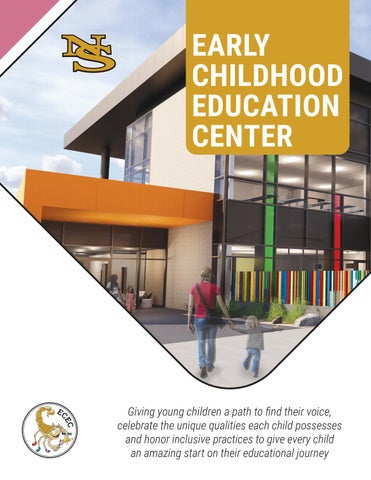
EARLY CHILDHOOD EDUCATION CENTER
Giving young children a path to find their voice, celebrate the unique qualities each child possesses and honor inclusive practices to give every child an amazing start on their educational journey
PROGRAM OUTLINE Implement developmentally appropriate practices (DAP) that are focused on safety, relationships and hands-on, age-appropriate, playbased curriculum.
Utilize authentic and individualized assessments to identify strengths and to support the unique needs of each child.
Focus on brain architecture by preparing young children to grow in their expressive and receptive communication, language and literacy skills through intentional teaching, relationship-building and exposure to Tier 2 vocabulary words through everyday interactions.
To ensure the highest quality care for your child and provide them with optimal learning experiences.
Highlight Social and Emotional Learning (SEL) and development utilizing Conscious Discipline and focusing on building and celebrating the ECEC School Family.
Extremely low ratios of less than 1:5, teacher:children. With maximum class sizes of only 16 children.
Children learn through play. This is their work and it is powerful! When children are guided by teachers to infuse intentional language, vocabulary and focus on their relationship as the foundation for all they do, we see amazing growth.
RELATIONSHIPS
PHONOLOGICAL AWARENESS
Conscious Discipline is a curriculum and overall mindset in supporting children and their abilities to identify, self-regulate and express their behaviors and emotions in healthy ways and feel good about themselves and their relationships with others.
Our intentional focus on phonological awareness and Tier 2 vocabulary, or sophisticated vocabulary, will help strengthen each child’s ability to understand oral language, manipulating those sounds that they hear and later be able to decipher words that are unknown to them. By exposing children to a wide variety of Tier 2 words through storybooks and conversations, they become familiar with mature language, comfortable when seeing them in print and increase comprehension across multiple academic tasks. Multiple exposures in a variety of contexts are crucial for the learning process.
Focusing on relationship-based competencies that are needed to create a strong foundation for optimal brain development, resilience, healthy self-esteem and social and emotional development. We prioritize inclusion, equity and social, racial, cultural and disability justice through social and emotional learning.
SOCIAL AND EMOTIONAL LEARNING Expression and Understanding of Feelings Shares feelings with an adult, enjoys sharing information about self with an adult, seeks detailed explanations with frequent use of why, describes social behavior using a variety of descriptive words, demonstrates selfconfidence.
Social Communication
Takes turns in play, has several friends, plays cooperatively in large-group games, participates well in group activities.
Work Habits/Task Engagement
Maintains interest and engages in small group projects or activities, reacts appropriately to change, transitions appropriately, demonstrates increased independence in learning activities and tasks.
Social Awareness
Greets adults and peers appropriately, pushes for autonomy, is truthful when sharing information with others, establishes eye contact when interacting with peers and adults.
Social Skills
Interacts with adults and peers respectfully, responds appropriately to directions from adults, asks for help when needed, eager to comply with classroom guidance and activities.
CURRICULUM HIGHLIGHTS The Creative Curriculum Focuses on 36 objectives that are organized into six areas of development:
Social-Studies
Physical
Literacy
Science & Technology
Language
The Arts
Our Creative Curriculum is structured around five fundamental principles:
1 Positive interactions and relationships with adults provide a critical foundation for successful learning. 2 Social-emotional competence is a significant factor in school success. 3 Constructive, purposeful play supports essential learning. 4 The physical environment affects the type and quality of learning interactions. 5 Teacher-family partnerships promote development and learning. An inclusive, early childhood program for all children 3-5 years old. Must be 3 years old on or by September 1, 2021 for enrollment. For more information about our organization contact:
TARA WILLIAMS | ECEC Director tara.williams@nsc.edu