Winter 2024 nrvc.net | Volume 49, Number 1
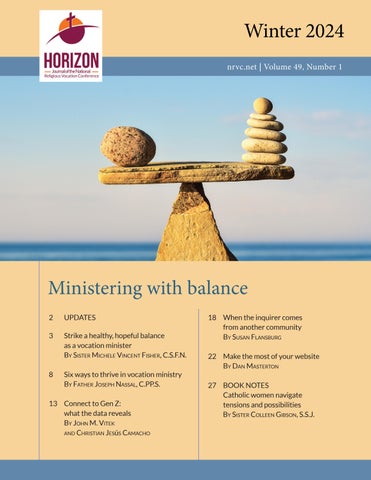
Ministering with balance 2
UPDATES
3
Strike a healthy, hopeful balance as a vocation minister By Sister Michele Vincent Fisher, C.S.F.N.
8
Six ways to thrive in vocation ministry By Father Joseph Nassal, C.PP.S.
13 Connect to Gen Z: what the data reveals By John M. Vitek and Christian Jesús Camacho
18 When the inquirer comes from another community By Susan Flansburg 22 Make the most of your website By Dan Masterton 27 BOOK NOTES Catholic women navigate tensions and possibilities By Sister Colleen Gibson, S.S.J.
Fostering healthy ministers for a vibrant Church.
CANDIDATE ASSESSMENT Diocesan Priesthood | Religious Life Permanent Diaconate | Incardination Saint Luke Institute understands the Church. Our multidisciplinary protocol includes: • Pre-assessment personal & spirituality profile • Clinical, psychosocial & spiritual assessments • Intellectual & psychological testing • Comprehensive feedback session & written report with concrete recommendations
LEARN MORE
SLI.org
SCHEDULE AN ASSESSMENT 502-632-2471 Saint Luke Institute | 8380 Colesville Road, Suite 300 | Silver Spring, MD | 301-445-7970
Editor’s note Editor Carol Schuck Scheiber Design Consultant Patrice J. Tuohy Proofreaders Rosemary Arnold, Virginia Piecuch © 2023, National Religious Vocation Conference HORIZON is published quarterly by the National Religious Vocation Conference, 5416 South Cornell Avenue, Chicago, IL 60615-5664. 773-363-5454 | nrvc@nrvc.net | nrvc.net Facebook: Horizon vocation journal Cover image: styf22, iStock.com SUBSCRIPTIONS A complimentary subscription to HORIZON comes with NRVC annual membership. Additional subscriptions are $50 each for NRVC members; $125 each for non-members. Single copies are $25 each. Subscribe online at nrvc.net/signup. Please direct subscription inquiries to Marge Argyelan at the NRVC office at 773-363-5454 or margyelan@nrvc.net. POSTMASTER Send address changes to HORIZON, 5416 S. Cornell Ave., Chicago, IL 60615-5664. Periodicals postage paid at Chicago, IL. ISSN 1042-8461, Pub. # 744-850. REPRINTS, ARCHIVES, ELECTRONIC EDITIONS Permission is granted to distribute no more than 50 copies of HORIZON articles for noncommercial use. Please use the following credit line: Reprinted with permission from HORIZON, nrvc.net. For other types of reprints, please contact the editor at cscheiber@ nrvc.net. EDITORIAL INQUIRIES & ADVERTISING All editorial inquiries should be directed to the editor: Carol Schuck Scheiber, cscheiber@nrvc.net. For advertising rates and deadlines, see nrvc.net or contact the editor. THE NATIONAL RELIGIOUS VOCATION CONFERENCE is a catalyst for vocation discernment and the full flourishing of religious life as sisters, brothers, and priests for the ongoing transformation of the world. Award winning member of the Catholic Media Association.
Inward and outward, in balance
A
FEW TIMES IN MY LIFE, I’ve done physical therapy that involved using a balance board. The board was about 18 inches wide and sat atop a half sphere. I would get on the board, crouch a little, throw my arms out, and try like mad to stay on it as long as possible. The board would constantly tilt and it took every fiber of concentration to keep counterbalancing enough to stay put. If I made it to 30 seconds, that was an achievement! That balance board was tough, but I think the pursuit of balance at an emotional and spiritual level as a vocation minister is tough in a different way. Most vocation ministers play multiple roles with varying expectations, and many important decisions are not yours to make. To help you keep from wobbling too much as you embrace this ministry, HORIZON presents two writers who look at both practical and conceptual ways to maintain balance and thrive. While vocation ministers must look inward on a regular basis, this edition also pays attention to key parts of the ministry itself. Our article on Gen Z research is intended to help you better understand and connect with young people. Our piece about inquirers who have left another community examines the emotional terrain in these cases. And our website feature presents practical ideas, big and small, for improving your all-important website. Thus, HORIZON begins 2024 looking both inward and outward—striving, as you do, for a semblance of balance. Of course, just like no one can stand for hours on a balance board, no one arrives at total balance in ministry either. But a good goal is to counterbalance the need to keep refining your ministry by also tending to your own needs, and staying centered on the call we all share: to be faithful disciples. —Carol Schuck Scheiber, editor, cscheiber@nrvc.net HORIZON is an award-winning journal for vocation ministers and those who support a robust future for religious life. It is published quarterly by the National Religious Vocation Conference. NATIONAL RELIGIOUS VOCATION CONFERENCE BOARD Board chair: Sister Nicole Trahan, F.M.I. Brother Brian Poulin, F.M.S. Brother Edward Shields, F.S.C. Vice chairs: Friar Mario Serrano, O.F.M. Sister Gail Trippett, C.S.J. Conv. and Mr. Len Uhal Sister Mary Yun, O.P. Brother Joseph Bach, O.F.M.Conv. Sister Deborah Borneman, SS.C.M. Ms. Nancy Costello Ex officio Sister Margarita Hernandez, S.P.
Winter 2024 | HORIZON | 1
Updates
Summer Institute offers five workshops Vocation ministers are invited to attend one or more of the five workshops offered in July at its Summer Institute at the Marillac Center in Leavenworth, Kansas. Details are at nrvc.net. Orientation Program for New Vocation Directors July 10-14, by Sister Deborah Borneman, SS.C.M. and Orientation Program team
Join us for the 2024 convocation Mark your calendar to attend the convocation of the National Religious Vocation Conference October 31 to November 3 in Minneapolis. With a theme of “Walking humbly together,” this event will include opportunities to learn, network, worship, and socialize with other vocation ministers from around the country. Attendees routinely tell the NRVC that their time together at the biennial convocation is inspiring, encouraging, and filled with ideas and resources that directly enhance their ministry. Plan to attend, and consider also bringing leadership and members of your vocation team. Details will be announced in the coming months on nrvc.net.
2024 vocation dates To help you plan for the coming year, here are dates in 2024 for vocation-related celebrations. As you prepare your activities, check out resources at nrvc.net/store for prayer cards, fact sheets, reflection guides, and more. Catholic Sisters Week—March 8-14 World Day of Prayer for Vocations—April 21 Religious Brothers Day—May 1 National Vocation Awareness Week—November 3-9 2 | Winter 2024 | HORIZON
Ethical Issues in Vocation and Formation Ministry July 16-17, by Father Raymond P. Carey, Ph.D. Behavioral Assessment 1 July 19-21, by Father Raymond P. Carey, Ph.D. Health and Wellness Issues in Candidate Assessment July 23-24, by Sister Mary Catherine Redmond, P.B.V.M. and Sister Chero Chuma, C.S.J.P., D.N.P. Understanding, Assessing, and Fostering Psycho-Sexual Integration July 26-29, by Sister Lynn M. Levo, C.S.J., Ph.D.
Promote opportunities and events on VISION’s online calendar VISION Vocation Network encourages all religious communities to promote their events and opportunities on its online calendar. Retreats, talks, discernment groups, book clubs, volunteer opportunities, and more may be listed. An event or opportunity does not have to be specifically related to vocations; it must simply be sponsored by a religious community. To add your event, visit vocationnetwork.org/events. Updates
National Religious Vocation Conference
Amid the many pressures of vocation ministry, it’s important to cultivate practices that help you stay balanced.
Maintaining a sense of humor is one of many practices that can help vocation ministers find balance. Here vocation ministers share a light moment. From left to right are Sister Mary Jo Curtsinger, C.S.J., Brother John Eustice, C.S.V., and Sister Christine Kunze, S.C.N.
Strike a healthy, hopeful balance as a vocation minister
I
T HAS BEEN FOUR LONG YEARS since I last watched the sun come up and the tide roll in along the Atlantic coast. It is indeed one of my “happy” places, and my heart and spirit sing when I am in the company of this great blue cathedral. Being in this place, on this piece of holy ground, helps me to breathe and to clear my head and my heart of both the good and the bad, the joys and the sufferings, the questions, concerns, and creative ideas. We all need time and space to do this very essential act. As I write during my time along the coast, some members of the National Religious Vocation Conference have just completed workshops to begin vocation ministry. Others are across the ocean accompanying young people at World Youth Day in Lisbon; others are making their annual retreat and planning the coming year. At the same time, some are feeling Fisher | Healthy Balance
By Sister Michele Vincent Fisher, C.S.F.N. Sister Michele Vincent Fisher, C.S.F.N. belongs to the Sisters of the Holy Family of Nazareth. She is the continuing formation minister for her province, a member of the vocation team, coordinator of the Delaware Valley Member Area for the NRVC, and a board member of the National Fund for Catholic Religious Vocations.
Winter 2024 | HORIZON | 3
overwhelmed with increasing responsibilities and multiple ministry roles. Some are struggling to discern the future of their institutes and whether to invite new membership. Some are feeling the pain of emotional, spiritual, and physical burnout and the lack of peers with whom to connect to rekindle the fire inside. Wherever you find yourself on this spectrum, I hope my thoughts about maintaining balance in the midst of vocation ministry will speak to you.
Love yourself
Being willing to wade through the murky waters, only seeing the next right step, is a good way to approach our daily realities.
A foundational step toward equilibrium is a question. Ask yourself: Do I love myself enough to ___? Fill in the blank with what you most need, be it extra sleep, time with a friend, or a day of prayer. Showing ourselves the necessary and life-altering love and tenderness that is God’s gift to us is not selfish or ego-serving. Rather, it is essential for our continued growth in wholeness, which is ultimately, holiness. As earthen vessels, our potter-God wants to mold and shape us to be the Christ-bearers we are meant to be. How do we lean into this God who is holding us gently as we turn and move through the seasons of our lives? I get the feeling that many of us have a love-hate relationship with the “B” word: balance. It’s such an easy thing to say, yet so difficult to achieve. Perhaps we are going about it the wrong way. Author Jana Kingsford suggests, “Balance isn’t something you find, it’s something you create.” We spend a lot of time seeking solutions, as if the secrets and mysteries of healthy balance are outside of us. If we can begin by seeing ourselves as the protagonists in our own stories and in our own efforts to live happy, passionate, harmonious lives, we may rekindle a friendship with this word. Motivational speaker and writer Danielle Orner reminds us, “Life is a balance between what we can control and what we cannot; learn to live between effort and surrender!” What wonderful wisdom. Daily, we face situations and circumstances that lie beyond our control, yet others are very much in the realm of things we can act upon. Being willing to wade through the murky waters, only seeing the next right step, is a good way to approach our daily realities. Part of the key to keeping balance is knowing when we’ve lost it. If you’ve ever had the fun of watching a squirrel attempt to keep his footing while hanging upside 4 | Winter 2024 | HORIZON
down on your bird feeder, you know that squirrels seem to beat all odds, but every now and then they slip and take a tumble. Amazingly, they know how to gracefully stick a landing! Can you think of these little creatures when you feel like you are slipping out of balance? Remember that it’s not about falling but about how you land and get back up again.
Strengthen your core by taking inventory
Yesterday morning, as I enjoyed watching the sun rise over the Atlantic from my perch high up on a pier, I noticed a man paddle boarding. From far away, he appeared to be simply standing on the water and moving with the tide. As he got closer to me, I saw how perfectly he was balanced on his board with a paddle in one hand, keeping rhythm with the waves, seeming to skim the surface and float above the water. As he passed close to the pier, he looked up, and we shared a smile. This little glimmer reminded me of two important facts. The first, which I learned after months of physical therapy, is that if you want better balance, you have to strengthen your core. Yes, that means discovering and working muscles you never knew you had. Second, as learned from the great Albert Einstein, “To keep your balance, you must keep moving.” On a purely human level, we know that our most basic needs are for nourishment, shelter, sleep, and movement, but equally essential are the needs for bonding, relationship, and love. Moving higher on the list are needs for purpose, meaning, direction, and generativity. These needs constitute our “core,” and giving them proper attention enables us to live a vibrant, dynamic, passionate life. What are some of these core areas that need to be strengthened and nurtured in you at this time? Where do you feel a tightness or resistance? Taking time to do an inventory might help you understand what you need to do to move toward greater harmony and balance. As you look at your core, you might discover some areas of stagnation, feeling stuck or mired in a particular pattern of behavior or thinking. Perhaps it’s a feeling of helplessness at not being able to meet expectations or to use the gifts and talents you possess to minister as you feel called. What do you need in order to keep moving? Ironically, it might mean stepping back, resting, and taking time out for your spiritual and emotional health. Fisher | Healthy Balance
Ümit Bulut, Unsplash
It is important to take the time to consider whether we’re meeting our core needs for purpose, meaning, direction, and generativity.
This stepping back is an essential movement that many of us in vocation ministry don’t nurture until we feel exhausted and burned out. Movement is not equal to busyness. Movement is a much gentler way to keep us in life’s flow, to keep us connected to the movements and rhythms of God’s Spirit in our lives. Even if the movement comes in the smallest of steps, it’s still movement. Having someone in your life to help you to keep moving is a great blessing, whether it is a good spiritual director, counselor, peer minister, or soul friend. If you are blessed to have this kind of person in your life, take a minute to write him or her an old-fashioned thank you note. Expressing gratitude for goodness received is one of the best fuels to rekindle your inner flame.
Rooted in hope Besides emphasizing movement, a focus on hope is also essential for balance. Hope is a little orphan with curly red hair singing, “The sun’ll come out ... tomorrow! Bet your bottom dollar that tomorrow ... there’ll be sun.” Hope is a caterpillar that asks, “How do I become a butterfly?” And a butterfly who responds, “When you want to fly so much that you’re willing to give up being a caterpillar!” Wikipedia tells us that hope is an “optimistic state of mind based on an expectation of positive outcomes” and Merriam-Webster tells us that hope means “to cherish a desire with anticipation: to want something to happen or be true.” Scripture tells us that hope is a strong and confident expectation; a trust in what is yet unseen. Striking a balance in hope is honoring the process Fisher | Healthy Balance
as much as the outcome, seeing each step along the way as the way, and believing that the providence of God is always greater than our limited vistas. With this in mind, I used the letters in the word hope to share some of the elements I find helpful in striking a healthy balance in prayer, community and family, ministry, mission, and self-care. Those elements are home, help and humor, order, outlook, peace, and expect.
Tend to your home Striking a healthy balance in hope begins at home. Where is your home? I am not only referring to your physical address on the GPS, but what constitutes home for you in an expansive sense of the word? When I was in full-time vocation ministry, I was grateful to live in a large community with sisters of diverse ages and ministries and with living space for me to host small groups for retreats and activities. Hospitality was one of the defining characteristics of our home, whether it was welcoming friends and family members of our sisters, housing employees from our hospital during weather emergencies, or making room for giggling groups of high school girls for an after-school evening with the sisters. Creating and respecting healthy boundaries; inviting others into activity and prayer; and showing genuine empathy, care, and support to one another and to others made this a sacred place for me that I will forever treasure. Even when my ministry kept me on the road, I knew that upon my arrival back home, I would be warmly welcomed and expected to pick up where I left off. The Winter 2024 | HORIZON | 5
Courtesy of the Franciscan Sisters of St. Joseph
of laughter, even in the midst of their aches, pains, and burdens. Humor is a most beneficial medicine, and we would all do well to take a daily dose of it. A good belly laugh actually burns calories and releases endorphins, making for good feelings and positive vibes. It’s even more valuable when shared with a friend. Surrounding yourself, whenever possible, with light-hearted people who can laugh at their own foibles and imperfections and spread joy by their very presence can turn around even the worst of days.
Order
One way to regain balance and perspective is by helping others, and visiting elders in the community infirmary is one way to do this. Sister Marcia Ann Fiutko, F.S.S.J. (standing) talks with the late Sister Benilda Nadolski, F.S.S.J (left) and Sister Alexine Machowicz, F.S.S.J.
anchor of a life-giving, nurturing home life sustained me through many joys and challenges, losses, disappointments, and successes. What is the quality of your home life? Is the time you spend there quality time where you participate actively in the life of those with whom you live? Does the quality of your home life nourish you for ministry?
Help and humor Help and humor are essential in striking a balance in hope as a vocation minister. When I start to feel locked in on my needs, wants, ways, and desires, I realize it’s time to get out of myself and to look around for opportunities to help others. For me, helping others in small, often unnoticed ways helps me to re-focus and widen my lens. Helping others helps us to gain necessary perspective and can re-energize our efforts for things that are more challenging and time-consuming. Helping can take many forms, but one in particular that I’ve found especially meaningful is visiting with my sisters in our infirmary, listening to what’s on their minds and hearts and being refreshed by their wisdom and authenticity. When I am with them, there is usually a lot 6 | Winter 2024 | HORIZON
I often joke about being a pile versus file kind of person, and it works well for me, but there are times when even with the greatest amount of resilience, I can’t take another minute of my piles. Whether it’s rearranging the spice rack or balancing the house checking account, putting things back in order is a non-negotiable. Keep order in your living and working spaces, not with museum-like rigidity but to foster an atmosphere that is peaceful and inviting when you or others are in that space. When you feel frustrated and don’t have energy for the task at hand, go and “make order” somewhere— weed the garden, clean out a closet, or reorganize your workspace. Making physical order helps forge a way for us to make spiritual and emotional order as well, leaving us feeling more connected and balanced. Ordering the hours of our day also helps us to stay in rhythm. The song “In Every Age” by Janet Sullivan Whitaker includes the line, “Teach us to make use of the time we have; teach us to be patient, even as we wait.” These words are like medicine for me when I start to feel like there aren’t enough hours in a day to accomplish all the tasks. We all have the same 24 hours. Try to keep certain daily or regular routines, especially prayer and worship, sitting at a table to eat, planning time for fun, going to bed and getting up at a consistent time, and predetermining the amount of screen time you can handle in a day. All of this contributes to a healthy balance.
Outlook So much of our self-concept centers around our outlook. How I understand myself is often a reflection of how I see the world around me and vice versa. Do you sometimes see through a narrow lens, one that sees scarcity, impossibility, and diminishment? Other times can you see through a wide lens that sees abundance, possibilities, and opportunities for growth? Which is the lens Fisher | Healthy Balance
Redemptorist Renewal Center that you most consistently look through? If your outlook leans toward the narrow lens, what can you do to expand your view?
Peace Striking a healthy balance in hope requires peace of mind, body, and spirit. Remember, Jesus breathed on his disciples and said, “Peace be with you!” Who breathes peace on you? Do you breathe peace to your world? Peace isn’t simply a passive virtue that helps you maintain stability, but it is a generative gift that sustains you in difficult times and allows you to support and encourage others.
Expect As you look at your life, are you checking your expectations? Are they realistic? Too high? Too low? Here are two challenges to consider. First, expect that no matter what comes your way, there will always be an open door or window—maybe even just a crawl space—for possibilities to bear fruit and bring joy. Second, expect that there will be chaos; that’s what the universe was born from! Let these two expectations permeate your mindset and learn to live within the necessary tension, suspending judgment long enough to really listen to your life speaking. Expectation also has to do with how you think about your ministry. When ministry seems overwhelming and all-consuming or unfulfilling and lifeless, it’s good to remember that you are more than your ministry. As Pope Francis proclaims: “I am a mission on this earth; that is the reason why I am here in this world.” Opportunities to be mission abound in the most ordinary experiences of our daily lives. There is never a moment when we are not in mission. Claiming this reality for ourselves gives us permission to see everything we’re about as sacred mission, as a bush afire. If you are struggling to see successes in your ministry and are beginning to lose hope, wake up to the mission that you are by simply being a child of God. In Evangelii Gaudium (Joy of the Gospel) Pope Francis reminds us: “We have to regard ourselves as sealed, even branded, by this mission of bringing light, blessing, enlivening, raising up, healing, and freeing.” These words are full of hope and can restore us to healthy balance. Remember, no matter what your ministry, you are always in mission. Go, be mission: in prayer, in community, in relationships, in service, and in caring for yourself. n Fisher | Healthy Balance
“Celebrating over 55 years of Retreat Ministry ” 7101 W. Picture Rocks Rd, Tucson, AZ 85743 USA Phone: 520.744.3400 Email: office@desertrenewal.org www.desertrenewal.org
Contemplative Study and Sabbatical Program The demands and expectations of full-time ministry are both rewarding and fulfilling; however, it is important to take time to rest & renew. The Sonoran desert allows you to seek the silence and space necessary for spiritual renewal. Since ancient times people have gone to the desert to encounter God. Come and experience desert spirituality in a contemplative environment that will make for a truly unique Sabbatical experience.
2024
July 21 - August 23 October 6 - December 13
HESYCHIA SCHOOL OF SPIRITUAL DIRECTION 2025
February 2 - 14 Week 1 & 2 March 30 - April 11 Week 3 & 4 The HSSD program focuses on the ancient art of Christian Spiritual direction in a multifaith context and offers contemplative study and practice to prepare clergy and vowed religious for a ministry of spiritual direction.
Winter 2024 | HORIZON | 7
Jaap2, iStock
Sometimes we need to pay attention to how we keep the faith. Here are six approaches to help keep the zest in your ministry.
It helps to carve out time for quiet to give the Spirit a chance to stir our creativity.
Six ways to thrive in vocation ministry By Father Joseph Nassal, C.PP.S. Father Joseph Nassal, C.PP.S. is a Missionary of the Precious Blood currently serving as vice provincial of the U.S. Province and living in Berkeley, California. He has worked in retreat, renewal, and reconciliation ministry since 1988. He also has published eight books and has served in justice and peace ministry and in formation, vocation, and leadership ministry for his congregation.
8 | Winter 2024 | HORIZON
K
EEP CALM AND CARRY ON” is one of those slogans that lingers because it can be applied to so many situations. The phrase originated in the spring of 1939 in Britain as the country anticipated the dark days of World War II. The government designed the famous poster and printed more than two million copies, but according to Brittany Fowler, author of a history of the phrase for Business Insider magazine, “not one of them was posted, as officials had last-minute doubts about whether the content was too patronizing or obvious.” Most of the posters were destroyed, but more than 60 years later, one of them surfaced when a bookseller found it hidden in a book he bought at an auction. He put it up over the cash register at his bookstore and customers began asking where they could purchase the poster. The shop Nassal | Thrive in Vocation Ministry
owner started printing copies, and a craze was born. The phrase has been adopted, adapted, and some might say exhausted over the years. But its truth is timeless because it captures an essential quality of faithfulness, steadfastness, and resolve in difficult situations. So how do we apply this truth to vocation ministry? I’ve spent time as a vocation director myself, and I’ve given my share of retreats for worn-out ministers. Putting together the wisdom I’ve acquired from these experiences, I offer six ideas to encourage thriving among vocation ministers and other wanderers, wayfarers, and dreamers of God’s realm. I hope these thoughts will help us to keep the faith and carry on when the road seems treacherous and we discover more dead ends than expressways, more roadblocks than rest stops.
1. Live in the now Thomas Merton once mused, “Time is given to us not to keep a faith we once had but to achieve a faith we need now.” Time passes quickly, and with so much suffering in the world, we are often advised to “keep the faith.” But what faith are we keeping? Is it the faith that served us as children when we were spoon fed without questioning? Is it the faith that leaves little room for doubt and often fails to give others the benefit of the doubt? What kind of faith do I need now? The older I get, the more doubt crowds in. I need a faith that leaves room for doubt and gives others the benefits of my own doubt, understanding that the opposite of faith is not doubt but certainty. I need a faith that helps in those times when fear threatens to get the best of me. The kind of faith we need today is one that reminds us that no matter the bitter disappointment or the beauty too stunning to describe, life goes on. Perhaps the work of faith is to simply know and believe that life goes on. I once heard an episode of National Public Radio’s Wait, Wait, Don’t Tell Me. The guest was the late Norman Lear, who is credited with changing television from a “Father knows best” attitude to “Father knows least” through the character of Archie Bunker on All in the Family in the 1970s. The host asked Lear about his longevity. At the time, Lear was in his 90s and still working, still creating. Lear said essentially that he is guided by two words, “over” and “next.” The image he suggested is hanging a hammock between two poles marked “over” and “next.” So how does he remain creative? When one project is finished, whether it is a success or a failure, he moves on to the next. He doesn’t dwell on what happened before; it’s over. It’s on to what’s next. Nassal | Thrive in Vocation Ministry
Then there is the image of the hammock. To some it might be a symbol of a lazy summer’s day. But it also speaks to the creative process. Taking time to listen, to rest one’s mind, to calm one’s heart, to allow the new to emerge in the gentle rocking back and forth allows one to stay focused, stay faithful, remain calm, before carrying on to the next project, the next person, the next possibility. When we apply this to religious life, and particularly vocation ministry, if we dwell only on our losses, we’ll get stuck. We must allow time for quiet to invite the Spirit to stir our creativity. And then we move on to what or who is next.
2. Keep your eyes on the road The New York Times publishes a column on leadership called “Corner Office,” which carries interviews with CEOs of successful companies. In one such column, the CEO of a software company says he learned many life lessons from his rowing coach in college who gave him this image: “When you When we are going are driving and rain is through difficult pouring down, with stretches on our journey, the windshield wipers if we pay more attention going, you can either to the rain, the storm, watch the windshield and the wipers, instead of wipers or you can keeping our eyes on the watch the road. Which road, we’re going to be in is going to be more successful?” trouble. When we are going through difficult stretches on our journey, if we pay more attention to the rain, the storm, and the wipers, instead of keeping our eyes on the road, we’re going to be in trouble. And yet, how easy it is to lose our focus or compromise our vision when the storms of life move in around us. Keeping our eyes on the road is what spiritual writers call mindfulness. It is the ability to center oneself, to pay attention to what is most important, rather than being distracted by the worries and fears that can cause us to lose our way. We can be “attentive and compassionate toward our own fear without being paralyzed by it,” spiritual activist Robert Gass writes. Awareness of fear “while cultivating … a capacity to think and act with clarity and Winter 2024 | HORIZON | 9
Nourishing vocation support for 49 years Be sure every house in your community is receiving HORIZON. Every quarter, we inspire, educate, and motivate religious communities to support vocation ministry. NRVC members receive special discounts on additional subscriptions along with the free subscription that comes with membership.
nrvc.net/signup
NRVC.net/signup | nrvc@nrvc.net | 773-363-5454
power” is at the heart of the matter of mindfulness. Cultivating this inner silence is an absolute necessity when confronted with a culture that is impatient and prone to shame and blame in public ways. Thus, if we are less than enthusiastic about our mission or ministry, we might check the pulse of our prayer life. Keeping our eyes on the road affords us the opportunity to pay attention. Our time in solitude will lead us to connect with others who share a passion for our community mission.
3. Cultivate community Author and pastor Rick Warren has noted that most people fall into three categories: caretakers, undertakers, and risk takers. Our communities are filled with people who dwell in each of these categories. Which category do you dwell in? Most of us are caretakers—that is the nature of religious life. We take care of one another and those we are called to serve. We take good care of those we love and even those we find difficult to love. But we also know some undertakers in our communities—those who take us under, whose cynicism and sarcasm serve as sharp shovels to dig a grave and bury us. Sometimes we are the undertakers and we dig our 10 | Winter 2024 | HORIZON
own graves with our negativity. We sense the life drain from us as our energy is depleted by the shadows of doom and gloom that often shroud our world. When we feed on this negative energy of those who take us under, we will experience an acid reflux disease of the soul. Its symptoms are anger and bitterness. We need to surround ourselves with people who are not bitter, who do not suffer from lethargy of spirit, with people who remain grounded in hope. We need to surround ourselves with risk takers, people who enlarge our minds, hearts, and imaginations and instill hope. The biblical tradition is filled with risk takers. From Abraham and Sarah through Elizabeth and Zechariah, from Jacob and Sarah to Mary and Joseph, from the prophets of old to the first disciples and witnesses to the Resurrection, we have numerous examples of ancestors in faith who took the ultimate risk to trust God and say yes to what seemed incomprehensible and unimaginable. What allowed them to be risk takers? It has something to do with this understanding that we are formed, known, dedicated, and appointed by God. Those are the verbs expressed in the call of the prophet Jeremiah (Jer. 1:5). He could be the patron saint for vocation directors because he thought he was too young to be a prophet. He needed more time in community to understand the hisNassal | Thrive in Vocation Ministry
tory and spirituality, and to deepen his relationship with goodness, and walk humbly with your God. God. One of my favorite films is The Best Exotic Marigold In reflecting on the call of Jeremiah, we often focus Hotel, about a group of older folks who go to India to on his excuse instead of the original call of the prophet. spend the twilight of their lives in a sort of resort-like Notice the actions taken by God: formed, knew, dedicatparadise. But once they arrive, the hotel turns out to be ed, and appointed. God forms us and has a purpose for less than they expected. Upon their arrival, Sonny, the us before we are born. Our vocation reaches back to the young entrepreneur who is more of a dreamer than a very mystery of life. We are formed and known by God. manager but is trying to save the hotel that his father Jeremiah’s call to be a prophet was his purpose in bequeathed to him, tells one of the guests who finds the life. Discerning one’s purpose is at the heart of vocation accommodations substandard that there is a saying in ministry. When times get tough and India, “Everything will be all right in the losses mount, it is important to return to end. And if everything is not all right, the original source of our call and to ask then it’s not the end.” ourselves: What risks are we willing to Life is often a matter of perspective. What risks are we willing take to promote and propel the reign of We keep our perspective by asking the to take to promote and God in our lives? What risks are we willimportant questions. Since so much in propel the reign of God in ing to take to make our charism, spirituour world doesn’t make sense today, our lives? What risks are ality, community, and ministry known Father Timothy Radcliffe, O.P., former to those who seek to belong? What master general of the Dominicans, bewe willing to take to make risks are we willing to take in calling lieves religious life must be the answer our charism, spirituality, forth from our congregations a deeper to the question, “What is the sense of community, and ministry and wider commitment that will shake, human life today?” One image he ofknown to those who seek rattle, and roll those undertakers in our fered that serves as a possible answer is to belong? community who have their sights set on that of a nun in Venezuela singing the death rather than life? “Exsultet” at an Easter Vigil he attended. “People must be able to recognize in our lives an invitation to be human in a new 4. Preserve your perspective way,” he wrote. For him, the image of that nun singing in the dark to the paschal candle reflects the present and Returning to our original inspiration allows us to prethe future of religious life. serve our perspective. We keep our perspective by focusing on the question, “Are we living our charism in the most relevant way possible?” 5. Embrace imperfection I once heard an interview with a British historian who interviewed a survivor of a Nazi death camp for a As we seek to stay calm and carry on in the work to book he was writing. After the interview, the historian which we are called, we need to avoid getting caught in called a cab and waited on the curb. He had a plane to the roundabout of perfectionism. Or else we will just be catch and the cab was late. As he kept looking at his going around in circles. watch and no cab showed up, the historian became We confuse perfection with holiness or wholeness. increasingly angry. He paced back and forth on the It is easy to do since so much of our religious training sidewalk, kept calling the cab company and yelling into has focused on perfection. That word, perfection, ochis cell phone. At one point, the survivor of the Holocurs early in Matthew’s gospel when Jesus talks about caust who had been watching him from her apartment discipleship in the Sermon on the Mount. In the context window came downstairs to wait with him. She gently of loving one’s enemies, Jesus says we must be “perfect as touched his arm and said, “What does it matter? Why our heavenly Father is perfect.” (I prefer Luke’s version worry about missing your plane? There will be another where he says we must be “compassionate as our God is plane. When you have lived in a Nazi concentration compassionate.”) camp these daily annoyances don’t matter so much.” The pursuit of perfection can stifle our growth and The prophet Micah put our lives in proper perdevelopment as a human person because we are called to spective when he wrote about what God requires of be human, not perfect. We must be who we are and stop us. Three things, the prophet said: do justice, love trying to live up to an ideal that we or others (parents, Nassal | Thrive in Vocation Ministry
Winter 2024 | HORIZON | 11
family, church, society, profession, and our own false self) place before us. In her book, Being Perfect, Anna Quindlen reflects on her desire as a young girl and high school student to be perfect by living up to the expectations of others. “Trying to be perfect may be inevitable for people who are smart and ambitious and interested in the world and its good opinion,” she writes. “What is hard, and amazing, is giving up on being perfect and beginning the work of becoming yourself.” Helping a candidate to religious life become him or herself within the parameters of a congregation’s charism and spirituality is at the heart of the process of discernment. If we are still living up to the expectations of others—of church or family or community or Wall Street or the people down the street—how can we help candidates discern their place in religious life if they are dealing with the same issues? It is important to ask ourselves if we are still trying to shape our lives in response to what other people think of us, of how they define us, of who they want us to be. Are we still trying to be perfect in an imperfect world? Or are we seeking to be whole and holy? In discernment with potential candidates for our communities, we must pay close attention to this question of perfectionism because, as Quindlen points out, one of the many downfalls of pursuing perfection is that it “makes you unforgiving of the faults of others.” But the main reason to avoid the path of perfection is that moment in our lives when we fail at something we truly wanted to succeed at, or we’ve lost a loved one who meant the world to us, or a dream has turned to dust—then “you will fall into the center of yourself ” and “will look for some core to sustain you,” Quindlen writes. “And if you have been perfect all your life and have managed to meet all the expectations of your family, your friends, your community, your society, chances are excellent that there will be a black hole where the core ought to be.”
there is so much apathy and indifference, to practice such kindness, we must first go inside and sense the fire of God’s love burning within us. This is where compassion begins because as Henri Nouwen wrote, “When I really bring others into my innermost being and feel their pains, their struggles, their cries in my own soul, then I leave myself, so to speak, and become them; then I have compassion.” Kindness is born when we learn compassion. And we learn to be compassionate from our losses. Not long ago I met the widow of a 50-year-old man who died suddenly of a heart attack. She and her two children, one in high school and the other a freshman in college, were devastated and grieving this most unacceptable loss. To help with her grief, she came to a retreat I was leading. She told me the story of her son, the freshman in college, who at his father’s funeral said to the brokenhearted congregation, “Dad, you gave me your name. It is the greatest gift you gave me. I will do my best to carry your name with the integrity, compassion, and love that you lived.” That young man is farther along the path of compassion than most. What will keep him going in the aftermath of such a great loss is the memory of his father’s integrity, compassion, and love, and the desire to live up to the name his father gave him. The memory of those who have loved us, encouraged us, and challenged us; the love and compassion we have experienced with God in silence and prayer, in the faith communities we serve, and in the people we have met along the way; and the name we carry that expresses the charism and spirituality of the life to which we are called—these will keep us going in our vocation ministry as we seek to create safe places for those we accompany. As we journey forward in faith, may these six points fuel our souls to keep the faith, stay calm, and carry on. n
6. Practice kindness
Related articles
Embracing our imperfections reminds us that we are not invincible and teaches us to be vulnerable. When we are in touch with our own vulnerability, we learn a little more about compassion. Creating an environment for discernment where the candidate experiences a compassionate presence and feels safe enough to share his or her story is one of the most important gifts a vocation minister can give to a person sensing a call to religious life. To be a compassionate presence in a world where
“Finding strength to uphold the dream of religious life,” by Brother Paul Bednarczyk, C.S.C., HORIZON, Fall 2022.
12 | Winter 2024 | HORIZON
A version of this article originally appeared in the Summer 2017 edition of HORIZON.
“How I stay healthy and hopeful as a vocation minister,” by Sister Renée Daigle, M.S.C., HORIZON, Fall 2006. “Hope in an anxious age,” by Sister Doris Gottemoeller, R.S.M., HORIZON, Spring 2011. Nassal | Thrive in Vocation Ministry
Deemerwha Studio, Adobe Stock
Research shows that for Gen Z a critical part of spiritual and vocational development is belonging to a group where they are named and known.
Connect to Gen Z: what the data reveals
A
T SPRINGTIDE Research Institute, we are not theologians or pastoral ministers. However, as social scientists we suggest that our data supports a ministry approach spelled out in an earlier article in HORIZON. In the Spring 2023 edition, Father Robert Aaron Wessman, G.H.M., describes the pattern of Jesus’ salvific encounters as follows. He met individuals or small groups, came to know them and their needs, listened to them and asked questions, shared his own stories and thoughts, and imparted what they seemed to desire in that moment or what he discerned was needed.
Belonging precedes believing This pattern of encounter strikes us as a worthy way to engage Gen Z young people in their spiritual yearning and vocational discernment. One insight critical to understanding Gen Z is this: belonging precedes believVitek & Camacho | Connect to Gen Z
By John M. Vitek and Christian JesÚs Camacho John M. Vitek is the founder of Springtide Research Institute, which is dedicated to sociological research on young people ages 13-25. Vitek has served in parish, diocesan, ecclesial, and academic leadership for 41 years. He recently retired as president and CEO of Lasallian Educational and Research Initiatives. Christian Jesús Camacho is discerning a vocation to religious life. He works in campus ministry at Christian Brothers University in Memphis.
Winter 2024 | HORIZON | 13
ing. The pattern Wessman describes parallels Springtide’s Loneliness and the need for connection understanding of how belonging is established in a perThe need to belong is very much connected to the reality son’s life. Young people’s experiences of belonging can of loneliness. Record levels of loneliness among young be cultivated by trusted adults, and belonging deepens people today are well documented. In fact, the U.S. through an identifiable process. We suspect that fruitfulSurgeon General issued a 2023 health advisory on the ness in vocation ministry will depend on the degree to epidemic of loneliness, calling it one of the most urgent which an experience of belonging is created through carhealth crises of our day. (“Our Epidemic of Loneliness ing, trusted relationships within community. and Isolation: The U.S. Surgeon General’s Advisory on Young people initially enter relationships, groups, the Healing Effects of Social Connection and Commuclubs, and organizations because of certain commonalinity” is available online). The report notes an alarming ties—shared interests, values, beliefs, practices, vocareality: “Approximately half of U.S. tions, or professions. But they stay in adults report experiencing loneliness, those relationships when they feel like with some of the highest rates among they belong. In our 2020 study “BeWithout question, young adults” and “the rate of lonelilonging: Reconnecting America’s Lonecreating spaces and ness among young adults has increased liest Generation,” we observed a clear every year between 1976 and 2019.” relationships of belonging pattern in the stories of young people Springtide has found that nearly 40 is the starting point for as they move from joining a group to percent of young people ages 13–25 say ultimately experiencing true belongvocation ministry. they feel they have no one to talk to and ing within that group. Repeatedly that no one really knows them well, three distinct experiences appear in at least sometimes. More than one in their narratives: feeling noticed, feeling four young people say they have one or named, and feeling known. fewer adults in their lives they can turn to if they need to Feeling noticed (seen) generates an initial sense of talk. These points come forth in our study “The State of belonging for a young person, which creates a foundaReligion & Young People 2020: Relational Authority.” tion for deeper relationships. Rabbi Jonathan Sacks We see in the data a direct correlation between the defines community as “that place where I am known by number of trusted adults in the life of a young person name and missed if I were gone.” Feeling named by anand that young person’s sense of meaning and purpose. other generates a felt experience of being known, which We know that young people in the United States today is a vulnerable and important experience that paves the need stronger connections with more adults in order to way to an abiding sense of belonging. It builds on and thrive. Data from our 2020 study “Belonging” makes this deepens the sense that one is noticed. clear. Adding just one trusted adult to the life of a young While becoming known is a process, it deepens and person dramatically decreases their sense of loneliness reaches another level of belonging when a person begins and isolation. feeling truly safe in a relationship or community. This Only 50 percent of young people surveyed who depth of belonging builds on the first two levels, being report having no mentors also say that their life has noticed and being named, but it adds the all-important meaning and purpose, whereas nearly 70 percent of dimension of unreserved acceptance. Freed from the fear those who have at least one mentor report that their of rejection, young people feel safe having open, honest life has meaning and purpose. This number jumps to conversations about their lives—hopes, anxieties, chal85 percent for those who have two to four mentors. lenges, and joys alike. Incredibly, more than nine out of 10 (91 percent) Based on our data, we suggest that taking an intenyoung people who have five or more mentors in their tional approach to building belonging is critical to the life report that they sense their life has meaning. The vocational discernment process. Young people are huncorrelation is undeniable. gry to be part of communities of belonging, places where they can seek to clarify the meaning and purpose of their lives and where they can explore the complex domains Christian’s story of their inner and outer lives. Without question, creatLet’s look at one young man’s story to gain insight about ing spaces and relationships of belonging is the starting the importance of trusted adults. point for vocation ministry. 14 | Winter 2024 | HORIZON
Vitek & Camacho | Connect to Gen Z
One of my biggest fears after college was not finding a community that would accept me as one of their own. However, after a couple of months in the Midwest, I was having fruitful and genuine conversations with the Christian Brothers of De La Salle, who did not fully know me but were interested in my story and my personal vocation to be an educator. The beautiful thing about finding this community was that my aspiration to become a brother was not front and center in our conversations. The brothers allowed me to ask the questions first and then guided me to have deeper reflections on God’s presence both in and out of the classroom and on how God’s presence was around me throughout my childhood. When I entered discernment with them, I was contacted by three brothers who would pray for me on a daily basis. Since then, I’ve met all of them, and we’ve had invaluable conversations with each other about how I’ve grown from a quiet volunteer to an aspiring young educator. Having these men email me monthly and talk about their lives and how they overcame obstacles allowed me to reflect on my own life and see the strength of a vocation. I felt comfortable opening up more and having those conversations with them about family and the balance between my new family, the brothers, and my family of origin.
For Christian, the vocation team has become a community of trusted adults that has been effective at cultivating a deep, meaningful relationship with lasting impact in his life. The needs of young people that our data has uncovered suggest that this is the kind of trusting relationship that leads to belonging, and the experience of belonging is fundamental to commitment to a community. Young people do not stay in a community they do not feel they belong to but rather look for a place where they feel noticed, named, and known by trusted and caring adults.
The complexities of religiosity for Gen Z One might assume that the decline in religious affiliation would naturally imply decreased religiosity and spiritual seeking among young adults. According to Springtide’s study “The State of Religion & Young People 2023: Exploring the Sacred,” 39 percent of young people ages 13– 25 identify as having no religious affiliation (nothing in particular) or as agnostic or atheist. While much of the focus of religious leaders over the past 10 years or so has been on the disaffiliation of young adults—that is, those Vitek & Camacho | Connect to Gen Z
leaving the church—Springtide’s most recent data (2023) indicates that nearly a third of young people (31 percent) have never been affiliated with a religious tradition. Yet the same data also shows that most young people see themselves as religious and spiritual. When asked, “To what extent do you consider yourself Religious identity today a religious person?” 68 percent of young people is increasingly something report that they are that individuals personally “religious” (responding construct piece by piece, “slightly,” “moderately,” rather than something or “very”). When asked, handed down from a prior “To what extent do you generation or adopted consider yourself a spirithrough affiliation. tual person?” 78 percent report that they are “spiritual.” So how do we reconcile these seeming contradictions? And what implications do they have for vocation ministry? Springtide sees opportunities in this data that could be easily overlooked if we considered only traditional markers of religiosity—such as Mass attendance and prayer—as the indicators of Gen Z’s religious and spiritual identities. In general, religious identity today is increasingly something that individuals personally construct piece by piece, rather than something handed down from a prior generation or adopted through affiliation with a particular community. Sophie, 23, a young person we interviewed for our study “The State of Religion & Young People 2020: Relational Authority,” explains her sense of religious identity: I believe in God, but I am not very faith driven. I don’t think about religion very often. I don’t go to church. Faith is not, unfortunately, a big part of my life. A lot of people get their fulfillment and that meaningfulness through faith, and since that’s not a huge part of my life, maybe I’m trying to get it in other ways by helping others. Sometimes I think I would be happier if I were more religious, but I think as long as I’m a good person, helping people when I can, that’s really my idea of religion.
Sophie doesn’t go to church or identify any practices that tie her to a specific denomination or tradition. Though a religious institution might contribute to a Winter 2024 | HORIZON | 15
Photo by Jeff Schrier, Diocese of Saginaw, Michigan
Young people without church affiliation may still attend services, and most see themselves as spiritual. At the same time, vocation ministers may want to begin building relationships with young people outside of institutional settings.
person’s religious identity—in this case, giving Sophie some language for thinking about the existence of God and her personal moral code—young people are increasingly seeking religious or spiritual ideas and values from places other than traditional religious institutions. Keep in mind, again, that nearly a third of young people in 2023 say they have never been affiliated with a religious community, meaning many young people are unfamiliar with the practices, beliefs, sacred stories, and rituals of a tradition. There is a broad shift among young people: they are moving away from forming religious identity solely 16 | Winter 2024 | HORIZON
through a formal or cultural association with a specific religious tradition. In fact, religious affiliation has declined steadily over many decades. The General Social Survey has been tracing this trend since 1974, noting a steady increase of individuals who say they have no religion when asked about affiliation. The boundaries around religious practices, beliefs, affiliations, and attendance are blurry for young people. Terms like religion, faith, and spirituality overlap and take on increasingly nuanced meaning. Springtide survey data from 2023 shows that 61 percent of young people ages 13–25 report affiliation with a religious tradition or denomination. But a term like “affiliated” doesn’t fully communicate the complexity of religious belief and practice for young people today. Even those who tell us they are affiliated with a particular religion may not understand affiliation in the same way a religious leader does. According to Springtide’s 2023 data, 65 percent of young people who are affiliated with the Catholic Church report little to no trust in organized religion. Incredibly, this means that well over half of young people who claim an affiliation have little trust in the very religious institutions with which they identify. The markers that define who is religious and who isn’t are not as neat as some might expect. The fact that nearly one in 10 of the young people in general (and the same rate of Catholic young people) who say they are affiliated with a particular tradition also say they are “not religious at all” indicates the complexity—the inadequacy—of terms like affiliated and unaffiliated to describe young people’s religious identities.
“Unaffiliated” doesn’t mean total void The complexity of the religious lives of young people becomes even more evident when we look closer at the unaffiliated—the young people who say they are agnostic, atheist, or nothing in particular. Eighteen percent of them report that they attend worship services, and a majority say that they are at least slightly spiritual. This challenges religious leaders—Catholics included—to move past misconceptions about the spiritual longings of those who identify as “nothing in particular” or outrightly atheist or agnostic. We see, then, that the broad categories of “affiliated” and “unaffiliated” do not capture the complexity of the inner and outer lives of young people today. While Catholic schools and young people “affiliated” with Catholicism have largely served as the feeder for vocation minVitek & Camacho | Connect to Gen Z
istry in the United States (at least since the early 1900s), the shifts in the religious landscape suggest that young people who may be drawn to religious life in the future will identify as affiliated, unaffiliated, and everything in between. Amid this complexity, vocation ministers may do well to consider how to become present to young people in spaces outside traditional institutions. The old labels are simply no longer meaningful for understanding the religious lives of young people—if they ever were. The inner and outer lives of young people in general and among young Catholics today are complex. Their religious impulses—the things they long for and belong to, the ways they make meaning, construct identity, and connect with others—are more complex than labels like “affiliated” or “unaffiliated” could possibly represent. One might assume that a lack of affiliation means a young person isn’t interested in questions or lifestyles we often associate with “religion,” including living out religious values or attending religious gatherings. But for a considerable number of young people, the data tells a surprisingly different story. Here are some 2023 facts about unaffiliated young people: • 22 percent say that they are at least slightly “religious.” • 13 percent say that they have become more religious over the last five years. • 4 percent say that they attend religious gatherings at least once a month. • 57 percent say that they are at least slightly spiritual. Again, we might do well to not assume that young people who are unaffiliated with a religious tradition would not be drawn to a religious vocation. Going forward, affiliation may not be the helpful indicator of prospective interest in religious life and community. Like young people in the general population, young people who identify as Catholic don’t necessarily have the expected hallmarks of religiosity either. As reported in “The State of Religion & Young People 2020: Relational Authority,” nearly one-third of affiliated young Catholics say they do not think it’s important to have a faith community, 49 percent attend religious services once a year or less, and 34 percent tell us they don’t try to live out their religious beliefs in their daily lives. In our report “The State of Religion & Young People 2023: Exploring the Sacred,” we examine young people’s Vitek & Camacho | Connect to Gen Z
experiences of the sacred and find that it is expansive regardless of affiliation. As you might expect, young people who are affiliated with a religious tradition report that they “see the sacred in all of life,” as do young people who identify as unaffiliated, although at just slightly lower percentages. Over half (58 percent) of the unaffiliated say that it is “somewhat true” or “very true” that they see the sacred in all of life.
Spiritual mentorship needed In bringing to a close this brief overview of our research on young people, we’d like to touch on just one attribute of young people who experience the sacred in their lives. These findings relate to our emphasis on the centrality of belonging for them. Our data indicates that connection to others is linked to sacred experiences. Of those who say they’ve felt “fully seen and understood” by at least one person in the past two weeks, 69 percent say they’ve experienced a sacred moment, compared to 57 percent of those who have not felt fully seen and understood. There is a similar pattern for those who feel they belong. Of those who say there is at least one place where they feel like they belong, 68 percent say they have experienced a sacred moment, compared to 59 percent of those who say they don’t have anywhere they belong. Gen Z and Gen Alpha, like generations before them, seek not only experiences of the sacred but also relationships with trusted adults who will listen to them on a deeper level and cultivate experiences of belonging. The question is, of course, how do young people, particularly those with no affiliation with a religious tradition, give language to and listen to their internal spirit and come to see that life in community may, in fact, be their calling? Vocation ministers can bring something important to the table: spiritual mentorship. The data shows that these younger generations are seeking and open to the religious and spiritual domains of life. Increasingly, that seeking will be outside of religious institutional affiliations for many young people. Thinking differently about where we come into relationship with young people and building relationships on the foundation of belonging is imperative for vocation ministry today and in the future. n Note: parts of this article have been drawn from previously published reports of Springtide Research Institute. Learn more about the research and resources referred to in this article at springtideresearch.org. Winter 2024 | HORIZON | 17
iStock, photo by wavebreakmedia.com
South_agency, iStock
The experience of leaving one religious community and entering another can be searing. Those who have done so share their insights.
Leaving a community where you envisioned living the rest of your life takes a big emotional toll. For those who seek a transfer, an understanding vocation director at the new community can smooth the transition.
By Susan Flansburg Susan Flansburg writes for and about Catholic sisters, as well as a range of nonprofit organizations. Her book, Feels Like Home: A Single Woman’s Guide to Catholic Religious Life in the U.S., is a guide for women who are discerning a vocation to religious life. It is available at CatholicSisterGuide.com.
18 | Winter 2024 | HORIZON
When the inquirer comes from another community
A
LMOST A QUARTER of those I spoke with about vocations during research for my book Feels Like Home: A Single Catholic Woman’s Guide to Religious Life in the U.S. (2023 independently published) reported leaving their original community. Some were asked to leave just before final profession. Others left of their own accord, stricken by what they felt was their failure to be good enough. While vocation directors tend to frame every outcome as positive—discernment is as much about finding what you aren’t called to as what you are called to—“no” feels bad. And depending on the individual and the way in which the relationship was terminated, it can cause long-lasting grief. Flansburg | From Another Community
This article shares some sisters’ and brothers’ stories of departure in the hope that they can help start conversations about how to journey with those who are coming from another religious community. Some stories also include instances of a seldomdiscussed problem that still exists in some communities, which is the abuse of power by leadership. Such abuse often leads to protracted feelings of grief and loss and even unworthiness. It is a topic well worth exploration, but beyond the scope of this article. Finally, each inquirer is different, of course, and each reason for having left a previous community is highly personal. Certainly some should not be members of any community at all. I hope these stories will invite you to increase your awareness and sensitivity toward any former religious who wish to restart their discernment with you.
Paul: hesitation led to rancorous ending Paul entered his first community straight out of seminary college. He had discerned with these men since high school. He knew he was where he was supposed to be. Until he hit 30. That milestone called him to question. “I decided to take time out, to determine whether I had been missing out on life. My friends were getting married, starting their lives. I had never had anything of my own. When I told my brothers, they said I was making a big mistake. The provincial was angry. They made me into the bad guy. Made me feel like a second-class citizen.” Paul left anyway, thinking he’d return as soon as he had the experience he felt called to. “It was never if, but when I would go back. I got my own apartment. I learned basic things, like you needed a deposit for rent and utilities and insurance for your car. I decorated my apartment with religious things. I invited a couple friends over, and they said, ‘This looks like your old room at the friary, Paul.’” Paul soon realized he wanted to go back, but he faced new hurdles. For one, he would have to complete both the postulant and novice phases again. Even more distressing, though, he would have to work with leadership who seemed bent on punishing him. He remembers the vocation director saying, “My job is to work with new vocations, not with people who left and had their fun and now want to come back. You have to play by my rules now.” “They made me doubt my own vocation, like I was Flansburg | From Another Community
doing something wrong. I thought, ‘I’m not going back to religious life.’” After an extended period of discernment during which he wrestled with a sense of powerlessness, blame, grief, and longing for community, Paul returned to religious life in a new community from the same tradition. There he repeated the postulancy and novitiate, and today serves as a vocation director. Looking back, the abuse of power he encountered — which included an effort by the first community to prevent his entering his next community—has helped make him more pastorally sensitive to his own inquirers. “Nobody should be more broken when they leave than when they enter a community. We [vocation and formation directors] need to own this reality. We need to accept that we might have a role in it and be aware of its human consequences. I think it’s more common than we realize.”
Ginny: a bad fit from the start Ginny began communicating with a vibrant vocation director while still in her teens. By the time she was 21, Ginny had been wowed into dropping out of college and entering the community. It turned out to be a very poor fit. “I hadn’t really gotten to know the community before entering. I knew I was called to religious life, but they adhered to a blind and hierarchical obedience that wouldn’t let me ask questions. They discouraged friendship with anyone but God. They made me feel like something was wrong with me.” Gradually, Ginny came to believe they were right. Something was wrong with her. She kept trying to be better, making preparations for her final profession. Community leadership had grown tired of her questions, however. They told her she had to leave. “They told me to pack my things and go. It was the most painful experience of my life. I no longer believed God loved me. I felt like I had lost my identity. I still felt called, but would another community ever want me?” Over time, and thanks to a good spiritual director, Ginny regained her sense of identity and self-worth. She joined a community that fits her like a glove. Today she serves on its vocation team. “Here, there’s room for me and my questions. I can make friends. I can be curious. I can ask the whys. It’s such a relief.” Ginny extends the wisdom of her own hard-won lessons to inquirers. Being aware of and sensitive to any Winter 2024 | HORIZON | 19
feelings of deep loss, grief, or anxiety is critical to inviting them to be who they are. “It took me two years to begin to heal. I couldn’t have done it without the wonderful sisters I have joined. Knowing I was loved and accepted for who I was made all the difference for me.”
Kim: an incompatible community Kim was in her 20s when she told her parish priest that she might be called to religious life. He sent Kim to the Korean community in his diocese because she was Korean American. She says it might have looked like a natural choice, but it proved to be terribly wrong. “They accepted me without any formal discernment. I entered after just two months. It was not a good fit.” Kim tried to shoehorn her personality and spirituality into the community, completing her postulancy and novitiate. But once she professed first vows, she was finally forced to face the fact that she simply did not fit. “I felt my spirit and soul were getting destroyed. I tried to stay, but they were much too conservative for me. They followed a pre-Vatican II way of life, which ended up pushing me away from God. They wouldn’t let me do or be what I felt called to.” Kim’s journey out of that community and into the right one was “very painful. I took time for a long and formal discernment process, which I think everyone needs. I recently professed first vows with my new community, and I am very happy.” She cautions that there’s a balance between the need to adapt to religious life and the need to honor your own needs. Both pieces are critical. “I learned so much about what I believe and need. But you have to be open to changing yourself, too. You’ll never find a community that is perfectly matched to yourself—you have to change and adapt to some extent.”
Simone: missing communal life Simone had entered a community she’d known since childhood. Her family and friends were thrilled with her decision. “I thought, I’m finally where I belong. I was very happy.” Gradually, though, it became clear the community was a poor fit. The two sisters she was living with were rarely home, a lifestyle repeated in living arrangements throughout the institute. Simone had thought religious life would prioritize community. She felt she was living in a way that was identical to her life as a single woman and began to feel called to leave. 20 | Winter 2024 | HORIZON
Looking back on it, Simone says she couldn’t tell anyone what she was feeling because it was simply too painful. “I cried a lot. The hardest thing was to say, ‘This isn’t working out.’ It was awful. I spent the entire summer grieving. I believed it was my fault, and that I was not called to be a sister after all. Then I found a new place to live and got back to single life.” For the next three years, Simone put religious life out of her mind. She taught school, participated in parish life, and enjoyed socializing with friends. She visited her family often. Then she began to hear the call to explore religious life again. Simone entered a monastic community, professing final vows in 2012.
Allison and Mary: difficult departures Allison discovered her first community in college and fell head-over-heels in love. Trouble was, being in love alone was not enough to sustain a vocation to that community. “It was like trying to force myself into a pair of shoes that I loved but didn’t fit. It was painful and embarrassing to leave.” Allison left and worked through her pain and embarrassment. After a couple of years, she found the community that was right for her. Mary was preparing for final profession when her community suddenly and unexpectedly asked her to leave. “They said I had issues that needed to be worked out.” Despite community leaders inviting her to come back after she resolved them, Mary said she despaired at their decision. “I knew it was the right community for me, but I wasn’t sure I should go back.” She lived as a single woman for seven years before returning. She is a fully professed sister today.
Second time around Following are suggestions for vocation ministers from people who have made a transfer out of one community and eventually entered another. • Discern carefully who and what your inquirer is called to be and do. Kim wanted to do ministry in a modern community. Simone wanted to live in a prayer-centered community. Remember, inquirers typically know very little about the scope of institutes available to them. It’s up to the vocation director to guide them according to their needs and desires. Get to know a variety of communities so you are better able to do that. Flansburg | From Another Community
Wavebreakmedia, iStock
• Make sure your inquirers really get to know your community. Some institutes provide pre-postulant live-in periods to offer advance opportunity for more interaction and experience of their traditions. Perhaps this would work for yours. • Don’t repeat a valid canonical novitiate. Fill in what the new member doesn’t know. Respect that they are not starting at the same level as everyone else. Explore how the experience can be tailored to value and acknowledge previous experience. • Recognize your inquirers are adults and treat them accordingly. • Listen to your inquirers. Then go to your leadership to advocate for what you’ve learned they need. • Do your due diligence. But be willing to write a new story together. • Contact their previous community. Yes, you are the agent of and advocate for your own community. But listen to what is said very carefully. Ask yourself these questions about your inquirer’s previous experience: Is it possible that there was a mismatch of charism? Is it possible that there was a mismatch of lifestyle? (For instance, did the inquirer want to stay home when they were supposed to go out to ministry?) Did they not connect with the institute’s particular ministry? Were there circumstances in the institute that might have provoked a sense of instability or turmoil in them? • Create a discernment process for leaving. This is critically important for the emotional and spiritual health of both parties. Don’t send people out more broken than they were when they entered. • When contacting the previous community for information about your inquirer, be aware that the old community might not be objective. • Your inquirer may be grieving and even feeling to blame for having “failed” at a previous community. Listen deeply and with compassion. Flansburg | From Another Community
It is important to listen carefully to anyone in discernment, and that is especially true for those seeking a transfer.
• Hearing the word no during discernment is crushing. Help your inquirers understand there is no failure in discernment. If they are asked to leave or don’t feel it to be a life-giving place for them, they’ve learned this particular community is not for them—at least not yet. That’s success. • Be honest with your inquirer (and, later, with someone in first formation). Warn them if you see red flags. No one should be surprised to learn the institute has decided to ask them to leave. n
Related article “What vocation directors need to know about the transfer process,” by Eileen Jaramillo, HORIZON, Summer 2022. Winter 2024 | HORIZON | 21
123RF
Here are practical tips for improving your website—from ensuring it looks good and reads well, to helping it show up in a browser search.
When young adults pull out their phones and look up your community, what do they find? An attractive, clear, updated site is essential in vocation ministry today.
Make the most of your website By Dan Masterton Dan Masterton has been a vocation minister for the Viatorians (Clerics of St. Viator) since 2019. He met them as a St. Viator High School student and is now in discernment and formation as a pre-associate. He has published two ministry-related books and a number of articles. Dan lives in Bolingbrook, Illinois with his wife and three children. Find his writing and get in touch at linktr.ee/ danmasterton.
22 | Winter 2024 | HORIZON
W
HEN WE’RE LOOKING for information, sometimes we ask the person sitting near us, sometimes we send a text or make a quick call, but most of the time we Google it. Catholics have the same tendency to seek quick reference answers online about faith. When we’re on vacation, we find Mass times on nearby parishes’ websites that pop up on Google Maps. When we’re curious if there’s a patron saint of something, we check Catholic.org. Religious communities need to honor this modern reality, and many do, but they may be falling short when it comes to communicating well with prospective members. Website professionals with expertise in Catholic vocations say religious community websites serve professed members and close collaborators well by providing information and reference pages. Additionally, most sites support donors by making it easy to give. Fewer religious community Masterton | Website
websites are intentionally aimed at young adults who may be open to life as a sister, brother, or priest. Having a strong website for this key audience can sometimes seem like a Sisyphean task. Maybe you can’t imagine dedicating time, money, or attention to this purpose. Yet the opportunity cost of letting a community website become outdated, disorganized, or unresponsive may loom even larger. Patrice Tuohy, publisher of VISION and vocationnetwork.org and CEO of TrueQuest Communications, invites religious leadership to acknowledge the magnitude here. “If potential discerners click through to a community’s website, and they find that it’s clunky, then it’s a huge drag and an issue that may stop them from continuing. Often, people designing websites are thinking primarily of members and donors, perhaps leaving discerners as a secondary consideration,” Tuohy says. Let’s look at ways you can build or improve your community’s website to ensure that young people who seek your community online will find something live and accessible that they can connect to.
The basics Whether you’re building a new website or improving upon your existing site, where do you start? Curtis Long, owner and director of ideaPort LLC (which provides web services for the National Religious Vocation Conference), encourages people to look at peer websites: “What kind of websites have you seen that you liked? That’s the best way to find common ground for functional ideas. If someone has no idea what they want, the designers and the clients must start by looking at examples together.” As you sample various pages, it’s helpful to see how others use multimedia, social media content, branding, color schemes, fonts, logos, and other elements. Additionally, Tuohy encourages communicators, vocation ministers, and other colleagues to go through a search themselves. “The first thing I always say is, ‘Go to your site as if you were a discerner and look at it that way.’ Or even ask a discerner or another young person to do this and show you their process,” she says. Since religious communities are prayerful and honor their late members with heartfelt memorials, sometimes the homepage image is less than ideal for a young person discerning. Tuohy advises that recognition of deceased members continues but in proportion to other considerations. “Often when a discerner goes to the website, the first thing they see is obituaries. It is probably best to consider a different message to lead with,” she says. Masterton | Website
Menus As you identify traits of sites that are attractive and work toward a portrait of your desired site, you need to identify how to organize your home page and the information it will house. As much as possible, strive for simplicity. “You have to keep it simple. The tabs should be super short, clean, and really obvious. You have a lot to say, but you can’t say it all on the first page. Keep narrowing things down to the simplest top-line tabs to help people explore,” Tuohy says. Marge Argyelan, director of database administration for the National Religious Vocation Conference, works extensively with religious communities via their online presence. She can’t recommend simplicity strongly enough. “Some sites try to do so much with small font, small pictures, and crowded content. It’s just too tight and can make your head spin as you look at it,” she says. “Less is more.” Tuohy believes most religious communities could organize their site’s information into just six categories: 1. 2. 3. 4. 5. 6.
About History and/or Mission Ministries Vocations News Donate
As you narrow down specific titles here, it could be tough to settle on a final choice. One thing to consider is avoiding technical words that most people will not quickly understand. “Some websites use really complicated jargon and terms. Sometimes communities use terms that are known within the community but are not understandable to those coming from the outside,” Argyelan says. A decent rule of thumb is to lean toward the titles that are shortest, simplest, and clearest, and when stuck between choices, give the nod to action verbs and concise single-word titles. “We found more than anything that using standard, basic tabs with simple, clear titles helps the most. Keep those initial tabs as short and clear as possible,” Tuohy recommends. For those who struggle to commit to a simpler, cleaner look, or who just want an elegant solution to organizing the home page, Long suggests a “splash page,” a simple, usually graphic-oriented opening page. “At the top, it tries to steer people to the part of the site that is best for them,” says Long. For example, a community Winter 2024 | HORIZON | 23
The National Religious Vocation Conference uses a splash page on nrvc.net to direct users to the appropriate section of its site.
could feature a few bright pictures with clear headings that link to dedicated subpages. By viewing these headline options, visitors self-sort into groups such as discerners, members, and benefactors. “Once they go to the interior pages, you can personalize those pages for the audience. That spares you from trying to make the home page everything to everyone,” Long says. Another added benefit of a splash page is that it can be set up to supersede the preexisting home page. In other words, when visitors type in or click through to your website, they’d land on this new page before seeing the older content. “It’s a way to give your website a facelift without having to pay for a larger overhaul. It can do some of the quick improvements that prioritize these things until you can tackle a larger upgrade,” Tuohy says.
Compatible with phones and tablets Another factor to consider is whether your site displays well and works smoothly regardless of whether users find it on a phone, tablet, or computer. This is known as responsive design. Researchers estimate that 60 to 70 percent of web traffic now comes from mobile devices. Responsive design detects the user’s device type, its screen size, and its orientation (portrait vs. landscape), and then adjusts the appearance of the website accordingly. “Today, it’s perhaps more important to have a website be mobile-friendly,” says Long. “I recommend designing a page to work primarily on mobile and then to function well on desktop. Responsive design will help overcome issues, and designers need to utilize the various preview modes to check for appearance.” Responsive design is a good example of a technologi24 | Winter 2024 | HORIZON
cal advancement that gradually made its way across website design. Some places started incorporating it in the early 2010s, and it eventually became the norm. Tuohy notes that the development of this new standard is a good example of why organizations need to commit to a semi-regular rework of their website: “It’s a tall order, but everyone should aim to redesign or upgrade key features on their website every five years.”
Vocation page While some larger communities may be able to create a stand-alone vocation website, most make it a subpage within their primary website. Just as the whole of the website should be designed with young people in mind, the vocation page needs to be a place that stands out to younger users, especially those discerning religious life. As you think of what information to share about your community and its formation process, consider incorporating these elements. First, have an area that taps into your community’s social media presence. If you maintain a YouTube channel, embed a favorite video or two. Embeds play on the page but also allow for clickthrough to your channel. If you maintain a Facebook account, include a box that populates with its latest activity. If you have a community podcast, include a section that displays the latest episodes for users to click and listen. Next, connect your vocation page to the newsfeed for your community. Incorporate the latest stories that celebrate your members’ ministries, spiritualities, milestones, and more. Ideally these stories would be multimedia, including at least short videos or vivid pictures. Finally, integrate an intake form of some kind. While inquiry systems like VISION Vocation Network Masterton | Website
do funnel discerners to vocation directors, communipage headers, in metadata, and in the proper file names ties shouldn’t miss the chance to receive these inquiries of photos that are uploaded,” Long says. directly. Incorporate a form into the page that invites disIn other words, you need fewer “IMG_0946.jpg” cerners to submit basic contact information and indicate and more “Robertson-Viatorian-school-service-withthat they’d welcome an email, phone call, or video chat kids-2022.jpg.” Renaming photos before they’re uploaded about their discernment. As you set this up, be absolutely is a good way to incorporate this strategy. “Vocation disure there is a clear way for someone rectors are often good at taking or gathto monitor submissions, maintain a ering pictures, but they need to follow database of these new contacts, and through with file names,” says Tuohy. respond to all serious inquiries. Just as the whole of “Even if every photo name doesn’t have the names of all people in them, they your website should be at least need an event name and year. designed with young Promote your website Pictures with just default file names fall people in mind, the Start with the low-hanging fruit. On short.” vocation page needs your social media accounts, ensure that One tricky element here is that to be a place that your community website is prominentsearch engines such as Google are alstands out to younger ly listed as part of your bio. Check in ways evolving as the technology of web users, especially those with your sponsored and owned instisearches improves. As a result, even discerning religious life. tutions to ensure their websites include experts need to stay on their toes. “The a prominent link to the community’s algorithms are always changing, so home page. You could also invite them sometimes you or your support will just to add links to the community site in have to Google ‘SEO’ and read through their emails, newsletters, and periodicals. Finally, on articles from the last year,” says Long. items such as the congregation’s business cards, brochures, advertisements, periodicals, letterhead, and even Ok, I’m in. What next? in some logos, include the website. Next, wade into a crucial component of internet If you are starting a vocation website from scratch, conresearch: search engine optimization, or SEO. This is sider using Wix or WordPress. Both are “freemium” the process of maximizing the number of visitors to a models, where you can build a website for free, but you website by ensuring that the site appears high on the list would pay to unlock more advanced features or secure of results returned by a search engine. To get an initial a domain name for your website. Both of these web sersense of things, Google the name of your community a vices are widely used and would be updated and serviced few different ways to see the top search results. regularly. Both are intuitive and can be accessed through One component of SEO is optimizing your metaany web browser. They allow motivated users to experidata, that is, the information included within the comment within built-in features to progressively design a ponents of the website. Metadata can also refer to the site. file name of photos or the way a document file contains Alternatively, if you are looking for a professional to its date of creation. Thoughtful wording of metadata is help, try to discover who built attractive peer sites. “Find another way to pave a pathway to people’s discovery of religious communities’ websites that you like. Then look your site. at the bottom and see who services their site, or reach “Think about the terms you know would draw out to them to find out who their developers were,” sugsomeone to your site and then incorporate them. Ensure gests Long. that these terms appear on your site, and try to have your What are a couple key junctions at which it makes tech support include them in metadata around the site. sense to hire professional help? First, if you’re trying to If your charism is healthcare or education, you need to improve or optimize an existing website without starting have a lot of word usage from those categories around over, it may take a more experienced hand to preserve your website. Part of it is regularly adding new content to existing structure without accidentally deleting or damyour website that includes those terms,” Tuohy says. aging what is there. Those who use popular platforms And as you add new photos, news stories, and more, like Wix or WordPress will find that hired professionals roll these keywords in. “Keywords need to appear in are willing to work with that existing structure. Second, Masterton | Website
Winter 2024 | HORIZON | 25
GOOGLE AD GRANTS Did you know grant money is available for increasing your online reach? “Google Ad Grants are complicated to apply for because it can be time consuming to gather the proper documentation. But they offer up to $10,000 worth of Google Ads each month to promote your community, your events, etc., so it’s definitely worth the effort,” says VISION and vocationnetwork.org publisher Patrice Tuohy. Google Ads is an enormous network of online advertising in which Google can show your ad to an immense amount of users in a variety of different ways. Because of Google’s close connection to users’ searches, its technology can put ads in front of users with a higher likelihood of clicking. This could mean more people learn about your community, and perhaps more young people open to religious life will visit your vocation page. Visit google.com/grants to learn more.
communications department. There needs to be a channel to connect them,” says Tuohy. And as this process unfolds, those tasked with creating, improving, and maintaining the website need a plan for steady attention. “Have a protocol and a plan for how often someone, or a group of people, will go in there to check on things. There are so many [religious community] sites that are old and not updated. And some even forget to pay for their domain name, so users may find something completely different than they were looking for,” says Argyelan, describing a particularly dangerous but avoidable scenario. One or more people should commit to doing a sort of “physical exam” of the website. These checks should have a set frequency, perhaps monthly or quarterly, for questions like these: • Are there broken links or pages? • Are any pages empty, partially unfilled, or still hosting placeholder content?
if you want your website to be a collaborative effort involving several people within your community and need to manage access and editing capabilities, it’s time for a professional. “The minute you start talking about trying to integrate multiple site administrators, a database, live updates, and all of that, then you need to hire someone,” Tuohy says. Look for a web designer with nonprofit experience, advises Tuohy. “Anyone who works with nonprofit groups will likely be able to work with proper language and presentation,” she says, noting how nonprofits— faith-based or secular—all need clear mission language in their communications, including websites.
Commitment and communication No matter what state your site is in—whether a work in progress or a polished product—communication between website administrators and communications staff, community leadership, and stakeholders who use the site is crucial. “Sometimes I wonder if things fall apart for religious communities’ members when they don’t know how to talk to their tech support or tech volunteers,” says Argyelan. Healthy organizational structure and avenues for reporting and collaborating are crucial here as always. “In larger communities, members, vocation directors, and formation directors may not even have access to the 26 | Winter 2024 | HORIZON
• Are any live modules no longer functioning? These include areas that self-populate with social media feeds or podcast episodes. • Are any articles, information blocks, or pictures outdated or erroneous? • Are there new events, ministries, or programs that should be featured on the website? How can they be thoughtfully added? All of this is best undertaken and implemented with strategic planning in mind. Ideally a community would clearly identify the goal (perhaps something as simple as having an effective website), objectives to reach in their web design, people who will be accountable for implementing particular actions, and supervisors who will receive reports and advise the process to its initial conclusion and ongoing upkeep. Establishing and maintaining an online presence is not really optional in modern life and modern ministry. Embrace the challenge to commit to doing this well with your community. Use some of these starting points to meet seekers where they are with an accessible, vibrant, online portrait of your community, its charism, and its desire to serve Christ, the church, and the world. n
Related article “Your online image: what it is and why it matters,” by Sister Julie Vieira, I.H.M., HORIZON, Spring 2019. Masterton | Website
Book notes
Catholic women navigate tensions and possibilities
E
ARLY IN MY VOCATIONAL DISCERNMENT, my former college campus minister asked me, “If there were a vocation genie, what would you wish for?” Without a second thought, I responded: “I want sisters I can pray with.” Over a dozen years later, finally professed, and studying for my master’s degree, I often posed this question to young women looking for direction in their lives and studies. No matter their response, one theme prevailed: They wanted to belong to a community and longed for a church that welcomed them. This refrain rings true in Creating Spaces for Women in the Catholic Church (Paulist Press, 2023), a collection of essays edited by Sister Sarah Kohles, O.S.F. that features the voices of nine theologically educated women. Addressing a multitude of issues, ranging from diverse prayer experiences to women’s ordination, Creating Spaces offers an invitation into the joys and struggles of these women as they navigate a deep longing to belong within the Catholic Church. From the outset, it is clear the book is not about why they stay in the church (or in some cases don’t) but rather about how they create space within it. Each author’s story, in its own way, illustrates the space-making capacity and call of Catholic women today. Early chapters center around the process of self-discovery by which women seeking a spiritual life within the church are called to claim their voices and spiritual authority. This search leads some into and ultimately out of religious life, while for others it reveals lessons in how women in Gibson | Catholic Women
By Sister Colleen Gibson, S.S.J. Sister Colleen Gibson, S.S.J. is a Sister of Saint Joseph of Philadelphia who currently serves as coordinator of pastoral care at St. John-St. Paul Catholic Collaborative in Wellesley, Massachusetts. An award-winning writer, she also co-hosts the podcast Beyond the Habit at beyondthehabitpod.com.
Winter 2024 | HORIZON | 27
the church are forced to balance self-actualization with self-censorship. Later essays explore this conundrum from the perspective of their insights into the liberating capability of liturgy, secular and ecclesial communities, and intercultural ministry to create life-giving spaces of welcome for all God’s people. Despite experiencing what Stephanie Boccuzzi aptly describes as “a double dismissal” based on their lay status and gender, women, subordinated to laymen and unable to be ordained, still strive to make space. As Sarah Fariash marvels, “My own continued existence within the church is this unexplainable, crazy, insane thing that shouldn’t happen. It happens anyway. I remain. I exist as a conduit of God’s love despite being told that this is impossible. So do many other women.” Remaining in the loving call of God, the authors of Creating Spaces witness to the fact that to exist as a woman in the church—let alone to serve as a woman in the church—is an exercise in embracing one’s God-given gifts with authenticity while also confronting what right relationship with the institutional church means. This latter reality and the tension it exposes is of utmost importance to vocation ministers. While accompanying discerners on their vocational journey is a graced experience of offering support in the sacred space of self-discovery and spiritual searching, part of that discernment may be grappling with what exactly it means to be vocationally linked to the Catholic Church. With keen insight and honest assessment, the essayists in this collection confront this balancing act head-on. “My Catholicism is a faith that brings me deep and profound joy and consolation despite many moments of anger and frustration,” Kristina Ortega writes. Working with those discerning religious life means acknowledging the human nature of the Catholic Church, as well as our religious institutes. Part of engaging such tension as ministers in and of the church is the critical call to examine if and how the narratives and cultural norms we perpetuate in our ministry create space for all people. For vocation ministers, this means carefully considering the story of religious life we tell and how we create space for those we encounter. Here the essay by Mary Perez, “Challenging the FOCUS Narrative of Evangelization,” is particularly helpful in promoting an expansive model for ministry that meets each person in their particular context. In vocation ministry, this means remaining mindful of the diversity of cultures, experiences, and identities in the Body of Christ and choosing to enter each encounter with curiosity and radical relationality that resists monolithic narratives of what it means to be a vowed religious. 28 | Winter 2024 | HORIZON
Those seeking a “how-to” guide for creating spaces for women in the Catholic Church will ultimately be disappointed by this collection, finding that the book more readily offers candid, personal examples than explicit ideas or prompts for ministry. Furthermore, although the book’s back cover implies that women religious are the intended audience, reference to them or a larger, unifying call to action remains lacking until the editor’s final essay. It should also be noted that although the authors of Creating Spaces come from diverse backgrounds, the majority were educated at the same graduate theological institution. While not inherently restrictive, this shared formative context raises the question of how a wider breadth of women (both educated elsewhere and without theological education) might speak to their experience of finding and creating space in the church. Nevertheless, a prayerful reading of these powerful testimonies to faith, community, and call reveals that, in the words of Lisa Cathelyn, “Truth is easier to carry when held with others.” Serving in vocation ministry offers a unique opportunity to join in this effort to carry the truth. As editor, Kohles draws the collection to a close by issuing a call to action that finally focuses the attention of the larger work. “Support is precisely what these women are searching for,” Kohles writes. While these gifted women have created spaces for themselves, she says essential questions remain: “Can sisters act with intentionality in enlivening laywomen’s leadership? What are the barriers that prevent laywomen from fully exercising their gifts? Can women religious help overcome these barriers? What might this look like?” As religious life undergoes a massive paradigm shift, Kohles presses religious communities to consider how they could share resources to support laywomen in developing creative, connective, grassroot structures. Presenting a network of support in the vein of Giving Voice, Kohles acknowledges that any number of pathways to empowerment are possible, if only vowed religious can surrender to the possibility and need before them. As vocation ministers accompany those discerning God’s call, perhaps the deep need of laywomen and the great desire of religious to work toward the reign of God is a clarion call to forge new pathways in vocation ministry and the church at large. It seems the call is to solidarity in the stories we share and a concrete commitment to actively be a church where belonging and welcome are more than just heartfelt wishes but rather are essential to the spaces we create for all God’s people. n Gibson | Catholic Women
Connect with our discerning readers! VISION is the most comprehensive Religious Vocation Discernment Guide with nearly 5,000 new and unique discerners completing profiles each year! As a VISION sponsor you are part of these popular features: • VISION VOCATION GUIDE • VOCATION MATCH • VOCATION CALENDAR • VOCATIONNETWORK.ORG
Your community can be part of this essential resource Learn more at tinyurl.com/Vision-ad-benefits
PREPARE TO BE HEARD We understand your desire to be an effective evangelizer. We’re here to help.
PrepareTheWord.com
NON PROFIT U.S. POSTAGE PAID CAROL STREAM IL PERMIT NO. 2198
5416 South Cornell Avenue Chicago, IL 60615-5664 www.nrvc.net | nrvc@nrvc.net | 773-363-5454
Love HORIZON in print. Love it online too! HORIZON Library (Articles organized by subject)
HORIZON issue index (editions by date, with theme listed)
HORIZON current edition