Come together
2 UPDATES
3 Minister well in a polarized world
By Father roBert aaron Wessman, G.h.m.
9 Vocation ministry ethics for the whole community
 By sister DaWn nothWehr, o.s.F.
13 Dual relationships: what they are and how to handle them
By Father raymonD P. Carey
17 Using art to explore vocation
By Kathleen hoPe BroWn anD DaviD m. orr
21 Podcasting 101
By Dan masterton
26 FEED YOUR SPIRIT
27 BOOK NOTES
Discard silos, engage with young people
By niCole Perone
Spring 2023
nrvc.net | Volume 48, Number 2
Reframing Retirement for Mission:
Sharing Wisdom and Seeking Meaningful Ministry after Retirement
Take a Mini-Sabbatical with CTU
Reframing Retirement for Mission is a curriculum-centered, community-based, holistic program that fosters both personal and communal renewal and provides continuing formation. This continuing education program is crafted for those who have served the Church in ministry.
June 5 to 23, 2023
In-Person or Online Catholic Theological Union | Chicago



ctu.edu
ctu.edu
ONLINE OR IN PERSON
Re-imagined for the 2023-24 academic year, the Institute of Religious Formation (IRF) at CTU provides a holistic opportunity for religious orders and diocesan formation directors to prepare for roles in accompaniment. With 35+ years of experience, this un-paralleled, 9-month education + internship program is a trusted name in formation preparation
Learn more at: ctu.edu/IRF
Editor
Carol Schuck Scheiber
Design Consultant
Patrice J. Tuohy
Proofreaders
Rosemary Arnold, Virginia
Piecuch
© 2023, National Religious Vocation Conference
HORIZON is published quarterly by the National Religious Vocation Conference, 5416 South Cornell Avenue, Chicago, IL 60615-5664. 773-363-5454 | nrvc@nrvc.net | nrvc.net
Facebook: Horizon vocation journal
Twitter: @HORIZONvocation
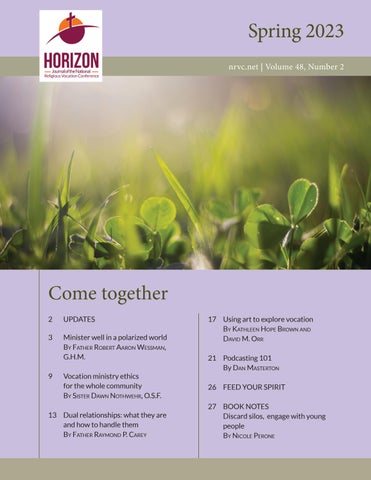
Cover image: Marko Nikolic Photography, Istock
SUBSCRIPTIONS
A complimentary subscription to HORIZON comes with NRVC annual membership. Additional subscriptions are $50 each for NRVC members; $125 each for non-members. Single copies are $25 each. Subscribe online at nrvc.net/signup. Please direct subscription inquiries to Marge Argyelan at the NRVC office at 773-363-5454 or margyelan@nrvc.net.
POSTMASTER
Send address changes to HORIZON, 5416 S. Cornell Ave., Chicago, IL 60615-5664. Periodicals postage paid at Chicago, IL. ISSN 1042-8461, Pub. # 744-850.
REPRINTS, ARCHIVES, ELECTRONIC EDITIONS
Permission is granted to distribute no more than 50 copies of HORIZON articles for noncommercial use. Please use the following credit line: Reprinted with permission from HORIZON, nrvc.net. For other types of reprints, please contact the editor at cscheiber@ nrvc.net.
EDITORIAL INQUIRIES & ADVERTISING
All editorial inquiries should be directed to the editor: Carol Schuck Scheiber, cscheiber@nrvc.net. For advertising rates and deadlines, see nrvc.net or contact the editor.
THE NATIONAL RELIGIOUS VOCATION CONFERENCE is a catalyst for vocation discernment and the full flourishing of religious life as sisters, brothers, and priests for the ongoing transformation of the world.
Creating the beloved community
FROM AFAR, a field or a lawn can appear unified, all of a piece. But up close, it’s easy to see many types of plants. Even in chemically corrected lawns, several different species of grass plants are often growing en masse. Thousands of plants, similar and different, create the unified look of a lawn or field.
That concept of unity in diversity is a human struggle that we shine a light on in this edition of HORIZON. The world and our church have plenty of division and conflict. But human beings also long for connection and unity. This edition of HORIZON uplifts the idea of unity and practices that can help achieve it in religious life. Father Robert Aaron Wessman, G.H.M. talks about unity the most directly, offering specific ideas for overcoming polarization (p. 3). Other writers look closely at ethical concerns that affect how we are to create this community, this unity. Sister Dawn Nothwehr, O.S.F. challenges communities to revisit their foundational principles and ethics to come together to include those traditionally left out (p. 9). Father Raymond P. Carey, clarifies ethical issues that must be at the forefront so that communities can responsibly welcome new members to “come together” with them (p. 13). Thank you to all our writers for helping our readers to “come together.”
Martin Luther King, Jr. spoke often of justice, and on more than one occasion he upheld a vision of unity: “Our ultimate end,” he said, “must be the creation of the beloved community.” So, let’s take a cue from King and devote ourselves to the creation of “the beloved community.”
—Carol Schuck Scheiber, editor, cscheiber@nrvc.net
HORIZON is an award-winning journal for vocation ministers and those who support a robust future for religious life. It is published quarterly by the National Religious Vocation Conference.

NATIONAL RELIGIOUS VOCATION CONFERENCE BOARD
Sister Mindy Welding, I.H.M. Board chair
Father Adam MacDonald, S.V.D. Vice chair
Sister Belinda Monahan, O.S.B. Vice chair
Sister Marichui Bringas, C.C.V.I.
Ms. Nancy Costello
Brother Brian Poulin, F.M.S.
Sister Nicole Trahan, F.M.I.
Mr. Len Uhal
Sister Mary Yun, O.P.
Sister Deborah Borneman, SS.C.M. Ex officio
Spring 2023 | HORIZON | 1
Editor’s note
Summer Institute to be in Kansas
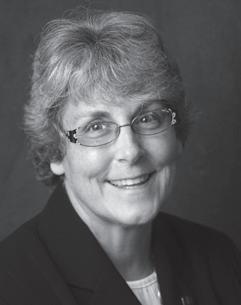
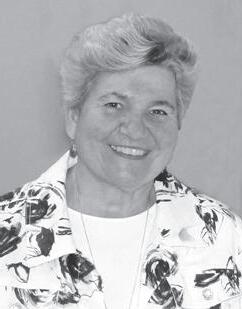
The NRVC Summer Institute will take place at the Marillac Center in Leavenworth, Kansas, July 6-23. Four workshops will be offered: “Psycho-sexual Integration,” (by Sister Lynn M. Levo, C.S.J.), “Orientation for New Vocation Directors” (by Sister Deborah Borneman, SS.C.M. and Father Adam MacDonald, S.V.D.), “Ethical Issues in Vocation and Formation Ministry,” and “Behavioral Assessment 1” (both by Father Raymond P. Carey, Ph.D.). Registration and further details are at nrvc.net. Please contact Sister Dina Bato, S.P., director of membership, with questions: dinasp@nrvc.net. Note: NRVC’s fall 2023 workshops will be online, and “Behavioral Assessment 2” will be offered Dec. 2-3 in Tucson, Arizona.

See it on video
The keynote addresses from the NRVC convocation held last fall in Spokane, Washington are now being posted at youtube.com/NatRelVocationConf. These are the same talks that were published in the Winter 2023 edition of HORIZON. Consider using the videos for community enrichment and reflection. Members can download video reflection handouts from the Member Toolbox.
Improved HORIZON archives
Subscribers to HORIZON receive full access to the electronic archives of the journal, which were recently updated to be more user-friendly. Log in at nrvc.net and browse through decades of award-winning material. The HORIZON library (nrvc.net/horizon_library) organizes material by topic. The HORIZON index (tinyurl. com/6mu7mb5f) organizes editions by date and also lists articles for each edition.
Religious communities to be present at World Youth Day in Lisbon

Young people from around the world will be gathering in Lisbon, Portugal August 1-6 for the 28th World Youth Day. “Mary arose and went with haste,” is the scriptural theme for this event, which is expected to bring together hundreds of thousands of pilgrims.
World Youth Day is a pilgrimage, a celebration of youth, an expression of the universal church, and a moment of evangelization. Many members of religious communities will be present, including at a vocation fair that is built into the the event.
The official website for World Youth Day is lisboa2023. org. Learn more about the U.S. presence at World Youth Day at nrvc.net. n
2 | Spring 2023 | HORIZON Updates Updates
Presenting at the Summer Institute will be (left to right): Sister Deborah Borneman, SS.C.M., Father Raymond P. Carey, Ph.D., Sister Lynn M. Levo, C.S.J., and Father Adam MacDonald, S.V.D.
Minister well in a polarized world
APRESSING QUESTION FOR ANYONE journeying with a man or woman considering religious life today is: how can we walk among God’s people in a way that unifies, rather than divides? How do we cultivate unity and faith in our Christian communities in a time of bitter societal divisions and tensions within the Body of Christ? It’s a question for minister and discerner, both. We want to build religious communities that reach across individual differences, both in and out of church.
It is an understatement to say that Christians today, in the United States, struggle to allow their identities to be thoroughly informed by their faith, that is, by the tradition handed down through the apostles. On the one hand, increasing numbers of Christians are simply choosing to walk away from Christianity and self-identify as “unaffiliated.” Of course people leave Christianity for various reasons, and not everyone does so simply because they do not want the Christian vision to inform their lives. Many formerly in the church have left, not necessarily because they find the
By Father Robert Aaron Wessman, G.H.M.
Spring 2023 | HORIZON | 3
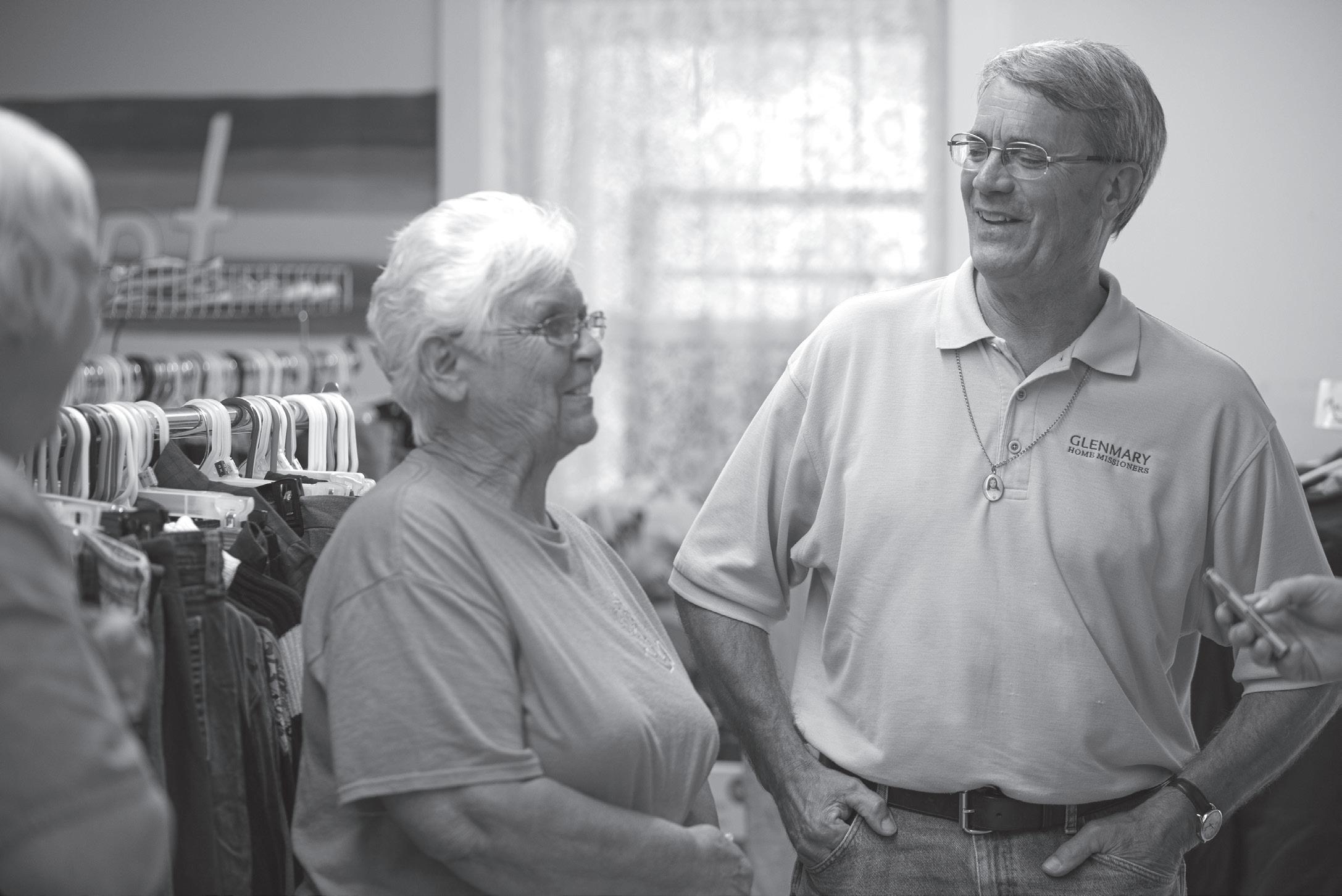
Brother Craig Digmann, G.H.M. (right) ministers in small-town and rural areas of Appalachia and the Southeast, building bridges between Catholics and the people he encounters.
T he e as T T ennessee C a T holi C / s T ephanie R C he R
Father Robert Aaron Wessman, G.H.M. is the vicar general (first vice president) and director of formation for the Glenmary Home Missioners. He is a guest lecturer at St. Meinrad Seminary and School of Theology. This article is adapted from his book, The Church’s Mission in a Polarized World (New City Press, 2023).
Wessman | Minister in a Polarized World
Church and social division take a toll on vocation ministers, but “crossing over” is one way to move forward.
gospel of Jesus unconvincing but because of their experiences with scandals or grievances.
On the other hand, other identities in people’s lives, particularly their political identity, replace or diminish their commitment to Christianity. One consequence of this is that some Christians listen to political leaders and parties for guidance in their faith lives—and other areas of their lives—even though those leaders and parties may not have the expertise or credibility to dispense guidance.
THE PATTERN OF JESUS’ SALVIFIC ENCOUNTERS
• Met individuals or small groups.
• Came to know them and their need(s).
• Listened to them and asked questions.
• Shared some of his own stories and thoughts.
• Imparted what they seemed to desire in that moment or what he discerned was needed.
This can sow confusion among people of goodwill, cause division and vitriol, and leave people wondering where to look for leadership. Who’s right? Who’s wrong?
Those questions capture the day. But the more pressing question for people of faith, especially for those who lead them, is how can we “cross over,” that is, get close enough to the other to form a loving communion? How can we step out of our polarized, fractured groups and begin living the mission of Jesus more fully? That is a question both for vocation ministers and for those they minister to, people considering religious life.
Crossing over
The Incarnation is a profound mystery of the Christian faith. Christians do not really know how this mystery is carried out except that it is done through God’s loving action, in cooperation with Mary’s open reception of grace (see Luke 1:26-38).
Nevertheless, it is possible to speculate about the meaning of God’s willingness to cross over into creation through this mystery. The Son of God knows full well the tragedy of human life. It isn’t pretty. And yet, rather than fleeing, he does the opposite. He decides to unite himself more intimately with the human experience. More intimately! He decides to take on flesh and unite himself with every reality that created existence entails, save for
personal sinfulness: joy, peace, happiness, and love, along with sadness, liminality, decay, suffering, rejection, mortality, and even death (see Heb. 4:15).
When Christians realize that Christ underwent his mission of crossing over not just for the entire world in an abstract sense, but for everyone—for each individual—they realize that Jesus has accomplished something extraordinary for them personally. He entered into this world and embraced the storm. In that love he has saved each of us. Jesus leaves the church this remarkable example of how to be his disciple.
Research also indicates that crossing over is likely the most beneficial activity for overcoming some of the negative consequences of polarization in society and the church. For Christians, then, crossing over means imitating Jesus by standing in solidarity with the world, even with those we disagree with or those we don’t identify with. We do it in order to bring grace and salvation to the world. Crossing over is both essential to missionary life and likely to be a healing action in our world today.
And if we decide to take up the mantle of Christ and cross over, we must be open to something else: cultivating salvific encounters.
Salvific encounters
Once again Jesus shows us the way. Even while Jesus’ life and ministry were colored with examples of crossing over to those around him, he cultivated something else. He encountered individuals or small groups along the journey in order to provide a salvific offering to them, which would anticipate the fullness of salvation he desired and made available to all.
These moments of salvific encounter had a similar pattern. He met individuals or small groups, came to know them and their needs, listened to them and asked questions, shared with them some of his own stories and thoughts, and then imparted to them whatever they seemed to desire in that moment or whatever he discerned was needed. To the woman suffering from bleeding, he shared healing (Mark 5:25-34). To those who struggled to believe, he offered faith (John 20:24-29). To the hypocritical, he provided a correction (Matt. 23). And with countless people, he shared his teachings (e.g., Matt. 5-6).
In imitation of Jesus, Christians, once crossing over into the polarized storms of life, will need to seek out the eye of the storm. If they desire to imitate Jesus, they will need to seek out moments of salvific encounter.
This means that when Christians conduct their mis-
4 | Spring 2023 | HORIZON
Wessman | Minister in a Polarized World
sion, they are seeking the right conditions such that there can be a mutual exchange between them and those they engage. This mutual exchange will often include dialogue whereby both parties speak and are heard, along with the sharing of various types of gifts, from personal stories, wisdom, truths about reality, opinions about the present state of the world, or acts of love and kindness. All this is ordered toward a situation where all parties involved grow in communion together and with God.
Ministry of presence
I belong to a Catholic missionary religious order, the Glenmary Home Missioners, which serves rural counties of the United States in the Southeast and Appalachia. Glenmary priests, brothers, sisters, and laypeople conduct their mission in predominantly non-Catholic (less than one percent) and economically poor areas by seeking to manifest more deeply the reality of the church, often including building up the parish structure, by fostering relationships with the people of the area, and by collaborating with the local community, especially non-Catholic Christians.
Throughout much of Glenmary’s history, including today, many members have sought salvific encounters through a ministry of presence. Through this ministry, the missioners pursue the right conditions for salvific encounters by habitually crossing over in the community. For instance, they might enter a fast-food establishment or rest stop, order a coffee, and remain there for hours. In general the missioners have little immediate agenda beyond wanting to meet the people and to follow where the grace and Spirit of God guide them.
As they are present to the people in these locations, various forms of mutual exchange begin to occur. Some people just smile, wave, or make some gesture or greeting. These gestures may involve the gifts of simple pleasantries, noting the weather, the crops, the outcome of the local football game, or other information. Though small, these exchanges are not unimportant, as they serve to establish the foundation of relationships that lend themselves to deeper conversations.
With some of the people they come across, the missioners will begin casual conversations that vary in content based on the conditions presenting themselves, e.g., what the person is interested in, how often the missioners have spoken with the person, the nature of their relationship, the emotional readiness of the person, or how much time is available. Far from being a weak or ineffectual approach to ministry, this dialogue tends to-
ward meaningful conversations during which hearts are opened and begin to change.
From the conversation, some people they encounter begin to ask the missioners interesting questions. Why are you here? What is your occupation? Do you belong to a local church? Do you have a family? These basic questions often turn to deeper sharing about life, love, meaning, politics, and even God, and they promote opportunities for the missioners to ask questions of their own.
Over time, some of the conversations become regular fixtures in people’s lives, almost like ongoing spiritual direction. More than a few of the exchanges even include deeper expressions of communion, such as prayer, words of mutual gratitude, the sharing of resources with a person in need, or an invitation to worship together on the weekend.
Spring 2023 | HORIZON | 5 Wessman | Minister in a Polarized World
p aul M C C lu R e , F li C k R
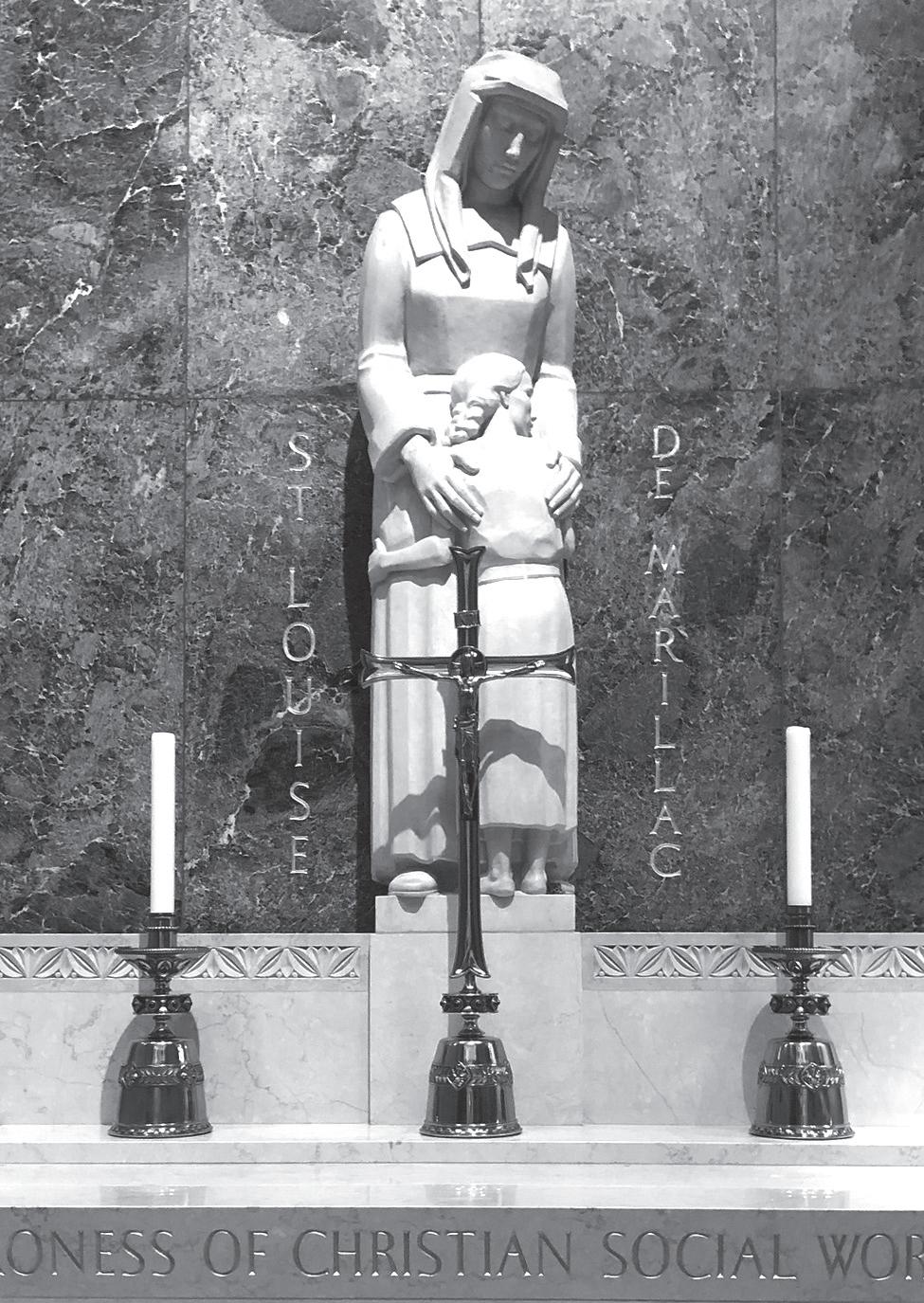
Saint Louise de Marillac—pictured here in a statue at the Basilica of the National Shrine of the Immaculate Conception, in Washington, D.C.—crossed over from her wealthy life to live with and serve among poor people.
What is more, many of the encounters these missioners have with the people lead to their own (the missioners’) increased communion with the local community, as they are invited to join, or participate in, existing groups or organizations that work toward building up the local community. This can include participation in the civic life of the community, service on local boards, or volunteering with nonprofit organizations. These invitations, when answered, only continue to enrich the missioners’ experience in the area, as well as the lives of those they encounter.
Arduous reality
THE POWER OF CURIOSITY
finding in the research about overcoming polarization is this: to undermine division, remain curious. Through curiosity, one seeks to know and learn as much about the other as possible, never settling for easy, simplified explanations or answers, all the while remaining open to learning about oneself in the process of mutual exchange.
The curious person is a lover and pursuer of wisdom, seeking to plumb the depths of what is true, beautiful, and good in the world and, especially, in the person being engaged.
Now there needs to be full disclosure here. Not everyone desires to talk to the missioners. Some people are outright hostile once engaged. And the missioners themselves are saints-in-the-making, and so do not always know how best to respond. Yet, even if unpleasant exchanges occur, moments of grace can happen if the missioners involved approach them wisely. Many people, after seeking to argue with the missioners, return more open to dialogue. The missioners, too, often learn from their mistakes and try again.
Seeking out salvific encounters can be an arduous though rewarding task and one that, especially in a polarized age, can be rife with challenges. Yet once people better realize and accept the complexity of the perspectives of the other, they can become more motivated to learn about those perspectives and people. To ensure that this pursuit of salvific encounters is meaningfully fulfilled, another tool for navigating the challenges of polarization is required: curiosity.
Curiosity, the secret sauce
With a longing to know and understand, the curious person seeks the interconnectedness of all things, aspiring, in humility, to be granted insight into reality, all the while being convinced that others can assist them in the process.
Once again, Christians need look no further than Jesus to find an example of a truly curious person. Jesus’ curiosity is manifested in his propensity to ask ques-
tions. Jesus asked a lot of questions. His queries elicited further questions, helped communicate difficult truths, surfaced the perspectives of those he engaged, and oftentimes allowed his interlocutors to touch more intimately the truth, goodness, and beauty of life. They allowed his interlocutors, and anyone nearby who witnessed the exchanges, to take a deeper dive into their own perspectives and motivations. His questions were a channel of grace. Although he is the Son of God and, therefore, blessed with divine foreknowledge, he shows that curiosity remains crucial to engaging the other. Even in difficult or contentious situations, when his own life was in jeopardy, he witnessed to the importance of curiosity.
Taking Jesus as a model, curiosity invites a disciple to break away from overly simplistic narratives and to eschew one-sided, narrow perspectives about other people. Curiosity invites one to ask questions, to explore, to admit limitations, and to desire the knowledge, experience, and stories of others so as to assist one in discovering the very mysteries of the world. The curious person longs for complexity, rejects an oversimplification of the world, and waits patiently with the discomfort of paradoxes and contradictory experiences. The curious person transforms discomfort into more questions, and, in turn, further wisdom.
Religious life calls us to bring people together
The call to a religious vocation today is a call to find ways to bring people together across the divide of distrust. Crossing over, being curious, being willing to encounter the other without judgment—these qualities follow in the footsteps of our Lord Jesus Christ. They encapsulate a call worthy of each of us, regardless of our personalities, talents, gifts, or weaknesses. Each of us—and not just the so-called experts—can do our part to deepen the unity that has been given to the church, and, by extension, to each of our religious communities, as a gift. No doubt being a unifying force in a divided world can be scary, intimidating, and, well, downright hard. But we are not left alone. As is so often the case in the church, we have
6 | Spring 2023 | HORIZON Wessman | Minister in a Polarized World
Apervasive
Nourishing vocation support for 48 years

Be sure every house in your community is receiving HORIZON. Every quarter, we inspire, educate, and motivate religious communities to support vocation ministry.
NRVC members receive special discounts on additional subscriptions along with the free subscription that comes with membership.
nrvc.net/signup
been left with many witnesses, saints both living and deceased, who can show us the way.
Witnesses to crossing over
It is easy to find examples of this approach in Catholic tradition. Untold followers of Christ have been about it since the beginning. Saint Francis of Assisi famously came down from his horse and embraced the leper. He even crossed over battle lines to dialogue with Muslims, risking his life in the process. Saint Thomas Aquinas was one who respected anyone, and any idea he encountered, even if doing so threatened his own academic and ecclesial reputation. Saint Louise de Marillac, friend of Saint Vincent de Paul, stepped away from money to be in solidarity with people in poverty. Crossing over boundaries, to stand outside their comfort zones, in order to meet other people where they were—this approach was essential to people we in the church admire.
A contemporary, practical example of this approach is Brother Craig Digmann, G.H.M. a white, middle-aged Glenmary religious brother. As a Catholic serving in rural, southern counties in the United States, he’s accustomed to living around the majority Protestant—mostly
Evangelical and Pentecostal—Christian population. He’s also aware of the division that exists between Catholics and Protestants, where both sides often share the blame. This division is regularly coupled with misunderstanding, prejudice, and sometimes, even hatred.
Brother Craig feels inspired to overcome these divides. He orders his life and mission around Jesus’ prayer that all Christians would be one (see John 17). That members of the same Body of Christ could find reasons to hate each other is, to him, unacceptable, though he understands well the long, sad history of division between Christians. So, he devotes himself, one relationship at a time, to overcoming this hatred and bringing about unity. As he is known to say, “It’s about relationships.”
To build these relationships, he dedicates himself to visiting every church in the county he lives in. This process begins by meticulously mapping out the churches, often hundreds of them, recording their addresses, logging contacts, and planning for a visit. Once mapped out, Brother Craig resolutely visits them all.
Arriving early at the various churches, Brother Craig often sees a few friendly faces he has met throughout the town—some have invited him to attend their services.
Spring 2023 | HORIZON | 7 Wessman | Minister in a Polarized World
NRVC.net/signup | nrvc@nrvc.net | 773-363-5454
CROSSING OVER IN VOCATIONAL ACCOMPANIMENT
Bridgingdifferences and looking for people who are willing to do the same can be challenging. Here are some situations and suggestions.
• For starters, cross over to those in the church with whom we share different views of the church: liturgy, theology, symbols, clothing, and more. We will meet many different people in our ministry who will share different visions than our own of what it means to be Christian or Catholic. We have to be willing to engage them, listen to them, learn from them, and honor what is good and true in what they have to say.
• In working with new religious or with people considering religious life, provide moments and experiences where they can see the rich diversity and true inculturated reality of Christianity. The Christian faith has a multitude of rich, genuine, and true expressions, and it is important to be aware of these, to find ways to appreciate them, and to acknowledge their goodness.
• In formation programs, both initial and ongoing, emphasize the importance of a missionary mindset of crossing over. Jesus constantly made efforts to be around people on the margins and peripheries, and to embrace people that his society rejected. Doing this in our own ministry cannot be an addendum; it must be learned in formation and practiced throughout our lives, whether in ministry or in our religious communities or dioceses. As we continue to grow in our vocations, we may relearn the importance of crossing over.
—Father Robert Aaron Wessman, G.H.M.
are usually longer, but Digmann bows his head, listens attentively, and sings.
In some situations, Brother Craig is called upon to lead a prayer in front of the group. This invitation to pray publicly in front of the congregation is remarkable in that he’s often the first Catholic to cross the threshold of these worship spaces. Craig’s presence in leading the prayer, along with the community’s hospitality extended to him, image an important reality: that unity can exist even when there are differences.
Brother Craig’s approach is humble and nonthreatening. As he states: “I have tried to not be intrusive or to force my faith on any I have met, but to walk with people wherever they are in their lives.” He’s adamant about allowing the Spirit of God to guide him in making prudent decisions and adapting to the many situations he encounters. In his own working theology of mission, he states: “I often remind myself that the Spirit is always with me, the Spirit is in control, and the Spirit knows what it’s doing. I just need to have an openness to allow the Spirit to somehow work through me.”
In one of his assignments as a missioner, he visited nearly 200 Protestant churches over a period of years. From these momentous efforts, it is easy to understand how Protestants in the area have considered him, a Catholic, as pastor. Furthermore, those he encountered regularly sought his advice in church matters, asked him for prayers, invited him to talk about Catholicism, accompanied him to Catholic worship, and even called upon him to give the sermon in the absence of their own minister.
Cross over within vocation ministry
With those he meets for the first time, he smiles, shakes hands, talks about the weather, comments on local high school sports, asks questions, and then readies himself to pray.
He’s aware that for many of the people he meets, he is the first Catholic they have ever talked to.
Once the worship service begins, Brother Craig follows the lead of the congregation. As a Catholic who deeply loves the Mass, what he encounters is not his usual style of worship. The hymns are different, the sermons
Most of us cannot do what Brother Craig does, but his is an example of being open to, and even encouraging salvific encounters. He’s no saint, he’d tell you, but Saints Francis, Louise and the rest would have said the same! Saints, indeed all of us, are called to cross over to the other and cultivate moments of salvific encounter, fueled by a spirit of respectful curiosity. That’s the name of the game for religious men and women in these polarized times.
Practically speaking, that means all of us have to take a hard look at how we journey with those who are discerning. Are we open to crossing over into their world, which might seem very foreign to us? Are we encouraging them not to give up their point of view, but to broaden their points of view, to nurture curiosity as a positive thing? We need to look at ourselves and at those we serve: How do we cross over to others? n
8 | Spring 2023 | HORIZON Wessman | Minister in a Polarized World
Vocation ministry ethics for the whole community
MY DOCTORAL ADVISOR, internationally renowned ethicist Daniel C. Maguire, centered his understanding of the Christian moral life on the maxim: “The foundational moral experience is reverence for human persons and their environment.” This fundamental insight draws credence from Gaudium et Spes (“Joy and Hope: the Pastoral Constitution on the Church in the Modern World”) and the work of the Belgian moralist, Father Louis Janssens.
Janssens asks: “What are those fundamental and constant aspects or dimensions of the person that must be considered?” He elaborates eight major dimensions of “the human person integrally and adequately considered.” I want to draw upon Janssens’ dimensions of human beings to reflect on two major ethical concerns for vocation ministers and those who support vocation ministry. They are:
1) dual relationships,
2) outreach to people who, as members, would be cultural or racial minorities within the religious community.
First, let’s look at our Christian foundation for moral, ethical behavior.
Spring 2023 | HORIZON | 9 Nothwehr | Vocation Ministry Ethics
Sister Dawn Nothwehr, O.S.F. is a member of the Sisters of St. Francis of Rochester, Minnesota. She is the Erica and Harry John Family Professor of Catholic Theological Ethics at Catholic Theological Union in Chicago.
Sister Dawn Nothwehr, O.S.F.
C ou RT esy o F T he s is T e R s o F s T J oseph
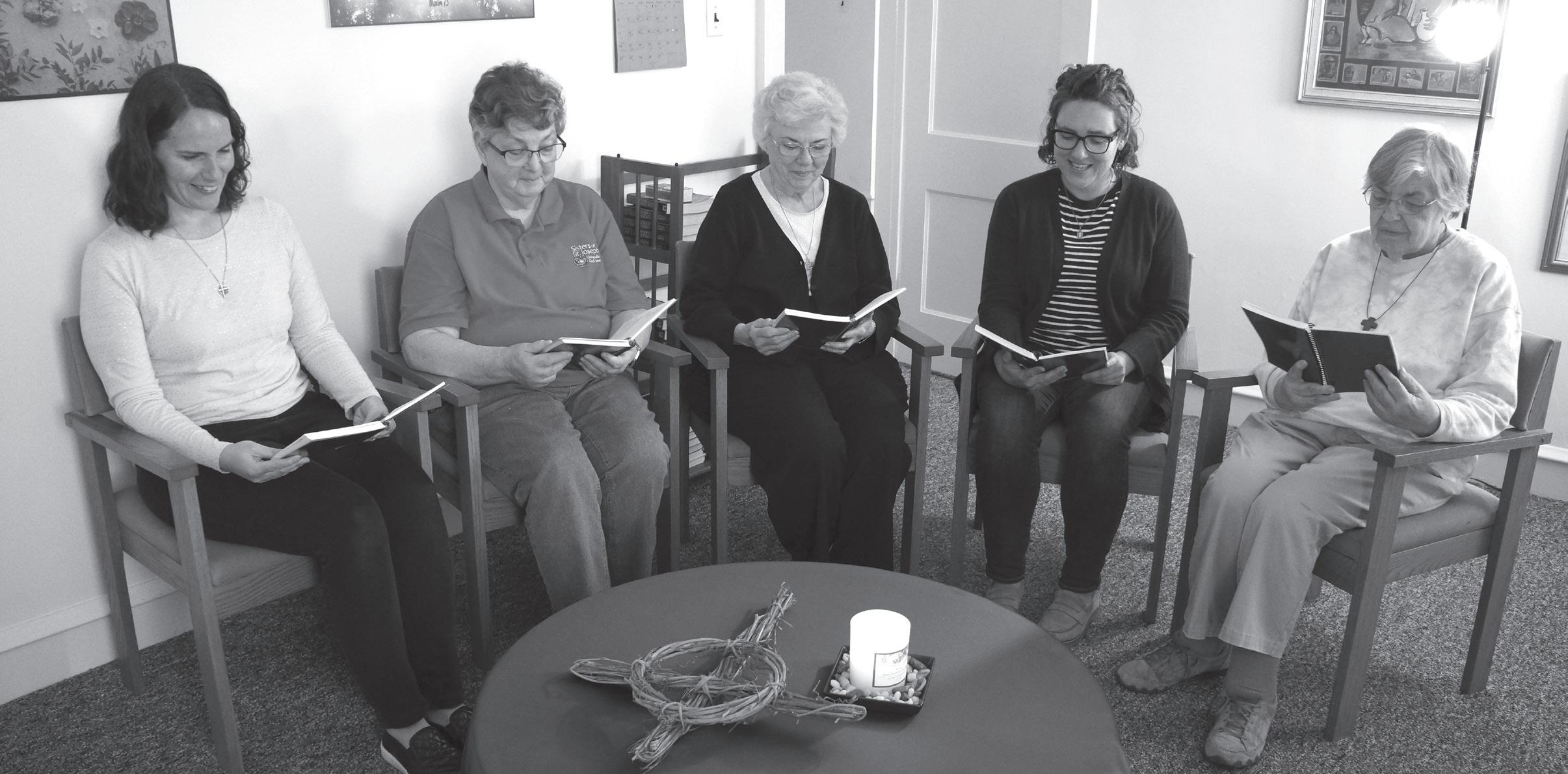
It is helpful for the whole community to consider ethical issues related to vocation ministry. The ideal is that both leadership and membership are invested in welcoming candidates of all cultures. Shown here are members of the the Sisters of St. Joseph of Chestnut Hill at prayer.
Who or what is a human person?
The Christian tradition recognizes the sacredness of life at the heart of every person and every culture around the globe. We assign value to individuals as persons. This sacredness is not something that can be proven in a laboratory or through a logical syllogism. The inviolable dignity of the human person is known through the wisdom of the heart. Such wisdom is profoundly intuitive, affective, and empathetic. Such is the wisdom of love meeting Love.
This is the great truth of the Christian view of the human person: God, who is Love and the source of all goodness, created humans and called them “very good” (Gen. 1:31). Though humans sinned, that sin did not determine the relationship between God and humans. The God of Love chose to reveal divine love in the Incarnation in the person of Jesus. Subsequently, humanity is graced with the means of salvation made visible through the teachings of Jesus, the example of his love for his Abba, and the experience of this transforming offer of love.
In Christ and through the Incarnation, God chose to deify human existence. From the moment of their creation, humans are without equals in the world (Gen. 1: 26-27 and Gen. 2:7). They are personal subjects, capable of consciousness and choice. This is the primary way human beings are distinct from plants, animals, and the rest of the created world. Most distinctive is the reality that human beings can have a personal relationship with God because God came to live on Earth as a person, Jesus of Nazareth.
Having looked briefly at the foundation of our Christian teaching on the dignity and sacredness of each human life, let us look at some of moralist Father Louis Janssens’ dimensions of the human person and examine the ethics of vocation ministry from their perspective. These ethical issues in vocation ministry are concerns for the whole community, not just a designated vocation leader, but all leaders and members of religious institutes.
The human person is a subject, not an object, as are things of the world.
The human person is a subject, not an object, as are the things of the world. People are normally called to be conscious (GS 15), to act according to their conscience (GS 16), in freedom (GS 17) and in a responsible manner (GS 31, 55). All of these are relevant when
we refer to the person as a moral subject.
Human beings have agency. This is the case for the people who come to religious communities curious about whether God is calling them to be a sister, nun, brother, or priest. These candidates are subjects, meant to act with freedom as they discern their calling.
ISSUES OF DUAL RELATIONSHIPS
Whenever we interact with another person in more than one capacity, we form a dual relationship. There is a wellestablished prohibition in helping professions against forming such relationships. The prohibition is a safeguard against impaired or biased judgments, conflicts of interest, and disproportionate dependencies. However, in some instances dual relationships are unavoidable for a variety of legitimate reasons. In all cases, the key to avoiding any form of harm is for the minister to be alert to the kind of problems that can arise, and the kinds of harm that can occur.
The best way to do no harm is to form clear boundaries in the relationship. For instance, if someone serves as both formator and professor, frequent review of the purpose of each relationship is needed. In what ways is the student or candidate a subject and not an object of the relationship? Is the candidate free to form her or his own conscience apart from the formator’s presence? Is the candidate able to freely give a “yes” or a “no” to the formator without destroying the whole relationship?
Both parties to the relationship must clearly understand the purpose and work toward that end. Professional relationships must remain “other directed,” and never be self-serving. The client—the person in formation—must remain the subject of the affiliation. A red flag moment is the recognition that the relationship is more about fulfilling the vocation minister’s need and less about the person in formation. For both parties, having strong relationships with people outside of formation will help the relationship stay healthy.
OUTREACH TO DIVERSE CANDIDATES
One blatant revelation of the church’s ignorance concerning racial justice was the unfortunate title of the U.S. Catholic bishops’ 1979 pastoral letter, “Brothers and Sisters to Us.” While the pastoral letter resulted from the noble moral intent of the majority-White Catholic bishops to challenge racial injustice, it was the “to Us” in the title that caused people of color to ask, “Who is the ‘Us’?” The absence of justice for people of color in the Catholic
10 | Spring 2023 | HORIZON Nothwehr | Vocation Ministry Ethics
Church—especially in any sort of leadership role, allowed the question to echo more loudly and drown out the moral value of the statement. If we religious want to attract people of color to our communities, especially communities that are mostly White—we must first come to terms with the “Us” we have been.
Truth must precede conversion to antiracism; active antiracist truth-telling must precede reconciliation; and reconciliation goes before credible invitation to membership. This is not to delay invitations to those who are culturally different from the community; it is a call to work on our own community issues of truth and reconciliation with people of color.
Human beings are corporeal, part of the material world, and directed toward each other.
That we are corporeal means in the first place that our body forms part of who we are—corporeal and spiritual. Nonetheless each person is a singular being (GS 14). What concerns the human body, therefore, affects the person.
ISSUES OF DUAL RELATIONSHIPS
The three “S’s”—sexuality, self-care, and self-esteem—are important for avoiding toxic dual relationships. God’s love for us is the starting point for our own self-care and self-esteem. We are invited to appropriate the self-love in Jesus’ great commandment to love your neighbor as yourself. This entails having fun, taking time for rest and relaxation away from the job, eating healthy foods in proportionate quantities, and getting sufficient rest each day. All are necessary for total physical, mental, and spiritual well-being.
Accepting ourselves for who we are—a mixture of good and not-so-good, and occasionally sinful—opens a pathway to empathy, compassion, and a life of faith. We want to be rooted in the reality of our need for grace. I also believe we minister best when we’ve been ministered to. We lead by example.
OUTREACH TO DIVERSE CANDIDATES
For over two decades the United States has been “browning,” that is, groups other than European Americans have gained population. Religious of all cultural backgrounds are wise to do the deep spiritual work of listening and really hearing the voices of “the other.” We cannot love
what we do not first know. And what we do not love, we may not support and defend. These small steps of intentional peace-building are prerequisites for becoming more intercultural communities. Let us allow the “other” to set the pace. True humility is being grounded in the deep soil of truth and reconciliation over the long term. For communities doing outreach among diverse candidates, the whole inviting community should gain a realistic understanding of present-day demographics. Within the United States, the traditional “White majority” is changing, with the population becoming a multicultural reality. It is worth exploring what the gospel says about “minority” and “majority” relations. How will your community of women or men religious follow Jesus, who takes up the towel and washes his disciples’ feet? How practiced is your community in being in “minority-majority” spaces? These are events, neighborhoods, social occasions, etc. in which people who are typically “minorities” (Blacks, Asians, Latinos, Native Americans, and so on) are the majority.
People need to live in social groups, structures, and institutions.
People are social beings not only because they relate to each other in the I-thou relationship, but also because they need to live in social groups and thus in appropriate structures and institutions.
We must live in society. We need worthy structures and institutions including political structures and forms for international cooperation. The Vatican II Council reacted against an individualistic ethic. Our Catholic moral and ethical teachings demand that we respect laws and institutions of social living, insofar as they serve the common good (GS 26, 74).
ISSUES OF DUAL RELATIONSHIPS
Religious communities are a type of social group, and we all have structures and institutions that reflect that reality. Each member’s well-being, not only the well-being of the mission, needs to be the subject of our structures and corporate ventures. New members need to know this. It is worthwhile to ask how our structures and communal life support individual well-being. Are our social structures models for the world? One way to model and support positive relationships and individual well-being is by holding the stance: “I am as good as I am by the grace of God.” It is best to avoid the Pelegian stance, “I am loved only because of my goodness.”
Spring 2023 | HORIZON | 11 Nothwehr | Vocation Ministry Ethics
Those who play dual roles within our communities need to always come back to the respect for the individual person, respect for the well-being of the candidate. We must ask if our structures promote their growth and support their well-being. Does combining the role of formation minister and vocation minister serve the candidate well? Does it aid in the candidate’s well-being? Does it aid the community’s well-being?
OUTREACH TO DIVERSE CANDIDATES
Returning once again to the ethics of who we welcome into our communities, we must ask: How has our community supported institutional, social, or political movements that embrace the rights of indigenous peoples and people of color? Would people of disparate cultures find our community attractive? Has our community discussed historical patterns that may have harmed or excluded cultures not represented in the community?
Created in the divine image, the human person is called to know and worship God (GS 12, 34) and to glorify the Holy One in all their attitudes and activities (GS 34, 36,48, etc.). Our openness to God means that we live in faith, hope and love.
One profound violation of the integral relatedness of the body and spirit is named today as “anti-blackness” or “colorism.” These terms point to housing and employment discrimination, enormous wealth inequalities, police harassment, disproportionate incarceration, stereotyping, and more—all realities of U.S. life. There are personal and structural dimensions to these harms. If religious communities do not look at, discuss, and critique systems of exclusion and exploitation, both within the church and outside it, how can they have credibility in their evangelization and outreach? A foundation for inclusive outreach is recognition of the reality of racial injustice in our church, our communities, and our society.
Human beings are fundamentally equal, but at the same time each person is a unique child of God.
We are fundamentally equal (GS 29). We share in the same human nature, and even existentialists like Jean-Paul Sartre recognize that we share in the same fundamental human condition. We encounter each other on the same human level. We can understand foreign cultures and comprehend the data of the farthest human past. Fundamental equality explains why moral demands are universal, that the same moral obligations apply to all.
ISSUES OF DUAL RELATIONSHIPS
Human beings are both equal and unique and have a God-given dignity. Professional relationships must honor that dignity, especially when formal decisions about a candidate’s future are being made. An important maxim is: “Nothing about me, without me.” In other words, decisions about a candidate are made with the candidate’s knowledge. Candidates for membership and people in formation must never be objectified or treated as game pieces on a chess board.
This has very specific implications. Candidates have the right to know the criteria, the processes, and the values by which they are being evaluated. Rights are based on equality and are distinct from entitlements. Each candidate should be evaluated fairly, his or her capacity to live and contribute to the life of the community must be considered. No candidate is entitled to membership, but each candidate merits dignified treatment that honors them as a child of God.
OUTREACH TO DIVERSE CANDIDATES
When assessing whether and how to reach out to diverse candidates, morality must be understood through the cultural lens of the community being addressed. Contextual theology is an important place to start. There are numerous ways to do what is right and to be and do what is good. Moral decision making must never be done among Christians without prayerful discernment. If we are to be truly Catholic, we must be truly human. The Gospel of John tells us in 3:16-17:
For God so loved the world that he gave his only Son, so that everyone who believes in him might not perish but might have eternal life. For God did not send his Son into the world to condemn the world, but that the world might be saved through him.
To return to the words of ethicist Daniel C. Maguire, “The foundational moral experience is reverence for human persons and their environment.” n
Related material
“Wield power, set boundaries,” by Father Richard M. Gula, S.S., HORIZON, Winter 2014, p. 23.
Code of ethics for vocation ministry, tinyurl.com/ vy2xfh27
12 | Spring 2023 | HORIZON Nothwehr | Vocation Ministry Ethics
Dual relationships: What they are, how to handle them
FOR A VARIETY OF REASONS, including the reality of fewer members, religious communities are increasingly choosing to combine the roles of vocation director and formation director in one person. While there is some common-sense appeal to the decision to combine the roles, there are some inherent conflicts and ethical challenges to such a strategy.
Vocation and formation ministries have very distinct missions. The primary mission of the vocation minister, once he or she is working with a potential candidate, is to gather information salient to the efficacy of the candidacy. In the context of such ministry he or she also assists the candidate to make the best discernment possible in regard to potential application for acceptance into initial formation. The vocation director offers this service always as the agent of the major superior who appointed him or her. While the vocation director’s skills, wisdom, and experience are at the service of the discerner, it is always the vocation minister’s challenge to do so as the agent of the community. In the end, the vocation minister’s primary task when working with a candidate is to make a recommendation whether or not the candidate should be accepted into initial formation.
By Father Raymond P. Carey
Spring 2023 | HORIZON | 13 Carey | Dual Relationships
C ou RT esy o F T he M issiona R y s e R van T s o F T he M os T h oly T R ini T y
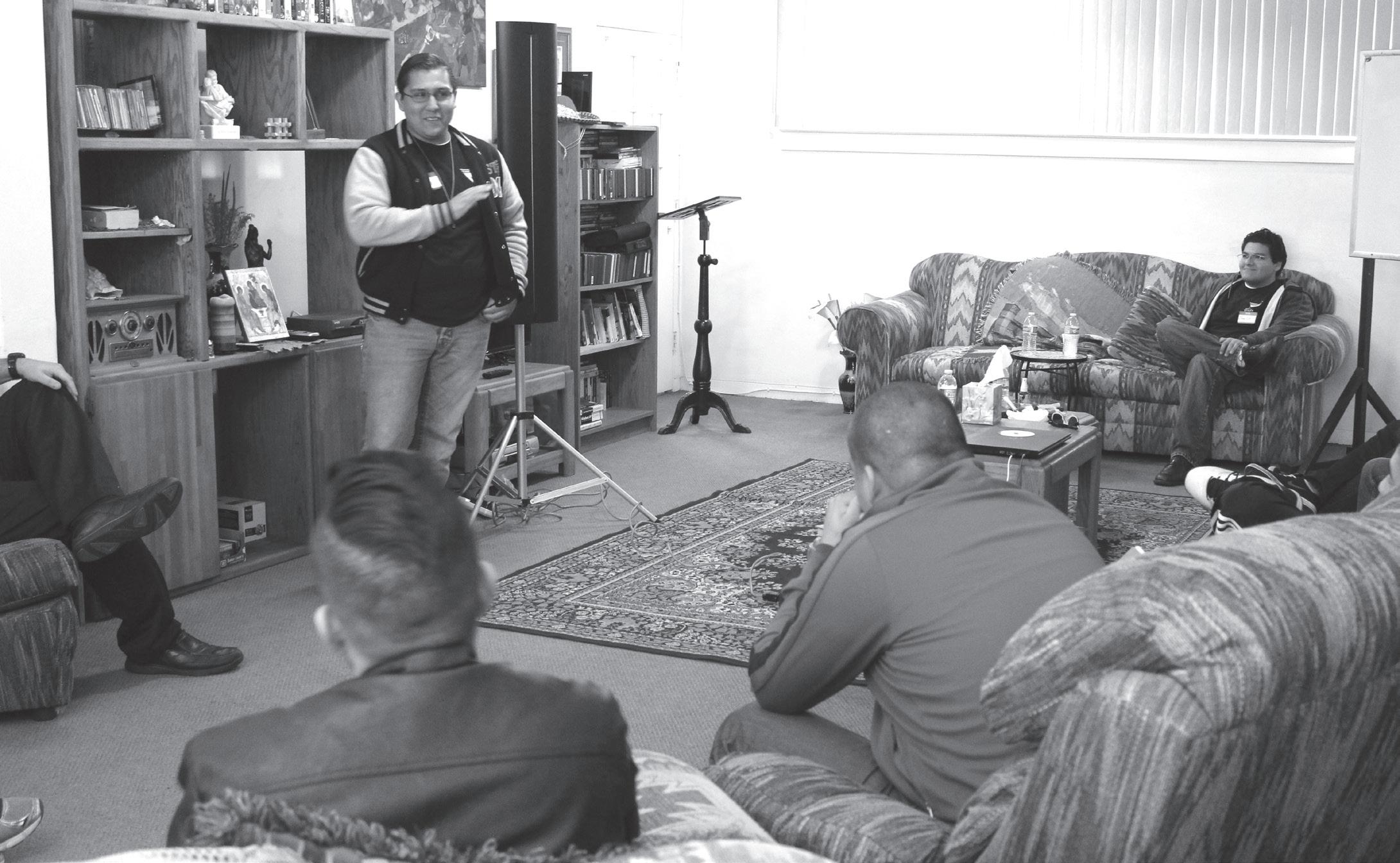
As a vocation director, it can be easy to slip into becoming an agent of a candidate instead of remaining an agent of the community. Keeping one’s role and responsibilities in mind is essential. Pictured here is a member of the Missionary Servants of the Most Holy Trinity addressing a group during a retreat.
Father Raymond P. Carey is a priest of the Archdiocese of Portland, Oregon. He serves as an adjunct professor at Mount Angel Seminary Graduate School of Theology and as a counselor to priests and religious. He regularly conducts workshops for the National Religious Vocation Conference, and he received the NRVC Harvest Award in 2020. His doctorate is in clinical psychology.
Rede mptorist Ren ew al Center
“Celebrating over 55years ofRetreat Ministry ”
7101 W. Picture Rocks Rd, Tucson, AZ 85743 USA
Phone: 520.744.3400
Email: office@desertrenewal.org
www.desertrenewal.org
Contemplative Study and Sabbatical Program
The demands and expectations of full-time ministry are both rewarding and fulfilling; however, it is important to take time to rest & renew.
The Sonoran desert allows you to seek the silence and space necessary for spiritual renewal. Since ancient times people have gone to the desert to encounter God.

Come and experience desert spirituality in a contemplative environment that will make for a truly unique Sabbatical experience.
2023
July 16 - August 18
October 1 - December 8
2024
March 3 May 10
July 21 - August 23
HESYCHIA SCHOOL OF SPIRITUAL DIRECTION
RENEWAL June 9-16, 2023
2024
February 4 - 16 Week 1 & 2
April 7-19 Week 3 & 4
The HSSD program focuses on the ancient art of Christian Spiritual direction in a multifaith context and offers contemplative study and practice to prepare clergy and vowed religious for a ministry of spiritual direction.
Formation ministers have a different charge. The primary mission of a formation minister is to teach a candidate how to become, for example, a Franciscan religious. There are a variety of tools and strategies the formator employs toward that end. Like the vocation minister, the formation minister is the agent of the major superior.
It is patently unethical for either the vocation minister or the formation minister to become the agent of a candidate or novice. Dual agency is by definition unethical. The ethical codes of spiritual directors, confessors, and counselors identify their roles as agents of the persons whom they serve.
It is not easy or automatic for vocation directors to assume they are working on behalf of the community. More specifically, many vocation directors have worked for some time with a candidate before a vocational assessment. They may well have helped the person steer through difficult times, like the break up of a relationship, the death of a family member, etc. It is easy for the vocation director to move into the role of being an advocate for the candidate, a defender if you will.
At that point, the vocation director has clearly become an agent of the candidate. This happens frequently to people new to the role of vocation director. Once they integrate the concept of agency—seeing themselves as agents of their religious community—it becomes second nature to avoid being the agent of a candidate.
Handling information
In addition to maintaining proper roles, another common ethical challenge comes about when the same person is both vocation and formation minister. In these cases the concern has to do with to the nature of the candidate’s personal information that the vocation minister needs to access. A responsible vocational assessment should include a thorough examination of family of origin issues, faith history, the process of vocational decision making, a history of psychosexual relationality and decision making, sexual orientation and integration, any experience of trauma, management of resources, educational and occupational history, health history (mental and physical), any prescription medication history, use of alcohol and other substances, any legal encumbrances, assets and debts, and any other factor, such as a marital or military history. In the process of obtaining salient information, it is often the case that a good measure of personal information in the end is not pertinent to the question of a candidate’s suitability for formation.
Some may ask: Why shouldn’t a formation director
14 | Spring 2023 | HORIZON Carey | Dual Relationships
have access to all the information the vocation team has developed? Ethically two main factors suggest otherwise. First, when the formation director has access to all the information from the discernment process, it compromises the candidate’s ethical right to minimal intrusion.
The candidate may have granted the “right to know” by virtue of starting the application process, but the “need to know” may not be in place. Second, it seems most respectful for a candidate to begin formation with a clean slate in relationship to the formation director. Both the candidate and the formator can start without the burden of information bias, pre-judgment, or the anchoring effect of vicarious first impressions.
Further, it is not automatically the formation director’s business whether or not, for example, a candidate has been sexually abused. A vocation minister more commonly will have investigated whether or not a candidate is considering religious life as a means of escaping a traumatic event, or whether a candidate is making up for a divorce or some other event by becoming a religious. Once a vocation minister has investigated how the candidate has addressed a traumatic event, and whether the individual has moved on healthily and well, the information only becomes the formator’s concern if the candidate chooses to make it so.
How to make it work
When the offices of vocation director and formation director are filled by the same person, there are options that can help reduce or accommodate ethical concerns. One option is to have someone other than the vocation minister conduct the behavioral assessment of the candidate. A vocation director could ask a skilled, trained colleague from another community, for example, to conduct the behavioral assessment.

Additionally, fidelity to the ethical principle of clarity of agency for all parties involved in both vocation and formation ministries will go a long way to helping eliminate ethical conflicts and dual role circumstances. For example, it is common practice in religious formation houses to have vowed members without vocation or formation responsibilities be members of the formation community. Are those vowed members asked for evaluations of a candidate at the end of formation? Or are those vowed members available to be agents of the candidates either as spiritual directors or counselors? It cannot ethically be both!
When members are asked to serve as wisdom figures in a formation community, it is imperative that who-
Vocation directors normally gather a lot of personal information about candidates. Because candidates ethically have a right to minimal intrusion, the vocation director should not automatically turn all information over to the formation director.
ever makes that assignment clarify, one way or another, whether these wisdom figures will be asked to evaluate those in formation. It can go either way, but should not be both. If these members are going to make an evaluation of a candidate, the candidate needs to know that up front. As well, if the wisdom figures are not evaluators, the candidates should know that as well. That leaves them free to consult the member as a spiritual director, guide, consultant, or friend.
Similarly the practice of soliciting or accepting a letter of recommendation from a candidate’s spiritual director or confessor puts that person in the unethical quandary of acting as the agent of the candidate and at the same time acting as the agent of the religious community. It is significantly cleaner to avoid such role conflicts. Just because it might be helpful to know something does not make it ethical to know something. So, instead of asking a spiritual director or confessor to write a recommendation, communities can ask pastors, professors, colleagues, friends, and supervisors to do so. They can all write letters of recommendation without de facto ethical conflicts.
In the end, all parties involved receive gospel-based respect and dignity when vocation and formation ministries are faithful to ethical guidelines. These guidelines are treated in a fuller way in the ethical code of the National Religious Vocation Conference, nrvc.net and in the NRVC’s ethics workshop. Vocation and formation ministers do well to conduct periodic and regular ethical audits of their programs and practices. A policy of regular audits helps ensure that a community’s need for due diligence is met, while at the same time ensuring that applicants are treated with gospel reverence and dignity. n
Spring 2023 | HORIZON | 15
Carey | Dual Relationships
a dobe s T o C k
Using art to explore vocation
IN MARGARET WHEATLY’S BOOK, Turning to One Another: Simple Conversations to Restore Hope to the Future (Berrett-Koehler Publishers, 2009), she writes:
I believe we can change the world if we start listening to one another again. Simple, honest, human conversation. Not mediation, negotiation, problem-solving, debate or public meetings. Simple, truthful conversation where we each have a chance to speak, we each feel heard, and we each listen well.
Vocation directors know well the importance of such conversation. It is in such conversation that we hear another person’s story and come to know them as unique individuals called by God. However, conversations about a person’s experience of call and vocation, conversations that come from the deepest part of a person’s heart and soul, are often the most
By Kathleen Hope Brown and David M. Orr
Kathleen Hope Brown holds a doctorate in ministry and has worked in higher education for many years. She and poet David M. Orr have given talks, workshops, and retreats drawing on Orr’s original poetry. They are authors of the book Companions on the Journey: The Gift of Spiritual Friendship, published in 2006 by the DeSales Resource Center.

Spring 2023 | HORIZON | 17 Brown and Orr | Art to Explore Vocation
i M age by J ohn g
, p
ibson
ixabay
delicate. They can touch fragile emotions and subtle, barely-understood movements of the heart. They also bear the weight of a person’s very sense of self.
Saint Francis DeSales was a spiritual guide for many people, religious and lay. He listened with great compassion and gentleness. He held the hearts of others with reverence and considered a heart’s depths sacred and holy ground.
He listened with unhurried calmness and for as long as people felt they needed to talk. People longed to have a taste of that great sweetness and serenity of heart which he invariably gave them and which helped people to open up to him with great confidence, especially when they wanted to talk about spiritual things.
Saint Francis DeSales was known for his ability to walk with people on their spiritual journeys. He is said often to have begun conversations not with the question, “How are you?” or “What’s happening in your life?” but with the question, “How is your heart?” Right away, with a question that was like a warm and loving embrace, he would open the door to sharing a person’s experience of God’s voice speaking within the heart.
An invitation to conversation about spiritual things is not assured of a response, however. Two factors can make conversations about call and vocation especially difficult. One is fear of the vulnerability such deep sharing entails. Another is unfamiliarity or discomfort with the vocabulary of heart and imagination that is necessary to express the experience of call and vocation. Inviting a response requires creating a space in which people are free to share and where the movements of the Spirit can be felt.
Creating the space
Space, as the word is used here, does not mean primarily physical space, although that is important. Certainly a place that is quiet and free from interruptions, like a place for prayer, is most conducive to deep sharing. However, creating an interior stillness, a feeling of comfort and sense of trust opens the way for having meaningful and deeply personal conversation. Such a space welcomes and encourages deep encounter, opens a person’s heart to share, treats a person’s story with reverence, and invites the heart to speak and be heard. The creation of the space in which such sharing can happen has much to do with the way of being, the openness and nonanxious, non-judgmental presence of the vocation director. Perhaps leading with the question “How is your heart?” might not be comfortable with a person the di-
rector hardly knows, but an equivalent beginning might be something like, “I’d really love to hear your story and perhaps share with you some of my own.” In this way the director communicates a willingness to listen and hear, to engage in sharing with his or her own heart open, and the vocation director invites the inquirer to do the same. Vulnerability and risk are involved, and such a beginning acknowledges their presence, which then allows trust to begin to develop. As the conversation unfolds, it can sometimes be tempting for the director to prompt and unintentionally put words in someone’s mouth or lead them down a path that is not the path they need to take. Because of the mutual vulnerability in these conversations, the director should communicate, in word and in manner, that he or she is on holy ground when listening to this story. On that ground, the Spirit is speaking and all are being called to transformation. Respect, gentleness, and reverence are required.
Quiet may be needed at first. While a period of quiet time might seem like delay, it can actually help to begin the conversation. The director might say, “Why don’t we both take a few moments of quiet, and just listen to what the Spirit might be saying?” Silence permits prayer to happen and allows the voice of the Holy Spirit to be heard.
Jesus often used quiet, gentle, prayerful words to join his heart, and those of his followers, with God’s. He communicated his own openness and vulnerability, and he invited others to open their hearts by sharing their stories, praying with him, laying down their burdens and becoming renewed. Think of the encounter with the Woman at the Well in the Gospel of John, Chapter 4, or his prayers at the Last Supper and the Garden of Gethsemane.
Come to me, all you who labor and are burdened, and I will give you rest. Take my yoke upon you and learn from me, for I am meek and humble of heart; and you will find rest for yourselves. — Matt. 11:28-29
A place of vulnerability needs to be a place of gentleness and comfort, a place where one can rest. Fear of the vulnerability inherent in this kind of sharing points to the need for affirmation. Sadly many people’s sense of their own dignity and worth has been buried under the pain of self-doubt, neglect, rejection, or abuse. If the director is quick to name the grace, goodness, and beauty in the inquirer, ready to recognize and affirm the action of God he or she hears in the inquirer’s story, the director stands in the image of the God who desires to be that
18 | Spring 2023 | HORIZON Brown and Orr | Art to Explore Vocation
place of gentleness, warmth, and rest. So, as a director listens, she or he should be listening for those places, events, movements in the inquirer’s life where the Spirit may be speaking and moving the inquirer to some action. The vocation director can gently name and affirm areas where God may be working, drawing the person closer, to discerning his or her call, whatever it may be.
Opening the language of heart
Conversations about a person’s experience of God, his or her feeling of call and vocation, require the language of the heart and imagination. Whenever we speak of our experience of God, we quickly can come up against the limits of our everyday vocabulary. Ordinary prose is often inadequate to express the deep experiences and passions of the heart. Similar to expressing the experience of being in love, for which people have always turned to poetry, music and art, we need to open new language when giving expression to our journeys of faith.
The language of the heart is the expression of love, delight, and joy, as well as longing, sorrow, and hope. Engaging the language of the heart can in itself become a means of experiencing the Spirit within, of understanding ourselves in relation to God and the world. Expressing what is in the heart requires engaging the imagination, because it goes beyond what is visible and literal. The language of the heart and imagination evokes more than it describes.
Young people who are only beginning to be aware of the call of God in their lives can struggle to give it expression, as can more mature people who simply have not found a comfortable way to speak of their experience of God. The language required becomes especially difficult in this age of rapid, electronic communication, in which words are few and often not even spelled out. The language of the heart and imagination doesn’t lend itself to being truncated or abbreviated. In fact, because it issues from the deepest place in the human heart where the Spirit dwells, it yearns, longs, and needs to be poured out.
We have given many retreats over the past several years and have found ways to tap into the language of the heart and imagination using poetry and visual art. The methods we have used and the insights we have gained might be helpful to vocation directors who want to help inquirers express the call of God that is their vocation, so we offer them here.
Poetry and art are vocabulary to express experiences and feelings that are too deep and complex for our every-
day ways of speaking. Here is a poem we have found effective in giving people language to express their feeling of call and vocation. It couples well with a photograph like the one on page 17.
A River Begins
Early summer in these mountains after rain, the water flows faster than usual stirs the ground beneath turns over and upon itself cuts a deeper path than usual spreading, feeding, creating a new earth filling empty spaces washing sorrowful faces and quenching many thirsts on its course to meet the sea.
Last winter, I waited, silent for a whole season as snow and ice fell to form a frozen waterfall falling from a place I knew was there but could not see; I wanted to climb it to scale this wall of ice leading back toward heaven but instead I followed it down looked forward to a spring thaw hoping I might join the water become part of the melting.
Now, as I watch this narrow stream, its spray cascading down the mountain I can only think of dancing imagine water with emotion its pure delight in falling free so clean, so fresh, at last released from peaks by warmth of sun to fly, to plummet, to rejoice in being one of many drops that sparkle so a silly man standing on the ledge below might find himself renewed.
©2007 David M. Orr
Spring 2023 | HORIZON | 19 Brown and Orr | Art to Explore Vocation
Beginning the conversation
Our process has worked best in small groups since a certain feeling of safety comes in doing this with others. For those discerning a call to religious life, this translates into potential for deep sharing among those discerning a similar call.
The poem and photograph become tools for reflection and prayer. They open the door for the Spirit to work in the hearts of those who read, hear, or see. The poem is first read aloud, perhaps even as a prayer, and an invitation is given to reflect in silence for a short time. Then, in a manner similar to lectio divina or visio divina, people are asked if there is a particular word or phrase in the poem, or something about the photograph, that speaks to them. Some people will respond to the words of the poem more readily, others to the picture image.
sion to do the same and graced sharing is the result. It is remarkable how the Spirit engages hearts and connects them. It is clear evidence of God working where two or more are gathered.
People have always turned to poetry, music and art to express themselves about falling in love. We need to open new language when giving expression to our journeys of faith.
For a vocation director, this process can work with a single inquirer rather than a group, but in such a setting, there might be a different starting point. The lyrics of a song are poetry put to music. An inquirer might be asked to bring with him or her a song or photograph that is meaningful and at the meeting the director would reflect along with the inquirer on the song or photo, asking the inquirer to express why it is important. Other items of art or literature, such as sacred art or scripture, might also be used to start the conversation. What issues forth will be the vocabulary of the heart and imagination because the conversation will be about something evoked from deep within.
If the topic of call and vocation has not yet surfaced in their initial responses, a more specific question can be posed, perhaps about something in the picture or the poem that speaks to them. The poem above can evoke feelings of desire, of surrender, or of being part of something larger and more powerful than oneself. The photograph can evoke feelings of refreshment, being fed from a powerful source, or of surrender.
With promptings by the facilitator kept to a minimum, people have responded with surprising openness, clarity, and depth about their experience of God at the innermost core of their being. As group members quietly and prayerfully reflect upon specific words or phrases in the poem or look at the photograph, they often find the Holy Spirit speaking to them about their own faith journeys and plans. Vocabulary that otherwise might be unfamiliar is provided in the conversation. What often moves people to reflect deeply are images of river water cutting deeper paths than usual, filling empty spaces, washing faces, quenching thirsts, being frozen in winter, struggling, waiting for thaw, or the image of a waterfall where water appears to let go and be carried, to join the dance and delight and sparkle in freedom As they speak of how their hearts are moved, they share what is going on in their life or faith journey at the moment, where they may feel God calling them. Sometimes, such images put participants in touch with something from the past that needs to be named and addressed. Hearing people speak of their own inner responses gives others permis-
Heart speaks to heart
Saint Francis DeSales is a master of the use of poetic imagery. He engages language of the heart and imagination in his writing, sermons, and conversations and is now the patron saint of writers. In On the Preacher and Preaching he expressses well the need for communication of this kind:
Our words must be set aflame not by shouts and unrestrained gestures, but by inward affection. They must issue from our heart rather than our mouth. We must speak well, but heart speaks to heart, and the tongue speaks only to men’s ears.
In a conversation about call and vocation, heart must speak to heart. Both hearts need to be willing to share, to accept vulnerability, and to listen for the promptings of the Spirit in the midst of the exchange. This requires a space of openness, gentleness and acceptance, and it requires the vocabulary of the heart and imagination. Poetry and art can provide that vocabulary, because they are evocative of the movements of the Spirit.
A version of this article appeared in the Spring 2011 edition of HORIZON.
See nrvc.net_library for other articles on discernment, retreats, and vocation conversations.
20 | Spring 2023 | HORIZON Brown and Orr | Art to Explore Vocation
IN EARLY 2021 VIATORIAN VOCATION MINISTRY started a new ministry: podcasting.
A few key pieces aligned. We had flexibility in our marketing budget, a close contact who could host and produce most of the episodes, and fallow space in our pandemic-restricted ministries encouraged us to be newly creative.
What has followed has been fruitful. We’ve produced a strong mix of episodes covering a great combination of things. We’ve featured guests from each of our U.S. regions; we’ve spotlighted professed brothers and priests, lay women and men associates, and young adults; we’ve covered everything from the origins and communal lives of individual institutions to the broad strokes of how people came to understand their own calling.
The fundamentals of our process are simple. We believe that with pa-
Podcasting takes effort, but the technology and know-how to create a podcast are within reach. The payoff is in reaching new people and creating a trove of content that can be used on many platforms.
By Dan Masterton
Dan Masterton has been a vocation minister for the Viatorians (Clerics of St. Viator) since 2019. He met them as a St. Viator High School student and is now in discernment and formation as a pre-associate. He has published two ministry-related books and a number of articles. Dan lives in Bolingbrook, Illinois with his wife and two daughters. Find his writing and get in touch at linktr.ee/danmasterton.

Spring 2023 | HORIZON | 21
Masterton | Podcasting
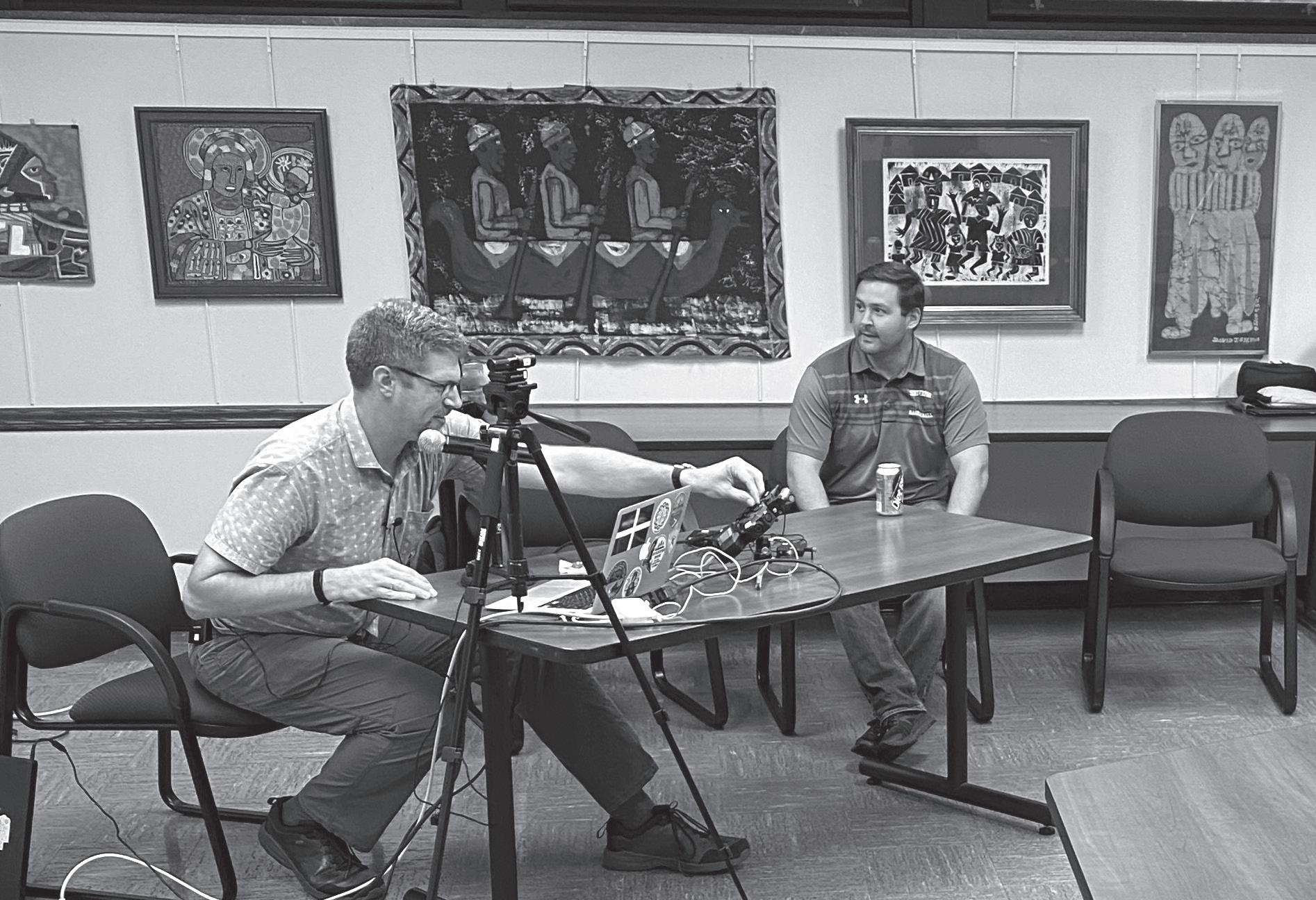
Brother John Eustice, C.S.V. prepares for a podcast interview.
Podcasting 101
i M ages C ou RT esy o F T he v ia T o R ian b R o T he R s and p R ies T s
tience and commitment, other religious communities might benefit from showcasing their members, ministries, and communities in this way, too.
How we got started
In December 2019, we held a Young Adult Think Tank to answer some big questions: How do young adults connect with each other? How is the church serving young adults? How do you think the Viatorians are serving young adults?
We convened a dozen young adults from our parish and school communities. I facilitated a discussion. Our professed men listened and took lots of notes.
Our young adults offered honest appraisals and suggestions for improvement and growth. They wanted to see better pictures and more concise text on social media, more outreach to students away at college, and in-person visits and phone calls rather than just mailings or e-blasts.
One young adult identified a desire for himself and his peers for something reflective, informative, and faithbased that they could use passively. His idea was a Viatorian podcast. As a young person in a long-hours business job, he could listen to a podcast during a commute, on a lunch break, or when he went for a walk to unwind. And he said episodes could be short and basic, even just five to 15 minutes.
This made sense to us—not just because young people suggested and affirmed it, but because podcasting seemed like a natural fit. Sometimes, what’s needed for a good TikTok video or a catchy Instagram post can come off as pandering. Conversely, since podcasting can essentially be earnest, authentic conversation, it felt like a clean fit.
Viatorians are trying to be better at going where young adults are. Considering the limits of time and personnel, the ability to produce and disseminate a podcast series largely from our offices helps us reach places and people in a new, different way.
So where do you start?
NAME YOUR SHOW
A podcast show needs a title. For religious communities, a title specific to the community, its roots, charism, or
spirituality could distinguish it and be a teaching point.
We chose “Viatorian Voices,” a basic title not unlike newsletters or student newspapers across our province. We added a subtitle: “Conversations on the Way.” This is an explanatory nod to our patron saint’s name “Viator,” which means “traveler” or “one on the way.” When you have a title in mind, search on Apple Podcasts and see if it’s already in use.
CREATE A LOGO
When your podcast is published, a visually interesting logo will help distinguish it. You’ll also want to keep the branding consistent with your community look. If you do not have a graphic designer in house, consider doing a basic design using a seal or logo of the community. A novice designer may be able make something decent using a basic online program such as Canva. Vocation directors can also check with youth and young adult communities or perhaps work with art classes in sponsored schools to find a designer.
Our province maintains an Adobe license, and I have developed some intermediate skills with Photoshop. I used a photo of a Saint Viator statue and added AirPods to his stony ears. I then placed the title of the series near him and added our logo and icons for the social media platforms we use.
GET A PLATFORM AND RECORDING MECHANISM
Sometimes audio editing fears can be a major barrier, especially without a good editing program and confident editor. We were pointed toward BlogTalkRadio.com. Just by creating a free account, a user can record episodes up to 15 minutes in length via a conference call. A BlogTalkRadio account lets you set an appointment time, provides a conference call number, and lets you record a live conversation between up to three phones. After the call ends, your account will automatically have a recording of it.
There are downsides to BlogTalkRadio. It records live, so it may include pauses or misspeaking; each episode is branded “BlogTalkRadio” at the start; and it sounds like a phone call (in contrast to studioand-microphone quality). The merit of this service is that it requires no editing, no special equipment (like microphones or recorders), and no exporting. Your BlogTalkRadio account creates a public webpage for
22 | Spring 2023 | HORIZON Masterton | Podcasting 101
Sometimes, what’s needed for a good TikTok video or a catchy Instagram post can come off as pandering. Conversely, podcasting can be earnest and authentic.
your blog where all the episodes are available. Our host uses this service for most of our episodes, and it works smoothly. (Occasionally, we record a special episode ourselves that is more complicated and extends to 45 or 60 minutes. That requires additional effort and equipment.)
HAVE A HOST
If you are doing a series that involves interviews of rotating guests, it is helpful to have a set host. That person can bring a consistent interview style to the show and create a level of comfort with listeners. If this isn’t possible, it can also work to have a rotation of hosts.
For most of our episodes, we use a communications specialist. He is an alumnus of our namesake high school and assists the advancement team there now. His home business offers podcast production for a reasonable perepisode fee. For each episode, we provide him with notes with the guests’ names, brief bios, a main topic with a few suggested questions, and the text of an announcement we’d like at the end of each episode. That “outtro” includes a brief summary of the community and its mission, plus reminders of our email, website, and social media handles. He also improvises an introduction and does a “reset” halfway through to remind listeners of the show title and guests’ names. He reaches guests via email to set an appointment and conducts the interview on his own time. He then forwards the BlogTalkRadio link for us to utilize.
Occasionally we do longer roundtable episodes where we go more in depth. For those episodes, one of us from vocation ministry hosts and moderates a dis-
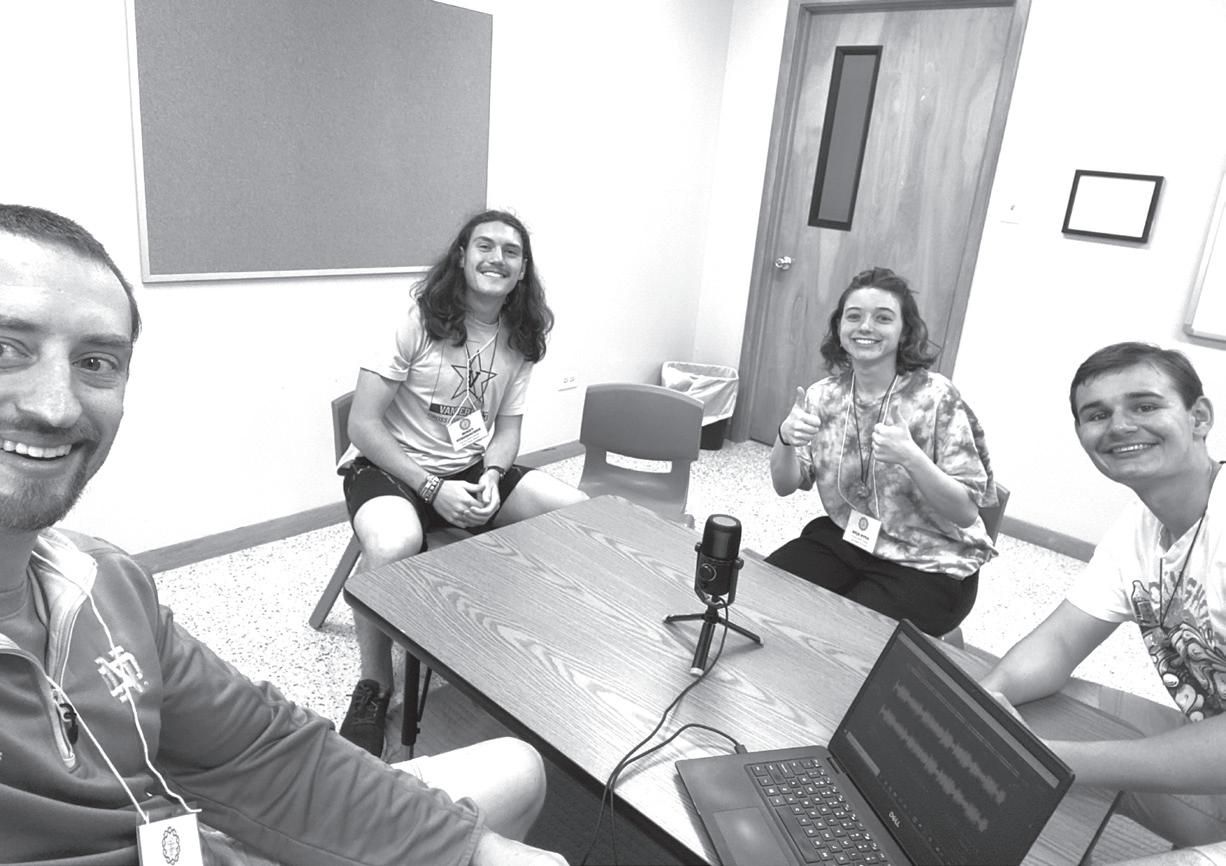
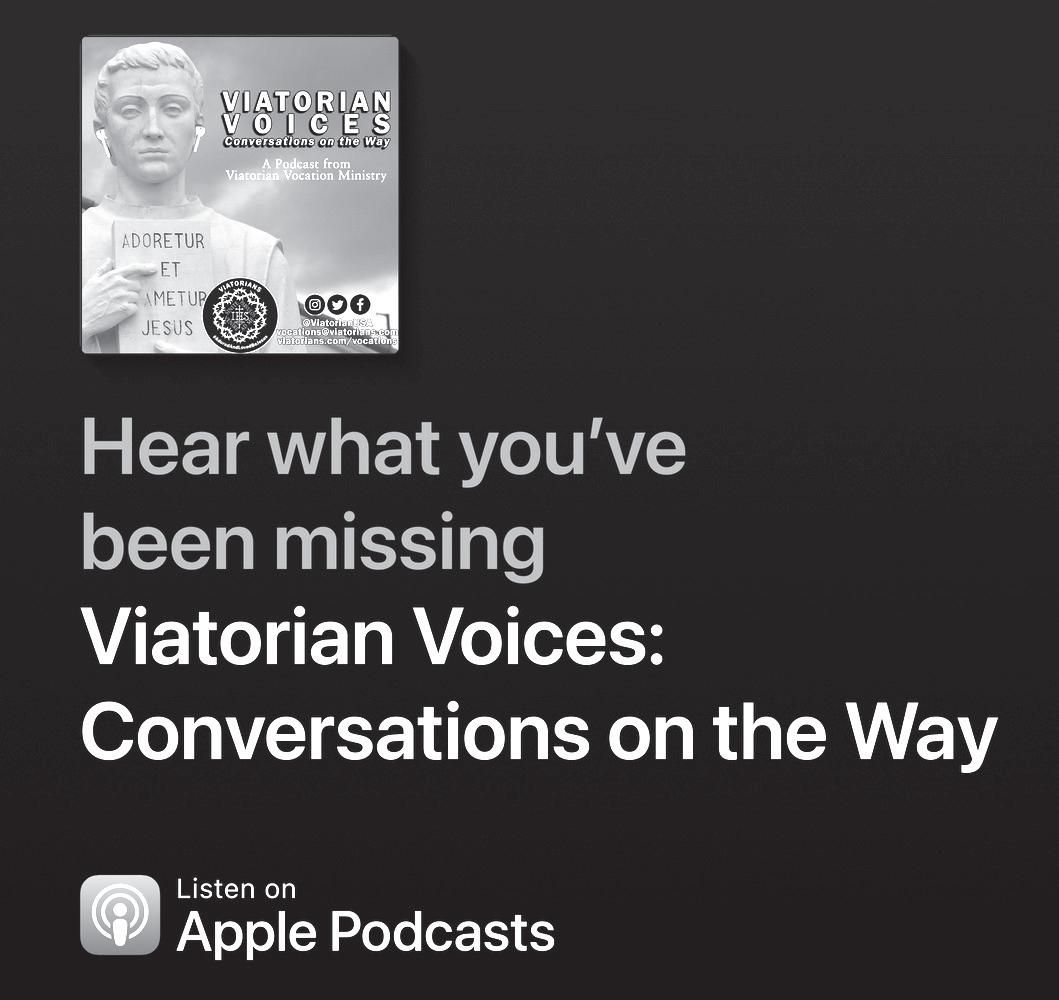
cussion. After the recording, I do some audio editing to remove background noise, echoes, pauses, or clunky sections, and separately self-record introduction and conclusion sections. However, you could certainly use the “live recording” style without editing and simply use whatever unfolds live.
USE A MICROPHONE
For the basic approach on BlogTalkRadio, people’s phones serve as microphones. For in-person interviews, a physical microphone helps improve sound quality over what a phone or laptop can record. If your community sponsors schools or hospitals, you might start by checking with their facilities teams to see if anyone has a sound system and microphones and can help you with your recording.
In lieu of a sound system, our microphone is a JLAB Talk USB microphone that easily plugs into our laptops. We have a “Talk Go” (the basic version that retails for $40) that I carry in my backpack. We also have a “Talk” (the mid-grade version that retails for $100) that we store in our office. We like these mics because they’re simple and come with specialized mini-tripods. Easy settings buttons control the input sensitivity and the direction of the mic. It can be set for 360º recording, which we’ve found works for up to 4 people around a small table in a quiet room. It can be changed to just record from its front, which is great for recording an individual. In a pinch, or before you have a budget, a standard pair of iPhone earbuds with its in-line mic can work for recording individual voice overs if you’re in a quiet, nonechoing room.
Spring 2023 | HORIZON | 23 Masterton | Podcasting 101
Left: Podcasts need a logo so that when prospective listeners search for them, the logo gives them a visual cue. Right: The author with interview subjects for an episode of Viatorian Voices.
A few technical notes
FIND AN EDITING PLATFORM
This is optional, but for those who want to edit recordings, or stitch together pieces of recordings, a software program is needed. Since our community already maintains an Adobe Creative Cloud license, I downloaded Adobe Audition. This audio editing program has more than what’s needed to process and package a good podcast. For those with Macs, the default program GarageBand can work for some editing.
PODCAST DISSEMINATION PLATFORM
The major third-party podcast apps, such as Apple Podcasts, Spotify, and Google Podcasts, rely on RSS feeds (which stands for Really Simple Syndication).
It’s crucial to use an RSS feed and get listed on these apps because many people, especially young people, will not go to a website—such as BlogTalkRadio.com or your community webpage—to listen. Rather, they’ll use their phone and its apps.
For this purpose, I like Acast.com. Using a free account, I can easily distribute our podcast.
VIDEO VERSIONS OF EPISODES
To share a podcast episode on Instagram or YouTube, the episode needs to be a video. For simplicity’s sake, I use a version of our show logo to make a basic graphic. Then, I make a video that consists of that still image with the audio running behind it.
In any of these cases, the default audio program on a computer (Voice Recorder on Windows and Voice Memos on Macs and iPhones) can record the sound well when you plug a microphone into your computer.
How do I carry it out? MAKE A COMMUNICATIONS PLAN
To go along with your title, logo, host(s), and concluding script, you need to commit to some parameters. Accounts that post inconsistently struggle to gain a steady and growing following. Podcasters who are consistently present and provide quality content can build an audience more reliably.
How often will new episodes post? We aim for every other Monday, hoping to produce about two episodes a month. When we sense upcoming episodes from our contracted host may not be ready in time, we consider
assembling a roundtable that we can complete before the next posting date. Additionally, I keep plans for one or two episodes I can record on my own, by using a mix of pre-existing media (like our older videos), articles and excerpts from books by members of our community, and upcoming events where I can meet people and record short conversations on the side.
DECIDE WHO AND WHAT TO FEATURE
First I try to keep us balanced between our Southern Nevada, Chicagoland, and Kankakee County, Illinois regions. Second, I try to feature a healthy mix of professed brothers and priests, women and men lay associates, and young adults. We also make an effort to record talks, reflections, and speeches at communal events such as retreats, conferences, and assemblies; as long as they’re not meant to be confidential or private, these preexisting addresses are ready-made good podcast content.
DECIDE HOW TO SHARE EPISODES
We share new episodes on our webpage and social media—first in brief announcement posts on Twitter and Instagram and also in videos on Instagram and YouTube. We also have a podcast page on our website where episodes are posted. Then, a few days later, our communications director writes up a short article on the episode. She shares the article on our website and on Facebook with a photo of the guest(s). Additionally, in the two weeks following an episode’s release, I post two audiovideo clips of the episode on Instagram and Twitter. We try to tag individuals’ and institutions’ accounts in all posts to encourage friends and members of those communities to engage with the episode, too.
Notes of encouragement
Working through this process for each episode is an accomplishment! There are a lot of steps, but it can become routine and systematized as you go. Plus, it creates a worthwhile product with a long shelf life and many uses around your community.
Professed members, lay associates, and others close to your community may tune in. Content that uplifts the good works of the community is a morale booster for members. Communicators and leaders throughout your province or community may share the link or even quote the episodes in articles, newsletters, and publication materials. Teachers in Catholic schools or religious education programs may use episodes as part of classroom lessons with young people. People interested in
24 | Spring 2023 | HORIZON Masterton | Podcasting 101
1. I identify a guest or guests and a topic.
2. I invite them to appear on the show and add them to my tracking table.
3. I create a “prep doc” for our host and send it to him.
4. Our host contacts our guests and schedules a phone interview appointment.
5. Our host conducts a live-recorded interview.
6. Our host emails me the link to his BlogTalkRadio recording.
Quick review of our podcast steps
7. I listen to the episode and download the audio recording.
8. I create a graphic cover for the episode using the guests’ photos and topic.
9. I use the cover to make a basic video for the episode.
10. On the planned day of publication, I post the episode to Acast.com with title and description, and Acast populates it to third-party apps.
11. I post the episode video to our accounts on Instagram and YouTube.
donating money or volunteering time and talent may be engaged by listening. College students far from your inperson community events may hear an episode and feel connected and re-engaged, especially if they hear fellow young adults as guests! And those open to God’s invitation to religious life or priesthood may be activated by what they hear and reach out to a professed member or vocation director.
The tough thing is that, while Acast.com can show you basics about how many people stream an episode and where they listen from, there is no way to know the full reach or impact of your work! In that sense, it’s not unlike planning a liturgy or service outing or fellowship event—you have to do it well for whoever may come, be it five, 50, or 500!
When it comes to engagement, aim high, but be realistic. The Viatorian Voices listenership averages around 50 streams per episode between our social media and podcast apps. We’d of course love to have a larger audience, but our priority is reaching members of our communities with something thoughtful and consistent. We also repurpose the podcast content on other platforms so the full reach is larger than just the listenership.
When it comes to quality, do your best, but be charitable to yourself. Even if BlogTalkRadio leaves something to be desired with audio quality, even if some guests struggle through parts of interviews, even if the response is lacking at first, commit to a consistent frequency for a predetermined trial period and give it your all.
And finally, be proud! Self-promotion can feel unseemly in pastoral ministry, but if we are centrally promoting the gospel and our charisms, then we need not be shy about wanting people to hear and reflect. Share
12. I post an Apple Podcasts link to the episode on Twitter.
13. Our communications director writes up the episode for our webpage news and posts the article to Facebook with a photo of the guest(s).
14. I extract two audio clips from the episode, and make two videos of the clips.
15. I post one clip each week to Instagram and Twitter.
the podcast actively across your community. You cannot rely just on passive means like social media. Invite people to pull it up on their phones right in front of you. Add QR codes to your posters and business cards. Play clips of episodes for people as you converse.
Our good work as the hands and feet of Christ in the world can and should be shared more widely. Maybe a podcast can be your next new avenue. n
Examples of podcasts by religious communities:
• A Nun’s Life Ministry
By A Nun’s Life Ministry
• Beyond the Habit
By the Sisters and Associates of the Congregation of St. Joseph
• Called to Action
By the School Sisters of Notre Dame, Central Pacific Province
• Viatorian Voices: Conversations Along the Way By the Viatorian Community
• The Providence Podcast
By the Sisters of Divine Providence of Kentucky
• AMDG: A Jesuit Podcast By the Jesuit Conference of Canada and the United States
Spring 2023 | HORIZON | 25 Masterton | Podcasting 101
Feed your spirit
More complete and beautiful
When you and I embrace Jesus’ essential paradox— that to lose is to gain and to die is to live—we come to God, who gathers up the broken pieces of the world and makes them more complete and beautiful than they were before they broke.
 —Rachel M. Srubas, “The Divine Paradox” Center for Action and Contemplation
Discard silos, engage with young people
WHAT ROLE MUST EACH OF US PLAY in ministering to the burgeoning and robust Hispanic Catholic population? Hispanic Catholics are the fastest growing segment of the U.S. This crucial question flies in the face of how we have functioned as a church. For a long time we have segregated ministry to Hispanics, including Hispanic young adults, to a siloed realm. We have left it to be the work of other Hispanics, or perhaps the work of those involved in pastoral juvenil, (young adult pastoral ministry) with the lanes firmly marked. However, the essays in a recent book make clear that this separate-but-equal model never had a place in the church, and especially should not now.
The book, Faith and Spiritual Life of Young Adult Catholics in a Rising Hispanic Church (Liturgical Press, 2022), edited by Father Thomas Gaunt, S.J. is a compendium of essays related to two recent studies by the Center for Applied Research in the Apostolate. The two studies (packaged together and available at nrvc.net under “Studies”) include:
• a national study of young adult Catholics and
By Nicole Perone
Nicole Perone is the national coordinator for ESTEEM, a faithbased leadership formation program for Catholic students at colleges and universities.
Experienced in young adult ministry, she has published articles on that topic in a number of periodicals.

Spring 2023 | HORIZON | 27 Perone | Engage With Young People
Book notes
• a national study of members of small Christian communities. Members were of varied ages, including young adults.
to take a critical look at our approach to the invitation to religious life.
Questions to ask young people: Who were you created to be? What gifts do you have that intersect with the world’s great needs? What brings you joy?
Although there is significant data in this book to demonstrate attrition of Hispanic young adults (especially the longer they and their families are in the United States), one could argue that Hispanic young adults have stayed somewhat more engaged with Catholicism than their Anglo counterparts. We know that “Hispanic young adult Catholics are rapidly becoming the majority among the U.S. Catholics in their age group” (p. 44), and the trend is expected to continue in the years to come. As Mark Gray points out in his chapter, “Faith Group Activity among Catholic Young Adults” (p.16): “To some extent, how young adult Hispanic Catholics are engaging in their faith today could be a window into how most young adult Catholics will do so in the future.”
Faith is one thing, institution another
When we rend our garments and gnash our teeth about the hemorrhage of young people from the church, we miss an important disclaimer: those young adults in disaffiliation are more Anglo by identification, and retention of Hispanic young adults, though not guaranteed, is more consistent.
Thus, what is of particular note in this book are the examples of Hispanic young adults who are engaged in a life of faith. In a time when the data around young adults can be, at best, bleak, this book’s findings demonstrate that one does not need to look far to find hope.
An especially important question to consider is what role the findings of the studies that this book is based on play in the invitation to young people to consider religious life. The work of cultivating a sense of vocation goes hand-in-hand with ministering to young adults. However, when we consider that even among respondents of these studies, Hispanic Catholic young adults struggled with the institution and its perceived failures around noteworthy events of our time (e.g. the Catholic Church response to COVID-19), we have
“Faith and institutional engagement may be conceived as two different things,” writes Claudia Avila Cosnahan, mission and partnerships director at Commonweal, in her chapter, “The Experiences and Perspectives of Young Hispanics/Latines through the Pandemic,” If that is so, we can consider the “angle” of faith, or a sense of spirituality, or even just wondering, as the perfect avenue to engage young people in the broad question of vocation. Who were you created to be? What gifts do you have that intersect with the world’s great needs? What brings you profound joy? In what places and spaces does that joy, and do those gifts, manifest most completely for you?
While those of us in church life recognize the language of vocation in those seemingly secularized questions, they are the questions with which all young people grapple, regardless of cultural family. These questions are an opportunity for those involved in religious life to invite young people to live into the answers in the setting of a religious community.
Even if, as this book’s findings also suggest, Hispanic young adults are also in some way disengaged with the institution of the church, their yearning for spiritual nourishment remains as potent as ever, if not more so in a post-pandemic reality. What an opportunity we have to invite them to bring their vocations about in a new way! We pastoral ministers in the church see the value of small Christian communities, the dichotomy of affiliation in groups versus institutions, and the discerning questions that young adults ask all coming to the fore in this book. These realities inform how religious communities might engage thoughtfully and deeply with young adults.
And so all of us who work with young Catholics are invited to bring to life these fascinating findings, asking ourselves how our ministries, small or large, with any demographic or specialization, can facilitate a church of greater welcome and engagement for all of God’s people, Hispanic and otherwise. Ultimately, as Tracey Lamont, director of the Loyola Institute for Ministry, wrote in her endorsement of this book, “Faith and Spiritual Life of Young Adult Catholics in A Rising Hispanic Church is a call to action, an invitation to transform how we think of and practice ministry with young adults.”
With such abundant and hopeful data before us, as well as some practical direction from the sage contributors, we have a way forward. It is now ours to take. n
28 | Spring 2023 | HORIZON Perone | Engage With Young People


SLIconnect.org 301-445-7970 Practical, skillsbased resources for ongoing human and spiritual formation PREPARE TO BE HEARD We understand your desire to be an effective evangelizer. We’re here to help. PrepareTheWord.com
5416 South Cornell Avenue Chicago, IL 60615-5664 www.nrvc.net | nrvc@nrvc.net | 773-363-5454 NON PROFIT U.S. POSTAGE PAID CAROL STREAM IL PERMIT NO. 2198