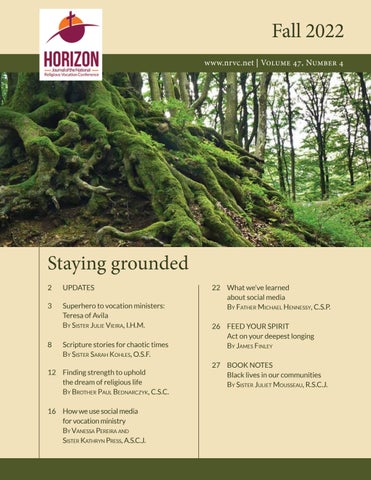
Staying grounded
UPDATES
Superhero to vocation ministers: Teresa of Avila
By SiSter Julie Vieira, i.H.M.
Scripture stories for chaotic times
By SiSter SaraH KoHleS, o.S.F.
Finding strength to uphold the dream of religious life

By BrotHer Paul BednarczyK, c.S.c.
How we use social media for vocation ministry
By VaneSSa Pereira and SiSter KatHryn PreSS, a.S.c.J.
What we’ve learned about social media
FatHer MicHael HenneSSy, c.S.P.
FEED YOUR SPIRIT Act on your deepest longing
JaMeS Finley
BOOK NOTES Black lives in our communities
SiSter Juliet MouSSeau, r.S.c.J.
Fall 2022 2
3
8
12
16
22
By
26
By
27
By
www.nrvc.net | Volume 47, Number 4
ONLINE OR IN PERSON

The Institute of Religious Formation (IRF) at Catholic Theological Union in Chicago provides a unique, holistic program for religious orders as well as diocesan formation directors.

With over 35 years of experience and close to 2,000 graduates, IRF is the trusted source in formation preparation.
Learn more at: c ctu.edu/academics/irf
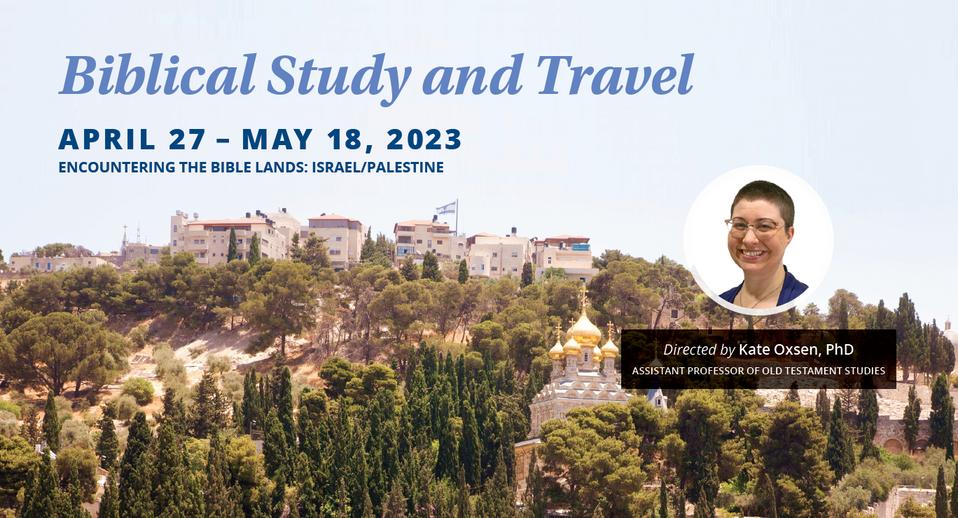
ctu.edu NRVC.net 773-363-5454 nrvc@nrvc.net JOIN US for 3 WEEKS IN THE HOLY LAND with world renowned faculty
Editor’s Note
Editor Carol Schuck Scheiber
Design Consultant Patrice J. Tuohy
Proofreaders
Rosemary Arnold, Virginia Piecuch
© 2022, National Religious Vocation Conference
Cover photo: Image by Anja-#pray for ukraine# #helping hands# stop the war from Pixabay
HORIZON is published quarterly by the National Religious Vocation Conference, 5416 South Cornell Avenue, Chicago, IL 60615-5664. 773-363-5454 | nrvc@nrvc.net | nrvc.net
Facebook: Horizon vocation journal
Twitter: @HORIZONvocation
SUBSCRIPTIONS
A complimentary subscription to HORIZON comes with NRVC annual membership. Additional subscriptions are $50 each for NRVC members; $125 each for non-members. Single copies are $25 each. Subscribe online at nrvc.net/signup. Please direct subscription inquiries to Marge Argyelan at the NRVC office at 773-363-5454 or margyelan@nrvc.net.
POSTMASTER
Send address changes to HORIZON, 5416 S. Cornell Ave., Chicago, IL 60615-5664. Periodicals postage paid at Chicago, IL. ISSN 1042-8461, Pub. # 744-850.
REPRINTS, ARCHIVES, ELECTRONIC EDITIONS
Permission is granted to distribute no more than 50 copies of HORIZON articles for noncommercial use. Please use the following credit line: Reprinted with permission from HORIZON, nrvc.net. For other types of reprints, please contact the editor at cscheiber@nrvc. net.
EDITORIAL INQUIRIES & ADVERTISING
All editorial inquiries should be directed to the edi tor: Carol Schuck Scheiber, cscheiber@nrvc.net. For advertising rates and deadlines, see nrvc.net or contact the editor.
THE NATIONAL RELIGIOUS VOCATION
CONFERENCE is a catalyst for vocation discern ment and the full flourishing of religious life as sisters, brothers, and priests for the ongoing transformation of the world.
Listen to the wise guys
IWAS DRIVING HOME from Chicago when I first started see ing road signs that seemed more like advice from a spiritual guide. “Don’t drive angry,” arched over the highway in bright lights in various slogans. Mulling on it, I wondered about road signs that would dig deeper. “What’s behind your anger?” “Over whelmed?” “Sad?” “Relationship trouble?”
While I don’t think the Illinois Department of Transportation is going to probe our inner life anytime soon, the idea of taking time for a spiritual-emotional check-up has been a built-in part of reli gious life since the beginning. We hope this edition of HORIZON might give you a way to refresh and renew the spirit that I love so much about vocation directors: an inner hope, creativity, and spiritual depth that is the foundation for what they do. Our writers explore ways to tap into the important lifeblood that feeds this inner spirit and this ministry.
It might seem incongruent to pair articles on social media along with articles about staying grounded in one’s spiritual foundation, but in fact, it makes sense. Most Catholic social media experts en courage a church presence in seemingly superficial, usually ephem eral online spaces. Religious communities have a charism and an invitation to share in the virtual world, both of which spring from their groundedness in God and from a healthy spirituality.
Thank you to our talented writers. May all of us laboring in vocation vineyards find rest and refresh ment along the way so we can bring our best com munity and our best self to our work.
Carol Schuck Scheiber, editor, cscheiber@nrvc.net
HORIZON is an award-winning journal for vocation ministers and those who support a robust future for religious life. It is published quarterly by the National Religious Vocation Conference.
NATIONAL RELIGIOUS VOCATION CONFERENCE BOARD
Sister Mindy Welding, I.H.M.
Board chair
Father Adam MacDonald, S.V.D.
Vice chair
Sister Belinda Monahan, O.S.B.
Vice chair
Sister Marichui Bringas, C.C.V.I.
Ms. Nancy Costello
Brother Brian Poulin, F.M.S.
Sister Nicole Trahan, F.M.I.
Mr. Len Uhal
Sister Mary Yun, O.P.
Sister Deborah Borneman, SS.C.M. Ex officio
Fall 2022 | HORIZON | 1
Handout encourages member involvement
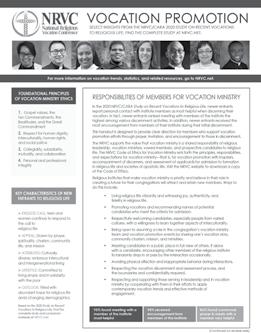
If you seek greater membership involvement in vocation ministry, NRVC’s newest resource may be for you. The colorful 8.5-by-11.5-inch handout, “Responsibilities of Community Members for Vocation Ministry,” elabo rates on the role of member ship. The front of the hand out quotes NRVC’s revised Code of Ethics on members’ part in vocation ministry. The back lists practical ways members can promote reli gious life membership. Download this docu ment for free from nrvc.net, or purchase copies printed in color on quality paper stock at nrvc.net/store. It’s a great discussion-starter for use in local households, at member assemblies, and to use at events such as World Day for Consecrated Life (February 2).
Have you posted to the VISION calendar?
As you go through your checklist of ways to publicize your events, be sure to add your events to the VISION online calendar. Events must be sponsored by a religious community, but they need not be specifically vocation-themed. Many communities successfully post on the VISION calendar about Masses, retreats, speaking engagements, prayer

services, open houses, ministry opportunities and many other happenings, both live and virtual.
Help people in discernment to find ways to connect to religious life by placing your announcement at: vocationnetwork.org/en/events.

Vocation ministry dates for 2023
The church has several dates dedicated to promoting and celebrating religious life. The NRVC encourages you to include the following dates in your 2023 vocation strategy.
World Day for Consecrated Life
February 2, 2023
Catholic Sisters Week March 8-14 , 2023
World Day of Prayer for Vocations April 30, 2023
Religious Brothers Day May 1, 2023
2 | Fall 2022 | HORIZON Updates Updates
Saint Teresa of Avila lived in an age with its own pressures and problems within religious life. What wisdom might this spiritual giant have for vocation ministers today?
The life and writings of Saint Teresa of Avila hold insights that can help vocation ministers unleash superpowers of their own.
Superhero to vocation ministers: Teresa of Avila
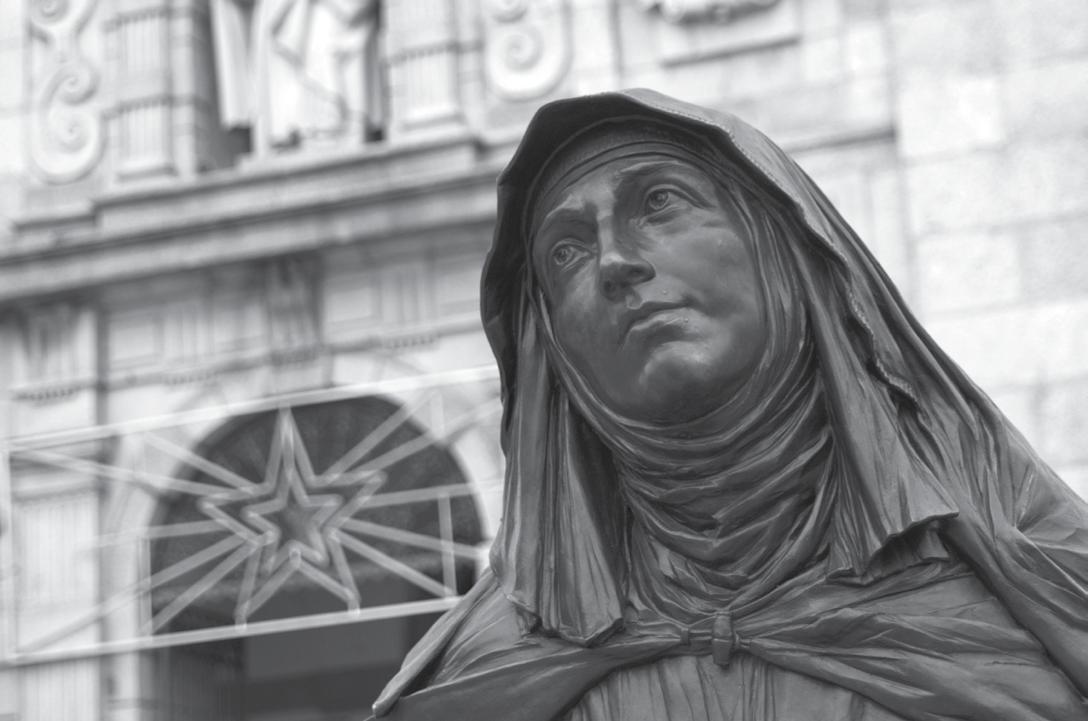
NOTALL SPIRITUAL SUPERHEROES wear capes. But mine does! Teresa of Avila is a spiritual superhero for today, and she even has a cape courtesy of the Carmelite habit of 16th century Spain. But why is she a spiritual su perhero? What makes her someone that Commissioner Gordon would run to the batphone and call for spiritual help? Teresa of Avila was many things—Carmelite nun, Doctor of the Church, saint, mys tic, writer, reformer. Superhero is not traditionally among those labels. What does “superhero” even mean when talking about this medieval Span ish woman?
The gold standard for understanding superheroes is none other than the legendary Stan Lee—comic book creator, Marvel founder and superhe ro collaborator responsible for the likes of Spider Man, Black Widow, and Black Panther. Stan, as his public always referred to him, outlines some of the key characteristics of a superhero, and in doing so, gives us some clues as to why Teresa of Avila might just be the spiritual superhero vocation ministers and their supporters need today.
Vieira | Teresa of Avila
By Sister Julie Vieira, I.H.M.
Sister Julie Vieira, I.H.M. belongs to the Sisters, Servants of the Immaculate Heart of Mary based in Monroe, Michigan. She is a writer, presenter, and spiritual guide currently serving as program director of the IHM Spirituality Centers.

Fall 2022 | HORIZON | 3
E milio A lonso F lickr
Uniquely gifted with superpowers
In his essay entitled, “More Than Normal, But Believ able,” published in the 2013 book What is a Superhero? Stan writes, “In order to be a superhero, you need a power that is more exceptional than any power a normal human being could pos sess.” Well, Teresa certainly fits that bill. It’s not every human being that can levi tate mystically in the kitchen.
Levitation, intellectual and imagina tive visions, and ecstatic experiences were all part of Teresa’s mystical experiences. These were indeed exceptional experi ences, “powers” seemingly beyond any person’s capacity. Even so, they were not her ultimate superpower.
an instruction manual on how to train ourselves to use our “superpower” of God dwelling within us.
We all want to grow in prayer, but we don’t always have time to read the instruction manual! If you are like me, you never even touch it unless something goes awry! Plus, who has the time? The demands of our ministry, our community life, our social outreach, our friends and family, our health—all these can make it feel like not only is there no time to read about prayer, but no time to pray, period!
Teresa’s superpower of prayer did more than help her individually; it also has helped a whole world of people longing to draw close to God.
Teresa’s superpower was in fact something very ordinary, something that each of us has the capacity for without necessitating mythological par ents, radioactive spiders, or a Wakandan plant. Teresa’s superpower? Prayer.
Prayer, as Teresa describes it, is “nothing else than an intimate sharing between friends; it means taking time frequently to be alone with Him who we know loves us.” In The Way of Perfection, she says that when we have “a clear realization and full consciousness” that we are en gaging with God—whether speaking aloud or reading or using our imagination—we are in fact praying.
Cultivating the superpower of prayer
But as we know with any superhero, superpowers aren’t one and done. They have to be cultivated. Imagine young Peter Parker days after being bit by a radioactive spider. Sure, he was given superpowers, but he had no under standing of them. He had to learn about them and to train, careful not to accidentally catch an innocent by stander in a wayward Spidey web.
Teresa was intent on better understanding her su perpower so that she might grow closer to God and feel more fulfilled. But that’s not all. Teresa also knew that the superpower of praying wasn’t just for her. It was for everyone. We all have the capacity of being aware of God, of listening to and talking to God, of loving and be ing loved by God. It takes time to grow our capacity for prayer and to deepen our relationship with God. And so, Teresa paid close attention to and wrote about her own experience of prayer so that she might encourage others in their relationship with God. Teresa’s writings are like
Too often we set aside our superpow er of prayer as Teresa described it, trust ing that “prayer in action” is just as good. We sometimes skip the quiet time with God and instead dive right into our many responsibilities. And of course, prayer in action is good; it is a very powerful form of prayer. But it cannot replace that quiet space Teresa reminds us about.
The more we have to do, the more, in fact, we should give to prayer. Martin Luther once said in response to his plans for the day, “Work, work from early until late. In fact, I have so much to do that I shall spend the first three hours in prayer.” Three hours is not easy to come by! But Luther and Teresa are trying to remind us that we have everything we need already because God dwells with and within us. Never underestimate the superpower of the gift of simply being with God.
Passionate about the good
We all know that while superpowers are really cool, there’s more to them than that. Stan Lee writes, “You need to use that power to accomplish good deeds.” Look ing at Teresa’s life, we can see how she was oriented to the good, even from an early age when she and her brother ran away from home, determined to become martyrs for the sake of the gospel. But even with her desire to do good, she was also tempted by the dark side. In her autobiography, she says she struggled often, “going from pastime to pastime, from vanity to vanity, from one oc casion of sin to another.”
Teresa used her superpower of prayer to keep herself oriented toward the good, which for her was to be found in God alone. “Quien a Dios tiene nada le falta. Sólo Dios basta,” as it says in her own handwriting on a bookmark found in her prayerbook— “The one who has God lacks nothing. God alone suffices.” Teresa’s commitment to prayer, even when it was rough going, helped her grow in
Vieira | Teresa of Avila
4 | Fall 2022 | HORIZON
her relationship with God and to find solace in “the One whom we know loves us.” The greater she aligned her life with her experience of God, the more she was able to ex perience the goodness in herself and in the world around her.
Teresa’s superpower of prayer did more than help her individually; it also has helped a whole world of people longing to draw close to God. As Teresa grew in her own life of prayer, she wanted to help her Carmelite sisters and brothers in their lives as well. She was asked to write about her life and her new Carmelite foundations and especially about how to grow in relationship to God and to understand the interior experience of God as well as God’s activity in the world.
Indeed, Teresa used her superpowers to accomplish good deeds that the world continues to benefit from, people she never imagined she would reach. Many times it can be like this in our own lives, especially in the field of vocations. We connect with many people wonder ing about and discerning their vocation, though only a handful may ever end up entering a religious commu nity. Yet in each email, chat, or visit we bring the best of ourselves and our charism. Even if we never hear from a person again, we can’t know the impact of our experi ence with them. I still have a holy card of Saint Scholas tica sent to me by the vocation director of St. Benedict’s Monastery in Manitoba, Canada. It has nourished me deeply for over 25 years.
We just don’t know all the places that God can take our humble work, but we can trust that God will see that the good flourishes in the way it is needed most.
Relatable and “relatively” normal
Now that we’ve covered superpowers, let’s look at a couple other aspects of the superhero model. Stan writes that the superhero must be “as believable and realistic as possible,” someone who lives in a realistic world that people can relate to. He says the superhero “has to have friends, enemies, people he’s in love with, people he doesn’t love—just like any human being.”
For as much as Teresa is known for her levitations and visions, she is equally known for being down-toearth, lighthearted, and humble. Teresa tells it like it is. In one moment, she can be extolling the virtues of prayer and in the next moment be very practical about how to live in community. She knew that even with our su perpowers, we still have the stuff of life to attend to. She conveys this well in one instruction to her sisters: “When obedience calls you to exterior employments (as, for ex
Avila
Like Teresa, we bring the best of our charism and ourselves to each ministry interaction, trusting God to use it for good. Here Brother Allen Pacquing, S.M. talks to a student at St. Mary’s University.
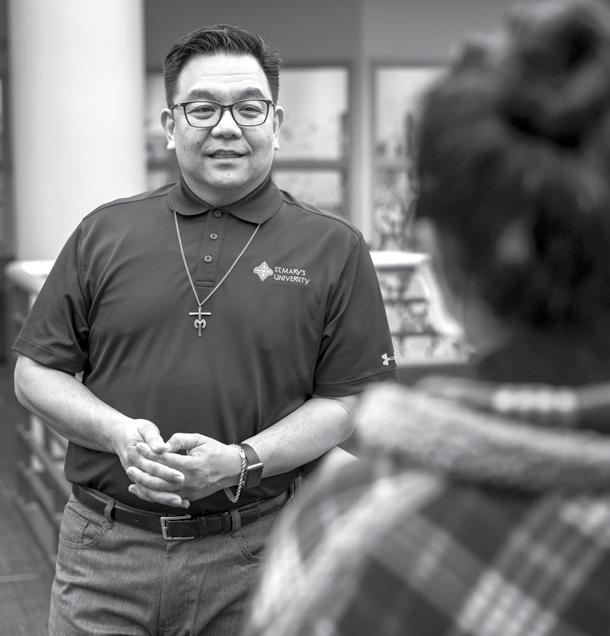
ample, into kitchen, amidst the pots and dishes), remem ber that our Lord goes along with you, to help you both in your interior and exterior duties.”
She also shares regularly about her own humanity. Her writings are not just instruction manuals for prayer. Rather, they paint a portrait of the human being before God—with all our light and darkness, color, textures, bold strokes and rough edges. Teresa was definitely not a paragon of virtue, but she kept at it and allowed herself to be fully human at the same time that she strived for uniting fully with God.
We too need to keep it real and allow ourselves to be fully human even while we are serving others. Of course this is not to say that we don’t have healthy boundaries. It just means that we can be ourselves. I remember giving what I thought was an awesome vocation talk to a The ology on Tap group. It was well researched, clever and compelling. But it flopped. In the Q&A, I made some off-handed comment about playing the video game Zel da, and that’s when the attendees lit up. It’s not that we even talked about video games, it was that I had revealed something about me personally that they could relate to. It opened the door to a great conversation about voca tion and life and God.
This ability to be very human and very much our selves is important for our own selves but also for others who are trying to see if they too can be themselves and be a religious. They want to see how we’ve integrated
Fall 2022 | HORIZON | 5Vieira |
Teresa
of
D A rr E n s hiv E r DE ck E r , s t m A ry ’ s U niv E rsity
not abandoned—our personalities, quirks, and pas sions into every dimension of religious life: community, prayer, and ministry.
Wounded superheroes
I want to highlight one other thing about superheroes being relatable and relatively normal. By the way, I say “relatively” normal because in the superhero multiverse, “normal” involves a wide spectrum, including everything from human to demigod to mutant to alien to artificial intelligence and everything in between. Oddly enough, there is no one way to be “normal”! But I digress.
Stan doesn’t directly mention this characteristic in his essay, but it is something that many fans have noticed about Stan in his creation and development of super heroes. Father Jim McDermott, S.J., associate editor at America magazine, says it well in his article remember ing Stan after he died in 2018:
The thing that Stan did that was truly revolution ary was not simply that he cut his characters from the everyday stuff of our lives, but that he specifi cally took qualities that society has often cast as shameful or embarrassing—being an orphan, being smart, being an adolescent, being handi
capped or just not being white—and ascribed those qualities to his heroes.... Stan Lee showed us nerds (and Catholics) can be heroes.
Superman’s alter ego Clark Kent is socially inept and dons stereotypical nerd eyewear. Makkari, a member of the Eternals, is a deaf woman of color. Peter Parker is an awkward teen when he gets his Spidey powers.
Part of being a superhero means owning and even elevating those parts of us that have been hurt, rejected, shamed. Our ability to do this can lead to our own heal ing, and it can help us be more present to others who are in need as well.
For as grounded and strong as Teresa of Avila ap pears in her writing, she also was someone deeply wounded by others. You can see traces of this in her characteristic self-deprecating remarks throughout her writing. Some of this is a result of her humility and some was a way to subvert church inquisitors who did not like “uppity women.” Still, her words also bear the edges of suffering.
For example, Teresa writes in her autobiography, “Blessed be Thou, O my Lord, who, out of a pool so filthy as I am, bringest forth water so clean as to be meet for Thy table! Praised be Thou, O Joy of the Angels, who hast been thus pleased to exalt so vile a worm!” In today’s
6 | Fall 2022 | HORIZON
Vieira | Teresa of Avila
world where copious amounts of self-empowerment quotes are on social media, these may be strange words to hear. Yet, Teresa is not putting herself down nor ask ing us to feel sorry for her. Rather, she wants to show us that God delights in us, lifts us up, sets us as an example even when we feel at our smallest—a lowly worm.
We have all felt that smallness. It might be wounds from our own history or our own feelings of inadequacy as others in our communities look to us to herald in the future of religious life. It may be that we don’t feel spiritual enough, or young and relevant enough, or that we are socially awkward, or have been hurt by our own community, or have our own struggles about the un known future of religious life.
What would happen if we saw our “smallness” or wounds as Stan Lee saw them? Or as Teresa of Avila? Or as Jesus the Christ? What would it be like to rise to our fullest potential as the wounded superheroes that we are?
Facing our adversaries
No discussion of superheroes would be complete with out mentioning the superhero antithesis: the supervil lain. Call it an archenemy, a nemesis, an evil overlord, a mad scientist, whatever. When there’s a superhero, there’s also going to be a Lex Luthor, a Harley Quinn, a Green Goblin, or a Dark Phoenix—and all their legions of minions (not the yellow kind). The supervillain keeps the superhero on her boot-clad—or discalced, as the case may be—feet. The supervillain can match the su perhero move for move and perhaps even appear to be more powerful!
Now this is where our comparison to Teresa might be stretched a bit. But let’s go with it. Teresa certainly did have the occasional adversary and, of course, she wrote regularly about the wiles of the devil. But her writings also reveal that her greatest nemesis was, in many ways, her own self.
She was self-aware enough to recognize how she often thwarted herself and got in the way of the good that both she and God were trying to accomplish! She worked at being herself thoroughly, and also she knew that she had to check her attitudes and behaviors when she wasn’t at her best. Teresa’s writings include a great vignette in which she shares how she was going to re ceive Communion, normally a beautiful experience for her, but she got rather judgmental when the priest gave her the tiniest piece of the host. She wondered: What’s wrong with him? Is he trying to mortify me? But then she stopped herself from going down that rabbit hole,
reminding herself that God was “whole and entire in the smallest particle.” She continues, “His Majesty said to me: ‘Have no fear, My daughter; for no one will be able to separate thee from Me,’ giving me to understand that the size of the Host mattered not.”
Like Teresa, we too have adversaries and adversarial situations that we must face, willingly or not, exteriorly or interiorly. We must activate our superpowers most especially in these situations and trust that though the other powers may appear stronger, nothing can over power the love of Christ. As Paul the Apostle writes to the Christian community in Rome: “Will hardship, or distress, or persecution, or famine, or nakedness, or per il, or sword? … No, in all these things we are more than conquerors through him who loved us” (Rom. 8:35, 37).
We are each invited to be the “more than” that Paul writes about. Our adversarial situations may seem small and innocuous like a wafer fragment, or they may be more formidable like a room full of Kryptonite. It won’t be easy—it never is. Life is messy and uncomfortable and painful at times. But in the end we choose how we will be in the midst of it, not in spite of it.
But wait! What about the sequel?
As we near the end of our spiritual superhero saga with Teresa of Avila and a cast of characters from the multi verse, it seems important to return once again where we first started. Stan Lee gave us a good model of a superhe ro to work with. In the end, however, he says simply this:
Another definition of a hero is someone who is concerned about other people’s well-being and will go out of his or her way to help them—even if there is no chance of a reward. That person who helps others simply because it should or must be done, and because it is the right thing to do, is in deed without a doubt, a real superhero.
The world is longing for this kind of “real super hero.” We see it in Teresa of Avila and in so many other spiritual superheroes past and present. Our invitation is not just to look to them for guidance, but to also take up the mantle ourselves. It’s time to roll up our sleeves and don our own spiritual capes once again, equipped with good companions, insight, and passion for the world. It’s also time to activate our superpowers on behalf of the next generation of religious to help them in their own journeys to become fully themselves and fully commu nity.
The sequel is up to us. n
Fall 2022 | HORIZON | 7Vieira | Teresa of Avila
The stories we tell ourselves matter. What stories from our tradition give grounding during troubled times?
Scripture stories for chaotic times
 By Sister Sarah Kohles, O.S.F.

Sister Sarah Kohles, O.S.F. is a Sister of St. Francis of Dubuque and an assistant professor of theology at Briar Cliff University in Sioux City, Iowa. She is a co-editor and contributor to In Our Own Words: Religious Life in a Changing World, and a contributor and editor of Creating Spaces for Women in the Catholic Church, to be published by Paulist Press in the summer of 2023.
IFIND
MYSELF LINGERING over favorite passages in scripture when I need an anchor and a reminder of how I am called to be in the world. For me, many biblical passages serve as touchstones, helpful reminders, and a bit of grounding in the upheaval of these times.
These days the words of Saint Paul often ring true: “All creation is groaning” (Rom. 8:22) with a pandemic, racial injustice, mass shootings, global warming, church struggles, and religious communities in sharp decline. Are the groans we hear death throes or birth pangs? How can we even know? Where do we turn for guidance in the midst of these chaotic times? Where do we find solidity when it seems the rug is being yanked out from under us every other day?
Kohles | Scripture for Chaotic Times
8 | Fall 2022 | HORIZON
PAtrick ForE, UnsPlAsh
Here are some of the scripture passages I turn to, along with questions that may help you reflect on these life-giving stories.
Go to the land I will show you
In Genesis 12, Abram and Sarai (later called Abraham and Sarah) are instructed by God to “Go … to the land I will show you.” They set out on a new adventure where everyone and everything they encounter is unfamiliar. God does not provide an itinerary or a road map. They are not told what will unfold on this journey. Abram and Sarai are barely told the next step. But they are reassured that they will have what they need and that they will be a blessing to others. Go to the land I will show you. God does not even tell them where they are going! They are to go to the land they will be shown at some unknown time in the future. It seems God has been consistently vague when calling people through the millennia. The call is simultaneously clear and unclear. Go to the land I will show you, and somehow there will be blessing involved.
Religious and discerners alike might struggle with how to live with the sheer volume of uncertainty in the world. God’s call to us is similar to that of Abram and Sarai: Go to the land I will show you. Go to the people I will show you. Go be in the midst of the upheaval I will show you. Just take the next step. There will be blessing in these messy, uncertain times.
Even though I believe this, practical and soul search ing questions intrude. With fewer and fewer practicing Catholics, where will new members of religious institutes come from? People continue to enter religious life, but they are fewer in number than in the past. Will men and women keep joining us even as we close motherhouses and face large numbers of funerals? What are we inviting people to?
As I ponder these questions, I confess I find Abram and Sarai’s story oddly reassuring. I’m not unusually dense because I don’t know what to do during these cha otic times. Instead, all I have to do is pay attention and listen, trusting that I will find a way to take the next step on the journey. Perhaps we are inviting people to come with us to the unknown space God will show us.
• On what unknown terrain are you called upon to walk?
• Are we brave enough to let go of comfort and distractions from difficult questions in order to embrace the unknown?
• What is the next small step you sense you might be called to take?
Wrestling with God
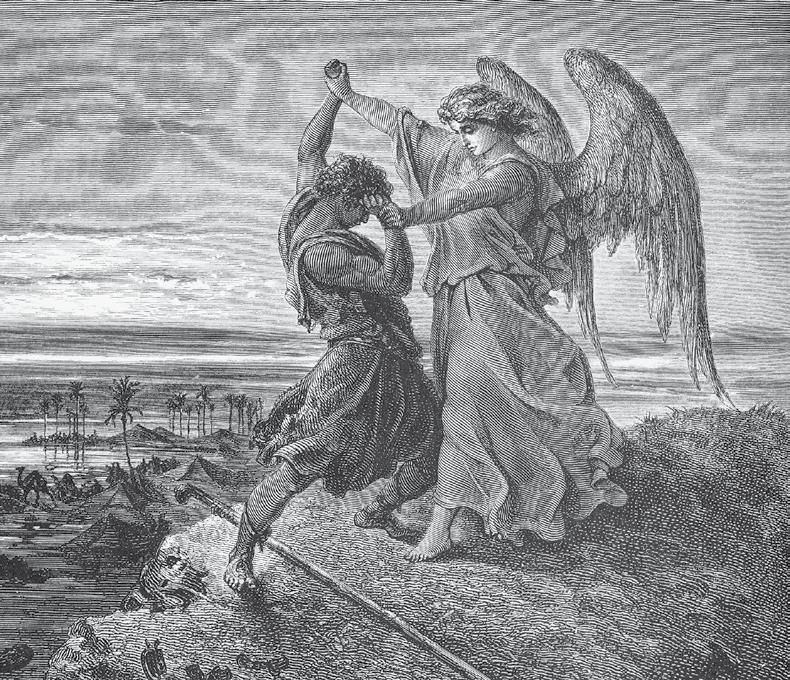
When Jacob tricks his father into giving him his brother’s birthright, he refers to God as “your God” (Gen. 27:20), indicating that it is Isaac who has a relationship with God rather than Jacob. Although Jacob’s trickery forced him to leave the country, he eventually returns home. On the route home, Jacob spends one night wrestling with a divine figure all through the night (Gen. 32:25-31). Jacob wrestled, struggled, with God all night. He refused to let go until he received a bless ing. After this experience, Ja cob exclaims that he has seen God face-to-face. He has de veloped his own relationship with God.
I find Abram and Sarai’s story oddly reassuring. Perhaps we are inviting people to come with us to the unknown space God will show us.
Christians, including young adults, often think that their faith is weak if they struggle with belief or church teachings or their relation ship with God. However, our siblings—our Jewish sisters and brothers, that is—know that wrestling with God is part of strengthening the relationship. It is comforting to know that it is in struggling with questions of faith that we make our faith our own.
For those of us who work during these chaotic times with young adults and those discerning religious life, it is also comforting to remember that our struggles, suffer ing, and mental anguish as we try to figure out what to do is not in vain. Our wrestling strengthens us. The col lective loss we are experiencing in religious life right now binds us together across generations and communities. We search and wrestle to find God in it all, and we grow stronger as a result.
Perhaps we are becoming people who are surefooted as we walk upon shaky ground. Maybe we are becom ing religious who can wrestle throughout the long night with the divine without letting go in order to receive a blessing we cannot yet imagine. We are blessed and transformed when we wrestle with God face-to-face. Individually and communally, we are being transformed through these times.
• What big questions are we wrestling with now?
Fall 2022 | HORIZON | 9Kohles | Scripture for Chaotic Times
• Where is God in our transformative struggle?
• What blessings are already emerging as a re sult of these experiences?
No way, God, not me
Every call story includes some serious objections from the person being called by God. People who are called to respond in unprecedented times, people who find them selves in impossible circumstances, people whom God calls anyway—all seem to have the same response.
In fact, call stories seem to go something like this.
God: I am calling you to do this thing.
Person: No way, God. You’ve got the wrong person. I couldn’t possibly. You’d better find someone else.
God: Actually, I do know what I’m doing. I pick you.
I find it hugely reassuring that virtually everyone shares this experience of questioning the call. For ex ample, in scripture, Moses has the nerve to question God and ask, “Who am I that I should go to Pharaoh?” (Exod. 3:11). Then when Moses hears more about what God wants him to do, he understandably inquires, “But sup pose they do not listen to me?” (Exod. 4:1). Once Moses realizes that public speaking is part of the call, he insists that he is “slow of speech and tongue” (Exod. 4:10), which should surely get him off the hook. None of his logical attempts to change God’s mind about
this call convinces God to find some one else.
Similarly, Isaiah expresses con cerns that he is not good enough to be a prophet. He declares that he has “un clean lips” and that he’s “living among a people of unclean lips” (Isa. 6:5).
Jeremiah protests, “I am too young!” (Jer. 1:6). The Samaritan woman who encounters Jesus at the well is shocked and asks, “How can you, a Jew, ask me, a Samaritan woman, for a drink?” as she protests that she is being asked to cross boundaries she never would have considered (John 4). Even Mary, the mother of Jesus, wonders, “How can this be?” when the angel announces God’s intention for her life. Everyone who is called seems to respond with serious doubts and some version of: “Are you sure about this, God?”
During my formation, Sister Bernice Schuetz, O.S.F., a sister in my community, confided that she had told God, “No!” every time God had asked her to do something new. She told me she had always had reasons why she could not go to this new place or start this new ministry. Sister Bernice then explained that even though she always said no, somehow God continued to work on her until she was doing precisely the thing she had declared would never happen.
While it’s not helpful if I say “no way” to God for ever, it is normal to need a little time for wrestling and arguing with God over the call in these chaotic times. I also find comfort in the thought that it is OK that I have no idea what to do. No one else knows either. In fact, it seems that everyone feels inadequate to face the task at hand. There are no clear answers about how to manage these times. It is enough that we come grumbling and protesting that we don’t quite have what it takes—and then respond to the call anyway. Somehow my good faith effort and best discerning guess of what to do next is enough. It’s up to God to figure out the rest.
• When has your no turned into a yes? What helped you change your response?
• What impossible feats are you involved in right now?
• What do you find reassuring as religious life faces the unknown?
10 | Fall 2022 | HORIZON Kohles | Scripture for Chaotic Times
Jacob wrestles with an angel, thought to represent God (Gen. 32:25-31). Wrestling with, struggling with, or questioning God can ultimately strengthen our relationship.
G U st A v D or E , W ikim ED i A
Faithful persistence
One of my very favorite passages in the New Testament is Luke’s story of the persistent widow who harasses the unjust judge until he rules in her favor (Luke 18:1-8). The story is framed as a lesson on prayer and the need to be faithful to our relationship with God. Luke is considered the gospel of prayer, as it is Luke’s Gospel that encourages disciples to “pray always” (Luke 18:1). It is also in Luke that Jesus is forever seeking a quiet place to pray (Luke 5:16; 6:12). While turning to God in prayer is certainly grounding in chaotic times, this story is about so much more than prayer for me.
We don’t know if Jesus told this parable with a liv ing human being in mind. The widow in the story may simply represent all women and widows who are poten tially treated unjustly because they don’t have someone to advocate on their behalf. Or maybe Jesus did know a truly tenacious widow whose persistence yielded justice despite the odds stacked against her.
This story is also an example of humor in the Bible. It’s supposed to be funny. We’re supposed to laugh at the very idea of a widow (with comparatively far less power) overcoming an unjust judge (who has a signifi cantly more powerful position). The idea that the judge is frightened of her would have made Jesus’ audience laugh out loud.
We aren’t told the widow’s socioeconomic status. For the sake of a dramatic story, it makes sense that she is truly vulnerable and poor as a widow. But she does have the confidence and strength to be persistent and to try to advocate for herself and to insist on justice, which might suggest that she is from a position in society that would have known how to use those skills.
This widow’s persistence transforms her circum stances. She faces the upheaval of injustice in her life, and by continually showing up, by not slinking away when shunted aside by the powerful, she finds her way forward.
Imagine the inner sense of rightness we will feel as we faithfully show up for these chaotic times and insist on goodness, justice, and all that is right in the midst of upheaval. Imagine our delight in watching for evidence of God guiding and nudging us through these times. Imagine our emerging confidence as the unexpected un folds all around us.
• When has persistence impacted your life?
• What circumstances require your persistence at this time?
• When have you experienced faithfulness overthrowing injustice?
It is natural to feel overwhelmed or even numb in the midst of all the turmoil of these times. Yet, we do have tremendous sources of wisdom at our fingertips. The sacred stories of our scriptures remind us that it is God who sends us out on a journey and God who prom ises Abram, Sarai, and us that the end of the story will include blessing. Like Jacob, we and the people we walk with may wrestle with God, but it is our struggle that deepens our relationship with God and helps us to con tinue on the journey.
Numerous prominent biblical figures demonstrate that it is only natural that we will inevitably feel inad equate to respond to the needs of the times. Even proph ets made excuses, and the Samaritan woman at the well and Mary, the mother of Jesus, had serious questions. Finally, persisting even when we can see no possible way forward, persisting when we feel powerless in the face of corruption, and persisting for the sake of good is not in vain.
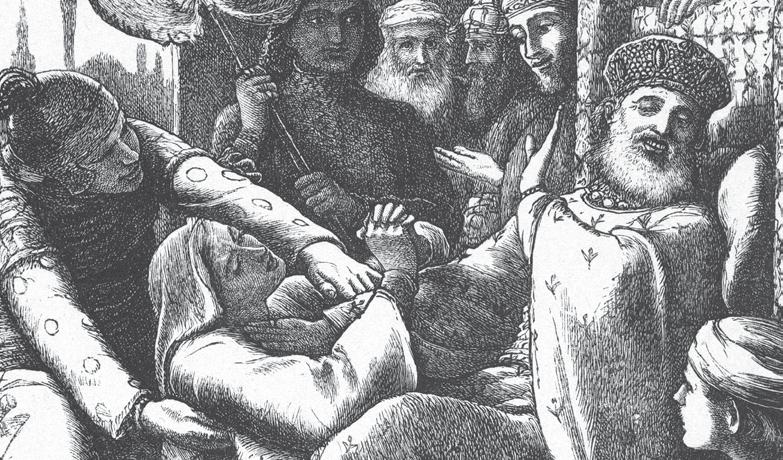
The widow reminds us to be faithful in prayer and to our call to engage in the upheaval. Each of these stories helps me to remember that I am not alone. Many others have persisted, and I can as well. As Luke tells us, “Will not God then secure the rights of his chosen ones who call out to him day and night?”
What passages from scripture serve as your guide through chaotic times? I encourage you to revisit them. Perhaps, like me, you will find perspective, strength, and sustenance in these timeless stories. n
Fall 2022 | HORIZON | 11Kohles | Scripture for Chaotic Times
The persistent widow reminds us to be faithful to prayer and to our call to engage in messy, ambiguous, and difficult situations.
J
ohn E v E r E tt m ill A is , W ikim ED A
Vocation ministry is not devoid of suffering. Paradoxically, our hardships can feed the faith that sustains us.
Finding strength to uphold the dream of religious life
By Brother Paul Bednarczyk, C.S.C.
Brother Paul Bednarczyk, C.S.C. is the superior general of the Congregation of Holy Cross. He began in education ministry, worked in vocation ministry for nine years, and served as executive director of the National Religious Vocation Conference for 14 years. Prior to his current position, he served his congregation as first general assistant and vicar.
I will rather boast most gladly of my weaknesses, in order that the power of Christ may dwell with me. Therefore, I am content with weaknesses, insults, hardships, persecutions, and constraints, for the sake of Christ; for when I am weak, then I am strong.
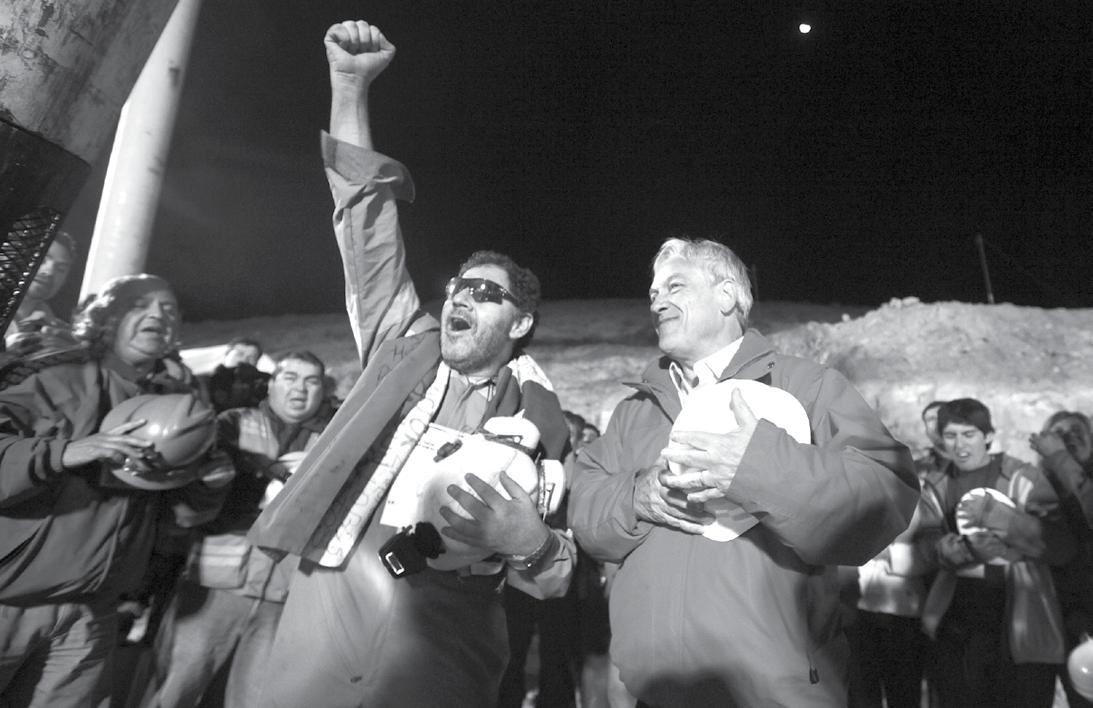
ITCAPTIVATED THE WORLD’S attention for months. In 2010, 33 miners were trapped in a Chilean mine over 2,000 feet below the earth’s surface. Prayer vigils, shrines, and statues dotted the landscape at the San José mine. Rosaries blessed by Pope Benedict were sent down the mine shaft to the men. They, in turn, signed a Chilean flag for the Holy Father, which he eventually displayed in the pa pal apartment. The world gasped when, after 69 days of captivity, the first miner literally rose out of the ashes and emerged into the light of a new day from a rescue capsule appropriately called “The Phoenix.” Miner after miner surfaced, and each was greeted by the welcoming arms of his family
12 | Fall 2022 | HORIZON Bednarczyk | Finding Strength
—2 Cor. 12:9-10
Luis Urzúa, (left) the leader of the trapped miners and the last to be lifted to freedom, celebrates with President Sebastián Piñera at the San José Mine near Copiapó, Chile in 2010. Miners credited their faith with bringing them through their ordeal.
G ov E rnm E nt o F c hil E , W ikim ED i A
and his God. As one man said in a televised interview, “God held my hand.” The Chilean Episcopal Conference of Catholic Bishops was right when it announced that a second Easter was celebrated in Chile that year. Clearly, this was more than a rescue mission—this was a display of religious faith and the power of prayer in a time of distress in the face of over whelming odds.
This incident was dramatic enough to spawn dozens of follow-up articles, books, documentaries, and even a feature film called The 33.
It is a paradox. How can people en dure such suffering and heartache, only to have their faith strengthened and re newed? Whether we look at scripture, theology, or the writings of the saints, this paradox, this union of opposites, is a com mon theme. The evangelist, John, speaks of God as both the beginning and the end; our faith tells us that God is both immanent and tran scendent; Jesus Christ is both divine and human. Saint Francis said that we will find richness in our poverty; Saint Thérèse of Lisieux pointed to a “little way” that leads to God’s munificent grace; and Saint Ignatius of Loyola spoke of consolation in the midst of desolation.
It is a paradox. How can people endure such suffering and heartache, only to have their faith strengthened and renewed?
cussion I had with one sister, a member of a small com munity of only 10 women, the youngest of whom was in her late 60s. This sister was approaching 80, and their community had agreed that they would no longer accept candidates. The sisters knew that they had served well, but they made a conscious choice not to give in to their grief that their community was coming to completion. Instead, they chose life and decided to live and serve to their fullest as long as they were able.
Of course, I asked the logical ques tion: “Sister, if you have chosen not to accept any candidates in the future, then why are you here at an orientation for new vocation directors?” I will never for get her response. She looked at me with her lovely blue eyes and said, “Because we have chosen not to accept, does not exempt us from the responsibility of pro moting what is most precious to us, which is the gift of our vocation. Even though my community will someday no longer be here, my community will live on in other communities through the men and women I hope to send to them. This isn’t about my congregation. It’s about the church. It’s about religious life.”
In many ways Saint Paul’s writings epitomize this union of opposites. Saint Paul knew suffering—he was imprisoned, chained, persecuted, and exiled, but he never looked back. Instead he always kept his eyes on the goal, straining ahead, “I continue my pursuit toward the goal, the prize of God’s upward calling, in Christ Jesus” (Phil. 3:14). Much like God held the hand of the miner, so too did God extend his hand to Paul, who writes, “for when I am weak, then I am strong” (2 Cor. 12:10).
Choose life
What does this paradox of faith say to us vocation min isters, men and women who promote consecrated reli gious life and priesthood in a time of uncertainty and change in the distressful face of overwhelming odds?
An experience of mine hints at an answer. One of my favorite things to do when I was executive director of the National Religious Vocation Conference (2002-2016) was to present at our annual orientation for new voca tion directors. I did this every year, and I had the privi lege of meeting an amazing group of women and men who have inspired me both in their faith and in their commitment to religious life. I will never forget a dis
Powerless? Yes, possibly, in some ways, but I heard the strength and conviction of a phoenix in her voice. This sister epitomized the paradox of Saint Paul’s words, but it was a union of opposites that can only come from the hand of God.
I am reminded of a quote by Dietrich Bonhoeffer, who died resisting the Third Reich, who spoke about his own experience of God’s calling. He said, “It is only through the call which I have heard in Christ, the call of the grace which lays claim to me, that ... I can live justi fied before God. From the standpoint of Christ this life is now my calling; from my own standpoint, it is my re sponsibility.”
A sacred responsibility
Vocation ministers have been entrusted with the sacred responsibility of discerning with men and women their own calling as they desire to fulfill their deepest longing for God. They come to us because they find something lacking in their lives; they yearn for something more, and they wonder whether or not that something more is a life as a religious brother, sister, or priest. They lay before us their histories, hopes, dreams, joys, sinfulness, and wounds, and they invite us to wonder and to dis
Fall 2022 | HORIZON | 13Bednarczyk | Finding Strength
Vocation directors carry out a sacred duty when they share the goodness of religious life with a new generation. To pray with discerners is sacred. So is upholding a vision for your community of the future of religious life.
cern with them. This is no easy task—in fact, it is quite humbling, because we too have our own histories and our own vulnerabilities and sinfulness that prompt us to question our own worthiness of this ministry. There are times that we ask the same question as Moses when God summoned him to go before Pharaoh: “Who am I that I should go to Pharaoh and lead the Israelites out of Egypt?” (Exod. 3:11). In other words, who am I to do this? Although we may question our worthiness, we don’t give up doing what we do.
And then there are days when we can easily identify with the experience of the Chilean miners. We find our selves in the pits, blinded by the darkness of not knowing the future of our own congregations, much less that of religious life. We feel trapped by the apathy of some of our own religious, the demographics of our own com munity, or the issues within the church over which we have no control. We long for that glimmer of light that assures us that things will get better and that all of our hope is not in vain. Like the psalmist, we ask, “How long, Lord? Will you utterly forget me? How long will you hide your face from me?” (Ps. 13:1). And despite our inability to see, we still don’t give up doing what we do.
In some similar ways, we can identify with the isola tion felt by the miners, for we too have experienced the loneliness of this ministry. Whether it is traveling alone, working alone, or praying alone, it is not uncommon to feel cut off from others. We know the experience of plan ning “Come and See” weekends, the investment of time and energy in coordinating what we hope will be a posi
tive, prayerful community experience for the men or women we have invited. We call, we advertise, we promote, we encourage, we cajole, we pray … only to be forced to cancel the weekend because of few, if any, participants. Although on an intellectual level we accept this as part and par cel of vocation ministry, nevertheless, emotionally we still struggle with our need for productivity, our feelings of failure and rejec tion, all of which contribute to our loneliness and isola tion. In these times we find ourselves praying the words of Esther as we cry out: “My Lord, you alone are God. Help me, who am alone and have no help but you” (Esther C:14). Amazingly, even in the midst of our despair, we don’t give up doing what we do.
I vividly recall an experience of speaking to a par ticular religious community of men, when one of their religious came up to me at the end of the day and asked me, “How do you do it?” “How do I do what?” I asked. “How can you speak of the virtue of religious life and talk about new candidates when so much is working against us?” Without giving it much thought, I simply said, “Because I believe in it.”
Become the paradox
It is unlikely that readers of HORIZON do not believe in religious life. If we do not believe in religious life and its future, why read this journal? We all know that if we believe in something with our entire being, we don’t give up, no matter what mistreatment, distress, persecu tion, or difficulty we encounter. Saint Paul knew this, Bonhoeffer knew this, the elderly sister at my workshop knew this, the Chilean miners knew this. By forsak ing doubt, embracing hope, and surrendering to God’s promise of unconditional fidelity, as St. Paul tells us in his letter, we soon find that God’s power remains with us. Our weakness becomes transformed into strength. By accepting our difficulties for the sake of Christ, we can do what we do with joy, contentment, and even laughter. In so doing, we become the paradox. We be

14 | Fall 2022 | HORIZON Bednarczyk | Finding Strength
F izk E s , s tock
come the mysterious union of opposites.
I have often said that one of our primary tasks as vocation directors is to keep the dream of religious life alive, not just for those who follow us, but for the church, for those in our institutes, the people we encounter, and those to whom we minister. We are entrusted with the responsibility of preserving a valuable and holy legacy that is constitutive to the life of the church. As vocation ministers, we strive for what could be, for what is meant to be, while being fully aware of the humanity that is contained in this life. The weakness of this humanity, however, does not prevent us from being empowered to speak of the dream and to witness it with integrity and conviction. Our faith produces perseverance. Our faith enables our powerlessness to become our strength. We must never assume, however, that this power and strength is of our own accord. Saint Paul reminds us that it is the power of Christ that rests upon us. Remember the words of the miner: “God held my hand.” It is Christ who holds the hands of all of us.
Our strength is in the Lord
As women and men committed to the gospel, like Paul, we have much to boast about. It is true—the faith we proclaim and the life that we lead is a paradox, for in Christ there is no weakness, distress, persecution, or difficulty. Much like “neither death, nor life, nor angels, nor principalities, nor present things, nor future things, nor powers, nor height, nor depth, nor any other crea ture can separate us from the love of God” (Rom. 8:3839), there is only the power of Christ in our lives.
Let us witness to one another in vocation ministry, tapping into this sacred power of Christ that resides within each one of us. May God strengthen us to em brace the paradox of our lives, so that we may carry out our vocation ministry, our sacred responsibility, with joy, contentment, and even laughter. For it is only by living this paradox, that we avoid the temptation of falling into the deep abyss of despair and the darkness of doubt. Let us never forget that it is the power of Christ that lives in us and enables us to rise into the light, like a phoenix, boasting of the glory of God and the glory of our voca tions.
The Chilean miner said, “God held my hand.” May we, too, cling to those reassuring hands of God with firmness and delight. n
A version of this article appeared in the Winter 2011 HORIZON.
Rede mptorist Ren ew al Center
over 50years ofRetreat Ministry ” 7101 W. Picture Rocks Rd, Tucson, AZ 85743 USA Phone: 520.744.3400 Email: office@desertrenewal.org www.desertrenewal.org
Contemplative Study and Sabbatical Program
The demands and expectations of full-time ministry are both rewarding and fulfilling; however, it is important to take time to rest & renew.
The Sonoran desert allows you to seek the silence and space necessary for spiritual renewal. Since ancient times people have gone to the desert to encounter God.

Come and experience desert spirituality in a contemplative environment that will make for a truly unique Sabbatical experience.
HESYCHIA SCHOOL OF SPIRITUAL DIRECTION
The HSSD program focuses on the ancient art of Christian Spiritual direction in a multi faith context and offers contemplative study and practice to prepare clergy and vowed religious for a ministry of spiritual direction.
Fall 2022 | HORIZON | 15Bednarczyk | Finding Strength
2023 March 5 - May 12 July 16 - August 18 October 1 - December 8
“Celebrating
2023 February 5 17 Week 1 & 2 April 16 28 Week 3 & 4
By Vanessa Pereira and Sister Kathryn Press, A.S.C.J.
Vanessa Pereira is the director of marketing and communications for the U.S. province.

Sister Kathryn Press, A.S.C.J. belongs to the Apostles of the Sacred Heart of Jesus and works in evangelization and pastoral ministry. Both are involved in the community’s use of social media to reach prospective members.

How we use social media for vocation ministry
IT’S
BEEN 11 YEARS since our congregation stepped out of our comfort zone and into the vast world of social media. This was completely uncharted territory for us and, truthfully, a bit daunt ing. While we didn’t know much about social media, we did know it was another way to reach people, and that was exactly what we wanted to do. Since then, we have been able to transform our social media accounts into online communities where our followers can feel connected to our sisters and to our charism.
It has taken us several years and a lot of trial and error to get a handle on this ever-changing digital landscape—and we are still learning! Here’s a look at how we started, how it’s going, what we have learned along the way, and some best practices that we hope will help you in your social media ministry.
16 | Fall 2022 | HORIZON
v A n E ss A P E r E ir A c o U rt E sy o F th E A P ostl E s o F th E s A cr
ED h EA rt
o F J E s
U
s
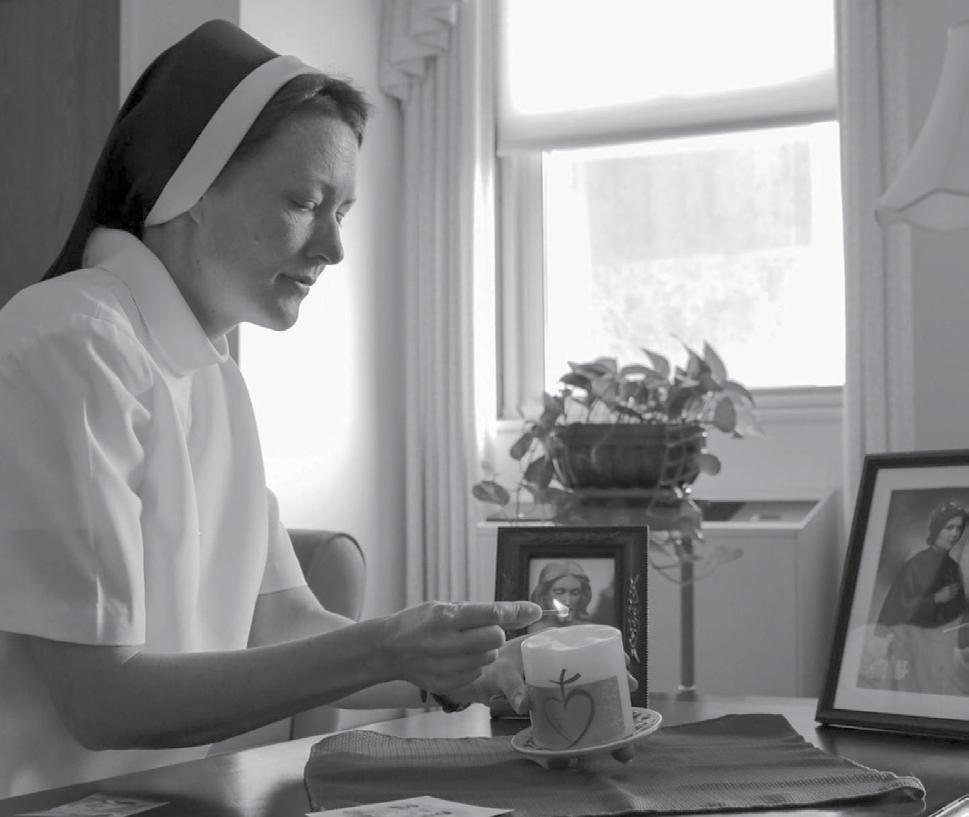
Sister Colleen Mattingly, A.S.C.J. gets her picture taken as she lights a candle. The community then used this image with a post inviting people to a discernment retreat. Note that the photo shows a member of the community, and includes images of Christ, a Sacred Heart, and the foundress, all meaningful symbols for the Apostles of the Sacred Heart of Jesus.
Pereira, Press
| Use Social Media
How we started
We made our social media debut in May 2011 with the creation of a Facebook page for our United States Prov ince. The goal was simple: to share news and informa tion with our supporters and family members. Later that year, we created a YouTube channel with the goal of sharing educational videos about our congregation. We expanded our social footprint in 2015 with the ad dition of a province Twitter account as another platform for sharing news and information—in 140 characters or less! It wasn’t until 2016, however, that we launched an Instagram account dedicated to promoting vocations.
It all started after Sister Kathryn Press, then a junior professed sister, attended a diocesan communications workshop. Although Sister Kathryn is a Millennial, she does not consider herself a digital native; she got her first cell phone at age 19 and started using her first smart phone in the convent! Facebook is the only social media platform on which she ever had a personal account.
The communications workshop opened her eyes to the ins and outs of Instagram, and she felt compelled to learn more about this tool and its potential for digital vo cation outreach. Sister Kathryn shared what she learned with our vocation director and offered to create and manage an Instagram account for vocation ministry.
“I knew nothing,” says Sister Kathryn. “I didn’t know about followers or hashtags. I simply started. If you had tried to teach me everything I know now at the start, I would have been overwhelmed.”
It started with one post, every day, no matter what— but posting daily proved problematic. Many of our sisters were wary of social media even though we had been on Facebook for a few years. They were hesitant to appear in photos or videos, which made it very difficult to produce content.
As a result, many of our early Instagram posts consisted of graphics with quotes from our foundress, Blessed Clelia Merloni, Scripture verses, or saints; photos of the Sacred Heart; nature scenes; and photos of our convent chapels.
Unlike our Instagram account, which is an extension of vocation ministry, our Facebook, YouTube, and Twit ter accounts fall under the purview of the Office of Mis sion Advancement for our U.S. Province. Although these accounts are not expressly geared toward vocations, they do help to support vocations by generating public aware ness of our congregation, our mission, our ministries and, of course, our sisters. For example, a discerning woman may be Facebook friends with someone who
TERMS TO KNOW
• Instagram posts Photos or videos that appear in your account’s main profile grid, also called the account gallery. These posts remain permanently attached to your account unless you delete them.
• Instagram stories Videos of about 15 seconds or photos that disappear after 24 hours unless you choose to save them as “highlights” on your main profile.
• Followers Users who have chosen to regularly see the content you post.
• Tagging Mentioning another social media account in your posts or stories.
• Likes Double tapping your phone on either an Instagram post or story sends a red heart to the post. These are known as “likes.” This is the best example of how someone will interact with your content. Facebook also provides the capability to like posts, but offers more variety (thumbs up, heart, laugh icon, etc.).
• Hashtag Using the # symbol before relevant words or phrases in your posts helps them to appear more easily in searches on Instagram and Twitter.
• Linktree A free social media reference landing page that allows you to post multiple URLs that point your followers to other content of your choosing (to your website, fundraising pages, other social media channels, etc.).
shares our posts to their personal account. Or perhaps a young woman sees one of our posts shared by her local parish. Through the power of social media sharing and good old fashioned word of mouth, everything we post on social media has the potential to reach discerning women.
How we evolved
In addition to her full-time ministry, Sister Kathryn maintained our vocations Instagram presence for the next three years, taking her cues from the vocation di rector. We began posting more photos of sisters and saw post “likes” increase as a result. However, it was still a struggle to get photos from our members. In an effort to
Fall 2022 | HORIZON | 17Pereira, Press | Use Social Media
~ When you add content to Instagram, the first two choices are “Post” and “Story.” Posts will remain on the “grid” (the listing of pho tos people see when opening your Instagram homepage). Posts give people a visual overview of your community. In contrast, “stories” appear for just 24 hours and tend to be more in-the-moment, raw, and experimental. Whether from posts or stories, more engagement means more exposure.

post content every day, Sister Kathryn culled our sisters’ personal Facebook pages hoping to find usable photos to share. She also lifted content from our province Face book account as needed.
In 2019 Sister Kathryn gave up social media for Lent and temporarily turned control of our Instagram ac count to one of our postulants—a true digital native who helped transform our account in two major ways. First, we switched from posting every day to posting every other day. We learned that it’s not necessary to post every day. Second, we migrated from a personal Instagram account to a business account. This made it easier for people to contact us through Instagram and provided us with valuable data on who was viewing and interacting with our posts.
Following her Lenten social media break, Sister Kathryn resumed control of the Instagram account and brought together our vocation director and the director of marketing and communications for our U.S. Prov ince, who maintains our other social media accounts. Because the Instagram account was created as an exten sion of vocation ministry, our director of marketing and communications—a lay staff member—was not involved in the management of this account; however, it was im portant to clarify the roles and purposes of each of our social media accounts, as well as to discuss what content we shared and how we could collaborate.
As our Instagram account gained traction, our audi ence grew, and it became clear we needed to devote more resources to this aspect of our vocation ministry. Sister Allison Masserano, A.S.C.J., one of our junior professed sisters, agreed to join Sister Kathryn in managing our Instagram account. She brought with her some great new ideas.
Through consistent social media exposure and edu cation by both the vocation director and our mission advancement staff, our sisters have become much more receptive to appearing in photos and videos. Now mem bers will even email photos or videos to us for use on social media.
Working as a team
Our Instagram is a collaborative ministry. Sister Al lison focuses on creating engaging Instagram stories and Sister Kathryn posts regular content three or four times a week, which appears in our Instagram grid. Our stories and “grid posts” are typically independent of one another, with stories being more spontaneous, fleeting, and fun. Grid posts are permanent and live in our pro file gallery unless deliberately deleted. We coordinate
18 | Fall 2022 | HORIZON Pereira, Press | Use Social Media
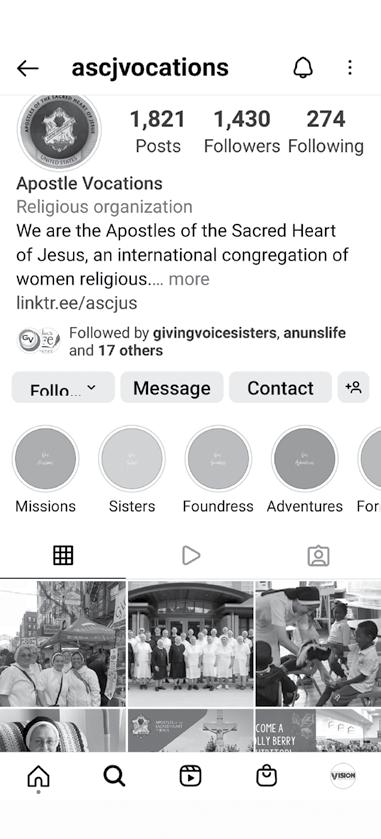
Linktree Stories Posts on grid g g g The Instagram homepage for the ASCJ community
our stories and grid posts a few times a year for special occasions (such as our novena for the Feast of the Sacred Heart, vow Masses, and jubilee celebrations).
We consistently share photos and videos with one another, including Vanessa Pereira, our marketing and communications director, who maintains our Apostle Facebook, Twitter, and YouTube accounts. She in turn shares photos and videos for use on Instagram. Our members throughout the province will also send us pho tos of their local communities or ministries.
The three of us will come together for larger plan ning conversations ahead of major events. For example, Sister Allison and Sister Kathryn may post behind-thescenes moments from a vow ceremony or jubilee Mass but will also post official photos or videos after Vanessa shares them on Facebook. Vanessa also receives word from our international communications office in Bra zil with regard to branding and content related to our foundress and the church (novenas, saints of the day, major feasts, etc.). We have the option to post such mate rial on Instagram.
How it’s going
We currently have a total of over 8,500 followers across our Facebook, Instagram, YouTube, and Twitter ac counts. Facebook is our largest social media platform (6,000+ followers), followed by Instagram (1,300+ fol lowers).
It’s important to note that our Facebook and In stagram audiences are different. This means we ap proach the content on these pages differently instead of cross-posting the same content. Although women make up the majority of both audiences, our Insta gram followers are younger. Here’s a quick breakdown of each audience. You can find the same by looking at analytics for your social media accounts. (Not sure how to get to the analytics? Try the help button within the app or do a Google search.)
INSTAGRAM
1,430 followers
• 74% are women
• 53.2% of the women are ages 18-44
• 20.8% of the women are ages 45-65+
FACEBOOK
6,094 followers
• 70.8% are women
• Of that 70.8%, only 29.2% are women 18-44.
• 41.6% are women between 45-65+
Given the makeup of our Instagram audience, we try to focus on content that prominently features our young er sisters in an effort to promote vocations—content that shows the joys of religious life. This does not mean that we ignore photos or videos with our older sisters. Inter generational living is very much a part of our identity, and we strive to paint an accurate picture of our com munity life. But more so on Instagram than on Facebook will we post “selfies” and more casual photos and videos of our sisters.
We also use Instagram to promote upcoming events and vocation opportunities using Linktree, a free service that allows us to directly point people to event registra tion pages and specific pages on our website where they can get a fuller picture of who we are. Because Instagram only allows for one link in your account profile (and you can’t post clickable links in an Instagram post), we decided to use Linktree instead of redirecting people to the homepage of our website. We want to direct our Ins tagram followers—women in our target vocation demo graphic—to vocation-related material.
Facebook is our largest social media account and has become the official voice of our United States Province after our website. As such, our Facebook has a more formal tone than our Instagram. Our goal on Facebook is twofold: to gain new supporters by promoting the mis sion and charism of our congregation, and to keep our existing supporters engaged in our mission. Many of our Facebook fans are family members, friends, and former students. Facebook allows them to stay connected with our sisters. We also use Facebook to promote events and vocations opportunities. Although women in discern ment are not our primary Facebook audience, vocation posts are shared by our sisters and followers alike. This creates a ripple effect and has resulted in our vocation posts being shared by diocesan Facebook pages and Catholic young adult pages.
Our YouTube channel is used primarily to share spiritually enriching content, including livestreamed Masses and reflections from our sisters. We promote our YouTube content on all our social media sites. Finally, Twitter is where we share news and information related to our congregation and ministries.
Best practices
ENGAGE YOUR FOLLOWERS. No matter the platform, it is important to engage your audience. This helps to build relationships, and the greater the engagement, the more the algorithm puts your content into people’s
Fall 2022 | HORIZON | 19Pereira, Press | Use Social Media
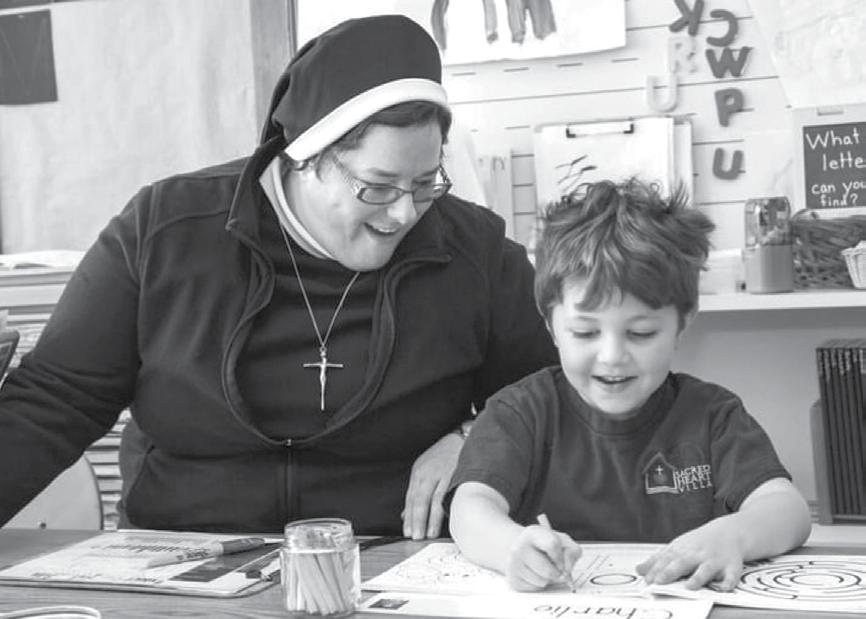
Candid photos of sisters tend to get the most interaction, but they are not the only type of post the Apostles use. They also run quotes from their foundress and images of the Sacred Heart because these are important aspects of their identity.
feeds. We often post open-ended questions or polls through Instagram stories as a way to get our followers to interact with our content. We also make an effort to respond to people’s comments. While we can’t reply to all comments, we will, at a minimum, like their com ments. Social media is a two-way street.
SHOW SMILING FACES WHENEVER POSSIBLE. People respond to seeing other people—especially smiling fac es. These can be posed or candid. Photos and videos that show our sisters get the most engagement.
ASK PERMISSION AND GIVE CREDIT. Whether the photo opportunity is formal or casual, we inform those being photographed (sisters, family members, lay col leagues, or people attending one of our events) that the photo may be used for social media. If there are any objec tions, we won’t use the photo. We also make an effort to credit contributed photos, whether it was taken by one of our sisters or someone in one of our ministries. It’s worth noting that to honor the discernment process, we do not post pictures of inquirers or discerners, as recommended by the National Religious Vocation Conference.
STAY TRUE TO YOUR MISSION. Have content that’s natural, not perfect. Your photos don’t need to be awardwinning, but they do need to be genuine, and ideally they are good quality. Show who you are, not who you aren’t. Avoid using stock photos.
Don’t only go for likes. We’re comfortable posting content that doesn’t get as many “likes” but is in line with
our mission and vision. For example, quotes from our foundress or photos of the Sacred Heart get far fewer likes than an image of our sisters peeling potatoes. Nev ertheless, as a religious community, prayer and spiritual ity are part of who we are. We will continue to publish less popular posts when we believe they authentically represent us and proclaim the Good News.
KNOW YOUR AUDIENCE. Instagram, Facebook, You Tube, and Twitter all provide post analytics. Insights vary from platform to platform, but generally speaking, analytics will show you the makeup of your audience (gender, age, geographic location), what your top per forming posts are, and when your audience is online. All of this helps you to be more strategic and effective with your posts.
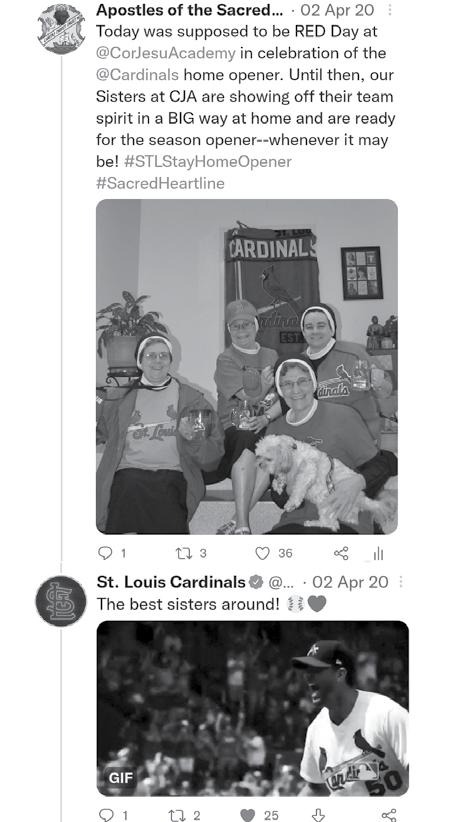
TAG OTHER ACCOUNTS. If you are posting content that involves a public figure, organization, or business, it is good practice to “tag” their social media account in the post. For example, when we post a photo of sisters at St. Louis Cardinals games, we will “tag” the St. Louis Cardinals on Instagram/Twitter/Facebook in hopes that they will see the post and share it. (See image on page 21.)
HAVE FUN WITH IT. Social media is designed to be an informal communication tool, so you can have some fun with your posts. During the 2022 Winter Olympics, Sister Allison posted daily Instagram stories of our Hall way Olympics at the provincialate. These video-based
20 | Fall 2022 | HORIZON Pereira, Press | Use Social Media
r E b E cc A v t o WE r , c o U rt E sy o F th E A P ostl E s o F th E s A cr ED h EA rt o F J E s U s
stories followed our sisters as they competed in each day’s games, culminating with a medals ceremony. This series was extremely popular and remains a highlight on our Instagram profile.
THINK TWICE BEFORE POSTING. Yes, we just said to have fun with your social media posts, and it is—to a degree! While it is important for us to show the joys of religious life and living in community, we avoid posting photos or content that can come across as too silly or undignified—and this will be different for each commu nity. Before posting we consider whether a sister would be embarrassed by it and also whether the content could be misused by someone with ill intent. We also avoid us ing Instagram hashtags that have become overrun with inappropriate content (for example, any hashtag with the word nun).
POST CONSISTENTLY. Don’t feel pressured to post every day, but it is best to post consistently. This is how you build your audience. We aim for 3-4 grid posts a week on Instagram and 4-5 posts a week on Facebook. It’s im portant to note that we will rarely post more than once a day (excluding stories) on the days that we post to Face book or Instagram. By posting multiple times a day you are essentially competing with your own content due to the way Facebook and Instagram algorithms work. Keep it going, but don’t bite off more than you can chew. If you’re new to Instagram, maybe try doing regu lar posts before tackling stories. Have a plan to keep your account going. If you decide it’s not the direction you want, or you find that you can’t sustain it, delete the ac count. A consistently updated account is more attractive than an inactive or inconsistently updated one. Success will come with goals that are realistic for you.
EDUCATE AND INVOLVE YOUR COMMUNITY. Ex plain to your community members the why and how of this ministry. It’s important to share with them why this social media account is being created and how they can help, thereby creating a culture of transparency and teamwork. Ask your community members or staff members to take and share photos. And keep asking!
CONSIDER TIME LIMITS. Social media mobile apps make it easy to access your account and even easier to lose track of time. If you find yourself caught up in what Sister Kathryn calls “doom scrolling”—mindless scroll ing through your Instagram or Facebook feed—we rec ommend setting a timer when on these apps.
Tagging on Twitter.
Encouragement
We’ve thrown a lot of information at you, so if you are overwhelmed, we get it. Like we said in the beginning, we are still learning what works and what doesn’t. If you haven’t already stepped into the social media world, our advice is to just start. Don’t let the perfect be the enemy of the good. You’ll learn as you go. Don’t worry about being an expert from the start. Look around and get ideas from what similar organizations are doing. Reach out with questions; someone who knows more than you might be happy to share ideas. Finally we wouldn’t be good social media promoters if we didn’t end by en couraging you to check us out on Instagram (@ascjvo cations), Facebook (Facebook.com/ascjus), Twitter (@ ascjus), and YouTube (youtube.com/ascjus). n
Sister Allison L. Masserano, A.S.C.J. also contributed to this article.
Fall 2022 | HORIZON | 21Pereira, Press | Use Social Media
AGE s
U rt E sy
F th E P AU
E
People that the Paulists want to connect with are on social media. Therefore, the Paulists are on social media, learning and refining as they go.
What we’ve learned about social media
By Father Michael Hennessy, C.S.P.
Father Michael Hennessy, C.S.P. is the vocation director of the Paulist Fathers, based in New York City. Originally from Connecticut, he received a B.A. from Saint Anselm College and an M.A. from Ashland University and taught social studies at a public high school in Manchester, New Hampshire for eight years. After completing his seminary studies at Catholic University in Washington, D.C., his first pastoral assignment was at the Cathedral of Saint Andrew in Grand Rapids, Michigan.
MUCHHAS CHANGED in the past few generations in vocation ministry. Many of my Paulist brothers first contacted the community by sending a letter in the mail. Today there are new ways of communicating with vocation prospects. Essential to vocation ministry at this moment is active use of social media. While this form of communica tion has been around for more than a decade now, we are still understand ing how to fully use it for our vocation purposes.
There is much to learn and study about social media, and it seems that just when we adjust to a new social media platform, a different one ar rives. So, perhaps a good way to begin this conversation is with humility, remembering that everyone has a lot to learn.
About a year ago, our vocations team decided to reevaluate our social media efforts. We began by having an in-person brainstorming retreat. Like a personal retreat, time away from our ministries and routines al
22 | Fall 2022 | HORIZON Hennessy | Social Media Lessons
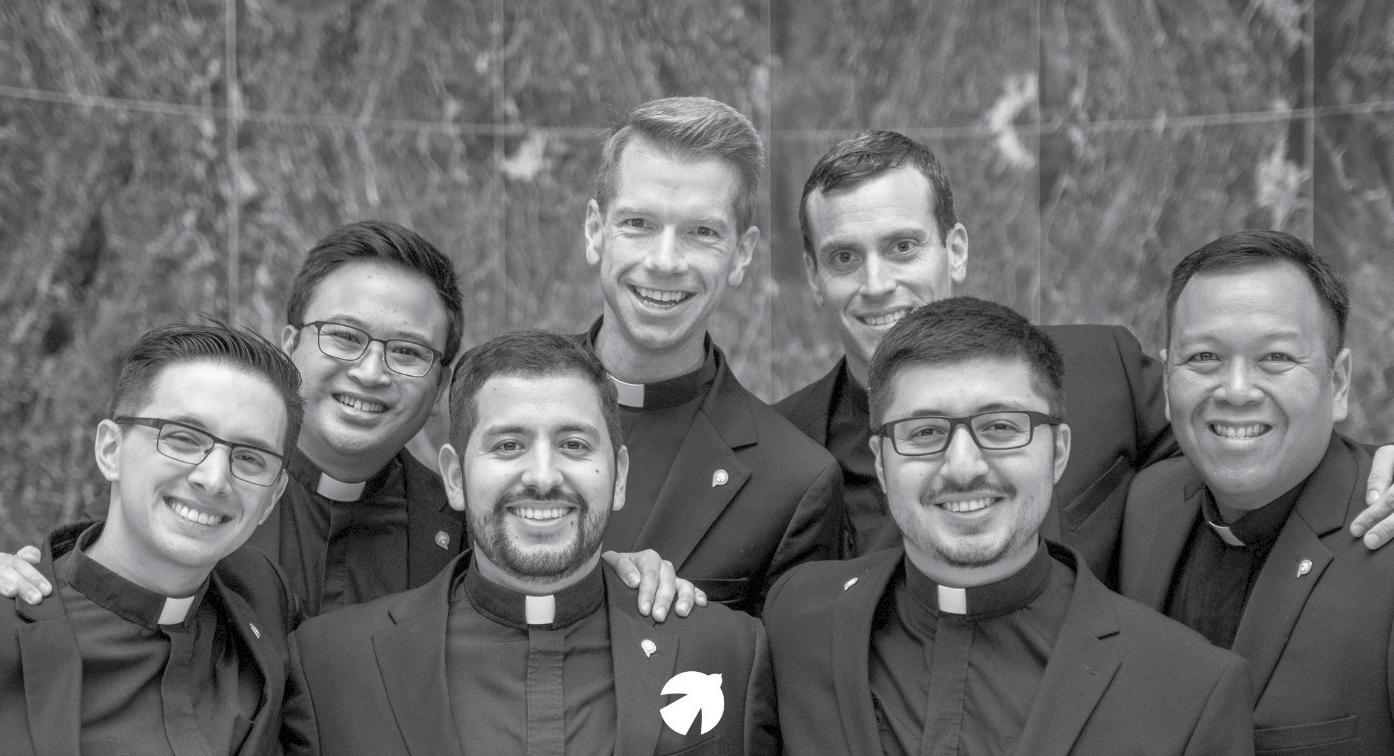
Recent members and those in formation are in this image, which is the cover photo for the Paulist Fathers Vocations page on Facebook.
A ll im
co
o
list F A th
rs
lowed our minds to clear. This process helped us talk through and focus on what our main vocation messaging was going to be.
Communications research says that messaging, re gardless of the medium, needs to be simple, clear, and to the point. While we created a list of dozens of reasons why a young man should consider joining the Paulist Fathers, we pruned this list into three core statements about who we are:
1) We are joyful priests.
2) We are rooted in community.
3) We minister in the American church.
These were the ideas that were to be our main mes sages. With a new focus on our core messages, then we turned to our social media strategy.
Although both of us on our vocation team are on so cial media, this sort of strategic planning for social me dia use was new to us. To take the next step, we reached out to a person who works full time in social media marketing. (He is a family friend who agreed to consult with us at no charge.) Perhaps you know someone in this field, but if not, it is a good investment to consult with someone to walk you through the first steps in creating a social-media strategy. While this person could be Catho lic, knowledge of our faith is not significant at this point because the principles of social media messaging are uni versal across industries and products.
Put the time in, be consistent
An initial takeaway from our meetings was that socialmedia marketing and communication takes time and patience. We see other social media accounts, both in the church and outside it, that have large followings and engaged followers. While it is possible for us to get there as well, this requires a dedicated and sustained effort. It is most common for this growth to resemble a hockey stick, slow, gradual, then sustained increases.
Our consultant looked at what we had been doing and gave some advice on our strategies going forward. He showed us other accounts that were doing well in their messaging, and how some of the concepts be hind them could be applied to our own efforts. He also stressed that consistency is important in our messaging.
To communicate the message that Paulists are joy ful priests, we posted humorous images and Catholic memes, often which had little direct connection to our Paulist community. By doing so, we encourage our fol lowers to associate us with joy and happiness.
This was also communicated by the kinds of posts that we did not send. Catholic social media can often be defensive, serious, and argumentative. By not posting anything with those attitudes, we differentiate ourselves from other Catholic voices in the digital space. And yes, some people might gravitate to a more serious and de fensive side of our Catholic faith and would not connect with these lighthearted posts. Yet this helps our voca tion efforts because these are people who would not be a good fit with us anyway.
With our brand messaging in place, we split the days of the week on a Google calendar. Sundays were for a quote from the Gospel. On Mondays, we linked to an article related to discernment. Tuesdays, we tried to ad dress a challenge that would surface in the discernment process. Other days in the week, we promoted upcoming events, sent out a humorous image, and linked to videos that profiled Paulist priests in ministry. We post roughly once a day, six days a week.
Monitor the impact
Many social media platforms have tools to help us un derstand the reach of our posts. While professionals can understand these statistics better than we can, even basic information can help our strategy. Because some posts draw more engagement than others, we can also learn what potential vocation prospects want to see and know.
A few months ago, we linked to an article entitled “Is Celibacy Cruel?” from a Christian, not Catholic, website. The article made some good points about celibacy and looked at the topic from a different angle than typically seen. Within hours it had become our most viewed post.
This information taught us a few things. First, celi bacy is a topic our followers want to know about. They want to read about what it is and how it works. (Maybe we have not been answering the questions that people have about celibacy!) Further, this experience reminded us that there is good content online outside of our Cath olic tradition. Of course we need to send out content that aligns with church teaching, yet there is much out there that has value for a young man or woman who is discerning.
What other topics do people want to learn about? Our followers tell us by what they click on.
One way vocation ministry is changing is that young people are taking a longer path into our communities. It is much like a runway: people need a long period to build up speed before they can take off, whether that
Fall 2022 | HORIZON | 23
Hennessy | Social Media Lessons
means beginning an application, entering the novitiate, or even just reaching out with a phone call or email. So cial media can be a way to lengthen our vocation runway.
An event that we have done a few times in the past year is online Catholic pub trivia. While the event is run from our vocation office, it is not just for those discern ing, it’s for all young adults. Leading up to the event, almost all our social media efforts are focused on pub trivia, not on promoting our community or encourag ing vocations. Day after day, we sent out assorted triv ia questions attempting to get the attention of young adult Catholics. Our hope is that these social media efforts lead people to attend the event. And, yes, dur ing trivia we talk about our upcoming online vocation events, but they are not the main focus. The purpose is to have fun, and our hope is that a few young men might get to know us and be interested in attending our future vocation events.
This progression is what a vocation runway looks like: social media posts lead to people attending a fun event, which leads to a few people attending a vocation event online, which may then lead to one or two people attending an in-person Come and See.

Paid advertising to boost results
Once you have a basic social media program in place, a next step could be to investigate paid advertising on the
platform. While paid advertising does not substitute for genuine interest and social media reach, it can help.
There are many ways of using this approach to social media, and if you have a considerable budget for this, we advise you to turn to paid consultants who understand the algorithms of the platforms well. Yet, even spending just a few dollars a day can increase the reach of your posts. An advantage of this strategy is that, in many cas es, you can target who will see these posts. For example, a men’s community can specify that only men see the post. Other settings allow targeting for other factors like age, location, interests, and marital status (that’s an im portant one!). While not too long ago Facebook allowed targeting based on religion, that is no longer possible, so it does take a bit more work to specify who you are try ing to reach.
The simplest way to increase the reach of your posts is to use the “Boost Post” option on Facebook. You can’t fine-tune who this advertising specifically goes to, but, in our experience, this does increase views and clicks. And, over time, the platform improves the performance of these posts. For just a few dollars a day, advertising is a good option to increase your reach.
Resources for developing content
Many resources are available to assist your social media vo cation efforts. One tool we find essential for graphic design is Canva, which, for about $12 a month, is a good value. If you have a larger budget for other assistance in graphic design, options include Fiverr and 99designs. Other tools streamline the posting and scheduling process: Later and Sendible are quite functional and have free trials. For free stock images, Unsplash and Pexels have many good pictures and videos for you to use in your posts. Finally, because our social media efforts are parallel to marketing a “product” (our religious community) to “consumers” (prospects), it helps to know some marketing and commu nication fundamentals. A few books that have helped our efforts are Building a StoryBrand, by Donald Miller, and Persuasion, by Lee Hartley Carter.
Social media occupies a complicated place in our digital world. It can be used in harmful ways, while also being a place of information, connection, and compas sion. Regardless of how we feel about social media, men and women who are open to religious life are using it, so it is important we have presence there. While, yes, our hope is to invite more men and women into our commu nities through social media, our positive presence and hopeful tone in can also do much good. n
24 | Fall 2022 | HORIZON
Hennessy | Social Media Lessons
A Paulist Instagram post.
5 ESSENTIAL BENEFITS
PROFESSIONAL DEVELOPMENT
VOCATION DIRECTOR

MANUAL Vocation Ministry basics and beyond! eVerything you need to do your Ministry well: dozens of teMplates and forMs that you can custoMize and adapt to your needs.
SUMMER & FALL INSTITUTES continuing education opportunities to hone your skills in such areas as behaVioral assessMent, ethics, and healthy sexuality.
NETWORKING
MEMBER AREA MEETINGS / CONVOCATION
MEMBER DIRECTORY contact other


PUBLICATIONS & RESOURCES



HORIZON MeMbership coMes with an annual subscription to our unique and highly respected quarterly journal plus access to our coMprehensiVe online horizon library of past issues where you can build your skills and renew your spirit. GO TO NRVC.NET/SIGNUP_HORIZON.
VISION our award winning Vision Vocation guide for discerners is distributed in print throughout the u.s. and canada and online globally. MeMber adVertisers receiVe free shipping and special acknowledgMent in the guide GO TO VOCATIONNETWORK.ORG.
NRVC STORE receiVe special MeMber only pricing on all store iteMs, including prayer cards, discernMent Manuals, and busy person’s retreat booklets GO TO NRVC.NET/STORE
RESEARCH &
Fall 2022 | HORIZON | 25Jaramillo | The Transfer Process
network with others in Vocation Ministry. find sources of support.
MeMbers and for idea sharing and joint projects MEMBERS-ONLY ACCESS RESOURCES Videos and podcasts; discernMent ideas and tech tips. GRANTS MISERICORDIA SCHOLARSHIP: financial assistance for MeMbers unable to bear the full cost of nrVc professional deVelopMent opportunities NATIONAL FUND FOR CATHOLIC RELIGIOUS VOCATIONS: educational debt relief for candidates seeking to enter religious life aVailable exclusiVely to nrVc MeMbers GO TO NFCRV.ORG
ADVOCACY STUDIES access research and reports on trends in Vocation Ministry NATIONAL & INTERNATIONAL OUTREACH attendance at global conferences, workshops, and youth gatherings, including ncyc and world youth day.
NATIONAL RELIGIOUS VOCATION CONFERENCE | 5416 South Cornell Avenue, ChiCAgo, illinoiS 60615 | nrvc@nrvc.net | nrvc.net SIGN UP TODAY! GO TO NRVC.NET/SIGNUP QUESTIONS? CALL US AT 773-363-5454. NRVC MEMBERSHIP
Feed your spirit
Act on your deepest longing
James Finley is a writer-podcaster who focuses on con templative prayer and Christian meditation. He shared the following insights when asked by the editors of belief. net how meditation “works.”
THEREARE MOMENTS in which we’re kind of unwittingly let out beyond ego con sciousness. One example I give is standing alone looking at a sunset. In a very subtle but intimate way, while we’re absorbed in the beauty of the sunset, we’re at a moment of meditative awareness, beyond the intellect, beyond the memory, and beyond the will.
Whatever feelings that might come up, we also sense

that the essence of the moment transcends emotion. We intuitively sense the richness or the fullness of the mo ment, and in terms of religious faith, we would say we sense God’s nearness.
The next thing that tends to happen is that the mo ment, like all moments, slips away and we get back in our car and drive home and pick up things at the store and run our errands and so on. But when we reflect on that moment of the setting sun, we long for a more daily abiding meditative awareness that we so fleetingly glimpsed.
Meditation then comes in as a response to that long ing; it’s a way of sincerely inviting or opening ourselves to this meditative oneness with God. n
Photo by AUGUstinE WonG, UnsPlAsh tExt UsED in cooPErAtion With bEliEF
nEt
Book notes
Black lives in our communities
SHANNEN
DEE WILLIAMS’ LONG-AWAITED history of Black women religious in the United States lives up to expecta tions. This work tells meticulously-researched stories of courage, persistence, betrayal, and hope. It is both a beautiful and a pain ful articulation of the history of women religious in the United States from a perspective that has long been overlooked. In addition to the implications for religious life in the United States, this history has lessons for vocation ministry as well.
Beginning with the earliest Catholics and their participation in the enslavement of African people, Subversive Habits: Black Catholic Nuns in the Long African American Freedom Struggle articulates the complicity and active racism espoused by ordinary Catholics, members of the hierarchy, and women religious from the 17th century through the 20th. As a White sister in a congregation that participated in trade of enslaved people, I read these accounts with heartache and humility. As a historian, I acknowledge both the difficulty of blaming these individuals who lived in a different time with different sensibilities and the reality that treating human beings as property has never been appropriate. It is at once complex and exceed ingly simple.
The persecution of early African American Catholics and early Black sisters is painful and shameful to read, yet it is important for us to look at history truthfully in order to move forward. The Catholic community did not question the use of enslaved people to create personal wealth, and a persistent view of Black people as inferior prevented White Catholics from seeing the vocation of Black girls and women to religious life as genuine and divine in origin. Williams combines the broad strokes of Catholic perspectives on slavery with specific experiences of individuals. This com bination of general and specific helps to illustrate the complexity of race relations among Catholics—lay, clerical, and religious. In many instances, individual religious and congregations valued the mission among African Americans but meanwhile denied entry to Black applicants.
Mousseau | Black Lives
By Sister Juliet Mousseau, R.S.C.J.
Sister Juliet Mousseau, R.S.C.J. is vice president for academic affairs at Franciscan School of Theology at the University of San Diego. She is also the author of Prophetic Witnesses to Joy: A Theology of the Vowed Life, Liturgical Press, 2021.

Fall 2022 | HORIZON | 27
Congregations of Black sisters likewise faced chal lenges of prejudice and racism as they established them selves. Sisters in White congregations apparently felt threatened and acted to prevent Black congregations from being treated like other sisters. Individual Black women who entered all-White congregations (those who were not rejected outright) faced explicit and personal maltreatment at the hands of their White sisters and formators. Many were forced to assimilate into the con vent’s dominant culture, to delay their final profession, or to leave the congregation. Yet, there is great courage and conviction in these stories of individual women who have powerful belief in their divine call to religious life and profound devotion to minister to others.
The role of Black sisters in the civil rights movement is highlighted, along with its cost. Again, this history has long been overlooked, as historians have showcased the role of White sisters instead. Williams tells the story of many individual Black sisters in White communities who fought for civil rights with little support or even outright discouragement from their communities. Wil liams notes that with the assassination of Rev. Martin Luther King, Jr. in 1968, the Black Catholic community was mobilized in a new way against White supremacy in the church.
The first meeting of the National Black Sisters Con ference took place in August following King’s murder. This meeting marked the first time that many Black sisters met others, and it impelled continued leadership in the Black revolution. The gathering built personal connections among the participants and offered them education on Black history and culture. This theme of connection and community among African American sisters carries throughout the seven chapters of Wil liams’ book.
Another strong theme is that of Catholic education for Black youth. During the decades of Jim Crow, Black congregations struggled to educate Catholic children even while experiencing opposition/racism from White Catholics and the wider American culture. Even so, sis ters serving in African American schools created curri cula that included the history and culture of the African American population. In the mid-20th century, while Catholic education was booming and congregations of women religious were expanding dramatically, Catho lic sisters struggled to provide university education for their sister-teachers in order to obtain the accreditation required to keep the doors open. In the 1970s, integra tion and the decline in numbers of Catholic children and Catholic nuns forced dioceses to close schools. Schools
in underserved communities, especially African Ameri can, were disproportionately marked for closure, despite the strong commitment of Black parents to Catholic education. Prejudice and fear marked White Catholic responses to the integration of schools, and access to education for African American children was often not protected in the fight for integration.
The power of Subversive Habits lies in its truthtelling. The human fight for freedom illustrated in the stories of Black Catholic sisters is a truth that must be told, regardless of how challenging it is for some to hear. It is only by recognizing our limitations and faults, indi vidual or collective, that we can begin to move toward healing. Several congregations, including my own, have publicly laid bare the realities of their history as holders of enslaved people.
While acknowledging a history that is inconsistent with our beliefs is difficult, it is even more challenging for congregations and individuals to acknowledge the racism that remains inherent in our American culture and Catholic systems. Williams speaks to some of those concerns, which include current Black sisters and former sisters who experienced racism as they entered and were formed in their congregations. The stories of their ex periences must be told so that we can learn how to treat each person with love and respect. While congregations have acknowledged participation in slavery, how many of us have truly dealt with our personal and collective attitudes of White supremacy and racism?
An all-White Catholic Church—which we know never actually existed—is getting further and further from the truth today. Greater diversity in the general Catholic population in the U.S. is reflected in the newer generations of religious men and women, as recent re search shows, including the NRVC 2020 Study on Recent Vocations to Religious Life. Vocation ministers have the challenge of appealing to young men and women who do not see people like themselves in the congregation already. The vast majority of religious in the United States are significantly older and less racially diverse than those considering religious life. How does the current membership foster the feeling of belonging among new members from very different upbringings and cultural backgrounds? That is an ongoing question for us.
Our efforts at a more inclusive future must be grounded on a clear understanding of our past. The job of the historian is to tell the truth, and Shannen Dee Williams has done that with clarity and passion. May the truth lead us to be better sisters and brothers to one another. n
28 | Fall 2022 | HORIZON
Mousseau | Black Lives

Saint Luke Institute Candidate Assessment i n t e g r a t e d , c o m p r e h e n s i v e p s y c h o l o g i c a l a n d s p i r i t u a l e v a l u a t i o n w w w S L I o r g | 5 0 2 6 3 2 2 4 7 1 p r o v i d i n g c r i t i c a l i n s i g h t f o r t h e f o r m a t i o n j o u r n e y
Religious Life Today Interactive feature showcasing the results of the 2020 Study on Recent Vocations
Abundant Hope Series of short videos featuring recent entrants to religious life
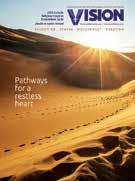
WEBINARS

Religious Life Today Six-part webinar series exploring the results of the 2020 Study on Recent Vocations
5416 South Cornell Avenue Chicago, IL 60615-5664 www.nrvc.net | nrvc@nrvc.net
773-363-5454
|
NON PROFIT U.S. POSTAGE PAID CAROL STREAM IL PERMIT NO. 2198 Help yourself to the many essential resources available at NRVC's VISION VocationNetwork.org Specifically designed to assist you in your ministry Be sure to check out these excellent NRVC resources STORYMAP
VIDEOS
NRVC.net VocationNetwork.org Order VISION 2023 Guides, prayer cards, and posters • PRAYERS • ARTICLES • VIDEOS • QUIZZES • E-VOCATION NEWSLETTER • VOCATION MATCH • COMMUNITY SEARCH • EVENTS CALENDAR for publicizing local, national, global events sponsored by or featuring a member of your community • AND MUCH, MUCH MORE!