Spring 2022 www.nrvc.net | Volume 47, Number 2
Leading into the future 2
UPDATES
3
Leading by applying discernment to ministry By Father Tom McCarthy, O.S.A.
7
Leading toward increased presence among young people By Sister Donna Del Santo, S.S.J.
10 Leadership makes the difference By Sister Mary Rowell, C.S.J. 16 Four things I discovered about vocation and discernment By Susan Flansburg
20 The tension between religious life and priesthood By Cardinal Joseph Tobin, C.Ss.R. 26 FEED YOUR SPIRIT There is in all visible things By Father Thomas Merton, O.C.S.O. 27 BOOK NOTES Much needed contemporary theology of vowed life By Sister Susan Francois, C.S.J.P.
Mini-Sabbatical Reframing Retirement for Mission is a curriculum-centered, community-based, holistic program that fosters both personal
Reframing Retirement for Mission: Sharing Wisdom and Seeking Meaningful Ministry after Retirement
and communal renewal and provides continuing formation. This Continuing Education program is crafted for those who have served the Church in ministry.
June 6 to 24, 2022 In Person or Online Catholic Theological Union | Chicago
ctu.edu
INSTITUTE of RELIGIOUS FORMATION Empowering formation leaders for a global Church
ctu.edu
ONLINE OR IN PERSON The Institute of Religious Formation (IRF) at Catholic Theological Union in Chicago provides a unique, holistic program for religious order as well as diocesan formation directors. With over 35 years of experience and close to 2,000 graduates, IRF is the trusted source in formation preparation. Learn more at: ctu.edu/IRF
Editor’s Note Editor Carol Schuck Scheiber Proofreaders Rosemary Arnold, Virginia Piecuch Design Consultant Patrice J. Tuohy © 2022, National Religious Vocation Conference HORIZON is published quarterly by the National Religious Vocation Conference, 5416 South Cornell Avenue, Chicago, IL 60615-5664. 773-363-5454 | nrvc@nrvc.net | nrvc.net Facebook: Horizon vocation journal Twitter: @HORIZONvocation SUBSCRIPTIONS A complimentary subscription to HORIZON comes with NRVC annual membership. Additional subscriptions are $50 each for NRVC members; $125 each for non-members. Single copies are $25 each. Subscribe online at nrvc.net/signup. Please direct subscription inquiries to Marge Argyelan at the NRVC office at 773-363-5454 or margyelan@nrvc.net. POSTMASTER Send address changes to HORIZON, 5416 S. Cornell Ave., Chicago, IL 60615-5664. Periodicals postage paid at Chicago, IL. ISSN 1042-8461, Pub. # 744-850. REPRINTS, ARCHIVES, ELECTRONIC EDITIONS Permission is granted to distribute no more than 50 copies of HORIZON articles for noncommercial use. Please use the following credit line: Reprinted with permission from HORIZON, nrvc.net. For other types of reprints, please contact the editor at cscheiber@nrvc. net. EDITORIAL INQUIRIES & ADVERTISING All editorial inquiries should be directed to the editor: Carol Schuck Scheiber, cscheiber@nrvc.net. For advertising rates and deadlines, see nrvc.net or contact the editor. THE NATIONAL RELIGIOUS VOCATION CONFERENCE is a catalyst for vocation discernment and the full flourishing of religious life as sisters, brothers, and priests for the ongoing transformation of the world.
Heavy packs but moving ahead
T
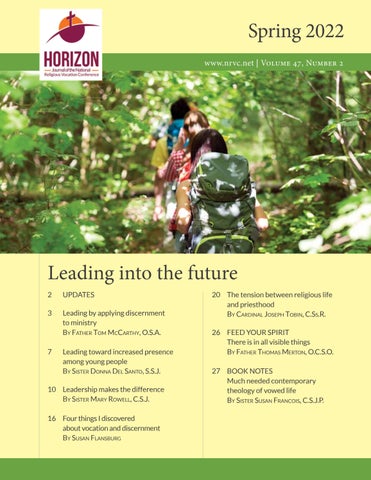
HIS EDITION’S COVER IMAGE jumped out at me because so many aspects of it seemed in line with what vocation ministers are dealing with right now. These travelers have heavy packs, the destination is unclear, and while some people are out front, they all seem to be on equal footing, each of them carrying a full portion of weight. I envision the leadership role of vocation ministers to be similar to the hikers who are up front: showing the way to their communities, but also walking as equals and close enough to listen to the group and adjust how they travel. Playing a leadership role in a religious community has never been easy, but the anxiety and uncertainty brought on by dramatic demographic shifts in communities make it more important than ever. That’s why this edition looks closely at the leadership role of vocation ministers. Our writers emphasize discernment—applying prayerful critical thinking to the way vocation ministry is done. They encourage spending time with and listening to young people. They urge vocation directors to build relationships with membership and to foster hope in the future. The model our writers encourage fits perfectly into the church’s recent emphasis on synodality, which is built on respect, listening, and collaboration. Communities may still have to raise uncomfortable questions and make hard decisions, but like the hikers in this image, they bear their burdens together. With a vocation director’s leadership, they can move forward in hope. —Carol Schuck Scheiber, editor, cscheiber@nrvc.net HORIZON is an award-winning journal for vocation ministers and those who support a robust future for religious life. It is published quarterly by the National Religious Vocation Conference. NATIONAL RELIGIOUS VOCATION CONFERENCE BOARD Sister Mindy Welding, I.H.M. Board chair Father Adam MacDonald, S.V.D. Vice chair Sister Belinda Monahan, O.S.B. Vice chair Sister Marichui Bringas, C.C.V.I. Ms. Nancy Costello Sister Jean Marie Fernandez, R.G.S.
Father Charles Johnson, O.P. Brother Brian Poulin, F.M.S. Sister Nicole Trahan, F.M.I. Mr. Len Uhal Sister Cheryl Wint, O.S.F. Sister Mary Yun, O.P. Sister Deborah Borneman, SS.C.M., Ex officio
Spring 2022 | HORIZON | 1
Updates
Ethical issues in vocation and formation ministry
Presenter: Father Raymond P. Carey, Ph.D. July 18-19 Behavioral assessment 1 Presenter: Father Raymond P. Carey, Ph.D. July 21-23 Learning to cooperate with grace through the Two of the five new entrants speaking at the June 2 webinar will be Nate Tinner-Williams, a seminarian with the Josephites, and Sister Cecilia Ashton, O.C.D.
inner work of transformation
Presenter: Ted Dunn, Ph.D. July 25-26
June 2 webinar to feature new members On June 2, from 7-8 p.m. CT, five recent entrants to religious communities will share their vocation stories and field live questions from the audience during NRVC’s free webinar, “Call to religious life: new member stories.” The event is the final webinar in a six-part series that has been underwritten by the GHR Foundation. Details and registration are at nrvc.net/webinars. The previous webinars in the series are available for public viewing at the same link. Previous topics are: Fundamentals, call to charism to community living Using all avenues to support vocation ministry Creating a collaborative environment Wellsprings of support for vocations Addressing parental concerns: wisdom and advice
Summer Institute: register now! The National Religious Vocation Conference is offering the following workshops online this July. Registration is underway and can be found at nrvc.net. Orientation program for new vocation directors Presenters: Brother Joseph Bach, O.S.F., Sister Deborah M. Borneman, SS.C.M., Brother John Eustice, C.S.V., and Father Adam MacDonald, S.V.D. July 12-16 2 | Spring 2022 | HORIZON
Attend convocation November 3-6 NRVC’s convocation in Spokane, Washington, November 3-6 will feature four pre-event workshops, two outstanding keynotes, a lively roundtable discussion, inspiring liturgies, and valuable networking. Speaking on the theme of “Call beyond Borders” will be keynoters Sister Barbara Reid, O.P., a scripture scholar and president of Catholic Theological Union (CTU) and Father vănThanh Nguyễn, S.V.D., a scripture and missiology professor at CTU. Four half-day workshops will take place prior to the evening opening of the convocation. One is “Dynamic communication strategies,” presented by communicators Nancy Costello, Carol Schuck Scheiber, and Chris Swain. Another is “Vocation promotion insights,” presented by experienced vocation ministers Len Uhal and Sisters Marichui Bringas Aguirre C.C.V.I., Nicole Trahan, F.M.I., and Mary Yun, O.P. Information on the other two workshops will be announced later. Registration opens in May; details are at nrvc.net. Updates
Brother Dominic Smith, O.S.A., Flickr
A new model for vocation ministry has borne fruit for the Augustinians. Above is Brother Emmanuel Isaac, O.S.A. at his solemn vows.
Leading by applying discernment to ministry One way vocation directors exercise leadership is by stepping back and evaluating what’s happening with new membership efforts, and, when needed, naming a new vision. Father Tom McCarthy, O.S.A. presents how he teamed up with other members to take such steps. He also shares some of the practical ways his community conducts vocation ministry today. This article is based on McCarthy’s presentation for the NRVC webinar “Using all avenues to support vocation ministry.” Find the hour-long webinar, which includes two presentations and a live Q&A, at nrvc.net/webinars. . ISCERNMENT IS A WORD we vocation directors like to use. The young (and not so young) people we work with have the word drilled into them by us and every vocation brochure, magazine, and website they encounter. But do we practice discernment when it comes to our own vocation ministry? Do we first discern our personal call to this ministry and then delve into all the ramifications of it? I say this from my own experience. In 1998 I was summoned to the provincial’s office for a Saturday meeting. As a young religious, I felt being
D
McCarthy | Applying Discernment to Ministry
We discerned that we had a lifestyle that was attractive, life-giving, and worth living. We were willing to change and try something new.
By Father Tom McCarthy, O.S.A. Father Tom McCarthy, O.S.A. is the vocation director for the Augustinian Midwest Province. In addition he is director of St. Rita of Cascia Shrine Chapel in Chicago and prior of the Pre-Novitiate Community of St. Clare of Montefalco Friary in Chicago. He serves, too, as a papal Missionary of Mercy.
Spring 2022 | HORIZON | 3
20, 30, or more years ago, we need to openly delve into summoned to the provincial’s office at any time was not discernment and see where we need to go and what we necessarily good. I was there with four other younger need to change. friars, and we were told that one of us was going to be None of us has all the answers or the perfect way the new vocation director. To say I was nervous is putto do vocation ministry. That said, we ting it mildly. I was terrified! I had been can all learn and grow and maybe even ordained four years and was loving my change. I am simply sharing with you ministry as chaplain in one of our high from my heart and my lived experience. schools. I wanted to be the vocation diWe knew what we Some things work and some things do rector like I wanted to stick a needle in were doing as a not work. That is OK. The NRVC named my eye. I did not want to do either! Vocaprovince was not its webinar “Using all avenues to support tion directors in our province tended to working, so we vocation ministry.” That means we all be friars who were yanked out of a mindiscerned a new way have something to share and we all can istry they loved and put in the vocation that was risky and and must learn from each other. office at the provincial center to stare at a went against all we Not every new idea works. When I phone that never rang. After two years of was principal of St. Rita of Cascia High misery, another sucker—I mean friar— understood about how School in Chicago, we tried something was put in and the cycle continued. As to do vocation ministry. new. We were going to implement a I said, I was terrified. Happily, I was not House System. Following what other appointed, and I continued my ministry schools were doing, and inspired by at the high school. the Harry Potter movies, we decided to The story might end there, but it does put every student, faculty member, and staff member not. Ten years later, to the day, I volunteered to become into one of eight different “houses.” The houses were the vocation director with two other friars and a lay staff randomly assigned with students from each class year member using a completely new model of vocation minmingled with faculty and staff members. We presented it istry. We all kept our primary ministries and formed the to the whole student body as they returned to school in Vocation Team. I am happy to say that 13 years later this August. A committee of students and faculty members model is still working for us, and we are going strong. had worked all summer and were excited to unveil their new creation that was going to transform the school and An honest assessment let us get closer to each other. Well, it was a disaster. The more we pushed it, the Why did this work? Because we discerned. We discerned more they pushed back. No matter what we tried, the about what we were doing and concluded it was not students rebelled and wanted to go back to the old class working. We discerned that we had a lifestyle as Augusyear system. At the end of the school year, we dissolved tinians that was attractive, life-giving, and worth living. the houses and went back to the ways that worked. We were willing to change and try something new. St. I tell this story to show that we tried something new. John Henry Cardinal Newman once said, “To change is We discerned that we would try something different. It to grow, and to be perfect is to change often.” (Winston did not work, but I am so glad we tried. If I were back Churchill made the saying even more well known.) We at St. Rita, I would try it again, but, learning from our knew what we were doing as a province was not workexperiences, we might introduce it incrementally, starting, so we discerned a new way that was risky and went ing with the freshman class and adding a class each year. against all we understood about how to do vocation Remember, we can learn, grow, and change even from ministry. We risked, and it worked, and it continues to failures. We need to discern, grow, and change! work today. I begin with this story because I believe all of us in vocation ministry need to discern why, how, and what Practical tips from what we’ve tried we do. I challenge us to discern, to look honestly at how we are doing this incredibly necessary and beautiful ONLINE UPGRADE ministry. If we are continually discerning the best pracWith this as a background and challenge, let us look at tices and are willing to change if necessary, let’s keep dosome things that have been effective. Our first and most ing that. If we are doing things the way we did them 10, powerful action has been to update and adapt our online 4 | Spring 2022 | HORIZON
McCarthy | Applying Discernment to Ministry
Brother Dominic Smith, O.S.A., Flickr
The Augustinians in Chicago invited volunteers, including discerners, to work alongside them in a 2021 food relief effort, providing a hands-on way to get to know the community. Packaging poultry to distribute to those in need are, left to right, Father Dan Madden, O.S.A., Brother Spencer Thomas, O.S.A., Father Elizandro Contreras, O.S.A. and Father Sam Joutras, O.S.A.
presence in social media and on our website. We decided we needed a person who understood technology and the way younger people use social media. We started by hiring someone 10 hours a week and have moved to 20 hours a week. I cannot stress enough that your website is open 24-7-365. It is open when young people look at websites, on their time, which usually doesn’t mean office hours of nine to five. Young people take study breaks at 2:30 in the morning, and your website may be what they look at. Is it welcoming? Is it user-friendly? Is it up-todate? Is it informative? The same goes for our presence on social media. Some platforms I have never heard of and am not using, but our vocation office better be using them. Material on social media needs to be relevant and eye-catching. In a ridiculously small number of seconds, a person either is or is not attracted enough to view our information. If it is not attractive to young people, they will move on to the next website or social media platform. And we will be left in the dust. QR CODES
I never heard of QR codes until a few years back. But if you’ve gone to a restaurant during COVID-19, you encountered one to get your menu. Is a QR code on your posters and other print material? Young people may not take the time to type in a website but they will scan a QR code. If they do look for a website address, is it unique and easy, or is it so difficult that it takes three tries to finally get there? McCarthy | Applying Discernment to Ministry
WRISTBANDS TIED TO WEBSITE
We used to buy all kinds of trinkets as giveaways for our tables at vocation fairs. How many pens have you ever lost? How many flashlight keychains does one person really need? We have all tried these giveaways, and to a certain degree, having some is good, but don’t think they are the end-all and be-all. We have found that rubber wristbands have been the most effective. Many young people actually like them and will wear them if they are attractive. Find a short question or quote that is relevant to your community and put it on the wristband with your website. At 2:30 in the morning when they are bored with studying and take a break, they may look at the band on their wrist and go to your website. Our bands simply say, “Restless?” and give our website. On our site we explain the prayer of Saint Augustine, “You have made us for yourself, Oh Lord, and our hearts are restless until they rest in you.” We tell people to wear the band or put it somewhere they will see every day and ask if they are truly restless in their search for God in their lives. It has worked beyond belief for us. We buy the bands in various colors in bulk and pay about 12 to 20 cents each. STAY IN TOUCH WITH INQUIRERS
Another bit of practical advice comes from what we’ve learned about tracking inquirers and discerners. First, every single person gets a response, no matter how far out or undesirable. They reached out, and they deserve the courtesy of an email response. We’ve developed 34 Spring 2022 | HORIZON | 5
And we always include our lay employees and associates, form letter responses for inquirers, from men who are asking them to get to know these discerners. 78 and bored with life—so why not become a priest?— to those who ask if their wife can attend a discernment weekend with them. We have to say no to a lot of people, INVOLVE YOUR COMMUNITY but it doesn’t take much to say no charitably. My final piece of advice is to not do this ministry alone. We also keep electronic files of names Have members of your community to because people can come back years later. support you in prayer and presence. Let’s We put a sentence or two about each perinvite young people into our homes for son to jog our memories. For instance, we prayer, fellowship, and some good food. Do not do this took note of the guy who said if he joined, We need to be present to them and acministry alone. Have he’d get three meals a day and a place to tively engage in their life journeys. They members of your sleep. It actually happened! need to know we care before they will care community to support Beside the turndowns are people who what we know. Walk with them and enjoy you in prayer and are viable. We send them an approprigetting to know their stories. presence. ate email from our 34 form letters. If we These are simply a few thoughts based haven’t heard back in three weeks, we on how I’ve learned and changed in this send another email saying, “You might ministry. I don’t know it all, and that’s why have received a lot of material at once, we need to talk to and learn from each we just want to check in.” If they did get a lot all at once, other. Young people are restless for meaning and purnow they get our email separately. After another three pose, and we in religious life have wisdom and a way of weeks without a response, we send a third and final life to share. Let’s discern, go forth, and minister. n email. My assistant in the vocation office, Father Jack Tierney, O.S.A. found us through VISION and did not Further reading reply until the third email. It does pay off. Visits are also critical for us. I like to visit discerners “Our vocation culture project,” by Father Tom McCaron their territory and then invite them to come to us. thy, O.S.A., HORIZON, Fall 2018. 6 | Spring 2022 | HORIZON
McCarthy | Applying Discernment to Ministry
All photos courtesy of the Sisters of St. Joseph of Rochester
The author, center, and Sister Lorraine Julien, S.S.J., right, make music with one of the many young people who spend time with their community. This young woman, now Sister Anita Kurowski, S.S.J., lived with the sisters during college, worked with them, and eventually entered the community.
Young people are seeking authentic, meaningful lives connected to God. Let’s open our doors and our hearts to them.
Leading toward increased presence among young people During two decades as vocation director, Sister Donna Del Santo, S.S.J. has led her community to new places by always listening to young people and the needs they express. With a team of members she has formed over the years, the sisters continuously ask how they might respond. The result has been to open their doors ever wider, finding creative, meaningful ways to connect with young people who very much want to learn from the sisters about prayer, service, and life direction. This article is based on Del Santo’s presentation for the NRVC webinar, “Using all avenues to support vocation ministry.” Find the hour-long webinar, which includes two presentations and a live Q&A, at nrvc.net/webinars.
T
HE FOLLOWING WORDS of Father Pedro Arrupe, S.J. are core to who I am as a woman religious and core to who I am as a vocation director because this life is a wonderful love story, one in which we love and serve God, and love and serve our neighbor.
Del Santo | Increased presence
By Sister Donna Del Santo, S.S.J. Sister Donna Del Santo, S.S.J. has been a member of Sisters of St. Joseph of Rochester since 1992 and has served as her congregation’s director of vocations since 2003. Much of her work has focused on creating a culture of vocation in which it is easy to ask, “What does God want, and what do the church and the world need from me?”
Spring 2022 | HORIZON | 7
The Sisters of St. Joseph of Rochester share a meal with a youth group that stayed with the community during a week-long service retreat.
Nothing is more practical than finding God, that is, falling in love in a quite absolute, final way. What you are in love with, what seizes your imagination, will affect everything. It will decide what will get you out of bed in the morning, what you will do with your evenings, how you spend your weekends, what you read, who you know, what breaks your heart, and what amazes you with joy and gratitude. Fall in love, stay in love, and it will decide everything.
I believe what people are seeking from us is guidance on how to live a loving and meaningful life rooted in God. However, today’s youth and young adults have little opportunity to get to know us because we have fewer members than in the past, and we no longer are in the places we once served, such as schools. Thus, a big part of our work is what I call loitering with intent. We need to ask ourselves: How are we present in places where youth and young adults gather?
Team approach, in person and online I have a team of 10 other Sisters of Saint Joseph called the Vocation Think Tank. This is a group of sisters who, one-by-one, I have taken with me to the NRVC convocation where they all got turned on to vocation ministry, 8 | Spring 2022 | HORIZON
and now we minister together. They are counselors, members of our leadership team, a surgeon, teachers, and spiritual directors. They, too, are in love with our life and want to share it with others. They and other sisters spend time with young adults in a variety of settings. For example, I volunteer in campus ministry at our former college, assisting with music at Mass and going on service trips with the students. In addition, my local community invites students to our home for what we call a Mass and a Meal, working closely with the campus minister (who, by the way, is a wonderful cook. I always sign up to cook when he does!). We can have up to 20 students in our chapel for Mass, which we follow with dinner together. After suspending Mass and a Meal during COVID-19, we just resumed them in February and had a great response. The pandemic has shown us that being present doesn’t always mean being physically in the same place. We’ve been doing Busy Person Retreats for many years on college campuses throughout our region. Under COVID-19, we discovered that doing things online expanded our reach to places too far for us to drive to. As a result, we’ve expanded our outreach to colleges further away because we can visit with our students one-on-one online. This positive experience prompted us to offer an online retreat series exclusively for young women. In spring 2021, we created an online series on the Year of Joseph. Later, in light of our Ignatian spirituality, we presented an online, four-part series called “Finding God in all things.” We’ve had up to 28 participants in our online retreats, and only three were from our Rochester, New York area. The rest came from across the U.S. and Canada. We would never have met them if we had limited ourselves to retreats done live and in person.
Living with young people I live in a community that has welcomed over 1,000 youth and young adults into our home over the last 25 years through the SSJ Volunteer Corps. In addition, we welcome young adults who wish to live in an intentional community, and we are now welcoming college students who are housing and food insecure to live with us. These young people come for different reasons, yet, what they hold in common is they all agree to live life with us, sharing prayer, food, chores, conversation, and more. They get to see us up close and personal—and to be quite honest, having them in community with us helps us to be the best Sisters of Saint Joseph possible because Del Santo | Increased presence
charism, community life, and mission. By offering young adults hospitality in our homes and ministries, they have an opportunity to experience us up close and personally. Study respondents also stated they are looking for cultural diversity and embrace intercultural and intergenerational living. So don’t be afraid of your age; it’s the vitality of our lives they are attracted to. Additionally, we need to ask: Who is not at our table who may not look like us? How are they experiencing our welcome? Those who consider religious life are looking for a lifestyle that is committed to simple living in solidarity with Liliam Montilla and Sister Lorraine Julien, S.S.J. share a laugh. Montilla is one of the many those who are poor, and, I might add, young people who have lived short term with the Sisters of Saint Joseph of Rochester. solidarity with creation. What is our community life like, and how are we living a life that speaks to this desire? we strive to be our better selves. This endeavor is not Newer members have abundant hope for religious about age, as we range from age 67 to 92, and our oldest life. How are we living our lives? Are we full of hope for sister is the one young people often are most attached to. this life as well? First and foremost, this ministry is one of presence, enThese ideas lead us back to the question: how do we counter, and invitation into the spaces where we live and meet the desires of those who seek us because of how we carry out our daily lives. embrace and live our consecrated lives? If we look at the summary statements from the BishAgain, I repeat the ways we Sisters of St. Joseph have op’s Synod on Young People, Faith and Vocational Distried to connect with young people who are seeking to cernment, we will find a road map on how to reach out, know their call in life: support, and invite youth and young adults to our lives. The synod made clear that we need to: • Loiter with intent. • Be a listening church.
• Recognize the gift of youth to the church and the world. • Recognize the mystery of each person’s vocation.
• Invite our community members to NRVC workshops and events. • Spend time with young adults.
• Mentor youth in the art of discernment.
• Welcome young people into our home for a community experience, and welcome them to join us in ministry.
• Walk together in daily life.
• Use online tools to connect.
We will see some of these elements in the key findings of NRVC’s 2020 Study on Recent Vocations. For example, there is an endless call to women and men to say yes to religious life. Yet even before that yes, there is a call to live a meaningful, authentic life, and unless we have encounters with youth, and let them get to know us in a real way, they will never develop a call to religious life. The respondents to the 2020 NRVC study stated they were drawn to religious life by prayer, spirituality, Del Santo | Increased presence
• Remember that this is a ministry of presence, encounter, and invitation. Let’s return to the guidance found in the words of Father Arrupe: Nothing is more practical than finding God, that is, falling in love in a quite absolute, final way. Fall in love, stay in love, and it will decide everything. n Spring 2022 | HORIZON | 9
Vocation ministers today are called to be leaders within their communities and throughout the church, helping all to embrace a vocation culture.
Vocation ministers often need to help their communities to consciously choose to invite new people. Hopefulness for making that choice can be fostered through contact between young adults and membership. The Sisters of St. Joseph of Toronto were invigorated by the enthusiastic participation in a pilgrimage to sites related to their community. Pictured here is Sister Joan Atkinson, C.S.J. (left) with two pilgrims. Photo courtesy of the Sisters of St. Joseph of Toronto.
Leadership makes the difference By Sister Mary Rowell, C.S.J. Sister Mary Rowell, C.S.J. is vocation coordinator for her community, the Sisters of St. Joseph of Toronto. She also serves as president of the National Association of Vocation and Formation Directors in Canada. In addition, she teaches theology at two universities and is on the team of the Villa St. Joseph Ecology and Spirituality Centre in Cobourg, Ontario.
10 | Spring 2022 | HORIZON
“H
ERE COMES EVERYBODY!” Many will recognize this description of the Catholic Church found in Finnegans Wake, the final work of Irish writer James Joyce. It describes the church, the Body of Christ, formed of its many parts, called to life. Indeed, without the vibrant diversity of each gifted and limited person brought into oneness, life is not possible at all. Both Christian theology and modern cosmology teach us this truth. I hope to suggest here that the work of vocation ministry today, in its varied settings, is grounded in this reality of “all and one.” It is a work of informal leadership, the primary purpose of which is to animate the gifts in individuals and in the whole to foster life in response to the love and call of God to each person and to each community. Rowell | Leadership
Animate the gifts of each Everybody! Everybody has gifts. As Brother Loughlan Sofield, S.T. pointed out in a 2015 address to the Religious Formation Conference, leadership that brings life begins with the identification, affirmation, and animation of the gifts of each person. Traditionally vocation ministers have done this as they have walked with individuals in discernment, and it is appropriate that they continue to do so. They encourage in others the most important question, “Where is God calling me?” Vocation ministers, in light of the Spirit, call out and affirm the gifts of discerners to enable them to reflect upon their particular call. In doing so, vocation ministers exercise the leadership skills of listening, reflection, values clarification, and invitation as a process of mutual discernment takes place. Focusing on, calling forth, and affirming the gifts of individuals is a critical part of this process. Today, however, this is not enough. Younger people rarely reach a point of truly discerning a particular vocation because the language of vocation in the church is absent, misconstrued, or limited. Moreover many religious communities lack visibility; people no longer even know we exist, and we have ceased to invite others to consider our way of life. Besides, many younger people no longer go to church on a regular basis, and while they may attend Catholic educational institutions, awareness and discussion of vocation is often largely absent from school and college curricula. (See “How universities can cultivate vocations,” by Father Vincent O’Malley, C.M., 2016 HORIZON, Number 2.) This situation now invites the vocation minister to work in a wider context and to assist in leading initiatives that help people recognize, claim, and live their gifts. For, as Brother Loughlan emphasized in his talk to formation directors, “Gift and call always go together.” In other words, gift recognition is essential to understanding and living out one’s vocation, and a vocation is about using one’s God-given gifts for the sake of the whole and for mission. I am reminded of the beautiful definition of vocation offered by writer and theologian Frederick Buechner: “Vocation is the place where our deep gladness [and I would add here, gifts] meet the world’s deep need.” So, I suggest that vocation ministers are called today as leaders who first help create, with others, initiatives in parishes, schools, colleges, coffee shops, and youth gatherings that facilitate the claiming of gifts to introduce healthy vocation awareness. Initiatives may include Rowell | Leadership
worship experiences, social events, relaxed discussions, retreats, hiking days, movie evenings, creative writing and art projects, social media events, and ecological and justice programs. The goal of such initiatives is to help people identify their gifts and ways in which their gifts have relevance for their relationship with God and significance for service in the contemporary church and world. In his book, Let Your Life Speak, Parker Palmer emphasizes this important first step in vocation leadership. He says: “Discovering vocation does not mean scrambling toward some prize just beyond my reach but accepting the treasure of my true self I already possess. Vocation does not come from a voice ‘out there’ calling me to be something I am not. It comes from a voice ‘in here’ calling me to be the person I was born to be, to fulfill the original selfhood given me at birth by God.” Vocation leadership finds a starting point in facilitating self-discovery, giftedness, and call. This approach presupposes that all are gifted and called. All have a vocation, and until this is fully realized, processes relating to the discernment of particular vocations are, at best, weak. Vocation ministry today entails that ministers take seriously the importance of working together to create a culture of vocation.
Vocation leadership to encourage a culture of vocation The Third Continental Congress on Vocations to Ordained Ministry and Consecrated Life in North America, which met in Montreal in 2002, made clear the varied vocations in the church which “express in diverse ways the universal call to holiness implicit in baptism.” The congress further emphasized “a deep respect for the complementarity and interdependence of all vocations.” As community and communion of vocations, “its members need to be concerned about and committed to the flowering of all vocations in the church.” The congress thus called for the development of a culture of vocation. The importance of this direction was demonstrated in NRVC’s 2015 study conducted by the Center for Applied Research in the Apostolate showing the positive impact of the family in nurturing ordained and consecrated vocations. Despite considerable attention to the need for a culture of vocation, however, programs are not yet widely developed. Experienced vocation ministers have an exciting opportunity to capture the energy and to partner in initiatives to bring about a lively sense of vocation. Spring 2022 | HORIZON | 11
This is not about a vocation minister doing it all him or herself. Rather it entails letting go of traditional models of leadership, as management consultant Margaret Wheatley, puts it, “Goodbye, command and control.” Here the vision of leadership implies a model of cooperation and empowerment. What a vocation minister may be able to offer at a direct level to begin are general presentations and workshops on vocation. These can create a deeper vocation awareness for all. Thereafter particular leadership skills are needed: • facilitation and dialogue for the unfolding of a vision that can be widely embraced, • motivational skills to engage all with passion and commitment, • listening and reflective skills to clarify the will of the group necessary for collaborative decision-making, • invitational skills to include a wide range of people, mobilizing the gifts of all in practical plans and in future shared leadership. Perhaps most needed are leaders who recognize that the visioning and work belong to all. They generously contribute and share their special gifts and experience; they respect others and their unique contributions; and they are appropriately aware of their own limitations such that the project truly engages vocational diversity for service in the church and world to nurture all types of vocations. These approaches to vocation leadership are consistent with certain general theories of leadership. Adaptive leadership models suited to our changing times emphasize the importance of “giving the work back to the people” by garnering the gifts of all, encouraging personal empowerment, getting people to own greater responsibility, listening and respecting various viewpoints, even those most difficult to hear, and challenging self and others to transformation. One of my teachers during novitiate would say it is “calling one another to greatness.” The servant leadership model articulated by Quaker Robert Greenleaf also calls for valuing the contributions of all, listening, discussing, and assisting others to achieve their potential and to assume responsibility. It is leadership in the model of Jesus who received the raw material of his followers and who formed them over time in prayer, vision, and action for the sake of the reign of God. 12 | Spring 2022 | HORIZON
Leading an internal culture of vocation Building a culture of vocation throughout the church truly enriches all vocations. But what of a culture of vocation within our religious communities? Internal vocation ministry is a vital context in which urgent and dedicated leadership is now needed. We have long known that for a vibrant vocation ethos in religious communities, everyone (and not just the vocation minister) has a responsibility. Revitalizing an internal culture of vocation is urgent if we are to invite new membership. In this context, as in the situations described above, a vocation minister exercises leadership through the gift of animation of individuals and of charism and community. Each member has something to bring to the vision, ethos, and work. This was movingly brought home to me when the Federation of Sisters of St. Joseph of Canada organized a weekend pilgrimage for young people to various community sites. The pilgrimage was entitled “Living Joy,” and 24 young women and men participated. Part of our time together was spent at one of our residences where senior sisters are living. One sister in particular, who has early stage dementia, remains true to her social personality and joy in life. She greeted the pilgrims on arrival, showed them her room, joined them for a barbecue, and generally entertained them with warmth and kindness, though her struggles with dementia were obvious. At the end of a weekend, full of prayer, presentations, ministry participation, and social gatherings, the young people were asked where they had found “living joy” during our days together. Immediately the group named their time with this particular sister. For them, she represented the joy and call of the gospel and of “living vocation.” She continues to be an inspiration for their personal discernment journeys.
Look at the bigger picture These things become possible within a wider context. The vocation minister as leader is also called, as proponents of adaptive leadership would say, to “get on the balcony.” This calls the leader to view the larger landscape and to see emerging patterns that yield essential questions concerning the whole: What is the essence and gift of the charism of the community? What is the call to live it fully today? What are the unmet needs in the church and world that invite change and transformation in how we understand and live the charism with relevance and renewed passion? Rowell | Leadership
Courtesy of the Xaverian Missionaries Communal discernment at assemblies and Chapters can encourage internal vocation culture. Here two members of the Xaverian Missionaries take part in a provincial Chapter, Father Alex Rodriguez, S.X. (left) and Father Joe Matteucig, S.X.
To do this the leader builds warm and sometimes challenging individual relationships and facilitates conversation, shared reflection, and story telling. The leader recognizes his or her personal gifts and limitations and thus affirms others in their contributions. For this task the leader is gifted by “the wisdom of the ages”—all that he or she receives from the community’s history, spirit, expertise, and witness. At a practical level, communal gift identification can be achieved through reflective questionnaires, workshops, or spirituality days designed to intentionally call forth the gifts of all to enhance community and contribute to the vocation climate. Motivated by a need to discern and help create conditions for inviting and attracting new life, the vocation leader may initiate processes of communal discernment that seek to refine understandings of identity and role in light of call and charism. In such communal discernment, Sister Maria Cimperman, R.S.C.J. points out, “Our deepest values, hopes, priorities, and identities are named, and what is no longer the deepest value or priority or keenest identity is gently let go.” (Find Cimperman’s article, “Inviting thresholds: How communities might respond to shifting times” in 2009 HORIZON Number 2.) Group discernment first invites the contributions of all in order to surface existing goods and build upon Rowell | Leadership
them together. It entails creating prayerful opportunities that inspire individuals and communities to “dream a future,” whatever that future may look like, under the guidance of the Spirit. As Marty Linsky of Harvard’s Kennedy School of Government says in Transformational Leadership: Conversations with the Leadership Conference of Women Religious, “Our experience is that when you are inventing the future and searching for next practices, rather than looking for best practices, the more voices that you can bring to bear in that conversation, the more likely it is that you will be able to generate ideas and options that will be accepted broadly and deeply and will get you where you want to go.” Of course, communal discernment of this kind already takes place at community assemblies and General Chapters. When such discernment is initiated as part of the work of vocation ministry, however, its primary intent is to energize the community and thus to create an invitational environment for new membership. Processes of communal discernment that take place at assemblies and Chapters are more broadly motivated. Nonetheless they must also maintain a mindfulness for vocation. After all, there are limits to identifying and naming inspiring directives to carry us into the future if there are no new members partnering with others to carry these out. Spring 2022 | HORIZON | 13
in different forms in the past, and for many of us now, was and is the attractor to religious life. I am not denying that some communities will come to a While the length and substance of this article prenatural end, as is the right order of things, having served cludes any in-depth discussion of this particular diffiwell the building up of God’s work in their time. Nor am culty, the existence of such challenges does invite vocaI denying that others outside the community, given their tion leadership to create pathways of dialogue and to particular vocation and gifts, may also live the charism act sometimes as “translators,” to bring all to threshold of a religious community and carry on some continuity. moments of discernment. This role of translating what However, for religious to neglect explicit discussion and newcomers are seeking may require the vocation leader discernment of religious vocation at any of our major to propose challenges to him or herself and to the comcommunal events, is arguably to choose, munity. Sister Constance FitzGerald, inadvertently, our own demise. This preO.C.D. discussed these concerns in the empts the work of the Holy Spirit, closing video “A Future Full of Hope from the When vocation is ourselves off from outcomes best entrustReligious Retirement Office.” FitzGerald discussed at a General ed to the Spirit. says of the case in point, the crux is that Anecdotally, it is clear, as international Chapter, it is taken this is “going to call for sacrifices. And vocation leaders have attested, that even sacrificing things that we may legitiseriously once again, for communities experiencing considermately have … we are going to have to be even if it is ultimately able diminishment, when vocation is on call to mentor … to provide a model for the benefit and discussed at a General Chapter, it is taken for [new members] of how the life needs growth of religious life seriously once again, even if it is ultimately to be lived. And unless communities can in general. for the benefit and growth of religious offer this, they are not going to have and life in general. This observation suggests keep new [members].” that the leadership work of the vocation The leader must sometimes have minister involves positive and proactive the courage, integrity, and commitment communications with formal congregational leadership to suggest sacrifice for the sake of new life. He or she as they discern the future together with members and may need to face frustration and receive the criticism or with Chapter preparation teams. This proactive commueven anger of others. It is not an easy task, but FitzGernication allows possibilities for vocation animation to be ald knows whereof she speaks given the courageous integrally incorporated into discussions for wider wellchallenge taken on by her community, the Discalced being and mission. Carmelites of Baltimore, who entered into a process of discerning, letting go, sacrificing, and real change. The reward was the gift of remarkable new vocations to the Courage to face hard questions community and a gift of hope. To “stand on the balcony” observing the wider context may also be a dangerous task and one that may not be Communicate hope welcomed! For the view from the balcony today is revealing emerging patterns that are not necessarily in Above all at this time, vocation leaders need to comharmony with one another. Take, for example, the great municate and engender hope through affirmation desire of those presently attracted to religious congreand sometimes challenge. Sessions in community that gations for community living and communal prayer. generate seeds of hope, even in difficult days, can be Meanwhile many existing members have come to differinvaluable in creating a context for inviting new life. ing views of what it means to live in community and to In saying this I am reminded of our own community’s pray. ecology center where each fall we plant the garlic for The heart of the problem here may well be a questhe new season. Given the Canadian climate, it takes an tion of interpretation. What existing members may think act of outrageous faith annually to believe that in the discerners are asking for is “institutional security.” Disspring, after being buried so long in the snow, the garlic cerners and new members may actually be saying that shoots will appear. But they always do appear, and faith for them, given their reality and today’s societal ethos, and hope meet once again. The vocation leader must community is the counter-cultural witness. Community, provide such hope for the regeneration of an invitational
General Chapters are key moments
14 | Spring 2022 | HORIZON
Rowell | Leadership
climate so that the shoots of new life appear. Hope is essential for creating a context that is attractive to new members. In recent years of diminishment, however, it has become a difficult virtue and context to create. So I suggest that leaders in vocation ministry, indeed all leaders formal and informal, need to look for ways to engender hope in all they do. Otherwise our lack of hope will send out negative messages and may itself become a self-fulfilling prophecy with respect to vocation. In my experience offering hospitality in our homes, opportunities for praying with our members, open houses and social events not only provide an opportunity for visibility and witness, but in turn bring hope. One of our larger communities once held a young adult open house that included contemplative prayer, a vocation DVD, discussion, and a pizza supper. It brought great vitality to all the sisters who participated, both younger and older members. Vocation leadership that includes affirmation and development of charism and community has the capacity to re-create a sense of grateful identity and an attractive context. For while a new generation has been deeply exposed to change and instability and are, thus, flexible, it is paradoxically those same conditions that attract them to ventures and groupings that know and name clearly Rowell | Leadership
who they are and to what they are called. Identity, albeit an identity in transition, is critical. Reclaiming who we are and who we are becoming may well lead us to actively invite women and men to consider the possibility of a religious vocation. Finally, which one of us, I wonder, doesn’t “come alive” when our gifts are affirmed and called upon or when we are engaged in seeking and claiming the gifts of communal identity? Through these leadership processes, vocation ministers, with others, call out a lively and engaged joy, an essential component for a community that attracts. At a 2014 gathering of religious men and women in Korea, Pope Francis said: “Joy is a gift nourished by a life of prayer, meditation on the Word of God, the celebration of the Sacraments, and life in community. When these are lacking, weaknesses and difficulties will emerge to dampen the joy we knew so well at the beginning of our journey.” Above all, together in mission and in shared leadership, we are called to witness to living joy and to be joy-makers! For, as Pope Francis continued, “Only if our witness is joyful will we attract men and women to Christ.” Leadership indeed! n A version of this article appeared in 2016 HORIZON, Spring, Number 2. Spring 2022 | HORIZON | 15
Natalia Figueredo, Unsplash
Family obligations and economic realities can complicate a decision about entering a religious community
Two dozen in-depth interviews with vocation ministers and newer sisters revealed some surprises for this experienced vocation writer.
Women considering religious life have many things on their minds to sort out with a vocation director.
By Susan Flansburg Susan Flansburg writes for and about Catholic sisters, as well as a range of nonprofit organizations. Her book, Feels Like Home: A Single Woman’s Guide to Catholic Religious Life in the U.S., is a guide for women who are discerning a vocation to religious life. It is currently in the final phase of editing. Questions and comments are welcome at seflans1@ gmail.com.
16 | Spring 2022 | HORIZON
Four things I discovered about vocation and discernment
W
HEN I BEGAN interviewing sisters for my book, Feels Like Home: A Single Woman’s Guide to Catholic Religious Life in the U.S., I thought I knew what they would say. After all, I had served nearly two decades as communications director for Benedictine sisters, worked as a consultant and writer for religious institutes across the country, maintained memberships in Communicators for Women Religious and the Catholic Media Association, and written for publications like VISION Vocation Guide and Duke Divinity Faith & Leadership. My bona fides demonstrated my expertise in the area. I would just write what I knew. What I found out, of course, was what I did not know. I’m sharing four Flansburg | Four Things
such discoveries with you here. Taken together, they may help seed and continue conversations within your institute as you work to create a vocation program that serves the women—and there are many!—who are discerning religious life today.
1. Discerners’ biggest fear is they will make a mistake. In fact, many do. Women often pursue the wrong institute, at least for a time. This is not just an early discernment issue, before inquirers have begun to identify their lifestyle needs. It occurs late in the discernment process for many. Sister Stefanie MacDonald, O.S.B., now happily with the Sisters of St. Benedict of Rock Island, Illinois, discovered her mistake—and inquirers do view it as a mistake—after having lived with the wrong institute for months. MacDonald had begun active discernment with a group of religious who had lived across the street from her family, dined at the family table, and shared holiday traditions. When she felt God calling her to be a sister, MacDonald had turned to them, believing that life as one of them would bring her the community, peace, and purpose she craved. Working with their vocation director, MacDonald had relocated to live with the sisters who would introduce her to the life. It would be the perfect discernment opportunity. “I was happy at first,” she said. “I thought, I’m finally where I belong.” Within a few months, however, MacDonald began to find the ministry-focused apostolic lifestyle was not a good fit for her. Anguished and dispirited, she left. “It was like living with roommates. Their ministries kept them at work till late at night. Our paths didn’t cross a lot. We didn’t pray together or eat together. I thought, religious life must not be for me.” After several years, MacDonald felt the call again. This time she ended up with a community of Benedictines, entered, and serves as their vocation director today. Vocation directors say the fear of making such a mistake stops many women from progressing in their discernment. They can’t face the ignominy of what they see as a public failure. Sister Lisa Mauer, O.S.B. still can feel the pain of her own such experience. “Trying to stay [with my first community] was like forcing myself into a pair of shoes that I loved but that didn’t fit. It was painful and embarrassing to leave.” At least a quarter of the sisters interviewed for Feels Like Home began serious discernment with an institute Flansburg | Four Things
they joined but eventually left. Ji Kyung Choi, C.B.S. was among them, finally leaving her Korean-American community just before final vows. She had to struggle with cultural and spiritual repercussions as well as pain and embarrassment. “I had told a priest at my parish that I might be called to religious life. He put me in touch with a Korean community. I’m Korean American so it seemed natural. They accepted me without any formal discernment. I entered after just two months. It was not a good fit. They followed a pre-Vatican II way of life, which ended up At least a quarter pushing me away from God. of the sisters I felt my spirit and soul were interviewed began getting destroyed. Today, I accept that time as part of serious discernment my discernment. I learned so with an institute much about what I believe they joined but and need. I learned what I’m eventually left. called to do.” MacDonald, Mauer, Choi, and several others persevered, entering communities that have been the right fit for them, while two more women accepted their chosen communities’ request to take more independent discernment time prior to entering. How many women fail to persevere because of such obstacles is anyone’s guess. But the need to help them believe there’s no shame in changing their minds, as well as the need to set expectations about the reality of discernment, is clear. How can you help women navigate this powerful obstacle? Sister Lynn Mousel, C.H.M. suggests engaging friends and family. “Learning how to talk to friends and family is critical. Getting feedback from loved ones will help women know what’s right and what’s not for them.” Offering printed talking points, a sort of “How to talk to your friends and family about your call,” could be valuable. It would help introduce the topic of religious life, establish reasonable expectations, answer some key questions and prepare everyone—even inquirers—for the possibility that the discernment might lead to a radically different outcome than initially anticipated. [See VISION’s “How to talk to your family about your vocation” at vocationnetwork.org.] As for when to bring it up? Definitely not in front of a movie, Mousel notes, or as participants parallel-scroll social media. “You have to take time for the conversation intentionally. No distractions.” Spring 2022 | HORIZON | 17
Nguyen Dang Hoang Nhu, Unsplash
its, such as those that copied the “widow’s weeds” or the working costumes of their times, came about from a desire to blend into society and among those whom the sisters served.
The desire to “blend into society” referenced by Kuhns remains an urgent desire among many sisters. But there were other urgent reasons to adopt different garb. Health, hygiene, and even safety were chief among them. The full habit was often made of heavy wool, and worn in all seasons. Not only was it hot in summer, it could stay wet for days after a sudden rain. Even if covered by umbrella and raincoat, the long skirt would soak the moisture up into its folds. And the headpiece —coif, wimple, and veil—often obscured the sisters’ peripheral vision, making it a hazard to drive or even walk. When Pope Pius XII suggested in 1951 sisters choose garb to be “in keeping with the demands of Discerners often have ideas about habits and community life that merit discussion hygiene … counseled by reason and wellbecause these two areas have many forms of expression. ordered charity,” many began the process of modernizing their dress. Happily, today’s habits are mostly fash2. The habit is a big deal … sometimes ioned of more breathable, comfortable fabric, while Every Catholic seems to have an opinion about how headpieces typically permit peripheral vision. sisters should dress, but the sisters I interviewed were Many of the younger monastic Benedictine sisters less dogmatic than many non-vowed churchgoers. Vocainterviewed said they would gladly wear a modified tion directors from non-habited institutes were quick to habit, if only the elders in their community would agree. point out the correlation between habits and medieval The apostolic sisters, on the other hand, often made the garb, while those from habited institutes spoke of the question of habit part of their discernment, entering an habit’s witness factor. institute on that basis. The cloistered/contemplative nuns Having a resource available to aid such discussions I spoke with saw the habit as appropriate for most but might be valuable, as most inquirers will have little if any not all activities (such as work). knowledge of how the habit first came to be, or how or Here’s a sampling of interviewee comments: why it has evolved over the millennia. Elizabeth Kuhns Sister Colleen Mattingly, A.S.C.J.: “The habit is imtackles those questions in her book, The Habit: A History portant to me. In the very, very beginning, wearing it of the Clothing of Catholic Nuns: was hard. Used to be I didn’t leave home without mascara and lipgloss! But now I don’t even think about it. The story begins at the dawn of Christianity, where Now that I’m living for the Lord—and not trying to find the first consecrated women and earliest Church a marriage partner—things like hair and clothes aren’t authorities shaped the habit’s initial forms. Evolvimportant anymore. I’m witnessing through it. It’s a sign ing from ascetic ideals, it traveled through medieval of something greater. But, I agree with those who say if cloisters and knights’ hospitals to the rugged fronthe habit is your prime reason for entering, it won’t sustier schools of the American West, taking on many tain you.” shapes. [Some] were designed as monastic uniforms, Sister Julie Sewell, O.S.B.: “If you want the habit to specifically intended to distinguish women who had be a factor in your discernment, please know it will not consecrated their lives to God. Other orders’ habbe enough to sustain your vocation over a lifetime. You 18 | Spring 2022 | HORIZON
Flansburg | Four Things
must take other factors into consideration.” Sister Linda Soler, O.S.B.: “I wear black and white at school. I’m open to a unified look.” Sister Stefanie MacDonald, O.S.B.: “If our community wore a habit, I’d be wearing one.” Sister Amanda Carrier, R.S.M.: “Habits never gave me the right feeling. There is something special about them, a witness factor, but they’re just not that important to me.” Sister Xiomara Méndez-Hernández, O.P.: “I was very observant, but thought I’d never become a sister because they wore a habit. The reason I didn’t want to go to Catholic school was the uniform! But then I met these two Adrian Dominicans who weren’t dressed in a habit. I entered in 2008.”
3. Community isn’t what many think it is Everyone I interviewed spoke of the value and benefit of community: apostolic, cloistered/contemplative, monastic, and missionary. Whether they live with the entire institute under one roof, or alone in their own apartment, each sister placed community at or near the top of her list of desired religious-life values. If community means something different to each woman—and it seems to—the first step in a discussion about it might be to clarify what each of you means and recognize that each definition has value. For monastic women, community is often both the literal place, a monastery, and the metaphorical joining together to seek God. It’s a spirituality that involves sharing everything from prayer and meals to decisionmaking and resources. For cloistered/contemplative monastics, community takes on an even more radical expression, as they literally remain together within their enclosure for life. For apostolic and missionary women, community can imply many different things. For some, living with another woman or two fits the bill. For others, a sense of belonging to something greater than themselves forms the heart of the concept, making community an important value even for those who prefer to live alone. Sister Julie Sewell, O.S.B. suggests easing into discussion by first asking a couple of simple questions: “We live in a 43-woman monastery. Sound bad? Then it’s not for you. Don’t want to live in an apartment alone, or with a small group? That’s also a clue.” The following is a sampling of comments from my interviews with both newly professed sisters and vocation directors that shows the breadth of thought around Flansburg | Four Things
the value and definition of community: Sister Lynn Mousel, C.H.M.: “The concept of religious life is broader than an isolated community. You are entering religious life. It’s more than an order or congregation.” Sister Colleen Mattingly, A.C.S.J.: “Community is number one. We try to live in groups of at least three or more.” Sister Fran Gorsuch, C.B.S.: “Searching for community? What’s that mean? Many of us live alone. What can you bring to the definition of community?” Sister Mary Jo Curtsinger, C.S.J: “Community for many is about a shared sense of mission and belonging.” Sister Ana Gonzales, O.P.: “I’ve been blessed to experience community since January 2014 when I became a candidate. I love living in community. There are five of us.” Sister Nicole Trahan, F.M.I.: “Community is a very big part of our charism. At least three sisters should live together. We are builders of community in order to change the world.” Sister Amanda Carrier, R.S.M.: “Ministry is primary but community is very important to me. The Mercy Sisters have a sense of family in community life, even among sisters who didn’t know each other. I love how they are together.” Monastic sisters, whether in more contemplative or more active communities, often report they were drawn to the family-like environment of communal life. Their definition of community tends to be more literal, as Sister Carmella Luke, O.S.B. notes. “I was drawn to sharing of resources, working, and living together. We make decisions as a whole community. We share, discuss, decide together.”
4. The right community feels like home The most commonly reported clue that an institute was the right one? It feels like home. Nearly every woman I interviewed volunteered a piercing sense of belonging when she found the institute she would ultimately enter and remain in. It’s why I named my book Feels Like Home. While the book is written for inquirers, many issues that may prove useful to vocation directors surfaced during my research, from cultural realities (age, institute location, ethnicity, language) to the importance of an institute’s charism. Clear communication around such issues will be key to helping inquirers navigate their call —to wherever home will eventually be for them. n Spring 2022 | HORIZON | 19
Courtesy of the Midwest Jesuits
Religious priests themselves and their local bishop need to understand and respect the distinct charism of consecrated life.
Father Glen Chun, S.J. at his ordination.
By Cardinal Joseph Tobin, C.Ss.R. Courtesy of the Roman Catholic Archdiocese of Newark
Cardinal Joseph Tobin, C.Ss.R. serves the Archdiocese of Newark, New Jersey. He is a member of the Redemptorists and ministered as their superior general for 12 years. He also has served as secretary of the Congregation for Institutes of Consecrated Life and Societies of Apostolic Life and as the archbishop of Indianapolis. This article is a condensed excerpt from Priesthood in Religious Life: Searching for New Ways Forward (2018), edited by Father Stephen Bevans, S.V.D. and Father Robin Ryan, C.P. Used with permission by Liturgical Press.
20 | Spring 2022 | HORIZON
The tension between religious life and priesthood
I
N MY PERSONAL EXPERIENCE, as well as that of most religious priests I know, there is an undeniable tension between one’s profession and one’s ordination. During the 18 years I served in the general council [for the Redemptorists], I was privileged to visit communities in 70 of the 78 countries where my confreres are missioned. I thus had many occasions to listen to a diocesan bishop describe the situation of the Redemptorists in a particular church. Often the ordinary would assure me with evident satisfaction that there were no problems with the confreres. “In fact,” he might add, “unless I really think about it, I cannot distinguish your confreres from the diocesan clergy.” For some diocesan bishops, that sort of assimilation appears to be good news; a superior general would arrive at a different conclusion. So would Pope St. John Paul II, who expected that “the charisms of the consecrated life can greatly contribute to the building up of charity in the particular Churches” (Vita Consecrata 48). So what I would like to consider is the relationship of the charism of religious priests and the particular church by focusing on two questions. Tobin | Religious Life and Priesthood
or ordained religious. From a theological point of view, First, in what sense are religious priests members of a there can be no doubt about the truth of the affirmation; diocesan presbyterate? I propose that we begin with hence, there would not be the slightest difficulty in apnumber 8 of Vatican II’s Decree on the Life and Ministry plying the doctrine of the decree to all presbyters. of Priests, Presbyterorum Ordinis (PO), which provides On the other hand, in the practical order, this unity a fundamental orientation. I will trace the postconciliar is also a goal to be achieved within the pastoral context development of this doctrine in other documents of the of a particular church. Here we can see a particular chalmagisterium, giving particular attention to the instruclenge for religious priests—that is, how they will live the tion Mutuae Relationes (MR). conjunction and: religious and priest. In Secondly, what does the pastor of a other words, how do religious successfully particular church need to keep in mind as articulate both their participation in the he coordinates the charismatic gifts that How do religious sacrament of Holy Orders and the special should enrich the people of God? Here successfully consecration of religious life? I am particularly interested in a proper articulate both their Beyond recognizing the fundamental understanding of canon 586 §1, which participation in the unity of all priests in one presbyterium, it attributes to institutes of consecrated life a seems useful to highlight two other elesacrament of Holy “just autonomy.” While the canon situates ments in number 8 of Presbyterorum Orthis autonomy in the area of internal govOrders and the dinis. First, there is an exhortation that is ernance, I will argue that it should condispecial consecration original, even generative: “that all priests tion the way that the ministry of ordained of religious life? . . . help one another always to be fellow priests is incorporated into the pastoral workers in the truth” (i.e., cooperatores plan of the particular church. veritatis). Beyond hearing in this phrase Let us begin, then, with a considera reference to the third Johannine epistle, ation of the first question: What is the [3 John 1:8], today one cannot help but think of Pope relationship between religious priests and the diocesan Benedict XVI, who chose the phrase as his episcopal presbyterate? motto. The phrase also offers a paradigm for relationships among ministers at all levels of the church comReligious priests and the diocesan munion. presbyterate Secondly, if it is true that the problem of the unity of the presbyterium is to be situated primarily in the A REREADING OF PRESBYTERORUM ORDINIS 8 practical rather than doctrinal sphere, the three “special The conciliar Decree on the Life and Ministry of Priests, bonds” that should exist among ordained priests, “aposPresbyterorum Ordinis, begins with a consideration of tolic charity, ministry and fellowship,” will help all priests the role of priests in the mission of the church. After make visible and credible such accord. beginning with some thoughts regarding the nature of priesthood and situating the order of priests within the broader context of the people of God, the decree tries The road after the council to identify the functions of this vocation. The relationship among the ordained is acknowledged to be critical. INSTRUCTION MUTUAE RELATIONES Number 8 insists that “it is of great importance that all Commenting on the origins of the instruction Mutuae priests, whether diocesan or [religious], should help each Relationes, Cardinal Eduardo Pironio, at the time the other, so that they may be fellow workers in the service prefect of the Sacred Congregation for Religious and of truth. Each is joined to the rest of the members of this Secular Institutes, highlighted the spirit that guided priestly body by special ties of apostolic charity, of minthe preparation of the document. It was born “from a istry and of fellowship.” deeper appreciation of the mystery of the Church as the The decree attributes a fundamental unity to the ‘new People of God’ as well as the urgency for more efordained priesthood and hopes that priests, whether fective coordination of the different charisms and pastodiocesan or religious, will support each other towards ral ministries.” The dynamism that permeates the whole the goal of being always “fellow workers in the truth.” document is a strong impulse of the Holy Spirit within The formula “whether . . . or” clearly recognizes as legitithe church and “the principle of unity in communion.” mate two ways of living priesthood: as diocesan priests [Pironio is quoted from La vida consagrada: DocuTobin | Religious Life and Priesthood
Spring 2022 | HORIZON | 21
mentos conciliares y postconciliares.] The instruction Mutuae Relationes does not hesitate to insert religious priests into the one presbyterium, even if there is no reference to the above-cited number of Presbyterorum Ordinis. Instead, the fundamental unity of the presbyterium is posited by appeal to the Dogmatic Constitution on the Church, Lumen Gentium (LG), and to the Decree on the Pastoral Office of Bishops, Christus Dominus (CD): “Religious priests, by virtue of the very unity of the priesthood (cf. LG 28; CD 28; 11) and inasmuch as they share in the care of souls, ‘may be said, in a certain sense, to belong to the diocesan clergy’ (CD 34); therefore, in the field of activity, they can and should serve to unite and coordinate religious men and women with the local clergy and bishop” (MR 36). One can see how the fact of the unity of the presbyterium and its co-responsibility for the cura animarum create bonds that unite religious priests with the diocesan presbyterium. A further task is assigned to religious priests: that of serving as a sort of bridge to other members of the consecrated life in the local church with an aim to strengthening and expanding the participation of all in the mission of the diocese. Finally, the instruction asserts that the attitude of the members of the presbyterium as well as the structures of the local church should witness to a tangible appreciation for members of the consecrated life.
Apostolic exhortation Vita Consecrata Vita Consecrata (VC), the apostolic exhortation that brought to completion the work of the Synod of Bishops on Consecrated Life, in number 48 gave particular attention to the relationship between religious and the local church. Although Pope John Paul II is speaking about consecrated people in general and does not refer specifically to the relationship of religious priests to the diocesan presbyterium, it is not hard to apply the broad vision of the Holy Father to that particular bond. Let us examine briefly the content of number 48 of Vita Consecrata. Consecrated persons play a “significant role” within the local churches, to which the conciliar doctrine regarding the church as mystery and communion attributes the full presence of a portion of the people of God. In the years following Vatican II, the importance of this role has been confirmed by various documents of the magisterium. These texts illustrate clearly “the fundamental importance of cooperation between consecrated persons and bishops for the organic development of 22 | Spring 2022 | HORIZON
diocesan pastoral life” (VC 48). The charisms of the consecrated life can greatly contribute to “the building up of charity in the particular Churches.” The church recognizes the “rightful autonomy” that is enjoyed by institutes of consecrated life; for their part, bishops “should preserve and safeguard this autonomy.” Bishops are asked also “to welcome and esteem the charisms of the consecrated life, and to give them a place in the pastoral plans of the Diocese. They should have a particular concern for institutes of diocesan right, which are entrusted to the special care of the local Bishop” (VC 48)
Consecrated life and the particular church In the wake of Vatican II, both the theology of the particular church and that of consecrated life have developed significantly. However, such development has not been accompanied by a successful integration of the two. Here I would simply note two matters that call for further reflection, even experimentation: • On the one hand, consecrated life needs to be inserted adequately within the particular church, since it is within a particular church that it lives and that the universal church is made present. • On the other hand, it should not be forgotten that consecrated life is called to witness to the universal church within the reality of a particular church. The apostolic exhortation Vita Consecrata clearly affirms this mission. In effect, different particular churches, especially in Asia and Africa, have experienced directly the contribution of religious men and women who came from other dioceses and were present at the birth and growing years of these young churches. In addition, religious frequently bring to their diocese of origin requests for help for these young churches and thus can favor a real “exchange of gifts.” Hence, the bishop should avoid—if I might be permitted a neologism—an excessive “diocesization” of consecrated life, that is, acting as if a religious institute, which is by nature international, instead is only a function of a particular church. It is interesting to note that Proposition 29 of the Synod of Bishops on Consecrated Life recommended that religious give greater attention to the particular church and that bishops value and welcome the charism of consecrated life, making room for Tobin | Religious Life and Priesthood
religious within the pastoral plan of the diocese. What does this mean, in practical terms, for the relationship of religious priests and a particular church? • First, there is a need for mutual respect and effective communication between the diocesan bishop and the major superiors of religious priests who serve in the diocese. A bishop should treat serious matters with the major superior instead of limiting his communication to the local superior, pastor, school director, etc. • The diocesan bishop will want to identify with major superiors different occasions for regular communication as well as promote extraordinary celebrations, such as the annual commemoration of consecrated life (February 2). Reciprocal visits have also proven to be helpful in fostering communion between the diocesan bishop and religious. • The bishop ought to appreciate persons and structures, such as the diocesan vicar or delegate for consecrated life, that will enhance his pastoral care for religious. • The bishop may wish to include religious in some of the diocesan offices or consultative bodies such as presbyteral or pastoral councils.
The autonomy of religious As is the case with non-ordained forms of consecrated life, a particular church, particularly its pastor, needs to acknowledge the autonomy of religious life. Canon 586 §1 of the Code of Canon Law recognizes a “just autonomy of life, especially of governance” for institutes of consecrated life; canon 732 calls for a similar recognition in the case of societies of apostolic life. This autonomy is the means by which a single institute of consecrated life or society of apostolic life can enjoy in the church its own internal discipline and preserve intact its proper charism and identity. With regard to their proper bishop, a “just autonomy” is attributed also to institutes and societies of diocesan right by canon 594, which judges as illegitimate any interference by the bishop in the internal life of the institute. The local ordinary is charged with safeguarding and protecting the just autonomy of institutes of either pontifical or diocesan right that are present in the diocese. Hence, the bishop is never considered the superior of an institute. Even in the case of institutes of diocesan Tobin | Religious Life and Priesthood
Redemptorist Renewal Center
“Celebrating over 50 years of Retreat Ministry ” 7101 W. Picture Rocks Rd, Tucson, AZ 85743 USA Phone: 520.744.3400 Email: office@desertrenewal.org www.desertrenewal.org
Contemplative Study and Sabbatical Program The demands and expectations of full-time ministry are both rewarding and fulfilling; however, it is important to take time to rest & renew. The Sonoran desert allows you to seek the silence and space necessary for spiritual renewal. Since ancient times people have gone to the desert to encounter God. Come and experience desert spirituality in a contemplative environment that will make for a truly unique Sabbatical experience.
2022
July 17—August 19 August 21—September 23 (SPA) October 2— December 9
HESYCHIA SCHOOL OF SPIRITUAL DIRECTION February 5 - 17, 2023 Week 1 & 2 April 16-28, 2023 Week 3 & 4
The HSSD program focuses on the ancient art of Christian Spiritual direction in a multifaith context and offers contemplative study and practice to prepare clergy and vowed religious for a ministry of spiritual direction.
Spring 2022 | HORIZON | 23
Jean Giesige, Courtesy of the Missionaries of the Precious Blood
Father Alfons Minja, C.PP.S. is one of many priests in religious institutes who has helped staff parishes. He is pictured here with drums that were gifts from parishioners when he was pastor at Our Lady of Guadalupe Church in Montezuma, Ohio.
right, the code never applies to the bishop any title that is proper to a religious superior, such as “moderator.” The preferred phrase is typically something like “[The institute] remains under the ‘special care’ of the diocesan bishop.” The just autonomy of institutes of consecrated life and societies of apostolic life should not be understood simply as respect for their freedom but rather as a requirement of the church herself, for whom the variety of charisms in the individual institutes represents a rich source of evangelical witness and pastoral activity. Obviously, the just autonomy we are speaking about does not signify in any way a total independence from legitimate ecclesiastical authority—for example, that of the pope or the diocesan bishop. Clearly, religious priests do not need to be unique in the way adolescents strive to differentiate themselves from their parents or other authority figures. Rather, within the same presbyterium, religious priests should bring the spiritual patrimony of their institute as a gift to the particular church. In order that a diocesan ordinary might fulfill his responsibility of “preserving and safeguarding” a “just autonomy” for religious, an autonomy that is aimed at “preserving the entire patrimony of the 24 | Spring 2022 | HORIZON
Institute,” it is clear that the bishop must acknowledge and appreciate the respective charisms of religious institutes whose priests are members of the presbyterium. This appreciation will condition the way the bishop inserts religious into the pastoral planning of the diocese.
A “just autonomy” in mission? Today the question of mission preoccupies many institutes of consecrated life. There is an effort to overcome a certain dichotomy, insofar as the mission is not something over and above one’s consecration; rather, as Vita Consecrata affirms, what one does is, in the deepest sense, an essential element of one’s special dedication to God (72). That same paragraph of the apostolic exhortation affirms, “It can therefore be said that a sense of mission is essential to every Institute, not only those dedicated to the active apostolic life, but also those dedicated to the contemplative life.” Earlier in the document, John Paul II teaches that “it can be said that the sense of mission is at the very heart of every form of consecrated life” (25). The history of the Catholic Church in the United States has been marked by its “parochial” character. For Tobin | Religious Life and Priesthood
If a bishop knows little
them to sacrifice such essential elements many Catholics, the word parish is pracabout the charism or of their charismatic identity as commutically synonymous with local church. proper mission of an nity life, a preferential choice for the poor, Catholic colleges, monasteries, health institute, there will be a partiality to extraordinary preaching care centers, retreat houses, and the like a greater chance that (i.e., non-eucharistic preaching, such as are seen as “extras,” as tangential to “real” the pastoral benefit parish missions, retreats, novenas), etc. If Catholic life. The “parochialization” of a bishop knows little about the charism or ecclesial life has had a major impact on to the particular proper mission of an institute, there will religious, especially institutes with orchurch results in be a greater chance that the pastoral bendained members. As the number of dioclasting damage to the efit to the particular church results in lastesan clergy has declined and the number religious institute. ing damage to the religious institute. of Catholics increased, religious institutes The shortage of secular clergy in a have felt an ever-greater pressure to adparticular church can influence the reliminister parishes. Even religious who are gious priests who remain in the diocese. not ordained have been inserted into paThese can be tempted to respond generously to the sacrochial ministry in significant numbers. ramental needs of the diocese by assuming new commitThe demographics of and pastoral pressures on the ments that effectively imperil their charismatic identity. ordained ministry in the United States portend decades Even today, number 11 of Mutuae Relationes can provide of more pressure on religious institutes of men to proa salutary corrective to an excessively pragmatic vision vide clergy for the maintenance of diocesan parishes. of religious priests in a diocese: “In this hour of cultural These pressures may blind both the ordinary and the evolution and ecclesial renewal, therefore, it is necessary religious to the fundamental question of the fidelity of to preserve the identity of each institute so securely, that the religious to the foundational charism of their instithe danger of an ill-defined situation be avoided, lest retutes and its proper expression in ministry. These presligious, failing to give due consideration to the particular sures further exacerbate an ambiguity within religious mode of action proper to their character, become part of institutes regarding the founding charism in the face of the life of the Church in a vague and ambiguous way.” historical and accelerating trends towards the “parochiThe strength of the church is found in communion, alization” of mission in the United States. which is the real source for projecting the mutual relaA pioneering study [by Father David Nygren, C.M. tions among the disciples of Jesus Christ. The magisteand Sister Miriam Ukeritis, C.S.J, 1993] of religious life rium and canonical disposition can favor a harmonious in the United States emphasized the exceptional role and fruitful collaboration among bishops and major clarity of religious involved in ordained ministry as comsuperiors. But not all the problems presented by life are pared to all other religious in their study. But the hypothresolved by the application of norms. The search for the esis employed by the researchers to explain the phenomcommon good of the church, love, and sincerity, together enon was that the role clarity of religious priests likely with a lively sense of communion and an appreciation came from their role as ordained ministers, not from a for creative dialogue, will always provide the best help. n fundamental clarity regarding their identity as religious. Reducing the mission of an institute to the provision of validly ordained priests for parochial work without Related articles regard to a renewal of the institute’s mission not only demeans fidelity to mission and charism that has been “Shifts in religious priesthood and the resulting chalemphasized throughout the initial formation of religious. lenges,” by Father Ted Keating, S.M., HORIZON 2008, It also deadens creativity within the institute, as satisfacNo. 3. tion, personal fulfillment, and role clarity are enhanced by the very behavior that is leading to decline in the “What does it mean to be a priest within a religious institute. Young religious often become socialized into community?” by Fathers Kevin Nadolski O.S.F.S., Ken a parochial model of mission and ministry [as noted by Schnipke C.PP.S., and Andrew Carl Wisdom O.P., HOFather Ted Keating, in Spring 1998 Touchstone]. RIZON 2008, No. 3. Hence, it should be recognized that a diocesan bishop might be cooperating in the real infidelity of religious “The gifts of religious priesthood,” by Bishop John M. if their insertion into the diocesan pastoral plan requires Quinn, HORIZON 2010, No. 4. Tobin | Religious Life and Priesthood
Spring 2022 | HORIZON | 25
Feed your spirit THERE IS in all visible things an invisible fecundity, a dimmed light, a meek namelessness, a hidden wholeness. This mysterious Unity and Integrity is Wisdom, the Mother of all. There is in all things an inexhaustible sweetness and purity, a silence that is a fount of action and joy. It rises up in wordless gentleness and flows out to me from the unseen roots of all created being, welcoming me tenderly, saluting me with indescribable humility. This is at once my own being, my own nature, and the Gift of my Creator’s Thought and Art within me, speaking as Hagia Sophia, speaking as my sister, Wisdom. —Father Thomas Merton, O.C.S.O. in “Hagia Sophia”
Photo by Aaron Burden, Unsplash
26 | Spring 2022 | HORIZON
Book notes
Much needed contemporary theology of vowed life
W
HEN I WAS A 30-SOMETHING sister in initial formation more than 15 years ago, I read many wonderful insights, reflections, and treatments on the vows by eminent theologians and religious. They were theologically astute, creative, and inspiring. They were also, however, overwhelmingly influenced by a different ecclesiological and religious life experience than my own. Often, the common frame of reference was how the Second Vatican Council and subsequent renewal impacted religious life in the latter part of the 20th century. This frame of reference was foreign to my own generational experience and therefore not as helpful as it could have been for my own integration and discernment during the early years of the 21st century. I was not alone. I recall many heartfelt conversations with my religious life peers at inter-congregational formation gatherings or Giving Voice retreats where we expressed our common yearning for a book on the vows written by someone who shared our perspective and experience, or at least by someone born after the Second Vatican Council. Imagine my delight when I received my copy of Prophetic Witness to Joy: A Theology of the Vowed Life by Sister Juliet Mousseau, R.S.C.J. (Liturgical Press 2021). (In full disclosure, several of the conversations I had with peers about the need for updated works on the vows and religious life included Mousseau.) Francois | Theology of Vowed Life
By Sister Susan Rose Francois, C.S.J.P. Sister Susan Rose Francois, C.S.J.P. is the assistant congregation leader for the Sisters of St. Joseph of Peace. She is the author of My Friend Joe: Reflections on St. Joseph (Kenmare Press 2021).
Spring 2022 | HORIZON | 27
Many of the women and men in religious formation today are even further removed from the ground-shaking revelations of the renewal period. Last year I facilitated a workshop for men and women in formation and realized, much to my chagrin, that I was the same age as the parents of some of those in formation. You would have to reach back to their grandparents’ generation for any familial experience of the church before Vatican II. This underscored for me the critical need for updated works on the theology of religious life and the vows. No Mousseau’s doubt the contacts vocation reflections are directors have with today’s interwoven with inquirers point to this need as well, both for those dischallenges and cerning and for those who opportunities accompany them on their posed by the signs journey. of the times. Centuries of men and women have felt the call to follow Jesus through the vowed life. There is an historic constancy to the vows. As a medieval historical theologian of the millennial generation, Mousseau is uniquely positioned to point us to both the threads of continuity and the particular responses and expressions called for by a careful reading of the signs of today’s times. “Religious life is a constant throughout the history of the church,” she writes, “but only because it has been able to address both needs that are universal and those that are timely.” In this well-researched and highly relatable book, Mousseau traces the evolution of religious life from its pre-Christian roots in the prophets, to the early Christian community depicted in the Acts of the Apostles, all the way through to the development of the monastic, mendicant, and apostolic forms of religious life. She roots her exploration in the universal call to become fully human persons, made in the image and likeness of God, endowed with the freedom to choose goodness, and meant to be in mutual relationships with one another modeled on the Trinity. The vowed life is a particular way of living out this call, “one that seeks out meaning and purpose, with hope for a glorious future here on earth and later in heaven, rather than fleeting happiness, found in power, pleasure, and possessions.” Mousseau places the vowed life in the context of the contemporary church and world. Her reflections are interwoven with challenges and opportunities 28 | Spring 2022 | HORIZON
posed by the signs of the times, including the climate crisis, global and local poverty, the coronavirus pandemic, polarization, sexual abuse, and individualism. This does not lead to doom or gloom. Rather, the overarching theme is the call to be prophetic witnesses to joy in and for the world. “Prophetic witness,” writes Mousseau, “involves, first, the critique of culture as it is, drawing attention through the challenge or grief to the elements of society that deny the dignity of the human person.” We are called to embody this critique and to live our lives in a way that “involves imagining a world that is different.”
Fresh look at the vows The evangelical counsels, typically listed as poverty, chastity, and obedience, root us in this call: “The three vows together allow a complete self-gift, one which brings freedom and devotion to ameliorate the needs of the world.” Mousseau intentionally reorders the vows, beginning with obedience. She considers obedience to be countercultural in a society where individual freedom is paramount. In an increasingly chaotic world, this vow “calls us to be open to change as a way to continue to meet the needs of God’s people.” Discernment is key to living out obedience. Vocation and formation directors will find the practical examples and personal stories helpful when introducing the discerner to both the vows and discernment. Mousseau says the joyful living of the vow of poverty calls us to simple living, solidarity, and action. “The call to solidarity with the poor brings us to the peripheries, to work toward radical inclusion of everyone in this life as a prefigure of the next, the fullness of life in God.” The vow of celibacy, centered as it is on relationship, stands in contrast to societal messages regarding pleasure and sexuality. “A vow of celibacy, within the context of a holistic religious life, pushes back on these messages with the faith in fulfillment that is found not in pleasure but in relationships, wholeness, mission, and ultimately God’s unfailing love for us.” In this slim volume, Mousseau has managed to paint a vibrant portrait of the promise of vowed religious life in the 21st century. Theologically sound, thoughtful, relevant, and well-written, it should be required reading for all those living the life today. It will spark the imagination and, I believe, encourage deep reflection and appreciation for our past, understanding of our present, and joyful hope for the future. n Francois | Theology of Vowed Life
New Faces, New Possibilities
Cultural Diversity and Structural Change in Institutes of Women Religious Edited by Thomas P. Gaunt, SJ, and Thu T. Do, LHC “Affirms the core tenet of consecrated women’s fidelity to God and pragmatic listening to contemporary challenges as an opportunity to learn and respond to new realities with new possibilities, hope, wisdom, and grace.” Sister Jane Wakahiu, LSOSF, Associate Vice President of Programs Operations and Head Catholic Sisters Initiative at the Conrad N. Hilton Foundation
978-0-8146-6739-2 Paperback, 208 pp., $24.95 Available May 2022
Priesthood in Religious Life Searching for New Ways Forward Edited by Stephen Bevans and Robin Ryan “This book calls religious priests to embrace the tension between profession and ordination in order to re-embrace the mercy at the heart of many of the founders of religious orders. It is indispensable for anyone interested in the religious priesthood in the twenty-first century.” Garrett Galvin, OFM, Franciscan School of Theology 978-0-8146-8454-2 Paperback, 232 pp., $24.95
LITURGICAL PRESS
litpress.org • 800-858-5450
Reflect on the realities and new ways forward for those called to religious life today
5416 South Cornell Avenue Chicago, IL 60615-5664 www.nrvc.net | nrvc@nrvc.net | 773-363-5454
NRVC Summer Institute 2022 Join us for virtual learning, networking, and inspiration July 12-16 Orientation Program for New Vocation Directors Orientation team
July 18-19 Ethical Issues in Vocation and Formation Ministry Father Raymond P. Carey, Ph.D.
July 21-23 Behavioral Assessment 1 Father Raymond P. Carey, Ph.D.
July 25-26 Learning to Cooperate with Grace through the Inner Work of Transformation Ted Dunn, Ph.D.
Details at NRVC.net
NON PROFIT U.S. POSTAGE PAID CAROL STREAM IL PERMIT NO. 2198