Summer 2021 www.nrvc.net | Volume 46, Number 3
Communal and personal wellness 2
UPDATES
3
Building blocks for healthy community By Brother Seán D. Sammon, F.M.S.
10 What to know about candidates with a history of depression or anxiety By Sister Karen Coté, I.H.M. 15 What I wish my community understood about vocation ministry By HORIZON readers 17 Understand candidates on the autism spectrum By Brother John Mark Falkenhain, O.S.B. Spring 2019 | HORIZON | 1
22 Young adults seek prayer and community By Keilah Blohm 25 FEED YOUR SPIRIT Hope calls us to something bigger than ourselves By Brother Joseph Bach, O.S.F. 27 BOOK NOTES Explore the values of the young By Amy Potthast
2021 RFC CONGRESS
NOV. 4-7
IN-PERSON AND VIRTUAL PACKAGES AVAILABLE. REGISTER ONLINE: RELFORCON.ORG/ARISE
INSTITUTE of RELIGIOUS FORMATION Empowering formation leaders for a global Church AD FROM CTU
ctu.edu
IN PERSON or ONLINE September 7, 2021 - May 26, 2022 The Institute of Religious Formation (IRF) at Catholic Theological Union in Chicago provides a unique, holistic program for religious order as well as diocesan formation directors. With over 35 years of experience and close to 2,000 graduates, IRF is the trusted source in formation leadership preparation. Learn more at: ctu.edu/IRF21
Editor’s Note Editor Carol Schuck Scheiber Proofreaders Rosemary Arnold, Virginia Piecuch Design Consultant Patrice J. Tuohy © 2021, National Religious Vocation Conference. HORIZON is published quarterly by the National Religious Vocation Conference, 5416 South Cornell Avenue, Chicago, IL 60615-5664. 773-363-5454 | nrvc@nrvc.net | nrvc.net Facebook: Horizon vocation journal Twitter: @HORIZONvocation COVER PHOTO Andrea Paevalill, Flickr SUBSCRIPTIONS A complimentary subscription to HORIZON comes with NRVC annual membership. Additional subscriptions are $50 each for NRVC members; $125 each for non-members. Single copies are $25 each. Subscribe online at nrvc.net/signup. Please direct subscription inquiries to Marge Argyelan at the NRVC office at 773-363-5454 or margyelan@nrvc.net. POSTMASTER Send address changes to HORIZON, 5416 S. Cornell Ave., Chicago, IL 60615-5664. Periodicals postage paid at Chicago, IL. ISSN 1042-8461, Pub. # 744-850. REPRINTS, ARCHIVES, ELECTRONIC EDITIONS Permission is granted to distribute no more than 50 copies of HORIZON articles for noncommercial use. Please use the following credit line: Reprinted with permission from HORIZON, nrvc.net. For other types of reprints, please contact the editor at cscheiber@nrvc. net. EDITORIAL INQUIRIES & ADVERTISING All editorial inquiries should be directed to the editor: Carol Schuck Scheiber, cscheiber@nrvc.net. For advertising rates and deadlines, see nrvc.net or contact the editor. THE NATIONAL RELIGIOUS VOCATION CONFERENCE is a catalyst for vocation discernment and the full flourishing of religious life as sisters, brothers, and priests for the ongoing transformation of the world.
Invite healthy people into a healthy community
A
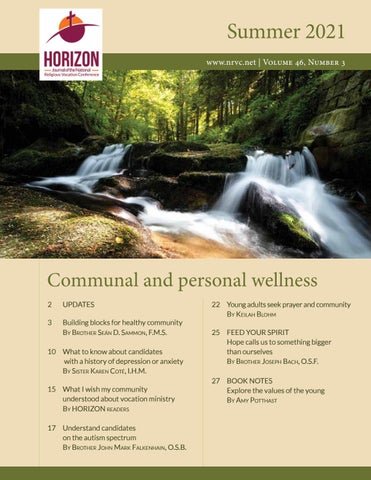
S A LAYWOMAN and a mother, my framework for understanding group dynamics is the family, which is a much different grouping than an intentional community of adults. Even so, there are parallels. One is that if the people making up a family are unwell, everyone will suffer. I think members of religious communities are acutely aware of this. If someone is depressed or anxious, it can set a tone of depression and anxiety throughout the group, especially if the person has a forceful personality. A reality of the human condition is that each of us is less than our best self sometimes, and some people’s best self just isn’t very well developed. Yet we’re glued to our families and communities by sacred bonds, for better or for worse. I like to think, however, that there is a dynamic like the waterfall on our cover: new life, motion, change within sameness. For religious communities, a significant help is the role model of Jesus Christ and his disciples, all of whom grew into their vocations. Thank you to our writers in this edition for their insight and wisdom about conditions that hold us back and move us forward. Some afflictions are lifelong and won’t change much, but others are malleable. May this edition of HORIZON help us mold ourselves and our community into something closer to the Kingdom so that we can better live our callings. —Carol Schuck Scheiber, editor, cscheiber@nrvc.net HORIZON is an award-winning journal for vocation ministers and those who support a robust future for religious life. It is published quarterly by the National Religious Vocation Conference. NATIONAL RELIGIOUS VOCATION CONFERENCE BOARD Sister Mindy Welding, I.H.M. Board chair Father Adam MacDonald, S.V.D. Vice chair Sister Belinda Monahan, O.S.B. Vice chair Sister Marichui Bringas, C.C.V.I. Sister Jean Marie Fernandez, R.G.S.
Sister Virginia Herbers, A.S.C.J. Father Charles Johnson, O.P. Sister Lisa Laguna, D.C. Sister Kristin Matthes, S.N.D.deN. Brother Brian Poulin, F.M.S. Mr. Len Uhal Sister Deborah Borneman, SS.C.M., Ex officio
Summer 2021 | HORIZON | 1
Updates dia Association (formerly Catholic Press Association). Awards went to: Best In-Depth Writing, HORIZON “Walking with jovenes who are discerning their vocation,” by Sister Ana Cecilia Montalvo, F.Sp.S., Third Place Best Website Magazine Or Newsletter, VISION VocationNetwork.org, Honorable Mention
Father Raymond P. Carey, Ph.D., psychologist and renowned presenter, will be teaching Behavioral Assessment workshops at the NRVC Fall Institute.
Join us for in-person learning at our Fall Institute in St. Louis The next opportunity for NRVC vocation ministry workshops will be at the in-person Fall Institute, to take place in St. Louis, Missouri October 5-19. Learn more about Fall Institute at nrvc.net. For details about the possibility of using Misericordia Scholarships to attend workshops, contact Sister Charlene Herinckx, S.S.M.O. at srcharleneh@nrvc.net or 503-805-6201. Behavioral Assessment 2 October 5-6, 2021 Behavioral Assessment 1 October 8-10, 2021 Orientation Program for New Vocation Directors October 12-16, 2021 Navigating Uncertainty with Young People
October 19, 2021
Accolades for HORIZON and VISION HORIZON and its sister publication, VISION Vocation Guide, once again earned honors from the Catholic Me-
2 | Summer 2021 | HORIZON
Best Reporting On Vocations, VISION “Our newest religious possess an age-old Christian virtue: hope,” Honorable Mention
Mark your calendar for NRVC's 2022 convocation Be sure to save the date and prepare your budget for the November 3-6, 2022 Convocation of the NRVC. It will take place at the Davenport Grand Hotel in Spokane, Washington and be hosted by the Pacific Northwest Member Area with a theme of “Call Beyond Borders.” NRVC.net will carry details as the date draws closer.
Free event listing on VISION website; order copies of latest edition The VISION online calendar allows religious communities to post their events so they can be seen by VISION's website audience, that is, men and women considering the possibility of religious life. Events can be either online or in-person and provide opportunities for service, education, reflection, or discernment. Visit vocationnetwork.org/events. Tip: some inquirers prefer to get familiar with a community in a no-pressure, non-vocation setting, so all types of events are encouraged. The next edition of VISION will be released in August 2021; order copies and bookmarks at: vocationnetwork.org/en/orders. n
Updates
Courtesy of CatholicIreland.net
No matter what community a brother, sister, or priest lives in, a harmonious way of life requires skill and effort.
The issues of life together challenge men and women religious. We can find ways to establish communities that are life-giving for both new and old members.
Building blocks for healthy community
S
INCE VATICAN II, community life has posed a challenge for many women and men religious. Prior to the council, rigid structures and antiquated rules governed life together. Communities, in general, were large, institutional, and closed off from the world around them. Little opportunity existed for personal expression; skills that might foster adult living were hard to find. Vatican II changed all that. Religious congregations were asked to examine their structures and make necessary changes. In response to this directive, innovative living situations began to emerge. Determined to live among the people whom they served, a number of brothers, sisters, and priests moved out of their residences, convents, and rectories and into neighborhood homes and apartments. In time a new phenomenon began to emerge: religious living in households of one or two members. This development was understandable. More than a few religious, serving in a ministry distant from any congregational house, had to find local accommodation. Others were forced to live alone or in smaller groups as parishes and dioceses repurposed Sammon | Healthy Community
By Brother Seán D. Sammon, F.M.S. Brother Seán D. Sammon, F.M.S., is currently scholar in residence at Marist College in Poughkeepsie, New York and novice director for his U.S. province. Prior to these appointments, he served his congregation as superior general and vicar general. A licensed clinical psychologist, he has published numerous articles and several books examining the interface of faith and social science.
Summer 2021 | HORIZON | 3
traditional community housing. Still others, after years of living in situations where they had little control over their lives, wanted to take advantage of their newfound freedom. Fast forward 50 years. Many in an aging population of religious now find themselves unable to live independently. Consequently they Young people looking have little choice but to move to communities that can proat religious life today vide healthcare and other serpoint out that life vices. However, for some the together is one of move from independent to the most important community living with neceselements they seek. sary institutional structures They have little has not been easy. interest in living alone At the same time, brothand are eager to share ers, priests, and sisters livtheir lives with others ing in small groups want to ensure that their communion a day-to-day basis. ties are life-giving, built on principles of faith and zeal for ministry. They realize that similar to a friendship or good marriage, community life requires that we respect those with whom we live, make sacrifices for the common good, and work toward consensus. Finally a new generation of young people looking at religious life today point out that life together is one of the most important elements that they seek. They have little interest in living alone and are eager to share their lives with others on a day-to-day basis. The type of community that these young men and women seek, however, differs in structure from those that existed in years past. For many of them qualities such as predictability, punctuality, and regularity are not as important as the quality of relationships that exist among those in the group. Wanting to promote a level of exchange that moves beyond the superficial, they are keen to talk with others in the community about their emotional life and experience of God. Some wonder how best to express their feelings of affection and care, their doubts and preoccupations. For many of them physical presence at prayer is less of a concern than the preparation that has gone into the service, the manner in which it is carried out, and the ability of those in the group to adapt. The issue of life together, then, continues to present a challenge for women and men religious. They must find ways to establish communities that will be life-giv4 | Summer 2021 | HORIZON
ing for both long-standing and new members. Let’s look at ways to address that challenge.
Different understandings about what constitutes a community Today there are many understandings about what constitutes a community. Some insist that numbers are unimportant; a person living alone can be connected to a wider community of people. Life under one roof, they say, is not necessary. Others have perfected the art of living alone together. They share physical space with others in the same house but might as well be living on their own. In these communities there is little interaction among members, most of whom live rather independent lives. Then there are those who insist that they will no longer live with difficult people. In their search for an ideal community, however, these men and women fail to realize that, just as there are no perfect families, problem free communities simply do not exist. Still others adopt a legalistic point of view when discussing life together. They cite articles from the constitutions and statutes of their congregation when addressing the issue. By their way of thinking, attendance at prayer and meals fulfills their obligation to the people with whom they are living. Some also wonder if community life has any witness value today or whether dealing with the obvious intergenerational and intercultural differences that exist in many groups is worth the effort. Amid these competing definitions of life together, just what do we mean by the term “community”?
Community defined To answer this question, communities must admit that the topic of community life is rarely on the agenda during initial formation. Rather this assumption is made: if they were able to live in a family, they can live in a community. But religious communities are not families. Families include people of unequal status—parents and children. In contrast, religious communities are made up of adult women and men who have come together to live the gospel. The skills needed to live in a family differ from those necessary to live in a community of adults. Second, a community does not magically become a reality through the observance of rules governing life together. Hard work is needed to build one. All people have days when they are not at their best. However, for Sammon | Healthy Community
Redemptorist Renewal Center
“Celebrating over 50 years of Retreat Ministry ”
anyone to subject their community to a steady diet of bad days is not only unjust, it has implications for the group’s ability to construct a life that will support the ideals that it holds dear and to foster vocations. Communities must work daily to repair damage done to community life and to lessen the frictions that inevitably occur. Each member of the community has a responsibility to live in such a way that the spirit of joy that should mark their way of life is evident to all. At the same time, any community in which anyone has ever lived has been flawed. We know only too well that neither we nor those with whom we live are perfect. The admission that many aspects of life together can lead to hurt feelings and disappointments is understandable. Day-to-day disagreements are sure to arise, and those with whom we live often fail to meet our expectations. As a consequence, a spirit of reconciliation must also lie at the heart of any community today that claims to be Christian and religious. Perhaps, then, one of the most honest ways to define community is to say that it is an affair of the heart. While structures are necessary, community is more of an attitude than a place. Life together with sisters and brothers should challenge each member to formulate and nurture a loving heart. Without one, each member may survive but never flourish in community.
Community and discipleship At the time of Baptism each Christian enters into that community of disciples known as the church; at first profession men and women religious go a step further, pledging to find their identity and destiny among a specific group of disciples within the People of God. Like Mary, they are challenged to let Christ be the center and passion of their lives and the life of their community. Their identity as disciples of Christ lies at the heart of their life together as brothers and sisters. Religious life, like all forms of Christian life, is a quest for God, a God who is love. It is easy to point to many aspects of life together that are unattractive. How much more difficult, though, to acknowledge that being called together by God is what transforms life in community into a moment of grace.
Community and mission are friends Communities, then, come into existence so that they can live the gospel and proclaim the Word of God; their primary mission is to love God and to make God known Sammon | Healthy Community
7101 W. Picture Rocks Rd, Tucson, AZ 85743 USA Phone: 520.744.3400 Email: office@desertrenewal.org www.desertrenewal.org
Contemplative Study and Sabbatical Program The demands and expectations of full-time ministry are both rewarding and fulfilling; however, it is important to take time to rest & renew. The Sonoran desert allows you to seek the silence and space necessary for spiritual renewal. Since ancient times people have gone to the desert to encounter God. Come and experience desert spirituality in a contemplative environment that will make for a truly unique Sabbatical experience.
2021
October 3— December 10
2022
March 6 —May 13 July 17—August 19 August 21—September 23 (SPA) October 2— December 9
HESYCHIA SCHOOL OF SPIRITUAL DIRECTION
January 30 - February 11, 2022 Week 1 & 2 March 27 - April 8, 2022 Week 3 & 4 The HSSD program focuses on the ancient art of Christian Spiritual direction in a multifaith context and offers contemplative study and practice to prepare clergy and vowed religious for a ministry of spiritual direction.
Summer 2021 | HORIZON | 5
TYPES OF COMMUNITY
S
ocial scientists have identified three different types of communities: intentional, bureaucratic, and associationstyle. Only the first provides a suitable model for religious community life.
Intentional In an intentional community, I freely commit myself to live, work, pray, and relax with a specific group of people. They may make extensive demands on my time, talents, and energy. Common practices and traditions mark the life of the group as well as a spirit of sacrifice and mortification. While consultation occurs, the community’s transcendent mission takes precedence over my needs and those of the other members. Those with whom I live have a claim on me; they know that they can count on me.
Bureaucratic In contrast, bureaucratic communities are often impersonal in nature. Members fail to put their hearts and souls into the challenge of living and working together. Tasks are divided, a set of rules exists, and often enough the worth of community members is measured by their ability to carry out specific roles and assigned work. However, little genuine interaction takes place. The authority structure of these groups is usually hierarchical in nature with some members taking little personal initiative. They look to the leader to do for them what they could do for themselves. There are a number of reasons why bureaucratic communities continue to exist. Some feel overwhelmed by community life or lack the skills necessary to cope with a diverse and challenging group of adults living together physically. Consequently, they choose to co-exist with those with whom they share the house. With what results? Loneliness, irritability, and ongoing disappointment. Others face the problem of activism. Stretched thin in ministry, they return to a community with little energy or interest in participating in the life of the group. In bureaucratic communities members survive but their human and spiritual diet is pretty meager.
Association-style Finally, an association is a group of people who come together around a common cause or purpose. Little commitment is required and members are only marginally involved in the lives of one another. Alumni organizations or groups such as Toastmasters fall under this heading. In this type of community, life together has a low priority in the hierarchy of what is important. Members are free to participate in what interests them; they can come and go as they please. Many associations are short-lived; they exist for a time and then pass out of existence.
6 | Summer 2021 | HORIZON
and loved. Little is accomplished today by continuing to rank community and mission in order of importance, or in asking time and again, which one has the greater claim on the time or talents of members. Balancing a life of action and contemplation is always a challenge. Remember, however, that community and mission are two sides of the same coin. Simply living together can never ensure that a community exists, nor does a common work, nor an agreed upon plan for community living. These elements might help but they can never guarantee a community. Likewise, reluctance to place discipleship at the heart of life together has caused many communities to entertain poorly analyzed, cosmetic, and ultimately ineffective solutions for the difficulties encountered in community life.
Evolution of a religious community Every religious community undergoes a process of evolution from the time its members first gather until it comes to an end (an “end” because the members are different people). E nds happen due to departures or additions. The first phase involves the experience of simply coming together. Subsequent phases include: • working out differences among members, • establishing norms for the group, • getting on with the tasks of living and serving together. For most of the first phase in the life of any community is a period of orientation. Members find themselves in an unfamiliar situation and need time to get their bearings. They are also on their best behavior. They size up one another and wonder if they will be liked, rejected, respected, or ignored. If members are feeling anxious and uncertain, they can easily start comparing their new living situation with the one they left recently. During this first phase, the veteran members of the community need to be careful not to spend all their time discussing people and events with which they alone are familiar. If they do, those new to the group need to point out what is happening, or they run the risk of finding themselves increasingly excluded from day-to-day conversation. The task of drawing up a plan for life together is often addressed during this forming period. Even if the community developed a plan the previous year, its details should be discussed and renegotiated. Such action is imperative whenever the membership of the community changes. With every departure and each addition, a new Sammon | Healthy Community
Courtesy of the Midwest Augustinians
Sometimes community members are completely in step with each other, and sometimes they are not. The inevitable disagreements that emerge in communal life must be negotiated well.
community forms and is in need of beginning again. A helpful way to describe the second phase in the formation of a community is that of “working out differences.” After the group has lived together for a time, attention shifts from concerns about acceptance and approval to issues of dominance, power, and control. “Oughts” and “shoulds” begin to appear, negative comments and criticisms are more frequent, judgments about others emerge. For growth to take place beyond the first phase of coming together, members must be able to disagree, even heatedly at times, and to resolve their differences in a mutually acceptable manner. Unfortunately, false notions about what the virtue of charity entails have rendered many members incapable of telling the truth. Instead, they remain silent to keep the peace. The virtue of charity is practiced when one person speaks the truth out of respect for the other. Members do so whether that truth is good news or bad. They don’t have to tell all the truth, at least as they see it, at any one time, but charity requires that they speak the truth. It is far more useful, for example, to respond to a fellow sister, priest, or brother honestly during a community meeting than to spend the next week telling everyone else what was on one’s mind. The first response is adult, the second patronizing. Likewise, remaining silent and allowing a person who is angry, withdrawn, or abusing alcohol to control the community with his or her behavior has little to do with gospel living. In failing to take action, those who make up the group eventually become crippled. Learning Sammon | Healthy Community
to disagree and resolve differences are skills that can be acquired. And learn them the community must. What alternative do they have? To wring their hands in despair about the state of the local community? Such behavior, as we well know, will do little to change the quality of life within the group. During this second phase, the community leader often becomes the focus of criticism. Previously viewed in a positive light, his or her limitations are now a topic for discussion. A struggle for control on the part of some also may be evident during this second phase, with a few members testing their influence on the group, usually in subtle ways. Others may try to establish a hierarchy of importance among community members based on age, academic degrees, a progressive or traditional attitude toward religious life and its renewal, or other criteria. This second phase of development is an uneasy time in the life of any community. A fear of conflict and an unwillingness on the part of some to accept the differences that exist among the group’s members can cause them to surrender all responsibility to a strong leader. Consequently, many decisions that need to be made collegially are simply evaded. When this occurs, the growth of the group is hindered. Communities that move successfully through the phase of working out differences develop a quality called cohesiveness. A community spirit emerges; cooperation, mutual support, and a sense of unity are evident. Having decided to come together around common goals and agreeing that it is safe to disagree, community members Summer 2021 | HORIZON | 7
are ready to establish norms for the group. They can speak honestly about their hopes and disappointments and arrive at a consensus about the details of their life together. Finally, having passed through the phases of coming together, working out differences, and establishing norms, the community will arrive at the last phase in its initial develHaving laid a solid opment: getting on with foundation for life the task at hand. What together, we are exactly does this phase now able to live out entail? Having laid a solid honestly the day-tofoundation for life today realities that any gether, they are now able to live out honestly the group must face. day-to-day realities that any group must face. All will proceed well if respect for others in the community is cherished and right relations are encouraged.
Traits that foster life together Just as communities pass through predictable phases of growth, there are also personal traits that make it easier for an individual to live in a group. Those in formation would do well to help young people develop some of these qualities. The first is flexibility. When a community has members who are rigid and inflexible, issues of power and control often become a problem for all involved. In contrast, flexibility on the part of community members allows them to “roll with the punches,” adapt quickly to new realities, and to live with uncertainty. A healthy sense of self-esteem is a second trait that comes in handy when living in community. Those with this trait are at home with themselves; they appreciate their strengths, accept their faults; they see themselves as others do. Dependability is a third trait. People are reluctant to rely on those whom they judge as undependable. Consequently, a disproportionate amount of the group’s work falls on a few. Having an ability to relate to others is another helpful trait. Those who possess it are able to form close relationships while maintaining their own autonomy; they don’t isolate themselves. Others see them as agreeable and friendly. Finally, an ability to control impulses and delay gratification and a spirit of resiliency are additional traits that help anyone live in community. They allow one to tolerate the inevitable frustrations that can arise as 8 | Summer 2021 | HORIZON
the group works to achieve larger and more long-range goals. Those without resiliency focus on the inherent unfairness of life or injustices that they believe they have suffered. Their ability to cope is quite limited.
Qualities found in a healthy community Just what does a healthy community look like? While each group is unique in composition and focus, lifegiving communities share six characteristics. 1. Centers of faith and spirituality They are centers of faith and spirituality; the gospel message of Jesus Christ lies at their heart. When visitors leave after time with the group, they are aware that they have been among people who pray. 2. Aware of influence of family of origin In a healthy community, members are aware of the influence of their family of origin. When men and women come to religious life, they bring their families with them. Not physically, of course, but in terms of their outlook on life, the traditions that they hold dear, the rules by which they live, and the idiosyncratic behaviors that make each family unique. Tasks such as managing money, planning a menu for the week, agreeing upon a level of cleanliness for the house, even trimming the Christmas tree can become flash points as each member remembers how these jobs were managed at home. The more members can remind themselves that the way they carried out these tasks in their family constitutes but one approach, the better they will be able to live harmoniously with others in the group. Somemembers, however, might also come from families that faced serious challenges such as addiction, abuse, and violence. Those who found themselves in any of these situations often bring to community these four rules: denial, silence, rigidity, and isolation. While these four rules might have helped them to survive childhood, they are impediments to healthy adult living. Being aware of their presence is the first step on the road to recovery. Courageously addressing the origin of each and changing our ways of acting will help us to adopt behaviors that are more life-giving. 3. Practice the “little virtues” They practice the “little virtues.” The way in which tasks—such as answering the door or phone, taking out the garbage, making sure that dishes are not left in the sink—are managed can either add to the stress found Sammon | Healthy Community
4. Active concern for members They have an active concern for the people with whom they live. One member of the community might have sole responsibility for a mother who is aging, another a niece who is passing through a difficult time in her life; still another may be dealing with a physical illness or a life transition or difficulties at work. They show genuine concern. They are supportive to others as they deal with these challenges. At the same time, they never fail to celebrate those moments of hope and of joy that are also a part of life.
courtesy of Sisters of Providence of Saint-Mary-of-the-Woods, Indiana
in a community or lessen any tension that might exist. Whenever a group lives together, several jobs need to be done to ensure the well-being of the community. These jobs must be shared by the members of the group. Identifying and addressing them is a good rule of thumb.
Small courtesies and acts of caring go a long way toward building a community with low stress.
5. Have a sense of humor Members cultivate a sense of humor. On one occasion or another, people can take themselves all too seriously. They need to learn to be able to laugh at themselves and appreciate those funny moments that occur regularly whenever a group of people lives together. Humor at one’s own expense is always appreciated; one can never hesitate to value the importance of humor in community life. 6. Prioritize a spirit of reconciliation Members ensure that a spirit of reconciliation is at the heart of their life together. If they cannot ask for forgiveness and, in turn, forgive others, a community has no right to call itself Christian and religious. Holding on to anger, refusing to talk with someone, nursing feelings of bitterness—none of these behaviors belong in a religious community made up of adults. Members must learn to forgive whatever was done to them because they value the person who did it as well as the relationship they share. Reconciliation entails a process wherein people choose not to let the hurt they have suffered get in the way of continuing their relationships. They decide to respond to whomever has hurt them rather than hold Sammon | Healthy Community
on to their pain. The relationships that one member has with others in the community are far more important than any slight that he or she might have suffered. In a healthy religious community, forgiveness is a habit and reconciliation no stranger. Our world longs to welcome communities of adults who embrace their interdependence, center their lives on the transcendent, and create spaces where young and old can live together. Let us pray that, as with the early Christians, life in religious communities of the 21st century will cause others to say, “See how they love one another?” n __________________
Related articles “Craft authentic community,” by Sister Ruth Anne Harkins, I.H.M., HORIZON 2017, No. 4, Fall “Signs of readiness for community life,” by Father David Couturier, O.F.M.Cap., HORIZON 2017, No. 4, Fall “Questions we must ask to build strong communities,” by Sister Patricia Wittberg, S.C., HORIZON 2013, No. 2, Spring Summer 2021 | HORIZON | 9
Adobe Stock
Depression and anxiety are part of the human experience. As a vocation director, it’s critical to know when a candidate is presenting a problem that is potentially debilitating or talking about a transitory low period.
What to know about candidates with a history of depression or anxiety By Sister Karen Coté, I.H.M. Sister Karen Marie Coté, I.H.M., is a member of the Sisters, Servants of the Immaculate Heart of Mary, Immaculata, Pennsylvania. She holds a doctor of psychology degree, is a licensed psychologist, and serves as the director of outpatient services at St. John Vianney Center. Along with overseeing the daily operation of the department, she conducts psychological assessments and psychotherapy for priests, deacons and their spouses, and men and women religious.
10 | Summer 2021 | HORIZON
I
N OUR 21ST CENTURY CULTURE, anxiety and depression are common words. People say, “I am depressed today,” or “I am anxious today,” in everyday conversations, especially among younger people, that is, the Millennials (born between 1981-1996) and Gen Z (born after 1996). When are these phrases to be taken lightly, and at what point are they a concern? If an individual is discerning religious life, we want to take into account their mental and spiritual well-being. Vocation directors may encounter a variety of individuals who express interest and desire to enter their community. It falls to them to gather all the pertinent information, assist with a prayerful discernment, see to a psychological assessment, and recommend an individual to their congregation’s leadership. Vocation directors may interview individuals who express anxiety, depression, or both in their conversations. At what point could anxiety or depression hinder the individual’s participation in the disCoté | Depression or Anxiety
cernment process, participation in community life, and move deeper into the person’s spiritual life? There are no simple answers, but knowing more about these two mental health conditions and considering some case studies can provide a nuanced framework from which vocation directors can make more confident decisions.
Depression comes in different forms Everyone, from time to time, feels sad. However, unlike sadness, time cannot heal major depressive disorder (clinical depression), a serious and persistent form of depression, which can wax and wane over a lifetime. It causes severe symptoms that affect how one feels, thinks, and copes with daily activities such as community interaction and ministry. Symptoms may include persistent sadness, anxiety, hopelessness, feelings of guilt, loss of interest in pleasurable activities, fatigue, difficulty concentrating and making decisions, insomnia, excessive sleep, changes in appetite or weight (gain or loss), and thoughts of suicide. A diagnosis of clinical depression takes these symptoms, their duration, and more into account. The National Institute of Mental Health reports that major depressive disorder is one of the most common mental disorders in the United States. Certain circumstances put individuals at higher risk for major depressive disorder. For instance childhood trauma (sexual, emotional, or verbal abuse, etc.) increases risk, but no one knows for sure what causes clinical depression. Many times you hear that depression is the result of a chemical imbalance (having too little or too much of a certain brain chemical). However, there are many other possibilities, including genetic vulnerability, medical issues, medications, and major life events that can trigger someone who is genetically predisposed. Clinicians recognize that several of these dynamics can interact, triggering clinical depression. It is highly likely that if an individual has experienced one major depressive episode, they will eventually experience another. The Diagnostic and Statistical Manual of Mental Disorders 5th Edition (DSM-5) rates for major depressive disorder among males and females are about equal before puberty, but starting in early adolescence, the rates for females is 1.5 to 3 times that of males. The peak age of initial diagnosis is around mid-20s, but the course, number of episodes, and likelihood of full recovery vary. Initial episodes are usually triggered by exposure to a stressful life event; but, as the number of previous episodes increases, the recurrence Coté | Depression or Anxiety
VOCATION DIRECTOR MUST-KNOWS • Do not disregard mental health as outside your expertise as a vocation director. You are not a clinician and cannot diagnose, but you should observe and gather information. • Once your relationship with a candidate has developed to the point where it is appropriate, ask about episodes of depression and anxiety, whether or not there is evidence of them now. • If the candidate has had experiences of depression or anxiety, ask about the circumstances, duration, frequency, and treatment. • It is crucial to share information you gather (with the candidate’s knowledge) with the professional who conducts a psychological evaluation. You are not creating bias; you are helping the psychologist fine-tune the assessment in order to provide you with the highest quality information.
of additional episodes is related more to the number of prior episodes than to the presence of a life stressor. On the other hand adjustment disorder with anxiety and depressed mood (situational depression) follows a significant and unwanted change in an individual’s life, such as a serious accident, ministry loss, or some other life change. Adjustment disorder often resolves in time. Participating in didactic (talk) therapy with a professional, with or without medication, can help facilitate the recovery process. Recovery is likely once the individual accepts the new situation. It is important to understand that depressive disorders can be active, or the disorder can be recurrent or in remission. Symptoms related to the disorder can be mild, moderate, or severe. These differences are critically important. For instance, if an individual is experiencing a major depressive disorder with severe and recurrent symptoms, they most likely will have difficulty keeping up with the daily demands of community life and ministry. However, someone else who experienced a loss or transition and is diagnosed with an adjustment disorder with depressed mood with mild to moderate symptoms, may be able to deal sufficiently with the daily demands of community life and ministry. As noted above, depression is characterized by a core set of symptoms, including low mood, lack of motivation, lack of interest in things once enjoyed, sleep disturbances, and changes in appetite. Most people with depression experience some of these symptoms but may Summer 2021 | HORIZON | 11
not have them all. Gender can be a contributing factor. It has long been thought that men and women experience and express depression differently. Men are more likely to misuse alcohol, have frequent outbursts or “explosive” anger, engage in risk-taking behavior, or play video games for hours. On the other hand, women are likely to have difficulty concentrating or making decisions, feelings of worthlessness, chronic pain, or episodes of excessive crying. These different forms of expression do not mean the disorder can be separated into two distinct types of depression (one for men and one for women). There are no clear differences
between genders in symptoms, course of illness, and treatment. While not classified in the DSM-5 as a depressive disorder, bipolar disorder is worth a brief mention. There are two types of bipolar disorder, I and II, with I being more severe. Heredity is the primary contributor to bipolar disorder, and a family history of either form of bipolar is one of the strongest predictors of risk, with the level of risk increasing with the degree of relationship. Bipolar disorder is characterized by extreme mood swings, from symptoms of depression to symptoms of mania. Mania involves a distinct period of abnormally
CASE STUDY: SISTER M
S
ISTER M is a Millennial who is now in temporary profession. She, like other case studies here, is a composite, based on many years of experience in treating newer members of religious communities. During her initial discernment phase, she shared with the vocation director that she was often tearful but was not sure what brought on the tears. She did not have friends with whom she felt comfortable sharing intimate thoughts and feelings and never dated in high school or college. In the vocation director's behavioral assessment the director wrote that Sister M was bullied and teased in school for being too sensitive, but Sister M’s lack of intimate relationships wasn't noted. Sister M has been associated with the community for a number of years, starting from her discernment phase to what is now her second year of temporary profession. These last two years have been very stressful for her. Sister M felt she was given too many community responsibilities on top of a demanding ministry. She found it too stressful for her, especially during temporary profession. During her initial psychological evaluation, Sister M reported a number of personal strengths but also reported what she considers personal limitations such as being shy, too sensitive, too easily stressed, and neglecting her prayer life when she has too much to do. Her psychological testing indicated that she tends to be vulnerable to episodes of depression and anxious rumination over her lack of selfconfidence and inability to meet her own expectations, causing a vicious cycle of self-criticism and anxiety. This cycling appears to be significantly problematic for her, causing emotional pain. Her stress paralyzes her ability to make decisions. Given that she sets high standards for herself and has a strong need to achieve, she likely feels she falls short of her own expectations. The assessment also indicated that Sister M lacks self-confidence, feels insecure,
12 | Summer 2021 | HORIZON
and overall feels dissatisfied with her life. The vocation director and the congregational leadership reviewed the relevant material, and all agreed to accept Sister M into initial formation with the understanding that she would have a growth plan that would include working on assertiveness. During her postulancy, Sister M completed all the tasks asked of her, such as household responsibilities, part-time ministry, and faithfulness to her prayer life. However, she seldom came to the community room, except when required to do so. She spent much of her spare time on the computer, which she reported was related to candidacy classes. She had few connections with the other sisters even within her cohort. Looking back to Sister M’s discernment phase and initial formation, there were warning signs. Remember, in Sister M’s background she herself noted having few friends and being very shy. Was Sister M depressed prior to entering initial formation? Most likely, yes, and her psychological evaluation indicated that she was vulnerable to depressive episodes. Her discernment phase would have been a good time to inquire about her lack of friends and why she felt shy. These areas raise concerns that warrant further investigation. Counseling would have been appropriate during her discernment and novitiate to flush out any other issues. Sister M was given permission to enter into temporary vows. She complied with all community responsibilities, but again was only present for community events that were required and nothing more. During temporary vows, she became more withdrawn and anxious and less selfconfident. She exhibited signs of depression. Counseling during her earlier years in formation likely would have helped her understand the connection between her lack of self-confidence, anxiety, and depression. It could have helped her and her community have a better experience.
Coté | Depression or Anxiety
Federico Respini, Unsplash
and persistently elevated, expansive, or irritable mood and persistently increased activity or energy. These symptoms can impair function and even require hospitalization to prevent harm to self or others.
Variations on anxiety Anxiety is a normal reaction to a stressful event, and in many cases anxiety is useful in motivating an individual to make a necessary decision and act. However, when symptoms become persistent and debilitating to the point where they disrupt an individual’s life, it is time to seek help, as the symptoms likely indicate an anxiety disorder with underlying depression. It is not uncommon for someone to have both depression and anxiety. Usually the two go hand-in-hand. The DSM-5 lists six different anxiety disorders: generalized anxiety disorder, panic disorder, phobias, agoraphobia, social anxiety disorder, and separation anxiety disorder. For the purpose of this article, I will focus on general anxiety disorder. As defined in the DSM-5, generalized anxiety disorder is excessive anxiety and worry about a number of events or activities. The intensity, duration, or frequency of the anxiety and worry is out of proportion to the actual likelihood or impact of the anticipated event. The person finds it difficult to control the worry and to keep worrisome thoughts from interfering with concentrating on the tasks at hand. Similar to rates of depression, women are twice as likely to have an anxiety disorder as men. While some symptoms of anxiety between genders may differ slightly, for the most part men and women share the same symptoms of anxiety. According to the 2020 Deloitte Global Millennial Survey, a surprising 44 percent of Millennials and 48 percent of Gen Zs reported feeling anxious and stressed more times than not. In terms of gender breakdown, women experienced more stress than men. Among the different age groupings, some 47 percent of females to 40 percent of males among Millennials and 53 percent of females to 42 percent of males among Gen Zs felt anxious and stressed. In the same survey, half of the Millennials and Gen Zs surveyed believed stress was a valid reason to take time off from work. Of interest, one in three of the young people surveyed took time off from work this past year because of stress. The physical and emotional burden of anxiety not only affects time away from ministry but also ministry performance.
Coté | Depression or Anxiety
Sometimes therapy and medication can bring about a new day for individuals with depression and anxiety. But each case is unique, and not everyone with these conditions can be in a religious community.
Seeking help, determining readiness Generally speaking, a counselor provides advice for clients after evaluating them over time. Counselors may refer clients to psychologists for more in-depth, insightoriented psychotherapy, which was likely needed in Sister M’s case, [see “Case Study: Sister M” on page 12.] However, such insight-oriented psychotherapy can be a distraction in formation, drawing the applicant away from community activities and prayer. Thus issues of depression and anxiety are best addressed in counseling and psychotherapy prior to formation. So what is the next step in examining readiness for formation? How does a vocation director determine who should be recommended to leadership to move forward in formation—especially if there are warning signs in the discernment phase and in the recommendations of the psychological assessment? What is the comfort level of the community in receiving an applicant into formation who has experienced anxiety or depression or both? A number of issues need to be taken into consideration. For instance, does the applicant have a history of depression? If so, what type of depression, and who did the diagnosis? Is the person currently on medication, and if not, was he or she on medication in the past? Was the person in counseling or psychotherapy or only on medication? Here is a plausible scenario. An applicant appears ready to move forward into candidacy, and the vocation director schedules the psychological assessment. The ap-
Summer 2021 | HORIZON | 13
CASE STUDY: BROTHER Z
B
ROTHER Z, AGE 23, discloses he had an abusive childhood. Three years prior to entering into discernment with the community, he was diagnosed with depression. He shared with his primary care physician that he was experiencing frequent outbursts and “explosive” anger and lost interest in many things he used to enjoy. His doctor prescribed an antidepressant and suggested counseling. After about four weeks, Brother Z started feeling better, thus he did not believe he needed counseling or therapy. He remained on the medication for approximately one year. During the discernment phase applicant Brother Z shared his history with the vocation director that he had taken an antidepressant for about one year and has not had a recurrence of symptoms. The community decided to allow him to enter. He was fine for three years, but after temporary vows he started having outbursts in community and lost interest in his prayer life, community life, and ministry. Subsequently, the community asked him to seek out insight-oriented psychotherapy, which he eventually did. An important lesson learned here is that the information concerning his depressive episode should have been shared with the testing psychologist so that it could have been ascertained whether the depression was situational or genetic.
plicant then tells the vocation director she was depressed during high school and again in her first two years of college. She reports that she is currently on medication. First this information needs to be shared with the testing psychologist. It is valuable for the clinical interview and will help the psychologist determine what additional testing is needed to assess her current emotional wellbeing. The vocation director needs to know what type of depression the applicant experienced. Was it situational depression, or does the applicant currently have a diagnosis of bipolar disorder or major depressive disorder? If the clinical interview and the testing indicate bipolar disorder or major depressive disorder, the vocation director needs to know if the applicant is taking medication as prescribed. Research by the National Institutes of Health indicates that upward of 60 percent of individuals diagnosed with bipolar do not take their medication as prescribed. Medication non-adherence can lead to negative outcomes such as hospitalization, relapse, functional impairment, or suicide. Similar research indicated that individuals diagnosed with major depression were 10 to
14 | Summer 2021 | HORIZON
60 percent medication non-adherent, also with similar negative outcomes. While an applicant believes he or she has a calling to the charism of the community, the vocation director and the community need to assess the liability. Additionally, they need to determine whether the applicant can keep up with the demands of ministry and community life as stress and anxiety are known triggers for bipolar episodes. Let’s consider another scenario. An applicant preparing to enter candidacy or postulancy shares with the vocation director that during his freshman year he was diagnosed with “adjustment disorder with anxiety and depressed mood.” He reported that social media bullying led to his depression and anxiety. He was on medication for a brief period and sought out counseling at the college counseling center. He denies having suicidal thoughts at the time of the bullying. Again, this is vital information to share with the testing psychologist. The psychologist can assess whether or not the applicant has dealt with the issues that led to the situational depression and if there are any residual side effects. If the applicant’s issues have been resolved, it is likely that he could be accepted into candidacy or postulancy. Looking at the overall picture of depression and anxiety among the young people who seek out religious life, a number of different diagnoses might be involved. A vocation director, in discernment with the applicant and in the behavioral assessment, needs to assess if an applicant has experienced either one or both of these common mental health concerns, either in the past or currently. Depression and anxiety can be debilitating. Both of these mental health concerns are no fault of the individual as they are genetic and/or situational and often triggered by environmental events. But religious communities need and want individuals who can be in ministry to others and not have an individual who becomes a ministry for the community. Certainly the vocation director’s analytical and pastoral skills will be put to the test when good candidates who suffer from depression and anxiety present themselves. Compassion and prudence must both be at play as the vocation director proceeds with caution and understanding. n ________________________
Related article “The essential facts about depression,” by Sister Mary Ellen Moore, S.H., 2005 HORIZON No. 3
Coté | Depression or Anxiety
Priscilla Du Preez, Unsplash
All religious need to be part of the process of vocation awareness, presence, invitation, and accompaniment. This is the most common message that vocation directors want their communities to understand.
Vocation ministers to communities: You are part of this ministry. It’s sacred and complicated. Don’t ask us to quantify it, but know it has profound impact.
What I wish my community understood about vocation ministry
I
N MAY 2021 HORIZON asked the members of the National Religious Vocation Conference to answer one question: What do you wish your community’s membership understood about vocation ministry?
Most responses fell into these three categories. 1) Vocation presence, awareness, and invitation is everyone’s responsibility. This was by far the most common response. 2) Vocation ministry is a sacred, complex, and time-consuming ministry that deserves to be full-time because at heart it is about the slow process of building relationships. This type of more nuanced observation about the important nature and complexities of the ministry was the second most common response. 3) Vocation ministry is an important ministry to young adults, a service to them and to the wider church. Its focus is on helping young people discern their life’s calling. Entrance to our religious community or another is not the measure of this ministry’s value. This response was the third most common in the survey. What I Wish My Community Understood
Following are comments from respondents, none of whom are identified here so that readers might appreciate the larger truth in their words; many survey respondents were talking about larger issues that affect all communities, not just their own. The National Religious Vocation Conference thanks all who took part in the survey. Their dedication and wisdom shine through, along with their love for their communities and for the young people they feel privileged to accompany.
All members have a role to play • Vocation ministry is the responsibility of all of us, not just the responsibility of the vocation minister or vocation committee.
• We truly rely on membership for relational connec-
tions, for vocation outreach. We deeply need members’ engagement and intentionality in creating a culture of vocation and invitation.
• We can go to any number of events, but when I look
at who came to our online events this past year and who tends to stay most in contact, often they are women who have a connection with one of our sisters or one of our Summer 2021 | HORIZON | 15
ministries, or they come to us referred by someone with one of these connections. Sisters often feel in their retirement years that they don’t have many connections to young people anymore, but everyone has a relational network that can help build goodwill and awareness of our community and its charism. We never know when or where this will have a vocational impact!
• Ongoing recruitment is not just the responsibility of
the officially assigned vocation director but must be the welcomed task of each and every member.
• All members need to be involved, especially by their
faithful living of our vows and community relationships.
• It is important that everyone is welcoming. • Every single one of us is part of the vocation minis-
try team. It is through unique personal witness, joined with our communal witness, that women are inspired to “come and see.”
• Each member of the community should realize that
we are all called to vocation ministry. All of our preaching, relationships, ministry, way of life, attitudes, etc. contribute directly or indirectly to attracting vocations. If people do not see us as joyful and fulfilled in our own vocations, they will never be attracted to join us.
Vocation ministry is sacred, complex, and time consuming • Vocation ministry is very time-consuming, especially
following up with discerners and accompanying them on their journey.... Leadership does not understand the value of having the same sister (vocation director) consistently attend particular events. Consistency helps build relationships with the campus ministers and young adults they encounter.
• Not everyone is a good fit for our community. It is
really hard when a vocation director has to say no to someone. Out of respect for the individual, the vocation director will not share personal information. This can feel very isolating, and the vocation director needs the community’s trust and support.
• It takes time, and the women who are seeking to be a sister today are of different ethnicities, races, and backgrounds than in the past.
• A lot of time and effort goes on behind the scenes that 16 | Summer 2021 | HORIZON
members do not know about. The conversations, the time spent, the building of relationships in the name of the community.
• We must think about vocation ministry differently
than how it was done even just 25 years ago. Collaboration among communities and sensitivity toward a postCOVID world are musts.
Vocation ministry is an important ministry to young adults, a service to them and to the wider church and world • Vocation ministry assists in vocational discernment
of all kinds, and it serves the wider church, not just our congregation.
• Vocation ministry is not about recruitment but about
accompaniment. It’s not about simply getting more members to join the community but assisting and supporting young people in discovering their gifts, recognizing the needs of the world around them, and determining where they can most fully and authentically share their gifts in the service of others!
• Whether or not women or men enter, the vocation
minister is meant to be walking with them to find their journey with God and how they are called to build the world in love.
• Just as we dedicate our lives to ending hunger, poverty,
human trafficking, illiteracy, and so many other social sins, we are also called to accompany young Catholics who are seeking a deeper relationship with God and humanity. We don’t measure our ministry at the border by the number of people guaranteed a pathway to citizenship. It’s a ministry of presence and availability. Can we not approach vocation ministry from the same perspective?
• Vocation ministry is about supporting discernment of life choices; it is enlivened by a dynamic embrace of the whole of religious life.
• Often when speaking with teens and young adults,
our conversations are one of the first times they feel really comfortable talking about deep, spiritual life issues. Our society doesn’t always encourage or provide a venue for these conversations. Many in my community get this, but we all forget sometimes!
• Vocation ministry is significant to all young people, not only those who eventually choose religious life. n
What I Wish My Community Understood
Adobe Stock
Although they may very well belong to churches and other types of groups, people on the autism spectrum frequently display discomfort and awkwardness in social encounters.
Understand candidates on the autism spectrum
“I
DON’T KNOW EXACTLY what it is. I can’t quite figure out whether or not he likes it here. He says he does and he insists that joining our community is the only thing he wants to do with his life. But he doesn’t look very happy, and when he’s here on visits, he stays mostly to himself. At recreation, he tends to gravitate to the older guys and, even then, he’s not really interacting. Do you think maybe he’s just shy?“ In my work as vocation director for nine years, one of the psychological concerns that arose fairly regularly was discerning with men who had a history of Asperger’s disorder or what is now called autism spectrum disorder. In this article, I would like to talk a little bit about individuals with autism spectrum disorder and hopefully offer some guidance on two primary questions: (1) Is an individual with autism spectrum disorder appropriate for our community; and (2) Is our community appropriate for a young man or woman with autism spectrum disorder? The aim of this article is not to train you to diagnose autism spectrum disorder (that should be left to a mental health professional), but to help you better understand the primary features of the disorder, why affected individuals might be attracted to your community, and what questions might assist you in determining the appropriateness of your community for a young man or
Falkenhain | Autism Spectrum
The characteristics of those on the autism spectrum present challenges to religious communities.
By Brother John Mark Falkenhain, O.S.B. Brother John Mark Falkenhain, O.S.B., is a licensed psychologist and monk of Saint Meinrad Archabbey in Indiana. He served his community for a number of years as vocation director and assistant formation director, and is on faculty teaching psychology and human formation courses at Saint Meinrad Seminary & School of Theology. Brother John Mark lectures nationally and internationally on topics related to formation for religious life and priesthood. He worked for several years as a pediatric psychologist prior to joining his community.
Summer 2021 | HORIZON | 17
woman diagnosed with this psychological condition. Affecting close to one percent of the population, and four times more prevalent among males, autism spectrum disorder (ASD) is considered one of the neurodevelopmental disorders—“neuro” because it is known to be neurologically driven or brain-based and “developmental” because it is evident and therefore typically diagnosed in childhood. As the word “spectrum” suggests, there are many ways this disorder may present itself, A key question is: and these depend primarily on the severity of the condiWill this individual’s tion, which features are most challenges interfere prominent, and whether or significantly with not the individual’s intelparticipation in the lectual abilities and language prayer, work, charism, skills are impaired. As for and relationships of all psychological conditions, our community? whether or not the symptoms interfere significantly with the individual’s social, educational, or professional functioning is key in determining if a diagnosis is warranted. This notion of the symptoms’ effect on everyday functioning might be good to keep in mind when determining the fit of a person for your community: will this individual’s challenges interfere significantly with participation in the prayer, work, charism, and relationships of our community?
What is autism spectrum disorder? Autism spectrum disorder has two primary features: (1) challenges in social communication and social interactions and (2) restricted or repetitive interests, behaviors, and activities. Let’s look at these, plus some additional associated features more closely. Social communication and interactions Interacting with individuals who have ASD can be puzzling. You may observe that the normal back-and-forth character of social interaction (what we call “reciprocity”) tends to be absent or limited with a young man or woman with ASD. A question meant to communicate your interest in the individual (e.g., “So, how is your family doing?”) may yield an abrupt, one word response (“good”), rather than a reply that encourages further engagement (“They’re doing really well, thank you. And how about your family? How are they doing these 18 | Summer 2021 | HORIZON
days?”). The social graces we typically take for granted when interacting with others tend to be limited in individuals with ASD. The result is interpersonal exchange that often feels abrupt, one-sided, or sometimes wooden or rehearsed. Men and women with ASD also struggle with the non-verbal aspects of communication. Eye contact is often limited or altogether absent, and it is common to observe flat, restricted, or inappropriate affect—i.e., emotional expression that does not seem to match the context or the content of the conversation. Individuals with ASD often find close personal relationships uncomfortable and therefore may retreat from social interactions or remain on the fringe of social gatherings. They are likely to prefer spending time by themselves—not out of a dislike of other people but in order to avoid an aspect of life at which they are not naturally skilled and do not find enjoyable or rewarding. Because individuals with ASD are less prone to engage in social referencing (i.e., looking to see what others around them are doing as a way of judging the appropriateness of their own actions), their behavior often comes across as odd, idiosyncratic, and sometimes unmannerly. Individuals with autism spectrum disorder might be attracted to the idea of religious life by the perception of it as a solitary life where the social demands on them will be very low. Although some forms of religious life are more solitary than others, in most religious communities—even monastic communities—members live closely with one another. And even where there is a greater cultivation of silence, the social demands may not be any less, just more subtle and reliant on non-verbal aspects of communication such as eye-contact, facial expression, body language, and a careful reading of the social context. Restricted and/or repetitive behaviors and interests The second main feature of autism spectrum disorder is restricted or repetitive behaviors and interests. There is a perseverative or repetitive quality to the behavior of individuals with autism spectrum disorder. Men and women with ASD are “groove” sorts of people who strongly prefer routines, familiarity and predictability. This is one of the characteristics that may propel them toward religious life—the perception of the life as very regimented, scheduled and predictable. While most of us prefer some degree of routine and predictability in our lives, folks with ASD appear more rigid and inflexible in their adherence to their routines. They are more easily upset when what they had planned or what they expected is disrupted. Falkenhain | Autism Spectrum
This perseverative or “groove” quality of functioning also characterizes the interests of men and women with ASD. Their interests can be very deep, but narrow and oftentimes peculiar. For example, a young man with high-functioning ASD may seem to know everything there is to know about airplanes, airport statistics, and flight patterns across the United States, but very little about the types of things his peers are talking about. Once in their groove, people with ASD may go on and on about some very specific and obscure detail while not picking up on the subtle or even obvious cues from others that it is time to move on. A clever conversation partner might attempt to redirect the conversation to something of more mutual interest (“You know, last year I flew down to Florida to visit my relatives. The beaches were so beautiful. Have you ever been to Florida?”), only to experience an abrupt steering of the conversation back to the groove (“Like I was saying, in the 1970s the airplane engines were…”). Often the presentation of individuals with ASD includes repetitive or “stereotyped” (odd and particular to the individual) behaviors, vocalizations or routines. These can take the form of repetitive hand movements, repetition of words or phrases, or an insistence on arranging and sorting objects in a particular way. Hypersensitivity to certain sounds, textures and light are also sometimes part of the picture of ASD. Intellectual disability and language impairments Autism spectrum disorder may differ from person to person depending on the presence of intellectual deficits and language impairments. Not all individuals with ASD meet the criteria for intellectual disability (what used to be referred to as mental retardation) and some may have a very high level of intellectual functioning in some if not many areas. Still, intellectual deficits are more commonly found among individuals with ASD compared to those in the general population. When considering the general functioning of an individual with ASD, higher levels of intelligence are generally associated with higher levels of overall functioning. Language impairment is another feature frequently associated with ASD, though not found among all affected individuals. Speech and language impairments may range in severity from a total inability to speak or respond to spoken language (in the most severe cases) to unusual or idiosyncratic speech patterns. A commonly noticed characteristic among men and women with ASD is alteration to the “prosody” or the musical character of speech. Instead of the characteristic rise-and-fall pattern Falkenhain | Autism Spectrum
GlobalSistersReport.org typical of Western speech, individuals with ASD may produce speech that is monotone, unusually emphasized or, in some cases, loud and poorly modulated. It may be helpful to point out here that the condition which was, until recently, referred to as Asperger’s disorder, now falls under the category of autism spectrum disorder without intellectual or language impairments.
Screening for your community Because autism spectrum disorder by definition must be evident in early childhood, it is likely that an individual with ASD has already been diagnosed prior to approaching your community. If a vocation director is noticing some of the features discussed above, he or she may invite inquirers to share whether they have been diagnosed with ASD or Asperger’s by incorporating some basic questions into the initial interview:
• Tell me a little about your educational history. • Did you ever receive any special education services when in school?
Summer 2021 | HORIZON | 19
• Have you ever been diagnosed with any kind of learning disabilities, ADHD, Asperger’s disorder or autism spectrum disorder in the past?
• Tell me about an important experience of
• If so, did you receive any kind of treatment? • And how has that condition affected your
perienced God in community.
life?
It is not unusual for men and women with Asperger’s or ASD to have received special education services and psychotherapy. These may have included social skills training, speech and language therapy, and physical and occupational therapies. Many individuals with ASD have benefited greatly from learning how to function more successfully in social, educational, and work situations. Although they still may appear socially awkward or somewhat less flexible than their peers, higher functioning individuals may be capable of contributing nicely to the life and mission of a religious community. Should you accept a candidate who has ASD into your community? This is a complex question, the answer to which depends on many variables related to both the individual and the community. The first question that must be answered is: Does this individual have a genuine religious vocation? The community must discern whether or not the individual’s primary motivation is a sincere attraction to and affinity for the consecrated life and the charism of your congregation. This must be distinguished from a possible attraction based primarily on the prospect of living a life which the inquirer may perceive to be most comfortable or suitable for them given their challenges. These two motivations are not necessarily mutually exclusive, but the vocation director acting in the interest of the community and the individual must be certain that the primary motivation is a religious and spiritual one. Many of the questions you are likely to ask any candidate will be helpful in making these distinctions:
• What about the consecrated life is attractive to you? • What about our particular charism do you find attractive? • Tell me about your prayer life. • Tell me about which of our ministries or
apostolates you are attracted to.
• What are some ways you experience God? 20 | Summer 2021 | HORIZON
community you have had.
• Tell me about some of the ways you have exIf it is clear that the inquirer does have a genuine calling to the consecrated life and to the specific charism of your community, then an important question becomes whether or not your community has the resources at this time to integrate a new member who comes with some special needs. A community unable to provide meaningful work, access to necessary support services, and the extra time and patience that a member with ASD may require, may be welcoming a situation that turns out poorly for everyone involved. Here are some questions that might be helpful in determining whether or not a community has the adequate resources to integrate a new member with these or other psychological concerns:
• Would this individual be able to find meaningful work within the charism and current apostolates of our community?
• Would the demands of our community life be manageable for this individual given his or her special needs?
• Does our community have access and the
monetary resources to provide the type of support services this individual requires or may require in the future?
• Are the community’s social and emotional
resources already stretched by other members with exceptional physical or psychological challenges?
• Does our community have an adequate num-
ber of younger members who will be able to provide for any special needs this individual may have in the more distant future? Remember that the psychological evaluation can be an excellent tool in better describing the functioning and special needs of an individual with ASD. When arranging the evaluation, you will want to inform the psychologist of the candidate’s diagnosis, and you will likely want to request more in-depth intellectual and language evaluation in order to obtain the best picture of the candidate’s abilities and possible impairments. Copies of the candidate’s education records will also be Falkenhain | Autism Spectrum
a helpful source of information, and it will be important, as always, to speak with past work supervisors and personal references to gain a clearer picture of the individual’s work and relationship skills. The more information available to you, the more likely you will be to make a decision that ends well for both parties.
Weigh an entrance decision carefully Anyone I’ve taught knows that my favorite line relative to formation and discernment comes from the most recent edition of the Program for Priestly Formation published by the United States Conference of Catholic Bishops. In that document, the bishops assert that human formation and discernment happens “in a three-fold process of selfknowledge, self-acceptance and self-gift.” A candidate’s freedom to truly give him or herself away is maximized when it is based on solid self-knowledge and honest acceptance of the truth of who he or she is. When it comes to the possibility of accepting an individual with special needs into a religious community, this notion of “self-knowledge, self-acceptance, self-gift” applies equally to the discerning community as well as
the candidate hoping to enter. In the consecrated life, the gift of self is bi-directional. That is, the community is expected to give itself to the new member just as generously as the member casts his or her lot with the congregation. In the case of integrating a member with special needs, the gift on the community’s part may involve additional costs that are not just monetary. Consequently, an honest appraisal by the community of the candidate must be accompanied by an equally honest assessment of the community and its resources. While the decision to enter a religious community is always accompanied by risk, it is important to remember that for the young man or woman with a physical or psychological condition such as autism spectrum disorder, the risk is especially high. In joining your community, individuals with ASD may be leaving a secure job, insurance coverage, a living situation, and a social support network—all of which have probably been more difficult for them to establish than their neuro-typical peers. Because of this, vocation directors and communities must discern especially carefully and aim to arrive at a greater level of confidence—confidence that this candidate’s willingness to “sell all” will truly be a risk worth taking. n
PHYSICAL HEALTH MATTERS
P
hysical health diagnoses can impact communal life and the ability to carry out many types of ministry. Here are articles from HORIZON that can help you better understand the communal and ministerial impact of certain physical conditions. Find these articles online at nrvc.net. (Go to “Resources,” “Periodicals,” “HORIZON Library,” “Health issues.)
Developing policies regarding HIV testing for applicants
How to evaluate candidates with chronic health issues Ethical issues raised by candidates with health concerns
Living religious life with chronic illness What canon law says about health concerns in prospective members religious life
Mobility issues in prospective members of a religious community
Chronic back pain and the capacity to live religious life Falkenhain | Autism Spectrum
Hush Naidoo, Unsplash
How MS or epilepsy could affect a candidate to
Summer 2021 | HORIZON | 21
Courtesy of Vocations Ireland
Irish religious face concerns similar to their American counterparts. They are responding by cranking up efforts to offer prayer and community to young people.
Margaret Cartwright, director of Vocations Ireland (center in a dark jacket) is surrounded by the National Evangelization Team, which has teamed with religious to work on young adult faith formation and outreach.
Young adults seek prayer and community
O
By Keilah Blohm Keilah Blohm is a lay representative on the executive board of Vocations Ireland. She works full time as the marketing manager for The Irish Catholic newspaper, which publishes a series of religious life supplements three times a year.
22 | Summer 2021 | HORIZON
VER THE PAST COUPLE OF DECADES here in Ireland, a noticeable shift regarding religion and the faith of young people has occurred. In the past Irish Catholicism was acknowledged as a given, and vocations to religious life were common. Now young people celebrating their faith, or even acknowledging it, is seen as countercultural. Nonetheless, some young people are noticeably pulled toward prayer and community. Even though the quantity of people may be down, the quality of those exhibiting interest remains as strong, if not stronger, than before. In our work at Vocations Ireland, we are continually looking to understand and foster this attraction young people have toward their faith in the hope that we can assist individuals in their own discernment. One project that really highlighted what young people are drawn to in faith was research by Dr. Noelia Molina in 2017. Titled “Religious Vocations in Ireland: Challenges and Opportunities,” the document not only provides an overview of the current climate in regard to faith in Ireland but also presents testimonials from young religious as to what drew them to their communities. Blohm | Young Adults
Courtesy of Vocations Ireland
In terms of the societal overview, Molina’s research emphasizes that the cultural shift is felt by not only vocations directors and chaplains, but also school counselors who may not be familiar themselves with religion. These counselors express their concern that for many of the students wanting to explore the faith there may be a lack of peer support. Additionally when discussing religious vocations in particular, 87.5 percent of those counselors state the current social climate in relation to church life would be a challenge to those who pursue a calling to religious life. Secondary school is a difficult time for most young people as is. The need to fit in and find true friendship often leads to peer pressure and the questioning of one’s self.
Boom times for young adult ministry Given this fear of being misunderstood by peers or, worse, unaccepted, it is no wonder that young adult ministry groups are thriving in Ireland. These groups offer individuals a place of acceptance and an outlet to explore their relationship with God. One such group, Youth2000, organizes lively faith festivals, retreats, prayer groups, and other events for young people ages 16-35 across the island of Ireland. At these events, like-minded individuals celebrate their faith and pray together. The support they receive from their peers not only strengthens prayer, but it allows for guidance in their spiritual life and opportunities to explore a vocation. The younger generation (18-29 years-old) are increasingly demonstrating “believing without belonging,” but when offered the opportunity to join in a prayer community more relaxed and easygoing then the more rigid, traditional Irish Catholicism, young people are eager to participate and come together. It is a good sign that these ministry groups are forming so faith can be celebrated. However, another aspect of this cultural shift in Ireland—perhaps the greatest underlying issue—is that many young people aren’t familiar with the faith because they simply haven’t been introduced to it. Two major factors at play are that religious communities have left their teaching and leadership roles in the schools, and faith in the home has become less prominent. To fill this gap, a group called NET Ministries has stepped in to bring evangelization to schools through retreats and youth groups. NET stands for National Evangelization Teams and each year, the organization recruits and trains young adults to evangelize to over 20,000 youth in churches, schools, and parishes across Ireland. The group’s impact Blohm | Young Adults
Father Conor McDonough, O.P. gives a retreat. Although Irish culture has become more secular, and church scandals have taken a toll, young people continue to seek meaning and community.
is twofold in that not only are young people in their 20s sharing the faith with teens who may not have experienced it before, but they are also developing their own prayer life alongside fellow believers. Vocations Ireland experienced the valuable work of the organization when it sponsored a NET team for the first time three years ago. The relationships between the team and Vocations Ireland was beneficial. Many of the vocation directors are older adults, and it was a great help to have young people work alongside them so they could gain confidence speaking to individuals that age. Additionally, many on the NET team hadn’t engaged with religious before coming to Vocations Ireland, and they were thankful for the opportunity, expressing that religious life is something they would now consider. These lay young adult ministry groups provide young people with a place where they can practice their faith and pray with their peers. And while both groups celebrate Mass and the sacraments, the other activities contribute something more to their prayer life, whether it is through meditation or song. One young religious states the importance of this in relation to vocation outreach: “I say stop measuring religiosity; percentages of Mass attendance. Connection—connection and creating opportunities to meet young people [is the key].” Another young religious echoed these sentiments: “Not everything revolves around Mass and sacraments. The important thing is creating Christian groups that create awareness of being a Christian and a more adaptSummer 2021 | HORIZON | 23
Courtesy of Vocations Ireland
Young people listen to a speaker at a Youth2000 retreat.
able approach to young people.” A vocations director involved in Dr. Molina’s research who is open to finding new ways to reach young people adds: “The new generation is apathetic, they feel we are irrelevant. They get their ideas from the media. They have no commitment to any institutions. New ways have to be found, [perhaps] meditation groups as they are open to that.”
Visibility and trust are problems, but new initiatives are helping Where does our current picture leave outreach ministry and the opportunity for religious vocations? In Ireland there is clearly a need for religious to become more visible in everyday life so young people can begin to understand them. This is a daunting and difficult journey, given the past scandals and the negative reports in the media still occurring today. Yet if young people are interested in discovering more about religious life, resources have to be available to them. Websites, social media, and events are all ways to facilitate this introduction. These tools can answer basic questions young people have about religious communities and will serve as an open door. Yet to truly understand the day to day life of a congregation, they will need to picture themselves living in the community. One young religious pointed out, “The challenge of going to a Catholic order for a weekend to experience their spirituality is undervalued now. Nobody will question if I go for a retreat to a Buddhist Ashram.” While this preference for aspects of other traditions signals the approach of this generation, there is also a concern that Come and See weekends aren’t readily available with many congregations in Ireland. If at all possible to accommodate, these weekends provide an ideal opportunity for young people to truly immerse themselves in an order’s way of life. One young religious 24 | Summer 2021 | HORIZON
knew the congregation was right for after such an event: “They impressed me and the vocational director was an active person in the community, a social person. Great community and spiritual life.” However, if for logistical reasons this isn’t something that can be offered, religious getting involved with some of the lay youth ministry groups is a great alternative. Individuals who take part in these groups are looking to deepen their spiritual life and have already experienced a call to prayer and community. Encountering members of religious communities in their ministry might be the awakening needed to explore their calling further. At Vocations Ireland, we’re also trying innovative ways to reach out to young people to inspire their spiritual life. In Christus Vivit we read, “The word ‘vocation’ can be understood in a broad sense as a calling from God, including the call to life, the call to friendship with [God}, the call to holiness and so forth.” Pope Francis wanted “to repurpose the call to holiness in a practical way for our own time”(Christus Vivit, 248, 117). Vocations Ireland has chosen to use music to create and build a culture of vocation within the consciousness of young people through a music awards program launched in Austria last year. Through a partnership with our equivalent body in the UK, we hope to facilitate the networking of Christians with one another and proclaim a message of faith through a musical setting.
Building up the young church Clearly faithful young people are already drawn to prayer and community as demonstrated by their involvement in such groups as Youth2000, NET Ministries, Focolare, and Christ for Youth, to name but a few. They are intentionally living out their faith, so if they are presented with opportunities to explore a vocation, they may find their calling in religious life. While vocations outreach used to be a numbers game in Ireland, in today’s climate quantity should no longer be the goal. We are focused on meeting the deep desire young people have for spirituality and community. Alongside meeting that young adult need, we can introduce ourselves to them, extend invitations, and see where the Spirit leads. Connection and engagement with young people will be the way forward for religious communities. It likely won’t happen overnight, but the opportunities are there. By introducing young people to religious life and continually showing them what the community has to offer, vocations of every type, including religious life, will follow. n Blohm | Young Adults
Feed your spirit
Courtesy of the Franciscan Brothers of Brooklyn
The Franciscan Brothers of Brooklyn arrived in New York City in the 19th century, having left families and familiarity behind in Ireland. Their willingness to boldly answer a call to serve continues to inspire people today. Pictured here is the author (right) with his community, advocating for immigrants.
Hope calls us to something bigger than ourselves
I
N THE FIRST CHAPTER of the encyclical, Fratelli Tutti (On Fraternity and Social Friendship), Pope Francis describes dark clouds over our world that hinder the development of a universal fraternity of sisters and brothers. We have known all too well how difficult it has been recently to have hope amid the weariness in our world, and especially our nation. Yet, despite dark clouds, which cannot be ignored, Pope Francis invites us to Bach | Hope Calls Us
By Brother Joseph Bach, O.S.F. Brother Joseph Bach, O.S.F. is the vocation director of the Franciscan Brothers of Brooklyn. He is the member area coordinator of the Hudson Valley, New York area for the National Religious Vocation Conference. He also is on the editorial board for the organization.
Summer 2021 | HORIZON | 25
a renewed hope, a hope that “speaks to us of something deeply rooted in every human heart.” A hope that is bold and courageous. It is a hope that is deeply rooted, not only in the individual members’ hearts, but in the heart of our religious communities. Tell the story of your founders and foundresses, those first brothers or sisters who took the risk to travel to a new place or undertake a new ministry. They had hope, a hope that speaks of a thirst, as Pope Francis called it, a thirst for living the gospel, a thirst to meet a need. They established relationships, built community, and celebrated the interwoven, interconnected, and interdependent relationships. Their hope was bold. It looked beyond inconveniences and roadblocks. Is it possible for us to have this same type of hope? I say yes. And I think the witness to this hope is perhaps even more important today. Hope calls us to something bigger than ourselves. Hope calls us to rediscover the heart of our religious profession. It calls us to continually look for ways to reconnect our individual hearts with the heart of our congregation—the charism—and pay attention to how the gift of our charism can be lived today. I recently heard a question I think can help us figure
this out: Where is the cry of those in need so strong that I must respond with my life? To answer this question we must use the gospel as the guide for living radically, the radical living that is being as faithful as we can to the calling of our founders—in my case, Francis, Clare, and the first brothers who arrived in Brooklyn from Ireland. They came to educate immigrants, even though the response to the calling of our founders might look different today. There is still hope, and we cannot lose the thirst for that hope, a hope that is bold enough to say, yes, our lives as consecrated women and men are relevant and needed in our world; a hope willing to listen to and respond to the loud cry of those in need; a hope that embraces the present with passion to bring about a future that is filled with abundant hope. This quality is not naïve, frivolous, or immature, but rather it is a hope we have because we know that the kingdom of God is here in our midst. Perhaps it is now time to have the courageous hope to do what needs to be done—and not just talk about it. We must bring hope; we must bear it against all odds, to be the voice and action of hope instead of hate, division, or despair. This hope that we bear is in the courageous living of our charisms. n
It takes a community to grow a vocation HORIZON helps leaders and members prepare for the future. Each HORIZON issue offers religious communities information and insights to help all members understand the issues that affect new membership. HORIZON readers also receive: • • •
Theological perspectives, social context, and vocation trends Vocation strategies, programs, resources, and tools Networking and professional development
GIVE THE GIFT OF HORIZON TO YOUR LEADERS & COMMUNITY MEMBERS TODAY! NRVC.NET/SIGNUP Reminder: NRVC members receive a free subscription to HORIZON and a 60% discount on additional subscriptions!
26 | Summer 2021 | HORIZON
Bach | Hope Calls Us
Book notes
Explore the values of the young
V
OCATION DIRECTORS HELPING young people discern their vocations may benefit from reading Making Meaning: 8 Values that Drive America’s Newest Generations by Josh Packard, Ph.D., and contributors. The book spotlights the values that drive young people ages 13-26. Each chapter uses anecdotes and data to illustrate interpersonal and organizational qualities that attract youth: accountability, inclusion, authenticity, welcome, impact, relational connection, growth, and meaning. The book’s publisher, Springtide Research Institute, identified these eight values through a “nationally representative survey” and interviews with young people. The authors have drawn on this original research as well as other research to create a guidebook for organizational leaders that is chock-full of actionable advice. Each chapter includes stories of young people seeking relationships that reflect the key characteristics, examples of youth-facing organizations built on these values, practical advice for organizations and companies hoping to succeed in engaging youth more meaningfully, reflection questions for self-discovery or small-group discussion, and references for further reading. For busy organizational leaders looking to quickly understand the eight key values unearthed by Springtide’s research, the book offers excellent help: • Narrative examples of young people seeking each value. Our brains are wired for story, and story helps us learn these lessons better than numbers alone. • Percentages of young people who expect organizations to reflect these eight values. These statistics suggest which values are most urgent to youth and which qualities to prioritize if we lack them. • Straightforward writing and good layout for clear reading and quick skimming. Potthast | Values of The Young
By Amy Potthast Amy Potthast is a writer, teacher, and nonprofit program director. She has spent years supporting young adults in faith-based and secular national service programs who are discerning their next steps. She authored Service Corps to Social Impact Career: A Companion to the Idealist.org Career Guides to Nonprofit Careers. A Florida native, she met her husband when they both served in the Notre Dame Mission Volunteers AmeriCorps program, and they now live with their two children in southern Indiana.
Summer 2021 | HORIZON | 27
Additionally the authors thoughtfully organize each chapter. Each centers on one of the eight values that young people strive to find in organizations they join. Chapters begin with an anecdote of a young person’s journey in search of one of the book’s central value. Breaking away from the anecdote, the authors reveal the percentage of youth surveyed and interviewed who seek that quality in the organizations they hope to join. This section then fully defines and describes the quality itself, and explains how an organization can incorporate the value into its culture. If applicable, Packard, et al., bring in other, closely related characteristics—for example, authenticity is closely related to creativity; accountability is closely related to organizational trust and owning mistakes. Next each chapter explores in-depth two or three steps the organization can take to develop the quality in its own culture, using data, examples of successful organizations, and clear, actionable next steps. Each chapter concludes with the story of the youth from its opening— did the person find what he or she sought? It lists valuable takeaways, action items, and references.
Bring data to life The book’s greatest strength lies in bringing data to life through the stories of young people, and then giving organizational staff and leaders tools to bring that same data to life through their workplace culture and by inviting youth to engage in meaningful ways. The chapter on accountability, for example, reveals that a whopping 75 percent of study participants value accountability in organizations they join. Packard explains what actions people and organizations take when they are accountable: provide clear roles and responsibilities, define goals and purpose, and take opportunities for meaningful feedback. Next the book walks readers through each of these actions in detail, illustrating how other organizations enact this virtue and advising readers about how to “act on the data.” Some chapters highlight exceptional wisdom, useful in any leadership context. For example, in the chapter on welcoming, Packard, et al, include the “Beginning of Belonging Process,” a graphic from another Springtide Research Institute study that helps us understand what draws youth in from the periphery and helps them truly join in the life of our organizations. The process of belonging is crucial for onboarding newcomers in any situation, and also for understanding ourselves better as we acclimate to any new environment. Additionally the chapter on relational connection distinguishes between 28 | Summer 2021 | HORIZON
bonding and bridging connections—essential distinctions to understand how social ties sustain individuals and communities. In one specific way the book struggles to live up to its own promise. The book denies readers the chance to fully connect with the young people featured. Most evident in the chapter on inclusion, the young people whose anecdotes focus the book are stripped of most identity markers, and in this way, we neither fully celebrate nor understand them. None of the chapters address the disability, race, language background, or immigration status of the young people whose stories are told—although readers would expect these to be wonderfully, richly diverse because the survey that Springtide Research Institute conducted to gather data is described as “nationally representative.” (We learn about the religious backgrounds of just two of the youth.) In the chapter on inclusion, we learn that Peter is from a lower socioeconomic status, and that he goes to an Ivy League college where he finds an opportunity to volunteer with immigrants using another language that he knows, but we’re not told whether he learned that language in school, or whether he grew up using that language at home. The chapter urges us to value, respect, and accept people—to not simply invite people to the party but ask them to dance—but we don’t even fully see Peter. Some could argue, these values are universal, and these identifiers are not necessary to the story and so they were not included. And yet, who would ever say that their own identity is not important to their story? With the exception of the narrowly-focused descriptions of the youth whose anecdotes illustrate each chapter, this slim, highly readable book packs powerful lessons into a short volume. The chapters are easily digestible with thoughtful questions that can be used to frame discussions over team meetings or planning meals. They also invite individual reflection. Religious communities hoping to engage more youth—or to deepen young people’s sense of belonging—can involve current youth participants in selecting which of the many action items to implement, how to best implement them, and in what priority order. Most ministry with young people will benefit from innovation. Every generation renews and evolves, as do trends in what young people expect in the organizations they join. But not every generation has the great fortune of Springtide Research Institute’s research and Josh Packard and contributors’ exceptional translation of the data into clear storytelling and guidance. We are very blessed to have both. n Potthast | Values of The Young
PREPARE TO BE HEARD We understand your desire to be an effective evangelizer. We’re here to help.
PrepareTheWord.com
Ad from SLI
5416 South Cornell Avenue Chicago, IL 60615-5664 www.nrvc.net | nrvc@nrvc.net | 773-363-5454
NON PROFIT U.S. POSTAGE PAID CAROL STREAM IL PERMIT NO. 2198
We are Here for You The Saint John Vianney Center specializes in: • Psychological and Formational Assessments for Religious Life Candidates • Comprehensive Evaluations to Identify Community and Ministry Difficulties
Our assessments are: • • • •
Conducted by a team of licensed professionals Federal, State, APA, and HIPAA compliant Tailored to the specific needs of the community Thorough with a feedback session and written report provided
To learn more, contact us at 610.518.2048.
Serving the Church for 75 years · 1946 - 2021 888.993.8885 | sjvcenter.org |