“What makes marine protected areas so critical is that these are often places of outsize ecological significance, much like intact old-growth forests, for example,” says Nelson. “They provide sanctuary for wildlife, allowing species to reproduce and recover from overexploitation elsewhere.” The Oceans team at NRDC is helping to sound the alarm and galvanize opposition to another emerging threat: the Trump administration’s attempt to fasttrack deep-sea mining in both U.S. and international waters (a thumb of the nose to the High Seas Treaty). Home to many fantastical—and fragile— species, the deep sea comprises the world’s largest ecosystem. “Pretty much every time scientists go down there, they discover new species, which tells you how much we don’t know,” says Kiekow Heimer. “What we do know is that deep-sea mining is as destructive as strip mining or clearcutting a forest, and that the discharge of mining waste can result in sediment plumes that stretch for hundreds of miles.” NRDC is marshaling extensive scientific and technical comments against the administration’s deep-sea mining push and building a case for possible legal action if the administration continues to barrel ahead with its plans. “This untested industry isn’t one you want to give free rein in vibrant ecosystems,” says Kiekow Heimer. TAKE ACTION
nrdc.org/NoMoreDrilling
EPA Seeks to Gut Toxic PFAS Protections In a brazen reversal, the EPA under the Trump administration has proposed eliminating key current standards to protect people from unsafe levels of PFAS “forever chemicals” in drinking water and has also announced it will no longer defend those standards in court. NRDC and our allies continue to defend the standards against the same lawsuit, which was filed by industry groups seeking to block the protective standards from going into effect. Meanwhile, thousands of NRDC supporters have called on the EPA to protect people over
polluters and keep PFAS out of our drinking water. Although the Safe Drinking Water Act explicitly forbids the EPA from weakening drinking-water protections once they are set, the agency is trying to do just that: axe standards adopted under the previous administration aimed at regulating four PFAS chemicals and allow water utilities an extra two years to comply with limits on two others. The pervasive and persistent chemicals used in a wide variety of products have been linked to a range of human health effects even at extremely low doses, including certain cancers as well as liver and kidney damage and developmental and reproductive harm.
There’s no denying that the only marine national monument in the Atlantic Ocean is special. “A living scientific laboratory” is how Brad Sewell, managing director of Oceans at NRDC, describes it. Some 130 miles off the coast of Massachusetts and spanning nearly 5,000 square miles, Northeast Canyons and Seamounts (as its name suggests) encompasses three expansive underwater canyons and four underwater mountains, and is as abundant in wildlife as any national park. Sewell was among those who spent years advocating for the monument’s creation, which President Obama designated in 2016, and later helped lead the legal fight to defend it when President Trump opened it up to commercial fishing in 2020. That lawsuit was ultimately mooted when President Biden restored the monument’s protections. Now NRDC and our allies are back in court, once again suing to stop Trump’s second revocation of the monument’s protections. “It’s déjà vu,” says Sewell. As if to underscore what’s at stake, mere weeks after Trump’s announcement, an aerial survey conducted by the New England Aquarium spotted more than 300 marine animals in the monument, including three separate sightings of endangered blue whales. The monument provides refuge for 13 whale species and at least 10 dolphin species, as well as some of the oldest cold-water corals on earth, which can take centuries to grow. “We’ll stay in court for as long as it takes,” says Sewell.
Lawsuit Filed over Weak CA Plastic Rules The California agency responsible for implementing a statewide program to tackle the staggering problem of plastic waste instead issued final regulations riddled with industry-friendly loopholes. NRDC and our allies have filed suit to force the agency, CalRecycle, to come up with rules that will actually deliver on the law’s promises to substantially cut the use of throwaway plastic and increase recycling. The law, passed in 2022, is the first of its kind in the country to require plastic producers to take responsibility for the pollution crisis caused by their products and to be part of the solution. The law’s ambitious
goals were hailed by plastic-reduction advocates as potentially a model for other states at a time when the industry’s impacts on our environment and health—from its reliance on climate-warming fossil fuels to the mounting health risks posed by toxic microplastics—are causing increased public concern. “We face a growing avalanche of plastic waste and rampant industry greenwashing that dresses up dirty practices with feel-good claims,” says Avi Kar, senior director of Toxics at NRDC. “Californians deserve strong rules that are true to the letter and intent of the law.”
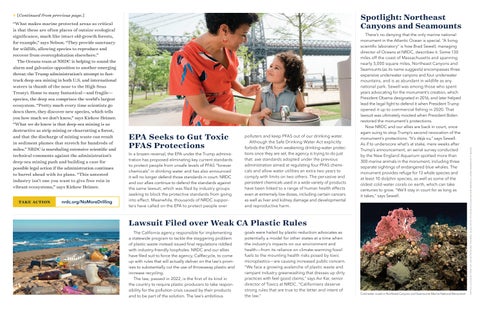
Cold-water corals in Northeast Canyons and Seamounts Marine National Monument
PHOTOS CLOCKWISE FROM TOP: JACOB PRITCHARD FOR NRDC; NOAA OFFICE OF OCEAN EXPLORATION AND RESEARCH; LARINA MARINA/GETTY IMAGES
Spotlight: Northeast Canyons and Seamounts
[Continued from previous page.]