FA L L 2 0 2 6
’ NATURE SVOICE
PHOTO: SUZI ESZTERHAS/MINDEN PICTURES
For the 3 million Members and online activists of the Natural Resources Defense Council
IN THIS ISSUE
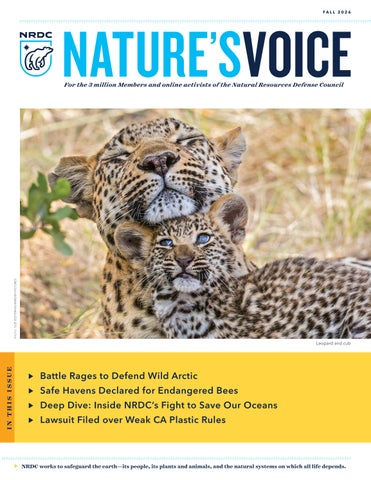
Leopard and cub
Battle Rages to Defend Wild Arctic Safe Havens Declared for Endangered Bees Deep Dive: Inside NRDC’s Fight to Save Our Oceans Lawsuit Filed over Weak CA Plastic Rules
NRDC works to safeguard the earth—its people, its plants and animals, and the natural systems on which all life depends.
Victory
COURT UPHOLDS STRONGER SOOT STANDARDS Siding with NRDC and our clean-air allies, the U.S. Court of Appeals for the D.C. Circuit has upheld tougher limits to protect Americans from soot, the deadliest form of air pollution. Industry groups and pro-polluter state attorneys general had sued to block the stronger standards, which were finalized by the Environmental Protection Agency (EPA) in 2024. The agency reversed course under the Trump administration. NRDC and our partners intervened in the lawsuit to defend the safer standards, which are projected to lead to 4,500 fewer deaths each year by 2032.
Victory
HISTORIC IVORY BAN TURNS TEN Here’s news worth trumpeting about! Wildlife advocates recently celebrated the tenth anniversary of California’s historic ban on the sale of ivory. NRDC was key in spearheading the campaign for the law, which also strengthened the state’s authority to combat illegal wildlife trafficking, a major threat to biodiversity worldwide. Since the landmark law was passed, more than 5,000 pounds of ivory have been seized or surrendered, and 60 criminal networks trafficking ivory have been dismantled.
RENEWABLES HIT MILESTONE(S) This past April marked the first time ever that wind and solar accounted for more electricity generation than gas worldwide, with the two renewable sources responsible for 22 percent of global electricity generation versus 20 percent from gas. The news is all the more remarkable when you consider that just five years ago, in April 2021, gas accounted for nearly twice the electricity generation as wind and solar. As for the United States, May was the first month that solar provided more power than coal.
C OV E R A RT I C L E
BATTLE RAGES TO DEFEND WILD ARCTIC
T
he fight to stop the Trump administration from unleashing a frenzy of new oil and gas drilling across America’s Arctic has reached a fever pitch, with thousands of NRDC Members and online activists joining to defend some of the largest intact wild ecosystems left in the United States. More than 23,000 NRDC supporters helped score a major win this past June, calling on the CEOs of oil giants such as ConocoPhillips, Shell, and ExxonMobil to sit out from the Trump administration’s attempt to auction off new leases across 700,000 acres of the Coastal Plain of the Arctic National Wildlife Refuge. The auction was a bust, with only two small companies—and no oil majors—submitting bids. Meanwhile, NRDC continues to fight in court to challenge the administration’s unlawful effort to expand oil and gas development in the Coastal
Plain, which is renowned for its stunning array of wildlife—from polar bears and grizzlies to caribou, musk oxen, and millions of migratory birds. “It’s incredibly heartening how many of our Members continue to show up for the Arctic and its wildlife,” says Bobby McEnaney, director of land conservation at NRDC. “We’ve been fighting to keep Big Oil from overrunning the Arctic Refuge for more than 40 years, and this kind of public outcry has been a critical part of that.” More than 30,000 NRDC supporters have been no less vocal in their opposition to another of the administration’s attempts to sacrifice the wild Arctic to the oil and gas industry. At stake are tens of millions of acres in the Western Arctic, including in ecologically sensitive areas that more than 150,000 NRDC supporters helped win protection for under the Biden administration, such as critical
denning habitat for polar bears and nesting grounds for migratory birds. “The Trump administration wants to give the oil industry free rein in the Western Arctic, with virtually no oversight, no attempt to protect what’s of vital importance to the wildlife there,” says McEnaney. “Not if we have anything to say about it.”
NRDC is in court to beat back the most-recent attacks on the Arctic National Wildlife Refuge.
L I T I G AT I O N W I N !
The environmental campaigns and victories featured in Nature’s Voice are all made possible through your generous support. You can help NRDC defend the environment by making a special contribution: NRDC.ORG/GIVE
Join NRDC’s rapid-response Action Network to fight back in real time against the latest Trump administration attacks. SIGN UP AT: nrdc.org/join-us
Safe Havens Declared for Endangered Bees The U.S. Fish and Wildlife Service has finalized its designation of critical habitat for the endangered rusty patched bumblebee, giving one of the country’s most imperiled pollinators a new lease on life. The potentially species-saving action comes in response to a lawsuit filed by NRDC and our allies after the agency originally declined to identify habitat essential to the bee’s survival. In all, the fight to win endangered species protections for the bee has spanned more than a decade and four separate lawsuits. “Our pollinators are in crisis, and few more so than
the rusty patched bumblebee,” says Lucas Rhoads, senior attorney with NRDC’s Pollinators & Pesticides program. The oncecommon bee has disappeared from nearly 90 percent of its historic range, owing to threats such as habitat loss, pesticides, and disease. “It’s been a long fight,” says Rhoads, “but what’s been incredible is the groundswell of support we’ve seen for our work to save the rusty patched bumblebee and to protect pollinators in general. At a time when the Endangered Species Act is under attack, it just goes to show the tremendous public support that’s out there for these kinds of bedrock wildlife protections.”
PHOTO FROM TOP: SARA WOLMAN/USFWS; TONY ERNST VIA FLICKR, CC BY-NC-SA 2.0
G O O D N EWS
CA M PA I G N U P DAT E
F
or anyone who loves the ocean, there’s good reason to make January 17 your next new holiday. That’s the date when, earlier this year, the landmark High Seas Treaty went into effect, a victory more than two decades in the making. NRDC ocean advocates had been there every step of the way, from helping to shape the treaty itself to championing it through years of negotiation and formal ratification. Now, finally, there was a framework to protect the biologically rich and sensitive waters that lie beyond any single country’s jurisdiction—waters that comprise some two-thirds of the world’s oceans. “A once-in-a-generation moment,” is how Regan Nelson, director of NRDC’s High Seas Program, describes the day the treaty became international law. “The ocean is under tremendous threat right now on so many fronts. This treaty marks a real turning point: for the first time, you have countries around the world recognizing that the only way we can truly protect ocean health is to safeguard the special places in the high seas that generate so much biodiversity.” NRDC ocean experts are helping to lay the groundwork for what may become some of the world’s first high-seas marine protected areas (MPAs), including the Emperor Seamounts, a chain of more than 80 underwater mountains that stretch from Hawai‘i to the Aleutian Islands and shelter some of the planet’s oldest deep-sea corals, and the Salas y Gomez and Nazca Ridge High Seas MPA off the coast of South America, home to endangered whales and more than 90 at-risk species. Most of us know from eighth-grade earth science how important our oceans are. Covering the vast majority of the planet’s surface, they support nearly a quarter million species—though as new marine species are being discovered all the time, the number is likely far higher. From mitigating
suit a mere 48 hours after the so-called “God Squad” convened by the Trump administration voted to strip endangered Gulf wildlife of their federal protections. Among the species that would lose protection in order to expedite more oil and gas drilling are Florida manatees and five species of sea turtles, as well as the magnificent Rice’s whale, the only great whale to live year-round in the Gulf and one of the most critically endangered marine mammals on earth, with only about 50 remaining in the wild. “The heartless irony is that Deepwater Horizon killed about a fifth of the population [of Rice’s whales],” says NRDC Marine Mammals Director Michael Jasny. “They’re still
The Trump-led assault on our oceans goes well beyond “drill, baby, drill.” Clockwise from top left: California’s iconic coast is among the targets of the Trump administration’s aggressive assault on our oceans, as is the Gulf of Mexico (top right), where local communities and marine wildlife have already paid a steep price for oil and gas development; nearly one in five endangered Rice’s whales were killed by the Deepwater Horizon disaster; endangered sea turtles are likewise at risk from more industrial exploitation.
the impacts of climate change to producing much of the oxygen we breathe to providing sustenance for billions of people around the world, healthy oceans are vital to a healthy planet. It’s a lesson the Trump administration seems to have skipped. If President Trump brought the bulldozing instincts of a real-estate developer to the management of our public lands, his administration has been no less aggressive trying to open our oceans to all manner of commercial exploitation. “When it comes to this administration’s industrialize-at-all-costs agenda, not a drop of our ocean is off limits,” says Taryn Kiekow Heimer, director of NRDC’s Ocean Energy program.
Indeed, the administration has proposed offering up a staggering 1.2 billion acres of U.S. waters to oil and gas drilling, from California’s iconic coastline to the wildlife-rich waters of Alaska’s Arctic. That followed President Trump’s unlawful executive order attempting to revoke permanent protections for 625 million acres of ocean adopted by Presidents Biden and Obama, which NRDC is fighting in court. Likewise, NRDC is waging multiple courtroom battles to stop the expansion of drilling in the already over-exploited Gulf of Mexico, where the catastrophic 2010 Deepwater Horizon oil-spill disaster continues to cast a long shadow. Those legal battles include racing to file
struggling to recover, yet it took the ‘God Squad’ less than 20 minutes to take away their endangered species protections.” The Trump administration’s industrial assault on the ocean and its astounding array of wildlife goes well beyond its determination to “drill, baby, drill.” Heading 180 degrees opposite of the international momentum behind the High Seas Treaty, President Trump has signed proclamations to open all five of our country’s own marine national monuments to industrial fishing, including the 500,000-square-mile Papahānaumokuākea Marine National Monument near Hawai‘i, designated by President George W. Bush in 2006, as well as the only marine national monument in the Atlantic, Northeast Canyons and Seamounts (see “Spotlight,” on next page). [Continued on next page.]
CLOCKWISE FROM TOP LEFT: ROBERT BOHRER/123RF; JAMES PINTAR; PAUL NAGELKIRK/NOAA FISHERIES, PERMIT #21938; GEORGETTE DOUWMA/GETTY IMAGES
DEEP DIVE: INSIDE NRDC’S FIGHT TO SAVE OUR OCEANS
“What makes marine protected areas so critical is that these are often places of outsize ecological significance, much like intact old-growth forests, for example,” says Nelson. “They provide sanctuary for wildlife, allowing species to reproduce and recover from overexploitation elsewhere.” The Oceans team at NRDC is helping to sound the alarm and galvanize opposition to another emerging threat: the Trump administration’s attempt to fasttrack deep-sea mining in both U.S. and international waters (a thumb of the nose to the High Seas Treaty). Home to many fantastical—and fragile— species, the deep sea comprises the world’s largest ecosystem. “Pretty much every time scientists go down there, they discover new species, which tells you how much we don’t know,” says Kiekow Heimer. “What we do know is that deep-sea mining is as destructive as strip mining or clearcutting a forest, and that the discharge of mining waste can result in sediment plumes that stretch for hundreds of miles.” NRDC is marshaling extensive scientific and technical comments against the administration’s deep-sea mining push and building a case for possible legal action if the administration continues to barrel ahead with its plans. “This untested industry isn’t one you want to give free rein in vibrant ecosystems,” says Kiekow Heimer. TAKE ACTION
nrdc.org/NoMoreDrilling
EPA Seeks to Gut Toxic PFAS Protections In a brazen reversal, the EPA under the Trump administration has proposed eliminating key current standards to protect people from unsafe levels of PFAS “forever chemicals” in drinking water and has also announced it will no longer defend those standards in court. NRDC and our allies continue to defend the standards against the same lawsuit, which was filed by industry groups seeking to block the protective standards from going into effect. Meanwhile, thousands of NRDC supporters have called on the EPA to protect people over
polluters and keep PFAS out of our drinking water. Although the Safe Drinking Water Act explicitly forbids the EPA from weakening drinking-water protections once they are set, the agency is trying to do just that: axe standards adopted under the previous administration aimed at regulating four PFAS chemicals and allow water utilities an extra two years to comply with limits on two others. The pervasive and persistent chemicals used in a wide variety of products have been linked to a range of human health effects even at extremely low doses, including certain cancers as well as liver and kidney damage and developmental and reproductive harm.
There’s no denying that the only marine national monument in the Atlantic Ocean is special. “A living scientific laboratory” is how Brad Sewell, managing director of Oceans at NRDC, describes it. Some 130 miles off the coast of Massachusetts and spanning nearly 5,000 square miles, Northeast Canyons and Seamounts (as its name suggests) encompasses three expansive underwater canyons and four underwater mountains, and is as abundant in wildlife as any national park. Sewell was among those who spent years advocating for the monument’s creation, which President Obama designated in 2016, and later helped lead the legal fight to defend it when President Trump opened it up to commercial fishing in 2020. That lawsuit was ultimately mooted when President Biden restored the monument’s protections. Now NRDC and our allies are back in court, once again suing to stop Trump’s second revocation of the monument’s protections. “It’s déjà vu,” says Sewell. As if to underscore what’s at stake, mere weeks after Trump’s announcement, an aerial survey conducted by the New England Aquarium spotted more than 300 marine animals in the monument, including three separate sightings of endangered blue whales. The monument provides refuge for 13 whale species and at least 10 dolphin species, as well as some of the oldest cold-water corals on earth, which can take centuries to grow. “We’ll stay in court for as long as it takes,” says Sewell.
Lawsuit Filed over Weak CA Plastic Rules The California agency responsible for implementing a statewide program to tackle the staggering problem of plastic waste instead issued final regulations riddled with industry-friendly loopholes. NRDC and our allies have filed suit to force the agency, CalRecycle, to come up with rules that will actually deliver on the law’s promises to substantially cut the use of throwaway plastic and increase recycling. The law, passed in 2022, is the first of its kind in the country to require plastic producers to take responsibility for the pollution crisis caused by their products and to be part of the solution. The law’s ambitious
goals were hailed by plastic-reduction advocates as potentially a model for other states at a time when the industry’s impacts on our environment and health—from its reliance on climate-warming fossil fuels to the mounting health risks posed by toxic microplastics—are causing increased public concern. “We face a growing avalanche of plastic waste and rampant industry greenwashing that dresses up dirty practices with feel-good claims,” says Avi Kar, senior director of Toxics at NRDC. “Californians deserve strong rules that are true to the letter and intent of the law.”
Cold-water corals in Northeast Canyons and Seamounts Marine National Monument
PHOTOS CLOCKWISE FROM TOP: JACOB PRITCHARD FOR NRDC; NOAA OFFICE OF OCEAN EXPLORATION AND RESEARCH; LARINA MARINA/GETTY IMAGES
Spotlight: Northeast Canyons and Seamounts
[Continued from previous page.]
F I G H T I N G FO R W I L D L I F E
Science Is More Important than Ever— Everywhere but the White House Science Office. Even as NRDC is widely known as a litigation powerhouse, it boasts a no-less-impressive science apparatus. “Science is the backbone of environmental protection,” says Jones. “The Clean Air Act, Clean Water Act, Endangered Species Act, and more all hinge on credible science and data. When those are attacked and weakened, protections become easier to roll back, harder to enforce, and more difficult to defend in court—exactly what so many industries that support this administration want.” From mapping the extent of toxic PFAS chemical pollution in drinking water to charting
the spike in harmful coal plant emissions since the start of Trump’s second term to tallying the true cost of the administration’s repeal of climate regulations, the 70-plus scientists and analysts at NRDC continue to work to make sure independent science remains at the forefront of environmental policymaking. As for Jones, she’s collaborating with coalition partners to envision the post-Trump era. “This regime isn’t going to last forever,” she says. “Reimagining the future of science for people and the planet is one of the most critical jobs we will have in the coming years. I’m grateful to be part of that work.”
NRDC and our conservation allies have filed suit to stop the importation of seafood from 44 foreign fisheries that fail to meet U.S. standards to protect whales, seals, and other marine mammals. Each year, more than 650,000 marine mammals are caught and killed in fishing gear around the globe, a tragic fate known as “bycatch” and the leading cause of
marine mammal deaths. Although federal law has long prohibited seafood imports that do not adhere to the same strict standards to reduce bycatch that U.S. fisheries must follow, it took years of advocacy (and multiple lawsuits) by NRDC and our partners to compel the National Marine Fisheries Service to implement such a ban, just last year. The current lawsuit is
T O P R AT E D B Y C H A R I T Y N A V I G AT O R . O R G N AT U R A L R E S O U R C E S D E F E N S E C O U N C I L 40 WEST 20 TH STREET, NEW YORK, NY 10011 WWW.NRDC.ORG/NATURESVOICE MEMBERSHIP@NRDC.ORG | 212.727.2700
Dr. Ticora V. Jones
Leopard and cub
BOOST THE POWER OF YOUR GIVING!
Defend wildlife and wild places by giving through your donor advised fund. Learn more at NRDC.ORG/DAF
EDITOR IN CHIEF JASON BEST MANAGING EDITOR LIZ LINKE DIRECTOR OF MEMBERSHIP GINA TRUJILLO
aimed at forcing the service to enforce that ban against fisheries in eight countries whose fishing practices kill unsustainable numbers of marine mammals: Argentina, Ecuador, India,Norway,Taiwan,Tunisia, the United Kingdom, and Vanuatu. “Americans want seafood that doesn’t lead to the deaths of thousands of whales and dolphins,” says Zak Smith, director of global biodiversity conservation at NRDC. “The U.S. seafood industry is a world leader in this, but our government continues to let foreign fisheries peddle their whale- and dolphin-killing fish into the United States as long as these governments say they’re ‘trying.’ That’s not good enough. It’s time for our government to work for U.S. consumers and fishers and stop letting foreign fisheries off the hook.”
PHOTOS CLOCKWISE FROM TOP: GETTY IMAGES; SUZI ESZTERHAS/MINDEN PICTURES; MICHAL ROBAK; ALYSSA SCHUKAR FOR NRDC
If there was any doubt that the second Trump administration was going to be far more aggressive than even the first in trying to advance its polluter-driven ideology, that was quickly dispelled after Inauguration Day. For Dr. Ticora V. Jones, the bull-in-a-china-shop recklessness of the new administration hit a deeply personal note: prior to joining NRDC as chief science officer in 2023, she had served as chief scientist at the U.S. Agency for International Development. The administration’s ruthless dismantling of that agency served as a prelude to its broader assault on something no less important to Jones: independent science. “What we’ve seen is truly unprecedented,” she says. Among the chief targets of the administration’s anti-science crusade is the EPA. More than a quarter of the agency’s staff has been eliminated—the most of any federal agency—including the layoff of more than a thousand scientists and technical experts after the administration shuttered the EPA’s widely respected independent research office. As alarming as the destruction has been, Jones is finding strength and hope in her position as head of NRDC’s
Suit Targets Seafood That Harms Marine Mammals