CA M PA I G N U P DAT E
F
or anyone who loves the ocean, there’s good reason to make January 17 your next new holiday. That’s the date when, earlier this year, the landmark High Seas Treaty went into effect, a victory more than two decades in the making. NRDC ocean advocates had been there every step of the way, from helping to shape the treaty itself to championing it through years of negotiation and formal ratification. Now, finally, there was a framework to protect the biologically rich and sensitive waters that lie beyond any single country’s jurisdiction—waters that comprise some two-thirds of the world’s oceans. “A once-in-a-generation moment,” is how Regan Nelson, director of NRDC’s High Seas Program, describes the day the treaty became international law. “The ocean is under tremendous threat right now on so many fronts. This treaty marks a real turning point: for the first time, you have countries around the world recognizing that the only way we can truly protect ocean health is to safeguard the special places in the high seas that generate so much biodiversity.” NRDC ocean experts are helping to lay the groundwork for what may become some of the world’s first high-seas marine protected areas (MPAs), including the Emperor Seamounts, a chain of more than 80 underwater mountains that stretch from Hawai‘i to the Aleutian Islands and shelter some of the planet’s oldest deep-sea corals, and the Salas y Gomez and Nazca Ridge High Seas MPA off the coast of South America, home to endangered whales and more than 90 at-risk species. Most of us know from eighth-grade earth science how important our oceans are. Covering the vast majority of the planet’s surface, they support nearly a quarter million species—though as new marine species are being discovered all the time, the number is likely far higher. From mitigating
suit a mere 48 hours after the so-called “God Squad” convened by the Trump administration voted to strip endangered Gulf wildlife of their federal protections. Among the species that would lose protection in order to expedite more oil and gas drilling are Florida manatees and five species of sea turtles, as well as the magnificent Rice’s whale, the only great whale to live year-round in the Gulf and one of the most critically endangered marine mammals on earth, with only about 50 remaining in the wild. “The heartless irony is that Deepwater Horizon killed about a fifth of the population [of Rice’s whales],” says NRDC Marine Mammals Director Michael Jasny. “They’re still
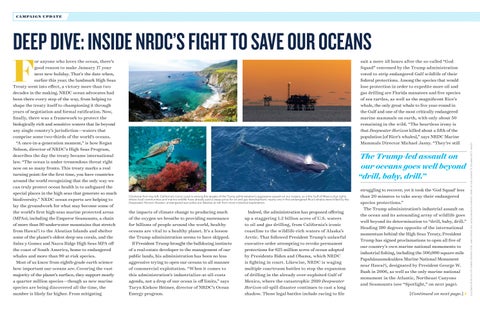
The Trump-led assault on our oceans goes well beyond “drill, baby, drill.” Clockwise from top left: California’s iconic coast is among the targets of the Trump administration’s aggressive assault on our oceans, as is the Gulf of Mexico (top right), where local communities and marine wildlife have already paid a steep price for oil and gas development; nearly one in five endangered Rice’s whales were killed by the Deepwater Horizon disaster; endangered sea turtles are likewise at risk from more industrial exploitation.
the impacts of climate change to producing much of the oxygen we breathe to providing sustenance for billions of people around the world, healthy oceans are vital to a healthy planet. It’s a lesson the Trump administration seems to have skipped. If President Trump brought the bulldozing instincts of a real-estate developer to the management of our public lands, his administration has been no less aggressive trying to open our oceans to all manner of commercial exploitation. “When it comes to this administration’s industrialize-at-all-costs agenda, not a drop of our ocean is off limits,” says Taryn Kiekow Heimer, director of NRDC’s Ocean Energy program.
Indeed, the administration has proposed offering up a staggering 1.2 billion acres of U.S. waters to oil and gas drilling, from California’s iconic coastline to the wildlife-rich waters of Alaska’s Arctic. That followed President Trump’s unlawful executive order attempting to revoke permanent protections for 625 million acres of ocean adopted by Presidents Biden and Obama, which NRDC is fighting in court. Likewise, NRDC is waging multiple courtroom battles to stop the expansion of drilling in the already over-exploited Gulf of Mexico, where the catastrophic 2010 Deepwater Horizon oil-spill disaster continues to cast a long shadow. Those legal battles include racing to file
struggling to recover, yet it took the ‘God Squad’ less than 20 minutes to take away their endangered species protections.” The Trump administration’s industrial assault on the ocean and its astounding array of wildlife goes well beyond its determination to “drill, baby, drill.” Heading 180 degrees opposite of the international momentum behind the High Seas Treaty, President Trump has signed proclamations to open all five of our country’s own marine national monuments to industrial fishing, including the 500,000-square-mile Papahānaumokuākea Marine National Monument near Hawai‘i, designated by President George W. Bush in 2006, as well as the only marine national monument in the Atlantic, Northeast Canyons and Seamounts (see “Spotlight,” on next page). [Continued on next page.]
CLOCKWISE FROM TOP LEFT: ROBERT BOHRER/123RF; JAMES PINTAR; PAUL NAGELKIRK/NOAA FISHERIES, PERMIT #21938; GEORGETTE DOUWMA/GETTY IMAGES
DEEP DIVE: INSIDE NRDC’S FIGHT TO SAVE OUR OCEANS