Nebraska Rural Community Schools Association Member Update
September 10, 2026
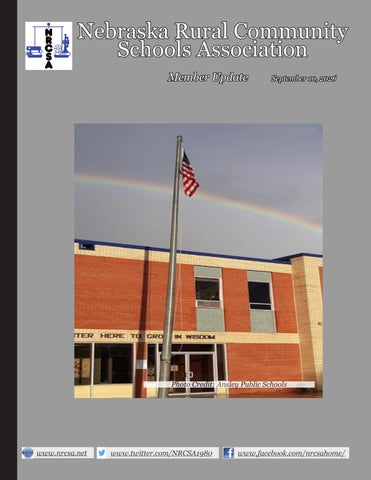
Photo Credit: Ansley Public Schools
www.nrcsa.net
www.twitter.com/NRCSA1980
www.facebook.com/nrcsahome/
NRCSA Calendar
NRCSA Events
Committee Meetings
NRCSA District Meetings (September & October 2026)
NRCSA Committee Meetings November 18, 2026 CHI Center in Omaha
South Central District Meeting 1:00 PM, September 2, 2026 At ESU 11 in Holdrege Northeast District Meeting 11:00 AM, September 21, 2026 At Wayne State College Southwest District Meeting 12:00 PM, September 24, 2026 At Hershey Public Schools Southeast District Meeting 10:00 AM, September 28, 2026 At the NCSA office in Lincoln North Central District Meeting 10:30 AM, October 14, 2026 At Jubilee Catering in Ord West District Meeting 1:30 PM (MT), October 28, 2026 At ESU 13 in Scottsbluff NRCSA Legislative Forum February 24, 2027 Cornhusker Hotel in Lincoln More about this event NRCSA Spring Conference April 1 & 2, 2027 Crowne Plaza & Younes North Convention Center in Kearney More about this event NRCSA Golf Tournament July 27, 2027 Meadowlark Hills Golf Course in Kearney More about this event
9:00 AM - NRCSA Executive Committee 10:00 AM - NRCSA Scholarship & Recognition Cmte 11:00 AM - NRCSA Closing the Achievement Gap Cmte 12:00 PM - NRCSA Leaders Lunch 1:00 PM - NRCSA Legislative Committee 3:00 PM - NRCSA Rural Teacher Committee
Nebraska Rural Community Schools Association
NRCSA Search Service Please let Paul Sheffield know where superintendent vacancies occur, so that NRCSA Superintendent Search can make direct contact. We need to hear as soon as possible in anticipation of getting promotional materials specific to that board of education ready. It is critical that Board Presidents have the NRCSA contact information so that if they choose to consider a Superintendent Search Service, NRCSA is one they hopefully will consider. Arapahoe Public Schools Announcement of Vacancy Apply for this Vacancy Application Deadline: Sept. 25, 2026 Finalists Selected: Oct. 12, 2026 Interviews: Oct. 24, 2026 Contract Starts: July 1, 2027 Clarkson Public Schools Search starting soon!
Educational Service Unit 17 Search starting soon!
1
Nebraska Rural Community Schools Association Access the Members area of www.nrcsa.net anytime. Login: member Password: learning
NRCSA Leadership
___________________________________________________ From the Executive Director ___________________________________________________
Stickiness Have you ever wondered why certain ideas stick while others quickly fade away? Why do some concepts thrive while others die out? More importantly, how can we improve the chances of our own worthy ideas taking hold? To demonstrate this concept of “stickiness,” let’s take a short quiz. Below are several commercial jingles and oneliners from the past decades—can you identify the products they advertised? “A little dab’ll do ya” “How do you spell relief?” “Like a good neighbor, _?_” “Ancient Chinese secret, huh?” “Mr. Whipple, please don’t squeeze the _?_!” “Silly rabbit, _?_ are for kids.” “Plop, plop, fizz, fizz oh what a relief it is.” “Sometimes you feel like a nut, sometimes you don’t” “He likes it, hey Mikey!” “This is a good place for a _?_.” How many did you recognize? The answers are provided at the end of this article. As you read through those phrases, did you find yourself humming the tunes or visualizing the commercials? What makes these specific messages so durable that we remember them years, or even decades, later? What, exactly, made them “stick”? This phenomenon is explored in the book Made to Stick by Chip and Dan Heath. The authors identify six key principles that help ideas win and explain how we can apply these rules to ensure our own messages resonate. As educators and parents, this is a challenge we face every single day.
Stephanie Kaczor, President. Riverside Public Schools Chris Kuncl, Past President. Mullen Public Schools Dale Hafer, Pres-Elect. Ainsworth Community Schools Dr. Jeremy Braden, Secretary. Doniphan-Trumbull Public Schs
District Representatives: Ginger Meyer, West Chadron Public Schools Dr. Heather Nebesniak, North Central Ord Public Schools Daryl Schrunk, Northeast Randolph Public Schools Andrew Havelka, Southeast Freeman Public Schools Jon Davis, South Central Alma Public Schools Jane Davis, Southwest Hershey Public Schools
Executive Director: Paul Sheffield
Lobbyists: Jon Edwards Scott Moore Russell Westerhold
The first principle is Simplicity. The more simple and profound an idea, the better its chance of survival. This aligns with the “KISS” method—Keep It Simple, Stupid. If a concept can be condensed into a single, punchy phrase, it is far more likely to be remembered. For example, the USA Today newspaper was built on this premise: keep articles short, sweet, and visual with charts and easy-to-read statistics.
Legislative Co- Chairs:
The second concept is Unexpectedness. There is no better way to generate curiosity than by introducing a surprise or something totally counterintuitive. This “shock value” grabs interest and, more importantly, helps hold attention long enough for the message to take root.
Scholarship & Recognition Co Chairs:
The “Velcro theory of learning” describes the third concept: Concreteness. The more “hooks” an idea has, the better it sticks to our memory. Concrete language makes abstract concepts tangible and real, giving us something we can actually
Jim Widdifield Minden Public Schools
2
Dr. Jason Dolliver Pender Public Schools Bryce Jorgenson Southern Valley Schools
Jessica Bland, Oakland-Craig Public Schools
Nebraska Rural Community Schools Association “sink our teeth into.” Next is Credibility. We tend to believe people we are familiar with or those who present themselves as authorities. Whether it’s a trusted expert or a persuasive late-night pitchman, we need a reason to believe the message is true and that the product or idea will actually work. Appealing to the Emotional side is another vital step. Making people care requires tapping into the power of association. Think of commercials for animal shelters or children’s charities; they pull at our heartstrings to drive us to action. By appealing to emotions, we connect an idea to a person’s self-interest or identity. Finally, we have Stories. Humans are hardwired for narrative. Stories act as a mental flight simulator, helping us visualize how to act in specific situations. Parables like the Good Samaritan or Daniel in the Lion’s Den stick because they allow us to see the action and draw our own conclusions, rather than just being told a dry set of rules. Making an idea stick follows a clear process. The most enduring messages usually satisfy these six criteria: they are Simple, Unexpected, Concrete, Credible, Emotional, and told through Stories. Using these concepts might just help the next time you want your thoughts to have a lasting effect. Maybe, just maybe, someone will hear your message and think, “Wow, I should have had a _?_” Now for those quiz answers! I had many more phrases I wanted to include, but I ran out of space (and time—Jeff was getting a bit impatient with me for being late with my column). Here is how you did: #1 – Brylcream (this dates me, but it’s a good one) #2 – ROLAIDS #3 – State Farm #4 – Calgon #5 – Charmin #6 – Trix #7 – Alka Seltzer #8 – Almond Joy and Mounds #9 – Life Cereal #10 – Stick-ups deodorizer.
Thought for the Month “Ze plane! Ze plane!” “Smiles, everyone… smiles. My dear guests, I am Mr. Roarke, your host. Welcome to Fantasy Island!” ___________________________________________________ NRCSA and outgoing Executive Director Jack Moles were honored to receive the Friend of Education Award at Administrator Days. NRCSA has been a long-time tenant of the Nebraska Council of School Administrators. We were included in the plans for NCSA’s new building, which opened up last summer. NRCSA truly appreciates the partnership that has developed with Dr. Mike Dulaney and his entire staff. Both organizations benefit from the other in many ways. The award from NCSA was in recognition of “distinguished advocacy, counsel and support to Nebraska public schools and school administrators.”
3
Nebraska Rural Community Schools Association
L-R: Jeff Bundy (NRCSA Office Manager), Jack Moles, NRCSA President Stephanie Kaczor, new NRCSA Executive Director Paul Sheffield
___________________________________________________ NRCSA Updates ___________________________________________________ From the University of Nebraska-Kearney We invite you and members of your school team to attend Building Effective Teacher-Paraeducator Partnerships, a free professional learning event designed to strengthen collaborative partnerships between special education teachers and paraeducators. This interactive event will provide participants with opportunities to work together, explore practical strategies, and engage in hands-on learning experiences focused on effective communication, collaboration, role clarity, flexibility, and consistent support for student success. We especially encourage special education teachers and paraeducators who work together to attend as a team so they can learn, plan, and problem-solve together. Event Details Date: Thursday, September 24, 2026 Time: 9:00 a.m.–3:00 p.m. Location: Regional Engagement Center, University of Nebraska at Kearney Presenters: Christine Fisher, EdD; Kathy Maxson; and Crystal Warner Cost: Free Meals: Lunch and snacks provided Participants will also receive a certificate of attendance and professional resources and materials they can use in their classrooms and with students. Registration is required and must be completed by Friday, September 18. Here is a link to the registration form: Building Effective Teacher-Paraeducator Partnerships – Fill out form
4
Nebraska Rural Community Schools Association
5
Nebraska Rural Community Schools Association From Sam Stetcher, Franklin Covey Education There is a free workshop on the FranklinCovey goal attainment framework. It is research proven to help students reach individual academic goals, specifically in literacy, at a statewide scale. Super relevant and valuable to our statewide literacy goals. It will not be a sales pitch. It will be 3 to 4 hours of PD from my team as well as school tours and presentations from Columbus Public School’s students and staff. It’s legit for sups, principals, teachers, and board members. Registration Link
The 4 Disciplines of Execution® for Educators Every district has goals. Not every district achieves them.
The challenge isn't having a plan. It's keeping everyone focused on what matters most-long enough to create meaningful results.
You're Not Alone in the Struggle District leaders across the country face the same frustrations.
Goals are set. Clear priorities are established.
Urgent takes over. Daily demands push out what matters.
Focus fades. Momentum slows. People get pulled in different directions.
Results stall. Despite good intentions, progress doesn't stick.
There's a Better Way 4DX® for Educators helps districts build the alignment, discipline, and shared ownership needed to turn goals into results—together.
4DX for Educators Addresses the Real Tensions • From scattered efforts to focused priorities • From initiative overload to clear execution • From doing for people to empowering people • From short-term wins to lasting impacts
© Franklin Covey Co. All Rights Reserved.
6
Nebraska Rural Community Schools Association
What Changes with 4DX for Educators Aligned Leadership Everyone moves in the same direction with clarity and purpose.
Focused Execution Teams stay focused on what matters most and execute with discipline.
Shared Ownership Everyone understands their role and works together to drive results.
Stronger Outcomes Sustained progress that improves outcomes for students every day.
Key Outcomes Build a system that keeps your priorities front and center Create alignment across leadership, staff, and students Empower teams to own their role in the results Sustain momentum from the first day of school to the last See measurable, meaningful improvements for students
$399 Value - Complimentary registration while seats remain.
“The 4DX framework transformed how our leaders approach goal setting and execution. It provided a clear, powerful structure to identify our Wildly Important Goals and track the daily actions that drive real progress. Our team left inspired, focused, and fully equipped to succeed.” —Rhonda Henry, Assistant Superintendent of Innovation & Strategic Initiatives, Farmington Public Schools, MI
Event Details Columbus, NE | Kramer Education Center 2410 16th Street, Columbus, NE 68601
Scan to register
October 15, 2026
7:30am - 3:00pm Materials & lunch provided
© Franklin Covey Co. All Rights Reserved.
7
Nebraska Rural Community Schools Association From Suzanne Kemp, University of Nebraska-Lincoln Building Nebraska’s Special Education Workforce Through Apprenticeship In 2023, the University of Nebraska–Lincoln (UNL) was invited by the Nebraska Department of Education (NDE) to serve as one of the pilot institutions for Nebraska’s newly approved apprenticeship pathway to special education teacher certification. Recognizing the critical need to address the statewide shortage of special education teachers, faculty in UNL’s Special Education Program embraced the opportunity to design an innovative preparation model grounded in the core principles of apprenticeship. UNL’s program was intentionally developed to provide aspiring special educators with a comprehensive, practice-based learning experience. Apprentices are employed as paraeducators or teacher apprentices while completing coursework that is directly connected to their daily classroom experiences. Throughout the program, apprentices receive ongoing coaching from expert mentor teachers and university supervisors, assume increasing instructional responsibilities through a gradual release model, and participate in competency-based assessments that measure their professional growth. Strong partnerships among UNL, Educational Service Units (ESUs), and local school districts ensure that apprentices are supported from recruitment through certification and licensure. At the heart of the program is the belief that educators learn best by doing. During an intensive six-week summer institute, offered both online and in person, apprentices build foundational knowledge in reading, mathematics, and behavior management. Rather than learning these concepts solely through lectures, apprentices immediately apply evidence-based instructional practices by tutoring students who need additional academic support. This combination of instruction, supervised practice, and timely feedback allows apprentices to develop confidence and competence before entering classrooms in the fall. Learning continues throughout the apprenticeship year. Weekly seminars provide opportunities for apprentices to deepen their understanding of evidence-based practices, reflect on their classroom experiences, receive individualized coaching from university faculty, and collaborate with fellow apprentices. This ongoing cycle of instruction, application, feedback, and reflection is a defining feature of the apprenticeship model and prepares apprentices to become highly effective special educators. Since its launch, UNL’s apprenticeship program has demonstrated remarkable success. The inaugural pilot cohort included eight apprentices employed by Lincoln Public Schools. All eight successfully completed the program, were hired as special education teachers, and have now completed their first year in the classroom. Building on the success of the pilot, UNL received additional funding to expand the program into rural Nebraska through partnerships with Educational Service Units 5 and 6. The expanded program now includes school districts in Crete, Waverly, Norris, Centennial, Bruning-Davenport, Beatrice, Seward, and York. Today, approximately 60% of the apprentices serve rural communities, strengthening the special education workforce where shortages are often the greatest. Of the 23 apprentices who entered the expanded program, 21 have accepted positions and will begin their careers as special education teachers during the 2026–2027 school year. The current cohort continues this momentum, welcoming additional district partners from Gothenburg, Fairbury, and Superior. As UNL prepares to recruit the next cohort of apprentices for the program beginning in January 2027, the goal remains clear: expand access to high-quality teacher preparation while strengthening Nebraska’s special education workforce. Although NDE grant funding has enabled many aspiring teachers to participate, available funding is limited and cannot support every qualified paraeducator. To continue growing this successful initiative, UNL welcomes partnerships with school districts interested in sponsoring one of their paraeducators through the apprenticeship program. Together, we can create additional pathways into the profession and ensure that Nebraska’s students with disabilities are served by well-prepared, highly effective special education teachers. ___________________________________________________
8
Nebraska Rural Community Schools Association We urge you to consider participation in the NRCSA Partner OneCard program as a tool for you in managing school expenditures, both large and small. Certainly, the card can help reduce/eliminate any issues relative to unverified cash expenditures. You decide who uses it, can get cards for each of those users, keep all cards wherever you wish, determine the amount to load on each individual card, and how long the time frame of use is. It is a terrific management tool and clearly identifies each expenditure/name/date/amount. Whether small purchases or very large purchases, the card is a terrific tool. NRCSA owns the state contract, so liability for misuse falls to NRCSA, not the district user. We have only had three circumstances of fraud and all three have been the theft of the card number information, not any district employee misuse. For 2025-26, over 100 districts/ESUs participated in the program. We currently have 111 entities using the program. In talking with some districts, there is a chance there could be upwards of 115 entities participating. Great job by all participating districts in protecting the card and program! Don’t forget, the NRCSA rebate from the transaction fee paid by businesses that choose to accept plastic is used for scholarship, awards, and special needs. For 2025-26, the rebate was over $40,000 to NRCSA, showing that use is increasing, and large purchases are being included. WIN, WIN, WIN! If you are considering joining the program and need more information, please contact Paul Sheffield (psheffield@nrcsa.net) or Jeff Bundy (jbundy@nrcsa.net). ___________________________________________________ NRCSA has partnered with the Holocaust Learning Experience to provide free curriculum for the teaching of the Holocaust and other genocides. LB888, which was adopted into law in 2022, requires school districts to teach about the Holocaust and other forms of genocide. This has been a growing move in many states. The Holocaust Learning Experience, based out of Florida, developed FREE on-line curriculum, which features interviews with survivors of the Holocaust, for Florida school districts.. The lessons are tiered for 5th and 6th grades, 7th and 8th grades, and high school grades. The group has now made it possible for schools in other states to access the materials for the same price: FREE! From Leigh Routman: I’ve attached a digital flyer that you can share with your newsletter as well as the link to our website for more information. Impactful Lessons from the Holocaust | The Holocaust Learning Experience Additionally, here is the link to the video with teachers and students in their own words: Holocaust Learning Experience | Empowering Classrooms to Combat Hate And a link to the Heroes of the Holocaust montage: Heroes of the Holocaust Demo with Hal_07072025.mov ___________________________________________________ NRCSA’s annual membership drive continues! Membership notices were sent to all of our members in July. We also contacted several non-members who we believe would be great fits in NRCSA. Annual Dues remain at $850.. You are welcome to pay your dues in this fiscal year or the next. Last year, we had 222 school districts, ESU’s, and State colleges and we expect to continue to grow. Thanks to you for being a member. This energizes our representation and advocacy for rural Nebraska, no matter who we are engaged with on education, legislation, or community issues. Without your support, there is less rural advocacy. Whether we like it or not, the outstate and rural population does not create a legislative majority anymore. In fact, rural Nebraska lost another seat in the Unicameral in the most recent redistricting. Finding success, whether passing, amending, or stopping legislation comes from membership, relationships, and focus. Thanks to your membership in NRCSA, rural is at the table and making a difference on behalf of our rural students, schools, and communities. ___________________________________________________
9
Nebraska Rural Community Schools Association 2026 NRCSA Joe Toczek Golf Tournament The 2026 NRCSA Joe Toczek Golf Tournament was held on Tuesday, July 28, 2026 at Meadowlark Hills Golf Course in Kearney. A beautiful day for golf resulted in some very nice scores. Proceeds from the tournament help to fund NRCSA’s scholarship program. Flight winners were: FIRST FLIGHT: 1st: Coady Pruett, Shari Russell, Bobby Truhe, Steve Williams with a score of 54 2nd: Bo Cribelli, Chris Kuncl, Mike Kvanvig, Brett Mauler, 57 3rd: Shane Alexander, Wade Finley, Roger Flohrs, Casey Painter, 57 SECOND FLIGHT: 1st: Blake Beebout, Andrew Cronin, Mike Halley, Troy Keilig, 59 2nd: Andy Havelka, Dade McDonald, PJ Quinn, 61 3rd: Ron Beacom, Dexter Hanzel, Matt Hodgson, Collin Martin, 61 THIRD FLIGHT: 1st: Jeff Koehler, Robert Mock, Nicole Hardwick, Brian Rottinghaus, 63 2nd: Jay Bellar, Clint Kimbrough, Cale Kimbrough, Paul Sheffield, 64 3rd: Greg Barnes, Alan Katzberg, Mark Norvell, Jim Tenopir, 64 __________________________________________________ Partnerships to Build Readiness for Implementing Trauma-Informed Programs and Practices for Schools (TIPPS). We seek school partners for a two-phase initiative that includes measurement development and in-person or online personalized training and professional development. In PHASE 1, we will partner with selected rural schools in Michigan and Nebraska to develop and test a readiness assessment that will determine a school’s preparedness to implement the 10 core pillars of the TraumaInformed Programs and Practices for Schools (TIPPS) framework. TIPPS helps schools create safe, supportive, and inclusive learning environments by building relationships, increasing trauma awareness, and shifting from punitive to restorative discipline. To develop and test the readiness assessment, we will use a structured interview protocol that solicits input on identified priorities and existing strategies within each school that align with TIPPS objectives; determining professionals’ knowledge of trauma and trauma supports; and exploring each school’s capacity to onboard new trauma-informed strategies relevant to each core pillar. In PHASE 2 of the project, we will provide a 4-part professional training series tailored to the learning needs of each school, drawing on materials from our TIPPS toolkit, which includes a comprehensive assessment tool, program guide, implementation guide, and supplementary case materials designed to deepen understanding of trauma-informed principles and strategies. Content experts from the TIPPS team will provide ongoing consultation and coaching to each school at no cost. Pre-post assessments of the training series will document progress toward established learning goals, as well as school professionals’ knowledge and confidence in implementing TIPPS strategies. Program Information: https://tipps.ssw.umich.edu/ Project Period/Milestones: 2026-2027 Academic Year Spring 2026 – Develop school partnerships Summer 2026 – Prepare for project launch Fall 2026 – Phase I Spring 2027 – Phase II
10
Nebraska Rural Community Schools Association Contact Information: Alex Mason University of Nebraska-Lincoln amason19@unl.edu Todd Herrenkohl University of Michigan tih@umich.edu ___________________________________________________ Ideas on how to deal with cancellations for NRCSA events were shared with the Executive Committee several months ago. After receiving input from the Committee members, a policy was presented at the November meeting of the Executive Committee and adopted. Following is the policy that will be followed moving forward: POLICY ON CANCELLATIONS FOR NRCSA EVENTS When planning for a large event (i.e. NRCSA Spring Conference or NRCSA Legislative Forum), NRCSA must make financial commitments such as facility rental and costs of meals. Weather sometimes causes a decision to be made by NRCSA in the form of a cancellation or postponement of the event, or for registrants to decide whether or not they can attend the event. Sometimes registrants need to make a decision not to attend due to other reasons. NRCSA has weighed the issues of its financial commitments versus registrants not being able to attend for various reasons. Thus, the following policy has been adopted: WEATHER CANCELLATION DECISION MADE BY NRCSA: All registrants, including vendors, will be offered a full refund or to have the registration fee carried forward to the next year’s event. WEATHER POSTPONEMENT DECISION MADE BY NRCSA: All registrants, including vendors, will be offered a full refund or to have the registration fee carried forward to the re-scheduled event. DECISION BY A REGISTRANT, INCLUDING VENDORS, TO NOT ATTEND THE EVENT AND COMMUNICATED TO NRCSA AT LEAST A WEEK PRIOR TO THE EVENT: Two options will be provided to the registrant, including vendors: A full refund OR carry the registrant amount forward to the following year. DECISION BY A REGISTRANT, INCLUDING VENDORS, TO NOT ATTEND THE EVENT AND COMMUNICATED TO NRCSA WITHIN A WEEK PRIOR TO THE EVENT: For members, an option will be provided to have the registration fee carried forward to the next year’s event OR a refund minus the costs to NRCSA for meal(s). (NOTE: In 2026, for the Spring Conference this would be $105, for the Legislative Forum the cost is $45.) For vendors, the option to carry the registration amount to the following year will be provided. DECISION BY A REGISTRANT TO NOT ATTEND THE EVENT, BUT FAILS TO COMMUNICATE WITH NRCSA PRIOR TO THE EVENT: No refund will be provided. ___________________________________________________ The NRCSA Executive Committee has made a positive move to assist non-traditional educators move toward full teaching certification. As a result of this move, new scholarship opportunities were created for paras who are in a “para to teacher program” and for transitional educators. NRCSA will provide three $1,000 scholarships for the fall semester and three $1,000 scholarships for the spring semester each school year. Applicants for the scholarships must be current employees of a NRCSA-member district or ESU. 11
Nebraska Rural Community Schools Association Applicants must be enrolled for that semester in one of two types of programs: (1) in a recognized “para to teacher” program such as is offered by the three State Colleges (Chadron State, Peru State, or Wayne State), or (2) a transition to teaching program in which a person with a minimum of a bachelor’s degree who is employed to teach in a member school while working through a transitional program, such as offered by the University of Nebraska-Kearney. The applicant could currently be teaching under a transitional certificate. Applications for the Spring, 2027 Semester will be forwarded to Superintendents later in the fall. Applications for the Summer/Fall semester were received and the three recipients were selected. They were: • • •
Jemma DeNaeyer, Thedford Veronica Schiffbauer, HTRS Chelsey Georges, District OR-1, Palmyra-Bennet
Thedford Principal Adam Kuntz, Brooklyn Denaeyer, Jemma Denaeyer, Kloey Denaeyer, Jack Moles
Director of Student Programs Linde Walter, Dylaney Georges, Justin Georges, Brea Georges, Chelsey Georges, Jack Moles, Logan Georges, Supt. Michael Hart, Elementary Principal Jared Haag
12
Nebraska Rural Community Schools Association
Jack Moles, Veronica Schiffbauer, HTRS Supt. George Griffith
___________________________________________________ SUPERINTENDENT SEARCH & PLANNING As Boards of Education and Superintendents start to plan for the future, there may be a change in Superintendent approaching your district. We would like to remind you that NRCSA has an outstanding Superintendent Search Service and I would encourage your Board of Education to closely consider these services if you are in need of a Superintendent. NRCSA has already helped the Axtell, Bancroft-Rosalie, Hampton, Hayes Center, Newman Grove, Potter-Dix, Sandy Creek and Superior Boards of Education identify their next Superintendent. We also assisted Red Cloud and Blue Hill in searches for Interim Superintendents. One of the more outstanding features of the NRCSA Superintendent Search Service is that the consultants who assist Boards of Education with their searches are all retired rural school Superintendents who experienced great success in their careers. They know what it takes to be successful in a rural school district and community, and how to work closely with a rural school Board of Education. Our consultants for the coming year will include: Dan Bird, Fred Helmink, Caroline Winchester, Curtis Cogswell, Mo Hanks, Jay Bellar, Holly Herzberg, Jon Cerny, and Jack Moles. If your district finds a need to locate your next school leader, please be sure to keep the NRCSA Superintendent Search Service in mind. For more information you can contact Executive Director Paul Sheffield at psheffield@ nrcsa.net or by phone at 402-759-1609. Another service that is offered is a planning service. It is a common practice for Boards of Education and the Superintendent to develop short and long-term plans. NRCSA does provide a quality service using experienced consultants. If you are interested in more information, please contact Executive Director Elect Paul Sheffield. NRCSA Search Service Brochure NRCSA Planning Support Brochure __________________________________________________
13
Nebraska Rural Community Schools Association The Nebraska Statewide Workforce & Educational Reporting System (NSWERS) has released a new research brief examining chronic absenteeism in Nebraska’s K–12 schools and its effect on student outcomes, including assessment scores, graduation rates, and college enrollment. The analysis highlights that chronic absenteeism—defined as missing 10 percent or more of the school year for any reason—has risen sharply in Nebraska since the COVID-19 pandemic and remains persistently high. Rates jumped from 10 percent in 2019–2020 to nearly 24 percent the following school year and have since remained above 20 percent statewide. Key Findings from the NSWERS brief: • • • • •
Nebraska’s chronic absenteeism rate has stabilized but remains elevated at more than one in five students. Disparities exist across student race/ethnicity, with Indigenous/Native American and Black students showing the highest rates of chronic absenteeism. Chronically-absent students consistently score lower on statewide assessments (NSCAS and ACT) compared to their peers. Chronic absenteeism greatly reduces the likelihood of graduating on time; students with regular attendance are nearly six times more likely to graduate high school than their chronically-absent peers. College-going rates show a significant divide: nearly 71 percent of non-chronically absent graduates enroll in postsecondary education compared to just 49 percent of chronic absentees.
“These findings underscore the lasting impact of chronic absenteeism on students’ academic progress and future opportunities,” said Dr. Jay Jeffries, author of the brief. “Addressing absenteeism requires not only monitoring the type of absence but also understanding the characteristics of students who are chronically absent.” The full report, NSWERS Brief on the Impact of Chronic Absenteeism on Academic Outcomes in Nebraska, is available at: https://insights.nswers.org/briefs/2025-chronic-absenteeism ___________________________________________________ Two years ago, NRCSA introduced a new initiative to assist rural schools in educating their communities about digital citizenship. Our partnership with A.Plum Creative will provide members with ready-to-use, research-based resources designed to help districts promote responsible technology use among students and families. The program has its origins out of a goal by the Hershey Board of Education and Superintendent Jane Davis to work on digital citizenship in their district. The district worked with A.Plum Creative on the initiative, then shared information on the program with the NRCSA Executive Committee. This research based, legally vetted campaign includes monthly social media graphics and captions that focus on key topics like online safety, respectful communication, digital wellness and appropriate tech use. All content is designed to engage school communities and support districts in meeting digital citizenship education goals. We offer a set of tiered service options for NRCSA Member Districts: • • • •
Tier 1 – NRCSA Branded Content ($2,500/school year): Monthly graphics and captions with NRCSA branding, aligned to seasonal themes and events. Tier 2 – District-Branded Content ($5,000/school year): Customized graphics and captions tailored to your district’s brand and messaging. Tier 3 – Custom Content + Consultation ($7,500/school year): District-branded content plus three planning calls per year with A.Plum Creative. Tier 4 – Full Social Media Management ($10,000/school year): District-branded content, full posting and 14
Nebraska Rural Community Schools Association scheduling, community engagement and monthly performance reports. A few more NRCSA-member districts have since started working with A-Plum Creative. This campaign is available exclusively to NRCSA member districts. To learn more or reserve your spot, contact Anna Weber at anna@a-plum.com or visit www.a-plum.com. Good Life EDU Podcast Featuring Anna Weber & Jane Davis ___________________________________________________ Expanding the Educator Pipeline through Innovative Nebraska State College Initiatives.
The Nebraska State Colleges (Chadron, Peru, and Wayne) are proactively addressing the growing teacher shortage across the state, particularly in rural communities. With their evolution beginning as Normal Schools to present, and approximately 28% of undergraduate students majoring in teacher education (the largest comprehensive major system-wide), the Colleges have long played a central role in preparing future educators. However, as Nebraska faces increasingly urgent staffing shortages in K–12 classrooms, especially in high-need areas such as special education, early childhood, and STEM, the State Colleges continue to evolve to meet this challenge through four strategic initiatives. Nebraska Roots to Teaching (NRT), seeks to offer a high school-to-career educator pathway modeled after Washington State’s successful Recruiting Washington Teachers (RWT) program. Anchored in Wayne State College’s STEP (Students to Teachers through Educator Pathways) program, NRT is expanding dual credit options in education across the three colleges. High school students (especially first-generation and underrepresented learners) will be able to complete introductory education courses for dual credit, participate in campus-based experiences, and receive mentorship from teacher-mentors and college “navigators” throughout their transition into college and early teaching careers. Flexible modalities, financial incentives, and future paraeducator credentialing further broaden access for rural students. The Homegrown Nebraska Educators Apprenticeship Program seeks to leverage new flexibility under Nebraska Department of Education Rules 20 and 21 to provide an alternative pathway to certification for paraprofessionals and place-bound adults. Building on Chadron State College’s pilot model, this initiative allows candidates to remain employed in their local districts while completing a bachelor’s degree and teacher certification. Courses are fully online and asynchronous, ensuring flexibility for working adults. The program emphasizes district-identified endorsement areas, such as special education and elementary education, and uses a competency-based credit model to reward relevant experience. The Nebraska SMART (Success Made Accessible through Rural Tutoring) initiative connects teacher education candidates from the three State Colleges with K–12 students in their home districts through virtual tutoring. Focused on supporting rural schools, SMART offers academic help during afternoons and evenings while providing early, meaningful field experience for teacher candidates. By allowing candidates to serve students in their own communities, the program strengthens local ties and broadens access to educational support. SMART not only improves outcomes for K–12 learners but also enhances the preparation of future 15
Nebraska Rural Community Schools Association educators committed to serving Nebraska’s rural schools and communities. Lastly, the Master of Arts in Teaching (MAT) is a distinct, graduate-level program designed for individuals who hold a bachelor’s degree in a core content area and seek teacher certification in Nebraska. Delivered fully online, the 18-credit core of the program ensures that individuals fully meet certification requirements and provides a flexible path to licensure, while the additional 18 credits of the graduate program provide options to o complete the required content courses to qualify for teaching dual credit courses or work toward specific endorsement requirements. Individuals can choose to complete the core course which lead to certification without committing to the MAT; however, the completion of the MAT graduate program assists individuals in completing elective coursework that moves them toward their career goals. Unlike the Homegrown Nebraska Educators apprenticeship model, which supports paraprofessionals pursuing a bachelor’s degree, the MAT serves adult career changers and professionals seeking a direct, advanced entry into the teaching profession. Together, these initiatives form a comprehensive ecosystem of entry points into the teaching profession. From high school dual credit options and rural tutoring roles to full apprenticeship models and flexible graduate pathways, the Nebraska State Colleges are creating scalable solutions to address Nebraska’s critical teacher shortage, ensuring every community has access to well-prepared, locally rooted educators for years to come. ___________________________________________________ Chris Prososki, formerly the Superintendent at Southern and Hastings, shared a sample Superintendent Checklist that he has used. The checklist has not been updated, but still could be of great help to Superintendents. I thought this was a great instrument, one that I wished I had available to me when I was in the Superintendency. It can be especially helpful as you head into the new school year! Thanks to Chris for sharing this! You can access the updated checklist here: Superintendent Check List ___________________________________________________ NRCSA has had the great privilege to work closely with Open Sky Policy Institute over the years. They provide great information on the fiscal impact of legislation that is very helpful to me in my work as NRCSA’s chief lobbyist. I would encourage Superintendents and Board of Education members to sign up to receive Open Sky’s email updates. Open Sky has developed some awesome Nebraska Public School District Profiles instruments. The instruments provide much information that can be used to tell the story of your district in comparison to other districts when discussing school finance. The instruments can be accessed at: https://www.openskypolicy.org/school-district-profile/ The mission of OpenSky Policy Institute is to provide impartial and precise research, analysis, education and leadership on fiscal policy-improving opportunities for all Nebraskans. Subscribe to their email updates at https://bit.ly/OpenSkyUpdates or contact Todd Henrichs at thenrichs@openskypolicy.org. As we head into the new legislative session, Open Sky has shared a few more tools that can be especially helpful. A message from Rebecca Firestone, Executive Director for Open Sky shares: Open Sky TEEOSA Guide Open Sky Budget Process Guide ___________________________________________________ NRCSA is pleased to be in a partnership with New Leaf Teletherapy. New Leaf provides mental health teletherapy services for both staff and students. I became very interested in this possibility especially in terms of staff services. I know our members are working hard to provide services for their students, but there does not appear to be that same capability when looking at staff services. 16
Nebraska Rural Community Schools Association I look at this service as helping to bolster what your district is already doing, not to take the place of those efforts. I believe this can be a cost effective means of furthering your efforts. NRCSA hosted three introductory Zoom meetings with Mark Goldman and Deb Romano of New Leaf to have them explain what the program would look like. Below you can access the slide show from those meetings, as well as a recording of one of the meetings. New Leaf PowerPoint Presentation New Leaf Zoom Meeting (recording) New Leaf Flyer If you would like to be in contact with Mark Goldman or Deb Romano, please feel free to call or email me and I can help make that happen. ___________________________________________________ NRCSA has developed a “resource” document to assist members when they want insight on a particular topic. Often we are contacted and asked if we know of a school that has experience in a topic of interest. Many times we can point them in the right direction, but often we need to put out a request for information to the members. We have developed a list to begin from and already have some contact information on some of the topics. The plan is to feature this list in each of our monthly updates. Below is a link to a copy of the list. If you would be willing to be listed as a resource or if you would like to suggest other topics for inclusion, please contact Jack Moles. NRCSA School Programs ___________________________________________________
17
Nebraska Rural Community Schools Association
NRCSA wishes to share in the celebration of the special accomplishments and recognitions going on in our member schools and ESUs. September 2026: * Nebraska FCCLA chapters attended the National Conference in Washington DC earlier this summer. Awards won and Top 4 finishes by those from NRCSA-member districts included: •
Acting for Community Traffic Safety (FACTS) National Program High School Award Winner–Twin River FCCLA
•
2026 Spirit of Advising Award–Suzanne Neef, Hemingford FCCLA advisor
•
Adviser Mentor Award–Tamara Nelson, Northwest FCCLA advisor
•
FCCLA Member of the Year Semifinalist: Jaiden Ertzner of Battle Creek
Top 4 placers: 1st Place: •
Jordee Johnston, Burwell – Impromptu Speaking, Level 2
•
Savannah Zeisler, Boyd County – Interpersonal Communications, Level 1
•
Taelyn Baumert, Clarkson – Repurpose and Redesign, Level 2
•
Catherine Stock & Erin Hynes, Elmwood-Murdock – Promote and Publicize FCCLA, Level 2
•
Suhani Chaudhari, O’Neill – Job Interview, Level 3
•
Bennet Phillips, Hugh York, & Noah Wiekamp, O’Neill – Sports Nutrition, Level 1
•
Paige Walahoski, Overton – Chapter Service Project Portfolio, Level 2
•
Meagan Lassen, Overton – Personal Finance, Level 2
2nd Place: •
Bradley Lott, Cross County – Math for Financial Literacy Challenge, Level 2
•
EveLynn Schroeder, Cozad – Technology in Teaching, Level 2
•
Claire Reiman, Boyd County – Promote and Publicize FCCLA, Level 3
•
Bentley Dexter & Jake Ehlers, Chambers – Nutrition and Wellness, Level 1
•
Raena Lansman, Ord – Hospitality, Tourism, & Recreation, Level 1
•
Devynn Vela, Kailey Wheatley, & Laila Miller-Hilliker, Palmyra – Entrepreneurship, Level 2
•
Brooke Christensen & Brylee Ramaekers, Twin River – National Programs in Action, Level 1 18
Nebraska Rural Community Schools Association •
Josie Urban, Twin River – National Programs in Action, Level 2
•
Evelyn Sanchez, West Point-Beemer – Personal Finance, Level 2
3rd Place: •
Calob Troy, Cross County – Nutrition & Wellness for Lif Challenge, Level 3
•
Alaina Rogat, Battle Creek – Say Yes to FCS Education, Level 2
•
Brynlee Janousek & Emma Ohri, Boyd County – Instructional Video Design,Level 1
•
Gracen Eckert, Boyd County – Professional Presentation, Level 3
•
Brittin Fink & Sophie Trimble, Medicine Valley – Chapter in Review Display, Level 1
4th Place: •
Grace Hoffman, Chambers – Teach or Train, Level 2
•
Evelyn Hu & Maya Ekbote, Elkhorn South – Fashion Design, Level 2
•
Gemma Zoz & Millie Hendricks, Elmwood-Murdock – Promote and Publicize FCCLA, Level 1
•
Lee-anne Joson, Medicine Valley – Career Investigation, Level 3
•
Aubrey Burton & Ella Montgomery, Milford – Interpersonal Communications, Level 3
•
Jozy York, O’Neill – Chapter Service Project Display, Level 2
•
Emerson Yantzie, Ord – Say Yes to FCS Education, Level 2
* The Nebraska Farm Bureau Foundation recently recognized 40 teachers from across the state as 2026 Agriculture in the Classroom Champions. Those from NRCSA-member districts include: •
Arlyss Cupp, Chase County
•
Stephanie Evans, Ansley
•
Kelsey Gabel, Shelby-Rising City
•
Lisa Hermann, Centura
•
Madisyn Jakub, East Butler
•
Nicolette Koch, Wynot
•
Abby Kuhn, Shelby-Rising City
•
Kristi Lindburg, High Plains
•
Kim Loseke, Leigh
•
Danielle Luettel, Shelby-Rising City
•
Kierra O’Brien, High Plains
•
Tabitha Rieken, High Plains
•
Kristi Riley, Ansley
•
Becky Streff, North Bend Central
•
Valerie Vandenberg, East Butler 19
Nebraska Rural Community Schools Association ___________________________________________________ Updates from Members & Other Entities ___________________________________________________ As we hear concern from rural districts concerning moves in the national front regarding the Department of Education, the National Rural Education Association (NREA) and the National Education Association (NEA) have combined to share a website outlining the amount of federal funding that goes to public schools. The website can be accessed here: How Much Funding Does My Public School Get from the Federal Government Dr. Steven Johnson, a member of the NREA Executive Committee, provided a document entitled, “Strengthening Rural Communities Through Public Education”. Many of you had an opportunity to meet Steve at the NRCSA Spring Conference. His article may be accessed here: Strengthening Rural Communities Through Public Education The Center on Budget and Policy Priorities, along with the Food Research and Action Center, has drawn attention to the possibility that the Community Eligibility Provision (CEP) might be substantially altered. This change could have a negative impact on several school districts in Nebraska. The following website provides a great overview of the concern and allows the viewer to go specifically to Nebraska to see how the change could affect districts. State by State Fact Sheet ___________________________________________________ The ESUCC and ESU 3 have shared a document which outlines all of the trainings and mandates that are required of districts. The document, “School District Plans, Policies, and Annual Trainings Requirements”, is a handy reminder for districts. Thanks to ESUCC Executive Director Kraig Lofquist and ESU 3 Administrator Dan Schnoes for developing and distributing this handy tool. The document may be accessed here: School District Plans, Policies, & Annual Trainings ___________________________________________________ Dr. Jeremy Braden, Superintendent at Doniphan-Trumbull, has developed a useful agenda for on-boarding new Board of Education members. Many of our districts will bring on new Board members in January. Jeremy’s instrument could be a nice template for Superintendents and Board Presidents to use in working with new Board members. It may be accessed here: Board Member Onboarding ___________________________________________________ From Jay Martin, NDE Director of School Safety & Security Hello All, Time for the home stretch to the end of another school year! I hope it all goes well with all the events planned this spring. Below you will find the School Safety Newsletter and information. The main question to look for is a Threat Assessment Survey. We are gaging schools’ interest in future Threat Assessment trainings. The last page has a breakdown of the three Threat Assessment trainings offered by UNLPPC. Please take a moment to complete this 20
Nebraska Rural Community Schools Association survey by April 15, 2025. Remember to apply for your Diamond status Safety Badge to display at your school letting your school community know you “Place School Safety First!” Thanks for all you do in school safety. School Safety Newsletter ___________________________________________________ UNL Extension Center: Embracing Innovation: Exploring the Dynamics of New Partnerships Developing business & Industry, organizational, and postsecondary partnerships with school districts can play a pivotal role in enriching the educational experience, supporting student achievement, and strengthening connections between schools and their communities. By leveraging external resources, expertise, and support, schools can create a more inclusive, engaging, and supportive learning environment for all students. While partnerships within school districts can bring numerous benefits, there are also challenges that may be encountered. These can be overcome by fostering a culture of collaboration, prioritizing communication and relationship-building, seeking creative funding solutions, and promoting equity and inclusivity in partnership efforts. Additionally, leveraging support from district leadership, community stakeholders, and external resources can help schools overcome obstacles and maximize the benefits of collaborative partnerships. We in the Institute of Agriculture and National Resources (IANR), specifically the College of Agricultural Sciences & Natural Resources (CASNR) and Nebraska Extension 4-H, believe this strategy for K-12 partnerships will result in a strong learning innovation network of support for every learner and every educator in the state of Nebraska. The world of higher education is evolving, driven by changes in technology, demographics, workforce demands, and societal expectations. To meet the needs of today’s learners in the 21st century and prepare them for the challenges of tomorrow, we are embracing innovation, collaboration, and a student-centered approach. In recent years, CASNR has created two new positions to help in this work. Dr. Tammy Mittelstet (tmittelstet@ unl.edu) is serving as the CASNR Statewide Education and Career Pathways Coordinator and Bailey Feit (bailey.feit@unl.edu) serves as the LPS/CASNR Early College and Career Pathways Coordinator. They engage in co-creating education and career pathways for students and supporting teachers by: • • • • •
creating opportunities and minimizing barriers for all learners in the exploration of education and career pathways, investing in and supporting teachers to innovate and integrate cross-curricular concepts of Food, Energy, Water, and Societal Systems (FEWSS) throughout K-12 education, encouraging our higher education institutions to share content expertise to build curriculum that will inform best practices in the areas of FEWSS and mentor future systems thinkers for the continuum of learners through our higher education institutions, connecting and developing a team of community leaders to build partnerships that combine resources to support student and teacher innovation, and building a workforce of tomorrow with the support of the industry of today by developing work-based learning opportunities.
If you would like to get monthly updates, consider signing up for the L.I.N.K.S. newsletter at https://casnr. unl.edu/k-12-partners. Nebraska Extension brings University of Nebraska expertise and research in 8 key areas of impact directly to Nebraskans from all walks of life in each of the state’s 93 counties. Nebraskans turn to Nebraska Extension to strengthen their families, inspire their communities, empower young people, conserve and protect natural resources and advance their farms, ranches and businesses. Nebraska 4-H represents one of the eight key areas, and has been a leader in the career and college readiness field by being one of the first in the country to support a statewide educator position and team to provide leadership in program development and delivery. 21
Nebraska Rural Community Schools Association ___________________________________________________ The National Rural Education Association (NREA) is proud to release Why Rural Matters 2025— the 11th edition in a long-standing series of reports that examine the contexts and conditions of rural education across all 50 states. This report continues the critical mission of drawing attention to the urgent need for policymakers, educators, and communities to address rural education challenges and opportunities within their own states. Since its inception, the Why Rural Matters series has sought to make publicly available data more accessible and actionable. The overarching goal remains clear: to promote informed, civil dialogue about our shared civic responsibility to ensure that every student—rural or urban—has access to high-quality educational opportunities. New in this year’s edition is the inclusion of Bureau of Indian Education (BIE) schools. In his topical essay, Alex Red Corn provides critical insights into the significance of BIE schools, which educate students from multiple tribes and nations with unique histories and cultures. The report carefully distinguishes between “states” proper and BIE schools while underscoring their shared place in the broader rural education landscape. The analyses and data presented in Why Rural Matters 2025 are intended to inform policy discussions, guide decisionmaking, and inspire action. The report highlights states that have demonstrated measurable progress over time, highlighting examples where thoughtful policy interventions have led to improved outcomes for rural students. These stories of progress offer valuable lessons and serve as evidence that strategic, context-sensitive policies can make a tangible difference in the lives of rural learners. Data used in Why Rural Matters 2025 come from public sources: the National Center for Education Statistics (NCES), the United States Department of Education, the U.S. Health Resources & Services Administration, and the U.S. Census Bureau. The National Rural Education Association is proud to launch the 2025 Why Rural Matters report, a project with a more than 20-year history of shaping the conversation about rural education. First conceptualized by the Rural Schools and Community Trust, the report has evolved into a vital resource for policymakers, educators, and communities. Today, NREA carries this important work forward, ensuring that the voices, needs, and strengths of rural schools and students remain at the forefront of education policy and practice nationwide. We are also grateful to the Rural Schools Collaborative, whose continued support strengthens NREA’s work on behalf of rural schools, educators, and students across the country. I would encourage you to take a look at WHY RURAL MATTERS, which can be accessed here: Why Rural Matters 2025 ___________________________________________________ The National Rural Education Association (NREA) partnered with AASA in producing a report on REAP. REAP is a program that benefits many of our smaller districts. The report can be accessed here: https://www.aasa.org/docs/default-source/resources/reports/rural-education-achievementprogram-survey-report.pdf Understanding REAP ___________________________________________________
22
Nebraska Rural Community Schools Association
The NCA & Proactive Coaching partner to bring Coach Bruce Brown’s legendary insights about the parent’s role in education-based athletics to your school & community.
THE ROLE OF PARENTS IN EDUCATION-BASED ATHLETICS
Book your School’s Presentation Parent Meetings or Special Events
PRESENTED BY DARIN BOYSEN, NCA EXECUTIVE DIRECTOR
“Outstanding information, well delivered. There were times I thought he was talking directly to me, which is a sign of a great communicator. I personally feel I’m better today than yesterday as a sports parent because I was able to listen to this message.” – Parent & School Board Member
Before the Season
During the Game/Event
After the Game/Event
What do Athletes/Kids Really Want?
Modeling Appropriate Behavior
Time & Space
Big Picture
Confidence Building
One Instructional Voice
Relationship Building
Releasing Your Son/Daughter to the Experience
Six Powerful Words
Parental Red Flags NEBRASKA COACHES ASSOCIATION 500 Charleston St, Ste 2, Lincoln, Nebraska 68508 402-310-5472 | darin@ncacoach.org
Official Association Endorsements as of September 1
23
Nebraska Rural Community Schools Association
Nebraska School Administrators & School Board Members, The Nebraska Coaches Association (NCA) is excited to announce a partnership with Proactive Coaching to bring Coach Bruce Brown’s legendary insights about “The Role of Parents in Education-Based Athletics” to your school and community. Please see the attached flyer for highlights/focus of the in-person presentation. NCA Executive Director, Darin Boysen, will begin travel across Nebraska multiple times throughout the 20242025 school year to deliver this powerful and passionate message. The NCA, Proactive Coaching and Darin are partnering to bring this message to your school at a 50% discounted rate from the standard Proactive Coaching in-person booking fee. Presentation Details: 45-Minute Parent Presentation with One School or Combined Schools • Single school presentations are recommended but not required • One presentation = one fee (no additional fee for schools merging) Audio/Visual Requirements from the Host School: • Overhead Projector with HDMI Connection • Screen or Scoreboard Display • Microphone Cost – Payable the Day of Presentation: • Within 75 miles of Lincoln/150 miles Round Trip • $750 flat rate • Beyond 75 miles of Lincoln/150 miles Round Trip • $750 flat rate • 50 Cents per mile Round-Trip -OR- Cost of a Rental Vehicle/Gas • In some cases, a rental car may be cheaper for longer distances • Hotel Expense – if needed • Please Note: Working together with other area schools to book separately on consecutive days of the week can greatly save travel and lodging expenses The following booklets authored by Bruce Brown will be available for purchase for $5 each (15% discount) after the presentation or ordered by the school in advance: • The Role of Parents in Athletics • Playing with Confidence • Life Lessons for Athletes Please let us know if you have any questions regarding the presentation or booking a date. All the best,
Darin Boysen Nebraska Coaches Association
24
Nebraska Rural Community Schools Association Three years ago, NRCSA began a Principal Search Service. This service is patterned after our successful Superintendent Search Service. Two options are available. Both options will involve NRCSA consultants recruiting candidates for the position. One option will involve the NRCSA consultant making background calls, while the reduced version of the service will place that role with the Superintendent. If you are interested in getting more information about the service now, please contact Jack. Here is a brochure outlining the service. NRCSA Principal Search Brochure _____________________________________
and learning approach embraced during this senior year. However, to ensure and assess concept learning, Chadron State faculty will be meeting with your student teacher cohort twice per week for 1.5 hours, via Zoom conferencing technology. Graduation: At the completion of this program students/candidates graduate from Chadron State College, and apply for teaching licensure resulting in a valid initial teaching certificate with and endorsement in PK-12 Special Education. Chadron State’s education program in nationally and State accredited. As such, interstate certification reciprocity is not a problem.
Chadron State College Special Education Para- Things for your consideration: to-Teacher Program Initiative. 1) To qualify for this program participants must hold at Purpose: This “Grow Your Own” Special Education least an Associate’s Degree or the equivalent in college Teacher program is designed to provide school districts credit hours. (CSC will work with those applicants to with the opportunity to cultivate and participate in the provide them with the needed coursework leading up training of their para-professionals who wish to continue to program entry). their education to become special education teachers. 2) Districts must agree to maintain para-professional Who: Any individual who holds a minimum of an employment throughout the course of the program— Associate’s Degree (or equivalent credit hours) from including during the student teaching experience. an accredited higher education institution, and who is employed as a para-professional within a school district. Please contact Dr. Adam Fette for more program What: Chadron State will provide required course work information, at afette@csc.edu. and enrichment activities via online, face-to-face (via ______________________________________ Zoom), and on the job experiential learning, leading to a Bachelor’s in Education Degree, and a Nebraska NRCSA developed a corporate sponsorship/ Teaching Certificate with an endorsement in Special partnership program. The program is designed to Education (grades PK-12). With administrator input, provide our corporate partners with more opportunities program course work will be tailored to best fit your for contact with the decision makers in our member district practices and expectations. Each course will be school districts, ESUs, and the colleges through offered in an 8-week format, with 12-13 credit hours to increased exposure. Corporate partners are able to be completed each 16 week semester. choose among three levels of sponsorship: Purple How: Program participants will be advised, monitored, Ribbon Partners, Blue Ribbon Friends, and Red Ribbon and supported by CSC faculty/staff, and a CSC Education Sponsors. Different forms of contact with our members Program liaison is specifically assigned to facilitate their are made available in each of the three levels. progress. District para-professionals may enter the program at any time in the academic year. We are very pleased to partner with our corporate sponsors, and NRCSA is so very thankful that each of When: once participants reach their senior academic you has chosen to partner with us. year they will embark on completing their capstone course work, via online and Zoom class sessions. This course work has been pared down considerably with the understanding and assumption that these student teachers will be learning “on-the-job”. For example, one section covers classroom management practices. Clearly, one can argue and attest that these student teacher interns are learning more about managing a classroom from being mentored by veteran teachers within your school, and observing them in action. This is the belief 25
Nebraska Rural Community Schools Association
26
Nebraska Rural Community Schools Association
Purple Ribbon Partners Apptegy Alex Brownstein 2201 Brookwood Dr, Suite 115 Little Rock, AR 72202 Phone: (832) 722.3053 conferenceteam@apptegy.com
Cornhusker International Trucks Russ Folts 3131 Cornhusker Hwy Lincoln, NE 68504 Phone: (402) 304-4016 russ.folts@cornhuskerinternational.com
Cheever Construction Britt Kurtzer 3425 N 44th St Lincoln, NE 68504 Phone: (402) 477-6745 bkurtzer@cheeverconstruction.com
DA Davidson Paul Grieger 450 Regency Parkway, Suite 400 Omaha, NE 68114 Phone: (402) 392-7984 pgrieger@dadco.com
Clark Enersen Partners Steve Miller 1010 Lincoln Mall, Suite 200 Lincoln, NE 68508 Phone: (402) 430-3803 steve.miller@clarkenersen.com
DLR Group Emily O’keeffe 6457 Frances St, Suite 200 Omaha, NE 68106 Phone: (402) 393-4100 eokeeffe@dlrgroup.com
Facility Advocates Dave Raymond 3738 S 149th St, Suite 102 Omaha, NE 68144 Phone: (402) 206-8777 draymond@facilityadvocates.com
CMBA Architects Troy Keilig 208 N Pine ST, Ste 301 Grand Island, NE 68801 Phone: (308) 384-4444 keilig.t@cmbaarchitects.com
27
Nebraska Rural Community Schools Association
Purple Ribbon Partners Tremco Roofing Jim Wolfsohn 3735 Green Road Beachwood, OH 44122 Phone: (909) 302-0617 jim jwolfsohn@tremcoinc.com
MCL Construction Travis Justice 14558 Portal Circle Omaha, NE 68138 Phone: (402) 339-2221 tkj@mclconstruction.com
Network For Educator Effectiveness (NEE) Marc Doss 288 Maguire Blvd Columbia, MO 65211 Phone: (844) 793-4357 dossm@missouri.edu
Voss Lighting Mike Little 4624 S 140th St Omaha, NE 68137 Phone; (402) 850-9789 mike.little@vosslighting.com
Wilkins Architecture, Design, Planning
Jacob Sertich 2204 University Dr, Suite 130 Kearney, NE 68845 Phone: (308) 237-5787 jsertich@wilkinsadp.com
28
Nebraska Rural Community Schools Association
Blue Ribbon Supporters Albireo Energy
Navitas
Blue Cross Blue Shield of Nebraska
Northland Securities
Hausmann Construction
Piper Sandler
Johnson Controls
Rasmussen Mechanical Services
Kearney Visitors Bureau
Sparq Data
K 12 Coalition
US Bank
29
Nebraska Rural Community Schools Association
Red Ribbon Friends
BD Construction
On to College
Boyd Jones Construction RMV Construction BVH Architects Sampson Construction Cariina
Chief Construction
Franklin Covey Education
Student Assurance Services
Trane Technologies
Mid - West Roofing & Sheet Metal
30
Nebraska Rural Community Schools Association
Contact Information NRCSA Paul Sheffield, Executive Director (402) 759-1609 psheffield@nrcsa.net Jeff Bundy, Office Manager (402) 202-6028 jbundy@nrcsa.net Legislative Contacts U.S. Senators Deb Fischer Pete Ricketts U.S. House of Representatives Don Bacon Mike Flood Adrian Smith Nebraska Governor Jim Pillen NE State Senators Bob Andersen, Dist 49 John Arch, Dist 14 Christy Armendariz, Dist 18 Beau Ballard, Dist 21 Carolyn Bosn, Dist 25 Eliot Bostar, Dist 29 Tom Brandt, Dist 32 Tom Brewer, Dist 43 John Cavanaugh, Dist 9 Machaela Cavanaugh, Dist 6 Robert Clements, Dist 2 Stan Clouse. Dist 37
Wendy DeBoer, Dist 10
Victor Roundtree, Dist 3
Barry DeKay, Dist 40
Rita Sanders, Dist 45
Myron Dorn, Dist 30
Tony Sorrentino, Dist 39
Robert Dover, Dist 19
Ashlei Spivey, Dist 13
George Dugan, Dist 26
Tonya Storer, Dist 43
John Fredrickson, Dist 20
Jared, Storm, Dist 23
Dunixi Guereca, Dist 7
Paul Strommen, Dist 47
Bob Hallstrom, Dist 1
Brad Von Gillern, Dist 4
Ben Hansen, Dist 16
Dave Wordekemper, Dist 15
Brian Hardin, Dist 48 Rick Holdcroft, Dist 36 Jana Hughes, Dist 24 Megan Hunt, Dist 8 Teresa Ibach, Dist 44 Mike Jacobson, Dist 42 Margo Juarez, Dist 5 Kathleen Kauth, Dist 31 Loren Lippincott, Dist 34 Dan Lonowski, Dist 33 Dan McKeon, Dist 41 Terrell McKinney, Dist 11 Glen Meyer, Dist 17 Mike Moser, Dist 22 Dave Murman, Dist 38 Jason Prokop, Dist 27 Dan Quick, Dist 35 Jane Raybould, Dist 28 Merv, Riepe, Dist 12
Danielle Conrad, Dist 46
31
Nebraska Rural Community Schools Association
Nebraska Rural Community Schools Association
“Quality Rural Schools”
www.nrcsa.net 32
NRCSA Programs
New Leaf Teletherapy Planning Support Service Scholarship and Awards Programs Superintendent Search Service USBank OneCard Program
NRCSA Rural Community Schools Association 440 S 13th St, Suite B Lincoln, NE 68508 www.nrcsa.net
www.twitter.com/NRCSA1980
www.facebook.com/nrcsahome/