Redesigning Early-Career Tech Pathways in the Age of AI
Redesigning Early-Career Tech Pathways in the Age of AI
A synthesis of employer roundtables with Burning Glass Institute & NPower
March 2026
Key Objectives and Motivations for Our Work
• The scale of displacement is significant: AI is having an outsized impact on the entry-level talent rung, as LLMs increasingly automate the well-defined tasks that once characterized early-career learning. Entry-level tech roles are among the first pressure points.
• We set out to build a roadmap: BGI and NPower are working together not just to understand AI's impact, but to actively redesign apprenticeship pathways that build resilience and create equitable access to tech careers.
• What distinguishes this study?: Unlike prior research, we map AI's impact across both automation and augmentation dimensions, providing a more nuanced picture of workforce vulnerability and resilience.
• Why this research matters now?: Workers of color, first-generation professionals, and those from low-income backgrounds are overrepresented in the entry-level roles most exposed to automation — making this a workforce equity imperative, not just a labor market trend. Without proactive intervention, the gap between employer expectations and worker readiness will widen.
• With gratitude to our funders: This research was made possible through the generous support of our funding partners, MetLife Foundation, Workday, CD&R and Anne E. Casey Foundation, whose commitment to workforce equity drives this work.
02 | Core Research
Measuring the Impact of AI on Entry-Level Roles
1
We looked at 52 tech job titles and analyzed skills from job postings for these roles across:
• Advanced Mfg.
• Data Centers
• Financial Services
• Healthcare
• IT Support
• Retail
2
We examined over 500 skills that underpin these jobs positions by looking at job postings across industries and scored them on an automation and augmentation matrix
3 Identified a list of jobs and related apprenticeship pathways that are most and least exposed to automation impacts to improve resiliency of these roles
Understanding AI’s Impact: Framework for Analysis
AI is having an outsized impact on the entry-level talent rung, as LLMs increasingly automate the well-defined tasks that once characterized early-career work
High Augmentation, Low Automation
Highlights skills that are enriched, but lack the efficiency gains of automation
High Augmentation, High Automation:
Skills in the top right deliver the greatest productivity gains and competitive advantage
Low Augmentation, High Automation:
These skills are increasingly commoditized, expected for all as AI lowers skill barriers
Low Augmentation, Low Automation:
Skills that remain human-centered with limited AI enhancement and automation exposure, including many skilled trades and foundational knowledge.
We analyzed 52 tech job
titles across industries
Select Roles Most Exposed to Automation
Select Roles Least Exposed to Automation
• Data Analyst
• Business Analyst
• Clinical Data Entry Operator
• Data Operations Assistant
• Helpdesk Associate
• Desktop Engineer
• Field Service Technician
• Tech Sales Manager
• Cybersecurity Analyst
• Installer
Illustrative | Analysis Shows Where Skills Land on the Augmentation and Automation Spectrum
High Automation Exposure
• Core analytics tasks are rapidly automating: Data cleaning, visualization, and modeling are executed by AI and low-code analytics platforms.
• Technical credentials risk commoditization: SQL, Python, and Tableau certifications signal minimum competence, not specialization.
• Human advantage lies in interpretation and storytelling: Turning algorithmic outputs into persuasive business narratives sustains relevance.
Illustrative | Skills Mapping Field Service Technician
Low AI Exposure
• Hands-on technical execution: Skills like Electrical Equipment, and Field Testing involve physical setup, calibration, and repair—tasks that demand dexterity and real-world problem-solving beyond AI.
• AI automates routine diagnostics: Debugging can be partially automated as AI systems detect and resolve common software or system errors.
• Human-centered service and communication: AI expedites Customer Service and Technical Support but requires a human in the loop.
Field Service Technician
Not All Career Moves Lead Up in the Age of AI
The historical pathways that entry-level tech workers have relied on are diverging: AI is accelerating demand for integrators and architects while quietly hollowing out support and oversight roles.
Analysts IT Project Managers
Systems Eng/Architects
Managers
Network/System Admin
Computer System Analysts
Core Research: Key Takeaways
• Entry-level roles most exposed to automation include: Data Analyst, Business Analyst, Clinical Data Entry Operator, Data Operations Assistant, and Helpdesk Associate.
• Roles with the lowest automation exposure include: Field Service Technician, Desktop Engineer, Tech Sales Manager, Cybersecurity Analyst, and Installer — many relying on physical, hands-on, or judgmentheavy skills AI cannot replicate.
• The career ladder is becoming a lattice: Workers in high-exposure entry roles can pivot — with the right training — into adjacent, lower-exposure roles. Mapping these pathways is critical to designing effective upskilling programs.
03 | Employer Roundtables
We Pressure Tested Findings With Employers
We hosted four roundtables in November 2025 with employers, training providers, and funding partners to validate our findings and uncover pain points
Funding Partners
Where Employers Disagree on AI Impacts
Where does your organization fall on the spectrum?
How do you see AI affecting junior hiring?
What matters most for early-career talent?
AI Automation Hits the Bottom of the Ladder First
"The ‘handholds’ are taken by AI. All the easy things that would have helped are gone for each step." - Cybersecurity
Executive
“AI has not replaced people because companies have not figured out how to do that” – Staffing Firm
Executive
• AI has collapsed the bottom rung of the ladder. The routine, well-scoped tasks that once built years 0–2 capability—QA, reconciliation, data cleaning, basic coding—are now automated or AI-assisted from day one. Juniors no longer get the repetitions that once formed the backbone of early-career learning.
• Expectations for new hires spike just as training capacity evaporates. With fewer managers in the middle, the organizational infrastructure that once absorbed, coached, and corrected new talent has thinned. Employers now expect early-career workers to exercise judgment and quality-check AI outputs rather than learn by doing.
• In a moment of uncertainty, firms are hedging with senior talent. Companies are still experimenting with what AI means for their operating model, team structure, and long-term shape. Unsure how many juniors they can productively develop—or which roles AI will ultimately reshape—they default to experienced hires and contractors. It’s the safest choice in the short term, but it widens the gap in internal pipelines.
What Sets Candidates Apart
Critical Thinking Leads
Debate class might be more useful than C+
+ - MD at Financial Institution
• Employers increasingly value critical thinking, curiosity, systems thinking, argumentation, and healthy skepticism.
Domain Fluency as the New Moat
Domain knowledge is a key differentiator for entry-level talent. – Senior Banking Exec
• Without domain fluency, workers cannot frame the right questions or prompts.
• Clarity in the business context unlocks precise, actionable AI outputs.
AI Output Evaluation as a Core Requirement
People need data thinking, systems thinking, and to have a point of view – Software Executive
• Interpretation outweighs generation of work.
• Workers must assess correctness, risk, and edge cases in AI outputs.
Cultural Competence and Work
Readiness
Formally AI can do a good job at training but bad at conveying company culture and business objectives. – Senior Advisor in Tech
• Employers need workers who understand professional norms and can operate effectively in teams.
The entry level is iterative. Each rung is a career change. – Cybersecurity Professional
Career Paths Are Becoming Lattices
Today, advancement runs on continuous learning and fluid, lattice-shaped careers across all career levels.
NPower is positioned to set the model for early-career development in this new era by equipping people with the skills to learn and adapt to new paradigms
What Employers Want From Training Providers
Capability Must Be Built Faster Than Ever
You will have to have more training hours compressed. Companies want to do more with less. They want a job filled then or yesterday. If you look at training hours and you see customized programs to fit in more skills, we may be looking at more hours and I don't think companies want that.” – Executive at Staffing Firm
AI Fluency Is the New Threshold for Readiness
How do you prompt engineer?
How do you think about the training data? How do you think about interpreting the results? To the degree that we can train so that students come AI ready–these are they differentiated skills. If they know how to use the tools in a corporate setting, you can accelerate the competency anyway.”
- Exec at Workforce Non-Profit
Responsible AI Use Is a Workforce Imperative
Have onboarding on responsible AI use. What information you put into it or not? What does it mean to protect the data? By putting something into AI that you should not have, you can get fired. That would be foundational for NPower students to have going in and we can also do some assessments on what is the level of knowledge.
-- Executive at Staffing Firm
04 | Takeaways & Recommendations
Empowering Workers
• Equip workers with the AI Impact Framework — so they can pinpoint where to upskill, where automation is encroaching, and where human judgment still wins.
• Navigate the lattice, not the ladder — lateral moves, adjacent roles, and skill pivots build the resilience and adaptability the AI era demands.
• Build AI literacy beyond tool use — workers need to evaluate outputs, recognize limits, and apply human judgment: the skills that stay relevant as AI evolves.
• Know the domain, not just the job — understanding the industry they're working in — its language, pressures, and trajectory — gives workers the context to grow within it and across it.
• Cultivate agency as a workforce superpower — workers with the psychological safety to challenge existing processes, propose new approaches, and advocate for themselves are the ones who lead through disruption rather than just survive it.
Redefining “3 Years of Experience” When the First Rungs Are Disappearing
As the squeeze on entry-level hiring tightens, employers need to consider new ways of measuring workforce readiness, such as:
• Capstone projects and certifications as evidence of skill: Structured project work, AI tool certifications, and portfolio-based assessments can demonstrate competence more directly than years on a resume.
• Adjacent skills count: Experiences that build time management, project coordination, customer service, or the ability to juggle competing priorities develop transferable skills that are increasingly valued over narrow technical experience.
• Life experience deserves a framework for evaluation: Employers and training providers should develop shared rubrics to quantify and evaluate non-traditional experience — creating more equitable onramps and better matching talent to opportunity.
What Does It Mean To Be a Best-in-class Employer
When employers cultivate psychological safety, clarity, and continuous learning, they don’t just adopt AI—they unlock the full creative and problem-solving capacity of their teams.
“You have a way to be an employer of choicetraining is the new pension” – Workforce
Hiring Executive
• Treat continuous learning as a core benefit, not a perk.
Leading employers invest across the talent spectrum—from entry level to mid-career—to help workers build fluency in new tools, emerging protocols, and evolving expectations around responsible AI use, data hygiene, and workflow redesign.
• Anchor the culture in psychological safety.
AI is reshaping work, yet many employees hesitate to use or discuss AI openly. Best-in-class teams create space to test tools, question workflows, and share what works. When people feel safe to experiment, organizations unlock real productivity and innovation.
• Onboard intentionally and codify what “good” looks like. Clear documentation, well-structured handbooks, and transparent workflows accelerate productivity—especially as teams adapt to AIdriven tools. When institutional knowledge is captured, new hires can experiment and contribute sooner.
05 | The Immediacy of Apprenticeships
Apprenticeships Can Evolve to Meet Today’s Market
A Scalable Model for Rapid Skill Alignment through Registered Apprenticeships
Traditional Entry Points Are Being Reimagined
AI is automating routine tasks that once served as learning opportunities for junior developers and analysts. The skills needed on day one have fundamentally shifted.
There is a Mindset Shift in the Workplace
Employers need workers who can collaborate with AI, not just operate it. Traditional education can't keep pace with this rate of change, leaving thousands unable to access tech careers.
Apprenticeships Offer a Practical On-Ramp
Earn while you learn. Build real-world skills alongside AI tools. Bridge the gap between education and employment with structured, employer-driven training that evolves with technology.
We Applied our Framework to Assess AI’s Impact on Competencies in Apprenticeships
Examined 30 techadjacent registered apprenticeships Isolated competencies for natural language analysis Connected competencies to skills using semantic embeddings. Ran quality assurance check to reduce LLM mapping errors
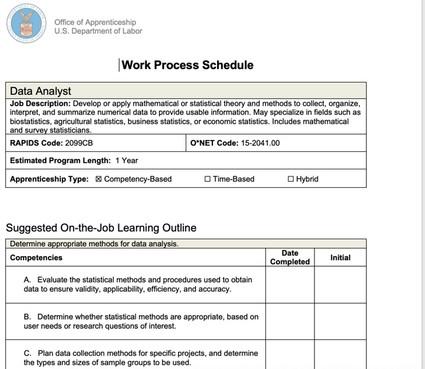
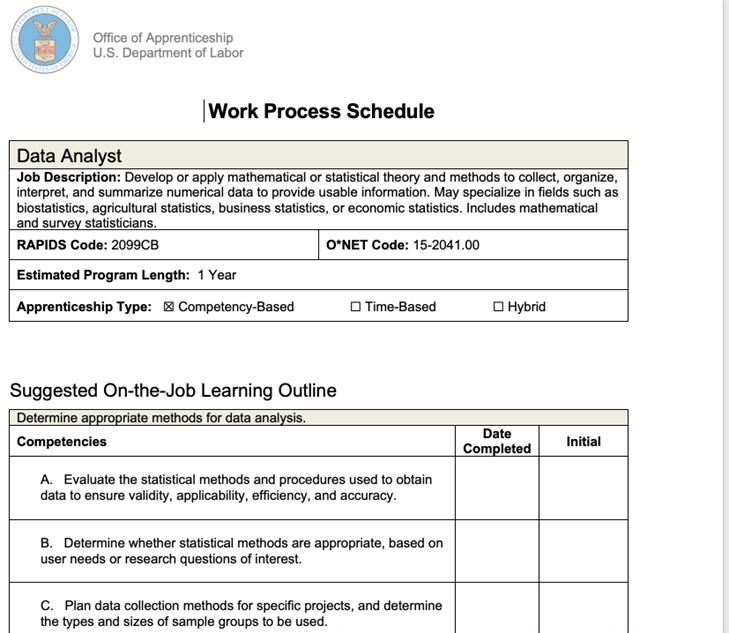
Illustrative Data Analyst RAPIDS Code: 2099CB
LLM identifies skill matches that are surprising and analyst manually adjust where needed Evaluate the statistical methods and procedures used to obtain data to ensure validity, applicability, efficiency, and accuracy.
Scored each skill on automation and augmentation across levels
We compare and deduplicate skills across competencies within RA’s. In total we identified 700 unique skills
ability to use AI increases both the
and quantity of workers’ output
Example | AI Exposure Analysis Summary Data Analyst
Office of Apprenticeship
U.S. Department of Labor
Data Analyst RAPIDS Code: 2099CB
Design research studies to obtain scientific information.
[JF Summary: AI as Intelligent Advisor | Auto 56% | Aug 87%]
Competencies Date
A. Develop and test experimental designs, sampling techniques, and analytical methods.
[AI as Intelligent Advisor | Auto 43% | Aug 85% | Skills: Experimental Design, Research Design]
B. Design research projects that apply valid scientific techniques, and use information obtained from baselines or historical data to structure uncompromised and efficient analyses.
[AI as Intelligent Advisor | Auto 49% | Aug 92% | Skills: Design Research, Research Design]
C. Plan data collection methods for specific projects, and determine the types and sizes of sample groups to be used.
[AI Productivity Power Zone | Auto 77% | Aug 83% | Skills: Sampling Design, Sample Size Determination]
From Insight to Practice Change
Behind our analysis are recommended actions on how to adapt registered apprenticeship competencies
AI as Intelligent Advisor
(low automation, high augmentation)
• AI augments problem solving, brainstorming, and ability to elevate quality, while still relying heavily on human judgement.
• As automating impacts commoditize outputs from many other skills, aptitude in these skills will increasingly be what differentiates worker performance. Training providers will need to invest in high quality training for these skills.
Essentially Human Skill
(low automation, low augmentation)
• Keep current approach, potentially with more time spent driving toward mastery, as these skills are less impacted by automation and augmentation
AI Productivity Power Zone
(high automation, high augmentation)
• The ability to use AI models increases both the quality and quantity of workers’ output, unlocking productivity gains while keeping humans in the loop.
• As these skills change quickly, traditional training methods must evolve to teach workers how to integrate AI into their work and fully realize these productivity gains.
AI Driven Execution
(high automation, low augmentation)
• Deemphasize the time/importance spent learning these skills as AI will drive greater productivity with less human labor.
• Training providers should either move away from focusing on these skills, or prepare learners to supervise AI agents that carry out these tasks.
Apprenticeships: Key Takeaways
• A proven track record for developing entry-level talent: Apprentices arrive with foundational understanding of tech, AI tools, and professional skills — shortening the employer learning curve and arriving ready to contribute.
• Aligned to the Augmentation/Automation framework: Our analysis of 30 registered tech apprenticeships shows competencies spanning the spectrum — with clear opportunities to redesign curriculum to prioritize high-augmentation, human-centered skills.
• The earn-while-you-learn model addresses real barriers: Financial constraints prevent many low- and moderate-income workers from pursuing traditional education pathways. Apprenticeships eliminate that barrier while delivering structured, employer-validated training.
• Apprenticeships are the answer for now — and the future: As AI continues to reshape entry-level roles, registered apprenticeships offer the most adaptable, employer-connected pathway to prepare talent for the AI era at scale.
06 | How NPower
is Responding
Programs
Career Ladders
How NPower is Responding to the Research
Employer-informed curriculum designed to yield certs
Pathways
Career Lattices
Young Adults & Military Connected
Job Placement
AI Literacy & Competency
Stackable Certifications
Internships
Dominant Employer Partnerships with Financial Services, Consulting, Managed Service Providers
Designed for high-augmentation and human skills (Quadrants 1, 2 & 4) PLUS
Employer-informed durable skills training
Plus those in low-income jobs exposed to AI disruption
Plus Wage Growth & Career Lattice Navigation
Plus AI for Personal Agency, Domain Exposure, and practical problem solving