





For Tegen. Because brilliant editors never get the credit they deserve.
For the Duck Duck Moose group x M.R. G.W.

With special thanks to Dr Daniel Antoine at the British Museum for his contribution and advice.
First published 2022
Nosy Crow Ltd
The Crow’s Nest, 14 Baden Place, Crosby Row, London, SE1 1YW
Nosy Crow Eireann Limited 44 Orchard Grove, Kenmare Co Kerry V93 FY22, Ireland
www.nosycrow.com
ISBN 978 1 78800 900 3
Nosy Crow and associated logos are trademarks and/or registered trademarks of Nosy Crow Ltd.
Published in collaboration with the British Museum.
Text © Matt Ralphs 2022 Illustrations © Gordy Wright 2022
The right of Matt Ralphs to be identified as the author and Gordy Wright to be identified as the illustrator of this work has been asserted.
All rights reserved.
This book is sold subject to the condition that it shall not, by way of trade or otherwise, be lent, hired out or otherwise circulated in any form of binding or cover other than that in which it is published. No part of this publication may be reproduced, stored in a retrieval system, or transmitted in any form or by any means (electronic, mechanical, photocopying, recording or otherwise) without the prior written permission of Nosy Crow Ltd.
A CIP catalogue record for this book is available from the British Library. Printed in China. Papers used by Nosy Crow are made from wood grown in sustainable forests.
1 3 5 7 9 8 6 4 2


Gordy Wright Matt Ralphs

Introducing the Dead
Tutankhamun
Ramses the Great Gebelein Man
Preserving the Dead Life, Death, Afterlife
Houses of the Dead
The Great Pyramid
The Maiden of Llullaillaco
The Chinchorro Mummies
Franklin’s Lost Expedition

Page 6 Page 8
Page 10
Page 12
Page 14
Page 17
Page 18
Page 19 Page 20
Page 24
Page 28
Ötzi the Ice Man
The Plaster Citizens of Pompeii
The Capuchin Catacombs
Bog Bodies
The Salt Men of Iran
Asia
Beauty of Xiaohe
Lady Xin Zhui
The Wet Mummy
Painted People of the Steppe
The Self-mummifying Monks
Secrets Revealed, Secrets Kept
Where They Were Found
Glossary
Index

Page 30
Page 32
Page 36
Page 38
Page 44
Page 46
Page 48
Page 50
Page 52
Page 56
Page 58
Page 60
Page 62
Page 64
The remains of our ancestors are all around us. They lie in graveyards, cemeteries, churches and temples, stone tombs and burial mounds. Most cultures throughout history believed it important to treat the dead with care, and many approaches have been used to either lay to rest, preserve or respectfully dispose of human remains.
Sometimes bones are even turned into works of art and put on display. In St Michael’s Chapel in Hallstatt, Austria, hundreds of beautifully painted skulls are stored, some decorated with wreaths, flowers, coloured crosses, and the dead person’s name and year of their death. Tunnels under Paris that were once ancient stone quarries now house the remains of millions of people – their skulls and bones lining walls in ordered layers. The ancient skeleton of a man called Saint Pancratius was even given a spectacular suit of armour.
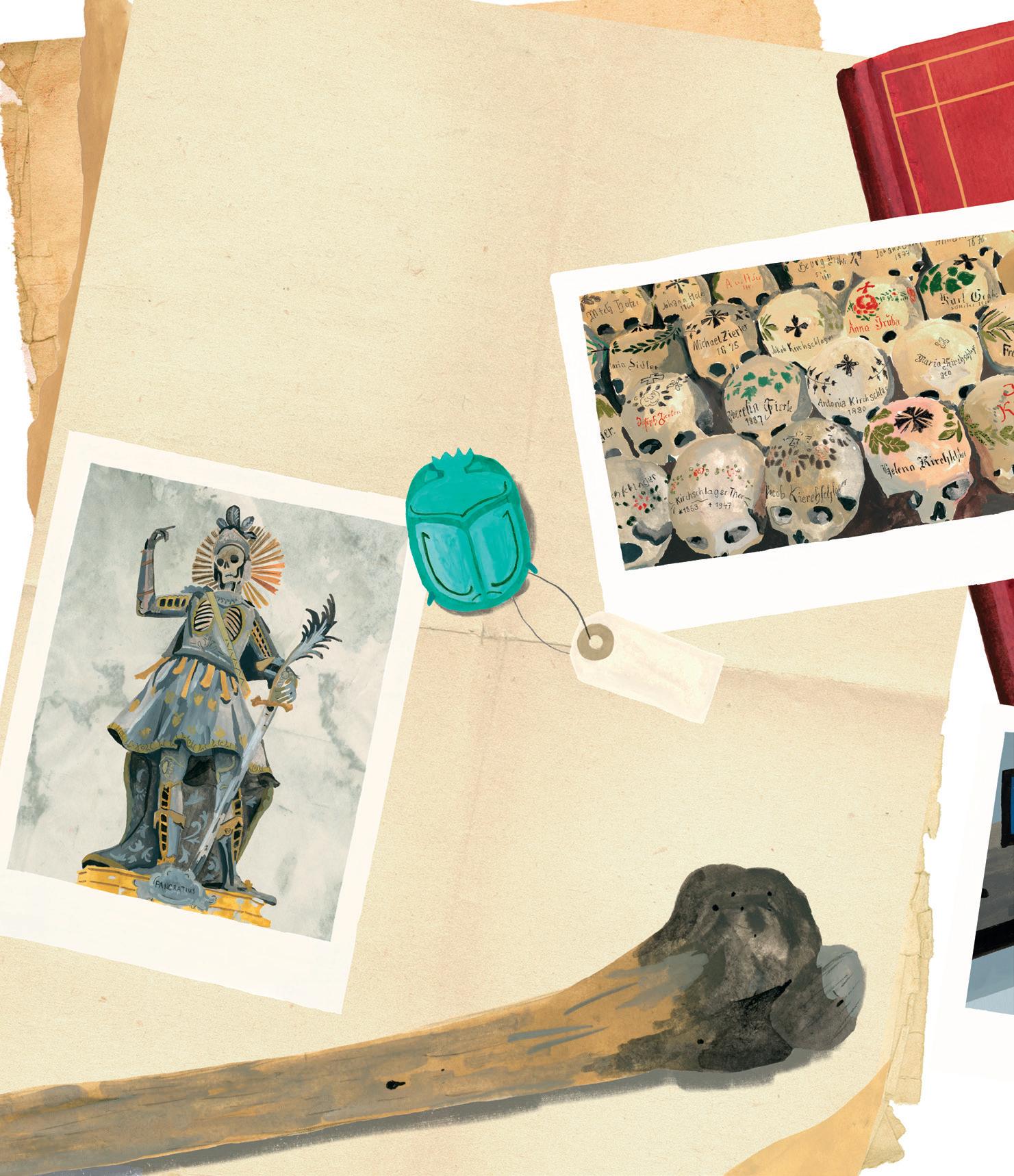
Egyptian scarab (foundamuletbyM.Ralphs)
In most environments, when someone dies their body’s soft tissues decay over time, leaving only the skeleton –skull, bones and teeth – behind. However, in mummified remains, soft tissues are preserved; they come to us in a more complete form. When we look at a mummy, we are reminded of the person they used to be and can learn about the time and place they lived in, from the food that they ate to the diseases they suffered from.
Switzerland

Some mummies were naturally created by chance. A man we now call Ötzi died high up in the alps of northern Italy that border Austria; he was covered in ice for 5,000 years, which acted just like a freezer, preserving even the tattoos on his skin. Others were deliberately mummified to stop their bodies from decaying. The ancient Egyptians are the most famous, but other cultures prepared their dead to ensure preservation – like the mysterious Chinchorro of South America, or the Scythians of Siberia.
The mummified dead have fascinated the living for centuries. Wealthy Victorians even held ‘unwrapping parties’, where people gathered to watch Egyptian mummies being stripped of their linen bandages. Nowadays, the dead are treated with more respect, and when archaeologists examine the delicate human remains in their care, they use modern technology like X-rays and CT scans to avoid any unnecessary damage.
This book will show you the amazing discoveries researchers have made and reveal the many secrets of the dead.
In November 1922, British archaeologist Howard Carter peered through a hole in the sealed doorway of a tomb. As his eyes adjusted to the dark chamber beyond, he saw a vast collection of extraordinary and beautiful objects. Carter’s companion asked, “Can you see anything?” Carter replied, “Yes, wonderful things!”

Carter had discovered the tomb of Tutankhamun who, in 1333 BC, became King of Egypt at the age of about nine. He died only ten years later. In paintings from his tomb he hunts wild animals and fights battles in his chariot; his stunning golden funerary mask shows a handsome, noble face. But art is not always true to life, so we need to examine his mummy to discover who he really was.
Tutankhamun’s fragile remains were damaged during examination in the 1920s. Nowadays, by using computers and X-ray machines, scientists have learned far more about the boy king without even touching him. Their studies revealed a very different person to the energetic warrior king shown in the paintings. Tutankhamun was slender, with narrow shoulders and wide hips.


Ramses II was worshipped like a god during his 66-year reign (1279–1213 BC). He won many battles and erected magnificent temples, monuments and statues. Under his rule, Egypt grew to the height of its power.
But even godlike kings die, and when Ramses passed away aged around 90 he was buried in the Valley of the Kings, where tombs were built into cliffs. He was later moved several times until eventually ending up in a secret tomb, where he lay undisturbed until local villagers discovered him by chance in the late 1800s.
Ramses’ preserved body gives us clues as to what he was like in life. He was 1.7 metres tall, with a sharp-featured face, strong jaw and beak-like nose. The back and sides of his head are still covered in thick, wavy hair; sparse tufts cling to his temples and mostly bald scalp. His once white hair is now reddish in colour, perhaps stained during the mummification process.
Ramses may have been a great king, but scientific studies of his mummy showed he still suffered from ordinary illnesses. He was probably crippled with arthritis, a painful disease that caused his joints to swell and made him walk with a stoop. Over the years, fat built up on the inside of his arteries, making them narrower. This caused poor blood circulation and increased his risk of heart disease. Scientists also found that he had a painful dental abscess; these occur when pus builds up inside the jawbone due to an infection in the teeth.

Even after 3,200 years, Ramses still looks every inch a king. His head, with its chiselled features, is stern and dignified. His linen-wrapped hands are especially wellpreserved, and the way he holds them away from his chest makes it look as if this great pharaoh is waking up and beginning to move.
Ramses was buried in the Valley of the Kings in a tomb we now call KV7. It’s located opposite the tomb of his many sons, which is the largest in the valley with at least 130 chambers. The walls are decorated with many scenes, including the Opening of the Mouth ceremony (page 17), and Ramses himself. The only objects found inside were a wooden shabti figurine, pieces of glass, jar lids and statue fragments. Unfortunately, Ramses’ resting place has been damaged over the years by floods.