This book belongs to

This book belongs to
For my much-loved friend Katy, who is a very good book-sharing granny.
F. M. W.
I Am the Seed That Grew the Tree gathers poems from all over the world. Regional spellings and usage have been retained in order to preserve the integrity of the originals.
First published 2018 by Nosy Crow Ltd
The Crow’s Nest, 14 Baden Place Crosby Row, London SE1 1YW www.nosycrow.com
ISBN 978 0 85763 770 3
This book is published by Nosy Crow in collaboration with the National Trust nationaltrust.org.uk/books.
‘The National Trust’ and the oak leaf logo are registered trademarks of The National Trust (Enterprises) Limited (a subsidiary of The National Trust for Places of Historic Interest or Natural Beauty, Registered Charity Number 205846). Nosy Crow and associated logos are trademarks and/or registered trademarks of Nosy Crow Ltd.
This selection © Fiona Waters 2018 Illustrations © Frann Preston-Gannon 2018 The acknowledgements on pages 332 – 333 constitute an extension of this copyright page.
The right of Fiona Waters to be identified as the compiler and Frann Preston-Gannon to be identified as the illustrator of this work has been asserted. All rights reserved.
This book is sold subject to the condition that it shall not, by way of trade or otherwise, be lent, hired out or otherwise circulated in any form of binding or cover other than that in which it is published. No part of this publication may be reproduced, stored in a retrieval system, or transmitted in any form or by any means (electronic, mechanical, photocopying, recording or otherwise) without the prior written permission of Nosy Crow Ltd.
A CIP catalogue record for this book is available from the British Library.
Printed in China
Papers used by Nosy Crow are made from wood grown in sustainable forests.
selected by illustrated by
Fiona Waters Frann Preston-Gannon
INTRODUCTION
JANUARY
SEPTEMBER
OCTOBER
NOVEMBER
DECEMBER
For my seventh birthday, my parents gave me a book containing — like this one — hundreds of poems. It was a small, fat book without pictures. At frst, I found it daunting: without pictures there was nothing to catch my eye, nothing to lead me into the book.
But one wet afternoon after school, I took it down and began to read. And that was it for me: I fell in love with poetry, with rhyme, with rhythm, with the way that poetry squashed big feelings, big thoughts, big things into tiny boxes of brilliance for the reader to unpack. It became my favourite book. I have it still. It is stuffed with little slips of paper that I used to mark the poems I liked best. As I grew older, those poems changed: a poem that baffled and bored me when I was seven revealed itself to me a couple of years later. I learned many of them by heart, and could recite them to you now.
When I was that seven-year-old child, I lived in a very small house with a very big garden on the outskirts of a city. The house was quite new, but the garden had old trees in it — a lilac, a holly and an apple tree so climbable it seemed as if it had grown itself with climbing children in mind. Those trees were alive with small birds and, one spring, there was a nest with blue eggs in it and, later, three shockingly naked baby birds with gaping beaks that seemed to split their heads in two. Hedgehogs sometimes snuffled across the grass at night, and, one wet spring, I saw two frogs. There were daisies and dandelions and buttercups, and a flower so astonishingly complex and beautiful that I thought it must be magical. I later learned it was called a columbine. I spent hours in that garden, looking and learning.
I grew up. I read more poems. I became a publisher and, in my thirty years of publishing, I have published many poetry books. But none has been as ambitious as this one. My idea was to make a book as rich as the one I loved so much, but to make something that was more beautiful and easier to find your way into. And I wanted, too, to make a book that helped you to pause and see the natural world around you.
I asked Fiona Waters to choose the poems and Frann Preston-Gannon to make the pictures, so that each page became an invitation to draw the reader in.
You could read the poems on your own or you could share them: you could have them read to you, or you could read them to someone else (because poems become particularly alive when they are read out loud).
You could read it from beginning to end quickly, or you could read a poem every day, every evening before you go to bed, and think about whether the things in the poem matched, or didn’t match, what you had seen that day.
You could dip into it, looking at the poem that we’ve chosen for your birthday, for example, and close the book again so you could just think about that poem.
You could just look at the pictures.
You could leave it on your shelf until you are ready for it.
You could stuff it full of slips of paper to mark your favourite poems. You could learn some of the poems in it by heart, just for you to remember, or to recite to someone you love on the morning of their birthday. You could keep it forever.
If you enjoy it half as much as we have enjoyed making it, then we will have done what we set out to do.
Kate Wilson Publisher, Nosy Crow
1st 2nd 3rd 4th 5th 6th 7th 8th 9th 10th 11th
12th 13th 14th 15th 16th
THE GARDEN YEAR Sara Coleridge
THE NEW YEAR Anonymous
JANUARY John Foster
JANUARY Winifred C. Marshall
BIRCH TREES John Richard Moreland
STOPPING BY WOODS ON A SNOWY EVENING Robert Frost
DIAMOND POEM John Foster
SNOWFLAKES Leroy F. Jackson
WINTER Walter de la Mare
SNOWFLAKES David McCord
WINTER DAYS Gareth Owen
SNOW IN THE SUBURBS Thomas Hardy
A HARD WINTER Wes Magee
IN THE GARDEN Anonymous
ONCE I SAW A LITTLE BIRD Anonymous
THE WIND Robert Louis Stevenson
17th
18th 19th
20th
21st 22nd 23rd
24th
25th
26th
27th
28th
29th
30th
31st
WHO HAS SEEN THE WIND? Christina Rossetti
WHITE FIELDS James Stephens
A MORNING WALK Southern Paiute song, translated by John Wesley Powell
SMALL, SMALLER Russell Hoban
OVER WINTRY WIND-WHIPPED WAVES Anonymous
SHELL Ted Hughes
HERE WE GO ROUND THE MULBERRY BUSH Anonymous
FLYING J. M. Westrup
STAR WISH Anonymous
THE STAR (EXTRACT) Jane Taylor
I SEE THE MOON Anonymous
THE FURRY ONES Aileen Fisher
MAGGIE Anonymous
JANUARY John Updike
WINTER TIME Robert Louis Stevenson
January brings the snow, Makes our feet and fingers glow.
February brings the rain, Thaws the frozen lake again.
March brings breezes loud and shrill, Stirs the dancing daffodil.
April brings the primrose sweet, Scatters daisies at our feet.
May brings flocks of pretty lambs, Skipping by their fleecy dams.
June brings tulips, lilies, roses, Fills the children’s hands with posies.
Hot July brings cooling showers, Apricots and gillyflowers.
August brings the sheaves of corn, Then the harvest home is borne.
Warm September brings the fruit, Sportsmen then begin to shoot.
Fresh October brings the pheasant, Then to gather nuts is pleasant.
Dull November brings the blast, Then the leaves are whirling fast.
Chill December brings the sleet, Blazing fire, and Christmas treat.
Sara Coleridge
The Young New Year has come so soon I wonder where the Old Years go?
To some dim land behind the moon
Where starlight glimmers, pale and low.
And everything is grey and cold
And there they sit, those ancient years, Their eyes so kind, and dim and old Their faces lined with vanished cares.
Their voices rattle, dry like bones, The while they talk of what has been, And murmur in their hollow tones
Of all the triumphs they have seen.
While the Young Year, with earnest eyes, Comes buoyant on, to run his race, Nor dreams how fast his life-span flies Nor how his end draws on apace.
Anonymous
3 rd
January is a clean white sheet, newly-ironed; an empty page; a field of freshly-fallen snow waiting to be mapped by our footsteps.
John Foster
4 th
Little January
Tapped at my door today. And said, “Put on your winter wraps, And come outdoors to play.”
Little January
Is always full of fun; Today we coasted down the hill, Until the set of sun.
Little January
Will stay a month with me And we will have such jolly times — Just come along and see.
Winifred C. Marshall
th
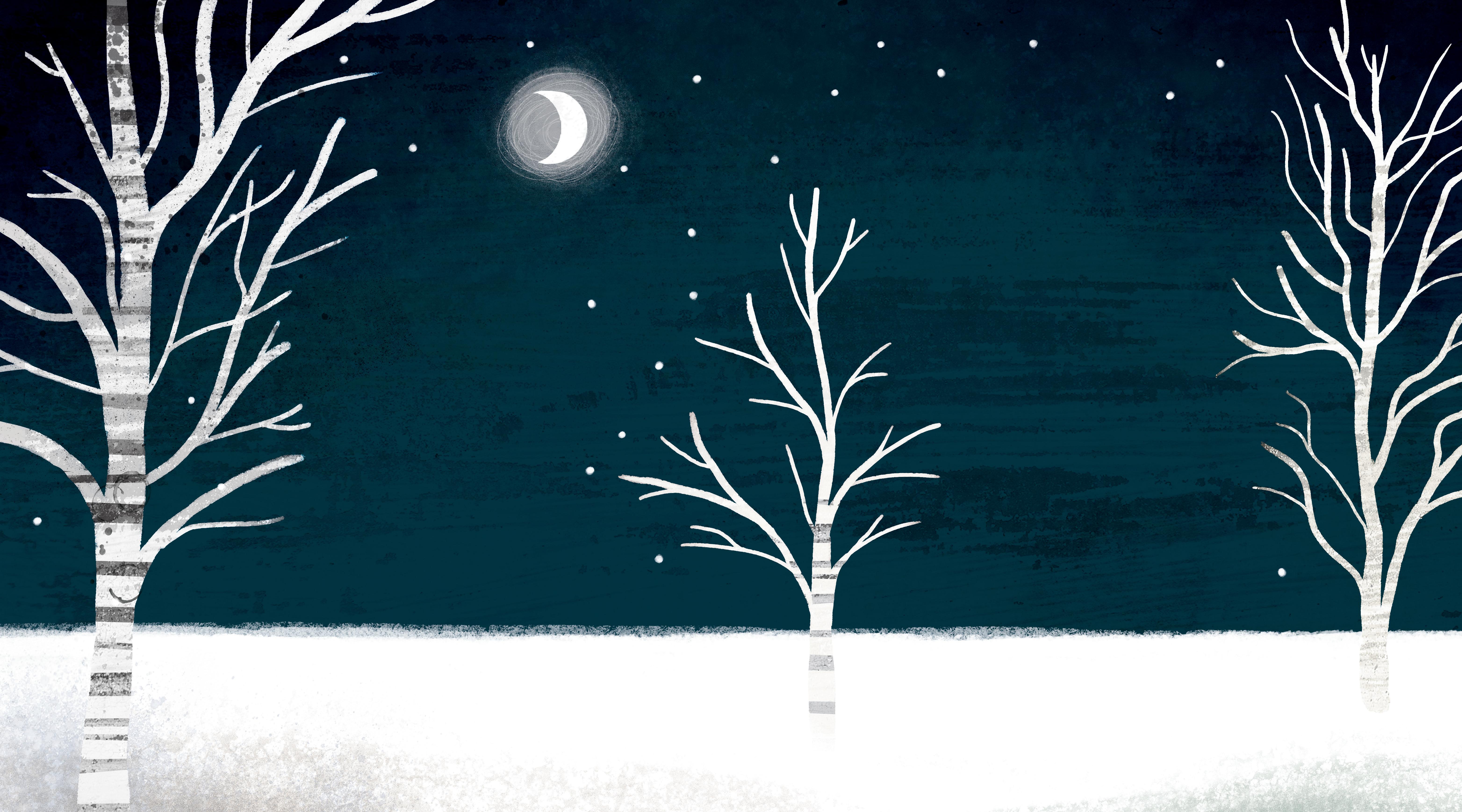
The night is white, The moon is high, The birch trees lean Against the sky.
The cruel winds Have blown away Each little leaf Of silver gray.
O lonely trees As white as wool . . . That moonlight makes So beautiful.
John Richard Moreland
Whose woods these are I think I know. His house is in the village though; He will not see me stopping here To watch his woods fill up with snow.
My little horse must think it queer To stop without a farmhouse near Between the woods and frozen lake The darkest evening of the year. He gives his harness bells a shake To ask if there is some mistake. The only other sound’s the sweep Of easy wind and downy flake.
The woods are lovely, dark and deep. But I have promises to keep, And miles to go before I sleep, And miles to go before I sleep.
Robert Frost
7 th
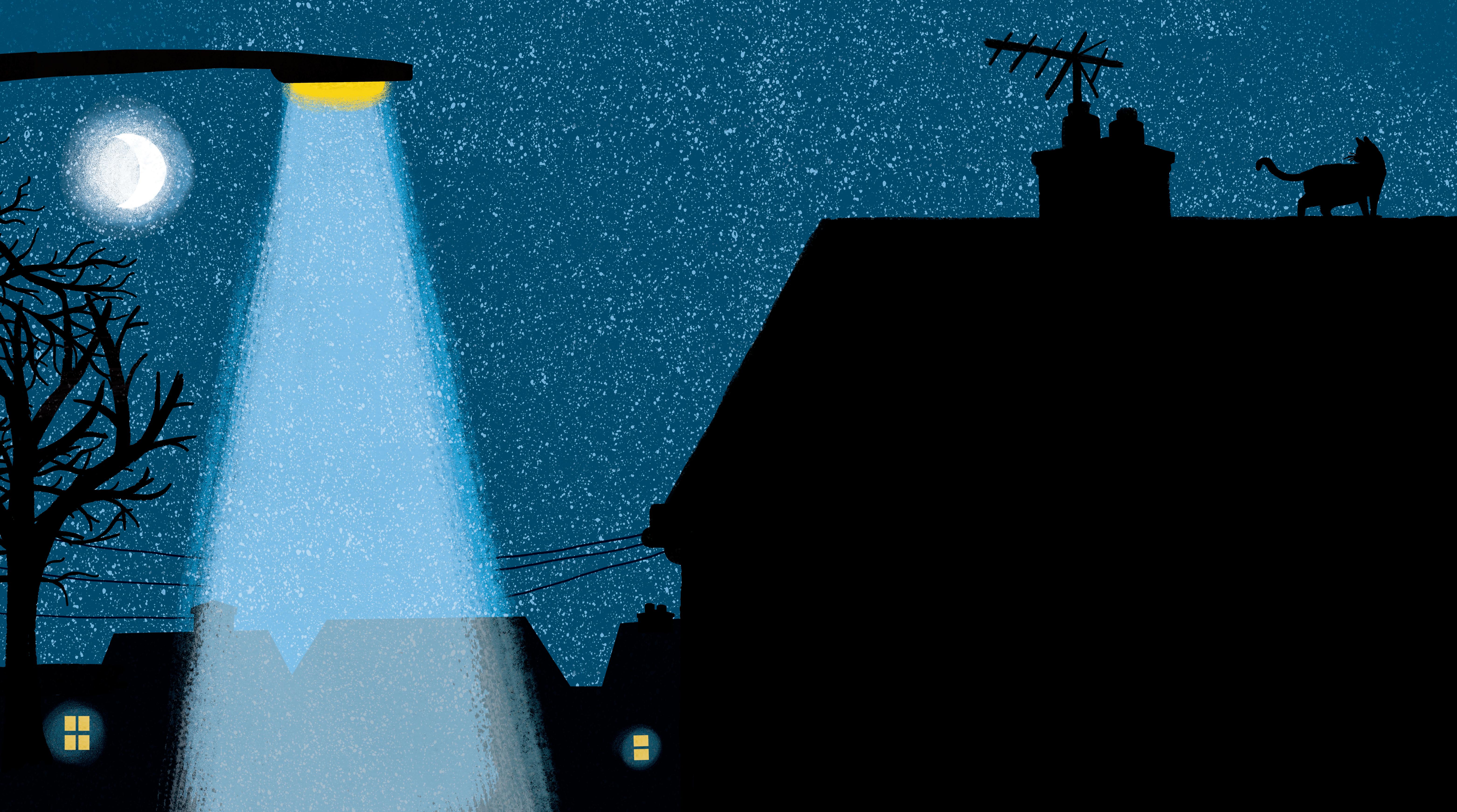
Snow — Soft flakes
Dust the street, Painting pavements
A brilliant white. In the lamp’s light, Glittering Crystals Gleam. John Foster
8 th
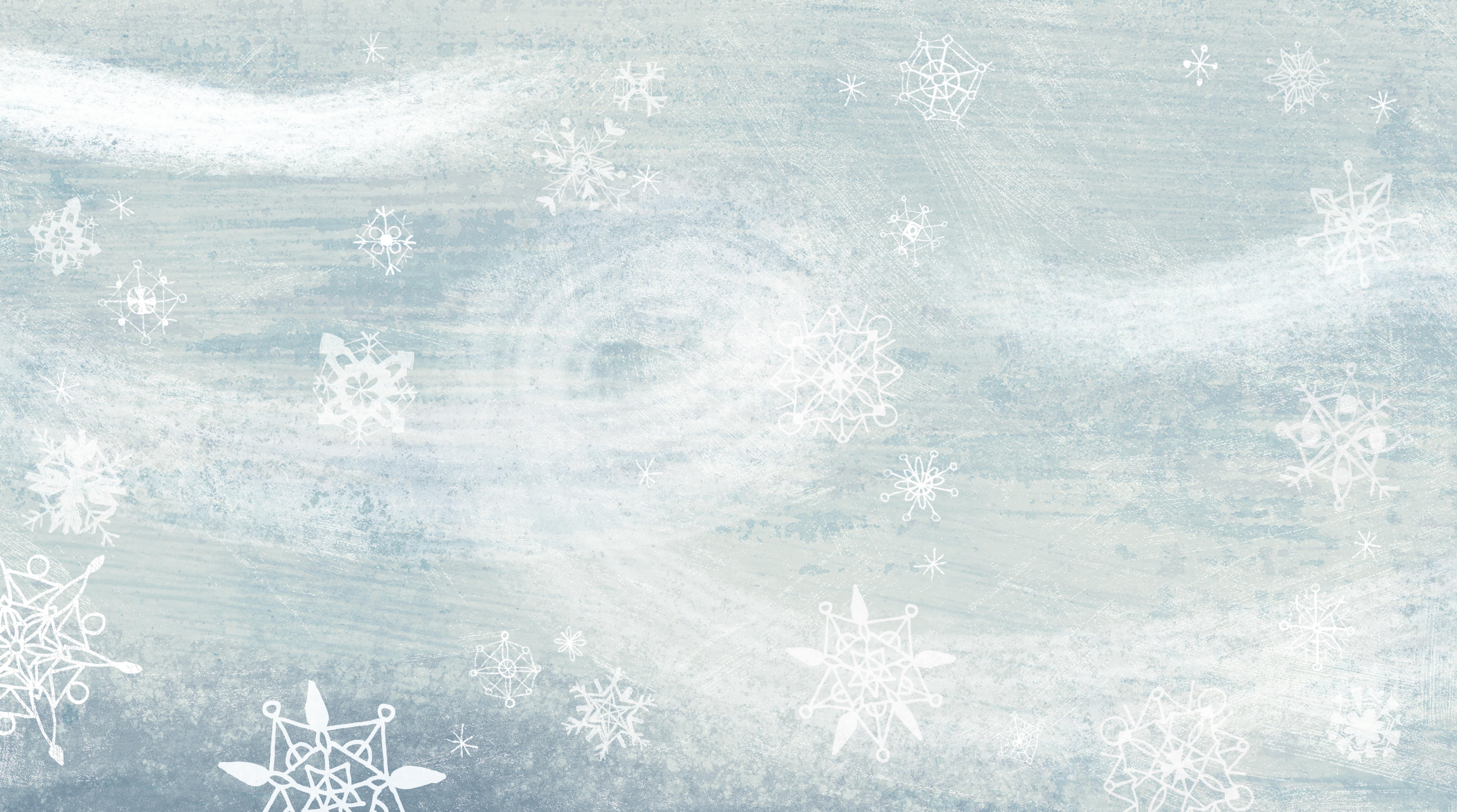
The snowflakes are falling by ones and by twos; There’s snow on my jacket, and snow on my shoes; There’s snow on the bushes, and snow on the trees — It’s snowing on everything now, if you please.
Leroy F. Jackson
9 th
WIN TER
Clouded with snow
The cold winds blow, And shrill on leafless bough The robin with its burning breast Alone sings now.
The rayless sun, Day’s journey done, Sheds its last ebbing light On fields in leagues of beauty spread Unearthly white.
Thick draws the dark, And spark by spark, The frost-fires kindle, and soon Over that sea of frozen foam Floats the white moon.
Walter de la Mare
Sometime this winter if you go
To walk in soft new-falling snow When flakes are big and come down slow
To settle on your sleeves as bright As stars that couldn’t wait for night You won’t know what you have in sight —
Another world — unless you bring A magnifying glass. This thing We call a snowflake is the king
Of crystals. Do you like surprise?
Examine him three times his size: At first you won’t believe your eyes.
Stars look alike, but flakes do not: No two the same in all the lot That you will get in any spot
You chance to be, for every one Come spinning through the sky has none But his own window-wings of sun:
Joints, points, and crosses. What could make Such lacework with no crack or break? In billion billions, no mistake?
David McCord
WINTER DAYS 11 th
Biting air
Winds blow
City streets
Under snow
Noses red
Lips sore
Runny eyes
Hands raw
Chimneys smoke
Cars crawl
Piled snow
On garden wall
Slush in gutters
Ice in lanes
Frosty patterns
On windowpanes
Morning call
Lift up head
Nipped by winter
Stay in bed
Gareth Owen
th
Every branch big with it, Bent every twig with it;
Every fork like a white web-foot;
Every street and pavement mute:
Some flakes have lost their way, and grope back upward, when Meeting those meandering down they turn and descend again.
The palings are glued together like a wall,
And there is no waft of wind with the fleecy fall.
A sparrow enters the tree, Whereon immediately
A snow-lump thrice his own slight size
Descends on him and showers his head and eyes, And overturns him, And near inurns him, And lights on a nether twig, when its brush
Starts off a volley of other lodging lumps with a rush.
The steps are a blanched slope, Up which, with feeble hope,
A black cat comes, wide-eyed and thin; And we take him in.
Thomas Hardy
Not a twig stirs.
The frost-bitten garden huddles beneath a heaped duvet of snow.
Pond, tree, sky and street are granite with cold.
14 th
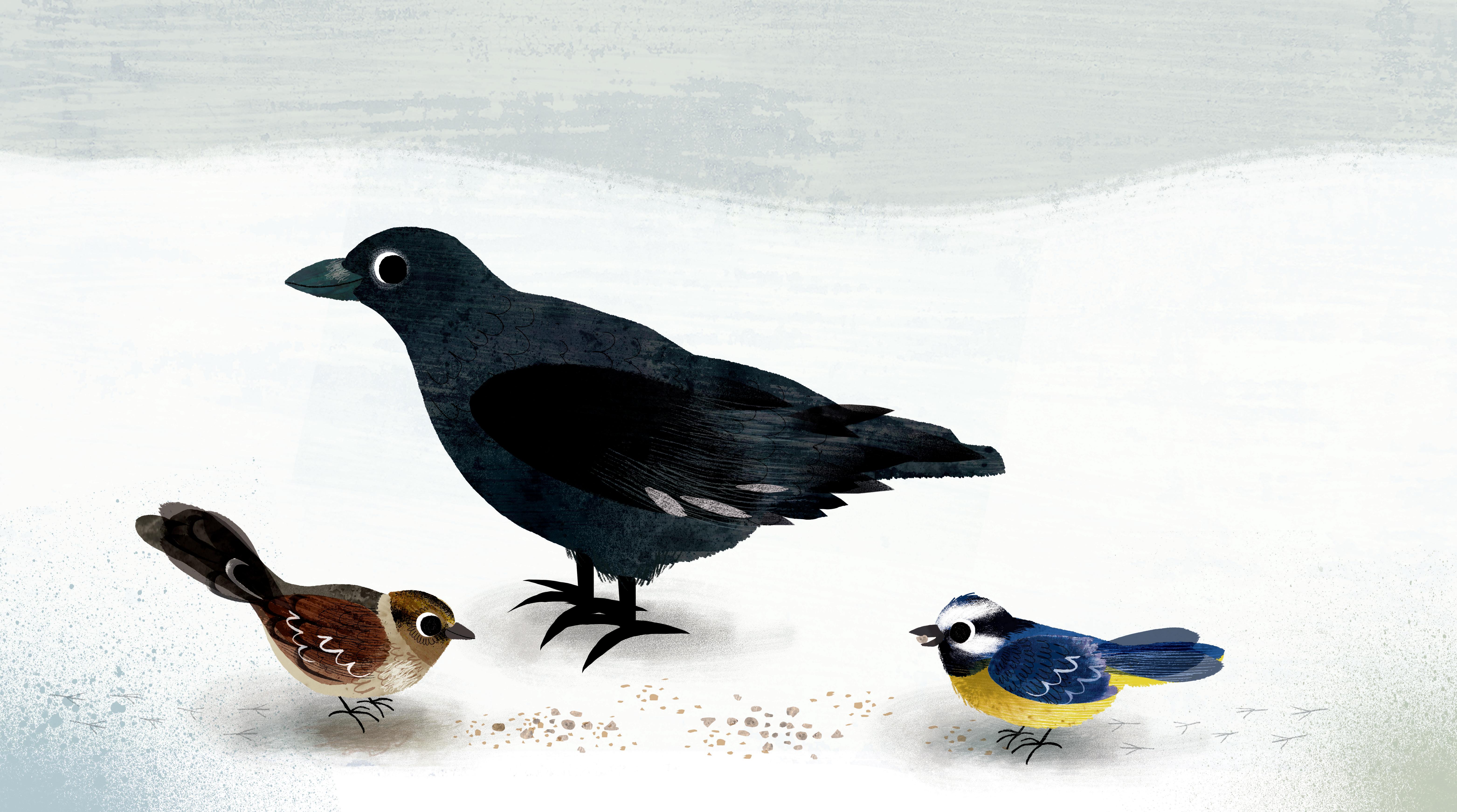
Greedy little sparrow, Great big crow, Saucy little tom-tits All in a row.
Are you very hungry, No place to go?
Come and eat my breadcrumbs, In the snow.
Anonymous
Once I saw a little bird going hop, hop, hop. So I cried, “Little bird, will you stop, stop, stop?” And was going to the window to say, “How do you do?” When he shook his tail and away he flew.
Anonymous