
SURVIVE
HOW TO ANYWHERE
STAYING ALIVE IN THE WORLD’S MOST EXTREME PLACES

BEN LERWILL
DANIEL LONG
INTRODUCTION
Have you ever dreamed of exploring distant lands? Of hiking through the chattering depths of the Amazon Rainforest, or crossing the freezing plains of the Arctic? Going on a big adventure is always exciting _ but it’s even better when you’re well prepared.
That’s what this book is for. Over the following pages, we’ll be travelling all the way around the world, visiting all sorts of incredible places and learning tricks and tips for staying safe. What happens if you get caught in a desert sandstorm? How do you build an igloo? And what’s the best way to escape a shark?
Humans need four basic things to survive: food, water, warmth and shelter. But when you’re on an expedition, survival is often about much more than that. It’s about understanding your environment and knowing how to stay fit and well. It’s about looking after the people you’re with and the place you’re visiting.
And above all it’s about being able to enjoy the adventure!
ARCTIC CIRCLE
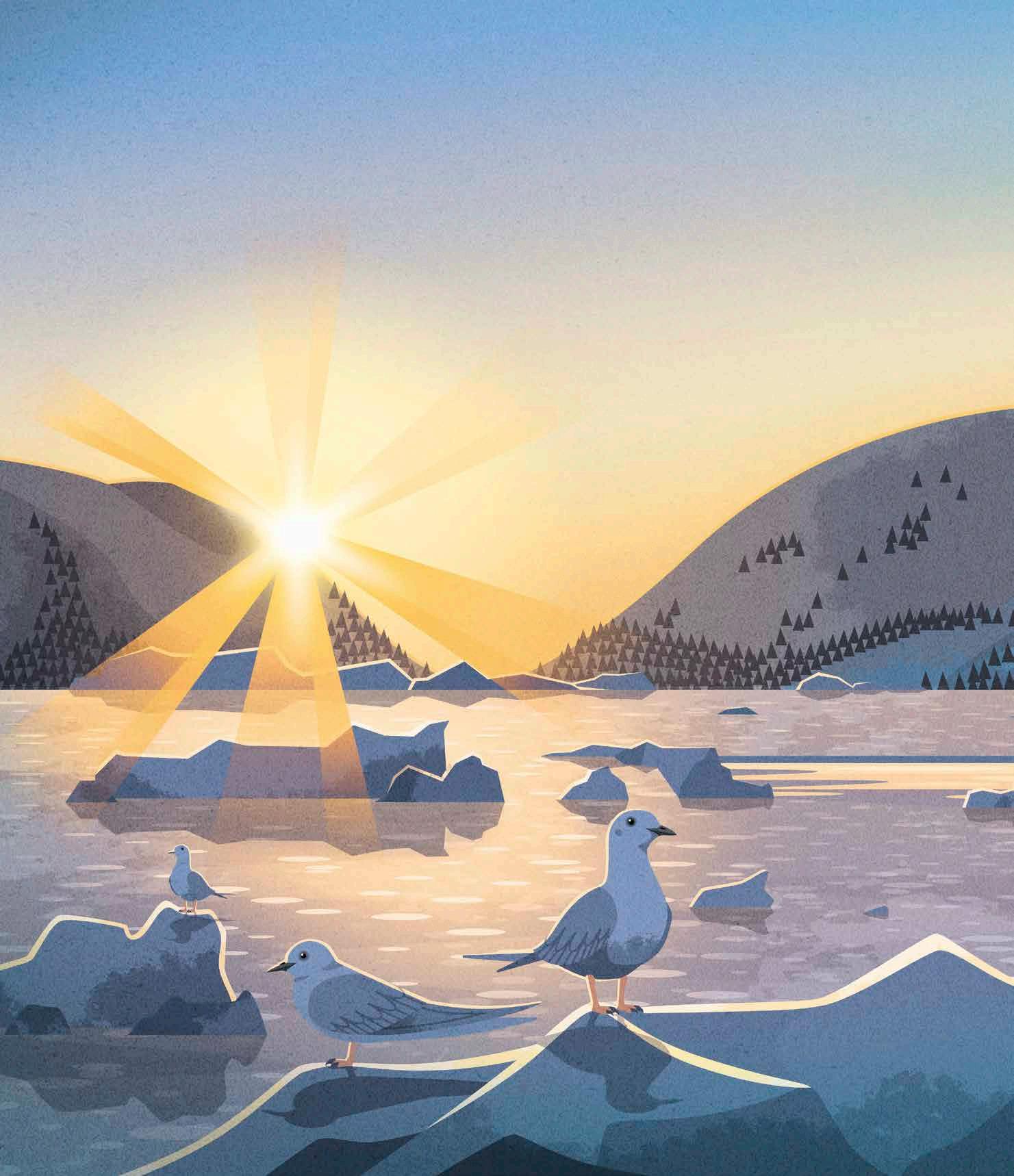
Picture a world of snow, ice and bone-chillingly cold water. A place where you can hear your breath tinkling as it freezes in the air. This is the long Arctic winter, when the sun rarely rises above the horizon and the skies can stay dark for weeks, or even months. Life is hard up here in the far north: the distances are huge, the cold is extreme and the nights are long. Months from now, when summer arrives, this will be a very different place. Until then, white hills and frozen lakes sit under silent skies. The polar landscape sometimes looks lifeless, but among the icy bays and islands, nature finds a way to survive . . .
FACT FILE
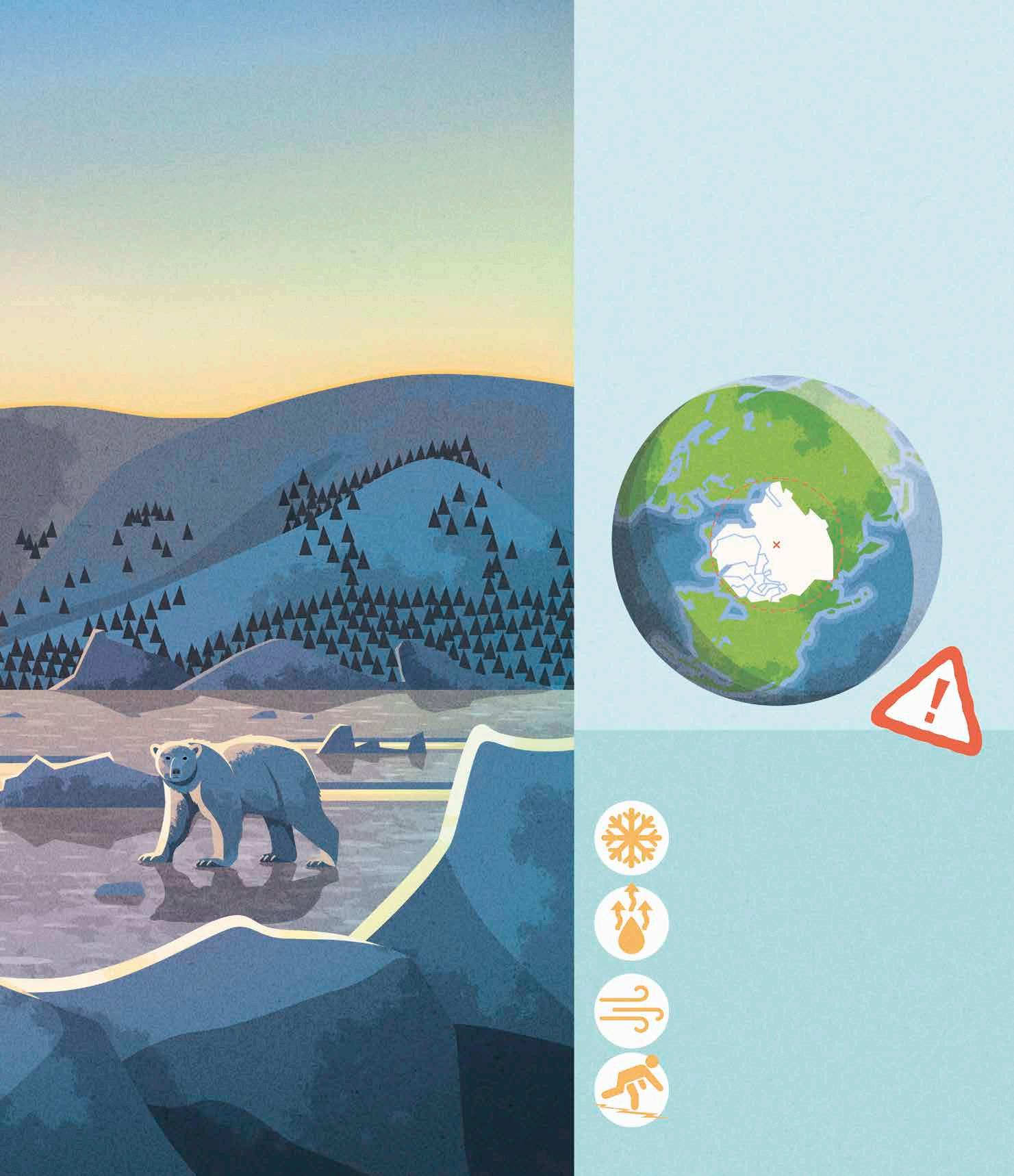
» The Arctic Circle is the name given to the area north of an imaginary line measuring 16,000 kilometres around the top of the world.
» Parts of Russia, Canada, Greenland, Alaska and Scandinavia are all within the Arctic Circle.
» Most of the Arctic Circle is ocean. Some parts of it stay frozen as sea ice all year.
» Along with Antarctica in the far south, the Arctic Circle is one of Earth’s two polar regions.
Things to remember
Temperatures can fall below -50 °C, so staying warm will save your life.
Staying dry is vital too. If you get wet, you’ll lose heat dangerously quickly.
Wild winds can make the air feel even colder.
If you’re walking over ice, always make sure it’s strong enough to support you.
North Pole
ArcticCircle
who lIves heRe?
The Arctic Circle covers an enormous area. Most of it is wilderness, but these days there are also villages, towns and even cities. Experts think people have been living in this part of the world for as long as 20,000 years. Peoples such as the Inuit, from Greenland and Canada, and the Yupik, from Alaska and Russia, have had to learn the best ways to survive the long Arctic winters. Some still live in remote areas and practise traditional ways of hunting and fishing, although modern technology has made survival easier. Adventurers from around the world also come to the Arctic Circle.
Sealskin is naturally waterproof. Some people who live here still use it to make gloves and shoes.
what eLse survIves heRe?
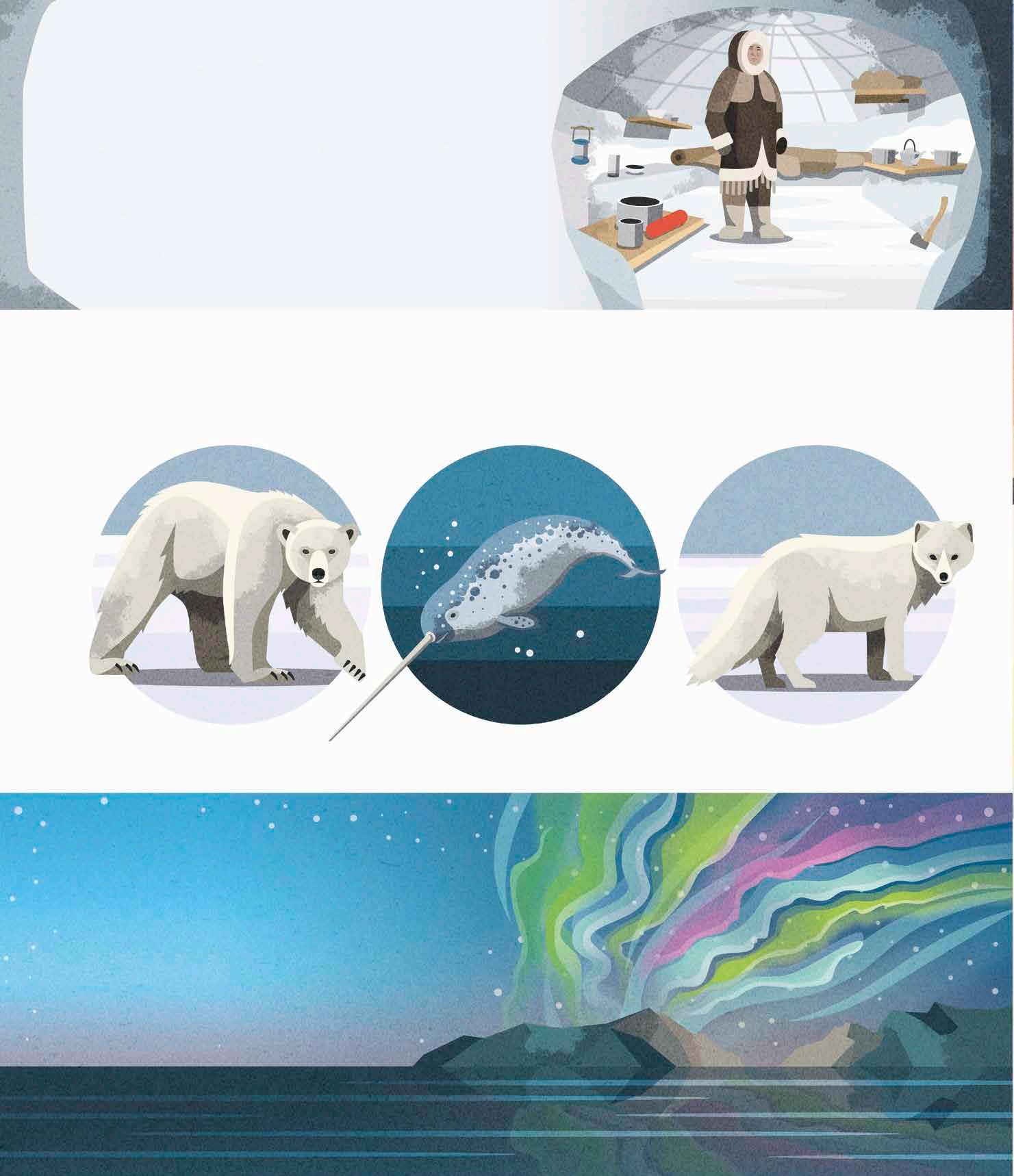
Some of the planet’s most incredible creatures have evolved to live in the Arctic Circle – above and below the sea ice!
what aRe ... the northern lIghts?
On dark, clear nights, magic fills the Arctic sky. Rainbow-coloured shapes shimmer across the heavens, gliding and glowing. The Northern Lights are one of nature’s most amazing displays . . . but what are they?
The lights are caused by solar particles, which are tiny specks of matter sent out by the Sun. When these particles get close to the Earth, they’re attracted to the polar regions, which are magnetic. Here, they collide with gases in the atmosphere, making the sky glow with light.
The lights are mostly green or pink, but can also be yellow, orange, violet or blue.
Polar bears have white shaggy fur to blend in with their surroundings.
Narwhals use their long tusks to stun and catch cold-water fish.
Arctic foxes have bushy tails that they can wrap round themselves to stay warm.
The stoRy oF ...
AdA BlACkjACk
Wrangel is an ice-cold Russian island roamed by polar bears. It’s not the sort of place you’d choose to be stuck for two years – but this is exactly what happened to a brave young Iñupiaq woman named Ada Blackjack, from Alaska. She was just 23 years old when she arrived here in 1921 as a helper on an expedition, but the other members of the team soon died, leaving just Ada and a cat called Victoria to survive alone. She set traps to catch foxes, learned how to shoot birds, and even made a small boat from animal skins. When a rescue ship finally arrived two years later, the crew found both Ada and Victoria alive. Back home in Alaska, Ada found work as a reindeer herder and lived to the age of 85.
how to... buIld An Igloo
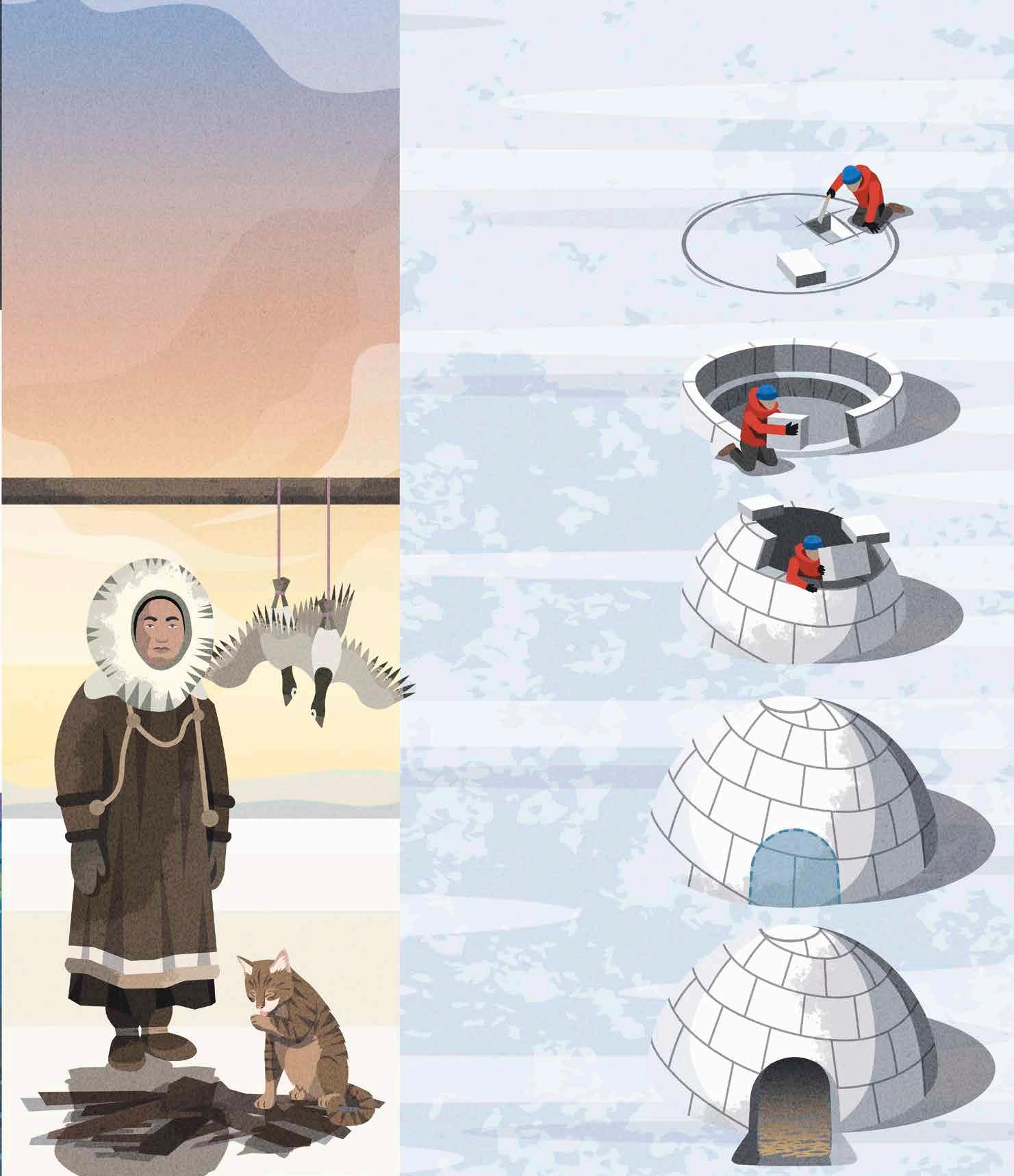
These traditional snow-domes are still used as temporary winter shelters by some Inuit. They can be surprisingly cosy!
Most of the Arctic Circle has no trees . . . which means no firewood. In the past, people lit lamps filled with seal fat or lichen (a mossy plant) to make small fires.
First, dig down past the powdery surface snow until you reach hard compact snow. Using a snow saw, cut this hard snow into thick rectangular blocks.
Start arranging the blocks into a circular wall. The top of the wall should slope gradually upwards. The space inside should be big enough for you to lie down comfortably.
Keep building the igloo, block by block, in a spiral pattern, until you’ve made a dome shape. Make sure you leave space for a small hole at the top. This helps the air circulate.
Cut a low doorway that you can crawl into. To keep more warmth in, you can even tunnel under the wall to make an underground doorway!
It’s dangerous to sleep directly on snow or ice, so cover the ground inside the igloo with whatever you have. Inuit traditionally used birch twigs and animal furs. 1 2 4 3 5
NoRth PoLe explorers
At the very top of the world map – in the exact middle of the Arctic Circle – you’ll find the North Pole. It’s not actually on land at all, but on a thick shelf of sea ice. This makes it very difficult to reach. Even today, no one’s quite sure who the first explorer was to arrive here!
Some people say it was an American called Frederick Cook and his two Inuit guides, Ahwelah and Etukishook. Cook claimed they had reached the pole in 1908, after a difficult expedition that lasted months. Other people say it was another American, Robert E. Peary, who battled his way to the North Pole in 1909. We may never know the truth!
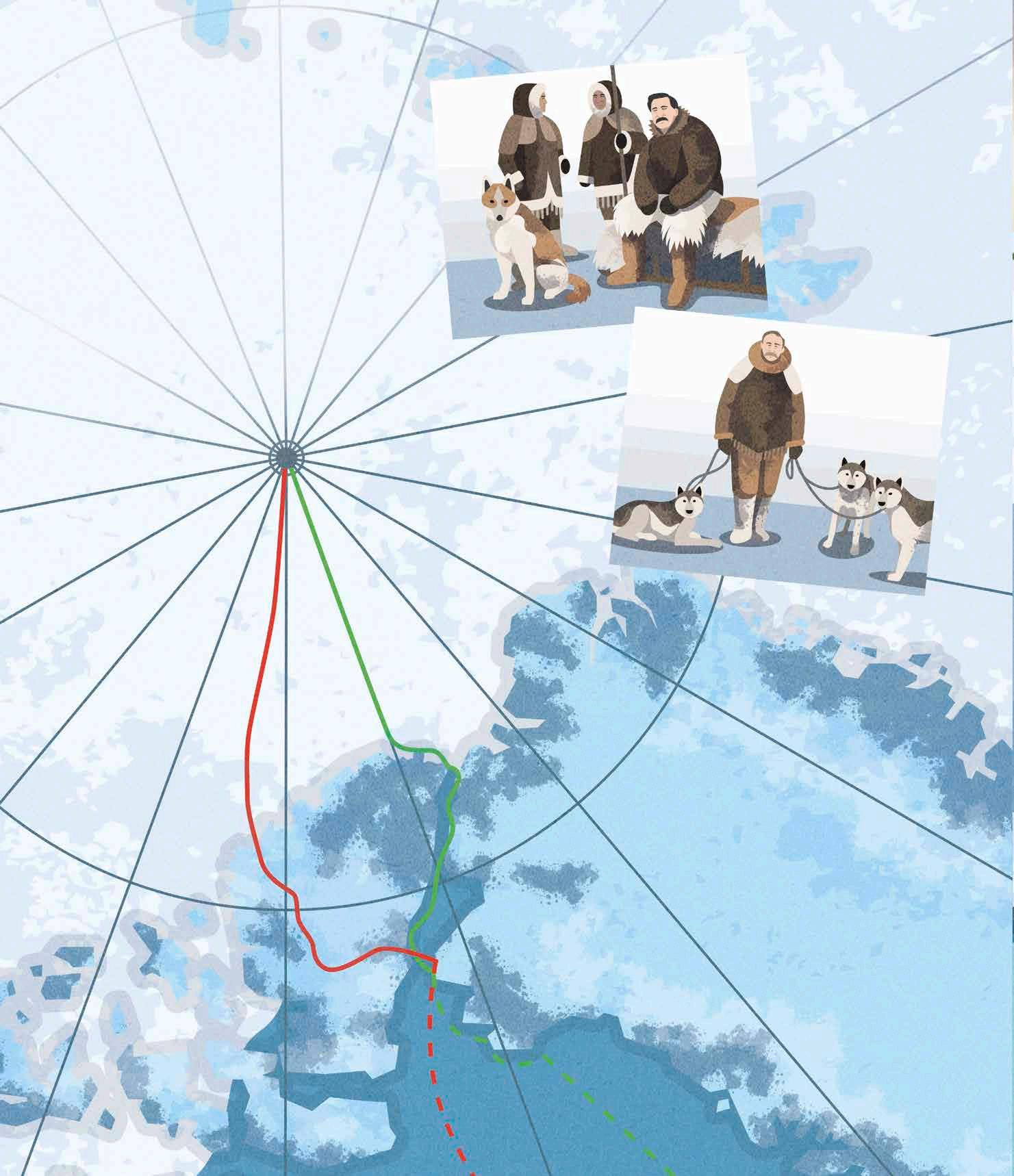
When they wanted to travel long distances, some Inuit used to make sleds by stretching animal skin over whale bones. The sleds were then pulled across the ice by dogs.
Ahwelah, Etukishook and Frederick Cook
Robert E. Peary
Ahwelah, Etukishook and Frederick Cook
Robert E. Peary
The glare from ice and snow can be blinding. If you don’t have snow goggles, cut small slits into pieces of wood or cardboard and place them over your eyes.
the ChAngIng aRCtiC
The summer months bring big changes to the Arctic Circle, with warmth, greenery and sunlight. On some days the sun never sets at all – even at midnight! These higher temperatures melt away lots of the ice and snow, although large areas stay frozen all year because the ice is so thick.
This is good for animals like polar bears, and good for the world as a whole, because the ice here reflects sunlight, which keeps the planet cooler.
But there’s a problem. Global warming means too much ice is melting. This not only damages the Arctic environment, it also makes the planet even warmer.
what is...
ICe FIshIng?
Ice fishing is a way of catching fish when the sea, or a lake, is frozen. It’s done by drilling a hole into the ice and dangling a rod and line into the water below. The hole should be big enough to pull a fish through but not large enough to slip into.
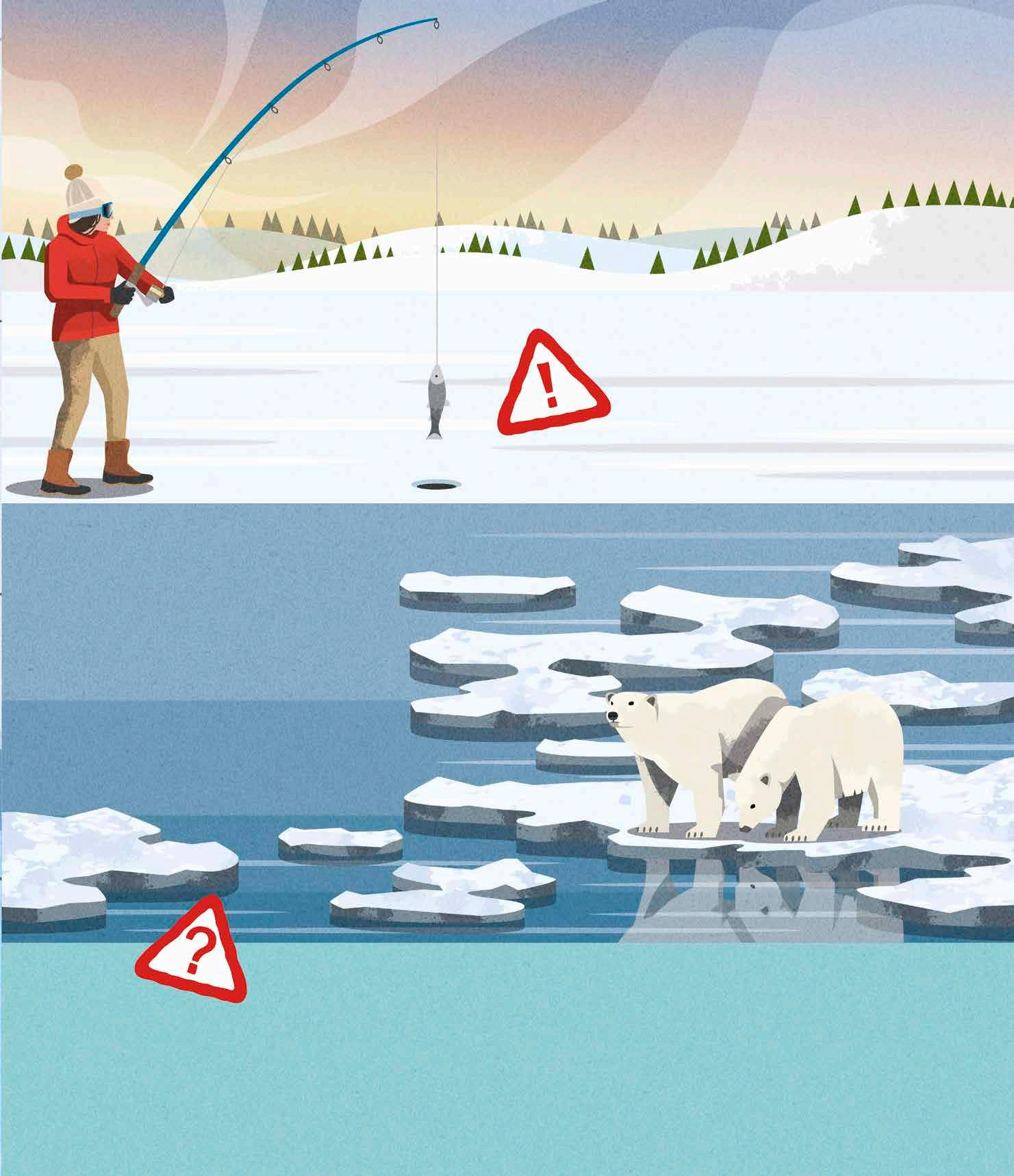
The crucial thing to remember is that the ice needs to be strong enough to support whoever’s on it. Imagine a toilet roll standing on its end – if the ice isn’t at least as thick as this, it’s far too dangerous to stand on!
The Arctic Circle is warming up faster than anywhere else in the world. By cutting our carbon emissions, we can slow this down. GIve green energy the thumbs up
Check which company supplies your gas and electricity at home. You could ask the person who pays the bill to switch to a green energy supplier.
JoIn the teAm
Get involved with brilliant organisations like Polar Bears International, which helps protect polar bears.
ReduCe your CArbon