

Ancient Rome was founded in the country we now call Italy on the banks of the River Tiber over 2,700 years ago. Starting as a small town, Rome eventually grew to become the capital of a huge empire that stretched from the far north of Britain to northern Africa, and from modern-day Spain to the Middle East. During its long history, the power of the Roman Empire was held by either elected officials or by emperors, and ancient Roman culture and life flourished for almost a thousand years. The ancient Romans built many incredible structures, from enormous stadiums and palaces to temples, aqueducts and roads; some of which are still in use today. Some of the places that Tom visits in this book may not have existed together at the same time, but they were all part of ancient Roman culture and history.
First published 2020 by Nosy Crow Ltd
The Crow’s Nest, 14 Baden Place, Crosby Row, London SE1 1YW www.nosycrow.com
ISBN 978 1 78800 100 7
Nosy Crow and associated logos are trademarks and/or registered trademarks of Nosy Crow Ltd.
Published in collaboration with the British Museum.
Text © Nosy Crow 2020
Illustrations © Fatti Burke 2020
The right of Nosy Crow to be identified as the author and Fatti Burke to be identified as the illustrator of this work has been asserted.
All rights reserved.
This book is sold subject to the condition that it shall not, by way of trade or otherwise, be lent, hired out or otherwise circulated in any form of binding or cover other than that in which it is published. No part of this publication may be reproduced, stored in a retrieval system, or transmitted in any form or by any means (electronic, mechanical, photocopying, recording or otherwise) without the prior written permission of Nosy Crow Ltd.
A CIP catalogue record for this book is available from the British Library.
Printed in China. Papers used by Nosy Crow are made from wood grown in sustainable forests.
Page 4 - 5
Page 6 -7
Page 8 - 9
Page 10 - 11
Page 12- 13
Page 14 - 15
Page 16 - 17
Page 18 - 19
Page 20 - 21
Page 22- 23
Page 24 - 25
Page 26 - 27
Page 28 - 29
Page 30 - 31
Page 32- 33
Tom was an ordinary boy, most of the time. He was clever and brave, and he loved adventure.
Tom’s grandmother, Bea, was an ordinary grandmother, most of the time. She was clever and brave, and a little bit mischievous, and she loved adventure, too. Which was just as well, since her job was digging in the dust and the dirt to discover how people used to live. Granny Bea was an .
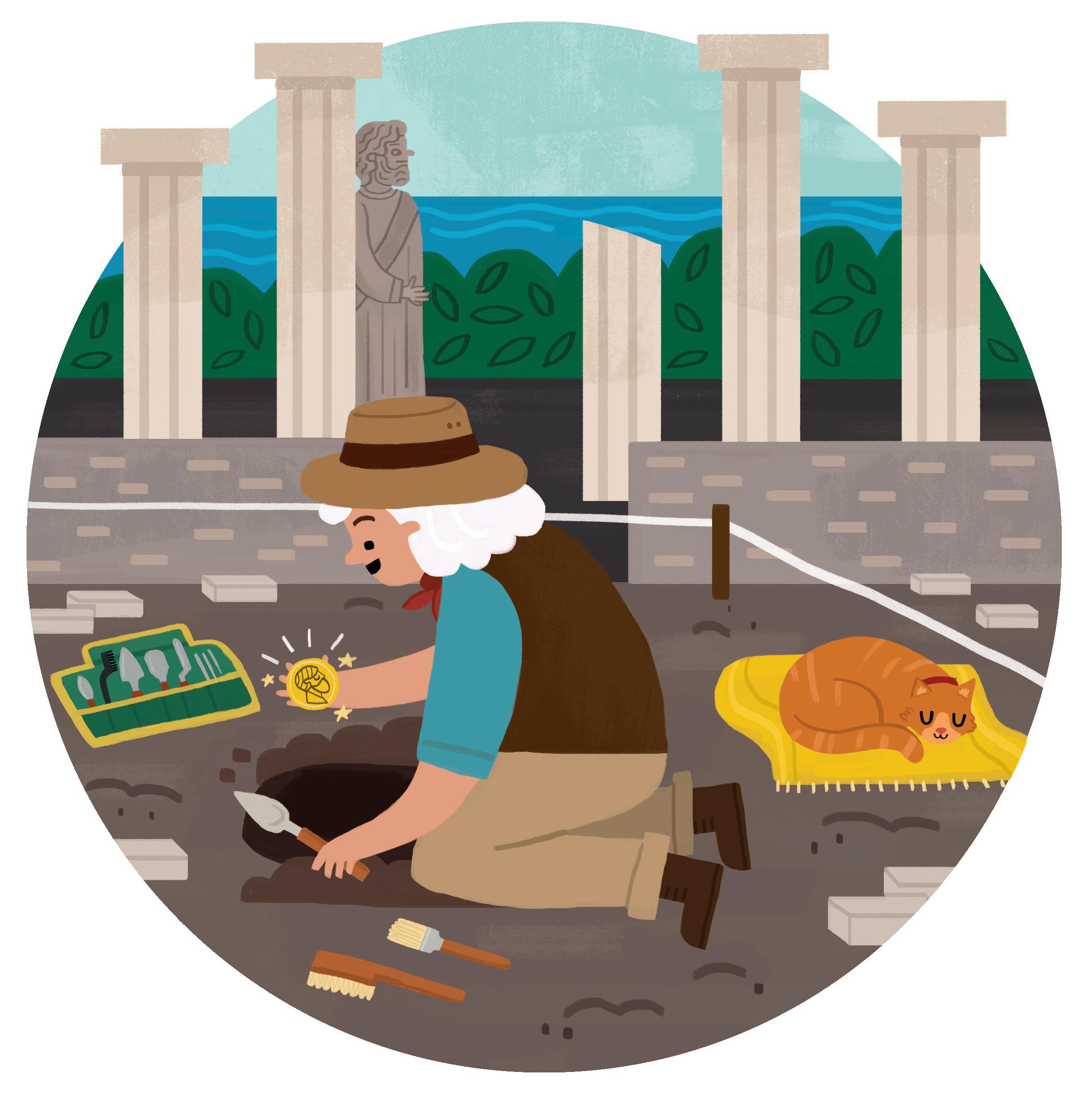
Granny Bea’s cat, Digby, did not like digging in the dust and the dirt. Or getting wet. Or missing his meals. In fact, Digby did not like adventure at all. Especially after what happened the last time Tom came to stay . . . but that’s another story.
One cold, rainy day, Granny Bea called Tom up to her study. Digby was sitting on her lap on his favourite yellow blanket, purring loudly.
“What’s that?” asked Tom, pointing at something shiny in Granny Bea’s hand.
“It’s a coin from the time of ,” said Granny Bea. “He was an emperor of ancient Rome, almost two thousand years ago. Here’s his face, stamped on every coin during his reign.”
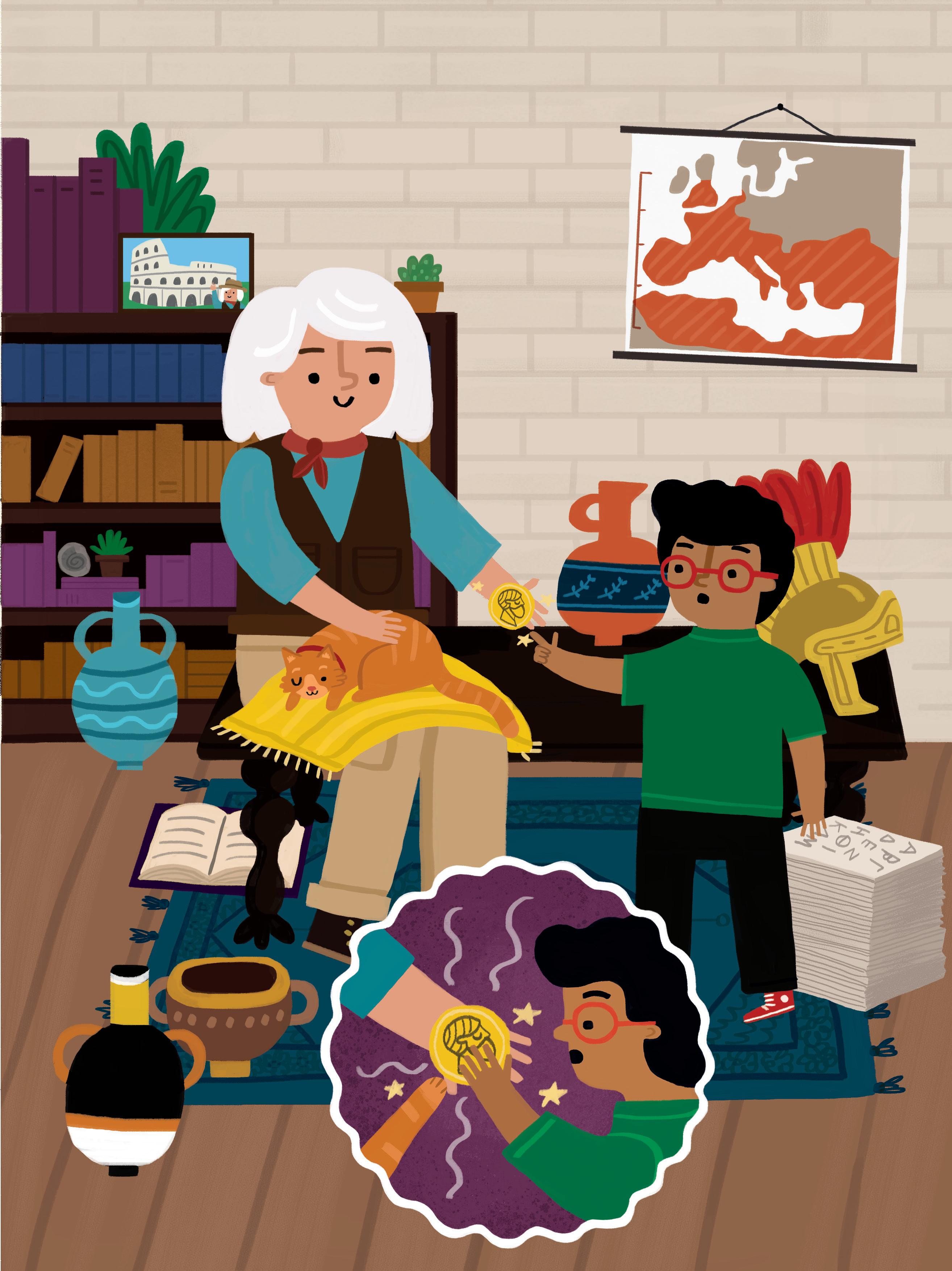
“Wow! May I hold it please, Granny?” asked Tom. Granny Bea smiled, a familiar glint in her eye.
Tom stretched out his hand to take the coin and . . .
Tom was in ancient Rome. He couldn't believe it! He was in some kind of market and there were people everywhere. But he couldn’t see Granny Bea or Digby.
Tom knew Granny wouldn’t send him back in time on his own, so they must be near . . . but where? Just then, Tom spotted an orange tail disappear between some stalls.
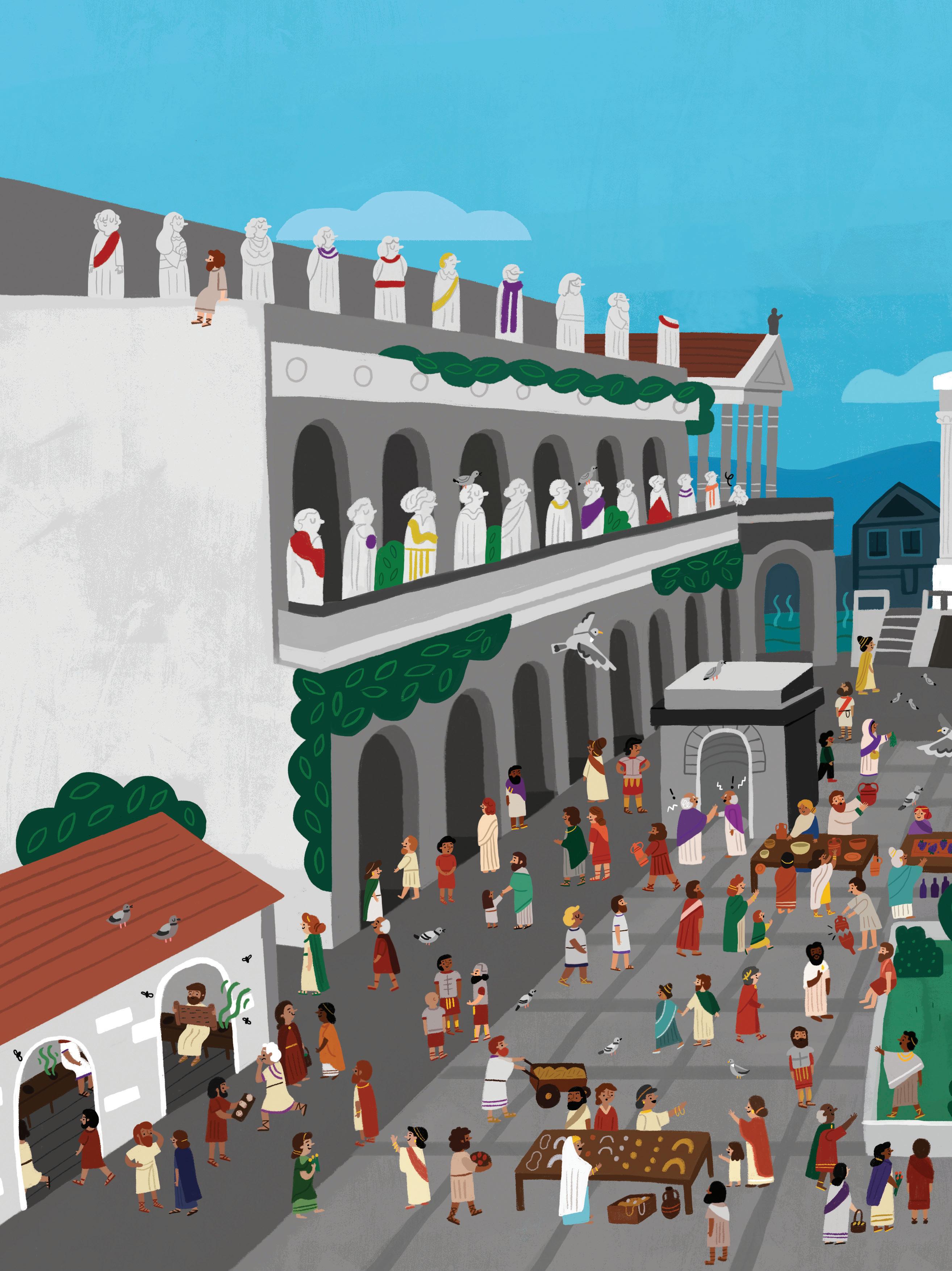
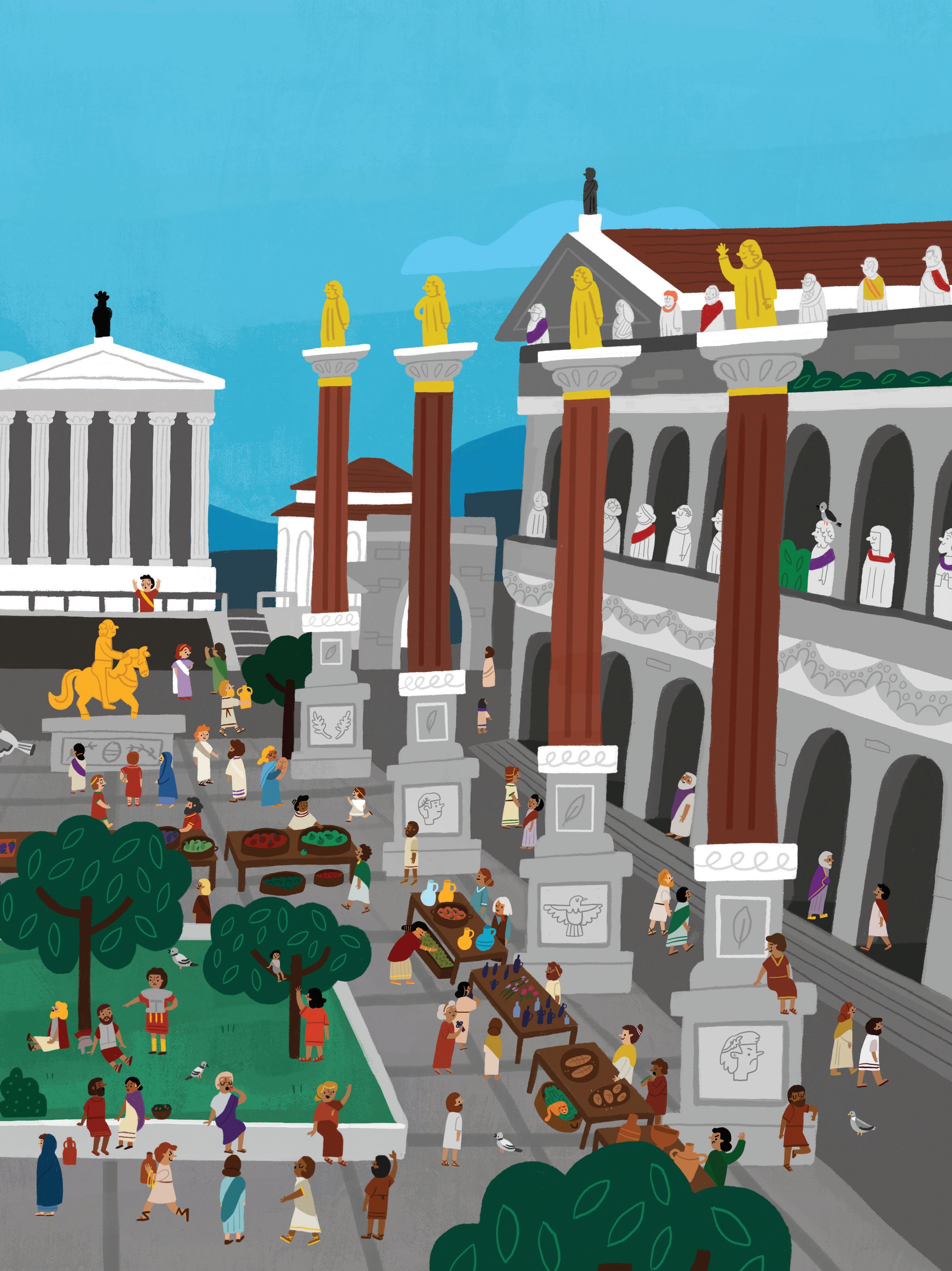
The Forum was first built by the kings of Rome and then changed over many centuries. They had to drain a marsh in order to build it – that must have been hard work!
The Forum was above the , which was a giant sewer. Its main job was to take storm water away from the city, so it didn’t flood, but it was also used to drain , which were ancient Roman toilets. It was probably a bit smelly on a hot day!
Someone reading in the communal latrine?
Tom?
Two senators wearing purple togas having an argument?
A broken jar?
Digby the cat?
A statue that has lost its head?
Someone taking a sneaky nap?
It was an amazing place where , priests and market stallholders worked side by side. With law courts, temples and shops all mixed together, many different kinds of people used this space, sharing news and meeting friends.
As Tom chased Digby, he tripped over a yellow blanket. Granny Bea must have dropped it! Tom picked it up and ran up the hill, and soon found himself in a packed arena. The cheering crowd were all wearing colourful togas.
Tom tied the blanket around himself to blend in. In the distance, he saw a startled cat. It had to be Digby!
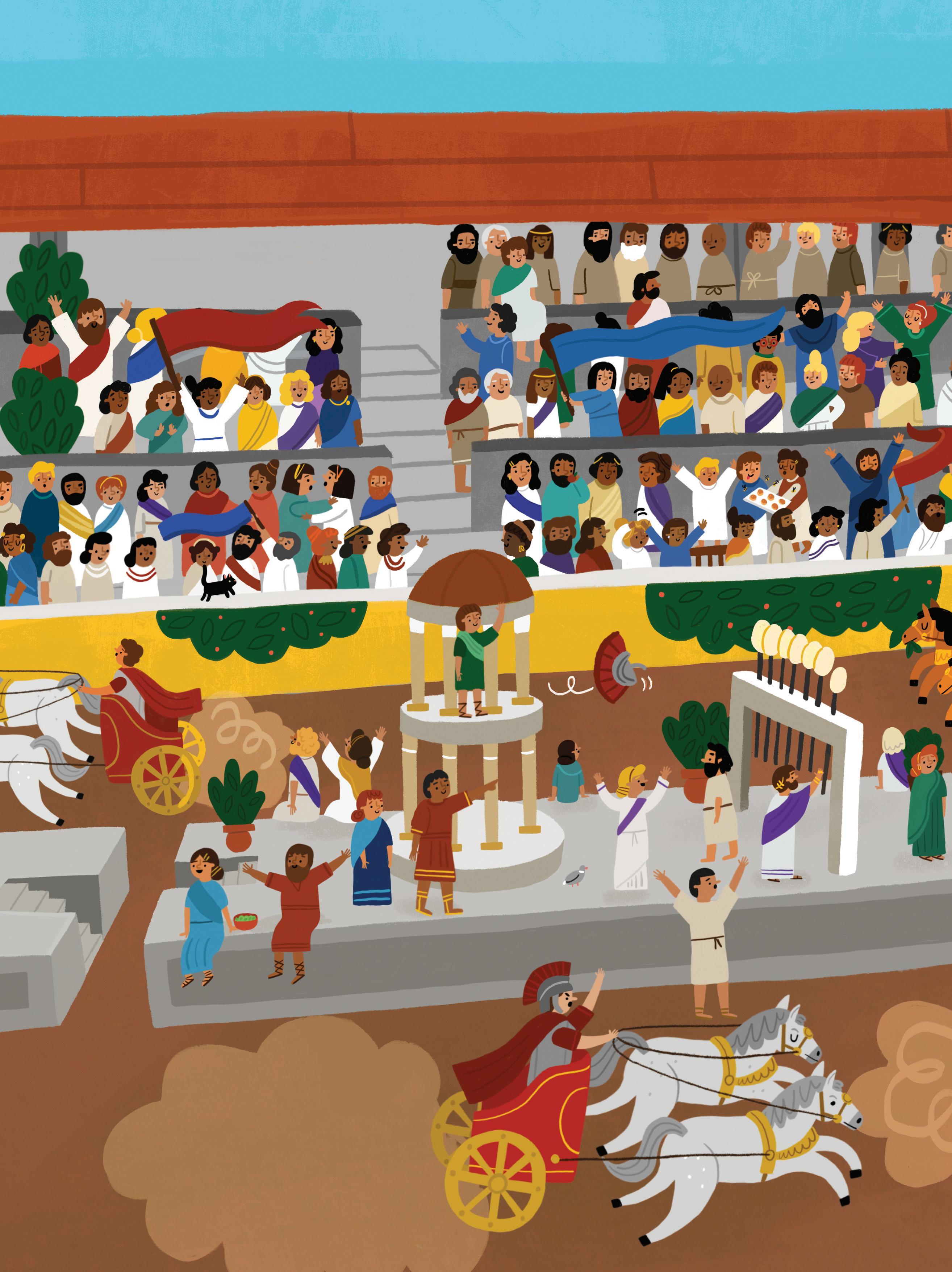
Each race was seven laps around the , and each time a lap was completed, a metal egg and a metal dolphin were removed from two special columns, so the crowd could see how many laps were left.
This incredible arena was the site of races as well as games (or in Latin), including wild animal hunts and gladiator fights.
A chariot missing a wheel? A lost helmet? Tom?
A horse eating one of the decorations? Digby the cat?
A rider wearing the wrong colour cloak? Someone selling honey cakes?
Chariot riders always wore red, blue, green or white silks, and chariots were pulled by teams of between two and 12 horses.
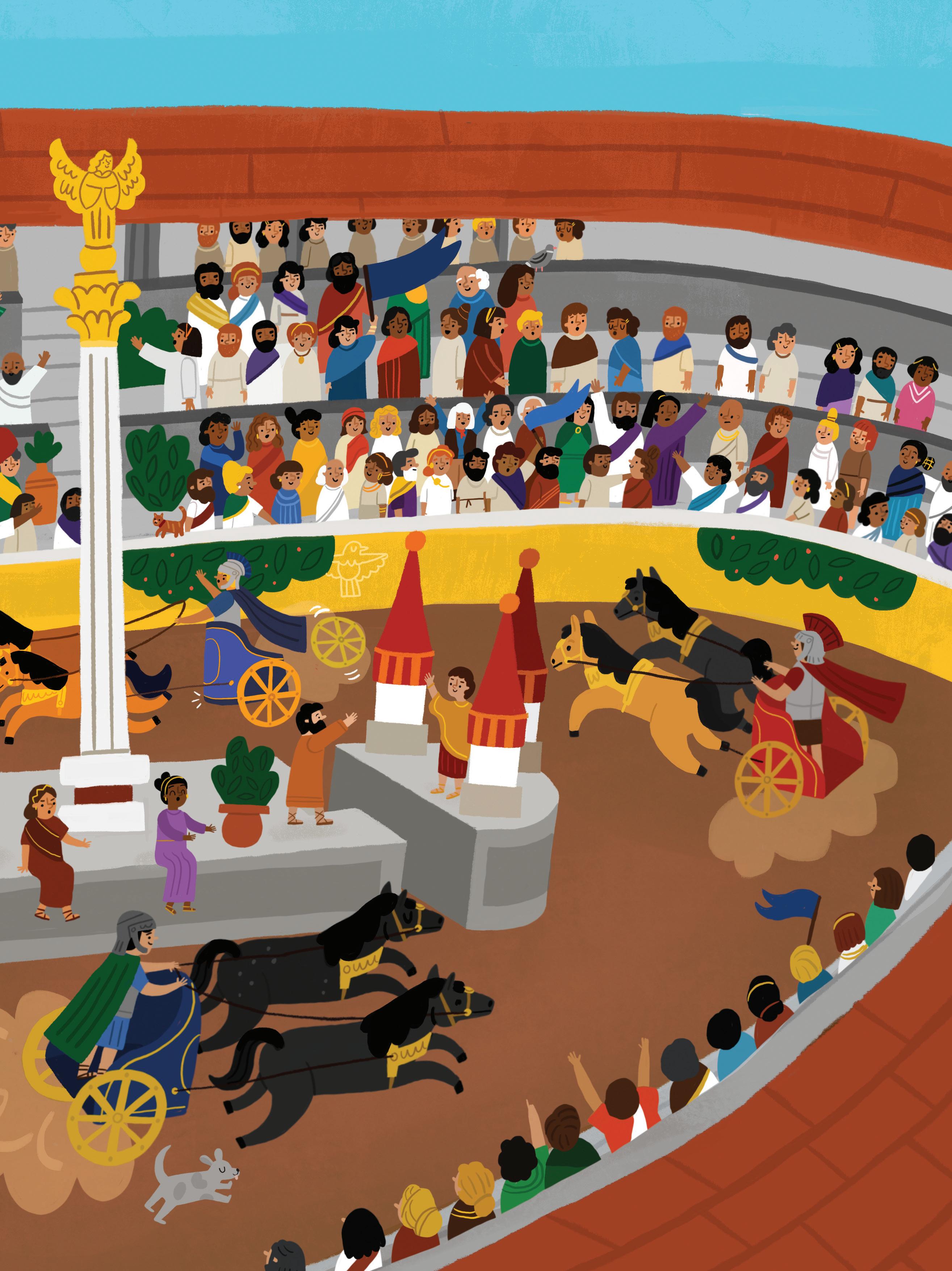
The Circus Maximus could hold over 250,000 people. That’s about the same as four completely packed football stadiums!
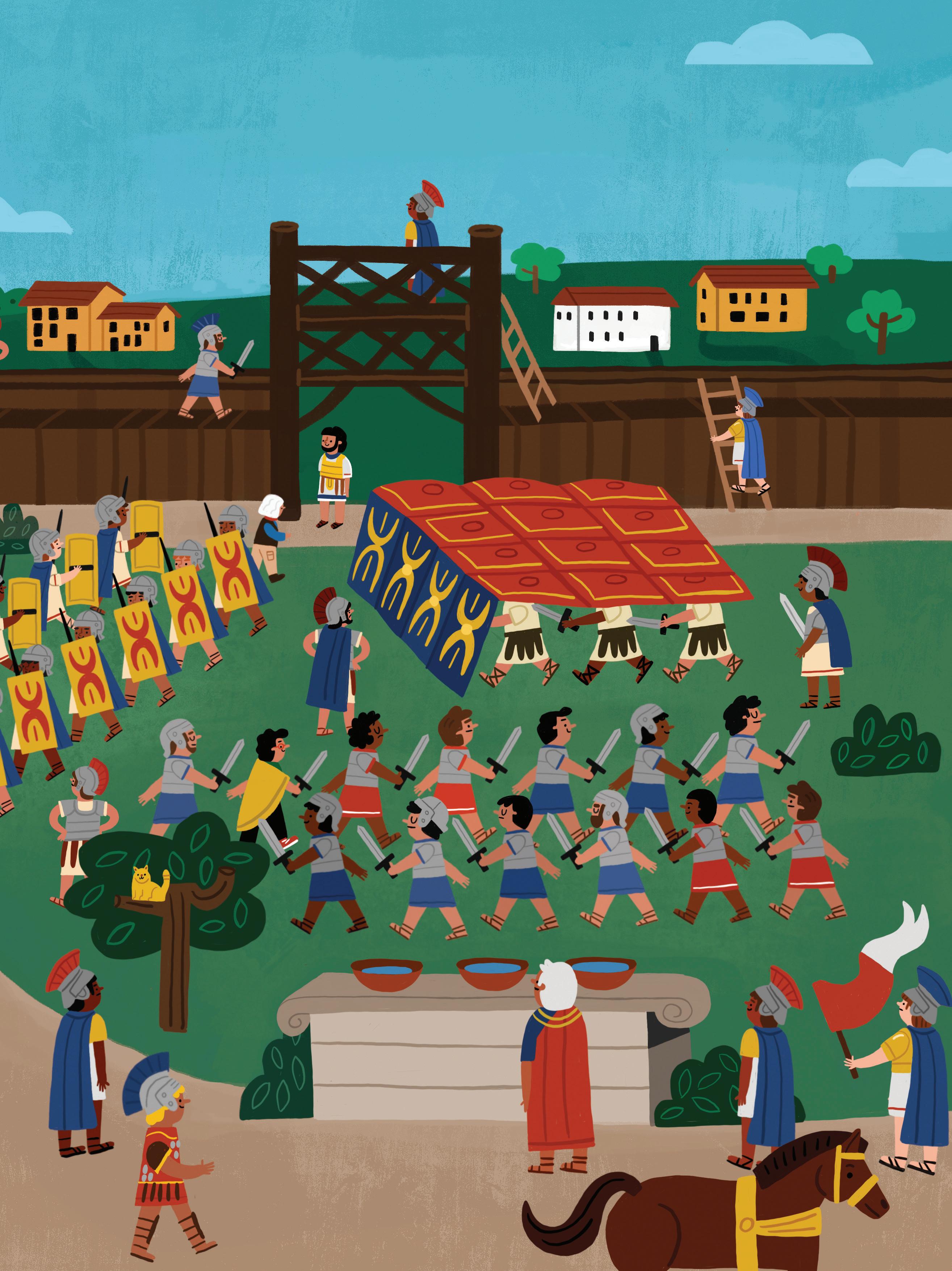
Outside of the arena, Tom hurried up another tall hill. There were soldiers everywhere, standing in large groups and wearing heavy polished armour. Granny Bea hated fighting, so surely she wouldn’t stay here for long?
Just then, Tom heard an angry yowl from behind a wall of shields. What was Digby up to now?
means
'the Field of Mars', who was the Roman god of war. The famous Roman army gathered and trained here, but it was also used for voting, the and for festivals.
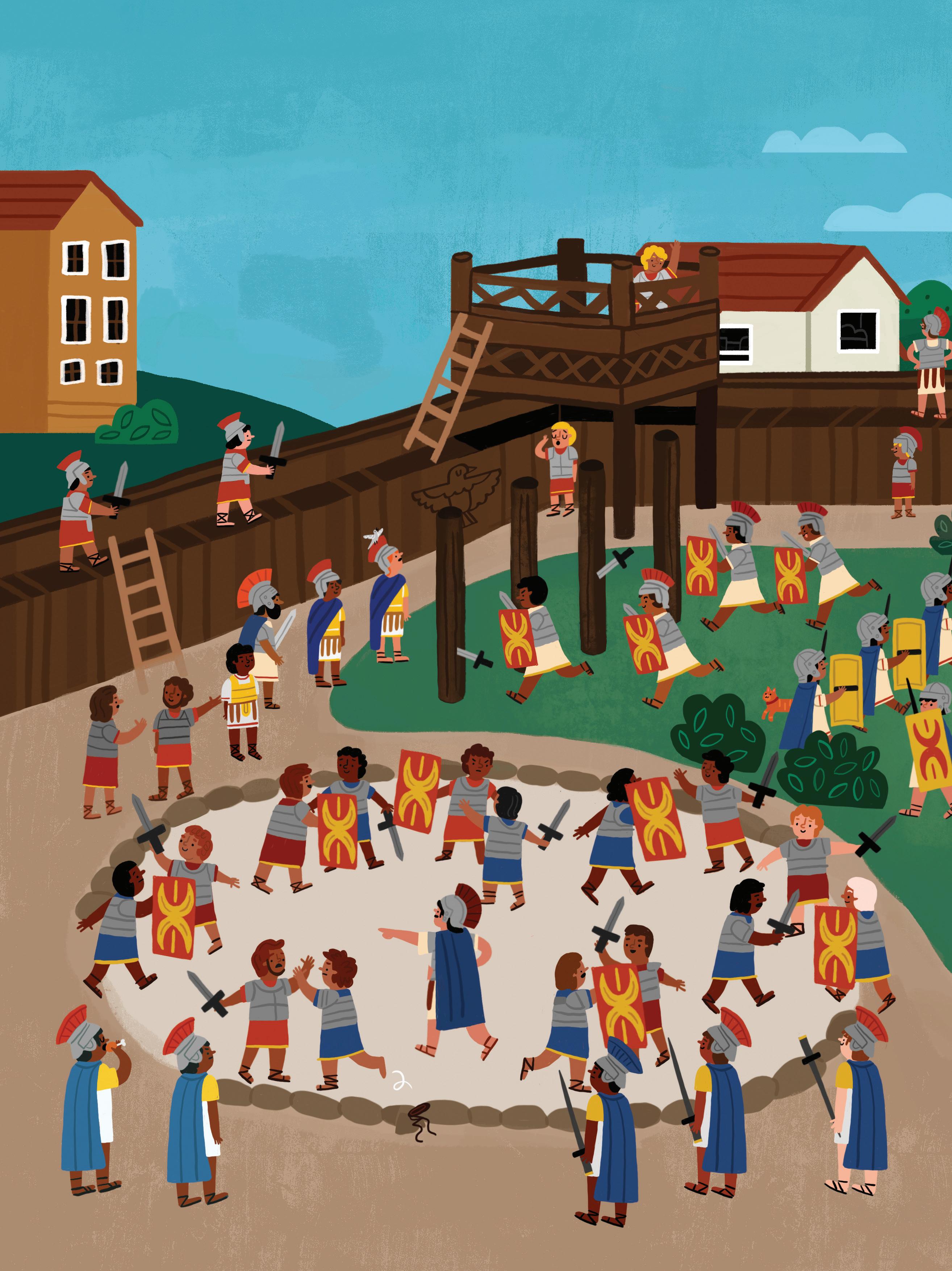
The soldiers were called , and each legion of about 5,000 soldiers was commanded by a
Each legion was organised into 10 , which were divided into centuries of around 80 men, led by a
The armies practised different formations standing shoulder-to-shoulder, such as the wedge formation and also the (which means ‘tortoise’ in Latin ).
A soldier who has lost his sandal? A sleepy soldier? Tom?
A soldier holding his sword upside down? A bird nesting in a centurion’s helmet? A soldier having a sneaky snack? Digby the cat?
The was an emperor’s personal bodyguard. The emperor Augustus had about 4,500 soldiers to protect him!