a
literary journal of canada's north
by Gwenna Cochrane Halinda
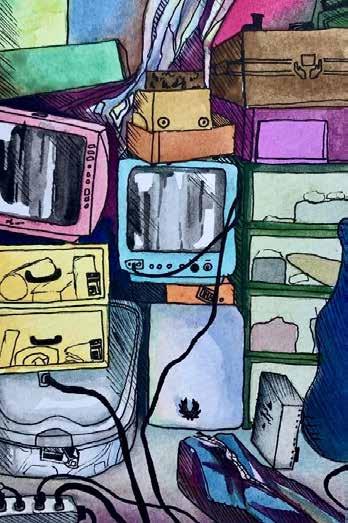
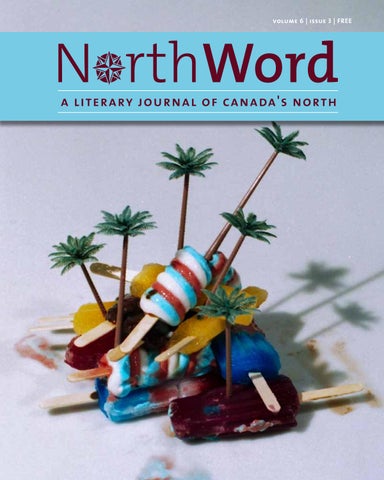
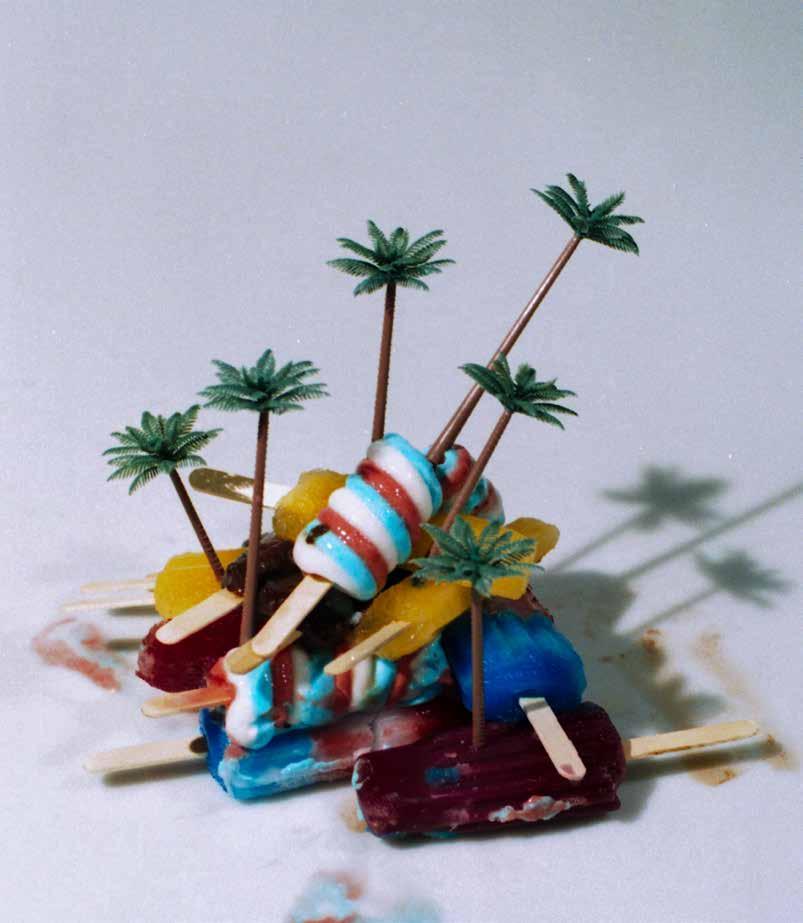
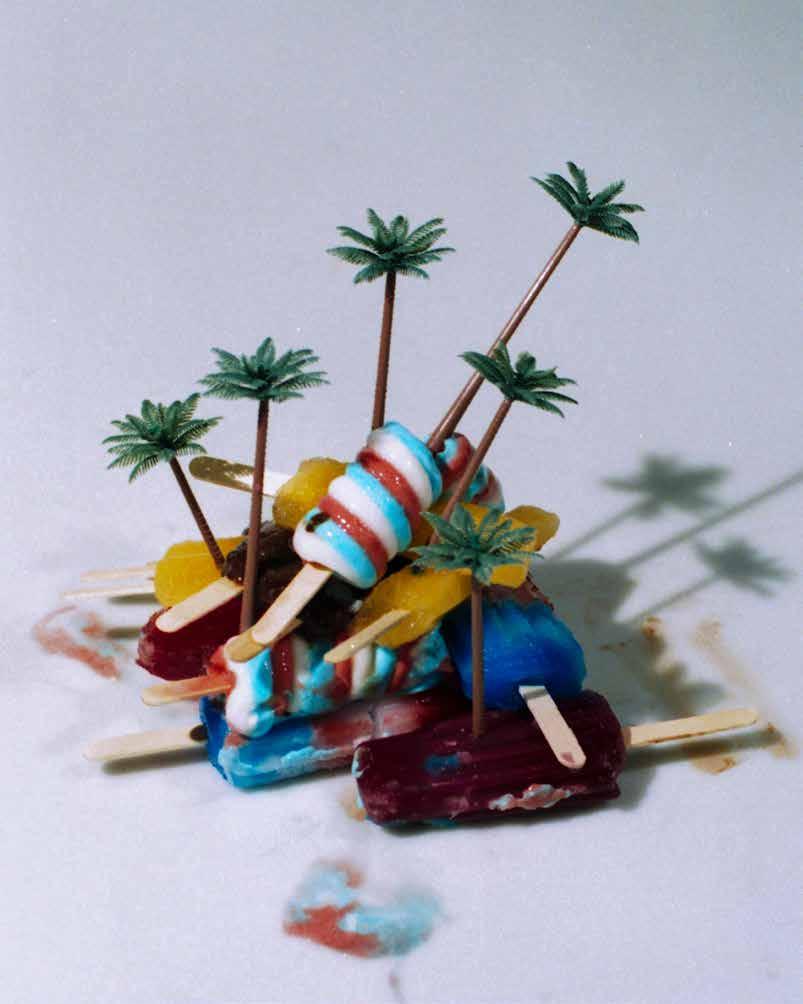
The cover image of NorthWord Magazine, Issue 33, is drawn from a 2016 photographic series titled Melting, created during my photography minor at OCAD University. Shot in studio on 35mm film and inspired by visits to Los Angeles and the surrounding California desert, the still life captures popsicles rapidly melting under the heat of studio lights.
The image connects directly to guest editor Emma Carter’s theme, “Plastic”, mirroring the instability of a warming planet, where heat reshapes environments in real time. The brightly coloured, synthetic popsicles and miniature plastic palms trees are emblems of material lifespan and manufactured consumption. The ephemerality of the melting form becomes a reflection of change in our observable and invisible environments, and the increasing difficulty to reverse damages done.
the plastics by Anna Pottie
cover artwork — melting by Michelle Foran
editorial
In early 2025, I read an Atlantic article about the wildfire that devastated Los Angeles County. Written by journalist Zoë Schlanger, the piece was titled “What Happens When a Plastic City Burns,” and it explored the unique environmental circumstances that result from the mass incineration of plastics – plastics like the ones found in most household items today. I am captivated by the multifaceted nature of plastic, its ubiquity in the modern world, its environmental impact, and its representations in pop culture. I found the imagery evoked in Schlanger’s title unshakeable, and when asked to guest-edit NorthWord Issue 33, I was grateful for the opportunity to impose my fixation on others.
The submissions explored and interrogated plastic in ways that delighted and shocked me. It is a gift to have read each piece and to have curated this edition of NorthWord
Equally delightful was the opportunity to engage with local artist and craftsperson Michelle Foran, whose work is featured on the cover of this edition. It’s a special thing, as an artist, to meet someone you connect with both personally and creatively, and I’m grateful for Michelle’s enthusiastic yes when I approached her about the theme.
To The Northern Canada Collective Society of Writers and all the artists who trusted me with their work, thank you.
And, to everyone who picks up a copy of Issue 33, I hope that you read something that stays with you forever, breaking down into smaller and smaller pieces but never completely disappearing.
Emma
Carter | issue thirty-three editor
apple
marty rempel
The brain, a cathedral of connections, a wilderness of lightning and silence. for a life time words moved through me effortlessly, from spark to sound from thought to speech. Damaged in a moment, an accident of chance in time, neurons once fired in elegant sequence, across each sculpted synapse singing its part in the orchestra of language.
After, a rupture, a loss, a sudden quiet, blood fled, cells flattened, networks dimmed the familiar routes went dark. The words that once leapt from my tongue now gone.
I am not still
The brain, neuroplastic, ever adaptive, restless and alive as old highways crumble, I send out scouts, axons searching like roots through unseen soil. Dendrites reach out towards the faintest electrical whisper.
I guide the rebuilding Circuits reorganize, neighbouring regions awaken to the call.
The right hemisphere listens, hesitant at first, visual cortex offers image, motor cortex lends rhythm, emotions add tone, again an orchestra, together they begin to trace new routes to find the ideas once lost. I rehearse again and again…
I feel the signal practice is in my pulse each repetition thickens my resolve, quickens the transmission, stabilizes the spark until one day the current finds home.
A light flares across a synapse and there it is that elusive lost word rises from silence like a bird returning to its branch.
“Apple” I say I say it aloud
With excitement and joy It’s “APPLE”! The sound is rough and alive. The meaning complete, whole and unmistakable.
I can recall and imagine think and do,
The brain is a builder of bridges, a keeper of faith and languages, When one path is lost Another is found.
Neuroplasticity.
the unbroken
stacey grant
“Why won’t you take me back?” His voice wavered along the shoreline, tangled in the frothy foam, “My brothers danced with you in the waves. You broke them down to join the sand from which they were made. Why am I not good enough?”
No answer came at first. The wind ceased in its bellowing across the landscape; the ocean sighed around him, and the forest beyond the bank stilled its breath.
He had waited long enough to ask this question. He would wait longer still, to hear the truth.
Finally, the Water spoke. Her voice, soft and sorrowful, lifted into the air, flowing across glistening rocks carved by centuries of remembering.
“Child,” she murmured with the tenderness of a grandmother, “I have carried the weight of whales and willow leaves. I have swallowed a million suns and secrets, delivered to me gently from the rivers and the sky.”
The waves lapped steadily just beyond his feet, continuing, “I remember when you did not exist.”
A pause. A breath. Her frothy edges slowed and retreated, as if mourning what she was about to say.
“You float upon me, but you do not join me. You do not bleed. You do not soften— You cling.”
The Earth rumbled beneath him then, low and aching: a voice that came not from speech, but from deep under gravel, bark, and stone.
“I have taken back all things,” she admitted. “The rotten, the broken, the sinful, the beautiful. I take the flesh of men who poisoned the waters and cut my trees, and I turn them into soil. I have taken those deeply loved, and grown flowers in their memory upon their bones.”
Her tone was not harsh, just weary — like a mother who had buried too many children.
“But I cannot take you. You do not decay. You do not turn.
You lie beneath my fields and suffocate my breath.”
Plastic stood, trembling: Mother Earth and Grandmother Water looked upon him, their careful gazes laced with sympathy.
“But… I held them,” he begged, his voice rising like steam shimmering on asphalt, “I held their water. Their food. Their tears. I shaped myself to serve them. And when they were done with me, they threw me away like I was nothing.”
He stepped forward, into the shallows, and the Water recoiled — not in pain or disgust, but in grief. She could not cleanse what would not release.
“I did not ask to be born,” he pleaded, his pace quickening, “I did not choose this body! I was pulled from oil and fire, and shaped in their image… thoughtless, eternal! I didn’t choose this!”
He gestured wildly toward the calm horizon. “Yet somehow, they who carved me from death and wrapped their world in me, they die and you forgive them. You cradle their bones. You let flowers bloom from their mouths.”
His voice cracked, and a soft, sorrowful breath escaped him. “But me? I cannot rot. I cannot be forgiven. I will live forever, reshaped, melted, shredded… but never freed.”
He raised his arms to the sky; a single, pleading motion intertwined with a sigh. “I am their shadow. I am the wound they left behind.”
The Water wept quietly.
The Earth withdrew to silence. Birdsong ceased in the air.
Then, the Water opened her current and spoke again: deeper this time… older.
“Do you know, child, the weight of the things I have carried? The ashes of villages. Blood, spilled from birth and from battle. The whispers of languages, no longer spoken.”
Her voice grew softer, shedding any sharp edges, a gentle trickle of a stream over smooth stone.
“I carried their grief, when they could no longer speak it aloud. I held their children when they returned to me too soon. And still, I flow… but you. You were not meant to stay. This, you know.”
Plastic bowed his head, looking to his hands: smooth, perfect, unbroken. He kneeled into the pebbled sand and dug his fingers into its wet, heavy flesh, and nothing stuck. It would not claim him.
“They made me,” he whispered, “forging me with cleverness and fire, with minds that moved faster than their spirits. They forgot their responsibility to you.”
A gull cried out in the distance, a sound thin against the stillness of his realization. His hands trembled as he lifted them from the shore. “They sin, and you forgive them. You decorate their bodies in roots and release them to dust. You let mushrooms sing over their graves… but me? I am left to drift. I will outlive even your sorrow.”
The Earth stirred again, her voice settling like a warm wind over fresh snowfall: ancient and heavy with knowing.
“You were made without memory,” she admitted, “but you remember now… don’t you? And that is no small thing.”
Plastic lifted his gaze, his mouth agape but no words formed from his tongue. He had nothing to offer in absolutes, only fragments. He swallowed hard, forcing his throat to open as he began to recount the shape of his life:
“I remember the first touch… heat, pressure, a mold. I remember the machine, and the light overhead.
“A girl drank from me and then tossed me underfoot,”
his chest rose and fell with increasing pace as his story flooded back.
“I’ve held food, medicine, milk, blood, oil. I was shaped into joy and discarded in indifference.
“I’ve been a toy, a shell casing, a straw, a mask… I have cradled life, and I have choked it.”
Mother Earth released a low rumble, not to interrupt, but to encourage him to continue.
“Now, regardless of my intention, I simply break apart but never down.
“My pieces just scatter: in the stomachs of birds, the wombs of whales, the fields where they grow their corn, the cells of their bodies,” his breath was laboured from the exertion of his recollection, lifting himself from the ground to step forward into the tide, “I am everywhere, and nowhere welcome.”
The Earth softened then, her voice shifting like a warm loam cushion beneath bare feet.
“I have seen them try,” she started cautiously, “not all have forgotten. I have watched them rinse you out to fill you again; they replenish your vessel with water, with paint, with seeds for the songbirds.
“I’ve witnessed children turn you into wings and masks. Your body has been fashioned into bricks, roads, and benches… even tiny greenhouses, sprouting new life.
“They are trying, child: to remember. To repair.”
She paused, giving a moment to allow the tenderness to hold… but Plastic’s face twisted, not with comfort, but from visceral pain.
“Don’t you see?” he cried, voice raw now, blistering with the heat of his truth, “I will never get to rest.”
He turned, half in the ocean, half on the shore: suspended, divided.
“They call it renewal, but it is only repetition. They call it
creative, but it is a sentence, not a gift.
I will not return to sand, like glass has. I will not become soil, as cotton does. No insect can eat me. No fungus can feast on me. I poison the worms that try to carry me home.”
His voice broke again.
“I will always only be this. Reshaped. Recoloured. Reused… But never truly changed.”
The silence that followed hummed with the undertone of unexpected peace. It did not ring with avoidance or denial, but with respect.
The Earth and Water had heard him. All of him. Even the parts he had never known how to say aloud.
Then, the Earth rose again.
“One day,” she soothed, “when the last of their machines go silent, when the smoke clears and the ground is no longer afraid, you may begin to fade.”
The branches on her trees began to wave in a slow dance. “The wind will remember how to carry your fragments. The sun will remember how to loosen your bonds. The moss will find you, and slowly, gently, the forgetting will begin.”
Plastic shuddered. “And what of now? Must I carry this forever?”
The Water moved close again, lapping around his ankles tenderly.
“We cannot take you. Not yet,” she murmured, “but we can witness you. We can hold your story. And we can
begin to make room.”
The Earth leaned in, her voice now that of a mother by a bedside.
“You are a teacher, though you did not choose to be.” Her tone was firm but gentle. “They will remember you: the ones who come after, and they will shape new beings with gentler hands. Hands that remember your grief. Hands that listen.”
Another gust of wind passed through, and the arching limbs of the canopy above relinquished handfuls of leaves in agreement.
“You are the lesson they could not learn without pain,” the Earth whispered, “and you have given them all you can.”
Plastic fell to his knees again. Not in worship, not in despair… but in release.
He pressed his palms into the puddles left upon the earthen banks. He could not become them… But he could feel them.
The Water placed a single drop on his shoulder. The Earth reached out and released a name that intertwined with the creaking of old growth roots: not one of blame, but of recognition.
“You are the Unbroken. You are the One Who Cannot Be Forgotten.”
Though he could not yet return, they made space for his voice… And in that space, something remembered how to begin again.
transformation
fizzah azam
Shivering in summer with a sturdy blanket
It scratches and clings to skin, a crass tick I swallow fake air, bending veins into elastic
Translucent eyes fold thrice like a hat trick
In 100 years, I'm sure my soul will be plastic
mcmurray in may
matt salem
First came the caterpillars, highly numbered, In creeping waves, the city was overencumbered. They chewed through trees without a sound, And left our forests bare and browned.
Then came beetles, small and sly, With twitching legs and shifty eyes. They slipped through vents and bathroom drains Invading houses, apartments and being a pain.
Next swarmed mosquitoes, fierce and loud, A buzzing, biting, itchy cloud. No spray or slap could hold the line They drilled into us like we do the mine.
And just when we had braced for worse, The Orcs marched in, a verdant curse.
They marched through town in battle amour, Demanding our oil, our fuel they would harbour.
We fought them off with plastic gear, Old lawn chairs, bins, a chandelier. Now they run things, truth be told They fixed our trails and paved the roads.
tomorrow's marrow
stacey grant
It held the milk for my children, cradling their hunger in pale translucence through the newborn fog;
It guarded my sister’s son— tubed and tethered— to give him breath and life.
It brightened their play; a thousand small suns spun from oil weaving in their hands and laughter.
And when our children sleep, it dreams alongside them; beneath their beds, inside the oceans, in the marrow of tomorrow.
We built a world that cannot fade. Our kindness—wrapped in what cannot die, will not rot.
How do we reconcile the line we dance— between necessity and our undoing?
What will our grandchildren call this century, floating on an island of ghosts that glisten?
plastic
zach wood
Smooth convenience, poison wrapped in mercy. We breathe your gift and choke.
Reliant, we bow— your praises sung in every store aisle, our altars lined with your image, our hands too weak to let go. Death, your use hath rung. The bell tolls not for you, but for us.
We cannot turn away. We cannot. You are life— and death disguised as ease.
focal points
jon lai
Vision can be overlooked as a disability a limitation often easily corrected
Spectacle Prescription: Sphere Cylinder Axis
OD -12.00 -0.75 167
OS -12.50 -0.75 180
Though I almost fainted, upright in the examination chair, when a contact lens was first placed on top of my eyeball
Contact Lens Prescription:
Base Curve Diameter Sphere
a plastic world
kiran malik
Stream, scroll, search AI is taking over the world
Finalize orderAdd to cart
Dashed to your door some super eats
Download the app No cap!
Optometrists say that I’m a good candidate for intraocular lens implantations resolving myopia and astigmatism discarding flawed material with polymers behind the pupils rather than endure surgery and recovery time I’ve opted to retain my awful eyesight as a means to check out of the visual world
Swipe right, veer left Rizz? Delulu?
Vibe checkIn a Plastic World!
mass extinction event (in 3 parts)
ron kirsch
Waste rubber brothers summon masticator toys
Workin to keep them coach monkeys dry
Patent 1825 Artificial Leather Boys .. yeah .. well They had nuthin on them Mesoamerican cats.
Rolling to the left, Rolling to the right.
Round and Round on a carpal tunnel death flight.
Manifesting rubber balls way on back in 1600 BC.
High as hell from
Morning Glory tears n rubber sap, repetitive osmotic cocktailing, Shortened an already grim life expectancy.
They did not care.
It allowed them to see all the gods. Even the ones
That were not there.
Pretty lady on the screen says all the little birds appear to be completely full of microplastics. Scientists are concerned.
So stuffed they crunch like little discarded cellophane wrappers when you pick them up and lightly squeeze them.
“ It’s such a tragedy ..Now back to Chet for a look at the local weather.”
Somewhere in the deep Midwest, an unemployed AlsoRan is lightning bolted off his ratty couch by the televised news of this horrifying bird crisis.
Deep in the remains of his alcoholic lizard brain, he remembers solving this very plastic driven problem. It came to him during a teenage mind bending peyote trip he took without consent.
Dosed by his high school crush, a girl he felt might be his future wife. She had no feelings for him and Did it on a dare.
The next day she got on a bus to California, to make it as a Game Show Girl. She never thought of him again. Not until years later on The Baja Peninsula when she was fatally drowning in freak rogue waves.
He sees a chance to redeem his life. BIRD SAVIOR HERO
Making a fortune. Accolades. Darling of the talk show circuit.
He knows exactly what blonde waitress he will marry. Reward for this rebirth will be a Bentley. How glorious.
“What color tho?” He muses while rushing out the door, charged with a new found ambition.
Missing the 3rd step, he tumbles. Broken neck spasming is his actual last achievement. Little birds who now crunch all fall silent across the planet. They do not exactly know why.
Flying cars zip in and out of Air Parkades. They are mostly made of a plastic hybrid allowing the entire car to weigh less than 20kg.
A most righteous gift from the Alien Benefactors. This does not prevent the New Humans from driving like total Clowns.
They just couldn’t get it out of the remaining DNA. Permanent Flesh Fault is what they call it. We still have a few.
At least the real bad ones are gone. Many things have changed. Now when you need a new body part ( things do wear out after 8000 years or so ) you just replace it like a fleshless piece of something the Ancient Tomes call LEGO.
the visit
marty rempel
As a young boy my family would travel in our 1952 blue Ford sedan. I sitting in the front between my parents, my father perpetually the driver, my siblings in the back teasing each other. We drove on that Sunday to visit my aunt Agatha who lived in a bleak brick building on a straight street with a hundred other such houses. Her house smelled of peppermint and was decorated with doilies of her own making. It was not a place for children, as she had none of her own. It was not a place I liked to visit and never returned there as an adult. The dinner was very Mennonite, simple with over cooked beef and
mashed potatoes with corn accompanied with stilted conversation in German which I could not follow. After dinner, French doors were opened to the mausoleum style living room which was only opened for Sunday guests and funerals. The room had a museum quality with everything in its place to be viewed, not touched. The couch where I avoided sitting was completely covered in plastic, as was every lamp in the room, I believe to preserve the eloquence of a fading dream.
now that i'm older
anonymous
For as long as I can remember I've been surrounded by it, an adolescence filled with plastic
Plastic slides
Plastic toys
Plastic chairs
Feelings of joy cultivated by free flowing polyethylene
An imagination running rampant in worlds sponsored by mattel
A life's worth of lessons learned on material founded through mistakes
Now that I'm older, the meaning of plastic has changed
Plastic people
Plastic feelings Plastic identity
Overwhelmed by the facade of reality
An illusion of life formulated synthetically
Fueling the desires of its makers nearing evangelical
Now that I'm older, the caution to plastic has changed
Appeasing the masses with self regulated forgery
A well-being formulated by milligrams in a plastic bottle
Altering perceptions with fabricated physicalities
Now that I'm older, I know what plastic is
Now that I'm older, I fear I am plastic
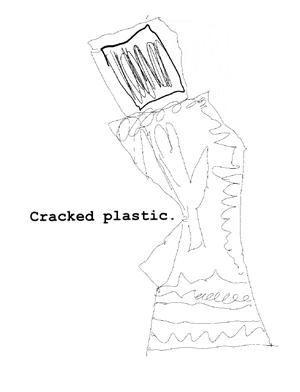
cracked plastic by Tineesha McKay
plastic takes 1000 years to degrade
ana manderson
I would serve you my heart.
In a take out container, sealed for freshness.
As true as the snap of a tupperware lid.
I would kiss you sticky and sweet. Like the residue left in half-empty pop bottles. As real as the ingredients are not.
I would love you bright and sparkling. Like confetti and discarded candy wrappers. As shiny as silver lining.
I would build a temple to us.
A monument constructed out of garbage bags and red cups. Towering and as forever as the human mind can comprehend.
the first cellophane bag
The first cellophane bag is still buried under layers of womb of motherly earth whimpering at a death that never comes What would it give… to dissolve into its mother’s embrace But this mother can’t recognize this child She has tried to soothe it to nurture it but even though it's part of her womb, it can never be part of her.
A weak foundation Like a dull duplication Plastic can’t be gold
tineesha mckay
jamal e fatima rafat
the three r's of recovering
will collins
Step One: Reduce
The first thing Is to rinse And reduce The residue. Wash it
Down the drain. Let the water take it
Like a paper boat On a rivulet of rain.
Step Two: Reuse
Remove the paper labels And scrub off the sticky goo. Clear every side of the container, So you can see it all
Straight through.
Take some time. Take it back,
Reuse those stolen moments. Reuse them to unpack.
Step Three: Recycle
Gather all the old jars and vials. The ones bottled up inside. Wrapped with scraps of newspaper, Their stories no longer confide.
It’s the end of their lifecycle, They’re not useful anymore. Spilled out of a deep blue bin
Laying scattered across the kitchen floor.
Store them in a plastic bag And take them to the dump.
Buried in the back of your throat, There must be something better To do with those pesky lumps.
statues anonymous
Statues are often a relic of beauty and serenity but the artist never realizes their work until it is completed they chip away and mold the structure into exactly what they want Altering synthetics to achieve a perception of perfection what happens when the art is finished and there’s hatred in the creation do you blame the statue for not contorting to your own ideology do you continue to tear down, morph and melt it into something else? why can't you see the creation for what it is?
a product of your own doing embrace it learn to work with the rough edges reclaim and salvage what remains stand back and look at the artist Recognize your own plasticity
suppleMENts interview file 1-C
veronica ephgrave
The morning I met Arya Evans was my first day going undercover for the department. It was difficult to curb my enthusiasm. My shoulders bounced to an invisible beat as I tucked in one of my larger dress shirts, closed it up with a belt, and slapped on the same old aftershave. I murmured to myself, “M-m, isn’t that the shit!” I gave myself a smile in the mirror coupled with a cheesy finger gun.
In the corner of my eye, I saw my wife, and wondered if I had somehow sucked all the carpe diem out of her.
“What are you so excited about?” she asked me. I holstered the finger guns. She was as oblivious to my current job assignment as anyone, so I said, “Just feeling good, I guess.”
In the process of my excuse making, she set down the contents of her hands: a pregnancy test sitting in a facecloth nest. She sighed, saying, “Negative. Again.”
“Well, better luck next time I guess.” I answered quickly, adjusting my collar.
“Thomas.”
I turned to look into her eyes and wondered what I said wrong. “Cheryl?”
“I don’t think you realize how important this is to me.”
“You think I don’t care?” I said this and turned to go towards the kitchen. It was too early in the morning to have this conversation again.
“No, I’m sorry Thommie…”
“It’s ok… I could have been more sensitive.” The answer was a script I had developed over time to prevent fights.
I started the coffee, Cheryl grabbed the to-go cups. The bright red cups screamed “cheap workplace SWAG” with their flimsy construction and simple SuppleMENts logo.
Cheryl says, “I ought to throw these out, these kinds of cups are really bad for microplastics.”
“Hm? What makes you say that?”
“It’s all over the internet right now. Not to mention, I heard from a friend recently… there was said. apparently a baby born with plastic body parts.”
I froze, but only for a split second. I could not act like I knew what she was talking about- how it had even gotten out was a mystery.
“Wow that’s… weird. Do you believe that?”
“Well, no, of course not… but it’s something to be concerned about.”
“Perhaps. I kind of hate those damn cups anyways, they are trash.”
I was off not too long after, reflecting on what Cheryl had said. She wasn’t wrong. There was such a child. She also wouldn’t be wrong to assume that microplastics had been part of it -- but it wasn’t just that. It was an unexpected side effect of our recent line of SuppleMENt products, specifically a plastic-like material used for the pill capsules. It was actually my job now to interview the victims -- when your product alters human DNA, impacts reproduction, you want to know about it. You want to know if it is worth pursuing more, worth selling the idea to someone bigger, or even if it is ethical to do so.
Without the world watching, of course. There’d definitely been some paying off of doctors and victims.
I went over my undercover story in my head once I was parked outside the Evans’ home. I am a blogger who heard rumours about what you have gone through. I would like to write about your child, Arya, and your experiences. Not that she didn’t know this already-- I just had to OWN it. I sipped from the red cup and started a staring match with the Evans’ dog sitting on the front lawn. I noticed I was standing on its silicone bone, which I threw to the dog. The dog happily chowed down on the false bone, and I wondered if it was flooding the dog’s system with micro-plastics.
At precisely 9:30 am, I knocked on the door.
Mrs. Evans looked the part of a new mother. She had dark rings around her eyes, and unidentified stains populated her plus-sized t-shirt. “Dammit, I forgot you were coming,” she said. She yawned, scratching her greasy head.
I took out my best customer service voice. “I can come back…”
“No, no. I don’t care, not at this point.”
I was led into a living room littered with empty chip bags and water bottles. I was eyeing a Coffee Crisp wrapper when Mrs. Evans came in with a coffee for me.
“I’m guessing you want to see her?” The woman’s voice had a quality that suggested she wanted to be whisked away from this current reality.
“Whenever you’re ready, Mrs. Evans.” While I didn’t consider myself chivalrous, I liked to think I wasn’t an asshole. I could tell this woman was not feeling it.
“You can call me Rae.”
I nodded and set up my phone’s voice to text AI, Gertie. Gertie would format the whole interview for the files.
“Ok, Rae. I have permission to record your words?”
“Yes.”
“Ok, first thing I will ask, how did it feel when they told you?”
“I didn’t know how to feel. It didn’t make sense.” At this moment, she opened a bottle of Pepsi and took a quick swig. She asked, “Why me?” I waited patiently. “We were trying so hard. I lost two kids before Arya came along.
I’m -- sorry.” I could tell she was holding back tears. “That sounds so terrible. I don’t know why I’m doing this. We only got to bring her home a few days ago, and god knows for how long.”
I was shocked. That would mean Arya had spent almost six months in hospitals, or even labs. I resolved to ask Rae about this if she seemed ready to share, and then said, “I can come back another time.”
She reached for a tissue. “You’re very kind, but I need to do this. I want to accept Arya for who she is, and I want others to do the same. I want her story to be heard. That is the truth.” This seemed difficult for her to say, but sincere. I nodded, opening up the floor for her to share.
“Her delivery was smooth, too smooth. She cried when she came into this world. The doctors… didn’t notice anything, not until they started cleaning up the blood.”
Another swig of Pepsi went down. “What about the
umbilical cord?”
“It was normal.”
“Ok.” I nodded again.
She continued, “ I didn’t understand fully what they were saying, but when I held her in my arms… something in me changed. I can not describe it, I just love her so much.”
“What part about this makes you upset? Or, even though you don’t like that you feel that way, what makes you say ‘Why me?’ ” Mrs. Evans looked very uncomfortable.
“I guess… fear.” At this, she tossed her empty pop bottle into the kitchen behind me. “What kind of life will Arya have, with what complications? Will she even be able to grow, will her body be able to support long-term life? These questions haunt me.”
I waited in silence for the answer to the second half of my question. I tend to limit my coffee sipping during conversations so that I can do so in these types of moments. My cup was empty when she said, “I know this sounds horrible, really. I do love Arya. I am going to do my best to raise her, and give her a good life, and my husband agrees with me but -- it is hard not to wish sometimes that it had not happened.”
She couldn’t hold her tears any longer and excused herself, leaving me in the crusty living room. I paused Gertie’s recording and explored the room. It looked fairly average, a flat screen TV on a stand, a couch and some chairs surrounding it. Wedding photo on the wall (smiles all around), Wi-Fi router on the window pane. I noticed an ultrasound photo of Arya. She had looked like any other fetus.
I was startled by a high pitched, raspy cry. The unearthly timbre brought to mind an image of a large cat’s tail being stepped on while the cat is using a megaphone.
Mrs. Evans began shushing, and singing softly. The singing grew closer. She entered the room saying, “I thought you may as well see her.”
It took every ounce of social skill awareness to not shout
at the sight of her face, which was reddish with translucent lumps. One large lump revealed the tendons of muscle in her cheeks peeking behind the streams of blood and veins. Without warning, Rae says, “No, you can’t touch them.”
She proceeded to sit and feed Arya with a glass bottle. I noticed that the back of Arya’s head, which appeared close to purple due to a blue translucent colour, seemed to rest solidly on Mrs. Evan’s hand. The plastic flesh was hard.
I had been imagining silicon.
“I paused my recording- I am going to continue it.” I said this and felt a slight disappointment that I had not recorded the cry. “How has Arya’s condition affected her body?” I asked.
Rae said, “The whole back of her head is plastic; there are patches like the ones on her face all over her body, and her whole right leg is also plastic.” She unwrapped the blanket to reveal Arya’s leg, which seemed to be a gradient of translucent blue and green. “It’s so cold.” Rae said. Her tone pushed my heart down to my stomach.
“I always have her wrapped up,” she said, replacing the blanket. “The doctor said that would happen. In those areas, her skin is a hard, single layer of plastic. He said there were no sweat glands, and that it would be hard for her…” She stopped and stared into space for a moment. “Circ-circ- Well, whatever the heart is part of. Her heart has to work really hard -- one of the chambers is made of plastic, but somehow it still works. Well, those were some of the observations from the medical lab.”
The baby seemed at peace now, and I felt guilty for my reaction. We sat in silence, until all I could hear was the milk bottle being sucked dry. Then, Rae spoke up.
“Really, I don’t know what else to say. She’s the first of her kind. Her existence will probably be under constant scrutiny, if she is able to survive.”
I sensed my job here was near done, so I asked a final question. “Rae, if there is something you could say to the
public, what would it be?”
She gave a slight shrug, holding in tears. “I don’t know… I guess, Arya is still a person to me, as much as anyone. She deserves the best life she can get.” Arya wheezed, startling Rae. “Her trachea is also partially plastic; it will affect her voice,” she said in a withdrawn tone. I ended the recording.
I left soon after that.
The scenes from that morning cycled through my mind. Somehow, I was going to have to interview ten more people who, just like Rae Evans, had given birth to babies of this kind (and had, of course, been paid not to make a fuss). I would have to give the data to the company, who would sell a hazardous compound to a far more powerful customer. A hazardous compound that could be used
against innocent people, as an agent of biological warfare, or perhaps even for genetic engineering studies. In my mind, I heard Arya’s wheezing cry, and recalled the pain on Rae Evan’s face. Then, I imagined that pain on Cheryl’s face. Cheryl, who wanted a kid more than anything, despite how much I ignored it.
When I got home, I sat parked in my driveway for a long time. I listened to the recording through. I ate a granola bar. I listened again, fidgeting with the wrapper and thinking about the plastic in the wrapper. My eyes wandered to the red plastic coffee cup, and I thought about the microplastics I drank that morning in my coffee.
I got out of the car, and on the way into the house, I stopped by the trash can to throw out the wrapper. And that damn red coffee cup.
plastic makes perfect
brooklyn wiltzen
We use plastic to make bottles and plates
But using plastic doesn't show the earth that we appreciate To get plastic, you need factories that hurt the earth and air But that doesn't show the animals that we care.
Plastic can make everything we need, but there are side effects. the plastic can easily make earth a wreck
Even if you’re young like me, you can still help the earth
If everyone can do that, we can show the Earth what we're really worth
on the microplastics in my brain
alex k. masse
Microplastics in my brain make me numb and passive
A mouse with feline parasites, body battered this way and that Unfeeling I shamble, sacrificial rat, pick up trinkets along the way Breadcrumbs to influencer tempters bleeding my pockets lining their own
Each dripping with their own toxins and troubled labour chain
Companions until trends change and they trot off to not-quite-rot in landfills
But I can’t be bitter because there is no control group
We are all the sick mouse that sways lab rat and prey
A credit card’s worth of disease swims in my blood sings through my veins
And the credit card in my hand bleeds stains my sleeve
In the future, lovers ponder not if their pieces came from the same star
But rather, maybe, the corpse of the same long-gone shopping cart
“Did my toxins know yours in another life?”
As if we own them not the other way 'round
I break the spell when I break the cycle break the cycle when I break its spell I tear my mind from reverie alchemize numbness into empathy
Despite the billionaires’ best efforts I still know my flesh to be mine
The breathing, growing things everywhere are family fleshful things of their own I help them like a parent/a child/a cousin, and we shoulder our toxins together
We talk them out, sleep them out think them out, sing them out
No poison can take from me the rabbit and the wildflower are my family
the western town (depression)
marty rempel
The sun hangs low over saddened streets. The coffee shop slouches on the corner.
Mediocre coffee served with a smile that Left with the wind years ago on the day hope died.
The post office stands with no purpose, Door still ajar.
The mail scattered like dried leaves.
The church steeple tilted in prayer
To a heaven that no longer listens.
Houses stare through boarded windows. Their memories of people long gone
Stifled and layered in dust.
Down the road
A tumbleweed rolls slowly.
A small ghost from the past
Wandering west, Where no one waits anymore.
the suburb (recession)
marty rempel
The sky hangs grey above silent streets, Plastic siding faded by years of sighs, A coffee chain squats on the corner With over-priced lattes, rehearsed smiles Their names mis-spelled on paper cups.
The church stands locked against The emptiness, Yet homeless
Sleep in the squalid retreat They are the faithful To survival.
Empty homes sit hollow Down the road,
A plastic bag drifts tumbleweed-style Wandering west
Where no one waits any more
journey into eternity with plastic preservation tm
cullen bird
You CAN take it with you when you go!
We have created a modern take on the ancient Egyptian art of mummification. Plastic PreservationTM uses the latest in plastics technology, so you can preserve you and your loved ones for eons to come.
Imagine layer after layer of clear wrap, sealing in everything but your soul.
Picture how clean and crisp it will look! All the mess of your life, safely packaged up for your journey to the other side.
And that’s only the surface-level detail. The real wonder is our epoxy injection feature.
Did you want an open casket funeral? You won't even need a casket! A Plastic PreservedTM cadaver can go anywhere. No stress, no mess.
Think of it as giving the gift of stasis to your hardworking body, frayed and worn from all that hot blood rushing around. Imagine a cool, refreshing injection of epoxy into your veins, preserving your mortal remains for eons to come.
If you’d like something smaller, consider our Eternal Heart Package!
Your heart is a marvelous pumping machine, and it should have a special place to rest when it finally goes cold and still. Suspended in a transparent block of polyurethane, it will be safe from all harm.
If the thought of it resting unused bothers you, it could be left as a mantel piece for your family, or a desk ornament for a beloved coworker!
Perhaps this all sounds too different, too new. It might comfort you to know that your embalming is already underway!
Our industry partners started that process for you decades ago, from the inside out.
Tiny plastics in your food, in your water bottles and soda cans, plastic fibres in your clothes and the air. They make their way into your blood, your intestines and even your brain! It all adds up!
Thinking of it this way, you are already partially embalmed! The undertaker will only need to finish the job.
With a whole afterlife ahead of you, be assured that you will be laid to rest with items built to persist forever.
Our service package includes consultation on how to build a hoard of plastic treasures to serve all your material needs. For example, no burial collection is complete without the finest polyester and nylon clothing. We’ll also make sure there’s a place of honour for your Stanley mug collection, and that vegan leather backpack you love.
Contact one of our friendly customer service agents today! Prepare for your eternity with Plastic Preservation TM
Advertorial by the Plastic Preservation Society, in partnership with Husk, Republican Oil, Earthcor, Exxoff, Coma Cola, Brad's Drink and our many valued corporate sponsors.
plastic ties
shaylean gladu
I had dreamt once that I was a plastic doll. A flawless beauty, in a box. Each body part firm, crafted, and deliberate. My hair was smoothed, styled, and polished. My waist, tiny. I was perfect in every physical way. I had thought being so perfect would be freeing; however, the walls of the package surrounded me, and plastic ties held me down in place. Feeling trapped, I struggled to get out, but the ties were too tight, and my body, too weak. I screamed, and no sound was made audible. It is more freeing to be human, even though, I carry an unkind lens.
The unkind lens reserved only for me: I gaze through it and can see the worst physical qualities that I believe everyone else can see. I criticize the fat hanging stomach, stretch marks, and scars. There is a crookedness in my base of my neck that shows my poor posture. I notice the loose skin and oncoming wrinkles- the white hairs that are blooming from my scalp. I see my mother in my face, with my dad’s harsh eyes – I have his eyes. I think back to my childhood, and remember words spoken by my dad to my mom. Unkind words don’t fix people. He tried to fix her with many.
As much as my dad tried to fix my mom, my mom tried to fix me.
I was sixteen, and on a family vacation. We travelled far to experience the California sand and sun. It was my first time seeing the ocean. I had put on my new bikini, and stepped on to Newport Beach, taking in the scenery. On the beach, my mother surveyed my body, and had told me, “I was as chubby as you, after I gave birth to you.” My skin crawled with shame as I felt the saltwater caress my ‘chubby’ body. Waves crashed into me, and I wanted to be swallowed up. My body was small, compared to the ocean.
When we left the beach, I still wore my bikini that had been dried by the sun, and we went to a nearby fastfood place. In line, there were girls close to my age that
were so perfectly sculpted, also in their bathing suits. They discussed with each other how the food was too high in calories. I thought about my stomach. I look back at photos from that day and try to remember the feeling of the sand and water on my skin. I look back and see, I wasn’t chubby at all.
Every day of my life, I think about my stomach. I think about how I wish I had appreciated the superficial beauty I possessed, unknowingly, before I had my children. I think about how it would never look the same. I also try to counter these thoughts by being grateful that my body could carry the greatest people I have known, and that my children are healthy and beautiful. I remind myself of the pride I had when my stomach was large, swollen, and ballooned up, like a beach ball. How easy it was to love myself, when I was pregnant. Also, how easy it was to lose that feeling, once the babies were on the outside.
My son was only a few weeks old when we had some visitors – real visitors, not the health nurse or lactation consultant. I put on some makeup and wore shapewear under my favorite shirt. My son’s dad had his close friends visiting, and their girlfriends, all to meet the baby. The ladies told me I looked amazing. My son’s dad responded to their compliments, “She’s wearing one of those waist things.” I felt a wash of tension in the room, and chose to feel embarrassed, instead of angry. I smiled politely and tried my best to be a good hostess to our guests. Making tea, I also offered them snacks. They declined. They told me about this new diet, and the large list of food that was forbidden. They talked about how it worked for them. I couldn’t imagine how the beautiful women in front of me could get any thinner. I thought about my stomach. I look back and remember the nights I spent awake with my son, and how secure he was in my arms. I think about how small and precious he was, as my body provided him life and nourishment.
As often as I preach body positivity, I confess, there are times in my life when I choose to stop eating. Before I had gotten married, I had spent months eating as little as possible. Days leading up to the wedding, I didn’t eat at all. I thought about the wedding photos, and how I wanted so desperately to feel beautiful on my wedding day. Thin is synonymous with beautiful, in this context. There was so much internalized pressure to meet the expectations that I had built around me. There were walls surrounding me. The day came, and I wasn’t flawless, but I was beautiful. I put down the unkind lens for the day. Happiness overflowed me; there wasn’t enough space to be worried about what it meant to be flawless. My dad walked me down the aisle and smiled proudly.
When the photos were released, I loved them, although I did think about my stomach. My husband lovingly went through the album with me, expressing only bliss and achievement. He could never think poorly about me, as I have. I sent copies of the photos to my dad, and he was eager to see all that we had posed for. He too, had spent long months in food deprivation. He looked so delighted in the pictures we had taken together. I had expected kind words. However, he forgot to tell me that I looked beautiful. He forgot to tell me he was proud. He was distracted, and said, “Oh, what a fat old guy.” Plastic ties hold him down, too, and the unkind lens I carry was gifted.
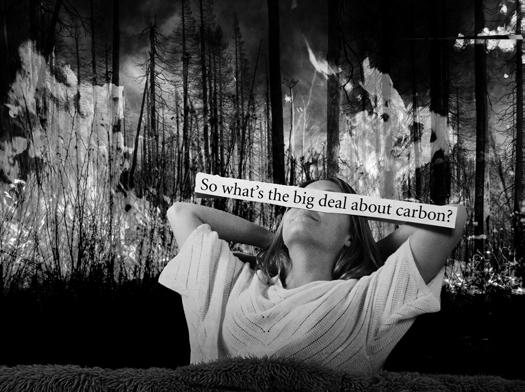
getting warmer
by Anna Pottie
marginalia
The Perils of Polyethylene?
A column by douglas abel
We might think of our age, the last half of the 20th century and the beginning of the 21st, as the age of electricity, the nuclear age, the electronic age, or the digital age. But it would probably be more accurate to label our era the age of plastic. It is amazing the extent to which these man-made substances have become universal in use and effect. A revolution which began with the creation of one limited substance, Bakelite, in 1904 has seen the proliferation of hundreds, if not thousands of different types, sizes, shapes, and textures of plastic material, with widely varying properties and uses. Plastic is found in children’s toys and toys for grownups, in containers for food and space capsules containing astronauts. Clothes and shoes are made of plastic. Medical devices and equipment are made of plastic; so are 3-D printed handguns and body armour. Look around any room in your home, and ask yourself, “Is it easier to count the objects that contain plastic, or those that do not?”
Plastics have transformed our world as much as electricity, computers and antibiotics have. Compared with the state of things in 1900, plastics have made objects both big and small lighter, stronger, faster, more flexible, more durable, more colourful, more varied, less expensive. Food has become safer and diets—at least in theory!—healthier, because produce can be easily and economically packaged for preservation and transport. At a cultural level, the music that inspires us is grounded in plastic: vinyl records, tapes and cassettes, CD’s. And even now, when most music is listened to digitally, the computers, tablets and smartphones that allow us to download or stream our favourites are full of plastic components.
It is almost as if our world is enveloped in plastic wrap for safekeeping, or built from Lego bricks. Plastic is everywhere. It is cheap. It is disposable.
And therein lies the problem. The plastic we have made, and are making, does not easily go away. It is effectively not “biodegradable.” If it does break down, we have discovered, it reduces itself to millions or billions of tiny fragments that fill the soil, the water, and our bodies. We do not know what effect these tiny chemical fragments will have on us; it seems fairly certain that the effect will not be beneficial. The plastic that does not break down wraps around trees and fences, fills landfills, strangles or chokes wildlife, clogs our pipes and pollutes waterways with floating plastic trash islands. Burning plastic does not solve the disposal problem; it creates both excess carbon dioxide to warm the atmosphere and complex chemical compounds that are hazardous to health. Recycling plastic is complicated, expensive and largely ineffective. There is simply too much of it to refashion efficiently and economically.
The substances that we invented to make our lives more convenient and easy sometimes seem to be pushing us out of the world they were designed to improve.
How did this happen?
The problem with plastic is just another instance of the problems created by any new technology, invention or advance. The benefits of the new development quickly become evident and are exploited to the full; the costs and hazards are more difficult to see and evaluate. Sometimes those hazards are even impossible to predict.
Think of the beginning of the industrial revolution at the end of the 18th century and the beginning of the 19th. Should the scientists of the time have predicted the effects that the burning of fossil fuels would have on the atmosphere and, hence, the climate? Hardly. Those scientists were not even sure yet what the atmosphere was, nor what its components were. Carbon dioxide may have been identified, but its properties and attributes were still to be worked out. Climate science had yet to be born. What prediction and prevention was possible then?
Similarly, we now know that some plastics can interact with other compounds to produce noxious substances. Many of those compounds had not, in fact, been created or discovered when the original plastic was invented. How can you predict and avoid the effect on something that does not yet exist?
More generally, there is the problem of the scope and limits of testing and prevention, when new products or processes are developed. In contemporary terms, how much diligence is due diligence? To be perfectly safe, the inventors of Bakelite should have tested it against every other substance known in 1904, to ensure that there were no negative effects. This would have been an impossible task. If the standard is that every possible eventuality needs to be evaluated before a product or process can be developed, there would simply be no new products or processes, no progress. In the case of plastics, no safer food, no life-saving medical devices. No attractive children’s toys. No challenging Lego sets!
This problem is compounded because some difficulties or hazards a product like plastic may create take time to become evident. Perhaps a certain plastic product begins to react toxically with other substances only after forty or fifty years. Do you wait that long or longer to find out if there are any problems before you use the product?
And if you are not using it, how, in fact, do you discover the problem? Or do you go ahead with development, and deal with future problems as they arise? Assuming that it is not too late to do so.
This problem of time frame, of the weighing of present benefits against future costs, is a pernicious difficulty. When the benefits of a product or process are obvious right now, and especially when there is money to be made, it is so easy to procrastinate on problems, to assume or hope that solutions will be found. Sometime. At a later date. After all, that’s what progress is all about! Isn’t it? Within a few years—ten, at the most!—some recycling breakthrough will let us make all those millions of plastic bags and containers disappear, or turn into something else. And when that “something else” solution causes its own problems, well, we will have time to make progress on that, too!
And there is, of course, the persistent problem of very long-term thinking, or avoiding. John Maynard Keynes noted, “In the long run we are all dead.”1 Wrestling with problems like plastic pollution or climate change requires committing to actions whose results no one alive now may see or profit from. The costs of action are here and now, the benefits, and the ultimate costs, are far away. Why not wait just a bit longer, and see what happens?
Food for thought, not necessarily tasty. I will engage in that thought as I take my carefully sorted plastic containers out to the recycle bin. And hope that something good happens because I do so.
1 Tract on Monetary Reform, 1923.
contributors
douglas abel is an actor, director, writer, theatre historian and voice and speech teacher. Work on his novel about Christopher Marlowe continues to continue . . . to continue. As a citizen of the plastic age, Douglas strives to be strong, flexible and transparent in his daily dealings. Please recycle his ideas.
anonymous is a local poet.
fizzah azam is a writer and lover of storytelling who is passionate about challenging herself, exploring the world, and being creative. She enjoys all forms of art and is especially fond of surrealism, horror, and subverting norms.
cullen bird is a writer and storyteller living in Fort McMurray on Treaty 8 Territory. He is always interested in the fight for a sustainable future.
will collins has been flourishing as an artist in Fort McMurray since 2006. Originally from southern Ontario, Will has studied languages and music in Toronto, Victoria, Tokyo, and Shizuoka, Japan. Will is a practising writer and multi-instrumentalist, an advocate for mental health, a lover of animals (except spiders), and he likes long walks on the beach… especially in countries that don’t speak English very well. In keeping with the theme of Plastic, Will has recycled parts of this bio from NorthWord Issue #29.
veronica ephgrave is, among many things, a local teacher, cat mom, and artist, trying her best to be an uplifting force in her sphere of influence.
michelle foran (b. 1992) is a Canadian-Colombian multidisciplinary artist and craftsperson from Toronto. She holds a BFA in Sculpture and Installation from OCAD University (2018) and an Honours Bachelor of Craft and Design in Furniture Design from Sheridan College (2024). A deep appreciation for traditional craft practices and contemporary design fuels her work, paired with a love of collaboration and community-based creativity. She’s devoted to material exploration and different approaches to art-making, working in wood, clay, paint, fibres/textiles,
analogue photography, and anything else she can get her hands on.
shaylean gladu is a multifaceted artist of the Nêhiyawak people, local to Fort McMurray. As a poet and writer, she explores intergenerational trauma, indigenous worldviews, and resilience. Shaylean was awarded First Place in the regional poetry competition, Words in Motion (2025) with her poem, ‘Drymeat’. Her work has been published in Northword Magazine, and Words & Birds Wood Buffalo. Currently, she is looking forward to a public speaking tour, organized by the Wood Buffalo Regional Library, promoting the literary arts to children and youth in rural indigenous communities. Shaylean believes that everyone has something inside of them; a gift, a vision, and wisdom that is meant to be shared.
stacey grant is a proud Métis mother of two and a multidisciplinary artist focused on traditional beadwork, writing, and storytelling. Through land-based teachings and cultural arts, her practice holds space for grief, love, memory, and quiet transformation.
gwenna cochrane halinda is a multidisciplinary artist from Fort McMurray, studying Sociology and English at the University of Alberta. She enjoys exploring themes of social justice through her writing, sewing, photography, and painting. In her free time, she can be found knitting or watching “How to Get Away with Murder.”
ron kirsch writes, “My introduction to literature came from an unsupervised decision at 12 years old. Found "Naked Lunch" by William S.Burroughs after being sent into Woolworth's alone to buy a summer vacation read. I thought it was gonna be a " sexy " book. It ended up altering the arc of my entire life and rewiring my young brain.”
jon lai (he/him) is a lifelong resident of Treaty 6 territory in Edmonton, Alberta, Canada. He holds a BA with a major in Sociology and a MSc in Human Ecology with a specialization in Aging from the University of Alberta. His previous poems have been published in Happiness
Reflected: A Community Poetry Project Vol. 1, Boyle McCauley News, NorthWord Literary Magazine, and Capital City Press Anthology Vols. 4 & 5.
kiran malik is co-founder of NorthWord. She is a freelance journalist and a poet based in Florida. An award-winning professional communicator, Kiran is a strong advocate for diversity, equity, inclusion, women's rights and the literary arts. She graduated from Gonzaga University with a Master’s in Communication and Leadership and has a Bachelor’s in English Literature. A voracious reader, she also loves Netflix (go figure!)
ana manderson hates pesto, has four brothers, and wears matching socks all the time. Two are truths and one is a lie.
alex k. masse is a writer from what is colonially known as British Columbia. Their work has been seen everywhere from the Scholastic Writing Awards to Autostraddle, as well as in collaboration with Vancouver Pride, Simon Fraser University, and more. They’re also a neurodivergent nonbinary lesbian, which greatly affects their process.
tineesha mckay is an interdisciplinary artist in the fields of visual art, writing, and dance. She served as guest editor of NorthWord Issue 29, “Resilience,” and her work appeared most recently in NorthWord Issue 31, “Isolation.” Her work has been selected multiple times for the Wood Buffalo Regional Library’s Words in Motion competition, and she has 10+ pieces featured in various other venues. She is inspired by her Afro-Métis background, her two children, and her lived experience.
anna pottie has been playing with the written word since she could hold a pencil—everything from little poems, stories or sayings in her notebooks, to published articles and press releases in her career. Always in awe of how language can be used to evoke feelings and imagination, Anna hopes to eventually write a book one day—she just has to figure out how not to miss deadlines.
jamal-e-fatima rafat, a local poet based in Fort McMurray, AB, started compiling her poems while stuck at home during the pandemic and produced a published copy by November 2020. In November 2024, her second poetry
book, The Lavender I Lost, was launched. Her work talks about stories, memories from childhood and adolescence, and lessons learned in life. She describes her writings as a journey through healing.
marty rempel, now retired for the fourth time, has been an educator in many capacities and places, serving as a teacher in Germany, Kuwait, and the Bahamas; Special Education Co-ordinator in Northern Alberta with Cree and Dene students; and principal in Jinhua, China.
Last June he retired as principal from a private school in Markham, ON, which caters to students from mainland China. Now he spends his time reading the news while drinking dark coffee on his balcony, solving world problems, writing, and planning his next trip with his lovely wife.
matt salem writes, “Not always a writer, but always an artist. This may be my first submission, but hopefully more to come.”
brooklyn wiltzen, 11, is a young Indigenous artist whose imagination shines through her expressive drawing and storytelling. A proud member of the Willow Lake Métis Nation, she has already been recognized as a 2023 Wood Buffalo Arctic Winter Games Torch Bearer, a Top 20 Under 20 recipient, and the Nation’s 2025 Youth Citizen of the Year. With creativity well beyond her years, Brooklyn continues to explore and share her art, inspiring those around her and shaping a bright artistic future.
zachary wood writes, “I have the privilege of working for FMPSD, where my passion for helping others fuels every aspect of my work. I find deep fulfillment in making a positive impact, and it is through my role that I am able to truly connect with and support those around me. Poetry, for me, is more than just an art form—it's the language of my soul. It allows my deepest emotions and inner thoughts to come alive in a way I cannot express through any other medium, giving voice to the parts of me that yearn to be heard.”
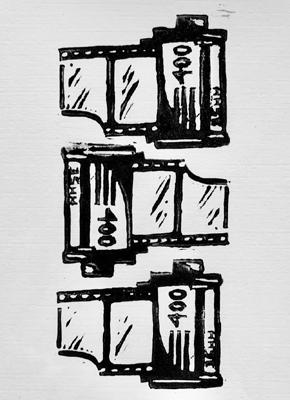
film
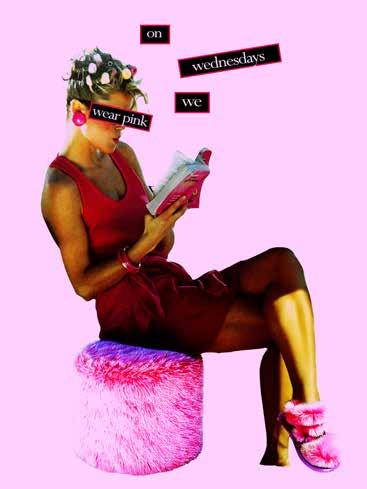
by Gwenna Cochrane Halinda


northern canada collective society for writers statement of purpose:
To publish and support the work of writers in northern Canada.
call for submissions
NorthWord Volume 6, Issue 4
deadline April 30,2026
theme Nonsense guest editor Anna Pottie
We’re always looking for prose (3000 words or fewer, fiction or nonfiction), poetry (50 lines maximum), excerpts from current projects, and visual art.
Extended submission guidelines are on our website: www.northwordmagazine.com
please submit as a microsoft word or image attachment to: northword@hushmail.com
for advertising and business inquiries, contact: www.northwordmagazine.com