From space to sustainability, researchers are taking on tomorrow
FUTURE-FOCUSED
Breaking down barriers to higher education — one student at a time
REAL-WORLD EXPERIENCE
Equipping students with the skills needed for the future
Meet the graduates and researchers applying practical skills and knowledge to solve real-world challenges
WELCOME
YOUR BACKGROUND DOESN’T DEFINE YOUR FUTURE
Potential is evenly distributed but opportunity is not. One student attended 15 schools before arriving at Northumbria. Another found her voice for the first time in a performing arts class. Northumbria stands ready to provide the support that can change everything.
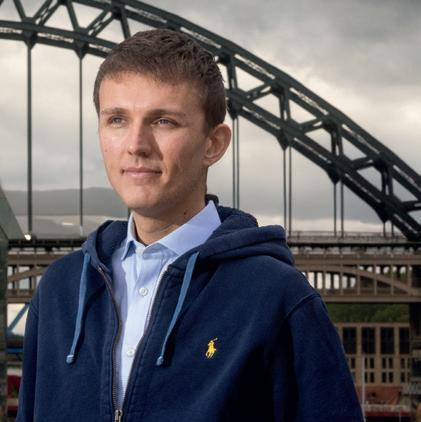
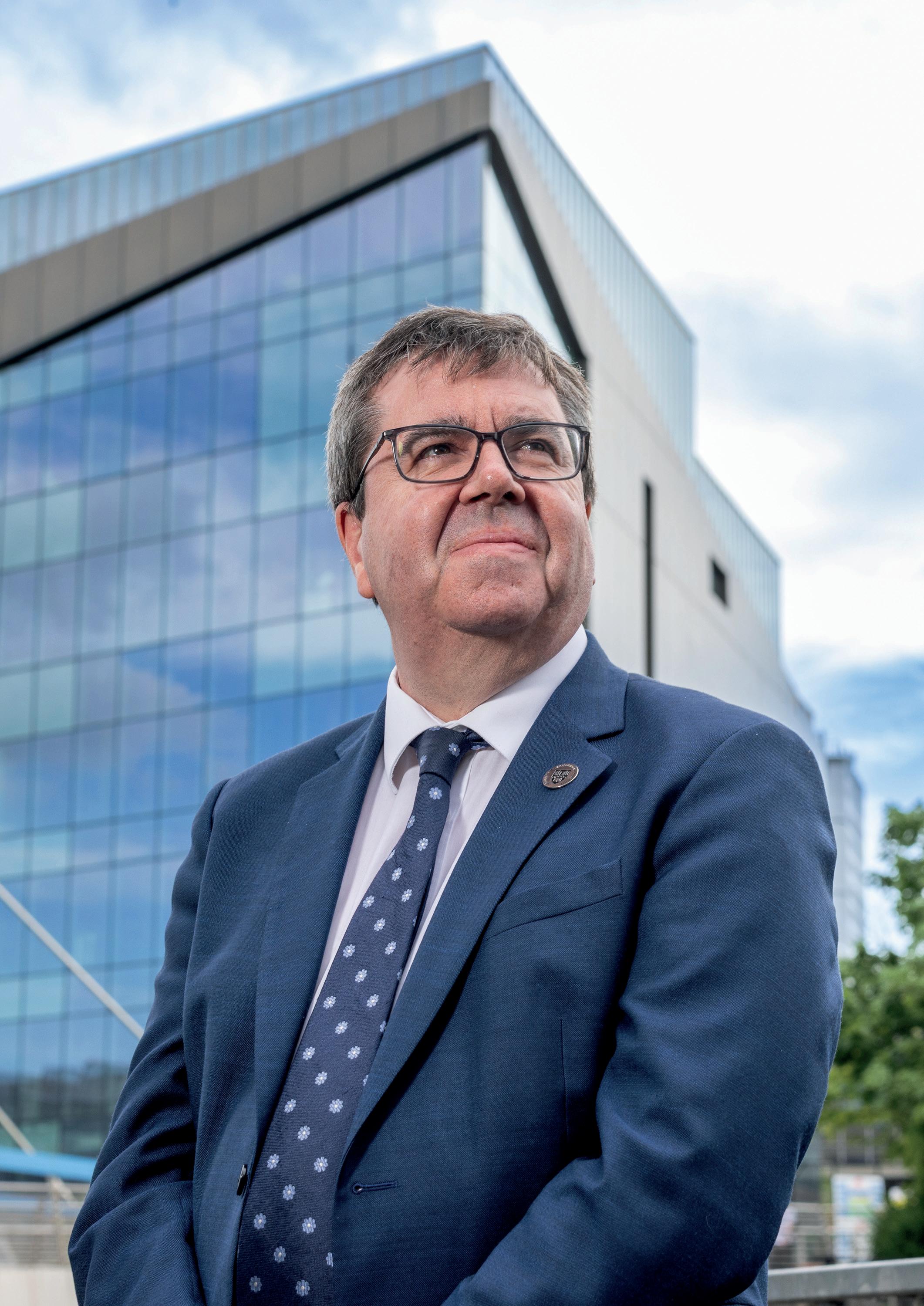
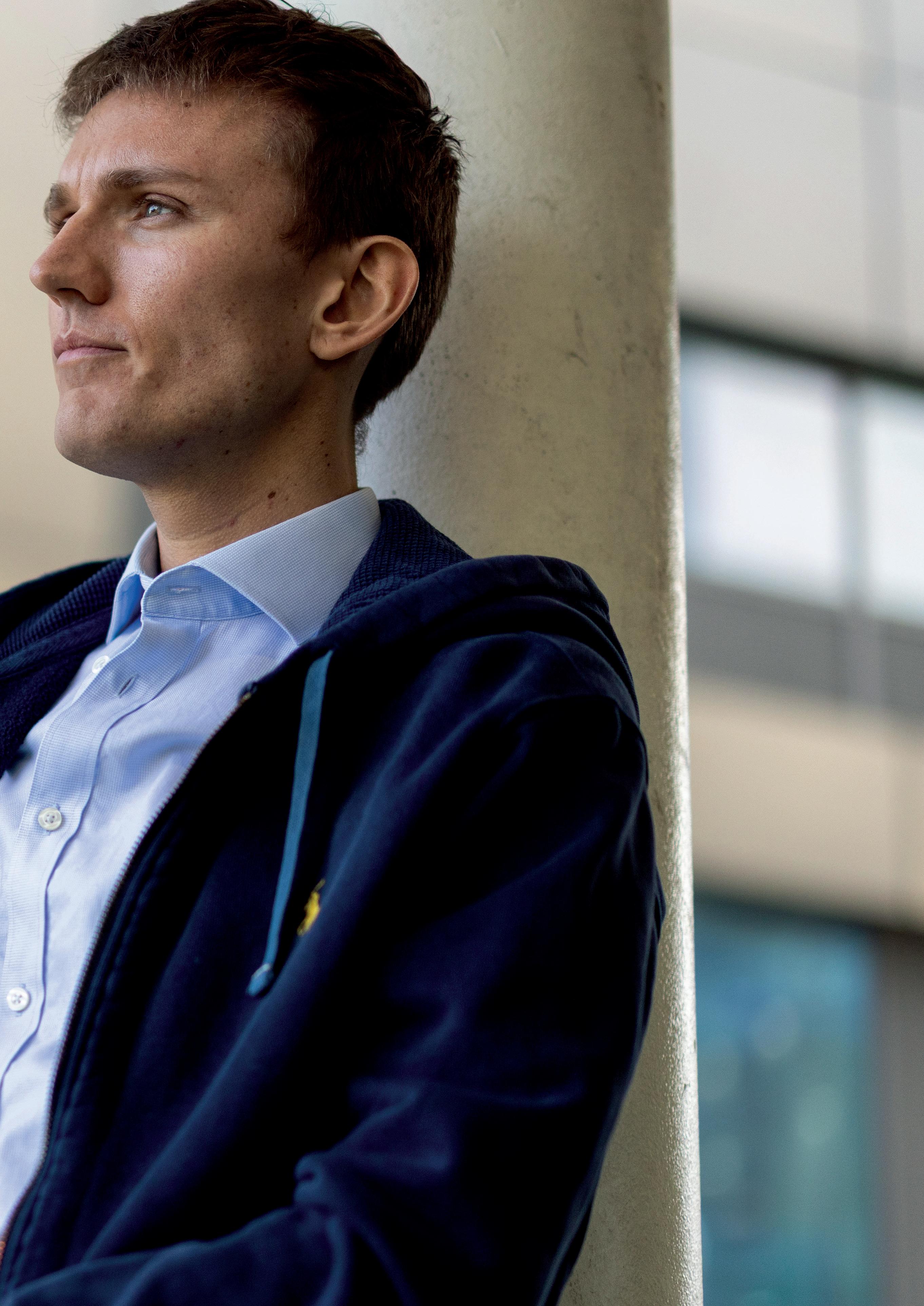
Sebastian Moore grew up in the care system in County Durham, attending 15 schools across as many years. By the age of 16 he was living independently. That level of instability is not unusual for care-experienced young people. What was different when he arrived at Northumbria was the infrastructure: a Care Leavers’ Bursary, a guaranteed 52week tenancy, and a dedicated care leaver contact. A named person who understands the specific pressures care leavers carry into higher education. They work directly with the Personal Advisers care-experienced young people are given to support complex moves and transitions into adulthood.
“That security matters in a way that is hard to overstate,” Sebastian says. “When the stable foundations are in place, everything else becomes possible. I remember arriving at Northumbria and realising, for the first time, that I didn’t have to solve the basics before I could start learning.”
He studied International Relations and Politics, and while at university Sebastian volunteered with regional Youth Justice
Services, supporting outcomes for lookedafter children. Two days after graduating, he began working for the government through the Civil Service Care Leaver Internship Scheme, joining Darlington Economic Campus (DEC), the North East headquarters for several major government departments. Northumbria is working in partnership with DEC to connect more people from the North East to jobs that have traditionally been done in London. Sebastian now works within the Government Digital and Data Profession at HM Treasury. He has since been named in two global lists and one national top 100 list for his work on artificial intelligence and digital transformation in the public sector.
The bursary, the tenancy, the named contact. Northumbria provided these as standard, and they gave Sebastian the conditions in which he could write his own story. Care leavers do not need rescuing. But they do need the same solid ground beneath their feet that other students arrive with.
“I remember arriving at Northumbria and realising, for the first time, that I didn’t have to solve the basics before I could start learning.”
Sebastian Moore
A DIFFERENT KIND OF STAGE
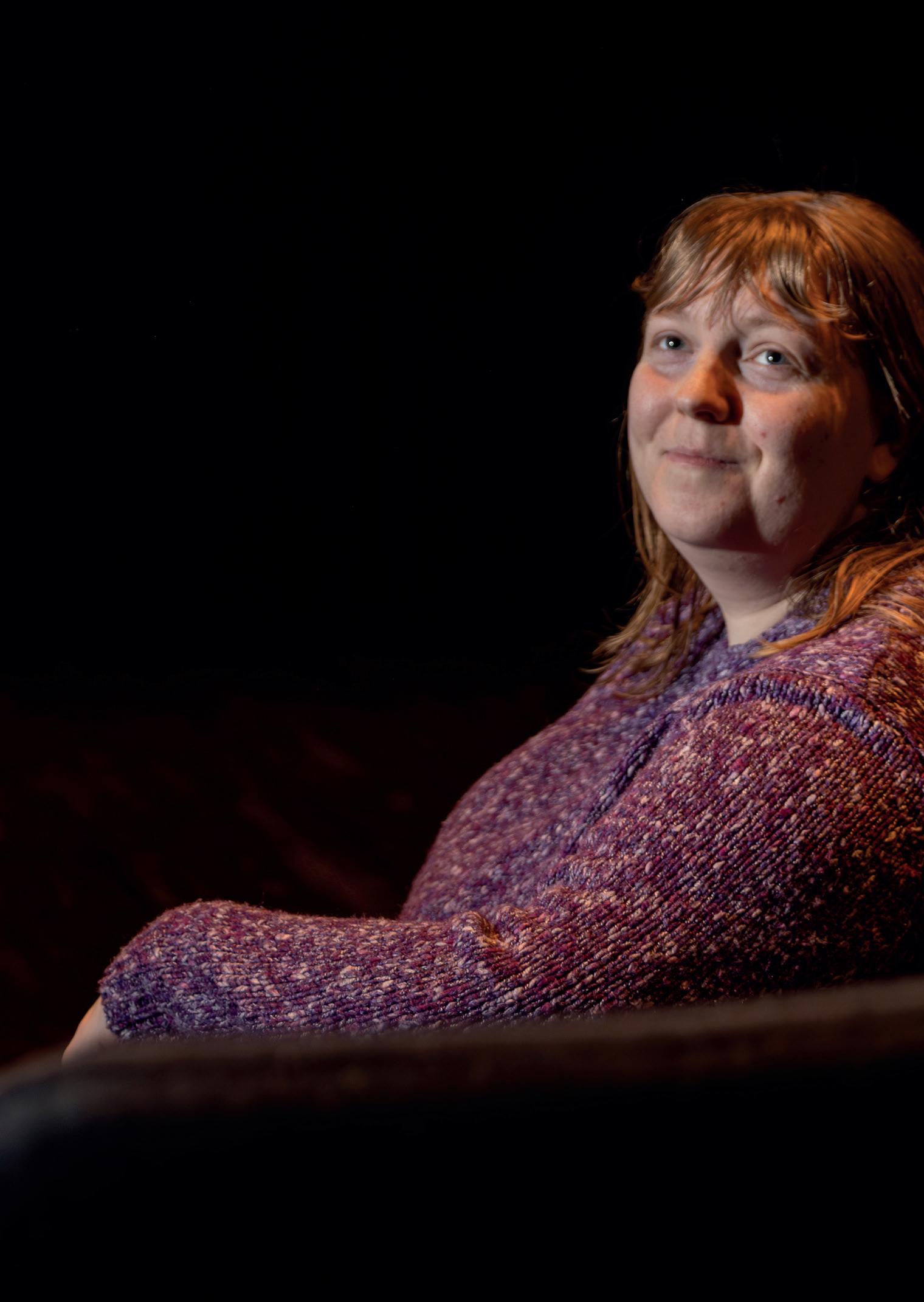
Sabrina Cruickshank’s journey to Northumbria was equally determined. Now 27, she also grew up in care, living with foster families and in a children’s home until she turned 18. Diagnosed with AuDHD, she has spent much of her adult life finding ways to support others through the challenges she has faced. As a child, just like Sebastian, she moved from school to school, struggling with her GCSEs, until discovering a rare feeling of freedom in performing arts classes. “For the first time, I was given the space to speak, and people listened,” she says.
Sabrina went on to complete a BTEC and Certificate of Higher Education before applying for her university place as a mature student. She was drawn to Northumbria’s School of Design, Arts and Creative Industries – producer of the largest number of creative industries graduates in the region – and now has a self-proclaimed extended family of inspirational staff and students she has met along the way. “I’ve always struggled building and maintaining relationships, specifically professional ones,” Sabrina explains.
“But at Northumbria the lecturers have helped and supported me to network and make industry connections. I still struggle sometimes, but every day I get better.”
The next chapter is already taking shape. Sabrina is now studying a part-time master’s in Creative and Cultural Industries Management at Northumbria and has plans to launch Disorderly Theatre – a performing arts company with weekly workshops for neurodivergent adults in performance, directing, set design, scriptwriting and costume design. By opening doors for other adults to learn a new skill in a supportive environment, Sabrina’s ambition mirrors Northumbria’s approach to widening participation in higher education. Department for Education data shows just 13% of students known to be care leavers progressed to higher education in the UK by age 19. In contrast, the progression rate for all other pupils is more than three times higher, at 46%. The barriers to learning are rarely about ability. More often, they are about circumstances, confidence, and having the right support in place.
“ For the first time, I was given the space to speak, and people listened.”
Sabrina Cruickshank
WHERE POTENTIAL MEETS OPPORTUNITY
Higher education participation in the North East trails behind most of England. Educational attainment gaps take root early – at GCSE and A-level – and financial pressures are deeply felt. For many young people here, the odds are simply not equal.
Northumbria is doing something about it. Forty per cent of its students come from areas with the lowest rates of higher education participation in the country. No other research-intensive university comes close to this figure. Around 60 per cent of Northumbria’s student body is drawn from the North East itself.
For Northumbria’s Vice-Chancellor and Chief Executive, Professor Andy Long, those figures represent a starting point and not a ceiling. “Financial circumstances must never cause a talented young person to decide university isn’t for them,” he outlined. “Many are the first in their families to consider university. Some are leaving care with no family safety net. Others are mature students juggling children and jobs while trying to further their education. What they all share is a hunger for opportunity and a determination to make it work.”
Targeted work in schools and supported entry schemes help young people to understand the benefits of higher education. Through IntoUniversity centres in Newcastle and Gateshead that Northumbria sponsors and funds with partners, thousands of seven to 18-year-olds in areas of real disadvantage have access to academic support and mentoring to help raise their aspirations early.
Encouraging more young people to believe that university is a genuine option for them, no matter their background, as well as giving them the tools to flourish when they get there, is at the heart of the support package Northumbria offers. As a result, 24% of all first degree graduates in highly skilled employment in the North East are Northumbria graduates – more than any other university.
New Fixed Block Degrees are being built around the realities of students’ lives, where campus teaching is scheduled across three fixed days each week for the full duration of the degree, allowing students to commit to work patterns throughout their studies. Going further still, the University will be looking at ways to support adult learners without the traditional qualifications needed to progress to higher education.
And this commitment to opening doors and providing support doesn’t stop when students enrol. The University’s response is practical and far reaching to cover all areas where students may need additional help, from travel bursaries, guaranteed accommodation and mental health support to hardship funds and access to digital devices for those who may not be able to afford their own laptops.
The University’s own Higher Education Without Barriers Fund aims to provide a range of financial initiatives, wellbeing services and community-based outreach projects to support students from all backgrounds. More than £5.8 million has been donated to the Fund over the last four years. Graduates such as Chris K Jones and businesses including the MGL Group and Jim Jackson Foundation have generously funded scholarships to support individual students. Partners such as Ryder Architecture and Enterprise Mobility have committed funding to support the IntoUniversity centres, investing in the community as well as the University.
And grants from sources such as the National Lottery Community Fund are enabling the University to develop innovative partnerships, like Converge Northumbria, to support young adults with mental health challenges, as well as establishing the North East’s first centre for Gypsy, Roma and Traveller communities.
Northumbria is not simply offering ways in. It is ensuring that once students arrive, they have everything they need to belong, to grow, and ultimately, to succeed – it is genuinely changing lives.
FUELLING AMBITION
Northumbria University graduates are rewriting NHS guidelines, building AI diagnostics and running national sport. Every year, thousands more graduates leave the University to make their mark. For them, graduating is just where the story begins.
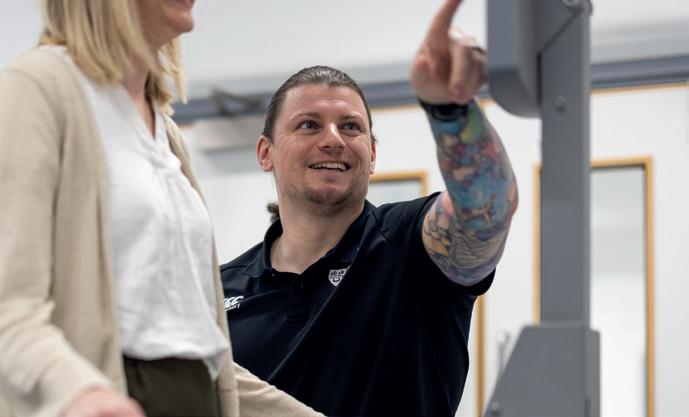
In 2010, a college tutor spotted real potential in a young man from South Shields and pointed him towards a job at Northumbria’s sports centre. Liam PearsonNoseworthy had left school with five GCSEs and no clear plan. Fifteen years on, Liam is now Dr Pearson-Noseworthy, a senior lab technician and published researcher. He is just one number in a huge success story. Northumbria is in the top 20 in the UK for the number of graduates going into skilled jobs and has spent 17 consecutive years in the top 10 for graduate business start-ups by turnover, with businesses generating more than £166 million and supporting 1,645 jobs according to the most recent data.
Andrew Haxell, the University’s Director of Graduate Futures, sees the impact Northumbria graduates make every day. “Our graduates don’t just enter the world of work – they transform it,” he says. “What sets Northumbria apart is the combination of academic rigour, real-world learning and an absolute commitment to making sure every student, whatever their background, leaves here ready to thrive – whatever path they choose to take.”
A DIFFERENT KIND OF JOURNEY
For Liam, the path to a doctorate was never going to follow a straight line. After starting work at Sport Central – the University’s flagship complex, home to elite athletes and world-leading research for partners including British Cycling and the UK Sports Institute – he spent five years as a personal trainer, earning a Queen’s Award for services to sport and health. His appetite for knowledge pulled him back into education, with an Access to HE course leading to undergraduate and master’s degrees in Applied Sports Science with Coaching, funded through freelance teaching and a government bursary.
He returned to Northumbria as a lab technician following a stint with Newcastle Falcons and the Rugby Football Union and has since completed a fully funded PhD, adapting training principles he honed with elite athletes – including Team GB Skiing and Newcastle Eagles Women’s basketball team – for use with older people. Twelve peer-reviewed papers in, he is just getting started. “I’m pushing the boundaries of what a technician role typically involves,” he says. “My long-term goal is to influence NHS guidelines and gain maximum impact for my research.” As a proud signatory of the Technician Commitment, Northumbria actively supports the recognition and career development of its technical staff – and Liam is proof of what that ambition looks like in practice.
“I’m pushing the boundaries of what a technician role typically involves. My long-term goal is to influence NHS guidelines and gain maximum impact for my research.”
Dr Liam Pearson-Noseworthy
A PROBLEM WORTH SOLVING
A few miles across Newcastle, Jack Parker was one of only nine students from his secondary school to go on to university. He entered Northumbria through a foundation degree and obtained work experience in a hospital cardiology department during his Biomedical Sciences studies. He describes watching a doctor spend an hour manually measuring vessels from an MRI scan as “the worst video game ever invented.” His father had suffered a heart attack while waiting for a scan to be read, exactly the kind of delay Jack has now dedicated his career to eliminating.
Today, as CEO and co-founder of AI healthcare company AIATELLA, Jack is cutting cardiovascular diagnosis times from more than 30 minutes to under three. His software is being evaluated by NHS trusts including Northumbria Healthcare, Newcastle Hospitals and South Tyneside and Sunderland, and has already identified people needing immediate intervention through community screening in South Tyneside. Northumbria’s Incubator Hub has helped open doors to UK grants, the Department for Business and Trade, and key industry networks.
“I want to change the narrative about university education,” he says, “by showing how knowledge from Northumbria can be practically applied to solve real-world problems.”
GIVING BACK
Some of Northumbria’s most successful graduates have returned to help shape the opportunities available to the next generation. Jon Dutton OBE, a Sports Management graduate, former Rugby League World Cup Chief Executive and now CEO of the British Olympic Association, returns to campus to give guest lectures, sharing first-hand insights with the next generation of sports leaders.
“Whether they’re mentoring, sharing their stories or opening doors, our alumni are helping to shape and inspire the next generation.”
Andrew Haxell
Lady Edwina Grosvenor studied Criminology and Sociology before founding the prison reform charity One Small Thing. She has since funded a PhD studentship at Northumbria on intergenerational trauma, imprisonment and parenting, giving outstanding students the platform to produce research with genuine social impact. They are just two examples of many graduates who recognise that they can use their position to support those who follow.
“We’re committed to helping all our students, whatever their backgrounds, achieve the positive outcomes they’re looking for, and support from our own graduates is a real driving force in this,” Andrew adds. “Whether they’re mentoring, sharing their stories or opening doors, our alumni are helping to shape and inspire the next generation. We provide opportunities that reflect authentic, realworld settings, helping students build confidence, develop their skills and create the professional networks that will carry them forward.”
Jack Parker
A WORLD SHAPED
More than a quarter of a million Northumbria graduates live in almost every corner of the world. They are building careers, founding companies and reshaping industries – living proof of what a Northumbria education can deliver. What unites them is not just a degree, but a collective experience, a shared city, and an ambition that Northumbria helped to forge. Northumbria’s global presence is alive and growing, and it’s becoming ever stronger.
LEARNING WITHOUT LIMITS
Four thousand miles from Newcastle, on the Caribbean island of Grenada, one of Northumbria’s most ambitious ventures has become a remarkable success. In partnership with St George’s University (SGU), Northumbria is part of a medical education programme that bridges the NHS and North American healthcare systems, moving students across the Atlantic and preparing them for medical careers with a genuinely international perspective.
Nearly two decades in, more than 2,500 students have come through its doors, and for ten consecutive years, SGU has been the single largest provider of new physicians to the US healthcare system. Every single day, doctors who’ve studied in Newcastle are seeing patients, making diagnoses and saving lives in hospitals and clinics across North America.
This year, on the other side of the world, the largest-ever cohort of students graduated from Northumbria’s partnership with Qatar Finance and Business Academy (QFBA). Graduates of these degree programmes in Accounting, Finance and Entrepreneurship included, Sheikh Abdulrahman Bin Fahad Al-Thani, the Group Chief Executive Officer of Doha Bank. In Singapore, a 15-year alliance with Kaplan Higher Education Academy, whose student community represents more than 55 countries, was marked with an alumni reunion that reflected how far a Northumbria degree can reach across the AsiaPacific region.
Closer to home, Northumbria’s partnership with QA Higher Education brings its programmes to hundreds of international students who wish to study in London.
“We have created educational experiences that take advantage of our collective strengths,” says Professor John Woodward, Pro Vice-Chancellor International. “Northumbria’s global partnerships reflect a long-standing commitment to delivering an exceptional education to students from a wide range of backgrounds, and the success of our graduates is testament to what that commitment can achieve.”
“Northumbria’s global partnerships reflect a long-standing commitment to delivering an exceptional education.”
Professor John Woodward
BY NORTHUMBRIA
A LEGACY IN THE MAKING
For many graduates, their bond with Northumbria doesn’t break when they leave – in fact, the connection can become even more meaningful after they begin their careers.
The University’s Alumni Association has been extending its reach, hosting events in North America, Singapore and Qatar that have brought graduates together to network, reconnect and build new relationships.
Raman Sehgal knows what that community can mean. A Marketing Management graduate, he founded his first business in Newcastle in 2009. Today, it is a multi-million-dollar private equity-backed agency, still headquartered in Newcastle, with offices in Boston and Toronto. A committed ambassador for Northumbria, he hosted the Toronto alumni event and has established The Raman Sehgal Scholarships, supporting two underrepresented students through
their undergraduate studies. Chris K Jones has a similar story. He arrived at Northumbria as an exchange student from a New Jersey college in 1989, the first in his family to go to university. He has maintained his deep connection with the University, funding multiple scholarships for entrepreneurs and creative writing students, investing in potential that mirrors his own passions, and joining the recent alumni events on the East Coast. Speaking about these events, he said: “What struck me was how many brilliant, talented people had gathered across two great evenings in New York. We were all united by a shared love of Newcastle and what Northumbria gave us. The alumni network is something special, and events like these remind you of just how far it reaches.”
Some of the world’s most celebrated designers have never really left Northumbria’s door.
Thirty years after graduating, Tim Brown CBE, executive chairman of global design firm IDEO, serves as a Visiting Professor, bringing a remarkable career full circle, while Michelle Poole, who graduated in 1992 and has held senior roles at some of the world’s most recognisable footwear brands – Timberland, Converse, and Crocs – has established a scholarship in Fashion Design and Marketing. She encourages all alumni to think about opportunities to give back. “It can be really daunting to be a student today and figure out which way to go. Sharing your experience or making a donation could change someone’s life pretty dramatically.”
It is exactly what the Alumni Association is building – members of a global community rooted in the shared experience of being shaped by Northumbria, who are actively choosing to shape it in return, supporting upcoming talent on their journey.
WHERE RESEARCH BECOMES REALITY
A six-year-old stuffing toast into his pockets. More than two billion invisible volunteers. One university connecting the two.
The moment that changed Professor Greta Defeyter’s career happened in a primary school breakfast club. A six-year-old boy was quietly stuffing toast into his pockets. He wasn’t being mischievous; he was making sure he and his younger sister would have something to eat that evening.
The stark realisation that this family would also go hungry during the school holidays lit a fuse, sparking research into how breakfast clubs were supporting children, and the deprivation they experienced when schools were closed. The evidence was clear. Children who attended breakfast clubs were better prepared for the school day: they learned more because they weren’t hungry, and they developed stronger social relationships with their teachers and classmates. She knew far more needed to be done.
Two decades on, Professor Defeyter OBE, Director of Northumbria’s Healthy Living Lab, has become the researcher politicians call when the conversation turns to free school meals, holiday hunger and food poverty. She is the architect, in no small part, of the government’s Holiday Activities and Food (HAF) and HAF
Plus programmes, which provide nutritious meals and enriching activities for children and teenagers throughout school holidays. Most recently, she has found a champion in Gordon Ramsay – a man better known for Michelin stars than food banks – who has now thrown his considerable public profile to the cause, committing his voice and his time to amplify the case for school holiday programmes and the children and families who depend on them. Her research has translated into genuine policy change. Over the last five years, the government has invested more than £1 billion in the programmes her work helped shape – £220 million for holiday activity clubs in 2021, £315 million for school breakfast clubs in 2023, and a further £600 million for the HAF programme in 2025.
“I see inequalities every day,” says Professor Defeyter. “And I also see the positive impact of investing in our children and young people. This funding really is creating opportunities that drive aspirations and future upward social mobility. It is changing lives for the better, but there is still so much more that can be done, and I’m determined to keep going.”
“It is changing lives for the better, but there is still so much more that can be done, and I’m determined to keep going.”
Professor Greta Defeyter
LEAVING NO ONE BEHIND
Professor Defeyter’s work is one expression of a broader mission running through Northumbria’s research culture: to understand where there are inequalities, and to do something about it. The Centre for Health and Social Equity, or CHASE, brings together researchers working across some of society’s sharpest fault lines, from addiction and unemployment to homelessness, disability and the impacts of old age.
“We seek to identify the gaps in fairness and support and address the challenges faced by different groups in society,” explains Professor Allan Kellehear OBE, a globally recognised expert in end-of-life care and one of the centre’s three co-leads. “From job seekers, ex-offenders, veterans, the elderly, people experiencing homelessness or with disabilities – our aim is to leave no one behind and to help people to thrive.” That conviction, he argues, is what makes the work so effective.
The approach is deliberately practical. “We have a strong track record of translating investigation into tangible results, working alongside businesses, local and national government, the public sector and charitable partners,” he says. “We’re united by the belief that we will all benefit from a healthy, prosperous society.”
The Common Sense Policy Group, led by CHASE Co-Director Professor Matthew Johnson, is one such example – developing feasible, evidence-based policy proposals for government. These policies are aimed at tackling the crises that affect Britain, and that cannot be addressed via existing approaches. The Group has developed a programme for progress in its report Act Now: A Vision for a Better Future and a New Social Contract, which outlines clear policies for the transformation of issues including welfare provision, health and social care, education, housing and, transport services. Members of the Group are currently working with leading policymakers to lay the foundations for transformative government at a time in which parties are recognising the need for real change.
That same determination to reach people at their most vulnerable extends to those who have given the most. The Northern Hub for Veterans and Military Families’ Research works alongside government departments, the NHS, military charities and more. Its researchers grapple daily with some of the most pressing challenges facing former service personnel, including,
THE GLOBAL PICTURE
“Across the world, volunteers are stepping forward in quiet but determined ways: in villages hit by drought, in cities recovering from conflict, in communities where inequalities run deep,” says Toily Kurbanov, Executive Coordinator of United Nations Volunteers. But the true scale of that collective effort is often hidden.
Although Northumbria’s roots lie in the North East of England, its influence extends far beyond. Researchers from the Centre for Global Development have coordinated a global consortium producing the most comprehensive analysis to date of volunteer measurement and the global scale of volunteer work. Their flagship 156-page report for the United Nations documents the contribution of more than 2.1 billion people volunteering each month worldwide and provides practical guidance for governments on embedding volunteerism into the heart of policy and planning.
but not limited to, alcohol dependency, PTSD, bereavement, social isolation, suicide and criminal justice.
Many of the Hub’s members have served in the Forces themselves and have never lost sight of the people adjusting to life beyond the military. Among them is Assistant Director, Professor Gavin Oxburgh, who traded the Royal Air Force Police for the world of forensic psychology.
“If somebody has been out in Afghanistan, Iraq, the Falklands, and is injured or left with mental health issues, sometimes the system can make things worse,” he says. “When they are discharged, they lose the structure and camaraderie they have grown used to and really need to deal with things on the outside. A lot of veterans become isolated, and to admit this is a massive thing, especially for men, so they tend not to do anything until it’s a crisis point, and that’s the issue. Quite often that’s too late.”
Knowing they need to improve the ways that veterans can access support, the team charted hundreds of specialist charities supporting service personnel across the UK, mapping the types of help people sought, the branch in which they served, and where they lived. That evidence base continues to grow through MONARCH, a Northumbria-led study bringing together health and social care data from across the UK – building the national picture needed to turn good intentions for veterans into effective policy.
Veterans are not the only ones who fall through the gaps. Professor Monique Lhussier’s work also begins where the safety net ends for people experiencing homelessness. Together with Dr Christina Cooper, she co-leads a team responsible for creating a new free online directory that brings together more than 1,000 housing, health and social care providers in one place. The team knew it was important to ensure those who have slept rough or relied on temporary beds were fully involved in the directory’s creation. People with lived experience of homelessness – who know just what it is like to be at a point of crisis and not know where to turn – have shaped its design.
“We want to make sure that no one falls through the gaps simply because they didn’t know what support was available, or because services weren’t connected to one another,” explains Professor Lhussier. “We want this to be a tool that helps shift the system from crisis response towards something more proactive, joined-up and human.”
“For too long, volunteering has been undervalued in humanitarian and development policies and investment decisions,” says Professor Matt Baillie Smith, Dean of Research Culture and Co-Director of the Centre for Global Development.
“This report aims to change that narrative and provides innovative approaches which capture and evidence how all kinds of volunteers can drive change worldwide.”
“When I think about what Northumbria research means in practice,” says Professor Louise Bracken, Pro-Vice-Chancellor for Research and Knowledge Exchange, “I think about a child who isn’t hungry, a veteran who gets the support they need, a volunteer whose contribution finally gets recognised. That’s the impact we’re having on people’s lives.”
Some of that impact can be measured in pounds of government funding, or pages of UN reports. Some of it was measured, once, in pockets full of toast.
CURIOUS MINDS, REAL CHANGE
High above our planet, a small tourniquet placed on an astronaut’s leg while they exercise fools the body into thinking it’s been through a heavy workout. Back on Earth, researchers are developing products that will cool cities during heatwaves.
These aren’t concepts; they are happening now, thanks to Northumbria University, where researchers are not waiting to be asked questions – they are already working on the answers.
Professor Nick Caplan
When astronauts orbiting the Earth place a tourniquet cuff to their leg before they begin their daily exercises, they are drawing on research developed in the North East of England.
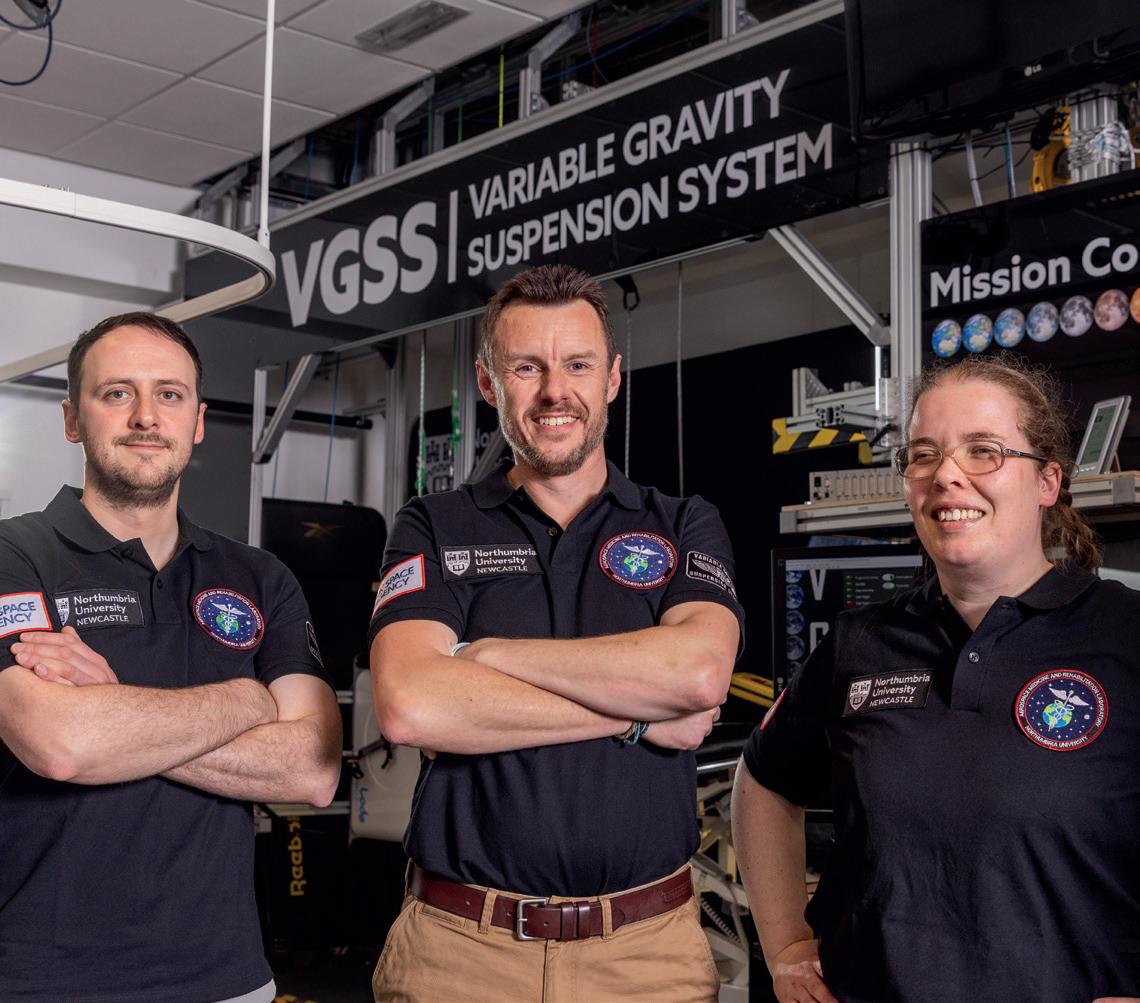
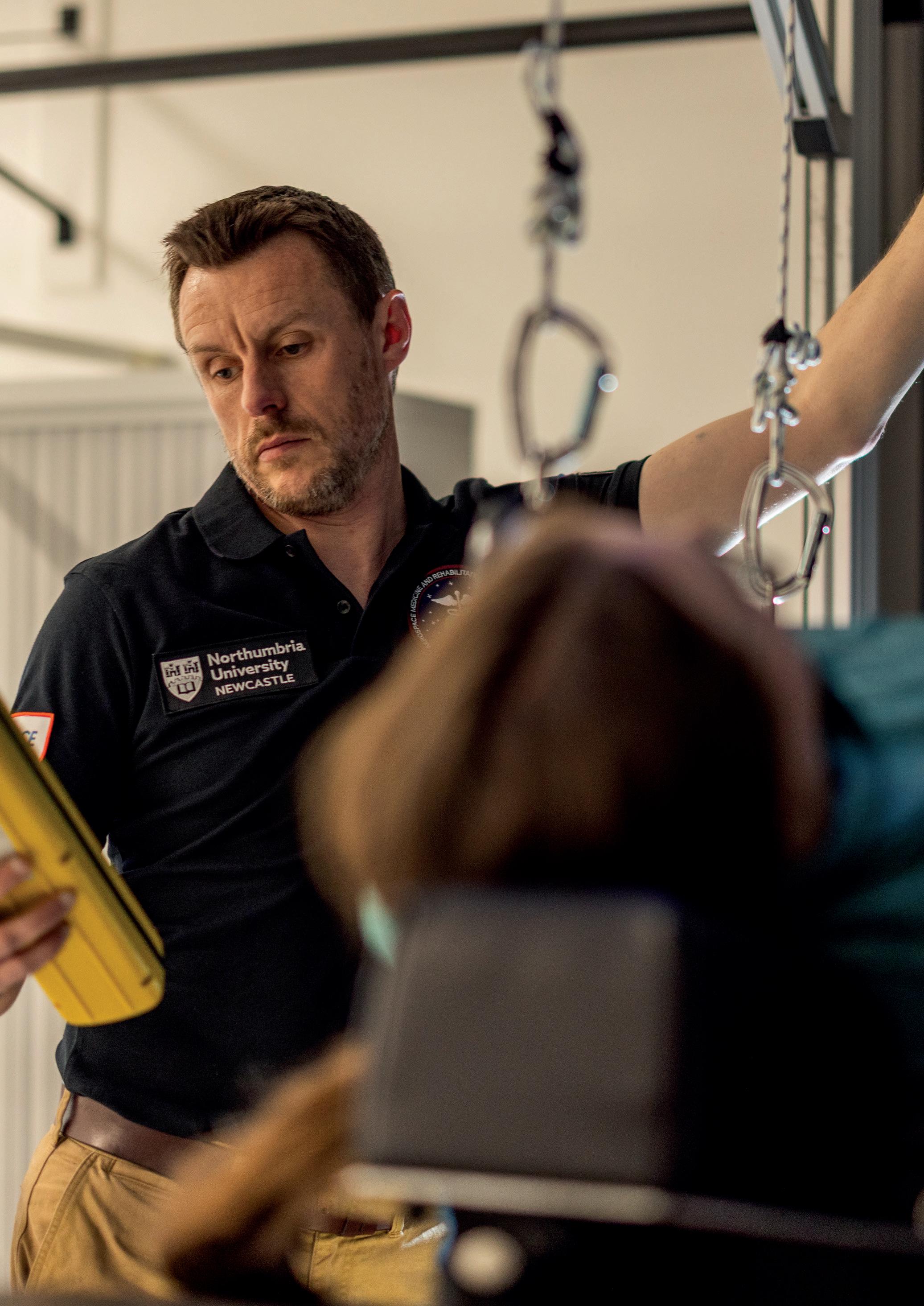
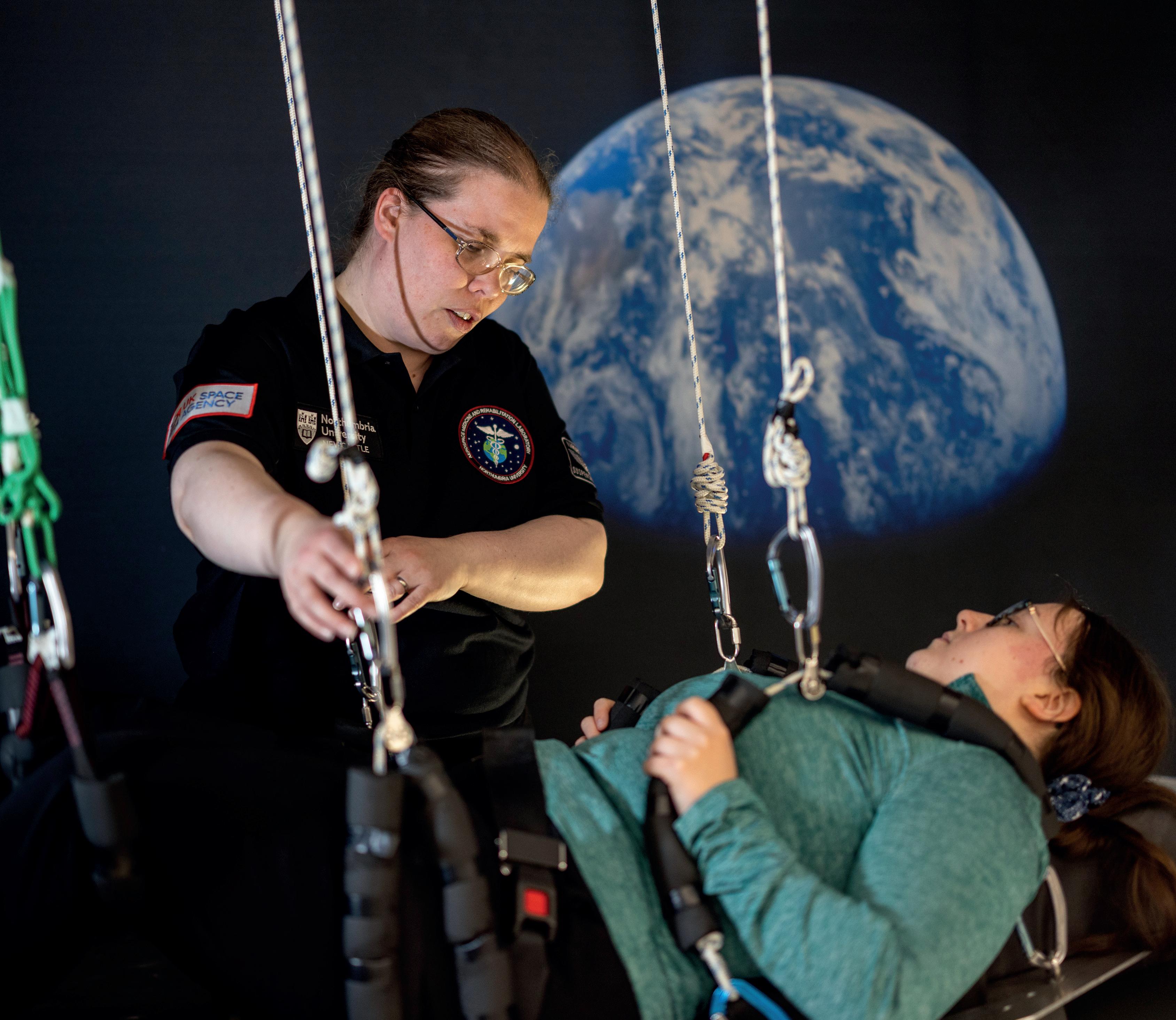
Professor Nick Caplan and Dr Luke Hughes, from Northumbria’s Aerospace Medicine and Rehabilitation Laboratory, have developed a space-ready device that restricts blood flow to the muscles. This tourniquet cuff, which has been developed in collaboration with Canadian company Delfi Medical Innovations, stimulates an amplified response from muscles and bones that would normally require much heavier training. In weightless environments, where bone-density loss is a persistent risk, this is transformational. Its benefits extend far beyond the launch pad, already aiding patients recovering from surgery, the elderly, and those with limited mobility.
Dr Kirsty Lindsay is also testing whether kinesiology tape – the colourful strips often worn by athletes to support muscles and joints – could help astronauts stay steady on their feet on the Moon, where the low gravity and uneven, rocky surface make even walking a challenge. Low-cost and easy to apply even under a spacesuit, it could potentially benefit those navigating difficult conditions on Earth too.
At the heart of the team’s work is their Variable Gravity Suspension System, a globally unique facility. It uses whole-body suspension to simulate reduced gravity, testing equipment for the European Space Agency and giving people the experience of walking on the Moon. It’s just one example of how Northumbria researchers are leading the way in turning ambitious ideas into tangible results.
Back on Earth, one of the most pressing issues of today, alongside health, is the impact of artificial intelligence (AI) on our lives. Northumbria has an ambition to be a critical and trusted voice in the AI revolution, shaping it rather than simply responding to it.
Working closely with the police service, the NHS and the Ministry of Defence, researchers from the University’s new Centre for Responsible AI are asking and answering essential questions that will shape how AI is used in public life, including whether AI tools should be used and on what terms, drawing on technical, legal, policy and ethical expertise.
“These are just a few examples of meaningful research making a measurable difference to everyday lives,” says Professor Louise Bracken, Northumbria’s Pro-ViceChancellor for Research and Knowledge Exchange.
Dr Kirsty Lindsay using the Variable Gravity Suspension System
Some universities teach students about the world. Northumbria puts them in it. From live business challenges to global design challenges, realworld experience is built into every course — giving graduates the skills, confidence and connections to shape the world as it should be.
For Elle Fox, handling live legal cases in her second year was exactly what she signed up for. An aspiring barrister, she chose Northumbria precisely because of its reputation for putting students in front of real practice.
Elle is taking part in Northumbria’s Law in the Community project, working alongside expert advisers at the Citizens Advice Bureau on cases spanning family law, housing, debt and, immigration. She’s one of a team of students working with real clients with real problems and real opportunities to make a difference. “Engaging with a cross-section of society means understanding individuals’ needs,” she says, “and how my practice can be tailored to benefit as many people as possible.”
It’s not the kind of thing you can replicate in a lecture theatre, and it shows.
GRADUATES THAT STAND OUT
Pete Coates has worked with a lot of graduates. As Managing Director of Omnicom Media in Newcastle, he has consistently seen a strong understanding of how to apply knowledge at work in Northumbria’s graduates. “Some universities focus so much on the academic side without giving students the chance to apply their thinking,” he says.
“The Northumbria curriculum clearly provides opportunities to apply that learning in real-world environments. That’s critical for us; we need our hires to be effective from day one.”
What he’s describing is the outcome of a deliberate institutional shift.
Experiential learning - handson experience that helps build professional skills and networks – is now embedded into every undergraduate course at Northumbria. It can take many forms. Students might go on placement, work on a consultancy project for a real organisation, step into a simulated clinical environment, take on a pro-bono legal case, or pitch solutions to a live business challenge. The variety is intentional. So is the progression. “We ensure that a range of activities are spread throughout our programmes by design. They provide our students with a transformative
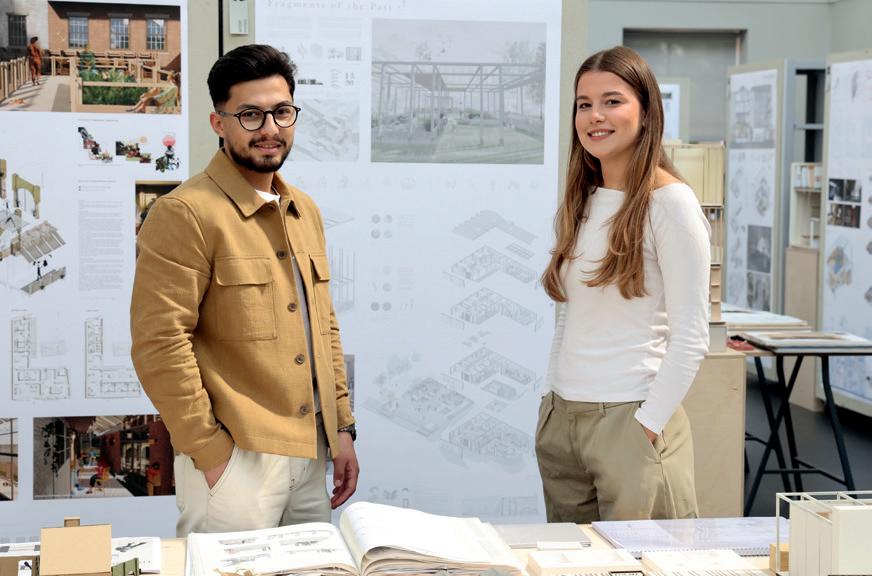
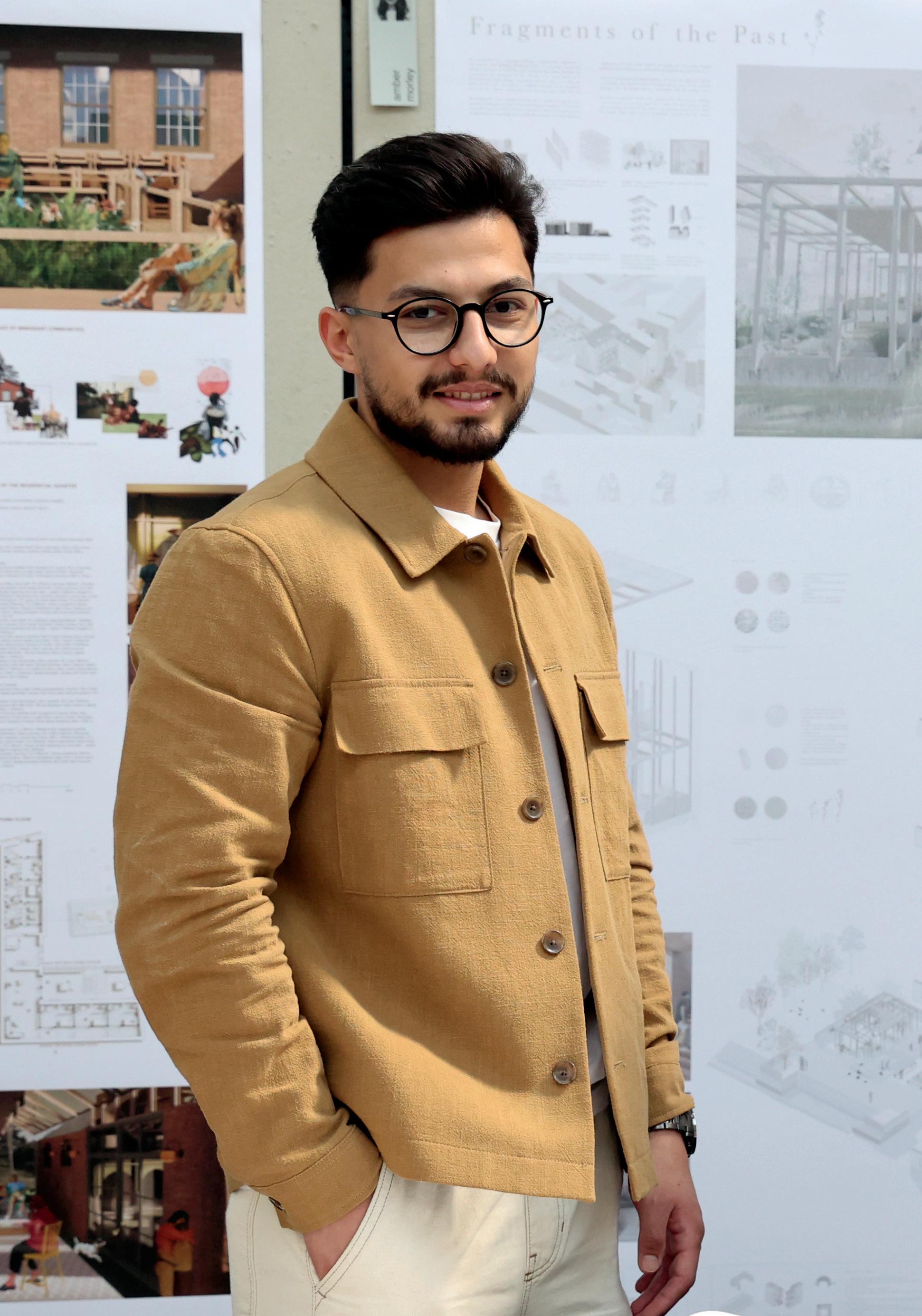
Khalil Abdulrahman and Amber Morley
BUILT ON REAL-WORLD EXPERIENCE
experience that will not only enhance their time at university, but better prepare them for what comes after,” says Andrew Haxell, Director of Graduate Futures.
Interior Architecture students
Amber Morley and Khalil Abdulrahman are one such example. They enjoyed a high-profile experiential learning opportunity after being chosen to attend the 2025 Venice Biennale – widely regarded as the world’s most prestigious architecture exhibition. A live design brief set by the Unconventional Affordable Housing network challenged students to develop real proposals for reimagining a historic Newcastle
building as modern living space. Amber and Khalil were able to work with peers from institutions from Italy, Portugal and Austria, giving them direct exposure to cross-border professional collaboration and globally relevant design challenges.
“It was an incredible experience to exchange perspectives and see our work showcased alongside inspiring projects from students across Europe, all addressing today’s urgent housing challenges in innovative ways,” says Khalil. “I had the opportunity to share my ideas with an international audience, something I am very grateful for.”
NO CONNECTIONS REQUIRED
There’s an equity argument running underneath all of this, and it’s central to Northumbria’s strategic mission.
Professional networks are not evenly distributed. For students who arrive at university without family connections to industry, or the confidence that comes from having grown up around professional environments, the gap between academic achievement and career readiness can be significant. Experiential learning is one way to close it.
Immersive experiences and simulated environments like Northumbria’s clinical skills centre, forensic crime house and mock courtroom help students apply learning, build confidence and networks, and develop professional expertise in a safe, supportive environment. There are also opportunities to get involved with real research, take part in field trips, study abroad or exhibit work in professional showcase events.
That same commitment to equity extends to how Northumbria is approaching AI. The University is one of only two in the UK to give students and staff free access to Claude for Education – a premium version of the leading AI platform built by Anthropic and chosen by Northumbria for its commitment to ethical higher education learning. Students aren’t just being provided with access to powerful AI tools – they are also being taught how to use these tools responsibly, ethically, and with confidence.
The goal is to ensure no one in the Northumbria community is left behind in an AI-enabled world, whatever their background.
“Experiential learning produces graduates who are equipped, confident and ready to perform. It really does help break down barriers to the professional world,” Andrew adds.
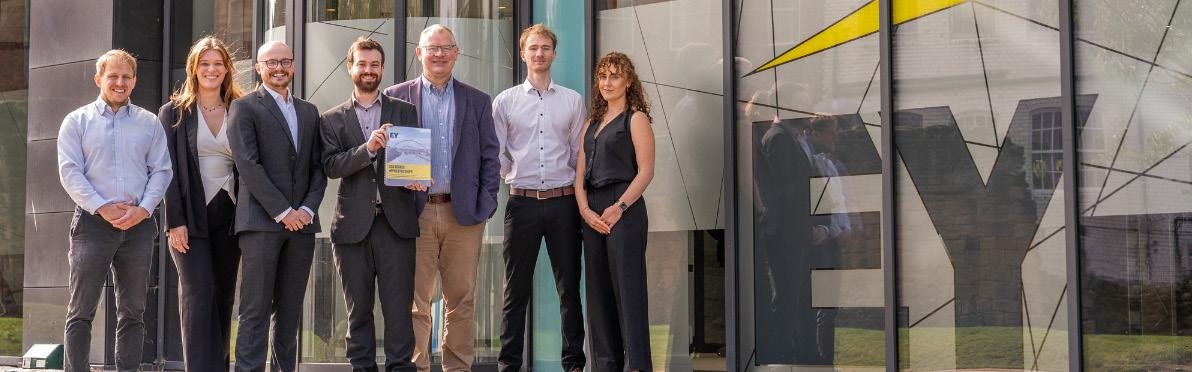
Northumbria students with members of the EY team
POWERFUL COLLABORATION
Businesses and organisations benefit too. Northumbria’s Business Clinic links students directly with organisations who need fresh thinking.
Global professional services firm EY provided Northumbria students with a genuine recruitment challenge: how to attract more young, local, female applicants. “They came up with a number of thought-provoking ideas and theories, some of which we have already started to implement,” says Harry Hawes, Director at EY.
“We give students an experience that no classroom alone can replicate,” says Dr Ed Cottam, Director of the Business Clinic. “Working with a real client on a real challenge builds the kind of confidence and commercial awareness that employers notice immediately.”
Many of Northumbria’s experiential learning opportunities are made possible by external funding or philanthropic support. The Chloe and Liam Together Forever Trust honours the legacy of Northumbria student Liam Curry and his partner Chloe Rutherford who tragically lost their lives in the
FROM LECTURE HALL TO WHITEHALL
With real briefs and real civil servants on board, more than 60 International Relations, Politics and History students were able to gain direct experience of government policymaking through a partnership with the Darlington Economic Campus (DEC).
Developing policy advice for the Department for Culture, Media and Sport, and the Ministry of Housing, Communities and Local Government, and presenting their recommendations to a panel of senior civil servants, they gained first-hand exposure to the workings of government, from initial research and risk assessment through to ministerial briefings.
The experience has undoubtedly firmed up career plans. Student Samuel Matuki Nyambu described presenting his findings to government professionals as being “genuinely transformative.”
“It confirmed that I want to work in environments where strategic thinking translates into real national impact and affirmed that a future career in the government is a path I intend to pursue.”
2017 Manchester Arena bombings. The Trust has funded scholarships as well as providing mentoring and consultancy projects for the Business Clinic and students in Art and Design.
“The generosity of our partners giving their time, expertise and support makes this kind of collaboration so powerful,” explains Dan Monnery, Northumbria’s Pro-Vice-Chancellor for External Affairs. “Experiential learning is central to the University’s ambition to power an inclusive economy, and the depth of our partnerships is a testament to that.”
Back in the Student Law Office, Elle Fox, who has pursued a range of legal experience alongside her degree, is reflecting on what the Law in the Community project has given her –and what it’s given the people she’s helped. “Not only does it help those who cannot gain legal services as easily as others,” she says, “but it also helps our learning on a practical level.”
At Northumbria that’s not a happy coincidence, it’s the whole idea.
BROADENING PRACTICE PERSPECTIVES
The Turing Scheme has given Social Work students the unique opportunity to gain hands-on experience of social care in South Africa – providing a perspective that few graduates would have.
A three-week trip saw a group of master’s students working alongside more than a dozen organisations in the city of Bloemfontein as well as the rural KwaZulu-Natal region, engaging with everyone from government social workers and child welfare agencies to traditional healers from the Sotho, Tswana, Xhosa and Venda communities.
The placement offered direct exposure to models of social care that differ significantly from UK practice – particularly around spirituality, community-driven approaches, and the integration of traditional African and Western health frameworks.
For students preparing to enter the world of work, the trip offered insights that will benefit their future careers.
“Being at the end of our master’s, this came at a really great time, as it got us thinking about how we will go into practice and implement some of the approaches used in South Africa,” said Alice Henderson.
BUILDING WHAT COMES NEXT
Northumbria University’s partnerships are reshaping the North East economy – and making sure the next chapter belongs to everyone in the region.
Bridges, ships, railways, lightbulbs and engines – the North East’s industrial history is written in structures that still stand, and in innovations used around the world. As active economic and civic forces, universities can create an ecosystem that advances the region’s future potential: delivering world-class research, convening industries and partners, training workforces, and attracting investment. This is exactly what Northumbria University is doing, bringing together industry, government, other institutions, and communities around shared ambitions for the region.
On the Newcastle campus, Northumbria is reaching skyward.
The North East Space Skills and Technology Centre – NESST – is on countdown to launch and is one of the most impactful investments in regional industrial infrastructure in decades.
A collaboration between Northumbria University, the UK Space Agency and Lockheed Martin UK Space, backed by £50 million of investment, NESST will bring together satellite testing capabilities, state-of-the-art research facilities and dedicated skills programmes in areas including optical communications, space weather and, space-based energy. The centre is expected to directly support the creation of over 350 jobs and inject more than £260 million into the North East economy over the next 30 years. Recently recognised as one of the most formative direct investment projects
in Europe, NESST is a catalyst that is expected to drive the creation of thousands more regional jobs in the high value manufacturing space industry, supporting the North East’s ambition to grow space sector employment to 10,000 by 2030. With a growing cluster of space sector businesses in the region, NESST is connecting academia to industry and building the skilled workforce the sector needs, cementing the North East as a destination for global space investment. Lockheed Martin saw that potential, announcing a wider commitment to the region following its partnership with Northumbria, with plans for a major new facility in County Durham, and an agreement with the North East Mayoral Strategic Authority (North East MSA) to align investment, skills and supply chain growth. “The North East can become an exporter of space technology
long-term, continuing the proud legacy of innovation from this region,” says Robert Lightfoot, President of Lockheed Martin Space. Outreach programmes are already active with schools across the region, connecting young people to space science and engineering at precisely the age when career aspirations are being ignited. The ambition is a pipeline of talented young people that runs from a primary school science lesson all the way to exciting research opportunities – entirely within the region. “Young people are often surprised to know just how much of their daily life already depends on space, from the GPS in their phone to the satellites that monitor our weather and protect our power grid,” says NESST Director, Dave Moody CBE. “I want every young person in this region to see NESST and think ‘that could be my future’.”
“I want every young person in this region to see NESST and think ‘that could be my future’.”
Dave Moody
REBALANCING THE BOOKS
The UK’s publishing sector contributes £11 billion to the national economy annually, but with the industry currently predominantly based in the South East, there has long been a real geographic imbalance – until now.
The new centre for writing and publishing – a collaboration between Northumbria University and New Writing North, backed by global publishers including Hachette UK, Faber, and Simon & Schuster – will attract publishers and creative start-ups to grow their businesses in the North East, giving the region a greater share of the multi-billion publishing industry and creating jobs in writing, publishing, TV, and film.
With the creative industries being one of the eight priority sectors in the Government’s Industrial Strategy, Northumbria is positioning the North East to play a leading role in that national ambition – not by waiting for the industry to arrive, but by building the conditions for it flourish. The Grade II listed Old Post Office opposite Newcastle Cathedral will house the centre. The University is making a substantial investment in the centre as part of £10.5 million of funding, contributing alongside the government, the North East MSA and Newcastle City Council. The University is further strengthening its commitment by moving all of its English, Creative Writing and Publishing students and staff to the centre, which will also will host commercial publishers, an audiobook production studio, event spaces and creative space for TV and film producers, connecting students directly to writers and industry professionals.
“The centre for writing and publishing is a genuinely unique proposition,” says Dan Monnery, the University’s Pro-Vice-Chancellor External Affairs. “It will provide a vital infrastructure to deliver growth of writing skills in the region, making creative careers more sustainable, providing more opportunities for young people and, having a significant impact on the growth of the regional economy.”
“The centre for writing and publishing is a genuinely unique proposition.”
Dan Monnery
FROM EDUCATION TO EMPLOYMENT
The University’s pioneering MA Publishing course – co-designed and co-taught with Hachette UK and New Writing North –guarantees every student a placement with the global publisher, enabling them to apply their learning in a real-life context and gain valuable experience within the industry. It is already producing graduates with real industry connections.
Among them is Victoria Howard, the first ever recipient of the Hachette UK Scholarship for exceptionally gifted students from under-represented backgrounds, funded by Hachette through the University’s Higher Education Without Barriers campaign. Victoria completed a successful placement with the publisher and is now a Rights Executive at Hachette. “Whilst my role today is constantly developing and evolving as I learn and take on new
responsibilities, I still use the skills and build on the knowledge I gained as part of my placement,” she said. “The time spent with Hachette before joining as an employee was invaluable in giving me the best chance possible as I started out in my career here and I know I will keep coming back to what I learned and the connections I made as part of this opportunity as I continue to progress in the industry.”
Richard Kitson, Deputy Chief Executive of Hachette Book Group, said: “Working closely with Northumbria University has been an incredibly positive part of our Changing the Story initiative, our commitment to the vital work of diversity, equity, and inclusion, ensuring that we include all voices, perspectives, and ideas in our partnerships, people, and publishing. Right from the start, along with New Writing North, we wanted to revolutionise the Publishing MA to include practical hands-on experience with access to industry experts and a cutting-edge understanding of how publishing works. We want every student to complete the course ready for employment in our industry.”
REWIRING THE REGIONAL ECONOMY
Alongside flagship developments, Northumbria is leading the structural work that shapes how the region thinks about its workforce and powers its economy.
Northumbria was chosen as the university in the north of England to host a Universities UK roundtable with business leaders – including Greggs, Siemens Energy, Lloyds Group, Port of Tyne, Northern Powergrid, the NHS, and the CBI – exploring how universities and industry can grow the graduate pipeline and create highquality local jobs. The discussions are shaping a new national roadmap on what is taught and how placements are structured to ensure businesses have the skills they need for the future.
“Conversations like this are so important –universities need to understand more about the challenges that businesses are facing, and businesses also need to make sure that they open their doors to help that education process so that universities can prepare students with the skills that we need for the future to keep moving forward and improving,” says Roisin Currie, Chief Executive of Greggs plc.
Universities UK President, Professor Malcolm Press, agrees. “Today’s graduates are going to have careers that last into the 2070s. We want to make sure we’re equipping people with the skills they’re going to need for long, successful careers and that businesses can access the talent they need to drive the country’s future prosperity.”
The University is not only supporting existing businesses, it is also creating new ones. It is investing in the £22.5 million Inspire Fund, as part of Universities for North East England (UNEE) to ensure that intellectual property created in the region’s five universities finds a commercial home in the North East. Backed by the North East MSA and delivered through the North East Fund, early-stage spinout companies will be supported with resources to develop, generating jobs and growth in the region.
Place-based approaches such as these are key.
“Our five universities have joined with us in a bold move to ensure their spinout companies can succeed for our region and that shows the rest of the country how we do business here in the North East,” says Mayor Kim McGuinness.
The North East has always known how to build things that last. What Northumbria’s partnerships are constructing now – a space economy, a creative industries hub, a graduate workforce shaped around what the region actually needs – is infrastructure of a different kind. The foundations are being laid. The next chapter is already being written.
Victoria Howard
GLOBAL PROBLEMS. NORTH EAST ANSWERS
Ranked the most sustainable university in the North East for five consecutive years, Northumbria is working across all areas to drive the climate conversation.
From groundbreaking research in Pakistan and Antarctica to reshaping how businesses function, sustainability at the University isn’t just a strategy. It’s a practice.
THE ENGINEER, THE HEAT, AND A RADICAL RETHINK
Pakistan has lived with extreme heat for years, but recently temperatures have regularly reached upwards of 50° Celsius. For communities with limited resources and power grids already straining under demand, conventional air conditioning is not a solution, it is part of the problem. These expensive, grid-dependent units are powered by chemical refrigerants that themselves contribute to warming.
Someone who may be about to change the way the world keeps cool is Professor Muhammad Wakil Shahzad, Chair in Advanced Energy and Sustainability at Northumbria. Backed by a £2.8 million grant from UK Research and Innovation’s Ayrton Challenge Programme, he is leading a consortium of more than 30 international partners working on S2Cool, a cooling system built around a simple principle: when water evaporates, it absorbs heat. No chemical refrigerants. No compressor. No dependence on a fragile grid. The system runs on solar power with battery storage at around half the price of a conventional unit.
Early prototype trials have already shown promising results, with the technology estimated to deliver up to 65 per cent in energy savings over traditional air conditioning. Global demand for air conditioning is projected to triple by 2050, placing greater pressure on the energy systems of countries least equipped to cope, yet widespread adoption of his system could eliminate around 23 million tonnes of CO₂ over a decade.
“Our co-designed solution will address the immediate needs of the country and its vulnerable populations, and sets a precedent for tackling similar challenges globally,” said Professor Shahzad.
“From our research we now know that sediments from the Antarctic continent could help to draw down atmospheric carbon dioxide into the ocean.”
Dr Kate Winter
THE IRON FACTORIES AT THE END OF THE WORLD
If S2Cool is about engineering a solution, research coming out of Northumbria’s School of Geography and Natural Sciences is about something more unexpected: discovering that the planet may already be doing some of the work itself.
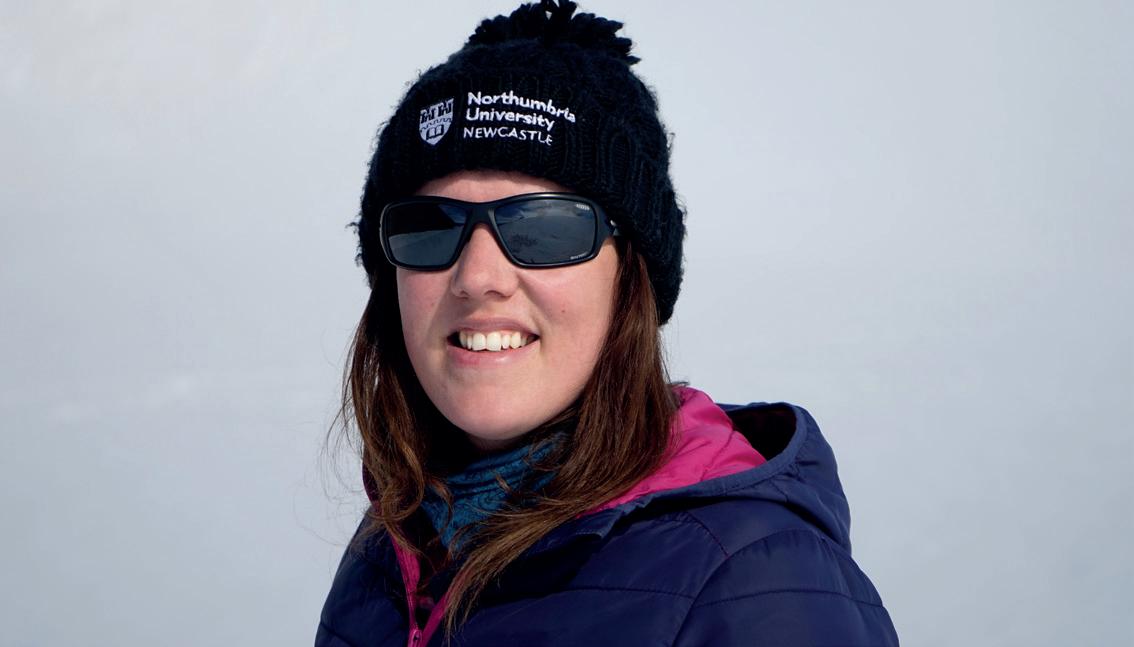
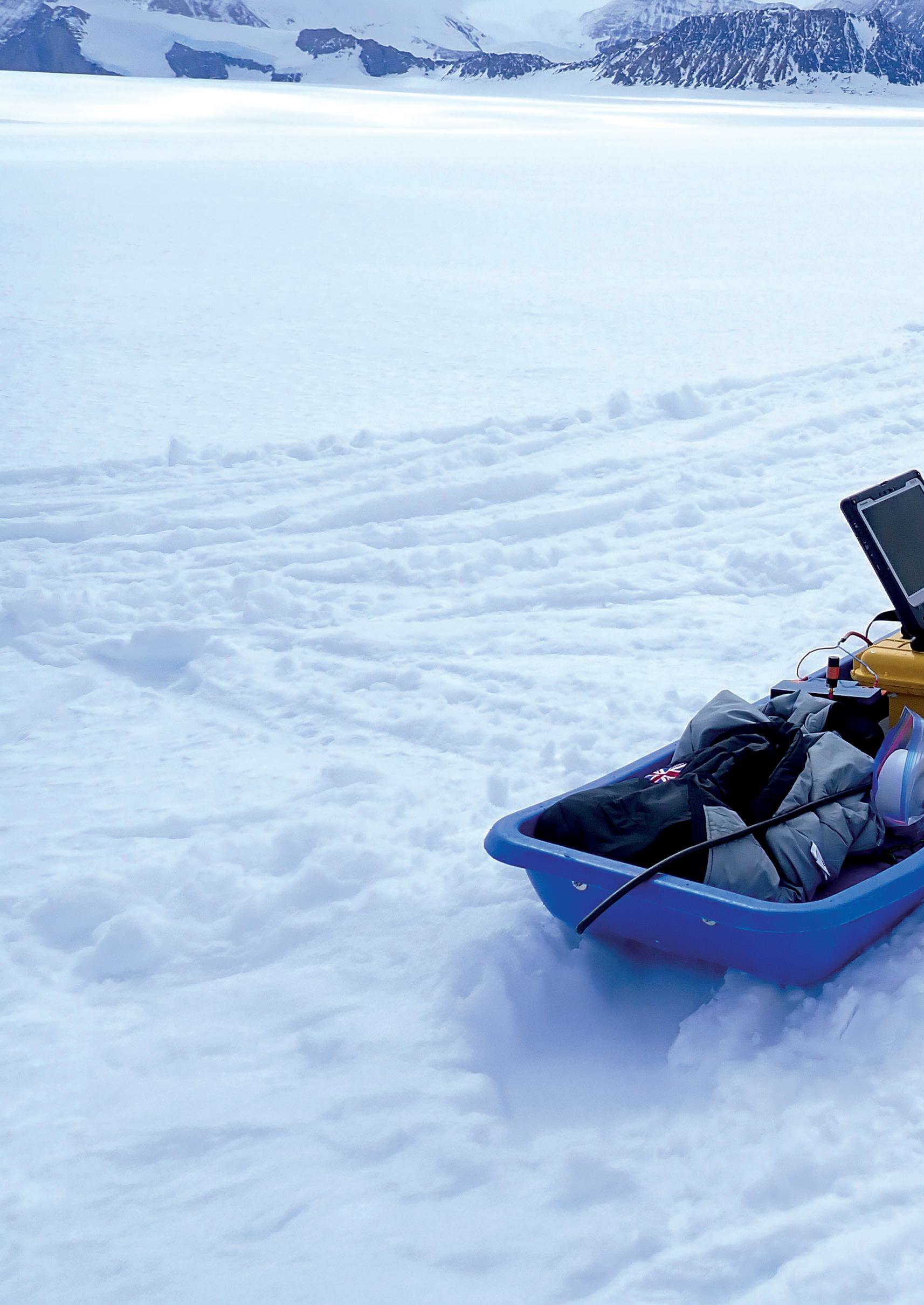
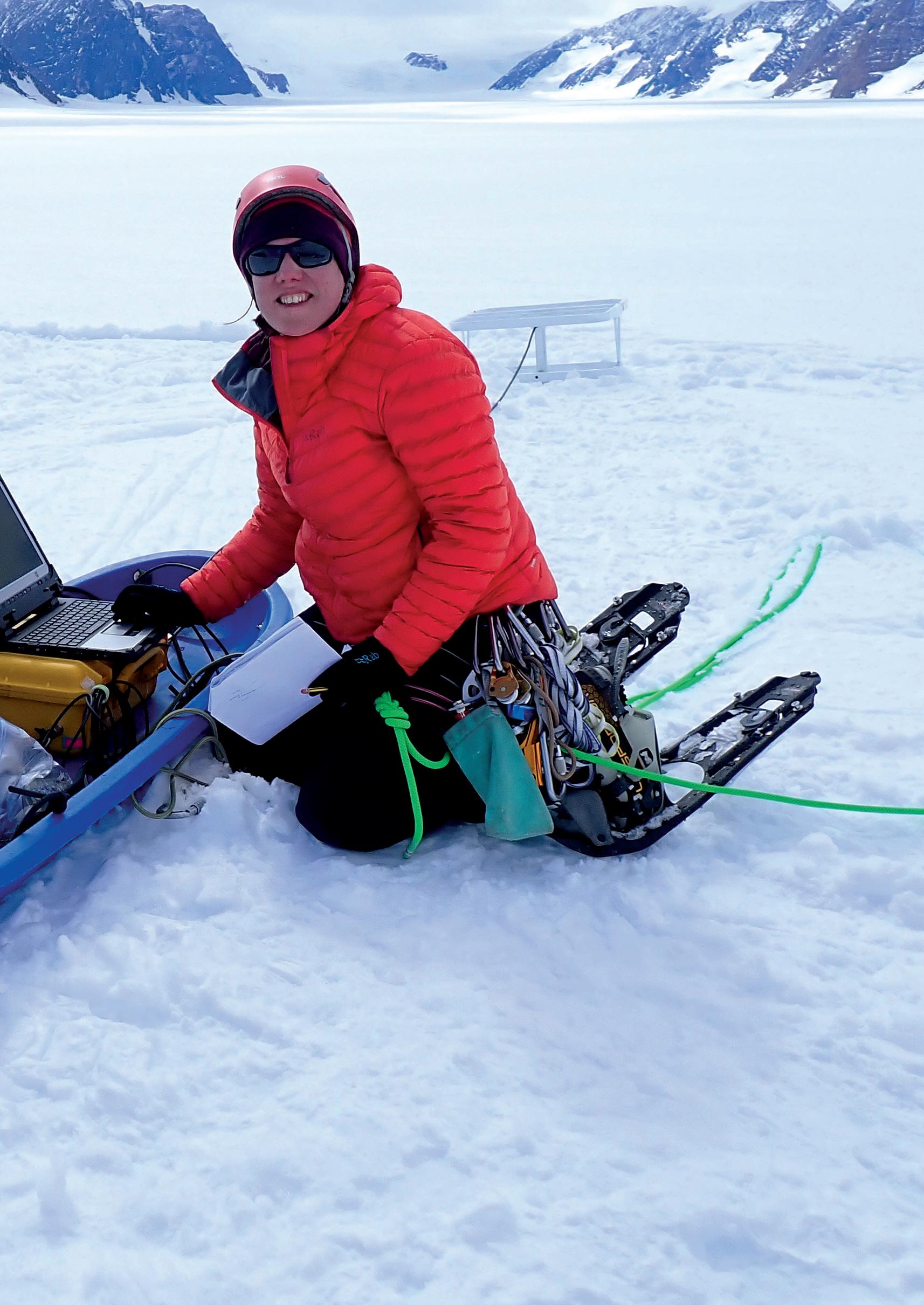
As Antarctica’s ice sheets thin, the retreating ice is exposing mountain peaks locked beneath it for millennia. Dr Kate Winter’s research has found that these peaks contain bioavailable iron concentrations up to ten times higher than previously recorded.
Carried by glaciers to the Southern Ocean, this iron-rich sediment fuels blooms of phytoplankton, microscopic organisms that absorb CO₂ through
photosynthesis, drawing carbon out of the air and into the ocean. Satellite imagery has already confirmed recurring blooms near glacier outlets in the study area.
“The results show that exposed bedrock in Antarctica acts like an iron factory,” says Dr Winter.
“From our research we now know that sediments from the Antarctic continent could help to draw down atmospheric carbon dioxide into the ocean.” She urges caution as sediments can take thousands of years to travel from mountain to coast, but as more peaks emerge with continued warming, this natural process could play a growing role in regulating the global carbon cycle.
FASHION’S TANGLED WEB
Another major initiative is supporting the clothing industry to become more sustainable. Evidence of microfibres generated from the textile industry has been found on every continent, and Northumbria is leading the way at bringing together academics and fashion representatives to change the way the fashion and textiles industry works.
As one of the world’s most polluting sectors, the true environmental cost of clothing production and consumption is not just hidden from view, it is deeply obscured. Through the IMPACT+ network, Dr Alana James and her colleagues have brought together designers, forensic scientists, environmental scientists and communications experts in a shared mission: to transform how the industry’s environmental impact is identified, measured and acted upon.
Their work includes tracking microfibres released from textiles which is leading to land and sea pollution and impacting on human health, and looking for innovative ways to share messaging about the importance of sustainability within the textiles industry. Community workshops have taught hundreds of people how to repair rather than replace worn clothes, while work with Newcastle United has explored ways to make the annual production and retail cycle of new football kits more sustainable.
THE CHANGE-MAKERS
Research breakthroughs matter. So too does the harder work of changing how an economy functions from the inside – and that’s exactly what Northumbria is trying to do.
The UK’s energy security objectives and net zero transition will not be delivered by pledges. It will be delivered by people. Researchers, scientists, and engineers with the skills, experience, and the track record to deliver. Northumbria is producing them, at scale, and the results are already visible.
Northumbria is proud to be the only UK institution leading doctoral training programmes funded by both EPSRC and NERC with an explicit net-zero mandate. ReNU+ and NZPS are backed by over £20 million in funding and a partner network that reads like a who’s who of global industrial and academic leadership, including Siemens, Airbus, Johnson Matthey, Horiba UK, the Offshore Renewable Energy Catapult, the Met Office, British Antarctic Survey and the Alan Turing Institute. Together, these organisations employ more than 420,000 people worldwide and turn over £136 billion annually.
Through ReNU+ and NZPS, Northumbria is training the next generation of researchers, across multiple universities, in renewable energy, life-cycle thinking, circular economy principles and cutting-edge sustainable approaches for polar environmental science, using satellite-based observations and low carbon technologies.
BUSINESS CONNECTIONS
“Our extensive network of global industry partners ensures that the research findings being generated by Northumbria’s scientists are being directly embedded into how these organisations operate – making them far more sustainable than before,” says Professor John Woodward, the University’s executive lead for sustainability, and one of Britain’s foremost glaciologists. He was awarded The Polar Medal earlier this year for exceptional service and achievement in the field of polar research.
And while the University works with major global partners, it also ensures it is providing for smaller businesses closer to home. Northumbria’s Green Skills CPD programme, developed in partnership with the North East Mayoral Strategic Authority, equips people who are driving change on the ground and on Northumbria’s doorstep. Businesses in Northumberland, North Tyneside and Newcastle are benefitting from courses in carbon calculation, net zero target-setting, sustainable materials manufacturing and housing retrofit.
“Building on world-leading research is driving the transition to a green economy by supporting the people who put new knowledge into action, sector by sector,” says Northumbria’s Sustainability Manager, Dr Paul Steadman, and that ambition extends to the University itself. Northumbria has committed to reach net zero by 2040 – practicing, on its own campus, the same transformation it is helping others to achieve.
That coherence shows in the results. For the fifth consecutive year, Northumbria has been ranked the most sustainable university in the North East by People & Planet, and sits within the top 60 globally in Times Higher Education’s Impact Rankings. “What makes Northumbria’s approach distinctive,” says Dr Steadman, “is that sustainability runs through everything we do – through our research, our teaching and our partnerships, at every scale: local, regional and global.”
Dr Alana James
24 of all first degree graduates in highly skilled employment in the North East are Northumbria graduates — more than any other university
20 for the number of UK undergraduates who go into skilled jobs
Graduate Outcomes Survey, 2023/24 Leavers
TOP 10
13
£60+
in England for Value Added –meaning our students achieve strong degree outcomes relative to their entry qualifications
invested in NESST and the centre for writing and publishing — two landmark projects driving Northumbria’s contribution to the regional economy
Northumbria University, 2026
£167 estimated current turnover of Northumbria graduate start-up businesses MILLION
10,000
practice placements undertaken by 2,000+ students with 200 providers ARC
and Financial Statements, 2024/25 for graduate business start-ups in each of the last 17 years
An independent assessment by BiGGAR Economics found that Northumbria University alone generates £1.6 BILLION in economic impact and supports more than 31,650 JOBS
£13 MILLION
1,645 JOBS created by Northumbria graduate start-up businesses
4 YEARS of continuous improvement in National Student Survey results Annual
In the North East Mayoral Strategic Authority region, that contribution stands at £1 BILLION in Gross Value Added and more than 20,000 JOBS
200+
increase in annual research income in last five years, from £13.4m per year in 2020/21 to £26.4m in 2024/25 collaborative and jointfunded PhD students studying at Northumbria – double the number four years ago
£6 MILLION generated through UKRI doctoral training partnerships, funding the next generation of researchers
£36.2 MILLION research awards received in 2024/25 — the highest annual total in Northumbria’s history
16
45 7
th People & Planet University League, 2025/26 increase in research grant and contract income in 2024/25
IN THE UK for environmental sustainability in operations. Best rated university in the North East
IN THE UK th AND 53rd IN THE WORLD for social and research impact against the UN’s Sustainable Development Goals — out of 2,526 universities across 130 countries Times Higher Education Impact Rankings, 2025