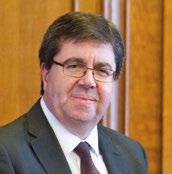
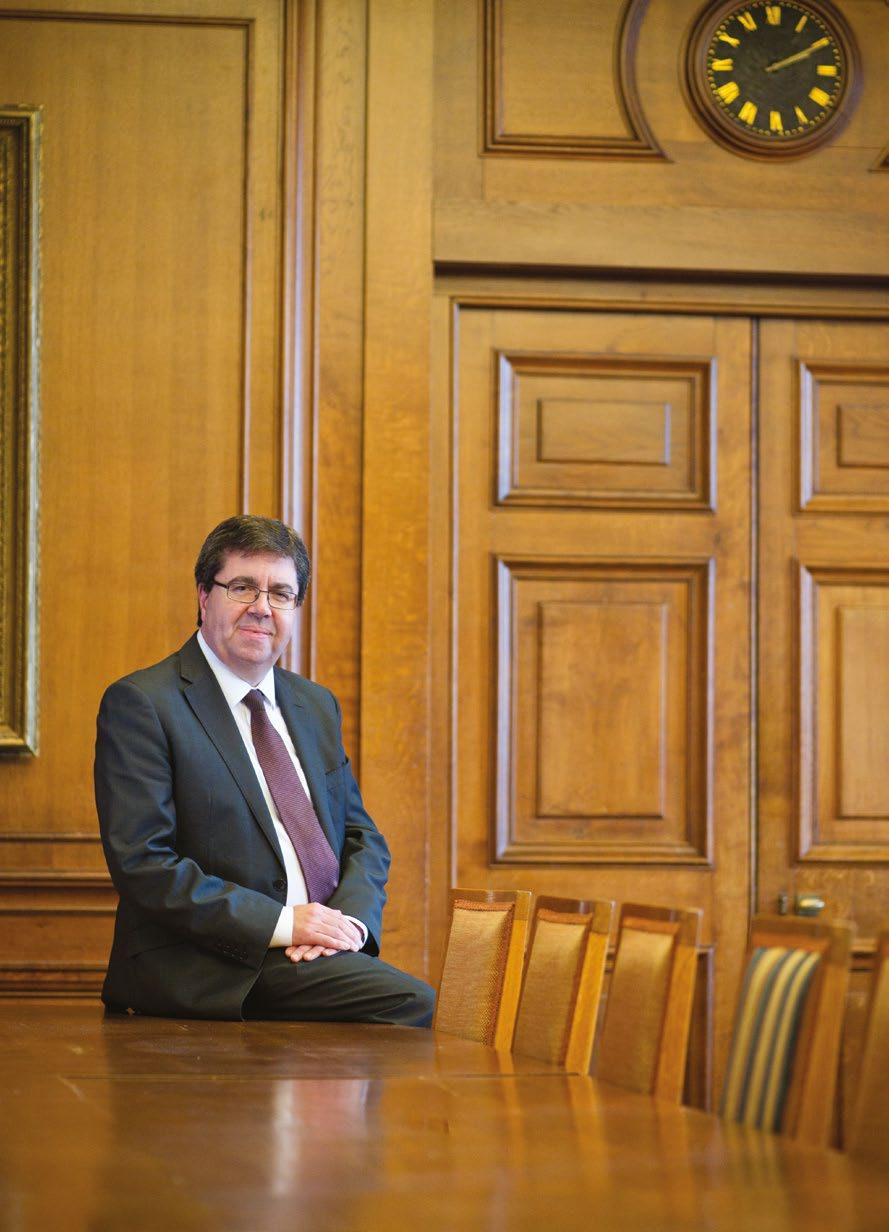
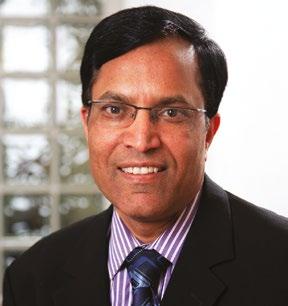
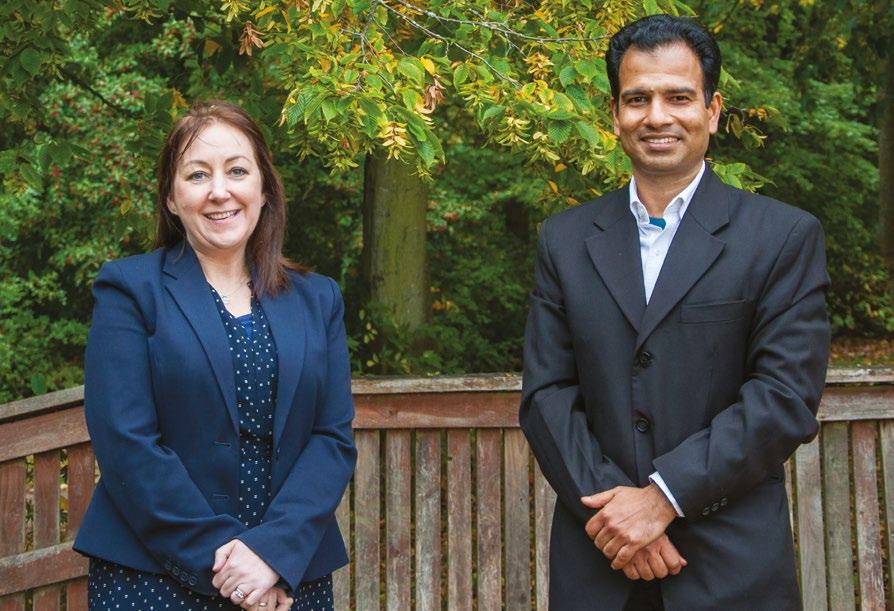
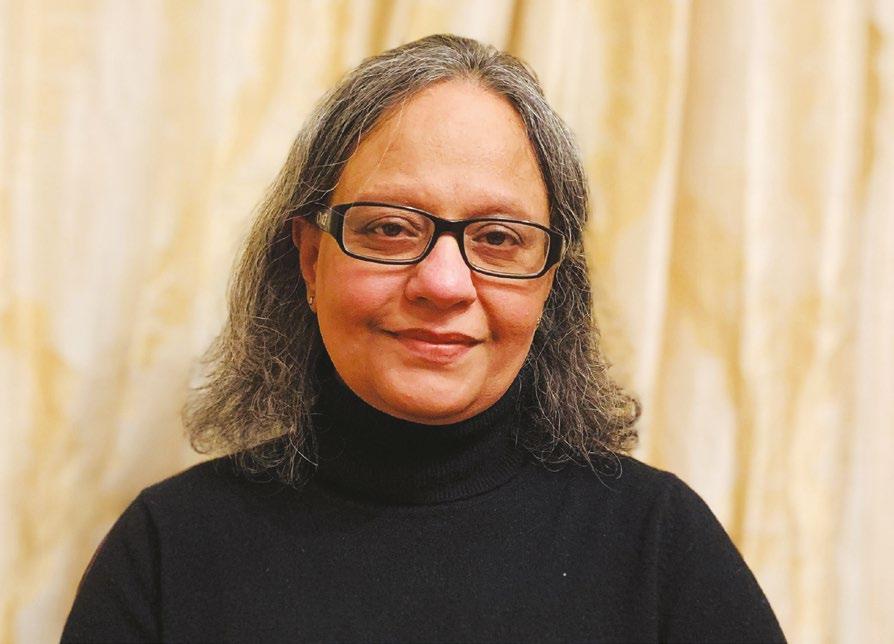
Professor Andy Long will take up the role of Vice-Chancellor in August 2022. Turn to page 5 to find out more.
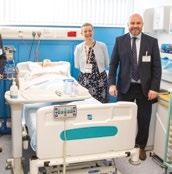
NATIONAL NURSING TEST CENTRE OPENS
The new centre will enable thousands more professionals to join the nursing register quickly and safely. Read about the new opening on page 6.
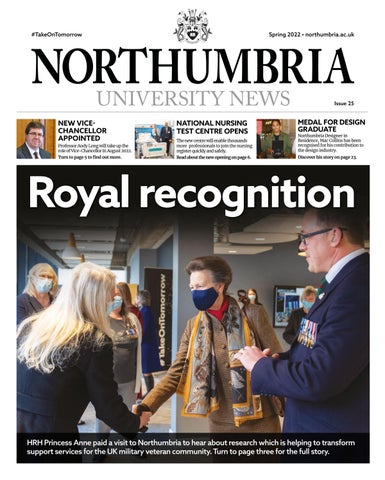
Royal recognition
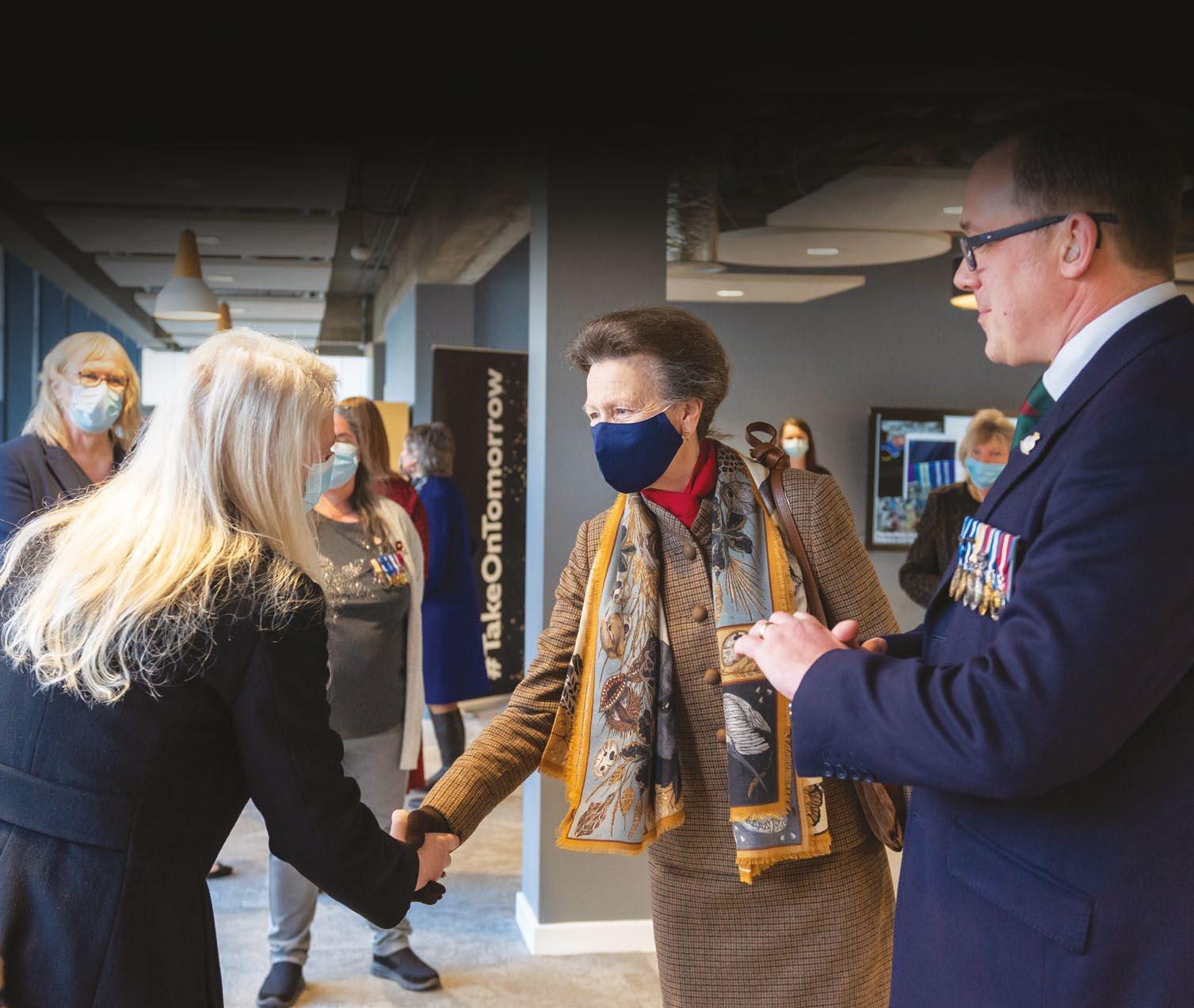
HRH Princess Anne paid a visit to Northumbria to hear about research which is helping to transform support services for the UK military veteran community. Turn to page three for the full story.
IN THIS EDITION
SPRING 2022
NEWS
Will lasers improve communications in space? Northumbria researchers tell us more, Page 4
BIG INTERVIEW
Hear from the new Pro ViceChancellor (Education), Professor Graham Wynne, Page 11
SUSTAINABILITY
Climate change research is boosted by a new international partnership, Page 15
SUSTAINABILITY ECONOMY
NORTHUMBRIA ACADEMICS PUT 800 UNDERGROUND LAKES ON RECORD FOR FIRST TIME
Page 18
SOCIETY
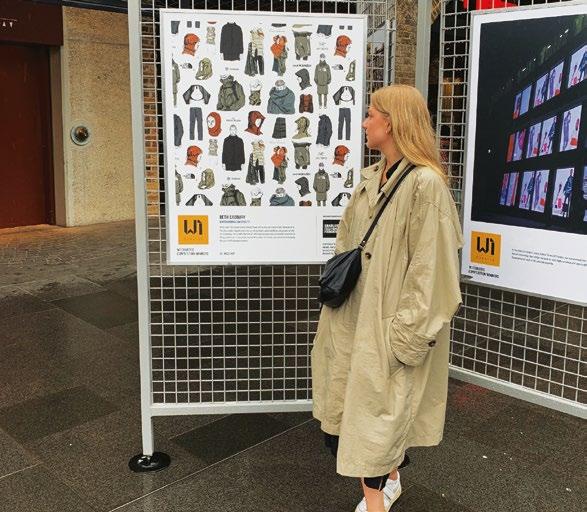
A clothing collection inspired by her childhood scored Northumbria graduate Beth Cadbury an international award, Page 23
HEALTH
Student
Healthy growth for wellbeing business as graduate start-up is supported by the University, Page 36
New Parkinson’s research is accelerating innovative treatment and management of the disease, Pages 28 and 29.
JUSTICE AND SECURTY
Research opens up a treasurechest of historical insight for genealogists, Page 39
SPORT
NORTHUMBRIA TAEKWONDO STAR SIMONE STRIKES GOLD AGAIN
Page 44
appointed as UK’s only youth ambassador at international forum
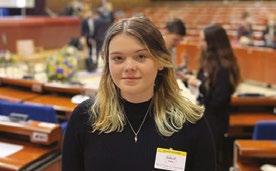
A Northumbria University student was selected as the UK’s only youth ambassador to attend The World Forum for Democracy 2021, an international event where issues around democracy and the environment are debated.
Cara Dunlop, a second year Psychology student, travelled to the Council of Europe in Strasbourg, France – the continent’s leading human rights organisation – to attend the event where political decision makers and activists met to debate solutions to key challenges for democracies worldwide.
Cara was encouraged to sign up for the forum through her work with the National Citizen Service. This is a voluntary personal development
programme which aims to build young people’s confidence.
The forum was held after a yearlong, online discussion between participants focused on ‘Can Democracy Save the Environment?’
Cara provided a young person’s perspective on the topics covered at the event, including human rights for the environment, biodiversity and climate change.
Reflecting on the opportunity,
Cara said: “Hearing the opinions of
people from around the world has been fascinating and has cemented my belief that we truly need to work together to tackle climate change.”
Cara’s personal tutor at Northumbria University and Associate Professor in Psychology, Dr Michael Smith, added: “Cara is an excellent student who brings an insightful perspective to our BSc Psychology programme from the admirable work she has done around youth and social justice.”
To read the full story, please visit www.northumbria.ac.uk/worldforum-democracy
“HEARING THE OPINIONS OF PEOPLE FROM AROUND THE WORLD HAS BEEN FASCINATING AND HAS CEMENTED MY BELIEF THAT WE TRULY NEED TO WORK TOGETHER TO TACKLE CLIMATE CHANGE.”
CARA
DUNLOP
Dunlop pictured at the World Forum for Democracy 2021.
Veteran Hub team welcome the Princess Royal to Northumbria
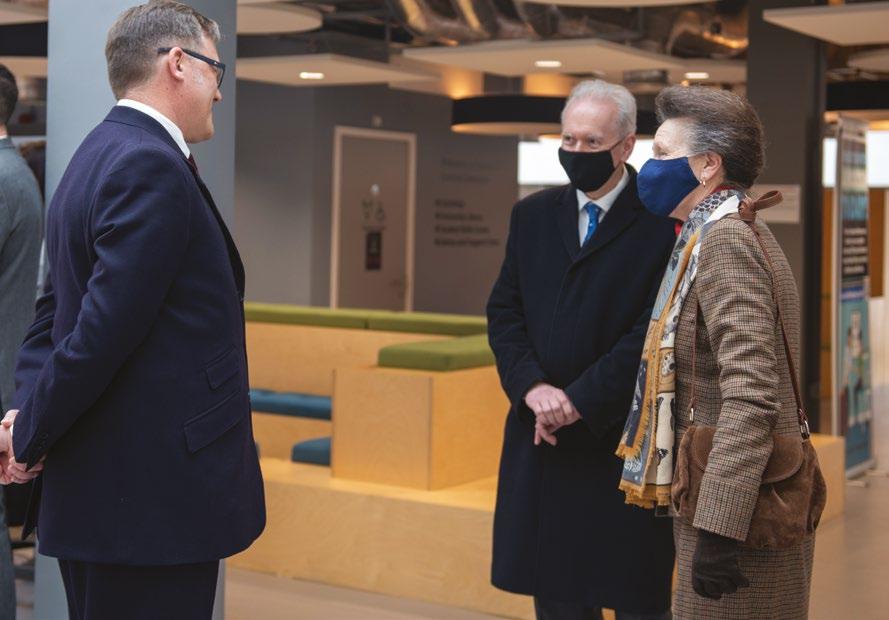
Princess Anne visited Northumbria University to hear about research which is helping to transform services and support for the UK military veteran community.
Northumbria was honoured to receive a visit from Princess Anne as she toured the North East in February. Her Royal Highness met academics involved in Northumbria’s Northern Hub for Veterans and Military Families Research, which was established in 2014 to bring together academics, ex-servicemen and women and experts who are dedicated to improving the health and social wellbeing of veterans and their families.
Conducting innovative, collaborative research to better understand the needs of the veteran community, the Hub team are helping to inform and shape policy change to improve current services and support available to veterans across the country. Northumbria has secured significant funding from government, local authorities, NHS and the third sector over the past few years, as a result of the specialist expertise it has in these fields.
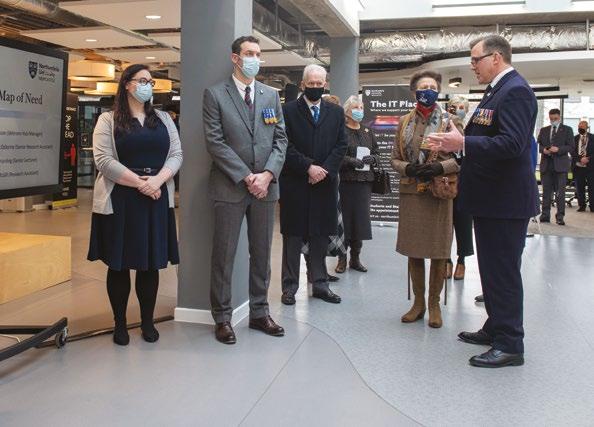
The Hub’s academics presented their current activities and key areas of research, including projects to support bereaved military families, older limbless veterans and the LGBT+ veteran community. Work to investigate veteran poverty and food insecurity and a project commissioned by the Ministry of Defence to map the needs of veterans across the UK was also showcased. As part of the pioneering ‘Map of Need’ project, the team developed the UK’s first digital, UK-wide directory of services known as the Veterans’ Gateway. The website and app enable veterans and their families to find support in their local area from a database of 16,800 qualityassured services.
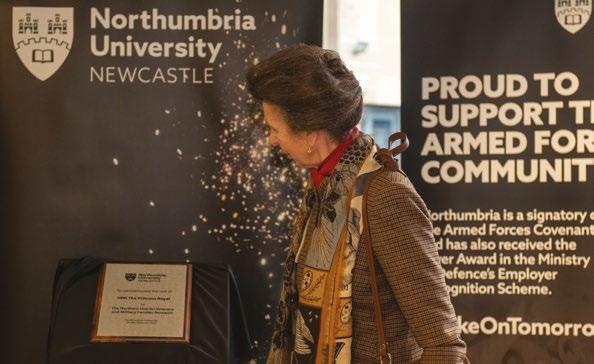
During the visit, Her Royal Highness was guided around the University’s multi-million pound Student Central building, which hosts Northumbria’s award-winning student support services, before meeting members of the Student Life and Wellbeing team. After unveiling a plaque
“IT WAS A REAL PRIVILEGE FOR US TO SHARE THE HUB’S TRANSLATIONAL RESEARCH TO IMPROVE THE HEALTH AND SOCIAL WELLBEING OF THE VETERAN COMMUNITY WITH THE PRINCESS ROYAL.”
PROFESSOR MATT KIERNAN
to commemorate the visit, The Princess Royal was presented with a gift of key reports from research conducted by the Hub. Commenting on the occasion, Professor Andrew Wathey CBE, Vice-Chancellor and Chief Executive of Northumbria University, said: “Northumbria is extremely proud of the work of the Northern Hub for Veterans
and Military Families Research, which is supporting vital activity to reduce health and wellbeing inequalities among those who have served their country. We were honoured to welcome Her Royal Highness The Princess Royal to our city campus during this special year commemorating Her Majesty The Queen’s Platinum Jubilee, and to demonstrate the significant contribution Northumbria is making through its research and partnerships to support the nation’s veteran community.”
Director of the Northern Hub for Veteran and Military Families’ Research, Professor Matthew Kiernan is a former Lieutenant Commander in the Queen Alexandra’s Royal Naval Nursing Service. He said: “It was a real privilege for us to share the hub’s translational research with The Princess Royal. Our work is driven by the needs of veterans and their families - integration into the community that we work with and for is at the heart of the hub’s mission. As a multidisciplinary team of academics and experts
by experience, we strive to attract and facilitate collaboration across the Armed Forces sector and work as a collective force for impact and change across emotionally challenging matters. It is an honour for the hub’s hard work to be recognised by Her Royal Highness.”
Northumbria was the first university in the North East to sign up to the Armed Forces Covenant in 2016, setting out its pledge to support service personnel, veterans and their families. The University has also received the Silver Award in the Ministry of Defence’s Employer Recognition Scheme.
To find out more about the work of Northumbria’s Northern Hub for Veterans and Military Families Research, visit www. northumbria.ac.uk/veteranhub
Professor Andrew Wathey CBE, Vice-Chancellor and Chief Executive of Northumbria University, presents Hub Director Professor Matt Kiernan to HRH The Princess Royal.
Professor Matthew Kiernan presenting the hub’s ‘Map of Need’ project, which includes the UK’s first digital, UK-wide directory of services known as the Veterans’ Gateway.
The Princess Royal unveiled a plaque commemorating the visit.
Will lasers improve communications in space?
Experts from Northumbria University have been awarded more than £1 million to develop the world’s first commercially available system which allows satellites to communicate with each other via lasers.
Satellites currently use radio frequency to transmit data, but this is very limited in terms of data speed, capacity and security. However, Northumbria’s Solar-Terrestrial Science research group have been working to develop a new laser-based system for small satellites, known as CubeSats. As lasers can transmit 1,000 times more data per second – and much more securely – than radio frequency, their work has the potential to transform the satellite communications industry.
In 2020 the UK Space Agency awarded Northumbria £360,000 to run a discovery phase of the project. This showed such promise that a further £650,000 was awarded in late 2021 – bringing total funding to more than £1 million – to enable the team to build and test the system. The aim is to develop an off-the-shelf product for major global organisations and telecoms providers that can be sent into orbit easily and cheaply, significantly improving data transfer abilities in space.
Northumbria is working in partnership with Durham University, satellite communications technology
company e2E Group and telecoms and electronics manufacturing company SMS Electronics Limited on the project. The teams plan to piece together three CubeSats – making a device roughly the same size as a shoe-box – to hold the new laser communication system. This poses a substantial challenge. It requires technologies normally used on much larger scales to be redesigned and redeveloped to fit into this much smaller device and withstand the atmospheric conditions in space. They hope the first devices will be ready for extensive testing in early 2023, ready to go into orbit by 2025.
Solar physicist, Dr Eamon Scullion, said the award would enable the team to put their ideas into practice to build and test their designs but explained “this is no mean feat. We need to carefully design, test and miniaturise electronic boards, optical lasers, receivers and transmitters which can fit together in the satellites and be
‘space qualified’, meaning they will be tested to ensure they continue to work at an optimal level whilst in orbit, dealing with the impact of radiation, atmospheric drag and extremely cold space temperatures.”
Professor Louise Bracken, ProVice-Chancellor for Research, said: “The Government recently launched the National Space Strategy, which outlines its long-term plans to grow the UK space sector and satellite communications are a key element of this. It is especially pleasing to see Northumbria’s work in this area being recognised as so innovative, more so given the importance the government has placed on investing in satellite communications over the coming decade.”
Northumbria University is becoming well known for its multidisciplinary research into space. As well as work by the Solar-Terrestrial Science research group, the Aerospace Medicine and Rehabilitation Laboratory is leading studies into the impact of reduced gravity on astronauts’ bodies and how this can be translated into conditions commonly faced on Earth, such as back pain, while world-leading experts in space law are undertaking pioneering work on the governance framework for human activity in outer space.
DISCOVER MORE
www.northumbria.ac.uk/ser
“IT IS ESPECIALLY PLEASING TO SEE NORTHUMBRIA’S WORK IN THIS AREA BEING RECOGNISED AS SO INNOVATIVE, MORE SO GIVEN THE IMPORTANCE THE GOVERNMENT HAS PLACED ON INVESTING IN SATELLITE COMMUNICATIONS OVER THE COMING DECADE.”
PROFESSOR LOUISE BRACKEN
Professor Andy Long appointed as Vice-Chancellor and Chief Executive
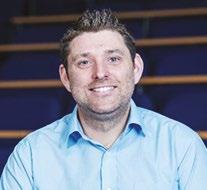
Joining Northumbria as the University’s fifth Vice-Chancellor and Chief Executive, Professor Andy Long will take up his role in August 2022, bringing with him a wealth of experience in academic leadership.
Northumbria’s current ViceChancellor and Chief Executive, Professor Andrew Wathey CBE, retires in May 2022, having led the University for the past 14 years.
As Provost and Deputy ViceChancellor at the University of Nottingham, Professor Andy Long was selected for the role after an extensive and competitive recruitment and selection progress.
“I am absolutely delighted to take up the role of ViceChancellor and Chief Executive and cannot wait to join Northumbria’s community. It is clear that the staff and students have a passion that I share for excellence in research, teaching and learning and I hope to build on the achievements of Professor Wathey over his many years in the role. I look forward to getting to know my new colleagues and Northumbria’s students, as well as working and living in the vibrant city of Newcastle upon Tyne,” commented Professor Long.
Professor Long has studied and worked at the University of Nottingham since 1990.
Appointed as Provost and Deputy Vice-Chancellor in 2018, he has held a wide range of responsibilities, including delivery of the University’s new strategy, oversight of planning and resources allocation, and the development of its new Castle Meadow campus. Prior to his appointment as Provost and Deputy ViceChancellor at Nottingham, Professor Long served as the Pro Vice-Chancellor for its Faculty of Engineering, and before that, as Executive Dean and Associate Dean for Research. He also served as Associate Dean to the Graduate School representing Engineering. He has a BSc in Applied Mathematics from the University of Warwick, an MSc in Computer Integrated Engineering from Loughborough University,
and a PhD in Mechanical Engineering from the University of Nottingham. He is a Chartered Engineer and Fellow of the Royal Academy of Engineering, of the Institution of Mechanical Engineers and of the Institute of Materials, Minerals and Mining. Professor Long is recognised internationally as a leading researcher for polymer composite materials with applications in the aerospace, automotive and renewable energy sectors. He has published extensively, received numerous awards for his research and is the founding Director of the Engineering and Physical Sciences Research Council Future Composites Manufacturing Hub, leading collaborative research in this discipline across the UK.
Dr Roberta BlackmanWoods, Chair of the Board of Governors at Northumbria, said: “I am incredibly excited to welcome Professor Long into the Northumbria community following a highly competitive selection process, where the standard was exceptionally high. Professor Long’s clear strategic vision and wealth of experience in leadership in higher education will be invaluable in taking this great University into its next phase. His commitment, drive and enthusiasm for Northumbria will build on the outstanding achievements of Professor Wathey and his team. I, and the Board, look forward to working closely with Professor Long, and the University Executive, to continue to deliver our ambitious plans for Northumbria University.
“I would also like to take this opportunity to thank Professor Andrew Wathey for his outstanding leadership during what has been a challenging time for the sector, and for his personal contribution to the transformation of Northumbria over the last 14 years.”
As part of the selection process
“I AM ABSOLUTELY DELIGHTED TO TAKE UP THE ROLE OF VICECHANCELLOR AND CHIEF EXECUTIVE AND CANNOT WAIT TO JOIN NORTHUMBRIA’S COMMUNITY.”
PROFESSOR ANDY LONG
Professor Long was also able to meet and engage with colleagues and students from across Northumbria, including members of the Students’ Union.
Emma Collier, Vice President for Sport at Northumbria Students’ Union, said: “It was
a privilege to be involved in the appointment process and to meet Professor Long. His commitment to the student experience was made clear during our conversation and I, along with my colleagues in the Student’s Union, look forward to working with him in the future.”
Hear more from Professor Long in future editions of Northumbria News.
Healthcare leaders officially open new national nursing test centre
A new national nursing and midwifery examination centre has officially opened at Northumbria University.
“WE ARE ALL AWARE OF THE SIGNIFICANT PRESSURES FACED BY THE NHS – MORE SO THAN EVER IN RECENT YEARS – AND THAT THERE IS A CLEAR NEED FOR MORE NURSES ON THE FRONT LINE.”
PROFESSOR ANDREW WATHEY CBE
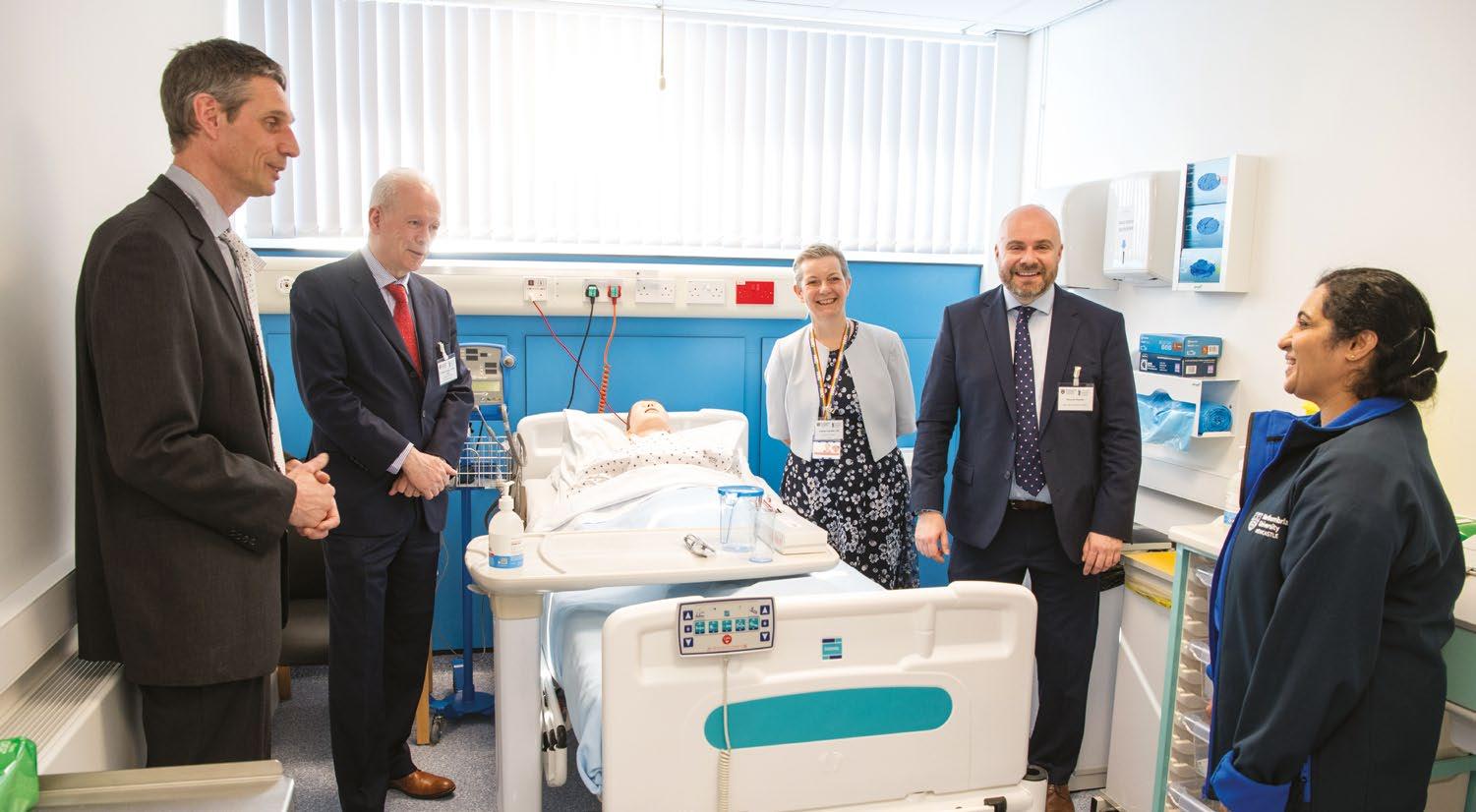
Andrea Sutcliffe and Duncan Burton viewing the University’s new nursing test centre
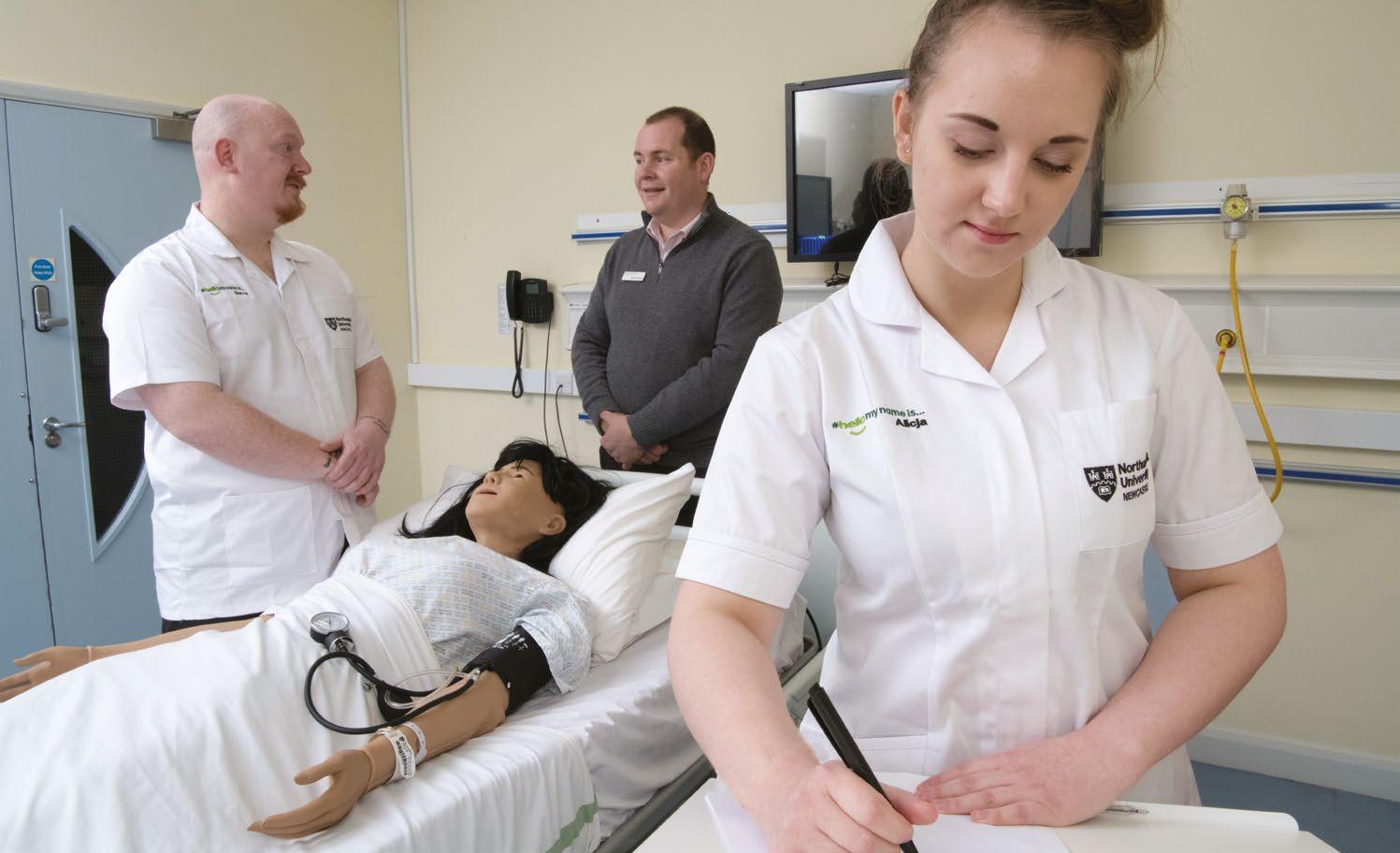
The new Nursing and Midwifery Council (NMC) Competence Test Centre, based at the University’s Coach Lane Campus, will host up to 7,000 nurses, midwives and nursing associates each year for their ‘OSCE’ Observed Structured Clinical Examination. The exam is the practical part of the Test of Competence that all overseas-trained nurses or those returning after a career break are required to take before they can be registered to practice. It involves a faceto-face examination using actors or simulation models to play patients presenting with a variety of medical conditions or ailments. Those sitting the exam are assessed on how they care for and communicate with
the patient to ensure they meet the required standards. Until now there were only three test centres in the UK, but with rising demand to bring people with the right skills and knowledge onto the UK’s nursing register as quickly as possible, the NMC needed to increase national testing capacity. As such, two new centres were announced to open in Newcastle and Leeds.
The University has redeveloped former management offices at Coach Lane Campus to house the test centre and has held a major recruitment drive to attract a team of over 30 people to lead and run it. Coach Lane Campus is already home to the
University’s Department of Nursing, Midwifery and Health, one of the largest centres for the education of healthcare professionals in the North of England.
Andrea Sutcliffe CBE, Chief Executive and Registrar of the Nursing and Midwifery Council and Duncan Burton, the Deputy Chief Nurse at NHS England, visited the University to officially open the new centre. Following a private tour to see the new facilities firsthand, they met with an invited audience of healthcare leaders from across the region. Andrea said: “Northumbria is one of the leading universities in the country and it’s great to see the partnership with The
Newcastle upon Tyne Hospitals NHS Foundation Trust and Newcastle City Council in creating this centre, helping to boost our national testing capacity.
“The nurses and midwives who do their tests here will be welcomed with open arms by their colleagues in health and social care and will play a vital part in providing the safe, kind, effective care the public have every right to expect.”
Professor Andrew Wathey, Vice-Chancellor and Chief Executive of Northumbria University, added: “We are all aware of the significant pressures faced by the NHS – more so than ever in recent years – and that there is a
clear need for more nurses on the front line. Northumbria University is already one of the largest providers of education for healthcare professionals in the North of England and we are delighted to work in partnership with the Nursing and Midwifery Council and others to bring more nurses onto the UK register.”
Find out more information by visiting the University’s OSCE centre website at www.northumbria.ac.uk/osce
Fired up for success after Dragons’ Den appearance
Queen’s Honours for Northumbria community
A number of inspiring staff and alumni from Northumbria University have been recognised in the Queen’s New Year Honours List 2022.
The New Year Honours List recognises the achievements and service of extraordinary people across the UK.
Professor Chris Whitty
A start-up business co-founded by a Northumbria University graduate has triumphed on the hit BBC One show Dragons’ Den after securing financial backing worth £30,000.
Pretty Mama was formed in 2018 by Jenny McFadden and her sister Alex, while Jenny was in her final year of a Law with Business degree at Northumbria. The sisters wanted to design and produce a collection of maternity clothes, especially for breastfeeding mothers, after Alex – who has a fashion degree from Sunderland Universityhad struggled to find feminine and comfortable clothing when she was pregnant with her daughter. The aim, in their own words, was to: “empower mothers on their nursing journey by feeling beautiful, confident and comfortable”.
Building on early success, Pretty Mama has continued to grow, and in March this year they entered the Dragons’ Den seeking £30,000 in exchange for a 20 per cent stake in the business. The sisters’ pitch worked so well that they secured funding from four of the Dragons who were impressed by the concept behind the business, the eco-friendly clothing line
“IT WAS INCREDIBLE! SINCE APPEARING ON DRAGONS’ DEN WE HAVE RECEIVED AN OVERWHELMING POSITIVE RESPONSE AND LOTS OF AMAZING MESSAGES OF SUPPORT.”
JENNY MCFADDEN
and the entrepreneurial skills of the sisters.
Commenting on the result, Jenny said: “We are extremely passionate about our brand and in offering a much-needed product for breast-feeding mothers. I think this came across in the Den, as we walked away with such an amazing outcome from some of the most successful and respected
business people in the UK. It was incredible! Since appearing on Dragons’ Den we have received an overwhelming positive response and lots of amazing messages of support.”
Pretty Mama has also received business support and advice from Northumbria, including mentoring support through the Northumbria Enterprise and Business Support 2 (NEBS 2) programme. NEBS 2 is funded by the European Regional Development Fund and will run until June 2023, offering a package of services to SME’s and start-ups in Tyne and Wear. It also helps fund career-enhancing internship opportunities for graduates.
For more information and to apply for NEBS 2 please visit www.northumbria.ac.uk/NEBS
DISCOVER MORE
www.northumbria.ac.uk/business
Professor Whitty, who studied for the LLM in Medical Law at Northumbria, graduating in 2005, has received a knighthood (Knight Commander of the Order of the Bath). The Chief Medical Officer for England has been recognised for the extraordinary role he has played at the forefront of tackling the Covid-19 pandemic.
Steve Orr
Newcastle Business School graduate and Chief Executive Officer (CEO) of entrepreneurship company, Catalyst, Steve Orr has been awarded an Order of the British Empire (OBE) for services to innovation. Steve founded Connect at Catalyst, a not-for-profit network of experienced entrepreneurs, business professionals and researchers dedicated to the creation of innovation companies in Northern Ireland.
Major Jamie Carrahar
A senior lecturer in Northumbria’s Newcastle Business School, Major Carrahar has received a Member of the Order of the British Empire (MBE) for his passionate advocacy of all
LGBT+ Army personnel. His dedicated work has directly improved the lived experience of military personnel and improved positive inclusion across the Army.
Ellen Buttrick
The Paralympian, who completed her Geography degree at Northumbria in 2017, has been awarded an MBE for services to rowing. Ellen won a gold medal for Great Britain at the Tokyo Paralympic Games in 2021 as part of Team GB’s rowing crew.
Katrina Moffat
MSc Project Management graduate from Northumbria in 2012, and former student recruitment coordinator at the University, Katrina, has been awarded a British Empire Medal (BEM) for services to young people in North Tyneside including her work as a leader for Girlguiding UK.
Krystal Ann Joan Vittles
Librarianship graduate from Northumbria in 2016, and head of service delivery for Suffolk Libraries, Krystal Ann, was awarded the BEM for services to public libraries.
Alex and Jenny McFadden at the Dragons’ Den
First class for sustainability
Northumbria University has been rated as ‘first class’ for sustainability and is the highest ranked university in the North East in the latest People & Planet university league table.
“NORTHUMBRIA IS SUPPORTING THE RESPONSE TO SOME OF THE BIGGEST CHALLENGES FACING THE WORLD
TODAY, INCLUDING THE GLOBAL FIGHT AGAINST CLIMATE CHANGE.”
PROFESSOR GEORGE MARSTON
The league table, compiled annually by the UK’s largest student campaigning network, People & Planet, is the only comprehensive and independent ranking of universities marked against sustainability and ethics criteria. The table includes more than 150 universities and smaller specialist institutions and ranks Northumbria as 17th overall for sustainability in the UK.
A signatory of the United Nation’s Sustainable Development Goals Accord, Northumbria scored 100 per cent of all available marks on environmental policy criteria. The University’s Environmental Sustainability Policy considers the impact its activities have on the wider environment. Reviewed and updated regularly, the policy includes ambitious targets in waste management, transport, sustainable procurement, water, construction and refurbishment, as well as emissions and discharges, community involvement and biodiversity. Northumbria also achieved full marks for its auditing and environmental management systems, which are externally verified by specialist industry bodies, and 97 per cent in ‘Education for sustainable development’. With the aim of mainstreaming sustainability across the curriculum, ‘Education for sustainable development’ means equipping students with the knowledge and understanding, skills and attributes needed to work and live in a way that safeguards environmental, social and economic wellbeing, both in the present and for future generations.
Another top-performing area was staff and student engagement, largely due to staff and students being invited to assist in the development and ongoing monitoring of Northumbria’s environmental policy. Northumbria was praised for supporting environment-themed weeks, student-led sustainability projects and local community partnerships – just a few of the ways that the University encourages staff and student engagement in the sustainability agenda.
Having incorporated changes to carbon intensity, reducing carbon emissions and water consumption, People & Planet awarded Northumbria with a top quartile position for carbon reduction and placed the University in the top 10 per cent of institutions for water reduction. Strong results were also seen for ethical investment, in which Northumbria ranks 2nd nationally, due to the University’s commitment to ensure that its investments and banking practices are conducted transparently and in an economically viable and responsible manner.
Commenting on the results, Professor George Marston, Pro Vice-Chancellor (Strategic Projects) and sustainability lead for the University, said: “Northumbria is supporting the response to some of the biggest challenges facing the world today, including the global fight against climate change. From institutional and individual commitments, through to innovative research teams bringing
Northumbria University NEWS • Spring 2022
Number 1 University in the North East for sustainability
17th overall for sustainability in the UK
100% for environmental policy criteria
100% for auditing and environmental management systems
90% for staff and student engagement
Top quartile for carbon reduction
Top 10% of higher education institutions for water reduction
2nd in the UK for ethical investment
multidisciplinary perspectives to a huge range of studies, the University is taking action to address the impact of climate change and help ensure a safer, more stable future for our planet.
“We are thrilled to see our sustainability efforts recognised so positively through People & Planet’s University League for 2021, and delighted to be ranked so highly, both within the top 20 in the UK overall, and as the best university in the North East region.
“I would like to thank all those staff and students who work so hard to ensure that sustainability is at the heart of everything we do.”
The first-class rating in People and Planet’s University League isn’t the first time Northumbria has been recognised for its actions against climate change. In 2021 the University also ranked 50th in the world for sustainability in Times Higher Education’s Impact League; the only global performance table that assesses how universities manage research, outreach and teaching set against the UN’s Sustainable Development Goals.
For more information about Northumbria’s sustainability efforts, visit www.northumbria. ac.uk/sustainability.
DISCOVER MORE www.northumbria.ac.uk/livesustainably
Call for culture
Northumbria University joined forces with The Northern Culture All Party Parliamentary Group (APPG) to lead the call for culture to be embedded in the Government’s long-awaited levelling up policy paper.
“LEVELLING UP WILL NOT BE ACHIEVED WITHOUT PLACE-BASED PARTNERSHIPS OF CULTURAL, EDUCATIONAL, PUBLIC, PRIVATE AND THIRD SECTOR ORGANISATIONS WORKING TOGETHER TO TACKLE CHALLENGES AND TO BUILD A NEW FUTURE FOR EVERYONE IN THE NORTH.”
PROFESSOR ANDREW WATHEY CBE
Made up of Northern MPs, regional mayors, local authorities and cultural leaders, The Northern Culture APPG produced a report called The Case for Culture: What Northern Culture Needs to Rebuild, Rebalance and Recover. With Northumbria as the APPG’s academic partner, the report was written by the University’s Director of Cultural Partnerships, Professor Katy Shaw.
The Northern Culture APPG’s Case for Culture report included a significant body of evidence on what the North needs to rebuild, rebalance and recover and achieved cross-party consensus on its findings and recommendations. The 10-point action plan contained within the report made it clear that Northern culture must be embedded - and not ignored - in the Government’s flagship Levelling Up White Paper.
The Case for Culture report’s aim to persuade central Government to embed culture in its latest policy document was successful, as the Levelling Up White Paper - launched by Levelling Up Secretary Michael Gove on February 2, 2022 - included a £2 billion Culture Recovery Fund, helping museums, theatres, cinemas, and heritage organisations survive the pandemic.
Professor Shaw says the Case
for Culture report was intended to highlight the huge economic contribution Northern culture makes to the UK and the need to unlock its full potential “The North has always been a powerhouse for culture,” she reflects and goes on to say: “But in recent decades the cultural sector and the North of England have been doubly disadvantaged by legacies of deindustrialisation, and most recently by a global pandemic that has hit the North and the arts most profoundly. This Case for Culture inquiry recognises the capacity of culture to build innovative foundations for a new vision of the North in the 21st Century. The report offers a vital opportunity to think about how we work together to build the sustainable creative skill sets in education, the infrastructure in capital build and digital connectivity and the culture of participation and inclusion across the many and varied geographies of our regions that we need to super charge the North as a cultural powerhouse fit for the future.”
The Case for Culture report sets out what the Government needs to do if it is to truly level-up Northern culture, including maximising the North’s cultural attractions, investing in greater economic and cultural infra-
Recognising the contribution of technicians
structure and opening-up opportunities and access to training and education.
Professor Andrew Wathey CBE, Vice-Chancellor and Chief Executive at Northumbria University, said: “The arts, cultural and creative industries in the North can play a vital role in the region’s economic renewal and recovery from the pandemic. Levelling up will not be achieved without place-based partnerships of cultural, educational, public, private and third sector organisations working together to tackle challenges and to build a new future for everyone in the North.”
The Case for Culture report called on Government to level up investment in culture for the next generation. It states that if we invest in our regions, our economy, and our wellbeing - we invest in ourselves and our country - and begin to generate the opportunities and solutions that will define the post-Covid world.
To read a copy of the Northern Culture APPG’s Case for Culture report in full visit www.northernculture.org.uk
More than 1.5 million university technicians are employed in the UK, which is expected to rise by around 70,000 each year. To safeguard their technical skills, enhance their visibility and boost career development, research institutions like Northumbria University have signed up to the Technician’s Commitment.
A university technicians’ role is vital to ensure the effective day-to-day running of a research lab including the maintenance of equipment. They also provide important support to students with their research projects. Through the Technician’s Commitment universities and other research institutions pledge action against key challenges affecting technical staff and commit to developing an action plan to deliver on the Commitment. The Technician Commitment is a sector-wide initiative led by the Science Council and is supported by the Gatsby Foundation
The Commitment focuses on four key areas – visibility, recognition, career development and sustainability – ensuring that the contribution of technicians is visible; that they are recognised through professional registration and external award schemes; that they are supported with career progression opportunities, and that the future of technical skills is safeguarded and expertise is fully utilised. Professor Louise Bracken, Pro Vice-Chancellor (Research) at Northumbria University said: “Technicians play a big part in our research strategy which is focused on tackling challenges of the future. We’re delighted to have joined this national initiative and we’re excited to implement our own action plan at Northumbria.”
Find out more about the Technician’s Commitment at www.technicians.org.uk
World Museum and Walker Art gallery, Liverpool.
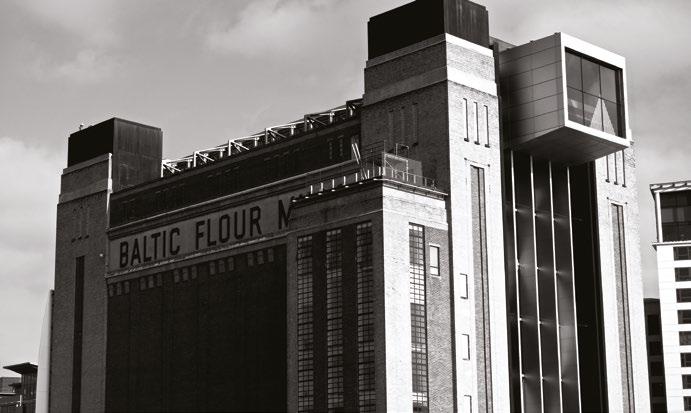
BALTIC Centre for Contemporary Art, Gateshead.
Imperial War Museum on the banks of Manchester Canal in Salford Quays, Manchester.
The Conversation is a collaboration between news editors and academics to provide informed news analysis and commentary that is free to read and republish.
At Northumbria, our academics have been working with The Conversation to produce independent, quality current affairs journalism on some of the latest topics to hit the news.
HERE ARE SOME OF OUR TOP PICKS OF RECENTLY PUBLISHED ARTICLES
What happens when someone dies in space? Space tourism brings new legal and moral issues
As commercial spaceflight companies begin offering exclusive opportunities for celebrities and civilians to travel to space, Christopher Newman, Professor of Space Law and Policy, and Nick Caplan, Professor of Aerospace Medicine and Rehabilitation, discuss the issues which will have to be considered in this new era of space tourism.
Renewable energy is fuelling a forgotten conflict in Africa’s last colony Morocco has positioned itself as a global leader in the fight against climate change, with one of the highest-rated national action plans. Senior Lecturer of Social Sciences, Dr Joanna Allan explores this in more detail, revealing how Morocco has exploited renewable energy developments to entrench Western Sahara.
How climate change is washing away precious evidence of our distant past
As well as threatening biodiversity, food systems and human health, climate change has another victim: ancient artefacts. Dr Rosie Everett, Lecturer in Forensic Science explores how climate change is damaging our archaeological sites and how they can be preserved for future generations.
If you have a great idea for an article, the Communications team at Northumbria can help you pitch it to The Conversation. Please email media.communications@northumbria.ac.uk
NFTs: WWF tried raising money with digital art but backtracked –environmental charities should follow suit
Despite claiming their Non-Fungible Tokens (NFTs) were ‘eco-friendly’, WWF discontinued its Tokens for Nature project after receiving backlash online from environmentalists. Dr Peter Howson, Senior Lecturer in International Development, explores the problems behind this sustainability statement and the environmental issues surrounding NFTs.
A Very British Scandal: divorce courts have been shaming women since the 1800s
The BBC drama, A Very British Scandal introduced a new generation to the scandalous Argyll v Argyll divorce. Women have long been judged with different standards to men and Dr Jennifer Aston, Senior Lecturer in History explains how nowhere has there been clearer evidence of this than in the divorce courts.
Football: English fans want an independent regulator – here’s how it could help save clubs from ruin
Mismanagement of finances within English football clubs has been addressed in a fan-led review. Mark Middling, Senior Lecturer in Accounting, discusses how the suggested regulations could keep them in the game.
THE BIG INTERVIEW:
PROFESSOR GRAHAM WYNN, PRO VICE-CHANCELLOR (EDUCATION) AT NORTHUMBRIA UNIVERSITY
Northumbria University News asks recently appointed Pro Vice-Chancellor (Education), Professor Graham Wynn to reflect on what attracted him to join Northumbria and how the learning opportunities here for students set the University apart from others in the sector.
Tell us about your background?
I’m originally from the North East and I’ve always loved the region. I left to pursue my studies in physics at university, eventually taking up an academic role at the University of Leicester. During my time at Leicester, I held a number of different roles, including Head of Department of Physics and Astronomy and Dean of Education for Science and Engineering. From there I led a full review of the curriculum across all programs, focusing on making sure that the student experience was the best it could be. Latterly, I became the Pro Vice-Chancellor for Education at the University.
My research background is in theoretical astrophysics, with a specific research interest in
research and its education, both things I’m passionate about. The University is tackling some of the most pressing problems the world is facing right now, from climate change and social justice to the wellbeing of our communities and more – all of which is really exciting.
Northumbria is also a global university but remains proud of its strong and deep local roots. It recruits lots of students from surrounding areas, educating them to an extremely high standard – we have the same number of graduates going into highly skilled employment in the North East as all of the Russell Group universities combined –which is fantastic for the region. Added to this, the campuses in London and Amsterdam, and other links around the world, like our numerous research and education partnerships, reinforce our global outlook.
What makes Northumbria different to other universities, in your mind?
Northumbria is different because it couples academic depth and rigour with a broad and vibrant portfolio of learning opportunities for students. Our courses are not just restricted to theoretical and library-based modules that many universities offer, they also offer a wide variety of authentic and practical learning experiences.
“NORTHUMBRIA IS DIFFERENT BECAUSE IT COUPLES ACADEMIC DEPTH AND RIGOUR WITH A BROAD AND VIBRANT PORTFOLIO OF LEARNING OPPORTUNITIES FOR STUDENTS. OUR COURSES ARE NOT JUST RESTRICTED TO THEORETICAL AND LIBRARY-BASED MODULES THAT MANY UNIVERSITIES OFFER, THEY ALSO OFFER A WIDE VARIETY OF AUTHENTIC AND PRACTICAL LEARNING EXPERIENCES.”
How do you see your role to Northumbria to the next stage?
I’ve been busy, since my arrival in October 2021, developing our future strategy for education. The strategy focusses on three key areas of learning here at Northumbria.
University acting as a springboard for their future success. We will provide inclusive education, so that all our students can succeed in their studies, no matter what their background may be. We will ensure that we are equipping our graduates with all the skills they need to take on whatever may come next in their lives. We are working in partnership with local, national and international employers we will help our students to develop the skills that are they need for an everchanging, ever challenging world. Alongside all this, we will enhance our student support services, to make sure that they are agile, dynamic and evolve to meet our students’ needs. The Students’ Union have been strong partners in developing the education strategy, and we will continue to work closely with them so that all our students feel part of a vibrant, innovative and supportive learning community.
What does going to university look like in five years’ time?
What going to university will look like in a five years’ time is a big question in this sector at the moment.
astrophysical accretion theory. This means that I think about the stars a lot and how objects such as neutron stars, black holes and white dwarfs (stars that have burned up all of the hydrogen they once used as nuclear fuel) interact with their surroundings; how we see them, and what influence they have on the universe.
What attracted you to Northumbria?
What I find exciting about Northumbria is the vibrancy and dynamism of the University, and its ethos of empowering students so they are equipped to achieve their life ambitions with confidence. I am also inspired by the way in which the University is developing in terms of its
Students are offered brilliant experiential learning opportunities where they have hands-on practical experience of the work they hope to be doing after their studies. This includes a fantastic ‘clinicbased’ education – such as our Student Law Office - an actual, legal practise - students work on real cases alongside qualified lawyers. In addition, our fantastic Business Clinic supports students to develop and realise their business ideas and dreams. These are fabulous examples of the way in which Northumbria provides a holistic learning experience - award winning and sector leading.
Northumbria is an ambitious university attracting students who are motivated to succeed in life - you can see that from our impressive alumni such Sir Jonathan Ive and Sir Chris Whitty among others. I see this ambition reflected in our students and solidly embedded in their plans for the future.
Overall, I think Northumbria is a university that is fresh and different in the sector, and I feel very proud to be a part of it.
The first is the Quality of our education offer and how students feel when they’re studying here. We want to ensure they are challenged and supported in the right way, and that their education is providing them with the skills they need to succeed in life. Whether that’s through academic or practise-based modules - such as the clinic-based learning I mentioned before - we want quality to underpin all our teaching. Added to this we will continue to closely integrate research into our education, so that the two complement and benefit from each other.
The next area that I’ve been focusing on is Pride. I want to build a real sense of pride in being a part of a university which is taking on some of the greatest global challenges currently facing the world. I want to help create a strong, supportive, inclusive learning community, which all our students can be an active part of and feel a sense of belonging to. This sense of belonging should last a lifetime, so our students will always feel part of our community, even beyond graduation, and able to come back to us at any time for support and to continue to contribute to the Northumbria story as they carve their own professional journey The third element of the strategy is called Success. This focusses on enabling students to achieve their life ambitions, with the
Covid has had a huge impact - we went from a position of virtually all face-to-face learning to online learning almost overnight. It wasn’t controlled or introduced in a way we would have liked and certainly not in a way we would have planned. Over the next year we will increase the level of in-person learning to match pre-Covid levels more closely but continue to complement that in-person experience with online learning where it is most effective. And most importantly, we’ll be working with our students in a planned way to make sure we get that balance right.
Looking further ahead on that five-year journey, offering students flexibility is going to be key. We need to understand how adaptable our programs can be. While still offering the invaluable face-to-face experience how do we also ensure that our students have access to a learning experience that enables them to balance their studies with other demands on their time they may have such as jobs or caring responsibilities.
But what I most look forward to in five years’ time for Northumbria, is having a much more vibrant, closely knit and supportive learning community, where We Are Northumbria, and we celebrate our achievements and successes together.
Historic hall inspires winning design
A talented Northumbria University graduate has been crowned the winner of a live architecture project inspired by the heritage of the National Trust’s Seaton Delaval Hall.
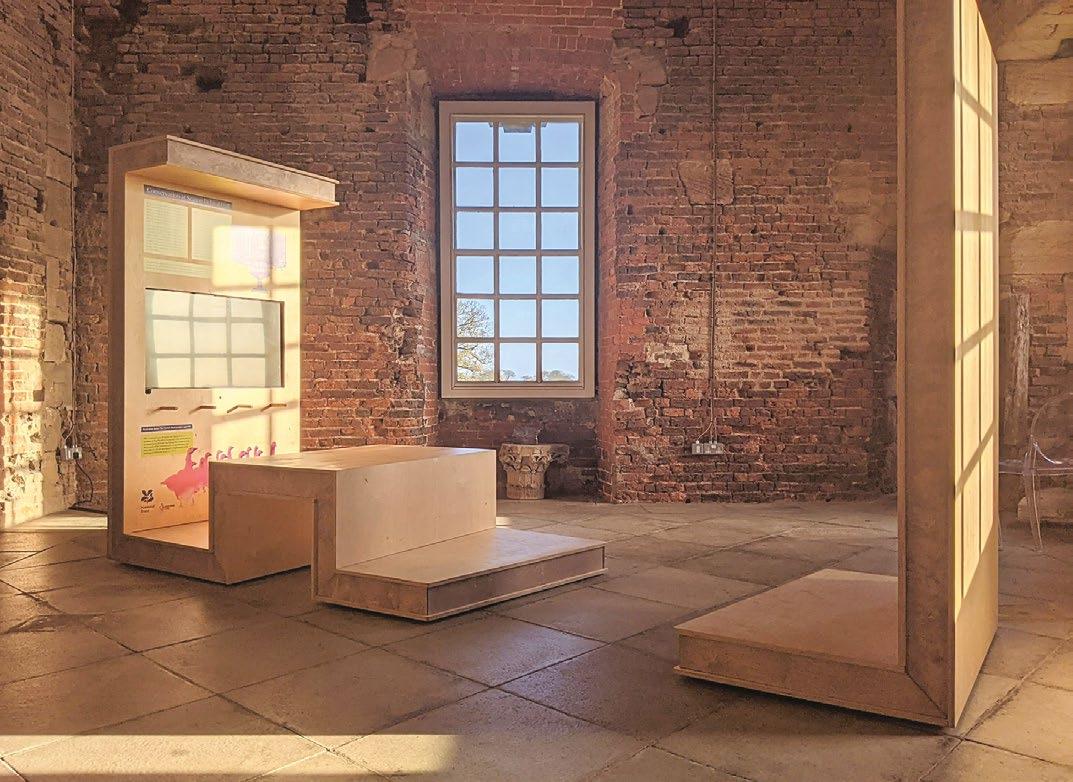
Hattie Keel’s striking seating installation, designed to convey the playful nature of the Delaval family who lived at the hall in the 18th century, was selected as the stand-out entry in the Rising Stars creative partnership project, supported by the National Lottery Heritage Fund.
Aimed at providing invaluable industry experience and an opportunity for students to showcase their creative talents, the competition was organised as part of the National Trust’s The Curtain Rises project, centred on conservation and improvement work at the historic hall, which was acquired by the Trust in 2009.
More than 20 students from Northumbria’s BA Interior Architecture programme benefited from talks and support from leading architecture practice, GT3 Architects, before submitting designs for installations to be enjoyed by visitors to the hall.
Hattie’s winning installation was constructed with support from GT3, and design and fabrication practice, Raskl. It is now available to visit in the Saloon at Seaton Delaval Hall until the summer.
As a result of her work with GT3, Hattie has secured a job with them since graduating and is now working as a designer for the company, which has studios in Newcastle and Nottingham.
Reflecting on the experience
Hattie explained: “My time at Northumbria gave me great insight into the industry through numerous live projects, including this partnership with the National Trust. Throughout the process, I also worked alongside GT3 Architects, giving me valuable career experience in the industry.
“The Rising Stars competition put my foot in the door to life after graduation; the knowledge it gave me boosted my confidence in my creativity
and design capabilities. I am incredibly grateful for the opportunity provided by Northumbria, as this enhanced my portfolio and assisted in securing my role as a Graduate Interior Architectural Designer at GT3.”
Due to donation from the National Lottery Heritage Fund, since 2018 Seaton Delaval Hall has been the focus of The Curtain Rises project where, as well as improvements to visitor facilities and extensive conservation work, the stories of Seaton Delaval Hall’s colourful past are now being brought to life through initiative like the Rising Stars creative partnership.
Speaking about her winning entry to the project, Hattie added: “My design was inspired by the playfulness of the Delaval family and I wanted to provide a space for visitors to sit and dwell within the structure.
“The seats follow the natural folds of origami, enabling visitors to interact and engage
“THE RISING STARS PROJECT HAS SUPPORTED THE EMPLOYMENT AND SOFT SKILLS DEVELOPMENT OF NORTHUMBRIA UNIVERSITY STUDENTS AND, AT THE SAME TIME, HELPED THE NATIONAL TRUST REALISE SEVERAL CREATIVE AND CONSERVATION-BASED AMBITIONS.”
with the structure. I really enjoyed the entire process and seeing my initial concept brought to life.”
Paul Ring, Associate Professor and Head of Architecture at Northumbria, said: “GT3 worked with students to guide them through client meetings, design detailing, budget and fabrication decisions. Hattie is without doubt a more informed and accomplished designer thanks to this experience and we are exceptionally grateful to GT3 and the National Trust for the opportunity, their expertise, and their support for our students.”
Emma Thomas, the National Trust’s general manager of Seaton Delaval Hall, said: “Hattie’s excellent design helped us achieve our ambition of
telling the stories of the hall, and our National Lottery Heritage Fund-supported project more creatively, to members and visitors. The Rising Stars project has supported the employment and soft skills development of Northumbria University students and, at the same time, helped the National Trust realise several creative and conservation-based ambitions.”
For more information on Seaton Delaval Hall and how to view Hattie’s installation, visit www. nationaltrust.org.uk/seatondelaval-hall
EMMA THOMAS, THE NATIONAL TRUST’S GENERAL MANAGER OF SEATON DELAVAL HALL.
Below: Northumbria University graduate, Hattie Keel, is now a Graduate Interior Architectural Designer at GT3. Credit: GT3 Architects
SEATON DELAVAL HALL IS NOW HOME TO HATTIE KEEL’S WINNING DESIGN FROM THE NATIONAL TRUST RISING STARS CREATIVE PARTNERSHIP. CREDIT: NATIONAL TRUST
Sizing up talent
A brand collaboration which aims to support talented fashion students to secure jobs in the industry through real-world experience has been launched for the third consecutive year at Northumbria University.
Global clothing and footwear retailer size? has released the latest instalment of its higher education syllabus, which provides the opportunity to nurture young creatives through live projects run in partnership with selected UK universities. The syllabus was officially launched at Northumbria with a visit from the company’s Senior Talent and Community Manager, Daniel Langhorn.
Final year students studying Fashion Communication and Fashion Design and Marketing within the Northumbria School of Design, have been set the task of developing a marketing campaign outlining how size? could best collaborate with the international footwear brand, Vans. Representatives from Vans have been involved in writing the brief and will review the results.
“With face-to-face visits and industry-level access, guidance and critique, universities involved in our Syllabus programme are given a unique opportunity to work with us in total collaboration to provide students with a guaranteed live brief,” explains Daniel.
“These ideas can and have then manifested into realworld nationwide campaigns for size?, as demonstrated last year with Northumbria graduate Sophie Clayton, who took part in the Syllabus and is now employed by size? directly due to her involvement. This year with the involvement of Vans, it adds another dimension to what students can create and
most importantly, Vans will be receiving the final submissions.”
Sophie, who graduated from the Fashion Communication course last summer, created a campaign for her own live project called Ask the Question, which showcased the work of creatives and designers who were willing to talk about their own mental health experiences while encouraging others to do the same. Her work was chosen by size? to be transformed into a social media campaign by the company to coincide with World Mental Health Day in October.
Sophie has since secured a role as a Brand Account Assistant Apprentice with size? and joined Daniel and fellow Northumbria Fashion Communication graduate, Cameron Poole, to speak to current students to launch this year’s live project.
Speaking about her time as a student, Sophie said: “When I was doing my own live project, I researched the size? brand values, and realised they really aligned with my own. It helped me identify lots of opportunities to create a unique and impactful campaign that would resonate with a young audience.”
Since graduating in 2019, Cameron’s work with size? has seen him become actively involved in developing the Syllabus and he now works as a Social Media Executive for the brand. He also maintains his links with Northumbria as an Associate Lecturer on the Fashion Communication programme.
Gayle Cantrell, Head of Subject for Fashion at Northumbria, said: “We are delighted to be involved with the size? syllabus again this year, giving our students the opportunity to engage in projects with a real-world, tangible context.
“The company’s iconic status and authentic commitment to their values really appeals to our students and underpins key themes in our programme. The honest, constructive support and feedback they have received on their projects has been amazing and has given them confidence to develop strong work for their portfolios.
“The fact we now have two graduates employed by the size? team shows what a great opportunity this is. We’re looking forward to continuing our collaboration in the future.”
Sarah Walton, Programme Leader for Fashion Design and Marketing, said: “This is a fantastic live project running once again with a global retailer which gives students an opportunity to augment their portfolio in a way which demonstrates their ability to respond to an industry brief.
“To have the support of an organisation like size? when it comes to securing real-world experience and employability skills for our students, is really invaluable.”
Visit www.northumbria.ac.uk/ fashion to find out more about study options at Northumbria.
DISCOVER MORE www.northumbria.ac.uk/design
“THESE IDEAS CAN AND HAVE THEN MANIFESTED INTO REAL-WORLD NATIONWIDE CAMPAIGNS FOR SIZE?, AS DEMONSTRATED LAST YEAR WITH NORTHUMBRIA GRADUATE SOPHIE CLAYTON, WHO TOOK PART IN THE SYLLABUS AND IS NOW EMPLOYED BY SIZE? DIRECTLY DUE TO HER INVOLVEMENT.”
DANIEL LANGHORN, SENIOR TALENT AND COMMUNITY MANAGER FOR SIZE?
Gayle Cantrell, Head of Subject for Fashion at Northumbria University.
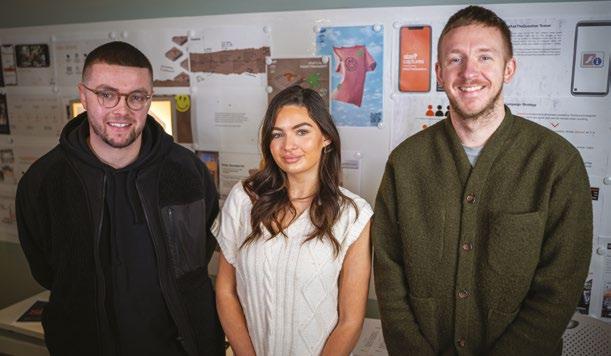
Cameron Poole, Sophie Clayton and Daniel Langhorn from size?
A mood board from Sophie Clayton’s live project called Ask the Question, which was brought to life by size?
The team from size? are supporting Northumbria Fashion Communication students with a live project.
Fashion Design and Marketing students were given the chance to ask questions of the size? team during a visit to mark the launch of the live project.
Previously unrecorded Chilean tsunami detected
A large earthquake off the coast of south-central Chile in 1737 may have caused a substantial tsunami that was absent from historical records, according to new research published in the Nature journal, Communications Earth & Environment.
Historical records are used to predict how often future tsunamis are likely to occur in a region. Until now, records had stated that tsunami-causing earthquakes had occurred in this area of Chile three times since the 1570s, the most recent being in 1960 after a 9.5 magnitude earthquake. These records had led to scientists believing there was an average interval of 193 years between each one.
However, while records show there was an earthquake in the area in 1737, there was no record of it causing a tsunami until now. This implies that tsunamis may have struck the Chilean coast more frequently than previously believed, significantly reducing the
average time between historical tsunami occurrences to 130 years.
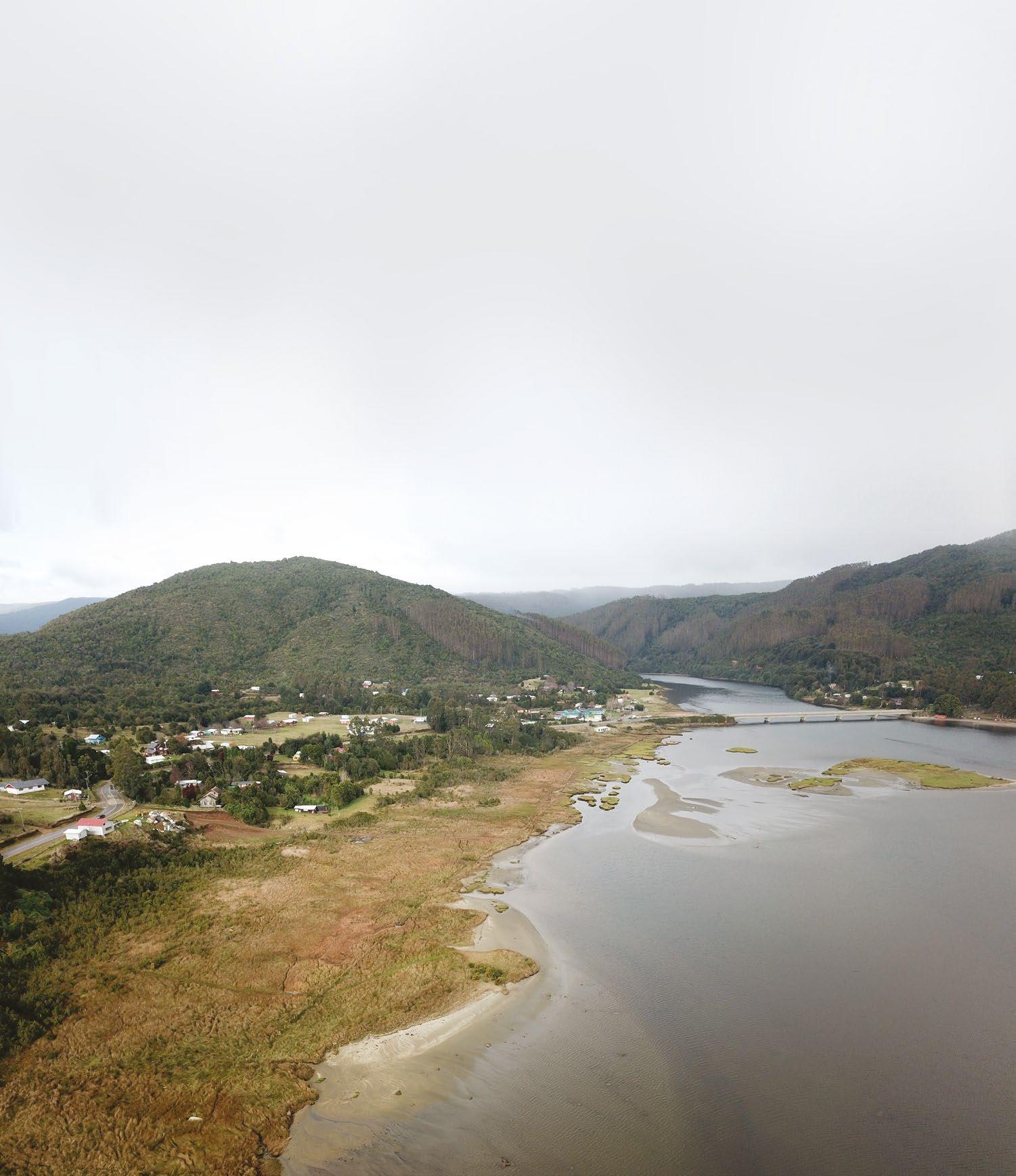
Researchers from the universities of Northumbria and York studied more than 100 sediment cores taken from tidal marshes at Chaihuín, near Valdivia. They found evidence of widespread sandy layers, dating back to 1737 – the same time that the earthquake struck the region. The sandy layers closely resemble deposits made by tsunami waves in other areas. The sediment cores also contained a mixture of marine and freshwater algae species and evidence of land subsidence. This meant the researchers could rule out storms or river flooding as the cause of the sand deposits,
meaning that the earthquake ruptured offshore, causing a tsunami.
Based on these findings, the research team suggests that geological and historical records should be considered in tandem when predicting future tsunami risk, adding that historical records alone may not provide a complete documentation of their occurrence and characteristics.
Lead researcher, Dr Emma Hocking, from Northumbria University’s Department of Geography and Environmental Sciences said: “Historical records are sometimes incomplete because reporting of tsunamis can be greatly affected by societal unrest or other crises. In
this case, it is believed that the lack of chronicles of a tsunami could be attributed to uprisings that had driven settlers from most of the colonial outposts in the area. There are records of an earthquake in the area in 1737, but there is nothing in these records to indicate it generated a tsunami.
“Our findings suggest that the earthquake did, in fact, cause a tsunami. The implication of this is that tsunamis have occurred more often than we previously believed, and we therefore suggest that the use of historic records alone may give miscalculations. Geological evidence is essential for verifying and supplementing historical records to obtain robust long-term patterns to inform seismic and tsunami hazard assessment.”
Ed Garrett, leader of the Creating a Climate Resilient World Research Group in the Department of Environment and Geography at the University of York, added: “Extensive fieldwork over several seasons allowed us to map out the tsunami deposit in great detail. We think the combination of this comprehensive field data with numerical models of the earthquake and tsunami makes this study really notable.”
The research paper is available online at www.nature.com/commsenv
DISCOVER MORE
www.northumbria.ac.uk/geography
“OUR FINDINGS SUGGEST THAT THE EARTHQUAKE DID, IN FACT, CAUSE A TSUNAMI. THE IMPLICATION OF THIS IS THAT TSUNAMIS HAVE OCCURRED MORE OFTEN THAN WE PREVIOUSLY BELIEVED, AND WE THEREFORE SUGGEST THAT THE USE OF HISTORIC RECORDS ALONE MAY GIVE MISCALCULATIONS.”
DR EMMA HOCKING
Climate change research boosted by new partnership
Northumbria University is set to advance its research on issues relating to climate change after forming a new strategic partnership with the International Centre for Climate Change and Development (ICCCAD).
“OUR COLLABORATION WILL FACILITATE THE DEVELOPMENT OF JOINT RESEARCH AND NEW ROUTES TO IMPACT AND OPEN UP NEW LEARNING OPPORTUNITIES FOR OUR STUDENTS IN THE AREAS OF CLIMATE CHANGE AND SUSTAINABLE DEVELOPMENT.”
PROFESSOR SALEEMUL HUQ, DIRECTOR OF THE CENTRE FOR INTERNATIONAL DEVELOPMENT
ICCCAD is an organisation working on climate change and development and is based at Independent University, Bangladesh, one of the leading private universities in the country. Bangladesh is frequently affected by natural disasters such as major floods and cyclones making it one of the world’s most vulnerable countries to climate change. ICCCAD has direct experience and specialist expertise relating to the local impact of climate change. The new partnership will help to expand the research capacity of both organisations and bring new perspectives to research undertaken by a range of Northumbria’s specialist research groups. This includes the Global Development Futures group which focuses on development, disasters, social
and cultural geographies, as well as the Centre for International Development, which brings together academics, practitioners and students to address issues around global poverty and inequality. The collaboration has also created opportunities for Northumbria staff and students to undertake fellowships, internships and collaborative research with ICCCAD on issues around climate change adaptation and development, both virtually and in situ in Bangladesh.
Northumbria’s Vice-Chancellor and Chief Executive Professor Andrew Wathey marked the formation of the partnership by signing a memorandum of understanding with Professor Saleemul Huq, Director of the Centre. “ICCCAD’s interests strongly align with
the approaches and focus of a number of Northumbria University’s multidisciplinary research areas,” he said.
“Our collaboration will facilitate the development of joint research and new routes to impact and open up new learning opportunities for our students in the areas of climate change and sustainable development. Importantly, it will facilitate collaborative efforts towards knowledge sharing on some of the most pressing issues of climate change and sustainable development and will enable Northumbria University to contribute to a growing demand for a paradigm shift in knowledge transfer, from the global south to the north.”
Professor Saleemul Huq leads ICCCAD and is an expert in climate change in the most
vulnerable developing countries.
He is the lead author of several Intergovernmental Panel on Climate Change (IPCC) assessment reports, advisor to the Least Developed Countries Group on the United Nations Framework Convention on Climate Change, and was recently ranked as the fourth most important climate change influencer in the world. Professor Huq visited Northumbria to sign the memorandum of understanding directly after speaking at COP26 in Glasgow. While at the University he delivered a lecture for staff, students and University partners reflecting on his time at the conference and his work to encourage governments to recognise the topic of loss and damage from human-induced climate change.
Speaking about the benefits of the partnership with Northumbria University, Professor Huq said: “I firmly believe that the agreement between ICCCAD, Independent University and Northumbria University will contribute to innovative thinking and generation of new knowledge through collaborative research, focusing particularly on capacity building and climate justice in the UK, Bangladesh and beyond.”
Find out more at www.icccad.net
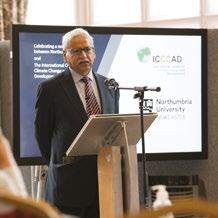
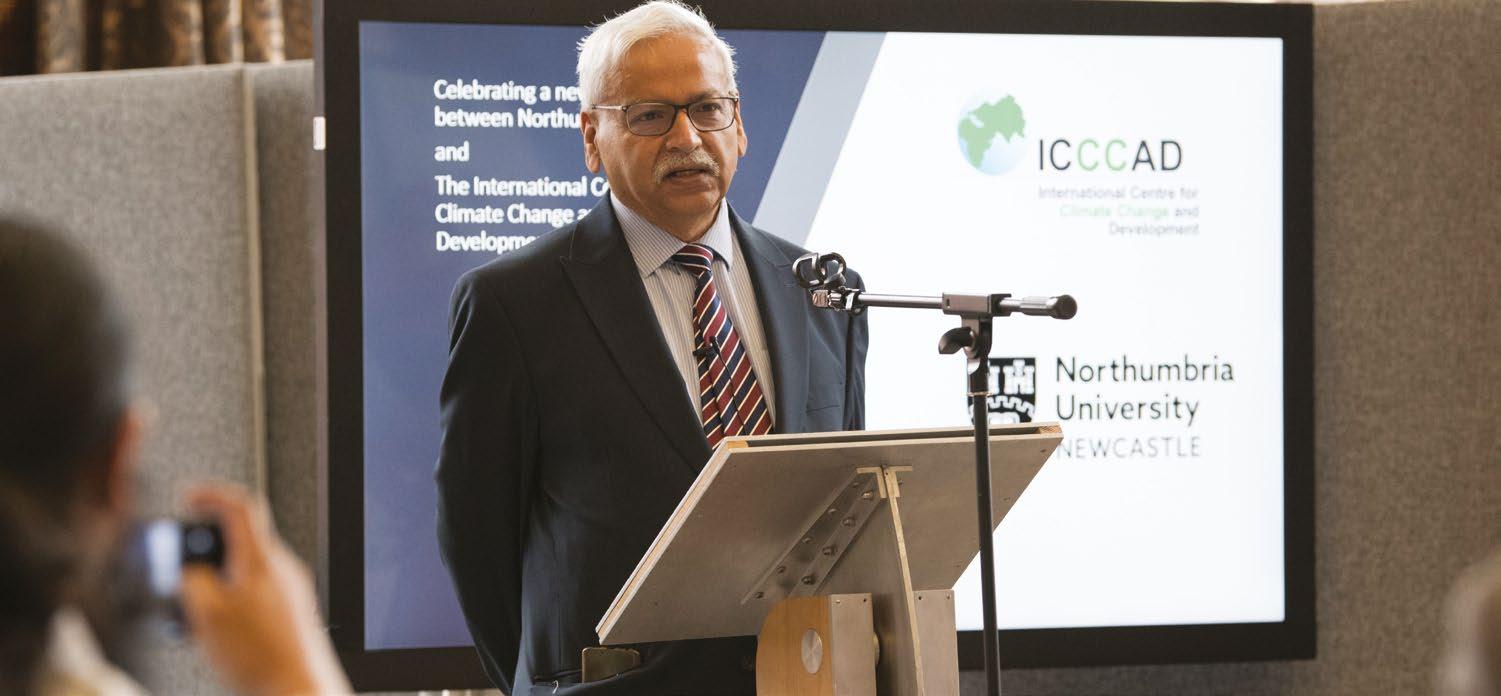
Professor Saleemul Huq, Director of ICCCAD speaking at the launch of the partnership at Northumbria University.
Designing homes that are fit for the future
“RESEARCH
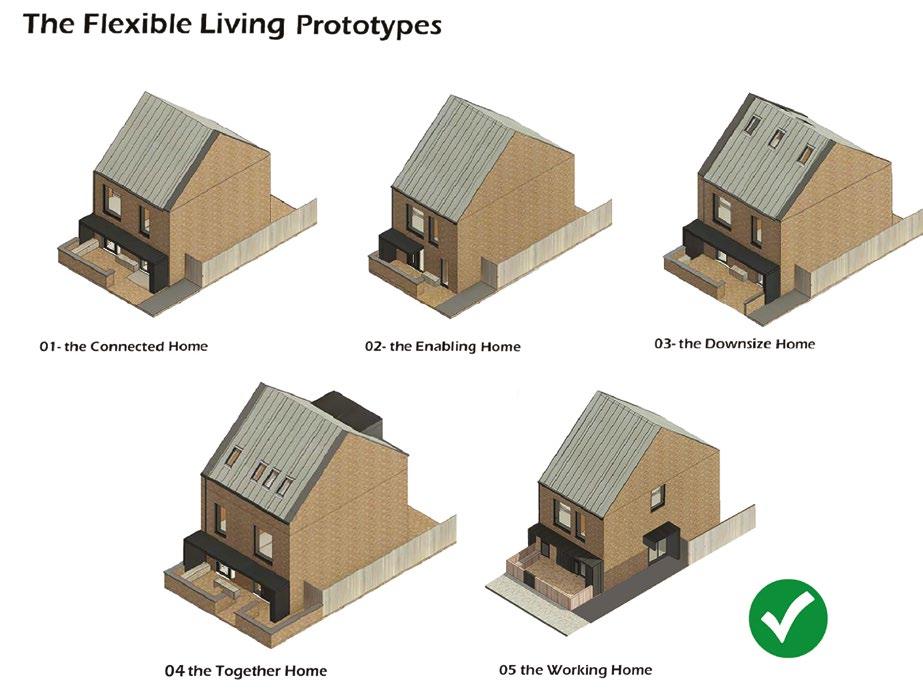
A team of Northumbria University academics has been commissioned to design and develop a purpose-built home office within a prototype house, that will allow older people to work effectively from home and remain productive beyond retirement.
Our homes are vital to our health, as well as our economy, and are central to how we live our lives. As we age or become infirm, a home can impact our ability to lead a happy, healthy, and fulfilled life. But the UK housing industry does not currently respond to the challenges of growing old. It continues to build homes that
adaptive and innovative solutions, the Design Age Institute has granted Northumbria University funding to design and develop a purpose-built home office within a prototype home, to be built at new housing development South Seaham Garden Village in County Durham. Led by Paul Jones,
to maintain an active and joyful life at every age.
The project is also being supported by developer and housing association Karbon Homes as part of their commitment to ageing innovation and ageing-inplace strategies within the village, building on previous research they have worked
are very difficult to adapt, compromising the ability of people to ‘age in place’ - a term used to describe a person living in the residence of their choice, for as long as they are able, as they age.
In a bid to provide more
Professor of Architecture at Northumbria, the design research is one of six Pathfinder Projects announced by the Design Age Institute to develop commercially viable products and services that will enable individuals and communities
on in collaboration with the University. The ultimate aim is to create a blueprint of how older people can work efficiently and effectively from home and remain productive beyond retirement age. Layout, ergonomics, flexible
SUGGESTS OLDER WORKERS NEED MORE BREAKS; THEY NEED TO EXERCISE AND STRETCH; HAVE ACCESS TO A MORE TAILORED ERGONOMIC ENVIRONMENT; AND OPPORTUNITY TO COLLABORATE WITH OTHERS TO DEVELOP IDEAS AND AVOID LONELINESS.”
PROFESSOR PAUL JONES
and demountable furniture, lighting, and smart technology will all be considered in the proposed home office. It will be codesigned with members of the Royal College of Occupational Therapists, the Chartered Society of Physiotherapy, representatives of the older community, in collaboration with the National Innovation Centre for Ageing (NICA) and Voice, a community of patients, carers and members of the public contributing their lived experience to inform health research.
Professor Paul Jones explained the timeliness of the project in responding to the rapid changes in the employment market for older people: “Since the onset of the pandemic, working at home has become the norm. We know that older people (along with the young) were most likely to be made redundant as a result of Covid. The cost of living has risen sharply, and pensions are not keeping pace with this rise. Many older people have therefore decided to set up businesses at home.
“However, the domestic environment and the functionality of the home is not always conducive. Long hours in front of a monitor in the same position, for instance, is not suitable. Research suggests older workers need more breaks; they need to exercise and stretch; have access to a more tailored ergonomic environment; and opportunity to collaborate with others to develop ideas and avoid loneliness.” How a dwelling can be adapted to serve as both a workplace and a home is another factor that
the team will consider, which is especially important if space is at a premium. “All of these issues form the basis of interesting design challenges that the research project aims to address,” added Professor Jones.
Other successful projects supported by The Design Age Institute, include cargocarrying robots, an app to engage people with their hearing health through birdsong, an age-inclusive bank, data-driven diabetes management and a twowheeled personal electronic vehicle. Colum Lowe, Director, Design Age Institute, said: “From health and mobility to housing and financial security, each of these innovative Pathfinder Projects focuses on a different fundamental part of day-to-day life. They all have the important common goal of developing desirable and commercially viable products and services for an ageing society.”
From accommodating increased home working and an ageing society, to reducing energy usage and withstanding the impact of climate change, find out more about how Northumbria University is helping to create homes that meet a growing list of changing demands at www.northumbria.ac.uk/ homesforthefuture
Meet the academic: Dr Marc Etherington
People all over the world have televisions, mobile phones and tablets, but how can we make something so commonly used more energy efficient? Imagine, for instance, if you only needed to charge your mobile phone once a week rather than every day. Northumbria University News spoke to Dr Marc Etherington, a Vice-Chancellor’s Senior Fellow at the University, who is leading research that could make this a reality.
Tell us about your area of research
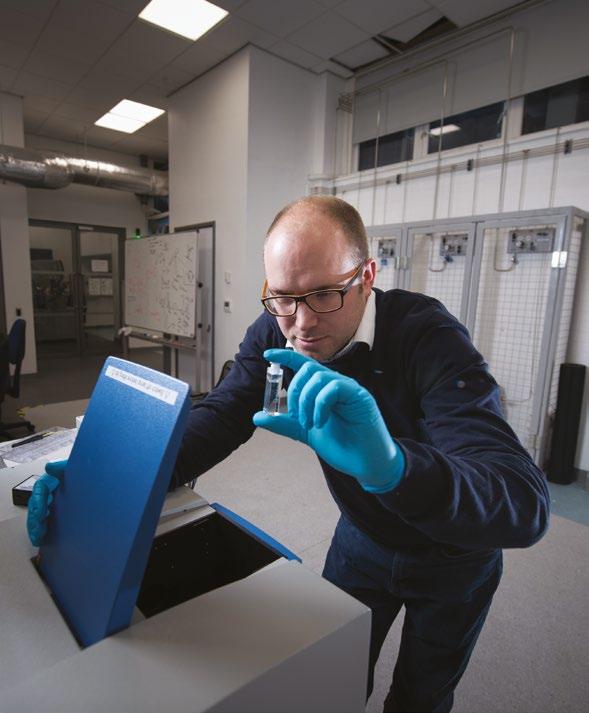
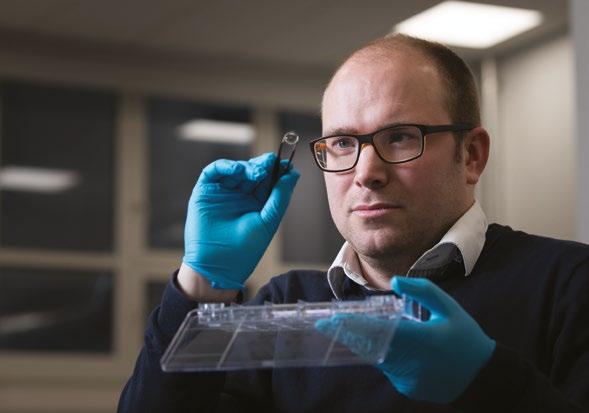
My particular interest is in organic light emitting diodes (OLEDs). These are smart materials widely used to light the displays in phone screens, tables and TV screens. Currently there is a scientific challenge around making the ‘blue’ element of these OLEDs more efficient and stable to reduce the amount of energy needed to power them. Saving energy is as important as generating energy. Part of my research is looking at how organic blue light-emitting materials or fluorophores such as caffeine or quinine can be applied within our electronic devices to save energy. More efficient blue OLEDs would substantially reduce the amount of time needed to charge your phone or other electronic device –potentially reducing from every day to once a week at most.
What do you ultimately hope to achieve?
My ultimate goal would be to find a blue OLED which is better than the rest and which could substantially improve efficiencies across a range of applications. There is enormous potential for this technology and my research is also looking at bioimaging and medically directed applications where the materials could be used to sense or detect certain cells. I would also love to change the way people think about materials and science. Within
my own research we are looking at how everyday substances such as caffeine or quinine, which is found in tonic water, can be used to shape the next generation of electronic devices. Imagine being able to put a glass of tonic water beside a mobile phone and ask students to identify the connection? It would really trigger interest in the topic and get people thinking in a different way. Fundamentally shifting people’s perceptions around technology is important for both inspiring the next generation and in showing how we can learn from nature to help answer some of the world’s most challenging problems. That’s something I would like to be involved in making happen.
What has been your biggest research achievement to date, and why?
I published a research paper alongside my colleagues entitled ‘Revealing the spinvibronic coupling mechanism of thermally activated delayed fluorescence (TADF)’
The paper has been widely embraced by the scientific community and has also been a key guide for developing new emitters that exhibit TADF for commercial applications. I am very proud to have been a part of such impactful research that can hopefully contribute towards the development of practical solutions to realworld challenges.
“SHIFTING PEOPLE’S PERCEPTIONS AROUND TECHNOLOGY IS IMPORTANT FOR BOTH INSPIRING THE NEXT GENERATION AND IN SHOWING HOW WE CAN LEARN FROM NATURE TO HELP ANSWER SOME OF THE WORLD’S MOST CHALLENGING PROBLEMS.”
DR MARC ETHERINGTON
What do you like about working at Northumbria?
The University has incredible vision and an impressive track record of conducting groundbreaking research. The North East is emerging as a key global hub for the renewable industry and there is an enormous amount of strength and support here with Northumbria University leading the way in academic research and training. The research body at the University is exceptional with a strong network of worldleading academics. Being able to share knowledge and collaborate with like-minded individuals and industry leaders is really exciting and I’m delighted to be part of it.
For more information about Northumbria’s work to help tackle climate change, visit www.northumbria.ac.uk/ livesustainably
Dr Marc Etherington
800 underground lakes on record for first time
Northumbria staff and students have played a key role in compiling the world’s first inventory of subglacial lakes, outlining where they are and how they are changing in a warming climate.
Subglacial lakes form in hollow cavities underneath ice sheets or in glacial valley regions. They can also form when ice is warmed by geothermal heat from the earth below causing it to melt. These ‘underground’ lakes play a critical role in how fast ice flows into oceans. When they form on land in mountainous regions they can drain, leading to flooding and landslides, posing a major risk to populations downstream.
There are many thousands of these subglacial lakes worldwide but now, for the first time, an international team of researchers have catalogued data on almost 800 lakes in Antarctica, Greenland and Iceland, as well as in glacial valley regions such as the Alps. Their work means there is now a collective current record detailing the size, stability and characteristics of these lakes. The record also highlights where there are gaps in scientific knowledge, giving researchers new areas to focus on in future.
Dr Kate Winter, Senior Lecturer in Geography and Environmental Sciences, explained: “Subglacial lakes are protected by a layer of thick overlying ice which insulates it from the cold air above, preventing them from re-freezing and can exist alone for millions of years, harbouring
unique life forms, or they can fill and drain over hourly timescales.
“These lakes can lubricate the base of the glacier or ice sheet and make ice flow faster, contributing to global sea-level rise. In populated regions such as the Alps, the sudden release of subglacial lake water can cause catastrophic damage to life and infrastructure. It is therefore important to study where subglacial lakes are, how much water they contain, how stable or active they may be and how they might be changing over time so we can learn more about why they form and what impact they may have on the local area.”
The inventory includes 59 newly identified lakes in Antarctica. Some measure up to six miles long, and are under 3,000 metres of ice, many of which were discovered by Environmental Monitoring, Modelling and Reconstruction master’s student Becky Sanderson. Becky found them while researching transects of icepenetrating radar data collected across East Antarctica for her dissertation. She is continuing to examine them on her PhD studies on the One Planet doctoral training programme, a specialist partnership between Northumbria and Newcastle Universities and the Natural Environment Research Council.
Becky said: “Finding new subglacial lakes was incredibly exciting. Being able to work on such a high impact paper and collaborating with a wide range of talented people in the scientific community was a great opportunity for me.”
Northumbria is one of the UK’s leading universities undertaking research into extreme environments and is believed to have the largest team of cold climate researchers in the country. Researchers are involved in major international studies including
leading roles in the £20 million UK/ US International Thwaites Glacier Collaboration and a £4 million study assessing tipping points in the Antarctic climate system.
Visit www.northumbria.ac.uk/ thwaites to find out more.
DISCOVER MORE www.northumbria.ac.uk/ges
“IN POPULATED REGIONS SUCH AS THE ALPS, THE SUDDEN RELEASE OF SUBGLACIAL LAKE WATER CAN CAUSE CATASTROPHIC DAMAGE TO LIFE AND INFRASTRUCTURE. IT IS THEREFORE IMPORTANT TO STUDY WHERE SUBGLACIAL LAKES ARE, HOW MUCH WATER THEY CONTAIN, HOW STABLE OR ACTIVE THEY MAY BE AND HOW THEY MIGHT BE CHANGING OVER TIME SO WE CAN LEARN MORE ABOUT WHY THEY FORM AND WHAT INFLUENCE THEY MAY HAVE ON THE LOCAL AREA.”
DR KATE WINTER
Tapping into sustainable drinking water
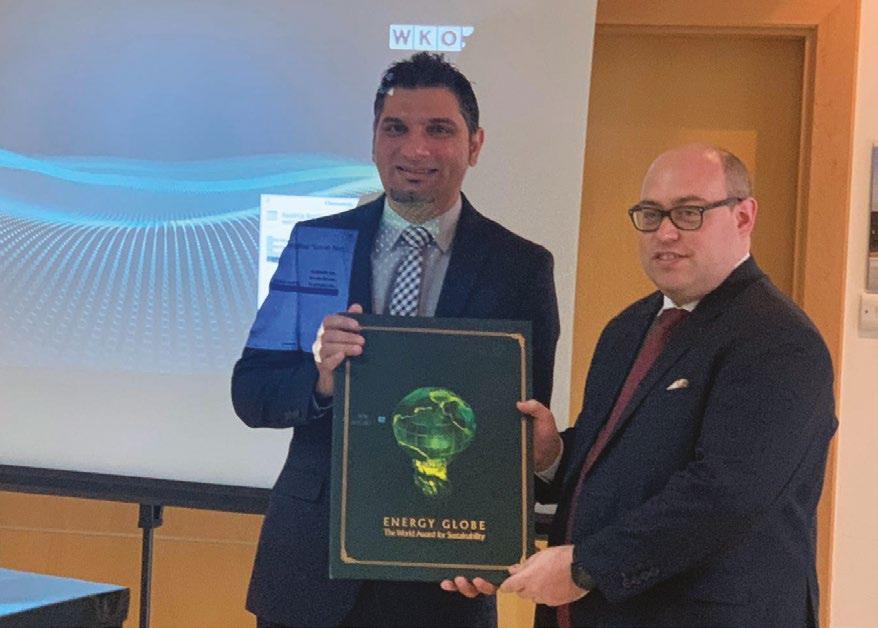
A project developed by a Northumbria academic which uses solar energy to turn sea water into clean, safe drinking water has been recognised for its contribution to future sustainability with an Energy Globe Award.
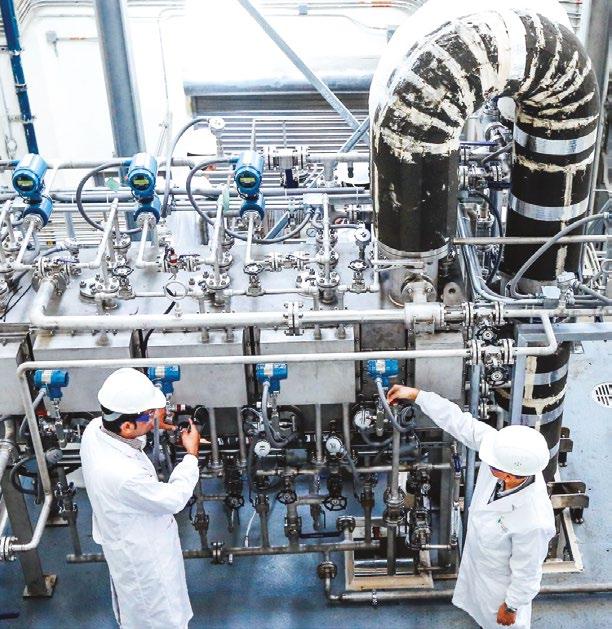
Desalination processes are widely used in most Middle East countries, where there is limited rainfall, to remove salt from sea water in order to produce safe drinking water. Conventional desalination processes are typically energy-intensive, using fossil fuels such as oil and gas, and result in damaging environmental emissions. In addition, the pre-treatment chemicals used during the process are rejected back into the sea with concentrated brine that negatively impacts marine life.
Over the last decade, Northumbria Senior Lecturer Dr Muhammad Wakil Shahzad has developed an innovative desalination process, powered by solar energy, which results in almost double the water production and half the CO2 emissions compared to conventional desalination methods.
Dr Shahzad has now made this desalination process even more sustainable by proposing a pioneering solar thermal energy storage battery to overcome the intermittent nature of solar energy availability. This latest development earned Dr Shahzad the Energy Globe Award (Saudi Arabia) 2021, an award that has been given annually in nations around the world since 2000 to showcase solutions that will protect the environment while promoting productive collaboration between the business community and consumers.
So how does Dr Shahzad’s proposed solar thermal energy storage battery work? The efficiency of conventional battery storage is very low because it needs to convert energy from one form to another, for example, chemical to electrical. As an alternative,
direct thermal storage and utilisation is significantly more efficient, as the energy is stored and used in the same form, without having to be converted. Dr Shahzad’s solar thermal energy battery uses a thermochemical material - dry magnesium oxide which reacts with water to become hydrated magnesium hydroxide – to store heat during the day and emit it at night. The hydration process at night and dehydration process during the day with solar energy can produce sufficient heat energy to operate the desalination process 24 hours a day. Storing and utilising solar heat in this way for roundthe-clock operation minimises carbon and marine pollution, making Dr Shahzad’s proposed desalination innovation the most practical and feasible solution for producing clean, sustainable water.
“THE PROPOSED PROCESS WILL DESALINATE SEA WATER USING 100 PER CENT SOLAR ENERGY, REDUCING THE LOAD ON THE ELECTRICITY GRID AND CUTTING CARBON EMISSIONS TO ACHIEVE NET ZERO TARGETS.”
DR MUHAMMAD WAKIL SHAHZAD
According to the United Nations, billions of people worldwide still live without safely managed drinking water, sanitation and hygiene services. Dr Shahzad’s technologies are considered game-changing in pursuit of sustainable water supplies and will help to progress the UN’s Sustainable Development Goal of clean water and sanitation for all. Speaking about the awardwinning project, he said: “The proposed process will desalinate sea water using 100 per cent solar energy, reducing the load on the electricity grid and cutting carbon emissions to achieve net zero targets. It will also help to produce water for remote offgrid communities to fulfil their daily demand.
“In the first phase of the project, the hybrid cycle successfully demonstrated that it could more than double water production. In this second phase,
operation with solar thermal batteries for 24 hours operation has been conceptualized and tested at prototype scale. We are planning to demonstrate at pilot scale for commercialisation. We believe that hybrid cycle with solar thermal batteries will be the most sustainable solution to achieve SDG6.”
Find out more about the work Northumbria University is leading in the fight against climate change at www.northumbria.ac.uk/ livesustainably
Christoph Pfeifer, Austrian commercial counsellor, honours
Dr Muhammad Wakil Shazad, winner of the Energy Globe Award Saudi Arabia.
On site at the pilot hybrid desalination system.
Championing UK culture
“CULTURE CONNECTS US LIKE NOTHING ELSE AND THE PANDEMIC HAS REMINDED US THAT PLACE AND PARTICIPATION MATTER NOW MORE THAN EVER.”
PROFESSOR KATY SHAW
Northumbria University’s Director of Cultural Partnerships, Professor Katy Shaw, has been chosen to lead a £1.5 million project that will explore how culture can address regional inequality and help level-up the UK.
Professor Shaw, who is an authority in fostering cultural partnerships across the North, has been appointed Programme Director for Creative Communities by the Arts and Humanities Research Council (AHRC) and UKRI. In her new role, Professor Shaw will lead outward-facing research and engagement work to identify and profile examples of good partnership-working practice from across the UK’s regions and develop the potential for arts and humanities in building creative communities.
The Creative Communities programme unites academic, cultural and third sector partners to co-create a new evidence base that will inform future AHRC place-based approaches to levelling up through culture and creativity. Taking a collaborative approach to culture, the new AHRC programme will examine the capacity of place partnerships to strengthen cultural and creative opportunity, exploring how culture can help communities level up economically, socially and in terms of health and wellbeing.
The report builds on AHRC’s Boundless Creativity projectpublished in collaboration with the Department for Digital, Culture, Media & Sport in July 2021 - which examines the role of innovation in shaping the recovery, renewal, and future growth of the UK’s cultural and creative sector.
Speaking about her appointment, Professor Shaw explains: “Culture connects us like nothing else and the pandemic has reminded us that place and participation matter now more than ever. The challenge is to preserve what we have and create new culture, as well as ensuring that culture is by all, and for all, going forwards. I am delighted that the AHRC has asked me to deliver the Creative Communities programme from Northumbria University. As an institution that is committed to developing the next generation of researchers, we especially welcome the opportunity afforded by the award
to offer career development through three post-doctoral roles that will be funded with the award.
“The decision to base the programme here at Northumbria is testament to our sector-leading reputation in partnership working. Collaboration in teaching and learning, research and impact, knowledge exchange and public engagement is a stylistic trait of how we take on the challenges of tomorrow at Northumbria University.”
Professor Andrew Wathey CBE, Vice-Chancellor and Chief Executive at Northumbria University, said the Creative Communities programme is a vital recognition of the role that the arts and humanities can play in enabling the creative economy.
“Creativity and Culture are not just important in building economic recovery, they are vital for our national wellbeing,” he said. “The pandemic, and the lockdowns we all endured to combat it, have taught us again the true value of arts and culture in our lives, and in defining what it means to be human.”
As Director of Cultural Partnerships at Northumbria University, Professor Shaw connects a portfolio of galleries, museums, theatres and writing development organisations to university teaching, research and civic engagement. She is the author of five monographs about contemporary culture and has authored several national reports on the creative industries, including the 2021 Case for Culture: An All-Party Parliamentary Group for Northern Culture inquiry report into postcovid cultural recovery.
For more information about AHRC’s New Research Programme Directors across the UK, visit www.ukri.org
Turning the page on a new publishing degree
An innovative new publishing degree, which includes a guaranteed work placement with a global publisher and the opportunity to work on live writing development projects, has been launched by Northumbria University.
“WE ALL SHARE A VISION FOR THIS MA TO DEVELOP THE NEXT GENERATION OF PUBLISHING TALENT AND TO GIVE GRADUATES A REAL WORLD UNDERSTANDING OF THE SKILLS NEEDED TO WORK IN OUR AMAZING INDUSTRY AND THE MYRIAD OF ROLES AVAILABLE.”
RICHARD KITSON, HACHETTE UK
The new MA Publishing programme has been developed in collaboration with one of the world’s largest publishing houses, Hachette UK, alongside New Writing North, a development agency that supports writers in the North to fulfil their creative ambitions. Both organisations will also be involved in the programme’s delivery.
The course has been specially designed to respond to recognised skills gaps within the contemporary publishing industry, and will cover all stages of the publishing process, from commissioning and editing through to marketing, sales, data and production. Students can also take part in a work placement in one of Hachette UK’s offices or with New Writing
North where they will get the opportunity to apply their learning in a real-life context, gain valuable work experience and enhance their knowledge of publishing and the wider writing industries.
Professor Katy Shaw, Director of Cultural Partnerships at Northumbria University, said she was hugely excited by the new course. “Our students will have the opportunity to explore all elements of the trade publishing landscape, and benefit from cutting-edge industry-inspired learning. When they graduate, they will be truly distinctive, having developed the academic, vocational and practical skills needed to prepare them for success in a range of publishingrelated roles.”
The course focuses on equality,
diversity and inclusion in publishing and the partners hope that it will help to create a future workforce that is more diverse. To support this ambition a £2,000 scholarship is available each year for one gifted student from the North East. It is awarded jointly by Northumbria University and Hachette UK as part of the University’s Higher Education Without Barriers Fund which provides a range of support to make participation and progression in higher education more achievable for academically talented students, regardless of their social or economic circumstances.
With Hachette UK recently opening five new regional offices across the UK – including one in Newcastle – and New Writing North developing a flagship
Centre for Writing in the city, the partners hope that the new course will reinforce the North East’s already significant reputation for being a creative centre for writing and publishing. Claire Malcolm, Chief Executive of New Writing North, said that the new partnership supports the broader ambitions of the region by building-up its creative industries infrastructure and workforce. “It demonstrates our capacity to bring partners together to create strategic ‘game-changing’ activities,” she said. Meanwhile, Richard Kitson, Deputy Group CEO at Hachette UK, hopes the partnership will make a meaningful contribution to the City of Newcastle and the North East, contributing to the area’s vibrant arts and culture scene, reflecting:
“We all share a vision for this MA to develop the next generation of publishing talent and to give graduates a real world understanding of the skills needed to work in our amazing industry and the myriad of roles available.”
Teaching on the new one-year full-time MA Publishing degree begins in September 2022.
Find out more at at www.northumbria.ac.uk/ mapublishing
Responsible designers help protect the planet
Northumbria University Interior Design students have been working on a live brief to make workplaces more sustainable with global design expert, Oliver Heath.
As more and more of the world’s population live and work in built-up urban environments, our opportunities to interact with nature are rapidly decreasing. However, by using biophilic design within cities, buildings and interiors, people can more easily connect to nature, bringing improvements to their health and wellbeing. Biophilia proposes that human beings share an innate attraction to nature and natural processes and can benefit from its restorative presence. Oliver, who champions the concept of ‘biophilic design’ when creating the spaces where we live, work and learn, has built a global practice offering services in design, media and consultancy, and teaching and research. Through his work he offers solutions to make spaces
support day to day life, while not taking resources from the planet.
While hosting a workshop at Northumbria’s School of Design, Oliver talked to students about the growing body of research about the use of biophilic design in creating more restorative, recuperative and energising environments across different types of buildings, including schools, hospitals, homes and offices. Together with Becky Gordon, the Regional Sustainability Manager for Interface - a leading international brand specialising in sustainable flooring products - Oliver set a challenge for Northumbria students. Using the footprint from Workpattern, a Gateshead-based workspace and contract furniture specialist, students were tasked with
designing a hybrid space for coworking.
Reflecting on his time with the Northumbria Design School Oliver said: “It’s been a pleasure discussing the rapidly evolving area of ‘health and wellbeing in the built environment’ with the interior design students at Northumbria University – in particular focusing in on how we can enhance the human connection with nature in those spaces that are so important in our lives – otherwise known as biophilic design.
“At a time when we have become so conscious about the human impact on the wider natural environment, the opportunity to investigate nature-based solutions is an essential topic. Live design briefs and investigations such as this are an important part of preparing
“IT’S BEEN A PLEASURE DISCUSSING THE RAPIDLY EVOLVING AREA OF ‘HEALTH AND WELLBEING IN THE BUILT ENVIRONMENT’ WITH THE INTERIOR DESIGN STUDENTS AT NORTHUMBRIA UNIVERSITY – IN PARTICULAR FOCUSING IN ON HOW WE CAN ENHANCE THE HUMAN CONNECTION WITH NATURE IN THOSE SPACES THAT ARE SO IMPORTANT IN OUR LIVES – OTHERWISE KNOWN AS BIOPHILIC DESIGN.”
OLIVER HEATH, GLOBAL EXPERT IN BIOPHILIC DESIGN
students for the real world where businesses and organisations are increasingly wanting to create spaces that benefit the triple bottom line of people, productivity and the planet.”
Becky Gordon, Regional Sustainability Manager for Interface, added: “It was fantastic to be involved in the workshop with Northumbria students. I hope the session has reinforced the proven benefits of biophilic and sustainable design on productivity and creativity.
“Taking a sustainable approach to a project underpins everything that Interface does and I know students will now be considering the positive impact that design choices can have on the carbon footprint of their final scheme.”
Dr Julie Trueman, Senior Lecturer in Interior Design at
Northumbria, said the brief students had been set was research-driven and responds to the United Nation’s Sustainable Development Goals on health and wellbeing, decent work for all, and responsible production and consumption.
The Interior Design programme at Northumbria focuses on designing innovative interiors within new architecture and via the adaptive re-use of existing buildings and their exterior presence. Find out more by visiting www.northumbria. ac.uk/interiordesign
Examples of some of the work produced by Interior Design students Daniel Smith and Nicole McDonnell.
Dr Julie Trueman, Becky Gordon from Interface and global design expert, Oliver Heath.
Medal for design graduate making an impact
“MAC’S ACHIEVEMENT AT THE LDF IS A WELLDESERVED TESTAMENT TO THE QUALITY AND VOLUME OF WORK HE HAS PRODUCED SINCE STARTING THE 3D DESIGN DEGREE AT NORTHUMBRIA.”
DR PHILIP LUSCOMBE, SENIOR LECTURER IN 3D DESIGN AT NORTHUMBRIA UNIVERSITY
International design win for Northumbria graduate
Beth Cadbury, Fashion Design and Marketing graduate from Northumbria University, has been recognised in an international design competition, supported by Gucci, winning an award for designing a clothing collection inspired by her childhood.
3D Design graduate and Designer in Residence at Northumbria University, Mac Collins, has been recognised at the London Design Festival (LDF) for his contribution to the design industry.
Alongside London Fashion Week,
The LDF is a key event in London’s autumn creative calendar designed to recognise the achievements of leading designers and emerging talent in the design industry each year. The LDF ceremony was held at the Royal Exchange where a panel of established designers, industry commentators and previous winners met to celebrate a total of four awards. Mac won the Emerging Design Medal, which acknowledges the impact made by emerging creatives on the design scene since graduating from university. Following his graduation in 2018, Mac has been committed to designing and making furniture and objects and bringing personal and cultural narratives into his work. He received the medal for his Afrofuturist wooden furniture range, which is handcrafted to Mac’s bold design specifications and inspired by hi Afro-Caribbean and European heritage.
While studying 3D Design at Northumbria, Mac’s interest in furniture design intensified. He worked on the Iklwa Chair project during his final year of study at Northumbria, which was selected for production by furnituremaking company, Benchmark, and won several awards postgraduation. Mac is now a Designer in Residence at Northumbria University and teaching on the 3D Design course, sharing his experiences with other students and helping them to transition
from university into the design industry.
Alongside this, Mac has been a member of the Steering Committee of Design Can since 2019, an organisation seeking to increase the visibility of minority groups within creative industries.
Mac was also awarded the inaugural Ralph Saltzman Prize by London’s Design Museum in January 2022, a new annual award for up-and-coming product designers, providing them with the opportunity to exhibit their work in a solo show at the museum.
Commenting on his achievement, Mac said: “It is humbling to see my name appear alongside such an impressive roster of past medal winners. I understand the Emerging Design Medal to be a recognition of potential, and so I see this accolade as a motivating force to encourage me to continue to follow this path.
“Throughout my studies at Northumbria, there
was a breadth of learning opportunities and I made full use of the University’s resources, collaborative space and tutoring in the process. The environment encouraged me to be ambitious in both the research and physical development of the project.
“Since graduating, I have been a Designer in Residence at Northumbria, working on many of my projects from the 3D Design department, which has been invaluable in establishing my practice.”
Reflecting on Mac’s accomplishments, Dr Philip Luscombe, Senior Lecturer in 3D Design at Northumbria, said: “Mac’s achievement at the LDF is a well-deserved testament to the quality and volume of work he has produced since starting the 3D Design degree at Northumbria.
“It has been a pleasure for us to see how Mac has taken the ideas and approach he developed during the degree and made such an important impact in the wider world of design. Mac is now also teaching the 3D Design programme, sharing his insights and inspiration with current students.”
For more information about Mac’s work and achievements, visit www.northumbria.ac.uk/ mac-collins
“THE FACILITIES THAT NORTHUMBRIA UNIVERSITY PROVIDE ARE SOME OF THE BEST IN THE UK. I HAD GREAT TUTORS AND TECHNICIANS WHO PUSHED ME TO DO WELL.”
The Global Design Graduate Show by ARTSTHREAD is a virtual competition which provides an opportunity for a panel of industry experts to feed back to emerging designers on their work. More than 5,000 students entered the competition, making the event the biggest ever online showcase of graduating creatives worldwide.
Judges from organisations including GQ magazine, the British Fashion Council, Nike and Vogue Italia, selected Beth’s designs, naming her the winner of the menswear category. Her winning collection, West Kip, was produced during her final year of study at Northumbria, inspired by her upbringing near Edinburgh’s Pentland Hills and her love for the outdoors.
Beth said: “Winning this competition is my biggest achievement to date. I am hoping that this will be a huge step for my career and I am excited to see where my journey will take me.
“The facilities that Northumbria University provide are some of the best in the UK. I had great tutors and technicians who pushed me to do well.
Choosing to study Fashion
Design and Marketing was an amazing decision due to the insights into the industry and employability skills I gained.”
Sarah Walton, Programme Leader for Fashion Design and Marketing, added: “We are thrilled to see Beth Cadbury being recognised as the winner of the Menswear Award in the Fashion category. Beth’s brand West Kip represents the strength and skills our students have as conceptual fashion thinkers for future markets. Beth is an exciting graduate talent and we look forward to seeing how she grows as a designer.”
To read the full story, please visit: www.northumbria.ac.uk/ design-win
BETH CADBURY
Beth Cadbury, winner of the menswear category at the Global Design Graduate Show 2021.
Mac Collins, pictured second from the left, at the London Design Festival awards ceremony this year.
The Iklwa Chair
Bringing volunteers together
Volunteers with different skills often work together to make a difference on an international scale, but new research led by Northumbria University is gathering evidence on how careful planning when blending teams of volunteers with different backgrounds and experiences, can make an even bigger impact.
“I THINK THE FINDINGS TO DATE SHOW QUITE CLEARLY THAT THERE NEEDS TO BE A SHIFT IN FOCUS FROM THE INDIVIDUAL VOLUNTEER TO THINKING ABOUT VOLUNTEERS IN TEAMS. OUR DATA SHOWS THAT SKILLSETS ARE NOT SPECIFIC TO ONE TYPE OR MODALITY OF VOLUNTEER.”
PROFESSOR KATY JENKINS
A team of six Northumbria academics, including project co-directors Professor Katy Jenkins and Professor Matt Baillie Smith, have been collaborating with researchers in Tanzania, Uganda and Nepal as part of the Volunteering Together: Blending Knowledge and Skills for Development research project, funded by Voluntary Service Overseas (VSO), the international development organisation which recruits skilled volunteers from across the globe to support change in Africa, Asia and the Pacific.
Members of the research team have built up a picture of the complexity of VSO’s “blended volunteering” model, where volunteers who have travelled from overseas (international volunteers), those offering support in their own country (national volunteers), and those who give their time to help in their local area (community volunteers) all work together.
The research case studies from Tanzania, Uganda and Nepal help to understand the different experiences and skills of individuals and communities who take part in or benefit from VSO’s development projects, which
support young people, education, livelihoods, governance and healthcare programmes.
Overall, 460 participantsincluding current and former volunteers, representatives from partner organisations, VSO staff members, and local stakeholders - have taken part in the research, through participatory workshops, interviews, and an online survey.
Key findings to date highlight the unique role of community volunteers in the sustainability of the blended volunteering model, and the need to ensure local knowledge is employed to its full potential by empowering community volunteers through specific management strategies. In addition, further in-depth information on the skills and experience of individuals is needed to ensure context-specific volunteer combinations that can lead to sustained development impacts.
A briefing paper, prepared by the research team on the outcomes so far, also outlines how the diverse skills, behaviours and attributes of volunteers need to be identified and incorporated during the planning stages of a project, with the fluidity of blended skills
harnessed to ensure resilience, particularly in times of shock or crisis.
Professor Jenkins said: “I think the findings to date show quite clearly that there needs to be a shift in focus from the individual volunteer to thinking about volunteers in teams. Our data shows that skillsets are not specific to one type or modality of volunteer.
“Blended volunteering is typically a mix of international, national and community volunteers and what we are seeing is, particularly in the context of the pandemic, blended volunteering has enabled greater flexibility, with national and community volunteers using their skills to keep projects running in the absence of international volunteers who haven’t been able to travel.”
Professor Matt Baillie Smith added: “We expect to publish the final outcomes from the research later this year and this will help address a recognised gap in research in this field, which tends to focus on institutional and project languages, rather than on the ways different forms of volunteering are experienced in practice among volunteers themselves.”
Ezekiel Esipisu, VSO’s Head of Programme Development, said: “Northumbria University’s study is a valuable addition to the increasing body of evidence about the value of the blended volunteering model.
“Particularly significant is the study’s evidence of the role community and youth volunteers have continued to play in delivering Volunteering for Development programme impact. Community and youth volunteers play an integral part in successfully delivering VSO’s programmes. They are trusted, enthusiastic and show unwavering commitment in supporting their communities, especially during the Covid-19 pandemic response and the current building back phase.”
To find out more about our research on volunteering in humanitarian and development settings, visit www.northumbria. ac.uk/cidvolunteering
Professor Matt Baillie Smith
Professor Katy Jenkins
Focus group discussion in Tanzania during 2021.
Photo by Egidius Kamanyi.
Participatory mapping workshop in Tanzania during 2021.
Photo by Egidius Kamanyi.
Home at the heart of tackling loneliness
A new study has highlighted how community-led housing, an arrangement whereby community groups design and manage housing developments, could help to end loneliness.
“OUR RESEARCH SHOWS THAT COMMUNITYLED HOUSING CAN AMELIORATE OR EVEN PREVENT MANY TYPES OF LONELINESS…”
DR MARA FERRERI
Community-led housing is a growing movement which involves groups of future residents coming together to form a ‘building group’ which contributes to the design and development of new housing to meet residents’ longer term needs, rather than leaving the design decisions to a construction company or developer.
To explore how these innovative housing schemes could help to tackle loneliness, the Department for Levelling Up, Housing and Communities (DLUHC) commissioned a study which discovered that people involved in community-led housing are significantly less likely to feel lonely than people living in more conventional homes and neighbourhoods.
Tapping into the real-life experiences of people living in existing community-led housing schemes, researchers at Northumbria University and the universities of Bristol, Lancaster and the London School
of Economics and Political Sciences, surveyed participants across the UK and carried out five in-depth case studies. The results were drawn up into a report – Those little connections:
Community-led housing and loneliness – which revealed that people living in community-led housing schemes across the UK found a sense of belonging from several factors, including the use of shared space and social and communal activities.
“Loneliness can affect people at different life stages, and can be compounded by origin, gender and sexual identities, national and international migration, economic conditions and different abilities,” explained Dr Mara Ferreri, Human Geographer and a Senior ViceChancellor’s Research Fellow from Northumbria University’s Department of Geography and Environmental Sciences.
“Our research shows that community-led housing can ameliorate or even prevent many types of loneliness because it
places inhabitants at the centre of decision-making about their home, promoting meaningful social and spatial relations.”
The study found numerous instances of neighbours in community-led housing communities providing practical and emotional support across age groups or between those sharing similar challenges, such as parents raising young children.
“Support is now needed to make the option accessible to a wider and more diverse community and to incorporate elements of community-led housing into other forms of housing provision,” added Dr Ferreri.
The report, which forms part of the England-wide Loneliness Strategy, recommends providing more support for resident influence in decision-making in the formation stage of new housing schemes as well as investigating how the benefits can be replicated in existing housing.
CO-HOUSING: run by residents and containing a private home as well as shared community space
CO-OPS: each resident is a member of the housing cooperative and has an equal say in managing and controlling the housing in which they all live
To find out more, visit www.gov.uk and search ‘Community-led housing and loneliness’.
COMMUNITY LAND TRUSTS: non-profit organisations that own and develop land for the benefit of the community
SELF-HELP HOUSING: where empty properties are refurbished, often creating opportunities for training and volunteering
Chris Pointon meeting first year students
David Simpson and Alicja Kleysa
“WE FOUND THAT WHEN STUDENTS HAD THEIR NAMES EMBROIDERED ONTO THEIR UNIFORMS IT HELPED THEM TO MAKE PERSONAL CONNECTIONS AND BUILD RELATIONSHIPS WITH VULNERABLE PEOPLE AND CO-WORKERS.”
DR JULIE DERBYSHIRE
In the name of quality care
Northumbria is believed to be the first university in the country to pay for the names of all first-year nursing and healthcare students to be embroidered onto their uniforms.
All nursing and healthcare students are required to spend 50% of their course on practice placements when they spend time rotating between different organisations, wards and clinical teams. However, placement providers do not always give students name badges meaning they aren’t always easily identifiable to coworkers and patients.
Although it may seem a simple solution, name badges are not always the best option in healthcare settings. Some have magnets which can interfere with electronic devices, and lanyards can also pose a health and safety issue. Infection control requirements also need to be considered too.
Inspired by the national #hellomynameis campaign, researchers in the University’s
Department of Nursing, Midwifery and Health
undertook a pilot study to see if having names embroidered onto uniforms would be of benefit to students, as well as patients. The campaign was launched by Dr Kate Granger and her husband Chris Pointon after Kate, who was terminally ill, became frustrated that many staff looking after her did not introduce themselves before delivering her care. They created the campaign, which uses a smiling face logo, to remind healthcare staff about the importance of introducing themselves to their patients. The study found clear benefits for both students and patients in names being clearly visible on uniforms. Students reported that it made it easier for them to integrate within their teams and
it assisted them when caring for patients who didn’t need to worry about remembering their name. Students also highlighted how it helped with patient safety, noting they could more easily be given instructions in emergency situations.
The success of the pilot programme has led to the University investing in personally embroidered uniforms for all first-year students on nursing, midwifery and healthcare programmes with the aim of rolling the initiative out to all health professional students in future.
Senior Lecturer in Nursing, Dr Julie Derbyshire, said: “We found that when students had their names embroidered onto their uniforms it helped them to make personal connections and build relationships with
vulnerable people and coworkers. We believe this simple, yet powerful, initiative can make a meaningful difference to compassionate, collaborative and safe care and can empower and enable both staff and patients.”
Chris Pointon visited Northumbria to meet with the first cohort of students to wear the new uniforms and to hear about the impact it has had on their placements. “I was really appreciative of the University’s suggestion to embroider student names onto student’s tunics,” he said. “It was a really proud moment when I first saw them, and I know Kate would have been proud too.
“Seeing the friendly smile on the logo and the individuals name is the first part of interaction that some patients
might have with healthcare staff and puts them at ease when they are in hospital. Patients and staff alike really get behind it.”
Northumbria is one of the toprated universities for health care programmes in the UK, offering courses in Adult, Child, Mental Health and Learning Disabilities Nursing, as well as in Midwifery and Operating Department Practice.
For more information on nursing courses, visit www. northumbria.ac.uk/nmh
New technology powering bionic eyes
New solutions for powering bionic eyes, jointly developed by academics from Northumbria University and the Harbin Institute of Technology in China, could revolutionise sight-seeing technology.
Bionic eye implants work inside the existing eye structures or in the brain. Several bionic eye implants are in development, but currently very few are available, and are suitable only for blindness caused by specific eye diseases. However, new research means more people may soon be able to benefit from high-tech bionic eyes.
Research, led by Professor PingAn Hu from the Harbin Institute, explored new technology for controlling the artificial devices used in bionic retinas, robots and visual prostheses which has the potential to make bionic eyes more accessible.
Professor Richard Fu at
Northumbria University is an expert in the shape memory of smart thin film materialswhich are known to respond to external stimuli such as temperature, electricity or light – and played an integral part in the research. He explained: “The current visual systems are based on physically separated sensors, memories and processing units. These systems often have high power consumption and difficulties of performing complex image learning and processing tasks.”
The research team discovered that injecting elements of the soft metal, indium, into a material called molybdenum
disulphide, could improve electrical conductivity and reduce power consumption of the optical synapses used in the development of bionic eyes. Optical synapses are part of the circuit that connects sensory organs in the peripheral nervous system to the brain.
“OUR NEWLY DEVELOPED METHOD IS OF GREAT SIGNIFICANCE FOR THE NEXT GENERATION OF ARTIFICIAL VISUAL SYSTEMS.”
PROFESSOR RICHARD FU
A NEW TECHNOLOGY SOLUTION WHICH WILL PROVIDE LOWPOWER SYSTEMS FOR USE IN BIONIC EYES, HAS BEEN JOINTLY DEVELOPED BY ACADEMICS FROM THE HARBIN INSTITUTE OF TECHNOLOGY IN CHINA AND NORTHUMBRIA UNIVERSITY.
“Our newly developed method is of great significance for the next generation of artificial visual systems,” said Professor Fu.
Testing the technology in electronic retinas showed that it was able to produce the highquality image sensing functions required – showing a significant breakthrough for the future of eyesight technology.
Funding for the research was supported by a UK-China Royal Society International Exchange Grant, and the National Science Funding Council of China. The research
has been published in a paper called Ultralow Power Optical Synapses Based on MoS2 Layers by Indium-Induced Surface Charge Doping for Biomimetic Eyes, in the prestigious scientific journal, Advanced Materials
To find out more about Northumbria University’s work on Smart Materials and Microsystems, visit www. northumbria.ac.uk/mpee
www.northumbria.ac.uk/news
Researcher wins recognition in Parliament
A Northumbria researcher secured a finalist spot in the STEM for Britain 2022 competition, held at the House of Commons.
Dr Kirsty Lindsay, who is an expert in physiology and physiotherapy within Northumbria University’s Aerospace Medicine and Rehabilitation (AMR) Laboratory, presented her research on maintaining astronaut health and improving clinical care for patients on Earth, to a panel of judges in Parliament during British Science Week.
Kirsty’s research forms part of a ‘bedrest study’, supported by the European Space Agency (ESA), in which 24 participants spent two months in bed to identify how astronauts’ bodies decondition while they’re in space for long periods of time. The study, led by Professor Nick Caplan, who heads up Northumbria’s AMR Laboratory, also tested the effectiveness
of a rehabilitation device on participants, which resembles a customised gym cross trainer known as the Functional Readaptive Exercise Device (FRED).
For a number of years, the Northumbria team, in collaboration with the ESA Space Medicine Team, have been exploring the possibility of using the FRED as a rehabilitation tool for astronauts after they return to Earth.
Given her extensive work on this study, Kirsty was selected as one of the finalists in the STEM for Britain 2022 Biological and Biomedical Sciences category.
“Whenever I do research at the Aerospace Medicine and Rehabilitation Laboratory, I always try to think about how it will affect people in the real world,” she said. “Spaceflight, and simulated spaceflight act
as an accelerated model which allows us study how back pain develops over a relatively short period, so it allows us to try out new rehabilitation tools like FRED to find better ways to treat back pain.”
STEM for Britain is a major scientific poster competition and exhibition which has been held in Parliament since 1997 and is organised by the Parliamentary & Scientific Committee.
To find out more about the research carried out within Northumbria University’s Aerospace Medicine and Rehabilitation (AMR) Laboratory, visit www.aerospacemed.rehab
DR KIRSTY LINDSAY
Researchers from Northumbria University are undertaking impactful research in a number of areas to support people with Parkinson’s and their carers. Northumbria University News takes a look at two recent studies which will help to improve the lives of those living with Parkinson’s disease.
Dr Sam Stuart, senior researcher in the Department of Sport, Exercise and Rehabilitation at Northumbria, is working with American company, Senaptec, an industry leader in the design and production of sensory performance assessment, to explore how their advanced technology could help to improve mobility and balance in people with Parkinson’s.
A new vision for improving Parkinson’s treatment RESEARCH HELPING PEOPLE
Northumbria University is leading research on the effects of wearing ‘smart’ glasses as a potential rehabilitation tool for people affected by Parkinson’s disease.
“RESEARCH HAS SHOWN THAT PEOPLE WITH PARKINSON’S RELY MORE HEAVILY ON THEIR VISION FOR DAY-TO-DAY ACTIVITIES.”
DR SAM STUART
Using Senaptec’s technology, and in collaboration with Northumbria Healthcare NHS Foundation Trust, Dr Stuart is carrying out clinical trials on 40 people diagnosed with and suffering the symptoms of Parkinson’s disease.
Senaptec’s ‘smart’ glasses, which are designed to look like a normal pair of glasses, were originally devised to help elite athletes process vision faster and more efficiently. Working alongside the glasses - as part of the company’s suite of technology - is a ‘sensory performance assessment station’, which assesses 10 visual and sensorimotor skills. In less than 25 minutes, the glasses and the assessment station can determine an individual’s visual strengths and identify opportunities to improve sensory performance. Controlled by the sensory station, the glasses’ lenses flicker on and off, making it harder to process information, which helps the brain focus on visual tasks. The resulting heightened vision capability can improve people’s eye-hand coordination, movement, balance, and reaction time.
“This study aims to explore whether vision and balance can be improved with visual training for people with Parkinson’s,” said Dr Stuart. “Research has shown that people with Parkinson’s
rely more heavily on their vision for dayto-day activities. Visual and cognitive problems combined with balance issues increase the risk of falls among people with Parkinson’s. This risk can of course lead to decreased physical activity and a reduced quality of life.
“Working with Senaptec and Northumbria Healthcare NHS Foundation Trust, our aim is to find out what effect visual training has on participants’ visual abilities and whether this has any impact on their balance and walking.”
Parkinson’s is the largest growing neurological disorder in the world, with one in 37 people at risk of developing the disease in their lifetime.
This project works as part of the growing body of research at Northumbria University on rehabilitation for people with Parkinson’s disease. Dr Stuart is also working on an international research project funded by the Parkinson’s Foundation (USA) looking at walking interventions for people with Parkinson’s disease in collaboration with Northumbria Healthcare NHS and Oregon Health and Science University.
For more information about further research being carried out by academics within Northumbria’s Department of Sport, Exercise and Rehabilitation, visit www.northumbria.ac.uk/sportexercise
DISCOVER MORE
www.northumbria.ac.uk/news
Image of brain scan for patient suffering with Parkinson’s disease.
WITH PARKINSON’S
Tackling Parkinson’s pain
Although Parkinson’s is most well-known for its debilitating symptoms such as tremors, muscle rigidity and reduced balance – up to 85% of people living with the disease also experience pain.
This pain can have a significant impact on a person’s movement, mood and quality of life, but there is a lack of existing research to help guide treatment.
Dr Jenni Naisby, a Senior Lecturer in the Department of Sport, Exercise and Rehabilitation at Northumbria University, has received £300,000 from the Medical Research Foundation to investigate the impact of pain in people with Parkinson’s with the aim of improving how this pain is managed. She will co-design a pain management toolkit for people with Parkinson’s, and a training package for healthcare professionals, before testing these resources in clinical practice.
“We have an extremely limited understanding of how pain in Parkinson’s behaves over time and whether it interacts with other symptoms,” says Dr Naisby. “We’ll be speaking directly to people
with Parkinson’s, their carers and healthcare professionals, to better understand these issues and develop resources that will improve how pain in Parkinson’s is managed.”
Dr Naisby will share her research findings through blog posts, a video animation, and a public event aimed at people with Parkinson’s.
The Medical Research Foundation has announced £1.2 million for pain research fellowships, divided across four exceptional mid-career researchers, including Dr Naisby. Other pain-related projects will be carried out by academics from King’s College London, University College London (UCL) and the University of Bristol. The fellowships aim to improve pain diagnosis, treatment, and recovery for those who live with unrelenting pain.
More than a third of the UK population – around 28 million people – are thought to be affected
by chronic pain, yet historic underinvestment in pain research has led to a gap in understanding, as well as a lack of effective treatment options. Chronic pain can have a devastating impact on nearly all aspects of everyday life, both for people directly afflicted by pain and their families. It affects mobility, mood, sleep, and appetite, and can lead to mental health issues such as anxiety and depression. Chronic pain also carries a large societal and economic burden by putting extra
“WE HAVE AN EXTREMELY LIMITED UNDERSTANDING OF HOW PAIN IN PARKINSON’S BEHAVES OVER TIME AND WHETHER IT INTERACTS WITH OTHER SYMPTOMS.”
DR JENNI NAISBY
strain on healthcare systems, as well as contributing to unemployment and work absence. This is estimated to cost the UK economy billions of pounds every year.
Dr Naisby’s interest in pain management developed through her experience of working as a physiotherapist in outpatient musculoskeletal settings within the NHS and private practice.
Northumbria’s physiotherapy programme is ranked in the top 30 in the UK in both The Guardian and Sunday Times university guides.
To find out more visit www.northumbria.ac.uk/ sportexercise
www.northumbria.ac.uk/ser-research
New scientific evidence in support of anxiety reducing videos
New psychology research from Northumbria University suggests a link between personality traits and the ability to experience the relaxing sensory phenomenon known as Autonomous Sensory Meridian Response (ASMR). The study found that watching ASMR videos could reduce anxiety in those with certain personality traits.
ASMR is described as a pleasant tingling sensation beginning in the scalp and neck, that may spread down the body. Not everyone experiences this sensory phenomenon, but for those who do, ASMR can be elicited by a range of video and auditory triggers, such as watching a video of someone performing relaxing actions like hair brushing, or listening to soft sounds such as whispering, tapping or crackling.
Recent years have seen the creation of millions of online videos featuring sounds and situations that may trigger ASMR, with many viewers reporting relaxing benefits. However, while scientific research relating to the phenomenon is expanding, there is a lot that is not known about ASMR, such as how certain personality traits might link to a person’s ability to experience ASMR, and whether understanding these associated personality traits could help when thinking about ASMR as a potential treatment for anxiety. Previous research has suggested that people capable of experiencing ASMR may have elevated levels of neuroticism – a personality trait that can lead towards increased anxiety, depression, self-doubt, and other negative feelings. However, the precise link between ASMR and personality traits has been unclear.
To investigate further, Charlotte Eid, now a Northumbria MSc Psychology graduate, and academic colleagues from the University’s Department of Psychology, asked 36 volunteers who experience ASMR and 28 nonexperiencers to watch a video designed to trigger ASMR. All participants completed several questionnaires to evaluate their general tendency to experience anxiety, known as ‘trait anxiety’, and their experience of anxiety in reaction to specific situations, known as ‘state anxiety’, before and after watching the video. Participants’ responses found that ASMR experiencers had higher levels of neuroticism, trait anxiety and state anxiety before watching the video — however, this anxiety was reduced after the video. In contrast, non-experiencers did not undergo a reduction in state anxiety after watching the video. The findings suggest that ASMR could serve as an anxiety treatment for individuals with elevated levels of neuroticism or anxiety in general. However, the authors note that further research is needed to address the limitations of this study and further enhance understanding. Reflecting on the research, Charlotte said: “As an experiencer of ASMR myself, I was very interested in its potential benefits for people
“BASED
ON OUR RESULTS, IF YOU SUFFER FROM ANXIETY IT IS DEFINITELY WORTH CHECKING IF YOU CAN EXPERIENCE ASMR. IT IS A FREE, ACCESSIBLE WAY TO RELAX.”
with anxiety. It is also evident within the community that a lot of viewers watch AMSR specifically for this reason, with many videos having themes around anxiety relief. Based on our results, if you suffer from anxiety it is definitely worth checking if you can experience ASMR. It is a free, accessible way to relax.”
Dr Joanna Greer, Senior Lecturer in Psychology at
Northumbria University, added: “As Charlotte’s thesis supervisor, it has been very rewarding to see her personal interest in ASMR develop into this research project, which has now been published in the openaccess journal, PLOS ONE.
“Whilst research interest in ASMR is growing, there is still much we do not know about the phenomenon. Our results have paved the way for more research
investigating ASMR from a clinical perspective.”
To read the full study, please visit www.northumbria.ac.uk/ asmr-research
Improving support for disabled young adults
“TO HELP IMPROVE SOCIAL CARE FOR YOUNG DISABLED ADULTS, IT’S IMPORTANT THAT WE FIND OUT ABOUT THESE EXPERIENCES, AND HELP INFORM CHANGE FOR THE BETTER.”
DR EDMUND COLEMAN-FOUNTAIN
Northumbria University is leading a £220,000 research project funded by the National Institute of Health Research School for Social Care Research, aimed at improving adult social care outcomes in England.
Academics involved in the Supporting Sexualities and Genders project are gathering information from young disabled adults who employ Personal Assistants (PAs) to help with their care and support needs, to find out how gender and sexuality may influence the decisions they make about who helps to deliver their care.
An advisory group of young disabled adults and Disability North, a user-led charity based in Newcastle, will work alongside the academics.
Dr Edmund ColemanFountain, a Senior Lecturer in the department of Social Sciences at Northumbria who focuses on researching the experiences of young people and adults in applied social care, is
collaborating with researchers at Bristol University, the University of York, and Nottingham Trent University on the project.
The team will work together to interview young adults with disabilities, to learn more about what they take into account when deciding on important issues, such as whether they prefer the people who help them to be the same gender.
The research outcomes will be used to develop information and support resources which will help PAs in their role and support young disabled adults to manage their gender and sexuality-related support arrangements in an informed way.
Dr Coleman-Fountain said there was very little data available on how disabled young people make decisions on how to
use their personal budget – the money made available to adults who need additional care and support to live independently.
“This research will focus on beginning to investigate the choices these young people are faced with when making decisions about the kind of
support they need, using the budget to recruit a Personal Assistant (PA), the kinds of relationships they have with PAs, and what part gender and sexuality plays in that,” explained Dr Coleman-Fountain.
“Young disabled adults may not know how to negotiate these
issues with their PA, or how to manage PAs who respond negatively to their gender or sexuality. To help improve social care for young disabled adults, it’s important that we find out about these experiences, and help inform change for the better.”
The study will run until January 2023. Any young disabled adult who lives in England, aged between 18 and 30, with at least six months experience of managing their own support arrangements can take part. Participants can provide responses in a number of ways.
Find out more by visiting www. supportingsexualitiesstudy. wordpress.com
ARTWORK BY JEM CLANCY
ARTWORK BY JEM CLANCY
Air quality research supports calls to clean up the school run
Research involving experts at Northumbria University outlines the health risks caused by harmful pollution from vehicles measured outside schools in Newcastle.
Air quality data collected outside 12 schools in the city, over a 24-month period, demonstrated that short-term levels of pollution, linked to patterns around school dropoff and pick-up times, would have consistently exceeded 2021 World Health Organisation (WHO) guidelines which are yet to be adopted into UK or EU policy.
Short term levels of Nitrogen Oxide (NO2) and tiny, inhalable particles called particulate matter (PM) recorded during the research were found to have exceeded 2005 and 2008 air quality guidelines and legal
limits on several occasions.
The research team was made up of experts from Northumbria and Newcastle Universities.
Professor Anil Namdeo, Dr Lindsay Bramwell and Dr Kamal Maji from Northumbria worked with Professor Judith Rankin from Newcastle and Dr Laura Keast who is a junior doctor in public health training.
Their research paper suggesting steps to improve air quality around schools to help protect the respiratory health of children has now been published in Atmosphere, an international journal of scientific studies. Their recommendations
include road closures outside schools, anti-idling campaigns, staggered drop-off and pickup times and the relocation of drop-off and pick-up sites away from school entrances.
The adverse effect air pollution has on health has long been recognised, but children are among the most vulnerable due to their developing lungs and higher rate of respiration. Air pollution can cause suppressed lung growth, increase risk of asthma, wheeze and bronchitis. Professor Namdeo, an expert in air quality management, monitoring and modelling from Northumbria University,
“IT’S TIME FOR THE SCHOOL RUN TO BE CLEANED UP. IT IS DETRIMENTAL TO ALL OUR HEALTH AND, AS WELL AS IMPROVING AIR QUALITY, LEAVING THE CAR AT HOME GIVES WIDER HEALTH BENEFITS FROM THE EXERCISE.”
COUNCILLOR NICK FORBES, LEADER OF NEWCASTLE CITY COUNCIL
said the respiratory health risks associated with the levels recorded demonstrated the need to act urgently to protect children in the city.
“This research confirms what we suspected in terms of the improvements needed to air quality near schools, providing a basis upon which to investigate why some schools in Newcastle experience noticeably worse ambient PM concentrations than others. We hope being able to demonstrate this variation will help to bring about change as part of discussions on the location of new schools, for example,” he explained.
Dr Bramwell said: “The role of parents is very important in improving the current picture, with decisions they make about whether they drive, walk or cycle to school with their children playing a big part in this. As does the availability of reliable public transport.”
Dr Keast added: “Our research provides evidence which organisations can use to plan and implement policy at both a local and national level to protect children from the harmful effects of ambient air pollution during their day at school.”
The data used in the research was collected in 2018 and 2019 through sensors installed by the Urban Observatory as part of a partnership project with Newcastle City Council on healthy schools. The Urban Observatory is a pioneering project that monitors temperature, air pollution and traffic levels, among others, in Newcastle and Gateshead. The project also involved experts from Newcastle University’s Open Lab, who developed digital learning and interactive materials based on the air quality
data collected outside schools. The City Council is consulting on and introducing measures across the city to help reduce traffic, lower pollution levels and improve road safety. They are also working with Newcastle’s Promise Board – a group of headteachers, school governing bodies and academy trusts from across the city – to look at ways of promoting sustainable ways of getting to school.
Councillor Nick Forbes, Leader of Newcastle City Council, said: “It’s time for the school run to be cleaned up. It is detrimental to all our health and, as well as improving air quality, leaving the car at home gives wider health benefits from the exercise.
“We’re urging all parents and carers who can choose to walk, scoot or cycle to school to please leave the car at home or park further away to reduce pollution and congestion at the school gates. While we will continue to work with schools across the city to support and promote active travel, it is time for everyone to take responsibility for this and do what they can.”
The team of researchers from Northumbria are based within the department of Geography and Environmental Sciences, which encompasses research in environmental geochemistry and health, cold and paleo environments, social and cultural geographies, communities and resilience, and ecology.
Find out more at www.northumbria.ac.uk/ges
www.northumbria.ac.uk/ geography
Bridging the digital divide
“THE RESULTS OF THIS SURVEY WILL BE USED TO HELP INFORM LOCAL PLANS AND TO ADDRESS INEQUALITIES CAUSED BY DIGITAL EXCLUSION.”
PROFESSOR LESLEY YOUNG MURPHY, EXECUTIVE DIRECTOR OF NURSING AND CHIEF OPERATING OFFICER, NORTH TYNESIDE
Academics at Northumbria University are leading a study which is investigating how residents across North Tyneside access and use digital technology – and identifying where there are barriers to its take-up.
The North East has the second highest proportion of noninternet users across the UK at 12.1%, however very little is known about the extent and reasons for this so-called digital poverty within the region. To gain a more in-depth understanding, Northumbria University, Newcastle University and North Tyneside Clinical Commissioning Group (CCG) are working together to gather information which will help to shape the development of future services within the borough, from healthcare and housing, to the education and digital infrastructure.
Residents across North Tyneside have been asked to share their experiences via a survey which was delivered
to every home across North Tyneside in February asking residents to answer questions about what technologies they use and how they use them. It also seeks to understand where there are gaps in digital skills needed to access online services. The survey is entirely anonymous and confidential, and was developed in partnership with North Tyneside Council, Healthwatch, local community organisations, Citizens Advice Bureau (CAB), VODA and the Community Healthcare Forum. Analysis of the responses will then enable the research team to design solutions to improve digital access and digital skills.
Dr Gemma Wilson-Menzfeld, principal investigator of
this research and Senior Lecturer from Northumbria’s Department of Nursing, Midwifery and Health, said:
“Whether connecting with others, accessing information and services, or meeting the changing demands of the workplace, digital access and digital skills are becoming ever more important. Digital exclusion is closely associated with inequalities and deprivation, meaning that those who are impacted by digital poverty are often marginalised in other ways too and face wider challenges of exclusion. We want to identify reasons for non-access to technology, to understand peoples’ physical access, skills, and perceptions of technology. This data will enable
us to work with stakeholders to transform policies and services across North Tyneside and to support digital access and skills development for residents.”
An increased reliance on online services since the start of the pandemic has exacerbated the impacts and inequalities linked to digital exclusion, bringing the pressing need for long term public policy solutions to the fore. Professor Lesley Young Murphy, Executive Director of Nursing and Chief Operating Officer, North Tyneside said: “We live in a world full of cutting-edge technology that helps people in their daily activities, as well as supporting and delivering health and care needs. It’s important that we listen and understand
local people’s experiences of accessing the internet and use of technology, as well as understanding the barriers that some people face. The results of this survey will be used to help inform local plans and to address inequalities caused by digital exclusion.”
Find out more about our research to address the challenges of wellness, healthy ageing and health inequality from our Department of Nursing, Midwifery and Health at www.northumbria.ac.uk/nmh
Students building their future careers with leading property firm
As demand for professionals in the property market grows, Northumbria University is supporting the expansion of a leading regional firm by helping to develop sought after Real Estate graduates.
Regionally and internationally, Northumbria students have been developing strong links with major surveying firms, two of which have found recent success at North East property firm Bradley Hall.
“Over the past couple of years, the link with Bradley Hall has been especially strong and we look forward to watching our graduates prosper and be at the forefront of exciting times for the North East, in terms of the burgeoning regional property sector,” explained Dr David McGuinness, BSc Real Estate Programme Leader at Northumbria.
Bradley Hall is a leading fullservice property consultancy firm based in the North of England, with over 30 years of experience in the industry and offices in Alnwick, Durham, Gosforth, Manchester, Morpeth, Newcastle, Sunderland, Yorkshire, and Tees Valley.
Students Matthew Jackson and Oliver Bartles-Smith have been appointed as Assistant Surveyors at Bradley Hall after completing a placement year with the company while studying
“WE LOOK FORWARD TO WATCHING OUR GRADUATES PROSPER AND BE AT THE FOREFRONT OF EXCITING TIMES FOR THE NORTH EAST, IN TERMS OF THE BURGEONING REGIONAL PROPERTY SECTOR.”
towards the Real Estate BSc (hons) at Northumbria. Matthew and Oliver will work part time for the firm while they complete the final year of their degree, with the potential opportunity of a full time role with Bradley Hall following graduation.
Speaking about his experience with Northumbria, Matthew said: “The University offers
great potential for growth, both personally and professionally.
It gave me the best experience I could hope for, and offered consistent help with work placements, CV assistance and mock interviews, ensuring we were as prepared as possible for our future careers.”
Nick Bramwell, a Northumbria graduate who is now a Senior
Surveyor with Bradley Hall, has also enjoyed recent success with a nomination for the Royal Institution of Chartered Surveyors (RICS) Matrics Young Surveyor of the Year 2020. The prestigious annual awards recognise the highest standards of professionalism and innovation. Nick was shortlisted for supporting national firm, Student Cribs, adapt ways of working during one of the national lockdowns and secure a £2.1m off-market deal for a new residential site.
Since joining the business in 2014 as an assistant surveyor, Nick has also been named Estates Gazette Dealmaker of the Year for 2018, 2019 and 2020, which is awarded by the national commercial property intelligence platform to the individual who conducted the highest volume of commercial property deals across the North East.
“Working at Bradley Hall Chartered Surveyors and Estate Agents is a very fast paced environment and my time at Northumbria prepared me for the world of work,” said Nick.
Neil Hart, group managing
director of Bradley Hall said: “These recent appointments further underpin our dedication to retaining local talent while futureproofing the property industry against skills shortages in the sector.
“The Real Estate programme at Northumbria University has a fantastic track record of providing highly skilled and driven candidates who have a good mix of academic knowledge and real-world experience.
“During their time with us, Matthew and Oliver have already shown great promise, with Nick excelling in his work since he joined us years ago. Some of our best talents have grown from junior roles in the company to becoming chartered, senior leaders and directors – including myself.”
Find out more information about our Real Estate (BSc) by visiting www.northumbria. ac.uk/real-estate
DISCOVER MORE www.northumbria.ac.uk/ architecture
New Director appointed for Amsterdam campus
Northumbria University has appointed Professor Christine De Lille as Director of its European campus based at the Amsterdam University of Applied Sciences (AUAS).
Professor De Lille joins Northumbria from The Hague University of Applied Sciences in the Netherlands, where she has held the positions of Professor of Innovation Networks and Co-Director of the Centre for Expertise “Mission Zero” – a research group working to create zero-carbon economies. She has extensive research experience and expertise in the areas of design, management, living labs and systemic design, and in industry has worked with Royal Dutch Airlines (KLM). Professor De Lille has also secured large scale research funding from flagship programmes such as Horizon2020 - Europe’s largest funding programme for research and innovation - the Netherlands Government, and from industry. A regular guest speaker at other universities, Professor De Lille will retain active relationships with both the Hague University of Applied Sciences and Delft University of Technology, with whom she has established close links over the years. She also continues to hold professional affiliations and memberships with internationally-recognised organisations including the Service Design Network, the Design Management Institute and the Design Research Society. Northumbria opened its Amsterdam campus in 2018 following a successful collaborative partnership with AUAS, and has seen its appeal to students continue to grow. Commenting on her appointment, Professor De Lille said she was looking forward to building on this success, explaining: “As a challenger university, Northumbria is known for innovation and a willingness to embrace change –all values international students are looking for, especially here in the Netherlands. I want to help take this forward and create a vibrant campus which is international in outlook, focused
on research-informed learning and teaching and collaboration with leading partners.
“With the courses and flexibility of study offered, the Northumbria Amsterdam campus is already attracting high-quality students from around the world who are looking to gain a valued UK-accredited degree from a university with an international reputation for excellence. I believe this is a solid platform for continued growth.”
Welcoming Professor De Lille to the University, Lucy Winskell OBE, who takes a strategic lead for Amsterdam, added: “With considerable opportunities for growth in Amsterdam, both for postgraduate and undergraduate study, and for further strengthening our partnership with AUAS, we are delighted to appoint Professor De Lille as our new campus Director. Her trackrecord in research, teaching and international collaboration make her the ideal candidate to take the campus to the next stage. I look forward to working with Professor De Lille as we use our presence in Europe to support our research and international collaborations, offer greater overseas study opportunities and enhance the overall learning experience for our students.”
In 2016 Professor De Lille was elected Best Teacher of Industrial Design at Delft University of Technology, and in 2019 she was named ‘Industry Provocateur’ by specialist aviation media group the Future Travel Experience. She is also a member of the Board of Advice of Fundamentals Academy – an international community of design professionals – a former board member of the Design Management Network and a frequent organiser of conferences such as the Global Service Design Conference, Academic Design Management Conference, Research through Design and International Association of Societies of Design Research (IASDR).
For more information on Northumbria’s Amsterdam campus and the courses available for both Masters and Undergraduate study please visit www.northumbria.ac.uk/ amsterdam
“AS A CHALLENGER UNIVERSITY, NORTHUMBRIA IS KNOWN FOR INNOVATION AND A WILLINGNESS TO EMBRACE CHANGE – ALL VALUES INTERNATIONAL STUDENTS ARE LOOKING FOR, ESPECIALLY HERE IN THE NETHERLANDS.”
PROFESSOR CHRISTINE DE LILLE
Healthy growth for wellbeing business
Support from Northumbria University has helped a graduate start-up business to expand, develop new products and create jobs.
Founded in 2018 by Northumbria PhD graduate Dr Phill Bell and his business partner Dr Paul Smith, Gatesheadbased ART Health Solutions works with a growing client base – including multinational companies – to improve the working environment, health and performance of employees. Methods include using smart watches as wearable technology to collect data around exercise levels, sleep quality, heart rate and how sedentary people are, and a cognitive performance app employing techniques similar to brain-training exercises to assess short-term memory, decision making and distractibility. As a fledgling but growing business,
ART Health Solutions sought help from Northumbria with acquiring larger premises, legal advice and assistance in accessing funding. Northumbria has also facilitated a Government-funded Knowledge Transfer Partnership (KTP), providing ART Health Solutions with a skilled graduate – known as a KTP Associate - on a two-year placement. KTPs are part-funded programmes offered through the Government’s innovation agency Innovate UK to enable collaboration between academia and industry, facilitating the transfer of knowledge and technology to increase competitivity and to promote an innovation culture.
ART Health Solutions has also recently secured £800,000 from a venture fund to help accelerate the next stage of its growth, including the further development of its artificial intelligence (AI) driven wellbeing and performance app.
Dr Bell, who is a guest lecturer at Northumbria in Sport and Exercise Science, says working with Northumbria, both with the Graduate Futures and the Business Enterprise teams, has always been extremely easy and rewarding, explaining: “We started our business in an accelerator hub but needed to relocate when we outgrew it. Making such a move for any developing business can be daunting, and Northumbria’s
assistance in finding a suitable premises, negotiating the legal work and accessing available funding was incredibly helpful.
“We were also outsourcing a lot of our technical systems and processes and wanted to bring elements of this in-house to accelerate development, improve efficiency and reduce costs.
The KTP with Northumbria has allowed us to do that and we now have KTP Associate, Rohit Venugopal, working with us for two years as an AI and Software Development Engineer. As our KTP Associate, and with support from academics from Northumbria, he is undertaking valuable work on our AI and other technical developments that will support further business growth. In essence we needed a good techy and when every penny counts, this was a great solution.”
ART Health Solutions currently has 11 employees, including a number of Northumbria graduates, and Dr Bell expects this number to grow as the company continues to expand.
For more information on working with Northumbria please visit: www.northumbria.ac.uk/business
DISCOVER MORE www.northumbria.ac.uk/news
“MAKING SUCH A MOVE FOR ANY DEVELOPING BUSINESS CAN BE DAUNTING, AND NORTHUMBRIA’S ASSISTANCE IN FINDING A SUITABLE PREMISES, NEGOTIATING THE LEGAL WORK AND ACCESSING AVAILABLE FUNDING WAS INCREDIBLY HELPFUL.”
DR PHILL BELL
DR PHILL BELL WITH ROHIT VENUGOPAL, SEATED.
Graduate intern helps business grow
SmartCarbon Ltd, a Newcastle-based enterprise helping organisations measure and reduce their carbon footprint, has seen its growth plans supported by the Northumbria University graduate internship programme.
The University’s Northumbria Enterprise and Business Support 2 (NEBS2) scheme, funded by the European Regional Development Fund (ERDF), offers financial assistance and expert advice to Small and Medium sized Enterprises (SMEs). Through the NEBS2 scheme, SmartCarbon was able to recruit Environmental Management (MSc) graduate Anindya Chatterjee as an intern, after he completed a placement year with the business during his studies.
Speaking about his time working with SmartCarbon, which was founded by Chartered Environmentalist Anna-Lisa Mills, Anindya said: “This has been a fantastic opportunity for me, both to develop my own career and to contribute to the work and success of SmartCarbon. No two clients are the same; they are from different industries, different backgrounds and have different challenges, so this is such a valuable learning experience. I have also been extremely lucky to work with SmartCarbon Director AnnaLisa Mills, who has acted as my mentor and who was also an
“HAVING A TALENTED AND HIGHLY QUALIFIED GRADUATE LIKE ANINDYA IS HUGELY BENEFICIAL FOR US AND OUR CLIENTS – SOMETHING THAT WAS MADE AFFORDABLE AND REALLY SIMPLE TO DO THROUGH THE SUPPORT OF NEBS2.”
GRAEME MILLS, SMARTCARBON
Associate Lecturer on my course at Northumbria.”
Graeme Mills, Operations Director at SmartCarbon, added: “This is an exciting and busy period for us as more organisations seek advice and guidance to help reduce their
Empowering students on climate change
As part of its sustainability strategy, Northumbria University is committed to helping young people fight climate change and is continuing to develop a broad portfolio of initiatives including a commitment from Newcastle Business School to put sustainability at the forefront of its curriculum.
carbon emissions. We are working with a diverse range of organisations including large NHS Trusts, social housing providers and construction companies – all committed to responding to the climate emergency.
“Anindya’s experience and expertise is proving very useful as we support organisations to engage their suppliers in their net zero strategy.
“Businesses and governments are realising the urgency in responding to the climate emergency and measuring your carbon is the first step on this journey. Having a talented and highly qualified graduate like Anindya is hugely beneficial for us and our clients – something that was made affordable and really simple to do through the support of NEBS2.”
For more information on NEBS2 and for businesses who are looking at ways to recruit highly skilled interns, please visit: www.northumbria.ac.uk/NEBS
Northumbria University is one of 38 higher education institutions from around the world to be a United Nations PRME Champion School. PRME is a United Nations led initiative to embed Principles for Responsible Management Education in business and management schools. Its aim is to raise the profile of sustainability and equip students training to be future business leaders with the understanding and ability to deliver change for tomorrow.
Dr Alex Hope, Head of the Department of Leadership and Human Resource Management and Associate Professor of Business Ethics, led the implementation of the PRME Initiative in the Business School. He said: “Northumbria supports the UN’s sustainable development goals through our research, education, operations, campuses and partnerships. Sustainability is a core part of
the University’s strategy and Newcastle Business School has embedded it across our taught curriculum.
“PRME’s vision is to create a global movement and drive thought leadership on responsible management education. As a business school we have a responsibility to help further the world and change the narrative when it comes to developing future leaders.
“Young people are driving the climate change agenda. We need to build on this to empower young people to take action to create a sustainable society and future for generations to come.”
Find out more at www. northumbria.ac.uk/ climatechangeaction
DISCOVER MORE
www.northumbria.ac.uk/ sustainability
“NORTHUMBRIA SUPPORTS THE UN’S SUSTAINABLE DEVELOPMENT GOALS THROUGH OUR RESEARCH, EDUCATION, OPERATIONS, CAMPUSES AND PARTNERSHIPS. SUSTAINABILITY IS A CORE PART OF THE UNIVERSITY’S STRATEGY AND NEWCASTLE BUSINESS SCHOOL HAS EMBEDDED IT ACROSS OUR TAUGHT CURRICULUM.”
ANNA-LISA MILLS AND ANINDYA CHATTERJEE
Students at Northumbria University.
DR ALEX HOPE
Brexit research inspires Commission invitation
A Northumbria University academic has joined the ranks of an independent organisation which aims to help resolve issues emerging following the UK’s departure from the European Union.
Dr Helena Farrand Carrapico from the Department of Social Sciences has been invited to serve as a Commissioner with the Independent Commission on UKEU Relations, which works with business, civil society and sector experts on Brexit issues.
The organisation will help identify the political, legal and social problems created by the Trade and Cooperation Agreement (TCA) between the EU and the UK, and propose viable solutions in advance of
the agreement renegotiation scheduled for 2024, prompted by well documented problems surrounding the supply of food, fuel and labour issues which have all been linked to Brexit. The TCA sets out arrangements in key areas such as trade, aviation, road transport, energy, fisheries and law enforcement.
The new Commission comprises 15 Commissioners with backgrounds in business, industry, trade unions, the media, academia and civil society.
Chaired by Mike Clancy, General Secretary of the Prospect trade union, and Janice Hughes, CEO of Graphite Strategy, it includes Commissioners such as Lionel Barber, former editor of the Financial Times and Anna Jerzewska, founder of Trade and Borders international trade consultancy.
The purpose of the Commission, which is politically independent, is twofold. Members will work with sector leaders to establish what issues have been created by the TCA in its current form, as well as by the negotiation process.
They then hope to collaborate with sector leaders to create
viable political and legal solutions within the existing framework.
Dr Carrapico commented: “It is an enormous privilege to join the Independent Commission on UK-EU Relations at a time when the impact of the TCA is becoming apparent in all sectors of activity.
“As we work towards renegotiation, I will be focusing in particular on police and judicial cooperation in criminal matters, where the reduction in data exchange and the limited engagement with EU agencies such as Europol and Eurojust are of particular concern to practitioners.”
Dr Carrapico’s invitation followed the publication of Brexit and Internal Security: Political and Legal Concerns on the Future UK-EU Relationship, a book she coauthored in 2019 on the impact of Brexit on the UK’s internal security, as well as a number of articles she published on the future UK-EU relationship in the field of justice and home affairs.
An Associate Professor of International Relations and Criminology, and Director of Research and Knowledge Exchange for the Department of
“I BELIEVE THE COMMISSION CAN PROPOSE SOLUTIONS WHICH ARE ACHIEVABLE WITHIN THE CONTEXT OF BREXIT BUT WHICH EVIDENTLY BENEFIT THE PEOPLE, BUSINESSES, NATIONS AND REGIONS OF THE UK.”
MIKE CLANCY, CO-CHAIR OF THE COMMISSION AND GENERAL SECRETARY OF THE PROSPECT TRADE UNION
Social Sciences, Dr Carrapico also holds the title of Jean Monnet Chair – a role awarded to some university professors by the European Commission, based on a competitive selection process, which involves teaching and research specialising in European Union studies.
Dr Carrapico’s research focuses on the governance of European internal security, which is based around the Area of Freedom, Security and Justice (AFSJ) - a collection of home affairs and justice policies designed to ensure security, rights and free movement within the European Union.
Mike Clancy, Co-chair of the Commission, said: “I believe the Commission can propose solutions which are achievable within the context of Brexit but which evidently benefit the
people, businesses, nations and regions of the UK. Beyond the economy there are unresolved issues in defence, police cooperation and the outcome for Northern Ireland. The organisation is necessary for us to propose viable solutions.
“I look forward to being part of this endeavour, along with members for the world of business, journalism, civil society and academia - including Dr Carrapico - and hope that our work can contribute to moving the conversation forward among politicians and the public.”
For more information about the Commission, visit www.ukeucommission.org
DISCOVER MORE
www.northumbria.ac.uk/socialsciences
Award-winning dissertation explores the dirty secret of fast fashion
Northumbria University graduate Jane Reynolds has won a Best Dissertation in Business Ethics prize for her work highlighting a disconnect between sustainable consumerism and the growth of fast fashion.
The award, set up by the North East Initiative on Business Ethics (NIBE) and Northumbria’s Newcastle Business School, recognises the contribution students can make to promoting ethical business practice.
Jane’s dissertation focuses on the rise in the consumption of fast fashion among Generation Z who are in their teens and early twenties and characteristically often have a greater sustainability ethic.
However, her research reveals that these green credentials cannot always be reflected in pro-environmental behaviours. In her dissertation Jane explored
the challenges of making the fashion industry more environmentally friendly and discovered wider structural barriers to young consumers and their purchasing habits.
Jane explained: “I chose this theme knowing that textile production contributes more to climate change than international aviation and shipping combined, and that the fast fashion industry has a particularly negative impact on the environment. But it is also evident that tackling the issue is not as simple as telling a fashionconscious consumer to change their shopping habits.
“Multinationals have seen the profit potential in fast fashion, and have exploited it, leaving little room for environmentallyfriendly fashion at affordable prices. I wanted to show how business ethics within the fashion industry has a large impact on whether or not consumers are able to match pro-environmental attitudes with behaviours – and what can be done to help where they can’t.
Overall, my research highlights the need for structural change.”
Barry Speker OBE DL, one of the three directors of NIBE to judge the entries, explained why Jane’s submission was picked for the prize: “Jane’s study impressed us as being innovative and very intelligently argued. She identified the conflict on students from the attraction to fast fashion due to limited budgets, peer pressure, self-
image and influencers. The paper thoroughly addressed a real-life issue and its ethical context. Jane can be highly commended on an excellent and valuable piece of work.”
Newcastle Business School has worked in partnership with NIBE for a number of years, an initiative which was established in 2013 by working professionals operating as challengers for good business ethics. It works through face-to-face meetings and seminars advising companies how to develop ethical practices and the benefits these can offer.
For more information, visit www.nibe.org.uk
DISCOVER MORE www.northumbria.ac.uk/nbs
Dr Helena Farrand Carrapico has become a Commissioner for the Independent Commission on UKEU Relations.
Northumbria graduate Jane Reynolds, centre, with namesake Jane Reynolds CBE and Barry Speker OBE DL from NIBE.
Research opens up a treasure chest for genealogists
“AS WELL AS PROVIDING A FASCINATING INSIGHT FOR FELLOW ACADEMICS AND RESEARCHERS INTO THE SOCIAL HISTORY OF THE TIME, IT WILL HELP BRING TO LIFE THE INDIVIDUAL EXPERIENCES OF THESE SAILORS – 30 PER CENT OF WHOM WERE BRITISH OR IRISH, AND 15 PER CENT WERE AFRICAN AMERICANS.”
PROFESSOR DAVID GLEESON
The lives and experiences of immigrant and African American sailors during the American Civil War are set to be uncovered in a £685,000 research study led by Northumbria University.
The project, Civil War Bluejackets: Race, Class and Ethnicity in the United States Navy, 1861-1865 is being delivered by Professor David Gleeson from Northumbria, in collaboration with Information Scientists Morgan Harvey and Frank Hopfgartner from the University of Sheffield. Their research, funded by the Arts and Humanities Research Council (AHRC), will include the creation of newly digitised muster rolls – registers of the officers and men on Union Naval vessels –from the conflict, providing a valuable online resource both
for social historians and people looking to discover their own family histories. By focusing on common United States Navy sailors – known as Bluejackets due to their short shell-jacket blue uniforms – the research will also help better understand issues of race, class and ethnicity in middle to late 19th century America.
Working with project partners the Cooperative Institute for Climate, Ocean & Ecosystem Studies and the US Naval Academy Museum, the project will provide an extensive and detailed analysis of all digitised
sailor data, opening further research avenues into social history that are not possible through traditional direct archival research.
Professor Gleeson, who is a Professor of American History at Northumbria’s Department of Humanities, says the research will draw on the personal details from this period such as name, age, place of birth, and pension files, explaining: “We are looking at innovative ways to provide a new and accessible history of the 118,000 or so common sailors who served in the Civil War for the Union. As well as providing a fascinating insight for fellow academics and researchers into the social history of the time, it will help bring to life the individual experiences of these sailors –30 per cent of whom were British or Irish, and 15 per cent were African Americans.
“Making the findings readily and easily available as a digital archive on the internet should also be of particular interest to those interested in family history, especially African American genealogists, as many of the formerly enslaved first appeared in their own right with full names on ship musters after they claimed equality through naval service.”
Project Civil War Bluejackets began in March 2022 and culminates with a conference at the US Naval Academy in Annapolis, Maryland, in February 2025.
More information on the full project and earlier pilot studies is available at www. civilwarbluejackets.com and those with an interest can also follow the work on Twitter @BluejacketsWar.
Civil War Bluejackets.
Credit: Library of Congress, Washington DC.
An uncomfortable truth for geneticists
Roma people in Europe may be the victims of unethical practice in genetics, according to an analysis of research papers and DNA databases by a group of academics, including Dr Matthias Wienroth at Northumbria University.
Academics Veronika Lipphardt, Mihai Surdu, Peter Pfaffelhuber and Nils Ellebrecht from Freiburg University in Germany, Matthias Wienroth from Northumbria University and Gudrun Rappold from Heidelberg University in Germany examined the handling and interpretation of DNA data of Roma people. Writing in the prestigious Nature Journal they argued that “Geneticists in Europe need to face up to the fact that unethical research practices are still happening on home soil – not just on other continents.” Over five years, the academics
have investigated five public DNA databases and more than 450 publications to better understand how researchers, from geneticists to molecular anthropologists – who use molecular analysis to help determine evolutionary links between ancient and modern human populations – have obtained and studied DNA from Roma people – the largest minority group in Europe. The team questioned ten researchers, three ethics committees and 13 research and funding institutions, as well as journal editors about their methods and policies.
The authors flag a range of problems with studies published between 1921 and 2021, roughly two-thirds of which were
published in the past three decades. They highlight issues with consent; with how data has been or is being shared and used, including by lawenforcement agencies; the language researchers use when describing Roma people; and methodological approaches and interpretations of study findings. In their view, research and peer-review practices must change, and they advocate four key actions to help resolve the issues. The first is to establish an international oversight board. This would involve human and forensic geneticists, bioethicists, medical scientists, anthropologists and scholars from the social sciences and humanities, as well as community advocates,
“GENETICISTS IN EUROPE NEED TO FACE UP TO THE FACT THAT UNETHICAL RESEARCH PRACTICES ARE STILL HAPPENING ON HOME SOIL — NOT JUST ON OTHER CONTINENTS.”
investigating all the DNA data held in public databases that have been obtained from oppressed groups. It would extend the ethical diligence already established in medical genetics to research on all human genetic data, and could be led by the European Society of Human Genetics. They also recommend retracting unethical work; improving publication practices; improving scientific training; and encouraging participation from the communities whose DNA might be studied.
Gender inequality research accounting for change
Professor Kathryn Haynes from Northumbria University’s Newcastle Business School has been awarded a prestigious research grant from the Leverhulme Trust to investigate fairness and gender inequality in the accounting profession.
The Leverhulme Trust prides itself on supporting the most talented researchers carrying out projects of the highest originality. Professor Haynes’ work, entitled: Contemporary Feminisms and their Emancipatory Implications for Accounting, is one of the high-profile studies to have received a share of funding worth £4.5 million through the Leverhulme Trust’s Major Research Fellowships - awarded to “distinguished researchers in the humanities
and social sciences”. Her work will explore systematic inequalities, both in the accounting profession and in accounting practice itself, aiming to advance feminist theories of accounting and how they contribute to a fairer society. Commenting on her research Professor Haynes said: “To receive a Leverhulme Trust Major Research Fellowship is a huge honour. By extending my existing research and expanding its depth and significance, I hope to generate findings that will be
both definitive and impactful in the accounting field and of interest to other disciplines. What we choose to measure or not to measure, such as a person’s labour and other ways they contribute to society, can leave many feeling undervalued and often underpaid. It is a global issue for the accounting profession and resonates particularly with feminist theories. I am keen to help address these issues in any way I can through my research.”
Professor Robert MacIntosh,
Pro Vice-Chancellor for the Faculty of Business and Law at Northumbria added: “To win any Leverhulme Trust award is a clear mark of excellence. This is the first time that Northumbria University has secured a Major Research Fellowship award and I congratulate Kathryn on what is an exceptional achievement for her and for the University. It is a clear reflection of the quality and impact of our research and the lasting difference research makes.”
To find out more about research at Newcastle Business School visit: www.northumbria.ac.uk/ nbsresearch
“Given our long history of misrepresenting human genetic variation, these challenges must be met if people’s trust in science, as well as in healthcare, policing and criminal justice, is to be retained – or, in some cases, restored,” they conclude.
You can read the full article in Nature Journal by visiting https://www.nature.com
DISCOVER MORE
www.northumbria.ac.uk/research
“TO RECEIVE A LEVERHULME TRUST MAJOR RESEARCH FELLOWSHIP IS A HUGE HONOUR. BY EXTENDING MY EXISTING RESEARCH AND EXPANDING ITS DEPTH AND SIGNIFICANCE, I HOPE TO GENERATE FINDINGS THAT WILL BE BOTH DEFINITIVE AND IMPACTFUL IN THE ACCOUNTING FIELD AND OF INTEREST TO OTHER DISCIPLINES.”
PROFESSOR KATHRYN HAYNES DISCOVER MORE www.northumbria.ac.uk/nbs
Driving a sustainable and equitable future
Professor Gita Gill from Northumbria Law School has joined the Sabin Centre for Climate Change Law, a prestigious international network of scholars investigating global trends in climate change law and litigation.
Professor of Environmental Law, Gita Gill, has been appointed as the Climate Change National Rapporteur for India at the Sabin Centre, which is based at Columbia University Law School, New York. The invitation follows the recent publication in The Environmental Law Review of her research which looks at greater justice for vulnerable communities in India who are disproportionately affected by climate change, which is considered innovative, relevant and of significant value to the Centre’s aims.
The Sabin Centre’s Peer Review Network of Global Climate Litigation involves practitioners and scholars from around the world who contribute to the Centre’s global climate change litigation database and ensure that it is comprehensive and up to date. This network connects with like-minded scholars and engages in conversations on the legal arguments adopted in climate litigation. The goal is to provide rapporteurs –those appointed to report on proceedings such as Professor
“[PROFESSOR
GILL’S APPOINTMENT]
REFLECTS
THE QUALITY AND IMPACT OF RESEARCH AT NORTHUMBRIA IN
SUCH A CRITICAL AREA.”
PROFESSOR MICHAEL STOCKDALE
Gill - with multiple opportunities to engage with the Centre.
Commenting on her appointment, Professor Gill said: “As was evident at the recent COP26, climate change and environmental justice are among the most pressing challenges we face today. Unfortunately, it is the most vulnerable communities that are at greatest risk. I am enthusiastic
Law student awarded prestigious scholarship in regional first
Following his studies at Northumbria, Peace will benefit from work experience, mentoring, and a financial contribution towards course and associated study-related costs to assist him in his career.
about joining this prestigious global network of scholars. Monitoring global climate change legislation and litigation around the world is crucial in addressing these challenges. I am keen to contribute in any way I can through my research and fieldwork in India.”
Professor Michael Stockdale, Head of Northumbria Law School, added: “Gita was invited to join this internationally-recognised network after the Centre saw some of her recent research publications on environmental law and justice and were so impressed by the insight and knowledge this work added. It reflects the quality and impact of research at Northumbria in such a critical area.”
Find out more about Northumbria’s research addressing the challenges of climate change at www. northumbria.ac.uk/ livesustainably
Northumbria law student Peace Aribisala has been awarded a scholarship on the prestigious Freshfields Stephen Lawrence Scholarship Scheme, the first time a student from a North East university has received the scholarship. Created in memory of Stephen Lawrence, a talented and ambitious 18-year-old who was murdered in a racist attack in 1993 in London, the scholarship aims to address the under-representation of black men from less socially mobile backgrounds employed by large commercial law firms and other institutions in the City of London, by broadening access to opportunities. Scholars such as Peace participate in a 15-month development programme, which includes skills workshops, interview coaching, networking, mentoring, work shadowing, support with job applications and careers advice. They also receive a guaranteed interview for a training contract, usually consisting of a twoyear training period before potentially being hired as a solicitor.
Reflecting on this opportunity , Peace said: “The Freshfields Scholarship scheme has truly been a lifechanging experience. It has opened my eyes to the vast world of opportunities that are out there for me, which I had no idea existed, and is helping me to set and achieve goals that I never thought possible.”
Siobhan McConnell, Senior Lecturer and Employability & Careers Coordinator at Northumbria Law School, added: “The Freshfields Stephen Lawrence Scholarship Scheme is a brilliant scheme and as a Law School we value greatly both our involvement in it and everything it stands for. I’m thrilled for Peace –he is a very talented student and an excellent ambassador for Northumbria. This is a wonderful opportunity that will have a massive impact on him and his future career.”
For more information about Freshfields careers and scholarships visit www. freshfields.com
“THIS IS A WONDERFUL OPPORTUNITY THAT WILL HAVE A MASSIVE IMPACT ON HIM AND HIS FUTURE CAREER.”
SIOBHAN MCCONNELL
Northumbria student Peace Aribsala (right) with a fellow Scholarship recipient Ousama Moutiq.
PROFESSOR GITA GILL
Good causes given a sporting chance
A charity launched in memory of a former Northumbria student and his girlfriend, who lost their lives in the Manchester Arena attack in 2017, is among the good causes set to benefit from almost £2,000 raised in a new sports initiative.
The Chloe and Liam Together Forever Trust, a charity which supports young people to achieve their full potential through sport and performance in the names of Liam Curry and Chloe Rutherford, received a share of donations generated from Northumbria University FUNdraiser Friday events, facilitated by Northumbria Sport.
FUNdraiser Fridays encourage the University sports clubs to work together to give something back to the community and have seen studentsorganising tournaments and competitions, with the aim of raising funds and spirits alike. Each competition is organised by the respective sport club, with support from Northumbria Sport.
The first event was a Kwik Cricket tournament, which saw over 80 students from different sports clubs take part. Seizing the opportunity to try out a new sport in style, the Men’s Football team took home the trophy. The tournament raised over £800 for the Chloe and Liam Together Forever Trust.
Following the debut FUNdraiser Fridays success, a mixed Netball tournament saw over 140 students across 20 teams competing in Sport Central – the University’s £30
“IT
million complex designed to hold competitive fixtures, international training camps, events, conferences and exhibitions. Strong team
efforts from start to finish were cheered on by supporters and the mixed Netball 1 and Men’s Rugby Union team who won the tournament. Over £900 was
raised for Student Minds, a student mental health charity which focuses on empowering students and members of the university community to look after their own mental health and support each other.
Northumbria Sport recently also hosted a Halls Sport Day, supported by he University’s student accommodation partners Sodexo and Unite. The event brought together students from different halls of residence to compete in games of dodgeball, five-aside football and basketball, organised and officiated by Northumbria Sport’s Social Sport Activators who aid in the running of events at Sport Central. Glenamara House was crowned overall winners, taking home the dodgeball and football trophies.
Sport Development Officer Keir Tattersdill said: “It has been fantastic to see the number of students who have engaged with both the FUNdraiser Fridays and Halls Sport events. The development of these initiatives has seen hundreds of students get active through friendly competition at Sport Central. It has been truly heart-warming to see students come together for our FUNdraiser Fridays events and
raise money for charities that have a massive impact both locally and nationally. These events would not have been possible if it wasn’t for our amazing cricket and netball clubs who collectively raised nearly £2,000 for their chosen charities. With Halls Sport, there was a mix of students from a wide range of Halls of Residence who came together to participate, with all students playing in good spirits and with some excellent ability on show.”
The success of these competitions has paved the way for more events over the coming months, including a FUNdraiser Friday event being led by students on the Volunteer Zambia programme, which works closely with the Zambian non-governmental organisation Sport In Action to engage and empower young people in Zambia and the UK.
For more information on upcoming events, follow Northumbria Sport on Twitter at @NorthUniSport.
National spotlight on Northumbria’s stars
Seven Northumbria students have been selected to represent the country on three English Universities Sport (EUS) squads, competing alongside the best student athletes from across the country.
English Universities Sport is the official association which governs all representative student sport and competition across higher education in England. Its own teams compete in the biennial Home Nations Tournament, as well as numerous fixtures against professional and amateur representative clubs, presenting students with the opportunity to develop as athletes and compete at the highest domestic representative level.
Physiotherapy students Molly Harris and Emma Reid were both selected to join the EUS national Netball and Hockey squads respectively. Molly said that she was excited by the challenge. “I feel honoured to be selected to represent the English University squad and Northumbria University in netball. I am really looking forward to getting on the court as it’s a great opportunity for me to gain some experience
against some great sides, including Netball England and Scotland U21s,” she added. “With this year also being my final year
of netball at university we are hoping for some wins to finish off what has been an amazing time with Northumbria Netball 1st team.”
Being selected to play for EUS is a significant achievement for any student and could pave the way for a future in their favoured sport beyond university. Emma said: “Being in a new team with new people is always exciting, as each individual player adds something different and when this works on the field as a team, the standard of hockey is enjoyable for all.”
Also selected for an English Universities national squad were Northumbria students, Sean Croston, Tyler Hepple, Jake Lightowler, Nathan Newbound and Jack Quinn who will join the Rugby League team. This strong representation across the EUS programmes demonstrates the high level of talent and dedication within Team Northumbria.
Rugby League triumph
“I FEEL HONOURED TO BE SELECTED TO REPRESENT THE ENGLISH UNIVERSITY SQUAD AND NORTHUMBRIA UNIVERSITY IN NETBALL. I AM REALLY LOOKING FORWARD TO GETTING ON THE COURT AS IT’S A GREAT OPPORTUNITY FOR ME TO GAIN SOME EXPERIENCE AGAINST SOME GREAT SIDES, INCLUDING ENGLAND AND SCOTLAND.”
MOLLY HARRIS, PHYSIOTHERAPY STUDENT
Find out more about sport at Northumbria by visiting www. northumbriasport.com
“WE HAVE GONE THREE SEASONS UNBEATEN AND ARE HOPING TO COMPETE
FOR OUR FOURTH STRAIGHT NATIONAL CHAMPIONSHIP”
JASON PAGE
DISCOVER MORE
www.northumbria.ac.uk/sport
Northumbria Men’s Rugby League team sailed to victory in February, taking the BUCS Premier North League title after beating longtime rivals Leeds Beckett.
The coveted sporting title reflects not only the hard work put in by the student players, but also the great support provided by their coach and the team’s exceptional sportsmanship.
Led by Head Coach Jason Payne, Northumbria’s Rugby League team is currently one of the University’s most successful sports teams and has held the National Championship title for the last three years.
Jason has worked alongside second team coach, Adam Houston, to help the team to victory. The two coaches credit their successful coaching style to their shared passion and teamwork, underpinning the successful development of the programme. Reflecting on their journey to get the team to where they are today, Jason said: “My first game in charge was against
Leeds Beckett and we lost 88-0, 10 years on we have gone three seasons unbeaten and are hoping to compete for our fourth straight National Championship in March.”
As the team’s fifth league win in the last six years and one of their most dominant performances yet with a +500 points difference, the players continue to show dominance and determination on the pitch and hopes remain high for more success this season in the Championship Finals and in seasons to come.
To find out more about the Rugby League programme and being a student athlete at Northumbria visit: www.northumbriasport. com/student-athletes
Emma Reid (right).
Molly Harris (right).
Simone strikes gold
Student Simone Abley is on a winning streak as she secures her fourth gold medal representing Northumbria in Taekwondo.
The Business Management student’s success is her fourth consecutive win at the British Universities and College Sport (BUCS) Taekwondo Championships. Having previously competed at a junior level, she has now advanced to the senior group, competing against other athletes aged 17 years or older. Armed with determination and hard work, Simone was prepared for the
My aim is to win 10 national competitions, so I’m going to keep participating in those.”
Commenting on Simone’s achievements to date, Emma Collier, Vice-President for Sport at Northumbria Students’ Union said: “It’s amazing to see Simone compete and achieve at this level, and to achieve her fourth gold is an outstanding accomplishment. Northumbria Sport are proud to support her
What is Taekwondo?
Taekwondo as a sport originated in South Korea and has its roots in various Korean forms of martial arts. It made its debut as an official Olympic sport at the 2000 Sydney Olympic Games. Taekwondo is characterised by the use of powerful kicks.
tougher competition.
“I think it is hard going from seeing consistent success as a junior, but I would say I am getting more out of the experiences I have now because I am fighting Olympic standard competitors,” she said. “I’m definitely giving them some good fights, so it shows that I’m not too far away from that standard.
continued success and efforts alongside balancing her studies at university. It is great to see sport represented at this level. Another huge well done to Simone herself.”
Northumbria University is a major player in BUCS, competing across a multitude of levels and with opportunities available for all students. Team
“IT’S AMAZING TO SEE SIMONE COMPETE AND ACHIEVE AT THIS LEVEL, AND TO ACHIEVE HER THIRD GOLD IS AN OUTSTANDING ACCOMPLISHMENT.”
EMMA COLLIER VICE PRESIDENT FOR SPORT AT NORTHUMBRIA STUDENTS’ UNION
“Managing both academic and sporting commitments can definitely be a struggle for me because alongside training and coaching, there is always university work that has to be done. I get very little time off to myself but winning medals like this BUCS gold, keeps me motivated to keep on top of everything”.
Simone will continue to practice and compete in Taekwondo whilst at Northumbria and looks forward to more success in the future.
“I think my aspirations would be to look at a minus 62 spot at senior European competitions or something similar to that.
Northumbria have access to some of the best coaches and facilities in the UK, including Sport Central, a £30 million sports facility providing hundreds of student athletes with a state-of-the-art base for competing and for training.
Find out more about Northumbria Sport by visiting www.northumbriasport.com DISCOVER MORE www.northumbria.ac.uk/ studentlife