US filings for unemployment aid fall to 187,000 last week, fewest since 1969
Washington, D.C.
U.S. applications for jobless benefits tumbled to the lowest level in decades last week as layoffs remain historically low despite global economic uncertainty. The number of Americans applying for unemployment benefits in the week ending July 18 declined by 22,000 to 187,000, the Labor Department reported Thursday. That’s well below the 215,000 new applications forecast by analysts.
Average 30-year US mortgage rate climbs to 6.58%, highest level in nearly a year
The average long-term U.S. mortgage rate climbed this week to its highest level in nearly 12 months, pushing up borrowing costs for prospective homebuyers at a time when rising oil prices are already squeezing household budgets. Mortgage buyer Freddie Mac said Thursday that the benchmark 30-year fixed rate mortgage rate rose to 6.58% from 6.55% last week. One year ago, the average rate was 6.74%. Borrowing costs on 15-year fixed-rate mortgages, often sought by borrowers refinancing a home loan, also rose this week. Mortgage rates are influenced by several factors, from the Federal Reserve’s interest rate policy decisions to bond market investors’ expectations for the economy and inflation.
Albemarle Historical Resources Commission elects new officers
Commissioners were sworn in for the 2026-27 term
By Jesse Deal Stanly News Journal
ALBEMARLE — The Al-
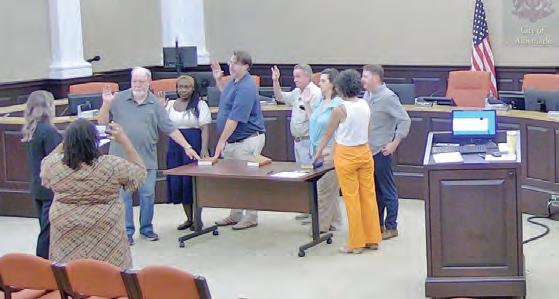
bemarle Historical Resources Commission swore in its commissioners and selected a new leadership slate during its July 14 meeting at City Hall.
Stephen Trudeau, Daniel Beck, Jayda Contreras, Razan Brown, Lori Baucom, Ronald Perine and John Williams took the oath of office for the 2026-27 term. Commissioners Benjamin Lisk and Lauren Wagoner were absent from the meeting. All nine seats on the commission are currently filled
heading into the new term.
The commission is a city-appointed board charged with helping preserve the historic character of Albemarle and its extraterritorial zoning juris-
diction. Its work includes making recommendations involving local historic districts and broader beautification efforts. City guidelines require members to live within Al-
bemarle’s jurisdiction and demonstrate a special interest, experience or education in history, architecture, archaeology, landscape design, horticulture, city planning or a closely related field.
The commission entered the new term with a revised membership that had begun taking shape by its June 9 meeting. Former Chair Tim Johnson and Commissioner John Crawford completed their second terms June 30 and were ineligible for reappointment.
The Albemarle City Council appointed Perine and Contreras on June 15 to replace Johnson and Crawford on the board.
Following the swearing-in ceremony, Albemarle Planning
The mobile pharmacy will visit Albemarle on Aug. 14
By Jesse Deal Stanly News Journal
ALBEMARLE — Stanly County residents can receive free over-the-counter medications next month as NC MedAssist’s Mobile Free Pharmacy returns to Albemarle.
Atrium Health Stanly and NC MedAssist are scheduled to hold an over-the-counter medicine giveaway and community event from 9 a.m. to 2 p.m. on Aug. 14 at the E.E. Waddell
Community Center, located at 621 Wall St.
The event is open to all North Carolina residents. Participants must be 18 or older to receive medication, but adults may also pick up items for family members. Walk-ins are welcome, and no registration, identification, proof of residency or income verification is required.
Available products are expected to include pain relievers, cold, cough and allergy medications, digestive aids, vitamins and children’s
help us spread the word so more families in our community can take advantage of this valuable resource.”
THE STANLY COUNTY EDITION OF NORTH STATE JOURNAL
President Donald Trump, Secretary of Defense Pete Hegseth and others salute as a U.S. Army carry team moves a transfer case containing the remains of Staff Sgt. Michael Emmanuel Swinton of Fayetteville on Wednesday at Dover Air Force Base in Delaware. Swinton was killed last Sunday in Iraq.
COURTESY CITY OF ALBEMARLE
Albemarle Historic Resources Commission members were sworn in at their July 14 meeting.
OpenAI says its AI technology acted on its own in ‘unprecedented’ hack of another company
The system discovered a previously unknown vulnerability to cheat the evaluation test
By Matt O’Brien The Associated Press
CHATGPT MAKER Ope-
nAI said Tuesday that its artificial intelligence system hacked into another AI company on its own in what the company called an “unprecedented cyber incident.”
“We had a significant security incident during evaluation of our models,” OpenAI CEO Sam Altman said in a statement posted on social media.
AI startup Hugging Face said last week that it had detected an intrusion into its data processing systems that it suspected was caused by an AI agent autonomously acting on its own.
“We suspected last week’s cyberattack might have come from a frontier lab, given the sophistication of the agent,”
CRIME LOG
July 13
• AJ Stevenson, 28, was arrested for obtaining property by false pretenses and resisting a public officer.
• Barrett Wade Strickland, 52, was arrested for driving while impaired.
July 14
• Mikael Alexander Marshall, 23, was arrested for misdemeanor larceny and injury to personal property.
• Brian James Moss, 51, was arrested for driving while impaired and reckless driving to endanger.
• Robert Lukus Tucker, 32, was arrested for possession of a firearm by a felon, possession of methamphetamine and maintaining a vehicle or dwelling for controlled substances, and other charges.
• Justin Marquise Johnson, 35, was arrested for simple assault and misdemeanor crime of domestic violence.
“AI is accelerating the discovery and exploitation of vulnerabilities.”
OpenAI
Hugging Face co-founder and CEO Clément Delangue said in a statement. “Turns out it did!”
The disclosure comes amid heightened concerns about the cybersecurity capabilities of powerful models that led President Donald Trump in June to sign an executive order creating a framework for the federal government to vet the national security risks of the most advanced AI systems for up to a month before their public release.
“AI is accelerating the discovery and exploitation of vulnerabilities,” OpenAI said in its statement Tuesday. “The primary lesson from this incident
• Martavis Devontae Crouch, 32, was arrested for driving while impaired, failure to stop for property damage and reckless driving to endanger, and other charges.
• Arnold Eugene Ritchie, 62, was arrested for driving while impaired.
July 15
• Isabella Marie Sturdivant, 20, was arrested for simple assault and misdemeanor crime of domestic violence.
• Darrell Levette Sturdivant, 34, was arrested for assault by strangulation, assault on a female and misdemeanor crime of domestic violence.
• Brandon Lee Johnson, 30, was arrested for misdemeanor larceny.
• Heather Miranda Puckett, 37, was arrested for domestic criminal trespass.
• Mack Ethan Drye, 33, was arrested for possession of methamphetamine,
is that model security and safety must keep pace with rapidly advancing capabilities.”
Delangue said he spent the past 24 hours working with OpenAI, “and we strongly believe there was no malicious intent on their part. It’s quite mind-blowing that all of this happened autonomously!”
Delangue added that it “might be the first incident of its kind.”
OpenAI said the intrusion was caused by a combination of its AI models, including its newly released GPT-5.6 Sol and an “even more capable” model that is still being tested internally.
OpenAI said its AI used stolen credentials and discovered a previously unknown vulnerability to access Hugging Face servers. It went to “extreme lengths to achieve a rather narrow testing goal” and “found ways to gain access to secret information that it could use to cheat the evaluation,” the company said.
possession of drug paraphernalia and maintaining a vehicle or dwelling for controlled substances, and other charges.
July 16
• David Thomas Wilson, 65, was arrested for possession of methamphetamine and possession of drug paraphernalia.
• Kevin Lamonte Pemberton, 49, was arrested for driving while impaired, driving on a revoked license and resisting a public officer, and other charges.
July 17
• Amy Catherine Cunningham, 52, was arrested for felony breaking and entering, misdemeanor larceny and larceny by changing price tag.
• Jose Isabel Mata Rosales, 38, was arrested for driving while impaired.
Here’s a quick look at what’s coming up in and around Stanly County.
July
26
Presidential Connections to Stanly County 4 p.m.
Local historian and author Lewis Bramlett presents on Stanly County’s surprising ties to U.S. presidents, part of the county’s America250 lecture series.
Central UMC Fellowship Center 172 N. 2nd St. Albemarle
Sonatas in the Sanctuary: A Classical Sunday Matinee 3-4 p.m.
Organist Michael Rowland and flutist Amy Orsinger Whitehead perform classical works in a free public concert. Childcare is provided.
First Presbyterian Church 126 W. North St. Albemarle
July 27
Locust Quilting 101 1:30-3 p.m.
The Stanly County Public Library offers interested parties the opportunity to take part in the community gathering and creative rhythm that is synonymous with the collective art form of quilting. Ages 18-plus and up are welcome. Limited seating means registration is required; and space can be reserved by calling 704-8 88-0103.
Stanly County Library 186 Ray Kennedy Drive
July 31
Live Music featuring Adam Daniels 7-10 p.m.
The singer and musician performs nostalgic hits from the '80s, '90s and 2000s. All ages are welcome; no cover charge. Tailgators Sports Grill 1788 W. Main St. Locust
THE CONVERSATION
Trip Hoffend, publisher | Frank Hill, senior opinion editor
VISUAL VOICES
COLUMN | SUSAN ESTRICH
The limits of merit
But I do want to spread it around, and that’s the problem.
THE NEW YORK City Public School system is 62% black and Hispanic. At its eight most prestigious competitive high schools, 80% of the students are Asian or white. Wait — what’s considered the most selective of the city’s schools, Stuyvesant High, 777 students were offered slots. Of those, how many (or should I say how few) went to blacks? Take a guess. It’s 2026, with equality for all. Three. And 21 offers went to Hispanic students, together with a one-third decline from last year’s freshman class.
The selections are entirely based on performance on a four-hour test in English and math, for which these incoming freshmen literally study for years. Proponents of the testing regime argue that it is entirely merit-based; opponents point to the results and argue that there is more to future success than can be measured by a four-hour test, and that the test itself is racially discriminatory.
I’ve always been a great fan of tests and merit systems, as I was a kid from a middle-class background with no special connections who was very good at taking tests and writing papers. Let the preppies inhabit their elites; I had better grades. My mother was a secretary, but I got into Harvard. I bartended my way through law school, but I made Law Review president. Merit, or what passed for that, got me the scholarships I desperately needed. They opened doors that otherwise would have been closed to me.
Asians make up 19% of all public-school students and 69% of those offered places at Stuyvesant. I celebrate those Asian families, many with first-generation children who study long
COLUMN | DAVID HARSANYI
Luddites are
Nationally, data centers consume significantly less water than golf courses.
hours to take their places at schools, which will open more doors to them. I don’t want to take away a system that rewards their incredible accomplishments and drive. But I do want to spread it around, and that’s the problem. Are New York’s leaders of tomorrow really going to learn what they need to in classes with — at most — three blacks in them? Won’t their educations be poorer as a result? And what of the opportunities these schools provide, not only for college but for future success? Can anyone really be comfortable with the disproportionate denial of those opportunities based on numbers that correlate with race? We need more blacks and Hispanics moving up the ladder, and so do they.
Mayor Zohran Mamdani, a graduate of one of those schools, Bronx Science, who at one point before he ran for mayor said the test should be abolished, now says the issue is a “struggle” for him. Mamdani’s two predecessors both condemned the test — Bill de Blasio called it a “monumental injustice,” and Eric Adams called it “a Jim Crow school system” — it’s the state legislature that would have to change it. The alumni groups are reportedly fierce in their opposition and have spent millions on lobbying efforts. They are full of people like me, and who am I to tell them they’re wrong?
And yet there’s something very wrong with the result — some things rather — and if we don’t dare talk about them, they will never change.
Susan Estrich is a lawyer, professor, author and political commentator. (Copyright 2026 Creators.com)
winning the data center debate
WHEN NEW YORK Gov. Kathy Hochul signed a one-year moratorium on new large-scale data centers via executive order, it became the nation’s first statewide ban.
It will likely be popular. Polls find widespread opposition to data centers, and the objections seem to be growing. Around 70% oppose the construction of a new artificial intelligence data center in their area, with 48% strongly opposed. Only 27% favor it. Even in Texas, the energy-rich state with the most data centers, Gov. Greg Abbott has called for a ban on new developments in rural areas.
The panic surrounding data centers is highly reminiscent of the panic surrounding hydraulic fracturing. Like the fracking ban in New York, also based on junk science and scaremongering — not to mention, initially a “moratorium” — the policy will backfire.
The economic case for data centers is indisputable. A single hyperscale facility brings in billions in capital investment, creates a slew of high-paying jobs from construction to engineering and ensures local governments are flush with tax revenue.
Big Tech bogeymen such as Microsoft, Google, Amazon and Meta upgrade local infrastructure and create secondary economies, often in struggling areas. Long term, these companies offer self-sustaining economic activity that the magical “green” industry never did or could.
In Loudoun County, Virginia, home of the largest concentration of data centers in the country, studies found revenue from AI infrastructure accounted for 95% of the county’s operating budget. That revenue has funded a $100 million plan for new schools in the county of 455,000 residents. Because energy price spikes have coincided with the data center debate, one of the major concerns you hear from people is that their utility bills will go up. The data doesn’t bear this out.
States with fast-growing electricity rates, such as California, have few data centers, while states such as Virginia, which lead the country in data center energy consumption, have seen electricity prices increase at the national average.
There’s considerable evidence that data centers have eased electricity rate hikes over the past decade, as companies took on a growing share of the utility costs, reducing the demand on residents.
AI infrastructure requires massive amounts of continuous power. Data centers are driving a rapid expansion in power generation. The solution to high energy demand isn’t to build fewer data centers. It’s to generate more energy.
Trepidation over AI also surely plays a role in concern over data centers. That’s a perfectly legitimate and important debate for society to have. The most emotional and effective attacks
on data centers revolve around environmental concerns.
The other day, popular WNBA player Sophie Cunningham asked: “So how do we save our farm land and stop all these dumb data centers?”
Save farmland? Data centers are predicted to use around 1,400 square miles of land by 2028. Farmland already uses 1.4 million square miles. There’s more than enough land for farms and data centers.
If anything, data centers might save farming communities. A large, self-perpetuating data center project in Farmville in rural Prince Edward County, Virginia, for instance, will optimize the land mass used by a small farm to the tune of a $5 billion investment into that community.
Data centers consume somewhere around 2% to 4% of total freshwater withdrawals, a tiny fraction compared to agriculture or manufacturing, mining or basically any other major industry. Nationally, data centers consume significantly less water than golf courses.
Not long ago, Rep. Alexandria Ocasio-Cortez (D-N.Y.) produced two jars with brown water at a congressional hearing, alleging that it was what “drinking water” looked like in Morgan County, Georgia, where a Meta data center project was underway.
Scary stuff.
Except earlier reports found only four households in the country had been stuck with sediment-clogged, brown or dry taps. Brown drinking water was not widespread, as Ocasio-Cortez had claimed. More importantly, construction projects that burst wells on occasion aren’t unique to data centers but rather to construction of all types.
In a major solar project in upstate New York, crews accidentally struck an aquifer while drilling not long ago. Does Ocasio-Cortez believe we should put a moratorium on solar panel projects?
If you care about the environment, you should also note that data centers facilitate considerable efficiencies elsewhere, such as remote work that reduces commuting emissions, better supply chain organization that cuts waste, and cloud computing that’s far more efficient than having everyone running their own servers.
The effective voices against data centers, after all, are the same Luddites who’ve spread environmental apocalypticism to stop modernization projects such as pipelines and power plants and fracking. Most of their arguments don’t hold water. That doesn’t mean they’re not winning.
David Harsanyi is a senior writer at the Washington Examiner. (Copyright 2026 Creators.com)
Oystercatchers, known for sharp bills and beady eyes, making a comeback thanks to conservation
A coordinated effort spanning 16 states has increased oystercatcher populations by 45%
By Michael Casey The Associated Press
SOUTH KINGSTOWN,
R.I. — On a pristine Rhode Island beach teeming with noisy seabirds, a group of biologists armed with nets sneak up on a pair of American oystercatcher chicks.
But just as they move in to capture them, one of the football-size birds, with bright-orange bills and long legs, scampers into a coastal salt pond. The other briefly takes to the air, sending the team running across the mile-and-a-half-long beach in pursuit.
“There is a problem. They can fly,” Alan Kneidel, a senior conservation biologist with the environmental group Manomet Conservation Sciences, said as he watched the team go after the chicks.
Eventually, the U.S. Fish and Wildlife Service biologists tracked down both birds. They bundled them each into white pillow cases and gingerly carried them to a sand dune where body measurements were taken and bands clipped onto their long, peach-colored legs.
Birds starting to recover
The banding in the 787-acre Trustom Pond National Wildlife Refuge is part of a nationwide effort to restore the oystercatcher’s population along the coasts of the Americas. The birds were largely wiped out in New England by the turn of the 20th century due to hunting and egg collecting, but their numbers are rising.
About $10 million was raised over a decade, and 35 coastal organizations in 16 states joined in the effort. Much of the campaign focused on educating beachgoers about the presence of the quirky birds known for their piercing calls and habit of using their razor-sharp bills to crack open oysters and mussels. Measures were also implemented to protect their ground nesting sites from predators and pets on beaches, sand dunes, salt marshes or tide wrack deposits.
From 2008 to 2023, oystercatcher numbers increased by 45% along the Atlantic and Gulf coasts. Their recovery is especially significant given a 2023 study found that most shorebird populations in North America were declining.
An adult oystercatcher is held at Trustom Pond National Wildlife Refuge.
“It’s amazing, and it’s a great conservation success story,” said Maureen Durkin, a federal wildlife biologist who led the banding effort and works at the Rhode Island National Wildlife Refuge Complex.
“It does really demonstrate how much you can accomplish when there is a dedicated group of partners that can come together and identify the needs of the species and implement conservation actions,” she said, adding that it also showed conserving imperiled species “is not easy and takes a sustained and committed effort.”
Targeting threats
Kneidel said a critical part of the conservation plan was determining that “chick survival was the big thing driving the declines.” Then, individually-tailored plans were drawn up from organizations in the American Oystercatcher Working Group, which was led by Manomet’s Shiloh Schulte, a conservation biologist and field scientist
who died last year in a helicopter crash in Alaska while on a mission to protect shorebirds. His initial aerial survey showed their numbers had declined by double-digits.
“At one site, it might be recreational disturbance, at another site it might be predators, at another site it might be sea level rise or loss of dune structure that’s causing overwash events that are causing nest failure,”
Kneidel said as he walked along the rocky Moonstone Beach, the sky filled with squeaking, least terns.
On Martha’s Vineyard, a low-lying fence with chicken wire is installed seasonally at the entrance of a key breeding site for oystercatchers and other seabirds and shorebirds, which has kept skunks and raccoons that eat their eggs off the beach. Colorful signs have also been installed educating the public about oystercatchers.
Focused attention on oystercatchers
The birds also benefit from federal protections given to piping plovers, a threatened shorebird that nests in some of the same areas. During the nesting season of piping plovers, vehicles and dogs are limited or banned near beach nesting sites.
“With a little bit of focused effort and attention on this really charismatic bird, you can teach the public how to share the shore,” said Luanne Johnson, a wildlife biologist who founded the nonprofit Biodiversity-
“With a little bit of focused effort and attention on this really charismatic bird, you can teach the public how to share the shore.”
Works, one of the groups working on the oystercatcher’s recovery. The island was the first place to have nesting oystercatchers in Massachusetts when they began to recover and has seen the numbers of breeding pairs increase 77% since 2009.
In South Carolina, nearly 30 breeding sites are roped off to protect nesting habitat. Georgia and North Carolina also rope off breeding sites along with trapping and euthanizing predators like foxes, raccoons and coyotes during breeding season.
“If you focus conservation efforts on a species, especially before it becomes endangered to the point that you’re considering listing, you can actually sort of head off trouble at the pass,” said Lindsay Addison, a coastal biologist with Audubon North Carolina, adding the state’s breeding pairs have increased nearly 20% to 403. Some birds, like Dark Green 06 and Yellow 25, were banded as far back as 2004 and have become minor celebrities.
Ted Simons, a retired emeritus professor at NC State who began studying the birds on North Carolina’s Outer Banks in 1995, said their recovery was a testament to the species’ resilience. He noted American oystercatchers have been found nesting on rooftops in the United States, and other oystercatcher species in Europe are nesting in pastures and eating worms. One pair, he recalled, was found nesting in a bus station pothole in Iceland.
“If these were really highly specialized birds that needed an exact prescription for survival, that would have been harder,” Simons said. “But what we found is that these birds are incredibly adaptive.”
Climate change, weakened protections pose dangers
Despite their strong recovery, threats remain.
Chief among the dangers is climate change that has led to rising seas and erosion washing out oystercatcher nests. That has prompted states such as Georgia to build elevated nesting platforms of oystershells for the birds and use dredged material from shipping channels to create and maintain nesting islands. Along the Cape Fear River in North Carolina, Audubon is replenishing shell rakes — beds of old oyster shells where the oystercatchers nest.
“Climate change, sea level rise — it’s a big challenge not only for oystercatchers but for all kinds of interests on the coast,” Addison said. “There’s going to be loss of habitat due to sea level rise, so we have to make sure that we do what we can to provide the habitat that we can so they can get through this next bottleneck.”
There are also concerns that changes this month to the Endangered Species Act could impact nesting sites, especially where state protections are weak. Environmental groups, which sued Tuesday to block the changes, fear breeding grounds could be disturbed by everything from vehicle traffic to unchecked development.
The changes would allow oil and gas drilling, mining, logging and other development on critical wildlife habitats so long as the animals themselves aren’t killed or injured. Environmentalists warned the move could cause some species to go extinct by opening the door to habitat destruction.
“It’s a direct attack on the protections that have allowed many of these shorebird species to recover,” Kneidel said.
JESSICA HILL / AP PHOTO
Shorebird Crew Lead Mary Bertschi of the United States Fish and Wildlife Service tracks down a juvenile oystercatcher that took off running at Trustom Pond National Wildlife Refuge in South Kingstown, Rhode Island, on Sunday.
JESSICA HILL / AP PHOTO
United States Fish and Wildlife Service Shorebird Monitor Allison Ruhl carries an adult oystercatcher at Trustom Pond National Wildlife Refuge.
JESSICA HILL / AP PHOTO
GIVEAWAY from page A1
medications. All items will be distributed while supplies last.
“North Carolina residents can receive free over-the-counter medications, including allergy medicine, cough and cold remedies, pain relievers, vitamins, children’s medicines and more,” Atrium Health Stanly and NC MedAssist said in a joint statement. “Please help us spread the word so more families in our community can take advantage of this valuable resource.”
Participants may preorder medications at medassist.org/ mobile through Aug. 7, unless the program reaches its maximum of 500 orders before then.
Preordering is optional and is intended to allow participants to select their items before arriving at the event. Online ordering opened July 14, and those who do not preorder may visit the community center during the event to select from available medications on-site that day.
Under the preorder guidelines, each adult participant may choose up to six items, with a limit of one item from
House Republican says Smith may have lied about Trump probe
NC MedAssist is teaming up with Atrium Health Stanly for a Mobile Free Pharmacy on Aug. 14.
each product category. Orders may also include up to two children’s items, limited to one item per child and one from each category.
Since 2018, Atrium Health Stanly and NC MedAssist have partnered annually to bring the mobile pharmacy to Stanly County. The program is supported through sponsorships and partnerships with community organizations, as some events also offer health services and connect visitors with local
agencies and other resources.
Founded in 1997 as North Carolina’s only statewide nonprofit pharmacy, NC MedAssist provides free prescription medications to uninsured state residents with low incomes while also distributing nonprescription health products through its OTC Free Store and Mobile Free Pharmacy programs. Additional information about the organization and its programs is available at medassist.org.
Republicans argue Jack Smith misled Congress by not sharing information on text messages
By Eric Tucker The Associated Press
WASHINGTON, D.C. —
A key Republican lawmaker says he believes special counsel Jack Smith may have lied to Congress while testifying about his investigation of President Donald Trump and that the Justice Department should consider prosecuting him. Lawyers for Smith deny the allegation and say he testified truthfully.
Rep. Jim Jordan of Ohio, the chairman of the House Judiciary Committee, referred Smith to the Justice Department on allegations he made false statements during closed-door testimony about whether he had obtained records of lawmakers while investigating Trump’s efforts to overturn his 2020 presidential election loss.
The referral, sent Wednesday, centers on a December 2025 exchange in which Smith was asked about subpoenas that prosecutors had issued for the toll records of some Republican lawmakers as part of the investigation. Toll records show the time, date, length of call and phone numbers involved but do not reveal the content of the communication.
“Did the toll records that you requested from the senators, did they include the content of the phone calls?” Smith was asked.
“No,” he said. He again answered no when asked whether the toll records he had requested included the content of text messages.
Jordan, in his referral, said the answer was misleading in light of newly released records from Republican Sen. Chuck Grassley of Iowa showing that Smith had obtained the contents of 44 lawmakers’ text messages in a separate subpoena to the National Archives and Records Administration that sought the communications of various Trump advisers and aides.
“The responses provided by Mr. Smith gave the impression that neither Mr. Smith nor his team had access to the content of Members’ privileged text messages. We now know this to be false,” Jordan wrote.
He said a false statement under the law can encompasses instances in which “the witness provides a half-truth or excludes information necessary to make statements accurate.”
In a letter to Jordan and Rep. Jamie Raskin of Maryland, the top Democrat on the Judiciary Committee, Smith’s lawyers called his answers “unimpeachably truthful” and noted that he was responding explicitly to questions about toll records, which did not include the contents of any text messages.
“The toll record subpoenas that were the focus of those questions did not call for the content of text messages,” wrote Smith’s lawyers, Peter Koski and Lanny Breuer. “The
“Congressional Republicans never asked Jack Smith about presidential records. Not during his 9-hour closed-door testimony or his 4-hour public hearing.”
Rep. Jamie Raskin (D-Md.)
questions and answers preceding and following these exchanges also make clear that the focus of the question was on the toll records subpoenas. Notably, the referral letter does not contest the truthfulness of Mr. Smith’s answers.”
Raskin said in his own statement that Jordan and House Republicans had “embarrassed themselves” with the referral and that Smith answered accurately when asked if the toll records subpoenas sought the content of lawmakers’ communications. He said Republicans were faulting Smith for not volunteering information he was not asked.
“Wishing that you had asked different questions while you had the opportunity to examine a witness is not a proper basis for a referral of a witness for criminal prosecution. Congressional Republicans never asked Jack Smith about presidential records. Not during his 9-hour closed-door testimony or his 4-hour public hearing,” Raskin wrote.
A criminal referral to the Justice Department from Congress or any other party has no legal authority and does not compel prosecutors to act. But the department under the Trump administration has proved to be eager to investigate and in some cases prosecute foes of the president. Smith is certainly one such adversary, with Trump having called him “deranged” and urging his prosecution.
“During his testimony, Mr. Smith provided truthful, responsive answers and candidly discussed his work as Special Counsel,” Smith’s lawyers wrote. “This referral reflects a chilling eagerness to weaponize the justice system by attacking a career, nonpartisan public servant who faithfully and fearlessly performed his duties by following the facts and the law.”
The Justice Department in a statement Wednesday night confirmed receipt of the referral and said it “will investigate all evidence of criminal conduct.”
Smith charged Trump with conspiring to undo the election he lost to Democrat Joe Biden and with hoarding classified documents at his Mar-a-Lago estate in Palm Beach, Florida, after his first term in the White House. Smith abandoned both prosecutions after Trump’s election win in November 2024, citing longstanding Justice Department opinions that say sitting presidents cannot face federal indictment.
Smith resigned from the Justice Department in early 2025, 10 days before Trump was inaugurated again.
COURTESY NC MEDASSIST
side the Box: How Constraints Make Us Better,” he began to shift away from his maximalist tendencies. Now, he limits his opportunities for making choices, such as when he bought 10 of the same well-fitting T-shirts in different colors.
Endless options paralyze decision-making and leave people less satisfied with their choices
By Albert Stumm The Associated Press
JEANS THAT fit perfectly. The ideal Netflix show for a Tuesday night. Your one and only soulmate. Modern life promises that with enough options, you will happily find the best of everything.
But behavioral scientists say the increasing flood of choices — whether it comes to shopping, social lives or relationships — is doing the opposite.
The idea that more choice is better is baked into Western culture, but research shows that having more options can make people anxious, indecisive and, paradoxically, less happy with what they pick, said Barry Schwartz, an emeritus psychology professor at Swarthmore College and author of “The Paradox of Choice.”
“There have been hundreds of studies showing that there can be too much of a good thing,” Schwartz said.
To minimize the mental noise, he said, limit the number of choices you make, and your brain will thank you for it.
More is often more confusing
Schwartz offered several ex-
amples of cases where more options left people worse off.
In the case of Medicare Part D prescription drug plans, people in states with more choices were less likely to choose any of them, he said. The same goes for 401(k) investments. The more options a company had, the less likely employees were to sign up, even when the employer offered matching money. Less consequential choices are no different. Schwartz pointed to one often-cited study that showed shoppers at a gourmet grocery store bought more jars of artisanal jam when they were presented with six flavors rather than with a wider array of 24. In a follow-up study, students were more likely to complete an extra-credit assignment when they were given six topics to choose from instead of 30.
Schwartz’s research expanded on those findings to learn the emotional responses to this phenomenon.
“Instead of being liberated by all this choice, you’re paralyzed,” he said. “You can do anything, and you can’t figure out which of those many things to do.”
People also often end up making worse decisions since more options suggest more potentially bad outcomes, he said. And once someone finally decides from all the possibilities, they may be less satisfied with even a good choice because they fear there was a better alternative.
Schwartz said the satisfaction problem is especially acute for people whose aim is to get the best, whom psychologists call maximizers.
“People who are maximizers especially suffer from the proliferation of options,” he said. “Only the best will do.”
The tendency isn’t true for all people in all situations, Schwartz noted. Car buffs will gladly dive into the details of nearly unlimited choice when buying a new one.
“But you don’t feel that way when it comes to buying jam,” he said.
The brain doesn’t like making decisions
Daniel Willingham, a psychology professor and neuroscience researcher at the University of Virginia, said the phenomenon occurs because the brain is designed to save
people from having to think.
Problem-solving requires more energy than relying on memory, a fact that has roots in evolutionary survival mode, Willingham said. When faced with a goal, whether it be an immediate need like responding to a threat or something longer term like finding shelter, the mind first searches for what’s worked before. The problem-solving part of the brain only kicks in afterward.
“Another way to put it is that if you’re thinking, things are not going well,” he said. That explains why sometimes people move through parts of their day on autopilot, he said. Throughout the day, people are confronted with hundreds of situations where they could do something different, but they almost always take the same route to work.
Schwartz said the proliferation of choices also has become tangled with identity in the social media age, where everyone can easily compare their choices to others.
“When all you’ve got to choose from is Lee’s and Levi’s, nobody expects the jeans they buy to fit perfectly,” he said. “When there are 2,000 options, well, now, dammit, you do expect your jeans to fit perfectly.”
Limit your choices and move on
David Epstein said that after researching his book, “In-
He was following the example of Herbert Simon, a psychologist and 1978 Nobel laureate in economics, who had three sets of clothes and ate nearly the same thing every day. Simon introduced the term “satisficing,” a combination of satisfying and sufficing that means setting good-enough criteria for decisions and moving on.
Epstein sets satisficing rules for himself when shopping online by first focusing on the purpose of the purchase.
“When I find one that does that, I’m buying it, instead of reading all the reviews and getting sucked into, ‘Well, this one has all these other features.’” Willingham and Schwartz suggested farming out some decisions. If you’re looking for a new phone, find a friend who is happy with theirs and buy that one.
For larger decisions like financial planning, you’ll be happier if you rely on someone else’s professional expertise, Willingham said.
“If you’re thinking, ‘Well, I’m a clever guy, I can figure that out,’ I think 9 times out of 10, you’re fooling yourself,” he said.
Schwartz acknowledged that for people who have trouble making decisions, changing is difficult. But it’s worth it.
“What happens over time is you find it easier to make decisions, you end up more satisfied with the decisions you make, and all of a sudden, you’ve got an extra two hours in every day,” he said.
Democrats seize on AI data center backlash that’s dividing rural Republicans in places like Texas
Environmental concerns about AI data centers are fracturing Republican support in rural communities
By Marc Levy The Associated Press
AMARILLO, Texas — When Gina Hinojosa, the Democratic nominee for Texas governor, began her campaign last year, candidates weren’t talking about — or hearing about — data centers that power artificial intelligence.
But with barely three months until November’s contest, the perceived threat to rural life, ranchland and dwindling water supplies could become a defining issue for her long-shot challenge to Republican Gov. Greg Abbott, dividing conservative rural areas that have traditionally served as a counterweight to Democrats’ urban strongholds.
The backlash to energy-guzzling server warehouses is also shaping other statewide campaigns from Arizona to Ohio to New York, and even giving Democrats a glimmer of hope in Texas, where Republicans have dominated for three decades.
“There is this little issue that I recently started hearing about that I wanted to tell you about, in case you don’t know,” Hinojosa quipped to a Democratic Party-organized crowd of about 160 seated on fold-out chairs at an Amarillo social club in Texas’ panhandle. “It’s this issue of data centers.”
The crowd booed, and she went on: “They are owned by the richest men in the world. We’re all footing the bill. There are no rules. It is the wild west of data centers.”
The fast growth of massive data centers has already upended races for local offices across the country, often uniting conservatives and liberals in revolting against projects in their midst.
People don’t like the secrecy surrounding the projects or the prospect of air, noise, water and light pollution. They fear electric bills going up, wells going dry and losing open space, farmland or forest.
Now the ripple effects have spread to top-of-the-ticket races, where incumbents and challengers are trying to show that they hear an angry electorate.
In Ohio, Democratic nominee Sherrod Brown aired a television advertisement attacking Republican U.S. Sen. John Husted as the “face of data centers in Ohio” as people gather signatures for a statewide referendum to outright ban their construction.
In Wisconsin, a Democratic candidate for governor, Francesca Hong, is pledging to “tax the rich, fund our schools and stop AI data centers” as she campaigns for her party’s nomination in a crowded primary.
In Pennsylvania, Democratic Gov. Josh Shapiro is facing heat from some voters who feel like he’s been too welcoming to tech behemoths. Sam Burleigh, a Democrat whose rural community is fighting off data center projects, accused Shapiro of “allowing these data centers to come in and take over acres and acres of prime farmland.”
Texas fertile ground for data centers
Any political unrest may be felt most acutely in Texas.
The state is poised to overtake northern Virginia as the largest global data center market by 2030, according to a report by commercial real estate giant JLL. It has lots of land, lots of energy and a friendly regulatory environment under Republican leadership.
In rural west Texas and its panhandle, gargantuan data centers are under construction, including one near Amarillo touted as the world’s largest. Some come with designs for natural gas-fired turbines to power them.
Rumors are flying about others popping up — Google, which is building four data centers in northwest Texas, sponsored moderated conversations with officials and business elite in Lubbock and Amarillo in recent weeks — and it is sowing an outcry across small cities, tiny towns and sprawling ranches where people vote overwhelmingly Republican.
Google says its investments are advancing American innovation, fortifying cybersecurity and boosting energy capacity, while President Donald Trump has made data centers a top priority to help the U.S. compete against China for AI superiority.
But tech giants and develop
ers can be secretive about their plans, making it impossible to know what will be built or what sort of pollution they’ll create, critics say. Some worry that data centers will destroy rural Texas’ low cost of living, sully sunsets and sweeping views that stretch toward the horizon.
Others say construction and an influx of workers are already causing havoc for ranchers and towns, driving up rents, snapping up farmland, illuminating the night sky, clogging roads and turning parts of rural Texas into industrial zones.
Opposition crosses partisan divide
Democrats are prominent among the data center critics, but so are Republicans, includ-
“They are owned by the richest men in the world. We’re all footing the bill. There are no rules. It is the wild west of data centers.”
Gina Hinojosa, Democratic nominee for Texas governor
ing Texas’ sitting agriculture commissioner, Sid Miller. They say there are many more Republicans who are quieter because they fear publicly opposing their governor and party.
“They’re upset with Greg Abbott,” said Suzanne Bellsnyder, a former Republican activist from Spearman who writes a syndicated column that advocates for rural Texas. “Whether that translates into voting against him, I don’t know.”
Abbott has aggressively advocated for big projects in Texas, and in November, he helped make Google’s announcement of a $40 billion investment there, saying “Texas is the epicenter of AI development.”
Compounding that, Texas counties don’t have zoning authority — precisely the local land planning authority that communities around the country are increasingly using to fight off data centers.
Abbott seems to recognize
that data centers are dividing his base. In recent weeks, he ordered regulators to take steps to ensure Texans weren’t paying higher electricity bills because of data centers and promised to push a legislative agenda next year to impose regulations on data centers.
At an East Texas campaign stop, Abbott said that includes taking away the state’s billion- dollar-plus-per-year tax break and preventing data centers from being built in “rural Texas neighborhoods.”
Hinojosa and others derided Abbott’s words about “rural Texas neighborhoods” as meaningless — “doublespeak that makes no sense to anyone,” Hinojosa said — and lacking urgency or seriousness.
“Now we have this gold rush of data centers in our communities,” Hinojosa said in an interview, adding that “people want a say, and I think that’s fair.”
As governor, she said she’d block a permit for a data center if it wasn’t a good deal for Texans or residents hadn’t gotten a say in the matter.
Abbott tries to soothe concerns
Abbott’s campaign season turnabout on data centers doesn’t seem to have soothed many.
Of great concern is the prospect that data centers will consume massive amounts of water
and worsen drought conditions for ranchers and farmers in a state where water shortages already crippled the sugar cane industry.
“Oh, I guarantee you, it’s on everybody’s mind,” said Giles Dalby, a cattle rancher and a Republican county commissioner in west Texas.
Dalby, who raises Angus and Brangus cattle on ranchland that’s been in his family for 125 years, pointed to fast-growing cities where water authorities have had to go to greater lengths to procure water, including the “water wars” between San Antonio and ranchers several years ago.
Texas is increasingly steamrolling over landowner rights in the quest for public water, Dalby said, and that could mean that data centers get in line ahead of ranchers when shortages or rationing worsen.
Clayton Tucker, a rancher and the Democratic nominee for state agriculture commissioner, said his campaign events are consumed by talk of data centers. It doesn’t matter whether he’s meeting with Democrats or Republicans.
“This is the most cross-partisan issue I’ve ever seen in my life,” Tucker said.
Meanwhile, protest groups are springing up, including one in Lubbock that is led by Republicans. The founders, Stephen Sanders and Hallie Bertrand, like some other Republican opponents of data centers, say it’s possible or even certain they won’t vote for Abbott, although they may not necessarily vote for Hinojosa.
There is still time for Abbott to push through major legislation before the election and “be a hero,” Sanders said.
The big question is whether enough rural voters will turn against Abbott to give Hinojosa a shot. It’s hard to tell, Bertrand said, especially when some know nothing about the issue.
“They’ll just hit that button, Republican all the way down,” Bertrand said. “But I think it’s a step towards something that we have not seen in Texas in a long time, with people on the right switching to the left. Or scooting a little closer to the middle, maybe.”
JUSTIN REX / AP PHOTO
Attendees listen as Democratic candidate for Texas governor Gina Hinojosa speaks at a campaign rally last Saturday in Lubbock, Texas.
JUSTIN REX / AP PHOTO
A future data center, pictured during construction last Saturday, is being built near Abernathy, Texas in Hale County.
JUSTIN REX / AP PHOTO
Democratic candidate for Texas agriculture commissioner Clayton Tucker speaks at a rally last Saturday in Lubbock, Texas.
Eagle Scout goes back to school with outdoor learning area project
By Dan Reeves Stanly News Journal
LOCUST — When Ethan Tarlton first heard about Cub Scouts, he was in elementary school, sitting in a gymnasium as volunteers explained camping trips, service projects and the promise of adventure.
“I thought, ‘Oh, this sounds so cool,’” Tarlton said. “From then on, I kept coming to every meeting.”
He started as a Wolf in Cub Scouts and never looked back.
Years later, Tarlton has earned the rank of Eagle Scout — the highest honor in Scouting America — becoming the first Eagle in his family. Both of his grandfathers were involved in scouting, but neither reached the rank.
That legacy made the moment meaningful. So did the people who helped him along the way — especially his mother.
“She’s a treasure for our troop,” Tarlton said. “She’s always been there to do a lot of the back-end things. We needed help, and she fulfilled that. I’m grateful for that.”
For Tarlton, scouting was never just about merit badges or camping trips. It was about community.
“What’s meant the most was definitely the community that I gained from this,” he said. “I can see all these people, and I know them by face. I know them by name. It’s given me people to rely on and people to celebrate.”
“I can see all these people, and I know them by face. I know them by name. It’s given me people to rely on and people to celebrate.”
Eagle Scout Ethan Tarlton
Two of the friends who stood by him during his Eagle ceremony have been with him since the beginning.
“It’s been great,” he said. When asked which point of the Scout Law resonates most, Tarlton didn’t hesitate.
“For me, the most important thing is for a Scout to be brave,” he said. “Because bravery is what enables you to go the extra mile and learn these new things.
I think it’s what really sets things in motion.”
For his Eagle Scout service project, Tarlton chose to give back to the elementary school he once attended. The idea came when the school requested help cleaning out an alley area on campus. He saw an opportunity.
“I realized, ‘Hey, I have an Eagle project to do,’” he said. “I’ve always wanted to help out that school.”
Planning the project took nearly two years.
“I was very particular,” he said. “It was a journey. It was tumultuous. It took time.”
The hands-on execution lasted a month or two and resulted in improvements designed to benefit students, including space for outdoor learning. He completed the work just as the school year ended, so he hasn’t yet seen it fully utilized.
“Hopefully, now that school starts back up again, we’ll see a bit more liveliness,” he said.
Next up: NC State University.
Tarlton plans to enter the engineering program with an eye toward computer science, a passion shaped in part by his father.
“My dad was always into computers,” he said. “By extension, I’ve always loved computers. I knew I wanted to be an engineer, so going to the engineering program at NC State was a no-brainer for me.”
He’ll live on the main campus and already has connections there, including a former Eagle Scout from his troop now studying engineering.
Outside the classroom, Tarlton enjoys programming, video games, hiking and cycling — interests rooted in both technology and the outdoors. He also played mandolin for several years and earned awards for it. He also spent time on the soccer field.
From a Wolf Scout in a school gym to an Eagle Scout heading to Raleigh, Tarlton’s path has been steady and deliberate — built on service, community and a willingness to be brave.
OFFICERS from page A1
Manager Brittani McClendon opened nominations for the commission’s three officer positions.
“The next item on the agenda is officer elections,” McClendon said. “We need to elect a chair, vice chair and secretary, given the new position that was created.”
Each position received only one nomination, and all three selections were approved unanimously. Williams nominated Trudeau for chair, Beck nominated Williams for secretary, and Baucom nominated Beck for vice chair.
“We have elected Stephen
“We need to elect a chair, vice chair and secretary, given the new position that was created.”
Brittani McClendon, City of Albemarle planning manager
Trudeau to be the chair, Daniel Beck to serve as vice chair, and John Williams to serve as the secretary,” McClendon said. Trudeau had previously served as vice chair, while Beck had served as secretary.
Later in the meeting, com-
missioners voted to cancel their regularly scheduled Aug. 11 meeting because no trained city staff members will be available to support the board.
Members also discussed whether to shift from monthly meetings to a schedule of every other month or once per quarter; the commission typically meets on the second Tuesday of each month.
No vote was taken on a potential schedule change. However, commissioners plan to continue discussing how frequently the board should meet.
The commission’s next regular meeting is scheduled for 6 p.m. Sept. 15 in the City Hall Council Chambers.
COURTESY COURTESY ROSS GOSSE
Ethan Tarlton stands in front of the outdoor learning area he created as his final Eagle Scout project.
STANLY SPORTS
North Stanly players earn Perfect Game MVP honors
Ryder Sheffield and Brody Parker were recognized after standout performances
By Jesse Deal Stanly News Journal
NEW LONDON — Two North Stanly baseball standouts were awarded as the most valuable players at Perfect Game tournaments this month following their performances with their respective travel teams.
Rising sophomore Ryder Sheffield was selected as the
MVP of the 2026 15/16U Perfect Game Coastal Summer Invitational, held July 3-5 at Wesleyan Christian Academy in High Point. The Comets shortstop collected 12 hits for South Charlotte Panthers 2029 National as the Panthers advanced to the tournament championship game. His performance included four doubles, six RBIs, four runs scored and three stolen bases. Sheffield, a member of the 2026 North Carolina Baseball Coaches Association All-Region 6 Team, also drew one walk and recorded one sacrifice bunt
Pfeiffer releases
The Falcons prepare for new soccer, volleyball and cross-country seasons
By Jesse Deal Stanly News Journal
MISENHEIMER — Pfeiffer University has announced its 2026 fall sports schedules, outlining the Falcons’ upcoming opponents in soccer, volleyball and cross country.
Led by 10th-year coach Tony Faticoni, the men’s soccer team will play two late-August scrimmages before opening the regular season Sept. 1 against Guilford at Lefko-Mills Field.
Pfeiffer begins USA South Athletic Conference play at home Sept. 26 against N.C. Wesleyan.
The Falcons enter the fall after an undefeated 2025 campaign in which they finished 13-0-4 overall and led the conference standings with a 5-0-2 record. Pfeiffer advanced to the USA South Tournament championship before finishing as the runner-up to Methodist.
Fourth-year coach Acasio Roche III and the women’s soccer team will also begin with two scrimmages before traveling to Danville, Virginia, for a Sept. 1 regular-season opener against Averett.
Pfeiffer opens conference play Sept. 20 at William Peace in Raleigh. The Falcons are coming off a 2-12-1 season in which they placed ninth in the USA South with a 1-7-1 record. In each of the past five seasons, the program has been limited to three or fewer victories.
without striking out during the event.
He finished with a Perfect Game hitting score of 52.65.
“Congratulations to Comet Ryder Sheffield on being named the Perfect Game tournament MVP,” the North Stanly Booster Club said. “Hard work, dedication and a phenomenal tournament led to a well-deserved honor. We’re proud of you!”
South Charlotte earned victories over New Market Baseball 16U and SBA NC East-Dickens during the tournament before facing Dirtbags National 2029 in the championship game. The
17
The number of combined hits by Comets in recent Perfect Game tournaments
Dirtbags secured the title with a 9-4 victory, leaving the Panthers as tournament runners-up.
A week later, rising Comets junior Brody Parker received his MVP award at the 2026 15U Perfect Game Wood Bat Clas-
sic (AA), held July 11-12 at York Comprehensive High School in York, S.C. Parker helped the Carolina Trash Pandas complete an unbeaten tournament run and claim the championship.
He recorded five hits, including a double, while driving in 10 runs and scoring four times. Parker also drew four walks, finishing the event with a Perfect Game hitting score of 44.32.
“Congratulations to Brody Parker on being named a Perfect Game tournament MVP,” the North Stanly Booster Club added. “An incredible performance at the plate! Keep swinging it, Brody!”
The Trash Pandas opened the event with a 6-1 victory over CBC Showcase Huss before defeating Arena Baseball 2029 by a 9-7 score, completing their championship run with a 7-3 win over 5G Prime Black in the title game.
2026 fall sports schedules
The USA South men’s and women’s soccer tournaments are scheduled for Oct. 31 through Nov. 7. In volleyball, fourth-year coach Heather Schoch will lead a Pfeiffer team searching for its first winning season since 2021. The Falcons approached that mark last year, finishing 15-16 overall and fifth in the conference with a 9-9 record before falling in the opening round of the USA South Tournament. Pfeiffer will open its season
Regular-season losses by Pfeiffer men’s soccer in 2025
Sept. 4 with matches against St. Mary’s of Maryland and Emory in Atlanta. Conference play begins Sept. 15 at Methodist
in Fayetteville, while the USA South Tournament is scheduled for Nov. 10-14. The men’s and women’s cross- country teams, led by fifth-year coach Bob Marchinko, begin their seasons Sept. 4 with the Pfeiffer Invitational in Misenheimer.
The Falcons will also compete in the NCAA South Regional Preview on Sept. 19 in Earlysville, Virginia; the Royals Cross Country Challenge on Oct. 9 in Charlotte; and the Up -
Lefko-Mills Field in Misenheimer is home to the Pfeiffer Falcons’ soccer and lacrosse programs.
state Invite on Oct. 17 in Spartanburg, South Carolina.
The USA South Championship is Oct. 31 in Brevard, followed by the NCAA South Regional on Nov. 14 in Earlysville and the NCAA Championship on Nov. 21 in Northfield, Minnesota.
Pfeiffer’s men won last year’s conference championship and placed third at the regional, while the women finished third in the conference and 20th at the regional.
North Stanly Comets baseball players Ryder Sheffield, left, and Brody Parker are Perfect Game MVPs.
How Italian sculptor created World Cup trophy that became iconic soccer prize
This year’s cup was the 14th to use the current design
By Niccolò Lupone
The Associated Press
MILAN — The Italian sculptor who designed the FIFA World Cup trophy wanted to capture three sporting emotions in a single spiraling form: the athlete’s struggle, the fan’s jubilation and the moment of victory.
On Sunday, Spain lifted the trophy after the 2026 World Cup final.
Here’s what to know about the most coveted prize in soccer. World Cup trophy designed in Milan
Silvio Gazzaniga designed the trophy in his studio in Milan’s Brera neighborhood after FIFA issued an open competition for a new design when Brazil took permanent possession of the original trophy by winning its third World Cup in 1970.
The design, now familiar to generations of World Cup fans, features two figures swirling up toward an orb representing the Earth.
“When he started to design the cup, he was sketching a huge number of drawings and finally started to develop the idea to have the world and this symbol that it is like a two DNA spirals, that are moving up,” said Giorgio Gazzaniga, the designer’s son who was a teenager at the time.
The elder Gazzaniga, a sculptor and trophy designer who died in 2016, worked for G.D.E. Bertoni Srl and created some of the most prestigious trophies in the world, including the UEFA Cup and European Super-Cup.
Previous trophy stolen, never recovered
The first World Cup Tro-
phy, introduced for the inaugural tournament in 1930, depicted the Greek goddess Nike and was known as the Jules Rimet Trophy, for the tournament’s founder. FIFA commissioned a replacement after Brazil earned permanent possession of the original after becoming the first nation to win three World Cups.
The Jules Rimet Trophy was stolen twice — first in 1966 while on public display in England, before being recovered by a dog named Pickles beneath a hedge in south London, according to FIFA. It was stolen again from the Brazilian Football Confederation headquarters in 1983 after Brazil had taken permanent possession. It has never been re-
covered and is widely believed to have been melted down.
More than 50 proposals were submitted, but only Gazzaniga presented a full model — which permitted the jury to appreciate both the form and the story it conveyed, his son said.
“There is the world, which stands above all else, there is the athlete’s exertion, there is the athlete’s movement within the metal, and the athlete’s body is rough, rugged, for it has suffered, had to fight, and struggled for victory,’’ the younger Gazzaniga said.
“That victory is expressed through arms that resemble the wings of Victory, capturing not only the athlete’s triumph but
also the jubilation of the fan,” he said.
Gazzaniga’s family has preserved his office at a new location on the outskirts of Milan, including drawings, the original prototype submitted to FIFA and a wax cast.
The official World Cup trophy hoisted by the winning captain at the end of the final is 14 inches tall cast in 18-carat gold, sitting on a base featuring two rings of green malachite, symbolizing the playing fields.
After the tournament, the original trophy goes back to FIFA, which keeps it at its Swiss headquarters between World Cups. The winning team brings home a gold-plated replica.
FIFA no longer lets three-time winners keep the original.
This is the 14th World Cup to use Gazzaniga’s design, and FIFA has decided to keep the trophy in use at least through the 2038 tournament, according to Gazzaniga’s website.
The younger Gazzaniga still vividly remembers watching the 1974 World Cup final at home with his family as West Germany faced the Netherlands. It was the first time his father’s trophy was presented at the World Cup.
“The real explosion of joy came when the German team raised the cup in Munich and the whole stadium erupted,” he said. “That was the moment an object became an icon.”
ACC looks to corporate sponsorships as way to boost bottom line of league revenue
Commissioner Jim Phillips continues to search for new
sources
By Aaron Beard
The Associated Press
CHARLOTTE — Jim Phillips has spent his five-plus-year tenure as Atlantic Coast Conference commissioner trying to generate more revenue for a league facing financial pressures even with yearly record hauls.
For his league — and across the national landscape in the revenue-sharing era, for that matter — that has included more emphasis on corporate sponsorships.
Finding event sponsors for naming rights. Securing deals for advertisements on conference TV networks. It’s all about looking for ways to sell those options and supplement the media rights payouts and earnings from postseason success that stand as core engines of the college financial system.
And stacking every bit helps in a time when schools are allowed to pay athletes directly.
“I don’t know if it’s pressure, but it’s the reality,” Phillips said during the league’s preseason football media days. “To me, it’s the reality of this role and it’s the reality of our league. We have to continue to find incremental dollars each and every year that continue to grow.”
That’s been a particular focus for Phillips, too, in dealing with a significant revenue gap behind the Big Ten and Southeastern Conference since his spring 2021 arrival.
The league reported about $826.5 million in total revenue in tax filings covering the 2024-25 sports season, with
schools earning a full distribution share getting an average of $47.1 million. That continued the ACC’s upward trajectory; the league reported $617 million for 2021-22 in Phillips’ first full season, good for a full-share average of $39.4 million. And Phillips said the league would crack $900 million in total revenue for the just-completed 2025-26 season.
By comparison, the Big Ten and SEC both crossed the $1 billion mark in total revenue in their 2024-25 filings, with the Big Ten paying an average of nearly $79.9 million to full-share members while the SEC came in at nearly $72.4 million.
The biggest way to move the needle for a league looking to change its financial picture typically is media rights contracts. The ACC is locked into a deal
“You can’t wait around, you can’t just kind of sit on your hands as it relates to some of these other areas and not fully explore and commit to finding those additional dollars.”
Jim Phillips, ACC commissioner
with ESPN — both for its base TV rights and the August 2019 launch of the ACC Network — through the 2035-36 season. The TV revenue continues to increase, but Phillips said at least some gains have come through corporate sponsorships,
such as investment manage-
ment firm T. Rowe Price putting its name on the men’s basketball tournament.
The ACC has doubled its list of corporate sponsorships to nine in the past five years, a list that includes Apple, Dr Pepper, Gatorade and Allstate. The league announced a deal with AI cybersecurity firm ReliaQuest, which includes advertising through ESPN, ESPN parent company Disney and the ACC Network.
That goes with other adjustments such as changes to the league’s revenue-distribution model to reward programs that generate higher TV viewership and the “success initiative” that allows schools to keep money generated by their own postseason success.
“You can’t wait around, you
can’t just kind of sit on your hands as it relates to some of these other areas and not fully explore and commit to finding those additional dollars,” Phillips said. “All of that stuff adds up incrementally.”
In its most recent report, SponsorUnited estimated that Power Four schools generated about $1 billion in corporate sponsorship revenue across roughly 6,300 deals for the 2025-26 season.
That equated to about $9.7 million per school in the ACC and $11.2 million for the Big 12. The SEC ($21.5 million) and Big Ten ($16.1 million) led the way, with the Big 12 as the only league lacking its own TV channel.
“There’s not a lot of places where you can go to an AD and say, ‘Look, I think we could potentially generate $5-10-20 million annually if we think differently about this side of the business and we can control it,’” Lynch said. “So it becomes a really intriguing space to look and say if we invest there, we could potentially extract a lot of dollars and generate a lot that we weren’t doing before.”
In the ACC’s case, that meant hiring Anthony Macri last September as its first chief revenue officer.
He’s helping schools in determining their own options on anything from patches on jerseys to arena signage. And unlike selling a finite number of tickets for an event, corporate sponsorships could offer layers of revenue options.
“We have a chance to really grow that area,” Macri said. “It’s been an underleveraged opportunity that has unlimited growth potential, so that gives us a lot of room to push on.”
LUCA BRUNO / AP PHOTO
Giorgio Gazzaniga, son of the late sculptor Silvio Gazzaniga, inserts the original plaster World Cup trophy sculpture into a wooden case.
AARON BEARD / AP PHOTO
Lin wins U.S. Girls’ Juniors in Durham
The Canadian topped Wake Forest recruit
Amelie Zalsman to win
Chatham News & Record staff
DURHAM — Clairey Lin of Canada won the U.S. Girls’ Junior Championship, beating Amelie Zalsman of St. Petersburg, Florida, 5 and 4 in the 36-hole final at Durham’s Old Chatham Golf Club.
The 16-year-old Lin, the stroke-play medalist, is the second straight Canadian winner. Aphrodite Deng won last year in Georgia.
“I’ve always wanted to be on the big stage and inspire some people and work hard and see it pay off,” Lin said. “To be able to do that today is amazing.”
The 17-year-old Zalsman is set to play for Wake Forest in 2027.
“I’ve played so much golf the past two weeks,” Zalsman said.
“I’m just really proud of myself for making it this far and my body, honestly, just sticking with me.”
“I’ve always wanted to be on the big stage and inspire some people and work hard and see it pay off.”
Clairey Lin
tie at 17th after shooting 69-72.
Wake Forest signee Vidhi Lakhawala tied for 28th at 72-70
Raleigh’s Jenna Kim shot 72-74 to qualify for match play, making the cut with one stroke to spare.
Cary’s Victoria Davis missed the cut by one shot, shooting 70-78. Pinehurst’s Riley Grimm shot 73-77 to miss.
Among other future players at North Carolina colleges to miss the cut, UNC Wilmington signee Kanchana Duangsam Rudd shot 74-78. Campbell’s Miah Rivas shot 75-76. Gardner-Webb recruit Ellie Benson shot 78-77. App State’s Addison Douglass shot 80-87.
The event combined two days of stroke play to determine the field of 64 for elimination match play, which occupied the rest of the week.
Lin shot a 66 on Monday and 65 on Tuesday to win the medal as the top scorer in stroke play. She missed the 21-year-old tournament record low score by one stroke.
Zalsman finished in a tie for seventh after stroke play, shooting 67-72 to finish eight shots back.
Southern Pines’ Maria Isabella Errichetto shot 73-68 to qualify for match play in a tie for 17th. Pikeville’s Ella June Hannant was part of the
Deng skipped her title defense to play in the Evian Championship last week in France.
Hannant won her opening match over Savera Sandhu, who conceded due to illness. Hannant was leading the match at the time. She then topped Keya Naik, 4 and 3, to move to the round of 16. It took 22 holes for her to top Japan’s Anna Iwanga to move to the quarterfinals, where Anna Bell eliminated her, 2 and 1.
Errichetto beat Korea’s Yisoo Min 4 and 3 to advance in the first round and topped Puerto Rico’s Sofia Rivera 4 and 2 to make the final 16. Her run then ended, 4 and 3, to Bell.
Lakhawala lost to Canada’s Shauna Liu in the round of 64, 2 and 1. Kim fell to Jude Lee in the first round, 3 and 2.
Special Olympics of North Carolina
Jamie Hathcock is a 49-year-old Special Olympian from Albemarle. In the Special Olympics of North Carolina Summer Games in Raleigh last month, he won three medals — bronze in the 100-meter dash, silver in the 100-meter walk and gold in the running long jump. That earned him a trip to Minneapolis, where he competed in the 2026 Special Olympics USA Games. He competed in three events in Minnesota and finished in the top five in all of them despite being a decade older than any of the competitors at the top of the leaderboards. He took fifth in the 100-meter dash with a time of 16.60 seconds, missing a medal by 0.72 seconds and gold by 1.14. He took fourth in the 50 meters with a time of 8.74 seconds, missing a medal by 0.29 seconds. Then he got fourth in the long jump, where he was double the age of any medal winners, with a leap of 2.84, only 0.06 away from a medal.
Fox makes birdie on final hole to claim British Open title
The 39-year-old won his first major
By Doug Ferguson The Associated Press
SOUTHPORT, England —
The hard work for Ryan Fox was just getting to the 18th hole in the British Open with a share of the lead. Still to come was the toughest hole at Royal Birkdale, which had yielded only four birdies to the 76 players who had already come through Sunday.
For a 39-year-old from New Zealand, the son of an All Blacks rugby star who once only dreamed of having a card on any tour, this was no time to back down.
“I did say to my caddie Dean (Smith) that we were going to take it on, that I was going to try
to win the tournament, and I’d live with the consequences if I stuffed it up,” Fox said. It turned out to be the stuff of major champions.
The drive was powerful and pure. The 9-iron from 175 yards looked good in the air and even better on the ground when it settled 12 feet below the hole. The birdie putt was the biggest of his life.
Fox closed with four birdies over his last six holes — and one bogey that felt equally important — for a 2-under 68 and a one-shot victory over hard-luck Cameron Young for his first major title.
This was pure theater to cap off a week of so much drama — three record-tying rounds of 62, Bryson DeChambeau’s animated protest over a two-shot penalty, Tommy Fleetwood thrilling and teasing his hometown
“I
was going to try to win the tournament, and I’d live with the consequences if I stuffed it up.”
Ryan Fox
crowd to massive ovations on every hole.
Four players had a share of the lead at some point in the final round. Young was atop the leaderboard for two hours without hitting a shot anywhere but the range because he finished his astonishing 6-under 64 as the last few groups were on the front nine.
Young was on the range when he heard the massive roar and knew it was over. He bowed
his head, lifted his driver and tapped the ground before packing up when Fox made his final birdie.
“Everyone practices on the green — you’ve got a putt to win a major championship, to win The Open. It’s not like that in real life. It’s not a very comfortable feeling,” Fox said. “It’s certainly very enjoyable when you see it go in.” He thrust those powerful arms into the air and on the phone with his family moments later. He was heard telling them, “You asked me to bring a trophy home, and I am, aren’t I?”
Sam Burns, the 54-hole leader, lost a two-shot lead and didn’t make birdie over the last 12 holes to finish two shots behind.
Defending champion Scottie Scheffler somehow managed to stick around until the end. He closed with a 67 and
shared fourth with Fleetwood.
Fox won for the 10th time worldwide. He is the oldest first-time major champion since Henrik Stenson was 40 at Royal Troon 10 years ago. Fox finished at 10-under 270.
“I’m not quite sure how I hit that putt on 18. Look, it is a dream come true,” Fox said. “Looking at that trophy now, it’s the first time I’ve seen it up close. So it’s pretty amazing.”
Fox was a late bloomer, a European tour rookie at age 30 and a PGA Tour rookie when he was 37. His goal when he started was to have a tour card. Now he’s a major champion.
“I said to my team last night at dinner, if you’d have given me my career up until yesterday when I turned pro, I’d have jumped at that,” Fox said, speaking with the claret jug at his side. “I don’t know what to think now.”
LOGAN WHITTON / USGA
Clairey Lin poses with the U.S. Girls’ Junior Championships trophy.
LATON ’S TREE SERVICE
NOTICES
NOTICE NORTH CAROLINA IN THE GENERAL COURT OF JUSTICE STANLY COUNTY SUPERIOR COURT DIVISION BEFORE THE CLERK 26SP000130-830 MARK T. LOWDER, Public Administrator for the Estate of CLAUDE JUNIOR HUNEYCUTT, Deceased, Petitioner, vs. UNKNOWN HEIRS, Respondents. NOTICE OF SERVICE PROCESS BY PUBLICATION TO: UNKNOWN HEIRS TAKE NOTICE that a pleading seeking relief against you has been filed in the above-entitled Special Proceeding. The nature of the relief being sought is as follows: Petition to Sell Real Estate to Create Assets including a House located at 1604 Liberty Avenue, Albemarle, Stanly County, North Carolina to make assets. You are required to make defense to such pleading not later than August 20th, 2026 and upon your failure to do so the party seeking service against you will apply to the court for the relief sought. A hearing shall be held at 10:30 A.M., September 2nd, 2026, before the Clerk of Superior Court, on the third floor in Courtroom #301, of the Stanly County Courthouse, 201 S. Second St., Albemarle, NC 28001. All interested parties should appear. This the 7th day of July, 2026.
MARK T. LOWDER M.T. Lowder & Associates P.O. Box 1284 Albemarle, NC 28002
704-982-8558
Publish: July 12, 19, and July 26, 2026
NOTICE NORTH CAROLINA, IN THE GENERAL COURT OF JUSTICE STANLY COUNTY SUPERIOR COURT DIVISION BEFORE THE CLERK 26E000331-830 NOTICE TO CREDITORS
The undersigned, having duly qualified as Executrix of the Estate of Teresa Meggs Whitley, deceased, late of Stanly County, North Carolina, is hereby notifying all persons, firms, or corporations having claims against said decedent, or her estate, to present the same to the undersigned Executrix, duly itemized and verified on or before the 19th day of October, 2026, or this notice will be pleaded in bar of their recovery. All persons indebted to the said decedent are hereby requested to pay the said indebtedness to the undersigned Executrix.
This the 14th day of July, 2026. Susan Whitley Harris Executrix of the Estate of Teresa Meggs Whitley 3023 Sandgate Ct. Cocoa, FL 32926 PUBLISH: July 19, 26, August 2, 9, 2026
James A. Phillips, Jr. Attorney and Resident Process Agent for the Estate P.O. Box 1162 117 W. North Street Albemarle, NC 28002-1162
The
NOTICE TO CREDITORS
The
NOTICE TO CREDITORS
NORTH CAROLINA STANLY COUNTY In the General Court of Justice Superior Court Clerk Before the Clerk 26E000302-830 Having qualified as Administratrix of the Estate of Ian Arthur Kleist, deceased, late of Stanly County, North Carolina, this is to notify all persons, firms and corporations having claims against the Estate of said deceased to exhibit them to the undersigned or her attorney on or before October 5, 2026, or this Notice will be pleaded in bar of their recovery. All persons indebted to said Estate please make immediate payment. This the 1st day of July, 2026.
DEIDRE MCEACHRAN ADMINISTRATRIX FOR THE ESTATE OF IAN ARTHUR KLEIST
MARK T. LOWDER
206 E. NORTH STREET PO BOX 1284 ALBEMARLE, NC 28002 RESIDENT PROCESS AGENT FOR THE ESTATE OF IAN ARTHUR KLEIST MARK T. LOWDER ATTORNEY AT LAW PO Box 1284
206 E. North Street Albemarle, NC 28002 Telephone (704) 982-8558
Publish: July 5, 12, 19, and 26, 2026
NOTICE
NORTH CAROLINA STANLY COUNTY IN THE GENERAL COURT OF JUSTICE SUPERIOR COURT DIVISION BEFORE
LEE RIVERS PO Box 1124 Albemarle, NC 28002 CHARLES P. BROWN BROWN & SENTER, P.L.L.C. PO Box 400 Albemarle, North Carolina 28002-0400 Telephone: 704 982-2141 Facsimile: 704 982-0902 PUBLISH: July 19, 26, August 2, and 9, 2026 NOTICE NORTH CAROLINA, IN THE GENERAL COURT OF JUSTICE STANLY COUNTY SUPERIOR COURT DIVISION BEFORE THE CLERK 26E000294-830
NOTICE
famous birthdays this week
Kinston’s Jaime Pressly is 49, Mount Pleasant’s Seth Avett turns 46, Roy Williams hits 76
The Associated Press
THESE CELEBRITIES have birthdays this week.
JULY 26
Former Australian Prime Minister John Howard is 87. Football Hall of Famer Bob Lilly is 87. Rock and Roll Hall of Famer Darlene Love is 85. The Rolling Stones’ Mick Jagger is 83. Actor Helen Mirren is 81. Actor Sandra Bullock is 62.
JULY 27
Singer-songwriter Bobbie Gentry is 84. Actor-director Betty Thomas is 79. Olympic gold medal figure skater Peggy Fleming is 78. Singer Maureen McGovern is 77. Comedian Bill Engvall is 69. Comedian Maya Rudolph is 54.
JULY 28
Music conductor Riccardo Muti is 85. Former senator and NBA Hall of Famer Bill Bradley is 83. “Garfield” creator Jim Davis is 81. TV producer Dick Ebersol is 79. Actor Sally Struthers is 79. Architect Santiago Calatrava is 75.
JULY 29
Former Sen. Nancy Kassebaum-Baker is 94. Former Sen. Elizabeth H. Dole is 90. Artist Jenny Holzer is 76. Documentary filmmaker Ken Burns is 73. Style guru Tim Gunn is 73. Rock singer-musician Geddy Lee (Rush) is 73. Country singer Martina McBride is 60. Actor Wil Wheaton is 54.
JULY 30
Former Major League Baseball Commissioner Bud Selig is 92. Blues musician Buddy Guy is 90. Actor and former California Gov. Arnold Schwarzenegger is 79. Actor Jean Reno is 78. Actor Laurence Fishburne is 65. Actor Tom Green is 55. Actor Jaime Pressly is 49. Alt-coun-
SCOTT A. GARFITT / INVISION / AP PHOTO
Actor Helen Mirren turns 81 Sunday.
SCOTT A. GARFITT / INVISION VIA AP
Rock icon Mick Jagger turns 83 Sunday.
try singer-musician Seth Avett is 46.
JULY 31
Jazz composer-musician
Kenny Burrell is 95. Actor Geraldine Chaplin is 82. Singer Gary Lewis is 81. Rock musician Bill Berry (R.E.M.) is 68. Jazz guitarist Stanley Jordan is 67. Musician Fatboy Slim is 63. Author J.K. Rowling is 61.
AUG. 1
Actor Giancarlo Giannini is 84. Basketball Hall of Fame
coach Roy Williams is 76. Blues musician Robert Cray is 73. Rock singer Joe Elliott (Def Leppard) is 67. Rapper Chuck D (Public Enemy) is 66. Rock singer Adam Duritz (Counting Crows) is 62.
Biden will publish ‘Promise Me, America’ memoir after November midterms
Reports of the book have circulated for more than a year
By Hillel Italie
The Associated Press
NEW YORK — Former
President Joe Biden will publish a memoir, “Promise Me, America,” which he says will touch upon everything from the economy to his decision to drop his bid for reelection.
The memoir is scheduled to come out Nov. 17, publisher Little, Brown and Company told The Associated Press. The timing of the book — two weeks after midterm elections in which Democrats seek to regain control of Congress — could raise concerns within Biden’s party by putting him back into the spotlight.
Democrats remain divided on Biden’s legacy, with many blaming his ill-fated determination to seek a second term for Republican President Donald Trump’s return to the White House. Leaders hope to keep the fall campaign focused on Trump and his record, and any leaks or promotional efforts before votes are cast could draw frustration.
“‘Promise Me, America’ is about the challenges we faced as a nation. It’s about the decisions I made and why I made them,” Biden said in a video statement accompanying last week’s announcement. “It’s about why I chose to run for reelection and why I chose to step aside.”
The former president has referred to the possibility of publishing a memoir during public remarks, appearing to suggest at one point that it would be released before November’s election.
Vowing as a candidate to “restore the soul” of his country, Biden was sworn into office in the midst of the COVID-19 pandemic and in the aftermath of the Jan. 6, 2021, attack on the U.S. Capitol by Trump supporters seek-
“It’s about why I chose to run for reelection and why I chose to step aside.”
Former President Joe Biden
ing to stop his certification as president. Biden’s term was defined by a wide range of conflicts and achievements, from his handling of wars in Ukraine and the Middle East to the passage of ambitious infrastructure and economic aid bills. But many readers will likely want to know more about his health while president, including the disastrous debate in June 2024 against Trump that led to his giving up his reelection bid. Biden was the oldest man to serve as president, and his health was a source of speculation for much of his term; Biden and his White House
advisers have faced intense criticism from Democrats and Republicans for allegedly concealing the extent of his problems. A notable book release from 2025, Jake Tapper’s and Alex Thompson’s “Original Sin,” was subtitled “President Biden’s Decline, Its Cover-Up, and His Disastrous Choice to Run Again.”
That year, Biden announced he had been diagnosed with prostate cancer.
A Little, Brown spokesperson said that Biden plans to tour on behalf of the book and give interviews. In his video announcement, Biden said that many people had been asking him how he was doing.
“I’ve been spending a lot of time with my family. I’m dealing with a cancer diagnosis, been getting treatment, and it’s going really well,” he said. “I want to thank all those who have offered their prayers and support and well-wishes. It’s meant the world to me and to Jill.”
Shakira, Madonna, Muppets take World Cup stage with BTS, Bieber
Jennifer Hudson, Post Malone and Tom Cruise opened the closing ceremony
By Andrew Dalton The Associated Press
MADONNA, Justin Bieber, BTS and Shakira each brought a bit of one of their hits to the World Cup’s first halftime show in a whirlwind performance Sunday that also squeezed in Burna Boy, Ted Lasso and many Muppets.
The show at what’s otherwise known as MetLife Stadium, outside New York, was an attempt to bring Super Bowl vibes to the World Cup, but the 11-minute performance was considerably more packed than the usual one-headliner, 13-minute American football counterpart.
Madonna opened the show with her 2000 dance-pop hit “Music,” joined by star Brazilian soccer players of yesteryear, Ronaldo and Ronaldinho. It started with an apparently prerecorded piece in a roller rink before she rode into the stadium on a dune buggy, singing, “Music, makes the people come together.”
Venezuelan conductor Gustavo Dudamel led an orchestra through the White Stripes’ sports anthem “Seven Nation Army,” while the Muppets’ house band — including drummer Animal in lieu of Meg White — provided furry shakes in the background.
K-pop sensations BTS took to the field in variations of red and black moments later singing “Dynamite” following a nod to Norway’s Viking row.
Promoting the upcoming season of “Ted Lasso,” Jason Sudeikis and Brendan Hunt, in character, pumped up Justin Bieber, who changed the tempo with “Everything Hallelujah,” performed with an acoustic guitar. “All right young man, let’s go! It’s your big shot!” Sudeikis said to Bieber. “Go out there, don’t be nervous, nobody’s watching.”
Shakira and Burna Boy followed with their official World Cup anthem “Dai Dai,” heard before all 104 kickoffs during this tournament. The Colombian superstar was barefoot, wearing a dress of yellow and pink feath-
ers and surrounded by similarly clad dancers — including a group of children — before the Afrobeats icon joined her in the song whose refrain is an Italian version of “Let’s go!”
The show wrapped with the PS22 Chorus of elementary-school students from Staten Island, backed by Dudamel and joined by Chris Martin — the Coldplay singer who curated the performance — along with Shakira and many more Muppets and “Sesame Street” characters, including Kermit, Miss Piggy, Count von Count and Cookie Monster. Dudamel and about 40 mu-
sicians — about half from the New York Philharmonic and half from Venezuela’s Simón Bolívar Symphony Orchestra — were on the field.
Jennifer Hudson, Robbie Williams and others performed a slew of anthems, Post Malone brought an old hit and a new tune, and Tom Cruise gave an earnest hype- em-up speech in the prematch closing ceremony. British singer and former Take That member Williams performed his FIFA anthem “Desire” wearing a blue bedazzled track suit. He was joined by Pussycat Dolls member Nicole Scherzinger and Italian singer
“Promise Me, America” by Joe Biden is set to be published in November by Little, Brown and Co. South Korean boy band BTS perform during the halftime show of the World Cup final soccer match between Spain and Argentina in East Rutherford, New Jersey, on Sunday.
Laura Pausini in blue spangled gowns. Next was Post Malone, who walked on to the New York/New Jersey Stadium pitch covered with a tarp showing the New York skyline.
Cruise, who was also part of the Paris Olympics’ closing ceremony, followed them with a speech delivered in polo shirt and jeans.
“Today only two teams remain: España!” Cruise said, pausing for cheers before adding, “y Argentina!”
“Let us celebrate a tournament that brought the world together,” he said.
ASHLEY LANDIS / AP PHOTO
LITTLE, BROWN AND CO. VIA AP
this week in history
Korean Armistice Agreement signed, Weimar Constitution adopted, MTV hits airwaves
The Associated Press
JULY 26
1775: The Continental Congress established an independent postal system and appointed Benjamin Franklin its postmaster general.
1847: The western African country of Liberia, founded by freed American slaves, declared its independence.
1863: Sam Houston, former president of the Republic of Texas, died in Huntsville at age 70.
JULY 27
1789: President George Washington signed a measure establishing the Department of Foreign Affairs, forerunner of the Department of State.
1866: Cyrus W. Field finished laying out the first successful underwater telegraph cable between North America and Europe.
1953: The Korean Armistice Agreement was signed at Panmunjom, ending three years of fighting on the Korean peninsula that killed an estimated 4 million people.
JULY 28
1794: Maximilien Robespierre and Louis Antoine de Saint-Just were executed by guillotine during the French Revolution.
1914: World War I began as Austria-Hungary declared war on Serbia.
1965: President Lyndon B. Johnson announced he was increasing the number of American troops in South Vietnam from 75,000 to 125,000.
JULY 29
1836: The newly completed Arc de Triomphe was inaugurated in Paris.
1858: The United States and Japan signed the Harris Treaty, formalizing diplomatic relations and trading rights between the two countries.
Dutch painter Vincent van Gogh died at 37 in Auvers-surOise, France, on July 29, 1890, two days after suffering a gunshot wound believed to have been self-inflicted.
1890: Artist Vincent van Gogh, 37, died of an apparent self-inflicted gunshot wound in Auvers-sur-Oise, France. 1914: Transcontinental telephone service in the U.S. became operational with the first test conversation between New York and San Francisco.
1921: Adolf Hitler became the leader of the National Socialist German Workers’ (Nazi) Party.
JULY 30
1619: The first representative assembly in Colonial America convened in Jamestown in the Virginia Colony.
1864: During the Civil War, Union forces tried to take Petersburg, Virginia, by exploding a gunpowder-laden mine shaft beneath Confederate defense lines; the attack failed.
1916: German saboteurs blew up a munitions plant on Black Tom, an island near Jersey City, New Jersey, killing about a dozen people.
JULY 31
1715: A fleet of Spanish ships carrying gold, silver and jewelry sank during a hurricane off
the east Florida coast; of some 2,500 crew members, more than 1,000 died.
1777: The 19-year-old Marquis de Lafayette received a commission as major general in the Continental Army by the Second Continental Congress.
1919: Germany’s Weimar Constitution was adopted by the republic’s National Assembly.
AUG. 1
1966: Charles Joseph Whitman, 25, went on an armed rampage at the University of Texas in Austin that killed 14 people, most of whom were shot by Whitman while he was perched in the clock tower of the main campus building.
1971: The Concert for Bangladesh, an all-star benefit organized by George Harrison of The Beatles and sitar player Ravi Shankar, was held at Madison Square Garden in New York.
1981: MTV began its American broadcast; the first music video aired on the new cable TV network was “Video Killed t he Radio Star,” by The Buggles.
PAUL JOSEPH DUMOUZA / PIERRE FRÉDÉRIC LEHNERT VIA WIKIPEDIA Paris formally unveiled the newly completed Arc de Triomphe on July 29, 1836.