NORTH CAROLINA
Farm Life
FALL 2026
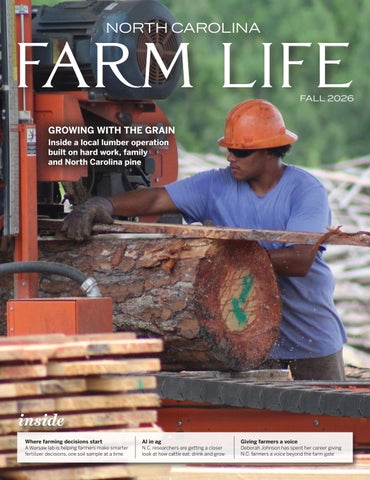
GROWING WITH THE GRAIN Inside a local lumber operation built on hard work, family and North Carolina pine
inside Where farming decisions start
A Warsaw lab is helping farmers make smarter fertilizer decisions, one soil sample at a time
AI in ag
N.C. researchers are getting a closer look at how cattle eat, drink and grow
Giving farmers a voice
Deborah Johnson has spent her career giving N.C. farmers a voice beyond the farm gate
ONE COMPANY. ENDLESS POSSIBILITIES. For more than two decades, Murphy Family Ventures has grown and evolved across hospitality, agriculture, technology, and more while staying true to our core values of loyalty, integrity, efficiency, work ethic, and family. Our continued success is powered by the hardworking employees who are the heart of MFV.
JOIN A TEAM THAT MAKES AN IMPACT ACROSS MULTIPLE INDUSTRIES.
w w w.murphy family venture s.com | 910 -285 -10 05 | Wallace, NC /M u r p hy F am i l y Venture s
/murp hy_ family_ venture s
Contents FALL 2026 PUBLISHER
SALES REPRESENTATIVE
Trip Hoffend
Patsy Teachey
EDITORIAL
DESIGN
Senior Editor Cory Lavalette
Design Editor Lauren Rose
Editor Ena Sellers Contributors Dan Reeves, Melinda Burris, Curt Simpson, Rebecca Whitman Cooke, Mark Grady
North State Media 211 Worth St. Asheboro, N.C. 27203
Rebecca Whitman Cooke, Mark Grady
© 2026 North State Media LLC. All rights reserved. No part of this publication may be reproduced without prior written permission from the publisher.
ADVERTISING
ADVERTISING INQUIRIES
Jim Sills, VP of Local Newspapers
ads@northstatejournal.com 910-463-1240
PHOTOGRAPHY
AI is helping raise more efficient cattle ........ 5 Chestnutt Farms connects agriculture and community ............................. 9 Beyond the Farm Gate: Deborah Johnson’s legacy of advocacy, leadership ....................... 13 The fertilizer and fuel squeeze..................... 15 Putting the right nutrients in the right place ............................................ 18 Fairport Farms: 2025 Small Farmers of the Year ...................23 Jeff Turner: A front-row seat to four decades of change .............................26 Carolina Sunshine Alpaca Farm: Growing agritourism and connections to the land.......................................................29 Shelton Herb Farm: A century farm with deep roots .....................31
A PROUD
local lending partner
TO NORTH CAROLINA FARMERS AND RURAL RESIDENTS.
A.G. Parker Lumber: From sawdust to success .............................. 37
29
Providing loans for farms, homes and land within 46 counties in eastern and southeastern North Carolina.
9
31
COVER PHOTO NMLS: 685614
FALL 2026
Rebecca Whitman Cooke for North Carolina Farm Life
North Carolina Farm Life • 3
4 • North Carolina Farm Life
FALL 2026
Every bite counts Smart barn brings precision cattle research to Butner AI-based analytics are giving state researchers a closer look at how efficiently cattle turn feed into weight By Dan Reeves North Carolina Farm Life
COURTESY NCDA&CS
A cow is restrained for testing at the Umstead Beef Unit in Butner, where researchers are using technology to collect data on cattle health, performance and feed efficiency. FALL 2026
BUTNER — Put two cattle side by side. One eats 40 pounds of feed a day and gains three pounds. The other eats 30 pounds and gains four. For a cattle producer, the difference is anything but small. “That’s a big deal for me because I’m getting one pound more of output on 10 pounds less of feed,” said Thomas Cobb, station superintendent at the Umstead Beef Unit in Butner. Finding those differences — and understanding why they exist — is at the center of a new generation of livestock research underway in North Carolina. At Umstead, part of the N.C. Department of Agriculture and Consumer Services’ statewide network of 18 research stations, cattle are helping researchers build a detailed picture of individual feed efficiency using technology that records what an animal eats, how much water it drinks and how its weight changes over time. The department’s new Vytelle barn at Umstead began housing cattle in late April, marking the start of research using the new facility after planning and construction that began in 2022. The Butner facility is the largest of four Vytelle systems in the department’s research network and the last of the four to become operational. The process begins with something that looks deceptively routine: a cow sticking its head into a feed bunk. An electronic RFID tag in the animal’s ear identifies it. Sensors beneath the feed measure how much disappears while it eats. When that animal leaves and another steps in, the system recognizes the new animal and begins recording again. North Carolina Farm Life • 5
eventually influence which animals they choose for their herds. Collecting data without the clipboard
COURTESY NCDA&CS
A worker handles a cow in a Powerlock livestock system at the Umstead Beef Unit. Researchers are combining traditional animal handling with automated technology to gather more detailed information on cattle performance.
“Every bite that that animal takes, the system is measuring how much feed it consumes,” Cobb said. The monitoring continues when the animal goes for water. A platform weighs the animal when it steps up to drink, while another reader identifies its electronic tag and a flow meter measures its water consumption. That means researchers can collect weight, feed and water information repeatedly without having to move cattle through a chute or have someone standing nearby recording every trip to a feeder. 6 • North Carolina Farm Life
It is a high-tech approach to one of agriculture’s most basic questions: How efficiently can an animal turn limited resources into production? “One of the largest inputs outside of labor in an animal operation is the feed cost,” Cobb said. The technology allows researchers to measure differences between individual animals and examine how efficiently each one converts feed into gain. For producers facing higher operating costs and limited land and water resources, those differences could
Livestock researchers have studied the relationship between feed and animal performance for generations. The principle itself is nothing new. How researchers collect the information is changing. Traditional feed-efficiency studies could be labor-intensive, Cobb said, requiring workers to monitor individual animals, measure feed and manually record the results. The system at Umstead instead relies heavily on what Cobb calls “passive data collection.” “This system is collecting all of that passively with no one having to be there,” he said. That does not mean people have disappeared from the process. Employees still care for the cattle, maintain the equipment and make sure the animals have feed and water. But once the system is operating, much of the repetitive measurement happens automatically. The information is transmitted by Wi-Fi to a computer, where researchers can review and manage it. Technicians primarily have to make sure the equipment has power, water is flowing and feed remains in the bunk, Cobb said. That distinction matters because the agricultural research system is dealing with the same workforce pressures farmers face. “You go to any farm these days and they’ll tell you that finding labor is a challenge,” Cobb said. Umstead has three full-time employees, with one person generally dedicated to the system when cattle are moving through it. Because the measurements are automated, Cobb said the station can continue producing detailed research data without requiring the number of labor hours older methods might demand. “This system allows us to continue to produce very high-end, publishable research data, but allows us to do it in a way that minimizes our labor,” he said. Finding the efficient animal
The larger goal extends well beyond saving researchers’ time. Cobb and other researchers hope the information eventually helps identify characteristics — including genetics — associated with cattle that use feed and other resources more efficiently. The idea is not simply to find the animal that eats the least. FALL 2026
A cow that consumes less feed but also gains substantially less weight may offer no advantage. Researchers instead want to examine the relationship between what goes into an animal and what comes out. That is what makes Cobb’s two-cow example important. If one animal can consume 30 pounds of feed while gaining four pounds and another requires 40 pounds to gain only three, the more efficient animal could have considerable value over time. There is no single explanation for that difference. “There’s tons of things that can affect animal efficiency,” Cobb said, cautioning that researchers cannot attribute performance to genetics alone. But if scientists can identify traits associated with animals that consistently perform well on fewer resources, that information could eventually help producers make breeding and herd-selection decisions. “If I’m a cattle farmer in North Carolina and I can utilize data that comes out of the research stations to help me make some decisions when I’m selecting the genetics for my herd to be more efficient, then I think that’s kind of the biggest impact that this system has right out of the gate,” Cobb said. The research could become increasingly important as farmers contend not only with feed costs but also with the availability of land and water. At Umstead, the monitoring system also measures individual water consumption. Cobb said that could eventually help researchers investigate whether some animals can perform using less water — particularly relevant during drought or in regions where water availability is limited. “If we can identify animals that are efficient in not only feed use but also in water use,” Cobb said, researchers may be able to investigate whether certain genetics allow animals to maintain production with fewer inputs. North Carolina as a testing ground
The technology is not confined to Butner. The N.C. Department of Agriculture and Consumer Services has Vytelle systems at four research stations: Umstead in Butner, the Upper Piedmont Research Station in Reidsville, the Mountain Research Station in Waynesville and the Upper Mountain Research Station in Laurel Springs. Reidsville already had the technology when the department committed in 2022 to adding systems at the other three locations. The differences among those locations could prove valuable. FALL 2026
Cattle use a Vytelle feed system at the Umstead Beef Unit in Butner. The technology automatically tracks individual animals’ feed consumption as researchers study efficiency, growth and performance.
COURTESY NCDA&CS
Winter conditions in Laurel Springs, for example, can resemble those farther north, while Butner’s climate may be more comparable to areas of South Carolina or Georgia. Having the technology across several geographic regions could eventually allow researchers to examine whether climate and environment alter feed efficiency or animal performance. That could make the findings useful beyond North Carolina. “When you can spread that technology across a lot of different geographical areas,” Cobb said, researchers have the opportunity to determine whether findings from one climate might also apply to producers in another part of the country. The statewide deployment is part of a broader effort by the department to modernize its agricultural research system. NCDA&CS says its research stations are increasingly using tools including precision-agriculture technology, drones, smart irrigation and automated data collection to improve efficiency and help farmers evaluate new practices before adopting them commercially. And cattle are only part of the potential. The equipment can also be used to study other ruminants, including sheep and goats, opening another avenue for researchers and producers.
More questions than answers
Feed efficiency is only one use for the system. Researchers at Umstead are also studying fescue toxicosis, a persistent challenge for cattle producers across the Southeast. Cobb said the technology allows researchers to examine its effects in greater detail than would typically be possible by simply watching cattle in a pasture. Other research possibilities are likely to emerge as scientists accumulate more information. That may ultimately be the most significant part of the technology now operating quietly behind the fences at North Carolina’s research stations. Researchers know what they can measure today. They do not yet know everything those measurements will tell them tomorrow. “This technology is just so new that I don’t know that we really even know its full capability yet,” Cobb said. He believes it may take five or 10 years of research before scientists fully understand what can be learned from the data. For now, the goal is considerably easier to explain. Find the animal that can do more with less. And at Umstead, researchers can begin looking for it one bite at a time. North Carolina Farm Life • 7
(9(5< 6($621 %5,1*6 &+$1*(
:HΞUH KHUH WKURXJK DOO RI WKHP
8 • North Carolina Farm Life
FALL 2026
ȹ !) !./$%,ˏ!(%#% %(05ˏ.!-1%.! Ȑˏ ! !. ((5ˏ%*/1.! ˏ 5ˏ0$!ˏ Ȑ
Chestnutt Farms Growing a market of their own David and Sharlette Chestnutt have built a diversified farm business by growing what customers want and finding new ways to reach them By Ena Sellers North Carolina Farm Life WHEN DAVID and Sharlette Chestnutt started selling green peanuts in 2001, their business fit in a car — along with their newborn son. More than two decades later, Chestnutt Farms in Kenansville has grown into a seasonal produce market, wholesale operation and community gathering place built around the same idea: connect people directly with the food grown close to home. “Our son was just born, and I quit
working with Soil and Water Conservation to stay home with him,” said Sharlette. “(David) had just started with the peanuts, kind of to offset me staying home and to do our own thing separate from his daddy and granddaddy.” To support her husband’s new venture, she loaded their newborn baby into his car seat, packed the car with peanuts and drove all around to local produce sheds to sell them. The following year, in 2002, the couple officially opened its first roadside produce stand. From those humble beginnings, the operation has evolved into a community staple that connects local production with consumer demand. For nearly two decades, the Chestnutts operated primarily as a roadside stand. In 2021, Sharlette’s mother had begun helping with the stand, and the family
PHOTOS COURTESY CHESTNUTT FARMS
FALL 2026
North Carolina Farm Life • 9
decided it was simply too hot to remain outside. What started as a move into an air-conditioned storage space blossomed into a permanent indoor store. “We were like, ‘This is so dang hot,’” Sharlette recalled. “Next year we’re going to fix it up a little inside.” The transformation wasn’t part of a grand plan. The building had originally been used as storage, and the transformation happened little by little. David and Sharlette began adding shelves and diversifying their inventory. “It wasn’t like an intentional, ‘Let’s make a store.’ It’s just out of convenience. I think we were standing there one day and we were like, ‘Oh, maybe we should put some shelves up,’” said Sharlette. Sharlette, her mother and her niece helped make the space more inviting, turning what had once been a storage area into a place customers wanted to visit. Then came the products. David had tried some jelly and suggested they sell a little of it. They ordered cases. A friend made barbecue sauce, so they added that, too. From there, the inventory continued to grow. “If you know anything about farming, farmers have farmer friends,” Sharlette said. The result was not something the Chestnutts had set out to create from the beginning. It simply grew from the needs of the farm, the family and their customers. This diversification has allowed them to weather challenging market conditions and meet consumer demand directly. The farm produces watermelons, cantaloupes, green peanuts, peas, sweet corn and collards, among other crops. But the Chestnutts also act as a hub for other local growers. Through a network of “farmer friends,” they source tomatoes from Clinton and okra from Rose Hill, ensuring the store remains a one-stop shop for local produce. “I learned early on in the produce business, if you’re going to be in the produce business, you need to control it from the start to the finish and create your own market,” said David Chestnutt. Rather than relying on a middleman, David works to maintain a direct connection between the farm and the customer. That approach has helped the farm develop more than one avenue for selling its crops. While locals enjoy the air-conditioned store, David maintains a robust wholesale operation, selling watermelons to buyers who travel from as far as New York, Long Island and Washington, D.C. 10 • North Carolina Farm Life
The retail and wholesale businesses provide different outlets for the farm’s crops, but both depend on producing something people want. Weather remains one of the biggest challenges. Weather conditions can affect the quality of produce and determine what the farm can offer. But David has found that direct relationships with customers provide some protection from the uncertainty of larger markets. “We have found if people want a watermelon, they’re going to pay for a watermelon,” he said. The farm’s role doesn’t end at the cash register. Chestnutt Farms also serves an educational role through agritourism,
PHOTOS COURTESY CHESTNUTT FARMS
FALL 2026
frequently hosting tours for children’s groups and farm organizations interested in learning how food is grown. These visits give consumers an opportunity to ask questions about specific varieties and production methods, turning a trip to the farm into a lesson about the work behind their food. Sharlette and David believe that transparency is part of what has fueled renewed interest in family farms, with social media platforms such as Facebook giving them another way to reach consumers. For the Chestnutts, the greatest reward is not simply the sale, but watching customers come back season after season. “Agriculture is hard work. There’s a lot of risk in it ... but it’s very rewarding. Seeing the smile on people’s face and them wanting to come back ... that means the world to me,” said David. Produce, David noted, always has a season, and there is a particular time when customers are looking for each crop. That seasonal rhythm has become part of the farm’s relationship with its customers.
Chestnutt Farms is not open year-round. The family aims to be open for about six months of the year. When the season ends, customers have to wait for the farm to open again. Then they return. For David, those repeat customers are among the greatest rewards of the business. “A lot to me is the repeat customers every year, to keep coming back and look forward to you,” he said. “And then them sending more customers and people calling you wanting something. That’s really a good thing to me.” Sharlette said the internet and platforms such as Facebook have helped promote family farms and small businesses and have contributed to growing interest in buying from local producers. For the Chestnutts, however, the relationship goes beyond simply selling produce. By diversifying what they grow and sell, building relationships with other growers and inviting the community onto the farm, the Chestnutts have created more than a
COURTESY CHESTNUTT FARMS
place to buy produce. They’ve created a direct connection between consumers and the farm. Intern Lindsey Hatcher contributed to this story.
Waters Agricultural Laboratories, Inc. +HOSLQJ \RX JURZ IURP 6WDUW WR )LQLVK
Analytical Testing Services x
Soil Analysis
x
DŝĐƌŽďŝĂůͬ&ŽŽĚ ^ĂĨĞƚLJ dĞƐƟŶŐ
x
Tissue Analysis
x
WĞƐƟĐŝĚĞ ZĞƐŝĚƵĞ dĞƐƟŶŐ
x
Nematode Assay
x
&ĞĞĚ ŶĂůLJƐŝƐ dĞƐƟŶŐ
x
&ĞƌƟůŝnjĞƌ dĞƐƟŶŐ
x
DĂŶƵƌĞͬ^ůƵĚŐĞ dĞƐƟŶŐ
x
tĂƚĞƌ dĞƐƟŶŐ
x
WƌĞĐŝƐŝŽŶ Ő DĂƉƉŝŶŐ ^ĞƌǀŝĐĞƐ
Let us be your )8// 6(59,&( Agricultural Analytical Lab Contact us today at ZZZ ZDWHUVDJ FRP
IMPROVING GROWTH WITH SCIENCE AND TECHNOLOGY SINCE 1976 *HRUJLD /RFDWLRQ
.HQWXFN\ /RFDWLRQ
1RUWK &DUROLQD /RFDWLRQ
0LVVLVVLSSL /RFDWLRQ
1HZWRQ +LJKZD\
&DOKRXQ 5G +LJKZD\
:HVW 3DUN 'ULYH
+LJKZD\ 6RXWK
&DPLOOD *HRUJLD
2ZHQVERUR .HQWXFN\
:DUVDZ 1RUWK &DUROLQD
9LFNVEXUJ 06
FALL 2026
North Carolina Farm Life • 11
Bacon makes everything better. Including our economy. North Carolina’s pork industry supports more than 42,000 jobs and generates $10.8 billion in economic impact every year. That’s what we call bringing home the bacon.
Beyond the farm gate Deborah Johnson has spent her career connecting farmers, consumers and policymakers through advocacy and education
“Agriculture has evolved to where it’s an equalizer.”
By Ena Sellers North Carolina Farm Life IN THE MODERN landscape of North Carolina agriculture, the role of a leader has expanded far beyond the boundaries of the farm gate. It is no longer just about the harvest; it is about advocacy, education and bridging the gap between rural production and urban consumption. Among those leading the charge is Deborah Johnson, whose career path exemplifies the shift toward strategic leadership and the rising influence of women in the industry. For Johnson, a career in agriculture wasn’t a predestined path, despite being the daughter of a Johnston County tobacco farmer. With a journalism degree from UNC Chapel Hill, her initial sights were set on writing. However, a return to rural life led her to become one of the most influential voices in North Carolina’s top industry, eventually serving as the CEO of the North Carolina Pork Council for 11 years. Her journey reflects a tireless commitment to supporting producers and a deep belief that the survival of farming depends on what happens beyond the farm gate. Johnson’s leadership was forged during the turbulent 1990s, a period marked by devastating hurricanes and a surge in proposed regulations. Recognizing that farmers were often too busy working the land to defend their livelihoods in Raleigh, she stepped into the role of translator and advocate. “I knew how hard people worked. I knew how important agriculture is to the state. ... It became evident that we needed every voice we could get,” said Johnson. As CEO of the Pork Council, Johnson managed diverse initiatives, from funding critical research at NC State to navigating the delicate world of legislative lobbying. She understood that supporting producers meant more than just defending them against regulation; it meant creating demand and building a sustainable farm economy. Under her leadership, the council engaged in everything from researching better swine diets to promoting FALL 2026
Deborah Johnson
COURTESY DEBORAH JOHNSON
Deborah Johnson, left, was inducted into the North Carolina Pork Council’s Hall of Fame in 2020.
protein-rich pork to athletes at local triathlons. A core tenet of Johnson’s career is the idea that the “disconnect” between the farm and the dinner table is the industry’s greatest challenge. She pioneered creative ways to humanize agriculture, such as hosting “blogger tours” for food influencers and coordinating “Story Pork” film crews from Japan to show the real families behind the product. “I believe education is advocacy,” she said. “I may not be lobbying on a bill, but if I can help somebody understand the value of agriculture or how we do it ... that’s valuable.” Whether she was training farmers to speak at Rotary and Kiwanis clubs or distributing magnets with proper cooking temperatures to consumers, Johnson’s goal was transparency. She fought hard against the “corporate agriculture” label, reminding the public that even large-scale operations are often family-owned LLCs where “animals are not raised by robots.” Johnson’s rise to leadership occurred in a landscape that was rapidly evolving for women. She credits pioneers like Lois G. Britt, an extension director who served as a vital mentor, for proving that women could command respect in agricultural policy. Johnson herself broke barriers, though she insists her motivation was always about the work itself. “I wasn’t doing it so I could be the first
woman to do it. I was doing it because I felt like I had something to offer and I had skills that I could bring,” said Johnson. Today, she sees a transformed industry. While allied sectors like lending and animal health were once male-dominated, Johnson now sees a surge of female branch managers, sales reps and veterinarians. She notes that women bring unique strengths to the table, particularly in communicating about animal well-being — a critical area for public trust. “Agriculture has evolved to where it’s an equalizer,” she said, noting that technology has removed many of the physical barriers that once limited female participation in certain farm roles. Now in a consulting phase of her career, Johnson remains dedicated to mentoring young people through programs at NC State and local FFA and 4-H chapters. She views these programs not just as a pipeline for future farmers but as a training ground for doctors, lawyers and political leaders who will carry agricultural literacy into every sector of society. Her advice to the next generation — especially young women — is simple: get out of your comfort zone. Whether it’s an internship on a sow farm or a trip to the Capitol in Raleigh, Johnson believes every skill, from social media savvy to an understanding of precision technology, is a tool for the future. “Soak up as much knowledge as you can. ... New ways for us to meet the demands of a hungry (world) are always going to be needed,” said Johnson. Johnson’s story is a testament to the idea that while the tools of the trade may change from tobacco sticks to drones, the need for a passionate, articulate voice for the farmer remains as vital as ever. Intern Lindsey Hatcher contributed to this story. North Carolina Farm Life • 13
Sampson County’s Finest Since 1967 In-Store • Watch Repair • Jewelry Repair • Engraving • Batteries • Gifts • Fine Jewelry
& more!
14 • North Carolina Farm Life
FALL 2026
Rising costs put the squeeze on North Carolina farmers Higher fuel and fertilizer prices are forcing farmers to make difficult decisions about crops, equipment and other expenses By Mark Grady For North Carolina Farm Life FOR NORTH CAROLINA farmers, rising fuel and fertilizer prices are turning everyday decisions into difficult calculations. How much to plant, which inputs to use and whether to invest in new equipment can all come down to one question: What can the farm afford? According to statistics from the American Farm Bureau Federation, the price of diesel fuel, used in most farm
equipment, is up 46% since February. Here in North Carolina, as of the time of this writing, diesel fuel is averaging $5.56 per gallon. That’s not the only farm necessity experiencing rapid rises in costs. Fertilizer is up too. It’s estimated that the cost of nitrogen-based fertilizer has almost doubled in recent months. The American Della King Farm Bureau says 67% of farmers in the Orangeburg, SC Bishopville, SC Midwest prebooked their fertilizer for this Stuckey, SC Clinton, NC season, giving them a bit of a break, but only about 19% of farmers in this region diesel and fertilizer costs, almost six in of the country prebooked their fertilizer, 10 farmers report worsening financial leaving them very affected by the rapidly conditions on their farm. rising costs. In southeastern North Carolina, the No matter what region, 70% of farmers situation has placed many farmers in the are reporting they cannot afford all the position of having to make some difficult fertilizer they need. Between the rising
“This year has been very interesting across the board.”
CAROLINA AGRI-POWER LLC Orangeburg, SC • Bishopville, SC • Stuckey, SC Clinton, NC • Polkton, NC
At Carolina Agri-Power we offer you the best brands in the industry. Our brands include: Case IH, Great Plains, Rhino, LandPride, Landoll, Unverferth, MacDon, Pequea, Salford, Geringhoff, BBI, Athens, Taylor-Pittsburg, Reddick, and Monosem. Among those brands we carry the best equipment including: planting and seeding, harvesting, advanced farming systems, loaders and attachments,
107 Northeast Boulevard, 107Clinton Northeast NC Boulevard, 28328 Clinton NC 28328
910.592.4188 910.592.4188
tractors, and headers. We have a great quality, clean selection of used equipment to choose from. Stop by or call today and see what we have to offer.
107 Northeast Boulevard, Clinton NC 28328
FALL 2026
910.592.4188
Carolina Agri Power | North & South Carolina We Carry the best for your agriculture North Carolina Farm needs Life • 15
www.carolinaap.com
XÙì¸ô¸Ą£Ëċ XÙùËôèċɟ ˇ˛˘ ˁˢ˥˧˛ ʶ˔˥ˢ˟˜ˡ˔ ˃ˢ˨˟˧˥ˬ ʹ˘˗˘˥˔˧˜ˢˡ ˛˔˦ ˕˘˘ˡ ˧˛˘ ˩ˢ˜˖˘ ˢ˙ ˧˛˘ ˁˢ˥˧˛ ʶ˔˥ˢ˟˜ˡ˔ ˣˢ˨˟˧˥ˬ ˜ˡ˗˨˦˧˥ˬ ˦˜ˡ˖˘ ʤʬʩʫʡ
ˉ˜˦˜˧ ˡ˖ˣˢ˨˟˧˥ˬʡˢ˥˚ ˧ˢ ˟˘˔˥ˡ ˠˢ˥˘ ˔˕ˢ˨˧ ˁˢ˥˧˛ 16 • North Carolina Farm Life ʶ˔˥ˢ˟˜ˡ˔Ϡ˦ ˣˢ˨˟˧˥ˬ ˜ˡ˗˨˦˧˥ˬʡ
FALL 2026
decisions, according to N.C. Cooperative Extension Field Crops Agent Della King. “I think farmers are having to make decisions on the cost it is to put whatever crop in,” King said. “Also, on top of that, there are the management aspects of having to make decisions on products to apply to the crops for protection.” She said those decisions are not just having to be made due to fertilizer costs but also because of rising fuel costs. “This year has been very interesting across the board,” King said. Despite the rising cost challenges, farmers are trudging along, hoping for the best. It hasn’t been just the cost of farming this year. The drought early in the planting season did not help the situation for corn farmers. Some rains finally came in late August and relieved some of the drought conditions, but not in time for most corn crops. “It was too late for that,” King said. The rains did come in time to help other crops. “It did help the soybeans along and the cotton and the sweet potatoes,” she said. “It definitely helped tobacco.” As far as the drought’s effect on corn,
King said some fields were able to get a decent crop, meaning the yield in the area was average or “a little below average.” Back on the issue of fuel prices, the farmers are not alone in being financially affected by the rising diesel costs. The entire agricultural supply chain is affected. King mentioned the grain elevators as victims of the fuel price issues too. “I mean, they’ve got to hold what they bring in,” she said. “It’s an elevator that has a dryer system. They’ve got to have the ability to run that dryer system.” The majority of grain elevator dryer systems run on diesel fuel, while some operate on biofuel. Murphy Family Ventures Chief Operating Officer Jeffrey Turner said fuel prices are affecting those involved in animal agriculture as well. “We in the poultry industry use LP gas to heat buildings year-round,” Turner said. “And obviously, all of these things have to be transported. The transportation is done by trucks, mainly diesel trucks.” Turner said he hopes things will improve when the conflict with Iran is brought under control.
“I hope if they can soon get this thing buttoned up in Iran that prices will go back down again, and I think they will,” he said. “And obviously, when fuel prices went up, the cost of fertilizer went up, the transportation and imports went up. It came at a very bad time for farmers.” On top of the fuel and fertilizer cost challenges, Turner said labor remains a big challenge. “The labor situation has always, for many years, been an issue for farmers,” Turner said. “The H-2A program allows for you to apply and get employees from other countries, not just Mexico, but that is a limited program. There are so many that are allowed to come each year and (they’re limited to) nine months only. If you think about seasonal crops, that works pretty good, but with poultry and livestock, that’s year-round. You have to have labor year-round.” It’s obvious that farming, despite all of the technology and mechanization entering the profession, is still a challenging profession due to so many aspects out of farmers' control, including weather, fuel and fertilizer prices and even world events.
5 Heavy-Duty Appliances Comfortable Mattresses Lawn & Garden Equipment
Durable Furniture Service After the Sale Delivery & Installation
FARM LIFE SPECIAL A Åä¬ËÅ Ë ƥ FARM359 ǤęĔ H## Åû ÖéÙ © Ý Ë£ Ǥęĝĝ ËÙ ÄËÙ
5 5 % ( ĘĔĕ B ¾ô ƣ ¾¬ÅäËÅƤ B ĖĜėĖĜ FALL 2026
North Carolina Farm Life • 17
Putting the right nutrients in the right place As precision agriculture gains ground, soil testing is giving growers data to guide where and how they apply nutrients By Curt Simpson For North Carolina Farm Life AS FALL TURNS into winter in eastern North Carolina and after the last harvest has been brought in, the busiest season is just beginning at a laboratory in Warsaw, a small Duplin County town off Interstate 40. The surrounding farm fields may look barren at this time of year, but the lab is processing thousands of soil and plant samples that will shape next season’s fertilizer decisions. How much lime should be applied? Does this field need more potassium? Is the soil pH where it needs to be? Are fertilizers being applied where they are actually needed or simply where they have always been spread? Those questions are answered every day inside Waters Agricultural Laboratories’ facility. The lab, located near U.S. Cold Storage in the West Park industrial park, is where thousands of soil, plant tissue, water and other samples are analyzed each year for growers and crop consultants across North Carolina and as far north as Pennsylvania. Soil testing has become a routine part of modern crop production, particularly as fertilizer costs have risen and precision agriculture has become a more accepted practice. Agriculture extension agents have long said that proper soil testing removes much of the guesswork from fertilizer management, helping growers apply only what their crops need while avoiding waste and unnecessary expense. “The bottom line is that we want to help growers and crop advisers use science-based results to make reliable agronomic decisions,” said Kirk Bell, general manager of the Warsaw lab and an NC State-trained agronomist. “Hopefully that increases yields, helps use fertilizer more efficiently, reduces input costs and, in turn, is better for the environment.” Founded in 1976 by Raymond Waters, the company began in southern Georgia as both a crop consulting business and 18 • North Carolina Farm Life
COURTESY WATERS AGRICULTURAL LABORATORIES INC.
an analytical laboratory. As the business grew, company leaders made a strategic decision to focus exclusively on lab services, allowing Waters to become an independent provider of agricultural analysis. Today, the company operates four labs in Georgia, Kentucky, North
Carolina and Mississippi. The Warsaw lab opened in 2014 and serves customers throughout North Carolina while also processing samples from Virginia, Pennsylvania, Delaware and Maryland. Bell said Waters works primarily with crop consultants and advisers who FALL 2026
collect samples and develop fertility recommendations for producers. “Our soil sample analysis is definitely our bread and butter,” Bell said. “We run hundreds of thousands of soil samples.” Routine soil testing has been widely used for decades, Bell said, while precision agriculture continues to gain ground. Rather than treating an entire field the same, precision agriculture divides fields into smaller management zones based on differences in soil type and productivity, allowing fertilizer and other inputs to be applied precisely where they are needed. “In North Carolina especially, we have a lot of variability,” Bell said. “One end of a field might have heavy clay soils while another area could be almost sandy. Precision agriculture lets you manage each of those areas individually instead of applying everything the same across the whole field.” That targeted approach comes in several forms: tractors equipped with variable-rate fertilizer spreaders on the ground, and planes or drones applying nutrients from the air. This not only improves crop performance but can also reduce unnecessary fertilizer applications. The U.S. Department of Agriculture describes precision agriculture as putting the right resources in the right place at the right time, improving efficiency while reducing the potential for excess nutrients to leave the field in the form of runoff. “It’s taking the guesswork out of it,” Bell said. “We’re providing science-based data so growers can make informed decisions.” While soil testing accounts for most of the lab workload, Waters also analyzes plant tissue, irrigation water, feed, fertilizer, nematodes and, in some cases, pesticide residues to help diagnose production problems. Recently, a farmer in Pender County noticed differences between irrigated and nonirrigated portions of his field, Bell said. Lab analysis of soil, plant tissue and irrigation water identified elevated sodium and boron in the irrigation water, allowing the farmer to begin addressing the problem before more serious damage was done to the crop. As farming keeps getting more precise, Bell says good information only gets more important. Whether a grower is trying to push yields higher, cut fertilizer bills or keep nutrients from washing off the field, it all starts with knowing what’s actually in the soil.
FALL 2026
“The bottom line is that we want to help growers and crop advisers use science-based results to make reliable agronomic decisions.” Kirk Bell
North Carolina Farm Life • 19
20 • North Carolina Farm Life
FALL 2026
Producing chicken. PROVIDING FOR PEOPLE. Since 1955
Our company began as a family farm. It has been family-owned, family-operated and family-oriented for four generations. Our chickens are raised on family farms—many through several generations of the same family—by local farmers who are committed to our mission. Our family of employees often includes multiple relatives working in the operation. And then there is our family of products—a wide variety ranging from fresh to cooked chicken.
HouseOfRaeford.com
NC- Rose Hill, Wallace
GA- Forest Park, Vienna
SC- W. Columbia, Greenville, Hemingway
FALL 2026
LA- Arcadia
North Carolina Farm Life • 21
ĊĈĎʼnSĜ Ĝʼn ®á Ĝ ®¡µÒºµĝʼn< ʼnĉďĊĉď ĐĈćĜČĐčĜċĎċĈ
COMMERICAL PASSENGER FARM & FORRESTRY TIRES RETREADING
0LFKDHO (GZDUGV 2ZQHU
ČĈĎʼniyÈÌyâʼnO Ĝ ®¡µÒºµĝʼn< ʼnĉďĊĉď ĐĈćĜċĐćĜĈĉĐĉ
ALIGNMENTS - BRAKES - KING PINS - WHEEL END SERVICE
22 • North Carolina Farm Life
PASSENGER & COMMERCIAL
FALL 2026
Fairport Farms From microgreens to a mission The Eatons are using their farm to connect their community with fresh food and new opportunities to learn By Melinda Burris North Carolina Farm Life KITTRELL — Madeline and Elvin Eaton had always wanted to farm. An opportunity to take the plunge and do it came when a family property recognized as a century farm became available for purchase. The land has been in the Eaton family for more than a hundred years. A few years ago, when Madeline was planning to retire, she was watching television with her husband when a report about microgreens was aired, and she expressed an interest in pursuing that type of farming. Elvin was supportive of his wife from the beginning, and the first microgreens were soon growing. A visit to the local farmers market and encouragement from a friend led the Eatons to get a booth there within two weeks. Seeing the other stalls packed with fresh seasonal vegetables put the idea of growing vegetables into their minds. Soon, Elvin was growing cabbage, broccoli and cauliflower at Fairport Farms in Granville County. The work they were doing garnered attention, and before long, the county called and asked for more information on what they were growing. The county immediately showed interest in purchasing their produce when they confirmed they were growing vegetables and microgreens. The Eatons were also soon selling to faith-based nonprofits in their community. Despite their swift progress, the Eatons caution that farming is a business first and foremost. “Our business is really unique, and the margins of produce are really, really tight, and selling to the nonprofits makes it even tighter,” Elvin said. “So we have to be as efficient as possible to make it pay for itself.” Guiding their decision-making FALL 2026
COURTESY MADELINE EATON
Caterpillar tunnels at Fairport Farms protect crops and allow for year-round growing.
process as they expanded the farm was a determination to be good stewards of the land and a strong commitment to dignity in food and to the right of access to nutrient-dense food. “By offering our food to those nonprofits, we’re ensuring that underserved communities are receiving the freshest, most nutrient-dense food available. We harvest the day before we deliver, so that it’s as fresh as possible,” said Madeline. Leading the way through deep community ties
From the start, the Eatons worked closely with the N.C. Cooperative Extension. Taking advantage of programs offered has helped to sustain the farm through the years. Relationships have been built with workers at the Cooperative Extension in the local community and across the region. Madeline calls the organization “a tremendous resource” for food and safety education through its workshops. She goes on to credit the staff at the cooperative extension and its “clear understanding of what we’re trying
“By offering our food to those nonprofits, we’re ensuring that underserved communities are receiving the freshest, most nutrient-dense food available.” Madeline Eaton
to do and how we’re trying to do it to meet the needs of our community” with contributing substantially to their farming and outreach success. In particular, she thanks Wendy Tatum, their extension agent, for her assistance with obtaining grants to further their work. North Carolina Farm Life • 23
The Eatons have also partnered with the Cooperative Extension to build new spaces where the community can connect with local farmers. One example is their joint contributions to the opening and advancement of a new farmers’ market in Oxford. Farm to Fridge
The Farm to Fridge program provides an opportunity for farmers to donate excess produce, delivering it to refrigerators located in each of the five libraries in Granville County. It is necessary because, Madeline said, “We’re in a food desert in Granville County. We only have about four supermarkets in the whole county.” Members of the community who want the excess produce can pick it up from the closest library for free. Being able to pick up produce at a library is significant. “It allows people to preserve their dignity,” Madeline said. The process is simple — individuals just walk in and take what they need. The pilot program has sparked interest throughout the country, with large cities
24 • North Carolina Farm Life
COURTESY MADELINE EATON
Madeline and Elvin Eaton have grown Fairport Farms from the ground up.
like Detroit sending representatives to learn more about exactly how the program works. Teaching a more ecologically friendly approach to farming
A commitment to education is a shared priority for the Eatons. Madeline worked for 45 years in education, and the couple maintains that education is vital
because people need to know the value of nutrient-dense food and the important role it plays in sustaining good health. The Eatons have opened their farm and invited beginning farmers to come and see for themselves how they grow crops using caterpillar tunnels, permanent above-ground beds and their own fertilizers without having to till. The approach makes the initial investment in farming more reasonable since it doesn’t require a tractor or other large, expensive pieces of machinery to get started. The Eatons are sharing their belief in a more ecological way of farming to encourage others to follow their lead and get started farming quickly while allowing them to make a profit and contribute to feeding their community. It’s also a more productive form of farming as the caterpillar tunnels protect the crops from inclement weather and other dangers, allowing for year-round growing. In recognition of the Eatons’ commitment to sustainable farming and outreach to grow and support their community, they were named the 2025 Small Farmers of the Year.
FALL 2026
Specializing in Heavy Truck Repair 24 Hour Wrecker Service P.O. Box 281 Hwy. 50 South • Kenansville, NC 28349
KENNEDY’S GARAGE & WRECKER SERVICE Serving our community for 39 years
CONTACT US TODAY! DAY PHONE: (910) 296-1566 NIGHTS: (910) 296-0979 • (910) 290-0782 • (910) 290-0783
FALL 2026
North Carolina Farm Life • 25
How North Carolina agriculture changed — and where it’s headed Jeff Turner has watched North Carolina farming change through decades of shifting markets, technology and opportunities
Jeff Turner, left, poses with Wendell Murphy at a recent agricultural event.
By Mark Grady For North Carolina Farm Life TRAVEL BACK to the 1970s, and North Carolina agriculture looks vastly different from the industry it is today. One man who has had a front-row seat to observing the evolution of farming, especially in the eastern part of the state, is Jeff Turner, the chief operating officer of Murphy Family Ventures. For many years, Turner’s observations came from a view one step removed from actual farming in positions serving farmers. After graduating from college with degrees in agricultural business and accounting, he worked for a farm supply company. He and his wife eventually decided they should strike out on their own and go into business for themselves. “My wife and I mortgaged everything we had and then some,” Turner said. They used those funds to go into the insurance business, serving many farmers in southeastern North Carolina. Serving farmers put him in the position of seeing what was happening in state agriculture at that time. “From where I sat, the profitability in farming was predominately about tobacco 40 years ago,” Turner said. “It was an allotment system which was based on consumption and demand. It appeared demand was going down, so quotas were being reduced most every time it came up each year.” Turner said the changing quotas meant a changing market. Eventually, that led to fewer and fewer farmers. Because of the capital necessary to mechanize farms as the number of people in farm labor declined, it led to bigger farms and fewer farms. He said the answer was diversification of income, which meant venturing into the world of animal agriculture. “Diversification of income is what a contract poultry or contract hog operation offered,” Turner said. “If you already had the land and you could get a contract, you could get financing for the 26 • North Carolina Farm Life
COURTESY MURPHY FAMILY VENTURES
capital to go into business, and it was a steady income. It was not seasonal. It’s a steady income to go along with your seasonal crops.” That journey by farmers into raising hogs, chickens, turkeys and cattle has been a successful one. Eastern North Carolina has grown into a major supplier of meat products not just locally but on a global scale. The growth shows no signs of diminishing. “Without the hog and poultry industry, I’m not sure what eastern North Carolina would look like,” Turner said. On the issue of seasonal crops, Turner became a big proponent of bringing back a classic crop from years ago: cotton. “Cotton was a mainstay in agriculture back in the ’30s, ’40s and ’50s,” he said. “Then we had the boll weevil, followed by the boll weevil eradication program, which was instrumental in allowing folks to plant cotton again.” Turner said that while the eradication of the boll weevil opened the door for a return to growing cotton, tobacco had become king and did very well in the region.
“If you think about eastern North Carolina soils, they’re the oldest farmed soils in the United States. It’s a lighter land, a sandy loam type of soil, great for growing tobacco,” said Turner. He added that local weather plays a factor. “Tobacco will kind of wait around for a shower or rain,” Turner said. “Corn and soybeans don’t fare well without some rain, and cotton seems a little more drought tolerant.” Just as the market changed for tobacco, it also changed for cotton when Dacron polyester, along with rayon and nylon, became common in the manufacturing of clothing. However, there has been a trend in recent years of customers wanting more natural products. “I do believe that people have gone back to more cotton, and that does create some demand,” Turner said. “But in the world market for cotton, today’s prices are not where we’d like to see them. They kind of ebb and flow like everything else. It’s all about supply and demand.” Turner’s climb from farm supply to insurance and then to COO of Murphy FALL 2026
Family Ventures also came with participation in state politics at the local and state level. For a while, he served as mayor of Pink Hill. That put him in the history books as the youngest person in North Carolina to ever be elected mayor of a town. That is not his only historical achievement in the state. Turner has served on the N.C. Board of Agriculture for more than 33 years, making him the longest-serving member of that board. It was Turner’s involvement in politics that led to his crossing paths with Wendell Murphy, which evolved into a friendship. Eventually, Murphy asked him to join Murphy Family Ventures. While Turner has been a witness and participant in some of the history of farming in North Carolina, he also has an eye on its future. He frequently finds himself before members of the N.C. General Assembly, consistently reminding those from the state’s more urban areas not only how important agriculture is but also reminding them it is the state’s largest industry. “That helps to start building bridges to help more urban members understand how important agriculture is to rural North Carolina and the entire state,” he said. Turner said the concern for the future of farming also plays a big role in his current role. “Wendell’s son, ‘Dell’ Murphy, who started Murphy Family Ventures, and I, share the same desire to hand something to the next generation and keep it a viable operating business, not only for our own kids but all of those contract growers that have been associated with this business for the last 30 years or so,” Turner said.
Quality Poultry and Livestock Equipment and Service Proudly Serving Our Community since 1989 176 N. NC 41 Hwy. Beulaville, NC 28518
910-298-5592 gjones@jonespoultryequip.com
C&R Auto Sales and Parts, Inc. We Buy Junk Cars & Scrap We Sell Used Auto Parts
White Dove OC-17
Pristine OC-75
Topaz 070
Teacup Rose 2170-50
Honeybee CSP-950
Regent Green 2136-20
Antique Pewter 1560
Blue Nova 825
Polar Sky 1674
Hazy Lilac 2116-40
Explore the Extraordinary with the Benjamin Moore® Color Trends 2024 Palette
5430 TURKEY HWY. • TURKEY Buy One Benjamin Moore 8 oz. Color Sample, Get One 50% OFF ®
Marshburn's Inc 605 S Norwood St Wallace, NC 28466 (910) 285-3341
FALL 2026
910-592-8207
Offer valid for 50% off one (1) Benjamin Moore ® 8 oz. Color Sample when you purchase one (1) Benjamin Moore ® 8 oz. Color Sample from participating retailer. Must present this coupon to redeem - no copies will be allowed. Products may vary from store to store. Subject to availability. Offer cannot be combined with other offers, discounts or promotions, or applied toward prior purchases. Retailer reserves the right to terminate, cancel or modify this offer at any time without notice. Coupon expires 10/31/2026. Color accuracy is ensured only when tinted in quality Benjamin Moore ® paints. Color representations may differ slightly from actual paint. ©2024 Benjamin Moore & Co. Benjamin Moore, The Signature Paint Dollop, and the triangle “M” symbol are registered trademarks licensed to Benjamin Moore & Co. All other marks are the property of their respective owner. AMCC 1/24
BUSINESS HOURS: MON. – FRI. 8 a.m. - 5 p.m. WEEKENDS – CLOSED LOCALLY OWNED AND OPERATED BY RENITA & NICOLE SASSER PROUDLY SERVING THIS AREA SINCE 1983
North Carolina Farm Life • 27
28 • North Carolina Farm Life
FALL 2026
Alpacas meet agritourism Carolina Sunshine Alpaca Farm is creating new ways for visitors to connect with the animals and the outdoors By Melinda Burris North Carolina Farm Life PITTSBORO — Five years ago, Danette Boezio and Em Stecker, co-owners of Carolina Sunshine Alpaca Farm, happened to be driving by and saw an alpaca farm for sale. It was a dream come true for Boezio, who had nurtured an interest in alpacas for decades, and Stecker — who Boezio describes as being “all about adventure” — was all for it. Together, they took a leap of faith and embarked on the journey of a lifetime. In the late 1980s and early 1990s, the alpaca industry began to prosper, and the United States imported 6,000 alpacas over six years. “What they were really building was a foundation for justified businesses to have the finest alpacas, breed them for their fiber and all that,” said Boezio. The news coverage caught her interest, and she was instantly fascinated with alpacas, but she was also in her early 20s and put the idea on the back burner. While she pursued a career in IT and project management, she continued to collect every newsletter and magazine that had articles and information on alpacas. Boezio and Stecker have embraced farm life and successfully grown the herd from 15 to 34 by breeding their own and buying and selling others. At the heart of what they do each day is their “mission to spread a little bit more light and joy,” said Boezio. Their focus on agritourism is born out of this driving philosophy, and they are always looking for ways to spark public interest and encourage interaction with the animals. The results are a source of fulfillment. “It’s just an amazing transformation to FALL 2026
PHOTOS COURTESY DANETTE BOEZIO
An alpaca is hand-fed by a young visitor.
see people connect with this animal they don’t see very often,” Boezio explains. A place to learn and connect with nature
The public is encouraged to visit the farm and get to know the alpacas through flexible offerings. Visitors to Carolina Sunshine Alpaca Farm can choose to go on a guided tour with a host who answers any questions or they can schedule a visit to explore open areas on their own and take in nature with the alpacas at their own pace. All visitors are given an introduction, including being taught how to approach the alpacas, feed them hay and pet them. Once their introduction or tour is completed, people are welcome to stay and enjoy the farm by relaxing on one of the benches spread throughout the property or simply walking the grounds. Popular yard games like cornhole are set up, and visitors are encouraged to take North Carolina Farm Life • 29
advantage of all the amenities. There are games, coloring pages and a bubble machine to entertain kids. Go zen: Yoga with alpacas
The farm offers outdoor yoga classes on a regular basis. Participants can watch the corralled alpacas while they are exercising and spend time with them afterward. The peaceful environment has helped build a loyal following of yogis who patronize the farm. Asked what the alpacas’ temperament is generally like, Boezio said, “Alpacas are very curious and calm for the most part, but they are livestock. They’re not at all like a dog. They’re not going to run up to you to get attention,” she explained. Younger alpacas are brought to the forefront during guest visits, Boezio maintains, because they “are a little more interactive and super adorable.” Alpacas do like human attention and especially like being hand-fed the hay that is grown on the farm. Other classes offered on the farm include knitting, crocheting, needle felting and various other handmade
crafts. They are looking to expand their classes and see the cool afternoons of fall as an optimum time to try new events and activities. Store and events
Boezio and Stecker also plan to expand the items they offer for sale in the farm shop. A large variety of things can be found there, including fresh wool sheared from the alpacas once each year and feedbags upcycled into reusable shopping bags. Sustainability and upcycling are important on any working farm, and Carolina Sunshine Alpaca Farm embraces these approaches in all its methods. The inventory is a mix of products made here and some brought in from countries including Peru, Ecuador and Chile — places where the alpaca industry has been around longer and their stocks are larger. Every few months, the farm hosts a large event. For example, each September there is a celebration for National Alpaca Farm Weekend. Festivities include family-friendly activities from games to hayrides. By 2027, the farm is looking
COURTESY DANETTE BOEZIO
Animals and visitors are pictured together on the farm.
forward to adding summer camps to its roster of offerings. Carolina Sunshine Alpaca Farm is located at 7084 U.S. 64 in Pittsboro. The farm can be reached at 919-542-4003.
Snipes Insurance
Since 1952 Personal • Commercial • Agribusiness • Employee Benefits
Dunn, Raleigh, Morehead City Greenville and Roanoke Rapids
snipesinsurance.com
30 • North Carolina Farm Life
910-892-2121
FALL 2026
Growing a legacy at Shelton Herb Farm A family farm has evolved from a roadside produce stand into a diversified operation rooted in direct customer relationships By Rebecca Whitman Cooke For North Carolina Farm Life
COURTESY SHELTON HERB FARM
FALL 2026
NESTLED IN A QUIET corner of Brunswick County is a century farm continuing a legacy of caring for the community. In the 1800s, the farm belonged to Dr. E.G. Goodman — the only physician for miles around. People would come to his little office adjacent to his house for their medical needs. His granddaughter Margaret Goodman grew up in that house and raised her family in it. While employed at UNC Wilmington as a marine science technician in the 1980s, Margaret saw a need for fresh herbs in both her kitchen and the community and decided to start Shelton Herb Farm. “She began with about 10 varieties of herbs,” farm manager Alex Modly said. “Now we grow over 100 varieties of culinary and medicinal herbs, native and pollinator plants, and a small selection of Southern heirlooms which we propagate off of plants here on the farm that both Margaret’s mother and grandmother planted. According to Modly, the Goodman’s family has been connected to the property for more than 200 years. Modly said the family has “been stewards of the land: ensuring that the wildlife can remain wild and the working farm can remain productive. To us, being a century farm means continuing that legacy. It also means we have an incredible layer of topsoil.” Everything grown at Shelton Herb Farm takes time and feels intentional. That is part of the appeal of a century farm, something that cannot simply be explained but must be experienced. The people working at Shelton Herb Farm know the plants in detail, can tell you what they are good for and will predict how they will react around other plants as if they have been studying their personalities. North Carolina Farm Life • 31
32 • North Carolina Farm Life
FALL 2026
COURTESY SHELTON HERB FARM
“What differentiates Shelton Herb Farm from many other plant nurseries and garden centers is that our team is not simply selling these plants,” Modly said. “They are propagating, growing, caring for and planting them out in our own gardens. This hands-on experience gives everyone you talk to at the farm the ability to answer questions from a wealth of knowledge cultivated here.” In addition to plants, Shelton Herb Farm offers workshops. “We are realizing that the community is as hungry for the knowledge we cultivate here as much as the plants we grow,” Modly said. “We have also begun hosting seasonal festivals with a desire to make Shelton Herb Farm a community-centric location for people to gather, have fun, and share their passion and knowledge. “Visitors to the farm are our guests. Many aren’t here to simply pick out a new plant. They’re coming back to see what is growing in our gardens this month, to hear how new propagation experiments are going, to see how our spring chicks have grown, to learn more about an herb we posted about on social media or to
ŚɁȴljȶٝɰ ljƃȢɽȃ :ƃɨlj Ȉɰ {ɨɁʥȈȶǼ /FX QSPWJEFST .PSF 0QUJPOT
0VS 4FSWJDFT 0CTUFUSJDT (ZOFDPMPHZ .FOPQBVTF .JEMJGF )FBMUI
#MBODB 3FZFT '/1 $
%S .BOJHBU '. 0#
%S 1BZBO '. 0#
"DDFQUJOH /FX 1BUJFOUT $BMM UPEBZ UP TDIFEVMF BO BQQPJOUNFOU
FALL 2026
"EPMFTDFOU :PVOH "EVMU $BSF
#FBNBO 4USFFU $MJOUPO /$
North Carolina Farm Life • 33
R RENEWABLE T TRANSPORT, LLC WE HELP WITH MANAGEMENT OF:
WASTE • SLUDGE • LAGOONS PONDS • RENEWABLE ENERGY
Call or email us today! 910-289-0395
renewabletransportllc@gmail.com
Turner Auto Parts For all your Auto, Ag & Industry Parts and Light Mechanic Work
Serving Our Community
find an heirloom shrub that they only ever saw at their grandmother’s house. What we realized is that the energy we cultivate here is as important as any of the plants. This property is a gem, and we want to share it.” The workshops cover a diverse range of gardening topics, from beginner to advanced interests, and some of them are taught by Margaret. Margaret still lives on the farm in a house built for her aunt. Renovations are now in process on the old farm house. The bright white two-story house with green COURTESY SHELTON HERB FARM shutters, wood interiors, working fireplaces, and a brick foundation was built in the 1830s and expanded by each generation of Goodmans that lived in it. Today, the old doctor’s office is home to farm manager Alex Modly and her black Lab, Rhett Butler, the farm’s four-legged greeter. While farm staff work to restore the house, they say it serves as a time capsule. In one room, a wooden box opens to reveal ceramic bowls for a wash station and bathroom. In another area, they found medical supplies from when E.G. Goodman lived there. Once restored, the first floor of the house will become office and classroom space, and the second floor will become a guest suite for family members. While the farm is open year-round, the plants grow seasonally as climate allows. November through April is the season for cool-season greens and brassicas. April through July is the season for tomatoes, peppers and summer vegetables. There are animals on the farm too: three kunekune pigs, more than 30 chickens, 10 guinea fowl, three farm cats and one black lab. Modly encourages visitors to come “experience the magic of a century farm, find native plants and herbs you may never have heard of before, and learn from our staff who help grow and care for everything here.” Shelton Herb Farm is located at 340 Goodman Road NE in Leland and is open Monday through Saturday from 9 a.m. to 4 p.m.
R
for 48 Years!
370 NE Center St., Faison NC 28341
Charles Turner
910-267-0621
Ryan Turner
910-267-8461
turnerautoparts@gmail.com
34 • North Carolina Farm Life
FALL 2026
FALL 2026
North Carolina Farm Life • 35
Advocating for farm and rural families since 1936
North Carolina Farm Bureau serves as an advocate for our members at the local, state, national and international levels providing educational, economic, public affairs, marketing, and various others services to our members.
NCFB.ORG
36 • North Carolina Farm Life
Advocating
Encouraging
Leading
Advocating and educating elected officials and the general public about the importance of agriculture.
Encouraging legislation and regulations that promote a viable agricultural economy.
Developing leaders for the present and future of agriculture in our state through a variety of programs.
FALL 2026
A cut above Brandon Jones turned an unexpected career setback into an opportunity to build his own lumber company By Rebecca Whitman Cooke For North Carolina Farm Life FOR MORE than 20 years, Brandon Jones worked in sawmills and lumberyards and loved it. He went to school for forestry and worked in everything from buying lumber to cutting it. Then COVID-19 hit, and the sawmill shut down. “For two to three months, I couldn’t find a job anywhere,” Jones said. “I finally decided to do my own thing and start my own business.” A.G.Parker Lumber Company started three and a half years ago and is just starting to hit its stride. “During COVID, everyone was at home doing lumber projects,” Jones said. “We saw the biggest boom in the lumber industry in its history. I caught the tail end of it when I started.” A.G.Parker Lumber Company — named for Jones’ three children — specializes in rough-cut, kiln-dried southern yellow pine boards and timbers. The company serves commercial contracts as well as individual retail buyers with both traditional and custom cuts. One of its main commercial contracts
FALL 2026
PHOTOS BY REBECCA WHITMAN COOKE FOR NORTH CAROLINA FARM LIFE
Top, Workers at A.G. Parker Lumber Company move lumber into the mill for processing. Bottom left, Fresh-cut lumber is stacked in the yard. Right, Logs marked for sorting and production await processing.
treats its lumber and uses it for marine applications building docks and homes at the coast. Lumber comes in raw logs from all over eastern North Carolina and is sliced, dried, trimmed and bundled on-site. Nearly all parts of a log have a useful purpose. Wood chips are used in
landscaping, and sawdust is used on stall floors at a local horse farm. Pine trees have shaped both the economy and identity of North Carolina since its original settlers. From the early days of naval production and earning the Tarheel nickname to timber, straw and paper today, pine is still one of the top
North Carolina Farm Life • 37
crops produced in North Carolina. Pine can be grown or naturally harvested. “Plantation pine is when landowners plant pine like rows of corn,” Jones said. “Natural growth is where you clear cut a tract of lumber and let it come back on its own. There are pros and cons to both.” The pros and cons come in the time it takes to make the product and the overall quality it produces. “Natural grown pine takes 50 to 75 years to grow, but it has a lot more rings that make it stronger,” Jones said. “Plantation pine grows much faster (25 to 35 years), but it has only a fraction of the rings the natural one gets so it’s weaker than natural pine.” To keep up with market demand, Jones said there is much more plantation pine on the market today than natural pine. Six employees — four full time and two part time — work at A.G.Parker Lumber Company today. Jones, Jayda Darden, Jaylin “The Champ” Darden, David “Squirrel” Massengill, Stephanie Crosby and Nick Beverly make up the current crew. While four of the team members are
“I’m just like you. I’m just the one in charge.” Brandon Jones
actual family, Crosby is one that is not but constantly confused as one. “People keep asking if I am married to or related to one of the guys here, but I’m not, I just want to work here,” Crosby said. She is a third-generation logger. Her grandfather ran a horse-drawn logging company in Oregon. She grew up living in an RV and traveling from state to state while her dad worked as a helicopter logger. “You gotta love it to do this kind of work,” Crosby said. “It’s hard work, and you have to love being outside in all kinds of weather.” Crosby went to school for a career in healthcare but didn’t like being stuck
inside all day. She left the healthcare industry to work with her father felling trees that they sometimes sold to Jones. When her father died, Jones was hiring, so Crosby started working with A.G.Parker Lumber. She has been with them almost since the company started. Stephanie is one of only 15% to 20% of women in the U.S. forestry industry today. At A.G.Parker Lumber Company, everyone works together as a team and treats each other like family — there are no titles. “I don’t like titles,” Jones said. “I’m just like you. I’m just the one in charge.” Jones hopes the future means growth in all areas of the company, including sales and employees. “We are looking great right now and moving in the right direction, but I’d like to see us be able to complete some of the projects that will help us have higher production too,” Jones said. A.G.Parker Lumber is located at 316 Belfast Road in Goldsboro. The company is open Monday through Friday from 7 a.m. to 5 p.m. and Saturday from 8 a.m. to noon.
WALLACEVARIETY.COM • 910- 665-1578
Locally owned and operated since 1995
Now offering service on appliances: 910-284-6618 38 • North Carolina Farm Life
FALL 2026
Kornegay Insurance Two locations Pink Hill / Mt. Olive 252.568.3911 / 919.658.6027 www.kornegayinsurance.com