NORTHERN CLAY CENTER PRESENTS
NORTHERN CLAY CENTER PRESENTS
MARCH 7 – APRIL 19, 2O26
NORTHERN CLAY CENTER MINNEAPOLIS, MINNESOTA
ESSAY BY KASEY PAYETTE
FRAGMENTATION, PARADOX, AND INTERCONNECTEDNESS
When I think of the adage “a rising tide lifts all boats,” I picture it printed on an inspirational poster. I hear it spoken by a man in a suit, seated at the head of a conference table. In this context, the word “tide” doesn’t conjure the tide. The word “boat” doesn’t conjure a boat. These words, divorced from their earthly and material referents, make me think of hierarchies, money, and power.
The expression was popularized in the 1960s by John F. Kennedy, who uttered it in speeches extolling the virtues of economic and infrastructural growth. It was later adopted by Ronald Reagan to advocate for his trickle-down economic policies, positing that tax breaks and decreased regulation for wealthy people and corporations would eventually benefit everyone. United States presidents Barack Obama, Joe Biden, and Donald Trump have all invoked the aphorism, infusing it with their own particular flavors of macroeconomics.
Missing from all these applications is a connection to the actual tides, the actual ocean—the one whose levels have risen eight to nine inches since 1880 and are expected to rise another foot along US coastlines by 2050. When the tide becomes a symbol for economic growth, where does its briny embodiment go? Where are the ocean’s vast, submerged geographies and millions of teeming life forms, many yet undiscovered?
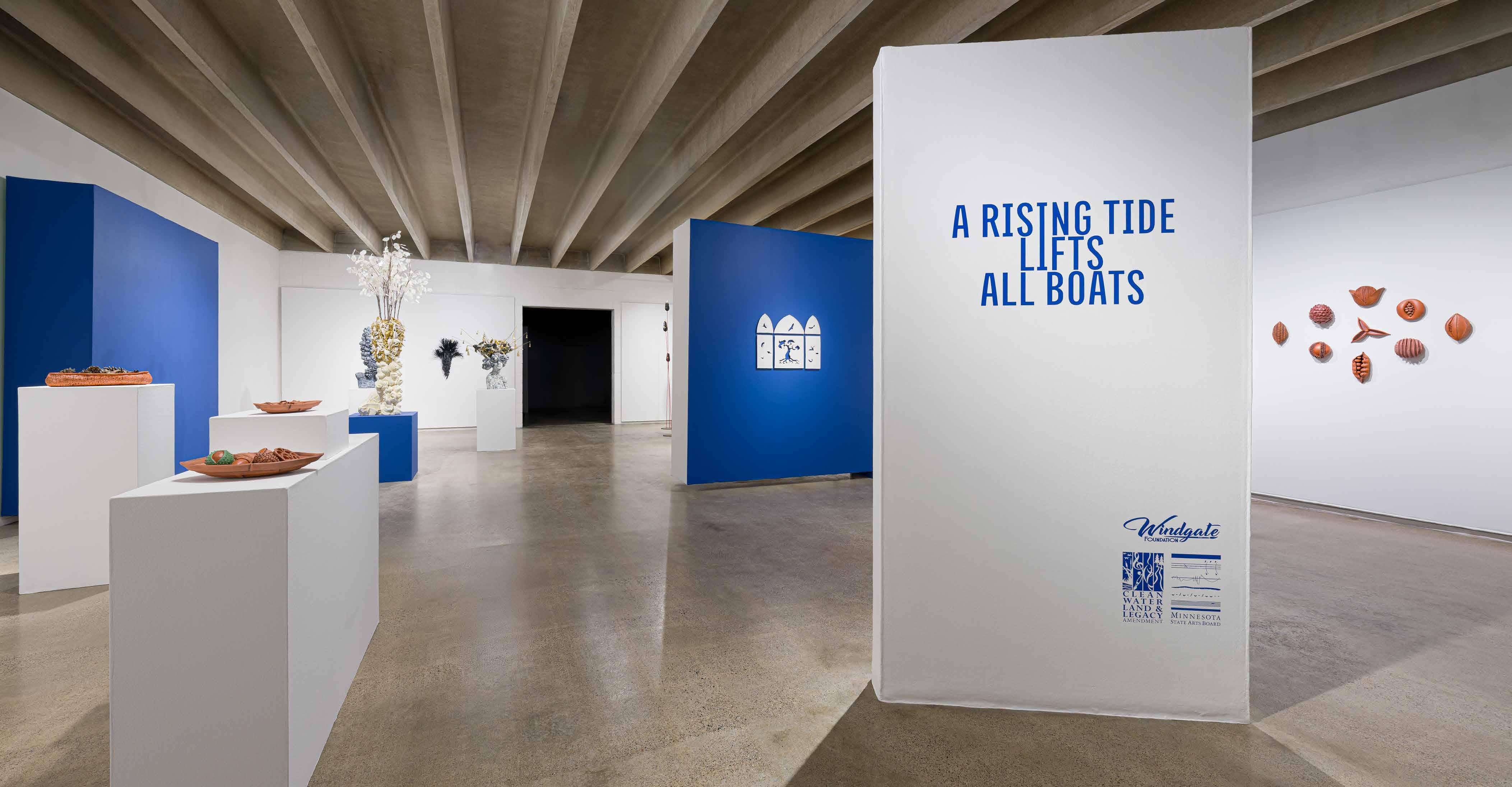
In this exhibition, A Rising Tide Lifts All Boats, artists Katayoun Amjadi, Misty Gamble, and Claudia Poser train their eyes on teeming life forms, engaging with flora and fauna through the ancient, terrestrial medium of clay. In these works, the space between representation and meaning is opened and interrogated. Hierarchies and definitions are challenged and overturned.
In the hands of these artists, the meaning of the old adage wobbles and shifts, turns salty and fluid. Though the words are unchanged, the top-down rallying cry for economic prosperity is turned on its head. Recontextualized, A Rising Tide Lifts All Boats becomes a warning, a taunt, and a prayer.
The ceramic works on view in this exhibition reach for an anticapitalist, pro-climate justice, collectivist vision, but they offer no easy answers. Each work contains elements of fragmentation and paradox, traversing physical and conceptual absences in the search for interconnectedness.
Amjadi, in her installation This Is Not an Eggplant, riffs on Magritte’s iconic painting The Treachery of Images (also known as This is Not a Pipe, where the French phrase Ceci n’est pas une pipe appears below the likeness of a pipe) and philosopher Michel Foucault’s book-length homage to the work. Playing in the gaps between language, image, and sense perception, Amjadi’s installation simultaneously embodies and grieves the fantasy of collectivity. Misty Gamble’s sculpture series Of Flesh and the Feminine combines extravagant beauty and carnage. Stylized feminine busts are adorned with bouquets of fragmented chicken parts, linking the commodification of women and animals within systems of domination. Finally, Claudia Poser’s sculptural work launches an inquiry into the nature of sacredness. Lavishing attention on plants, a life form often deemed disposable in service of human flourishing, her works asks audiences to consider what is preserved and what is discarded, what is treasured and what is ignored, what is sacrificed and what is protected.
KATAYOUN AMJADI
Katayoun Amjadi is a Tehran-born, Minneapolisbased interdisciplinary artist, educator, and curator with an eye for paradox: memory and history, low and high art, the personal and the collective. Her work in this exhibition, This Is Not an Eggplant, was created in her studio in the Q.Arma building in Northeast Minneapolis.
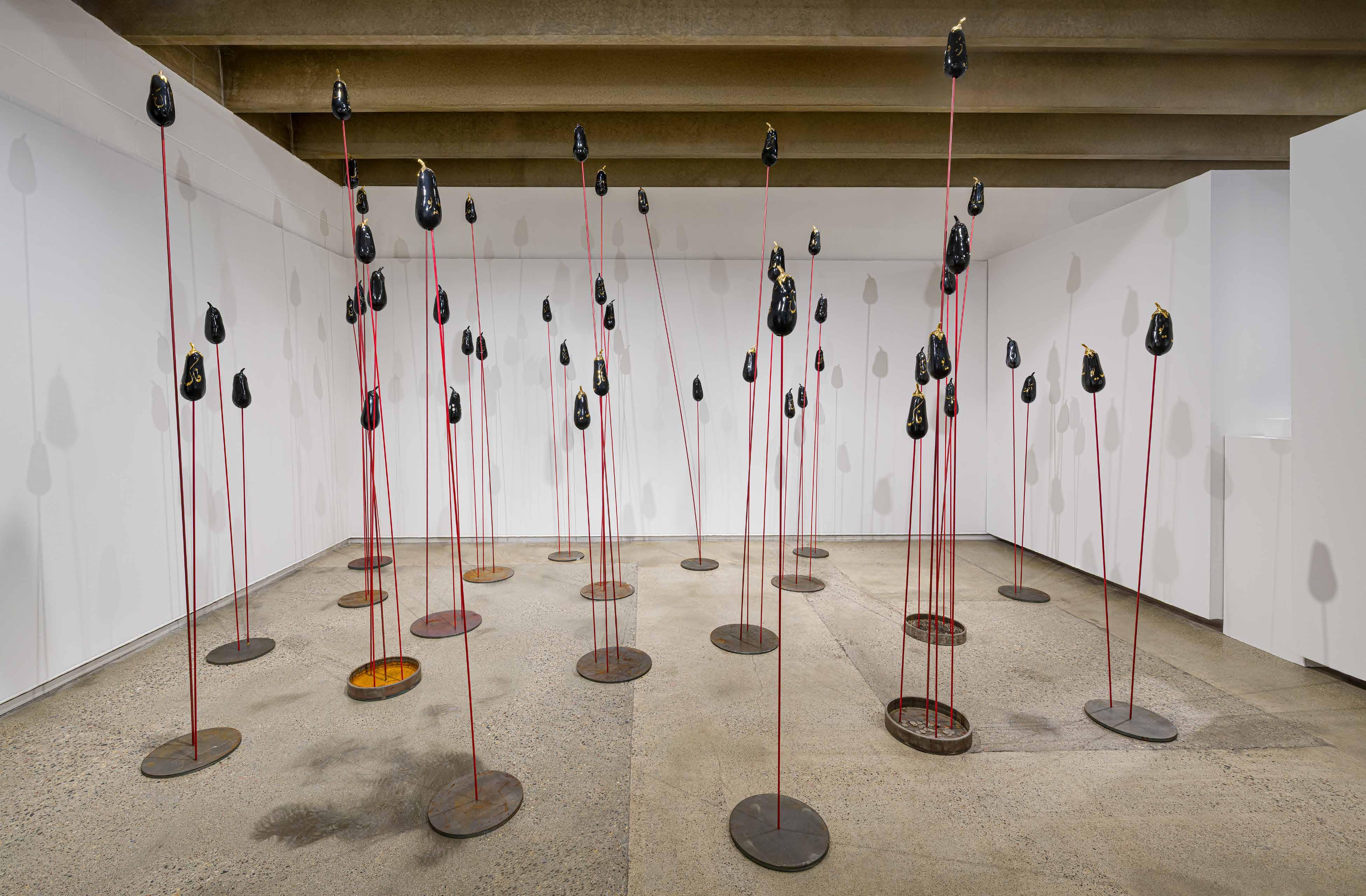
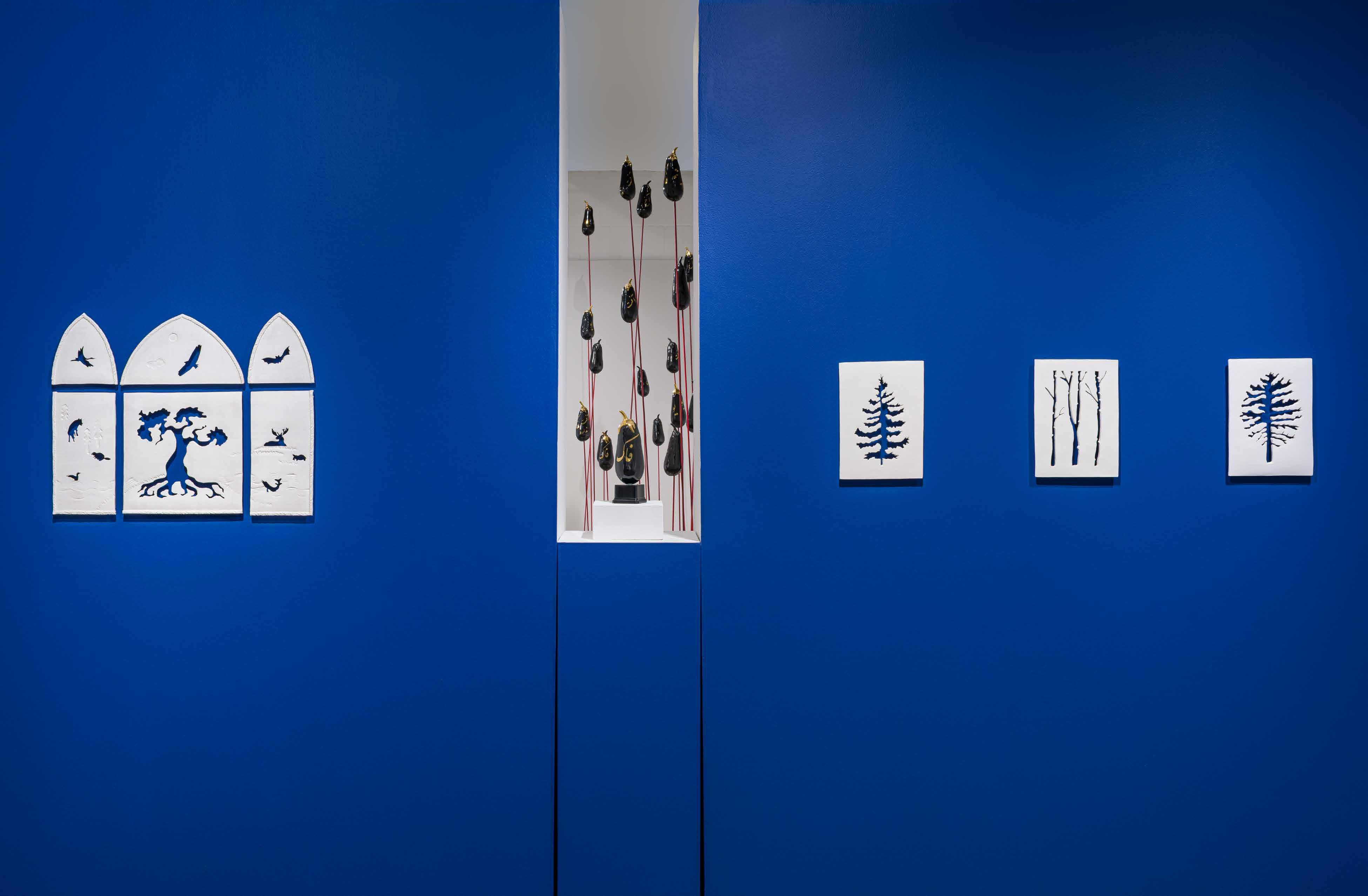
In my conversation with Amjadi, she described the spatial presence of This Is Not An Eggplant as “an absurd garden, like a bamboo farm.” The installation, a collection of castporcelain eggplants mounted on steel poles of varying heights, is intended to be moved through, traversed, as if journeying into a small forest. Each eggplant is finished with a black mid-fire glaze and adorned with gold luster. The illuminated script on the side of each eggplant— in Persian, Arabic, and Urdu—at first appears to be some sort of sacred text, but is actually the English phrase “Fuck You” transliterated. These complications in reference and language echo Magritte and Foucault’s interrogation of the relationship between word, image, and sense—a concept Amjadi also explores in her earlier work This Is Not a Pomegranate.
Unlike the pomegranate, which holds deep associations with the female body and fertility, the symbol of the eggplant, said Amjadi, “has no cultural significance.” Its primary appearance in cultural symbology is in the form of the eggplant emoji. She pointed out that within emoji culture, the eggplant can be sent in a spirit of love and fertility, or as a weapon or tool. Adding to the eggplant’s liminal status is its dual identity as a botanical fruit and culinary vegetable.
This fragmentation of image and language circles a deep grief. First conceived in 2020, This Is Not an Eggplant has “carried forward into a time of continuous war, displacement, and ecological grief—from Iran to Afghanistan, Syria, and Palestine— the work inhabits a world where crisis is no longer episodic, but atmospheric.” The absurd, fractured garden evokes a longing for wholeness and connection, “the fragile fiction of a collective ‘we.’”
MISTY GAMBLE
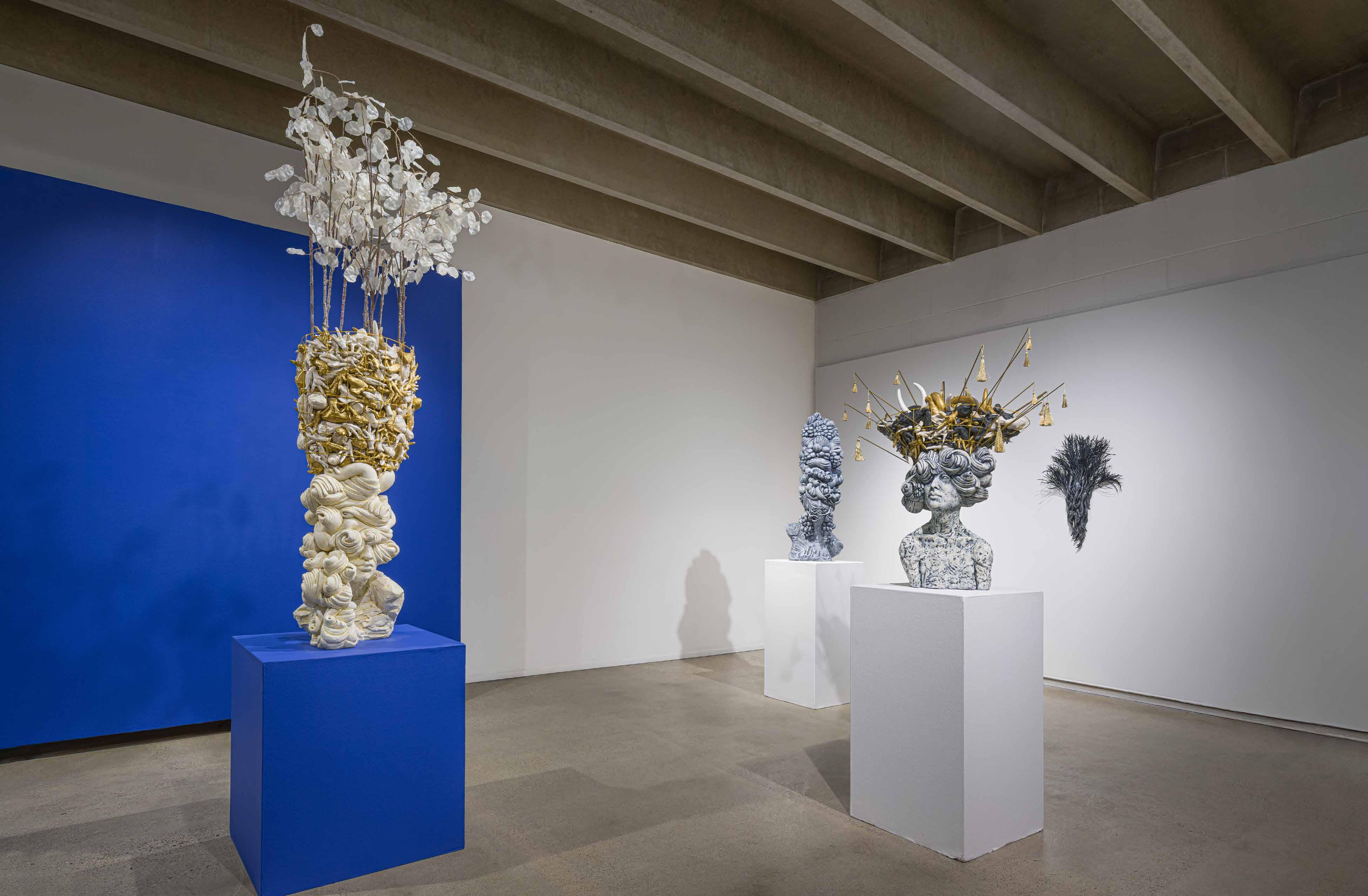
Sculptor Misty Gamble, a “California transplanted feminist vegan living deep in cattle country on the High Plains of Texas,” also works in fragmentation and paradox. Her sculpture series Of Flesh and the Feminine is a collection of ceramic busts, each standing about 25 inches tall and crowned with hand-soldered metal cages holding an assortment of cast chicken parts— legs, feet, and wings—plus the occasional goat’s horn. These cast parts are arranged loose inside the metal structures alongside sprays of faux foliage and other ephemera, forming elaborate headpieces Gamble calls “meat bouquets.”
The body of each bust is formed with a combination of hollow-built and solid-built construction, then beaten with a paddle to create a meatlike surface texture. Beneath the meat bouquets, huge Rococo-inspired hairstyles cascade over necks and foreheads, obscuring the figures’ eyes.
Gamble’s work draws on the ideas of ecofeminist thinkers Carol J. Adams and Vendana Shiva to develop visual, tactile representations of the linked exploitation of women and animals. Especially central to this body of work is Adams’ concept of the “absent referent”, the idea that when parts of animals are consumed as meat, the animal’s existence—its life and its death—are absent from the encounter.
Like the word “tide” in the macroeconomic version of “a rising tide lifts all boats” doesn’t conjure the ocean, the word “meat” doesn’t conjure a whole animal. In patriarchal systems, women are also regarded as collections of parts rather than complete beings—objectified, commodified, and fragmented.
Gamble’s arrangements of cast chicken parts are simultaneously grotesque and beautiful. Three-toed feet, cast from multi-part molds, splay and bend as if readying for escape. At the same time, in the lush composition of the meat bouquets—inspired by Ikebana, the ancient Japanese art of floral display—the chicken is exalted.
This exaltation carries through in the titles of the sculptures, each named for a different fancy chicken breed: Ayam Cemani, Bearded Buff Laced Polish, Blue Polish Frizzle Bantam, Buff Brahma, Gold Penciled Hamburg, Mille Fleur Belgian D’uccle, Partridge Plymouth Rock, Russian Orloff.
“I like the idea of bowling people over with over-the-top extraordinary beauty,” said Gamble. She wants people to stay with her work long enough to start wondering about the “disparate representation,” the tension between the beauty and the pain.
“Deanimation” is another word Gamble used when talking about how the idea of “meat” is separated from the being of the animal, and how the objectification of women severs them from their whole selves. “It’s the fragmenting of the body, seeing parts instead of the whole, seeing things instead of beings,” she said. Her work demonstrates, physically and theatrically, with beauty and opulence, how—when a being is fragmented and objectified—it becomes severed from its essence or spirit.
CLAUDIA POSER
As a child growing up in Germany, following her art-historian mother through European churches, Claudia Poser asked herself, “What is holy?” Her eye was drawn to relics—bits of bone and clothing attributed to saints—protected within bejeweled reliquaries.
As an adult, confronting widespread environmental destruction, she asked herself again, “What is holy?”
From a deep curiosity about plant intelligence fed by her reading of Brilliant Green: The Surprising History and Science of
Plant Intelligence by Alessandro Viola and Stefano Mancuso, The Hidden Life of Trees by Peter Wohlleben, and the work of ecological philosopher Joanna Macy, an answer to her question arose. Seeds.
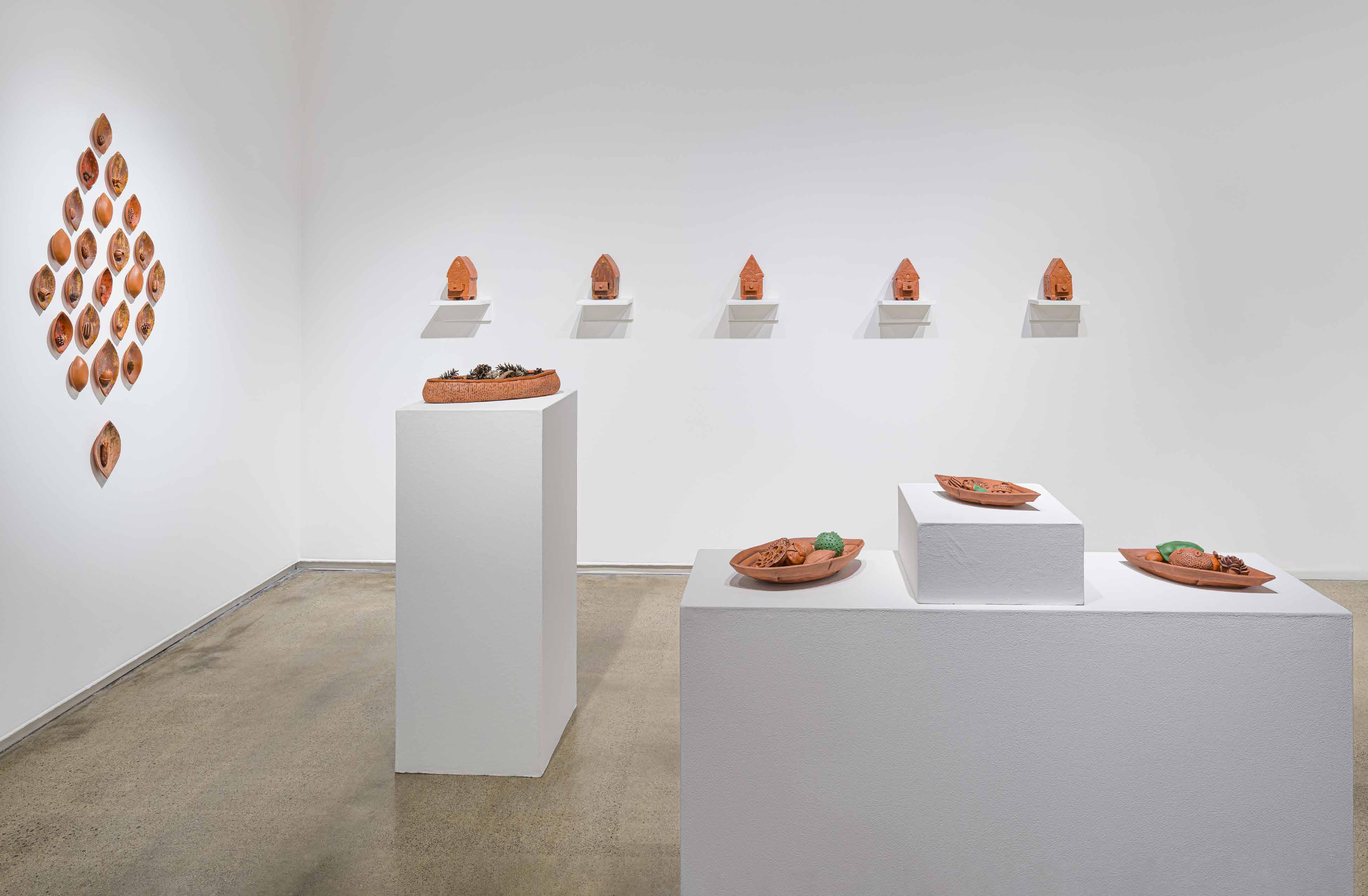
For her work in A Rising Tide Lifts All Boats, Poser researched different kinds of seed pods and figured out how to replicate them in clay. In her studio in the Northrup King building in Northeast Minneapolis, she crafted facsimiles of banksia, sea daffodil, poppy, cacao, tamarind, acorn, pinecone, lotus, chestnut, peapod, okra, and horse chestnut seed pods. Through her deep attention to seed pods, she enacts a last-will-befirst reversal. In narratives of dominion, plants are at the bottom of the food chain. Here, they are powerful, protected, and holy. “Some of this work felt almost like a prayer,” said Poser. “My expression of hope.”
To express this orientation toward sacredness and protection, she created seed reliquaries—vessels with small compartments and doors to house the seed forms, inspired by those that had made an impression on her as a child. These reliquaries are not made of precious metals and gemstones but of earth: terracotta glazed with terra sigillata, Poser’s preferred clay body and finish. Terra sigillata, a historic finishing method traced to ancient Greece, combines powdered clay body, water, and a suspension agent, resulting in a subtle sheen instead of a hard gloss.
While some of Poser’s seed pods are housed in reliquaries, others are placed inside simple terracotta boats, mounted to the wall in her Lifeboats series, embodying a state of preservation and rescue. “If all the plants died, we would be dead in three days,” she said.
Also included in this exhibition is a series called Citizens of the BWCA, silhouettes of plants and animals native to the Boundary Waters cut from wall-mounted tiles. Instead of her usual terracotta, Poser used a white paper clay for this series. The use of stark white dramatizes the shadows cast by the cutouts, the absence of life. If sulfide-ore copper mining is allowed to proceed in the Boundary Waters, all the life forms she depicts in this series will face dire threat.
“In all my work, I’m trying to get people to calm down and notice,” she said. “I’m trying to generate reverence for things we often overlook, that are really crucial for our survival.”
The collective voice emerging from the works in A Rising Tide Lifts All Boats is a complex assertion of non-hierarchical interconnectedness. When plants suffer, when animals suffer, when women suffer, when immigrants suffer, every one of us suffers.
These works, in the way they are made, fly in the face of mass production and unregulated economic growth. When I asked the artists what they experienced while creating the work in this exhibition, they spoke about the tactile pleasures of clay and the embodiment of the art form. They also spoke about the role of mystery and surprise in their processes. “The whole picture of an installation never comes at first. It comes in the process,” said Amjadi. Gamble told me about “happy accidents” that led to the glaze effects she was looking for. Poser, explicit in her understanding of her work as a spiritual practice, described working with clay as “meditative” and “grounding.”
Instead of imposing rigid structures or obsessive expectations of efficiency, these artists aren’t afraid to backtrack, try something new, allow space for the ineffable.
To the presidents who have uttered “a rising tide lifts all boats” in service of the kind of economic growth which severs humans from other life forms, I want to say: This is not a tide.
To Amjadi, Gamble, and Poser, and to everyone who spends time with the ceramic work in this exhibition, I want to say (though Magritte and Foucault may not approve): This is a tide.