/NORTHERNIOWAN
WWW.NORTHERNIOWAN.COM
CEDAR FALLS, IA
WEDNESDAY, SEPTEMBER 30, 2026
@NORTHERNIOWAN
VOLUME 123, ISSUE 6
Research panel presents environmental factors behind Iowa’s cancer problem Iowa is now second in the nation for new cancer incidences
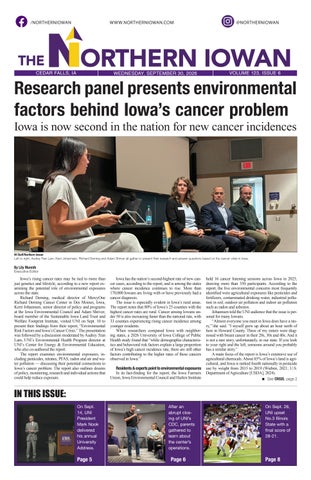
NI Staff/Northern Iowan Left to right: Audrey Tran Lam, Kerri Johannsen, Richard Deming and Adam Shriver all gather to present their research and answer questions based on the cancer crisis in Iowa.
By Lily Munnik
Executive Editor
Iowa’s rising cancer rates may be tied to more than just genetics and lifestyle, according to a new report examining the potential role of environmental exposures across the state. Richard Deming, medical director of MercyOne Richard Deming Cancer Center in Des Moines, Iowa, Kerri Johannsen, senior director of policy and programs at the Iowa Environmental Council and Adam Shriver, board member of the Sustainable Iowa Land Trust and Welfare Footprint Institute, visited UNI on Sept. 10 to present their findings from their report, “Environmental Risk Factors and Iowa’s Cancer Crisis.” The presentation was followed by a discussion moderated by Audrey Tran Lam, UNI’s Environmental Health Program director at UNI’s Center for Energy & Environmental Education, who also co-authored the report. The report examines environmental exposures, including pesticides, nitrates, PFAS, radon and air and water pollution — discussing their potential connections to Iowa’s cancer problem. The report also outlines dozens of policy, monitoring, research and individual actions that could help reduce exposure.
Iowa has the nation’s second-highest rate of new cancer cases, according to the report, and is among the states where cancer incidence continues to rise. More than 170,000 Iowans are living with or have previously had a cancer diagnosis. The issue is especially evident in Iowa’s rural areas. The report notes that 80% of Iowa’s 25 counties with the highest cancer rates are rural. Cancer among Iowans under 50 is also increasing faster than the national rate, with 33 counties experiencing rising cancer incidence among younger residents. When researchers compared Iowa with neighboring states, a 2026 University of Iowa College of Public Health study found that “while demographic characteristics and behavioral risk factors explain a large proportion of Iowa’s high cancer incidence rate, there are still other factors contributing to the higher rates of these cancers observed in Iowa.” Residents & experts point to environmental exposures In its fact-finding for the report, the Iowa Farmers Union, Iowa Environmental Council and Harkin Institute
held 16 cancer listening sessions across Iowa in 2025, drawing more than 550 participants. According to the report, the five environmental concerns most frequently identified were agricultural exposures like pesticides and fertilizers, contaminated drinking water, industrial pollution in soil, outdoor air pollution and indoor air pollution such as radon and asbestos. Johannsen told the UNI audience that the issue is personal for many Iowans. “Almost everyone you meet in Iowa does have a story,”’she said. “I myself grew up about an hour north of here in Howard County. Three of my sisters were diagnosed with breast cancer in their 20s, 30s and 40s. And it is not a rare story, unfortunately, in our state. If you look to your right and the left, someone around you probably has a similar story.” A main focus of the report is Iowa’s extensive use of agricultural chemicals. About 85% of Iowa’s land is agricultural, and Iowa is ranked fourth nationally in pesticide use by weight from 2015 to 2019 (Wieben, 2021; U.S. Department of Agriculture [USDA], 2024). See CRISIS, page 2
IN THIS ISSUE: On Sept. 14, UNI President Mark Nook delivered his annual University Address.
After an abrupt closing of UNI’s CDC, parents gathered to learn about the center’s operations.
On Sept. 26, UNI upset No.3 Illinois State with a final score of 28-21.
Page 5
Page 6
Page 8
PAGE 2
NEWS SEPTEMBER 30, 2026 |
NORTHERNIOWAN.COM
|
LILY MUNNIK Executive Editor
VOLUME 123, ISSUE 6
CRISIS
continued from page 1
Hudson and Cedar Rapids over five months. The study found differences between neighborhoods served by different water wells, including Waterloo and Cedar Falls. It also argued that residents may not know which wells serve their homes or what nitrate levels those wells contain. The study calls for greater public disclosure about nitrate levels and for officials to address nitrate pollution more urgently.
Courtesy Photo/Iowa Environmental Council & Harkin Institute Figure B.4 shows the trends of cancer incidence in people under 50 over the past 30 years comparing Iowas cases with the U.S.
The authors examine three widely used pesticides in particular: acetochlor, atrazine and glyphosate. The report cites several studies linking exposure to certain cancers and other health effects, while also noting disagreements and limitations in the scientific literature. The report also argues that pesticide exposure can occur not only among farmers and applicators, but also among people living near treated fields through drift, airborne particles, soil, household dust, food and drinking water. “For several of the pesticides, even though they’re not banned in the U.S., there have been scientific bodies that have looked at those pesticides and banned their use in other countries,” said Shriver. “So that is a pretty strong set of evidence that there’s something that we should be looking at more closely.” PFAS and nitrate raise concerns on Iowa’s water quality The report also focuses on perand polyfluoroalkyl substances, also known as PFAS or “forever chemicals.” Since PFAS break down slowly and can accumulate in the environment, the authors say exposure can occur through drinking water, consumer products, food and agricultural applications. The report says PFAS have been detected in Iowa surface water and
NORTHERN IOWAN L011 Maucker Union Cedar Falls, IA 50614 www.northerniowan.com northern-iowan@uni.edu 319.273.2157
LILY MUNNIK
Executive Editor munnikl@uni.edu 319.529.0526
groundwater. The authors mention several studies connecting certain PFAS exposure with kidney, testicular, prostate and ovarian cancers, while noting that researchers are still investigating the health effects of many individual PFAS compounds. “A person’s exposure [to PFAS and unhealthy levels of nitrate] really depends on their geographic area, the source of their drinking water and the product they have in their homes,” said Johannsen. “Our current regulatory systems continue to allow more PFAS to be developed and used in spite of the risks.” Nitrate was another major concern for the authors. Iowa has among the highest nitrate concentrations in the country, with agricultural activity identified as the main source of nitrate pollution in the state’s water. The report reviews studies linking long-term nitrate exposure with several health concerns, including certain cancers. It also argues that the federal drinking water limit of 10 mg/L was established primarily to prevent methemoglobinemia, also known as “blue baby syndrome.” New research has also suggested that nitrates at lower levels can be harmful. That concern is especially relevant in Northeast Iowa, where an independent 2026 survey by Dr. Kamyar Enshayan, former director of the CEEE at UNI, examined tap water in Waterloo, Cedar Falls, Waverly,
Managing Editor westejac@uni.edu 515.776.0176
Report calls for regulatory and policy changes The report not only identifies potential risks but also provides an extensive list of changes to Iowa’s environmental policies. Recommendations include stronger health-based standards for carcinogens in air, water, and soil; tighter nitrate standards; expanded PFAS
EDITORIAL STAFF
PRODUCTION STAFF
FAITH VANDENBERG
JENNA WESTENDORF
News Editor vandenbf@uni.edu
MICHAEL SPAHN
Webmaster westejac@uni.edu
HOLDEN FROMM
Sports Editor spahnm@uni.edu
Assistant Digital Editor frommh@uni.edu
CARTER LUST
MEREDITH MENNING
Assistant Sports Editor lustc@uni.edu
ZACH MINEART Spanish Editor mineartz@uni.edu
OLIVIA HARRINGTON JENNA WESTENDORF
Radon considered as another statewide risk Radon, which is a naturally occurring radioactive gas produced by the decay of radium in soil, is another major focus of the report. Radon can enter homes through cracks, floor drains, sump systems and other openings in your home, with exposure highest in basements. The report cites findings from the Iowa Radon Lung Cancer Study that roughly 60% of basement radon measurements and 30% of first-floor measurements exceeded the EPA action level of 4 picocuries per liter. The report identifies radon as the second-leading cause of lung cancer in the U.S. after smoking and says Iowa had among the nation’s highest levels of radon exposure. The report also mentions new research on possible links between radon and cancers beyond the lungs, while noting that the evidence for lung cancer is the strongest. “The diversity and consistency of the information indicates that the weight of evidence for radon carcinogenicity is overwhelming,” said Buchner and Lubin in a 2008 study titled “Reviews on Environmental Health,” featured in “Special Issue on Environmental Factors in Cancer: Part 2.” If you are concerned about exposure, Johannsen said, “Getting your home tested for radon is a great first step.”
Assistant News Editor harringo@uni.edu
ULYANA KARPLYUK Assistant News Editor karplyuu@uni.edu
Multimedia Editor mennimaa@uni.edu
ADVISERS ANELIA DIMITROVA anelia.dimitrova@uni.edu
CHRIS MARTIN
christopher.martin@uni.edu
CIRCULATION ELIJAH HIETBRINK Circulation Manager
regulations; pesticide buffer zones around schools, homes, and waterways; reforms to agricultural drainage and manure management; and additional restrictions on large livestock operations. The authors also call for stronger monitoring and transparency. These include a centralized pesticide-tracking system, public access to manure application records, expanded PFAS and groundwater monitoring, additional air-quality monitors, and a statewide “right to know” law on toxic pollution. The report recommends funding for private well testing, radon testing and mitigation, water-treatment infrastructure and research into cumulative chemical exposures. It also calls for more research into the combined effects of multiple environmental contaminants — which the authors call a “chemical cocktail” — and greater protection for university researchers studying environmental contributors to cancer. The panel also said that individuals can take steps to reduce exposure, such as testing private wells for nitrate, testing homes for radon, following pesticide safety instructions, limiting unnecessary pesticide use, paying attention to air-quality advisories and choosing PFAS-free products when available. However, many of these protective measures are more accessible to people with greater financial and social resources, making environmental exposure not only a public health concern but also a social justice issue, particularly for marginalized communities that may face barriers to testing and other forms of protection. Overall, the report emphasizes that it is not claiming environmental exposures are responsible for Iowa’s cancer crisis on their own. Instead, the report argues that the evidence warrants greater investigation, monitoring and prevention combined with established risk factors such as smoking, ultraviolet exposure, diet, physical activity and access to health care. “The precautionary principle says that even if you don’t have 100% certainty about something being true, nevertheless, you’re entitled to take actions, try to address certain problems as long as you have reasonable suspicion and evidence… this is one way to answer the question ‘what do we do about this? And what actions can we take?’” said Shriver.
The Northern Iowan is published weekly on Wednesday during the academic year, except for holidays and examination periods, by the Northern Iowan under the auspices of the Board of Directors of the Northern Iowan. Advertising errors that are the fault of the Northern Iowan will be corrected at no cost to the advertiser only if the Northern Iowan office is notified within seven days of the original publication. Publisher reserves the right to refuse any advertisement at any time. The Northern Iowan is funded in part with student activity fees. All material is © 2026 by the Northern Iowan and may not be used without permission.
LETTERS TO THE EDITOR
Letters must be less than 300 words in length and are subject to editing. Not all submissions will be printed. Send submissions to northerniowan@uni.edu.
SEND US STORY IDEAS
Tell us what’s happening on campus. Email submissions to northern-iowan@uni.edu. Do you want to have an event listed here? Email us at northern-iowan@uni.edu with information about the event to have it featured.
PAGE 3
NEWS
LILY MUNNIK Executive Editor
SEPTEMBER 30, 2026 |
NORTHERNIOWAN.COM
|
VOLUME 123, ISSUE 6
The challenges of the modern job market
How can humanities majors find their place in the workforce?
Ulyana Karplyuk Robert Townsend is one of the directors from the American Academy for Arts and Sciences.
By Ulyana Karplyuk
Assistant News Editor
The value of four years of college is ultimately measured by its relevance to the workplace. How a degree in humanities can empower students was the subject of the inaugural lecture on Sept. 21. “Set up for Success: Making Your Humanities Degree Work,” was presented by Robert Townsend, who highlighted pathways into the modern workforce for humanities majors and the importance of humanities programs. Townsend is the director of humanities, arts and cultures Programs at the American Academy for Arts and Sciences. He has also written over 200 articles on the humanities, including higher education, history and scholarly publishing. The lecture served as the inaugural event of UNI’s newly established Humanities Hub. Funded by a $2.4 million grant from the Andrew W. Mellon Foundation. The Hub aims to provide majors in the College of Humanities, Arts & Sciences with paid internship opportunities at nonprofit organizations across Iowa during the school year. Through such internship opportunities, students can apply their classroom learning in professional environments, gain experience in their chosen field and grow professionally and academically.
Only 28% of recent graduates saw a relationship between their field of study and professional careers. Cengage’s 2025 Graduate Employability Report “A big part of your internship is not about learning how to get a job, it’s learning how to help employers understand your skillset…We’re [the Humanities Hub] going to give students an opportunity to get real world experience including the skills they learn in the job,” said Mark Nook, UNI president, prior to the lecture. Townsend began his lecture by sharing statistics about the humanities, working professionals and students in the field. He explained that humanities majors are widely spread across occupational fields, from management to museum and library studies. Townsend argued that these outcomes result from people’s ability to “work with people, deal with ambiguity and to handle complexity.” The lecture also discussed the popular notion that humanities majors hold lower-paying positions. Townsend noted that, in reality, individuals with humanities degrees earn about $63,900 annually, similar to people with degrees in other areas, such as social sciences.
He argued that some believe this misconception because they compare humanities graduates with engineering graduates. In reality, the latter are outliers and outperform every other graduate area in annual income, closer to approximately $98,000. Most of the lecture focused on how students can apply their degrees to get hired for their desired jobs and the challenges that come with it. “One of the big challenges we face is that our [humanities] majors are least likely to see a connection between their job and their degree after college,” said Townsend. He mentioned that only 28% of recent graduates saw a relationship between their field of study and professional careers, according to Cengage’s 2025 Graduate Employability Report.. The issue is that many graduates believe they’re gaining content knowledge, not a well-rounded skill set for a job. For example, a computer science major might develop expertise in coding languages like SPSS, Python or JavaScript
used in the professional field. In contrast, a history major might gain extensive knowledge of the French Revolution. However, not everyone sees how that knowledge can help them get a job in the real world. Townsend argued that “content knowledge translates into a longer journey,” and that humanities majors need to consider what skills they develop throughout their academic careers that can apply to a professional career. Employers commonly look for the skills humanities students learn in college. “Critical thinking, ability to organize information and communication” are some of the qualities a humanities major possesses. Townsend argues that professors should also help their students understand the value of those skills, “so that a student doesn’t just think of themselves as having written a paper about the French Revolution, but understands that they’ve done a number of different steps along the way.” Townsend also shared per-
spectives on artificial intelligence (AI) and its connection to the humanities. AI implementation in the workplace has grown in the past few years, and people have contrasting views on its role and necessity. Townsend seemed optimistic about the topic. “I think humanities have a better story to tell than most other fields in response to what AI is doing,” said Townsend. The abilities and skills related to research, oral and written communication and critical thinking can be used to interpret and enhance the information AI generates. “We [humanities majors and graduates] fill in a major gap, a weakness of AI.” After the lecture, audience members asked Townsend questions. Many shared a similar theme, asking how educators can help humanities majors realize their potential in the professional field. Townsend reinforced the importance of communicating what professors look for in class assignments. When discussing what students get out of a class in terms of applicable knowledge that can help them succeed in the professional world, the quality and organization of the information and a student’s ability to articulate their point should be at the forefront.
PAGE 4
N.I. EN ESPAÑOL
N.I. EN ESPAÑOL SEPTEMBER 30, 2026 |
NORTHERNIOWAN.COM
|
JENNA WESTENDORF Managing Editor
ZACH MINEART Spanish Editor
VOLUME 123, ISSUE 6
La UNI fue el número 1 en el Medio Oeste por primera vez
Courtesy Photo/University of Northern Iowa La UNI es la más pequeña de las tres universidades públicas en Iowa con un matrícula actual de 9.366. Escrito por Lily Munnik
Mientras la UNI termina la celebración de su 150 aniversario este otoño, otra ocasión celebratoria sale a la luz en las noticias el martes 22 de septiembre, con
la publicación del informe de U.S. News & World Report’s Best Colleges. La Universidad del Norte de Iowa ha sido clasificada como la universidad pública regional número 1 en el Medio Oeste; esta distinción la convierte
en parte de los libros de historia. Este viene después de 29 años de estar en segundo lugar detrás de la Universidad Estatal de Truman. “La Universidad de Norte de Iowa está honrada de ser reconocida por U.S. News & World Report por nuestra dedicación continuada al acceso de los estudiantes, nuestra tasa de graduación y el valor excepcional que ofrecemos a las familias de un lado al otro del Medio Oeste”, dijo Pete Moris, el director de las Relaciones Universitarias de la UNI, en el co m u n i cad o de prensa de la UNI. Las calificaciones de U.S. News Best Colleges han sido publicadas cada año desde 1983 usando varios factores
Courtesy Photo/University of Northern Iowa UNI registró su mayor promoción de estudiantes de primer año desde 2017, con 1.709 alumnos.
para calificar más de 1.700 universidades en los Estados Unidos. El criterio más importante para calificar es la tasa de graduación y el rendimiento de la tasa de graduación; con la tasa de graduación de cuatro años de la UNI, más de 25 puntos porcentuales sobre el promedio nacional. La deuda promedio de los graduados de la UNI está por debajo del promedio estatal y nacional. “Como un graduado, voluntario y donante, sé el poder de la educación de la UNI”, dijo Nicholas Linde, un exalumno y vicepresidente actual de la Fundación de la Universidad de Nebraska en LinkedIn. “La clasificación no es una sorpresa para cualquiera que asiste a la UNI. Lo que esto señala, sin embargo, es que no necesita ser llamativo para ser increíble”. La UNI también fue clasificada como el número 6 entre las universidades del Medio Oeste por el
valor que provee a los estudiantes del estado y número 4 entre las universidades del Medio Oeste por su apoyo a los veteranos y los miembros de servicio activo. “Esta distinción refleja la cualidad increíble y el compromiso de nuestra facultad, personal y estudiantes y la actitud de los estudiantes primeros al corazón de la UNI”. Después de alcanzar una matrícula máxima por primera vez en seis años, junto con el crecimiento drástico de la matrícula estudiantil de los estados vecinos, las Panteras en todo el campus están orgullosas, incluso insinuando que el reconocimiento estaba muy atrasado. “Estos de nosotros [en el campus] han creído esto por mucho tiempo”, dijo Mike Murray, el jefe general en Learfield. “Ahora está siendo reconocido”.
LILY MUNNIK
PAGE 5
NEWS
Executive Editor
‘What will we do this year that we’ll be proud of tomorrow?’ SEPTEMBER 30, 2026 |
NORTHERNIOWAN.COM
|
VOLUME 123, ISSUE 6
Nook delivers his 2026 presidential address
By Jenna Westendorf Managing Editor
“Yesterday’s the past, tomorrow we call the future, but today, today is a gift.” Referencing a Family Circus cartoon, UNI President Mark Nook opened his 2026 university address. Each fall, Nook delivers remarks on the university's major accomplishments over the last year, and the vision for the future of the university. However, this year's address was special. UNI is celebrating its sesquicentennial anniversary, or 150 years as a recognized institution. Nook gave his speech on Sept. 14 in the Gallagher Bluedorn Performing Arts Center. This year's address highlighted increased enrollment and graduation rates, as well as student achievements, research funding and athletic successes. He also talked about the university's continued impact across the Cedar Valley. Nook began his address by highlighting new leaders across campus, including Ken Brown, the Wilson College of Business dean, and Anne Lefter, the executive director of the GBPAC. He also highlighted many of the university’s accomplishments over the past year: National Recognitions and Research Funding During the 2025-26 academic year, UNI received several national recognitions - including the Carnegie Foundation identifying UNI as a Carnegie research college and university. The Carnegie Foundation also recognized UNI for its community engagement. Phi Theta Kappa, an honor society for students at community colleges and twoyear universities, named UNI to its transfer honor roll – recognizing UNI as a transferfriendly institution. UNI also received recognition as a top-10 military-friendly school, and a top-10 school supporting military spouses and family. Beyond national recognition, UNIalsoreceivedseveralresearch grants for departments across campus. The grants include: a $2.4 million Mellon Foundation grant to establish the UNI Humanities Hub, $1.22 million from the U.S Department of Education American History and Civics Education for a seminar grant, $2.8 million from the U.S.
to compete in the NYOP Challenge, a challenge for commercial real estate students to pitch a deal to potential investors. They won first place.
Courtesy Photo/University of Northern Iowa Nook delivered his 2026 presidential address on Sept. 14 in Gallagher Bluedorn Performing Arts Center.
Department of Education for TRIO grants (Student Support Services Regular and STEM), a $5 million grant from the U.S. Science Foundation to elevate STEM teaching in rural schools as well as another $1 million for a physics grant to advance quantum research, and $2.8 million to the Department of Psychology from the U.S. Department of Education to become a partner. Changes to Campus Nook also noted the various changes that UNI has seen to campus over the past year. In the spring of 2025, UNI purchased Trailside Apartments (formerly known as The Quarters), opening to students in the fall of 2025. This purchase offers more on-campus housing options, specifically apartmentstyle living to students, encouraging them to continue living on campus in their second and third year of school. The recently renovated Applied Engineering Building also opened to students, offering two new majors as well. The old Applied Engineering and Technical Management program split to become the Department of Construction Management and the Department of Applied
Engineering. A new major in Material Science Engineering also opened to students, with its first graduates of the program expected this winter. The nursing program is also seeing continued success. Phases two and three of renovations to the new nursing facility, located in ITTC, have been completed and continue to support current and incoming nursing students on UNI's campus. A more recognizable story: Wally the alligator, one of two alligators on UNI campus, moved enclosures this past winter. The new environment gives Wally more space to live comfortably for years to come. Neighboring State Rate UNI also recently introduced its neighboring state rate, offering in-state tuition costs to incoming students from states surrounding Iowa. Nook credits the neighboring state rate as part of what drove UNI’s enrollment up this year. “Getting the word out about who we are and the excellence that is here…it certainly helped our enrollments,” he said. Student achievements UNI students are also seeing successes beyond the classroom.
Two notable achievements Nook mentioned are recent graduates Marvin Carr and Lee Beauchamp. Marvin Carr was recently recognized as the 2025 Veteran of the Year. After serving in the Navy for six years, Carr came to UNI at the age of 47 to pursue a degree in History Teaching Education, graduating in December 2025. During his time, Carr was active in the Veterans Association on campus, as well as CATS (Connecting Alumni to Students), and served as a sergeant-at-arms for Model UN. Lee Beauchamp, a May 2026 graduate with a degree in interactive digital studies (IDS), was selected as one of 25 members of the American Advertising Federation’s Most Promising Students. Beauchamp got the opportunity to travel to New York City for a week to connect with other college seniors from across the country and visit advertising firms to learn more about the industry. Outside of AAF, Beauchamp was also a member of the 2025 AT&T Team that won first place at the District 9 National Student Advertising Competition. Additionally, a team of UNI students traveled to Minneapolis
Athletic successes Learfield Sports, which manages marketing for many of the Division I programs in the country, noted that UNI was first in the Missouri Valley Conference across all sports. Several athletics programs at UNI also won championships this past year. Volleyball not only won in the regular season, but also won the MVC tournament title and made it to the Sweet 16 round of the national championship. Cassidy Hartman, an outside hitter on the team, was also named the MVP of the MVC. Several other teammates were named to first and second all-teams. The men's basketball team also won the Missouri Valley Arch Madness, making history as the lowest seed to win the conference. Their tournament title gave them a bid to March Madness, where they unfortunately lost in the first round to St. John's University. Former star Trey Campbell was named second all-team for the MVC. The men's track and field team also won the indoor MVC title, with Carter Morton winning MVP of the tournament and taking first in the heptathlon. Morton also placed sixth in the nation at the national meet. The women's track and field team had two women compete in the national meet, both placing in the top 15 of the heptathlon. Several coaches also received recognition for their efforts. Volleyball Head Coach Bobbi Petersen was named MVC coach of the year – her 10th time receiving this recognition. Head Coach of the men's track and field team Dave Paulsen won MVC coach of the year, with assistant coach Jeff Coover winning assistant coach of the year. Diving coach Bethany Hovland was named co-coach of the year. Panther Mayhem – UNI’s student section – has also seen a large increase in students showing up at home games. The student section had its largest attendance at its football home opener on Sept. 12, recording 1,476 students in attendance. Read the remainder of the story at northerniowan.com.
PAGE 6
NEWS SEPTEMBER 30, 2026 |
NORTHERNIOWAN.COM
LILY MUNNIK Executive Editor
|
VOLUME 123, ISSUE 6
UNI Child Development Center closes Sept. 14-18 to reassess operations By Brooke Berumez Staff Writer
Editor’s Note: This is an ongoing story that will continue to be monitored and reported. On Friday, Sept. 12, parents who send their children to the University of Northern Iowa’s Child Development Center (CDC) were left confused when they received a sudden email. At 4:27 p.m., parents were notified that the CDC would be closing for the following week, Monday, Sept. 14, to Friday, Sept. 18, “due to unexpected limitations in staffing.” The email sent to parents additionally stated that the “temporary closure is a necessary, unavoidable, practical step.” Parents were subsequently invited to an open parent forum on Tuesday, Sept. 15, in the auditorium of the Schindler Education Center, where they were able to learn more details about the sudden closure from Dean Colleen Mulholland and Director Tam Burt in UNI’s College of Education. At the meeting, Dr. Mulholland began the discussion surrounding the CDC’s sudden closure. “The quality of care provided to children and the strength of our systems are two very different things. In other words, while your children have been well cared for, I want to be clear that the staffing and operational systems sup-
porting that care were not as stable or sustainable as they needed to be,” said Mulholland. “That is the issue that we are addressing.” The main explanation for the closing was due to an “organizational drift,” where “informal practices” became the normal routine after many accommodations and temporary solutions for any issues were made. “Over time, likely ten years or more, the CDC developed staffing practices and procedures that helped the center meet its day-to-day requirements and needs,” Mulholland explained, “and for a long time, those practices appeared to work. Children were cared for, classrooms operated, families came through our doors every day, but underneath that successful daily care was a staffing model that had become increasingly fragile and financially unsustainable.” The CDC has been heavily reliant on student employees for years. However, with this reliance on student workers, the CDC has been operating $100,000 over the annual student staffing budget for years. (graphic). The center’s established budget for student workers is only $20,150. Due to the center’s consistent overspend-
NI Staff/Northern Iowan On Sept. 15, parents gathered in the Schindler Education Center for an open parent forum to learn more about the closure and to express concerns or ask questions to Dean Mulholland.
ing, it became unable to absorb the overages and took a closer look at the logistics of the center. Right away, several problems became clear and added up. Many student employees had begun to call out. “We had an unusual convergence of illness and absences,” said Mulholland. On top of that, many employees were unable to start work right away due to the differences between the center’s hours and the academic calendar. “By Friday afternoon, we could not confi-
Graphic/Brooke Berumez With a majority of CDC’s workers being UNI students, it is important for the center to have a set budget for paying their student employees. In the past four years, the CDC has been over budget by atleast $98,954 with 2025 being the most at $131,249 over budget.
dently say that we could open every classroom every day this week with the dependable staffing necessary to maintain required ratios,” Mulholland said. “We chose to not try to piece things together for yet another week.” By taking the week off, Dr. Mulholland and Dr. Burt planned to redevelop the center’s system with six main parts. During the week, they planned to develop proper schedules that are intentional and based on the needs of both the center and students. They also plan to widen the pool of student workers and hire permanent floater teachers for extra help. Along with the pool of student employees and teachers, they plan to work directly with UNI to create a reliable pool of substitute teachers and a brand new pool for volunteers. In all of these pools, they will require more appropriate clearing before problems occur, not after. This ensures that each staff member is properly trained, screened and documented within the university. By implementing these new processes, classrooms will be able
to open with a substitute teacher if the main teacher is sick, and with more staff for additional security. Moving forward, Burt shared that the center will trade older toys for new ones and get new material for student use. With new materials and toys, Burt shares that her vision for the center moving forward is to “responsibly determine what [their] needs are and to work hand in hand with Mulholland to make that a reality.” “I have dreams of an age-appropriate playground with artificial turf and a bicycle playground out back where we see that basketball court. I foresee spring and summer learn-to-ride bicycle camps open to the community,” said Burt. “The possibilities are endless.” Dean Mulholland shared her hope for bouncing back, stating, “Rebuilding that confidence will take more than my words tonight; it will take our actions in the weeks and months ahead,” she said. Our responsibility is not to merely open the doors. Our responsibility is to build a CDC that is safe, dependable, sustainable and worthy of the trust
you place in us every morning when you leave your child here.” Moving forward, Dean Mulholland feels confident that the center will only come back stronger after facing challenges that ultimately led to the week-long closure. “I’m deeply committed to the child development center. I believe in Director Burt’s leadership and the vision for the center,” she said. I believe in the people who care for your children. I believe in the importance of this center to you and I, to the community, to our students, to our faculty and staff and especially to those of you here tonight who are our families, and I believe we can come through a difficult and disruptive week with a stronger center on the other side.” As of Tuesday, Sept. 29, the CDC has been reopened since Monday, Sept. 21. The NI reached out to Dr. Burt who referred us to Dr. Mulholland who we have not heard back from. At this time, we do not know the current state of staffing as we enter the second week of the reopening of the CDC.
FAITH VANDENBERG
PAGE 7
OPINION
News Editor
SEPTEMBER 30, 2026 |
NORTHERNIOWAN.COM
|
VOLUME 123, ISSUE 6
Pokémon Champions: Disappointment from competitive and casual fans alike
Courtesy Photo/Nintendo Ad “Pokémon Champions” is a new strategy-focused game that is accessible for all levels of players on Nintendo Switch, IOS and Android.
By Theo Trimble Staff Writer
On Feb. 27, 2025, The Pokémon Company celebrated its 29th anniversary by releasing a Pokémon Presents video. In the 25-minute video, they announced “Pokémon Champions,” a strategy-focused game that lets both new and veteran players compete in Pokémon battles. The game was announced alongside “Legends: Z-A” and was planned for release on April 8, 2026, on Switch 1 and 2, iOS and Android. Fans were initially excited to play a game focused solely on battling, and they had been asking the company for something like this for years. However, this past spring, the game officially launched, and what should’ve been a positive, uplifting experience for the community quickly turned into outrage. When “Pokémon Champions” was first shown to fans, the major assumption was that the game would include a wide variety of items, abilities and, of course, Pokémon. After all, competitive Pokémon is about creating a team that can beat your opponent, no matter what creatures or items you use. Some of the most fun competitive battles I’ve seen include Pokémon I would never usually see on a final team, with items I would sell to the shop for extra cash. However, the game disappointed fans, offering only 186 Pokémon (including Megas and variants) out of the 1,025 in the series. As for the item roster, only 108 held items made it into the games. This includes Mega Stones, berries and key competitive items. Although the number of items in the games can seem like a lot, it excludes the several hundred other items introduced in previous generations. Fans have been extremely disappointed by this smaller roster, as it limits their ability to build exciting, unique teams. To make this even more frustrating, players can only earn Pokémon through story progression, rather than having the full roster from the start. This makes players unmotivated to keep playing, feeling more like they’re finishing a chore than enjoying the game. Conor Ross, a game reviewer from SmashPad, describes his frustration with this mechanic, saying, “And as I battled more players, it felt like I was seeing the same group of fifteen or so Pokémon every match, which made every battle feel like a repeat of the last. Even as I tried new Pokémon team compositions, nothing felt unique.” “Pokémon Champions” is an online-only multi-
player game, and an internet connection is always required. Fans were immediately thrown off by this, as they expected to play locally with friends and family. Online play has major performance issues. Several players reported being randomly disconnected from battles or the game freezing without warning. One player described an online glitch where, after knocking out their opponent’s Pokémon, the creature seemed to revive on its own, without any self-healing items. Along with several glitches, the game doesn’t present itself very well. The framerate is all over the place, usually at 30 frames per second (FPS), often peaking and glitching at pivotal points during gameplay. On top of that, the game is incredibly ugly. Menu navigation is incredibly slow, and the art of the characters and creatures seems fuzzy and low-quality. The lighting and sound design are mediocre at best, and the game seems to freeze for no reason. With the public waiting decades for an official Pokémon battling game, fans and developers took matters into their own hands, creating the famous “Pokémon Showdown” simulation in October of 2011. The fangame gives players access to every Pokémon, item, ability and move throughout the series, letting them create teams tailored to their own strategies. Be-
fore “Champions” was released, this was how professional and non-professional competitive players battled outside the mainline games. Now, with “Pokémon Champions” being released with all these issues, the fanbase has still stuck to “Showdown” as the primary way to battle competitively. One user claims that the new game could completely ruin “Showdown,” saying, “The existence of Champions could pose a threat to Showdown due to Nintendo’s penchant for lawsuits.” The release of “Champions” could have been an incredible way for Pokémon’s competitive fanbase to come together and play in an exciting way. However, with the current complaints and public opinion, I believe that if Nintendo doesn’t include new updates with returning Pokémon and items, then the game will never fully rival “Showdown.” With a 5/10 rating from NintendoLife and a 67% rating on Metacritic, it’s clear the game wasn’t pushed to its full potential. IGN gives “Champions” a 6/10, saying, “Pokémon Champions could have, and should have, been an easy knockout, but instead, fans got a stripped-down, underwhelming and content-barren package with an unfortunate monetization model.”
The game disappointed fans, offering only 186 Pokémon (including Megas and variants) out of the 1,025 in the series. As for the item roster, only 108 held items made it into the games. This includes Mega Stones, berries and key competitive items.” THEO TRIMBLE Staff Writer
PAGE 8
MICHAEL SPAHN
SPORTS
Sports Editor
Down goes No. 3 SEPTEMBER 30, 2026 |
NORTHERNIOWAN.COM
|
VOLUME 123, ISSUE 6
UNI earns first top-5 win since 2021 season By Mason Kalkbrenner Sports Writer On Saturday, the Northern Iowa football team secured a huge upset over No. 3 Illinois State in a 28-21 clash. This win marks the first Missouri Valley Conference victory for the Cats this year. UNI’s gameplan clicked seamlessly on both sides of the football. Coming off of a 55-0 loss against Iowa on Sept. 19, UNI bounced back this week and secured a total of 416 total yards on the day. Immediately after their loss to Iowa, UNI head coach Todd Stepsis knew that their response to this adversity was the most important. “We went from playing a game where we were not our best, we were embarrassed, to really flip a switch and do a 180,” said Stepsis. “I attribute it to them [the players] and their coachability. To be able to watch that on tape from a week ago and then apply it this week was really cool to see.”
The Panthers’ offense was rolling, with quarterback Jaxon Dailey throwing for 217 yards on 13-of-17 completions and two touchdowns. Dailey also took to the ground for 44 rushing yards and a rushing touchdown. Taj Hughes topped the stat sheet with 80 receiving yards on three receptions. Meanwhile, running back Xavier Terrell led the charge with 80 rushing yards and one touchdown, with his longest rush going for 43 yards. The UNI defense stood tall and caged the Redbirds’ offense. John Powers led the team with 11 tackles, followed by Jordan McClom and Isaiah Pinks with 10 tackles each. Braden McShane forced a clutch turnover on downs with the Redbirds in UNI territory. The Redbirds were in striking distance right before the half when a muffed pitch led to CJ Wade’s first fumble recovery of his career. With the Panthers facing the North Dakota in two weeks, Coach Stepsis knows the team needs to ride this momentum into the bye week.
Photo Courtesy/UNI Athletics
UNI Running Back Xavier Terrell carries the football in a matchup against Illinois State at the UNI-Dome. Terrell rushed for a 43-yard touchdown and finished the contest with 80 yards.
“We got a good edge going to us. So in practice, how can we still go some good against good, and how can we still practice in the way that helps us improve? It’s a great opportunity to get a jump on a really good team,”
Stepsis said in his press conference. “For us, we will treat this week like we’re going to play on Saturday from a gameplanning perspective. Lets get a really good plan in place on offense, defense and special teams. Let’s
use this week to rep some of those things.” Northern Iowa will return from the bye-week to host North Dakota on Saturday, Oct. 10, at the UNI-Dome. Kickoff is set for 4 p.m.
MICHAEL SPAHN
PAGE 9
SPORTS
Sports Editor
Panthers sweep Racers SEPTEMBER 30, 2026 |
NORTHERNIOWAN.COM
|
VOLUME 123, ISSUE 6
UNI wins 54th consecutive MVC regular season match By Tyler Wood Sports Writer The University of Northern Iowa volleyball team swept the Murray State Racers last Saturday while allowing only 32 points across all three sets. The Panthers entered the match at 7-5 overall and 1-0 in conference play, while the Racers entered at 2-11 overall and 0-1 in conference play. UNI never let the Racers come close to winning a set in Saturday’s matchup, and it started with a 25-13 victory in set one. The Panthers jumped out to an early 12-8 lead, then went on a dominant 6-0 midset run, led by multiple kills from Lily Dykstra, to secure the set. UNI also took set two by a score of 25-10. The Panthers dropped the first point, but quickly took a 3-2 lead and never looked back. Dykstra and Kamryn Vogt did most of the scoring work for the Panthers, connecting on consecutive kills throughout the set. In the third set, UNI held Murray State to just nine points to secure the sweep.
Dykstra ended with a matchhigh 10 kills. She also had three blocks and an ace. Reese Booth had 31 assists, 11 digs and five serving aces, the most in her career. Maryn Bixby had five kills and six blocks, while Jadyn Petersen led the team with 22 digs. Head coach Bobbi Petersen was impressed with Booth’s career day on the court. “She’s defending well, she’s really good behind the service line, she’s had eight double-doubles in a row,” said Petersen in her weekly coaches press conference. “She’s just doing a lot of different work for us out there on the court.” This victory marks UNI’s 54th consecutive Missouri Valley Conference win. The Panthers’ win also marks Northern Iowa’s eighth consecutive victory over Murray State. The Panthers will continue conference play against rival Illinois State on Thursday, Oct. 1, at CEFCU Arena in Normal, Illinois. On Friday, Oct. 2, they will take on the Bradley Braves in Peoria, Illinois.
Photo Courtesy/UNI Athletics
The UNI volleyball team celebrates after securing a point against Murray State in the McLeod Center.
UNI soccer earns first win By Avery Moomey Sports Writer The Panthers earned their first win of the season this past Sunday against Belmont in downpouring rain. A long range strike from Cedar Falls’ native Ella Ubben, and a career day in goal from Hailey Luedtke gave UNI a 1-0 victory over the Bruins. It was the Panthers’ first win in 358 days, and it came against a Belmont team that dominated the stat sheet. The Bruins outshot UNI 17-7 and earned 13 corner kicks, but UNI’s defense held it down on a wet, sloppy field all afternoon. Rain shaped the match from the first whistle. Both teams traded chances on a slick surface, and neither team could fully adjust to the conditions. UNI broke the scoreless tie in the 34th minute. Ubben found space well outside the penalty area and sent a well-struck shot past Greta Genie in the Belmont goal. Belmont pushed back as
Photo Courtesy/UNI Athletics
UNI Forward Kylie Knief goes for the ball in a matchup versus Belmont at the UNI Soccer Field.
the first half came to an end, generating a string of attacks on offense. The Bruins carried that momentum into the second half, with Katelyn Hnatek firing a shot within the first minute after the break. The Bruins thought they finally leveled the match in the 66th minute when Kaitlyn Elliot
sent the ball into the net. Officials flagged a foul on the play, and after taking a second look, they kept the call and wiped the goal off the board. Belmont kept their foot on the gas through the final ten minutes and piled up corner kicks, but Luedtke and the Panthers’ back line refused to crack. Luedtke anchored the
Panthers’ defense throughout the whole game, absorbing wave after wave of Belmont pressure to secure the shutout. With her stellar performance, Luedtke was named Missouri Valley Conference Goalkeeper of the week. Head coach Alex Place Thomas credited the freshman keeper and the
defense as a big reason the team came away with the victory. “We knew that Belmont would be a high attacking team,” said Place Thomas in her weekly coaches press conference. “To be able to make a couple of really great defensive plays and saves, especially from our defensive line and goalkeeper, it really kept us in the match.” The result gave UNI a much needed lift. It was also the Panthers’ first conference win of the year. The team was coming off a 2-0 loss at Indiana State in their conference opener on Sept. 20, a game where they were outshot 13-3. Sunday followed a similar pattern, with UNI again outshot, but this time a single goal was enough. For the Panthers, the focus shifts to the road. UNI travels to Illinois State on Oct. 4, looking to build on its first win of the year before returning for a homecoming weekend match-up against Valparaiso on Oct. 11.
PAGE 10
MICHAEL SPAHN
SPORTS SEPTEMBER 30, 2026 |
NORTHERNIOWAN.COM
|
Sports Editor
VOLUME 123, ISSUE 6
UNI XC competes at Gans Creek Classic By Carter Lust Assistant Sports Editor Three weeks after a hot and humid season opener in Iowa City, the University of Northern Iowa men’s and women’s cross country teams traveled to Columbia, Missouri, for their biggest meet of the season: the Gans Creek Classic. Spanning more than 50 teams in each of the men’s and women’s fields, there was no shortage of competitors across the Gans Creek Cross Country Course on Friday, Sept. 25. After racing in the “Black” division last year, both Panther squads entered the “Gold” division this season, facing some of the nation’s premier Division I universities. UNI faced fair weather conditions on race morning, with temperatures creeping up to 60 degrees amidst a light east-southeast breeze. The Panther women leaped from their starting box at 8 a.m., placing 27th out of 29 teams in their division. Clare Wright was Northern Iowa’s top finisher, finishing the 6K course in 21:32.5 for 135th overall. Fellow junior Meghan Wheatley was the next Panther across the line, running 21:42.5 for 149th. Wright and Wheatley moved up steadily throughout the back half of the race to gain
valuable points for UNI in the team standings. Josee Simonson and Kaylee Woolery were just steps behind Wheatley at 21:47.0 and 21:49.6, respectively. Simonson placed 162nd and Woolery finished 167th. Evie Henneberry passed 13 runners in the final kilometer as UNI’s final scorer, placing 174th in 21:53.8. Lucy Murphy also broke the 22-minute barrier in 21:59.3, placing 187th. Freshman Izzy Hardin did not finish, dropping out during the second kilometer. The University of Missouri dominated the women’s field, bringing home the team title with 56 points. Isca Chelangat of the University of Arkansas took home the individual victory in 18:58.4. The UNI men took the course shortly before their 8:45 a.m. start, with conditions similar to those in the women’s race. The Panthers finished 28th out of 30 teams in their division. Chase Lauman placed 140th to lead the way for Northern Iowa, posting a new personal best of 24:39.2 over the 8K distance. Carson Owens was the No. 2 UNI scorer, running 24:54.8 for 162nd. Lauman and Owens missed all of last season because of injuries, but look to be finding their footing as the
Photo Courtesy/UNI Athletics
UNI junior Claire Wright runs towards the finish line at the Gans Creek Classic in Columbia, Missouri.
racing season gets underway. After an individual win at the Hawkeye Invite, Ethan Olds also dipped under 25 minutes in 24:57.3, finishing 185th. The freshman duo of AJ Willey and Cooper Erickson were not far behind, each using a strong last kilometer to post marks of 25:05.0 and 25:09.8, respectively. Willey
placed 185th, followed by Erickson at 193rd. Jonas VanDis was UNI’s sixth finisher, placing 228th in 25:46.2. Ty Getz rounded things out for the Panthers, finishing 238th in 25:55.6. Arkansas narrowly defeated the University of Tennessee for the men’s team title, 69-75.
Ernest Cheruiyot of the Razorbacks also captured the individual win in 22:32.8. What’s next? Both the Panther men and women return to action on Saturday, Oct. 3, at the Dan Hutson Invitational hosted by Wartburg College.
UNI golf posts succesful tournaments By Michael Spahn Sports Editor The Northern Iowa women’s golf team finished second at the Stampede at the Creek on Sept. 21-22. The men’s team participated in the Blue Jay Invitational on Sept. 20-21, with Tanner Dinnebier finishing in the top five. Women’s results: In the first round of action, Addie Berg, Greenlee Smock, and Brinley Carlson each shot a 76, giving the Panthers a promising start. Camille Wood followed the trio with a score of 77, along with Jane Peterson’s 79 and Lauren Nuss’ 84. UNI ended round one with a score of 305, their best score of the three rounds. Wood had the best score for UNI in the second round with a 78. Berg and Carlson both ended with a 79, while Nuss, Smock and Peterson all shot an 80. The Panthers had their best individual performances in round three, with Berg and
Photo Courtesy/UNI Athletics
UNI’s Tanner Dinnebier attempts a put at the Blue Jay Invitational.
Smock shooting a 75. Wood and Petersen rounded out their afternoon, each shooting a 78. Carlson ended with an 80, while Nuss rounded out the Panthers
with an 81. Northern Iowa finished second with a team score of 927. The University of Omaha took first place with 902. Eastern Illi-
nois followed in third place with 934, followed by Bethune-Cookman in fourth with 946 and Iowa Western Community College in fifth with 998.
Men’s results: Dinnebier took second place posting scores of 74, 68 and 69 for a 5-under-par total. Drew Spooner followed Dinnebier, tying for 12th after shooting a 72 in his first two rounds and a 73 in the third. Sam Wahman took 27th, finishing 11 over par and shooting 72, 77 and 78 through three rounds. Zach McCarty tied for 33rd, ending the three matches 16 over par with a best round of 74. Anthony Galvin followed closely behind, tying for 36th and finishing 17 over par with a best score of 74. Rounding out the UNI men in 42nd place was Davis Tripp, who finished 20 over par in three rounds. Lawsen Justesen took 43rd, finishing 25 over par. Both UNI men’s and women’s teams returned to action on Sept. 28-29. The men head to Madison, Illinois, to compete in the SIUE Dolenc Invitational, while the women make the short trip to Davenport, Iowa, to compete in the Diane Thompson Invitational.
PAGE 11
MICHAEL SPAHN
SPORTS
Sports Editor
International students find community through soccer SEPTEMBER 30, 2026 |
NORTHERNIOWAN.COM
|
VOLUME 123, ISSUE 6
By Sam O’Hair Sports Writer Imagine this: You’ve traveled thousands of miles from home to a foreign country. You’re a well-blended mix of anxious, excited and ambitious for your new journey as you set foot upon the unfamiliar University of Northern Iowa campus – you’re then met by language barriers, Midwestern cold and unfamiliar faces. These are obstacles encountered by many of the international students here at UNI, including Phil Mbewe and Joel Vaca. “There was a shock and a few things I’ve never experienced before,” Mbewe, a graduate student from Malawi studying recreation, tourism and nonprofit leadership, said. “Malawi is in the southeast of Africa… I moved here with my wife and kids last year in December, during the winter time, and it was snowing heavily.” Mbewe added. Malawi’s lowest temperatures year-round are typically around 50 degrees Last year marked Mbewe’s first Iowa winter, which saw temperatures drop to as low as -14 degrees, with snowfall and icy roads. Vaca, an Industrial Engineering Management student from Bolivia, shared a similar experience. “The most difficult part about being here at first was the weather in January. The winter is so cold, compared to my country, where it’s so hot,” Vaca said. “I love to go outside; I would try, but it was so different.” For Mbewe and Vaca, getting outside was a regular part of their routine back home. However, arriving in the midst of the Iowa cold prevented them from doing so. Thankfully, what seemed like an obstacle quickly made their transition to Cedar Falls less daunting because of UNI’s community. “We were plugged into a community of the most generous people that I can think of, helping us settle down and just also meeting friends,” Mbewe said. “We used to play [soccer] in the indoors, and actually
Photo Courtesy/Phil Mbewe
A group of international students pose for a photo after playing a game of soccer together.
Joel was one of the guys that I met during my first days,” Mbewe continued. “I literally went to him and asked if there were people playing soccer in the recreational center, and he invited me over.” Despite thousands of miles separating each of their homes, kicking a soccer ball around bridged the gap between them. “Soccer is like a universal language, because I wasn’t there when Joel was playing in Bolivia, or my other friends that I’ve met here,” Mbewe said. “But when we all arrive here, we speak the same language because we love the game of soccer. We just love that it connects people, even from different sectors of life.” Despite the universality of the beautiful game, it’s impossible to completely erase the differences created by miles of separation. But for Mbewe and Vaca,
cultural differences brought out curiosity and chemistry amongst each other, which quickly developed on the field through the international students’ style of play. “In Bolivia, I was born with a ball at my feet.” Vaca said, “But, here at UNI we have fun playing soccer with people from different countries because they play differently. For example, Phil is from Africa; some of us elsewhere. In my country, and all of South America, we play more aggressive. There are more fights and strong passion, but here it is way different.” The differences in playstyles don’t divide them; instead, they bring the two closer. Soccer’s standard rules and structure give Mbewe and Vaca common ground on the field. “What is called offside in Africa is offside in Asia, in South America, in North
America and all over the place,” Mbewe said. “It’s easy for us to just get glued together because we love the game in the first place, but also for the fact that the game of soccer demands that you follow the rules… that kind of a thing just puts us into that zone where we know that we have to respect each other.” Sharing the game gave Mbewe and Vaca a place to connect with other international students through the UNI International Students’ Soccer Team, a space for Mbewe, Vaca and others to gather and enjoy competing with each other. Over time, hours spent together on the field developed into friendships on campus and beyond. While soccer served as the first step in their journey, the relationships built extended beyond the game. “Soccer is just a medium of bringing people together,”
Mbewe said. “After we play, after we score goals, what remains is the relationship.” These relationships quickly turned into a new sense of family and belonging for the pair. “Whether you like soccer, basketball, American football, maybe baseball, sharing the game with each other is what makes it feel like home,” Vaca said. “UNI is one big great family that does not leave anyone behind or leave anybody out. The community has given us the opportunity just to be able to enjoy ourselves and socialize,” said Mbewe. “Being here makes it hard to give excuses and to say, ‘I’m feeling lonely,’ or ‘I’m homesick,’ because this school always kind of makes me remember home.”
PAGE 12
ETC. SEPTEMBER 30, 2026 |
CROSSWORD BY NEW YORK TIMES
Across
1) Big ones can be difficult to manage 5) Urge 9) British John 14) Nincompoop 15) Surrounding glow 16) Who "wants to be defeated" in "Beat It" 17) Where some monster home runs land 19) Language of the Vikings 20) Rich deposits of ore 21) Home of the Buckeyes, for short 23) Muslim holiday, informally 24) Scoped out with intent to rob 25) Pretty long time, in an idiom 28) Battery fill 29) Capital of Yemen 30) Copied 31) "You ___!" ("Absolutely!") 32) Terse 33) "I ___ U" (candy heart message) 35) Another plateful from the buffet, say 40) Deposit/withdraw al site, in brief 41) Board appointee, for short 42) Work unit 44) Chief god of Valhalla 47) European viper
49) Greek goddess of the earth 50) Position of Rickey Henderson in M.L.B. 52) Storage units 53) Dad on "Black-ish" 54) Pablo Neruda's "___ to My Socks" 55) Indie rock singer ___ O 56) Couch 58) Wedding officiant's directive... or what both halves of 17-, 25-, 35- and 50-Across do? 62) Unconcealed 63) Toll unit on some roads 64) Tour de France entry 65) "Cooties" 66) Hitch up on a farm 67) Ice cream brand that's a cousin of Dreyer's
Down
1) Address ending that's not .com, .org or .gov 2) Reach great heights in life 3) Like black and white 4) Numbered in a tournament bracket 5) Always at the pharmacy? 6) Regret 7) Middle-earth foe 8) ___ Territory, 1861-89 9) Ho-hum feeling 10) British john 11) Ripped to pieces
NORTHERNIOWAN.COM
JENNA WESTENDORF Managing Editor
|
VOLUME 123, ISSUE 6
SUDOKU
12) Like not-work-from-home days 13) Had to have 18) Visibly embarrassed, say 22) Like subcompacts vis-à-vis compacts 24) What can travel a fare distance? 25) Brain-busting 26) Just between us 27) Blue race in "Avatar" 29) Raisin brand whose containers feature a girl in a red bonnet 32) Hotel request 34) Scanned lines, for short 36) "If you ___ stand the heat ..." 37) Crossed (out) 38) Made nice? 39) Band with the 6x platinum album "American Idiot" 43) Pit stop refill 44) Subject of a saying about new tricks 45) Infer (from) 46) Perhaps not at all 48) Spinner of tunes 49) Move like Shakira in her "Hips Don't Lie" video 51) Courier and Century Gothic, for two 52) "Nuts!" 55) Achy joint for a floor installer, perhaps 57) Pitcher's asset 59) Kitchen brand that could be an unsuccessful tic-tac-toe line 60) Sort 61) Texting for
ANSWERS