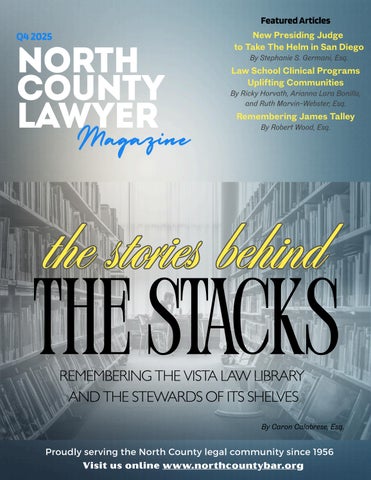
Featured Articles
Q4 2025
NORTH COUNTY LAWYER Magazine
New Presiding Judge to Take The Helm in San Diego By Stephanie S. Germani, Esq.
Law School Clinical Programs Uplifting Communities
By Ricky Horvath, Arianna Lara Bonilla, and Ruth Marvin-Webster, Esq.
Remembering James Talley By Robert Wood, Esq.
the stories the stories behind behind
THE STACKS REMEMBERING THE VISTA LAW LIBRARY AND THE STEWARDS OF ITS SHELVES
By Caron Calabrese, Esq.
Proudly serving the North County legal community since 1956 Visit us online www.northcountybar.org
Published by the North County Bar Association Phone: (760) 758-5833 E-mail: info@northcountybar.org www.northcountybar.org P.O. Box 2381, Vista, CA 92085 © 2023 North County Bar Association Board of Directors Suzanne Skolnick, President Jess Booth, Vice President Erica Bloom, Vice President Rima Khoury, Vice President Angela Medrano, Director Katharine Tremblay, Director Ed Burns, Director. Carmela Birnbaum, Director. Avneet Sidhu, Director Hon. Harry Powazek (Ret.), Director Alan Mansfield, Director Reid Chambers, Director Gary Cunneen, Director
Our mission is to promote professional excellence, camaraderie, philanthropy, and community outreach.
Staff: Camden Retzlaff, Executive Director N O R T H C O U N T Y L AW Y E R
|
2
NORTH COUNTY LAWYER
CONTENTS 2025 Q4 2025 SUSTAINING MEMBERS To be a "Gold" or "Silver" Sustaining Member, a member pays the regular dues for the appropriate category, plus an additional $500 or $250 per year. Members are recognized in each North County Lawyer Magazine publishing and on the bar's web page.
Gold Edward Burns, James Bush, Darwin Bustarde, Paul Camp, Howard Franco, Michael Friedrichs, Thomas Grimes, Robert Jackson, Michael Klein, Daniel Martin, Jodi Schnoebelen, Debra Streeter Silver Lesly Adams, Erica Bloom, Melissa Bustarde, Amber Crothall, Susanne De La Flor, Carline Fonseca, Rich Gaines, Russell Kohn, David Larkin, Gregory Lievers, Sue Loftin, Kelly Reid, Jacqueline Skay, Joseph Stine, Nicole Varela, Herbert Weston, Tanya Weston
5 Editor's Letter Caron Calabrese, Esq. 7 One Court: Incoming Presiding By Stephanie Germani, Esq. 13 San Diego’s Three Pillars of Legal Education 15 Probate Made Possible, TJSL By Ricky Horvath 18 Rooted in Service, Cal Western By Arianna Lara Bonilla 23 Students Standing up for Tenants, USD By Ruth Marvin Webster 26 The Legacy of the Vista Law Library By Caron Calabrese 39 Raising The Bar Staff reports
Caron Calabrese, Esq., Editor Camden Retzlaff, Executive Director Editorial Committee: Lesly J. Adams, Esq., Dar win Bustarde, Esq., Ruth Mar vin Webster, Esq., Bill Kamenjarin, Esq., Larr y Campitiello , Esq., and Stephanie S. Germani, Esq.
The North County Lawyer Magazine is published quarterly by the North County Bar Association. Subscriptions, articles, photos and advertising should be submitted to: North County Bar Association, P. O. Box 2381, Vista, CA 92085 or info@northcountybar.org, or (760) 758-5833. The subscription rate for non-members is $40 per year. Deadline for submissions is the 10th of the month prior to publication. The North County Lawyer reser ves the right to edit all submissions.
40 Hiring The Modern Paralegal By Kristine M. Custodio Suero, ACP, Tracey N. Perkins, MBA 45 Booked for the Holidays By Lopardo Inn of Court 47 NCBA‘s Holiday Party on the Coast Staff reports 49 In Memoriam: James Warren Tally By Robert Wood, Esq.
N O R T H C O U N T Y L AW Y E R
|
3
NORTH COUNTY BAR ASSOCIATION
The North County Bar Association requests the pleasure of your company at the
70th Anniversary Board Installation Dinner Join us as we recognize our outgoing Board of Directors, formally swear in our incoming leadership, and celebrate the beginning of NCBA’s 70th Anniversary year with an evening of connection, tradition, and reflection.
Monday, January 26, 2026 5:30 p.m. – 8:30 p.m. The Crossings at Carlsbad Event Highlights Installation of the Incoming Board of Directors & President Recognition of Outgoing Directors Presentation of the President’s Award Special Recognition of North County’s Distinguished Law Librarians
REGISTER HERE https://www.northcountybar.org/?pg=events or at info@northcountybar.org by January 16th, 2025 Attire: Business or Business Formal Table and event sponsorships are available. To learn more, please contact Camden Retzlaff, Executive Director at camden@northcountybar.org
NORTH COUNTY BAR ASSOCIATION
President’s Award Each year, the President of the North County Bar Association selects an individual whose dedication, leadership, and service exemplify the values and mission of our Association. The President’s Award is a special honor recognizing extraordinary commitment to the legal community and meaningful contributions that have strengthened NCBA and the profession as a whole. This evening, we are proud to present the President’s Award to an individual whose impact has been felt through service, mentorship, and unwavering support of the North County legal community.
Recognition of Outgoing Directors We also take this opportunity to formally recognize and thank our outgoing Board of Directors. Their leadership, time, and service have been instrumental in guiding the Association through the past year, and their commitment has helped ensure NCBA’s continued growth and stability. We extend our sincere appreciation for their dedication to the Association and the broader legal community.
Special Recognition: North County Law Librarians The North County Bar Association is honored to recognize two individuals whose careers have profoundly shaped legal research, education, and access to justice throughout our region. This evening, we extend special recognition to Debra A. Morse and Cheryl WeeksFrey, two distinguished law librarians whose decades of service to the North County legal community have supported generations of attorneys, judges, and students. Through their expertise, dedication, and commitment to public service, they have played an indispensable role in strengthening the practice of law in North County. Their contributions reflect the quiet but essential work that sustains our profession, and we are deeply grateful for their lasting legacy.
EDITOR'S
Caron Calabrese, Editor (858) 598-5552 caron@cawoodwardlaw.com
LETTER I wanted this issue to be about some of the people who make the North County Bar so unique. We visit with the presiding judge of San Diego County, Judge Michael Groch. We focus on the law schools and the ways they are helping our community through partnerships with community groups and the courts, and discuss how to hire the best paralegals for your needs. We also highlight a new feature wherein we invite you to acknowledge your peers in Raising the Bar. As always, we share photos from NCBA around town, at the Inns of Court and at the Holiday Party. And we honor a special colleague we have lost, Jim Talley. On a personal level, I am proud to honor Deb Morse and Cheryl Weeks-Frey, the extraordinary librarians who made the Vista branch of the San Diego Law Library a home for me and so many others. The overwhelming response I received from fellow library-goers shows the common wish to acknowledge their amazing contribution to the history of our bar association and our community. I sincerely hope you will join us for the Installation Dinner on Monday, January 26, 2026, at The Crossings, where this long-overdue celebration will take place. Wishing a peaceful holiday season to all.
Ca
. n ro
N O R T H C O U N T Y L AW Y E R | 6
By Stephanie S. Germani, Esq.
ONE
San Diego County’s courtrooms are set for a distinctive leadership transition in 2026 when Judge Michael S. Groch takes up the gavel as Presiding Judge of the county’s vast Superior Court system. More than a ceremonial role, Groch is driven by a straightforward principle that he calls “One Court.” As he steps up after serving two years as Assistant Presiding Judge under Judge Maureen Hallahan, Groch’s vision is poised to shape the future of law and justice for more than
Judge Groch
three million residents, including 1.2 million residents in North County.
COURT A VISION FOR UNIFIED JUSTICE IN SAN DIEGO COUNTY An Interview with incoming Presiding Judge Michael S. Groch
Path to Presiding Judge: Roots and Reluctant Innovation Judge Groch’s professional journey began in traditional prosecutorial trenches, with a focus on gang violence as a Deputy District Attorney. In 1999, he was tapped to launch the Computer and Technology Crime High-Tech Response Team (CATCH). But what started as a reluctant shift became a career-defining opportunity to innovate and build tools for modern justice. Then, an appointment by Gov. Arnold Schwarzenegger to the N O R T H C O U N T Y L AW Y E R
|
7
bench in 2010, affirmed Groch’s commitment to public service. After almost two decades as a prosecutor, including a brief stint in Sacramento County, Groch’s embrace of judicial leadership was, in his words, “another form of service.” “Every judge has a duty to serve their community beyond just handling cases,” Groch reflects. “If we can make it better then that’s what we ought to be doing.” As he notes, the decision to pursue the presiding role wasn’t lightly made. “It’s called government promotion. It’s the same pay, more challenges, but more opportunity to be of service, too,” he shares. Elected by his peers, Groch is as much heir to the court’s traditions as he is a catalyst for change. The "One Court" Philosophy: Guiding Principle and Practice Across the county’s seven regional courthouses and dozens of departments, Groch’s “One Court” philosophy sets the standard for unified purpose. “To me, One Court means we share all resources, we help each other out, our guidepost is always what serves the public better.” He adds, “No matter what, whatever we need to serve the public, that’s what we do, so that will continue.” Groch rejects the notion of silos or divisions between court locations or administrative teams. “We’re One Court. No matter where somebody is, we want to serve them.” That vision shapes day-to-day operations, from resource allocation to the way the court interacts with attorneys, litigants, and the community. Technology and Change: Leading with Innovation Groch’s reputation as an innovator is hard won and rooted in his direct experience with systemic reform. His first major project as a judge replaced the county’s antiquated search warrant process, which required on-call judges to listen to affidavits read over the telephone. “It was a terrible system,” Groch explains. “Officers would have to call and read these lengthy documents. It was inefficient for everyone involved.” N O R T H C O U N T Y L AW Y E R
|
8
He pushed for an electronic search warrant system, a process that took several years to bring online. “You’ve got to push, you’ve got to explain, you’ve got to educate, you’ve got to bring people along.” Change management, Groch says, comes down to patience and persistent listening and education. “People resist change naturally, but when you show them how it makes their job easier and serves the public better, they come around – most of the time.” On the perennial challenge of courtesy copies, Judge Groch is upfront about the balancing act and sees the current priority as reducing, not eliminating, paper dependence: “I think complete paperless will come after my time in the courts.” For now, he focuses on tangible progress: more digitization, fewer unnecessary copies, and always working toward a system that is “easier, better, faster, and more accurate” for everyone. With his move to Presiding Judge, he is now overseeing the implementation of Criminal Odyssey, a digital case management system for the criminal division, mirroring reforms already in place in civil matters. “We’re still currently paper-based in criminal,” he says. “Criminal Odyssey will change that, but it’s a massive undertaking.” The budget presents unique challenges. “Close to Eighty-five percent of our $225 million budget is personnel,” Groch notes. “That doesn’t leave much discretionary funding for major technology initiatives.” Staffing is another focus. Recruitment and training used to take two years for new clerks, and Groch is support his Operation Team’s efforts to streamline training while preserving court accuracy. Artificial Intelligence, too, is under scrutiny. “Hallucinations and mistakes are real,” Groch cautions, referencing the risk of AI errors. He sees appropriate uses for AI in administrative functions, such as document review and form checking, but insists “AI should never touch judicial decision making.” Groch’s optimism about technology is balanced by a relentless commitment to transparency and education. “If it helps the public and it doesn’t threaten the integrity of the process, we should use it, but carefully.” Access to Justice: Reaching Every Community Improving access to justice is another major priority for Judge Groch.
“We have to be sure that access, staffing, and technology meet the unique needs of North County practitioners and litigants.” Judge Groch
The Vista Courthouse serves North County’s 1.2 million residents.
N O R T H C O U N T Y L AW Y E R
|
9
The shift to remote appearances via video has, in his words, “revolutionized” the court’s accessibility. “People can now appear during their work breaks,” Groch observes. “A parent doesn’t have to take an entire day off work and arrange childcare for a five-minute hearing. That’s real access to justice.” Self-represented litigants, a significant portion of the courts’ users, are a constant focus. Forms are regularly revised for clarity and usability. “We’re always looking for ways to make our forms clearer,” Groch notes. Physical access remains important, but remote options have vastly expanded how people can interact with the court process. Groch spoke of the importance of partnerships with community organizations, including the Family Justice Center, public libraries, and law libraries, ensuring technology does not become a barrier for those lacking digital resources. North County: High Regard, High Impact His appreciation for North County’s unique scale and legal talent is unwavering. “I have a deep
appreciation for the work that happens in North County and the caliber of the attorneys who practice there.” Although Groch does not reside in North County, he is deeply aware of its importance within the county’s court system. “North County is our largest operation outside of Central,” he explained. “We’re serving approximately 1.2 million people in North County.” Geographical challenges are real, especially for attorneys balancing caseloads across distant courthouses, and Groch’s “One Court” philosophy commits leadership attention and resources to North County’s needs. “You can’t just focus everything downtown,” Groch asserted. “We have to be sure that access, staffing, and technology meet the unique needs of North County practitioners and litigants.” Transparent Technology, Smarter Access Groch is also intent on addressing everyday inefficiencies that frustrate ractitioners, including courtesy copies and e-filing delays. “We’re experimenting with auto-acceptance protocols for N O R T H C O U N T Y L AW Y E R
|
10
reporting out innovations statewide. “There’s a definite awareness of problems and I can promise you that there’s nobody that is making decisions that’s ignorant to these problems and it’s better for everybody when we make things easier and better and faster and more accurate.”
In addition to North County, Judge Groch will oversee operations at the Central Courthouse, top left, the East County Courthouse, Juvenile Court, Kearny Mesa Traffic Court, the Hall of Justice, and the South County Courthouse..
e-filings to reduce delays,” he says. “It’s about finding the right balance between thoroughness and efficiency.” “I can’t stand inefficiency,” Groch admits candidly. “I’ve just always had this urge when I see something terribly inefficient and I know it can be done better, I to try to make it better.” When court filings get rejected, Groch’s openness about improvement is evident. “Maybe some of that’s on us, if we haven’t made that necessary information as readily available as possible, and the problem is
you have so much information that it’s hard to find what you need sometimes,” he acknowledges. He points to innovative solutions piloted elsewhere. “One of our sister courts developed an internal AI-driven chatbot where the clerks can get their procedural questions answered in plain language by making a query of only the court’s policies and procedure manuals.” A comprehensive “information technology advisory committee” is at work, developing and
Advice for Attorneys: Embrace Change, Value Civility Judge Groch’s advice to San Diego’s legal community is both practical and principled. “Embrace the technological changes,” he urges. “They’re coming whether we like it or not, and they generally make practice more efficient once you adapt.” Respect for court staff is nonnegotiable. “These people work incredibly hard for less than they deserve. A little kindness and recognition go a long way.” For those seeking to improve processes or voice concerns, Groch recommends working with supervising judges. “We want to hear your feedback, and there are appropriate channels that help ensure your concerns reach the right people.” Above all, Groch advocates for civility. “This profession is difficult enough without unnecessary conflict. Civility and professionalism make everything work better.” N O R T H C O U N T Y L AW Y E R
|
11
Looking Forward: A "One Court" Future Judge Groch’s elevation to Presiding Judge marks a new chapter for San Diego County’s judicial community. “If I can make it better then, you know, that’s what we ought to be doing.” His vision for a truly unified “One Court” system, grounded in resource sharing, innovation, and relentless focus on public service, promises to unlock new possibilities for attorneys, litigants, and all who depend on the courts. The challenges ahead remain significant: budget constraints, staffing shortages, and the demands of technological change. But Groch sees opportunity at every juncture. “Our guidepost is always what serves the public better.” As 2026 approaches, Judge Groch’s “One Court” mission will guide the court system through transition, affirming that unity and service to the public are the ultimate standards for justice in San Diego County. Stephanie S. Germani, Esq. practices landlordtenant law and plans to keep practicing long enough to see courtesy copies go from “perennial challenge” to historical footnote.
2026 New Judicial Assignments
ROY LAI South 17 Family IC
CHANDRA REID Central 61 Civ. Harassment
FRANK BIRCHAK Central Assistant Criminal Supervising
KATHLEEN LEWIS East 15 Criminal
CATHY RICHARDSON North 17 Family IC
ALEX CALERO East 21 (Crim/Civ/RO)
DEVON LOMAYESVA Juvenile 10 Juvenile Dependency
TERRIE ROBERTS HOJ 68 Civil IC
RACHEL CANO Central Criminal 1104 (Misd. Readiness)
ADELAIDA LOPEZ North 14 (Jan. - June 30)
ALANA ROBINSON Central 1501 Criminal
DEBORAH CUMBA East 4 (Misd. Readiness)
ADELAIDA LOPEZ North 26 Criminal (July 1)
DANIEL SEGURA North 28 Civil IC
CINDY DAVIS East D9 Criminal
JIHAN MALONEY South 3 (Misd. Arr./Readiness)
BLAIR SOPER East 18 Juvenile Dependency
LAURA DUFFY Central Criminal 101 Felony Arraign.
PENNIE MCLAUGHLIN North 26 (Jan. - June 30)
TODD STEVENS Civil 2102 Limited Civil
SELENA EPLEY East 11 Supervising
PENNIE MCLAUGHLIN North 14 Criminal Arr. (July 1)
VALERIE SUMMERS North 16 Family IC
BRIAN ERICKSON North 2 DV/CHRO
RICHARD MONROY North 6 Criminal Dispo/Asst. Supv.
VICTOR TORRES North 31 Civil IC
JAMI FERRARA Central 902 Family IC
CHRIS MORRIS Central 702 Family Long/Asst. Supv.
LEONARD TRINH South 7 Criminal
MAUREEN HALLAHAN Central Criminal
PETER MURRAY Central 501 Probate
MICHAEL WASHINGTON Civil IC HOJ 73
RACHEL JENSEN Central 201 Unlawful Detainer
EUKETA OLIVER HOJ 75 Civil IC
THEODORE WEATHERS Central 102 Criminal Supervising
ROBERT KEARNEY North 22 Criminal
MICHAEL PULOS Juvenile 6 Juvenile Justice
N O R T H C O U N T Y L AW Y E R
|
12
SAN DIEGO’S
THREE PILLARS OF LEGAL EDUCATION
How local law schools are turning classrooms into community lifelines
TJSL page 15
Cal Western page 18
USD page 23
San Diego’s three law schools form the backbone of the region’s legal education, shaping not only future advocates but also how the profession shows up for the community. Across Thomas Jefferson School of Law, California Western School of Law, and the University of San Diego School of Law, clinic-based programs now sit at the center of that mission, treating access to justice as a core teaching tool rather than an extracurricular activity.
THREE SCHOOLS, THREE STORIES This North County Lawyer package brings together three stories, one from each of San Diego’s law schools, to showcase a shared commitment to experiential learning in service of the public. Read together, they trace an emerging regional ecosystem in which students learn doctrine and professionalism in the same spaces where low-income San Diegans seek help with housing, probate, and other civil legal issues. THOMAS JEFFERSON: PROBATE IN PARTNERSHIP At Thomas Jefferson School of Law, the new Probate Limited Assistance Clinic was built in direct collaboration with the San Diego Superior Court’s Probate Department and the San Diego County Bar Association, with a clear mandate to help self-represented litigants without displacing the local probate bar. Under faculty and volunteer supervision, students learn to identify probate defects, interpret court notes, and prevent delay, turning technical procedure into a vehicle for practical training and more humane outcomes. CAL WESTERN: COMMUNITY LAW PROJECT IN THE NEIGHBORHOODS California Western’s Community Law Project, now entering its third decade, has grown from a single church-based medical-legal partnership into a multi-site network of walk-in clinics embedded in neighborhoods across San Diego. By pairing legal services with social work, interpreters, and long-standing community partners, CLP equips students to interview clients, spot issues under time pressure, and deliver community presentations that translate complex law into accessible information. USD: HOUSING RIGHTS IN THE COURTROOM At the University of San Diego School of Law, the Housing Rights Legal Clinic and its Eviction Negotiation Program meet tenants where the stakes are highest: in the hallway outside Department 201, where thousands of eviction cases move through a single courtroom each year. Each week, a small cohort of students, guided by supervising attorneys and Professor Allyson Snow, approaches unrepresented tenants, conducts rapid intake, explains rights and defenses, and negotiates resolutions that can change the course of a family’s housing future. AN INVITATION TO THE NORTH COUNTY BAR Together, these three programs depict San Diego’s law schools as coordinated pillars of an access-to-justice infrastructure that spans courts, neighborhoods, and courthouse hallways. For North County lawyers, they also serve as an invitation to supervise students, volunteer at clinics, collaborate on referrals, and help ensure that the next generation of attorneys learns to see pro bono service not as an add-on, but as part of what it means to be a San Diego lawyer.
N O R T H C O U N T Y L AW Y E R
|
14
PROBATE MADE Possible Possible
TJSL ANSWERING JUDICIAL CALL FOR ACCESS TO JUSTICE By Ricky Horvath Self-represented litigants in probate face persistent procedural hurdles that often cause serious delay and hardship during some of the most challenging moments of their lives. Recognizing these barriers, Thomas Jefferson School of Law reached out to the Probate Department of the San Diego County Superior Court to explore the creation of a dedicated probate clinic and to ensure judicial support for its mission. In response, the Hon. Olga Álvarez engaged in detailed discussions with the school, offering insight into the struggles she observed daily—from technical filing errors to repeated continuances—and confirming the court’s strong interest in a clinic designed to improve access to justice and strengthen court efficiency. N O R T H C O U N T Y L AW Y E R
|
15
STRUCTURING THE CLINIC THROUGH INSTITUTIONAL PARTNERSHIP The clinic’s development emerged from early conversations among Thomas Jefferson School of Law, the San Diego County Superior Court, and the San Diego County Bar Association, an alignment that reflects a shared commitment to improving access to justice for self-represented probate litigants. Through this collaboration, Judge Álvarez provided critical guidance on how the clinic should be structured to meet real needs within the probate system. In shaping the model, Judge Álvarez emphasized a core principle: The clinic must expand access to justice without diverting prospective clients from practicing probate attorneys. Her focus was on ensuring a framework that balanced public need with respect for the local bar—a design that supports litigants while preserving the integrity of the broader legal community. The involvement of both the Court and the Bar ensures that the clinic is being built with the insight of those who understand the system’s challenges most deeply, grounding it in partnership, practicality, and ethical responsibility.
Professor Nicole D’Ambrogi, Director of Clinical Programs at Thomas Jefferson, envisions the clinic not only as a response to the court’s call, but as a new pathway for students to discover and immerse themselves in probate law.
HOW THE CLINIC WILL WORK Now in development at Thomas Jefferson School of Law, the Probate Limited Assistance Clinic connects law students under the guidance of Professor Nicole D’Ambrogi, Director of Clinical Programs at Thomas Jefferson, and volunteer probate attorneys with litigants needing hands-on guidance before and during the probate process. The intake system is being designed to screen and triage applicants efficiently, helping those most at risk for costly delay or error. Clinic students will learn essential skills like identifying probate defects, interpreting court notes, and navigating filings. In the process, they’ll build substantive knowledge of probate law while ensuring litigants avoid procedural missteps that delay hearings and outcomes. This direct Experience complements classroom learning, reinforcing technical proficiency and the values of practical justice and service. N O R T H C O U N T Y L AW Y E R
|
16
BENEFITS FOR COURT, STUDENTS, AND COMMUNITY
TJSL CLINICS
The clinic’s dual benefit is clear. It supplies the court with a steady resource to tackle a backlog of cases burdened by procedural defects, reducing unnecessary continuances and freeing judicial resources. For students, it offers an unrivaled practical education, one built on the real demands of probate practice, the urgency of client needs, and the accountability of serving under judicial scrutiny. Self-represented litigants, meanwhile, receive individualized assistance navigating forms, procedures, and requirements. By eliminating preventable barriers, the clinic aims to make the probate process more humane, efficient, and accessible throughout San Diego County. LEADERSHIP AND VISION Guided by Professor D’Ambrogi’s clinical education model, which stresses student empowerment and collaborative problem-solving, the clinic works as a living answer to the court’s challenge. It is supported by dedicated student leaders who will help build workflows, train volunteers, and shape the clinic’s ongoing evolution. Professor D’Ambrogi envisions the clinic not only as a response to the court’s call, but as a new pathway for students to discover and immerse themselves in probate law. Her goal in launching the clinic was to create meaningful volunteer opportunities, cultivate student interest in a traditionally under-explored practice area, and build a sustainable model that develops future probate practitioners. THE ROAD AHEAD
Ricky Horvath is a 4L part-time evening student at Thomas Jefferson School of Law and a student leader in the school’s Clinical Programs.
As the Probate Limited Assistance Clinic continues to take shape, its mission is clear: to serve San Diego’s litigants and probate system, to train future attorneys, and to exemplify the best of legal education and community collaboration. With the support of the court, the partnership of the San Diego County Bar Association, and the leadership of the Clinic Director and student team, this initiative is positioned to leave a lasting impact on the community and the practice of probate law for years to come. N O R T H C O U N T Y L AW Y E R
|
17
Cal Western’s Community Law Project: From a Single Seed to Serving 100+ Monthly By Arianna Lara Bonilla L asting change begins as a seed—an idea, a partnership, or a moment of compassion. In the legal community, those seeds take root where the law meets lived experience. For California Western School of Law’s Community Law Project (CLP), what began as a small seed has flourished into a twentyyear legacy of service, collaboration, and education. Planting the First Seeds The Community Law Project began as a seed that has since flourished into a robust program, providing vital legal services to the San Diego community while equipping law students with the tools to thrive in their legal careers. Its roots trace back to First Lutheran
Professor Ted Janowsky and others volunteer at First Lutheran Church. N O R T H C O U N T Y L AW Y E R
|
18
Church, a longstanding hub for philanthropic initiatives and the soil in which CLP first took root. Founded in 2005 by Professor Linda Morton in collaboration with Dr. Ellen Beck from UC San Diego and a law student working on medical-legal partnerships, the program grew from identifying legal needs alongside the church’s medical clinic into an integrated approach that continues to this day. Reflecting on that foundation, Executive Director Dana Sisitsky shared that she loves how the project partners with different types of professional providers to meet a variety of needs, “to meet the whole person, not just the legal needs.” By 2007, CLP expanded to other sites, including City Heights, incorporating social work and legal collaborations with local schools. In 2012, several projects were brought together under the CLP umbrella. What began as a small, volunteer-driven effort has grown into a formalized program with dedicated staff, cohorts of student volunteers, and participating attorneys, continuing its mission twenty years after CLP’s founding.
Rooted in Service CLP partners with organizations and professionals to provide sustainable and competent legal services to lowincome and indigent members of the community
Collaborations address needs across housing, immigration, consumer law, family law, and more. By partnering with sites hosting medical professionals, social workers, and community organizations, CLP delivers holistic solutions that truly meet people where they are. And while CLP does not provide direct representation, it offers legal advice, guidance, and referrals, equipping individuals with the tools to navigate their situations more confidently. Sisitsky described how the program evolved, explaining that when it first started it was very client-focused, but over time the student aspect blossomed, and now the program balances serving the community with shaping future lawyers. During the fall and spring semesters, students must be enrolled in the class component, requiring them to be assigned to a clinic, attend class sessions, and create a community presentation. Current law student Hilda tBetancourt joined CLP to give back in a meaningful way. Betancourt said that it has given her the opportunity to put what she has learned in class into practice in “a direct and impactful way, while helping people who might not otherwise have access to support.” Current CLP student Mackenzie Rivera reflected, “You strengthen your issue-spotting, you only have an hour to speak to clients, often with a lot of facts thrown at you, and you have to know how to identify issues and ask questions accordingly.”
Community Law Project’s Fall 2025 cohort visiting the Hall of Justice. N O R T H C O U N T Y L AW Y E R
|
19
Clinics are often buzzing with activity, as interpreters, students, and volunteer attorneys collaborate to guide clients, conduct interviews, and provide resources. Rivera recalled one of her first clients: “I met with a couple facing eviction from their temporary housing. I contacted the program director to clarify their situation and was able to reassure them that they would not be displaced. Seeing their relief and gratitude, knowing they had a safe place to stay that night, was an incredibly rewarding experience.” Learning By Doing: Clinics in Action From a single location, CLP has expanded to four clinic sites across San Diego. The program hosts three weekly clinics, one monthly, and a few pop-up clinics that bring legal services directly into underserved neighborhoods. These walk-in clinics address immediate legal needs while modeling accessibility and compassion. Each clinic is staffed by a mix of professionals and student volunteers, including a supervising attorney, volunteer interpreters, and law students. Students help set up tables and chairs, prepare intake files, and practice their client interviewing skills. They often shadow attorneys, gaining hands-on experience deepening their understanding of legal topics and developing transferable skills to become advocates that are wellrounded. The current staff includes Executive Director and Clinical Professor Dana Sisitsky, Associate Director and Clinical Professor Ted Janowsky, and Community Education Coordinator and Program Administrator Lizeth Cervantes. Janowsky reflected on his experience, saying that he has learned a lot from Sisitsky, particularly about “maintaining relationships with attorneys and managing sustainable efforts with volunteers.” Together, the staff guide twelve student clinicians each trimester, with four students assigned to each site and meeting with at least two clients per session. Janowsky explained that “while students cannot directly give advice, consulting with a supervising attorney gives them the tools to help define and relay clients’ options.” Over the course of a month, CLP assists roughly 100 community members, a powerful testament to what collaboration can grow into. Flexibility has also been one of CLP’s greatest strengths. Sisitsky recalled that within weeks of the pandemic shutdown, the team pivoted from in-person to remote clinics, ensuring that San Diegans could still access legal help. Former law student clinician and now volunteer attorney Sydney Castillo-Johnson echoed this adaptability, explaining, “During COVID everything changed overnight —we had to adjust presentations
Community Law Project students Thomas Tamayo and Caitlyn Burns present on expungements. to reflect new housing policies, move them to Zoom, and translate materials into multiple languages so everyone could understand.” Rivera noted that flexibility and collaboration are essential skills for CLP students, adding that law school does not always offer opportunities for teamwork, but “working with multiple attorneys in clinic settings is invaluable preparation for practice.” Turning Lessons Into Outreach During the fall and spring semesters, CLP students are required to give community presentations as part of their clinic coursework. These presentations began as attorney-led sessions but were formally integrated into the curriculum in 2013. Sisitsky explained that community education became a way to assess learning while benefiting the public, since traditional final exams would not adequately reflect students’ experiences. The program operates on two tiers: serving the community and training law students to become effective, adaptable advocates. To train law students, each week, a module covers a practice area commonly encountered in clinics, often taught by volunteer attorneys. Students appreciate exposure to these areas of law through guest speakers. Rivera and other students noted that they value hearing from multiple attorneys every week, an opportunity she says is unique compared to other classes.
N O R T H C O U N T Y L AW Y E R
|
20
“Many of our partnerships go back years. It’s not just about showing up once, it’s about staying connected, listening, and adapting to what each organization and community needs.” Lizeth Cervantes, Cal Western Community Education Coordinator
CLP students Eden Arthur and Ragan Fowzer present to the Karen Organization. Preparing a community presentation is no small feat. Students must consider audience needs, provide resource sheets, and ensure the session is engaging and relevant, all within an hour. This mirrors clinic work, where multiple issues often arise for each client, and while students want to address every need, it is not always feasible. Current student Isabel Salazar reflected that community presentations allow for “a holistic approach, combining legal information from CLP with specialized services from partner organizations to provide robust support for vulnerable communities.” Students often stand before rooms of parents, seniors, or recent immigrants, breaking down complex legal concepts into everyday language, sometimes in multiple languages or through visual aids, transforming information into empowerment. Castillo-Johnson recalled working with a refugee community during the pandemic, creating a presentation on tenants’ rights during the housing moratorium. She described the challenge of keeping materials accurate as laws constantly changed, but also the reward of communicating complex legal ideas in an understandable and practical way. To ensure accessibility, her team used visuals rather than text for audiences who did not read English, demonstrating CLP’s commitment to meeting people where they are.
Another former CLP student, now a California Western alumnus, Ragan Fowzer echoed a similar sentiment. She recalled her presentation with the Karen Organization of San Diego, “engaging youth group ages twelve to twenty-one with a presentation of their legal rights and responsibilities.” Ragan stated, “We made it fun and organized a quiz with prizes. It was incredibly rewarding to see that everyone was engaged and learned from a presentation that required so much preparation.”
Growing Together “Meeting people where they are” is more than a motto, it guides CLP’s partnerships. CLP collaborates with organizations such as Chicano Federation, Price Philanthropies, Partnership for the Advancement of New Americans (PANA), Casa de Amistad (with Solana Beach), the City of San Diego District 6, AARP, and Multilingual Intellectual Department. Community Education Coordinator Lizeth Cervantes emphasized that these relationships are built on trust and long-term commitment, “Many of our partnerships go back years. It’s not just about showing up once, it’s about staying connected, listening, and adapting to what each organization and community needs.”
N O R T H C O U N T Y L AW Y E R
|
21
The impact of this work has not gone unnoticed. CLP recently received the Bernard E. Witkin Award for Excellence in Legal Education from the San Diego Law Library Foundation, recognizing two decades of commitment to experiential learning and public service. Alumnus Michelle Valania reflected on the program’s three core purposes: inspiring students by training ethical, community-driven lawyers, reaching low-income San Diegans to make law accessible, and encouraging lawyers to fulfill their duty to provide pro bono services. Valania shared, “I was really happy to share that moment and see the bigger picture. Even though I’m only a few months out of law school, it was nice to look back on my time with CLP and see how it continues to impact people who’ve gone through the program.” Keeping the Work Alive CLP thrives on collaboration. Pro bono attorneys can volunteer in various legal areas, and Sisitsky emphasized that participation is flexible, requiring just a few hours every other month to lend expertise. CastilloJohnson highlighted how easy it is to get involved, noting that her firm has become very “CLP-friendly.” Several attorneys, former interpreters, and CLP alumni continue to volunteer regularly because of CLP’s mission and impact. “I make everyone at my office do it,” Castillo-Johnson joked, highlighting both the accessibility and the sense of community that CLP fosters among legal professionals. Ragan Fowzer noted how important shadowing was to her, “The volunteer attorneys were inspiring to observe. They demonstrated how to interact with clients, navigate difficult situations, and carry the skills we learn throughout CLP throughout our careers. Thanks to CLP, I take pride in being able to communicate effectively with clients, make them feel heard and seen, and do everything I can to support them.” After two decades of growth, the Community Law Project will continue to cultivate both justice and education, proof that when service takes root, an entire community can flourish. Alumni share similar sentiments as Fowzer who stated, “CLP has given so much to me and my career. I can’t wait to give back to the Community Law Project and the San Diego community.” The seeds that CLP plants continue to nurture the next generation of legal professionals, fostering skills, compassion and a commitment to justice that extends beyond the classroom and into the community. CLP’s story is ongoing, and its work continues to evolve, adapt, and grow.
CLP collaborated with Your Safe Place to provide legal services to support their clients.
Arianna Lara Bonilla is a J.D. Candidate at California Western School of Law (Class of 2027). She currently serves as Vice President of the Latino Law Student Association, Junior Community Liaison for the Women’s Law Caucus, and Community Service Chair for the First-Generation Law Student Association. She can be reached at ahlara@law.cwsl.edu.
ON NOTICE:
STUDENTS STANDING UP FOR TENANTS USD Law Clinic Helps Navigate Eviction Negotiations By: Ruth Marvin Webster N O R T H C O U N T Y L AW Y E R
|
23
“It’s wonderful to see students catch the fire for pro bono service. The return is almost instantaneous. Clients are so grateful—they tell you you’re an angel. One man told his student attorney she had changed the course of his life.” Allyson Snow, USD Law Professor - Housing Rights Clinic When San Diego County faced a surge of evictions following the pandemic, Lemon Grove Mayor and University of San Diego School of Law Professor Allyson Snow helped establish the Housing Rights Legal Clinic in August 2022. “Coming out of COVID, there were protections in place to ward off evictions,” explained Debbie Rider, Assistant Dean of Development and Alumni Relations at USD School of Law. “But when those protections were lifted, an overwhelming number of families were at risk of losing their homes. A local foundation approached us and asked what it would take to create a legal clinic to help families in crisis.” Last June, as part of that effort, the clinic launched the Eviction Negotiation Program, designed to provide legal assistance to low-income tenants facing eviction. Each semester, one day a week— Mondays for now—Snow, supervising attorneys, and up to ten second-year law students approach tenants waiting for their eviction cases to be called. They offer free legal help to those interested, filling a critical gap in representation. Snow estimates that roughly 80 percent of tenants appear without counsel, while N O R T H C O U N T Y L AW Y E R
|
24
95 percent of landlords have attorneys, leaving low-income tenants at a major disadvantage. The need is tremendous. At any given time, approximately 4,000 eviction cases are open in San Diego County. All are heard downtown in a single department—Department 201—before one rotating judge (currently the Hon. Peter Murray, with the Hon. Rachel Jensen set to oversee the department in 2026). “When you walk into court on Monday morning, there might be 26 trials on calendar,” said Snow. “The first thing the court does after check-in is send everyone into the hallway to negotiate a settlement.” But that setting is far from ideal. The hallway, surrounded by glass walls and lined with hard wooden benches, offers no privacy for confidential discussions. “It’s not suitable for contract negotiations,” said Snow. “But instead of letting logistics get in the way, we started going over to the law library with clients and appearing remotely with them. There’s plenty of space there—it really brings down the temperature.” After completing an intake, and assuming no conflict exists, clients receive help from the students, who receive on-site training and work under attorney supervision. They help tenants understand their rights and obligations, prepare for negotiations, and identify potential defenses—
EVICTIONS IN SAN DIEGO COUNTY: BY THE NUMBERS The Scope of the Crisis About 750 unlawful detainer filings every month (as of 2024-2025) About 4,000 open UD cases at any given time Typically 26 UD trials scheduled every Monday morning All limited UD cases start in Department 201
The Justice Gap
80% 95%
of tenants have of landlords NO lawyer HAVE a lawyer > $225 Filing Fee For Tenant to File an Answer Hardest Hit Neighborhoods Downtown San Diego Southeastern San Diego Barrio Logan City Heights
often involving habitability issues or defective notice. If a student has completed Evidence, they can even represent clients at trial, gaining invaluable hands-on experience. Participating students earn course credit, but for most, the greatest reward is the immediate impact of their work. “It’s wonderful to see students catch the fire for pro bono service,” said Snow. “The return is almost instantaneous. Clients are so grateful—they tell you you’re an angel. One man told his student attorney she had changed the course of his life.” And all that happens before noon on any given Monday.
To make a donation: click here: law.sandiego.edu\eviction-protection And for pro bono opportunities, contact Martita Ocon, Esq. at 619-243-9620. Spanish helpful but not necessary.
N O R T H C O U N T Y L AW Y E R
|
25
he e h t f o egacy ista aw
ibrary
ians r a r b i L e l arkab m e R e h t Honoring ary an r b i L e h t e that Mad ace l P e l b a t t Unforge brese
Cala By Caron
“I cannot thank these librarians enough for their kindness and resources. Deb and Cheryl: you became and remained great friends and mentors to me. I truly cherish all you did for me and for our legal community.” Eric Ganci, Esq.
Deb Morse and Cheryl Weeks-Frey
he Vista branch of the San Diego Law Library is remembered most vividly not for its shelves or square footage, but for the two librarians who turned it into North County’s legal living room: Deb Morse and Cheryl Weeks‑Frey. Their legacy is a story of mentorship, community, and the quiet, steady care they gave to generations of new attorneys finding their footing in practice. These amazing women will be honored at the NCBA’s Installation Dinner on January 26. What follows are Caron Calabrese’s memories and the recollections she gathered from our legal community to honor Deb and Cheryl as we celebrate them this January. N O R T H C O U N T Y L AW Y E R
|
27
By Caron Calabrese, Esq.
Deb Morse, top, left, and colleagues at the library’s Law & Comics series. Below, Cheryl Weeks-Frey in the stacks.
“Whenever I pass the former Vista Law Library, I am filled with warm memories of all the time I spent there.” Aleida K. Wahn, Esq.
As I often do when planning an issue of the North County Lawyer magazine, I focus on what differentiates the NCBA from other bar associations. For this issue, I reflected on my personal experience, and my thoughts immediately went to the Vista branch of the San Diego Law Library. When I was a new lawyer, I spent a lot of time there, and it was such a unique place. The library served as something of a home base for me, since I lived close to downtown but worked in Vista. I spent hours sitting crossed-legged on the floor surrounded by practice guides, and on many occasions, another lawyer or one of the law librarians would round the corner and nonchalantly ask if I needed any help. Many would top and take the time to answer my questions about civil procedure, give me tips about the judges, and guide me to the right resources. So, I reached out to the law librarians-extraordinaire, Deb Morse and Cheryl Weeks-Frey, to let them know I wanted to write a short piece on the law library. I asked them provide me with some names of people who they felt were particularly connected to that library, so I could send a few emails and maybe get a few comments on why each person shared my sentiment. The response was staggering. I began receiving pages and pages from so many people about their experiences with Cheryl and Deb. And I realized there was a bigger story to be told. While I had begun writing about the library itself, I realized the real story is about the librarians who made it special, and it is crystal clear that there is a compelling need to honor these women and the impact they have had on our lawyers and the North County community. The library was exceptional because of them. Deb and Cheryl were so much more than research librarians. They were mentors, guides, coaches, cheerleaders, moms, enforcers, educators, and N O R T H C O U N T Y L AW Y E R
|
28
friends. Not only did both Deb and Cheryl guide me in my research, but they also supported me and my journey as a lawyer. They made the library a place where many attorneys and community members felt at home. They each operated in their own way, but they were like some powerful combined force. I remember specifically how their united approach had a significant effect on me. After a particularly difficult morning in court, I sought refuge in the library during the lunch break, to gather my emotions before heading back for more. Upon my arrival and obvious distress, Cheryl swooped in for Stage 1: Sympathy. I remember her listening to me intently with wide eyes and nodding to agree with me that everything was unfair. She gave me a hug and told me to take a deep breath and have some water. After a brief rest, Deb came in for Stage 2: Reality. While also sympathetic, Deb saw that I needed to go back stronger, and used more of a tough-love approach: “Well, it’s not going to get better if you don’t do something about it. What’s the issue and what do you need to learn to feel more prepared? We have 20 minutes before you need to get back in there.” Then they both went into research and education mode. They made sure I had the ammunition to do the job, but also the confidence to believe I could be successful. And my story is not unique. So many North County lawyers, judges, and community members feel so passionately about the loss of the library and our beloved librarians, and sharing those stories is well overdue.
“When the law library shut down without warning during COVID, it felt like the abrupt end of an era-one in which real human beings, not search bars, guided us toward clarity. These days, whenever I research alone at my desk, I still catch myself wishing for those good old days when Cheryl and Deb stood ready with a statue book, a knowing smile, and the perfect question to set a lawyer back on course.” Rafael Acosta, Esq.
A glimpse of the Vista Law Library circa 2010, when Deb Morse and Cheryl Weeks‑Frey presided over unforgettable characters including a gentleman who once showed up with a leashed cat and a very large knife. He was kindly informed by the librarians that the cat could stay but the knife had to go.
N O R T H C O U N T Y L AW Y E R
|
29
Branch History September 1973 – Branch opens Vista branch of the San Diego County Law Library opens at 325 S. Melrose Drive, Suite 300, as the first satellite branch, serving the growing North County courthouse complex and nearby detention facilities. 1970s–2000s – Full‑service community hub Operates as a full‑service law library for attorneys and the public, offering free access to legal materials and, later, electronic research tools. 2015 – Usage peaks and patron praise Patron surveys show about 55 reference questions and 86 visitors per day; solos like Robert Fougner call the branch “essential” and attorney Mary Cavanagh praises librarian Cheryl Weeks‑Frey’s “fabulous and informative” assistance. Early 2016 – Trailer condemned, renovation push Aging trailer used for clinics and trainings is declared unsafe due to rot, leaks, dampness, and mold, prompting a renovation campaign led by the Law Library Foundation. 2016–2018 – Fundraising and infrastructure work North County Bar Association and local firms contribute to a $150,000 campaign; HVAC units are replaced, and electrical and fire‑safety upgrades begin, aimed at keeping the Vista branch viable. 2017–2018 – Active programming Branch hosts 14 programs attended by 347 people in a single fiscal year, including “Know the Law” lectures and free legal clinics on landlord‑tenant, trusts and estates, small claims, and immigration issues. March 2020 – COVID‑19 shutdown Pandemic forces closure of the branch; services shift to remote databases and virtual programs. 2021–2022 – Permanent closure decision After reviewing renovation costs, the Law Library decides Vista cannot be feasibly reopened and formally closes the North County branch, pivoting to a partnership model with public libraries instead. 2022 onward – Partnership/remote model Law Library plans and develops North County partnerships and expands remote access so residents can still reach legal information despite the loss of the physical Vista branch.
A Quick History While this story is about the people behind the building, it is important to have some context and history of the Vista Branch of the San Diego Law Library. Richard Duquette recounts that when he was sworn in as an attorney in 1983, “the Vista law library consisted of an 800foot space at the bottom of the old courthouse. It was a cramped space, prone to humidity, limited light, and limited size. You had to walk down a cement stairwell, at the end of the court hallway next to the criminal arraignment courtroom by pushing through some heavy metal doors.” In 1996, that small, basement library got an upgrade to 4,000 feet when it moved from the Vista detention facility and courthouse to the location at 325 S. Melrose, Suite 300. As Duquette recalls, money to support the library came from lawyer filing fees. He remembers that Deb and Cheryl helped to put on free Law Days to help the public. “This was a great asset to the court complex. It made law research tools accessible to pay people and private practitioners who did not have expensive and fancy law libraries.” For decades the law library in Vista served the legal community and the public. When it began, legal resources were exclusively in print form, Shepardizing was a laborious hieroglyphic-like process, and The Daily Journal’s insert was the first report we had of binding case law. It was imperative to have access to the physical reporters and practice to the physical N O R T H C O U N T Y L AW Y E R
|
30
reporters and practice guides. No other format existed. And although for us lawyers the physical resources at the Law Library were essential to be sure, in many ways the librarians became the secret treasure. From 2007 on the local branch management alternated between Cheryl and Deb, and each had their own style and left their own imprint. As print was slowly replaced by online databases, our research skills were updated by the librarians and other staff, and we were grateful for the free access and guidance the library provided. Former NCBA President Richard Muir has related a story about how Cheryl taught him to Shepardize cases using Westlaw on the law library computers. He was amazed at both how fast and how easy the process was.
“Deb and Cheryl brought an exceptional kind of energy and talent to the Vista branch, and it was a gift to have been a part of that.” Marian Birge, Esq. Time marched on and the building became increasingly dilapidated. Plans were hatched and monies raised for renovation. Steps were taken and MOUs drafted intending to temporarily house resources and staff at the county’s Vista library, a few short miles away, during the time of actual physical renovation. While talks continued at the higher levels, the librarians forged additional relationships with the county libraries in Encinitas and San Marcos. The Vista law library branch slowly shrank as the trailer wing literally began collapsing and the conference rooms and librarian offices were condemned. Then COVID hit. Everything shuttered. The librarians grabbed laptops and provided remote reference and classes via email, phone, and Zoom. Cheryl was there by herself to pull books for lawyers who were involuntarily stuck at home, still working on zoom but sans resources. Upper-level
Deb and Cheryl through the years. N O R T H C O U N T Y L AW Y E R
|
31
“The librarians were the ambassadors of the written legal word, and they did their best to be of service to us and the public. I say thank you to them for all the memories and the years of remarkable service they provided to the San Diego County legal community and San Diego County residents.” Sylvia Keating, Esq. Cheryl Weeks-Frey, right, with CEB rep Suzanne.
administration at the Law Library changed. New directors made difficult decisions. Ultimately it was decided to not reopen the Vista Law Library. Certain resources were made available on the San Diego Law Library website, and select databases made available at the Escondido City Library. A new era began. One without a North County venue or those librarians. The ready availability of databases and tools like AI have dramatically changed the way we do research. Much is to be said in favor of these advances. Yet it’s come at a cost. We’ve lost the collegiality of a gathering place. Gone is the place where, like the television show Cheers, “everybody knows your name.”
The Heart and Soul of the Library North County was incredibly fortunate to have Deb and Cheryl at the helm of the Vista branch of the law library. Together they cultivated an environment of community for the Bar and were devoted to creating a space lawyers could count on for resources and support. As licensed attorneys themselves who had practiced, they understood exactly what practicing lawyers- especially solos and small firms- needed. Their patience with the lay public was generous and gracious. “The North County space was more than the average law library-Deb and Cheryl created a venue for synchronicity. You always knew that you would run
into colleagues there, an more than that, Deb and Cheryl cultivated a welcoming space and fostered introductions between lawyers from various locations and practice areas,” reminisces Marian Birge. Cheryl was originally hired as a substitute reference librarian in April 2000. She has traveled between all four San Diego branches and held the titles of Branch Librarian/Manager, Branch Operations Manager, Community Outreach Officer, and Reference Librarian. She says: “I loved my job and took helping library patrons very seriously. One thing all of my job titles/duties had in common was the opportunity to form connections and relationships with patrons, especially our N O R T H C O U N T Y L AW Y E R
|
32
attorney patrons.” She was known to regale the “regulars” with proud stories of her sons. Cheryl and Deb traded positions as branch manager. Deb was sent for a year to manage the El Cajon branch, and then a year to manage the Chula Vista Branch. And while Cheryl and Deb had different styles, they were together devoted to creating a special place for people. “We were both devoted to the challenge and joy of it,” says Deb. “And all the wild ride of personalities and circumstances that brought folks in to figure things out.” Deb has been described as “a registered nurse with an encyclopedic command of personal injury issues, who could dissect a negligence question with the same calm precision she once brought to medical charts” by library-goer Rafael Acosta. Personally, I remember the sparkle in her eye and her amazing knack for making just the right comment to put each person at ease. As talented librarians, these women did not simply tell lawyers where to find answers. Instead, they asked the kind of thoughtful, gently challenging questions that nudged us toward actual understanding of the law. The Vista law library became a place where you could sit with a sandwich and take a free or low-cost MCLE class and discuss it in lively conversation with friends. Many connections and partnerships were forged. You could dash in during a break at court to get anything from a suddenly-necessary medical illustration of an elbow, to a quick check of case law. Or simply hide out on the patio and collect your thoughts. Cheryl and Deb were more than librarians, often filling the role of advisor, troubleshooter, and therapist for attorneys in the throes of deadlineinduced panic. You could arrive stating “I need to draft a motion for XYZ yet have no idea how”, and the librarians would peruse the stacks and, like the wand shopkeeper in Harry Potter, consider and select the exact practice guide you needed.
Cheryl Weeks-Frey, center.
“I used the library frequently when I worked at the Vista courthouse. I often went there when I had a difficult problem to address. The library was a great resource for the entire community. And I agree that the librarians were the key to the library’s success. I was very disappointed when the library was closed. And disappointed that Deb and Cheryl did not receive the recognition that they deserved. I guess it is a sign of the times that the library has not reopened. The people that are probably most impacted by the closure (other than Deb and Cheryl) are the self-represented litigants who no longer have anywhere to go to get pointed in the right direction, at no cost, to find reliable information about their legal problems.” Judge Robert P. Dahlquist (Ret.)
N O R T H C O U N T Y L AW Y E R
|
33
Marian Birge, top left, Ikuko Sano, Amber Crothall, bottom left, and Deb Morse in the Vista law library.
“Over the years I’ve been able to stay in touch with these ladies at NCBA events and it’s always great to see them. I was really disappointed to hear when the Vista branch closed suddenly, and we lost that valuable resource here in North County. I guess I’m old fashioned, but I still prefer the books over online resources. Thank you to Cheryl, Debra and Irene for the support and kindness over the years, especially during that time when I was getting started.” Amber Crothall, Esq.
Beyond the Stacks Ahhh, the Stacks. The rows of books immediately behind the reference desk and in the adjoining room next to the copy machine were conveniently located and updated constantly. Syliva Keating chuckles as she remembers one attorney plowing through the law books in the stacks, repeating “All I need to find is ONE case to cite on point.” They two laughed together over their shared constant quest to “do justice” despite not always having the best facts in a case. But the reach of the library extended beyond research books. Law Day Clinics were a result of a conversation between the librarians and then- President of the NCBA Deborah Bayus, around 2008. She took the idea to the board, and a Law Day Free Clinic collaboration was born. The bar association purchased a large “Law Day” banner and yard signs to place around the court complex, and the clinic was held on the patio of the library. These free clinics were held at the library for years and helped visitors gain access to justice. The librarians encouraged the idea that the law library should be a place of learning in a variety of ways, and so the library also became a host of many continuing education classes for local attorneys. The librarians specifically remember attorney Wayne Templin and describe him as “so gracious and giving of his time for MCLE classes and public education classes we produced.” Laura Handler, senior staff attorney at San Diego Volunteer Lawyer Program’s Temporary Restraining Order Clinic in the Vista courthouse, provided yearly MCLE training at the library every year on various topics related to domestic violence and TROs, both to educate the North County community on the topic and to help recruit new volunteers to advocate for victims of abuse in our community. Working in the courthouse, Laura says “Anytime I ran into a legal issues I needed to research, I could just walk over to the law library N O R T H C O U N T Y L AW Y E R
|
34
on a quick break and get some research done quickly. The library was small enough that it wasn’t intimidating, and both Deb and Cheryl were always welcoming and eager to help however they could.” Law clinics provided public service as well as professional networking. Deb and Cheryl were deeply involved with the North County Bar Association, taking particular delight in helping new lawyers get their bearings and guiding them to mentors. They supported Law Day Clinics, a Law and Comics event, and any venture that resulted in the sharing of information. “I look as my time as a law librarian as part of the teaching aspect of my legal career. Library in the day, teaching law school as an adjunct law professor in the evening,” says Deb. Home Office Away from Home Office
library’s roomy restrooms and change out of your courtroom attire to casual clothes to continue your day in comfort. (I definitely did this!) Judges would send self-represented litigants over with instructions to ask the librarians for specific guides and self-help books. Others of the lay public would arrive with anxiety and an issue and leave with a Nolo Press book and a referral to the exactly needed free clinic. The public who lacked their own computers had free access to library computers and could generate a Judicial Council form to take to court. “The law library in Vista served a kind of an intellectual rest stop -- part research hub, part. confessional, and part emergency triage center for lawyers who has wandered too far into the weeds of statutory interpretation,” quips Rafael Acosta. “I found myself there about every other week, drawn not only by the books and databases but by the human wisdom that lived behind the reference desk. Before algorithmic search results and
North County is home to a large number of small firms and solo practitioners. The library provided a Cheryl with the famous Bookmas Tree support network for practitioners ‘suggested authorities’ there were two far more who would otherwise be left on their own. reliable guides: Cheryl and Deb.” This was true for Amber Crothall, who says: “When I For fifteen-plus years, Dawn Bradley made the moved to Oceanside in 2009, I did not have a fullVista branch her “home office away from home time job or many contacts. I picked up some contract office.” She says, “Much more than just an work and started going to the Vista law library for outstanding source of legal information, it was a research resources. I was there about 2-3 days a place of camaraderie, where all patrons, whether week, and got to know the law librarians. Working at legal professionals or laypersons, always received a home could be a bit isolating, so I appreciated the warm welcome. It provided a social connection with sense of community they created. Deb colleagues, where we ‘regulars’ could greet each recommended that I join the Inns of Court, which other and pause for a chat before getting down to was immensely helpful in meeting other lawyers and work.” judges. I remember volunteering at the library for For new lawyers, the library was a comforting place Law Day many times.” to grow. “When I was a baby lawyer, I spent many an The law library was a place for quick consultation hour digging through the stacks at the Vista Law with a colleague, or a last-minute rendezvous with a Library. I’d basically tailgate for the library to open, client before court. You could even duck into the N O R T H C O U N T Y L AW Y E R
|
35
“Both of these, strong, creative, and capable women persevered through serious health challenges, structural failures of an aging building, and frequent changes of library policy and personnel. Through all the upheaval, they consistently provided essential services to the legal community and the public, and did so with unflagging skill, grace, and good humor. I miss the North County branch for its rich collection of resources, but I miss being to stop in for a chat with Cheryl or Deb--which always provided a smile and a shot of encouragement--far more. I still harbor a vague hope that the library may open again one day, but it won’t be the same. Books and computers are replaceable, but people like Deb and Cheryl are not-they were truly treasures, and we were fortunate to have their assistance for the years that we did. And we’re still fortunate to have their friendship and presence in our community. Well done, you two!” Dawn Bradley, Esq.
then research and learn as much as I could before they closed each day,” shares Eric Ganci. “As I was a lost soul, the librarians here helped lead me in so many right directions. They would listen to my case stories, then offer thoughts of ‘hm, you may want to check out this resource,’ which was always right on point! And of course, that was aside them showing me how to use the library Westlaw.” The library patio provided a quiet respite from harried days in court. Sylvia Keating fondly remembers the “open area” enclosed patio with “almost comfortable” concrete tables and seats. Lawyers could be found there eating lunches brought from home as they did their research. Syvia recalls, “I remember my first position as a Public Defender spending a full day in courtrooms with no windows, no real fresh air, with old-style ‘wood-look’ wallpaper, and marvel that on my lunch break, I could enjoy the fresh California air” while doing research. A Cast of Characters The library was- on most days- a lively mix of issues and people. Almost everyone who spent time there has a story…. Dawn Bradley: So many fond
(and often amusing) memories stay with me from those days. As with most libraries, this branch had a cast that included some real characters, a few of whom appeared regularly. One older gentleman would sit at the computers performing legal research with intense focus, then swear loudly when the law failed to give him the answers he sought. Another frequent visitor was the man who was inordinately fond of sharing the (often cringe-worthy) details of his love life and legal travails with female patrons. On one occasion, I nearly bumped into a small man with a large orange cat and an even larger hunting knife sitting on the floor beside him as he casually perused the shelves. I reported this Felliniesque tableau to Deb and Cheryl, and seem to recall that Cheryl tactfully advised the man that the cat (who was leashed) could stay, but the knife had to go.” N O R T H C O U N T Y L AW Y E R
|
36
CELEBRATE DEB & CHERYL We will be honoring these amazing women at the NCBA’s Installation dinner, held on Monday, January 26, 2026, at The Crossings in Carlsbad. If you would like to contribute your own memories of your time at the Vista law library with Deb and Cheryl, please send them to me by January 15, to caron@cawoodwardlaw.com. Please join us for the celebration!
Cheryl Weeks-Frey: “Imagine my surprise when I walked into a back office to find a gentleman wearing a nice suit with his feet up and a gun on the desk! Turns out FBI agents were in court and found the law library to be a great place to relax between court sessions.” The End of an Era When Covid hit and the world shut down, the Vista branch of the law library was no exception. Sadly, it would never reopen again. As people started returning to the courthouse and to civilization, library patrons were stunned to discover that their beloved safe haven for research and camaraderie has disappeared. People were shocked and saddened that they never got a chance to say goodbye. So many of the comments I received included this sentiment, with one ending her remarks with “I feel like this should end with ‘RIP, dear friend.’”
N O R T H C O U N T Y L AW Y E R
|
37
raising
THE BAR
North County lawyers are constantly achieving new heights in the courtroom, the community, and beyond. Whether you’ve earned an award, landed a new position, won a big case, published an article, or even scored a hole‑in‑one at the NCBA Golf Tournament, we want to celebrate you! Share your news for our new Raising the Bar section and help us highlight the successes that make our legal community shine. Send your updates (2–4 sentences and a photo, if available) to Camden@NorthCountyBar.org for inclusion in the next issue.
Stephanie S. Germani, Esq. was honored with Consumer Atto r n ey s of S a n D i e g o’s 2 0 2 5 R i s i n g S t a r Aw a r d a t i t s O c t o b e r Tr i a l A w a r d s D i n n e r, r e c o g n i z i n g her outstanding advocacy on behalf of tenants. The award highlights her rapidly growing impact in the courtroom and her dedication to advancing justice in t h e S a n D i e g o l e g a l c o m m u n i t y.
J u d g e V i c t o r To r r e s c a p t u r e d t o p honors at the North County Bar As s o c i at i o n’s F i r st A n n u a l P i c k l e b a l l To u r n a m e n t i n A u g u s t , showcasing both competitive spirit and court-side finesse. His win drew an enthusiastic crowd of colleagues and friends, making the inaugural event a memorable highlight of the s u m m e r b a r c a l e n d a r. N O R T H C O U N T Y L AW Y E R
|
39
H I R I N G T H E M O D E R N PA R A L E G A L : B U I L D I N G T E A M S T H AT T H R I V E I N THE AGE OF AI BY KRISTINE CUSTODIO SUERO, ACP AND TRACEY PERKINS, MBA
In today’s rapidly evolving legal landscape, hiring a paralegal or legal assistant is about much more than filling a vacancy. It is about investing in your firm’s future and operational core. As automation, AI, and hybrid workflows reshape the practice of law, the firm’s that thrive are those who recruit for adaptability, strategic thinking, emotional intelligence, and a shared commitment to learning, the human factors that technology cannot replicate.
N O R T H C O U N T Y L AW Y E R
|
40
B e yo n d R e s u m e s : H i r e fo r Durable Skills
While technical competence remains essential, the modern paralegal’s real differentiator lies in what the business strategists call durable skills; the abilities that transcend tools, roles, and trends. These include communication, critical thinking, teamwork, initiative, judgment and problem-solving. A high-performing paralegal does not simply execute tasks, they anticipate, prioritize, and connect dots between legal operational, and successful business outcomes. During the interview process, ask behavioral questions that uncover how candidates handle ambiguity, manage workload priorities, or collaborate across teams. Hiring managers should understand that you are not hiring a set of hands; you are hiring a mind that can manage pressure, build systems, and spot inefficiencies before they cost you time or credibility. During interviews, move beyond generic questions. Ask scenario-based, ones that reveal how candidates manage ambiguity, navigate attorney personalities, and adapt to shifting demands. The goal is to find the professional who treats workflow as both an art and a science, someone who sees patterns, builds processes, and continuously improves them and takes ownership of outcomes, not just tasks driving continued competitive advantage of the organization or firm. N O R T H C O U N T Y L AW Y E R
|
41
L e v e r ag e T e c h n o l o g y — b u t Lead with Human Judgment Generative AI tools, automation tools, and ediscovery platforms have redefined how we work. But even as technology expands our capacity, it does not replace ethical discernment or human oversight. The best paralegals use tech as a force multiplier, not a crutch. They understand confidentiality protocols, data integrity, and the ethical boundaries of automation. When evaluating candidates, look for curiosity and discernment: Can they integrate AI into their workflow responsibly? Do they question for accuracy, lack of bias, assumptions? Being tech savvy is not enough anymore. Today’s ethical paralegal is tech-critical; someone who knows when to leverage automation and when human judgment must take the lead. Be aware of the use of AI, but more importantly, be aware of who is using it and how.
C u lt u r e a n d E m ot i o n a l I n t e l l i g e n c e M at t e r The paralegal often anchors the culture of a firm. Retention begins with alignment. Paralegals are the quiet constant between attorney directives, client crises, and procedural chaos. A successful hire fits your firm’s values, communicates proactively, and builds trust across all levels. Paralegals are often the heartbeat of client service. When hiring, alignment with firm culture should weigh as heavily as technical skill. Ask candidates how they handle high-stress client interactions, competing attorney demands, or shifting deadlines. What do you do when you realize a mistake has been made, whether it was you, a colleague or an attorney. Their answers reveal the emotional intelligence and resilience, required to represent your firm with professionalism and poise. Retention also begins at hiring. Candidates who feel seen and supported from day one are far more likely to grow within your organization. The best firms invest in structured onboarding, 30/60/90-day check-ins, and clear expectations for success. N O R T H C O U N T Y L AW Y E R
|
42
Invest in Continuous Learning and Career I n f r a s t ru c t u r e
Legal professionals who stop learning quickly fall behind and lose relevance. Firms should cultivate a culture of continuous improvement, encouraging paralegals to pursue certifications such as NALA’s Certified Paralegal (CP) or Advanced Certified Paralegal (ACP), attend professional conferences, or explore crossdisciplinary training in project management, data privacy, and legal operations. From a recruiting standpoint, firms should position learning as a benefit,
not a burden. The questions are not “Do we have time to train?”, but “Can we afford not to?” Modern legal work demands interdisciplinary fluency that includes understanding project management, data privacy, and change management alongside legal research and drafting. Firms that invest in development attract highercaliber candidates and experience greater retention and return on investment. Hire people who are learners, not just earners. N O R T H C O U N T Y L AW Y E R
|
43
Assess collaboration. Ask how candidates build trust across departments or with external partners. Evaluate Communication. Writing samples and correspondence tests reveal clarity, tone, and professionalism. Te a c h t e c h f l u e n c y e t h i c a l l y . A s s e s s c o m f o r t w i t h e filing, document management, and AI tools. P r i o r i t i z e d i v e r s i t y o f t h o u g h t . Te a m s t h a t b l e n d backgrounds and experiences are more innovative and empathetic.
P r ac t i c a l T i ps fo r H i r i n g M a n ag e rs
Define Success Early. Craft job descriptions that include deliverables and metrics for success at six and twelve months.
Onboard intentionally. Assign mentors, schedule structured feedback sessions, and integrate new fires into culture early.
A P eo p l e - F i rs t F u t u r e The future of the legal profession will always hinge on human capability and intention. Technology accelerates workflows, but it is empathy, integrity, critical thinking, and human connection that sustain successful results. Hiring the modern paralegal is not about finding someone to do the work. It is about finding someone who can transform it. When you invest in durable skills, judgment, and continuous learning, you are not just hiring support staff; you are building the next generation of leaders behind the desk.
ABOUT THE AUTHORS
Kristine M. Custodio Suero, ACP® is a Senior Paralegal and Business Development Director at Schechter Benefits Law Group LLP, educator at the University of San Diego School of Law Paralegal Program, and Chair of the San Diego County Commission on the Status of Women and Girls. She is a nationally recognized speaker, author, and consultant helping legal professionals thrive in the era of AI.
Tracey N. Perkins, MBA is a Litigation Strategist, Legal Recruiting Consultant, and Founder of ParaLeader™, a professional development and continuing education platform designed to transform legal support staff into strategic partners, and leaders. A frequent speaker with regional and national professional organizations, Tracey also teaches in the paralegal programs at the University of California, Irvine DCE and Santa Ana College, helping firms and professionals bridge the gap between ethics, durable and technical skills, and business strategies that drive competitive advantage. N O R T H C O U N T Y L AW Y E R
|
44
BOOKED FOR THE HOLIDAYS at the Lopardo Inn
Lopardo Inn of Court Hosts Festive Book Swap The Lopardo Inn of Court added a literary twist to its December 10 meeting with a fun and festive book swap, And it was a hit! Members brought their favorite reads, everything from legal thrillers to cozy mysteries, and left with new books (and new recommendations) to enjoy over the holidays. The lively exchange sparked great conversation and plenty of laughter, reminding everyone that sharing stories, in and out of the courtroom, is what community is all about.
N O R T H C O U N T Y L AW Y E R
|
45
The North County Bar Association extends its sincere appreciation to the sponsors whose generous support made this event possible:
Platinum Sponsor: Suzanne Skolnick Law Group Gold Sponsors: Howard Franco, Jr. – Collins + Collins JAMS Erica Bloom Law The Lawyer Referral Service of The Bar Association of Northern San Diego County Welcome Sponsor: AK Injury Law Cocoa & Cookies Sponsor: Fend Bookkeeping Friend of the Bar Sponsor: Paul V. L. Campo, Attorney at Law
The NCBA Holiday Party was a wonderful reflection of the association’s values — fostering professional relationships, celebrating community, and giving back in meaningful ways. The Association thanks everyone who attended and supported this event and looks forward to continuing this cherished tradition in the years to come.
NCBA’S HOLIDAY PARTY ON THE COAST A NIGHT TO CELEBRATE COMMUNITY, MUSIC, AND GIVING:
The North County Bar Association’s annual Holiday Party was a festive and meaningful celebration, bringing members, guests, and sponsors together at the Hilton Garden Inn Carlsbad Beach. With sweeping coastal views and an inviting atmosphere, the venue once again provided the perfect setting for an evening of connection, celebration, and giving back. This year marked the third consecutive holiday celebration featuring DJ Jackie J, whose energy and talent have become a beloved part of the NCBA holiday tradition. Jackie Jensen is a world-renowned DJ and MC, professional recording artist, and founder of Jackie J. Productions LLC, as well as her original music and party band, Jackie J. & the Outlaws. A multiinstrumentalist, singer-songwriter, and humanitarian, Jackie performs more than 120 events each year around the world. Despite her global schedule, she continues to return to NCBA with enthusiasm and gratitude, bringing a high-energy performance style that reflects her belief in the power of music to unite people of all backgrounds. Her dynamic presence kept the dance floor lively throughout the evening. A standout highlight of the night was the success of the NCBA Teddy Bear Fund fundraiser. The North County Superior Court presents a teddy bear to every child going through the adoption process to commemorate this important milestone. However, the Court does not receive budgeted funds for the bears. Each year, the NCBA proudly fills this gap by collecting monetary donations at the Holiday Party, ensuring that every child receives a soft, fluffy, and equally sized teddy bear. Thanks to the generosity of attendees, this meaningful tradition will continue for another year.
Susanne De La Flor, Howard Franco, Esq., Camden Retzlaff, NCBA Executive Director.
N O R T H C O U N T Y L AW Y E R
|
47
I
N
O M R E IAM M
James Warren Talley By Robert Wood, Esq.
I have been given the honor of sharing some things about my good friend, colleague and mentor, James Warren Talley, who died on September 22, 2025. I first met Jim in 1977. Even though I was a few years older than Jim, I did not become an attorney until 1977, and he had already been practicing for 5 years by then. The Vietnam war was the cause of that disparity. We became friends and he was looking for someone to share office expenses and I was looking for someone to mentor me. The first thing that Jim taught me was how important it was to establish a strong reputation for honesty and integrity. He said you will be N O R T H C O U N T Y L AW Y E R
|
49
judged not so much by your oratory or your skill in the courtroom, although those are important attributes, but by how you interact with your clients, other attorneys, judges, clerks and office staff (your own as well as that of your fellow attorneys). Sound life advice for all of us and Jim always modeled those attributes without exception. In the forty years that I was privileged to work with Jim, I never once saw him lose his temper or display disrespectful behavior toward anyone. In stark contrast to me, Jim was a member of Mensa. He had an irresistible proclivity to “assist” people with their vocabulary and grammar. Many of you will acknowledge that Jim had an incredible vocabulary and was exceptionally articulate. He was not hesitant to respectfully correct one’s misuse or mispronunciation of a word or a phrase – even opposing counsel or judges during hearings or trials. I would always refer to him as a “wordsmith” and he would reflexively remind me that he was a “vocabularian” – I had to look that up and, by golly, he was right. Jim was a certified specialist in two areas of the law: Family Law and Workers Compensation. He was a former President of the North County Bar Association. He was on several committees of the California State Bar. He and attorney Jim Clark gave many CE presentations for the San Diego County Bar Association. Jim was a prolific writer. He wrote countless articles for the North County Lawyer which were always informative and entertaining. I was an aviator flying off of aircraft carriers in Vietnam in the 60’s. We aviators all had “call signs” like Maverick in the Top Gun movies. One does not have the opportunity to pick one’s call sign - rather it is bestowed upon you by your squadron mates – generally for an unusual name, prominent physical characteristic (tall, short, or prominent nose or ears), some heroic or praiseworthy deed, or for a personality quirk, but MOST OFTEN, we earned it for some alcohol-inspired public behavior while on liberty. With that in mind, I anointed Jim with a call sign several years ago. Jim had some issues with back pain and the only way he could get any relief was to hang upside down for several minutes until he experienced “The Pop.” That sound heralded pain relief for the remainder of the day. He recalled times that he would be out of town in unfamiliar areas and would have severe back pain. He drove around until he found a school playground or a park that had monkey bars. He would climb up the bars and then hang upside down until he felt “The Pop.” I would occasionally enter his office and find him hanging upside down like a side of beef in a butcher’s freezer. He kept a device in his
“Mr. Tabasco ties. A wonderful guy and an excellent advocate. So sorry to hear.” - Jeff Stacer
“Man, that leaves a hole in my heart. I remember him well. He is one of the attorneys that taught me you could be a tough advocate while still being professional at all times. It reminds me that I was fortunate to have practiced during what were the last years of the golden age of family law.” - Jim Clark
“Not another one! Always welcomed in my court.” - Judge Harry Powazek
office that looked like a stretcher. It had stirrups at the bottom for his feet. He would lean against it, insert his feet in the stirrups, and then invert it so that he was literally hanging upside down until he experienced “The Pop.” That prompted me to tag him with the call sign “Batman.” I sensed that he did not fully appreciate the honor bestowed. Those of you who knew Jim well will recall his addiction to Tabasco sauce. His addiction was so strong that he had a Tabasco holster that he wore on his belt like John Wayne’s Colt six shooter. It held a small bottle of Tabasco sauce for those emergencies when he was served bland food at an event or a restaurant that he did not regularly patronize. He ordered small bottles of Tabasco sauce by the carton. He often wore his Tabasco tie to social events. I started calling him “Mr. T” at the office and for the longest time he thought it was for Talley - but it wasn’t. One of the few intellectual blind spots that afflicted Jim was the computer, or the “confuser” as he called it. He knew they existed, had a vague idea of what they could do, was convinced they were Satanic in origin, and avoided them like he would Ramon Asedo. Some of you are old enough to recall an arcade game machine, Pac-Man. As incongruous as it sounds given his aversion to computers, Jim also developed an addiction to playing Pac-Man. A restaurant in Escondido, Love’s Wood Pit Barbecue, had a Pac-Man machine. It was an ideal place to spend an hour or two chasing the elusive iconic figure and, of course, anointing his favorite beef sandwich with Tabasco. It surprised no one who knew him well that he eventually purchased his own Pac-Man machine for “his kids” … sure he did! Jim was the eternal optimist. I rarely saw him despondent or discouraged – he was diligent and a problem solver. He was never too busy to offer advice on a difficult case that I had or to constructively critique my mediocre performance in court if he happened to observe it. I will close this with a summary of comments from Jim’s staff that was penned by his paralegal, Debbie Wilkie. “It speaks volumes about Jim as an employer that he had the same three staff members for more than 30 years - Terry, Maria, and myself. We all agree that in all the years we worked together, Jim never once raised his voice or lashed out in anger, no matter the circumstances. He always focused on problem solving and never looked to assign blame. He was generous and expressed his gratitude often and in meaningful ways. He expected everyone to work hard – but he always worked harder. And he promoted an office atmosphere that fostered love and respect which is why we feel like we have lost a family member with his passing.”
“Jim was a force to be reckoned with. But like you and your Mom, he was always professional.” - Bill Hargreaves (Bill was referring to Nicole Nore and her mother, Robin DeVito)
“That is just too sad. I really liked Jim - we did a couple of cases together and against each other. He was always so kind.” - Linda Ciancolo