MAGAZINE OF THE ANGLICAN DIOCESE OF GRAFTON, NEW SOUTH WALES
North Coast Anglican SYNOD 2026 | ISSUE NO 20
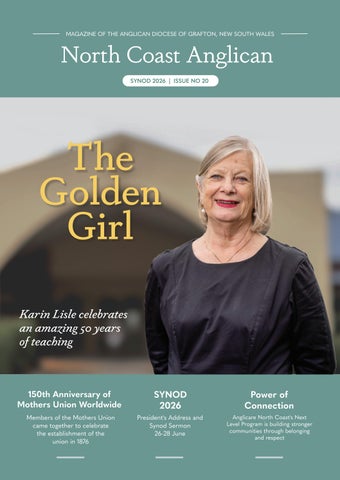
The Golden Girl Karin Lisle celebrates an amazing 50 years of teaching
150th Anniversary of Mothers Union Worldwide
SYNOD 2026
Power of Connection
Members of the Mothers Union came together to celebrate the establishment of the union in 1876
President's Address and Synod Sermon 26-28 June
Anglicare North Coast's Next Level Program is building stronger communities through belonging and respect
Acknowledging Country We acknowledge the Bundjalung, Arakwal, Yaegl, Githabul, Gumbayngirr, Dunghutti and Birpai peoples, the traditional custodians of the lands on which the Diocese of Grafton is based. We pay tribute and respect to the elders of these nations and peoples, both past, present and emerging, acknowledge their continuing connection to the land and waters, and thank them for their protection of the mountains, hinterland, waters and coastline since time immemorial.
The Baptistry of Grafton Cathedral proudly displays Yaegl artist Frances Belle Parker's painting, which evokes the life-giving capacities of the Clarence River and reminds us that we stand on country that has long been sacred to the Indigenous peoples of this ancient land. In the spirit of Jacaranda Festival, the Cathedral community put together some beautiful flower arrangements for the locals and tourists to enjoy while exploring the city during this time of celebration.
Front Page Image: Principal, Karen Lisle, from Clarence Valley Anglican School - full story page 30
North Coast Anglican TRANSFORMING LIVES THROUGH JESUS CHRIST EDITORIAL TEAM
SUBSCRIPTIONS
CONTRIBUTIONS
ALL CONTENT
The Rev'd Vivian Hoskins, Jan Fryer, Kaytrina Jessup, The Right Revend Tiffany Sparks, Anne Weekley, Maree Collett
Australia $16.00 p.a Overseas $28.00 p.a
Please send articles by email as a Word Doc. attachment. Photographs must be sent as email attachments in JPEG format, with a file size of 500kb or greater. Please contact the Editor to 'pitch' article ideas and to discuss due dates, word limits and image requirements.
The Editor is not responsible for the opinions expressed by any contributors, nor do their views necessarily reflect the policy of this publication or of the Diocese. Acceptance of advertisements does not necessarily mean endorsement of the product or services.
EDITOR DETAILS PO Box 4 Grafton NSW 2460 nca@graftondiocese.org.au DESIGNER Yoohoo McPhee - Grafton yoohoomcphee.com.au
2 · NCA SPRING 2026
CIRCULATION Circulation: 1,000 ADVERTISING Please contact the Editor for rates and bookings.
Aunty Sonya Breckenridge created this wonderful artwork entitled ‘Emmanuel and the paperbark tree’ for Emmanuel Anglican College Ballina. It was presented to the school at Emmanuel Day celebrations 10 June
Reflections from the Bishop On the banks of the Clarence River in Grafton the sunset triggers a magnificent response from the birds. Corellas (white cockatoos) have recently been roosting at night in big trees between Bishopsholme and the river. This feature of life on Bundjalung Country has been depicted recently in the stunning painting by Elder Aunty Sonya Breckenridge, Emmanuel and the Paperbark Tree, which now hangs in the library at Emmanuel Anglican College, Ballina. The sound of hundreds of Corellas roosting is deafening. It’s not conducive to sleep some nights! But it’s always good to hear the sound of birds. If we listen carefully there is plenty to listen to in the presence of God’s creation here in this ancient land. There is an Indigenous contemplative tradition from Northern Australia that encourages listening in this way. It’s called dadirri.* In part, dadirri is a practice of deep listening where Country, it’s land and creatures, is an active participant. Through intentionally listening in this way
we can know the patterns and movements of nature – flowers, birds, weather - in their full vibrancy as God’s creation. But in Indigenous culture this is also how understanding happens; how time, stillness, and deep attentive listening are a vital part of decision making. So this kind of listening is not passive. It is intentionally open to understanding. Some call it truth-listening giving respectful attention to Indigenous knowledge, history and culture. The Scriptures tell us that listening is something that God does (John 9:31). We are called to listen too, both to God (Is 51:7) and to listen generally (Eccl 5:1). Let’s all take time to stop and truly listen. As the poem goes, knowledge speaks, but wisdom listens.
* Dr Miriam Rose Ungunmerr- Baumann
NCA SPRING 2026 - 3
SYNOD
"Synod does not happen by accident. It requires careful preparation, generous service, patient attention, and the goodwill of many people."
4 · NCA SPRING 2026
Summary of First Session of the Thirty-Ninth Synod of the Diocese of Grafton JAMES GALE - REGISTRAR/GENERAL MANAGER ANGLICAN DIOCESE OF GRAFTON
Thank you for your participation in the First Session of the Thirty-Ninth Synod of the Diocese of Grafton. This Synod gathered us again as the people of God across this Diocese, clergy and lay, parishes, schools, agencies, chaplaincies and diocesan ministries, under our shared diocesan vision of Transforming lives through Jesus Christ. We began in worship, attended carefully to the business of the Diocese, listened to important presentations, considered matters of justice and human dignity, and made decisions that will help shape the life and mission of the Diocese in the years ahead. This year’s Synod reminded us that the work of governance is not separate from mission; it is part of how we order our common life for the sake of the Gospel. Across the day, Synod engaged with matters of financial stewardship, clergy tenure and ministry sustainability, giving and generosity, schools and education, Cursillo, organ donation, gambling harm, online safety for children, modern slavery, and the life of Anglicare North Coast. These are not merely administrative concerns, they reflect our desire to be a Diocese that prays, listens, acts justly, cares deeply, and remains attentive to the needs of the communities God has placed before us. It was also a Synod marked by gratitude. We acknowledged the long and faithful service of Mr John Bryen, whose contribution to the Diocese over many decades was recognised with deep appreciation and applause. We also recorded our thanks for Mrs Maree Collett, whose professionalism, graciousness and service through the Registry have blessed many across the Diocese.
As members return to parishes and ministry communities, I encourage you to speak of Synod not simply as a meeting that was held, but as a gathering of the Church discerning together how we might serve faithfully in this time and place. Please share the encouragement, the decisions, the challenges, and the hope of Synod with your communities. In particular, I encourage parishes to continue forming people for diocesan leadership, to pray for those elected and appointed, and to consider how the resolutions of Synod may be lived out locally. On a personal note, I thank you sincerely for your encouragement, your engagement, and your willingness to wrestle together with important questions for the life of the Diocese. Synod does not happen by accident. It requires careful preparation, generous service, patient attention, and the goodwill of many people. My thanks go to Bishop Murray for his leadership of Synod and the Diocese; to Mr Terry Shorten as Chair of Committees; to Mr Stephen Campbell as Deputy Chair of Committees and Advocate; to the Synod officers, Secretaries, Minutes Committee, Elections and Qualifications Committee, Tellers, Timekeepers, Clerk of Committees, Chancellor, Registry staff, technical support, and all who contributed to worship, hospitality, administration and the smooth running of Synod. Above all, thank you to the members of Synod. May we return to our parishes and ministries with thoughtful and compassionate words, renewed courage, and a shared commitment to seek, recognise and encourage God’s hopes and dreams in every place of mission and ministry entrusted to us. ■ NCA SPRING 2026 - 5
SYNOD
Major Resolutions of Synod 2026 R13/26: Acknowledgement of Service – Mr John Bryen
That this First Session of the Thirty-Ninth Synod noted the retirement of Mr Allan John Bryen and acknowledged his long and faithful service to the Anglican Church and to the Diocese of Grafton. Synod recorded with grateful thanks his service as a member of the Synods of Newcastle and Grafton from 1971 until this Synod, together with his many diocesan roles, including service on Bishop-in-Council, the Professional Standards Committee, the Ordinance Review Committee, Emanuel Anglican College Council, as a Lay Canon of Christ Church Cathedral, Licensed Lay Minister, and Facilitator for Faithfulness in Service. The motion was carried unanimously with applause.
R14/26: Implementation of the “You Win Some, You Lose More” Report That Synod noted with deep concern the impact of gambling harm on individuals, households, families and vulnerable children; recalled the 2023 House of Representatives report You Win Some, You Lose More; lamented that its recommendations had not yet been fully enacted; called members and the wider diocesan community to prayer and advocacy; and requested Bishop-in-Council to write formally to national leaders calling for decisive legislative action to reduce gambling harm and prioritise human dignity over corporate profit.
R15/26: NSW Poker Machine Reform That Synod recognised the destructive impact of poker machine addiction on individuals, families and communities, especially vulnerable people, and called members of Synod and the wider Church to pray for those affected, advocate with local Members of Parliament, and urge legislative safety measures such as mandatory precommitment limits, reduced bet limits and slower spin speeds.
R16/26: Support of eSafety Commissioner’s Age-Restricted Material Codes That Synod gave thanks for the gift of children, acknowledged the shared responsibility of families, churches and governments to protect and nurture them, welcomed the Age-Restricted Material Codes introduced by the Commonwealth Government’s eSafety Commissioner, affirmed the need for collaboration between parents, carers, educators, churches, industry and governments, and requested that Synod write to the Minister for Communications supporting robust measures to protect children from harmful online content.
R17/26: Modern Day Slavery in NSW That Synod noted the work of Regional Development Australia Mid North Coast, the NSW Anti-Slavery Commissioner, Nambucca Valley Council, Unions NSW, Red Cross Australia and local churches in responding to modern slavery and migrant worker exploitation in the Nambucca Valley. Synod called upon the Diocese of Grafton to increase awareness of this issue and work with appropriate agencies to help bring modern slavery to an end.
R18/26: Amendment to Clergy Tenure Provisions That Synod requested Bishop-in-Council to amend the Diocesan Governance Ordinance 2008 concerning clergy tenure so that the standard term of appointment for incumbents be extended from seven years to ten years, and any extension of tenure thereafter may be granted for periods of up to five years at a time rather than three years.
R22/26: Removal of Compulsory Retirement Age for Clergy That Synod requested Bishop-in-Council to investigate amending the Diocesan Governance Ordinance 2008 to remove the compulsory retirement age for incumbents and assistant clergy, and instead provide for a ministry review protocol when a clergyperson reaches the age of seventy, with a report to be brought back to Synod.
R29/26: Organ Donation That Synod acknowledged the importance of lifegiving organ donation, endorsed the work of the Organ and Tissue Authority, and resolved to write to all Ministry Units of the Diocese promoting the national organ donation register and engagement with DonateLife Week.
6 · NCA SPRING 2026
R30/26: Vote of Thanks – Mrs Maree Collett
R32/26: Vote of Thanks
That Synod recorded its deep appreciation and grateful thanks for the ministry and service of Mrs Maree Collett, recognising her professionalism, graciousness and service through the Registry since 2014, and praying God’s blessing upon her as she prepares to leave and embrace a new future. The motion was carried with applause.
That Synod thanked all who contributed to the successful coordination of the First Session of the Thirty-Ninth Synod, including those involved in worship, Synod officers, secretaries, committees, tellers, legal officers, technical support, Registry staff, Bishop Murray, the Registrar, and the members of Synod.
Election and Appointment Results at Synod Appointments where insufficient nominations were received The President announced the following appointments where there were insufficient nominees to require ballots.
Bishop-in-Council – Lay • Mr Bill Adler • Mr David Ford • Mr Brad Patterson • Canon Robert Weatherby
Board of Enquiry – Clergy • The Venerable Peter Shayler-Webb • The Right Reverend Tiffany Sparks
Cathedral Chapter – Clergy • The Reverend Michael Ridge • The Reverend Canon Grahame Yager
Cathedral Chapter – Lay • Mrs Fiona Miller • Canon Robert Weatherby
Corporate Trustees • Mr Ian White
General Synod – Lay • Mr James Gale • Canon Robert Weatherby
Panel of Triers – Clergy • The Reverend Kevin Booth • The Reverend Aaron Coates • The Very Reverend Naomi Cooke • The Reverend Grant Sparks
Panel of Triers – Lay • Mr Terry Shorten
Provincial Synod – Lay • Mr James Gale
Election Results The President announced the following election results.
Bishop-in-Council – Clergy • The Reverend Daniel Berris • The Reverend Kevin Booth • The Reverend Nicole Hagon • The Reverend Amanda Larkin • The Reverend Canon Sally Miller • The Reverend Canon Grahame Yager
General Synod – Clergy • The Very Reverend Naomi Cooke • The Right Reverend Tiffany Sparks
Presentation Board – Clergy • The Reverend Roxanne Addley • The Reverend Kevin Booth • The Very Reverend Naomi Cooke • The Venerable Gail Hagon • The Venerable Kay Hart • The Reverend Canon Sally Miller • The Reverend Michael Ridge • The Venerable Peter Shayler-Webb
Provincial Synod – Clergy • The Right Reverend Tiffany Sparks
NCA SPRING 2026 - 7
SYNOD THE SYNOD OF THE DIOCESE OF GRAFTON 26-28 JUNE 2026
President’s Address and Synod Sermon DR MURRAY HARVEY - BISHOP OF GRAFTON
Welcome to the 39th Synod of the Anglican Diocese of Grafton. As we gather and consider the matters before us over the next couple of days, the scripture readings from last night’s Eucharist are hopefully still fresh in our minds. As the Anglican Church on the North and Mid-North Coast, we are called to bring the message of the gospel to our region, whether its message is in season, or out of season. John the Baptist’s ministry was a profoundly social and economic call to repentance, demanding justice through equitable sharing, honesty in business, and ethical conduct. Anyone who has two shirts should share (Luke 3:11) … do not collect more money than you are required to (13) do not extort money and don’t accuse people falsely (14). His message, delivered to ordinary people, tax collectors, and soldiers, addressed the structural inequalities of his day. He rebuked Herod for doing evil things (Luke 3:19). Ours too is a call to speak the truth of the gospel to power. As one Christian writer recently penned, social justice is aggravating. It refuses to keep to its kennel and wanders into other peoples’ gardens … it is likely to bark and run into the street. Christians are to comfort the afflicted, yet the social justice imperative of the Gospel, like the ministry of John the Baptist, also afflicts the comfortable.
8 · NCA SPRING 2026
We live in challenging times, with populist politicians capitalising on discontent, grievance and the normalising of unacceptable behaviour. Social media, and even the mainstream media, are eager to turn difference into division, further polarising and inflaming an already fragmented landscape. Yet you and I both know that it’s possible to support the suffering people of Gaza without supporting Hamas, to grieve for Iran without endorsing extremism, to feel comfort for Israelis without backing the Government of Israel. These positions aren’t binary or mutually exclusive. Empathy isn’t allegiance, it’s humanity.1 Yet it is becoming increasingly difficult to speak in this space – to hold complexity, conscience, and compassion, all at once. As an example, in last year’s Synod Address I spoke about the dangers of white Christian nationalism (of the kind we’re seeing in the USA). I was soon criticised for being unpatriotic. Yet in such a circumstance it is even more important to be clear about the Gospel message and how it speaks in the public square. The Five Marks of Mission of the Anglican Communion,2 firmly rooted in the Gospel, are evidence that social justice is front and centre as one of our highest priorities. The Fourth Mark of the Five Marks of Mission calls us to transform the unjust structures of society, challenge violence of every kind, and pursue peace and reconciliation. This recognises that sin is not only personal but also systemic. This Fourth Mark calls the Church to move beyond individual acts of charity to address the root causes of suffering: the “unjust structures” that perpetuate poverty, oppression, and conflict. This is costly, because those responsible for systemic injustice and exploitation don’t like being called out. Herod had John the Baptist beheaded. The call to justice is part of our Anglican DNA – as Archbishops Desmond Tutu and Trevor Huddleston showed the world in their opposition to Apartheid in South Africa all those years ago. Last year the World Economic Forum3 asked people around the globe to rank the top risks for our world. We need to be aware of these and take them seriously because this is the wider context of our ministry, even here on the North and Mid North Coast. Geoeconomic confrontation (armed conflict) was number one, followed by deliberate misinformation, and thirdly, societal polarisation. While we are not immune from the first one, we are certainly being affected by conflicts elsewhere. We definitely see the second and third right here in Australia. Australia is one of the few remaining liberal democracies, but we are not immune to anti-democratic forces or the fraying international rules-based order. Our social compact and social cohesion is under pressure. This is showing up in growing economic pessimism, worry for future generations, concern about unfairness, declining sense of belonging, and low trust in political actors. Lower-income Australians and those with financial concerns tend to report lower trust and satisfaction with democracy. Renters are less satisfied than homeowners, and people in regional
Photo courtesy David Ford
Photo courtesy David Ford
Above: Bishops Sonia Roulston, Sophie Relph-Christopher, Tiffany Sparks, Denise Ferguson, Carol Wagner, Sarah Plowman at the Consecration service.
Top: Bishop Murray Bottom Left: Bishop Peter Stuart (Bishop of Newcastle and Principal Consecrator) and Dr Harvey at the Consecration Service. Bottom Right: The Registrar / General Manager, James Gale, with the Bishop;
areas tend to be less satisfied than people in cities. Where there is fuel for discontent, there is increasing risk that populist politicians and ideologies will gain a foothold, harvesting hate, based on their narrative of grievance and fear, which are so easy to sell.
The National Council of Churches of Australia made a Submission to the Royal Commission on Antisemitism and Social Cohesion6 and said this:
It is certainly within the ambit of the Churches to make a contribution, and they do so on many levels. The In such a time as this there are many challenges. In Christian faith with emphasis on love of neighbour response, the church, and individual Christians, can and forgiveness, welcome, community, hospitality and play a key role. Firstly, we can nurture belonging inclusion overlaps with the language of social cohesion. and engagement. Our church communities are a Churches have a pro-social positive disposition and place where people can belong and feel part contribute to society through being good social of the community. Based on Australian citizens as well as the provision of highresearch, while public opinion on quality services in education, welfare religion in general is mixed, many and healthcare over many years … Australians appreciate the role Christianity centred on love of of their local or neighbourhood neighbour provides the impetus Australia is one of the church and the role it plays to promote social cohesion in building community and and multiculturalism….Social few remaining liberal meeting needs. Research4 cohesion is often strongest at democracies, but we the local level where people from 2024 shows that local show up at times of crisis. congregations act as sources are not immune to antiof social capital, increasing democratic forces or the Secondly, we can live as people social cohesion and of Christian character. Being fraying international civic engagement. people of Christian character rules-based order. is foundational. Modelling godly More recent research helps us to character starts with showing the ground these findings in the local fruits of the Holy Spirit (Galatians experience of Anglican Parishes in 5:22-23) - love, joy, peace, patience, regional and rural areas. In her recent kindness, generosity, faithfulness, gentleness, study on the lived experience of rural and self-control, but continues with other features churches, Dr Monica Short5 had conversations of holiness such as humility, integrity, honesty, with graziers and farmers. The conversations illustrated trustworthiness, and the ability to treat others with that the church is an important and unique space respect. Character reveals itself most clearly under where people in a community can explore existential pressure, and there’s a lot of pressure in our time. It is crises and gain a sense of belonging, receive practical seen in whether we keep our promises, whether we can and pastoral care in family tragedies and in other issues acknowledge mistakes, whether we become defensive confronted by modern farming families. CONTINUED OVERLEAF NCA SPRING 2026 - 9
SYNOD
when challenged, whether we speak difficult truths with courage and kindness. Beating hate requires leadership.
Bishop Mariann Edgar Budde, Bishop of Washington in the Episcopal Church of the United States, is admired by many. She writes that the failures of character are equally revealing: passive-aggressiveness, pride, contempt for others, impulsiveness, chronic unreliability, anger, or the inability to accept correction. From her current experience in the USA she brings many insights. But none of us are free from these failures of character. Under strain, we can all revert to less healthy versions of ourselves. But Christian maturity and character requires that we learn to recognize those patterns and take responsibility for them. Thirdly, we can help to protect the public square. The decline in traditional news media and the rise of online and social news sources have fragmented our fact base, making misinformation and extreme views more salient in people’s daily lives. Sadly it’s a generation of rage-media, where division sells. Let’s not buy into it. Healthy public debate requires ensuring the sustainability of our news media and investing in institutions that produce trusted information. We can act responsibly in this space, contributing respectfully to public debate, and sending clear messages about welcome, inclusion and social action. We should carefully point out misinformation when we see it. After all, we are committed to the truth which sets us free (John 8:31-32). A particularly worrisome feature of recent months has been the confusion around Christian Zionism. As stated above, and in my Synod Address of last year, it is possible to criticise the Government of
Israel without being anti-semitic. Imagine if the Prime Minister of a Christian country claimed that criticising her country was “anti-Christian”. This would be absurd. But apparently criticising the Government of Israel is being anti-Jewish. It is not anti-semitic to expect that Israel should comply with international law that applies to all countries. Zionism is not Judaism. It is a modern political movement that emerged in the late 19th Century, prior to the formation of the modern State of Israel. Christian Zionism is a damaging ideology that sows confusion and wounds Church unity. Many Jewish leaders, including the Jewish Council of Australia, oppose Zionism and have been critical of Israel’s genocide in Gaza. The Heads of Churches in Jerusalem, including our own Anglican Archbishop of Jerusalem and the Middle East, condemned Christian Zionism in an open letter of January this year. They state strongly that it serves political agendas and jeopardises the ancient Christian presence in Israel, Gaza and the wider Middle East. We need to respectfully challenge the claims of Christian Zionism in our preaching and communications. I am grateful to the Dean and the Cathedral team who helped us express our grief and shock at the tragic events of the Bondi Beach terror attack in December, by holding a Prayer Vigil. This was well attended by a broad cross-section of the community. Similar events were held in our parishes and schools as we offered space and time for community grief. Sadly however, division sells, so sections of the media and some politicians rather disgustingly used this tragic Bondi event as an opportunity to sow yet more division and hate. As Anglicans, our mourning for the Jews murdered at Bondi was not at all at odds with our ongoing protest at the continued genocide of Palestinians in Gaza. Anyone who can't accept that empathy is the natural human reaction to both atrocities has got a problem with understanding what it is to be truly human. Let’s work together for the peace and dignity of Palestinians and people of Jewish faith. The Australian Bishops as well as other faith leaders have condemned the rise of antisemitism in our society. The National Council of Churches, in their submission to the Royal Commission on Antisemitism and Social Cohesion, reminded us of an earlier statement from the World Council of Churches7: The churches have a continuing responsibility to confront the scourge of antisemitism, given the historic role of churches in promoting and disseminating it. Our commitment as a Diocese to transforming lives through Jesus Christ involves reconciliation - walking together in truth, justice, and love with the traditional custodians of the lands of the North and Mid North Photo left: The Rev’d Christopher Waterhouse welcomes the Bishop to St James King Street;
10 · NCA SPRING 2026
1
2
3
4 Photo 1: The Rev’d Christopher Waterhouse welcomes the Bishop to St James King Photo 2: Members of the Schools Commission at Lindisfarne Anglican Grammar School Photo 3: At Archbishop Geoff Smith’s Farewell Dinner in Adelaide. Mr John Bryen, Archbishop Geoff Smith, Archdeacon Greg Ezzy, Bishop Harvey. Photo 4: Anglicare Christmas Event at the Cathedral
Coast. Our Reflect Reconciliation Action Plan has been guiding us to listen deeply, learn humbly, and act courageously as we take meaningful steps toward healing and reconciliation. I thank the members of the RAP Working Group for continuing to lead and challenge us on this journey. Nationally, it’s proving to be a tough journey. The loss of the Voice Referendum is a deep scar, and white supremacist groups are getting more confident. Reconciliation is no spectator sport.8 I hope that the Federal Government’s Joint Standing Committee on Aboriginal and Torres Strait Islander Affairs' Inquiry into Racism, Hate and Violence Directed at Aboriginal and Torres Strait Islander People will provide the impetus to governments and all sectors of society, including churches, for a transformation to a more just and caring culture in Australia where First Nations people are heard and their rights protected. I commend the National Council of Churches’ submission to you.9 The church has a scriptural mandate for reconciliation and we need to continue act on it.10 Almost 60 years ago the Synod of this Diocese made provision for the appointment of an Assistant Bishop, by adopting the Assistant Bishops Canon 1966 Adopting Ordinance 1967.11 Yet no Assistant Bishop was appointed until this year. The Consecration of The Rt. Rev’d Tiffany Sparks in Grafton Cathedral on 12 March was a great joy for the whole Diocese. This significant occasion in Tiffany’s life and in the life of the Diocese was well supported, with well over 300 people from around the Diocese and beyond attending. Many more participated online. Bishop Tiffany is an outstanding example of women in leadership in the church. Her consecration as a bishop has been an encouragement to women in ministry in this diocese as well as in the wider church. Last year I spoke at some length about schools but this year there will be a special presentation later so I’ll be more brief. Our Anglican Schools continue to play an incredibly important part of our diocesan life together, and I’m grateful to the Principals, Senior Staff, Chaplains, Chairs of School Councils for their collegiality, advice and support. We were greatly blessed when Stephanie Munday-Lake agreed to become the Chair of the Grafton Anglican Schools Commission. Under her leadership the Schools Commission is gaining more clarity about its role, purpose and vision. In a short time, our Executive Officer (Schools), Dr Susan Allan, made an incredibly positive contribution to the work of the Schools Commission. We were sad to see her leave this position, but we welcome our new Schools Officer, Julie Irvine. Anglicare North Coast has focused on being visible, developing innovative solutions, and on developing relationships with key stakeholders. ANC has been intentional about being a visible and credible presence. You may have heard and seen the ANC CONTINUED OVERLEAF NCA SPRING 2026 - 11
SYNOD
After the Consecration of Bishop Anne van Gend, Dunedin Cathedral;
CEO, Mark MacNamara and staff, advocating on TV and radio. He regularly meets with local, State and Federal Government representatives. Regular Newsletters, flyers and social media posts give ANC visibility amongst stakeholders and others, as do community events and branding on vehicles, buildings, shirts, marquees. At South Grafton, ANC pioneered the largest modular built social housing development in the state and now we have four other similar developments underway as a result, including a Social and Affordable Housing development at Lismore. Mobile food distribution now reaches 30 regional and remote towns where communities have few options. Disaster readiness has been expanded, with a total of 200 trained staff and volunteers. ANC staff seek out like minded organisations to partner with and to complement capability gaps. My thanks to Mark MacNamara, his staff and the ANC Board for this incredible work. Turning briefly to the wider church, I was glad to participate in the Consecration of The Rt Rev’d Dr Anne van Gend as Bishop of Dunedin in March 2025. Anne served with distinction in Grafton Diocese over many years. The little Brothers of Francis at Tabulam made her Crosier from timber at their Hermitage. The Crosier was presented to her during the service in Dunedin Cathedral. I was warmly welcomed by the Aotearoa New Zealand Bishops at a dinner in Dunedin the night before the consecration.
and later, for the installation of Ric Thorpe as the new Archbishop. The 2025 Bishops’ meetings were held in Busselton WA in March and in North Sydney in October. The addresses in Busselton focused on the theme of trauma. The Secretary General of the Anglican Communion, The Rt Revd Anthony Poggo, joined us for the Busselton meeting. I attended the Anglican Schools Australia Conference in Brisbane in August. It was a joy to participate in the 175 Year celebration of the Anglican Board of Mission in October, including a service at St James King Street, Sydney and a Gala Dinner at Parliament House. In Grafton Diocese we have welcomed new clergy who have come to us from Melbourne Diocese, Armidale Diocese, and the Anglican Church of Nigeria. Looking to the wider church, my role as the Australian representative on the Steering Group of the Anglican Communion Health and Community Network (AHCN) continues. As predicted, cutbacks in the funding of international aid for health and prevention programs has had tragic consequences.
"Mobile food distribution now reaches 30 regional and remote towns where communities have few options"
I was pleased to once again be the Guest Preacher at St James King Street, Sydney. A significant event in the life of our National Church was the retirement of Archbishop Geoff Smith as Primate and as Archbishop of Adelaide. Together with others from our diocese, I travelled to Adelaide to participate in his farewell dinner and service. We are grateful for his ministry in our Diocese, years that were formative for him. I also travelled to Melbourne for the retirement of Archbishop Philip Freier as Archbishop of Melbourne, 12 · NCA SPRING 2026
The Bishop of Armidale, Rod Chiswell, and Bishop of Grafton, Murray Harvey, with Uncle Douglas Smith at the ABM Gala Dinner at Parliament House.
The Ebola outbreak in Congo’s (DRC) Ituri Province shows us why we can’t cut back aid in this way because aid helps to prevent global outbreaks and reduces the risk of deadly diseases spreading globally. AHCN is working with the WHO Faith Network and our partner faith-based health organisations (such as Christian Connections for International Health CCIH, the African Christian Health Associations Platform ACHAP, Caritas etc) to support health services in DRC, including the Anglican Church of Congo, which is an experienced and trusted primary healthcare provider. Efforts are centred around the supply of PPE and of other consumables and equipment. However, as with COVID-19, a key role for the church is to bridge a dangerous gap in public trust. We have engaged local faith leaders to strengthen community risk communication, fight denial, counter dangerous rumours, promote early reporting and dismantle stigma. An example of the consequences of community mistrust was the burning down of an Ebola treatment centre by a grieving family after they had been denied access to the body of their deceased relative. They were of course denied access due to the strict safe-burial protocols that are required to prevent viral transmission. Clear messaging and communication from trusted leaders is essential, and thankfully the Anglican Church of Congo is a trusted voice. Please keep Archbishop Ande in your prayers. He has called for prayers with practical action, that the Anglican Church there might be a beacon of hope12. A graphic summarises the work of AHCN from 2023 to 2025.
I thank the team at the Bishop’s Registry for their work during the year. While much of our work goes on behind the scenes, we play a crucial role in supporting and facilitating ministry across all ministry units, including schools and Anglicare. Our Registrar / General Manager, James Gale, has brought real energy and creativity to this role since his commencement in early 2025. He has bravely tackled contentious issues, named things that needed to be named, made muchneeded improvements to systems and processes, and is carefully taking a more entrepreneurial approach. When I became a Bishop and attended Bishop’s training in Melbourne and in Canterbury, I was told that a trap many Anglican Dioceses fall into is to not have a clearly defined vision and values that impact the whole culture and leadership of a diocese. It was said that the Diocesan Bishop should use every opportunity to name the vision, foster a sense of purpose and direction, and articulate shared goals. I am grateful that Grafton Diocese is clear about its mission and purpose. Living Into God’s Future – Restructuring for Mission and Ministry has helped us put mission front and centre as we share the good news of Jesus Christ, make disciples and grow faith communities. I hope we can be clear about our values and purpose, and live lives of character, speaking responsibly and maturely in the public square about the Gospel call, nurturing belonging and community, and acting for reconciliation and social justice. Let’s honour those with whom and to whom we minister, and bring glory to God as we transform lives through Jesus Christ. ■
"I am grateful that Grafton Diocese is clear about its mission and purpose."
NCA SPRING 2026 - 13
SYNOD
SERMON PREACHED AT THE SYNOD EUCHARIST, ST JOHN’S COFFS HARBOUR, FRIDAY 26 JUNE 2026
The Birth of John the Baptist DR MURRAY HARVEY - BISHOP OF GRAFTON
In the French historical novel Les Miserables13, after nineteen years as a prisoner on the chain gang, Jean Valjean is released on parole with his yellow ticket-of-leave, which he must always carry with him, always branding him as a thief. Only the local Bishop invites him in and treats him with compassion. With no money and with little chance of turning his life around, in desperation, Valjean steals some silver from the Bishop’s home. In a dramatic scene, he is caught escaping and in possession of the Bishop’s silver.
Policeman: Tell his reverence your story. Let us see if he's impressed. You were lodging here last night. You were the honest Bishop's guest and then, out of Christian goodness, when he learned about your plight you maintain he made a present of this silver. Bishop: That is right, but my friend, you left so early surely something slipped your mind [The bishop, hands Valjean two silver candlesticks] You forgot, I gave these also. Would you leave the best behind? So, Messieurs, you may release him for this man has spoken true I commend you for your duty And God's blessing go with you. This act of mercy—unexpected and radical—becomes the moment that severs Valjean’s past as convict 24601 and sets him on a path towards a new life. Valjean, who once knew only chains and numbers, now encounters grace so profound that it “raises him out of darkness.” The candlesticks themselves symbolize both light and guidance, illuminating a “higher plan” for a man who had believed his soul beyond saving. The bishop’s gentle reproach reveals his true gift: not just silver, but an invitation to see beyond a condemned past. “But remember this my brother, (he says to Valjean) see in this some higher plan. You must use this precious silver to become an honest man.” In contrast to the Bishop’s merciful character and Jean Valjean’s vulnerable search for a new life, stands Javert. Once a prison guard and now a police inspector, Javert stands for the law, authority, the state, a hatred of rebellion. Empathy he sees as weakness. He’s not interested in mercy or even in peoples’ humanity – or even his own humanity for that matter.
14 · NCA SPRING 2026
The Best Supper © Jan Richardson. janrichardson.com. Used with permission.
Given our focus on John the Baptist tonight, perhaps you can see where I’m headed. John spoke out against the ruler of the day and was eventually jailed and beheaded. Then, as now, this is sometimes the cost of speaking truth to power. There are plenty of Javerts and Herods out there today – I don’t need even to name any – you will know about whom I am speaking. They think empathy is a sin, and treat people as mere commodities to be exploited. Within living memory the Gestapo treated people as numbers. Today (sometimes) masked immigration agents and other agents of authoritarian states treat people in a similar way, without human dignity. John the Baptist’s ministry was a threat. It wasn’t just a message to individuals to turn and repent, it was a profoundly social and economic call to repentance, demanding societal justice through equitable sharing, honesty in business, and ethical conduct. His message, delivered to ordinary people, tax collectors, and soldiers, addressed the structural inequalities of his day, instructing people to share food and clothing, avoid extortion, and act with integrity. Luke 3:11-14: Anyone who has two shirts should share with the one who has none, and anyone who has food should do the same.” (Luke 3:11) … do not collect more money than you are required to (13) do not extort money and don’t accuse people falsely (14). What is repentance? There are many definitions, but helpful here is N.T. Wright14. He sees repentance as a
serious turning away from patterns of life which deface and distort our genuine humanness. It’s not just a private, internal sorrow for sin, but as a public, life-altering "U-turn". It is an active turning away from distorted patterns of living to fulfill humanity's original calling: reflecting God's image into the world. Repentance is a turning from all that distorts and defaces the image of God that we bear. John uses Isaiah’s road-building imagery here: height and depth are to be levelled, the crooked and rough are to be made straight and smooth. This drastic transformation of a terrain that obstructs travel becomes a symbol of the preparation that the Lord’s coming requires. This is not just individual work. It calls for wider change. This was too much for Herod. And for Pilate. So with many other exhortations [John] proclaimed the good news to the people. But Herod the ruler, who had been rebuked by him … because of all the evil things Herod had done, added to them all by shutting up John in prison. (Luke 3:18-20). Their regimes, like many today, offered no freedom, but only slavery, oppression and death. They pursued not life and human freedom for others, only seeking life and freedom and flourishing for themselves. Though inspired by historical events in France, the Les Miserables story is of course fictitious, as opposed to the story of John the Baptist which was real life. Yet the candlestick scene carries a deeply Gospelbased message for us all. God is a God of mercy and forgiveness. God offers us not eternal punishment, pointless imprisonment and ongoing condemnation. God loves us; he might love us too much to leave us the way we are but he does love us, created in his image. He offers us salvation and eternal life. God’s voice calls to us daily – an echo of John the Baptist’s call all those years ago, crying out in the wilderness, to abandon sin and embrace the Kingdom of God wholeheartedly. To live the way of the Kingdom now. The candle sticks in the Les Miserables scene were life changing. A really merciful act by the Bishop, showing in turn, God's mercy. How do we show others the way of mercy and new life? What are/were those candle sticks for you? How have you been shown mercy in your life? What experience or encounter, symbol or word has touched you, and raised you out of darkness, set your life on a new course? What caused you to turn to God, or to turn again to God? Looking more broadly, what are those candle sticks for us as Anglicans on the North Coast, how do we show mercy? Our ministry as Anglicans on the North and Mid North Coast is only effective if we each have given our lives to him and rely on his mercy and strength. Only effective if we offer all we do to his glory. At John the Baptist's birth Zechariah's mouth was opened and he began to
speak. This marvellous thing, this miracle, was widely talked about, and the question was asked: what then will this child become? We too are children of God. What then will we become through his mercy and in his hands? ■
End Notes to Presidential Address and Sermon 1 Nicki Barber (2025) Instagram 2 www.graftondiocese.org.au/five-marks-of-missionof-the-anglican-communion 3 World Economic Global Risks Perception Survey 2025-2026 4 The Australian Community Survey ACS by NCLS 5 Monica Short et al, Practical Theology. 15 May 2024 6 National Council of Churches of Australia, 20 May 2026, Submission to the Royal Commission on Antisemitism and Social Cohesion. 7 World Council of Churches (2022): Confronting Racism and Xenophobia, Overcoming Discrimination, Ensuring Belonging. 8 Larissa Minniecon. Report to the Board of ABM 9 National Council of Churches Submission to the Joint Standing Committee on Aboriginal and Torres Strait Islander Affairs' Inquiry into Racism, Hate and Violence Directed at Aboriginal and Torres Strait Islander People. 1 June 2026. 10 Five Scriptural Mandates include Right Relationship - Micah 6:8, Romans 12:10; Equality & Equity - Galatians 3:28, Acts 10:34–35; Historical Acceptance - Nehemiah 1:6–7, Psalm 51:3–4; Institutional Integrity - Isaiah 1:17, Luke 11:46; Unity Psalm 133:1, Colossians 3:14 11 https://www.graftondiocese.org.au/wp-content/ uploads/2017/12/Ordinance-No.-8-of-1967The-Assistant-Bishops-Canon-1966-AdoptingOrdinance-1967.pdf 12 Anglican Communion News Service, 18 May 2026, Ebola Outbreak in DRC: Archbishop urges need for prayers and practical action. https://www. anglicannews.org/news/2026/05/ebola-outbreakin-drc-archbishop-urges-need-for-prayers-withpractical-action.aspx 13 Victor Hugo (1862) 14 N.T.Wright (2006) Simply Christian: Step-by-Step Basics of Christian Faith and Practice
NCA SPRING 2026 - 15
SYNOD
Activities of the Anglican Communion Health Network 2023-2025
16 · NCA SPRING 2026
Registrar Reflections -
Fighting the Good Fight "God, grant me the serenity to accept the things I cannot change, courage to change the things I can, and wisdom to know the difference."
BY JAMES GALE REGISTRAR/GENERAL MANAGER
Recently I found myself reflecting on the Serenity Prayer hanging on my office wall: As we move from Synod to forthcoming diocesan and national church gatherings, those words sit alongside Paul's exhortation to Timothy: "Fight the good fight of the faith" (1 Timothy 6:12). Synod reminded us of our calling to participate in God's mission and to seek justice in our communities. For the laity serving in governance and administration, that calling often takes a quieter form. The "good fight" is found in stewardship: ensuring financial sustainability, strengthening governance, supporting transparency, and making difficult decisions with integrity. Leadership in the Church requires both serenity and courage. There are many things beyond our control: wider cultural trends, differences across the Anglican Communion, and the future direction of the Church nationally. Faithful leadership means recognising those limits and trusting God with what we cannot change.
Ultimately, wisdom may be the virtue we need most. Wisdom helps us discern what is essential, what is urgent, and which battles are truly worth fighting. The good fight is not about winning arguments but remaining faithful to the calling God has given us. My prayer currently is simple: that we may have serenity for what lies beyond our control, courage for the responsibilities entrusted to us, and wisdom to know the difference. May every decision we make help the Church flourish in its mission and service to God's Kingdom. ■
At the same time, serenity must never become complacency. We are called to courage: to reform systems when needed, address challenges honestly, prioritise safeguarding and accountability, and ensure our structures serve the mission of the Gospel rather than simply preserve what is familiar. Synod 2026
The F00D PANTRY
10 AM - 2PM MONDAY TO THURSDAY *HEALTHCARE CARE CARD REQUIRED
FIND US AT 72 POUND STREET GRAFTON The Food Pantry provides groceries and fresh items at very low cost to help your money go further! www.anglicarenorthcoast.org.au This is intiative with the support of the Salvation Army and St Vincent de Paul
NCA SPRING 2026 - 17
Around the Around theDioceses Dioceses Around the Dioceses
1
150th Anniversary of Mothers Union Worldwide SUBMITTED BY GAE SHORTEN
On Saturday 25th July 2026 members and friends of Mothers Union in Grafton Diocese came together to celebrate the establishment of Mothers Union in 1876.
2
It was formed by Mary Sumner. Mary whilst she brought up her three children had a vision of bringing Christian faith to the many mothers and grandmothers in her area. She was very aware how little she knew about the upbringing of her children, and for that matter so too were the majority of young mothers, to give their children that moral and spiritual training which was their due. Today Mothers Union groups can be found in 84 countries worldwide. Some groups are large, others small, many now meet via social media of some form or other. Whatever the age of the member there is always someone to share stories and faith journeys.
3
Here in Grafton Diocese members have been and continue to be involved in many aspects of their parishes and beyond. Members visit nursing homes, hospitals, make biscuits for the less fortunate at Christmas time. Many are deeply involved with their parishes on reading, prayer rosters, working in Opportunity Shops. On our Celebration Day it was wonderful to enrol a new member, Janette Sweeney and present Long Service Certificates to Margaret Klien 60 years membership, Jean Knight 50 years membership, Wendy Hodgkinson 50 years membership and Janette Llewellyn 40 years membership.
18 · NCA SPRING 2026
4
Visitors came from Newcastle Diocese and Brisbane Diocese. Special guest speaker was Dr Robin Ray the Australian President of Mothers Union. In her talk she particularly spoke about members being more outgoing and becoming more visable in the community. After a wonderful celebration service all moved to Edwards Hall where they enjoyed lunch and a time of fellowship. Many of those there saying they were catching up with friends they hadn’t seen in years. The Celebration cake was cut by Margaret Klien our 60 year Long Service recipient. ■
IN BRIEF
Scan to learn more
The Grafton representatives at the General Synod in Melbourne.
Bishop Murray preached at St Mark's Fitzroy in Melbourne recently.
5 Photo 1: Bishop with members who received Long Service Certificates. Photo 2: Mrs Elizabeth Bissaker (President, Newcastle Diocese Mothers Union) Photo 3: Dr Robin Ray giving her talk Photo 4: Dr Robin Ray (Australian President, Anglican Mothers Union Australia) with Mrs Margaret Klien and Mrs Gae Shorten Photo 5: The Celebration Cake Photographer: Kaytrina Jessup
Acknowledgment of Photographer for the Consecration of the Right Reverend Tiffany Sparks. The Diocesan Team would like to acknowledge and thank Mr David Ford from the Parish of Coffs Harbour for his time, talent and dedication for being the official photographer for the occasion of Bishop Tiffany's consecration and rehearsal. The photos by Mr Ford published in the Winter Issue of the North Coast Anglican were vibrant and captured the zeitgeist of the moment. We appreciate his contributions to the wider diocese and for his faithfulness and artist talents. Thank you David.
Anglican Deans, including the Dean of Grafton, Naomi Cooke, gathered in Sale in Victoria recently for the annual Conference of Deans.
The Australian Educators award night with 3 Grafton Diocesan school principals attending; Bishop Druitt College, Lindisfarne Anglican Grammar School and St Columba Anglican. Congratulations to all schools and our wonderful Anglican community
Did you know? The Diocese of Grafton was one of the first in Australia to legislate for gender equality in positions such as Scan to learn synod representatives, churchwardens more and parish councillors. It was also an early adopter in ordaining women to the diaconate and priesthood and now just under half of stipended clergy are female, which is considerably higher than the national average,
NCA SPRING 2026 - 19
Reverend Canon Camellia Flanagan
CHRIST CHURCH CATHEDRAL GRAFTON
Praying with the Saints BY THE REVEREND CANON CAMELLIA FLANAGAN TSSF
Saint Edward the Confessor Feast Day: October 13 died 1066 Edward was born between 1003 and 1005 in Islip, Oxfordshire. During his childhood, England was the target of Viking raids and invasions under Sweyn Forkbeard and his son, Cnut. Edward spent a quarter of a century in exile, mainly in Normandy, although there is no evidence of his location until the early 1030s. Then, Edward witnessed four charters in Normandy, signing two of them as king of England. Edward was crowned at the cathedral of Winchester, the royal seat of the West Saxons, on Easter Sunday, 3 April 1043. He ruled from 1042 until his death in 1066.
He did not die a martyr but was known as confessor for his devout faith, and prayerfulness. He was also known for his kindness and generosity toward the poor giving alms and cancelling unjust taxes. Saint Edward re-endowed the Benedictine monastery of Westminster and built a large Romanesque church for the monastic community. Edward died shortly after the dedication of that building on 28th December 1065. He was canonised in 1161 by Pope Alexander III and on 13th October 1163 his body was moved, or ‘translated’ to a new tomb in the church which he had built. Saint Edward’s Romanesque church survived until the 13th century, when it was replaced by a new church in the Gothic style built by Henry III. A new shrine was constructed for the body of Saint Edward, and the translation of his relics to this shrine was an integral part of the liturgy of the dedication of Henry’s church on 13th October 1269. St Edward’s relics remain in that same shrine, which is behind the High Altar. I was following the travels of special friends returning to Grafton, who brought a prayer card from Westminster Abbey which I had visited many years before. The prayer card is of a new icon of Saint Edward the Confessor dedicated and placed in his burial shrine in Westminster Abbey. Pilgrims on Saturday 19th October 2019 to the shrine were able to venerate the new icon, which was written by the Orthodox Russian iconographer Archimandrite Zinon (Teodor), and made of egg tempera on a lime board, framed in oak. The icon was commissioned to mark the 750th anniversary of Saint Edward's translation, and was dedicated by the Dean of Westminster, the Very Reverend Dr John Hall.
20 · NCA SPRING 2026
Saint Edward the Confessor
Saint Edward is the patron saint of England, kings, difficult marriages, and separated spouses. The collect for Saint Edward.
Sovereign God, who set your servant Saint Edward upon the throne of an earthly kingdom and inspired him with zeal for the kingdom of heaven; grant that we may so confess the faith of Christ by word and deed, that we may, with all your saints inherit your eternal glory; through Jesus Christ your Son our Lord, who is alive and reigns with you, in the unity of the Holy Spirit, one God, now and for ever. Amen.
Threads Laid Bare Consecration stones
Around the perimeter of Christ Church Cathedral one will notice some square carved stones embedded in the brickwork. These stones mark the official dedication of the building as sacred; that it is set apart physically and theologically, that it is free of debt and that it has a specific use consecrated to the worship of God. The stones are set in the north, south and east exterior walls and dedicated by representatives of the dioceses from which Grafton evolved. These stones are: “For the Diocese of Australia (1836-47) set by the Primate and Archbishop of Sydney, The Most Reverend Hugh R Gough; for the Diocese of Newcastle (1847-67) set by the Bishop of Newcastle the Right Reverend James A G Housden; and for the Diocese of Grafton and Armidale (1867-1914) by the Dean of Armidale, the Very Reverend Mervyn K Jones. The dean took the
ST MARY'S ANGLICAN CHURCH
'Listening to Music for Well-Being' sessions at St Mary's Ballina
These stones mark the official dedication of the building as sacred; place of his bishop, the Right Reverend John S Moyes, unable to attend because of illness.” 1 The stone on the southern wall illustrated is the one consecrated for the Diocese of Newcastle. It carries the crest of the diocese which can be described as a Pastoral Staff enfiled with a Ducal Coronet and a border of vertical billets. It is set upon a Christogram, the monogram of Christ, the Chi Rho.
For the past 4-weeks Dr Sarah Burns-Sibly, a retired music therapist, and the wife of our current 'locum' at both St Mary's Anglican Church, Ballina and St John the Baptist Anglican Church, Lennox Head has been holding 'Listening to Music for Well-Being' sessions at St Mary's Anglican Church in Ballina for our parishioners. Over the 4-weekly sessions, Sarah has introduced the participants to: Week 1 'Different Genres of Music', Week 2 'Music to Create Imagery', Week 3 'Vocal Music from the Ancient to the Modern Time Period' and finally, Week 4 'A Music Guided Visualization - A Journey Through the Rainforest' - using both appropriate music and percussion instruments to create the sounds of the rainforest. Having now completed her sessions, Sarah has created a 4-page document for each of her participants which she hopes will help them to continue with their own 'Listening to Music for Well-Being' within the comfort and safety of their own homes. ■
Here are focal points of history and blessing or anointing with chrism (holy oil) during the Consecration liturgy on Holy Cross Day 14 September 1959. Consecration stones are not the same as foundation stones because they commemorate the spiritual completion and official opening of the Cathedral for prayer and witness. They spiritually link the Cathedral to the teachings of Jesus as the chief cornerstone (Ephesians 2:20) and remind all of us that we are “living stones; being built into a spiritual house.” (1 Peter 2:5) The stones mark the completion of construction, the payment of all money owing (75 years after construction commenced) and begin the Cathedral Community of Faith’s role as a regional spiritual beacon. Although we struggle financially to repair our buildings, the Cathedral continues to be a venue for sacred rites, recently hosting the historic 12 March 2026 service for the Consecration of the Venerable Tiffany Sparks as Assistant Bishop and NAIDOC 50 years of Deadly in June 2026. ■
Sarah as she is about to commence her final session at St Mary's Anglican Church in Ballina.
NCA SPRING 2026 - 21
Voices Across the Dioceses
ANGLICARE NORTH COAST
The Power of Connection in Coffs Harbour: Building Stronger Communities Through Belonging and Respect SUBMITTED BY LESLEY GRANT
At Anglicare North Coast, we know that strong communities and healthy relationships are built through connection, belonging and mutual support. Our Next Level program in Coffs Harbour works with refugee and migrant communities, creating welcoming spaces where men, women and young people can build friendships, strengthen their wellbeing and access practical supports. Through these relationships and shared experiences, the program promotes the protective factors that contribute to respectful relationships, gender equality and safer communities for everyone. The following update provides a snapshot of some of this work in action.
MEN'S PROGRAMS
Our Next Level men’s programs are going through an exciting period of growth, with a number of local refugee settlement and support providers joining forces to help address a long-identified gap in opportunities for local men. Alongside our long-running Wednesday Multicultural Men's Group - which has become a valued space where camaraderie, friendship and mutual support naturally grow through cards, dominoes and conversation - we launched the weekly Multicultural Outdoor Men's Group in mid-June in partnership with STARTTS, Community Hubs and North Coast Settlement Service. While the Wednesday group remains a trusted weekly hub for connection, the new Thursday program has a deliberate intergenerational focus, bringing men and young men together through inclusive outdoor activities such as lawn games from around the world, gardening, communal cooking, and plenty of opportunities for conversation, laughter and connection across cultures. Building on these strong foundations, the outdoor program adds the shared experiences of recreation and adventure to strengthen social connection, belonging,
Akram playing boules
wellbeing and positive male identity among refugee and migrant men and young men - protective factors that also contribute to healthy relationships and domestic and family violence prevention. Participants have enthusiastically embraced the new model, with 16 men and young men joining our first Bushwalk and BBQ at Bongil Bongil National Park in July - a fantastic day that welcomed new participants, strengthened existing friendships and built excitement for a community fishing trip planned for the spring school holidays. Together, the indoor and outdoor programs create a complementary pathway that broadens our reach, deepens engagement and demonstrates the power of collaboration in fostering stronger multicultural communities, positive male role models and respectful relationships across cultures, generations and genders.
4
1
22 · NCA SPRING 2026
3 2
Photo 1: Young men fishing Photo 2: Group shot Photo 3: Azeez and Akram on a bushwalk Photo 4: Hassin playing golf
WOMEN'S PROGRAMS The Anglicare North Coast Sewing Group has partnered with NSW Health to deliver a gentle exercise weekly in Term 2. Our refugee and migrant participants and are from different parts of the Globe namely Iraq, Syria, El Salvador and Malta. We meet in the Anglicare Hub in Coffs Harbour weekly in school term. The gentle exercise class focuses on physical wellbeing and mental health in a supportive environment. The sessions focus on stretches and seated exercises, equipping clients with knowledge and skills to implement exercise at home and during their sewing activities. During discussions, participants have shared that women exercising in their home country is often limited or not encouraged due to cultural expectations and gender related stigma Delivering the exercise sessions within the “When we do exercise trusted setting of the sewing group, classes, I laugh a lot and helped create a safe, welcoming, and I forget about all my culturally sensitive environment where participants felt comfortable engaging troubles” in physical activity with the support of a female health professional.
“I only get out twice a week and Sewing Group is one of my outings. I also get to exercise here as well” Top photo: Participants engaging in Gentle Chair Exercise Class before having morning tea in our Sewing Group. Middle photo: Women’s Group Participants having fun with our Exercise Physiologist on our last day Term 2.
ALSTONVILLE ANGLICAN PARISH
Celebration of Ministry SUBMITTED BY ANNE WAREING Alstonville Anglicans hosted a Celebration of Ministry service marking milestones of ordained Ministry for its clergy. The Venerable Greg Ezzy 60 years, The Reverend Geoff Vidal 30 years, The Reverend Dr Desiree Snyman 20 years, The Reverend Cathy Ridd 10 years and Mr Charlie Handley 40 years as a Licenced Lay Minister in Alstonville Parish. It was a beautiful and moving service honouring the clergy, Charlie and all the baptised. It was very special to have Geoff Smith the former Primate of the Anglican Church of Australia preach at the event. Below is an excerpt from his sermon. “People who are ordained are expected to abide by those public commitments and be faithful to the service they are called to do. This is a weighty responsibility which impacts not only the individual but their families too. As part of today’s celebration of the ministry of all the baptised we thank God for Greg’s faithfulness to those commitments for 60 years. That’s a long time. We thank God for Geoff’s faithfulness for 30 years, Desiree for 20 and Cathy for 10. Ordained ministry is very public. It is a ministry of leadership and public interaction.
Geoff Smith, Cathy Ridd, Desiree Snyman, Greg Ezzy, Charlie Handley, Geoff Vidal
When ordained people live their ministry out well there is great benefit. When ordained people live it out badly there is the potential for great damage. So, we thank God for the faithfulness of Greg and Geoff and Desiree and Cathy. Thanks for what you have done on our behalf, as part of the body of Christ, doing what the body of Christ has asked you to do so well and so faithfully. It is the case that God calls and the church sets aside a very small number of the baptised for particular service. Forty years ago, the church, in the form of this parish, asked the bishop to license Charlie Handley for service as a lay reader, and forty years later Charlie is still doing that ministry alongside his other Christian ministry as a baptised person. We thank God for Charlie’s faithfulness to that call, and we thank Charlie for that faithfulness.”
NCA SPRING 2026 - 23
Voices Across the Dioceses
MID RICHMOND ANGLICAN PARISH
Sunday School Revisited SUBMITTED BY LENORE MOULES Like many parishes, Mid Richmond Anglicans hold a combined service whenever a 5th Sunday occurs. Lately some of us had been reminiscing about our Sunday School days, and so it was decided to hold a Back to Sunday School event on the 5th Sunday in May. The service was held in the Wardell Hall, which gave us plenty of space for activities as well as access to full kitchen facilities.
then the worksheets were issued, an assortment of colouring and puzzle sheets to reinforce our learning. Old and young worked together with great enthusiasm. Ages ranged from around 3 to 93! The morning tea that followed was reminiscent of Sunday School Picnics, with tables groaning with goodies, including fairy bread and chocolate crackles. We certainly enjoyed our trip down memory lane. ■
Our time together included the singing of several old-time favourites such as Build On The Rock, Wide Wide As The Ocean, Hear The Pennies Dropping, and of course Jesus Loves Me. Actions were compulsory. Several folk brought along significant items from their childhood for ‘Show and Tell’.
As it was Trinity Sunday, there was a short talk on the importance of The Holy Trinity to our faith, and
HELP SHAPE THE FUTURE OF ANGLICAN EDUCATION
PO Box 4 GRAFTON NSW 2460 02 6642 4122 schools@graftondiocese.org.au
Calling for Expressions of Interest
The Grafton Anglican Schools Commission (GASC) invites Expresssions of
Interest from members of the Anglican community to contribute their skills,
Grafton Anglican Schools Commission
experience and leaderships through service on the Commission or a School Council. Supporting five schools, 5900+ students, and 750 staff across the Diocese, GASC provides governance, guidance and strategic oversight to ensure our schools contribute to flourish as communities of learning, faith and service, advancing the Diocesan Vision of Transforming lives through Jesus Christ.
SCHOOLS COMMISSION EXPERTISE SOUGHT
SCHOOL COUNCIL OPPORTUNITIES Expressions of interest are invited for membership of:
The Commission is currently seeking to appoint two members with expertise in one or more of
Bishop Druitt College Council
the following areas:
Expressions of Interest – Contribute to Anglican Education The Grafton Anglican Schools Commission (GASC) is seeking Expressions of Interest from members of the Anglican community who are passionate about education, faith, and service, and to contribute their skills and leadership through service on the Commission or a School Council. Supporting five schools, more than 5,900 students and 750 staff across the Diocese, GASC provides governance and strategic oversight to ensure our schools flourish as communities of learning, faith, and service. Through this work, GASC advances the Diocesan Vision of Transforming Lives through Jesus Christ. Schools Commission Expertise Sought The commission is seeking to appoint two Commission members with expertise in one or more of the following areas:
Clarence Valley Anglican School Council
Finance, Audit & Investment
Emmanuel Anglican College Council
Risk, Compliance & Safeguarding
Lindisfarne Anglican Grammer School Council
Community Engagement & Communications
Additional expertise in Property, Assets and Capital Projects would be highly valued.
Mission & Ministry Strategy
School Council Opportunities
St Columba Anglican School Council Please note: Current members of a school Council and persons employed by a school are not eligible for appointment to the Commission
WHY SERVE?
Additional Expertise Highly Valued:
Property Assets & Capital Projects
Contribute to the governance, strategic direction and mission of Anglican education. Help shape the future of our schools and strengthen their service and ministry to students, families and communities. Gain valuable board-level governance experience and insight. Develop leadership, strategic thinking and decision-making skills. Expand your professional networks and connections. Enhance your personal and professional growth through meaningful, purposedriven service.
Invitation to Contribute and Serve
Julie Irvine Executive Officer - Schools
We invite members of the Anglican community to consider how their skills, experience, and leadership can contribute to the future of Anglican Education.
02 6642 4122 schools@graftondiocese.org.au
24 · NCA SPRING 2026
SCAN ME
FOR MORE INFORMATION
Finance, Audit and Investment Risk, Compliance and Safeguarding Community Engagement and Communications Mission and Ministry Strategy
Expressions of Interest are invited for membership of the following School Councils:
Bishop Druitt College Council Clarence Valley Anglican School Council Emmanuel Anglican College Council Lindisfarne Anglican Grammar School Council St Columba Anglican School Council
Why Serve? Serving the Commission or on a School Council is an opportunity to make a meaningful contribution to the future of Anglican education across the Diocese. Members help shape strategic direction, strengthen governance, and support schools in their mission to nurture students, serve their families, and communities. In addition to sharing your skills and experience, you will gain valuable governance experience, develop strategic leadership skills, and engage with a network of committed professionals and community leaders committed to the success of Anglican education. Disclaimer: Current School Council members and persons employed by a GASC school are not eligible for appointment to the Commission. Further Information: Julie Irvine, Executive Officer – Schools Phone (02) 6642 4122 Email schools@graftondiocese.org.au
Need More information
Submit EOI today
Pondering on the characteristics of 'soccer' SUBMITTED BY STEPHANIE MUNDAY-LAKE TOGETHER WITH FELLOW MEMBERS OF THE GRAFTON ANGLICAN SCHOOLS COMMISSION Image from ABC News
I guess that like me, you’ve heard quite a bit about ‘soccer’ over the past few weeks. Maybe you call it ‘football’ (the official name of the game, we are told, with the round ball) as you watched or chatted with friends or family around. Yet even though I am not a soccer enthusiast, I have enjoyed pondering on the characteristics of the game. The crowd cheers for the person who scored, but the team knows the ‘goal’ belongs to no single player, for it required a shared strategy, perfect synchronization, and deep trust. I understand that this can be referred to as ‘the player triangle’ with the deep midfielder, the wing playmaker and the on-field striker. Different players have entirely different roles on the pitch—one is calculating logistics from deep, one is running the community boundaries, and one is executing the daily mission. They all wear the same jersey and play for the same crest, with full cooperation. Watching the game is enjoyable, yelling and cheering at the screen; being at the stadium magnifies the experience; and yet, being part of the team must truly be exhilarating – goal kicked or no goal. I wonder if the ‘goal’ for us as Anglican communities of faith is the spiritual, academic, and emotional flourishing of children and young people in our diocese and communities. The school is at the point of action, right in front of the goal. They are in daily contact with the young people and their families, tuning their endeavours into lived experiences of faith, learning, and care. The local parish plays on the flank, connecting the team to the broader community. They provide the multigenerational support and a connection to the wider Church. They widen the field of view beyond just the school gates. And the Commission provides the
structural foundation in the back line. They read the wider landscape, support the governance, set the strategic direction, and prioritise the resources. We invite you to be part of the team, as members of a school, a parish, and the Schools Commission, each using our unique talents and gifts, where the entire community can ‘win’ as lives are transformed through Jesus Christ. Please join in praying:
Praying for our Schools… For all who lead and serve, especially the Senior Leaders, Chaplains, and Councils, we pray that they be guided by you. And that they may nurture the flourishing of their students and families, and that all may look to you as their creator and guide.
Praying for our Parishes… God of mission, give our parishes a spirit of adventure and courage as they ponder ways to live into new connections with our Anglican schools. Guide them with your light to see a possible future that can be a rich blessing for the families in our communities.
Praying for the Grafton Anglican Schools Commission… In this time of challenge, complexity and opportunity, may the Commission be wise and responsible stewards, diligently seeking your wisdom, vision, and inspiration. We pray that their decisions may deepen Anglican Identity and Ethos; strengthen governance; foster forward focused and creative responses, while striving to live the Diocesan Mission of ‘Transforming Lives through Jesus Christ.’ ■
BISHOP DRUITT COLLEGE
Amaia Wain makes history with AFLW Draft selection Bishop Druitt College (BDC) is celebrating a landmark moment in its sporting history, with student-athlete Amaia Wain becoming the first student from the college and its High Performance Program to be drafted into the AFL or AFL Women’s (AFLW).
Selected at Pick #4 in the national AFLW Draft, Amaia’s achievement represents an extraordinary milestone for both her and the BDC community, reflecting years of dedication, resilience, and elite performance at the highest level.
NCA SPRING 2026 - 25
EMMANUEL ANGLICAN COLLEGE
Journeys in Education
Emmanuel Day Spirit SUBMITTED BY JUSTINE FRKOVIC
On Wednesday 10 June, Emmanuel Anglican College paused its regular routine to celebrate Emmanuel Day, marking 28 years since the gates first opened in 1998. The College was pleased to welcome The Most Reverend Bishop Murray Harvey, Bishop of the Diocese of Grafton, to join the festivities and honour the school’s journey into the vibrant Preschool to Year 12 community it is today. At the absolute heart of this year’s celebration was the College’s foundational narrative: Emmanuel and the Paperbark Tree.
A Story Brought to Life The morning began with a beautiful whole-school Liturgy, which brought the story of Emmanuel and the Paperbark Tree to life through dance, song and spoken word. Later, at a formal assembly, local Bundjalung artist Aunty Sonya Breckenridge revealed a stunning artwork she was commissioned to paint for the College: an enormous, dual-panelled masterpiece titled “Emmanuel and the Paperbark Tree.” Rich with layers of meaning and hidden details for the community to discover, this artwork will hang proudly in the Joan Pickup Library as a daily reminder of the school’s unique story and enduring connection to this land.
1
Living the Emmanuel Story In the afternoon, the campus transformed for a series of cross-campus activities under the banner of Living the Emmanuel Story. It was a magnificent display of mentorship from the older students, who sat side-by-side with their younger peers to bring the themes of the Emmanuel story and our values (Courage, Compassion, Citizenship and Creativity) into reality: Kindergarten & Year 6: Partnered up to collaboratively read and draw pages for a newly illustrated edition of the story. Years 1 & 7: Painted a multicoloured Chalk Art Welcome Walk along campus pathways, translating the story’s values into vibrant art. Years 2 & 8: Decorated Kindness Rocks with liturgy symbols to share joy or add to Reverend Rich’s campus collection. Years 3 & 9: Explored the story’s central theme of being “woven into order” by crafting matching friendship bracelets. Years 4 & 10: Channelled the story’s compassionate message into social outreach, decorating canvas fooddonation bags for locals in need.
2
26 · NCA SPRING 2026
“The real joy of the day wasn’t just in the items created but in the beautiful noise of laughter and storytelling filling the air.”
Years 5 & 11: Designed calico story squares expressing personal interpretations of the tale, to be sewn into bunting for the school library. Even the youngest learners at the Early Learning Centre (ELC) gathered under the shade of the campus trees to listen to a simplified version of the tale, discussing the animals and trees before creating their own inspired drawings. By embedding the message of Emmanuel and the Paperbark Tree into every activity, Emmanuel Day left the College community with wonderful, lasting memories. It became more than a history lesson - it was a living, breathing expression of a school growing together as one supportive family. ■
3
6 4
5
7
8
1. ‘Emmanuel and the Paperbark Tree’ by local artist Aunty Sonya Breckenridge 2. Reverend Richard Browning leads the wholeschool Liturgy 3. Aboriginal Education Support Officer, Ms Kaz Ross, with artist Aunty Sonya Breckenridge 4. Students create the Chalk Art Welcome Walk 5. Students work together on friendship bracelets 6. Dance performance during the Liturgy 7. Reverend Richard Browning with the College Captains 8. Students decorate food donation bags
NCA SPRING 2026 - 27
Journeys in Education
BISHOP DRUITT COLLEGE
Bishop Druitt College hosts Ukrainian educators in a threeweek professional learning partnership SUBMITTED BY HOLLY HEATHER
distance, culture and hardship, and to offer hope even in difficult times.” Service lived through action is embedded in our BDC Way. During their time at the college, the educators observed classes, took part in professional conversations, and shared their own experiences of teaching during a time of ongoing conflict in Ukraine. For Yuliia, a teacher from Kharkiv, the Coffs Coast made a strong first impression. “Coffs Harbour is a beautiful coastal paradise, surrounded by tropical greenery, green mountains and the brilliant blue of the Pacific Ocean. With every breath, you can enjoy the incredibly fresh air.” Yuliia has been teaching online for the past four years due to the impact of the war in Ukraine, making this her first international trip. She also spoke warmly about the welcome she received: “Thank you so much for this incredibly warm welcome. People are so friendly and kind, and we have already found so many wonderful things to talk about. They have made me feel right at home.”
Sue O'Connor, Simon Doyle, Iryna Kaika, David Ford, Viktoriia Topol, Yuliia Pietrishcheva
Bishop Druitt College (BDC) in Coffs Harbour has recently concluded a three-week professional learning and cultural partnership program with three visiting educators from Ukraine, creating a meaningful opportunity for shared practice, perspective, and connection through education. The visiting educators — Viktoriia Topol, Yuliia Pietrishcheva, and Iryna Kaika — came from Kharkiv, Kyiv, Pryluky. While in Coffs Harbour, they spent time with staff and students across programs focused on student wellbeing, digital technology/online learning, and English language learning for students affected by conflict. Their visit was supported through local sponsorship and the generosity of the BDC community, including accommodation and assistance provided by homestays with staff and local partners. It formed part of the college’s broader commitment to global awareness, service, and learning that extends beyond the classroom while living our motto “Faithfulness in Service”. Bishop Druitt College Principal, Mr Simon Doyle, said: “It has been a privilege to welcome Yuliia, Viktoriia and Iryna into our school community. Their courage, generosity of spirit, and deep commitment to education, despite the circumstances they are living through, have left a lasting impression on our staff and students. In return, our community has been reminded of the power of education to connect people across
28 · NCA SPRING 2026
Viktoriia Topol, Head of the Board of Learn and Teach UA, has worked in education, journalism, and communications for almost nine years, including contributing to Ukraine’s national school reform. She reflected on both the region and the school community. “I was surprised by the hot weather during the winter and, of course, by the ocean. I also saw kangaroos for the first time in my life, and I was so happy at that moment.” Of Bishop Druitt College, she said: “The school environment is healthy, kind and supportive. Students are respected not only by teachers but also by their peers. It is wonderful to see how proud the school is of every student’s achievement — whether academic, artistic or sporting.” She also noted the focus on student wellbeing, describing it as a point of difference from her experience in Ukraine, where academic outcomes are often the main focus. Iryna Kaika, Project Coordinator with Learn and Teach UA, also experienced her first visit outside Ukraine during the program. She said: “My experience at BDC has been incredibly positive and inspiring. I have been impressed by the welcoming atmosphere, the strong sense of community, and the care shown to students.” She added that the opportunity to connect with Australian educators was something she valued both personally and professionally. All three visitors contributed to school life, working with students, speaking with staff, and sharing insights into education and everyday life in Ukraine.
Yuliia also reflected on teaching and learning at BDC: “Students get to explore areas such as cooking, music, practical art and sport, which allows them to discover their potential. BDC provides opportunities to develop students’ skills in different ways.” The visit also highlighted several ongoing initiatives within the BDC community, including the Hope25 project, which supported Ukrainian schools through books and letters, a $2000 donation from the Class of 2025, and the donation of art packs for students in Ukraine, alongside wider community support and outreach led by staff and Principal Mr Doyle.
Classrooms Without Walls (CWW) https:// classroomswithoutwalls.ca/ is the connector for volunteers like our Principal Simon Doyle for the Project Ukraine Speaks English by Learn and Teach UA https://vchysia.org.ua/en/ . This is the project where volunteers assist children in Ukraine to practice their English. The partnership with BDC reinforced the role regional schools can play in building understanding across cultures, particularly at a time when many communities continue to live with the impact of conflict and displacement. More than anything, the partnership was a reminder of what education can do by bringing people together from across the globe. ■
2
1
4
1. Iryna Kaika, Yuliia Pietrishcheva, Viktoriia Topol, Simon Doyle, Kellie Reinhold
3
2. BDC Students and Ukraine Visitors 3. Iryna Kaika, Charlie McLauchlan, Yuliia Pietrishcheva, Aanya Rao, Viktoriia Topol, Jilly Gibson, Simon Doyle
6
4. Sally Crane, Yuliia Pietrishcheva, Iryna Kaika, Viktoriia Topol 5. Yuliia Pietrishcheva 6. Yuliia Pietrishcheva & BDC Year 9 Students 7. Iryna Kaika
5 7 NCA SPRING 2026 - 29
Journeys ininEducation Journeys Education
CLARENCE VALLEY ANGLICAN SCHOOL
Karin Lisle:
The Golden Girl SUBMITTED BY JENNA THOMPSON
This year you celebrate a tremendous milestone: 50 years of teaching! Congratulations! How are you celebrating this incredible anniversary? With a very large cup of tea and by doing what I’ve done every week for the last 50 years: showing up for our students and staff. Though, I might indulge in a little feet up in the sunshine if I get the chance. What put you on the path to becoming a teacher? Was it a lifelong ambition?
If I’m being completely honest, 50-plus years ago, it wasn’t some grand, cinematic epiphany. I didn’t wake up at age five holding a piece of chalk. It was a mix of wanting a career where no two days were identical and a genuine desire to work with people rather than paper. Once I stepped into the classroom, though? That’s when it became a lifelong passion. I was hooked. What are some of the changes that stand out, good or bad? The Good: The move away from the "sit still, be quiet, and memorise this" style of teaching. Education today is much more collaborative, inclusive, and tailored to how individual brains actually work. The "Different": The sheer amount of administration. Back in the day, "data tracking" meant a grid in a physical notebook written in neat cursive. Now, I think we track the data of our data. Is there something that has remained steadfast across your career? The kids. Tools change, fashions change (thankfully, some of those 70s and 80s haircuts and trouser suits are gone), and technology changes, but the core of a young person doesn't. They still want to be heard, they still need to feel safe to fail, they still thrive on encouragement, and they still have an uncanny ability to spot a hypocrite from a mile away. If you could list your favourite three things about being a teacher, what would they be? The "Aha!" Moment: That exact second the lightbulb goes on in a student’s eyes when a difficult concept finally clicks. It never gets old.
The Humour: Kids are hilarious. If you can't laugh at least three times a day in a school, you're doing it wrong. The Legacy: Watching former students grow into incredible parents, professionals, and kind human
30 · NCA SPRING 2026
beings—and sometimes, seeing them walk back through the CVAS doors as teachers themselves. Are there any standout memories from your expansive career? There are too many to count, but the ones that stick aren’t usually the big ceremonies. It’s the quiet triumphs. The student who struggled terribly with reading finally finishing their first novel. The school musicals where the shyest kid in the year level suddenly belts out a solo. And, of course, the time when Brendan and my daughter got engaged and some of the kids thought I was the one marrying Brendan - I thought it was hilarious, Brendan not so much. How has teaching and learning changed over the last 50 years, if at all? We’ve gone from blackboards and physical encyclopedias to interactive screens and instant access to the sum of human knowledge via the smartphones in pockets. Learning is no longer about accessing information; it’s about filtering it, questioning it, and applying it critically. We used to teach kids what to know; now we teach them how to think. What are some of the challenges you see for teaching as a profession, both as a teacher and as our school's Principal? As Principal, my biggest worry is teacher burnout. The expectations on educators today are immense—they are expected to be subject experts, social workers, data analysts, and tech wizards all at once. Our challenge is to protect the wellbeing of our staff so they can keep bringing their best energy to our students. We need to let teachers teach, rather than drowning them in compliance. What are your predictions for the next 50 years of education? AI and virtual reality will make learning incredibly personalised. A student won’t just read about ancient Rome; they’ll walk through it virtually. But my boldest prediction? No matter how advanced technology gets, robots will never replace teachers. You can't program empathy, inspiration, or the ability to know when a student is just having a bad day and needs a kind word. After 50 years, what's next? Well, I don't think I'll commit to another 50 years—my knees wouldn't allow it. But for now, it’s business as usual. Leading CVAS is an absolute privilege, and as long as I still wake up excited to come to school and make a difference, I’ll be right here. ■
CLARENCE VALLEY ANGLICAN SCHOOL
Emily Lamberth: To infinity & beyond SUBMITTED BY JENNA THOMPSON
How persistence landed Year 11 CVAS student Emily Lamberth a stellar spot at a US Space Camp against global competition. following her Rotary Exchange to Argentina.
you're off on a very special adventure Q: Emily, in July. Can you tell us about it? Yes! At the end of July, I will be heading to A: Space Camp in Huntsville, Alabama, USA,
with an Astronaut Al Worden Endeavour Scholarship. This scholarship funds all expenses related to travel, accommodation and space camp itself. Space camp is a week-long experience with a variety of astronaut training exercises, engineering challenges and team-building activities all culminating in an extended-duration simulated space mission. I will get to have a spin on a multi-axis trainer, experience neutral buoyancy while scuba diving, and so much more. There will also be other mission teams from all around the world who will come to space camp and we will all collaborate with each other. You're one of only five students on Mission
Q: Team #29. This year the judges decided
to award an extra place due to the high calibre of applicants, so it's obviously an extremely competitive process. How was the application process for you? I have applied for the scholarship for the last three years and in the first year I reached the top 13, so I tried again and the next year I reached the top 8 and had an interview with the selection panel. Then this year I reached the top 8, had an interview with the selection panel and that's when they told me I was going! It took a lot to keep applying after two rejections but I just thought to myself that I have nothing to lose and so much to gain just by trying.
A:
Q: have advice for anyone who has a dream?
Your persistence has really paid off. Do you
Just do it. Do whatever you can to make that dream come true. Don’t sit around waiting for opportunities to come to you. You have to take advantage of every opportunity that comes your way. Life is too short to not dream big and chase those dreams.
A:
What do you hope to get from the 2026
Q: Astronaut Al Worden Endeavour Scholarship experience?
I hope I gain knowledge, inspiration, valuable
A: STEM experience and lifelong international
friendships. Being able to learn in such a handson, practical environment and to work with like-minded students from across the globe will be amazing! I ultimately hope that this experience will further inspire me to advocate for all paths that can be taken within STEM and advocate especially for women in STEM in the Clarence Valley and further afield. Did you follow the Artemis mission? If you
Q: did, what were some of the highlights for you?
Yes, I did. It was so inspiring to be able to watch and listen to everything. I watched the takeoff live with my dad and tuned into the livestream every so often to see what the astronauts were up to. Some of the highlights for me were the picture of Christina Koch looking out the window with her braid floating in the middle which became a symbol of representation in space exploration, I watched the splashdown live too which was so cool to see and every single interview that the crew did, in space and on Earth, was incredible to listen to.
A:
It's been a busy year of travel for you. Can
Q: you tell us what you got up to at the end of last year?
In October last year I departed for Argentina
A: for my short-term Rotary Youth Exchange. This
exchange went for three months but in those three months I was able to experience a lifetime of things. I went to and explored all through Patagonia, including Ushuaia with a bunch of exchange students who I still talk to, the Iguazu falls in the north of Argentina, the capital city Buenos Aires and so much more that I wouldn't be able to fit on this page.
CONTINUED OVERLEAF
NCA SPRING 2026 - 31
Journeys in Education
WOW! You went to Argentina! How did
Q: life in Argentina compare to life back here in Grafton?
A: was pretty similar to school here except
My life in Argentina was amazing! School
they spoke in a completely different language that I didn't understand. My host family was amazing, even though we couldn't really communicate, they treated me like their second daughter. There is a strong party culture in Argentina so there were definitely a lot more parties in Argentina then there is in Grafton.
Q: and how is your Spanish now?
Did you learn Spanish before you went, I did not learn Spanish before I left,
A: which I regret, but over time I picked
Back row from left: Christa Pitman, Ziggy Carpenter, Danai Tsipitsidis, Connor Aherne, Caroline Mostert, Andrea Wiffen. Front row from left: Margot Lawlor, Emily Jarman, Indi Burton, Sarah Stokes, Archer Jordan, Emerson Uzzell.
BISHOP DRUITT COLLEGE
Named Excellence Awardee in Australian Education Awards 2026 SUBMITTED BY HOLLY HEATHER
up on words and I was able to roughly speak to people. It was only basic conversations in Spanish but I was lucky enough to meet some people who spoke English. Since coming back I have been doing Spanish by distance education and I would say I have improved because now I am able to call my Argentinian friends and hold a conversation.
Bishop Druitt College (BDC) has been named an Excellence Awardee in the Australian Education Awards 2026 in the category of Regional School of the Year.
Do you have any advice for students thinking
Deputy Principal Sue O’Connor said the recognition reflects the collective effort of the whole school community.
Q: about going on a student exchange?
Consider doing it through Rotary. I cannot recommend Rotary Youth Exchange enough, it is one of the most supportive and affordable programs out there. And I will just say that there is no time to waste by being shy or nervous, so make the most of every chance you get and don't waste a second.
A:
what about students wanting to go to Q: And space camp? The same principle as exchange, don't waste
A: the valuable time you have. But also that space
The national recognition places BDC among the country’s leading regional schools and acknowledges the college’s ongoing commitment to strong academic outcomes, innovation, wellbeing, and opportunities for students in regional Australia.
“This recognition belongs to our staff, students, and families who contribute so much to the life of the college every day. At BDC, we believe where a student lives should never limit their opportunities, and we are proud to continue creating learning experiences that support every student to thrive.” In 2025, Bishop Druitt College recorded its strongest academic results to date, with its largest graduating cohort and 80 per cent of university applicants receiving Early Entry offers, including placements in highly competitive courses such as Medicine and Engineering.
camp is more than just science, it is about teamwork, confidence building and problem solving. Be curious, ask questions, and don’t be afraid to step outside your comfort zone. It is also a great chance to meet people who share similar interests.
The college has also continued to expand its learning programs through initiatives including the Kaizen Initiative, the World Options elective model, and BDC Horizon Online — a fully registered distance education school providing flexible learning pathways for regional students.
finally, what do you want to be when you Q: And grow up?
Head of BDC Horizon Online Craig Verbruggen said the online school has had a significant impact across the college community.
So many things. I want to travel and work all
A: around the world but I am also interested in
piloting and aviation, space exploration, equine assisted therapy and careers related to animals, and circus arts. I am happy to go wherever these interests take me in life but I don't currently have a job idea set in stone. ■
“It is opening doors for students who may be learning from remote areas, balancing elite sport commitments, or looking for more flexible pathways through Years 11 and 12. It has created opportunities for students to accelerate their learning while also supporting personalised pathways for our High Performance Program students.” Winners of the Australian Education Awards will be announced at the national awards ceremony at The Fullerton Hotel Sydney on Friday, 7 August 2026. ■
32 · NCA SPRING 2026
JUNE REFLECTION
Following Jesus Today BY SISTER HELEN CSC
The number of Christians who worship together each Sunday has changed over the past decades. It is a little like our fixed phones. Once they were part of our lives but today mobile phones have taken over. Religion and God are still valued by many people, but less people attend Sunday services. Many years ago I went to Perth to test the calling I had from God to be a Sister in the Anglican Community of the Sisters of the Church. Then there were about 30 Sisters of our Community in Australia, today there are only 3 of us. Since 1978, when we Sisters came to live in the parish of Kempsey, the life of our local church has changed. I remember when All Saints, Kempsey, had a thriving Sunday School, but now there is no Sunday School. An article in a local newspaper, the Argus of 9.5.26, entitled, “Old churches are finding new purpose”, highlighted the closure of church buildings in our area in recent years, including the Anglican churches at Bellbrook, Frederickton and East Kempsey. I suggest that this change also applies to many other church buildings in Australia. I am not sure how we are to increase the attendance at Sunday Church services, but it can be linked to following Jesus who we are told in Luke 4:16, “went to the synagogue on the sabbath day, as was his custom”. In the article, “From monks to ministers, politics of broken promises,” in The Weekend Australian, 16.5.26, situation ethics is used to decide what is right or wrong, by drawing on the influence of the circumstances of each situation. This allows people to be free to choose what is right, and not be told what to do by a religious edict. “Rather than following fixed rules, the goal was to choose the most loving or beneficial action for everyone.” Do we need religion, we might ask? All Anglicans, all Christians, and all people are members of God’s loved creation. As human beings we belong to one another as brothers and sisters, children of God, whether we believe it or not. Therefore, we should be 4
5
responsible for one another, love one another and be willing to give our lives for others, as did Jesus. So, how might we do this as groups and individuals praying and working in our world today? In Christian groups, whether of one denomination or combined denominations, how we behave towards one another can witness to others of Christ’s love. Further, in our relationships with Christians of other denominations, I believe respect and appreciation has been growing, not shrinking, over the past few years. This is seen in the way Anglican and Catholic world leaders have recently come together to pray. In October 2025 King Charles III, an Anglican, and Pope Leo XIV, a Catholic, led a joint public act of worship in the Sistine Chapel, in Rome. The first such joint worship since 1534. Since then, in April 2026, Pope Leo and the new Anglican Archbishop Sarah Mullally of Canterbury, the first woman, also met and prayed together in Rome. The Pope declared they both were called to proclaim Christ to all people in the world. These acts of worship can encourage groups of Christians of varying denominations to come together, not only to pray, but also to serve others in need, such as in times of floods, and today in Australia, perhaps to respond to the many acts of domestic violence. We could do this as a group of Christians, a group of Christians and non-Christians, or as individuals. As fellow children of God, we can share in the pain of those involved, and as Christians we may take it in prayer into Christ’s Body where it can be healed and transfigured. CONTINUED OVERLEAF
NCA SPRING 2026 - 33
Reflections by Sister Helen
Following Jesus as individuals, can mean listening to someone who is grieving or stressed, offering a friend or stranger a meal or a lift in our car, and so on. It should be done in love, and can often become for those involved, an act of both giving and receiving love, as can the acts performed by groups. Our loving relationships, of course, are not limited to humans, but also apply to all God’s creation in our world. Not only pet dogs and cats matter, but also the rats and mice we might trap! We also know we must care for trees and plants. Loving relationships with God, other people and nature are important if God’s kingdom is to come, and God’s will is to be done in our world, as we pray in the Lord’s Prayer.
In all our ministry and mission, we are to remember God’s presence in ourselves and received at Holy Communion in the body and blood of Christ, and allow God’s love to work through us as members of Christ’s Body, to others. This can be difficult when what seems God’s will for us is not what we would prefer, but if we put aside our will to do God’s will, we are following Jesus and loving others as Jesus loves them. I have noticed in the Gospels that neither Jesus nor the risen Christ punished anyone for doing wrong, except perhaps when Jesus drove out those buying and selling in the temple (Mark 11:15), but accepted and loved all. Such behaviour is not just based on situation ethics, but on God’s love which I believe directs how we Christians are to follow Jesus today. Also, I have found that being present at Sunday services, gives me guidance and support for prayer and ministry to others, both Christians and non-Christians. ■
JULY REFLECTION
Silence and Solitude BY SISTER HELEN CSC
The bell above is silent. Being one bell on its own, it can symbolise not only silence, but also solitude, while being able to connect with all who ring it or hear it. Silence and solitude, I believe, are important in our lives, in both positive and negative ways. Among other things, they can influence our relationships with God, other people and nature. (Of course, God is present in all our relationships human and nature, whether we realise it or not.) When we are praying alone to God, silence can allow our relationship with God to deepen. In the Gospels, we are told that from time to time, Jesus withdrew from others to pray to God. It could be to go to a desert place, up a mountain, or into the Garden of Gethsemane at the base of the Mount of Olives. We first read about Jesus in a desert at the beginning of his ministry after his baptism by John the Baptist, when he was driven by the Spirit into the wilderness to be tempted by Satan, and then waited on by the angels (Mark 1:12-13). If he had hoped for silence and solitude, it did not happen. A later time of withdrawal did happen, after Jesus struggled to achieve it. This was when Jesus was told about the death of John the Baptist. He tried to withdraw by himself but the crowds followed him. After curing the sick and feeding 5,000 people, Jesus sent his disciples off in a boat, dismissed the crowds, and finally, in Matthew 14:22-23, “went up the mountain by himself to pray”. (Also told in Mark 6:46 and John 6:15.) He desired a time alone, relating with his Father, which was important for him, as it can be for us. When we are praying alone to God, we can speak or be silent. Instead of always praying using words, we can relax, rest in God’s love, and then open ourselves to God. We do not always know what is best for those we pray for, but instead of telling God what to do, we can in our silence and love for God and those we care about, allow God (the Spirit) to pray through us. As Paul writes in Romans 8:26-27, the Spirit “intercedes with sighs too deep for words”, and “… according to the will of God”. Silence and solitude can be thrust on us when we live alone and are unable to speak or listen to others whenever we feel like it. We may try to overcome this silence by turning on the television. Instead, perhaps we can pray for or write to others, and so connect with them.
34 · NCA SPRING 2026
In our public worship of God in a Church, we relate to others by praying or singing together, or by speaking or listening to one another. However, there are some places in “A Prayer Book for Australia”, where a time for silence is suggested. For example, on p.120, in the Service of Holy Communion, Second Order, after an introduction to confession, we are told, “Silence may be kept”. Again, after the Sermon, on p.122, we read, “Silence may follow”. Being silent with others can be a unifying, restful, and spiritual time. It can also be an anxious or fearful time.
I have found it important in later life when I am alone, to often stop, be still and silent, while I look at the leaves of a tree being gently moved by the wind, notice small cobwebs in branches of trees lit up by a rising sun, admire a beautiful flower, or look at clouds in the sky. I also appreciate listening to the song of a Butcherbird, or relating with a Noisy Miner that pauses on our veranda to look at me. Always I enjoy picking up one of my hens and holding her gently in my arms! In a sense, we are never really solitary as members of God’s creation, but are united to all, human and non-human, through God’s loving presence in all of creation. As Richard Rohr in “Silent Compassion”, writes on page 47, “God is another word for the heart of everything and for everything precisely in its connectedness. When you say you love God, you are saying you love everything.”
Sometimes when we are talking with others, silence becomes important. We may find ourselves judging what is being said and wanting to criticise it. However, it may be more helpful for us to be silent with our voices and in our minds, and to listen carefully, and accept sympathetically what is said. When what is told us involves the It is God’s loved creation speaker’s suffering, we may find which not only feeds ourselves sharing in their pain us and keeps us warm, with our tears.
There are times when I can briefly focus on just what I am engaged with in nature and forget about everything else. These are treasured moments that are etc., but of which we available and can link us to In situations when we are are a part, with a God’s presence. Yes, there are criticised or hurt by the words or times when nature seems to be responsibility for its actions of others, silence and love opposing us in floods, earthquakes, rather than violence in any form well-being. storms and so on, but there are seems the way God’s love responds. more times provided for us just to be It is worth noting that when Jesus was silent, increasing our love for God and arrested and tormented by the crowds, all others. he was mostly silent. Suffering may also be transformed by God into something good, Summing up, silence has a negative side when during silence. connected to anger or the rejection of others, and Finally, silence and solitude can also play a part in our relationship with nature - animals, plants, the soil, sea and air, etc.. We cannot live without the world around us. It is God’s loved creation which not only feeds us and keeps us warm, etc., but of which we are a part, with a responsibility for its well-being.
solitude has a negative side when it leads us into depression and loneliness. On the other hand, both silence and solitude are environments that can allow us to share in the pain, grief and even joy of others, and enable us to experience something of God’s love for us and all creation. ■
NCA SPRING 2026 - 35
The steadfast love of the Lord never ceases; his mercies never come to an end; they are new every morning; great is your faithfulness. LAMENTATIONS 3:22-23
MAGAZINE OF THE ANGLICAN DIOCESE OF GRAFTON, NEW SOUTH WALES
North Coast Anglican