

















Volume 25, Issue 3
Fall 2020







Goldenrods––For Nectar, Not Allergies!
Butterfy Garden
Journal: Raising a Variegated Fritillary
A Red Admiral in the Garden Wanted Alive in Your Garden: Gray Hairstreak Caterpillars
Articles for Butterfy Gardener are submitted to me randomly and erratically. There are often dry spells, weeks when it is unclear how the upcoming issue will come together and other times when multiple articles are submitted over the course of a few days.
Two of the articles in this issue were submitted in close succession over the course of one week, and both express a sense of wonder refected through the lens of observing the natural world. It is rare that articles with similar themes arrive at nearly the same time—both Julie O’Donald and Casey Laine noticed caterpillars, kept close watch on their progress, and felt joy at the sight of the adult butterfy moving freely out into the world. Yes, these are stories about butterfies and gardens, but while the butterfies will exist without the gardens, these articles illuminate the gardens, or perhaps the gardeners, who would not be what or who they are without the butterfies. While plants are vitally important, ultimately, the experience of observing and interacting with the garden is what defnes butterfy gardening.
With this issue, I am stepping down as Editor of Butterfy Gardener after nine rewarding years. Among the many people who have supported my editing efforts over those years, I would like to extend a special word of thanks to Jeffrey Glassberg, NABA’s President, for entrusting me with the position; to Sharon Wander for her untiring copyediting and question-answering; and to Mary Anne Borge for injecting enthusiasm and providing much practical support.
I hope, like the authors featured in the two articles, to now have more leisure to watch butterfies, spend time in my garden, and experience the wonder that comes from observing the unattended workings of nature that occur when we thoughtfully create habitat for butterfies.
—Jane Hurwitz, Editor
CORRECTION: Vol. 25, Issue 2, page 6: The current offcers of the Broward County Butterfy Chapter were incorrectly identifed. The current list of offcers may be found at www.naba.org/chapters.html
Butterfy Gardener is published quarterly by the North American Butterfy Association, Inc. (NABA). © 2020 by the North American Butterfy Association, Inc. All rights reserved. Views of contributors do not necessarily refect the views of NABA.
Editor: Jane Hurwitz Associate Editor: Mary Anne Borge
We want to hear from you! Please send Butterfy Gardener correspondence and submissions to: Jane Hurwitz, Editor, NABA, 4 Delaware Road, Morristown, NJ 07960; hurwitz@naba.org
Articles, gardening tips and observations, artwork, digital high resolution photographs, poetry and comments will be considered for publication. Please send self-addressed stamped envelope for items to be returned.
Butterfy Gardener welcomes advertising. Please write us at: Butterfy Gardener, 4 Delaware Road, Morristown, NJ 07960, or telephone (973) 285-0907 or fax (973) 285-0936 for current rates and closing dates.
For questions concerning membership issues, magazines, or changes of address, please write to NABA Membership Services, 4 Delaware Road, Morristown, NJ 07960. Occasionally, members send membership dues in twice. Our policy in such cases, unless instructed otherwise, is to extend membership for an additional year.
Text
photos by Mary Anne Borge
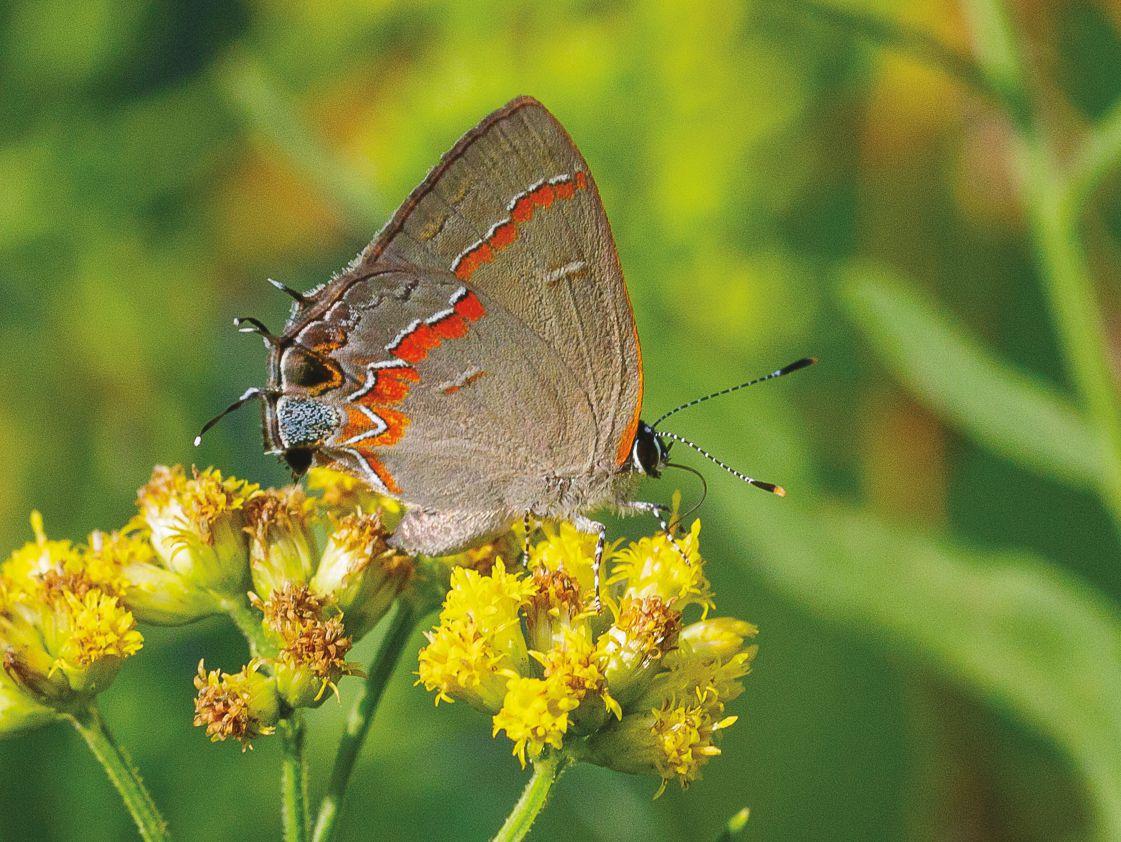
A Red-banded Hairstreak drinking nectar from Flat-top Goldentop, a species of goldenrod also known as grass-leaved goldenrod
In mid-summer and throughout fall, if your eyes start to water and itch and you can’t stop sneezing, you look around for something to blame. You see fields of bright clusters of tiny yellow flowers belonging to various species of goldenrods, and you think, “Aha! They must be the culprits!”
If that’s what you think, you would be wrong.
The perpetrators are primarily ragweeds, which have very inconspicuous flowers that you could walk right past without noticing. Ragweeds have evolved to be pollinated by the wind. They have very light, small grains of pollen that are mobile enough to travel up your nose or in your eyes if you are in their path. Grasses, some trees and other plants share this wind-pollination strategy, and may also cause allergies. It’s worth noting that in spite of their allergy causing potential, ragweeds have some redeeming qualities. They are native plants, and many birds eat their seeds!
Goldenrods are among the plants that have showy flowers to attract third party intermediaries as essential partners in accomplishing their pollination goals. Their pollen is heavy and waxy, so that it will stick to the body of the visiting insect who has come for a meal. It is not designed for flight; it is highly unlikely to be picked up by the wind and find its way up your nose.
Abundant bright clusters of tiny golden flowers entice insect visitors, including butterflies, bees, wasps, flies and others. A bountiful supply of nectar keeps them coming back, and for bees and flies there is also pollen. While visiting goldenrod flowers for food, these insects become
unwitting pollen couriers, helping to ensure future generations of goldenrod for their own off-spring.
There are goldenrods and their close cousins, goldentops, for most habitats, from sun to shade, dry sites to wet. The bloom times differ somewhat for each species, but they begin in midsummer and continue throughout the fall. Many species can be found in natural areas throughout the country.
Some species that work well in sunny gardens include Showy Goldenrod and Stiff Goldenrod, both showing neat, upright clusters of fowers; Flat-top Goldentop, an earlier blooming species with fat-topped fower clusters; and a cultivated variety of Wrinkleleaf Goldenrod called ‘Fireworks’, with its fowing cascade of golden inforescences.
There are even goldenrod species that can light up a shade garden. Wreath Goldenrod has a gracefully arching shape often seen along woodland paths. Zigzag Goldenrod, true to its name, has a zigzagging stem with flower clusters at the top and where the leaves meet the stem. Both of these species do well in shade to part shade.
In addition to the value their flowers provide, goldenrods offer food and shelter to hundreds of species of insects, some of which may spend the winter in goldenrod stems or rolled up in leaves. This is a good thing, because both the seeds and the over-wintering insects in turn provide a source of winter food for birds. Watch while hungry sparrows, chickadees, goldfinches and even Downy Woodpeckers forage for protein in the form of an insect meal.
The United States Department of Agriculture Natural Resources Conservation Service Plants Database lists over 170 species and naturally occurring varieties of goldenrods that are native somewhere in North America. Learn which are native where you live, then add some to your garden to ensure a steady supply of food for butterflies and other pollinators from summer through fall.
Mary Anne Borge is an Associate Editor of Butterfly Gardener, an instructor at Bowman’s Hill Wildflower Preserve, and a Pennsylvania Master Naturalist. She enjoys sharing her love of nature through her writing and photography at her blog, www.the-natural-web.org.
By
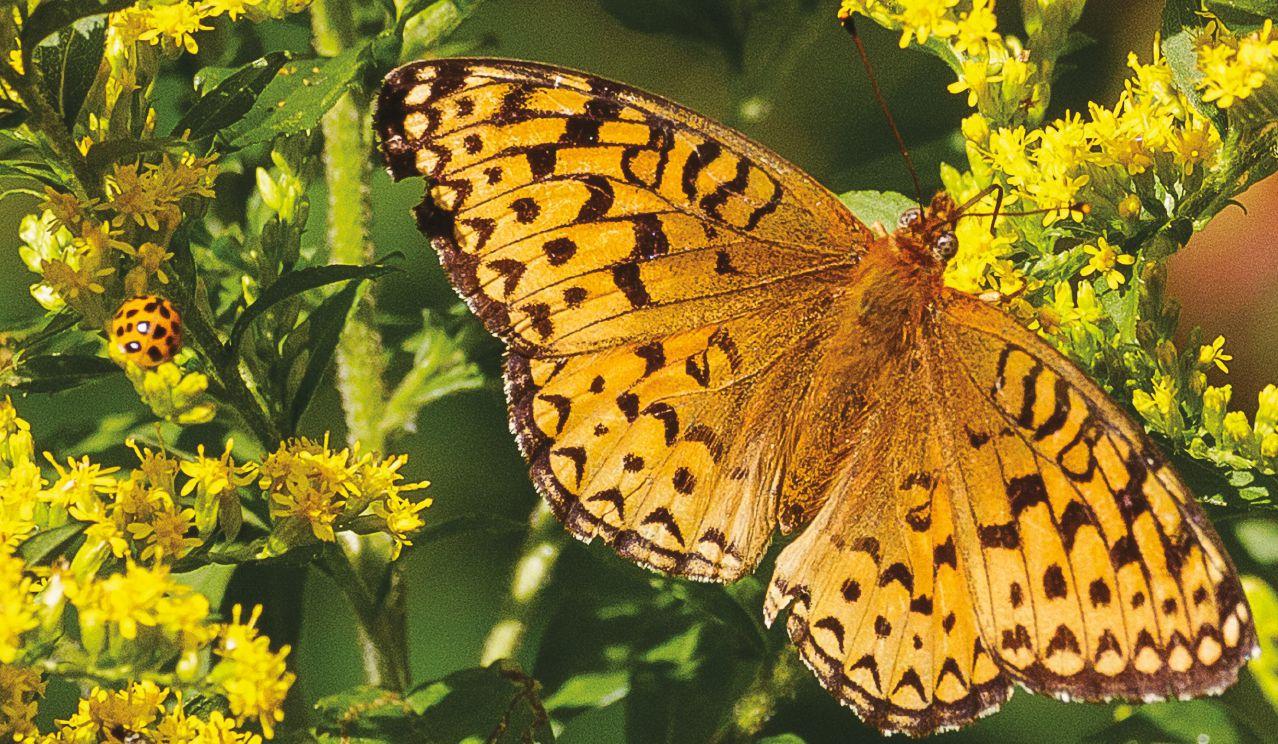
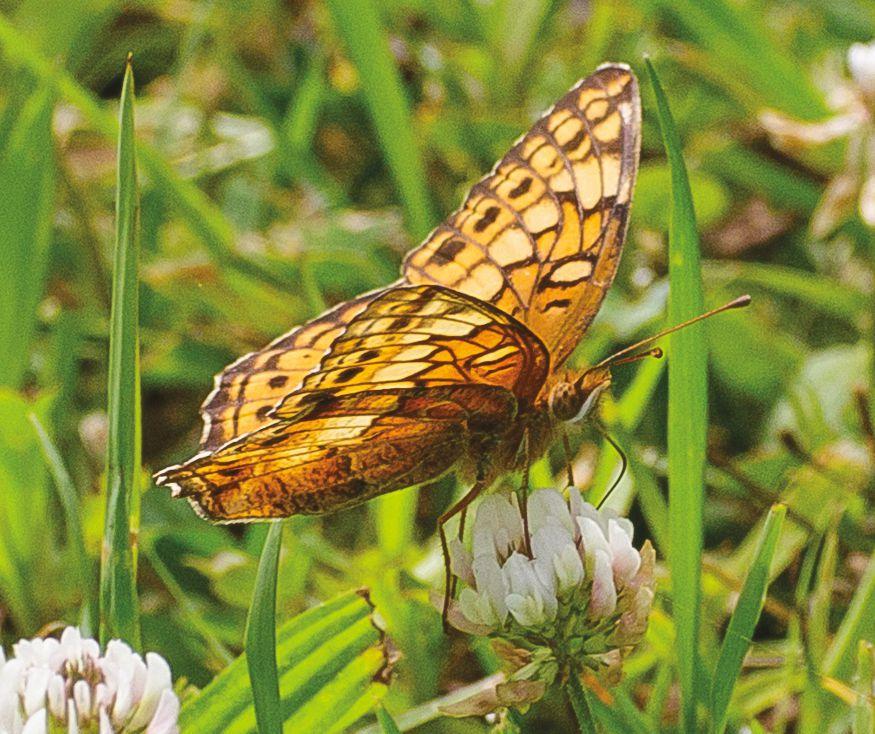
In the fall of 2018, I moved into a suburban property in the town of Waldorf, Maryland. There fourished an abundance of Common Blue Violets, which have long been among my favorites—and which serve as a caterpillar food plant for fritillaries. Not one to miss an opportunity, I designated a swath of our backyard as an unmowed wildlife garden and let the violets grow! How delighted I was, come spring, when I began to see the low-fying futter-and-alight of an adult Variegated Fritillary among the blooms.
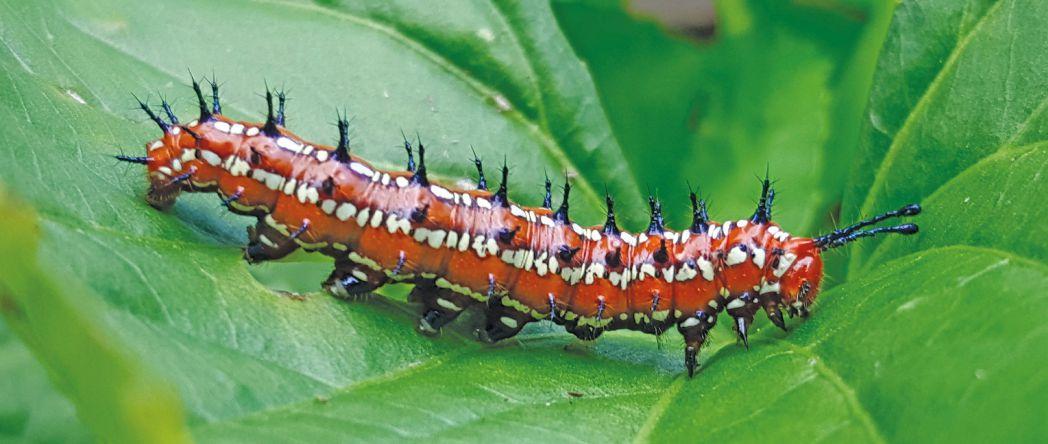
I started searching. I never found any eggs, but in July my diligence was rewarded: a glossy, red-orange caterpillar, already well-grown, sporting white stripes cross-barred with black and and rows of spiky spines, including a pair of black, clubbed “horns” on its bright red head. I imagined a predator would think twice about those spines, and wondered whether the red was a type of mimicry, signaling to predators they might be toxic, like Monarchs.
For observation, I moved my foundling to a pot of violet volunteers, crossing my fngers that it did not stray (or get eaten). Every morning for a week, I found my subject resting along the stem or the underside of a leaf, though I could tell where it had eaten some of the violets overnight.
On day eight, the caterpillar was gone. A local inspection turned up a rover on the patio nearby—presumably “mine,” though I couldn’t be sure. By its speed and distance from the violets, it
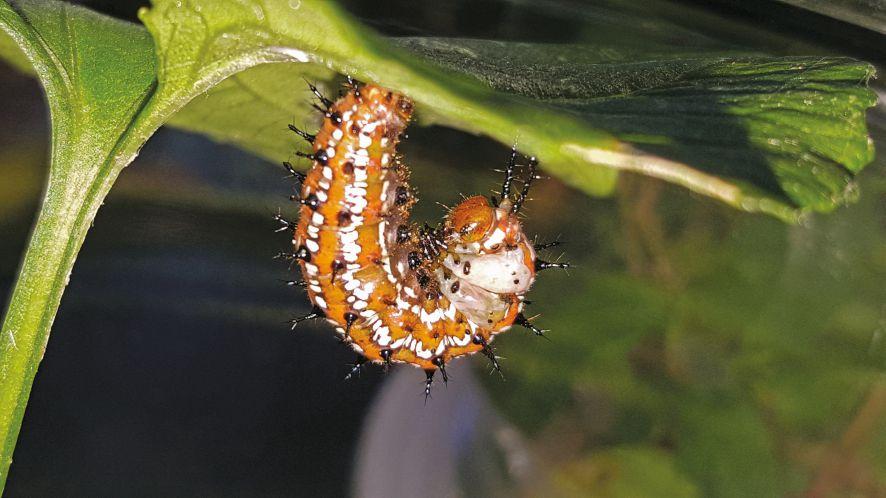
Above: The Variegated Fritillary caterpillar about to become a chrysalis. Center: The spectacular chrysalis. Below: Shortly before the butterfy emerges from its chrysalis.
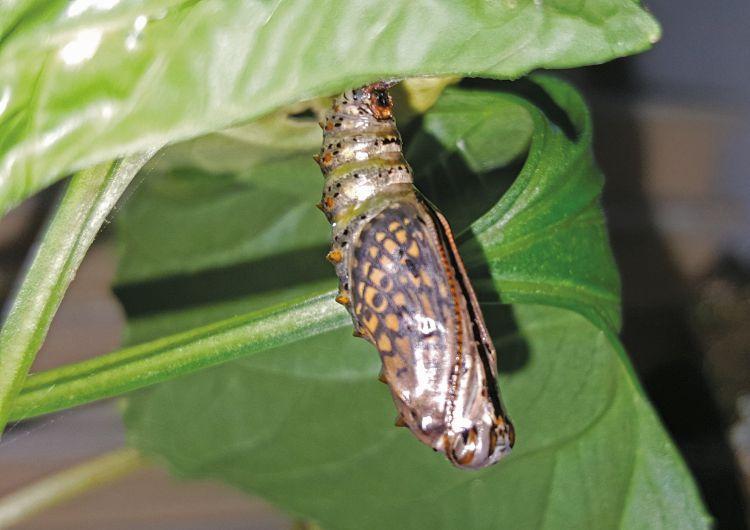
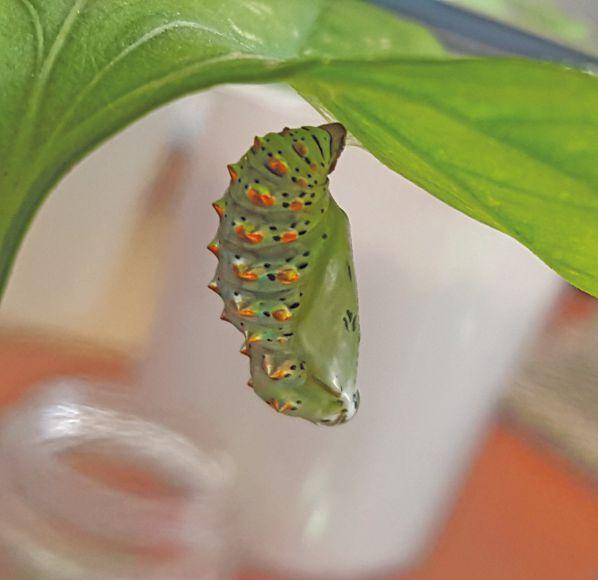
seemed likely that it had gone “on walkabout” to pupate. I put it in my aquarium for observation, with a pot of violets. Sure enough, by the next day it had formed a spectacular chrysalis, a real beauty of bright shimmering green with black speckling and gilded knobs. What purpose did these orange-gold architectural structures serve? I wondered.
Over fourteen days, its color shifted from bright to pale, then dark, until one morning I could see the markings of wings showing through. I was not at home when the butterfy eclosed, so I missed the brand-new “wrinkly” phase; when I checked in, its wings were fully infated—straight and clean and vividly orange and brown.
Time for release. I took the tank outside and removed the lid. The emergent butterfy basked for a bit in the dappled sun, and then, with a sudden furry, sprang up and away. I watched until I lost sight of its wings in the glare of summer sun. This beauty was not meant to be caged.
Through summer and fall, I continued to see Variegated Fritillaries—males patrolling for mates, females stooping and pausing to lay their eggs, one at a time, on a leaf here or there. No doubt eggs were scattered by the dozens across my wildfower patch—though I still couldn’t fnd the tiny treasures. Even so, I felt rewarded—who knew that gardening for butterfies could be as easy as letting a piece of your garden simply do its own thing?
Casey Laine comes from a long line of talkative women. She works as an editor, and publishes an annual anthology of fction and poetry. In her spare time, she chases butterfies with her camera.
By Julie O’Donald
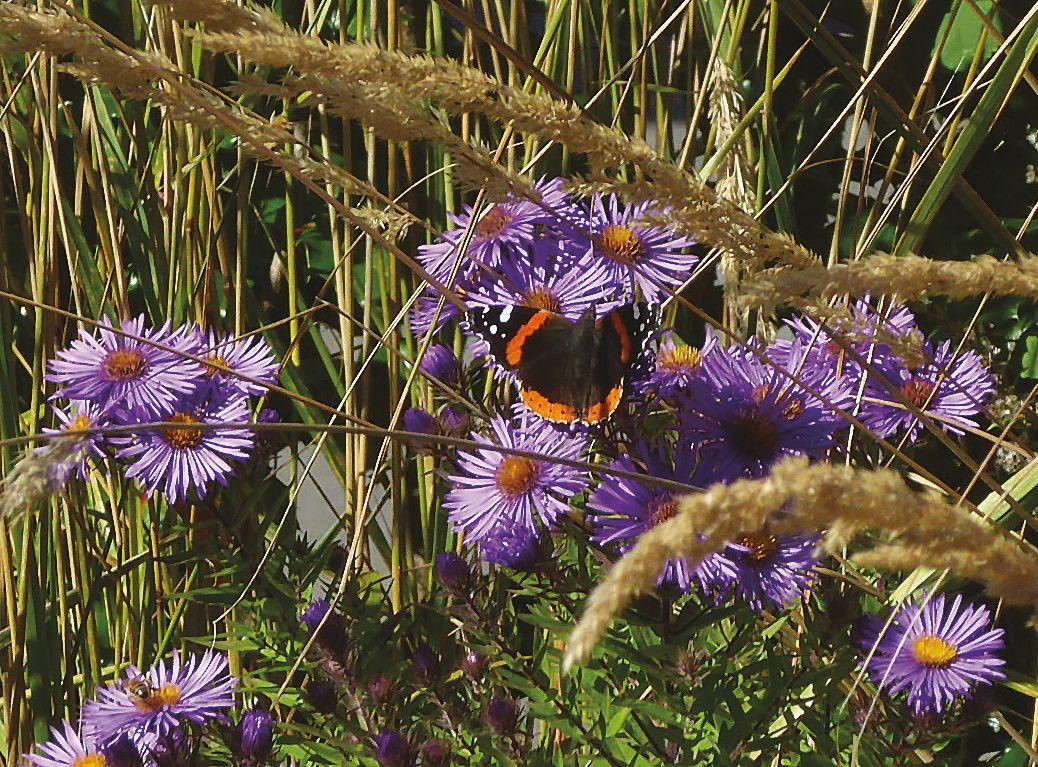
This story is a re-telling of an event that took place 25 years ago. The location was, and still is, my half-acre wildlife habitat garden, located in the suburbs north of Seattle. It was high summer here in the Pacifc Northwest, a perfect day to remove invasive Himalayan Blackberries in the far back corner of the native plant garden. Stinging Nettle grows prolifcally here and is an important caterpillar food plant for butterfies. In a sense, this story is about making peace with Stinging Nettle. Several butterfy species, including Red Admiral, use Stinging Nettle as one of their caterpillar food plants.
In the early years of creating the garden, a weedy patch of nettles and blackberries grew in back, near the edge of the property. One day, while removing blackberries, I accidentally snipped a nettle stalk. Realizing that I needed to be more careful, I looked closely and discovered a tiny egg. This led to an immediate shift in priorities. Forgetting the blackberries, I went back to the house to fnd a small jar for water. After covering the top with plastic and poking the nettle stem into the water, I placed the nettle in a one-gallon jar with a mesh cover. The large jar wasn’t ideal but it was all that was available on short notice. A mesh butterfy-rearing enclosure is a preferable choice since it offers better air fow and more space.
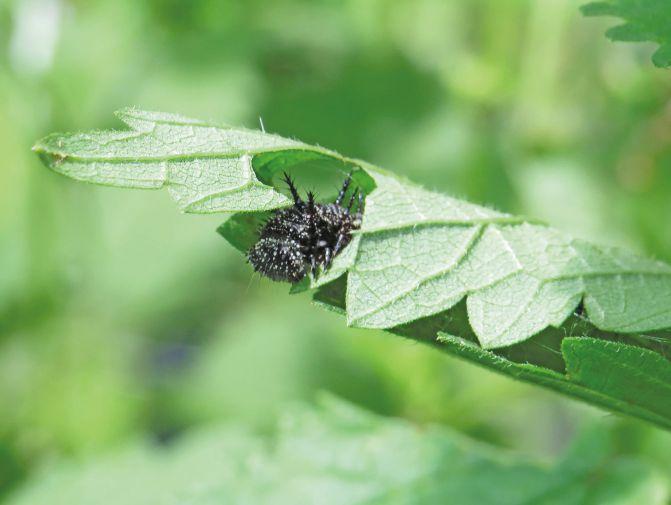
Above, an early instar caterpillar protects itself inside a leaf shelter where it continues to feed and grow.
Below, a freshly molted caterpillar moves off insearch of a meal.
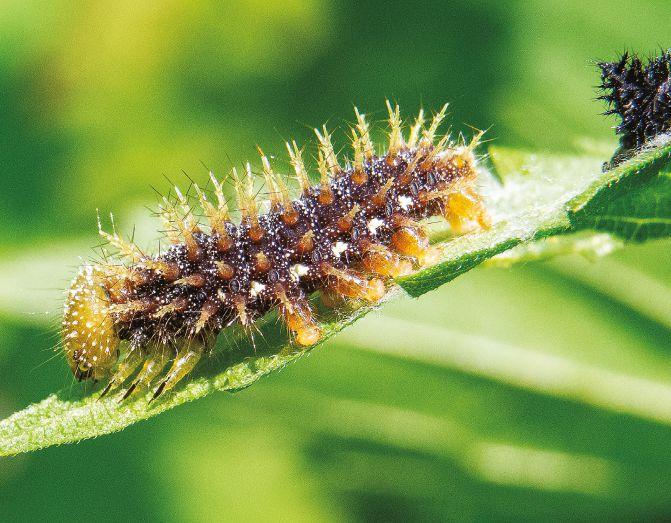
A few days later, a tiny caterpillar emerged from the egg, making the effort worthwhile. Fortunately, an abundance of Stinging Nettle was still available, and each day thereafter I put on a denim jacket and garden gloves to safely clip fresh nettle stalks to feed the growing caterpillar.
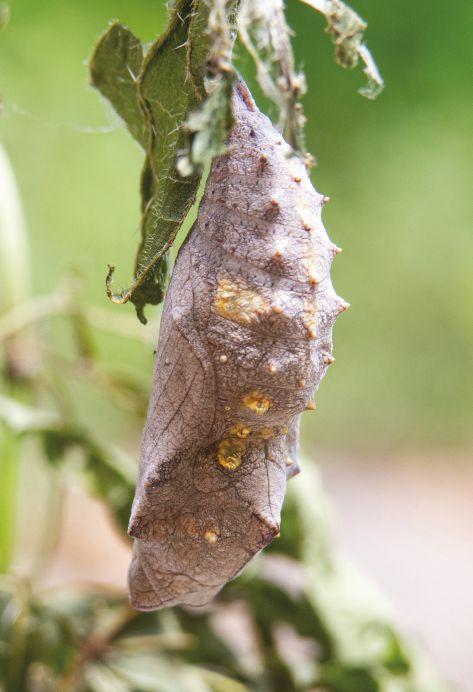
My two children were watching, as well as fve neighbor kids who would come over every few days to check on the caterpillar’s growth. The caterpillar spent most of its time inside a leaf where it continued to feed and grow. Eventually, it crawled onto a twig which the children placed in a jar, so it could pupate and form a chrysalis. On the day the butterfy emerged, the children gathered to take the jar out to the nettle patch. We released the Red Admiral to the happy sounds of childhood wonder and delight as it landed on a blackberry fower. Then, starting the next day, something surprising happened
Each morning for close to ten days, the Red Admiral returned to the back screen door around 10 am to warm in the sun for 15 to 20 minutes. At no other time in the 32 summers that I’ve lived here have butterfies landed on the screen door for more than a few seconds. I suppose the Red Admiral knew the smell of the house where it was raised. Or perhaps it thought it could fnd a mate or lay eggs on those clipped nettles in the jar. Either way this experience drove home the importance of nettles for butterfies.
For a few years I grew Stinging Nettle on one side of our shed. The ten-by-two-foot area was surrounded with garden fence to keep the nettles
in, but it didn’t work very well. The nettles poked through the fence, stinging anyone who carelessly brushed against them. Finally, we needed to paint the shed. Three walls were painted and the side with the nettles had to be done the following year, because I waited for winter to move the plants.
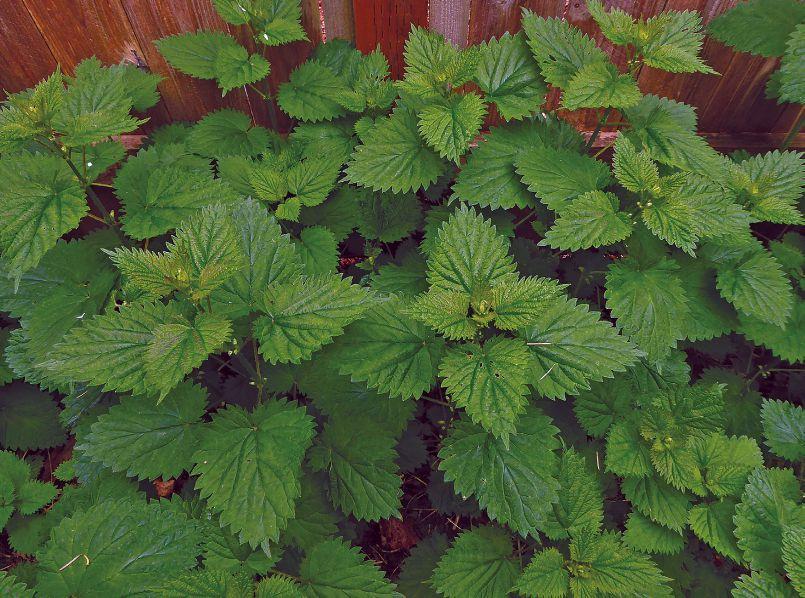
Even though nettles aren’t well suited to gardens, preserving them in greenbelts can help keep these butterfies in our neighborhoods. The Puget Sound region isn’t the best place for butterfy watching—most of us who live here are thrilled to see any butterfies at all. But having Stinging Nettles grow near our homes will bring us the delight of seeing Red Admirals as well as other butterfies in our gardens. Satyr Commas, Milbert’s Tortoiseshells, and West Coast Ladies will all beneft from increased availability of Stinging Nettles, a preferred and necessary host plant for their caterpillar stages. Let’s do all we can to keep corridors of Stinging Nettles available for butterfies.
Julie O’Donald is a Backyard Wildlife Habitat Steward with over 30 years experience creating wildlife friendly gardens. She has focused on the use of native plants in the home landscape and the benefits that native plants offer to pollinators and wildlife. Julie’s personal certified wildlife habitat contains over 200 species of native plants and has been successfully attracting native birds, butterflies, pollinators, and beneficial insects for more than 25 years.
Edited by Stephen Love | ISSN: 1522-8339, e-ISSN: 1548-4785, 3/year
Native Plants Journal is a forum for dispersing practical information about planting and growing North American (Canada, Mexico, and U.S.) native plants for conservation, restoration, reforestation, landscaping, highway corridors, and related uses. Topics include seed germination, planting techniques and tools, equipment, cultural techniques, production trends, seed collection, genetics, and fertilization. The second issue of each year includes the Native Plants Materials Directory, which provides information about producers of native plant materials in the U.S. and Canada. Relevant books are reviewed. Subscribers receive online access to all back issues. Volumes one through five are open access and available to all.
Native Plants Journal began in January 2000 as a cooperative effort of the USDA Forest Service and the University of Idaho, with assistance from the USDA Agricultural Research Service and the Natural Resources Conservation Service.














Please photocopy this membership application form and pass it along to friends and acquaintances who might be interested in NABA. www.naba.org
Yes! I want to join NABA and receive American Butterflies and Butterfly Gardener and/or contribute to the creation of the premier butterfly garden in the world, NABA’s National Butterfly Center. The Center, located on approximately 100 acres of land fronting the Rio Grande in Mission, Texas, uses native trees, shrubs and wildflowers to create a spectacular natural butterfly garden that significantly benefits butterflies, an endangered ecosystem, and the people of the Rio Grande Valley.
Name:
Address:
Email:
Telephone:
Special Interests (circle): Listing, Gardening, Observation, Photography, Conservation, Other:
For a $35 donation, one receives NABA publications as either digital or print. All higher levels of donations receive both digital and print versions. Outside the U.S., only digital is available, at any donation level.
Tax-deductible dues (donation) enclosed (circle): Regular $35 (must choose either digital or print — circle one), Family $45. Special sponsorship levels: Copper $55; Skipper $100; Admiral $250; Monarch $1000. Institution/Library subscription to all annual publications $60. Special tax-deductible contributions to NABA (please circle): $125, $200, $1000, $5000. Mail checks (in U.S. dollars) to NABA, 4 Delaware Rd., Morristown, NJ 07960.
Articles, gardening tips and observations, artwork, digital high resolution photographs, poetry and comments will be considered for publication. Contact Jane Hurwitz, Editor, hurwitz@naba.org
Advertising
Butterfly gardener welcomes advertising. Please contact us for current rates and closing dates at naba@naba.org, or telephone 973.285.0907, or fax 973.285.0936
Membership Services
If you have questions about duplicate magazines, missing magazines, membership expiration date, change of address, etc., please write to NABA Membership Services, 4 Delaware Rd., Morristown, NJ 07960. Occasionally, members send membership dues twice. Our policy in such cases, unless instructed differently, is to extend membership for an additional year. NABA sometimes exchanges or sells its membership list to like-minded organizations that supply services or products that might be of interest to members. If you would like your name deleted from membership lists we supply to others, please write and inform us at: NABA Membership Services, 4 Delaware Rd., Morristown, NJ 07960.

By Casey Laine
Known Food Preferences: Master generalists when it comes to chowing down, Gray Hairstreak caterpillars have been found on plants in more than 20 diferent families. Female adults lay a single, light-green egg on the fower or bud of a caterpillar food plant— most often on legumes such as peas, beans, and clovers, as well as cotton and other plants in the Mallow Family. Caterpillars may be found March through October on fowers and buds (though later instars may also feed on leaves).

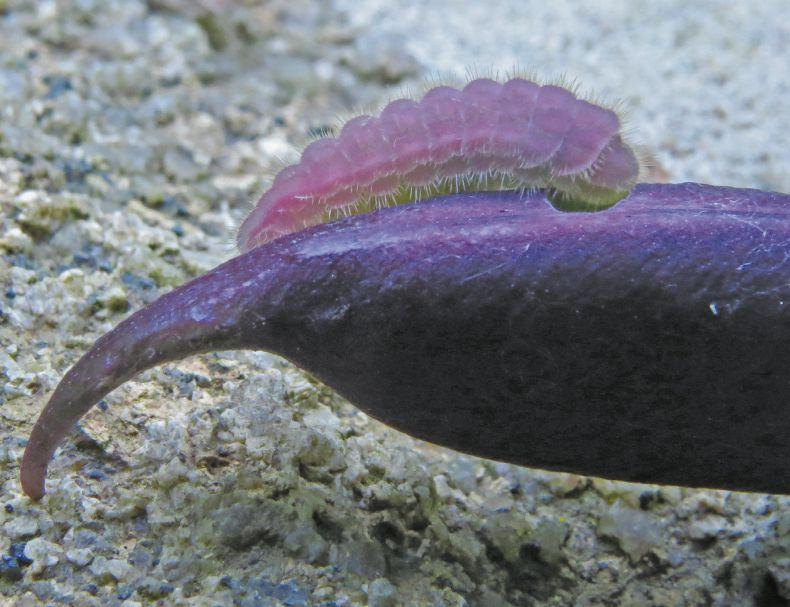


Aliases: Gray Hairstreak caterpillars are also called Cotton Square Borers because of the damage they sometimes cause to crops.
Known disguises: Common and widespread, Gray Hairstreaks are most often seen in disturbed areas, ranging from the northern regions of South America up to the southern regions of Canada. Their slug-like caterpillars have small heads on short, wide, fattened bodies that are covered in long hairs (setae). The body color itself is extremely variable, with cream, bright green, pink, red, and brown forms, but all display a cream stripe on both sides. Paler oblique dorsal markings (chevrons) sometimes occur, varying in prominence from bold to obscure.
Special Weaponry: Aside from their color variations, which provide excellent camoufage among the buds, blooms, and leaves of their food plants, Gray Hairstreak caterpillars are sometimes guarded by ants (an association called myrmecophily—literally, “ant-love”). Ants may protect the caterpillars from predators and parasites in exchange for the collection of “honeydew,” a sugary solution secreted from special glands, called nectary organs, in the caterpillars’ abdominal regions.
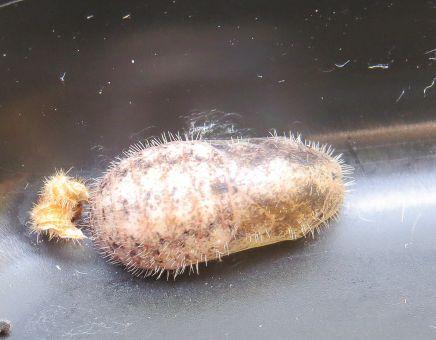
Winter hide-out: Gray Hairstreaks produce multiple broods per season, from two northern regions to ve (southern regions). Late-season caterpillars move away from their feeding site to pupate, concealing themselves under bark or leaf litter to form a short, rounded, hairy chrysalis that is usually brown. There they will remain dormant till spring.
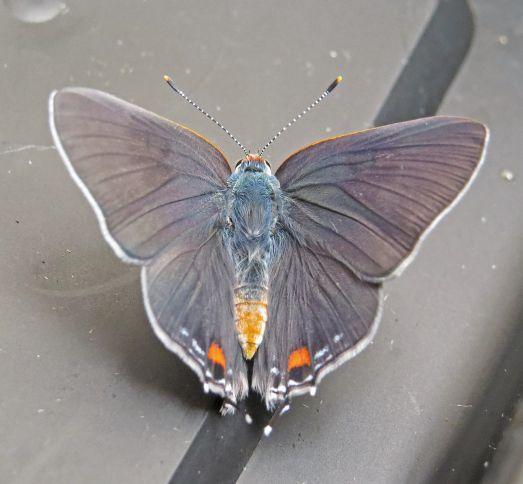
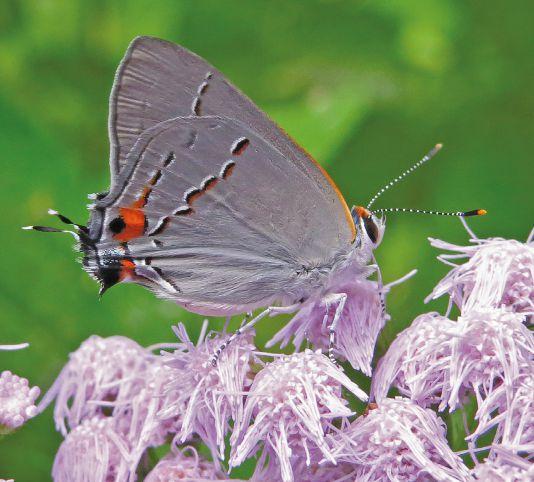
If capture is avoided: The following year, adult Gray Hairstreaks emerge to begin their breeding cycle. You may see them feeding among fowers, or nd males waiting among shrubs and small trees for a receptive female. They may perch with wings upright and closed, moving their hindwings up and down, or bask with wings open (one of the few hairstreaks that do), creating a false-head illusion with their threadlike tails (which resemble antennas) and their bright orange “eyes.” These features draw a predator’s attention away from their vulnerable heads and bodies.

Reward offered: Despite the “gray” in its common name, there is nothing bland about this member of the ossamer ing Family. As a caterpillar, it often presents in vibrant foral colors. As an adult, it ofers a striking sight to observers the beautiful pearly-gray underside of its wings is slashed with black and spotted with orange for a dashing contrast, while the upper wings shimmer with unexpected metallics. It seems like a misnomer to call this gem something so ordinary as gray, when it would clearly have been more apt to call it silver. But by any name, it is a treasure in the garden.


Casey Laine comes from a long line of talkative women. She works as an editor, and publishes an annual anthology of fiction and poetry. In her spare time, she chases butterflies with her camera.