



NABA Scores a Victory in its Lawsuit Seeking Protection for Everyone from Unreasonable Government Overreach!
In December 2017, NABA fled a lawsuit against the U.S. Dept. of Homeland Security because NABA believes that the U.S. government was, and continues, to illegally and unconstitutionally take NABA’s property at the National Butterfy Center in Mission, Texas. In Feb. 2019, a federal judge on the D.C. circuit dismissed all of NABA’s claims. NABA appealed and the D.C. Court of Appeals heard NABA’s case in Dec. 2019. Last month, the Court of Appeals issued its ruling, saying that the lower court was wrong not to consider NABA’s claims and remanding the case back to the lower court. You can see more detail by going to www.themonitor.com/2020/10/18/ and clicking on the article about the Butterfy Center lawsuit.
NABA is pleased to announce that, beginning with the Winter 2020 issue, Mary Anne Borge will become editor of Butterfy Gardener magazine and Lauren Kovacs will become associate editor.
Mike Reese Honored
Mike Reese, moderator of the NABA Recent Sightings website and author of the Hot Seens feature in American Butterfies, has recently been named a recipient of the David N. Redell Award for Lifetime Achievement in Citizen-based Monitoring by the Wisconsin Citizen-based Monitoring Network. Congratulations Mike!
NABA is gratifed that Forethought Marketing has agreed to represent NABA on a pro bono basis for the next years as NABA works to increase public awareness and concern for butterfies in Florida.
In extreme southern Florida, NABA is working toward expanding the range of endemic endangered species while looking to acquire land to serve as sanctuaries for their populations. Thanks to everyone at Forethought for helping us in these efforts!
Artists interested in entering the 2021 NABA Art Contest should submit digital images of original two-dimensional color “paintings,” in any medium. The digital fle name should include the artist’s name (last name frst), should be from two to ten MB, and should be sent to naba@naba.org. Higher resolution images will be requested, if needed.
If realistic, the painting should depict butterfy species found in Mexico, the United States or Canada. In your cover letter, please indicate the dimensions of the original work, give a description of the medium of the work, and provide a release granting to NABA the right to copy and publish the image. Please include a telephone number and email address where you can be reached and state the city or town in which you live. Submissions need to be received not later than June 1, 2021. Winning artist will receive a prize of $500, 2nd place winner will receive $125 and winners and honorable mentions will have their works published in color in the Fall 2021 issue of American Butterfies. All decisions of the judges are fnal.
If you are one the fortunate few who continued to have signifcant income this year, you can make the world better and reduce your taxes at the same time, by making an end of the year tax-deductible donation to NABA, whose income has been greatly affected by the pandemic.
We’d like to ask those NABA members who have planned estates, to consider including NABA and the National Butterfy Center in their plans. This will allow you to continue to help butterfies and conservation.

Front cover is a detail of the painting “Metamorphosis” by Tsherin Sherpa. See page 36 for Art of the Butterfy.
The North American Butterfly Association, Inc. (NABA), a non-profit organization, was formed to promote public enjoyment and conservation of butterflies. Membership in NABA is open to all those who share our purpose.
President: Jeffrey Glassberg Vice-president: James Springer Secrty./Treasurer
Ann James Directors: Jeffrey Glassberg
Fred Heath
Yvonne Homeyer
Ann James
Dennis Olle
Robert Robbins
James Springer
Patricia Sutton Scientific Advisory Board
Nat Holland
Naomi Pierce
Robert Robbins
Ron Rutowski
John Shuey
Ernest Williams
Volume 28: Number 4
Inside Front Cover NABA News and Notes
Winter 2020
2 Thanks (except for you, 2020) by Jeffrey Glassberg
4 Definitive Destination: Great Smoky Mountains National Park by Charles R. Smith and Elizabeth A. Domingue
28 You Are What You Eat
29 Great Southern White on turnips in Florida by Ed Perry IV
33 Statira Sulphur on Emperor’s Candlesticks in Florida by Adam Skowronski
36 Art of the Butterfly by Tsherin Sherpa
38 Hot Seens by Mike Reese
48 Contributors Inside Back Cover Readers Write
American Butterflies (ISSN 1087-450X) is published quarterly by the North American Butterfly Association, Inc. (NABA), 4 Delaware Rd., Morristown, NJ 07960; tel. 973285-0907; fax 973-285-0936; web site, www.naba.org. Copyright © 2020 by North American Butterfly Association, Inc. All rights reserved. The statements of contributors do not necessarily represent the views or beliefs of NABA and NABA does not warrant or endorse products or services of advertisers.
Editor, Jeffrey Glassberg
Editorial Assistance, Matthew Scott and Sharon Wander
Please send address changes (allow 6-8 weeks for correction) to: NABA, 4 Delaware Rd., Morristown, NJ 07960; or email to naba@naba.org
2020 has been an extremely challenging year in many ways. Through it all, NABA offcers and directors have worked without fnancial compensation to guide NABA on its mission of conserving North American Butterfies. I’d like to especially thank NABA director and vp, Jim Springer, for his many vital contributions to NABA’s operations.
Jane Hurwitz, who has served as editor of Butterfy Gardener for ten years, has just retired. Thanks Jane for your enormous contribution! And best of luck with your new projects.
At the NABA national offce, Laura Bianco ably manages the offce, keeping track of members (and sometimes holding hands) and serving as chapter liaison while Mike Cerbone focuses on web issues and producing the Count Report. Thanks to both of you!
Staff at the National Butterfy Center have had to deal with trying to operate during a pandemic and while walls are being constructed all around them. It’s been a diffcult year and Marianna Treviño-Wright, the executive director, and the rest of the staff, including Max Munoz, Luciano Guerra, Stephanie Lopez, Nestor Gonzalez, Marcelo Saavedra, Dale Oliver and Teresa Garcia have done a great job.
NABA has won a victory in its lawsuit against the U.S. DHS (see NABA News & Notes) taking of our land, due to the tremendous pro bono efforts on NABA’s behalf by the law frm of Debevoise & Plimpton, with the team including Timothy Beeken, Emily Hush, Mark McLennan, Nathan Noh, Adrian St. Francis, Darevia Williams and Harry Zirlin. Many thanks to you all!
Thanks to Delia Smith, NABA’s Director of Conservation, who, starting from scratch, is assembling the puzzle parts for the direct conservation of butterfies, focusing, for the moment, on southern Florida.
Thanks to Mike Reese, who runs the NABA Recent Sightings pages, helping NABA to track butterfy sightings throughout North America.
Thanks to Nancy Flint, NABA’s pro bono trademark attorney.
Thanks to the many, many offcers and volunteers of the NABA chapters throughout the U.S. Your efforts are of great importance in moving forward NABA’s mission and are much appreciated.
Thanks as well to Rick Cech and Peter Post who helped judge this year’s photo contest. American Butterfies depends entirely upon the generosity of authors and photographers who contribute their work free of charge.
For their year 2020 articles, we thank Mike Cerbone, Jaeson Clayborn, Elizabeth Domingue, Don Dubois, John Kemner, S. Mark and Tessa C. Nelson, Ed Perry IV, Mike Reese, Pat Rossi, Tsherin Sherpa, Adam Skowronski, Charles Smith, Marianna Treviño-Wright, Sandy-Crystal Vaughn, Ken Wilson and Harry Zirlin.
Thanks to all the photographers who donated the use of their photos to NABA, including the authors listed above and Seth Ausubel, David H. Bartholomew, Lisa Blackwelder, Andy Birkey, Ron Birrell, Spencer Black, Devon Blaw, Jacqueline Brackett, Stephen Buckingham, Doug Buege, Jeremiah Butler, Steve Carbol, Valerie Chansigaud, Jack Cochran, Joseph Connors IV, Linda Cooper, John & Nancy Crosby, Renee Davis, Barbara DeWitt, William Dickenson, Robert Gilson, Lorna Graham, Marcus Gray, Luciano Guerra, Brian Harding, Pam Higginbotham, Dennis Holmes, Michael Hulft, Teri Jabour, Bart Jones, Dan Jones, Venice Kelly, Theresa Knippers, Lorena Krenitsky, John Lampkin, Rick Lanting, Karl & Dorothy Legler, Curtis Lehman, Craig Lipski, Bill Lupardus, Aaryn Mann, Malcolm
Continued on page 46

Please photocopy this membership application form and pass it along to friends and acquaintances who might be interested in NABA
Yes! I want to join NABA, the North American Butterfy Association, and receive American Butterfies and The Butterfy Gardener and/or contribute to building the premier butterfy garden in the world, the National Butterfy Center. The Center, located on approximately 100 acres of land fronting the Rio Grande River in Mission, Texas uses native trees, shrubs and wildfowers to create a spectacular natural butterfy garden that importantly benefts butterfies, an endangered ecosystem and the people of the Rio Grande Valley.
Name:
Address:
Email (only used for NABA business):______________________ Tel.:______________________ Special Interests (circle): Listing, Gardening, Observation, Photography, Conservation, Other
For a $35 donation, one receives NABA publications as either digital or print. All higher levels of donations receive both digital and print versions. Outside the U.S., only digital is available, at any donation level.
Tax-deductible dues (donation) enclosed (circle): Regular $35 (must choose either digital or print — circle one), Family $45. Special sponsorship levels (all of these include memberships for the whole family): Copper $55; Skipper $100; Admiral $250; Monarch $1000. Institution/Library subscription to all annual publications $60. Special tax-deductible contributions to NABA (please circle): $125, $200, $1000, $5000. Mail checks (in U.S. dollars) to NABA, 4 Delaware Rd., Morristown, NJ 07960.
American Butterfies welcomes the unsolicited submission of articles to: Editor, American Butterfies, NABA, 4 Delaware Rd., Morristown, NJ 07960. We will reply to your submission only if accepted and we will be unable to return any unsolicited articles, photographs, artwork, or other material, so please do not send materials that you would want returned. For the type of articles, including length and style, that we publish, refer to issues of American Butterfies
Occasionally, members send membership dues twice. Our policy in such cases, unless instructed differently, is to extend membership for an additional year.
American Butterfies welcomes advertising. Rates are the same for all advertisers, including NABA members, offcers and directors. For more information, please write us at: American Butterfies, 4 Delaware Road, Morristown, NJ 07960, or telephone, 973-285-0907, or fax 973-285-0936 for current rates and closing dates.
If you have questions about missing magazines, membership expiration date, change of address, etc., please write to: NABA, 4 Delaware Rd., Morristown, NJ 07960 or email to naba@naba.org.
by Charles R. Smith and Elizabeth A. Domingue
The more than half million acres of Great Smoky Mountains
National Park (GSMNP) sit astride the Appalachian Trail and the boundary between North Carolina and Tennessee.
The park was created by an act of Congress in 1934. It was offcially dedicated by President Franklin D. Roosevelt on September 2, 1940, with a ceremony at Newfound Gap. The Great Smoky Mountains was the frst national park whose land and other costs were paid for, in part, with federal funds; previous parks were funded wholly with state money and/ or private funds. Local school children are reported to have donated their pennies for purchase of land that would become GSMNP. Because both public and private funds were used to purchase land for the park, there is no entry fee for the park. It is the second largest
What Can You See in Great Smoky Mountains National Park?
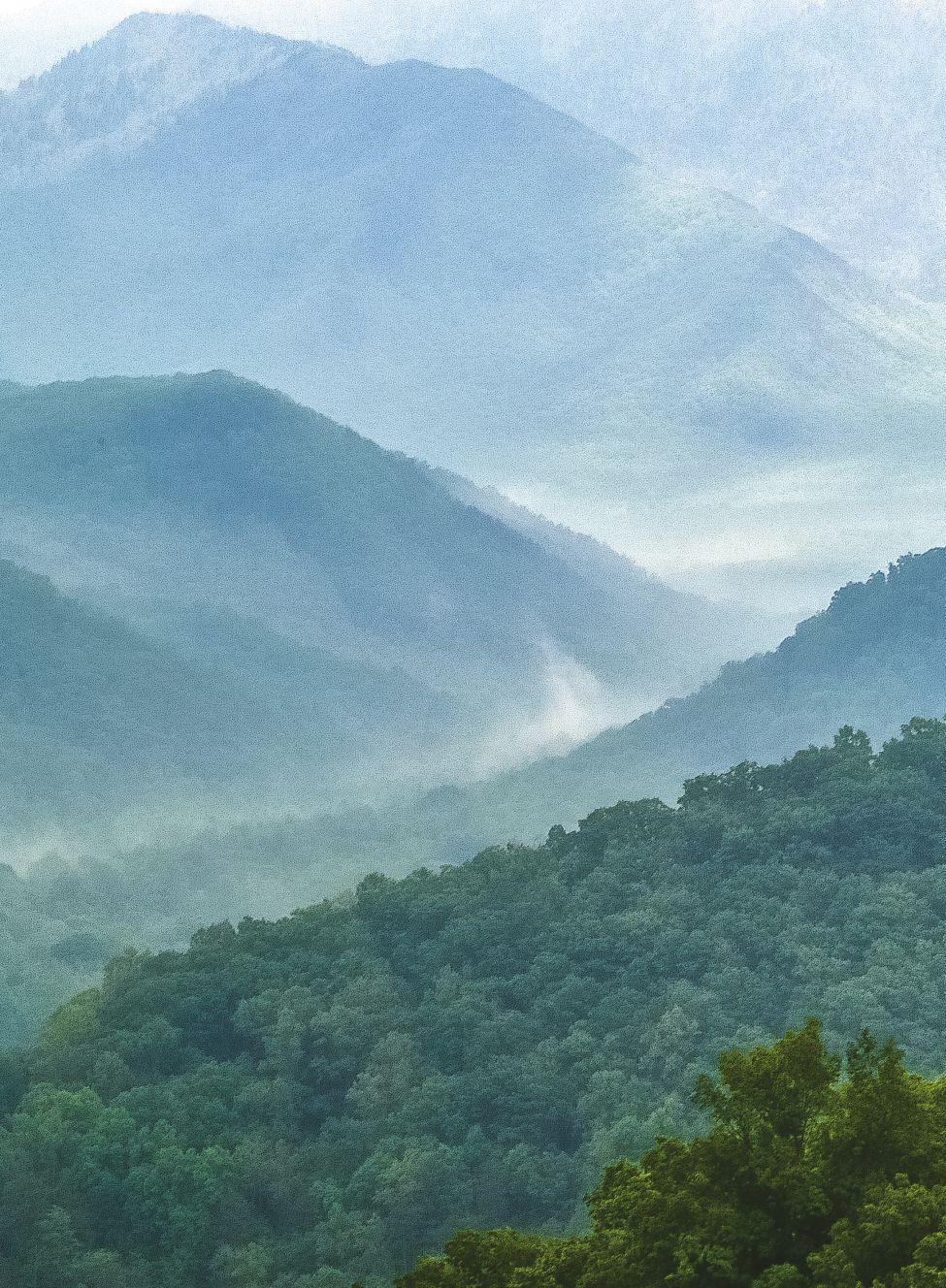
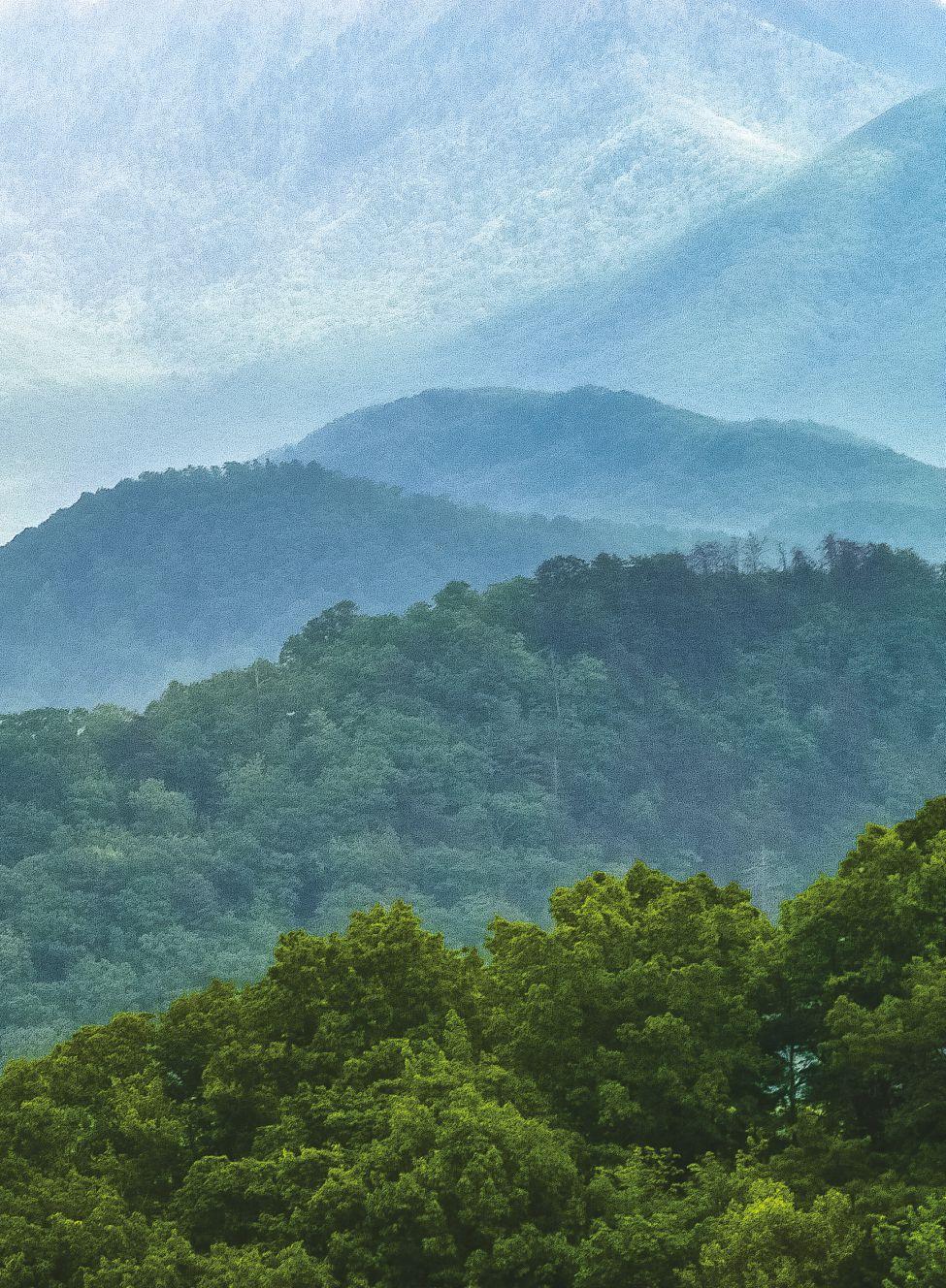
Beautiful Scenery. Pages 4-5. A Smoky View of the Park. May 11, 2004. Page 4 inset. A male Diana Fritillary. June 30, 2011. Forge Creek Road.
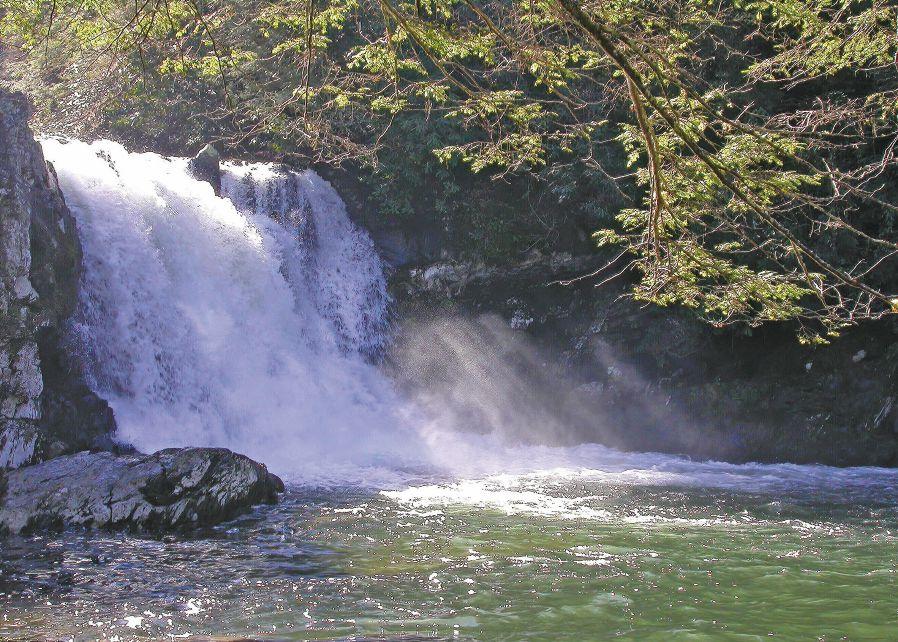
Waterfalls. This page: Abrams Falls. Dec. 5, 2004.
.
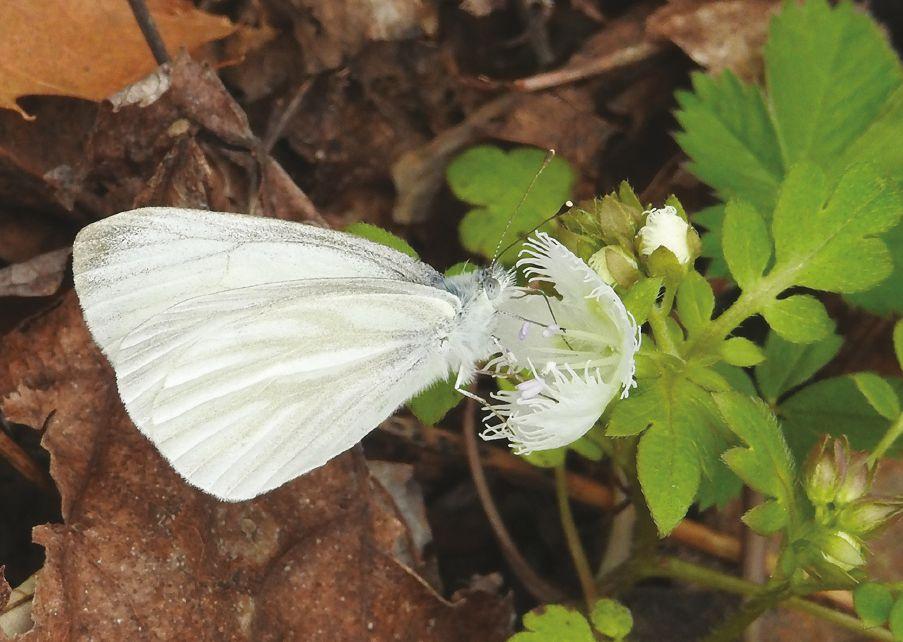
Opposite page top: West Virginia White nectaring at White-fringed Phacelia. March 26, 2018. Porter Creek.
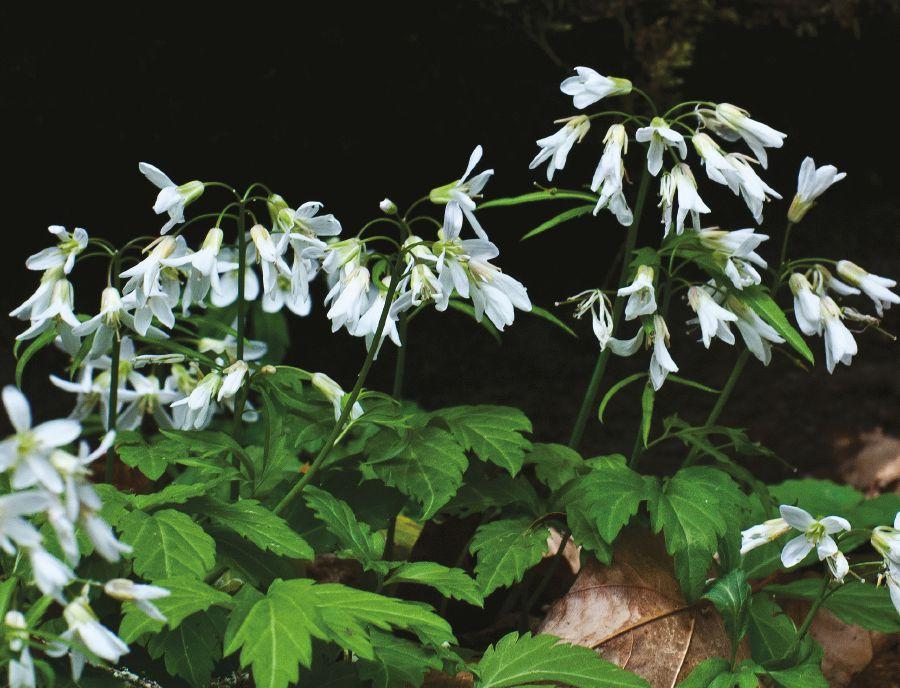
Opposite page bottom: Crinkleroot, a West Virginia White foodplant. April 19, 2011.
national park east of the Mississippi River, after Everglades NP.
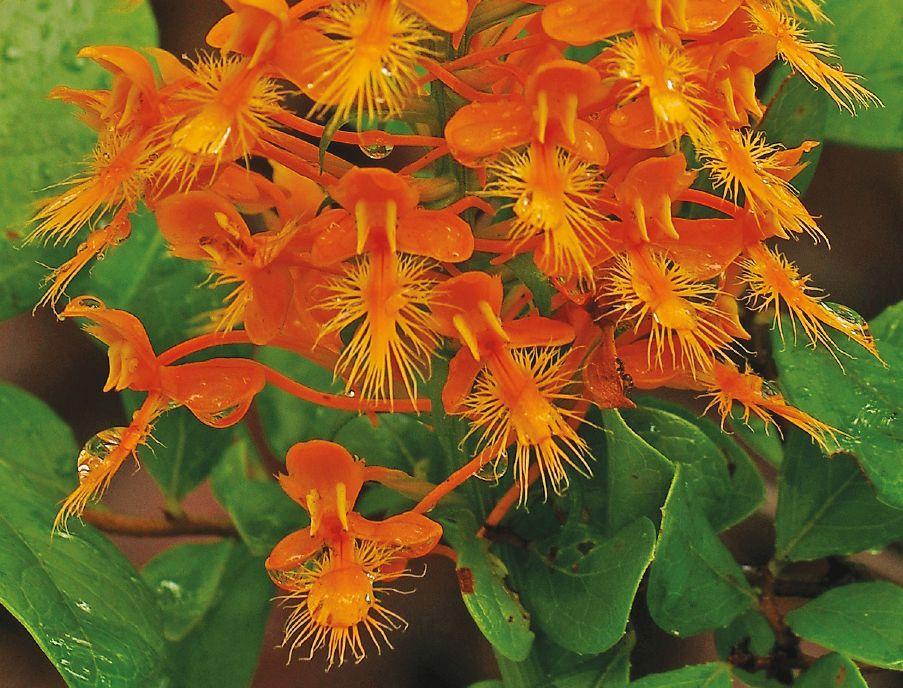
GSMNP is the most biologically diverse park in the National Park System. More than 19,000 species have been documented from the park, and biologists believe another 80,000 to 100,000 additional species may live there. More than 1600 species of fowering plants (36 of them native orchids), 200 species of birds, 103 species of butterfies, 50 species of fsh, 39 species of reptiles, and 43 species of amphibians, including 30 species of salamanders, have been documented from GSMNP. There are more species of salamanders in GSMNP than can be found anywhere else on Earth. The park has been designated a UNESCO World Heritage Site (1983) and an International Biosphere Reserve (1988). In addition to its natural history, GSMNP also displays excellent examples of southern Appalachian cultural history from the
This page: More than 35 species of native orchids can be found in GSMNP, including Yellow-fringed Orchids. Aug. 2, 2018. Just outside GSMNP, near Walland, TN.
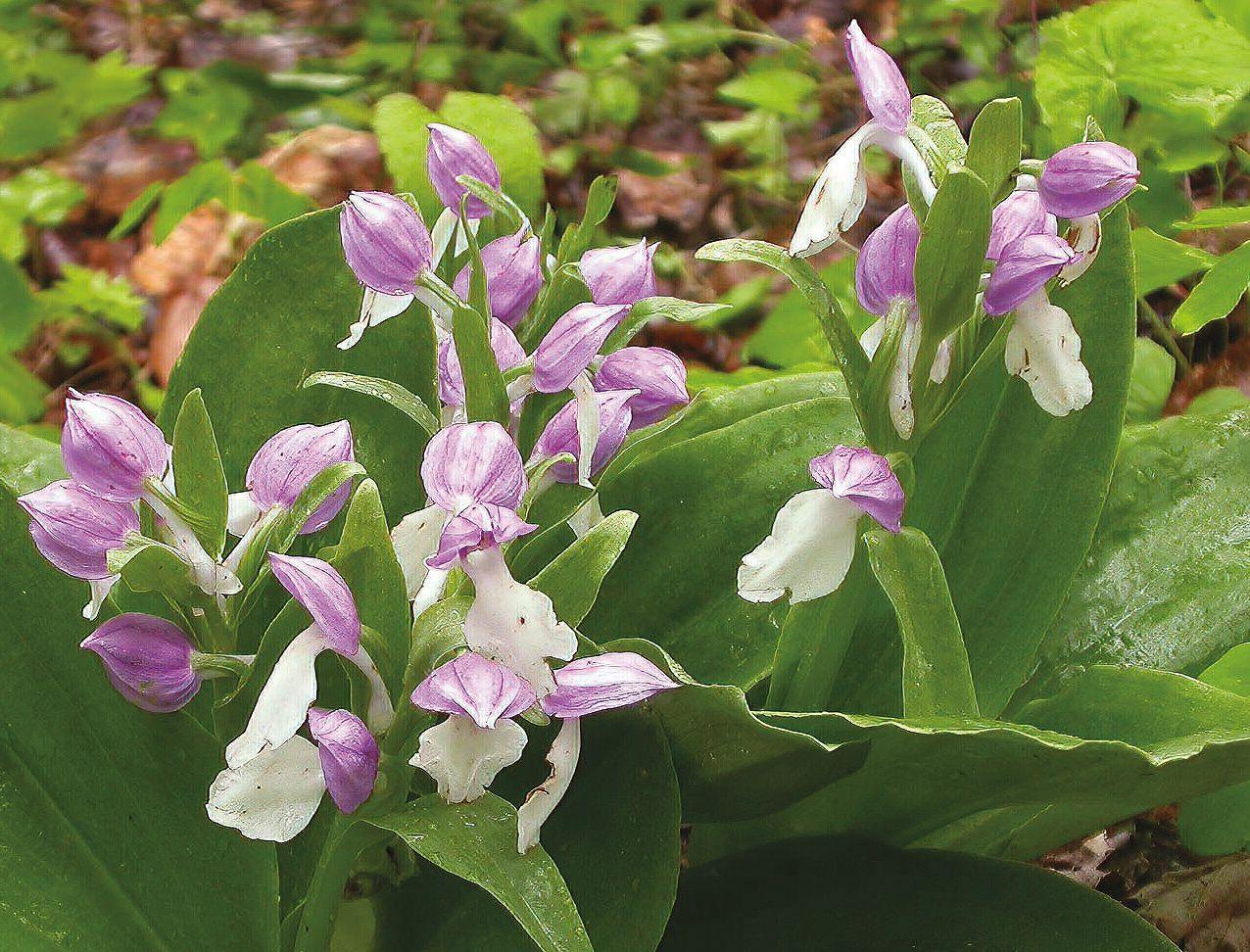
Opposite page top: Showy Orchid. May 5, 2005. Little River Trail, GSMNP.
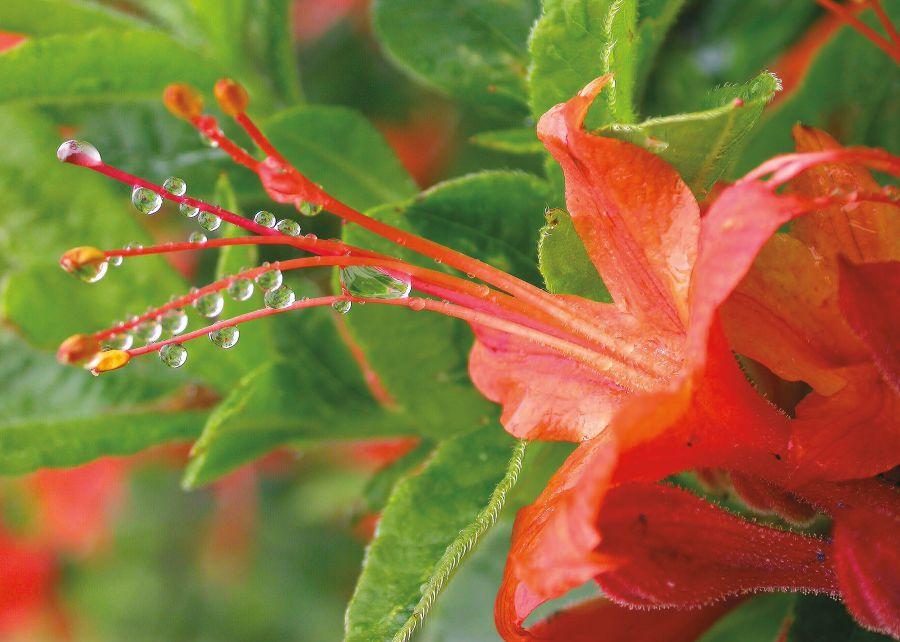
Opposite page bottom: Beautiful Flame Azaleas are primarily pollinated by Eastern Tiger Swallowtails! June 13, 2004. Andrew’s Bald, GSMNP.
late nineteenth and early twentieth centuries. If your interests include wildfowers, the Smoky Mountain Wildfower Pilgrimage, held each year during the third week of April, is worth attending. The GSMNP web site has good background information about the park and valuable advice for visitors to consider (see https://www.nps.gov/GSMNP/index.htm).
Its geographic location, accessibility, topographic complexity, and documented biodiversity make GSMNP an ideal setting for enjoying butterfies. With an elevational range from 857 feet to 6643 feet, you can span in a short time and modest distance a range of habitats that would represent a northward latitudinal displacement of more than 700 miles, with higher elevation habitats comparable to those found in the mountains of New York State and New England. Lower elevation habitats are more typical of those found in the southern Appalachians. Butterfies can be found anywhere in GSMNP, from the lowest elevations to the top of
Clingmans Dome, but some places are better than others. The park is almost 95 percent forested, and almost 36 percent of it, 187,000 acres, is estimated by the Park Service to be old growth forest, with many trees that predate European settlement of the area. It is one of the largest blocks of deciduous, temperate, old growth forest in North America. In addition, more than 100 waterfalls, some of them quite spectacular, are accessible to hikers. The forests of GSMNP are magnifcent, but include relatively few species of butterfies, compared to the more open areas.
Because of its accessibility, variety of different habitats and water sources, Cades Cove is one of the best places to look for butterfies, followed by the Cataloochee Valley. Both Cades Cove and Cataloochee Valley have expanses of open feld habitats and nectar-providing plants that are especially attractive to a variety of butterfies. In late summer and early fall, patches of blooming Sweetscented Joe Pye Weed can be especially
productive. The extensive forested habitats of the park have relatively fewer species of butterfies, but offer opportunities to hike to some of the few remnants of virgin forest in the eastern United States. More old growth forest exists in the Smokies than any other location east of the Mississippi River. Some species, such as Eastern Tiger Swallowtail, use the creeks and rivers as travel corridors through forested habitats.
The best areas for butterfies, Cades Cove and Cataloochee Valley, each have wellmaintained campgrounds. In late summer and early fall, the paved trail to the top of Clingmans Dome also can be attractive to butterfies on a sunny day with little wind. On a warm, sunny mid-September day in 2015, walking the paved trail from the parking lot to the observation tower on Clingmans Dome, one of us (CS) saw a dozen different kinds of butterfies. Eight of those butterfies were at the summit of Clingmans Dome (6643 ft.). The butterfies were nectaring at plants still
Mike Turns
Fritillaries, including Diana, Aphrodite, Great Spangled, Meadow and Variegated.
Opposite page: A Female Diana Fritillary, a key “seek to see” eastern butterfy, on a joe pye weed. Aug. 16, 2013.
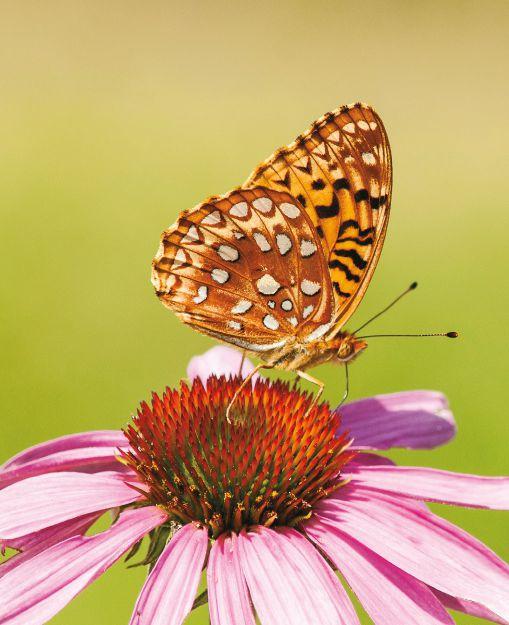
This page: An Aphrodite Fritillary, near the southern edge of their range, nectaring at a Purple Conefower. July 1, 2011. Near Cherokee, NC.
in bloom at that elevation, but that already had gone out of bloom at lower elevations. In late summer, keep a watchful eye for nectaring butterfies when driving along the road from Newfound Gap to the Clingmans Dome parking area, where Scarlet Beebalm and Cutleaf Conefower typically bloom in great abundance. Be sure to use pull-outs, when they are available, for more leisurely observations and photography and to avoid traffc.
Cades Cove
You can drive to Cades Cove either from the Sugarlands Visitor Center, near Gatlinburg (about 24 miles), or directly from nearby Townsend, TN (about 10 miles). Within Cades Cove, seeing butterfies is facilitated by a one-way, 11-mile, loop road, that features a number of historic homesteads and hiking trails along the way, each with parking areas, and good opportunities for butterfies. This road is currently closed to motor vehicles all
day Wednesday and Saturday mornings until 10:00 a.m., from early May through the end of September, to allow bicyclists and pedestrians to enjoy the cove. Otherwise, the road is open daily from sunrise until sunset, except during extreme weather events.
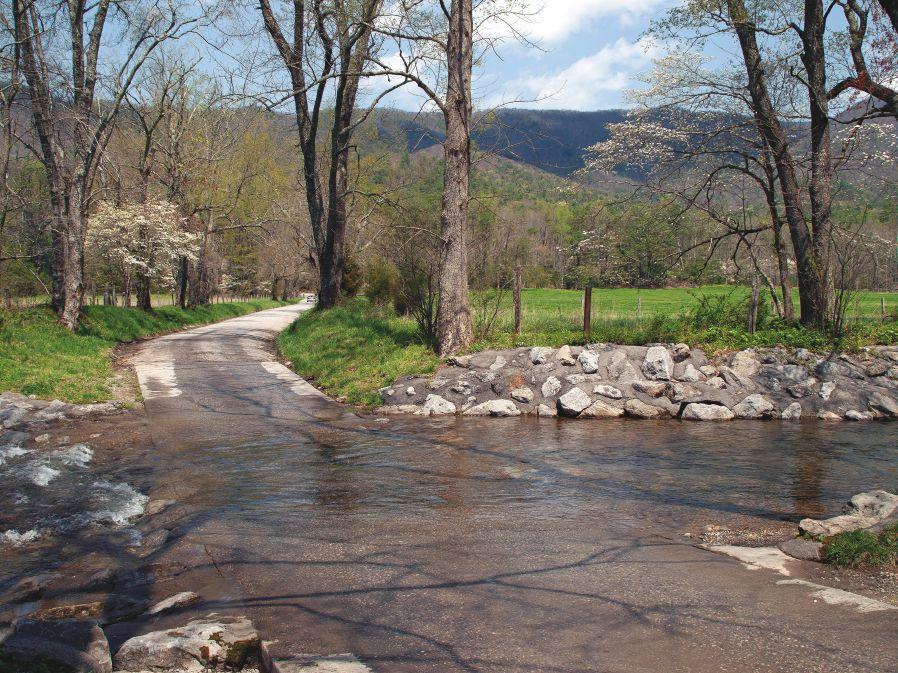
One of the best places for seeing butterfies in Cades Cove is Sparks Lane, where it crosses Abrams Creek via a paved ford. If you enter Sparks Lane from the north, stop in the small parking lot on the east side of the road, just after you cross Abrams Creek. Search the wet areas along the road on either side of the ford and the felds and roadsides for butterfies. Falcate Orangetips and Harvesters have been found there. From the parking lot, a grassy access road goes east, paralleling a stock fence around a horse pasture. Along the access road are good places to see Common Buckeyes, Common Wood-Nymphs and various skippers and sulphurs in late summer or early fall.
The felds along the trail from the Loop Road to the Oliver Place also can be productive for butterfies, including Diana Fritillaries. The trail from the parking area to the Oliver Place offers an easy way to observe and photograph butterfies from the nearby felds. Abrams Falls are a short hike from the Cades Cove Loop Rd. along the Abrams Falls Trail and offer opportunities for seeing West Virginia Whites and numerous wildfowers along the trail in the spring.
Be advised that during the peak summer season, traffc can be bumper-to-bumper on the Cades Cove Loop Road, so you may want to pack a lunch and make a day of it. Be courteous to other drivers and move to the side of the road or use pull-outs when you stop to observe butterfies and other wildlife.
In summer, check the Butterfy Milkweed along the roadsides for nectaring butterfies. In addition to butterfies, attentive observers may see Wild Turkey, white-tailed deer, and black bear from the Cades Cove Loop Road. In early 2020, Cades Cove was chosen as “America’s Most Beautiful Valley” by Country Living magazine.
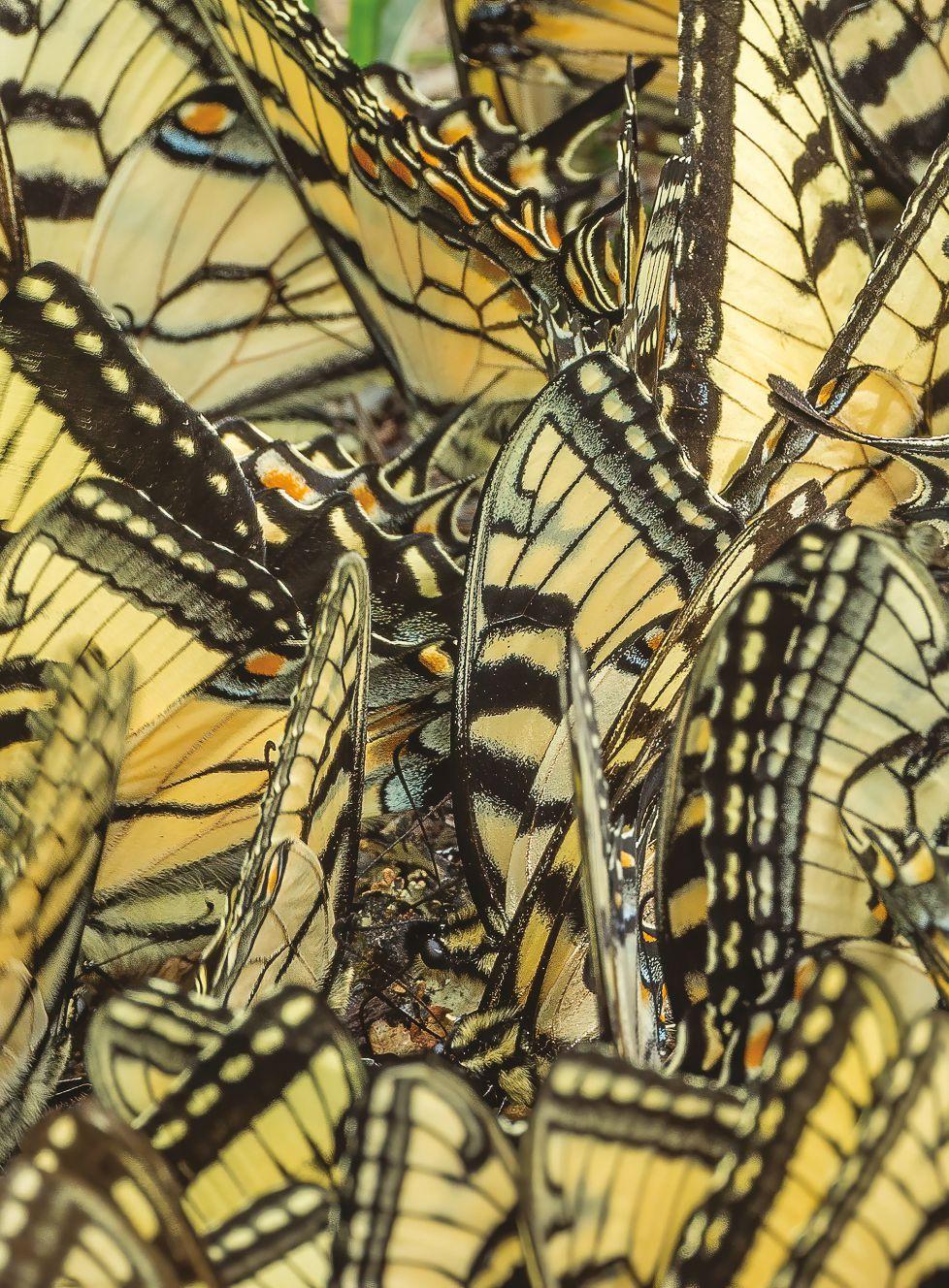
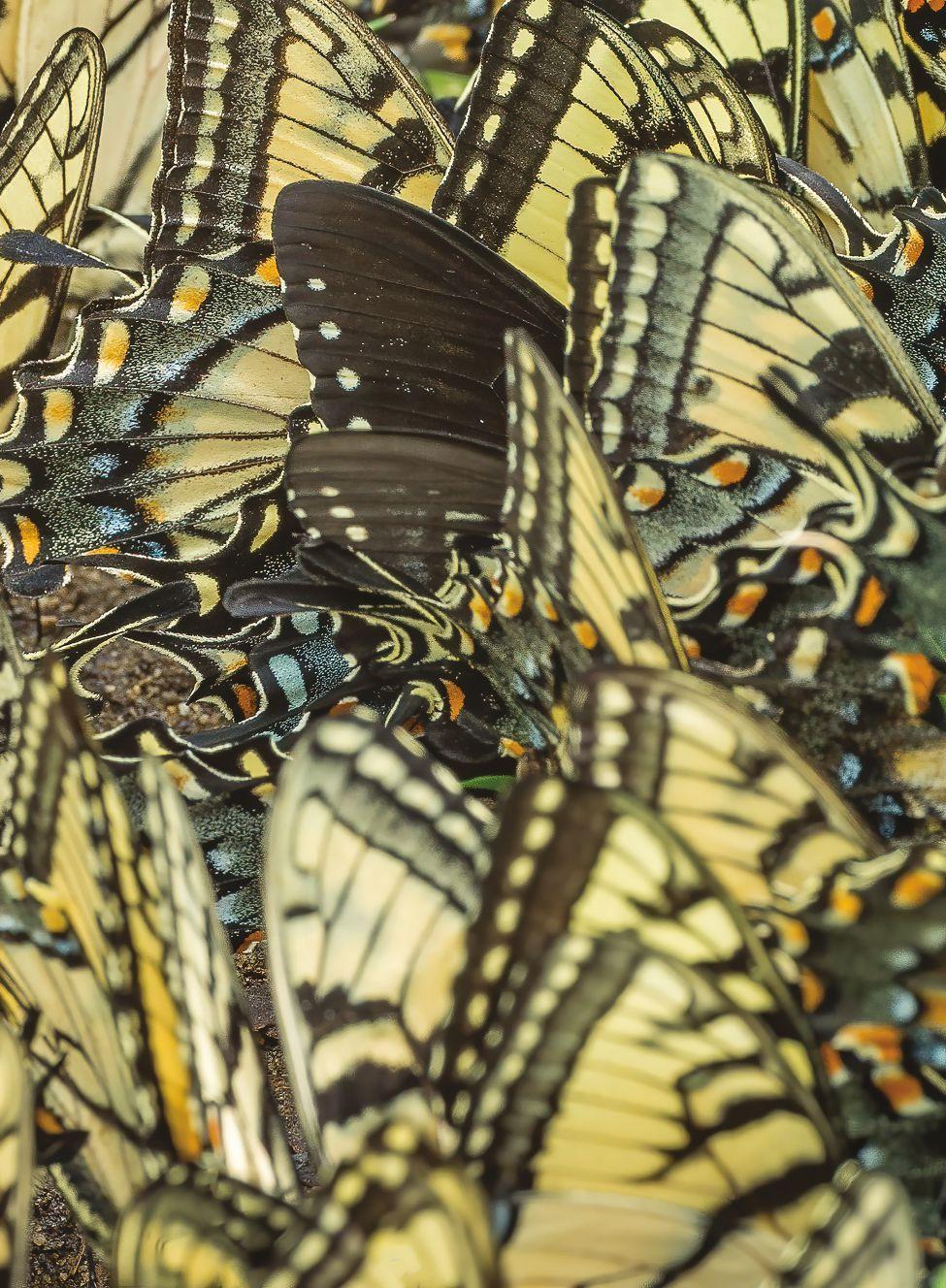
Pages 12-13: Countless Eastern Tiger Swallowtails and one Spicebush Swallowtail. April 20, 2016. Greenbrier Picnic Area.
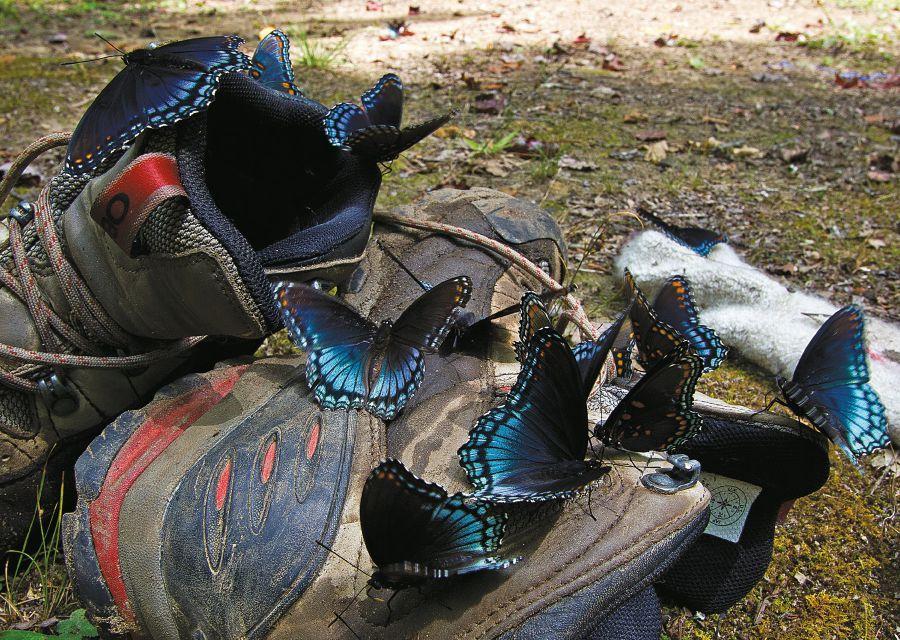
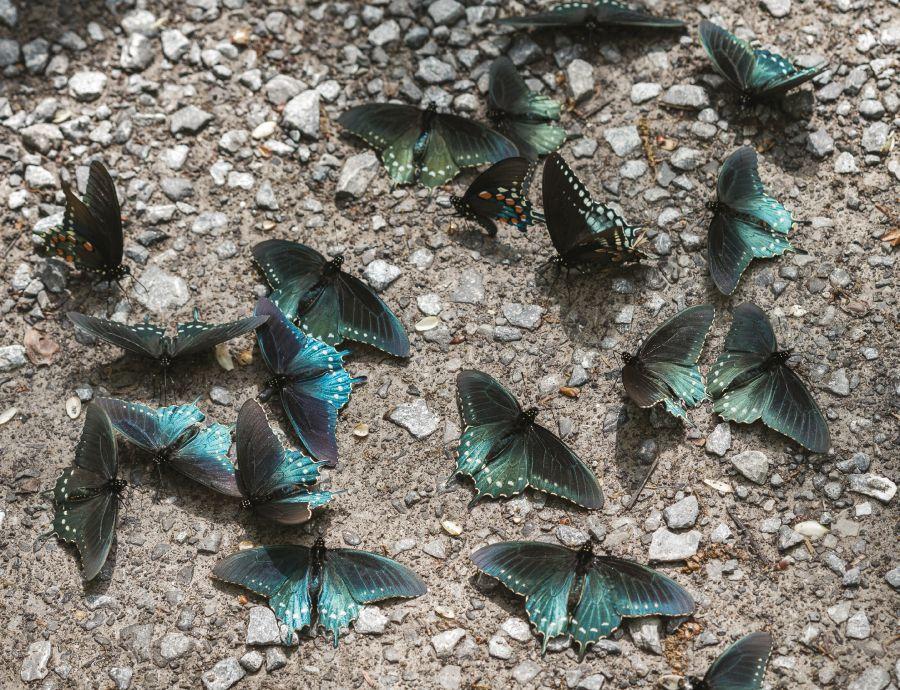
Opposite page top: Is it the red spots on the boots that was attracting these Red-spotted Purples? Nah, we all know that it was the salts encrusting the surfaces of the boots. Sept. 2, 2012. Forney Creek Trail.
Opposite page bottom: Do Butterfies of a Scale, Bunch Their Tales? Apparently so, if they’re Pipevine Swallowtails (Is the Spicebush Swallowtail in this photo a descendant of the interloper on page 13?). April 20, 2017. Porter Creek Trail.
Cataloochee Valley
In addition to butterfies, Cataloochee Valley offers one of the best opportunities east of the Mississippi River to see and photograph a free-range elk herd. Elk were reintroduced into the park in 2001 and now number about 200 animals. There are numerous opportunities to observe butterfies along the road that bisects the valley, but walking into the felds along the road can be limited by the Park Service during the elk calving season in
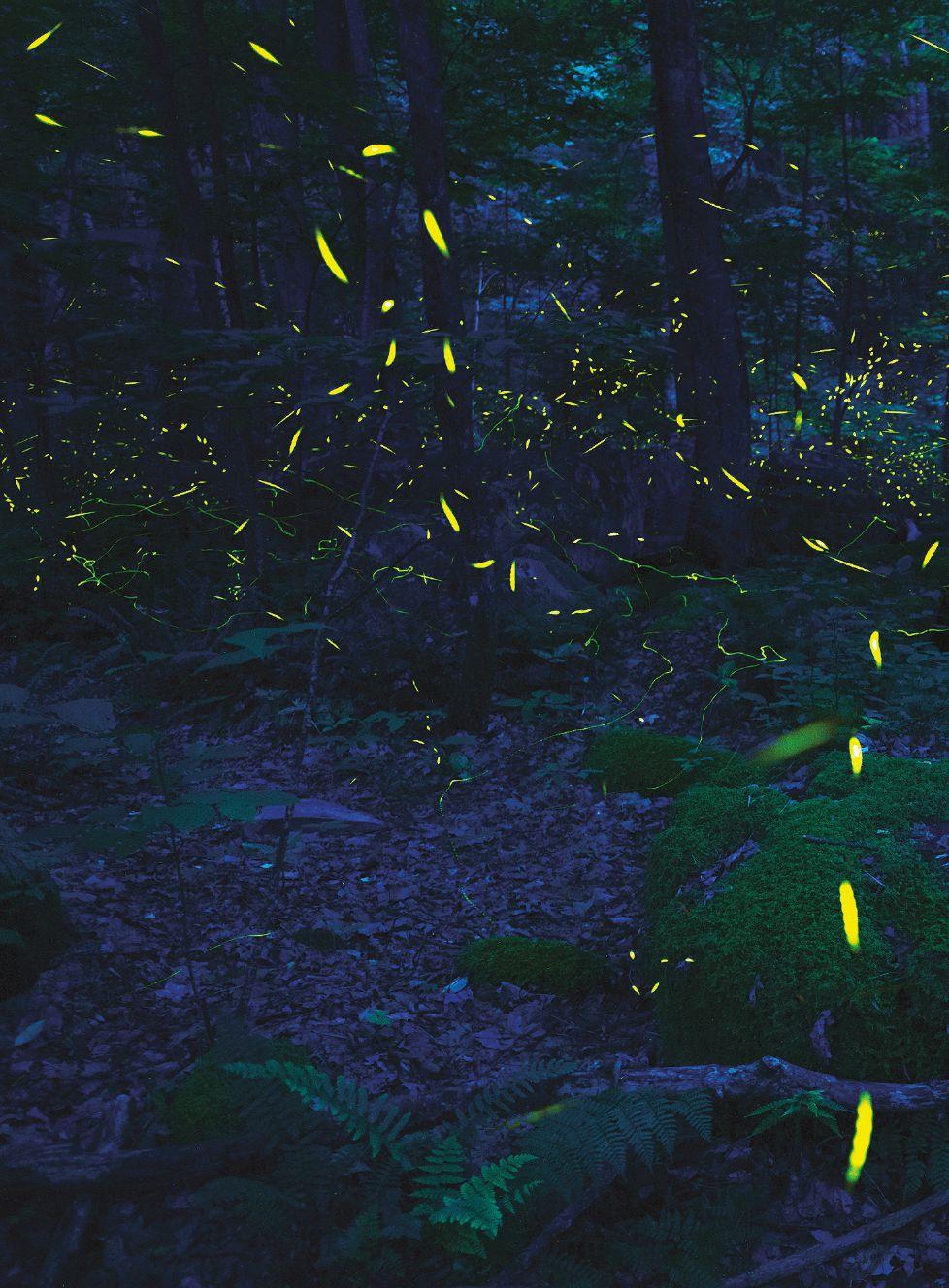
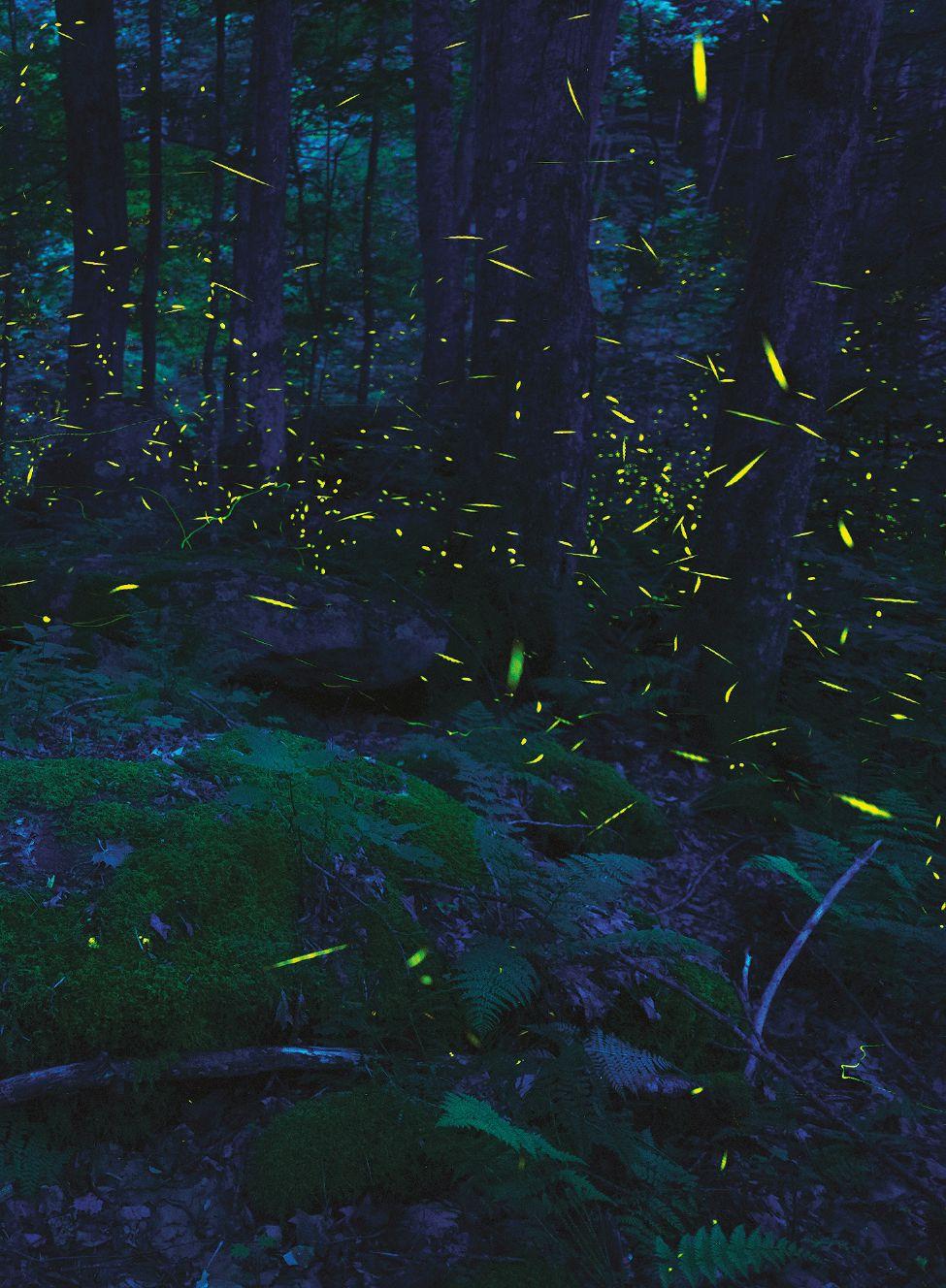
See the Firefies Blazing in Air? How can you call yourself a naturalist without traveling to GSMNP to see the spectacular displays of synchronous frefies?
June 19, 2014. Elkmont area, GSMNP.
This page: Sparks Lane where it crosses Abrams Creek is one of the best areas in GSMNP to see butterfies. April 10, 2011.
Opposite page: The trail to Woody Place affords opportunities to see Silvery Blues. Sept. 23, 2014.
the spring and during the elk rutting season in the fall. During those times, elk may be unpredictable and can be dangerous. Signs are posted along the roadsides, reminding you that you must keep a safe distance from elk and all wildlife. Walking in the felds is restricted when elk or other wildlife (turkey, bear, deer) are present in close proximity, but butterfies still can be seen and photographed easily on the shoulders of the road and at the various historic structures in the valley. Willfully approaching within 50 yards (150 feet), or any distance that disturbs or displaces elk (or other wildlife), is illegal in the park. In Cataloochee Valley, the small wetland and open areas in front of Caldwell Place can be especially productive. Look for Least Skippers in the small wetland, and Harvesters in the nearby alders. Cataloochee Valley can be accessed
from Gatlinburg by traveling east on I-40 and exiting at the Maggie Valley/ US Route 276 S exit (Exit 20 - about 30 miles), going toward Maggie Valley. Just after the exit, look for a small sign on the right side of the road, directing you toward the national park, a driving distance of about 10 miles, mostly over a gravel road. Perhaps the easiest way to visit Cataloochee is to stay in nearby Maggie Valley, NC, where there are numerous motels and restaurants. The road into Cataloochee is narrow, winding, and unpaved, and you can access it easily from US Route 276. The road can be challenging to navigate with camper trailers or large recreational vehicles. Check at one of the Visitor Centers to be sure the road is open, as it might occasionally be closed because of heavy rains and landslides. In both Cades Cove and Cataloochee Valley,
be alert for venomous snakes. Both timber rattlesnake and eastern copperhead occur in the park.
West Virginia Whites are among the earliest spring-fying butterfies (late March to early May) and have only one fight. They are normally common along streams at lower elevations, with their caterpillar host, toothworts nearby. The trail from the Cades Cove Loop Road to Abrams Falls can be a good place to see West Virginia Whites as can the Twin Creeks Trail just outside of Gatlinburg and within the park. April and May also offer opportunities to see some of the rarer butterfies of the park. In addition to one of the most magnifcent wildfower
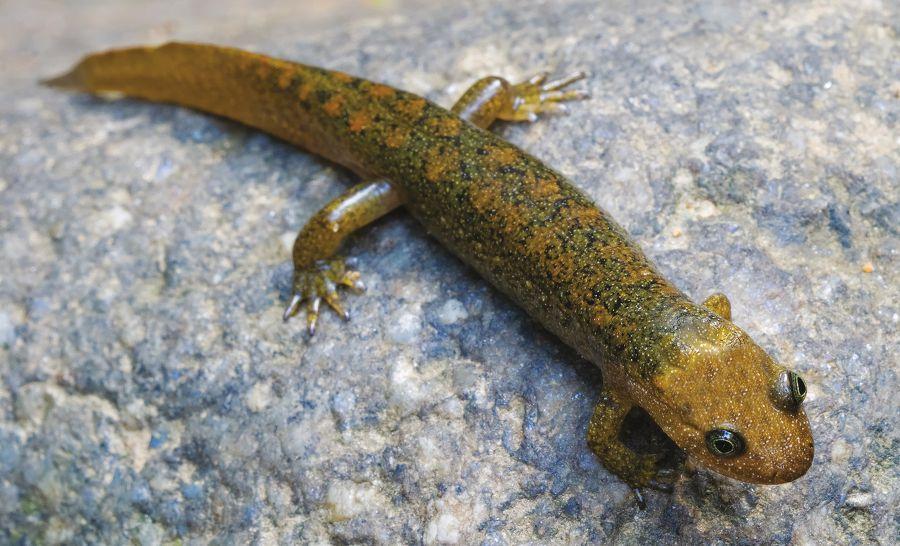
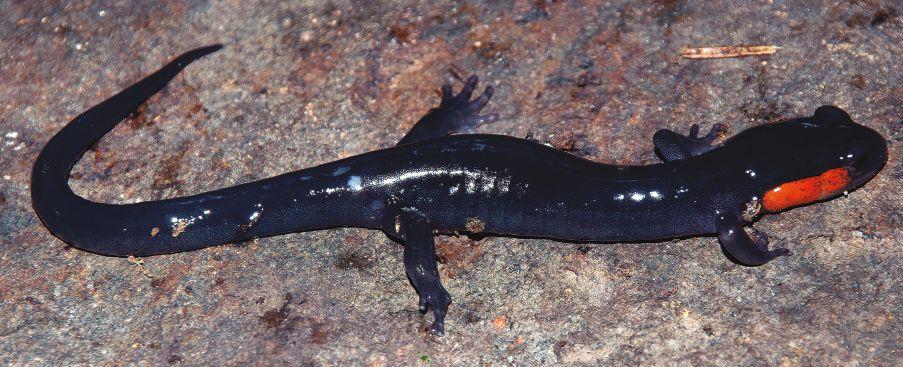
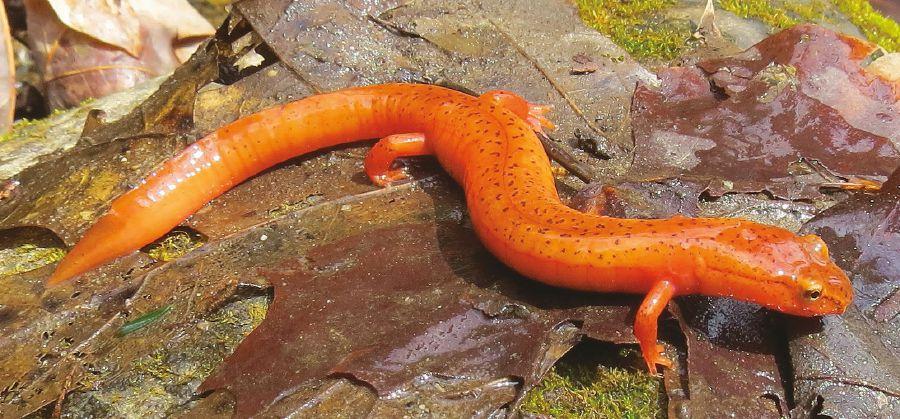
See Salamanders.
The Appalachians are the Salamander Capital of the World, with 30 species found in GSMNP.
Opposite page
Top: Spotted dusky salamander (Desmognathus conanti) Sept. 25, 2007. Roaring Fork Motor Nature Trail.
Middle: Jordan’s salamander (Plethodon jordani). Aug. 6, 2010. Cove Hardwoods Nature Trail near the Chimneys Picnic Area.
Bottom: ‘Blue Ridge’ spring salamander (Gyrinophilus porphyriticus danielsi). March 25, 2016. Near the Sugarlands Visitors Center.
If you look at nectaring Eastern Tiger Swallowtails, you will see some darker females, perhaps easier to see in GSMNP than elsewhere. Of the tiger swallowtails, only the females of Eastern Tiger Swallowtails occur as a black form, thought to mimic the appearance of the Pipevine Swallowtail. They are common in the park and are the most important pollinators for Flame Azaleas (see the article by Mary Jane Epps in the Fall/ Winter 2015 issue of American Butterfies).
displays east of the Mississippi River, Olympia Marbles, Early Hairstreaks, Falcate Orangetips, and Brown Elfns all are possible, but challenging to fnd. In April 2009, an Early Hairstreak and a Brown Elfn were found at the Elkmont Campground; Olympia Marbles at the Trillium Gap Trailhead and Twin Creeks area, all by Jeffrey Glassberg. Falcate Orangetips have been found in Cades Cove, at the point where Sparks Lane fords Abrams Creek. Brown Elfns can be found in the Elkmont area, especially along the Elkmont Nature Trail, where its caterpillar food plants, Mountain Laurel and blueberries are abundant.
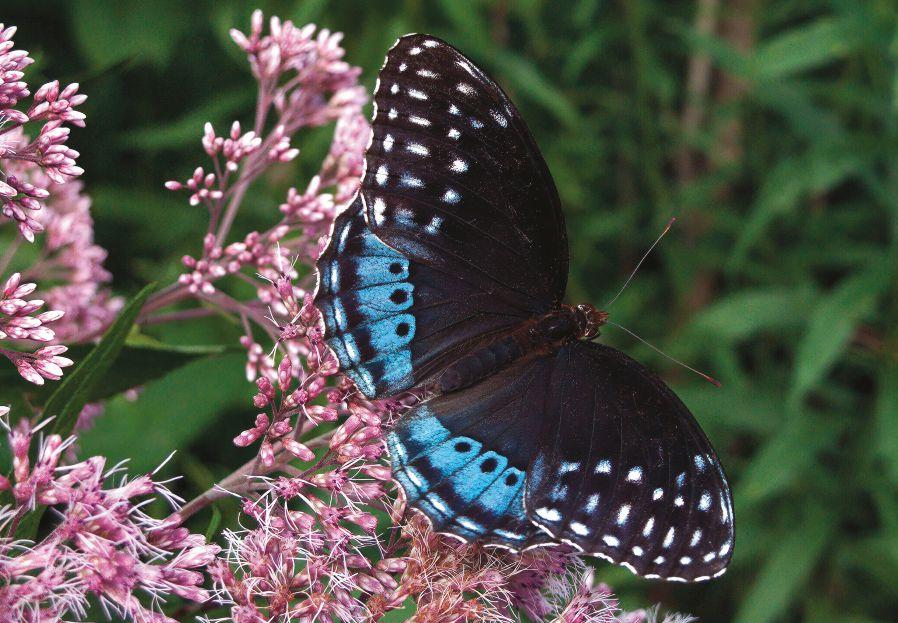
GSMNP is the only national park where Pipevine Swallowtails and fve of its mimics can be seen. Pipevine Swallowtails are common to abundant in the park from April through October, but more diffcult to fnd outside the park. Their caterpillars feed on Pipevine, which contains compounds that make the caterpillars and adults distasteful to predators, such as lizards and birds. Pipevine Swallowtail serves as the model for fve mimics found in the park: black female Eastern Tiger Swallowtail, Black Swallowtail, Spicebush Swallowtail, female Diana Fritillary and Red-spotted Purple. The mimics all are thought to be edible to predators, but may avoid being eaten because of their similarity to the distasteful model. All species of the mimicry complex can be found in Cades Cove and Cataloochee, with Diana Fritillaries most likely to be found in late summer.
Silvery Blue
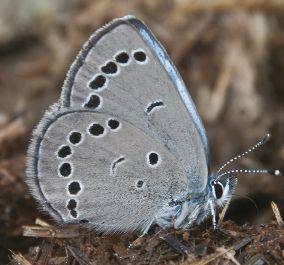
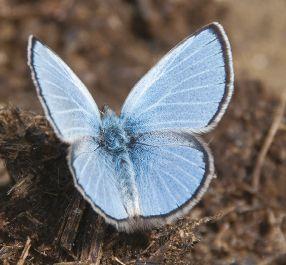
This distinctive little gossamerwing is not common in the park, but can be found puddling with Spring and ‘Summer’ Azures. If you see a “puddle party” of azures, take some time to look it over carefully and you might fnd some Silvery Blues. Piles of horse manure along woodland trails also can be attractive to this butterfy. You also can look for it near one of its caterpillar host plants, Carolina Vetch. It has been found along the Rough Fork Trail at the south end of Cataloochee Valley. If you walk the Rough
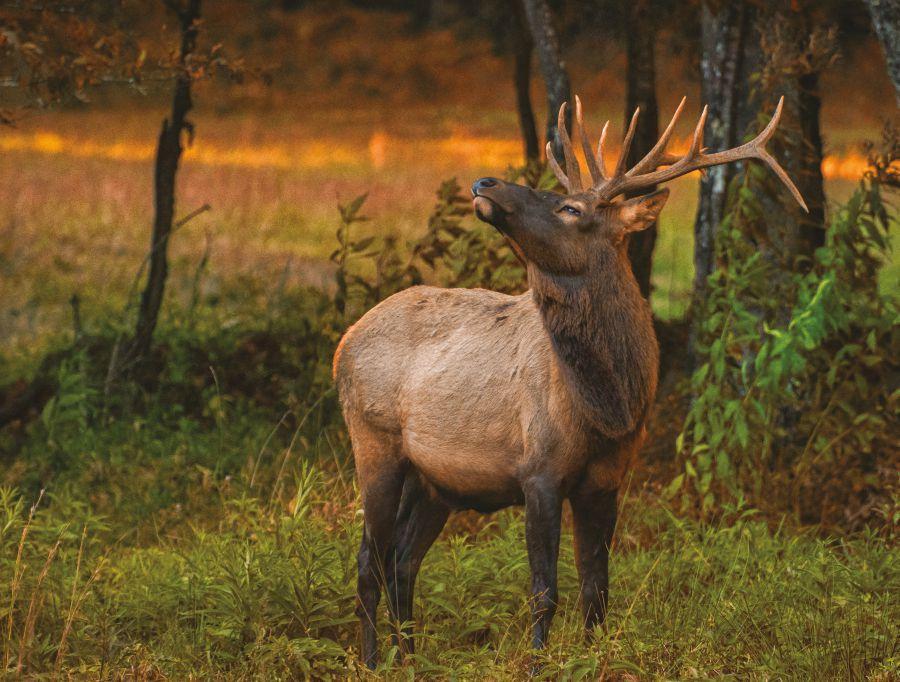
Top: One of the few and easiest places to see elk in the eastern U.S. is in GSMNP. Sept. 28, 2016. Cataloochee Valley.
Bottom: Silvery Blues can lift your spirits, pointing you toward the silver linings in your clouds. March 21, 2012. Rough Fork Trail at the south end of the Cataloochee Valley.
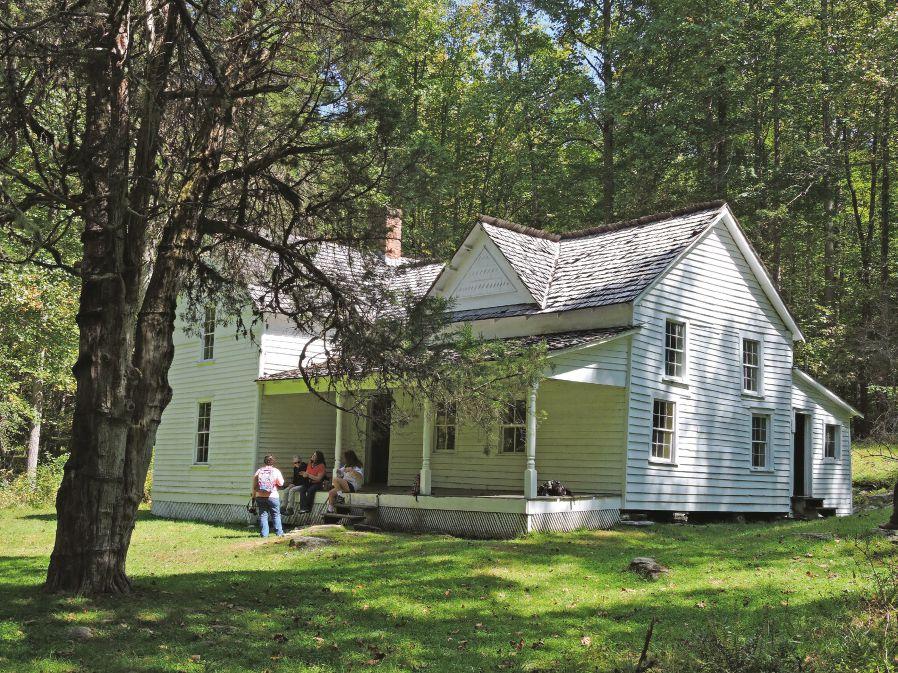
Fork Trail for about a mile, you will arrive at Woody Place, an early settler’s home site, restored and maintained by the Park Service. The house is interesting in and of itself, and there is a grassy yard and a small meadow nearby. The meadow offers a good opportunity to see butterfies typical of forest clearings, such as Eastern Tiger Swallowtail, Pipevine Swallowtail, Eastern Comma, sulphurs, fritillaries, and skippers. Late summer and early fall can be good, with many
kinds of meadow plants that attract butterfies, in bloom. There’s also a spring and a spring house. The round-trip hike, over relatively gentle terrain, is a bit less than two miles and well worth the effort. The parking lot at the trail head also is a good place to see puddling and basking butterfies, including Spicebush Swallowtails, Pipevine Swallowtails, and Common Checkered-Skippers.
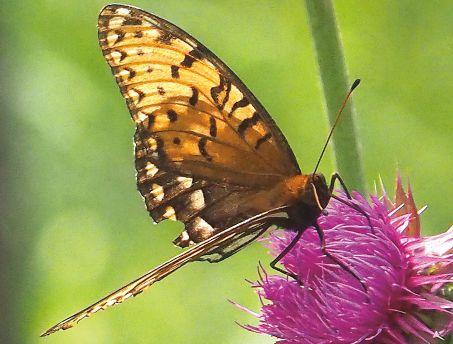
Male and female Diana Fritillaries are very different from one another and each of them is a stunning beautiful, large butterfy. GSMNP is a good place to see these sought-for butterfies with a fairly limited range. Within GSMNP, look for them in the lowlands, especially in Cades Cove and Cataloochee Valley in late summer and fall, when they are nectaring on joe pye weeds and ironweeds. Also try Forge Creek Road just east of the Visitors Center and the Cable Mill area.
Baltimore Checkerspots are rare in the park. Look for them in May and June in Cades Cove and at Cataloochee, where their caterpillar foodplant, White Turtlehead grows in moist areas and along streams. Some specifc spots include Cades Branch, where it crosses the Cades Cove Loop Road, on its south side, just west of the Dan Lawson Place; Rough Fork Creek, at the west end of Cataloochee Valley, near the parking area for the Rough Fork Trail trailhead.
Green Comma
Green Commas formerly were found in GSMNP. For unknown reasons, they may now be extirpated from GSMNP and throughout much of the southern Appalachians, according to Forest Service entomologists. They are still worth searching for, however. You can try fnding them along higher elevation trails, at the interface between northern hardwoods and spruce-fr forests. From late March through early September, the Forney Ridge Trail, from the Clingmans Dome parking area to
Andrews Bald, could be good, and in June you can see a beautiful display of Flame Azaleas on Andrews Bald. The round trip is an easy day hike, so carry water and pack a lunch. Look for the butterfy where its caterpillar food plants, gooseberries and Yellow Birch, grow. If you believe you have found a Green Comma, be sure to take pictures, send them to the NABA Recent Sightings page, and report your fnding to a park ranger at one of the visitor centers. Green Commas easily can be confused with other anglewings that are more common in GSMNP.
The species is rare in GSMNP and is not reported every year. Cataloochee Valley is a good place to search for it in April and May. It has been found in the Cataloochee Group Campground at the east end of the valley. Become familiar with its caterpillar host plant, American Hogpeanut, which is common at low to mid-elevations in the park. Along with Green Comma, this is another species that has declined and disappeared from much of its eastern range in the last 30-40 years. Though its appearance is distinctive, be sure to get a photograph if you fnd one, and post your photo to Recent Sightings and report your discovery to a Park Ranger.
A special opportunity exists in the Smokies for those interested in seeing a spell-binding natural phenomenon. Each June, synchronous frefies (in this case, Photinus carolinus) treat observers to their unique display. At dusk, male Synchronous Firefies gather and begin to fash their displays to females, which are waiting on the ground. As they gather in large numbers of individuals, the males synchronize their fashes, and the display moves in waves through groups of males. Sara Lewis describes the phenomenon, which attracts 30,000 or more visitors each June, in great detail in her delightful book, Silent Sparks and in her article, “Firefies: A Silent Choir of Cool Fire Lights the Night Sky” in the summer
2018 issue of American Butterfies. Viewing the frefies has become so popular and crowded that the Park Service provides shuttle buses to the site, near Elkmont, for a fee, to reduce automobile traffc congestion in the area. Visitors also can enlist private guides, including author Elizabeth Domingue, to show them the frefies.
There is no admission fee for GSMNP, as mandated by the federal legislation that created the park. Interstate highways provide easy access to GSMNP by way of Asheville, NC, and Knoxville, TN. Asheville and Knoxville both are served by major airports, as well. Driving distance from Asheville

to Cherokee, NC, at the eastern entrance to the park, is about 65 miles. Knoxville is a bit closer, with a driving distance of about 45 miles from Knoxville to Gatlinburg, TN, the western gateway to the park. Getting to Gatlinburg from Knoxville can be challenging and time-consuming, however, with traffc
jams common at Pigeon Forge, along the way, because of tourists accessing the Dollywood Theme Park and other attractions. Gatlinburg is a busy, bustling town, with numerous motels, hotels, restaurants, and other venues attractive to tourists. Townsend, TN, on the “quiet side of The Smokies” has fewer motels and restaurants, but has the advantage of being only about a 20-minute drive from Cades Cove. Townsend also is only about 35 miles from Knoxville.
Cherokee, NC, is less busy and also provides easy access to the Blue Ridge Parkway. Cherokee is on the Cherokee Indian Reservation, home of the Eastern Band of the Cherokee, and, with many interesting attractions and learning experiences, is well worth a visit of its own.
Within the park is a system of wellmaintained, paved, two-lane roads. There also are several unpaved, scenic, gravel roads worth exploring, such as Parson’s Branch, Rich Mountain, Heintooga Road, and the roads to Cataloochee. Both paved and unpaved roads in the park are narrow and winding, with blind curves and low shoulders. Speed limits are strictly enforced and generally 35 mph or less. Note: If you are ticketed by Park Police for speeding in the park, it is a federal infraction. Lodging in the park is limited to campgrounds and there are no gas stations or restaurants, though snacks can be purchased at Sugarlands, Oconaluftee, Cades Cove, and Clingmans Dome Visitor Centers. If you do plan to camp, either by tent or camper, we recommend you make reservations in advance, using the park web site. To avoid peak season crowds, while still having a good chance of seeing butterfies, visit the Park in May and September, when most public schools are in session. Stick to the weekdays when possible, as weekends are busy year-round. GSMNP is the most visited park in the National Park System, with nine million or more visitors each year. July is the busiest month in the park.
Abbreviations are: A, abundant, likely to see more than 20 individuals per visit to the right habitat at the right time; C, common, likely to see 4-20 individuals per visit to the right habitat at the right time; U, uncommon, likely to see 0-3 individuals per visit to the right habitat at the right time, R, rare, unlikely to see any individuals, but possible and S, stray, not seen most years. Numbers refer to months of the year, where January = l, February = 2, and so on. The abundance ratings refer to months and habitats with “ideal” conditions and are largely based upon information provided by Discover Life in America. More information is needed for all rare species. With climate change, both abundances and months of occurrence can be expected to change. Uncommon, rare, and stray species may not be seen every year.
There are 103 species listed here that have been reported from the park as of April 2019. Pipevine Swallowtail A, 4-10; Zebra Swallowtail U, 4-9; Black Swallowtail C, 4-10; Giant Swallowtail S, 7-9; Eastern Tiger Swallowtail C, 3-10; Spicebush Swallowtail C, 4-10; Checkered White R, 6-8; West Virginia White C, 3-5; Cabbage White U, 3-10; Olympia Marble R, 4; Falcate Orangetip U, 3-5; Clouded Sulphur C, 3-10; Orange Sulphur C, 3-11; Cloudless Sulphur C, 3-10; Barred Yellow S, 8-9; Little Yellow S, 5-10; Sleepy Orange U, 2-10; Dainty Sulphur U, 7-10; Harvester U, 5-9; American Copper C, 4-10; Great Purple Hairstreak R, 4-10; Banded Hairstreak U, 5-7; Striped Hairstreak R, 6-9; Brown Elfn U, 3-4; Eastern Pine Elfn R, 3-6; Juniper Hairstreak R, 5-8; White M Hairstreak R, 5-9; Gray Hairstreak U, 3-10; Red-banded Hairstreak C, 4-9; Early Hairstreak R, 4-7; Eastern Tailed-Blue C, 3-10; Spring Azure C, 3-5; Summer Azure C, 5-10; Appalachian Azure U, 4-6; Silvery Blue R, 4-6; American Snout U, 4-10; Gulf Fritillary U, 5-10; Variegated Fritillary U, 4-10; Diana Fritillary C (lower elevations), 6-10; Great Spangled Fritillary C, 5-10; Aphrodite Fritillary U, 6-9; Meadow Fritillary C, 4-10; Silvery Checkerspot U, 3-9; Pearl Crescent C, 3-11; Northern Crescent R, 5-9; Tawny Crescent R (possibly extirpated), 5-9; Baltimore Checkerspot R, 5-6; Question Mark U, 2-10; Eastern Comma C, 3-10; Green Comma R, 3-9 (possibly extirpated);
Gray Comma R, 6-8; Mourning Cloak U, 2-10; American Lady U, 4-11; Painted Lady U, 4-9; Red Admiral C, 3-9; Common Buckeye C, 4-10; Red-spotted Purple C, 4-10; Viceroy R, 5-10; Goatweed Leafng S, 4-9; Hackberry Emperor C (lower elevations), 5-7; Northern Pearly-eye U, 6-9; Appalachian Brown U, 6-9; Gemmed Satyr U, 4-8; Carolina Satyr C, 4-9; Little Wood-Satyr U, 5-7; Common Wood-Nymph U, 7-9; Monarch C, 5-10; Silver-spotted Skipper C, 3-10; Long-tailed Skipper S, 8-10; Golden Banded-Skipper R, 4-5 (possibly extirpated); Hoary Edge U, 5-9; Southern Cloudywing R, 5-8; Northern Cloudywing U, 5-8; Dreamy Duskywing R, 4-5; Sleepy Duskywing U, 4-5; Juvenal’s Duskywing C, 3-6; Horace’s Duskywing U, 6-9; Mottled Duskywing R, 4-7; Wild Indigo Duskywing R, 5-9; Common Checkered-Skipper U, 6-10; Swarthy Skipper R, 6-8; Clouded Skipper R, 6-10; Least Skipper U, 5-9; European Skipper R, 6-9; Fiery Skipper R, 6-9; Cobweb Skipper R, 4; Indian Skipper R, 5-7; Peck’s Skipper U, 5-9; Tawny-edged Skipper R, 5-9; Crossline Skipper R, 6-8; Northern BrokenDash U, 6-9; Little Glassywing R, 6-9; Sachem C, 5-10; Hobomok Skipper U, 5-6; Zabulon Skipper C, 5-9; Dun Skipper U, 5-9; Dusted Skipper R, 5-6; Pepper and Salt Skipper R, 6-9; Lace-winged Roadside-Skipper R, 5-8; Reversed RoadsideSkipper S, 5-8; Common Roadside-Skipper R, 5-7, Ocola Skipper R, 8-9; Twin-Spot Skipper S, 5-9.
Suggested Background Readings:
Linzey, D.W. 2008. A Natural History Guide to Great Smoky Mountains National Park. University of Tennessee Press, Knoxville. 292 pp. This little book is the best general guide to the natural history of GSMNP. It is intended for the non-technical reader. The author is a recipient of the Virginia Museum of Natural History’s Thomas Jefferson Medal for Outstanding Contributions to Natural Science Education. The award is presented to a Virginia educator who has made signifcant contributions to natural history or natural science education at any academic level. Dr. Linzey also has written an excellent guide to the mammals of GSMNP.
This book, and many others, can be ordered from the online store of the Great Smoky Mountains Association (https://www.smokiesinformation.org/ store).



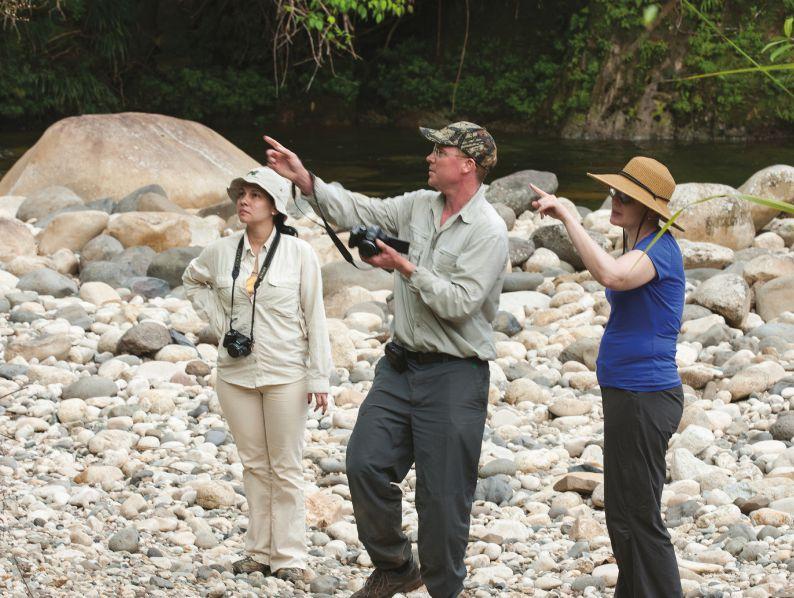
We have initiated a project to document the caterpillar foodplants of North American butterfies. For those who would like to participate in this photodocumentation, here are instructions:
Find an egg or a caterpillar (or a group of eggs or caterpillars) on a single plant in the “wild” (this includes gardens). The plant does not need to be native to the area — we want to document all plants used by North American butterfies.
Follow this particular egg or caterpillar (or group of eggs or caterpillars) through to adulthood, with the following documentation.
1. Photograph the actual individual plant on which the egg or caterpillar was found, showing any key features needed for the identifcation of the plant.
2. Photograph the egg or caterpillar.
3. Either leave the egg or caterpillar on the original plant, perhaps sleeving the plant it is on with netting, allowing the caterpillar to develop in the wild, or remove the egg or
caterpillar to your home and feed it only the same species of plant on which it was found.
4. Photograph later instars of the caterpillar.
5. Photograph the resulting chrysalis.
6. Photograph the adult after it emerges from the chrysalis.
7. If the egg or caterpillar was relocated for raising, release the adult back into the wild at the spot where you found it.
We would like to document each plant species used by each North American butterfy species, for each state or province. This documentation includes both native and nonnative plant species, inclusion in this series is not necessarily a recommendation to plant the plant in your garden..
In addition to appearing in American Butterfies, the results of this project will be posted to the NABA website. Please send any butterfy species/plant species/state or province trio that is not already posted to naba@naba.org.
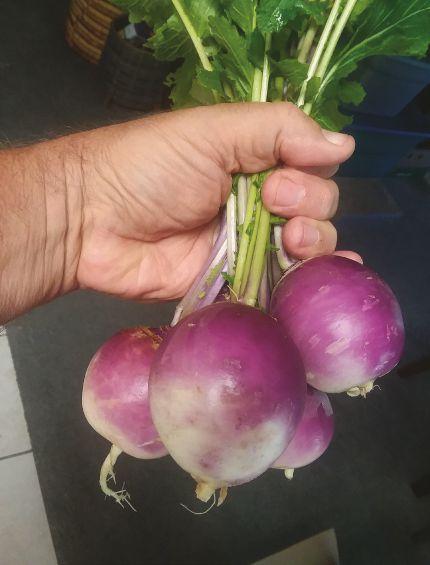
Opposite page top left: The author shows off his pre-Great Southern White turnips in his yard. Feb. 27, 2020.
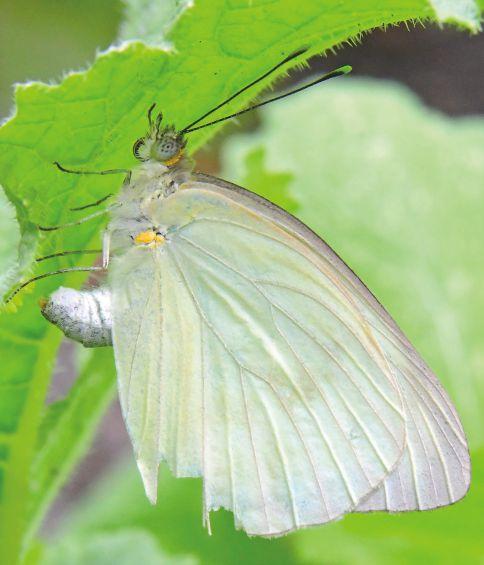
Opposite page top right: A Great Southern White laying eggs on turnips. April 15, 2020.
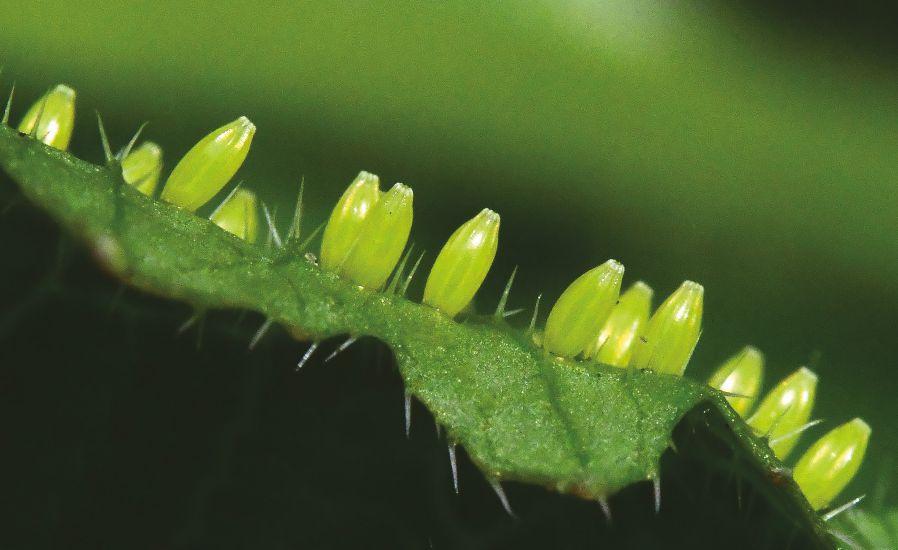
Opposite page bottom: Great Southern White eggs on turnips. April 15, 2020.
text and photos by
Ed Perry IV
Even before the pandemic, I found myself with some “free time” on my hands due to my recent retirement as a park ranger, in December of 2019. I decided to get the vegetable garden in full swing again though it’s only a 10’ x 12’ plot of over-burdened, sandy soil, in my small, Melbourne, Florida yard. We garden in the winter in Florida, so the timing was just right.
So when it came time to pick seeds for the
garden, and I chose to put in a couple rows of turnips. Turnips grow well in our poor sandy soils, and I happen to enjoy them immensely. I have a taste for some of the more bitter vegetables; ones that my friends seem to dislike. The turnips did well this season and I enjoyed several harvests of both greens and roots, so I was only a little dismayed when I noticed caterpillar damage starting on the leaves around the frst week in April.
But wait, could these be Great Southern White caterpillars? Adults had been hanging around the garden lately, but I also have their native host, Virginia Pepper Grass, growing in my lawn and purposely don’t cut or pull it so the Great Southern Whites can use it.
While reading, I discovered that at least the white form of Great Southern Whites presumably benefts from Müllerian mimicry with other white butterfies that store mustard oils in the body. I thought, maybe like most of my friends, birds don’t like the taste of turnips either!
About the time I fgured I indeed had Great Southern White caterpillars in the garden, sure enough, a female landed right in front of me and laid eggs under the “perfect” turnip leaf. This was on April 15th. I ran and got my camera. In the photos I later counted
43 eggs she put under the leaf. This gave me a great opportunity to follow from mother, to egg, to caterpillar, to chrysalis, to adultdevelopment in my own yard. Quarantine from the pandemic was in full-swing now and this gave me something to focus on each day.
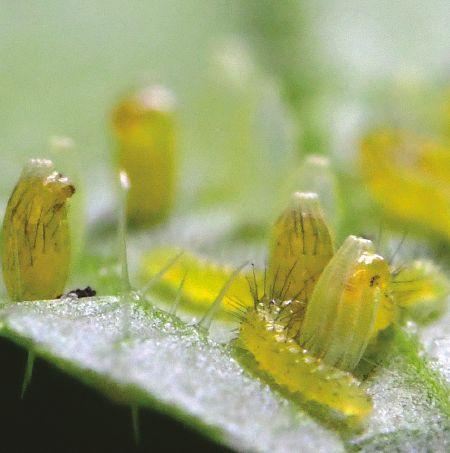
The eggs hatched exactly fve days later. Could anything be cuter than a baby caterpillar eating his way out of his eggshell? Or one only minutes old using its true legs to clutch the hair on a turnip leaf and devour it down like a popsicle!??
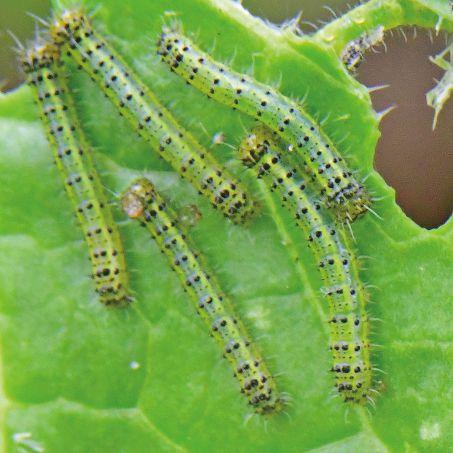
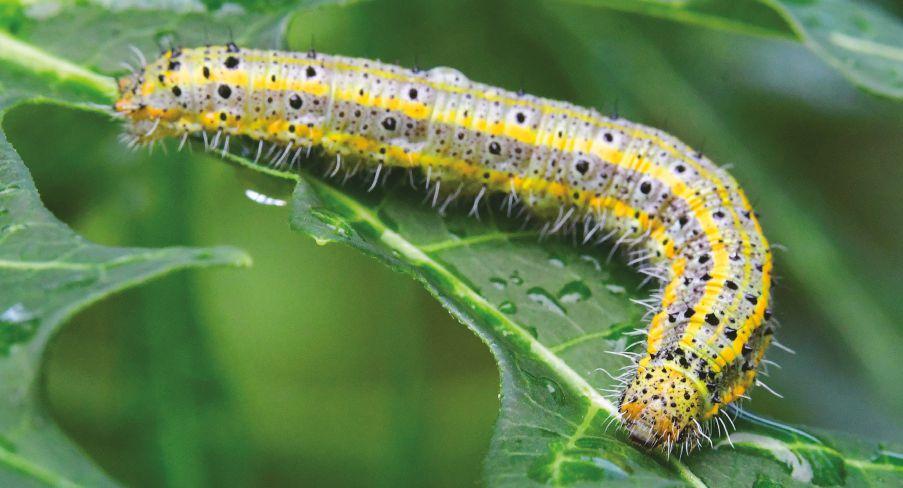
Now there were two generations/clutches of GSW caterpillars devouring my garden turnips. They ate everything down to the roots! They even transferred a bit to radishes when the turnips got sparse. It was a blast to watch and photograph all of this. I’ll gladly share my turnips with the butterfies!
Opposite page top left: A second set of caterpillars hatching. Apr. 20, 2020.
Opposite page top right: Early instar caterpillars. April 13, 2020.
Opposite page bottom: A late instar caterpillar. April 20, 2020.
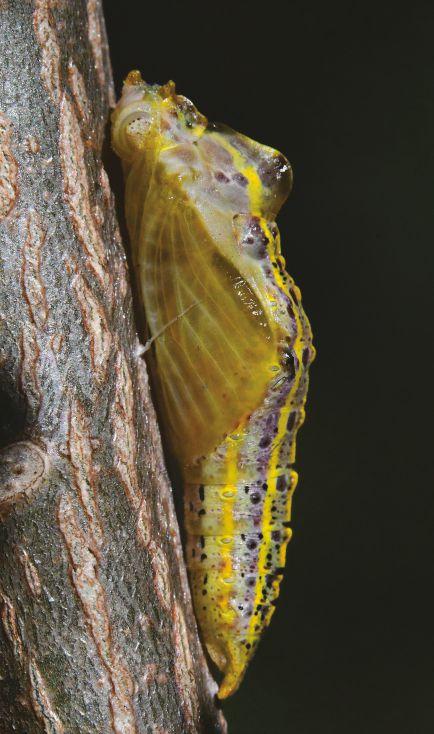
This page: A chrysalis. April 21, 2020.
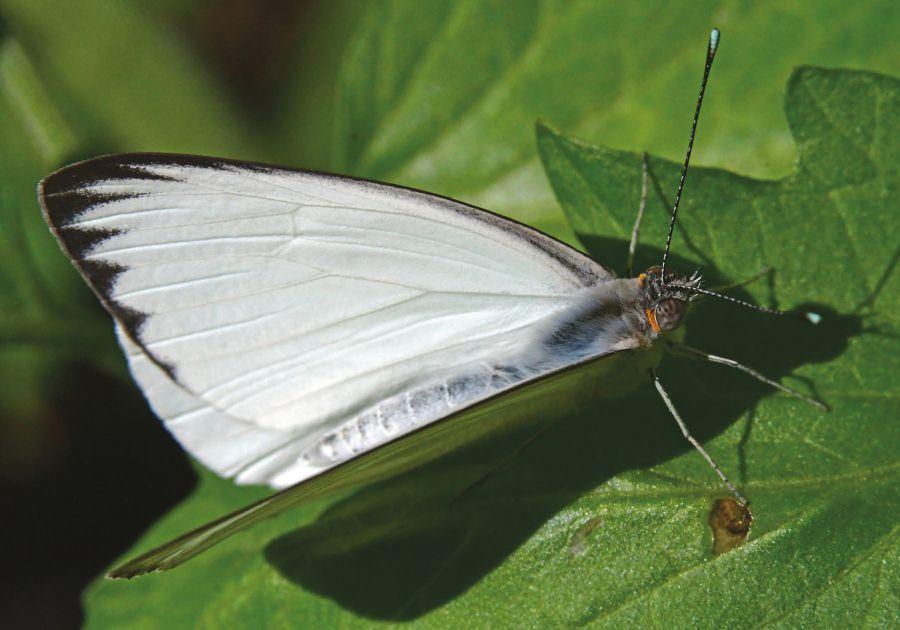
An male adult Great Southern White emerged on May 1, 2020.
Above: A drawing of the approximate range of Great Southern Whites. Orange indicates three or more broods. Cherry spots indicate that strays have occurred there. (drawing modified from A Swift Guide to Butterflies of North America).
Above: A drawing of the introduced range of turnips (Field Mustard). This plant is hardy in plant zones 2-9. This might be a useful plant for your garden if you like to dream, or to cook. When Great Southern Whites don’t show up, you can eat the plant yourself.

text and photos by
Adam Skowronski
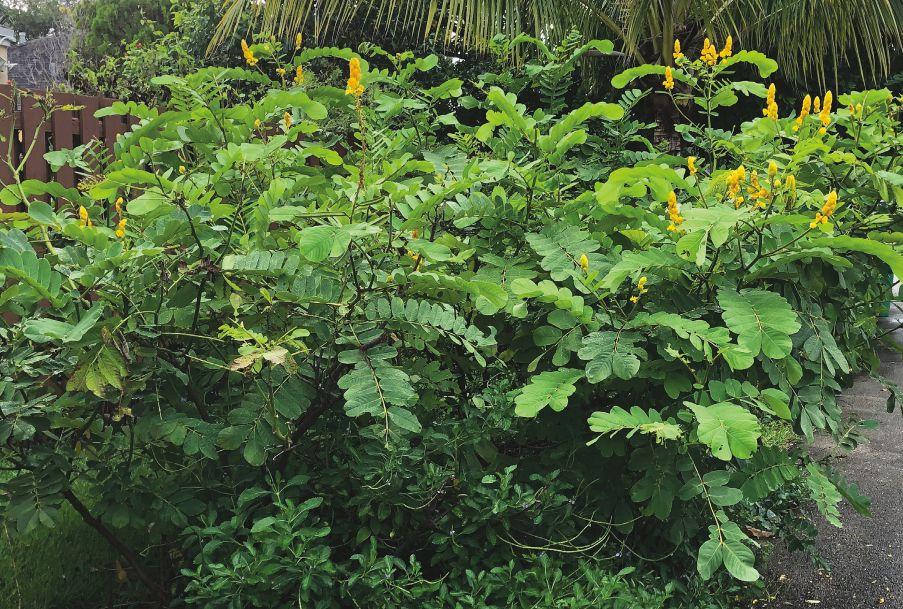
In 2008, I became enthralled with butterflies and started my first butterfly garden, ripping out all of the sculptured green landscaping plants, to make room for the new butterfly garden to be. One of the plants recommended to me was Emperor’s Candlesticks for sulphurs.
As the plants matured and butterflies arrived, I loved searching for their eggs, caterpillars and chrysalises. My Emperors Candlesticks produced many Orange-barred and Cloudless Sulphurs, but the plants only lasted a couple years and had to be replaced.
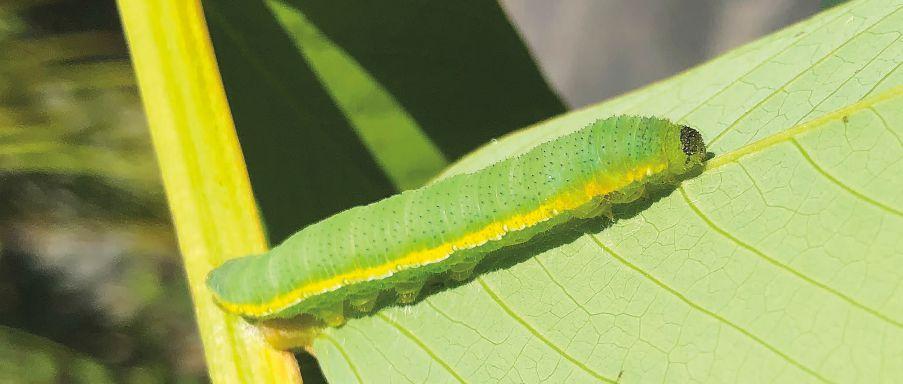
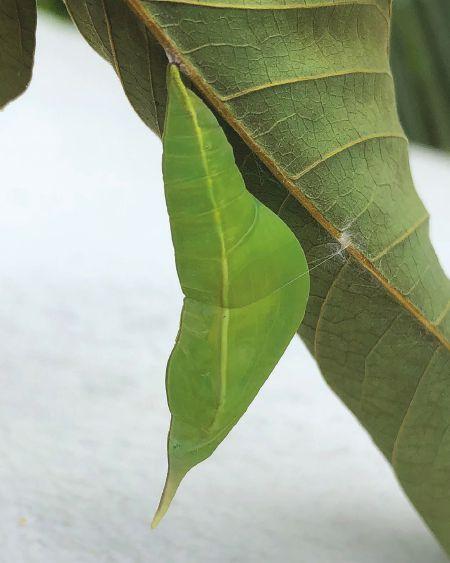
Fast forward to June 9th, 2020. In assessing the many sulphur caterpillars on the Emperors Candlesticks, I noticed some lacked the black markings of Orange-barred or Cloudless caterpillars. I put sleeves over their branches, monitoring them, and eventually ended up with chrysalises. These too were different from the others. Although they had roughly the same shape, they was not as wide at the middle being somewhat slenderer, and had a lime green to yellowish straight line down the side of the chrysalises. Now, to see
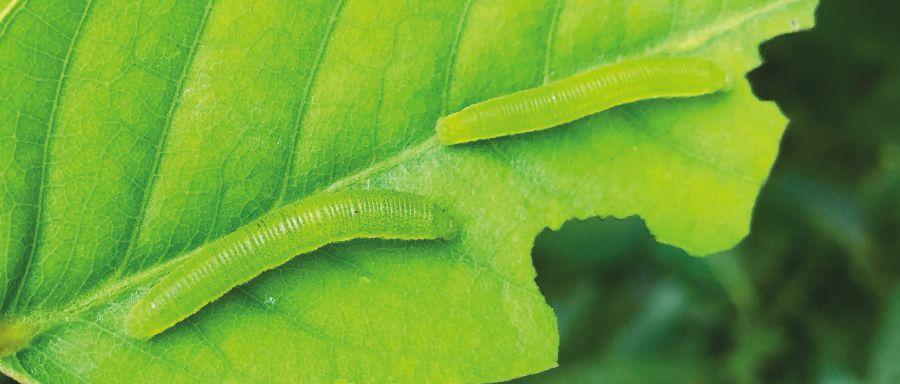
Top: Early instar Statira Sulphur caterpillars on the author’s Emperor’s Candlesticks. June 9, 2020.
Middle: A late instar caterpillar (from a later cohort). June 23, 2020.
Right: A chrysalis. June 27, 2020.
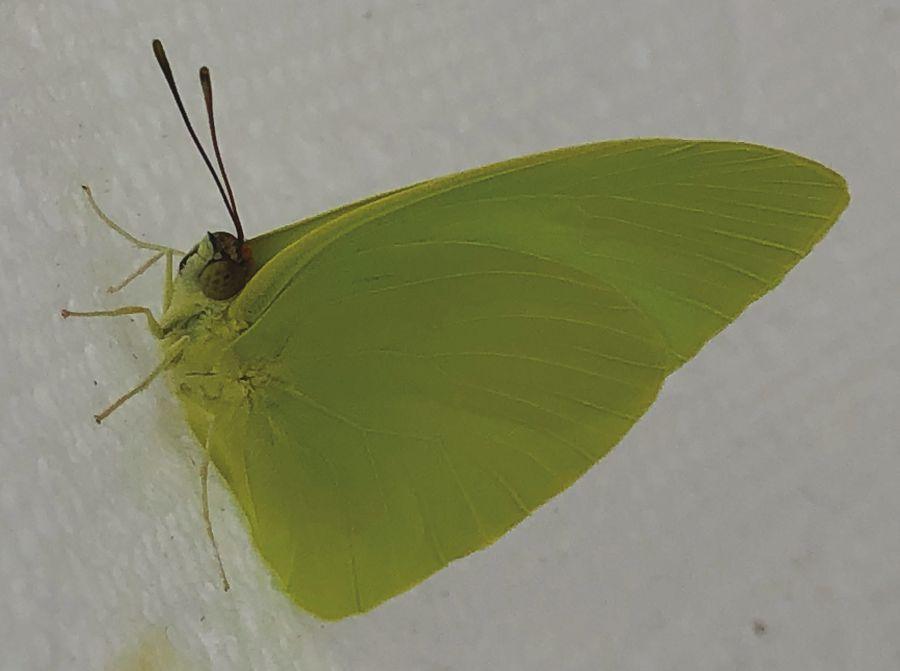
Opposite page: A male Statira Sulphur emerged (from a different chrysalis). June 18, 2020.
and verify what these might be, I clipped the stems with the chrysalises, put them into an enclosure, and waited for them to eclose.
After just four days, three Statira Sulphurs emerged. Following this confirmation, I have had a few more generations of Statira Sulphurs on the same Emperor’s Candlesticks.
Above: A drawing of the approximate range of Statira Sulphurs. Orange indicates three or more broods. Cherry spots indicate that strays have occurred there. (drawing modified from A Swift Guide to Butterflies of North America).
Above: A drawing of the range of non-native (South American) Emperor’s Candlesticks based upon county occurrence data from the Biota of North America Program. It has been reported as invasive in some areas and should be approached with caution.


Tsherin Sherpa Metamorphosis, 2020
Size: 49.5 x 83.5 in Acrylic and ink on canvas
Also available as an archival pigment print on Hahnemuhle fne art paper 20 × 34 in (50.66 x 86.36 cm) Edition of 300


une t seens inc u e a une re rt r m antr an ei B r an n i t Dollar Mountain Road near Selma, Josephine s ecies inc u in Clodius Parnassians, six r n ers, a Pacuvius us in , and a in se s i er. Chris ar s a a si tin n une a ea irt s B ue a er rare stra t astern a at a e e i i e ana ement Area Johnson Co., IA and a report from Stephens tate rest ucas A n une ac err m er rs! Other June sightings inc u e a une re rt e ese at Ba as ar rt am t n A a er ear Cloudless Sulphur n une Bart nes c unte e Bronze Coppers, a rare s ecies in ennessee an a er ear Ocola Skipper in Lower Hatchie NWR, Lauderdale n une te en nn sa species including Mustard White, Br n n, i er B ue, arris ec ers t, and Jutta Arctic at Bloomington Bog areas, Franklin an n une An Bir e a species and photographed a leucistic Northern Crescent at ar s A er A An a MN.
t er une re rts inc u e a une re rt ar err r m is ac ar in e urne Bre ar s ecies inc u in a ne ar utterf a Mangrove Skipper and a ra airstrea cater i ar on June 13 Robert A. Behrstock and Karen e a sa in ar en an n t uac uca c ise A s ecies inc u in Marine Blues Deva Skippers and two t n i ers n une Anna a t n in Ft. DeSoto Park, Pinellas Co., FL recorded a arie ate riti ar n t e sec n re rt
American Butterfies, inter
by Michael Reese
Hot Seens Can Document A Rare Stray, Unusual Abundance, Unusual Appearance or, as on the Opposite Page, Rare Beauty.
Opposite Top
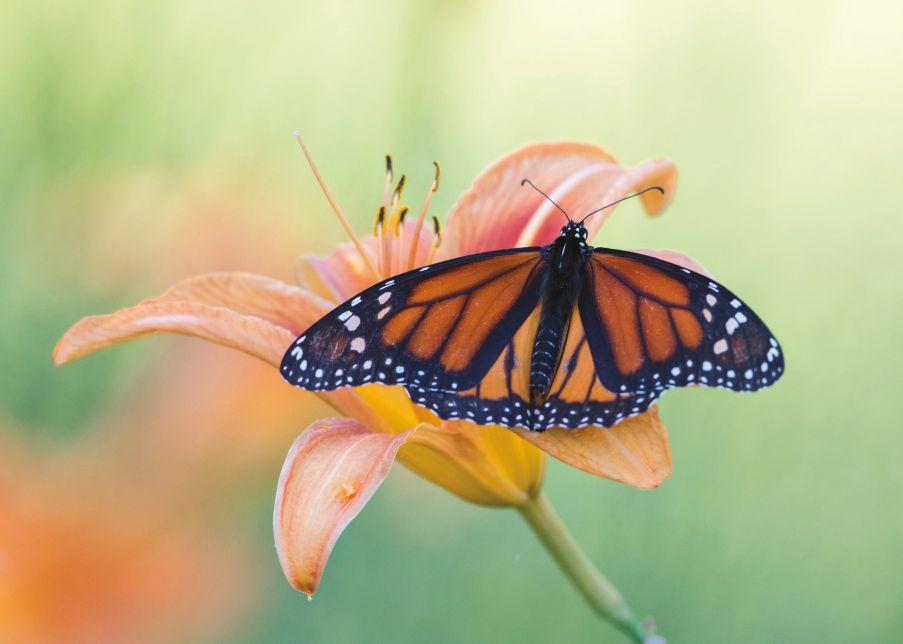
A male Monarch on a lily, u t o er the u on i er from Manhattan, photographed by Stephen Buckingham on July 14 at DeKorte Park, Bergen Co., NJ.
Opposite Bottom
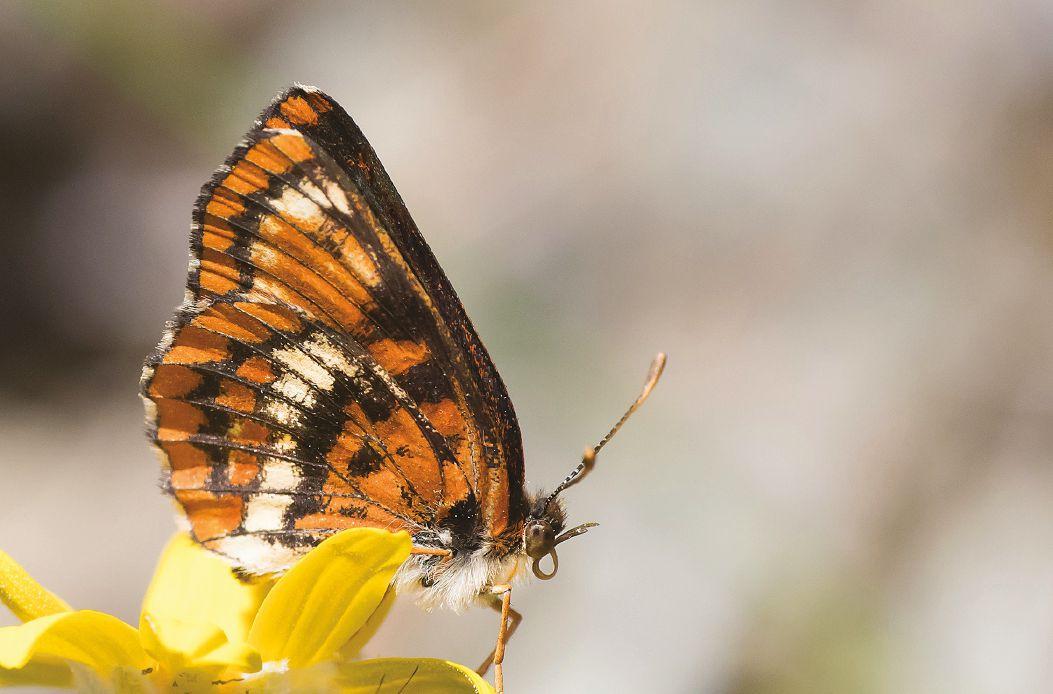
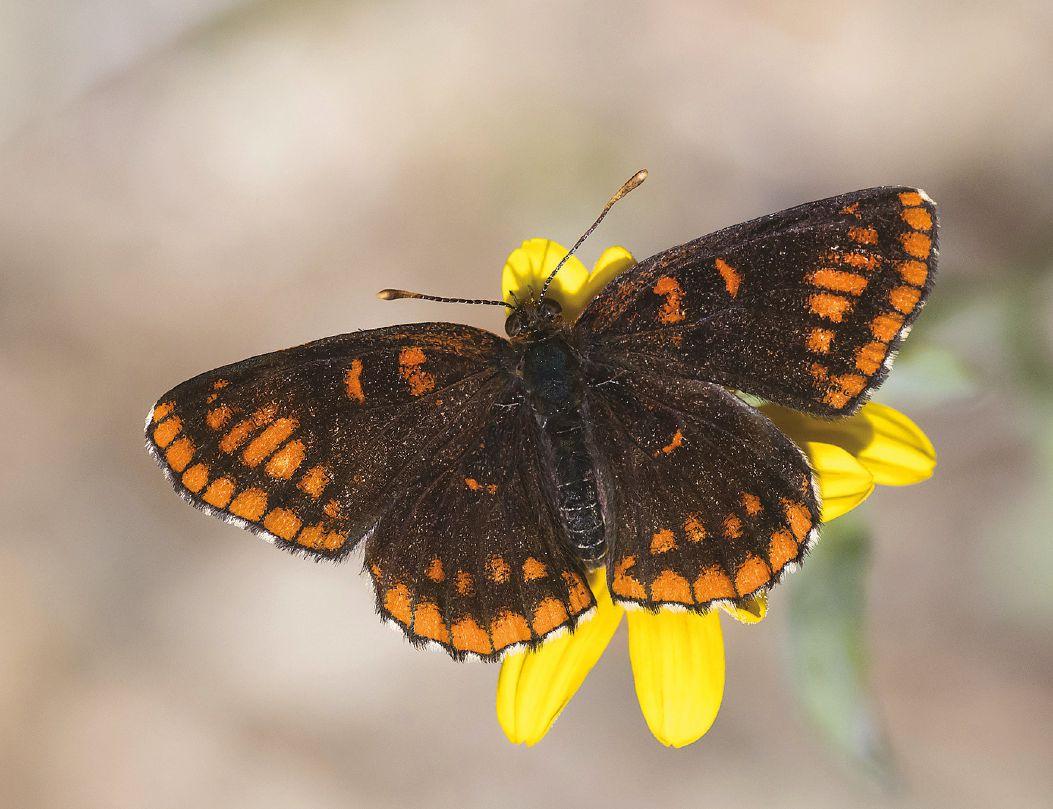
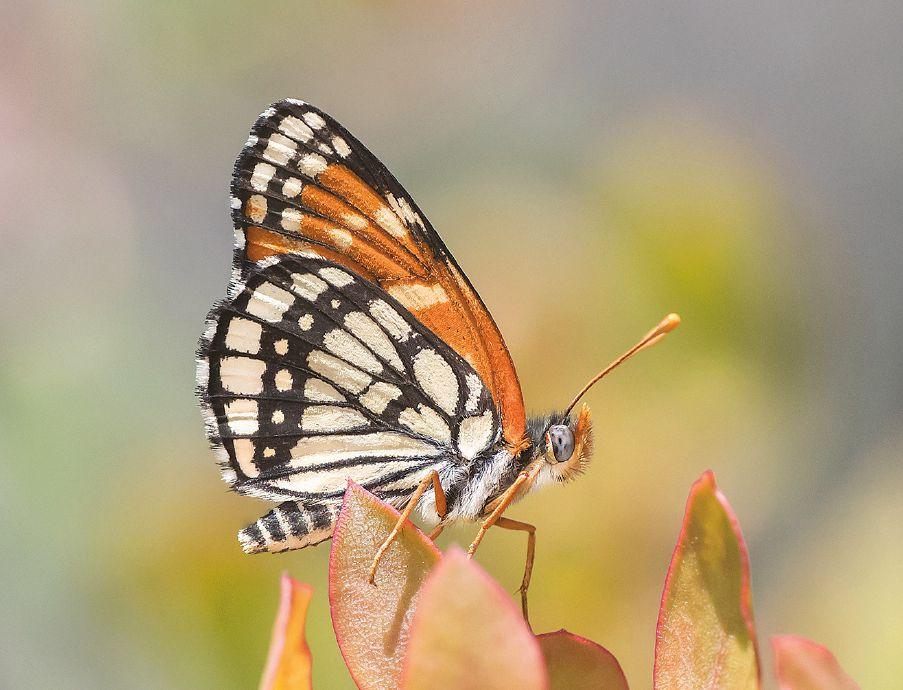
An alert Leanira’s Checkerspot, photographed by Rob Santry on June 4, 2020 at Eight Dollar Mountain Road, near Selma, Josephine Co., OR.
Top left
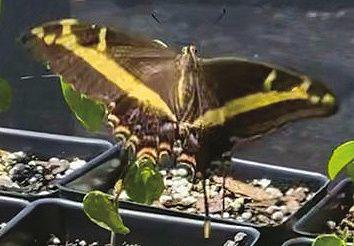
Although semi-resident on Elliott Key and straying to other Florida Keys, this photograph of a Bahamian Swallowtail by Brian Harding on June 23 at Fairchild Tropical Gardens, Miami-Dade Co., FL, is perhaps the frst documentation of this species from mainland Florida.
Second row left
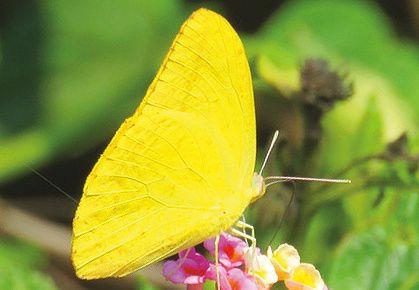
Large Orange Sulphurs are normally rare strays to southern California. This year there was an infux. This one was in San Diego on Aug. 28.
Third row left
Regal Fritillaries, iconic prairie butterfies, are usually uncommon to rare west to central Colorado. This one was seen by Venice Kelly at 8300 ft., in a meadow 2 miles west of Pine Cliffe, Gilpin Co., CO, demonstrating once again that butterfies can fy! Aug. 5, 2020.
Bottom row left
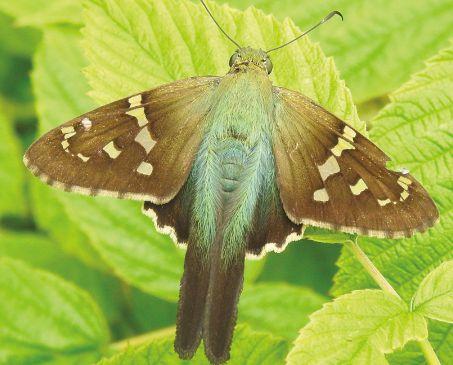
Long-tailed Skippers have become more commonly seen in the Northeast the past few years. Still, this individual, seen by Thomas Nix fve miles east of Ithaca, Tompkins Co., NY on Aug. 29, was photographed unusually far north of their usual range. 40 American Butterfies,
Top right
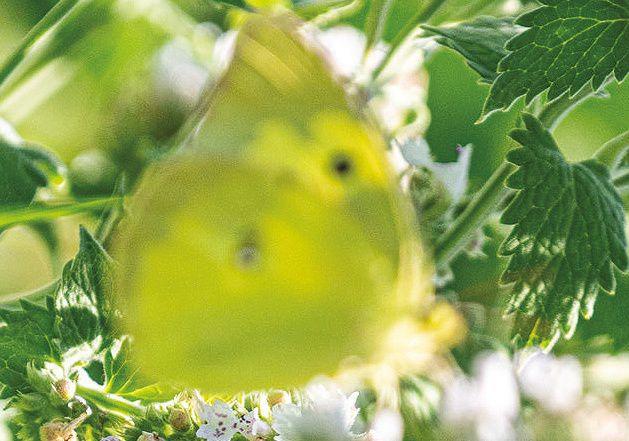
Southern Dogfaces (southerners, as their name implies) are very rare strays to Minnesota. This one was seen at Hythecker Prairie and Natural Area, Dodge Co., MN on July 23 by Andy Birkey. Apparently, traveling so far north made it a little blurry.
Second row right
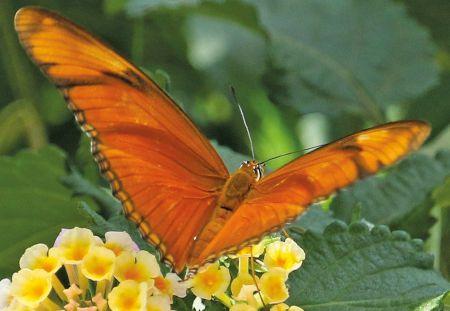
Julia Heliconians are usually restricted to southern Texas (and southern Florida). This one, photographed on July 1 by Bill Lupardus in Skyline Terrace, Midland Co., TX, is way north and west of their normal range.
Third row right
Ruddy Daggerwings are rare strays to the Tampa-Sarasota, Florida area. This one was seen by Valentina Roumi on Aug. 11 at Bay Street Park, Osprey, Sarasota Co., FL.
Bottom row right
This photograph of a male Horace’s Duskywing, taken by Renee Davis on July 18 at Wolf Brook Multiple Use Area, documents the frst report of this species from Sullivan County, NY.
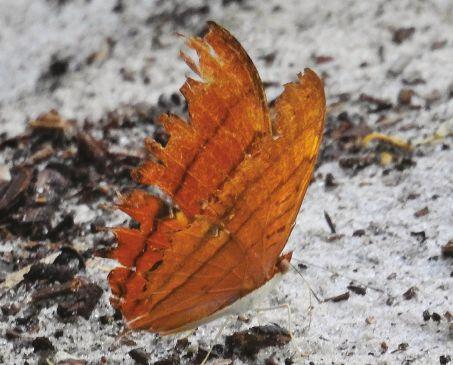
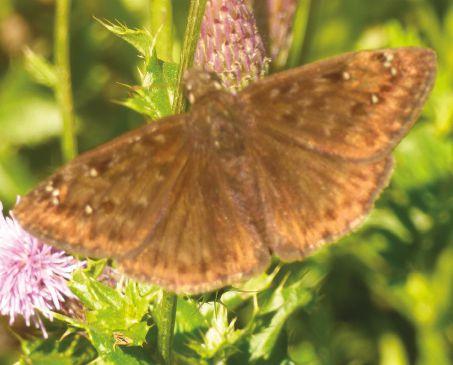
from the park; and on June 14 Linda Cooper and seven others on the NABA count in Bull Creek WMA, Triple N Ranch WMA, Forever Florida, Osceola Co., FL reported 57 species including a record high of 15 Arogos Skippers and 405 Gray Hairstreaks. On June 19 John J. Collins in Duke Farms, Hillsborough, Somerset Co., NJ sighted two very early Cloudless Sulphurs; on June 20 Shirley Devan at Little Creek Reservoir Park, James City Co., VA photographed an Edwards’ Hairstreak, a rare to uncommon species in Virginia with no recent records east of the mountains; Ken Wilson had several nice reports, a June 21 report from Mt. Laguna, San Diego Co., CA of 28 species including Queen Alexandra’s Sulphur, Gold-hunter’s Hairstreak, Mountain Mahogany Hairstreak, and Hedgerow Hairstreak and a June 26 report from Soda Springs, Nevada Co., CA of 16 species including Lustrous Copper, Edith’s Copper, and Lilac-bordered Copper; and on June 23 Brian Harding at Fairchild Tropical Botanic Garden nursery, Coral Gables, MiamiDade Co., FL photographed a Bahamian Swallowtail, perhaps the frst verifed report from mainland Florida. On June 29 Daniel Jones in his Progreso Lakes yard, Hidalgo Co., TX recorded 34 species, a high number for this time of year which included a Polydamas Swallowtail, Broad-banded Swallowtail, and a Soldier, and in Oregon on June 26 Rob Santry recorded six Small Blues, despite snow in the area, in Sand Creek, east of Crater Lake National Park, Klamath Co., OR and on June 27 he saw on a NABA Butterfy Count - Warner Mountains Fandango Pass Zone, Modoc Co., CA eight Arrowhead Blues, the most he had even seen in one day.
Interesting July sightings included a July 1 submission from Bill Lupardus in Skyline Terrace, Midland Co., TX of a Julia Heliconian, rare this far north; a July 2 report from Renee Davis in Callicoon and Fremont Township, Sullivan Co., NY of 21 species including 11 Bronze Coppers; a July 3 sighting by Scott Anderson of a Carolina
Top left
For a lot of people, seeing one Statira Sulphur would be great. On July 7, Ron and Lori Smith counted 97 Statira Sulphurs along the Gandy Causeway in Pinellas Co., FL.
Top right
The 28 Pink-spot Sulphurs seen on July 12 by Mark and Holly Salvato and Dennis Olle at Modello Wayside Park, Homestead, Miami-Dade Co., FL, may be a new high count for this species in the U.S.
Middle left
Renee Davis saw 10 Bronze Coppers at one spot in Sullivan Co., NY on July 2. If that were me, I’d embroider a belt with the news!
Middle right
Seeing 300+ Atalas would drive me into sensory overload! Steve Carbol saw that many on July 31 in Juno Beach, Palm Beach Co., FL.
Bottom left
Brant Reid found very rarely seen Mountain Fritillaries to be COMMON on Aug. 5 at high elevation southwest of Green River Lakes, Sublette Co., WY.
Middle right
On June 14, Linda Cooper et al. found 15 Arogos Skippers, a high for this count, in Osceola Co., FL .
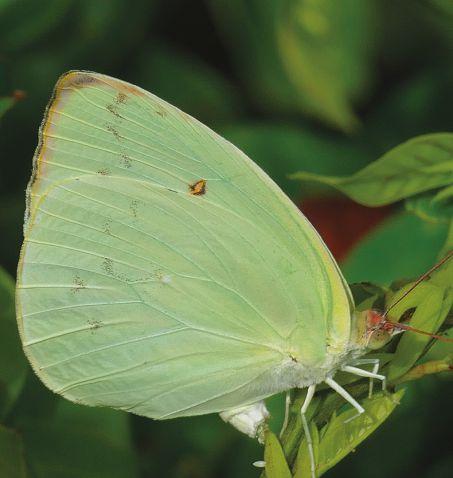
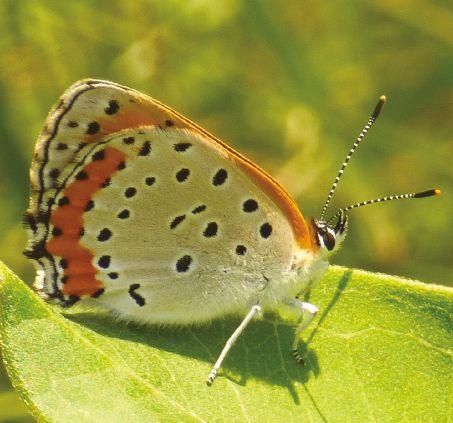
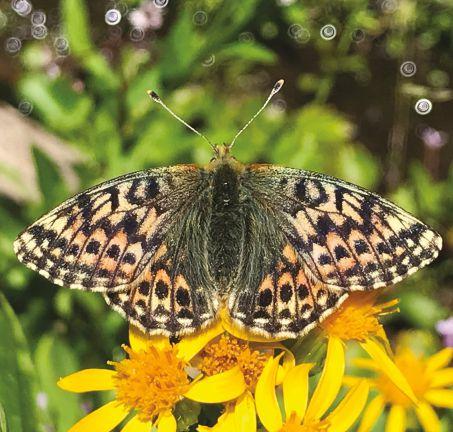
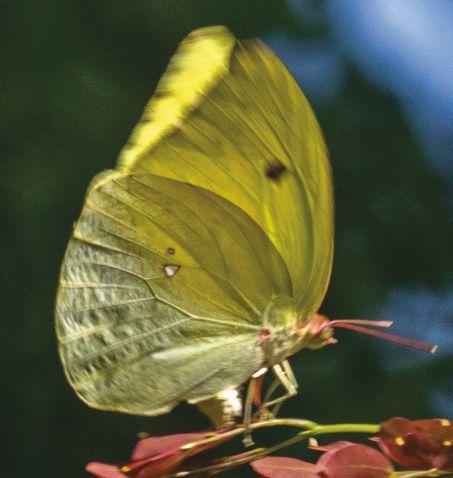
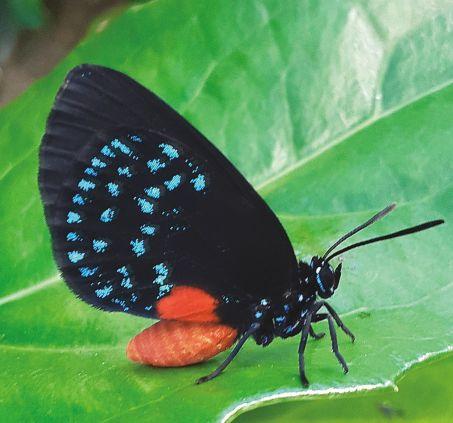
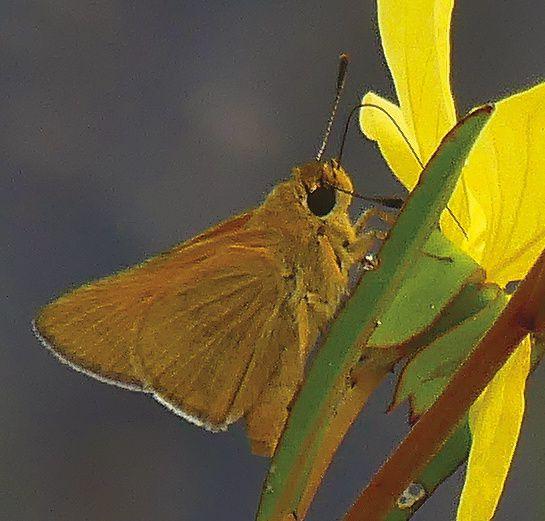
Satyr, an uncommon butterfy in Sarasota County, at Deer Prairie Preserve, FL; a July 4 report of 16 species including three Meadow Fritillaries and two Dion Skippers from Karlo and Alison Mirth in Hurd Corners, Ulster Co., NY; and a July 6 submission from John Lampkin from Fred and Idah Schultz Preserve, Hillsborough Co., FL of three new species for the site including American Snout, Tawny Emperor, and White M Hairstreak. On July 7 Ron & Lori Smith saw 97 Statira Sulphurs at Gandy Causeway, Pinellas Co., FL, on July 9 David Jeffrey Ringer photographed a Brazilian Skipper, a very rare butterfy this far north, in the Conservatory Garden in Central Park, NY; Andrew Block observed a very worn Cloudless Sulphur on July 12 in Pen Yan, Yates Co., NY; and on July 12 Mark and Holly Salvato and Dennis Ollie observed 13 species including 28 Pink-spot Sulphurs, a Ruddy Daggerwing, and a Baracoa Skipper in Modello Wayside Park, Homestead, MiamiDade Co., FL. Other July butterfy sightings included a July 16 sighting from Joanne Langabee in Lauritzen Garden, Omaha, Douglas Co., NE of the frst ever Harvester at the gardens and the frst of the year Variegated Fritillary, Fiery Skipper, and American Lady; on July 18, Renee Davis saw the frst Horace’s Duskywing in Sullivan Co., NY; on July 23 Andy Birkey photographed a lifer Southern Dogface, a very rare stray to Minnesota, at Hythecker Prairie Scientifc and Natural Area, Dodge Co., MN; on July 26 Mathew Zappa photographed a Funereal Duskywing, an even rarer stray to Minnesota, at Edina High School, Hennepin Co., MN; on July 28 Warren A. Jacobs reported a Sleepy Orange in Spring Mount, Montgomery Co., PA; and, on July 31, Steve Carbol tallied an impressive 300+ Atalas at Ocean Trace Uno Lago, Juno Beach, Palm Beach Co., FL.
August sightings included an August 5 submission from Venice Kelly 2 miles west of Pine Cliffe, Gilpin Co., CO of a Regal Fritillary in a meadow at 8,300 ft., not an expected spot for this species and a county
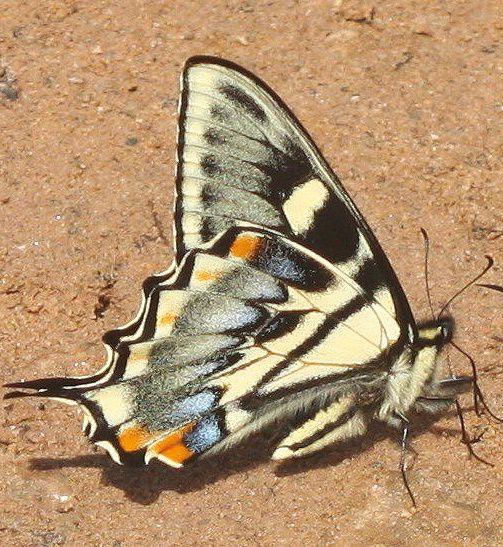
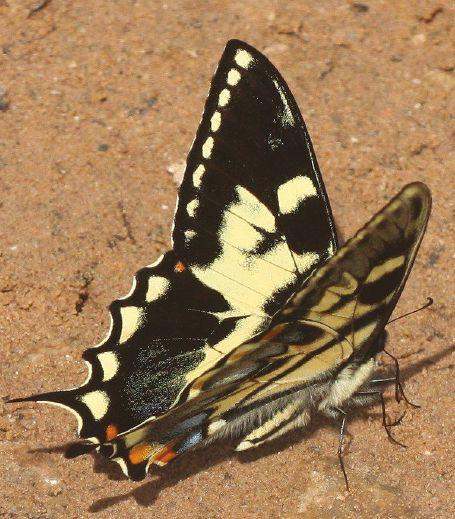
Doug Buege found and photographed this aberrant Canadian Swallowtail. Northern Wisconsin seems to be a hot spot for this type of aberration, with at least other similar individuals photographed over the past eight years. June 8, 2020. Logan Rd., Oconto Co., WI.
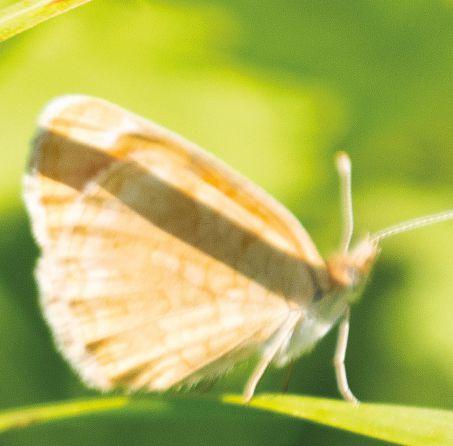
Andy Birkey photographed this aberrant Northern Crescent with normally black areas now white — cool! June 12, 2020. Carlos Avery WMA, Anoka Co., MN.
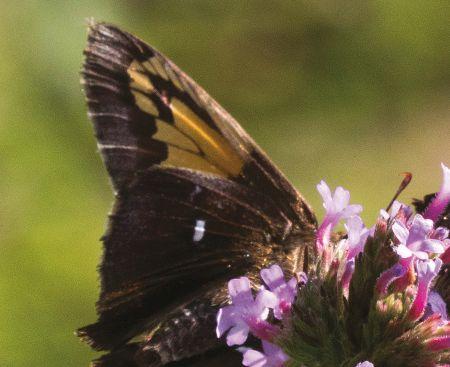
Beth Polvino photographed this aberrant Silver-spotted Skipper. The HW below is missing most of the “silver” spot while the FW has the gold median band greatly expanded with extra gold postmedian spots. Aug. 1, 2020. Cape May Co., NJ.
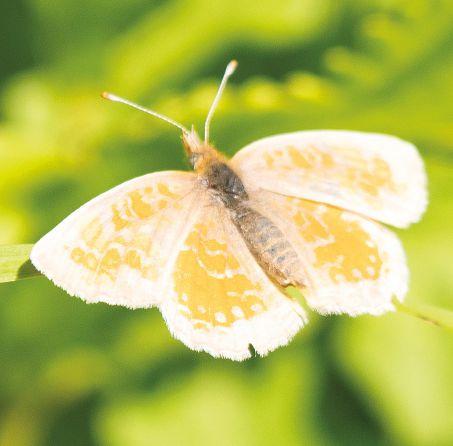
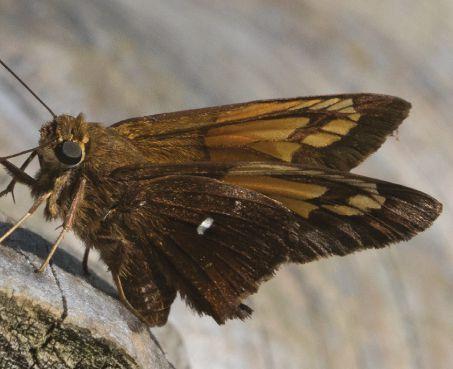
frst; an August 5 sighting of a Pipevine Swallowtail by Ahmet Baytas, his frst and only the sixth overall record from Montclair Township, Montclair, Essex Co., NJ; an August 6 report from Brant Reif from the NE side of the Green River Lakes, Bridger-Teton National Forest, Wind River Range, Fremont Co., WY 8,000-11,500 ft. of 26 species including, Queen Alexandra’s Sulphur, Mead’s Sulphur, Hayden’s Ringlet, Theano Alpine, Colorado Alpine, and Grizzled Skipper and a large population of Mountain Fritillaries; and an August 11 report by Joanne Langabee in Fontenelle Forest, Omaha, Sarpy Co., NE of her frst White M Hairstreak and only the second at the forest. Other August butterfy sightings included an August 11 report of a Ruddy Daggerwing by Valentina Roumi in Bay Street Park, Osprey, FL, a rare stray this far north; an August 16 sighting by Renee Davis of her frst Giant Swallowtail of the year on Stump Pond Rd., Sullivan Co., NY; an August 17 list from Jim Wilkinson from Patuxent Research Refuge North Tract, Anne Arundel Co., MD of 18 species including 20 Sleepy Oranges and 24 Zabulon Skippers; an August 17 sighting of a Giant Swallowtail by Glenn Koppel in Butler, Butler Co., PA; and an August 19 report from Joanne Langabee in Lauritzen Garden, Omaha, Sarpy Co., NE of a surprise Regal Fritillary and a Reakirt’s Blue
Other August sighting included an August 21 by Noel Edelson in New Rochelle, Westchester Co., NY of a Giant Swallowtail; an August 21 submission from Amanda Hawn in Bradford, Isanti Co., MN of a Giant Swallowtail caterpillar on prickly ash; an August 23 sighting of six Colorado Hairstreaks on the Mormon Trail, Morgan Co., UT reported by Jeanette Klodzen; and on August 24 David H. Bartholomew, after propagating a bush mallow with hopes of attracting a Northern White-Skipper, was rewarded when one came and visited in Sunnyvale, Santa Clara Co., CA. On August 28, Charles R. Smith reported three newly emerged male Cloudless Sulphurs, very rare
strays to Montezuma National Wildlife Refuge at the entrance to Guy Baldassarre Marsh, Wayne Co., NY; an August 29 submission from Thomas Nix of a very rare Long-tailed Skipper 5 miles east of Ithaca, Thompkins Co., NY; on August 31 Ronda G Spink saw 20 species including seven Purplish Coppers and three Leonard’s Skippers in Allegan State Game Area, Allegan Co., MI, and on August 31 Randy Harrod recorded 117 Hackberry Emperors in Radnor Lake State Park, Davidson Co., TN.
Whether you see an unusual butterfly, an early or late sighting of a common species, or have a complete list of the species you have seen, we would appreciate hearing from you. Please send your butterfly sightings to sightings@naba.org. Those who record your sightings to the Butterflies I’ve Seen website can just click on “email trip” and send it to the address given above. Your sightings will go into the larger database and will also be available for others to see on the Recent Sightings web page.
Thanks (continued from page 2)
Moran, James Monroe, Jan Nagalski, Marcus Neal, Andrew Neild, Rick Nirschl, Thomas Nix, Reid Northrup, David Oakley, Jenny Pansing, Matthew Paulson, Barbara Peck, Craig Perry, Kris Peterson, Beth Polvino, Ed Post, Mary Rasmussen, Brant Reif, Amy Rielly, Leon Robinson, Valentina Roumi, Jane Ruffn, Holly Salvato, Rob Santry, Tom Simpson, Ron & Lori Smith, Paul Strauss, Mike Troyan, Mike Turns, Todd Underwood, Yntze Van Der Hoek, Rob Van Epps, Phil Varney, Robert A. Willson, Ken Wilson and Cecil Wingfel
Contributors (continued from page 48)
eventually becoming a national offcer of the U.S.I.S.T.D., a world dance body where he through necessity became a self taught database programmer, eventually creating his own company. He later moved into developing and maintaining data-driven websites until retiring in 2018. As a boy he was always interested in nature creating collections of insects and tree leaves, but it wasn’t until 2008 that he became introduced to the world of butterfies. Quickly immersing himself, he created a butterfy habitat, attended seminars, successfully worked to create an Atala colony at his Cutler Bay FL home, and joined the Miami Blue Chapter of NABA where he now holds a position on the board.
Charles R. Smith (“Charlie”) was born and raised in northeastern Tennessee, near Roan Mountain, where he began studying birds and other natural history subjects at about ten years of age. He received his undergraduate degree from East Tennessee State University, with a double major in botany and zoology.

He earned his Ph.D. in wildlife ecology from Cornell University and was hired by Cornell in 1977. At Cornell, he was Executive Director of the Laboratory of Ornithology and taught courses in feld natural history and conservation of birds. One of his students introduced him to the study of butterfies in 1988, an interest which continues to this day with the publication in 2019 of Butterfies and Moths of The Smokies, co-authored with one of his former students, Elizabeth A. Domingue. His hobbies include cooking, tasting wines; studying odonates, butterfies, and vascular plants; public speaking, and nature photography. Charlie lives with his wife of 35 years, Claudia Melin, and their border terrier, Brodie, near Dryden, NY.
visit www.nababutterfy. com
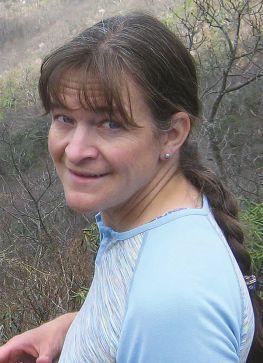
Elizabeth A. Domingue has more than thirty years of experience as a professional naturalist, nature photographer, guide, writer, and educator. She earned her Bachelor of Science degree in Wildlife Biology from Cornell University and her Master of Science degree in Wildlife Ecology and Conservation Biology from the University of Florida. As the founder and operator of Just Get Outdoors, Liz has shared her passion for the natural world with others for more than twenty years. She leads guided interpretive hikes and Naturalist Adventure Tours locally in The Smokies and throughout the United States, including Everglades and Glacier National Parks and the Adirondacks.

Ed Perry is a retired 31-year park ranger for the state of Florida. He loves the wild plants and animals of the state and is passionate about conserving what is left of natural Florida. His interest in butterfies began at an early age and has grown into a love of skippers and their identifcation. Other
hobbies include fshing, gardening, tropical aquaria, and more recently, photography. He earned a Bachelor of Arts degree from the University of Florida, and lives with his daughter Gayle and their three cats in Melbourne, on Florida’s eastern coast, in Brevard County. It’s frequently referred to as the Space Coast, due to the proximity of the launch pad at Cape Canaveral and the onceagain thriving space industry. Ed is a “space baby.” His parents and even a grandparent worked in the space program.

Mike Reese updates the NABA Recent Sightings web pages. He enjoys photographing wild fowers, birds, dragonfies, and, of course, butterfies. He is an educator in Wautoma, Wisconsin and has been recording and documenting the butterfies that are found there for over 15 years. He also maintains a website on the Butterfies of Wisconsin.
Adam Skowronski was trained in mechanical electrical drawing before the CAD systems came about, simultaneously moved into ballroom dancing teaching, competing, adjudicating and

Continued on page 47
Thank you for the wonderful articles by the three butterfiers. We need more articles like this and more ways to involve more people of all ages and ethnicity on equal footing in our butterfy world, well, lets say our world. Arabella Dane, Boston, MA
I believe it appropriate and helpful to public discourse for a far wider audience to see your American Butterfies article,“Butterfying While Being Black.” I long for it to be posted somewhere online where anyone can read it. Surely that would be a praiseworthy and signifcant NABA gift and service to the wider public! Perhaps it could be a “live link” where it appears in your online Table of Contents? How could its wider publication not garner new members for NABA? The article is, in my opinion, entirely too informing to languish in any sort of obscurity. I fnd it to be a magazine article in the vein of such awareness-raising flms as Green Book or Hidden Figures. For me personally, it is one of the most pleasing and praiseworthy of all NABA efforts.
Jeffrey Caldwell, Walnut Creek, CA Thanks for the suggestion! A pdf of the article is now available at www.naba.org.
Wishing That NABA Would Capitalize on a Great Issue.
I think the fall 2020 issue of American Butterfies is one of the best ever; a panoply of topics: scientifc; social; nomenclature/ taxonomy; artistic.
As a serious birder, one inconsistency was apparent: the formatting/style of English butterfy names. And it seems to come from guest authors, not the magazine’s staff. In Dr. Glassberg’s feld guides and NABA publications both English names “words” are capitalized. The logic for capitalization is alluded to in Harry Zirlin’s article where he writes Blue is not sad and Yellow is not cowardice, but the name of a species. On page 20 Pat Rossi starts her interesting and
informative article with “...out came the Dainty Yellow(s)…” We’ll a dainty yellow butterfy is descriptive; a Dainty Yellow is non-existent (were those Dainty Sulphur or Barred Yellow?)
John Kemner’s article has a mix. Most of his English names capitalize the frst “word”, but not the second. Many capitalize neither (is it a blurry picture of a skipperling or an actual Blurry Skipperling?) And I did fnd a couple correctly spelled as Colorado Hairstreak and Acmon Blue. Again, one terrifc issue.
AJ, parts unknown
Thanks for enjoying the issue! I’m pretty sure that very few people are fred up about the proper capitalization of butterfy English names. But, since you asked (sort of)... Clearly, not catching (so to speak) and correcting Dainty Yellow was a lapsis hahooli on the part of the editor — bad editor! All others follow our style — names are capitalized if we are following a particular organization’s names list, such as NABA’s list, or the USDA plant names available online. Most of the names in John Kemner’s article are of Mexican species whose names have not been offcially adopted by NABA. For species that have been, such as Acmon Blue, they were capitalized. First names are capitalized when they begin a sentence. Hope that helps! [Ed.].
I liked the Fall issue. Lots of pictures and pages. That’s good. Thanks. Oaxaca butterfy article was interesting, as well as the Black butterfiers article. Am I missing the id of the man on page 25?
Bob Behrstock, Hereford, AZ
Yes, we intentionally showed only his superego. [Ed].
Page 6. Caption to photo of a Oaxacan swallowtail should have read “East of La Esperanza” rather than “La Esperanza.”
Page 15. The caption for the cloud-forest skipperling photo should have read “April 28, 2012. Road to Villa Alta.”
Back cover photographs of an aberrant, probable, Hoffmann’s Checkerspot were taken on July 5, 2020 below Bigelow Lake, at Oregon Caves NM by Rob Santry. See the Hot Seens article on page 38.