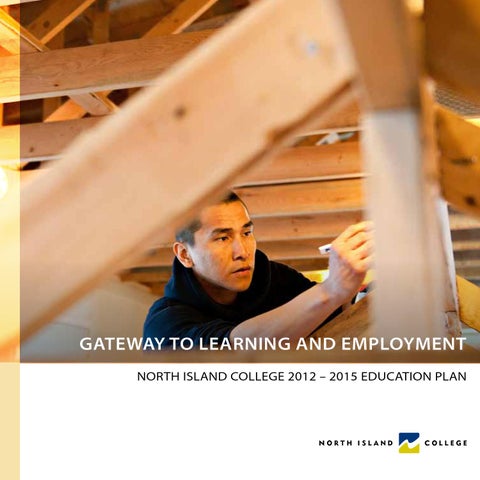
Gateway to Learning and Employment NORTH ISLAND COLLEGE 2012 – 2015 EDUCATION PLAN
“Now, more than ever, we are focused on working creatively with industry, organizations, and educational partners to meet community needs.� Dr. Jan Lindsay, President, North Island College
Table of Contents Message from the President
1
Message from the Vice President, Education
3
Vision, Mission & Values
4
Institutional Overview
6
Planning Context
8
KEY Priorities, Goals and Directions
11
Priority 1: Pathways and Transitions
12
Priority 2: Student Success and Access to Education
18
Priority 3: Expand and Diversify Program Delivery
24
Priority 4: Scholarly Activity and Applied Research
30
Multi-Year Program Plan, 2012-2015  
32
NORTH ISLAND COLLEGE 2012 – 2015 EDUCATION PLAN
Message from the President North Island College’s 2011-2015 Strategic Plan established an ambitious and future-focused agenda. Members of the college community have demonstrated exceptional commitment and resolve in moving towards our vision of becoming “a premier community and destination college that inspires and prepares students for success in a rapidly changing world.” The past few years have been characterized by a high degree of collaboration, motivation and sense of purpose. We have become a highly coordinated team, all focused on delivering results for the individuals and communities we serve. Much has been accomplished already and we have much reason to celebrate. The launch of North Island College’s Education Plan is yet another milestone, one which establishes the educational framework and priorities of our core business – providing education and training to the residents and communities of the North Island region. This Education Plan complements our Strategic Plan by refining our directions and educational priorities, moving us ever closer to making our collective vision a reality. Thank you all for your work thus far and I look forward to the journey ahead.
Dr. Jan Lindsay President North Island College
NORTH ISLAND COLLEGE 2012 – 2015 EDUCATION PLAN
1
2
NORTH ISLAND COLLEGE 2012 – 2015 EDUCATION PLAN
Message from the Vice President, Education With its roots in distance education, North Island College has grown and adapted to serve the diverse educational needs of the people and communities of the North Island region over its 37 year history. We strive to develop the knowledge and skills required to strengthen our communities and to foster leadership and growth. We work with our community partners to create opportunities for rewarding careers for our students, to fulfill dreams, and to facilitate positive change. This being said, our instructional programming and delivery methods vary between communities, in accordance with local needs and student demand. Reliance on distance delivery and in-community instruction remains integral to serving our more remote communities, while face-to-face instruction, combined with distributed learning, is the norm at our four campuses. Academic programming differs significantly between communities, with all campuses offering adult upgrading, first year university studies, and specific career, technical and trades training. Access to second year university studies, Fine Arts and degree programs is also available at the Comox Valley campus. Educational priorities and directions are greatly influenced by the current economic circumstances facing British Columbia, the communities we serve, and the college itself. Financial resources are limited and often restricted towards provincially-targeted ends. Combined with ongoing technological change and the demographic shift currently taking place, increased demands on government finances will continue, as will industry’s need for enhanced efficiency, and the evolution of our former resource-based communities to more broad-based economies. We are entering a time when there is an increasing need for post-secondary education and decreasing public resources to address those needs. While this Education Plan outlines our intentions to address the educational requirements of our diverse communities, we recognize that we will have to work differently to maximize our impact. For that reason, a cornerstone of this strategy is to work in partnership and collaboration with local First Nations, educational institutions, industry and community organizations, first to create the required educational opportunities, and second, to create the necessary pathways to further education and work. I hope you are as inspired as I am by the journey ahead and I invite you to participate fully as we continue to serve as the gateway to learning and employment for the residents and communities of the North Island.
Jan K. Carrie Vice President, Education North Island College NORTH ISLAND COLLEGE 2012 – 2015 EDUCATION PLAN
3
Vision, Mission & Values Vision North Island College holds a vision of being a premier community and destination college, in a spectacular west-coast environment, that inspires and prepares students for success in a rapidly changing world. North Island College will fulfill its vision by being: A vibrant community of learners – embracing their goals and shaping their worlds; A gateway to education, work and life; A central force in improving the cultural and socio-economic well-being of the communities we serve; and, A respectful steward of our unique natural setting.
Mission North Island College is committed to meeting the education and training needs of adults within its service region by: providing high quality, affordable higher education and skills training, collaborating with our partners to create pathways to learning, and empowering individuals to achieve their full potential.
4
NORTH ISLAND COLLEGE 2012 – 2015 EDUCATION PLAN
Values At North Island College, while our organizational roles differ, our values frame everything we do and express our commitment to our students, communities, residents of our region and ourselves. Student Success – We empower students to become self-reliant, lifelong learners capable of integrating what they learn with how they live and work. Access – We ensure access to learning opportunities, regardless of geographic, technological, financial, social, educational or historic barriers. Accountability – Our individual and organizational performance fosters public trust and community confidence. Quality – We are committed to continuous improvement and achieving the highest quality possible. Relevance and Responsiveness – We provide learning opportunities that are relevant to the lives and work of our students and delivered in a creative, flexible, timely and collaborative manner. Positive Organizational Culture – Ours is an organizational culture that operates in an open and honest manner, is based on mutual trust and respect, values creativity and responsible risk taking, encourages innovative, strategic thinking and affirms excellence. Social and Environmental Responsibility – We are actively engaged in the economic and social development of our communities and are active stewards of the unique natural environment in which we reside.
NORTH ISLAND COLLEGE 2012 – 2015 EDUCATION PLAN
5
Institutional Overview The story of North Island College is one of innovation and change, challenge, and success. For 37 years, North Island College has grown and adapted to serve the educational needs of the people and communities of the North Island region. Our vision of North Island College as a premier community and destination college that inspires and prepares students for success in a rapidly changing world is ambitious and future-focused. We want to expose not only students from our region, but also those from elsewhere in Canada and around the world to the excellence and spectacular learning environment that is North Island College. No other college in British Columbia serves a region as vast and diverse as North Island College. Our region is home to approximately 159,000 residents widely dispersed within a geographic region of 80,000 square kilometers. This includes northern Vancouver Island from Ucluelet to Cape Scott, and the BC mainland coast from Desolation Sound to Klemtu. Our unique West Coast location gives North Island College students an uncommon opportunity to choose a highly sought-after alpine to ocean lifestyle with both a high quality education and a tuition rate that is among the lowest in the province. To meet the diverse needs of our communities, we offer over 70 credit programs and more than 900 courses in the following areas: access for students with disabilities, adult basic education (upgrading), business, health care, fine arts, interactive media, community care, human services, tourism and hospitality, international education, and Industry Training Authority-approved trades, technology, and apprenticeship training. Further, our university studies courses offer nationwide transfer options as well as dual admission opportunities with top BC universities. By actively expanding our post-secondary network, we are working to pioneer seamless pathways for North Island students so that they may reside longer in our communities – be it for family, friends, or work – while still reaching their educational goals.
6
NORTH ISLAND COLLEGE 2012 – 2015 EDUCATION PLAN
In addition, hundreds of non-credit courses and programs are offered each year through our Continuing Education and Training department, which includes not only personal and professional development, but also first aid, industry, and marine training that is so vital to our coastal communities. These include face-to-face, distance, and online options, as well as custom training services and in-community course delivery for groups in remote areas, particularly First Nations communities. North Island College has campuses located in Campbell River, the Comox Valley, Mount Waddington (Port Hardy), and Port Alberni, each with its unique facilities and programming to serve local demand. In 2011/12, the college employed approximately 470 full-time, part-time, or seasonal regular employees and served approximately 9700 students (2,504 full-time equivalent students), including 116 international students (76 FTEs) and 1,286 students of self-declared Aboriginal ancestry. Our commitment to student success also includes a full range of services, from international student support and study abroad opportunities, to financial aid, student advising (including Aboriginal student advising), counseling, and disability services. Further, our dedicated student Employment Resource Centre supports our nationally accredited Co-operative Education programs and, through the generosity of our donors, the North Island College Foundation provides scholarships and bursaries to students each year. In 2011/12, 320 students were awarded over $215,000 to help fund their education.
NORTH ISLAND COLLEGE 2012 – 2015 EDUCATION PLAN
7
Planning Context North Island College’s 2011-2015 Strategic Plan, entitled Participation, Partnership and Pathways, embodies the dreams and aspirations we have set for ourselves. The culmination of an extensive and inclusive process involving employees, students and community partners, the Strategic Plan focuses on six key directions for the college: Responsive Curriculum, Student Success, Active Community Partner, Strategic Partnerships, Raising Awareness, and Employee Engagement. These provide the direction and foundation for this Education Plan. The Education Plan’s purpose is to set out an educational framework that, while aligned with the Strategic Plan, establishes North Island College’s education priorities for the next three years. Over this time, North Island College will create a new structure consisting of Schools and Departments that will allow for greater synergies between programs and department areas and provide greater opportunities for interdisciplinary activities and collaborative pathways. In addition, greater emphasis will be placed on working in-community, in conjunction with community and First Nations partners. This new regional model of education will see programming and instruction delivered at our partners’ locations, based entirely on the specific community’s needs, similar to what is already occurring in Ahousaht, Alert Bay, and Ittatsoo. As opposed to requiring students to come to a North Island College campus, we will go to them. Such a model requires greater flexibility, collaboration and strong relationships, but offers great potential for ensuring enhanced access to public post-secondary education. Emphasis will also be placed on greater involvement with applied research that has a connection to both educational programing and industry and/or community needs. Partnerships will be integral to moving the research and scholarly activity agenda forward. As you read through this Plan, you will discover key priorities and directions that will shape our core business, determine the programs we offer, influence how programs are delivered, and identify with whom we will strengthen or develop partnerships.
8
NORTH ISLAND COLLEGE 2012 – 2015 EDUCATION PLAN
KEY Priorities, Goals And Directions
Priority 1: Pathways and Transitions In today’s rapidly changing world, students need the latest skills and knowledge to excel in their chosen field. By expanding educational pathways in study areas ranging from upgrading and trades to university studies, health and human services and business, North Island College students will be well-positioned for success. Goal #1: Improve and Expand Student Transitions Transitions from High School to College Improve Transitions for high school students and strengthen relationships with school districts Increase and diversify dual credit and advanced placement options and include a wider range of school districts • Expand overall course offerings by 2% • Offer secondary level science based courses with School District 85 (Vancouver Island North) • Offer Early Childhood Care and Education (ECCE) transition option with School District 85 (Vancouver Island North) and School District 72 (Campbell River) Build on the Open House Experience • Expand high school student attendance by 7% • Work to involve all high schools within the region • Track Open House attendance against NIC application conversions Create opportunities for Department Chairs and secondary teachers to meet and discuss discipline specific curriculum and transition opportunities • One meeting per year in each of the school districts
12
NORTH ISLAND COLLEGE 2012 – 2015 EDUCATION PLAN
Through the work of the NIC Director of Aboriginal Education and Aboriginal Advisors, create opportunities for Aboriginal students to transition seamlessly from K-12 to post-secondary education Work in partnership with the schools and parents to provide career and educational planning tools and resources to help students make informed choices • Registration increase of 6% by 2014 In collaboration with North Island College International (NICI), create opportunities for international students to transition seamlessly from K-12 to post-secondary education Consider international student needs in the creation of dual and advanced credit Consider international student needs in planning the Open House experiences Work with NICI and international coordinators at the high schools to identify specific pathway processes as seen from the high school perspective • Minimum five (5) students per year
NORTH ISLAND COLLEGE 2012 – 2015 EDUCATION PLAN
13
Priority 1: Pathways and Transitions (continued)
Goal #2: Increase Number of and Strengthen Dual Admissions Opportunities Transition from College to Other Post-Secondary Institutions Strengthen Island Consortium partnership to create new collaborations for degree and diploma programming and greater opportunities for learners • Minimum two (2) new program partnerships - Vancouver Island University (VIU) Liberal Studies - Allied Health Identify and create new pathways for students wishing to pursue education outside of the Vancouver Island area, including University of British Columbia, Simon Fraser University, University of Northern British Columbia, and other Canadian or international universities outside of BC • Minimum two (2) new dual admission agreements over three years
14
NORTH ISLAND COLLEGE 2012 – 2015 EDUCATION PLAN
Goal #3: Increase and Strengthen Pathways of Study Increase options for learners through the creation of new education agreements leading to bridging programs, laddering options and block transfers • Minimum two (2) new options per year for the duration of the plan Expand “Access Pathway” programs connected to particular areas of study and, when appropriate, tailor pathways to meet local needs • New ECCE Access program by September 2013 • New Education Assistant/Human Services Worker (EA/HSW) programs by September 2013 • New Trades Access programs • New Licensed Practical Nursing (LPN) to Bachelor of Science of Nursing (BSN) Access program by September 2013 • English as a Second Language/Adult Basic Education (ESL/ABE) Participate in the development of transfer plans, such as flexible pre-majors, through articulation committees and ensure these are communicated to prospective students
Priority 1: Pathways and Transitions (continued)
Strengthen partnerships with First Nations communities to reflect regional priorities • Minimum three (3) regional meetings per year in each regional advisory area • Minimum two (2) meetings per year with North Island College’s Aboriginal Advisory Committee
Cooperate with International Education in the development of existing agreements with international institutions for study abroad/field school opportunities for NIC students • Review present NIC International partner schools and work with International Education to determine how to activate particular agreements for interested program areas • Once reviewed, determine activity targets for each partner Create new pathways and options for 19 Wing CFB Comox • Minimum three new pathways/advance credits for Prior Learning Assessment (PLA) options
16
NORTH ISLAND COLLEGE 2012 – 2015 EDUCATION PLAN
Priority 2: Student Success and Access to Education As many of our Island economies are shifting from traditional resource-based economies to knowledge-based or mixed economies, so are the education needs throughout the region. To strengthen our communities in changing times, we are working closely with local industry, agencies and First Nations communities to create training opportunities that will help residents support themselves and their families through local jobs. Goal #1: Support Student Retention Improve advising and selections processes and work on increasing support and resources to meet student need. Areas of focus will include: • Peer tutoring • Tutorials • Writing support • Outreach Services – to define and promote • Remote office hours – to increase access using technology • Entrance assessments relevant to trades training - develop two (2)
Create preparation modules to ensure learners possess skills and capabilities to experience success in courses and programs, along with understanding program expectations Develop math prep modules to support trades students transitioning into or within a trades program in Fall 2012 Building on models in BSN, ECCE and PN, develop Requisite Skills and Abilities documents in other career programs to assist students in making informed decisions
18
NORTH ISLAND COLLEGE 2012 – 2015 EDUCATION PLAN
In collaboration with NICI, identify emergent issues related to international student success Where possible, consider international students within the context of learning supports being provided for all students Define and consider additional or different learning supports or processes required to meet the needs of students coming from different educational norms Identify and plan appropriate professional development to support instructors teaching students from different educational norms
NORTH ISLAND COLLEGE 2012 – 2015 EDUCATION PLAN
19
Priority 2: Student Success and Access to Education (continued)
Goal #2: Improve Access and Success for Aboriginal Learners Create a policy or framework to support the indigenization of the college Increase Aboriginal student numbers participating in and completing post-secondary education at NIC • Increase graduate numbers by 5% Establish designated seats for First Nations students in Health and Human Services programs • Three (3) designated seats in BSN program for September 2013 • Two (2) designated seats in ECCE, HSW, PN, HCA (Health Care Assistant) for September 2013
20
NORTH ISLAND COLLEGE 2012 – 2015 EDUCATION PLAN
In consultation with First Nations and with the support of NIC Elders in Residence, explore Aboriginal paradigms and ways of knowing and integrate into NIC curriculum • Identify which courses have First Nations content included • Encourage more indigenous knowledge in courses • Minimum of two new program curriculums adapted • Explore Aboriginal ECCE option
Link Elders and Advisors with a broader range of programs • Minimum of four programs receiving Elder and Advisor support
Investigate use of technology to enhance relationships in First Nations communities • Explore technology options with specific communities
NORTH ISLAND COLLEGE 2012 – 2015 EDUCATION PLAN
21
Priority 2: Student Success and Access to Education (continued)
Goal #3: Increase and Strengthen Partnerships and Collaboration Increase number of Memorandum of Understandings (MOUs) and Education Agreements with First Nations communities to support programming needs • Two (2) agreements per year
Increase number of active education agreements with international partner institutions • Identify departmental interest in up to two (2) exchange and partnership locations • Work with International Education to identify existing or new partners in those locations
and establish up to two (2) international MOUs to support that interest
22
NORTH ISLAND COLLEGE 2012 – 2015 EDUCATION PLAN
Priority 3: Expand and Diversify Program Delivery No other college in British Columbia serves a region as vast and diverse as North Island College. And for many remote areas, the time and cost of travel present genuine barriers to education. That’s why we are committed to finding new ways to deliver education and training on site or using innovative technology that is tailored to the unique needs of each community, making education accessible where it would otherwise not exist. Goal #1: Utilize Distributed Learning as a Means to Enhance Learning and Improve Access, in partnership with the Education Technology Department Increase Technology Enabled Learning and Delivery (on-line/blended/hybrid, alternative technologies, Lync, simulations) • Pilot three (3) programs utilizing a combination of technology • Deliver ECCE Diploma program across the NIC region • Develop and offer PN Access program across the region • Develop one (1) pilot program in trades training • Develop courses supported by Remote Web-based Science Lab (RWSL)
Expand capacity and improve quality of Interactive Television (ITV) • Upgrade ITV instructional facilities • Provide high definition video quality at all campuses • Increase flexibility to offer more course options across campuses to a larger number of students • Move to multipoint delivery model
24
NORTH ISLAND COLLEGE 2012 – 2015 EDUCATION PLAN
Identify and secure appropriate support to increase Technology Enabled Learning and Delivery objectives Utilize ITV to improve utilization rates and enrollment • Increase number of courses offered through ITV by 10 % Support and prepare instructors in the best use of a broad scope of technology that supports their work in providing options and flexibility for students • In partnership with the Distributed Learning Operations team, create professional development opportunities that enable faculty to adapt to changing technologies while creating innovative approaches to teaching and learning • Provide a minimum of two (2) workshops or courses per year with a minimum of two technologies Celebrate College champions, mentors and early adopters • Minimum of four (4) faculty displays per year at the year-end celebration
NORTH ISLAND COLLEGE 2012 – 2015 EDUCATION PLAN
25
Priority 3: Expand and Diversify Program Delivery (continued)
Goal #2: Create a New Education Model to Better Serve our Region Increase delivery of off-site community-based programming through the development of a new regional service delivery model • Increase total enrollment of students in remote communities by 10% Increase the use of technology to support delivery of community based programs as part of a new regional service delivery model • Implementation in 2012 • Explore mobile options and alternative meeting technologies - Lync meetings with advisors - Faculty support for students in Distributed Learning (DL) models of instruction Create reciprocal partnerships with First Nations, industry and/or community agencies through the development of MOUs and education/articulation agreements • Two (2) agreements per year Find avenues to link international learning opportunities with Aboriginal communities Provide greater flexibility and access to programming across the region (technology based and prior learning assessment)
26
NORTH ISLAND COLLEGE 2012 – 2015 EDUCATION PLAN
Work with the college community to create systems and structures that cater to a new regional service model including off campus education, quick response programming and programming that is self-funded or has a combination of funding sources • Set cross planning meetings • Define and formalize a viable model that articulates roles and the range of programming
Rotate select programming to meet community needs • Provide programs fully on-line
- minimum of two (2) career programs • PN Access delivered across the region and Labs rotating through the region • Work with community partners to secure space • Develop an internal program review model to support annual planning to foster
rotational schedules Support regional communities in identifying and securing funding to support the delivery of community based programs • Deliver contract programming to a minimum of five (5) communities per year (e.g. ECCE in Alert
Bay or Education Assistant (EA) in Ahousaht)
NORTH ISLAND COLLEGE 2012 – 2015 EDUCATION PLAN
27
Priority 3: Expand and Diversify Program Delivery (continued)
Goal #3: Provide Opportunity for Students throughout the NIC Region to Have Greater Access to Education Develop new programs in response to community and labour market education needs Develop new programs in response to community and labour market education needs Identify specific educational and training needs of industry groups or companies to support the local employment requirements of the college region Work with Vancouver Island Health Authority (VIHA) to develop new programs to address labour market needs Increase delivery of contract and continuing education programs targeted to specific industry needs • Priority programming to span across the diverse natural resource sectors of the region Work with VIHA to develop education needs for employee upgrading (e.g. leadership, assessment and critical care, special needs and gerontology certificates • Offer identified courses as required
28
NORTH ISLAND COLLEGE 2012 – 2015 EDUCATION PLAN
Priority 4: Scholarly Activity and Applied Research North Island College is well known as a place for learning and developing careers. But as a community resource, we are also focused on pursuing research and sharing knowledge. By working with community members, local industry and business, other post-secondary institutions and research partners we will enhance learning opportunities and enrich community life. Goal #1: Facilitate Applied Research and Scholarly Activity within the College Community and Region Work with the Research Steering Committee to update the NIC Research and Scholarly Activity Plan • Complete Plan by 2012 • Maintain Research Coordinator position Develop a process for faculty collaboration and information sharing • Engage with the wider College community Complete an inventory of applied research and scholarly activity being undertaken within the college • Complete inventory in 2012 and post on research website • Formalize structure and communications strategy Research Steering Committee to identify and implement key faculty support mechanisms including professional development opportunities. • Minimum of two (2) professional development opportunities per year Support and enhance economic and social community development • Actively cultivate partnerships with First Nations and community groups that engage in, or have the potential to engage in, community-based research 30
NORTH ISLAND COLLEGE 2012 – 2015 EDUCATION PLAN
Goal #2: Build Partnerships with Other Institutions and Organizations • Vancouver Island Community Research Alliance (VICRA) • Vancouver Island Health Authority (VIHA) • Island Coastal Economic Trust (ICET) • Innovation and Development Corporation (IDC) • Foreign institutions with NIC International, where possible Initiate planning for Centres of Excellence related to areas of programming and service strength • Proposals developed for Centres of Excellence in - Natural Resource Education and Research - Rural and Remote Health Education - Education Technology
NORTH ISLAND COLLEGE 2012 – 2015 EDUCATION PLAN
31
Multi-Year Program Plan, 2012-2015 Recently Developed Programs and Major Revisions
32
Program
Start Date
Criminology Diploma Social Service Diploma Carpentry Access Certificate Practical Nursing Diploma Professional Cook 3 Certificate Aircraft Sheet Metal Manufacturing Certificate Exercise and Wellness Certificate Tourism & Hospitality Management Certificate Metal Jewelry Design Certificate Activity Assistant Certificate Post Degree Diploma Human Resources Post Degree Diploma Global Business Management Professional Potter Advanced Diploma Adventure Guiding Certificate
September 2011 September 2011 January 2012 January 2012 February 2012 September 2012 September 2012 September 2012 September 2012 September 2012 September 2012 September 2012 May 2013 September 2013
NORTH ISLAND COLLEGE 2012 – 2015 EDUCATION PLAN
New Program Concepts • • • • • •
Environmental Technician Global Engagement (certification) Interactive Media Redevelopment Aquaculture Technician Campground Operator’s Program Sustainable Construction Certificate Program
Essential Skills Programming • Integrated Core Resources Program – Utility Supply, Land Based Resources, and Wildfire Fighting Training • Woodland Harvesting • Underground Mining • Carpentry Access Foundation • Leadership and Capacity Building for First Nations (offered jointly by NIC, VIU & Camosun College)
Other priorities may arise due to opportunities for funding or partnerships All proposed new programs are subject to a feasibility study and those listed as new concepts are speculative.
NORTH ISLAND COLLEGE 2012 – 2015 EDUCATION PLAN
33
For more information please contact: Susan Auchterlonie 250-334-5271 | 1-800-715-0914 susan.auchterlonie@nic.bc.ca
www.nic.bc.ca