4 NOVE M B E R 2 0 2 6 AT 10 A M
4 N OV EM B ER 2 0 2 6
OR DER S , DECOR ATI ON S , ME DAL S AND MI LI TAR IA
NOONA N S • ORDER S , DECORAT I ON S , M EDA L S A ND M I L I TA RI A
W W W. NO ONAN S .CO.U K
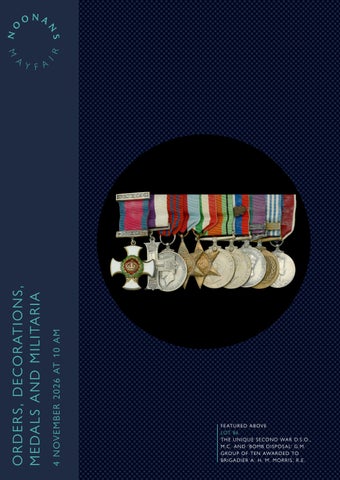
FE ATURED AB OV E LOT 86 TH E UNIQUE S ECOND WAR D. S .O., M .C . AND ’ B OM B D I S P OS AL’ G . M . G ROUP OF TEN AWARD ED TO B RIG AD IER A . H . M . M ORRI S , R . E .
AUC T ION
AUC TI O N A N D CL I E N T SE RVI C E S
AN AU C T ION OF: OR DE R S , DECORAT I O N S , MEDAL S AND M I LI TA RI A
PHI L I PPA HE A LY A D M I NI S T RAT I O N D I RE C TO R ( A S S O C . DI R EC TOR) P H I LI P PA @NO O NA N S .CO.U K T. 0 2 0 7 0 1 6 1 7 7 5
DATE 4 NOVEMB ER 2026 AT 10AM V IE WINGS ALL APP OIN TMENTS TO VIE W PLE A SE CON TAC T 020 7016 1700 OR VIE W ING@N O O N AN S .CO.UK A LL LOT S ARE AVAI L AB LE TO VI E W ONLI NE WI T H FULL IL LUST RAT I O N S AN D CO N DI T IO N RE P O RT S AT W W W. N OON AN S .CO.UK
CONTAC TS GENER A L AUC T ION ENQUIRIES AUC TION S@N OON AN S .CO.UK M EDAL ENQUIRIES ME DA L S@N OON AN S .CO.UK ACCO UN T E N QUIRIES ACCOU N T S@N O O N AN S .CO.UK
B AN K DETAIL S B ANK ER S : LLOY D S AD D RESS : 39 P I CC ADI LLY, LO N DON W1 J 0 A A SO RT CODE: 30-96-64 ACCO UN T N O.: 00622865 SWIF T CODE: LOY D GB2L IB AN: G B70LOY D30966400622865 BIC: LOY DGB21085
B OARD OF DIRE C TOR S PIERCE NOON AN CH A IR M AN AN D C EO NIM RO D DIX DE PUT Y C HAI RMAN ROBIN GRE VIL L E CH IE F OP ERAT I N G OF F I C ER C HR ISTOP HER WE B B CLIE NT LI AI SO N D I REC TOR (N UMI SM AT I CS )
AN N A HO PPE R ACCO U NT S A ND A D M I NI S T RAT I O N A NNA @NO O NA N S .CO.U K T. 0 2 0 7 0 1 6 1 7 0 0 SO FI A B USACC A A D M I NI S T RAT I O N S O F I A @NO O NA N S .CO.U K T. 0 2 0 7 0 1 6 1 7 0 0 LOT TI E B RO UG HTO N A D M I NI S T RAT I O N LOT T I E @NO O NA N S .CO.U K T. 0 2 0 7 0 1 6 1 7 0 0 CHR I STO PHE R M E L LO R - HI L L H E A D O F CLI E NT LI A I S O N ( A S S O C . D I R EC TOR) CH RI S TO P H E R@NO O NA N S .CO.U K T. 0 2 0 7 0 1 6 1 7 7 1 J A M E S C A RVE R CLI E NT LI A I S O N J B C@NO O NA N S .CO.U K T. 0 2 0 7 0 1 6 1 7 7 1
AT NO O NA NS O U R E X P E RT I S E E X T E NDS BE YO ND T H E K NOW L E DG E W I T H I N O U R S P E C I A L I S T DE PA RT ME NT S TO I NC LU DE A L L A S P E C T S O F O U R AU C T I O N H O U S E , F RO M O U R P H OTO G RA P H Y S T U DI O TO O U R A DVA NC E D P RO P RI E TA RY O NL I NE BI DDI NG S Y S T E M. We’re a close-knit team of experts with deep knowledge across our specialist subjects: banknotes, coins, detectorist finds, historical & art medals, jewellery, medals & militaria, tokens and watches. Focusing on these fascinating items, we share this expertise with an international community of sellers and buyers. Each sale item that passes through our Mayfair auction house is appraised by an expert recognised as a leading authority in a particular field of interest, ranging from ancient coins and military medals to jewellery and vintage watches. This depth of knowledge across all departments sets us apart from other generalist auctioneers.
CHR I S FI N CH HAT TO N CLI E NT LI A I S O N F I NCH @NO O NA N S .CO.U K T. 0 2 0 7 0 1 6 1 7 5 4 I A N A N D E R SO N CH I E F T E CH NI C A L O F F I CE R ( A S S O C . D I R EC TOR) I A N@NO O NA N S .CO.U K T. 0 2 0 7 0 1 6 1 7 5 1
M E DA L AN D M I L I TA R I A SPE CI A L I S T S N I M RO D D I X H E A D O F M E DA L D E PA RT M E NT ( B OA RD DI R EC TOR) NI M RO D @NO O NA N S .CO.U K T. 0 2 0 7 0 1 6 1 8 2 0 O L I VE R PE PYS M E DA L S P E CI A LI S T ( A S S O C . D I RE C TO R) O LI V E R@NO O NA N S .CO.U K T. 0 2 0 7 0 1 6 1 8 1 1 M A R K Q UAYL E M E DA L S P E CI A LI S T ( A S S O C . D I RE C TO R) M A RK@NO O NA N S .CO.U K T. 02 0 7 0 1 6 1 8 1 0
N OON A N S 1 6 BOLTON ST R EE T M AY FA I R LON DON W 1 J 8 BQ T. 0 2 0 7 0 1 6 1 7 0 0 W W W. NO O NA NS .CO. U K
SELL WITH US
BUY WI TH US
Respected worldwide for the breadth and depth of our specialist expertise, we can connect you to a broad, deep pool of potential buyers. Over the years, we’ve brought together an international community of people who share our particular passion. As recognised experts, with a vast store of freely available in-house knowledge and experience, we’ve earned the trust of buyers across the globe.
We’re here for you, whether you’re an experienced collector with a depth of knowledge or an occasional buyer attracted to a particular piece of jewellery or vintage watch.
Our fees are transparent. Unlike many other auction houses, we don’t charge for collecting your lots, photography or marketing and there’s no minimum lot charge. Not surprisingly, our position as a trusted authority, with deep global reach, often leads to the achievement of higher than expected prices at auction. Free valuation If you’re interested in selling your items and you’d like a free auction valuation, without obligation, our specialists will be happy to help. You can submit online or bring your sale item to a valuation day at our Mayfair auction house or at a regional venue. Alternatively, request a home visit.
Be assured that the item in question has been accurately described and photographed, detailing all available information, from its provenance to its current condition. Be certain that our price estimate is fair and sensible. Delve deep into our website and you’ll discover a vast store of helpful background data, including prices achieved for similar items at previous auctions. Informed and empowered, study our detailed online catalogue, then place your bid in complete confidence.
ORDER OF SALE
O RDER S , D E CO R AT I ONS , ME DAL S A ND MI LI TA RIA W ED NESDAY 4 NOVEMB ER 2026 AT 10AM A FINE COLLECTION OF MEDALS, THE PROPERTY OF A LADY, PART 4
1-78
GROUPS AND SINGLE DECORATIONS FOR GALLANTRY
79-180
CAMPAIGN GROUPS AND PAIRS
181-383
A COLLECTION OF MEDALS TO THE PRINCESS PATRICIA’S CANADIAN LIGHT INFANTRY
384-392
SINGLE CAMPAIGN MEDALS
393-618
CORONATION AND JUBILEE MEDALS
619-620
LONG SERVICE MEDALS
621-640
LIFE SAVING AWARDS
641-647
MISCELLANEOUS
648-670
MINIATURE MEDALS
671-692
WORLD ORDERS AND DECORATIONS
693-713
MILITARIA
714-770
F O R T H CO M I N G AU C T I O N S W EDNES DAY 9 DEC EMBER 2026 ORDER S , DECORATION S , MEDAL S AND MILITAR IA W EDNES DAY 13 JANUARY 2027 ORDER S , DECORATION S , MEDAL S AND MILITAR IA W EDNES DAY 10 FEBRUARY 2026 ORDER S , DECORATION S , MEDAL S AND MILITAR IA
SU M M ARY OF I NFORMATI ON FO R BUY ERS
REGIS TERING TO BID
New clients must register online to bid (whether in person or in absentia). This can be done via our website www.noonans.co.uk Registrations will be subject to due diligence and Noonans reserves the right to cancel registrations. Once registered, any client bidding for the first time online will need to enter their card details so that a security check can be performed to authorise you to bid (www.noonans.co.uk >Your Account > Account Authorisation). This check is secure, your card details are not seen by us and no funds will be deducted. BIDDING P RIORITY
Please note that we prioritise executing commission bids as early as possible in order to secure the lot for you at the cheapest possible price. It is therefore entirely possible that a lot can sell at your top bid to another bidder. To avoid this happening we offer an optional ‘Plus 1’ bidding increment facility, whereby if the bidding is against you at your maximum bid the auctioneer will execute one further bid on your behalf. Please note that in the event of identical top bids priority is given to the first bid received. P L ACIN G B IDS
LIVE BIDDING VIA WWW.NOONANS.CO.UK You may bid in real time from your computer or mobile device. We provide an optional live video and audio feed of the auctioneer, allowing you to participate in much the same way as attending the auction. You may see your invoice and pay online directly after you’ve finished bidding. There is no additional charge for this facility.
ADVANCE BIDDING VIA WWW.NOONANS.CO.UK We strongly advise this method if you wish to leave bids in advance as it is the easiest, most accurate and flexible way to leave your bids and gives you total control over them right up to the point that the lot is offered for sale. Bids made online cannot be seen by others and only become live at the point the lot is being sold. Up until this time your bids can be easily altered or cancelled. An automated email is sent to confirm any changes made. There is no additional charge for online bidding. ADVANCE BIDDING VIA POST, EMAIL OR TELEPHONE Whilst we are still happy to execute all bids submitted to us using post, email or telephone, it should be noted that all bids left with us in these ways will be entered at our offices using exactly the same bidding facility to which all our clients have access. There is, therefore, no better way of ensuring the accuracy of your advance bids than to place them yourself online. If you are registered with Noonans you may bid by email to bids@noonans.co.uk or by telephone to 020 7016 1700. All bids placed by email or telephone must be received before 4 PM on the day preceding the sale. A bidding form is included in the back of this catalogue. If you wish to use this please fill it in carefully, to include all relevant information. Please ensure that you post this form so that it arrives, at the latest, the day before the sale. BIDDING IN THE AUCTION ROOM You are very welcome to attend the auction and bid in person if you are registered with Noonans.
Please note that the auction room is situated on the third floor of a Georgian building which doesn’t have a lift. You may pay for and collect your lots during the auction.
importation VAT rates for collectable items in the Terms and Conditions published on the Noonans website. PR I CE S R E A L I SE D
S AL ERO O M NOTICES
Should the description of a lot need to be amended after the publication of this catalogue, the amendments will appear automatically on the Noonans website, www.noonans.co.uk. All such amendments are also incorporated in the List of Saleroom Notices pertaining to this auction which are posted separately on the website. The auctioneer will refer to any notices at the time any affected lot is offered for sale. C ATA LOGUE IL LUS T RATIO N S & TH E INTE R N E T
Prospective bidders are reminded that the Noonans website features high-resolution colour illustrations of every lot in this auction. There may also be additional illustrations of any lot. B UY ER S ’ P REMIUM
The rate for this sale is 24% of the Hammer Price (+ VAT where applicable). IMP O RTATIO N VAT
Lots marked ‘X’ are subject to importation VAT of 5% on the Hammer Price unless re-exported outside the UK, as per Noonans Ts & Cs. From 1 January 2021 importation VAT may be levied by EU countries on lots sold by Noonans and subsequently imported into those countries. Although Noonans is unable to advise buyers on customs regulations in their country of domicile, there is further information regarding EU
The hammer prices of lots sold at Noonans auctions are posted at www.noonans.co.uk in real time and telephone enquiries are welcome from 9 AM on the day after the auction. PAYM E N T
You may access your invoice shortly after the hammer has fallen on your last lot. As we weigh lots at the time of cataloguing most shipping is already calculated, enabling you to settle your account and receive your lots in a timely fashion. Auction attendees may pay and collect during the course of the auction as soon as they have bid on their last lot. Full Terms and Conditions of Business are available to read in the back of this catalogue and on our website. CO N TAC TS
GENERAL SUPPORT ENQUIRIES auctions@noonans.co.uk 020 7016 1700 or from overseas (+44) 20 7016 1700 WEBSITE AND LIVE BIDDING SUPPORT ENQUIRIES Ian Anderson ian@noonans.co.uk 020 7016 1700 or from overseas (+44) 20 7016 1700
A Fine Collection of Medals, the Property of a Lady, Part 4 1
The impressive G.C.M.G. group of nine awarded to the 1st Baron Cadman of Silverdale, the noted mining engineer and petroleum technologist The Most Distinguished Order of St. Michael and St. George, G.C.M.G., Knight Grand Cross, set of insignia, comprising collar chain, sash badge and breast star, silver-gilt and enamel; British War and Victory Medals (Sir J. Cadman.); Jubilee 1935, unnamed as issued; Coronation 1937, unnamed as issued; France, Third Republic, Legion of Honour, Grand Officer’s breast badge, gold and enamels, and silver breast star; Iran, Empire, Pahlevi Coronation 1926, bronze; Iraq, Kingdom, Order of El Ra"dain, Grand Commander’s sash badge and breast star, silver-gilt and enamels, the badge lacking suspension loop and small enamel chip to one point of Star; Italy, Kingdom, Order of the Crown, Commander’s neck badge, gold and enamels, the whole mounted on board for display together with mounted group of eight miniature medals, the orders all in gold and enamels, unless otherwise described generally good very ne (14) £3,000-£4,000
www.noonans.co.uk
all lots are illustrated on our website and are subject to buyers’ premium at 24% (+VAT where applicable)
A Fine Collection of Medals, the Property of a Lady, Part 4 The Right Hon. Sir John Cadman, !rst Baron Cadman of Silverdale, in the County of Stafford, was born in the north Staffordshire mining village of Silverdale on 7 September 1877. He was christened and con"rmed in the village church there, and in a grave near its entrance he decided that his ashes should rest. Tt is there’, he said, ‘that I belong.’ The writer, who was present at his funeral, was much struck by the attachment of the villagers to their old friend ‘Jack’. Throughout his life he never forgot them, and when the end came they showed that they had not forgotten him. Cadman was educated at the High School, Newcastle-under- Lyme, and studied mining under his father, Mr James Cope Cadman, M.I.C.E. When in 1922 he was elected President of the Institution of Mining Engineers he reminded the members that, eighteen years before, his father occupied the same presidential chair. He won a Staffordshire County Council Scholarship for mining which he held at the Durham College of Science, now Armstrong College; there he took his B.Sc. degree with honours and subsequently took the M.Sc. and the D.Sc. At twenty-two he worked as assistant manager at the Silverdale Collieries, and at twenty-three was appointed manager of the Collieries of Trindon Grange. A few years later he was made one of H.M. Inspectors of Mines, and among the districts he covered was one containing Scottish Shale. Thus it was that Cadman made his "rst contact with oil. The period of his services as an inspector was a time of many serious explosions in mines, and he never spared himself in visiting the scenes of such disasters at the earliest possible moment after their occurrence. In this work he was keen to "nd out the causes, and then to seek a remedy. Many of his investigations were undertaken in co-operation with the late Dr J. S. Haldane, who was a great admirer of his work. Haldane knew of his intense interest in coal and his great desire to help that industry and especially the miners. Both deprecated the dangers of over legislation believing that every one connected with the industry, from the Inspectors of Mines down to the pony drivers, were so tangled up with parliamentary mine regulations that it was difficult for them to move. In his later years Cadman was an advocate of the coal industry becoming a single entity controlling all operations from production to retail sale. He pointed out that when that status was attained competition between individual collieries would virtually disappear, and the industry as a whole would study its problems as a whole. Those who bought coal were not interested in coal as a substance but as a form of energy, and he pressed that the coal industry should organize itself to give to its customers so many millions of calories in the form best suited to their requirements. He continuously advocated the complete gasi"cation of coal, believing that this would lead us much nearer to a smokeless England, and at the same time enable cheap gas to be made available in millions of homes as well as in industry. Often, when serving on a ‘coal’ committee he would laugh at a stray suggestion that he was biased in favour of oil. It was indeed difficult to believe that Cadman was at any time biased; he loved the truth and was always willing to believe. He never regarded oil as a rival of coal, but rather as an ally and associate. When he lived at Silverdale as a boy there were twenty-two collieries working in the area; there were blast furnaces and "nished iron works in Silverdale, Knutton and Chesterton. The whole neighbourhood bustled with industry, and the future looked secure. In 1938, when Cadman received the freedom of the neighbouring town of Newcastle-under-Lyme, he contrasted the prosperity of his boyhood days with the depressed outlook then. He reminded the Mayor and Corporation that the area was still well endowed with great reserves of coal and rich deposits of ironstone, and if fault was to be found it was because man had not seen "t to seek and apply scienti"c knowledge to utilize and pro"t from the benefactions of nature. He was awarded a gold medal by the City of Birmingham for conspicuous bravery in connexion with the Hamstead Colliery disaster which occurred near Birmingham in 1908, and, for conspicuous service in other mine disasters, he held the North Staffordshire Brigade Rescue medal with "ve clasps. In 1904 Cadman was asked by the Government of Trinidad to regulate the digging of asphalt in that colony. At the time the digging of asphalt was causing endless litigation; the great pitch lake was hardly recognized as evidence of the existence of oil, and the petroleum industry of the island could scarcely be said to exist. He succeeded in settling many knotty problems to the satisfaction of all concerned, and did much to stimulate the development of the colony’s oil industry. During his stay of four years, he organized the Mines and Petroleum Department. He lived in Trinidad continuously for four years, and it was there he met his future wife, Lilian Harrigan, whom he married in 1907. On his return to England in 1908 he served on a Royal Commission on Mines, and two years later he was appointed Professor of Mining at Birmingham University. There he established the Department of Petroleum Technology, the "rst of its kind in the Empire. He at once became one of the leading exponents of the petroleum industry, and in particular he stressed the application of science in all its operations. There is little doubt that he would have been content to remain a Professor of Mining and to blaze a scienti"c trail, but his country needed him in other directions. It was in May 1908 that the "rst great oil gushers of Iran was struck at Masjid-i-Sulaiman. Development proceeded rapidly; a pipe line was built across the mountains and the desert to the head-waters of the Persian Gulf 145 miles away; a great re"nery was built on the shores of the Shatt-al-Arab; tankers were ordered to transport the oil, and an immense distributing organization was planned for its disposal. In 1913 this Iranian "eld was beginning to produce oil in quantity. At that time, the Admiralty, under the guidance of Lord Fisher and the stimulus of Mr Winston Churchill, was turning the British Navy over from coal to oil; it was a tremendous step to take, for Great Britain possessed no indigenous supply. An Admiralty Fuel Oil Commission was appointed by Mr Winston Churchill, of which Cadman was a member, and he went to Iran to report upon the Iranian oil "elds. The help he gave to the commission made it very certain he would soon be called on again, and in 1917 during the Great War, when there was a serious shortage of fuel oil for the Navy, and the Army had but a few days’ supply of motor fuel, Cadman became Director of the Petroleum Executive and later Chairman of the Allied Petroleum Council. This body controlled all oil supplies for the Allied Forces, and there is no doubt that Cadman’s work contributed vitally to the success of the war. Lord Haig paid the following tribute to his work:— ‘The success which happily attended our administration is entirely due to his great ability, wonderful industry and unsurpassed knowledge of oil questions. . . . In all the long list of services rendered by both men and women, which contributed to the ultimate victory, there is none which stands higher than the work which Sir John Cadman did.’ For these services he was made K.C.M.G., Officer of the Legion d’Honneur and Knight Commander of the Crown of Italy. Cadman became a technical adviser to the Anglo-Persian Oil Company in 1921, and shortly afterwards a director, but he showed that he was far more than a technical expert, and early in 1929 he succeeded Lord Greenway as chairman of the company, the "rst ‘professor’ scientist to become chairman of an industrial company with a capital of tens of millions of pounds. Sir Thomas Holland, commenting on this appointment has said:— ‘Thereafter he added strength with symmetry to a great commercial industry by establishing within its structure a research organization which has contributed substantially to the body of pure science in the relative branches of chemistry, physics, geology and geophysics.’ Cadman’s entry into the oil industry was at a most momentous time. During the war of 1914-1918 the internal combustion engine, like so many other inventions, had been developed at a rapid rate, and quantity production of motor cars was expanding in the United States and spreading to Europe. The Diesel engine was in use on land and at sea, and oil, as a fuel for ships, threatened to replace coal. The potential demands on the petroleum industry were foreseen by Cadman in that wide vision that so distinguished him, and he shaped his efforts and those of the company of which he was the head to meet all demands sanely and without waste. It is probable that there was no man of his time with the same encyclopaedic knowledge of the oil industry; he was expert on all its phases from the initial geophysical demarcation of the oil-bearing structure, the technology of drilling, the chemistry of re"ning, the corrosion of pipe lines to the construction of tankers. As an outcome of the continuous application of scienti"c methods to the examination of the main produ
www.noonans.co.uk
all lots are illustrated on our website and are subject to buyers’ premium at 24% (+VAT where applicable)
A Fine Collection of Medals, the Property of a Lady, Part 4 cing areas of Iran, the structural complexities of these areas have been so successfully studied that full reliance can be placed upon calculations of the magnitude of the oil reservoirs. This scienti!c development of the Iranian oil !elds and the great pipe lines of Iraq were matters of great pride to Cadman. Each oil !eld was drilled in a comparatively few places, the oil "ow from each well being regulated so as to maintain uniformity of oil level throughout the !eld. At each well head there was regular inspection of level, rate of "ow, underground temperature and oil pressure, and a central control station regulated the rate of "ow from the wells. These Iranian oil !elds are unique among the oil !elds of the world inasmuch as unwanted products of the re!nery are pumped back into the wells, and this notwithstanding that at many well heads the natural oil pressure exceeds 2000 lb. per square inch. In all such plans Cadman showed great depth of knowledge as well as width of outlook. Some there were who looked upon the Iranian scheme as unnecessary and grandiose. After its completion the critics admitted their mistake, and now there are few who do not highly appraise the scienti!c planning of the Iranian !elds. As in the !elds, so it was in the re!nery at Abadan, which grew to be the largest oil re!nery in the world. Even in Cadman’s time the technique of petroleum changed rapidly, and with increased scienti!c knowledge so was the plant adapted to produce better and more uniform products. Cadman had many ideals, but none gave way to his main desire to know ‘why’ as well as to know ‘how’. In addition to being Chairman of the Anglo-Iranian Oil Co. he was was Chairman of the Iraq Petroleum Co., the pipe lines of which start in the !elds and end on the coasts of Palestine and the Lebanon. Oil was discovered in Iraq in October 1927, and as there was no local market for the great quantities of oil which were available, at least one pipe line had to be laid to a port in the Mediterranean. Eventually it was decided that the line should debouch at two points, Tripoli in the north and Haifa in the south. The distance between the two points to be connected was about 600 miles and some idea of the magnitude of the under taking may be judged from its cost, which was £9,250,000. Almost the entire route lies in desert wastes unequipped with roads or railways, passing very few towns and unpopulated save for scattered tribes of nomads. Material, medical supplies and food had to be conveyed from the Mediterranean and the Persian Gulf, and by the time the work was !nished, 37 million ton miles of traffic had been handled. The problems associated with this pipe line were both difficult and attractive, and on many occasions Cadman spoke of the great help he had received from physicists, metallurgists and engineers. He, more than any other person, was instrumental in abolishing the aggressive commercial policy which at one time threatened not only those engaged in the oil industry but the countries producing oil. He pleaded with success for a sane nationalism, regarding oil neither as a heavy intoxicant for oneself nor as a deadly drug for one’s political competitors, but rather as a store of energy to be conserved, released and applied as part of a concerted operation, owing its inception to more than one nation and yielding its tribute to more than one treasury. In a speech at Chicago in 1929 he summarized his views very brie"y as follows:— ‘We must all do our share towards promoting a policy of sane and honest internationalism in industry. Co-operation between nations and international forces there must be, in some form or other, if we are not to squander the world’s heritage.’ The same spirit of conservation was his policy when he spoke of the ‘absolutely unlimited multiplication of facilities for the so-called service of the motorist’. He wondered whether there was supposed to be some virtue in piling up the number of pumps, of rail and road wagons and of service stations. He considered such multiplication to be an evil, and did his utmost, again with much success, to attain equilibrium between service and supply. Remarking on the results of his international efforts, Sir William Fraser pays the following tribute:— ‘The measure of success which, together with others of a like mind, he achieved, was amply demonstrated during the years when potential production outstripped all possible demand and when production let loose would have put an end to orderly development, to say nothing of ruining thousands of smaller participants in the industry, as well as some of the larger, and leaving the world the poorer by the dissipation of an irreplaceable natural asset.’ Cadman was a Director of the Suez Canal Company and of the Great Western Railway. He sat on numerous Government Committees including the Prime Minister’s Economic Advisory Council, the Lord President’s Advisory Council for Scienti!c and Industrial Research, the Government Industrial Transference Board, the Safety in Mines Board, the Fuel Research Board, the Coal Advisory Committee, the Committee of Enquiry into Civil Aviation, over which he presided, and the Committee of Enquiry into the Post Office. When the Bridgman Television Committee was set up he was appointed Vice-Chairman, and on the death of Lord Selsdon he became Chairman. He took the greatest interest in television, and followed step by step the development of the transmitter and the many types of receivers both electrical and mechanical. His keen brain saw that this development would in time revolutionize the transmission of information to millions of people the world over. He was anxious that Great Britain should retain the lead in this discovery, and in 1939, on the outbreak of war, he was preparing a memorandum for the Postmaster-General in which he advocated the construction of other transmitter stations than the one at Alexandra Palace. His knowledge of atomic physics much surprised Rutherford, who jokingly told Cadman that he should leave the world of oil and join his band of adventurers who were exploring atomic worlds. In subsequent conversation Cadman told us that often he regretted leaving his professorial chair at Birmingham; he loved research and believed that had he continued at Birmingham he might have made some contribution to scienti!c knowledge. But this was not to be. However, he gained much satisfaction in following the work of others; the work of the Cavendish Laboratory he had followed for over twenty years, and I have a suspicion that he helped to !nance some of it. However that may be, certain it is that his scienti!c knowledge was very exceptional for a man who was classi!ed as an industrialist. Rutherford and Cadman were great friends, and when Cadman was raised to the peerage in 1937, Rutherford wrote and said he would be delighted to introduce him into the House, which he did. Although his period of service in the House of Lords was brief he spoke with great effect on Fuel Supplies in war time and on the British Overseas Airways Bill. This latter translated the bulk of the recommendations of the Committee of Enquiry into Civil Aviation, of which Cadman was chairman, into legislative form. Naturally, Cadman spoke in favour of the Bill believing it to be a great turning point in British Civil Aviation. The time was August 1939; the clouds of war were gathering fast and Cadman’s concluding remarks are worth quoting here:— ‘I welcome this latest addition . . . as a further indication of the Government’s determination to impress upon the outside world that Britain is still a great and virile power, and that we shall be resolute in upholding the traditions of overseas trade and communications which are among the principal sources of our national strength.’ Cadman was one of the founders of the Institute of Petroleum and was its President in 1915 and again in 1936. He occupied also the presidential chairs of the Institutes of Fuel, of Mining Engineers (for three successive periods) and of the Society of Gas Engineers. He was made a C.M.G. in 1916, a K.C.M.G. in 1918 and a G.C.M.G. in 1929. He had also several foreign honours, including the First Class Order of the Ra!dain, and he was a Pasha First Class of Transjordan. He was an honorary LL.D. of Birmingham University and an honorary D.Eng of Melbourne University. He was elected a Fellow of the Royal Society in 1940, and was a member of the Lord President’s Council of the Department of Scienti!c and Industrial Research for two periods, the !rst from 1920 to 1928 and the second from 1934 to 1939. He was a keen supporter of the Industrial Research Association movement, and frequently expressed his opinion that in this country the application of science to industry had not had reasonably favourable conditions in which to develop its in"uence. He regretted that some scientists in their wisdom thought it right to attempt to divide the realms of science into two hemispheres, one of ‘pure’ science and the other of ‘applied’ science. He never doubted that this distinction had injured, or at least retarded, the steady value of science’s contribution to industry. He had a very long talk on this topic with members of the Lord President’s Advisory Council in 1936. The oil industry, he reminded us, was in general regarded as a haphazard one of spasmodic drilling for oil and re!ning the product by crude distillation methods. Instead it was an industry founded on !rm scienti!c principals. It was true that in the earlier days a seepage of oil or gas was the prospector’s sole guide to the existence of a subterranean reservoir of oil. But in more recent times there were not enough seepages to go round and the necessity for !nding oil without a surface indication of its presence gave rise to a variety of theories regarding its accumulation.
www.noonans.co.uk
all lots are illustrated on our website and are subject to buyers’ premium at 24% (+VAT where applicable)
A Fine Collection of Medals, the Property of a Lady, Part 4
To-day, Cadman reminded us, methods based on these theories are used, and numerous scientists who are expert in geology, palaeontology, geophysics and chemistry are employed. Many of these have not only made their contribution to the oil industry but have added substantially to scienti!c knowledge. The instruments used by them are among the most sensitive ever made, one of them, of a most robust character, being used to detect changes in the gravitational constant as small as one part in a million. On the contacts between science and industry and on the education of youths for industry, he had very de!nite views. In September 1935 he communicated to The School Government and Educational Review a paper on ‘Industry’s demand of education’ which was much discussed by industrial leaders and by educationalists. Cadman pointed out that a survey of the educational system of this country gave the impression of much complexity if not of general confusion. The many different types of institutions—State provided, State supported or merely State supervised— re#ected many diverse opinions but did not meet the needs of large industrial and commercial concerns. Education, he contended, should meet the real needs of the community; in this country the needs are many, for example, the provision and preparation of food, the mining of coal, the manufacture of machinery and the provision of power. These needs are co-operative, and in all these spheres the most essential need is properly educated personnel—men and women properly equipped with knowledge, skill and stamina—to operate and to improve upon the processes which constitute an activity. He laid the greatest stress on the early association of youth with actual conditions of industrial life and with the manual, technical and directive personnel of industry. He stressed the importance of encountering the real issues of life in early formative years so that young people could prove their adaptability or establish their unsuitability for certain positions. ‘It is signi!cant’, he said, ‘that the Navy—a most successful type of organization— makes a point of taking its novitiates at a very early age.’ The enforced relegation or rejection of the technically !t on account of inadaptability of temperament was a fault which must be laid at the door of our system of education, and it brought in its train discontent, instability and many social evils of which these are the unrecognized cause. The spartan method of the successful business man of a past generation who forced his son to start his career at an early age on the lowest rung of the industrial ladder, had an advantage ensuring a real understanding with the worker at every stage of his career, and much of this advantage could be provided if our educational system permitted a break in studies in order to allow our youths to spend a year or so amid the environment of their probable future careers. His !nal words on this subject—and they seem most appropriate to-day—were, that knowledge, understanding and sympathy are all essential to true progress in industry. He emphasized the need of studying industrial psychology, and on many occasions drew attention to the relationship between the resting time of individuals, their state of physical !tness and their output of useful work. Always was he insistent that scienti!c knowledge and training are not by themselves sufficient in industry since in general, science concerns itself with matter rather than human beings. In order to achieve the greatest measure of success and prosperity, men of industry must know something of psychology and indeed be psychologists. They must know how to handle their men, how to pull together with a maximum of result and a minimum of friction, and they must also know how to present a case in its most convincing form. Cadman’s record of public service deserves very special praise. His outlook was singularly wide; he was fully at his ease whether the topic was television, hydrocarbon chemistry, aviation, the coal industry, the design of tankers or the general aspects of industrial research. In his many and varied social functions he was ably supported by his wife to whom he was deeply attached. He was frequently found at the annual dinners of scienti!c societies and technical institutions. His speeches were invariably well prepared and always appropriate to the occasion. The Chairman of the Standard Oil Company of New Jersey tells how on one occasion Cadman addressed 3000 oil men of all grades at Chicago. His speech was a great success. At !rst they expected to !nd him distant, professorial and hard to get along with, but they quickly learned to admire his keen intelligence, his admirable character and his charming attributes for friendliness. In private life no one could be more loved and esteemed. He had reverence for all that was good. His utterances were invariably accompanied by a genial smile, and he delighted in relating some- thing of a novel character that had occurred in his day’s work. While it must be admitted that his wide technical knowledge and intuition based upon that knowledge were what impressed his friends most, he was imbued with a sense of the far greater importance of the knowledge of humanity, itself. Indeed the value of human relationships and the supreme in#uence of good feeling and affection in business as well as in private life were axiomatic to him. Many a young man in the employment of the Anglo-Iranian Oil Company looked upon ‘the Chairman’ as a friend. Fitting it was that at a great public gathering, it should be Cadman who quoted the American poet, Sidney Lanier:— ‘Whether man’s land was rich or poor, Thar was more in the man than thar was in the land.’ One of his oldest friends, Sir William Fraser, in a published tribute says:— ‘When numerous distinctions had fallen to him and he had become a !gure of international repute, he remained essentially the same John Cadman that he was when I !rst came into close touch with him. His character was unspoiled, his charm of manner never left him, his kindliness and consideration were constant. He was not ‘all things to all men’, but one man—and that a very human one—to all.’ Obituary published by The Royal Society, 1 December 1941.
www.noonans.co.uk
all lots are illustrated on our website and are subject to buyers’ premium at 24% (+VAT where applicable)
A Fine Collection of Medals, the Property of a Lady, Part 4 2
A Great War C.M.G., D.S.O. group of !ve awarded to Lieutenant-Colonel H. S. W. Pennington, Army Service Corps, who was thrice Mentioned in Despatches The Most Distinguished Order of St. Michael and St. George, C.M.G., Companion’s neck badge, silver-gilt and enamels; Distinguished Service Order, G.V.R., silver-gilt and enamels, with integral top riband bar; 1914-15 Star (Major H. S. W. Pennington. A.S.C.) the ‘S’ of ‘A.S.C.’ double struck; British War and Victory Medals, with M.I.D. oak leaves (Lt. Col. H. S. W. Pennington.) all housed in a !tted leather case, with gilt lid inscription, ‘Lt. Col. H. S. W. Pennington, C.M.G. D.S.O. 1914-1918’; together with the related miniature awards, these mounted as worn, good very ne and better (5) £1,400-£1,800 C.M.G. London Gazette 1 January 1919. D.S.O. London Gazette 1 January 1917. M.I.D. London Gazettes 1 January 1916, 4 January 1917 and 22 December 1918. Hubert Stanley Whitmore Pennington was born in Rathdowney in Queen’s County, Ireland, in 1871 and was commissioned Second Lieutenant in the Wicklow Artillery (Militia) on 17 August 1889. Following the outbreak of the Great War he was commissioned temporary Captain in the Army Service Corps on 1 September 1914, and served with them during the Great War on the Western Front from April 1915. For his services during the Great War he was thrice Mentioned in Despatches, as well as being awarded the Distinguished Service Order, and created a Companion of the Order of St. Michael and St. George. He died in Hampshire in 1949
www.noonans.co.uk
all lots are illustrated on our website and are subject to buyers’ premium at 24% (+VAT where applicable)
A Fine Collection of Medals, the Property of a Lady, Part 4 3
The scarce Second War Coastal Command ‘1945’ C.B.E., ‘1940’ D.S.O., immediate ‘1940’ D.F.C. group of ten awarded to Air Commodore F. L. Pearce, Royal Air Force, late Honourable Artillery Company and Royal Flying Corps, who was twice decorated for his gallant deeds as a Squadron C.O. and Hudson pilot in 1939-40, when, in the face of heavy opposition, he led low-level attacks against enemy shipping on the Norwegian coast, including a brace of strikes on the Scharnhorst The Most Excellent Order of the British Empire, C.B.E., (Military) Commander’s 2nd type neck badge, silver-gilt and enamel; Distinguished Service Order, G.VI.R., silver-gilt and enamel, reverse officially dated ‘1940’, with integral top riband bar; Distinguished Flying Cross, G.VI.R., reverse officially dated ‘1940’; British War and Victory Medals (Lieut. F. L. Pearce. R.A.F.); 1939 -45 Star; Atlantic Star, 1 clasp, France and Germany; Defence and War Medals 1939-45, with M.I.D. oak leaf; Coronation 1953, unnamed as issued, housed in a glazed display frame with ten related miniature awards, rank shoulder boards and RAF ‘Wings’, BWM and VM slightly worn, otherwise generally very ne (10) £3,600-£4,400 C.B.E. London Gazette 5 July 1945: ‘For gallant and distinguished service in North-West Europe.’ The original recommendation states: ‘Air Commodore Pearce has served as S.A.S.O. 16 Group since October 1943. His devotion to duty and untiring energy has largely contributed to the successful operations throughout the period of his appointment. His outstanding character and ability as a leader have been re!ected in the efficiency of the units under my command, and by their eagerness to engage the enemy. During the many phases of the war, from the time when he #rst joined the Group when the destruction of enemy ships on the Holland and North German coast trade routes was of #rst importance, through to the planning for D-Day, the intensive operations which followed, the planning and execution of the anti-E-boat warfare during the winter months, and #nally with the intensive operations against the small battle units, his personality and example have been an inspiration to all.’ D.S.O. London Gazette 20 February 1940. D.F.C. London Gazette 12 July 1940. The original recommendation states: ‘This Squadron Commander led a formation of nine aircraft on a bombing raid at night against an enemy aerodrome 342 miles from base, including 289 miles across the sea. As a result of his careful planning of the raid, initiative and leadership, the raid was a complete success and very severe damage was done. This officer had led seven raids, #ve of which were at night, during the last #ve weeks and had shown magni#cent qualities of leadership and courage which have been an example and inspiration to the personnel of his squadron.
www.noonans.co.uk
all lots are illustrated on our website and are subject to buyers’ premium at 24% (+VAT where applicable)
A Fine Collection of Medals, the Property of a Lady, Part 4
Covering remarks by the A.O.C.: Wing Commander Pearce has continued to lead his squadron in the most courageous and skilful manner, effecting great damage to the enemy with the minimum loss to our own forces. The details of the raid on Bomoens Aerodrome on 26 June are set out in the attached reports. Another outstanding achievement was the attack on enemy warships in Trondheim on 11 June when, using twelve Hudsons operating from Sumburgh, three direct hits were obtained on the two enemy cruisers in the face of intense opposition by both A.A. and enemy "ghters. It is due to his personal efforts and example that the morale and effectiveness of No. 269 Squadron is at its present exceptionally high standard. An immediate award of the Distinguished Flying Cross is very strongly recommended.’ Frederick Laurence Pearce was born on 9 August 1898 and was educated at Goodwin College, Aylesbury, Buckinghamshire. Enlisting in the Honourable Artillery Company in the summer of 1916, he witnessed active service as a Driver in France prior to transferring to the Royal Flying Corps as an Equipment Officer in January 1918. Having then trained as a pilot and quali"ed for his ‘Wings’, Pearce was appointed a Flying Officer in September 1920, the same year in which he also quali"ed as a $ying instructor at the Central Flying School. His subsequent inter-war appointments included command of No. 440 Fleet Spotter Reconnaissance Flight and No. (F.A.A.) 824 Squadron and he was advanced to Wing Commander in January 1939. On the renewal of hostilities, he was serving as C.O. of No. 269 Squadron in Coastal Command, the Montrose-based unit carrying out antisubmarine patrols in its Ansons in the opening months of the war. It was for these early operational patrols that Pearce was awarded the D.S.O. He was also mentioned in despatches (London Gazette 20 February 1940). Having then attended a conversion course for Hudsons, he led the squadron in a spate of daring, low-level attacks against enemy targets in Norway in May-June 1940, including strikes against the Scharnhorst. The "rst such sortie was carried out against Stavanger Aerodrome on 16 May 1940 and the last on 26 June 1940, namely the strike on Bomoen Aerodrome referred to the recommendation for his immediate D.F.C. On that occasion, Pearce and his fellow aircrew delivered a total of 90 bombs within a minute ‘and about 4,000 rounds "red into the huts and woods.’ But far more perilous were the attacks mounted by 269 Squadron against enemy shipping, sometimes undertaken from an altitude of 500 feet and always in the face of heavy $ak. Thus outings to Bergen on 1 June, Trondheim on 11 June and Stavenager on 21 June. On the last two occasions, Scharnhorst was the main target, the squadron O.R.B. noting the arrival of enemy "ghters on the scene on 11 June, when two of 269’s Hudsons were shot down. Pearce was awarded an immediate D.F.C. Advanced to Group Captain in August 1940, he was placed on the Special Duty List at the Air Ministry, but before the year was out he served as a member of the Tizard Technical Mission to the U.S.A., which carried out negotiations with the Americans into the production of centimetric radar. On his return, he was granted permission to $y one of the newly equipped Hudsons on the Trans-Atlantic run from Botwood, Newfoundland to R.A.F. Aldergrove, the second such $ight to be undertaken; he also carried out a reconnaissance to North Russia, prior to the despatch of No. 151 Wing in August 1941. An appointment on the Air Staff at H.Q. No 17 Group having then ensued, he was appointed to the command of R.A.F. North Coates in March 1942 and S.A.S.O. of No. 16 (Reconnaissance) Group, latterly in the rank of Air Commodore and in which capacity he was awarded his C.B.E. Post-war, Pearce served as the Air Officer Commanding in Ceylon in 1949-52, in which latter year he was placed on the Retired List. He died in December 1975. Sold with copied research.
www.noonans.co.uk
all lots are illustrated on our website and are subject to buyers’ premium at 24% (+VAT where applicable)
A Fine Collection of Medals, the Property of a Lady, Part 4 4
A Great War ‘Western Front’ D.S.O., O.B.E. group of six awarded to Colonel C. H. Kuhne, Royal Army Ordnance Corps, late Royal Army Service Corps, who was Mentioned in Despatches Distinguished Service Order, G.V.R., silver-gilt and enamels, with integral top riband bar; The Most Excellent Order of the British Empire, O.B.E. (Military) Officer’s 1st type breast badge, silver-gilt, hallmarks for London but date letter worn; 1914-15 Star (Capt. C. H. Kuhne. A.S.C.); British War and Victory Medals, with M.I.D. oak leaves (Major C. H. Kuhne.); France, Third Republic, Medaille Reconnaissance, bronze, mounted as worn but lacking pin, generally very ne (6) £1,000-£1,400 D.S.O. London Gazette 4 June 1917. O.B.E. London Gazette 3 June 1919. M.I.D. London Gazettes 4 January 1917 and 29 January 1917. Carl Hans Kuhne was born in Plymouth in 1891. Of Danish descent, he attended Plymouth and Rutherford Colleges, where he studied for an apprenticeship in marine engineering. He then undertook a voyage to Australia as an engineer in the steamship Argyllshire, after which he worked as a managerial assistant for Messrs. Hawthorn, Leslie, which work included the installation of machinery in warships. In October 1914, Kuhne was commissioned in the Royal Army Service Corps (R.A.S.C.), and, by April 1915, he was serving in France in the temporary rank of Captain. Subsequently promoted to Major, he was given command of all the mechanical transport for the heavy artillery attached to V Corps, amounting to about 1,500 vehicles, and some 3,000 personnel. Awarded the D.S.O. and O.B.E., he was also twice Mentioned in Despatches, and subsequently served as Deputy Assistant Director of Transport prior to relinquishing his commission in January 1920. Having then worked brie!y for Messrs. Armstrong-Siddeley of Coventry, Kuhne chose to return to military service, and was granted a Regular Army commission as a Captain in the R.A.S.C. Shortly afterwards, he transferred to the Royal Army Ordnance Corps (R.A.O.C.) as a Mechanical Engineer and, later still, served as an instructor at the Mechanical Transport School. A tour of duty having then ensued at the War Office in 1925 -26, he was appointed Deputy Assistant Director of Mechanisation and was given the Brevet of Lieutenant-Colonel. His next appointment was as Chief Ordnance Mechanical Engineer in Hong Kong and on his return home he served as the Senior Ordnance Mechanical Engineer. His #nal appointment was that of Deputy Assistant Director of Transport, R.A.O.C., with the rank of full Colonel. Tragically, having been recalled on the renewal of hostilities, he was killed in a motor accident in January 1941.
www.noonans.co.uk
all lots are illustrated on our website and are subject to buyers’ premium at 24% (+VAT where applicable)
A Fine Collection of Medals, the Property of a Lady, Part 4 5
The outstanding Second War submariner’s D.S.O. and Second Award Bar group of seven attributed to Commander P. S. Francis, Royal Navy, who commanded the Proteus in the Mediterranean in 1941-42. Described as having ‘a brain packed in ice’, he cut his teeth in the submarine Talisman in the Channel and Bay of Biscay, in which he undertook clandestine patrols in support of S.O.E. But it was for his gallant command of Proteus that Admiral Sir Henry Harwood was moved to liken his exploits with those of ‘Tubby’ Linton, V. C., and ‘Crap’ Miers, V.C. On one occasion, when caught on the surface, Francis rammed the Italian torpedo boat Sagittario, opening up several of her compartments ‘like a tin-opener’, whilst his torpedo ‘batting average’ of 40% re!ected considerable success further a"eld Distinguished Service Order, G.VI.R., 1st issue, with Second Award Bar, silver-gilt and enamels, the reverse of the lower suspension bar officially dated ‘1942’, the reverse of the Bar officially dated ‘1942’, with integral top riband bar; 1939-45 Star; Atlantic Star ribbon but mounted with Pacic Star; Africa Star; Defence and War Medals 1939-45; Coronation 1953, unnamed as issued, mounted as worn; together with the related miniature awards, these similarly mounted, and the recipient’s miniature-width riband bar, good very ne (7) £1,600-£2,000
www.noonans.co.uk
all lots are illustrated on our website and are subject to buyers’ premium at 24% (+VAT where applicable)
A Fine Collection of Medals, the Property of a Lady, Part 4 Just 110 R.N. recipients were awarded Second Award Bars to the D.S.O. in the Second War. D.S.O. London Gazette 30 June 1942: ‘For gallant and distinguished service in successful patrols while serving in H.M. Submarine Proteus.’ The original recommendation states: ‘For outstanding courage, skill and determination during six war patrols. During this time LieutenantCommander Francis has pressed in to attack the enemy on every possible occasion and as a result he has sunk four ships in convoy, including two troopships, damaged another troopship and a large oiler - the Tampico - and destroyed a schooner. It is possible a further supply ship was also damaged or sunk.’ D.S.O. Second Award Bar London Gazette 29 December 1942: ‘For distinguished and successful patrols in H.M. Submarines.’ Philip Stewart Francis was born in Boxmoor, Hertfordshire on 8 April 1908, and was educated at Horton School and the R.N.C. Dartmouth. In his !rst seagoing appointment, as a Midshipman in the battleship H.M.S. Ramillies, he won the Atlantic Fleet lightweight boxing cup in 1926. Having then passed his basic training for submarines, Francis served in the Otus in Hong Kong, where he rode as an amateur jockey at Happy Valley. In fact, by all accounts, he was an adventurous sole, a notable voyage in the 50-ft. ketch Mo Shan being undertaken in 1933-34, when he and four fellow officers chose to sail back to the U.K. from the Far East; the King sent them a congratulatory message on their return. A Lieutenant-Commander by the outbreak of hostilities, Francis spent the !rst six months of the war in the battlecruiser Repulse, but was then given command of the submarine Talisman, in which he undertook six war patrols in the Channel and Bay of Biscay. In August 1940, he undertook an S.O.E. operation, landing three agents near Bordeaux, and in November, after damaging a tanker and surviving a counter-attack, he surfaced near the Ile de Groix and captured a tunny !shing vessel, which was deemed suitable for future clandestine operations. But it was for his subsequent command of the Proteus in the Mediterranean in the period September 1941 and August 1942 that he gained wider fame, a period of operations best summarised in his Daily Telegraph obituary notice in October 2000: ‘Proteus’s own score included an 8,000-ton troopship, !ve enemy supply ships, tankers, and an escort vessel. Her patrols had some dramas, notably ‘The Tin-Opener Incident’ on the night of 8 February 1942. Proteus was on the surface close inshore off the Levkat-Cephalonia passage to the Corinth Canal when Francis saw what he thought was a U-boat and at once turned to attack. However, the target was the Italian torpedo boat Sagittario and Proteus met her head on. Proteus’s port forward hydroplane ripped open Sagittario’s port side. Proteus lost her hydroplane and had several rivets loosened, so Francis reluctantly had to abandon the patrol. As a submarine C.O., Philip Francis was known as the man with ‘his brain packed in ice’. According to official !gures, he !red 51 torpedoes in all and scored 20 hits – a ‘batting average’ of just under 40 percent, higher than those of much better-known C.O.s such as Linton, V.C., Wanklyn, V. C. and Miers, V.C.’ Himself awarded the D.S.O. and Bar, Francis was advanced to Commander in December 1942 and subsequently served as Operations Officer of the First Submarine Flotilla, based ashore at Beirut. But he was back home by the war’s end, when, as Base C.O. at Lisahally in Northern Ireland, he oversaw the surrender of 63 U-boats. A return tour of duty having ensued in Hong Kong in the post-war era – where he renewed his acquaintance with Happy Valley – Francis was placed on the Retired List in 1953. He died in West Camel, Somerset in September 2000, aged 92, when extensive obituaries were published in the Times and Daily Telegraph. Sold with a !le of copied research, including a scan of the recipient’s original D.S.O. Bestowal Document (supplied by the recipient’s nephew), and photographic images of the recipient, but with no original documentation.
www.noonans.co.uk
all lots are illustrated on our website and are subject to buyers’ premium at 24% (+VAT where applicable)
A Fine Collection of Medals, the Property of a Lady, Part 4 6
A Korea War O.B.E. group of nine awarded to Captain O. N. Bailey, Royal Navy, a long-served Fleet Air Arm pilot who was decorated for his services as Commander (Air) in the carrier H.M.S. Ocean The Most Excellent Order of the British Empire, O.B.E., (Military) Officer’s 2nd type breast badge, silver-gilt; 1939-45 Star; Atlantic Star, 1 clasp, Air Crew Europe; Burma Star; Defence and War Medals 1939-45; Korea 1950-53, 1st issue (Cdr. O. N. Bailey R.N.); U.N. Korea 1950-54, unnamed as issued; Coronation 1953, unnamed as issued, mounted as worn, and housed in a glazed display frame with bullion insignia and photographic image of recipient, Stars gilded, generally good very ne (9) £1,000-£1,400
O.B.E. London Gazette 23 February 1954: ‘For distinguished services in operations in Korean waters.’ Oswald Nigel Bailey was born on 19 June 1913, the son of Lieutenant-Colonel Frederick Bailey and his wife, Lady Janet, and entered the Royal Navy as a cadet at Dartmouth in September 1930. Appointed a Sub Lieutenant in May 1934, he attended a Fleet Air Arm pilot’s course in the summer of 1935 and was serving in No. 718 Naval Air Squadron (N.A.S.), a catapult !ight, on the outbreak of war. Duly appointed as a spotter pilot in H.M.S. Berwick, he would have !own operationally off Denmark and Norway in March-June 1940. He next served in No. 701 (N.A.S.) at Lee-on-Solent, !ying anti-submarine and reconnaissance sorties in Walrus aircraft in the period June-October 1940 and thence – from November 1940 to July 1941- on like duties in No. 700 (N.A.S.) off Scotland and the Orkneys. Then, in the latter month, he transferred to No. 801 (N.A.S.), a Marlet unit which was operating off the carrier Audacity on the Gibraltar run. And he remained similarly employed until returning to an appointment at R.N.A.S. Yeovilton at the year’s and. In the interim, the squadron shot down an impressive tally of four enemy FW 200 Condor aircraft. Bailey returned to sea in April 1942, when he joined No. 881 N.A.S. in the carrier Illustrious, in which he saw action in the unit’s Martlets and Fulmars in the Indian Ocean and in Operation ‘Ironclad’, the capture of Diego Suarez in Madagascar. A spell at R.N.A.S. Tanga in Tanganyika having then ensued from late 1942, he brie!y served as C.O. of No. 891 (N.A.S.), a Sea Hurricane unit at R.N.A.S. Hatston in the Orkneys, in early 1943. And his #nal wartime appointment was on the staff of the Combined Operations’ base at Largs, in which role he was promoted to LieutenantCommander. Post-war, Bailey was advanced to Commander in June 1948, whilst serving as a Naval Assistant to the Second Sea Lord, but in September 1952 he returned to sea in the carrier Ocean, in which he undertook at least two operational tours off Korea. Firstly, as a Lieutenant-Commander (Flying) in May-November 1952, and latterly as Commander (Air) in May-November 1953. He was awarded the O.B.E. ‘for his outstanding leadership and devotion to duty’, which distinction he received at a Buckingham Palace investiture on 13 July 1954. An appointment at N.A.T.O. aside, one of his #nal postings was as Director of Air Warfare at the Admiralty in 1958-60. He died in July 1991 and his home – Lake House, near Salisbury – was subsequently purchased by the pop singer ‘Sting’. Sold with three First Day Covers and copied research.
www.noonans.co.uk
all lots are illustrated on our website and are subject to buyers’ premium at 24% (+VAT where applicable)
A Fine Collection of Medals, the Property of a Lady, Part 4 7
A post-War M.B.E. group of seven awarded to Squadron Leader C. E. G. Tomkins, Royal Air Force The Most Excellent Order of the British Empire, M.B.E., (Military) Member’s 2nd type breast badge, silver; 1939-45 Star; France and Germany Star; Defence and War Medals 1939-45; General Service 1918-62, 1 clasp, Malaya, G.VI.R. (Sqn. Ldr. C. E. G. Tomkins. R.A.F.) scratch marks in obverse eld; Royal Air Force L.S. & G.C., G.VI.R., 1st issue (Act. Flt. Lt. C. E. G. Tomkins. R.A.F.) mounted as originally worn, with six related miniature awards, and two unofficial 1897 Jubilee Medals, one in bronze and the other in white metal, generally very ne (7) £400-£500 M.B.E. London Gazette 1 January 1959. Charles Edward Gordon Tomkins enlisted in the Royal Air Force, and having been advanced Warrant Officer was commissioned Pilot Officer on 3 November 1941. Advanced Squadron Leader on 1 November 1947, he transferred to the Retired List on 9 July 1958, and was appointed a Member of the Order of the British Empire in the 1959 New Year’s Honours’ List. He "nally retired on 9 July 1964.
www.noonans.co.uk
all lots are illustrated on our website and are subject to buyers’ premium at 24% (+VAT where applicable)
A Fine Collection of Medals, the Property of a Lady, Part 4 8
A rare Great War D.S.C., A.F.C. group of nine awarded to Group Captain T. H. England, Royal Air Force, later Royal Naval Air Service, ‘a brilliant officer and splendid pilot’ who lent valuable service in the opening stages of the Arab Revolt in the summer of 1916. One of three R.N.A.S. pilots who bombed Jeddah from just 500 feet on 16 June – and secured the surrender of the Turkish garrison - he then "ew an epic sortie to attack Homs in Ottoman Syria on 26 August, in which endeavour he again came under sustained #re Distinguished Service Cross, G.V.R., hallmarks for London ‘1916’; Air Force Cross, G.V.R., unnamed as issued; 1914-15 Star (Flt. Lt. T. H. England, R.N.A.S.); British War and Victory Medals, with M.I.D. oak leaves (Major T. H. England. R.A.F.); 1939-45 Star; Africa Star; Defence and War Medals 1939-45, with M.I.D. oak leaf, mounted for wear, housed with related miniature awards in a leather case, lacquered, very ne (9) £3,000-£4,000 D.S.C. London Gazette 25 October 1916: ‘In recognition of his services on 26 August 1916, when, accompanied by a military officer as Observer, he "ew a seaplane 43 miles inland from the Syrian coast, crossed a range of hills 2,000 feet high, with clouds at 1,500 feet, and after dropping bombs on the station of Homs returned safely to his ship. The machine was exposed to ri"e #re at extremely low altitudes for long periods, and Flight Commander England showed remarkable pluck, determination and skill in carrying out the "ight under adverse conditions.’ A.F.C. London Gazette 3 June 1919. Tom Harry England was born in Concordia, Argentina on 21 November 1893; his brother, Eric, was to gain fame as one of the early pioneers of gliding. For his own part, Tom was appointed a Flight Sub. Lieutenant in the Royal Naval Air Service in September 1914 and took his aviator’s certi#cate on a Grahame-White Biplane at Hendon in the following month. A spate of appointments having ensued on the home establishment – including Felixstowe – he was posted to Gibraltar in January 1916, where he served as a First Lieutenant of the R.N.A.S. establishment, and thence to the East Indies in April 1916, where he was advanced to Flight Commander and joined the seaplane carrier H.M.S. Ben-My-Chree. The "agship of the East Indies and Egypt Seaplane Squadron, which was commanded by the redoubtable Wing Commander Charles Samson, the Ben-My-Chree was called upon to assist in the early stages of the Arab Rebellion and did likewise until her loss to artillery #re in March 1917, so her activities were well-known to the likes of T. E. Lawrence. One sortie recorded on England’s service record was his part in an attack on Jeddah on 16 June 1916, when Samson, he and another pilot dropped their bomb loads from just 500 feet. The Turkish garrison responded with much ground #re, Samson having the heel of one of his shoes shot off, but soon afterwards the Turks surrendered, as explained in T. E. Lawrence and the Red Sea Patrol, by John Johnson-Allen: ‘The effect on the Turkish defenders, who, despite #ring on the aircraft would have experienced little or no aerial attack before, must have been enormous. The effect on the residents of Jeddah would have been even greater. The likelihood that any would have seen aircraft before was slight; to see craft leaving the water and then drop bombs and machine-gun Turkish positions from the air would have been beyond comprehension. The aerial attack took less than an hour. That, combined with the bombardment from the #ve ships, caused a white "ag to be raised over Jeddah shortly after the aerial attack.’ Subsequently awarded the D.S.C. for his epic "ight to Homs in Ottoman Syria, England was promoted to Squadron Commander and next served in the seaplane carriers Campania and Nairana, prior to taking command of the seaplane base at Calshot. Awarded the A.F.C. and mentioned in despatches (London Gazette 1 January 1919, refers), he was granted the permanent rank of Major in the newly established Royal Air Force. Placed on the Retired List at his own request in May 1927, he was elected as a member of the Royal Aero Club in the same month. England was recalled on the renewal of hostilities, served in the Middle East and was mentioned in in despatches (London Gazette 14 January 1944, refers), prior to being placed back on the Retired List as a Group Captain in June 1944. He settled in Malta, where he died in 1976. Sold with copied research.
www.noonans.co.uk
all lots are illustrated on our website and are subject to buyers’ premium at 24% (+VAT where applicable)
A Fine Collection of Medals, the Property of a Lady, Part 4 9
A Second War ‘Defence of Malta’ D.S.C. group of nine awarded to Lieutenant-Commander S. W. Brooks, Royal Navy Distinguished Service Cross, G.VI.R., reverse officially dated ‘1942’ and additionally privately engraved ‘S. W. Brookes RN Malta’; 1914-15 Star (J. 23399 S. W. Brookes, Sig. R.N.); British War and Victory Medals (J. 23399 S. W. Brookes. L. Sig. R.N.); 1939-45 Star; Atlantic Star; Africa Star; War Medal 1939-45; Coronation 1937, unnamed as issued, mounted court-style for display, the Great War medals with contact marks and polished, these good ne, the remainder good very ne (9) £1,000-£1,400
D.S.C. London Gazette 16 June 1942: ‘For gallantry and devotion to duty in the defence of Malta.’ Sidney William Brookes was born in East Stonehouse, Plymouth on 5 March 1897, and joined the Royal Navy as a Boy 2nd Class in March 1913. By the outbreak of war, he was serving in the cruiser H.M.S. Doris, in which he saw action off Gallipoli and in the Aegean before removing to Torpedo Boat 104 in March 1917. She patrolled the English Channel and Brookes was advanced to Leading Seaman, prior to joining the cruiser Isis on convoy duties in the Atlantic in November 1917. But he ended the war in Turkish waters and the Black Sea, having removed to the cruiser Skirmisher in September 1918. Gaining steady advancement between the wars, Brookes was appointed a Signal Bosun in April 1928 and a Commissioned Signal Bosun in April 1938, and by the renewal of hostilities he was serving as Resident Officer at the Signal Training Centre on Malta. Here, then, the scene of his gallant exploits during the embattled island’s defence in 1941-43, when he took over the duties of the Port War Signal Station Officer. In writing to congratulate him on his award of the D.S.C. in June 1942, David Thomas, a naval chaplain, said: ‘If ever a man deserved recognition for services rendered you did. To stand where you did, raid after raid, in so exposed a position, required fortitude of a high order.’ Brookes returned to the U.K. in early 1943 and attended a Buckingham Palace investiture on 25 May 1943. Thereafter, he served at various training establishments and was advanced to Signal Lieutenant in the summer of 1944. He was #nally placed on the Retired List in March 1947, but he retained his naval links by gaining appointment as the librarian of the con#dential books at Greenwich Naval College, in which role he was still employed in the 1960s. Sold with a quantity of original documentation, including a #ne run of ship’s ‘$imsies’ 1928-1948; his commission warrant for Signal Boatswain, dated 22 April 1929; the above quoted letter from the Rev. David Thomas, dated 15 June 1942; one or two Naval signals, including one sent to him when hospitalised; Buckingham Palace investiture admittance ticket; Admiralty retirement letter, dated 6 March 1947, and Order of Release, dated 1 April 1948; and three photographs.
www.noonans.co.uk
all lots are illustrated on our website and are subject to buyers’ premium at 24% (+VAT where applicable)
A Fine Collection of Medals, the Property of a Lady, Part 4 10
Family Group: A Great War ‘Western Front’ M.C. group of four awarded to Lieutenant W. J. Fernie, Border Regiment, late Cameron Highlanders Military Cross, G.V.R., unnamed as issued, in case of issue; 1914-15 Star (S-17154, Pte .W. J. Fernie. Cam’n Highrs.); British War and Victory Medals (Lieut. W. J. Fernie.) all in individual attened named card boxes of issue, extremely ne Three: Private I. Fernie, King’s Own Scottish Borderers, who died on 8 September 1917 1914-15 Star (790 Pte. I. Fernie. K.O. Sco: Bord:); British War and Victory Medals (790 Pte. I. Fernie. K.O. Sco. Bord.) all in individual attened named card boxes of issue, extremely ne Five: Warrant Officer Class I. G. M. Fernie, Army Ordnance Corps 1914-15 Star (02961 Sjt. A. Sub. Condr. G. M. Fernie, A.O.C.) in named card box of issue; British War and Victory Medals (02961 A.W.O. Cl. 1. G. M. Fernie. A.O.C.) in named card box of issue; Defence and War Medals 1939-45, in card box of issue, addressed to ‘Mr. G. M. Fernie, 55 Faraday Road, Belle Grove Park, Welling, Kent’, extremely ne (12) £800-£1,000 M.C. London Gazette 17 September 1917: ‘For conspicuous gallantry and devotion to duty when in charge of a raiding party. Having been discovered whilst endeavouring to blow up the enemy wire, and quick action becoming necessary, he led his men with great dash and determination straight at the enemy's parapet, where he remained during the !erce !ght with bombs that ensued, controlling and directing his men with great fearlessness and admirable judgment.’ Annotated Gazette states: ‘South of Lombaertzde, 4-5 July 1917’. William James Fernie was born on 4 October 1893 and attested for the Cameron Highlanders at Inverness on 30 January 1915. He served with the 2nd Battalion during the Great War on the Western Front from 18 May 1915, and was commissioned Second Lieutenant in the Border Regiment on 28 February 1917, being awarded the Military Cross for his gallantry near Lombaertzde in July 1917. Ivor Fernie, brother of the above, was born in Perth and attested there for the King’s Own Scottish Borderers. He served with the 1/4th Battalion during the Great War initially in the Gallipoli theatre of War from 4 June 1915, and died on 8 September 1917. He is buried in Kantata War Memorial Cemetery, Egypt. Gilbert Fernie, brother of the above, served with the Royal Army Ordnance Corps during the Great War on the Western Front form 19 September 1915. Sold with copied research.
www.noonans.co.uk
all lots are illustrated on our website and are subject to buyers’ premium at 24% (+VAT where applicable)
A Fine Collection of Medals, the Property of a Lady, Part 4 11
A Great War ‘Western Front’ M.C. group of seven awarded to Quarter Master and Lieutenant C. A. Jones, 1/23rd London Regiment, late East Surrey Regiment (Volunteer Force), who was Mentioned in Despatches Military Cross, G.V.R., unnamed as issued; 1914-15 Star (31. Q.M. Sjt. C. A. Jones. 23-Lond. R.); British War and Victory Medals, with M.I.D. oak leaves (Q.M. & Lieut. C. A. Jones) BWM and VM both officially re-impressed; Coronation 1911 (31 Q.M. Sergt. C. A. Jones 23rd London Regt) privately engraved naming; Volunteer Force Long Service Medal, E.VII.R. (2888 Clr. Sjt. C. A. Jones. 4/V.B. E. Surrey Regt.); Territorial Decoration, G.V.R., hallmarks for London 1919, the reverse engraved, ‘Lieut. C. A. Jones. M.C., T.D., 1/23 Battn. London Rgt. 13.3.19’, with integral top riband bar, mounted for display, contact marks, otherwise very ne or better (7) £800-£1,000 M.C. London Gazette 1 January 1919. M.I.D. London Gazette 4 January 1917. Charles Alfred Jones enrolled in the 4th (Volunteer) Battalion, East Surrey Regiment in March 1886, in which he was promoted to ColourSergeant in December 1901 and awarded the Volunteer Force Long Service Medal. On the formation of the Territorial Army in April 1908, however, he attested for the 1/23rd London Regiment, in which he was serving as a Quarter Master Sergeant on being embarked for France on 14 March 1915. He and his comrades quickly saw action at the battles of Festubert and Loos, and likewise on the Somme in the following year, Jones’s C.O. speci!cally referring to his conduct in the latter operations in a letter of recommendation at the end of 1916. For his services he was duly Mentioned in Despatches. Commissioned as a Quarter Master and Lieutenant in February 1917, Jones’s subsequent duties included those of Transport Officer, his service record noting that he was ‘wounded at duty’ on 10 December 1917. Having then been awarded the M.C. and T.D. (London Gazette 13 March 1919), he was due to be demobilised, but he appears to have successfully pleaded his case and remained employed until placed on the Retired List in October 1922. Sold with copied service record, which con!rms his entitlement to the Coronation Medal.
www.noonans.co.uk
all lots are illustrated on our website and are subject to buyers’ premium at 24% (+VAT where applicable)
A Fine Collection of Medals, the Property of a Lady, Part 4 12
A Great War M.C., A.F.C. group of four awarded to Major L. H. Peter, Royal Air Force, late Royal Engineers and Royal Flying Corps, a founder member of No. 70 Squadron, who shot down an enemy aircraft in a combat on 23 March 1917, but not before his Sopwith Strutter had been ‘very badly shot about’, thereby necessitating a crash-landing in which he was injured Military Cross, G.V.R., unnamed as issued; Air Force Cross, G.V.R., unnamed as issued; British War and Victory Medals, with M.I.D. oak leaves (Capt. L. H. Peter. R.F.C.) mounted for wear, with four related miniature awards - these lacking M.I.D. emblem, all housed in a Spink & Son Ltd, King St. leather case, generally good very ne (4) £2,800-£3,400 M.C. London Gazette 18 July 1917: ‘For conspicuous gallantry and devotion to duty. When leading a reconnaissance his party was attacked by hostile scouts. He kept his machines together and carried out a successful photographic reconnaissance despite a strong attack. To his leadership and initiative were largely due the success of his patrol.’ A.F.C. London Gazette 2 November 1918. Leslie Hurst Peter was born in Launceston, Cornwall on 9 November 1891, the son of a solicitor, and was educated at Blundell’s School, Tiverton. Employed as an electrical engineer on the London Underground in the lead up to the Great War, he was commissioned as a Second Lieutenant in the Electrical Lights Company of the Cornwall Fortress Engineers, R.E., in October 1914, in which capacity he remained employed on the home establishment on searchlight duties. Subsequently seconded to the Royal Flying Corps in early 1916, he quali!ed as a pilot and was gazetted as a Flying Officer in July 1916. Then, that November, he accompanied ‘C’ Flight, No. 70 Squadron to France, where he was advanced to Temporary Captain and appointed a Flight Commander. On 23 March 1917, in a squadron reconnaissance between Douai and Cambrai, Peter, in Sopwith Stutter A2983, with Lieutenant B. Balfour as his observer, was attacked by 12 hostile single-seater scouts, the whole described as being ‘clean, bright and new’ with ‘extremely skilful pilots’. A frantic dog!ght between the Sopwith aircraft and the Germans ensued, lasting for at least 15-minutes, a combat in which Peter was credited with downing one of the enemy scouts – raked by his close-range !re, ‘it turned upside down and went down completely out of control’. But Peter’s own aircraft was also ‘very badly shot about’ and he was injured on making a crash-landing on reaching our lines. Notwithstanding his injuries, he returned to an operational footing in early May and was back in action in another dog!ght on the 4th. And so the regular photographic patrols continued, Peter seeing action in another combat over Menin on 4 June 1917. Later rested in the U.K., he attended a training squadron and took up employment as a test pilot. Then in March 1918, he took command of No. 55 Squadron, initially on home defence duties but later out in France, where it carried out bombing missions in its D.H. 4s; among his pilots was W. E. Johns of ‘Biggles’ fame. Mentioned in despatches (London Gazette 14 June 1918, refers) and awarded the A.F.C., Peter was placed on the Unemployed List in January 1919. He later became Chairman of the Radio Manufacturers’ Association. Sold with copied research.
www.noonans.co.uk
all lots are illustrated on our website and are subject to buyers’ premium at 24% (+VAT where applicable)
A Fine Collection of Medals, the Property of a Lady, Part 4 13
A !ne Second War D.F.C., post-war A.F.C. group of eight awarded to Wing Commander P. W. Lovell, Royal Air Force, who amassed over 240 wartime sorties; having completed his !rst operational tour in Spit!res and Hurricanes over Malta and the Western Desert in 1942-43, he undertook a highly successful second tour in Mustangs in low-level stra!ng sorties over Italy and the Adriatic in 1944 Distinguished Flying Cross, G.VI.R., reverse officially dated ‘1945’; Air Force Cross, G.VI.R., 2nd issue, reverse officially dated ‘1950’; 1939-45 Star; Africa Star, 1 copy clasp, North Africa 1942-43; Italy Star; Defence and War Medals 1939-45; General Service 1918-62, 1 clasp, Malaya, E.II.R. (Sqn. Ldr. P. W. Lovell. R.A.F.) mounted as originally worn, light contact marks overall, generally nearly very ne or better (8) £2,800-£3,400 D.F.C. London Gazette 23 February 1945. The original recommendation states: ‘Flight Lieutenant Lovell has almost completed his second tour of operations. He commenced his !rst tour in England carrying out offensive sweeps over France. In May 1942 he operated from Malta in defence of the Island until September of that year, completing his tour on defensive patrols over shipping in the Eastern Mediterranean. Flight Lieutenant Lovell returned to operations in June 1944 serving with a Fighter-Bomber Squadron in Italy as a Flight Leader and Flight Commander. During his present tour he has led many attacks against enemy forward positions, communications and shipping. In bombing and stra!ng attacks Flight Lieutenant Lovell has personally destroyed many enemy locomotives, railway trucks and road transport and his excellent leadership has been responsible for the locating and subsequent destruction of many important targets. Flight Lieutenant Lovell has carried out more than 200 sorties against the enemy and his example in pressing home attacks has contributed much to the successes of the Squadron.’ A.F.C. London Gazette 8 June 1950. The original recommendation states: ‘Squadron Leader Lovell has been commanding the Fighter Command Instrument Training Squadron since it was formed in September 1948. He was responsible for the formation of the Squadron and commenced training the !rst course within fourteen days of its inception. He has been entirely responsible for the building up of a most efficient unit. Squadron Leader Lovell has had to content with numerous difficulties, such as acute shortage of manpower and totally inadequate accommodation, but has never allowed these difficulties to dampen his enthusiasm or divert him from the task. His squadron has trained and given instrument ratings to 216 pilots in Fighter Command and completed 3,500 hours without a single $ying accident. This officer’ s personal example of discipline, enthusiasm and energy has been of the highest order, and it is this example which has enabled his squadron to complete all the tasks required of it. Squadron Leader Lovell’s work has been of the highest order and has contributed greatly to the efficiency of Fighter Command.’ Peter Wilson Lovell was born in London on 21 July 1921 and was educated at the Royal Masonic School in Bushey, Hertfordshire. Joining the Royal Air Force on a direct entry commission in May 1939, he commenced his operational career in Spit!res of No. 234 Squadron on cross-Channel sorties in May 1942, but was ordered to Malta in the following month, where he joined No. 603 Squadron at Takali. Then in August-September 1942, he served in No. 229 Squadron at Luqa. Towards the end of the latter month, he transferred to ferry pilot duties in North Africa, but he returned to an operational footing in No. 74 Squadron in the period November 1942 to July 1943, seeing action in the unit’s Hurricanes over the Western Desert. By now a Flight Commander, he transferred to No. 127 Squadron in July 1943 and to 335 (Hellenic) Squadron as a Liaison Officer in January 1944. But it was for his subsequent tour of operations in Italy in Mustangs of No. 112 and No. 260 Squadrons that he was awarded his D.F.C., encompassing as they did much low-level stra!ng and resultant $ak. By the time of being recommended for his D.F.C., he had amassed a tally 243 operational sorties, one of them being described in in the home press in the following terms: ‘Flight Lieutenant P. W. Lovell recently led an attack by !ve R.A.F. Mustangs of the Desert Air Force on 100 rail trucks in a factory siding east of Pragersko, Northern Yugoslavia. The record of the attack states that the Mustangs found the trucks in three lines near a factory which had been attacked previously by M.A.A.F. aircraft. Two locomotives, with steam up, were !rst of all destroyed, and then the Mustangs carried out ten stra!ng attacks against the trucks. When the aircraft left, ten trucks had completely burned out, and the !res were spreading. After the Mustangs returned to base they made a modest claim of ten trucks destroyed, but next day the squadron found that not a single truck had escaped destruction.’ Granted a regular commission after the war, Lovell was awarded the A.F.C. for his services as C.O. of the Fighter Command Instrument Training Squadron at R.A.F. Tangmere in 1948-50. And he witnessed further active service as a Squadron Leader in Vampires and Venoms of No. 60 Squadron in Malaya between May 1955 and April 1956. Having then attended the Staff College at Andover and gained advancement to Wing Commander in Fighter Command at Bentley Priory, he was attached to N.A.T.O. Tragically, however, his promising career was cut short by a fatal car crash in Germany in March 1966. Sold with copied research.
www.noonans.co.uk
all lots are illustrated on our website and are subject to buyers’ premium at 24% (+VAT where applicable)
A Fine Collection of Medals, the Property of a Lady, Part 4 14
A Second War pilot’s D.F.C. group of eight awarded to Flight Lieutenant W. J. Warn, Royal Air Force Volunteer Reserve, who was decorated for a tally of 39 operational sorties in Halifaxes of No. 78 Squadron in 1944, among them numerous targets in support of the Normandy operations for which he also received the Croix de Guerre Distinguished Flying Cross, G.VI.R., reverse officially dated ‘1945’; 1939-45 Star; France and Germany Star; Defence and War Medals 1939-45; General Service 1918-62, 1 clasp, Malaya, E.II.R. (Flt. Lt. W. J. Warn. R.A.F.) rank partially officially corrected; Air Efficiency Award, G.VI.R., 1st issue (Fg. Off. W. J. Warn. R.A.F.V.R.); France, Third Republic, Croix de Guerre, bronze, reverse dated 1939, with one bronze star on riband, mounted for wear, generally very ne or better (8) £1,800-£2,200 D.F.C. London Gazette 16 February 1945. The original recommendation states: ‘This officer has now completed his "rst operational tour, consisting of 39 sorties involving a total of 191 hours. He is a very capable and efficient officer and had been one of the squadron’s best captains of aircraft. He has at all times set a "ne example to his own and other crews on this squadron. He is a very sound and reliable pilot who has done much operational work. As a Deputy Flight Commander he has done much to assist in the training of new crews and in a number of ways both from an operational and from an administrative point of view, attributed to the efficiency of the squadron. For his devotion to duty and "ne operational record, this officer is most strongly recommended for the award of the Distinguished Flying Cross.’ French Croix de Guerre - Decision No. 16 by the Major-General of National Defence: ‘Flight Lieutenant Warn has #own on 23 successful sorties against the enemy in occupied France between 6 June and 31 August 1944. Commencing on D-Day this officer has never failed to press home his attacks with the utmost determination in face of the heaviest opposition. As captain of aircraft he has successfully led the squadron on a number of occasions and has been largely responsible for the high degree of bombing accuracy which they obtained. He has shown himself to be most efficient and a "ne example to the other members of the squadron.’ William John Warn commenced his operational tour in May 1944, when he joined 78 Squadron, a Halifax unit based at R.A.F. Breighton, Yorkshire, and #ew two sorties to Trappes as a Second Pilot. Thereafter, in June, as might be expected on the back of the Normandy landings, he completed another eight sorties against French targets, among them St. Lo on D-Day itself. Then in July, he and his crew completing no less than 12 trips, 10 of them to France and two of them to Germany, the former numbering Caen, the Forêt du Croc and the Forêt de Nieppe, and the latter a strike on Stuttgart. And those targets were followed by nine more in August, among them strikes on Dijon, Falaise and Sterkade. Calais and Kiel having then been on the operational agenda come September, pilot and crew ended their tour with strikes on Gelsenkirchen and Bochum in October.
www.noonans.co.uk
all lots are illustrated on our website and are subject to buyers’ premium at 24% (+VAT where applicable)
A Fine Collection of Medals, the Property of a Lady, Part 4 15
A !ne Great War A.F.C. group of four awarded to Major R. E. A. W. Hughes-Chamberlain, Royal Air Force, late Royal Flying Corps, who saw much action in ‘Gunbuses’ of No. 11 Squadron, not least in several separate combats played out on 6 November 1915, in which his aircraft was severely damaged by return !re. He added to his score of ‘driven down’ on returning to the fray in No. 24 Squadron on the Somme in the summer of 1916, "ying as a Flight Commander under Hawker, V.C., in which capacity he sustained a serious foot wound, and in later life he was interviewed at length by the Imperial War Museum, an interview in which he spoke of ‘Mick’ Mannock and ‘Billy’ Bishop, in addition to focusing on the action which resulted in Gilbert Insall being awarded the V.C. Air Force Cross, G.V.R., unnamed as issued; 1914-15 Star (2. Lieut. R. E. A. W. Hughes-Chamberlain. R.F.C.); British War and Victory Medals (Capt. R. E. A. W. Hughes-Chamberlain. R.F.C.) mounted for display, generally good very ne or better (4) £2,000-£2,400 A.F.C. London Gazette 3 June 1919. Robert Edward Aylmer Weige Hughes-Chamberlain was born in Greytown, Natal, South Africa, on 2 January 1887 and took his aviator’s certi!cate on a Maurice Farman Biplane at Brooklands in February 1915. Commissioned as a Second Lieutenant, he joined No. 11 Squadron in early May 1915. Equipped with the Vickers F.B. 5 – or ‘Gunbus’ – the unit arrived in France in July 1915 and Hughes-Chamberlain and his fellow pilots were quickly in action. One such action took place on 23 September 1915. R.F.C. Communiqués takes up the story: ‘2nd Lieutenant Chamberlain (pilot) and Captain Lane (observer), 11 Squadron, in a Vickers with a Lewis gun when near Ham doing a reconnaissance were attacked by a Fokker at 1.25 p.m. The Vickers turned in a cloud and dived on the Fokker !ring two drums on the hostile machine when broadside on. The German machine appeared to be hit as the machine nose dived for a long distance, side-slipped and came to earth. These same two officers at 3.25 p.m. near Peronne when on reconnaissance engaged a doubled fuselaged biplane. The Vickers turned suddenly and !red one drum into this machine when broadside on. The hostile machine went away in the direction of Peronne. It was much faster than the Vickers.’ On 7 November 1915, fellow squadron pilot Lieutenant Gilbert Insall fought a major engagement for which he was awarded the V.C. As it happened, Hughes-Chamberlain and his observer had fought a remarkable spate of combats on the previous day. R.F.C. Communiqués takes up the story: ‘2nd Lieutenant Hughes Chamberlain and 2nd Lieutenant Robinson (Vicker F.B. 11 Squadron) during a reconnaissance in the IIIrd Army area encountered four hostile machines. When north of Peronne they were attacked suddenly by a Fokker biplane with passenger and machine-gun. Unperceived till within 150 yards, the Fokker dived from 200 feet above them and opened !re at 100 yards range. By the time !re was opened on it the enemy machine crossed in front of the Vickers at 50 yards range and in this position 25 rounds were !red at it. The Fokker then circled left passing the Vickers at 150 yards !ring from the side in bursts of 15-12 rounds. The remainder of the drum was !red into it and by the time a new drum had been !tted the range was reduced to 23 yards. The Vickers was head on and at this range half a drum was !red into the Fokker which continued a rapid !re. The enemy then circled round for position to cross the Vickers front but anticipating it, the Vickers !red one drum at the passenger and pilot at 50 feet. The enemy machine dived steeply followed by the Vickers with full engine and in this position another drum was got off. The Fokker disappeared in a belt of clouds at 3,000 feet above Aizecourt. 2nd Lieutenant Hughes Chamberlain and 2nd Lieutenant Robinson are convinced that the observer of this machine was put out of action and other serious damage was done. Continuing the reconnaissance a few minutes later another Fokker biplane which had climbed unnoticed, opened !re on the Vickers at about 180 yards and at a slightly higher elevation. The Vickers turned for position and opened !re with the Lewis gun expensing 1 ½ drums and driving the hostile machine away in the direction of Happencourt. The !re from the hostile machine severely damaged the propeller of the Vickers which was forced to return to our lines. In addition to a damaged propellor the Vickers was shot in many places, among them three shots through the nacelle between the pilot and the passenger.’ Advanced to Temporary Captain and appointed a Flight Commander in December 1915, Hughes-Chamberlain was posted to No. 24 Squadron on the home establishment, but he returned to the fray when the squadron was ordered to France in early 1916. In fact, as a Flight Commander under Hawker V.C., Hughes-Chamberlain witnessed extensive action over the Somme. On the evening of 20 July 1916, an offensive patrol of four D.H.2s from 24 Squadron encountered !ve L.V.G.s, three Rolands and three Fokkers over Flers. Hughes-Chamberlain, who led the patrol, !rst dived at an L.V.G. which made off east, and he then attacked and drove down a Fokker. He was then attacked by a Roland, but he outmanoeuvred it and drove it down. Receiving a serious foot wound in mid-August, upon recovery from his wounds Hughes-Chamberlain returned to France with No. 71 Squadron, an Australian unit, in the period December 1917 to February 1918. In that time, he came to know ‘Mick’ Mannock, V.C. Having himself then been awarded the A.F.C. for instructional duties, he ended the war as an Acting Major and was placed on the Unemployed List in March 1920. In later life, he was interviewed at length by the Imperial War Museum (IWM Catalogue No. 231530). In the interview, he spoke of ‘Mick’ Mannock and ‘Billy’ Bishop, in addition to focusing on the action which resulted in Gilbert Insall being awarded the V.C. Sadly, his son, Robert, was posted missing in a Blenheim of No. 500 Squadron on 23 September 1941. Hughes-Chamberlain died in December 1971.
www.noonans.co.uk
all lots are illustrated on our website and are subject to buyers’ premium at 24% (+VAT where applicable)
A Fine Collection of Medals, the Property of a Lady, Part 4 16
A rare Second War A.F.C., North-West Frontier operations D.F.M. group of six awarded to Flight Lieutenant P. C. Anscombe, Royal Air Force, who pre-war !ew numerous missions over hostile territory in Waziristan in Harts of No. 39 Squadron and who became the recipient of a rare gold G.Q. Parachute Company membership badge in January 1943 Air Force Cross, G.VI.R., reverse officially dated ‘1946’; Distinguished Flying Medal, G.VI.R. (563430. Cpl. P. C. Anscombe. R.A.F.); India General Service 1936-39, 1 clasp, North West Frontier 1937-39 (563430 Cpl P C Anscombe RAF) officially impressed; 1939 -45 Star; Defence and War Medals 1939-45; together with a rare Gregory & Quilter Parachute Company lapel badge by J. R. Gaunt & S. in 9ct. gold, reverse of wings officially engraved ‘F.O. P. C. Anscombe 10th Jan. 1943’ and reverse of horseshoe $tting engraved ‘No. 152’, housed in glazed wooden display frame with photograph of recipient in uniform, very ne (6) £3,600-£4,400
A.F.C. London Gazette 13 June 1946. The original recommendation states: ‘This officer has been employed as a Staff Pilot since July 1944. Since that time, he has #own in all weathers, by day and night and has never failed to reach his destination. In a large and scattered Group, Flight Lieutenant Anscombe’s services have been of inestimable value.’ D.F.M. London Gazette 25 October 1940: ‘For gallant and distinguished service during operations in Waziristan for the period 1 January 1939 to 31 December 1939.’
www.noonans.co.uk
all lots are illustrated on our website and are subject to buyers’ premium at 24% (+VAT where applicable)
A Fine Collection of Medals, the Property of a Lady, Part 4
Philip Charles Anscombe was born in Eastbourne, Sussex on 24 October 1913 and enlisted in the Royal Air Force in the mid-1930s. Having then attended an Air Observer’s course in early 1937, he was posted to No. 12 (Bomber) Squadron, a Hind unit based at Andover. In April 1938, he transferred to No. 39 (Bomber) Squadron at Risalpur, India, in which he !ew in the unit’s Harts in numerous sorties over the coming months. His "rst !ight there was on 5 April and a fortnight later the squadron moved to Miran Shah to commence operations over Waziristan. Anscombe’s !ying log book for the period reveals many raids against such targets as Pondia Khel, Abdur Rahman, Shirani and Jambe Khel. In late May the squadron returned to Risalpur, Anscombe taking part in a !ypast for the King’s Birthday Parade on 9 June, but it headed back to Miran Shah in January 1939, where it undertook an intensive agenda of bombing sorties into late February, sometimes !ying up to four missions a day. Back home, Anscombe commenced pilot training and was graded ‘above average’ on graduating at Tern Hill. Posted to No. 90 Squadron in December 1939, he remained similarly employed until April 1940, operating in the unit’s Blenheims. Thereafter, as revealed by his !ying log books, he spent the remainder of the war on instructional duties, being commissioned in May 1942 and consistently rated as ‘above average’. But he nearly came to grief over Lossiemouth on 10 January 1943, when the Wellington he was piloting was involved in a serious accident that compelled him to take to his parachute. His service record states that he sustained serious back injuries, as a result of which he was unable to !y again until January 1940, when he joined the Station Flight at R.A.F. Halton. By way of compensation, he joined the elite ‘GQ Club’ and received its gold membership badge. In January 1944, Anscombe joined the Communications Flight in No. 22 Group in which he !ew Oxfords, Ansons and Proctors until January 1947, and was awarded the A.F.C. He was placed on the Retired List at his own request in the same year. Sold with a quantity of original documentation and photographs, comprising the recipient’s R.A.F. Observer’s and Air Gunner’s Flying Log Book (Form 1767), with entries covering the period 15 February 1937 to 27 February 1939; his R.A.F. Pilot’s Flying Log Books (Form 414) (2), with entries covering the periods 3 March 1939 to 11 October 1942 and 19 November 1942 to 14 January 1947; a linen-backed map of Afghanistan and the North-West Frontier territories, as approved for official use in 1925 and assorted career photographs (approx. 60), the majority being of targets visited in Waziristan in 1938-39.
www.noonans.co.uk
all lots are illustrated on our website and are subject to buyers’ premium at 24% (+VAT where applicable)
A Fine Collection of Medals, the Property of a Lady, Part 4 17
A !ne Second War G.M. group of four awarded to Mr. J. Forbes, Fraserburgh Civil Defence, late Royal Naval Reserve, who was decorated for rescuing two children from a coastal mine!eld on 24 May 1942, after their sister had already been killed by a detonation George Medal, G.VI.R., 1st issue (John Forbes) on original investiture pin, with its attened card box of issue; British War and Victory Medals (16726 D.A. J Forbes, D.H., R.N.R.); Defence Medal, together with a Workers’ Union silk riband with gilt brooch bar, good very ne or better (4) £2,600-£3,000 G.M. London Gazette 11 September 1942. The recommendation for the award was contained in a letter sent to Forbes by the Deputy Regional Commissioner of Scotland’s Civil Defence on 10 September 1942: ‘Attention was recently drawn to your gallant conduct on the afternoon of Sunday, 24 May 1942, when a child entered a mine!eld on the beach at Fraserburgh and was killed by the explosion of a mine. Seeing that two of her companions had also entered the danger area, you went to their assistance without hesitation and with complete disregard to you own safety and, by bringing the two children out, saved their lives at the risk of your own. Your courage and promptitude were felt to be deserving of high praise and steps were taken to bring the matter to the notice of his Majesty the King. I now have the pleasure of intimating that His Majesty has been graciously pleased to award you the George Medal in recognition of the courage you displayed.’ John Forbes was born in Lybster, Caithness on 26 September 1889 and enrolled in the Royal Naval Reserve in June 1917. Having then served at the Grimsby and Humber auxiliary patrol bases Pekin and Wallington, he was demobilised in July 1919. Forbes returned home, where he was employed by the Consolidated Pneumatic Tool Company on the renewal of hostilities. Otherwise employed as a member of the local Civil Defence, he was acting as an aircraft spotter near Fraserburgh beach on the afternoon of 10 September 1942. On hearing the detonation of a mine, he quickly made his way to the scene of the tragedy. In a subsequent interview with the Press and Journal, he modestly stated: ‘I was on duty when I heard the explosion. I looked down upon the sands to !nd out what had happened and saw two little girls frantically running about in the mine!eld. I immediately rushed down to their assistance. When I reached them thy ran away, crying “We want our sister.” I looked in the direction indicated and found the dead body of the eldest of the three. Then I persuaded the younger ones to come under my charge and I managed to get them out in safety.’ Forbes attended an investiture at Buckingham Palace on 23 February 1943. Sold with a quantity of original documentation, including a portrait photograph and Central Chancery investiture letter, dated 21 January 1943, with related guidance notes and rail travel warrants, and the above quoted letter of noti!cation of the award of the G.M. from the Deputy Regional Commissioner of Scotland’s Civil Defence, dated 10 September 1942, and a congratulatory letter from the Directors of the Consolidated Pneumatic Tool Co. Ltd., dated 17 September 1942. Sold also with the following Family Medals: Pair: Deck Hand N. Forbes, Royal Naval Reserve British War and Victory Medals (20840 D.A. N. Forbes, D.H., R.N.R.) good very ne Neil Forbes was born in Caithness on 14 January 1895 and enrolled in the Royal Naval Reserve in June 1918. Having then served at the Peterhead auxiliary patrol base Nairn, he was demobilised in June 1919.
www.noonans.co.uk
all lots are illustrated on our website and are subject to buyers’ premium at 24% (+VAT where applicable)
A Fine Collection of Medals, the Property of a Lady, Part 4 18
A scarce post-War Q.P.M. and Colonial Police M.S.M. group of seven awarded to Superintendent J. W. Chilton, Singapore Police Queen’s Police Medal, E.II.R., 2nd issue, for Distinguished Service (John W. Chilton. Supt. Singapore Police) surname partially officially corrected, in Royal Mint case of issue; 1939-45 Star; Paci"c Star; Defence and War Medals 1939-45; General Service 1918 -62, 1 clasp, Malaya, G.VI.R. (Asst. Supt. T. [sic] W. Chilton. S’pore Police); Colonial Police Forces Meritorious Service Medal, E.II. R., 1st issue (Supt. John W. Chilton, Singapore Police) the last six mounted as worn, good very ne or better (7) £1,200-£1,600 Q.P.M. London Gazette 13 June 1957. Colonial Police M.S.M. London Gazette 1 January 1955. John William Chilton was born in Chiswick, Middlesex on 1 May 1906, and joined the Singapore Police in the 1930s, where he rose to be Officer in Charge of the Marine Police and Traffic Police. Latterly, as a Superintendent, he was deployed in combating illegal gambling dens. He retired as Senior Assistant Commissioner of Police in the summer of 1957 and died in Hove, Sussex in February 1985. Sold together with three athletics’ prize medals (3), bronze, one of them issued by Ealing College; and copied research.
www.noonans.co.uk
all lots are illustrated on our website and are subject to buyers’ premium at 24% (+VAT where applicable)
A Fine Collection of Medals, the Property of a Lady, Part 4 19
A rare Great War D.S.M. and silver S.G.M. group of four awarded to Skipper A. Elsome, Royal Naval Reserve, who served in trawlers operating out of Gibraltar and proved instrumental in saving survivors from the torpedoed Lord Charlemont in April 1918 Distinguished Service Medal, G.V.R. (S.A. 2708 A. Elsome, 2nd Hd. R.N.R. “Cygni” Aux. Patrol. 1917.) number officially corrected; Sea Gallantry Medal, G.V.R., silver (Alfred Elsome, “Lord Charlemont” 19th April. 1918.); British War and Victory Medals (S.A. 2708 A. Elsome. Skr. R.N.R.) mounted for display, the rst with edge bruises and light contact wear, otherwise generally very ne or better (4) £1,200-£1,600 Provenance: Captain K. J. Douglas-Morris Collection, Dix Noonan Webb, October 1996. D.S.M. London Gazette 6 April 1918: ‘In recognition of their services in vessels of the Auxiliary Patrol between 1 January and 31 December 1917.’ The original recommendation states: ‘H.M.T. Cygni. Action with enemy submarine off Cape St Vincent 25 May 1917. I wish to call your attention to the 1st Gunner C. Allen and also the Mate A. Elsom for the cool manner in which they carried out their work under heavy "ring (ADM 137/1396/406 refers). S.G.M. Board of Trade Rotation No. 474: ‘On 19 April 1918, while in convoy, the S.S. Lord Charlemont was torpedoed and sunk in the Mediterranean Sea. On observing that the vessel had been struck, the Crucis, which formed part of the escort, at once bore down and launched a boat which, under the command of Second Hand Alfred Elsome, and manned by Leading Seaman Joseph Ansley and Deckhand Harry Curman, succeeded in picking up the Master and four Chinese members of the Lord Charlemont's crew. The boat was being driven by the rising wind and sea and it became impossible to return to the trawler. It was accordingly decided to make for the Spanish coast. The Master of the Lord Charlemont had been severely burnt, and Elsome attended to his injuries, taking off his own shirt and singlet in order to bandage the Master's face and hands. Curman also took off his singlet and put it round one of the rescued men. The boat ultimately reached San José on the morning of the 20 April, two of the Chinese men having died on the passage. Elsome and the two others were unremitting in their attentions to the rescued men, and in addition to this he remained at the tiller, while they continued rowing, without a break, in very rough seas, for about 27 hours.’ (TNA BT 261/6 refers). Alfred Elsome was born in Hull, Yorkshire on 12 May 1884 and enrolled in the Royal Naval Reserve in September 1916, when he joined the Hired Trawler Ruby. Removing to the Gibraltar base H.M.S. Cormorant in January 1916, he went on to serve in the trawler Crusis, in which he was awarded his S.G.M. for the above cited deeds in April 1918. It was in the same month that Elsome was appointed a Skipper, R.N.R. and awarded his D.S.M. for services in the Hired Trawler Cygni, likewise operating out of Gibraltar in the Auxiliary Patrol. Demobilised in the following year, he received his S.G.M. at a Buckingham Palace investiture on 3 December 1919. Subsequently, as recorded on his R.N.R. service record, he underwent treatment for insanity in a mental hospital in the early 1920s, but he eventually returned to sea. He was serving in the S.S. Empire Spartan at the time of his death in Birkenhead in December 1948. Sold with copied research.
www.noonans.co.uk
all lots are illustrated on our website and are subject to buyers’ premium at 24% (+VAT where applicable)
A Fine Collection of Medals, the Property of a Lady, Part 4 20
A !ne Second War ‘Coastal Forces’ D.S.M. group of six awarded to Leading Motor Mechanic A. R. Hayter, Royal Navy, who was decorated for his gallant deeds in M.G.B. 661 off the Dalmatian coast on 18 May 1944 Distinguished Service Medal, G.VI.R. (L.M.M. A. R. Hayter. PM/X. 117918) officially engraved naming, in case of issue with investiture pin; 1939-45 Star; Africa Star; Italy Star; Defence and War Medals 1939-45, these !ve in their O.H.M.S. card forwarding box addressed to the recipient, good very ne (6) £1,000-£1,400 D.S.M. London Gazette 7 November 1944: ‘For coolness and skill and devotion to duty shown in Motor Gun Boat 661 in a successful action during the night of 18-19 May 1944 with enemy coastal forces.’ The original recommendation states: ‘For great bravery and devotion to duty. Leading Motor Mechanic Hayter returned twice to the engine room after the methyl bromide had been sprayed and the !re was still raging. On the second occasion, although the protective mask had caught up and been pulled from his head, he persisted in spite of the lethal fumes until he had stopped the engine which had restarted itself by trailing in. His coolness was an inspiration to others.’ Arthur Richard Hayter was decorated for his gallantry in action off the Dalmatian coast on 18 May 1944, when serving as a Leading Motor Mechanic in M.G.B. 661. His boat had originally been ordered to Malta in June 1943, as a reinforcement for the 20th M.G.B. Flotilla, but in January 1944 she transferred to Brindisi to join the 61st Flotilla under Lieutenant-Commander T. G. ‘Tom’ Fuller, D.S.C., R.C.N.V.R. Aged 35, Fuller was ‘so eccentric and non-conformist’ that his choice as a #otilla leader was deemed as very bold, for he ‘was not only piratical in appearance with a full set of facial hair but was piratical by nature.’ But such characters turn the tide of war and Fuller was no exception, his bold and gallant leadership as the ‘Pirate of the Adriatic’ proving instrumental in achieving the #otilla’s many successes. On her arrival at Brindisi, M.G.B. 661 was under the command of Lieutenant L. Ennis, R.N.V.R., but by the time of Hayter’s D.S.M.-winning deeds on the night of 18-19 May 1944, she was operating out of Komiza under Lieutenant R. M. Cole, D.S.C., R.N.V.R. Of interest to all concerned was that non-conformist-Fuller chose to avoid having his own command, preferring instead to hitch a ride aboard any one of the #otilla’s boats. And he opted for M.G.B. 661 on numerous occasions, in consequence of which Hayter and his shipmates were regularly in action. Leonard Reynolds takes up the story in Dog Boats at War: ‘The run of success in the boarding operations continued, with Fuller present as S.O. on each occasion, on three more nights in April. With everincreasing numbers of prisoners and with even more welcome supplies aboard the prizes. On 6-7 April, he took 661 (Cole) and 647 (Mountstephens) and captured the 400-ton schooner Libecchio off Murter Island (a very popular prize on return to Komiza as it was full of foodstuffs). Then on the 11-12th, with the same unit and in the same area, he varied the pattern by sinking a schooner and I-boat, ramming a motor boat, and capturing two more schooners. On the 14-15th, again with Cole in 661 but this time with 646 (Knight-Lachlan) in support, he sank a 100-ton tug and the 400-ton tanker it was towing by gun!re and returned to Komiza with a 250-ton lighter and 35 prisoners.’ One of Fuller’s innovations for such operations was to embark small boarding parties from No. 2 (Army) and 40 (R.M.) Commando. But if he had such a party with him in 661 on the night of Hayter’s D.S.M.-winning exploits, they would have been forced to keep their heads down. Dog Boats at War takes up the story: ‘Tom Fuller returned to the fray after a well-deserved short break on the mainland. On 18-19 May in 661 (Ralph Cole) and with 667 (Charles Jerram), he encountered a large coaster escorted by an R-boat and two I-boats in the Peljesac Channel. Forced to attack before the enemy reached the shelter of the Korcula shore batteries, he found himself observed and attacked at 600 yards. Almost at once, with the Dog Boats scoring hits, 661 herself received a hit that began a bright !re on deck, which drew more !re. Fuller continued to close through a hail of shells from the R-boat, and 661’s gunners excelled themselves with a devastating attack which brought the spirited resistance to a close. But then the Motor Mechanic [Hayter], staggering to the bridge, reported a serious !re in the engine room which was out of control despite all his efforts. All his men had got out on deck. He then collapsed. The C.O. pulled the methyl-bromide extinguisher levers, but the boat was underway at 14 knots with the engines still running. Meanwhile 667 had been attacking the I-boats and the coaster, which were no longer !ring, so every effort was then made to save 661. Jerram brought 667 alongside, which at this speed was a difficult manoeuvre, and gradually reduced the speed while the !re was fought with the additional extinguishers and pumps he could provide. Leading Telegraphist L. Pegler took charge of the !re !ghting and soon it was under control. 667’s Motor Mechanic re-entered the engine-room once it had been vented, and 661 miraculously was able to proceed rather gingerly and return to base. L./Tel. L. Pegler and L./M.M. A. R. Hayter of 661 were awarded D.S.M.s and Sub Lt. R. S. Smith, the young and recently arrived Pilot, the D.S.C., for their bravery in the saving of 661.’
www.noonans.co.uk
all lots are illustrated on our website and are subject to buyers’ premium at 24% (+VAT where applicable)
A Fine Collection of Medals, the Property of a Lady, Part 4 21
A !ne Second War ‘Fall of France 1940’ immediate D.F.M. group of !ve awarded to Flight Sergeant D. Kitto, Royal Air Force, who was decorated for his gallantry as an Air Observer in a Fairey Battle of No. 142 Squadron in May 1940, when it was shot up and forced down by nine Me. 109s - in his subsequent journey back to his base, he was ‘arrested as a spy and spent one night in custody’. Having then been compelled to take to his parachute after another close encounter in June 1940 – and evaded capture - he completed an operational tour in Lancasters of No. 405 (Vancouver) Squadron in JuneNovember 1944, in which his aircraft was twice damaged by heavy "ak Distinguished Flying Medal, G.VI.R. (1836232. F/Sgt. D. Kitto. R.A.F.) suspension slack, with Royal Mint box of issue; 1939-45 Star; France and Germany Star; Defence and War Medals 1939-45; together with a Bomber Command Commemorative Medal, generally very ne (6) £1,800-£2,200 D.F.M. London Gazette 31 May 1940. The original recommendation states: ‘The above-named airman is strongly recommended for the immediate award of the Distinguished Flying Medal for his efforts in a raid on enemy convoys on 14 May 1940. Whilst approaching the target, his machine was attacked by nine Messerschmitts who completely shot away the tail controls. Whilst the aircraft was rapidly losing height, four bombs were dropped, two of which were on target. During the aircraft’s dive to the ground, this airman as Air Observer kept up a continuous "re at the enemy "ghters. Sergeant Kitto had to make his own way back together with the Air Gunner after taking the pilot to hospital suffering from burns. He covered many miles on foot, was arrested as a spy and spent one night in custody.’ Richard Vellenoweth Trethewey Kitto was born on 17 January 1913 and was educated at Truro Technical College prior to entering the Royal Air Force as a ‘Halton Brat’ in 1929. Among those selected for aircrew duties on the outbreak of war, he quali"ed as an Air Observer and joined No. 142 Squadron, a Fairey Battle unit, as part of the Advanced Air Striking Force in France. On 14 May 1940, in Battle P2246 WT, Kitto and his crew were detailed to attack enemy concentrations and a pontoon bridge between Sedan and Mouzon, but as outlined above, they came to grief when attacked by nine Me. 109s. Other sources state that their aircraft was the victim of friendly "re administered by French Morane 408 "ghters. Either way, the pilot, Squadron Leader J. F. Hobler, was compelled to carry out a bellylanding south of Artaise-le-Vivier. Kitto and the Air Gunner - Corporal D. J. Barbrooke - were unhurt but Hobler suffered burns to his face and hands and had to be admitted to hospital. Then in their journey back to base, Barbrooke and Kitto were arrested as suspected spies and held in custody for a night. Just under a month later, on 13 June 1940, Kitto’s aircraft was attacked and damaged by Me.109s whilst targeting enemy columns between Pacysur-Eure and Vernon. The Air Gunner, Leading Aircraftman R. J. Utteridge, put up a determined "ght, shooting down two enemy aircraft and damaging another, but such was the damage in#icted on the Fairey Battle that the pilot, Flight Lieutenant J. M. Hewson, ordered the crew to bale out. Utteridge – who was awarded the D.F.M. - was captured, but Kitto evaded capture and reached England via St. Malo. Hewson – who was awarded the D.F.C. – appears to have remained in the stricken Battle and carried out a crash-landing in a "eld beside the Rouen to Chartres road, about 10 miles north of Dreux. He too evaded capture. Of Kitto’s postings and movements after returning to the U.K. little is known, other than the fact he trained as a Navigator in Lancasters and returned to an operational footing in No. 405 (Vancouver) Squadron, a unit of the elite No. 8 (Path"nder) Group, in the summer of 1944. Thus ensued a busy tour of 37 sorties in Pilot Officer P. C. Cadegan’s crew, commencing with a strike on the Foret de Cerisy on 7-8 June 1944. And "ve more sorties were #own before the month was out, among them a trip to Villers Bocage in Normandy. July witnessed Kitto and his crew carry out no less than 12 sorties, eight of them to French targets such as Caen, and four of them to German targets, including Stuttgart. Four further trips having then been #own in August - including a daylight strike on Homberg - Kitto and his crew undertook seven sorties in September, two of them resulting in #ak damage to their Lancaster. The "rst of those incidents occurred in a raid on Wanne Eickel on the 12th, when the visual bomb aimer and #ight engineer were slightly wounded; the second a few nights later – on the 17th – over Boulogne, when their Lancaster’s wings and port tyre were damaged. Pilot and crew were no doubt relieved to round off their operational tour in October, when they #ew "ve sorties against German targets. Kitto’s pilot was awarded the D.F.C. and Bar. Sold with copied research.
www.noonans.co.uk
all lots are illustrated on our website and are subject to buyers’ premium at 24% (+VAT where applicable)
A Fine Collection of Medals, the Property of a Lady, Part 4 22
A Second War D.F.M. group of six awarded to Master Navigator M. J. Stancer, Royal Air Force, who was decorated for an operational tour as a navigator in Lancasters of No. 630 and No. 44 Squadrons in JanuaryJuly 1944, when his sorties included four trips to the ‘Big City’ and the costly raids on Nuremburg on 30-31 March 1944 and Mailly-le-Camp on 3-4 May 1944. Such were his skills as a navigator that he !ew in the crew of Wing Commander F. W. Thompson, D.S.O., D. F.C., A.F.C., on sixteen occasions, all of them in 44 Squadron’s Lancaster KM-Y, one of a handful of aircraft to surpass the 100-sortie mark Distinguished Flying Medal, G.VI.R. (1452104. F/Sgt. M. J. Stancer. R.A.F.); 1939-45 Star; Air Crew Europe Star, 1 clasp, France and Germany; Defence and War Medals 1939-45; Royal Air Force L.S. & G.C., E.II.R., 2nd issue (M. Nav. M. J. Stancer (V1452104) R.A. F.) mounted for wear, generally very ne or better (6) £1,600-£2,000 D.F.M. London Gazette 17 October 1944. The original recommendation states: ‘Since starting his tour of operational duties in January 1944, Flight Sergeant Stancer has participated as a Navigator of his crew in 33 successful operational sorties. During this time, he has taken part in attacks on many heavily defended targets such as Berlin (4), Leipzig, Stuttgart, Frankfurt and Nuremberg. This N.C.O. is an extremely efficient navigator as is evidenced by the fact that he was often chosen to "nd winds for the main force and, due to his work, his crew have been most successful in acting as controllers and deputies for the precision operations. His skilled and accurate work has been maintained throughout a long and arduous tour and this undoubtedly re#ects not only a high devotion to duty but also obvious personal courage. The con"dence placed in his ability by the remainder of his crew has been an indispensable contribution to the efficiency and success with which they have pressed home their attacks. I strongly recommend Flight Sergeant Stancer for the non-immediate award of the Distinguished Flying Medal.’ Maurice John Stancer enlisted in the Royal Air Force at Cardington in mid-1941 and trained as an Air Observer in Canada, where he passed an advanced navigation course at Rivers, Manitoba. Returning home in the summer of 1943, he attended No. 14 O.T.U. and joined No. 630 Squadron, a Lancaster unit based at East Kirkby, in January 1944. Thus commenced a spate of 15 sorties in the period leading up to April 1944, all but one of them of a German nature and including multiple trips to Berlin and Stuuttgart. He was also present in the disastrous strike on Nuremberg on the night of 30-31 March 1944, when Bomber Command suffered its highest loss of the war, namely 11.9 per cent of the attacking force. In April 1944, Stancer transferred to No. 44 Squadron, another Lancaster unit, based at Dunholme Lodge, in which he completed 20 further sorties, many of them in the crew of Wing Commander F. W. Thompson, D.S.O., D.F.C., A.F.C., for his services as a navigator were much in demand. With D-Day on the horizon, his targets were largely of a French nature, including a strike on the enemy’s coastal batteries at La Pernelle on the night of 5-6 June and on Caen on the 6-7 June. Perhaps most notable of all, however, was an earlier sortie #own to Mailly-le-Camp on the night of 3-4 May, a raid which was marked by Cheshire, V.C. His order for the main force to attack was delayed by interference caused by an American broadcast, and German "ghters arrived on the scene during that delay. Eventually the strike proceeded according to plan but it came at a high cost of 11.6 per cent to the attacking force, not far short of that incurred over Nuremberg in March 1944. Tour-expired, Stancer was awarded the D. F.M. and was rested as a Radar Navigator Instructor, in which role he was commissioned as a Pilot Officer. But he returned to an operational footing in No. 61 Squadron at R.A.F. Skellingthorpe in April 1945, in which month he #ew sorties against Pilsen and Komotau, Czechoslovakia. Released from service as a Flight Lieutenant at the end of 1946, Stancer rejoined the R.A.F. in early 1952, and was appointed a Master Navigator in March 1961. Having then been awarded his L.S. and G.C. Medal in March 1968, he was placed on the Retired List in the same year. Sold with his original R.C.A.F. Flying Log Book for Aircrew other than Pilot, covering the period 31 October 1942 to 20 October 1955, with closing statement ‘Continued in Book 2’; together with Buckingham Palace forwarding letter for his D.F.M. and a "le of copied research.
www.noonans.co.uk
all lots are illustrated on our website and are subject to buyers’ premium at 24% (+VAT where applicable)
A Fine Collection of Medals, the Property of a Lady, Part 4 23
The K.C.M.G. set of insignia attributed to Professor Marchese Count Aldo Castellani, the distinguished Italian scientist The Distinguished Order of St. Michael and St. George, K.C.M.G. Knight Commander’s set of insignia, comprising neck badge, silver-gilt and enamels; and breast star, silver with appliqué centre in gold and enamels, with gold retaining pin, complete with full neck riband, in Garrard, London, !tted case of issue, chips to both centres of badge, otherwise good very ne (2) £1,400-£1,800 Aldo Castellani (1877-1971) was the most famous !gure in tropical medicine ever to be produced in Italy. He was born in Florence, the son of Ettore Castellani, one of a long and distinguished line of landowners in the Chianti region, and his wife Violante Giulani, who could claim Santa Veronica in her ancestry. He went to the Liceo Dante, and when he graduated with honours from Florence University he had already demonstrated an outstanding ability in bacteriology. He went to Kruse in Bonn for postgraduate study and developed there his Absorption Test for the differentiation of bacteria in mixed infections. When he continued his studies in London, Sir Patrick Manson quickly recognised his genius and started him off in tropical medicine, which was to occupy his long life. Medical research became a consuming passion. Another was his Anglophilia - he married in 1910 an Englishwoman, Josephine Ambler Stead; their daughter was to marry Lord Killearn; and their granddaughter Lord Eliot. The third passion of his life was his patriotism to his native land and to the House of Savoy. He had been made a Senator in 1929, Hereditary Count of Chisimaio in 1936, and received from King Umberto II in 1946 the title of Marchese. He swore never to reside in Italy again until the monarchy was restored. In 1902 Castellani went with Low and Christie on a Royal Society expedition to Uganda, where he soon made his greatest contribution to science, the discovery of the cause of sleeping sickness. Through the in#uence of Manson, Castellani was appointed bacteriologist to the Ceylon government in 1903 and he spent twelve happy and fruitful years in Colombo. It was in Ceylon that he was to make his fame as a dermatologist, mainly through work on fungus infections of the skin, and Castellani’s ‘paint’ has been used throughout the present century. He described also what was almost certainly the !rst human case of toxoplasmosis. On the outbreak of the Great War, Castellani returned to Europe and immediately introduced the use of the ‘polyvalent’ vaccine for typhoid and paratyphoid fevers. He served with great bravery in the !eld and was decorated for gallantry more than once by Italy and Serbia. He showed the same courage in !ghting a fearful epidemic of typhus, for which he was awarded the Gold Medal of the Italian Red Cross. Between the World Wars he simultaneously held chairs of tropical medicine in Naples, Rome and New Orleans, a lectureship in mycology at the London School of Hygiene and Tropical Medicine, and he founded (with Sir William Simpson) and directed the Ross Institute, all whilst engaging in an enviably #ourishing consultant practice in Harley Street. In his research he identi!ed an important pathogenic amoeba, which was designated Hartmannella castellanii by Mackenzie Douglas. In the Ethiopian campaign of 1935-36 he was Director General of Medical Services, and in the second world war he was again decorated for valour in the !eld (at Tobruk) and attained the rank of Lieutenant-General. He ended the war in Rome, giving valuable assistance to the Allies in the department of tropical medicine. After the Plebiscite in 1946 he accompanied the Italian Royal Family into exile, serving as their physician until his death 26 years later, and being appointed a professor of tropical medicine in Lisbon. Castellani’s brilliant services in tropical medicine and dermatology brought him honours in many countries, including Italy, the United Kingdom, the United States, Spain, Greece, Egypt, France, Portugal and Yugoslavia, and he was awarded an honorary K.C.M.G. in 1928. During the Second World War his English honours were withdrawn, but later re-granted by Queen Elizabeth II. Sold with a metal plaque, 160mm x 135mm, listing his assorted appointments in Italian, together with copied research. For the recipient’s Italian Order of the Crown of Italy, see the following Lot.
www.noonans.co.uk
all lots are illustrated on our website and are subject to buyers’ premium at 24% (+VAT where applicable)
A Fine Collection of Medals, the Property of a Lady, Part 4 24
The Italy Order of the Crown of Italy Grand Cross set of insignia attributed to Professor Marchese Count Aldo Castellani Italy, Kingdom, Order of the Crown of Italy, Grand Cross set of insignia, comprising sash badge, 51mm, gold and enamel, unmarked; breast Star, 88mm, silver, gold, and enamel, unmarked, with silver retaining pin, with full sash riband, in Johnson, Milan, !tted case of issue, with embossed V.E. crowned cypher to lid, about extremely ne £500-£700 Sold with four medical medallions, one silver and three bronze, one of the bronze medallions named ‘Prof. A. Castellani’.
25 The Royal Victorian Order, C.V.O., Commander’s neck badge, silver-gilt and enamel, reverse officially numbered ‘C626’, with short section of neck riband for display purposes, good very ne £300-£400
26
Royal Red Cross, 2nd Class, G.V.R., silver and enamel, mounted on bow with original investiture pin, in its Garrad & Co. Ltd case of issue, nearly extremely ne £100-£140
27
A Silver R.V.M. group of seven awarded to Acting Corporal Thomas Gravett, Royal Army Medical Corps, later Butler and Valet at the British Embassy, Paris Royal Victorian Medal, E.II.R., 1st issue, silver, unnamed as issued; 1914-15 Star (60959 Pte. T. Gravett. R.A.M.C.); British War and Victory Medals (60959 A. Cpl. T. Gravett. R.A.M.C.); Sweden, Gustav V, medal of recompense, silver, 32mm, the reverse engraved ‘Thomas Gravett 15 April 1920’; Gustav V, medal of recompense, silver-gilt, 24mm, unnamed; France, Third Republic, Medal of Honour, silver, 27mm, unnamed, good very ne £240-£280 R.V.M. awarded 10 April 1957: Butler and Valet, British Embassy, Paris, State Visit to Paris.
www.noonans.co.uk
all lots are illustrated on our website and are subject to buyers’ premium at 24% (+VAT where applicable)
A Fine Collection of Medals, the Property of a Lady, Part 4 28
Pair: Private W. Brown, Scots Guards Queen’s South Africa 1899-1902, 3 clasps, Cape Colony, Transvaal, Wittebergen (8266 Pte. W. Brown, Scots Gds:); King’s South Africa 1901-02, 2 clasps, South Africa 1901, South Africa 1902 (8266 Pte. W. Brown, Scots Guards.) both in attened named card boxes of issue, toned, virtually Mint state (2) £140-£180 William Brown was born in Lochee, Dundee, in 1866, and attested for the Scots Guards at Liverpool on 4 June 1889. He transferred to the Army Reserve on 4 June 1902, but was recalled to the Colours on 26 December 1899, and served with the 2nd Battalion in South Africa during the Boer War from 15 March 1900 to 9 August 1902. He was !nally discharged on 31 August 1902, after 13 years and 89 days’ service. Sold with copied service papers.
29
Five: Chief Engine Room Arti!cer First Class Ernest Gunn, Royal Navy, who was killed aboard H.M.S. Monmouth at the battle of Coronel, off the Chilean coast on 1 November 1914 China 1900, 1 clasp, Relief of Pekin (E. Gunn, E.R.A. 3Cl., H.M.S. Aurora.); 1914-15 Star (268356, E. Gunn, C.E.R.A.1., R.N.); British War and Victory Medals (268356 E. Gunn. C.E.R.A.1 R.N.); Royal Navy L.S. & G.C., E.VII.R. (268356 Ernest Gunn, C.E.R.A. 2Cl., H. M.S. Impregnable.) light contact marks to rst and last, otherwise good very ne or better (5) £400-£500 Ernest Gunn was born at Swindon, Wiltshire, on 28 June 1872, and was a !tter by trade when he joined the Royal Navy as an acting E.R.A. 4th Class on 24 November 1894. Having advanced steadily through the rates to become Chief E.R.A. 2nd Class in January 1906, he received his L.S. & G.C. medal aboard H.M.S. Impregnable in December 1909 and advanced to Chief E.R.A. 1st Class a year later. He joined H.M.S. Monmouth in 2 August 1914, and was kia at the battle of Coronel, off the Chilean coast on 1 November 1914. Aged 42, he was the son of George and Martha Gunn, of Swindon, and husband of Alice Maud Gunn, of Stoke, Devonport. He is commemorated by name on the Plymouth Naval Memorial, Devon. Battle of Coronel Evidence had reached the British admiralty early in October 1914 that the East Asiatic squadron of the German navy, under Vice-Admiral Graf Maximilian von Spee, was moving toward the west coast of South America, where its presence would threaten vital supply-lines from Chile to Great Britain. Rear-Admiral Sir Christopher Cradock, with a hastily assembled squadron consisting of the outdated cruisers Good Hope and Monmouth, the light cruiser Glasgow and the armed merchantman Otranto, was instructed to "search and protect trade," along the Chilean coast. With the exception of Glasgow, these ships were manned largely by old reservists and partly trained boys. At 4.25pm on November 1st, the British met the German squadron, consisting of the !rst-class cruisers Scharnhorst and Gneisenau, and the light cruisers Leipzig, Dresden and Nurnberg, all manned by long-service compliments. Cradock signalled the attack two hours later, but his situation was already hopeless, for in addition to superior strength, range and speed, von Spee had secured the shoreward position, so that twilight cloaked the German ships while the British were silhouetted against the setting sun. Within an hour the #agship Good Hope blew up with the loss of her entire complement, Monmouth was burning !ercely, Otranto had withdrawn and only Glasgow could continue the battle. Monmouth's captain ordered Glasgow to make her escape, and just before 9.00pm Monmouth, having refused to surrender, was sunk with all hands by Nurnberg.
30
Five: Able Seaman A. E. Ellison, Royal Navy China 1900, no clasp (A. E. Ellison, A.B., H.M.S. Daphne.); 1914-15 Star (180205, A. E. Ellison, A.B., R.N.); British War and Victory Medals (180205 A. E. Ellison. A.B. R.N.); Coronation 1911, unnamed as issued, contact marks to the rst, otherwise good very ne (5) £180-£220 Albert Edward Ellison was born in London on 13 May 1878, and joined the Royal Navy as a Boy 2nd Class in St Vincent on 16 July 1894. He served as an Able Seaman aboard Daphne in Chinese waters from January 1899 to April 1902. At the time of the 1911 Coronation Review he was serving aboard H.M.S. Natal, and during the Great War aboard the Lord Nelson until September 1917. Following a period ashore he joined Centaur on 8 January 1918 until his discharge on 18 March 1919.
31
Family Group: Four: Private B. O. Ingram, Wiltshire Regiment 1914 Star, with clasp (8855 Pte. B. O. Ingram. 1/Wilts: R.); British War and Victory Medals (8855 Pte. B. O. Ingram. Wilts. R.); Imperial Service Medal, E.II.R., 2nd issue (Bertram Oliver Ingram) mounted as worn, very ne or better Three: Stoker W. F. Ingram, Royal Navy 1914-15 Star (K.12299 W. F. Ingram, Sto.1., R.N.); British War and Victory Medals (K.12299 W. F. Ingram. Sto.1 R.N.) mounted as worn, nearly very ne (7) £100-£140 Bertram Oliver Ingram served in France and Flanders from 14 August 1914, and is entitled to the Silver War Badge.
32
Three: Private F. Short, Wiltshire Regiment, who was killed in action on 20 August 1916 1914 Star, with clasp (7722 Pte. F. Short. 1/Wilts: R.); British War and Victory Medals (7722 Pte. F. Short. Wilts. R.); Memorial Plaque (Frederick Short) in card envelope , contact marks, nearly very ne (4) £100-£140 Frederick Short was born in Salisbury and enlisted there into the Wiltshire Regiment. He served in France from 28 August 1914, was killed in action on 20 August 1916, and is buried in Blighty Valley Cemetery, Authuille Wood, France.
www.noonans.co.uk
all lots are illustrated on our website and are subject to buyers’ premium at 24% (+VAT where applicable)
A Fine Collection of Medals, the Property of a Lady, Part 4 33
Four: Temporary Sergeant H. Dwyer, Army Service Corps 1914 Star, with clasp (M-26594 Cpl. H. Dwyer. A.S.C.); British War and Victory Medals (M-26594 T. Sjt. H. Dwyer. A.S.C.); Army Meritorious Service Medal, G.V.R., 1st issue (M-26594 Cpl. H. Dwyer. A.S.C.) mounted as worn and housed in a Spink, London, leather case, good very ne (4) £160-£200 M.S.M. London Gazette 11 November 1916: ‘In recognition of valuable services rendered with the Armies in the Field during the present war.’ Harold Dwyer attested for the Army Service Corps and served with them during the Great War on the Western Front from 16 August 1914.
34
Three: Captain A. H. E. Ashley, Coldstream Guards, who was wounded near Ypres on 6 May 1916, and died as a result of his wounds on 15 January 1921 1914-15 Star (Lieut. A. H. E. Ashley. C. Gds.); British War and Victory Medals (Capt. A. H. E. Ashley.); together with the remnants of a Coldstream Guards cap badge, good very ne (3) £180-£220 Anthony Henry Evelyn Ashley was born in 1894, the son of the Rt. Hon. Evelyn Ashley, M.P., and Lade Alice Ashley, of Broadlands, Romsey, Hampshire, and the grandson of Anthony Ashley-Cooper, 7th Earl of Shaftesbury, the great social reformer. Educated at Harrow and Magdalen College, Oxford, he served with the 1st Battalion, Coldstream Guards during the Great War on the Western Front from 22 January 1915, and, having been promoted Captain and transferred to the 2nd Battalion, was seriously wounded by a German shell at Ypres on 6 May 1916, being paralysed from the waist down, his spinal cord having been severed by shell splinters. He died as a result of his wounds on 14 January 1921, and is buried in Romsey Cemetery. Ashley’s family home, Broadlands, had been inherited by his father in 1888, and was then inherited by Ashley’s elder half-brother, Wilfred Ashley, 1st Baron Mount Temple. Upon his death in 1939 it passed to his daughter Edwina Ashley, the future Countess Mountbatten of Burma. The newly-married Duke and Duchess of Edinburgh spent their honeymoon there in 1947, as did their eldest son and daughter-in-law, the Prince and Princess of Wales, in 1981.
35
Family Group: Three: Second Lieutenant Charles Saunders, 15th (Leeds Pals) Battalion, West Yorkshire Regiment, who was killed in action on the !rst day of the Battle of the Somme, 1 July 1916 1914-15 Star (23069 L.Cpl. C. Saunders. Yorks: L.I.); British War and Victory Medals (2.Lieut. C. Saunders) extremely ne Pair: Sergeant G. A. Stannard, Army Service Corps British War and Victory Medals (M2-022341 Sjt. G. A. Stannard. A.S.C.) extremely ne Victory Medal 1914-19 (1823 Sjt. P. Stannard. Suff. Yeo.) extremely ne Four: Major C. C. H. Tanner, Middlesex Regiment 1939-45 Star; Burma Star; Defence and War Medals 1939-45; General Service 1918-62, 1 clasp, Malaya, G.VI.R. (Maj. C. C. H. Tanner. Mx.) extremely ne General Service 1962-2007, 1 clasp, Northern Ireland (2/Lt. N. R. H. Tanner RTR.) all medals mounted on board for display together with related cap badges, extremely ne (12) £500-£700 Charles Saunders, 2nd Lieutenant, 15th Battalion, West Yorkshire Regiment (Leeds Pals) was killed in action on 1 July 1916, and is commemorated by name on the Thiepval Memorial, Somme. A contemporary news cutting reported: ‘Killed in Action. - Official intimation has been received of the death of Second Lieut. Charles Saunders, of the West Yorks Regiment, who was killed in action on July 1st. The deceased was a clerk in Messrs. Barclay’s Bank at Beccles prior to the war. He enlisted in the Scots Greys, and subsequently received a commission, when he was transferred to the West Yorks and went out to France, where he met an early death in the service of his country. He was an active member of Beccles Caxton Athletic Club, taking a prominent part in football, and was also a "ne long distance runner. He was very popular, and much sympathy will go out to his widow and infant child, and to his parents who live at Lowestoft.’ Sold with a copy of a poignant letter written to his wife Alma, dated 27 June 1916, in premonition of his likely impending death. G. A. Stannard, Army Service Corps afterwards married Alma, widow of Second Lieutenant Charles Saunders. P. Stannard, Suffolk Yeomanry, was the brother of Sergeant G. A. Stannard. C. C. H. Tanner, Middlesex Regiment, came back through Dunkirk and afterwards went out to Burma where he was attached to the Ghurkas. He retired but was recalled for service in Malaya where the regiment was not present as a unit. N. R. H. Tanner, Royal Tank Regiment, was the son of Major C. C. H. Tanner, and maternal grandson of Second Lieutenant Charles Saunders.
36
Three: Private P. Brady, Royal Irish Fusiliers 1914-15 Star (10574 Pte. P. Brady, R. Ir. Fus.); British War and Victory Medals (10574 Pte. P. Brady. R. Ir. Fus.) mounted as worn, together with regimental green hackle in card tube holder, and another of black horse hair and red feathers in metal tube holder, very ne Pair: Private C. H. Mitchell, Wiltshire Regiment, later South Wales Borderers British War and Victory Medals (31824 Pte. C. H. Mitchell. Wilts. R.) good very ne (5)
£80-£100
Patrick Brady attested for the Royal Irish Fusiliers and served with them during the Great War on the Western Front from 19 December 1914.
www.noonans.co.uk
all lots are illustrated on our website and are subject to buyers’ premium at 24% (+VAT where applicable)
A Fine Collection of Medals, the Property of a Lady, Part 4 37
Three: Lieutenant-Commander Harry L. Butt, Royal Naval Reserve British War and Mercantile Marine War Medals (Harry L. Butt); Royal Naval Reserve Decoration, G.V.R., hallmarks for London 1911, in its Garrard, London case of issue, extremely ne (3) £100-£140 Harry L. Butt was appointed Lieutenant-Commander, R.N.R., on 12 May 1912, and was awarded the Reserve Decoration in the same year.
38
Five: Flight Lieutenant J. ‘Toby’ Crawford, Royal Air Force 1939-45 Star; Defence and War Medals 1939-45; Coronation 1953, unnamed as issued; Royal Air Force L.S. & G.C., G.VI.R., 1st issue (Act. Flt. Lt. J. Crawford. R.A.F.) #rst loose, remainder mounted for wear, with four related miniature awards, minor edge bruising, very ne (5) £200-£30
James Crawford was born on 2 May 1909 and joined the Royal Air Force in the late 1920s. He was subsequently commissioned in May 1942 and appears to have served as a Technical Officer throughout the war. In 1952, he was given charge of arrangements for the Queen’s visit to Malta to unveil the R.A.F. Memorial, in which role he devised a special mechanism to unfurl simultaneously from each of the 20 panels. He was placed on the Retired List as a Flight Lieutenant in March 1958. Sold with a quantity of original documentation, comprising the recipient’s R.A.F. Pilot’s Flying Log Book (Form 414), with the word ‘Pilot’s’ on the front cover inked out, and the inside front cover with endorsement, ‘Log Books for the years 1928-43 destroyed by enemy action’, the ensuing entries covering the period 14 January 1944 to 28 February 1958; his commission warrants for Acting Pilot Officer, dated 26 May 1942 and Flight Lieutenant, dated 27 May 1952; two or three career photographs, including a large format group image of ‘No. 110 Course Officers’ School, April 1942’, with titled card mount and key of personnel depicted, together with a portrait photograph in "ying kit; and a signed print of the Red Arrows, folded and creased; R.A.F. Swimming Pro#ciency Certi#cates (3), all named and issued in 1955-57; a certi#ed copy of his retirement letter, dated 20 March 1958, and his R.A.F. Officer’s cap badge, on woven band, with a M.I.D. oak leaf.
39
Pair: Major J. C. Turner, Royal Artillery War Medal 1939-45; General Service 1918-62, 2 clasps, Palestine 1945-48, Canal Zone (Lt. J. C. Turner. R.A.) mounted for display together with related miniature medals similarly mounted, contact marks, otherwise nearly very ne (2) £180-£220 John Charles Turner was born on 4 September 1926, and served in the ranks of the Royal Artillery 1 year 117 days; Emergency Commission as 2nd Lieutenant, 30 June 1946; 2nd Lieutenant, 4 September 1947; Lieutenant, 1 November 1947; Captain, 4 September 1953; Major, 4 September 1960; retired on retired pay, 29 July 1978. Major Turner died on 27 February 2017. Sold with various copied group course photographs, copied commission document as 2nd Lieutenant, together with copied research.
40
Three: Gunner J. F. Arm, Royal Artillery War Medal 1939-45; General Service 1918-62, 1 clasp, S.E. Asia 1945-46 (14786365 Gnr J F Arm RA) later impressed naming; Imperial Service Medal, E.II.R., 2nd issue (James Frederick Arm) mounted on card for display with R.A. badge, extremely ne (3) £50-£70
41
Pair: Marine Engineering Mechanic (Propulsion) M. Symons, Royal Navy General Service 1962-2007, 1 clasp, Radfan (067853 M. Symons. M.(E).2. R.N.); Royal Navy L.S. & G.C., E.II.R., 2nd issue (D067853K M Symons MEMN(P)1 HMS Antrim) rate and ship officially corrected on this, very ne (2) £120-£160 Served aboard the aircraft carrier Centaur, November 1963 to December 1964, with 815, 849 and 892 Squadrons embarked, covering the operations in Aden and Radfan. Sold with original copy of the ship’s magazine, H.M.S. Centaur October 1963-December 1964, giving a detailed insight into her operational tour which covered some 80,000 miles since leaving Portsmouth.
www.noonans.co.uk
all lots are illustrated on our website and are subject to buyers’ premium at 24% (+VAT where applicable)
A Fine Collection of Medals, the Property of a Lady, Part 4 42
Pair: Staff Sergeant F. R. Best, Royal Army Pay Corps, late Royal Armoured Corps General Service 1962-2007, 2 clasps, Northern Ireland, Lebanon (24144517 Cpl. F. R. Best RAPC.); Army L.S. & G.C., E.II.R., 2nd issue, Regular Army (24144517 SSGT F R Best RAPC) mounted as worn, good very ne (2) £500-£700 Francis Richard Best was born on 18 February 1950, and enlisted at Chester into the Royal Armoured Corps on 17 September 1968. He transferred to the Royal Army Pay Corps on 18 April 1971, and was discharged at Worthy Down, Winchester, on 28 September 1990 in the rank of Staff Sergeant. Sold with copied Certi"cate of Service which con"rms medals and clasps.
43
Three: Police Inspector Joseph A. Moore Rhodesia 1980, unnamed as issued; Police L.S. & G.C., E.II.R., 2nd issue (Inspr Joseph A Moore); Zimbabwe Independence 1980, mounted as worn, adhesive residue to reverse of the last, otherwise extremely ne (3) £400-£500
44
Pair: Leading Airman (Aircraft Handler) B. L. Hillier, Royal Navy Gulf 1990-91, 1 clasp, 16 Jan to 28 Feb 1991 (LA(AH) B L Hillier D145121M RN); Royal Navy L.S. & G.C., E.II.R., 2nd issue (LA (AH) B L Hillier D145121M RN) mounted as worn, extremely ne (2) £160-£200 Brian Leslie Hillier was born on 19 December 1955, and joined the Royal Navy at H.M.S. Ganges on 9 July 1974. He was discharged as Leading Airman (Aircraft Handler) on 12 July 1993, character ‘Exemplary’. Sold with copied Certi"cate of Discharge.
45
India General Service 1854-95, 1 clasp, Burma 1885-7 (439 Pte. G. Hatcher 2d. Bn. Hamps R.) good very ne
£140-£180
George Hatcher was born in Stockbridge, Hampshire and attested for the Hampshire Regiment at Winchester in October 1882, aged 19. He subsequently served in the 2nd Battalion in India from September 1883 until February 1888, in which period he witnessed active service in Burma in 1885-87. Having then transferred to the Army Reserve on his return home, he attested for the 1st Battalion, Royal Southern Reserve Regiment in April 1900 and transferred to the Royal Garrison Regiment in April 1901, in which latter corps he served in Malta from May 1901 to March 1903. Sold with copied research.
46
Operational Service Medal 2000, for Afghanistan, 1 clasp, Afghanistan (Pte J L Bethell R Welsh 30062585) in its named case of issue, extremely ne £140-£180
www.noonans.co.uk
all lots are illustrated on our website and are subject to buyers’ premium at 24% (+VAT where applicable)
A Fine Collection of Medals, the Property of a Lady, Part 4 47
Pair: Battery Sergeant Major A. Bratby, Royal Horse Artillery Empress of India 1877, silver (Battery Sergt. Major A. Bratby, C/F. R.H.A. 1-1-1877.) contemporary engraved naming; Army L.S. & G.C., V.R., 3rd issue, small letter reverse (588. B. Sjt. Maj: A. Bratby, F. Bde. R.H.A.) light contact marks, otherwise good very ne and better (2) £500-£700 Provenance: Glendining’s, June 1992. Alfred Bratby was born at Mount Sorrell, Leicestershire, and enlisted for the Royal Horse Artillery at Watford on 23 November 1857, aged 20 years, a boatman by trade. He served overseas in India from 22 July 1862 to 7 April 1879, but with no campaign service, and was discharged at Jersey on 4 April 1882. Sold with copied discharge papers which con!rm both L.S. & G.C. medal with £5 Gratuity and Empress of India medal.
48
Empress of India 1877, silver, unnamed as issued, complete with full neck cravat in C.C. Adams, London case of issue, catch defective on this, otherwise nearly extremely ne £400-£500
www.noonans.co.uk
all lots are illustrated on our website and are subject to buyers’ premium at 24% (+VAT where applicable)
A Fine Collection of Medals, the Property of a Lady, Part 4 49
Pair: Canon F. C. Alderson, Chaplain in Ordinary to Queen Victoria and Hon. Chaplain to King Edward VII Coronation 1902, silver, in its Elkington, London, !tted case of issue with manuscript note ‘Canon Alderson, Hon Chaplain to King Edward VII. His Coronation Medal given to him by His Majesty King Edward VII’; Badge of Chaplain to the King, E.VII.R., silver, the reverse engraved ‘Presented by H.M. The King to Canon F. C. Alderson’, in its Elkington, London, !tted case of issue with manuscript note ‘This Medal given to Canon F. C. Alderson by King Edward VII to whom he was Hon. Chaplain 1902. Before that Canon Alderson was Chaplain in Ordinary to Queen Victoria but the Medal she gave him was buried with him’, extremely ne (2) £300-£400
50
Royal Household Faithful Service Medal, G.VI.R., suspension dated ‘1925-1945’ (Morrison, Donald) in its Royal Mint !tted case of issue, nearly extremely ne £240-£280 Donald Morrison received his medal in June 1945 whilst serving at Balmoral.
51
Army Meritorious Service Medal, V.R. (Garn. Q.M. Sergt. W. F. Taylor. 68th Foot) nearly extremely ne
£240-£280
M.S.M. awarded 28 October 1882 with £10 Annuity. He died on 24 April 1895.
52
Pair: Regimental Sergeant-Major Frank Hilton, 5th Dragoon Guards Army L.S. & G.C., V.R., 3rd issue, small letter reverse (204. Regtl. Sgt. Maj. F. Hilton. 5th Dragn. Gds.); Army Meritorious Service Medal, E.VII.R. (S. Mjr. F. Hilton. 5/Dgn. Gds.) extremely ne (2) £260-£300 Frank Hilton was born in Liverpool and attested for the 5th Dragoon Guards at London on 8 March 1858, a clerk by trade. He served 21 years 60 days and was discharged as Regimental Sergeant-Major on 6 May 1879, conduct throughout ‘very good’, ‘no foreign or !eld service.’ He was awarded his L.S. & G.C. medal on 1 April 1876, and recommended for the M.S.M. on 18 November 1900, which was granted with £10 annuity on 27 October 1908. Hilton died circa 1917.
53
Army L.S. & G.C., V.R., 3rd issue, small letter reverse (Qr. Mr. Sergt. J. Carlile Indian Submarine Mining Co.) good very ne £80-£100
www.noonans.co.uk
all lots are illustrated on our website and are subject to buyers’ premium at 24% (+VAT where applicable)
A Fine Collection of Medals, the Property of a Lady, Part 4 54
Royal Navy L.S. & G.C., V.R., wide suspension (Jn. I. Cocks. Lg. Stokr. H.M.S. Cadmus. 20 Yrs.) nearly extremely ne £500-£700 55
Royal Navy L.S. & G.C., E.II.R., 1st issue (KX98189. G. T. Pearse. P.O.S.M. H.M.S. Neptune.) in named card box of issue, toned, good very ne £60-£80 Petty Officer Stoker Mechanic George Thomas Pearse was awarded the Naval L.S. & G.C. medal on 2 September 1954, whilst serving at H.M.S. Neptune, submarine base on the Clyde.
56
Imperial Yeomanry L.S. & G.C., E.VII.R. (213 Sjt: J. Frisby. Warwick I.Y.) good very ne
£300-£400
L.S. & G.C. Army Order 27 of February 1905.
57
Special Reserve L.S. & G.C., E.VII.R. (1591 Gnr: P Nagle. Cork R.G.A.) extremely ne L.S. & G.C. Army Order 271 of October 1910. One of only 8 awards to Cork R.G.A.
www.noonans.co.uk
all lots are illustrated on our website and are subject to buyers’ premium at 24% (+VAT where applicable)
£400-£500
A Fine Collection of Medals, the Property of a Lady, Part 4 58
Royal Canadian Mounted Police Long Service Medal, G.V.R., robed bust (A. Pedley.) in its named card box of issue, extremely ne £800-£1,000
‘HE WAS A “MOUNTY” - Death of Mr. A. E. Pedley A former Mounty and Salisbury resident, Mr. Albert Reuben Pedley, died on Wednesday [3 June 1959] at Newbridge Hospital. He was aged 81. It was 59 years ago that Mr. Pedley left his Cambridgeshire home for Canada, where he joined the Royal Canadian Mounted Police and served with them for 25 years. During his service he made a trip which was to make Mounty history and is recorded in the Ottawa headquarters as one of the !nest examples of how the honour of the Mounted Police is upheld. In the summer of 1904, Mr. Pedley (then Constable Pedley) was chosen to take a missionary, whose brain had been affected by the tedium of the long Winter nights, from a mining station in British Columbia to a hospital at Fort Saskatchewan, 500 miles to the South. After almost a month’s journey, during which the madman tried to escape - but was prevented from doing so by Mr. Pedley - arrived at the fort. The police physician afterwards wrote: “The devotion of Constable Pedley to his charge undoubtedly saved the missionary’s life.” On his retirement, Mr. Pedley came with his wife to live in England. For a time they resided at Steeple Langford, and in 1939 moved to Salisbury. Mr. Pedley is survived by his wife and one son.’ (Salisbury Times & South Wilts Gazette, Friday June 5, 1959 refers). Sold with original R.C.M.P. Discharge Certi!cate which certi!es that ‘Albert Pedley served as Constable, Corporal and Sergeant in the above Force from April 18th 1900 to April 17th 1924 and is now discharged in consequence of being pensioned’; together with copies of the above obituary and a lengthy 4pp account of Pedley’s heroic trip published in The Wide World Magazine, November 1927. Pedley was a !ctional character in the 1952 !lm The Wild North, starring Stewart Granger as Jules Vincent, a French Canadian trapper who hides out in the frozen north after accidentally killing a man and is pursued by Pedley of the Canadian Mounted Police, played by Wendell Corey, who is determined to bring back the wanted man, whatever the cost.
www.noonans.co.uk
all lots are illustrated on our website and are subject to buyers’ premium at 24% (+VAT where applicable)
A Fine Collection of Medals, the Property of a Lady, Part 4 59
Board of Trade Medal for Gallantry in Saving Life at Sea, V.R., large, silver (Thomas Shea. Wreck of the “Emerald” Rockes Bay, 9 December, 1856.) !tted with silver clip and ring for suspension, very ne £400-£500 Provenance: Glendining’s, March 1973. For saving the crew of the Emerald, of Scarborough, wrecked at Queenstown on 9 December 1856.
60
A Bronze Sea Gallantry Medal awarded to Boatman John Kelcher, for his gallantry in helping rescue the only man on board the cutter Eclipse, stranded at Pegwell Bay, Kent, on 19 November 1893, after repeated attempts to do so Board of Trade Medal for Gallantry in Saving Life at Sea, V.R., large, bronze (John Kelcher, Wreck of the “Eclipse” on the 19th November 1893) in original embossed case of issue, nearly extremely ne £300-£400 John Kelcher, Boatman of Her Majety’s Coatguard Station, Sandwich was awarded the Board of Trade Gallantry Medal in Bronze for a rescue effected upon the cutter Eclipse on 19 November 1893: ‘The cutter Eclipse, of Ramsgate, stranded at Pegwell Bay, Kent. Rescued the only man on board the Eclipse after repeated attempts to do so. Gale blowing and very heavy sea. Very great risk.’ (Board of Trade records refer). For this action, one silver ‘Gallantry’ and four bronze ‘Gallantry’ medals were awarded.
61
Liverpool Shipwreck and Humane Society, Marine Medal, 3rd type, silver (To Wm. Hy. Davies For Gallant Service 9th June 1919.) complete with top suspension riband buckle, good very ne £120-£160 Awarded for a rescue in the River Mersey.
62
Arctic Medal 1818-55, unnamed as issued, toned, nearly extremely ne 63
£800-£1,000
Naval Good Shooting Medal, E.VII.R. (136847 W. E. Jobson, A.B., H.M.S. Pylades. 1903. 5 In. B.L.) good very ne £300-£400
www.noonans.co.uk
all lots are illustrated on our website and are subject to buyers’ premium at 24% (+VAT where applicable)
A Fine Collection of Medals, the Property of a Lady, Part 4 64
A Sydney-Emden Mexican dollar attributed to Chief Petty Officer T. J. Timmins, Royal Navy H.M.A.S. Sydney - S.M.S. Emden Medal, 9 November 1914, silver Mexican Dollar dated 1883, mounted by W. Kerr, Sydney, in case of issue, the worn silk lining inscribed ‘Watchmaker and Jeweller. W. Kerr, 542-4 George Street, Sydney’, good very ne and rare £600-£800
Sold with a copied portrait photograph, some brief biographical details (was from Fowey, Cornwall), and his son’s Second War campaign medals, comprising 1939-45 Star; Burma Star; Defence and War Medals 1939-45, with two related identity discs in the name of ‘2316570 Timmins E.’ and a watch fob.
www.noonans.co.uk
all lots are illustrated on our website and are subject to buyers’ premium at 24% (+VAT where applicable)
A Fine Collection of Medals, the Property of a Lady, Part 4 65
The Lord Mayor of The City of London, Sir Charles Wake"eld’s Gold Medal for the destruction of Zeppelin L15, gold, 9ct, hallmarks for Birmingham 1916, the obverse featuring Sir Charles Wake"eld’s coat of arms within inscription ‘Presented by the Lord Mayor Colonel Sir Charles Wake"eld’, the reverse featuring a gun pointing at ‘L15’, with two scrolls reading ‘Well Hit’ and ‘March 31st - April 1st 1916’, and inscribed with name of recipient ‘Gunr. H. Sykes’, mounted for display in a glazed display frame together with a German Great War Iron Cross, Second Class breast badge, silver with iron centre, with plaque below inscribed ‘Worn by the Commander of the L.15 when she was shot down’, extremely ne (2) £1,000-£1,400
These medals were awarded as the result of a bounty of £500 offered by Sir Charles Wake"eld to the "rst gun’s crew to shoot down a Zeppelin on domestic soil. Due to the fact that a number of gun crews were involved in shooting down the L15, it was decided that the money would instead be spent on the production of gold medals to present to each individual member of the crews involved. The L15 was severely damaged by anti-aircraft "re over London on the night of 31 March - 1 April 1916, and plunged into the sea a mile from the Kentish Knock Lightship shortly after midnight - the 17 survivors were taken aboard H.M.S. Vulture, but not before being stripped naked by order of the ship’s Captain. Note: Notwithstanding the inscribed plaque, there is no documentary evidence to support the fact that the Iron Cross in this lot was indeed the one worn by Kapitänleutnant Joachim Breithaupt, the Commander of the L.15.
www.noonans.co.uk
all lots are illustrated on our website and are subject to buyers’ premium at 24% (+VAT where applicable)
A Fine Collection of Medals, the Property of a Lady, Part 4 66
The Lord Mayor of The City of London, Sir Charles Wake"eld’s Gold Medal for the destruction of Zeppelin L15, gold, 9ct, hallmarks for Birmingham 1916, the obverse featuring Sir Charles Wake"eld’s coat of arms within inscription ‘Presented by the Lord Mayor Colonel Sir Charles Wake"eld’, the reverse featuring a gun pointing at ‘L15’, with two scrolls reading ‘Well Hit’ and ‘March 31st - April 1st 1916’, and inscribed with name of recipient ‘Gunner Allen’, brooch mounted to obverse, otherwise good very ne £700-£900 Sold with a cigarette card depicting the wrecking of Zeppelin L.15; and a piece of Zeppelin Wire wrought into a ring, with British Red Cross Society enclosure stating that this wire came from Zeppelin SL.11 shot down by Lieutenant W. Leefe Robinson, Royal Flying Corps, over Cuffley on 3 September 1916; for his gallantry in bringing down the Zeppelin that night, Leefe Robinson was awarded the Victoria Cross.
67
Canadian Memorial Cross, G.V.R. (402162. Pte. H. F. Morris.); together with an unrelated Silver War Badge (B132022) very ne (2) £80-£100 Herbert Frank Morris enlisted at Guelph, Ontario, and served in France and Belgium with the 1st Canadian Infantry where he was killed in action on 13 October 1915. He is buried in the St. Quentin Cabaret Military Cemetery, Ploegsteert, Belgium. Silver War Badge No. B132022 was issued to 15166 Company Sergeant Major Edward Gilbert, Welsh Regiment.
68
The King’s Commendation for Brave Conduct Badge attributed to Captain R. S. Bowden, Merchant Navy, who was killed in action when the S.S. Rio Blanco was sunk during Convoy JW51B to North Russia on 31 December 1942 King’s Commendation for Brave Conduct, plastic pin-backed badge and bronze oak leaf emblem, both housed together in their card box of issue, with Central Chancery enclosure, in OHMS transmission envelope addressed to ‘Mr. Beatrice M. Bowden, 93 Gunterstone Road, London, W14’; together with a pair of additional King’s Commendation for Brave Conduct plastic pin-backed badges both in individual card boxes of issue; and a Merchant Navy silver lapel badge, extremely ne (4) £200-£240 King’s Commendation for Brave Conduct (Civil) awarded to Captain Robert Sydney Bowden, Merchant Navy, S.S. Rio Blanco. The S.S. Rio Blanco was a catapult aircraft merchant that was part of convoy JW51B to North Russia which sailed on 22 December 1942 with a cruisers H.M.S. Sheffield and Jamaica and a close escort of "ve destroyers. On 31 December 1942 when the convoy was 220 miles N.W. of the Kola Inlet, they sighted the German battleship Hipper, which opened "re on the convoy. Rio Blanco was ordered to turn towards the Hipper and to $y off her aircraft. This she did but was hit by two 8 inch shells from Hipper’s secondary armament. Captain Bowden continue to place his ship between the enemy and the rest of the convoy, the smoke from his burning ship effectively masking them until his ship sank beneath him. There were no survivors.
69
An unattributed mounted group of seven miniature dress medals Queen’s South Africa 1899-1902, 4 clasps, Relief of Kimberley, Paardeberg, Driefontein, Transvaal; King’s South Africa 1901-02, 2 clasps, South Africa 1901, South Africa 1902; 1914 Star, with clasp; British War and Victory Medals; Army L.S. & G.C., G.V.R., 1st issue; Territorial Force Efficiency Medal, G.V.R., mounted as worn, good very ne An unattributed mounted group of three miniature dress medals France, Third Republic, Legion of Honour, Officer’s badge, silver-gilt and enamel, with rosette on riband; Serbia, Kingdom, Order of St. Sava, Officer’s badge, silver-gilt and enamel, Bishop with red robes, with rosette on riband; Order of the White Eagle, Military Division, Officer’s badge, silver-gilt and enamel, with rosette on riband, mounted for wear on a modern pin, good very ne Miniature Medals: The Most Distinguished Order of St. Michael and St. George (2), silver-gilt and enamel; France, Third Republic, Legion of Honour, silver-gilt and enamel; Italy, Kingdom, Order of the Crown of Italy, silver-gilt and enamel; together with various other Italian miniature awards, minor enamel damage, generally very ne and better (lot) £100-£140 Sold with a Defence Medal in named card box of issue, addressed to ‘Mr. W. G. Cooke, 46 Ickenham Close, Ruislip, Middlesex’, with accompanying Home Guard Certi"cate; a Silver War Badge, the reverse numbered ‘B184831’; an elaborate Silver Prize Medal, the obverse engraved ‘Presented by James C. Cox to James Macintosh, First Student’, the reverse engraved ‘Lochee Science and Art Classes, Session 1892-93, in James Ramsey, Dundee, "tted case; various riband bars; rank and unit insignia; and other ephemera.
70
King’s Royal Ri$e Corps Officer’s Whistle and Guard A standard pattern two-part silver whistle with carrying chains to the central lion’s mask guard, hallmarked Jennens & Co, Birmingham 1881 (whistle) and 1893 (guard); together with another plated two-part whistle, chain and lion’s mask guard, unmarked, and a separate plated lion’s mask guard, good condition (3) £100-£140
71
Ottoman Empire, Order of the Medjidieh, Third Class neck badge, 80mm including star and crescent suspension x 63mm, silver, gold, and enamel, mint mark to reverse; together with a Persian badge of the Order of the Lion and the Sun, 70mm x 65mm, of Bazaar manufacture, originally "tted with a retaining pin but this now broken, this good ne; the Medjidieh good very ne (2) £160-£200
www.noonans.co.uk
all lots are illustrated on our website and are subject to buyers’ premium at 24% (+VAT where applicable)
A Fine Collection of Medals, the Property of a Lady, Part 4
The Parry Family Medals 72
The Special Constabulary Long Service Medal awarded to the Reverend Canon Allen J. Parry Special Constabulary Long Service Medal, G.V.R., 1st issue (Rev. Allen J. Parry) extremely ne
£100-£140
Allen James Parry was the Vicar of St. Peter’s, Upton Cross, for 25 years, retiring in 1943. He and his wife Muriel Constance St. John Parry, had four sons, two of whom were killed in the Second War. Sold with some original documents including last will of Muriel C. St. J. Parry and several letters of condolence from their surviving sons following the death of their youngest son on 6 June 1944, and subsequent events during the war, including War Office letter advising that Major A. J. M. Parry had been wounded on D-Day.
www.noonans.co.uk
all lots are illustrated on our website and are subject to buyers’ premium at 24% (+VAT where applicable)
A Fine Collection of Medals, the Property of a Lady, Part 4 73
The important Second War ‘North West Europe’ M.C. group of seven awarded to Lieutenant-Colonel A. J. M. Parry, The Essex Regiment, attached 9th Parachute Battalion, 6th Airborne Division, who commanded “A” Company in the attack on the Merville Battery on D-Day, 6 June 1944, being severely wounded in the leg, and again jumped with the Battalion on 24 March 1945, over the Rhine Military Cross, G.VI.R., reverse officially dated 1945 and additionally engraved ‘A. J. M. Parry The Essex Reg.’; 1939-45 Star; France and Germany Star; Defence and War Medals 1939-45, with M.I.D. oak leaf these last four privately engraved ‘A. J. M. Parry. The Essex Reg.’; General Service 1918-62, 3 clasps, Palestine 1945-48, Malaya, Cyprus, with M.I.D. oak leaf (Major A. J. M. Parry. Essex.); U.N. Korea 1950-54, good very ne (7) £8,000-£12,000
M.C. London Gazette 24 January 1946. The recommendation by Lieut. Colonel Napier Crookenden states: ‘Major Parry has jumped with the Battalion on 6 June 1944 in Normandy and on 24 March 1945 over the Rhine. He has taken part in every action fought by the Battalion in France, Belgium, Holland and Germany, and has never deviated from the highest standards of leadership and courage. During the assault on the Sallonelles battery on 6 June 1944, although wounded in the leg early in the !ght, he led his party with skill and determination against considerable odds so that their task of destroying the enemy guns was completely successful. He then organised the withdrawing of the Battalion from the battery, only handing over command, when no longer able to walk. Evacuated to England, he soon rejoined the Battalion and as Second in Command during a prolonged period of intense shelling and mortaring, he displayed a steady courage and cheerfulness as he went about among the men, which was of inestimable value. Since then he has commanded a Company with un"agging devotion to duty, leading his men in action with calmness and skill and at all times setting a !ne example of the !rst-class regimental officer.’ M.I.D. London Gazette 10 May 1945 and 1 February 1957 (Cyprus).
www.noonans.co.uk
all lots are illustrated on our website and are subject to buyers’ premium at 24% (+VAT where applicable)
A Fine Collection of Medals, the Property of a Lady, Part 4
Allen James Maule Parry was one of four sons of Canon Allen James Parry. All four served in the forces and two were killed; Peter Francis Parry of the 1st Battalion, The Essex Regiment died in North Africa on the 26 November 1941, and Captain/Reverend George Edward Maule Parry, the Chaplain of the 7th Parachute Battalion, was killed in Bénouville on 6 June 1944 when the Regimental Aid Post was overrun. Major Allen Parry commanded the 9th Battalion's "A" Company. The chief task assigned to the Company for the invasion was to !y to Normandy in three Horsa gliders, land inside the Merville Battery and attack the casemates with Sten guns and !ame-throwers. Despite the fact that approximately three-quarters of "A" Company were to participate in this, Major Parry and some thirty others did not accompany them, but were instead dropped over DZ-V with the remainder of the Battalion. Parry was to be one of the ten-man advanced party of the 9th Battalion who were to jump with the path"nders at 00:20, half an hour before the main force. His task was to establish the Battalion Rendezvous and signal its location when the main drop took place by means of a red Aldis lamp. The glider assault was felt to be an extremely risky, almost suicidal venture that could result in severe casualties amongst those taking part. Nevertheless the whole Company volunteered to be a part of the G-B Force, as it was known, but Major Parry made a point of selecting from amongst the volunteers as few married men as possible. The advanced guard and the path"nders took off from R.A.F. Harwell, where the Albemarles of 295 and 570 Squadrons were based. "Ten of us had visited the air"eld to 'bomb up', collect and "t parachutes and meet our pilot. We were the only ten of the Battalion to depart from this air"eld, from which also !ew the Path"nders of 22 Independent Parachute Company and Divisional Headquarters... Ever since returning from France in 1940 on the occasion of the Dunkirk evacuation, I had been apprehensive lest I should not one day be among the lucky ones to return. Thus, on the evening of 5 June I found myself at Harwell air"eld waiting to emplane on what was to be the biggest operation ever undertaken by British arms. I was well aware of this fact, which added to my suppressed excitement.” "Everybody was very calm, outwardly at any rate, and going about his business quietly. I stuffed my haversack into my leg kitbag in which I was also carrying an Aldis Lamp. Seeing me do so, my batman, Private Adsett did likewise; so did one of the sergeants. I told them I couldn't guarantee they would see them again but they appeared to be quite content to take the risk rather than strap them to their stomachs for the jump. A frightful job of getting into one's harness. Although we had "tted chutes a couple of days before, mine didn't "t at all well now. After a few further adjustments, it "tted beautifully thanks to Adsett's bene"cial advice. [The] Kitbag became a bit of a problem as the quick-release mechanism had come adrift and reposed in the bottom of the bag. As there was not sufficient time to look for it, I had to be content with tying the rope onto my harness.” Having been at R.A.F. Harwell for just over an hour, the path"nder and advanced parties began to board their aircraft at 22:30. "This was most difficult as we were all very heavily laden. The only entrance was the aperture in the !oor of the aircraft. One had "rst to crawl under the fuselage, grab a doubtful ladder and then, by using every ounce of strength, lever oneself into the interior. When all ten of us were in, we were sweating like pigs and cussing each other because of our extreme discomfort. I found it quite impossible to strap my kitbag to my leg so had to be content to secure it with but one strap round my right ankle, and praying to God it would not slip off before I wanted it to. Sergeant Easlea spent several minutes swearing at the crush.” Once over France, the ten paratroopers were spared the discomfort of !ying inside the cramped Albemarle and were allowed to jump over DZV. "We couldn't get out fast enough. I eased my way towards the aperture and just fell out. Catching my KB [Kitbag] on the port side of the aperture caused numerous twists in my rigging lines, a sight that perplexed me slightly. Worse still, I couldn't reach sufficiently far down to release my KB. I was beginning to think I had 'had it', when with a "nal effort, I succeeded in releasing it. All this took time and I didn't once look down to see how I was doing. It was, therefore, with a considerable shock, both mentally and physically, that I touched down. My legs must have been miles apart. Before landing, however, I was conscious of hearing bullets and made up my mind then and there that they were all destined for me. I felt a devil of a target sitting on the ground, ridding myself of my harness and emptying my KB. No more than two or three aircraft had dropped before us so we could claim to be among the "rst forty or so to land in France.” Major Parry had unfortunately been dropped off target and as he made his way onwards, quite alone, the one hundred Lancaster and Halifax bombers of the R.A.F., which were to bombard the Merville Battery, put in an appearance but unfortunately they released their ordnance south of the Battery and on top of the 9th Battalion's advance parties. "I made off in the direction of the RV, had just reached a ditch when the [bombs] descended all around me. I felt certain that I couldn't be missed. Bombs were dropping on my right and left for some ten minutes... Many of the bombs dropped in the "eld in which I found myself. I took cover in a ditch and, whilst hoping for the best, feared the worst. I was scared out of my wits. I bit the dust and there prepared to meet my end. When they ceased to fall I breathed a sigh of relief. In contrast to this noise, the next I heard was a rustling in the hedge. I lay very still for a few moments and breathed yet another sigh of relief when I heard whispered "Punch", to which I replied enthusiastically "Judy". At long last I was no longer alone and joined up with two Canadians who were as lost as I was... They seemed to think that I should be able to direct them to their RV." Both of the men had lost their weapons and so Major Parry, with a pistol to hand, gave one of them his Sten gun before they headed off together. "By this time, 01:00, I was getting a little agitated at the passing of time and still I hadn't made the RV. I collected about a dozen other chaps and eventually saw a red light. For the third time, I breathed a sigh of relief and approached the red light which was held by the inevitable [Lieutenant] Joe [Worth - the Battalion's Intelligence Officer]. Sergeant Easlea was there, waving his torch, also [Major Eddie] Charlton and [Captain Hal] Hudson, but precious few others. I eventually found the tree I was looking for [the designated Rendezvous] and was amazed to see my batman was already there. His direction "nding at night was evidently better than mine. I congratulated him and he said, "Good evening Sir. What kept you then?" I replied, "I had one or two little jobs to do on the DZ and here I am." That didn't impress him either!” "All this time I had been lugging the heavy kitbag with which I had jumped. It contained an Aldis lamp which I was to !ash to mark the RV for the Battalion... I knelt to unpack the bag, pulled out the lamp and my haversack. To my surprise there was another haversack. Adsett, who was leaning over me, said, "Thank you very much Sir, I believe that one is mine!" I said to Private Adsett "Now you go up that tree and I will hand you the lamp, and when I give you the word you can start !ashing." He said, "Oh no, you're OC party, you go up the tree and I will hand YOU the lamp." So up the tree I shinned and he handed me the lamp.” Despite waiting for several hours, only one hundred and "fty men of the 9th Battalion presented themselves at the Rendezous. Lieutenant-Colonel Otway made the decision to proceed and attack the Merville Battery with what little men and equipment he had. Major Parry led the advance to the Battery with some thirty men of "A" Company at his side. "The CO [Otway] decided that I must lead the assault in the absence of Ian Dyer, OC, "C" Company, and that "A" and "C" Companies would constitute the Assault Party. The signal for the assault to begin would be the blowing of the [Bangalore] torpedoes... There was no time for anything more than cursory orders. I explained that there would be no communications, as we had no wireless and that each party would have to go independently. I arranged a signal for the assault to begin [Parry blowing his whistle] and we deployed along the line of the cattle fence which marked the perimeter of the mine"eld.” With "fty men in the Assault Party, Major Parry decided to split these into four groups, one for each of the gun casemates. Nos.1 to 4 casemates were to be attacked by groups commanded by Lieutenants Alan Jefferson and Mike Dowling, C.S.M. Barney Ross and Colour Sergeant Harold Long respectively. C.S.M. Ross was to have commanded the 2nd Sniping Group, but very few of his men had turned up and he had no idea what part he was to play in the assault until Parry approached and said, "Any other NCOs? Oh you'll do, Barney.”
www.noonans.co.uk
all lots are illustrated on our website and are subject to buyers’ premium at 24% (+VAT where applicable)
A Fine Collection of Medals, the Property of a Lady, Part 4 The Battalion waited for the gliders to arrive before beginning the assault, but after one passed over unsuccessfully and the others were nowhere to be seen, the attack could wait no longer and so Major Parry blew his whistle to signal the assault. Everyone lay down to the ground and moments later the Bangalores blew a twenty foot gap in the wire. Lieutenant-Colonel Otway shouted "Get in, get in!", and so Major Parry ran into the mine!eld with the Assault Party charging after him. Parry was amongst the !rst to be hit. "I was conscious of something striking my left thigh, my leg collapsed under me and I fell into a huge bomb crater. I saw my batman, who was just alongside me, looking at me as if to say, "Bad luck mate", and off he went." Private George Adsett, Parry's batman, was killed during the assault. "In the bottom of my rather personal bomb crater, I assessed my position. My left leg was numb and my trouser leg was soaked in blood. Having a miniscule knowledge of !rst aid I removed my whistle lanyard and tied it to my leg as a tourniquet. My knowledge was evidently too limited, as I applied it to the wrong place. Realizing, after a brief interval, my error, I removed it, thus restoring some form of life to my leg; sufficient at any rate, to enable me to clamber out of my hole and continue with my appointed mission.” By this time the assault was drawing to a conclusion. Parry made his way to No.1 Casemate and noticed some German prisoners. "Most of them were wearing greatcoats and soft hats and didn't appear to be expecting us. As I entered the enormous casemate it was possible to discern only two or three of my party. I was somewhat weakened by the loss of blood and passed through the casemate to the !ring aperture at the far end, where, to my intense dismay, I saw not a 150mm gun, as was expected, but a tiny, old-fashioned piece mounted on a carriage with wooden wheels. I estimated it to be a 75mm and it was clearly a temporary expedient pending the arrival of the permanent armament. This was an awful anti-climax, and made me wonder if our journey had really been necessary.” Parry sat on the sill at the bottom of the !ring aperture, but moments later there was an explosion immediately outside and he felt something strike his wrist. His !rst reaction was that he had lost his hand, but upon inspection Parry was considerably relieved to !nd that he had suffered only a small cut from a shell splinter. He proceeded to deal with the captured gun of No.1 Casemate. "We all carried sticks of plastic explosive, detonators and fuse wire and I instructed a sergeant to make up a suitable charge which was placed in the breech of the gun... We re-entered the casemate, now full of acrid smoke, and upon inspecting the gun I was reasonably satis!ed that sufficient damage had been in$icted upon it to prevent it playing a part in the seaborne assault, which was due in two and a half hours.” Major Parry then proceeded to check the damage in$icted upon the remaining guns. "I visited No.3 gun after the party responsible for its destruction had withdrawn. Lieutenant Halliburton went to inspect No.4 gun and reported to me that he considered it had been successfully neutralized. Whilst marshalling the prisoners prior to withdrawing, Lieutenant Slade came along and informed me that the position was due to be shelled in a very few minutes by [H.M.S.] Arethusa. I ordered Lieutenant Halliburton to lead numbers one and two parties back to the Battalion. At this stage I was feeling weak from a considerable loss of blood." He continued to carry out his duties, however. The Naval liaison party had not arrived and so less direct means were used to convey a success signal to H.M.S. Arethusa, in the hope of aborting their bombardment. Parry ordered that yellow smoke candles were to be set off at intervals of no more than !ve minutes, half an hour after dawn. He hoped that a spotter aircraft might see the smoke and relay a signal down the line, though Parry knew that this would not happen in enough time to prevent Arethusa from opening !re. As it happened, the guns of H.M.S. Arethusa did not open !re. The reasons for this have not been !rmly established, but it is believed that, contrary to their orders to open !re on the Battery if no success signal had been received by 05:30, Arethusa was later told that they should only open !re if con!rmation was received that the Battery was still active, such as its shells being !red at the invasion $eet. The 9th Battalion prepared to leave the Merville Battery. "There were quite a few soldiers still in there and, as best I could, I shouted to them to make their way out. I felt very weary and was not as mobile as I would have wished. Slowly, and with some difficulty, I made my way to the point of exit, where I saw what can only be described as an urchin's soap box on wheels. This seemed to me a godsend and I decided to mount it and begin my withdrawal. By lying on my back on the trolley, and propelling myself with the heel of my right foot, I was able to make very slow progress. It was, however, exhausting, and I considered my chances of reaching the rallying point remote. As I was re$ecting upon my chances a sergeant [Taylor}] of my Company came into view, took off his toggle rope, attached it to my chariot and proceeded to drag me along the dusty track to the rallying point. During this journey, while shells were still landing nearby, I drank several mouthfuls of whiskey from the $ask which, attached to my belt, I regarded as an important part of my battle accoutrements.” Sergeant Taylor wheeled Major Parry to the rallying point and his arrival was witnessed by Major Smith of Headquarters Company. "He [Parry] took a brandy $ask from his pocket, gulped a mouthful and beamed, "A jolly good battle, what?" The grim faces of the men burst into smiles, and the sullen group of prisoners looking on in bewildered amazement. He insisted on being allowed to stay with the Battalion, but the Commanding Officer [Otway] ordered him to go to the Regimental Aid Post and he did so reluctantly.” The Aid Post was established at a farm called the Haras de Retz. Major Parry was one of twenty-two wounded who were left here as the 9th Battalion pushed on towards Le Plein. "I lay on the $oor next to [Captain] Hal Hudson who had serious intestinal wounds. He was barely conscious and deadly white. Watts came in and dressed my leg, assisted I believe, by Private Comley. The MO had to leave hurriedly to rejoin the Battalion, but left us in the charge of two German medical orderlies who were awfully good, and couldn't do too much for us.” The wounded remained at the Haras de Retz until the end of the 6th June. The Reverend John Gwinnett and his driver, Private Allt, had been at Brigade HQ at Le Mesnil, where the 224th Parachute Field Ambulance were based, and upon hearing that there were wounded at the farm they took a German truck to the scene to bring them to Le Mesnil. The vehicle could only carry four men at a time and so they had to make several trips back and forth. When at last Major Parry's turn came, later in the evening, the return journey was not without incident. "We nearly ran into an ambush en route and sheltered for half an hour at a Château in which refugees had collected. Hal [Hudson] was taken out of the car but nothing could be done for him. A French doctor there had lost all his belongings, including his instruments, as a result of the Allied bombing. A woman in the Château hastily made us a Red Cross $ag which we gave to a German orderly to hold. We placed him on the nose of the vehicle as a precaution. We hoped, by this, to avoid getting shot at should we encounter another ambush. As luck would have it, we had no trouble and arrived at the MDS at 2130." Despite the severity of his condition, Captain Hudson recovered from his injuries after several years of hospital treatment. Major Parry recovered from his injuries and rejoined the Battalion after its return from Normandy. For his conduct with the Battalion throughout the War he was, in 1946, awarded the Military Cross. The above biography has largely been taken from The Day The Devils Dropped In, by Neil Barber. Sold with case of issue and named Buckingham Palace letter for M.C., together with a large and varied archive of original documents and photographs covering his service from the late 1930s onwards, including letter of congratulations on award of M.C. from Maj-Gen Bols, commanding 6th Airborne Division; receipts from Hawkes and Wilkinson for various uniform items, accoutrements and sword; Regimental mess bills, letters and orders, many marked ‘secret’; several wartime editions of Pegasus; Telegrams reporting his wound on D-Day; typescript list of 9 Para missing personnel on D-Day, “A” Company men identi!ed; and a P.O.W. camp letter from Sergeant Easlea who was captured on 6 June 1944.
www.noonans.co.uk
all lots are illustrated on our website and are subject to buyers’ premium at 24% (+VAT where applicable)
A Fine Collection of Medals, the Property of a Lady, Part 4 74
The Second War campaign group of three awarded to Lieutenant P. F. M. Parry, The Essex Regiment, who was killed in action in North Africa on 26 November 1941 1939-45 Star; Africa Star; Defence and War Medals 1939-45, together with named Army Council enclosure ‘Lieutenant P. F. M. Parry’, extremely ne (4) £120-£160 Peter Francis Maule Parry was killed in action on 26 November 1941, the youngest of four sons of the Reverend Canon Allen James Parry and Muriel Constance St James Parry, of Leytonstone, Essex. Aged 22, he is buried in Knightsbridge War Cemetery, Acroma. Sold with Weymouth College half-term report (2nd Term 1938) and several contemporary news cuttings announcing his death and memorial service.
www.noonans.co.uk
all lots are illustrated on our website and are subject to buyers’ premium at 24% (+VAT where applicable)
A Fine Collection of Medals, the Property of a Lady, Part 4 75
The Second War campaign group of four awarded to Captain The Reverend G. E. M. Parry, Royal Army Chaplains’ Department, the ‘Parachuting Parson’ attached 7th Battalion, Parachute Regiment, Army Air Corps, who was brutally cut down by German troops in a frenzied bayonet attack as he was aiding fellow wounded paratroopers on D-Day 6 June 1944 1939-45 Star; France and Germany Star; Defence and War Medals 1939-45, unnamed as issued, extremely ne (4) £800-£1,200
Captain The Reverend George Edward Maule Parry, 7th Battalion, Parachute Regiment, was killed on action on D-Day, 6 June 1944. Aged 29 he was the son of Allen James Parry, and of Muriel Constance St. John Parry, of Leytonstone, Essex, and is buried in Benouville Churchyard with those who fell with him. ‘A dramatic story of how Capt. Parry, who was 29, met his death at the side of wounded paratroops he tried to save, was told in the “Daily Sketch" on Thursday by Leonard Mosley, a correspondent with the Allied Forces. Capt. Parry dropped with the men of his Division, who had the job, in the early hours of D-Day of capturing intact the vital bridges spanning the river Orne and the Caen Canal. Soon they were defending themselves against a frenzied Nazis' bayonet attack. Hearing that another Company was in sore straits and aid for wounded was badly needed, Capt. Parry made off through the darkness to join them. Not long after he arrived Nazi forces in"ltrated between the Company and the rest of the Battalion, cutting them off. Capt. Parry reached a medical post and began aiding the wounded when the enemy, in a frenzied condition, broke in, and set about shooting and bayoneting them. Padre Parry protested violently against the murder of helpless troops, but was charged by Germans, and in the struggle was cut down and fell mortally wounded beside the men he tried to save. The second in command of this company, although wounded, later crawled back to headquarters through the enemy lines to tell the story, and insisted upon returning to the scene of the murderous attack. When a patrol eventually recaptured the medical post and occupied it, all those in it were dead, with Capt. Parry lying beside them. Leonard Mosley added: "Padre Parry was immensely popular with his men, and news of his death and the way in which he died sent a wave of fury and indignation through the Division.’ (Reprinted from the Stratfrod Express, June 30th, 1944.) Sold with a portrait photograph, R.A.C.D. cap badge and a quantity of original documents including named Disembarkation Pass for Sierra Leone, 9 October 1941; certi"cate of Yellow Fever Inoculation, 22 September 1942; medical examination certi"cate, West African Force, 13 May 1943; Leaving and Handing Over Certi"cate (Ref. Garrison Church A/C etc) 18 May 1943; Letter dated 18 June 1944 from one of his brothers, returned with stamp ‘addressee is reported deceased’; and various news cuttings reporting the story of his death.
www.noonans.co.uk
all lots are illustrated on our website and are subject to buyers’ premium at 24% (+VAT where applicable)
A Fine Collection of Medals, the Property of a Lady, Part 4 76
The Second War ‘North West Europe’ M.B.E. group of eight awarded to Colonel R. K. M. Parry, Royal Army Service Corps, late Royal Artillery The Most Excellent Order of the British Empire, M.B.E. (Military) Member’s 2nd type breast badge; 1939-45 Star; France and Germany Star; Defence and War Medals 1939-45, with M.I.D. oak leaf; General Service 1918-62, G.VI.R., 2 clasps, Malaya, Cyprus (Major R. K. M. Parry. M.B.E. R.A.S.C.); Korea 1950-53, 1st issue, with M.I.D. oak leaf (Major. R. K. M. Parry. M.B.E. R.A.S.C.); U.N. Korea 1950-54, nearly extremely ne (8) £400-£500
M.B.E. London Gazette 24 January 1946: ‘T/Major Roden Keble Maule Parry, R.A., “Q” Maintenance, H.Q. 21 Army Group.’ The recommendation states: ‘This officer by his ability, forethought and thoroughness has contributed largely to the maintenance of the forces in B.L.A. throughout the NorthWest European campaign. His untiring energy and devotion to duty have been an example to all serving under him and his quick grasp of problems and sound judgement have enabled him to make decisions of far-reaching effect. His work has at all times been of the highest order and in periods of undue strain he has shown marked efficiency and exceptional powers of endurance. M.I.D. London Gazette 22 March 1945 (N.W.E.). M.I.D. London Gazette 24 April 1953: ‘In recognition of gallant and distinguished services in Korea during the period 1st July to 31st December 1952.’ Roden Keble Maule Parry served in the Royal Artillery until at least April 1947 and by December 1947 had transferred to the Royal Army Service Corps. He was promoted to Colonel on 24 August 1964.
www.noonans.co.uk
all lots are illustrated on our website and are subject to buyers’ premium at 24% (+VAT where applicable)
A Fine Collection of Medals, the Property of a Lady, Part 4 77
Five: Lieutenant Mary P. E. Pidgeon, Queen Alexandra’s Royal Army Nursing Corps 1939-45 Star; France and Germany Star; Defence and War Medals 1939-45; General Service 1918-62, 1 clasp, Cyprus (Lt. M. P. E. Pidgeon. Q.A.R.A.N.C.) good very ne (5) £100-£140 Subsequently married to Colonel R. K. M. Parry.
78
Five: Lieutenant H. Hitch, Queen Alexandra’s Royal Army Nursing Corps 1939-45 Star; Africa Star; Defence and War Medals 1939-45, these with named card box of issued addressed to Haslemere & District Hospital, Surrey; General Service 1918-62, 1 clasp, Cyprus (Lt. H. Hitch. Q.A.R.A.N.C.) with named card box of issue, extremely ne (5) £100-£140 Lieutenant H. Hitch, Q.A.R.A.N.C., was the Godmother to the daughter of Colonel R. K. M. Parry, M.B.E. Sold with forwarding enclosures for Second War medals and G.S.M.
www.noonans.co.uk
all lots are illustrated on our website and are subject to buyers’ premium at 24% (+VAT where applicable)
Groups and Single Decorations for Gallantry Sold by Order of the Family 79
A !ne Boer War C.B., ‘Sierra Leone operations’ D.S.O. group of eight awarded to Colonel A. H. Thomas, Army Service Corps, late East Surrey Regiment, who was twice Mentioned in Despatches The Most Honourable Order of the Bath, C.B., (Military) Companion’s, breast badge, silver-gilt and enamel, with integral riband buckle; Distinguished Service Order, V.R., silver-gilt and enamel, with integral top riband bar; East and West Africa 1887-1900, 1 clasp, Sierra Leone 1898-99 (Major A. H. Thomas, A.S.C.); Queen’s South Africa 1899-1902, 3 clasps, Cape Colony, Transvaal, Wittebergen (Lt: Col: A. H. Thomas. D.S.O. A.S.C.) engraved naming, rank officially corrected; King’s South Africa 1901-02, 2 clasps, South Africa 1901, South Africa 1902 (Lt. Col. A. H. Thomas. C.B. D.S.O. A.S.C.) engraved naming; 1914-15 Star (Col. A. H. Thomas, C.B. D.S.O. A.S.C.); British War and Victory Medals (Col. A. H. Thomas.) the #rst #ve mounted court-style as worn; the Great War trio loose, light contact marks and minor green enamel damage to wreath on reverse of DSO, otherwise good very ne (8) £3,000-£4,000 C.B. London Gazette 26 June 1902 D.S.O. London Gazette 9 January 1900: ‘In recognition of services whilst employed in Sierra Leone.’ Arthur Haviland Thomas was born in India on 31 July 1860, the third son of H. S. Thomas Esq., Indian Civil Service, and was educated at Cheltenham College and at the Royal Military College, Sandhurst. He was commissioned Second Lieutenant in the 31st Regiment of Foot on 11 August 1880, and was promoted Lieutenant in the East Surrey Regiment (as the 31st Foot had been re-titled) on 28 February 1881. He served as Deputy Assistant Commissary General, Commissariat and Transport Staff, from 19 November 1886, and was promoted Captain on 14 December 1887. Officially transferring to the Army Service Corps on 1 April 1889, he served as Deputy Assistant Adjutant General, China and Hong Kong, from 14 June 1893, and was promoted Major on 31 July 1895. He was in charge of the Supply and Transport, Sierra Leone Rebellion, 1898-99, taking part in the Karene Expedition and in the Protectorate Expedition, in command of the Army Service Corps, and for his services was Mentioned in Despatches (London Gazette 29 December 1899), and was created a Companion of the Distinguished Service Order. Thomas subsequently served in South Africa during the Boer War, as Deputy Assistant Adjutant General, Field Army, from 9 October 1899 to 11 November 1900; and then as Assistant Adjutant General and Director of Supplies, Cape Colony District, from 5 July 1901 to 29 May 1902. He was present at the operations in Orange River Colony, May to September 1900, including the action at Wittebergen, and also took part also in the operations in Cape Colony, 30 November 1900 to 31 May 1902. Promoted Lieutenant-Colonel on 12 November 1900, for his services in South Africa he was again Mentioned in Despatches (London Gazette 10 September 1901) and was created a Companion of the Order of the Bath. Thomas was promoted Brevet Colonel on 10 February 1904, and became Colonel on 15 October 1905, upon his appointment as Assistant Director of Supplies and Transport, Southern Command. He retired on 16 April 1910, but saw further service during the Great War on the Western Front as Assistant Director of Supplies and Transport from February 1915. He died on 8 November 1919.
www.noonans.co.uk
all lots are illustrated on our website and are subject to buyers’ premium at 24% (+VAT where applicable)
Groups and Single Decorations for Gallantry Sold by Order of the Family 80
A Great War C.B. group of three awarded to Colonel F. H. S. Thomas, Supply and Transport Corps, late Commissariat Department, Indian Army, who was twice Mentioned in Despatches The Most Honourable Order of the Bath, C.B., (Military) Companion’s, breast badge, silver-gilt and enamel, with integral riband buckle; Delhi Durbar 1911, silver, unnamed as issued; India General Service 1854-95, 4 clasps, Burma 1885-7, Burma 1887-89, Chin-Lushai 1889-90, N.E. Frontier 1891, second clasp soldered to rst, with unofficial retaining rods between and above subsequent clasps (Lieutt. F. H. S. Thomas 15th. Madras Infy.) mounted court-style as worn in this order, but with ribands now frayed, minor green enamel damage to wreaths on CB, with gilding almost all rubbed, minor edge nicks to last, generally very ne and better (3) £1,200-£1,600 C.B. London Gazette 1 January 1916. Francis Herbert Sullivan Thomas was born in Bangalore, India, on 2 October 1862, and was commissioned Second Lieutenant initially in the Royal Warwickshire Regiment on 10 May 1882. Appointed to the Indian Army on 5 November 1885, he was posted Lieutenant in the 15th Madras Infantry, and then served with the Commissariat Department during the various operations in Burma and on the North East Frontier of India. He was twice Mentioned in Despatches, !rstly for his services as an Assistant Commissariat Officer with the Burma Northern Column during the Chin-Lushai Expedition of 1889-90 (London Gazette 12 September 1890), and secondly for his services as a Chief Commissariat Officer with the Burma-Tammu Column on the North East Frontier in 1891 (London Gazette 14 August 1891). Promoted Captain on 10 May 1893, he was advanced Lieutenant-Colonel on 10 May 1908, and was awarded the 1911 Delhi Durbar Medal for his role as Officiating Director of Supplies, 7th Division. Promoted Colonel on 23 October 1912, he was appointed a Companion of the Order of the Bath in the 1916 New Year’s Honours’ List, although does not appear to have received any Great War medals. He retired on 2 October 1919, and died in Devon on 8 June 1944.
www.noonans.co.uk
all lots are illustrated on our website and are subject to buyers’ premium at 24% (+VAT where applicable)
Groups and Single Decorations for Gallantry Sold by Order of the Family 81
A Great War C.M.G. group of !ve awarded to Brigadier-General E. A. d’A. Thomas, Worcestershire Regiment, who was Mentioned in Despatches The Most Distinguished Order of St. Michael and St. George, C.M.G., Companion’s breast badge, silver-gilt and enamel, officially converted for neck wear, with neck riband; 1914-15 Star (Brig. Gen. E. A. d’A. Thomas.); British War and Victory Medals, with M.I. D. oak leaves (Brig. Gen. E. A. d’A. Thomas.); Delhi Durbar 1911, silver, unnamed as issued, mounted as worn; together with the related miniature awards (the miniature C.M.G. badge in gold and enamel), these similarly mounted, and all housed in a glazed display case, reverse central medallion on CMG depressed, otherwise good very ne and better (5) £800-£1,200
www.noonans.co.uk
all lots are illustrated on our website and are subject to buyers’ premium at 24% (+VAT where applicable)
Groups and Single Decorations for Gallantry
C.M.G. London Gazette 23 November 1916. M.I.D. London Gazette 25 September 1916. Edward Algernon d’Arcy Thomas was educated at Cheltenham College and the Royal Military College, Sandhurst, and was commissioned Second Lieutenant in the 29th Regiment of Foot on 11 May 1878. He proceeded with the Regiment to India in January 1879, and was promoted Lieutenant on 8 September 1880, being appointed Instructor of Musketry, and then Adjutant of the 1st Battalion, Worcestershire Regiment (as the 29th Foot had been re-titled) with the rank of Captain on 1 September 1886. In 1890 he was appointed to the General Staff of the British Army in India, and was posted as a Station Staff Officer in Poona, before becoming Deputy Assistant Adjutant General at Kempti. He afterwards served for #ve years with the Bengal Nagpur Railway Volunteers. Promoted Major on 2 March 1899, he returned to his parent unit in 1901, and was appointed Commanding Officer of the 3rd Battalion, Worcestershire Regiment, with the rank of Lieutenant-Colonel, on 14 February 1904, a position he held until 1908. Promoted Colonel on 14 February 1907, he then served on the Staff of the Army in India from 1 September 1908, as Assistant Adjutant-General of the 7th Meerut Division, and it was in this capacity that he was awarded the Delhi Durbar Medal 1911. Following the outbreak of the Great War Thomas came out of retirement and was tasked to raise the 78th Infantry Brigade. He served with them during the Great War on the Western Front from 22 September 1915, before being posted the following year as Officer Commanding the troops in the Isle of Man, guarding interned German and Austrian civilians. For his services during the Great War he was Mentioned in Despatches and was appointed a Companion of the Order of St. Michael and St. George. He died on 2 December 1927.
www.noonans.co.uk
all lots are illustrated on our website and are subject to buyers’ premium at 24% (+VAT where applicable)
Groups and Single Decorations for Gallantry x 82
A post-War C.M.G., O.B.E. group of four awarded to Sir Robert E. Hardingham, Chief Executive, Air Registration Board, together with an extensive archive The Most Distinguished Order of St. Michael and St. George, C.M.G., Companion’s neck badge, silver-gilt and enamel, with neck riband, in Goldsmiths and Silversmiths Company, London, case of issue; The Most Excellent Order of the British Empire, O.B.E., (Civil) Officer’s 2nd type breast badge, silver-gilt, in Royal Mint case of issue; Coronation 1953, unnamed as issued, in card box of issue; Italy, Republic, Order of Merit, Knight’s breast badge, gilt and enamel, in Arturo Pozzi, Rome, case of issue; together with the related miniature awards, these mounted as worn, about extremely ne (lot) £800-£1,000
www.noonans.co.uk
all lots are illustrated on our website and are subject to buyers’ premium at 24% (+VAT where applicable)
Groups and Single Decorations for Gallantry
Knight Bachelor London Gazette 1 January 1969: Robert Ernest Hardingham, C.M.G., O.B.E., Chief Executive, Air Registration Board. C.M.G. London Gazette 1 June 1953: Robert Ernest Hardingham, Esq., O.B.E., Secretary and Chief Executive, Air Registration Board. O.B.E. London Gazette 12 June 1947: Robert Ernest Hardingham, Esq., Principal Surveyor, Air Registration Board. Sir Robert Ernest Hardingham was born on 16 December 1903 and was educated at the de Havilland Technical College, Farnborough. He worked for the de Havilland Aircraft Company from 1921 to 1934; for the Air Ministry from 1934 to 1937; and then for the Air Registration Board from 1937 until 1968, being Chief Executive from 1947 onwards. Upon retirement he served as President of the Society of Licenced Aircraft Engineers and Technologists. For his services he was appointed an Officer of the Order of the British Empire in 1947; a Companion of the Order of St. Michael and St. George in 1953; and was knighted in 1969. He died on 6 December 1991. Sold with the following extensive archive: i) Imperial Society of Knights Bachelor bestowal document, named to Sir Robert Hardingham, and dated 18 March 1969. ii) Two Royal Aeronautical Society Certi"cates electing Robert Ernest Hardingham an Associate Fellow of the Society, dated 30 September 1939; and electing Robert Ernest Hardingham a Fellow of the Society, dated 29 April 1949. iii) Three Society of Licensed Aircraft Engineers Certi"cates electing Robert E. Hardingham an Associate Member of the Society, dated 9 September 1944; electing Robert E. Hardingham a Full Member of the Society, dated 19 November 1949; and electing Sir Robert Hardingham, C. M.G., an Honorary Fellow of the Society, dated 26 June 1974; together with the Society’s Past President’s neck badge. iv) Bestowal Document for a Knight of the Italian Order of Merit, named to R. E. Hardingham, and dated 2 June 1958, in embossed scroll holder v) Presentation silver miniature aircraft component, in "tted case of issue, with silver plaque inscribed ‘Presented to R. E. Hardingham, C.M.G., O. B.E., F.R.Ae.S., M.S.L.A.E. For outstanding services to aircraft engineering, by the society of Licensed Aircraft Engineers, London, 3rd June 1961’ vi) Presentation silver Cigarette Box, 230mm x 90mm x 50mm, with plaque inside inscribed ‘Presented by Members of the Council of the Air Registration Board to R. E. Hardingham on his Retirement after 32 years with the Board and 50 years active service in Civil Aviation, 31st. December 1968.’ vii) Presentation silver Cigarette Box, 140mm x 90mm x 55mm, the outside engraved with various contributors’ signatures. viii) Royal Aero Club Silver Presentation Medal, 38mm, the reverse engraved ‘R. E. Hardingham C.M.G., O.B.E., F.R.Ae.S. 1964’, in "tted case ix) A Society of Licensed Aircraft Engineers lapel badge, gold and enamel x) The recipient’s Copy of the Freedom of the City of London Scroll, named to ‘Ernest Robert Hardingham, Citizen and Air Pilot & Air Navigator of London’, and dated 22 April 1966, in red envelope xi) A large Presentation Photograph Album, containing the photographs of most of the prototype aircraft certi"cated during the 21 years which Mr. Hardingham served as Chief Executive, dated 20 December 1968. xii) A smaller, personal photograph album; and various other photographs and ephemera.
www.noonans.co.uk
all lots are illustrated on our website and are subject to buyers’ premium at 24% (+VAT where applicable)
Groups and Single Decorations for Gallantry 83
A Boer War D.S.O. group of four awarded to Captain M. G. Farquhar, Thorneycroft’s Mounted Infantry, later Lieutenant-Colonel, Scottish Horse Yeomanry Distinguished Service Order, V.R., silver-gilt and enamels, with integral top riband bar; British South Africa Company Medal 1890 -97, reverse Matabeleland 1893, 1 clasp, Rhodesia 1896 (Trooper M. G. Farquhar. Victoria Column.); Queen’s South Africa 1899 -1902, 7 clasps, Cape Colony, Tugela Heights, Orange Free State, Relief of Ladysmith, Transvaal, Laing’s Nek, South Africa 1901 (Capt. M. G. Farquhar, D.S.O., Thorn: M.I.); British War Medal 1914-20 (Lt. Col. M. G. Farquhar.) the $rst three mounted on contemporary wearing bar, the D.S.O. with chips to both wreaths, otherwise toned, extremely ne (4) £2,000-£3,000 M.I.D. Sir R. Buller’s despatch of 30 March 1900: ‘Lieutenant M. Farquhar, Thorneycroft’s Mounted Infantry.’ M.I.D. Sir R. Buller’s despatch of 9 November 1900: ‘Captain M. Farquhar, who has performed exceptionally good service throughout, and only joined for the war, and I recommend him for special consideration.’ M.I.D. Lord Roberts’ despatch of 2 April 1901: ‘Captain M. G. Farquhar, Thorneycroft’s Mounted Infantry.’ D.S.O. London Gazette 19 April 1901: ‘In recognition of services during the operations in South Africa.’ Moubray Gore Farquhar was born on 19 September 1862, in Greenock, Renfrewshire, son of the late Admiral Sir Arthur Farquhar, K.C.B., and Ellen (who died in 1898), daughter of S. P. Rickman. He served with the B.S.A. Company's Forces in Matabeleland, 1893 (Medal) and in 1896 (clasp). He again saw active service in the South African War of 1899-1901; was mentioned in Despatches; received the Medal with seven clasps, and was created a Companion of the Distinguished Service Order [London Gazette, 19 April, 1901]: "Moubray Gore Farquhar, Capt., Thorneycroft's Mounted Infantry. In recognition of services during the operations in South Africa." The Insignia were sent to the Commander-inChief in South Africa, and presented at Bulawayo. Of Thorneycroft’s Mounted Infantry we are told, in the Official "History of the War in South Africa" (compiled by Major-General Sir F. Maurice, K.C. B., and published by Messrs. Hurst and Blackett) (page 206): "In Natal itself two mounted corps, under the command of Major (local Lieut.Colonel) A. W. Thorneycroft, Royal Scots Fusiliers, and Major (local Lieut.-Colonel) E. C. Bethune, 16th Lancers, were already being formed." Elsewhere we read that the corps was raised at Maritzburg, and on page 332 that it formed part of the mounted brigade commanded by Colonel the Earl of Dundonald. Thorneycrott and his men were engaged in the attempt to capture Hlang-whane Mountain at the Battle of Colenso. In the retreat after Colenso, "Colonel Thorneycroft was told by Lord Dundonald to fall back slowly along the Gomba Spruit, protecting the "ank of the South African Light Horse. His retreat, which was covered by the 13th Hussars and three companies of the Royal Fusiliers, was a good deal harassed by the enemy.” In the Spion Kop Campaign a dismounted squadron of the South African Light Horse, supported by Thorneycroft's Mounted Infantry, captured Bastion Hill. In the capture and evacuation of Spion Kop, Sir F. Maurice says that when Woodgate attacked Spion Kop on 24 January 1900, Thorneycroft offered his services as guide, and he was desired by Woodgate to take his men to the front and lead the column. Having climbed the hill and arrived at the edge of an open plateau, "Thorneycroft's men, who had been climbing in double $les, halted, and having formed line, stole forward again over the crest with $xed bayonets, expectant of a volley which they had been previously ordered to receive by "inging themselves to the ground. Behind them, the Lancashire Fusiliers followed closely in column of double companies, single rank, about one hundred yards intervening between the companies. Suddenly a loud challenge, twice repeated in Dutch, rang out from the depths of the mist, followed by a burst of $re from a surprised Boer piquet, whose position was revealed by a line of dancing "ashes from a dozen ri"es. Flat upon the grass dropped the soldiers, and lay motionless in accordance with their orders, suffering few casualties, whilst the bullets whistled close above them for two or three minutes. Then when the magazines of the Mausers were nearly exhausted, and the $re slackened, the word was given, and the men, leaping to their feet, charged down upon the piquet, which disappeared into the protecting fog escaping with the loss of one man only. The rest of the Boer outposts upon the mountain, numbering some seventy men, vanished without offering opposition and undiscovered. Thus, at 4 a.m., by skill and good fortune, the summit of Spion Kop was almost bloodlessly delivered into our hands." Woodgate gave orders to entrench, which was done in the fog, and on very difficult ground, and when the mist lifted a little it was discovered that the entrenchments were wrongly placed. The Boers rallied and returned, and the fog began to disperse and disclosed Woodgate's position to the Boers. The troops, almost without cover, were almost surrounded by $re, and the Boer reinforcements arrived and began an enveloping movement. Woodgate was mortally wounded. The $ght went on, watched by Buller through a telescope from Mount Alice. "Even at that distance, the energetic and courageous movements of a single officer—Thorneycroft—a man of great stature, were to be singled out from the swaying knots of $gures," and General Buller suggested to Sir C. Warren that Thorneycroft should be put in command. The situation had, however, become very critical. The official and other histories of the war tell the story of the $ghting, and of the $nal evacuation of the hill. "Neversince Inkerman," says Sir A. Conan Doyle, in his "Great Boer War" (page 199), "had we so grim a soldiers' battle. The company officers
www.noonans.co.uk
all lots are illustrated on our website and are subject to buyers’ premium at 24% (+VAT where applicable)
Groups and Single Decorations for Gallantry were superb... Grenfell, of Thorneycroft's, was shot, and exclaimed, ‘That's all right. It's not much.’ A second wound made him remark, 'I can get on all right.’ The third killed him." And in the end (page 202, "Great Boer War"): "Thorneycroft saw the frightful havoc of one day, and he shrank from the thought of such another. ‘Better six battalions safely down the hill than a mop up in the morning, said he, and he gave the word to retire. One who had met the troops as they staggered down has told me how far they were from being routed. In mixed array, but steadily and in order, the long thin line trudged through the darkness. Their parched lips would not articulate, but they whispered 'Water! where is water?’ as they toiled upon their way. At the bottom of the hill they formed into regiments once more, and marched back to the camp. In the morning the bloodspattered hill-top, with its piles of dead and of wounded, was in the hands of Botha and his men, whose valour and perseverance deserved the victory which they had won. There is no doubt now that at 3 a.m. of that morning Botha, knowing that the Ri!es had carried Burger's position, regarded the affair as hopeless, and that no one was more astonished than he when he found, on the report of two scouts, that it was a victory and not a defeat which had come to him. How shall we sum up such an action save that it was a gallant attempt, gallantly carried out, and as gallantly met? On both sides the results of artillery #re during the war have been disappointing, but at Spion Kop beyond all question it was the Boer guns which won the action for them. So keen was the disappointment at home that there was a tendency to criticize the battle with some harshness, but it is difficult now, with the evidence at our command, to say what was left undone which could have altered the result. Had Thorneycroft known all that we know, he would have kept his grip upon the hill. On the face of it one #nds it difficult to understand why so momentous a decision, upon which the whole operations depended, should have been left entirely to the judgement of one who in the morning had been a simple Lieutenant-colonel. "Where are the bosses? cried a fusiler, and the historian can only repeat the question." Thorneycroft's Mounted Infantry took a prominent part in the Relief of Ladysmith. When Northern Natal was being cleared, Thorneycroft's men were once more to the fore, on 13 May 1900, in the action at Helpmakaar, at Alleman's Nek and Laing's Nek. They took part also in the advance towards Komati Poort, and in the operations on the Johannesburg-Durban line. In the operations in the Orange River Colony they were engaged in the forcing of Springhaan Nek on 14 December 1900, and thereafter we read a great deal of the doings of Thorneycroft, now in command of a column. On 20 September 1901, Thorneycroft discovered, attacked and defeated the Boer leader, Kritzinger. Some of Thorneycroft's men were with Ternan when, in the course of his clearance of the vicinity of Bulfontein, he met with a reverse near Bulfontein 8 April 1900. After this affair, which crippled Ternan for a time, he was ordered to Eensgevonden to re#t. "This was effected," says Sir F. Maurice, in Volume IV. (page 489) of the Official History, "by 15 April, when, after escorting a convoy to Hoopstad, Ternan marched to Bothaville on the 23rd. Thence he despatched Thorneycroft's M.I. to rejoin the officer from whom this veteran corps took its name. Thorneycroft being now at Klerksdorp in command of a new column of Australians and New Zealanders. Three days later Thorneycroft took his force into Kroonstad, where it was broken up." During the Great War Farquhar held the rank of Lieutenant-Colonel on the Staff in command of the Scottish Horse Yeomanry for which services his sole entitlement was the British War Medal. He died on 24 September 1948, at the age of 86, and was buried in Kincardine O'Neil, Aberdeenshire, Scotland.
www.noonans.co.uk
all lots are illustrated on our website and are subject to buyers’ premium at 24% (+VAT where applicable)
Groups and Single Decorations for Gallantry 84
The Great War D.S.O., O.B.E. group of eight awarded to Captain G. L. Parnell, Royal Navy, who won the former distinction for his gallant command of the torpedo boat destroyer H.M.S. Nith in anti-submarine patrols in 1917, and the latter for his services as Resident Naval Officer at Baku during the Caspian Sea operations of 1919: but his additional “mention” perhaps re"ected greater deeds, namely an all-afternoon surface-to-surface shooting match with U-Boat ace Lothar von Arnauld Distinguished Service Order, G.V.R., silver-gilt and enamel, with integral top riband bar; The Most Excellent Order of the British Empire, O.B.E., (Military) Officer’s 1st type, breast badge, silver-gilt, hallmarks for London 1919; 1914-15 Star (Commr. G. L. Parnell, R.N.); British War and Victory Medals, with M.I.D. oak leaves (Commr. G. L. Parnell. R.N.); Defence Medal; France, Third Republic, Legion of Honour, Chevalier’s breast badge, silver-gilt and enamel; Croix de Guerre, reverse dated 1914-17, with bronze palm, mounted court-style as worn, good very ne and better (8) £2,400-£2,800 Provenance: R. C. Witte Collection, Dix Noonan Webb, December 2007. D.S.O. London Gazette 8 March 1918: ‘For services in the Destroyer and Torpedo Boat Flotillas during the period ending 31 December 1917.’ O.B.E. London Gazette 11 November 1919: ‘For valuable services in connection with operations in the Caspian Sea.’ France Legion of Honour London Gazette 4 December 1917. France Croix de Guerre London Gazette 17 May 1918. Gerald Langdon Parnell was born in Forest Hill, London in February 1880 and entered the Royal Navy as a Naval Cadet in Britannia in January 1894, and was appointed Midshipman in the cruiser Charybdis in the Channel Squadron in January 1896. Advanced to Lieutenant in July 1900 and to Lieutenant-Commander in December 1912, he was serving in command of the torpedo boat destroyer Swale on the outbreak of hostilities in August 1914. Removing to the command of a similar vessel, Nith, in February 1916, he participated in an attack on the UC-39 off the east coast early in the following year, the enemy submarine diving just before Nith reached her. Parnell, however, ordered an immediate depth-charge attack, a large patch of oil rising to the surface shortly afterwards - a patch probably released by the UC-39’s commander, since the U-Boat was actually "nished off by the Thrasher. Still in command of Nith, Parnell was commended by Their Lordships ‘for his services in the salvage of the S.S. Glenelg when she was attacked by an enemy submarine on 12 September 1917’. He was awarded the D.S.O. In January 1918, Parnell assumed command of the armed boarding steamer Perth, an appointment that led to a spectacular encounter with an enemy submarine that October. In point of fact, this was a remarkable surface-to-surface action against the U-139, the latest of U-Boats armed with 5.9-inch guns, and under the command of the ace Lothar von Arnauld. The latter attacked Perth’s convoy - HG. 109 - off Cape Finisterre, and a surface duel raged throughout the afternoon of 1 October, the German ace sinking two merchantmen and severely damaging the Perth, but not without cost to his own command, no mean feat given Perth’s inferior 4.7-inch guns. As von Arnauld would later admit, ‘Our upper works were hopelessly ruined ... our three periscopes hanging by wire.’ In point of fact, Parnell’s gunners got off over a hundred rounds in three separate duels that afternoon, his Executive Officer, Lieutenant W. B. Chilton, R.N.R., winning a D.S.C. in the process, while the Gunner’s Mate and the Signalman won D.S.Ms - the latter’s recommendation serves as testament to the ferocious nature of the engagements that afternoon: ‘In the "rst action he was struck by a shell splinter but refused to report himself sick. In the third action he was swept off his legs into the signal house by the body of Assistant Paymaster C. G. Maile, which had been struck by a complete 5.9-inch shell. Splashed with human remains he kept to his post and all orders to the guns were passed by him as usual.’ For his services Parnell was Mentioned in Despatches. In December 1918, he joined the cruiser Theseus ‘for duties in the Caspian Sea as Resident Naval Officer Baku’, an appointment that resulted in him being commended for his ‘excellent work’ in the eventual evacuation of that place and being awarded the O.B.E. Admitted to the R.N.H. Haslar on his return to the U.K., he was sufficiently recovered to attend a Buckingham Palace investiture in March 1920, when he received both his D.S.O. and O.B.E. He was placed on the Retired List in the rank of Captain in the early 1920s. In retirement he devoted his life to The Mission to Seamen, visiting the incumbents of lighthouses and lightships around the coast of Britain. Sold with copied research.
www.noonans.co.uk
all lots are illustrated on our website and are subject to buyers’ premium at 24% (+VAT where applicable)
Groups and Single Decorations for Gallantry 85
A Great War D.S.O., M.C. group of four awarded to Major R. H. Gregg, 22nd (Kensington) Battalion, Royal Fusiliers, who was awarded the M.C. for gallantry in an action at Vimy Ridge in May 1916, and was afterwards severely wounded when leading his company in an attack during the battle of Arleux in April 1917, his leg being amputated in consequence Distinguished Service Order, G.V.R., silver-gilt and enamel, with integral top riband bar; Military Cross, G.V.R., unnamed as issued; British War and Victory Medals, with M.I.D. oak leaves (Major R. H. Gregg) mounted court-style for display, good very ne and better (4) £2,200-£2,600 D.S.O. London Gazette 1 January 1918. M.C. London Gazette 27 July 1916: ‘For conspicuous gallantry and initiative. His senior officer being wounded in the attack, Second Lieutenant Gregg took command of the company and on reaching the captured trench at once consolidated his position. Then, "nding his #anks were unsupported, he showed remarkable ability in the withdrawal of his company.’ Richard Hugo Gregg joined the 23rd (Sportsman’s) Battalion, Royal Fusiliers, on its formation in 1914. He was commissioned on 24 August 1915 but, because there was a surplus of subalterns in the battalion when the 23rd went to France in November 1915, Gregg and thirteen other subalterns were sent to the 30th (Reserve Training) Battalion. He was promoted to Lieutenant on 16 December 1915, and transferred to the 22nd (Kensington) Battalion, Royal Fusiliers and joined it in France on 6 May 1916, as part of the 99th Brigade, 2nd Division. On 22 May 1916, the division was sent from reserve to the Souchez-Angres area, to support the 47th Division which was under attack. Almost immediately, the 22nd Battalion was ordered to mount an attack at 1.30 p.m., to recover ground lost by the 47th Division on Vimy Ridge. The attack was to be carried out in conjunction with the 1/Royal Berks, on the right, and the 20th London Regiment on the left. The attack was postponed until 8.30 p.m., but, when a heavy German bombardment prevented the 1/Royal Berks from forming up, the attack was cancelled. “B” Company of the 22nd Battalion, however, did not receive the message and went into the attack alone. Despite heavy casualties “B” Company pressed home the attack. When the Company Commander was hit, Lieutenant Gregg took over command and captured the trench and consolidated the position. But, after holding the position for about an hour and a half, the Battalion M.O., who was looking for casualties, came across them and told Lieutenant Gregg that the attack had been cancelled and that he was unsupported. Lieutenant Gregg therefore led the company back to the British lines. Lieutenant Gregg was awarded the M.C. for this action. The casualties suffered by “B” Company were one officer died of wounds and two others wounded. Seven other ranks were killed and 78 wounded. Battle of Arleux, 28-29 April 1917 (Battles of Arras) The attack by the battalion was set for 4 a.m. on the 29th April. As it could only muster 240 men, “B” and “C” Companies were amalgamated to form a composite company, under the command of Major Gregg. “A” and “D” Companies were formed into another composite company. Each had a strength of about a hundred. The battalion had been in the trenches for about three days prior to the attack and they were very tired when they arrived at the rear at 4 a.m. on the 28th April. They marched from the starting point at 9 p.m. and reached their battle position at 2 a.m. the next day. Because of a mix-up, the men had only emergency rations and water. To add to these problems, it was known that the British shelling had only partially cut the German wire in front of Captain Smith’s company. The wire facing Major Gregg was still intact. Nevertheless, the two companies attacked at Zero hour. Gregg’s company managed to struggle through the "rst row of wire, but the second row was impassable. The barrage was lifted while the men were still trying to "nd a way through. This enabled the Germans to man their guns and most of the casualties occurred here. All the officers, except one, and most of the men were hit. Major Gregg was wounded in the leg and it had to be amputated. A few managed to to reach the German trenches but they were too few to achieve permanent success. When the men were withdrawn, only a hundred could be mustered to form one composite battalion, under the command of a lieutenant. Major Gregg died on 18 May 1929, at the age of "fty. In his last years he lived on a meagre pension which barely kept him from starvation. Sold with copied research.
www.noonans.co.uk
all lots are illustrated on our website and are subject to buyers’ premium at 24% (+VAT where applicable)
Groups and Single Decorations for Gallantry x 86
The unique Second War ‘Italy operations’ D.S.O., 1940 ‘British Expeditionary Force’ M.C., ‘Bomb disposal’ G. M. group of ten awarded to Brigadier A. H. M. Morris, C.B.E., Royal Engineers Distinguished Service Order, G.VI.R., silver-gilt and enamel, reverse officially dated 1945, with integral top riband bar; Military Cross, G.VI.R., reverse officially dated 1941; George Medal, G.VI.R., 1st issue (Major Arthur Henry Musgrave Morris, M.C.); 1939 -45 Star; Italy Star; Defence and War Medals 1939-45, with M.I.D. oak leaf; General Service 1918-62, 1 clasp, Palestine 1945-48 (Lt. Col. A. H. M. Morris. R.E.); U.N. Korea 1950-54, unnamed as issued; Coronation 1953, unnamed as issued, mounted as worn; together with the related miniature awards, these also including the C.B.E. badge, these similarly mounte,d and all housed in a Gieves, London, leather case, the lid embossed ‘A. H. M. M.’, light contact marks throughout and pitting to GM from Star, cleaned, generally very ne and better (10) £12,000-£15,000
C.B.E. London Gazette 1 January 1958. The original Recommendation states: ‘Brigadier Morris has commanded the Engineer Training Centre and Headquarters Army Emergency Reserve, Royal Engineers since March 1955. In addition to the normal Royal Engineers and All Arms Field Engineering Courses, he was made responsible in 1956 for forming a Plant School with the commitment of training all Royal Engineers recruits selected for plant operators up to B III Grade; during the !rst year of training he successfully trained 253 operators which was 13 in excess of the target !gure set. In 1957 he was given the additional task of training all Royal Engineers recruits selected for signals training up to B III standard. The !rst course has been successfully completed and the second is well under way. Since 1956 he has assisted Northern Command by running Civil Defence Light Rescue Courses for all units within the Command, and has provided Civil defence training sets at all major Territorial Army camps. As commander HQ Army Emergency Reserve Royal Engineers, Brigadier Morris has 12 major units of Army Emergency Reserve under his command as well as many minor units and specialist teams. During a most difficult period of reorganisation of reserve units, by his personality, drive and initiative he has fostered a high spirit of enthusiasm and endeavour amongst all Royal Engineer reserve personnel; he has allowed no administrative obstacle or manpower shortage to stand in the way of a successful Army Emergency Reserve camp, and his enthusiasm has been an example and inspiration to all. His organisation of camp training for Army Emergency Reserve units has always been constructive, imaginative and right up to date; the results have been sound as is evidenced by the part played by 323 E&M Squadron in the Suez Operation.’ D.S.O. London Gazette 13 December 1945: ‘In recognition of gallant and distinguished services in Italy.’
www.noonans.co.uk
all lots are illustrated on our website and are subject to buyers’ premium at 24% (+VAT where applicable)
Groups and Single Decorations for Gallantry
The original Recommendation states: ‘Lieutenant-Colonel Morris has commanded 6 British Armoured Division, Royal Engineers, since August 1944. During this time the Division has advanced from Arezzo to Austria. After a long and arduous winter in the Apennines, the Division was brought round to the Eighth Army front and launched through Argenta Gap on 19 April 1945. The operations which followed divided themselves into three distinct phases: an armoured battle, an assault river crossing and a swiftly moving pursuit. In all these divergent operations the divisional engineers were fully extended. In the armoured battle, the Po Di Primaro was the !rst water obstacle to be bridged enabling the armour to cross. The Fossa Cembalina was bridged during the night of 21 April, enabling the whole Division to deploy the following day. An Ark bridge, laid under extremely difficult conditions, enabled the Derbyshire Yeomanry to reach the Po before any other British troops. The operation for crossing the Po in itself required planning of a very high order in the minimum possible time. When the Grenadier Guards crossed on the night of 24/25 April, they were soon joined by the rest of their Brigade and supporting arms, thanks to the excellent ferry services organised by the divisional sappers. The battle swept on to the Adige with each canal and ditch raising some fresh sapper problems which required immediate solution. The last great obstacle, the Adige, was crossed on 28 April 1945, and a class 40 raft was in operation almost immediately. From then onwards the battle became #uid and the problems of the divisional engineers diminished. They were nevertheless always up with the advance, their reconnaissance officers frequently heading the fast moving columns. Throughout the operations Lieutenant-Colonel Morris was an inspiration to his men. Wherever vital work was in hand there he was to be found encouraging and exhorting his men. Once the battle was started, until after the crossing of the Adige sappers at work were normally under either shell or mortar !re, and his presence did much to steady them in very difficult conditions. His planning throughout was !rst class. The inspiring leadership and careful planning of Lieutenant-Colonel Morris was a vital factor in the successful execution of the divisional battles during this very testing campaign.’ M.C. London Gazette 6 June 1941. G.M. London Gazette 8 July 1941: ‘In recognition of conspicuous gallantry in carrying out hazardous work in a very brave manner.’ The original Recommendation states: ‘On 21 December 1940, after a number of soldiers had been killed or wounded by the explosion of some of the mines in a mine!eld which they had accidentally entered on the coast near Chichester, Sussex, Major Morris commanded the party of Royal Engineers who were sent to disarm the remaining mines. Although it was not known whether other mines had been displaced nor where they lay, at great danger to himself Major Morris jumped into the crater of an exploded mine to trace the recovery wires and so enable the remaining mines to be disarmed. After jumping into the crater Major Morris was unable to locate any recovery wires to assist him in disarming any of the mines. He noticed, however, a small heap of shingle nearby which appeared likely to be a mine and determined to investigate it. He therefore came out of the crater, crawled forward, found that it was a mine and rendered it safe. A recovery wire attached to this mine enabled him to disarm another and with the assistance of RSM Legg and Lance-Sergeant Hardy, he was able to take the !rst body off the mine!eld. He then proceeded to the other side of the mine!eld and helped by Lance-Sergeant Hardy located and disarmed further mines in order to recover the other bodies. The whole operation was one of extreme danger and difficulty as rough seas and the force of the explosion had severed many of the connecting wires and shifted the mines from their original position. The mines themselves were in many cases covered with shingle and were difficult to locate. His gallant action at the risk of his own life was in accordance with the highest traditions of the Corps of Royal Engineers.’ For this action Warrant Officer Class I E. J. Legge, Royal West Surrey Regiment, and Lance-Sergeant H. F. Hardy, Royal Engineers, were also awarded the George Medal. M.I.D. London Gazette 19 July 1945. Arthur Henry Musgrave Morris was born in Woolwich on 22 October 1904, the son of Colonel A. E. Morris, Royal Army Medical Corps, and was educated at Cheltenham College and the Royal Military Academy, Woolwich. He was commissioned Second Lieutenant in the Royal Engineers on 26 August 1924, and was promoted Lieutenant on 26 August 1926. He served in India and Burma from 1926 to 1932, and was promoted Captain on 26 August 1935. Appointed Adjutant of the 6th City of London Regiment (Territorial Army) on 15 December 1935, he held that appointment until 31 December 1939, and was appointed Acting Major on 18 April 1940. Morris served during the Second World War, initially as Officer Commanding, 262nd Field Company, Royal Engineers, and served with the British Expeditionary Force in France in 1940, being awarded the Military Cross. Evacuated from Boulogne, he was promoted temporary Major on 18 July 1940, and after returning to the U.K. was awarded the George Medal for his gallantry on 21 December 1940 when some men of an infantry unit, who were holding a sector of the defences on the coast near Chichester, strayed into a mine!eld, killing and wounding a number of them. A call for assistance to 262nd Field Company was answered by Major Morris, and it was here that he displayed great gallantry in disarming the mines, at risk to his own life, an act that ‘was in accordance with the highest traditions of the Corps of Royal Engineers.’ Con!rmed in the rank of Major on 26 August 1941, Morris subsequently served with the Joint Staff Mission to the United States of America in 1941. Promoted Lieutenant-Colonel on 15 July 1944, he was appointed Commander Royal Engineers, 6th Armoured Division, and served with them in Italy; for his services he was Mentioned in Despatches and awarded the Distinguished Service Order. He was invested with the insignia of the D.S.O. by H.M. the King at Buckingham Palace on 19 November 1946. He subsequently served in Austria, 1945-46; in post-War Palestine, 1947; and with the British Army of the Rhine, 1948-51. Promoted Colonel on 31 December 1951, he served in Korea, 1953-54, and was promoted Brigadier on 29 September 1955. He transferred to the Reserve of Officers on 15 October 1957, and for his services was appointed a Commander of the Order of the British Empire in the 1958 New Year’s Honours’ List. In retirement he was appointed Honorary Colonel of the 120 Army Engineer Regiment, Army Emergency Reserve, and ceased to belong to the Reserve of Officers on his 58th birthday. He died in Guildford, Surrey, in December 1972, age 68. Sold with a !ne portrait photograph of the recipient; and an unofficial Dunkirque 1940 Commemorative Medal.
www.noonans.co.uk
all lots are illustrated on our website and are subject to buyers’ premium at 24% (+VAT where applicable)
Groups and Single Decorations for Gallantry 87
A Great War O.B.E. group of !ve awarded to Lieutenant-Commander W. H. Whittle, Royal Naval Reserve, sometime Deputy Master of the Honourable Company of Master Mariners The Most Excellent Order of the British Empire, O.B.E., (Military) Officer’s 1st type, breast badge, silver-gilt, hallmarks for London 1918; 1914-15 Star (Lt. Commr. W. H. Whittle, R.N.R.); British War and Victory Medals (Lt. Commr. W. H. Whittle. R.N.R.); Royal Naval Reserve Decoration, G.V.R., hallmarks for London 1918, mounted court-style for display, good very ne (5) £240-£280 Provenance: Spink, March 1997. O.B.E. London Gazette 4 July 1919. William Henry Whittle was born in Barbados on 25 January 1875 and joined the British Merchant Navy as Apprentice in the barque Victoria Nyanza on 25 November 1889. Raised Able Seaman in 1893, he earned his Certi!cate of Competency as Second Mate aboard a Foreign-going ship in 1894 and gained extensive experience of the eastern seaboard of the United States of America. Appointed Captain of the S.S. Georgia in 1909, he became Principle Officer for the Ministry of Transport in 1912 and later served in H.M.S. Donegal as part of the 5th Cruiser Squadron during the early stages of the Great War. Transferred to H.M.S. President for special service in August 1915, Whittle’s time as Transport Officer was later recognised with the award of the O.B.E. Advanced Lieutenant-Commander, Whittle was placed on the retired list in 1924. A life member of the Old Tauntonian Society, he later took high office in the Honourable Company of Master Mariners, retiring to Bournemouth where he died in 1965. He was also a member the Master Mariners Cape Horners Section, having sailed around Cape Horn in Victoria Nyanza (a copy of his application form is included with the lot). Sold with extensive copied research, including photographs of the recipient wearing his robes in later life.
88
A post-War O.B.E. attributed to W. E. Coles, Esq., Deputy Director of Audit, Exchequer and Audit Department The Most Excellent Order of the British Empire, O.B.E., (Civil) Officer’s 2nd type, breast badge, silver-gilt, in Royal Mint case of issue, good very ne £100-£140 O.B.E. London Gazette 12 June 1958: William Edward Coles, Esq., Deputy Director of Audit, Exchequer and Audit Department. Sold with the recipient’s original named Warrant, and original statutes booklet.
www.noonans.co.uk
all lots are illustrated on our website and are subject to buyers’ premium at 24% (+VAT where applicable)
Groups and Single Decorations for Gallantry 89
A rare Second War ‘Prisoner of War’ M.B.E., ‘Defence of Calais’ M.C. group of !ve awarded to Captain H. V. E. ‘Harry’ Jessop, King’s Royal Ri"e Corps, who commanded ‘D’ Company of the 1st Battalion, Queen Victoria Ri"es at the defence of Calais in May 1940 The Most Excellent Order of the British Empire, M.B.E., (Military) Member’s 2nd type, breast badge, silver; Military Cross, G.VI.R., reverse officially dated ‘1945’ and privately engraved ‘Lieut. H. V. E. Jessop, Q.V.R. K.R.R.C.’; 1939-45 Star; War Medal 1939-45; Efficiency Decoration, G.VI.R., 2nd issue, Territorial, with Bar, reverses of both officially dated ‘1951’, mounted as worn, good very ne (5) £800-£1,200 M.B.E. London Gazette 20 December 1945: ‘For distinguished and gallant services whilst a prisoner of war.’ M.C. London Gazette 20 December 1945: ‘In recognition of distinguished and gallant services in the defence of Calais in May 1940.’ Harold Victor Edwards Jessop was born in Handsworth, Staffordshire on 15 September 1905 and was educated at Malvern and St. John’s College, Cambridge, prior to qualifying as a dental surgeon at University College London. He also obtained a commission in the 1st Battalion, Queen Victoria Ri"es, a Territorial unit of the London Regiment. Mobilised in September 1939, Jessop was employed as an instructor, including work with the Motorcycle Battalion. Having then been appointed Company Commander of ‘D’ Company, he and his men were ordered to France in May 1940, their short notice departure leading to the loss of their main equipment and transport. Many of the men were armed only with revolvers. Of subsequent events at Calais, which Churchill insisted be defended to the last man, in order to take pressure off the retreat to Dunkirk, much has been written. For his own part, Jessop’s company ended up attached to the 1st Ri"e Brigade in the closing stage of the siege on 25-26 May 1940, but not before seeing heavy #ghting on the Canal de Marck and being machine-gunned by enemy aircraft whilst manning the exposed eastern ramparts of the Citadel. Then came the Germans’ #nal assault on the 26 May: ‘No one who experienced the attack on the morning of the 26th is ever likely to forget it. A hundred aircraft attacked the Citadel and the old town in waves. They dived in threes, with a prolonged scream, dropping one high explosive and three or four incendiaries. They machine-gunned the streets and dropped a few heavy bombs between the 60th H.Q. in the Rue des Marechaux and the docks. The #rst effects on the defence were paralysing but, as others had experienced with Stukas, the damage was moral rather than physical. Within a few minutes, the ri"emen eagerly #red Bren guns and engaged the Stukas, one of which was brought down on the seashore...’ (The Flames of Calais by Airey Neave refers). Nonetheless, later in the day, Jessop and his gallant comrades, exhausted, hungry and with ammunition spent, #nally admitted defeat, having for #ve vital days faced off overwhelming enemy forces. In respect of his award of the M.B.E., the recommendation cites his valuable services in dentistry, for he volunteered to undertake such duties for other ranks. Hence his deployment to Stalag XXI B and Stalag IV B. But the recommendation further cites his good leadership in dealing with the Russians: ‘Just before the end of hostilities in Germany, Lieutenant Jessop, who was then at Stalag IV B, assumed on the departure of the German staff the responsibility of Camp Leader and as such did all within his power to keep the 10,000 British and American prisoners of war together and maintain order and discipline. His difficulties were not diminished when the Russians assumed control of the camp. Lieutenant Jessop, in his dealings with the Russian authorities, displayed great tact and good judgement and fully upheld the prestige of the British. He remained with his men until their transfer to the American Zone had been completed. The highest praise is due to Lieutenant Jessop for his unremitting services to his fellow prisoners and his high sense of duty.’ Post-war, Jessop became second in command of ‘A’ Company, Queen Victoria’s Ri"es, and served in the 7th Battalion, K.R.R.C., being awarded the Efficiency Decoration and Bar (London Gazette 15 June 1951). Having then served as Chairman of the Q.V.R. Association in 1957-60, he died in Camden, London in January 1969. Sold with a copy of Eric Linklater’s The Defence of Calais (H.M.S.O., 1941), with related forwarding letter, and an original photograph which includes the recipient in a tennis doubles team.
www.noonans.co.uk
all lots are illustrated on our website and are subject to buyers’ premium at 24% (+VAT where applicable)
Groups and Single Decorations for Gallantry 90
A !ne post-War M.B.E., Great War ‘Passchendaele’ M.C. group of six awarded to Major A. C. Faulkner, Devonshire Regiment, who was severely wounded and decorated for his gallantry at Sans Souci Farm during the storming of the Zonnebeke Redoubt in August 1917 The Most Excellent Order of the British Empire, M.B.E. (Military) Member’s 2nd type breast badge, silver; Military Cross, G.V.R., reverse privately engraved ‘Captain A. C. Faulkner – 2nd Devons – Sans Souci Farm Ypres August 15th 1917’; British War and Victory Medals (Capt. A. C. Faulkner); Defence and War Medals 1939-45, mounted as worn; together with the recipient’s Masonic Million Memorial Fund Jewel 1922, silver (hallmarks for Birmingham 1921), the reverse inscribed, ‘W. Bro. A. C. Faulkner No. 549’; and the recipient’s wound stripe, very ne and better (6) £800-£1,000 M.B.E. London Gazette 1 January 1949. M.C. London Gazette 18 October 1917; citation published 7 March 1918: ‘For conspicuous gallantry and devotion to duty. He led his company with great gallantry under heavy !re. He set a very !ne example to his men, and, though badly wounded in several places, he refused to leave his company until he was satis!ed that it was properly organised and in the best position.’ Amory Cornelius Faulkner was born in 1894 in India and educated at Marlborough College where he was a member of the Officer Training Corps between January 1908 and May 1911. He was commissioned Second Lieutenant in the 3rd Battalion, Devonshire Regiment (Special Reserve of Officers) on 30 June 1915 and attached to the Second Battalion with which he served in France from 18 August 1916. After completing a Lewis Gun course upon his arrival in France, he rejoined his Battalion, accompanying them into action on 22 October in the Gap and Punch trenches at Montauban on the Somme. This attack, targeting a set of trenches covering Le Transloy known as Orion, Zenith, Mild and Stormy, was partially successful with Orion and Zenith being taken. Remaining on the Somme, he was again in the front line on 6 January 1917 as Lewis Gun Officer attached B Company, 2nd Battalion in the Pollux Sector. Terrible conditions prevailed with the line here consisting of a series of shell holes, full of mud and water, converted into posts in front of the St. Pierre Vaast Wood. Faulkner took command of B Company on 31 July 1917, his unit now having been relocated into the notorious Ypres Salient for what became known as the Third Battle of Ypres or simply ‘Passchendaele’. Around midnight on 15 August 1917 both B and C Companies, were moved into assembly positions on Westhoek Ridge with the objective of storming the Zonnebeke Redoubt in support of the 2nd West Yorkshires. Although their objectives were reached, some difficulty was encountered in Sans Souci Wood which contained two enemy machine guns and it was here that Faulkner was severely wounded, receiving gun-shot wounds to the head, left arm and left hand. He was awarded the M.C. for his gallantry on this occasion, the Battalion also receiving a D.C.M. to Private H. R. Collins, A Company, and M.M.s to Sergeant E. S. Eyre, B Company and Sergeant H. Unsworth, B Company for this action. Faulkner embarked for England on 8 August 1917 and was treated for a number of months at the Royal Free Hospital and further convalesced at the Victoria Hotel, Sidmouth. In April 1919 the Medical Board at 3rd Southern General Hospital determined that some of his injuries were still severe and declared him permanently un!t. He was categorised as 50% disabled and awarded a wound pension. He relinquished his commission on 1 April 1920 and is entitled to a Silver War badge. In 1941, despite the permanent nature of some his wounds he was granted an Emergency Commission as a Lieutenant in the Devonshire Regiment and after the Second World War he was granted a Short Service Commission as Captain with seniority dating back to 25 April 1941. He was appointed M.B.E. in 1949 and !nally retired in 1952 and was granted the Honorary rank of Major. He died in Exeter in 1979. Sold with the Bestowal Document for the recipient’s M.B.E., dated 1 January 1949; and copied research.
www.noonans.co.uk
all lots are illustrated on our website and are subject to buyers’ premium at 24% (+VAT where applicable)
Groups and Single Decorations for Gallantry 91
A !ne post-War ‘Civil Division’ M.B.E., Second War ‘North West Europe’ M.C. group of ten awarded to Major A. Ayling, Royal Artillery, for his gallantry at Villers-Bocage on 13 June 1944, for which services he was initially recommended for the D.S.O. The Most Excellent Order of the British Empire, M.B.E. (Civil) Member’s 2nd type breast badge, silver; Military Cross, G.VI.R. reverse officially dated 1944; 1939-45 Star; Africa Star; Italy Star; France and Germany Star; Defence and War Medals 1939-45; Korea 1950-53, 1st issue (Capt. A. Ayling. M.C. R.A.); U.N. Korea 1950-54, unnamed as issued, mounted court-style as worn, generally good very ne (10) £2,000-£2,400 M.B.E. London Gazette 12 June 1982: Major Anthony Ayling, M.C., Retired Officer Grade II, Ministry of Defence. M.C. London Gazette 31 August 1944: ‘In recognition of gallant and distinguished services in Normandy.’ The original Recommendation (originally for a D.S.O.) states: ‘On 13 June 1944 Lieutenant Ayling was in charge of a Section of M.10s in support of 8 Hussars. “Tigers” were reported in the area of Tracy Bocage and Lieutenant Ayling’s section went off to ding them. He arrived to #nd they had withdrawn, so continued on towards the village to #nd them. By this time his section was without other close support. On being heavily mortared, he dismounted and proceeded on foot alone, and with his Bren gun forced the mortar detachments to withdraw. His section was again stopped and Lieutenant Ayling again dismounted and knocked out three mortar detachments, killing one crew of three complete. During this period he was fully exposed to snipers, automatic and mortar #re. His section advanced further and cleared the whole village. He was in the village about an hour. This officer by his complete disregard of his own personal safety, his dash and initiative, was not only an outstanding example to his section, but was responsible for clearing the enemy from a village of great tactical value to them.’ Anthony Ayling was born in South Africa on 16 June 1921, the son of a serving gunner in the Royal Garrison Artillery, who had been awarded the D.C.M. during the Great War, and arrived back in the U.K. with his parents in December of that year. He joined the Royal Artillery as a boy soldier in April 1936, and was commissioned Lieutenant (Quartermaster) on 17 August 1942. He served with the 65th (Norfolk Yeomanry) Antitank Regiment during the Normandy campaign, and for his gallantry at Villers-Bocage on 13 June 1944 was awarded the Military Cross. Ayling was promoted captain on 16 June 1948, and saw further service in Korea. Promoted major on 16 June 1955, his #nal posting was with an anti-aircraft regiment in the U.K., and he retired as major on 30 June 1961. Sold with copied research.
www.noonans.co.uk
all lots are illustrated on our website and are subject to buyers’ premium at 24% (+VAT where applicable)
Groups and Single Decorations for Gallantry 92
A Great War D.S.C. group of twelve awarded to Air Commodore E. W. Norton, Royal Air Force, late Royal Naval Air Service, a Nieuport Scout Ace with 9 Victories, who later commanded an Armoured Car Company in Iraq and taught King George VI to !y Distinguished Service Cross, G.V.R., the reverse hallmarked London 1916; 1914-15 Star (Major E. W. Norton R.A.F.) renamed; British War and Victory Medals (Major E. W. Norton. R.A.F.); Defence and War Medals 1939-45, with M.I.D. oak leaf; Jubilee 1935; Coronation 1937; Belgium, Kingdom, Order of the Crown, Officer’s breast badge, silver and enamel, with rosette on riband; Croix de Guerre 1914-18, A.I.R.; France, Third Republic, Croix de Guerre 1914-1916, with bronze palm and star; Iraq, Kingdom, Active Service Medal, mounted as worn, very ne or better (12) £3,000-£4,000
D.S.C. London Gazette 1 January, 1917: Flight Lieutenant Ernest William Norton, R.N.A.S. ‘In recognition of his skill and gallantry in destroying a German kite balloon on the 20th October, 1916, under severe anti-aircraft !re.’ Ernest William Norton was born in Scotland on 14 May 1893, and joined the Royal Naval Air Service in 1915. He had originally enlisted as a Private in the Montgomeryshire Yeomanry. As a pilot he "ew with 1 Naval Wing and then with 6 Naval Squadron during 1916-17 on Nieuport Scouts, being promoted Flight Lieutenant in July 1916. He was perhaps the most successful pilot with the latter unit during the period and had at least nine victories by the end of April 1917, including seven Albatross Scouts. His !rst victory was claimed on October 1916, when he destroyed a kite balloon over Ostende using Le Prieur rockets, for which he was awarded the D.S.C. At this period there was no suitable bullet which would set !re to a kite balloon, and it was decided to employ Le Prieur rockets, a French invention which had been successfully used by the Royal Flying Corps. The rockets were attached to the inter-plane struts, four on each side, and !red electrically by means of a switch, by the pilot. The method of attack was to approach from a height, and, when nearly over the balloon, to dive at full speed, !ring the rockets so that they would travel only 300 or 400 feet. The risk of colliding with the balloon itself was an obvious and real danger. The Ostende kite balloon had been !rst shot down the previous month by Flight Commander C. R. Mackenzie, also using Le Prieur rockets, for which he was awarded the D.S.O. In 1918 Norton commanded 204 Squadron, Royal Air Force, and was promoted to Squadron Leader. After the War he commanded No. 6 Armoured Car Company , Iraq Command, at Hinaidi, from December 1924. He was promoted Wing Commander in 1925 and took over command of No. 70 Squadron at Hinaidi in December of the same year. Appointed to command No. 58 Squadron, 1927; to command Station H. Q., Upavon, 1930; Group Captain 1932, commanding No. 5 Flying Training School, Chester; Air Commodore 1937; in command Administration H.Q., Far East Command (Singapore), from December 1937; Air Officer commanding No. 29 Group 1942. Air Commodore Norton retired from the Royal Air Force in 1944 having had the honour of teaching King George VI to "y.
www.noonans.co.uk
all lots are illustrated on our website and are subject to buyers’ premium at 24% (+VAT where applicable)
Groups and Single Decorations for Gallantry 93
A "ne Second War ‘anti-U-boat operations’ D.S.C. group of ten awarded to Gunner (T.) E. C. Goffe, Royal Navy, who was decorated for the destruction of the U-761 by H.M.S. Anthony off Gibraltar in February 1944, on which occasion he suffered perforated ear drums Distinguished Service Cross, G.VI.R., the reverse hallmarked London 1943, officially dated ‘1944’ and privately engraved ‘E. C. Goffe’, with its Garrard, London, case of issue; 1939-45 Star; Atlantic Star; Arctic Star; Africa Star; Burma Star; Italy Star; Defence and War Medals 1939-45; Royal Navy L.S. & G.C., G.VI.R., 1st issue (J. 102771 E. C. Goffe, P.O., H.M.S. Vernon.) mounted courtstyle for display, good very ne (10) £1,400-£1,800
Provenance: David Lloyd Collection, Dix Noonan Webb, February 2021. D.S.C. London Gazette 13 June 1944: ‘For courage and skill in H.M. Ships Anthony and Exmoor in actions with U-boats.’ The original recommendation states: ‘For zeal, devotion to duty and presence of mind when, after being dazed by the near explosion of an H.E. shell, he rallied the depth charge personnel who were all affected by the explosion, and successful reloaded the depth charges, meanwhile directing Able Seaman Balch and Leading Seaman Brown to render safe the depth charges which had been damaged by shell splinters.’ Eric Clarence Goffe was born at Little Kingsmill, Wycombe, Buckinghamshire, on 23 August 1904 and entered the Royal Navy as a Boy 2nd Class in June 1921. He gained steady advancement, being appointed Petty Officer and awarded his L.S. & G.C. Medal in July 1937. The outbreak of hostilities in September 1939 found him serving as a Chief Petty Officer in the destroyer H.M.S. Douglas, in which capacity he was employed on anti-U-boat operations; in the very same month Douglas recovered survivors from the S.S. Tafna, a victim of the U-37. In January 1940, Douglas was back in action in the defence of Gibraltar-bound convoy OG. 15F, when she attacked and damaged the U-44. Having then made a valuable contribution to diversionary work undertaken by Force H, she returned to duties in the Home Fleet. In April 1941, having been transferred to the 2nd Escort Group in Western Approaches command, Douglas was heavily engaged in support of convoy HX. 121, and she depth-charged and sank the U-65, south-east of Iceland, on the 28th. Then, in June 1942, she was nominated for support in the passage of convoys PQ. 17 and QP. 13, the outcome of the former requiring little explanation here; on 4 July the convoy was scattered on Admiralty orders, with terrible consequences. In October 1943, whilst employed at torpedo establishment Vernon, Goffe was appointed a Temporary Acting Gunner (T.), R.N., and it was in the same rank that he went on to win his D.S.C. for gallant services in the destroyer H.M.S. Anthony on the occasion of the destruction of the U-761 off Gibraltar on 24 February 1944, a con#rmed 'kill' enacted with the assistance of her consort, H.M.S. Wishart. The U-Boat, which had been located by use of Coastal Command aircraft #tted with Magnetic Anomaly Detector (M.A.D.) equipment, was scuttled in the Strait of Gibraltar, north of Tangier, with a loss of nine dead. Goffe suffered perforated ear drums on this same occasion but kept his depth-charge team rallied and in action and was awarded the D.S.C. His injuries, however, prevented him from seeing further active service and he was invalided and placed on the Retired List as a Gunner (T.), R.N., in July 1948. He died in Sutton, Surrey in August 1999. Sold with a quantity of original documentation and photographs, including: Admiralty letter of noti#cation for the award of the recipient's D.S.C., together with a congratulatory Naval Message; copies of The Hampshire Telegraph & Post, 16 June 1944, announcing the recipient's award of the D. S.C., and The Naval Chronicle, 25 May 1945, with a front-page photograph of him, and family, outside Buckingham Palace on his investiture day; Admiralty campaign medal forwarding slip and Under-Secretary of State for Defence forwarding slip for the Arctic Star; Certi#cate for Wounds and Hurts, dated 14 March 1944; various wartime photographs including one of H.M.S. Anthony; contemporary copy of statements of reference made by senior officers at H.M.S. Vigilant in the period 1945-48; typed carbon copy of the recipient's medical history, circa 1949; and Admiralty letter of appreciation on the recipient's retirement in July 1948, together with a Ministry of Pensions letter forwarding him the 'King's Badge' for those disabled as a result of war service, this dated 3 July 1948.
www.noonans.co.uk
all lots are illustrated on our website and are subject to buyers’ premium at 24% (+VAT where applicable)
Groups and Single Decorations for Gallantry 94
A Second War ‘Operation Pedestal’ D.S.C. group of seven awarded to Lieutenant-Commander A. J. Thomson, Royal Naval Volunteer Reserve, who served as Commanding Officer of 887 Squadron, and was additionally Mentioned in Despatches for his services in action against the Tirpitz Distinguished Service Cross, G.VI.R., reverse officially dated 192 and additionally privately engraved ‘Sub Lieut (A) A. J. Thomson R. N.V.R.’; 1939-45 Star; Atlantic Star, 1 clasp, France and Germany; Africa Star; Paci"c Star; Defence and War Medals 1939-45, with M.I.D. oak leaf, mounted court-style for display, nearly extremely ne (7) £1,200-£1,600
D.S.C. London Gazette 10 November 1942: ‘For bravery and dauntless resolution while serving in H.M. Ships, H.M. Aircraft-Carriers, Merchantmen, and Oilers when an important Convoy was fought through to Malta in the face of relentless attacks by day and night from enemy submarines, aircraft and surface forces.’ M.I.D. London Gazette 16 January 1945: ‘For undaunted courage, skill, and determination in carrying out daring attacks on the German battleship Tirpitz.’ The original recommendation (originally for a decoration, rather than a Mention) states: ‘As Senior Pilot in 887 Squadron this officer has taken part in three "ghter sorties during recent operations, and has assisted in the destruction of several enemy aircraft on the ground, together with hangars at Banak and a radar station at Ytteroerne. He has displayed great courage and determination in his attacks, providing an excellent example for younger pilots and supporting his Squadron Commander with skill.’ Andrew John Thomson was commissioned Sub-Lieutenant (Air) in the Royal Naval Volunteer Reserve on 9 August 1941, and was posted to 800 Squadron on 11 October of that year. He is is mentioned a number of times by Commander R. Crossley in his book They gave me a Seare; they served together in 800 Squadron in 1942 when the unit re-equipped with Sea Hurricanes. Acquiring the nickname ‘Greyhound’, Thomson was awarded the Distinguished Service Cross for his gallantry during Operation Pedestal, the Malta convoy, whilst serving in H.M.S. Indomitable. It was subsequently with this unit and on the carrier H.M.S. Biter that Thomson saw action on the opening morning of Operation Torch over Oran in French Morocco, where he was credited with the shooting down of one French Dewoitine D520 that day. Transferring to 759 Squadron, based at R.N.A.S. Yeovilton, on 28 December 1942, Thomson was promoted Lieutenant (Air) on 1 September 1943, and transferred to 887 Squadron on 14 January 1944, being appointed the Squadron’s Commanding Officer on 19 August 1944 whilst at sea on H.M.S. Indefatigable on a mission off the Norwegian coast. He remained the Squadron’s commander until May 1945 and lead them through their deployment to the Paci"c theatre. Remaining in the service following the cessation of hostilities, Thomson was appointed Commanding Officer of 807 Squadron on 8 July 1948, and was promoted Lieutenant-Commander on 30 November 1951. His "nal posting was to the aircraft carrier H.M.S. Bulwark in January 1956. Sold with named Director of Naval Pay and Pensions, Ministry of Defence enclosure for the Second War awards; two group photographs of the Officers of 887 Squadron, H.M.S. Indefatigable, in which the recipient is identi"ed; and copied research.
www.noonans.co.uk
all lots are illustrated on our website and are subject to buyers’ premium at 24% (+VAT where applicable)
Groups and Single Decorations for Gallantry 95
A Second War D.S.C. group of !ve attributed to Sub Lieutenant (A.) A. W. D. Beale, Fleet Air Arm, who was decorated for his part in the sinking of the Bismarck in May 1941, on which occasion he made a solo attack at 50 feet and 800 yards range - the sea around him ‘lashed with shot and fragments’ Distinguished Service Cross, G.VI.R., hallmarks for London 1940, the reverse officially dated ‘1941’ and additionally privately engraved ‘A. W. D. Beale, R.N., H.M.S. Ark Royal’, in Garrard, London, case of issue; 1939-45 Star; Atlantic Star; Defence and War Medals 1939-45, extremely ne (5) £1,800-£2,200
Provenance: Dix Noonan Webb, June 2009. D.S.C. London Gazette 16 September 1941: ‘For gallantry, daring and skill in the operations in which the German battleship Bismarck was destroyed.’ Anthony William Duncan Beale was appointed a Sub. Lieutenant (A.) in January 1941, and won the D.S.C. for his part in the famous Fleet Air Arms strikes mounted against the Bismarck on 26 May 1941. Taking-off from the Ark Royal in Sword"sh 2P, one of three aircraft in No. 2 Sub-Flight, with Sub. Lieutenant (A.) C. Friend as his Observer, and Leading Airman K. Pimlott as his T.A.G., Beale lost his way in thick cloud at 9,000 feet, and had to return to get a bearing from the Sheffield. He then carried out a solo attack on Bismarck’s port bow - Ludovic Kennedy’s de"nitive history Pursuit takes up the story: ‘Beale climbed towards cloud again, but before reaching it spotted Bismarck, worked his way round to her port bow. Friend thought how wicked she looked with her huge humped back, no clear break in her upperworks as in British ships. Beale turned, made a long, brave upwind attack at 50 feet, dropped his torpedo at 800 yards. Oddly Bismarck didn’t "re until he had turned away, then, said Friend, ‘her decks seemed to explode into crackling #ame, the sea was lashed with shot and fragments.’ Leading Airman Pimlott, the air gunner, "red back, less with any hopes of damaging the Bismarck than the sheer impertinent joy of it. Friend watched for signs of a hit, was rewarded by a plume of water rising on the port side amidships. ‘Pimlott was dancing a small jig as I excitedly told Beale. By turning the Sword"sh quickly, he too was able to see the splash subsiding. Thus, all three of us saw our hit.’ One of the shadowing aircraft saw too.’ Beale did not survive the War, being posted missing on 5 April 1942, while operating out of Lanka, the naval base in Ceylon. The son of Captain Richard Beale, O.B.E., of Norwich, he was 21 years of age and has no known grave, his name being commemorated on the Lee-on-Solent Memorial.
www.noonans.co.uk
all lots are illustrated on our website and are subject to buyers’ premium at 24% (+VAT where applicable)
Groups and Single Decorations for Gallantry 96
A good Great War ‘Western Front’ M.C. and Second Award Bar group of four awarded to Captain J. E. Ferrario, King Edward’s Horse, who was awarded the Second Award Bar for conspicuous gallantry at Mortho Wood on 8 October 1918 whilst attached to the 11th Battalion, Tank Corps Military Cross, G.V.R., with Second Award Bar, reverse of cross inscribed ‘Lieut. J. E. Ferrario King Edward’s Horse’; 1914-15 Star (1133 Pte. J. E. Ferrario. K. Edw. H.); British War and Victory Medals (Capt. J. E. Ferrario) BWM officially re-impressed, generally very ne (4) £1,400-£1,800 Provenance: Bill Green Collection, Dix Noonan Webb, April 2004. M.C. London Gazette 18 June 1917: 2nd Lieut., King Edward’s Horse) ‘For conspicuous gallantry and devotion to duty, while on reconnaissance. He displayed great coolness and skill in withdrawing his patrol under heavy !re, covering the retirement himself. His personal example was splendid.’ M.C. Second Award Bar London Gazette 15 February 1919: Lt. (A./Capt.) King Edward’s Horse, Spec. Res. Secd., 11th Bn. Tank Corps ‘For conspicuous gallantry and devotion to duty at Mortho Wood, Villers-Outreaux, on 8 October 1918, when he assisted his company reconnaissance officer in successfully laying tape under heavy shell !re through German posts to German main line. Later he tried to get into a burning tank to recue some of the crew; the tank was being heavily shelled. Again, later, he went forward under heavy shell and machine-gun !re to make sure that the last tank of his section had got into action. During the whole action he displayed total disregard to his personal safety.’ John E. Rerrario attested for King Edward’s Horse ands served with them during the Great War on the Western Front from 5 May 1915. He was commissioned Second Lieutenant in King Edward’s Horse on 1 October 1915, and was subsequently attached to the 11th Battalion, Tank Corps. Sold with copied Medal Index Card, which states: ‘BWM returned 6.2.29 (card entered as Ferraris) and re-issued’.
www.noonans.co.uk
all lots are illustrated on our website and are subject to buyers’ premium at 24% (+VAT where applicable)
Groups and Single Decorations for Gallantry 97
A !ne Great War ‘Western Front’ M.C. and Second Award Bar group of nine awarded to Brigadier H. H. M. Oliver, Royal Garrison Artillery, who was wounded in 1917, taken Prisoner of War at St. Quentin in 1918, and subsequently served in the jungles of Burma during the Second World War Military Cross, G.V.R., with Second Award Bar, unnamed as issued; 1914-15 Star (2. Lieut. H. H. M. Oliver. R.G.A.); British War and Victory Medals (Lieut. H. H. M. Oliver.); 1939-45 Star; Africa Star; Burma Star; War Medal 1939-45; Jubilee 1935, unnamed as issued, the Great War awards mounted as worn, the later awards loose, contact marks to the Great War awards, therefore very ne; the unmounted awards extremely ne (9) £1,400-£1,800
M.C. London Gazette 26 November 1917; citation published 6 April 1918: ‘For conspicuous gallantry and devotion to duty in maintaining communication as forward observation officer under heavy shell "re. On six occasions he went out himself under heavy "re and mended telephone wires. He also brought in four wounded men who were lying out exposed to "re.’ M.C. Second Award Bar London Gazette 8 March 1918. Henry Herbert Montague Oliver was born at Dharwar, Maharashtra, India, on 22 April 1897, the only son of Edward Graves Oliver, Deputy Conservator of Forests in the Indian Forestry Service, and was sent to England as a baby. Spending his school holidays with Anglo-Irish relatives in Galway, he did not see his parents again until he was 16. Passing fourth into the Royal Military Academy, Woolwich, he was commissioned Second Lieutenant in the Royal Garrison Artillery on 28 July 1915, and served with the Artillery during the Great War on the Western Front from 4 August 1915. Promoted Lieutenant on 1 July 1917, he was reported wounded on 19 October 1917, and the following year was captured and taken Prisoner of War at St. Quentin. For his services during the Great War he was awarded the Military Cross and a Second Award Bar. Following the cessation of hostilities, Oliver served in Ireland during the Irish Civil War, before being posted to India in 1922, and from there to Hong Kong, where he met his Canadian wife, Elizabeth Jones. They were married at the Garrison Church, Aden, on 23 March 1928, ‘attended by all the troops and their dogs, and followed by a reception feast of liver and onions. Their wedding night was spent under the stars at the end of a row of fellow officers’ cots, whose legs were standing in tins of kerosene to keep off the bugs’ (Imperial Vancouver Island Who was Who refers). In 1936, Oliver was posted again to Hong Kong, much to the delight of his family, as recounted by his daughter Elizabeth, who was aged four when they moved: ‘Hong Kong was a wonderful place to be a soldier. Soldiering meant going to the office in the morning, lunch at the Club or the Peninsula Hotel, followed by race meetings at Fanling or Macao in the afternoon and dinner parties at night. We had a Chinese cook, two house boys, a fah wong (gardener), an amah, and a Portuguese nanny - all on a Major's pay! My father kept two race horses, Double Chance, a little grey China pony, and Sea Urchin, an Australian mare. They won the Governor's Cup twice, much to his delight. He rode himself as a 'bumper' or gentleman jockey, being too tall - 6' 1"- and heavy for anything else. They also ran a drag hunt, and we raised two foxhound puppies every year for the hunt.’ Oliver’s posting to Hong Kong came to an end in 1940, and the family returned to England. The following year, with the rank of temporary Brigadier, he was recalled for War service, and served in both North Africa and then in Burma, "ghting the Japanese in alien jungle conditions and an appalling climate. As a result, he was to suffer from recurring bouts of malaria for the rest of his life. After a brief spell in command of a territorial unit in Cumberland (an appointment that he took up ‘to improve his pension’), he "nally retired to Victoria, British Columbia, in 1947. Following the death of his wife in 1971, he became something of a recluse, ‘his best friends being his neighbours’ dogs’. He died on 8 February 1984 at the age of 86. Sold with the recipient’s small travel suitcase, this inscribed ‘Lt. Col. Oliver. H. H. M.’, and containing a large number of Great War period maps of the Western Front; together with the recipient’s miniature awards (the Great War awards mounted on one bar; the Second War awards mounted on a separate bar; the Jubilee Medal not present; and an additional set of the Great War campaign miniatures); Great War riband bar; Regular Army Reserve of Officers lapel badge; various Military cartoon prints by H. S. Cameron; three photographic images of the recipient; and copied research.
www.noonans.co.uk
all lots are illustrated on our website and are subject to buyers’ premium at 24% (+VAT where applicable)
Groups and Single Decorations for Gallantry 98
An interesting Great War ‘Western Front’ M.C. group of ten awarded to Brigadier E. W. Chadwick, Royal Garrison Artillery Military Cross, G.V.R., unnamed as issued; 1914-15 Star (Capt. E. W. Chadwick. R.G.A.); British War and Victory Medals, with M.I. D. oak leaves (Major E. W. Chadwick.); General Service 1918-62, 1 clasp, Iraq, with M.I.D. oak leaf (Major E. W. Chadwick.); 1939 -45 Star; Defence and War Medals 1939-45; Jubilee 1935; Coronation 1937, mounted court-style as worn but lacking pin, good very ne (10) £800-£1,000 M.C. London Gazette 16 September 1918: ‘For conspicuous gallantry and devotion to duty. He personally brought his gun into action under a heavy concentration of gas and high explosive shell after the !rst detachment had been knocked out. Throughout the day this gun was fought and !nally withdrawn by hand, covered by ri"e !re of gunners led by him.’ M.I.D. London Gazette 7 July 1919 (France), and 9 September 1921 (Iraq). Edward William ‘Willie’ Chadwick was born on 24 August 1884, the second son of Colonel E. F. Chadwick of Chetnole, and was educated at Winchester and the Royal Military Academy, Woolwich. He was commissioned into the Royal Garrison Artillery in 1904 and was later seconded to the Mountain Artillery in India, where he served before World War I in the 2nd, 3rd and 4th British Mountain Batteries and later in the 12th (Poonah) and 4th (Hazara) Indian Mountain Batteries, commanding the latter. His tale of the 32nd Indian Mountain Battery on the 600mile march from Rohtak near Delhi to Dera Ismail Khan, crossing the !ve rivers of the Punjab is related in Tales of the Mountain Gunners (copied extract sold with Lot). Soon after the outbreak of hostilities in 1914 he began his war service with operations in the Tochi Valley and Derajat, 28 November 1914 to 27 March 1915, continuing in Mesopotamia until late 1917 when he was transferred to the Western Front, where he served from 18 January 1918 to the end of the war, was awarded the Military Cross and was mentioned in despatches. Shortly before the outbreak of World War II and following service in India, Egypt and the United Kingdom, Brigadier Chadwick was given command of all anti-aircraft defences in Northern France and returned to England via the retreat from Dunkirk. He then commanded the Royal Artillery training establishment at Arbor!eld, near Reading, and !nally retired from active service in 1944. He died in January 1984 at the age of 99.
www.noonans.co.uk
all lots are illustrated on our website and are subject to buyers’ premium at 24% (+VAT where applicable)
Groups and Single Decorations for Gallantry 99
A Great War ‘Mesopotamia’ M.C. group of seven awarded to Major F. E. Verney, Devonshire Regiment, a soldier, author, playwright and journalist, who wrote a series of well-received short stories based on army life in India, and later garnered considerable praise for ‘H.R.H.’, a character study of the then Prince of Wales, borne of their time together during the Prince’s tour of South Africa from April to July 1925 Military Cross, G.V.R., unnamed; British War and Victory Medals, with M.I.D. oak leaves (Capt. F. E. Verney.); Territorial Force War Medal 1914-19 (Lieut. F. E. Verney. Devon R.); Coronation 1911, unnamed as issued; Serbia, Kingdom, Order of the White Eagle, 5th Class breast badge with swords, silver, silver-gilt and enamel; Russia, Empire, Order of St. Stanislas, Military Division, Third Class with swords, silver-gilt and enamel, this last of Continental manufacture, mounted as worn, minor enamel loss to foreign awards, very ne (7) £1,000-£1,400 M.C. London Gazette 22 December 1916: ‘For distinguished service in the Field in Mesopotamia.’ M.I.D. London Gazette 19 October 1916. Serbia, Order of the White Eagle, Fifth Class with Swords London Gazette 15 February 1917. Frank Edwin Verney was born in West Bromwich on 20 December 1881, the son of house painter Joseph Horatio Wigley; a complicated family dynamic, Frank’s grandfather had renounced the surname ‘Verney’ on account of bitter family differences, exacerbated when his son, Frank’s father committed a ‘runaway marriage, which resulted in being cut-off without means and minus any profession’ (Devon Territorial Force Association records refer, June 1911). With generations at loggerheads, Frank repatriated the former family name in 1901 and took civilian employment as a clerk in Combe Martin, Devon. Appointed to a commission as Second Lieutenant in the 6th Battalion, Devonshire Regiment on 12 July 1911, Verney embarked for India per H.M. T. Galeka in October 1914. Disembarked at Karachi on 11 October 1914, the officers and men settled into barracks at Fort Lahore and spent the following months employed on garrison duties and training. Posted to the banks of the Shat al-Arab river, near Basra, from 5 July 1916, Verney and the 6th Battalion were heavily engaged in skirmishes with Ottoman and Arab forces along the length of the Tigris and Euphrates waterways. He was subsequently ‘brought to special notice’ in the London Gazette of 19 October 1916 by Lieutenant-General Sir Percy Lake, K.C.B, General Officer Commanding, Indian Expeditionary Force “D”. Advanced Captain and Adjutant of the 6th Battalion, Verney was awarded the Military Cross in December 1916 and was later decorated by the Serbs with the Order of the White Eagle 5th Class with Swords - believed to be the only such award to the Regiment. Invalided from Mesopotamia suffering from disordered action of the heart, he later spent time in the south of France recuperating and compiling short stories; his creativity was further aided by partial deafness, as detailed in his medical records, which helped to block out outside distractions. Post-war, Verney served with Sir Wyndham Childs in the Personal Services Department at the War Office. A man with ‘great faith’ in the rank and #le, Verney accepted the role of editor of the British Legion Journal, becoming a familiar #gure at Haig House, and latterly at Cardigan House, Richmond. One hazards that it was in such a capacity that he became acquainted with the Prince of Wales, later King Edward VIII, accompanying the then 31 year-old on the Royal Tour of South Africa; using two beautiful carriages built for the South African Railways, the Prince ‘met local Royalty, visited Victoria Falls, played golf, and enjoyed exuberant African welcomes throughout his visit’ (The Journal of the Rhodesian Study, refers). Verney later detailed these colourful exploits in his book ‘H.R.H.’ which was feted by the contemporary press in December, 1926: “Inspiring as well as entertaining” (The Sunday Times); “A very human individual, painted by an artist of rare sympathy and understanding” (The Daily Telegraph); “An immediate success” (The Sphere). Twice married, Verney went on to experience numerous personal and professional ups and downs over the next decade; bankrupted and struggling with ill health, he died in 1941. Sold with a #ne hardback copy of H.R.H., as published by Hodder & Stoughton in 1927; and a large #le of copied research. Note: Entitlement to the Russian award remains uncon#rmed.
www.noonans.co.uk
all lots are illustrated on our website and are subject to buyers’ premium at 24% (+VAT where applicable)
Groups and Single Decorations for Gallantry 100
A Great War ‘Western Front’ M.C. group of four awarded to Captain B. S. B Thomas, Welsh Regiment, later Royal Flying Corps and Royal Air Force, who survived being shot down by Anti-Aircraft !re, before being killed in a mid-air collision on 4 October 1918 Military Cross, G.V.R., unnamed as issued; 1914-15 Star (2. Lieut. B. S. B. Thomas. Welsh R.); British War and Victory Medals (Lieut. B. S. B. Thomas. R.A.F.) VM officially re-impressed, mounted court-style for display, minor contact marks, generally very ne (4) £800-£1,000 M.C. London Gazette 1 January 1917. Benjamin Stewart Buckingham Thomas was born at Pembroke on 25 January 1894 and was educated at the University of London, joining the London University Officer Training Corps in October 1914. Commissioned Second Lieutenant in the 9th Battalion, Welsh Regiment, he served with them during the Great War on the Western Front from 29 October 1915. Invalided back home suffering from pneumonia on 29 January 1916, he re-joined his Battalion in France later that year and saw active service in the attack on La Boiselle on the night of 5-6 July. On this occasion a major attack against the Battalion threatened to overwhelm them, and Thomas held an exposed #ank for some time before leading a counter attack and securing a key section of the trenches. For his gallantry he was awarded the Military Cross. Seriously wounded, Thomas was invalided home in December 1916, and subsequently applied to join the Royal Flying Corps on 17 August 1917. Transferring to the R.F.C. he was posted to 11 Squadron on 3 April 1918 #ying patrols over France in the Summer of 1918. He suffered a major setback when he and his co-pilot, 2nd Lieutenant C. E. Spinks, were shot down by anti-aircraft $re on 10 August 1918. Despite this he began a short run of victories in the Cambrai area, starting with a pair on 16 September when he and his observer Lieutenant W. T. Barnes shot down a Fokker biplane and a Pfalz DXII apiece, the combat report stating: ‘While on Reconnaissance over Cambrai my observer spotted a single enemy aircraft diving down on one of our machines, he opened $re at a range of about 100 yards. After a short burst the enemy aircraft fell in a slow and was seen to crash near a small clump of trees north of Cambrai. We then encountered a large formation of enemy aircraft Scouts above us and to the East, obviously there with the intention of preventing us from carrying out the Reconnaissance. Our formation turned due West in order to gain height and draw the enemy aircraft towards the lines. We suddenly did a quick turn towards the enemy aircraft who turned East. I then noticed two Fokkers detached from their formation and much lower. I picked out one and $red about 100 rounds at an approximate range of 150 yards. The enemy aircraft immediately went down out of control and was seen to crash by my observer just South of Cambrai. This was also seen by another observer in the formation.’ The following morning Thomas and Barnes again #ew a reconnaissance mission over enemy lines when they were attacked by a #ight of enemy aircraft: ‘Whilst returning from Reconnaissance we were attacked by 5 or 6 Fokker Biplanes which dived on us from out of the sun. Noticing two of these pulling out of the dive below us, we went down on them and I $red several bursts without effect. I then turned towards the line followed by 3 enemy aircraft who got close onto my tail. My observer $red about 60 rounds at the nearest, who immediately went down in #ames and when about 2,000 feet from the ground a large piece was seen to fall away, from the machine. He was last seen to hit the ground and crash just East of Wasnes a village north of Cambrai. The remaining two enemy aircraft made off East.’ Thomas was subsequently re-united with his previous Observer, second Lieutenant C. E. Sparks, with whom he had survived a brush with antiaircraft $re the previous August. They pair were #ying a reconnaissance on 4 October 1918 when, at 08:45, they collided with the Bristol Fighter #own by Second Lieutenant D. R. Philips. The crash destroyed both aircraft and killed all involved, their bodies were taken to 56 Casualty Clearing Station. All four officers were buried together in Greviller British Cemetery, France. Sold with copied research.
www.noonans.co.uk
all lots are illustrated on our website and are subject to buyers’ premium at 24% (+VAT where applicable)
Groups and Single Decorations for Gallantry 101
A Great War ‘Western Front’ M.C. group of four awarded to Captain G. G. Paine, Royal Berkshire Regiment, late Artists’ Ri!es, who lost an eye in July 1915 and died of wounds at Aveluy Wood on the Somme on 27 March 1918 Military Cross, G.V.R., unnamed as issued; 1914 Star, with clasp (1154 Pte. G. G. Paine. 1/28 Lond: R.); British War and Victory Medals, with M.I.D. oak leaves (Capt. G. G. Paine.) good very ne (4) £1,000-£1,400
M.C. London Gazette 14 January 1916. George Gordon Paine enlisted in the Artists’ Ri!es shortly before the outbreak of war and was embarked for France in October 1914. Having then obtained a commission in the Royal Berkshire Regiment in May 1915, he was wounded in July of the same year, losing the sight of an eye, and was mentioned in Sir John French’s despatch, dated 30 November 1915. Also awarded the M.C., Paine next served as an Adjutant on the home establishment but in November 1917 he returned to active duty in the 5th Battalion, and he died from wounds at Aveluy Wood on the Somme on 27 March 1918. Aged 24, he was the son of Mr. and Mrs. George Cuthbert Paine of Beechwood, Parkstone, Dorset, and is buried in Varennes Cemetery, France; his younger brother, James, was killed in action in the Artists’ Ri!es in November 1917, aged 19. Both men are commemorated on a brass wall plaque in Thomas a Becket Church, Warblington, Hampshire. Sold with the recipient’s original M.I.D. certi"cate in the name of ‘T./2nd Lt. G. G. Paine, Royal Berkshire Regiment’, and dated 30 November 1915; his Buckingham Palace memorial scroll in the name of ‘Capt. George Gordon Paine, Royal Berkshire Regt.’, and War Officer forwarding letter for his British War and Victory Medals, dated 31 October 1921.
www.noonans.co.uk
all lots are illustrated on our website and are subject to buyers’ premium at 24% (+VAT where applicable)
Groups and Single Decorations for Gallantry 102
A Great War ‘Western Front’ 1918 Air Ace’s M.C., 'Battle of the Somme' M.M. group of !ve awarded to Captain P. S. Burge, 64 Squadron, Royal Flying Corps and Royal Air Force, late 10th (Stockbroker's) Battalion, Royal Fusiliers, an SE 5A pilot who was credited with 11 victories over the Western Front in 1918, and was killed in action on 24 July 1918 Military Cross, G.V.R., the reverse privately engraved 'Captain P. S. Burge. M.M. 64 Squadron. R.A.F. 1917-18'; Military Medal, G.V. R. (Stk-1182 Pte P. Burge. 10/R. Fus.); 1914-15 Star, erased; British War and Victory Medals (Capt. P. B. Burge. R.A.F.) good very ne (5) £2,600-£3,000
M.C. London Gazette 16 September 1918: ‘For conspicuous gallantry and devotion to duty. This officer is a brilliant "ghting pilot, and has destroyed six enemy aeroplanes. His dash and determination when engaged in combat with the enemy, often numerically superior, have set a "ne example to the remainder of his formation.’ M.M. London Gazette 1 September 1916. Philip Scott Burge was born at Potters Bar, Hertfordshire, on 29 March 1895, and attested for the 10th (Stockbroker’s) Battalion, Royal Fusiliers following the outbreak of the Great War, and served with them on the Western Front from 31 July 1915. He served with his unit in the La Boisselle sector during the Battle of the Somme, where they were involved in attacks on Pozieres from the direction of the La BoisselleContalmaison road, and it was presumably for these actions that Burge was awarded the Military Medal. Burge was commissioned Second Lieutenant with the Royal Flying Corps on 27 February 1917 and was posted to 64 Squadron. Flying SE 5As, his "rst victory was a Fokker Triplane shot down over Bourlon Wood on 23 March 1918 in the company of fellow 64 Squadron ace Captain J. A. Slater; his companion had already made a kill on that patrol when the pair ambushed two Pfalz Scouts. The Fokker got the jump of the British airmen but Burge avoided the initial volley and swung onto his opponents tail "ring a 50 round burst that brought his enemy down. His next kill was shared with Slater, a German two-seater shot down over Croiselles on 30 March 1918. On 1 April 1918 Burge shot down an Albatross scout during a squadron engagement over Mametz Wood. Promoted Captain on 20 April 1918 he took over Lieutenant Daniel's Flight, and the following month had his next victory, sharing a Rumpler two-seater with Lieutenants Daniel and Walkerdine on 3 May. Con"rmed Captain on 16 May, this was Burge’s most successful day of the War – after hammering a 100-round burst into an Albatros, tearing its right hand wing off, he then forced another down out of control over Brebieres. On 20 May Burge shot down a two seater Haldberstadt south west of Armentieres, and then followed this up the next day by shooting down another Haldberstadt over Laventie. Awarded his Military Cross in June, he then scored another victory on 19 July when he took down a Fokker Biplane south of Lille. His "nal two victories occurred in quick succession with one the next day on 20 July - a Rumpler - over Drocourt (shared with Captain Tempest and Lieutenant Henderson) and then an Albatross D.V. north of Hernes on 22 July. His "nal tally of 11 victories comprised 6 enemy aircraft destroyed outright, 3 enemy aircraft destroyed shared, and 2 enemy aircraft shot down out of control. Burge was killed in action on 24 July 1918 when his SE 5A D6900 was hit during a dog"ght adn was seen to go down in $ames west of Seclin, with Unteroffizier Marat Schumm of Jasta 52 being credited with the victory. He is buried at Dud Corner Cemetery, Loos. Sold with correspondence with the Air Ministry relating to the recipients career, and extensive copied research, including a photographic image of the recipient.
www.noonans.co.uk
all lots are illustrated on our website and are subject to buyers’ premium at 24% (+VAT where applicable)
Groups and Single Decorations for Gallantry 103
An early and rare Great War ‘Defence of Great Britain’ M.C. group of four awarded to Captain R. C. L. Holme, Royal Flying Corps, late Somerset Light Infantry, who distinguished himself in the !ght against raiding Zeppelins with 39 (Home Defence) Squadron, alongside such pilots as ‘Bomber’ Harris and William Leefe-Robinson. Transferring to 33 Squadron, Holme crashed on take-off whilst attempting to intercept one of the 16 airships intent on raiding London - one of which, SL11, was shot down by Leefe-Robinson during his V.C. winning exploits on 2-3 September 1916. Holme suffered badly both physically and mentally as a result of his crash - having to be removed from underneath his burning aircraft. Despite these setbacks, he went on to be posted to France as a Flight Commander with 29 Squadron and gained ‘Ace’ status in SE.5a single seater !ghters during 1918. Holme survived the War, only to tragically die as a result of injuries and burns sustained as a passenger in a Vickers Vernon which crashed in Baghdad in October 1922 Military Cross, G.V.R., unnamed as issued; 1914-15 Star (2. Lieut. R. C. L. Holme. Som. L.I.); British War and Victory Medals, with M.I.D. oak leaves (Capt. R. C. L. Holme. R.A.F.)) mounted court-style for display, generally very ne or better (4) £2,400-£2,800
Provenance: Dix Noonan Webb, September 2000. M.C. London Gazette 24 January 1917 (Home Honours): ‘For valuable services rendered in connection with the War.’ One of a handful of known ‘Home Defence’ gallantry awards for the Air Defence of Great Britain during the Great War, !ve of which were awarded in respect of gallantry during 1916 and 1917 - these including a V.C., a D.S.O., a Second Award Bar to the M.C., and 2 M.C.’s (the latter including Holme’s award). These early awards were for actions against Zeppelins, whilst the remainder were primarily for actions against Giants and Gothas in 1918. M.I.D. London Gazette 25 January 1917: ‘For distinguished services rendered in connection with the War.’
www.noonans.co.uk
all lots are illustrated on our website and are subject to buyers’ premium at 24% (+VAT where applicable)
Groups and Single Decorations for Gallantry Robert Charles Lyon Holme was born in Reading, Berkshire, in November 1896, and in his youth resided in Norton-sub-Hampden, Somerset, and Barnes, London. He was educated at Repton and Sandhurst, and was commissioned into Prince Albert’s Somerset Light Infantry 11 November 1914, the day after his 18th birthday. Holme served with the Regiment in France from December 1914 to March 1915. He transferred to the Royal Flying Corps later that year, and despite being initially seconded as an Observer to 16 Squadron, Holme quali!ed on a Maurice Farman for Aviator’s Certi!cate No. 1665 at the British Flying School, Le Crotoy, on 28 August 1915. He had already been in combat with 16 Squadron, with Second Lieutenant H.M. Goode as his pilot, on 17 June 1915. On this date the pair carried out a reconnaissance in a BE.2a over Seclin, armed only with an automatic ri"e, when they engaged an Aviatik bi-plane: 'The German machine was !rst seen going south over Gondecourt, where upon we changed our course in order to get within range – when within about 200 yards we made a sharp turn heading north and opened !re, we followed him as far as Loos !ring all the time. By then he had increased his lead to some 1,000 yards and was losing height rapidly, we then turned and continued our reconnaissance. During the later point of the combat we were in range of the Lille anti-aircraft guns which had opened an ineffective !re.' (Combat Report refers) A ‘Dash’ with ‘Bomber’ Harris Holme was officially seconded as a Flying Officer (Observer) in the Royal Flying Corps in September 1915, and left 16 Squadron the same month. He was posted for Home Defence duties, for the defence of Great Britain, in December 1915. Holme carried out further training as a pilot, and served with 39 (Home Defence) Squadron (BE.2cs) at Sutton’s Farm and Hainault Farm, Hounslow. By the start of the new year, he was up in the air trying to intercept Zeppelins: ‘On the night of 25/26 April 1916, one of Holme’s squadron colleagues, Captain A. T. Harris, became the !rst to use the new and still experimental Brock explosive bullets against a raiding Zeppelin (LZ97). (Harris would gain undying fame in the Second World War as ‘Bomber’ Harris). Soon after closing with LZ97, Harris’ Lewis gun jammed and whilst he was clearing it, the Zeppelin slipped away into the surrounding gloom. Holme and another colleague spied the same Zeppelin in the distance, coned in the light of searchlights, but it was too far away to be caught.’ (The Military Cross to Flying Personnel of Great Britain and the Empire 1914-1919, by H. Giblin and N. Franks refers) Holme, Harris and one Lieutenant W. Leefe-Robinson (later V.C.) had attempted an attack on one of !ve raiding Zeppelins that night. Both Harris and Leefe-Robinson were unsuccessful, and Holme took up the pursuit. However, he encountered a fuel problem and was forced to make a deadstick landing at Chingford. Hunting Zeppelins with Leefe-Robinson Holme advanced to Temporary Captain, and transferred as a Flight Commander to 33 Squadron (BE.2cs) at Bramham Moor. The Squadron was engaged on Home Defence duties, protecting the Midlands and the North against Zeppelin raids. On the night of 28-29 July 1916, the Squadron received information from the Humber Garrison Commander that hostile airships (six Imperial Navy Zeppelins) had been sighted 40 miles east of the mouth of the Humber proceeding due west. At this time, however, a thick fog in the vicinity of the aerodrome precluded any attempt being made to despatch aeroplanes. At 2 a.m. a further report was received of a Zeppelin proceeding from Driffield towards Hull. The weather being slightly clearer by this time, Lieutenant Holme was the only pilot to ascend from Bramham Moor, but at 3,500 feet above the aerodrome could barely see the landing "ares and as the fog was becoming thicker he was forced to descend. So bad was the weather that he was forced to abandon his attempt to stalk Kapitanleutnant Koch’s L24, which had been reported in the Hull area. On the night of 2-3 August 1916, six Zeppelins raided England, whilst the Squadron was operating from Beverley. Although the German force con!ned their raid to the eastern counties of Norfolk and Suffolk, 33 Squadron sent out a protective patrol over Hull and the Humber. Holme took off at 2.25 am and patrolled towards Driffield, then turning south he circled round Hull at 10,000 feet. Visibility was bad and he could see nothing on his own level, so descending to 8,000 feet he went out over Hedon to the coast and followed it north to Atwick, where Holmes stated: 'I now saw a searchlight at Beverley giving me the pre-arranged signal that all was over, accordingly I throttled to come down. My lights had gone out and wishing to keep my headlamp until near the ground I came down without it to 4,000 feet. When trying my engine I got into a mild nose dive but came out of it all right and landed without damage at 3.35 am.’ Exactly one month later, on the night of Leefe-Robinson’s V.C. victory over SL11, Holme crashed on take-off in BE.2c 2661 at one o’clock in the morning whilst attempting to intercept Zeppelin 122 which had bombed Humberston. That night (2-3 September), 16 airships had set out on a combined raid with London as the target. One, the L22, crossed the coast at Skegness, turned north and carried out a "ight over Lincolnshire and Yorkshire without any apparent objective, evidently having abandoned any intention of making for London. Holme took off in BE.2c No. 2661 in an attempt to intercept the raider, but crashed on take off from Beverley. The Zeppelin, after dropping three H.E. bombs in open !elds at Flinton, went out to sea at Aldbrough. Holme’s determination in the defence of Great Britain was recognised with the award of the Military Cross, and he was Mentioned in Despatches and promoted Captain. His crash on take off lead to him being wounded - this being noted in his medical notes as follows: ‘Captain Holme has been under my observation for some time. He had a bad crash a year ago (Sept. 1916) when he was removed from under a burning aeroplane, I consider that prolonged rest would be bene!cial'. France - Back on the Offensive On his return to France in May 1918, Holme joined 29 Squadron (SE.5a !ghters) as a Flight Commander, and on 2 July 1918, he destroyed a Fokker DVII biplane: ‘At 8.25 pm a patrol of 4 led by Capt. R.C.L. Holme was dived on by 7 Fokker bi-planes. In the ensuing dog!ght Capt. Holme !red 100 rounds at close range into one of the E.A. E.A. immediately dived vertically, did a complete turn, and continued diving – engine apparently full on, judging by the speed. Capt. Holme lost sight of E.A. at about 2000 ft. as he had to turn to attack another E.A. Con!rmed by A.A. As having crashed near Merris.’ (Combat Report refers) Recent literature gives this as the !rst of Holme’s !ve (in some cases four) victories; however, his original recommendation (dated 27 September 1918) on posting home from the Expeditionary Force to Home Establishment (held in the National Archives, his original Officers service !le) by the Commanding Officer of 29 Squadron, gives him with three destroyed and !ve forced down out of control. This would suggest that he was an ‘Ace’, with at least !ve, if not eight, aerial victories. Regardless of the conjecture of above, the following are con!rmed by combat reports throughout July 1918: On 14 July he destroyed a kite balloon: ‘At 9.50 am Capt. R. C. L. Holme, M.C. While on offensive patrol saw an enemy balloon at 2,500ft. Capt. Holme dived on the balloon and !red 250 rounds into it from 300 to 50 yards range. The balloon was hauled down rapidly, with smoke issuing from it, and when near the ground seen by Capt. T.S. Harrison to burst into "ames.’ On 28 July, he was credited with a two-seater driven down out of control at Merville: ‘At 8.15 am while on line patrol, Capt. Holme and Lieut. H. C. Rath engaged an E.A. two-seater with silver top planes and a yellow fuselage over S.W. Merville at 1,000ft. Capt. Holme dived on E.A. which "ew S.W. - !red 50 rounds at close range then had a jamb. Lieut. Rath then dived and !red 50 rounds at E.A. at close range. E.A. side-slipped steeply into thick mist covering the ground, being last seen at 100ft. Still going down between Merville and Venant.’
www.noonans.co.uk
all lots are illustrated on our website and are subject to buyers’ premium at 24% (+VAT where applicable)
Groups and Single Decorations for Gallantry On 31 July, Holme and Rath were both credited with sharing a two-seater destroyed at Estaires: ‘While on W.E.A. Capt. R. C. L. Holme, M.C. and Lieut. H. C. Rath engaged 2 2-seater's E. of Merville at 2,500ft. Capt. Holme !red 150 into the !rst, and Lt. Rath 100 rounds; whereupon it went down and crashed N.E. Of Estaires.’ On 1 August 1918, Holme met a D.F.W. over Bailleul and, chasing it eastwards, sent it down out of control at Steenwerck, again in conjunction with Rath, and this should have been a 'shared' victory between them, but was credited to Rath. The Combat Reports give the following: 'Capt. R. C. L. Holme and Lieut. H.C. Rath engaged an E.A. 2 seater at 3,000ft over Bailleul and chased it down eastwards. Capt. Holme !red 100 rounds and then pulled out owing to engine failure Lieut. Rath followed closely on tail of E.A. !ring about 100 rounds. E.A. went out of control over Steenwerck, but was not seen to crash owing to mist.’ Holme continued to lead his men from the front, and on 16 September 1918, he and Captains Hoy and Largesse led a force of 14 aircraft. Flying at 7,000ft, they encountered 8 DVIIs and one Fokker Triplane "ying towards Menin from Armentieres. Five minutes later they were joined by 6 more DVII's that dived out of the sun on the SE.5a's over Comines. Shortly after 3 more DVIIs descended from 13,000ft to take part in this hot 42 minute 'dog!ght.' Claims by the SE5 Pilots amounted to 7 Fokkers destroyed. (extract from “Jasta 7 under 'Robes' part 2”, by S. T. Lawson refers) On 28 September, Holme and Second Lieutenant Parks !red 800 rounds into infantry east of Staden from 1,000ft, leading to the troops scattering. The following day Holme’s luck almost ran out whilst carrying out an offensive patrol east of Houthulst Forrest. His aircraft was hit by ground machine gun !re, and although he staggered back to the lines, he had to crash land in some shell holes and was very lucky to get into the front line trenches. He had to abandon his aircraft due to the proximity of the enemy. His aforementioned Commanding Officer’s report, made the day before this incident, gives the following: ‘This Officer has been "ying 3.5 years – 5 months as Observer in 1915 and 2 years on Home Defence work in England. During this latter period Capt. Holme crashed badly several times – one in particular causing a severe nervous breakdown (his medical report states in Sept. 1916 he was removed from under a burning aeroplane). Captain Holme has now served 5 months with this unit. He has done excellent work and in my opinion should now be posted to H.E.’ He also noted ‘number of E.A. destroyed – 3, number of E.A. brought down Out of Control – 5.’ Holme resigned from the Regular Army on 1 August 1919, on being granted a Permanent Commission in the Royal Air Force. He went to Iraq as a Flight Lieutenant and died in Baghdad on 4 October 1922 from injuries and burns sustained in the crash of a 1 Squadron Vickers Vernon in which he was a passenger - the aircraft having taken off with its controls locked in. Flight Lieutenant Holme is buried in the Ma’asker, Al Rischid R.A.F. Cemetery, Baghdad, and a memorial was dedicated to him at Norton-SubHampden. Sold with an extensive !le of copied research, including: photographic images of recipient; Aviators’ Certi!cate; Casualty Forms/Reports; London Gazette/T.N.A. detail showing “Home Honours”; Service Papers; M.I.C.; Combat Reports; Action Reports on Hostile Air Raids on U.K.; Squadron Record Books and articles on 29 Squadron, and 'Jasta 7', etc.
www.noonans.co.uk
all lots are illustrated on our website and are subject to buyers’ premium at 24% (+VAT where applicable)
Groups and Single Decorations for Gallantry 104
A !ne Great War 1918 ‘Western Front’ Nieuport Scout and S.E.5a Ace’s M.C. group of four awarded to Captain H. J. Hamilton, Royal Flying Corps and Royal Air Force, late Duke of Cornwall’s Light Infantry and 28th (County of London) Battalion, London Regiment (Artist’s Ri"es). Hamilton served operationally for 6 months as an Observer with 20 Squadron, before retraining as a Pilot and going on to be credited with at least 7 ‘Victories’ "own with 1 and 29 Squadrons. He was killed in a "ying accident whilst stationed with 68 (Training) Squadron at Tadcaster, 13 June 1918 Military Cross, G.V.R., the reverse engraved ‘Capt. Herbert J. Hamilton R.F.C. Over Comines 12.10.1917 to 26.3.1918’; 1914 Star, with clasp (1238 Pte H. J. Hamilton. 1/28 Lond: R.); British War and Victory Medals (Capt. H. J. Hamilton. R.A.F.) mounted courtstyle for wear, generally very ne or better (4) £3,000-£4,000
Provenance: Spink, December 1988. M.C. London Gazette 26 July 1918: ‘For conspicuous gallantry and devotion to duty. He has on many occasions displayed utmost dash and fearlessness in engaging enemy aircraft at close range, and has succeeded in destroying a considerable number. He also attacked with machine-gun !re and from low altitude, enemy formations on the ground, and dropped bombs on points of importance behind hostile lines. He has invariably shown determination and a !ne offensive spirit.’ Herbert James Hamilton was the son of A. E. Hamilton, a Jeweller, of 59 Ridge Road, Stroud Green, Middlesex, and was born in April 1895. Hamilton was educated at Stationer’s Company School, London, and volunteered for service with the 28th (County of London) Battalion, London Regiment (Artists’ Ri#es) in September 1913. He served during the Great War with the Battalion in the French theatre of war from 28 October 1914. Hamilton was commissioned Second Lieutenant in the 1st Battalion, Duke of Cornwall’s Light Infantry in August 1915. He served with the Battalion at Maricout on the Somme during the winter of 1915, and was frequently on patrol at night in No Man’s Land. On the night of 7 November, Hamilton was leading a patrol when they were caught out in the open and !red upon. On the night of 4/5 January 1916, the enemy raided a listening post manned by his platoon. Approximately 20 Germans advanced on the post but were spotted by the sentries - a short bombing duel followed, after which Hamilton’s men forced them to withdraw.
www.noonans.co.uk
all lots are illustrated on our website and are subject to buyers’ premium at 24% (+VAT where applicable)
Groups and Single Decorations for Gallantry Hamilton transferred to the Royal Flying Corps in March 1916, and commenced training as an Observer. He was posted for operational !ying as a Probationary to 20 Squadron (F.E.2b’s) at Clairmarais during the same month. The Squadron was primarily engaged on reconnaissance and escort duties. Hamilton !ew in ‘C’ Flight, a contemporary of his being James McCudden - the latter making a brief mention of Hamilton in his book Flying Fury. After several abortive combats in April 1916, Hamilton "nally met with success when !ying with Captain R. S. Maxwell (M.C., D.F.C. and ‘Ace’ by the end of the war), as his pilot, 21 July 1916. On the latter date, the pair carried out a patrol west of Lille and engaged a Rumpler C. at a range of about 250 yards. Five drums were "red in all, the last when they had closed to some 60-70 yards. The enemy aircraft dived steeply, smoke was seen trailing out behind when it entered cloud at 2,000 feet still diving. Having completed his tour, Hamilton returned to the UK to carry on training as a Pilot. He gained his ‘Wings’ in November 1916, and served as an instructor at Montrose. During his nine month posting, Hamilton amassed some 500 !ying hours. He returned to operational !ying, this time as a pilot, with 1 Squadron (Nieuport Scouts) in August 1917. Hamilton met with success, when he shared a two-seater forced down out of control with the Canadian pilot Captain G. B. Moore, M.C. (later an ‘Ace’), 2 October 1917. On the latter date, Hamilton and Moore were !ying a patrol at 4,000 feet near Comines. They observed some Aviatik two seaters working between Comines and Wervicq. Moore dived on one and "red a whole drum, then Hamilton dived and "red another drum into it. The enemy observer "red at "rst but was evidently wounded or killed as he disappeared from view leaving his gun pointing upwards. The aircraft went down out of control and was last seen about 200 feet from the ground going down steeply. Moore and Hamilton were then forced away by four other enemy aircraft. Hamilton continued to !y patrols over the Ypres sector, advanced to Lieutenant, 22 October 1917, and to Temporary Captain and Flight Commander the following month. He received a temporary posting as Flight Commander to 29 Squadron (Nieuport Scouts), 23 November - 24 February 1917. Hamilton added to his score when he shared another enemy aircraft forced down out of control, 5 December 1917. He shared the Albatross with Second Lieutenant F. J. Williams east of Staden. Hamilton went on to lead his Flight in many successful combats, before adding his "nal victory whilst with 29 Squadron, 16 February 1918. On the latter date he was leading a patrol of twelve Nieuports, when he spotted a two-seater just below them. Using the sun he dived on the enemy and when about 100 yards from it and under his tail, Hamilton "red nearly a drum into the enemy aircraft which went into a steep right-hand spiral near Moorslede. Hamilton returned to 1 Squadron, who had converted to S.E.5a’s , and shot down an enemy observation balloon near Lomme, 9 March 1918. Two days later, he shared a Rumpler C with Second Lieutenant P. J. Clayson (later an ‘Ace’) whilst on patrol over the Ypres sector. Hamilton also dropped a bomb on Houtem railway station during the patrol. He added his "nal success of the war, 13 March 1918, when he shared in forcing down out of control an enemy Scout near Wieltje. Hamilton took part in many ground-straffing attacks during the German spring offensive, and was himself forced down by a Fokker Triplane east of Amiens, 26 March 1918. His aircraft had suffered considerable damage from anti-aircraft "re and was struck off strength. Hamilton and the other members of the Squadron often !ew 5-6 hours of operational !ying a day during this intensive period. Hamilton returned to the Home Establishment for a well earned rest, and was posted to 68 (Training) Squadron at Tadcaster in Yorkshire. He was killed in a !ying accident in Sopwith Camel, ‘C158’ at Tadcastle, 13 June 1918, when the port wing of the aircraft broke up at 2,000. The machine fell to the ground, and Captain Hamilton, aged 23, was killed. Captain Hamilton is buried in Islington Cemetery, Finchley. His Military Cross was announced posthumously. Sold with copied research, and a photographic image of recipient in uniform.
www.noonans.co.uk
all lots are illustrated on our website and are subject to buyers’ premium at 24% (+VAT where applicable)
Groups and Single Decorations for Gallantry x 105
A Great War ‘Western Front’ M.C. group of seven awarded to Lieutenant-Colonel D. A. Guildford, Royal Canadian Artillery, who was also Mentioned in Despatches Military Cross, G.V.R., reverse privately engraved ‘Lieut David Guildford 5th. Can. Siege Btty.’ in case of issue; British War and Victory Medals, with M.I.D. oak leaves (Lieut. D. A. Guildford.); Canadian Volunteer Service Medal, with overseas clasp; War Medal 1939-45, Canadian issue in silver, with named Minister of National Defence enclosure for the two Second War awards; Colonial Auxiliary Forces Officers’ Decoration, G.V.R., the reverse officially named ‘Major D. A. Guildford M.C. 9th. Hvy. Bty. C.A.’, with integral top brooch bar, in case of issue; Colonial Auxiliary Forces Long Service Medal, G.V.R. (Major D. A. Guildford M.C. 9th. Hvy. Bty. C.A.); together with the recipient’s Canadian Memorial Cross, G.VI.R. ‘Lt. Col. D. A. Guildford, M.C. V.D.’, with silver bow riband brooch suspension, with Minister of National Defence enclosure, in case of issue; the recipient’s Birk’s Memorial Bar ‘Lt-Col. D. A. Guildford, M.C., V.D., R.C.A. Died in his Country’s Service 21. Dec. 1947’, with enclosure, in card envelope; and the related miniature awards for the three Great War awards, these mounted for wear, extremely ne (lot) £1,000-£1,400
M.C. London Gazette 3 June 1919. M.I.D. London Gazette 1 January 1919. David Adams Guildford was born in Halifax, Nova Scotia, in 1892 and was educated at the Halifax Academy and Dalhousie University. On the outbreak of the Great War he enlisted as a Private in the Cycle Corps, before being commissioned Second Lieutenant, and went overseas with the 64th Battalion, where he saw active service on the Western Front with the 48th Highlanders and the 5th Siege Battery, Royal Canadian Artillery. For his services during the Great War he was both Mentioned in Despatches and awarded the Military Cross; according to a handwritten note accompanying the lot written by the recipient’s wife, ‘the Military Cross was pinned on my husband’s tunic by H.M. King George V; my husband had been very seriously ill with pneumonia after the Armistice, and on the day of the Investiture went from his hospital in London to Buckingham Palace accompanied by two nurses. The King had a very sincere, kindly manner. He said “How are things with you now, Canada” to my husband. My husband was still so weak and shaky he was not able to march backwards.’ Returning home to Canada, Guildford joined the Non-Permanent Active Militia, and was awarded the Colonial Auxiliary Forces Long Service Medal per General Order 49 of 15 April 1932, and the Colonial Auxiliary Forces Officer’s Decoration per General Order 88 of 15 July 1932. He subsequently served as Commanding Officer of the 9th Heavy Battery, Royal Canadian Artillery. During the Second World War he organised and commanded No. 6 District Depot, and having been promoted Lieutenant-Colonel, later served as Second in Command of No. 1 Transit Camp, Windsor, Nova Scotia. Towards the end of the War he also spent some time on duty in England. He reverted to the Reserve at his own request on in July 1945, and died suddenly after a short illness at home on 21 December 1947. Sold with the recipient’s riband bar for the three Great War awards; a C.E.F. ‘For service at the Front’ lapel badge, the reverse numbered ‘396032’; two R.C.A. shoulder titles; two 48 Highlanders, 15th Canadian Battalion cap badges; a Department of National Defence letter to the recipient on the occasion of his transfer to the Reserve, dated 10 July 1945; seven photographs of the recipient; and various newspaper cuttings, one of which contains his obituary.
www.noonans.co.uk
all lots are illustrated on our website and are subject to buyers’ premium at 24% (+VAT where applicable)
Groups and Single Decorations for Gallantry 106
A Second War M.C. group of six attributed to Major J. C. G. Dunolly, 1st (Royal) Dragoons and 6th Airborne, who was awarded the M.C. for services as commander of “B” Squadron, 6th Airborne Armoured Reconnaissance Regiment, during operations in Normandy from 6 June to 6 September 1944 Military Cross, G.VI.R., reverse officially dated 1945; 1939-45 Star; Africa Star, 1 clasp, 8th Army; France and Germany Star; Defence and War Medals 1939-45, mounted as worn; together with the related miniature awards, these similarly mounted, and all housed in Spink, London, leather case, good very ne (6) £700-£900
M.C. London Gazette 29 March 1945. The original Recommendation states: ‘This Officer commanded “B” Squadron of the Airborne Armoured Reconnaissance Regiment during operations in Normandy from 6th June to 6th September. The Squadron had four troops of 1 Bren Gun Carrier, 1 Jeep, and 5 Lightweight Motor Cycles each, supported by two 3" Mortars and 20 Motor Cycle Ri"emen. With this force of almost completely unarmoured vehicles, Captain Dunolly operated for ten days inside enemy territory and obtained valuable information for the Divisional Commander, overcoming insuperable difficulties in country which was unsuitable to his vehicles. From 7th to 14th August, he took over and held a portion of the line under the command of 4 Special Service Brigade. During this time, the Squadron positions were very heavily mortared. From 18th to 26th August the Squadron worked in advance of the Division during the pursuit to Pont Audemer, never losing touch with the enemy, and in spite of extremely difficult country of woods, orchards and overhanging lanes, grabbed the enemy's positions with the greatest dash, and harassed his every movement. That the Squadron was able to achieve such results, re"ects the greatest credit on all ranks, and more particularly on Captain Dunolly, who was an inspiration to everyone. That he was able to cover the distance, and achieve the results that he did, with few losses in men, and none in vehicles, shows that his standard of training was of a very high order. The courage and dash of his men in such country, and in unarmoured vehicles, was above the course of duty. They cannot all get an award, but the man who is so trained and directed them that they were able to obtain such results, deserves a recognition of this achievement.’ Jarrad Cholmeley Gabbett Dunolly was born in 1910 and was educated at Charterhouse and the Royal Military College, Sandhurst, where he achieved distinction in Boxing. On leaving Sandhurst, he worked for a while with the Anglo-Persian Oil Company, before being commissioned into the 1st Royal Dragoons in 1937. Promoted Lieutenant on 13 March 1940, by 1944 he was serving as a Captain in command of ‘B’ Squadron, 6th Airborne Reconnaissance Regiment. He was later promoted to Major and appointed Second-in-Command of the Regiment. Post War, he served as a King’s and Queen’s Messenger between 1946 and 1963. He died on 12 February 1996. Sold with small Silver ashtray with greyhound motif, hallmarks for London 1963, engraved ‘Major J. C. G. Dunolly from the Corps of Queen’s Messengers 1946-1963’; and copied research.
www.noonans.co.uk
all lots are illustrated on our website and are subject to buyers’ premium at 24% (+VAT where applicable)
Groups and Single Decorations for Gallantry 107
A Second War ‘Italy operations’ immediate M.C. group of !ve awarded to Lieutenant D. J. Watts, 27th Lancers, Royal Armoured Corps Military Cross, G.VI.R, the reverse officially dated '1945', together with Royal Mint case of issue; 1939-45 Star; Italy Star; Defence and War Medals 1939-45, together with the named card box of issue, addressed to 'D. J. Watts Esq., "Dawn", Bury Rd, Bournemouth W', and Army Council enclosure, mounted court-style as worn, nearly extremely ne (5) £800-£1,000 M.C. London Gazette 23 August 1945. The original recommendation states: ‘24 April 1945. During the early morning Lieutenant Watts’ Armoured Car Troop was advancing in front of 56 Divisions left axis when he came to a small bridge (260950) backed by houses; he could see that this feature was held by a considerable number of enemy. It was essential that the bridge should be seized intact. Lieutenant Watts was ordered to seize and hold it, and another Armoured Car Troop and a dismounted Troop were moved up to support him. He immediately took these Troops under his command, made a very rapid plan and rushed the bridge with his own Troop in face of a very heavy !re. His leading car struck a demolition hole on the bridge and stuck. Mortars started to !re from the "anks and an 88mm gun from the front, but in spite of this he carried on with his plan, and within 45 minutes of his !rst arrival at the bridge he succeeded in seizing and consolidation his objective. Owing to the speed and skill with which he manoeuvred his forces the operation was entirely successful and the advance of the Division was not delayed; he took 56 Prisoners of War, in"icted many casualties and destroyed or captured a large amount of arms and equipment - including a complete Company HQ, a half track ammunition carrier, 15 carts loaded with heavy mortar ammunition, and a large quantity of horsed transport.’ Douglas Joseph Watts was educated at Rossell School and the University of Cambridge. With the outbreak of the Second World War he went up to Sandhurst and was commissioned Second Lieutenant on 10 May 1941. He served with the 27th Lancers, a unit formed from a cadre of the 12th Royal Lancers and was initially posted to Egypt in 1943, before moving on to Italy. It was here where it served as an independent reconnaissance regiment for the Allied Force Headquarters. Watts was serving with 'A' Squadron in April 1945 at the time of winning his M.C. during the crossings of the Canale Bianco. Having been ordered to take the bridge, Watts and his force moved up and were !red upon from a haystack at 450 yards. With one vehicle caught in a demolition hole, Lieutenant Robinson also distinguished himself on that day. Watts was to the fore and dismounted in order to personally gather the important exact positions of several spandau and mortar positions. Having given these details to Trooper Hunt, who gave the positions, the allied guns silenced the spandaus and took out the half-track.’
www.noonans.co.uk
all lots are illustrated on our website and are subject to buyers’ premium at 24% (+VAT where applicable)
Groups and Single Decorations for Gallantry 108
A Second War ‘North Africa’ M.C. group of four awarded to Captain E. P. H. Gane, Nottinghamshire Yeomanry and 1 Royal Tank Regiment, who died of wounds on 28 November 1942 Military Cross, G.VI.R., reverse officially dated 1942, in Royal Mint case of issue; 1939-45 Star; Africa Star, 1 clasp, 8th Army; War Medal 1939-45; together with the recipient’s Memorial Scroll ‘Captain E. P. H. Gane, M.C., Nottinghamshire Yeomanry’, this last mounted on card, good very ne (4) £1,000-£1,400 One of eight Military Crosses awarded to the Nottinghamshire Yeomanry for the Second World War. M.C. London Gazette 24 February 1942. The original Recommendation states: ‘On 28th November 1941 in the area N.E. of Bir el Hamed, this officer’s troop took part in a counter-attack against 11 enemy tanks. He led his troop with exceptional courage, and, when his own tank broke down, he himself dismounted and carried out the necessary repairs, when under anti-tank and light machine gun "re. Later in the day this officer’s troop charged and captured 4 anti-tank guns and 250 prisoners, without loss to themselves.' Everett Percival Hillier ‘Steve’ Gane was born on 2 June 1906, the son of Justice Percival Carleton Gane, a Judge of the Supreme Court in Grahamstown, South Africa. Emigrating to England in October 1939, he served with the Nottinghamshire Yeomanry during the Second World War as part of the 8th Armoured Brigade. The Regiment served in most of the major battles of the Eighth Army in the North Africa campaign, including Alam El Halfa and Second El Alamein and the Tunisia Campaign. Awarded the Military Cross for his gallantry near Bir el Hamed on 28 November 1941, he died of wounds sustained in an air raid exactly a year later on 28 November 1942, with his unit’s Chaplain, the Reverend C. S. Duthie, writing to his parents the following day: ‘My dear Mr. and Mrs. Gane, By the time this reaches you, you will have received the terrible news that your son, Captain Gane, was killed yesterday. I am writing to give you some detail of what happened and to tell you what we thought of your boy. Yesterday we were bombed several times. About one o'clock there was a Stuka attack on some of our forward tanks. Steve's crew got into the tank but Steve stayed out, either because he thought the bombs were going to fall further over or because he was concerned primarily for the safety of the men with him. Perhaps both things were in his mind at the same time. The bombs of the "rst nine Stukas did actually fall some distance away. But three more Stukas then dropped their load just where the tank was. One fella few yards from the rear, another a few yards from the side of it. Steve fell #at when he heard the bombs coming but this did not save him. He was hit in the right leg and in the back and to some extent in the stomach. The crew did what they could, wirelessing immediately for the doctor, Capt. Wainman, who went up post haste to the frontal position. He found Steve badly wounded, did what was possible for him in the ambulance for the Advanced dressing station. Steve kept losing consciousness from time to time, but he was able to speak to the doctor and ask that his letters should be attended to. He did not know he was likely to die and the doctor, who thought the world of him, could not bring himself to tell him. You can be sure that everything possible was done for Steve and that it was the gravity of his wounds that made help unavailing. We buried him out in the open and marked the place with a cross. It is hard for me to try even to put into words what Steve's loss means to us all. He was a grand officer, respected, loved and almost worshipped by his men. He was utterly without fear. When a brother officer spoke at any time of "Stevie" Gane, you could almost detect the undercurrent of affection in his voice. There was a strength and sanity and directness in all he said. The daylight shone through him and he scorned all that was mean or low. I cannot think of 1st Tanks without him. Among my happiest memories are chats with him in the mess or in the lulls between battles. I had an ambition to learn Afrikaans because it was so like my home Scots dialect and we had many a laugh over my efforts to say something in reply to him. Two incidents stand out in my memory. The "rst was on June 8th. He came out with me to recover and bury the body of one of our officers killed two days before. That was typical of him. The other was a day or two later, when he was wounded. he waited at my truck and was very cheery as ever - and very indignant because the Italians had been gunning the crews who baled out from the tanks. I consider it a great privilege to have known your son. The memory of what he was will not soon fade. May God bless you in your great loss and encourage you with the thought that his sacri"ce with the sacri"ces will one day set the world free from the terror that had threatened it- already too long. May that day be speeded. Yours very sincerely, Chas. S. Duthie. Chaplain R.T.R.’ Gane is buried in Benghazi War Cemetery, Libya. Sold with various letters of condolence to the recipient’s parents; various War Office letters; and various original photographs, including one of the recipient’s widow and daughter outside Buckingham Palace having received his Military Cross.
www.noonans.co.uk
all lots are illustrated on our website and are subject to buyers’ premium at 24% (+VAT where applicable)
Groups and Single Decorations for Gallantry 109
An outstanding Second War ‘Anzio Beach-head’ Immediate M.C. group of six awarded to Major J. E. Rolo, Royal East Kent Regiment Military Cross, G.VI.R. reverse officially dated 1944; 1939-45 Star; Africa Star, 1 clasp, 8th Army; Italy Star; France and Germany Star; War Medal 1939-45, with M.I.D. oak leaf, together with original M.I.D. Certi"cate, dated 13 January 1944 (Captain (T/Major) J. E. Rolo, The Buffs (Royal East Kent Regiment)) extremely ne (6) £1,200-£1,600
Provenance: The Robert F. Brett Collection of Medals to the Buffs, Dix Noonan Webb, September 1999. M.C. London Gazette 20 July 1944: ‘In recognition of gallant and distinguished services in Italy.’ The original recommendation for an Immediate M.C. states: ‘For outstanding leadership and bravery in the Anzio Beach-head on 3rd March 1944. Major J. E. Rolo’s gallant conduct is strongly recommended for an award. The Buffs were holding 2,000 yards front East of the Flyover Bridge when it became known that the enemy was occupying a house with infantry, supported by tanks 500 yards in front of and threatening the left forward company. At 19.35 hours Major Rolo led his raiding-party of 40 men (2 weak Platoons of “A” Company) through our own wire on a dark and very wet night after being heavily shelled in his assembly area. Supported by an Artillery programme "red by 180 guns he saw the house after going 1,200 yards by compass. The party approached the house from the rear or north at 20.15 hours over deep shell holes full of mud in which his men #oundered with their weapons. When at 20 yards from the house the enemy opened up with two machine guns from ground level and with automatics from the upper windows. As a result of the mud it was found that only one Bren out of six, and one Tommy Gun, could return "re, and the attacking party was at a loss how to act. Without hesitation Major Rolo used his voice and led his men straight for the house and surrounded it, himself receiving a bullet in the leg at ten yards range. It was on his orders that the one Bren silenced the machine gun at the door enabling several men to get into the house and force the enemy to the upper storey, and it was his calm orders which directed the throwing of grenades through the upper windows. After 20 minutes on the objective, when only one automatic was still being "red from the house, enemy machine-guns opened from across the road to the NW and the expected counter attack seemed probable. Major Rolo rallied his men and after going 200 yards was rewarded by the surrender of twelve prisoners from slit trenches. He made the prisoners carry our own wounded, and ignoring his own wound brought the whole raiding party back to our lines. The raid identi"ed a new enemy unit on the front [146th Grenadier Regiment of 65 Division], and on reports from subsequent prisoners killed 30 Germans including the only two officers who were in the house. Two of our officers and seven men (one since died) were wounded. The success of this action was due largely to the personal inspiration of its leader, whose conduct in action was of the same high order in both the Libyan and Tunisian campaigns.’ M.I.D. London Gazette 13 January 1944: ‘In recognition of gallant and distinguished services in the Middle East.’
www.noonans.co.uk
all lots are illustrated on our website and are subject to buyers’ premium at 24% (+VAT where applicable)
Groups and Single Decorations for Gallantry 110
A !ne Second War 1945 ‘Burma Operations’ M.C. group of seven awarded to Jemadar Padamlal Rai, 1/7th Gurkha Ri"es, 17th Indian Division, Indian Army, who took on ‘fanatical’ Japanese resistance when making a night reconnaissance of an enemy-held village - the information gleaned and the neutralisation of three enemy snipers prevented heavy losses the following day and enabled the deployment of valuable resources elsewhere Military Cross, G.VI.R. reverse officially dated 1946; 1939-45 Star; Burma Star; War Medal 1939-45; India Service Medal; General Service 1918-62, 1 clasp, Malaya, G.VI.R. (Capt. Padamlal Rai. 7. G.R.) naming re-impressed; Indian Independence Medal 1947 (388515 Sub. Padamlal Rai. M.C. GR.) minor official correction, generally very ne (7) £800-£1,000 M.C. London Gazette 6 June 1946. The original recommendation states: ‘From the crossing of the Irrawaddy River up to the capture of Meiktila this Officer commanded the Commando Platoon. Throughout this period his leadership was outstanding, his resource and coolness in danger was a byword in the Battalion. Time and again this Officer’s Platoon was called upon to carry out the most hazardous tasks usually behind the enemy lines, and every time the task was well done. He has built for himself a reputation for sterling courage, "rst class leadership, and cool daring in the face of danger which has been equally by only a few men of this Battalion. The following incidents illustrate some of the hazardous tasks his Commando Platoon was called upon to carry out during the recent operations, and the results that his leadership achieved. At Kandaung on 2 April 1945 the enemy had been offering fanatical resistance to the attack of another Battalion of this Brigade, with the result that the attack did not penetrate their position. Accordingly, Jemadar Padamlal was ordered to take his Platoon into the enemy held village during the night and "nd out the strength of the enemy. All night long he probed "ghting strong outpost positions thrown out by the Japs. At early dawn he succeeded in pushing a Section into the village which killed three snipers and found that the main body of the enemy had withdrawn. The information gained by his Platoon in time resulted in the cancellation of a Battalion attack supported by Air, Artiller, and Tanks laid on for the next day.’ Padamlal Rai enlisted into the Indian Army on 21 November 1932. Appointed to a commission as Jemadar on 19 May 1944, he was awarded the Military Cross whilst serving with the 1/7th Gurkha Ri$es in Burma; heavily engaged since the start of the campaign, the 1/7th Gurkha Ri$es fought with distinction in the Moulmein area at the opening of the Japanese offensive in January 1942. Carrying honours for Sittang 1942, the unit also had the satisfaction of being recognised with further honours for Sittang 1945, where it presided over the "nal Japanese defeat. Raised Subedar on 1 January 1948, Padamlal Rai went on to serve two tours of duty in Malaya, the latter culminating in his sudden death on 30 September 1952 at the British Military Hospital in Kamunting, a consequence of internal bleeding. Such an affliction was likely caused by a bleeding ulcer, itself precipitated by a bacterial infection associated with the humid climate and primitive conditions. Padamlal Rai was later buried at the 1/6 Gurkha Regiment Hindu Cemetery at Sungei Patani in Kedah State. Sold with copied research.
www.noonans.co.uk
all lots are illustrated on our website and are subject to buyers’ premium at 24% (+VAT where applicable)
Groups and Single Decorations for Gallantry 111
A !ne Second War pilot’s immediate D.F.C. group of six awarded to Flight Lieutenant A. C. Smart, Royal Air Force Volunteer Reserve, who completed a busy tour of operations in Halifaxes of No. 158 and No. 640 Squadrons in 1943-44, his aircraft being attacked by enemy night !ghters on nine separate occasions: six of the latter were shot down by his Air Gunners Distinguished Flying Cross, G.VI.R., the reverse officially dated ‘1943’; 1939-45 Star; Air Crew Europe Star, clasp, France and Germany; Defence and War Medals 1939-45; Air Efficiency Award, G.VI.R., 1st issue (Plt. Off. A. C. Smart. R.A.F.V.R.) mounted for display, generally extremely ne (6) £2,000-£2,400
Smart front row, second from left All received DFCs or DFMs and all were later commissioned Provenance: David Lloyd Collection, Dix Noonan Webb, February 2021. D.F.C. London Gazette 28 December 1943. The original Recommendation states: ‘On the night of 3-4 December 1943, Pilot Officer A. C. Smart was captain of an aircraft detailed to attack Leipzig. While on the outward journey his aircraft was attacked by a Ju. 88 and the starboard engine rendered useless, while the starboard inner engine and ailerons and "aps were damaged. Nevertheless, Pilot Officer Smart continued to carry out correct combat manoeuvre. The Ju. 88 came in for a second time to attack and closed 200 yards, when it was hit by both gunners and exploded. The damage to Pilot Officer Smart’s aircraft was such that bombs had to be jettisoned and course set for base. A second attack was experienced by the crippled aircraft within half an hour of the #rst. Although the aircraft had become difficult to handle, upon the Rear Gunner reporting a second Ju. 88 astern, the pilot again took the aircraft through correct combat manoeuvre and the enemy aircraft was hit, broke away and was seen to fall in "ames. The damaged machine was then brought back to make a successful landing. In addition, this officer has completed 16 sorties, during which his machine has been repeatedly attacked by enemy night #ghters, the total score for the crew being six destroyed and several damaged. Pilot Officer Smart’s outstanding skill, courage and determination have been an inspiring example to the remainder of the Squadron, and it is recommended that his exceptional record should be recognised by the award of the Distinguished Flying Cross.’
www.noonans.co.uk
all lots are illustrated on our website and are subject to buyers’ premium at 24% (+VAT where applicable)
Groups and Single Decorations for Gallantry Alan Cargill Smart was a pre-war member of the Royal Air Force Volunteer Reserve in Hull and quali!ed for his ‘Wings’ at Brough on the outbreak of hostilities in September 1939. Among his subsequent appointments was a lengthy stint at the Central Gunnery School, a posting that included close liaison work with !ghter pilots such as “Sailor” Malan and one which Smart credited for his forthcoming success as a bomber pilot against night !ghters - ‘we fought each other with camera guns and I learned my trade against the cream of Fighter Command.’ His remarkable operational career with No. 158 Squadron, a Halifax unit operating out of Lissett, commenced in August 1943, with his !rst sortie, against Berlin, on the 23rd. And as it transpired, Berlin and other heavily defended German targets, were very much on No. 158’s agenda in the period leading up to the recommendation for his immediate D.F.C. and, as cited above, his aircraft, Halifax NP-Y (Why Worry), frequently subjected to attacks by enemy night !ghters - copied combat reports for nine such occasions are included and for the record are summarised herewith: Night of 30-31 August 1943: Munchen-Gladbach: two separate attacks by Ju. 88s with inconclusive results. Night of 30 August-1 September: Berlin: Me. 110 claimed as destroyed. Night of 5-6 September: Mannheim: attack by a Ju. 88 with inconclusive results. Night of 29-30 September: Hanover: numerous attacks. One Ju. 88 claimed as destroyed and three as damaged, together with one Fw. 190 damaged. Night of 22-23 October: Kassel: attack by a Ju. 88 with inconclusive results. Night of 3 November: Dusseldorf: two separate attacks by Ju. 88s. Both claimed as destroyed. Night of 11-12 November: Cannes: Me. 109 claimed as damaged. Night of 18 November: Mannheim: Ju. 88 claimed as damaged. Night of 25-26 November: Frankfurt: Ju. 88 claimed as damaged. Night of 3-4 December: Leipzig: two separate attacks by Ju. 88’s, as cited in the above recommendation. Both claimed as destroyed. Smart later recalled that the multiple combats over Hanover in September 1943 were by far the most hair-raising: ‘I can remember vividly details of each operation we "ew and in my opinion even the “double kills” over Dusseldorf and Leipzig were outstripped for sheer danger on the trip we did to Hanover. We arrived over the target and found parachute "ares above us lighting up the scene to almost daylight intensity. We were sitting ducks, and when I opened the bomb doors and levelled out for the bombing run we were quickly attacked by a team of four !ghters - Fw. 190s I believe. I had to use every trick I knew to escape them without a chance of dropping our bombs. We tried four times to achieve our task and received the same treatment from the !ghters each time. I recall my “corkscrewing” of the Halifax was so extreme that the dials on my instrument panel became unscrambled (i.e. slipped their gyros).’ Following his recommendation for the D.F.C., Smart went on to complete one further sortie with No. 158 - against Magdeburg - prior to transferring to another Halifax unit, No. 640 Squadron, at the end of January 1944, and in which latter capacity he "ew another 12 sorties, his targets once again including the “Big City”, in addition to Dusseldorf and Stuttgart (twice), and several French targets in support of the Normandy landings, with Maisy on D-Day itself. The announcement of his Air Efficiency Award having appeared in Air Ministry Order N. 139 of 8 February 1945, he was released from the Service in the rank of Flight Lieutenant at the war’s end. Sold with the recipient’s original R.A.F. Pilot’s Flying Log Book (Form 414), covering the period May 1941 to October 1944, together with a typescript of some of his wartime experiences, a quantity of copied research and photographs, the latter including his Halifax with Younger’s Tartan nose art, and The History of 158 Squadron by W. R. Chorley and R. N. Benwell, this containing several references to Smart.
www.noonans.co.uk
all lots are illustrated on our website and are subject to buyers’ premium at 24% (+VAT where applicable)
Groups and Single Decorations for Gallantry 112
A well-documented Second War 1945 D.F.C. awarded to Halifax Bomb Aimer Flying Officer C. L. ‘Mac’ McCarthy, Royal Air Force Volunteer Reserve, who "ew at least 41 operational sorties, all but 3 of which were with 78 Squadron Distinguished Flying Cross, G.VI.R., reverse officially dated ‘1945’, mounted on investiture pin, in Royal Mint case of issue, good very ne (lot) £1,200-£1,600
D.F.C. London Gazette 26 October 1945.
www.noonans.co.uk
all lots are illustrated on our website and are subject to buyers’ premium at 24% (+VAT where applicable)
Groups and Single Decorations for Gallantry Clarence John ‘Mac’ McCarthy was born in Poole, Dorset in September 1921, and was educated at Poole Grammar School. He attested for the Royal Air Force Volunteer Reserve, 21 July 1941, and carried out initial training as a Navigator in Rhodesia prior to carrying out further training at No. 24 C.A.O.S., Moffat, Scotland. McCarthy was subsequently posted to No. 20 O.T.U., Lossiemouth, and then on to No. 1658 C.U. (Halifaxes) at Riccall in February 1943. He was then posted for operational service as a Bomb Aimer with 78 Squadron (Halifaxes) at Linton in March 1943. Initially crewed with Flight Sergeant F. Williams as his pilot, McCarthy "ew in at least 24 operational sorties with the Squadron, March - July 1943, including: Duisburg; (2); St. Nazaire; Essen (3); Kiel; Frankfurt; Stuttgart; Terschelling; Anholt; Dortmund (2); Bochum (2); Dusseldorf (2); Wuppertal; Le Creusot; Krefeld; Mulheim; Gelsenkirchen, 25 June 1943, ‘Returned from Target on 3 Engines’ (Log Book refers); Cologne (2), including 28 June 1943, ‘Attacked by Two Fighters’ (Ibid); and Montbeliard. McCarthy was posted as a Bombing Instructor to No. 21 O.T.U. at Enstone in August 1943, before being posted to No. 1652 C.U. at Marston Moor in June 1944. At the latter he was crewed with Wing Commander J. Young as his pilot, and they were posted for operational service with 76 Squadron (Halifaxes) at Holme in July 1944. McCarthy "ew in 3 operational sorties with the Squadron, July - August 1944, including: VillersBocage; Battle Area, 7 August 1944 and Foret De Mormal. Young and McCarthy were posted to 78 Squadron at Breighton in August 1944, with the latter having advanced to Temporary Warrant Officer. They "ew at least a further 13 operational sorties with the Squadron, between August 1944 - April 1945, including: Homberg; Le Havre; ScholvenBuer (2); Essen (3); Koblenz; Wesel; Mainz; Wuppertal; Osnabruck and Bayreuth. The Squadron transferred to Transport Command on 7 May 1945, and Young and McCarthy continued to "y together. Crews were converted to Dakota aircraft, with McCarthy now being a Co-Pilot and commissioned. He moved with the Squadron to the Middle East, and was based at Almaza by the end of the year. McCarthy returned to the UK in February 1946, and after war resided at 50 Hennings Park Road, Poole, Dorset. In later life he resided at ‘Emin Mist, 1 Merley Gardens, Merley, Wimbourne, Dorset, and he died in July 2006. Sold with the following related documents and items: Royal Air Force, Form 1767, Observer’s and Air Gunner’s Flying Log Book (15 May 1942 - 8 February 1946) spine damaged; R.A.F Airman’s Service and Pay Book; named Buckingham Palace enclosure for D.F.C.; Tankard, stamped ‘EPNS’, engraved ‘Presented to F/O. C. J. McCarthy by No. 78 Bomber Squadron on Completion of 41 Operational Sorties April 1945’; Bomber Command Commemorative Tankard, pewter, additionally engraved ‘Fg. Off. Clarence John McCarthy D.F.C.’; 78 Squadron bullion Blazer Badge; R. A.F. tunic buttons; Letter Opener made out of a bullet; a quantity of photographs from both service and civilian life; correspondence from later life; copied service records, a copy of Nobody Unprepared, The History of No. 78 Squadron Royal Air Force by V. Holland and other ephemera.
www.noonans.co.uk
all lots are illustrated on our website and are subject to buyers’ premium at 24% (+VAT where applicable)
Groups and Single Decorations for Gallantry 113
A well-documented Second War ‘1945’ Lancaster Rear Gunner’s D.F.C. group of !ve awarded to Flying Officer K. G. W. Mantock, Royal Air Force Volunteer Reserve, who #ew in at least 46 operational sorties with 467 (R.A.A.F.) and 57 Squadrons, including the Peenemünde Raid 17/18 August 1943 - with his !nal sortie being the Dresden Raid, 13/14 February 1945 Distinguished Flying Cross, G.VI.R., reverse officially dated ‘1945’, in Royal Mint case of issue; 1939-45 Star; Air Crew Europe Star, 1 clasp, France and Germany; Defence and War Medals 1939-45, with M.I.D. oak leaf, campaign medals mounted for wear, generally good very ne (5) £2,000-£2,400 D.F.C. London Gazette 20 July 1945. The original Recommendation states: ‘Pilot Officer Mantock has completed two operational tours in Bomber Command, the "rst of 26 sorties with No. 467 Squadron, the second of 20 with No. 57 Squadron. During his "rst tour he took part in "ve attacks on targets in Italy: Milan, Genoa, Turin and Spezia (twice). Targets in Germany included Peenemünde, Essen, Cologne, Stettin and Berlin. On a raid on Berlin on the 3rd September, 1943, the aircraft in which he was the rear gunner, was attacked by enemy "ghters after having been damaged by anti-aircraft "re. One engine had to be feathered, while a second did not function to full power. During the whole time of the attack by enemy aircraft he kept his Captain informed of their manoeuvres thus enabling successful evasive action to be taken. His courage and coolness on this occasion contributed considerably to the safe return of the crew and aircraft to Base. Throughout his second tour, included in which were attacks on many heavily defended targets such as Stuttgart, Karlsruhe, Siegen and Dresden, he has carried out his duties with courage and enthusiasm and has been one of the most reliable gunners in his Squadron. He is recommended for the award of the Distinguished Flying Cross.’ M.I.D. London Gazette 8 June 1944. Kenneth Gordon William Mantock served with the Royal Air Force Volunteer Reserve during the Second War. His initial postings included to No. 1 A.A.S., Manby and 1661 C.U, before being posted as a Air Gunner for operational service with 467 (R.A.A.F.) Squadron (Lancasters) at Bottesford in March 1943. Mantock was crewed with Flight Sergeant Tillotson as his pilot, and he #ew in at least 26 operational sorties with the Squadron, including: Bayonne; Frankfurt; Spezia (2); Pilsen; Stettin; Dortmund (2); Dusseldorf (2); Essen; Wuppertal; Cologne (3); Gelsenkirchen; Turin; Genoa; Mannheim; Milan; Peenemünde Raid, 17/18 August 1943; Berlin, 13 September 1943, ‘Nicely Shot Up Came Back On 2 1/2 Engines’ (Log Book refers); Munich; Hanover; Bochum and Hagen. Having completed his "rst operational tour, Mantock was posted to No. 5 L.F.S. in January 1944. He returned to operational #ying when posted as a Rear Gunner for service with 57 Squadron (Lancasters) at East Kirby in September 1944. Mantock advanced to Flight Sergeant October 1944. He was crewed with Flying Officer Watt as his pilot, and Mantock #ew in at least 19 operational sorties with the Squadron, including: Darmstadt; Stuttgart; Boulogne; Bremenhaven; Munchen Gladbach; Munster; Karlsruhe; Heligoland; Wilhelmshaven; Bergen; Oslo; Houffalize; Royan; Danzig Bay; Siegen; Karlsruhe; Kiel Bay and the Dresden Raid 13/14 February 1945. Mantock advanced to Flying Officer April in 1945, and subsequent postings included 1660 H.C.U., R.A.F. Habbaniya and R.A.F. Woodford. Sold with the following related items and documents: M.I.D. Certi"cate, dated 8 June 1944, in OHMS envelope addressed to recipient at ‘74 Poole Road, Westbourne, Bournemouth, Hamps’; Royal Air Force Observer’s and Air Gunner’s Flying Log Book (5 December 1942 - 1 August 1946); named Buckingham Palace enclosure for D.F.C.; Air Gunner’s Brevet; 57 Squadron Battle Order for 13 February 1945; Telegram from recipient to wife, informing her that he has "nished his "rst tour and is coming home on leave; an example of a Propaganda Lea#et dropped by the R.A.F. on Hamburg; and a number of photographs including recipient with his crew, and of his aircraft ‘Thermo Excreta’.
www.noonans.co.uk
all lots are illustrated on our website and are subject to buyers’ premium at 24% (+VAT where applicable)
Groups and Single Decorations for Gallantry 114
A Second War D.F.C. group of six awarded to Flying Officer J. W. Murray, Royal Canadian Air Force, who was decorated for his gallantry as a Bomb Aimer in Halifaxes of No. 429 (Bison) Squadron, on one occasion continuing his duties after being hit in the eye by "ying Perspex Distinguished Flying Cross, G.VI.R., reverse officially dated ‘1945’; 1939-45 Star, reverse engraved ‘F/O J. W. Murray Can J.28235 No. 429 Sqdn.’; France and Germany Star; Defence Medal, Canadian issue in silver; Canadian Volunteer Service Medal, with overseas clasp; War Medal 1939-45, Canadian issue in silver, mounted for display, good very ne (6) £1,600-£2,000 D.F.C. London Gazette 27 March 1945. The original recommendation states: ‘As Air Bomber on a heavy bomber aircraft this officer has taken part in 31 attacks on enemy targets, many of them against heavily defended localities of the Ruhr. Throughout his tour, he has shown a keenness for his work and a determination to reach his target which have been most praiseworthy. He has carried on in the face of difficulties and discomfort. On one occasion he was struck in the eye by "ying Perspex on his run into the target, but only after he had released his bombs and obtained a picture of the aiming point did he inform his captain he was in pain. It is considered that this officer’s fortitude and devotion to duty, combined with his record of skilful and determined operations, fully merit the award of the Distinguished Flying Cross.’ John Walter Murray gained his #rst air experience on a student and graduate course in Quebec in February 1942 and notched a few more hours in like courses in Alberta and Manitoba in the same year. Having then undertaken further courses, he was embarked for the U.K., where he quali#ed as a Bomb Aimer and commenced an operational tour in Halifaxes of No. 429 (Bison) Squadron at R.A.F. Leeming, Yorkshire, in July 1944. It being the time of the Normandy campaign and the V.1 offensive, Murray and his crew were largely assigned to related targets in France, the Channel ports of Boulogne, Calais and Le Havre also being among their targets. They also undertook three ‘gardening’ trips to Oslo. By October 1944, however, the squadron had turned its attention to targets of a German nature, seven such sorties being "own by Murray in the same month, including strikes on Cologne (twice), Duisburg, Essen and Hanover. And he rounded off his tour with an attack on Gelsenkirchen on 6 November 1944, being recommended for his D.F.C. a week or two later. Sold with the recipient’s original R.C.A.F. Flying Log Book for Aircrew other than Pilot, covering the period 4 February 1942 to 6 November 1944, and a Royal Canadian Air Force Pilot’s Flying Log Book, covering the period 4 February 1942 to 30 September 1942, the period of his initial training.
www.noonans.co.uk
all lots are illustrated on our website and are subject to buyers’ premium at 24% (+VAT where applicable)
Groups and Single Decorations for Gallantry 115
A Second War Halifax Navigator’s D.F.C. group of six awarded to Flight Lieutenant L. Tate, Royal Australian Air Force, who !ew in at least 35 operational sorties attached to 78 Squadron, Royal Air Force Distinguished Flying Cross, G.VI.R., reverse officially dated ‘1945’; 1939-45 Star; France and Germany Star; Defence and War Medals 1939-45; Australia Service Medal, campaign awards all officially impressed ‘415594 L Tate’, mounted for display, light contact marks, very ne (6) £1,200-£1,600 D.F.C. London Gazette 23 March 1945. The original recommendation states: ‘This Officer has now completed his "rst operational tour consisting of 35 sorties (122 points) involving a total of 158 hours. He is a most thorough and efficient operational Navigator. During his tour of operations he has been a great asset both to the Section and to the Squadron, always displaying a very high standard of devotion to duty. His determination and keenness to carry out his work on operations against the enemy have always been outstanding. For his work on operations and devotion to duty, this Officer is strongly recommended for the award of the Distinguished Flying Cross. Remarks by Station Commander: During his operational tour this officer has developed into a most efficient operational navigator. In particular he has concentrated on the use of special equipment and owing to the success which he has achieved has since been appointed Station Instructor in the use of this. He has shown particular interest in the training of new crews on the ground and for his continued devotion to duty and "ne example the award of the D.F.C. is strongly recommended.’ Leon Tate was born in East Fremantle, Western Australia in September 1921. He served during the Second World War with the Royal Australian Air Force. Tate was posted for operational service as a Navigator with 78 Squadron (Halifaxes) at Breighton, Yorkshire. Tate #ew in at least 35 operational sorties with the Squadron, 7 June - 29 November 1944, including: Juvisy, 7 June 1944; Amiens, 12 June 1944; Douai, 14 June 1944; Domleger, 16 June 1944; St. Martin L. Hortier; Chateau Bernapre; Thiverny; Nucourt; Caen H.2.; Bottrop; Foret Du Croc; Foret De Nieppe (2); Prouville; Bois De Cassan; Tirlemont; Brest; Sterkrade (2); Homburg; Le Havre; Nordstern; Neuss; Calais (2); Gelsenkirchen; Cleves; Bochum (2); Duisburg; Wilhelmshaven; Essen (3) and Julich. Flight Lieutenant Tate died in Australia in July 1977.
www.noonans.co.uk
all lots are illustrated on our website and are subject to buyers’ premium at 24% (+VAT where applicable)
Groups and Single Decorations for Gallantry 116
A Boer War D.C.M. pair awarded to Private A. Budworth, Ri!e Brigade, a soldier of the Composite Mounted Infantry Regiment who was decorated for gallant deeds in the Earl of Dundonald’s 3rd Mounted Brigade in June 1900, not least in the actions at Botha’s Pass and Allemann’s Nek Distinguished Conduct Medal, V.R. (4240 Pte A. Budworth, 1st Ri!e Brigade); Queen’s South Africa 1899-1902, 3 clasps, Orange Free State, Transvaal, Laing’s Nek (4240 Pte, A. Budworth. Ri!e Bde.) nearly extremely ne (2) £1,200-£1,600 D.C.M. London Gazette 19 April 1901. Sir Redvers Buller’s related despatch states: ‘The 3rd Mounted Brigade gave most valuable assistance on the right at the capture of Botha’s Pass on the 8th June. Their ascent of the mountain and their getting up machine guns and two guns of the Royal Horse Artillery, was most valuable, and it is largely due to Lord Dundonald’s section that our casualties were so small. On the 11th June the action of the 3rd Mounted Brigade on our right !ank was excellent, and owing to Lord Dundonald’s good dispositions he "rst contained and eventually drove off a force of the enemy far exceeding his own number. In connection with this action of the 3rd Mounted Brigade, I have the honour to recommend that No. 4240 Private A. Budworth, 1 st Ri!e Brigade, and No. 4048 Private J. Robson, Durham Light Infantry, both of the Composite Mounted Infantry Regiment, be granted the Distinguished Service (sic) Medal.’ Sadly, Budworth didn’t live long to enjoy his award, for he did of enteric fever at Heidelberg on 21 August 1901.
www.noonans.co.uk
all lots are illustrated on our website and are subject to buyers’ premium at 24% (+VAT where applicable)
Groups and Single Decorations for Gallantry 117
A Great War ‘Western Front’ D.C.M. group of three awarded to Temporary Regimental Sergeant Major, Royal Field Artillery Distinguished Conduct Medal, G.V.R. (212 B.S.Mjr. - A.R.S.Mjr. J. E. W. Marshall. R.F.A.); British War and Victory Medals (212 T.W. O. Cl. 1. J. E. W. Marshall. R.A.) light contact marks, slightly polished, good ne (3) £600-£800 D.C.M. London Gazette 3 June 1919. The recommendation states: ‘On the 7th November 1918, when the Battery coming into action near Rosin, a 5.9 battery opened !re on it. The !rst round knocked out one of the howitzers and also killed and wounded several men. He superintended the removal of the wounded as well as collecting the teams to a place of safety.’ James Emmanuel William Marshall, a Tailor from Bow, London, attested into the Royal Field Artillery on 15 July 1899. He served in South Africa from 16 December 1905 to 18 October 1907, and then in India from 19 October 1907 to 31 May 1915. Advanced Warrant Officer Class II on 29 January 1915, he served during the Great War on the Western Front from 6 January 1917, and was awarded the Distinguished Conduct Medal for his gallantry in the !nal week of the War. He was discharged on 20 December 1920. Sold with copied research and a silver and enamel Royal Field Artillery sweetheart brooch.
www.noonans.co.uk
all lots are illustrated on our website and are subject to buyers’ premium at 24% (+VAT where applicable)
Groups and Single Decorations for Gallantry 118
A Great War ‘Western Front’ D.C.M. group of !ve awarded to Battery Sergeant-Major A. G. Cooper, Royal Garrison Artillery Distinguished Conduct Medal, G.V.R. (1852 B.S. Mjr: A. G. Cooper. R.G.A.); 1914-15 Star (1852. Sjt. A. G. Cooper, R.G.A.); British War and Victory Medals (SR-1852 W.O. Cl.2. A. G. Cooper. R.A.); Army L.S. & G.C., G.V.R., 1st issue (276852 W.O. Cl.II. A. G. Cooper. R.G.A.) mounted as worn, very ne (5) £800-£1,000 D.C.M. London Gazette 4 June 1917; citation published 9 July 1917: ‘For conspicuous gallantry and devotion to duty. He has consistently performed good work throughout, and has at all times set a splendid example to his men.’ Alfred George Cooper was born at Streatham, London, and attested for the Royal Artillery at Devonport on 26 June 1895, aged 20 years 6 months, a barman by trade. He was discharged to the Reserve as a Sergeant on 13 July 1913, and recalled for service on 31 August 1914. Posted to 14th Heavy Battery R.G.A., he served in France from 21 May 1915, and was discharged with rheumatism on 12 July 1918. Also entitled to Silver War Badge. Sold with copied discharge papers and other research.
www.noonans.co.uk
all lots are illustrated on our website and are subject to buyers’ premium at 24% (+VAT where applicable)
Groups and Single Decorations for Gallantry 119
A Great War ‘Western Front’ D.C.M. group of four awarded to Corporal S. J. Smith, Royal Berkshire Regiment, for his gallantry during an enemy trench raid at the Double Crassier, Loos Distinguished Conduct Medal, G.V.R. (16116 Cpl. S. J. Smith. 8/R. Berks: R.); 1914-15 Star (16116 Pte. S. J. Smith, R. Berks. R.); British War and Victory Medals (16116 Cpl. S. J. Smith. R. Berks. R.) BWM officially re-impressed, contact marls, traces of lacquer, nearly very ne (4) £600-£800 D.C.M. London Gazette 24 June 1916: ‘For conspicuous gallantry during a successful raid on the enemy's trenches. He was in charge of a delaying party and held up the enemy till all his bombs were exhausted. Finally, after in!icting considerable loss among the enemy's bombers, he skilfully withdrew through the enemy's wire. Annotated Gazette states: ‘Double Crassier, Loos.’ Stephen Jonah Smith attested for the Royal Berkshire Regiment on 28 December 1914 and served with the 8th Battalion during the Great War on the Western Front from 7 August 1915. Awarded the Distinguished Conduct Medal for his gallantry at Loos, he subsequently transferred to the Labour Corps, and was discharged due to sickness on 28 February 1919, being awarded a Silver War Badge no. B208974. Sold with copied research.
www.noonans.co.uk
all lots are illustrated on our website and are subject to buyers’ premium at 24% (+VAT where applicable)
Groups and Single Decorations for Gallantry 120
A Great War ‘Western Front’ D.C.M. group of four awarded to Lance-Corporal C. G. Woodward, 18th Battalion, Manchester Regiment Distinguished Conduct Medal, G.V.R. (9952. L.Cpl. C. G. Woodward. 18/Manch: R.); 1914-15 Star (9952 Pte. C. G. Woodward. Manch. R.); British War and Victory Medals (9952 Pte. C. G. Woodward. Manch. R.) mounted as worn, the rst with edge bruise, otherwise nearly very ne or better (4) £1,000-£1,400
D.C.M. London Gazette 4 June 1917; citation published 9 July 1917: ‘For conspicuous gallantry and devotion to duty. He rendered most valuable service as a runner, and during operations he performed consistent good work under heavy !re.’ Charles Gladstone Woodward was born in the Parish of Moss Side, Manchester, and enlisted there for the duration of the war on 4 September 1914. He served in France with the 18th Battalion, Manchester Regiment from 18 November 1915, and was in charge of cyclists from November 1915 to January 1919. His Certi!cate of Employment During the War states: ‘Lance Corporal Woodward has done very excellent work as N.C.O. i/c Orderlies with HQ 90th Inf Bde. A smart and capable soldier of exemplary character. Won the Distinguished Conduct Medal in 1916 for gallantry in action at Flers.’ He was also described as a ‘1st Class Shot.’ Sold with several photographs including one in uniform and others in later life; and several original documents, including XXX Division gallantry card for D.C.M., Certi!cate of Employment as quoted above, Soldiers’ Small Book, and Certi!cate of Transfer to Reserve.
www.noonans.co.uk
all lots are illustrated on our website and are subject to buyers’ premium at 24% (+VAT where applicable)
Groups and Single Decorations for Gallantry 121
An outstanding Great War D.C.M. group of four awarded to Acting Corporal F. Hamilton, Ri!e Brigade, who was decorated for his gallantry as a member of the 8th Battalion’s machine-gun section in the German ‘liquid "re’ attack at Hooge on 30 July 1915; he subsequently died of wounds received in the tank action at Flers on the Somme in September 1916 Distinguished Conduct Medal, G.V.R. (S-7625 Pte. F. Hamilton. 8/Rif: Bde:); 1914-15 Star (S-7625 Pte. F. Hamilton. Rif. Bde.); British War and Victory Medals (S-7625 A. Cpl. F. Hamilton. Rif. Brig.) together with Memorial Plaque (Frederick Hamilton), in its card envelope, extremely ne (5) £2,000-£2,400
Pte Hamilton stops the enemy’s bombing attack
D.C.M. London Gazette 15 September 1915: ‘For conspicuous gallantry and ability on 30 July 1915 at Hooge. When his own machine-gun had been knocked out, he mounted another, the detachment of which had been disabled and !red it at the enemy attacking from the rear. When the water failed, he !lled the water jacket of the gun from the men’s water bottles, kept the gun in action and !nally stopped the enemy bombing attack with his !re.’
www.noonans.co.uk
all lots are illustrated on our website and are subject to buyers’ premium at 24% (+VAT where applicable)
Groups and Single Decorations for Gallantry
Pte Hamilton lling the water-jacket of his gun Frederick Hamilton was born in Stockport, Cheshire in 1892 and enlisted in the Ri!e Brigade at nearby Ashton-under-Lyne following the outbreak of war. Drafted to the 8th Battalion, he was embarked for France in May 1915 and was a member of the unit’s machine-gun section at the time of the German ‘liquid "re’ attack at Hooge, Belgium on 30 July 1915. Writing home to his sweetheart two days later, Hamilton described his recent ordeal: ‘Dear Ethel, I received your letter this morning and I thank the Lord that I am alive to read it. I will tell you about Friday, the one day we had in the "ring line; Dear me, it makes me shudder to think about it but I will try to tell you the thing that happened that day. We had been in the support trenches seven days when on Thursday afternoon we had orders to pack up and get ready to move into the "ring line. We got ready but it was nine o’clock at night before we moved off and we were told that we were going into the "ring line for ten days. We arrived in the "ring line about one o’clock Friday morning and relieved the 7th Ri!e Brigade and the 8th King’s Royal Ri!es. For a little while we were busy unpacking and getting guns ready for "ring, then between two and three o’clock there appeared just in front of our trenches a large "re of yellow !ames and a dense cloud of smoke. We were perplexed for the moment wondering what game the Germans were up to and then they started shelling us and sending liquid "re into our trenches. Dear, Dear, Dear, what a terrible moment that was, we got the guns "ring on them when a shout went up that the Germans were advancing and that one of our platoons was retreating, we saw then that the Germans were coming and we let them have it for all we were worth with the machine-guns. Suddenly one of the men on one gun rushed up and shouted that his gun was blown up and also his men but we could do nothing, only stick to our guns and keep "ring and all the while they were spraying the trenches with this liquid "re. Then our gun got blown up and out of seven men on the gun, only two of us never got hit. Well it was no use stopping there now, the gun was blown up, so I started moving down the trench with the others and it was horrible to see the dead and wounded in the trench being trampled on. I got a tidy way down the trench when I come across a machine-gun turned over and the men dead under it. I looked round and saw two of our machine-gun men and going to them, I said ‘come on lads, let us get this gun and have a pop at the b……s.’ We got the gun off its tripod and put it on top of the trench, telling them to get some ammunition. I got behind the gun and simply slaughtered the Germans that were advancing and between us we killed between two and three hundred of the devils. At last they got in one part of the trench and killed a great many of our men by throwing bombs. About the same time as they got in the trench, our gun got blown up and three men got killed by the same shell, so we retreated and then came a duel between our bombers and theirs and what a sight, it was awful, terrible and then came a calm and we could get no further. All this took place till about eleven o’clock and out of a battalion of men, we had about two hundred and "fty left, that makes our loss over seven hundred men and all in nine hours. After that, I with a few more men went to help the 7th K.R.R.’s and in the same afternoon we had a charge and I saw men go mad with the shock of the shells. I cannot write any more, but we got relieved at night and went back to the rest camp. We have lost all our officers besides those men and we will have a long rest now. I lost everything, Ri!e, haversack, valise and every damn thing that had been sent me.’ Hamilton was awarded the D.C.M., his section officer, Lieutenant Charles Le Blanc Smith, writing: ‘Dear Mrs. Hamilton, I expect you have already heard of all the wonderful things that your son did during the awful attack we had at Hooge and he "red one of the machine-guns over the back of the trench, killing a tremendous number of Germans - at one time there were Germans in the trench on each side of him, only being kept off by one of our bombing parties. How any of them got clear, I cannot imagine; but he did and I am very pleased to say that he is the "rst man in the battalion to receive the Distinguished Conduct Medal, which he most nobly deserves. I must say I am most awfully proud of the way the machine-gun section behaved; they really did most exceptionally well, especially as most of those round were cowed by the awfulness of the liquid "re. Your son is so modest; he never says anything about himself and it is all the nicer therefore, to feel that he will now go through life with one of the most coveted things in the world - a medal for outstanding bravery.’ Worthy of mention is the fact that in the trench adjacent to that occupied by Hamilton, 19-year-old, Second Lieutenant Sidney Woodroffe, also of the 8th Ri!e Brigade, was awarded the Victoria Cross posthumously for his outstanding bravery and leadership during both the initial ‘liquid "re’ attack and later in the incomprehensible day-light counter-attack in which, although twice severely wounded, he made the supreme sacri"ce whilst attempting to breach the German barbed-wire. Either on account of wounds or illness, Hamilton was invalided home, where he was admitted to a military hospital in Greek Street, Stockport, and on his recovery, he was married to his sweetheart in November 1915. Back in France, he was advanced to Lance-Corporal and transferred to the 41st Machine Gun Corps and was present in the major attack launched at Flers on 15 September 1916, in which British tanks were deployed for the "rst time. The War Diary of 41st M.G.C. shows that Second Lieutenant A. H. Gilbert was wounded, one O.R. killed and eight O.R.s wounded in the action. It would appear Hamilton was among the latter, for he died of wounds at No. 36 Casualty Clearing Station on 20 September 1916. Aged 24, Hamilton was buried in the Heilly Station Cemetery, Merricourt-L’Abbe, France.
www.noonans.co.uk
all lots are illustrated on our website and are subject to buyers’ premium at 24% (+VAT where applicable)
Groups and Single Decorations for Gallantry Sold by Order of the Family x 122
A Great War ‘Western Front’ D.C.M. group of four awarded to Sergeant J. Owens, 20th (County of London) Battalion (Blackheath and Woolwich), London Regiment, for his gallantry at Carency on 22 May 1916 Distinguished Conduct Medal, G.V.R. (1262 Cpl. J. Owens. 20/Lond. R. -T.F.); 1914-15 Star (1262. Pte. J. Owens. 20-Lond. R.); British War and Victory Medals (1262 Sjt. J. Owens. 20-Lond. R.) nearly very ne (4) £1,000-£1,400 D.C.M. London Gazette 27 July 1916: ‘For conspicuous gallantry when in charge of a party of six sent to bring rations under heavy shell !re. He dug one of his party who had been buried by a shell, carried him to the dressing station, and then, with the only two men of his party who had not become casualties, retruned with rations to the front line. He set a !ne example of courage.’ Annotated Gazette states: ‘Carency, 22 May 1916.’ John Owens attested for the 20th (Blackheath and Woolwich) Battalion, London Regiment on 11 March 1913, and served with them during the Great War on the Western Front from 9 March 1915, being awarded the Distinguished Conduct Medal for his gallantry at Carency on 22 May 1916. Advanced Sergeant, he was discharged due to wounds on 1 January 1919, and was awarded a Silver War Badge, no. B244222. Sold with a postcard photograph of the recipient wearing his medals in later life.
123
A Great War ‘Western Front’ D.C.M. awarded to Staff Sergeant Major E. Morris, Army Service Corps Distinguished Conduct Medal, G.V.R. (S-18206 S.S .Mjr: E. Morris. A.S.C.) edge bruising, nearly very ne D.C.M. London Gazette 14 January 1916; citation published 11 March 1916: ‘For consistent good work as Superintending Clerk, Headquarters Cavalry Corps.’ Edward Morris served with the Army Service Corps during the Great War on the Western Front from 12 August 1914.
www.noonans.co.uk
all lots are illustrated on our website and are subject to buyers’ premium at 24% (+VAT where applicable)
£500-£700
Groups and Single Decorations for Gallantry 124
A rare inter-War ‘North West Frontier 1937 operations’ D.C.M. group of four awarded to Sergeant T. Bosworth, 6th Light Tank Company, Royal Tank Corps - whose ingenuity, when harnessed in conjunction with a Verey light and some petrol, managed to !ush out some tribesmen from an ambushing position of strength Distinguished Conduct Medal, G.VI.R. (7873667 Sjt. T. Bosworth. R. Tank C.); India General Service 1936-39, 1 clasp, North West Frontier 1936-37 (7873667 Sjt. T. Bosworth. D.C.M. R. Tank. C.) unit officially corrected; Coronation 1937 (D.C.M. 7873667 Sjt. T. Bosworth. R. Tank C.) privately engraved naming; Army L.S. & G.C., G.VI.R., 1st issue, Regular Army (7873667 Sjt. T. Bosworth. D. C.M. R. Tank R.) mounted court-style for wear, light contact marks, otherwise good very ne and extremely rare to unit (4) £3,000-£4,000
D.C.M. London Gazette 21 December 1937: ‘For distinguished and meritorious service rendered in the !eld in Waziristan between 17 January and 15 September 1937.’
www.noonans.co.uk
all lots are illustrated on our website and are subject to buyers’ premium at 24% (+VAT where applicable)
Groups and Single Decorations for Gallantry
Thomas Bosworth, a native of Wolverhampton, Staffordshire, attested for the Tank Corps on 24 August 1921, aged 15 years and 7 months, and is believed to have been awarded his D.C.M. for his gallantry in an action on the Bannu – Razmak road betwen Mir Ali and Damdil, which took place on 26 April 1937. A later account, written by an officer of the Regiment in 1961, gives the following details: ‘On 26 April 1937 the Gurkhas were on a road patrol and were attacked by $re from across the river bed. They laid their machine guns to reply across the river and were attacked from behind by many hundreds of tribesmen who were hiding in the bushes on the bank. During this operation a Section of 6th Light Tank Company, who was stationed at Dosalli Fort, was sent to the spot. Some tribesman were found be hiding in a culvert under the road. They could not be moved by pistol $re from the river and so Sergeant Bosworth took the %exible pipe from the machine gun, backed the armoured car to the top end of the culvert, and siphoned some petrol into the culvert. He then withdrew and $red a verey light into the culvert. The result was instantaneous. Four tribesmen came out and made across the river bed, but did not reach the other side. Thirty-three Gurkha troops lost their lives. For their gallantry Lieutenant Harry Stibbard was awarded the Military Cross; Sergeant Bosworth the Distinguished Conduct Medal; and Private Carroll the Military Medal.’ The same letter gives the following information regarding the two photographs illustrated with the lot: ‘These photographs were taken by the late Lieutenant Hutchinson, and he submitted them to G.H.Q. Delhi, for permission to publish them. The answer was “on no account is permission granted for these photographs to be submitted for publication in any literature”. I think that no the time factor has overridden this endorsement. You will notice that the Crossley Armoured Cars are well to the fore The car with the white ring on the turret was the Section Commander’s car, near which aircraft dropped their messages.’ Bosworth is con$rmed on the medal roll as having been awarded the Coronation Medal in 1937, and was discharged on 26 April 1945. Sold with a photographic image of the recipient.
www.noonans.co.uk
all lots are illustrated on our website and are subject to buyers’ premium at 24% (+VAT where applicable)
Groups and Single Decorations for Gallantry 125
A Second War ‘Battle of Normandy’ D.C.M. group of !ve awarded to Sergeant C. H. Russell, Devonshire Regiment, who successfully cleared stubborn pockets of the German 3rd Battalion, Grenadier Regiment (91st Infantry Division), from the village of Les Forges on 14 August 1944 Distinguished Conduct Medal, G.VI.R. (5619215 Sjt. C. H. Russell. Devon. R.); 1939-45 Star; France and Germany Star; Defence and War Medals 1939-45, mounted court-style for display, nearly extremely ne (5) £2,000-£2,400 D.C.M. London Gazette 1 March 1945. The original recommendation for an Immediate award, states: ‘At Les Forges, on 14th August, 1944, Sgt. Russell’s Company was sent out to mop up enemy pockets of resistance. He was commanding a Platoon, consisting of two Sections. His Platoon cleared a small village, taking three prisoners and then, owing to the very close country, lost contact with Company H.Q. Sgt. Russell decided to resume his advance. As light was failing, his Platoon encountered an enemy Post, but before the enemy had a chance to open !re, Sgt. Russell led his Platoon into the attack, killing two, wounding two, and taking seven prisoners. As it was then too dark to continue the advance, Sgt. Russell reorganised his Platoon, in case of counter-attack, placing the prisoners in the centre. At daybreak, he managed to contact his Company H.Q. and proceeded to help the Company take all of their objectives. Through this N.C.O.’s drive, leadership and bravery, he saved his Platoon from suffering any casualties and greatly contributed to the success of his Company’s attack.’ Croslyn Holmes Russell was born in Bristol on 21 December 1916, the son of linesman’s mate Arthur Wallace of Lincombe Road, Downend. He was educated at Dr. Bell’s School and enlisted in the Devonshire Regiment on 11 February 1937, initially serving with the 1st Battalion at Rawalpindi from 7 March 1938. Detailed to Iraq in March 1941, he transferred to the 2nd Battalion in March 1944 and spent the following months in Scotland stationed at No. 1 Combined Training Centre at Inveraray in preparation for the Allies amphibious assault on northern France. Advanced Sergeant, Russell disembarked in France on 13 July 1944. He fought with the 2nd Battalion through northern Normandy, Bayeux, and south to Aunay-sur-Odon and Conde, and was awarded the Distinguished Conduct Medal for operations clearing stubborn rearguard pockets of resistance in hedgerows and houses. His gallantry was later detailed in the Bristol Evening Post on 2 March 1945, the article including a small photograph of Russell. Remaining in the !eld, Russell led his men through bitter !ghting in France and into Belgium and Holland over the winter of 1944-45; likely exhausted from his endeavours, February 1945 was spent in the small Dutch town of Weert assisting 79th Armoured Division with armoured amphibious vehicle trials in preparation for the crossing of the Rhine. The Battalion War Diary, adds: ‘This was a very pleasant month and well earned. The weather was kind, conditions were peaceful and everybody in the division soon began to know everybody else. On the 5th. March, Field Marshal Montgomery visited the Battalion and presented decorations to Major M. W. Howard, MC - Bar to the MC; Sergeant C. Russell - DCM.’ Russell survived the Second War and embarked for England on 16 July 1945. Disembodied in 1947, he later took employment with the Ministry of Supply in Christchurch as Clerk of Works and died at the Royal Victoria Hospital in Bournemouth in May 1979. Sold with copied research.
126
A Great War ‘French theatre’ I.D.S.M. pair awarded to Risaldar Khurshed Muhammad Khan, 5th Cavalry Indian Distinguished Service Medal, G.V.R., 1st issue (Risldr. Khurshed Muhammad Khan, 5/Cavy.); British War Medal 1914-20 (Residr. Khurshed Muhd, 5 Cavy.) minor edge bruising, very ne and rare (2) £500-£700 I.D.S.M. G.G.O. 536 of 1918 (France). Ten I.D.S.M’s and one Bar awarded to the 5th Cavalry in the period 1907-22. Khurshed Muhammad Khan enlisted into the 5th Cavalry on 1 October 1909 and Jemadar same date; promoted to Ressaidar on 1 December 1914. The 1916 I.A.L shows him with 38th Central India Horse.
www.noonans.co.uk
all lots are illustrated on our website and are subject to buyers’ premium at 24% (+VAT where applicable)
Groups and Single Decorations for Gallantry 127
A rare Great War D.S.M., ‘Tsar’s visit’ Russian Medal for Zeal and Tuscania Survivors Association Medal group of seven awarded to Stoker Petty Officer W. S. Noad, who was serving in H.M.S. Grasshopper when she came to the aid of U.S. Troopship Tuscania, saving over 1,500 lives Distinguished Service Medal, G.V.R. (306741. W. S. Noad. Act. Ch. Sto. H.M.S. Grasshopper. 1917.); 1914-15 Star (306741, W. S. Noad. S.P.O., R.N.); British War and Victory Medals (306741 W. S. Noad. Ch. Sto. R.N.); Royal Navy L.S. & G.C., G.V.R., 1st issue (306741. W. S. Noad, Ch. Sto. H.M.S. Pembroke.); Russia, Empire, Medal for Zeal, Nicholas II, small silver medal, with replacement swivel-suspension, unnamed; United States of America, Tuscania Survivors Association Medal, inscribed to reverse ‘In recognition of valor shown by Commander and crew of H.M.S. Grasshopper in rescue of U.S.A. troops Feb. 5. 1918.’, with original top wearing pin, the "rst six mounted court-style for display, contact marks to Russian award, otherwise very ne and better (7) £1,000-£1,400 Provenance: Dix Noonan Webb, October 2020. D.S.M. London Gazette 5 March 1918: ‘For services in Destroyer and Torpedo Boat Flotillas during the period ending 31 December 1917’ The original Recommendation states: ‘For generally valuable services since ship recommissioned at Newport on 18 October 1917. Specially meritorious service on 16 December 1917 at Rathmullan when boiler was open for cleaning. On being ordered to raise steam with all dispatch, it was largely due to this Chief Petty Officer that steam was on main engines in "ve hours.’ (ADM 116/1561/MS19 refers). Russian Medal for Zeal, con"rmed in service record: awarded on the occasion of the Tsar’s visit in August 1909 William Samuel Noad was born in Aldgate, London, on 14 January 1886 and served in the Royal Marines Light Infantry, before joining the Royal Navy as a Stoker 2nd Class on 21 June 1904. Rated Stoker Petty Officer from March 1910, he served as such in H.M.S. Racoon on the outbreak of war, serving in her until he was drafted to Grasshopper from October 1917 to January 1919. The sinking of the Tuscania is well known; but by way of summary: on the night of 5 February 1918, she had almost reached her "rst ‘home’ port, sailing some seven miles north of Rathlih Island, off Northern Ireland, when a German submarine located her, "rmly between the cross hairs of the sub’s periscope, and launched "rst one torpedo, then another. H.M.S. Grasshopper came to her aid, a survivor said: ‘The work of the destroyer was magni"cent and could not have been better. They were constantly in danger of being torpedoed while clearing the lifeboats. They carried on however, and when they saw they could save no more life, left the scene.’ In the aftermath of the sinking, a survivors’ association was formed and a gold medal issued to members of Grasshopper’s crew. Noad’s service record notes he was ‘awarded Russian silver medal of St Stanislas’ in connection with the Tsar’s visit of August 1909, for which he was serving in H.M.S. Indomitable. Noad remained in naval service after the war and was discharged dead from H.M.S. Lowestoft 25 May 1925, from illness. Note: An article by Captain Jack Boddington for the Orders and Medals Society of America’s Journal, vol. 44, considers the Tuscania medal and illustrates Noad’s actual group; the article can be seen online via the O.M.S.A. website. Sold with copied research.
www.noonans.co.uk
all lots are illustrated on our website and are subject to buyers’ premium at 24% (+VAT where applicable)
Groups and Single Decorations for Gallantry 128
A Great War ‘Belgian Coast Patrol’ D.S.M. group of seven awarded to Petty Officer J. H. Trewartha, Royal Navy, later Royal Fleet Reserve, who was later decorated by the French military authorities for his work in mine laying Distinguished Service Medal, G.V.R. (J.1053 J. H. Trewartha, Lg. Sea. Belgian Coast. 1917.); 1914-15 Star (J.1053, J. H. Trewartha, L. S., R.N.); British War and Victory Medals (J.1053 J. H. Trewartha. P.O. R.N.); Defence Medal; Royal Fleet Reserve L.S. & G.C., G.V. R., 1st issue (J.1053 Dev. B. 10743 J. H. Trewartha. P.O R.F.R.); France, Third Republic, Medaille Militaire, silver-gilt and enamel, mounted court-style for display, very ne and better (7) £600-£800
D.S.M. London Gazette 23 April 1918. James Henry Trewartha, a tin miner, was born in the Parish of Calstock on 31 March 1892, and spent his childhood living with his parents at Concordia House, Harrowbarrow, Cornwall. His father died at a young age in a mining accident, swiftly followed by two brothers, leaving Trewartha in need of a wage in order to support his mother and siblings. As a result, he joined the Royal Navy at Devonport on 6 April 1908 and was posted as Boy Class II to H.M.S. Impregnable for training. Promoted Boy Class I in H.M.S. Sutlej 2 February 1909, and Ordinary Seaman in the battlecruiser H.M.S. New Zealand 31 March 1910, Trewartha spent the !rst year of the Great War in H.M.S. Carnarvon assigned to the Cape Verde Station in the Mid-Atlantic. Detailed to protect British shipping and hunt for German commerce raiders, H.M.S. Carnarvon experienced her !rst success when she captured the German cargo liner SS Professor Woermann on 23 August 1914; operating as a supply vessel laden with coal, her loss proved a signi!cant thorn in the side to the German Imperial Navy. Ordered to the South Atlantic in early December 1914, Trewartha took part in the Battle of the Falklands against the German East Asia Squadron under Vice-Admiral Maximilian von Spee. Although limited by speed, his ship succeeded in engaging the armoured cruiser Gneisenau on 8 December 1914, later rescuing 20 survivors from the icy waters. After the battle H.M.S. Carnarvon participated in the hunt for the light cruiser Dresden which had slipped the net, investigating anchorages in Argentina, Chile and South Georgia, to little avail; Trewartha was fortunate not to require rescuing himself when she struck a coral reef off the Abrolhos Archipelago (Brazil) on 22 February 1915 and had to be beached to avoid sinking. Transferred to H.M.S. Meteor on 25 June 1917, Trewartha spent much of the remainder of the Great War with the Sixth Destroyer Flotilla, part of the Dover Patrol. According to the Vice-Admiral, Dover Patrol, in a letter to the Secretary of the Admiralty, the work on the Belgian Coast was ‘incessant’ throughout 1917: ‘Constant vigilance on the part of officers and men is required, and the service is to say the least of it arduous... The bombing of the patrol has been frequent. The use of E.M.B.’s has not been without its dangers, and the patrol has been frequently !red at by the shore batteries and the enemy destroyers. Nearly every day some small engagement of this nature has taken place... I feel sure the Board will confer special favour on the officers and men recommended to signify their appreciation of the work done by them.’ Awarded the Distinguished Service Medal alongside 21 comrades of the Dover Patrol in April 1918, Trewartha was later presented the French Medaille Militaire on 4 June 1919, as con!rmed upon his service record. Advanced Petty Officer, he transferred to the Royal Fleet Reserve at Devonport in March 1920 and was discharged twelve years later. Employed in later life as a storekeeper at H.M. Dockyard, Plymouth, he died of pneumonia in June 1967. Sold with the recipient’s original Royal Navy parchment Certi!cate of Service; Award Certi!cate for French decoration, this dated 3 August 1918; a letter from the recipient’s daughter, Mrs. E. J. Bickley, detailing her father’s life; with extensive copied research and a postcard photograph of the recipient wearing his medals.
www.noonans.co.uk
all lots are illustrated on our website and are subject to buyers’ premium at 24% (+VAT where applicable)
Groups and Single Decorations for Gallantry 129
The Great War D.S.M. group of !ve awarded to Ordnance Arti!cer First Class C. H. Hazell, Royal Navy, who was decorated for his services in the H.M. Monitor 32 in the Eastern Mediterranean Distinguished Service Medal, G.V.R. (M. 4491 C. H. Hazel [sic], Armr. Mte., H.M.S. M. 32, E. Mediterranean); 1914-15 Star (M. 4491 C. H. Hazell, A. Ar. Mte., R.N.); British War and Victory Medals (M. 4491 C. H. Hazell, Act. Armr., R.N.); Royal Navy L.S. & G.C., G.V.R., 2nd issue (M. 4491 C. H. Hazell, O.A. 2, H.M.S. Pembroke) mounted court-style for wear, contact marks and edge bruising, and severely polished, thus fair to ne (5) £800-£1,000 Provenance: R. C. Witte Collection, Dix Noonan Webb, December 2007. D.S.M. London Gazette 11 April 1917: ‘For services in the Eastern Mediterranean up to 30 June 1916.’ Charles Henry Hazell was born at Taunton, Somerset in March 1893 and entered the Royal Navy as a Boy 2nd Class in March 1893. An Ordinary Seaman aboard the cruiser Duke of Edinburgh by the outbreak of hostilities in August 1914, he transferred in the rate of Acting Armourer’s Mate to the monitor 32 in July 1915, and was awarded his D.S.M. for his services in her over the following year in the Easterm Mediterranean. In fact Hazell remained similarly employed until coming home to an appointment at Vivid II in May 1918, a busy period indeed for 32 and her crew. Armed with two 6-inch guns, she was based at Imbros during July 1915 to June 1916, when she lent supporting !re in the withdrawal of our forces from Gallipoli, and thereafter at Mitylene (July 1916 to September 1917) and Stavros (September 1917 to January 1918), the latter including her shelling of retreating Turkish forces at Gaza and Jaffa in October 1917. As stated, Hazell returned to an appointment in Vivid II in May 1918, but returned to sea in the battleship Orion that September. Then in the early 1920s he transferred to submarines, his earlier experiences in handling “big guns” being used in successive appointments in the M. 1 (February to June 1922) and the M. 2 (July 1922 to August 1923), both of which carried 12-inch battleship guns, followed by the X. 1 (November 1923 to December 1926), armed with four 5.2-inch quick-!ring guns - and at that stage the largest British submarine in service. Hazell was awarded his Long Service and Good Conduct Medal in March 1926, and was subsequently promoted Ordnance Arti!cer First Class.
www.noonans.co.uk
all lots are illustrated on our website and are subject to buyers’ premium at 24% (+VAT where applicable)
Groups and Single Decorations for Gallantry 130
A "ne Second War D.S.M. group of seven awarded to Chief Engine Room Arti"cer A. L. Griffiths, Submarine Service, Royal Navy, who was decorated for a series of highly successful patrols in the Mediterranean Sea in H.M.S. Unruffled Distinguished Service Medal, G.VI.R. (MX. 51586 A. L. Griffiths. E.R.A.2.) officially impressed naming; 1939-45 Star; Atlantic Star; Africa Star, 1 clasp, North Africa 1942-43; Italy Star; War Medal 1939-45; Royal Navy L.S. & G.C., G.VI.R., 2nd issue (MX. 51586 A. L. Griffiths. D.S.M. C.E.R.A. H.M.S. Andrew.) mounted court-style for display, nearly extremely ne (7) £1,000-£1,400
D.S.M. London Gazette 4 May 1943: ‘For outstanding skill and devotion to duty while serving in His Majesty’s Submarine P.46 on War patrols in the Mediterranean in 1942, in which four Enemy Merchantmen and a Schooner were destroyed, and an Italian Cruiser was badly damaged.’ The original recommendation for an Immediate award, adds: ‘For skill and ability in his duties as Outside E.R.A. both in action and while on maintenance work: the efficiency with which he has carried out his important work and the excellent example he has set have done much towards the general standard of efficiency.’ Arthur ‘Algy’ Lumley Griffiths was born in West Bromwich on 3 September 1908 and joined the Submarine Service as Engine Room Arti"cer 4th Class in May 1935. Appointed to the minelayer submarine H.M.S. Rorqual 19 April 1937, he took part in the Coronation Review on 20 May and later operated out of Hong Kong as part of the China Fleet. Recalled to the Mediterranean theatre, Griffiths transferred at Alexandria from H.M.S. Rorqual to H.M.S. Pandora on 30 December 1940 and spent the next 12 months engaged in North Atlantic patrols and convoy duties, most notably the escort of convoy HG-55 which left Gibraltar in March 1941 bound for Liverpool; it was around this time that the German raiders Scharnhorst and Gneisenau were leaving their hunting grounds in Newfoundland for North Africa, with all Allied warships on high alert. Transferred to the Island of Malta, Griffiths joined the crew of H.M.S. P46 under the command of Captain J. S. ‘Steve’ Stevens on 23 February 1942. Operating as part of the 10th Submarine Flotilla, H.M.S. P46 soon garnered a reputation of contrasts; on the one hand she was viewed by her crew and submariners in the service as a place of calm, quiet efficiency, borne heavily of her Captain’s reputation as a kind, considerate leader; on the other hand she came to be regarded as a ruthless and opportunist hunter-killer; during one particular patrol in the Tyrrhenian Sea in October 1942, two ships were sunk, followed by an unfortunate train on the Naples-Messina line which was gunned and stopped. In the late summer of 1942, British Prime Minister Winston Churchill decreed that all submarines should have names instead of numbers. Likely in#uenced by the crew’s perception of Stevens, H.M.S. P46 became H.M.S. Unruffled, by dictionary de"nition ‘calm, peaceful, and not worried or upset, even when things are difficult or stressful’. On the afternoon of 6 November 1942, the choice of name was tested to extreme. Deployed on patrol close to Cape St. Vito, Sicily, she took the opportunity to attack a large Regolo-Class cruiser, later discovered to be the Attilio Regolo. Protected by a screen of six destroyers, Stevens was forced to sit back and "re a spread of torpedoes from distance, one of which struck home blowing off the bow of the Italian warship and leaving it dead in the water but crucially, still a#oat. It was at this time that H.M.S. Unruffled became very much ruffled when it became known that all torpedoes had been "red and the deck gun which had proven its worth against the Italian railways was not an option for the coup de grace given the swarm of angry enemy buzzing above in their escort vessels. Captain Stevens reaction later caught the ear of General Eisenhower who described him as “the maddest submarine captain in the Royal Navy”. Griffiths remained in H.M.S. Unruffled for the remainder of the Second War, his submarine accounting for over 35,000 tons of enemy shipping. Present during the attack on Palermo harbour in January 1943 when she launched two-man ‘Chariots’ during Operation Principal, he went on to witness H.M.S. Unruffled acting as an offshore navigation beacon for the Sicily landings. Raised Temporary Chief Engine Room Arti"cer 15 May 1945, he transferred to H.M.S. Virulent on 15 April 1946 and was discharged at Portsmouth on 20 March 1957. Griffiths later retired to Stourporton-Severn, Worcestershire, and died at Kidderminster General Hospital on 13 November 1978. Sold with extensive copied research, including a photograph of the recipient in naval uniform standing outside the gates of Buckingham Palace on the day of his investiture, alongside his crew and family.
www.noonans.co.uk
all lots are illustrated on our website and are subject to buyers’ premium at 24% (+VAT where applicable)
Groups and Single Decorations for Gallantry 131
A !ne Second War ‘Human Torpedo operations’ D.S.M. awarded to Chief Engine Room Arti!cer R. Lynch, H. M. Submarine Thunderbolt, Royal Navy, who was killed in action when his submarine was sunk by an Italian corvette in the Mediterranean on 14 March 1943 Distinguished Service Medal, G.VI.R. (E.R.A. Cl.2. Roderick Lynch, C/MX51374.) officially re-impressed naming, extremely ne £400-£500 D.S.M. London Gazette 29 June 1943. The following recommendation was extracted from Admiralty records: ‘For skill and efficiency and ability as Outside E.R.A. during the two Chariot Operations, when particular attention to duty on his part was responsible for the successful launching of the Chariots. H.M. Submarine Thunderbolt took part in Operations Principal and Welcome, and in each case, Chariots launched from her obtained a measure of success. Both operations were most hazardous. In Operation Principal the Chariots were launched 3.3 miles from Palermo Breakwater on a dark night, with the submarine in low buoyancy. In Operation Welcome, the Chariots were launched 7 miles 318 degrees from Tripoli (North Africa) Light during a full moon with an enemy E-boat clearly visible one mile distant. The Operation was rendered additionally hazardous by the suspected presence of a deep mine"eld.’ Roderick Lynch was born in Tynemouth, Northumberland, in Mrch 1913 and served during the Second World War as a Chief Engine Room Arti"cer in H.M. Submarine Thunderbolt, under the command of Lieutenant Commander C. B. Crouch, D.S.O. and two Bars. The vessel completed 6 patrols in the Mediterranean ands sank the Italian submarine Tarantni ands 13 other enemy surface vessels. Lynch was killed in action along with the rest of his crew when Thunderbolt was lost with all hands after it was depth-charged and sunk by the Italian Corvette Cicogna north of Sicily on 14 March 1943. He is commemorated on the Chatham Naval Memorial. Sold with some original newspaper cuttings, and copied research. Note: Another D.S.M. named to this man sold in these rooms in November 1996. Given the naming details on this medal (speci"cally the fact that the rate comes before the recipient’s name, the number comes after, and his Christian name is given in full), and the fact it has been officially reimpressed, it would appear likely that the medal in this lot is an official duplicate, although why a duplicate medal was authorised is unknown.
www.noonans.co.uk
all lots are illustrated on our website and are subject to buyers’ premium at 24% (+VAT where applicable)
Groups and Single Decorations for Gallantry 132
A good Second War D.S.M. group of eight awarded to Chief Petty Officer J. R. L. Appleby, Royal Navy, who was decorated for his gallant deeds in the 15-inch gun monitor H.M.S. Erebus off Le Havre in September 1944 Distinguished Service Medal, G.VI.R. (P.O. J. R. L. Appleby, P/JX. 125653); 1939-45 Star; Atlantic Star, 1 clasp, France and Germany; Burma Star; Italy Star; War Medal 1939-45; Naval General Service 1915-62, 1 clasp, Minesweeping 1945-51 (P/JX. 125653 J. R. L. Apppleby, D.S.M., C.P.O., R.N.); Royal Navy L.S. & G.C., G.VI.R., 1st issue (P/JX. 125653 J. R. L. Apppleby, C.P.O., H.M.S. Sursay) minor official corrections to naming, polished, the DSM good ne, the rest better (8) £700-£900 Provenance: Dix Noonan Webb, September 2009. D.S.M. London Gazette 24 April 1945: ‘For skill, leadership and undaunted devotion to duty whilst serving on H.M. Ships Erebus and Roberts in the bombardment of Le Havre and Walcheren.’ The original recommendation states: ‘For undaunted devotion to duty when the ship was under accurate enemy !re during the bombardment of Le Havre, in maintaining a high rate of ammunition supply when adjoining compartments had been "ooded by action damage.’ James Richard Leslie Appleby, a native of Reading, Berkshire, was serving as Captain of the Forecastle Division and employed in the 15-inch shell room of the monitor H.M.S. Erebus at the time of the above related deeds, his recommendation further revealing that he was present at the bombardments of Le Havre on 5, 8, and 10 September 1944 - her 15-inch guns in"icting serious damage on enemy installations, as indeed they had off Normandy that June, when engaging the batteries at Bar"eur and La Pernelle. She went on to lend equally valuable support during Operation Infatuate, the assault on Walcheren in November 1944. Sold with copied research.
www.noonans.co.uk
all lots are illustrated on our website and are subject to buyers’ premium at 24% (+VAT where applicable)
Groups and Single Decorations for Gallantry 133
A Great War ‘Western Front’ M.M. and Second Award Bar group of four awarded to Sergeant W. Goddard, Royal Field Artillery Military Medal, G.V.R., with Second Award Bar (69305 Cpl. W. Goddard. 15/By: R.F.A.); 1914 Star, with clasp (69305 Gnr: W. Goddard. R.F.A.); British War and Victory Medals (69305 Sjt. W. Goddard R.A.) BWM renamed, good very ne (4) £500-£700 M.M. London Gazette 14 September 1916. M.M. Second Award Bar London Gazette 16 July 1918. Walter Goddard, a native of Birmingham, attested for the Royal Field Artillery and served with the 36th Brigade R.F.A. during the Great War on the Western Front from 16 August 1914, and was awarded the Military Medal in 1916. Wounded by gunshot to the right leg on 30 November 1916, he was repatriated back home, but returned to the Front on 21 March 1917, and was awarded a Second Award Bar to his Military Medal in 1918. Sold with copied research. Clasp to 1914 Star not con!rmed.
www.noonans.co.uk
all lots are illustrated on our website and are subject to buyers’ premium at 24% (+VAT where applicable)
Groups and Single Decorations for Gallantry 134
Family Group: A Great War ‘Western Front’ M.M. and Second Award Bar group of four awarded to Acting Sergeant W. E. Haffenden, 490th (H.C.) Field Company, Royal Engineers Military Medal, G.V.R., with Second Award Bar (632186 2.Cpl. W. E. Haffenden. 490/H.C. F. Coy. R.E.-T.F.); 1914-15 Star (447. Spr. W. E. Haffenden. R.E.); British War and Victory Medals (447 A-Sjt. W. E. Haffenden. R.E.) mounted as worn, very ne Four: Acting Sergeant W. T. Haffenden, 490th (H.C.) Field Company, Royal Engineers 1914-15 Star (37. Cpl. W. T. Haffenden. R.E.); British War and Victory Medals, with M.I.D. oak leaves (37 A.Sjt. W. T. Haffenden. R.E.); Territorial Force Efficiency Medal, E.VII.R. (37 L.Cpl. W. Haffenden. 1/H.C.F.C. R.E.) mounted as worn, very ne (8) £700-£900
M.M. London Gazette 11 May 1917. M.M. Second Award Bar London Gazette 16 July 1918. William E. Haffenden served in France from 23 December 1914, and was awarded the M.M. and Bar. M.I.D. London Gazette 7 July 1919. William T. Haffenden served in France from 23 December 1914, and was mentioned in despatches. Sold with original M.I.D. Certi!cate, Field Marshal Sir Douglas Haig’s despatch dated 16th March 1919. Together with a small boxed chess set, the lid named in ink ‘Sergt. E. Haffenden P.O.W. Giessen.’ The above recipients would appear to be father and son, or possibly brothers, serving in the same Territorial company of the Royal Engineers which formed part of the 8th Division. Sold with an original copy of The Eighth Division in War, 1914-1918, which contains nominal rolls for all awards including those of these two men.
www.noonans.co.uk
all lots are illustrated on our website and are subject to buyers’ premium at 24% (+VAT where applicable)
Groups and Single Decorations for Gallantry 135
A Great War ‘Western Front’ M.M. and Second Award Bar group of three awarded to Private J. Clark, 1/7th Battalion, Argyll and Sutherland Highlanders Military Medal, G.V.R., with Second Award Bar (41035 Pte J. Clark. 1/7 A.&S. Highrs:); British War and Victory Medals (5914 Pte. J. G. Clark. R. Highrs.) mounted for wear, lacquered, very ne (3) £600-£800 M.M. London Gazette 11 December 1918. M.M. Second Award Bar London Gazette 23 July 1919.
136
A Great War ‘Western Front’ M.M. and Second Award Bar group of three awarded to Sergeant V. Clemm, 18th Battalion (Western Ontario), Canadian Infantry Military Medal, G.V.R., with Second Award Bar (444968 L. Cpl V. Clemm. 18/Can: Inf:); British War and Victory Medals (444968 Sjt. V. Clemm. 18-Can. Inf.) mounted for display, very ne (3) £700-£900 M.M. London Gazette 28 July 1917. M.M. Second Award Bar London Gazette 11 February 1919. Victor Clemm was born in Aylesford, Nova Scotia in February 1894. He was a Mariner, and resided with his wife at 172 Wentworth Street, St. John. Clemm attested for the C.E.F. in June 1915, and served in France from August 1916. He advanced to Lance Corporal in September 1917, and was promoted Sergeant in the Field, 1 September 1918. Clemm returned to Canada in March 1919, and was discharged at Halixfax, Nova Scotia the following month. He died in May 1959, and is buried in Burlington Cemetery.
www.noonans.co.uk
all lots are illustrated on our website and are subject to buyers’ premium at 24% (+VAT where applicable)
Groups and Single Decorations for Gallantry 137
A Great War ‘Western Front’ M.M. and Second Award Bar group of three awarded to Lance Corporal H. Butterworth, 46th Battalion (South Saskatchewan), Canadian Expeditionary Force, who was wounded at Vimy Ridge, 12 February 1917 Military Medal, G.V.R., with Second Award Bar (472620 Pte. H. Butterworth. 46/Can: Inf:); British War and Victory Medals (472620 L. Cpl. H. Butterworth 46-Can. Inf.) mounted for display, very ne (3) £700-£900 M.M. London Gazette 17 April 1917. M.M. Second Award Bar London Gazette 11 February 1919. Herbert Butterworth was born in Leeds, Yorkshire in January 1885. He resided in Dunblane, Saskatchewan, and attested for the C.E.F. at Saskatoon in November 1915. He served with the 46th Battalion, C.E.F. from June 1916, and received shrapnel and bayonet wounds to the lower half of his body at Vimy Ridge, 12 February 1917.
www.noonans.co.uk
all lots are illustrated on our website and are subject to buyers’ premium at 24% (+VAT where applicable)
Groups and Single Decorations for Gallantry 138
A Great War ‘Western Front’ M.M. group of four awarded to Sergeant F. Shenton, 1st Battalion, Grenadier Guards Military Medal, G.V.R. (9936 Sjt. F. Shenton. 1/G. Gds.); 1914 Star, with clasp (9936 Pte F. Shenton. 1/G. Gds:); British War and Victory Medals (9936 Sjt. F. Shenton. G. Gds.) mounted as originally worn, with Metropolitan Special Constabulary 1914 Long Service badge, and 2 National Safety First Association Driving Medals, both named to recipient, generally very ne or better (lot) £360-£440 M.M. London Gazette 11 February 1919. Frank Shenton was born in Haughton, Staffordshire. He attested for the Grenadier Guards at Stafford in October 1901, and transferred to the Army Reserve in October 1913. He resided at 43 Mordaunt Road, Harlesden, London when he was mobilised 5 August 1914. Shenton served with the 1st Battalion, Grenadier Guards in the French theatre of war, 11 November 1914 - 9 September 1916 and 9 June 1917 - 5 November 1918 (having advanced to Sergeant in October 1915). Shenton ‘took a prominent part in many important engagements, including those at Ypres, the Somme and Festubert, and was awarded the Military Medal for conspicuous bravery in the "eld. In addition he holds the 1914 Star and the General Service and Victory Medals, and was demobilised in January 1919.’ After the war, Shenton returned to 43 Mordaunt Road and was employed for a number of years as a Tram Driver. Sold with 2 photographs of recipient; named card box of issue for BWM & VM; a copy of Regiments Of The Dead, War Graves Of Flanders, by Paul Shenton (the recipient’s grandson), and copied service papers. For the medals awarded to the recipient’s son, see Lot 354.
139
A Great War ‘Western Front’ M.M. group of four awarded to Private C. Earl, 7th (Service) Battalion, Norfolk Regiment Military Medal, G.V.R. (12466 Pte C. Earl. 7/Norf: R.); 1914-15 Star (12466 Pte C. Earl. Norf. R.); British War and Victory Medals (12466 Pte. C. Earl. Norf. R.) mounted for display, with The Military Medalists Association, For Bravery on the Field lapel badge, metal and enamel, reverse numbered ‘853’, very ne (lot) (4) £300-£400 M.M. London Gazette 23 July 1919. Charles Earl served during the Great War with the 7th (Service) Battalion, Norfolk Regiment in the French theatre of war from 30 May 1915. He was discharged, 20 February 1919.
www.noonans.co.uk
all lots are illustrated on our website and are subject to buyers’ premium at 24% (+VAT where applicable)
Groups and Single Decorations for Gallantry 140
A Great War ‘Western Front’ M.M. group of four awarded to Corporal H. Tuffery, Devonshire Regiment, who was killed in action at High Wood during the Battle of the Somme on 20 July 1916 Military Medal, G.V.R. (8556 Cpl. H. Tuffery. 8/Devon: R.); 1914 Star, with copy clasp (8556 Pte. H. Tuffery. 1/Devon: R.); British War and Victory Medals, with M.I.D. oak leaves (8556 Cpl. H. Tuffery. Devon. R.) mounted court-style for display, good very ne and better (5) £300-£400 M.M. London Gazette 19 February 1917. M.I.D. London Gazette 14 January 1915. Harold Tuffery was born in Oxford in 1890 and enlisted in the Devonshire Regiment at Devonport, the home of his father. Posted to the 1st Battalion, he disembarked in France on 22 August 1914 and was soon engaged at the Battle of Le Cateau, the Battle of the Marne and the Battle of the Aisne. During the Race to the Sea from 10 October to 2 November 1914, the Battalion suffered a reduction in strength of two-thirds of its officers and one third of other ranks, as each side attempted to envelop the northern #ank of their opponent. Posted to Neuve Chapelle, Tuffery was mentioned in the Battalion War Diary on 11 November 1914 for ‘good scouting work towards the enemy’s trenches’. Mentioned in despatches in January 1915, he was listed as sick in The Totnes Times and Devon News on 30 January 1915 and likely returned home to recover. The opening months of the Great War had proven devastating to the highly trained professional soldiers of the British Expeditionary Force. Transferred to the 8th (Service) Battalion, it fell to Tuffery and fellow men with experience to train up Kitchener’s First New Army recruits and return to the front. Serving as part of 20th Brigade, 7th Division, Tuffery rejoined the trenches and likely fought with the 8th Battalion at the Battle of Loos from 25 September 1915 to 13 October 1915, in what would be the $rst mass engagement of the New Army divisions. Supported by the 9th Battalion, Tuffery and his comrades faced waves of heavy machine-gun and ri#e $re near Hulloch and Breslau; casualties were high, made worse by uncut wire and a shifting wind which blew British poison gas back on our own troops. Transferred south to the Somme, Tuffery witnessed further heavy losses on 1 July 1916 when attempting to capture a German stronghold near the village of Mametz. The Devonshire Regiment, 1914-18, adds: ‘Even when no attack was in progress there was constant shelling, the front trenches were nothing better than the hastily-dug line where earlier attacks had been brought to a standstill, they had usually to be approached over the open, so ordinary reliefs and the carrying up of rations and ammunition were often attended with severe casualties’. Directed to the attack on High Wood on 20 July 1916, the survivors of the 8th Battalion likely re-entered the fray with dread: ‘Zero was 3.35 a.m., on July 20th... As the Devons pushed forward to the second road, Wood Lane, they came under heavy $re, partly from ri#emen and machine-guns hidden in the standing corn, partly from machine-guns in Switch Trench, on which, unfortunately, no barrage had been put down. The attack came to a standstill twenty-$ve yards from Wood Lane. Anyone who stood up was hit at once, and it was difficult to get targets to $re back at owing to the splendid concealment given by the standing corn... It soon became clear that the advanced position was untenable.’ The hopelessness of the situation resulted in numerous acts of gallantry, including that of a comrade, Corporal Theodore Veale, who crawled into the open, within 50 yards of the enemy, in an attempt to rescue his commanding officer; an act of valour which later resulted in the award of the Victoria Cross. Despite their best efforts however, there was nothing for it but to fall back on hands and knees leaving scores of dead behind. The son of Mr. and Mrs. William Tuffery of Devonport, and husband of Daisy Ellen Tuffery of Liverpool, Harold Tuffery’s name is commemorated upon the Thiepval Memorial. Sold with the recipient’s original Mention in Despatches Certi$cate; and copied research.
www.noonans.co.uk
all lots are illustrated on our website and are subject to buyers’ premium at 24% (+VAT where applicable)
Groups and Single Decorations for Gallantry 141
A Great War ‘Western Front’ M.M. group of three awarded to Lance Corporal A. E. Goddard, 7th (Service) Battalion, East Surrey Regiment Military Medal, G.V.R. (544 L. Cpl. A. E. Goddard. 7/E. Surr: R.); British War and Victory Medals (544 Pte. A. E. Goddard. E. Surr. R.) mounted for wear, last with edge bruising, otherwise very ne or better (3) £300-£400 M.M. London Gazette 26 May 1917. Arthur Ernest Goddard served during the Great War with the 7th (Service) Battalion, East Surrey Regiment in France from 1 June 1915. He subsequently served with the 13th (Service) Battalion (Wandsworth) and then the 12th (Service) Battalion (Bermondsey).
142
A Great War ‘Western Front’ M.M. group of four awarded to Acting Sergeant A. Adams, Hampshire Regiment, late East Surrey Regiment Military Medal, G.V.R. (20023 Pte -L. Cpl.- A. Adams. 15/Hamps. R.); 1914-15 Star (9436 Pte. A. Adams. E. Surr. R.); British War and Victory Medals (9436 A. Sjt. A. Adams. E. Surr. R.) edge bruising and pitting to rst, nearly very ne and better (4) £300-£400 Provenance: Dix Noonan Webb, June 2013. M.M. London Gazette 17 June 1919. Arthur Adams attested for the East Surrey Regiment and served with them during the Great War on the Western Front from 9 January 1915. Subsequently transferring to the 15th Battalion, Hampshire Regiment, he was awarded the Military Medal, and was discharged on 13 February 1919.
www.noonans.co.uk
all lots are illustrated on our website and are subject to buyers’ premium at 24% (+VAT where applicable)
Groups and Single Decorations for Gallantry 143
A Great War ‘Western Front’ M.M. group of four awarded to Sergeant J. C. Hilton, 2nd Battalion, Nottinghamshire and Derbyshire Regiment, who was wounded in action, 20 October 1918 Military Medal, G.V.R. (25854 L. Cpl. J. C. Hilton. 2/N. & D. R.); 1914-15 Star (25854 L. Cpl. J. C. Hilton. Notts: & Derby: R.); British War and Victory Medals (25854 Sjt. J. C. Hilton. Notts. & Derby. R.) mounted for wear, with riband bar, lacquered, generally very ne or better (4) £300-£400 M.M. London Gazette 22 January 1917. John Christopher Hilton was born in Rangoon, India. He initially served during the Great War with the 2nd Battalion, Nottinghamshire and Derbyshire Regiment on the Western Front, before transferring to the 15th Battalion. Hilton served with the Regiment in France, 9 December 1915 - 30 March 1918 and 28 September 1918 - 26 October 1918 (he received a gun shot wound to the shoulder, 20 October 1918). After the war he resided in Winnipeg, Canada.
144
A Great War ‘Western Front’ M.M. awarded to Private A. G. Cross, Northamptonshire Regiment Military Medal, G.V.R. (12857 Pte. A. G. Cross. 2/Nth’n: R.) good very ne
£180-£220
M.M. London Gazette 19 November 1917. Albert George Cross attested for the Northamptonshire Regiment and served with the 2nd Battalion during the Great War on the Western Front from 15 April 1915. Awarded the Military Medal, he subsequently transferred to the King’s Own Yorkshire Light Infantry, and was discharged, Class ‘Z’, on 31 May 1919.
www.noonans.co.uk
all lots are illustrated on our website and are subject to buyers’ premium at 24% (+VAT where applicable)
Groups and Single Decorations for Gallantry 145
A Great War ‘Western Front’ M.M. group of four awarded to Lance-Corporal C. Dempsey, 2nd Battalion, Manchester Regiment, who was killed in action on the Western Front, 1 October 1918 Military Medal, G.V.R. (1490 Pte. - L. Cpl. C. Dempsey. 2/Manch. R.); 1914-15 Star (1490 Pte. C. Dempsey. Manch. R.); British War and Victory Medals (1490 Pte. C. Dempsey. Manch. R.) generally good very ne (4) £300-£400 Provenance: Dix Noonan Webb, September 1998. M.M. London Gazette 24 January 1919. Charles Dempsey was born in Bootle, Liverpool, and served with the 2nd Battalion, Manchester Regiment during the Great War one the Western Front from 4 January 1915. He was killed in action on 1 October 1918, and is buried in the Joncourt British Cemetery, Aisne, France. Sold with copied research.
146
A Great War M.M. group of three awarded to Sergeant J. Duncalf, 12th (Service) Battalion, North Staffordshire Regiment, late Liverpool Regiment Military Medal, G.V.R. (44076 Sjt. J. Duncalf. 12/N. Staff: R.); British War and Victory Medals (64625 Sjt. J. Duncalf. L’Pool R.) mounted for display, generally very ne or better (3) £280-£340 M.M. London Gazette 12 July 1919. James Duncalf initially served during the Great War with the Liverpool Regiment. He subsequently served with the 74th Company, Labour Corps prior to transferring to 12th (Service) Battalion, North Staffordshire Regiment.
www.noonans.co.uk
all lots are illustrated on our website and are subject to buyers’ premium at 24% (+VAT where applicable)
Groups and Single Decorations for Gallantry 147
A Great War M.M. group of three awarded to Private W. R. Holder, 1/4th (Hallamshire) Battalion, York and Lancaster Regiment, late 1/5th Battalion, Yorkshire Regiment Military Medal, G.V.R. (203486 Pte W. R. Holder. 4/Yorks. & Lanc: R.); British War and Victory Medals (2718 Pte. W. R. Holder. York. R.) mounted for display, very ne (3) £280-£340 M.M. London Gazette 17 June 1919. William Richard Holder initially served during the Great War with the 1/5th Battalion, Yorkshire Regiment, before transferring to the 1/4th (Hallamshire) Battalion, York and Lancaster Regiment.
148
A Great War 1917 ‘Western Front’ M.M. group of four awarded to Corporal A. Murray, 10th (Service) Battalion, Durham Light Infantry Military Medal, G.V.R. (201466 Pte A. Murray. 10/Durh: L.I.); 1914-15 Star (3681 Pte A. Murray. Durh: L.I.); British War and Victory Medals (3681 Cpl. A. Murray. Durh. L.I.) mounted for display, very ne (4) £280-£340 M.M. London Gazette 2 November 1917. Alexander Murray initially served during the Great War with the 1/5th Battalion, Durham Light Infantry in the French theatre of war from 1 September 1915. He subsequently transferred to the 10th (Service) Battalion.
www.noonans.co.uk
all lots are illustrated on our website and are subject to buyers’ premium at 24% (+VAT where applicable)
Groups and Single Decorations for Gallantry 149
A Great War ‘Italy operations’ M.M. awarded to Private G. W. Neal, Durham Light Infantry Military Medal, G.V.R. (38908 Pte. G. W. Neal. 13/Durh: L.I.) contact marks, edge bruising, good ne
£160-£200
M.M. London Gazette 21 October 1918. George W. Neal, from Hendon, Sunderland, attested into the Durham Light Infantry and served in the Italian theatre with the 13th Battalion. The award of the Military Medal is likely for the repulse of the Austrian offensive across the Asiago Plateau in June 1918. Sold with copied Medal Index Card and copied gazette entry.
150
A Great War ‘Western Front’ M.M. group of three awarded to Private F. Darby, 1/6th (Morayshire) Battalion, Seaforth Highlanders (T.F.), late 1/5th (The Sutherland and Caithness) Battalion Military Medal, G.V.R. (241945 Pte F. Darby. 1/6 Sea. Hdrs-T.F.); British War and Victory Medals (6204 Pte. F. Darby. Seaforth.) mounted for wear, minor edge bruising, very ne (3) £300-£400 M.M. London Gazette 13 March 1918. Frederick Darby was born in 1889, and attested for the 1/5th (The Sutherland and Caithness) Battalion, Seaforth Highlanders in August 1914. He subsequently transferred to the 1/6th (Morayshire) Battalion, and was discharged from the Depot, Perth, due to wounds, 3 April 1919 (entitled to Silver War Badge).
www.noonans.co.uk
all lots are illustrated on our website and are subject to buyers’ premium at 24% (+VAT where applicable)
Groups and Single Decorations for Gallantry 151
A Great War ‘Western Front’ M.M. group of four awarded to Private W. Adamson, Royal Irish Fusiliers, late North Irish Horse Military Medal, G.V.R. (41271 Pte. W. Adamson. 9/R. Ir: Fus:); 1914-15 Star (1088 Pte. W. Adamson, N. Ir. H.); British War and Victory Medals (1088 Pte. W. Adamson. N. Ir. H.) the Star lightly gilded, very ne and better (4) £400-£500 M.M. London Gazette 29 August 1918. William Adamson attested for the North Irish Horse at Ballynahinch and served with them during the Great War on the Western Front from 1 May 1915. Posted to the 9th Battalion, Royal Irish Fusiliers, he was awarded the Military Medal.
152
A Great War 1916 ‘Western Front’ M.M. group of four awarded to Private A. Steptoe, 7th (Service) Battalion, Ri!e Brigade Military Medal, G.V.R. (S-7166 Pte A. Steptoe. 7/Rif: Bde:); 1914-15 Star (7166 Pte. A. Steptoe, Rif. Brig.); British War and Victory Medals (7166 Pte. A. Steptoe. Rif. Brig.) mounted for wear, generally very ne or better (4) £280-£340 M.M. London Gazette 21 October 1916. Amos Steptoe served during the Great War with the 7th (Service) Battalion, Ri!e Brigade in the French theatre of war from 19 May 1915. He subsequently transferred to the Labour Corps.
www.noonans.co.uk
all lots are illustrated on our website and are subject to buyers’ premium at 24% (+VAT where applicable)
Groups and Single Decorations for Gallantry 153
A Great War ‘Italy operations’ M.M. pair awarded to Private J. E. Taylor, Machine Gun Corps Military Medal, G.V.R. (119733 Pte. J. Taylor. 23/M.G.C); British War Medal 1914-20 (Pte. J. E. Taylor. M.G.C.) with attened named card box of issue for the recipient’s British War and Victory Medals, official correction to last digit on rst, very ne (2) £260-£300 M.M. London Gazette 29 March 1919. Joseph Edwin Taylor, from Cricklewood, Middlesex, attested into the Machine Gun Corps for service during the Great War and served in Italy with the 23rd Battalion. He was discharged ‘Class Z’ on 22 February 1919. Sold with copied research.
www.noonans.co.uk
all lots are illustrated on our website and are subject to buyers’ premium at 24% (+VAT where applicable)
Groups and Single Decorations for Gallantry 154
A Great War ‘Western Front’ M.M. group of !ve awarded to Gunner S. D. Ross, 10th Battalion, Tank Corps, late Ri"e Brigade, who was awarded both the M.M. and the French Medaille Militaire, the former award most likely for the Battle of Mormal Forest on 4 November 1918, the last set Tank attack of the War Military Medal, G.V.R. (76195 Gnr: S. Ross. 10/Tank C.); 1914-15 Star (520 Pte. S. D. Ross, Rif. Brig.); British War and Victory Medals (520 Pte. S. D. Ross. Rif. Brig.); France, Third Republic, Medaille Militaire, silver-gilt and enamel, with trophy of arms suspension, nearly very ne and better (5) £800-£1,000 M.M. London Gazette 20 August 1919. French Medaille Militaire London Gazette 7 October 1919. Sidney Deans Ross was born in Islington, London, on 9 January 1893, and attested for the Ri!e Brigade. He served with the 2nd Battalion during the Great War on the Western Front from 17 December 1914, before transferring to the Machine Gun Corps (Heavy Branch) in early January 1917. Subsequently posted to the 10th Battalion, Tank Corps (which was formed in July 1917 as ‘J’ Battalion, M.G.C. (Heavy Branch) and joined the British Expeditionary Force in France in December 1917), the Battalion saw tank actions during the German Spring Offensive from March to June 1918 before the great Battle of Amiens from 8 August 1918, through the 100 days, and the #nal battles of the Scarpe, the Selle, and the Sambre in October and November 1918. The Battalion as a whole was awarded 2 Distinguished Service Orders, 28 Military Crosses (as well as 3 Second Award Bars), 5 Distinguished Conduct Medals, and 38 Military Medals (as well as 2 Second Award Bars). Given the Gazette date of Ross’ M.M. it is not possible to say for certain for which action he was awarded his Military Medal, but cross-referencing Ross’ award with the other Military Medals awarded to the Battalion (for some of which either the citation has survived or they are referenced in contemporary accounts), it is most probable that Ross’ Military Medal was awarded for the action at Mormal Forest on 4 November 1918. The Tank Corps by Williams-Ellis gives the following account: ‘The Battle of Mormal Forest was the last set Tank attack of the War, and for it we could only scrape together just thirty-seven machines. Tank units were bled almost white. Sections took the place of companies, companies of battalions, and Tanks were parcelled out in such a way that the very most might be made of their scanty numbers. At dawn, after an intense bombardment, Tanks and infantry moved forward to the assault under a heavy barrage, and it was not long before they had penetrated the enemy’s positions on the whole battle front. On the right of the attack, zero was at 5.45. The 9th Corps, which, it will be remembered, was supported by four sections of the 10th Tank Battalion, pushed forward and captured Catillon, where the Tanks fought a particularly good action. The infantry were able to cross the Sambre at this place, capturing a lock some two miles to the south of it. By two hours after zero two battalions of infantry were east of the river. An account of the #ghting on this central part of the line is given in the Tank Corps Intelligence Summary: “The early morning was #ne and clear, but a dense mist came up with the dawn and persisted until about 8.30. In addition, the country S.W. of Mormal Forest is peculiarly enclosed with thick orchards, quick-set fences and hedgerow trees, con#ning visibility to no more than #fty yards or so, under the best conditions. The infantry largely depended on the Tanks to give them their direction, and many of the latter had to steer exclusively by compass. By this means they were able to keep approximately to their allotted routes, and were of considerable help to the infantry in breaking through the dense hedges (some wired) and in dealing with machine-guns. In places the enemy barrage came down heavily with a high proportion of gas, whilst elsewhere it was inconsiderable. Resistance also was unusually ‘patchy,’ some few M.G. posts holding out well, whilst many others, though well sited and camou!aged, were found not to have #red a round. A show of resistance was put up at Landrecies bridge by some 300 German infantry and machine-gunners, but they gave in when out!anked by the crossing of the canal on rafts further to the south. The enemy had lined some of the hedges with deep and very well camou!aged ri!e-pits, which here and there were held in strength. The main body of the enemy, however, appears to have been withdrawn a kilometre or so in rear of his forward positions just prior to our attack. French inhabitants of the most forward villages state that he started withdrawing at #ve o’clock this morning. In a number of instances the enemy was found hiding, unarmed, awaiting an opportunity to surrender. In one village over #fty Germans emerged from the house cellars where they had been hiding together with the inhabitants. Other Germans attempted to hide themselves in trees and were dealt with using case shot. A number of anti-Tank ri!es were found in ri!e-pits, etc., but appear to have been made little or no use of. There were instances of detached #eld guns being sited to en#lade hedges and cover crests, but so far no reports have come in as to their effect—if any. One Brigade operating with Tanks is reported to have had over 350 prisoners through its cage before 11 a.m., including a Regimental Commander and part of his Staff, whilst one Division reported over 1000 prisoners by 12.30. A German pigeon loft (complete with birds) was captured in Landrecies. Air visibility was nil until after 9 a.m., and communication therefore difficult.” By the end of the day we had made a #ve-mile advance, reaching the general line Fesny-Landrecies—centre of Mormal Forest—and #ve miles beyond Valenciennes: “In these operations and their developments twenty British Divisions utterly defeated thirty-two German Divisions, and captured 19,000 prisoners and more than 450 guns. On our right the French 1st Army, which had continued the line of attack southwards to the neighbourhood of Guise, kept pace with our advance, taking 5000 prisoners and a number of guns. By this great victory the enemy’s resistance was de#nitely broken. On the night of November 4–5 his troops began to fall back on practically the whole battle front”.’
www.noonans.co.uk
all lots are illustrated on our website and are subject to buyers’ premium at 24% (+VAT where applicable)
Groups and Single Decorations for Gallantry 155
A Great War ‘Western Front’ M.M. group of !ve awarded to Corporal D. Harris, 6th Battalion, London Regiment Military Medal, G.V.R. (320185 Pte. D. Harris. 6/Lond. R.); 1914-15 Star (1460 Pte. D. Harris. 6-Lond. R.); British War and Victory Medals (1460 Cpl. D. Harris. 6-Lond. R.); Defence Medal, privately inscribed ‘D. Harris’, some minor contact wear and edge bruising, therefore nearly very ne and better (5) £400-£500 Provenance: Dix Noonan Webb, March 2008. M.M. London Gazette 17 April 1917. David Harris attested into the 6th (City of London (Ri!es)) Battalion, London Regiment for service during the Great War and served on the Western Front from 18 August 1915. Advanced Corporal, according to the Battalion war diary, his Military Medal was awarded for a trench raid on 20 February 1917. Sold with copied Medal Index Card and copied gazette entry.
156
A Great War ‘Western Front’ M.M. group of three awarded to Sergeant F. Wise, 4th Canadian Machine Gun Battalion, Canadian Machine Gun Corps Military Medal, G.V.R. (437211 Sjt: F. Wise. 4/Can. M.G.C.); British War and Victory Medals (437211 Sjt. F. Wise. C.M.G. Bde.) mounted for display, very ne (3) £280-£340 M.M. London Gazette 13 March 1919. Frank Wise was born in Ripon, Yorkshire in June 1890. He attested for the C.E.F. at Edmonton in May 1915, and served in the French theatre of war from 12 August 1916. Wise advanced to Lance Corporal in September 1917, and to Sergeant in February 1918. He was discharged at Toronton in June 1920.
www.noonans.co.uk
all lots are illustrated on our website and are subject to buyers’ premium at 24% (+VAT where applicable)
Groups and Single Decorations for Gallantry 157
A superb Second War 1944 ‘Defence of Shenam - Scraggy Hill’ Immediate M.M. and Second Award Bar group of four awarded to Naik Manbir Pun, 3rd Battalion, 5th Royal Gurkha Ri!es, for his part in a gallant night raid on Japanese trenches only 30 yards from his own, 17/18 June 1944. Having crawled on top of a bunker with another Naik, they then proceeded to burrow with their hands through the soil and roof, before dropping their grenades in between the gaps in the rafters. All this was done in darkness whilst surrounded by enemy listening posts, only a matter of feet distant from their position. In the chaos that followed up to 20 Japanese soldiers were accounted for from 27 grenades thrown. Some official war correspondents were in the area at the time, and an account of the raid appeared in the Statesman under the heading “Gurkhas’ night out.” Manbir Pun was severely wounded in action 9 days later during the battle for Rajput Hill Military Medal, G.VI.R., with Second Award Bar (10200 Nk Manbir Pun GR); 1939-45 Star; Burma Star; War Medal 1939-45, mounted for wear, generally good very ne (4) £2,000-£2,600 Provenance: Spink, October 1991; Dix Noonan Webb, March 2002 (sold as a single on both occasions) and September 2017 (as a group) M.M. London Gazette 4 January 1945: ‘On the night of 17/18 June 1944, at “Scraggy” Hill on the Palel/Tamu Rd, 10200 Nk Manbir Pun was 2 i/c of a raiding party sent to move into the Jap trenches, 30 yds from ours, and to kill the occupants. He accompanied his comdr up an old crawl trench and crept into the Jap position. There they could just see a long bunker, but were unable to !nd its entrance. So creeping up with his comdr this Naik got on top of the bunker and burrowed a hole in its roof. Scraping away the earth with his hands he came upon rafters; these he prized apart making a hole sufficiently large for a grenade to be pushed through. Into this hole two grenades were dropped. There was a muffled explosion and shouts and cries from inside the bunker. One Jap ran out of the far end of the bunker and jumped into a bagged post. He was followed by a grenade. There were shouts and cries all round and about ten Japs came tumbling out of bunkers into a crawl trench. These two men then threw six grenades at a range of ten paces. All the grenades burst in the trenches and shrieks and cries of pain were heard. More Japs left their bunkers to the North and threw grenades; meanwhile Naik Manbir Pun creeping back with his comdr picked up the other small parties and returned to our trenches. In all 27 grenades had been thrown. A minimum of 10 and a possible maximum of 20 Japs casualties had been in$icted. Our casualties were nil. Throughout this action, this young Naik showed great coolness under !re coupled with !ne offensive actions.’ M.M. Second Award Bar London Gazette 28 June 1945: ‘Period 16 May 44 - 15 Aug 44. Naik Manbir Pun has been with his company throughout the last operations on the Assam - Murma border up to 27 June 1944, when he was severely wounded in the battle for Rajput Hill in the Shenam defences. Throughout this difficult and trying time he has shown himself to be a courageous and intrepid young leader - especially so, on the night of 17/18 June 1944, at Scraggy Hill feature, on the Palel/Tamu Rd.’ The recommendation goes on to recount his actions at “Scraggy” Hill for which he received his !rst award. One of only 8 bars to the Military Medal awarded to Gurkha regiments for the Second World War, and one of only 21 to the entire Indian Army for the same period. Manbir Pun was a Hindu Gurkha from the village of Thotneri, in the Baglung District of Nepal. He served during the Second War in Burma with the 3rd Battalion, 5th Royal Gurkha Ri$es, as part of the 37th Indian Infantry Brigade. The History of the 5th Royal Gurkha Ries (Frontier Force) 1929 to 1947 offers the following: ‘The tour from 15th to 19th [1944] was marked by a very successful raid on the enemy position on Scraggy by a small party from “C” Company (Major B. J. Hickey, M.C.). Some official war correspondents were in the area at the time, and an account of the raid appeared in the Statesman under the heading “Gurkhas’ night out.” The raid was a harassing one, its object being to in$ict the maximum of damage on the enemy. The raiding party consisted of Naiks Narbahadur Gurung and Manbir Pun, with three men each carrying a number of grenades and two men with a Bren gun. Narbahadur led his party at 1am on 18th June to the edge of the Japanese-held north-eastern tip of Scraggy, dropped his Bren-gun team in a covering position and crawled into the position. They found a group of two large bunkers with a number of slit trenches and two listening posts. Narbahadur left his three men some !ve paces from the !rst bunker with orders to lie doggo and attack the bunker when they heard his own attack begin. These three men remained in position on one side of the bunker for about half an hour without discovery, although there was a Japanese listening post with three men in it immediately beyond the bunker.
www.noonans.co.uk
all lots are illustrated on our website and are subject to buyers’ premium at 24% (+VAT where applicable)
Groups and Single Decorations for Gallantry
Meanwhile Narbahadur with Manbir crawled forward past another listening post to the second bunker. This they found to be over !fteen paces long and they could hear coughing and muttering inside. Fearing grenades thrown in at the end might not do enough damage, they decided to try the roof. They then proceeded carefully and deliberately to dig through the roof immediately over the heads of those inside and with enemy all around them. The night was, of course, very dark and the unmelodious snoring which emanated from the bunker probably helped. Having removed about six inches of packed earth and a layer of sandbags, they then found a layer of large logs which luckily presented a small gap. Dropping two grenades through the hole, they followed up with more through the two ends, and then the party started. The listening post got the surprise of its life and probably the last it ever got as it received the next couple of grenades. Japanese came tumbling out of fox holes and slit trenches all round, while the two naiks lobbed grenades at all as they appeared with the strictest impartiality. As soon as the !rst grenades were heard the three Gurkhas at the !rst bunker lobbed in their grenades and dealt with their listening post, while the Bren gun farther down the hill opened !re on the rear of the Japanese position. Pandemonium is an inadequate description as the Japanese too began to !re wildly in all directions. Narbahadur, taking advantage of the confusion, collected and withdrew his party, which returned intact to its company having thoroughly enjoyed its “night out.” Naik Narbahadur Gurung was awarded the I.D.S.M. and Naik Manbir Pun a M.M. for this gallant - perhaps audacious - exploit.’
158
A good Second War 1945 ‘North West Europe - Final Advance into Germany’ M.M. group of !ve awarded to Corporal W. A. Simpkiss, 1st Battalion, Norfolk Regiment, who was studying at Oxford prior to serving in the ranks and distinguishing himself in the house to house !ghting at Lingen and Brinkum - personally accounting for several fanatical enemy soldiers, capturing more and being wounded in the process Military Medal, G.VI.R. (6480133 Cpl. W. Simpkiss. R. Norf. R.); 1939-45 Star; France and Germany Star; Defence and War Medals 1939-45, mounted for display, good very ne (5) £1,200-£1,600 M.M. London Gazette 24 January 1946. The original recommendation states: ‘This NCO has been a sec comd since 12 Oct 44 and previously to that a member of the Int Sec since Aug 44. Whilst in the Int Sec he frequently occupied OPs which were difficult to reach and went on many hazardous patrols, always ful!lling the task set no matter how difficult or dangerous. As a sec comd he has shown a courage almost fanatical, and considering he is intellectually far above the average and highly sensitive this courage is all the more praiseworthy. At Lingen in Apr 45 this NCO personally cleared a block of #ats, killing three of the enemy and capturing the remainder, whilst his sec took up covering posns. Again at Brinkum he was faced with the task of clearing fanatical enemy out of a house. Slightly wounded from blast he killed one German and captured seven, aided by one man only. This NCO’s courage is known throughout the Bn. He has shown a complete disregard for himself, by example he has proved himself a worthy leader and his conscientious loyalty is beyond praise. In his rank he has done more for the Bn than any other NCO.’ William Arthur Simpkiss was born in Harrogate, Yorkshire in July 1922. He initially resided with his family at 1 Ring Road, West Park Leeds. Simpkiss was educated at Leeds Grammar School, and was a member of their O.T.C., 1937-41. He also studied at Oxford University, and was a member of the S.T.U. in 1941 prior to enlisting. Simpkiss attested in the ranks of the Royal Fusiliers at Oxford in October 1941. After a period of training, including at an O.T.U., he was posted for service as a Private with the 1st Battalion, Norfolk Regiment. Simpkiss served with the Battalion as part of the 185th Infantry Brigade, 3rd British Infantry Division, 1st Corps during the North West Europe campaign. He served in Europe, 6 August 1944 - 19 October 1945, and distinguished himself during the !nal advanced into Germany - including at Lingen, Lower Saxony and at Brinkum, near Bremen in April 1945. Simpkiss transferred to the Army Reserve and was discharged, 10 February 1954.
www.noonans.co.uk
all lots are illustrated on our website and are subject to buyers’ premium at 24% (+VAT where applicable)
Groups and Single Decorations for Gallantry 159
A rare Second War ‘Defence of Calais’ M.M. group of three awarded to Corporal R. J. Williams, King’s Royal Ri!e Corps, who was taken prisoner of war Military Medal, G.VI.R. (6843784 Cpl. R. J. Williams. K.R.R.C.) second initial double-stamped; 1939-45 Star; War Medal 1939-45, mounted court style for display, extremely ne (3) £1,600-£2,000 M.M. London Gazette 20 September 1945: ‘In recognition of gallant and distinguished services in the defence of Calais’. Rees Jenkins Williams was born at Nantymoel, Wales and was serving as a Corporal in the 2nd Battalion, King’s Royal Ri!e Corps on the outbreak of war. Deployed to France as part of the British Expeditionary Force, and in company with the 2nd Ri!e Brigade and Queen Victoria Ri!es, the battalion gained enduring fame for its epic defence of Calais in late May 1940, when Winston Churchill ordered that the town be defended to the last man: ‘The situation of the 60th was desperate. A death-struggle at the bridges. Barricades of burned-out lorries and trucks off the Rue Edison and Place Richelieu were manned by the surviving officers and ri!emen. Houses in the area had long been devastated by the !ames and blown by shell$re into heaps of rubble behind which the defenders $red on the Germans. The mortar bombs came in an endless stream exploding dead on the road-blocks. The 60th, lying without cover in the streets, had little protection from the Stukas. No one who experienced the attack on the morning of the 26th is ever likely to forget it. A hundred aircraft attacked the Citadel and the old town in waves. They dived in threes, with a prolonged scream, dropping one high explosive and three or four incendiaries. They machine-gunned the streets and dropped a few heavy bombs between the 60th H.Q. in the Rue des Marechaux and the docks. The $rst effects on the defence were paralysing but, as others had experienced with Stukas, the damage was moral rather than physical. Within a few minutes, the ri!emen eagerly $red Bren guns and engaged the Stukas, one of which was brought down on the seashore...’ (The Flames of Calais by Airey Neave refers). Among those to survive the ordeal and be taken P.O.W., Williams was held at Stalag XX-A at Thorn and Stalag XX-B at Malbork, both camps being in Poland. He died in Bristol in February 1959.
www.noonans.co.uk
all lots are illustrated on our website and are subject to buyers’ premium at 24% (+VAT where applicable)
Groups and Single Decorations for Gallantry 160
A !ne Second War ‘Battle of El Alamein’ M.M. group of seven awarded to Major R. V. Allen, Royal Army Service Corps, late Ri"e Brigade and Reconnaissance Corps, who was decorated for his gallantry in the important action at El Wiskha, when 7th Battalion, The Ri"e Brigade, knocked out 14 enemy tanks, four of them being credited to Allen’s gun Military Medal, G.VI.R. (6967641 A. Sjt. R. V. Allen. Rif. Brig.); 1939-45 Star; Africa Star; Defence and War Medals 1939-45; General Service 1918-62, 3 clasps, Malaya, Cyprus, Arabian Peninsula, G.VI.R. (Capt. R. V. Allen, M.M., R.A.S.C.); Efficiency Medal, G.VI.R., 1st issue, Territorial, with one Additional Award Bar (Lt. R. V. Allen. M.M. Recce. Corps) mounted court-style as worn with provision for France and Germany Star which is lacking, good very ne (7) £1,200-£1,600 M.M. London Gazette 14 January 1943. The original recommendation states: ‘At El Wiskha in the early morning of 25 October [1942], No. 11 Platoon, with its four anti-tank guns, was placed in a position guarding the rank !ank of the Battalion. At 0600 hours the Platoon Commander was killed and three of the guns were moved to another area. Sergeant Allen’s detachment was therefore on its own, directly supporting ‘B’ Company. A tank attack by some 20 tanks started at 1430 hours and was directed straight at ‘C’ Company’s forward guns. They were immediately engaged by this particular gun. Four Mark XIIIs were de"nitely hit and, temporarily, the gun ran out of ammunition. By this time the shell "re was extremely heavy and it was almost impossible to stand up without getting hit. Sergeant Allen, however, immediately started restocking with ammunition until he found that his gun had been put out of action by shell "re. Sergeant Allen, by his coolness and care, kept his gun in action for four days under heavy shell "re, machine-gun "re and sniping, and throughout the duration of the attack. He was responsible for the destruction of at least four enemy tanks. He showed considerable leadership and example to his men.’ Robert Vincent Allen was born in Lewisham, London on 2 October 1916, and was a pre-war Territorial soldier in the London Ri!e Brigade. Drafted to the 7th Battalion on its formation in January 1941, he was embarked for the Middle East. And of his unit’s subsequent part in the El Alamein operations, Hastings’ history of the Ri!e Brigade in the 1939-45 War sets the scene: ‘The 7th Battalion spent most of the 24th October [1942] in an assembly position behind the area of the main battle … This particular spot was near the beginning of what was known as Sun Track. The congestion of vehicles was beyond belief. There was a constant stream of trucks bumping forward; ambulances, boxes on wheels, lumbered back. Elements of every formation and unit in the Army seemed to be represented among the hundreds of stationary trucks. Dreary columns of prisoners were walking aimlessly back. An occasional shell-burst would sound unpleasantly close. Our own barrage and the enemy’s reply seemed to go without pause. The dust, ground into the "nest white powder, enveloped everywhere but did not altogether hide the succession of Boston bombers in close formation on their way to attack the enemy. Every now and then the anti-aircraft guns would start off and a Messerschmitt would appear low out of the dust cloud, dropping a bomb or "ring its machine-guns at random among the crowded vehicles.’ Hastings continues: ‘At "ve o’clock in the evening the Battalion was ordered forward. In the dust and noise, the intention behind the move was not clear to everyone. After hours of despairingly slow progress through traffic blocks and shelling, past Ri!emen and Military Policemen controlling the !ow, the Battalion passed through the gaps in the foremost mine"elds at about four o’clock on the morning of the 25th. It was still dark and some Australians were apparently engaged in dealing with a counter-attack. Only Colonel Geoffrey Hunt could say with certainty where we were. He interpreted the role of the Battalion and its location correctly and allotted the companies defensive areas in what turned out to be a gap between the left of the 9th Australian Division and the right of the 51st (Highland) Division. Here in haste before it got light everyone set about digging in. It often seemed in the desert that when you wanted to drive a truck there was nothing but soft, deep sand on all sides, but when you wanted to dig, the surface was composed entirely of rock. This time it was rock. So, while the carriers went forward to cover the occupation of the position, picks were broken and arms bruised and by the time it was light most people were reasonably well dug in. This was as well; for at dawn the carriers were heavily shelled and withdrew, bringing with them a good few prisoners and some wounded. The enemy soon turned their attention to the rest of the Battalion, whose vehicles in this bare area were an obvious and vulnerable target. Shelling was heavy and accurate. The machine-guns and 3-inch mortars did have some chance to reply. Philip Fowler’s (until he was killed and Sergeant Jones took over), Mike Bird’s and Peter Lockwood-Wingate’s platoons kept "ring throughout the morning and did some damage to the enemy infantry. There was a continual drain of casualties from the enemy’s "re and these included the Adjutant, Kyrle Simond. It was in the afternoon that the enemy tank attack came in. They appeared suddenly from behind a ridge with the dust blowing in front of them, a mixture of Italian M13’s and German Mark III’s. The majority of them came up against Jack Salt’s guns, but a gun under Sergeant Allen in Jim West’s platoon had a good shoot. The Ri!emen in the motor companies kept up a continuous and accurate stream of small-arms "re, which had the effect of making the tanks close their lids and also caught the crews as they baled out of tanks which had been hit. The enemy could make no headway and soon withdrew into the dust. They had lost a number of tanks and the Battalion could claim to have knocked out fourteen of these and to have damaged others.
www.noonans.co.uk
all lots are illustrated on our website and are subject to buyers’ premium at 24% (+VAT where applicable)
Groups and Single Decorations for Gallantry The signi!cance of this short, sharp attack was the Germans had appreciated that here was the main thrust and had called on their armoured divisions to drive the infantry back into the mine!elds before they could gain a !rm foothold. It was in this process of attacking anti-tank guns, dugin in infantry positions, that the enemy tank strength was whittled away. But the result of these encounters was never a foregone conclusion. The 7th Battalion’s was the !rst major success, the !rst good score of tanks destroyed to be credited to the Eighth Army in this battle. At a time when the number of tanks knocked out was more important than the amount of ground gained, this short, dusty, little action had an importance of its own.’ Awarded the M.M., Allen was granted an emergency commission as a 2nd Lieutenant in the Reconnaissance Corps (R.A.C.) in August 1943. And post-war, he transferred to the Royal Army Service Corps, in which he was advanced to Major in 1955. Sold with copied research.
161
A Second War ‘Crossing of the Elbe’ immediate M.M. group of !ve awarded to Lance Corporal L. A. Pont, 106th Company Royal Army Service Corps (Bridge), for his gallantry at Artlenburg, 29 April 1945 Military Medal, G.VI.R. (T/132525 L. Cpl. L. A. Pont. R.A.S.C.); 1939-45 Star; France and Germany Star; Defence and War Medals 1939-45, mounted for display, generally good very ne (5) £600-£800 M.M. London Gazette 2 August 1945. The original recommendation states: ‘On 29 April 1945 at Artlenburg during the crossing of the Elbe a vehicle containing Bridging equipment was damaged by shell !re. Realising that the equipment was vital to the success of the rafting operation and acting entirely upon his own initiative L/Cpl. Pont obtained another vehicle and a party of men and changed the load. During the whole time the area was under continuous shell !re and L/Cpl. Pont by his coolness and personal example kept his men together and quickly completed the loading. He then drove the vehicle to the offloading site which was also under !re. Later he volunteered to take another vehicle to the offloading site after the original driver had been wounded.’ Leslie Albert Pont served during the Second World War with the 106th Company, Royal Army Service Corps (Bridge) attached to H.Q. Canadian Royal Army Service Corps, 24th Transport Column (Bridge) for the above action.
www.noonans.co.uk
all lots are illustrated on our website and are subject to buyers’ premium at 24% (+VAT where applicable)
Groups and Single Decorations for Gallantry 162
A Second War ‘North West Europe’ M.M. group of !ve awarded to Sergeant R. Cox, Provost Company, Corps of Military Police, who distinguished himself during operations to cross L’Escaut Canal, 16 September 1944, and the liberation of Venray, Netherlands, 18 October 1944 Military Medal, G.VI.R. (7683856 Sjt. R. Cox. C.M.P.); 1939-45 Star; France and Germany Star; Defence and War Medals 1939-45, mounted for display, generally good very ne (5) £700-£900 M.M. London Gazette 29 March 1945. The original recommendation states: ‘On the 16th September 1944 during the operation of crossing the L’Escaut Canal, Sgt. Cox and his section were detailed to control traffic on the enemy side of the newly built bridges. The river banks from which it was necessary to control traffic were under observed "re. Despite "re from the enemy Sgt. Cox remained on the bridge sites and by his coolness, "ne example and constant supervision of his section, ensured smooth #ow of traffic. On the 18th October 1944 he again displayed courage and devotion to duty in the liberation of Venraij [Venray, Netherlands] in his handling of refugees, thus keeping the roads clear for urgent operational traffic. During this period he was under heavy shell and mortar "re but showing complete disregard for his own safety encouraged his section to carry out their work. These examples are but a few instances of coolness and devotion to duty shown by this NCO during battle.’ Reginald Cox served during the Second World War with the Provost Company, Corps of Military Police as part of the 3rd British Infantry Division in North West Europe.
www.noonans.co.uk
all lots are illustrated on our website and are subject to buyers’ premium at 24% (+VAT where applicable)
Groups and Single Decorations for Gallantry 163
A very rare Second War ‘Defence of Singapore Island’ M.M. awarded to Havildar Mohammed Sarwar, 6/1st Punjab Regiment, for gallantry in the action on Reformatory Road on Singapore Island, 11 February 1942, when by the end of the day practically the whole of his section had been killed or wounded and he himself received severe abdominal and other wounds; he survived captivity and upon repatriation in October 1945 was recommended for the unique award of the M.M. to his regiment in the Second War Military Medal, G.VI.R. (7479 Hvldr. Mohd Sarwar. Punjab. R.) mounted on original investiture pin, extremely ne £2,000-£3,000 M.M. London Gazette 19 December 1942. The only such award to the 6/1st Punjab Regiment during the Second World War. Subadar Jaswant Singh of the 6/1st Punjabis was awarded the M.C. for the same action, these being the only two gallantry awards to the Battalion. The original recommendation by Lieutenant-Colonel J. D. Sainter, Commandant 6/1st Punjabis states: ‘No. 7479 Havildar (since commissioned) Mohammed Sarwar (Punjabi Mussalman), 44th Indian Infantry Brigade, 8th Australian Imperial Force Division. On 11th February 1942 in the action on Reformatory Road on Singapore Island Havildar Mohd Sarwar was in command of a MG Section in the area of the Left Forward Company. He commanded and maintained the Section in spite of hostile shelling, small arms and LMG !re and during frequent air bombing attacks. His example, and the effect of the sustained !re of his Section largely contributed in beating off the Japanese attacks. His courageous behaviour, disregard of personal danger and leadership, encouraged and heartened all troops in the vicinity, thus enabling them to hold their ground in a position which was unprepared and had only been taken up that morning. By the end of the day practically the whole of his Section had been killed or wounded, and he himself received severe abdominal and other wounds. He displayed courage of the highest order.’ Sold with copied pages of The 6th Battalion in the Second World War from the History of the First Punjab Regiment 1759-1956, the chapter being based on the narrative written by Lieutenant-Colonel J. D. Sainter, M.C., in the prisoner-of-war camp, Changi, in Singapore Island. The narrative was completed on June 15th, 1942, and was deposited for safe keeping in a grave by Major S. I. Strong, his Second-in-Command, who recovered it after the capitulation of the Japanese. The news of the “unconditional surrender” was received at 9:30 p.m. on the 15th February 1942, with mixed feelings of frustration and annoyance. On the following morning the officers were separated from the men, who marched off to a camp three miles to the east. The officers were sent to Changi in the north-eastern part of the Island. Out of the total strength of 1,017 who landed at Singapore on January 25th, 1942, 82 had been killed in action, 81 died of wounds in hospital and captivity, 95 were missing and 30 were con!rmed as prisoners of war but not recovered, making a total of 288. The remainder, 14 officers, 20 V. C.O’s, 650 other ranks and 45 non-combatants, were recovered and arrived in India.
www.noonans.co.uk
all lots are illustrated on our website and are subject to buyers’ premium at 24% (+VAT where applicable)
Groups and Single Decorations for Gallantry 164
An outstanding Second War ‘Malaya 1941’ M.M. awarded to Havildar Sondha Khan, 5/2nd Punjab Regiment Military Medal, G.VI.R. (9150 Hvldr. Sondha Khan. Punjab R.) mounted on original investiture pin, small official correction to rank, otherwise extremely ne £1,400-£1,800 M.M. London Gazette 25 September 1947. One of only 3 such awards to the regiment for Malaya 1941. The original recommendation states: ‘No. 9150 Havildar Sondha Khan, 5/2nd Punjab Regiment, 12 Indian Infantry Brigade, 11 Indian Division, 3 Indian Corps. At CHEMOR in MALAYA on the 27 Dec 1941, the Battalion was attacked by two Japanese Battalions most of the weight of this attack falling on the right Company; A Company Havildar Sondha Khan’s Platoon was the right platoon of A Company and against it two enemy Companies attacked at dawn. By sheer weight of numbers the enemy forced the platoon back, but Havildar Sondha Khan realising this jeopardised the remainder of his Company’s position and that of the Battalion, rallied his men and drove the enemy back; the enemy immediately attacked again and the platoon once more was forced back, but it again counter attacked and regained the position. The third attack by the enemy again forced back the platoon the strength of which by this time had been sadly depleted by casualties. Havildar Sondha Khan, however, held on to a position some 300 yards in rear with his remaining men and thus enabled hi Company Commander to adjust his Company position to meet this threat to his !ank. He showed courage and leadership of a high order. Throughout the campaign as Havildar Platoon Commander he showed outstanding leadership and courage.’ The 5/2nd Punjabis subsequently took part in the last phase of the defence of Singapore between 11th and 15th February, before the capitulation of the garrison. Of a total of approximately 1,400 of all ranks (including reinforcements which reached Singapore before the capitulation) over 250 were battle casualties before their "nal battle of Slim River, about 250 died in captivity, and approximately 250 were never traced. Havildar Sondha Khan was one of the fortunate survivors to be repatriated after the Japanese surrender and received his well earned M.M. in 1947.
www.noonans.co.uk
all lots are illustrated on our website and are subject to buyers’ premium at 24% (+VAT where applicable)
Groups and Single Decorations for Gallantry 165
A Second War ‘Burma operations’ ‘immediate’ M.M. group of six awarded to Lance Havildar Dilbahadur Rana, 3/1st King George V’s Own Gurkha Ri!es, for leading his section in a ‘kukrie and a bayonet charge in which he himself killed three Japs... his section swept through the enemy leaving no fewer than 22 of their number dead’, at Sinbugon, 6 March 1945 Military Medal, G.VI.R. (10284 L Hvldr Dilbahadur Rana 1 GR); 1939-45 Star; Burma Star; Defence and War Medals 1939-45; General Service 1918-62, 1 clasp, S.E. Asia 1945-46 (10284 L/Hav Dilbahadur Rana MM 1GR) campaign awards all official later issues, mounted for display, generally good very ne (6) £600-£800 Provenance: Dix Noonan Webb, September 2017 M.M. London Gazette 2 August 1945. The original recommendation states: ‘Lance-Havildar Dilbahadur Rana and the section he was leading in the attack came under !re from close range from a large number of the enemy. He immediately formed his section up and led a kukri and bayonet charge in which he himself killed three Japs. Lance-Havildar Dilbahadur [then] reformed his section and stormed a second enemy position. His personal example of determination to close with and cut down all opposition offered him, was such that his section swept through the enemy leaving no fewer than 22 of their number dead on the !eld. He was at all times throughout the action an inspiration to the men under his command.’ Dilbahadur Rana was from Kamerapani village, Gaerhung, Nepal and was serving with the 80th Indian Infantry Brigade, a component of the 20th Indian Division, at the time of the above cited deeds.
www.noonans.co.uk
all lots are illustrated on our website and are subject to buyers’ premium at 24% (+VAT where applicable)
Groups and Single Decorations for Gallantry 166
A Second War ‘Italy campaign’ M.M. group of !ve awarded to Corporal A. S. Edwards, South African Engineer Corps Military Medal, G.VI.R. (177053V. Cpl. A. S. Edwards. S.A.E.C.); 1939-45 Star; Italy Star; War Medal 1939-45; Africa Service Medal, campaign awards all officially impressed ‘177053 A. S. Edwards’, mounted for display, with miscellaneous prize medals, generally very ne (5) £700-£900 M.M. London Gazette 24 August 1944. The original recommendation states: ‘On 29 October 1943, Corporal Edwards proceeded to a tower in San Andrea to establish a survey station on top of the tower, and to obtain observations on to the forward targets. The village was at the time under heavy shell !re, but Edwards stuck to his task, and completed it satisfactorily, despite a number of shell bursts very near the tower. His work enabled the accurate computation to be made of the coordinates of points behind enemy lines and materially contributed to results obtained by our artillery. On 9 November 1943, Corporal Edwards was instructed to obtain observations at Corigliano, if this was possible. He was stopped some miles from this village by M.Ps and told that Corregliano was in ‘No Man’s Land’. He obtained an interview with an infantry Colonel and stressed that the observations were urgently needed for artillery purposes, and was eventually allowed to proceed, but was provided with a patrol to accompany him. Edwards led the patrol, completed his observations and thereby contributed materially to the !xation of control and targets for our artillery.’ Albert Studley Edwards was serving in 46 Survey Company, South African Engineer Corps, at the time of the above cited deeds.
www.noonans.co.uk
all lots are illustrated on our website and are subject to buyers’ premium at 24% (+VAT where applicable)
Groups and Single Decorations for Gallantry 167
A Second War ‘Italy campaign’ immediate M.M. group of !ve Sapper H. A. Ouzman, South African Engineer Corps, who was decorated for gallant clearance work in a bulldozer at Paliano in June 1944 - despite being under individual targeted shell !re Military Medal, G.VI.R. (230653V. Spr. H. A. Ouzman. S.A.E.C.); 1939-45 Star; Italy Star; War Medal 1939-45; Africa Service Medal, campaign awards all officially impressed ‘230653 Ouzman H.A.’, mounted for display, light contact marks, very ne (5) £600-£800 M.M. London Gazette 7 December 1944. The original recommendation states: ‘On 4 June 1944, at Paliano, the road on the side of the town, in full view of the enemy, was blocked by demolitions of buildings, preventing vehicles from proceeding forward. Sapper Ouzman went forward alone with his D4 Bulldozer and proceeded to clear away the debris although under aimed shell!re. He persisted in his efforts with the utmost coolness and disregard for personal safety until the bulldozer was damaged and could not be extricated. The machine was in such an exposed position that even after nightfall mechanics were unable to approach near enough to recover it until the enemy had been dislodged from his positions. By his courage and devotion to duty he contributed largely to the success of the operations in this sphere.’ Henry Anthony Ouzman was serving in 12 Field Squadron, South African Engineer Corps, a component of 12 South African Motorised Brigade, at the time of the above cited deeds.
www.noonans.co.uk
all lots are illustrated on our website and are subject to buyers’ premium at 24% (+VAT where applicable)
Groups and Single Decorations for Gallantry 168
A Second War ‘Italy campaign’ immediate M.M. group of seven awarded to Temporary Sergeant J. G. Daniels, 1st Battalion, Witwatersrand Ri!es, who faced-off countless enemy counter-attacks Military Medal, G.VI.R. (40945V. Cpl. J. G. Daniels. W.R./D.L.R.); 1939-45 Star; Africa Star; Italy Star; Defence and War Medals 1939-45; Africa Service Medal, campaign awards all officially impressed ‘40945 J. G. Daniels’, mounted for display, cleaned, very ne (7) £700-£900 M.M. London Gazette 8 March 1945. The original recommendation states: ‘On the morning of 19 October 1944, Corporal Daniels was in command of a section in the attack on Point 806. His platoon was commanded by the Platoon Sergeant. Shortly after arriving on the objective the Platoon Sergeant was wounded, and Corporal Daniels was ordered to take over command of the platoon. At approximately 1100 hours, the enemy was reported to have in!ltrated to the company rear. Corporal Daniels took his platoon, which was in reserve at the time, to clear the enemy from their positions in the thick bush. With great skill and leadership, Daniels completely ousted the enemy, who outnumbered his platoon considerably, killing a number and capturing the rest, thus restoring a dangerous position. Later on, his platoon was ordered to the left "ank to prevent a threat of a breakthrough. Daniels led his platoon to the position, !nding it necessary to go into the forward slopes. Completely disregarding his own personal safety, he calmly placed each man in position and then took up a strategical position himself. Throughout the whole day and night, and the morning of the 20th, Daniels’s section was heavily mortared and shelled and counter-attacked time and again. With superb calmness and coolness, he rallied his men for each attack and prevented the enemy from breaking through. Through his leadership and coolness, in the face of heavy odds, Daniels secured a dangerous "ank and enabled the company to hold their position on the feature.’ James George Daniels was serving in 12 South Africa Motorised Brigade, a component of 6 South African Division, at the time of the above cited action. He is believed to have been wounded on a separate date.
www.noonans.co.uk
all lots are illustrated on our website and are subject to buyers’ premium at 24% (+VAT where applicable)
Groups and Single Decorations for Gallantry 169
A Second War ‘Italy campaign’ immediate M.M. group of seven awarded to Corporal M. J. Bradley, South African Army Medical Corps, who displayed ‘superb courage’ in evacuating 47 stretcher cases over a 12-hour period from Monte Sole in April 1945 Military Medal, G.VI.R. (227963V. T. Cpl. M. J. Bradley. S.A.M.C.); 1939-45 Star; Africa Star; Italy Star; Defence and War Medals 1939-45; Africa Service Medal, campaign awards all officially impressed ‘227963 M. J. Bradley’, mounted for display, generally very ne (7) £700-£900 M.M. London Gazette 5 July 1945. The original recommendation states: ‘In the attack on Monte Sole on the night of 15-16 April [1945], Corporal Bradley was Medical Orderly attached to one of the two assaulting companies. During the advances on the feature the leading platoon came under intense small arms and mortar !re and suffered many casualties. Despite the presence of numerous anti-personnel mines and the heavy enemy !re, Corporal Bradley went forward un-ordered to the platoon and attended to the casualties and during two counter-attacks he remained in the forward positions and evacuated wounded, displaying superb courage and complete disregard for all his own safety. On the afternoon of 16 April, when a neighbouring company suffered casualties, Corporal Bradley again volunteered to go forward to render medical assistance and even though his party was under full view of the enemy and was on one occasion !red on and pinned down, he continued to treat and evacuate the wounded. All other medical N.C.O.’s on the feature had been wounded and Corporal Bradley personally treated and evacuated to safety forty-seven stretcher cases over a period of twelve hours. His conduct throughout the action was beyond all praise and beyond all praise and many wounded owe their lives to his prompt and unhesitating assistance.’ Michael Johannes Bradley was attached to the First City / Cape Town Highlanders at the time of the above cited action, part of 12 South African Motorised Brigade in 6 South African Division, then attached to II U.S. Corps. He is believed to have been wounded on a separate date.
www.noonans.co.uk
all lots are illustrated on our website and are subject to buyers’ premium at 24% (+VAT where applicable)
Groups and Single Decorations for Gallantry 170
A !ne Second War ‘North Africa campaign’ M.M. group of !ve awarded to Sergeant F. Tonkin, Indian and Malay Corps, a driver in a South African motor transport company who "oored the accelerator in his Bedford truck on running into an enemy armoured column - and shook off two pursuing armoured cars Military Medal, G.VI.R. (M11795 A. Sjt. F. Tonkin. I. & M. C.); 1939-45 Star; Africa Star; War Medal 1939-45; Africa Service Medal, campaign awards all officially impressed ‘M11795 F. Tonkin’, mounted for display, very ne (5) £700-£900 M.M. London Gazette 18 February 1943. The original recommendation states: ‘On the night of 22-23 June 1942, Acting Sergeant Tonkin was driving a truck loaded with 14 men of the Indian Brigade engaged in a rearguard action near Capuzzo. He ran into an enemy tank column and was ordered to halt, but drove straight on, coming under enemy machine-gun and anti-tank !re, which killed two and wounded !ve of his passengers. He was chased by two enemy armoured cars which damaged his truck, but shook them off in the dark and, after repairing the damage, brought his twelve surviving passengers into our lines. Despite the fact that he had been in the desert only a month, Acting Sergeant Tonkin showed great initiative throughout. After rejoining his unit he was constantly engaged in forward areas in evacuating troops, notably around Mersa Matruh, and he has consistently been a source of inspiration and leadership to the drivers under his control.’ The following website article, by Jeremy Vearney, adds: ‘Sergeant Francis Tonkin of the 106 Motor Transport Company was in Libya in June 1942, when Field Marshal Rommel and his Afrika Corps broke through the Gazala Line of the Allied forces and the latter had to retreat into Egypt. One dark new moon night in the scramble from an enemy in hot pursuit, Tonkin #oored the Bedford troop carrier truck he drove across the desert plains away from Gazala in a desperate dash to save his injured and shell-shocked passengers. He evaded his pursuers after veering off the open plains into a wadi where he cruised through the narrow barren valley, alert for enemy nests burrowed in its slopes. With every turn he braced himself for the inevitable plunk and whoosh of mortars and staccato of machine gun !re. One last turn, and he would be out of the wadi and back onto the plains. He #oored the truck and burst out of the wadi. Then he saw it. A German PZKW Mark IV tank blocked his path with its coaxial gun swivelling to lock on. Thank God its top hatch had not opened yet and there was no one manning the machine-gun turret. Tonkin braked and the truck swerved in the desert grit. The tank gun swivelled again to target it but found itself amiss to lock on as Tonkin raced pass it. His comrades in the back cheered, but Tonkin did not. He knew that the German tank would not be able to outrun him as it could only do thirty miles per hour on open desert. All he had to do now was zigzag across the plain until he was out of range. Simple enough, but not so with the two faster Daimler armoured cars storming towards him in the distance on his left #ank, its MG34 machine guns peppering the sand outside his driver’s-side door. Tonkin #oored the Bedford once more and raced across the plains. His men in the back cheered - the Daimlers had turned back, probably afraid of running into an ambush if too far from their own lines. Sergeant Francis Tonkin received a medal for bravery when he !nally arrived in El Alamein with all his passengers safe and secure. The medal was pinned on his uniform by none other than General Sir Henry Maitland Wilson, General Officer Commanding-In-Chief of British Troops in Egypt. However, Francis Tonkin returned to South Africa an unsung hero. And a mere !ve years later, he faced a new war of political manoeuvre, one that uprooted him from the Claremont of his birth with the passing of the Group Areas Act of 1950.’ A photograph of General Wilson presenting Tonkin with his M.M. in a ‘desert investiture’ on 23 March 1943 is held in the collection of the Imperial War Museum.
www.noonans.co.uk
all lots are illustrated on our website and are subject to buyers’ premium at 24% (+VAT where applicable)
Groups and Single Decorations for Gallantry 171
A Second War Path!nder’s D.F.M. group of four awarded to Lancaster Flight Engineer Flight Sergeant A. N. Robinson, 582 Squadron, Royal Air Force Volunteer Reserve, who "ew in at least 55 operational sorties including the Peenemunde Raid, 17/18 August 1943, and to Berlin and back on 5 occasions Distinguished Flying Medal, G.VI.R. (111418 F/Sgt. A. N. Robinson. R.A.F); 1939-45 Star; Air Crew Europe Star, 1 clasp, France and Germany; War Medal 1939-45, mounted for display, generally very ne or better (4) £1,200-£1,600 D.F.M. London Gazette 12 December 1944. The original recommendation states: ‘Flight Sergeant Robinson is a competent engineer who has completed a long tour of operations, more than half his 42 sorties have been made against the defences of Nazi Germany. His keenness for operations is undiminished and he at all times sets an example of coolness and con!dence. He has shown a high sense of devotion to duty and skill as a Flight Engineer at all times. He is recommended for a non-immediate award of the Distinguished Flying Medal.’ Allan Newton Robinson was born in November 1920. He served during the Second World War as a Flight Engineer with the Royal Air Force Volunteer Reserve. He "ew in at least 28 operational sorties, 3 July - 23 November 1943, including: Cologne (2); Gelsenkirchen; Turin (2); Hamburg; Mannheim (2); Nuremburg (2); Milan (2); Peenemunde, 17/18 August 1943; Leverkusen; Berlin (5); Munchen-Gladbach; Hannover (2); Bochum; Munich; Ludwigshaven; Leipzig; Dusseldorf and Modane. Robinson advanced to Flight Sergeant and joined 582 Squadron (Lancasters) at Little Staughton in July 1944. Initially crewed with the extremely experienced Squadron Leader R. C. Alabaster (D.S.O and Bar, D.F.C. and Bar) as his pilot, Robinson "ew in 12 operational sorties 16 July - 27 August 1944, including: St. Philibert Ferme; Vaires; Foret De Croc; Chateau Bernapre; Battle Area; Troissy St. Maximim; Mare De Magne; Dijon; Russelheim; Falaise; St. Trond and Marquise Mimoyeque. Robinson changed crews at the start of September 1944, and joined up with Flight Lieutenant F. B. Gipson as his pilot. Robinson "ew in at least 16 further operational sorties with the Squadron, 12 September - 12 December 1944, including: Frankfurt; Kiel; Boulogne; Neuss; Saarbrucken; Dortmund (2); Essen (2); Homberg; Cologne; Dusseldorf; Koblenz; Duisberg; and Merseburg. Robinson died in Todmorden, West Yorkshire in 1977.
www.noonans.co.uk
all lots are illustrated on our website and are subject to buyers’ premium at 24% (+VAT where applicable)
Groups and Single Decorations for Gallantry 172
A Second War Halifax and Lancaster Mid Upper and Rear Gunner’s D.F.M. group of four awarded to Sergeant G. H. Sims, Royal Air Force Volunteer Reserve, who !ew in at least 31 operational sorties with 10 and 166 Squadrons, sharing in the destruction of a Ju. 88, before being killed in action on a raid to Stuttgart, 24/25 July 1944 Distinguished Flying Medal, G.VI.R. (1810802. Sgt. G. H. Sims. R.A.F.); 1939-45 Star; Air Crew Europe Star, 1 clasp, France and Germany; War Medal 1939-45, die aw to crown of ACE Star, otherwise generally good very #ne (4) £1,800-£2,200 D.F.M. London Gazette 15 February 1944. The original Recommendation states: ‘Sergeant Sims was posted to No. 10 Squadron in May, 1943, and after completing 23 sorties comprising 141 operational hours has now been recommended for screening and posting for instructional duties. This N.C.O. has been one of the most efficient Mid Upper Gunners in an outstanding crew of this Squadron, and although his aircraft has on many occasions been badly damaged by "ak, also night #ghters, he has continued to operate with undiminished ardour and enthusiasm. He was Mid Upper Gunner of a Halifax detailed to attack Aachen on the night of 13th July, 1943, when in the vicinity of the target area, the port inner engine ‘cut’. His Captain continued the operational "ight and the target was successfully bombed. During a sortie on Leverkusen on 22nd August, 1943, his aircraft was attacked by a Ju. 88 which was engaged by Sergeant Sims and the rear gunner and, after a short combat, was claimed as destroyed. On the night of 27th August, 1943, during a raid on Nuremburg, the Halifax was attacked by three enemy night #ghters, all these attacks were evaded by the Captain on evasive instructions from the two gunners. Sergeant Sims, throughout his operational tour, has displayed a high morale and possesses the ideal temperament for operations - keen, watchful and eager to get at grips with the enemy. His unusual qualities of cheerful con#dence have often proved invaluable in times of stress over the target and has at all times displayed an outstanding devotion to duty. I strongly recommend that his #ne operational record be now recognised by the award of the Distinguished Flying Medal. Remarks by Station Commander: This N.C.O. possesses #ne #ghting qualities. His courage and skill have set a most praiseworthy example to the air gunners of the Squadron. I do not hesitate in endorsing his Squadron Commander’s recommendation of the award of the D.F.M.’ George Henry Sims was the son of Henry Sims of Teddington, Middlesex and was educated at St. Mark’s (South Teddington) School. He served during the Second War with the Royal Air Force Volunteer Reserve, and carried out his initial training as an Air Gunner at No. 1 A.G.S., No. 10 O.T.U. and 1663 Conversion Unit. Sims was posted for operational "ying with 10 Squadron (Halifaxes) at Melbourne, Yorkshire in June 1943. He "ew in at least 23 operational sorties with the Squadron, including: Krefeld; Mulheim; Gelsenkirchen (2); Cologne (2); Aachen; Montebeliard; Hamburg (4); Essen; Leverkusen; Berlin (2); Nuremburg; Munchen Gladbach; Munich; Montlucon; Mondane; Hanover; Kassel (2) and Frankfurt. The Combat Report for Sims’ aircraft during the raid to Leverkusen, 22/23 August 1943, gives the following: ‘... approaching Leverkusen. Time 23.45 hours. Position 50.38 N. 06.23 E. Heading 128 Magnetic. T.A.S. 200mph. Height 19,000 feet. Visibility moderate, 8/10 cloud. An enemy aircraft, heard on Monica, was #rst seen by Rear Gunner [Sims] on starboard quarter, range 800 yards, with a light in its nose, and was identi#ed as a Ju. 88. Enemy aircraft opened #re with a short inaccurate burst, which did not hit our aircraft, and closed in to attack. The captain of our aircraft was instructed to make a diving turn to starboard, and as he did so both gunners opened #re with long bursts. Strikes were observed on enemy aircraft by both gunners, and enemy aircraft broke away, to port beam with its port engine on #re. Our aircraft then resumed course, the enemy aircraft fell away on #re, and was last seen to explode on hitting the ground. This Ju. 88 is jointly claimed as destroyed. A Lancaster was observed in the vicinity during the combat, the crew of which could possibly con#rm the claim. Approximately 500 rounds were #red from each turret.’ Sims was screened at the end of this tour, and was posted as an instructor to No. 1658 C.U. He returned for operational "ying with 166 Squadron (Lancasters) at Kirmington in July 1944. Sims "ew in at least 8 operational sorties with the Squadron, including: Dijon; Foret de Croc; Revigny sur Ornain (2); Sanneville; Scholven Buer; Kiel and Stuttgart, 24/25 July 1944. On the latter date, with Flying Officer W. G. Shearer USAAF as his pilot, Sims’ Lancaster is believed to have been shot down near Olbronn, Germany. The entire crew of seven were killed in action, and are all buried in Dürnbach War Cemetery, Germany. Sergeant Sims’ D.F.M. was presented to his mother at Buckingham Palace, 9 April 1946. Sold with named Air Council condolence slip; and copied research.
www.noonans.co.uk
all lots are illustrated on our website and are subject to buyers’ premium at 24% (+VAT where applicable)
Groups and Single Decorations for Gallantry 173
A scarce Medal of the Order of the British Empire awarded to Fireman A. W. E. Goodwin, Ramsgate Fire Brigade Medal of the Order of the British Empire, (Civil) (Fireman A. W. E. Goodwin. R.F.B. Air Raids 1914-1918) contemporarily engraved naming, in john Pinches case of issue, extremely ne £300-£400 Medal of the Order of the British Empire London Gazette 7 July 1920: Goodwin, Arthur William Edward, Fireman, Ramsgate Fire Brigade ‘For conspicuous courage and devotion to duty on the occasion of an explosion on board a torpedo boat, and at a !re at an ammunition dump.’
174
A Second War B.E.M. group of seven awarded to Sick Berth Chief Petty Officer J. A. Guenigault, Royal Navy British Empire Medal, (Military) G.VI.R., 1st issue (S.B. C.P.O. John A. Guenigault. C/M. 652) in card box of issue; 1914-15 Star (M.652, A.J. [sic] Guenigault. S.B.S.2., R.N.); British War and Victory Medals (M.652 J.A. Guenigault. S.B.S. R.N.); Defence and War Medals 1939-45; Royal Navy L.S. & G.C., G.V.R., 2nd issue, !xed suspension (M.652 J.A. Guenigault. S.B.P.O. H.M.S. Pembroke), good very ne (7) £260-£300 Provenance: Spink, November 2008. B.E.M. London Gazette 2 June 1943. John Albert Guenigault, a Tobacco Blender from Kennington, London, was born on 4 November 1887. He attested into the Royal Navy on 21 September 1908 and served during the Great War. His L.S.G.C. was traced on 25 September 1923 and he was advanced Sick Berth Chief Petty Officer on 27 October 1925. Re-entering the Royal Navy for service during the Second War, he was released on 24 November 1944. Sold with copied service papers, and a note suggesting that the B.E.M. was, according to family legend, possibly awarded for intervening and stopping some junior ratings who were allegedly throwing live grenades into the sea, whilst their ship was in port, thus averting a potential disaster. Sold with copied research.
www.noonans.co.uk
all lots are illustrated on our website and are subject to buyers’ premium at 24% (+VAT where applicable)
Groups and Single Decorations for Gallantry 175
A Second War ‘Defence of Malta’ B.E.M. group of six awarded to Flight Sergeant A. J. M. MacDonald, Royal Air Force, who was also Mentioned in Despatches British Empire Medal, (Military) G.VI.R., 1st issue (510249 F/Sgt. Alfred J. M. MacDonald. R.A.F.); 1939-45 Star; Africa Star; Defence and War Medals 1939-45, with M.I.D. oak leaf; Royal Air Force L.S. & G.C., G.VI.R., 2nd issue (510249 F. Sgt. A. J. M. MacDonald. R.A.F.) minor edge bruising to rst, good very ne (6) £600-£800 B.E.M. London Gazette 31 March 1942: 510249 Flight Sergeant Alfred John Maxwell MacDonald, Royal Air Force. One evening in December, 1941, following enemy action at a Royal Air Force Station in Malta, !res broke out in an area which included aircraft containing bombs and the bomb dump itself. A further aircraft commenced to catch !re and 2 other aircraft in the immediate vicinity were in danger of catching !re. Flight Sergeant MacDonald, with complete disregard for his own safety, attempted to extinguish the "ames from the burning aircraft by means of a portable !re hydrant. By his untiring efforts and aided by another non-commissioned officer, Flight Sergeant MacDonald !nally extinguished the !re. In accomplishing this, he undoubtedly saved the other 2 aircraft from destruction. Throughout, this airman showed coolness and courage and set a !ne example to all within the scene of operations. Flight Sergeant MacDonald, who is in charge of the !re section at the station, has on several occasions displayed bravery in the execution of his duties.’ M.I.D. London Gazette 1 January 1942.
176
A scarce Second War ‘British Somaliland’ B.E.M. awarded to Company Quartermaster Sergeant C. Stephenson, 1st Northern Rhodesia Regiment British Empire Medal, (Military) G.VI.R., 1st issue (40018 C.Q.M.S. Charles Stephenson. N.R.R.) good very ne
£300-£400
B.E.M. London Gazette 1 January 1942. The original Recommendation (originally for a M.B.E.), dated 9 May 1941, states: ‘Company Quartermaster Sergeant Charles Stevenson has been Company Quartermaster Sergeant of “D” Company since July 1940. During this period he has carried out his duties with exceptional keenness and ability. By constant hard work and improvisation and a difficult conditions of life and climate, he has it all times provided for the welfare of the Europeans and African ranks of his Company. On one occasion in British Somaliland while the battalion was engaged with the enemy, he contrive to feed the whole of his Company at night while they were in close contact with the enemy is a dangerous and exposed position outside the defensive wire. His invariable cheerfulness, good humour, and willingness for any job – no matter how difficult – has played a not inconsiderable part in maintaining the moral of his Company.’
177
A Second War ‘Civil Division’ B.E.M. awarded to Mr. S. Seymour, Station Engineer, British Overseas Airways Corporation, Calcutta British Empire Medal, (Civil) G.VI.R., 1st issue (Sidney Seymour) good very ne
£80-£100
B.E.M. London Gazette 9 January 1946.
178
A post-War B.E.M. awarded to Corporal H. Waring, Royal Air Force British Empire Medal, (Military) G.VI.R., 2nd issue (651553 Cpl. Harry Waring. R.A.F.) in Royal Mint case of issue, polished, light pitting, nearly very ne £100-£140 B.E.M. London Gazette 1 January 1950. Sold with named Buckingham Palace enclosure.
www.noonans.co.uk
all lots are illustrated on our website and are subject to buyers’ premium at 24% (+VAT where applicable)
Groups and Single Decorations for Gallantry 179
A post-War B.E.M. group of seven awarded to Chief Engine Room Arti!cer L. A. Smith, Royal Navy and Submarine Service British Empire Medal, (Military) E.II.R. (C.E.R.A. Leonard A. Smith, P/MX.59055); 1939-45 Star; Atlantic Star; Burma Star; Italy Star; War Medal 1939-45; Royal Navy L.S. & G.C., E.II.R., 2nd issue (MX.59055 L. A. Smith C.E.R.A. H.M.S. Ambush.) the BEM on original riband with top wearing pin, the remainder mounted as worn, very ne and better (7) £240-£280
B.E.M. London Gazette 31 December 1960: ‘For outstanding zeal and devotion to duty’. Leonard Arthur Smith was born in King’s Norton, Worcestershire on 19 October 1920, and was educated at Waterloo Road Senior Boys School in Smethwick. He enlisted in the Royal Navy on 17 January 1939 and initially served as Engine Room Arti!cer in the cadet training ship H. M.S. Caledonia, formerly the liner R.M.S. Majestic; once "agship of the White Star Line, she caught !re and sank at her moorings on 29 September 1939. Transferred to the Mechanical Training Establishment at Rosyth Docks, Smith suffered an accident on 6 October 1939, catching his hand in a milling machine; the injury resulted in the amputation of a !nger and award of a hurt certi!cate. Posted to the destroyer H.M.S. St Mary’s on 5 January 1941, Smith spent the next 18 months on convoy escort duties between England and North America. Transferred to the submarine service, he joined H.M.S. Vigorous on 6 November 1943; detailed to the Mediterranean, H.M.S. Vigorous conducted six war patrols, sinking with gun!re or torpedoes two sailing vessels and a German landing craft. Transferred to H.M.S. Totem, H.M.S. Scorcher, H.M.S. Ambursh and H.M.S. Rorqual, Smith was awarded the L.S. and G.C. Medal in 1954 and the British Empire Medal in 1961, the original recommendation adding: ‘A most experienced and efficient C.E.R.A. with very good powers of leadership. He is capable of taking charge of machinery installations and personnel. He is intelligent and trustworthy, and his initiative is above average.’ Retired to Taunton, he died suddenly in 1996. Sold with a large archive of original documentation including original named Buckingham Palace award slip for B.E.M.; Royal Navy record of service; Hurt Certi!cate; a !ne photograph of the recipient in naval uniform on his wedding day; another of the investiture ceremony; with a large number of photographs, letters of congratulations and copied research.
www.noonans.co.uk
all lots are illustrated on our website and are subject to buyers’ premium at 24% (+VAT where applicable)
Groups and Single Decorations for Gallantry 180
A post-War B.E.M. group of four awarded to Leading Steward G. R. Hamilton, Royal Navy British Empire Medal, (Military) E.II.R. (L Std George R. Hamilton, D090076V.); General Service 1962-2007, 1 clasp, Northern Ireland (D090076V G. R. Hamilton L. Std RN); South Atlantic 1982, with rosette (L Std G R Hamilton D090076V HMS Penelope); Royal Navy L.S. & G.C., E.II.R., 2nd issue (L Std G R Hamilton D090076V RN) mounted as worn, good very ne (4) £800-£1,000 B.E.M. London Gazette 16 June 1990: Leading Steward George Richard Hamilton, D090076V. H.M.S. Penelope, a Leander-class Frigate launched in 1962, served during the Falklands War as a close-escort ship, and early on 14 June had a close encounter: ‘Several enemy aircraft, including Exocet carrying Super Etendards, attacked our troops surrounding Stanley and harrassed British shipping. As they opened to the north east they spotted Penelope with a merchantman in company. A missile was launched from the air and most of those on the upper deck saw its menacing red glow as it descended from the launch aircraft and skimmed at wavetop height towards the ship. The ship avoided the missile by violent high speed manoeuvring. It was a most sobering experience. The merchantman, unaware of the dire danger, observed Penelope’s dramatic missile !ring actions and signalled, “I enjoyed the !rework display”.’
www.noonans.co.uk
all lots are illustrated on our website and are subject to buyers’ premium at 24% (+VAT where applicable)
Campaign Groups and Pairs 181
Pair: Driver J. Thompson, Royal Artillery Drivers Military General Service 1793-1814, 1 clasp, St. Sebastian (J. Thompson, Driver, R. Arty.); Waterloo 1815 (John Thompson, Royal Artillery Drivers.) !tted with replacement silver clip and bar suspension, edge bruising and contact marks, otherwise nearly very ne (2) £2,200-£2,600 John Thompson served in ‘L’ Troop, Royal Artillery Drivers, attached to Morrison’s Company, 4th Battalion R.A., in the Peninsula; and in Captain W. H. Humphrey’s ‘H’ Troop during the Waterloo campaign, 16-18 June 1815. Sold with copied research.
182
Four: Sailmaker’s Mate J. Sixsmith, Royal Navy Naval General Service 1793-1840, 1 clasp, Syria (John Sixsmith.); Crimea 1854-56, 1 clasp, Sebastopol (John Sixsmith), contemporarily engraved naming, suspension claw tightened; St. Jean d’Acre 1840, bronze, unnamed as issued, !tted with later rings for suspension; Turkish Crimea 1855, Sardinian issue, unnamed as issued, !tted with a BWM-style !xed suspension, contact marks and occasional edge bruising, good ne (4) £700-£900 John Sixsmith was born in Portsmouth on 18 May 1825, and served as a Boy in H.M.S. Thunderer during the operations on and off the coast of Syria in 1840. He remained in naval service until 30 November 1875, when he was pensioned from H.M.S. Vanguard (Coast Guard). Sold with copied research.
www.noonans.co.uk
all lots are illustrated on our website and are subject to buyers’ premium at 24% (+VAT where applicable)
Campaign Groups and Pairs 183
Four: Petty Officer First Class W. Wiltshire, Royal Navy China 1842 (William Wiltshire, H.M.S. Alligator.); New Zealand 1845-66, reverse dated 1845 to 1846 (W. Wiltshire, Gunrs. Mate, H.M.S. Castor.); South Africa 1834-53 (W. Wiltshire. Actg. Gunner.); India General Service 1854-95, 1 clasp, Pegu, naming erased, mounted court-style for display, light contact marks and minor edge bruising to rst three, otherwise very ne and a scarce combination of medals (4) £2,000-£2,400
Provenance: Dix Noonan Webb, March 2008 (!rst three medals only). 139 First China War medals were awarded to H.M.S. Alligator (124 to R.N. and 15 to R.M.). 69 medals were awarded to H.M.S. Castor for the First New Zealand War (4 to R.N. officers, 56 to R.N. ratings, 2 to R.M. officers, and 7 to R.M. N.C.Os. and men), of which 35 are known, including one with the reverse undated and the rest with reverses dated 1845-1846. Wiltshire's medal was issued on 8 December 1870. 143 medals were issued to H.M.S. Hermes for the South Africa Campaign of 1850-53. William Wiltshire was born in the village of Newton St Loe, near Bath, on 26 December 1819, and was appointed to the brig H.M.S. Rolla as Boy 2nd Class in 1835. Advanced Able Seaman in H.M.S. Alligator, he served aboard her in Australia and the Far East, the ship being involved in !ve actions in 1841. Returning home to England, Wiltshire was posted to the gunnery training base H.M.S. Excellent and then joined H.M.S. Castor in 1843; during his 4.5 years aboard, he was advanced Captain of the Mizzen Top (Seaman Gunner) and Gunner’s Mate, returning to the Far East, including Hong Kong. Landed ashore for service in New Zealand, he likely joined his crew mates in the capture of the Maori fortress of Rua Pekapeka; translated as the ‘Bat’s Nest’ on account of its underground rua (pits/nests) and narrow slit entrances. As the !nal signi!cant engagement of the Northern War, its surrender by Chieftain Te Ruki Kawiti helped to pave the way to a negotiated peace. Transferred to H.M.S. Hermes in 1850, Wiltshire witnessed further active service off South Africa and Pegu, Burma, earning the respective medals. Found drunk aboard H.M.S. Harrier in 1854 following two days’ absence, he was court martialled on 25 December 1854 and sentenced to be dismissed from Her Majesty’s Service; Wiltshire subsequently applied for restoration to the Royal Navy, his request being granted, and 6 months later he re-entered as Petty Officer 1st Class in H.M.S. Implacable. He served the next twelve years in H.M.S. Marlborough and H.M.S. Megaera, before taking his discharge in 1872 and retiring to Torpoint, Cornwall, where he died in 1890. Sold with copied research.
www.noonans.co.uk
all lots are illustrated on our website and are subject to buyers’ premium at 24% (+VAT where applicable)
Campaign Groups and Pairs 184
Three: Carpenter First Class R. Wise, Royal Navy China 1842 (Richard Wise, H.M.S. Conway.) with replacement straight bar suspension; India General Service 1854-95, 1 clasp, Pegu (Richd. Wise. Carpr. “Sphinx”); Baltic 1854-55, unnamed as issued, mounted for display, minor edge bruising, traces of lacquer, generally very ne (3) £800-£1,000 Richard Wise was born in Portsmouth around 1817 and entered the Royal Navy in 1836 as Carpenter’s Crew in the sixth rate man of war H. M.S. Conway. Sent to the Far East for the following !ve years, the ship was initially employed in a surveying role on the Australian and China Stations, detailed to produce navigational charts of New Zealand, Fiji, Tonga, Samoa and Australia. In 1840, she made her !rst examination of the River Yangtze, exploring as far west as the gorges of Wushan County; during this time H.M.S. Conway also took part in a number of small boat actions, being present on 5-6 July 1840 at the capture of Tinghai Chusan. Wise later witnessed further sharp engagements in 1841, including the capture of a Macao Fort located between Gough and Hunam Islands on 13 March, and the destruction of enemy junks and !re rafts on the approaches to Canton on 22 May. H.M.S. Conway returned to England in 1842, departing the Pearl River before other ships, and carrying a vast fortune of indemnity money paid by Canton. Remaining in the Service of the Royal Navy, Wise took part in the Second Burmese War as Carpenter 3rd Class in H.M.S. Sphinx. Further appointments took him to H.M.S. Termagant, where he earned the Baltic Medal as Carpenter 2nd Class. Retired to pension in 1863, Wise died in his home city of Portsmouth in 1879. Sold with copied research.
www.noonans.co.uk
all lots are illustrated on our website and are subject to buyers’ premium at 24% (+VAT where applicable)
Campaign Groups and Pairs 185
The important campaign group of three awarded to Rear-Admiral B. C. T. Pim, Royal Navy, a pioneer of early Arctic Exploration, indeed global exploration, who rose to national prominence as rescuer of Captain McClure and his surviving crew from Mercy Bay in 1853; twice wounded in action by the Russians and Chinese, he was called to the Bar of the Inner Temple in 1873 and succeeded Liberal Sir Charles John Wing!eld as Conservative Member of Parliament for Gravesend in 1874 Baltic 1854-55, unnamed as issued; China 1857-60, no clasp, unnamed as issued; Arctic Medal 1818-55, unnamed as issued, all with contemporary silver brooch buckles; together with the recipient’s Judicial Badge, 82mm x 58mm, silver-gilt, the reverse engraved ‘Captain Bedford Pim J.P., United Service Club London S.W. In 1765 His Majesty George III gave to the Magistrates of the City, and Liberty of Westminster, permission to distinguish themselves by wearing the Arms of Westminster, with the Emblems of Magistracy on a gold shield, fastened to a ribbon hanging down the breast.’, heavy toning throughout, generally good very ne and an important group(4) £4,000-£5,000
www.noonans.co.uk
all lots are illustrated on our website and are subject to buyers’ premium at 24% (+VAT where applicable)
Campaign Groups and Pairs
Bedford Clapperton Trevelyan Pim was born in Bideford on 12 June 1826, the son of Edward Bedford Pim of Weirhead, Exeter, a distinguished naval officer who died of yellow fever while in command of Her Majesty’s ship Black Joke, employed off the coast of Africa in the suppression of the slave trade. Educated at the Royal Naval School, Pim initially went to India in the British Merchant Navy before returning to England in 1842 and entering the Royal Navy. Posted to the survey ship H.M.S. Herald under Captain Henry Kellett in 1845, he was placed in command of ‘Owen’, one of the Herald’s tenders in 1846, taking part that year in extensive surveys on the Paci#c side of the isthmus of Central America. The following year Pim travelled with the German botanist Berthold Carl Seemann on a journey across the Cordillera of the Andes, collecting and describing hitherto unknown plants. Rejoining H.M.S. Herald, Pim left the warm, tropical climes of central America and travelled north to the Bering Strait, the narrow body of water separating Russia and Alaska, in search of the missing ships of Sir John Franklin; transferred from H.M.S. Herald to H.M.S. Plover, he wintered at Chamisso Island in Kotzebue Sound from 1849-50, spending considerable time with the Malimiut, before rejoining Herald and being raised to a Lieutenancy upon his return to England. In 1852, believing that there was an open sea around the North Pole, and that the search for Sir John Franklin had not been carried far enough in the right direction, Lieutenant Pim proposed that an expedition should be sent to the Northern coast of Asia, and went to lay his plan before the Czar at St. Petersburg. His cause was enhanced through the support of Earl Russell, then Prime Minister, and Lord Palmerston. The permission to cross Siberia was subsequently refused on account of the alleged difficulties of the proposed undertaking, and Pim returned to England to join the Arctic expedition sent out under Sir Edward Belcher. In March 1852 he returned to the Arctic, and, while attached to Her Majesty’s ship Resolute, he made a journey of 28 days across the ice and had the happiness of rescuing the crew of H.M.S. Investigator, commanded by Captain Robert McClure from Mercy Bay; his vessel was about to be abandoned, having been icebound for three years, the crew’s survival testament to human resilience and a strict, capable leader. Detailed to the Baltic in 1854 as part of the Anglo-French naval and economic offensive against Russia, Pim served in Her Majesty’s gunboat Magpie where he did good service, especially at the bombardment of Sveaborg, where he was wounded sometime between 9-11 August 1855. In 1857 he was appointed to the command of Her Majesty’s gunboat Banterer, ordered to China on the breaking out of hostilities. Here, in Chinese waters, Pim was so severely wounded as to be invalided home. Remaining in England for 6 months, he successfully regained his health which was further re-established by a voyage to the warm climates of Egypt. Advanced Commander in 1858, Pim was given the command of H.M.S. Gordon, later investigating the possibility of a transoceanic canal between the Paci#c and Caribbean Sea; an early supporter of the Nicaragua canal, his proposals were eventually abandoned decades later after the United States purchased the French interests in the Panama Canal in January 1903. Pim subsequently became Post Captain, and obtained his Flag rank in 1885. Retired to Devon, Pim devoted his #nal years to politics, being described in the contemporary press as ‘an old-fashioned Tory’. He twice contested the seat of Totnes unsuccessfully in the Conservative interest, but in 1874 he was returned for Gravesend to Parliament, where his chief exertions were made in behalf of naval reform. Elected a Fellow of the Royal Geographical Society in 1854, and Associate of the Institute of Civil Engineers, he devoted his later years to writing books. Very much a man of Empire, he died at Deal on 30 September 1886. Sold with the following comprehensive archive: i) A particularly large Ship’s Log book, containing hundreds of contemporary newspaper cuttings, carefully pasted within, detailing the recipient’s voyages of discovery and those of his contemporaries, including: a coloured map titled ‘New Transit Route through Central America proposed by Captn. Bedford Pim, R.N., F.R.G.S.’; the original hand written minutes relating to a Meeting to discuss the Nicaraguan Railway, dated 24 September 1863, it being advised that ‘Captain Pim proceed as soon as possible’ to that country; supplementary notes considering the #nancial costs of a railway as opposed to a canal across Nicaragua or Panama; corresponding newspaper cuttings from the 1860’s, detailing the project; original Certi#cate electing Pim a Member of the Society for the Encouragement of Arts, Manufacturing and Commerce, dated 25 February 1863; letters from the Leeds Philosophical & Literary Society and Halifax Philosophical & Literary Society, thanking Pim for his present of The Gate of the Pacic.; two small election posters addressing The Electors of the Borough of Totnes, with an acerbic note from a voter: ‘You have not a ghost of a chance, I know Totnes well.’; with further newspaper cuttings detailing his political speeches and leanings. Size 42cm x 28cm, approximately 85 pages of entries and cuttings, some hand annotated, the hardback covers detached from spine, temporarily held together with brown tape, extremely fragile but a rare survivor. ii) Two extremely large #les of copied research, as compiled by the present vendor; with a framed and glazed copied photograph of the recipient. iii) An original hardback copy of The Gate of the Pacic by Commander Bedford Pim, R.N., as published in 1863; with more recent editions of Resolute: The Epic Search for the Northwest Passage and John Franklin, and the Discovery of the Queen’s Ghost Ship, by M. W. Sandler; A Frenchman in Search of Franklin, De Bray’s Arctic Journal 1852-1854, by E. F. de Bray; The Journal of the Rochfort Maguire 1852-1854, Volumes I and II, edited by John Bockstoce; and Soldiers of the Queen, The Victorian Military Society, Special Naval issue 104, March 2001.
www.noonans.co.uk
all lots are illustrated on our website and are subject to buyers’ premium at 24% (+VAT where applicable)
Campaign Groups and Pairs 186
Pair: Captain Hardy McHardy, Royal Navy, later Chief Constable for Ayrshire Baltic 1854-55 (Mid. Hardy McHardy. R.N.) contemporarily engraved naming; China 1857-60, 3 clasps, Fatshan 1857, Canton 1857, Taku Forts 1858 (Mid. Hardy McHardy. R.N.) contemporarily engraved naming, good very ne (2) £600-£800 Hardy McHardy was born in Chelmsford, Essex, in October 1840, son of Captain (later Admiral) John Bunch Bonnemaison McHardy, R.N., Chief Constable of the Essex Constabulary. Hardy McHardy joined the Navy as a Naval Cadet in July 1854; and was promoted Sub-Lieutenant on 7 December 1859; Lieutenant on 27 March 1860; Commander on 4 April 1870; and Captain (Retired) on 13 November 1881. He served in the Colossus in the Baltic during the Russian war (Baltic Medal); as Midshipman of the Raleigh and Calcutta during the second China war (China Medal); took part in the actions in Escape Creek, 25th May, and Fatshan Creek, 1st June 1857 (Fatshan Clasp), and with the Naval Brigade at the operations against Canton, including the attack and capture, December 1857 (Canton Clasp); also with the Brigade at the taking of the Taku Forts, May 1858 (Taku Clasp); in charge of Calcutta’s pinnace, was, on various occasions, in action with pirates in the China seas. He was afterwards Chief Constable for Ayrshire for many years from 1877, and was still living in 1913. Sold with copied research.
187
Pair: Quarter Master E. Seaward, Royal Navy, who went ashore in 1856 after more than 30 years in the service Baltic 1854-55, unnamed as issued; Royal Navy L.S. & G.C., Anchor obverse (Edwd. Seaward. Quarter Master, H.M.S. Calcutta 22 Years.) pierced with small ring suspension, mounted court-style for display, minor gouge to reverse of second, very ne and better (2) £800-£1,000 Provenance: Captain K. J. Douglas-Morris Collection, Dix Noonan Webb, October 1996 (L.S. & G.C. only) Edward Seaward was born in Plymouth around 1800, and joined the Royal Navy as Landsman in H.M.S. Superb on 16 July 1819. His advancement to Petty Officer status, as Captain of the Fore Top, took place whilst assigned to H.M.S. Druid in December 1829. After receiving his pension, medal and gratuity on 12 November 1842, Seaward remained in the service for a further ten years in the reduced rate of Able Seaman, before "nally taking his discharged from H.M.S. Royal William in May 1856 after earning a medal for his service in the Baltic. Sold with copied Service Record.
www.noonans.co.uk
all lots are illustrated on our website and are subject to buyers’ premium at 24% (+VAT where applicable)
Campaign Groups and Pairs 188
Three: Private R. Bryant, Royal Marine Artillery Baltic 1854-55 (Thos. Bryant. R.M.A. H.M.S. Valorous.) contemporarily engraved naming; Crimea 1854-56, 1 clasp, Sebastopol (T. Bryant. R.M. H.M.S. Valorous.) contemporarily engraved naming; Turkish Crimea 1855, Sardinian issue (T. Bryant. R.M.A. H.M.S. Valorous.) contemporarily engraved naming, plugged and !tted with an IGS-style suspension, edge bruising and contact marks, good ne and better (3) £400-£500 Thomas Bryant, a native of Stonehouse, Devon, served in H.M.S. Valorous during the Baltic and Crimea campaigns, and was discharged from the ship on 19 August 1856. He had previously served in H.M. Ships Agincourt and St. George.
189
Four: Captain of the Forecastle T. Shilson, Royal Navy, who was decorated by the Shipwrecked Fishermen and Mariners Royal Benevolent Society for his distinguished service in helping to save fellow crew members at the burning of H.M.S. Bombay on 14 December 1864 Crimea 1854-56, no clasp (T. Shilson. H.M.S. Vulcan.) contemporarily engraved naming in sans serif capitals; Royal Navy L.S. & G. C., V.R., wide suspension (T. Shilson Capt. Fo’castle H.M.S. Implacable 20 Yrs.) officially engraved naming; Turkish Crimea 1855, British issue, pierced as issued with small ring suspension; Shipwrecked Fishermen and Mariners Royal Benevolent Society, silver, with ‘double dolphin’ riband bar (Thomas Shilson.) mounted court-style for display, very ne (4) £1,200-£1,600 Shipwrecked Fishermen and Mariners Royal Benevolent Society, silver medal (a joint citation to 1 officer and 13 men), 1865: ‘For their distinguished services in saving upwards of 500 lives at the burning of H.M.S. Bombay, off the coast of South America, 22nd December, 1864.’ Thomas Shilson was born in Dover on 20 June 1831 and initially served in the British Merchant $eet. He joined the Royal Navy in 1854 and was sent to the Crimea as Able Seaman aboard the troopship H.M.S. Vulcan. Responsible for transporting wounded soldiers to hospitals in Constantinople, H.M.S. Vulcan was later used to move captured Russian prisoners of war. Transferred to H.M.S. Bombay on 7 May 1964, Shilson served on the South American Station under the command of Captain Colin Andrew Campbell; it was whilst aboard her that he carried out the deeds for which he was decorated. The Dictionary of Disasters at Sea, continues: ‘The line-of-battleship Bombay, was the $agship of Rear-Admiral Charles Elliot, C.B., commanding the South American Station. The ship was constructed of teak, and in 1860 had been cut in two, lengthened and converted into a screw steamship. On the afternoon of December 22nd, 1864, she was off Montevideo preparing for target practise, she was some 14 miles outside the harbour and all was ready to commence when a seaman in the shell room saw signs of !re and immediately gave the alarm. The time was between 2 and 3 o’clock and in a very short while the whole ship was in $ames from end to end despite the good discipline of her crew and rapidity with which the pumps were manned. To add to the difficulties the method of ventilation ensured that a current of air was always circulating through the hold by means of gratings in the partitions, and through the ports between decks. This had the effect of fanning the $ames until the lower part of the ship became a furnace... Two hours later the !re reached the magazine and the Bombay blew up, taking with her 2 officers and 90 men, the greater part of whom could not swim and feared to trust themselves to the chance of being picked up by the boats. A quantity of molten lead poured from the bows and compelled many taking refuge there to jump overboard.’ For his gallant attempts to rescue those unfortunate seaman $oundering in the water, Sub-Lieutenant Henry A. Mandeville, Royal Navy, was awarded the gold medal of the Shipwrecked Mariners and Royal Benevolent Society; Shilson was awarded the silver medal and £2. Returning to the United Kingdom, Shilson served in the Royal Naval manned coast guard until his last posting to the Devonport training ship H.M.S. Implacable, in which he was awarded his L.S. & G.C. medal when pensioned in 1874. He married Emma Miller in 1876 and died in the summer of 1913, aged 81 years. Sold with copied Royal Navy Service Record; Crimea medal roll entry, this annotated ‘duplicate’ alongside the recipient’s name; with extensive private research, including a copy of Journal No. 50 of the Life Saving Awards Research Society which details the burning of H.M.S. Bombay.
www.noonans.co.uk
all lots are illustrated on our website and are subject to buyers’ premium at 24% (+VAT where applicable)
Campaign Groups and Pairs 190
Pair: Private F. Burman, Ri!e Brigade, who died at Scutari on 22 January 1855 Crimea 1854-56, 3 clasps, Alma, Balaklava, Inkermann (Fredk Burman, 1st. Bn. Ri!e Bde.) officially impressed naming; Turkish Crimea 1855, Sardinian issue, unnamed as issued, pierced as issued with small ring suspension, mounted court-style for wear, good very ne and better (2) £400-£500 Provenance: Dix Noonan Webb, March 2020 (Crimea Medal only) Frederick Burman died at Scutari on 22 January 1855.
191
Three: Leading Stoker A. Moore, Royal Navy Ashantee 1873-74, no clasp (A. Moore. Lg. Stoker. H.M.S. Active. 73-74.); South Africa 1877-79, no clasp (A. Moore. Lg. Stoker. H.M.S. “Boadicea”.); Royal Navy L.S. & G.C., V.R., narrow suspension (A. Moore. Lg. Stoker H.M.S. Thalia) impressed naming, mounted court-style for display, nearly extremely ne (3) £600-£800 Albert Austin Moore was born in the market town of Mere in Wiltshire on 24 October 1840. He joined the Royal Navy on 23 August 1862 and was posted to H.M.S. Asia as Stoker 2nd Class. Transferred to H.M.S. Pantaloon and H.M.S. Warrior, he was advanced Leading Stoker in the screw frigate H.M.S. Ariadne in 1873 and served on the Africa Station in the iron corvette H.M.S. Active, !agship of Commodore William Hewett, V.C., Senior Naval Officer on the Gold Coast. Extending his service in 1877, Moore was appointed to H.M.S. Boadicea and took part in the Royal Navy review at Spithead on 13 August 1878; Queen Victoria later recorded in her journal that it was ‘a beautiful sight... The Iron Clads looked splendid’ and she was impressed by ‘the 2 torpedo boats, Vesuvius and Lightning, which rushed about at a rate of 20 knots an hour’. Three months later, Moore was sent to the Cape of Good Hope and West Africa Station following the outbreak of the Zulu War; struck down by an outbreak of smallpox aboard, the disembarkation of her naval brigade would have to wait until March 1879. Moore’s Royal Navy service record, adds: ‘Was entered February 11 with headache and pain in the loins - well marked tongue, a dirty white. Had some shivering and a sensation of nausea, states that the symptoms began yesterday - pulse 120, temp. 104.8.’ Removed the same morning to isolation in H.M.S. Flora, Moore was diagnosed with a severe bout of varioloid fever. He returned to H.M.S. Boadicea on 2 April 1879 and was later awarded the L.S. and G.C. Medal in H.M.S. Thalia in the summer of 1882. Shore pensioned on 20 September 1884, Moore retired to Portsea and worked with the Admiralty as a writer. He died in 1898, aged 57 years. Sold with copied research.
www.noonans.co.uk
all lots are illustrated on our website and are subject to buyers’ premium at 24% (+VAT where applicable)
Campaign Groups and Pairs 192
Five: Sergeant Instructor of Gunnery Allan Wood, Royal Marine Artillery and Yeoman of the Guard; at the opening of Parliament in 1908, he seized hold of a suffragette, who was approaching King Edward VII, and seized and held her until the police came and removed her Ashantee 1873-74, no clasp (A. Wood, Cr. Serjt. R.M.A. H.M.S. Simoom. 73-74); Coronation 1902, bronze; Coronation 1911 (Allan Wood Kings Body Guard.) privately engraved; Royal Navy L.S. & G.C., V.R., narrow suspension, impressed naming (Allan Wood, Sergt. 10th Co. R.M.A.); Royal Marines Meritorious Service Medal, G.V.R., Field Marshal’s bust (R.M.A./216. Allan Wood, Sergt. R.M.A.) mounted as worn, dark toned, contact marks, nearly very ne or better (5) £1,000-£1,400
M.S.M. was awarded the Annuity M.S.M. on 4 May 1919. Allan Wood was born at Bradford, Yorkshire, in August 1848, and enlisted into the Royal Marine Artillery at London on 6 September 1866, and retired to pension as a 1st Class Instructor of Gunnery having been awarded the Ashantee Medal for 1873-74 and a Royal Navy L.S. & G.C. medal. He was appointed to the Queen’s Body Guard on 11 May 1898, and was awarded the 1902 Coronation Medal. In January 1908, at the opening of Parliament, he seized hold of a suffragette, who was approaching King Edward VII. She was shouting “Petition, petition, petition!” According to contemporary reports “She would have reached the coach had not Yeoman A. Wood, who was marching alongside the near front wheel, seized and held her until police came and removed her.” Wood subsequently received the 1911 Coronation Medal and in May 1919 the Royal Marine M.S.M. with Annuity. He died in service on 7 October 1926. Sold with copied record of service and other research.
www.noonans.co.uk
all lots are illustrated on our website and are subject to buyers’ premium at 24% (+VAT where applicable)
Campaign Groups and Pairs 193
Five: Ri!eman H. Curtis, Ri!e Brigade Ashantee 1873-74, 1 clasp, Coomassie (2217 Pte. H. Curtis. 2. Bn. Ri!e. Bde.); Egypt and Sudan 1882-89, undated reverse, 2 clasps, The Nile 1884-85, Abu Klea (3710. Pte. H. Curtis. 3/Rif: Bde.); India General Service 1854-95, 2 clasps, Burma 1887-89, Burma 1889-92 (3710 Pte. H. Curtis 4th Bn. Rif. Brig.) unofficial rivets between clasps; Army L.S. and G.C., V.R., small letter reverse (3710 Pte H. Curtis. Rif. Bde.); Khedive’s Star, dated 1884-6, unnamed as issued; together with the recipient’s Royal Life Saving Society Swimming Pro$ciency Medal, bronze, reverse engraved, ‘H. Curtis, 1920’, mounted court-style for display, contact marks and edge nicks, generally very ne and a rare combination to the Rie Brigade (6) £1,200-£1,600 Henry Curtis was born in Newington, London, and enlisted in the Ri!e Brigade at Woolwich in January 1871, aged 19. He subsequently witnessed active service in the 2nd Battalion on the Gold Coast from November 1873 to March 1874; in Egypt and the Sudan in the 3rd Battalion from August 1884 to July 1885 and in India and Burma in the 4th Battalion from January 1886 to January 1890. Given his varied service in three different battalions, his resultant combination of Medals and clasps might well be unique to the regiment. He was discharged in February 1892. Sold with copied attestation and discharge papers.
194
Four: Petty Officer First Class J. Spry, Royal Navy India General Service 1854-95, 1 clasp, Perak (J. Spry. Ord: H.M.S. Egeria.”); Egypt and Sudan 1882-89, dated reverse (J. Spry. A.B. H.M.S “Achilles”); Royal Navy L.S. & G.C., V.R., narrow suspension (Jas. Spry, P.O. 1st. Cl., H.M.S. Vivid.) impressed naming; Khedive’s Star, dated 1882, unnamed as issued, mounted court-style for display, light contact marks from Star, otherwise very ne and better (4) £300-£400 James Spry, an errand boy, was born in Plymouth in 1857, and joined the Royal Navy as Boy 2nd Class on 3 March 1873. Initially posted to the China Station in the four-gun composite sloop H.M.S. Egeria, Spry left Hong Kong for Singapore on 10 November 1875, with 100 soldiers aboard bound for Perak. Proceeding to Dingding Island, H.M.S. Egeria took part in the initial deployments of the Perak Expedition, later suppressing local resistance through punitive operations and a naval blockade. She later deployed smaller boats up the Kurow River, the naval brigade in!icting harsh punishment upon the native population and successfully carrying off guns, arms and ammunition which might have been brought to bear on the British. Raised Able Seaman 1 October 1877, Spry transferred to H.M.S. Victor Emanuel on 1 January 1878 and witnessed steady advancement. Appointed Petty Officer 1st Class in H.M.S. Nelson 12 January 1889, he was awarded the L.S. & G.C. Medal on 14 January 1892 and was invalided to shore ten months later. Sold with copied research.
www.noonans.co.uk
all lots are illustrated on our website and are subject to buyers’ premium at 24% (+VAT where applicable)
Campaign Groups and Pairs 195
A superb Arctic 1875-76 group of !ve awarded to Lieutenant-Commander J. Thornback, Royal Navy, who attempted to reach the North Pole via Smith Sound whilst serving as Able Seaman in H.M.S. Discovery Egypt and Sudan 1882-89, undated reverse, no clasp (J. Thornback. Bosn. R.N. H.M.S. Serapis.); Queen’s South Africa 1899-1902, no clasp (Ch. Bosn. J. Thornback, R.N., H.M.S. Monarch.); British War Medal 1914-20 (Lt. Commr. J. Thornback. R.N.); Arctic Medal 1875-76 (Jas. Thornback. A.B. H.M.S. Discovery. 1875-76.); Khedive’s Star, dated 1884, unnamed as issued, mounted courtstyle for display, good very ne (5) £4,000-£5,000
Provenance: Spink, March 1997. James Thornback was born in Holloway, London, on 17 May 1851, and entered the Royal Navy as a 15 years and 8 months-old Boy 2nd Class on 12 February 1867. Appointed to H.M.S. Lord Warden, he was present at the opening of the Suez Canal in 1869, and as Able Seaman in H.M.S. Discovery, he took part in Sir George Strong Nares’ Arctic Expedition of 1875-76. On the latter occasion he conducted numerous sledge journeys, being speci!cally selected for one under the command of Lieutenants May and Egerton (later Admirals), and was also present in the relief sledge for the northern parties; a feat made all the more remarkable given recorded temperatures of forty degrees below zero, which ‘stood at that time as the greatest cold ever experienced by any Polar expedition’ (The County Observer and Monmouthshire Advertiser, 2 March 1895, refers). Returning home to England, Thornback transferred to H.M.S. Raleigh in 1879 and was present at the occupation of Cyprus and landing of Indian troops during the conference which ended in the Treaty of Berlin. After promotion to the Warrant rank of Boatswain on 3 January 1880, he joined H.M.S. Warrior in that capacity, and, in July 1882, H.M.S. Serapis, in which he served during operations near Suakin in Eastern Sudan, 1884. Transferred to H.M.S. Penelope from 1888 to 1895, followed by two years in H.M.S. Nile, he joined the twin-screw Special Service Vessel H.M.S. Seahorse in June 1898 and was advanced Chief Boatswain 1 November 1900. Appointed in an additional capacity to H.M.S. Monarch on 9 January 1901, on whose books he was borne during the Boer War, Thornback served at Cape Dockyard, assisting in navigating the large steamers and sailing vessels consigned to berths at Simon’s Bay; the work proved dangerous, with a large number of disembarkation accidents, acts of violence involving prisoners of war who were extremely reluctant to be transported overseas to Saint Helena and Ceylon, and outbreaks of illness, borne of overcrowded ships and climatic extremes. The Bay also teemed with sharks; a fact not lost on the unfortunate Boers, the war coinciding with the very !rst recorded shark attacks off the Simon’s Town and Seaforth shores. Commissioned as Lieutenant on 29 October 1903, Thornback remained on the books of H.M.S. Monarch until January 1904, following which he took his retirement in May 1906. He later returned to active service during the Great War, serving at home as Lieutenant-Commander in H.M.S. Research, a survey vessel stationed at Portland in Dorset, from October 1915 to December 1916. Sold with copied research, including Royal Navy Service Record, images of the recipient and extensive reference to his exploration adventures. Note: A duplicate Arctic Medal was issued to the recipient in 1879 (but which has not been noted on the market).
www.noonans.co.uk
all lots are illustrated on our website and are subject to buyers’ premium at 24% (+VAT where applicable)
Campaign Groups and Pairs 196
Four: Petty Officer F. W. Fleming, Royal Navy, a member of Active’s naval brigade in South Africa he later participated in the bombardment of Alexandria in 1882 and in the Dongola campaign of 1896 South Africa 1877-79, 1 clasp, 1879 (F. W. Fleming, A.B. H.M.S. “Active”); Egypt and Sudan 1882-89, dated reverse, 1 clasp, Alexandria 11th July (F. W. Fleming. A.B. H.M.S. “In$exible.”); Khedive’s Star, dated 1882; Khedive’s Sudan 1896-1908, no clasp, unnamed as issued, contact marks and pitting from Star, otherwise nearly very ne or better (4) £900-£1,200 Frederick William Fleming was born on 6 August 1860, at Nacton, Suffolk, and joined the Royal Navy at Portsmouth on 7 September 1875 as a Boy 2nd Class. He had an interesting naval career being raised to a Petty Officer rank on no fewer than three occasions but reduced to A.B. twice. Clearly a competent sailor whose conduct was variously described as exemplary and very good with intermittent periods of indifference. In H.M.S. Inexible he was twice con#ned to the ship's cells for a total of 24 days and while on the China Station aboard H.M.S. Sapphire, he was the subject of a Hong Kong Court Martial being accused #rstly of smuggling spirits onboard and secondly of striking an officer. He pleaded guilty to the #rst offence but the second offence was not proven thus saving him being dismissed the service. For the offence of smuggling he was sentenced to 90 days hard labour. He formed part of H.M.S. Active's 174 bluejacket and 42 Marine Naval Brigade that was landed on 19 November 1878, under the command of Commander Henry Campbell to garrison Fort Pearson on the Tugela River to prevent incursions into the British Colony from Zululand. They were equipped with 2 x 12-pounder breech loading guns and 24 pounder rockets. He was at the battle of Inyezane 22 January 1879, as part of No. 1 column under Colonel Charles Pearson driving off the Zulus with rockets, Martini-Henry and Gatling gun #re. The same day the British main force was defeated at the battle of Isandhlwana. Pearson advanced the column to Eshowe where over 6,000 British and Naval forces were besieged by 10,000 Zulu Impi for two months. Casualties were 137 killed but many more died of disease. Eshowe was relieved by Lord Chelmsford's column 3rd April 1879. He was present in H.M.S. Inexible at the Bombardment of Alexandria 11 July 1882. where Inexible formed part of the $otilla that attacked the defences from outside the breakwater. At the time of this action he had been certi#cated as a Senior Gunner 1st Class. He remained in Inexible until 6 February 1885, but did not go ashore. He served in Sapphire, 11 May 1886 until 1 April 1888, on the China Station. He served variously for short periods in Imperieuse, Audacious and Royal Adelaide before returning to H.M.S. Excellent 20 December 1888. Apart for a few days in Achilles he served the next 7 years attached to several shore stations being advanced twice to Leading Seaman then Petty Officer 2nd Class, each time being reduced to A.B. He left Chatham on 1 October 1895 in H.M.S. Sappho en-route to join the 3rd class Torpedo Cruiser H.M.S. Scout at Malta. On 15 October 1895 she sailed for the Red Sea before being directed to sail for Suakin where Osman Dinga was causing unrest in the Sudan. H.M.S. Scout stayed in Sudan giving assistance throughout the Dongola Campaign before returning to Malta. On the uprising of the Cretans against the occupying Ottomans, H.M.S. Scout was sent to Crete and stationed at Suda Bay looking after British interests. H.M.S. Scout and H.M.S. Rodney contributed 250 personnel to a 650 man Naval Brigade that were landed to protect the Muslim population. On the evacuation of the Ottoman troops in November 1898 he returned to Malta. By the time he signed off Scout on 19 December 1898, he had been raised to Leading Seaman and then Petty Officer 2nd Class. He was further raised to Petty Officer 1st Class and shore pensioned on 2 November 1899. He afterwards found employment in a brewery at Burton upon Trent as an electrician and died in the 2nd quarter of 1901, aged 40. Sold with copied research, including record of service, medal roll extracts and Courts Martial return.
www.noonans.co.uk
all lots are illustrated on our website and are subject to buyers’ premium at 24% (+VAT where applicable)
Campaign Groups and Pairs 197
Pair: Private G. Cooper, 16th Lancers South Africa 1877-79, 1 clasp, 1879 (1454. Pte. G. Cooper. 16th Lancers.); Army L.S. & G.C., V.R., 3rd issue, small letter reverse (1454. Pte. G. Cooper. 16th Lancers.) toned, good very ne and rare (2) £1,000-£1,400 One of just six South Africa 1877-79 medal issued to the 16th Lancers, !ve of them with the ‘1879’ clasp. George Murray was born in the Parish of Lambourn, Berkshire, and enlisted into the 17th Lancers for a period of twelve years at Woolwich on 10 March 1865. Upon completion of his !rst period of service he re-engaged and joined the 16th Lancers on 28 March 1877, serving in ‘South Africa, Zululand’ from 28 May to 23 October, 1879, the remainder of his service being at Home. He was awarded the medal for long service and good conduct with gratuity of £5 on 1 January 1884, and was !nally discharged on 30 March 1886. Sold with copied discharge papers which con!rm both medals.
198
Three: Trumpeter and Driver G. E. O’Neill, Royal Artillery South Africa 1877-79, 1 clasp, 1879 (1838 Tr. G. E. O’Neill. 10/7 R.A.) renamed; Egypt and Sudan 1882-89, dated reverse, 1 clasp, Tel-El-Kebir (13751 Driv. G. E. O’Neill. A/1. Bde. R.A.); Khedive’s Star, dated 1882, unnamed, pitting from Star, otherwise nearly very ne (3) £260-£300 Con!rmed on roll of 7th Brigade, No. 10 Battery (Gatling Field Battery) for medal and clasp ‘1879’. Sold with copied medal roll extracts and other research.
www.noonans.co.uk
all lots are illustrated on our website and are subject to buyers’ premium at 24% (+VAT where applicable)
Campaign Groups and Pairs 199
Six: Hon. Captain (Q.M.) W. C. Harrington, King’s Royal Ri!e Corps, onetime attached West African Frontier Force, who distinguished himself in the First Boer War action at Ingogo on 7 February 1881, in which he was severely wounded and taken prisoner South Africa 1877-79, 1 clasp, 1879 (244. Pte. W. C. Harrington. 3/60th Foot.); Egypt 1882-89, dated reverse, 2 clasps, Suakin 1884, El-Teb-Tamaai (244 Pte. W. Harrington. 3/K:R:R:C.); East and West Africa 1887-1900, 1 clasp, 1897-98 (Lt. & Qr. Mr. W. Harrington, K.R.R.C.); Queen’s South Africa 1899-1902, 5 clasps, Cape Colony, Tugela Heights, Relief of Ladysmith, Transvaal, Laing’s Nek (Lt. & Qr. Mr: W. C. Harrington. K.R.R.C.); King’s South Africa 1901-02, 2 clasps, South Africa 1901, South Africa 1902 (Lt. & Qr. Mr. W. C. Harrington. K.R.R.C.); Khedive’s Star, dated 1882, unnamed as issued, mounted court-style for display, one or two minor edge bruises, good very ne (6) £1,600-£2,000 Wiliam Charles Harrington enlisted in the 60th Ri!es at Chatham on 10 May 1875, and was embarked for South Africa in the 3rd Battalion in February 1879. There he saw action in the engagement at Ginginhlovo on 2 April 1879, where conditions were harsh, the battalion living without tents and compelled to drink ‘stinking water’. Remaining in South Africa, Harrington was among those called to arms at the time of the First Anglo-Boer War in 1880-81. He was subsequently present in the action at Laing’s Nek on 28 January 1881 and in Colley’s renewed engagement with the Boers at Ingogo on 7 February, when he served in ‘I’ Company. He and his comrades particularly distinguished themselves, suffering a loss of 61 men killed or wounded out of a strength of 75. Harrington was among the wounded, but carried on nonetheless, as taken up by the K.R.R.C. Chronicle: ‘Several plucky deeds were performed during the day and night. Harrington, who was then a Lance-Corporal in the band, though severely wounded, went about the battle#eld after the #ght, removing the block-axis pins from the Martini-Henry ri!es of the dead and wounded, so as to render them useless to the Boers if they fell into their hands.’ Harrington did indeed fall into enemy hands but was later released. And still with the 3rd Battalion, he was next actively employed in Egyptian campaign of 1882, and later still in the Sudan campaign of 1884-85, when he was present at the battles of El-Teb and Tamaai. He also gained steady advancement to Regimental Sergeant-Major. Then in February 1898, he was commissioned as an Honorary Lieutenant & Quarter Master in the 2nd Battalion (The Yoruba Regiment), West African Frontier Force, to which he had been seconded in the previous year. And he was consequently present in expeditions to the Lagos hinterland in the period September 1897 to June 1898. Back home, Harrington rejoined the 3rd Battalion, K.R.R.C., in which he saw action in the Boer War, when he was present at the crossing of the Tugela and in the operations leading to the relief of Ladysmith, among them a return trip to Laing’s Nek. Having then been placed on the Retired List about 1910, he appears to have served as Post Master for the Egyptian Authorities at Port Said, a role previously occupied by his brother. Sold with copied research.
www.noonans.co.uk
all lots are illustrated on our website and are subject to buyers’ premium at 24% (+VAT where applicable)
Campaign Groups and Pairs 200
Eight: Colonel G. J. Ellicombe, Devonshire Regiment, who was twice Mentioned in Despatches for service during the Boer War, and was later specially re-appointed to train and lead the 10th (Service) Battalion into France in September 1915 Afghanistan 1878-80, no clasp (2nd. Lieut: G. J. Ellicombe. 2/11th. Regt.) minor official correction to surname; India General Service 1895-1902, 2 clasps, Punjab Frontier 1897-98, Tirah 1897-98 (Captn. G. J. Ellicombe. 1st. Bn. Devon: Regt.); Queen’s South Africa 1899-1902, 3 clasps, Cape Colony, Orange Free State, Transvaal (Major. G. J. Ellicombe. Devon. Rgt.) engraved naming; King’s South Africa 1901-02, 2 clasps, South Africa 1901, South Africa 1902 (Lt. Col. G. J. Ellicombe. Devon Rgt.) engraved naming; 1914 -15 Star (Col. G. J. Ellicombe. Devon. R.); British War and Victory Medals (Col. G. J. Ellicombe.); Coronation 1911, unnamed as issued, mounted court-style as worn, minor edge bruise to rst, very ne and better (8) £700-£900
M.I.D. London Gazette 10 September 1901 and 29 July 1902. George John Ellicombe was born in Carshalton, Surrey, on 5 March 1859, the son of Bradford Ellicombe of Chudleigh, Devon. He was educated at Clifton College and served with the Devon Artillery Militia from 1876, being appointed to a commission as Second Lieutenant in the Devonshire Regiment on 11 October 1879. Posted to Afghanistan, he formed part of the column under General Roberts which undertook the 320-mile march from Kabul to Kandahar in order to relieve that besieged city; he was later lauded in the contemporary press for carrying the colours of the 2nd Battalion, 11th Regiment of Foot from Sibi to Kandahar. Returning home to Devon, Ellicombe was specially selected from the 1st Battalion for the adjutancy of the 5th (Haytor) Volunteer Battalion from 21 September 1891 to 21 September 1896. He later served on the Indian frontier with the Tirah Expeditionary Force from 1897-98 in operations against the Mohmands and Afridi tribesmen. Advanced Major, Ellicombe served in South Africa from 22 June 1900 to 10 November 1902, being twice mentioned in despatches during the Boer War, latterly by Lord Kitchener. Raised Brevet Lieutenant-Colonel, he presented the King’s South Africa Medals to the officers and men of the 2nd Battalion, Devonshire Regiment at the Regimental depot in July 1903, and was appointed to the command of the 7th (Cyclist) Battalion in 1907. Placed on retired pay as Lieutenant-Colonel in the London Gazette of 26 January 1909, Ellicombe was recalled to service upon the outbreak of the Great War and was appointed to command the 10th Battalion of the New Army at Bath from October 1914. He disembarked in France with his men on 21 September 1915, and later led the 17th Battalion, Gloucestershire Regiment in Salonika before ill-health recalled him to England. According to the Bath Chronicle and Weekly Gazette of 6 September 1919, Ellicombe’s name was brought to the notice of the Secretary of State for War for ‘valuable service with the 7th Battalion, Devonshire Regiment (commanding 17th Battalion, Gloucestershire Regiment).’ On his retirement from active service, Ellicombe devoted his time to public affairs, particularly as a member of Devon County Council and chairman of the Devon Standing Joint Committee - with responsibility for police affairs. He founded the Devonshire Old Comrades Association and regularly took his seat on the Bench as Justice of the Peace at Newton Abbott. Believed to be the last surviving Devon officer to have carried the colours of his regiment in action, Colonel Ellicombe died in his 88th year in 1946. Sold with extensive copied research, including Army Service Record, photographs of the recipient and a CD containing further information.
www.noonans.co.uk
all lots are illustrated on our website and are subject to buyers’ premium at 24% (+VAT where applicable)
Campaign Groups and Pairs 201
Family Group: Three: Drummer C. Hollingsworth, Royal Irish Regiment Afghanistan 1878-80, no clasp (69B/675. Drumr. C. Hollingsworth. 1/18th. Regt.); Egypt and Sudan 1882-89, undated reverse, 1 clasp, The Nile 1884-85 (675, Drumr. C. Hollingsworth. 1/Rl. Ir: Regt.); Khedive’s Star, dated 1884-6, unnamed as issued;, pitting and contact marks, good ne Three: Sergeant A. E. Hollingsworth, Royal Artillery Defence and War Medals 1939-45; Efficiency Medal, G.VI.R., 1st issue, Territorial, with one Additional Award Bar (2031253 Sjt. A. E. Hollingsworth. R.A.) nearly extremely ne (6) £280-£340 Charles Hollingsworth was born in Pimlico, London, in 1860 and attested for the British Army as a Boy Soldier at Bow Street Police Court on 15 September 1874, by trade a Musician. Posted to the 18th Regiment of Foot (later the Royal Irish Regiment) he served with them in India and Afghanistan from 20 January 1876 to 15 September 1884; appointed a Drummer on 1 August 1878, he saw active service during the Second Afghan War. He saw further service in Egypt and the Sudan from 16 September 1884 to 8 September 1885, and then again in India from 8 September 1888 to 15 November 1894. He transferred to the Army Reserve on 21 November 1894, and was discharged on 14 January 1899, having spent nearly 15 years soldiering in India. Sold with copied research.
202
Pair: Private C. Peat, 60th Regiment of Foot Afghanistan 1878-80, 2 clasps, Ahmed Khel, Kandahar (2216. Pte. C. Peat. 2/60th. Foot.); Kabul to Kandahar Star 1880 (2216 Private Chas: Peat 2/60 Foot) light pitting, good very ne (2) £400-£500 203
Pair: Assistant Engineer J. Barber, Royal Navy Egypt and Sudan 1882-89, dated reverse, 1 clasp, Alexandria 11th July (J. Barber. Asst. Eng: R.N. H.M.S. “Alexandra.”); Khedive’s Star, dated 1882, unnamed as issued, light pitting, very ne (2) £200-£240
204
Four: Chief Officer R. J. Smart, Royal Navy and H.M. Coast Guard Egypt and Sudan 1882-89, dated reverse, 2 clasps, Alexandria 11th July, Tel-El-Kebir (R. J. Smart. A.B. H.M.S. “Temeraire.”); British War Medal 1914-20 (Ch. Offr. R. J. Smart. R.N.); Royal Navy L.S. & G.C., V.R., narrow suspension (R. J. Smart, Boatman. H.M. Coast Guard) impressed naming; Khedive’s Star, dated 1882, unnamed as issued, mounted court-style for display, heavy contact marks that has partially obscured the naming on the LS&GC, therefore good ne and better (4) £400-£500 Provenance: Dix Noonan Webb, April 2006. Richard John Smart was born in Bexley, Kent, on 24 May 1862, and joined the Royal Navy as Boy 2nd Class on 6 July 1877. Posted to the training establishment H.M.S. Fisgard, his character in these early months was rated ‘fair’, but improved as he rose through the ranks from Ordinary Seaman 1 June 1880, through to Able Seaman in H.M.S. Temeraire 1 September 1881. Deployed to the Mediterranean Sea, H.M.S. Temeraire took part in the bombardment of the forts at Alexandria and later assisted the inshore squadron with the silencing of Fort Mex. She also used her 11-inch guns against Fort Pharos and Fort Moncrieff, silencing both. From 9 September 1882, Smart served as part of the Naval Brigade supporting the army at Kassassin; Commanded by General Sir Garnet Wolseley, he helped to defeat an entrenched Egyptian force at the Battle of Tel El Kebir on 13 September 1882, and in the immediate follow-up operations designed to secure the Suez canal. Returned to his ship 16 September 1882, Smart was advanced Leading Seaman 13 May 1887 and transferred to the Coast Guard Service as Boatman on 7 February 1889. Posted to Western Command, he served at St. Mawes, Charlestown, Cadgwith, Dartmouth and Mothercombe, latterly as Chief Officer. Awarded the L.S. and G.C. Medal in 1890, he spent the Great War at Charlestown Harbour near St. Austell. Here he was detailed to look our for U-boat activity and watch over ships travelling eastwards from Falmouth docks towards Plymouth, often under tow and vulnerable having been targeted in the Western Approaches. Sold with copied Royal Navy service record.
www.noonans.co.uk
all lots are illustrated on our website and are subject to buyers’ premium at 24% (+VAT where applicable)
Campaign Groups and Pairs 205
Pair: Able Seaman D. Cobell, Royal Navy Egypt and Sudan 1882-89, dated reverse, 1 clasp, Alexandria 11th July (D. Cobell, A.B. H.M.S. “Sultan”); Khedive’s Star 1882, unnamed as issued, pitting from star, very ne (2) £140-£180 David Cobell was born in Poole on 19 May 1862 and entered naval service on 8 May 1878 as a Boy 2nd Class in H.M.S. Boscawen. After advancement to Boy 1st Class, he served in H.M.S. Minotaur from September 1879 to 23 December 1881. Serving in H.M.S. Sultan during Egyptian operations from April 1882 to November 1885, he spent time in cells on that ship, before being advanced to Petty Officer 1st Class in April 1891 in H.M.S. Invincible. He was shore pensioned on 30 June 1900. Sold with copied service papers and other research.
206
Pair: Caulker T. Wilcox, Royal Navy Egypt and Sudan 1882-89, dated reverse, 1 clasp, Suakin 1884 (T. Wilcox. Caulker. H.M.S. “Inconstant”); Khedive’s Star, dated 1882, unnamed as issued, nearly extremely ne (2) £140-£180
207
Three: Lieutenant-Colonel J. F. Chapman, who served as Second in Command of the 7th Dragoon Guards at Tel-El-Kebir Egypt and Sudan 1882-89, dated reverse, 1 clasp, Tel-El-Kebir (Lt. Col. J. F. Chapman. 7th Dn. Gds.); Ottoman Empire, Order of the Osmanieh, 4th Class breast badge, lacking centres, one "nial ball point and most enamel, the centre replaced with silver monogram ‘JFC’, now in relic condition; Khedive’s Star, dated 1882, the rst with light contact marks from star, otherwise better than very ne (3) £500-£700 John Fryer Chapman was born on 9 September 1844, and was "rst commissioned as a Cornet in the 18th Hussars on 21 July 1863, and promoted to Lieutenant on 18 October 1864. He transferred to the 7th Dragoon Guards on 23 October 1867, becoming Captain, 18 August 1869, Major, 23 April 1881, and Lieutenant-Colonel, 1 July 1881. He was second-in-command of the regiment during the campaign of 1882 in Egypt, being present at Masameh, Kassassin, the battle of Tel-El-Kebir, and the forced march to Cairo (Medal with Clasp, 4th Class of the Osmanieh, and Khedive’s Star. He was presented with his Egypt medal by H.M. Queen Victoria. Lieutenant-Colonel Chapman died at Benares, East Indies, on 17 August 1885. Sold with copied research.
208
Five: Private J. Thomson, Scots Guards, later Constable, Metropolitan Police Egypt and Sudan 1882-89, dated reverse, 2 clasps, Tel-El-Kebir, Suakin 1885 (5203 Pte. J. Thomson, 1/Scots Gds.) parts of naming weak through contact wear; Jubilee 1897, Metropolitan Police (P.C. J. Thomson. D. Divn.); Coronation 1902, Metropolitan Police, bronze (P.C. J. Thomdon. D. Div.); Coronation 1911, Metropolitan Police (P.C. J. Thomson.); Khedive’s Star, dated 1882, the reverse of top two points impressed ‘S. Gds. 5203’, the Egypt pair good ne, otherwise nearly very ne or better (5) £300-£400 John Thomson was born at Berwick and joined the Scots Guards at London on 6 October 1880, aged 22 years 11 months. He was appointed Lance-Corporal in May 1883 and promoted to Corporal in April 1884. He served in Egypt from July to November 1884, and again from February to July 1885, before 3 months service in Cyprus and returning Home in September 1885. Discharged on 10 November 1885, he joined the Metropolitan Police at Old Scotland Yard on 4 July 1887, initially in “T” Division before transferring to “D” (Marylebone) Division where he served for the remainder of his service until resigning on 22 June 1914. Sold with copied discharge papers and M.P. record.
209
Pair: Lieutenant F. D. F. McCarthy, Royal Engineers Egypt and Sudan 1882-89, undated reverse, 2 clasps, Suakin 1885, Tofrek (Lieut: F. D. F. Mc.Carthy. 24th. Co. R.E.); Khedive’s Star, dated 1884-6, unnamed as issued, mounted as worn, light pitting, better than very ne (2) £300-£400 Felix Denis Francis McCarthy (also recorded as MacCarthy) was commissioned Lieutenant in the Royal Engineers on 19 June 1877, and served with the 24th Field Company in the Sudan campaign in 1885, being present at the engagement at the Tofrek zereba and at the destruction of Temai.
210
Pair: Private H. Lewis, Duke of Cornwall’s Light Infantry Egypt and Sudan 1882-89, undated reverse, 1 clasp, The Nile 1884-85 (985 Pte. H. Lewis. 2/D. of Corn: L.I.); Khedive’s Star, dated 1884-6, unnamed as issued, mounted court-style for wear, heavy pitting to rst, and the suspension bar on the Star crudely repaired, better than good ne (2) £100-£140 Henry Joseph Lewis was born in Bedminster, Bristol, in 1863 and attested for the Duke of Cornwall’s Light Infantry in London on 10 February 1883, having previously served in the 3rd (Militia) Battalion, Royal Fusiliers. He served with the 2nd Battalion in Egypt and the Sudan, taking part in the Nile Expedition, and retuned home on 17 June 1886. He was discharged on 9 February 1895, after 12 years’ service. Sold with copied research.
211
Pair: Private J. Atherton, Ordnance Store Corps Egypt and Sudan 1882-89, undated reverse, 1 clasp, Suakin 1885 (2032, Pte. J. Atherton, O.S.C.); Khedive’s Star, dated 1884-6, unnamed as issued, minor pitting from Star, nearly very ne (2) £120-£160 J. Atherton served in the Sudan the Ordnance Store Corps, which provided logistics, supplies and weaponry for the British Army.
www.noonans.co.uk
all lots are illustrated on our website and are subject to buyers’ premium at 24% (+VAT where applicable)
Campaign Groups and Pairs 212
Five: Sergeant G. Stamp, Devonshire Regiment India General Service 1854-95, 1 clasp, Burma 1889-92 (1322 Pte. G. Stamp. 2d. Bn. Devon Regt.); India General Service 1895 -1902, 2 clasps, Punjab Frontier 1897-98, Tirah 1897-98 (1322 Corpl. G. Stamp 1st. Bn. Devon. Regt.); Queen’s South Africa 1899 -1902, 3 clasps, Transvaal, Cape Colony, Orange Free State, unofficial rivets between clasps (1322 Serjt: G. Stamp. Devon: Regt.); King’s South Africa 1901-02, 2 clasps, South Africa 1901, South Africa 1902 (1322 Serjt. G. Stamp. Devon: Regt.); Army L.S. & G. C., E.VII.R. (1322 Serjt: G. Stamp. Devon: Regt.) suspension loose on second, heavy edge bruising and contact marks, therefore good ne (5) £400-£500 George Stamp was born near Honiton, Devon, in 1867 and attested for the Devonshire Regiment at Exeter on 10 September 1885. He served with both the 2nd and 1st Battalions in India from 18 September 1888 to 24 March 1898, and saw active service in Upper Burma in 1891-92, and then on the North West Frontier of India with the Tirah Expeditionary Force 1897-98. He was promoted Corporal on 5 February 1897, and Sergeant on 1 April 1900, and then served with the 2nd Battalion in South Africa during the Boer War from 17 October 1900 to 21 May 1903. He was awarded his Long Service and Good Conduct Medal per Army Order 7 of 1904, and was discharged on 9 September 1906, after 21 years’ service. Sold with the recipient’s original Parchment Certi!cate of Discharge; a Union "ag pocket silk upon which is printed the Engagements by General Sir Redvers Buller’s Natal Field Forces; and copied research and medal roll extracts, which con!rms that Stamp was issued the CC and OFS clasps to his QSA on 18 August 1904, after his medal had been issued with just the single clasp Transvaal.
213
Pair: Private J. Agar, Devonshire Regiment India General Service 1854-95, 1 clasp, Burma 1889-92 (607 Pte. J. Ager. 2d. Bn. Devon. Regt.); Army L.S. & G.C., E.VII. (607 Pte. J. Agar. Devon Regt.) mounted as worn, minor official correction to unit on rst, light contact marks, otherwise very ne (2) £140-£180 Joseph Agar, a plasterer, was born in York in 1865 and enlisted in the Devonshire Regiment at Exeter on 7 September 1883. Posted to India with the 1st Battalion on 15 February 1886, he gained his Mounted Infantry Certi!cate in August 1889 and later served with the Hanton Column in Upper Burma from 1891. Specially detailed to punish localised rebellions, notably those of the Kachin tribes of the Kaukkwe Valley, Agar and his comrades spent the following months hacking through dense jungle and attempting to pacify the local factions, handle insurgencies and enforce British colonial control; temporary respite was only achieved when the Hanton Sawbwa was assassinated and large numbers of villages were burned by the British in retaliation. Returning home to England, Agar married Jane Prouse at the Register Office in Stoke Damerel on 17 September 1895. Discharged in 1904, he later served at home during the Great War in the East Surrey Territorial Reserve and Royal Defence Corps. He retired to Epsom and died in 1947. Sold with the following copied books: Upper Burma 1891-92, Irrawaddy Column by Lt. E. C. Peebles; With the Devonshire Regiment in Burma. The Irrawaddy Column; The History of the Third Burmese War 1890-91, The Winter Campaign; together with copied research.
214
Pair: Lance-Corporal A. Rose, Duke of Cornwall’s Light Infantry India General Service 1854-95, 1 clasp, Kachin Hills 1892-93 (2874 Pte. A. Rose 1st Bn. D.C. Lt. Infy.); Queen’s South Africa 1899 -1902, 5 clasps, Cape Colony, Paardeberg, Driefontein, Johannesburg, South Africa 1901, last clasp loose as issued (2874 Pte. A. Rose, 2nd D. of C. Lt. Infy.) very ne and rare (2) £1,000-£1,400 One of only 6 ‘Kachin Hills 1892-93’ clasps to the regiment (British Battles and Medals refers). Alfred Rose was born in the Parish of Ladywood, Birmingham in April 1870 and enlisted into the Duke of Cornwall’s Light Infantry on 15 January 1889. He served in India from October 1890 to January 1892, where he was attached to the Army Signalling Department for service during the Kachin Hills campaign of 1892-93. Discharged to the Reserve on 15 January 1896, he was recalled to the Colours upon the outbreak of war in South Africa, 9 October 1899, serving once more as a regimental signaller, now with the 2nd Battalion. He was discharged to Section D of the 1st Class Army Reserve in April 1903. Sold with copied discharge papers, medal roll extracts for both medals and clasps, and a modern transcript of a diary kept by the recipient in South Africa, 9 October 1899 - 28 December 1901.
www.noonans.co.uk
all lots are illustrated on our website and are subject to buyers’ premium at 24% (+VAT where applicable)
Campaign Groups and Pairs 215
Pair: Captain P. C. Underwood, Royal Navy, who served during the Great War in command of the armed boarding yacht North Star II whilst in his mid 60s East and West Africa 1887-1900, for Mwele 1895, no clasp (Comr. P. C. Underwood, H.M.S. Racoon. Mwele 1895); British War Medal 1914-20 (Capt. P. C. Underwood. R.N.) mounted court-style for display, minor edge bruising, good very ne (2) £400-£500 Powell Cecil Underwood was born in London on 28 October 1849 and entered the Royal Navy as Cadet in the training ship Britannia on 9 January 1864, aged 14 years. Posted to H.M.S. Defence in March 1865, he was advanced Midshipman on 21 September 1865, and Lieutenant 5 June 1875. Loaned to the Government of the Gold Coast from February to June 1881, Underwood was appointed to the command of H.M.S. Racoon in April 1894, but was soon reprimanded after allowing her to ground when entering Port Durnford, South Africa; the recipient’s Officer’s Service Record, adds: ‘acted unwisely in not examining the bar before crossing.’ Underwood later took part in the Ashantee Expedition of December 1895 to February 1896, for which undertaking he received the thanks of expedition leader Colonel Sir Francis Cunningham Scott. A well-recorded chapter of empire, the travails of his 2000-strong force were later detailed in George Musgrove’s To Kumassi with Scott, which noted: ‘140 miles of jungle and swamp fraught with more perils to be dreaded than the arms of the savage Ashantis’. Dozens of men were lost to fever and dysentery - among them Queen Victoria’s son-in-law, Prince Henry of Battenberg, whose widow is said to have designed the Ashanti Star. In further recompense for his grounding of the Racoon, Underwood went on to be praised by Rear Admiral Rawson for good services on the occasion of the bombardment of the Sultan of Zanzibar’s Palace on 27 August 1896. Placed on the retired list at his own request in 1898, Underwood took employment as Nautical Assessor to the Courts of High Justice. Awarded a naval good service pension of £65 per annum in 1911, his life took a turn for the worse the following year when his debtors petitioned for bankruptcy; owing in excess of £800, his plight was looked upon kindly when it was discovered that his pension was at that time supporting "ve adults, as opposed to a frivolous lifestyle. Although 65 years-old at the outbreak of the Great War, Underwood returned to service in the Mediterranean as Captain of the North Star II. Admitted to military hospital at Ras-el-Tim, Alexandria, he died on 4 June 1917 and was buried at Hadra War Cemetery, Egypt. Sold with a copy of Zanzibar, Slavery and the Royal Navy and Zanzibar and the Shortest War in History, both by author Kevin Patience; with extensive copied research.
216
Six: Chief Petty Officer J. Warren, Royal Navy East and West Africa 1887-1900, for Mwele 1895, 2 clasps, Brass River 1895, Benin 1897 (John Warren, Ord, H.M.S. Barrosa); China 1900, no clasp (J. Warren. P.O.2 Cl., H.M.S. Goliath); 1914-15 Star (166912 J. Warren. P.O.1., R.N.); British War and Victory Medals (166912 J. Warren. C.P.O. R.N.); Royal Navy L.S. & G.C., E.VII.R. (166912 John Warren, Boatman, H.M. Coast Guard.) edge bruising and light contact marks, otherwise nearly very ne (6) £500-£700 Duplicate East & West Africa medal issued and sent to H.M.S. Goliath 28 June 1901. John Warren was born on 2 January 1776, at Woodbury, near Exeter, Devon, and joined the Navy on 27 May 1892. He served aboard Barrosa on the West coast of Africa from 29 August 1895 to 3 September 1897, being advanced to Able Seaman in December 1895. He joined Goliath on 26 March 1900, in which ship, apart from service on the China station, he was advanced to Leading Seaman, Petty Officer 2nd Class and to Petty Officer 1st Class. In October 1904 he was transferred to the Coast Guard as a Boatman and served at various Coast guard stations along the south coast and in Northern Ireland. On the outbreak of war in 1914 he returned to sea and served in the battleship Albemarle and, from July 1917, in the cruiser Grafton. He was discharged to shore after being demobilised on 21 September 1919. Sold with copied medal roll extracts and record of service.
www.noonans.co.uk
all lots are illustrated on our website and are subject to buyers’ premium at 24% (+VAT where applicable)
Campaign Groups and Pairs 217
Five: Major G. W. Gilbertson, Supply and Transport Corps, late 3rd Dragoon Guards, who over the course of a 34 year career was Mentioned in Despatches whilst serving with the 7th Mule Corps as part of Colonel Younghusband’s Tibet Expedition 1903-04; and received further ‘Mentions’ for service in Mesopotamia and Iraq during the Great War; and post-Armistice with the Bushire Force in South Persia in 1919 India General Service 1895-1902, 2 clasps, Relief of Chitral 1895, Waziristan 1901-2, second clasp loose on riband as issued (Sergr. G. Gilbertson Comst. Transpt. Deptt.); Tibet 1903-04, 1 clasp, Gyantse (Condtr. G. W. Gilbertson. 7th. Mule Corps); British War Medal 1914-20 (Major G. W. Gilbertson.); General Service 1918-62, 1 clasp, S. Persia, with Great War M.I.D. oak leaves (Major G. W. Gilbertson.) officially re-impressed naming; Army L.S. & G.C., E.VII.R. (Sub Condtr. G. Gilbertson S. & T. Corps.) minor official correction to rank on last, about extremely ne (5) £600-£800 Provenance: Dix Noonan Webb, May 2017. George Walters Gilbertson was born at Thurso, Caithness, in 1860, and attested for the 3rd Dragoon Guards at Liverpool on 4 March 1885, having previously served in the Royal Marine Light Infantry. Transferring to the Commissariat Department on 1 July 1889, he was promoted Sergeant on 1 July 1890, and served during the Relief of Chitral in 1895. Promoted Sub-Conductor on 7 March 1901, he served with the 7th Mule Corps during Colonel Younghusband’s Expedition to Tibet, December 1903 to September 1904, and was Mentioned in Despatches (London Gazette 13 December 1904). Awarded his Army Long Service and Good Conduct Medal per Army Order 345 of 16 May 1904, he was promoted Conductor on 27 September 1904, and was subsequently advanced to Deputy Commissary on 24 November 1913, with the rank of Honorary Captain. He served during the Great War in India and the Middle East (additionally entitled to a 1914-15 Star and a Victory Medal), and was Mentioned in Sir Percy Lake’s Despatch for Mesopotamia and Iraq (London Gazette 19 October 1916). Promoted to his ultimate rank of Major and Commissary on 4 April 1918, he saw further service following the Armistice with the Bushire Force in South Persia, and was again Mentioned in Despatches (London Gazette 3 February 1920). He died in at South Norwood, Surrey, on 23 September 1941. Sold with copied research.
www.noonans.co.uk
all lots are illustrated on our website and are subject to buyers’ premium at 24% (+VAT where applicable)
Campaign Groups and Pairs 218
Family Group: Pair: Trooper H. Lane, Imperial Light Horse, late Bulawayo Field Force, who was mortally wounded at Rietfontein on 7 July 1900, and died three days later British South Africa Company Medal 1890-97, reverse Rhodesia 1896, no clasp (Troopr. H. Lane. “C” Troop B.F.F.); Queen’s South Africa 1899-1902, 2 clasps, Relief of Mafeking, Transvaal (916 Tpr: H. Lane. Imp: Lt: Horse) extremely ne Three: Captain A. B. Lane, Ri"e Brigade, late British South Africa Police and South African Infantry, who was killed in action in the battle of Cambrai in November 1917 British South Africa Company’s Medal 1897-97, reverse Rhodesia 1896, 1 clasp, Mashonaland 1897 (123. Troopr. A. B. Lane. B.S. A.P.); British War and Victory Medals (Capt. A. B. Lane.) the rst with an edge bruise and edge nicks, otherwise very ne or better (5) £1,200-£1,600
Henry Lane was born in Lucknow, India, on 26 December 1864, the son of Wilmot Lane, a member of the Indian Civil Service who had distinguished himself in the Indian Mutiny. Having made his way to Rhodesia, where he served in ‘C’ Troop of the Bulawayo Field Force in 1896, he enlisted in the ranks of the Imperial Light Horse after the outbreak of hostilities in South Africa. He was mortally wounded at Rietfontein on 7 July 1900, and died of his wounds in Johannesburg three days later, being buried in Braamfontein Cemetery. Arthur Bloom!eld Lane was born in Nynporrie, India, on 1 December 1872, a younger brother of Henry. Educated at Haileybury and the R. M.C. Sandhurst, he was gazetted to the King’s Own Yorkshire Light Infantry. Subsequently, however, he resigned his commission and joined the Police in Rhodesia, becoming a Native Commissioner in the Chartered Company’s employ, and later a cattle ranch manager. On the outbreak of war in August 1914, Lane was commissioned in the Rhodesia Light Infantry and commanded ‘D’ Company in the subsequent operations in German South-West Africa campaign. Following the unit’s demobilisation in July 1915, he transferred to the Union Forces and obtained a commission in the 3rd South African Infantry, in which he was embarked for France. An unhappy interlude ensued, namely his appearance at a General Court Martial for changing his statement regarding a fellow officer who was found to be drunk on duty. Lane was clearly trying to protect him, knowing how devastated the officer was at the loss of a close friend and the fact he had been twice ‘blown over’ by shell"re on the same day. Nonetheless, the court found Lane guilty, and he surrendered his commission in the Union Forces. Later, however, on appeal, he was absolved of any blame and his name was cleared. By then he had been granted a commission in the Ri#e Brigade, in which he returned to active duty in the 10th Battalion and was killed in action near La Vacquerie, a village just north-east of Gouzeaucourt and south of Cambrai in November 1917. His Colonel wrote: ‘Your son was killed in action during a big attack by his Battalion. He had done so magni"cently and had gallantly led his men to the "nal objective some "ve miles from where we started. Everyone speaks of his splendid courage and leadership and I know it was greatly owing to him that the Battalion did so well. I cannot tell you how I and we all miss him, his cheerfulness under every circumstance was an example to us all. He was just one of the best officers we ever had and I don’t know how to replace him.’ Lane’s official date of death is given as the 20 November 1917, yet a pencilled report he wrote in the Cambrai operations, reporting on ‘A’ Company’s progress and position – and which is contained in the unit’s war diary – is clearly dated the ‘22/11/17’. Perhaps, in what was a period of chaotic "ghting, he understandably became confused. In addition, his father was contacted by the War Office in January 1918, the Germans having sent news of his son’s fate via the Red Cross in Geneva: ‘Fell 21.11.17. North of the Rue des Vignes. No further details disc. Transmitted by a Res. Inf. Regt. 3.12.17.’ Then on 6 March 1918, the German Government returned his son’s identity disc, a related War Office communication stating, ‘it is regretted that no information is forthcoming regarding the circumstances of its recovery.’ And that communication was followed by yet another on 5 August 1920, when Lane’s father was sent ‘a further identity disc … through diplomatic channels.’ Described in one obituary notice as a ‘well-known tennis player’, his son has no known grave and is commemorated on the Cambrai Memorial at Louverval in the Pas-de-Calais, France. Sold with copied research, including medal index card con"rming issue of 1914-15 Star to Captain Lane by the South African authorities
www.noonans.co.uk
all lots are illustrated on our website and are subject to buyers’ premium at 24% (+VAT where applicable)
Campaign Groups and Pairs 219
Five: Petty Officer 1st Class H. F. Mitchelmore, Royal Navy East and West Africa 1887-1900, 1 clasp, Benin 1897 (H. F. Mitchelmore, A.B. H.M.S. Phoebe.); 1914-15 Star (140233, H. F. Mitchelmore, P.O.1., R.N.); British War and Victory Medals (140233 H. F. Mitchelmore. P.O.1. R.N.); Royal Navy L.S. & G.C., E.VII. R. (140233 H. F. Mitchelmore, P.O. 1Cl., H.M.S. Donegal.) the rst and last with contact marks, nearly very ne, otherwise good very ne (5) £240-£280 Henry Ferres Mitchelmore was born at Blackawton, Devon, on 15 September 1871, and joined the Royal Navy as a Bot 2nd Class aboard H. M.S. Lion on 3 February 1887. He was advanced to Ordinary Seaman in September 1889, to Able Seaman in January 1891, to Leading Seaman in February 1900, to Petty Officer 2nd Class in April 1901, and to Petty Officer 1st Class in December 1902. He received his L.S.&G.C. medal in February 1907 and was shore pensioned on 30 September 1911, joining the Royal Fleet reserve shortly afterwards. Recalled for war service in August 1914, he was "nally demobilised on 4 April 1919. Sold with copied record of service.
220
Four: Driver J. Hawker, Royal Horse Artillery, who was captured and taken Prisoner of War at Sannah’s Post on 31 March 1900 India General Service 1895-1902, 1 clasp, Punjab Frontier 1897-98 (18174 Dr. J. Hawker. 50th Fd. Bty. R.A.); Queen’s South Africa 1899-1902, 4 clasps, Relief of Kimberley, Paardeberg, Driefontein, Transvaal (78174 Dvr. J. Hawker. U Bty., R.H.A.); King’s South Africa 1901-02, 2 clasps, South Africa 1901, South Africa 1902, the top clasp lacking both lugs (78714 Dvr: J. Hawker. R.H.A.); Army L.S. & G.C., E.VII.R. (78714 Gnr: J. Hawker. RH.A.), contact marks, good ne and better (4) £360-£440 Joseph Hawker, a Bricklayer from Chard, Somerset, attested into the Royal Horse Artillery on 4 March 1890 and served in India from 2 December 1890 to 28 March 1898 including service during the Punjab Frontier 1897-98 campaign. He served in South Africa during the Boer War and was taken Prisoner at Sannah’s Post on 31 March 1900. After his release, he served in South Africa until 5 October 1902 and was awarded his L.S.G.C. under Army Order 101/09. He was discharged on 3 March 1911. Sold with copied service papers and copied medal roll extracts.
221
Pair: Major E. Mumford, Devonshire Regiment India General Service 1895-1902, 2 clasps, Punjab Frontier 1897-98, Tirah 1897-98 (3134 Sergt. Major. E. Mumford. 1st. Bn. Devon: Regt.); Coronation 1911, unnamed as issued, mounted court-style for display, good very ne and better (2) £160-£200
Edward Mumford was born in Lower Bebington, Cheshire, on 23 April 1861, and enlisted in the Devonshire Regiment on 23 April 1879. He witnessed steady advancement, serving with the 1st Battalion in Ireland, Egypt and India, latterly as part of the Tirah Expeditionary Force. Appointed to a commission as Honorary Lieutenant and Quartermaster in the 3rd Battalion, he served on the island of Jersey at the time of the Boer War and was advanced Captain in 1909; he was later one of 5 officers of the 1st Battalion, Devonshire Regiment to be awarded the Coronation 1911 Medal. Promoted Major shortly before the outbreak of the Great War, he served four further years at home training new recruits. Retiring to Basford, Nottinghamshire, he died on 1 December 1943. Sold with a copy of Operations of the Tirah Expeditionary Force, 1897-98 (Extract) by Captain H. F. Walters; with copied research, including a number of photographs of Mumford in military uniform.
www.noonans.co.uk
all lots are illustrated on our website and are subject to buyers’ premium at 24% (+VAT where applicable)
Campaign Groups and Pairs 222
Six: Corporal T. W. Lampon, Devonshire Regiment, later Royal Engineers and London Postal Service India General Service 1895-1902, 2 clasps, Punjab Frontier 1897-98, Tirah 1897-98 (4374 Pte. F. [sic] W. Lampon. 1st Bn. Devon: Regt.); Queen’s South Africa 1899-1902, 3 clasps, Elandslaagte, Defence of Ladysmith, Belfast (4374 Pte. T. W. Sampson [sic], Devon: Ret.); King’s South Africa 1901-02, 2 clasps, South Africa 1901, South Africa 1902 (4374 Corpl: F. [sic] Lampon. Devon: Regt.); British War and Victory Medals (144035 Spr. T. W. Lampon. R.E.); Imperial Service Medal, G.V.R., Circular issue, 2nd ‘Coronation robes’ issue (Thomas William Lampon.) toned, very ne or better (6) £400-£500 The Elandslaagte roll published by David Biggins con!rms all three Q.S.A. clasps under the name ‘Lampon’. Thomas William Lampon was born in Newington, London, in 1875 and attested for the Devonshire Regiment in London on 20 August 1895, having previously served in the 4th (Militia) Battalion, East Surrey Regiment. He served with the 1st Battalion in India from 9 September 1896 to 20 September 1899, seeing active service on the North West Frontier with the Tirah Expeditionary Force, and then in South Africa during the Boer War from 21 September 1899 to 18 January 1902, including the actions of Elandslaagte, the Defence of Ladysmith, and Belfast. Promoted Corporal on 23 March 1902, he transferred to the Reserve on 27 March 1903, and joined the London Postal Service on 22 December 1903. He was recalled for service during the Great War as a Sapper with the Royal Engineers (British War and Victory Medals con!rmed on M.I.C.). He returned to the London Postal Service and was awarded the Imperial Service Medal announced in the London Gazette of 3 December 1935: ‘Lampon, Thomas William, Sorter, London Postal Service.’ Sold with copied research.
223
Six: Corporal J. Trivett, Devonshire Regiment, later Military Foot Police India General Service 1895-1902, 2 clasps, Punjab Frontier 1897-98, Tirah 1897-98 (3035 Pte. J Trivett 1st. Bn. Devon Regt.); Queen’s South Africa 1899-1902, 4 clasps, Cape Colony, Driefontein, Johannesburg, Diamond Hill (3035 Pte. J. Trivett, Devon: Regt.); King’s South Africa 1901-02, 2 clasps, South Africa 1901, South Africa 1902 (3035 Pte. J. Trivett. Devon: Regt.); British War and Victory Medals (P-4141 Cpl. J. Trivett. M.F.P.); Army L.S. & G.C., E.VII.R. (3035 Pte. J. Trivett. Devon Regt.) mounted courtstyle for display, light contact marks and wear throughout, nearly very ne (6) £260-£300 John Trivett, a labourer, was born in Axminster, Devon, around 1872, and enlisted in the Devonshire Regiment at Seaton on 14 July 1890. Posted with the 1st Battalion to Egypt and the East Indies, the recipient’s Army Service Record con!rms service during the ‘North West Frontier disturbances 1897-98’ and as part of the Tirah Expeditionary Force. He later served in South Africa from 20 October 1899, passing his second class of instruction in the Mounted Infantry at Potchefstroom in 1902. Awarded the L.S. & G.C. Medal with £5 gratuity in 1909, Trivett was raised Corporal and served with the Military Foot Police in France from 21 April 1917. Discharged in 1920, he returned home to his wife Florence who was at that time living at 6 Radford Road, Plymouth. Sold with copied research.
224
Four: Private A. Gray, Dorsetshire Regiment, later Devonshire Regiment India General Service 1895-1902, 2 clasps, Punjab Frontier 1897-98, Tirah 1897-98 (2405 Pte. A. Gray. 1st. Bn. Dorset. Regt.); Queen’s South Africa 1899-1902, 2 clasps, Natal, Belfast (6168 Pte. A. Gray. Devon: Regt.); King’s South Africa 1901-02, 2 clasps, South Africa 1901, South Africa 1902 (6168 Pte. A. Gray. Devon: Regt.); Army L.S. & G.C., G.V.R., 1st issue (13178 Pte. A. Gray. Dorset: R.) light contact marks, good very ne (4) £260-£300 Alfred Gray attested for the Dorsetshire Regiment on 25 July 1887 and served with the 1st Battalion in Egypt from 1889 to 1893, where he was part of the Mounted Infantry, and then in India from 27 September 1893 to 27 April 1898, seeing active service on the North West Frontier of India. Returning home on 28 April 1898, he transferred to the Army Reserve on 24 May 1898, and was discharged on 24 July 1899, after 12 years’ service. He subsequently re-enlisted in the Devonshire Regiment, and served with the 1st Battalion in South Africa during the Boer War. Following the outbreak of the Great War he once again attested for the Dorsertshire Regiment, on 21 April 1915, and served as an Acting Corporal at home (not entitled to any Great War medals). He was discharged on 17 February 1919, and was awarded his Long Service and Good Conduct Medal on 1 April 1919. Sold with copied research.
www.noonans.co.uk
all lots are illustrated on our website and are subject to buyers’ premium at 24% (+VAT where applicable)
Campaign Groups and Pairs 225
Pair: Private J. Watson, 21st Lancers, who rode with ‘B’ Squadron in the famous charge at Omdurman, 2 September 1898 Queen’s Sudan 1896-98 (3440. Pte. J. Watson. 21/Lancers.); Khedive’s Sudan 1896-1908, 1 clasp, Khartoum (3440 Pte J. Watson 21st Lcrs) generally very ne (2) £2,400-£2,800 Provenance: Dix Noonan Webb, December 2005. John Watson was born in the Parish of St. John’s, Margate, Kent in 1873. A labourer by occupation and a serving member of the Thames Division, Royal Engineers Militia, he attested for the cavalry on 22 April 1892, aged 19 years. Posted to the 21st Lancers he served in India, February 1893 - October 1896 and in Egypt and the Sudan, October 1896 - November 1899. He served in the Sudan and as a member of “B” Squadron rode in the famous charge at Omdurman, 2 September 1898 - his squadron suffered the heaviest losses during the charge, with 9 men killed and 26 wounded. Watson was discharged after completing his period of engagement in 1904.
226
Three: Sergeant N. Hersey, Grenadier Guards Queen’s Sudan 1896-98 (4524, Cpl. N. Hersey, 1/Gren: Gds:); Queen’s South Africa 1899-1902, 3 clasps, Cape Colony, Transvaal, South Africa 1902 (4524 Corpl: N. Hersey. Grenadier Guards.); Khedive’s Sudan 1896-1908, 1 clasp, Khartoum (Sergt. N. Hersey. Gren. Gds.) Regimentally impressed naming, contact marks, nearly very ne and better (3) £400-£500 Nicholas Hersey was born in Godstone, Surrey, in 1873 and attested for the Grenadier Guards at Rochester, Kent, on 23 September 1893, having previously served in the 3rd (Militia) Battalion, East Kent Regiment. Promoted Corporal on 16 September 1897, and appointed Lance Sergeant on 19 November 1897, he served with the 1st Battalion in Egypt and the Sudan from 19 July to 7 October 1898, and then in South Africa during the latter stages of the Boer War from 12 April to 21 July 1902. He was discharged on 22 September 1909, after 16 years’ service. Sold with copied record of service.
www.noonans.co.uk
all lots are illustrated on our website and are subject to buyers’ premium at 24% (+VAT where applicable)
Campaign Groups and Pairs 227
A good Sudan and Boer War group of three awarded Lieutenant C. J. Rennie, Lincolnshire Regiment; having been severely wounded at the Atbara on 6 April 1898, and Mentioned in Despatches by Kitchener, he was again severely wounded at Zilikat’s Nek on 11 July 1900 and died in hospital on 26 August 1901 – sadly by his own hand Queen’s Sudan 1896-98 (Lt. C. J. Rennie. 1/Lin: R.); Queen’s South Africa 1899-1902, 3 clasps, Cape Colony, Paardeberg, Johannesburg (Lieut: C. J. Rennie. Lincoln. Rgt:); Khedive’s Sudan 1896-1908, 2 clasps, The Atbara, Khartoum, unnamed as issued, mounted for display on an old velvet-lined pad with ivorine name label, extremely ne (3) £2,400-£2,800 Coverley James Rennie was born at Frensham, near Farnham, Surrey on 6 October 1871, a grandson of the famous engineer Sir John Rennie. Educated at Wellington College and the R.M.A. Sandhurst, he was commissioned Second Lieutenant in the 1st Battalion, Lincolnshire Regiment in October 1894 and promoted to Lieutenant on the eve of his arrival in the Sudan. Quickly in action at the Atbara on 6 April 1898, he was severely wounded and mentioned in despatches by Lord Kitchener. Following his recovery, he saw further action in the battle of Khartoum, prior to being embarked for South Africa in the 2nd Battalion in January 1900. And it was there, defending the post at Zilikat’s Nek on 11 July 1900, that he was once more severely wounded. The position had been poorly organised and was overwhelmed by a large Boer force, the battalion suffering a loss of 17 killed and 31 wounded. Rennie’s wounds must have been extremely serious, for he was still hospitalised at Rietfontein as late as August 1901. Presumably overwhelmed by the nature of those wounds, he is said to have taken his own life with his revolver on the 26th. He was buried at Rietfontein West Cemetery and is commemorated on memorial panels at Wellington College and the R.M.C. Sandhurst, and on the regimental memorial in Lincoln Cathedral. Sold with copied research.
228
Three: Chief Petty Officer F. Underhill, Royal Navy, later Royal Fleet Reserve East and West Africa 1887-1900, 1 clasp, Sierra Leone 1898-99 (141538 P-O:1:Cl: F. Underhill, H.M.S. Blonde); British War Medal 1914-20 (141538 F. Underhill. C.P.O. R.N.); Royal Navy L.S. & G.C., E.VII.R. (Frederick Underhill, C.P.O., H.M.S. Bulwark.) mounted court-style for display, contact marks, nearly very ne and better (3) £400-£500 Frederick Underhill, a farmer, was born in the village of Stokeinteignhead, Devon, on 16 December 1871, and joined the Royal Navy as Boy 2nd Class on 1 June 1887. Posted to the China Station in H.M.S. Hyacinth, he was advanced Able Seaman 4 December 1890 and Petty Officer 1st Class in H.M.S. Deance on 2 July 1896. Transferred to the twin-screw cruiser H.M.S. Blonde on 5 August 1897, he took part in the suppression of the Sierra Leone Rebellion, later known as the Hut Tax War. Initiated by the Governor of Sierra Leone, Colonel Frederick Cardew, in order to fund the British colonial Government’s expenses, the tax proved extremely unpopular borne of cost and stipulations that unoccupied dwellings would also face a charge; many of the local chiefs also perceived the tax as an attack on their sovereignty. Within months two serious rebellions had broken out in the hinterlands of Sierra Leone, the #rst starting in the north east of the colony under 61 year-old Temne chief Bai Bureh, who assembled a mixed force of rebels in open revolt. His argument that local people should not be compelled to pay ‘tribute’ to foreign rulers and that local chiefs should settle their own affairs without British control soon gathered signi#cant momentum. To the south east, the Mende chiefs, including Momoh Jah, aided by the Sherbro, attacked colonial offices and summarily executed all “outsiders” including Europeans and Creole, in a wave of bloodlust that caused panic for those trapped between the two rebel groups. Detailed to the scene in response, Underhill and his fellow sailors in H.M.S. Blonde were ordered to carry soldiers of the West Indian Regiment from Freetown to Bonthe on Sherbro Island. From here, two expeditions involving native troops and a naval brigade were sent up nearby rivers to meet the insurgents and in$ict retaliatory punishment. Present on 13 May 1898, when the Navy was heavily engaged along the Jong River, Underhill witnessed the crushing of the rebellion and returned home to Plymouth on 20 June 1898. Advanced Chief Petty Officer 17 October 1901, he was awarded the Royal Navy L.S. & G.C. Medal on 2 January 1905 and joined the Royal Fleet Reserve at Devonport on 14 April 1912. He was recalled at the outbreak of the Great War and served in the Devonport training ship H.M.S. Deance from August 1914 to June 1919, qualifying for the British War Medal. Sold with copied research.
www.noonans.co.uk
all lots are illustrated on our website and are subject to buyers’ premium at 24% (+VAT where applicable)
Campaign Groups and Pairs 229
Five: Armourer J. Tuck, Royal Navy, who fought with the Naval Brigade during the Boer War and was instrumental in keeping the two 4.7-inch guns manned by sailors of H.M.S. Barrosa in operational service; for his zeal and energy in covering 955 miles over nine months, he was Mentioned in Despatches Queen’s South Africa 1899-1902, 4 clasps, Cape Colony, Paardeberg, Driefontein, Transvaal (147812 Arm-Mt: J. Tuck, H.M.S. Barrosa); 1914-15 Star (147812. J. Tuck. Armr., R.N.); British War and Victory Medals (147812 J. Tuck. Armr. R.N.); Royal Navy L. S. & G.C., E.VII.R. (Joseph Tuck. Armr. H.M.S. Hogue.) mounted court-style for display, contact marks to QSA and LSGC, nearly very ne and better (5) £600-£800 M.I.D. London Gazette 12 March 1901: ‘Naval Brigade, Krugersdorp, 28th August 1900. Sir, I must bring to your attention the zeal and energy displayed during the march by Joseph Tuck, Armr’s mate of “Barrosa.” It was due to his exertions that the guns could be taken along, every halt, day or night, being utilised by him, aided by the crews, to repair, replace nuts & c. W. L. Grant, Commander, Welverdiend.’ Joseph Tuck was born in Bristol on 2 January 1870 and joined the Royal Navy as Stoker 2nd Class on 19 February 1889. Advanced Stoker in H. M.S. Phaeton 1 April 1890, and Armourer’s Crew in H.M.S. Cambridge on 26 August 1893, he transferred to H.M.S. Barrosa as Armourer’s Mate on 31 July 1897. Deployed to South Africa in October 1899, Tuck was one of 59 ratings and marines specially selected by Commander W. L. Grant from H.M.S. Doris and H.M.S. Barrosa to venture inland to Lord Methuen’s area of operations, armed with two new guns, No. 1 “Little Bobs” and No. 2 “Sloper”, together known as “Grant’s guns”. It wasn’t long before Grant’s guns proved their worth. Deployed at Belmont, Graspan, Modder River and Paardeburg, and all the operations under Lord Roberts following the surrender of Cronje, the 4.7-inch guns enabled Lord Methuen to hold the Modder River, just as the Powerful’s guns kept the Boer in check at Ladysmith. A !ne example of one such engagement is detailed by author Tony Bridgland in Field Gun Jack versus the Boers: ‘On 5 March [1900] Grant’s guns were ordered forward to mount an isolated kopje about 7,000 yards from where the scouts had spotted the Boers’ gun emplacements on what was christened One Tree Hill. It was difficult terrain up which to haul the heavy guns, and !rst of all, taking care to keep well down of the Boer lookouts, the sailors had to spend the whole day rolling big boulders to one side and smaller ones into the potholes so as to make a passable track up the nearside of the hill. By evening, with every man heaving on the drag-ropes or manning the spokes of the wheels, they had taken “Little Bobs” and “Sloper” up to a level just below the crest so as to leave them out of sight until morning. Next day, at 4 a.m. the guns’ crew fell in, ran the two 4.7’s into position and sent an opening shot crashing through the dawn silence. It landed about halfway up One Tree Hill and received absolutely no response at all from the Boer gunners. Lord Roberts himself was standing nearbye, watching the fall of shot, and personally directed the next few salvoes. One of the shells landed in the middle of a colony of anthills, throwing up great fountains of earth, whereupon no less than 200 Boers emerged from their foxholes, which had been set, evidently, among the anthills, and scampered beyond the ridge, followed by bursts of 4.7” shrapnel !re. As they #ed the Boers came into range of Bearcroft’s 12-pounders on the other side of the Modder. These had been moved into a forward position and now shelled them with lyddite. This did bring a reply from the Boer artillery, in the shape of a large Krupp gun which until now had maintained silence from its hidden emplacement on One Tree Hill. The 12-pounders had been caught in the open, and now another Krupp opened !re on them from the other #ank, catching them in a !erce cross!re... Grant’s guns turned their attention to the Krupps, in defence of the 12-pounders, which also replied to the Boers’ !re will all the venom they could muster. The Boer gunners, severely outnumbered, fought bravely all day to cover the withdrawal of their transport wagons, but both their gunnery and ammunition were poor that day, and eventually they were forced to abandon their guns and retire.’ The Battle of Poplar Grove resulted in the capture of two Krupp guns; it also happened right under the nose of Lord Roberts who was full of praise for the naval brigade. Tuck later took part in the celebrated march from Poplar Grove to Bloemfontein, guns and all, 64 miles in 73 hours, and the equally creditable march to Kroonstadt. Losses proved heavy however, chief among them being Captain Prothero, R.N., and Lieutenant Jones, R.M.L.I., who was severely wounded; a further 3 seamen died from enteric fever with more lost to dysentery and illness associated with terrain and climate. Tuck survived the campaign and was awarded his L.S. & G.C. Medal on 14 March 1904. He later served during the Great War as Armourer in H. M.S. Prince George from 2 August 1914 to 7 February 1916, being discharged to shore on 13 February 1919. Sold with a hardback copy of Field Gun Jack versus the Boers; and copied research.
www.noonans.co.uk
all lots are illustrated on our website and are subject to buyers’ premium at 24% (+VAT where applicable)
Campaign Groups and Pairs 230
Six: Chief Stoker T. F. Barrow, Royal Navy Queen’s South Africa 1899-1902, no clasp (T. F. Barrow, Sto, H.M.S. Bar!eur.); 1914-15 Star (289362, T. F. Barrow, Ch. Sto., R. N.) minor official correction to number; British War and Victory Medals (289362 T. F. Barrow. Ch. Sto. R.N.); Royal Navy L.S. & G. C., G.V.R., 1st issue (289362 T. F. Barrow, Actg. Ch. Sto. H.M.S. Weymouth); Russia, Empire, Medal for Zeal, Nicholas II, small silver medal, unnamed, on St. Stanislas riband, light contact marks, good very ne (6) £600-£800 Thomas Fairclough Barrow was born in London on 13 October 1878 and joined the Royal Navy as a Stoker Second Class on 6 July 1898. He served brie!y in H.M.S. Bareur from 7 to 31 December 1900, and was advanced Stoker Petty Officer on 1 July 1906. Serving in H.M.S. Weymouth from 31 October 1911, he was promoted Acting Chief Stoker on 2 September 1912, and was awarded his Long Service and Good Conduct Medal on 5 August 1913. Con#rmed in that rate on 2 September 1913, he served during the Great War in a variety of ships and shore based establishments, including the Submarine depot H.M.S. Dolphin, and the submarine E19. He was shore pensioned on 2 August 1920. Note: Barrow’s Russian Medal is uncon#rmed: according to family tradition it was awarded to him for his services in assisting in the repatriation of the Russian Royal Family; however, there is noting on his service papers to con#rm this, and there is no indication that he ever served in H.M.S. Marlborough. Sold with copied research.
231
Four: Officer’s Cook C. Nott, Royal Navy Queen’s South Africa 1899-1902, no clasp (C. Nott. Dom: 1st. Cl: H.M.S. Magicienne); Africa General Service 1902-56, 1 clasp, Jubaland (C. Nott, Dom. 1 Cl., H.M.S. Magicienne.); British War Medal 1914-20 (355539 C. Nott. O.C.1 R.N.); Royal Navy L.S. & G.C., G.V.R., 1st issue (355539 Charles Nott, Officers Cook 1 Cl., H.M.S. De#ance.) minor edge bruising, nearly extremely ne (4) £500-£700 Charles Nott was born in Tiverton, Devon, on 25 March 1876 and joined the Royal Navy as a Domestic Third Class on 23 April 1897. He served in H.M.S. Magicienne from 27 November 1897 to 19 June 1901, and was advanced Domestic First Class on 1 April 1900. Appointed Officer’s Cook First Class on 1 October 1907, he served throughout the Great War in H.M.S. Deance, and was awarded his Long Service and Good Conduct Medal on 26 March 1914. He was discharged dead due to alcoholism on 18 July 1918. Sold with copied research.
232
Pair: Driver C. J. Cooksey, Royal Horse Artillery Queen’s South Africa 1899-1902, 6 clasps, Relief of Kimberley, Paardeberg, Driefontein, Johannesburg, Diamond Hill, Belfast (25646 Dvr: C. J. Cooksey. O. Bty., R.H.A.); King’s South Africa 1901-02, 2 clasps, South Africa 1901, South Africa 1902 (25646 Dvr. C. J. Cooksey. R.H.A.) light contact marks, very ne (2) £180-£220 Sold with copied medal roll extracts.
233
Five: Regimental Sergeant Major B. Belcher, Royal Field Artillery Queen’s South Africa 1899-1902, 1 clasp, Natal (9995 Cpl. B. Belcher. 86th. Bty: R.F.A.); 1914 Star (9995 B.Q.M. Sjt. B. Belcher. R. F.A.); Victory Medal 1914-19, with M.I.D. oak leaves (9995 W.O. Cl. 1. B. Belcher. R.A.); Army L.S. & G.C., G.V.R., 1st issue (9995 B.Q.M. Sjt; B. Belcher. R.F.A.); Army Meritorious Service Medal, G.V.R., 1st issue (9995 R.S. Mjr: B. Belcher. H.Q.2/Bde: R.F.A.) mounted as worn with the riband for the British War Medal (this now missing), nearly very ne (5) £300-£400 M.S.M. London Gazette 17 June 1918. M.I.D. London Gazette 1 January 1916. Benjamin Belcher was born in Walworth, Surrey, in 1877 and attested for the Royal Field Artillery in London on 19 June 1895. He served with the 86th (Howitzer) Battery in South Africa during the Boer War from 17 January to 14 July 1900; advanced Battery Quartermaster Sergeant on 15 December 1911, he was awarded his Long Service and Good Conduct Medal in December 1913. He saw further service with the 28th Brigade during the Great War on the Western Front from 18 August 1914, and was promoted Regimental Sergeant Major (Warrant Officer Class I) on 21 February 1916. For his services during the Great War he was both Mentioned in Despatches and awarded an Immediate Meritorious Service Medal. He was discharged on 1 July 1919, after 24 years and 13 days’ service. Sold with copied service papers and medal roll extracts.
www.noonans.co.uk
all lots are illustrated on our website and are subject to buyers’ premium at 24% (+VAT where applicable)
Campaign Groups and Pairs 234
Pair: Driver S. J. Clements, Royal Field Artillery Queen’s South Africa 1899-1902, 5 clasps, Tugela Heights, Orange Free State, Relief of Ladysmith, Transvaal, Laing’s Nek (75678 Dvr: S. J. Clements. 64th. Bty: R.F.A.); King’s South Africa 1901-02, 2 clasps, South Africa 1901, South Africa 1902 (75678 Dvr: S. J. Clements. R.F.A.) very ne and better (2) £160-£200 Samuel John Clements, from Devonport, attested into the Royal Field Artillery on 13 November 1899. He served in India from 1 October 1890 to 5 November 1897 before service in South Africa during the Boer War with the 64th Battery. Returning Home on 11 August 1902, he was discharged on 21 August 1902 before re-enlisting on 23 October 1902 for a further four years’ service.
235
Three: Private A. Laurie, Grenadier Guards, later Royal Flying Corps Queen’s South Africa 1899-1902, 5 clasps, Cape Colony, Wittebergen, Transvaal, South Africa 1902, South Africa 1901, clasps mounted in this order, with unofficial rivets between clasps (7197 Pte. A. Laurie. Gren. Gds.) engraved naming; British War and Victory Medals (36337. 1.A.M. A. Laurie. R.F.C.) edge bruise to rst, generally good very ne (3) £180-£220 Alfred Laurie was born in Swaffham Bulbeck, Cambridgeshire, on 26 January 1877 and attested for the Grenadier Guards in Cambridge on 6 January 1898, having previously serve in the 4th Volunteer Battalion, Suffolk Regiment. He served with the 2nd Battalion, Grenadier Guards in South Africa during the Boer War from 18 March 1900 to 24 January 1901, and then, having been invalided home, returned to South Africa with the 1st Battalion from 12 April to 21 July 1902. He was discharged on 5 January 1910, after 12 years’ service. Laurie attested for the Royal Flying Corps on 10 July 1916, and served with them in France from 18 September 1916 to 5 November 1917, being promoted Air Mechanic First Class on 1 June 1917. He transferred to the Royal Air Force as a Founder Member on 1 April 1918, and then to the Reserve on 8 February 1919, and was "nally discharged on 30 April 1920. Sold with copied research. South Africa 1901 clasp not con"rmed.
236
Pair: Private A. Keal, Lincolnshire Regiment Queen’s South Africa 1899-1902, 3 clasps, Cape Colony, Orange Free State, Johannesburg (6608 Pte. A. Keal. 2/Linc: Rgt.); King’s South Africa 1901-02, 2 clasps, South Africa 1901, South Africa 1902 (6608 Pte: A Keal. 2/Linc: Regt:) the second unofficially renamed, very ne (2) £120-£160 Sold with copied Queen’s South Africa medal roll extracts, con"rming additional entitlement to a ‘South Africa 1901’ clasp.
237
Four: Major J. C. Southcombe, Devonshire Regiment, who compiled a fascinating diary detailing everyday life ‘in the ranks’ during the Boer War Queen’s South Africa 1899-1902, 4 clasps, Cape Colony, Transvaal, Laing’s Nek, South Africa 1901, unofficial rivets between third and fourth clasps (5515 Sgt. J. C. Southcombe, Devon: Regt.); British War and Victory Medals (Capt. J. C. Southcombe.); Territorial Force War Medal 1914-19 (2. Lieut. J. C. Southcombe. Devon R.) mounted court-style for display, very ne (4) £240-£280 John Charles Southcombe, an architect, was born in Barnstaple, Devon, in March 1873, and enlisted in the Devonshire Regiment at the Guildhall, Barnstaple, on 12 January 1900. Stating previous experience as a Sergeant in the 4th Volunteer Battalion, he was re-appointed to that rank and embarked with the Regiment for South Africa per SS Greek on 16 February 1900, arriving at Cape Town on 9 March 1900. Appointed to the 2nd Battalion, Southcombe compiled a detailed diary during the campaign, extracts of which were later published in the North Devon contemporary press: ‘Ladysmith. Saturday 17th March. One boy has just been giving us a good illustration with his stick of how the British use the bayonet. He had an idea that they pick up the Boers on the end of it, and toss them back over their heads; this chap had been with a party of Royal Engineers on a "eld searchlight, and knew a lot of English, including a complete vocabulary of swear words which he used freely about the Boers. It’s too dangerous to try bathing here; the water is very swift and there is still a lot of barbed wire in it. Two of the Dublins were drowned a day or two ago...’ Southcombe survived the campaign and returned to England per SS Custodian on 7 June 1901. He resumed civilian employment and was later reported in the North Devon Journal of 9 February 1905 as architect of Fernleigh House, an imposing red brick property standing above the village of Parracombe. Appointed to a commission as Second Lieutenant in the 6th Battalion, Devonshire Regiment on 5 August 1914, Southcombe served during the Great War in India and Mesopotamia as a machine gun officer, likely being present with the 1/6th Battalion at the Battle of Dujailah on 8 March 1916. Advanced Captain and later Major as a peacetime Territorial, he took his retirement in 1926. Sold with copied research, including extracts from the recipient’s diary.
www.noonans.co.uk
all lots are illustrated on our website and are subject to buyers’ premium at 24% (+VAT where applicable)
Campaign Groups and Pairs 238
Pair: Private F. J. Mercy, Royal Welsh Fusiliers, later South Lancashire Regiment and Royal Scots, who died of illness aboard a hospital ship in Archangel Harbour on 15 March 1919, whilst serving as part of the North Russia Expeditionary Force Queen’s South Africa 1899-1902, 3 clasps, Natal, Orange Free State, Transvaal (7418 Pte. F. J. Mercy, R. Welsh Fus:); Territorial Force Efficiency Medal, E.VII.R. (2016 Cpl. F. J. Mercy. 6/R. Welsh Fus.) third clasp to QSA affixed with thread, very ne and better (2) £160-£200 Francis Joseph Mercy, a gardener, was born in Leighton Buzzard, Buckinghamshire, around 1876, and enlisted in the Royal Welsh Fusiliers at Wrexham on 27 January 1900. Posted to South Africa with the 1st Volunteer Service Company from 11 February 1900, the medal roll con!rms entitlement to QSA, clasps Natal and Orange Free State, adding ‘invalided Wynberg’. Returning home to Llandudno, Mercy remained in the service of the Territorials and became one of the founding members of the 6th (Caernarvonshire and Anglesey) Battalion, Royal Welsh Fusiliers. Advanced Corporal 1 March 1908, he was awarded the T.F.E.M. on 1 October 1909. Relocating to Warrington, Mercy was advanced Sergeant in the 4th Battalion, South Lancashire Regiment on 28 February 1912, and disembarked in France on 13 February 1915. Sent to the Ypres sector, he spent the spring of 1915 at Dickebusch engaged in trench preparation, localised attacks and relief operations. It was here that his health began to fail him, largely skin conditions associated with the primitive conditions and lack of sanitation. Evacuated to England on 1 September 1915, he spent the next two years on home service - likely training new recruits. Posted to the 2/10th (Cyclist) Battalion, Royal Scots on 30 July 1918, Mercy disembarked in North Russia on 27 August 1918 as part of the Allied intervention against the Bolsheviks. Recorded as suffering from pneumonia in February 1919, he died of bronchitis and heart disease the following month. The husband of Hannah Mercy of 29, Forshaw Street, Warrington, he is buried at Archangel Allied Cemetery, Russia. Sold with copied research.
239
Pair: Private R. Thompson, Duke of Cornwall’s Light Infantry Queen’s South Africa 1899-1902, 4 clasps, Cape Colony, Paardeberg, Driefontein, Johannesburg (5420 Pte. R. Thompson, 2: D. of C. Lt. Infy.); King’s South Africa 1901-02, 2 clasps, South Africa 1901, South Africa 1902 (5420 Pte. R. Thompson. D. of C.L.I.) edge bruising and contact marks, nearly very ne (2) £120-£160
x 240
Pair: Private H. Nutbeam, Hampshire Regiment Queen’s South Africa 1899-1902, 3 clasps, Cape Colony, Paardeberg, Johannesburg (3395 Pte. H. Nutbeam, 2: Hampshire Regt.); King’s South Africa 1901-02, 2 clasps, South Africa 1901, South Africa 1902 (3395 Pte. H. Nutbeam. Hampshire Regt.) very ne, clasp combination scarce to unit (2) £140-£180 Sold with copied medal roll extract.
241
Five: Temporary Regimental Sergeant Major T. Gale, Army Service Corps Queen’s South Africa 1899-1902, 3 clasps, Cape Colony, Orange Free State, Transvaal (14989 Dvr: T. Gale. A.S.C.); 1914 Star (T -14989 Sjt. T. Gale. A.S.C.; British War and Victory Medals (T. W. O. Cl. 1. T. Gale. A.S.C.); Army L.S. & G.C., G.V.R., 1st issue (T -14989 Sjt. T. Gale. A.S.C.) mounted for wear, the second loose, contact marks, edge bruising, somewhat polished, good ne (5) £160-£200 Thomas Gale, a Labourer from Lambeth, London, attested into the Army Service Corps on 13 June 1899. he served in South Africa during the Boer War from 29 March 1901 to 21 October 1901, afterwards serving at Home before service during the Great War on the Western Front from 17 August 1914. Advanced Acting Regimental Sergeant Major, his L.S.G.C. was awarded under Army Order 4430 of 1921, and he was discharged on 12 June 1920. Sold with copied service papers.
242
Six: Captain (Quartermaster) P. W. Moore, Royal Army Medical Corps, who was Mentioned in Despatches Queen’s South Africa 1899-1902, 1 clasp, Cape Colony (7063 S. Sgt. W. Moore. R.A.M.C.); Ashanti 1900, no clasp (St.- Sergt. W. Moore. R.A.M.C.); 1914-15 Star (Q.M. & Lieut. W. Moore. R.A.M.C.); British War and Victory Medals (Q.M. & Capt. W. Moore.); Army L.S. & G.C., E.VII.R. (7063 2nd. Cl: S. Serjt: W. Moore. R.A.M.C.) light contact marks, very ne and better (6) £300-£400 M.I.D. London Gazette 14 June 1918 (Egypt). Percy William Moore served with the Royal Army Medical Corps in both South Africa during the Boer War, and subsequently in the Third Ashanti War. Commissioned Lieutenant (Quartermaster), he served with the R.A.M.C. during the Great War in the Balkan theatre of War from 30 July 1915; was promoted Captain; and for his services with the Egyptian Expeditionary Force was Mentioned in Despatches.
243
Pair: Trooper T. Trudgian, Kimberley Light Horse Queen’s South Africa 1899-1902, 2 clasps, Defence of Kimberley, Paardeberg (59 Tpr: T. Trudgian. Kimberley Lt. Horse); Mayor of Kimberley’s Star 1899-1900, reverse hallmark with date letter ‘a’, unnamed as issued, lacking integral top brooch bar, generally very ne and better (2) £300-£400 Thomas Trudgian served with the Kimberley Light Horse during the Defence of Kimberley, and was discharged on 3 April 1900.
www.noonans.co.uk
all lots are illustrated on our website and are subject to buyers’ premium at 24% (+VAT where applicable)
Campaign Groups and Pairs x 244
Pair: Private S. W. G. Coates, Kaffrarian Ri"es, later British South Africa Police Queen’s South Africa 1899-1902, 1 clasp, Cape Colony (1078 Pte. S. Coates. Kaffrn: Ri"es); King’s South Africa 1901-02, 2 clasps, South Africa 1901, South Africa 1902 (2675 Tpr. S. W. G. Coates. B.S.A.P.) light contact marks, good very ne (2) £120-£160 Sold with copied medal roll extracts.
245
A Cape Copper Company Medal for the Defence of O’okiep pair awarded to Sergeant E. J. Pascoe, Namaqualand Town Guard, who engaged with the enemy at O’okiep Queen’s South Africa 1899-1902, no clasp (252 Serjt: E. J. Pascoe. Namqlnd: T.G.); Cape Copper Company Medal for the Defence of Ookiep, bronze issue (E. J. Pascoe.) mounted for wear, some staining, minor edge bruise to latter, otherwise good very ne and scarce (2) £2,000-£2,400 E. J. Pascoe served with the Namaqualand Town Guard during the Boer War, and engaged with the enemy at O’okiep. Employed to man the defence works at O'okiep and Nababeep, for many months carrying out piquet, guard, escort and other duties, from 4 April 1902 the Namaqualand Town Guard successfully defended the town against Boer forces under Smuts, van Deventer and Maritz. The war and the siege of O'okiep ended with the Peace of Vereeniging on 31 May 1902.
246
Pair: Naval Chaplain the Reverend Michael Longridge, Royal Navy, later Royal Marines China 1900, no clasp (Rev. M. Longridge, Chapln. R.N., H.M.S. Arethusa) ‘Chapln’ partially officially corrected; British War Medal 1914-20 (Chapn. M. Longridge. R.M.); together with the related miniature awards, these mounted for wear, good very ne (2) £700-£900 The Reverend Michael Longridge was appointed a Chaplain in Her Majesty’s Fleet on 26 September 1898, and saw active service as a Naval Chaplain in H.M.S. Arethusa during the Boxer Rebellion from 30 July to 31 December 1900. He saw further service during the Great War at the Royal Marines Depot, Deal. Sold with two family group photographic images in which the recipient is identi#ed.
www.noonans.co.uk
all lots are illustrated on our website and are subject to buyers’ premium at 24% (+VAT where applicable)
Campaign Groups and Pairs 247
Five: Able Seaman G. Uren, Royal Navy, later Royal Fleet Reserve, who served in China during the Boxer Rebellion and later fought in H.M.S. Benbow at the Battle of Jutland on 31 May 1916 China 1900, 2 clasps, Taku Forts, Relief of Pekin (G. Uren, A.B., H.M.S. Aurora.); 1914-15 Star (179183, G. Uren, A.B., R.N.); British War and Victory Medals (179183 G. Uren. A.B. R.N.); Royal Fleet Reserve L.S. & G.C., G.V.R., 1st issue (179183 Dev. A. 5346 G. Uren. A.B. R.F.R.) mounted court-style for display, good very ne (5) £600-£800 Provenance: Dix Noonan Webb, December 2007. George Herbert Uren, a farm servant, was born in the village of St. German’s, Cornwall, on 24 July 1876, and joined the Royal Navy as Boy 2nd Class on 25 July 1894. Rated Ordinary Seaman in H.M.S. Northampton on 4 February 1895, and Able Seaman in H.M.S. Colussus on 8 January 1897, he served during the Boxer Rebellion in the armoured cruiser H.M.S. Aurora. Present as part of the British contingent of the international !eet involved in the attack on the Taku Forts along the Hai River on 17 June 1900, he later took part in the relief of the Legations in Peking in August 1900. Appointed to the battleship H.M.S. Benbow during the Great War from 7 October 1914 to 18 April 1917, and H.M.S. Endymion from 27 February 1918 to 14 October 1918, Uren survived the campaign and was demobilised at Devonport in February 1919. Sold with copied Royal Navy service record.
248
Six: Leading Seaman E. W. Sparks, Royal Navy, later Royal Fleet Reserve Africa General Service 1902-56, 1 clasp, Somaliland 1902-04 (E. W. Sparks. A.B., H.M.S. Hyacinth.); 1914-15 Star (199995 E. W. Sparks, L.S., R.N.); British War and Victory Medals (199995 E. W. Sparks. L.S. R.N.); Delhi Durbar 1911, silver, unnamed as issued; Royal Navy L.S. & G.C., G.V.R., 1st issue (199995 E. W. Sparks. Ldg. Sea. H.M.S. Donegal) mounted for display, light contact marks throughout, nearly very ne and better (6) £240-£280 Ernest Whitman Sparks, an electrician, was born in Taunton, Somerset, on 4 April 1883, and joined the Royal Navy as Boy 2nd Class on 22 July 1898. Appointed to H.M.S. Hyacinth as Able Seaman from 21 July 1903, he took part in operations off Somaliland against the religious and military leader Sayid Mohamed Abdulle Hassan. Initially detailed to gathering intelligence, boarding dhows and blockading the Dervish coastline in order to prevent the import of supplies and weapons, H.M.S. Hyacinth and some of her crew were later actively involved in the successful attack on Fort Ilig on 20 April 1904. Sparks returned home to Devonport on 5 May 1904, and was later raised Leading Seaman in H.M.S. Deance 1 August 1911. He joined the Royal Fleet Reserve at Devonport on 6 April 1913, and served in the armoured cruiser H.M.S. Donegal from 7 October 1914 to 28 February 1919, much of that time spent as a convoy escort to Archangel and on the North American and West Indies Stations. Sold with copied Royal Navy service record and Volume 16.3, Winter 2003 edition of The Review (The Quarterly Journal of the Naval Historical Collectors & Research Association) which con#rms entitlement to the Delhi Durbar Medal for service with the R.N. Guard of Honour, Delhi, whilst serving in H.M.S. Medina.
249
Seven: Commander P. Agger, Royal Navy, who served in H.M.S. Shannon at the Battle of Jutland, 31 May 1916 Africa General Service 1902-56, 1 clasp, Somaliland 1908-10 (238653 P. Agger, Boy. 1 Cl, H.M.S. Diana.); 1914-15 Star, naming erased; British War Medal 1914-20 (Mte. P. Agger R.N.); Victory Medal 1914-19, naming erased; 1939-45 Star; Defence and War Medals 1939-45, mounted court-style for display, generally very ne (7) £160-£200 Paul Agger was born at Ardmore, Waterford, Ireland, on 1 May 1891 and joined the Royal Navy as a Boy Second Class on 11 April 1907. Advanced Leading Seaman on 20 August 1913, he served during the Great War initially in H.M.S. Defence, and was promoted Petty Officer on 1 February 1915, and then Acting Mate on 15 February 1916. He served in H.M.S. Shannon at the Battle of Jutland, 31 May 1916, and, having been advanced Commander, served during the Second World War in H.M.S. Bacchante. Sold with copied research.
www.noonans.co.uk
all lots are illustrated on our website and are subject to buyers’ premium at 24% (+VAT where applicable)
Campaign Groups and Pairs 250
Three: Gunner J. T. Jenkins, Royal Field Artillery 1914 Star, with clasp (41121 Gnr: J. T. Jenkins. R.F.A.); British War and Victory Medals (41121 Gnr. J. T. Jenkins. R.A.) mounted court-style for wear, the clasp somewhat worn, otherwise very ne and better (3) £70-£90 John T. Jenkins attested for the Royal Field Artillery and served with 37 Brigade during the Great War on the Western Front from 23 August 1914.
251
Three: Lieutenant S. E. Charlton, 18th (London Irish) Battalion, London Regiment, late Honourable Artillery Company Infantry 1914 Star, with clasp (662 Pte. S. E. Charlton. H.A.C.); British War and Victory Medals (Lieut. S. E. Charlton.) good very ne (3) £220-£260 Sidney England Charlton, an Insurance Clerk from Epsom, Surrey, was educated at Epsom College. He attested into the Honourable Artillery Company and served during the Great War with the Infantry battalion from 18 September 1914 and was commissioned into the 3/18th (London Irish) Battalion, London Regiment on 6 June 1915, before further service with the Machine Gun Corps. He was released from service on 7 February 1919 and died in 1974. Sold with copied research.
252 Four: Lieutenant-Colonel J. F. Boyd, Indian Medical Services, attached 57th Wilde’s Ri!es (Frontier Force) 1914 Star, with clasp (Capt: J. F. Boyd. I.M.S.); British War and Victory Medals (Maj. J. F. Boyd.); Delhi Durbar 1911, silver, unnamed as issued, mounted for wear; together with the recipient’s riband bar and an Indian Medical Service cap badge, minor edge bruise to BWM, good very ne (4) £240-£280
John Francis Boyd was born on 17 September 1881 and was educated at University College, London (M.R.C.S. 1905, L.R.C.P. London 1905). He was commissioned Lieutenant in the Indian Medical Service on 1 September 1905, and was promoted Captain on 1 September 1908. He served as Medical Officer to 57th Wilde’s Ri"es (Frontier Force) from 13 April 1910, and is con#rmed on the rolls as having been awarded the Delhi Durbar Medal 1911. Boyd served with the 57th Wilde’s Ri"es during the Great War on the Western Front from September 1914 to March 1916, and then in Mesopotamia from April to October 1916, and was promoted Major on 15 November 1915. He was advanced Lieutenant-Colonel on 1 March 1925, and retired on 31 January 1933. Sold with a group photographic image featuring the recipient; a 57th Wilde’s Ri"es playing card; and copied research.
253
Three: Sapper F. J. B. Woods, Royal Engineers, who was Mentioned in Despatches 1914 Star (19408 Sapr: F. J. B. Woods. R.E.); British War and Victory Medals, with M.I.D. oak leaves (19408 Spr. F. J. Woods. R.E.) nearly extremely ne (3) £80-£100 M.I.D. London Gazette 11 February 1917. Frederick. J. B. Woods attested into the Royal Engineers and served during the Great War on the Western Front with the 29th Company from 12 August 1914. Sold with copied research.
254
Seven: Private E. Edwards, 1st Battalion, Royal Welsh Fusiliers, later Labour Corps 1914 Star (7446 Pte. E. Edwards. R.W. Fus.); British War and Victory Medals (7446 Pte. E. Edwards. R.W. Fus.); 1939-45 Star; Burma Star; Defence and War Medals 1939-45; together with the recipient’s Silver War Badge ‘B349500’, this lacking retaining hook, the 1914 Star polished, otherwise very ne (8) £140-£180 Edward Edwards, a resident of 9 Butcher Street, Rhos, was born around 1894 and served in France with the 1st Battalion, Royal Welsh Fusiliers from 6 November 1914. Transferred to the Labour Corps, he was issued a Silver War Badge due to sickness on 7 February 1919 and was later awarded a part military pension due to otitis media (ear infection), this aggravated by military service. Sold with an E.P.N.S. identity disc, this engraved ‘E. Edwards 7446 4th Royal Welsh Fus. BAP.’; three card identity discs; and two modern Masonic medals, base metal and enamel.
www.noonans.co.uk
all lots are illustrated on our website and are subject to buyers’ premium at 24% (+VAT where applicable)
Campaign Groups and Pairs 255
Pair: Private J. Carter, Royal Welsh Fusiliers, who was killed in action when the Germans detonated their largest mine of the Great War at Red Dragon Crater, Givenchy, on 22 June 1916 1914 Star (8931 Pte. J. Carter. 2/R.W. Fus.); Victory Medal 1914-19 (8931 Pte. J. Carter. R.W. Fus.); Memorial Plaque (John Carter) holes drilled to top and bottom of plaque to facilitate mounting, these now crudely plugged, otherwise good very ne (3) £120-£160 John Carter, a general labourer, was born in Cardiff around 1895, and enlisted in the Royal Welsh Fusiliers at Wrexham on 21 October 1905. Initially appointed to the 1st Battalion, he transferred to the 2nd Battalion in January 1907 after being convicted by District Court Martial of using insubordinate language and striking. Disembarked in France on 14 September 1914, he died in the early hours of 22 June 1916 when the Germans detonated enough explosive to create a crater 120 yards long, 70 yards wide and 30 feet deep. With large numbers of men buried alive, they then launched a moonlight attack which was beaten off by a vengeful Welsh Fusiliers. According to author David Langley in his book Duty Done: 2nd Battalion The Royal Welch Fusiliers in the Great War: ‘The dead are buried in four cemeteries, re"ecting the nature of the battle and the difficulty of recovering the bodies. 52 other ranks died, 33 had ‘Old Contemptible’ regimental numbers. The majority have no known grave.’ The explosion of the mine also succeeded in blocking a gallery in which men of the 254th Tunnelling Company, Royal Engineers were engaged. Several tunnellers were eventually rescued, but Sapper William Hackett refused to leave a wounded comrade. Four four days the Royal Engineers attempted to rescue both men, but without success; Sapper Hackett received a posthumous Victoria Cross for his self-sacri$ce. Aged 20 years, Carter’s name is commemorated upon the Loos Memorial.
256
Three: Private F. Davis, 2nd Battalion, Worcestershire Regiment, who died of wounds on the Western Front on 15 September 1914 1914 Star, with clasp (12018 Pte. F. Davis); British War and Victory Medals (12018 Pte. F. Davis. Worc. R.) very ne (3) £140-£180 Frank Davis was born in Gloucester and enlisted in the Worcestershire Regiment at Cheltenham. He served with the 2nd Battalion during the Great War on the Western Front from 12 August 1914 and died of wounds, at No. 6 Field Ambulance, on 15 September 1914. He is buried at Vendresse British Cemetery, France. The 2nd Battalion, Worcestershire Regiment took part in the Battle of Mons and the various engagements in the retreat to the Marne and then in the advance to the Aisne where, on 14 and 15 September 1914, they were heavily shelled, suffering many casualties.
257
Three: Private F. Ellis, 4th (Denbighshire) Battalion, Royal Welsh Fusiliers, who was severely wounded in action in January 1915 1914 Star (7150 Pte. F. Ellis. 4/R.W. Fus.); British War and Victory Medals (7150 Pte. F. Ellis. R.W. Fus.) nearly very ne (3) £100-£140 Frank Ellis, a collier, enlisted in the Royal Welsh Fusiliers on 27 March 1913, and served with the 4th Battalion in France from 6 November 1914. Admitted to No. 1 Field Ambulance on 26 January 1915 suffering from a gunshot wound to the head, he was evacuated to England per H.S. Asturias. Appointed to the 23rd Battalion, he remained on home service for the remainder of the Great War, being transferred to Gatewen Colliery, Broughton, Wrexham on 10 November 1918. Sold with copied Army Service Record which notes his address in 1918 as 19 Fair$eld Terrace, Wrexham.
258
Three: Private R. H. Griffiths, 4th (Denbighshire) Battalion, Royal Welsh Fusiliers, later Loyal North Lancashire Regiment 1914 Star (7366 Pte. R. H. Griffiths. R.W. Fus.); British War and Victory Medals (7366 Pte. R. H. Griffiths. R.W. Fus.) very ne (3) £80-£100 Robert Henry Griffiths served in France with the 4th Battalion, Royal Welsh Fusiliers from 6 November 1914. The recipient’s medal index card states that he deserted on 17 February 1916, this being crossed through. The medal roll of the 1914 Star adds: ‘Originally forfeited on R.W. Fus. (T.F.) Roll No. 495’. Transferred to the Loyal North Lancashire Regiment on 22 February 1917, Griffiths was discharged due to sickness on 15 April 1919 and issued Silver War Badge ‘515020’.
259
Pair: Private J. R. Jeffreys, 4th (Denbighshire) Battalion, Royal Welsh Fusiliers, who was killed in action on the Western Front on 7 December 1917 1914 Star (7478 Pte. J. R. Jeffreys. 4/R.W. Fus.); Victory Medal 1914-19 (7478 Pte. J. R. Jeffreys. R.W. Fus.); Memorial Plaque (John Richard Jeffreys) the plaque sometime lacquered with small hole drilled at 12 o’clock for mounting, generally very ne and better (3) £140-£180 John Richard Jeffreys served in France with the 4th Battalion, Royal Welsh Fusiliers from 6 November 1914. Employed as a Pioneer Battalion in the 47th (2nd London) Division, the 4th Battalion was heavily engaged at the Battle of Messines, the Battle of Passchendaele, and the Battle of Cambrai, latterly including the capture and defence of Bourlon Wood in November 1917. Regarded as a pivotal high-ground objective, the $ghting in Bourlon Wood was brutal, with hand to hand engagements, gas shell bombardments, and repeated German counter-attacks. Forced to relinquish the shattered remains, Jeffreys was killed in December 1917. His name is commemorated upon the Cambrai Memorial, Louverval. Sold with a postcard photograph of the recipient and his brother, annotated in pencil to reverse.
www.noonans.co.uk
all lots are illustrated on our website and are subject to buyers’ premium at 24% (+VAT where applicable)
Campaign Groups and Pairs 260
Three: Private R. Haley, Seaforth Highlanders 1914 Star (7605 Pte. R. Haley. 2/Sea: Highrs.); British War and Victory Medals (7605 Pte. R. Haley. Seaforth.) nearly very ne (3) £70-£90 Robert Haley, from Leeds, Yorkshire, was born on 5 February 1887. He attested into the Seaforth Highlanders and served during the Great War on the Western Front with the 2nd Battalion from 8 September 1914. He saw further service with the 1st Garrison Battalion, Royal Scots Fusiliers, from 22 January 1917 and died post war, aged 35, on 19 January 1922. Sold with copied research including copied widow’s pension papers.
261
Three: Temporary Corporal E. E. Smith, Ri!e Brigade 1914 Star (9897 Pte. E. Smith. 3/Rif: Brig.); British War and Victory Medals (9897 Pte. E. S. Smith. Rif. Brig.) mounted as worn, good very ne (3) £80-£100 Eustace Stewart Smith was born in Winchester on 28 August 1885 and attested for the Ri!e Brigade on 5 June 1903. Posted to France with the 3rd Battalion, Ri!e Brigade from 10 September 1914 to 1 October 1914, he returned home due to severe stomach complaints. Advanced Temporary Corporal 1 February 1915, Smith was discharged upon termination of his 1st period of engagement at Eastchurch (Isle of Sheppey) on 4 June 1916. Described as ‘sober, steady, honest & trustworthy, a total abstainer’, he returned home to Lodge Road, Birmingham, and took civilian employment as a prison warder. Sold with copied Army Service Record and private research con"rming entitlement to clasp to 1914 Star.
262
Three: Private C. Bodenham, Ri!e Brigade 1914 Star (8096 Pte. C. Bodenham. 3/Rif: Brig.); British War and Victory Medals (8096 Pte. C. Bodenham. Rif. Brig.) very ne (3) £70-£90 Charles Bodenham attested into the Ri!e Brigade and served during the Great War on the Western Front with the 3rd Battalion from 23 October 1914 and saw further service with the 16th Battalion, King’s Royal Ri!e Corps. Sold with a Princess Mary Christmas 1914 Gift Tin with its damaged card, and copied medal roll extracts.
263
Four: Company Sergeant Major A. E. Shatford, Army Service Corps 1914 Star (T-25670 Cpl. A. E. Shatford. A.S.C.); British War and Victory Medals, with M.I.D. oak leaves (T-25670 T. W. O. Cl. 2. A. E. Shatford. A.S.C.); Army L.S. & G.C., G.V.R., 1st issue (T-1290 W. O. Cl. 2. A. E. Stratford. A.S.C.) contact marks, some staining, good ne (4) £120-£160 M.I.D. London Gazette 24 May 1918. Albert Edward Stratford, a Shoemaker from Northampton, attested into the Army Service Corps at Northampton on 18 February 1905, after a short spell serving in the Northamptonshire Regiment Militia. He served during the Great War on the Western Front from 23 August 1914 and was advanced Company Sergeant Major. He continued to serve post war and was awarded his L.S.G.C. before his discharge on 17 February 1927. Sold with the recipients soldier’s Red Book certi"cate of Service and copied medal roll extracts.
264
Four: Lieutenant A. Rowe, Royal Navy, who survived the torpedoing of H.M.S. Hogue on 22 September 1914, and later that morning displayed "ne leadership and ingenuity to save nearly one hundred lives 1914-15 Star (Gnr. A. Rowe. R.N.); British War and Victory Medals (Gnr A. Rowe. R.N.); Jubilee 1935, mounted court-style for display, very ne (4) £240-£280 Arthur Rowe, a baker’s boy, was born in Newton Abbott, Devon, on 23 September 1885, and joined the Royal Navy as Boy Class II on 14 January 1901. Advanced Able Seaman in H.M.S. Hermione 5 June 1904, and Petty Officer in H.M.S. Triumph 2 May 1912, he joined H.M.S. Hogue on 30 July 1914 and was advanced Acting Gunner on 1 August 1914. The story of the destruction of H.M.S. Hogue, H.M.S. Aboukir and H.M.S. Cressy in quick succession on the morning of 22 September 1914 as a result of torpedoes "red by the German Submarine U-9 is well documented. What is less well-known is the impressive part played by Rowe, later documented in Three Before Breakfast: A true and dramatic account of how a German U-boat sank three British cruisers in one desperate hour by author Alan Coles: ‘Away from the main area of wreckage drifted the Aboukir’s cutter. In it were 94 men, a gaping hole and only two oars. To keep up their courage they sang, ‘It’s a long way to Tipperary’, over and over again... The boat had become a rescue point for shipmates and as each man was recognised and gathered in, more water gushed in through the gash in the bows. When Acting Gunner Arthur Rowe of the Hogue was picked up it was obvious to him that unless the men were organised, the cutter would be inundated. He decided to take command. ‘All men with shirts or jerseys on take them off,’ he barked... The sailors handed them to him. Rowe rolled the clothing into a ball and plugged it into the hole in the bows. Despite this makeshift repair the boat still took water, but by using the two oars he was able to row it...’ Gunner Rowe was rescued later that day from the North Sea by H.M.S. Lance, the author noting that the little cutter and her composite crew were the last to be retrieved. Appointed to H.M.S. T.B.117 and H.M.S. P33 for much of the remainder of the Great War, Rowe was placed on the retired list as Lieutenant in September 1935. He brie!y returned to home service during the Second War, but was discharged as medically un"t on 6 August 1941. Sold with a hardback copy of Three Before Breakfast by Alan Coles; and copied research.
www.noonans.co.uk
all lots are illustrated on our website and are subject to buyers’ premium at 24% (+VAT where applicable)
Campaign Groups and Pairs 265
Four: Master at Arms G. H. Newton, Royal Navy, who served in H.M.S. Marlborough at the Battle of Jutland 1914-15 Star (277715, G. H. Newton. M.A.A., R.N.); British War and Victory Medals (277715 G. H. Newton. M.A.A. R.N.); Royal Navy L.S. & G.C., E.VII.R. (277715 G. H. Newton, Sh. Corpl. 1Cl., H.M.S. Impregnable.) generally good very ne (4) £120-£160 George Henry Newton was born in Collyton, Devon, on 10 September 1875 and joined the Royal Navy as a Stoker 2nd Class on 12 September 1894. He was advanced Ship’s Corporal on 1 October 1905, and was awarded his Long Service and Good Conduct Medal on 24 September 1909. Promoted Master at Arms on 1 December 1913, he served during the Great War in H.M.S. Marlborough from the outbreak of War to 31 March 1918, being present in her at the Battle of Jutland, 31 May 1916, and was shore pensioned on 3 December 1919, subsequently joining the Royal Fleet Reserve.
266
Four: Chief Petty Officer R. Morgan, Royal Navy 1914-15 Star (190792, R. Morgan, P.O. R.N.); British War and Victory Medals (190792 R. Morgan. C.P.O. R.N.); Royal Navy L.S. & G.C., G.V.R., 1st issue (190792 Robert Morgan. P.O. 1 Cl. H.M.S. Weymouth) light contact marks, nearly very ne (4) £100-£140 Robert Morgan was born in Portland, Dorset, on 26 December 1878, and joined the Royal Navy as a Boy Second Class on 30 September 1896. Advanced Petty Officer First Class on 1 March 1905, he was awarded his Long Service and Good Conduct Medal on 3 January 1912, and served during the Great War in a variety of ships and shore based establishments, being promoted Chief Petty Officer on 1 April 1916. He was shore pensioned on 1 October 1919.
267
Four: Chief Petty Officer W. E. Wells, Royal Navy, who survived the disastrous sinking of the Hogue, Aboukir and Cressy by the German submarine U-9 on 22 September 1914 1914-15 Star (186203, W. E. Wells, P.O., R.N.); British War and Victory Medals (186203 W. E. Wells. Act. C.P.O. R.N.); Royal Navy L.S. & G.C., G.V.R., 1st issue (186203 W. E. Wells, Act. C.P.O. H.M.S. Dominion.) with minor official corrections, mounted court-style for display, generally very ne or better (4) £120-£160 William Edward Wells was born in Maidstone, Kent in December 1878. He joined the Royal Navy as a Boy 2nd Class in October 1895, and advanced to Acting Chief Petty Officer in April 1917. Wells served with H.M.S. Hogue (cruiser), 30 July - 22 September 1914. On the latter date the Hogue, along with her sister ships Aboukir and Cressy, part of the 7th Cruiser Squadron engaged in blockade and patrol duties, were all torpedoed and sunk in the North Sea by the German submarine U-9. The Aboukir was the "rst to be hit, at 06:20; her captain thought that she had struck a mine and ordered the other two ships to close in order to transfer his wounded men. The Aboukir quickly began listing and capsized, sinking at 06:50. Having approached, stopped, and lowered her boats, Hogue was struck by two torpedoes at 06:55 as she was attempting to rescue the survivors. She capsized and sank within twenty minutes. Cressy meanwhile attempted to ram the submarine, but did not hit anything and resumed her rescue efforts until she too was torpedoed at 07:20. She too took on a heavy list and then capsized before sinking at 07:55. Wells survived the sinking, however, total losses from the three ships were 62 officers and 1,397 men killed. He subsequently served with H.M.S. Dominion (battleship), December 1917 - April 1918, and was awarded his Long Service and Good Conduct Medal in January 1918. He was shore demobilised in March 1919.
268
Five: Petty Officer W. J. Charles, Royal Navy, who served in H.M.S. Minotaur during the Battle of Jutland 1914-15 Star (205356. W. J. Charles. L.S., R.N.); British War and Victory Medals (205356 W. J. Charles. P.O. R.N.); Royal Navy L. S. & G.C., G.V.R., 1st issue (205356. W. J. Charles. Ldg Sean. H.M.S. Victory.); Special Constabulary Long Service Medal, G.V.R., 2nd issue (William J. Charles) mounted court-style for display, contact marks, nearly very ne (5) £140-£180 William John Charles was born in Wareham, Dorset, on 10 January 1884 and joined the Royal Navy as a Boy 2nd Class on 26 July 1899. Advanced Leading Seaman on 3 May 1911, he served during the Great War in H.M.S. Minotaur from the outbreak of War to 16 September 1916, being present at the Battle of Jutland on 31 May 1916, and was promoted Petty Officer on 27 April 1917. He was awarded his Long Service and Good Conduct Medal on 23 March 1917, and was shore pensioned on 22 June 1923, subsequently joining the Royal Fleet Reserve.
269
Four: Petty Officer H. G. Dinham, Royal Navy 1914-15 Star (143813, H. G. Dinham, P.O., 2. R.N.); British War and Victory Medals (143813 A. G. [sic] Dinham. P.O. R.N.); Royal Navy L.S. & G.C., E.VII.R. (143813 H. G. Dinham, Boatmn., H.M. Coastguard.) mounted court-style for display, generally very ne (4) £100-£140 Harry George Dinham was born in Devonport, Devon in July 1872. He joined the Royal Navy as a Boy 2nd Class in December 1887, and advanced to Able Seaman in November 1891. Dinham transferred to H.M. Coastguard in 1899, and served at Worthing, Aldwick, Thorney and Cuckmere stations, being awarded his Long Service and Good Conduct Medal in 1906. Dinham transferred to the Royal Fleet Reserve in October 1913, and served as a Petty Officer 2nd Class with H.M.S. Canopus, August 1914 - June 1915. During the latter period she served in the Battle of the Falklands (8 December 1914), and the Dardanelles Campaign. Dinham subsequently served with H.M. Ships Europa and St. George, and was demobilised as Petty Officer 1st Class in February 1919. Sold with copied record of service.
www.noonans.co.uk
all lots are illustrated on our website and are subject to buyers’ premium at 24% (+VAT where applicable)
Campaign Groups and Pairs 270
Three: Petty Officer W. J. Hancock, Royal Navy, who served in H.M.S. Warrior during the Battle of Jutland 1914-15 Star (208239. W. J. Hancock. L.S., R.N.); British War and Victory Medals (208239 W. J. Hancock. P.O. R.N.) very ne (3) £100-£140 William James Hancock was born in Horwill, Devon, on 6 May 1884 and joined the Royal Navy as a Boy 2nd Class on 5 February 1900. Advanced Leading Seaman on 1 May 1914, he served during the Great War in H.M.S. Warrior from the outbreak of War. At Jutland the armoured cruisers H.M.S. Defence and Warrior, part of the 1st Cruiser Squadron, were closing with the disabled German light cruiser Wiesbaden, when they came under concentrated !re from the battlecruiser Derfflinger and four battleships at less than 8,000 yards. Defence blew up and Warrior was heavily damaged and was only saved from from further punishment when the German ships switched their !re to the more tempting target in the form of the battleship Warspite whose steering had become jammed. Badly damaged, Warrior was able to make her way out of the battle zone and was eventually taken in tow by the seaplane carrier Engadine who took off her surviving crew of 743. However, the ship could not be saved and she was abandoned the next day and subsequently foundered, with the loss of 70 lives. Hancock was advanced Petty Officer on 1 March 1918, and was shore pensioned on reduction of the Fleet on 10 June 1922.
271
Eight: Petty Officer J. T. Hodges, Royal Navy, later Royal Fleet Reserve 1914-15 Star (J.19124 J. T. Hodges, A.B., R.N.); British War and Victory Medals (J.19124 J. T. Hodges. A.B. R.N.); 1939-45 Star; Atlantic Star; Defence and War Medals 1939-45; Royal Fleet Reserve L.S. & G.C., G.V.R., 2nd issue (J.19124 (CH. B.19078) J. T. Hodges. P.O. R.F.R.) very ne and better (8) £120-£160 James Thomas Hodges was born in Kensington, London, on 23 November 1896. He joined the Royal Navy as Boy Second Class on 27 July 1912, and served during the Great War aboard the pre-dreadnought battleship H.M.S. Africa and the minelayer H.M.S. Paris. Advanced Able Seaman 28 August 1915, and Leading Seaman 1 June 1919, he concluded his service with the Royal Navy in June 1922 as Petty Officer aboard the battleship H.M.S. Royal Oak. Joining the Royal Fleet Reserve on 23 March 1925, it is believed that Hodges served aboard the K-Class destroyer H.M.S. Kelvin during the Second World War. This warship had a particularly eventful war, including the bombardment of Benghazi in May 1941 and diversionary attacks in support of Operation Pedestal. Sold with a contemporary postcard of H.M.S. Kelvin, and copied research.
272
Four: Stoker Petty Officer C. W. Hubbard, Royal Navy 1914-15 Star (307953, C. W. Hubbard, S.P.O., R.N.); British War and Victory Medals (307953 C. W. Hubbard, S.B.O. R.N.) BWM officially renamed; Royal Navy L.S. & G.C., G.V.R., 1st issue (307953 C. W. Hubbard, S.P.O. H.M.S. Greenwich.) mounted for display, nearly very ne (4) £80-£100 Charles William Hubbard was born in Crostwight, Norfolk in March 1885. He joined the Royal Navy as a Stoker 2nd Class in October 1904, and advanced to Chief Stoker in January 1922. Hubbard served with H.M.S. Laforey (destroyer), 28 October 1914 - 24 May 1915, during which time she was present at the battles of Dogger Bank and Noordhinder Bank. He subsequently served with H.M.S. Havelock (monitor) in the Dardanelles, and with H.M.S. Lightfoot ($otilla leader), November 1916 - July 1918, during which time she served as escort for the monitors involved in the First Ostend Raid (23-24 April 1918). Hubbard was awarded his Long Service and Good Conduct Medal in November 1919, and was shore pensioned in October 1926. Sold with copied record of service.
273
Four: Stoker Petty Officer G. Kellond, Royal Navy, who was killed in a German air raid on Plymouth in 1943 1914-15 Star (282486, G. Kellond, S.P.O., R.N.); British War and Victory Medals (282486 G. Kellond. S.P.O. R.N.); Royal Navy L.S. & G.C., E.VII.R. (282486 George Kellond, Sto. P.O., H.M.S. Pyramus.) mounted court-style for display, very ne (4) £120-£160 George Kellond, a labourer, was born in Plymouth on 19 May 1873 and joined the Royal Navy as Stoker Class II on 22 April 1896. Advanced Stoker in H.M.S. Pallas 1 October 1897 and Stoker Petty Officer in H.M.S. Implacable 1 June 1907, he later served during the Great War in the minesweeper H.M.S. Gossamer as part of the Second Fleet Sweeping Flotilla at Scapa Flow. It was in this capacity that he was !rst on the scene when the steam-propelled submarine H.M.S. K13 founded at Gareloch, Dunbartonshire, on 29 January 1917 during pre-acceptance trials; 32 submariners died in the accident when she sprang a leak in the boiler room. Demobilised to shore on 11 June 1919, Kellond, a 70 year-old naval pensioner of 102 Hotspur Terrace, North Road, Plymouth, was later reported as killed on the night of 11-12 August 1943 in one of the worst air raids on the city in the whole war. The toll that night amounted to 41 killed, 90 seriously injured, with a further 70 people sustaining minor wounds. Kellond was later laid to rest following a communal funeral at Ford Park Cemetery. Sold with a Plymouth Education Authority small bronze medal for 3 Years Perfect Attendance, 1909, engraved to reverse ‘A. Kellond.’
www.noonans.co.uk
all lots are illustrated on our website and are subject to buyers’ premium at 24% (+VAT where applicable)
Campaign Groups and Pairs 274
Seven: Stoker Petty Officer C. G. Legge, Royal Navy, who served in H.M.S. Fearless at the Battle of Jutland 1914-15 Star (K.14754. C. G. Legge. Act. L.Sto., R.N.); British War and Victory Medals (K.14754 C. G. Legge. S.P.O. R.N.); 1939 -45 Star; Atlantic Star; War Medal 1939-45; Royal Navy L.S. & G.C., G.V.R., 2nd issue, "xed suspension (K.14754 C. G. Legge. S.P. O. H.M.S. Rowena.) nearly very ne (7) £180-£220 Cecil George Legge was born in Burton Bradstock, Dorset, on 27 October 1893 and joined the Royal Navy as a Stoker 2nd Class on 26 April 1912. He served during the Great War in H.M.S. Fearless from the outbreak of War to 17 July 1916, being present in her during the Battle of Jutland, 31 May 1916, and was advanced Stoker Petty Officer on 2 November 1918. He was awarded his Long Service and Good Conduct Medal on 17 June 1927, and was shore pensioned on 25 April 1934. Recalled for service during the Second World War, he was "nally discharged on 21 August 1945. Sold together with the recipient’s original parchment certi"cate of service; various quali"cations and ratings certi"cates; and other original documentation.
275
Six: Leading Signalman A. E. J. Matten, Royal Navy and Royal Fleet Reserve, who served in H.M.S. Shannon during the Battle of Jutland, and died in active service on 2 May 1944 1914-15 Star (J.37293, A. E. J. Matten. Sig. Boy. R.N.); British War and Victory Medals (J.37293 A. E. J. Matten. O.Sig. R.N.); Defence and War Medals 1939-45; Royal Fleet Reserve L.S. & G.C., G.V.R., 2nd issue (J.37293 (Dev. B.10145) A. E. J. Matten. Sig. R.F.R.) mounted court-style for display, edge bruising to last, nearly very ne and better (6) £140-£180 Albert Edwin James Matten was born in Weymouth, Dorset, on 28 December 1898 and joined the Royal Navy as a Boy 2nd Class on 31 March 1915. He served during the Great War in H.M.S. Shannon from 8 December 1915 to 16 September 1918, and was promoted Signalman on 4 October 1918. He was shore discharged on 25 February 1920, and joined the Royal Fleet Reserve the following day. He saw further service during the Second World War as a Leading Signalman, and was discharged dead from H.M.S. Defender on 2 May 1944. He is buried in Southport (Duke Street) Cemetery, Lancashire.
276
Three: Leading Stoker A. Webb, Royal Navy who served in Submarines E34, E56 and L15 during the Great War 1914-15 Star (K.8209, A. Webb, Sto. 1., R.N.); British War and Victory Medals (K.8209 A. Webb. L. Sto. R.N.) in named damaged card box of issue, good very ne (3) £70-£90 Alfred Webb, a Labourer from Abbey Wood, Kent, attested into the Royal Navy on 11 August 1910. He served during the Great War in H.M. S. Cygnet before further service as a Submariner in E-34 from 17 April to 17 September 1917, E-56 from 13 November 1917 to 30 September 1918, L-15 from 1 October 1918 to 8 March 1919, and served post war in K-12 from 1 October 1919 until his discharge on 28 July 1921.
277
Seven: Leading Telegraphist J. R. Salmon, Royal Navy, who served in H.M.S. Neptune at the Battle of Jutland, and then in H.M.S. Cardoc during the Russian Intervention, and was killed in action during the Second World War when H.M.S. Dunedin was torpedoed and sunk 900 miles west of Freetown, Sierra Leone, on 24 November 1941 1914-15 Star (J.21334, J. R. Salmon, O. Tel., R.N.); British War and Victory Medals (J.21334 J. R. Salmon. L. Tel. R.N.); 1939-45 Star; Atlantic Star; War Medal 1939-45; Royal Naval L.S. & G.C., G.V.R. (J.21334 J. R. Salmon L. Tel. H.M.S. Centaur.) mounted court-style for display, heavy contact marks and edge wear to the G.V.R. awards, these good ne; the G.VI.R. awards nearly extremely ne (7) £140-£180 Joseph Albert Salmon was born at Leyton, Essex on 27 December 1896 and enlisted with the Royal Navy as a Boy Second Class on 5 November 1912. Rated Ordinary Telegraphist on 6 November 1915, he served during the Great War in H.M.S. Neptune and was promoted Telegraphist on 1 April 1916. He was present at the Battle of Jutland, 31 May 1916, during which action Neptune "red 48 rounds from her 12-inch guns and was attacked by destroyers. Promoted Leading Telegraphist on 1 June 1917, Salmon was posted to the Light Cruiser H.M.S. Cardoc on 5 July 1917 and saw further action at the Second Battle of Heligoland Bight. Cardoc was later posted to the Baltic as part of Operation Red Trek, the British effort to preserve the Baltic States from Soviet and German aggression, where she was involved in the bombardment of Russian positions in Estonia and later - at a pivotal moment in the war - destroyed a bridge which cut of Russian reinforcements coming from the direction of Petrograd. Later transferring to the Mediterranean Cardoc was involved in operations against the Bolsheviks in the Crimea, notably performing several shore bombardments and even landing White Russian troops near Odessa. Shore pensioned on 26 December 1936, Salmon was recalled for Naval Service on 28 September 1938 and was posted to the cruiser H.M.S. Dunedin. Employed on anti-submarine patrols in the North Atlantic, in November 1941 Dunedin found herself off Sierra Leone while searching for the submarine supply ship Python. It was while performing this task that, on 24 November 1941, she came under the sights of U-124, commanded by Jochen Mohr. This U-boat had been attempting to rendezvous with Python but seeing a cruiser in the area decided to try their luck. U-124 "red three torpedoes at the unlikely range of 4,000 yards. Remarkably two of the three hit in quick succession destroying the wireless office and leaving the ship badly holed and sinking. A letter from Fred Hawks, the sole surviving Telegraphist on the crew describes the scene in the wireless office, stating: ‘We in the wireless office stuck there doing our best to get out an SOS, but unfortunately a second torpedo struck the magazine aft of the office, blew the receivers, transmitters and the wireless staff all over the place. After that it was every man for himself and I reached the upper deck and [got] into the water by running down the ship's side. That was all in about six minutes. Soon after the ship quickly listed and then sank, approximately 25 minutes past [1] pm.’ Those who survived the initial sinking must have expected at best captivity as U-124 rose from the water near the Carley Floats to inspect her kill. Any German sailors who went above deck were greeted with the de"ant sound of over 200 sailors singing ‘There will always be an England’. Despite this the Germans showed no interest in either rescuing nor condemning the British to an immediate death - simply slipping away for their rendezvous with Python. The survivors were now in a truly poor position, despite lashing their rafts and $oats together they had very little in the way of food or drink and were some 900 miles from land. Worse still they had been unable to get out a distress call and as such would not be missed for some time and even if they were their last position wasn't known. They drifted for three days enduring appalling conditions, attacks by carnivorous "sh and sharks as well as an ever present thirst which drove many of them to hallucinations and even eventually madness. Finally picked up by the American Merchantman Nishmaha only 72 men still lived and of these another 5 died. Salmon was amongst those killed, although whether in the initial action or on the rafts in not clear. He is commemorated upon the Portsmouth Naval Memorial, his official date of death being given as 24 November 11.
www.noonans.co.uk
all lots are illustrated on our website and are subject to buyers’ premium at 24% (+VAT where applicable)
Campaign Groups and Pairs 278
Six: Stoker First Class W. H. Clegg, Royal Navy, later Royal Fleet Reserve 1914-15 Star (K.4554, W. H. Clegg, L.Sto., R.N.); British War and Victory Medals (K.4554 W. H. Clegg. Sto.1 R.N.); Defence and War Medals 1939-45; Royal Navy L.S. & G.C., G.V.R., 2nd issue, !xed suspension (K.4554 W. H. Clegg Sto.1 H.M.S. Lowestoft.) nearly very ne and better (6) £120-£160 William Henry Clegg was born in Bermondsey, London, on 22 September 1891, and joined the Royal navy as Stoker 2nd Class on 11 October 1909. He served during the Great War in the cruiser H.M.S. Topaze from 5 May 1914 to 27 March 1918, initially as part as the Mediterranean Fleet and later attached to the East Indies Station. Despatched from Aden to attack Ottoman forces on the island of Kamaran 10 June 1917, she later disembarked a landing party which captured the garrison at As-Salif, Yemen. Shore pensioned on 10 October 1931, Clegg joined the Royal Fleet Reserve the following day and served in the aircraft carrier H.M.S. Argus from 7 October 1939 to 18 August 1940. Detailed to deliver new aircraft to Norway and Malta in the early stages of the Second War, Clegg transferred to Scottish depot ship H.M.S. Carrick on 20 October 1940 and was invalided from the service on 22 May 1944. Sold with copied service record.
279
Three: Stoker First Class, G. Green, Royal Navy, who was severely wounded at the Second Battle of Heligoland Bight on 17 November 1917, whilst serving in H.M.S. Caledon, when Ordinary Seaman J. H. Carless was awarded a posthumous V.C. 1914-15 Star (K.26714, G. Green. Sto. 2. R.N.); British War and Victory Medals (K.26714, G. Green. Sto. 1. R.N.); together with the recipient’s Silver War Badge (R.N. 28249) very ne (3) £160-£200 Gordon Green, a Coal Miner from Hexham, Northumberland, was born on 29 December 1898. He attested into the Royal Navy on 9 June 1915 for service during the Great War and served a"oat in H.M.S. Leviathan and H.M.S. Caledon in which he was severely wounded by shrapnel during the Second Battle of Heligoland Bight on 17 November 1917 and was subsequently discharged as consequence of his wounds on 18 July 1918. Sold with copied research. The following extract has been taken from The Victoria Cross at Sea, by John Winton: ‘The battle in the Heligoland Bight of November 1917 was the last 'big-ship' engagement of the First World War. It might have led to a major action, but in fact it was not much more than a skirmish, between British light battlecruisers and cruisers, under Admiral Napier, covered by battleships, and German cruisers under Admiral von Reuter, covered by the battleships Kaiser and Kaiserin. By November 1917 the most important task of the German Navy was to keep submarine bases free of mines. German minesweepers, with heavy ship support, were operating over 100 miles from their bases. Knowing this, Beatty despatched Napier's force into the Bight in the hope of action. The German minesweepers were !rst sighted at 7.30 am on 17th November. Von Reuter immediately turned away under smoke. Due to misunderstandings about the positions of German mine!elds, Von Reuter was not followed as closely as he might have been. In the action that followed, the light cruisers Calypso and Caledon were straddled and hit by salvoes from Kaiser and Kaiserin, while the battlecruiser Repulse hit von Reuter's "agship Konigsberg. The Germans also lost the torpedo boat Kedingen. It was a disappointing action for the British (and it contributed to Jellicoe's resignation) but it was redeemed by an act of outstanding gallantry in Caledon. One of her guns was hit and almost the whole crew became casualties. The rammer, Ordinary Seaman Carless, was mortally wounded in the stomach. In spite of his wound, Carless carried on serving his gun and helping to clear away the casualties. He collapsed once, but got up again. He cheered on the new guns' crew who arrived to take the place of the casualties, but then fell again and died. In the words of his V.C. citation, 'He not only set a very inspiring and memorable example but he also, while mortally wounded, continued to do effective work against the King's enemies.'
280
Four: Stoker First Class E. Westcott, Royal Navy, who saw service during the Great War with the Royal Australian Navy and died at Home on 1 November 1920 1914-15 Star (276200 E. Westcott. Sto. 1, R.N.); British War and Victory Medals (276200 E. Westcott. Sto. 1. R.N.); Royal Navy L.S. & G.C., G.V.R., 1st issue (276200. Ernest Westcott. Sto 1 Cl. H.M.S. Blenheim) good very ne (4) £120-£160 Ernest Westcott, a Farm Labourer from Winsleigh, Devon, attested into the Royal Navy on 18 January 1894. Advanced Stoker 1st Class on 1 July 1906, he served during the Great War in H.M.S. Blenheim where his L.S.G.C. was traced on 2 July 1915. He saw further service on a temporary agreement with the Royal Australian Navy from 21 June 1917 in H.M.S. Melbourne before returning to the Royal Navy on 5 February 1919 and was discharged as a consequence of kidney disease on 19 May 1920. He died aged 43 on 1 November 1920, and is buried in Plymouth (Western Hill) Cemetery, Devon. Sold with copied research.
www.noonans.co.uk
all lots are illustrated on our website and are subject to buyers’ premium at 24% (+VAT where applicable)
Campaign Groups and Pairs 281
Three: Wireman First Class F. H. Allum, Royal Navy, who served in H.M.S. Calliope at the Battle of Jutland 1914-15 Star (M.12389. F. H. Allum, Ar. Cr., R.N.); British War and Victory Medals (M.12389. F. H. Allum. Wmn. 1 R.N.) mounted court-style for display, good very ne (3) £80-£100 Provenance: Dix Noonan Webb, December 2012. Frederick Henry Allum was born in Reading, Berkshire, on 5 July 1884 and joined the Royal Navy as Armourer’s Crew on 15 March 1915. He served during the Great War in H.M.S. Calliope from 4 May 1915 to the end of the War, and was advanced Wireman First Class on 1 March 1916. Under the direct command of Commodore Le Mesurier, the Calliope acted as the !agship of the 4th Light Cruiser Squadron at Jutland and was heavily engaged throughout the battle. But it was not until the evening that she started to take her "rst casualties, the result of a duel with two Kaiser class battleships. The Fighting at Jutland takes up the story: ‘ ... only our speed and zigzagging saved us from annihilation. As it was, we seemed to be in the middle of splashes, and the noise of the bursting shell and !ying fragments was absolutely deafening. We were hit "ve times in all, three of which did serious damage to personnel. One shell, bursting against the breech of the port after 4-inch gun, smashed the "ttings and gun shield and killed practically all the gun’s crew, the notable exception being the sight-setter, a Corporal of Marines, who had the gun between him and the burst and only suffered a slight scalp wound. The second hit on us burst near No. 3 4-inch gun under the bridge, disabled the gun, killing and wounding some of the crew, and fragments of this shell penetrated the deck of the lower bridge and wounded a signalman and a bugler. The third shell penetrated the upper deck, and burst in the boys’ mess deck, almost in the middle of the after dressing station, killing some and wounding many others, including the Staff Surgeon. For the last "ve minutes that we were under "re we were in sight of our own ships, although the two battle !eets were invisible to each other, and we were told afterwards that at times we were hidden in spray from the splashes. Altogether, we had 10 killed and 23 wounded, some seriously. We were ordered to take station on the port beam of the battle !eet for the night, and in the morning resumed our cruising station ahead during the search for disabled enemy ships. On reaching Scapa afterwards, we were ordered in "rst, instead of waiting for the battle !eet to enter, to land our wounded. Our dead we buried at sea the morning after the action, the Commodore leaving the bridge for a few minutes to read the burial service, the one time he was ever known to leave the bridge at sea.’ Allum was shore demobilised on 8 March 1919. Sold with copied research.
282
Three: Able Seaman W. C. Adams, Royal Navy, who served in H.M.S. Neptune at the Battle of Jutland 1914-15 Star (J.30677. W. C. Adams. Ord., R.N.); British War and Victory Medals (J.30677 W. C. Adams. A.B. R.N.) mounted court-style for display, good very ne (3) £60-£80 William Charles Adams was born in Forest Gate, Essex, on 12 September 1897 and joined the Royal Navy as a Boy 2nd Class on 27 April 1914. He served during the Great War in H.M.S. Neptune from 2 January 1915 to 25 July 1916, and was present at the Battle of Jutland, 31 May 1916, during which Neptune, as part of the 1st Battle Squadron, "red a total of 48 twelve-inch shells and 48 four-inch shells. Advanced Able Seaman on 15 March 1916, Adams was shore discharged on 23 February 1923.
283
Four: Able Seaman W. Glover, Royal Navy, who served with H.M.S. Tiger at the Battles of Dogger Bank and Jutland 1914-15 Star (J. 27070. W. Glover, Boy. 1., R.N.); British War and Victory Medals (J. 27070 W. Glover. A.B. R.N.) mounted courtstyle for display, very ne (3) £100-£140 William Glover was born in Plymouth, Devon in April 1898. He joined the Royal Navy as a Boy 2nd Class in September 1913, and advanced to Able Seaman in August 1916. Glover served with H.M.S. Tiger, 3 October 1914 - 1 December 1917, and was present at the Battle of Dogger Bank, 24 January 1915, where her Q-turret sustained a direct hit; and the Battle of Jutland, 31 May 1916, where the Tiger was hit a total of 18 times during the battle, and suffered 24 dead and 46 wounded. He was shore demobilised in November 1919.
284
Three: Able Seaman W. C. Slater, Royal Navy, later Royal Fleet Reserve 1914-15 Star (J.35387. W. C. Slater. Boy.1. R.N.); British War and Victory Medals (J.35387 W. C. Slater. A.B. R.N.) mounted court-style for display, pitting from Star, polished, good ne and better (3) £70-£90 William Christopher Slater was born in Liverpool on 13 February 1899, and joined the Royal Navy at Devonport on 29 January 1915. Listed as 4-feet and 11 inches tall, he was sent to the training ship H.M.S. Powerful and was advanced Boy 1st Class 7 May 1915. Posted to H.M.S. Diamond from 17 May 1915 to 23 October 1917, he survived the Great War and was appointed Able Seaman in H.M.S. Dunedin on 10 May 1924. Deployed in the waters of the western Paci"c, he spent the mid 1920’s !ying the !ag for Great Britain, returning home to Devonport in 1929. Transferred to the Royal Fleet Reserve in 1929, he was released in 1933 having failed to meet the physical standards required. Sold with original Royal Navy Certi"cate of Service and Gunnery History Sheet; a hand-drawn map by the recipient showing the disposition of the German Fleet upon their surrender at Scapa Flow, 21 November 1918; two "ne diaries detailing the recipient’s life from 15 June 1923 to 20 March 1924, including his ‘First cruise in H.M.S. Chatham’, and second ‘Winter’ adventures per Dunedin of 1924, incorporating the Dutch West Indies, the "rst a 50 page A5-size notepad, the second a 34-page pocket diary with an attractive centrefold of contemporary stamps (N.Z., Tahiti, Apia, Australia etc.); and private research.
www.noonans.co.uk
all lots are illustrated on our website and are subject to buyers’ premium at 24% (+VAT where applicable)
Campaign Groups and Pairs 285
Three: Engine Room Arti!cer Class III A. Abbley, Royal Navy, a pre-war merchant sailor who served in H.M.S. Britannia as part of the 3rd Battle Squadron from 1911-16 1914-15 Star (M.810. A. Abbley, ERA.3., R.N.); British War and Victory Medals (M.810 A. Abbley. E.R.A.3. R.N.); together with the recipient’s Silver War Badge ‘RN 13711’ affixed to riband, this with numbered card box of issue, mounted court-style for display, nearly extremely ne (4) £80-£100
Andrew Abbley, a !tter and turner, was born in York on 3 November 1882 and joined the Royal Navy at Portsmouth on 26 January 1909. Posted to the battleship H.M.S. Britannia on 3 December 1911, he was deployed to the Mediterranean Sea during the First Balkan War from October 1912 to May 1913 and took part in the International blockade of Montenegro and occupation of Scutari. He later served in the North Sea as part of the Northern Patrol, steaming at the head of the "eet as a means to protect the more valuable dreadnoughts behind; the work proved extremely hazardous with the lead ships being the !rst to detect mines. Posted to Orkney in the winter of 1914-15, Abbley was present when his ship ran aground off Inchkeith Island in the Firth of Forth on 26 January 1915. Stranded for 36 hours, she suffered extensive damage requiring lengthy repairs at Devonport Dockyard. Drafted to H.M.S. Victory, Abbley was invalided from the service suffering from rheumatism in September 1916. Sold with the recipient’s original Merchant Navy Continuous Certi!cate of Discharge recording service as an Engineer from 1905-08; Individual references during this time (8); Shipping Federation Parchment Registration Certi!cate ‘Andrew Abbley, 3rd Engineer, St. Ann’s Hill, Stockton-onTees’ 28-9-1905; Certi!cate of Competency as Second Class Engineer; Royal Navy Certi!cate of Service on parchment and two contemporary photographs of the recipient in uniform; Honourable discharge scroll, dated 8 September 1916; and extensive research.
286
Eight: Stoker J. Bow, Royal Naval Reserve, who served in H.M.S. Canada at the Battle of Jutland, 31 May 1916 1914-15 Star (S.5893. J. Bow. Sto., R.N.R.); British War and Victory Medals (5893S. J. Bow. Sto. R.N.R.); 1939-45 Star; Atlantic Star; Africa Star; Burma Star; War Medal 1939-45, with the O.H.M.S. Second War Medal box lid addressed to ‘Mr. J. Bow, 90 Horton Street, Bowness, West Lothian, Scotland’, nearly extremely ne (8) £80-£100 John Bow was born in Motherwell, Lanarkshire, on 7 March 1889, and enrolled in the Royal Naval Reserve at Bo’ness on 14 January 1915. Posted to the dreadnought battleship H.M.S. Canada from 9 August 1915, he served under the command of Captain William Nicholson at the Battle of Jutland as part of the 4th Battle Squadron. Transferred to H.M.S. Caroline 2 February 1918, he spent the !nal months of the Great War on operations designed to intercept German airships operating over the North Sea.
www.noonans.co.uk
all lots are illustrated on our website and are subject to buyers’ premium at 24% (+VAT where applicable)
Campaign Groups and Pairs 287
Family Group: Five: Seaman J. Westlake, Royal Naval Reserve and Rocket Apparatus, who survived the torpedoing of H.M.S. Majestic off Cape Helles in May 1915 1914-15 Star (D.2253. J. Westlake, Smn., R.N.R.); British War and Victory Medals (2253D J. Westlake. Smn. R.N.R.); Royal Naval Reserve L.S. & G.C., G.V.R., 1st issue (D.2253 J. Westlake, Sea. R.N.R.); Rocket Apparatus Volunteer Long Service Medal, G.V.R. (Jethro Westlake) mounted court-style for display, very ne and better Seven: Seaman M. Westlake, Royal Naval Reserve and Rocket Apparatus 1939-45 Star; Atlantic Star; Africa Star; Italy Star; War Medal 1939-45; Royal Naval Reserve L.S. & G.C., G.VI.R., 1st issue (6704.C. M. Westlake. Smn. R.N.R.); Rocket Apparatus Volunteer Long Service Medal, G.VI.R., 2nd issue (Martin Westlake) the last as worn on original wearing pin, otherwise mounted court-style for display, with original O.H.M.S. card box of issue and ribands for Second War medals, the former addressed to ‘Mr. M. Westlake, “The Dairy”, Beer, S. Devon.’, nearly extremely ne and better (12) £400-£500 Jethro Westlake, a !sherman, was born in Beer, South Devon on 17 November 1875. He joined the Royal Naval Reserve in the late 1890’s and served in H.M.S. Alexandria, H.M.S. Sans Pareil and H.M.S. Revenge per service commitments and training. Posted to the battleship H.M.S. Majestic on 3 August 1914, he spent the early months of the Great War covering the passage of the British Expeditionary Force to France and on convoy duties between Liverpool and Canada; detached from the 7th Battle Squadron, H.M.S. Majestic escorted the !rst Canadian troop convoy across the North Atlantic in October 1914. In February 1915, H.M.S. Majestic was assigned to the Dardanelles, taking aboard specialist ‘mine-catching’ equipment at Malta. Alongside H.M.S. Albion and H.M.S. Triumph, she was the !rst to enter the Straits and one of the !rst to suffer Ottoman retaliatory !re from the coastal forts; struck below the waterline, it was an early wake-up call. Returned to the Straits in mid-March, Westlake participated in the !nal attempts to force a pathway to Constantinople by naval power alone; hit four times by artillery !re, she returned to Tenedos with 1 dead and a number of wounded crew. Back in action on the First Day of the Gallipoli Landings, 25 April 1915, H.M.S. Majestic bombarded coastal positions and later brought 99 wounded soldiers aboard, but it wasn’t long before her luck ran out. On 27 May 1915, whilst stationed off “W” Beach at Cape Helles, she was struck by a torpedo !red by the German submarine U-21. A huge explosion killed large numbers of her crew, with further men being trapped underwater when she capsized in around 9 minutes; 49 sailors died. Westlake managed to survive the !reball, but suffered injury to his vision which resulted in discharge in July 1915 and the award of a Silver War Badge. He returned home to Beer, and was later awarded the Rocket Apparatus long service medal in 1926. Martin Westlake, a !sherman, was born in Beer on 9 July 1905, the son of Jethro and Ida Westlake. He joined the Royal Naval Reserve aged 19 years and served in H.M.S. Asturias from late August 1939. Awarded the L.S. & G.C. medal in 1940, he transferred to L.S.T. 361 in August 1944 and was released from service in October 1945. Following in his father’s footsteps, he was later awarded the Rocket Apparatus long service medal sometime between 1949 and 1953, his medal being the scarce G.VI.R. 2nd issue, ‘Fid. Def.’ type. Sold with copied research relating to both men.
288
Four: Chief Steward S. W. Gates, Mercantile Fleet Auxiliary 1914-15 Star (Ch. Std. S. W. Gates. M.F.A.); British War Medal 1914-20 (Ch. Std. S. W. Gates. M.F.A.); Mercantile Marine War Medal 1914-18 (Stephen W. Gates); Victory Medal 1914-19 (Ch. Std. S. W. Gates. M.F.A.) edge bruising, very ne Pair: Assistant Storekeeper S. W. Gates, Mercantile Fleet Auxiliary British War and Victory Medals (S. W. Gates. Asst. Stkpr. M.F.A.) edge bruising, very ne (6)
£100-£140
Stephen William Gates was born in Lewes, Sussex, in 1866. He served a#oat during the Great War with the Mercantile Fleet Auxiliary as a Chief Steward in the Armed Merchant Cruiser H.M.S. Changuinloa. Sold with copied Mercantile Marine Medal Card, con!rming a Royal Navy issue; and a copied medal roll extract con!rming that two men of this name appear on the roll. The other as an Assitant Storekeeper additionally entitled to a 1914-15 star. Possibly a double issue and worthy of further research.
www.noonans.co.uk
all lots are illustrated on our website and are subject to buyers’ premium at 24% (+VAT where applicable)
Campaign Groups and Pairs 289
Three: Major G. E. S. Young, Irish Guards, who, having been wounded at Festubert in May 1915, was appointed second-in-command of the 1st Battalion and died of wounds received on the Somme on 31 March 1917 1914-15 Star (Capt. G. E. S. Young. I. Gds.); British War and Victory Medals (Major G. E. S. Young.); Memorial Plaque (George Edward Savill Young) adhesive deposits to reverses, good very ne (4) £400-£500
George Edward Savill Young was born at Aston Rowant, Oxfordshire on 20 January 1884, the son of the Rev. Henry Young. Educated at Brad!eld and Corpus Christi, Oxford, where he was a hocky blue, he passed his examination for the Royal Irish Constabulary in 1908, and was appointed a District Inspector. Commissioned in the Irish Guards soon after the outbreak of war in August 1914, he was drafted to No. 4 Company in the 1st Battalion in February 1915 and was wounded in the hand at Festubert on 18 May. On that date, for ‘three hours the Irish suffered in the open and among the shell-holes, beaten down, as the other battalions had been before them, round the piled wreckage of Cour l’Avoine farm’; Kipling’s The Irish Guards in the Great War, refers. Subsequently appointed second-in command of the 1st Battalion in early March 1917, he was mortally wounded on the Somme on 15-16 March, as described by Kipling: ‘No one knew exactly what was in the enemy’s mind, or how far the retirement was extending, but an hour after the 1st Battalion had started, they came under long-range machine-gun and heavy artillery !re while they were consolidating Bayreuth trench. Major G. E. S. Young was so badly wounded this day by a shell, which came through a Company Headquarters dug-out he was visiting, that he died in hospital a fortnight later and was buried at Grove Town cemetery.’ Aged 33, he left a widow, Alison of Cheslworth Cottage, Warley, Essex.
www.noonans.co.uk
all lots are illustrated on our website and are subject to buyers’ premium at 24% (+VAT where applicable)
Campaign Groups and Pairs 290
Four: Acting Sergeant J. Ripley, Royal Engineers 1914-15 Star (37466 E.C. Cpl. J. Ripley. R.E.); British War and Victory Medals (37466 A-S.Sjt. J. Ripley. R.E.); Army Meritorious Service Medal, G.V.R., 1st issue (37466 A. Sjt: J. Ripley. R.E.) very ne (4) £120-£160 M.S.M. London Gazette 1 January 1918. Joseph Ripley from Leeds, Yorkshire, attested into the Royal Engineers for service during the Great War and served on the Western Front from 10 August 1915, initially as an Engineer Clerk. Advanced Acting Staff Sergeant, he was discharged ‘Class Z’ on 24 February 1919. A scarce rank upon the 1914-15 Star. Sold with copied medal roll extracts.
291
Family Group: Three: Private R. W. Wyer, 7th Battalion, Lincolnshire Regiment, killed in action during the Battle of the Somme on 3 July 1916 1914-15 Star (12129 Pte. R. W. Wyer, Linc. R.); British War and Victory Medals (12129 Pte. R. W. Wyer. Linc. R.) nearly extremely ne Three: Private E. Wyer, 8th Battalion, Lincolnshire Regiment, who was killed in action during the Battle of Passchendaele on 4 October 1917 1914-15 Star (10912 Pte. E. Wyer. Linc: R.); British War and Victory Medals (10912 Pte. E. Wyer. Linc. R.) nearly extremely ne Three: Private W. Wyer, 9th Battalion, Leicestershire Regiment, who died of wounds during the Battle of the Somme on 14 July 1916 1914-15 Star (14004 Pte. W. Wyer. Leic: R.); British War and Victory Medals (14004 Pte. W. Wyer. Leic. R.) nearly extremely ne (9) £300-£400 Robert Wilson Wyer was born at Haconby, Lincolnshire in 1885, the son of William and Sarah Wyer of Haconby, Lincolnshire. He served with 7th Battalion, Lincolnshire Regiment during the Great War on the Western Front from 10 September 1915, and was killed in action on the Somme on 3 July 1916: on this day the Battalion launched a highly successful assault upon Cruci"x Trench between Fricourt and Contalmaison, and the attack ended with over nine hundred enemy prisoners taken, along with two "eld guns and two machine guns. He has no known grave and is commemorated upon the Thiepval Memorial, France. Edmund Wyer, brother of the above, was born at Haconby, Lincolnshire in 1887, and served with 8th Battalion, Lincolnshire Regiment during the Great War on the Western Front from 10 September 1915. He was wounded in action by gun shot to the right arm on 16 April 1917, and was killed in action during the Battle of Broodseinde, part of the wider Battle of Passchendaele, on 4 October 1917, on which date the Battalion was tasked with attacking enemy positions south of the Menin Road, but came under murderous machine-gun "re, suffering severe casualties. He has no known grave and is commemorated on the Tyne Cot Memorial, Belgium. William Wyer, brother of the above, was born at Haconby, Lincolnshire in 1894, and served with 9th Battalion, Leicestershire Regiment during the Great War on the Western Front from 29 July 1915. He was fatally wounded on the Somme on 14 July 1916, on which date the Battalion was tasked with attacking enemy positions towards Mametz and later Bazentin Le Petit Woods, and died of his wounds that same day. He is buried at Heilly Station Cemetery, Mericourt-L'Abbe, France. Sold with copied research.
292
Five: Sergeant F. S. Milton, Devonshire Regiment, later Royal Observer Corps 1914-15 Star (11577 Pte. F. S. Milton. Devon: R.); British War and Victory Medals (11577 Pte. F. S. Milton. Devon R.); Defence Medal; Army L.S. & G.C., G.V.R., 3rd issue, Regular Army (5608732 Sjt. F. S. Milton. Devon R.) mounted as worn, contact marks, heavily polished and worn, therefore ne (5) £80-£100 Frederick Samuel Milton, a groom, was born in 1896, and enlisted in the 8th Battalion, Devonshire Regiment on his nineteenth birthday. Posted to France from 25 July 1915, he fought at the Battle of Loos, the Battle of the Somme, and the Battle of Passchendaele, ending his campaign in Italy. He remained a regular soldier throughout the 1920’s and 30’s, and later witnessed the Plymouth Blitz as a member of the Royal Observer Corps. Described in his obituary as a ‘"rm but fair disciplinarian’ and for many years, the Regimental Provost Sergeant of the 2nd Battalion, always ‘smartly and correctly dressed himself’, he was admitted to the Royal Chelsea Hospital as an In-Pensioner in the 1970’s, later becoming its oldest pensioner. Known as ‘Jan’ to his vast retinue of friends, he died there on 20 February 1980. Sold with the recipient’s obituary, as published in the Devonshire and Dorset Regimental Journal; and copied research.
www.noonans.co.uk
all lots are illustrated on our website and are subject to buyers’ premium at 24% (+VAT where applicable)
Campaign Groups and Pairs 293
Pair: Captain C. H. C. Keevil, West Yorkshire Regiment and Royal Flying Corps, who was killed in action whilst gallantly attacking three Gotha bombers after a raid on London on 13 June 1917 – a raid which in!icted the most civilian casualties of any carried out by the German Air Force on Great Britain during the Great War 1914-15 Star (Capt. C. H. C. Keevil. W. York. R.); Victory Medal 1914-19 (Capt. C. H. C. Keevil.) good very ne (2)
£200-£240
Cecil Horace Case Keevil initially served as a Captain with the 18th ('Bradford Pals') Battalion, West Yorkshire Regiment, during the Great War in Egypt from 22 December 1915, before transferring to the Royal Flying Corps. On 13 June 1917, the German Air Force conducted one of its largest – and certainly most deadly – bombing raids on British soil during the whole of the Great War. No fewer than 20 heavy bombers participated in the raid; of these 14 headed over London and began dropping their deadly cargo on East Ham, Islington and the Royal Albert Docks before attacking the City: a total of 72 bombs fell within a mile of Liverpool Street train station in the course of two minutes, in!icting horrendous casualties of 162 killed and 432 injured. This raid is also infamous for claiming the lives of 64 young children when a 50kg bomb fell on their school in Poplar. The raid complete, the bombers turned for home and by this time various Squadrons of the Royal Flying Corps (and Royal Naval Air Service) had taken to the air to combat the enemy. Unfortunately however, the response was completely uncoordinated and of 94 aircraft which took off, only eleven actually came within range of the Gotha bombers. One of these was a Bristol F2 Fighter, piloted by Captain C. W. E. Cole-Hamilton, with Keevil as his rear-gunner, which spotted three 'stragglers' over Ilford. Valiantly going in for the attack despite being outnumbered and outgunned, Cole-Hamilton and Keevil pressed home for just over ten minutes before the front gun jammed and Keevil was shot dead by defensive #re from the bombers, a bullet going through the left side of his neck and exiting under the right shoulder. Cole-Hamilton broke off and returned for home, the bombers doing likewise and making it back to Germany. Keevil is buried in Hampstead Cemetery, London.
294
Three: Lance-Corporal C. Simpson, West Yorkshire Regiment, who was killed in action during the Battle of the Somme on 28 July 1916 1914-15 Star (2335 Pte. C. Simpson. W. York: R.) with named card box of issue; British War Medal 1914-20 (2335 Pte. J. [sic] Simpson. W. York. R.); Victory Medal 1914-19 (2335 Pte. C. Simpson. W. York. R.) extremely ne Pair: Sapper W. Burns, Royal Engineers, who died of wounds on the Western Front on 13 October 1917 British War and Victory Medals (145057 Spr. W. Burns. R.E.) with lid of named card box of issue, extremely ne 1914-15 Star (41413 Gnr: R. Mc.Ilroy. R.F.A.); Mercantile Marine War Medal 1914-18 (William Potts); Victory Medal 1914-19 (2343 Pte. W. Bannister. York Hrs.); Atlantic Star; Africa Star; Italy Star; Special Constabulary Long Service Medal, G.V.R., 1st issue, 1 clasp, Long Service 1940 (Ernest H. Burton); together with an unofficial Rowntree’s 1937 Coronation Medal in gilt metal, generally very ne and better (13) £100-£140 Charles Simpson was born in York and attested there for the West Yorkshire Regiment. He served with the 1/5th Battalion during the Great War on the Western Front from 15 April 1915, and was killed in action on the Somme on 28 July 1916. He is buried in Blighty Valley Cemetery, Authuille Wood, France. William Burns was born in Fryup, Yorkshire, and attested for the Royal Engineers at Whitby. He served with the 90th Field Company during the Great War on the Western Front post-1916, and died of wounds on 13 October 1917. He is buried in New Irish Farm Cemetery, Belgium. Robert McIlroy served with the Royal Field Artillery during the Great War on the Western Front from 18 January 1915. Walter Bannister attested initially for the Yorkshire Hussars, and served with them during the Great War on the Western Front from 18 April 1915. Transferring to the West Yorkshire Regiment, he was commissioned Second Lieutenant in the Tank Corps on 23 October 1918.
295
Three: Private G. Blackshaw, M.M., Cheshire Regiment 1914-15 Star (1973 Pte. G. Blackshaw. Ches. R.); British War and Victory Medals (1973 Pte. G. Blackshaw. Ches. R.) contact marks, nearly very ne (3) £70-£90 M.M. London Gazette 24 January 1919. George Blackshaw, from Maccles#eld, Cheshire, was born on 3 June 1894. He attested into the Cheshire Regiment for service during the Great War and served at Gallipoli with the 7th Battalion from 8 August 1915. He remained with his battalion throughout the Great War, seeing later service in Egypt, Palestine and on the Western Front. Awarded the Military Medal, he was discharged on 12 April 1919. Sold with copied research.
296
Four: Sergeant R. L. Williams, Royal Welsh Fusiliers, later 4th Field Survey Company, Royal Engineers 1914-15 Star (14661 Pte. R. L. Williams, R.W. Fus.); British War and Victory Medals (14661 Sjt. R. L. Williams. R.W. Fus.); Army Meritorious Service Medal, G.V.R., 1st issue (244637 L. Cpl. R. L. Williams. 4/F. Surv: Coy. R.E.) mounted as worn in the incorrect order, generally nearly very ne (4) £120-£160 M.S.M. London Gazette 3 June 1918 (Italy). Robert Lloyd Williams, a collier and resident of the Welsh village of Ruabon, was born in 1895 and enlisted in the Royal Welsh Fusiliers at Wrexham on 8 September 1914. Posted to the 10th Battalion, he disembarked in France on 27 September 1915, serving as part of 76th Brigade, 3rd Division. Initially deployed to the St. Eloi Craters, the Battalion was transferred to the Somme in the spring of 1916 where it witnessed heavy #ghting at the Battle of Albert, the Battle of Bazentin and operations around Delville Wood. Having survived these engagements, Williams transferred to the Royal Engineers in July 1917 and quali#ed as a Skilled Observer whilst attached to the 4th Field Survey Company. Awarded the Meritorious Service medal for devotion to duty in Italy, he was discharged to Army Reserve in February 1919.
www.noonans.co.uk
all lots are illustrated on our website and are subject to buyers’ premium at 24% (+VAT where applicable)
Campaign Groups and Pairs 297
Three: Lance Corporal J. W. Black, 7th (Merionethshire & Montgomeryshire) Battalion, Royal Welsh Fusiliers, who was killed in action in the Negev desert, Palestine, on 6 November 1917 1914-15 Star (2541 Pte. J. W. Black. R.W. Fus:); British War and Victory Medals (2541 Pte. J. W. Black. R.W. Fus.) very #ne Three: Private R. W. Jones, 7th (Merionethshire & Montgomeryshire) Battalion, Royal Welsh Fusiliers 1914-15 Star (2830 Pte. R. W. Jones. R.W. Fus.); British War and Victory Medals (2830 Pte. R. W. Jones. R.W. Fus.) nearly extremely ne (6) £100-£140 John William Black was born in Hammersmith, London, around 1893, and enlisted in the 7th Battalion, Royal Welsh Fusiliers at Blaenau Festiniog on 5 July 1911. Disembarked at Suvla Bay on 8 August 1915, the recipient’s Army Service Record notes that he was awarded a bounty of £15 under Army Order 209 of 1916, and was later advanced unpaid Lance Corporal whilst serving with the 1/7th Battalion on 15 May 1917. Sent to Palestine, he died in the late autumn of 1917 and is buried at Beersheba War Cemetery. Robert William Jones enlisted in the Royal Welsh Fusiliers on 10 August 1914, and disembarked at Suvla Bay with the 7th Battalion on 8 August 1915. Ordered forward towards Scimitar Hill and the Salt Lake features, the Battalion suffered heavy casualties, their task made harder by imprecise maps and confusion amongst the officers. Re-embarked for Mudros on 14 August 1915, Jones was later discharged due to wounds on 6 September 1916 and issued a Silver War Badge, no. ‘106741’.
298
Pair: Private B. Cervi, 7th Battalion, King’s Own Scottish Borderers, who was killed in action on the !rst day of the Battle of Loos, 25 September 1915, when a battalion Piper, D. Laidlaw, was awarded the Victoria Cross 1914-15 Star (14585 Pte. B. Cervi. K. O. Sco: Bord:); British War Medal 1914-20 (14585 Pte, B. Cervi. K. O. Sco. Bord.) with original separately named bestowal slips for the recipient’s trio; Memorial Plaque (Benjamin Cervi), in its card envelope, some verdigris stains to the plaque, otherwise extremely ne (3) £140-£180 Benjamin (Benedetto Antonio) Cervi, an Iron Turner’s Finisher from Ancoats, Manchester, attested into the King’s Own Scottish Borderers for service during the Great War, and served on the Western Front with the 7th Battalion from 19 July 1915. He was killed in action whilst serving with ‘D’ Company on the #rst day of the Battle of Loos, 25 September 1915, when a battalion Piper, Daniel Laidlaw, was awarded the Victoria Cross. The London Gazette of 18 November, 1915 refers: ‘For most conspicuous bravery prior to an assault on German trenches near Loos and Hill 70 on 25th September 1915. During the worst of the bombardment, when the attack was about to commence, Piper Laidlaw, seeing that his company was somewhat shaken from the effects of gas, with absolute coolness and disregard of danger, mounted the parapet, marched up and down and played the company out of the trench. The effect of his splendid example was immediate, and the company dashed out to the assault. Piper Laidlaw continued playing his pipes till he was wounded.’ He is commemorated on the Loos Memorial, France. Sold with copied research.
299
Family Group: Pair: Private J. Gregory, Border Regiment, who was killed in action on the Western Front on 18 December 1914 1914-15 Star (4310 Pte. J. Gregory. Bord. R.); British War Medal 1914-20 (4310 Pte. J. Gregory. Bord. R.) very ne Pair: Private N. Gregory, Border Regiment, who died of wounds on the Western Front on 6 August 1915 1914-15 Star (4290 Pte. N. Gregory. Bord. R.); British War Medal 1914-20 (4290 Pte. N. Gregory. Bord. R.) good very ne (4) £90-£120 James Gregory, from Workington, Cumberland, attested into the Border Regiment and served during the Great War with the 2nd Battalion on the Western Front from 26 November 1914. He was killed in action on 18 December 1914. He is commemorated on the Ploegsteert Memorial, Belgium. Nicholas Gregory, brother of the above, attested into the Border Regiment and served on the Western Front with the 2nd Battalion from 4 January 1915. He died of wounds on 5 August 1915 and is buried in Calais Southern Cemetery, France. A third brother, 67291 Private Francis Gregory, Machine Gun Corps, was killed in action on 24 March 1918 and is commemorated on the Pozieres Memorial, France, Sold with copied research.
www.noonans.co.uk
all lots are illustrated on our website and are subject to buyers’ premium at 24% (+VAT where applicable)
Campaign Groups and Pairs 300
Four: Company Quartermaster Sergeant F. E. J. Buck, Essex Regiment and Machine Gun Corps, who was Mentioned in Despatches and awarded an ‘immediate’ Meritorious Service Medal for Italy 1914-15 Star (9423 L. Cpl. F. Buck. Essex R.); British War and Victory Medals, with M.I.D. oak leaves (9423 C. Sjt. F. Buck. Essex R.); Meritorious Service Medal, G.V.R. (21422 C. Sjt.: - C. Q. M. Sjt: - F. E. J. Buvk. 7/M.G.C.) very ne (4) £240-£280
M.I.D. London Gazette 30 May 1918. M.S.M. London Gazette 1 January 1919. Frederick Ernest John Buck was born at High Ongar, Essex in January 1891 and attested for the 1st Battalion, East Kent Regiment, on 10 January 1910, having previously served with the 3rd (Militia) Battalion, Essex Regiment. However, he transferred later that month to the 2nd Battalion, Essex Regiment, on 31 January 1910, and was promoted Lance-Corporal on 25 October 1912. Buck served with the 1st Battalion during the Great War at Gallipoli from the !rst day of the Gallipoli campaign, 25 April 1915, and immediately faced heavy !re: the Battalion managed to seize Hill 138 and, slowly working their way out from there, took heavy losses including their commander, Lieutenant-Colonel Godfrey Faussett. Buck clearly served with distinction during the campaign, being !rst appointed Corporal on 18 May 1915 and later promoted Sergeant on 16 July 1915. The Battalion later succeeded in taking Fir Tree Grove but as the campaign dragged on losses continued to mount and eventually they were evacuated to Egypt on 8 January 1916, being one of the last units to leave that theatre. Transferred to the 88th Company, Machine Gun Corps on 20 February 1916, Buck was posted with them to the Western Front where he served until 22 July when he was hospitalised with severe Shell Shock at 24 General Hospital. Not declared !t for duty until 26 February 1917, he returned to his unit soon after on 8 March, and was promoted Company Quartermaster Sergeant on 19 July. He transferred to the 91st Company, Machine Gun Corps on 8 September 1917 just prior to their involvement in the Battle of Passchendaele. After the heavy !ghting in Flanders throughout the winter of 1917, the 91st Company was posted to the Italian Front for service on the Piave River. During the equally heavy !ghting on this front throughout the Italian advance through Austrian held positions, Buck distinguished himself, being both Mentioned in Despatches and awarded an immediate Meritorious Service Medal. Posted to 1st Depot Battalion Machine Gun Corps as Colour-Sergeant following the cessation of hostilities, Buck transferred to the Army Reserve as Company Quartermaster Sergeant on 9 April 1921, and was discharged on 9 January 1922. Sold with the recipient’s original Mentioned in Despatches certi!cate; a postcard photograph of the recipient; and copied research.
301
Three: Private W. Walker, Nottinghamshire and Derbyshire Regiment, who was killed in action on The Bluff on 14 February 1916 1914-15 Star (20061 Pte W. Walker. Notts: & Derby: R.); British War and Victory Medals (20061 Pte. W. Walker. Notts. & Derby. R.); Memorial Plaque (William Walker) good very ne (4) £120-£160 William Walker was born at Derby in 1895 and attested there for the Nottinghamshire and Derbyshire Regiment. He served with the 10th Battalion during the Great War on the Western Front from 28 July 1915; the Battalion was one of the !rst units to be struck by the German assualt on The Bluff starting on 14 February 1916. The enemy detonated three mines under British positions (two of which hit Walker's Battalion) before attacking the damaged defences along a narrow front. The attack was successful and Walker was one of those killed either upon the detonation of the mines or during the subsequent !ghting. He has no known grave and is commemorated on the Ypres (Menin Gate) Memorial, Belgium.
www.noonans.co.uk
all lots are illustrated on our website and are subject to buyers’ premium at 24% (+VAT where applicable)
Campaign Groups and Pairs 302
Three: Captain R. S. T. Cochrane, King’s Royal Ri!e Corps, who was wounded at High Wood on the Somme on 5 August 1916 and again in the battle of the Ancre 14 November 1916 1914-15 Star (Lieut: R. S. T. Cochrane, K.R. Rif: C.); British War and Victory Medals (Capt. R. S. T. Cochrane.) good very ne (3) £140-£180 Robert Sherratt Tomlinson Cochrane was born at Barrow on Trent, Derbyshire, on 27 August 1877, the son of the Rev. David Cochrane, and was educated at Malvern College. Commissioned in the 13th Battalion, King’s Royal Ri!e Corps in April 1915, he was embarked for France, where he was advanced to Lieutenant in July 1915 and to Captain in July 1916, and saw action on the Somme. Initially deployed to Mametz Wood, he afterwards took part in the "ghting at High Wood, where he was wounded on 5 August 1916. Rejoining his unit in the autumn, Cochrane next saw action in the battle of the Ancre, when he commanded ‘B’ Company and was severely wounded at Beaucourt on 14 November 1916. As the battalion advanced through the village, a considerable amount of opposition was encountered from a group of Germans who were engaged by our bombers, and who gradually surrendered as the advance continued to the northern end of the village. Cochrane died in Wycombe, Buckinghamshire in July 1947.
303
Three: Captain A. E. Messer, King’s Royal Ri!e Corps, who, having been wounded at Festubert in May 1915, was mortally wounded by a sniper in January 1916 1914-15 Star (2. Lieut: A. E. Messer. K.R. Rif: C.); British War and Victory Medals (Capt. A. E. Messer.) good very ne (3) £220-£260
Allan Ernest Messer was born in Georgetown, British Guiana in May 1894, and was educated at Rugby and St. John’s College, Oxford, where he rowed in the "rst eight for his College in 1914, and where he had been resident for a year when war broke out. He obtained a commission in the 5th (Special Reserve) Battalion, King’s Royal Ri!e Corps and was embarked for France in December 1914, being attached to the 1st Battalion. Promoted to Lieutenant in January 1915, he was wounded at Festubert in a night attack on 15 May but remained two days in the trenches taken, before being relieved. On recovering from his wound he was advanced to Captain in October 1915 and rejoined his battalion in the following month. Sadly, however, he was seriously wounded on 22 January 1916, being shot in the head by a sniper while visiting one of his Company’s advanced posts at midnight, in front of the "ring line near Festubert, and died of his wounds on 17 February in the Lahore British General Hospital at Calais. The President of St. John’s College, Oxford, his old Headmaster, wrote: ‘No more manly, clean-living or high-principled man ever came to this College and his Rugby School record was of the same high type.’ Captain Messer is buried in Calais Southern Cemetery, France.
304
Three: Ri!eman F. Haycock, King’s Royal Ri!e Corps, who was killed in action on the Western Front on 13 June 1917 1914-15 Star (A-2071 Pte. F. Haycock. K.R. Rif: C.); British War and Victory Medals (A-2071 Pte. F. Haycock. K.R. Rif. C.) the rst gilded, very ne (3) £80-£100 Frank Haycock, from Birmingham, attested into the King’s Royal Ri!e Corps for service during the Great War and served on the Western Front with the 12th Battalion from 27 July 1915. He saw further service with the 18th (Arts and Crafts) Battalion, and was killed in action on 13 June 1917. He is commemorated on the Ypres (Menin Gate) Memorial, Belgium. Sold with damaged copied memorial card and copied research.
www.noonans.co.uk
all lots are illustrated on our website and are subject to buyers’ premium at 24% (+VAT where applicable)
Campaign Groups and Pairs 305
Four: Sergeant E. C. Bell, Durham Light Infantry 1914-15 Star (1913 Pte. E. C. Bell. Durh. L. I.); British War and Victory Medals (1913 Sjt. E. C. Bell. Durh. L. I.); Special Constabulary Long Service Medal, G.VI.R., 1st issue (Ernest C. Bell) light contact marks, very ne Four: Gunner T. W. Rutter, Royal Artillery British War and Victory Medals (80814 Gnr. T. W. Rutter. R.A.); Defence Medal; Special Constabulary Long Service Medal, G.VI. R., 1st issue (Thomas W. Rutter) in its named card box of issue, with Royal Artillery Cap Badge and Second War era Special Constabulary Cap and uniform Badges, some scarce, official correction to the number on the rst two, good very ne Three: Air Mechanic 1st Class F. S. Hodge, Royal Naval Air Service British War and Victory Medals (F.33252 F. S. Hodge. A. C. 1. R.N.A.S.); Special Constabulary Long Service Medal, G.VI.R., 1st issue (Frederick S. Hodge) edge bruising, very ne (11) £120-£160 Ernest Charles Bell from Wilton Gilbert, Co. Durham, attested into the Durham Light Infantry for service during the Great War and served on the Western Front from 20 April 1915. Advanced Sergeant, he saw further service with the Labour Corps and later served with the Special Constabulary. Thomas William Rutter, a Fireman from Bishop Auckland, Co. Durham, attested into the Royal Garrison Artillery for service during the Great War and served n the Western Front. He later served with the Special Constabulary. Frederick Stephen Hodge, a Shoemaker from St. George, Bristol, attested into the Gloucestershire Regiment on 21 September 1914 for service during the Great War. Serving at Home, he was discharged as a consequence of Sickness on 1 August 1915 and was awarded a Silver War Badge, No. 82561. He further attested into the Royal Naval Air Service on 11 July 1917 and served on the Western Front as an Air Mechanic 1st Class. He later served with the Special Constabulary. Sold with copied research.
306
Three: Sergeant A. Spence, Gordon Highlanders, who was killed in action on the First Day of the Passchendaele Offensive, 31 July 1917 1914-15 Star (S-5617. Sjt. A. Spence, Gord. Highrs.); British War and Victory Medals (S-5617. Sjt. A. Spence, Good. Highrs.) good very ne (3) £120-£160 Alexander Spence was born at Inch, Aberdeenshire, on 4 February 1891, the eldest son of the Rev. Alexander Easton Spence, and was educated at Walker’s Academy, Aberdeen, then Stiring High School, and !nally the Technical and Agricultural Colleges in Glasgow. Prior to the Great War he was employed as an Assistant Surveyor for Lanarkshire. Spence attested for the Gordon Highlanders on 3 September 1914, and served with the 8/10th Battalion during the Great War on the Western Front from 9 July 1915. He was killed in action 31 July 1917, on the !rst day of the Passchendaele Offensive; he has no known grave and is commemorated on the Ypres (Menin Gate) Memorial, Belgium. Sold with copied Medal Index Card and Roll of Honour extract.
307
Three: Second Lieutenant S. Knowles, 2nd Battalion, Ri"e Brigade, who died of wounds at Guedecourt on 24 October 1916, whilst attached to the 5th Battalion 1914-15 Star (2. Lieut: S. Knowles. Rif. Brig.); British War and Victory Medals (2. Lieut. S. Knowles.) in their #attened card boxes of issue, extremely ne (3) £120-£160
Stephen Knowles was born in Bolton, Lancashire on 30 April 1896, and was educated at Repton, where he was noted for his ‘considerable music gifts’, but chose to study Medicine on going up to Pembroke College, Cambridge. Those studies were swiftly curtailed, however, for although he was ‘one of those people whose abilities and character seem wholly alien to the horrors of war’, he successfully applied for a commission in the 2nd Battalion, Ri#e Brigade. Embarked for France in December 1915, he was attached to the 5th Battalion and died of wounds the day following an attack on enemy trenches at Gueudecourt on 23 October 1916. A fellow Old Reptonian saw him ‘shot through the throat’ at a casualty clearing station. Described as ‘ever cheerful and possessed of humour’, 20-year-old Stephen was the son of the late Ernest Knowles and Mrs. Knowles of Heaton Grange, Bolton, and is buried in Grove Town Cemetery; he appears in Captain A. C. Burnell’s memoir The Making of an Officer, in which he is noted as having been a ‘good subaltern’.
www.noonans.co.uk
all lots are illustrated on our website and are subject to buyers’ premium at 24% (+VAT where applicable)
Campaign Groups and Pairs 308
Eight: Captain B. R. Vertannes, Royal Flying Corps and Royal Air Force, late Honourable Artillery Company, who subsequently served with the 18th Rangoon Battalion, Indian Defence Force 1914-15 Star (3639 Pte. B R. Vertannes. H.A.C.); British War Medal 1914-20 (Capt. B. R. Vertannes. R.A.F.); Victory Medal 1914 -19 (Capt. B. R. Vertannes. R.F.C.); 1939-45 Star; Burma Star; Defence and War Medals 1939-45; Volunteer Force Long Service Medal (India & the Colonies), G.V.R. (Pte. B. R. Vertannes, 18-Rangoon Bn. I.D.F.) impressed naming, mounted court-style for wear, light pitting to BWM, minor edge bruise to last, generally very ne and better (8) £500-£700 Benjamin Raphael Vertannes, an Armenian, attested for the Honourable Artillery Company and served with them during the Great War on the Western Front from 1 January 1915, before being commissioned Second Lieutenant in the Royal Flying Corps on 5 April 1917, serving with 42 Squadron. A Member of the 18th Rangoon Battalion, Indian Defence Force in the inter-War years, he saw further service during the Second World War, being granted an emergency commission in the Army in Burma Reserve of Officers on 10 April 1942. Sold with typed extracts from the Squadron Record Book giving details of the recipient’s "ying operations during the period 5 December 1917 to 9 March 1918.
309
Three: Corporal W. H. Frame, Royal Flying Corps, later Second Lieutenant, Royal Air Force 1914-15 Star (11336 2.A.M. W. H. Frame. R.F.C.); British War and Victory Medals (11336. Cpl. W. H. Frame. R.F.C.) mounted court-style for wear, good very ne (3) £120-£160 Walter Harvey Frame attested for the Royal Flying Corps and served with them during the Great War on the Western Front from 14 December 1915. He was subsequently commissioned Second Lieutenant in the Administration Branch, Royal Air Force on 22 May 1918.
310
Three: Acting Sergeant F. Reason, Canadian Field Artillery 1914-15 Star (84183 Gnr: F. Reason. Can: Fd: Art:); British War and Victory Medals (84183 A. Sjt. F. Reason. C.F.A.); together with a Silver War Badge (C 75305) light contact marks, nearly very ne (4) £80-£100 Fred Reason, a Painter from Belmont, Ontario, was born in Ipswich, Suffolk, England, on 19 March 1886. He attested into the Canadian Overseas Expeditionary Force on 26 October 1914 for service during the Great War and served on the Western Front with the 16th Battalion, 4th Brigade, Canadian Field Artillery, from 15 September 1916. Advanced Acting Sergeant, he was hospitalised as a consequence of Shell Shock and was eventually discharged on 27 March 1919. Sold with detailed copied service papers.
x 311
Three: Private T. Walker, 16th Battalion, Canadian Infantry, who died of wounds on the Western Front on 23 April 1915 1914-15 Star (28808 Pte. T. Walker. 16/Can: Inf:); British War and Victory Medals (28808 Pte. T. Walker. 16-Can. Inf.) with Minister of Militia enclosure, in envelope of issue, addressed to ‘Mr. Thomas Walker, Rosemont Cottage, Bathgate, Scotland’, nearly extremely ne (3) £70-£90 Thomas Walker was born in Scotland and having emigrated to Canada attested for the Canadian Overseas Expeditionary Force on 24 September 1914. He served with the 16th Battalion, Canadian Infantry, during the Great War on the Western Front, and died of wounds on 23 April 1915. he is buried in Poperinghe Old Military Cemetery, Belgium.
312
Four: Lieutenant G. M. Reed, Sierra Leone Battalion, West African Frontier Force 1914-15 Star (Lieut. G. M. Reed.); British War and Victory Medals (Lieut. G. M. Reed.); Defence Medal, the $rst three mounted as worn, the Defence Medal loose, good very ne, scarce to unit (4) £120-£160 G. M. Reed served with the Sierra Leone Battalion, West African Frontier Force during the Great War in the Cameroon theatre of War from 15 September 1915. Sold with copied medal roll extract.
www.noonans.co.uk
all lots are illustrated on our website and are subject to buyers’ premium at 24% (+VAT where applicable)
Campaign Groups and Pairs 313
Three: Trimmer Cook G. H. Ives, Royal Naval Reserve and Mercantile Marine British War Medal 1914-20 (1136T.C. G. H. Ives. Tr. Ck. R.N.R.); Mercantile Marine War Medal 1914-18 (George H. Ives.); Victory Medal 1914-19 (1136T.C. G. H. Ives. Tr. Ck. R.N.R.) mounted on card for display, generally very ne Three: Cook A. H. Morgan, Mercantile Fleet Auxiliary British War Medal 1914-20 (A. H. Morgan. Ck. M.F.A.); Mercantile Marine War Medal 1914-18 (Albert H. Morgan); Victory Medal 1914-19 (A. H. Morgan. Ck. M.F.A.) suspension a little loose to MMWM, very ne (6) £100-£140 George Herbert Ives was born in Hull on 22 December 1899, and enrolled in the Royal Naval Reserve on 9 April 1918. He survived the Great War and was discharged home to Courtney Street, Hull, in 1922. Albert Henry Morgan was born in Garston, Liverpool, in 1894, and served with the Mercantile Fleet Auxiliary during the Great War.
314
Five: Pilot W. S. Ballard, Mercantile Marine, who served in both World Wars and prevented a cargo ship becoming a total loss on the Goodwin Sands in 1939 British War and Mercantile Marine War Medals (William S. Ballard); 1939-45 Star; France and Germany Star, 1 clasp, Atlantic; War Medal 1939-45, good very ne (5) £80-£100 William Stockwell Ballard was born in Forest Gate on 27 December 1877, and gained his Board of Trade Certi!cate of Competency as Master of a Foreign-going ship on 12 April 1901. Employed as a Trinity House Pilot, he married Miss Edith Mary Payne at Holy Trinity Church, Margate, on 12 January 1914, and later served with the Merchant Navy during the Great War. He returned to service during the Second War as Trinity House Pilot (London District) and caught the attention of the Deal, Walmer & Sandwich Mercury on 13 July 1940: ‘Pilot awarded £75 – Mr. William Stockwell Ballard, of Dover, a !rst class Cinque Ports pilot, was awarded £75 for salvage services by Mr. Justice Langton in the Admiralty Court. On November 10th last, Mr. Ballard was in a pilot-cutter cruising in the Downs when an Admiralty motor boat came alongside and requested a pilot to proceed to the S.S. “Bengloe,” a vessel of 5,317 tons gross, which was aground on the Goodwin Sands. Mr Ballard proceeded to the vessel, boarded her, and !nally got the ship off the sands and piloted her to Gravesend.’ Sold with copied Merchant Navy medal roll con!rming entitlement; and private research.
315
Pair: Wireless Operator D. H. Atwood, Mercantile Marine British War and Mercantile Marine War Medals (Dudley. H. Atwood) with damaged original paper packets of issue and card box, nearly extremely ne Pair: Chief Baker A. F. Beuchet, Mercantile Marine British War and Mercantile Marine War Medals (Albert F. Beuchet.) with original Authority to wear, nearly extremely ne (4) £80-£100 Dudley Harold Atwood was born in Aberystwyth on 26 August 1898 and served with the Merchant Navy during the Great War. Albert Frederick Beuchet was born in Jersey on 7 November 1882 and served with the Merchant Navy during the Great War.
316
Pair: Seaman W. Nicoll, Mercantile Marine British War and Mercantile Marine War Medals (William Nicoll) nearly extremely ne Pair: Second Engineer S. A. Shingler, Mercantile Marine British War and Mercantile Marine War Medals (Sidney A. Shingler) with original paper packets, attened card boxes of issue, and O.H.M.S. envelope of transmittal named to ‘Mr. S. A. Shingler, 21 Beaufort Drive, Wallasey, Cheshire’, extremely ne (4) £80-£100 Sydney Arthur Shingler was born in Altricham, Cheshire, on 11 October 1885, and served with the Merchant Navy during the Great War. Sold with original Authority to wear War Medals for the Mercantile Marine Certi!cate; with letter from the Board of Trade forwarding the BWM and MMWM, dated 23 June 1921.
317
Pair: Cook W. J. Enery, Mercantile Marine British War and Mercantile Marine War Medals (William J. Enery) nearly extremely ne Pair: Wireless Operator C. V. Farmer, Mercantile Marine British War and Mercantile Marine War Medals (Cyril V. Farmer) extremely ne (4) Cyril Victor Farmer was born in York on 24 May 1901.
www.noonans.co.uk
all lots are illustrated on our website and are subject to buyers’ premium at 24% (+VAT where applicable)
£70-£90
Campaign Groups and Pairs 318
Three: Acting Sergeant S. E. Temple, Royal Flying Corps and Royal Air Force, late Mercantile Marine, who suffered severe wounds to the left eye and hand in 1921, likely the consequence of a motorcycle accident British War Medal 1914-20 (20692. 2.A.M. S. E. Temple. R.F.C.); Mercantile Marine War Medal 1914-18 (S. E. Temple); Victory Medal 1914-19 (20692. 2.A.M. S. E. Temple. R.F.C.) very ne Pair: Air Mechanic 3rd Class J. W. Hitchcock, Royal Air Force British War and Victory Medals (196835. 3.A.M. J. W. Hitchcock. R.A.F.) in attened named card box of issue, extremely ne (5) £100-£140 Sydney Edward Temple, an electrician, was born in Northampton on 17 May 1887, and served in the Royal Naval Volunteer Reserve (Mersey Division) Merchant Service from 1912 to 28 August 1914. He enlisted in the Royal Flying Corps on 6 February 1916 as Air Mechanic 2nd Class, and served in France from 1 April 1916 to 1 June 1917. Transferred to 109 Squadron, Royal Air Force, he spent the summer of 1918 employed in the maintenance of de Havilland DH.9 aircraft. Qualifying as a ‘superior’ motorcyclist, Temple was raised Acting Sergeant 20 August 1918, but his promising career was soon cut short by an accident which resulted in his discharge in 1922. Sold with copied service record.
319
Pair: Stoker Petty Officer J. H. Reay, H.M.S. Queen Mary, Royal Navy, who was killed in action at the Battle of Jutland on 31 May 1916 British War and Victory Medals (K.13872 J. H. Reay. S.P.O. R.N.) good very ne (2)
£70-£90
James Hilliard Reay was born in Durham on 26 May 1889. He attested into the Royal Navy from the Royal Marine Artillery on 27 May 1908. Advanced Stoker Petty Officer on 29 April 1914, he served during the Great War in H.M.S. Queen Mary and was killed in action at the Battle of Jutland on 31 May 1916. During the Battle, Queen Mary engaged the German ships S.M.S. Seydlitz and S.M.S. Derfflinger, and one of Derfflinger’s shells scored a direct hit on Queen Mary’s ‘Q’ turret detonating the magazines and breaking the ship in two. She was sunk with the loss of 1,266 crew; there were only 18 survivors. Additionally entitled to a 1914-15 Star, he is commemorated on the Portsmouth Naval Memorial. Sold with two H.M.S. Hindustan pewter ornaments and a R.A.O.B. medallion named to Joseph Reay. Sold with copied research.
320
Eight: Able Seaman J. McInnes, Royal Navy British War and Victory Medals (J.78591 J. Mc. Innes. A.B. R.N.) BWM partially corrected; 1939-45 Star; Atlantic Star; Africa Star; Italy Star; War Medal 1939-45, the Second War awards all privately engraved ‘J. McInnes A.B. D/J78591’; Royal Navy L.S. & G.C., G.V.R., 3rd issue, coinage head (J.78591 J. McInnes. A.B. H.M.S. Glorious.) mou nted court-style for display with traces of adhesive to reverse of medals, the GVR awards polished and worn, therefore ne; the Second War awards better (8) £100-£140
321
Pair: Skipper T. Thomson, Royal Naval Reserve British War and Victory Medals (S.A.2619 T. Thomson. Skr. R.N.R.) wear to VM, nearly very ne and better Three: Leading Trimmer A. R. Adams, Royal Naval Reserve British War and Victory Medals (2696S.T. A. R. Adams. L.Tr. R.N.R.); Defence Medal, mounted as worn, very ne Pair: Chief Baker H. Banks, Mercantile Fleet Auxiliary British War and Victory Medals (H. Banks. Ch. Bkr. M.F.A.) nearly extremely ne (7)
£100-£140
Thomas Thomson was born in North Ronaldsay, Orkney, on 21 February 1879, and enrolled in the Royal Naval Reserve on 25 May 1916. Posted to H.M.T. Northumbria, he was present on minesweeping duties when she struck a sea mine and sank north of May Island in the Firth of Firth on 3 March 1917. Transferred to H.M.S. Vale of Clyde and the former Grimsby trawler Silanion, Thomson spent the remainder of the war as part of the Auxiliary Patrol, before being demobilised on 10 November 1919.
322
Five: Lieutenant Commander N. H. Hibbs, Royal Naval Volunteer Reserve British War and Victory Medals (Lieut. N. H. Hibbs. R.N.V.R.); Defence and War Medals 1939-45; Special Constabulary Long Service Medal, G.V.R., 2nd issue (Norman Hibbs.) mounted court-style for display; together with the recipient’s Poole Rotary International Past President’s Jewel, silver-gilt and enamel, generally very ne (6) £100-£140 Norman Hadley Hibbs was commissioned Temporary Sub Lieutenant in the Royal Naval Volunteer Reserve in October 1915, and was posted to the Motor Boat Reserve. The following month he was posted service with the Motor Fishing Boat Bon Ami, and between 1916 and 1917 served with the following ML’s: 133; 243; 422 and 433. During this time he had ‘three “Close Shaves”. Singularly enough his narrowest escapes in the service were experienced in Poole Harbour where he had three “close shaves” in one day. Two officers had stepped aboard a launch and Mr Hibbs was following them when the vessel blew up. He was blown back on shore and the other two were seriously injured. An hour or two later he encountered a submarine outside the harbour when his depth charge failed to explode. Another launch dropped a second charge, and both exploded at once and nearly blew his launch out of the water. That evening he had returned to Poole when he was struck in the chest by the jib of a crane which badly tore his clothes but did not injure him.’ (copied newspaper cutting included with lot refers). Having advanced to Temporary Lieutenant, Hibbs was demobilised in November 1919. He re-engaged for service during the Second World War as a Temporary Acting Lieutenant Commander, and commanded H.M.S. Turtle (Poole). Hibbs was the President of the Poole Rotary Club, and was elected Sheriff of Poole in 1930. In civilian life he was a Chartered Surveyor and Auctioneer, who resided at 2 Bournemouth Road, Lower Parkstone. Hibbs was also the Commodore of The Hamworthy and Bournemouth Sailing Club, which was to become Poole Yacht Club. Sold with copied research.
www.noonans.co.uk
all lots are illustrated on our website and are subject to buyers’ premium at 24% (+VAT where applicable)
Campaign Groups and Pairs x 323
Pair: Able Seaman A. Bell, Royal Naval Volunteer Reserve British War and Victory Medals (K.P. 905 A. Bell. A.B. R.N.V.R.) very ne Pair: Corporal J. MacArthur, Army Service Corps British War and Victory Medals (M2-153062 Cpl. J. Mac Arthur. A.S.C.) mounted court-style for display, good very ne (4) £60-£80
324
Pair: Air Mechanic 1st Class P. Price, Royal Naval Air Service British War and Victory Medals (F. 25113. P. Price. 1.A.M. R.N.A.S.) very ne Pair: Private 2nd Class H. Ogden, Royal Air Force British War and Victory Medals (127548. Pte. 2. H. Ogden. R.A.F.) edge dig to VM, very ne (4)
325
£70-£90
Family Group: Three: Bombardier J. W. Mason, Royal Garrison Artillery British War and Victory Medals (65371 Bmbr. J. Mason. R.A.); Special Constabulary Long Service Medal, G.VI.R., 1st issue (Joseph W. Mason) light contact marks, very ne Pair: Gunner J. J. Mason, Royal Field Artillery, who died on the Western Front on 22 September 1918 British War and Victory Medals (262011 Gnr. J. J. Mason. R.A.) very ne (5) £80-£100 Joseph W. Mason, from Gateshead, Co. Durham, attested into the Royal Garrison Artillery for service during the Great War and served on the Western Front. He was advanced Bombardier. He saw later service with the Special Constabulary. John James Mason, brother of the above, attested into the Royal Field Artillery for service during the Great War and served on the Western Front with ‘C’ Battery, 94th Brigade. He died on 22 September 1918 and is buried on St. Sever Cemetery Extension, Rouen, France. Sold with copied research.
326
Pair: Private A. Dowie, 20th (1st Tyneside Scottish) Battalion, Northumberland Fusiliers, who was killed in action on the First Day of the Battle of the Somme, 1 July 1916, when the Battalion was virtually wiped out British War and Victory Medals (20-750 Pte. A. Dowie. North’d Fus.) nearly extremely ne (2)
£240-£280
Andrew Dowie was born in Sunderland on 9 July 1895 and attested for the Northumberland Fusiliers. He served with the 20th (1st Tyneside Scottish) Battalion during the Great War on the Western Front from 1916, and was killed in action on the !rst day of the Battle of the Somme, 1 July 1916. The Battalion advanced together with the 21st, 22nd, and 23rd (2nd, 3rd, and 4th Tyneside Scottish) Battalions up Mash Valley north of La Boisselle, across the widest part of No Man’s Land, and were almost completely destroyed within minutes of leaving their start positions. Of the 80 officers that went into action from the 4 battalions only 10 returned, and of the men some 80% became casualties. There were 940 all ranks killed and some 1,500 wounded, with the 20th Battalion losing every Officer and Sergeant. Dowie has no known grave and is commemorated on the Thiepval Memorial, France. Sold with copied Medal Index Card; copied Birth Certi!cate; and Battalion War Diary extract.
327
Seven: Corporal S. M. Burch, Devonshire Regiment, later Plumber First Class, Royal Navy British War and Victory Medals (266454 A. Cpl. S. M. Burch. Devon R.); Territorial Force War Medal 1914-19 (3191 Pte. S. M. Burch. Devon. R.); Naval General Service 1915-62, 1 clasp, Palestine 1936-1939 (M.35485 S. M. Burch. Pbr. 1. R.N.); Defence and War Medals 1939-45; Royal Navy L.S. & G.C., G.V.R., 3rd issue, coinage head (M.35485 S. M. Burch. Pbr. 1. H.M.S. Comus) contact marks, nearly very ne (7) £300-£400 Stanley Moses Burch was born in Newton Abbott, Devon, on one May 1896, and served during the Great war with the 2/6th Battalion, Devonshire Regiment (Territorial Force). Disembodied following the cessation of hostilities, he joined the Royal Navy on 20 May 1920 as a Plumber Fourth Class and was advanced Plumber First Class on 20 May 1929, being awarded his Long Service and Good Conduct Medal on 15 June 1931. He saw further service in inter-War Palestine, and then during the Second World War, and was released on 19 September 1941. Sold with copied research.
328
Family Group: Pair: Private T. W. Bivans, West Yorkshire Regiment British War and Victory Medals (77549 Pte. T. W. Bivans. W. York. R.) very ne Three: Private R. S. Bivans, Bedfordshire and Hertfordshire Regiment, who was captured and taken Prisoner of War at the Fall of Singapore on 15 February 1942 and died in captivity, in Japan, on 13 November 1943 1939-45 Star; Paci!c Star; War Medal 1939-45, unnamed as issued, very ne (5) £120-£160 Thomas Watson Bivans, from Sunderland, Co. Durham, attested into the West Yorkshire Regiment for service during the Great War and served on the Western Front with the 1st Battalion. He was discharged ‘Class Z’ on 13 September 1919. Robert Storey Bivans, son of the above, attested into the Bedfordshire and Hertfordshire Regiment and served during the Second War with the 5th Battalion. He was taken prisoner on 15 February 1942 at the fall of Singapore and died in captivity in Japan on 13 November 1943. He is buried in Ypkohama War Cemetery, Japan.
www.noonans.co.uk
all lots are illustrated on our website and are subject to buyers’ premium at 24% (+VAT where applicable)
Campaign Groups and Pairs 329
Pair: Private E. Hughes, Lancashire Fusiliers, who was killed in action during the Battle of Passchendaele on 9 August 1917 British War and Victory Medals (25879 Pte. E. Hughes. Lan. Fus.) good very ne Pair: Private J. Holland, Cheshire Regiment British War and Victory Medals (36364 Pte. J. Holland. Ches. R.) in attened named card box of issue; together with the recipient’s Silver War Badge ‘412303’, extremely ne Pair: Corporal H. O. Barrett, Hampshire Regiment, later Labour Corps British War and Victory Medals (36835 Cpl. H. O. Barrett. Hamps. R.) in named card boxes of issue, with O.H.M.S. envelope of transmittal, extremely ne (6) £100-£140 Edward Hughes was born in Llandudno in 1887 and lived with his wife Margaret at 2, Belle Vue Terrace, Great Orme. He served on the Western Front with the 2nd Battalion, Lancashire Fusiliers, and died in the autumn of 1917. Aged 30 years, he is buried at Level Crossing Cemetery, Fampoux, France. Sold with copied research.
330
Pair: Private M. Argyle, Royal Welsh Fusiliers, later Nottinghamshire and Derbyshire Regiment, and Royal Engineers British War and Victory Medals (59900 Pte. M. Argyle. R.W Fus.) nearly extremely ne Pair: Private T. A. Ford, Royal Welsh Fusiliers British War and Victory Medals (241192 Pte. T. A. Ford. R.W. Fus.) edge bruising to BWM, generally very ne Pair: Private W. A. Thomas, Royal Welsh Fusiliers British War and Victory Medals (28597 Pte. W. A. Thomas. R.W. Fus.) very ne and better (6)
£80-£100
Thomas Arthur Ford served during the Great War with the 24th (Denbighshire Yeomanry) Battalion, Royal Welsh Fusiliers. William Alfred Thomas served during the Great War with the 10th, 17th and 19th Battalions, Royal Welsh Fusiliers.
331
Pair: Private A. Hampson, Training Reserve, Royal Welsh Fusiliers, who was killed in action on the Western Front on 27 May 1917 British War and Victory Medals (56242 Pte. A. Hampson. R.W. Fus.); Memorial Plaque (Alfred Hampson) generally very ne (3) £120-£160 Alfred Hampson was born in St. Helens, Lancashire, in 1897, and enlisted in the Royal Welsh Fusiliers at Earlestown. Initially posted to the 2nd Battalion, he transferred to the Training Reserve and was killed in action on 27 May 1917 as the Allies attempted to consolidate key features such as Vimy Ridge, following the Battle of Arras. The 20 year-old son of Edith Hampson of 68 Houghton Street, Earlestown, Newton-le-Willows, Lancashire, his name is commemorated upon the Arras Memorial.
332
Six: Private C. C. J. Harris, Royal Welsh Fusiliers British War and Victory Medals (80060 C. J. Harris. R. W. Fus.) both renamed; India General Service 1908-35, 2 clasps, Waziristan 1919-21, Waziristan 1921-24, second clasp loose on riband (4179951 Pte. C. C. J. Harris, R.W. Fus.); 1939-45 Star (C J Harris Sto RN 535762); Defence and War Medals 1939-45 (535762 C J Harris Sto RN), the Second War medals privately impressed in the same style as the Great War pair, generally very ne (6) £70-£90 C. C. J. Harris, a resident of 102, Ethel Street, Cardiff, served in Waziristan with the 1st Battalion, Royal Welsh Fusiliers , in operations designed to quell tribal unrest. Sold with two "bre identity discs ‘2261417 R.A.F. Pres Harris’; and copied M.I.C. which con"rms no entitlement to the BWM and VM.
333
Pair: Private E. B. Humphreys, 2nd Battalion, Royal Welsh Fusiliers, who was killed in action in the aftermath of the Battle of Passchendaele, 28 November 1917 British War and Victory Medals (73279 Pte. E. B. Humphreys. R.W. Fus.); Memorial Plaque (Edward Burton Humphreys) good very ne (3) £120-£160 Edward Burton Humphreys was born in 1898, the son of David and Annie Humphreys of 34, Pentrerhedyn Street, Machynlleth, Montgomeryshire. He enlisted in the Royal Welsh Fusiliers at Welshpool and was killed in action amongst the mud, water "lled shell holes and shattered trees of the Passchendaele battle"eld on 28 November 1917. Aged 19 years, he is buried at Larch Wood (Railway Cutting) Cemetery, near Ypres, Belgium.
334
Pair: Private H. E. Lovett, 13th (1st North Wales) Battalion, Royal Welsh Fusiliers, who was killed in action on the Western Front on 29 August 1918 British War and Victory Medals (316023 Pte. H. E. Lovett. R.W. Fus.); Memorial Plaque (Harold Ernest Lovett) generally good very ne (3) £120-£160 Harold Ernest Lovett was born in Liverpool in 1897, and enlisted in the 23rd Battalion, Royal Welsh Fusiliers at Shrewsbury on 11 December 1915. Transferred to the 13th Battalion 20 June 1918, he was killed in action during the Hundred Days Offensive on 29 August 1918 as the Allies attempted to break through the Hindenburg Line. The 21 year-old son of William and Fanny Lovett of The Villa, Bayston Hill, Shrewsbury, his name is commemorated upon the Vis-en-Artois Memorial, France.
www.noonans.co.uk
all lots are illustrated on our website and are subject to buyers’ premium at 24% (+VAT where applicable)
Campaign Groups and Pairs 335
Pair: Corporal T. A. Legg, Durham Light Infantry, who was killed in action on the Western Front on 27 April 1918 British War and Victory Medals (39436 Cpl. T. A. Legg. Durh. L.I.) good very ne Pair: Private J. H. Odey, Durham Light Infantry, who was killed in action on the Western Front on 8 June 1917 British War and Victory Medals (54286 Pte. J. H. Odey. Durh. L.I.) good very ne Pair: Private R. M. Appleby, Durham Light Infantry British War and Victory Medals (251811 Pte. R. M. Appleby. Durh. L.I.) official correction to number on rst, light edge bruising and staining, nearly very ne (6) £100-£140 Thomas Albert Legg a Railway Clerk from Gateshead, Co. Durham, attested into the Durham Light Infantry for service during the Great War and served on the Western Front with the 22nd Battalion. He was killed in action on 27 April 1918 and is commemorated on the Pozieres Memorial, France. John Henry Odey, from Swindon, Wiltshire, attested into the Durham Light Infantry for service during the Great War and served on the Western Front with the 13th Battalion. He was killed in action on 8 June 1917 and is commemorated on the Ypres (Menin Gate) Memorial, Belgium. Robert Murray Appleby attested into the Durham Light Infantry for service during the Great War and served on the Western Front with the 2/6th Battalion from 6 May 1918. Sold with copied research.
336
Pair: Lieutenant A. A. Hill, Machine Gun Corps, late Sherwood Foresters and 28th (County of London) Battalion (Artists Ri!es), London Regiment, who was severely wounded in action whilst attempting to capture Le Cateau and force a German retreat to the Sambre-Oise Canal British War and Victory Medals (Lieut. A. A. Hill.) nearly extremely ne (2)
£80-£100
Alexander Augustus Hill was born in Hull, Yorkshire, in 1882. Educated at Derby Grammar School and Denstone College, Staffordshire, he attested at Dukes Road, Bloomsbury, for the 28th (County of London) Battalion (Artists Ri"es), London Regiment on 15 February 1916, and was appointed to a commission with the 3rd Battalion, The Sherwood Foresters (Nottinghamshire and Derbyshire Regiment), on 19 December 1916. Transferred to the Machine Gun Corps, Hill joined the Base Depot at Camiers on 7 July 1918, and was posted to the 25th Battalion, Machine Gun Corps, on 11 July 1918. On 17 October 1918, the British Fourth Army launched a major attack across the River Selle designed to destroy the German defences, capture Le Cateau, and liberate almost 40 towns and villages that had been occupied since August 1914. Infantry and tanks, preceded by a creeping barrage, moved forward on a 10-mile front and met strong enemy resistance, exacerbated by large swathes of uncut wire. Fighting was particularly #erce along the line of the Le Cateau-Wassigny railway. The following day, Hill’s war came to a sudden halt when he suffered a severe gunshot wound. Removed to the 8th General Hospital at Rouen and then evacuated to England per H.S. Panama, the loss of tissue from his left buttock proved a painful and troublesome injury. He was released from service on account of this wound on 21 March 1919.
337
Pair: Air Mechanic First Class W. Greenwood, Royal Flying Corps and Royal Air Force British War and Victory Medals (51298. 1.A.M. W. Greenwood. R.A.F.) mounted court-style for wear, good very ne 1939-45 Star; Africa Star; Africa Star, 1 clasp, 1st Army; Burma Star; Italy Star; France and Germany Star; Defence Medal; War Medal 1939-45, the majority of the Stars all polished, generally very ne (10) £60-£80 William Greenwood was born in Halifax, Yorkshire, in 1896 and attested for the Royal Flying Corps on 3 July 1916, for the duration of the War. Promoted Air Mechanic First Class on 1 March 1918, he transferred to the Royal Air Force as a Founder Member on 1 April 1918, and was discharged to the Reserve on 14 February 1919. Sold with copied record of service.
x 338
Pair: Private W. J. Sharpe, 16th Battalion, Canadian Infantry, who was killed in action on the Somme on 25 September 1916 British War and Victory Medals (152674 Pte. W. J. Sharpe. 16-Can. Inf.) light contact marks, very ne Pair: Acting Lance-Corporal D. F. MacInnes, Canadian Machine Gun Corps, who was severely wounded at Hill 70 on 17 August 1917, resulting in both of his legs being amputated British War and Victory Medals (442734 A.L. Cpl. D. F. Mac Innes. C.M.G. Bde.) mounted as worn, light contact marks, good very ne (4) £80-£100 William James Sharpe was born in Newmarket, Cambridgeshire, England, on 21 August 1895 and having emigrated to Canada attested for the Canadian Overseas Expeditionary Force at Brandon, Manitoba, on 5 August 1920, stating 18 months’ previous military service in the British Territorial Force. Posted to the 16th (Canadian Scottish) Battalion, Canadian Infantry, he served with them during the Great War on the Western Front from 29 June 1916, and was killed in action during the Battle of Thiepval Ridge, during the Battle of the Somme, on 25 September 1916. He has no known grave and is commemorated on the Vimy Memorial, France. Donald Francis MacInnes was born at St. Peters, Prince Edward Island, on 25 April 1888 and attested for the Canadian Overseas Expeditionary force at Cranbrook, British Columbia, on 31 May 1915. Posted to the 7th Machine Gun Company, Canadian Machine Gun Corps, he served with them during the Great War on the Western Front from 20 April 1917, and was seriously wounded at Hill 70 during the Battle of Lens when an artillery shell hit his position on 17 August 1917. Admitted to No. 1 Casualty Clearing Station that same day, both of his legs were amputated. Evacuated to England, he was invalided home to Canada on 25 May 1918, and was discharged on 22 March 1920. He died in Victoria, British Columbia, on 27 April 1936. Sold with copied research.
www.noonans.co.uk
all lots are illustrated on our website and are subject to buyers’ premium at 24% (+VAT where applicable)
Campaign Groups and Pairs 339
Pair: Corporal J. B. Griffiths, 6th (Caernarvonshire and Anglesey) Battalion, Royal Welsh Fusiliers British War Medal 1914-20 (2264 Cpl. J. B. Griffiths. R.W. Fus.) minor official correction to number; Territorial Force Efficiency Medal, G.V.R. (4178599 Cpl. J. B. Griffiths. 6-R.W. Fus.) minor edge nicks and contact marks, nearly very ne (2) £80-£100 John Bernard Griffiths, a porter, was born in 1890, the son of Mrs. M. E. Griffiths of 6 Queen’s Park, Holyhead. He served at Gallipoli with the 6th Battalion, Royal Welsh Fusiliers from 27 July 1915 and later re-enlisted in the Regiment at Holyhead on 3 July 1920 under the name James Bryan Griffiths. Awarded the TFEM in February 1921, he was discharged at Shrewsbury on 2 July 1924.
340
Family Group: Pair: Private C. Day, 2/6th Royal Sussex Regiment British War Medal 1914-20 (G-22042 Pte. C. Day. R. Suss. R.); India General Service 1908-35, 1 clasp, Afghanistan N.W.F. 1919 (G-22042 Pte. C. Day, 2-6 R. Suss. R.) good very ne Four: Sergeant (Air Gunner) M. R. Day, 75 Squadron, Royal Air Force Volunteer Reserve, who was killed in action on 13 October 1941 1939-45 Star; Air Crew Europe Star; Defence and War Medals 1939-45, all unnamed as issued, extremely ne (6) £400-£500 Charles Day, Royal Sussex Regiment is entitled to the B.W.M. and I.G.S. for Afghanistan N.W.F. 1919 (Medal Index Card refers). Sold with large printed Government of India Resolution, dated Delhi, 31 December 1919 - ‘Copy to C. Day to commemorate his service in the 2/6th Battalion, The Royal Sussex Regiment, in India, February 1916 to December 1919; including Waziristan Field Force 1917, Punjab Riots 1919, Afghan War 1919.’ Maurice Ronald Day, Sergeant (Air Gunner) 75 Squadron, R.A.F.V.R., was killed in action on 13 October 1941, aged 20, son of Charles and Edith Day, of Potters Bar. He is buried in Potters Bar (St Mary) Church cemetery. The squadron history records that on 12 October 1941 a Wellington Mark IC bomber X9951, took off for a bombing raid to Bremen and was attacked on the way home by a night #ghter. The bomber crash landed at R.A.F. Stradishall but the crew survived with the exception of Day, who obviously had already been killed, as shown by the cause of death on his death certi#cate (Bullet through Head), the death being reported by R. S. Cookson, Officer Commanding R.A.F. Station. Sold with various R.A.F. metal and cloth insignia, 19 daylight reconnaissance target photographs, other family wartime photographs, and O.R.B. extracts for some of his earlier operations with 75 Squadron.
341
Five: Captain S. Smyth, 1/55th Coke’s Ri"es British War Medal 1914-20 (Lieut. W. Smyth.); General Service 1918-62, 1 clasp, S. Persia (Lieut. W. Smyth.; India General Service 1908-35, 1 clasp, Afghanistan N.W.F. 1919 (Capt. W. Smyth. 1-55 R$s.) naming officially re-impressed; Defence and War Medals 1939-45, good very ne (5) £300-£400 Sidney Smyth was commissioned as Second Lieutenant in the 6th (Cyclist) Battalion, The Suffolk Regiment on 16 May 1915, and subsequently transferred to the Indian Army Reserve of Officers as Lieutenant, attached 1/55th Coke’s Ri$es F.F., becoming Captain on 16 May 1919. He appears to have served as a Major, R.E.M.E., during the Second War. Sold with 2 silver sports fobs awarded to S. Smyth in 1910 and 1911, and an electroplate 1/4 pint hip $ask with half leather cover, engraved ‘To Major Smyth from 408 Workshop R.E.M.E.’; together with several large format photographs of military camps, c.1919, Third Afghan War annotated Kirgi, Kalabagh, Jandola Camp, Kotkai, and ‘Kirgi Camp overlooking Tank Zam; and several other military and non-military photographs, including Smyth in uniform, a post-war Driving Licence for Major Smyth, and other ephemera, together with copied research.
342
Pair: Private F. Parrott, King’s Own Yorkshire Light Infantry, later Bombardier, Royal Artillery India General Service 1908-35, 1 clasp, North West Frontier 1930-31 (4686260 Pte. F. Parrott. K.O.Y.L.I.); Efficiency Medal, G.VI. R., 1st issue, Territorial (4686260 Bdr. F. Parrott. R.A.) edge nicks to rst, good very ne Territorial Force Efficiency Medal, G.V.R. (397 Pte. W. Phillips. 5/Som: L.I.) good very ne (3)
343
£100-£140
Five: Sergeant C. A. Hall, Army Catering Corps, late Royal Artillery General Service 1918-62, 1 clasp, Palestine (4264352 Gnr. C. A. Hall. R.A); 1939-45 Star; Africa Star; Defence and War Medals 1939-45, some staining, generally very ne (5) £60-£80 Charles Andrew Hall attested into the Royal Artillery and served in Palestine, before further service as a Sergeant with the Army Catering Corps during the Second War. Sold with copied medal roll extract and copied Second War Medal Tracer Card.
344
Four: Squadron Leader F. Seeley, Royal Air Force India General Service 1936-39, 1 clasp, North West Frontier 1936-37 (362171. F/Sgt. F. Seeley. R.A.F.); Defence and War Medals 1939-45; Royal Air Force L.S. & G.C., G.VI.R., 1st issue (362171. F/Sgt. F. Seeley. R.A.F.) mounted court-style for wear, nearly extremely ne (4) £160-£200 Frank Seeley was born in Bury St. Edmonds, Suffolk, in 1906, and served with 11 Squadron, Royal Air Force, during the operations on the North West Frontier of India in 1936-37. He was awarded his Long Service and Good Conduct Medal per Air Ministry Order 298 of 1940, and was granted an emergency commission as a Pilot Officer in the Technical Branch of the Royal Air Force on 21 November 1940. He retired with the rank of Squadron Leader on 27 December 1945. Sold with copied research.
www.noonans.co.uk
all lots are illustrated on our website and are subject to buyers’ premium at 24% (+VAT where applicable)
Campaign Groups and Pairs 345
A North-West Frontier casualty’s group of three awarded to Captain H. L. V. Russell, 1/16th Punjab Regiment, attached Tochi Scouts, who was killed in action on 7 August 1940: last seen lying on a stretcher, smoking a cigarette, with revolver in hand, his mutilated, headless corpse was recovered the following day India General Service 1936-39, 2 clasps, North West Frontier 1936-37, North West Frontier 1937-39 (Lt. H. L. V. Russell. 1-16 Punjab R.); 1939-45 Star; War Medal 1939-45 extremely ne (3) £600-£800
Provenance: Matthew E. Taylor Collection. Harold Leslie Vancourt Russell was born on 12 July 1910, the son of Dr. Logan Dillon Hooper Russell, M.D., and was !rst commissioned on the Unattached List, Indian Army in August 1931. He was then attached to the Royal West Kents for a year, prior to being appointed to the 16th Punjab Regiment in October 1932. Advanced to Lieutenant in the following year, and having witnessed active service on the North-West Fronter, he signed up for a three-year tour of duty in the Tochi Scouts in April 1938, an appointment that surely guaranteed action with the turbulent tribes of the Tochi Valley. In August 1940, at the behest of the local Political Agent, a force was assembled to capture the hostile village of Tappi, on the Tochi River. And Russell volunteered to join the force after several political and military officers were incapacitated. From the outset, however, the !ghting ability of the villagers, Daur tribesmen, was sorely underestimated, so too the likely support of local Wazirs. In the early morning hours of 7 August 1940, Russell advanced with his men through difficult country, only to be greeted by chaotic scenes at Tappi, where around 150 prisoners were rounded up. And the chaos spread alarmingly as hundreds of protesting Wazirs started to arrive on the scene. A hasty retreat was ordered by the force commander, and Russell was told to take up covering positions in a feature known as ‘Graveyard Ghundai’. He had with him three platoons, all of which then came under !re from higher ground, and in going to the rescue of one of his wounded scouts, he was himself severely wounded, a bullet smashing the bone just below the knee. And when at length he was carried off on a stretcher, his weight of 16 stone delayed progress, the bearers having to rest every 20 yards or so. Thereafter, Russell’s fate swiftly unravelled, for all but one of his stretcher party and supporting arms deserted him. Last seen alive on his stretcher, smoking a cigarette, with revolver in hand, his fate was sealed. Whether he accounted for any of the enraged tribesmen who came upon him remains unknown, but his mutilated, headless corpse bore testament to a terrible end. His remains were interred in Karachi War Cemetery. Sold with a pasted-down photograph of the recipient with two fellow officers, and a quantity of copied research including extracts from The Frontier Scouts by Charles Chenevix Trench.
www.noonans.co.uk
all lots are illustrated on our website and are subject to buyers’ premium at 24% (+VAT where applicable)
Campaign Groups and Pairs 346
Five: Leading Aircraftman D. Barkley, Royal Air Force India General Service 1936-39, 1 clasp, North West Frontier 1937-39 (543657 L.A.C. D. Barkley. R.A.F.); 1939-45 Star; Burma Star; Defence and War Medals 1939-45, mounted court-style for wear, light pitting to rst, good very ne (5) £80-£100
347
Six: Major K. M. Hutchison, 8th Gurkha Ri"es, late Royal Leicestershire Regiment, who was Mentioned in Despatches for Malaya India General Service 1936-39, 1 clasp, North West Frontier 1937-39 (2-Lt. K. M. Hutchison, U.L.I.A.); 1939-45 Star; Burma Star; War Medal 1939-45; India Service Medal; General Service 1918-62, 2 clasps, S.E. Asia 1945-46, Malaya, with M.I.D. oak leaf (Capt. K. M. Hutchison. 8th G.R.) mounted court-style for display, light contact marks and edge digs, otherwise very ne (6) £400-£500 M.I.D. London Gazette 29 June 1954. Kenneth Mahaffy Hutchison was born on 13 March 1920. Educated at Manwood School, Sandwich, Kent; and Sandhurst, he was commissioned Second Lieutenant in the Royal Leicestershire Regiment and served on the North West Frontier of India on attachment with the Unattached List Indian Army, afterwards rejoining his parent regiment in India before being posted to Ramzak with the 1/8th Gurkha Ri!es. Appointed a Company Commander, he served in India before his Battalion joined the 26th Indian Division in the Arakan, where it took part in heavy "ghting including the Combined Operations landings on Ramree Island, before serving through to Rangoon. He saw further service with the 4/8th Battalion as second in command in Java. He continued to serve post-War and after partition joined the 6th Battalion in Malaya, where he was Mentioned in Despatches. Retiring from the Army in 1963, he joined the India Tea Association before his retirement in 1975. Retuning to the U.K., he settled in Kent and worked for the National Institute for the Blind, before "nal retirement in 1986. He died in Sandwich, Kent, in 2004. Sold with detailed copied research including copied service papers.
348
Five: Attributed to Lieutenant J. M. S. Collins, Royal Navy 1939-45 Star; Atlantic Star; Africa Star; Burma Star; War Medal 1939-45, mounted as worn; together with the recipient’s related miniature awards, these similarly mounted, good very ne (5) £60-£80
Sold with the recipient’s Naval epaulettes; various group and individual postcard photographs and photographic images; the recipient’s riband bar; and the recipient’s silver napkin ring, engraved with the list of ships in which he served, thus: J. M. S. Collins. “Warspite” 1940: “Rodney” “Nelson” “Birmingham”; 1942: “Tern”; 1944: “Baldur II” (A.C.I. (C.)); 1945: “Indomitable”; 1948: “Daedalus (F.O. Air (Home)); 1950: “Condor” (R.A.R.A.); 1952: “President” (Addl.) “Cook”; 1954: “Falcon”; 1956: “Blackcap”; 1st May 1958: “The Beach”.
349
Six: Chief Petty Officer S. W. Scrace, Royal Navy 1939-45 Star; Atlantic Star; Africa Star, 1 clasp, North Africa 1942-43; Defence and War Medals 1939-45; Royal Navy L.S. & G.C., G.VI.R., 1st issue (J.113782. S. W. Scrace. P.O. H.M.S. Ironclad.) good very ne, last rare to ship (6) £80-£100 Sidney William Scrace was born in Bedwelty, Monmouthshire, on 23 November 1909. He joined the Royal Navy in November 1927 on a twelve year service which continued because of the Second World War. His postings included H.M.S. Pegasus in February 1938, a training ship for seaplane pilots and to evaluate aircraft catapult operations and techniques; H.M.S. Sharpshooter from 26 August 1938 to April 1940: in June 1939 this ship helped look for the submarine Thetis, which had sunk in Liverpool Bay, and was later based in Scapa Flow; H.M.S. Farndale from 18 April 1941 to 2 March 1942 which was involved with Malta Convoys, Atlantic and the Arctic and North Africa; and H.M.S. Ironclad, a shore base in Diego Suarez, Madagascar from from 16 June 1942 to 11 August 1943. Scrace was awarded his Long Service and Good Conduct Medal on 23 June 1943, which was sent to H.M.S. Caroline in June 1944. Further study of the navy medal rolls show only two long service medals were awarded to H.M.S. Ironclad, the other being to a John Alfred Leake on 26 March 1943. He was advanced Chief Petty Officer on 15 May 1945, and was discharged to shore in 1949. He died in Reading in 1986. He would also have been entitled to the Arctic Star. Sold with copied service papers.
www.noonans.co.uk
all lots are illustrated on our website and are subject to buyers’ premium at 24% (+VAT where applicable)
Campaign Groups and Pairs 350
Seven: Ordnance Arti!cer First Class L. J. Haskins, Royal Navy 1939-45 Star; Atlantic Star; Africa Star, 1 clasp, North Africa 1942-43; Burma Star, 1 clasp, Paci!c; Italy Star; War Medal 1939-45; Royal Navy L.S. & G.C., G.VI.R., 2nd issue, with Second Award Bar (MX57356 L. J. Haskins, O.A.1 H.M.S. Excellent) mounted as worn, minor edge bruising and contact marks, very ne (7) £160-£200 Leslie James Haskins was awarded his Long Service and Good Conduct Medal on 27 April 1953.
351
Three: Leading Seaman W. G. Sargent, Royal Navy, who was mortally wounded in action during Operation Chariot, the British Commando Raid on St. Nazaire, 28 March 1942, whilst serving as Coxswain of H.M. Motor Launch 306 1939-45 Star; Atlantic Star; War Medal 1939-45, with M.I.D. oak leaf, mounted court-style for display, with original O.H.M.S. box of transmittal, this addressed to the recipient’s father ‘Mr Richard Sargent. 98 Heathbank Rd. Cheadle Hulme. Cheshire.’; and Buckingham Palace letter of condolence, this named to ‘Walter George Sargent’, nearly extremely ne (3) £200-£240 M.I.D. London Gazette 22 January 1946. Walter George Sargent was born 1921, the son of Richard Edward and Constance Eleanor Sargent of Cheadle Hulme, Cheshire. A Portsmouth rating, he was appointed to the Fairmile ‘B’ Type Motor Launch 306 and initially served as Ordinary Seaman under the Captaincy of Lieutenant I. B. Henderson, Royal Naval Volunteer Reserve. His interactions with fellow crewman Ordinary Seaman Ralph Batteson, reminiscing in 1989, offer a rare !rst-hand account of those early days: ‘Walter Sargent was a very likeable chap who was always fair in his dealings [with] the rest of the crew. If it had not been for his sad end he was due to go to an officer training course and I think he would have made a very good officer given the chance...’ The winter months of January and February 1942 were extremely challenging for the crew. Detailed to convoy work, and later, as cover for the returning forces following the successful raid on the German coastal radar installation at Bruneval, 27-28 February 1942, Motor Launch 306 was further awakened by the threat posed by mother nature in the North Atlantic: ‘We were out in a very rough sea with waves up to thirty feet high battering us about until they !nally knocked our three pounder Hotchkiss gun right off its mounting on the bows of the boat & we had a real struggle to get the gun lashed down onto the deck before it could be washed overboard. It made quite a large hole in the wooden decking and when we !nally made it back to port the other crews thought that we had been in action against Jerry.’ The Saint Nazaire Raid The story of the Saint Nazaire Raid is perhaps one of the greatest of the Second War. Possessing the only large lock and dry dock facility capable of taking the Tirpitz, its demise and the demolition of other port facilities, together with the morale effect on the enemy of an attack on one of its principal bases, was seen by British Naval Intelligence as offering a potentially game-changing shift in the momentum of the war; if the dock at St. Nazaire was unavailable, the Germans were highly unlikely to risk sending Tirpitz into the Atlantic, thus avoiding a repeat of the hunt for the Bismarck in May 1941. At 01.24hrs the obsolete destroyer H.M.S. Campbeltown rammed into the Normandie dry dock south gate. At the same time 18 smaller craft, including Motor Launch 306 attempted to land teams of Commandos ashore; for the 14 Commandos and 14 crewmen aboard 306, things began to go wrong almost immediately. Facing a barrage of enemy gun!re and lit up for all to see, Lieutenant Henderson was forced to retire before making landfall. He successfully managed to evade the coast defence batteries through changes of course, but was sighted at 05.30hrs by the German destroyer Jaguar, which immediately engaged. Struck in the wheelhouse by shell!re and riddled with bullets, the Jaguar pressed home her attack with such intensity that she accidentally rammed the British motor launch. Refusing to give up the !ght and surrounded by the dead and wounded, Sergeant Thomas Durrant, in charge of a lewis gun aboard 306, drew on himself the individual attention of the enemy guns, !ghting from an exposed position and receiving multiple wounds; he was later awarded a posthumous V.C. The engagement !nally ended when Jaguar came alongside, grappled the Motor Launch and took prisoner those who remained alive, including Leading Seaman Sergeant. Ordinary Seaman Ralph Batteson, continues: ‘Regarding what happened to Walter after the action I cannot be one hundred % certain but as far as I know he was taken on board the Jaguar. I was helping to get our wounded up the rope ladder... and after we had just about cleared all the wounded the Germans came onto 306 to help. He is buried in the cemetery near to St. Nazaire where most of the people killed in the raid are buried.’ Walter George Sargent died of his wounds and later received a posthumous mention in despatches for the raid. He is buried at Escoublac-LaBaule War Cemetery. Sold with a personal effects slip, certifying the return of non-prohibitive items, this named to ‘Sargent. W.G. Ldg Smn. P/JX283330.’; a second slip for receipt of medals, this named to ‘R. Sargent Esq., 98, Heathbank Rd. Cheadle Hulme Cheshire’, officially stamped July 1945; a contemporary black cap tally ‘H.M.M.L.’; a copy of War Dead of the British Commonwealth 1939-45, Escoublac-La-Baule War Cemetery; with extensive copied research and a !ne typed letter from Ordinary Seaman Batteson.
www.noonans.co.uk
all lots are illustrated on our website and are subject to buyers’ premium at 24% (+VAT where applicable)
Campaign Groups and Pairs 352
Six: Able Seaman R. Shutt, Royal Navy 1939-45 Star; Atlantic Star, 1 clasp, France and Germany; Africa Star; Paci!c Star, 1 clasp, Burma; War Medal 1939-45; Naval General Service 1915-62, 1 clasp, Yangtze 1949 (P/JX. 336029 R. Shutt. A.B. R.N.) mounted court-style for display, generally very ne and better (6) £600-£800 353
Seven: Sergeant J. S. Peacock, 12th Lancers 1939-45 Star; Africa Star, 1 clasp, 8th Army; Italy Star; Defence and War Medals 1939-45; General Service 1918-62, 1 clasp, Malaya, E.II.R. (64426. Sgt. J. Peacock. 12.L.) partially officially corrected; Army L.S. & G.C., E.II.R., 2nd issue, Regular Army (64426 Sgt. J. S. Peacock. 12th. L.) light contact marks, good very ne (7) £140-£180 Provenance: David Lloyd Collection, Dix Noonan Webb, February 2021. Joseph Sidney Peacock was born in Chelsea, London, on 28 June 1913, and attested for the Royal Army Service Corps on 31 May 1937. He purchased his discharge on 13 July 1937, and re-enlisted in the 12th Lancers on 27 January 1938. Promoted Corporal on 3 July 1940, and Sergeant on 5 July 1941, he served with the 12th Lancers during the Second World War, before transferring to the Reserve on 20 February 1946. Recalled from the Reserve on 1 September 1947, he served in Malaya from 4 October 1952 to 3 October 1954, and was awarded his Long Service and Good Conduct Medal in 1960. He was discharged on 6 August 1961, after 23 years and 192 days’ service. Sold with copied record of service.
354
A well-documented Second War campaign group of four awarded to Sergeant J. Shenton, Royal Engineers 1939-45 Star; France and Germany Star; Defence and War Medals 1939-45, mounted for wear, with bronze prize medal for Military Efficiency, reverse engraved ‘Spr. Shenton Oct. 1939’, and 4 related miniature awards also mounted for wear, and Operation Overlord 50th Anniversary Commemorative Medal, generally good very ne (lot) £80-£120 Jack Shenton was the son of Sergeant F. Shenton, Grenadier Guards. He served during the Second World War with No. 5 Engineers Stores Base Depot, Royal Engineers during the campaign in North West Europe. Shenton remained in Germany after the war with the B.A.O.R. Sold with a most complete scrap book compiled by the recipient including photographs, propaganda lea"ets, leave passes and German Identity Documents amongst other things, all gathered during his service and journey through France, Belgium and Germany, 1944-45; and a named certi!cate for the Operation Overlord 50th Anniversary Commemorative Medal, this framed and glazed, along with other ephemera relating to this and photographs of the recipient being presented his medal in Caen in June 1994. For the medals awarded to the recipient’s father, see Lot 138.
355
Four: Lance-Corporal S. Thornber, Royal Engineers, who landed on Sword Beach with 79 Armoured Engineer Squadron on D-Day, 6 June 1944, and was wounded in action at Cambes three days later on 9 June 1944 1939-45 Star; France and Germany Star; Defence and War Medals 1939-45; together with the recipient’s !bre identity disc ‘S Thornber 2119161 CE’; and King’s Badge for Loyal Service, nearly extremely ne (4) £160-£200 Stanley Thornber was born in Burnley, Lancashire, in 1918, and in the 1939 Register he is recorded as working as a joiner. He attested for the Royal Engineers in August 1940, and served with the 79 Armoured Engineers Squadron, 5 Armoured Engineer Regiment during the Second World War, landing on Queen Beach (Sword Beach) on D-Day, 6 June 1944. He was wounded in action three days later on 9 June 1944 when his unit was !ghting at Cambes, and was discharged on 27 September 1946. His testimonial states: ‘He was a demolition NCO in a tank of an Assault Squadron R.E. and acted most coolly through many gallant actions. He is a top rate Carpenter and Joiner, and has carried out some excellent construction work.’ Thornber died in Burnley in 1990. Sold with the recipient’s Soldiers’ Service and Pay Book; Soldier’s Release Book; Record of Service Card and Certi!cate of Transfer to the Reserve; a 79 Armoured Engineer Squadron Farewell Dance Programme, and a 5 Armoured Engineer Regiment Nominal Roll booklet, in both of which the recipient is recorded as being wounded in action on 9 June 1944; and various letters, photographs, and other ephemera.
www.noonans.co.uk
all lots are illustrated on our website and are subject to buyers’ premium at 24% (+VAT where applicable)
Campaign Groups and Pairs 356
A Korea War C.-in-C.’s Commendation group of !ve awarded to Sergeant A. Baggott, 1st Battalion, Royal Northumberland Fusiliers, late East Yorkshire Regiment, who was killed in action the battle of Imjin River on 25 April 1951 1939-45 Star; France and Germany Star; War Medal 1939-45; Korea 1950-53, 1st issue (4344000 Sgt. A. Baggott. R.N.F.) number officially corrected; U.N. Korea 1950-54, unnamed as issued, with original Army Council condolence slip in the name of ‘4344000 Sgt. A. Baggott, R.N.F.’, extremely ne (5) £600-£800 Arthur Baggott was born at Houghton, Co. Durham, on 7 September 1923, and was employed as a shop assistant prior to enlisting in the East Yorkshire Regiment after the outbreak of war. He was likely a member of the 2nd Battalion, which came ashore on D-Day at Sword Beach. Remaining in the Army after the war, Baggott transferred to the Royal Northumberland Fusiliers and was serving in ‘X’ Company in the 1st Battalion when embarked for Korea in October 1950. In the new year, on 3 January 1951, Baggott and his comrades were present in a heated action at Kan-Dong, when the Chinese attacked its positions before daylight, a number of enemy snipers thereafter adding to the casualties. By the time the Chinese retreated, the Fusiliers had lost 16 killed and 45 wounded. Baggott’s Company Commander, Major R. Pratt, was awarded the D. S.O., and he received a C.-in-C’s Commendation on the same occasion. In the famous battle at Imjin River in April 1951, ‘X’ Company’s forward positions were attacked in force in the evening of the 22nd, and a !erce grenade and small arms !re !ght ensued. By the early morning hours of the 23rd, the situation became critical and Major Pratt was given orders to withdraw at his own discretion, an operation successfully undertaken with the company’s wounded, which at that stage numbered 15 men. The unit then dug in near Battalion H.Q. on the lower hills near the valley "oor, but unfolding events, including the gallant last stand of the Gloucesters, led to a general order to retreat to Tokchon, some 12 miles back. The St. George’s Gazette of 31 May 1951 takes up the story: ‘Those on their feet, in small parties, either worked their way through down the road or out to the East across the paddy !elds and into the hills: unfortunately, as a result of this, a number are still missing. Those who got through made their way back to Tokchon and were in due course lifted back to Yongdongpo, South of the Han, by !rst light on the 26th. Our casualties for the action were three officers and 10 other ranks killed; seven officers and 76 other ranks wounded; three officers and 43 other ranks missing.’ Baggot was among those posted as ‘missing’ on 3 May 1951, but it was later con!rmed that he had been killed in action. He is buried at the U.N. Memorial Cemetery in Pusan, Korea. Sold with copied research.
357
Five: Lieutenant E. R. Newman, Royal Fusiliers, late Royal Artillery, who was killed in action at Camerino, Italy on 21 December 1944 1939-45 Star; Italy Star; Defence and War Medals 1939-45; Efficiency Medal, G.VI.R., 1st issue, Territorial (Lt. E. R. Newman. R.F.) mounted court-style for display, extremely ne (5) £100-£140 Ernest Richard Newman was killed in action at Camerino, Italy on 21 December 1944, whilst serving in the 9th Battalion, Royal Fusiliers (City of London Regiment). On that date, the unit’s war diary refers to his ‘Z’ Company coming under shell and spandau !re. Aged 24, he was the son of Ernest and Edrie Newman of Forest Hill, London and is buried in Forli War Cemetery, Italy. The award of his Efficiency Medal was posthumously announced in the London Gazette on 21 January 1949.
www.noonans.co.uk
all lots are illustrated on our website and are subject to buyers’ premium at 24% (+VAT where applicable)
Campaign Groups and Pairs 358
Eight: Private S. A. Adams, Gloucestershire Regiment, late Hampshire Regiment, with whom he was wounded in Sicily in August 1943 and in N.W. Europe in June 1944; recalled for service with the Glosters in Korea, he was wounded and taken prisoner at Imjin River in April 1951 1939-45 Star; Africa Star; Italy Star; France and Germany Star; Defence and War Medals 1939-45; Korea 1950-53 (5501200 Pte. S. Adams. Glosters); U.N. Korea 1950-54, unnamed as issued, mounted court-style for wear, nearly extremely ne (8) £1,000-£1,400 Stanley Arthur Adams was born on 2 April 1921, near Norwich. He enlisted into the Hampshire Regiment at Brighton for 7 years with the Colours and 5 years in Reserve. He joined the 1st Battalion on 28 April 1940, and served in Egypt, Malta, Middle East, North Africa, Italy, and North West Europe. He was wounded in action on 31 July 1943, but date amended to 3 August 1943, and also on 7 June 1944, in N.W. Europe. Transferred to 5th Wiltshire Regiment in December 1944 and by May 1946 he was in the 4th Battalion. Transferred to the 2nd Glosters in July 1946, in B.A.O.R., and to the Reserve Section B in January 1947. Adams was recalled from the Reserve for service with the 1st Glosters in Korea on 8 August 1950, and served in Korea from 11 October 1950. He was posted missing at the battle of Imjin River on 26 April 1951, and con!rmed as having been taken Prisoner of War the following day, having been slightly wounded in the right hand, right side chest and ribs. He was held in No. 1 Camp at Chongsong from June 1951 to 9 August 1953. After a short period of recuperation in Japan, he returned to the U.K. where he was discharged to ‘Z’ Reserve on 29 December 1953.
359
Five: Private W. T. Williams, Nottinghamshire and Derbyshire Regiment 1939-45 Star; Italy Star; Defence and War Medals 1939-45; Efficiency Medal, G.VI.R., 1st issue, Territorial (3962548 Pte. W. T. Williams. Foresters) the last in attened named card box of issue, nearly extremely ne Pair: Fusilier I. E. Jones, 4th (Denbighshire) Battalion, Royal Welsh Fusiliers Defence Medal; Efficiency Medal, G.VI.R., 1st issue, Territorial (4182181 Fsr. I. E. Jones. 4-R.W. Fus.) edge bruise to second, otherwise extremely ne (7) £100-£140 Isaac Edward Jones, a collier, was born in Ruthin, Denbighshire,, on 12 January 1901, and enlisted in the Royal Welsh Fusiliers in 1921.
360
Six: Corporal J. L. Neal, Royal Army Service Corps 1939-45 Star; Africa Star, 1 clasp, 1st Army; Italy Star; Defence and War Medals 1939-45; Efficiency Medal, G.V.R., Territorial (T 75897 Cpl. J. L. Neal. R.A.S.C.) mounted for wear, contact marks, the surname slight unaligned, but clearly legible, very ne (6) £70-£90
www.noonans.co.uk
all lots are illustrated on our website and are subject to buyers’ premium at 24% (+VAT where applicable)
Campaign Groups and Pairs 361
Six: Master Signaller L. Taylor, Royal Air Force 1939-45 Star; Atlantic Star; War Medal 1939-45; General Service 1918-62, 1 clasp, Palestine 1945-48 (1580869 Sig. II.B. L. Taylor. R.A.F.); Iraq, Kingdom, Flood Rescue Medal 1954, gilt, unnamed as issued; Royal Air Force L.S. & G.C., E.II.R., 2nd issue (M. Sig. L. Taylor. (1580869). R.A.F.) mounted as worn in this order, good very ne and a rare combination (6) £400-£500 The Iraq Flood Rescue Medal was awarded to all those who assisted in the relief efforts after the Tigris and Euphrates rivers "ooded in 1954. Although widely distributed to Iraqi personnel, only 75 medals were awarded to British personnel (mainly to Royal Air Force personnel stationed at R.A.F. Habbaniya in Iraq, who assisted the efforts in delivering sandbags). All the British recipients were granted unrestricted permission to wear the medal (although of course it should be worn after any British medals). Leslie Taylor enlisted in the Royal Air Force and was awarded the Iraq Flood Rescue Medal in 1954. Appointed Master Signaller on 27 July 1959, he was awarded his Long Service and Good Conduct Medal per Air Ministry Order 265 of 1962. Sold with copied research, including a nominal roll of British recipients of the Iraq Flood Rescue Medal.
362
Six: Chief Technician J. D. Topping, Royal Air Force 1939-45 Star; Burma Star; Defence and War Medals 1939-45; General Service 1918-62, 1 clasp, Malaya, E.II.R. (575758 Sen. Tech. J. D. Topping. R.A.F.); Royal Air Force L.S. & G.C., E.II.R., 2nd issue (575758 Sen. Tech. J. D. Topping. R.A.F.) mounted for wear, light contact marks, very ne (6) £160-£200 John David Topping was born on 26 June 1922 and attested into the Royal Air Force for service during the Second World War. Continuing to serve post-War, he served in Malaya during the emergency and, advanced Flight Sergeant, appears to have died whilst in service, at R.A.F. Kinloss on 1 February 1972. He is buried in Kinloss Abbey, Moray, Scotland.
363
Four: Flight Sergeant A. Campbell, 53 Squadron, Coastal Command, Royal Air Force, who was killed in action when his Liberator was shot down by gun!re from U-763 on 4 February 1944 1939-45 Star; Atlantic Star; Defence and War Medals 1939-45, in named card box of issue addressed to 'Mrs E. J. Campbell, 9, Avenue, Middleton Cheney, Banbury, Oxon.'; Memorial Scroll ‘Flight Sergeant A. Campbell, Royal Air Force’, in similarly addressed envelope, nearly extremely ne (4) £300-£400 Alan Campbell quali#ed as a Wireless Operator on 18 September 1940 and "ew a complete tour with 48 Squadron, Coastal Command from December 1940 to May 1942. Besides convoy escorts, he also "ew many missions against targets in Norway. An attack on a U-Boat is recorded in the log book on 25 September 1941, and on 15 February 1942, his aircraft sank a German cargo ship in the Vevring fjord. A few months later, he searched for the German battlecruiser Admiral Hipper on 6 May 1942 and an attack on the German battlecruiser Prinz Eugen, on its way from Trondheim to Kiel after being torpedoed, in February. They attacked but were unable to score a hit and found themselves chased by two Me109's. Completing his tour in May 1942, he engaged in training until returning to operations a year later, in May 1943. Flying anti-submarine patrols in Liberators with 53 Squadron, he recorded the following on 7 July 1943: ‘2 U-boats sighted, 1 attacked and destroyed.’ Campbell continued with 53 Squadron and was with them when they moved to St Eval on 3 January 1944. He was killed in action on 4 February 1944, when his Liberator BZ795/F was shot down as it prepared to attack U-763, commanded by Kapitänleutnant Ernst Cordes. They had put in a strong attack and scored hits with the machine-gun on the conning tower but as they were making a second run, they were hit, the aircraft exploding as it hit the water just after 0800hrs. There were no survivors. Campbell had "own no less than 87 Operational Sorties. Sold with the recipient’s Observer’s and Air Gunner’s Flying Log Book, together with named forwarding slip and letter from his CO regarding his death.
www.noonans.co.uk
all lots are illustrated on our website and are subject to buyers’ premium at 24% (+VAT where applicable)
Campaign Groups and Pairs 364
Three: Flight Sergeant (Air Gunner) A. A. 'Bert' Holt, 617 Squadron, Royal Air Force, who was killed in action on an Operational Sortie to the V-rocket sites at Rilly-La-Montagne on 31 July 1944 when his Lancaster, piloted by Flight Lieutenant 'Bill' Reid, V.C., was torn apart by a falling bomb from another aircraft some 6,000ft above 1939-45 Star; Air Crew Europe Star, 1 clasp, France and Germany; War Medal 1939-45, with Air Council enclosure in the name of 'Flight Sergeant A. A. Holt', ticker tape named '1159886 F/Sgt Holt' and card box of issue addressed to 'Mrs. G. M. Holt, 3 Strathallan Crescent, Queen's Promenade, Douglas. I. O. Man.', extremely ne (3) £400-£500 Albert Arthur Holt was born in Winslow, Buckinghamshire, on 13 January 1915 and enlisted in the Royal Air Force in July 1940. Posted initially to 619 Squadron (Lancasters), R.A.F. Woodhill Spa, he !ew his "rst operational sortie, to Cologne, on 28 June 1943. After 16 operational sortie, he transferred with his crew to 617 (Dambusters) Squadron on 30 September 1943, and in April 1944 was re-crewed into a Lancaster crew piloted by Flight Lieutenant Bill Reid, V.C. He took part in the operations as part of D-Day, 6 June 1944, and on 31 July 1944 617 Squadron, along with 9 Squadron, were detailed to attack a railway tunnel at Rilly-La-Montagne near Rheims. The tunnel had been converted for use as a V-rocket storage facility. It was a high priority target and the attacking aircraft were armed with 12,000lb 'Tallboys', a bomb designed to penetrate the ground and create an earthquake effect on detonation. With two Squadrons over a small target the airspace was crowded, and as the Air Bomber of Holt’s Lancaster pressed the bomb release button the crew felt the aircraft shudder. Witnesses would later state that a bomb, released from above, had struck the aircraft which broke in two. By some miracle the pilot, Bill Reid V.C., and the Wireless Operations were thrown clear. The rest of the crew, including Holt, were killed. He was buried alongside his crew-mates in Clichy Northern Cemetery, France. Reid, who survived and was taken Prisoner of War, subsequently wrote to Holt’s mother: ‘Dear Mrs Holt We were !ying on a daylight raid on V1 storage depots (i.e. !ying bombs stored in a tunnel near Reims) that evening, and just after we had dropped our 12,000lb bomb I felt the plane being badly hit. Told the crew to bale out and Bert being my mid-upper gunner had to climb down, get on his 'chute and bail out of the rear door. It all happened so suddenly that I had just been give my 'chute from the Engineer then he rushed forward to get out of the escape hatch. All of those in the main cabin viz. the Bomb Aimer, Navigator Wireless Op, Engineer and myself go out of the front hatch whereas the Mid-Upper and Rear Gunners go out the back door when there is no time to get to the front. I found the controls had been knocked away by the hits and whilst the others piled into the front the 'plane went into a steep dive and began spinning down. By this time I had my 'chute on and began to get out being unable to do any more at the controls. The control column was holding me down against my chest type 'chute pack. I then tried to open the side window and get out that way but it wouldn't open. Managed then to struggle out of the seat and tried to open the other side window which wouldn't open either. Still spinning down I couldn't get forward to the escape hatch; I then thought of the dinghy escape hatch above my head and a little behind. Struggled to this and as I turned the handle felt a lot of banging and scuffling. Next thing I knew I was falling through the air pulled the rip chord of my 'chute and it opened. A chap who was on the same raid that evening from our squadron was up seeing me. He told me how he saw bombs falling from a 'plane above us, on top of us hitting the wing and fuselage. This sort of thing rarely happens but on a small target and with a fairly heavy force made it more likely. After I was captured on landing the Germans took me to their Headquarters about a mile away. On the way I saw part of my 'plane and asked them to let me look at it. Beside the 'plane they had my two gunners laid out and I looked to identify them. You've no idea what a shock it was to me to "nd Bert and my rear gunner to be killed. I don't know whether they were hit by the bombs or not, but I was certain I was the only one trapped in the 'plane when it was spinning down. It was only that the nose of the 'plane came off or I'd never have lived myself. I do hope I haven't been to callous in describing everything as it happened but U thought you'd want to know everything. I'm afraid that only the W/Op and myself are alive out of the crew and he too was thrown clear on the way down. I have no idea what happened to the others. Whether their 'chutes didn't open or not I couldn't say. I need hardly say what a "ne fellow Burt was and I can assure you, you have the greatest sympathy from me and all on the Squadron, in your sad bereavement. He was exceedingly well liked, especially having completed almost two tours of operations. Please give my sympathy to his wife and if there is anything at all I can do for you please let me know and I will do my very best to do it. Goodbye for now and thank you for Bert, a "ne lad and a worthy member of my crew.’ (original letter held by the Imperial War Museum). Sold with copied research.
365
Seven: Sergeant R. Cornish, Royal Air Force 1939-45 Star; Africa Star; Defence and War Medals 1939-45; General Service 1918-62, 1 clasp, Arabian Peninsula (Sgt R Cornish (701511) RAF); Royal Air Force L.S. & G.C., E.II.R., 2nd issue (Sgt R Cornish (701511) RAF); Air Efficiency Award, G.VI.R., 1st issue (Cpl R Cornish (701511) RAFVR) the three named medals all stamped ‘R’ for Replacement, mounted for wear, nearly extremely ne (7) £140-£180 Sold with a typed transcript ‘A Militia Man’s Journey, 1939-69’, being an account of the recipient’s service, and giving details of his Second War Service in South Africa and Egypt, and post-War service in Aden.
366
A Second War ‘Gold!sh Club’ group of !ve awarded to B. Deverell, Royal Air Force 1939-45 Star; Africa Star, 1 loose clasp, North Africa 1942-43; Italy Star; Defence and War Medals 1939-45, with Air Council enclosure, in named card box of issue, addressed to ‘B. Deverell, Esq. Zimona Bedford Lane, Frimley Green, Nr, Aldershot, Hants’, with Gold"sh Club Badge, a pair of R.A.F. cloth Pilot’s Brevets, and a newspaper clipping relating to the crew of a Baltimore aircraft which had crashed into the sea, with the crew "nally being rescued by an R.A.F. launch, due to a carried pigeon message, this uncon"rmed as to whether related to the recipient of these medals, very good condition (5) £360-£400
www.noonans.co.uk
all lots are illustrated on our website and are subject to buyers’ premium at 24% (+VAT where applicable)
Campaign Groups and Pairs 367
Three: Sergeant K. Jones, Royal Air Force Volunteer Reserve, who was killed in action when his Lancaster was shot down during a raid to Berlin on 18 November 1943 1939-45 Star; Air Crew Europe Star; War Medal 1939-45, with named Air Council enclosure, extremely ne (3)
£240-£280
Kenneth Jones was born on 21 June 1943 and attested for the Royal Air Force Volunteer Reserve on 22 February 1942. Mobilised on 13 August 1942, he served during the Second World War as a Flight Engineer with 101 Squadron, and was killed in action on 18 November 1943, when his Lancaster LM370, piloted by Pilot Officer C. P. McManus, was shot down at Oud Schoonebeek, 14 km SSE of Emmen, Holland, whilst on a raid to Berlin. The entire crew was killed, and all are buried in Schoonebeek General Cemetery, Holland. Sold with the recipient’s damaged Royal Air Force Airman’s Service Book; named Buckingham Palace enclosure, named to the recipient’s father, M. Jones Esq.; a photograph of the recipient; and a photograph of his original grave.
368
Five: Pilot Officer (Air Bomber) J. C. Corbally, Royal Canadian Air Force, who was part of a gallant crew during a raid on Kassel in October 1943, in which his aircraft was shot to pieces; the subsequent actions of its crew to return the '"ying sieve' led to the award of a C.G.M. and D.F.C. He was subsequently killed on 30 March 1944 when his Halifax was involved in a fatal mid-air collision 1939-45 Star; Air Crew Europe Star; Defence Medal, Canadian issue in silver; Canadian Volunteer Service Medal, with overseas clasp; War Medal 1939-45, Canadian issue in silver, all in card boxes of issue; together with the recipient’s Birks Memorial Bar ‘P/O J. C. Corbally, R.C.A.F., 31 Mar. 1944’, in original card folder and outer envelope, extremely ne (5) £400-£500 Joseph Corbally was born in Toronto on 11 July 1919 and enlisted in the Royal Canadian Air Force on 24 March 1941. He initially began training as an Air Observer but later switched to air bomber training. He was posted to 427 Squadron at R.A.F. Leeming, Yorkshire, on 26 August 1943, and "ew his #rst operational sortie to Mannheim on 5 September, followed by a raid on Hanover on 22 September. It was on just his third operational sortie, to Kassel, on 3 October, that he had a fateful "ight. As recalled by Yorkshire Aircraft: 'Halifax LK637, took off from Skipton on Swale air#eld at 18.30hrs for an operational "ight to bomb Kassel. Outbound, at 20.10hrs, the Halifax was attacked from below by an unseen enemy aircraft while "ying over the Zuider Zee, Holland. The rear turret was extensively damaged and the fuselage was raked in cannon #re killing both the rear gunner and wireless operator and also injuring the "ight engineer. The Halifax also caught #re but after the pilot put the aircraft into a steep diving turn the air"ow put out the #re. The intercom was disabled in the attack as was the hydraulic system and also the bomb doors were damaged initially preventing them being jettisoned. On the return "ight to England a 2000lb bomb fell through the damaged bomb doors but this then opened the doors to allow the rest of the larger high explosive bombs to be jettisoned. Having made landfall and with the undercarriage being stuck in the up belly landing with bombs on board the aircraft was probably not ideal. Having made contact with "ying control they had initially received instruction that the aircraft be abandoned and not landed but in and out of consciousness the "ight engineer managed to instruct others how to locate and then cut hydraulic pipes that would allow the undercarriage to lower and lock down. Realising that the seriously injured "ight engineer would probably not survive a parachute descent the pilot opted to try and land the aircraft to give a better chance of survival. They landed at Skipton on Swale air#eld at around 22.40hrs but some incendiary bombs then ignited on landing and set the aircraft on #re. The #ve remaining crew members made good their escape from the aircraft and the #re was soon put out. The pilot was later awarded the Distinguished Flying Cross while the injured "ight engineer was awarded the Conspicuous Gallantry Medal for their actions on this night.' Sergeant William Harry Cardy was duly awarded the C.G.M. whilst Corbally was made Pilot Officer on 30 November 1943, perhaps as a result of his conduct on that night. He "ew twice during 'Big Week', completing raids to Leipzig on 20 February 1944 and to Augsburg on 25 February. His 13th and #nal operational sortie was the infamous raid on Nuremburg on 30 March 1944; "ying in Halifax LV923, his aircraft collided with a Lancaster from No. 427 Squadron, and crashed with the loss of his entire crew. Aged just 24, he is buried in Hotton War Cemetery, Belgium. Sold with the recipient’s Observer’s and Air Gunner’s Flying Log Book; together with various letters of condolence; newspaper cuttings related to his career; and other ephemera.
www.noonans.co.uk
all lots are illustrated on our website and are subject to buyers’ premium at 24% (+VAT where applicable)
Campaign Groups and Pairs 369
Five: Major and Quartermaster R. R. Patmore, Devonshire Regiment Defence and War Medals 1939-45; Africa General Service 1902-56, 1 clasp, Kenya (Lt. R. R. Patmore. Devon.); Coronation 1953, unnamed as issued; Army L.S. & G.C., E.II.R., 1st issue, Regular Army (Lt. (Q.M..) R. R. Patmore. Devon.) mounted court-style for display, wear and contact marks to Second War medals, nearly very ne, the remainder good very ne and better (5) £200-£240 Roy Richard Patmore was born on 7 November 1916 and served with the Territorial Army during the Second War. Appointed to a commission as Lieutenant and Quartermaster in the Devonshire Regiment on 1 January 1957, he served in Kenya as Quartermaster, attached 5th and 11th Battalions of the King’s African Ri!es. He later acted as Quartermaster of the 1st Ri!e Volunteers, superseding Captain Cann, and was advanced Major and Quartermaster on 24 November 1965. Retired to Colchester, he died on 12 August 1971. Sold with copied research including a "ne group photograph of the W.O. and Sergeant’s Mess, Devonshire Regiment (1st R.V.), T.A., taken at St. Martin’s Plain Camp (Shorncliffe) in 1961, the recipient identi"ed.
370
Four: Chief Technician J. Blyth, Royal Air Force Defence and War Medals 1939-45; General Service 1918-62, 1 clasp, Malaya, G.VI.R. (578668 Act. Cpl. J. Blyth. R.A.F.); Royal Air Force L.S. & G.C., E.II.R., 2nd issue (578668 Ch. Tech. J. Blyth. R.A.F.) mounted court-style for wear, light contact marks, good very ne (4) £100-£140
371
Six: Staff Sergeant B. F. Bennett, Royal Electrical and Mechanical Engineers, late Canadian Forces Defence Medal, Canadian issue in silver; Canadian Volunteer Service Medal; War Medal 1939-45, Canadian issue in silver; General Service 1918-62, 2 clasps, Palestine 1945-48, Cyprus, unofficial retaining rod between clasps (2548180 Cfn. B. Bennett. R.E.M.E.); Korea 1950-53, 1st issue (2548180 S/Sgt. B. F. Bennett. R.E.M.E.); U.N. Korea 1950-54, unnamed as issued, good very ne (6) £180-£220
372
Five: Commander (E) V. Evans, Royal Navy War Medal 1939-45; Naval General Service 1915-62, 1 clasp, Palestine 1945-48 (Lieut. V. Evans. R.N.); Korea 1950-53, 1st issue (Lieut. (E) V. Evans. R.N.); U.N. Korea 1950-54; General Service 1962-2007, 1 clasp, Borneo (Cdr. V. Evans. R.N.) mounted as worn, together with companion set of "ve mounted miniatures, light contact marks, otherwise very ne or better (6) £500-£700 Vincent Evans was born in North Wales in May 1924 and educated at Merchant Taylors School, Liverpool, and St. John’s College, Cambridge where he read engineering and quali"ed as a chartered marine engineer. He entered the Royal Navy as a Midshipman in 1944 and was commissioned as Sub-Lieutenant (E) on 12 July 1945. ‘He had a wide and varied experience as an engineer officer in H.M. ships and shore establishments and earned a series of glowing assessments. After one of his later appointments the captain of the depot ship H.M.S. Triumph said this: "The fact that this 25 year old ship runs like a two year old, that the over side services to escorts have never failed and that her workshops have been more productive than ever before is positive proof of his competence, resourcefulness and leadership. A shrewd judge and mentor of his officers and men and with wide interests outside his department he has played a leading part in the well being and success of the ship as a whole. I have valued greatly his sound judgement and advice." Retiring in 1976 in the rank of Commander he employed his talents for some years at the Admiralty helping other retired officers to "nd suitable occupations. In Dorset he lived with his parents, who had retired to the Shaftesbury area and then to Yetminster; but, keeping a !at in London, he was an active member and Secretary of the London Philharmonic Orchestra Society and its choir, in which he sang, and attended all its concerts, as well as opera and ballet. He was a debenture holder at Twickenham where he added to the chorus of support for Wales. His cricketing knowledge was incomparable, supported by a huge collection of Wisden. His family and friends remember him as a witty, genial, kindly man who was always the life and soul of a party, making his way to the piano and leading the company in what is best, on an occasion like this, described as an eclectic variety of songs. He remembered his Godchildren most generously and they heard from him every Christmas and Birthday, the last time only "ve weeks ago.’ Commander Evans died unmarried on 3 November 2014, leaving his £2m fortune to Sherborne Abbey. Sold with original commission warrant as Sub-Lieutenant, three St John’s College group photographs and hi Charles Letts’s School-Boy’s Diary for 1941.
www.noonans.co.uk
all lots are illustrated on our website and are subject to buyers’ premium at 24% (+VAT where applicable)
Campaign Groups and Pairs 373
Pair: Corporal D. H. King, Royal Marines Naval General Service 1915-62, 2 clasps, Malaya, Brunei, G.VI.R., unofficial retaining rod between clasps (Ply/X.4273 D. H. King. Cpl. R.M.); General Service 1962-2007, 1 clasp, Borneo (Ply/X.4273 D. H. King. Cpl. R.M.) contact marks to rst, therefore very ne and better (2) £160-£200
374
Pair: Lieutenant B. Swinbanks, Royal Engineers, who was mortally wounded whilst serving in No. 1 Troop, 55 Field Company in the battle of Imjin River on 25 April 1951 Korea 1950-53, 1st issue (Lt. B. Swinbanks, R.E.) naming officially re-impressed; U.N. Korea 1950-54, unnamed as issued, mounted court-style for display, the !rst with its named card box of issue, good very ne (2) £500-£700 Brian Swinbanks was born in South Shields, Co. Durham, on 16 October 1927, and was educated at Ipswich School. Commissioned in the Royal Engineers in July 1948, he was advanced to Lieutenant in No. 1 Troop, 55 Field Company, R.E., in the summer of 1950. Embarked for Korea, he !rst saw action in the battle of Seoul in January 1951, when his troop acted in support of the 1st Battalion, Royal Northumberland Fusiliers. And he was likewise employed at the famous battle of Imjin River in April 1951, when he and his fellow sappers performed prodigious acts of bravery in keeping the road open for retreating elements of the Royal Northumberland Fusiliers and Royal Ulster Ri"es. As second in command of No. 1 Troop, under Captain Holmes, R.E., Swinbanks and his comrades maintained a heavy small arms !re which, with supporting !re from the tanks of the 7th Hussars, enabled many to escape the Chinese hordes. Sadly, however, Swinbanks was not among them, having fallen mortally wounded, and he died in the Danish hospital ship Jutlandia on 26 April 1951. He is buried in the U.N. Memorial Cemetery in Pusan, Korea. Sold with copied research.
www.noonans.co.uk
all lots are illustrated on our website and are subject to buyers’ premium at 24% (+VAT where applicable)
Campaign Groups and Pairs 375
Pair: Fusilier R. South, Royal Northumberland Fusiliers, who was killed in action at Kowang-San, Korea on 20 September 1951, aged 19 Korea 1950-53, 1st issue (22347060 Fus. R. South. R.N.F.); U.N. Korea 1950-54, unnamed as issued, good very ne (2) £500-£700 Robert South was killed in a night operation on 20 September 1951, when his patrol was ambushed by the Chinese. The 1st Battalion, Royal Northumberland Fusiliers had recently taken up new positions just north of the Imjin River, and intelligence as to the strength and whereabouts of the enemy was sparse. It therefore became necessary, in what became known as Operation ‘Brodie’, to mount ‘Aggressive Reconnaissance Patrols’ in an effort gain intelligence. And it was in just such a patrol that South was killed in a "re "ght that wounded his patrol leader, 2nd Lieutenant Cowe, and others. They were evacuated by helicopter. South is buried in the United Nations Cemetery at Daeyon-dong, Pusan, Korea.
376
Pair: Private P. J. C. Stamp, Gloucestershire Regiment Korea 1950-53, 1st issue (22203119 Pte. P. J. C. Stamp. Glosters.); U.N. Korea 1950-54, unnamed as issued, edge nicks, good very ne (2) £240-£280
377
Pair: Private I. Lamb, Royal Army Service Corps Korea 1950-53, 2nd issue (22773857 Pte. I. Lamb. R.A.S.C.) surname officially corrected; U.N. Korea 1950-54, unnamed as issued, in named card box of issue, nearly extremely ne (2) £60-£80
378
Pair: Sergeant C. J. Charlton, Royal Air Force General Service 1918-62, 1 clasp, Arabian Peninsula (4147136 Cpl. C. J. Charlton. R.A.F.); Royal Air Force L.S. & G.C., E.II.R., 2nd issue (Sgt. C. J. Charlton. (T.4147136) RAF) with named card box of issue, very ne (2) £120-£160 Sold with a white metal example Sergeant’s rank badge.
379
Three: Sergeant E. H. Glasper, Royal Air Force General Service 1918-62, 1 clasp, Arabian Peninsula (4014896 Cpl. E. H. Glasper. R.A.F.); General Service 1962-2007, 1 clasp, South Arabia (4014896 Sgt. E. H. Glasper R.A.F.); Royal Air Force L.S. & G.C., E.II.R., 2nd issue (4014896 Sgt. E. H. Glasper. R.A.F.) mounted court-style for wear, slight scratch to obverse eld of rst, otherwise nearly extremely ne (3) £120-£160
380
Pair: Sergeant C. Griffiths, Royal Air Force General Service 1918-62, 1 clasp, Brunei (1131131 Act. Sgt. C. Griffiths. R.A.F.); Royal Air Force L.S. & G.C., E.II.R., 2nd issue (1131131 Sgt. C. Griffiths. R.A.F.) mounted court-style for wear, light contact marks, good very ne (2) £80-£100 Sold with cloth rank insignia.
www.noonans.co.uk
all lots are illustrated on our website and are subject to buyers’ premium at 24% (+VAT where applicable)
Campaign Groups and Pairs Sold by Order of the Recipient 381
Pair: Corporal A. M. Crocker, Parachute Regiment General Service 1962-2007, 1 clasp, Northern Ireland (245389845 Pte A M Crocker Para); South Atlantic 1982, with rosette (245389845 Pte A M Crocker Para) mounted court-style as worn, good very ne (2) £1,400-£1,800
Anthony Michael Crocker was born in Pontypridd, South Wales, on 20 February 1961 and attested there for the Parachute Regiment on 11 September 1979. He served with the 2nd Battalion in Northern Ireland during Operation Banner from 30 July 1980 to 6 March 1981, and again from 12 November 1984 to 19 March 1985, and in the South Atlantic during Operation Corporate from 26 April to 1 July 1982. According to the recipient’s own testimony (included with the lot): ‘[I] was positioned on the shoreline at Fitzroy/ Bluff Cove when Argentine Skyhawks bombed the logistics ships R.F.A. Sir Galahad and R.F.A. Sir Tristram. Witnessing the single greatest disaster to strike British forces during the entire war, [I] immediately rushed onto the burning beach under immense danger. In a twist of profound fate, [I] actively participated in pulling severely burned casualties and traumatised survivors of my fellow countrymen – the Welsh Guards – ashore from lifeboats and landing craft, administering critical lifesaving emergency "rst aid directly on the frontline shoreline.’ A keen marksman, Crocker frequently represented his Battalion at Bisley, winning multiple shooting competitions. He also served with a small training team deployed to Fort Bragg, North Carolina, to undergo cross-training with the United States 82nd Airborne Division successfully qualifying for the US Army Parachutist Badge (Jump Wings). He also on another international airborne exchange quali"ed for the German Fallschirmjäger Jump Wings. Crocker transferred to the Royal Corps of Transport on 27 August 1986, and then to the Royal Logistics Corps on 5 April 1993. He was discharged in the rank of Corporal on 31 October 1994, after 15 years and 51 days’ service. Sold with the recipient’s Regular Army Certi"cate of Service Red Book; Log Book of Parachute Descents; Parachute Regiment belt; US Army Parachutist Badge (Jump Wings); German Fallschirmjäger Jump Wings badge; Operation Corporate East Falkland Manoeuvre Map; an original Argentine ‘Liberation’ poster; various individual and group photographs; and other ephemera.
www.noonans.co.uk
all lots are illustrated on our website and are subject to buyers’ premium at 24% (+VAT where applicable)
Campaign Groups and Pairs 382
Pair: Petty Officer Weapons Engineering Arti"cer (Ordnance) K. J. Foley, Royal Navy South Atlantic 1982, with rosette (WEM(O)1 K J Foley D167227J HMS Cardiff); Royal Navy L.S. & G.C., E.II.R., 2nd issue (POWEA K J Foley D167227J RN) mounted court-style for display, extremely ne (2) £600-£800 Kevin J. Foley was born in London and joined the Royal Navy in 1977. Posted to the training establishment H.M.S. Raleigh at Torpoint, he quali!ed Weapons Engineering Mechanic (Ordnance) at H.M.S. Pembroke in 1979 and joined the Type 42 destroyer H.M.S. Cardiff in the early spring of 1982. Initially deployed to the Persian Gulf with the Armilla Patrol, H.M.S. Cardiff was ordered to the Falkland Islands on 23 April 1982, liaising with the Bristol group of warships heading south to the islands on 14 May. On 22 May 1982, she !red two long-range Sea Darts at an Argentine reconnaissance aircraft shadowing the armada; the !rst fell short and the second missed due to evasive manoeuvres taken by the aircraft’s crew. On 25 May 1982, H.M.S. Cardiff was tasked with the recovery of four Special Air Service troopers, who had parachuted from a C -130 Hercules passing over the destroyer. H.M.S. Cardiff met up with the main task force on 26 May, her primary roles being to form part of the anti-aircraft warfare picket, protecting British ships from air attack and attempting to ambush enemy aircraft that were resupplying Port Stanley airport. She was also required to !re at enemy positions on the islands with her 4.5-inch gun; in one engagement she !red 277 high-explosive rounds. Amidst poor weather, two Argentine Dagger aircraft attacked Cardiff’s Lynx Helicopter whilst it was searching the Falkland Sound on 13 June 1982. The Lynx successfully evaded the !ghters, its pilot, Lieutenant Christopher Clayton being later mentioned in despatches for his efforts. Foley survived the campaign and returned home to England on 28 July 1982, having learned a number of valuable lessons during the campaign; the threat posed by low-#ying fast jets and the heavily reliance placed upon the 4.5-inch Mk. 8 gun resulted in the addition of two Oerlikon 30mm twin cannons, port and starboard, to her arsenal, later highly valued during the Gulf War. Transferred to the Submarine Service, Foley rose to Petty Officer rank, taking his discharge around 1994. Sold with copied research.
www.noonans.co.uk
all lots are illustrated on our website and are subject to buyers’ premium at 24% (+VAT where applicable)
Campaign Groups and Pairs 383
Five: Petty Officer Airman E. J. McGrath, Royal Navy and Royal Naval Reserve General Service 1962-2007, 1 clasp, Kuwait (LA (SE) E J Mc.Grath D160628M RN); Gulf 1990-91, 1 clasp, 16 Jan to 28 Feb 1991 (ALA (SE) E J Mc.Grath D160628M RN); Jubilee 2002, unnamed as issued; Volunteer Reserves Service Medal, E.II.R. (POA (SE) E J McGrath D975615N RNR); Royal Navy L.S. & G.C., E.II.R., 2nd issue (LA (SE) E J Mc.Grath D160628M RN) mounted as worn, nearly extremely ne (5) £800-£1,000 Provenance: Dix Noonan Webb, December 2019. E. J. McGrath served in Kuwait as Leading Airman with responsibility for maintaining the wide variety of survival equipment used by the Fleet Air Arm and ships at sea. This included lifejackets, parachutes, life rafts, survival packs and emergency signalling devices such as radio beacons and distress !ares. Advanced Petty Officer Airman, he was awarded the Volunteer Reserves Service Medal in the London Gazette of 20 August 2002.
www.noonans.co.uk
all lots are illustrated on our website and are subject to buyers’ premium at 24% (+VAT where applicable)
A Collection of Medals to the Princess Patricia’s Canadian Light Infantry, Part 1 x 384
Pair: Lieutenant G. Q. Dowling, Princess Patricia’s Canadian Light Infantry, late 8th Canadian Machine Gun Company, who died of disease on 29 June 1922 British War and Victory Medals (Lieut. G. Q. Dowling.); together with a Birks black mourning band with gold (14ct) brooch !tting, good very ne (2) £100-£140 Guy Quincy Dowling was born in St. John, New Brunswick, on 30 December 1894 and joined the 62nd (St. John Fusiliers) Regiment of the Canadian Militia in 1912. Commissioned Lieutenant in the 104th (Sussex, New Brunswick) Overseas Battalion on 3 January 1916, he transferred to the 140th (St. John, New Brunswick) Battalion on 14 February 1916, and served with the Canadian Machine Gun Pool during the Great War on the Western Front from 13 March 1917, seeing active service with the 8th Canadian Machine Gun Company in the First Battle of Arras (Vimy Ridge), 9-11 April 1917. He transferred to the Princess Patricia’s Canadian Light Infantry as a Machine Gun quali!ed officer on 19 October 1917, but was soon after hospitalised to the United Kingdom. After spending the rest of the War in various hospitals suffering from bronchitis and associated diseases, he arrived back in Canada on 26 January 1919, but died on 29 June 1922, with his death being attributed to his military service. Sold with copied research.
x 385
Three: Bandsman R. G. Stewart, Princess Patricia’s Canadian Light Infantry British War and Victory Medals (817874 Pte. R. G. Stewart. P.P.C.L.I.); Colonial Auxiliary Forces Long Service Medal, G.V.R. (Bdsm. R. G. Stewart R.C.A. (N.P.)) mounted court-style for display, minor contact marks, nearly extremely ne (3) £120-£160 Robert Gerald Henry Stewart was born in St. John, New Brunswick, on 23 March 1891 and attested there for the 140th (St John, New Brunswick) Battalion on 24 February 1916. Posted to the unit’s Brass Band, he served with the Princess Patricia’s Canadian Light Infantry during the Great War on the Western Front from 11 November 1917. He arrived back in Canada on 17 March 1919 and was demobilised on 20 March 1919. He subsequently joined the 3rd (New Brunswick) Medium Brigade, Royal Canadian Artillery, Non-Permanent Militia, and served as a Bandsman, being awarded his Colonial Auxiliary Forces Long Service Medal per General Order 47 of 3 April 1937. He died in St. John in 1946. Sold with copied research.
x 386
Pair: Private M. Ashley, Princess Patricia’s Canadian Light Infantry British War and Victory Medals (2595856 Pte. M. Ashley. P.P.C.L.I.) good very ne (2)
£60-£80
Morris Ashley was born in London, England, on 4 May 1894 and having emigrated to the United States of America attested for the 2nd Reinforcing Draft for the Princess Patricia’s Canadian Light Infantry at Toronto on 5 September 1917, giving his address as Chicago, Illinois. Posted for service with the Princess Patricia’s Canadian Light Infantry during the Great War on the Western Front from 12 April 1918, he never actually served with them in the !eld, and was instead taken on the strength of the 21st Battalion, Canadian Infantry, on 8 June 1918: ‘A draft of 20 other ranks arrived from the 3rd Divisional Wing, Canadian Corps Reinforcement Centre - these other ranks had been despatched from England as reinforcements for Princess Patricia’s Canadian Light Infantry’ (21st Battalion War Diary, 8 June 1918 refers). He was hospitalised on 30 September 1918, suffering from abscesses to the rectum and scrotum, and landed back in Canada on 2 March 1919, being demobilised on 27 March 1919. Sold with copied research.
www.noonans.co.uk
all lots are illustrated on our website and are subject to buyers’ premium at 24% (+VAT where applicable)
A Collection of Medals to the Princess Patricia’s Canadian Light Infantry, Part 1 x 387
Pair: Private W. B. Gaffikin, Princess Patricia’s Canadian Light Infantry, who was killed in action at Tilloy during the Battle of the Canal du Nord on 28 September 1918 British War and Victory Medals (2265976 Pte. W. B. Gaffikin. P.P.C.L.I.); Memorial Plaque (William Bertram Gaffikin); Canadian Memorial Cross, G.V.R. (2265976 Pte. W. B. Gaffikin) traces of solder to reverse of plaque, otherwise extremely ne (4) £140-£180 William Bertram Gaffikin was born in Belfast, Ireland, on 4 November 1892, and having emigrated to Canada in 1909, attested for the Canadian Overseas Expeditionary Force at Toronto on 17 September 1917. Posted to the Canadian Engineers, he quali!ed as a Signalman, and served with the Princess Patricia’s Canadian Light Infantry during the Great War on the Western Front from 12 April 1918. He was killed in action by a sniper’s bullet at Tilloy, during the Battle of the Canal du Nord, on 28 September 1918, and is buried in Drummond Cemetery, France. Sold with a portrait photograph of the recipient in uniform, mounted for display in a glazed frame on a painted wooden stand; and copied research.
x 388
Pair: Private J. C. Greer, Princess Patricia’s Canadian Light Infantry, who was wounded at Tilloy during the Battle of the Canal du Nord on 28 September 1918 British War and Victory Medals (1042882 Pte. J. C. Greer. P.P.C.L.I.); together with a miniature British Empire Service League Canadian Legion lapel pin, good very ne (2) £70-£90 James Coleman Greer was born in Maberly, Ontario, on 17 August 1893 and attested for the Canadian Overseas Expeditionary Force at Renfrew, Ontario, on 24 January 1917. Posted to the 240th Battalion, Canadian Infantry, he served with the Princess Patricia’s Canadian Light Infantry during the Great War on the Western Front from 19 January 1918, and was wounded by gun shot to the head at Tilloy, during the Battle of the Canal du Nord, on 28 September 1918. Admitted to No. 1 Casualty Clearing Station, he was invalided to England, and was in hospital for the rest of the year. He landed back in Canada on 30 March 1919, and was demobilised on 1 April 1919. Sold with copied research.
x 389
Pair: Private R. W. Hutt, Princess Patricia’s Canadian Light Infantry, who was wounded at Tilloy during the Battle of the Canal du Nord on 28 September 1918 British War and Victory Medals (3056647 Pte. R. W. Hutt. P.P.C.L.I.) mounted court-style for display, very ne (2)
£70-£90
Robert Wellington Hutt was born in Musgrove, Ontario, on 4 January 1897 and attested for the Canadian Overseas Expeditionary Force at Kingston, Ontario, on 12 February 1918. Posted to the 1st (Depot) Battalion, Eastern Ontario Regiment, he served with the Princess Patricia’s Canadian Light Infantry during the Great War on the Western Front from 18 August 1918, and was wounded by gun shot to the left foot at Tilloy, during the Battle of the Canal du Nord, on 28 September 1918. Invalided to England, he landed back in Canada on 2 March 1919, and was demobilised on 28 March 1919. Sold with copied research.
x 390
Pair: Private W. E. T. Shewen, Princess Patricia’s Canadian Light Infantry British War and Victory Medals (1263824 Pte. W. E. T. Shewen. P.P.C.L.I.) good very ne (2)
£60-£80
William Eastland Thornboro Shewen was born in Apsley, Ontario, on 24 August 1890 and attested for the Canadian Overseas Expeditionary Force at Kingston, Ontario, on 26 November 1917. Posted to the 1st (Depot) Battalion, Eastern Ontario Regiment, he served with the Princess Patricia’s Canadian Light Infantry during the Great War on the Western Front from 12 September 1918. He landed back in Canada on 17 March 1919, and was demobilised on 20 March 1919. Sold with copied research.
x 391
Pair: Private H. Woods, Princess Patricia’s Canadian Light Infantry, who was twice wounded in 1918: at Parvillers during the Battle of Amiens on 12 August 1918; and at Tilloy during the Battle of the Canal du Nord on 30 September 1918 British War and Victory Medals (802154 Pte. H. Woods. P.P.C.L.I.) mounted court-style for display, good very ne (2)
£70-£90
Harry Woods was born in Dublin on 1 July 1894, and having emigrated to Canada attested for the Canadian Overseas Expeditionary Force at Parkhill, Ontario, on 1 December 1915. Posted initially to the 135th Battalion, Canadian Expeditionary Force, he served with the Princess Patricia’s Canadian Light Infantry during the Great War on the Western Front from 28 March 1918, and was wounded by gun shot to the left leg at Parvillers during the Battle of Amiens on 12 August 1918. Admitted initially to No. 47 Casualty Clearing Station, he was evacuated 4th Canadian Field Ambulance the following day. Upon recovery, he rejoined his unit in the !eld on 29 September 1918, and was wounded again the following day near Tilloy during the Battle of the Canal du Nord on 30 September 1918. Remaining on duty, he saw further service at the Battle of Sambre and the !nal advance to Mons in November 1918. He arrived back in Canada on 17 March 1919, and was demobilised on 20 March 1919. Sold with copied research.
www.noonans.co.uk
all lots are illustrated on our website and are subject to buyers’ premium at 24% (+VAT where applicable)
A Collection of Medals to the Princess Patricia’s Canadian Light Infantry, Part 1
x 392
British War Medal 1914-20 (2) (3056157 Pte. A. W. Lane. P.P.C.L.I.; 2193331 Pte. A. C. Marsh. P.P.C.L.I.); Victory Medal 1914-19 (2) (1042219 Pte. J. B. Legacee. P.P.C.L.I.; 818218 Pte. A. J. Sparks. P.P.C.L.I.) generally very ne and better (4) £120-£160 Arthur Winkworth Lane was born in Orwell, Cambridgeshire, England, on 3 December 1884 and having emigrated to Canada in 1912 he attested for the Canadian Overseas Expeditionary Force on 16 January 1918, and was posted to the 1st Depot Battalion, Eastern Ontario Regiment. He served with the Princess Patricia’s Canadian Light Infantry during the Great War on the Western Front from 11 October 1918, and was hospitalised following the Armistice. He landed back in Canada on 28 June 1919, and was demobilised on 30 June 1919. He died at Peterborough, Ontario, on 26 March 1926. Alfred Carlson Marsh was born in Newmarket, Ontario, on 28 April 1895 and attested for the Canadian Overseas Expeditionary Force on 23 April 1917, being posted to the 196th (Western Universities) Battalion, Canadian Infantry. He served with the Princess Patricia’s Canadian Light Infantry during the Great War on the Western Front from 4 November 1917, and was hospitalised suffering from Trench Fever on 2 February 1918. He landed back in Canada on 11 July 1919 and was demobilised on 16 July 1919. John Bubliss Legacee was born in South Berwick, Maine, United States of America, on 31 March 1893 and attested for the Canadian Overseas Expeditionary Force on 17 October 1916, stating that he had previously served for four years in the United States Navy. He was posted to the 240th Battalion, Canadian Infantry and served with the Princess Patricia’s Canadian Light Infantry during the Great War on the Western Front from 19 January 1918. He was wounded by shrapnel to the left hand at Monchy on 26 August 1918, resulting in his middle "nger being blown off, and was admitted to No. 26 General Hospital at Etaples. Evacuated to England, he landed back in Canada on 17 January 1919 and was demobilised on 12 February 1919. Albert James Sparks was born in Ripples, New Brunswick, on 10 September 1895 and attested for the Canadian Overseas Expeditionary Force on 10 May 1916. He was posted to the 140th (St. John, New Brunswick) Battalion, Canadian Infantry and served with the Princess Patricia’s Canadian Light Infantry during the Great War on the Western Front from 17 December 1916. He was mortally wounded by shrapnel to the left shoulder and arm at Passchendaele on 29 October 1917, and was admitted to No. 3 Casualty Clearing Station that same day. He died of his wounds on 2 November 1917, and is buried in Nine Elms British Cemetery, Belgium. Sold with copied research.
www.noonans.co.uk
all lots are illustrated on our website and are subject to buyers’ premium at 24% (+VAT where applicable)
Single Campaign Medals 393
Naval General Service 1793-1840, 1 clasp, Trafalgar (Alexr. Moodie.) nearly extremely ne
£3,000-£4,000
Alexander Moodie is con!rmd on the roll asa Quarter Gunner aboard H.M.S. Culloden at the battle of the Nile on 1 August 1798.
394
Naval General Service 1793-1840, 1 clasp, Gut of Gibraltar 12 July 1801 (James Giffard, Chaplain.) good very ne and rare to a Chaplain for this action £2,000-£2,400 James Giffard was born circa 1770 and was educated at Eton and Trinity College, Cambridge. Having taken Holy Orders he served as Curate of Whaplode, Lincolnshire, and Waterbeach, Cambridgeshire, before being appointed a Naval Chaplain, and served in H.M.S. Spencer from 10 November 1800 to 6 June 1803, being aboard the Spencer during the action in the Gut of Gibraltar on 12 July 1801. He subsequently served as Curate at West Meon, Hampshire, and then Vicar of Wootton from 1814. He died at Wootton on 18 August 1849. Sold with copied research.
www.noonans.co.uk
all lots are illustrated on our website and are subject to buyers’ premium at 24% (+VAT where applicable)
Single Campaign Medals 395
Naval General Service 1793-1840, 1 clasp, Trafalgar (Stephen Barber.) edge bruising and contact marks, therefore nearly very ne £4,000-£5,000 Provenance: Glendining’s, January 1910; Baldwin’s, February 1954; Buckland Dix & Wood, July 1992. Stephen Barber served as a Private, Royal Marines, in H.M.S. Minotaur during the major !eet action off Cape Trafalgar between the British !eet under the command of Vice-Admiral Lord Nelson and the Franco-Spanish !eet under the command of ViceAdmiral P. C. de Villeneuve on 21 October 1805. Minotaur’s Captain, Charles Mans#eld, famously pledged to his crew that he would stick to any ship engaged 'till either she strikes or sinks - or I sink.' At the climax of the battle, he deliberately placed Minotaur between the damaged Victory and an attacking French ship; he was later awarded a Patriotic Sword and Gold Medal for this gallant act.
396
Naval General Service 1793-1840, 1 clasp, Martinique (Benjn. Mills) edge bruising and contact marks, nearly very ne £600-£800 Provenance: Spink 1897. Benjamin Mills (also recorded as Mill) served in H.M.S. Belleisle during the Capture of Martinique.
397
Naval General Service 1793-1840, 1 clasp, Basque Roads 1809 (John Woolridge.) edge bruising, nearly very ne £1,200-£1,600 Provenance: Turl Collection, Spink, July 2010. John Woolridge served as Private, Royal Marines in H.M.S. L’Aigle during Lord Cochrane’s successful destruction of a number of French ships, including four ships of the line, in the Basque Roads, off St. Nazaire, 11-12 April 1809.
398
Naval General Service 1793-1840, 1 clasp, Off Tamatave 20 May 1811 (Hugh McGillin.) good very ne £2,400-£2,800 Approximately 78 clasps issued for this action between three French 40-gun frigates and the British 36-gun frigates Astraea, Galatea and Phoebe, together with the 18-gun brig Racehorse. Hugh McGillin (also recorded as McGillan) is con#rmed on the roll as a Landsman aboard the brig Racehorse. Two officers and nine ratings from this ship received this clasp. Sold with copied research.
www.noonans.co.uk
all lots are illustrated on our website and are subject to buyers’ premium at 24% (+VAT where applicable)
Single Campaign Medals 399
Naval General Service 1793-1840, 1 clasp, Java (William Costor.) !tted with an attractive contemporary silver ribbon slide engraved ‘Copenhagen 1807’ and ‘Isle of France 1811’, edge bruise and lightly polished, otherwise good very ne £1,400-£1,800 Provenance: Buckland Dix & Wood, June 1994. Con!rmed on the roll as Captain of the Fore Top aboard H.M.S. Hesper at the capture of Java. William Costor was aged 21 when he entered the Royal Marines as an Able Seaman aboard H.M.S. Goshawk on 7 February 1807. His trade was given as ‘mariner’, which explains his A.B. rating. Goshawk served on the Irish station and in the North Sea, and took part in the seizure of the Danish "eet at Copenhagen in 1807. Costor subsequently served in the Amsterdam from April to September 1809; and the Hesper from September 1809 to July 1812, being rated !rst as Able Seaman, then Quarter Gunner from October 1809, and Captain of the Fore Top from August 1810, and in this rate saw service at the capture of Java. He was invalided out of Hesper on 4 July 1812, into Doris as Able Seaman for passage home only from 5 July to 23 October, and into his !nal ship Gladiator from 24 October to 2 November 1812, when paid off. He was placed on the Greenwich Hospital books on 16 November 1843, at the age of 61. Sold with copy of Greenwich Hospital record of service which shows his last ship as Doris and ‘wounded head’.
400
Naval General Service 1793-1840, 1 clasp, Syria (F. Edington.) pawn-broker’s mark to obverse eld, minor edge nicks and light contact marks, very ne £500-£700 Provenance: Glendining’s, March 1905. F. Edington served as a Private, Royal Engineers, in H.M.S. Gorgon during the operations on and off the coast of Syria in 1840.
401
Naval General Service 1793-1840, 1 clasp, Syria (William Groves.) edge bruise, otherwise nearly very ne and better £500-£700 Two men of this name are shown on the rolls, both for Syria; an Ordinary Seaman aboard H.M.S. Benbow, and a Quarter-Master aboard H.M.S. Gorgon, the latter’s claim allowed after “Run” removed from his record of service.
www.noonans.co.uk
all lots are illustrated on our website and are subject to buyers’ premium at 24% (+VAT where applicable)
Single Campaign Medals 402
The Naval General Service medal awarded to George Bell, an Ordinary Seaman aboard the Stately at the destruction, in company with H.M.S. Nassau, of the Danish 74-gun Prinds Christian Frederick in March 1808, later present as Able Seaman in H.M.S. Illustrious on 11 April 1809 at the inconclusive action at Basque Roads; described as a ‘troublesome fellow’, he was admitted to the Royal Hospital Greenwich as an In Pensioner in 1836, from where he deserted in 1838 Naval General Service 1793-1840, 2 clasps, Stately 22 March 1808, Basque Roads 1809 (George Bell.) minor edge nicks, nearly extremely ne £2,400-£2,800 Provenance: Whalley Collection 1877, Glendining’s September 1961. George Bell was born in London around 1776 and entered the Royal Navy on 31 August 1903 as Landsman in H.M.S. Roebuck. Raised Ordinary Seaman he transferred into H.M.S. Stately in 1805, and in con!rmed on the roll as present at the destruction of the Danish Prinds Christian Frederick on 22 March 1808; 31 clasps issued for this action. On 22 March 1808, at 2 p.m., the British 64-gun ships Stately, Captain George Parker, and Nassau, Captain Robert Campbell, proceeding towards the Great Belt, descried and chased a strange sail. At 4 p.m., off the Jutland coast, the stranger was made out to be an enemy, and at 5 p.m., a Danish ship of the line, which evidently intended to run herself ashore, if no other means of escape presented itself. At 7.40 p.m. the Nassau got up with, and opened !re upon the Danish 74-gun ship Prinds Christian Frederick, Captain Jessen, and, in a few minutes afterwards, the Stately closed and did the same. A running !ght was thus maintained, with great obstinacy on the part of the 74, until 9.30 p.m., when the Prinds Christian Frederick struck her colours. At this time the latter was within less than 500 yards of the shore of Zealand, and, before the !rst lieutenant of the Stately, who had gone on board to take possession, could cut away her anchor, the prize grounded. The two British ships, fortunately for them, had already brought up near her. The remaining part of the night was employed in removing the prisoners, but it was found impossible to get the captured ship a$oat. In the evening of the 23rd, as the Danes were preparing their artillery on the coast, and as the wind blew strong on the shore and a good deal of sea was running, the Prinds Christian Frederick was set on !re by her captors, and in a short time blew up. The loss on the part of the Stately was two seamen and two marines killed, and one lieutenant, the boatswain, one master's mate, 23 seamen and two marines wounded. The Nassau had one seaman killed and one missing, and one !rst-class volunteer, 10 seamen and !ve marines wounded; the total British loss amounting to !ve killed and 45 wounded and missing. The Prinds Christian Frederick, out of a complement on board of 576 men and boys, had 55 killed and 88 wounded. Relocated to the 74-gun 3rd rate H.M.S. Illustrious in August 1808, Bell is con!rmed on the roll as present at Basque Roads on 11 April 1809, when the Admiralty, desiring an attack on the French $eet, ordered Lord Cochrane, an outspoken and popular junior captain, to lead an attack. Organising an inshore squadron of !reships and bomb vessels, including a converted frigate, Cochrane personally led this force into the Basque Roads, causing initial panic amongst the French sailors; with large numbers of ships grounded in the narrow channel waters, the opportunity for a decisive victory was borne, but the refusal by Lord Gambier to follow up initial successes with the weight of the full $eet proved a tactical failure. This allowed the majority of the French ships to re$oat and retreat up the Charante to safety. Promoted Yeoman of the Sheets in H.M.S. Royal George around 1811, Bell spent his !nal years as a Petty Officer rate with responsibility that the fore and main sheets be properly belayed aboard ship, and kept clear for running. Returned to shore from September 1814, he was later admitted to the Royal Hospital Greenwich on 17 March 1836; he ran a little over 2 years later on 23 March 1838. Sold with an extensive !le of copied research, including the recipient’s Royal Navy service record. Note: One other man by the name George Bell appears on the Admiralty Claimants’ List, a single clasp award for St. Domingo to a Boy Second Class in H.M.S. Superb.
www.noonans.co.uk
all lots are illustrated on our website and are subject to buyers’ premium at 24% (+VAT where applicable)
Single Campaign Medals 403
Military General Service 1793-1814, 2 clasps, Corunna, St. Sebastian (E. Battals, 1st. Foot Guards) pawn-broker’s mark to edge, otherwise extremely ne £800-£1,000 Provenance: J. B. Hayward, October 1974. Sold with copied muster details.
404
Military General Service 1793-1814, 2 clasps, Salamanca, Toulouse (R. Edwards, Corpl. 3rd Lt. Dragns.) suspension claw re-affixed, heavy edge bruising and contact marks, therefore ne £600-£800 Provenance: Spink 1888.
405
The Peninsula War medal awarded to Ensign William Smyth, 31st Foot, who was severely wounded in the knee at Roncesvalles in the Pyrenees, 30 July 1813 Military General Service 1793-1814, 2 clasps, Vittoria, Pyrenees (W. Smyth, Ensn. 31st Foot) good very ne £1,600-£2,000 William Smyth, volunteered in 1811 from the Wiltshire Militia into the 31st Foot as Ensign. He was present at Vittoria and in the Pyrenees, at Roncesvalles and Sorauren, 25th to 30th July, 1813, and was severely wounded in the knee in the assault on the heights in front of Pampeluna on 30th July. After returning home he purchased a Lieutenancy, 30 June 1819, and exchanged into the 3rd Foot Guards on 29 December 1819, due to difficulty when on the march.
406
Military General Service 1793-1814, 3 clasps, Vimiera, Corunna, Orthes (Timothy Carline, 6th. Foot.) edge bruising, very ne £700-£900 Timothy Carline was born in Nottingham and enlisted in the Roxburgh and Selkirk Fencibles (Cavalry) on 1 March 1800. He transferred to the 23rd Light Dragoons on 26 August 1800, and then to the 6th Regiment of Foot on 3 October 1802, and served with that regiment during the Peninsula campaign. He was discharged 'worn out' on 24 July 1821, after 21 years and 160 days’ service. Sold with copied service record.
www.noonans.co.uk
all lots are illustrated on our website and are subject to buyers’ premium at 24% (+VAT where applicable)
Single Campaign Medals 407
The Peninsula War medal awarded to Lieutenant Henry Scott, 95th Foot, who was severely wounded at the battle of Nivelle, 10 November 1813 Military General Service 1793-1814, 3 clasps, Fuentes D’Onor, Salamanca, Nivelle (Henry Scott, Lieut. 95th Foot) two small edge bruises, otherwise good very ne £1,800-£2,200 Henry Scott was appointed 2nd Lieutenant in the 95th Foot on 22 August 1810, aged 20 years, and was promoted 1st Lieutenant on 11 May 1812. He served in the Peninsula with the 2nd Battalion from August 1810 to April 1814, and was present at the siege of Cadiz, the battle of Fuentes D’Onor, action at Sabugal, crossing of the Bidassoa, and the battle of Nivelle. Whilst commanding a Company of the 95th Foot he was severely wounded at Nivelle on 10 November 1813. Granted a pension of seventy pounds per annum, commencing a ‘year and day from date of wound’, he was placed on the half-pay of the 5th Foot, 18 February 1818, ‘in consequence of ‘Ill health, having suffered much from the effects of my wound, in the knee joints, which is much contracted and stiff, as also from rheumatism.’ Scott died on 7 June 1855.
408
Military General Service 1793-1814, 5 clasps, Corunna, Vittoria, St. Sebastian, Orthes, Toulouse (T. Hair, R. Arty. Drivers.) light edge bruising and contact marks, otherwise better than very ne £1,000-£1,400 Provenance: Lieutenant-Colonel J. B. Gaskell Collection, Glendining’s, May 1911; John Darwent Collection, Dix Noonan Webb, April 2004. Thomas Hair (also recorded as Hare and Haire) was born in Coningsby, Lincolnshire, in 1785, and attested for the Royal Artillery in November 1904. He served with ‘A’ Troop, Royal Artillery Drivers, attached to Drummond’s Company, 3rd Battalion, Royal Artillery; and later with ‘L’ Troop, Royal Artillery Drivers, attached to May’s Company, 1st Battalion, Royal Artillery, and was discharged in March 1817, after 12 years and 184 days’ service. Sold with copied Muster rolls.
www.noonans.co.uk
all lots are illustrated on our website and are subject to buyers’ premium at 24% (+VAT where applicable)
Single Campaign Medals 409
Military General Service 1793-1814, 6 clasps, Vittoria, St. Sebastian, Nivelle, Nive, Orthes, Toulouse (W. Cronin, Rl. Sappers & Miners) edge bruise, good very ne £1,800-£2,200 Provenance: Glendining’s, 1982.
410
Military General Service 1793-1814, 8 clasps, Albuhera, Ciudad Rodrigo, Badajoz, Salamanca, Vittoria, Pyrenees, St. Sebastian, Toulouse (John Lemon, 23rd Foot.) edge bruise, otherwise good very ne £2,400-£2,800 Provenance: Dix Noonan Webb, July 2016. Approximately 31 clasps for St Sebastian awarded to the 23rd Foot. John Lemon was born at Stake, Suffolk, and served in the 9th Regiment of Foot from July 1796 to July 1799. He attested for the 23rd Regiment of Foot on 28 July 1799 and served with the regiment in the Peninsula and during the Waterloo campaign(No. 6 Company). He was discharged on 19 May 1818 to an Out-Pension of 1s per diem.
www.noonans.co.uk
all lots are illustrated on our website and are subject to buyers’ premium at 24% (+VAT where applicable)
Single Campaign Medals 411
Military General Service 1793-1814, 9 clasps, Corunna, Busaco, Fuentes D’Onor, Ciudad Rodrigo, Badajoz, Salamanca, Vittoria, Pyrenees, Orthes (T. Baxendale, 52nd. Foot.) traces of having been held in a circular mount, with suspension claw subsequently re-affixed and the medal plugged at 6 o’clock (with nal letter of surname neatly re-engraved), clasp carriage neatly repaired, toned, very ne £1,000-£1,400 Thomas Baxendale was born in Wigan, Lancashire, in 1776 and attested for the 52nd Regiment of Foot on 8 May 1802. He served during the Peninsula campaign, and suffered ‘gun shot wounds of the abdomen and right leg at Badajoz and Orthes’ (discharged papers refers). He subsequently transferred to the 5th Royal Veteran Battalion on 25 December 1819, and was discharged upon its disbandment on 4 June 1821, after 17 years and 187 days’ service. Sold with copied discharge papers.
412
Military General Service 1793-1814, 9 clasps, Corunna, Ciudad Rodrigo, Badajoz, Salamanca, Vittoria, Nivelle, Nive, Orthes, Toulouse (W. Evans, 52nd. Foot.) small pawn-broker’s mark to obverse eld, contact marks, very ne £2,400-£2,800 Provenance: Spink, May 1974; Glendining’s, September 1987. Three men of the name William Evans appear on the Military General Service Medal roll for the 52nd Regiment of Foot (two entitled to a two clasp medal, both with clasps for Corunna and Busaco; and one entitled to the nine clasp award that appears in this lot). All three men subsequently served at Waterloo.
www.noonans.co.uk
all lots are illustrated on our website and are subject to buyers’ premium at 24% (+VAT where applicable)
Single Campaign Medals 413
Army of India 1799-1826, 1 clasp, Ava (Lieut. T. [sic] S. Kirby, Arty.) short hyphen reverse, officially impressed naming, nearly extremely ne £900-£1,200 Provenance: Debenham’s, May 1901; Glendining’s, February 1920 and July 1929; Sotheby’s, February 1985; Christie’s, July 1988 and July 1990. John Stuart Kirby (note incorrect initial on medal) was born at Greenwich on 28 May 1795, and educated at Eton 1808-09. A Cadet at Addiscombe 1810-11, he was appointed Fireworker on 14 January 1812 and admitted to the Bengal Establishment a week later. Officiating as Engineer at Malacca for 2 years from September 1814, he served with the Foot Artillery throughout the Third Mahratta War. Promoted to Lieutenant in February 1818, he moved to 2nd Troop 2nd Battalion Horse Artillery in 1820, and was appointed Adjutant & Quartermaster to Captain Curphy’s detachment in October 1822; Adjutant Chittagong Division Artillery, October 1824. Served in First Burma War in Arakan 1825 (Medal). Kirby was promoted to Captain in August 1828 and retired on 31 December 1838. He died in London on 23 October 1851.
414
Army of India 1799-1826, 1 clasp, Bhurtpoor (J. Cross, 14th. Foot.) short hyphen reverse, officially impressed naming, edge bruising, very ne £800-£1,000 John Cross was born in North Crawley, Buckinghamshire, in 1795 and attested for the 14th (Buckinghamshire) Regiment of Foot on 20 October 1813. He served in Captain C. Wilson’s Company during the Waterloo campaign, 16-18 June 1815. He subsequently served with the Regiment in India from 1 October 1818 to 28 January 1831, and was present at the storming of Bhurtpore, 17-18 January 1826, where it is recorded that the Commanding Officer of the 14th speci"cally ordered those Waterloo veterans in the battalion to form the leading ranks of the assault column. He was discharged on 10 June 1833, after 27 years and 295 days’ service. Sold with copied research.
www.noonans.co.uk
all lots are illustrated on our website and are subject to buyers’ premium at 24% (+VAT where applicable)
Single Campaign Medals 415
The Waterloo medal awarded to Private John Kay, 1st Dragoon Guards, who was wounded by a sabre cut in the head at the battle of Waterloo Waterloo 1815 (John Kay, 1st Reg. Dragoon Guards.) !tted with original steel clip and later ring suspension, severe edge bruising and overall wear, otherwise good ne £1,200-£1,600 Two men of this name are shown on the Waterloo roll, one a weaver from Bury, the other a weaver from Manchester, both recorded as having been wounded. Papers exist for one of these men as follows: John Kay was born in the Parish of Manchester in the County of Lancaster, and enlisted into the 1st (or King’s) Dragoon Guards at Gorton, Lancaster, on 21 June 1811, aged eighteen, a weaver by trade. He served 26 years up to 19 June 1835, including two years for Waterloo, and was !nally discharged to pension on 8 September 1835. It was noted at discharge that ‘His conduct and character have been excellent and that his name appears in the good conduct book of the Regt’ and furthermore that he ‘served in the Campaign of 1815, particularly in the Action at Waterloo, where he was wounded in the Head.’ The Surgeon’s report con!rms that he ‘received a sabre wound of the Head whilst employed in the !eld at Waterloo.’ Sold with copied discharge papers and other research.
416
Waterloo 1815 (William Dival, 3rd Batt. Grenad. Guards.) !tted with replacement clip and straight bar suspension, minor edge bruising, very ne £1,000-£1,400 William Divall (also recorded as Dival and Devall) was born at Cuck!eld in Sussex, in 1789 and attested for the 1st Foot Guards at Sutton Cold!eld on 2 October 1812, having previously served in the Sussex Militia. He served with the 3rd Battalion during the Hundred Days' Campaign in Lieutenant-Colonel Miller's Company, and then during the Waterloo campaign, 16-18 June 1815, being present in the action at Quatre Bras on 16 June 1815, and then during the repulse of the Imperial Guard at Waterloo on 18 June 1815. For their gallantry on the !eld of Waterloo the Prince Regent bestowed upon the regiment the title Grenadier Guards. Divall was discharged on 12 April 1819. Sold with copied research.
www.noonans.co.uk
all lots are illustrated on our website and are subject to buyers’ premium at 24% (+VAT where applicable)
Single Campaign Medals 417
The Waterloo medal awarded to Lieutenant George Ingram, 28th Foot, who was slightly wounded at Albuhera, 16 May 1811, and severely wounded at Quatre Bras, 16 June 1815, had his leg amputated, but bled to death at Brussels when his tourniquet moved in the night of 18 June Waterloo 1815 (Lieut. George Ingram, 28th Regiment Foot.) !tted with original steel clip and ring suspension, good very ne £3,000-£4,000
418
The Waterloo Medal awarded to Sergeant C. Winch, 52nd Regiment of Foot, who was wounded at Waterloo Waterloo 1815 (Charles Winch, 1st. Batt. 52nd. Reg. Foot.) !tted with a replacement silver loop and slotted straight bar suspension, contact marks, good ne £1,400-£1,800 Charles Winch was born in Staplehurst, Kent, in 1796, and served in Captain James McNair's Company during the Waterloo campaign, 16-18 June 1815, being wounded at Waterloo. He was promoted Corporal in 1826, and was a Sergeant at the time of his death in 1845. An obituary notice in the Bristol Mercury of 21 June 1845 states: ‘June 15th, at the In!rmary, aged 51, Charles Winch, Sergt of the 52nd Regiment. He served his country in the !eld of Waterloo and was esteemed a most excellent soldier.’ Sold with copied research.
419
Cabul 1842 (J. Sheldrake. 13th. P.A.L.I.) contemporarily engraved naming, !tted with a replacement silver swivel bar suspension, minor edge bruising and light contact marks, very ne £360-£440
www.noonans.co.uk
all lots are illustrated on our website and are subject to buyers’ premium at 24% (+VAT where applicable)
Single Campaign Medals 420
China 1842 (John Morris, H.M.S. Wellesley.) with original straight bar suspension, edge bruise and light contact marks, nearly very ne £400-£500 H.M.S. Wellesley took part in the quelling of an insurrection on the coast of Malabar during 1838, and at the capture of Kurrachee in February 1839. In the following month she was present at the evacuation of the British Residency at Bushire in the Persian Gulf, occasioned by the critical state of relations then existing between Britain and Persia. H.M.S. Wellesley !red the !rst shot of the China War at the capture of Chusan Island on 6 July 1840. She subsequently took part in the operations in the Bocca Tigris leading to the capture of the Bogue Forts guarding the entrance to Canton, January to March 1841, the siege of Canton in May 1841, the capture of Amoy in August 1841, and the re-capture of Chusan Island and the capture of Chinghae in October 1841.
421
Hyderabad 1843 (John Cook Q:M: E:I:C: Sr. Nimrod) impressed naming, !tted with original steel clip and straight bar suspension, and !tted with a top silver brooch bar, very ne, rare £1,000-£1,400 Approximately 52 ‘naval issue’ Hyderabad Medals issued to Europeans. John Cook was born in Yarmouth around 1814 and was recruited into the Honourable East India Company’s Marine on 21 January 1842 for a period of three years. Appointed to the iron river steamer Nimrod, he served during the 1st Afghan War of 1839-42 as part of the Indus Flotilla alongside Comet and Meteor, taking up positions to protect the river side of the Hyderabad forti!ed camp. Awarded the Scinde Medal with Hyderabad reverse, Cook transferred to the steam sloop Berenice and receiving ship Hastings for the remainder of his term; on 21 November 1843 he found a substitute to take his place and took early discharge from the Marine. Sold with copied research.
www.noonans.co.uk
all lots are illustrated on our website and are subject to buyers’ premium at 24% (+VAT where applicable)
Single Campaign Medals 422
Maharajpoor Star 1843 (Private William Harrison H.M. 16th Lancers) original retaining hook removed and !tted with a contemporary decorative bar suspension, very ne £300-£400 William Harrison was born in Barrow-upon-Soar, Leicestershire, in 1823 and attested for the 16th Lancers 7 February 1842. He served with the Regiment in India, and saw active service during both the Gwalior campaign and the First Sikh War (Medal with Aliwal reverse and clasp Sobraon). Appointed Farrier on 4 February 1860, he was discharged, un!t for further service, on 7 November 1863, after 21 years and 314 days’ service, of which 3 years and 9 months were spent soldiering in India. Sold with copied discharge papers.
423
Maharajpoor Star 1843 (Private John Gamblin H.M. 39th. Regt.) !tted with original brass hook and replacement ring suspension, good very ne £400-£500 Provenance: J. B. Hayward, August 1973. John Gamblin was born in Litch!eld, Hampshire, and attested for the 9th Regiment of Foot at Winchester on 24 June 1823. He transferred to the 39th Regiment of Foot on 5 November 1823, and served with the Regiment in Australia from March 1826 to October 1832. He subsequently served with the Regiment in India, and took part in the Coorg campaign, March to April 1834. He next saw active service in the Gwalior campaign of 1843, and was present at the Battle of Maharajpoor on 29 December 1843. He died in service at Fort William, Calcutta, on 4 December 1845. Sold with copied research.
424
Sutlej 1845-46, for Sobraon 1846, no clasp (Gunner W: Harrison 3rd. Batn. Arty.) good very ne
www.noonans.co.uk
all lots are illustrated on our website and are subject to buyers’ premium at 24% (+VAT where applicable)
£200-£240
Single Campaign Medals 425
The extremely rare New Zealand medal, dated 1862-1866, awarded to Captain Edward Mills, 57th Regiment New Zealand 1845-66, reverse dated 1862 to 1866 (Lieut. & Captn. Edwd. Mills, 57th Regt.) officially impressed naming, some light contact marks and a little polished, otherwise very ne £3,000-£4,000
Provenance: Buckland Dix & Wood, July 1993. Only two medals are believed to have been issued with these dates; the other to Ensign Charles Picot of the same regiment is known and has been brooch mounted. Edward Mills was born on 6 October 1836, and was appointed Ensign in the 57th Regiment on 23 February 1855; Lieutenant on 8 October 1855; Captain on 2 November 1866. He retired by the sale of his commission on 29 October 1869. His !nal entry in Hart’s Army List states that ‘Captain Mills served in the New Zealand war in 1863.’
426
New Zealand 1845-66, reverse undated (3697 C. Dunlay 65th. Regt.) very ne Cornelus Dunlay served with the 65th Regiment of Foot in New Zealand from 5 February 1849 to 7 October 1865.
www.noonans.co.uk
all lots are illustrated on our website and are subject to buyers’ premium at 24% (+VAT where applicable)
£300-£400
Single Campaign Medals 427
Punjab 1848-49, 1 clasp, Mooltan (James Sutcliff. No. 1658. Carpenter’s Mate Indian Navy.) mounted court-style for display, nearly extremely ne, scarce £500-£700 James Sutcliff was born in Yorkshire around 1821, and disembarked in India per H.M.S. Cleopatra in 1846. He took the bounty of the Honourable East India Company on 14 March 1846, initially signing on for three years as Seaman in the Indian Navy. Appointed to the Indus Flotilla, he served in H.C.S. Mootnee and H.C.S. Comet, and was advanced Bosun’s Mate 12 November 1849. Deployed to the Siege of Mooltan, he served as part of a naval party of 56 officers and men brigaded with the Bombay Artillery, with orders to direct artillery "re at the Delhi Gate. Armed with seven artillery pieces, their attentions proved highly effective, the bombardment preying heavily on the fort on 9 January 1949; but in the early hours of the next morning, the fascines protecting the battery were set alight by relaliatory "re. The blaze could not be contained, forcing the sailors to move their guns and powder under continuous enemy "re. Returned to his ship upon the cease"re, 22 January 1849, Sutcliff took his discharge on 28 April 1849. Sold with copied research.
428
Punjab 1848-49, 1 clasp, Mooltan ([2nd. Corpl.] Jas. Wilson, Sappers & Miners.) rank obliterated, but just about legible under a glass, otherwise good very ne £200-£240 James Wilson served as a 2nd Corporal in the 4th Company, Bombay Sappers and Miners.
429
Punjab 1848-49, 2 clasps, Mooltan, Goojerat (J. Scott, 1st. Bn. 60th. R. Ri"es.) minor edge nicks, nearly very ne £300-£400
430
Punjab 1848-49, 2 clasps, Chilianwala, Goojerat (C. Smith, 24th. Foot.) edge bruising and contact marks, nearly very ne and better £500-£700 Charles Smith attested for the 24th Regiment of Foot and served with them during the Second Sikh War, being wounded in action at the Battle of Chilianwala on 13 January 1849.
www.noonans.co.uk
all lots are illustrated on our website and are subject to buyers’ premium at 24% (+VAT where applicable)
Single Campaign Medals 431
Baltic 1854-55 (H. Mc.Donnell. H.M.S. Orion.) privately engraved naming, good very ne
£120-£160
432
The Crimea Medal awarded to Private J. Bain, 2nd Dragoons (Royal Scots Greys), a probable Heavy Brigade Charger, who died at Scutari in January 1955 Crimea 1854-56, 1 clasp, Balaklava (James Bain, 2nd Dragns.) officially impressed naming, edge bruising, light contact marks, very ne £400-£500 James Bain served with the 2nd Dragoons (Royal Scots Greys) during the Crimean War. A probable Heavy Brigade Charger, he is additionally entitled to the Inkermann and Sebastopol clasps. He died at Scutari at end of January 1855.
433
Crimea 1854-56, 1 clasp, Sebastopol (George Hutchings. H.M.S. Sidon.) contemporarily engraved naming, nearly extremely ne £120-£160
434
Crimea 1854-56, 1 clasp, Sebastopol (Capt. G. B. Payne, R.M.) depot impressed naming, edge bruising and contact marks, otherwise nearly very ne £300-£400 Gallway Byng Payne was born in 1812 and joined the Royal Marines as a 2nd Lieutenant in May 1831. In the subsequent years he served a"oat in various ships in the North Sea, off Lisbon, and in the Mediterranean. In May 1838 he was appointed to the R.M. Battalion that was serving ashore on the North Coast of Spain during the Carlist Wars but arrived after the main actions had been fought, allowing the Battalion to be withdrawn and returned to England. He served brie"y in H.M.S. Vernon at the end of the operations off the coast of Syria in 1840, following which he was subsequently appointed to be Adjutant to the R.M. garrison on the Island of Ascension, being promoted to Captain in December 1847 and placed in command of the garrison. He returned to England in November 1849 where he was mainly employed with the Portsmouth Division and on recruiting duties in Yorkshire in early 1852. Following the outbreak of war with Russia in March 1854, Payne was landed in command of one of the R.M. companies as part of the garrison at Eupatoria under the command of Captain Brock, R.N. A testimonial of his service written by his commanding officer gives an insight into his service: ‘Having landed in command of the battalion of 400 Royal Marines for the defence of Eupatoria on the 18 September 1854 and reliable information having reached me that the enemy were about to enter the town. I sent out Capt Payne's company to an outpost in advance near the windmill. On the night of the 19 (the night previous to the action of Alma) a force of cavalry endeavoured to enter the town there were surprised and $red on by Captain Payne's picket, and driven back in disorder. On the $ring being heard at Headquarters I sent out a reinforcing picket when a wagon and horses with some baggage and evidently of the Russian Army was captured as it had been abandoned by the retreating enemy and was brought in to headquarters. I received every assistance from Captain Payne in the arduous duties of Eupatoria and entrusted the position of town held by the British and the protection of the inhabitants to him and as we were at the time acting in concert with French, Turkish and Egyptian Troops and hemmed in by a watchful enemy the duties were arduous I regret now being obliged to give up command from ill health and forced onboard ship but should the town be attacked I am persuaded the defence of it cannot be in left in better hands than with Capt. Payne. George Elliot Capt R Marines & Senior Officer Eupatoria 18 October 1854.’ Captain Payne’s services ashore during the siege of Sebastopol are recorded in the following testimonial from Colonel Thomas Hurdle, R.M.: ‘Brevet Major G. B. Payne, Royal Marine Lt. Infantry served with the Brigade of Royal Marines under my command in Russia from the 5 November 1854 when he landed at Balaklava to the 22 September 1855, with the exception of a few weeks when he was absent through ill health. Bt. Major Payne (in the absence of Lt. Col. Holloway with the Fleet) commanded the 2nd Battalion on the 25 May 1855 when the brigade moved on the right of the Sardinian Army in general advance of the allies to the banks of the Tchernaya and retained the command in camp near Baidar until the 16 June when the brigade returned to the heights of Balaklava. I have pleasure in bearing testimony to the merit of Brevet Major Payne and zeal he has always exhibited in the performance of his duty.’ For his services during the war Payne was decorated with the 5th Class of the Medjidie and also received the Sardinian War Medal for Valour on 21 December 1857, the citation for which states: ‘Commanded the marine force at Eupatoria, and favourably spoken of for his conduct in defence of the town. Subsequently joined the Marine Brigade before Sebastopol, and was moved forward with a portion of it to support the allies at the battle of Tchernaya.’ Payne’s subsequent promotions were to Lieutenant-Colonel, 11 August 1858; Colonel and 2nd Commandant, 22 May 1862; Colonel Commandant, Woolwich Division R.M.L.I., 5 November 1864; and $nally to Major-General on 12 June 1865. Major-General Payne died on 19 May 1870, at Chatsworth, Torquay, Devon, aged 58. Sold with comprehensive research.
435
Crimea 1854-56, 1 clasp, Sebastopol (E. Hall, 17th Lancers) officially impressed naming, edge bruising, contact marks, nearly very ne £240-£280 Provenance: John Chidzey Collection, Dix Noonan Webb, March 2012. Edward Hall was born in Windsor, Berkshire, in 1836 and attested for the 17th Lancers (Duke of Cambridge’s Own) at Westminster on 15 May 1854. He served with the Regiment in the Crimea from May 1855, and then in India during the Great Sepoy Mutiny (Medal), and was promoted Corporal on 22 March 1857, and Sergeant on 7 September 1857. He was discharged, un$t for further service, on 3 October 1865, after 11 years and 183 days’ service. Sold with copied research.
436
Crimea 1854-56, 1 clasp, Sebastopol (145. Henry Phillips. R.S. & Miners.) Depot impressed naming, minor contact marks, good very ne £120-£160
www.noonans.co.uk
all lots are illustrated on our website and are subject to buyers’ premium at 24% (+VAT where applicable)
Single Campaign Medals 437
Crimea 1854-56, 2 clasps, Balaklava, Inkermann (Isaac Dean, R.M. C.D. St. Ives.) contemporarily engraved naming, edge bruise, good very ne £180-£220
438
Crimea 1854-56, 3 clasps, Alma, Balaklava, Inkermann (Geo. Minkley. Scots Fusr. Gds.) officially impressed naming, minor edge nicks, about extremely ne £400-£500 George Minkley was born in Plungar, Leicestershire, in 1823 and served with the Scots Fusilier Guards during the Crimean War. He died of dysentery at Scutari on 16 January 1855. Sold with copied research.
439
The Turkish Crimea Medal attributed to Private W. Reynolds, V.C., Scots Fusilier Guards, who was awarded the Victoria Cross for the Battle of the Alma, 20 September 1854, the Army’s !rst V.C. action Turkish Crimea 1855, Sardinian issue (3368 Pte. Wm. Reynolds. Sco. Fus. Gds.) contemporarily engraved naming in the style often seen to the Regiment, pierced as issued, with replacement ring suspension, heavy edge bruising and contact marks, therefore ne £800-£1,000 V.C. London Gazette 24 February 1857: ‘For having behaved in a conspicuous manner in rallying the men round the Colours when the formation of the line was disordered at Alma.’ William Reynolds was born in Edinburgh in 1827 and attested there for the Scots Fusilier Guards on 2 April 1846. He served with the Regiment in the Crimea, and was awarded the Victoria Cross for his gallantry at the Battle of the Alma, 20 September 1854, the "rst major Battle of the War – seven Victoria Crosses were awarded for gallantry that day, these being the "rst seven Victoria Crosses awarded to the Army (three previously had been awarded to the Royal Navy). Reynolds served with the Scots Fusilier Guards throughout the campaign, and in addition to receiving the Victoria Cross was awarded the Crimea Medal with four clasps; the French Legion of Honour; and the Turkish Crimea Meal. He was invested with his Victoria Cross by H.M. Queen Victoria at the "rst V.C. investiture at Hyde Park on 26 June 1857, and was discharged to pension on 15 October 1867. He died in London on 20 October 1869, and is buried in Brookwood Cemetery, Woking. Note: Reynolds’ Victoria Cross is held by the Guards Museum, Wellington Barracks, London.
440
India General Service 1854-95, 1 clasp, Persia (W. M. Begbie, Actg. 2nd. Off. Hugh Lindsay, S.V.) edge bruising, nearly very ne, rare £400-£500
www.noonans.co.uk
all lots are illustrated on our website and are subject to buyers’ premium at 24% (+VAT where applicable)
Single Campaign Medals 441
India General Service 1854-95, 1 clasp, North West Frontier (6103 Sergt. D. Watt Bengal Saprs. & Miners) minor edge bruising, good very ne £120-£160 D. Watt was also entitled to a no clasp Afghanistan Medal 1878-80 as a Sergeant in the Royal Engineers.
442
India General Service 1854-95, 1 clasp, Perak (J. Howard, Captns. Coxn. H.M.S. “Thistle”) good very ne
£200-£240
Approximately 75 India General Service Medals with clasp Perak awarded to H.M.S. Thistle.
443
India General Service 1854-95, 1 clasp, Burma 1885-7 (T. Brown, A.B. H.M.S. Ranger.) traces of brooch mounting to obverse, with suspension claw re-affixed, nearly very ne £70-£90 Approximately 59 India General Service Medals with clasp Burma 1885-7 awarded to H.M.S. Ranger, who served as part of the 2nd Naval Brigade engaged with the troops in the operations in Burma between 14 November 1885 and 30 April 1887.
444
India General Service 1854-95, 1 clasp, Burma 1885-7 (Chief Officer R. H. Sach. I.F. Co’s Str “Doowoon”) nearly very ne, scarce £160-£200 Provenance: Captain K. J. Douglas-Morris Collection, Dix Noonan Webb, February 1997. The Doowoon was a paddle steamer built in 1878 by Messrs William Denny of Glasgow. Her measurements were length 249 feet, beam 30 feet, and draught 8.5 feet, of 608 gross tons. She was broken up in December 1895. During the military operations in Upper Burma in 1885 she carried General Predergast, Colonel Sladen and their respective Staffs.
445
India General Service 1854-95, 1 clasp, Burma 1885-7 (Captain A. W. Cockburn. R.E.) nearly extremely ne
£240-£280
Alexander William Cockburn was born on 18 August 1851 and was commissioned Lieutenant in the Royal Engineers on 2 August 1871. Promoted Captain on 2 August 1883, he served during the Third Burmese War in 1886-87, and for his services was Mentioned in Despatches (London Gazette 2 September 1887). Promoted Major on 20 July 1889, he retired on 7 August 1895.
446
India General Service 1854-95, 1 clasp, Burma 1889-92 (Condr. J. M. Puttock Burma Marine Deptt.) good very ne £140-£180 John Milligen Puttock served with the Burma Marine Department, and was additionally entitled to the clasp Kachin Hills 1892-93 as an Assistant Marine Transport Officer. He was also sometime seconded to the Burma Military Police as a Commandant.
447
India General Service 1854-95, 1 clasp, Waziristan 1894-5 (2258 Pte. C. Cable 2d. Bn. Border Regt.) very ne £120-£160
448
India General Service 1854-95, 2 clasps, Burma 1889-92, N.E. Frontier 1891 (3455 Pte. S. Morgan 4th. Bn. K.R. Rif. C.) good very ne £200-£240 Approximately 25 medals with this clasp combination to the 4th Battalion, King’s Royal Ri#e Corps. Sidney Morgan was born in Chipping Sodbury, Gloucestershire, and attested for the King’s Royal Ri#e Corps at Bristol on 6 March 1886. Proceeding to India on 18 October 1889, he served with the 4th Battalion on the North West Frontier of India with the Tamu Column between 18 April and 7 May 1891, and in Burma with the Baungshe Column between 25 December 1891 and 29 February 1892. He returned home on 6 December 1892, and transferred to the Army Reserve on 6 March 1893. He was discharged on 5 March 1898, after 12 years’ service. Sold with copied service papers and medal roll extracts.
www.noonans.co.uk
all lots are illustrated on our website and are subject to buyers’ premium at 24% (+VAT where applicable)
Single Campaign Medals 449
India General Service 1854-95, 2 clasps, Chin Hills 1892-93, Kachin Hills 1892-93, lugs removed from both medals, with clasps soldered together (Engr. D. J. Taylor R.I.M.S. Pagan) nearly extremely ne and rare £500-£700 Provenance: Captain K. J. Douglas-Morris Collection, Dix Noonan Webb, February 1997. David Taylor was born in Greenock, Scotland, on 22 May 1864, and served an Apprenticeship with Messrs Rankin and Blackmore Eagle Foundry, Greenock. He served in the Merchant Service as an Engineer prior to joining the Indian Marine as an Assistant Engineer on 2 November 1886. In this rank he served aboard the following ships: Dalhousie (November 1886), Semiramis (January 1887), Tenasserim (January 1887), Lawrence (October 1887), and Clive (September 1890). He was promoted to Engineer on 24 October 1891 and appointed to Pagan. In this vessel he was engaged in transporting troops and stores in connection with the punitive military operations into the Chin Hills during 1892-93, and also the military expeditions into the Kachin Hills, during the same period. For his services he was awarded the India General Service Medal with clasps ‘Kachin Hills 1892-93’ and ‘Chin Hills 1892-93’. On leaving Pagan Taylor was promoted to Engineer in Charge, and was posted to the Calcutta Yard Craft (March 1893). As an Engineer he next joined Canning (September 1893), and was transferred immediately to Warren Hastings (September 1893) and served next aboard Dalhousie (March 1895). He was appointed officiating foreman of the factory at Karachi Dockyard (August 1895) and during this period was on deputation to Negapatam to Superintend the erection of a Steam Dredger. In December 1895 he was again on deputation to Dowlaishweram to Superintend the re-erection of the Stern Wheeler Nell constructed for the Narsapur Ferry in December 1897. He was again on deputation in December 1897 to Bezwada to Superintend the re-erection of two Stern Wheelers constructed at the Kiddapore Dockyard to ply on the Kistna river above and below the Anicut. Following Taylor’s return from one year's leave he was appointed Foreman of the Factory at Karachi Dockyard (June 1899) and served next a"oat aboard Clive (March 1901). He returned to Karachi Dockyard (March 1901) prior to joining Sladen (April 1901) as Engineer in Charge, and transferred in the same rank to Lawrence (June 1901). He was next appointed to the Calcutta Dockyard, followed by service at the Bombay Dockyard. As Engineer in Charge he was appointed to Investigator (November 1904), Dalhousie (February 1905), Minto (March 1905) and Dalhousie (May 1906). He was promoted to Chief Engineer on 28 October 1907 on rejoining Dalhousie, and subsequently served in this rank aboard Hardinge (February 1909). He was appointed Inspector of Machinery for the Government of India and worked in this capacity until he retired on 17 November 1911, having served for nearly 25 years.
450
Indian Mutiny 1857-59, no clasp (C. Edmondston, 1st. Bn. 6th. Regt.) good very ne
£200-£240
451
Indian Mutiny 1857-59, no clasp (C. Lindsay. Civil Service.) #tted with contemporary top silver brooch bar, suspension repinned, very ne £180-£220 ‘Mr C. Lindsay, Civil Service, Behar District: When he was sent with 50 Nujeebs to relieve the Tehta Sub-Deputy Opium Agency, he attacked and defeated a body of 200 mutineers near Jehanabad. He was thanked by the Lieut.-Governor’ (List of Europeans who have rendered Good Service to Government during the Mutiny refers).
www.noonans.co.uk
all lots are illustrated on our website and are subject to buyers’ premium at 24% (+VAT where applicable)
Single Campaign Medals 452
The !ne Defence of Lucknow medal awarded to Lieutenant C. W. Fletcher, 48th Bengal Native Infantry, who was recommended for the Victoria Cross for his bravery during the siege, later having his left arm shattered while on lookout duty at the Flagstaff Post at the Residency, losing the use of the arm and hand Indian Mutiny 1857-59, 1 clasp, Defence of Lucknow (Lieut. C. W. Fletcher, 48th Regt. N.I.) #tted with contemporary silver ribbon buckle, extremely ne £3,000-£4,000
Charles William Fletcher was born on 25 January 1833, at Kensington, London, the son Charles William of the Indian Board. Educated at Kensington Proprietary Grammar School, he was recommended for the service by his cousin Henry Inglis and entered the service aged 17 years 3 months. Posted to the 48th Regiment Bengal Native Infantry, 6 April 1850; Ensign, 6 November 1850; Lieutenant, 5 June 1853; Captain, Bengal Staff Corps, 20 February 1862; Major, 20 February 1870; Lieutenant Colonel, 20 February 1876; From this date he served variously as 2 I/C commanding 2nd and 7th Bengal Cavalry until July 1878; Colonel, 31 December 1880, retiring on this date. e served variously throughout his career as Aide de Camp to Major General Sir J. Inglis K.C.B.; Aide de Camp and Private Secretary to Lieutenant Governor N.W. Provinces; Superintendent of Police 1st Class N.W. Provinces; 2/IC commanding 6th Bengal Cavalry; Officer commanding 2nd Squadron, 1st Bengal Cavalry. His Statement of Service states:
www.noonans.co.uk
all lots are illustrated on our website and are subject to buyers’ premium at 24% (+VAT where applicable)
Single Campaign Medals ‘Recommended by Sir John Inglis for the Victoria Cross in 1861, for services at the defence of the Residency at Lucknow. Vide Extract from letter dated June 11th 1861 to Major C. W. Fletcher. “I selected a certain number of those in my garrison who I consider had more prominently distinguished themselves for the Victoria Cross and your name was on this list. - The reply was unsatisfactory and inconsistent. One reason for refusing was Lord Clyde's absence from England who was to be referred to; the other being the long period that had elapsed since the services were performed.” At 9 a.m. 30th May 1857 two companies of the 48th Native Infantry who had been accompanying the pension paymaster in the Lucknow district mutinied at Choleypore killing Major Burmester and Lieutenant Farquharson. While most of the regiment joined the mutineers 8 native officers and 51 rank and "le remained loyal and entered the Residency. A letter, written at Allahabad by Fletcher to his father, dated 9 December 1857, recounts his many exploits during the siege: On July 3rd the enemy set "re to a Bhoosa stock in the garden very close to a some tents which could communicate "re to the powder magazine containing 140 barrels of gunpowder. Fletcher led a party including Lieutenants Aitken and Green of the 13th B.N.I. to cut the tents down. Under "re Fletcher used a sharp tulwar to cut the tent ropes but on return noted his little "nger had been cut through and was lying in his hand being cut through the joint taking 3 months to heal. On 22 July the enemy attacked in force but were beaten back with a loss of 300 men. The Residency was losing at least 3 defenders every day and on the 25th July Banks was shot through the head with Inglis taking command. On 18 August while on guard duty on top of the Residency Tower his left arm was shattered by a musket ball and he was hospitalised. Several bone fragments were removed and are now exhibited in the National Army Museum Chelsea. He lost all movement in his left arm and hand. Fletchers was services in the Army List are recorded thus: ‘Colonel C. W. Fletcher served throughout the defence of the Residency of Lucknow from the 30th June until its "nal relief by Lord Clyde on the 17th Nov. 1857; and was severely wounded - shot through the left arm, resulting in the loss of the use of the left hand - whilst on duty on the top of the Residency on the 18th August. (Medal with Clasp, wound pension for life, and a year’s service).’ It should be noted that the events of July 3rd form the "rst part of the citation for Lieut. Robert Hope Moncrieff Aitken's Victoria Cross. Further exploits with Aitken would lead to a great camaraderie between the two men, becoming lifelong friends, and led to one of the more unusual episodes in the evolution of the Victoria Cross. Canon Lummis writes that on his deathbed Aitken gave his V.C. to Fletcher saying he was far more deserving of the award. On leaving, Fletcher handed the Cross back to his wife. In fact it was a duplicate V.C. as the original had been lost at Simla and never actually made it to Lucknow for the presentation. Instead, a Cross of the Companion of the Bath belonging Colonel Donald Stewart C.B. D.A.G. was substituted and presented by Sir Hugh Rose to Aitken in the ruins of the Lucknow Garrison. Aitken would wear a “VC” made of leather until his duplicate arrived from London. In 1900 the original V.C. surfaced to be sold at auction by a Mrs Judge, widow of Major Judge who had purchased it in 1894, it having turned up in the kit of a Gurkha Officer. On the insistence of Mrs Aitken and the War Office she was directed to surrender it. She refused unless she was reimbursed the £35. 10s. 0d her husband paid for it. The War Office refused on the grounds that it never reached the recipient and therefore remained War Office property. Canon Lummis visited the family home at Ashwellthorpe Hall in Norfolk and met with Colonel C. W. Fletcher, late 48th N.I. and was shown the blood stained tunic worn by his father who had gone to great lengths to have his claim recognised even printing the events. The Canon was given a copy, however it was 5 years after the events and was turned down. By December 1860 the large numbers of late claims for the Crimean campaign were exercising minds in Horse Guards as to what to do with the similar numbers being submitted for the Mutiny. The Duke of Cambridge ordered a halt in further Mutiny submissions but then changed his mind as it was recognised that the Indian Service had reasons for complaint. Many were on sick leave so the time was extended with the last awards being gazetted in February 1862. Unfortunately the last awards for the Mutiny did not arrive until December 1863. Lord de Grey as Secretary of State pronounced that no more submissions could be countenanced so Fletcher and the likes of Greenhow were all refused. (The Evolution of the Victoria Cross by M.J. Crook refers). Colonel Fletcher died at Kensington on 3 April 1903. The Fletcher family emigrated to South Africa in the late "fties and deposited a large archive of material with the Imperial War Museum. Among the highlights are copy photographs of Fletcher in full dress uniform, both as an Ensign 48th N.I. and Colonel 7th Light Cavalry, together with the poignant Ahmad Ali Khan photo of the cadre of officers 48th N.I. taken just prior to the uprising. Sold with comprehensive copied research and various copied photographs.
453
Indian Mutiny 1857-59, 1 clasp, Lucknow (J. Buttell, 1st Bn. 20th Regt.) good very ne
£240-£280
454
Indian Mutiny 1857-59, 1 clasp, Lucknow (Serjt. Hy. Maffey. 3rd. Bn. Ri"e Bde.) suspension post re-pinned, polished and lacquered, very ne £240-£280 Sold with copied medal roll extract.
455
Indian Mutiny 1857-59, 1 clasp, Central India (Sapper. J. Williams. 11th. Compy. Ryl. Engrs.) suspension slightly loose, otherwise good very ne £260-£300 Jonathan Williams served with the 11th Company, Royal Engineers in India during the Great Sepoy Mutiny, and was wounded at the Siege of Kotah on 30 March 1858.
456
Indian Mutiny 1857-59, 1 clasp, Central India (Lt. H. W. Wood, Madras Engrs.) very ne
457
China 1857-60, 1 clasp, Canton 1857 (Gunr. Stephen Harris, No. 6 B. 12th. Bde. R. Art.) officially impressed naming, good very ne £240-£280
www.noonans.co.uk
all lots are illustrated on our website and are subject to buyers’ premium at 24% (+VAT where applicable)
£240-£280
Single Campaign Medals 458
China 1857-60, 1 clasp, Canton 1857 [not entitled - see Footnote] (Sapper Saml. Scrase. 10th. C. Royal Engrs.) very ne £100-£140 Provenance: Buckland Dix & Wood, July 1992. Samuel Scrase served with the 10th Company, 1st Division, Royal Engineers in China during the Second Opium War, and is shown on the medal roll as being entitled to the clasps Taku Forts 1860 and Pekin 1860. He is not shown as being entitled to the clasp Canton 1857.
459
Canada General Service 1866-70, 1 clasp, Fenian Raid 1866 (3735 2d. Corl. W. George, R.E.) officially impressed naming, extremely ne £240-£280
460
Canada General Service 1866-70, 1 clasp, Fenian Raid 1870 (Tr. H. Silmser Cornwall. M.P.) officially impressed naming, minor edge bruising, very ne £240-£280 Henry Silmser served with the Cornwall Mounted Patrol. Approximately 50 Canada General Service Medals awarded to the Cornwall Mounted Patrol, 46 with clasp Fenian Raid 1870.
461
Abyssinia 1867 (Lieut S. C. Darwin H.M.S. Satellite) good very ne
£360-£440
462
Abyssinia 1867 (T. Cross Engr. H.M.S. Satellite.) good very ne
£300-£400
463
Abyssinia 1867 (J. Bennett Actg. Ships Cook H.M.S. Star) suspension neatly repaired, light scratch to obverse eld, good very ne £240-£280
464
Abyssinia 1867 (G. S. Cornish. Asst. Engr. H.M.S. Vigilant) suspension neatly repaired, good very ne
£300-£400
Provenance: Dix Noonan Webb, December 2013 George Samuel Cornish was born at Sheerness in August 1841 and trained as an Engineer at Keyham Factory before joining his "rst ship, H.M. S. Indus, in 1862. Present in operations off Abyssinia in 1867, as an Assistant Engineer aboard the Vigilant, he was advanced to 1st Class Engineer in March 1869, and was placed on the Retired List in August 1886. He died in May 1927.
465
Abyssinia 1867 (W. Showler Private R.M. H.M.S. Octavia) suspension nearly repaired, good very ne
£240-£280
Provenance: Dix Noonan Webb, June 2012. William Showler was born in the Parish of Wain$eet, Boston, Lincolnshire. A Farm Labourer by occupation, he enlisted into the Royal Marines at Hull on 15 July 1863, aged 18 years, 6 months, and served in H.M.S. Octavia from June 1865 to March 1869. He was discharged at his own request in July 1875.
466
Abyssinia 1867 (477 Gunr. H. Harrington 21st. Brigde. R.A.) suspension neatly repaired, very ne
£240-£280
Henry Harrington was born in Liverpool in 1833 and attested there for the Royal Artillery on 19 May 1859. He served with the 21st Brigade in both India and Abyssinia from 18 February 1863 and was discharged on 9 September 1880, after 21 years and 76 days’ service. Sold with copied research.
467
Abyssinia 1867 (Sergt. T. Coulthard Bombay Sarps. & Minrs.) light contact marks, very ne
£300-£400
468
Ashantee 1873-74, no clasp (T. Green, Engr. R.N., H.M.S. Beacon, 73-74) lacquered, nearly extremely ne
£260-£300
Provenance: Dix Noonan Webb, December 2010. Thomas Green was appointed Assistant Engineer, 2nd Class, in December 1854, and was promoted Assistant Engineer, 1st Class, in June 1861; and Engineer on 22 July 1864. He retired on 30 March 1878.
469
Ashantee 1873-74, no clasp (T. Vickery, Engr. River Volta. 1873-4) nearly extremely ne and believed unique
£300-£400
Provenance: Captain K. J. Douglas-Morris Collection, Dix Noonan Webb, October 1996. The Iron Steam Mail Ship Volta, gross tonnage of 1,477, which had been built in Govan in 1870, was taken up by Commodore Hewett in late 1873 from its owners The British Steam Navigation Company. An Engineer by the name of Vickery is recorded in Colonial Office records as having been engaged in her during the Ashantee war.
470
South Africa 1877-79, no clasp (12751. Sapper, J. Allen. R.E.) nearly extremely ne
www.noonans.co.uk
all lots are illustrated on our website and are subject to buyers’ premium at 24% (+VAT where applicable)
£240-£280
Single Campaign Medals 471
Afghanistan 1878-80, no clasp (Capt: C. H. Kensington, R.E.) minor edge bruise, very ne
£140-£180
Charles Henry Maurice Kensington was commissioned Lieutenant in the Royal Engineers on 10 July 1867, and was promoted Captain on 1 October 1879.
472
Afghanistan 1878-80, no clasp (12679 Corpl. J. H. Browne-Browne Ben: S. & M.) very ne
473
Afghanistan 1878-80, 1 clasp, Kandahar (5955 Driv: J. Coltham. C. Batt: 2nd Bde. R.A.) nearly very ne
£70-£90 £140-£180
James Coltham was born in Canterbury in 1855 and served with the Royal Artillery during the Second Afghan War. He was discharged in 1885, and died in Ipswich in 1935. Sold with copied research.
474
Afghanistan 1878-80, 2 clasps, Kabul, Kandahar (1380. Pte. J. Mc.Message. 9th. Lancers); mounted court-style for wear together with an unnamed Kabul to Kandahar Star 1880, heavy pitting to medal, this good ne; the Star extremely ne (2) £300-£400 Sold with copied medal roll extracts.
x 475
Cape of Good Hope General Service 1880-97, 1 clasp, Basutoland (Corpl. G. Schrieber C.M. Yeo.) good very ne £240-£280
476
Egypt and Sudan 1882-89, dated reverse, no clasp (B. R. King, Engr. R.N. H.M.S. “Inconstant”.) minor edge bruising, good very ne £100-£140
477
Egypt and Sudan 1882-89, dated reverse, no clasp (Mr. J. W. Shannon. “Iberia”) extremely ne
£80-£100
Provenance: Captain K. J. Douglas-Morris Collection, Dix Noonan Webb, February 1997. J. W. Shannon served as Master of Transport in H.M.S. Iberia. The S.S. Iberia, 4671 gross registered tons, belonged to the Paci!c Steam Ship Company and conveyed the 2nd Battalion Coldstream Guards.
478
Egypt and Sudan 1882-89, dated reverse, no clasp (Mr. S. Brown: “Kent.”) minor edge nicks and light scratching to reverse eld, good very ne £80-£100 Provenance: Captain K. J. Douglas-Morris Collection, Dix Noonan Webb, February 1997. The S.S. Kent, 1045 gross registered tons, belonged to F.D. Lambert & Co and became Store Ship No. 65.
479
Egypt and Sudan 1882-89, dated reverse, no clasp (Mr. M. Barker. I.G.S. “Tenasserim.”) edge bruising and light contact marks, nearly very ne, rare to ship £240-£280 In addition to the sixteen European members of the crew of the Indian Government Steamer Tenasserim, there were a further 122 Goanese and Lascars who were issued with unnamed medals. Amberwitch and Tenasserim were the only such vessels from India serving during the operations in Egypt in 1882.
480
Egypt and Sudan 1882-89, dated reverse, no clasp (16898 Lce. Corpl. W. D. Short. 8th. Co. R.E.) initials officially corrected, pitting from star, nearly very ne £70-£90 W. D. Short served with the 8th Railway Company, Royal Engineers.
481
Egypt and Sudan 1882-89, dated reverse, 1 clasp, Alexandria 11th July (W. F. Denison. Pte. R.M. H.M.S. “Téméraire.”) pitting from Star, nearly very ne £100-£140
482
Egypt and Sudan 1882-89, dated reverse, 1 clasp, Tel-El-Kebir (C. Thompson. Pte. R.M.) pitting from Star, nearly very ne £100-£140
483
Egypt and Sudan 1882-89, dated reverse, 1 clasp, Tel-El-Kebir (2329. Pte. J. Kerry 7/Dn. Gds.) heavy pitting from Star that has partially obscured naming, suspension bent, good ne £120-£160
484
Egypt and Sudan 1882-89, dated reverse, 1 clasp, Tel-El-Kebir [not entitled - see footnote] (10065. Sergt. W. James. 8th. Co. R.E.) heavy pitting, nearly very ne £100-£140 W. James served with the 8th Railway Company, Royal Engineers. The medal roll states that he received the clasp Suakin 1884, not Tel-el-Kebir.
www.noonans.co.uk
all lots are illustrated on our website and are subject to buyers’ premium at 24% (+VAT where applicable)
Single Campaign Medals 485
Egypt and Sudan 1882-89, dated reverse, 1 clasp, Tamaai (373. Pte. J. Cairns. 3/K.R. Rif: C.) good very ne
£200-£240
486
Egypt and Sudan 1882-89, dated reverse, 3 clasps, Tel-El-Kebir, The Nile 1884-85, Kirbekan (16903. Sapr. H. J. Hillyer. 26th. Co. R.E.) minor official correction to last three letters of surname, pitting from Star, nearly very ne £260-£300 Provenance: Jack Webb Collection, Dix Noonan Webb, December 2008. 4 officers and 31 other ranks of the Royal Engineers were present at Kirbekan, including 2 officers and 20 other ranks from the 26th Company. Only Captain J. E. Blackburn and Sapper Hillyer were also present at Tel-el-Kebir. Henry James Hillyer was born at Portsea, Hampshire, and attested for the Royal Engineers at Portsmouth on 2 February 1881, a miner by trade, aged 19 years 3 months. He was transferred to the Army Reserve in November 1887 and was discharged on 1 February 1893.
487
Egypt and Sudan 1882-89, dated reverse, 3 clasps, Suakin 1884, El-Teb_Tamaai, Suakin 1885 (15626. Driv: J. Watson. 24th. Co. R.E.) light pitting, polished, very ne £180-£220
488
Egypt and Sudan 1882-89, undated reverse, no clasp (R. Leicester. Pte. R.M. H.M.S. Jumna.) impressed naming, light pitting, otherwise good very ne £60-£80
x 489
Egypt and Sudan 1882-89, undated reverse, 1 clasp, The Nile 1884-85 (4th. Bn. Infry. No. 169.) some pitting marks from star, minor scratch to the obverse, nearly very ne and scarce to a native recipient £200-£300 A scarce surviving example awarded to a member of the 4th Infantry Battalion, Egyptian Army.
490
Egypt and Sudan 1882-89, undated reverse, 2 clasps, The Nile 1884-85, Abu Klea (17572. Driv: J. Tate. 26th. Co. R.E.) edge bruising, very ne £600-£800 Provenance: Jack Webb Collection, Dix Noonan Webb, December 2008. 2 officers and 25 other ranks of 26th Company, Royal Engineers, fought at Abu Klea, the only engineers present. James Tate was born in the Parish of Burton, near Brigg, Lincolnshire, and attested for the Royal Engineers on 10 October 1882. He served on the Nile from June 1884 to September 1885 as a Driver with 26th Company, Royal Engineers, and transferred to the Army Reserve on 19 December 1885. He was discharged on 9 October 1894.
491
East and West Africa 1887-1900, 1 clasp, Witu 1890 (E. Kirby, Pte. R.M. H.M.S. Humber.) very ne
£120-£160
492
East and West Africa 1887-1900, 1 clasp, 1892 (187. Pte. E. Duffis. 1/W.I. Rgt.) minor edge bruise, good very ne £160-£200
493
East and West Africa 1887-1900, 1 clasp, Benin River 1894 (C. H. Coldrick, Stoker, H.M.S. Alecto.) edge bruising, good very ne £180-£220 Approximately 44 Benin River 1894 clasps awarded to H.M.S. Alecto. Charles Henry Coldrick was born in Birmingham on 12 December 1869, and joined the Royal Navy as a Boy 2nd Class on 29 January 1885. Advanced Able Seaman on 1 November 1889, he was re-rated as Stoker in H.M.S. Daphne on 1 July 1891, and transferred to H.M.S. Alecto on 20 March 1894, serving in her during the Benin River Expedition of August to September 1894, and remaining in her until 18 March 1895. His Naval career was punctuated by several periods in the cells, and he was dismissed from the service as objectionable on 2 February 1896, his conduct noted as Indifferent.
www.noonans.co.uk
all lots are illustrated on our website and are subject to buyers’ premium at 24% (+VAT where applicable)
Single Campaign Medals 494
East and West Africa 1887-1900, 1 clasp, Benin 1897 (A. Litton, Ord., H.M.S. Magpie.) edge bruise, light contact marks, very ne £160-£200
495
East and West Africa 1887-1900, 2 clasps, Brass River 1895, Benin 1897 (E. Longbottom, Actg. E.R.A. 4 Cl., H.M.S. Barrosa.) very ne £300-£400
496
British South Africa Company Medal 1890-97, reverse Rhodesia 1896, no clasp (Tpr. C. J. Forrester, Salisbury Fld. Fce.) extremely ne £240-£280
497
India General Service 1895-1902, 1 clasp, Relief of Chitral 1895 (3412 Pte. J. Poulter 2d. Bn. K.O. Sco. Bord) minor official correction to surname, nearly extremely ne £80-£100 Sold with copied medal roll extract.
498
India General Service 1895-1902, 1 clasp, Relief of Chitral 1895 (3583 Pte. P. Callaghan 1st. Bn. E. Lanc: Regt.) good very ne £80-£100
499
India General Service 1895-1902, 1 clasp, Waziristan 1901-2 (Lieut. D. A. Graves. R.E.) minor edge bruise, good very ne £120-£160 Dermot Affleck Graves was commissioned Second Lieutenant in the Royal Engineers on 3 February 1899, ands was promoted Lieutenant on 25 July 1901.
500
India General Service 1895-1902, 2 clasps, Punjab Frontier 1897-98, Tirah 1897-98 (4701 Pte. A. B. Nuttall 2d. Bn. Ryl. Suss Regt) edge bruising, otherwise very ne £100-£140
501
India General Service 1895-1902, 2 clasps, Punjab Frontier 1897-98, Tirah 1897-98 (5054 Pte. T. Hodgson 1st. Bn. Gord: Hrs.) suspension slightly loose, minor edge bruising and light contact marks, very ne £140-£180 T. Hodgson attested for the Gordon Highlanders at Leeds on 23 May 1894 and served with the 1st Battalion in India during the Tirah campaign, where the Regiment distinguished itself at the storming of the Dargai Heights on 20 October 1897. Sold with copied medal roll extract.
502
Queen’s Sudan 1896-98 (27768. Sap: C. R. Pilley. R.E.) very ne
£200-£240
C. R. Pilley served with the 2nd Company, Royal Engineers, in the Sudan, and took part in the Expedition to Khartoum in 1898. Promoted Sergeant, he subsequently served during the Boxer Rebellion (entitled to a no clasp China Medal 1900)
503
Queen’s Sudan 1896-98 (4121. Pte. G. W. Wilcox. 1/Lin: R.) minor edge bruised, polished, nearly very ne
£180-£220
504
Queen’s South Africa 1899-1902, no clasp (J. Hodge, B. 1st. Cl: H.M.S. Niobe) nearly extremely ne
£80-£100
505
Queen’s South Africa 1899-1902, no clasp (W. E. Watts, Bandn. H.M.S. Powerful) impressed naming, edge bruise, good very ne £80-£100 William Edward Watts was born in Woolwich, Kent, on 16 August 1871 and joined the Royal Navy as a Band Boy on 27 November 1885. Rated Bandsman on 16 August 1889, he served in H.M.S. Powerful from 28 December 1898 to 8 June 1900, and transferred to the Royal Marines for served at the Royal School of Music in December 1903.
506
Queen’s South Africa 1899-1902, no clasp (W. H. Tiffany. G.P.O. Staff.) abrasively cleaned, good ne, rare to unit £100-£140
507
Queen’s South Africa 1899-1902, no clasp (Civ: Farr: E. E. Quay. A.V.D.) initials and surname officially corrected, good very ne £80-£100 E. E. Quay served as a Civilian Farrier with the Army Veterinary Department.
508
Queen’s South Africa 1899-1902, no clasp (Mr. T. Carey. Sub-Overseer.) edge bruise, good very ne
www.noonans.co.uk
all lots are illustrated on our website and are subject to buyers’ premium at 24% (+VAT where applicable)
£80-£100
Single Campaign Medals x 509
Queen’s South Africa 1899-1902, no clasp (8033 Tpr: M. M. Holland. Damant’s Horse.) suspension claw re-affixed, edge bruising, very ne £60-£80 Michael Mark Holland served with Rimington’s Guides and Damant’s Horse, and the Field Intelligence Department during the Boer War, and is entitled to the clasps Cape Colony, Johannesburg, Diamond Hill, and Wittebergen to his Queen’s South Africa Medal, as well as a King’s South Africa Medal with the usual two date clasps. Sold with copied medal roll extracts.
x 510
Family Group: Queen's South Africa 1899-1902, no clasp (2) (41 Pte. C.H. Ochley [sic], Sen. Somerset E. T.G.; 13 Serjt: O.C. Ochley [sic]. Somerset E. T.G.) good very ne Three: Lieutenant C. E. Oehley, Royal Naval Reserve 1939-1945 Star; Africa Star; War Medal, M.I.D. Oak Leaf, all privately named 'Charles Edward Oehley Lieut. R.N.R. 18th April 1941', very ne (5) £180-£220 Approximately 186 medals awarded to the Somerset East Town Guard. Charles H. Oehley served during the Boer War with the Somerset East Town Guard; he is additionally entitled to the clasp South Africa 1901 for service with Nesbitt's Horse. Oliver Charles Oehley, the son of Charles H. Oehley, served alongside his father during the Boer War with the Somerset East Town Guard. Charles Edward Oehley, the son of Oliver Charles Oehley, was born in 1913 and served during the Second World War in the convoy service ship H.M.S. Fiona, and was killed in action when Fiona was bombed by German aircraft off Sidi Barani, North Africa, on 18 April 1941. He was posthumously Mentioned in Despatches for his ‘courage, skill and devotion to duty in operations off the Libyan Coast’ (London Gazette 29 July 1941), and is commemorated on the Plymouth Naval Memorial. Sold together with the ribands for the War Medal and Africa Service Medal awarded to Private Arthur Oehley, Union Defence Force, with named enclosure document
511
Queen’s South Africa 1899-1902, 1 clasp, Cape Colony (J. J. J. Jones, Sig. H.M.S. Partridge.) good very ne
£260-£300
John James Jackson Jones was born in Kingswinford, Staffordshire, on 5 July 1883 and joined the Royal Navy as a Boy Second Class on 5 January 1899. He served in H.M.S. Partridge from 25 April 1901, and was rated Signalman from 5 July 1901, being one of only a handful of men from the ship to serve ashore (also entitled to the clasp South Africa 1901). Advanced Leading Signalman on 1 July 1906, he was shore discharged, time expired, on 18 July 1913, and joined the Royal Fleet Reserve at Portsmouth on 25 July 1913. Recalled for Great War service on 2 August 1914, he served throughout the War borne on the books of H.M.S. Vernon and H.M.S. Victory I, and died of pneumonia at R.N. Hospital Haslar on 25 May 1918. He is buried in Haslar Royal Naval Cemetery, Hampshire. Sold with copied research.
512
Queen’s South Africa 1899-1902, 1 clasp, Cape Colony (J. Deluchy, Sto: H.M.S. Powerful) impressed naming, polished and worn, therefore ne £120-£160 Joseph Deluchy was born in Portsea, Hampshire, on 2 June 1877 and joined the Royal Navy as a Stoker Second Class on 7 September 1896. He served in H.M.S. Powerful from 17 September 1897 to 8 June 1900, and was promoted Stoker on 27 January 1898. He purchased his discharged on 27 May 1905, and joined the Royal Fleet Reserve at Portsmouth the following day. Recalled for War service on 2 August 1914, he served during the Great War exclusively in shore based establishments, and was demobilised on 12 February 1919.
513
Queen’s South Africa 1899-1902, 1 clasp, Cape Colony (C. C. Parsons, Surgeon.) engraved naming, extremely ne £200-£240 C. C. Parsons served as a Civilian Surgeon in South Africa during the Boer War.
514
Queen’s South Africa 1899-1902, 1 clasp, Cape Colony (W. Dick, Scottish Hosp:) nearly extremely ne
£120-£160
The Scottish National Red Cross Hospital was organised in the "rst instance by the St Andrew’s Association and was funded by voluntary donations. The organisation of the hospital commenced in January 1900, the personnel eventually consisting of an officer in charge, 18 civil medical officers, 1 Quartermaster, 1 Warrant Officer, 2 secretaries, 35 nursing sisters of the Army Nursing Service Reserve, 45 "rst-class orderlies, all of whom were medical students, and 57 second-class orderlies, making a total of 160. The "rst section arrived at Cape Town on 13 May 1900, and the hospital was opened for patients on 4 June, at Kroonstadt. Previous to that time however, the hospital staff had been employed on duty in the military hospitals at Bloemfontein and Kroonstadt. It remained during the whole period at Kroonstadt, and its equipment was handed over to the Government, when it ceased to exist as a private hospital, on 14 October 1900. x 515
Queen’s South Africa 1899-1902, 1 clasp, Cape Colony (287 Serjt: J. Backlin. D. of E. Own V.R.) contact marks, nearly very ne £70-£90
516
Queen’s South Africa 1899-1902, 1 clasp, Defence of Ladysmith (29212. Sapr. C. H. Ives. R.E.) engraved naming, good very ne £120-£160 C. H. Ives served with the 23rd Field Company, Royal Engineers, during the Defence of Ladysmith.
www.noonans.co.uk
all lots are illustrated on our website and are subject to buyers’ premium at 24% (+VAT where applicable)
Single Campaign Medals 517
Queen’s South Africa 1899-1902, 1 clasp, Natal (3573. Pte. F. Dugdale. 18/Hrs.) engraved naming, nearly extremely ne £100-£140
518
Queen’s South Africa 1899-1902, 1 clasp, Transvaal (6192 Pte. R. Atkinson, Norht’d: Fus: M.I.) very ne
£70-£90
R. Atkinson served with the 3rd Battalion, Northumberland Fusiliers, as part of the 18th Battalion Mounted Infantry in South Africa during the Boer War, and is con!rmed on the roll as additionally receiving both date clasps.
519
Queen’s South Africa 1899-1902, 1 clasp, Transvaal (7530 Pte. A. Shears. Rl: Warwick Regt. M.I.) good very ne £100-£140 A. Shears served with the 4th Battalion, Royal Warwickshire Regiment, as part of the 18th Mounted Infantry, in South Africa during the Boer War, and died of disease at Machadodorp on 16 March 1902.
520
Queen’s South Africa 1899-1902, 2 clasps, Cape Colony, Orange Free State (1683 Sap: H. Edwards, Rl: Monmouth Engrs:) nearly extremely ne £140-£180 H. Edwards served with the 8th Company, Royal Monmouthshire Royal Engineers (Militia), and was also entitled to the clasp South Africa 1901. The medal roll recalls him as ‘Invalided’.
x 521
Queen’s South Africa 1899-1902, 2 clasps, Cape Colony, Orange Free State (3201 Pte. R. Mc.Cormack, Scot: Ri!es.) very ne £80-£100
522
Queen’s South Africa 1899-1902, 2 clasps, Cape Colony, Orange Free State (Rev: R. H. Kerr.) engraved naming, nearly extremely ne £200-£240 The Reverend R. H. Kerr served as Chaplain to the 2nd Dragoons, and is listed as ‘Dead’ on the medal roll.
523
Queen’s South Africa 1899-1902, 2 clasps, Cape Colony, Orange Free State (Staff. Capt. N. E. Fairweather. Transpt. C.) engraved naming, suspension claw tightened, nearly very ne £120-£160
524
Queen’s South Africa 1899-1902, 2 clasps, Cape Colony, Transvaal (1686 Pte. J. Gray, R. Welsh Fus:) light contact marks, nearly very ne £70-£90 John Gray, a seaman, was born in Holyhead, Anglesey, on 13 July 1871, and enlisted in the Royal Welsh Fusiliers at Wrexham on 21 May 1891. Posted to the 4th Battalion, he served in South Africa during the Boer War and later disembarked with the Regiment in France on 1 June 1915. Transferred to the Labour Corps he survived the Great War and is recorded in 1939 as a retired dock worker residing in Liverpool.
525
Queen’s South Africa 1899-1902, 2 clasps, Cape Colony, South Africa 1902 (37823 Pte. J. A. Thompson. 134th. Coy. Imp: Yeo:) good very ne £100-£140 J. A. Thompson served with the 134th (Irish Horse) Company, 29th Battalion, Imperial Yeomanry.
x 526
Queen’s South Africa 1899-1902, 2 clasps, Cape Colony, South Africa 1902 (44550 Cpl. W. E. Mylam. Pay Office Staff. I. Y.) nearly extremely ne £80-£100
527
Queen’s South Africa 1899-1902, 2 clasps, Tugela Heights, Relief of Ladysmith (183495 A.B: J. J. Bobbett, H:M:S Terrible.) impressed naming, heavy contact marks, nearly very ne £300-£400 Approximately 1,086 Queen’s South Africa Medals awarded to H.M.S. Terrible, including 261 two clasp awards, of which 260 have this clasp combination. John Joseph Bobbett was born in Chidcock, Dorset, on 17 April 1878 and joined the Royal Navy as a Boy Second Class on 15 April 1895. Promoted Able Seaman on 3 April 1897, he served in H.M.S. Terrible from 24 March 1898. He landed with the Naval Brigade in Natal in 1900 and accompanied the guns which had been removed from H.M.S. Shah to the Relief of Ladysmith. No sooner had Ladysmith been relieved on 28 February 1900 than Terrible and its men were posted to China. There, Bobbett was again employed in a land operation, being part of the Naval Brigade marching with the Peking Relief Column, and was present at the Relief of Pekin, 21 June to 10 December 1900 (approximately 263 China Medals with the clasp Relief of Pekin awarded to H.M.S. Terrible). Advanced Leading Seaman on 5 June 1907, Bobbett was awarded his Long Service and Good Conduct Medal on 13 May 1911, whilst serving in H. M.S. Orontes. He saw further service during the Great War in H.M.S. Hampshire, being present in her at the Battle of Jutland on 31 May 1916, and was killed in action when the Hampshire, conveying Field Marshal Lord Kitchener on a diplomatic mission to Russia, struck a German-mine off Orkney !ve days later on 5 June 1916, and sank within 15 minutes with the loss of 737 lives. There were only 12 survivors. He is commemorated on the Portsmouth Naval Memorial.Sold with copied research.
www.noonans.co.uk
all lots are illustrated on our website and are subject to buyers’ premium at 24% (+VAT where applicable)
Single Campaign Medals 528
Queen’s South Africa 1899-1902, 2 clasps, Tugela Heights, Relief of Ladysmith (4186 Pte. R. Roberts. R. Welsh Fus:) nearly extremely ne £80-£100 Robert Roberts, a farmer, was born in the Parish of Tremenchien, Denbighshire, around 1872, and enlisted in the Royal Welsh Fusiliers on 27 December 1893. He served overseas in India and South Africa from 22 October 1899 to 21 July 1900, and was discharged on 20 December 1901.
529
Queen’s South Africa 1899-1902, 2 clasps, Natal, Transvaal (3937 Pte. R. Norman, Scot: Ri!es.) minor edge bruising, nearly very ne £100-£140
530
Queen’s South Africa 1899-1902, 3 clasps, Cape Colony, Orange Free State, Transvaal (65725 Dvr: J. Cole. 87th. Bty: R.F. A.) slight edge bruising, very ne £80-£100 Sold with copied research.
531
Queen’s South Africa 1899-1902, 3 clasps, Cape Colony, Orange Free State, Transvaal (2935 Sapr. D. Davies. Rl: Engineers. M.) edge bruising, very ne £120-£160
532
Queen’s South Africa 1899-1902, 3 clasps, Cape Colony, Orange Free State, Transvaal (3304 Sapper W. Madden, Rl: Angl: Engrs:) polished, nearly very ne £140-£180 W. Madden served with the Royal Anglesey Royal Engineers (Militia), and was also entitled to the clasp South Africa 1901.
533
Queen’s South Africa 1899-1902, 3 clasps, Cape Colony, Orange Free State, Transvaal (6208 Pte. C. Ansell, 1st. Rl: Welsh. Fus:) edge bruising and light contact marks, nearly very ne £80-£100 Charles Ansell was born in Wolverhampton around 1877, and enlisted in the Royal Welsh Fusiliers at Wrexham on 22 November 1899. Posted to South Africa during the Boer War, he later disembarked with the 1st Battalion in France on 20 September 1914. Tried and convicted by F.G.C.M. of ‘leaving his post without permission when on sentry duty & drunkenness’ on 30 November 1914, he was sentenced to 6 months of imprisonment, later commuted to 3 months of !eld punishment No.1.; the recipient’s M.I.C. adds: ‘Star scrapped’, adding that a duplicate 1914 Star was issued, then returned to Records at Shrewsbury, due to ineligibility. Transferred to the Labour Corps 6 November 1917 and 794 Area Employment Company 28 March 1918, Ansell attended the School of Cookery at Boulogne in April 1918 and returned home in March 1920. Sold with copied research.
x 534
Queen’s South Africa 1899-1902, 3 clasps, Cape Colony, Orange Free State, Transvaal (C. Collier. Surgeon.) re-engraved naming as typically encountered on civilian’s medals, nearly extremely ne £140-£180
C. Collier served as a Civil Surgeon attached to the Royal Army Medical Corps for duty with the 22nd Field Hospital, and is mentioned several times in Boer War – the Letters, Diaries, and Photographs of Malcolm Riall. Sold with an empty South Africa 1900 Christmas tin.
www.noonans.co.uk
all lots are illustrated on our website and are subject to buyers’ premium at 24% (+VAT where applicable)
Single Campaign Medals x 535
Queen’s South Africa 1899-1902, 3 clasps, Cape Colony, Orange Free State, Transvaal (712 Tpr: A. Stevens. Kitchener’s F. S.) edge bruise, cleaned, very ne £80-£100 Sold with copied medal roll extracts which indicate that the recipient was also entitled to the date clasp South Africa 1901.
536
Queen’s South Africa 1899-1902, 3 clasps, Cape Colony, Transvaal, South Africa 1901, unofficial rivets between state and date clasps (25265 Tpr: A. E. Jordan. C. in C. Bodyguard) nearly very ne £100-£140
537
Queen’s South Africa 1899-1902, 3 clasps, Cape Colony, South Africa 1901, South Africa 1902 (C.V.S. G. Dykes A.V.D.) extremely ne £180-£220 G. Dykes served as a Civilian Veterinary Surgeon with the Army Veterinary Department.
538
Queen’s South Africa 1899-1902, 3 clasps, Transvaal, South Africa 1901, South Africa 1902, date clasp block loose on riband (6162 Pte. R. Wilson. Rl; Lanc: Regt. M.I.) minor edge bruising, good very ne £80-£100 R. Wilson served with the 1st Battalion, King’s Own Royal Lancaster Regiment, as part of the 19th Battalion Mounted Infantry in South Africa during the Boer War, and is con!rmed on the roll as receiving both date clasps.
x 539
Queen’s South Africa 1899-1902, 4 clasps, Cape Colony, Belmont, South Africa 1901, South Africa 1902 (7022 Pte. J. Russell. Highland L.I.) edge bruising, cleaned, good ne £80-£100
540
Queen’s South Africa 1899-1902, 4 clasps, Cape Colony, Tugela Heights, Relief of Ladysmith, Transvaal (3272 Sejt. W. Hughes, R: Welsh Fus:) very ne £120-£160 William Hughes, a collier, was born in St. Helens, Lancashire, and enlisted in the Royal Welsh Fusiliers at Wrexham on 12 August 1891. He fractured his forearm whilst on duty at Aldershot on 1 February 1894, and later suffered from severe illness in Egypt due to climatic conditions. Posted to Crete as part of the Army Occupation, and later, South Africa per S.S. Oriental from 23 October 1899, he was discharged on 5 December 1913. He later returned to service during the Great War as Regimental Sergeant Major in the 15th Battalion, South Lancashire Regiment.
541
Queen’s South Africa 1899-1902, 4 clasps, Cape Colony, Tugela Heights, Relief of Ladysmith, Transvaal (3044 Pte. J. Mc. Caffery, Rl. Irish Fus:) nearly extremely ne £100-£140
542
Queen’s South Africa 1899-1902, 4 clasps, Cape Colony, Paardeberg, Driefontein, South Africa 1901, unofficial rivets between third and fourth clasps (75780 Cpl. D. Thorne. 65th. Bty: R.F.A.) very ne £80-£100
x 543
Queen’s South Africa 1899-1902, 4 clasps, Cape Colony, Orange Free State, Transvaal, South Africa 1901, unofficial rivets between state and date clasps (4807 Sgt. Far: E. Perkins. 37th. Coy. 10th. Imp: Yeo:) good very ne £100-£140 Edward Perkins was born in Northampton in 1847 and attested for the Imperial Yeomanry at Buckingham on 5 January 1900, stating his age as 37 (whereas he was actually 53!) He served with the 37th (Buckinghamshire) Company, 10th Battalion, Imperial Yeomanry in South Africa during the Boer War from 10 February 1900 to 19 April 1901, and was present in the actions at Boshof, Heilbron, and Lindley. He was discharged on 22 May 1901.
544
Queen’s South Africa 1899-1902, 4 clasps, Cape Colony, Orange Free State, South Africa 1901, South Africa 1902, left hand side rivet missing between third and fourth clasps (2686 Gnr: R. Kirby. Norfolk Art: Mil:) very ne £80-£100
545
Queen’s South Africa 1899-1902, 4 clasps, Cape Colony, Transvaal, Wittebergen, South Africa 1901, date clasp loose on riband (5857 Sapper R. Forster, 1st. Durham R.E. Vols:) pawn-broker’s mark to obverse eld, good very ne £120-£160 R. Forster served with the 1st Service Section, 1st Durham Royal Engineer Volunteers. His entitlement to the Wittebergen clasp is uncon!rmed; his date clasp was issued to him on 14 December 1904.
546
Queen’s South Africa 1899-1902, 4 clasps, Orange Free State, Transvaal, South Africa 1901, South Africa 1902 (9538 Spr: J. Joyce. Tel: Bn: R.E.) good very ne £100-£140
www.noonans.co.uk
all lots are illustrated on our website and are subject to buyers’ premium at 24% (+VAT where applicable)
Single Campaign Medals x 547
Family Group: Queen’s South Africa 1899-1902, 4 clasps, Orange Free State, Transvaal, South Africa 1901, South Africa 1902 (2056 Drm: R. Kettley. Essex Regt.); Victory Medal 1914-19 (27176 Pte. A. Kettley. Suff. R.) nearly very ne and better (2) £100-£140 Reuben Kettley was born in London on 11 April 1868 and served in South Africa during the Boer War as a Drummer with the 2nd Battalion, Essex Regiment. Arthur Kettley, son of the above, was born in Brentwood, Essex, and attested for the Suffolk Regiment at Warley. He served with the 2nd Battalion during the Great War on the Western Front in 1916, and was killed in action on 13 November 1916. He has no known grave and is commemorated on the Thiepval Memorial, France. Sold with a Drummer’s badge; an unrelated empty South Africa 1900 Christmas Tin; and copied research.
548
Queen’s South Africa 1899-1902, 5 clasps, Cape Colony, Paardeberg, Driefontein, Wittebergen, South Africa 1901, unofficial rivets between fourth and fth clasps (2237 Pte. M. Lynch, 2: Sea: Highrs:); King’s South Africa 1901-02, 2 clasps, South Africa 1901, South Africa 1902 (1843 Tpr. E. L. Hooker. Nesbitt’s H.) polished, nearly very ne and better (2) £120-£160 Sold with copied medal roll extracts.
549
Queen’s South Africa 1899-1902, 5 clasps, Cape Colony, Orange Free State, Transvaal, South Africa 1901, South Africa 1902 (8083 Sapr: E. C. Squire. Elec: Engrs: R.E.) good very ne £100-£140 E. C. Squire served with ‘B’ Company, Electrical Engineers Royal Engineer Volunteers.
550
Queen’s South Africa 1899-1902, 5 clasps, Cape Colony, Orange Free State, Transvaal, South Africa 1901, South Africa 1902, unofficial rivets between second and third, and between third and fourth clasps (5255 Pte. T. Morris. Worc: Regt. M.I.) good very ne £70-£90
x 551
Queen’s South Africa 1899-1902, 5 clasps, Cape Colony, Orange Free State, Johannesburg, Diamond Hill, South Africa 1901, unofficial rivets between fourth and fth clasps (642 Pte. W. Gradwell. Marshall’s Horse) good very ne £100-£140
552
King’s South Africa 1901-02, 2 clasps, South Africa 1901, South Africa 1902 (3521 Pte. A. Jupp. Innis: Drgns:) good very ne £70-£90
553
King’s South Africa 1901-02, 2 clasps, South Africa 1901, South Africa 1902 (10666 Pte. E. W. Wade. R.A.M.C.) light contact marks, very ne £70-£90 E. W. Wade attested into the Medical Staff Corps and served in the Gold Coast during the Fourth Ashanti War before further service in South Africa with the Royal Army Medical Corps during the Boer War. He is additionally entitled to an Ashanti Star and a Queen’s South Africa with the clasps Paardeberg, Driefontein, Johannesburg, Diamond Hill, Belfast and Relief of Kimberley. Sold with copied medal roll extracts and a copy Ashanti Star.
554
Transport 1899-1902, 1 clasp, S. Africa 1899-1902 (J. Pattison.) minor damage to clasp facing, good very ne J. Pattison served as Chief Engineer in the Cunard Line’s S.S. Servia
www.noonans.co.uk
all lots are illustrated on our website and are subject to buyers’ premium at 24% (+VAT where applicable)
£500-£700
Single Campaign Medals 555
Transport 1899-1902, 1 clasp, China 1900 (R. Miller.) good very ne
£700-£900
R. Miller served as Second Engineer of the British India Steam Line’s S.S. Mombassa.
556
China 1900, no clasp (10912 Gnr: J. Harrison. 62nd. Coy. R.G.A.) pawn-broker’s mark to edge, good very ne
£180-£220
557
China 1900, no clasp (3396 Dvr: F. Smith. R.E.) minor edge bruise, good very ne
£200-£240
F. Smith served with the 4th Balloon Section, Royal Engineers in China.
558
China 1900, no clasp (52406 Serjt: J. Warling. 5th. Sec: Maxims) good very ne
£200-£240
Approximately 45 China Medals awarded to the 5th Maxim Gin Section.
559
China 1900, no clasp (Bearer A. J. Craig. Shanghai Vols.) nearly extremely ne
£300-£400
Sold with a quantity of genealogical research including a copied photograph of the recipient at Shanghai Race Club c.1910.
560
China 1900, 1 clasp, Relief of Pekin (13203 Guner. J. Norris, 12th Battery Rl. Fd. Artry.) minor edge bruising, otherwise very ne £300-£400 Provenance: Dix Noonan Webb, September 2013. John Norris was born in Mortlake, Surrey, in 1877 and attested for the Royal Artillery in London on 15 January 1896, having previously served in the 3rd (Militia) Battalion, Middlesex Regiment. He served in India from 1 February 1898, and then with the 12th Battery, Royal Field Artillery in China during the Boxer Rebellion from 2 July 1900, being present at the Relief of Pekin (the 12th Battery being the only battery so present. Promoted Bombardier on 9 March 1901, he transferred to the Army Reserve on 1 January 1904, and was discharged on 14 January 1912, after 16 years’ service. Sold with copied service papers.
561
China 1900, 1 clasp, Relief of Pekin (20077 Corpl. Waters H. W. Q.O. Mad: S. & M.) good very ne
£160-£200
H. W. Waters served with ‘A’ Company, Queen’s Own Madras Sappers and Miners during the Boxer Rebellion, disembarking at Sinho on 6 August 1900.
562
Africa General Service 1902-56, 1 clasp, Somaliland 1902-04 (R. W. Cogger, Lg. Sig., H.M.S. Porpoise.) nearly extremely ne £100-£140
563
Africa General Service 1902-56, 1 clasp, Somaliland 1902-04 (T. H. Eden. Pte. R.M. H.M.S. Fox.) nearly very ne £120-£160
564
Africa General Service 1902-56, 1 clasp, Somaliland 1908-10 (Asst. Engr W. G. Man!eld R.I.M.S. “Hardinge”) good very ne, scarce to ship £160-£200
565
Africa General Service 1902-56, 1 clasp, Somaliland 1908-10 (2) (Asst. Mr. Tlr: C. Rodrigues. 3/K.A.R.; 3320 Vol. R. E. Allen. 1st. Punjab V.R.) nearly very ne (2) £100-£140
www.noonans.co.uk
all lots are illustrated on our website and are subject to buyers’ premium at 24% (+VAT where applicable)
Single Campaign Medals 566
Africa General Service 1902-56, 1 clasp, Nyasaland 1915 (W. C. Mason. Nyasaland Vol: Res:) very ne
£240-£280
567
Africa General Service 1902-56, 1 clasp, Kenya (22998985 Pte. W. Sillett. Buffs.) good very ne
£70-£90
568
Africa General Service 1902-56, 1 clasp, Kenya (2738432 L.A.C. C. Stockdale. R.A.F.) nearly extremely ne
£60-£80
569
Africa General Service 1902-56, 2 clasps, Somaliland 1902-04, Jidballi (6055. Pte. E. Cate. Hamp: Regt.) heavy pitting and contact marks, therefore ne £180-£220 E. E. Cate served with the 1st Battalion, Hampshire Regiment, during the Great War on the Western Front from 12 September 1914.
570
Tibet 1903-04, no clasp (4921 Corpl. S. [sic] Redfern 1st. Bn. Lanc: Regt.) polished and worn, therefore good ne, rare to unit £400-£500 Approximately 8 Tibet Medals awarded to the 1st Battalion, King’s Own Royal Lancaster Regiment, all to seconded men serving with various Field Hospitals. William Redfern (listed as S. Redfern on one medals roll, and William Redfern on another) served with B.71 Native Field Hospital during the Tibet Expedition. He saw further service during the Great War as a Colour Sergeant (also entitled to a British War Medal and a Victory Medal). Sold with copied research.
571
India General Service 1908-35, 1 clasp, North West Frontier 1908 (8264 Pte. W. Clarke 1st. Rl. M. Fus.) edge bruise, very ne £300-£400 William Clarke attested for the Royal Munster Fusiliers and served with the 1st Battalion in India on the North West Frontier, and subsequently with during the Great War in the Gallipoli theatre of War from 25 April 1915, where he was presumably one of those Munsters who landed from the River Clyde. He was killed in action on 21 August 1915; he has no known grave and is commemorated on the Helles Memorial, Turkey.
572
India General Service 1908-35, 1 clasp (2), Afghanistan N.W.F. 1919 (36426 Pte. T. Matthias, 1 P.W. Vols.); Waziristan 1919-21 (5764658 Pte. W. H. Field. Norf. R.) nearly extremely ne (2) £100-£140
573
India General Service 1908-35 (2), 1 clasp, Afghanistan N.W.F. 1919 (185882 Cpl. R. M. Bufford, 3 S. & M.); 2 clasps, Waziristan 1921-24, North West Frontier 1930-31, unofficial rivets between clasps (1861342 L-Sgt. W. E. King. R.E.) unit partially officially corrected on latter, edge bruise, otherwise good very ne (2) £100-£140
574
India General Service 1908-35, 1 clasp, Waziristan 1919-21 (333735. A.C.2. P. V. Hancock. R.A.F.) good very ne £140-£180 Percy Vivian Hancock was born in Faversham, Kent, on 14 May 1899 and joined the Royal Navy as an Ordinary Seaman on a hostilities only basis on 17 May 1917. He served during the Great War in H.M.S. Temeraire from 21 June to 20 November 1917, and then in H.M.S. Whirlwind from 27 March 1918, before being shore demobilised from that ship on 5 June 1919. He subsequently enlisted in the Royal Air Force on 14 August 1919, and served with 31 Squadron in India, seeing active service during the Waziristan campaign with No. 3 Army Co-operation Squadron. He transferred to the Reserve on 14 August 1924, and was discharged on 13 August 1931. Subsequently recalled for service during the Second World War, he served !rstly with 57 Squadron in France before the fall of France, and then as a Motor Transport Driver at home, being promoted Corporal on 6 September 1942. He was !nally demobilised on 20 May 1946. Sold with copied research.
575
India General Service 1908-35, 1 clasp, North West Frontier 1930-31 (4443963 Pte. J. Stoker. Durh. L.I.); General Service 1918-62, 1 clasp, S. Persia (2187 Naik Umar Bakhsh. Bengal S. & M.) edge bruise to rst, light contact marks, very ne and better (2) £100-£140
576
1914 Star (3) (9934 Pte. P. A. Aldridge. 1/R.W. Fus:; 4724 Pte. B. Benson. 1/R.W. Fus:; 4572 Pte. G. Thomas. 1/R.W. Fus:) pitting to reverse of second, this good ne, the remainder very ne (3) £120-£160 Percy A. Aldridge was born in 1887 and served in France with the 1st Battalion, Royal Welsh Fusiliers from 6 October 1914. He was captured and taken Prisoner of War at Munster on 30 October 1914, being repatriated and disembarked at Hull on 23 November 1918. Bertie Benson served in France with the 1st Battalion, Royal Welsh Fusiliers from 2 November 1914, and was discharged due to wounds on 27 October 1916. George Thomas served in France with the 1st Battalion, Royal Welsh Fusiliers from 2 November 1914, and suffered a shrapnel wound to the left thigh on 16 May 1915. He was discharged due to wounds on 4 October 1916.
www.noonans.co.uk
all lots are illustrated on our website and are subject to buyers’ premium at 24% (+VAT where applicable)
Single Campaign Medals 577
1914 Star (3) (8535 Pte. J. Beddowes. 1/R.W. Fus:; 10424 Pte. H. Fox. 1/R.W. Fus:; 6095 Pte. J. Stephens. 1/R.W. Fus:) very ne and better (3) £120-£160 J. Beddowes served in France with the 1st Battalion, Royal Welsh Fusiliers from 12 September 1914. His records state that he suffered a shrapnel wound to the hand on 16 May 1915 and a bullet wound to the left calf on 3 September 1916. Henry Fox was born in 1893 and served in France with the 1st Battalion, Royal Welsh Fusiliers from 6 October 1914. His records state that he suffered a shrapnel wound to the knee on 11 December 1914, which necessitated evacuation to England "ve days later. Returning to active service, he died of wounds on 24 April 1917 and is buried at Bucquoy Road Cemetery, Ficheux. James Stephens served in France with the 1st Battalion, Royal Welsh Fusiliers from 2 November 1914, later transferring to No. 210 Divisional Employment Company, Labour Corps, on 22 June 1917.
578
1914 Star (3) (4407 Pte. H. Bowyer. 2/R.W. Fus.; 7907 Pte. A. G. Fleming. 2/R.W. Fus.; 8680 Cpl. D. Jones. 2/R. W. Fus.) scratches to naming of last, all details fully legible, generally very ne and better (3) £120-£160 Henry Bowyer served in France with the 2nd Battalion, Royal Welsh Fusiliers from 1 September 1914, and was discharged, aged 39 years, on 28 July 1915. Alfred G. Fleming served in France with the 2nd Battalion, Royal Welsh Fusiliers from 22 September 1914. Thrice wounded during the campaign, his records state that he suffered a shrapnel wound to the right buttock on 16 May 1915, a shrapnel wound to the leg on 19 November 1915 and a further shrapnel wound to the leg on 26 October 1917, latterly whilst serving with the 23rd Works Battalion, Liverpool Regiment. David Jones was born in Mold, Flintshire, around 1887, and enlisted in the Royal Welsh Fusiliers at Wrexham on 20 February 1905. Posted to Burma and India, he disembarked in France with the 2nd Battalion on 28 August 1914 and was later transferred to the 4th Battalion, North Staffordshire Regiment on 20 April 1916. Sent to Guernsey, he was tried by District Court Martial and reduced in the ranks after being being found guilty of absence without leave. He subsequently saw out the remainder of the campaign on home service with the Royal Guernsey Light Infantry and Royal Defence Corps, being demobilised on 4 February 1919.
579
1914 Star (3) (11008 Pte. A. Brennan. 1/R.W. Fus:; 5500 Pte. W. Edwards. 1/R.W. Fus:; 6437 Pte. E. Manning. 1/R.W. Fus:) very ne and better (3) £120-£160 Arthur Brennan was born in 1894 and served in France with the 1st Battalion, Royal Welsh Fusiliers from 6 October 1914. His records state that he was admitted to No. 21 Field Ambulance on 27 October 1914 suffering from an accidental shrapnel wound to the buttock. Evacuated to England 10 January 1915, he returned to the Western Front with the 9th Battalion and was admitted to medical care suffering from illness in May 1918. William Edwards served in France with the 1st Battalion, Royal Welsh Fusiliers from 6 October 1914, and was discharged due to wounds on 28 April 1915. Eliakim Manning served in France with the 1st Battalion, Royal Welsh Fusiliers from 6 October 1914, his Medal Index Card stating ‘Prisoner of War’.
580
1914 Star (3) (8624 Pte. R. G. Brookes. 2/R.W. Fus.; 7739 Pte. J. Ellis. 2/R.W. Fus.; 9838 Pte. W. Wood. 2/R.W. Fus.) nearly very ne and better (3) £120-£160 Reuben George Brookes served in France with the 2nd Battalion, Royal Welsh Fusiliers from 14 September 1914. Posted to the Somme, he was killed in action on 20 July 1916. The 36 year-old son of the late John Brooks, his name is commemorated upon the Thiepval Memorial. Joseph White, alias Joseph Ellis enlisted in the Royal Welsh Fusiliers at Wrexham on 21 April 1903 and served in France with the 2nd Battalion from 11 August 1914. Transferred to the 3rd Battalion, he was discharged due to wounds on 10 May 1915. William Wood was born in 1878 and served in France with the 2nd Battalion, Royal Welsh Fusiliers from 11 August 1914. He was admitted to hospital on 20 March 1915 suffering from a gunshot wound to the hand, and was subsequently transferred to the 419th Agricultural Company, Labour Corps on 1 August 1917.
581
1914 Star (3) (11063 Pte. S. Cadman. 1/R.W. Fus:; 10375 Sjt. H. Evans. 1/R.W. Fus:; 5972 Pte. J. Lewis. 1/R.W. Fus:) patches of staining to last, very ne and better (3) £120-£160 Samuel Cadman served in France with the 1st Battalion, Royal Welsh Fusiliers from 6 October 1914. Transferred to the 25th Battalion, Liverpool Regiment, he was discharged no longer physically "t for war service on 31 October 1917, later claiming the clasp and roses to his 1914 Star in 1939. Harry Evans served in France with the 1st Battalion, Royal Welsh Fusiliers from 20 October 1914. He was captured and taken prisoner of war on 30 October 1914, later claiming the clasp and roses to his 1914 Star in 1920. Joseph Lewis served in France with the 1st Battalion, Royal Welsh Fusiliers from 6 October 1914. Wounded in action on 24 October 1914, he was discharged due to wounds on 17 February 1916 and issued a Silver War Badge.
582
The 1914 Star awarded to Private T. Edwards, 1st Battalion, Royal Welsh Fusiliers, who was killed in action on the Western Front on 16 March 1915 1914 Star (9448 Pte. T. Edwards. 2.R.W. Fus.); Memorial Plaque (Thomas Edwards) the Star nearly extremely ne, spots of verdigris to plaque, therefore nearly very ne (2) £100-£140 Thomas Edwards, a collier, was born at Aberporth, Cardiganshire, in 1885, and enlisted in the Royal Welsh Fusiliers at Cardiff on 8 May 1907. He disembarked in France with the 2nd Battalion on 1 September 1914 and was reported as missing in action whilst serving with the 1st Battalion on 16 March 1915. The recipient’s Army Service Record con"rms that he was killed in action, but states date unknown, adding: ‘body recovered and buried 24/7/15’. It also poignantly notes that his wife, Mrs Mary Ellen Edwards would give birth to their "rst child, a boy called Thomas, a few months later on 26 September 1915. Aged 30 years, Edwards is commemorated upon Le Touret Memorial, France.
www.noonans.co.uk
all lots are illustrated on our website and are subject to buyers’ premium at 24% (+VAT where applicable)
Single Campaign Medals 583
1914 Star (3) (6844 Pte. W. McCarthy. 1/R.W. Fus:; 6229 Pte. S. McDonald. 1/R.W. Fus:; 6253 Pte. M. Williams. 1/R.W. Fus:) good very ne and better (3) £120-£160 William McCarthy served in France with the 1st Battalion, Royal Welsh Fusiliers from 6 October 1914, his Medal Index Card additionally annotated ‘Prisoner of War’. McCarthy survived the Great War and was later awarded the IGS Medal, clasp Waziristan 1921-24. Sydney McDonald served in France with the 1st Battalion, Royal Welsh Fusiliers from 10 November 1914, and was later discharged due to wounds on 9 August 1916. Morris Williams was born in Arthog, Merionethshire, and enlisted in the Royal Welsh Fusiliers at Cardiff. Posted to the 1st Battalion, he served in France from 10 November 1914 and was killed in action on 9 March 1915. His name is commemorated upon the Le Touret Memorial.
584
The 1914-15 Star awarded to Lieutenant The Earl De La Warr, Royal Naval Volunteer Reserve, a Boer War veteran who served during the Great War at Gallipoli, and died of Rheumatic Fever in Sicily, on 16 December 1915 1914-15 Star (Lieut. The Rt. Hon. Earl De La Warr. R.N.V.R.) good very ne
£240-£280
Gilbert George Reginald Sackville, 8th Earl De La Warr, was born on 22 March 1869. Appointed Deputy Lieutenant of Sussex in 1891 he was commissioned into 2nd (Cinque Ports) Division of the Royal Artillery in 1891 and advanced Captain in 1894. He succeeded his father to the earldom, aged 25, in January 1896, resigning his commission later that year. Reappointed Captain in 1900, he served in South Africa during the Boer War, initially as a Correspondent for The Globe, and afterwards Bethune’s Mounted infantry, and was wounded at Vryheid whilst trying to rescue a wounded Trooper, before returning Home to a hero’s welcome. Promoted Major in 1901, he resigned his commission in 1902 afterwards serving as Mayor of Bexhill-on-Sea from 1903-04, and as a County Alderman and Justice of the Peace of Sussex. He was commissioned Temporary Major into the South Downs Battalion, Royal Sussex Regiment in November 1914 for service during the Great War before transferring into the Royal Naval Volunteer Reserve, and served at Gallipoli in H.M.M.L. California off Suvla Bay. Contracting Rheumatic Fever, he died of pneumonia at Messina, Sicily, on 16 December 1915 and is buried in Messina Town Cemetery, Italy. Sold with a damaged copy of ‘Some Reminiscences of The War In South Africa’, written by the recipient, a caricature print of the recipient ‘Bexhill and Dunlop’, by Spy, published in Vanity Fair in 1896; and detailed copied research.
www.noonans.co.uk
all lots are illustrated on our website and are subject to buyers’ premium at 24% (+VAT where applicable)
Single Campaign Medals 585
1914-15 Star (2) (2345 Pte. G. Watson. Durh. L.I.; 1737 Pte. W. Webster. Durh: L.I.); Victory Medal 1914-19 (4) (8137 Pte. W. E. Gustard. Durh. L.I.; 27314 Pte. J. R. Harris. Durh. L.I.; 1618 Pte. A. Lambert. Durh. L.I.; 205212 Pte. W. H. Stephens. Durh. L.I.) generally very ne (6) £80-£100 George Watson, from Easington Collery, Co. Durham, attested into the Durham Light Infantry for service during the Great War and served on the Western Front with the 5th Battalion from 18 April 1915. He saw further service with the 7th, 9th and 10th Battalions, King’s Own Yorkshire Light Infantry. Waddington Webster, from Burnhope, Lanchester, Co. Durham, attested into the Durham Light Infantry for service during the Great War. He served on the Western Front with the 13th Battalion from 25 August 1915 and was awarded the Military Medal (London Gazette 11 December 1917). William Ernest Gustard, an Omnibus Driver from Fencehouses, Co. Durham, was born in Plawsworth, Co. Durham, on 27 August 1886. He attested into the Durham Light Infantry for service during the Great War and served on the Western Front. James Richardson Harris was born in Wigton, Cumberland on 9 March 1887. He attested into the Durham Light Infantry for service during the Great War and served on the Western Front with the 2nd Battalion. He was killed in action on 24 September 1918 and is commemorated on the Vin En Artois Memorial, France. Alfred Lambert was born in Thornaby on Tees, Yorkshire, in 1892. He attested into the Durham Light Infantry for service during the Great War and served on the Western Front with the 6th Battalion and received a Gun Shot Wound to his knee. William Hartley Stephenson, from Gateshead, Co. Durham, attested into the Durham Light Infantry for service during the Great War and served on the Western Front with 7th Battalion.
586
British War Medal 1914-20 (H. J. Stafford. Service with the Royal Navy.) extremely ne
£80-£100
Hedley Joseph Stafford was born in Guernsey on 20 February 1889, the youngest child of postal worker Joseph Stafford of St. Peter Port, Guernsey. He served during the Great War as a civilian dockyard worker and is later recorded in the London Gazette of 10 November 1936 as an Electrical Fitter in the employment of H. M. Dockyards and Naval Establishments. He died on 10 September 1942 in Plymouth, aged 53 years.
587
British War Medal 1914-20 (4) (M.Z. 3287 G. Dalton. Sig. R.N.V.R.; 510209 Spr. C. Leach. R.E.; 12235 Pte. J. Baines. Ir. Gds.; 43752 C. Smith H. A. Appu. Meso. Rys.) slight contact marks and edge digs, generally very ne (4) £90-£120 George Dalton, from Prestwich, Manchester, attested into the Royal Naval Reserve for service during the Great War. He died at Home on 27 September 1918 and is buried in Prestwich (St. Mary) Churchyard, Manchester. James Baines, from Ryhope, Durham, attested into the Irish Guards and served during the Great War on the Western Front. He was killed in action on 12 April 1918 and is buried in Aval Wood Military Cemetery, Vieux-Berquin, France. Sold with copied research.
588
British War Medal 1914-20 (5) (9857 Pte. J. W. Allen. R.W. Fus.; 40399 Pte. J. D. Ebenezer. R.W. Fus.; 9245 Pte. R. Gilboy. R.W. Fus.; 6399 Pte. J. Hartshorne. R.W. Fus.; 8552 Pte. J. Whatley. R.W. Fus.) good very ne and better (5) £120-£160 James William Allen disembarked in France with the Royal Welsh Fusiliers on 23 November 1914, and is recorded on 19 May 1915 as suffering from a bullet wound to the left foot, whilst attached to the 1st Battalion. He was discharged on 14 June 1916. John Daniel Ebenezer was born in Cardigan in 1897, and enlisted in the Royal Welsh Fusiliers at Lampeter. Posted to the 1st Battalion, he died of wounds on 13 January 1917 and is buried at Doullens Communal Cemetery Extension No.1. Robert Gilboy was born in Hudders"eld and disembarked in France with the 2nd Battalion, Royal Welsh Fusiliers on 29 August 1914. Transferred to the Royal Engineers as Sapper on 30 May 1916, he was killed in action whilst serving with the 173rd Tunnelling Company on 19 October 1917. He is buried at Duhallow A.D.S. Cemetery in Belgium. Jonathan Hartshorne served in France with the 2nd Battalion, Royal Welsh Fusiliers from 22 September 1914, and was discharged on 31 January 1916.
589
British War Medal 1914-20 (5) (10825 Pte. S. Brotherton. R.W. Fus.; 9610 Pte. W. Evans. R.W. Fus.; 5870 Pte. J. T. Headington. R.W. Fus.; 5132 Pte. R. Iball. R.W. Fus.; 8777 Sjt. A. Ward. R.W. Fus.) the BWM to Iball good ne, the remainder good very ne and better (5) £120-£160 Samuel Brotherton was born in the Parish of All Saint’s, Birmingham, in 1893, and served at Zeebrugge with the 1st Battalion, Royal Welsh Fusiliers from 6 October 1914. He died of wounds a short while later on 19 October 1914 and is commemorated upon the Ypres (Menin Gate) Memorial. William Evans was born in Baddesley, Atherstone, Warwickshire, and enlisted in the Royal Welsh Fusiliers at Nuneaton. Posted to the 2nd Battalion, he was killed in action on the Western Front on 16 February 1916. He is buried at Cambrin Churchyard Extension. Joseph Thomas Headington was born in Montpelier, Bristol, in 1876, and enlisted in his home city for the Royal Welsh Fusiliers. Posted to the 1st Battalion, he died of wounds received in action on 25 December 1914. The son of Joseph and Emma Headington, he is buried at St. Sever Cemetery, France. Richard Iball served in France with the 4th (Denbighshire) Battalion, Royal Welsh Fusiliers from 6 November 1914. Transferred to the Labour Corps he was discharged sick on 19 November 1918 and issued a Silver War Badge. Alfred Ward was born in 1894 and served in France with the 2nd Battalion, Royal Welsh Fusiliers from 11 August 1914. Raised Sergeant, he was discharged due to sickness on 23 May 1917.
www.noonans.co.uk
all lots are illustrated on our website and are subject to buyers’ premium at 24% (+VAT where applicable)
Single Campaign Medals 590
The British War Medal awarded to Private G. Flint, 2nd Battalion, Royal Welsh Fusiliers, who was killed in action on the Western Front on 27 May 1917 British War Medal 1914-20 (36665 Pte. G. Flint. R.W. Fus.); Memorial Plaque (George Flint) good very ne (2)
£80-£100
George Flint was born in Birmingham in 1898, the son of William and Elizabeth Flint of 7 Back, 137, Vaughton Street, Birmingham. The National Roll of the Great War, adds: ‘He volunteered in November 1915, and in the following year was drafted to the Western Front. There he took part in many engagements, including those at Loos, Albert, Ploegsteert, Vimy Ridge, Beaumont-Hamel, and Arras, where he was killed in action on May 27th, 1917.’ Aged 19 years, his name is commemorated upon the Arras Memorial.
591
British War Medal 1914-20 (7217 Pte. H. L. Wynne. R.W. Fus.); Victory Medal 1914-19 (5) (4514 Sjt. S. Williams R.W. Fus.; 11353 Pte. T. Ball. R.W. Fus.; 9674 Pte. F. E. Barrett. R.W. Fus.; 9319 Pte. W. Rogers. R.W. Fus.; 11448. 1.A.M. W. E. Evarson. R.A.F.) nearly very ne and better (6) £100-£140 Herbert Lloyd Wynne was born in Chirk, Denbighshire, in 1892, and served in France with the 4th (Denbighshire) Battalion, Royal Welsh Fusiliers from 6 November 1914. Admitted to Lady Had!eld’s Anglo-American Hospital at Wimereux on 5 September 1915 suffering from gastric catarrh, he was later discharged medically un!t on 20 December 1916. Thomas Ball was born in the Parish of St. Mary’s, Birmingham, in 1896, the son of Catherine Ball of 78 Mott Street, Birmingham. He served in France with the 1st Battalion, Royal Welsh Fusiliers from 2 November 1914, and was killed in action on 25 September 1915. Aged 19 years, his name is commemorated upon the Loos Memorial. Frederick Ernest Barrett enlisted in the Royal Welsh Fusiliers in Leeds, and served with the 1st Battalion at Zeebrugge from 6 October 1914. Advanced Lance Corporal, he transferred to the 9th Battalion and died of wounds on 18 August 1916. He is buried at Bailleul Communal Cemetery Extension, France. William Rogers was born in Tixall, Staffordshire, in 1889, and enlisted in the Royal Welsh Fusiliers at Wrexham in 1907. Posted to the 2nd Battalion, he disembarked in France on 11 August 1914 and was killed in action on 7 November 1914. Aged 25 years, he is buried at Pont-DuHem Military Cemetery, La Gorgue.
592
British War Medal 1914-20 (S4-218139 A. Cpl. R. B. Liscomb. A.S.C.); Victory Medal 1914-19 (Specimen - B.M. 15470.) some scratches and edge digs to the VM, and this lacking its suspension ring, therefore good ne; the rst very ne (2) £70-£90 Roger Bensted Lipscomb, a Clerk from Maidstone, Kent, attested into the Army Service Corps on 26 October 1916 for service during the Great War. He served as a Clerk to the Military Attaché in Washington, with the British Military Mission to the United States of America. Advanced Acting Corporal, he was mentioned in the Secretary of State’s War List for valuable services rendered in connection with the War, dated 27 March 1919 and was discharged at Aldershot, on 17 March 1920. He did not qualify for a Victory Medal. Sold with copied research.
593
Mercantile Marine War Medal 1914-18 (5) (K. J. Ainslie.; Norman G. Buxton; William H. Palmer; Henry C. Thorn; John T. Young) generally very ne and better (5) £100-£140 Kenneth John Ainslie was born in New Zealand in 1895 and served as Able Seaman in the Merchant Navy during the Great War.
594
Mercantile Marine War Medal 1914-18 (5) (B. N. D. Gittens; Joseph T. Goddard; Hugh Hughes; Francis Legg; Hugh Thomas) generally very ne and better (5) £100-£140 Beresford Nathaniel David Gittens, a native Trinidadian, was born on 4 March 1896 and served as Able Seaman in the Merchant Navy during the Great War. He is later recorded serving in S.S. Lombardy from 23 January 1939. Joseph Thomas Goddard was born in Brightlingsea in 1876 and served as Second Officer in the Merchant Navy during the Great War. Sold with original Authority to wear War Medals Certi!cate; and copied research stating that he died at Dovercourt on 26 February 1925.
595
Victory Medal 1914-19 (9) (720244 Gnr. J. Hamblin. R.A.; 44760 Sjt. W. Newell. R.E.; 192205 Spr. W. E. Cave. R.E.; 205118 Pte. C. E. Dixon. York. R.; 24629 Pte. R. Matthews. Glouc. R.; 12-1811 Pte. S. Backhouse. Yorks. L.I.; 1890 - A.Sjt. H. P. Evans. D.C.M. 19-Bn. A.I.F.) some staining, generally nearly very ne and better (7) £80-£100 D.C.M. London Gazette 22 September 1916. ‘For conspicuous gallantry during a successful raid on the enemy's trenches. He carried in the body of a sergeant, who had been killed, 200 yards under intense shell!re. On another occasion he shot the leader of an enemy patrol whilst reconnoitring.’ Hamblett Poole Evans, from Sutton Cold!eld, Warwickshire, was born in 1889. After emigrating to Australia, he worked as a Storekeeper before attesting into the Australian Imperial Forces for service during the Great War. He served at Gallipoli with the 19th Battalion shortly after the initial landings at Anzac Cove before action at Hill 60. Evacuated as a consequence of gonorrhoea on 13 November 1915, upon his recovery in Lemnos, he quickly contracted malaria, which incapacitated him until after the Gallipoli evacuation. Upon recovery, he served on the Western Front in the Armentières area, his service papers noting: ‘Complimented by Lt. Gen. W. R. Birdwood K.C.S.I., K.C.M.G., C.I.E., D.S.O., in Army Corps Orders dated 26.6.16. for gallant action on the night of 20/21st June 1916.’ Wounded as a consequence of shell !re with shrapnel wounds and a sprained ankle in August 1916, he was evacuated to hospital in the U.K. Advanced Acting Sergeant, upon recovery, he rejoined his battalion on 3 November 1916 and was killed in action on 14 November 1916 during the attack on Grid Trench. He is commemorated upon the Villers-Bretonneux Memorial, France.
www.noonans.co.uk
all lots are illustrated on our website and are subject to buyers’ premium at 24% (+VAT where applicable)
Single Campaign Medals 596
Naval General Service 1915-62, 1 clasp (2), Palestine 1936-1939 (S. T. Woodward. Ctn. Mgr. R.N.); Near East (A. J. H. Smith. Ctn. Asst. N.A.A.F.I.) nearly extremely ne (2) £100-£140
597
Naval General Service 1915-62, 1 clasp, S.E. Asia 1945-46 (Lt. Cdr. (S) F. W. Anelay. R.N.V.R.) extremely ne
598
Naval General Service 1915-62, 1 clasp (2), Minesweeping 1945-51 (MX97065 J R Shread Ldg Wireman RN) this a somewhat later issue; Malaya, G.VI.R. (P/MX.533210 W. E. Wantling L.S.A. R.N.) extremely ne (2) £100-£140
599
Naval General Service 1915-62, 2 clasps, Malaya, Near East, E.II.R., unofficial retaining rod between clasps (P/KX.907864 R. E. Stokes. S.M. R.N.) good very ne £70-£90
600
General Service 1918-62, 1 clasp, Kurdistan (GS-39345 Pte. H. W. Collins. Midd’x. R.) light contact marks, nearly extremely ne £80-£100
£200-£240
Provenance: Jack Webb Collection, Dix Noonan Webb, August 2020. Henry William Collins attested for the Middlesex Regiment and proceeded with the 1/9th Battalion to India on 2 December 1914. From there the Battalion went to Mesopotamia on 23 December 1917 (entitled to British War and Victory Medals) and then 2 Companies of the Battalion proceeded to Kurdistan in March 1919 to support and bring the 1/5th Battalion East Surrey Regiment up to strength in South Kurdistan.
601
General Service 1918-62, 1 clasp, Kurdistan (351539 Cpl. T. J. Preston. R.A.F.) polished, minor edge nicks and light contact marks, nearly very ne £160-£200
602
General Service 1918-62, 1 clasp (2), Iraq (G-150618 Pte. C. J. Brackenbury. R. Fus.); Near East (22806354 Spr. D. Mc. Gee. R.E.) good very ne (2) £100-£140
603
General Service 1918-62, 1 clasp, N.W. Persia (601914 A. Sjt. H. A. White. R.E.) good very ne
£60-£80
Herbert A. White attested for the Royal Engineers and served with them during the Great War in the Gallipoli theatre of War from 25 April 1915.
604
General Service 1918-62, 1 clasp, Southern Desert, Iraq (355752. L.A.C. N. S. Edwards. R.A.F.) good very ne £600-£800 Neil Stewart Edwards was born in Fram!eld, Uck!eld, Sussex, on 7 April 1905 and enlisted in the Royal Air Force on 13 September 1923. He served with No. 6 Armoured Car Company in Iraq from 19 November 1925, and was discharged to the Reserve on 13 September 1931. Recalled for service during the Second World War, he was promoted temporary Flight Sergeant on 15 June 1942. Sold with copied record of service.
605
General Service 1918-62, 1 clasp (3), Palestine (512312 L.A.C. R. J. McCormack. R.A.F.); Palestine 1945-48 (1902220 A. C.1. U. L. Reynolds. R.A.F.); S.E. Asia 1945-46 (2209806 L.A.C. R. Dolby. R.A.F.) the rst heavily lacquered, minor edge bruising, very ne and better (3) £120-£160
www.noonans.co.uk
all lots are illustrated on our website and are subject to buyers’ premium at 24% (+VAT where applicable)
Single Campaign Medals 606
General Service 1918-62, 1 clasp (4), Palestine 1945-48 (2) (14191424 Gnr. M. Eaton. R.A.; 19144581 Gnr. C. Grundill. R.A.); Malaya, E.II.R. (1157846 Sgt. V. Melvin. R.A.); Cyprus (23282640 Gnr. R. Williams. R.A.) generally very ne (4) £140-£180
607
General Service 1918-62, 1 clasp (2), Palestine 1945-48 (14828136 Pte. J. W. Payne. E. Yorks) minor official correction to number; Malaya, G.VI.R. (3128497 A.C.1. A. P. Drabwell. R.A.F.); General Service 1962-2007, 1 clasp, Borneo (22835947 Pte. S. Macmillan. Gordons.) minor edge bruising to last, otherwise good very ne and better (3) £120-£160
608
General Service 1918-62, 1 clasp, Malaya, E.II.R. (2/Lt. A. T. Hutton. R.E.) minor edge bruise, about extremely ne
£80-£100
609
General Service 1918-62, 1 clasp, Malaya, E.II.R. (2/Lt. M. Spettigue. R.E.) good very ne
£70-£90
Martin Spettigue was commissioned Second Lieutenant in the Royal Engineers on 12 October 1957.
610
General Service 1918-62, 1 clasp, Canal Zone (AC1 C A May (4053257) RAF) impressed naming, in named card box of issue, extremely ne £100-£140
611
General Service 1918-62, 2 clasps, Cyprus, Malaya, unofficial retaining rod between clasp and above top clasp (3522134 L.A.C. B. T. Perkins R.A.F.); General Service 1962-2007, 2 clasps, Borneo, Malay Peninsula, unofficial retaining rod between clasps (4276113 L.A.C. D. C. V. Smith R.A.F.) nearly extremely ne (2) £120-£160
612
1939-45 Star (25), all unnamed as issued, generally very ne (25)
x 613
£50-£70
Atlantic Star; Air Crew Europe Star; Paci!c Star; Burma Star; Italy Star; France and Germany Star; U.N. Korea 1950-54, unnamed as issued; Voluntary Medical Service Medal, naming erased on last, good very ne (8) £200-£240 Sold with a cast copy South African Medal for Korea 1950-53.
614
Burma Star (25), all unnamed as issued, generally very ne (25)
£50-£70
615
General Service 1962-2007, 1 clasp, Radfan (4264600 SAC. R. H. R. Scott-Wilds R.A.F.) nearly extremely ne
£80-£100
616
General Service 1962-2007, 1 clasp, Northern Ireland (3) (24219511 Gnr. D. S. Wilcock. R.A.; 24479664 Fus V A Smith RRF; 24329155 Pte. N. P. F. Thornton Queens) official correction to number on the second, generally very ne (3) £120-£160
617
General Service 1962-2007, 1 clasp, Dhofar (P8089746 Jnr Tech M W Fenn RAF) in named card box of issue, extremely ne £100-£140
618
General Service 1962-2007, 2 clasps, Borneo, Malay Peninsula, second clasp affixed by thread (MX.803632 R. A. Gibbs. Ch. El. R.N.) good very ne £80-£100
www.noonans.co.uk
all lots are illustrated on our website and are subject to buyers’ premium at 24% (+VAT where applicable)
Coronation and Jubilee Medals
619
Three: Police Constable S. Thompson, Metropolitan Police Jubilee 1897, Metropolitan Police (P.C. S. Thompson. 3rd. Divn.); Coronation 1902, Metropolitan Police, bronze (P.C. S. Thompson. C. Div.); Coronation 1911, Metropolitan Police (P.C. S. Thompson.) mounted court-style for display, minor patch of staining to obverse of rst, generally very ne (3) £100-£140 Provenance: Dix Noonan Webb, September 2004. Samual Savery Thompson was born in Southwark in 1870 and joined the Metropolitan Police on 22 December 1890. Initially posted to “N” (Islington) Division, he transferred to “A” (Whitehall) Division and “D” (Marylebone) Division before relocating from London to the Westcountry on 8 April 1892. Sent to 3rd Division based at Devonport Dockyard, he spent the following years ful!lling the responsibilities of the Metropolitan Force [which had existed since 1863] to safeguard the naval facilities, being later awarded the Jubilee Medal of 1897 for service as Police Constable 67. Removed from special duty on 7 April 1902 following an unknown transgression, Thompson was posted to “C” (St. James’s) Division and served in central London during the series of demonstrations, marches and petitions instigated by the Suffragette movement. Appointed to St. James’s and Marylebone during the Great War, he also witnessed the panic and disarray caused by the zeppelin raids, and the mob attacks on businesses associated with the enemy. He !nally took his retirement from “A’ Division on 29 September 1919. Sold with copied Metropolitan Police service record and private research.
620
Pair: Police Superintendent J. R. Talbot, Dublin Metropolitan Police Visit to Ireland 1900 (Supt. J. R. Talbot. D.M.P.) with integral top shamrock brooch bar; Visit to Ireland 1903 (Supt. J. R. Talbot. D. M.P.) with integral top shamrock brooch bar; together with the related miniature awards, these both complete with integral top shamrock brooch bars, good very ne (2) £400-£500
www.noonans.co.uk
all lots are illustrated on our website and are subject to buyers’ premium at 24% (+VAT where applicable)
Long Service Medals 621
A Great War Naval M.S.M. pair awarded to Chief Writer J. E. Thomas, Royal Navy Royal Navy L.S. & G.C., G.V.R., 1st issue (344009. J. E. Thomas, Ch. Writer. H.M.S. Vivid.); Royal Naval Meritorious Service Medal, G.V.R. (344009. J. E. Thomas, Ch. Wtr. Transport Office Devonport.) mounted court-style for display, minor edge nicks, nearly extremely ne (2) £300-£400 Provenance: Captain K. J. Douglas-Morris Collection, Dix Noonan Webb, October 1996. M.S.M. London Gazette 11 June 1919. John Edmund Thomas, a clerk, was born in Plymouth on 1 November 1882 and joined the Royal Navy as Writer 3rd Class on 6 February 1901. Advanced Writer 1st Class at the Royal Navy shore establishment and accounting base H.M.S. Vivid II on 4 February 1909, he was advanced Chief Writer in H.M.S. Tamar 3 February 1913 and was awarded the L.S. & G.C. Medal in 1916. Posted to Devonport Transport Office, Thomas was likely engaged in administering the passage of hospital ships and carriers; alongside Portsmouth and Chatham, Devonport was a primary southern hub designated by the Admiralty to "t out and receive hospital ships. For his valuable service during this time, Thomas was awarded the Meritorious Service Medal in 1919. Sold with copied Royal Navy service record and private research which notes further entitlement to the British War Medal for his Great War service.
622
Army L.S. & G.C., V.R., 3rd issue, small letter reverse (1003 Tp. Corpl. Mjr. D. Avery Ryl. Horse Gds.) impressed naming, extremely ne £100-£140 David Avery was born in Stinchcombe, Dursley, Gloucestershire, in 1826 and attested for the Royal Horse Guards on 15 December 1846. Promoted Troop Corporal Major in 1862, he was awarded his Long Service and Good Conduct Medal, and was discharged on 10 January 1871, after 24 years and 27 days’ service. He was subsequently appointed Sergeant Instructor of the Royal Gloucestershire Hussars Yeomanry on 13 January 1871, and served with them until 25 December 1885. Sold with copied research.
623
Army L.S. & G.C., V.R., 3rd issue, small letter reverse (40. Pte. J. Shrubsole, 3rd. Dragoon Gds.) impressed naming, good very ne £80-£100 George Shrubsole was born near Dover, Kent, in 1841 and attested for the 3rd (East Kent) Regiment of Foot at Canterbury on 16 January 1858. He transferred to the 3rd Dragoon Guards on 1 July 1861, ands served during the Abyssinia campaign, 4 October 1867 to 19 April 1868 (Medal). He was awarded his Long Service and Good Conduct Medal, together with a gratuity of £5, in 1876, and transferred to the Military Mounted Police on 1 August 1877. He was discharged on 24 December 1879, after 21 years and 9 days’ service. Sold with copied research.
624
Army L.S. & G.C., V.R., 3rd issue, small letter reverse (263. Corpl. J. N. Rownsley 18th. Hussars) impressed naming, edge bruising, good very ne £80-£100 John Nicholas Rownsley was born in Guiseley, Leeds, Yorkshire, in 1832 and attested for the newly-reformed 18th Light Dragoons at Westminster on 20 March 1858 (the Regiment was re-titled 18th Hussars in 1861). Promoted Corporal on 3 March 1874, he was awarded his Long Service and Good Conduct Medal on 8 April 1876, and was discharged on 27 May 1877, medically un"t for further service ‘due to chronic ulceration of right leg caused by a kick from a horse whilst on duty at Bangalore in 1872’, after 19 years and 68 days’ service.
www.noonans.co.uk
all lots are illustrated on our website and are subject to buyers’ premium at 24% (+VAT where applicable)
Long Service Medals 625
Army L.S. & G.C., V.R., 3rd issue, small letter reverse (16198. Sgt. Whlr. J. Beecham. R.A.) engraved naming, good very ne £60-£80 James Beecham was born in Polstead, Suffolk, in 1851 and attested for the Royal Artillery at Colchester, Essex, on 5 June 1872. He was appointed Bombardier Wheeler on 13 August 1877, and was promoted Corporal Wheeler in 1881, and Sergeant Wheeler in 1886. Awarded his Long Service and Good Conduct Medal, he was discharged on 17 June 1893, after 21 years and 13 days’ service. Sold with copied research.
626
Army L.S. & G.C., V.R., 3rd issue, small letter reverse (7312. Sapper J. Quin, R.E.) impressed naming, good very ne £60-£80 John Quin was born in Finsbury, London, in 1843 and attested for the Royal Engineers at Chatham on 16 October 1862, a lithographic printer by trade. Sometime employed during the course of his army service at the Ordnance Survey Office, Southampton, he was awarded his Long Service and Good Conduct Medal per Army Order 103 of 1881, and was discharged on 30 October 1883, after 20 years and 358 days’ service.
627
Army L.S. & G.C., V.R., 3rd issue, small letter reverse (2386. G. Palmer. Coldstream Gds.) impressed naming, good very ne £80-£100 George palmer was born in Bungay, Suffolk, in 1819 and attested for the Coldstream Guards at Ipswich on 10 December 1838. He was discharged on 17 February 1860 after 21 years ands 11 days’ service, and was awarded his Long Service and Good Conduct Medal, together with a gratuity of £5, on 17 August 1860. He was admitted to the Royal Hospital, Chelsea, as an in-pensioner that same year, and died at the Royal Hospital on 22 October 1881. He spent his entire service at home, and this is his sole medallic entitlement.
628
Army L.S. & G.C., V.R., 3rd issue, small letter reverse (24 Pte. J. Grimes. 1st. Bn. 1st. Foot) impressed naming, very ne £70-£90 Joseph Grimes was born in Burnham Market, Norfolk, and attested for the 1st (Royal) Regiment of Foot at Fermoy, County Cork, on 30 January 1856, having previously served in the 1st West Norfolk Militia. He was awarded his Long Service and Good Conduct Medal on 22 August 1873, and was discharged, medically un#t for further service, on 16 September 1873, after 19 years and 77 days’ service, of which 13 years and 3 months had been spent soldiering in India. Sold with copied research.
629
Army L.S. & G.C., V.R., 3rd issue, small letter reverse (1342. Pte. E. Taylor, 2-4th. Foot) impressed naming, good very ne £70-£90 Edward Taylor was born in Northampton in 1839 and attested there for the 4th (King’s Own) Regiment of Foot on 21 November 1860, a boot closer by trade. He was awarded his Long Service and Good Conduct Medal on 1 October 1879, and was discharged on 21 March 1882, after 21 years and 148 days’ service, his entire service being spent at home. This is his sole medallic entitlement. Sold with copied research.
630
Army L.S. & G.C., V.R., 3rd issue, small letter reverse (1546. Sgt. B. Moyler. K.O. Bord.) impressed naming, edge bruise, good very ne £70-£90 Robert Moyler was born in London in 1845 and attested for the 25th Regiment of Foot at Westminster on 30 December 1863. Promoted Corporal on 1 August 1878, and Sergeant on 31 August 1881, he was awarded his Long Service and Good Conduct Medal, together with a gratuity of £5, and was discharged on 13 January 1885, after 21 years and 15 days’ service.
631
Army L.S. & G.C., V.R., 3rd issue, small letter reverse (1647. Schl. Mr. Serjt. G. J. Colquhoun, 65th. Foot) impressed naming, good very ne £70-£90 George Colquhoun was born in London on 23 January 1825 and attested for the 65th Regiment of Foot at Westminster on 12 February 1841. Promoted Corporal on 27 January 1842, and Sergeant on 1 August 1845, he was appointed Schoolmaster Sergeant on 1 February 1848, ands was awarded his Long Service and Good Conduct Medal, together with a gratuity of £15, on 31 March 1862. He was discharged, medically un#t for further service, on 31 January 1865, after 22 years and 129 days’ service, of which 18 years and 4 months were spent soldiering in New Zealand. He does not appear on the New Zealand Medal roll, and consequently this is his sole medallic entitlement. Sold with copied research.
632
Army L.S. & G.C., V.R., 3rd issue, small letter reverse (1978 Serjt. John Brown 74th. Foot) impressed naming, good very ne £70-£90 John Brown was born at St. Andrews, Nova Scotia, in 1828 and attested for the 74th (Highland) Regiment of Foot as a Boy Soldier at Waterford, Ireland, on 27 March 1841, aged 13. He served with the Regiment in the Cafe of Good Hope from 1851 to 1854 (Medal), and then in India from 1854 to 1864. Advanced Sergeant on 23 July 1861, he was awarded his Long Service and Good Conduct Medal, and was discharged on 16 April 1867, after 21 years and 21 days’ man’s service.
www.noonans.co.uk
all lots are illustrated on our website and are subject to buyers’ premium at 24% (+VAT where applicable)
Long Service Medals 633
Army L.S. & G.C., V.R., 3rd issue, small letter reverse (1108. Pte. H. Hallett. Rif: Brig:) engraved naming, edge bruising, suspension loose, nearly very ne £70-£90 Henry Hallett was born in Quebec, Canada, in 1838, the son of Private William Hallett, Ri!e Brigade, and attested for the Ri!e Brigade at Winchester on 6 February 1862, aged 14. Awarded his Long Service and Good Conduct Medal, he was discharged on 31 March 1885, after 23 years and 54 days’ service.
634
Volunteer Officers’ Decoration, V.R. cypher, hallmarks for London 1901, the reverse privately engraved ‘Fred J. Pilcher – 25 July – 1902 –’, with integral top riband bar, good very ne £100-£140 Frederick Joseph Pilcher was awarded the Volunteer Officers’ Decoration (London Gazette 20 May 1902) whilst serving as a Major in the 1st Lancashire Royal Engineers (Volunteers). His name was erased from the Register in 1910 (London Gazette 16 August 1910). He was also awarded the Volunteer Long Service Medal per Army Order 261 of 1 November 1906,
635
Volunteer Force Long Service Medal (2), V.R. (9 C. Sgt.-Maj: A. Baillie. Clyde Div: R.E.V.) impressed naming; E.VII.R. (2627 Sapr: A. Cawthorne. 1st. W.R. of Y. R.E.V.); Territorial Force Efficiency Medal, G.V.R. (236 L. Cpl. J. Clark. Tyne E.E. R.E.) generally good very ne (3) £120-£160
636
Colonial Auxiliary Forces Long Service Medal, G.V.R. (Coy. Sgt. Maj. Thomas Bloxham. Ceylon Engineers.) minor edge bruising, nearly extremely ne £80-£100 Thomas Bloxham was awarded his Colonial Auxiliary Forces Long Service Medal on 4 February 1921.
637
Colonial Auxiliary Forces Long Service Medal, G.V.R. (Spr. W. H. Davidson. 4th Fld. Co. C.E.) good very ne
£70-£90
W. H. Davidson was awarded his Colonial Auxiliary Forces Long Service Medals per General Order 87 of 1 September 1925.
638
The Territorial Force Efficiency Medal awarded to Sergeant P. Burke, M.M., Royal Field Artillery, who played Association Football for Blackpool F.C. Territorial Force Efficiency Medal, G.V.R. (755788 Sjt. P. Burke. R.F.A.) very ne
£60-£80
M.M. London Gazette 23 February 1918. Patrick Burke was born in Hebburn, Co. Durham, in 1889. A noted footballer, by March 1911, he was playing for Hebburn Argyle before joining Blackpool F.C. at the end of the 1911–12 season, making his #rst-team debut on 22 March 1913. He attested into the Royal Field Artillery, Territorial Force in 1908 and served during the Great War on the Western Front from 21 April 1915. Advanced Sergeant, he was twice wounded, and as well as the award of an M.M., he was presented with a gold watch from the Local Heroes' Fund, with supporters from his old club subscribing for a silver tea service and a gold brooch for his wife. Returning to Blackpool F.C. after the cessation of hostilities, he lost his place in the team in the 1921 season and was not selected again. Returning to Co. Durham, he signed for Darlington F.C. but was released at the end of the season. By 1939 he was working as a Grinder, living in Hebburn, where he died in January 1942. Sold with copied Medal Index Card.
639
Efficiency Medal (2), G.VI.R., 1st issue, Territorial (3057423 Gnr. J. Ferguson. R.A.); E.II.R., 2nd issue, Territorial (2560018 Cpl. G J Salisbury. R. Sigs.) the #rst in named card box of issue, extremely ne (2) £70-£90 James Gidson Ferguson was born in 1920 and served during the Second War with the 90th (Middlesex) Heavy Anti-Aircraft Regiment, Royal Artillery. The unit defended London during the Blitz and later disembarked in Normandy in July 1944. The recipient’s medals were sent to 9 Belmount Road, Midlothian, Scotland. George John Salisbury, a telephone #tter in the General Post Office, was born in Shoreditch in 1896 and served in Egypt as Driver in the Royal Engineers from 17 August 1915. Enlisting in the Royal Signals on 27 November 1923, he was advanced Corporal 27 July 1927 and later applied to extend his service in 1935 whilst employed with the 56th (1st London) Divisional Signals. Sold with copied research.
640
Army Emergency Reserve Efficiency Medal, E.II.R. (22282019 Spr. W. G. Madders. R.E.) minor official correction to last letter of surname, extremely ne £100-£140
www.noonans.co.uk
all lots are illustrated on our website and are subject to buyers’ premium at 24% (+VAT where applicable)
Life Saving Awards Sold by Order of the Recipient 641
A Royal Humane Society Stanhope Gold Medal group awarded to Police Constable I. P. Standerwick, Avon and Somerset Police, for his great bravery in rescuing a women from a one-foot ledge on the outside of the Clifton Suspension Bridge, 200 feet above the Avon Gorge, on 8 September 1997 – originally awarded the Royal Humane Society’s Bronze Medal, following a visit to the site of the rescue by the Secretary of the Society his award was upgraded to a Silver Medal; uniquely, therefore, the lot contains all three of the Society’s medallic awards then available for the same rescue Stanhope Gold Medal, for 1998, 2nd issue, gold (9ct.), hallmarks for Birmingham 1963 (unsuccessful [sic]) (Ian Peter Standerwick 8 September 1997) in Spink, London, case of issue; Royal Humane Society, small silver medal (successful) (Ian Peter Standerwick 8 September 1997) in Spink, London, case of issue; Royal Humane Society, small bronze medal (successful) (Ian Peter Standerwick 8 September 1997) in Spink, London, case of issue, extremely ne (3) £6,000-£8,000
www.noonans.co.uk
all lots are illustrated on our website and are subject to buyers’ premium at 24% (+VAT where applicable)
Life Saving Awards Stanhope Gold Medal awarded 6 December 1998 for being the most meritorious case submitted to the Royal Humane Society for the Year 1998: R.H.S. Case No. 83,443: ‘Place: Clifton Suspension Bridge, Bristol. Date: 13:30 hrs, 8 September 1997. Conditions: Clifton Suspension Bridge across the Avon Gorge, 200 feet above the road protection canopy. Salvor: Police Constable Ian Peter Standerwick, Avon and Somerset Police. Saved: A 37 year old woman. Summary: Police Constable Standerwick and another police officer responded to an emergency call. The woman was standing, swaying alarmingly backwards and forwards as if in a trance, on a one foot ledge on the outside, i.e. front face, of the support tower of the Suspension Bridge, overhanging the gorge. Police Constable Standerwick climbed over the wall onto the ledge along the side and approached cautiously. As he rounded the corner he was about four feet from the woman. She began falling forward and Police Constable Standerwick had to lunge to catch her shoulder and force her back against the wall. In doing this, he lost his balance and just managed to steady himself with the only handhold available, the "at but rough surface of the stonework. The other officer, Police Constable Steven Francis Date, having approached along the main parapet, was now directly above where the woman was standing. In his statement he says: “I heard Police Constable Standerwick shout ‘Steve – grab me!’ I looked over the edge and saw him balancing on one leg. I immediately jumped onto the wall and grabbed Police Constable Standerwick’s arm, pulling him towards me. I then grabbed the female and pulled her against the wall. She did not resist or struggle. If she had, she would have pulled Police Constable Standerwick and myself over the edge.” Police Constable Date then had to climb over the wall onto an 18 inch ledge slightly above Police Constable Standerwick’s so that they could both drag the woman, who was making no effort to help herself, over the wall to safety. The woman was taken into custody. Neither of the Police Officers had a harness and there was nothing to get a hold of; the only restraint was friction between a free hand and the rough but "at stonework. Throughout the rescue, they were one step or a slip away from a vertical drop of 200 feet.’ Ian Peter Standerwick was initially awarded the Royal Humane Society’s Bronze Medal on 18 November 1997 for saving the life of the 37 year old woman from the Clifton Suspension Bridge on 8 September 1997. After the award had been made, Major-General Christopher Tyler, C. B., the Secretary of the Royal Humane Society, made an official visit to the scene and, much to the alarm of the Chief Constable’s Staff Officer, climbed over the edge of the parapet on the Clifton Suspension Bridge and edge himself to where the incident took place. On climbing back, the visibly shaken Major-General Tyler told the Staff Officer that the recommendation should have been for a Silver Medal, not a Bronze Medal, and on 6 October 1998 Standerwick’s Royal Humane Society award was upgraded to the Silver Medal, although unusually he was permitted to retain (but not wear) the Bronze Medal as a keep-sake. As the recipient of a Silver Medal he became eligible for consideration for the award of the Stanhope Gold Medal, and this was duly conferred upon him by the Stanhope Gold Medal Committee following their annual meeting on 6 December 1998; thus, uniquely, he was in possession of all three of the Society’s medallic awards then available for the same rescue. The assistant Salvor, Police Constable Date, was initially awarded a Royal Humane Society’s Testimonal of Vellum for the incident, but in 1998, presumably following Major-General Tyler’s site visit, his award was upgraded to a Bronze Medal. Sold with the three Bestowal Documents for the three awards; a Buckingham Palace letter sent from the Special Assistant to H.M. Queen Elizabeth’s Private Secretary to Major General Christopher Tyler (the Secretary of the Royal Humane Society) sending Her Majesty’s warm congratulations to Police Constable Standerwick on his well deserved award; and a photograph of the recipient with H.R.H. Princess Alexandra, President of the Royal Humane Society. Note: The Royal Humane Society Medals from this period were not issued with an integral riband buckle. Quite why Standerwick was issued with an unsuccessful issue Stanhope Gold Medal is unknown, but presumably down to administrative error.
www.noonans.co.uk
all lots are illustrated on our website and are subject to buyers’ premium at 24% (+VAT where applicable)
Life Saving Awards 642
A Royal National Institution for the Preservation of Life from Shipwreck silver medal awarded to Commander A. T. Mann, Royal Navy, later Mail Packet Service and H.M. Coast Guard, a man of ‘singular courage, promptness of decision, and !rmness of resolution, who was several times instrumental in saving the lives of others at the risk of his own’, who was decorated for his bravery in rescuing six souls from a watery grave in Plymouth Sound in 1833 Royal National Institution for the Preservation of Life from Shipwreck, G.IV.R., silver (Lieut. Adrian Thos. Mann. RN. Voted 8 May 1833.) with eyelet and ring suspension, good very ne £500-£700 Adrian Thomas Mann was born in 1799 and entered the Royal Navy as Boy Class II on 11 February 1814. Originally posted to H.M.S. Queen Charlotte, he took part in the blockade of Brest and was advanced Midshipman the following year whilst in the sloop H.M.S. Swinger. The London Evening Standard, adds: ‘He was Midshipman in action with an American privateer off Surinam in 1815, and served in a boat of the Cambrian’s at the capture of a pirate in the Archipelago in 1826; and while in command of the Cameleon’s boats in 1827 cut out another.’ Advanced Lieutenant on 24 April 1827 for his part in the surprise attack on a Greek pirate vessel in the Doro Channel, Mann returned to England and was appointed Chief Officer of the Coast Guard in the Plymouth District, where he would remain for the next fourteen years. On 8 May 1833 the barge James, with two men aboard was wrecked in a gale in Plymouth Sound, and four men who went to their rescue were capsized. Chief Officer Mann, ably assisted by Coast Guard men George Corscaddon and James Spargo set out in a boat and succeeded in saving all six lives; for their gallantry, Mann was awarded the R.N.L.I.P.S. silver medal and his compatriots were rewarded with £1 each. Appointed Admiralty Agent for Mail in the Mediterranean from 1845-46, Mann was further commended for the zealous way in which he carried out his duties. He subsequently rose to command the Liverpool steamship Merlin, his time aboard her catching the attention of the Stroud Journal on 9 December 1871: ‘When the Irish insurrection under Smith O’Brien broke out, in 1848, he [Lieutenant Mann] was ordered to take H.M. steamship Merlin, then under his command, with a body of 270 marines, to Waterford, for the protection of that city... This was a service of considerable responsibility, and a command of unusual importance to be given to an officer of Lieutenant Mann’s rank, and, besides receiving the thanks of Sir Charles Napier, for the manner in which its duties were discharged, he was recommended to the notice of the Admiralty by the late Earl of Clarenden, then LordLieutenant of Ireland, for his conduct as a magistrate.’ Returning home to England, Mann served from 1854-56 as Governor of Lewes prison in Sussex where 700 Russian prisoners of war from the Crimea were con#ned. It was here that he ‘vigorously repressed a rising of the prisoners’ before being detailed to escort the entire body of British prisoners, some 1100 men, through the Baltic and back to Russia following the cessation of hostilities; on his return, Mann received promotion to the rank of Commander. Retired to Islington, he died on 26 November 1871. Sold with extensive copied research.
www.noonans.co.uk
all lots are illustrated on our website and are subject to buyers’ premium at 24% (+VAT where applicable)
Life Saving Awards 643
A !ne S.G.M. group of three awarded to Able Seaman W. J. Lawry, Mercantile Marine, who gallantly went to the rescue of the crew of the Steam Tug Reindeer I of Halifax, Nova Scotia, which was in severe distress in the North Atlantic Ocean on 12 March 1932 Sea Gallantry Medal, G.V.R., bronze (William John Lawry. “Reindeer I” 12th. March 1932.); Lloyd’s Medal for Saving Life at Sea, 2nd small type bronze (William Lawry Tug “Reindeer I” 12th. March 1932); Liverpool Shipwreck and Humane Society, Marine Medal, 3rd type, bronze, with integral top riband buckle (To. J. Lawry, for Gallant Service. 12/3/32.) edge bruise to last, mounted courtstyle for display, nearly extremely ne (3) £700-£900 Provenance: W. H. Fevyer Collection, Dix Noonan Webb, September 2008.. S.G.M. London Gazette 8 December 1932. William John Lawry was born in 1912 and is recorded in the Portsmouth Evening News of 15 April 1932 as a 20 year-old seaman in the Merchant Navy, residing at 20, Brunswick Square, Southampton. Appointed to the liner S.S. Montcalm of Liverpool, he witnessed early service on the Southampton to Canada route, including the fateful transatlantic passenger crossing of March 1932. Answering a wireless distress signal from Reindeer I, the Montcalm arrived off the coastline of Halifax to "nd an exhausted crew and the tug in a perilous state, her pumps choked and her hull leaking badly; sinking low in the water, it soon became clear that she must be abandoned without delay. Having poured 17 tons of oil into the sea in an attempt to calm the breaking waves, Lawry and eight crewmen descended into a wooden lifeboat and rowed towards the stricken tug. Initially unsuccessful at getting close, the engineer of Reindeer I succeeded in putting his engines astern for a few minutes in order to check the drifting; with lines thrown aboard, the crew then jumped into the small lifeboat as opportunity offered, one by one. The Portsmouth News of 15 April, 1932, adds: ‘The Master and crew of 25 men (sic) and a beautiful Alsatian dog were safely transferred from the tug to the lifeboat, and afterwards to the liner, which continued her voyage at 7.40 p.m.’ Taken aboard the S.S. Montcalm by rope ladder, the 30 survivors were landed in Canada to much fanfare. The rescuers, including Lawry were later thrice decorated for their gallantry and were further rewarded with money from the passengers aboard the S.S. Montcalm. According to the Liverpool Journal of Commerce on 28 May 1932, the bestowal of Lloyd’s Medals was ‘an occasion which none present were likely to forget.’ Sold with copied research including the recipient’s birth certi"cate; Register of Seamen Record Cards photographic images from the recipent’s Record card, Malcolm lifeboat crew presentation of LS&HS medals and in old age; and sample of ship voyages.
644
Royal Humane Society, large bronze medal (successful) (C. A. Evans. 19 Sept 1865.) "tted with small ring suspension, mounted court-style on card for display, nearly extremely ne £160-£200 R.H.S. Case number 17630. Charles Anthony Evans was born in Plymouth in 1836 and spent his childhood living with his parents and siblings at 19 King Street. Employed as a shipwright in 1865, he was awarded the Royal Humane Society medal for rescuing James White, a fellow 27 year-old shipwright from the South Basin, Keynham. Ably supported by J. Hedges, Evans successfully managed to drag White to a nearby ship where the ship’s surgeon resuscitated him. Evans later caught the attention of the Western Morning News on 17 December 1884, which adds: ‘Charles Anthony Evans, established shipwright at Devonport Dockyard, has been granted a special pension of £59 9s. 3d., on account of injury.’
www.noonans.co.uk
all lots are illustrated on our website and are subject to buyers’ premium at 24% (+VAT where applicable)
Life Saving Awards 645
Royal Humane Society, small bronze medal (successful) (Charles J. Kittle 8th. Sept 1924.) with integral bronze buckle, minor edge nicks, generally good very ne £120-£160 R.H.S. Case no. 47,523. Charles James Kittle, a well-known bathing attendant at the foreshaw of Plymouth Hoe, was awarded the bronze medal of the Royal Humane Society for saving the life of Mary Whittle, aged 36 years, of Mannamead, Plymouth. The rescue later caught the attention of the Daily Mirror on 21 January 1925, who commended him on forty-two rescues up to this date, the last involving Mrs. Whittle requiring ‘a dive from the rocks into a heavy sea’. He was further mentioned by the Gloucester Citizen on 27 August 1928, after notching up his 50th rescue from drowning, the case being that of a girl swimmer who got into difficulties in cross-currents in the same location. Sold with a photographic image of the recipient in his Superintendent whites.
646
Plym Tamar Lynher and Tavy Humane Society, silver, reverse inscribed, ‘To Richard Kerswill who to save another life, risked his own. Jany. 7th 1832’, unmounted, minor edge bruising, very ne and scarce £300-£400 Provenance: W. H. Fevyer Collection, Dix Noonan Webb, September 2008. The Royal Devonport Telegraph and Plymouth Chronicle, 5 May 1832, states: ‘Another case at Oreston was preserved by the highly praiseworthy exertions of a labourer named Richard Kerswill, who in the dark, and hearing something splashing in the water, jumped in, and at much personal risk and difficulty, succeeded in rescuing a man named Cornelius, who had walked over the Quay in a perfectly sober state, not distinguishing a sharp angle of the Quay from the water. This was the third instance he had saved lives in the same spot, and the Committee felt themselves bound to reward him with one pound, accompanied by a letter expressive of their admiration; but he begged to be allowed to return it as a donation.’
647
Plym Tamar Lynher and Tavy Humane Society, bronze (To Mary Wilton, who risked her own to save another’s life. 1870.) unmounted, minor edge nicks, otherwise nearly extremely ne £240-£280 The circumstances of the above award were detailed in the Western Morning News on 15 August 1870: ‘A young woman named J. A. Shepherd yesterday morning visited the ladies’ bathing place at Plymouth, when suddenly her feet slipped from the rock on which she was standing, and she fell into the water. Miss M. Wilton, who was bathing at the time, noticed the accident, and at once swan to Shepherd and rescued her from peril.’
www.noonans.co.uk
all lots are illustrated on our website and are subject to buyers’ premium at 24% (+VAT where applicable)
Miscellaneous x 648
Union of South Africa Medal 1910, unnamed as issued; together with the related miniature award, minor edge bruise, good very ne £300-£400
649
The Memorial Plaque awarded to Able Seaman C. G. Biles, Royal Navy, who was killed in action at the Battle of Jutland aboard H.M.S. Defence on 31 May 1916 Memorial Plaque (Charles George Biles) slightly polished, verdigris stains, good ne
£80-£100
Charles George Biles, a Butcher from Blandford, Dorset, was born on 6 January 1885. He attested into the Royal Navy as a Boy 2nd Class on 6 January 1903 and was advanced Able Seaman 2nd Class on 12 January 1912. He served a!oat during the Great War in H.M.S. Defence and was killed in action at the Battle of Jutland on 31 May 1916 when Defence was "red upon by a German battlecruiser and four dreadnoughts as she attempted to engage a disabled German light cruiser. She was struck by two salvoes from the German ships that detonated her rear magazine. The "re from that explosion spread to the ship's secondary magazines, causing them to explode in turn. The entire crew was killed. He is commemorated on the Plymouth Naval Memorial. Sold with copied research.
650
The Great War Memorial Plaque to Lieutenant-Commander S. C. Magrath, R.D., Royal Naval Reserve, who took his own life at sea via a self in!icted bullet wound on 4 June 1918 Memorial Plaque (Stewart Chichester Magrath) good very ne
£80-£100
Stewart Chichester Magrath was born in Liverpool in 1867, the son of Marcus Charles Chichester Magrath. He married Leila Preston at the Parish Church, St. Asaph, in 1891, and forged a successful career as Master in the Merchant Service from 13 June 1891. Appointed Lieutenant in the Royal Naval Reserve 24 August 1901, Magrath served as Lieutenant-Commander at Scapa Flow from December 1914 to February 1915. Transferred to H.M.S. Royal Arthur and H.M.S. Iolaine, he was awarded the Reserve Decoration in 1916 and spent the following year on Air Defence Service, attached to the books of H.M.S. Pekin. A short while later he joined H.M.T. Craigsin, a former German prize trawler named Blumenthal which had been captured in October 1915 and taken into Royal Naval Service. Detailed to operations in the North Sea, Magrath took his own life in June 1918, his papers recording that he died aboard her from excessive bleeding whilst of unsound mind. Aged 51 years, he is buried at Grimsby (Scartho Road) Cemetery. Sold with copied research.
651
Memorial Plaque (2) (John Beadling; Roger Hewitt) nearly very ne and better (2)
£100-£140
John Beadling, from Dudley, Northumberland, attested into the Northumberland Fusiliers for service during the Great War and served on the Western Front with 18th Battalion. He was killed in action, aged 28, on 19 August 1916 and is buried in Caberet-Rouge British Cemetery, Souchez, France. Harold Roger Hewitt, from Ashington, Northumberland, attested into the Durham Light Infantry for service during the Great War and served on the Western Front with the 2nd Battalion. He was killed in action on 23 October 1918 and is buried in St. Souplet British Cemetery, Fance. Sold with copied research.
www.noonans.co.uk
all lots are illustrated on our website and are subject to buyers’ premium at 24% (+VAT where applicable)
Miscellaneous 652
The Great War Memorial Plaque to Captain R. M. J. French, Royal Welsh Fusiliers, who received a fatal bullet wound to the spine and neck at Hulloch in September 1915, dying of his injuries a few months later on 19 February 1916 Memorial Plaque (Robert Mason Jackson French) minor tape residue to reverse, extremely ne
£80-£100
Robert Mason Jackson French was born at Boscombe on 17 January 1893, the son of Mr. I. M. French of Jumpers House, Christchurch, Hampshire. He was educated at Oxford Preparatory School (Lynam’s) and was awarded a scholarship to Blundell’s School, Tiverton, where he was at North Close from 1907-11. Appointed Head of the school company of the O.T.C., he was specially selected as a representative at the Coronation of King George V in London. Appointed to a commission in the 3rd Battalion, Royal Welsh Fusiliers 25 November 1911, French transferred to the 2nd Battalion at the outbreak of the Great War and disembarked with the First Reinforcement of 100 soldiers at Villeneuve St. Denis on 6 September 1914. He fought throughout the autumn and winter of 1914 and was twice hospitalised in 1915, likely due to sickness. Transferred to the 1st Battalion as Captain 1 September 1915, French was struck by a bullet !red from over 200 yards range around 27 September 1915; he was evacuated to hospital at Boulogne on 1 October, conscious but with no movement in his arms or legs. Nursed over the winter, he died in the Empire Hospital, Westminster, and is buried at Bournemouth East Cemetery. Sold with copied research.
653
The Great War Memorial Plaque to Second Lieutenant P. C. Hughes, 3rd Battalion, Royal Welsh Fusiliers attached 7th Battalion, South Wales Borderers, who died of wounds received in action at Salonika on 3 October 1918 Memorial Plaque (Percy Caynton Hughes) in original card envelope, good very ne
£80-£100
Percy Caynton Hughes was born in Aston in 1890, the youngest son of Peter and Mary Hughes of 235 Douglas Road, Acocks Green, Birmingham. Initially posted to France on 6 July 1916 as Private in the 2nd Battalion, Royal Welsh Fusiliers, he survived the assault on High Wood on 20 July 1916 when the Battalion suffered severe losses navigating shattered trees and deep shell craters. Appointed to a commission as Second Lieutenant in the Royal Welsh Fusiliers 28 March 1917, he died of wounds at No. 28 Casualty Clearing Station, Karasouli, Salonika, in the late autumn of 1918. Aged 28 years, he is buried in Karasouli Military Cemetery.
654
Memorial Plaque (3) (Thomas Warriner Davies; Charles Marchant; Alfred O’Gara) the rst and second polished with hole drilled to top of plaque to Davies to facilitate hanging, these good ne to nearly very ne, the plaque to O’Gara good very ne (3) £120-£160 Thomas Warriner Davies was born in Liverpool around 1885, and enlisted in the Royal Welsh Fusiliers at Wrexham on 23 February 1910. Recorded in the recipient’s Army Service Record as repeatedly absent without leave, he disembarked in France with the 2nd Battalion on 11 August 1914 and died of wounds on 8 April 1916. The husband of Christine Davies of 3 Island Street, Dublin, he is buried in Bethune Town Cemetery. Alfred O’Gara was born in 1885, the husband of Elizabeth O’Gara of 18, Galton Street, Vauxhall, Birmingham. Posted to France on 13 August 1914 with the 1st Battalion, Royal Welsh Fusiliers, he died of wounds at No. 13 Stationary Hospital on 21 May 1915 and is buried at Boulogne Eastern Cemetery. Note: The recipient’s Medal Index Card incorrectly states his date of death as 21 June 1915.
655
Memorial Plaque (2) (George Herbert Fosse; John Forman Hobrin) with original card envelopes, very ne (2) £80-£100 George Herbert Fosse was born in Holyhead in 1899, and enlisted in the Royal Welsh Fusiliers at Menai Bridge. Posted to the 9th Battalion, he was killed in action on the Western Front on 6 November 1918 and is buried at Cross Roads Cemetery, Fontaine-au-Bois. John Forman Hobrin was born in Stepney, London, around 1882, and served in France with the Royal Welsh Fusiliers from 3 December 1915. Posted to the 2nd Battalion, he died of wounds received on the Western Front on 8 October 1917 and is buried at Wimereux Communal Cemetery.
656
Memorial Plaque (2) (Clement Hibbott; Wilfred Leech) good very ne and better (2)
£80-£100
Clement Hibbott was born in Welshpool and enlisted in the 7th Battalion, Royal Welsh Fusiliers at Welshpool on 29 August 1914. Embarked at Devonport for the Mediterranean theatre 17 July 1915, he disembarked at Gallipoli on 8 August 1915 and was later admitted to hospital in Malta on 9 December 1915. Sent to Ghain Tuffieha Convalescent Camp, he was invalided to England per H.S. Formosa 15 January 1916. He subsequently transferred to the 25th (Montgomeryshire and Welsh Horse Yeomanry) Battalion, and returned to Egypt. Wounded on 31 October 1917, he died a few days later on 18 November 1917 and is buried at Port Said War Memorial Cemetery. Wilfred Leech was born in Lees, Lancashire, and enlisted in the Royal Welsh Fusiliers at Ashton-Under-Lyne. Posted to France with the 25th (Montgomery & Welsh Horse Yeomanry) Battalion, Royal Welsh Fusiliers, he was killed in action on 18 September 1918 and is buried at Ronssoy Communal Cemetery on the Somme.
www.noonans.co.uk
all lots are illustrated on our website and are subject to buyers’ premium at 24% (+VAT where applicable)
Miscellaneous 657
Memorial Plaque (2) (William George Mayes; William Dyer Morgan) scratches to reverse of rst, otherwise nearly extremely ne (2) £80-£100 William George Mayes was born in 1894 and enlisted in the Royal Welsh Fusiliers at Marylebone on 29 August 1914. A quali!ed lewis gunner, he disembarked at Gallipoli with the 8th Battalion on 10 July 1915 and was evacuated home to Shorncliffe War Hospital suffering from illness on 24 September 1915. Transferred to the 24th (Denbighshire Yeomanry) Battalion, he drowned at sea on 15 April 1917 when the troopship H.M.T. Arcadian was torpedoed in the Aegean Sea by the German submarine UC-74; she sank in just six minutes, resulting in the loss of 279 lives, including Mayes. His name is commemorated upon the Mikra Memorial. William Dyer Morgan , a tin worker, was born in 1892, the son of Alice Morgan of 24, Hunter Street, Briton Ferry, Glamorgan. He originally enlisted in the 13th Battalion, Royal Welsh Fusiliers at Neath on 8 June 1915, serving in France from 1 December 1915. Sent to 129th Field Ambulance suffering from a gunshot wound to the head 10 July 1916, he was evacuated to England per H.S. Aberdonian that same day. He recovered from his wound and returned to the Western Front on 7 May 1918; transferred to the 24th (Denbighshire Yeomanry) Battalion, the recipient’s Army Service Record states that he went missing in action on 31 October 1918. He was later con!rmed to have died on this date. Aged 27 years, his name is commemorated upon the Tyne Cot Memorial.
658
The Great War Memorial Plaque to Second Lieutenant E. C. Bracey, 1/5th Battalion, South Staffordshire Regiment, late 2nd Battalion, Royal Welsh Fusiliers, who was killed in action on 28 September 1918 Memorial Plaque (Ernest Clifford Bracey) nearly extremely ne
£80-£100
Ernest Clifford Bracey was born in Walsall, Staffordshire, around 1887, the son of ironworks bundler William Bracey. Recorded in 1911 as a Lance-Corporal in the Royal Welsh Fusiliers stationed in India, he returned home at the outbreak of the Great War and disembarked in France as Corporal in the 2nd Battalion on 1 September 1914. The Battalion went on to witness heavy !ghting on the Somme, including the attempts to capture and hold Delville Wood, Mametz Wood and High Wood in July 1916. At Serre on 13 November 1916, the 2nd Battalion suffered 289 casualties, leaving few of the ‘originals’ unscathed. Advanced Sergeant, Bracey was recommended for a commission in the late summer of 1917 and was appointed Second Lieutenant in the South Staffordshire Regiment on 28 November 1917. Returned to the Western Front, he died during operations around the St. Quentin Canal. Aged 30 years, his name is commemorated upon the Vis-en-Artois Memorial.
659
Memorial Plaque (Albert Folland) some verdigris stains, very ne
£60-£80
Albert Folland, from Sutton Cold!eld, Warwickshire, attested into the 16th (Queen’s Westminsters) Battalion, London Regiment for service during the Great War and served on the Western Front with the 1st Battalion. He was killed in action on 16 May 1918 and is buried in Dainville British Cemetery, France. Sold with copied research.
660
Memorial Plaque (3) (George James; Joseph Jones; Morris Jones) all three polished, the plaque to Morris Jones with a large knock to obverse at 2 o’clock, fair to good ne (3) £80-£100
661
The group of three swimming medals awarded to Mr. J. Carbonell i) Silver medal, 37mm, the obverse engraved ‘Presented by F. E. Beckwith Swimming Master Lambeth Baths’ within wreath, the reverse engraved ‘To John Carbonell, Winner of the Amateurs Prize 31st. Augt. 1859.’, edge plain, and !tted with a small ring suspension ii) Silver medal, 49mm, the obverse engraved ‘Volunteers Prize Presented by F. E. Beckwith at the Serpentine’, the reverse engraved ‘To John Carbonell, for superiour Swift Swimming 28. Augt. 1861’, with rope border with integral loop suspension iii) Silver medal, 45mm, the obverse depicting Queen Victoria facing left, the reverse engraved ‘John Carbonell, Winner, Sep. 23rd. 1863.’ within wreath, the edge engraved ‘Presented by the ...ional Swimming Club.’, and !tted with a small ring suspension that has partially obscured the edge naming, good very ne (3) £100-£140 Sold with copied research.
662
Princess Mary Christmas 1914 Gift Tin, complete with original unopened packet of tobacco, the packaging somewhat damaged; opened cigarette packet with 16 monogrammed cigarettes; and Princess Mary Christmas Card with photograph in envelope, good condition £100-£140
663
Second Award Bar for a D.C.M. or M.M., on carriage with both top and bottom lugs, good very ne
664
Second Award Bar for a D.C.M. or M.M., on carriage with both top and bottom lugs, small stain to centre of Bar, otherwise good very ne £100-£140
665
Clasps: A selection of clasps pertaining to the various India General Service Medals, comprising: Pegu, Naga 1879-80, Hazara 1888 (bronze issue), Punjab Frontier 1897-98, Samana 1897, Tirah 1897-98, Abor 1911-12 (bronze issue), Mahsud 1919-20, Malabar 1921-22, North West Frontier 1930-31, Burma 1930-32, North West Frontier 1936-37 (6), North West Frontier 1937-39 (3), generally very ne (20) £80-£100
www.noonans.co.uk
all lots are illustrated on our website and are subject to buyers’ premium at 24% (+VAT where applicable)
£100-£140
Miscellaneous 666
Clasps: A selection of clasps for the Queen’s South Africa Medal, comprising Cape Colony (9), Belmont (2), Modder River, Orange Free State (4), Relief of Ladysmith (2), Driefontein, Transvaal (8), Johannesburg, Wittebergen (2), South Africa 1901 (6), South Africa 1902 (9), mounted in various claps blocks, generally very ne (45) £80-£100
667
Clasps: A selection of miscellaneous clasps, Second Award bars, and top riband bars, the majority good quality tailor’s copies, including three copy Trafalgar clasps for the Naval General Service Medal 1793-1840; and 13 copy clasps for the Military General Service Medal 1793-1814; together with a contemporary portrait photograph of Captain Arthur Henderson, V.C., M.C., Argyll and Sutherland Highlanders, to which is affixed the ribands of the Victoria Cross and the Military Cross, generally very ne, sold as viewed (lot) £60-£80
668
A selection of miscellaneous riband bar and buckles. A miscellaneous selection of mainly 19th Century, mainly silver, top riband brooch bars and buckles, of various designs; together with a narrow silver-gilt CB split ring suspension bar; and other related ephemera, generally very ne (lot) £100-£140
x 669
Renamed and Defective Medals (4): Army of India 1799-1826, 1 clasp, Ava (H. Pearson 45th Foot) short hyphen reverse, renamed; Maharajpoor Star 1843, naming erased, with original hook suspension replaced by a contemporary "xed laurel leaf bar suspension, and "tted with a contemporary top silver riband buckle; Crimea 1854-56, 1 clasp, Sebastopol (Danl. Smith 4th. Regt.) officially impressed naming, suspension broken, the suspension bar and clasp detached from planchet (but present); Afghanistan 1878-80, no clasp, naming mostly erased; the last heavily polished and worn, this fair; the rest generally nearly very ne and better Copy Medals (4): Military Cross, G.V.R.; Davison’s Nile Medal 1798 (2), one in ‘silver’, the other in bronze; Defence Medal, these all obvious poor-quality copies, nearly very ne (8) £160-£200
670
Renamed and Defective Medals (3): India General Service 1854-95, 1 clasp, Burma 1885-7 (25004 Gunr. H. Eames No. 3 By. 1st. Bde. S. Dn. R.A.) officially re-engraved naming; North West Canada 1885, no clasp (F. J. Thompson) renamed; Ashanti Star 1896, unnamed, this last a copy; generally very ne (3) £200-£240
www.noonans.co.uk
all lots are illustrated on our website and are subject to buyers’ premium at 24% (+VAT where applicable)
Miniature Medals 671
An inter-War G.C.M.G., Great War C.B., C.B.E. mounted group of nine miniature dress medals attributed to/ worn by Sir Francis O. Lindley, British Foreign Office, who served as His Majesty’s Consul-General in Russia (Archangel) in 1919, and was later Ambassador to Portugal and Japan The Most Distinguished Order of St. Michael and St. George, G.C.M.G., Knight Grand Cross badge, silver-gilt and enamel; The Most Honourable Order of the Bath, C.B., (Civil) Companion’s badge, gold, marked ‘9ct’ to edge; The Most Excellent Order of the British Empire, C.B.E., (Civil) Commander’s 1st type badge, silver-gilt and enamel; British War and Victory Medals; Coronation 1902, silver; Coronation 1911; Jubilee 1935; Coronation 1937, mounted as worn, good very ne (9) £180-£220 G.C.M.G. London Gazette 1 January 1931. C.B. (Civil) London Gazette 1 January 1919. C.B.E. (Civil) London Gazette 1 January 1917. Francis Oswald Lindley was born on 12 June 1872, the fourth son of Lord Lindley and the Honourable Etheldreda Mary Fraser, 3rd daughter of the 13th Lord Lovat. He was educated at Winchester College and Magdalene College, Oxford, joining the British Foreign Office as Attaché in 1896. Posted to Vienna and Tehran, he was promoted First Secretary in the Diplomatic Service in 1909 and served as Counsellor of Embassy at Petrograd from November 1915. Advanced His Majesty’s Commissioner in Russia, June 1918, and Consul-General in Russia in 1919, he later served in Austria, Athens, Portugal and as Ambassador Extraordinary and Plenipotentiary to Japan from 1931-34. Recalled from retirement in 1939 as a member of the Home Office Advisory Committee on interned Aliens, he died on 17 August 1950. Sold with extensive copied research, but with no original documentation.
672
A Boer War C.B., Inter-War C.V.O., Great War C.B.E. mounted group of ten miniature dress medals attributed to/ worn by Sir St. John C. Gore, 5th (Princess Charlotte of Wales’s) Dragoon Guards, who led the charge of “D” Squadron on the retreating Boers at the Battle of Elandslaagte, 21 October 1899 The Most Honourable Order of the Bath, C.B., (Military) Companion’s badge, gold and enamel; The Royal Victorian Order, C.V. O., Commander’s badge, silver-gilt and enamel; The Most Excellent Order of the British Empire, C.B.E., (Military) Commander’s 1st type badge, silver-gilt and enamel; Egypt and Sudan 1882-89, undated reverse, 1 clasp, The Nile 1884-85; Queen’s South Africa 1899-1902, 4 clasps, Elandslaagte, Relief of Ladysmith, Orange Free State, Transvaal; King’s South Africa 1901-02, 2 clasps, South Africa 1901, South Africa 1902; Coronation 1911; Jubilee 1935; Coronation 1937; Khedive’s Star, undated, mounted as worn, nearly extremely ne (10) £300-£400 C.B. London Gazette 19 April 1901. C.V.O. London Gazette 3 June 1925. C.B.E. London Gazette 7 January 1918. M.I.D. London Gazette 23 January 1900, 9 November 1900 and 8 February 1901. St. John Corbet Gore was born on 10 December 1859, and was educated at Elizabeth College, Guernsey, Winchester College and the Royal Military College, Sandhurst. Gazetted Second Lieutenant in the 19th Hussars in 1879, he exchanged that same year into the 5th Dragoon Guards and witnessed initial service in Egypt attached to the Heavy Camel Regiment. Raised Lieutenant-Colonel 8 July 1899, he fought with distinction at the Battles of Elandslaagte and Lombard’s Kop, formerly as Second in Command of the cavalry under Lieutenant-Colonel R. S. S. Baden-Powell. Present at the Siege of Ladysmith and thrice mentioned in despatches, Gore was employed at Aldershot as Military Secretary to General Sir Archibald Hunter during the Great War, and was later appointed Clerk of the Cheque and Adjutant in His Majesty’s Corps of Gentlemen-atArms, in consequence of which he became Commander of the Royal Victorian Order in 1925. Invested as a Knight Bachelor in 1930, Gore died on 5 November 1949. Sold with extensive copied research and a paperback copy of The Green Horse in Ladysmith edited by St. John Corbet Gore, but with no original documentation.
www.noonans.co.uk
all lots are illustrated on our website and are subject to buyers’ premium at 24% (+VAT where applicable)
Miniature Medals 673
A Great War ‘Civil Division’ C.B. mounted group of four miniature dress medals attributed to/ worn by Commander F. O. Creagh-Osborne, Royal Navy The Most Honourable Order of the Bath, C.B., (Civil) Companion’s badge, silver-gilt; China 1900, no clasp; British War Medal 1914-20; Russia, Empire, Order of St. Anne, Civil Division, Third Class badge, silver-gilt and enamel, the "rst with replacement riband, this appearing to be from a full-sized award, the remainder mounted as worn, good very ne (4) £100-£140 C.B. (Civil Division) London Gazette 1 January 1918. Frank Osborne Creagh-Osborne was born in Clifton, Bristol, on 1 September 1867, and entered the Royal Navy as Midshipman on 15 December 1883. Posted to Portsmouth for Navigational duties 12 April 1893, he soon became a specialist in navigation whether on water, land or in the skies; in 1909, quite informally, he wrote to Colonel William F. Cody, perhaps better known today as ‘Buffalo Bill’ suggesting that he might be able to help him navigate his aircraft across America. Only a couple of months after Louis Bleriot crossed the Channel in 1909, CreaghOsborne went on to become the "rst naval officer to $y, his discovery of ways to reduce vibration in the cockpit proving invaluable for the next generation of pilots relying on maps and the aircraft compass. Appointed Director of the Admiralty Compass Observatory in 1917, Creagh-Osborne was awarded the C.B. and later garnered the attention of author A. E. Fanning in his book Steady As She Goes: A History of the Compass Department of the Admiralty. Creagh-Osborne retired in December 1926, having led his department through the most challenging periods in its history, building it up to meet the requirements of all three services throughout a long war. He died at his home in Lymington on 10 September 1943. Sold with extensive copied research and a hardback copy of Steady As She Goes, this bearing a "ne photograph of the recipient operating a Sperry gyro-sight in a Curtiss aircraft, but with no original documentation.
674
A Great War C.M.G., D.S.O. mounted group of twelve miniature dress medals attributed to/ worn by Lieutenant-Colonel R. J. Clarke, Royal Berkshire Regiment, who later served as Officer Commanding 201st (Special) Machine Gun Company, Sadleir-Jackson Brigade, Dvina Force, during the North Russian Intervention of 1919 The Most Distinguished Order of St. Michael and St. George, C.M.G., Companion’s badge, gold and enamel; Distinguished Service Order, G.V.R., gold and enamel, with integral top riband bar; Queen’s South Africa 1899-1902, 4 clasps, Cape Colony, Orange Free State, Transvaal, South Africa 1901; 1914-15 Star; British War and Victory Medals, with M.I.D. oak leaves; Coronation 1902, silver; Coronation 1911; Territorial Decoration, G.V.R., with integral top riband bar; France, Third Republic, Order of Agricultural Merit, Officer’s badge, gilt and enamel, with rosette to riband; Italy, Kingdom, War Merit Cross, V.E.III.R., bronze; Russia, Empire, Order of St. Vladamir, Military Division, Fourth Class badge, silver-gilt and enamel, mounted court-style as worn, good very ne and better (12) £300-£400 C.M.G. London Gazette 1 January 1918. D.S.O. London Gazette 25 August 1916: ‘For conspicuous gallantry in action. He has handled his Battalion with great skill and determination. On three separate occasions his "ne leading has achieved important success.’ M.I.D. London Gazette 30 April 1916, 13 November 1916, 7 November 1917 and 26 October 1919. France, Order of Agricultural Merit London Gazette 7 October 1919. Italy, War Merit Cross London Gazette 17 May 1919. Robert Joyce Clarke was born in Abingdon, Berkshire on 29 May 1874, and educated at Charterhouse School. Appointed Lieutenant in the 1st (Volunteer) Battalion, Royal Berkshire Regiment on 27 October 1896, he fought during the Boer War, including the action at Zilikate Nek, and was later appointed Companion of the Most Distinguished Service Order after leading his men with distinction at Ovillers on 25 July 1916, during the Battle of the Somme. Advanced Lieutenant Colonel, he embarked for Italy as Commanding Officer on the 1/4th Battalion 22 November 1917, and was later posted in command of the 48th Machine Gun Battalion. Awarded the C.M.G. in the New Year’s Honours List of 1918, Clarke sailed from Tilbury Docks to North Russia per H.M.T. Pretorian on 1 June 1919. He arrived on the Keln River six days later and fought at Osinova with the Dvina Force in operations against Bolshevik forces. Evacuated home via Murmansk in September 1919, he relinquished his commission on 30 September 1921. Sold with extensive copied research, but with no original documentation.
www.noonans.co.uk
all lots are illustrated on our website and are subject to buyers’ premium at 24% (+VAT where applicable)
Miniature Medals 675
A post-War C.M.G., Second War C.B.E. mounted group of ten miniature dress medals attributed to/ worn by Brigadier M. Hotine, Royal Engineers The Most Distinguished Order of St. Michael and St. George, C.M.G., Companion’s badge, silver-gilt and enamel; The Most Excellent Order of the British Empire, C.B.E., (Military) Commander’s 2nd type badge, silver-gilt and enamel; British War and Victory Medals; General Service 1918-62, 2 clasps, Iraq, S. Persia; 1939-45 Star; Africa Star; Defence and War Medals 1939-45, with M.I.D. oak leaf; United States of America, Legion of Merit, Officer’s badge, silver-gilt and enamel, with miniature device on riband, mounted court-style as worn, good very ne (10) £140-£180 C.M.G. London Gazette 1 January 1949. C.B.E. London Gazette 1 January 1945. M.I.D. London Gazette 9 September 1921 (Iraq) and 20 July 1944. U.S.A. Legion of Merit London Gazette 14 November 1947. Martin Hotine was born on 17 June 1898 and was appointed to a commission in the Royal Engineers on 6 June 1917. Appointed to the Air Survey Committee in 1925, he joined the geographical section of the War Office in 1931 and led the Ordnance Survey with their triangulation and levelling survey (mapping) of the British Isles from 1933-39. Appointed Director of Military Surveys at the War Office from 1941-45 and Director of Overseas Surveys, Colonial Office, from 1946-61, his service was recognised with the gold medal of the Institute of Royal Engineers, the Presidents Medal from the Photogrammetry Society, and the Legion of Merit from the American military authorities. Sold with extensive copied research, but with no original documentation.
676
A Great War C.B.E. mounted group of eight miniature dress medals attributed to/ worn by Captain J. Harvey, Royal Navy The Most Excellent Order of the British Empire, C.B.E., (Military) Officer’s 1st type badge, silver-gilt and enamel; Naval General Service 1915-62, 1 clasp, Persian Gulf 1909-1914; 1914-15 Star; British War and Victory Medals; Delhi Durbar 1911, silver; France, Third Republic, Legion of Honour, Officer’s badge, gold, silver and enamel, with rosette to riband; Italy, Kingdom, Order of the Crown of Italy, Officer’s badge, gold and enamel, with rosette to riband, mounted as worn, generally good very ne (8) £160-£200 C.B.E. London Gazette 23 April 1920. France, Legion of Honour London Gazette 14 September 1917. Italy, Order of the Crown of Italy London Gazette 5 November 1917. John Harvey was born in Haverfordwest, Pembrokeshire, on 1 June 1873, and joined the Royal Navy on 15 July 1886. Raised Midshipman in H. M.S. Iron Duke 15 January 1889, his early promise was soon facing signi"cant scrutiny: ‘Failed in examination in navigation, Sep. ‘93; Failed in Pilotage exam. 27 Feb. 1894; Failed in Gunnery. 21 Sep. 1894’. Despite these academic setbacks, his character and conduct endeared him to his superiors and he steadily rose to the rank of Commander in H.M.S. Sphinx. Detailed to anti gun-running operations in the Persian Gulf, he was later one of only 61 Royal Naval officers to be presented with the Delhi Durbar 1911 Medal. Posted to Gibraltar as Flag Captain in 1915, Harvey was appointed Naval Attaché in Madrid in January 1918; it seems that here he was able to use his charm, tact and discretion to successfully gather information regarding the future internment of German shipping. Praised for this work, Harvey was appointed Commander of the British Empire. He was further decorated by the French authorities for service to the Naval Department at Le Havre, and by the Italians for service to Italian maritime traffic. Sold with extensive copied research including the recipient’s Royal Navy service record, but with no original documentation.
www.noonans.co.uk
all lots are illustrated on our website and are subject to buyers’ premium at 24% (+VAT where applicable)
Miniature Medals 677
A Second War C.B.E., Great War M.C. and Second Award Bar mounted group of twelve miniature dress medals attributed to/ worn by Brigadier J. A. L. Caunter, 1st Battalion, Gloucestershire Regiment, later Royal Tank Regiment; captured and taken Prisoner of War at Gheluvelt on 31 October 1914, he went on to publish a vivid account of his escape from German captivity, emphasising his ‘deep hatred’ of the German Army The Most Excellent Order of the British Empire, C.B.E., (Military) Commander’s 2nd type badge, silver-gilt and enamel; Military Cross, G.V.R., with Second Award Bar; 1914 Star, with clasp; British War and Victory Medals, with M.I.D. oak leaves; General Service 1918-62, 1 clasp, Iraq; 1939-45 Star; Africa Star; Defence and War Medals 1939-45, with M.I.D. oak leaf; Jubilee 1935; Coronation 1937, mounted as worn, generally good very ne (12) £140-£180 C.B.E. London Gazette 8 July 1941. M.C. London Gazette 30 January 1920. M.C. Second Award Bar London Gazette 30 January 1920. M.I.D. London Gazette 5 June 1919 and 30 April 1941. John Alan Lyde Caunter was born in Axbridge, Somerset, on 17 December 1889, and was educated at Uppingham School and the Royal Military College, Sandhurst. He was appointed to a commission as Second Lieutenant in the Gloucestershire Regiment on 18 September 1909, and served with the 1st Battalion in France from 14 August 1914. Captured at the Battle of Gheluvelt, he served time at Crefeld and Schwarmstedt camps, before escaping from the latter on 20 June 1917 and successfully crossing the Dutch border. Repatriated home, he later wrote about his exploits in 13 Days: The Chronicle of an Escape from a German Prison. Posted overseas to Salonika in May 1918, Caunter was later awarded the Military Cross for gallant and distinguished service and the Second Award Bar for his successful attempt to escape captivity. Raised Captain in the Royal Tank Corps in 1923, he attended Staff College at Camberley and was given command of the 1st (Light) Battalion in 1935; he took his men to Egypt in the face of ‘Mussolini’s more provocative posturings’ and went on to command 4th Armoured Brigade in the Western Desert in 1940. He led a hugely successful campaign against the Italians, culminating in the Battle of Beda Fomm in February 1941 when the 10th Armata were forced to evacuate Cyrenaica, the eastern province of Libya; Caunter was awarded the C.B.E. in recognition of distinguished service. Retired to Cornwall in 1944, Caunter developed somewhat of a reputation as a shark "sherman; a topic which resulted in his second publication. A member of Looe Urban District Council from 1952-67, he died on 21 April 1981. Sold with extensive copied research and a paperback copy of the recipient’s "rst book, but with no original documentation.
678
A post-War C.B.E. mounted group of nine miniature dress medals attributed to/ worn by Major M. G. Butcher, Royal Danish Consul at Tasmania, late Deputy Director of Recruiting (Tasmania), 2nd Australian Imperial Force and 3rd Australian Light Horse The Most Excellent Order of the British Empire, C.B.E., (Civil) Commander’s 2nd type badge, silver-gilt and enamel; 1914-15 Star; British War and Victory Medals; War Medal 1939-45; Australia Service Medal; Coronation 1937; Coronation 1953; Denmark, Kingdom, Order of the Dannebrog, Knight’s badge, gilt and enamel, mounted court-style as worn, generally nearly very ne and better (9) £140-£180 C.B.E. London Gazette 1 January 1953. Maxwell Gordon Butcher was born in Epping, England, on 27 April 1892, and enlisted in the Australian Imperial Force on 20 August 1914. Appointed Trooper in the 3rd Light Horse Regiment, he disembarked at Gallipoli on 9 May 1915 and suffered a gunshot wound to the arm at Monash Valley on 31 May 1915. Sent to convalescent camp in Mustapha, he returned to the peninsula on 25 August 1915, but was soon admitted to No. 1 General Hospital at Heliopolis suffering from shell shock. Evacuated home to Australia in March 1916, Butcher went on render long and loyal service to the Tasmanian Government; appointed Honorary A.D.C. to the Governor of Tasmania from 1932-35, he later served as a Director of Recruitment during the Second War and was awarded the insignia of the Royal Order of the Knight of the Dannebrog in 1950 for 15 years of service as Danish Consul; he is believed to be the only Australian recipient to date to be awarded the Danish Order. Sold with extensive copied research, including the recipient’s Army Service Record, but with no original documentation.
www.noonans.co.uk
all lots are illustrated on our website and are subject to buyers’ premium at 24% (+VAT where applicable)
Miniature Medals 679
A Boer War D.S.O. mounted group of six miniature dress medals attributed to/ worn by Lieutenant-Colonel E. G. Concannon, 18th Battalion, London Irish Ri!es, late 16th Middlesex (London Irish) Ri!e Volunteer Corps and City of London Imperial Volunteers Distinguished Service Order, V.R., gold and enamel, with integral top riband bar; Queen’s South Africa 1899-1902, 7 clasps, Cape Colony, Paardeberg, Driefontein, Johannesburg, Diamond Hill, Wittebergen, Belfast; 1914-15 Star; British War and Victory Medals; Territorial Decoration, G.V.R., with integral top riband bar, mounted as worn, wearing pin missing to reverse, nearly extremely ne (6) £200-£240 D.S.O. London Gazette 27 September 1901: ‘In recognition of services during the operations in South Africa.’ M.I.D. London Gazette 10 September 1901 and 1 February 1917. Edmond George Concannon was born in London on 24 June 1875, the son of James Blake Concannon of Athenry, County Galway, Ireland. Educated privately, he was appointed to a commission in the 16th Middlesex Volunteers and served in South Africa with the City Imperial Volunteers Mounted Infantry. Present on operations in the Orange Free State from February to May 1900, he witnessed the actions at Poplar Grove, Driefontein, Karee Siding and Houtnek (Thoba Mountain), followed by operations in the Transvaal, including the action at Belfast from 26 -27 August 1900. Created a Companion of the Distinguished Service Order in 1901, Concannon received his award from the hand of King Edward VII at an investiture held on 29 October 1901. Advanced Lieutenant-Colonel, he was awarded the Territorial Decoration on 13 June 1913 and rose to command the 18th Battalion, London Irish Ri!es from November 1913. He trained this Regiment and accompanied it to France in March 1915, but his time on the Western Front proved !eeting; invalided home in May 1915, he ended the campaign on home service in command of the 32nd Battalion, The London Regiment. Sold with copied research, but with no original documentation.
680
A Great War D.S.O., M.C. and Second Award Bar mounted group of seven miniature dress medals attributed to/ worn by Acting Major W. Smyth, Royal Engineers Distinguished Service Order, G.V.R., silver-gilt and enamel, with integral top riband bar; Military Cross, G.V.R., with Second Award Bar; 1914-15 Star; British War and Victory Medals, with M.I.D. oak leaves; Territorial Force Efficiency Medal, G.V.R.; Belgium, Kingdom, Croix de Guerre, A.I.R., bronze, with bronze palm on riband, mounted as worn, good very ne (7) £160-£200 D.S.O. London Gazette 5 June 1919. M.C. London Gazette 4 June 1917. M.C. Second Award Bar London Gazette 15 January 1919. M.I.D. London Gazette 7 July 1919. Belgium, Croix de Guerre London Gazette 4 September 1919. William Smyth was born at Burton Port, County Donegal, Ireland on 26 January 1888. He initially served as Sapper in the Royal East Lancashire Engineers (Territorial Force), before being appointed to a commission as Second Lieutenant in 150th Field Company, Royal Engineers in the London Gazette of 28 January 1915. Posted to France on 6 October 1915, his Army Record states that he received a gunshot wound to the right shoulder at Ploegsteert on 18 February 1917. It adds: ‘Accidentally wounded on the afternoon of the 18th instant, whilst demonstrating the method of cutting wire with an ammonal tube... at the time of the explosion was about ten yards away, lying down on the ground, with a slight hummock as cover between him and the tube.’ Despite being wounded in the blast, Smyth pretended not to have been hurt to those men witnessing the demonstration. Transferred to Headquarters, 36th (Ulster) Division from 29 July 1917, he later received multiple decorations for gallantry and "ne leadership on the Western Front. Sold with extensive copied research including the recipient’s Officer Service Records, but with no original documentation.
681
A Great War O.B.E. group of six miniature dress medals worn by Dr. C. J. R. MacFadden, Surgeon to the British Red Cross Society during the Second Balkan War of 1913, later Divisional Surgeon, St. John Ambulance Brigade and Metropolitan Police The Most Excellent Order of the British Empire, O.B.E., (Civil) Officer’s 1st type badge, silver-gilt; The Order of St. John of Jerusalem, Officer‘s (Brother’s) badge, silver and enamel; Coronation 1911, St. John Ambulance Brigade; British Red Cross Society Medal, 2 clasps, Bulgaria, Balkan Allies War 1913, silver-gilt and enamel, the reverse engraved ‘Dr. Cecil MacFadden’; Service Medal of the Order of St. John of Jerusalem, silver; Bulgaria, Kingdom, Order of Merit, silver-gilt and enamel, minor enamel damage to one arm of cross, these mounted as worn; together with the recipient’s miniature Bulgaria Red Cross Medal, silver-gilt and enamel, and Queen Eleanora Cross, silver and enamel, these last two both loose, generally good very ne (8) £160-£200 O.B.E. London Gazette 18 February 1919. Cecil John Read MacFadden was born in Belfast on 20 July 1879 and was educated at Lurgan College, graduating M.D. in 1898. He joined the St. John Ambulance Brigade as Divisional Surgeon (Hampstead Division) in 1903, and rendered valuable service during the Second Balkan War when Bulgaria fought against its former allies, Serbia, Greece, Romania and the Ottoman Empire, over disputed territory in Macedonia. Appointed Surgeon at Cedar Laws Military Hospital (Hampstead Heath) and Medical Officer in Charge of the American Hospital during the Great War, MacFadden was advanced Esquire in the Most Venerable Order of St. John in the London Gazette of 5 May 1918. The following year he was awarded the O.B.E for services in Military Hospitals. Advanced Assistant Commander in the Northern Area, St. John Ambulance Brigade, MacFadden died at Frognal House, Hampstead on 26 June 1930. Sold with extensive copied research, including the recipient’s obituary featuring a photograph of him wearing his medals, but with no original documentation.
www.noonans.co.uk
all lots are illustrated on our website and are subject to buyers’ premium at 24% (+VAT where applicable)
Miniature Medals 682
A Second War O.B.E., Great War M.C. and Second Award Bar group of nine miniature dress medals attributed to/ worn by Major B. Burt-Smith, 6th (City of London) Battalion (Ri!es), London Regiment, later Oxfordshire and Buckinghamshire Light Infantry The Most Excellent Order of the British Empire, O.B.E., (Military) Member’s 2nd type badge, silver-gilt, gilding almost all rubbed; Military Cross, G.VI.R., with Second Award Bar; 1914 Star; British War and Victory Medals; 1939-45 Star; Africa Star; War Medal 1939-45; Egypt, Kingdom, Order of Ismail, badge, silver and enamel, mounted as worn, good very ne (9) £120-£160 O.B.E. London Gazette 6 January 1944. M.C. London Gazette 31 May 1916. M.C. Second Award Bar London Gazette 15 February 1919. Egypt, Order of Ismail Third Class London Gazette 19 September 1944. Basil Burt-Smith was born in Finchley on 28 April 1895 and was appointed to a commission from the Inns of Court O.T.C. as Second Lieutenant in the 6th Battalion, London Regiment on 14 November 1914. Posted to France on 1 June 1915, he suffered a gunshot wound to the left thigh on 29 September 1915 and was evacuated to hospital in Etaples. Wounded again on 3 May 1916, he was sent to Grosvenor Place Hospital in London with a gunshot wound to the right shoulder. He recovered and later served at Headquarters as A.D.C. to the General Officer Commanding 58th Division in July 1918; returned to the Western Front, he was wounded for a third time whilst on night operations at Heilly. Appointed Commandant of the Prisoner of War Camp at Grondall in January 1919, he served during the Second War with the Oxfordshire and Buckinghamshire Light Infantry as Intelligence Officer and Technical Officer attached to the Egyptian Government; awarded the O.B.E. (note #rst award to group) in 1944, his valuable service as Chief Civil Defence (A.R.P.) Advisor in Cairo and Alexandria was later rewarded by the Egyptians with the Order of Ismail. Sold with extensive copied research, but with no original documentation.
683
A Second War O.B.E., Great War M.C. mounted group of fourteen miniature dress medals attributed to/ worn by Colonel R. Mould-Graham, Royal Field Artillery The Most Excellent Order of the British Empire, O.B.E., (Military) Officer’s 2nd type, breast badge, silver-gilt; Military Cross, G.V. R.; 1914-15 Star; British War and Victory Medals; 1939-45 Star; Africa Star; Italy Star; Defence and War Medals 1939-45; Coronation 1937; Coronation 1953; Efficiency Decoration, G.V.R., Territorial, with #ve Additional Award Bars; Special Constabulary Long Service Medal, G.V.R., 1st issue, mounted as worn, good very ne (14) £140-£180 O.B.E. London Gazette 24 August 1944. M.C. London Gazette 2 May 1919. M.I.D. London Gazette 20 December 1940 and 11 January 1944. Robert Mould-Graham was born in Newcastle-on-Tyne on 12 December 1895 and was appointed to a commission as Second Lieutenant in the 72nd Field Regiment (1st Northumbrian Brigade), Royal Field Artillery (T.F.) on 14 October 1915. He was awarded the Military Cross for action at Le Cateau from 23-24 October 1918, and later served as Officer Commanding No. 288 Battery, 72nd Northumbrian Brigade from 6 December 1923. Posted to France during the Second War from 29 January 1940, he fought in North Africa and was awarded the O.B.E. for operations at Salerno in Italy. Mentioned in Despatches following the Anzio landings, he was advanced Honorary Colonel of 272 Brigade on 3 March 1950 and later served as a Deputy Lieutenant of Northumberland. Sold with extensive copied research, but with no original documentation.
684
A Second War O.B.E. mounted group of eleven miniature dress medals attributed to/ worn by LieutenantColonel W. B. Rowntree, Royal Artillery, late Royal Engineers The Most Excellent Order of the British Empire, O.B.E., (Military) Officer’s 2nd type badge, silver-gilt; 1939-45 Star; Atlantic Star, 1 clasp, France and Germany; Africa Star, 1 clasp, 8th Army; Paci#c Star, 1 clasp, Burma; Italy Star; Defence and War Medals 1939 -45, with M.I.D. oak leaf; Efficiency Decoration, G.VI.R., 1st issue, Territorial; Efficiency Decoration, E.II.R., Territorial, with Second and Third Award Clasps; Special Constabulary Long Service Medal, G.VI.R., 1st issue, mounted court-style as worn, generally very ne (11) £80-£100 O.B.E. London Gazette 18 February 1943. M.I.D. London Gazette 30 December 1941 and 13 January 1944. Walter Beveridge Rowntree was born in Brixton, London, on 12 May 1906, and was educated at the Sir John Cass Technical Institute. He originally attested for the 27th (London Electrical Engineers) Battalion, Royal Engineers, on 25 May 1925, and was advanced Sergeant on 7 February 1931. Appointed to a commission as Second Lieutenant 21 December 1934, Rowntree transferred to the Royal Artillery in August 1940 and was mentioned in despatches for service in the Middle East the following year. Advanced War Substantive Major, he was awarded the O.B.E. for marked energy and devotion to duty in the anti-aircraft defence of Matruh and the Western Desert Railway. The recipient’s citation, adds: ‘He has organised the defence of trains, in motion and at rest, by means of machine guns mounted in specially designed and constructed trucks...’ Appointed Officer Commanding 193rd Heavy Anti-Aircraft Regiment 26 February 1944, Rowntree was promoted Lieutenant-Colonel in the postwar Territorial Service on 16 September 1947 and took his retirement in 1961. Sold with extensive copied research con#rming entitlement to a single Efficiency Decoration with 2 clasps, but with no original documentation.
www.noonans.co.uk
all lots are illustrated on our website and are subject to buyers’ premium at 24% (+VAT where applicable)
Miniature Medals 685
A post-War O.B.E. mounted group of eleven miniature dress medals attributed to/ worn by Colonel T. L. Laister, London Irish Ri!es and Royal Ulster Ri!es The Most Excellent Order of the British Empire, O.B.E., (Military) Officer’s 2nd type badge, silver-gilt; 1939-45 Star; Africa Star, 1 clasp, 1st Army; Italy Star; Defence and War Medals 1939-45; General Service 1918-62, 2 clasps, Palestine 1945-48, Malaya; Korea 1950-53, 2nd issue; U.N. Korea 1950-54; Efficiency Decoration, G.VI.R., 2nd issue, Territorial; United States of America, Bronze Star, mounted court-style as worn, good very ne (11) £120-£160 O.B.E. London Gazette 2 January 1956: ‘Assistant Director of Public Relations, Headquarters, Northern Army Group.’ U.S.A. Bronze Star London Gazette 30 October 1953. Thomas Leslie Laister was born in Islington on 11 February 1911 and originally attested at Sloane Square as Ri!eman in the Royal London Ri!es (Territorial Army) on 11 May 1939. Appointed to a commission in the London Irish Ri!es 17 June 1939, he was embodied in the Regular Army 24 August 1939 and served in North Africa as Press Officer, No.1 Public Relations Service from March 1943. Advanced Deputy Assistant Director of Public Relations with the rank of Temporary Major 6 February 1945, he later served with the Royal Irish Ri!es in Korea and as part of the British Army of the Rhine in 1952. Transferred to Singapore, Hong Kong and Australia, Laister took his retirement as Colonel in 1960. Sold with copied research, but with no original documentation.
686
A Great War M.B.E., A.F.C. mounted group of eight miniature dress medals attributed to/ worn by Major S. E. Parker, Royal Air Force and Royal Flying Corps, late York and Lancaster Regiment The Most Excellent Order of the British Empire, M.B.E., (Military) Member’s 1st type badge, silver, on 2nd type riband; Air Force Cross, G.V.R.; 1914-15 Star; British War and Victory Medals; 1939-45 Star; Defence and War Medals 1939-45, mounted as worn, very ne (8) £100-£140 M.B.E. London Gazette 7 January 1918. A.F.C. London Gazette 1 January 1919. Sydney Ernest Parker was born in Bitterne, Southampton, on 18 October 1891, as was appointed to a commission as Temporary Second Lieutenant in the 11th Battalion, Yorkshire and Lancashire Regiment. Transferred to the General List 2 June 1915, he was sent to the Central Flying School at Farnborough and joined No. 60 Squadron, Royal Flying Corps in August 1916. Sent to the School of Specialised Flying (Gosport) on 2 August 1917, Parker later distinguished himself as a !ying instructor, being promoted Major on 3 December 1918 and twice decorated. Sent by the Air Ministry to America for Special Duty in connection with Liberty Bonds, he later requested that his full-sized campaign medals be sent to Baltimore. Sold with extensive copied research, but with no original documentation.
687
A Great War M.C. mounted group of "ve miniature dress medals attributed to/ worn by Captain F. C. Robbs, Royal Army Medical Corps, attached 1st Battalion, Royal Irish Regiment Military Cross, G.V.R.; 1914-15 Star; British War and Victory Medals; Romania, Kingdom, Order of the Star of Romania, Military Division, Knight’s badge, silver and enamel, mounted as worn, wearing pin missing to reverse, good very ne (5) £60-£80 M.C. London Gazette 1 January 1919. Romania, Order of the Star (Chevalier) London Gazette 20 September 1919. Francis Charles Robbs was appointed Temporary Lieutenant in the Royal Army Medical Corps on 16 September 1914. Posted to France with the 81st Field Ambulance on 10 June 1915, he was advanced Captain and later claimed his campaign medals in 1920, the recipient’s address at that time recorded as ‘Lodgewood, Gravesend’. Sold with copied research, but with no original documentation.
688
A Second War D.S.M. and Second Award Bar mounted group of seven miniature dress medals attributed to/ worn by Chief Stoker P. A. Collins, Royal Australian Navy Distinguished Service Medal, G.VI.R., with Second Award Bar; 1939-45 Star; Africa Star; Burma Star, 1 clasp, Paci#c; War Medal 1939-45; Australia Service Medal; Royal Navy L.S. & G.C., G.VI.R., 1st issue, mounted as worn, nearly extremely ne (7) £80-£100 D.S.M. London Gazette 27 January 1942. D.S.M. Second Award Bar London Gazette 12 February 1946. Percy Alfred Collins was born in Murwillumba, New South Wales, on 26 January 1905, and joined the Royal Australian Navy as Stoker Class II on 10 August 1927. Posted to the light cruiser H.M.A.S. Sydney in 1928, he spent much of the 1930’s serving at H.M.A.S. Penguin, the Royal Australian Navy base located at Balmoral on the lower north shore of Sydney Harbour. Transferred to the destroyer H.M.A.S. Napier as Stoker Petty Officer 28 November 1940, Collins was awarded the Distinguished Service Medal for bravery at the Battle of Crete when Axis forces launched a major airborne and amphibious operation designed to occupy the Mediterranean island. Raised Chief Stoker, he took part in the Madagascar Campaign in H.M.A.S. Nepal and was awarded a Bar to the D.S.M. for his service on convoy duties between Australia and the Philippines in the corvette H.M.A.S. Strahan. Issued the L.S. & G.C. Medal on 10 August 1942, Collins was demobilised in February 1946. Sold with extensive copied research, but with no original documentation.
www.noonans.co.uk
all lots are illustrated on our website and are subject to buyers’ premium at 24% (+VAT where applicable)
Miniature Medals 689
A post-War B.E.M. mounted group of nine miniature dress medals attributed to/ worn by LieutenantColonel C. H. L. Turner, Royal Army Pay Corps British Empire Medal, (Military) G.VI.R., 2nd issue; 1939-45 Star; Africa Star, 1 clasp, 1st Army; Italy Star; Defence and War Medals 1939-45; General Service 1918-62, 1 clasp, Malaya, E.II.R.; Army L.S. & G.C., E.II.R., 2nd issue, Regular Army, with Second Award Bar; Army Meritorious Service Medal, E.II.R., 2nd issue, mounted as worn, very ne (9) £60-£80 B.E.M. London Gazette 1 January 1952. Charles Hubert Leslie Turner was born on 4 April 1921 and enlisted in the Royal Army Pay Corps on 22 April 1941. Raised Sergeant 8 December 1942, he was posted to No. 80 Detachment at Whitehall in 1947 and was awarded the British Empire Medal in the New Year’s Honours List of 1952. Appointed to a commission as Captain and assistant Paymaster 15 June 1970, he later served at Winchester and Taunton and was awarded a Bar to his L.S. & G.C. Medal in the London Gazette of 31 October 1978. Raised Lieutenant-Colonel 1 April 1979, he took his retirement in May 1981. Sold with copied research, including a colour photograph of the recipient in military uniform at Buller Barracks around 1978, but with no original documentation.
690
A scarce Order of St. John Lifesaving Medal mounted group of three miniature dress medals worn by Captain B. O. Duff, 1st Gurkha Ri"es, who was killed in action in November 1914 Order of St. John Lifesaving Medal, 2nd type, silver; India General Service 1895-1902, 1 clasp, Waziristan 1901-2; Africa General Service 1902-56, 2 clasps, Somaliland 1902-04, Jidballi, mounted as worn, good very ne (3) £180-£220 Provenance: Morton and Eden, July 2006 (when sold alongside other family medals). Beauchamp Oswald Duff was born in India on 8 September 1880, the son of General Sir Beauchamp Duff, a Scottish officer who served as Commander-in-Chief of India during the Great War. Educated at Dalvreck Academy in Crief and the Royal Military Academy, Duff was appointed to a commission as Second Lieutenant on 27 July 1900 and served with the 23rd Indian Pioneers in Waziristan. He later acted as Special Service Office to the 1/1st Gurkha Ri#es in Somaliland, and was awarded the Order of St. John Lifesaving Medal in 1905: ‘For gallant conduct displayed on 4 April 1905 at Dharamshala, Punjab, India during an earthquake that took place there on that day. The heroic named officers and non commissioned officer of the 1st and 7th Gurkha Ri#es who, at great difficulty and at imminent risk to their own lives, rescued several of their comrades who were buried under the ruins of the barracks that were destroyed by the $rst shock felt at 6.15 am.’ Advanced Captain, Duff later served on the Western Front with the 2/2nd Battalion, Dehra Dun Brigade, Meerut Division, and was killed in action near Neuve Chapelle on 7 November 1914 whilst supporting the 1st Battalion, Seaforth Highlanders in the trenches. Sold with extensive copied research which notes that Duff was invested with his full-sized Lifesaving medal by the Viceroy of India, The 4th Earl of Minto, at a Levee at Shimla on 24 May 1907, but with no original documentation.
x 691
Miniature Medals: The Most Excellent Order of the British Empire, O.B.E., (Military) Officer’s 2nd type badge, silver-gilt; British Empire Medal, (Military) G.V.R.; Transport 1899-1902, 1 clasp, S. Africa 1899-1902; General Service 1918-62, E.II.R., no clasp [sic]; Atlantic Star; Air Crew Europe Star; Paci$c Star; Burma Star; Italy Star; France and Germany Star; U.N. Korea 1950-54; Coronation 1911; Jubilee 1935; Coronation 1937; Coronation 1953; Air Efficiency Award, G.VI.R., 1st issue; Voluntary Medical Service Medal; South Africa, Medal for Korea 1950-53, generally very ne (18) £60-£80
x 692
Miniature Medals: Sir Harry Smith’s Medal for Gallantry 1851; South Africa 1877-79, 1 clasp (2), 1877-8; 1877-8-9; British South Africa Company Medal 1890-97 (2), reverse Matabeleland 1893, 1 clasp, Mashonaland 1897; reverse Rhodesia 1896, no clasp, second with contemporary top silver riband buckle, generally very ne and better, the rst scarce (5) £120-£160
www.noonans.co.uk
all lots are illustrated on our website and are subject to buyers’ premium at 24% (+VAT where applicable)
World Orders and Decorations 693
Austria, Empire, Military Merit Medal ‘Signum Laudis’, Franz Joseph (2), small silver medal, with crown and crossed swords device on riband; bronze medal, with crown and crossed swords device on riband; Military Long Service Cross, bronze, with applied silver coat of arms to obverse, the applied medallion missing from the reverse; Mobilisation Cross 1912-13, bronze, generally very ne (4) £80-£100
694
Belgium, Kingdom, Order of Leopold (2), Military Division, Chevalier’s breast badge, with crossed swords, 77mm including crown suspension x 43mm, silver and enamel, bilingual motto; Civil Division, Chevalier’s breast badge, 65mm including crown suspension x 40mm, silver and enamel, French motto, in de Greef, Brussels, case of issue; Order of Leopold II, Commander’s neck badge (2), 82mm including crown suspension, the !rst silver-gilt and enamel, with French motto, in Fisch, Brussels, case of issue; the second bronze-gilt and enamel, with bilingual motto, both with neck ribands, minor enamel damage to mottos, generally very ne (4) £80-£100
695
Belgium, Kingdom, Order of the Crown (3), Commander’s neck badge, 73mm including wreath suspension x 56mm, silver-gilt and enamel, with neck riband, in Wolfers, Brussels, case of issue, the case damaged; Officer’s breast badge, 60mm including wreath suspension x 45mm, gilt and enamel, with rosette and A.I.R. silver palm on riband, in Fonson, Brussels, case of issue; Chevalier’s breast badge, 63mm including wreath suspension x 45mm, silver, gilt, and enamel, in de Greef, Brussels, case of issue; Croix de Guerre (4), L.III.R., bronze, one with bronze palm on riband; one with gilt Lion button on riband; and one with bronze Lion button on riband, minor enamel damage to wreath on rst, nearly very ne and better (7) £100-£140
696
The Belgian Queen Elisabeth Medal awarded to Miss Elizabeth A. Scoble Belgium, Kingdom, Queen Elisabeth Medal, bronze, in damaged embossed case of issue; together with the original Bestowal Document, named to ‘Miss Elizabeth A. Scoble’, and dated 30 October 1918; and a photograph of the recipient in nurse’s uniform, in a small circular wooden glazed frame, good very ne £50-£70
Sold with an unrelated Medico-Psychological Association bronze cape badge for Pro!ciency in Mental Nursing, the reverse named to ‘Caroline E. Manley’.
697
France, Second Empire, St. Helena Medal (5), bronze, generally good very ne (5)
698
France, Second Empire, Italy Campaign Medal 1859, by Barre, silver; Third Republic, Tonkin Medal 1883-85, Navy issue, by Daniel Dupuis, silver; Fifth Republic, Legion of Honour, Chevalier’s breast badge, silver gilt, and enamel, generally very ne (3) £100-£140
www.noonans.co.uk
all lots are illustrated on our website and are subject to buyers’ premium at 24% (+VAT where applicable)
£80-£100
World Orders and Decorations 699
France, Second Empire, Mexico Expedition Medal 1862-63, by Barre, silver, with original embroidered riband, good very ne £100-£140
700
France, Third Republic, Legion of Honour, Chevalier’s breast badge, 55mm including wreath suspension x 40mm, silver, gilt, and enamel, poincon mark to base of tassel; Croix de Guerre, reverse dated 1914-1917, bronze, with bronze star on riband, traces of verdigris to reverse central medallion of latter, generally very ne (2) £70-£90
701
France, Third Republic, Medaille Militaire (11), silver, silver-gilt, and enamel, all with trophy or arms suspension, 9 in various boxes of issue, generally very ne and better (11) £120-£160
702
France, Third Republic, Croix de Guerre (9), bronze, reverse dated 1914-1915; 1914-1916; 1914-1917; 1914-1918 (3); 1939 (3); Cross for Overseas Operations (2), bronze; Vichy Government, Croix de Guerre (2), bronze, reverse dated 1939-1940 (2), with various Stars on ribands, generally very ne (13) £80-£100
703
France, Society for the Succour of Military Wounded 1864-66 (2), silver, one with original embroidered riband and top ‘Croix Rouge Francaise’ brooch bar; French Red Cross Medal for the Franco-Prussian War 1870-71 (2), bronze, both with original embroidered riband; Association des Dames Francaises Medal 1879, silver, on original embroidered riband; French Society for Aid to the Military Wounded Cross 1914-19 (2), silver, both with embroidered riband; together with a French Commemorative Medal for the Great War, bronze; and a Red Cross lapel badge, very ne and better (9) £100-£140
x 704
An unattributed German Great War Iron Cross group of three Germany, Iron Cross 1914, Second Class breast badge, silver with iron centre, suspension ring stamped ‘SM’; Bavaria, Military Merit Cross, Third Class breast badge, with crossed swords, bronze; Germany, Cross of Honour 1914-18, combatant’s issue with swords, bronze, reverse marked ‘G12’, mounted German-style as worn; together with a miscellaneous selection of mainly German Medals, wound badges, and tinnies, nearly very ne (lot) £100-£140
705
Germany, Prussia, Hohenzollern Campaign Medal 1848-49, non-combatant’s type, bronze; Danish War Medal 1864, bronze; Commemorative Cross for the War of 1866 (2), ‘loyal Warriors’ type, bronze; non-combatant type, bronze; War Merit Medal 1870-71 (2), combatant’s type, bronze; Saxony, War Cross 1866, bronze, generally very ne (7) £120-£160
706
Indian States, Jummoo and Kashmir, President’s Police Medal for Gallantry, 1947 issue (Q. ZIA-UD-DIN, PDSP. 1967.) naming impressed in capital letters, nearly very ne and rare £80-£100
707
Italy, Kingdom, Order of the Crown (3), Officer breast badge, 36mm, gold and enamel, with rosette on riband; Knight’s breast badge (2), 36mm, gold and enamel, good very ne £120-£160
708
Netherlands, Kingdom, Order of Orange Nassau, Civil Division, Knight’s breast badge, 65mm including crown suspension x 42mm, silver, gilt, and enamel, unmarked, good very ne £80-£100
www.noonans.co.uk
all lots are illustrated on our website and are subject to buyers’ premium at 24% (+VAT where applicable)
World Orders and Decorations 709
A rare Second World War early Order of Virtuti Miltari, Cross of Valour and 2 Bars group of nine awarded to Wellington Navigator Flight Lieutenant B. M. Wielgus, Polish Air Force and Royal Air Force, who !ew in at least 27 operational sorties with 301 (Pomeranian) Squadron, before being employed in the Military Intelligence Branch in Italy Poland, Republic, Order of Virtuti Militari, Fifth Class breast badge, silvered and enamel, reverse lower arm officially numbered ‘9549’, by Krupski Matulewicz, rare; Cross of Valour 1920, bronze, unnumbered, with 2 Additional Award Bars, by Spink & Son; Air Force Medal, silver; Cross of the September Campaign 1939; Great Britain, 1939-45 Star; Air Crew Europe Star; Italy Star; Defence and War Medals 1939-45; with Polish Aircrew Badge, light bronze and green enamel, by J. R. Gaunt & Son Ltd., London, with chain and screw-back "tment for wearing, four later related polish miniature awards, riband bar and a passport size photograph of the recipient, generally good very ne (lot) £1,200-£1,600
www.noonans.co.uk
all lots are illustrated on our website and are subject to buyers’ premium at 24% (+VAT where applicable)
World Orders and Decorations
The award of the Virtuti Militari, 5th Class to Wielgus was gazetted 20 August 1942. The award of the Cross of Valour was gazetted 30 August 1941, and the two bars to the Cross of Valour on 19 February 1942. When the Polish Government left Warsaw for London in 1939, it took with it the remaining 1501 un-awarded 5th Class Crosses (of the original supply of Crosses made between 1921-23), to be awarded in the West, the !rst being serial number 8200. The supply of original 1921-23 produced Crosses was exhausted by early 1941, so the Polish Government in Exile commissioned new dies from several !rms. Serial numbers 8742 - 9699 awarded by the Government in Exile, with Wielgus’ award falling between that number. Bronislaw Michal Wielgus was born in Tarnow, Poland in October 1910. He joined the Polish Army in 1931, transferring to the Air Force the following year: ‘Until the outbreak of the war he served in the 2 Air Regiment in Krakow. During the Polish 1939 Campaign he was attached to the 2 Air Base. Interned in Romania he reached France in November 1939 joining the PAF being formed there.’ (Letter from The Polish Institute and Sikorski Museum refers). Further information is given by the Ministry of Defence, APC Polish Enquiries: ‘[He] made his way by sea to Marseilles, France, where he reported to the Polish Air Force Officers Base at Lyon-Bron on 20.11.1939 and came under French command with effect from that date. Posted to Paris, where he was involved in the evacuation of Polish airmen to the United Kingdom. On capitulation of France in June 1940, was evacuated to North Africa and via Gibraltar arrived in the United Kingdom on 16.07.1940. On formation of the Polish Air Force (PAF) under British command joined the Force with effect from 05.08.1940.’ Wielgus carried out initial training as a Navigator at various O.T.U.’s, prior to being posted as a Flying Officer for operational service with 301 (Pomeranian) Squadron (Wellingtons) at Swinderby in July 1941. He $ew in at least 27 operational sorties with the Squadron, 16 August 1941 - 28 August 1942, including: Rotterdam; Dunkirk; Boulogne; Brest (3); Bremen (4); Kiel (3); Berlin; Hamburg (2); Cologne; Dusseldorf; Wlihelmshaven; Essen (2); Warnemunde; St. Nazaire; Emden (2); Duisburg and Saarbrucken. Wielgus took over duties as the Squadron’s Bombing Leader, 1 June 1942. He advanced to Flight Lieutenant in September 1942, and after his tour of operations - subsequent postings included to Glasgow, Polish Officers’ Military Training Course in February the following year. He was posted to the Air Intelligence Section, London in May 1943, and discharged from the PAF and RAF to be put at the disposal of the Staff of the Commander in Chief, 1 January 1944. Wielgus was posted to the Military Intelligence Branch ‘AFR’ (North Africa), 11 February 1944. He served with the Headquarters 2 Polish Corps in Italy from 1 June 1944, rejoining the PAF under British command (Air and Special Duties Branch), 1 July 1945. Wielgus served with the Headquarters PAF (Directorate of Intelligence) from 8 July 1945, until his transfer to No. 4 (Polish) Personnel Holding Unit in March 1946. He married an English girl that year, and resided at 375 Devonshire Road, Blackpool. Due to the gradual demobilisation of the PAF under British command, Wielgus was commissioned into the Polish Resettlement Corps (RAF). He !nally relinquished his commission in December 1948, and continued to reside with his family in Blackpool until his death in October 1999. Sold with an extensive !le of copied research, including copied service papers, photographic images of the recipient, and correspondence from The Polish Institute and Sikorski Museum.
710
Romania, Kingdom, Order of the Crown, 2nd type, Military Division, Knight’s breast badge, 56mm including crown suspension x 37mm, silver and enamel, unmarked; Medal for Hardihood and Loyalty (3), 1st type, without swords, First Class, gilt; 2nd type, with swords, Third Class (2), bronze; Carol I Jubilee Medal 1906, bronze, generally very ne (5) £100-£140
711
United States of America, Distinguished Service Cross (2), bronze; Distinguished Flying Cross, bronze; Bronze Star, bronze, with ‘V’ emblem on riband; Purple Heart, gilt and enamel; Freedom Medal, bronze; State of Missouri Great War tribute medal, bronze; Hinsdale, New Hampshire, Great War tribute medal, bronze; State of New York Mexican Border Service Medal 1916-17, bronze; State of New York Great War tribute medal (2), bronze; State of New York Faithful Service in the Field during the Great War Medal, bronze; Mount Vernon, New York, Great War tribute medal, silvered; State of Oregon Great War tribute medal, bronze; State of Pennsylvania National Guard Great War tribute medal (3), bronze, two in card boxes of issue; together with various semi-official and unofficial Veterans medals, nearly very ne and better (lot) £100-£140
712
Vatican, Holy See, Order of the Holy Sepulchre, Military Division, Commander's neck Badge, 85mm including trophy of arms suspension x 37mm, silver-gilt and enamel, unmarked, with neck riband, in Guccione, Rome, case of issue, good very ne £160-£200
713
Allied Victory Medals: Belgium (5); France (2), both official types; France (2), both unofficial types by Pautot/ Mattei; Italy (3); together with !ve miscellaneous World medals, generally nearly very ne and better (17) £60-£80
www.noonans.co.uk
all lots are illustrated on our website and are subject to buyers’ premium at 24% (+VAT where applicable)
Militaria 714
Early Royal Navy Swords. Two Swords, the !rst example, circa 1805, possibly a Warrant Officer’s Sword with a brass stirrup hilt with a black !sh skin wire bound grip, the langets with fouled anchors, the blade etched with a crown and anchor, etc., lacking any maker’s marks, lacking its scabbard, good condition; the second, an 1827 pattern example, with a gilded hilt and folding section, with a plain pipe backed blade, possibly a Midshipman or Boy’s example, etc., with all dimensions smaller than standard, including the thickness of the wire bound !sh skin grip, the hilt, etc., lacking its scabbard, good service worn condition (2) £160-£200 This is an age restricted lot: the successful buyer will be required to either collect in person, or arrange specialist shipping.
x 715
Lord Lieutenant’s or Officer’s Dress Waist Belt, Clasp, Sword Belt and Slings. A good convex white metal example with a seeded rectangular bordered background, with a crown surmounting an oak leaf wreath centred with a crowned Royal cypher ‘G.R.I.’ above a motto scroll ‘Dieu Et Mon Droit’, the belt of silver embroidered lace upon red morocco leather backing, with a single undulating horizontal line to the centre with oak leaves and acorns along its full length, the sword slings of the same pattern with two attractive buckles, the reverse of the belt with maker’s marks ‘F. P. Scholte 7 Saville Row, W.’, some holes, generally good condition and better £80-£100
716
1st (Royal) Dragoons, Senior Non Commissioned Officer’s Arm Badges. Very good examples (2) the !rst a Victorian die-stamped hallmarked silver example with the Royal Crest of a lion surmounting a Victorian crown, with hallmarks to the underside of the crown for Birmingham, 1898, with maker’s marks ‘B & P’, for Bent and Parker, the reverse with three original silver lug !xings; with a similar Edwardian crowned nickel plated example, the reverse with two loop !xings north and south, very good condition and better (2) £220-£260
717
3rd (Prince of Wales’) Dragoon Guards, or 10th (Prices of Wales’ Own) Hussars, Senior Non Commissioned Officer’s Arm Badges. Very good and scarce examples (2) the !rst a Victorian hallmarked silver example with a large Prince of Wales plume of feathers above a coronet and two-part motto scroll ‘Ich Dien’, of hollow #at backed construction, with hallmarks to the front along the stem of the central feather, for Birmingham 1898, with maker’s marks ‘F & S Ltd.’ for Firmin and Sons, the reverse similarly hallmarked with three loop !xings and possibly the ush base of a fourth, now absent, to the centre; with a similar die-stamped white metal example, the reverse with two loop !xings, north and south, with its original backing cloth, very good condition (2) £140-£180
718
6th Inniskilling Dragoons, Non Commissioned Officer’s Arm Badge. A very good silver plated or possibly unmarked silver (untested) example of hollow #at back construction, with a castle with a standard above #ying to the right, above an ornate regimental title scroll ‘Inniskilling’, the white metal reverse with three tarnished copper loop !xings, very good service condition £140-£180
719
11th (Prince Albert’s Own) Hussars, Non Commissioned Officer’s Hallmarked Arm Badges. Very good examples (3) including a post Second War silver !ne die-struck example bearing the crest of Prince Albert resting upon the motto 'Treu Und Fest', the reverse with hallmarks for Birmingham 1950 and maker’s marks ‘F&S’, for Firmin and Sons, the reverse with two silver loop !xings; with two similar examples, one a gilding metal example; the other a polished brass example, both reverses with two with loop !xings, very good condition (3) £100-£140
www.noonans.co.uk
all lots are illustrated on our website and are subject to buyers’ premium at 24% (+VAT where applicable)
Militaria 720
18th (Queen Mary’s Own) Hussars, Non Commissioned Officer’s Arm Badges. Very good examples (2) the "rst a marked continental .925 grade silver example (see Seaman p.105) the reverse with two silver loop "xings; the other a similar designed nickel plated example, the reverse with two loop "xings and maker’s marks ‘J.R.Gaunt, London’, very good condition (2) £80-£100
721
Queen's Own Dorset Yeomanry, Officer’s Cap Badge. A good and scarce paper backed post 1920 bullion wire embroidered example Cap Badge, with a crowned wreath with a central Garter Strap and motto ‘Honi Suit Qui Mal. Y. Pense’, centred with ‘Q. O. Dorset. Y.’ above battle honour scrolls ‘1900,1901’ and ‘The Great War’, good service worn condition and scarce £80-£100
722
7th Lancashire Artillery Volunteers, Helmet Plate. A good and scarce die-stamped white metal nickel silver example, with a Royal Coat of Arms and motto scroll bearing a numeral ‘7th’, above a cannon resting upon a regimental title scroll ‘Lancashire Artillery Volunteers’, the reverse with two loop "xings, very good condition £100-£140
723
1st Volunteer Battalion, The King’s Own Regiment, Officer’s Cap Badge. A very good and scarce silver or white metal example, with a lion of England above a curved plaque inscribed, ‘1st. Volr Battn.’, surmounting a curved regiment title ‘The King’s Own’, the reverse with two loop "xings, very good condition and scarce £160-£200
724
The King’s Own Regiment, Mess Servant’s Pagri Badge. A scarce good quality large example, 70 mm. wide, with a lion of England above an ornate roped edge scroll inscribed ‘The King’s Own’, the reverse with a stout pin, hook and hinge "tting, very good service worn condition and scarce £100-£140
725
4th Battalion, King’s Own Regiment, Pagri Badge. A very good and scarce, likely Indian made die-cast brass example, with a lion of England surmounting a regimental title scroll ‘4th The King’s Own Royal Regt.’, the reverse with a brooch "tting, very good service worn condition and scarce £80-£100
726
King's Own Regiment, Officer’s Forage Cap Badge. A very good Victorian bullion two part example, circa 1891, with a Royal lion embroidered in gold bullion, with bead eyes upon a black velvet ground, separately, below the lion, a Lancastrian rose in gold bullion and red velvet, very good condition (2) £120-£160
727
7th Royal Lancashire Militia, Senior Non Commissioned Officer’s of Other Ranks Glengarry Badge. An excellent Victorian frosted white metal example, circa. 1874–1881, with an Imperial crown surmounting a non-voided oval background, centred with a shield with a #eur-de-lis above a lion, above a suspended central rose surmounting a strung bugle, with a tri-part regimental title scroll ‘VII Royal Lancashire Militia’, the reverse with two brass loop "xings north and south, two brass loops north and south, excellent condition £160-£200
728
1st Cheshire Ri#e Volunteer Corps, Officer’s Pouch Belt Plate. A very good die-stamped silver plated example approximately 100 mm, surmounted with a Prince of Wales’ feathers above a large voided oval with a roped edged titled circlet ‘Cheshire Rie Volunteers’ centred with the Arms of Cheshire above a tri-part motto scroll ‘Jure Et Dignitate Cladii’, the reverse with two screw post "xings north and south, excellent condition £160-£200
729
Yorkshire Ri#e Volunteers or Militia, Officer’s Shoulder Belt Plate. A very good and scarce die-stamped hallmarked silver Victorian example, with a large Victorian crowned circular laurel wreath with two blank scrolls, one beneath the crown, the other at the base of the wreath, centred with a large silver rose, all mounted upon a separate hallmarked silver back plate with hallmarks for Birmingham, 1879 and maker’s marks ‘J.& Co’., the reverse with four screw post "xings, with three nut and washer "ttings, very good condition and scarce £220-£260
730
Lanarkshire Ri#e Volunteer Corps, Badges. A very good and scarce nickel plated example 9th Battalion Other Ranks Glengarry Badge, circa 1880, with ‘9’ centred within a voided garter strap inscribed ‘Lanarkshire Rie Volunteer Corps’, the reverse with two toned loop "xings, very good condition and scarce; a 17th Lanarkshire Ri#e Volunteers frosted silver example Officer’s Forage Cap Badge, centred with ‘17’ inside a French horn, the reverse lacking the lower of its two single pin "xings, some glue residue below, very good condition (2) £100-£140
www.noonans.co.uk
all lots are illustrated on our website and are subject to buyers’ premium at 24% (+VAT where applicable)
Militaria 731
96th Regiment of Foot Insignia. A very good, scarce and original unidenti!ed early gilt on brass example of either an unrecorded Shoulder Belt Plate, or possibly another form of period accoutrement for a mounted senior Officer’s Sabretache, etc., circa 1816-18, with a Georgian crown surmounting a battle honour scroll ‘Peninsula’, above a Sphinx with a shouldered captured French #ag, resting upon a plinth with the battle honour ‘Egypt’, with ‘96’ below to the voided centre, within an ivy weath, above a regimental title scroll ‘Queens Own’, worn only between 1816-18 when the regiment was disbanded, of the same design as a regimental Button (See Parkyn, P. 271), with the addition of a Georgian crown, the shouldered captured French #ag upon the Sphinx was only worn by the regiment for two years between 1816-1818, the front in original and very ne condition, the reverse with minor traces of period solder repairs on a few areas of the wreath with two large square non-folding blade xings, north and south, with some over splash of the gilding upon the reverse, very good condition and scarce £400-£500
732
Trophy of Arms Military Band, Officer’s Shako Plate. A very good and exceedingly scarce Georgian polished bronze example of Regency shape and style, centred with a pre 1837 Royal Coat of Arms, a Garter Belt with the motto title ‘Honi Soit Qui Mal. Y. Pense’, all set within a very elaborate trophy of arms, with musical instruments, #ags, weapons, etc., sitting upon a slender wreath of roses, shamrocks and thistles, the reverse with two large soldered loop !xings, the centre slightly polished, otherwise very good condition and scarce £400-£500
733
North Western Railway Volunteer Ri#es, Helmet Badge. A very good British made Victorian die-stamped blackened brass example, with an Imperial crown surmounting the regimental cypher above a tri-part motto scroll ‘Ducit Amor Patria’, above a strung bugle with thistle ends,the reverse with two loop !xings, very good condition £140-£180
734
Royal Fusiliers, Officer’s Waist Belt Clasp. A good Victorian silver and gilt example, circa 1881-1901, the circlet inscribed ‘The Royal Fusiliers’, the seeded gilt centre mounted with silver Victorian crown surmounting a Rose, the belt loops with universal pattern rococo shoulders, with matching bench marks ‘6’, good condition £80-£100
735
8th (Scottish) Volunteer Battalion, The King's (Liverpool) Regiment, Waist Belt Clasp. A good and scarce nickel example, circa 1900-08, the circlet inscribed ‘The King’s Liverpool Regt.’, with a polished seeded centre with the numeral ‘8’ surmounting ‘Scottish’ above ‘V B’, the belt loops with thistle shoulders, very good condition £120-£160
736
2nd Volunteer Battalion, Lincolnshire Regiment Officer’s Waist Belt Clasp A good and scarce white metal standard pattern example, the circlet inscribed ‘2nd Volr. Batt The Lincolnshire Regiment’, centred with a Sphinx resting upon a plinth inscribed with the battle honour ‘Egypt’, with retailer’s marks ‘Samuel Brothers, Outtters, 65 & 67, Ludgate Hill, London’ stamped behind, minor service wear otherwise very good condition £140-£180
www.noonans.co.uk
all lots are illustrated on our website and are subject to buyers’ premium at 24% (+VAT where applicable)
Militaria 737
The Suffolk Regiment, Officer’s Waist Belt Clasp. A very good and scarce Victorian silver and gilt example, circa 1881-1902, the silver circlet inscribed ‘The Suffolk Regiment’, the seeded centre mounted in silver with a battle honour scroll ‘Gibraltar’ surmounting a castle, key and a motto scroll ‘Montis Insignia Calpe’, the belt loops with universal pattern rococo shoulders, with matching bench marks of four dots, (see Ryan p. 176) very good condition £100-£140
738
Prince Albert’s (Somersetshire Light Infantry), Officer’s Waist Belt Clasp. A good Victorian silver and gilt example, circa 1881-1902, the silver circlet inscribed ‘The Prince Albert’s’, the seeded gilt centre silver mounted with a battle honour scroll ‘Jellalabad’ above a crown shaped turret with thistle strings above a sphinx upon a plinth with the battle honour ‘Egypt’, with a strung horn below, the belt loops with universal pattern rococo shoulders, with matching bench marks ‘1’ (see Ryan p.177) good condition £100-£140
739
Yorkshire Regiment, Officer’s Waist Belt Clasp. A good silver and gilt interlocking example circa 1881-1901, the circlet inscribed ‘The Yorkshire Regiment’, the seeded gilt centre mounted with a silver imperial crown surmounting a Dannebrog cross, the belt loops with universal rococo shoulders, with matching bench marks ‘7’, very good condition £80-£100
740
29th Regiment of Foot, Officer’s Waist Belt Clasp. A good silver and gilt pre 1881 pattern example with a circlet inscribed ‘Worcestershire Regiment’; with a seeded gilt centre mounted with a silver crown above the numerals ‘29'. the belt loops with universal pattern rococo shoulders, good service worn condition £100-£140
741
East Lancashire Regiment, Officer's Waist Belt Clasp. A very good 1855 standard pattern example, centred upon a seeded ground with a silver Sphinx upon a plinth with the battle honour ‘Egypt’, above Egypt over a silver rose, the circlet bearing the regimental title ‘The East Lancashire Regiment’, the belt loop shoulders with rococo scrolls (see Ryan p. 197), the reverse with rivets for the central device, very good condition £80-£100
742
The West Riding Regiment, Officer’s Waist Belt Clasp. A very good and scarce Victorian silver and gilt example, circa 1881-1902, the silver circlet inscribed ‘The West Riding Regiment’, the seeded gilt centre silver mounted with an elephant and howdah, the belt loops with universal pattern rococo shoulders, with matching bench marks of a single dot (see Ryan p.200) very good condition £100-£140
743
Border Regiment, Officer’s Waist Belt Clasp. A very good silver and gilt example, the circlet inscribed ‘The Border Regiment’, the seeded gilt centre mounted in silver, with a Garter Star, the belt loops with universal pattern rococo shoulders, with matching bench marks ‘18’, the enamel dull, otherwise very good condition £120-£160
744
Dorsetshire Regiment, Officer’s Waist Belt Clasp. A very good and scarce silver and gilt Victorian example, circa 1881-1902, with a silver circlet inscribed 'Dorsetshire Regiment’, the seeded centre mounted with a silver battle honour scroll ‘Gibraltar’ surmounting a castle, above a Sphinx upon a plinth with the battle honour ‘Marabout’, the belt loops with universal pattern rococo shoulders, with matching bench marks ‘28’ (see Ryan p. 206) very good condition £100-£140
745
South Lancashire Regiment, Officer’s Waist Belt Clasp. A good and scarce silver and gilt Victorian special pattern example, circa 1881-1902, the gilt centre with a regimental title scroll 'South Lancashire Regt’ surmounting a Prince of Wales' plume of feathers and motto, above a Sphinx resting upon a plinth with the battle honour ‘Egypt’, above a further title scroll ‘Prince of Waless Vol’s’, all within a wreath of laurels, the belt loops with universal pattern rococo ends, with matching bench marks ‘77’ (see Ryan p. 207) good condition and scarce £120-£160
746
Welsh Regiment, Officer’s Waist Belt Clasp. A very good and scarce silver and gilt Victorian example, circa 1881-1902, the silver circlet inscribed ‘The Welsh Regiment’, the seeded centre mounted with a silver dragon upon a torse, the belt loops with universal pattern rococo shoulders, unusually with the acorn #nials, with matching bench marks ‘5’ (see Ryan p.208) very good condition and scarce £120-£160
www.noonans.co.uk
all lots are illustrated on our website and are subject to buyers’ premium at 24% (+VAT where applicable)
Militaria 747
The Middlesex Regiment Victorian Officer’s Waist Belt Clasp A very good and scarce silver and gilt Victorian example, circa 1881-1902, the silver circlet inscribed ‘The Duke of Cambridge's Own', the seeded centre silver mounted with a laurel wreath and battle honour scroll ‘Albuhera’, with a Prince of Wales' plume of feathers surmounting the county arms of Middlesex to the voided centre, the belt loops with universal pattern rococo shoulders, with matching bench marks ‘1’ (see Ryan p.225) very good condition £100-£140
748
Royal Irish Fusiliers, Waist Belt Clasp. A very good and scarce silver and gilt Victorian special pattern example, with a silver circlet bearing a Victorian crowned laurel wreath, at its base a tri-part scroll inscribed ‘Royal Irish Fusiliers’, mounted upon the seeded gilt centre, a gilt "aming grenade with a silver eagle resting upon a tablet inscribed ‘8’, mounted upon its ball, both belt loops with shamrock shoulders bearing the Maid of Erin and a Harp, with matching bench marks ‘45’, minor service wear, very good condition £180-£220
749
Unattached Officer’s Waist Belt Clasp. A very good silver and gilt Victorian example with a standard pattern matt gilt frame, centred with a Victorian crown surmounting a ‘VR’ entwined cypher, the circlet inscribed ‘Unattached’, all in frosted silver upon a stippled gilt ground, the belt loops with rococo shoulders, with bench marks ‘2’, excellent condition £80-£120
750
General Pattern or Staff Officer’s Levee Waist Belt Clasp. A very good silver and gilt example, the circlet with a wreath of laurels, the seeded centre silver mounted with a lion upon a Queen’s crown, the belt loops with rococo shoulders, see (Ryan p.162) very good condition; with a possible copy East Surrey Regiment Officer’s Waist Belt Clasp, the circlet with the title ‘East Surrey Regiment’, the seeded centre mounted with a silvered and gilt regimental Badge, the belt loops with universal pattern rococo shoulders, very condition, the last example possibly a copy (2) £60-£80
751
Assorted Border Regiment and Lancashire Other Ranks Shoulder Titles. A good selection including a matched pair of Victorian brass titles ‘King’s Own’, the reverses with two loop $xings, very good condition; white metal examples (2) ‘T. 5. Kings Own’, a pair, both reverses with three loop $xings, one with a brass back plate, very good condition; a single brass example ‘T. 4. Kings Own’, the reverse with three loop $xings; a single brass example ‘T. 5. Kings Own’, the reverse with three loop $xings; assorted brass examples (4) ‘King’s Own’, the reverses with two loop $xings; brass examples (2) ‘T’, a pair, the reverses with two loop $xings; an unusual small straight brass example, ‘The King’s Own’, the reverse with two loop $xings; brass examples (2) ‘King’s Own. Border’, the reverses with two loop $xings; anodised examples (2)‘King’s Own. Border’ , the reverses with two pin $ttings; a single brass example ‘T. 5. S. Lancashire’, the reverse with three loop $xings; a single brass example ‘T. 5. Lancashire’, the reverse with two loop $xings; Lancashire (PWV) (2), the reverses with two ‘coffin’ loop $xings; a single brass example ‘Prince of Wales’s Own’, the reverse with four loop $xings; a single brass example ‘T. 4. S. Lancashire’, with its brass back plate, the reverse lacking one of its three loop xings; cloth Shoulder Titles (2) white upon red examples, ‘King’s Own’; very good condition; with a single Indian made cloth example ‘King’s Own’, worn by the Second Battalion in India, circa 1944-47, white upon red, service worn condition (lot) £160-£200
752
The King’s Own Regiment, assorted Other Ranks Cap and Collar Badges. A very good selection including a scarce wartime silvered plastic economy badge, the reverse with two brass blade $xings and maker’s marks, ‘F&G’ within a ring; an anodised example, the reverse with a slider $xing and maker’s marks ‘J.R.Gaunt. London’; a nickel plated example, the reverse with a slider $xing; a brass example, the reverse with a slider $xing and maker’s marks ‘F.N.B’ Ham’; a copper example, the reverse with a slider $xing; an oversized brass example, with remnants of black paint to the reverse, with a slider $xing, good service worn conditon; a good quality die-cast silver plated white metal example, the reverse with an upturned brass slider $xing; with a good selection of assorted Collar Badges, some patched pairs, etc., of different again many different sizes metals periods, and a couple of matched pairs etc., very good condition (lot) £120-£160
753
Assorted King’s Own, Officer’s Cap And Collar Badges. A very good selection including a die-stamped silver (unmarked and untested) example, the reverse with its loop xings replaced with a brooch tting; a Service Dress example, the reverse with two blade $xings; a silver or white metal example, the reverse with two blade $xings; Service Dress Collar Badges (2) one a die-cast example, the other a die-struck example, both reverses with two loop $xings; a silver full size Collar Badge, the reverse with hallmarks for Birmingham 1992, with maker’s marks ‘J.R.G.&.S’, the reverse with two loop $xings; with similar possibly silver examples (2) both unmarked and untested, the reverses with two loop $xings; silver plated examples (2) both reverses with silver loop $xings, etc., very good condition (10) £160-£200
www.noonans.co.uk
all lots are illustrated on our website and are subject to buyers’ premium at 24% (+VAT where applicable)
Militaria 754
Manchester Regiment, Assorted Cap Badges. A very good selection, with some scarce examples, of Regular and Volunteer Battalions, including a Great War ‘Pals’ ‘Kitchener’s Army’ Cap Badge, the reverse with two loop !xings; 1st V.B., an all white metal example the reverse with nicely toned loop !xings; 2nd V.B., a bi-metal example, the reverse with loop !xings; a Volunteer Battalion all white metal Other Ranks example, lacking its Battalion oval; a bi-metal example, the reverse with the slider !xing removed, replaced with a brooch !tting; an example with the shield and both scrolls enamelled, the reverse with a brooch tting; an all brass example, the reverse with a replaced wide slider; a 2nd Battalion Officer’s small bronze example with a crowned Garter star and strap, centred with a Sphinx resting upon a plinth with the battle honour ‘Egypt’, the reverse with two blade !xings; a similar 2nd Battalion example; an Officer’s bronze example, the reverse lacking one of its two blade xings; 7th (Ardwick) Battalion (3) bronze, hallmarked silver and white metal examples of Cap and Collar Badges, the reverses with blade, loop and slider !xings; a white metal example Cheetham School ‘C’ (Cadets) example, etc., generally very good condition (lot) £280-£340
755
Manchester Regiment, Assorted Shoulder Titles. A good selection with some scarce examples including ‘T.6. Manchester’ (2), non-voided examples, both reverses lacking one loop xing; ‘T.8. Manchester’ (2) non voided examples, with a solder reinforcement between ‘T’ and ‘8’ upon one example; ‘T.9. Manchester’ (3) one example non voided; ‘T. Manchester’; ‘T.10. Manchester’ (2) one example non voided, Manchester, one reverse lacking a loop xing; ‘T.5. Manchester’ (2) one example non-voided, with a repair to the numeral; ‘C.5. Manchester’; ‘T.7. Manchester’, a white metal example, the reverse with copper three loop !xings; ‘T.7. Manchester’, a brass non-voided example, the reverse lacking one of it three loops; ‘1.6. Manchester’, a brass example, the reverse lacking with one of its three loop xings; ‘T.6. Manchester’ (2), white metal examples; ‘T.6. Manchester’, the reverse with three loop !xings; ‘T.6/7. Manchester’, a brass three part example; etc., good service worn condition (lot) £160-£200
756
Manchester Regiment, City Battalions, Assorted Shoulder Titles. A very good selection of mostly bronzed examples, some scarce, including 1st Manchester City Battalion, bronzed; 2nd Manchester City Battalion, brass; 3rd Manchester City Battalion, bronzed; 4th Manchester City Battalion (2), bronzed; 6th Manchester City Battalion, bronzed; 7th Manchester City Battalion, bronzed; 8th Manchester City Battalion, bronzed; 24th Oldham Battalion Manchester, all reverses with two nicely toned !xings, very good condition (9) £260-£300
757
Assorted British Officer’s Cap and Beret Badges. A good selection including a Royal Dragoons bronzed Service Dress example, the reverse with blade !xings; a 15th/19th Hussars bi-metal example Forage Cap Badge, post 1953, with a blue enamelled motto scroll, centred with a silvered Royal Lion surmounting an Elizabethan crown, the reverse with two long loop !xings; a King’s Own Regiment frosted silver plated example, the reverse with two long loop !xings; a Loyal Regiment bi-metal example with a silver lion and King’s crown surmounting a gilt rose and regimental title scroll ‘The Loyal Regiment’, the reverse with two blade !xings; Worcestershire Regiment, a silvered bronze Service Dress Cap Badge, the reverse with two blade !xings and maker’s marks ‘I & Co’, service worn condition, etc., generally very good condition (6) £80-£100
758
Assorted British Officer’s Cap and Beret Badges. A very good selection of post Second War examples including The Wessex Brigade, a frosted silver plated example, the reverse with two long loop !xings; Lancashire Fusiliers, a three part silver and gilt example, the reverse with a brooch !tting; The Forester Brigade, a three part riveted silver and gilt example, the reverse with two long plated loop !xings and maker’s marks ‘J.R.Gaunt’; Fifth Dragoon Guards, an Elizabethan frosted silvered example, the reverse with two long loop !xings and its cut green cloth background; The Duke of Wellington’s (West Riding) Regiment, a very good frosted silvered and gilt example, the reverse with a slider !xing and maker’s marks ‘Firmin. London’; South Lancashire (Prince of Wales’s Volunteers) Regiment silvered and gilt examples (2), the smaller example, the reverse with loop !xings and maker’s marks ‘J.R.Gaunt. London’, the large example with a hole drilled to the lower part of the slider xing upon the reverse, etc., very good condition and better (7) £100-£140
759
Assorted Cavalry and Yeomanry Non Commissioned Officer’s Arm Badge’s. A good selection including a nickel or chrome plated Northumberland Hussars example, with a castle above a battle honour scroll ‘South Africa, 1900-02.’, the reverse with two loop !xings; Staffordshire Yeomanry, a die-stamped white metal example with a Victorian crown surmounting a Garter belt, centred with a Staffordshire Knot, with the motto ‘Pro Aris Et Focis’ upon the strap, the reverse with two loop !xings; An early manufactured die-cast heavy brass convex example, with a Prince of Wales’ plume of feathers and motto scroll ‘Ich Dien’, the reverse with two loop !xings north and south and a regimental stock number ‘78’; 7th (Queen’s Own) Hussars, a good Edwardian crowned white example upon its original blue backing cloth, the reverse with four blade !xings; 1st (King’s) Dragoon Guards (2) 1930’s pattern king’s crowned white metal examples, the reverses with two loop !xings north and south; with a modern 14th /20th (King’s) Hussars oval gilt example, the reverse two loop !xings and two post and nut !xings for the spread eagle central device, very good condition (7) £90-£120
www.noonans.co.uk
all lots are illustrated on our website and are subject to buyers’ premium at 24% (+VAT where applicable)
Militaria 760
Assorted Scottish Insignia. A good selection of Glengarry Badges and Collar Badges, etc., including a 71st (Highland Light Infantry) Regiment of Foot, brass Other Ranks ‘Pork Pie’ example, with the numeral ‘71’, the reverse with two loop !xings; a Scottish Cadets Bonnet Badge, circa. 1932, centred with a lion rampant upon a saltire, between title scrolls ‘Scottish’ and ‘Cadets’, within a wreath of thistles, the reverse with three loop !xings, very good condition; Assorted Collar Badges (8) not matching pairs, 74th Highlanders, circa 1874 -1882 (2); 90th Perthshire Volunteer Light Infantry, circa 1873-1881 (2); 91st Regiment of Foot, circa 1872-1883 (2); Argyll and Sutherland Highlanders silvered and gilt officer’s examples (2); Argyll and Sutherland Highlanders, all white metal (2), all reverses with two loop !xings; a Queen’s Edinburgh Ri#e Volunteers Imperial crowned bronze Headdress Badge, circa 1888-1902, with its leather badge backing; generally good condition and better (13) £180-£220
761
Assorted Canadian Cloth Shoulder Titles. A good selection of Second War and later printed and woven examples, including ‘8th Canadian Hussars (Princess Louise’s)’; ‘1st Royal 22e Regiment Canada’; ‘Canadian Provost Corps’ (2); one a Second War era example; ‘Seaforth Canada’, printed; ‘Royal Canadian Engineers’; ‘Royal Canadian Chaplain Corps’; ‘Royal Canadian Signals’; ‘Princess Patricia’s Canadian Light Infantry’; ‘Royal Canadian Dental Corps’; ‘Royal Canadian Army Pay Corps’; ‘The Royal Canadian Regiment’; ‘Royal Canadian Ordnance Corps’; ‘Royal Canadian Army Medical Corps’; ‘Royal Canadian Electrical Mechanical Engineers’; ‘Royal Canadian Army Service Corps’, very good condition (16) £80-£100
762
Assorted Insignia. A very good selection including a good die-stamped gilded brass example New Zealand Post and Telegraph Corps, the reverse with two loop !xings and a maker’s tablet, ‘J.R.Gaunt London’; an Air Cadets of Canada brass example with a maple leaf surmounting an eagle with maple leaf above with two title scrolls below, the reverse with two loop !xings; a 1920’s/30’s era nickel shield Flying School example, with ‘F’ ‘S’ ‘S’ and a rose , betwwen the arms of a propellor, the reverse with three loop !xings; a good example South African Air Force Brevet, with minor service wear; Royal Dutch Navy Brevets (3) all different, ’T’, ’T.S’, ’S’, the second with maker’s marks ‘Toye & Co. London’, all reverses with pin and hook !titngs; an R.A.F. Warrant Officer’s full gilt and velvet backed cap badge, very good condition, the reverse with two loop !xings; an R.A.F. Side Cap, or Cuff eagle, from an early khaki uniform, the reverse with three screw post !xings and three nut !ttings, very good condition; a Woman’s Royal Air Force, padded 1st pattern Cloth Cap Badge, circa 1918, good service worn condition; Commercial Airlines wing, ‘OAS, Olley Air Service’, Pilots Wing’, bullion wire with brass plate stitched to the reverse, with two loops attached, very good condition, etc., generally very good service worn condition and better (17) £160-£200
763
Royal Flying Corps Pilot’s Brevets. Good and scarce very !ne tailor or theatre made silk embroidered examples (2) the !rst a scarce ten feather example, with cream and brown silk embroidery and a red background to the crown, with partial black paper backing, good service worn condition; with an eleven feather padded example, with white silk embroidered shoulders, the lower wings in a darker cream colour with a brown silk edging to each feather, with a brown crown with ‘RFC’ in cream with brown laurel sprays, removed from a uniform, very good service worn condition (2) £300-£400
764
Royal Flying Corps Pilot’s Brevets. Good service worn examples including a ten feather white cream and thread example, with minor nips to the tip of each side most likely when removed from the uniform; with a padded nine feathered embroidered example with nine feather embroidered wings, a white crown, ‘RFC’ and light tan laurel sprays, removed from a uniform; with a #at variant, white embroidered tissue backed eleven feather example, with a crown, ‘RFC’ and unusual turquoise coloured laurels and crown bands, a good unworn example, good condition (3) £300-£400
765
Great War era Fixed Pilot’s Brevet. A very good Great War era metal example, worn by British, French and United States of America aviators, with a well detailed and !nished large #ying eagle, the reverse with a gold brooch pin and hook !tting, and a further upturned gold hook !xing to support the wing when worn on the uniform, with a !x hallmark within an oval stamp, very good service worn condition £160-£200 The FIX Trademark: Created in 1893, the FIX brand used a heavy-gauge rolled-gold/gold-!lled process that bonded a thick layer of 18-carat gold to a base metal core. It was legendary for its durability and resistance to wear, often looking indistinguishable from solid gold.
www.noonans.co.uk
all lots are illustrated on our website and are subject to buyers’ premium at 24% (+VAT where applicable)
Militaria 766
Assorted Royal Flying Corps Insignia. A good selection of Great War era examples including a very nice !at variant partially tissue backed eleven feathered Brevet, with crowned cream embroidered wings and a central cypher style ‘RFC’ within a brown coloured laurel wreath and crown band, a good service worn example with wear to the edges and rst and second feather line; a very good cloth example Flight Sergeant’s Arm Badge with crossed propellers, centred with a four pointed star, with cream and brown stitching, very good condition; an Officer’s gilt Cap Badge of the standard die-cast voided insignia, with a crowned laurel wreath centred with ‘RFC’, the reverse with a pair gilt blade #xings, excellent condition; Officer’s Service Dress Collar Badges (2), not a matching pair, however very close, the reverses with two loop #xings, very good condition; Other Rank’s Cap Insignia (3) with a crown surmounting a voided ‘RFC’ cypher, within a wreath of laurels, the reverses with two loop #xings, good condition; with a !at cloth early example Observer’s Brevet, service worn condition (9) £260-£300
767
Royal Air Force Brevets. A very good selection of mostly Second War era examples including different examples Air Gunner ‘AG’ (2) both with minor service wear, one padded and the other !at; Observer ‘O’ (3) different !at examples, two service worn, the other unworn; Navigator ‘N’ (2) the rst a service worn example, the other possibly of later manufacture and unworn; Pilot, a padded ten feather example, service worn condition; Signaller ‘S’ (7) two padded and #ve !at examples, one possibly a post war example, etc., generally good service worn condition and better (15) £160-£200
768
Assorted Royal Air Force and Commonwealth Air Force Insignia. A good selection of Second War era and earlier examples including a good !at example R.A.F. Pilot’s Brevet, service worn condition; a smaller King’s crown bullion example; assotred Air Crew Brevets including Observer, Flight Engineer, Navigator, Air Gunner, Signaller, etc.; R.A.F. Chaplain’s Badges (3) two reverses with brooch #ttings, and maker;s marks “Frimin, London’ and ‘Gaunt, London’, the other reverse with two blade #xings and maker’s marks ‘Firmin. London’; R.A.F. Dental Branch Collar Badges (2); a Path#nder Wing, the reverse with its original brooch #tting, polished and worn; a winged bullet example Air Gunners Badge, good condition; and early R.A.F. Collar Badge; a chromed R.A.F. Police Cap Badge; a Royal Canadian Air Force Cap Badge; a Royal Australian Air Force Cap Badge; early R.A.F. Medical Branch Officer’s insignia; a 43rd Fighter Squadron Lapel Badge; assorted Several R.A.F. Cap Badges; a pair of card Identity Discs, service worn, etc., generally very good condition (lot) £160-£200
769
Royal Canadian Air Force Insignia. A very good selection of Second War era brevets including two different examples of the Wireless Air Gunner ‘WAG’ (2) both examples with minor service wear; Air Gunner ‘AG’ two different examples, one in service worn condition, the other unworn; Bombardier ‘B’, good unworn condition; Flight Engineer ‘E’, unworn condition; Observer ‘O’, a large example in service worn condition; Navigator ‘N’, a King’s crown example in service worn condition; Pilot (2) one centred with R.C.A.F., the other centred with R.A.F., both examples Canadian made, the #rst an unworn example, the second example in minor service worn condition; with a post war example Navigator’s bullion mess dress Brevet, generally very good condition (11) £160-£200
770
A Second War Czech Pilot’s Badge. A silver Pilot’s Badge, by Spink, London, maker’s name to reverse, complete with three retaining hooks, gilding almost all rubbed, otherwise very good condition £140-£180
End of Sale
www.noonans.co.uk
all lots are illustrated on our website and are subject to buyers’ premium at 24% (+VAT where applicable)
M COMMISSION FORM ORDERS , DECOR ATIONS, MEDALS AND M I L I TA R I A 4 NOVE MBER 2026
Please bid on my behalf at the above sale for the following Lot(s) up to the price(s) mentioned overleaf. These bids are to be executed as cheaply as is permitted by other bids or any reserve. I understand that in the case of a successful bid, a premium of 24 per cent (plus VAT if delivered or collected within the UK) will be payable by me on the hammer price of all lots. Please see the Terms and Conditions of Business for any other charges which may be applicable.
Please ensure your bids comply with the steps outlined below: Up to £200 by £10 £200 to £500 by £20 £500 to £1,000 by £50 £1,000 to £2,000 by £100 £2,000 to £5,000 by £200 £5,000 to £10,000 by £500 £10,000 to £20,000 by £1,000 £20,000 to £50,000 by £2,000 etc. Bids of unusual amounts will be rounded down to the bid step below and will not take precedence over a similar bid unless received first.
NOTE: All bids placed other than via our website should be received by 4 PM on the day prior to the sale. Although we will endeavour to execute any late bids, Noonans cannot accept responsibility for bids received after that time. It is strongly advised that you use our online Advance Bidding Facility. If you have a valid email address bids may be entered, and amended or cancelled, online at www.noonans.co.uk right up until a lot is offered. You will receive a confirmatory email for all bids and amendments, Bids posted to our office using this form will be entered by our staff using the same Advance Bidding Facility. There is, therefore, no better way of ensuring the accuracy of your advance bids than to place them yourself online. I confirm that I have read and agree to abide by the Terms and Conditions of Business in the catalogue. SIGNED NAME (block capitals)
CLIENT CODE
ADDRESS TELEPHONE
If successful, payment can be made in the following ways: Credit/Debit card online via www.noonans.co.uk Bank Transfer Bankers: Lloyds; Address: 39 Piccadilly, London W1J 0AA; Sort code: 30-96-64; Account No.: 00622865; Swift Code: LOYDGB2L; IBAN: GB70LOYD30966400622865; BIC: LOYDGB21085 Cheque payable to Noonans Cash up to a maximum of £5,000 All payments to be made in pounds sterling. Please note payment is due within five working days of the end of the auction. YOUR BIDS MAY BE PL ACED OVERLE AF
NO O NA N S • 16 BOLTON S T RE E T MAY FAIR LO ND O N W 1 J 8 B Q • T. 0 2 0 7 0 16 1 7 0 0 • W W W. N O O NA NS .CO. UK
M COMMISSION FORM ORDERS, DECORATIONS, MEDALS AND MILITARIA 4 NOVEMBER 2026 If you wish to place a ‘plus one’ bid, please write ‘+1’ next to the relevant bid LOT NO.
£ BID
LOT NO.
£ BID
LOT NO.
£ BID
SALEROOM NOTICES: Any Saleroom Notices relevant to this auction are automatically posted on the Lot Description pages on our website. Prospective buyers are strongly advised to consult the site for updates. SUCCESSFUL BIDS Should you be a successful bidder you will receive an invoice detailing your purchases. All purchases are sent by registered post unless otherwise instructed, for which a minimum charge of £12.00 (plus VAT if resident in the UK) will be added to your invoice. All payments for purchases must be made in pounds sterling. Please check your bids carefully. PRICES RE ALISED The hammer prices bid at the auction are posted on the Internet at www.noonans.co.uk in real time. A full list of prices realised appear on our website as the auction progresses. Telephone enquiries are welcome from 9 AM the following day.
T ERM S A ND CO ND I T I O N S O F B U S I NE S S CO N DITIO NS M AINLY CO N CER NING BU YER S 1 The buyer The highest bidder shall be the buyer at the ‘hammer price’ and any dispute shall be settled at the auctioneer’s absolute discretion. Every bidder shall be deemed to act as principal unless there is in force a written acknowledgement by Noonans Auctions Ltd. (“Noonans”) that he acts as agent on behalf of a named principal. Bids will be executed in the order that they are received. 2 Minimum increment The auctioneer shall have the right to refuse any bid which does not conform to Noonans’ published bidding increments which may be found at noonans.co.uk and in the bidding form included with the auction catalogue. 3 The premium The buyer shall pay to Noonans a premium of 24% on the ‘hammer price’ and agrees that Noonans, when acting as agent for the seller, may also receive commission from the seller in accordance with Condition 16. 4 Value Added Tax (VAT) The buyers’ premium is subject to the current rate of Value Added Tax if the lot is delivered to or collected by the purchaser within the UK. Lots marked ‘X’ are subject to importation VAT of 5% on the hammer price unless re-exported outside the UK, as per the conditions below. Buyers who wish to hand carry their lots to export them from the UK will be charged VAT at the prevailing rate and importation VAT (where applicable) and will not be able to claim a VAT refund. Buyers will only be able to secure a VAT free invoice and/or VAT refund if the goods are exported by Noonans or a pre-approved commercial shipper. Where the buyer instructs a pre-approved commercial shipper, proof of correct export out of the UK must be provided to Noonans by the buyer within 30 days of export and no later than 90 days from the date of the sale. Refunds are subject to a £50 administrative fee. 5. Artist’s Resale Rights (Droit de Suite) Lots marked ARR in the catalogue indicate lots that may be subject to this royalty payment. The royalty will be charged to the buyer on the ‘hammer price’ and is in addition to the buyers’ premium. Royalties are charged on a sliding percentage scale as shown below but do not apply to lots where the hammer price is less than 1000 euros. The payment is calculated on the rate of exchange at the European Central Bank on the date of the sale. All royalty charges are paid in full to The Design and Artists Copyright Society (DACS). Portion of the hammer price From 0 to €50,000 From €50,000.01 to €200,000 From €200,000.01 to €350,000 From €350,000.01 to €500,000 Exceeding €500,000 6 Payment When a lot is sold the buyer shall:
Royalties 4% 3% 1% 0.5% 0.25%
(a) confirm to Noonans his or her name and address and, if so requested, give proof of identity; and (b) pay to Noonans the ‘total amount due’ in pounds sterling within five working days of the end of the sale (unless credit terms have been agreed with Noonans before the auction). Please note that we will not accept cash payments in excess of £5,000 (five thousand pounds) in settlement for purchases made at any one auction. 7 Noonans may, at its absolute discretion, agree credit terms with the buyer before an auction under which the buyer will be entitled to take possession of lots purchased up to an agreed amount in value in advance of payment by a determined future date of the ‘total amount due’. 8 Any payments by a buyer to Noonans may be applied by Noonans towards any sums owing from that buyer to Noonans on any account whatever, without regard to any directions of the buyer, his or her agent, whether expressed or implied. 9 Collection of purchases The ownership of the lot(s) purchased shall not pass to the buyer until he or she has made payment in full to Noonans of the ‘total amount due’ in pounds sterling. 10 (a) The buyer shall at his or her own expense take away the lot(s) purchased not later than 5 working days after the day of the auction but (unless credit terms have been agreed in accordance with Condition 7) not before payment to Noonans of the ‘total amount due’. (b) The buyer shall be responsible for any removal, storage and insurance charges on any lot not taken away within 5 working days after the day of the auction. (c) The packing and handling of purchased lots by Noonans staff is undertaken solely as a courtesy to clients and, in the case of fragile articles, will be undertaken only at Noonans’ discretion. In no event will Noonans be liable for damage to glass or frames, regardless of the cause. Bulky lots or sharp implements, etc., may not be suitable for in-house shipping. 11 Buyers’ responsibilities for lots purchased The buyer will be responsible for loss or damage to lots purchased from the time of collection or the expiry of 5 working days after the day of the auction, whichever is the sooner. Neither Noonans nor its servants or agents shall thereafter be responsible for any loss or damage of any kind, whether caused by negligence or otherwise, while any lot is in its custody or under its control. Loss and damage warranty cover at the rate of 1.5% will be applied to any lots despatched by Noonans to destinations outside the UK, unless specifically instructed otherwise by the consignee. 12 Remedies for non-payment or failure to collect purchase If any lot is not paid for in full and taken away in accordance with Conditions 6 and 10, or if there is any other breach of either of those Conditions, Noonans as agent of the seller shall, at its absolute discretion and without prejudice to any other rights it may have, be entitled to exercise one or more of the following rights and remedies:
(a) to proceed against the buyer for damages for breach of contract. (b) to rescind the sale of that or any other lots sold to the defaulting buyer at the same or any other auction. (c) to re-sell the lot or cause it to be re-sold by public auction or private sale and the defaulting buyer shall pay to Noonans any resulting deficiency in the ‘total amount due’ (after deduction of any part payment and addition of re-sale costs) and any surplus shall belong to the seller. (d) to remove, store and insure the lot at the expense of the defaulting buyer and, in the case of storage, either at Noonans’ premises or elsewhere. (e) to charge interest at a rate not exceeding 2 percent per month on the ‘total amount due’ to the extent it remains unpaid for more than 5 working days after the day of the auction. (f) to retain that or any other lot sold to the same buyer at the sale or any other auction and release it only after payment of the ‘total amount due’. (g) to reject or ignore any bids made by or on behalf of the defaulting buyer at any future auctions or obtaining a deposit before accepting any bids in future. (h) to apply any proceeds of sale then due or at any time thereafter becoming due to the defaulting buyer towards settlement of the ‘total amount due’ and to exercise a lien on any property of the defaulting buyer which is in Noonans’ possession for any purpose. 13 Liability of Noonans and sellers (a) Goods auctioned are usually of some age. All goods are sold with all faults and imperfections and errors of description. Illustrations in catalogues are for identification only. Buyers should satisfy themselves prior to the sale as to the condition of each lot and should exercise and rely on their own judgement as to whether the lot accords with its description. Subject to the obligations accepted by Noonans under this Condition, none of the seller, Noonans, its servants or agents is responsible for errors of descriptions or for the genuineness or authenticity of any lot. No warranty whatever is given by Noonans, its servants or agents, or any seller to any buyer in respect of any lot and any express or implied conditions or warranties are hereby excluded. (b) Any lot which proves to be a ‘deliberate forgery’ may be returned by the buyer to Noonans within 15 days of the date of the auction in the same condition in which it was at the time of the auction, accompanied by a statement of defects, the number of the lot, and the date of the auction at which it was purchased. If Noonans is satisfied that the item is a ‘deliberate forgery’ and that the buyer has and is able to transfer a good and marketable title to the lot free from any third party claims, the sale will be set aside and any amount paid in respect of the lot will be refunded, provided that the buyer shall have no rights under this Condition if: (i) the description in the catalogue at the date of the sale was in accordance with the then generally accepted opinion of scholars and experts or fairly indicated that there was a conflict of such opinion; or (ii) the only method of establishing at the date of
publication of the catalogue that the lot was a ‘deliberate forgery’ was by means of scientific processes not generally accepted for use until after publication of the catalogue or a process which was unreasonably expensive or impractical. (c) A buyer’s claim under this Condition shall be limited to any amount paid in respect of the lot and shall not extend to any loss or damage suffered or expense incurred by him or her. (d) The benefit of the Condition shall not be assignable and shall rest solely and exclusively in the buyer who, for the purpose of this condition, shall be and only be the person to whom the original invoice is made out by Noonans in respect of the lot sold. CO N DITIONS M AINLY CONCERN ING SE L L E R S AND CO NS IGN OR S 14 Warranty of title and availability The seller warrants to Noonans and to the buyer that he or she is the true owner of the property or is properly authorised to sell the property by the true owner and is able to transfer good and marketable title to the property free from any third party claims. The seller will indemnify Noonans, its servants and agents and the buyer against any loss or damage suffered by either in consequence of any breach on the part of the seller. 15 Reserves The seller shall be entitled to place, prior to the first day of the auction, a reserve at or below the low estimate on any lot provided that the low estimate is more than £100. Such reserve being the minimum ‘hammer price’ at which that lot may be treated as sold. A reserve once placed by the seller shall not be changed without the consent of Noonans. Noonans may at their option sell at a ‘hammer price’ below the reserve but in any such cases the sale proceeds to which the seller is entitled shall be the same as they would have been had the sale been at the reserve. Where a reserve has been placed, only the auctioneer may bid on behalf of the seller. 16 Authority to deduct commission and expenses The seller authorises Noonans to deduct commission at the ‘stated rate’ and ‘expenses’ from the ‘hammer price’ and acknowledges Noonans’ right to retain the premium payable by the buyer. 17 Rescission of sale If before Noonans remit the ‘sale proceeds’ to the seller, the buyer makes a claim to rescind the sale that is appropriate and Noonans is of the opinion that the claim is justified, Noonans is authorised to rescind the sale and refund to the buyer any amount paid to Noonans in respect of the lot. 18 Payment of sale proceeds Noonans shall remit the ‘sale proceeds’ to the seller 35 days after the auction, but if by that date Noonans has not received the ‘total amount due’ from the buyer then Noonans will remit the sale proceeds within five working days after the date on which the ‘total amount due’ is received from the buyer. If credit terms have been agreed between Noonans and the buyer, Noonans shall remit to the seller the sale proceeds 35 days after the auction unless otherwise agreed by the seller. 19 If the buyer fails to pay to Noonans the ‘total amount due’ within 3 weeks after the auction, Noonans will endeavour to notify the seller and
take the seller’s instructions as to the appropriate course of action and, so far as in Noonans’ opinion is practicable, will assist the seller to recover the ‘total amount due’ from the buyer. If circumstances do not permit Noonans to take instructions from the seller, the seller authorises Noonans at the seller’s expense to agree special terms for payment of the ‘total amount due’, to remove, store and insure the lot sold, to settle claims made by or against the buyer on such terms as Noonans shall in its absolute discretion think fit, to take such steps as are necessary to collect monies due by the buyer to the seller and if necessary to rescind the sale and refund money to the buyer if appropriate. 20 If, notwithstanding that, the buyer fails to pay to Noonans the ‘total amount due’ within three weeks after the auction and Noonans remits the ‘sale proceeds’ to the seller, the ownership of the lot shall pass to Noonans. 21 Charges for withdrawn lots Where a seller cancels instructions for sale, Noonans reserve the right to charge a fee of 15% of Noonans’ then latest middle estimate of the auction price of the property withdrawn, together with Value Added Tax thereon if the seller is resident in the UK, and ‘expenses’ incurred in relation to the property. 22 Rights to photographs and illustrations The seller gives Noonans full and absolute right to photograph and illustrate any lot placed in its hands for sale and to use such photographs and illustrations and any photographs and illustrations provided by the seller at any time at its absolute discretion (whether or not in connection with the auction). 23 Unsold lots Where any lot fails to sell, Noonans shall notify the seller accordingly. The seller shall make arrangements either to re-offer the lot for sale or to collect the lot. 24 Noonans reserve the right to charge commission up to one-half of the ‘stated rates’ calculated on the ‘bought-in price’ and in addition ‘expenses’ in respect of any unsold lots. GENE RA L CO N D I TI O N S AN D DE FIN IT I O N S 25 Noonans sells as agent for the seller (except where it is stated wholly or partly to own any lot as principal) and as such is not responsible for any default by seller or buyer. 26 Any representation or statement by Noonans, in any catalogue as to authorship, attribution, genuineness, origin, date, age, provenance, condition or estimated selling price is a statement of opinion only. Every person interested should exercise and rely on his or her own judgement as to such matters and neither Noonans nor its servants or agents are responsible for the correctness of such opinions. 27 Whilst the interests of prospective buyers are best served by attendance at the auction, Noonans will, if so instructed, execute bids on their behalf. Neither Noonans nor its servants or agents are responsible for any neglect or default in doing so or for failing to do so. 28 Noonans shall have the right, at its discretion, to refuse admission to its premises or attendance
at its auctions by any person. 29 Noonans has absolute discretion without giving any reason to refuse any bid, to divide any lot, to combine any two or more lots, to withdraw any lot from the auction and in case of dispute to put up any lot for auction again. 30 (a) Any indemnity under these Conditions shall extend to all actions, proceedings costs, expenses, claims and demands whatever incurred or suffered by the person entitled to the benefit of the indemnity. (b) Noonans declares itself to be a trustee for its relevant servants and agents of the benefit of every indemnity under these Conditions to the extent that such indemnity is expressed to be for the benefit of its servants and agents. 31 Any notice by Noonans to a seller, consignor, prospective bidder or buyer may be given by first class mail or airmail and if so given shall be deemed to have been duly received by the addressee 48 hours after posting. 32 These Conditions shall be governed by and construed in accordance with English law. All transactions to which these Conditions apply and all matters connected therewith shall also be governed by English law. Noonans hereby submits to the exclusive jurisdiction of the English courts and all other parties concerned hereby submit to the non-exclusive jurisdiction of the English courts. 33 In these Conditions: (a) ‘catalogue’ includes any advertisement, brochure, estimate, price list or other publication; (b) ‘hammer price’ means the price at which a lot is knocked down by the auctioneer to the buyer; (c) ‘total amount due’ means the ‘hammer price’ in respect of the lot sold together with any premium, Value Added Tax chargeable and additional charges and expenses due from a defaulting buyer in pounds sterling; (d) ‘deliberate forgery’ means an imitation made with the intention of deceiving as to authorship, origin, date, age, period, culture or source which is not shown to be such in the description in the catalogue and which at the date of the sale had a value materially less than it would have had if it had been in accordance with that description; (e) ‘sale proceeds’ means the net amount due to the seller being the ‘hammer price’ of the lot sold less commission at the ‘stated rates’ and ‘expenses’ and any other amounts due to Noonans by the seller in whatever capacity and howsoever arising; (f) ‘stated rate’ means Noonans’ published rates of commission for the time and any Value Added Tax thereon; (g) ‘expenses’ in relation to the sale of any lot means Noonans charges and expenses for insurance, illustrations, special advertising, certification, remedials, packing and freight of that lot and any Value Added Tax thereon; (h) ‘bought-in price’ means 5 per cent more than the highest bid received below the reserve. 34 Vendors’ commission of sales A commission of 15 per cent is payable by the vendor on the hammer price on lots sold. Insurance is charged at 1.5 per cent of the hammer price. 35 VAT Commission, illustrations, insurance and expenses are subject to VAT if the seller is resident in the UK.
AUC T ION
AUC TI O N A N D CL I E N T SE RVI C E S
AN AU C T ION OF: OR DE R S , DECORAT I O N S , MEDAL S AND M I LI TA RI A
PHI L I PPA HE A LY A D M I NI S T RAT I O N D I RE C TO R ( A S S O C . DI R EC TOR) P H I LI P PA @NO O NA N S .CO.U K T. 0 2 0 7 0 1 6 1 7 7 5
DATE 4 NOVEMB ER 2026 AT 10AM V IE WINGS ALL APP OIN TMENTS TO VIE W PLE A SE CON TAC T 020 7016 1700 OR VIE W ING@N O O N AN S .CO.UK A LL LOT S ARE AVAI L AB LE TO VI E W ONLI NE WI T H FULL IL LUST RAT I O N S AN D CO N DI T IO N RE P O RT S AT W W W. N OON AN S .CO.UK
CONTAC TS GENER A L AUC T ION ENQUIRIES AUC TION S@N OON AN S .CO.UK M EDAL ENQUIRIES ME DA L S@N OON AN S .CO.UK ACCO UN T E N QUIRIES ACCOU N T S@N O O N AN S .CO.UK
B AN K DETAIL S B ANK ER S : LLOY D S AD D RESS : 39 P I CC ADI LLY, LO N DON W1 J 0 A A SO RT CODE: 30-96-64 ACCO UN T N O.: 00622865 SWIF T CODE: LOY D GB2L IB AN: G B70LOY D30966400622865 BIC: LOY DGB21085
B OARD OF DIRE C TOR S PIERCE NOON AN CH A IR M AN AN D C EO NIM RO D DIX DE PUT Y C HAI RMAN ROBIN GRE VIL L E CH IE F OP ERAT I N G OF F I C ER C HR ISTOP HER WE B B CLIE NT LI AI SO N D I REC TOR (N UMI SM AT I CS )
AN N A HO PPE R ACCO U NT S A ND A D M I NI S T RAT I O N A NNA @NO O NA N S .CO.U K T. 0 2 0 7 0 1 6 1 7 0 0 SO FI A B USACC A A D M I NI S T RAT I O N S O F I A @NO O NA N S .CO.U K T. 0 2 0 7 0 1 6 1 7 0 0 LOT TI E B RO UG HTO N A D M I NI S T RAT I O N LOT T I E @NO O NA N S .CO.U K T. 0 2 0 7 0 1 6 1 7 0 0 CHR I STO PHE R M E L LO R - HI L L H E A D O F CLI E NT LI A I S O N ( A S S O C . D I R EC TOR) CH RI S TO P H E R@NO O NA N S .CO.U K T. 0 2 0 7 0 1 6 1 7 7 1 J A M E S C A RVE R CLI E NT LI A I S O N J B C@NO O NA N S .CO.U K T. 0 2 0 7 0 1 6 1 7 7 1
AT NO O NA NS O U R E X P E RT I S E E X T E NDS BE YO ND T H E K NOW L E DG E W I T H I N O U R S P E C I A L I S T DE PA RT ME NT S TO I NC LU DE A L L A S P E C T S O F O U R AU C T I O N H O U S E , F RO M O U R P H OTO G RA P H Y S T U DI O TO O U R A DVA NC E D P RO P RI E TA RY O NL I NE BI DDI NG S Y S T E M. We’re a close-knit team of experts with deep knowledge across our specialist subjects: banknotes, coins, detectorist finds, historical & art medals, jewellery, medals & militaria, tokens and watches. Focusing on these fascinating items, we share this expertise with an international community of sellers and buyers. Each sale item that passes through our Mayfair auction house is appraised by an expert recognised as a leading authority in a particular field of interest, ranging from ancient coins and military medals to jewellery and vintage watches. This depth of knowledge across all departments sets us apart from other generalist auctioneers.
CHR I S FI N CH HAT TO N CLI E NT LI A I S O N F I NCH @NO O NA N S .CO.U K T. 0 2 0 7 0 1 6 1 7 5 4 I A N A N D E R SO N CH I E F T E CH NI C A L O F F I CE R ( A S S O C . D I R EC TOR) I A N@NO O NA N S .CO.U K T. 0 2 0 7 0 1 6 1 7 5 1
M E DA L AN D M I L I TA R I A SPE CI A L I S T S N I M RO D D I X H E A D O F M E DA L D E PA RT M E NT ( B OA RD DI R EC TOR) NI M RO D @NO O NA N S .CO.U K T. 0 2 0 7 0 1 6 1 8 2 0 O L I VE R PE PYS M E DA L S P E CI A LI S T ( A S S O C . D I RE C TO R) O LI V E R@NO O NA N S .CO.U K T. 0 2 0 7 0 1 6 1 8 1 1 M A R K Q UAYL E M E DA L S P E CI A LI S T ( A S S O C . D I RE C TO R) M A RK@NO O NA N S .CO.U K T. 02 0 7 0 1 6 1 8 1 0
N OON A N S 1 6 BOLTON ST R EE T M AY FA I R LON DON W 1 J 8 BQ T. 0 2 0 7 0 1 6 1 7 0 0 W W W. NO O NA NS .CO. U K
SELL WITH US
BUY WI TH US
Respected worldwide for the breadth and depth of our specialist expertise, we can connect you to a broad, deep pool of potential buyers. Over the years, we’ve brought together an international community of people who share our particular passion. As recognised experts, with a vast store of freely available in-house knowledge and experience, we’ve earned the trust of buyers across the globe.
We’re here for you, whether you’re an experienced collector with a depth of knowledge or an occasional buyer attracted to a particular piece of jewellery or vintage watch.
Our fees are transparent. Unlike many other auction houses, we don’t charge for collecting your lots, photography or marketing and there’s no minimum lot charge. Not surprisingly, our position as a trusted authority, with deep global reach, often leads to the achievement of higher than expected prices at auction. Free valuation If you’re interested in selling your items and you’d like a free auction valuation, without obligation, our specialists will be happy to help. You can submit online or bring your sale item to a valuation day at our Mayfair auction house or at a regional venue. Alternatively, request a home visit.
Be assured that the item in question has been accurately described and photographed, detailing all available information, from its provenance to its current condition. Be certain that our price estimate is fair and sensible. Delve deep into our website and you’ll discover a vast store of helpful background data, including prices achieved for similar items at previous auctions. Informed and empowered, study our detailed online catalogue, then place your bid in complete confidence.
4 NOVE M B E R 2 0 2 6 AT 10 A M
4 N OV EM B ER 2 0 2 6
OR DER S , DECOR ATI ON S , ME DAL S AND MI LI TAR IA
NOONA N S • ORDER S , DECORAT I ON S , M EDA L S A ND M I L I TA RI A
W W W. NO ONAN S .CO.U K
FE ATURED AB OV E LOT 86 TH E UNIQUE S ECOND WAR D. S .O., M .C . AND ’ B OM B D I S P OS AL’ G . M . G ROUP OF TEN AWARD ED TO B RIG AD IER A . H . M . M ORRI S , R . E .