1 4 J A NUA RY 2 0 2 6 AT 1 0 AM
1 4 J A N UA RY 2 0 26
O RDE RS, DE CO RATI O NS, ME DALS A ND M ILITA R IA
NO O NANS • O RDE R S , DE CO RAT IO NS , ME DA L S A ND MIL ITA RIA
W W W.NO O NANS .CO.UK
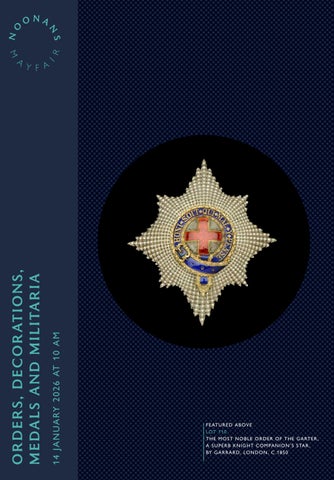
FE ATURED A BOVE LOT 110 THE MOS T N OBLE ORDER OF THE G A RTER , A S UPERB KN I G HT COMPA N I ON ’ S S TA R , BY G A RRA RD, LON DON , C .1850
AUC TION AN AU C TION OF: OR DE R S , DECO RAT I ON S , MEDAL S AN D M I LI TA RI A DATE 14 JA NUA RY 2026 AT 10AM VIE WIN GS ALL APPO INTMENTS TO VIE W PLE A SE CON TAC T 020 7016 1700 O R VIE W ING@ N O O N AN S .CO.UK A LL LOTS A RE AVAI L AB LE TO VI E W O N LI NE WI T H FULL IL LUST RAT I O N S AN D CO N DI T I ON R E P O RT S AT W W W. NOON AN S .CO.UK
CONTAC TS GENER AL AUC TION ENQUIRIES AUC TION S @N OON AN S .CO.UK M EDAL ENQUIRIES ME DA L S @ NOO N AN S .CO.UK ACCO U NT ENQUIRIES ACCOUNTS @N OON AN S .CO.UK
B AN K DETAIL S B ANK ER S: LLOY DS AD D RESS: 3 9 P I CC ADI LLY, LO N DON W1J 0 A A SO RT CODE: 30-96-64 ACCO U NT NO.: 00622865 SWIF T CODE: LOY D GB2L IB AN: GB70LOY D 30966400622865 BIC: LOYDG B21085
BOARD OF DIREC TOR S PIERCE NO ONAN CH A IR MA N AN D C EO NIM RO D D IX DE PUT Y CH AI RMAN ROBIN GR E VIL L E CH IE F OPE RAT I N G OF F I C ER C HR ISTOPHE R WEBB CLIE NT LIA I SO N D I REC TOR (N UMI SMAT I CS )
AUC TI O N A N D CL I E N T SE RVI CE S PHI L I PPA HE ALY A D M I NI S T RAT I O N D I RE C TO R ( A S S O C . D I R EC TOR) P H I LI P PA @NO O NA N S .CO.U K T. 0 2 0 7 0 1 6 1 7 7 5 A N N A HO PPE R ACCO U NT S A ND A D M I NI S T RAT I O N A NNA @NO O NA N S .CO.U K T. 0 2 0 7 0 1 6 1 7 0 0 SO FI A B USACC A A D M I NI S T RAT I O N S O F I A @NO O NA N S .CO.U K T. 0 2 0 7 0 1 6 1 7 0 0 LO UI S O CO N N O R A D M I NI S T RAT I O N LO U I S @NO O NA N S .CO.U K T. 0 2 0 7 0 1 6 1 7 0 0 CHR I STO PHE R M E L LO R - HI L L H E A D O F CLI E NT LI A I S O N ( A S S O C . D I RE C TOR) CH RI S TO P H E R@NO O NA N S .CO.U K T. 0 2 0 7 0 1 6 1 7 7 1 J AM E S C ARVE R CLI E NT LI A I S O N J B C@NO O NA N S .CO.U K T. 0 2 0 7 0 1 6 1 7 7 1
AT NO O NA NS O U R E X P E RT I S E E X T E NDS BE YO ND T H E K NOW L E DG E W I T H I N O U R S P E C I A L I S T DE PA RT ME NT S TO I NC LU DE A L L A S P E C T S O F O U R AU C T I O N H O U S E , F RO M O U R P H OTO G RA P H Y S T U DI O TO O U R A DVA NC E D P RO P RI E TA RY O NL I NE BI DDI NG S Y S T E M. We’re a close-knit team of experts with deep knowledge across our specialist subjects: banknotes, coins, detectorist finds, historical & art medals, jewellery, medals & militaria, tokens and watches. Focusing on these fascinating items, we share this expertise with an international community of sellers and buyers. Each sale item that passes through our Mayfair auction house is appraised by an expert recognised as a leading authority in a particular field of interest, ranging from ancient coins and military medals to jewellery and vintage watches. This depth of knowledge across all departments sets us apart from other generalist auctioneers.
CHR I S FI N CH HAT TO N CLI E NT LI A I S O N F I NCH @NO O NA N S .CO.U K T. 0 2 0 7 0 1 6 1 7 5 4 I AN AN D E R SO N CH I E F T E CH NI C A L O F F I CE R ( A S S O C . D I RE C TOR) I A N@NO O NA N S .CO.U K T. 0 2 0 7 0 1 6 1 7 5 1
M E DA L AN D M I L I TA R I A SPE CI A L I ST S N I M RO D D I X H E A D O F M E DA L D E PA RT M E NT ( B OA RD D I R EC TOR) NI M RO D @NO O NA N S .CO.U K T. 0 2 0 7 0 1 6 1 8 2 0 O L I VE R PE PYS M E DA L S P E CI A LI S T ( A S S O C . D I RE C TO R) O LI V E R@NO O NA N S .CO.U K T. 0 2 0 7 0 1 6 1 8 1 1 M AR K Q UAYL E M E DA L S P E CI A LI S T ( A S S O C . D I RE C TO R) M A RK@NO O NA N S .CO.U K T. 02 0 7 0 1 6 1 8 1 0
N OON A N S 1 6 BOLTON ST R EE T M AY FA I R LON DON W 1 J 8 BQ T. 0 2 0 7 0 1 6 1 7 0 0 W W W. NO O NA NS .CO. U K
SELL WITH US
BUY WI TH US
Respected worldwide for the breadth and depth of our specialist expertise, we can connect you to a broad, deep pool of potential buyers. Over the years, we’ve brought together an international community of people who share our particular passion. As recognised experts, with a vast store of freely available in-house knowledge and experience, we’ve earned the trust of buyers across the globe.
We’re here for you, whether you’re an experienced collector with a depth of knowledge or an occasional buyer attracted to a particular piece of jewellery or vintage watch.
Our fees are transparent. Unlike many other auction houses, we don’t charge for collecting your lots, photography or marketing and there’s no minimum lot charge. Not surprisingly, our position as a trusted authority, with deep global reach, often leads to the achievement of higher than expected prices at auction. Free valuation If you’re interested in selling your items and you’d like a free auction valuation, without obligation, our specialists will be happy to help. You can submit online or bring your sale item to a valuation day at our Mayfair auction house or at a regional venue. Alternatively, request a home visit.
Be assured that the item in question has been accurately described and photographed, detailing all available information, from its provenance to its current condition. Be certain that our price estimate is fair and sensible. Delve deep into our website and you’ll discover a vast store of helpful background data, including prices achieved for similar items at previous auctions. Informed and empowered, study our detailed online catalogue, then place your bid in complete confidence.
ORDE R O F SALE
O RDER S , D E CO R AT I ONS , ME DAL S A ND MI LI TA RIA W EDNESDAY 14 JANUARY 2026 AT 10AM A COLLECTION OF MEDALS TO THE ROYAL ARMY PAY CORPS, PART 2
1-100
THE COLLECTION OF THE LATE JAMES C. RISK, C.V.O., F.S.A.
101-327
GROUPS AND SINGLE DECORATIONS FOR GALLANTRY
328-362
SINGLE ORDERS AND DECORATIONS
363-368
CAMPAIGN GROUPS AND PAIRS
369-489
SINGLE CAMPAIGN MEDALS
490-656
LONG SERVICE MEDALS
657-684
MISCELLANEOUS
685-725
MINIATURE MEDALS
726-740
WORLD ORDERS AND DECORATIONS
741-789
MILITARIA
790-800
FORTHCOMING AUCTIONS W EDN ES DAY 11 FEBRUARY 2026 ORDER S , DECORATION S , MEDAL S AND MILITAR IA W EDN ESDAY 18 MARC H 2026 ORDER S , DECORATION S , MEDAL S AND MILITAR IA W EDNESDAY 15 APRIL 2026 ORDER S , DECORATION S , MEDAL S AND MILITAR IA
SU M M ARY OF I NFORMATI ON FO R BUY ERS
REGIS TERING TO BID
New clients must register online to bid (whether in person or in absentia). This can be done via our website www.noonans.co.uk Registrations will be subject to due diligence and Noonans reserves the right to cancel registrations. Once registered, any client bidding for the first time online will need to enter their card details so that a security check can be performed to authorise you to bid (www.noonans.co.uk >Your Account > Account Authorisation). This check is secure, your card details are not seen by us and no funds will be deducted. BIDDING P RIORITY
Please note that we prioritise executing commission bids as early as possible in order to secure the lot for you at the cheapest possible price. It is therefore entirely possible that a lot can sell at your top bid to another bidder. To avoid this happening we offer an optional ‘Plus 1’ bidding increment facility, whereby if the bidding is against you at your maximum bid the auctioneer will execute one further bid on your behalf. Please note that in the event of identical top bids priority is given to the first bid received. P L ACIN G B IDS
LIVE BIDDING VIA WWW.NOONANS.CO.UK You may bid in real time from your computer or mobile device. We provide an optional live video and audio feed of the auctioneer, allowing you to participate in much the same way as attending the auction. You may see your invoice and pay online directly after you’ve finished bidding. There is no additional charge for this facility.
ADVANCE BIDDING VIA WWW.NOONANS.CO.UK We strongly advise this method if you wish to leave bids in advance as it is the easiest, most accurate and flexible way to leave your bids and gives you total control over them right up to the point that the lot is offered for sale. Bids made online cannot be seen by others and only become live at the point the lot is being sold. Up until this time your bids can be easily altered or cancelled. An automated email is sent to confirm any changes made. There is no additional charge for online bidding. ADVANCE BIDDING VIA POST, EMAIL OR TELEPHONE Whilst we are still happy to execute all bids submitted to us using post, email or telephone, it should be noted that all bids left with us in these ways will be entered at our offices using exactly the same bidding facility to which all our clients have access. There is, therefore, no better way of ensuring the accuracy of your advance bids than to place them yourself online. If you are registered with Noonans you may bid by email to bids@noonans.co.uk or by telephone to 020 7016 1700. All bids placed by email or telephone must be received before 4 PM on the day preceding the sale. A bidding form is included in the back of this catalogue. If you wish to use this please fill it in carefully, to include all relevant information. Please ensure that you post this form so that it arrives, at the latest, the day before the sale. BIDDING IN THE AUCTION ROOM You are very welcome to attend the auction and bid in person if you are registered with Noonans.
Please note that the auction room is situated on the third floor of a Georgian building which doesn’t have a lift. You may pay for and collect your lots during the auction.
importation VAT rates for collectable items in the Terms and Conditions published on the Noonans website. PR I CE S R E A L I SE D
S AL ERO O M NOTICES
Should the description of a lot need to be amended after the publication of this catalogue, the amendments will appear automatically on the Noonans website, www.noonans.co.uk. All such amendments are also incorporated in the List of Saleroom Notices pertaining to this auction which are posted separately on the website. The auctioneer will refer to any notices at the time any affected lot is offered for sale. C ATA LOGUE IL LUS T RATIO N S & TH E INTE R N E T
Prospective bidders are reminded that the Noonans website features high-resolution colour illustrations of every lot in this auction. There may also be additional illustrations of any lot. B UY ER S ’ P REMIUM
The rate for this sale is 24% of the Hammer Price (+ VAT where applicable). IMP O RTATIO N VAT
Lots marked ‘X’ are subject to importation VAT of 5% on the Hammer Price unless re-exported outside the UK, as per Noonans Ts & Cs. From 1 January 2021 importation VAT may be levied by EU countries on lots sold by Noonans and subsequently imported into those countries. Although Noonans is unable to advise buyers on customs regulations in their country of domicile, there is further information regarding EU
The hammer prices of lots sold at Noonans auctions are posted at www.noonans.co.uk in real time and telephone enquiries are welcome from 9 AM on the day after the auction. PAYM E N T
You may access your invoice shortly after the hammer has fallen on your last lot. As we weigh lots at the time of cataloguing most shipping is already calculated, enabling you to settle your account and receive your lots in a timely fashion. Auction attendees may pay and collect during the course of the auction as soon as they have bid on their last lot. Full Terms and Conditions of Business are available to read in the back of this catalogue and on our website. CO N TAC TS
GENERAL SUPPORT ENQUIRIES auctions@noonans.co.uk 020 7016 1700 or from overseas (+44) 20 7016 1700 WEBSITE AND LIVE BIDDING SUPPORT ENQUIRIES Ian Anderson ian@noonans.co.uk 020 7016 1700 or from overseas (+44) 20 7016 1700
A Collection of Medals to the Royal Army Pay Corps, Par t 2 1
A fin fine Indian Mutiny ‘50th Anniversary’ C.B. group of six awarded to Colonel W. G. Small, Army Pay Department, late 20th, 59th, and 104th Regiments of Foot, who was Mentioned in Despatches for his services in both Afghanistan and Egypt, and was advanced Colonel as a reward for his services in connection with the Boer War The Most Honourable Order of the Bath, C.B., (Military) Companion’s breast badge, silver-gilt and enamel, converted for neck wear, on short section of neck riband for display purposes, gilding heavily rubbed, and green enamel to both obverse and reverse wreaths almost entirely lacking; Indian Mutiny 1857-59, 1 clasp, Lucknow (W. G. Small, 1st. Bn. 20th. Regt.); Afghanistan 1878-80, 2 clasps, Ahmed Khel, Kandahar (Lieut: W. G. Small. 59th. Foot.); Kabul to Kandahar Star 1880 (Lieut. W. G. Small. 59th. Foot.); Egypt and Sudan 1882-89, undated reverse, 1 clasp, Gemaizah 1888 (Major Paymaster W. G. Small. A.P.D.); Khedive’s Star, undated, unnamed as issued, minor edge bruising, and light pitting to Egypt Medal from Star; the CB good fine, otherwise generally very fine (6) £3,000-£4,000
www.noonans.co.uk all lots are illustrated on our website and are subject to buyers’ premium at 24% (+VAT where applicable)
A Collection of Medals to the Royal Army Pay Corps, Part 2
C.B. London Gazette 28 June 1907: ‘On the occasion of the fiftieth anniversary of the Military Operations in India in 1857.’ One of only 9 Kabul to Kandahar Stars awarded to the 59th Regiment of Foot. William George Small was born at Westmeath, Ireland, on 29 March 1842 and originally attested as a boy soldier in the 20th Regiment of Foot in July 1856, seeing active service with them in India during the Great Sepoy Mutiny, being present at the actions at Chanda, Umeerpore, Sultanpore, Lucknow, Curdah, and Musjeedia. Advanced Colour-Sergeant, he was commissioned and sign in the 59th Regiment of Foot on 18 December 1867, and was appointed Adjutant of the 59th Foot on 28 October 1868. Promoted Lieutenant on 28 October 1871, he served during the Second Afghan War firstly as Baggage Master, Southern Afghanistan Field Force, from 31 December 1878 to 11 February 1879; then as Assistant Field Engineer to the Kandahar Field Force from 12 February to 14 September 1879; and finally as Officer in Charge Field Treasure Chest from 29 March to 26 September 1880. Present at the actions at Ahmed Khel, Urzoor, and Kandahar, for his services he was Mentioned in LieutenantGeneral Sir Frederick Roberts’ Despatch of 3 December 1880. Small was promoted Captain on transfer to the 104th Fusiliers on 10 November 1880, and for his services in Afghanistan he was promoted Brevet Major on 2 March 1881. He transferred to the Army Pay Department as Paymaster on 12 May 1881, and served in Egypt and the Sudan as Chief Paymaster to the Suakim Field Force on 5 December 1888, being present at the action at Gemaizah. For his services in Egypt he was Mentioned in Major General Sir Frederick Grenfell’s Despatch. Promoted Major and appointed Staff Paymaster on 28 September 1894, he was advanced Lieutenant-Colonel on 28 September 1899, and retired on 23 September 1900, but was temporarily reemployed on 23 January 1902 and was promoted Colonel as a reward for his services in connection with the War in South Africa on 23 July 1903. He was appointed a Companion of the Order of the Bath in the Indian Mutiny 50th Anniversary Honours’ List in June 1907, and died in Battersea, London on 4 October 1931. Sold with a display of the recipient’s ribands, signed by the recipient in December 1910; a coloured portrait photograph of the recipient in later life; various carbon copies of official letters sent and received in the latter 19th Century; and other ephemera and copied research.
www.noonans.co.uk all lots are illustrated on our website and are subject to buyers’ premium at 24% (+VAT where applicable)
A Collection of Medals to the Royal Army Pay Corps, Part 2 2
An inter-War C.B., Great War C.M.G. group of even awarded to Colonel G. W. Fitton, Army Pay Department and Royal Army Pay Corps, late Manchester Regiment, who was four times Mentioned in Despatches, and awarded the Serbian Order of the White Eagle, Third Class The Most Honourable Order of the Bath, C.B., (Military) Companion’s neck badge, silver-gilt and enamel, with short section of neck riband for display purposes; The Most Distinguished Order of St. Michael and St. George, C.M.G., Companion’s neck badge, silver-gilt and enamel, with short section of neck riband for display purposes; Queen’s South Africa 1899-1902, 3 clasps, Cape Colony, Orange Free State, Transvaal (Capt. G. W. Fitton A.P.D.) engraved naming; King’s South Africa 1901-02, 2 clasps, South Africa 1901, South Africa 1902 (Maj. G. W. Fitton A.P.D.) engraved naming; British War and Victory Medals, with M.I.D. oak leaves (Col. G. W. Fitton.); Serbia, Kingdom , Order of the White Eagle, Military Division, Knight’s [sic] breast badge, silver-gilt and enamel, unmarked, blue enamel damage to reverse pendelina on last, traces of adhesive throughout, otherwise good very fine and better (7) £1,400-£1,800 C.B. London Gazette 4 June 1921. C.M.G. London Gazette 1 January 1918: ‘In recognition of valuable services in connection with the War.’ M.I.D. London Gazettes 10 September 1901 and 31 October 1902 (both South Africa); and 12 February and 14 June 1918 (both Egypt) Serbian Order of the White Eagle, Third Class, with Swords London Gazette 15 February 1917. Guy William Fitton was born in Kensington, London, on 24 January 1862 and was commissioned Lieutenant in the Manchester Regiment on 9 September 1882. Posted to the 2nd Battalion in India, he was promoted Captain on 18 March 1890 and was seconded for service with the Army Pay Department on 1 June 1895. Permanently transferred to the Army Pay Department on 28 March 1899, he served with them in South Africa during the Boer War, and was twice Mentioned in Despatches, first in Lord Roberts’ Despatch of 4 September 1901, and then in Lord Kitchener’s final despatch of 23 June 1902. For his services he was appointed Staff Paymaster on 22 August 1902, and was promoted Major on 9 September 1902. Fitton was promote Lieutenant-Colonel on 22 August 1908, and then Colonel on 5 July 1911, being appointed Chief Paymaster that same date. Following the outbreak of the Great War he was posted as Command Paymaster to Malta, and served as Chief Paymaster to the Egyptian Expeditionary Force from 2 June 1917. For his services during the Great War he was twice Mentioned in Despatches, and was appointed a Companion of the Order of St. Michael and St. George. Subsequently appointed a Companion of the Order of the Bath in the 1921 Birthday Honours’ Kist, he retired on 24 June 1922, and died on 9 September 1939. Sold with copied research.
www.noonans.co.uk all lots are illustrated on our website and are subject to buyers’ premium at 24% (+VAT where applicable)
A Collection of Medals to the Royal Army Pay Corps, Part 2 3
A post-War C.B., Second War C.B.E., Great War ‘Egyptian theatre’ M.C. group of twelve awarded to Brigadier F. C. Williams, C.B.E., Royal Army Pay Corps, late Royal Army Ordnance Corps, who was additionally Mentioned in Despatches for pr e-War Palestine The Most Honourable Order of the Bath, C.B., (Military) Companion’s neck badge, silver-gilt and enamel, on short section of neck riband for display purposes; The Most Excellent Order of the British Empire, C.B.E. (Military) Commander’s 2nd type neck badge, silver-gilt and enamel, on short section of neck riband for display purposes; Military Cross, G.V.R., unnamed as issued; 1914-15 Star; (Lieut. F. C. Williams. A.O.D.) British War and Victory Medals (Major F. C. Williams.); General Service 1918-62, 1 clasp, Palestine, with M.I.D. oak leaf (Lt. Col. F. C. Williams. R.A.P.C.); 1939-45 Star; Burma Star; Defence and War Medals 1939-45; Coronation 1953, unnamed as issued, mounted court-style for display, the Great War awards very fine; the rest nearly extremely fine (12) £1,800-£2,200 C.B. London Gazette 1 June 1953. C.B.E. London Gazette 1 January 1943. M.C. London Gazette 3 June 1918: ‘For distinguished service in connection with Military Operations in Egypt.’ M.I.D. London Gazette 15 September 1939 (Palestine). Frederick Christian Williams was Born in Kilburn, Middlesex, on 25 September 1891 and by the time of the outbreak of the Great Wall was an incorporated accountant. He was commissioned temporary left tenant in the army ordinance department on 4 September 1915 and served during the Great war in Salonica, Greek Macedonia, Serbia, Bulgaria, European, Turkey, and the Aegean Islands. Promoted temporary Captain on 1 December 1915, he later served with 60th Division and 4th Cavalry Division in Egypt and Syria, and for his services he was awarded the Military Cross. Transferring to the Royal Army Pay Corps in 1925, Williams was appointed Paymaster in 1926 and was promoted Major and Staff Paymaster on 2 February 1928. Promoted Lieutenant-Colonel on 24 January 1937, he served in Palestine from September 1938 and for his services there was Mentioned in Despatches. Promoted Acting Colonel and Chief Paymaster in West Africa in July 1940 he served in West Africa until February 1942 before proceeding to Persia and Iraq, and was appointed a Commander of the Order of the British Empire in the 1943 New Year’s Honours’ List. He subsequently served in India as Deputy Paymaster-in-Chief, attached to Lord Mountbatten’s Headquarters, and was promoted Colonel on 3 December 1944. Returning to the U.K. following the cessation of hostilities he was seconded to the War Office as Deputy Paymaster-in-Chief, and was promoted Brigadier and Chief Paymaster on 14 May 1951. For his services he was appointed a Companion of the Order of the Bath in the 1953 Coronation Honours’ List. He retired from the Army on 25 September 1953 and rejoined his old accountancy firm in London where he worked until retirement. He died in Folkestone, Kent, on 12 March 1970. Sold with copied research.
www.noonans.co.uk all lots are illustrated on our website and are subject to buyers’ premium at 24% (+VAT where applicable)
A Collection of Medals to the Royal Army Pay Corps, Part 2 4
A Great War C.M.G., inter-War C.B.E. group of four awarded to Colonel and Chief Paymaster C. C. Todd, Royal Army Pay Corps, late Royal Dublin Fusiliers and Army Pay Department The Most Distinguished Order of St. Michael and St. George, C.M.G., Companion’s neck badge, silver-gilt and enamel, on eminiature width section of neck riband, in Garrard, London, case of issue; The Most Excellent Order of the British Empire, C.B.E., (Military) Commander’s 1st type neck badge, silver-gilt and enamel, with short section of neck riband for display purposes, in Garrard, London, case of issue; Queen’s South Africa 1899-1902, 5 clasps, Tugela Heights, Orange Free State, Relief of Ladysmith, Transvaal, Laing’s Nek (Capt. C. C. Todd. Rl. Dub. Fus.) engraved naming; British War Medal 1914-20 (Lt. Col. C. C. Todd.) the last two mounted as worn; together with the recipient’s related miniature awards, the CMG in gold and enamel, the CBE a 1st type in silver-gilt and enamel, on 2nd type riband, these mounted as worn; and also with a Royal Dublin Fusiliers commemorative Medal 1662-1911, bronze, the edge engraved ‘Major C. C. Todd’, with riband bar engraved ‘1892-98’, and integral top ‘Old Toughs’ brooch bar, the cases for the CMG and CBE both rather scuffed; the orders and medals good very fine and better (4) £1,400-£1,800 C.M.G. London Gazette 24 January 1917. C.B.E. London Gazette 3 June 1930. Charles Campbell Todd was born on 6 May 1870 and was commissioned Second Lieutenant in the 4th Battalion, Royal Irish Rifles on 18 April 1889. He transferred to the Regular Army with a commission in the Royal Dublin Fusiliers on 28 September 1892, and was promoted Lieutenant on 10 July 1895. He transferred further to the Army Pay Department as Captain and Paymaster on 12 May 1898, and served with them in South Africa during the Boer War. Promoted Major and Staff Paymaster on 9 November 1898, he was advanced Lieutenant-Colonel on 9 November 1913, and following the outbreak of the Great War he was appointed temporary Colonel and Chief Paymaster. For his services during the Great War he was appointed a Companion of the Order of St. Michael and St, George in January 1917. Promoted Colonel on 8 June 1920 and appointed Chief Paymaster, he was further honoured by being appointed a Commander of the Order of the British Empire in the 1930 Birthday Honours’ List, and retired in 1931. He died, tragically, in a house fire at his home in Southsea, Hampshire, on 27 December 1956. Sold with the recipient’s original Bestowal Document for the Order of St. Michael and St. George, together with a copy of the statutes of the order; various portrait photographs of the recipient; and other ephemera and copied research.
www.noonans.co.uk all lots are illustrated on our website and are subject to buyers’ premium at 24% (+VAT where applicable)
A Collection of Medals to the Royal Army Pay Corps, Part 2 5
A Great War ‘Home Service’ C.B.E. group of three awarded to Colonel F. M. Watkins, Royal Army Pay Corps, late Royal Irish Regiment and Army Pay Department, who was Mentioned in Despatches for his services in inter-War Mesopotamia The Most Excellent Order of the British Empire, C.B.E., (Military) Commander’s 1st type neck badge, silver-gilt and enamel, with full neck riband, in Garrard, London, case of issue; India General Service 1895-1902, 2 clasps, Punjab Frontier 1897-98, Samana 1897 (Lieut. F. M. Watkins 2d. Bn. Ryl. Ir: Regt.); General Service 1918-62, 1 clasp, Iraq, with M.I.D. oak leaves (Col. F. M. Watkins.) the campaign medals mounted court-style for display, good very fine (3) £500-£700 C.B.E. London Gazette 3 June 1919. Fredric Mostyn Watkins was born in Hinton Charterhouse, Somerset, on 26 February 1873 and was commissioned Second Lieutenant in the 3rd (Militia) Battalion, Wiltshire Regiment on 24 January 1891. Promoted Lieutenant on 5 December 1891, he transferred to a Regular commission as Second Lieutenant in the Royal Irish Regiment on 26 April 1893, and was promoted Lieutenant on 31 July 1895. After seeing active service with them during operations on the Punjab Frontier, he transferred as Captain to the Army Pay Department on 8 September 1898, and then to the Army Accounts Department on 1 May 1905. Promoted Major and Staff Paymaster on 4 September 1909, he reverted back to the Army Pay Department on 31 December 1909, and was promoted Lieutenant-Colonel and Staff Paymaster on 4 September 1914, and then Colonel and Chief Paymaster on 25 March 1918. For his services at home during the Great War he was appointed a Commander of the Order of the British Empire. Watkins was appointed Command Paymaster in Baghdad in 1919, and served there with the Mesopotamian Expeditionary Force, being Mentioned in Despatches. He retired on 25 January 1933, and died in Folkestone, Kent, on 23 April 1946.
www.noonans.co.uk all lots are illustrated on our website and are subject to buyers’ premium at 24% (+VAT where applicable)
A Collection of Medals to the Royal Army Pay Corps, Part 2 6
A Great War C.B.E. pair awarded to Colonel T. G. C. Bliss, Army Pay Department, late Lancashire Fusiliers The Most Excellent Order of the British Empire, C.B.E., (Military) Commander’s 1st type neck badge, silver-gilt and enamel, the reverse upper arm engraved ‘Colonel T. G. C. Bliss R.A.P.C. 1919’, with neck riband; British War Medal 1914-20 (Col. T. G. C. Bliss.) minor blue enamel damage to one arm of first, good very fine (2) £240-£280 C.B.E. London Gazette 3 June 1919. Thomas Gordon Cumming Bliss was born in Derha Dun, India, on 30 August 1869 and was commissioned Second Lieutenant in the 3rd Battalion, Lancashire Fusiliers on 9 November 1889. He served with the 2nd Battalion in the campaign in the Sudan under Sir Herbert Kitchener in 1898, ands was present at the Battle of Khartoum (awarded the Queen’s Sudan Medal, and Khedive’s Sudan Medal with clasp). He was also present during the Occupation of Crete in 1898. He transferred to the Army Pay Department as a Paymaster on 29 April 1899, and and was promoted Captain on 17 October 1899; Major and Staff Paymaster on 12 January 1911; Lieutenant-Colonel on 12 January 1916; and temporary Colonel and Chief Paymaster on 1 September 1918. He served during the early stages of the Great War in Tsing-Tau from 23 September to 7 November 1914 (which qualified him for the British Empire Medal), and was appointed a Commander of the Order of the British Empire in the 1919 Birthday Honours’ List. He retired with the rank of honorary Colonel on 2 December 1922, and died on 24 October 1949. Sold with copied research.
www.noonans.co.uk all lots are illustrated on our website and are subject to buyers’ premium at 24% (+VAT where applicable)
A Collection of Medals to the Royal Army Pay Corps, Part 2 7
A post-War C.B.E. [inter-War M.B.E.] group of ten awarded to Brigadier H. W. T. Marden, Royal Army Pay Corps, late Dorsetshire Regiment, who was twice Mentioned in Despatches The Most Excellent Order of the British Empire, C.B.E., (Military) Commander’s 2nd type neck badge, silver-gilt and enamel, with full neck riband, in Garrard, London, case of issue; General Service 1918-62, 2 clasps, Palestine, Malaya, second clasp loose on riband, as issued, with copy M.I.D. oak leaf (Major H. W. T. Marden. R.A.P.C.); 1939-45 Star; Africa Star, 1 clasp, 1st Army; Italy Star; Defence and War Medals 1939-45, with M.I.D. oak leaf; Korea 1950-53, 1st issue (Col. H. W. T. Marden. M.B.E. Staff.); U.N. Korea 1950-54, unnamed as issued; Coronation 1953, unnamed as issued, mounted as worn, generally good very fine and better (10) £500-£700 C.B.E. London Gazette 2 January 1956. The original Recommendation, dated 19 August 1955, states: ‘This officer has been Deputy Paymaster-in-Chief in the War Officer since March 1954, following tours overseas as Command Paymaster in West Africa and in Korea. His present responsibilities are very heavy indeed as the Paymaster-in-Chief must be away on duty as Inspector of Pay Services for considerable periods of each year. Colonel Marden has shown a very high degree of ability, patience, and tact and has been a complete success. He has worked long hours, taken little leave, and has given excellent service in the interests both of the Corps and of the Army. Colonel Marden has 38 years’ commissioned service and would now have been a Brigadier, but promotion was not possible owing to medical unfitness due to service abroad, He has now happily recovered, and has proved a most conscientious and hardworking deputy, during this War Officer tour. He is very strongly recommended for the C.B.E.’ M.B.E. London Gazette 1 January 1923. Henry Walter Ternell Marden was born at Rimpton, Somerset, on 2 January 1899 and was commissioned Second Lieutenant from the Royal Military College, Sandurst, into the Dorsetshire Regiment on 21 August 1918. Promoted Lieutenant on 21 February 1920, he was appointed a Member of the Order of the British Empire in the 1923 New Year’s Honours’ List. He transferred to the Royal Army Pay Corps on 22 August 1932, and was promoted Captain on 22 August 1934, and Major on 16 March 1939. He served with the R.A.P.C. in pre-War Palestine, for which he was Mentioned in Despatches (London Gazette 22 December 1939), and saw further service during the Second World War, again being Mentioned in Despatches for his services in Italy (London Gazette 29 November 1945). Promoted Lieutenant-Colonel on 7 April 1949, and Colonel on 19 December 1952, he was posted to the War Office as Deputy Paymaster-in-Chief on 5 March 1954, and was advanced to a Commander of the Order of the British Empire in the 1956 New Year’s Honours’ List. He retired with the honorary rank of Brigadier on 17 January 1959, and died in Rimpton on 2 April 1991. Sold with copied research.
www.noonans.co.uk all lots are illustrated on our website and are subject to buyers’ premium at 24% (+VAT where applicable)
A Collection of Medals to the Royal Army Pay Corps, Part 2 8
A Great War ‘Egypt operations’ O.B.E. group of four awarded to Lieutenant-Colonel A. Morland, Army Pay Department, who was twice Mentioned in Despatches The Most Excellent Order of the British Empire, O.B.E., (Military) Officer’s 1st type, breast badge, silver-gilt, hallmarks for London 1919; Queen’s South Africa 1899-1902, 3 clasps, Cape Colony, South Africa 1901, South Africa 1902, top lugs removed from CC clasp, with the date clasp block loose on riband (Capt. A. Morland, A.P.D.) engraved naming; British War and Victory Medals, with M.I.D. oak leaves (Lt. Col. A. Morland.) mounted court-style for display, good very fine (4) £300-£400 O.B.E. London Gazette 3 June 1919. M.I.D. London Gazettes 21 July 1917 (Salonika) and 5 June 1919 (Egypt). Algernon Morland was born in Dinder, Somerset, on 24 November 1871 and was commissioned Second Lieutenant in the Suffolk Regiment from the Royal Military College, Sandhurst, on 19 July 1893. He was promoted Lieutenant on 24 March 1897, before transferring to the Army Pay Department as a Captain and Paymaster on 28 January 1899. He served with the Army Pay Department in South Africa during the Boer War, and was promoted Major on 23 January 1910. He saw active service during the Great War as Chief Paymaster, Greek Macedonia, Serbia, Bulgaria, European Turkey and the islands of the Aegean Sea from 20 June 1916 to 1 September 1917, and was Mentioned in Despatches for his services in Salonika. Proceeding to Egypt for service with the Egyptian Expeditionary Force on 28 August 1918, he was again Mentioned in Despatches and was appointed an Officer of the Order of the British Empire. Placed on Retired Pay with the rank of Lieutenant-Colonel on 3 May 1922, he died in Kew, London, on 2 November 1947. Sold with copied research.
www.noonans.co.uk all lots are illustrated on our website and are subject to buyers’ premium at 24% (+VAT where applicable)
A Collection of Medals to the Royal Army Pay Corps, Part 2 9
A Great War M.B.E. group of fiv five awarded to Major E. W. Dawkins, Royal Army Pay Corps The Most Excellent Order of the British Empire, M.B.E., (Military) Member’s 1st type breast badge, silver, hallmarks for London 1918; Queen’s South Africa 1899-1902, 5 clasps, Cape Colony, Orange Free State, Transvaal, South Africa 1901, South Africa 1902, unofficial rivets between State and date clasps (675 Corpl: E. W. Dawkins, A.P.D. [sic]); Defence Medal; Jubilee 1935, unnamed as issued; Army L.S. & G.C., G.V.R., 1st issue (675 S.Q.M. Sjt: E. W. Dawkins. A.P.C.) mounted for display, contact marks, nearly very fine (5) £300-£400 M.B.E. London Gazette 12 December 1919. Ernest Walton Dawkins was born in Southampton on 24 December 1876 and attested for the Hampshire Regiment on 2 April 1895, having previously served in the Regiment’s 2nd Volunteer Battalion. He transferred to the Army Pay Corps on 30 June 1897, was promoted Corporal on 30 June 1898, and served with them in South Africa during the Boer War from 19 January 1901. He was promoted Sergeant on 30 June 1903; Staff Sergeant on 30 June 1905; and Staff Quartermaster Sergeant on 30 June 1908. He was awarded his Long Service and Good Conduct Medal per Army Order 333 of 1913. Promoted Staff Sergeant Major on 9 May 1914, he was commissioned Lieutenant in the Army Pay Department on 12 February 1915, and was promoted Captain on 12 February 1918. For his services during the Great War at home he was created a Member of the Order of the British Empire. Promoted Major on 12 February 1930, he retired on 1 November 1935, and died in Salisbury on 10 December 1952. Sold with copied research.
www.noonans.co.uk all lots are illustrated on our website and are subject to buyers’ premium at 24% (+VAT where applicable)
A Collection of Medals to the Royal Army Pay Corps, Part 2 10
An inter-War M.B.E. group of seven awarded to Major S. Holman, Royal Army Pay Corps The Most Excellent Order of the British Empire, M.B.E., (Military) Member’s 1st type breast badge, silver, hallmarks for London 1929; British War Medal 1914-20 (1025 W.O. Cl.2 S. Holman. A.P.C.); General Service 1918-62, 1 clasp, Palestine (Lieut. S. Holman. M.B.E. R.A.P.C.); War Medal 1939-45; Jubilee 1935, unnamed as issued; Coronation 1937, unnamed as issued; Army L.S. & G.C., G.V.R., 1st issue (1025 S.Q.M. Sjt: S. Holman. A.P.C.) mounted for display, good very fine (7) £300-£400 M.B.E. London Gazette 3 June 1930. Stephen Holman was born in Kingston-upon-Thames on 18 March 1882 and attested for the Dorsetshire Regiment in London on 18 September 1900, having previously served in the 3rd Volunteer Battalion, East Surrey Regiment. He transferred to the Army Pay Corps on 3 December 1901, and was advanced Squadron Quartermaster Sergeant on 12 February 1918, having spent almost the entirety of the Great War in Gibraltar (therefore not entitled to a Victory Medal). He was awarded his Long Service and Good Conduct Medal on 18 September 1918, and was promoted Staff Sergeant Major on 10 January 1921. Appointed a Member of the Order of the British Empire in the 1930 Birthday Honours’ List, he was commissioned Lieutenant in the Royal Army Pay Corps on 6 November 1931, and was promoted Captain on 1 August 1938, and Major on 6 November 1943. He retired due to ill health on 1 March 1945, and died in Leicester on 25 March 1945. Sold with copied research.
www.noonans.co.uk all lots are illustrated on our website and are subject to buyers’ premium at 24% (+VAT where applicable)
A Collection of Medals to the Royal Army Pay Corps, Part 2 11
A post-War M.B.E., Second War ‘North West Europe’ M.C. group of eight awarded to Lieutenant-Colonel W. B. Wilton, Royal Army Pay Corps, late Royal Army Medical Corps and Royal Engineers, who was awarded the M.C. for his gallantry with 16 Armoured Squadron, Royal Engineers, at Cloppenburg on 13 April 1945 The Most Excellent Order of the British Empire, M.B.E., (Military) Member’s 2nd type breast badge, silver; Military Cross, G.VI.R. reverse officially dated 1945; 1939-45 Star; France and Germany Star; Defence and War Medals 1939-45; General Service 1918 -62, 1 clasp, Malaya, G.VI.R. (Capt. W. B. Wilton. M.C. R.A.P.C.) rank officially corrected; Efficiency Medal, G.VI.R., 2nd issue, Territorial (Lt. W. B. Wilton. R.E.) mounted court-style for wear, good very fine (8) £1,000-£1,400 M.B.E. London Gazette 13 June 1957. The original Recommendation, dated 1 March 1957, states: ‘Major Wilton has been employed in the Paymaster-in-Chief’s Directorate for nearly three years. As Staff Officer responsible for the personnel administration of the Royal Army Pay Corps, he has been a marked success. During the past two years he has had the major share of organising and controlling the implementation of the “Paymasters with Units” scheme introduced by AC1.401 of 1955, including the planning and training of accepted candidates. In this, as in all his other duties, this officer has shown exceptional qualities of foresight and imagination. In his spare time outside normal working hours he has recently produced a fourth edition of his booklet ‘Guide to Army Officers’ Pay, Allowances, and Financial Affairs”, which has received high recommendation from all sources. Major Wilton is an officer without standing knowledge and experience of all problems affecting pay accounting in the Army, and in all his work he has shown selfless devotion to duty.’ M.C. London Gazette 12 July 1945: ‘In recognition of gallant and distinguished services in North West Europe.’ The original Recommendation, dated 22 April 1945, states: ‘during the attack on Cloppenburg on Friday, 13 April 1945, the left forward company became temporarily held up by determined mortar and machine gun fire from the built-up area to its immediate front and left flank. It became necessary to deal with certain houses from which the small arms fire was coming and one which was being used as the mortar operating post. Flame-thrower and the supporting troop of tanks were not at that time available but this officer, who had moved up with his A.V.R.E. across the bridge gained by the proceeding company, quickly appreciated the situation and reported on his own initiative to the company command that he was more than prepared and willing to support the company by firing his “petard” against the houses were opposition had been encountered, and a new plan was therefore quickly made. This officer, although under a heavy fire from mortar and machine guns, with the utmost cheerfulness and without any hesitation, moved up into position in an area suspected to contain bazookas, but from which he could engage these houses. From this position he was able to support the leading troops by demolishing in turn every house from which opposition was encountered or suspected. During this action this officer showed great determination and complete disregard for his own safety in his desire to assist the infantry forward, and was largely responsible for the success achieve by the company, as his shooting obviously had a great demoralising effect on the hitherto stubborn enemy.’ Walter Basil Wilton was born in London on 12 September 1917 and initially attested for the Royal Army Medical Corps (Territorial Force) in London on 13 April 1939. Embodied on 27 August 1939, he was promoted Corporal on 7 June 1940, before being granted an emergency commission as a Second Lieutenant in the Royal Engineers on 12 April 1941. Promoted Lieutenant on 1 October 1942, he served during the Second World War with 16 Assault Squadron, R.E., in North West Europe from 16 August 1944, and was wounded at Le Harve on 11 September 1944. Promoted Captain on 25 February 1945, for his gallantry at Cloppenburg on 13 April 1945 he was awarded the Military Cross. Wilton transferred to the Royal Army Pay Corps on 23 April 1946, and was awarded his Efficiency Medal on 10 November 1950. Promoted Major on 20 June 1953, he served as General Staff Officer Class II at the War Office from 25 August 1954, and for his services there was appointed a Member of the Order of the British Empire. Promoted Lieutenant-Colonel and appointed Staff Paymaster on 1 October 1957, he retired on 14 September 1968, and died in Chertsey, Surrey, on 5 March 1987. Sold with a copy of the booklet ‘A Guide to the Maintenance and Control of Regimental Funds’, written by the recipient; and copied research.
www.noonans.co.uk all lots are illustrated on our website and are subject to buyers’ premium at 24% (+VAT where applicable)
A Collection of Medals to the Royal Army Pay Corps, Part 2 12
A post-War M.B.E. group of fiv five awarded to Lieutenant-Colonel T. R. Shimmin, Royal Army Pay Corps The Most Excellent Order of the British Empire, M.B.E., (Military) Member’s 2nd type, breast badge, silver; War Medal 1939-45; General Service 1918-62, 1 clasp, Malaya, G.VI.R. (10400823 Sjt. T. R. Shimmin. R.A.P.C.); Coronation 1953, unnamed as issued; Army L.S. & G.C., E.II.R., 2nd issue, Regular Army (10400823W.O. Cl. 2. T. R. Shimmin. RAPC.) mounted as worn, good very fine (5) £180-£220 M.B.E. London Gazette 1 January 1970. The original Recommendation, dated 29 July 1969, states: ‘Lieutenant T. R. Shimmin, who was commissioned from the ranks in 1967, is in charge of testing of computer programs affecting the soldier pay systems. Since he rejoined this unit he has been engaged in providing test facilities on a third generation computer requiring mammoth research into new procedures. His insight and progressive thinking have been major factors in developing more efficient procedures and for many months he has worked long hours day and night diagnosing and correcting errors in program logic. Although junior in rank he has made a major contribution to developing highly sophisticated management techniques, thereby greatly improving resources utilisation, providing more accurate prediction of target dates and tangible cost savings by elimination of computer time wasted. He has demonstrated professional ability of a high order very much above that to be expected of his rank and service, and also a degree of devotion to duty and sacrifice of personal interests which places him head and shoulders above his colleagues.’ Terence Ridgeway Shimmin was born on the Isle of Man on 10 December 1925 and enlisted in the Royal Army Pay Corps on 9 December 1943. Advanced Staff Quartermaster Sergeant on 5 April 1956, he was awarded his Long Service and Good Conduct Medal on 8 December 1961, and was promoted Staff Sergeant Major on 22 August 1963. He was commissioned Lieutenant and Paymaster on 14 August 1967, with seniority from 12 August 1965, and was promoted Captain on 14 August 1969. Appointed a Member of the Order of the British Empire in the 1970 New Year’s Honours’ List, he was promoted Major on 22 September 1975, and Lieutenant-Colonel on 25 November 1979, and retired on 25 November 1981. He died in Fareham, Hampshire, on 7 May 2016. Sold with copied research.
www.noonans.co.uk all lots are illustrated on our website and are subject to buyers’ premium at 24% (+VAT where applicable)
A Collection of Medals to the Royal Army Pay Corps, Part 2 13
A post-War M.B.E. group of six awarded to Major J. H. A. Bryden, Royal Army Pay Corps, late Royal Artillery The Most Excellent Order of the British Empire, M.B.E., (Military) Member’s 2nd type, breast badge, silver; Africa Star; Defence and War Medals 1939-45; General Service 1918-62, 1 clasp, Malaya, G.VI.R. (Capt. J. H. A. Bryden. R.A.); General Service 1962 -2007, 3 clasps, Malay Peninsula, Borneo, Northern Ireland, unofficial retaining rods between clasps (Major J. H. A. Bryden. R.A.P. £300-£400 C.) mounted court-style as worn, nearly extremely fine (6) M.B.E. London Gazette 12 June 1976. The original Recommendation, dated 14 November 1975, states: ‘Major Bryden retires from the Army in April 1976 having completed 36 years of dedicated service. He applied for and was granted an extension of one year to his service in order that he might see the 1st Battalion, Scots Guards through its third tour in Northern Ireland, all of which he has attended, and also cover the move from Germany to London. This is indicative of his devotion to duty, even in his 56th year. He was commissioned into the Royal Artillery in 1939 and served with the Indian Army for five years, seeing active service in North Africa. In 1957, when a Deputy Assistant Adjutant and Quartermaster General on the staff of a formation headquarters, he took the unprecedented step of transferring into the Royal Army Pay Corps. He did this against the wishes of his superior officers, for he was both successful and staff trained, but with foresight and determination Major Bryden pursued his course because he realised that there was at that time a superfluity of officers of his age and seniority in the Royal Regiment of Artillery, and he had to take into account reasons of personal necessity. He has served the 1st Battalion Scots Guards as the Paymaster in an exemplary way for 12 years. He has been with a battalion on active service in Malaysia and Northern Ireland, and was in Sharjah unaccompanied for nine months. During the last decade, he has experienced many changes in the Battalion, and within his own Corps and its methods. He has unfailingly adapted to them all and given himself tirelessly to his work, in which he has a long established reputation second to none. A person of great character and splendid sense of humour he is held in respect and earns a loyalty of everyone with whom he comes in contact. He has devoted a large proportion of his life to the good of battalion and the welfare of his soldiers, and the number of Scots Guardsmen, now scattered far and wide, who owe him a debt of thanks is very large. He is always prepared to give his wise council, based on his expert knowledge and his wealth of experience, to anyone who seeks it, not only within the Battalion but also from outside it. He has willingly undertaken many tasks beyond the call of his normal duty and fulfilled them in an admirable way. When he retires and era will pass, but it is most appropriate that his son is to perpetuate his name in the Regiment to which he has given such outstanding service. This long service is synonymous with a selfless devotion to duty which richly merits official recognition.’ John Hewgill Anderson Bryden was born in Shoeburyness, Essex, on 30 April 1920 and was commissioned Second Lieutenant in the Royal Artillery on 3 July 1939. Promoted Lieutenant on 3 January 1941; Captain on 1 July 1946; and Major on 3 July 1952, he attended the Staff College, Camberley, from 23 January to 16 December 1953 and was appointed a Deputy Assistant Adjutant and Quartermaster General in February 1954. He transferred to the Royal Army Pay Corps on 9 January 1957, and was posted as Paymaster to the 1st Battalion, Scots Guards in June 1964. He retired on 30 April 1976, and was appointed a Member of the Order of the British Empire in that year’s Birthday Honours’ List. He died in Edinburgh on 12 January 2008. Sold with copied research.
www.noonans.co.uk all lots are illustrated on our website and are subject to buyers’ premium at 24% (+VAT where applicable)
A Collection of Medals to the Royal Army Pay Corps, Part 2 14
A post-War M.B.E. group of six awarded to Major P. G. Snow, Royal Army Pay Corps The Most Excellent Order of the British Empire, M.B.E., (Military) Member’s 2nd type breast badge, silver, in Royal Mint case of issue; 1939-45 Star; Africa Star; Defence and War Medals 1939-45; Africa General Service 1902-56, 1 clasp, Kenya (Capt. P. G. Snow. M.B.E. R.A.P.C.); together with the recipient’s related miniature awards, mounted as worn (but for some reason omitting the 1939-45 Star); aluminium identity discs; and the recipient’s riband bar, showing all six awards, good very fine (6) £180-£220 M.B.E. London Gazette 2 January 1953. The original Recommendation, dated August 1952, states: ‘Captain P. G. Snow has been Messing Officer of the Royal Army Pay Corps Training Centre since 1948. By his efforts this Unit has built up and consistently maintained a very high standard of messing. The Deputy District Commander of Salisbury Plain District, in his 1951 Annual Administrative Report on this Training Centre, said “The standard of the food was excellent. It is in my opinion the best-fed Unit in the District, The Messing Officer, Captain Snow, is doing a fine job”. The number of rank and file for whose feeding he is responsible is approximately 1,200. His organisation and control is such that all meals are of a high-quality and wide variety. He also willingly and cheerfully accepts responsibilities and tasks beyond his normal duties and clearly offers his services in the running of Unit and Garrison functions. Other Units in the District also regularly call him for advice and help in connection with their messing problems and the catering side of their functions and this is always freely and cheerfully given. His selfless devotion to duty, unbounded enthusiasm for his work, and his willingness to help others are an inspiration to all junior officers in the unit, and the high standard he sets undoubtedly contributes very largely to the high morale of the unit, which has been commented upon by senior Inspecting Officers on several occasions. Philip Glynne Snow was born in Neath on 6 December 1913 and enlisted in the Royal Army Pay Corps in April 1940. Commissioned Second Lieutenant on 8 January 1943, he was promoted Lieutenant and Paymaster on 8 July 1944, and Captain on 6 January 1949. Appointed a Member of the Order of the British Empire in the 1953 New Year’s Honours’ List, he was promoted Major on 10 July 1959, and relinquished his commission on 21 November 1971. He died in Wrexham on 15 July 1977. Sold with copied research.
www.noonans.co.uk all lots are illustrated on our website and are subject to buyers’ premium at 24% (+VAT where applicable)
A Collection of Medals to the Royal Army Pay Corps, Part 2 15
A scarce Great War ‘Warrant Officer’s’ M.C. group of six awarded to Staff Sergeant Major S. Martin, Army Pay Corps, who was Mentioned in Despatches Military Cross, G.V.R., unnamed as issued, housed in a modern fitted case; Queen’s South Africa 1899-1902, 3 clasps, Cape Colony, South Africa 1901, South Africa 1902, unofficial rivets between state and date clasps (746 Corpl: S. Martin. A.P.C.); 1914 -15 Star (746 S-Q.M. Sjt. S. Martin. A.P.C.); British War and Victory Medals (746 W.O. Cl. 1. S. Martin. A.P.C.); Army L.S. & G.C., G.V.R., 1st issue (746 S.Q.M. Sjt: S. Martin. A.P.C.) the first loose, the last five mounted court-style for display, edge bruise to QSA, otherwise nearly extremely fine (6) £800-£1,000 M.C. London Gazette 3 June 1916. M.I.D. London Gazette 13 July 1916. Samuel Martin was born in Plymouth on 22 November 1879 and attested for the East Lancashire Regiment at Burnley on 14 January 1897, having previously served in the Regiment’s 3rd (Militia) Battalion. He transferred to the Army Pay Corps on 3 December 1898, was promoted Corporal on 3 December 1899, and served with them in South Africa during the Boer War from 23 May 1901. Promoted Sergeant on 3 December 1904, Staff Sergeant on 1 March 1908, and Staff Quartermaster Sergeant on 1 March 1911, he was awarded his Long Service and Good Conduct Medal per Army Order 412 on 1 July 1914. He served with them during the Great War in the Balkan theatre of War from 20 March 1915, before proceeding to Cairo. Promoted Staff Sergeant Major, he was both Mentioned in Despatches and awarded a scarce ‘Warrant Officer’s’ Military Cross. Returning to the U.K. in June 1918, he was discharged, no longer physically fit for War service’ on 4 September 1919, ands died the following month on 15 October 1919. Sold with copied research.
www.noonans.co.uk all lots are illustrated on our website and are subject to buyers’ premium at 24% (+VAT where applicable)
A Collection of Medals to the Royal Army Pay Corps, Part 2 16
A Second War B.E.M. group of six awarded to Staff Sergeant G. Boulton, Royal Army Pay Corps, late 18th Battalion (London Irish Rifle fles), London Regiment British Empire Medal, (Military) G.VI.R., 1st issue (7658463 S/Sgt. Gordon Boulton); British War and Victory Medals (594314 Pte. G. Boulton. 18-Lond. R.); Defence and War Medals 1939-45; Efficiency Medal, G.VI.R., 1st issue, Militia (7658463 S. Sjt. G. Boulton. R.A.P.C.) mounted court-style for display, light contact marks, generally good very fine (6) £240-£280 Provenance: Michael Haines, Collection, Dix Noonan Webb, December 2002. B.E.M. London Gazette 1 January 1945. The original recommendation states: ‘An N.C.O. of the Supplementary Reserve who, since his recall to service, in September 1939 has done much in the training of new personnel. A thoroughly loyal N.C.O. who within recent months has performed highly important liaison duties with General Headquarters, 2nd Echelon, 21 Army Group. His work in this connection has been outstanding and merits the highest praise.’ Gordon Boulton was born in Wootton Wawen, Warwickshire, on 1 October 1898 and attested for the 18th Battalion (London Irish Rifles), London Regiment, at Whitehall on 26 October 1916, serving with them during the Great War. He was discharged, Class ‘Z’ Reserve, on 4 January 1920. He subsequently enlisted in the Royal Army Pay Corps at Warwick on 15 February 1935, and was promoted Corporal on 15 February 1936 and Lance Sergeant on 15 February 1938. Mobilised on 1 September 1939, he served with the British Expeditionary Force in France from 26 October 1939 before transferring back to U.K. in January 1940. Promoted Sergeant on 15 February 1941, and Staff Sergeant on 5 April 1942, he was awarded his Efficiency Medal per Army Order 28 in February 1944, and for his services during the Second World War he was awarded the British Empire Medal. He was released Class ‘Z’ Reserve on 1 September 1945 and died in Falmouth on 19 February 1990, a retired Auctioneer. Sold with coped research.
www.noonans.co.uk all lots are illustrated on our website and are subject to buyers’ premium at 24% (+VAT where applicable)
A Collection of Medals to the Royal Army Pay Corps, Part 2 17
A post-War B.E.M. group of nine awarded to Lieutenant-Colonel C. H. L. Turner, Royal Army Pay Corps British Empire Medal, (Military) G.VI.R., 2nd issue (7680517 S/Sgt. Charles H. L. Turner. R.A.P.C.); 1939-45 Star; Africa Star; Italy Star; Defence and War Medals 1939-45; General Service 1918-62, 1 clasp, Malaya, E.II.R. (7680517 W.O. Cl. 2. C. H. L. Turner. R. A.P.C.); Army L.S. & G.C., E.II.R., 2nd issue, Regular Army, with one Additional Award Bar (7680517 W.O. Cl. 2. C. H. L. Turner. R.A.P.C.); Army Meritorious Service Medal, E.II.R., 2nd issue (7680517 W.O. Cl. I. C. H. L. Turner. B.E.M. RAPC.) mounted courtstyle for wear, light contact marks, good very fine and better (9) £300-£400 B.E.M. London Gazette 1 January 1952. The original Recommendation, dated 1 August 1951, states: ‘During the four years Staff Sergeant Turner has served in this Directorate he has shown loyalty and devotion to duty to an outstanding degree. He has been indefatigable in the performance of his duties and his enthusiasm and standard of work have been an inspiration to his subordinates. Over and above his normal duties this N.C.O. has, owing to the extended use of costing records by other Branches of War Office since the war, being frequently called upon to carry out work superior to that of his rank and he has performed this work with conspicuous zeal and ability.’ Charles Hubert Leslie Turner was born in Tottenham, Middlesex, on 4 May 1921 and enlisted in the Royal Army Pay Corps on 22 April 1941. Advanced Staff Sergeant on 24 June 1947, he was posted to the Costing Services Directorate in the War Office that same date, and was awarded the British Empire Medal in the 1952 New Year’s Honours’ List. He was promoted Staff Quartermaster Sergeant non 5 April 1953, and was awarded his Long Service and Good Conduct Medal in 1959. He was promoted Staff Sergeant Major on 1 August 1963, and was awarded his Meritorious Service Medal in 1969, the Corps Journal noting: ‘he dare not wear his uniform too much, the weight of medals being too great for his stature! [his height was 4 ft 11 in]’. He was commissioned Lieutenant and Paymaster in 1970, and was advanced Major on 26 September 1976. Awarded a Second Award Bar to his Long Service and Good Conduct Medal on 30 October 1978, he was promoted Lieutenant-Colonel on 1 April 1979, and retired on 4 March 1981. He died in Cambridge on 26 May 2002. Sold with copied research.
www.noonans.co.uk all lots are illustrated on our website and are subject to buyers’ premium at 24% (+VAT where applicable)
A Collection of Medals to the Royal Army Pay Corps, Part 2 18
Three: Paymaster Lieutenant-Colonel W. Hughes, 82nd Regiment of Foot, late 22nd Regiment of Foot Meeanee Hyderabad 1843 (Color Serjt. Wm. Hughes, 22nd. Regt.) fitted with replacement silver clip and bar suspension; India General Service 1854-95, 1 clasp, North West Frontier (Qr. Mr. W. Hughes. H.Ms 1st. Bn. 22nd. Regt.); Indian Mutiny 1857-59, no clasp (Pay Mr. W. Hughes, 82nd. Regt.) mounted court-style for display, the first nearly very fine, otherwise good very fine and a scarce group (3) £1,200-£1,600 Provenance: Dix Noonan Webb, September 2001. William Hughes served as a Colour-Sergeant with the 22nd Regiment of Foot in the campaign of 1842-43 in Scinde, including the destruction of Imaumghur, and battles of Meeanee and Hyderabad (Medal). He was employed in the campaign in the Southern Mahratta Country in 1844-45, and was present at the investment and capture of the forts of Panulla and Pownghur. He was commissioned as Ensign in September 1846, as Lieutenant in June 1849, and served on the North West Frontier of India, near Peshawur 1851-55, and took part in the expedition against the Bori Afridis in November 1853 (Medal with clasp). Hughes was appointed Paymaster in the 82nd Regiment of Foot in April 1856, and served with the regiment in the North West Provinces in the suppression of the Great Sepoy Mutiny in 1857-58, including the operations at Cawnpore under Windham and defeat there of the Gwalior Contingent, action of Kala Nuddee, occupation of Furruckabad, defence of the Jail and subsequent operations at Shahjehanpore (Medal). Promoted to Honorary Captain on 1 April 1861 and Honorary Major on 1 April 1866, he transferred to the Half Pay List with the rank of Honorary Lieutenant-Colonel on 28 May 1870. Sold with copied research.
19
Three: Paymaster Lieutenant-Colonel C. B. Roche, 34th Regiment of Foot Crimea 1854-56, 1 clasp, Sebastopol (Capt. C. B. Roche. 34th. Regt.) officially impressed naming; Indian Mutiny 1857-59, no clasp (Paymr., C. B. Roche. 34th. Regt.); Turkish Crimea 1855, Sardinian issue, unnamed as issued, plugged and fitted with a Crimea-style suspension, light contact marks, very fine (3) £600-£800 Charles Boyse Roche was born in Ramsgate, Kent, on 16 October 1805 and served as a Volunteer from December 1826 until being commissioned an Ensign in the 45th Regiment of Foot on 18 January 1828. He was promoted Lieutenant on 21 June 1832, and was appointed Paymaster of the 34th Regiment of Foot on 30 November 1838. He served with the Regiment in the Crimea from 9 December 1854, and then in India from 7 August 1857, being present during the Great Sepoy Mutiny at Cawnpore during the actions of 26-28 November 1857. Promoted Major on 1 January 1860, he transferred to the Half Pay List with the rank of Lieutenant-Colonel on 15 October 1870, and finally retired on 18 January 1881, aged 76. he died in Bathwich, Somerset, on 10 May 1883. Sold with copied research.
www.noonans.co.uk all lots are illustrated on our website and are subject to buyers’ premium at 24% (+VAT where applicable)
A Collection of Medals to the Royal Army Pay Corps, Part 2 20
Three: Paymaster Sergeant J. Whittingham, 65th Regiment of Foot New Zealand 1845-66, reverse dated 1860 to 1865 (210 Josph. Whittingham, 65th. Regt.); Army Meritorious Service Medal, V.R. (P.M. Sejt. J. Whittingham. 65: Foot Regt.); Army L.S. & G.C., V.R., 3rd issue, small letter reverse (210 Py. Mr. Sgt. J. Whittingham. 65th. Foot) mounted court-style for display, minor edge bruising, generally good very fine and better (3) £800-£1,000 Provenance: Ian McInnes Collection, Dix Noonan Webb, September 2002. Joseph Whittingham was born in Dunstall, Staffordshire, in 1842 and served briefly with the 75th Regiment of Foot before attesting for the 65th Regiment of Foot at Liverpool in June 1859, aged 18 years. Subsequently actively employed out in New Zealand, following an early stint in the cells for disobedience, he served in the Taranaki operations of 1860-61 and in the Waikato operations of 1863-65, and was promoted Corporal on 1 September 1865, and Sergeant on 15 January 1866. He was appointed Paymaster’s Clerk on 1 October 1866, and received his New Zealand Medal at a parade in Fermoy, Ireland in June 1870. In the following year, having been advanced to Pay Master Sergeant, he sailed with his regiment for India, arriving there six weeks later after a journey that included a two day camel-crossing of the Suez isthmus. Variously employed at Agra, Lucknow and Dinapore, he was awarded his Long Service and Good Conduct Medal in January 1877 and returned home to be discharged at Netley on 22 December 1879, ‘unfit due to climate and long service.’ He was awarded his Meritorious Service Medal on 9 November 1899, and died on 25 April 1905. Sold with copied research.
21
Pair: Paymaster-Sergeant J. Butt, Derbyshire Regiment Abyssinia 1867 (1417 J. Butt. H.M. 45th Regt.); Army L.S. & G.C., V.R., 3rd issue, small letter reverse (912. Pay Mr. Sgt. J. Butt. Derby: R.) suspension re-affixed on the first, contact marks, this good fine; the second very fine (2) £260-£300 John Butt was born at St. Martin in the Fields, London, on 2 January 1845 and attested for the 45th Regiment of Foot at Poona on 24 August 1867. He served with the Regiment in Abyssinia, landing on 2 February 1868, and having then returned to Madras, was promoted Corporal on 1 September 1872, and Sergeant on 6 February 1877. He was appointed Colour Sergeant on 30 December 1878, before transferring to the 3rd Royal Guernsey Militia on 13 April 1883. The following year he transferred to the Derbyshire Regiment, ands on 16 October 1884 was posted to the 3rd Battalion at Derby as Paymaster-Sergeant. He was awarded his Long Service and Good Conduct Medal in 1886, and was discharged at his own request on 9 June 1887. He died in London on 18 September 1921. Sold with copied research.
www.noonans.co.uk all lots are illustrated on our website and are subject to buyers’ premium at 24% (+VAT where applicable)
A Collection of Medals to the Royal Army Pay Corps, Part 2 22
Three: Paymaster Sergeant J. Cameron, Gordon Highlanders Afghanistan 1878-80, 3 clasps, Charasia, Kabul, Kandahar (1535, Sergt. J. Cameron, 92nd. Highrs.); Kabul to Kandahar Star 1880 (1535 Sergt. J. Cameron. 92nd. Highlanders.); Army L.S. & G.C., V.R., 3rd issue, small letter reverse (1535. Paymr. Sgt. J. Cameron. Gord: Highrs.) mounted court-style for wear, light contact marks, very fine (3) £700-£900 Provenance: John F. Goodwin Collection, Dix Noonan Webb, September 2009. John Cameron was born in Inverness in 1849 and attested there for the 92nd Highlanders on 7 February 1867. He served with them in India from 7 March 1872, and saw active service during the Second Afghan War. Appointed Paymaster Sergeant on 24 July 1882, he was promoted Quartermaster Sergeant on 18 December 1883, and transferred to the Corps of Military Staff Clerks in this rank on 15 November 1886. He transferred to the Army Pay Corps as a Staff Quartermaster Sergeant on its formation on 1 April 1893, and was discharged on 31 January 1899, after 31 years and 358 days’ service, of which over 10 years were spent soldiering in India and Afghanistan. Sold with copied research.
23
Pair: Lieutenant-Colonel and Paymaster R. J. G. Utermarck, Army Pay Department, late Manchester Regiment Egypt and Sudan 1882-89, dated reverse, no clasp (Lieut: R. J. G. Ultermarck [sic]. 2/Manch: R.); Khedive’s Star, dated 1882, unnamed as issued, light contact marks, otherwise very fine (2) £160-£200 Provenance: Buckland Dix & Wood, October 1995. Reginald John Guthrie Utermarck was born in Guernsey on 3 August 1856, the son of the Bailiff of Guernsey, and was commissioned Second Lieutenant in the Royal Guernsey Militia. He transferred to a regular commission as Lieutenant in the 96th Regiment of Foot on 24 June 1876, and served with the 2nd Battalion, Manchester Regiment (as the 96th had become) in Egypt from 17 August 1882. Promoted Captain on 2 June 1884, he was seconded to the Army Pay Department on 1 July 1885, formally transferring on 1 April 1890, and was promoted Major on 1 April 1895. He retired on 1 July 1896, but was temporarily re-employed from 8 January 1900, and was advanced Lieutenant-Colonel. He retired once more on 18 October 1902, and died in Sydney, New South Wales, on 18 April 1927. Sold with copied research.
24
Three: Staff Sergeant J. Wallace, East African Pay Corps, late Matabeleland Relief Force British South Africa Company Medal 1890-97, reverse Rhodesia 1896, no clasp (Troopr. J. Wallace. M.R.F.); British War and Victory Medals (7074 S. Sjt. J. Wallace. E. Afr. P.C.) mounted as worn, minor edge nicks to first, good very fine (3) £260-£300 A total of 97 recipients appear on the roll for the East Africa Pay Corps (27 officers, 69 other ranks, and 1 female account), although many of these recipients’ medals are known to be named to their parent unit.
www.noonans.co.uk all lots are illustrated on our website and are subject to buyers’ premium at 24% (+VAT where applicable)
A Collection of Medals to the Royal Army Pay Corps, Part 2 25
Four: Major H. S. D. Stuart, Army Pay Department, late Northamptonshire Regiment India General Service 1895-1902, 3 clasps, Punjab Frontier 1897-98, Samana 1897, Tirah 1897-98 (Lieut. H. S. D. Stuart 1st. Bn. North’n Regt.); 1914 Star, with later slide clasp (Major H. S. D. Stuart. A.P.D.); British War and Victory Medals (Major H. S. D. Stuart.) good very fine (4) £300-£400 Hugh Seymour David Stuart was born on 7 October 1867 and originally attested for the Durham Light Infantry. Commissioned Second Lieutenant in the Northamptonshire Regiment on 17 January 1894, he was promoted Lieutenant on 7 August 1897 and saw active service with the 1st Battalion in the operations on the North West Frontier of India 1897-98 under Sir William Lockhart, including the operations on the Samana Ridge, and with the Tirah Expeditionary Force, and was present in the engagements at Chagru Kotal and Dargi, the capture of the Sampagha and Arhanga Passes, the reconnaissance of the Saran Sar, and he operations in the Bara valley. He transferred to the Army Pay Department on 16 March 1900, ands was promoted Major on 27 November 1910. Appointed Staff Paymaster on 15 April 1914, he served with the A.P. D. during the Great War on the Western Front from 12 August 1914 (clasp to his 1914 Star confirmed on his Medal Index card), and was promoted Lieutenant-Colonel on 15 April 1919. He retired on 30 September 1922, and died in Brighton on 17 January 1946. Sold with copied research.
26
Three: Lieutenant-Colonel and Staff Paymaster the Hon. C. F. H. Napier, Army Pay Department, late Rifle fle Brigade, and the son of Field Marshal the Lord Napier of Magdala India General Service 1895-1902, 1 clasp, Punjab Frontier 1897-98 (Lieut. The Hon. C. F. H. Napier, 3rd. Bn. Rif: Bde.); Queen’s South Africa 1899-1902, 3 clasps, Cape Colony, Orange Free State, South Africa 1902 (Capt: Hon: C. F. H. Napier, Rifle Bde.) engraved naming; British War Medal 1914-20 (Major Hon. C. F. H. Napier.) mounted as worn, very fine (3) £400-£500 The Hon. Charles Frederick Hamilton Napier was born in Simla, India, on 19 March 1872, the seventh son Field Marshal Sir Robert Napier, 1st Baron Napier of Magdala, who commanded the Abyssinian Expedition, and was commissioned Second Lieutenant in the Rifle Brigade from the Royal Military College, Sandhurst, on 25 May 1892. He was promoted Lieutenant on 12 December 1894, and saw active service with the 3rd Battalion in India as part of the Tochi Field Force. Promoted Captain on 16 November 1899, he saw further service in South Africa during the Boer War, during operations in the Orange River Colony from January to May 1902, and in the Cape Colony in January 1902. He was appointed Paymaster in the Army Pay Department, and was promoted Major on 28 July 1912. Appointed Staff Paymaster, he was promoted LieutenantColonel on 1 April 1926, and retired on 19 March 1929, having attained the age limit. He died in Alton, Hampshire, on 15 June 1963, aged 91. Sold with copied research.
27
Pair: Lieutenant-Colonel E. C. Eicke, Army Pay Department, late Wiltshire Regiment, who was Mentioned in Despatches Queen’s South Africa 1899-1902, 2 clasps, Cape Colony, Orange Free State (Major E. C. Eicke. A.P.D.) engraved naming; King’s South Africa 1901-02, 2 clasps, South Africa 1901, South Africa 1902 (Maj. E. C. Eicke. A.P.D.) engraved naming, about extremely fine (2) £180-£220 Ernest Campbell Eicke was born in Paddington, London, on 27 December 1859 and was commissioned Second Lieutenant in the Essex Rifles Militia on 24 November 1877. He transferred to the Regular Army as Second Lieutenant in the Wiltshire Regiment on 23 April 1881, and was promoted Lieutenant on 1 July 1881, and Captain on 11 June 1890. He transferred to the Army Pay Department as Paymaster and Honorary Captain on 5 January 1893, and was promoted Major on 29 November 1900. He served in South Africa throughout the Boer War, and was Mention in Despatches (London Gazette 16 April 1901). Advanced Lieutenant-Colonel on 29 November 1905, he retired on 1 February 1917, and died in Greenwich on 29 March 1918. Sold with copied research.
www.noonans.co.uk all lots are illustrated on our website and are subject to buyers’ premium at 24% (+VAT where applicable)
A Collection of Medals to the Royal Army Pay Corps, Part 2 28
Six: Regimental Quartermaster Sergeant A. Tomey, Corps of Military Accountants, late South Wales Borderers and Royal Warwickshire Regiment Queen’s South Africa 1899-1902, 3 clasps, Cape Colony, Orange Free State, Johannesburg (3013 Cpl. A. Tomey. S. Wales. Bord.); King’s South Africa 1901-02, 2 clasps, South Africa 1901, South Africa 1902 (3013 Corpl: A. Tomey. S. Wales Bord.); 1914-15 Star (1104 Q.M. Sjt. A. Tomey. R. War: R.); British War and Victory Medals (1104 W.O. Cl. 2. A. Tomey. R. War. R.); Army L.S. & G. C., G.V.R., 1st issue (7733524 Cpl. A. Tomey. C. of Mil. Acc.) mounted as worn, generally very fine (6) £240-£280 Arthur Tomey was born in Birmingham on 31 October 1872 and attested for the South Wales Borderers on 6 November 1889. Promoted Corporal on 11 March 1892, he transferred to the Reserve on 6 November 1896, but was recalled to the Colours on 18 December 1899, and served with the 2nd Battalion in South Africa during the Boer War from 19 January 1900 to 20 August 1902. He was discharged on 21 August 1902. Following the outbreak of the Great War Tomey attested for the Royal Warwickshire Regiment at Sutton Coldfield on 26 November 1914, and was promoted Colour Sergeant and appointed Quartermaster Sergeant of the 14th Battalion on 14 November 1915. He served with the 14th Battalion during the Great War on the Western Front from 21 November 1915, and was advanced Regimental Quartermaster Sergeant on 7 July 1916. He transferred Class ‘Z’ Reserved on 11 March 1919, ands was discharged on 31 March 1920. He next joined the Corps of Military Accountants as a Corporal on 8 June 1920, and was awarded his Long Service and Good Conduct medal per Army Order 187 of 1925. he was discharged on the reduction of the establishment on 5 December 1925, and died in New Barnet on 1 April 1950. Sold with copied research.
29
Three: Staff Sergeant Major H. Balls, Army Pay Corps, later Flying Officer, Royal Air Force, who was twice Mentioned in Despatches Queen’s South Africa 1899-1902, 1 clasp, Natal (244 S:Q:M:S: H. Balls. A.P.C.); King’s South Africa 1901-02, 2 clasps, South Africa 1901, South Africa 1902 (244 S. Qr:- Mr:- Serjt: H. Balls. A.P.C.); Army L.S. & G.C., E.VII.R. (244 S. Serjt: Maj: H. Balls. A.P.C.) mounted court-style for display, light contact marks, good very fine (3) £180-£220 Harry Balls was born in Earsham, Norfolk, on 5 December 1863 and attested for the Norfolk Regiment at Norwich on 20 April 1885. Promoted Corporal on 6 October 1886, and Paymaster Sergeant on 1 November 1887, he transferred to the Corps of Military Staff Clerks on 15 January 1891, and then to the Army Pay Corps on its formation on 1 April 1893. Promoted Staff Quartermaster Sergeant on 13 April 1894, he served with the Army Pay Corps in South Africa during the Boer War from 20 October 1899, and for his services in South Africa was twice Mentioned in Despatches, first by Lord Roberts (London Gazette 10 September 1901), and then by Lord Kitchener (London Gazette 29 July 1902). Promoted Staff Sergeant Major on 1 April 1903, he was awarded his Long Service and Good Conduct Medal per Army Order 75 of 1904. Balls served at home throughout the Great War (and consequently was not entitled to any Great War medals), and transferred to the Royal Air Force as a founder member on 1 April 1918. He was commissioned Second Lieutenant and temporary Lieutenant on 1 June 1918, and was employed at the R.A.F. Central Pay Office. Promoted Flying Officer (Administration Branch) on 1 December 1919, he relinquished his commission on 19 September 1922. Sold with copied research.
30
Four: Staff Sergeant Major A. H. Stevens, Army Pay Corps, late West Yorkshire Regiment, who was wounded at Monte Christo on 17 February 1900, and was Mentioned in Despatches by the War Office and was awarded an Immediate Meritorious Service Medal for his services at home during the Great War Queen’s South Africa 1899-1902, 5 clasps, Tugela Heights, Orange Free State, Relief of Ladysmith, Transvaal, Laing’s Nek (5156 Serjt: A. H. Stevens. W. York: Regt.); King’s South Africa 1901-02, 2 clasps, South Africa 1901, South Africa 1902 (1038 Corpl: A. H. Stevens. A.P.C.); Army Meritorious Service Medal, G.V.R., 1st issue (1038. S.S. Mjr: A. H. Stevens. A.P.C.); Army L.S. & G.C., G. V.R., 1st issue (1038 S. Sjt: A. H. Stevens. A.P.C.) edge bruising and contact marks, nearly very fine and better (4) £220-£260 Arthur Haywood Stevens was born in Leicester on 26 June 1881 and attested for the West Yorkshire Regiment at York in 13 January 1898. He served with the 2nd Battalion in South Africa during the Boer War, and was wounded at Monte Christo on 17 February 1900. Whilst in South Africa he transferred to the Army Pay Corps on 17 November 1901, and was advanced Staff Sergeant on 27 October 1914. He was awarded his Long Service and Good Conduct medal per Army Order 333 of 1916, and for his services during the Great War at home he was awarded an Immediate Meritorious Service Medal in February 1919 (London Gazette 22 February 1919) and was Mentioned in Despatches by the War Office on 25 March 1919. He was discharged on 19 June 1919, after 21 years and 158 days’ service, and died in Plymouth on 22 July 1940. Sold with copied research.
31
Three: Staff Quartermaster Sergeant J. Chambers, Army Pay Corps, late 17th Lancers Queen’s South Africa 1899-1902, 1 clasp, Cape Colony (421. Serjt. J. Chambers. A.P.C.) engraved naming; King’s South Africa 1901-02, 2 clasps, South Africa 1901, South Africa 1902 (421 S. Serjt: J. Chambers. A.P.C.); Army L.S. & G.C., E.VII.R. (421 S.Q.M. Sjt: J. Chambers. A.P.C.) mounted court-style for display, light contact marks, good very fine (3) £120-£160 James Chambers was born in Weybridge, Surrey, on 10 October 1869 and attested for the 17th Lancers at London on 24 October 1887. He transferred to the Army Pay Corps on 1 April 1893 and was promoted Sergeant on 16 July 1897. He served in South Africa from 18 May 1899 to 8 June 1904, and was promoted Staff Sergeant on 1 April 1901, and Staff Quartermaster Sergeant on 1 April 1904. He was awarded his Long Service and Good Conduct Medal per Army Order 90 of April 1906, and was discharged in 1909. He saw further served at home during the Great War, as an Acting Staff Sergeant Major at the Regimental Pay Office in York, and was later an A.R.P. Warden during the Second World War. he died on the Isle of Wight on 5 April 1946. Sold with copied research.
www.noonans.co.uk all lots are illustrated on our website and are subject to buyers’ premium at 24% (+VAT where applicable)
A Collection of Medals to the Royal Army Pay Corps, Part 2 32
Six: Staff Quartermaster Sergeant W. E. White, Army Pay Corps, late Wiltshire Regiment Queen’s South Africa 1899-1902, 3 clasps, Cape Colony, Orange Free State, Transvaal (5408 Corpl: W. E. White. Wilts: Regt.) rank officially corrected; King’s South Africa 1901-02, 2 clasps, South Africa 1901, South Africa 1902 (5408 Corpl: W. E. White. Wiltshire Regt.); 1914 Star, with copy clasp (1202 Sjt. W. E. White. A.P.C.); British War and Victory Medals (1202 Sjt. W. E. White. A.P.C.); Army L.S. & G.C., G.V.R., 1st issue (1202 S. Sjt: W. E. White. A.P.C.) mounted court-style for display, light contact marks, generally very fine and better (6) £200-£240 Willie Egbert White was born in Corsley, Wiltshire, on 8 September 1880 and attested for the Wiltshire Regiment at Devizes on 7 September 1899, having previously served with the 1st Wiltshire Rifle Volunteer Corps. He served with the 2nd Battalion in South Africa during the Boer War from 14 September 1900, and transferred to the Army Pay Corps on 30 November 1902. Promoted Sergeant on 30 November 1908, he saw further service during the Great War on the Western Front from 18 August 1914, and was promoted Staff Sergeant on 30 November 1916. He was awarded his Long Service and Good Conduct Medal per Army Order 106 of 1918, and was promoted Staff Quartermaster Sergeant on 30 November 1919. He was discharged on 6 September 1920, and died in York on 30 December 1939. Sold with copied research.
33
Four: Staff Sergeant F. P. P. Ford, Army Pay Corps, later Nottinghamshire and Derbyshire Regiment Queen’s South Africa 1899-1902, 3 clasps, Cape Colony, Orange Free State, South Africa 1901, date clasp loose on riband, as issued (325 S. Serjt. F. P. P. Ford. A.P.C.) engraved naming; 1914-15 Star (3.7214 C.Q.M. Sjt. F. Ford. Notts. & Derby. R.); British £100-£140 War and Victory Medals (3-7214. W.O. Cl. 2. F. Ford. Notts. & Derby. R.) good very fine (4) Francis Pickett Pykitt Ford was born Oakham, Rutland, on 3 July 1862 and attested for the Derbyshire Regiment at Aldershot on 28 July 1881. Promoted Corporal on 16 October 1887, he transferred to the Army Pay Corps on 1 April 1893, and served with them in South Africa during the Boer War. He was discharged on 30 November 1903, but re-enlisted in the Nottinghamshire and Derbyshire Regiment on 15 September 1914, and served with them during the Great War on the Western Front from 14 July 1915. He was discharged on 19 December 1917, and died on 3 April 1939. Sold with copied research.
34
Four: Sergeant C. Waller, Army Pay Corps, late Essex Regiment Queen’s South Africa 1899-1902, 6 clasps, Relief of Kimberley, Paardeberg, Johannesburg, Diamond Hill, Belfast, South Africa 1901, unofficial rivets between fifth and sixth clasps, with top lugs on SA01 clasp removed (4109 Sejt. C. Waller, 1: Essex Regt.); British War and Victory Medals (12066 Pte. C. Waller. A.P.C.); Army L.S. & G.C., E.VII.R. (4109 Sjt. C. Waller. Essex R.) mounted court-style for display, very fine and better (4) £200-£240 Charles Waller was born in Cork on 8 October 1875 and attested for the Duke of Wellington’s Regiment as a Boy Soldier at Halifax on 30 October 1889. Appointed Drummer on 30 September 1890, he transferred to the Essex Regiment on 21 February 1894, and was promoted Corporal on 19 September 1896, and Sergeant on 8 June 1899. He served in South Africa during the Boer War from 11 November 1899, and was awarded his Long Service and Good Conduct medal with gratuity in 1908. He was discharged on 29 October 1910 after 21 years’ service. Following the outbreak of the Great War Wallar enlisted in the Army Service Corps at Birmingham and was appointed Staff Sergeant on 1 October 1914. Discharged as no longer physically fit for War Service on 2 April 1915, he next attested for the Royal Warwickshire Regiment (Territorial Force) on 25 September 1915, and was promoted Company Quartermaster Sergeant on 16 October 1915. He transferred to the Army Pay Corps on 25 January 1917, and after a brief spell attached to the Royal Flying Corps was discharged for the final time on 25 February 1918. He died in London on 17 September 1938. Sold with copied research.
35
Pair: Corporal W. B. Barfie field, Army Pay Corps, late King’s Royal Rifle fle Corps Queen’s South Africa 1899-1902, 2 clasps, Cape Colony, Orange Free State (659. Corpl. W. Barfield. A.P.C.) engraved naming; King’s South Africa 1901-02, 2 clasps, South Africa 1901, South Africa 1902 (659 Corpl: W. B. Barfield. A.P.C.) mounted court£100-£140 style for display, light contact marks, good very fine (2) William Benjamin Barfie field was born in Shoreditch, London, on 7 February 1873 and attested for the King’s Royal Rifle Corps in London on 20 May 1891. Promoted Corporal on 1 January 1897, he transferred to the Army Pay Corps on 27 January 1897, and then to the Reserve on 19 May 1898. Recalled to the Colours on 14 October 1899, he served with them in South Africa during the Boer War,a and was discharged on 19 May 1903. Sold with copied research.
36
Four: Captain H. E. Bell, Army Pay Department 1914 Star (Lieut: H. E. Bell. A.P.D.); British War and Victory Medals, with M.I.D. oak leaves (Capt. H. E. Bell.); Russia, Empire , Order of St. Stanislas, Third class badge, of French manufacture, silver-gilt and enamel, silver mark to suspension ring, good very fine (4) £300-£400 M.I.D. London Gazette 4 January 1917. Harold Edward Bell was born in Brixton, London, on 28 December 1878 and was commissioned directly into the Army Pay Department on 1 October 1914. He served with them during the Great War on the Western Front from 8 October 1914, one of the very few officers of the A.P. D. to qualify for the 1914 Star. Mentioned in Despatches in 1917, he was promoted Captain on 1 July 1918, and following the cessation of hostilities on the Western front he subsequently served with the British Military Mission to South Russia from 1 March to 21 October 1920, and was awarded the Order of St. Stanislas, Third Class. He was demobilised on 13 July 1921, and died in Tunbridge Wells, Kent, in 1958. Sold with copied research.
www.noonans.co.uk all lots are illustrated on our website and are subject to buyers’ premium at 24% (+VAT where applicable)
A Collection of Medals to the Royal Army Pay Corps, Part 2 37
Four: Staff Quartermaster Sergeant S. G. Hayes, Army Pay Corps 1914-15 Star (947. S.Q.M. Sjt. S. G. Hayes, A.P.C.); British War and Victory Medals (947 W.O. Cl. 2. S. G. Hayes. A.P.C.); Army L. S. & G.C., G.V.R., 1st issue (947 S.Q.M. Sjt: S. C. Hayes. A.P.C.) the campaign medals mounted for wear, the LS&GC loose, nearly very fine (4) £70-£90 Samuel Gerald Hayes was born in Croydon on 16 July 1876 and attested for the Royal Artillery in London on 9 April 1900. He transferred to the Army Pay Corps as a Corporal on 22 May 1901, and was promoted Sergeant on 22 May 1906, and Staff Sergeant on 1 July 1910. Promoted Staff Quartermaster Sergeant on 1 July 1913, he served with them during the Great War on the Western Front from 28 December 1914, and was awarded his Long Service and Good Conduct Medal per Army Order 125 of 1917. Promoted Staff Sergeant Major on 30 July 1918, he was discharged on 27 January 1931, and died in Edinburgh on 23 November 1950. Sold with a copied research.
38
Seven: Staff Quartermaster Sergeant J. W. Simpson, Royal Army Pay Corps, who was twice Mentioned in Despatches and was awarded an Immediate Meritorious Service Medal for his services in Egypt 1914-15 Star (1043 S-Sjt. J. W. Simpson. A.P.C.); British War and Victory Medals (1043 S. Sjt. J. W. Simpson. A.P.C.); Defence Medal; Coronation 1937, unnamed as issued; Army L.S. & G.C., G.V.R., 1st issue (1043 S.Q.M. Sjt. J. W. Simpson. A.P.C.); Army Meritorious Service Medal, G.V.R., 1st issue (1043 S. Sjt: J. W. Simpson. A.P.C.) mounted court-style for display, good very fine (7) £180-£220 James William Simpson was born in Wolverhampton on 6 November 1882 and attested for the South Staffordshire Regiment on 6 December 1900. He transferred to the Army Pay Corps on 16 January 1902, and was promoted Corporal on 16 January 1903; Sergeant on 16 January 1908; and Staff Sergeant on 22 May 1915. He served with the Mediterranean Field Force during the Great War in the Egyptian theatre of War from 22 November 1915, and was promoted Staff Quartermaster Sergeant. For his services he was twice Mentioned in Despatches (London Gazettes 25 September 1916 and 11 June 1918), and was awarded an Immediate Meritorious Service Medal (London Gazette 12 March 1917). Remaining in the Royal Army Pay Corps, he was awarded a Coronation Medal in 1937, and was discharged to pension on 2 August 1937, after over 36 years’ service. However, his services were not lost to his former unit, as he was re-engaged as a Grade IV Civilian Clerk the following day. He died in Canterbury on 18 May 1961. Sold with the recipient’s two original Mentioned in Despatches Certificates; named Bestowal Certificate for the Coronation Medal; and copied research.
39
Six: Second Lieutenant A. E. Chapman, South African Pay Department, who died in service on 16 October 1943 1914-15 Star (C.Q.M. Sjt. A. E. Chapman 11th. Infantry); British War Medal 1914-20, this an unnamed cast copy; Bilingual Victory Medal 1914-19 (S/S. M./ A. Chapman. S.A. Pay C.); War Medal 1939-45; Africa Service Medal, these both officially impressed ‘179854 A. E. Chapman’; Permanent Forces of the Empire L.S. & G.C., G.V.R. (No 2076 S/Sjt. A. E. Chapman. S.A.A.P & C.C.) mounted court-style for display, generally very fine and better (6) £120-£160 Albert Edwin Chapman was born in Hendon, Middlesex, on 19 July 1874 and attested for the Rifle Brigade on 30 April 1892. Discharged on payment of £18 on 30 October 1896, he emigrated to South Africa and enlisted in the South African Constabulary as a Third Class Trooper on 15 January 1903. Discharged free at his own request on 24 October 1907, he attested for the South African Permanent Force at Johannesburg on 1 October 1913, and served during the Great War with ‘B’ Company, 11th Regiment, South African Infantry, initially in German South West Africa from 18 August 1914. He transferred to the South African Pay Corps on 8 November 1917, and briefly held a temporary commission as Second Lieutenant in the South African Pay Department from 1 January 1918 to 22 July 1919. Relinquishing his temporary commission, he was discharged in the rank of Warrant Officer Class II on 28 February 1926. He saw further service at home during the Second World War as a Warrant Officer Class II in the General Service Corps, and died in service in Johannesburg on 16 October 1943. He is buried under a C.W.G.C. headstone in Johannesburg (West Park) Cemetery. Sold with the recipient’s original Commission Document appointing him a Second Lieutenant in the South African Pay Department; original South African Constabulary Certificate of Discharge; named Union Defence Forces enclosures for his Second War awards; and copied research.
40
Five: Major F. B. Mitchell, Royal Army Pay Corps and Machine Gun Corps British War and Victory Medals (128419 Cpl. F. B. Mitchell. M.G.C.); Defence and War Medals 1939-45; Army L.S. & G.C., G.V.R., 3rd issue, Regular Army (7657444 W.O. Cl. II. F. B. Mitchell. R.A.P.C.) mounted as worn, light contact marks, good very fine (5) £60-£80 Frank Bailey Mitchell was born in Walton-on-Thames on 18 June 1889 and attested for the Army Pay Corps in 1914. He served with the Machine Gun Corps during the Great War from 1917, before reverting back to the Army Pay corps on 12 March 1919, and was advanced Staff Quartermaster Sergeant on 5 May 1932. He was awarded his Long Service and Good Conduct Medal per Army Order 63 of 1933, and was promoted Staff Sergeant Major on 9 October 1934. He was commissioned Lieutenant on 12 September 1939, and retired with the rank of Major in August 1945. he died in Sidcup, Kent, on 20 August 1975. Sold with copied research.
www.noonans.co.uk all lots are illustrated on our website and are subject to buyers’ premium at 24% (+VAT where applicable)
A Collection of Medals to the Royal Army Pay Corps, Part 2 41
Three: Major and Paymaster R. R. Sparks, Princess Louise’s Dragoon Guards, late Railway Construction and Forestry Corps British War and Victory Medals (Lieut. R. R. Sparks.); Colonial Auxiliary Forces Long Service, G.V.R. (Capt. (Py. Mr.) R. R. Sparks P. L.D.G.) mounted court-style for display, edge bruising, good very fine (3) £100-£140 Robert Russell Sparks was born in Ottawa, Ontario, Canada, on 27 April 1878, and received a commission as Lieutenant in Princess Louise’s Dragoon Guards on 6 May 1917, having previously served for 6 years in the 43rd Ottawa Regiment. Appointed Lieutenant in the Railway Construction and Forestry Corps on 12 May 1917, he embarked for England, in September of that year, and proceeded to France for service in the Great War on 15 October 1917. He was promoted Captain and appointed Paymaster on 12 June 1923, and advanced Major on 11 May 1927. He transferred to the Reserve of Officers on 21 June 1929, and retired the following year. He died on 24 March 1963. Sold together with various photographs of the recipient and a large quantity of copied research.
42
Pair: Staff Sergeant W. G. Blair, East Africa Pay Corps British War and Victory Medals (7107 S.Sjt. W. G. Blair. E. Afr. P.C.) mounted court-style for display, good very fine, rare to unit (2) £70-£90 A total of 97 recipients appear on the roll for the East Africa Pay Corps (27 officers, 69 other ranks, and 1 female account), although many of these recipients’ medals are known to be named to their parent unit.
43
Pair: Staff Sergeant Major J. H. Haskins, Royal Army Pay Corps, late Royal Artillery General Service 1918-62, 1 clasp, Iraq (7658015 Pte. J. H. Haskins. R.A.P.C.); Army L.S. & G.C., G.V.R., 3rd issue, Regular Army (7658015 Sjt. J. H. Haskins. R.A.P.C.) mounted as worn, very fine (2) £80-£100 James Henry Haskins was born in Cupar, Fifeshire, on Christmas Day 1899 and enlisted at Bristol as a boy soldier in the Royal Garrison Artillery on 27 October 1914. Appointed Trumpeter, he transferred to the Royal Army Pay Corps on 29 December 1919, and was promoted Corporal on 29 December 1920 and Sergeant on 29 December 1925. He was awarded his Long Service and Good Conduct Medal per Army Order 64 in April 1932 and was promoted Staff Quartermaster Sergeant on 28 July 1935, and Staff Sergeant Major on 7 December 1940. He was discharged permanently unfit on 26 July 1942, and died in Reading on 18 January 1947. Sold with copied research.
44
Four: Sergeant J. W. K. Carthew, Royal Army Pay Corps, late Royal Artillery and King’s Shropshire Light Infantry India General Service 1908-35, 1 clasp, North West Frontier 1930-31 (4029660 Pte. J. W. K. Carthew. K.S.L.I.); Defence and War Medals 1939-45; Army L.S. & G.C., G.VI.R., 2nd issue, Regular Army (4029660 Sjt. J. W. K. Carthew. R.A.P.C.) mounted as worn, very fine (4) £80-£100 James Wallace Kildare Carthew was born in County Kildare, Ireland, on 16 March 1906 and attested for the King’s Shropshire Light Infantry at Shrewsbury on 12 February 1925. He served with the 1st Battalion in India from 15 November 1926, before being posted back to the Depot on 7 January 1933, and transferred to the Reserve on 21 January 1933. Re-attested for the Royal Artillery on 7 June 1938, he transferred to the Royal Army Pay Corps on 29 August 1939, ands was advanced Sergeant on 22 September 1945. He was awarded his Long Service and Good Conduct Medal on 27 June 1949, and died still in service on 8 November 1950. Sold with copied research.
45
Six: Lieutenant-Colonel S. R. Walker, Royal Army Pay Corps General Service 1918-62, 1 clasp, Palestine (6910464 S. Sjt. S. R. Walker. R.A.P.C.); 1939-45 Star; Africa Star; Defence and War Medals 1939-45, with copy M.I.D. oak leaf; Army L.S. & G.C., G.VI.R., 1st issue, Regular Army (6910464 S. Sjt. S. R. Walker. R.A.P. C.) mounted as worn, nearly extremely fine (6) £120-£160 Stanley Redvers Walker was born in Bethnal Green, London, on 31 August 1905 and attested for the Rifle Brigade on 18 January 1923. He transferred to the Royal Army Pay Corps on 4 July 1924, and was promoted Corporal on 4 July 1925; Sergeant on 4 July 1930; and Staff Sergeant on 15 October 1938. Serving during the Second World War in the Middle East, he was commissioned Lieutenant on 6 September 1941; was appointed Paymaster on 6 March 1943; and was promoted Captain and temporary Major on 30 April 1943. For his services during the Second World War he was Mentioned in Despatches (London Gazette 13 January 1944). He saw further service in West Africa post-War, and was promoted Major on 4 February 1953, and Lieutenant-Colonel on 21 February 1961. He retired on 31 August 1964, and died in Devizes, Wiltshire, on 6 November 1970. Sold with copied research.
46
Four: Major H. Averty, Royal Army Pay Corps General Service 1918-62, 1 clasp, Palestine (4121467. S/Sjt. H. Avery. R.A.P.C.); Defence and War Medals 1939-45; Army L.S. & G. C., G.VI.R., 2nd issue, Regular Army (Lieut. H. Avery. R.A.P.C.) mounted court-style for display, nearly extremely fine (4) £100-£140 Harold Avery was born in Wavertree, Liverpool, on 10 October 1902 and attested for the Cheshire Regiment on 18 November 1927. He transferred to the Royal Army Pay Corps in June 1929, and was commissioned Lieutenant on 23 December 1940. Appointed Lieutenant and Paymaster on 23 June 1942, he was awarded his Long Service and Good Conduct Medal on 18 June 1948. He relinquished his commission on 1 October 1953, and was granted the rank of Honorary Major. He died in Greenwich, London, 24 August 1955. Sold with copied research.
www.noonans.co.uk all lots are illustrated on our website and are subject to buyers’ premium at 24% (+VAT where applicable)
A Collection of Medals to the Royal Army Pay Corps, Part 2 47
Five: Lieutenant G. W. Bellars, Royal Army Pay Corps, late Coldstream Guards, who was captured and taken Prisoner of War on Crete on 31 May 1941 General Service 1918-62, 1 clasp, Palestine (2653909 S. Sjt. G. W. Bellars. R.A.P.C.); 1939-45 Star; Defence and War Medals 1939 -45; Army L.S. & G.C., G.VI.R., 1st issue, Regular Army (Lieut. G. W. Bellars. R.A.P.C.) nearly extremely fine (5) £100-£140 Gordon William Bellars was born in Monmouth on 31 December 1909 and attested for the Coldstream Guards on 19 April 1929. He transferred to the Royal Army Pay Corps on 30 June 1931, ands served with them during the Second World War, being captured and taken Prisoner of War in Crete on 31 May 1941. Repatriated following the cessation of hostilities, he was commissioned Second Lieutenant on 23 March 1946, and was promoted Lieutenant and Paymaster on 23 September 1947. He was awarded his Long Service and Good Conduct Medal on 15 June 1948, and relinquished his commission on 24 July 1948. He died in Middlesborough on 6 January 1980. Sold with copied research.
48
Six: Staff Sergeant Major A. J. Milne, Royal Army Pay Corps, late Coldstream Guards General Service 1918-62, 2 clasps, Palestine, Cyprus (2657798 Gdsmn. A. J. Milne. C. Gds.); 1939-45 Star; Africa Star; Defence and War Medals 1939-45; Army L.S. & G.C., E.II.R., 1st issue, Regular Army (2657798 W.O. Cl. 2. A. J. Milne. R.A.P.C.) mounted courtstyle for display, good very fine and better (6) £80-£100 Alexander James Milne was born in Aylsham on 4 August 1918 and attested for the Coldstream Guards in 1938. He transferred to the Royal Army Pay Corps on 27 August 1939, and was advanced Staff Quartermaster Sergeant on 1 April 1952. He was awarded his Long Service and Good Conduct Medal the following year, and was promoted Staff Sergeant Major on 15 June 1961. He was discharged to pension on 28 February 1966. Sold with the recipient’s original Warrant appointing him a Warrant Officer Class II (this named ‘Alexandra [sic] James Milne’); and Army Board letter of Appreciation upon his retirement, both in scroll holders; an original named London Chamber of Commerce Intermediate Certificate; and copied research.
49
Five: Colonel T. W. Corner, Royal Army Pay Corps 1939-45 Star; France and Germany Star; Defence and War Medals 1939-45; General Service 1962-2007, 1 clasp, South Arabia £80-£100 (Major T. W. Corner. RAPC.) mounted as worn, good very fine (5) Thomas William Corner was born in South Shields on 7 February 1924 and was commissioned Second Lieutenant in the Royal Army Pay Corps on 5 November 1944. He was advanced Colonel on 30 June 1978, and retired on 3 April 1983. He died in North Shields on 26 May 2000. Sold with copied research.
50
Five: Lieutenant-Colonel E. J. Goldsmith, Royal Army Pay Corps, late Indian Army and Royal Signals 1939-45 Star; Italy Star; Defence and War Medals 1939-45; General Service 1918-62, 1 clasp, Malaya, E.II.R. (Major E. J. Goldsmith. R.A.P.C.) mounted as worn, good very fine (5) £70-£90 Ernest James Goldsmith was born in Chadwell Heath, Essex, on 19 January 1918, and was commissioned Second Lieutenant in the Indian Army, Unattached List, on 19 October 1940. Appointed Quartermaster of the 4/15th Punjab Regiment on 10 June 1941, he transferred to the Royal Signals on 16 September 1947, and then to the Royal Army Pay Corps on 9 November 1949. Promoted Major on 3 June 1953, and LieutenantColonel on 26 August 1963, he retired on 1 September 1968, and died in Bexhill on 10 May 1989. Sold with copied research.
51
Five: Major P. C. A. Bridgland, Royal Army Pay Corps 1939-45 Star; France and Germany Star; Defence and War Medals 1939-45; General Service 1918-62, 1 clasp, Malaya, E.II.R. (Major P. C. A. Bridgland. R.A.P.C.) mounted as worn, good very fine (5) £60-£80 Peter Courage Alchin Bridgland was born in Farnham, Surrey, on 21 November 1919 and was commissioned Second Lieutenant in the East Surrey Regiment on 1 March 1939. Promoted Major on 19 September 1953, he transferred to the Royal Army Pay Corps as Paymaster to the 13/18 Hussars on 12 May 1958, and served with them in this capacity in Malaya from September 1958. He relinquished his commission on 1 March 1961, and died in Guildford on 23 November 1996. Sold with copied research.
52
Six: Major G. H. Dingle, Royal Army Pay Corps, late Royal Air Force Volunteer Reserve 1939-45 Star; Africa Star; Burma Star; Defence and War Medals 1939-45; Air Efficiency Award, G.VI.R., 1st issue (Act. Sqn. Ldr. G. H. Dingle. R.A.F.V.R.) mounted court-style as worn, good very fine (6) £100-£140 Geoffret Hopkins Dingler was born in Gillingham, Kent, on 19 April 1915 and enlisted in the Auxiliary Air Force on 28 October 1938. He was commissioned Acting Petty Officer, Administrative and Special Duties Branch, Royal Air Force on 21 March 1941, and was promoted Squadron Leader on 1 August 1947. He relinquished his commission in the Royal Air Force upon being Commissioned Captain and Paymaster in the Royal Army Pay Corps on 15 September 1952. Promoted Major on 5 June 1954, he relinquished his commission on 19 November 1960, and died on 23 December 1974. Sold with copied research.
www.noonans.co.uk all lots are illustrated on our website and are subject to buyers’ premium at 24% (+VAT where applicable)
A Collection of Medals to the Royal Army Pay Corps, Part 2 53
Six: Major R. P. Hughes, Royal Army Pay Corps, late Royal Signals 1939-45 Star; Africa Star; Italy Star; Defence and War Medals 1939-45; Africa General Service 1902-56, 1 clasp, Kenya (Capt. R. P. Hughes. R.A.P.C.) generally very fine (6) £120-£160 Raymond Percival Hughes was born in Islington on 12 October 1919 and was commissioned Second Lieutenant from Cadet, in the Royal Corps of Signals on 9 October 1941. Promoted Lieutenant on 1 October 1942, and Captain on 1 November 1947, he transferred as Captain and Paymaster to the Royal Army Pay Corps on 11 April 1954, and was promoted Major on 4 July 1955. He transferred to the Reserve of Officers on 2 December 1956, and died in Selsey, West Sussex, on 24 June 191. Sold with a Commission appointing R. P. Hughes a Lieutenant in the Royal Corps of Signals, dated 14 March 1947; and copied research.
54
Seven: Major K. A. C. Lock, Royal Army Pay Corps 1939-45 Star; Africa Star, 1 copy clasp, 1st Army; Italy Star; Defence and War Medals 1939-45; General Service 1918-62, 1 clasp, Palestine 1945-4 (Capt. K. A. C. Lock R.A.P.C.); U.N. Korea 1950-54, unnamed as issued, mounted as worn, good very fine (7) £80-£100 Kenneth Archibald Charles Lock was born in Clapham, London, on 3 December 1911 and was commissioned Second Lieutenant in the Royal Army Pay Corps on 24 May 1941. Promoted Lieutenant and Paymaster on 24 November 1942, Captain on 1 November 1947, and Major on 24 May 1954, he transferred to the Reserve of Officers on 1 April 1961, and retired having reached the age limit on 3 December 1966. He died in Torquay on 26 April 1986. Sold with copied research.
55
Seven: Major J. A. Matthews-Williams, Royal Army Pay Corps 1939-45 Star; Italy Star; France and Germany Star; Defence and War Medals 1939-45; General Service 1918-62, 1 clasp, Malaya, G.VI.R. (Lt. J. A. Matthews-Williams R.A.P.C.); General Service 1962-2007, 1 clasp, South Arabia (Major J. A. Matthews-Williams, £100-£140 RAPC.) mounted as worn, minor edge bruising, good very fine (7) John Anthony Matthews-Williams was born on 6 May 1925 and served during the latter stages of the Second World War in the Royal Air Force Volunteer Reserve. He was commissioned Pilot Officer on 13 June 1946, and was promoted Flying Officer on 13 December 1946. He transferred to the Royal Army Pay Corps as a Lieutenant on 24 September 1951, and was promoted Captain on 11 December 1954, and Major on 11 December 1961. He retired on 6 September 1968, and was granted the honorary rank of Lieutenant-Colonel. Sold with copied research.
56
Seven: Major T. W. M. Wykes, Royal Army Pay Corps, late Royal Artillery 1939-45 Star; France and Germany Star; Defence and War Medals 1939-45; General Service 1918-62, 1 clasp, Malaya, G.VI.R. (828760 W.O. Cl. 1. T. W. M. Wykes. R.A.P.C.); Army L.S. & G.C., G.VI.R., 2nd issue, Regular Army, with one Additional Award Bar (828760 W.O. Cl. 1. T. W. M. Wykes. R.A.P.C.); Army Meritorious Service Medal, E.II.R., 2nd issue (828760 W.O. Cl. 1. T. W. M. Wykes. R.A.P.C.) mounted as worn, with the Additional Award Bar for the LS&GC superimposed on an additional section of riband, light contact marks, generally very fine (7) £140-£180 Thomas William Marshall Wykes was born in Lincoln on 12 January 1914 and attested for the Royal Artillery on 7 June 1933. Advanced Warrant Officer Class I on 16 May 1946, he was awarded his Long Service and Good Conduct Medal on 6 June 1951, and was commissioned Lieutenant in the Royal Army Pay Corps on 1 November 1960, after 27 years’ service, of which 15 were as Warrant Officer Class I. Promoted Captain on 13 September 1961, and Major on 13 September 1967, he retired on 15 June 1973, and died in Lincoln on 18 April 1985. Sold with copied research.
57
Seven: Staff Quartermaster Sergeant W. Jenkins, Royal Army Pay Corps 1939-45 Star; Africa Star; Italy Star; France and Germany Star; Defence and War Medals 1939-45; Army L.S. & G.C., G.VI.R., 2nd issue, Regular Army 806068 S/Sgt. W. Jenkins. R.A.P.C.) mounted as worn, good very fine Four: Staff Sergeant Major F. W. Jones, Royal Army Pay Corps Africa Star; Defence and War Medals 1939-45; Army L.S. & G.C., G.VI.R., 1st issue, Regular Army (534263 Sjt. F. W. Jones. R.A.P. C.) mounted as worn, good very fine (11) £70-£90 William Jenkins was awarded his Long Service and Good Conduct Medal on 14 August 1951, and was advanced Staff Quartermaster Sergeant on 4 August 1955. Frederick William Jones was awarded his Long Service and Good Conduct Medal in October 1937, and was advanced Staff Sergeant Major on 26 April 1943. Sold with copied research.
www.noonans.co.uk all lots are illustrated on our website and are subject to buyers’ premium at 24% (+VAT where applicable)
A Collection of Medals to the Royal Army Pay Corps, Part 2 58
Four: Staff Quartermaster Sergeant F. McGhee, Royal Army Pay Corps, late Bedfordshire and Hertfordshire Regiment, who was captured and taken Prisoner of War in North Africa 1939-45 Star; Africa Star; War Medal 1939-45; General Service 1918-62, 1 clasp, Malaya, G.VI.R. (5961503 Sgt. F. Mc.Ghee. R.A.P. C.) mounted as worn, minor official correction to number, very fine Five: Sergeant S. V. John, Royal Army Pay Corps 1939-45 Star; Africa Star; Defence and War Medals; General Service 1918-62, 1 clasp, Malaya, G.VI.R. (7664760 Sgt. S. V. John. R. A.P.C.) mounted as worn, good very fine (9) £120-£160 Francis McGhee was born in St. Helens, Lancashire, on 21 September 1922, ands served during the Second World War with the Bedfordshire and Hertfordshire Regiment. He was captured and taken Prisoner of War in North Africa and was held in Italy and at Stalag 4C at Teplitz. Transferring to the Royal Army Pay Corps in September 1959, he was advanced Staff Quartermaster Sergeant on 1 April 1963, and was discharged on 8 August 1964. He died in Runcorn, Cheshire, on 8 March 1998. Sold with copied research.
59
Eight: Staff Quartermaster Sergeant J. W. C. Symons, Royal Army Pay Corps 1939-45 Star; Pacific Star; Defence and War Medals 1939-45; General Service 1918-62, 1 clasp, Malaya, E.II.R. (1872325 S/Sgt. J . W. C. Symons. R.A.P.C.); Army L.S. & G.C., E.II.R., 1st issue, Regular Army (1872325 S/Sgt. J. W. C. Symons. R.A.P.C.); Army Meritorious Service Medal, E.II.R., 2nd issue (1872325 W.O. Cl. 2. J. W. C. Symons. RAPC.); Nigeria Independence Medal 1960, unnamed as issued, mounted as worn, good very fine (8) £140-£180
60
Six: Sergeant W. A. R. Giles, Royal Army Pay Corps, late Royal Signals 1939-45 Star; Italy Star; Defence and War Medals 1939-45; General Service 1918-62, 1 clasp, Malaya, G.VI.R. (2589583 Sgt. W. A. R. Giles. R. Sigs.); Army L.S. & G.C., E.II.R., 2nd issue, Regular Army (2589583 Sgt. W. A. R. Giles. R.A.P.C.) very fine (6) £80-£100 Wilfred Albert Richard Giles was born in King’s Lynn, Norfolk, on 29 February 1916 and attested for the Royal Signals at Hounslow on 24 October 1939. Promoted Sergeant on 26 April 1948, he transferred to the Royal Army Pay Corps on 9 July 1951, and was awarded his Long Service and Good Conduct Medal on 23 October 1957. He was discharged on 8 March 1962, and died in Cromer, Norfolk, on 8 July 1980. Sold with copied research.
61
Nine: Sergeant D. J. Waite, Royal Army Pay Corps, late Royal Army Service Corps 1939-45 Star; Africa Star; Italy Star; Defence and War Medals 1939-45; Korea 1950-53, 1st issue (T/22285362 Cpl. D. J. Wait. [sic]. R.A.S.C.); U.N. Korea 1950-54, unnamed as issued; General Service 1918-62, 1 clasp, Malaya, E.II.R. (22285362 Sgt. D. J. Waite. R.A.P.C.); Army L.S. & G.C., E.II.R., 2nd issue, Regular Army (22285362 Sgt. D. J. Wait. RAPC.) mounted as worn, light contact marks, very fine and better (9) £200-£240
62
Six: Major E. H. Ferriday, Royal Army Pay Corps, late Royal Army Service Corps and Indian Army Burma Star; Defence and War Medals 1939-45; General Service 1918-62, 1 clasp, Malaya, E.II.R. (Major E. M. Ferriday. R.A.S.C.); Coronation 1953, unnamed as issued; Efficiency Medal, G.VI.R., 2nd issue, Territorial (Capt. E. H. Ferriday. Indian. Army.) mounted as worn, good very fine (6) £80-£100 Edward Halkyard Ferriday was born in Oldham, Lancashire, on 11 March 1914 and attested for the Royal Army Service Corps (Territorial Army) in Chelsea on 22 April 1939. Commissioned Second Lieutenant in the Royal Indian Army Service Corps on 3 January 1942, he embarked for India on 13 February 1942, ands saw active service in Burma during the final months of the Second World War, being advanced Captain on 17 December 1943. Promoted Major on 11 March 1950, he transferred to the Royal Army Pay Corps on 14 January 1959, and retired on 1 June 1966. He died in Boston, Lincolnshire, on 19 November 1993. Sold with copied research.
63
Five: Staff Sergeant Major J. Gunnell, Royal Army Pay Corps France and Germany Star; Defence and War Medals 1939-45; General Service 1918-62, 1 clasp, Malaya, G.VI.R. (7664337 W.O. Cl. 2. J. Gunnell. R.A.P.C.); Army L.S. & G.C., E.II.R., 1st issue, Regular Army (7664337 W.O. Cl. 2. J. Gunnell. R.A.P.C.) mounted as worn, good very fine (5) £100-£140 John Gunnell was born in Rickmansworth on 30 December 1916 and enlisted in the Royal Army Pay Corps on 6 January 1941. He was promoted Staff Quartermaster Sergeant on 1 April 1952, and was awarded his Long Service and Good Conduct Medal on 4 March 1958. He was promoted Staff Sergeant Major on 10 May 1961, and was discharged on 3 October 1963. He died in Aslockton, Nottinghamshire, on 5 March 2001. Sold with the recipient’s original Regular Army Certificate of Service Red Book; and copied research.
www.noonans.co.uk all lots are illustrated on our website and are subject to buyers’ premium at 24% (+VAT where applicable)
A Collection of Medals to the Royal Army Pay Corps, Part 2 64
Six: Lieutenant-Colonel C. W. Connor, Royal Army Pay Corps Defence and War Medals 1939-45; Jubilee 1935, unnamed as issued; Coronation 1937, unnamed as issued; Army L.S. & G.C., G.V. R., 1st issue (1215 S.S. Mjr. C. W. Connor. A.P.C.); Army Meritorious Service Medal, G.V.R., 1st issue (1215 S.S. Mjr. C. W. Conor [sic]. A.P.C.) mounted court-style for display, extremely fine (6) £100-£140 Charles William Connor was born in Cambridge on 22 March 1884 and attested there for the Oxfordshire Light Infantry on 22 April 1901. He transferred to the Army Pay Corps on 10 March 1902, and served with them at home during the Great War, being advanced Staff Sergeant Major on 22 May 1917, and being awarded an Immediate Meritorious Service Medal for valuable services in connection with the War (London Gazette 21 February 1919). He was awarded his Long Service and Good Conduct Medal per Army Order 38 of 1919. He was commissioned Lieutenant on 24 April 1926, and was promoted Captain on 24 April 1934; Major on 1 August 1938; and Lieutenant-Colonel on 28 August 1942. He retired on 23 August 1945, having been awarded no fewer than six medals despite never having seen active service, and died in Hounslow on 19 January 1965. Sold with copied research.
65
Four: Major G. G. Chambers, Royal Army Pay Corps Defence and War Medals 1939-45; U.N. Korea 1950-54; Efficiency Medal, G.VI.R., 1st issue, Territorial (Lt. G. G. Chambers. R.A.P. C.) mounted as worn, good very fine Three: Staff Quartermaster Sergeant G. G. Aldous, Royal Army Pay Corps Defence and War Medals 1939-45; Army L.S. & G.C., E.II.R., 1st issue, Regular Army (7668563 W.O. Cl.2. G. G. Aldous. R.A.P.C.) mounted as worn, good very fine (7) £80-£100 Geoffrey Gowland Chambers was born in Wilmslow, Cheshire, on 22 August 1915 and was commissioned Second Lieutenant in the Royal Artillery on 10 August 1940. He transferred to the Royal Army Pay Corps on 11 March 1945, and was advanced Major on 23 June 1954. He relinquished his commission on 1 February 1961, and died in Halifax on 3 April 1969. George Guy Aldous was born in Dickleborough, Norfolk, on 5 November 1913 and attested for the Royal Army Pay Corps at Norwich on 18 March 1940. Advanced Staff Quartermaster Sergeant on 1 April 1955, he was awarded his Long Service and Good Conduct Medal on 18 March 1958. He was discharged on 17 March 1963, and died in Nottingham on 19 February 1982. Sold with copied research.
66
Three: Captain A. Cruickshank, Royal Army Pay Corps Defence and War Medals 1939-45; General Service 1918-62, 1 clasp, Palestine 1945-48 (Capt. A. Cruickshank. R.A.P.C.) mounted £70-£90 as worn, very fine (3) Alexander Cruickshank was commissioned Second Lieutenant in the Royal Army Pay Corps on 30 July 1941, and was promoted Lieutenant on 30 January 1943, and Captain on 1 November 1947. He relinquished his commission on account of disability on 29 January 1953. Sold with copied research.
67
Three: Staff Quartermaster Sergeant R. B. Bayley, Royal Army Pay Corps Defence and War Medals 1939-45; Army L.S. & G.C., G.V.R., 3rd issue, Regular Army (1040994 Sjt. R. G. Bayley. R.A.P.C.) mounted as worn, edge bruising to last, good very fine Three: Staff Sergeant Major L. G. Bedford, Royal Army Pay Corps Defence and War Medals 1939-45, with Army Council enclosure, in named card box of issue, addressed to ‘Mr. L. Bedford, 312 Fullers Road, South Woodford, London E18’; Army L.S. & G.C., G.VI.R., 1st issue, Regular Army (400004 W.O. Cl.1. L. G. Bedford. R.A.P.C.) in named card box of issue, extremely fine (6) £70-£90 Reginald Bertram Bayley was awarded his Long Service and Good Conduct Medal per Army Order 72 of 1935. He died on 12 February 980 whilst an In-Pensioner of the Royal Hospital, Chelsea. Leslie George Bedford was awarded his Long Service and Good Conduct Medal per Army Order 142 of 1944. Sold with copied research.
68
Three: Staff Quartermaster Sergeant A. V. Johnson, Royal Army Pay Corps, later Vicar of Oswaldtwistle Defence and War Medals 1939-45; Army L.S. & G.C., E.II.R., 1st issue, Regular Army (7665218 W.O. Cl. 2. A. V. Johnson, R.A.P. C.) mounted as worn, good very fine Three: Staff Quartermaster Sergeant G. F. Jones, Royal Army Pay Corps Defence and War Medals 1939-45; Army L.S. & G.C., E.II.R., 2nd issue, Regular Army (22960807 S. Sgt. G. F. Jones. RAPC.) mounted as worn, good very fine (6) £70-£90 The Reverend Arthur Victor Johnson was born in Kingston-upon-Hull on 15 August 1919 ands served with the Royal Army Pay Corps, being advanced Staff Quartermaster Sergeant on 26 September 1952. He was discharged in September 1962 and subsequently enrolled in St. Aidan’s Theological College, Birkenhead. He was ordained Deacon in 1964, and Priest in 1965, and held the living of Vicar of All Saints, Oswaldwhistle. He died on 27 March 2001. Sold with copied research.
www.noonans.co.uk all lots are illustrated on our website and are subject to buyers’ premium at 24% (+VAT where applicable)
A Collection of Medals to the Royal Army Pay Corps, Part 2 69
Five: Staff Quartermaster Sergeant T. P. McGrath, Royal Army Pay Corps, late Royal Ulster Rifle fles, Royal Irish Fusiliers, and Royal Army Service Corps Defence and War Medals 1939-45; Korea 1950-53, 1st issue (S/22540041 Cpl. T. P. Mc.Grath. R.A.S.C.); U.N. Korea 1950-54, unnamed as issued; General Service 1918-62, 2 clasps, Malaya, Cyprus, E.II.R., second clasp loose on riband, as issued (22540041 Sgt. T. P. Mc.Grath. R.A.P.C.) last with official corrections, mounted court-style as worn, contact marks, very fine and better (5) £100-£140 Terrence Patrick McGrath was born in Cardiff on 10 March 1927 and enlisted in the Territorial General Service Corps on 3 May 1945. He transferred to the Royal Ulster Rifles on 13 September 1945, and then to the Royal Irish Fusiliers on 17 February 1946, and to the Royal Army Service Corps on 6 October 1950. He served with 76 Supply Company, R.A.S.C. in Korea from 15 July 1951, and having returned home transferred to the Royal Army Pay Corps on 16 June 1952. He was advanced Staff Quartermaster Sergeant on 24 December 1967, ands was discharged on 5 October 1973. He died in Colchester on 31 October 1986. Sold with copied research.
70
Five: Staff Quartermaster Sergeant D. O’Doherty, Royal Army Pay Corps Defence and War Medals 1939-45; General Service 1918-62, 1 clasp, Cyprus (7668154 W.O. Cl. 2. D. O’Doherty. R.A.P.C.); General Service 1962-2007, 2 clasps, Radfan, South Arabia, unofficial retaining rod between clasps (7668154 W.O. Cl. 2. D. O’Doherty. RAPC.); Army L.S. & G.C., E.II.R., 1st issue, Regular Army (7668154 W.O. Cl. 2. D. O’Doherty. R.A.P.C.) mounted court-style for wear, third and fifth both with minor official corrections, nearly extremely fine (5) £100-£140 Desmond O’Doherty was born in Roscommon, Ireland, on 19 November 1914 and enlisted in the Royal Army Pay Corps at Taunton on 7 March 1940, his service papers noting that he had previously been rejected by the Royal Navy in 1935 owing to weakness of the right eye. He was promoted Corporal on 24 April 1941; Sergeant on 24 September 1942; Staff Sergeant on 1 April 1952; and Staff Quartermaster Sergeant on 12 April 1952. He was awarded his Long Service and Good Conduct Medal on 7 March 1958, and was discharged on 6 March 1965. Sold with copied research.
71
Six: Staff Quartermaster Sergeant S. G. Smith, Royal Army Pay Corps Defence and War Medals 1939-45; General Service 1918-62, 1 clasp, Malaya, G.VI.R. (5381997 S/Sgt. S .G. Smith. R.A.P.C.); Korea 1950-53, 1st issue (5381997 Sgt. S. G. Smith. R.A.P.C.); U.N. Korea 1950-54, unnamed as issued; Army L.S. & G.C., E.II.R., 1st £180-£220 issue, Regular Army (5381997 S. Sjt. S. G. Smith. R.A.P.C.) nearly extremely fine (6) Stanley George Smith was born in Enfield Lock, Middlesex, on 20 October 1919 and attested original for the Oxfordshire and Buckinghamshire Light Infantry. Transferring to the Royal Army Pay Corps, he was promoted Sergeant on 12 December 1933, and was awarded his Long Service and Good Conduct Medal on 26 September 1952. Promoted Staff Quartermaster Sergeant on 1 April 1955, he was discharged on 19 October 1959, and died in Colchester, Essex, on 18 March 1984. Sold with copied research.
72
Four: Staff Quartermaster Sergeant T. W. Hamblett, Royal Army Pay Corps, late South Staffordshire Regiment Defence Medal; General Service 1918-62, 2 clasps, Palestine 1945-48, Malaya, unofficial retaining rod between clasps (14473938 Pte. T. W. Hamblett. S. Stafford); General Service 1962-2007, 2 clasps, Radfan, South Arabia, unofficial retaining rod between clasps (14473938 W.O. Cl. 2. T. W. Hamblett. RAPC.); Army L.S. & G.C., E.II.R., 2nd issue, Regular Army (14473938 S. Sgt. T. W. Hamblett. RAPC.) mounted court-style for display, good very fine (4) £240-£280 Provenance: Dix Noonan Webb, December 2013 (when sold without the Defence Medal and the Malaya clasp). Thomas William Hamblett was born in West Bromwich on 28 May 1925 and served during the Second World War for four years with the 31st South Staffordshire Battalion Home Guard. He voluntarily enlisted at Wolverhampton into the General Service Corps on 19 October 1945, and was posted to the South Staffordshire Regiment the following year. Appointed Lance Corporal on 24 November 1947, he transferred to the Royal Army Pay Corps on 1 January 1951, and was advanced Staff Sergeant on 2 July 1962. Awarded his Long Service and Good Conduct Medal in 1964, he was promoted Staff Quartermaster Sergeant on 2 July 1965, and was discharged on 24 March 1968. He died in Ashton-under-Lyne on 6 November 1984. Sold with copied research.
73
Pair: Staff Sergeant Major H. K. Barber, Royal Army Pay Corps, late Coldstream Guards General Service 1918-62, 2 clasps, Palestine 1945-48, Cyprus, unofficial retaining rod between clasps (2671136 Gdsm. H. Barker. Coldm. Gds.); Army L.S. & G.C., E.II.R., 2nd issue, Regular Army (2671136 W.O. Cl. 2. H. K. Barber. RAPC.) mounted as worn, edge bruising to first, very fine and better (2) £80-£100 Harry Kenneth Barber was born in Albany Barracks, Isle of Wight, on 31 December 1928, the son of a Private in the Oxfordshire and Buckinghamshire Regiment, and attested initially for the Coldstream Guards. He transferred to the Royal Army Pay Corps on 26 May 1949, and was advanced Staff Quartermaster Sergeant on 5 October 1963. He was awarded his Long Service and Good Conduct Medal per Army Order 66 of 1965, ands was promoted to his ultimate rank of Staff Sergeant Major on 1 April 1968. He was discharged on 30 December 1968, and died in Portsmouth on 15 September 1997. Sold with copied research.
www.noonans.co.uk all lots are illustrated on our website and are subject to buyers’ premium at 24% (+VAT where applicable)
A Collection of Medals to the Royal Army Pay Corps, Part 2 74
Pair: Staff Sergeant Major E. J. Mundey, Royal Army Pay Corps General Service 1918-62, 1 clasp, Palestine 1945-48 (7885497 W.O. Cl. 2. E. J. Mundey. R.A.P.C.); Army L.S. & G.C., E.II.R., 1st issue, Regular Army (7885497 W.O. Cl. 2. E. J. Mundey. R.A.P.C.) light contact marks, good very fine (2) £70-£90 Eric John Munday was advanced Staff Quartermaster Sergeant on 25 April 1949 and was awarded his Long Service and Good Conduct Medal on 27 January 1953. He was promoted Staff Sergeant Major on 27 May 1952, and was discharged on 27 January 1960. Sold with copied research.
75
Three: Staff Quartermaster Sergeant K. W. J. Walker, Royal Army Pay Corps, late South Staffordshire Regiment General Service 1918-62, 3 clasps, Palestine 1945-48, Malaya, Arabian Peninsula, unofficial retaining rods between clasps (15002377 Cpl. K. W. J. Walker. S. Staffords); U.N. Korea 1950-54; Army L.S. & G.C., E.II.R., 2nd issue, Regular Army (15002377 £140-£180 S. Sgt. K. W. J .Walker. RAPC.) good very fine (3) Kenneth Wallace James Walker was born in India on 16 March 1928 and attested for the South Staffordshire Regiment on 8 February 1946. He transferred to the Royal Army Pay Corps in September 1956, and was promoted Staff Sergeant on 2 October 1962. He was awarded his Long Service and Good Conduct Medal on 4 February 1964, and was promoted Staff Quartermaster Sergeant on 2 October 1965. He was discharged on 14 July 1968, and died in Winchester on 22 July 2003. Sold with copied research.
76
Pair: Staff Sergeant Major R. G. Halliday, Royal Army Pay Corps General Service 1918-62, 1 clasp, Malaya, G.VI.R. (22078981 Sgt. R. Halliday. R.A.P.C.); Army L.S. & G.C., E.II.R., 2nd issue, Regular Army (22078981 W.O. Cl. 2. R. G. Halliday. RAPC.) mounted as worn, good very fine (2) £70-£90 Ralph Garnett Halliday was born in York on 23 July 1930 and enlisted in the Royal Army Pay Corps. He was promoted Staff Quartermaster Sergeant on 1 February 1965, and was awarded his Long Service and Good Conduct Medal on 3 November 1966. Promoted Staff Sergeant Major on 2 March 1969, he was discharged on 23 January 1973 and died in York on 19 January 1997. Sold with copied research.
77
Four: Staff Sergeant C. C. Pilgrim, Royal Army Pay Corps, late 5th Dragoon Guards Korea 1950-53, 1st issue (22322739 Cpl. C. C. Pilgrim. D.G.); U.N. Korea 1950-54, unnamed as issued; General Service 1962 -2007, 1 clasp, South Arabia (22322739 Sgt. C. C. Pilgrim. RAPC.); Army L.S. & G.C., E.II.R., 2nd issue, Regular Army (22322739 Sgt. C. C. Pilgrim. RAPC.) nearly extremely fine (4) £180-£220 Cyril Colin Pilgrim was born in Halstead, Essex, on 12 August 1931 and transferred to the Royal Army Pay Corps from the 5th Dragoon Guards on 7 June 1960. He was promoted Sergeant on 7 June 1965, and was awarded his Long Service and Good Conduct Medal on 4 January 1968. Promoted Staff Sergeant on 18 January 1972, he was discharged on 1 September 1973. Sold with copied research.
78
Three: Sergeant J. S. Young, Royal Army Pay Corps, late Royal Highlanders Korea 1950-53, 1st issue (2758006 Sjt. J. S. Young. B.W.); U.N. Korea 1950-54, unnamed as issued; General Service 1962-2007, 1 £140-£180 clasp, Borneo (27658006 Sgt. J. G. [sic] Young. RAPC.) good very fine (3)
79
Four: Staff Sergeant Major I. Webber, Royal Army Pay Corps U.N. Korea 1950-54, unnamed as issued; General Service 1918-62, 2 clasps, Malaya, Cyprus, E.II.R., unofficial retaining rod between clasps (22606696 Sgt. I. Webber. R.A.P.C.); General Service 1962-2007, 1 clasp, Borneo (22606696 S. Sgt. I. Webber. RAPC.); Army L.S. & G.C., E.II.R., 2nd issue, Regular Army (22606696 W.O. Cl. 2 I. Webber RAPC) mounted court-style for wear light contact marks to second, nearly extremely fine and better (4) £140-£180 Iorwerth Webber was born in Glamorgan on 20 September 1933 and enlisted in the Royal Army Pay Corps as a National Serviceman on 1 November 1951. Re-enlisting as a Regular on 24 March 1953, he was promoted Corporal on 17 November 1953; Sergeant on 24 March 1958; Staff Sergeant on 18 November 1965; and Staff Quartermaster Sergeant on 18 November 1968. He was awarded his Long Service and Good Conduct Medal on 31 October 1969, and was promoted Staff Sergeant Major on 1 May 1973. He was discharged on 23 March 1977, and died in Brighton on 20 December 1984. Sold with copied research.
80
Pair: Captain H. S. Macrae, Royal Army Pay Corps General Service 1918-62, 1 clasp, Malaya, E.II.R. (Capt. H. S. Macrae. R.A.P.C.); Africa General Service 1902-56, 1 clasp, Kenya (Capt. H. S. Macrae. R.A.P.C.) small scratch to edge of GSM, otherwise about extremely fine (2) £120-£160 Hamish Simpson Macrae was commissioned Second Lieutenant in the Royal Army Pay Corps on the National Service List on 17 September 1955, and was promoted Lieutenant and Paymaster on 3 June 1957, with the rank of Acting Captain. He transferred to the Territorial Army Reserve of Officers on 23 May 1960. Sold with copied research.
www.noonans.co.uk all lots are illustrated on our website and are subject to buyers’ premium at 24% (+VAT where applicable)
A Collection of Medals to the Royal Army Pay Corps, Part 2 81
Four: Sergeant A. Woolhouse, Royal Army Pay Corps General Service 1918-62, 1 clasp, Malaya, E.II.R. (23221909 Sgt. A. Woolhouse. R.A.P.C.); General Service 1962-2007, 2 clasps, Borneo, South Arabia, unofficial retaining rod between clasps (23221909 Sgt. A. Woolhouse. RAPC.); Rhodesia , General Service Medal (727372 Sgt A. Woolhouse); Zimbabwe , Independence Medal 1980 (14913), mounted court-style as worn, the Zimbabwe medal mounted first, nearly extremely fine (4) £300-£400
82
Three: Staff Quartermaster Sergeant A. A. Titt, Royal Army Pay Corps Africa General Service 1902-56, 1 clasp, Kenya (22872130 [sic] Cpl. A. Titt. R.A.P.C.); General Service 1962-2007, 1 clasp, Northern Ireland (22872120 W.O. Cl. 2. A. A. Titt. RAPC.); Army L.S. & G.C., E.II.R., 2nd issue, Regular Army (22872120 W.O. Cl. 2. A. A. Titt. RAPC.) mounted court-style as worn, extremely fine (3) £200-£240 Alan Albert Titt was advanced Staff Quartermaster Sergeant on 9 August 1969. He was awarded his Long Service and Good Conduct Medal on 22 April 1971, and was discharged on 31 March 1974. In later life he was the publican of the Plymouth Inn at Crediton. He died in Exeter on 25 June 1989. Sold with the recipient’s original Warrant appointing him a Warrant Officer; and copied research.
83
Three: Sergeant M. E. Lynam, Royal Army Pay Corps, late Royal Highlanders and Royal Army Service Corps Africa General Service 1902-56, 1 clasp, Kenya (22531679 Pte. M. Lynam. B.W.); General Service 1918-62, 1 clasp, Malaya, E.II.R. (22531679 Pte. M. E. Lynam. R.A.S.C.); Army L.S. & G.C., E.II.R., 2nd issue, Regular Army (22531679 Sgt. M. E. Lynam. RAPC.) nearly extremely fine (3) £120-£160 Michael Edward Lynam was promoted Sergeant on 24 August 1964, and was awarded his Long Service and Good Conduct Medal on 12 January 1971. He was discharged in the rank of Sergeant on 1 January 1972. Sold with copied research.
84
Pair: Lieutenant-Colonel E. N. Page, Royal Army Pay Corps General Service 1918-62, 1 clasp, Canal Zone (2Lt E N Page RAPC) laser engraved naming; Efficiency Decoration, E.II.R., T. & A.V. R., reverse officially dated 1979, with two Additional Award Bars, the reverses of these officially dated 1985 and 1991, with integral top riabnd bar, mounted court-style as worn, good very fine (2) £240-£280 Edwin Noel Page was born in Streatham, London, on 14 December 1933, and was commissioned Second Lieutenant in the Royal Army Pay Corps on 12 April 1953. Promoted Lieutenant and appointed Paymaster on 14 November 1954, he transferred to the Royal Pioneer Corps on 12 April 1955, and then to the Royal Artillery (Territorial Army) on 12 April 1960. Reverting to the Royal Army Pay Corps (Territorial Army) on 12 November 1974, he was promoted Captain on 12 November 1975, and Major on 20 August 1978. He was awarded his Efficiency Decoration in 1979 (London Gazette 9 January 1979), and his first Additional Award Bar in 1985 (London Gazette 18 June 1985). Subsequently serving with the Chichester High School Combined Cadet Force, he was awarded his second Additional Award Bar to his Efficiency Decoration in 1991 (London Gazette 27 August 1991), and retired on 1 September 199, being granted the honorary rank of Lieutenant-Colonel. He died in Uckfield, Sussex, on 21 May 2007. Sold with copied research.
85
Pair: Sergeant J. A. W. Lewis, Royal Army Pay Corps, late Royal Engineers General Service 1962-2007, 2 clasps, Malay Peninsula, Borneo, clasps mounted in this order, with unofficial retaining rod between clasps (22999501 L/Cpl. J. A. W. Lewis. RE.); Army L.S. & G.C., E.II.R., 2nd issue, Regular Army (22999501 Sgt. J. A. W. Lewis RAPC.) edge bruising to first, good very fine and better (2) £70-£90 John Arthur William Lewis was born in Braintree, Essex, on 15 April 1938 and transferred to the Royal Army Pay Corps from the Royal Engineers on 20 April 1965. He was promoted Sergrant on 20 April 1971, ands was awarded his Long Service and Good Conduct Medal on 2 May 1972. He was discharged on 14 April 1978, and died in Stoke-upon-Trent on 10 July 2017. Sold with copied research.
86
Four: Staff Quartermaster Sergeant J. F. Climo, Royal Army Pay Corps, late Royal Electrical and Mechanical Engineers General Service 1962-2007, 1 clasp, South Arabia (23466022 Cpl. J. F. Climo. RAPC.); U.N. Medal, on UNFICYP ribbon; Jubilee 1977, unnamed as issued; Army L.S. & G.C., E.II.R., 2nd issue, Regular Army (23466022 S. Sgt. J. F. Climo. RAPC.) mounted as worn, suspension ring bent on UN Medal, otherwise good very fine (4) £100-£140 John Frederick Climo was born in Harrow on 27 November 1939 and attested as a Boy Soldier in the Royal Electrical and Mechanical Engineers at Acton on 8 February 1956. He transferred to the Royal Army Pay Corps on 30 September 1961, and was advanced Staff Quartermaster Sergeant on 2 September 1976. He died in Wendover, Buckinghamshire, on 13 July 1984. Sold with copied research.
www.noonans.co.uk all lots are illustrated on our website and are subject to buyers’ premium at 24% (+VAT where applicable)
A Collection of Medals to the Royal Army Pay Corps, Part 2 87
Three: Major A. J. P. Mullarkey, Royal Army Pay Corps General Service 1962-2007, 1 clasp, Northern Ireland (23923525 Cpl. A. J. P. Mullarkey RAPC.); U.N. Medal, on UNFICYP riband, suspension ring slightly bent; Army L.S. & G.C., E.II.R., 2nd issue, Regular Army (23923525 SSgt A J Mullarkey RAPC) mounted £80-£100 court-style as worn, contact marks, very fine (3) Anthony John Patrick Mullarkey was born in Plymouth on 11 December 1946 and joined the Royal Army Pay Corps on 4 July 1966. Promoted Corporal on 12 February 1968, Sergeant on 4 July 1972, and Staff Sergeant in July 1977, he was awarded his Long Service and Good Conduct Medal on 10 June 1979. He was commissioned Second Lieutenant in the Royal Army Pay Corps on 14 September 1980, and was promoted Lieutenant that same day, with seniority back dated to 14 March 1978. Promoted Captain on 14 September 1982, and Major on 30 September 1985, he retired on 20 April 1990, and died in Borehamwood on 16 January 2007. Sold with copied research.
88
Pair: Staff Quartermaster Sergeant J. D. Snowball, Royal Army Pay Corps General Service 1962-2007, 1 clasp, Northern Ireland (24031671 Sgt. J. D. Snowball. RAPC.); Army L.S. & G.C., E.II.R., 2nd issue, Regular Army (24031671 Sgt J D Snowball RAPC) mounted as worn, good very fine (2) £70-£90 John David Snowball was born in Sunderland on 31 July 1946 and attested for the Royal Army Pay Corps on 3 April 1965. Promoted Corporal on 29 July 1966, and Sergeant on 1 May 1971, he was awarded his Long Service and Good Conduct Medal on 29 April 1980, and was promoted Staff Quartermaster Sergeant on 1 March 1984. He was discharged in 1991. Sold with copied
89
Three: Staff Sergeant M. J. Redgwell, Royal Army Pay Corps, late Royal Engineers U.N. Medal, on UNFICYP riband; General Service 1962-2007, 1 clasp, Northern Ireland (24200443 LCpl M J Redgwell RE); Army L.S. & G.C., E.II.R., 2nd issue, Regular Army (24200443 Sgt M J Redgwell RAPC) mounted court-style as worn, extremely fine (3) £70-£90 Michael John Redgwell was born in Southampton on 23 February 1950 and attested originally for the Royal Engineers. He transferred to the Royal Army Pay Corps on 10 September 1972, and was promoted Corporal on 10 September 1973, and Sergeant in July 1980. He was awarded his Long Service and Good Conduct Medal on 4 April 1985, and was promoted Staff Sergeant on 1 October 1985. He died in Wimborne, Dorset, on 9 July 2014. Sold with copied research.
90
Four: Staff Sergeant D. Taylor, Royal Army Pay Corps, later Adjutant General’s Corps (Staff and Personnel Support Branch) Gulf 1990-91, no clasp (24878449 LCpl D Taylor RAPC); N.A.T.O. Medal 1994, 1 clasp, Former Yugoslavia; General Service 1962 -2007, 1 clasp, Northern Ireland (24878449 SSgt D Taylor AGC(SPS)); Jubilee 2002, unnamed as issued, mounted court-style as worn, nearly extremely fine (4) £140-£180
91
Military General Service 1793-1814, 10 clasps, Fuentes D’Onor, Ciudad Rodrigo, Badajoz, Salamanca, Vittoria, Pyrenees, Nivelle, Nive, Orthes, Toulouse (J. Wright, Paymaster 94th. Foot) light scratches to obverse field, otherwise good very fine £2,200-£2,600 Provenance: Glendining’s, May 1919 and September 1989; Spink, July 1996. James Wright was commissioned Ensign in the Renfrewshire Militia on 8 August 1805, and transferred to the 94th Regiment of Foot as Paymaster on 25 March 1810. He transferred to the Half Pay List upon the Regiment’s disbandment on 25 December 1818, and died in Lawton, Perthshire, on 18 August 1860. Sold with copied research.
www.noonans.co.uk all lots are illustrated on our website and are subject to buyers’ premium at 24% (+VAT where applicable)
A Collection of Medals to the Royal Army Pay Corps, Part 2 92
Indian Mutiny 1857-59, 1 clasp, Lucknow (Paymr. T. Smith, 97th. Regt.) good very fine
£200-£240
Thomas Smith was commissioned Ensign in the 82nd Regiment of Foot on 28 May 1847 and was promoted Lieutenant on 2 August 1850. He transferred to the 97th Regiment of Foot as Paymaster on 28 July 1854, and served with the 97th in the Crimea at the Siege of Sebastopol form 20 November 1854 (Medal with clasp Sebastopol, and Turkish Crimea Medal). He saw further service in India during the Great Sepoy Mutiny with the Jounpore Field Force in the action at Nusrutpore, Chanda, Ummeerpore, and Sultanpore, and afterwards at the Siege and Capture of Lucknow (Medal with clasp). Promoted Captain on 1 January 1860, he transferred as Paymaster to the 25th Regiment of Foot on 18 May 1860, and thence to the 37th Regiment of Foot on 23 June 1863. Promoted Major, he retired on 14 August 1866, and was granted the honorary rank of Lieutenant-Colonel. Sold with copied research.
93
Queen’s South Africa 1899-1902, 3 clasps, Cape Colony, South Africa 1901, South Africa 1902, date clasp block loose on riband, as issued (Lt: Col: J. Blomfie field, A.P.D.) engraved naming, nearly extremely fine £100-£140 James Bromfie field was born in Whitchurch, Shropshire, on 10 February 1845 and was commissioned Ensign by purchase in the 36th Regiment of Foot on 15 November 1864. He transferred to the 50th Regiment of Foot on 21 November 1865, and served with them in New Zealand from 28 May to 16 September 1866 (entitled to a New Zealand Medal). Promoted Lieutenant on 28 October 1871, and Captain on 15 January 1879, he was appointed Paymaster in the Army Pay Department on 23 June 1879, and was promoted Major on 23 June 1884, and Lieutenant-Colonel on 16 February 1899. He served in South Africa during the Boer War in the Caper Colony from March 1901 to May 1903, and retired on 28 October 1903. He died in York on 20 July 1916.
Note: The recipient’s New Zealand Medal, the reverse date 1866, and named to him as an Ensign in the 50th Queen’s Own Regiment, was sold in these rooms in July 2015.
94
General Service 1918-62, 1 clasp, Palestine 1945-48 (7263348 W.O. Cl. 2. A. J. Jones. R.A.P.C.) in named card box of issue; General Service 1962-2007, 1 clasp, Northern Ireland (24694821 Sgt M S P Jerrim RAPC) small area of erasure after unit on latter (possibly obliterating an ‘R’ for Replacement?), otherwise nearly extremely fine (2) £60-£80 Sold with copied research.
95
General Service 1918-62, 1 clasp, Cyprus (23491861 Pte. G. F. Burns. RAPC.) ; General Service 1962-2007 (2), 1 clasp, Borneo (22846248 S. Sgt. B. L. Byrne. RAPC.) ; South Arabia (24006427 Cpl. G. F. Caine. RAPC.) good very fine (3) £100-£140 Sold with copied research.
96
General Service 1918-62, 1 clasp, Cyprus (23291228 Pte. J. Catherall. R.A.P.C.) ; General Service 1962-2007, 1 clasp, Northern Ireland (24502704 Sgt A M Breakwell RAPC) nearly extremely fine (2) £70-£90 Sold with copied research.
97
General Service 1962-2007, 1 clasp (3), South Arabia (2) (24089805 Cpl. C. W. Curtis. RAPC.; 23877007 Cpl. J. M. Doyle. RAPC.) ; Northern Ireland (24264338 Cpl. I. M. Davies RAPC.) very fine and better (3) £100-£140 Sold with copied research.
www.noonans.co.uk all lots are illustrated on our website and are subject to buyers’ premium at 24% (+VAT where applicable)
A Collection of Medals to the Royal Army Pay Corps, Part 2 98
Pair: Paymaster Sergeant H. Hard, Gloucestershire Regiment Army Meritorious Service Medal, G.V.R., 1st issue (Q.M. Sjt: H. Hard. 2/Glouc: R.); Army L.S. & G.C., V.R., 3rd issue, small letter reverse (581. Py. Mr. Sgt. H. Hard. Glouc: R.) minor edge bruising to latter, very fine (2) £100-£140 Hubert Hard was born in Brixton, Devon, on 3 July 1848 and enlisted in the 61st Regiment of Foot at Plymouth on 7 January 1868. He was appointed Paymaster Sergeant, ranking as Quartermaster Sergeant, on 27 August 1884 and was awarded his Long Service and Good Conduct Medal in July 1886. He was discharged on 31 January 1893, after 25 years and 25 days’ service, and was awarded his Meritorious Service Medal with annuity per Army Order 91 of 1917. He died in Preston, Gloucestershire, on 16 April 1921. Sold with copied research.
99
Army L.S. & G.C., V.R., 3rd issue, small letter reverse (2) (1384. Paymr. Sgt. R. Blunden. Essex R.; Qr. M. Sgt. W. Burton. C. of £100-£140 Mil: St: Clks.) minor official correction to surname on first, generally very fine and better (2) Sold with copied research.
100
Army L.S. & G.C., G.V.R., 3rd issue, Regular Army (3) (7657602 W.O. Cl.II. J. L. Blyth. R.A.P.C.; 7657621 W.O. Cl.II W. E. Butler. R.A.P.C.; 7658049 Sjt. C. A. Cross. R.A.P.C.) minor official correction to unit on first, good very fine and better (3) £100-£140 Sold with copied research.
www.noonans.co.uk all lots are illustrated on our website and are subject to buyers’ premium at 24% (+VAT where applicable)
James C. Risk, C.V.O., F.S.A. (1913 - 2005)
James Charles Risk was born in Manhatten, New York City, on 5 May 1913 and grew up in Upper Montclair, New Jersey, and Forest Hills, New York City. Educated at Dartmouth College, he graduated, cum laude, in 1937 with a Bachelor of Arts in History, before embarking upon a post-graduate course in English and European History at Harvard. Upon the outbreak of the Second World War he was commissioned Ensign in the United States Naval Reserve, and served during the War on antisubmarine convoy and escort duty in the north Atlantic in the U.S.S. Jeffers, before taking part in the invasion of Sicily. He was advanced Lieutenant-Commander and, following the cessation of hostilities, was commissioned to write the administrative history of the United States Navy in the Mediterranean, before being posted to Rome in a Staff role to serve on the Naval Sub-commission of the Allied Commission on the Democratisation of Italy.
As Protocol Officer, Lieutenant-Commander Risk was the liaison with the Vatican as well as the Quirinale Palace, and became acquainted with Pope Pius XII and a friend of King Umberto II of Italy. For his diplomatic service he was appointed a Commander of the Order of the Crown of Italy and a Knight of the Order of Sts. Maurice and Lazarus. In later years, he was created a Knight of Grace of the Sacred Military Constantinian Order of St. George and a Commander of the Order of Merit of Malta with Swords. Retaining a life-long friendship with the House of Savoy, he was ultimately advanced to Knight Grand Cross of the Order of Sts. Maurice and Lazarus in 2001, the first non-cleric American so honoured since the Second World War. Discharged from the United States Navy in 1946, he subsequently joined the United States Department of State Foreign Service, and undertook postings to Vladivostok, Moscow, and Saigon. A keen student of coins and medals since his teenage years, James Risk joined the American Numismatic Society in 1939, and saw his first paper, ‘British Orders and Decorations’, published in the Society Journal in 1945. Upon leaving the United States Foreign Service he was subsequently offered a job with Coin Galleries, the world coin division of Stack’s, on 57th Street in New York City. As manager, he frequently travelled to Europe on business, and back home was a notable lecturer and award-winning exhibitor, serving as Editor of The Numismatic Review. Whilst in Britain in the mid-1960s Mr. Risk was invited by H.M. Queen Elizabeth II to catalogue and organise the various Orders, Decorations, and Medals in the Royal Collection – the bulk of the collection had been dispersed for safe storage during the War, and his role was to collate, repair, attribute, and catalogue the entirety of the Collection. Whilst undertaking this Herculean task he came to enjoy a close personal relationship with the Queen, and his finished seven volume catalogue was published in an edition limited to just three copies: one for the Royal Library; one for the Queen; and one for himself. For his services he was appointed an Honorary Commander of the Royal Victorian Order on 23 November 1977, the first American to be so honoured. Legend has it that, for his insignia of the Order, he was permitted to request and receive the oldest and finest C.V.O. badge that the Central Chancery had in store. For the student of British Orders, Mr. Risk is perhaps best known for his authorship of ‘The History of the Order of Bath and Its Insignia’, the definitive history of the Order, which was published by Spink in 1972. He also co-authored Royal Service, Volume II, the history of the Royal Family Orders and an account of various medals and badges of office connected with the Royal Households, in 2000. An active member of both the Orders and Medals Research Society, and the Orders and Medals Society of America, he gave the keynote banquet speech at the 1977 O.M.S.A. Convention in Chicago, his subject being the Order of the Bath. A keen collector of British and European Orders of Knighthood throughout his life, not surprisingly the James Risk Collection is especially strong in the insignia of the Order of the Bath, the Royal Victorian Order, and the Italian Order of Sts. Maurice and Lazarus, the three Orders with which he is perhaps most closely associated. Subsequently appointed a Knight of Justice of the Order of the Hospital of St. John of Jerusalem, he was granted a Coat of Arms by the College of Arms in London in 1990, taking the motto ‘Risk all for Sincerity’. He died in New York City on 24 October 2005, his death mourned by a wide circle of friends throughout the numismatic community.
The Collection of the late James C . Risk, C .V.O., F.S. A . x 101
The important G.C.B., K.B.E. C.M.G. group of twelve awarded to General The Lord Bourne of Atherstone, late Royal Artillery, the remarkable ‘one armed General’ who was Chief of Staff of the First British Airborne Corps at the Crossing of the Rhine and later Colonel of 10th Battalion The Parachute Regiment The Most Honourable Order of the Bath, G.C.B. (Military) Knight Grand Cross set of insignia, comprising sash badge, silver-gilt and enamels, and breast star, silver-gilt, gold and enamels, reverse with gold pin for wearing, complete with full dress sash in its Garrard & Co. Ltd. case of issue; The Most Excellent Order of the British Empire, K.B.E. (Military) Knight Commander’s 2nd type set of insignia, comprising neck badge and breast star, silver-gilt and enamels, complete with neck cravat in its Garrard & Co. Ltd. case of issue; The Most Distinguished Order of St. Michael and St. George, C.M.G., Companion’s neck badge, silver-gilt and enamels, complete with neck cravat in its Garrard & Co. Ltd. case of issue; 1939-45 Star; Italy Star; France and Germany Star; Defence and War Medals 1939-45; General Service 1918-62, 3 clasps, S.E. Asia 1945-46, Malaya, Cyprus (Maj. Gen. G. K. Bourne. Staff.); Coronation 1953; United States of America , Silver Star, officially numbered ‘40127’; Legion of Merit, Officer (Geoffrey K. Bourne), the last nine mounted court-style, generally good very fine (14) £6,000-£8,000 G.C.B. (Military) London Gazette 1 January 1960 (K.C.B. 1957; C.B. 1949). K.B.E. (Military) London Gazette 1 June 1954 (C.B.E. 1947). C.M.G. London Gazette 1 January 1942. U.S.A. Silver Star Medal London Gazette 23 July 1948. The recommendation states: ‘Brigadier Geoffrey K Bourne, OBE, British Army for gallantry in action in connection with military operations against an armed enemy of the United States on 24 March 1945. Brigadier Bourne, Headquarters, 1st British Airborne Corps, landed by glider in the hostile area on the east side of the Rhine with the airborne assault wave at 11.00 hours on 24 March 1945. Proceeding under constant enemy machine gun and small arms fire, he made a complete evaluation of the friendly and enemy situation. This vitally essential information he carried to the west bank of the Rhine, travelling through the enemy held Diersfordt Woods in order to reach his destination. Brigadier Bourne’s personal courage, gallantry and determination in the face of the enemy reflect the highest military traditions, and his actions were a material contribution to the successful airborne operation north east of Wesel.’ U.S.A. Legion of Merit, Degree of Officer London Gazette 17 October 1946. The recommendation states:‘Brigadier Geoffrey K. Bourne, British Army, serving as Chief of Staff of the First British Airborne Corps from January to May 1945, was responsible for the joint planning of the American and British Airborne Units of the First Airborne Army. The rare judgment and unusual ability shown by Brigadier Bourne in coordinating the planning and execution of the joint Airborne operations contributed materially to the success achieved.’ Geoffrey Kemp Bourne was born on 5 October 1902, son of Colonel W. K. Bourne, of Sway, Hampshire. Educated at Rugby and R.M.A. Woolwich, he was commissioned into the Royal Artillery in 1923 and served overseas in Hong Kong, the Far East, and the Mediterranean during which period he lost an arm in a bob-sleigh accident as a subaltern, and retired from the Army, only to return to regimental duty a year later. Despite this handicap he passed through Staff College in 1936. During World War II he served primarily as a staff officer including postings to the Joint Planning Staff (War Office), 1939-41, and the Joint Staff Mission, Washington D.C. U.S.A., in 1942. After serving as Commander, 152 Field Artillery Force (Ayrshire Yeomanry), in Italy (1944), he went on to serve as Chief of Staff, 1st British Airborne Corps, from January to May 1945. In this post he was responsible for the joint planning of the American and British Airborne units of the First Airborne Army, for which he was subsequently awarded the Legion of Merit (Degree of Officer). His actions on Operation Varsity, the 17th Airborne Division's first combat air assault and the last major airborne operation of World War II, to establish a bridgehead across the river Rhine, were recognised in 1948 with a US Silver Star. After a further staff post with 21 Army Group he went on to become Commander Royal Artillery (CRA) 5 Indian Division, Java, Indonesia 1945 -46, and later became Head of British Mission to Burma 1947-48, followed by General Officer Commanding, British Sector, Berlin, Germany, when he played a decisive part in setting up the Berlin Airlift. He returned to the Airborne Forces fold in 1951 when he became Commander of 16 Airborne Division (TA), a post which he held until 1953, when he took over Eastern Command. He went on to succeed Field Marshal Templer as General Officer Commanding Malaya until 1956 and was mainly instrumental in bringing the terrorist campaign there to a close. Perhaps even more important, he set up the inter-communal security organisation which eased the path to Malaya’s independence; he had also formed the Malayan Army. He then became Commander-in-Chief, Middle East Land Forces in 1957. His final post was as Commandant, Imperial Defence College 1958-59 before retirement to the Army Reserve of Officers in 1960. In that year he became Director General of the Aluminium Federation and Chairman of the National Building Agency fro 1967-73. Other posts held include Colonel Commandant, Royal Artillery 1954-67; Honorary Colonel of the 10th Battalion The Parachute Regiment (TA) 1960-65, and Aide-de-Camp to the Queen. He was created a life Peer in 1964 as The Lord Bourne of Atherstone in the County of Warwickshire. General The Lord Bourne died on 26 June
www.noonans.co.uk all lots are illustrated on our website and are subject to buyers’ premium at 24% (+VAT where applicable)
The Collection of the late James C. Risk, C.V.O., F.S.A. x 102
The magnific ficent G.C.B., M.V.O. group of twenty-two awarded to Admiral of the Fleet Sir John H. D. Cunningham, Royal Navy, Commander-in-Chief, Mediterranean 1943-46 and Allied Naval Commander, including the landings at Anzio and Southern France The Most Honourable Order of the Bath, G.C.B. (Military) Knight Grand Cross set of insignia, comprising sash badge, silver-gilt and enamels, and breast star, silver-gilt, gold and enamels, reverse with gold pin for wearing, complete with full dress sash in its Garrard & Co. Ltd. case of issue, catch defective, minor damage to both blue enamel scrolls of sash badge; The Royal Victorian Order, M.V.O., Member’s 4th Class, breast badge, the reverse officially numbered’1212’; Queen’s South Africa 1899-1902, no clasp (Mid. J. H. D. Cunningham, H.M.S. Gibraltar) impressed naming; 1914-15 Star (Lt. Cr. J. H. D. Cunningham, R.N.); British War and Victory Medals (Commr. J. H. D. Cunningham. R.N.); 1939-45 Star; Atlantic Star; Italy Star; Defence and War Medals 1939-45, with M.I.D. oak leaf; Jubilee 1935; Coronation 1937; Coronation 1953; Norway , War Cross 1940; United States of America , European Campaign medal, with bronze star; France, Third Republic , Legion of Honour, Officer’s breast badge, silver-gilt and enamels, lacking enamel on several arms; Croix de Guerre 1939, with bronze palme, these seventeen mounted court-style as worn; Norway , Order of St Olaf, Grand Cross set by I Tostrup, Oslo, comprising sash badge, 18 carat gold and enamels, and breast star, silver, gold and enamels, complete with full dress sash in its Tostrup case of issue; France, Third Republic , Legion of Honour, Grand Officer’s breast star, silver, in its case of issue; Greece, Kingdom , Order of George I, Grand Cross set with swords by Spink, London, comprising sash badge, silver-gilt and enamels, and breast star, silver, silver-gilt and enamels, the reverse with maker’s cartouche, complete with full dress sash; United States of America , Legion of Merit, Chief Commander’s breast star by Bailey, Banks & Biddle, silver-gilt and enamels, the reverse officially numbered ‘68’ and with pin for wearing, complete with lapel ribbon bar and enamelled lapel pin bars in its official case of issue, unless otherwise described, nearly extremely fine or better (25) £12,000-£16,000
www.noonans.co.uk all lots are illustrated on our website and are subject to buyers’ premium at 24% (+VAT where applicable)
The Collection of the late James C. Risk, C.V.O., F.S.A.
Sir John Henry Dacres Cunningham was born at Demerara, British Guiana on 13 April 1885, to Elizabeth Harriet and Henry Hutt Cunningham. After education in British Guiana and at the Stubbington House School, he enlisted in the Royal Navy. In 1900, he was posted to cadet training ship Britannia, and in 1901 to the cruiser Gibraltar, taking part in the operations during the Second Boer War. In 1904, he was promoted to the rank of Sub-Lieutenant and then completed the examination to become a Lieutenant in October 1905. After navigation training, he became the assistant navigator for the cruiser Illustrious and senior navigator for the gunboat Hebe, cruiser Indefatigable, and finally the minelayer Iphigenia. On 8 March 1910, he married his cousin Dorothy May; they later had two sons, John and Richard. During the First World War, he served as a navigator on the cruiser Berwick in the West Indies in 1914, the battleship Russell in the Mediterranean Sea between 1915 and 1916, notably surviving her sinking by a mine, in Maltese waters in April 1916, the battlecruiser Renown in 1916, and the battlecruiser Lion in 1918. After the war he served aboard the battlecruiser Hood as her navigator, and then later served as the battlecruiser squadron's navigator. In 1922, he served as the commander of the Royal Navy Navigation School and then served with Admiral Sir John de Robeck as his master of the fleet aboard the battleship Queen Elizabeth. In 1924, he was promoted to the rank of Captain and spent time on the staff of the Royal Naval College at Greenwich. At the Review Fleet at Spithead by His Majesty on 26 July 1924, Cunningham was in his position as Master of the Fleet and was rewarded by the KIng with the M.V.O. 4th Class. After some time as deputy director of plans at Admiralty House, he commanded the minelayer Adventure between 1928 and 1929. In 1932, he took command of the battleship Resolution, flagship of Admiral Sir William Fisher of the Mediterranean Fleet. In 1935, he served as naval aide-de-camp to King George V. In 1936, he was promoted to the rank of Rear Admiral and was named the assistant chief of naval staff, which brought him to the administration of the Fleet Air Arm in the following year. In 1938, his office became that of fifth sea lord with a seat on the Board of Admiralty. In the summer of 1939, he was promoted to the rank of Vice Admiral and was deployed back to sea with command over the 1st Cruiser Squadron in the Mediterranean Sea; he broke his flag on the cruiser Devonshire. On the outbreak of war on 1 September 1939, Cunningham took the 1st Cruiser Squadron back to Britain to join the Home Fleet. Shortly after, he was sent north to support the Norwegian campaign. During the night of 1 May 1940, he led a mixed force of three cruisers, nine destroyers, and three French transports to the port of Namsos, north of Trondheim, to evacuate about 5,700 Allied troops; bad weather postponed the evacuation by a day, but it also somewhat shielded the operation from being attacked by German aircraft. On 7 June, he took Devonshire to the Arctic port of Tromsø to evacuate King Haakon VII, Crown Prince Olav, other members of the Norwegian royal family, government ministers, and Norway's gold reserve. On the return trip, Devonshire received the distress signal from the carrier Glorious, which was under overwhelming German naval attack; under order to keep strict radio silence on this important transport mission, Cunningham chose to ignore the distress call. He safely delivered the important passengers and cargo to Britain, but Glorious and her two screening destroyers were sunk with the loss of 1,519 men. In September 1940, Cunningham was appointed joint commander with Major-General N. M. S. Irwin for Operation Menace which planned to land 6,670 British and Free French soldiers at Dakar, Western Africa. The operation turned out to be a failure as local Vichy-French forces put on a fierce resistance. In 1941, Cunningham was knighted and was named the fourth sea lord in charge of supplies and transport. In August of the same year, his younger son Richard Cunningham, who was a Lieutenant with the Royal Navy Submarine Service, died in action aboard submarine P33 during an attempt to intercept an Italian convoy toward Libya. He remained in that position until June 1943, when he was deployed to the eastern Mediterranean Sea. In August, he was promoted to the rank of Admiral and given command of all Allied shipping in the Mediterranean Sea. In this role, he oversaw the amphibious operations at Anzio, Italy and Southern France. He remained in the Mediterranean Sea through to the end of the war. Cunningham was appointed as a Chief Commander of the American Legion of Merit on 17 July 1945. He was appointed a Grand Officier of the French Legion of Honneur and also awarded the French Croix de Guerre avec Palmes in 1945. He was also appointed a Knight Grand Cross of the Greek Order of George I on 22 May 1945 and then awarded the Greek War Cross 1st Class on 19 March 1946. Additionally he was appointed Commander of the Norwegian Order of St. Olav on 13 October 1942, and appointed a Knight Grand Cross of that Order on 22 July 1947. Cunningham was promoted to Knight Grand Cross of the Order of the Bath in the 1946 New Year Honours, and he succeeded Admiral Sir Andrew Cunningham (no relation) as the First Sea Lord in May 1946. As the First Sea Lord his focus was on implementing the Government's policy of scrapping numerous serviceable ships. He was made a Freeman of the City of London in 1946, and he was promoted to Admiral of the Fleet on 21 January 1948, before retiring in September 1948. After leaving the Royal Navy, Cunningham became the chairman of the Iraq Petroleum Company and the Deputy Lieutenant of Bedfordshire. He attended the coronation of Queen Elizabeth II in June 1953. He retired from the Iraq Petroleum Company in 1958 and as the Deputy Lieutenant of Bedfordshire in 1959. Admiral of the Fleet Sir John Cunningham died in the Middlesex Hospital on 13 December 1962.
www.noonans.co.uk all lots are illustrated on our website and are subject to buyers’ premium at 24% (+VAT where applicable)
The Collection of the late James C. Risk, C.V.O., F.S.A.
x 103
The K.C.B., C.M.G. group of twelve awarded to General Sir William Godfrey, Adjutant-General of the Royal Marines The Most Honourable Order of the Bath, K.C.B. (Military) Knight Commander’s set of insignia comprising neck badge and breast star, silver-gilt and enamels, complete with neck cravat in its Garrard & Co. Ltd. case of issue; The Most Distinguished Order of St. Michael and St. George, C.M.G., Companion’s neck badge, silver-gilt and enamels, complete with neck cravat in its Garrard & Co. Ltd. case of issue; 1914-15 Star (Maj. W. Godfrey, R.M.L.I.); British War and Victory Medals, with M.I.D. oak leaves (Lt. Col. W. Godfrey. R.M.L.I.); Defence and War Medals 1939-45; Jubilee 1935; Coronation 1937; France, Third Republic , Legion of Honour, Officer’s breast badge, gold and enamels; Greece, Kingdom , Order of the Redeemer, Officer’s breast badge, gold and enamels; Japan , Order of the Rising Sun, 4th Class breast badge, silver-gilt and enamels with central cabachon, these ten mounted courtstyle, good very fine or better (13) £2,600-£3,000
K.C.B. London Gazette 2 January 1939 (C.B. 1932). C.M.G. London Gazette 1 January 1916. M.I.D. London Gazette 16 August 1915, 14 March 1916, and 11 April 1917. William Wellington Godfrey was born on 2 April 2 1880, the son of Mr. George Godfrey, of Courtral, Belgium. He entered the Royal Marine Light Infantry in 1898. Among the ships in which he served as a junior officer were the Juno and her sistership the Venus. He was promoted to Captain in April 1907, while serving as adjutant of the Chatham Division, and in 1910 was appointed to the Vanguard. Two years before war broke out in 1914 he had been one of the three Marine officers selected to join the first course in staff duties held on the introduction of the staff system in the Navy, and on passing out he joined the staff of Rear-Admiral E. C. T. Troubridge, commanding the 1st Cruiser Squadron, Mediterranean Fleet, in the Defence. After the return home of the Rear-Admiral and the transfer of the Defence to the Atlantic, he joined the staff of Rear-Admiral S. H. Carden in the battle cruiser Indefatigable at the Dardanelles. In that cruiser he was present at the blockade of the Dardanelles until joining Inflexible in January 1915 and was present at the bombardment of Forts and various minor operations. In Queen Elizabeth he was present at the bombardment of the defences of the ‘Narrows,’ 18 March 1915, and at the landing at Gallipoli, 24 April. Joining the Lord Nelson in May 1915, he was present at the landing at Suvla Bay, 7-8 August. He landed on numerous occasions at Helles, Anzac, and Suvla Bay, and was present at the evacuation of Suvla and Anzac in December 1915, and at the evacuation of Helles in January 1916. Mr. Churchill, then First Lord, afterwards referred in The World Crisis to Captain Godfrey as "a very able officer." He later served on the staffs of Admirals de Robeck and Thursby until the evacuation of Gallipoli. Godfrey was afterwards present at the blockade of the Bulgarian and Turkish coasts. He acted as Assistant Secretary at the Conference of Allied Admirals at Malta in March 1916. He was promoted to Lieutenant-Colonel by brevet in May 1917, and three months later appointed G.S.O.l and temporary Lieutenant-Colonel for duty as staff officer to the Admiral of Patrols, Malta, for convoy and anti-submarine work. In August, 1918, he was appointed to the staff of Vice-Admiral Sir Roger Keyes in the Dover Patrol, with which he served until the patrol was demobilized in 1919. After the end of the 1914-18 war Godfrey was selected for the staff of the R.N Staff College at Greenwich, and served there until 1924. He then worked in the Plans Division at the Admiralty until 1927. For the next three years he was on Corps duties at Chatham and Deal. He was appointed Assistant Adjutant-General, Royal Marines, in 1930, and while there was promoted to Colonel Second Commandant in 1931. In 1933 he received his promotion to Colonel Commandant, and was appointed in command of the Portsmouth Division of the Corps. This command he held until promoted Major-General in 1935, having served as Royal Marine A.D.C. to the King from 1934 until his promotion. He became Adjutant-General of the Corps in succession to General Sir Richard Foster in 1936; he was promoted Lieutenant-General in 1937 and General on 1 April 1939. He was still serving as Adjutant-General, Royal Marines - a post of which the title was later changed to General Officer Commanding - on the outbreak of war, but having had to relinquish duty in order to undergo an operation in August 1939, he was relieved, at his own request, and placed on the retired list. In the following summer, however, his successor in office, Major-General Alan Bourne, was seconded for duty as the first Director of Combined Operations - becoming Deputy Director when Sir Roger Keyes was put in over his head; and during Major-General Bourne's absence General Godfrey was recalled from retirement to his old post until Bourne's return at the end of 1940. Godfrey then reverted permanently to the retired list. He died at Tavistock, Devon, on 18 May 1952. Sold with a quantity of research including original statements of service.
www.noonans.co.uk all lots are illustrated on our website and are subject to buyers’ premium at 24% (+VAT where applicable)
The Collection of the late James C. Risk, C.V.O., F.S.A. x 104
The very fin fine K.B.E., C.B., K.St.J., Great War M.C. group of nine awarded to Surgeon Vice-Admiral Sir Cyril May, F.R.C.S., Medical Director General of the Navy, late Royal Garrison Artillery The Most Excellent Order of the British Empire, K.B.E. (Military) Knight Commander’s 2nd type set of insignia, comprising neck badge and breast star, silver-gilt and enamels, complete with neck cravat in its Garrard & Co. Ltd. case of issue; The Most Honourable Order of the Bath, C.B. (Military) Companion’s neck badge, silver-gilt and enamels, complete with neck cravat in its Garrard & Co. Ltd. case of issue, catch defective; The Most Venerable Order of St. John, Knight’s set if insignia, comprising neck badge and breast star, silvered metal and enamel; Military Cross, G.V.R.; British War and Victory Medals (Major R. C. May.); Defence and War Medals 1939-45; Coronation 1953, the last six mounted court-style as worn, good very fine or better (11) £2,600-£3,000
(Robert) Cyril May was born in London on 12 June 1897, the only child of Robert and Clara May. His father practised as a dental surgeon. After education at South Belgravia Preparatory School and Westminster School he joined the Royal Garrison Artillery in 1915 and served in France from 1918 to the end of the war, commanding 139 Siege Battery in 1917. He was awarded the Military Cross in the following year and was demobilized with the rank of Major, then the youngest of that rank in the Army. After the war he entered Guy's Hospital and qualified in 1925, joining the Royal Naval medical service. By 1937 he was a Surgeon-Commander and serving in H.M.S. Sheffield, but in 1938 he became assistant to the medical director-general of the Royal Navy and served as such throughout the second world war. From 1946-49 he was senior medical officer in the surgical section of the Royal Naval Hospital, Chatham, having been E.N.T. specialist there in 1931-34. He was Fleet medical officer to the Home Fleet 1949-50, and then in charge of the Royal Naval Hospital, Malta, 1951-56. He was promoted to Surgeon Rear-Admiral in 1953 and served as medical adviser to the Commander-in-Chief, Mediterranean. He was promoted to Surgeon Vice-Admiral in 1956 and served as medical director general to the Royal Navy until his retirement in 1960. He was Honorary Surgeon to the Queen from 1953-60 and received the K.B.E. in 1958, having previously been appointed O.B.E. in 1942 and C.B. in 1956. He was elected F.R.C.S. in 1957 and became Knight of the Order of St John in 1959. In his early years he had been keenly interested in cricket, lawn tennis, golf and association football. He married Mary Robertson in 1925. She died in 1977 and he was survived by his son when he died on 17 September 1979, aged 82 years. Sold with a quantity of related documents, artefacts and photographs, including original Warrants for K.B.E. and C.B.; his Naval Officer’s uniform; an assortment of Westminster School photographs and three complete photograph albums covering service at sea and ashore in Malta, 1926-29, and as a Senior Officer in the 1950’s at S.H.A.P.E. and elsewhere, together with a number of invitations including a dinner aboard the Royal Yacht Britannia in March 1955, this complete with a menu and programme of music. See Lot 105 for his mounted group of miniature dress medals.
x 105
The mounted group of nine miniature dress medals worn by Surgeon Vice-Admiral Sir Cyril May, K.B.E., C.B., K.St.J., M.C., F. R.C.S., Medical Director General of the Navy, late Royal Garrison Artillery Order of the British Empire (Military) silver-gilt and enamels; Order of the Bath (Military) silver-gilt and enamels; M.C., G.V.R.; Order of St. John, silver and enamel; British War and Victory Medals; Defence and War Medals; Coronation 1953, mounted court-style as worn, together with related ribbon pin bar, very fine (9) £100-£140
www.noonans.co.uk all lots are illustrated on our website and are subject to buyers’ premium at 24% (+VAT where applicable)
The Collection of the late James C. Risk, C.V.O., F.S.A. x 106
The M.V.O. group of fiv five awarded to Charles Taylor Esq., Inspector at Buckingham Palace The Royal Victorian Order, M.V.O., Member’s 5th Class, breast badge; Victoria Faithful Service Medal, the reverse officially engraved ‘To Charles Taylor Esq Inspector at Buckingham Palace For Faithfull Services to the Queen during 38 Years 1896’, the edge embossed, ‘Presented by Queen Victoria 1872’, complete with original tartan riband; Jubilee 1887, clasp, 1897, silver; Coronation 1902, silver; Siam , Kingdom, Rajaruchi Medal, 5th Reign, King Chulalongkorn, silver, mounted court-style, light contact marks, otherwise good very fine (5) £1,000-£1,400 M.V.O, 5th Class 30 December 1904. Rajaruchi Medal, silver, 30 July 1897, on the occasion of the King’s visit to England. Charles Taylor was born on 23 July 1836, and entered the service of Queen Victoria in 1858 as a Joiner at Buckingham Palace. He was appointed a Tapissier at the Royal Pavilion, Aldershot, and later at Buckingham Palace in 1888 and at Holyrood in 1891. He became Inspector at Buckingham Palace in 1894 and died in Fulham, London, on 19 February 1908.
www.noonans.co.uk all lots are illustrated on our website and are subject to buyers’ premium at 24% (+VAT where applicable)
The Collection of the late James C. Risk, C.V.O., F.S.A. x 107
Pair: H. A. Anderson, Esq., C.S.I., Indian Civil Service, Waziristan Afghan Boundary Delimitation Commission India General Service 1854-95, 1 clasp, Waziristan 1894-5 (Mr. H. A. Anderson. Punjab Comsn.); India General Service 1895-1902, £600-£800 1 clasp, Punjab Frontier 1897-98 (Mr. H. A. Anderson. C.S. C.S.I.) extremely fine (2) Henry Aiken Anderson was born at Mangalore, East Indies, on 22 February 1851, son of Findlay Anderson, Madras Civil Service. He was educated at the Edinburgh Academy and Repton. He passed the final examination for Indian Civil Service in 1873 and commenced Inddian service on 13 November 1873. Served on Waziristan Afghan Boundary Delimitation Commission 1894-95 (Medal with Clasp, Waziristan 1894-95; Medal with Clasp, Punjab Frontier 1897-98); Commissioner for Derajat and Jullunder Divisions, Punjab, 1899-1906. Created Companion of the Order of the Star of India, C.S.I., 1897, for service on Waziristan Afghan Boundary Delimitation Commission. He retired in 1906 to live in Edinburgh, where he died on 21 December 1936.
www.noonans.co.uk all lots are illustrated on our website and are subject to buyers’ premium at 24% (+VAT where applicable)
The Collection of the late James C. Risk, C.V.O., F.S.A. x 108
The Most Noble Order of the Garter, K.G., 20th century Lesser George sash badge by Spink & Son, London, 18 carat gold, hallmarked London 1971, 70mm x 41mm excluding ring suspension, 63.66g, with full dress sash in earlier Garrard, London case of issue with provision for star, extremely fine £8,000-£12,000
www.noonans.co.uk all lots are illustrated on our website and are subject to buyers’ premium at 24% (+VAT where applicable)
The Collection of the late James C. Risk, C.V.O., F.S.A. x 109
The Most Noble Order of the Garter, K.G., Knight’s breast star by Rundell Bridge & Rundell, silver, gold and enamels, 92mm x 83mm, circa 1834-37, the reverse backplate inscribed ‘RUNDELL BRIDGE & RUNDELL JEWELLERS TO THEIR MAJESTIES & ROYAL FAMILY LONDON’, fitted with gold retaining pin and catch, very fine £6,000-£8,000
www.noonans.co.uk all lots are illustrated on our website and are subject to buyers’ premium at 24% (+VAT where applicable)
The Collection of the late James C. Risk, C.V.O., F.S.A. x 110
The Most Noble Order of the Garter, K.G., Knight’s breast star by Garrard, circa 1850, silver with appliqué centre in gold and enamels, 95mm x 85mm, the reverse backplate inscribed ‘R&S. GARRARD & CO. Goldsmiths Jewellers &c to the Queen HIS ROYAL HIGHNESS PRINCE ALBERT & ALL THE ROYAL FAMILY Panton Street London’, fitted with gold retaining pin and catch, extremely fine £6,000-£8,000
x 111
The Most Noble Order of the Garter, K.G., a late Victorian Garter with solid 18 carat gold letters, buckle and chape, hallmarked London 1891, 97.93g overall including garter, maker’s mark ‘WB’ over ‘WB’, on dark blue velvet with additional decoration in gold thread, 56.5cm overall, in later Collingwood, London fitted case, the lid embossed ‘GARTER’, extremely fine £5,000-£7,000
www.noonans.co.uk all lots are illustrated on our website and are subject to buyers’ premium at 24% (+VAT where applicable)
The Collection of the late James C. Risk, C.V.O., F.S.A. x 112
The Most Ancient and Most Noble Order of the Thistle, K.T., Knight’s breast star by Hancock, London, circa 1870, silver with appliqué centre in silver-gilt and enamels, 96mm x 85mm, the reverse backplate inscribed ‘C. F. HANCOCK 39 Bruton Street London’, fitted with gold retaining pin and catch, small chip to enamel on thistle head and one leaf, otherwise nearly extremely fine and rare £5,000-£7,000
www.noonans.co.uk all lots are illustrated on our website and are subject to buyers’ premium at 24% (+VAT where applicable)
The Collection of the late James C. Risk, C.V.O., F.S.A. x 113
The Most Illustrious Order of St. Patrick, K.P., Knight’s breast star by Garrard, circa 1900, silver with appliqué centre in gold and enamels, 93mm x 90mm, the reverse backplate inscribed ‘R. & S. Garrard & Co. Goldsmiths to the Crown 25 Haymarket, London’, fitted with fitted with gold retaining pin and catch, in contemporary Garrard, London fitted case, the lid embossed ‘STAR St. PATRICK’, nearly extremely fine £3,000-£4,000
www.noonans.co.uk all lots are illustrated on our website and are subject to buyers’ premium at 24% (+VAT where applicable)
The Collection of the late James C. Risk, C.V.O., F.S.A. x 114
The Most Honourable Order of the Bath, K.B., Knight of the Bath, an exceptional embroidered mantle star, circa 1800-10, 265mm x 230mm, mounted on board for display with ivorine label inscribed ‘Probably worn at the Installations in 1803 and 1812’, a rare survival in outstanding condition for age £1,000-£1,400
www.noonans.co.uk all lots are illustrated on our website and are subject to buyers’ premium at 24% (+VAT where applicable)
The Collection of the late James C. Risk, C.V.O., F.S.A. x 115
The Most Honourable Order of the Bath, G.C.B. (Civil) Knight Grand Cross set of insignia, comprising sash badge, silver-gilt, hallmarked London 1900, and breast star, silver with appliqué centre in gold and enamel, fitted with gold retaining pin, complete with full dress sash in a slightly later Garrard & Co. Ltd case of issue, extremely fine (2) £2,000-£2,400
www.noonans.co.uk all lots are illustrated on our website and are subject to buyers’ premium at 24% (+VAT where applicable)
The Collection of the late James C. Risk, C.V.O., F.S.A. x 116
The Most Honourable Order of the Bath, G.C.B. (Military) Knight Grand Cross, sash badge, 22 carat gold and enamels, George III hallmarks but no date letter, circa 1814-20, 90mm excluding ring suspension x 88mm, maker’s mark ‘IN’ for John Northam, the noted Goldsmith, Jeweller and Boxmaker, who worked largely for Rundell Bridge & Rundell, with modern full dress silk sash, a rare and impressive badge, nearly extremely fine £6,000-£8,000
www.noonans.co.uk all lots are illustrated on our website and are subject to buyers’ premium at 24% (+VAT where applicable)
The Collection of the late James C. Risk, C.V.O., F.S.A. x 117
The Most Honourable Order of the Bath, G.C.B. (Civil) Knight Grand Cross sash badge by Spink, London, silver-gilt, hallmarked London 1970, complete with full dress sash, nearly extremely fine £400-£500
www.noonans.co.uk all lots are illustrated on our website and are subject to buyers’ premium at 24% (+VAT where applicable)
The Collection of the late James C. Risk, C.V.O., F.S.A. x 118
The Most Honourable Order of the Bath, G.C.B. (Military) Knight Grand Cross embroidered breast star by Delmaine & Co, 110mm diameter, circa 1840, with maker’s paper label to reverse, small sequin loss to two rays, otherwise toned, good very fine £400-£500
x 119
The Most Honourable Order of the Bath, G.C.B. (Military) Knight Grand Cross breast star, circa 1918, silver with appliqué centre in gold and enamels, 95mm x 90mm, fitted with gold retaining pin, some very minor loss to green enamel wreath, otherwise extremely fine £1,000-£1,400
www.noonans.co.uk all lots are illustrated on our website and are subject to buyers’ premium at 24% (+VAT where applicable)
The Collection of the late James C. Risk, C.V.O., F.S.A. x 120
The Most Honourable Order of the Bath, G.C.B. (Civil) Knight Grand Cross breast star by Rundell Bridge & Rundell, circa 1825 -30, silver with appliqué centre in gold and enamels, 95mm x 92mm, the reverse backplate inscribed’ RUNDELL BRIDGE & RUNDELL, JEWELLERS TO HIS MAJESTY and THE ROYAL FAMILY’, fitted with gold retaining pin and catch, one very small chip to white enamel of one crown, otherwise nearly extremely fine and rare £2,000-£2,600
www.noonans.co.uk all lots are illustrated on our website and are subject to buyers’ premium at 24% (+VAT where applicable)
The Collection of the late James C. Risk, C.V.O., F.S.A. x 121
The Most Honourable Order of the Bath, G.C.B. (Civil) Knight Grand Cross, an unusual late Georgian breast star by Green & Ward, circa 1830, silver with appliqué centre in gold and enamels, the crowns set on a white enamel ground,, 80mm x 79mm, the reverse backplate inscribed ‘Green & Ward London’, fitted with central screw-nut fitting, £1,600-£2,000 The white enamel represents the heraldic colour for silver.
x 122
The Most Honourable Order of the Bath, G.C.B. (Civil) Knight Grand Cross breast star, circa 1970, silver with appliqué centre in gold and enamels, unmarked, 100mm diameter, fitted with gold retaining pin and silver clasp with additional safety catch, extremely fine £400-£500
www.noonans.co.uk all lots are illustrated on our website and are subject to buyers’ premium at 24% (+VAT where applicable)
The Collection of the late James C. Risk, C.V.O., F.S.A. x 123
The Most Honourable Order of the Bath, K.C.B. (Civil) Knight Commander’s set of insignia, comprising sash badge, silver-gilt, hallmarked London 1948, and breast star, silver with appliqué centre in silver-gilt and enamel, fitted with fitted with gold retaining pin, complete with full dress and evening dress neck cravats in its Garrard & Co. Ltd case of issue, extremely fine (2) £600-£800
www.noonans.co.uk all lots are illustrated on our website and are subject to buyers’ premium at 24% (+VAT where applicable)
The Collection of the late James C. Risk, C.V.O., F.S.A. x 124
The Most Honourable Order of the Bath, K.C.B. (Military) Knight Commander’s neck badge, 22 carat gold and enamels, 58mm x 55mm, hallmarked London 1814, maker’s mark ‘IN’ for John Northam, the noted Goldsmith, Jeweller and Boxmaker, who worked largely for Rundell Bridge & Rundell, with gold connecting ring to original gold hinged oak wreath suspension ring and length of contemporary 85mm wide silk neck ribbon, small loss of berries to wreaths, otherwise extremely fine and rare £4,000-£5,000
x 125
The Most Honourable Order of the Bath, K.C.B. (Military) Knight Commander’s embroidered breast star by Delmaine & Co, 76mm diameter, circa 1840, with maker’s paper label to reverse, rather distressed at the edges, nearly very fine £200-£240
www.noonans.co.uk all lots are illustrated on our website and are subject to buyers’ premium at 24% (+VAT where applicable)
The Collection of the late James C. Risk, C.V.O., F.S.A. x 126
The Most Honourable Order of the Bath, C.B. (Military) Companion’s breast badge, 22 carat gold and enamels, hallmarked London 1815, maker’s mark ‘IE’ for John Edwards, complete with correct wide gold swivel-ring suspension and gold ribbon buckle, some minor enamel loss to a few leaves and berries of wreaths, otherwise extremely fine £3,000-£4,000
www.noonans.co.uk all lots are illustrated on our website and are subject to buyers’ premium at 24% (+VAT where applicable)
The Collection of the late James C. Risk, C.V.O., F.S.A. x 127
The Most Honourable Order of the Bath, C.B. (Military) Companion’s breast badge, 22 carat gold and enamels, hallmarked London 1874, with gold swivel-ring suspension and three-pronged gold ribbon buckle, some minor enamel loss to both wreaths, otherwise extremely fine £1,800-£2,200
www.noonans.co.uk all lots are illustrated on our website and are subject to buyers’ premium at 24% (+VAT where applicable)
The Collection of the late James C. Risk, C.V.O., F.S.A. x 128
The Most Honourable Order of the Bath, C.B., (Civil) Companion’s breast badge, by Garrard, London, gold (18ct., the badge only 20.73g), hallmarks for London 1871, complete with gold swivel bar suspension and integral three pronged riband buckle, about extremely fine £1,000-£1,400
www.noonans.co.uk all lots are illustrated on our website and are subject to buyers’ premium at 24% (+VAT where applicable)
The Collection of the late James C. Risk, C.V.O., F.S.A. x 129
The Most Honourable Order of the Bath, C.B., (Military) Companion’s neck badge, silver-gilt and enamel, with both full and £600-£800 miniature width neck ribands, in Garrard, London, case of issue, nearly extremely fine
x 130
The Most Honourable Order of the Bath, C.B., (Civil) Companion’s neck badge, silver-gilt, hallmarks for London 1950, with full and miniature width neck ribands, in Garrard, London, case of issue, extremely fine £180-£220
www.noonans.co.uk all lots are illustrated on our website and are subject to buyers’ premium at 24% (+VAT where applicable)
The Collection of the late James C. Risk, C.V.O., F.S.A. x 131
The Royal Guelphic Order, K.C.H. (Military) a rare breast star with swords by Hamlet, silver with appliqué centre in gold and enamels, the reverse backplate inscribed ‘HAMLET JEWELLER to their Royal Highnefses the Princefses August Elizabeth Mary & Sophia Princes Street Leicester Square LONDON’, fitted with fitted with gold retaining pin and clasp, good very fine £2,000-£2,600 The reverse inscription refers to four of the daughters of King George III and Queen Charlotte of Mecklenburg-Strelitz. They were known for their very sheltered upbringing at court, often referred to as "the Nunnery".
www.noonans.co.uk all lots are illustrated on our website and are subject to buyers’ premium at 24% (+VAT where applicable)
The Collection of the late James C. Risk, C.V.O., F.S.A. x 132
The Most Exalted Order of the Star of India, C.S.I., Companion’s neck badge, gold and enamel, with central onyx cameo of a youthful Queen Victoria, the motto of the order set in rose diamonds, suspended from a five-pointed silver star and gold ring suspension, with neck riband, in Garrard, London, case of issue, about extremely fine £3,000-£4,000
www.noonans.co.uk all lots are illustrated on our website and are subject to buyers’ premium at 24% (+VAT where applicable)
The Collection of the late James C. Risk, C.V.O., F.S.A. x 133
The Most Distinguished Order of St. Michael and St. George, G.C.M.G., Knight Grand Cross collar chain, of early 20th Century manufacture, silver-gilt and enamels, the links alternatively composed of winged lions royally crowned, Maltese crosses, and the cyphers SM and SG, having in the centre of the collar an imperial crown over two uncrowned winged lions, passant gardant, each holding in his fore paw a book and seven arrows, the reverse with split ring suspension for badge, with two similar lions, but uncrowned, at the opposite end of the chain, in Garrard, London, case of issue, some very minor chips to white enamel, otherwise extremely fine £2,400-£2,800
www.noonans.co.uk all lots are illustrated on our website and are subject to buyers’ premium at 24% (+VAT where applicable)
The Collection of the late James C. Risk, C.V.O., F.S.A. x 134
The Most Distinguished Order of St. Michael and St. George, G.C.M.G., Knight Grand Cross set of insignia, comprising sash badge, 100mm including crown suspension x 73mm, silver-gilt and enamel; breast Star, 88mm, silver silver-gilt, gold, and enamel, with gold retaining pin, with full sash riband, in Garrard, London, fitted case of issue, about extremely fine (2) £1,800-£2,200
www.noonans.co.uk all lots are illustrated on our website and are subject to buyers’ premium at 24% (+VAT where applicable)
The Collection of the late James C. Risk, C.V.O., F.S.A. x 135
The Most Distinguished Order of St. Michael and St. George, K.C.M.G. Knight Commander’s set of insignia, circa 1860, comprising neck badge, gold and enamels, 96mm excluding ring suspension x 70mm, and breast star, silver with appliqué centre in gold and enamels, 81mm diameter, fitted with gold retaining pin and catch, complete with neck cravat with gold clasp fitments, in its R & S. Garrard & Co. fitted case of issue, extremely fine £2,000-£2,600
www.noonans.co.uk all lots are illustrated on our website and are subject to buyers’ premium at 24% (+VAT where applicable)
The Collection of the late James C. Risk, C.V.O., F.S.A. x 136
The Most Distinguished Order of St. Michael and St. George, K.C.M.G. Knight Commander’s set of insignia, comprising neck badge, silver-gilt and enamels, 90mm excluding ring suspension x 60mm, and breast star, silver with appliqué centre in gold and enamels, 75mm diameter, fitted with gold retaining pin, complete with full neck cravat in its Garrard & Co. Ltd. fitted case of issue, extremely fine (2) £1,000-£1,400
x 137
The Most Distinguished Order of St. Michael and St. George, C.M.G., Companion’s neck badge, silver-gilt and enamels, complete with neck cravat in its Garrard & Co. Ltd. case of issue, some arms appear to have been re-enamelled with slight overspill in parts, otherwise good very fine £240-£280
www.noonans.co.uk all lots are illustrated on our website and are subject to buyers’ premium at 24% (+VAT where applicable)
The Collection of the late James C. Risk, C.V.O., F.S.A. x 138
The Most Eminent Order of the Indian Empire, C.I.E., Companion’s 3rd type neck badge, gold and enamels, complete with neck cravat in its Garrard & Co. Ltd case of issue, extremely fine £800-£1,000
www.noonans.co.uk all lots are illustrated on our website and are subject to buyers’ premium at 24% (+VAT where applicable)
The Collection of the late James C. Risk, C.V.O., F.S.A. x 139
The Royal Victorian Order, G.C.V.O., Knight Grand Cross set of insignia, comprising sash badge, silver-gilt and enamels, the reverse officially numbered ‘8’, and breast star, silver with appliqué centre in silver-gilt and enamels, the reverse officially numbered ‘8’ and fitted with gold retaining pin, complete with full dress sash, in a slightly later Collingwood, London, fitted case of issue with paper label numbered ‘G 748’, extremely fine (2) £1,600-£2,000
www.noonans.co.uk all lots are illustrated on our website and are subject to buyers’ premium at 24% (+VAT where applicable)
The Collection of the late James C. Risk, C.V.O., F.S.A. x 140
The G.C.V.O. Dame Grand Cross sash badge awarded to the Duchess of Devonshire, Mistress of the Robes to H.M. Queen Elizabeth The Royal Victorian Order, G.C.V.O., Dame Grand Cross sash badge, silver-gilt and enamels, the reverse officially numbered ‘D8’, complete with full lady’s sash in a modern Cleave, London, numbered case of issue with provision for a breast star, extremely fine and rare £1,000-£1,400 G.C.V.O. London Gazette 11 May 1937: Evelyn Emily Mary, Duchess of Devonshire (on the occasion of His Majesty’s Coronation)
www.noonans.co.uk all lots are illustrated on our website and are subject to buyers’ premium at 24% (+VAT where applicable)
The Collection of the late James C. Risk, C.V.O., F.S.A. x 141
The important ‘jewelled’ G.C.V.O. Dame Grand Cross breast star of the Royal Victorian Order given by H.M. King Edward VIII to H.M Queen Mary, K.G., V.A., G.C.S.I., C.I., G.B.E., R.R.C., upon her appointment as the fir first Lady admitted to the Order in 1936 The Royal Victorian Order, G.C.V.O., Dame Grand Cross, breast star, silver, gilt and enamels, the body set with paste brilliants, 90mm diameter, the reverse with gold retaining pin and additional silver prongs, in Collingwood, London, fitted case, extremely fine £3,000-£5,000
The Royal Victorian Order, Dame Grand Cross, 23 June 1936. An accompanying news cutting from June 1936 states: ‘To-day it is the KING's birthday for the first time in the new reign; and the occasion gives a special interest to the ceremony of Trooping the Colour this morning, and to other customary observances. It also invests with a more than usual importance the Birthday Honours which are published to-day. The first of these, and one which will commend itself immediately as felicitous in every respect, is the conferment by the KING upon his mother, QUEEN MARY, of the title and dignity of a Dame Grand Cross of the Victorian Order. That the first lady in the land, who has been so much in the thoughts of all during the past months, should in this manner appear at the head of KING EDWARD's first honours list, will be recognized as peculiarly appropriate. For the first time a woman has been admitted into that illustrious Order; and no woman could possibly inaugurate the new statutes more worthily. It is an innovation which has the grace of inevitability. QUEEN Mary, it will be remembered, is a Lady of the Order of the Garter, and Grand Master, since March, of the Order of the British Empire. Sold with photograph of Queen Mary wearing this star together with the Royal Victorian Chain, and accompanied by three explanatory notes in Queen Mary’s hand, two on Marlborough House note paper, one signed, and two related news cuttings announcing the award.
www.noonans.co.uk all lots are illustrated on our website and are subject to buyers’ premium at 24% (+VAT where applicable)
The Collection of the late James C. Risk, C.V.O., F.S.A. x 142
The Royal Victorian Order, K.C.V.O., Knight Commander’s set of insignia, comprising neck badge, silver-gilt and enamel, the reverse officially numbered ‘K594’, and star, silver, silver-gilt and enamel, the reverse officially numbered ‘594’ and fitted with gold retaining pin, complete with full neck cravat in its Collingwood, London, fitted case of issue, extremely fine (2) £1,000-£1,400
www.noonans.co.uk all lots are illustrated on our website and are subject to buyers’ premium at 24% (+VAT where applicable)
The Collection of the late James C. Risk, C.V.O., F.S.A. x 143
The C.V.O. badge awarded to James C. Risk The Royal Victorian Order, C.V.O., Commander’s neck badge, silver-gilt and enamels, the reverse officially numbered ‘C132’, £280-£340 complete with neck cravat in case of issue, this unmarked, good very fine
www.noonans.co.uk all lots are illustrated on our website and are subject to buyers’ premium at 24% (+VAT where applicable)
The Collection of the late James C. Risk, C.V.O., F.S.A. x 144
The Royal Victorian Order, C.V.O., Commander, Lady’s shoulder badge, silver-gilt and enamels, the reverse officially numbered ‘C18 L’, mounted on bow for wear in its Collingwood, London, numbered case of issue, good very fine and rare £400-£500
x 145
The Royal Victorian Order, M.V.O., Member’s 4th Class breast badge, silver-gilt and enamels, the reverse officially numbered ‘1314’, mounted on original investiture pin in a Collingwood, London, case of issue, this numbered ‘4 286, extremely fine £280-£340
www.noonans.co.uk all lots are illustrated on our website and are subject to buyers’ premium at 24% (+VAT where applicable)
The Collection of the late James C. Risk, C.V.O., F.S.A. x 146
The Most Excellent Order of the British Empire, D.B.E., (Civil) Dame Commander’s 2nd type set of insignia, comprising lady’s shoulder badge, silver-gilt and enamel, on lady’s bow riband; Star, silver, gilt, and enamel, with silver retaining pin, in Garrard, London, fitted case of issue, extremely fine (2) £600-£800
www.noonans.co.uk all lots are illustrated on our website and are subject to buyers’ premium at 24% (+VAT where applicable)
The Collection of the late James C. Risk, C.V.O., F.S.A. x 147
The Most Excellent Order of the British Empire, C.B.E., (Civil) Commander’s 2nd type, lady’s shoulder badge, silver-gilt and enamel, on lady’s bow riband, in Garrard, London, case of issue, extremely fine £200-£240
www.noonans.co.uk all lots are illustrated on our website and are subject to buyers’ premium at 24% (+VAT where applicable)
The Collection of the late James C. Risk, C.V.O., F.S.A. x 148
Distinguished Service Order, V.R., silver-gilt and enamels, with integral top riband bar, in its R & S. Garrard & Co. case of issue, nearly extremely fine £1,000-£1,400
x 149
Distinguished Service Order, G.VI.R., silver-gilt and enamels, reverse officially dated 1942, with integral top riband bar, in its Garrard & Co. Ltd. case of issue, extremely fine £1,000-£1,400
www.noonans.co.uk all lots are illustrated on our website and are subject to buyers’ premium at 24% (+VAT where applicable)
The Collection of the late James C. Risk, C.V.O., F.S.A. x 150
The Order of St. John of Jerusalem, Dame Grand Cross sash badge, silver-gilt and enamel, heraldic beasts in angles, with full lady’s sash riband, this 2 1/4 inches wide, in fitted case of issue, the lid embossed with the insignia of the Order and additionally £400-£500 embossed ‘D.G.C. O.S.J.J.’, about extremely fine, rare
x 151
The Order of St. John of Jerusalem, Knight of Justice, neck badge, silver-gilt and enamel, with heraldic beasts in angles, with neck riband, in case of issue, the lid embossed with the insignia of the Order, nearly extremely fine £200-£240
x 152
An unattributed Order of St. John pair The Order of St. John of Jerusalem, Dame of Justice shoulder badge, gold and enamel, with heraldic beasts in angles, gold marks and maker’s mark to suspension loop, on lady’s bow riband; Coronation 1902, unnamed as issued, on lady’s bow riband, mounted as worn, nearly extremely fine (2) £600-£800
www.noonans.co.uk all lots are illustrated on our website and are subject to buyers’ premium at 24% (+VAT where applicable)
The Collection of the late James C. Risk, C.V.O., F.S.A. x 153
The Order of St. John of Jerusalem, Knight of Grace set of insignia, comprising neck badge, silver and enamel, with heraldic beasts in angles, with small ring but lacking main loop suspension; breast Star, silver and enamel, with heraldic beasts in angles, in Spink, £100-£140 London, case of issue, the lid embossed with the insignia of the Order, good very fine (2)
x 154
The Order of St. John of Jerusalem, Knight of Grace, post-1936 set of insignia, comprising neck badge, silver and enamel, with heraldic beasts in angles; and breast Star, silver and enamel, with heraldic beasts in angles, with short section of neck riband for display purposes, in unmarked fitted case of issue, good very fine and better (2) £180-£220
x 155
The Order of St. John of Jerusalem, Dame of Grace set of insignia, comprising lady’s shoulder badge, silver and enamel, with heraldic beasts in angles, on lady’s bow riband; and Star, silver and enamel, with heraldic beasts in angles, in slightly damaged fitted case of issue, the lid embossed with the badge of the Order, good very fine and better (2) £180-£220
x 156
The Order of St. John of Jerusalem, Knight of Grace breast Star, silver and enamel, with heraldic beasts in angles, maker’s mark £80-£100 ‘JBC’ to reverse, with silver retaining pin, extremely fine
x 157
The Order of St. John of Jerusalem (2), Commander’s (Brother’s) neck badge, silvered and enamel, with heraldic beasts in angles, with neck riband, in To, Kenning & Spencer, London, case of issue; Officer‘s (Brother’s) breast badge (3), silver and enamel, all with heraldic beasts in angles, two in cases, one with outer affixed label inscribed ‘The Rev. Lemuel Winterbottom’, good very fine (4) £80-£100
x 158
The Order of St. John of Jerusalem, Officer’s (Sister’s), shoulder badge, silver and enamel, all on lady’s bow ribands, two of which with central white stripe indicating an Associate award, and two in Spink, London, cases of issue, good very fine and better (4) £100-£140
x 159
The Order of St. John of Jerusalem, Serving Brother’s breast badge (3), 1st type (1892-1939), circular badge with white enamel cross with heraldic beasts in angles raised above the background; 6th type (1984-) (2), Maltese Cross, with heraldic beasts in angles, all in cases, the lid of one embossed ‘The Revd. Paul W. Wyatt, M.A., Hon, Assoc. Order of S. Jon of Jerusalem.’; Service Medal of the Order of St. John (2) (8080. L/Supt. F. E. Ward Handsworth Nsg Div No 3 W Dis SJAB 1929; 22784 A/Off. S. Wellard. No. 6 Dis. S.J.A.B. 1941.) first in case of issue; together with a number of miniature awards, lapel badges, ansd other ephemera relatring to the Order, including an empty case of issue for a Knight of htre Order; a pair of Order of t. John cuff-links, manufactured by Spink, London, in silver-gilt and enamel, in fitted case; and a gold-plated shoe horn, engraved with the badge of the Order, generally very fine and better (lot) £80-£100
x 160
Royal Victorian Medal, V.R., silver, suspension repaired and no longer swivels, otherwise good very fine
£100-£140
x 161
Royal Victorian Medal, E.II.R., 1st issue, silver, nearly extremely fine
£100-£140
x 162
King’s Medal for Service in the Cause of Freedom, unnamed as issued, on original investiture pin in Royal Mint case of issue, nearly extremely fine £300-£400 Accompanied by a printed bulletin of the Canadian Women’s Club of New York City for October 1946 which reports: ‘Mr. John Hart, husband of one of our most active members recently received The King’s Medal for Freedom. Mrs. Hart accompanied her husband to Washington where he received this signal honour from Lord Inverchapel, British Ambassador to the United States.’
www.noonans.co.uk all lots are illustrated on our website and are subject to buyers’ premium at 24% (+VAT where applicable)
The Collection of the late James C. Risk, C.V.O., F.S.A. x 163
King’s Messenger Badge, G.V.R., silver-gilt and enamel with pendant silver greyhound, ‘No 16’ engraved on reverse, complete with neck ribbon in its Garrard case of issue, extremely fine £1,000-£1,400
x 164
Union of England and Scotland 1707, silver medal by J. Croker, 47mm (MI ii, 295/107-10) very fine
£160-£200
x 165
Marriage of James III and Princess Clementina 1719, silver medal by O. Hamerani, 48mm (MI ii, 445/52) good very fine £160-£200
www.noonans.co.uk all lots are illustrated on our website and are subject to buyers’ premium at 24% (+VAT where applicable)
The Collection of the late James C. Risk, C.V.O., F.S.A. x 166
Order of the Bath Revived 1725, silver medal by J. Croker, 46mm (MI ii, 463); together with another in bronze, very fine or better (2) £160-£200
x 167
Accession of George III 1760, silver medal by T. Pingo, 55mm (BHM 1) nearly extremely fine
www.noonans.co.uk all lots are illustrated on our website and are subject to buyers’ premium at 24% (+VAT where applicable)
£200-£300
The Collection of the late James C. Risk, C.V.O., F.S.A. x 168
Recovery from Illness badge, 1789, gold and enamels, 36mm, Royal cypher, surmounted with legend ‘regi amato redvci’, below ‘mart x mdcclxxxix’, rev. plain gold, with integral ring for suspension, minor enamel chip by suspension ring, otherwise extremely fine £1,000-£1,400
x 169
Matthew Boulton’s Medal for Trafalgar 1805, white metal, named in reverse field (Heny. Butler H.M.S. Spartiate) contained in gilt metal hinged glazed frame and old circular leather case, a little surface corrosion, otherwise very fine £1,000-£1,400 Henry Butler was born at Plymouth Dock, Devon, and was aged 30 at Trafalgar where he served as a rope maker aboard H.M.S. Spartiate.
www.noonans.co.uk all lots are illustrated on our website and are subject to buyers’ premium at 24% (+VAT where applicable)
The Collection of the late James C. Risk, C.V.O., F.S.A. x 170
Matthew Boulton’s Medal for Trafalgar 1805, white metal, contained in original metal shells, nearly extremely fine
£800-£1,000
x 171
London Pitt Club, an oval silver-gilt member's badge, c. 1810-15, cameo portrait of William Pitt by Tassie on black glass, set within border and laurel wreath, rev. named (Edward Tewart Esq), 45mm excluding ring suspension x 40mm, with blue silk neck ribbon, good very fine £160-£200
x 172
Coronation of King George IV 1821, official coronation medal in silver by L. Natter, 34mm (BHM 23) good very fine £200-£300
www.noonans.co.uk all lots are illustrated on our website and are subject to buyers’ premium at 24% (+VAT where applicable)
The Collection of the late James C. Risk, C.V.O., F.S.A. x 173
Coronation 1821, silver medal by Thomason & Jones, 55mm, contained in silver frame and glass lunettes, post and loop suspension, frosted matt finish, lightly tarnished around the circumference, otherwise a fine example, extremely fine £200-£300 BHM 1091.
x 174
Visit of King George IV to Scotland 1822, white metal medal by T. Webb after designs by Hardman, 55mm, pierced for silk ribbon, nearly extremely fine and very scarce £100-£140 BHM 1186.
www.noonans.co.uk all lots are illustrated on our website and are subject to buyers’ premium at 24% (+VAT where applicable)
The Collection of the late James C. Risk, C.V.O., F.S.A. x 175
India General Service 1854-95, 3 clasps, Burma 1885-7, Burma 1887-9, Chin-Lushai 1889-90 (Major F. D. Raikes. Bo. S.C.) second clasp rare, extremely fine £400-£500 Frederick Duncan Raikes was commissioned as Second Lieutenant in the 66th (Berkshire) Regiment on 14 March 1868; appointed Lieutenant in the Bombay Staff Corps, 3 May 1871; Captain, 14 March 1880; Major, 22 February 1888; Lieutenant-Colonel, 14 March 1894; retired 15 August 1901. Served in Burma 1887-89 (Despatches London Gazette 2 September 1887; Medal with Clasp); with Chin Field Force, as Political Officer, 1888-89 (Despatches G.G.O. 782 of 1889; Clasp); North East of India, Chin-Lushai 1889-90 (Clasp). Appointed Companion of the Indian Empire C.I.E., 16 February 1887).
x 176
Jubilee 1887, clasp, 1897, silver, named on edge (Edward Philip Collins 1887-1897) in Wyon fitted case of issue, good very fine £240-£280
www.noonans.co.uk all lots are illustrated on our website and are subject to buyers’ premium at 24% (+VAT where applicable)
The Collection of the late James C. Risk, C.V.O., F.S.A. x 177
Jubilee 1887, silver medal by J. E. Boehm and F. Leighton, 77mm (Eimer 1733) the official Royal Mint issue in its case of issue with £100-£140 gilt embossed Royal Arms, hinge defective, otherwise extremely fine
x 178
Jubilee 1897, silver, unnamed as issued, in Wyon, London, fitted case of issue, extremely fine
£100-£140
x 179
Coronation 1902, bronze medal by E. Fuchs, 64mm (Eimer 1870) mounted in wooden frame; Investiture of Edward Prince of Wales 1911, silver medal by W. Goscombe John, 35mm (Eimer 1925), official Royal Mint issue in gilt embossed Royal Mint case of issue, extremely fine (2) £50-£70
x 180
Delhi Durbar 1911, silver, unnamed as issued, in card box of issue with investiture pin, box rather scuffed, otherwise extremely fine £80-£100
x 181
Edward Prince of Wales, Visit to the United States 1919, silver medal by J. Flannagan for the American Numismatic Society, 63mm (Adelson 212) good very fine £160-£200
www.noonans.co.uk all lots are illustrated on our website and are subject to buyers’ premium at 24% (+VAT where applicable)
The Collection of the late James C. Risk, C.V.O., F.S.A. x 182
New Charter of the Order of St. John Medal 1926 (2), 70mm, silver, the obverse featuring the bust of the Duke of Connaught facing left, in uniform and Mantle as Grand Prior, the reverse featuring the port broadside view of a medieval ship of the Order under sail, another astern in the distance, a cross below on either side, ‘Anno Peregrinationis et Novae Cartae MCMXXVI’ around, one in Charles Wright, Edgware, fitted case of issue, about extremely fine (2) £100-£140 Provenance: Referenced in British Historical Medals, no. 4208. In 1926, 53 members of the Order of St John embarked on a pilgrimage to visit each of the historic homes of the Knights Hospitaller, the ancient Christian foundation from which the Order derived. This journey was taken to mark the granting of a new Royal Charter to the Order of St John, a Royal Order of Chivalry, by HM King George V. Following the Pilgrimage, a limited-edition commemorative medal was commissioned. A special silver-gilt version of the medal was presented to HM King George V, HM Queen Mary, the King of Italy, and HRH The Prince of Wales. A silvergilt medal was also given to HRH The Duke of Connaught, whose portrait bust features on the obverse, in recognition of his role as Grand Prior of the Order of St John. Bronze and silver medals were distributed to those who had given hospitality to the group on the Pilgrimage, and they were also available for purchase. Approximately 55 medals were struck in silver, and 100 in bronze.
x 183
Jubilee 1977, unnamed as issued, in Royal Mint fitted red leather case of issue, as issued to dignitaries, extremely fine
£70-£90
x 184
Badge of Chaplain to the King, G.VI.R., silver-gilt and enamel, the reverse officially numbered ‘7’ and hallmarked Birmingham 1934, £160-£200 in its Elkington & Co Ltd. fitted case of issue, very fine
x 185
Victoria Faithful Service Medal, with ‘10’ Year Additional Award Bar, silver, the reverse officially inscribed ‘To Mr. George Gower, Groom. For Faithful Services during 42 years, to The Queen and Her Predecessor King William IV 1877.’ the edge embossed, ‘Presented by Queen Victoria 1872’, complete with original tartan riband, a few minor scratches, otherwise nearly extremely fine £600-£800
George Gower was born in Hampton on 19 January 1821 and entered the service of King William IV in 1835 as a Groom. He died at Derby Villa, Albany Road, Windsor on 25 February 1895, and is buried in Windsor Cemetery where there is a headstone.
www.noonans.co.uk all lots are illustrated on our website and are subject to buyers’ premium at 24% (+VAT where applicable)
The Collection of the late James C. Risk, C.V.O., F.S.A. x 186
Victoria Faithful Service Medal, with ‘10’ Year Additional Award Bar, silver, the reverse officially inscribed ‘To Edward P. Collins Esq Inspector at Buckingham Palace. For Faithful Services to The Queen and Her Predecessor King William IV during 47 years 1879’ the edge embossed, ‘Presented by Queen Victoria 1872’, complete with original tartan riband in its Wyon, London case of issue, extremely fine £600-£800
Edward Philip Gillam Collins was born on 2 June 1816, and entered the service of King William IV as a Tapissier at Buckingham Palace in 1844. He transferred to Windsor Castle in 1854 and to Osborne House in 1861. He was appointed Inspector of Buckingham Palace in 1876, when he was granted an apartment at Kensington Palace. He died at Victor House, Partlands Avenue, Ryde, Isle of Wight, on 22 June 1903, and is buried in Whippingham Churchyard, near Osborne. Collins is recorded as having received the Hessian Medal of Merit in bronze, bearing the head of the Grand Duchess Alice, 25 June 1891.
www.noonans.co.uk all lots are illustrated on our website and are subject to buyers’ premium at 24% (+VAT where applicable)
The Collection of the late James C. Risk, C.V.O., F.S.A. x 187
Royal Household Faithful Service Medal, G.V.R., 2nd issue, suspension dated ‘1910-1930’ with ‘Thirty Years’ bar (LINES, Sidney Aaron) in Royal Mint case of issue, extremely fine £300-£400 Sidney Aaron Lines was employed on the Sandringham Estate.
x 188
Royal Household Long Service Token 1930, G.V.R., silver (J. Palmer) in fitted case of issue, extremely fine and scarce £100-£140 J. Palmer was employed as a gamekeeper in Windsor Park and received his Token in 1930. He did not exchange it for a Long and Faithful Service Medal. Instituted in 1930 and intended to be worn from a watch chain, Royal Household Long Service Tokens were first given to workers on the Royal Estates who had completed 20 years. Theses were given instead of medals but subsequently many of these Tokens were exchanged for Long and Faithful Service Medals.
x 189
The mounted group of four miniature dress medals attributed to Arthur Charles Wellesley, K.G., G.C.V.O., 4th Duke of Wellington The Royal Victorian Order, silver-gilt, gold and enamels; Coronation 1902, silver; Coronation 1911; Spain, Second Republic , Alphonso XIII, Coronation 1902, silver, a bespoke all-engraved piece, mounted court-style by Spink, Piccadilly, as worn, the last detachable, two small chips to the first, otherwise good very fine (4) £200-£300 Arthur Charles Wellesley, 4th Duke of Wellington (1849-1934).
www.noonans.co.uk all lots are illustrated on our website and are subject to buyers’ premium at 24% (+VAT where applicable)
The Collection of the late James C. Risk, C.V.O., F.S.A. x 190
A fin fine quality ‘triple Order’ gold Riband bar depicting the miniature badges of the Orders of the Bath, Maria Theresa, and St. Vladimir A gold slide bar, 13mm x 40mm, upon which is surmounted the miniature badges of the British Most Honourable Order of the Bath (Military Division); the Austrian Order of Maria Theresa; and the Russian Order of St. Vladimir, good very fine, rare £400-£500
x 191
Miniature Medals: The Most Honourable Order of the Bath (Civil) silver-gilt (3), two with straight bar suspension and ribbon buckle, one with ring suspension, very fine (3) £80-£100
x 192
The two pairs of cuff-links worn by Mr. James C. Risk, C.V.O. Two pairs of cuff-links, the first pair featuring the badge of the Royal Victorian Order, by Spink, London, silver-gilt and enamel; the second a plain gold (9ct, hallmarks for Birmingham 1950) pair engraved ‘JCR’, both in reasonable condition as worn (2) £80-£100
x 193
George III, oval portrait miniature of the King in military uniform wearing the sash and star of the Order of the Garter, in oils, unsigned, image approximately 33mm x 30mm, in oval gold frame and contained in a gilt outer frame with rings for suspension, the reverse engraved ‘King George III’, excellent quality and condition £600-£800
x 194
George III, oval portrait miniature of the King in military uniform wearing the star of the Order of the Garter, oils on card, unsigned, image approximately 22mm x 16mm, in oval gold frame surmounted by crown, in old case with paper label inscribed in ink ‘George III’, excellent condition £400-£500
www.noonans.co.uk all lots are illustrated on our website and are subject to buyers’ premium at 24% (+VAT where applicable)
The Collection of the late James C. Risk, C.V.O., F.S.A. x 195
George IV, oval portrait miniature of the King in military uniform wearing the Orders of the Golden Fleece, Garter, St. Esprit and Bath, very finely enamelled on copper, unsigned, by or after Henry Bone (after Sir Thomas Lawrence) as for King William IV’s Royal Family Order (Risk WC 119; RCIN 441444), circa 1821-30, image approximately 35mm x 30mm, set in a gilt frame with decorative border, the reverse with hook for safety chain and brooch fitting with steel pin, an outstanding piece in excellent condition £1,500-£2,000
x 196
William IV, oval portrait miniature of the King in Admiral’s uniform wearing the sash and star of the Order of the Garter and crowned neck badge and star of the Order of the Bath, very finely enamelled on copper, by William Essex (after A. Morton), image approximately 35mm x 30mm, the reverse inscribed on the white counter-enamel in black paint ‘WR IV - Wm. Essex Pt. 1830 from the Original picture by A. Morton Esq.’ set in a modern gilt frame with loop, very fine quality and condition £1,500-£2,000 William Essex , Enamel Painter to George IV, William IV, Queen Victoria and Prince Albert, first exhibited at the Royal Academy in 1818. Queen Victoria employed Essex to make numerous enamel copies of portraits of her after Franz Xaver Winterhalter, which were set into bracelets and distributed as gifts.
x 197
Victoria, oval portrait miniature of the youthful Queen wearing décolleté white dress with George IV’s State Diamond Diadem and 'Turkish' diamond necklace suite, very finely enamelled on copper, by William Charles Bell, image approximately 34mm x 28mm, the reverse inscribed on the white counter-enamel in black paint ‘Queen Victoria. Painted by Bell. 1855.’, contained in glazed gilt frame with ring for suspension, very fine quality and condition £1,500-£2,000 William Charles Bell trained as an enamel painter in Geneva before securing his first royal commission in March 1850. From then onwards, he was employed constantly by Queen Victoria for almost 50 years, painting enamel miniatures, often copied after Franz Xaver Winterhalter's oil portraits, for her own collection and for distribution as gifts. His enamels were usually smaller than those by Henry Pierce Bone, William Essex or John Simpson, whose services she had previously employed, and many were set into items of jewellery, particularly Maid of Honour brooches.
www.noonans.co.uk all lots are illustrated on our website and are subject to buyers’ premium at 24% (+VAT where applicable)
The Collection of the late James C. Risk, C.V.O., F.S.A. x 198
Victoria, unsigned cameo portrait brooch, ‘old head’ bust of the Queen, 25mm x 19mm, mounted in gold rope-twist frame, the reverse with gold brooch fitting and small swivel-loop, excellent quality and condition £1,000-£1,400 x 199
The Duke of Wellington, oval portrait miniature in oils of the Duke in a heavy blue coat with black collar wearing the Order of the Golden Fleece (after Thomas Lawrence), unsigned, image approximately 47mm x 38mm, circa 1840, in gold glazed frame set into the lid of a tortoise-shell gold-hinged box, 80mm x 58mm x 22mm, small section of inner frame broken off (piece present) and old repair to top lid, otherwise good condition £400-£500 x 200
British Officer of the Line, a very fine portrait miniature of a British Officer in uniform wearing a C.B. and Army Gold Medal with Bar, circa 1810-15, signed with monogram ‘c’ within ‘C’ as for Richard Crosse (died 1810), the decorations probably added later, image approximately 80mm x 64mm, mounted in modern gilt glazed frame, good condition £400-£500
www.noonans.co.uk all lots are illustrated on our website and are subject to buyers’ premium at 24% (+VAT where applicable)
The Collection of the late James C. Risk, C.V.O., F.S.A. x 201
Grant of Title as an Esquire of the Sovereign’s Body of Gentlemen of the Privy Chamber, to Everard Home Esquire, in attendance upon Sir Archibald Campbell at his installation as a Knight of the Military Order of the Bath on 19 May 1788, finely illuminated £200-£300 document on vellum, dated 16 February 1797, 40cm x 38cm, good condition for age
www.noonans.co.uk all lots are illustrated on our website and are subject to buyers’ premium at 24% (+VAT where applicable)
The Collection of the late James C. Risk, C.V.O., F.S.A. x 202
Vellum Grant of Arms to Vice-Admiral Sir James Nicoll Morris, K.C.B., Royal Navy, Captain of the Colossus 74 at the battle of Trafalgar, where he was severely wounded, subsequently receiving the Thanks of Parliament, the gold medal, and a sword of honour from the Lloyd’s Patriotic Fund Vellum Grant of Arms to Vice-Admiral Sir James Nicoll Morris, R.N., upon his appointment as Knight Commander of the Military Order of the Bath, dated 10 May 1815, complete with both seals in their decorated tins and contained in gilt decorated red leather box, the box rather distressed and leather hinge of lid defective but overall good condition for age £2,000-£3,000 Vice-Admiral Sir J. N. Morris , K.C.B., was the son of Captain John Morris, R.N., who fell in command of the Bristol in the unsuccessful attack on Sullivan's Island, Charlestown, during the War of American Independence in 1776. He was born in I763, and entered the service in I775. He was present in the Prince of Wales in the actions of St. Lucia and Grenada in 1779, and was promoted to the rank of lieutenant in 1780. Lieut. in the Plato, sloop, at the capture of the French ship Lutine, on the Newfoundland station in I793. Promoted to Captain, 1793. Captain of the frigate Lively when lost on Rota Point, near Cadiz, c1798. In the Phæton conducted Lord Elgin to Constantinople in 1799, and served near Genoa, cooperating with the Austrians in 1800. Captain of the Colossus, 74, at the blockade of Brest, and watching Cadiz in 1804-5, and at the battle of Trafalgar, 1805. He was severely wounded in the thigh, but the bleeding being stopped by a tourniquet, he remained on deck till the close of the action, when be fainted from loss of blood and was carried below, and landed some days later at Gibraltar. He received the thanks of Parliament, the gold medal, and a sword of honour from Lloyd's Patriotic Fund. Appointed a Colonel of Marines, 18I0. Became Rear-Admiral, 1811. Third in command in the Baltic, 1812. K.C.B., 1815. Vice-Admiral, 1819. Died in Marlow on the 15th April, 1830.
www.noonans.co.uk all lots are illustrated on our website and are subject to buyers’ premium at 24% (+VAT where applicable)
The Collection of the late James C. Risk, C.V.O., F.S.A. x 203
George II period silver tankard with cover, hallmarked London 1734, maker’s mark ‘IS’ below a star, probably James Smith, 18cm high with 9.6cm diameter top rim, 605g, quart-sized in the typical style for the period with straight sides and a central girdle, with an engraved armorial to the front of the body featuring a lion rampant atop a mural crown with inscription ‘G*A*J from J*H*L Nov. 6, 1894,’ the hinged cover fits nicely and has a Queen Ann half-crown (1703 VIGO) set into the top, with an excellent scrolled thumb-piece, the handle with engraved initials ‘W*B H+L A*J and H+K’, obverse of coin heavily polished but overall condition good £500-£700
x 204
A set of three circular steel wax-seal matrices of Sir Walter Raleigh, 55mm, 47mm, and 40mm in diameter, the two larger seals with reverse semi-circular hinged handles, the small seal with circular mount for a wooden block, the largest seal depicting the arms of Raleigh, comprising a shield with five lozenges in a bend, topped by a stag crest, with two wolf supporters, with motto ‘Amore et Virtute [Love and Valour]’ below, the date 1584 in the field above, with legend around; the medium seal depicting a heraldic mounted knight, bearing sword, with legend around; the small seal depicting the quartered arms of the Raleigh family, with two wolf supporters, and motto below, all housed in a slightly warped fitted red leather case, by Crichton Bros, Silversmiths and Jewellers, London; together with an unrelated silver pill-box, constructed from two silver tokens, both bearing the date 1809, very good condition (4) £300-£400
www.noonans.co.uk all lots are illustrated on our website and are subject to buyers’ premium at 24% (+VAT where applicable)
The Collection of the late James C. Risk, C.V.O., F.S.A. x 205
A Pair of Georgian Silver Spurs Worn by the Duke of Wellington A fine pair of silver spurs, hallmarked London 1812, maker’s mark ‘J.A’ probably for John Atkins, buckle maker registered in May 1793, mounted for display in a glazed frame with silver label engraved with inscription ‘These spurs were worn during the Peninsular War by the Duke of Wellington, and were given by him to his Judge Advocate General, Francis Seymour Larpent. G. A. de H. L.’, good condition £600-£800 Francis Seymour Larpent was the half brother of Sir George Gerard Larpent later de Hochepied Larpent, 1st Bt, who edited the Private Journal of Judge Advocate General F. S. Larpent, who was attached to the head-quarters of Lord Wellington during the Peninsular War, from 1812 to its close. Sir George Albert de Hochepied Larpent, 3rd Bt, succeeded to the baronetcy on the death of his father in 1861 and died in 1899 when the baronetcy of of de Hochepied Larpent became extinct.
www.noonans.co.uk all lots are illustrated on our website and are subject to buyers’ premium at 24% (+VAT where applicable)
The Collection of the late James C. Risk, C.V.O., F.S.A. x 206
Ceremonial red silk banner finely embroidered with the Royal Arms and V.R. cypher, circa 1840, approximately 50mm x 45mm excluding gilt thread fringes, plain blue silk lining, good condition commensurate with age £300-£400 Possibly related to the Coronation of Queen Victoria. x 207
An attractive Society of Members of Peebles School Prize Shield, 61mm x 52mm, silver, with Georgian hallmarks for Edinburgh, the obverse engraved with the Peebles coat of Arms, and engraved ‘A A Societate Sodalium Peeblensi Donatum Idibus Augusti MDCCCXLI ’ [Presented by the Society of Members of Peebles, 13 August 1841], the reverse engraved ‘JJoanni Brown Puero Optime Merito condiscipulorum in Schola Municipii Peeblensis Duci Præceptore Jacobo Sloane ’ [John Brown, the Boy with the best Merit amongst his classmates, Peebles Municipal School, Head Master James Sloane], within an attractive border, with integral ring suspension, housed in a fitted case of issue, with jeweller’s label ‘James Howden & Co., Edinburgh’, extremely fine and an attractive Georgian badge £100-£140
x 208
Cases of Issue (2): The Order of Merit case, unsigned, the lid embossed ‘Order of Merit’, complete with insert; The Most Distinguished Order of St. Michael and St. George, Registrar’s insignia case, by Spink, London, the lid embossed ‘Registrar, Order of St. Michael and St. George, During Tenure of Office’, complete with insert, both good condition and both rare (2) £70-£90
x 209
Cases of Issue (2): The Most Honourable Order of the Bath (2), K.C.B., (Military) Knight Commander’s case, by Garrard, London, complete with insert and section of neck riband; K.C.B., (Civil) Knight Commander’s case, by Garrard, London, the lid embossed ‘K.C.B. Civil’, complete with insert and section of neck riband, generally good condition (2) £80-£100
x 210
Cases of Issue (2): The Most Eminent Order of the Indian Empire, K.C.I.E., Knight Commander’s case, by Garrard, London, complete with insert and section of neck riband; The Most Exalted Order of the Star of India, C.S.I., Companion’s case, by Garrard, London, the lid embossed ‘C.S.I.’, complete with insert, generally good condition (2) £80-£100
x 211
Cases of Issue (4): The Most Excellent Order of the British Empire (2), K.B.E., (Civil) Knight Commander’s 1st type case, by Garrard, London, the lid embossed ‘K.B.E.’, complete with insert and section of neck riband; K.B.E., (Military) Knight Commander’s 2nd type case, by Garrard, London, the lid embossed ‘K.B.E. Mily.’, complete with insert and section of neck riband; The Most Distinguished Order of St. Michael and St. George, C.M.G., Companion’s case, by Garrard, London, the lid embossed ‘C.M.G.’, complete with insert and section of neck riband; The Most Excellent Order of the British Empire, C.B.E., (Military) Commander’s 2nd type case, by Garrard, London, the lid embossed ‘C.B.E. Mily.’, complete with insert and section of neck riband, generally good condition (4) £80-£100
www.noonans.co.uk all lots are illustrated on our website and are subject to buyers’ premium at 24% (+VAT where applicable)
The Collection of the late James C. Risk, C.V.O., F.S.A. x 212
The Broad Sash Ribands of the Orders of the Garter, St. Patrick, and St. Michael and St. George attributed to H.R.H. The Duke of Windsor, late H.M. King Edward VIII Riband: The Most Noble Order of the Garter, K.G., a broad full sash ribands of the Order; The Most Illustrious Order of St. Patrick, K.P., a broad full sash riband of the Order; The Most Distinguished Order of St. Michael and St. George, G.C.M.G., a broad full sash ribands of the Order, all showing some signs of wear, good condition (3) £120-£160 Sold with a hand-written index card stating: ‘Duke of Windsor’s Ribbons. Garter, St. Patrick, G.C.M.G.’ x 213
Riband: The Most Noble Order of the Garter, K.G., a number of broad sash ribands of the Order, both full sashes and evening dress sections, some showing signs of wear, most likely as worn by senior members of the Royal Family; together with some unused sections and a small roll of unused Garter riband, generally good condition (lot) £200-£240 Sold with a Spink, London, compliments slip, inscribed ‘Riband enclosed as per Standing Order’, and dated 20 January 1986.
x 214
Riband: The Most Ancient and Most Noble Order of the Thistle, K.T., two broad sash ribands of the Order, one a full sash and the other an evening dress sections; together with some unused sections of Thistle riband; The Most Illustrious Order of St. Patrick, K.P., a broad full sash riband of the Order; together with some unused sections of Patrick riband and a nearly full 25m roll of Patrick riband, generally good condition (lot) £80-£100
x 215
Order of the Bath, G.C.B. full dress silk sash attributed to Lord John Elphinstone (1807-60, appointed G.C.B. in 1858); together with a pair of gilt ceremonial spurs for a Knight of the Bath, with old label of attribution to Sir P. Malcolm, K.C.B.; pair of menu holders in the form of a breast star of the Order of the Bath; modern ceremonial banner bearing embroidered Royal Crown and Civil badge of the Order with Roman numerals ‘XXVII’, mounted on pole section with gilt finial depicting Royal Lion above Crown of State, banner approximately 50mm x 45mm; and a modern acrylic paperweight of the Order, good condition (7) £140-£180
x 216
Riband: The Most Honourable Order of the Bath, G.C.B., a number of broad sash ribands of the Order, both full sashes and evening dress sections, some showing signs of wear; together with some unused sections of Bath riband, generally good condition (lot) £100-£140
x 217
Riband: The Most Exalted Order of the Star of India, G.C.S.I., a broad full sash riband of the Order; The Most Distinguished Order of St. Michael and St. George, G.C.M.G., three broad sash evening dress section ribands of the Order; together with an unused section of Michael and George riband; The Royal Victorian Order, G.C.V.O., six broad sash ribands of the Order, four full sashes and two evening dress sections; together with an unused section of Royal Victorian Order riband; The Most Excellent Order of the British Empire, G.B.E., (Military) 2nd type, a broad full sash riband of the Order; together with an unused section of British Empire (Civil) 2nd type riband; The Order of St. John of Jerusalem, a broad full sash riband of the Order, generally good condition (lot) £140-£180
x 218
Riband: A miscellaneous selection of ribands of various British Orders of Knighthood, including a lady’s bow riband of the Order of the Bath; a scarce bow riband of the Order of the Companion’s of Honour; and various neck ribands for the Order of St. Michael and St. George; the Royal Victoria Order; and the Order of the British Empire, 2nd type, generally good condition (lot) £60-£80 Sold with a Bestowal Document for an M.B.E. (Civil Division) named to Thomas Bertram Butcher Esq., and dated 11 May 1937.
www.noonans.co.uk all lots are illustrated on our website and are subject to buyers’ premium at 24% (+VAT where applicable)
The Collection of the late James C. Risk, C.V.O., F.S.A. x 219
Austria, Empire , Military Order of Maria Theresa, Grand Cross sash badge, by C. F. Rothe, Vienna, 51mm, silver-gilt and enamel, maker’s mark and silver marks to suspension loop, nearly extremely fine, scarce £1,600-£2,000
x 220
Austria, Empire , Military Order of Maria Theresa, Grand Cross Star, by C. F. Rothe, Vienna, 59mm, silver, applied gold, and enamel, with silver retaining pin, with maker’s name to pin, nearly extremely fine, scarce £1,800-£2,200
www.noonans.co.uk all lots are illustrated on our website and are subject to buyers’ premium at 24% (+VAT where applicable)
The Collection of the late James C. Risk, C.V.O., F.S.A. x 221
Austria, Empire , Order of Maria Theresa, Commander’s neck badge, 41mm, gilt and enamel, unmarked, good very fine £300-£400
x 222
Austria, Empire , Order of Maria Theresa, Commander’s neck badge, 41mm, gilt and enamel, unmarked, good very fine £300-£400
x 223
Austria, Empire , Order of Maria Theresa, Commander’s neck badge, 41mm, gilt and enamel, unmarked, good very fine £300-£400
x 224
Austria, Empire , Order of Maria Theresa, Knight’s breast badge, 33mm, gold and enamel, unmarked, good very fine £1,000-£1,400
x 225
Austria, Empire , Order of Maria Theresa, Knight’s breast badge, 29mm, gilt and enamel, unmarked, good very fine
www.noonans.co.uk all lots are illustrated on our website and are subject to buyers’ premium at 24% (+VAT where applicable)
£120-£160
The Collection of the late James C. Risk, C.V.O., F.S.A. x 226
The rare Maria Theresa Jubilee Medal presented to Ferdinand, Landgrave of Hesse-Homburg, who served through the Napoleonic Wars, was badly wounded on several occasions, and for his services at the Battle of Leipzig was appointed a Knight of the Order of Maria Theresa Austria, Empire , Order of Maria Theresa, Jubilee Medal 1843, Karl Ludwig Erzherzog von Osterreich, silver, by I. D. Boehm, 52mm, officially impressed on the edge ‘S. D. Ferd. Prinz Z. Hessen=Homburg’, nearly extremely fine, rare £1,000-£1,400 The Order of Maria Theresa Jubilee Medal was presented in 1843 to all living holders of this rare military order. Each medal was officially impressed to the individual recipient, some of whom chose to adapt them to be worn. At the time of the Jubilee there were five holders of the Grand Cross, including the Duke of Wellington, 17 holders of the Commander’s Cross, and approximately 140 holders of the Knight’s Cross.
x 227
The rare Maria Theresa Jubilee Medal presented to General Sir Andrew Barnard, G.C.B., G.C.H., who commanded the 2nd Brigade, Light Division during the Waterloo Campaign, during which he was wounded; and for his services was appointed a Knight of the Order of Maria Theresa Austria, Empire , Order of Maria Theresa, Jubilee Medal 1843, Karl Ludwig Erzherzog von Osterreich, silver, by I. D. Boehm, 52mm, officially impressed on the edge ‘Sir Andreas Barnard’, minor edge nick, nearly extremely fine, rare £1,000-£1,400 The Order of Maria Theresa Jubilee Medal was presented in 1843 to all living holders of this rare military order. Each medal was officially impressed to the individual recipient, some of whom chose to adapt them to be worn. At the time of the Jubilee there were five holders of the Grand Cross, including the Duke of Wellington, 17 holders of the Commander’s Cross, and approximately 140 holders of the Knight’s Cross.
www.noonans.co.uk all lots are illustrated on our website and are subject to buyers’ premium at 24% (+VAT where applicable)
The Collection of the late James C. Risk, C.V.O., F.S.A. x 228
Austria, Empire , Royal Hungarian Order of St. Stephen, a superb-quality early 19th Century Grand Cross badge, 1st issue, 88mm including crown suspension x 48mm, gold and enamel, integral suspension loop fitted to reverse of crown, unmarked, with broad sash riband tailored for neck wear, extremely fine, rare £6,000-£8,000
www.noonans.co.uk all lots are illustrated on our website and are subject to buyers’ premium at 24% (+VAT where applicable)
The Collection of the late James C. Risk, C.V.O., F.S.A. x 229
Austria, Empire , Royal Hungarian Order of St. Stephen, Grand Cross Star, by C. F. Rothe, Vienna, 2nd issue, 86mm, silver, gold appliqué, and enamel, maker’s mark and silver marks to reverse, with silver retaining pin, with maker’s name and silver marks to pin, minor chip to white enamel on central cross, otherwise extremely fine £1,800-£2,200
www.noonans.co.uk all lots are illustrated on our website and are subject to buyers’ premium at 24% (+VAT where applicable)
The Collection of the late James C. Risk, C.V.O., F.S.A. x 230
Austria, Empire , Royal Hungarian Order of St. Stephen, Commander’s neck badge, 2nd issue, 75mm including crown suspension x 43mm, silver-gilt, gold appliqué, and enamel, unmarked, with modern neck riband, very minor enamel damage to reverse, nearly extremely fine £800-£1,000
www.noonans.co.uk all lots are illustrated on our website and are subject to buyers’ premium at 24% (+VAT where applicable)
The Collection of the late James C. Risk, C.V.O., F.S.A. x 231
Austria, Empire , Royal Hungarian Order of St. Stephen, Knight’s breast badge, by C. F. Rothe, Vienna, 2nd issue, 60mm including crown suspension x 34mm, gold and enamel, maker’s mark and gold marks to suspension ring, with miniature star device affixed to the riband, in fitted case, the inside silk lining of the case inscribed ‘Rothe & Neffe, Wien, K.u.K. Kammer- Juweliere’, the lid £1,800-£2,200 embossed with the crown of St. Stephen, very minor enamel damage to reverse, nearly extremely fine
www.noonans.co.uk all lots are illustrated on our website and are subject to buyers’ premium at 24% (+VAT where applicable)
The Collection of the late James C. Risk, C.V.O., F.S.A. x 232
Austria, Empire , Order of Leopold, Grand Cross set of insignia, by C. F. Rothe, Vienna, comprising sash badge, 88mm including crown suspension x 48mm, gold and enamel, maker’s marks and gold marks to suspension ring, loop suspension, and crown pendalia; breast Star, 88mm, silver, gold, and enamel, maker’s mark to reverse, with silver retaining pin, with maker’s name and silver marks to pin; with full sash riband, in fitted case of issue, the inside silk lining of the case inscribed ‘Rothe, Kolmarkt 7, K.u.K. Hof-Goldarbeiter u. Juwelier’, the lid embossed ‘Insignien vom Grosskreuze des Oesterr. Kaiserl. Leopold-Ordens’, extremely fine (2) £4,000-£5,000
www.noonans.co.uk all lots are illustrated on our website and are subject to buyers’ premium at 24% (+VAT where applicable)
The Collection of the late James C. Risk, C.V.O., F.S.A. x 233
Austria, Empire , Order of Leopold, Commander’s neck badge, by C. F. Rothe, Vienna, 75mm including crown suspension x 41mm, bronze-gilt and enamel, with maker’s name to suspension ring and asterisk stamp mark on crown pendalia, with neck riband, in fitted case of issue, the inside silk lining of the case with embossed coat of arms, the lid embossed ‘Oesterr. Kaiserlicher Leopold-Orden Commandeurkreuz’, with stock sticker ‘Bronze 1916’ to bottom of case, nearly extremely fine £1,000-£1,400
www.noonans.co.uk all lots are illustrated on our website and are subject to buyers’ premium at 24% (+VAT where applicable)
The Collection of the late James C. Risk, C.V.O., F.S.A. x 234
Austria, Empire , Order of Leopold, Knight’s breast badge, by C. F. Rothe, Vienna, 60mm including crown suspension x 30mm, gold and enamel, with maker’s mark and gold marks to suspension ring, in fitted case of issue, the inside silk lining of the case inscribed ‘Rothe & Neffe, Wien, K.u.K. Kammer- Juweliere’, the lid embossed ‘Oesterr. Kaiserlicher Leopold-Orden Ritterkreuz’, extremely fine £800-£1,000
www.noonans.co.uk all lots are illustrated on our website and are subject to buyers’ premium at 24% (+VAT where applicable)
The Collection of the late James C. Risk, C.V.O., F.S.A. x 235
Austria, Empire , Order of Leopold, Knight’s breast badge, by C. F. Rothe, Vienna, 61mm including crown suspension x 30mm, gold and enamel, with enamelled War Decoration wreath, with maker’s mark and gold marks to suspension ring, extremely fine £600-£800
x 236
Austria, Empire , Order of Leopold, Knight’s breast badge, 62mm including crown suspension x 30mm, gold and enamel, with applied plain War Decoration wreath, unmarked, minor white enamel damage to motto around obverse central medallion, nearly extremely fine £500-£700 Sold with a Bestowal Document for a Knight’s Cross of the Order of Leopold named to Dr. Eugen Ritter Beck von Mannagetta, and dated 7 February 1916; together with various other document and enclosures relating to the recipient.
www.noonans.co.uk all lots are illustrated on our website and are subject to buyers’ premium at 24% (+VAT where applicable)
The Collection of the late James C. Risk, C.V.O., F.S.A. x 237
Austria, Empire , Order of the Iron Crown, Grand Cross set of insignia, by C. F. Rothe, Vienna, comprising sash badge, 79mm including crown suspension x 45mm, gilt and enamel, with iron insert in crown, asterisk stamp mark on crown pendalia; breast Star, 89mm, silver, gold, and enamel, maker’s mark to reverse, with silver retaining pin, this with maker’s name and silver marks to pin; with full sash riband, in fitted case of issue, the inside silk lining of the case with embossed coat of arms, the lid embossed ‘Insignien des Oesterr. Kaiserl. Orden der Eisernen Krone I. Classe.’, about extremely fine (2) £3,000-£4,000
www.noonans.co.uk all lots are illustrated on our website and are subject to buyers’ premium at 24% (+VAT where applicable)
The Collection of the late James C. Risk, C.V.O., F.S.A. x 238
Austria, Empire , Order of the Iron Crown, Grand Officer’s neck badge, 63mm including crown suspension x 34mm, gold and enamel, lacking iron insert in crown, unmarked, with full and miniature width neck ribands, in fitted case of issue, the inside silk lining of the case inscribed ‘Rothe & Neffe, Wien, K.u.K. Kammer- Juweliere’, the lid embossed ‘Oesterr. Kaiserlicher Orden der Eisernen Krone II. Classe.’, with stock sticker ‘No. 590, 1911’ to bottom of case, minor red enamel damage to ‘rubies’ around crown, otherwise extremely fine £1,400-£1,800
www.noonans.co.uk all lots are illustrated on our website and are subject to buyers’ premium at 24% (+VAT where applicable)
The Collection of the late James C. Risk, C.V.O., F.S.A. x 239
Austria, Empire , Order of the Iron Crown, Third Class breast badge, by A. E. Köchert, Vienna, 56mm including crown suspension x 31mm, gilt and enamel, with iron insert in crown and with War Decoration wreath, maker’s name to reverse of crown pendalia, with crowned wreath device on riband, in fitted case, the inside silk lining of the case inscribed ‘Rothe & Neffe, Wien, K.u.K. Kammer- Juweliere’, the lid embossed ‘Oesterr. Kaiserlicher Orden der Eisernen Krone III. Classe.’, extremely fine £500-£700
x 240
Austria, Empire , Order of the Iron Crown, Third Class breast badge, 61mm including crown suspension x 30mm, gilt and enamel, with iron insert in crown and with War Decoration wreath, unmarked, in fitted case, the inside silk lining of the case inscribed ‘V. Mayer’s Söhne, Wien, K.u.K. Hof-u. Kammer- Juweliere, Ordenfabrikanten, Wien’, the lid embossed ‘Österr. Kaiserlicher Orden der Eisernen Krone III. Classe.’ and additionally stamped ‘K.D.’, nearly extremely fine £400-£500
www.noonans.co.uk all lots are illustrated on our website and are subject to buyers’ premium at 24% (+VAT where applicable)
The Collection of the late James C. Risk, C.V.O., F.S.A. x 241
Austria, Empire , Order of Franz Joseph, Civil Division, Knight’s breast badge, by Vinc Mayer’s Söhne, Vienna, 56mm including crown suspension x 31mm, gold and enamel, with hinged reverse central medallion, maker’s name to suspension ring, in fitted case of issue, the inside silk lining of the case with embossed coat of arms, the lid embossed ‘F.J.O.’, extremely fine £600-£800
x 242
Austria, Empire , Bravery Medal ‘Der Tapferkeit’, Franz Joseph I, 2nd issue (1859-66), Gold Medal, 40mm, gold (28.04g), unsigned, minor edge nicks, good very fine £1,800-£2,200
www.noonans.co.uk all lots are illustrated on our website and are subject to buyers’ premium at 24% (+VAT where applicable)
The Collection of the late James C. Risk, C.V.O., F.S.A. x 243
Austria, Empire , Bravery Medal ‘Der Tapferkeit’, Franz Joseph I, 3rd issue (1866-1914), Gold Medal, 40mm, gold (27.93g), designer’s named ‘Leisek’ below bust, gold mark to edge, minor edge nicks, good very fine £1,400-£1,800
x 244
Austria, Empire , Bravery Medal ‘Der Tapferkeit’, Franz Joseph I (2), 1st issue (1849-59), Large Silver Medal, 40mm, silver, designer’s named ‘K. Lange’ below bust; 3rd issue (1866-1914), Large Silver Medal, 40mm, silver, designer’s named ‘Leisek’ below bust, silver mark to edge, about extremely fine (2) £200-£240
x 245
An unattributed Austrian group of three Austria, Empire , Bravery Medal ‘Der Tapferkeit’, Franz Joseph I (2), Small Silver Medal, 33mm, silver, silver mark to edge; Bronze Medal, 33mm, bronze; Karl Troop Cross 1916, white metal, mounted continental-style as worn, very fine (3) £70-£90
x 246
Austria, Empire , Bravery Medal ‘Fortitudini’, Karl I, Gold Medal (2), 40mm, bronze-gilt, designer’s named ‘Kautsch’ below bust, both with bronze marks to edge, both with gilt ‘K’ devices on riband, about extremely fine (2) £140-£180
x 247
Austria, Empire , Bravery Medal ‘Fortitudini’, Karl I, Large Silver Medal (3), 40mm, silver, designer’s named ‘Kautsch’ below bust, silver marks to edge, good very fine (3) £100-£140
x 248
Austria, Empire , Military Merit Cross, 2nd issue, Third Class breast badge (2), by C. F. Rothe, Vienna, 31mm, silver and enamel, maker’s mark silver marks to suspension loop, in fitted case, the inside silk lining of the case inscribed ‘Rothe & Neffe, Wien, K.u.K. Kammer- Juweliere’, the lid embossed ‘Militaer Verdienstkreuz’; by Vinc Mayer’s Söhne, Vienna, 31mm, silver and enamel, maker’s mark silver marks to suspension loop, in fitted case, the inside silk lining of the case inscribed ‘V. Mayer’s Söhne, Wien, K.K. Hof u. Kammerjuweliere, Ordenfabrikanten, Wien’, the lid embossed ‘Officier Verdienstkreuz’, about extremely fine (2) £100-£140
x 249
Austria, Empire , Military Merit Cross, Third Class, silver and enamel; Merit Cross 1849, by Vinc Mayer’s Söhne, Vienna, without crown, silver-gilt and enamel, maker’s name and silver marks to suspension ring, with gilt crossed swords device to riband; Military Merit Medal ‘Signum Laudis’, Franz Joseph I, bronze, in Rothe & Neffe, Vienna, fitted case; Commemorative Medal 1898 ‘Signum Memoriae’, bronze; Commemorative Cross 1848-1908, bronze; Bohemia , Prague Citizens Medal 1866, silver; together with three Austrian miniature medals, comprising an Order of Maria Theresa; a Silver Franz Joseph Bravery Medal; and a Bronze Karl I Bravery Medal, generally very fine and better (9) £100-£140
x 250
Austria, Empire , Army Cross ‘Kanonenkreuz’ 1814 (2), bronze, one inscribed around the edge, nearly very fine (2)
www.noonans.co.uk all lots are illustrated on our website and are subject to buyers’ premium at 24% (+VAT where applicable)
£70-£90
The Collection of the late James C. Risk, C.V.O., F.S.A. x 251
Austria, Empire , Commemorative Medal for the Treaty of Fuessen 1745, 54mm, bronze, the obverse depicting the bust of Maria Theresa facing left, the reverse depicting Minerva in clouds leaning on the shield of Zeus embodded with the head of Medusa, her foot resting on a portion of the globe, ‘Et Mente et Armis 1745 [By Thought and by Arms]’ around; Commemorative Medal for the Coronation of Empress Elisabeth of Austria as Queen of Hungary at Buda, 1867, 48mm, bronze, the obverse depicting the bust of Empress Elisabeth facing left, the reverse featuring the Royal Crown of Hungary, ‘Fausto Sidere Laeta, Coronata Regina Hungariae Budae MDCCCLXVII [Rejoicing in the Auspicious Start, Crowned Queen of Hungary, Buda, 1867]’ around, very fine and better (2) £100-£140
x 252
Austria, Empire , Commemorative Medallion for the Battle of Temesvár 1849, 58mm, bronze, the obverse featuring the bust of Franz Joseph I facing right, the reverse depicting an Austrian interpretation of Victory, with Austrian Eagle in one hand, and sword in other, with the fallen shield of Hungary below, ‘Ad Temesvariam, d. IX Aug. MDCCCIL’ around; together with two commemorative medals commemorating the Institution of the Order of St. Stephen, 1757, 41mm, silver, generally good very fine, the first rare (3) £100-£140
x 253
Austria, Empire , Commemorative Medallion for the 100th Anniversary of the Institution of the Order of Maria Theresa, 58mm, silver, the obverse with the bust of Empress Maria Theresa facing left, ‘M. Theresia 18 Juni 1757’ around, the reverse with the badge of the Order in the centre, ‘Hundert Jahre Reich an Heldenthaten [A hundred years rich in heroic deeds] 18 Juni 1857’ around, about extremely fine £400-£500 The Commemorative Medallion for the 100th Anniversary of the Institution of the Order of Maria Theresa was issued in 1857, in gold, silver, and bronze. Gold medals were awarded to living Grand Cross holders of the Order; Silver medals were issued to all other living recipients of the Order; and bronze medals were more widely distributed.
x 254
Austria, Empire , Commemorative Medallion for the 100th Anniversary of the Institution of the Order of Maria Theresa, 58mm, bronze, the obverse with the bust of Empress Maria Theresa facing left, ‘M. Theresia 18 Juni 1757’ around, the reverse with the badge of the Order in the centre, ‘Hundert Jahre Reich an Heldenthaten [A hundred years rich in heroic deeds] 18 Juni 1857’ around, minor edge bruising, good very fine £60-£80
x 255
Austria, Empire , Commemorative Medallion for the Austrian Counteroffensive at Folgaria 1916 (2), 65mm, bronze, the obverse with the bust of Emperor Karl facing left, ‘Carolus Imp et Rex’ around, the reverse with the badge of the Order of Maria Theresa in the centre, with sword and victor’s wreath, ‘Folgaria, XV Mau MCMXVI’ around, good very fine (2) £80-£100 The Folgaria Commemorative Medallion, awarded in both silver and bronze, was struck to commemorate the leadership of the Emperor at Folgaria, and the confirmation of his right to wear the Grand Cross of the Order of Maria Theresa.
www.noonans.co.uk all lots are illustrated on our website and are subject to buyers’ premium at 24% (+VAT where applicable)
The Collection of the late James C. Risk, C.V.O., F.S.A. x 256
A miniature portrait of an Austrian Nobleman, a circular portrait, 70mm, in diameter, the sitter standing facing left in uniform wearing the breast Star and broad sash riband of the Order of Maria Theresa, mounted within a circular gilt border, and set in a squared wooden frame, this measuring 107mm, together with small miniature brooch badge of another Austrian nobleman, the sitter standing facing half left in uniform wearing the breast Star of the Order of Maria Theresa, set in a rectangular gold frame, this measuring 42mm x 37mm, with reverse gold pin, very good condition (2) £200-£240
x 257
Belgium, Kingdom , Order of Leopold, Grand Officer’s Star, Civil Division, 83mm, silver, gilt, and enamel, French motto, unmarked, with silver retaining pin and two additional support hooks, in fitted case of issue, the inside silk lining of the case inscribed ‘J. Heremans, Bljoutier-Joaillier de S.M. la Reine et de LL. AA. RR. le Comte & la Comtesse de Flandre, 21. Rue de Loxum, Bruxelles’, with embossed L.II.R. cypher to lid, some light tarnishing, about extremely fine £120-£160
x 258
Denmark, Kingdom , Order of the Dannebrog, C.X.R. (1912-47), Silver Cross of the Order; Army Long Service Decoration, C.X. £100-£140 R., for 16 Year’s Service, gilt, mounted together for display, very fine (2)
x 259
France, Kingdom , Order of St. Louis, Chevalier’s breast badge, 40mm x 36mm, gold and enamel, unmarked, with rosette on riband, very minor blue enamel damage to motto around reverse central medallion, nearly extremely fine, scarce £700-£900
x 260
France, Kingdom , Order of St. Louis, Chevalier’s breast badge, 34mm, gold and enamel, unmarked, with rosette on riband, very minor blue enamel damage to motto around reverse central medallion, nearly extremely fine, scarce £700-£900
x 261
France, Second Empire , Legion of Honour, Grand Officer’s Star, 88mm, silver, unmarked, with silver retaining pin and two additional support hooks, extremely fine £160-£200
www.noonans.co.uk all lots are illustrated on our website and are subject to buyers’ premium at 24% (+VAT where applicable)
The Collection of the late James C. Risk, C.V.O., F.S.A. x 262
France, Second Empire , Legion of Honour, Commander’s neck badge, 86mm including crown suspension x 60mm, gold and enamel, gold marks to suspension ring and base of tassel, with neck riband, about extremely fine £700-£900
x 263
France, Second Empire , Legion of Honour, Officer’s breast badge, 61mm including crown suspension x 41mm, gold and enamel, gold mark to tassel, with rosette on riband, in fitted case of issue, the inside silk lining of the case inscribed ‘Ouizille Lemoine, Lemoine Fils, Succr. Rue Duphot No. 7, Paris’, with embossed representation of the Order to lid, minor blue enamel damage to motto around reverse central medallion, otherwise about extremely fine £400-£500
x 264
France, Second Empire , Legion of Honour, Officer’s breast badge, 63mm including crown suspension x 42mm, gold and enamel, gold mark to base of tassel, with rosette on riband, minor dinting to reverse central medallion, otherwise extremely fine £300-£400
x 265
France, Second Empire , Legion of Honour, Officer’s breast badge, 64mm including crown suspension x 42mm, gold and enamel, gold mark to base of tassel, with rosette on riband, minor blue enamel damage to motto around reverse central medallion and a couple of hairline cracks to white enamel, otherwise extremely fine £300-£400
x 266
France, Second Empire , Legion of Honour, Chevalier’s breast badge, 62mm including crown suspension x 41mm, silver, gold appliqué, and enamel, silver mark to base of tassel, in fitted case of issue, the inside silk lining of the case inscribed ‘Ouizille Lemoine, Lemoine Fils, Succr. Rue du Bac No. 1, Paris’, with embossed representation of the Order to lid, minor blue enamel damage to mottos around central medallions, and some white enamel damage and restoration to a couple of the tips of points of star, otherwise very fine £140-£180
www.noonans.co.uk all lots are illustrated on our website and are subject to buyers’ premium at 24% (+VAT where applicable)
The Collection of the late James C. Risk, C.V.O., F.S.A. x 267
France, Second Empire , Cross of the Schools of the Legion of Honour, Chevalier’s badge, 55mm including crown suspension x 35mm, gold and enamel, Maison de St. Denis obverse, the crown of slightly earlier design as used under the July Monarchy, unmarked, crown lacking top cross, minor white enamel chipping, generally very fine, rare £800-£1,000 x 268
France, Third Republic , Legion of Honour, Commander’s neck badge, 78mm including wreath suspension x 59mm, gold and enamel, gold mark to base of tassel, with neck riband, minor enamel damage to wreath suspension, nearly extremely fine £600-£800
x 269
France, Third Republic , Legion of Honour, Commander’s neck badge, 83mm including wreath suspension x 64mm, gold and enamel, gold mark to base of tassel, with neck riband, minor enamel damage to wreath suspension, nearly extremely fine £600-£800
x 270
France, Third Republic , Legion of Honour, Officer’s breast badge, 53mm including wreath suspension x 40mm, gold and enamel, gold mark to base of tassel, with rosette on riband, minor green enamel restoration to wreath suspension, nearly extremely fine £300-£400
x 271
France, Third Republic , Legion of Honour (2), Officer’s breast badge, 54mm including wreath suspension x 42mm, silver-gilt and enamel, silver mark to base of tassel, with rosette on riband, in fitted case of issue, the inside silk lining of the case inscribed ‘Arthus Bertrand, Beranger & Magdelaine, 46, Rue de Rennes, Paris’, the lid embossed ‘R.F.’; Chevalier’s breast badge, 54mm including wreath suspension x 42mm, silver, gilt, and enamel, silver mark to base of tassel, in fitted case of issue, the inside silk lining of the case inscribed ‘Papeterie E. Mauclerc, 14 Rue de la Monnaie, Paris’, the lid embossed ‘Légion d’Honneur Chevalier’, significant enamel damage to latter, this nearly very fine; the first nearly extremely fine France, Fifth Republic , Legion of Honour, Chevalier’s breast badge, 53mm including wreath suspension x 41mm, silvered, gilt, and enamel, unmarked; together with three related miniature awards, good very fine (3) £100-£140
x 272
A fin fine-quality mounted group of four miniature dress medals France, Second Empire , Italy Campaign Medal 1859, silver; Italy, Kingdom , Order of Sts. Maurice and Lazarus, gold and enamel; Independence Medal 1865, silver; Order of the Crown of Italy, gold and enamel, all mounted from a single gold riband bar on £140-£180 quadruple riband, extremely fine, scarce (4)
x 273
France, Louis XV, silver tastevin, the base set with silver 1 écu coin of 1765, gadrooned and ringed decoration with handle in the form of a coiled serpent with makers mark stamped in the coil and head of Minerva to base, 82mm diameter excluding handle, 86g, good condition £160-£200
www.noonans.co.uk all lots are illustrated on our website and are subject to buyers’ premium at 24% (+VAT where applicable)
The Collection of the late James C. Risk, C.V.O., F.S.A. x 274
A Superb Prussian Order of the Black Eagle set of insignia attributed to H.R.H. Alphonso, Duke of Oporto Germany, Prussia , Order of the Black Eagle, Knight’s set of insignia, comprising sash badge, 80mm, gold and enamel, maker’s mark ‘S.F.S.’ to lower arm; breast Star, 97mm, silver, gold appliqué, and enamel, the reverse backplate engraved ‘H.R.H. Alphonso, Duke of Oporto, Appointed Knight of the Black Eagle May 6, 1900.’, with gold retaining pin, complete with full sash riband, in fitted red leather case with gold tooling to lid, extremely fine, rare (2) £8,000-£10,000
www.noonans.co.uk all lots are illustrated on our website and are subject to buyers’ premium at 24% (+VAT where applicable)
The Collection of the late James C. Risk, C.V.O., F.S.A. x 275
Germany, Prussia , Order of the Black Eagle, a reduced-sized Knight’s badge for breast wear, 50mm, silver-gilt and enamel, maker’s mark ‘S’ to suspension quarter-circle, with small star insignia affixed to riband, nearly extremely fine, rare £1,000-£1,400
x 276
Germany, Prussia , Iron Cross 1914, First Class breast badge, silver with iron centre, of slightly convex manufacture, unmarked, in case of issue, extremely fine £100-£140
x 277
An unattributed German/ Austrian group of six Germany, Prussia , Iron Cross 1914, Second Class breast badge, silver with iron centre; Austria, Empire , Order of the Iron Crown, Knight’s breast badge, gilt and enamel, with iron insert in crown and War Decoration wreath, with gilt crossed swords device on riband; Military Merit Cross, Third Class Cross, silver and enamel, with gilt crossed swords device on riband; Military Merit Medal ‘Signum Laudis’, Franz Joseph I, bronze, with gilt crossed swords device on riband; Karl Troop Cross 1916, white metal; Germany , Cross of Honour 1914-18, combatant’s issue with swords, bronze, mounted continental-style as worn, very fine (6) £400-£500
x 278
Germany, Prussia , Military Merit Medal, 39mm, silver, unsigned, in fitted case, about extremely fine
www.noonans.co.uk all lots are illustrated on our website and are subject to buyers’ premium at 24% (+VAT where applicable)
£60-£80
The Collection of the late James C. Risk, C.V.O., F.S.A. x 279
Germany, Prussia , Commemorative Medallion for the Coronation of Wilhelm I as King of Prussia, 42mm, silver, the obverse depicting conjoined busts of Wilhelm and Augusta facing right, the reverse depicting the Coronation insignia in front of an iron cross in a wreath made of shielded arms; Wilhelm II Commemoration Medallion, 89mm, bronze-gilt, the obverse depicting the bust of Wilhelm II facing right, the reverse depicting the imperial eagle, maker’s mark to edge, in red leather case of issue with applied gilt crown to lid; Prussia-Austria Alliance Plaque 1915, 85mm x 129mm, the obverse depicting the conjoined busts of Franz Joseph I and Wilhelm II facing left, the dates 1914 1915 either side, uniface, very fine and better (3) £80-£100
x 280
Germany, Prussia , Commemorative Medallion for the Centenary of the Kingdom of Prussia 1801, 56mm, silver, the obverse featuring the conjoined busts of the first five kings of Prussia facing left in unison, with radiant star above, the reverse depicting Borussia seated looking left being crowned by Sunna, all surrounded by Germanic mythological figures in field, ‘Mit Neuem Glanz [With new Shine]’ above left, ‘Und Neuem Guck [And New Look]’ below right, the exergue dated ‘Den 18 Januar 1801’, minor edge nicks, good very fine £140-£180
x 281
Case of Issue: An early 19th Century red leather case for the Prussian Order of the Black Eagle, with gold tooling, with label affixed to the bottom reading (in German) ‘Prussian Order of the Black Eagle - worn from the left shoulder to the right hip. The star is worn on the left breast’, good condition commensurate with age, scarce £600-£800
x 282
Riband: A full length of broad sash riband for the Baden Order of Berthold the First, of late 19th Century manufacture, possibly dating from the Order’s establishment on 1887, very good condition £100-£140
x 283
Italy, Kingdom , Order of the Crown of Italy, Grand Cross set of insignia, by Cravanzola, Rome, comprising sash badge, 51mm, gold and enamel, unmarked; breast Star, 88mm, silver, gold, and enamel, maker’s cartouche ‘D. Cravanzola Succ. Flli. Borani, Roma’ to reverse, with silver retaining pin and two additional support hooks; with full sash riband, in fitted case of issue, the inside silk lining of the case inscribed ‘Dco. Cravanzola, Successore Flli. Borani, Corso Umberto I. 338, Roma’, with embossed V.E. crowned cypher to lid, about extremely fine (2) £600-£800
www.noonans.co.uk all lots are illustrated on our website and are subject to buyers’ premium at 24% (+VAT where applicable)
The Collection of the late James C. Risk, C.V.O., F.S.A. x 284
Italy, Kingdom , Order of the Crown of Italy, Grand Cross set of insignia, by Gardino, Rome, comprising sash badge, 50mm, gold and enamel, unmarked; breast Star, 88mm, silver, gold, and enamel, maker’s cartouche ‘E. Gardino Succ. Cravanzola, Roma’ to reverse, with silver retaining pin; with full sash riband, in fitted case of issue, the inside silk lining of the case inscribed ‘Cravanzola, Succ. E. Gardino, Gioielleria, Roma’, with embossed V.E. crowned cypher to lid, about extremely fine (2) £500-£700
x 285
Italy, Kingdom , Order of the Crown of Italy, Commander’s neck badge, by Cravanzola, Rome, 50mm, gold and enamel, maker’s name to base of lower arm, with neck riband, in damaged fitted case, the inside silk lining of the case inscribed ‘Cravanzola, Succ. E. Gardino, Gioielleria, Roma’, with applied gilt V.E. crowned cypher to lid, about extremely fine £100-£140
x 286
Italy, Kingdom , Order of the Crown of Italy, Commander’s neck badge, 50mm, gold and enamel, unmarked, with neck riband, in fitted case of issue, the inside silk lining of the case inscribed ‘Cravanzola, Succ. Gardino, Gioielleria, Roma’, with applied gilt V.E. crowned cypher to lid, nearly extremely fine £80-£100
x 287
Italy, Kingdom , Order of the Most Sacred Annunciation, Knight’s Star, by Krètly, Paris, 78mm, silver and silver-gilt, reverse with maker’s cartouche ‘No. 46 Krètly, Palais-Royal, Paris’, with silver retaining pin; together with a similar engraved Star of modern manufacture, 76mm, in gilt-metal, reverse with maker’s cartouche ‘P. Meybauer, Berlin, S.W.68’, extremely fine (2) £400-£500
www.noonans.co.uk all lots are illustrated on our website and are subject to buyers’ premium at 24% (+VAT where applicable)
The Collection of the late James C. Risk, C.V.O., F.S.A. x 288
Italy, Kingdom , Order of Sts. Maurice and Lazarus, Grand Cross set of insignia, by Gardino, Rome, comprising sash badge, 101mm including crown suspension x 64mm, gold and enamel, unmarked, one small white enamel hemisphere detached from arm, but present; and breast Star, 86mm, silver, gilt, and enamel, reverse with maker’s cartouche ‘E. Gardino succ. Cravanzola, Roma’, with silver retaining pin; with full sash riband, in fitted case of issue, the inside silk lining of the case inscribed ‘Cravanzola, Succ. E. Gardino, Gioielleria, Roma’, with applied gilt V.E. crowned cypher to lid, about extremely fine (2) £400-£500
www.noonans.co.uk all lots are illustrated on our website and are subject to buyers’ premium at 24% (+VAT where applicable)
The Collection of the late James C. Risk, C.V.O., F.S.A. x 289
Italy, Kingdom, Order of Sts. Maurice and Lazarus, Grand Cross set of insignia, comprising sash badge, 101mm including crown suspension x 64mm, gold and enamel, unmarked; and breast Star, 86mm, silver, gold, and enamel, unmarked, with silver retaining pin, and two additional support hooks, with full sash riband, in Pernetti, Turin, fitted case of issue, the inside silk lining of the case inscribed ‘Pernetti Fabte. di Gioielleria e Decorazioni Dora Grossa 2 Torino’, with embossed gilt V.E. crowned cypher to lid, about extremely fine (2) £400-£500
www.noonans.co.uk all lots are illustrated on our website and are subject to buyers’ premium at 24% (+VAT where applicable)
The Collection of the late James C. Risk, C.V.O., F.S.A. x 290
Italy, Kingdom , Order of Sts. Maurice and Lazarus, a fine quality c.1835 Grand Cross sash badge, 82mm including crown suspension x 51mm, gold and enamel, the white enamelling on the cross of St. Maurice relatively flat, gold mark to suspension ring, minor cracking to green enamel, otherwise good very fine and rare £1,000-£1,400
x 291
Italy, Kingdom , Order of Sts. Maurice and Lazarus, a fine quality c.1835 Grand Cross Star, 83mm, silver, applied gold, and enamel, the cross of St. Maurice in plain silver, with five small base nuts to reverse and double gold retaining pin, silver mark to reverse of Star, with gold marks to retaining pin, minor cracking to green enamel, otherwise good very fine and rare £300-£400
www.noonans.co.uk all lots are illustrated on our website and are subject to buyers’ premium at 24% (+VAT where applicable)
The Collection of the late James C. Risk, C.V.O., F.S.A. x 292
Italy, Kingdom , Order of Sts. Maurice and Lazarus, Grand Officer’s set of insignia, by Cravanzola, Rome, comprising neck badge, 87mm including crown suspension x 54mm, gold and enamel, maker’s mark to base of badge; and breast Star, 86mm, silver, gold, and enamel, reverse with maker’s cartouche ‘D. Cravanzola, succi. Flli. Borani, Roma’, with silver retaining pin; with short section of neck riband, in fitted case of issue, the inside silk lining of the case inscribed ‘Dco. Cravanzola, Prov. della R. Casa E. R.R. Ministeri Corso Umberto I 338. 339. 350 Roma’, with applied gilt V.E. crowned cypher to lid, extremely fine (2) £300-£400
www.noonans.co.uk all lots are illustrated on our website and are subject to buyers’ premium at 24% (+VAT where applicable)
The Collection of the late James C. Risk, C.V.O., F.S.A. x 293
Italy, Kingdom , Order of Sts. Maurice and Lazarus, a fine quality c.1860 Grand Officer’s neck badge, 75mm including crown suspension x 55mm, gold and enamel, with gold marks to suspension loop, with short section of wide neck riband for display purposes, extremely fine and rare £400-£500
www.noonans.co.uk all lots are illustrated on our website and are subject to buyers’ premium at 24% (+VAT where applicable)
The Collection of the late James C. Risk, C.V.O., F.S.A. x 294
Italy, Kingdom , Order of Sts. Maurice and Lazarus, a fine quality c.1860 Grand Officer’s Star, 83mm, silver, gold, and enamel, with one small base nut to reverse and double silver retaining pin, unmarked, the rays of the Star all individually pierced for attachment £240-£280 to coat, extremely fine and rare
x 295
Italy, Kingdom , Order of Sts. Maurice and Lazarus, Commander’s neck badge, by Cravanzola, Rome, 88mm including crown suspension x 54mm, gold and enamel, maker’s mark to base of badge, with neck riband, in fitted case of issue, the inside silk lining of the case inscribed ‘Dco. Cravanzola, Prov. della R. Casa E. R.R. Ministeri Corso Umberto I 338. 339. 350 Roma’, with applied gilt V.E. crowned cypher to lid, extremely fine £200-£240
x 296
Italy, Kingdom , Order of Sts. Maurice and Lazarus, Commander’s neck badge, by Cravanzola, Rome, 87mm including crown suspension x 54mm, gold and enamel, maker’s mark to base of badge, with miniature-width neck riband, extremely fine £100-£140
x 297
Italy, Kingdom , Order of Sts. Maurice and Lazarus, Commander’s neck badge, without crown (2), 58mm, gold and enamel, unmarked, with short section of neck riband for display purposes; 52mm, gold and enamel, with gold mark to suspension ring, with short section of wide neck riband, the first of late 19th/ early 20th Century manufacture; the second of mid-19th Century £160-£200 manufacture, minor white enamel damage to latter, good very fine and better (2)
x 298
Italy, Kingdom , Order of Sts. Maurice and Lazarus (2), Commander’s neck badge, without crown, 53mm, gold and enamel, unmarked; Knight’s breast badge, without crown, 39mm, gilt and enamel, unmarked, minor green enamel damage to first, and traces of restoration to latter, nearly very fine and better (2) £80-£100
x 299
Italy, Kingdom , Order of Sts. Maurice and Lazarus, a fine quality c.1850 Knight’s breast badge, 58mm including crown suspension x 39mm, gold and enamel, gold mark to suspension ring; together with a rectangular gold riband bar, with blue enamel border with applied central badge of the Order, nearly extremely fine, scarce £100-£140
x 300
Italy, Kingdom , Order of Sts. Maurice and Lazarus, Knight’s breast badge (2), 63mm including crown suspension x 40mm, gold and enamel, unmarked, in fitted case of issue, the inside silk lining of the case inscribed ‘Dco. Cravanzola, Prov. della R. Casa E. R.R. Ministeri Corso Umberto I 338. 339. 350 Roma’, with applied gilt V.E. crowned cypher to lid; 61mm including crown suspension x 39mm, gold and enamel, unmarked, in fitted case of issue, the inside silk lining of the case inscribed ‘Cravanzola, Succ. Gardino, Gioielleria, Roma’, with applied gilt V.E. crowned cypher to lid, the first of early 20th Century manufacture; the second of mid -20th Century manufacture, cross to top of crown repaired on first, otherwise good very fine and better (2) £100-£140
www.noonans.co.uk all lots are illustrated on our website and are subject to buyers’ premium at 24% (+VAT where applicable)
The Collection of the late James C. Risk, C.V.O., F.S.A. x 301
Italy, Kingdom , Order of Sts. Maurice and Lazarus, Knight’s breast badge, without crown (3), 38mm, gold and enamel, unmarked; 29mm, gold and enamel, with gold mark to suspension ring; 36mm, gold and enamel, unmarked, with related miniature award and lapel rosette, in fitted case of issue, the inside silk lining of the case inscribed ‘Gioielleria, Cravanzola, Succ. Gardino, V. del Corso, 341, Roma’, with applied gilt V.E. crowned cypher to lid, the first of late 19th/ early 20th Century manufacture; the second of mid -19th Century manufacture; the third of more recent manufacture, nearly extremely fine (3) £120-£160
x 302
Italy, Kingdom , Independence Medal 1865, silver, 1 clasp, 1860-61, the edge engraved ‘E E. L. Clifton ’, with top brooch bar, in fitted case of issue; Medal for the Unification of Italy 1840-70, silver; War Merit Cross, V.E.III.R., bronze, suspension ring detached but present; Medal of St. Maurice, bronze, unnamed, in fitted case of issue; together with a modern striking of the Medal of St. Maurice, gilt; a gold medallion (10.00g), unmounted, commissioned by King Umberto to commemorate the 600th Anniversary of the Order of the Most Sacred Annunciation; and a commemorative medallion in white metal for the 400th Anniversary of the Order of Sts. Maurice and Lazarus 1572-1972, generally very fine and better (7) £800-£1,000
x 303
Italy, Kingdom , Messina Earthquake Medal 1908, silver, unnamed as issued, in embossed case of issue, edge bruising, good very fine £80-£100
x 304
Italy, Kingdom , Messina Earthquake Medal 1908, silver, unnamed as issued, edge bruising and contact marks, therefore nearly very fine £60-£80
x 305
Italy, Kingdom, Kingdom of Sardinia-Piedmont , Military Order of Savoy, Commander’s neck badge, 87mm including crown suspension x 56mm, gold and enamel, unmarked, with neck riband, about extremely fine £240-£280 x 306
Italian States, Duchy of Savoy , Civil Order of Merit, Knight’s breast badge, 36mm, silver-gilt and enamel, unmarked, good very fine £200-£240
www.noonans.co.uk all lots are illustrated on our website and are subject to buyers’ premium at 24% (+VAT where applicable)
The Collection of the late James C. Risk, C.V.O., F.S.A. x 307
Italian States, Kingdom of the Two Sicilies , Order of St. Januarius, Knight’s set of insignia, comprising sash badge, 55mm, silver-gilt and enamel, Bishop with red mitre and cape, unmarked; Star, 77mm, silver, silver-gilt, and enamel, Bishop with white metre and cape, with silver retaining pin and two additional support hooks, unmarked; with full sash riband, good very fine and better, scarce (2) £1,400-£1,800 x 308
A miniature portrait of Prince Eugene Emmanuel of Savoy-Carignano (1816-88) A fine contemporary miniature of a middle-aged Prince Eugene Emmanuel, hand painted, glazed with oval brass frame and green £140-£180 velvet reverse, 97mm x 82mm, mounted from top loop, good condition
x 309
A miniature portrait of Carlo Alberto (1798-1849), King of Sardinia and Duke of Savoy (1831-1849) A fine contemporary miniature of a young Carlo Alberto, hand painted, glazed with circular gilt frame, the reverse card dated 1819, 75mm, mounted from top loop, very good condition £160-£200 x 310
Riband: A full length of broad sash riband for the Italian Order of Sts. Maurice and Lazarus; together with an unused section of mid 19th Century manufacture, very good condition £60-£80
www.noonans.co.uk all lots are illustrated on our website and are subject to buyers’ premium at 24% (+VAT where applicable)
The Collection of the late James C. Risk, C.V.O., F.S.A. x 311
Japan, Empire , Order of the Rising Sun, Third Class neck badge, 82mm including paulownia flowers x 55mm, silver-gilt and enamel, with red cabochon in centre, unmarked, with neck riband complete with full fitments, and lapel rosette, in rio-nuri lacquered case of issue, extremely fine £100-£140
x 312
Ottoman Empire , Order of the Medjidieh, Second Class breast Star, 82mm, silver, gold appliqué, and enamel, silver mark and Mint mark to reverse, and additional silver mark on obverse, with silver retaining pin, and two additional support hooks, central medallion re-affixed, good very fine £180-£220
x 313
Ottoman Empire , Order of Medjidieh, Third Class neck badge, 76mm including star and crescent suspension x 59mm, silver, gold, £120-£160 and enamel, mint mark to reverse, with short section of neck riband, in embossed case of issue, good very fine
x 314
Russia, Empire , Order of St. George, Fourth Class breast badge, of slightly bulbous manufacture, 37mm, gold (56 zolotnoki) and enamel, gold mark, 1908-17 kokoshnik mark, and indistinct maker’s mark to suspension ring, about extremely fine £1,600-£2,000 x 315
Russia, Empire , Order of St. Vladimir, Fourth Class breast badge, by Eduard, St. Petersburg, 34mm, gold (56 zolotniki) and enamel, maker’s name and marks to reverse, gold marks to suspension loop, lacking ring suspension, otherwise nearly extremely fine £600-£800
www.noonans.co.uk all lots are illustrated on our website and are subject to buyers’ premium at 24% (+VAT where applicable)
The Collection of the late James C. Risk, C.V.O., F.S.A. x 316
Russia, Empire , Cross of the Order of St. George, Fourth Class, silver, the reverse officially numbered ‘126870’, silver mark to suspension ring, very fine £100-£140
x 317
Russia, Empire , Order of St. George, a fine-quality miniature lapel badge, by Eduard, St. Petersburg, gold (56 zolotniki) and enamel, maker’s mark, gold mark, and 1908-17 kokoshnik mark to reverse, with miniature bow riband, with screwback suspension with gold screwback plate, good very fine £300-£400
x 318
Russia, Empire , a Fabergé silver trompe l-oeil cigar box of rectangular form, 97mm x 63mm, 142.03g, stamped St Petersburg 1865 -96, Fabergé workmaster's mark of Erik Kollin, St. Petersburg, the gilt interior lid engraved with monogram CL below dates 1864 -1889 and inscription ‘von der evang luther Gemeinde zu Orel’, good condition £1,400-£1,800
x 319
Spain, Kingdom , Royal and Military Order of St. Ferdinand, Knight’s breast badge, 44mm including suspension x 37mm, gold and enamel, minor enamel damage, very fine, scarce £600-£800
www.noonans.co.uk all lots are illustrated on our website and are subject to buyers’ premium at 24% (+VAT where applicable)
The Collection of the late James C. Risk, C.V.O., F.S.A. x 320
Spain, Kingdom , Royal and Military Order of St. Ferdinand, a reduced-size Knight’s breast badge, 30mm including suspension x 28mm, gilt and enamel, unmarked; together with a related miniature award, nearly very fine £60-£80
x 321
Sweden, Kingdom , Order of the North Star, Grand Cross Star, 74mm, silver, unmarked, in fitted case, the inside silk lining of the case inscribed ‘C. F. Carlman, Kunglhof & Ordensjuvelerare Stockholm, 15 Regeringsgatan 15.’, the lid embossed ‘K.V.O. K.I. Kraschan’, extremely fine £140-£180
x 322
Sweden, Kingdom , Pro Patria Medal ‘For Fidelity and Diligence’, Large Silver Medal, 40mm, silver, with crown suspension; Commemorative Medal for the 300th Anniversary of the Foundation of Sweden 1638-1938, silver, in C. F. Carlman, Stockholm, fitted case, extremely fine (2) £100-£140
x 323
Sweden, Kingdom , Commemorative Medallion for the installation of Charles XI as a Knight of the Moste Noble Order of the Garter 1671, 43mm, silver, the obverse depicitng St. George slaying the dragon, inscription ‘Carolus. XI. Rex. Sve. Eq. Nob. Ord. Perisc. Inavg. [Charles XI, King of Sweden, installed Knight of the Most Noble Order of the Garter] around, the exergue dated ‘29 Maii 1671’, the reverse depicitng the Garter insignia, with interlinked crowned ‘CC’s, ‘Concordia Regum Salus Populorum [The Harmony of Kings, the Salvation of Peoples]’ around, edge bruising, very fine, rare £100-£140
x 324
The Honours and Awards bestowed upon R. C. Miller for the Spanish-American War 1898 United States of America , War with Spain Medal 1898, the edge impressed ‘M. No. 1316’; State of New York Service Medal 1898-1900; Spanish War Veterans Cross 1898-99, bronze, with integral top Eagle brooch bar; together with the recipient’s Volunteers Medallion, engraved ‘Robert C. Miller’, and various riband bars, lapel rosettes, and miniature awards, all housed in a £120-£160 fitted case, the inside silk lining inscribed ‘Robert C. Miller, Spanish-American War 1898’, good very fine (4)
x 325
United States of America , General Society of Sons of the Revolution in the State of New York, Member’s Badge, 3rd type, by Bailey, Banks & Biddle, gold and enamel, eagle reverse inscribed, ‘28208’, the badge reverse inscribed, ‘L Louis Preston Hollander, May 31” 1894. ’, with split brooch, nearly extremely fine £200-£240
x 326
Vatican, Holy See , Equestrian Order of St. Gregory the Great, Civil Division, Knight’s breast badge, by Tanfani and Bertarelli, Rome, 61mm including wreath suspension x 43mm, silver-gilt and enamel, maker’s name to wreath suspension, silver marks to edge, in fitted case of issue, the inside silk lining of the case inscribed ‘Tanfani & Bertarelli, Oggetti Sacri, Via S. Chiara N. 37 a 42, Roma’, with embossed coat of arms to lid; together with the related miniature award, gilding slightly rubbed in places, good very fine £60-£80
x 327
International , Sovereign Military Order of St. John of Jerusalem, Rhodes & Malta, Johanniter Order (Prussia), Commander’s neck badge, with crown, 72mm including crown suspension x 46mm, gold and enamel, with crowned eagles in angles; together with twobreast Stars, both plain white enamel Maltese Crosses without heraldic beasts in angles, one in gold and enamel with gold retaining pin; the other in bronze and enamel with bronze retaining pin, some enamel chipping to the gold Star, otherwise nearly extremely fine (3) £400-£500
www.noonans.co.uk all lots are illustrated on our website and are subject to buyers’ premium at 24% (+VAT where applicable)
Groups and Single Decorations for Gallantry 328
The important Second World War 1944 ‘Italy operations’ C.B., 1940 ‘North Africa’ D.S.O. group of eleven awarded to Major-General H. L. Birks, Royal Tank Corps, late Private, 5th Battalion (London Rifle fle Brigade), London Regiment. A veteran of the Great War - when he was wounded in action as an infantryman during the fir first week of the Battle of Somme, July 1916, and went on to be a distinguished tank commander during the Third Battle of Ypres, and the Battle of Cambrai, November 19 17. Birks commanded Tank D30 ‘Dusky Dis’ at Ypres, during which she received a direct hit - his original report of the action being held by The Tank Museum. Birks was wounded again whilst commanding Tank 27 ‘Double Dee III’ at Cambrai in November 1917. He remained in the army between the wars, before leading the 4th Armoured Brigade during Operation Compass in North Africa. Birks commanded the 126th Infantry Brigade (later re-designated 11th Armoured Brigade) during Operation Crusader , before being appointed to the Command of 10th Armoured Division in North Africa. He served as the Commander of the Royal Armoured Corps for the Mediterranean Force in Italy in 1944, and unusually for a soldier, was to become a member of the Caterpillar Club: ‘Major General Birks, 3 Brigadiers and his 'servant' were flo flown by a crew of 3 in Hudson No. 723 of the RAF from Naples to Berlin, when over Innsbruck the aircraft became unmanageable owing to severe icing, the passengers and crew were obliged to bail out in thick cloud, 6 of the crew and passengers landed in the valley of the Vomper loch [Alps] and were more or less unhurt, but he and one other man came down in a neighbouring mountain and Major General Birks broke his leg.’ The Most Honourable Order of the Bath, C.B., (Military) Companion’s neck badge, silver-gilt and enamel, with short section of neck riband for display purposes; Distinguished Service Order, G.VI.R., silver-gilt and enamel, reverse officially dated ‘1941’, the arms of the cross additionally privately engraved ‘Col. H. L. Birks’, with integral top riband bar; 1914-15 Star (1673. Pte. H. L. Birks. 5/Lond. R.); British War and Victory Medals (2. Lieut. H. L. Birks.); 1939-45 Star; Africa Star; Italy Star; Defence and War Medals 1939-45; Coronation 1937, this last privately engraved ‘Major H. L. Birks. Royal Tank Corps.’, mounted court-style for wear; together with the recipient’s Caterpillar Club Badge, gilt and enamel, with ‘ruby’ eyes, the reverse engraved ‘Major. Gen. H. £3,800-£4,600 L. Birks.’, generally good very fine and better (11)
www.noonans.co.uk all lots are illustrated on our website and are subject to buyers’ premium at 24% (+VAT where applicable)
Groups and Single Decorations for Gallantry
C.B. London Gazette 13 December 1945: ‘In recognition of gallant and distinguished services in Italy.’ D.S.O. London Gazette 25 April 1941: ‘‘In recognition of gallant and distinguished services in the Middle East.’ The original Recommendation, dated 21 December 1940, states: ‘His handling of the 4th Armoured Brigade during the violent fighting of 9th, 10th and 11th December, was of the highest order, and the decisive effect of the operations of the Brigade during these vital days was increased by his determination and boldness in execution. Later when ordered to get the Brigade astride the Mardia-Tobruk road, he carried out that difficult task with great success. During the 14th and 15th December, his whole force, including his HQ was subjected to continuous heavy attack from the Italian Air Force. His leadership and example of courage during this most trying period were very largely responsible for the morale of the Brigade remaining at a high level.’ M.I.D. London Gazettes 1 April 1941 and 8 July 1941 (both Middle East). Horace Leslie Birks born in Hackney, London, on 7 May 1897 and enlisted in the 5th Battalion (London Rifle Brigade), London Regiment on 23 February 1915. He served with them during the Great War on the Western Front from 1 September 1915, and was wounded in action during the first week of the Battle of the Somme, returning home on 7 July 1916. Upon recovery he then served with the Heavy Branch Machine Gun Corps in the United Kingdom before being commissioned Temporary Second Lieutenant in the Machine Gun Corps on 25 February 1917. Posted to 2 Company, ‘D’ Battalion, Tank Corps, 1st Tank Brigade, he saw further service on the Western Front during the Third Battle of Ypres in October 1917, where he commanded Tank D30 ‘Dusky Dis’. On 9 October 1917 Birks’ tank suffered a direct hit and caught fire just beyond Poelcappelle Cemetery. He left an account of the attack on his tank which is partially quoted in ‘Band of Brigands’ and is fully detailed below from the original report held by the Tank Museum: ‘Our peace was then shattered by the opening barrage which came down a few hundred yards in front of us on what we imagined to be our objective, the brewery at Poelcapelle. It was impossible to hear or see anything except the black road between the horns of the tank and we crawled slowly on. Conscious that the German defensive barrage had come down and that we were in the middle of it. Suddenly an ear-splitting crash filled the tank with the acrid smoke of an exploding shell through which appeared a telltale flame – we had received a direct hit. The fire was on the starboard side of the tank and the driver with great coolness switched off and put it out with his pyrenes. The direct hit had been occasioned by a shell which came in through the starboard doors and hit the engine, and we were hopelessly immobile. There was nothing in sight and all we could do was to evacuate the tank into the nearest shell hole. One gunner had practically lost his leg, he subsequently died, and three others were more or less badly wounded. By this time we were in the middle of an absolute inferno. The last tank appeared in sight some twenty yards behind us commanded by “Rosy” Stephens. We crawled back dragging our wounded with us and explained to him that the road was hopelessly blocked and to leave it courted instantaneous bogging. The driver with quite extraordinary skill managed to turn his tank on the narrow road literally by swinging inches at a time until he was once more facing in the direction of St Julian and we withdrew down the road until we met the block we had passed previously and which now consisted of every tank which had started the advance except for Hugh Skinner’s, my own and Stephens’. We did our best to bypass the chaos, but morass was too much and we bogged half way round. A very brave advance stretcher party took off the man without a leg and the rest of us set off across a path we had found in the direction of home. We eventually found a dressing station to drop the rest of the wounded who were by this time in a bad condition, but were halted by MPs who said it was for stretcher cases only. For the first time we were able to deal with an enemy face to face. Signed H. L. Birks.’ Birks subsequently served at the Battle of Cambrai in November 1917, where he commanded Tank D27 ‘Double Dee III’; his tank is recorded as having attacked, engaged the enemy, reached the second objective, and rallied.’ He was again injured this time by shrapnel chipping from the internal armour of his machine. He returned to the United Kingdom at the end of November 1917 and continued to serve for the rest of war in the UK. He was promoted Lieutenant on 25 August 1918. Remaining in the service, Birks was commissioned into the Worcester Regiment on 15 December 1920 and was seconded back to the Tank Corps. He served in the inter-War period in the United Kingdom from 1920 to 1923 as an Assistant Instructor (Class GG), Tank Driving and Maintenance School, before formally transferring to the Royal Tank Corps in the rank of Lieutenant on 29 September 1923. From 1924 to 1939 he served in India, initially with 1st Armoured Car Company (1924-1926), then as Staff Officer at Staff College, Quetta (1927-1928), and finally with 6th Armoured Car Company, stationed at Bangalore, Southern India (December 1928 to 1930). Promoted Captain on 31 January 1930 he returned to the United Kingdom to be Staff Captain, 55th (West Lancashire) Division, Territorial Army, Western Command from April 1930 to April 1932, and then as General Staff Officer, 3rd Grade, still at Western Command. He then went to the 1st Battalion (Light Tank) Royal Tank Corps in 1934 before taking up post as General Staff Officer, 2nd Grade at the War Office in January 1935.
www.noonans.co.uk all lots are illustrated on our website and are subject to buyers’ premium at 24% (+VAT where applicable)
Groups and Single Decorations for Gallantry
Posted back to India and promoted Major on 1 August 1936, Birks was specially employed again at the Staff College Quetta for a period before taking the post of Instructor and General Staff Officer, Grade 2, until 25 October 1939, with the local rank of Lieutenant Colonel. On 1 December 1939 he was appointed General Staff Officer, 1st Grade to the 7th Armoured Division, in Egypt. He was promoted Colonel on 28 April 1940 and was appointed Second in Command of the 4th Armoured Brigade in Egypt and Libya, and whilst serving with them was awarded the Distinguished Service Order and was twice Mentioned in Despatches. Promoted Brigadier on 22 September 1941, he took command of the 126th Infantry Brigade (later re-designated as 11th Armoured Brigade) and led the Brigade at the Battle of Tobruk, as part of Operation Crusader. Birks was appointed General Officer Commanding, 10th Armoured Division in North Africa (Syria and Egypt) on 12 January 1943, and was subsequently appointed Commander of the Royal Armoured Corps for the Mediterranean Force in Italy in 1944. He became a member of the Caterpillar Club when his plane crashed in the Alps on his return from his Mediterranean Command. Club records state: ‘Major General Birks, 3 Brigadiers and his 'servant' were flown by a crew of 3 in Hudson No. 723 of the RAF from Naples to Berlin, when over Innsbruck the aircraft became unmanageable owing to severe icing, the passengers and crew were obliged to bail out in thick cloud, 6 of the crew and passengers landed in the valley of the Vomper loch and were more or less unhurt, but he and one other man came down in a neighbouring mountain and Major General Birks broke his leg.’ Major-General Birks retired in 1946 and subsequently served as Secretary to the University College Hospital Medical School from 1946 to 1963. He died in the New Forest, Hampshire, on 25 March 1985.
www.noonans.co.uk all lots are illustrated on our website and are subject to buyers’ premium at 24% (+VAT where applicable)
Groups and Single Decorations for Gallantry
329
A most attractive and interesting Great War C.B.E. group of four awarded to The Reverend Canon J. G. Alford, a long serving chaplain to the Volunteer Force who served at Home during the Great War at an advanced age, as Chaplain to the Forces in Bristol, where he was affectionately known as ‘The Grand Old Man’ of Bristol Cathedral i) The Most Excellent Order of the British Empire, C.B.E., (Military) Commander’s 1st type neck badge, silver-gilt, the reverse privately engraved ‘Canon J. G. Alford. 1919’, in Garrard, London, case of issue, the lid embossed in gold leaf ‘Canon J. G. Alford 1919’; together with a corresponding miniature, the reverse privately engraved ‘J.G.A. 1919’, in Spink, London, fitted case, the lid embossed in gold leaf ‘Canon J. G. Alford C.T.F.’ ii) Volunteer Officers’ Decoration, V.R. cypher, silver and silver-gilt, hallmarks for London 1898, the reverse privately engraved ‘Canon J. G. Alford Chaplain, Volunteer Artillery 1899’, with integral top riband bar, in Garrard, London, case of issue, the lid embossed in gold leaf with the Royal coat of arms and ‘Rev. Canon J. G. Alford Chaplain, Volunteer Artillery’; together with a corresponding miniature, the reverse privately engraved ‘Canon Alford 1899’, in Henry Jenkins, Birmingham, fitted case, the lid embossed in gold leaf ‘Rev. Canon Alford Chaplain Volunteer Artillery’ iii) Volunteer Force Long Service Medal, V.R. (Chaplain Rev. J. G. Alford. Volunteer Artillery. 1896) privately engraved naming, housed in a fitted case, the lid embossed in gold leaf with the Royal coat of arms and ‘Rev. J. G. Alford Chaplain. Glos. Vol. Artillery. Gloucester and Somerset’; together with a corresponding miniature, the edge engraved ‘Rev. J. G. Alford’, in H. Jenkins & Sons, Birmingham, fitted case, the lid embossed in gold leaf ‘Rev. J. G. Alford Chaplain Volunteer Artillery’ iv) Territorial Decoration, G.V.R., silver and silver-gilt, hallmarks for London 1919, the reverse privately engraved ‘Canon J. G. Alford. 1920’, with integral top riband bar, in Garrard, London, case of issue, the lid embossed in gold leaf ‘Canon J. G. Alford. Territorial Decoration. 1920’; together with a corresponding miniature, the reverse privately engraved ‘Canon Alford 1899’, extremely fine and a most attractive lot (4) £600-£800
C.B.E. London Gazette 3 June 1919. V.D. London Gazette 7 February 1899. T.D. London Gazette 4 November 1919. The Reverend Canon Josiah George Alford was born in Doncaster, Yorkshire, on 1 January 1847 and was educated at Corpus Christi College, Cambridge, afterwards taking Holy Orders in Bristol. He was commissioned into the Royal Artillery, Volunteer Force, with seniority from 11 December 1879, serving as Chaplain to the Gloucestershire Volunteer Artillery. Continuing to serve for many years, he served at Home during the Great War as Honorary Chaplain to the Forces in Bristol. Appointed a Canon and later Sub Dean of Bristol Cathedral, where he was affectionately known as ‘The grand old man’, he died in Bristol on 14 January 1924, aged 77. Sold with copied research.
www.noonans.co.uk all lots are illustrated on our website and are subject to buyers’ premium at 24% (+VAT where applicable)
Groups and Single Decorations for Gallantry 330
A rare Great War ‘South West Africa’ D.S.O. group of fiv five awarded to Lieutenant-Colonel P. W. Vorster, Krugersdorp Commando Distinguished Service Order, G.V.R., silver-gilt and enamel, with integral top riband bar; Anglo-Boer War Medal 1899-1902 (Burger. P. W. Vorster.) area of erasure before rank; 1914-15 Star (Lt. Kol. P. W. Vorster Krugersdorp Kdo.); British War and Bilingual Victory Medals, with M.I.D. oak leaves (Lt. Kol. P. W. Vorster.) suspension loose on second; the BWM and VM both polished and worn, generally nearly very fine and better (5) £1,400-£1,800 D.S.O. London Gazette 20 August 1918: ‘For distinguished service in the Field and in connection with the campaign in German South-West Africa, 1914-15. To date 1 January 1916.’ M.I.D. London Gazette 22 August 1918. Pieter Willem Vorster was born in Krugersdorp, west of Johannesburg, and served with the Krugersdorp Commando during the Boer War from May 1900 – the Krugersdorp Commando was already famous as the Commando that captured Churchill at Chieveley in 1899, although Vorster joined the Commando after this. He saw active service under General de La Rey and Kommandant J. J. van Zyl at Krugersdorp, Rustenburg, Lichtenburg, and Bloemhof, and on the Western Border, and fought at Yster Spruit, Rooiwal, Klipdrift, Marico, and elsewhere, including the skirmish at Nooitgedacht, where he would have served alongside Deneys Reitz, who was later the Adjutant of Jan Smuts’ Commando, the author of the famous book ‘Commando’, and was the South African High Commissioner in London at the start of the Second World War. Following the outbreak of the Great War Vorster enrolled in 2nd Regiment Military Constabulary at Windhoek on 14 October 1914, and two days later was advanced Major. He was promoted temporary Lieutenant-Colonel on the authority of General Smuts on 1 June 1915, and was confirmed in this rank the following month. As Commanding Officer of the Krugersdorp Commando he helped put down the Boer Rebellion, prior to the Allied invasion of German South West Africa. For his services he was Mentioned in Despatches by General Louis Botha, and was awarded the Distinguished Service Order. He subsequently served with 1st Mounted Brigade in South West Africa throughout the campaign, and was demobilised in Windhoek on 14 April 1920.
www.noonans.co.uk all lots are illustrated on our website and are subject to buyers’ premium at 24% (+VAT where applicable)
Groups and Single Decorations for Gallantry 331
A post-War M.V.O., Second War O.B.E. group of four awarded to G. Mould, Ministry of Information, late Royal Air Force The Royal Victorian Order, M.V.O., Member’s 4th Class breast badge, silver-gilt and enamel, reverse officially numbered ‘1578’; The Most Excellent Order of the British Empire, O.B.E., (Civil) Officer’s 2nd type breast badge, silver-gilt; British War and Victory Medals (106334. Pte. 1. G. Mould. R.A.F.) incorrectly court-mounted for display purposes; together with the recipient’s contemporarily mounted miniature medals, good very fine (4) £600-£800 M.V.O. 4th Class London Gazette 5 June 1952. O.B.E. London Gazette 4 June 1943. George Mould , a Journalist from Bury, Manchester, was born on 29 November 1894. He attested into the Manchester Regiment on 11 January 1915 for service during the Great War. Transferring into the Royal Flying Corps, he served on the Western Front from 29 August 1917 to 23 February 1919 before his discharge from the Royal Air Force on 28 March 1919. Post war he returned from journalism in Manchester before joining the Central Office of Information in Manchester, as Chief Regional Officer in 1941. He retired in 1962. Sold with copied research, including an interview of the recipient from The Manchester Evening News of 16 December 1975.
www.noonans.co.uk all lots are illustrated on our website and are subject to buyers’ premium at 24% (+VAT where applicable)
Groups and Single Decorations for Gallantry 332
The Great War O.B.E. group of four awarded to Major J. F. A. Trotter, Royal Horse Artillery: one of the pioneers of hydroplanes, he was the fir first man to receive his Aviator’s Certific ficate with the tests accomplished on a hydro-aeroplane, and subsequently designed the Gnosspelius Trotter Biplane The Most Excellent Order of the British Empire, O.B.E., (Military) Officer’s 1st type breast badge, silver-gilt, hallmarks for London 1918; 1914 Star (2. Lieut: J. F. A .Trotter. R.H.A.); British War and Victory Medals (Major J. F. A. Trotter) good very fine (4) £400-£500
A pre-War 2-seater hydroplane over Lake Windermere O.B.E. London Gazette 7 June 1918; confirmed as Military Division London Gazette 15 April 1919: ‘For services with the British Expeditionary Force in France.’ John Frederick Arthur Trotter was the inaugural pupil of the Lakes Flying Company, the first British hydro-aeroplane school based on Lake Windermere, and was awarded his Royal Aero Club Aviator’s Certificate no. 360, the first man to receive his Certificate having taken his test flight in a hydroplane. Lessons with the Lakes Flying Company included flying by moonlight, ‘a feature unique to this special school.’ He was subsequently requested by Oscar Gnosspelius to design him a two-seater hydroplane: the result was ‘a large and powerful machine on the newest and most approved lines’, which launched on 8 September 1913. Testing though was not without mishap, and on 7 July 1913 Trotter, having misjudge the rate of descent when coming into land on Lake Windermere, had to jump from a height of 15 feet seconds before the craft hit the surface – damage was limited thought to a cut on the chin, and broken propeller. Commissioned Second Lieutenant in the Royal Horse Artillery, Trotter served with them during the Great War on the Western Front from 6 October 1914, later serving with the Anti-Aircraft section. Advanced Major, for his services during the Great War he was appointed an Officer of the Order of the British Empire. Sold with a postcard photograph showing an early hydro-aeroplane on Windermere; and copied research.
www.noonans.co.uk all lots are illustrated on our website and are subject to buyers’ premium at 24% (+VAT where applicable)
Groups and Single Decorations for Gallantry 333
A Great War ‘East Africa’ M.B.E. group of three awarded to Captain T. Greenwood, East African Forces The Most Excellent Order of the British Empire, M.B.E. (Military) Member’s 1st type, breast badge, hallmarked London 1917; Africa General Service 1902-56, 1 clasp, Nandi 1905-06 (Lieut: & Q.M. T. Greenwood, 4/K.A.R.); British War Medal 1914-20 (Capt. T. Greenwood.) mounted court-style for display, very fine or better (3) £500-£700 M.B.E. (Military) London Gazette 18 November 1918.
334
A Great War M.C. awarded to Captain E. J. Boswell King, C.B.E., Royal Garrison Artillery, later Officer-in-Charge, London County Council Rest Centre Service and Institutions Military Cross, G.V.R., the reverse privately engraved ‘E. J. Boswell King. 16th. August 1917.’, in case of issue, extremely fine £500-£700 C.B.E. (Civil) London Gazette 1 January 1942: Edward John Boswell King, Esq., M.C., Officer-in-Charge, London County Council Rest Centre Service and Institutions. M.C. London Gazette 26 September 1917; citation published 9 January 1918: ‘For conspicuous gallantry and devotion to duty whilst acting as Forward Observation Officer in a very exposed position. Although driven away by shell fire, he continued to return, and, with the help of a volunteer, mended nineteen breaks in his telephone line under fire and in full view of the enemy. He successfully maintained communication, with great courage and determination.’ Edward John Boswell King originally attested for the 16th Battalion, London Regiment, and served with them during the Great War on the Western Front from 1 November 1914. He was commissioned Second Lieutenant in the Royal Garrison Artillery, and was awarded the Military Cross for his gallantry as a Forward Observation Officer on the Western Front on 16 August 1917. Advanced Captain, he was subsequently employed by the London County Council, and organised London’s rest-centre service during the Second World War, for which services he was appointed a Commander of the Order of the British Empire. He retired in 1951.
www.noonans.co.uk all lots are illustrated on our website and are subject to buyers’ premium at 24% (+VAT where applicable)
Groups and Single Decorations for Gallantry 335
A Great War ‘Western Front’ M.C. group of four awarded to Captain G. H. Gibbs, Royal Engineers Military Cross, G.V.R., unnamed as issued; British War and Victory Medals, with M.I.D. oak leaves (Capt. G. H. Gibbs.); Defence Medal, mounted for wear, lacking its wearing pin, contact marks, very fine (4) £700-£900 M.C. London Gazette 4 June 1917. M.I.D. London Gazette 5 July 1919. George Henry Gibbs was born into a Bristol family of gunsmiths and attested for the Royal Engineers for service during the Great War. He initially served at Home with 1st Field Company, South Midland Divisional Engineers, before being commissioned Second Lieutenant in the Royal Engineers on 20 May 1916, serving with them on the Western Front from later that month. Advanced Captain, he saw further service post-War with the Territorial Force and was appointed Secretary to the Lord Mayor of Bristol. He saw further service at Home during the Second World War as Deputy Controller of Bristol Air Raid Precautions. Sold with copied research.
336
A Great War 1918 ‘Battle of the Sambre’ M.C. group of four awarded to Major E. H. S. Knight, Royal Fusiliers, attached 1/5th (Prince of Wales’s) Battalion, Devonshire Regiment Military Cross, G.V.R., unnamed as issued; 1914-15 Star (2. Lieut. E. H. S. Knight. R. Fus.); British War and Victory Medals (Major E. H. S. Knight.) generally good very fine (4) £700-£900 M.C. London Gazette 10 December 1919: ‘For conspicuous gallantry and able leadership on the 4th November, 1918, in the attack on Louvignies. He led the leading line and, under severe machine-gun fire, set a fine example to his men. On reaching the objective he superintended the work of consolidation under heavy shell fire. He also took charge of another company of which the company commander had become a casualty.’ Ernest Haymen Sherwin Knight was born in 1893, and was the son of Henry Sherwin Knight and Lena Vincent Haymen. He initially served during the Great War with the Royal Fusiliers in the French theatre of war from November 1915. Knight advanced to Temporary Captain, and was serving attached to the 1/5th (Prince of Wales’s) Battalion, Devonshire Regiment at the time of the award of his M.C. (erroneously listed as 15th Battalion - a Home Service battalion). The Battalion were engaged in action at the attack on positions around the village of Louvignies, as part of the Battle of the Sambre, 4 November 1918.
www.noonans.co.uk all lots are illustrated on our website and are subject to buyers’ premium at 24% (+VAT where applicable)
Groups and Single Decorations for Gallantry 337
A Second War ‘Italian campaign’ Spitfir fire Pilot’s D.F.C. group of six awarded to Captain I. N. L. Taylor, 40 Squadron, South African Air Force, who was killed in action over Orvieto on 13 June 1944 Distinguished Flying Cross, G.VI.R. 2nd issue, reverse officially dated 1943, in Royal Mint case of issue; 1939-45 Star; Africa Star, 1 clasp, North Africa 1942-43; Italy Star; War Medal 1939-45; Africa Service Medal, the campaign awards all officially impressed ‘205516 I. N. L. Taylor’, nearly extremely fine (6) £1,800-£2,200 D.F.C. London Gazette 2 November 1943: ‘In September, 1943, this officer located a large enemy camp, with its lines of armoured cars, some 25 miles from one of our forward airfields. In the face of intense anti-aircraft fire, Captain Taylor flew over the encampment at a height of only 50 feet to complete his reconnaissance. He returned to base and afterwards led a bomber force to the target which was attacked with great success. Captain Taylor displayed outstanding gallantry and devotion to duty and his example was worthy for the highest praise’. Ivor Norman Lawrence Taylor was born in Maraisburg, north of Johannesburg, South Africa, on 22 February 1920 and worked as an Apprentice Fitter on the Randfontein Estates Gold Mine before signing up for his Advanced Technical Certificate from the Witwatersrand Technical College, which he achieved 1939. In April 1940 he joined No. 75 Air School in Lyttleton, Pretoria as part-time Pupil Pilot to start flying training. Having achieved 152 hours 45 mins on Tiger Moths and Hart Varients, he qualified for his South African Air Force Wings in December 1941, and was commissioned Second Lieutenant in the Special Reserve of Flying Officers, this despite at least one crash landing that led to ‘very substantial damage’ to his aircraft, and ‘superficial injuries round head’. Taylor was immediately transferred to the newly formed 7 Squadron, South African Air Force, under the command of Major Douglas Loftus, D.S. O., D.F.C., S.A.A.F., and in April 1942 they moved to Egypt in support of the North Africa Campaign, with the Squadron’s role being to fly sorties in support of the 8th Army. He was promoted Temporary Lieutenant the same month. In April 1943, Taylor transfer to 40 Squadron, South African Air Force, which was equipped with Spitfire MkVs, and was promoted temporary Captain and Flight Commander soon afterwards. The work of the Squadron included undertaking Tactical Reconnaissance and Photo Reconnaissance flights, taking vertical and oblique photography; marking targets for fighter bombers; undertaking searches for night bomber targets; identifying landmarks for day bomber navigation; and performing convoy escort and fighter-interception sorties. This was later extended to undertake long-range reconnaissance of the south of Italy and low-level oblique photography of the Italian coast, from Malta and other Mediterranean bases, in preparation for the invasion of Italy. In early September 1943 the Squadron withdrew to North Africa re-equip with Spitfire IXs, before Taylor’s Flight proceeded to Italy, and operated from a succession of landing-grounds near the Adriatic coast. For his outstanding gallantry and devotion to duty during a reconnaissance mission that same month he was awarded an Immediate D.F.C. In March 1944 he returned briefly to the MAF Depot at Roberts Heights Pretoria, and took 30 days leave, before arriving back in the Middle East in May 1944, where the Squadron was reunited in order to provide support to the 5th Army, which was advancing up the Eastern side of Italy. Taylor was killed in action on 13 June 1944, flying Spitfire EF738, during a mission to Orvieto: ‘Unfortunately, on the fourth mission that day Captain I. N. L. Taylor was shot down in flames by light anti-aircraft fire before reaching his target area at Orvieto, where tactical reconnaissance next day showed that about half the bridges had already been demolished in the sector’ (Eagles Victorious - South African Forces in World War II refers). He is buried in Bolsena War Cemetery II, Italy, his headstone bearing the inscription, ‘Until the day dawns and we shall be together again. Our beloved son’.
www.noonans.co.uk all lots are illustrated on our website and are subject to buyers’ premium at 24% (+VAT where applicable)
Groups and Single Decorations for Gallantry 338
The rare and well-documented ‘South Arabia’ D.F.C. group of four awarded to helicopter pilot Flight Lieutenant J. M. Evans, Royal Air Force - a former Vampire and Venom jet fig fighter pilot, who retrained and fle flew Wessex helicopters with 78 Squadron on over 200 operational sorties in the South Arabian Federation, 1965-66. Operating in mountainous terrain and frequently under fir fire, Evans fle flew on a multitude of trooplifting and Casevac missions. He later served with 33 Squadron, the R.A.F.’s fir first Puma squadron Distinguished Flying Cross, E.II.R., reverse officially dated ‘1967’; General Service 1962-2007, 2 clasps, South Arabia, Northern Ireland (Flt. Lt. J. M. Evans R.A.F.) 2nd clasp loose as issued; General Service 1918-62, 1 clasp, Arabian Peninsula (Flt. Lt. J. M. Evans. R.A.F.); U.N. Medal, on UNFICYP ribbon, mounted as originally worn in this incorrect order, generally very fine (lot) £6,000-£8,000
D.F.C. London Gazette 9 May 1967: ‘In recognition of gallant and distinguished service in the South Arabian Federation.’ The original Recommendation states: ‘Flight Lieutenant Evans was one of a small group of pilots selected and posted at very short notice to Middle East Command in mid-1965 to build up the Wessex Helicopter Squadron. Immediately on arrival, before being able to acclimatise to the hot season and totally strange terrain, he was flying in support of the ground forces in the forbidding environment of the Radfan mountains, showing great determination to meet the full and exacting demands of the Forward Commander. Flight Lieutenant Evans, who is the Senior Flight Commander of No. 78 Squadron, has now flown in more than 200 operations, comprising over one thousand individual sorties into the more remote and inaccessible mountain outposts within the Federation of South Arabia, deploying troops, delivering urgently awaited ammunition to places under attack and other supplies, without which these outposts could not for long retain their dominant position. During 1965 and 1966, he successfully recovered many civilian, Federal Army and British casualties, by day and by night.
www.noonans.co.uk all lots are illustrated on our website and are subject to buyers’ premium at 24% (+VAT where applicable)
Groups and Single Decorations for Gallantry
During September 1965, whilst operating in support of Federal troops who were engaged in conflict with dissidents at Awabil and Jebel Khuder, Flight Lieutenant Evans remained in the area under fire, while another Squadron aircraft which had been hit had to be withdrawn from the operation; he was instrumental in re-deploying the ground troops involved in this action to other locations on his own. Then, later in the same month, whilst searching for Federal Army casualties in the Am Shudayf area, his own aircraft sustained bullet damage from the same dissidents who had caused the casualties; he displayed great tenacity of purpose by continuing with his search until he had located the injured troops and recovered them from the area under attack. Between February and December 1966, whilst engaged on special missions in the 7,000 foot mountains adjacent to the Yemen border, he flew many successful sorties under the most exacting and demanding conditions. Operating as a singleton he has several times been called upon to redeploy troops tactically in the last few minutes of dusk and before complete darkness obliterated the sheer mountain sides. In so doing, in areas from which dissident fire is always more than a probability, he exploited his skill to the limits, thus safeguarding his aircraft, his crew and the troops carried; his courage and coolness in these conditions inspired all who served and flew with him. Flight Lieutenant Evans has displayed determination, resourcefulness and professional ability of the highest order throughout his tour of duty in Aden and, through his efforts and endeavour, has played a most significant part in helicopter operations in the area. He has demonstrated and upheld the best traditions of the Royal Air Force under fire.’ 1 of only 3 D.F.C.’s awarded for South Arabia (the other 2 being awarded to Flight Lieutenant D. P. Malin, 43 Squadron, Royal Air Force and Captain D. J. Ralls, Army Air Corps and Royal Corps of Transport) John Michael Evans was the son of Mrs B. Evans of 10 Manor Court, Manor Road, Twickenham. He joined the Royal Air Force in 1951, and was commissioned Acting Pilot Officer in January 1952. After carrying out initial pilot training, he was posted to No. 210 A.F.S., Tarrant Rushton where he received instruction in Meteor and Vampire jets from March 1953. Having advanced to Pilot Officer, Evans was posted as a pilot to 5 Squadron (Vampires and Venoms), Wunstorf, Germany in September 1953. The following year Evans advanced to Flying Officer, and continued serving with the Squadron under the command of P. V. ‘Decoy’ Ayerst - a Battle of Britain pilot (whose signature appears multiple times in the recipient’s log book). Evans was posted to Central Navigation & Control School, Shawbury in April 1956. He was briefly attached to 5 Squadron again, on two separate occasions before returning to No. 1 (Vampire) Squadron, C.N.C.S Evans was attached to 8 Squadron at Khormaksar, Aden August - October 1958 (when he was employed on Ops Room duties), before returning the Shawbury. He was posted as a student to the Thor Intermediate Range Guided Missile School, operated by the United States Air Force at Tucson, Arizona prior to being posted to No. 3 Group Communications Flight, Mildenhall in April 1960. Having advanced to Flight Lieutenant, Evans qualified as a Launch Control Officer in the Strategic Missile Force, 12 March 1962. Evans was posted to the School of Refresher Flying, Manby in January 1964, before being posted for instruction in Sycamores at the C.F.S. Helicopter Wing in March of the same year. He progressed onto Whirlwinds, before being posted to the Wessex Conversion Unit, Odiham in August 1964. Evans was posted as a Helicopter Pilot to 72 Squadron (Wessex’s) at Odiham in September 1964, and then to 78 Squadron at Khormaksar, Aden in June of the same year. By August Evans was a Flight Commander, and was involved in multiple Casevac operations - including the above mentioned Trooplift in the Awabil Area, 2 September 1965, and the Casevac in the Am Shudayf Area, 29 September of the same year when his log book records ‘1 Bullet Hole’ to his helicopter. His log book also lists other operational flying such as, 16 September 1965, ‘Recce. Crater, Maala & Tawahi with KOYLI.’ Evans flew on a large number of operations, including patrols and V.I.P. trips - amongst the latter was the C-in-C Major General Philip Tower, 14 March 1967. At the end of his tour, Evans returned to the UK and was posted to 72 Squadron at Odiham, in June 1967. He served with a detachment of the Squadron in Cyprus, August - December 1967. Evans was posted as a Flight Commander to 28 Squadron (Whirlwinds) in Hong Kong in September 1968, and attached to 110 Squadron at R.A.F. Changi in September the following year. Having returned to Hong Kong, Evans was posted to carry out No. 2 Puma Course at Odiham in June 1971, and having successfully converted he was posted to 33 Squadron (the R.A.F.’s first Puma squadron) at Odiham the following month. He served with the Heli Detachment in Northern Ireland from April 1973, and left the service in July of the same year. Evans went in to Civil Aviation, and was employed as a helicopter pilot (Hughes 300) by the Metropolitan Police August 1973 - January 1975. He was one of the first helicopter pilots employed by the Met (who at that time were using a charter firm to supply their helicopters) covering traffic, crime and state events. Evans was employed flying Pumas and Alouettes by the Helicopter Aviation Service Co. SA. in Iran, April 1975 - October 1978, before taking employment with the Ferry Flight, Shreiner Airways, Rotterdam to Brunei. Subsequent employment included with Tyrolean Airways in Austria, and as an instructor with the Piper West Flight School, Jandakot, Western Australia. He remained in Australia, when he was employed by Mayne Bristow Helicopters, in March 1982. Finally he held the position of Chief Pilot for Channel 7 News in Perth covering TV action, sport and general reporting - at the time the Channel 7 helicopter was the only one in Perth able to transmit ‘live’ from the air and so there was a lot of prestige in this role. Evans moved to New Zealand, and lived the remainder of his life there. Sold with the following related items: Commission appointing recipient as Acting Pilot Officer, dated 1 April 1952; 4 Royal Air Force Pilots Flying Log Books (covering the period 24 January 1952 - 29 July 1982) latter including civil aviation; Department of Transport Australia Pilot’s Log Book (2 August 1982 - 9 May 1993); a photograph album with a mixture of Military and family related photographs, including some of posting to Aden; a copy of Free Spirit, A Nomadic Story by S. George and other ephemera. For the recipient’s related miniature medals, see Lot 726.
www.noonans.co.uk all lots are illustrated on our website and are subject to buyers’ premium at 24% (+VAT where applicable)
Groups and Single Decorations for Gallantry 339
The historically signific ficant Crimean War ‘Battle of Inkermann D.C.M. to Florence Nightingale’s Bodyguard’ group of three awarded to Private S. Vickery, 1st Battalion, Coldstream Guards, for his Gallantry during the fie fierce Bayonet and Hand-toHand Combat with mighty Russian infantry columns; soon afterwards he became Florence Nightingale’s most indispensable and trusted Bodyguard – Miss Nightingale wrote to his Colonel, ‘I Cannot Speak Too Highly of Vickery's Honesty and TrustWorthiness’ Distinguished Conduct Medal, V.R. (Saml. Vickary [sic]. Coldstream Guards.); Crimea 1854-56, 4 clasps, Alma, Balaklava, Inkermann, Sebastopol (S. Vickery. Coldm. Guards.) depot impressed naming; Turkish Crimea 1855, British issue, unnamed as issued, pierced as issued and fitted with ring suspension, edge bruising and contact marks, nearly very fine and better (3) £7,000-£9,000 Provenance: Morton and Eden, May 2005 and July 2014. D.C.M. Recommendation Submitted to the Queen 2 April 1855, ‘for Gallantry at the Battle of Inkermann, 5 November 1854’; medal ordered 5 May 1855. His Discharge Paper reads: ‘Distinguished himself at the battle of Inkermann: for which he was granted a Distinguished Conduct Medal and a gratuity of Five Pounds.’ By Royal Warrant of 4 December 1854, the Commanding Officer of each Battalion of Foot Guards serving in the Crimea could nominate ten Privates to receive a Medal and a gratuity of £5 for ‘Distinguished Service and Gallant Conduct’. Once the £50 allocated to the 1st Battalion, Coldstream Guards was used up, further D.C.M.s would be issued without gratuity. Samuel Vickery , the son of an illiterate labourer, was born in Kenton, near Exeter, Devon, in August 1826. He was attested at Exeter on 10 August 1844, aged 18, and joined the Coldstream Guards with Regimental no. 2996. He was described as 5 feet 9 inches tall, with dark hair, brown eyes and a ruddy complexion. Although his name is given on his service papers as 'Vicary', he clearly signed as ‘Vickery’ on his Statement of Service and Discharge Papers and this is the naming on his medals. Unlike his father, he must have acquired some formal education, as he signed his papers in confident copperplate handwriting. Vickery was promoted Corporal in January 1847 after two and a half years’ service, but was confined for a week in October 1848 and on release was reduced to Private. The following month he was promoted back to Corporal, but a year later he was again confined, this time for four days. He reverted to Private and retained this rank for the remainder of his service, which totalled just over 12 years. He nevertheless was given two good conduct rings, on 5 November 1851 and 20 August 1854. In 1854 Vickery sailed with his battalion to the Crimea. He saw action in the battles of the Alma (a hard fight for the Guards), Balaklava, Inkermann and at the Siege of Sebastopol.
The Battle of Inkermann – 5 November 1854 Private William Wilden, a contemporary of Vickery who also received the D.C.M. for his actions at Inkermann, wrote an eyewitness account of the Coldstream’s experience during the battle. The Russian thrust at dawn, aimed at raising the siege of Sebastopol, was sudden and unexpected. The Guards were rushed down from their encampment in the siege lines and told to point their bayonets only at faces and necks, as they would not penetrate the thick winter greatcoats worn by Russian infantrymen: ‘Suddenly the alarm came, “fall in”, every man rushed for his rifle and ammunition; the order was so sudden many had not turned out, and several took their places in the ranks only partly dressed; poor Captain Ramsden was killed in his brown shooting-suit. During the early part of the day, I should think about 8 or 8.30, the atmosphere became so thick with fog, rain, or mist, and the smoke from firing on both sides, I was not able to see more than eight or ten of my comrades, and scarcely able to distinguish the enemy, although within a few yards of him. At this juncture an alarm ran through our shattered ranks that the enemy was surrounding us. This turned out to be true, for he was working round our right flank to obtain possession of the small Sandbag Battery. A terrible struggle took place for possession of this Battery; the enemy pushed his columns to the front in great numbers, and at the same time his left flank was gradually working round and attacking our right. At this time I should think about two companies of our Battalion held the battery. Here our losses were very heavy. We held it apparently for some time, and kept the Russian massive columns in check, until an unfortunate crisis happened; our ammunition was exhausted, and, as our ranks were so terribly shattered, we were compelled by superior numbers to retire from the Battery, or, in other words, we were driven out, and left it in the hands of the enemy; but only for a short time, for we rallied and charged the enemy at the point of the bayonet and recaptured the Battery. Here a dreadful struggle ensued, a hand-to-hand fight took place, in which bayonets were freely used on both sides, and at one period stones were resorted to beat the enemy back from the north-western embrasure.
www.noonans.co.uk all lots are illustrated on our website and are subject to buyers’ premium at 24% (+VAT where applicable)
Groups and Single Decorations for Gallantry
Although several bayonet charges were made upon the enemy, we were unable any longer to hold our ground against overwhelming numbers, and greatly exhausted, we were compelled gradually to retire, at the same time disputing every inch of ground. Here the enemy gradually advanced, and many of our wounded comrades were bayoneted or killed by the enemy. At this moment, the welcome sound of the bugles of the gallant Bosquet’s division of Zouaves reached our ears; their numbers enabled them to force the enemy back and regain the position we were gradually losing. We then retired.’ (A History of the Coldstream Guards 1815-1895, by Sir John Ross, refers). The war correspondent of the London Morning Herald reported: ‘The Coldstream Guards, when they retired from the Two-gun Battery, leaving about 100 wounded behind, were maddened to perceive that the instant the enemy occupied the place they commenced massacring all the poor defenceless objects. The conduct of the Coldstream Guards should immortalise their name. They fought literally to the death. They went into action with 16 officers and about 400 men, and out of this small number had 8 officers killed, 5 wounded, and upwards of 200 rank and file killed and wounded ... The Coldstreams charged the enemy at the point of the bayonet eleven times. At each time the Russians crossed bayonets, and fought fiercely.’ The Great Storm of 14 November – Soon a Frostbite Casualty Following the Battle of Inkermann conditions for Vickery and his comrades, already difficult, were about to get dramatically worse. ‘Men in the trenches twenty-four hours at a time,’ Colonel Bell wrote in his diary on 13 November, ‘soaked to the skin. No change when they come up to their miserable tents, hardly a twig to get to boil their bit of salt pork. Short of rations too for want of transport. Everything cheerless.’ On 14 November there was a new disaster, an intense hurricane. The previous night had been cold and wet. The rain stopped a little before five o'clock, but half an hour later it was raining more heavily than ever. By six o'clock the sound of the downpour and its ‘heavy beating on the earth had become gradually swallowed up by the noise of the rushing of the wind and by the flapping of the tents.’ Then suddenly ‘everything went whiz bang in less time than I have taken to tell you.’ Tents leapt into the air and went flying over the plateau, looking like bits of paper; stones were lifted from the ground and crashed into any obstacles in their path, cutting men’s faces, tearing into the sailing canvas, smashing bottles, ringing against cans. ‘Great barrels could be seen bounding along like cricket balls.’ Heavy wagons were thrown headlong through the camps, dragging bullocks after them ‘as if they were mere kittens.’ Hospital marquees collapsed, their poles torn out of the ground, and the sick were tossed in their muddy blankets helplessly across the ground. Men huddled behind walls, in holes in the ground, tied themselves together, clawing at the greasy, slippery earth as they tried to resist the force of the hurricane. In Balaclava, trees were uprooted and flung across the streets of the town. All morning the torrent raged and the rain flew down through the howling wind. At two o'clock the force of the wind dropped. Men got up from their hiding-places, covered in mud, their eyes streaming from the cold of the sleet, and looked ‘at each other in a sort of despair, shivering in wet rags.’ The muddy ground was littered with the damp, collapsed canvas of the tents, broken lengths of rope, smashed boxes, torn blankets, furniture, pots, pans and, against the windward side of the walls and protecting banks, muddled piles of debris. The dead lay around the collapsed and tattered hospital tents and under the waterlogged canvas; horses blown from their picket-ropes walked amidst the chaos. At five o'clock it became much colder; ‘the hail and rain changed to a heavy snow.’ As night began to fall, the men scraped the mud and snow from their tents and tried to pitch them again; their movements were slow, their fingers numb with cold. The commanding officer of the 1st Regiment remembered: ‘How patient those men of mine; how admirably they behave. In silence they bear with all privations; away they go ... ankle deep in mud, and wet to the skin, down to the trenches. Thus is the British soldier most to be admired. This is discipline; here he is in all his glory.’ (The Destruction of Lord Raglan by C. Hibbert refers). Soon after the battle of Inkermann, Vickery suffered severe frostbite, probably while serving in the waterlogged and exposed trenches in front of Sebastopol. He would have been wearing the summer uniform in which he had landed at Calamita Bay in September, as the ship carrying winter uniforms and greatcoats to equip the army sank in the hurricane at Balaklava on November 14 before it could be unloaded. ‘Her full cargo of supplies, including forty thousand greatcoats, boots for almost the entire army, and 'everything that was most wanted', was lost.’ (ibid). As his Discharge Examination reported no marks or scars on his face or the visible parts of his body, Vickery’s frostbite was almost certainly mostly in his feet, and he probably lost several toes, which may have permanently affected his balance. He was certainly too serious a case to stay in the regimental hospital camp. He was evacuated, first to the British Army Hospital at Balaklava and then to the Base Hospital at Scutari, on the Asian side of the Bosphorus, opposite Constantinople.
Bodyguard to Florence Nightingale At Scutari Vickery met the 34-year-old Florence Nightingale, who had arrived from England only a few weeks before to supervise the nursing of wounded and sick British soldiers. Her headquarters were in the Barrack Hospital at Scutari, a huge, filthy place where infection was rife. Such care as existed was provided by male army orderlies, who lacked any nursing skills, were usually drunk and frequently ill-disciplined. Miss Nightingale and her nurses wrote damning indictments of conditions at Scutari: ‘There were no vessels for water or utensils of any kind; no soap, towels, or clothes, no hospital clothes; the men lying in their uniforms, stiff with gore and covered with filth to a degree and of a kind no one could write about; their persons covered with vermin ... We have not seen a drop of milk, and the bread is extremely sour. The butter is most filthy; it is Irish butter in a state of decomposition; and the meat is more like moist leather than food. Potatoes we are waiting for, until they arrive from France ...’ The crusty, misogynistic, intensely conservative military and medical authorities at Scutari viewed Miss Nightingale's criticism and demands for change as unacceptable and put every possible obstruction in her way. Their objective was to harass and discourage her so much that she would return home Vickery soon became indispensable to Miss Nightingale. Tall, an accomplished soldier, with over ten years of experience as a Guardsman, Vickery principally served as Miss Nightingale’s sounding board, personal protection expert and bodyguard, both in the dirty and dangerous environment of Scutari and during her visits to the two main hospitals in the Crimea. The General Hospital and the Castle Hospital were both located at Balaklava, and throughout the war were constantly menaced by a likely sudden coup-de-main thrust from the Russian Field Army, who were attempting to drive the Allies from their siege lines. Vickery is mentioned several times in O'Malley in his work Florence Nightingale 1820-56. When Miss Nightingale left the hospital to go home at night, an orderly (Robert Robinson) led the way, carrying a lantern, while Vickery protected the rear, assisted by a 12-year-old Russian boy called Peter. ‘He was a prisoner, and was in the General Hospital at Balaclava. He is a fine-looking, hearty little fellow, speaks English. He goes with my bodyguard Vickery and Robert, when I go home at night and sleeps in a little bed in their room.’ (O’Malley refers). When Miss Nightingale was in the hospital and security conditions were normal, during the day Vickery worked in the hospital stores and kitchens, where he cooked ‘Extras’ (special Additional Diet food and comforts purchased with cash and outside of the Army Commissary system). He always waited for Miss Nightingale to finish her rounds at night and accompanied her on her daily journeys between the hospital and her house, where he had a room on the lower floor, close to the entrance. Before the end of 1854, Miss Nightingale and her nurses had put the Scutari Barrack Hospital into better order. The relief funds organised by The Times and other voluntary associations at home sent out much-needed stores and money. Miss Nightingale quickly set up a vast kitchen and laundry. Once Vickery had ensured her safety from drunken and licentious convalescents, she was the only woman allowed to enter the wards after eight at night, when the other female nurses were replaced by the male orderlies; the grateful patients called her ‘The Lady of the Lamp’. The death rate at Scutari Hospital dropped from 42% in February 1855 to 2% in June 1855.
www.noonans.co.uk all lots are illustrated on our website and are subject to buyers’ premium at 24% (+VAT where applicable)
Groups and Single Decorations for Gallantry
Drunkenness was a ‘besetting sin’ among both the soldiers and Miss Nightingale’s contingent of British nurses. Vickery was not teetotal; he was allowed a pint of drink a day but clearly did not overstep the mark: ‘Let Horsfield have the half pint (the same as Vickery) daily. Between ourselves it is a pint they have – and Robert [Robinson, 68th Regiment, an orderly] half a pint. But, if Vickery is content with half a pint, so much the better.’ (letter to Miss Nightingale’s aunt Mai Smith, dated October 1855, refers). Vickery is the subject of an important letter sold by Christie’s in November 2011 (sale 3013, lot 244, sold for £1,500), and described as follows: Nightingale, Florence (1820-1910). Autograph letter signed ('Florence Nightingale') to Colonel Gordon Drummond of the Coldstream Guards, General Hospital, Balaclava, 15 April 1856, asking permission to retain a private in the Coldstreams, Samuel Vickery, as an orderly in the case of the regiment being ordered home: Vickery 'was frostbitten soon after Inkermann, & sent down to Hospital in Scutari. He recovered sufficiently to become one of my Orderlies' and has since become indispensable -- 'I cannot speak too highly of Vickery's honesty & trust-worthiness. On one occasion, he was the principal means of discovering a robbery, of a large amount, of Stores', 2½ pages, 4to, on a bifolium. Headed ‘Castle Hospital Balaklava’ and dated 15 April 1856, the initial page of text reads: ‘Sir, May I venture, altho’ a stranger to you, to apply to you upon a matter of some importance to our Hospital? Samuel Vickery, a Private in the Coldstreams under your command, was frostbitten soon after Inkermann, & sent down to Hospital at Scutari. He recovered sufficiently to become one of my Orderlies, though not to rejoin his Regiment.’ It goes on to praise his ‘diligence, sobriety, trust-worthiness, cleaeness [sic]’.
No More a Guardsman After the end of the war, the closure of the hospitals in July 1856 and the return of the British Army from the Crimea, Vickery was discharged from the Army at his own request on 3 December 1856, aged 30, probably in London. His character was described as Very Good. After his discharge he married Sarah, a woman four years older than himself (possibly a widow). It is not clear what civilian work Vickery took up initially. He was likely richer than at any other time in his life, given the few opportunities in Scutari and Balaclava to spend the pay that had accumulated during the war, together with his five-pound Inkermann D.C.M. gratuity (worth £475 in 2025, according to the Bank of England). However, Vickery did not achieve a permanent step-up in the world. His father died at Budlake, south Devon, in March 1861. It appears from the 1861 census that Vickery was not living in Devon at that time. In the 1871 census he is listed as an ‘unemployed servant’, living with his wife in Broadclyst, south Devon, near to his sister. No children are recorded as living in the house. Samuel Vickery was killed in an accident while working as an agricultural labourer at Thorverton (flour) Mills on 9 December 1871. His leg became trapped in a water-powered chaff-cutting machine, pulling him into its mechanism. He died in the Devon and Exeter Hospital of a fractured leg and concussion of the brain, aged 45.
www.noonans.co.uk all lots are illustrated on our website and are subject to buyers’ premium at 24% (+VAT where applicable)
Groups and Single Decorations for Gallantry x 340
A scarce Tirah 1897-98 D.C.M. group of six awarded to Colour Sergeant, later Captain (Quartermaster) G. H. Wallis, Royal West Surrey Regiment, for his gallantry in storming an enemy Sangar near the entrance to the Loskar Pass on 26 November 1897; subsequently twice Mentioned in Despatches during the Great War, he died of wounds on the Western Front on 20 September 1918 Distinguished Conduct Medal, V.R. (C. Sgt. G. H. Wallis. R.W. Surr. R.); India General Service 1895-1902, 2 clasps, Punjab Frontier 1897-98, Tirah 1897-98 (2338 Color Sergt. G. H. Wallis, 1st Bn. Ryl. W. Surr: R.); 1914 Star (Hon: Lieut: & Q.M. G. H. Wallis. The Queen’s R.); British War and Victory Medals (Q.M. & Capt. G. H. Wallis.); Army L.S. & G.C., E.VII.R. (2338 C. Sjt. G. H. Wallis. Rl. W. Surrey Regt.) the pre-war trio mounted as worn, contact marks to the earlier medals, nearly very fine, otherwise extremely fine (6) £5,000-£7,000 D.C.M. recommendation submitted to the Queen 9 July 1898; Army Order 135 of 1898; Tirah 1897-98. Of the three D.C.M.’s awarded to the Royal West Surrey Regiment for the Tirah Campaign, R. de M. Rudolph records 2338 Colour Sergeant Wallis and 3070 Private Sullivan’s acts of gallantry as ‘Storming a Sangar’.
The History of the Second Queen’s now the Royal West Surrey Regiment by Lieutenant-Colonel John Davis gives the following account: ‘The weather now began to show signs of breaking, and there were many indications that the winter season with its heavy snows was rapidly approaching; it had therefore become evident that unless the troops were to spend the winter in the severe Tirah climate, it would shortly become necessary for them to return to India. Consequently, on 25th November [1897], the heavy luggage baggage was despatched to Shinawari. At the same time it was felt that before withdrawal a punitive expedition should visit the Massuzai and Chamkanni Valleys, the inhabitants of which had been at various times actively concerned in forays into British territory; and the latter, an especially truculent tribe of robbers, had recently ambushed and destroyed a strong patrol of the Kapurthala Imperial Service Regiment, when on reconnoitring duty from the Kurram Valley. The task was confided to General Gaselee, who, with a force consisting mainly of the 2nd Brigade, was directed to carry out the necessary operations in conjunction with the Kurram Valley column, whilst the remainder of the troops awaited the result of the negotiations at Bagh. The passes leading from Tirah to these valleys being unknown, but reported to be very difficult, it was arranged that in order to facilitate supply, General Gaselee’s force should march in two bodies, at an interval of one day’s march. On 26th the leading column moved off at 6.30am in a westerly direction, accompanied by Sir W. Lockhart and the Headquarters’ Staff, 4 companies of the Queen’s, with the Ghurkha Scouts, forming the advanced guard, the remainder of the Battalion being at the head of the main body. Shortly after leaving the camp the troops were fired on, and a running fight ensued until about 3pm, when they bivouacked at the entrance of the Losaka Pass. During the course of this engagement, a smart action was performed by Lieutenant H. A. Engledue, which gained the unstinted praise of General Gaselee, who witnessed the incident. On being detailed with about 20 men to drive a party of Afridis from a sangar on the crest of a ridge, whence they were harassing the column, this Officer wisely divided his force into two parts, directing half to keep up a heavy covering fire to distract the enemy’s attention, whilst he skilfully led the remainder by some dead ground against a flank of the sanger. In consequence of these tactics the Afridis, who were expecting a frontal attack, were completely surprised, and Lieutenant Engledue succeeded in killing 2, wounding several, and capturing 3 or 4 rifles, the latter a great achievement, with the loss of but one man killed.’ George Herbert Wallis was born on 30 January 1870 and attested for the Royal West Surrey Regiment in 1888, serving with them during the operations on the North West Frontier of India, and in the Tirah campaign. Advanced Sergeant Major, he was appointed Quartermaster, with the honorary rank of Lieutenant, on 29 March 1911, and served with the 1st Battalion during the Great War on the Western Front from 13 August 1914. Twice Mentioned in Despatches during the Great War, (London Gazettes 1 January 1916 and 4 January 1917), he was promoted Captain, and was wounded by a shell during the attack on the Hindenburg Line on 20 September 1918: ‘Captain Wallis had come out with the Battalion in 1914, and had served continuously with it. His energy, courage and resource in rationing the men under all conditions made his loss one that was very greatly felt by the Battalion.’ He died of his wounds on 20 September 1918, aged 48, and is buried in Thilloy Road Cemetery, Beaulencourt, France. Sold with a regimental cap badge and some copied research.
www.noonans.co.uk all lots are illustrated on our website and are subject to buyers’ premium at 24% (+VAT where applicable)
Groups and Single Decorations for Gallantry 341
A well documented Great War ‘Battle of Cambrai’ D.C.M., Belgian Croix de Guerre group of seven awarded to Sergeant F. Diver, 1st Battalion, Lancashire Fusiliers Distinguished Conduct Medal, G.V.R. (987 Sjt: F. Diver. 1/Lanc: Fus:); 1914-15 Star (987 Cpl. F. Diver, Lan. Fus.); British War and Victory Medals (987 Cpl. F. Diver. Lan. Fus.); Defence Medal; Special Constabulary Long Service Medal, G.VI.R., 1st issue (Frank H. Diver); Belgium, Kingdom , Croix de Guerre, A.I.R., bronze, contact marks, very fine (7) £1,000-£1,400 D.C.M. London Gazette 26 November 1917. ‘For conspicuous gallantry and devotion to duty. When his officer was wounded he at once took command and led his men forward in the advance, though he was badly shaken by the explosion of a shell. He captured his objective, and later led his platoon forward and covered an exposed flank. It was mainly owing to his courage and determination that the position was made secure.’ Belgian Croix de Guerre London Gazette 15 April 1918. Frank Diver , a Labourer from Landbeach, Cambridgeshire, attested into the Lancashire Fusiliers on 19 January 1906. Advanced Corporal, he served during the Great War with the 1st Battalion, first at Gallipoli from 25 April 1915 – the first day of the Gallipoli campaign – and afterwards on the Western Front, including likely service with his battalion at Beaumont Hamel on 1 July 1916 - first day of the Battle of the Somme. He was awarded the Distinguished Conduct Medal for conspicuous gallantry and devotion to duty during the Battle of Cambrai, where he was wounded on 30 November 1917, returning Home on 12 December 1917. Discharged as ‘no longer physically fit for service’ on 19 September 1918, after 12 years and 238 days service, he was awarded a Silver War Badge, No. ‘B13’. He later attested into the Cambridgeshire Special Constabulary and served at Home during the Second War. Sold with original Soldier’s Service Book, original discharge certificate, named Honourable Discharge scroll, named award scroll for the Belgian Croix de Guerre, named certificate for the issue of the Defence Medal, named card box of issue for the Special Constabulary Long Service Medal, a named work related scroll, and copied research including an excerpt from Regiment of the line - The story of the Lancashire Fusiliers, by Cyril Ray, which specifically mentions the recipient’s actions at the Battle of Cambrai.
www.noonans.co.uk all lots are illustrated on our website and are subject to buyers’ premium at 24% (+VAT where applicable)
Groups and Single Decorations for Gallantry 342
A Great War Mesopotamia D.C.M. group of four awarded to Corporal R. Parks, Oxfordshire and Buckinghamshire Light Infantry Distinguished Conduct Medal, G.V.R. (9166 L. Cpl. R. Parks. 1/O. & B.L.I.); 1914-15 Star (9166 Cpl. R. Parks. Oxf: & Bucks: L.I.); British War and Victory Medals (9166 T. Cpl. R. Parks. Oxf. & Bucks. L.I.) very fine £1400-1800 D.C.M. London Gazette 3 June 1915: ‘For conspicuous gallantry near Ahwaz (Turkey in Asia) on 3rd March 1915, where he displayed great devotion to duty in attending on wounded in the open, under heavy shell and rifle fire, and for protecting them with his own rifle fire from the assaults of the enemy.’ M.I.D. London Gazette 5 April 1916 (Mesopotamia). Reginald Parks served with the 1st Battalion and entered the Asiatic theatre of war on 5 December 1914.
343
A Great War D.S.M. group of four awarded to Chief Petty Officer E. E. Turner, Royal Naval Air Service, later Royal Air Force, who was part of the crew of the Airship R34 on her epic return journey from New York to Norfolk in July 1919 Distinguished Service Medal, G.V.R. (F.364. F. E. Turner, P.O. Mechn. R.N.A.S. 1917.); 1914-15 Star (F.364. E. E. Turner. P.O. M., R. N.A.S.); British War Medal 1914-20 (F.364 E. E. Turner. C.P.O.3 R.N.A.S.); Victory Medal 1914-19, naming erased on last; good very fine (4) £600-£800 D.S.M. London Gazette 1 October 1917: ‘For services on patrol duties and submarine searches in Home Waters.’ Ernest Edward Turner was born in Bangalore, India, on 9 October 1894 and enlisted in the Royal Naval Air Service as an Air Mechanic on 10 September 1914. Advanced Petty Officer Mechanic on 1 June 1915, he was rated as Air Crew on 1 October 1915, and was awarded his Distinguished Service Medal in 1917. Promoted Chief Petty Officer on 30 April 1917, he transferred to the Royal Air Force as a Founder Member on 1 April 1918, and was part of the crew of the Airship R34 on her epic return journey from New York to the United Kingdom, departing New York at 23:54 on 9 July 1919, and landing at Pulham, Norfolk, at 6:57 on 13 July 1919, a total flight time of 3 days, 3 hours, and 3 minutes. He was discharged on 30 April 1920. Sold with a copy of ‘Flight of the Titan - The Story of R34’, by George Rosie; and copied research.
www.noonans.co.uk all lots are illustrated on our website and are subject to buyers’ premium at 24% (+VAT where applicable)
Groups and Single Decorations for Gallantry 344
A Second War Replacement D.S.M. group of six awarded to Acting Chief Petty Officer H. Armstrong, Royal Navy, for his gallantry in H.M. Submarine Ultor Distinguished Service Medal, G.VI.R. (ACPO H Armstrong C/JX145754 RN) and additionally stamped ‘R’ for Replacement; 1939 -45 Star; Atlantic Star; Africa Star, 1 clasp, North Africa 1942-43; Italy Star; War Medal 1939-45, mounted for wear, nearly extremely fine (6) £300-£400
Armstrong front row centre (leaning slightly under gun) D.S.M. London Gazette 8 February 1944: ‘For great courage, skill and undaunted devotion to duty in successful patrols in H.M. Submarines.’ Harry Armstrong was born on 22 June 1920 and joined the Royal Navy aged 15. He served during the Second World War in a variety of submarines, most notably as an Acting Chief Petty Officer in H.M. Submarine Ultor, and was awarded the Distinguished Service Medal for her Mediterranean War Patrols, during which she bombarded Salina Island in the Liparis on 13 June 1943, and sank the Italian Torpedo Boat Lince, near the Gulf of Taranto, on 28 August 1943; during the Second World War Ultor was the 9th highest scoring British submarine, damaging and sinking a total of 47,225 tons of enemy shipping. Confirmed in the rate of Chief Petty Officer on 17 February 1961, he was shore pensioned on 13 February 1962. Sold with a photographic image of the crew of Ultor; and copied research.
www.noonans.co.uk all lots are illustrated on our website and are subject to buyers’ premium at 24% (+VAT where applicable)
Groups and Single Decorations for Gallantry 345
A Great War 1917 ‘Western Front’ M.M. and Second Award Bar awarded to Private J. McNeil, 1st Battalion, East Yorkshire Regiment, late 1/6th Battalion, Scottish Rifle fles Military Medal, G.V.R., with Second Award Bar (31515 Pte J. McNeil. 1/E. York: R.) lacquered, very fine
£500-£700
M.M. London Gazette 18 June 1917. M.M. Second Award Bar London Gazette 14 January 1918. James McNeil initially served during the Great War with the 1/6th Battalion, Scottish Rifles in the French theatre of war from 29 November 1915. He subsequently transferred to the 1st Battalion, East Yorkshire Regiment and served with them on the Western Front.
346
A Great War 1917 ‘French theatre’ M.M. and ‘Italian theatre’ Second Award Bar awarded to Private N. Metcalfe, 10th (Service) Battalion, West Riding Regiment Military Medal, G.V.R., with Second Award Bar (13526 Pte N. Metcalfe. 10/W. Rid: R.) good very fine
£500-£700
M.M. London Gazette 17 December 1917. M.M. Second Award Bar London Gazette 29 March 1919 [Italy]. Ned Metcalfe served during the Great War with the 10th (Service) Battalion, West Riding Regiment in the French theatre of war from 26 August 1915. He moved with the Battalion to Italy in November 1917.
www.noonans.co.uk all lots are illustrated on our website and are subject to buyers’ premium at 24% (+VAT where applicable)
Groups and Single Decorations for Gallantry 347
A Great War Western Front M.M. group of three awarded to Sergeant S. W. C. Harpin, No. 7 Army Tramway Company, Royal Engineers Military Medal, G.V.R. (105001 Cpl.-A. Sjt:-S. Harpin. No: 7 A. Tram Coy. R.E.); British War and Victory Medals (105001 Sjt. S. W. C. Harpin. R.E.) mounted for display, very fine (3) £300-£400 M.M. London Gazette 25 April 1918.
348
A Great War Western Front M.M. group of four awarded to Sergeant J. McDonald, 1st Battalion, Irish Guards Military Medal, G.V.R. (4386 Sjt. J. McDonald. 1/Ir: Gds:); 1914 Star, with clasp (4386 Pte. J. McDonald. Ir: Gds.); British War and Victory Medals (4386 Sjt. J. McDonald. Ir. Gds.) B.W.M. officially re-impressed, good very fine (4) £400-£500 M.M. London Gazette 17 August 1917. James McDonald was born at Stradbally, Queen’s County and enlisted into the Irish Guards on 28 October 1907. Serving in the 1st Battalion, he landed with the B.E.F. on 13 August 1914. He returned Home from 27 October 1914 to 29 March 1917, before returning to the Western Front.
www.noonans.co.uk all lots are illustrated on our website and are subject to buyers’ premium at 24% (+VAT where applicable)
Groups and Single Decorations for Gallantry 349
A Great War ‘Western Front’ M.M. awarded to Private J. W. H. Bull, 1/5th Battalion, Lincolnshire Regiment (T.F.) Military Medal, G.V.R. (241713 Pte J. W. Bull. 1/5 Linc: R. - T.F.) good very fine
£260-£300
M.M. London Gazette 16 August 1917. John William Henry Bull resided at Little Bytham, Lincolnshire. He attested for the Lincolnshire Regiment at Lincoln, 10 December 1915. Bull served during the Great War with the 1/5th Battalion in the French theatre of war from 9 June 1916 (entitled to BWM and VM).
350
A Great War ‘1916’ Western Front M.M. awarded to Warrant Officer Class II J. Mitchell, 1st Battalion, Leicestershire Regiment Military Medal, G.V.R. (7436 Sjt: J. Mitchell. 1/Leic: R.) remnants of adhesive to reverse, edge bruising, nearly very fine £260-£300 M.M. London Gazette 27 October 1916. Joseph Mitchell served during the Great War with the 2nd Battalion, Leicestershire Regiment on the Western Front from 12 October 1914. He subsequently transferred to the 1st Battalion, with whom he would have served on the Somme in 1916. Mitchell advanced to Warrant Officer Class II, and continued to serve after the Great War (awarded L.S. & G.C. in 1926).
www.noonans.co.uk all lots are illustrated on our website and are subject to buyers’ premium at 24% (+VAT where applicable)
Groups and Single Decorations for Gallantry 351
A Great War ‘French theatre’ M.M. awarded to Sergeant W. Grimes, 2nd Battalion, King’s Own Scottish Borderers Military Medal, G.V.R. (11242 Sjt: W. Grimes. 2/K.O.S.B.) very fine
£260-£300
M.M. London Gazette 28 January 1918. William Grimes served during the Great War with the 2nd Battalion, Kings Own Scottish Borderers on the Western Front from 15 August 1914.
352
A Great War 1917 ‘Western Front’ M.M. awarded to Private L. Goldthorpe, 10th Battalion, Worcestershire Regiment, who was killed in action south of Ypres, 13 July 1917 Military Medal, G.V.R. (7380 Pte L. Goldthorpe. 10/Worc. R.) good very fine
£260-£300
M.M. London Gazette 17 September 1917. Lewis Goldthorpe was born in Thurlestone, Yorkshire and was the husband of Minnie Lazenby (formerly Goldthorpe) of 171 Snydale Rd, Cudworth, Yorkshire. He served during the Great War with the 3rd Battalion, Worcestershire Regiment on the Western Front from 12 August 1914. Goldthorpe subsequently served with the 9th Battalion, before transferring for service with the 10th Battalion. Private Goldthorpe was killed in action south of Ypres, aged 37 years old, 13 July 1917, and is buried in the Croonaert Chapel Cemetery, Belgium.
www.noonans.co.uk all lots are illustrated on our website and are subject to buyers’ premium at 24% (+VAT where applicable)
Groups and Single Decorations for Gallantry 353
A Great War 1916 ‘Western Front’ M.M. awarded to Sergeant J. Tidy, 7th (Service) Battalion, Royal Irish Fusiliers, who was killed in action on the Somme, 5 September 1916 Military Medal, G.V.R. (17976 Cpl J. Tidy. 7/R. Ir: Fus:) edge bruise, otherwise good very fine
£300-£400
M.M. London Gazette 14 September 1916. James Tidy was born in Dublin in February 1891, and was the son of Mr J. W. Tidy of 23 Richmond Cottages, Inchicore, Dublin. His father was a former soldier, serving with the Gloucestershire Regiment. Tidy was one of three sons, all of which served during the Great War - the other two both with the Royal Dublin Fusiliers, with one being killed in action and the other being discharged due to wounds. Tidy served during the Great War with the 7th (Service) Battalion, Royal Irish Fusiliers on the Western Front (entitled to BWM & VM). He was: ‘Killed in action on September 5, 1916. Sergeant Tidy was presented with a parchment certificate for bravery on April 29, 1916 and awarded the Military Medal on September 3, 1916. His wife resides at 10 Upper Stephen Street, Dublin.’ (copied newspaper cutting refers - includes a small photographic image of recipient). On the date of Sergeant Tidy’s death, the Battalion was in action on the Somme: ‘Moved forward to Angle Wood (5/9) - dug support trenches near Falfemont Farm. Later (attached to 15th Brigade, 5th Division) in attack southwest of Combles - attacking Combles Trench 4pm - Official History of The Great War records - leading waves coming upon wire amongst the standing corn and tall weeds could not get forward due to machine gun fire. Another attempt made 7.30pm also failed. Relieved to Angle Wood (6/9). Casualties 273.’ (British Battalions on the Somme, by R. Westlake refers) Sergeant Tidy is commemorated on the Theipval Memorial, France.
354
A Great War 1917 ‘Western Front’ M.M. awarded to Corporal E. W. Lamb, 2nd Battalion, Leinster Regiment, who was killed in action on the Western Front, 7 September 1917 Military Medal, G.V.R. (5423 Cpl. E. Lamb. 2/Leins: R.) edge bruising, nearly very fine
£300-£400
Provenance: The Michael McGoona Collection to the Leinster Regiment, Dix Noonan Webb, June 2000. M.M. London Gazette 28 September 1917. Edward William Lamb was born in Weymouth, Dorset. He served with the 2nd Battalion, Leinster Regiment during the Second Boer War (entitled to Q.S.A. with ‘Cape Colony’, ‘Orange Free State’ and ‘Transvaal’ clasps). Lamb served during the Great War with the 2nd Battalion on the Western Front (entitled to BWM & VM). Corporal Lamb was killed in action, 7 September 1917, and is commemorated on the Tyne Cot Memorial, Belgium.
www.noonans.co.uk all lots are illustrated on our website and are subject to buyers’ premium at 24% (+VAT where applicable)
Groups and Single Decorations for Gallantry 355
A Second War ‘Italian campaign - Gothic Line’ M.M. group of six awarded to Sergeant R. Percival, Lancashire Fusiliers Military Medal, G.VI.R. (3446002 Sjt. R. Percival. Lan. Fus.); 1939-45 Star; Africa Star; Italy Star; Defence and War Medals 1939-45, mounted for display purposes, very slight edge digs to first otherwise extremely fine (6) £1,000-£1,400 M.M. London Gazette 13 December 1945: ‘During the six months in which the Battalion was in action in the Gothic Line, Sergeant Percival was Sergeant of Signals Platoon. Throughout these operations, Sergeant Percival was at or forward of Battalion HQ. During the early mobile actions when the companies and platoons were widely dispersed and mobile, communications were as vital as they were difficult to maintain, but Sergeant Percival allowed no circumstance of personal danger, fatigue or discomfort to interfere with his duty, frequently visiting forward detachments, often in exposed positions and under enemy fire and observation. He was largely responsible for maintaining contact and communications during this vital period. In later static positions, maintenance of line communication was a most hazardous undertaking. Enemy harassing fire was heavy and frequently cut lines faster than linesmen could repair them. On may such occasions Sergeant Percival himself went to the most exposed positions, under mortar and shellfire to locate and repair breaks. His high courage, cheerfulness and devotion to duty were at all times an inspiration to men of his platoon.’ Robert Percival was born in Platt Bridge, Lancashire, on 25 September 1918 and attested into the Lancashire Fusiliers. He served during the Second World War with the 11th Battalion Signals Platoon in Africa and Italy, and was awarded the Military Medal. He died in Wigan, Lancashire, on 7 August 1976. Sold with copied gazette entry, copied research and a copied named group photograph, including the recipient as a Lance Corporal, of the 2nd Battalion Rugby XV, taken from The Gallipoli Gazette, Journal of the Lancashire Fusiliers, of July 1938.
www.noonans.co.uk all lots are illustrated on our website and are subject to buyers’ premium at 24% (+VAT where applicable)
Groups and Single Decorations for Gallantry 356
A good Second World War 1943 ‘Tunisian campaign’ Stretcher Bearer’s M.M. group of fiv five awarded to Corporal T. L. Baker, 5th (Huntingdonshire) Battalion, Northamptonshire Regiment, who was originally recommended for the D.C.M. - when he distinguished himself whilst in command of “C” Company’s stretcher bearers during the operations to clear the BéjaMedjez road, 8 April 1943. He ‘at once commenced to evacuate the wounded back to the Medjez Road, a distance of about two miles, over exceedingly difficult country and under heavy fir fire... Baker made this gruelling journey ten times under fir fire...’ Baker was subsequently wounded in action during operations in the hills around Medjez el Bab, 27 April 1943 Military Medal, G.VI.R. (4032842 Cpl. T. L. Baker. North’n R.); 1939-45 Star; Africa Star; Defence and War Medals 1939-45, £1,000-£1,400 mounted for wear, generally very fine (5) M.M. London Gazette 15 June 1943. The original recommendation (for the award of a D.C.M.) states: ‘Corporal Baker was in command of Stretcher Bearers of “C” Company, 5 Northamptons, who on the morning of 8 April 1943, were ordered to attack a position on Hill Ae Derej 473373, which was on the right flank of the Battalion’s attack. “C” Company captured and occupied the position under heavy mortar and machine gun fire and suffered heavy casualties. The Stretcher Bearers under Corporal Baker at once commenced to evacuate the wounded back to the Medjez Road, a distance of about two miles, over exceedingly difficult country and under heavy fire from a flank. Corporal Baker made this gruelling journey ten times under fire with his men during the day, encouraging them to further efforts. By his action 18 wounded men were evacuated and four lives definitely saved. At all times he has shown great courage, coolness and valour and by his personal efforts and disregard to danger is an example to all. I strongly recommend this N.C.O. for an immediate award of the Distinguished Conduct Medal.’ Thomas Leonard Baker served during the Second World War with the 5th (Huntingdonshire) Battalion, Northamptonshire Regiment as part of the 11th Infantry Brigade, 78th Infantry Division, and distinguished himself in action during the Tunisian campaign in 1943. On 7 April 1943, the 78th Infantry Division was tasked with clearing the Béja-Medjez road. Supported by artillery and close air support, they methodically advanced 10 miles through difficult mountain terrain over the next ten days, clearing a front 10 miles wide. It was during the second day of the advance that Baker led his Stretcher Bearers multiple times under heavy fire. Corporal Baker was wounded in action, 27 April 1943. As the Allied armies from the west and the south closed in on Bizerta and Tunis, German resistance became more stubborn, especially through the hills around Medjez el Bab. On 27 April 1943 the 5th Battalion was ordered to take a mosque which was heavily defended. The attack was across open country without artillery or tank support and in the face of heavy artillery and machine gun fire. The battalion was pinned down and as the open plain was obviously untenable it withdrew at dusk. A new advance was planned on the 28th, this time with more success. However, heavy enemy counter-attacks caused further withdrawals. That night the 5th Battalion was relieved and moved back to an area east of Medjez. They suffered casualties of 79, including 4 officers.
www.noonans.co.uk all lots are illustrated on our website and are subject to buyers’ premium at 24% (+VAT where applicable)
Groups and Single Decorations for Gallantry 357
A superb Second World War evader’s M.M. group of four awarded to Private E. D. Harwood, 4th Battalion, King’s Shropshire Light Infantry, who, seriously wounded and surrounded by the enemy in a burning house on the Albert Canal in Holland in September 1944, nonetheless made it back to British lines after evading capture for nine days . Harwood was wounded in action again, during the advance in to Germany, 13 April 1945 Military Medal, G.VI.R. (14433425 Pte. E. D. Harwood. K.S.L.I.); 1939-45 Star; France and Germany Star; War Medal 1939-45, mounted for display, generally very fine or better (4) £1,800-£2,200 Provenance: Dix Noonan Webb, June 2013. M.M. London Gazette 26 July 1945. The original recommendation - with three other soldiers from his battalion - states: ‘Privates H. Leay and E. F. Bates found they had been left behind on the roof of a house, after an attempt to form a bridgehead on the north side of the Albert Canal, Holland, on 6 September 1944. Through their house being set on fire they were compelled to take shelter in another house, where they found Private E. D. Harwood, who had been badly wounded and Private B. K. Rigden who had remained behind to help him. Although they had exhausted all their ammunition and were surrounded by Germans, these four men never thought of surrender, even when this house was in turn set on fire by the enemy. For 36 hours it burned, but rain eventually put out the fire, which by that time had gutted the two lower floors of the building. Driven out by hunger after five days, they left the building by a blanket rope; Rigden went in search of food, whilst the others explored routes to the canal. A close study of the enemy’s movements enabled them to get through the area of a guarded ammunition dump. Their journey of approximately one mile took ten hours, during which they narrowly escaped capture on many occasions. A heavy morning mist enabled them to cross a railway bridge and to reach Allied lines, where they were able to give valuable military information. These four Privates showed, individually and collectively, a fine fighting spirit during nine days of encirclement by the enemy, during which time they were without ammunition and had practically no food or water.’ Edward Desmond Harwood was serving in the 4th Battalion, King’s Shropshire Light Infantry, part of 11th Armoured Division, at the time of the above cited deeds. The Division landed on Juno Beach on D-Day plus 8 and was subsequently deployed in all major operations of the 2nd British Army, including Operations “Epsom”, “Goodwood” and “Bluecoat”, much of the time fighting elite S.S. Divisions. And throughout this period Harwood and his fellow Shropshires were much to the fore, the above action on the Albert Canal taking place shortly after the relief of Antwerp - an action which had to be called off owing to the scale and ferocity of the enemy’s fire. Harwood continued to serve with the Battalion during the advance in to Germany, and was wounded in action, 13 April 1945.
www.noonans.co.uk all lots are illustrated on our website and are subject to buyers’ premium at 24% (+VAT where applicable)
Groups and Single Decorations for Gallantry 358
A good Second World War 1943 ‘prelude to the Battle of Wadi Akrit’ M.M. group of six awarded to Lance Sergeant B. Van Gelder, 1st Battalion, King’s Royal Rifle fle Corps, who was later taken prisoner of war during the crossing of the Ronco River, near Forli, Italy, 26 October 1944 Military Medal, G.VI.R. (6848750 Cpl. B. Van Gelder. K.R.R.C.); 1939-45 Star; Africa Star; Italy Star; Defence and War Medals 1939 -45, mounted for display, generally very fine (6) £1,200-£1,600 M.M. London Gazette 25 November 1943. The original recommendation states: ‘For consistent bravery and coolness, and fine leadership on every occasion in which he platoon has been engaged, either in actions by days or on patrols by night. In particular, on 2/3 April 1943, when on a night reconnaissance patrol near the Wadi Akarit. Corporal Van Gelder was detailed to report the location and size of an anti-tank ditch and also the location and size of enemy minefields. During the operation the section became involved in the enemy minefield and casualties were suffered. Corporal Van Gelder at once removed his section, and dealt with the casualties. He then proceeded himself through the minefield and calmly measured the ditch and size of the minefield in a narrow defile commanded by the enemy, returning with this valuable information. In this, as in all other operations, Corporal Van Gelder has displayed great courage and initiative.’ Bernard Van Gelder was born in November 1919. He served during the Second World War with the 1st Battalion, King’s Royal Rifle Corps as part of the 7th Motor Brigade, 1st Armoured Division in North Africa. Van Gelder distinguished himself during the Tunisian Campaign, in particular during the prelude to the Battle of Wadi Akrit. Van Gelder served with the Battalion in Italy, and was taken prisoner of war, 26 October 1944. On the latter date the Battalion was engaged with the crossing of the River Ronco, near Forli, as part of the Gothic Line Offensive. Van Gelder was interned in Stalag VIIA, Moosburg, Germany.
www.noonans.co.uk all lots are illustrated on our website and are subject to buyers’ premium at 24% (+VAT where applicable)
Groups and Single Decorations for Gallantry 359
A good Second World War ‘immediate’ Gothic Line M.M. group of fiv five awarded to Rifle fleman H. A. Sparrow, 1st Battalion, London Irish Rifle fles, Royal Ulster Rifle fles, who distinguished himself as a Platoon Runner during the fig fighting for the Coriano-San Savino Ridge Line, 10 September 1944. He was despatched with messages several times during daylight, coming under continual fir fire, and being blown up twice. Sparrow had been wounded in action earlier during the Italian Campaign, 2 February 1944 Military Medal, G.VI.R. (14433707 Rfmn. H. A. Sparrow. R. U. Rif.) edge nick; 1939-45 Star; Italy Star; Defence and War Medals 1939-45, mounted for display, generally good very fine (5) £1,000-£1,400 M.M. London Gazette 8 March 1945. The original recommendation states: ‘On 10 September 1944 Rifleman Sparrow was Platoon runner to 11 Platoon, “B” Company, 1/LIR, in the area of San Savino cemetery. The Company was dug in on a bare hill under full observation of the enemy and under almost continual shell and mortar fire for 48 hours. During this period, on several occasions Rifleman Sparrow was despatched by daylight carrying important messages to Company Headquarters, some 300 yards away. On one of these occasions he was blown into the air by the blast from a mortar bomb. In spite of this he refused to be replaced by another man and all his messages were safely delivered. On 10 September 1944 at 2300 hrs he was a member of a patrol which was investigating an area where three spandaus had been located. As the patrol started a large shell landed near blowing him off his feet and severely shaking him. The patrol officer suggested to him that he should return to his Coy. to recover but he refused to be relieved and continued with the patrol. His example of courage and determination was an inspiration to the platoon and directly contributed to the success of this patrol which brought back valuable information of the enemy positions.’ Harry Ambrose Sparrow served during the Second World War with the 1st Battalion, London Irish Rifles, R.U.R. as part of the 168th (London) Infantry Brigade, 56th (London) Infantry Division in Italy. He was wounded in action in Italy, 9 February 1944, and the Belfast Telegraph, 27 July 1944 gives the following: ‘Rifleman Harry Sparrow, R.U.R. (L.I.R.), has been awarded the Military Medal and mentioned in despatches [M.I.D. unconfirmed]. He joined up in June, 1943. His wife and little son reside at 3 Wilson’s Row, Monkstown, Whiteabbey, and formerly lived at Seaview Street, York Road, Belfast, while his mother resides at 8 Kensington St., Donegall Road. His father made the supreme sacrifice in the Great War, and up until last year in the present conflict, two of his brothers and three brothers-in-law are on active service. Rifleman Sparrow was wounded in action.’ The above mentioned article also features a small photographic image of the recipient.
www.noonans.co.uk all lots are illustrated on our website and are subject to buyers’ premium at 24% (+VAT where applicable)
Groups and Single Decorations for Gallantry 360
A good Second World War ‘immediate’ M.M. group of fiv five awarded to Sergeant J. J. Morrissey, 1st Battalion, Royal Irish Fusiliers, for his gallantry in the aftermath of the Irish Brigade’s attack on Jebel el Mahdi, Tunisia, 7 April 1943, when led his platoon - despite being outnumbered and with his officer wounded - with ‘bomb and bayonet’ to clear a force of 33 Germans who were dug in and armed with 3 heavy machine guns Military Medal, G.VI.R. (7043381 Sjt. J. J. Morrisey. R. Ir. Fus.); 1939-45 Star; Africa Star; Defence and War Medals 1939-45, mounted for display, light contact marks, nearly very fine (5) £1,200-£1,600 M.M. London Gazette 8 July 1943. The original recommendation states: ‘On 7 April 1943 after the attack on the final objective on the Jebel el Mahdi, Sergeant Morrissey was platoon Sergeant of a platoon sent forward to exploit success after the capture of the hill. The platoon encountered an enemy strong point having superior numbers. During the ensuing attack Sergeant Morrissey’s platoon commander was severely wounded. In spite of this setback and the fact that the platoon was under shell and machine gun fire from another quarter, Sergeant Morrissey led the platoon forward with bomb and bayonet and forced the enemy remaining alive to surrender. After the action Sergeant Morrissey spent two hours under shell fire arranging the evacuation of the wounded of both sides. Sergeant Morrissey’s skilful and daring leadership after his platoon commander had been wounded set a fine example top his own men and ensured the success of the whole action.’ John Joseph Morrissey served during the Second World War with the 1st Battalion, Royal Irish Fusiliers as part of the 38th (Irish) Infantry Brigade, 78th Division, and distinguished himself in action during the immediate aftermath of the assault on Jebel el Mahdi, 7 April 1943. The latter being a 1,400-foot-high feature that needed to be taken to clear the route for the advance on Tunis. Morrissey’s platoon commander (mentioned in the recommendation above) was Lieutenant W. J. Chapman. He was awarded the M.C. for the same action, and his citation gives further detail: ‘On 7 April 1943 after the attack on the final objective on Jebel el Mahdi Lieut Chapman was in command of a fighting patrol sent forward to exploit success. The patrol encountered a force of 33 Germans dug in with three MGs. Although his patrol was inferior in numbers Lt Chapman at once attacked. Twelve of the enemy were killed and a number killed and a number wounded and Lieut Chapman himself was seriously wounded in the head. Throughout the action enemy shells were falling and considerable interference was encountered from one flank by enemy MGs from another position. In spite of this the action was completely successful and the remainder of the enemy surrendered to the patrol. This officer set a magnificent example to his men inspiring them to pursue the action to its successful conclusion, after he himself was wounded.’
www.noonans.co.uk all lots are illustrated on our website and are subject to buyers’ premium at 24% (+VAT where applicable)
Groups and Single Decorations for Gallantry 361
A rare ‘Malaya 1941’ operations M.M. group four awarded to Lance-Naik Mohd Khan, 5th Battalion, 2nd Punjab Regiment, who drove straight through the the enemy’s line in an armoured car, thereby assisting his unit’s withdrawal in the face of overwhelming odds: his award was gazetted after the War, beyond doubt as a consequence of him having been taken P.O. W. at the fall of Singapore Military Medal, G.VI.R. (11335 L. Naik. Mohd Khan. Punjab R.); 1939-45 Star; Pacific Star; War Medal 1939-45, mounted for display, minor edge nicks, generally very fine (4) £600-£800 Provenance: Dix Noonan Webb, July 2017 (when sold as a single M.M.) M.M. London Gazette 25 September 1947. The original recommendation states: ‘On the Grik Road in Malaya on 20 December 1941, the situation of 8 Platoon of ‘A’ Company, which was in an exposed position on the banks of Lake Chendoran, was desperate, surrounded on three sides by an overwhelming number of the enemy. Lance-Naik Mohd Khan, the commander of one of the armoured cars, drove straight through the enemy lines and attacked the enemy in the rear, then circled, over very rough ground, a number of times round 8 Platoon’s position, scattering and demoralising the enemy to the extent that it was possible to withdraw the Platoon in the general plan of withdrawal being carried out at the time. Not only did this action enable 8 Platoon to be withdrawn but also enabled the continuance of the withdrawal of a forward battalion which was being menaced by the enemy about to take the position held by 8 Platoon.’ Mohd Khan was from the village of Thirpal in Jhelum district. He was recommended for his M.M. by Lieutenant-Colonel Deakin, C.O. of the the 5/2nd Punjabis, after the war, following their return from captivity. In January 1942, as the Japanese continued their victorious sweep down the Malayan peninsula towards Singapore, Deakin wrote in his diary: ‘During the day of 5 January found a most lethargic lot of men. They were thoroughly depressed. There were no vehicles on the road, nor any movement whatsoever and the deadly silence, doubly noticeable owing to the blanketing effect of the jungle, was undoubtedly getting on the men’s nerves. This silence was broken from time to time by the roar of enemy aircraft overhead. The Japanese airmen could not see our troops but they knew where they were and they carried out a blanket bombing of the whole area. The 5/2nd had suffered 200 casualties with a high percentage killed. The enemy, always in overwhelmingly superior numbers, pushed on relentlessly, regardless of casualties. Never for a moment was the Battalion left in peace from the air menace and, from start to finish, they did not see a single friendly aeroplane. This undoubtedly had the most demoralising effect on the troops. And the Japanese tanks were a constant menace... ’ Immediately after the fall of Singapore the Indian prisoners of war were collected at Farrior’s Park, where they were kept apart from the British and Australians, who had been taken to Changi Gaol. They were told that an Indian, Captain Mohan Singh of the 1/14th Punjab Regiment, had been appointed G.O.C. the Indians and that they must obey his orders. Every kind of pressure, both moral and physical, was put upon these unfortunate Indian soldiers, and they were sent to concentration camps where they were beaten, tortured and even beheaded for refusing to join the renegade army. Many died of their ill-treatment. It is to their undying credit that so many of them resisted all the efforts of the Japanese to sway them for allegiance to their King-Emperor.
www.noonans.co.uk all lots are illustrated on our website and are subject to buyers’ premium at 24% (+VAT where applicable)
Groups and Single Decorations for Gallantry 362
A fin fine Second World War ‘Burma operation’s M.M. group of four awarded to Company Quarter-Master Havildar Qadar Baksh, Machine Gun Battalion, 9th Jat Regiment, who moved around as bomb splinters peppered his position, shouting at the Japs in Urdu at the top of his voice - “Come here, come here!” Military Medal, G.VI.R. (11559 CQMH Qadar Baksh Jat R) impressed naming; 1939-45 Star; Burma Star; War Medal 1939-45, mounted for display, generally very fine (4) £700-£900 Provenance: Dix Noonan Webb, December 2014 (when sold as a single M.M.) M.M. London Gazette 24 May 1945. The original recommendation states: ‘On the night of 14-15 February 1945, on the eastern edge of the bridgehead on the south bank of the River Irrawaddy, C.Q.M.H. Qadar Bakhsh was commanding a section of M.M.Gs of the M.G. Battalion, 9/Jats, in an outpost, with one section of the 2nd Battalion, Border Regiment as protection. The outpost was about 80 yards outside the Battalion perimeter. During the night a large party of enemy infiltrated between the outpost and the perimeter and commenced to dig-in. Although engaged by heavy small arms and grenadedischarger fire, C.Q.M.H. Qadar Bakhsh engaged the enemy immediately. Further, his position was such that mortar fire directed on the enemy from the Battalion perimeter was constantly falling very close to his party, and bomb splinters were peppering his position always. With complete disregard for his own personal safety C.Q.M.H. Qadar Bakhsh moved around his position, indicating targets to his gun crews, and by his cheerfulness and coolness was a source of inspiration to his men. He shouted in Urdu at the Japs many times at the top of his voice, “Idhar-ao, Idhar-ao,” in the hope that they would disclose their position further. By his coolness and initiative, C.Q.M.H. Qadar Bakhsh displayed courage and gallantry of a very high order.’
www.noonans.co.uk all lots are illustrated on our website and are subject to buyers’ premium at 24% (+VAT where applicable)
Single Orders and Decorations 363
The Most Distinguished Order of St. Michael and St. George, C.M.G., Companion’s neck badge, silver-gilt and enamel, with neck riband, in an unmarked generic Spink, London, case, about extremely fine £300-£400
364
The Most Excellent Order of the British Empire, O.B.E., (Military) Officer’s 1st type breast badge, silver-gilt, hallmarks for London 1918, in Garrard, London, case of issue, good very fine £80-£100
365
The Most Excellent Order of the British Empire, O.B.E., (Military) Officer’s 1st type, breast badge, silver-gilt, hallmarks for London 1919, very fine £80-£100
366
The Most Excellent Order of the British Empire, M.B.E., (Military) Member’s 1st type, breast badge, silver, hallmarks for London 1919, very fine £80-£100
367
The Most Excellent Order of the British Empire, M.B.E., (Civil) Member’s 2nd type, breast badge, silver, nearly extremely fine £80-£100
x 368
Military Cross, G.VI.R. reverse officially dated 1942, extremely fine
www.noonans.co.uk all lots are illustrated on our website and are subject to buyers’ premium at 24% (+VAT where applicable)
£600-£800
Campaign Groups and Pairs 369
Pair: Gunner William Atrill, Royal Navy, who died whilst serving in H.M.S. Sidon at Kertch, Black Sea, June 1854 Naval General Service 1793-1840, 1 clasp, Syria (William Atrill.); St. Jean d’Acre 1840, silvered bronze, fitted with decorated silver bar suspension, the last nearly very fine, otherwise about good very fine (2) £600-£800 William Atrill is confirmed on the roll as Gunner’s Mate aboard H.M.S. Cambridge during the operations on and off the coast of Syria. He was later commissioned Gunner and died at the Naval Hospital at Kertch, Black Sea, whilst serving in H.M.S. Sidon. Sold with research.
370
Pair: Lieutenant F. S. Miller, 68th Bengal Native Infantry Sutlej 1845-46, for Sobraon 1846, no clasp (Lieut. F: S: Miller 68th Regt. N:I:); India General Service 1854-95, 1 clasp, Pegu (Lieut. F. S. Miller. 68th Reg. N.I.) nearly extremely fine (2) £500-£700
www.noonans.co.uk all lots are illustrated on our website and are subject to buyers’ premium at 24% (+VAT where applicable)
Campaign Groups and Pairs 371
Three: Colour Sergeant John Quay, Yeoman of the Guard, late 1/60th Rifle fles Punjab 1848-49, 2 clasps, Mooltan, Chilianwala (J. Quay, 1st Bn. 60th R. Rifles.); Indian Mutiny 1857-59, 1 clasp, Delhi (Serjt. J. Quay, 1st Bn. 60th Rifles); Jubilee 1887, bronze, the first with heavy edge bruising, contact marks and slack suspension, the second about nearly very fine, the last good very fine (3) £500-£700 John Quay enlisted into the 1st 60th Rifles on 1 October 1842, when the regiment was in the U.K., and served until September 1862. He was appointed to the Guard in 1866 and by 1885 was serving in the Fourth Division. In 1891 he was present at the inspection by Kaisar Wilhelm. John Quay died on 10 November 1895. Sold with confirmation of all medals and clasps.
372
Three: Fleet Engineer H. W. Edgar, Royal Navy Crimea 1854-56, no clasp (H. W. Edgar. 2 Co. Engir. H.M.S. Agamemnon.) Hunt & Roskell engraved naming; China 1857-60, 2 clasps, Canton 1857, Taku Forts 1858, unnamed as issued; Ashantee 1873-74, no clasp (H. W. Edgar, Chief Engr. R.N. H.M.S. Rattlesnake 73-74.) light contact marks, very fine and better (3) £500-£700 Henry Wallace Edgar entered the Royal Navy as as Assistant Engineer on 18 June 1852, and served in H.M.S. Agamemnon from 28 September 1852. He next saw service on the China Station in H.M.S. Staunch from 25 June 1857, and was promoted Engineer on 7 May 1861, and Chief Engineer on 11 February 1862. He served in H.M.S. Rattlesnake from 16 February 1871, and saw active service in the Ashantee campaign. Placed on the Retired List on 5 November 1883, he was designated Fleet Engineer on 17 February 1886, and died on 13 March 1901. Sold with copied record of service and medal roll extracts.
www.noonans.co.uk all lots are illustrated on our website and are subject to buyers’ premium at 24% (+VAT where applicable)
Campaign Groups and Pairs 373
Pair: Sergeant J. O. Dwyer, Cape Mounted Rifle fles South Africa 1877-79, 1 clasp, 1877-8-9 (Sergt. J. O. Dwyer. C.M. Rifles.); Cape of Good Hope General Service 1880-97, 1 clasp, Basutoland (Sergt. J. C. Dwyer. C.M. Rifn.) together with ribbon brooch bar, toned, good very fine (2) £800-£1,000 x 374
Pair: Gunner D. McLarnon, 6th Battery, 8th Brigade, Royal Artillery Afghanistan 1878-80, 1 clasp, Kandahar (3378. Gunr. D. McLarnon. 6/8th Bde. R.A.); Kabul to Kandahar Star 1880 (3378 Gunner D. McLarnon 6th Battery 8th Bde. R.A.) good very fine (2) £300-£400
375
Five: Pipe Major William McClean, 92nd Gordon Highlanders Afghanistan 1878-80, 3 clasps, Charasia, Kabul, Kandahar (1957 Pipe Maj: W. McLean, 92nd Highrs.); Kabul to Kandahar Star 1880, naming erased; Egypt and Sudan 1882-89, dated reverse, 4 clasps, Tel-El-Kebir, Suakin 1884, El-Teb_Tamaai, The Nile 1884-85 (1957. Sgt. Piper W. McLean, 1/Gord: Highrs.); Army L.S. & G.C., V.R., 3rd issue, small letter reverse (1957 Sgt. Piper W. McLean. Gord: Highrs.); Khedive’s Star, dated 1882, unnamed, mounted on old bar as worn, pitting and contact marks, generall good fine or better (5) £1,000-£1,400 William McLean was born near Beauly, Inverness, on 27 November 1852. He enlisted into the 92nd (Gordon Highlanders) at Inverness, ‘by Special Authority, dated Horse Guards, 21st March, 1868’ at the age of 14 and only 4 ft. 1in. tall, a baker’s boy by trade He embarked for foreign service in December 1869, arriving in India on 3 February 1870. Stations included Jullundur, Mooltan and Burnass. Appointed Piper, 5 April 1872; Lance-Corporal, 20 December 1875; and Corporal, 21 June 1877. He re-engaged at Benares on 21 January 1878, to complete 21 years with the Colours. He was appointed Pipe-Major on 6 August 1879, and promoted Sergeant on 10 June 1880, while Sergeant Alexander Rhind assumed the appointment of Pipe-Major on the 1 August following. Took part in the Afghan Campaign of 1878-80, including the engagement at Charasia, the 310 mile march from Kabul to Kandahar and the action that followed on 1 September 1880. He returned to India in October. He embarked for Cape Colony and Natal, South Africa the following January, and ontinued in rank of Sergeant with the 2nd Battalion Gordon Highlanders following the amalgamation with the 75th (Stirlingshire), 1 July 1881, until transferred to the 1st Battalion at Malta. Appointed Sergeant-Piper of the 1st Battalion, 27 April 1882, he took part in the campaign in Egypt and the Soudan, including the battle of Tel-el-Kebir in September 1882 and the actions at El-Teb and Tamaai, and operations on the Upper Nile in 1884-85. He returned to Malta in September 1885 and embarked for Ceylon in November 1888 on board H.M.S. Himalaya. He was awarded the medal for Long Service and Good Conduct in 1886. He was discharged on 24 February 1890, at his own request after 21 years service, including 20 years and 2 months abroad. Intended residence in Ceylon. Sold with copied discharge papers and other research.
www.noonans.co.uk all lots are illustrated on our website and are subject to buyers’ premium at 24% (+VAT where applicable)
Campaign Groups and Pairs 376
Pair: Captain W. L. Morrison, Royal Navy Egypt and Sudan 1882-89, dated reverse, 2 clasps, Alexandria 11th July, Suakin 1885 (Lt. & Comdr. W. L. Morrison. R.N. H.M.S. “Helicon.”); Khedive’s Star, dated 1882, good very fine (2) £400-£500 William Llewellyn Morrison , Lieutenant and Commander of the “Helicon” at the bombardment of Alexandria, 11 July 1882; landed with the Naval Brigade and variously employed, first under Lord Charles Beresford in organising a police force, then chief of the Fire Brigade, then in pulling down dangerous buildings, part of the time commanded the Naval force at Ramleh, present at the action at Magfar, promoted (Egypt Medal, Alexandria Clasp, Khedive’s Bronze Star, Osmanieh, 4th Class); served during Naval and Military operations in the Eastern Soudan 1885-85, in the Naval Transport Service at Suakin, mentioned in despatches (Suakin 1885 Clasp); Commander commanding “Sphinx”, served during the Burmah Annexation 1885-86; Commander “Lion” (Training Ship for Boys), 1 September 1888; Retired Captain 23 January 1893.
377
Pair: Captain C. T. Turner, Royal Navy, who commanded the Nile Gunboat Mahmoudieh Egypt and Sudan 1882-89, dated reverse, 2 clasps, Alexandria 11th July, The Nile 1884-85 (Lieut: C. T. Turner. R.N. H.M.S. “Monarch”); Khedive’s Star, dated 1882, unnamed, together with ribbon brooch bar, light pitting from star, otherwise toned, very fine (2) £600-£800 Charles Tatton Turner joined the Royal Navy in September 1860; Sub-Lieutenant, 5 December 1866; Lieutenant, 4 April 1870; Commander, 17 August 1885; Retired Captain, 28 July 1897. Lieutenant of Monarch at bombardment of Alexandria, 11 July 1882, and during Egyptian war (Egyptian Medal, Alexandria Clasp; Khedive’s Bronze Star); served with the Naval Brigade landed for service in the Soudan, with the Nile Expedition for the relief of General Gordon at Khartoum, 1884-85; commanded the S.S. Mahmoudieh in the Nile; promoted to Commander ‘for services rendered in connection with the Nile Expeditionary Force’ London Gazette (Nile 1884-5 Clasp).
378
Pair: Major H. R. Wallis, 34th Sikh Pioneers, Indian Army India General Service 1854-95, 1 clasp, Hazara 1888 (2nd Lieut. H. R. Wallis 34th Bl. Infy.); India General Service 1895-1902, 2 clasps, Punjab Frontier 1897-98, Tirah 1897-98 (Captn. H. R. Wallis. 34th Pioneers.) contact marks, edge bruising, slack suspensions, otherwise very fine (2) £300-£400 Hugh Ryves Wallis was born in India in on 30 June 1863. He was commissioned into the Highland Light Infantry as a Second Lieutenant before transferring to the Indian Army in September 1888 and served with the 34th Sikh Pioneers during the Hazara 1888 campaign. Advanced Captain in 1898, he saw further service in the operations in the Bara Valley, and was promoted Major in March 1907. A photo of the recipient in uniform, in Rawalpindi from 1905, appears within the collection of the National Army Museum.
379
Pair: Private G. W. Bankes-Price, Imperial Light Infantry British South Africa Company Medal 1890-97, reverse Rhodesia 1896, no clasp (Troopr. G. Price-Banks [sic]. M.R.F.); Queen’s South Africa 1899-1902, 4 clasps, Tugela Heights, Relief of Ladysmith, Transvaal, Laing’s Nek (868 Pte. G. Price [sic], Imp: Lt. Infy.) minor edge bruising to first, otherwise generally good very fine (2) £360-£440 Provenance: Dix Noonan Webb, July 2016. Gilbert Wyndham Bankes-Price was born in Coedkernew, Monmouthshire, in 1871, the son of the Reverend John Bankes-Price, Rector of Llandwrog, and having emigrated to South Africa joined the Matabeleland Relief Force under Colonel Plumber, assisting in the relief of Bulawayo in 1896. Following the outbreak of the Boer War he volunteered for the Imperial Light Infantry on 20 November 1899, and was discharged, time expire, on 19 November 1900. He subsequently served with the Utrecht Mounted Police from 17 June 1901, and died in Worthing, Sussex, in 1941. Sold with copied research.
380
Pair: Lieutenant W. L. Bovell, Alexandria Town Guard, late Duke of Edinburgh’s Own Volunteer Rifle fles Cape of Good Hope General Service 1880-97, 1 clasp, Basutoland (Lce. Cpl. W. L. Bovell. D.E.O.V.R.); Queen’s South Africa 1899 -1902, no clasp (Lieut: W. L. Bovell. Alexandria T.G.) nearly extremely fine (2) £400-£500 Only 25 medals issued to the Alexandria Town Guard.
381
Three: Petty Officer J. R. Gale, Royal Navy East and West Africa 1887-1900, 1 clasp, Benin 1897 (J. R. Gale. P.O. I Cl. H.M.S. Forte.); British War and Victory Medals (121978 J. R. Gale. P.O.1. R.N.) the B.W.M. officially re-impressed, nearly very fine (3) £180-£220
www.noonans.co.uk all lots are illustrated on our website and are subject to buyers’ premium at 24% (+VAT where applicable)
Campaign Groups and Pairs 382
Three: Colour Sergeant J. Hagan, Scottish Rifle fles India General Service 1895-1902, 2 clasps, Punjab Frontier 1897-98, Tirah 1897-98 (2846 Sergt. J. Hagan. 1st. Scottish Rifles.) officially re-engraved naming; Queen’s South Africa 1899-1902, 4 clasps, Tugela Heights, Relief of Ladysmith, Transvaal, Laing’s Nek (2846 Sgt. J. Hagan. Scottish Rifles.); King’s South Africa 1901-02, 2 clasps, South Africa 1901, South Africa 1902 (2846 Serjt: J. Hagan. Scottish Rifles.) mounted court-style for display, contact marks, very fine, the first rare to unit (3) £400-£500 John Hagan was born in Greenock, Renfrewshire, in 1870 and attested for the Scottish Rifles at Hamilton on 20 September 1888, having previously served in the Regiment’s 4th (Militia) Battalion. He served with the 1st Battalion in India from 19 September 1890 to 11 January 1899, and was promoted Corporal on 9 August 1894, and Sergeant on 29 March 1898. He saw further service with the 2nd Battalion in South Africa during the Boer War from 23 October 1899 to 4 April 1903, and was promoted Colour Sergeant on 20 November 1903. He was discharged on 19 September 1909, after 21 years’ service. Sold with copied service papers and medal roll extracts.
383
Five: Colour Sergeant R. J. Davey, Royal Irish Regiment India General Service 1895-1902, 2 clasps, Punjab Frontier 1897-98, Samana 1897 (3160 Color Sergt. R. Davey 2d Bn. Ryl. Ir. Regt.); British War and Victory Medals (100322 C. Sjt. R. J. Davey. Midd’x R.); Army L.S. & G.C., E.VII.R. (3160 C. Sjt. R. J. Davey. Rl. Irish Regt.); Army Meritorious Service Medal, G.VI.R., 1st issue (3160 C. Sjt. R. J. Davey. R. Ir. Regt.) the earlier medals polished and with contact wear, otherwise nearly very fine or better (5) £300-£400 L.S. & G.C. Army Order 242 of 1907. M.S.M. Army Order 103 of 1945.
384
Four: Captain J. A. Durnan, Indian Army, late Corporal, Argyll and Sutherland Highlanders India General Service 1895-1902, 1 clasp, Punjab Frontier 1897-98 (3394 Lce. Corpl. J. Durnan. 2nd Bn. Arg: & Suth’d Highrs:); India General Service 1908-35, 1 clasp, North West Frontier 1908 (Qr. Mr. Sergt. J. Durnan. Unattached List.); British War Medal 1914-20 (Capt. J. A. Durnan,); Army L.S. & G.C., E.VII.R. (Qr Mstr Sergt John Durnan Centl. Sig School Kasauli) light contact marks, very fine (4) £300-£400 John A. Durnan attested for the Argyll and Sutherland Highlanders and served in India during the Punjab Frontier campaign of 1897-98 and on the North West Frontier campaign of 1908. Advanced Quartermaster Sergeant, he was discharged after 23 years’ service in 1913. He was subsequently commissioned into the Indian Army for service during the Great War and, serving in India, was advanced Captain.
385
Four: Private J. Swann, Cameron Highlanders Queen’s Sudan 1896-98 (3704. Pte. J. Swann. 1/Cam: Hdrs.); Queen’s South Africa 1899-1902, 4 clasps, Cape Colony, Johannesburg, Diamond Hill, Wittebergen (3704 Pte. J. Swann, 1st Cam’n: Highrs.); King’s South Africa 1901-02, 2 clasps, South Africa 1901, South Africa 1902 (3704 Pte. J. Swann, Cameron Highrs.).); Khedive’s Sudan 1896-1908, 1 clasp, The Atbara (3705 Pte. Swan 1 Cam. Highrs.) very fine (4) £400-£500
386
Pair: Boy Bandsman E. Morgan, 2nd Dragoons (Royal Scots Greys) Queen’s South Africa 1899-1902, 3 clasps, Cape Colony, Orange Free State, Transvaal (5028 Boy E. Morgan. 2nd Dragoons); £300-£400 Russia, Empire , Medal for Zeal, silver, named on the edge (Bdn. Morgan), contact marks, nearly very fine (2)
387
Pair: Sergeant-Major S. Jarvis, Royal Horse Artillery Queen’s South Africa 1899-1902, 3 clasps, Relief of Kimberley, Paardeberg, Driefontein (39247 S. Major S. Jarvis, T Bty., R.H.A.); Army L.S. & G.C., E.VII.R. (39247 Sergt:-Maj: S. Jarvis. R.H.A.) good very fine (2) £180-£220
388
Six: Sapper A. Cumming, Royal Engineers, late Army Post Office Corps and subsequently overseer of St Andrews Post Office Queen’s South Africa 1899-1902, 5 clasps, Cape Colony, Orange Free State, Transvaal, South Africa 1901, South Africa 1902 (749 Pte. A. Cumming. A.P.O. Corps.); British War and Victory Medals (195260 Spr. A. Cummimg. R.E.); Defence Medal; Imperial Service Medal, G.VI.R., 1st issue (Andrew Cumming.); Jubilee 1935, small edge bruises to the first two, otherwise nearly extremely fine (6) (6) £240-£280 Sold with two contemporary news cuttings which state: ‘King’s Medal for St Andrews Man. Mr Andrew Cumming, overseer of St Andrews Post Office, was this morning presented with the King’s Silver Jubilee Medal for meritorious service. The handsome silver medal and parchment were handed over by Mr J. C. Ramsay, head postmaster.’
www.noonans.co.uk all lots are illustrated on our website and are subject to buyers’ premium at 24% (+VAT where applicable)
Campaign Groups and Pairs 389
Three: Sergeant Bugler J. W. Donnelly, Oxfordshire Light Infantry Queen’s South Africa 1899-1902, 4 clasps, Relief of Kimberley, Paardeberg, Driefontein, Transvaal (2701 Corl. J. W. Donnelly, Oxford: Lt. Infy.); King’s South Africa 1901-02, 2 clasps, South Africa 1901, South Africa 1902 (2701 Serjt: - Bug: J. Donnelly. Oxford: L.I.); Army L.S. & G.C., E.VII.R. (2701 Sjt: Bglr: J. Donnelly. Oxford: L.I.) contact marks, edge bruising, otherwise good very fine (3) £300-£400
John William Donnelley , a Shoemaker from Folkestone, Kent, was born around 1873. He attested into the Oxfordshire Light Infantry, aged 14, on 29 March 1887 and served in both India and Burma between 21 November 1887 and 6 March 1898, before returning Home. He subsequently served in South Africa during the Boer War from 22 December 1899 to 4 October 1902, and was advanced Sergeant Bugler. He was awarded his Long Service and Good Conduct Medal per Army Order 189 of 1905 whilst serving in India from 22 September 1903 to 29 March 1908, during which time he won the Regimental Rifle Aggregate Championship and the Bengal Presidency Rifle Association Silver Medal both in 1904. Discharged at Home on 10 April 1908, he died in Tenterden, Kent, on 26 May 1950, aged 77. Sold with the recipient’s unnamed Silver Burma Rifle Association Medal; an unnamed bronze Madras District Medal; an unnamed Silver India Army Temperance Association, with top clasp ‘Excelsior’; and copied research.
390
Three: Colour-Sergeant F. J. Simmons, Royal Dublin Fusiliers Queen’s South Africa 1899-1902, 3 clasps, Cape Colony, Orange Free State, Transvaal (6463 Drmr: F. Simmons, Rl. Dublin Fus:); King’s South Africa 1901-02, 2 clasps, South Africa 1901, South Africa 1902 (6463 O.R. Serjt. F. Simmons, Rl: Dublin Fus:); Army L. S. & G.C., E.VII.R. (6463 C. Sjt: F. J. Simmons. Rl: Dublin Fus:) mounted as worn, light contact marks, otherwise good very fine (3) £160-£200 ‘The late Mr. F. J. Simmons. The death occurred on Sunday of Mr James Frederick Simmons, aged 86, od 12 Pellhurst Road, who was well known as a talented string musician. He was a member of the yde Philharmonic Orchestra and in the days when the Theatre Royal provided live entertainment played in the theatre orchestra. Mr Simmons enlisted as a boy of 14 in 1887 with the Royal Dublin Fusiliers and served with the regiment until 1908, when he had reached the rank of colour-sergeant. Upon coming to the Island he joined the staff of the former Island Electric Light Co. as a clerk in 1914 and remained with them until his retirement in March, 1946. During the last war he broke a leg when he slipped on snow and ice and this restricted his walking, which until then was a favourite pursuit...’ Sold with copied obituary, dated 31-5-59, four Great War period post card photographs (probably relating to a son in the Army), and a pair of worn silver cufflinks featuring the Irish Harp.
www.noonans.co.uk all lots are illustrated on our website and are subject to buyers’ premium at 24% (+VAT where applicable)
Campaign Groups and Pairs 391
Pair: Lieutenant E. A. Booth, Southern Rhodesia Volunteers, late Imperial Light Horse Queen’s South Africa 1899-1902, 5 clasps, Cape Colony, Orange Free State, Transvaal, South Africa 1901, South Africa 1902 (2361 Tpr: A. E. Booth. Imp: Lt. Horse); Colonial Auxiliary Forces Long Service Medal, G.V.R. (Lieut. Edward A. Booth, S. Rhod. Vols.); together with two named S.R.V. shooting medals, silver and enamels, hallmarked Birmingham 1910 and 1912, (Bushtick Rifle Coy, Quarterly Medal 1912 S.S.M. E. A. Booth) and (Bushtick Rifle Coy, Quarterly Medal 1912 S.S.M. E. A. Booth) toned, extremely fine (4) £400-£500
392
Pair: Corporal G. F. Musson, 3rd Light Horse Brigade, A.I.F., late Southern Rhodesia Volunteers Queen’s South Africa 1899-1902, 3 clasps, Rhodesia, Relief of Mafeking, Transvaal (391 Serjt: G. F. Musson, S. Rhod: Vols:); 1914 -15 Star (321 Cpl. G. F. Musson. 3/L.H. Bde. A.I.F.) nearly extremely fine (2) £400-£500
393
Pair: Lieutenant A. W. Curry, Kimberley Town Guard Queen’s South Africa 1899-1902, 1 clasp, Defence of Kimberley (Lieut: A. W. Curry. Kimberley Town Gd:); Mayor of Kimberley’s Star 1899-1900, reverse hallmark with date letter ‘a’, privately named ‘Lieut. A. Wolfe Curry’, lacking top suspension brooch, toned, extremely fine (2) £500-£700
394
Pair: Sergeant J. T. Crellin, Kimberley Town Guard Queen’s South Africa 1899-1902, 3 clasps, Defence of Kimberley, Cape Colony, Transvaal, clasps mounted in this order (Serjt: J. J. [sic] Crellin. Kimberley Town Gd:); Mayor of Kimberley’s Star 1899-1900, reverse hallmark with date letter ‘a’, unnamed as issued, with integral top riband bar, minor edge nicks to first, otherwise good very fine (2) £500-£700 John Thomas Crellin was born in Millom, Cumberland, in April 1872 and served during the Boer War with the Kimberley Town Guard, serving in No. 1 Redoubt during the Siege of Kimberley. Upon the raising of the Siege he joined the Kimberley Light Horse on 16 March 1900 and was allocated to ‘B’ Squadron. He served with the Kimberley Mounted Corps under Colonel Peakman as part of Mahon’s expedition to relieve Mafeking, and as such would have been involved in the Battle of Kraaipan, in which the unit suffered several casualties, and the battle of 16 May 1900 outside Mafeking. He was discharged on 8 June 1900, and subsequently enlisted in Scott’s Railway Guards on 11 February 1901 (also entitled to the clasps Relief of Mafeking and South Africa 1901). He died at Gatoooma, Southern Rhodesia, on 6 December 1926. Sold with copied research.
395
Pair: Private H. Ingram, Kimberley Town Guard Queen’s South Africa 1899-1902, 1 clasp, Defence of Kimberley (Pte. H. Ingram, Kimberley Town Gd:); Mayor of Kimberley’s Star 1899-1900, reverse hallmark with date letter ‘a’ but very feint, lacking top suspension bar, good very fine (2) £400-£500 Harold Ingram enlisted at De Beers, Kimberley, on 17 October 1899, and served throughout the siege until discharged at De Beers on 10 March 1900. He served subsequently with Scott’s Railway Guards, Colonial Defence Force, from 11 February 1901 to 15 May 1901. Sold with original discharge certificates for both periods of service.
www.noonans.co.uk all lots are illustrated on our website and are subject to buyers’ premium at 24% (+VAT where applicable)
Campaign Groups and Pairs 396
Three: Surgeon Captain G. G. Hay, South African Medical Corps, late Mercantile Marine Transport 1899-1902, 1 clasp, S. Africa 1899-1902 (G. G. Hay.); 1914-15 Star (Capt. G. G. Hay S.A.M.C.); Bilingual Victory Medal 1914-19 (Capt. G. G. Hay.) nearly extremely fine (3) £600-£800
George Gray Hay was born in Grantown-on-Spey Scotland, in 1876 and studied Medicine at Edinburgh University, graduating MB (Surgery) in 1899. He signed up as a Surgeon in the S.S. Jelunga, a troop transport, carrying troops to the Boer War; passengers on his first trip included two Battalions of the Rifle Brigade and Generals Gough and Dawnay; he then spent the rest of the War as an H.M. Colonial Medical Adviser at the Pinetown ‘Burgher Camp’ for Prisoners of War in Natal. Following the cessation of hostilites, Hay settled in South Africa at Louis Trichardt, becoming not only the settlement’s first Doctor, but also ‘Resident Justice of the Peace, Police Surgeon, Burgomaster, Waterbailiff, Pound Master, Registrar of Births, Marriages and Deaths, Repatriation Storekeeper, &c.’ (quoted from the memoir that he wrote). He was elected to the Town Council and later became Mayor of Louis Trichardt. In February 1906 Hay joined the Northern Mounted Rifles, Transvaal Volunteers, with the rank of Surgeon Lieutenant. He was promoted Surgeon Captain in 1913, and appointed to command the 6th Mounted Brigade Field Ambulance, and served with them during the Great War in the South West Africa campaign from 14 November 1914 to 16 July 1915, when he was released from Service. He died on 1 January 1938. Hay was the author of a number of pamphlets on the prevention of malaria which were issued separately in Dutch and English by the South African Anti-Malarial Association in Johannesburg. These included ‘Fever on the farm, some common causes (1914), First measures in malaria prevention for farmers and settlers (1915 revised ed. 1924), and ‘Malaria prevention on active service. Notes for the information and guidance of the Union troops on service in Central and East Africa’ (1916). An article ‘Amaa’ [or alastrim, a specific contagious eruptive fever resembling smallpox] was posthumously published in the South African Medical Journal in 1938.
397
Five: Able Seaman B. Pyman, Royal Navy and Royal Fleet Reserve China 1900, no clasp (B. Pyman, A.B., H.M.S. Isis.); 1914-15 Star (190207. B. Pyman. A.B. R.N.); British War and Victory Medals (190207. B. Pyman. A.B. R.N.); Royal Fleet Reserve L.S. & G.C., G.V.R., 1st issue (190207 (CH. B. 6372). B. Pyman. A.B. R.F.R.) mounted separately for wear in incorrect order, contact marks, very fine (5) £360-£440 Brice Pyman , a Pawnbroker's Assistant from Ipswich, Suffolk, was born on 23 January 1880. He enlisted into the Royal Navy as a Boy on 20 August 1896 and served in China during the Boxer Rebellion in H.M.S. Isis, being advanced Able Seaman on 1 January 1900. Discharged on 22 January 1910, he joined the Royal Fleet Reserve the following day and served during the Great War in H.M.S. Actaeon, H.M.S. Victorious, H.M.S. Columbine, H.M.S. Remexo, during which time he was noted for an action against a Zeppelin on 19 April 1916, and H.M.S. Gunner. He was demobilised on 1 March 1919. Sold with copied service papers.
398
Three: Constable F. J. Neller, City of London Police, late Private Royal Marines, Wei-Hai-Wei Naval Depot China 1900, 1 clasp, Relief of Pekin (F. J. Neller, Pte. R.M., Nl. Depot Wei-Hai-Wei.); Coronation 1902, City of London Police, bronze (P.C. F. J. Neller); Coronation 1911, City of London Police (P.C. F. J. Neller) mounted as worn with Coronation medals taking precedence, nearly very fine (3) £600-£800
399
Three: Trooper F. H. Stent, 2nd Life Guards, later Major, Trinidad Volunteers 1914 Star, with copy clasp (2656 Tpr. F. H. Stent. 2nd. L.G.) renamed; British War and Victory Medals (2656 Tpr. F. H. Stent. 2-L. £80-£100 Gds.) heavy contact marks, therefore good fine (3) Frederick Howard Stent was born in Westminster in 1890 and attested for the 2nd Life Guards at Windsor on 14 November 1908. He served with them during the Great War on the Western Front from 16 August 1914 to 10 September 1915, and again from 21 December 1915 to 2 January 1918. He transferred to the Reserve on 25 February 1919. Emigrating to Trinidad, he joined the Trinidad and Tobago Constabulary, and was commissioned Second Lieutenant in the Trinidad Light Horse on 12 September 1925. Sold with two silver National Rifle Association Wakefield Medals, both engraved ‘Major F. H. Stent, Trinidad Vols.’; and eleven further shooting medals, two in gilt enamel, the other nine in bronze, all unnamed, but some relating to Trinidad and dated 1932-33.
www.noonans.co.uk all lots are illustrated on our website and are subject to buyers’ premium at 24% (+VAT where applicable)
Campaign Groups and Pairs 400
Four: Corporal F. A. West, Royal Field Artillery, who was mentioned in despatches and awarded the Russian Medal of St George in gold 1914 Star, with clasp (28914 Bmbr: F. H. West. R.F.A.); British War and Victory Medals (28914 Cpl. F. H. West. R.A.); Russia, Empire , Medal of St George for Bravery, 2nd Class, Gold, Nicholas II, officially numbered on the reverse ‘No 2889’ and impressed on the edge (28914 Cpl. F. H. West R.F.A.) good very fine (4) £2,400-£2,800 M.I.D. London Gazette 22 June 1915. Russian Medal of St. George, Second Class London Gazette 25 August 1915: ‘For distinguished service in the Field.’ Frederick H. West served in France with 37 Brigade, Royal Field Artillery, from 23 August 1914, and was discharged on 3 December 1918. Sold with original M.I.D. Certificate (F.M. Sir John D. P. French, 31 May 1915).
401
Three: Private R. S. Johnson, 2nd Battalion, Yorkshire Regiment, who was taken prisoner of war during the Battle of Loos, 25 September 1915, and died of influ fluenza in France, 15 December 1918 1914 Star, with clasp (9644 Pte R. S. Johnson. 2/York: R.); British War and Victory Medals (9644 Pte. R. S. Johnson. York. R.); Memorial Plaque (Robert Stephen Johnson); Memorial Scroll ‘Pte. Robert Stephen Johnson Yorkshire Regiment’, scroll in two pieces, otherwise very fine (lot) (4) £140-£180 Robert Stephen Johnson was the son of Mr and Mrs W. H. Johnson of Urlay Nook, Yarm-on-Tees, Yorkshire. He served during the Great War with the 2nd Battalion, Yorkshire Regiment on the Western Front from 5 October 1914. Johnson was taken prisoner of war during the Battle of Loos, 25 September 1915. He died of influenza on his return home from captivity, 15 December 1918: ‘Mr and Mrs Johnson, New-row, Urlay Nook, near Yarm, received a telegram stating that their eldest son, R. Johnson, 2nd Yorks, was in a critical state in France, suffering from influenza. A warrant was issued and his father left for Calais on the following day to visit him, but unfortunately he died before his father’s arrival. Pte. Johnson was taken prisoner on 25 Sept., 1915 in the battle of Loos and was on his way home when he fell sick. Much sympathy is felt for his parents, who are well known and highly respected.’ (Newspaper cutting included with lot refers) Private Johnson is buried in Les Baraques Military Cemetery, Sangatte, France. Sold with the following related documentation: Transmittal for recipient’s 1914 Star, dated 25 August 1919; Enclosure for recipient’s British War Medal addressed to ‘Mrs J. E. Johnson, Urlay Nook, Yarm-on-Tees, Yorks’ and dated 18 November 1920; Enclosure for recipient’s Victory Medal the same address, dated 3 November 1921; Postcard addressed to recipient’s mother - ‘Bruges Belgium, 8-10-14, Saw your son looking well. Sends his love’; King George V and Queen Mary’s 1914 Christmas Card; Lady Rawlinson and The Friends of the 4th Corps 1914 Christmas Card; newspaper cutting and other ephemera.
402
Three: Private M. Hardyman, 2nd Battalion, South Lancashire Regiment, taken prisoner of war in 1914 1914 Star, with clasp (5752 Pte M. Hardyman. 2/S. Lan: R.) traces of verdigris; British War and Victory Medals (5752 Pte. M. Hardyman. S. Lan. R.) generally nearly very fine (3) £80-£100 Michael Hardyman resided with his sister at 52 Victoria Street, St. Helens. He served during the Great War with the 2nd Battalion, South Lancashire Regiment. Hardyman was taken prisoner of war on the Western Front before or on 25 December 1914, and interned at Hameln, Germany.
403
Four: Private C. M. Greenaway, Royal Berkshire Regiment 1914 Star, with clasp (9408 Pte. C. M. Greenaway. 2/R. Berks: R.); British War and Victory Medals (9408 Pte. C. M. Greenaway. R. Berks. R.); Defence Medal, mounted as worn, very fine (4) £100-£140 Christopher Melville Greenaway attested for the Royal Berkshire Regiment on 10 November 1910 and served with the 2nd Battalion during the Great War on the Western Front from 6 November 1914. He was discharged due to wounds on 3 March 1916, and was awarded a Silver War Badge, no. 3768.
www.noonans.co.uk all lots are illustrated on our website and are subject to buyers’ premium at 24% (+VAT where applicable)
Campaign Groups and Pairs 404
Three: Private H. Holland, Royal Berkshire Regiment, who died of wounds on the Western Front on 1 November 1914 1914 Star, with copy clasp (7996 Pte. H. Holland. 1/R. Berks: R.); British War and Victory Medals (7996 Pte. H. Holland. R. Berks. R.) polished and worn, fine and better (3) £100-£140 Harry Holland was born in Oxford and attested for the Royal Berkshire regiment at Abingdon, Berkshire. He served with the 1st Battalion during the Great War on the Western Front from 27 August 1914, and died of wounds on 1 November 1914. He is buried in Boulogne Eastern Cemetery, France.
405
Three: Private H. Hubbard, Royal Berkshire Regiment 1914 Star, with clasp (9060 Pte. H. Hubbard. 2/R. Berks: R.); British War and Victory Medals (9060 Pte. H. Hubbard. R. Berks. R.) edge bruising and contact marks, nearly very fine (3) £100-£140 Henry Hubbard was born in London in September 1894 and attested for the Royal Berkshire Regiment as a Bandsman at Brighton on 4 December 1908. He served with the 2nd Battalion during the Great War on the Western Front from 6 November 1914, and was discharged, no longer physically fit for war service, on 26 March 1915, being awarded a Silver War Badge no. 3762. Sold with the recipient’s original Character Certificate and Certificate of Discharge, these both with some water damage.
406
Three: Private W. Norris, Royal Berkshire Regiment, who was killed in action on the Western Front on 10 March 1915 1914 Star, with clasp (9166 Pte. W. C. Norris. 2/R. Berks: R.) first digit of number officially corrected; British War and Victory Medals (9186 Pte. W. C. Norris. R. Berks. R.) good very fine (3) £120-£160 William Charles Norris was born in Burghfield, Berkshire, and attested for the Royal Berkshire Regiment at Reading. He served with the 2nd Battalion during the Great War on the Western Front from 6 November 1914, and was killed in action on 10 March 1915. He has no known grave and is commemorated on Le Touret Memorial, France.
407
Three: Private J. Cleave, Middlesex Regiment 1914 Star, with clasp (L-8212 Pte. J. Cleave. 4/Midd’x R.); British War and Victory Medals (L-8212 Pte. J. Cleave. Midd’x R.) minor patches of staining to VM, nearly very fine and better (3) £80-£100 John Cleave was born in St. Pancras around 1884, and attested for the Middlesex Regiment at Stratford on 13 November 1902. He served with the 4th Battalion during the Great War on the Western Front from 19 September 1914 to 9 November 1915 and was discharged upon termination of engagement. His Army Service Record states his conduct and character to have been exemplary, adding: ‘Has been employed as an officer’s servant 4.5 years. Is an excellent valet. Very steady, sober and honest.’
408
Three: Corporal A. Hyem, Postal Section, Royal Engineers 1914 Star (27724 Sapr: A. Hyem. R.E.); British War and Victory Medals (27724 Cpl. A. Hyem. R.E.) minor edge bruising, nearly very fine (3) £100-£140 Albert Hyem attested for the Royal Engineers and served with the Postal Section during the Great War on the Western Front from 22 August 1914; a postman in civilian life, he had served with the Nottingham Post Office since 1909, and died in Nottingham in August 1943.
409
Three: Acting Sergeant W. Willis, Royal Berkshire Regiment 1914 Star (7477 Pte. W. Willis. 1/R. Berks: R.); British War and Victory Medals (7477 Pte. W. Willis. R. Berks. R.) nearly extremely fine (3) £100-£140 William Willis attested for the Royal Berkshire Regiment and served with the 1st Battalion during the Great War on the Western Front from 30 August 1914. He was reported wounded in late 1915, and subsequently transferred to the South Wales Borderers.
410
Three: Lance-Corporal W. G. Chance, Royal Berkshire Regiment, who was killed in action on the Western Front on 28 October 1916 1914 Star (10060 Pte. W. G. Chance. 2/R. Berks: R.); British War and Victory Medals (10060 Pte. W. G. Chance. R. Berks. R.) good very fine (3) £80-£100 William George Chance was born in Chelsea, London, and attested for the Royal Berkshire Regiment at Reading. He served with the 2nd Battalion during the Great War on the Western Front from 6 November 1914, and was killed in action on 28 October 1916. He is buried in Bancourt British Cemetery, France.
411
Three: Private J. Adams, Royal Berkshire Regiment, who was killed in action on the Western Front on 15 May 1915 1914 Star (7251 Pte. J. Adams. 1/R. Berks: R.); British War and Victory Medals (7251 Pte. J. Adams. R. Berks. R.) good very fine (3) £80-£100 John Adams was born in Camberwell, London, and attested for the Royal Berkshire Regiment at Kingston-on-Thames. He served with the 1st Battalion during the Great War on the Western Front from 31 August 1914, and was killed in action on 15 May 1915. He has no known grave and is commemorated on Le Touret Memorial, France.
www.noonans.co.uk all lots are illustrated on our website and are subject to buyers’ premium at 24% (+VAT where applicable)
Campaign Groups and Pairs 412
Three: Private E. D. Cordery, Royal Berkshire Regiment 1914 Star (7340 Pte. E. D. Cordery. 1/R. Berks: R.); British War and Victory Medals (7340 Pte. E. D. Corderoy [sic]. R. Berks. R.) good very fine (3) £100-£140 Ernest D. Cordery attested for the Royal Berkshire Regiment and served with the 1st Battalion during the Great War on the Western Front from 31 August 1914 (also entitled to a clasp to his 1914 Star). He was reported wounded in early 1915, and subsequently transferred to the Essex Regiment.
413
Three: Private T. G. Hunt, Royal Berkshire Regiment, who died of wounds on the Western Front on 3 July 1916 1914 Star (9222 Pte. T. G. Hunt. 2/R. Berks: R.); British War and Victory Medals (9222 Pte. T. G. Hunt. R. Berks. R.) traces of adhesive to reverse of VM, good very fine (3) £100-£140 Thomas George Hunt was born in Tadley, Hampshire, and attested for the Royal Berkshire Regiment at Reading. He served with the 2nd Battalion during the Great War on the Western Front from 6 November 1914, and died of wounds on 3 July 1916. He is buried in Puchevillers British Cemetery, France.
414
Three: Private E. A. White, Royal Berkshire Regiment 1914 Star (9432 Pte. E. A. White. 2/R. Berks: R.); British War and Victory Medals (9432 Pte. E. A. White. R. Berks. R.) very fine (3) £80-£100 Ernest Arthur White attested for the Royal Berkshire Regiment and served with the 2nd Battalion during the Great War on the Western Front from 6 November 1914.
415
Three: Private T. Morrison, Argyll and Sutherland Highlanders 1914 Star (3-6942 Pte. T. Morrison. 2/A. & S. Highrs.); British War and Victory Medals (3-6942 Pte. T. Morrison. A. & S. Highrs.) in flattened named card boxes of issue, with outer OHMS transmission envelope, addressed to ‘Mr. T. Morrison, 17 Monkland Street, Townhead, Glasgow’, extremely fine (3) £80-£100 Thomas Morrison attested for the Argyll and Sutherland Highlanders on 20 May 1914 and served with the 2nd Battalion during the Great War on the Western Front from 11 November 1914. He was discharged due to sickness on 13 July 1916, and was awarded a Silver War Badge no. 158,876.
416
Three: Second Lieutenant H. C. Price, 5th (City of London) Battalion (London Rifle fle Brigade), London Regiment, later Middlesex Regiment 1914 Star (1158 Pte. H. C. Price. 5/Lond: R.); British War and Victory Medals (2. Lieut. H. C. Price.) generally good very fine (3) £60-£80 Harold Cuthbert Price attested for the London Regiment and served with the 1/5th Battalion during the Great War on the Western Front from 4 November 1914 to 9 March 1916, before being commissioned Second Lieutenant in the 6th Battalion, Middlesex Regiment, on 5 August 1916.
417
Four: Temporary Wheeler Staff Sergeant H. W. Snell, Royal Army Service Corps 1914 Star (T-21102 Dvr: Whlr: H. W. Snell. A.S.C.); British War and Victory Medals (T-21102 T. S. Sjt. H. W. Snell. A.S.C.); Army Meritorious Service Medal, G.V.R., 1st issue (T-21102 Whlr: - T. Whlr: S. Sjt. - H. W. Snell. R.A,S.C.) mounted incorrectly for wear, slight contact marks, good very fine (4) £200-£240 M.S.M. London Gazette 16 October 1919. Henry William Snell , from Great Ayton, North Yorkshire, attested into the Army Service Corps in September 1903 and served during the Great War on the Western Front from 20 August 1914. Advanced Temporary Wheeler Staff Sergeant, he was awarded the Meritorious Service Medal on 16 October 1919. He died in Lavenham, Suffolk, on 4 June 1932. Sold with copied research.
418
Pair: Orderly E. C. Williams, British Red Cross Society and Order of St. John 1914 Star (E. C. Williams. B.R.C.S. & O. St. J.J.); Victory Medal 1914-19 (E. C. Williams. B.R.C. & St. J.J.) minor edge bruising to VM, otherwise good very fine (2) £100-£140 Edwin Charles Williams served as an Orderly with the British Red Cross Society during the Great War on the Western Front from 20 August 1914.
www.noonans.co.uk all lots are illustrated on our website and are subject to buyers’ premium at 24% (+VAT where applicable)
Campaign Groups and Pairs 419
Four: Chief Petty Officer Telegraphist J. F. Murphy, Royal Navy 1914-15 Star (J.12423, J. F. Murphy, Tel., R.N.); British War and Victory Medals (J.12423 J. F. Murphy, L. Tel. R.N.); Royal Navy L.S. & G.C., G.V.R., 2nd issue, fixed suspension (J.12423 J. F. Murphy, P.O. Tel. H.M.S. Argus.) mounted as worn, traces of verdigris to Star, contact marks, nearly very fine (4) £80-£100 John Francis Murphy was born in Lambeth, London, on 28 February 1895 ands joined the Royal Navy as a Boy Second Class on 2 June 1911. Rated Telegraphist on 30 March 1914, he served during the Great War in a variety of ships and shore based establishments, both at home and in Malta, and was promoted Leading Telegraphist on 9 August 1916, and Petty Officer Telegraphist on 16 September 1921. Qualifying as an Aerial Gunner in 1927, he was involved in a seaplane accident whilst employed with the Fleet Air Arm, but was not injured. Awarded his Long Service and Good Conduct Medal, with gratuity, on 20 May 1928, he was promoted Chief Petty Officer Telegraphist on 19 December 1933. Shore pensioned on 27 February 1935, he was recalled for War service on 26 August 1939, and was advanced temporary Warrant Air Officer on 1 February 1945. Sold with copied record of service.
420
Four: Petty Officer F. W. A. Sparkes, Royal Navy 1914-15 Star (J.40629. F. W. A. Sparkes. Boy.1., R.N.); British War and Victory Medals (J.40629 F. W. A. Sparkes. A.B. R.N.); Royal Navy L.S. & G.C., G.V.R., 3rd issue, coinage head (J.40629. F. W. A. Sparkes. P.O. H.M.S. Cornwall.) mounted court-style for display, polished and worn, therefore fine; the LS&GC better (4) £80-£100 Frederick White Aylivin Sparkes was born in Petersfield, Hampshire, on 31 August 1899, and joined the Royal Navy as a Boy Second Class on 3 June 1915. He served during the Great War in H.M.S. Impregnable from this dated to 18 November 1915, and then in H.M.S. Carnarvon from 19 November 1915 to 28 February 1918, and was promoted Able Seaman on 7 February 1918. Remaining in the Service, he was promoted Leading Seaman on 19 September 1925, and was awarded his Long Service and Good Conduct Medal on 13 October 1932. Sold with copied record of service.
421
Three: Petty Officer J. A. Taylor, Royal Navy, attached Royal Australian Navy, who died in service on 4 April 1919; he had previously been awarded a Naval Good Shooting Medal 1914-15 Star (157815 J. A. Taylor, P.O., R.N.); British War and Victory Medals (157815 J. A. Taylor. P.O. R.N.) extremely fine 1914-15 Star (2896 Pte. H. H. Barnes. 22/Bn. A.I.F.) with lid of named card box of issue, nearly extremely fine (4)
£80-£100
James Anderson Taylor was born in Kinnoul, Perthshire, on 4 November 1875 and joined the Royal Navy as a Boy Second Class on 18 November 1890. Serving in H.M.S. Marathon during the Boxer Rebellion, and in H.M.S. Hermione during the operations on and off the coast of Somaliland 1902-04, he was awarded a Naval Good Shooting Medal in 1910 whilst serving in H.M.S. Amethyst. Advanced Petty Officer First Class on 15 November 1911, he was loaned to the Royal Australian Navy for three years from 10 May 1913, and served during the Great War in a variety of Australian ships. He died on 4 April 1919 whilst on foreign service and demobilisation leave. Harie Haslar Barnes served during the Great War as a Private in the 14th Battalion, Australian Infantry, A.I.F., and was killed in action on 8 August 1916. He has no known grave and is commemorated on the Villers-Bretonneux Memorial, Somme, France.
422
Four: Leading Stoker W. Parry, Royal Naval Reserve, who was awarded the Russian Medal of the Order of St. George for his gallantry at the Battle of Jutland 1914-15 Star (V.458, W. Parry, Sto., R.N.R.); British War Medal 1914-20 (458V W. Parry. L. Sto. R.N.R.); Victory Medal 1914-19, erased; Russia, Empire , Medal of the Order of St. George, Fourth Class, silver, the reverse officially numbered ‘1273085’, mounted for wear, good very fine (4) £140-£180 William Parry served during the Great War in H.M.S. Inflexible from 24 August 1914 to 19 August 1918, and served in her during the Battle of the Falkland Islands, and subsequently at the Battle of Jutland, 31 May 1916. For his services at Jutland he was awarded the Russian Medal of the Order of St. George, Fourth Class. He reverted to the Mercantile Marine following the cessation of hostilities, where he was employed as a shore fireman with the Cunard line. Sold with copied service papers.
423
Four: Leading Cook H. Singleton, Royal Navy 1914-15 Star (M.1236, H Singleton, Ck. Mte., R.N.); British War and Victory Medals (M.1236 H. Singleton. Ck. Mte. R.N.); Royal Navy L.S. & G.C., G.V.R., 2nd issue, fixed suspension (M.1236 H. Singleton. L. Ck. H.M.S. Conquest.) mounted court-style for display, very fine (4) £100-£140 Harvey Singleton was born in Farnham, Surrey, on 1 January 1891 and joined the Royal Navy as an Acting Second Cook’s Mate on 2 September 1909. Advanced Cook’s Mate on 21 October 1911, he served during the Great War in a variety of ships and shore-based establishments, including the Tyne Guard Ship H.M.S. Jupiter from 26 August 1914 to 19 May 1915. In January 1915 the Admiralty received a request for assistance from the Russian Government, whose icebreaker used to keep open the passage to Archangel in the White Sea had broken down. In response the Royal Navy sent out Jupiter. She departed for Archangel in February 1915, freeing en-route a number of vessels stuck in the ice, occasionally by using explosive charges. She, too, sometimes became icebound, but still managed to make a major impression on the problem, improving the safe passage of numerous vessels, many of them laden with highly important war materials, among them the S.S. Thracia. The latter was taken in tow after the use of explosive charges to free her. Throughout these operations it was not unusual for the temperature to fall as low as minus 20 degrees, a hard test indeed on the morale and well being of the Jupiter’s crew. Her mission completed by May 1915, the Tsar expressed his gratitude by the presentation of a variety of Russian Honours and Awards to her crew, including the Russian Medal of Zeal. Promoted Cook on 17 May 1919, and Leading Cook on 15 August 1919, he was awarded his Long Service and Good Conduct Medal on 9 September 1924. Sold with copied research.
www.noonans.co.uk all lots are illustrated on our website and are subject to buyers’ premium at 24% (+VAT where applicable)
Campaign Groups and Pairs 424
Three: Cook’s Mate E. G. T. Crouch, Royal Navy 1914-15 Star (M.10662. E. G. T. Crouch. Ck. Mte. R.N.); British War and Victory Medals (M.10662. E. G. T. Crouch. Ck. Mte. R. N.) very fine Three: Able Seaman W. McQuiggan, Royal Navy 1914-15 Star (234138. W. Mc.Quiggan. A.B. R.N.); British War and Victory Medals (234138 W. McQuiggan. A.B. R.N.) very fine Three: Able Seaman T. G. Murphy, Royal Navy 1914-15 Star (J.26954 T. G. Murphy. A.B. R.N.); British War and Victory Medals (J.26954 T. G. Murphy. A.B. R.N.) heavily polished, contact marks and edge bruising, fair Pair: Ordinary Seaman A. J. Cheshire, Royal Naval Volunteer Reserve British War and Victory Medals (B.Z.9909 A. J. Cheshire. R.N.V.R.) extremely fine (11)
£120-£160
Edward George Thomas Crouch , a Barman from Ramsgate, Kent, attested into the Royal Navy for service during the Great War on 16 November 1914, He served afloat in H.M.S. Riviera, H.M.S. Gibraltar and H.M.S. Montbretia. Discharged on 19 January 1920, in civilian life, he was later sentenced to six months hard labour on 6 May 1943, for theft whilst a postal worker at Romford General Post Office, Essex. William McQuiggan , a Shop Porter from Liverpool, attested into the Royal Navy as a Boy on 7 March 1906. Advanced Able Seaman on 14 June 1907, he served throughout the Great War in H.M.S. Colossus and was present at the Battle of Jutland. He was discharged on 16 April 1919. Thomas George Murphy , a Messenger from Ratcliff, London, attested into the Royal Navy as a Boy in September 1913 and served afloat during the Great War in a number of ships including H.M.S. Chester, in which he was present at the Battle of Jutland, when Boy ‘Jack’ Cornwall was awarded a posthumous Victoria Cross. He continued to serve post war and was advanced Petty Officer on 19 August 1933. He was discharged to pension on 1 October 1938 before recall for service during the Second War, when he served at Home in H.M.S. Ganges. He was released on 11 September 1945. Alfred James Cheshire , a Munitions Worker from Handsworth, Birmingham, attested into the Royal Naval Volunteer Reserve on 23 November 1916 for service during the Great War. He served afloat in the Troopship H.M.S. Morea and was invalided from the Service as a consequence of Chronic Bronchitis on 7 August 1918. Sold with copied research.
425
Three: Bombardier G. Hill, Royal Garrison Artillery 1914-15 Star (54003 Gnr. G. Hill. R.G.A.); British War and Victory Medals (Bmbr. G. Hill. R.A.) contact marks, very fine Three: Sergeant T. Lyon, King’s Royal Rifle fle Corps 1914-15 Star (R-9088 Pte. T. Lyon. K. R. Rif: C.); British War and Victory Medals (R-9088 Sjt. T. Lyon. K. R. Rif. C.) good very fine Three: Private F. Gale, Army Service Corps 1914-15 Star (7210 Pte. F. Gale. A.S.C.); British War and Victory Medals (7210 Pte. F. Gale. A.S.C.) some staining, very fine Three: Private W. Ward, Army Service Corps 1914-15 Star (10962 Pte. W. Ward. A.S.C.); British War and Victory Medals (10962 Pte. W. Ward. A.S.C.) very fine (12) £120-£160 Sold with copied Medal Index Cards.
426
Three: Lieutenant J. E. Robinson, North Somerset Yeomanry, late Royal Lancaster Regiment, who subsequently voiced the character Simon Cooper in the long-running and popular B.B.C. Radio broadcast ‘ The Archers ’, including the very fir first episode 1914-15 Star (3018 Pte J. E. Robinson. R. Lanc. R.); British War and Victory Medals (3018 Pte. J. E. Robinson. R. Lanc: R.) good very fine (3) £80-£100 John Edward Robinson attested for the Royal Lancaster Regiment and served with them during the Great War on the Western Front from 5 May 1915. He was commissioned Second Lieutenant in the North Somerset Yeomanry on 18 August 1917, and was promoted Lieutenant on 19 February 1919. He relinquished his commission on 30 September 1921. Robinson subsequently became a voice actor, under the stage name Eddie Robinson, and voiced the role of Simon Cooper, a farm hand working on the Ambridge farm in the long-running and popular B.B.C. Radio broadcast ‘The Archers’, including the very first pilot episode broadcast on 29 May 1950; he reprised the role until his retirement in 1956 (an occasion which necessitated Cooper’s death), and died in Wolverhampton on 2 October 1957. Sold with copied research.
www.noonans.co.uk all lots are illustrated on our website and are subject to buyers’ premium at 24% (+VAT where applicable)
Campaign Groups and Pairs 427
Three: Corporal R. W. Cownden, Essex Regiment, later Bedfordshire and Hertfordshire Regiment 1914-15 Star (17704 Pte. R. W. Cownden. Essex R.); British War and Victory Medals (17704 Cpl. R. W. Cownden. Essex R.) polished and worn, good fine Pair: Private S. Cownden, 7th Battalion, London Regiment, who was killed in action on the Western Front on 31 May 1917 British War and Victory Medals (6013 Pte. S. Cownden. 7-Lond. R.) extremely fine (5) £70-£90 Rowland W. Cownden was born in Limehouse and attested for the Essex Regiment. He served with them during the Great War on the Western Front from 17 November 1915 and later transferred to the Bedfordshire and Hertfordshire Regiment. Sidney Cownden , elder brother of the above, was born in Rotherhithe and attested for the 7th Battalion, London Regiment at Canning Town. He served with them during the Great War on the Western Front post 1916, and was killed in action on 31 May 1917. He is buried in H.A.C. Cemetery, Ecoust-St. Mein Cemetery, France.
428
Pair: Private F. Wright, King’s Own Scottish Borderers, who died of wounds on the Western Front on 26 September 1915 1914-15 Star (15603 Pte. F. Wright. K.O. Sco: Bord:); British War Medal 1914-20 (15603 Pte. F. Wright. K.O. Sco. Bord.) very fine Defence Medal; War Medal 1939-45; Belgium, Kingdom , Commemorative Medal for the Great War 1914-18, bronze, with four silver bars; Decoration for Artisans and Workers, First Class, with rosette on riband; France, Third Republic , Legion of Honour, Chevalier’s breast badge;, silver-gilt and enamel; Union of Soviet Socialist Republics , Medal for a Veteran of Labour, generally very fine (8) £60-£80 Frank Wright , from West Hartlepool, County Durham, attested into the King’s Own Scottish Borderers for service during the Great War and served on the Western Front with the 8th Battalion from 10 July 1915. He died of wounds on 26 September 1915 and is buried in Lens Eastern Communal Cemetery, France. Sold with copied research.
429
Family Group: Three: Private G. Kinchin, 1st Battalion, Royal Berkshire Regiment 1914-15 Star (13037 Pte G. Kinchin. R. Berks: R.); British War and Victory Medals (13037 Pte. G. Kinchin. R. Berks. R.) lacquered, very fine Memorial Plaque (William James Kinchin) very fine (4)
£100-£140
George Kinchin served during the Great War with the 1st Battalion, Royal Berkshire Regiment on the Western Front from 29 November 1914. He was discharged due to wounds, 27 September 1916 (entitled to Silver War Badge). William James Kinchin was the son of William and Sarah Kinchin, of 50 Filey Road, Reading, Berkshire, and the brother of the above. He served during the Great War with the 1st Battalion, Royal Berkshire Regiment on the Western Front from 13 August 1914. Private Kinchin was killed in action at Le Metz Farm, 14 September 1914: ‘Later moved on to bivouacs at Chevillon, then (11th) via Priez, Sommelans, Breny and Oulchy to Cugny-les-Couttes. At Breny a detachment of Senegalese cavalry passed through mounted on fine Arab horses with high saddles. The men were dressed in bright scarlet robes and turbans and armed with antique pistols, daggers and scimitars. The party, which was led by a French Cuirassier in full dress uniform, was referred to by the men of 6th Brigade as “The Circus.” Marched via Beugneux, Arcy, Branges, Jouaignes, Quincy and Courcelles to Monthussart Farm (12th), to VieilArcy (13th). Crossed the Aisne at Pont Arcy (14th) then to Veneuil. Later took part in fighting on the Moussy Spur then dug in throughout the night - Battalion Headquarters at La Metz Farm. Casualties - Second Lieutenant R. G. B. Perkins killed, 40 other casualties.’ (British Battalions in France and Belgium 1914 by R. Westlake refers) Private Kinchin is buried in the Chauny Communal Cemetery British Extension, Aisne, France.
430
Six: Staff Quartermaster Sergeant C. V. Jarvis, Royal Army Pay Corps, late King’s Shropshire Light Infantry 1914-15 Star (9274 L. Cpl. C. Jarvis. Shrops: L. I.); British War and Victory Medals (9274 Sjt. C. Jarvis. Shrops. L. I.); War Medal 1939-45; Army L.S. & G.C., G.V.R., 2nd issue with fixed suspension (4025762 Sjt. C. Jarvis. K.S.L.I.); Efficiency Medal, G.VI.R., 1st issue, Militia (4025762 W.O. Cl. 2. C. V. Jarvis. R.A.P.C.) mounted for wear, the last two mounted separately, contact marks, edge digs, slightly polished, otherwise nearly very fine (6) £180-£220 Cyril Valentine Jarvis , the son of Leominster Town Crier James Jarvis, was born in Leominster, Herefordshire, on 15 May 1895. He attested into the King’s Shropshire Light Infantry at Hereford on 2 November 1909 and served in India from 21 September 1910 before service during the Great War on the Western Front with the 2nd Battalion from 21 December 1914. He saw further service with the 8th Battalion in Salonika from 19 November 1915 to 4 March 1919 and continued to serve post war at Home, in Aden, India and Germany. He was awarded his Long Service and Good Conduct Medal in 1928 and was advanced Colour Sergeant before his discharge on 1 June 1934. Re-attesting into the Royal Army Pay Corps, Militia, he was advanced Company Sergeant Major and served at Home during the Second World War. He died in Shrewsbury, Shropshire, on 28 June 1981, aged 86. Sold with a silver India Army Temperance Association medal; copied service papers; a photograph of the recipient in later life; and detailed copied research.
www.noonans.co.uk all lots are illustrated on our website and are subject to buyers’ premium at 24% (+VAT where applicable)
Campaign Groups and Pairs 431
Three: Second Lieutenant P. A. J. Lewonski, Middlesex Regiment 1914-15 Star (G-878. Sjt. P. A. J. Lewonski. Middx. R.); British War and Victory Medals (2. Lieut. P. A. J. Lewonski) verdigris to edge of VM, otherwise good very fine fles), Three: Second Lieutenant J. H. Keena, 15th (County of London) Battalion (Prince of Wales’s Own Civil Service Rifle London Regiment, later Middlesex Regiment, attached 31st Punjabis, Indian Army 1914-15 Star (2269. Pte. J. H. Keena 15-Lond. R.); British War and Victory Medals (2. Lieut. J. H. Keena.) nearly extremely fine (6) £80-£100 Peter Arthur James Lewonski was born in Harlesden, Middlesex, on 17 November 1893, and is recorded from 1907 to 1909 as an apprentice employed by the London & North Western Railway (Commercial Handling Department). Attesting for the Middlesex Regiment, he served with the 11th Battalion during the Great War on the Western Front from 31 May 1915. Reputedly wounded in the left leg by a gunshot on 5 October 1916, he was commissioned Second Lieutenant in the Middlesex Regiment 30 October 1917. James Henry Keena was born in Hampstead on 29 October 1893, and initially served during the Great War on the Western Front as a Private in the 15th Battalion, London Regiment from 17 March 1915 to 31 October 1915. Present at the Battle of Loos, it wasn’t long before Keena caught the attention of the Kilburn Times: ‘He has seen many months’ service at the Front, and was a year ago promoted Sergeant on the field for bravery.’ Keena returned to the Western Front from 21 June 1916 to 21 February 1917, witnessing further heavy losses with his Regiment at High Wood on the Somme. Commissioned Second Lieutenant in the Middlesex Regiment on 31 July 1917, he saw further service attached to the 31st Punjabis, Indian Army.
432
Four: Sergeant H. Beauchamp, Middlesex Regiment 1914-15 Star (1342 L.Cpl. H. J. Beauchamp. Midd’x R.); British War and Victory Medals (1342 Sjt. H. J. Beauchamp. Midd’x R.); Territorial Force Efficiency Medal, G.V.R. (240053 Sjt. H. T. Beauchamp. 8-Midd’x R.) minor edge bruise to BWM, very fine (4) £80-£100 Henry Beauchamp attested for the Middlesex Regiment and served with the 1/8th Battalion during the Great War on the Western Front from 9 March 1915, subsequently being attached to the King’s African Rifles. He was demobilised on 26 March 1920.
433
Three: Sergeant H. Coy, Middlesex Regiment 1914-15 Star (L-11245. Pte. H. Coy. Middx. R.); British War and Victory Medals (L.11245 Sjt. H. Coy. Midd’x R.) very fine and better Three: Private C. Church, Middlesex Regiment, who was killed in action on the Western Front on 3 March 1916 1914-15 Star (G-13704. Pte. C. Church. Middx R.); British War and Victory Medals (G.13704 Pte. C. Church. Midd’x R.) good very fine (6) £80-£100 Henry Coy was born in Clerkenwell around 1888 and attested for the Middlesex Regiment. He served with the 3rd Battalion during the Great War on the Western Front from 18 January 1915, before proceeding to the Mediterranean theatre of operations on 25 October 1915. He was demobilised on 14 May 1919. Charles Church was born in Tottenham around 1896, and attested for the Middlesex Regiment at Mill Hill on 17 July 1915. He served with the 11th Battalion during the Great War on the Western Front from 14 December 1915, and was killed in action on 3 March 1916. He has no known grave and is commemorated upon the Loos Memorial, France.
434
Three: Sergeant T. W. Ford, Middlesex Regiment and Machine Gun Corps, who was killed in action on the Western Front on 31 July 1917 1914-15 Star (2318 Pte. T. W. Ford, Midd’x R.); British War and Victory Medals (2318 Sjt. T. W. Ford. Midd’x R.) very fine Three: Private P. J. Ashby, Middlesex Regiment, who died of wounds on the Western Front on 17 June 1917 1914-15 Star (G-1208. Pte. P. J. Ashby. Middx. R.); British War and Victory Medals (G.1208 Pte. P. J. Ashby. Midd’x R.) very fine (6) £80-£100 Thomas William Ford was born in 1892 and attested for the Middlesex Regiment. He served with them during the Great War on the Western Front from 12 March 1915, before transferring to the 23rd Battalion, Machine Gun Corps (Infantry), and was killed in action during the Battle of Passchendaele on 31 July 1917. He is buried at Hooge Crater Cemetery, Belgium. Percy James Ashby was born in 1886 and attested for the Middlesex Regiment on 25 August 1914. He served with them 1st Battalion during the Great War on the Western Front from 4 August 1915, and was appointed unpaid Lance Corporal on 15 November 1916. He suffered an accidental bomb wound to the right hand on 16 June 1917; evacuated to No. 99 Field Ambulance for treatment, he died of his injury the following day., on 17 June 1917, and is buried at Doullens Communal Cemetery Extension No. 1. France.
www.noonans.co.uk all lots are illustrated on our website and are subject to buyers’ premium at 24% (+VAT where applicable)
Campaign Groups and Pairs 435
Three: Lance-Corporal C. Stamp, Middlesex Regiment, who was killed in action on the Western Front on 11 May 1916 1914-15 Star (PW-213. L-Cpl. C. Stamp. Middx. R.); British War and Victory Medals (PW-213 Pte. C. Stamp. Midd’x R.) minor staining to edge of VM, better than very fine Three: Private O. J. Thomas, Middlesex Regiment, who was killed in action during the Battle of the Somme on 12 September 1916 1914-15 Star (4618. Pte. O. J. Thomas. Middx. R.); British War and Victory Medals (4618 Pte. O. J. Thomas. Midd’x R.) nearly extremely fine (6) £80-£100 Charles Stamp was born in 1889 and attested for the Middlesex Regiment. He served with the 18th Battalion during the Great War on the Western Front from 12 November 1915, and was killed in action on 11 May 1916. He is buried at Cambrin Churchyard Extension, France. Owen John Thomas attested for the Middlesex Regiment at Ealing and initially served with the 8th Battalion during the Great War in Egypt from 1 September 1915. Proceeding to the Western Front with the 1/8th Battalion, he was killed in action during the Battle of the Somme on 12 September 1916. He has no known grave and is commemorated upon the Thiepval Memorial, France.
436
Three: Private A. Green, Middlesex Regiment, who died of wounds on 19 April 1915 1914-15 Star (G-6084. Pte. A. Green, Middx. R.); British War and Victory Medals (G-6084 Pte. A. Green. Midd’x R.) good very fine Three: Private G. F. Marshall, Middlesex Regiment 1914-15 Star (9743, Pte. G. F. Marshall. Midd’x R.); British War and Victory Medals (9743 Pte. G. F. Marshall. Midd’x R.) very fine (6) £80-£100 Albert Green was born in 1875 and attested for the Middlesex Regiment. He served with the 1st Battalion during the Great War on the Western Front from 9 February 1915; subsequently transferring to the 3rd Battalion, he was admitted to No. 3 Casualty Clearing Station on 17 April 1915, and died of wounds two days later on 19 April 1915. He e is buried at St. Sever Cemetery, Rouen, France. George Frederick Marshall attested for the Middlesex Regiment and served with the 1st Battalion during the Great War on the Western Front from 4 August 1915. He later transferred to the Labour Corps and was discharged on 8 August 1917.
437
Three: Private A. W. Hall, Middlesex Regiment, who was killed in action during the Second Battle of Ypres on 23 April 1915 1914-15 Star (1717. Pte. A. W. Hall. Middx. R.); British War and Victory Medals (1717 Pte. A. W. Hall. Midd’x R.) good very fine Three: Private G. Pritchard, Middlesex Regiment, who was killed in action on the Western Front on 14 March 1915 1914-15 Star (G-1286. Pte. G. Pritchard, Midd’x R.); British War and Victory Medals (G-1286 Pte. G. Pritchard. Midd’x R.) nearly extremely fine (6) £80-£100 Albert William Hall was born in Crouch End and attested for the Middlesex Regiment at Twickenham. He served with the 1/8th Battalion during the Great War on the Western Front from 8 March 1915, and was killed in action during the Second Battle of Ypres on 23 April 1915. He has no known grave and is commemorated on the Ypres (Menin Gate) Memorial, Belgium. George Pritchard attested for the Middlesex Regiment and served with the 2nd Battalion during the Great War on the Western Front from 19 January 1915. He was killed in action on 14 March 1915; he has no known grave and is commemorated on Le Touret Memorial, France. Sold with a fine half-length photograph of the recipient in civilian attire, this held in a period hammered brass frame bearing the crest of the Middlesex Regiment.
438
Three: Private W. J. Ritchie, Middlesex Regiment 1914-15 Star (5132 Pte. W. J. Ritchie, Midd’x R.); British War and Victory Medals (5132 Pte. W. J. Ritchie. Midd’x R.) contact marks and patches of staining, good fine Four: Private A. J. C. Rogers, Middlesex Regiment 1914-15 Star (20123. Pte. A. J. C. Rogers. Middx R.) renamed [not entitled]; British War and Victory Medals (20123 Pte. A. J. C. Rogers. Midd’x R.); Defence Medal, mounted as worn, good very fine (7) £70-£90 William John Ritchie was born in Finsbury, London, on 21 November 1890, and attested for the Middlesex Regiment on 6 October 1914. He served with the 13th Battalion during the Great War on the Western Front from 5 October 1915 to 27 April 1916 and later served at home with various works and labour companies in the Hounslow area. Arthur James Charles Rogers served during the Great War with the 3rd Battalion, Middlesex Regiment, and later transferred to the 12th Battalion, Lancashire Fusiliers. The recipient’s MIC confirms entitlement to a BWM and VM only.
439
Three: Private R. J. McTighe, Royal Irish Rifle fles 1914-15 Star (6-10804 Pte. R. J. Mc Tighe. R. Ir. Rif.); British War and Victory Medals (10804 Pte. R. J. Mc Tighe. R. Ir. Rif.) edge bruising to second, otherwise good very fine Pair: Private J. Scott, Royal Scots Fusiliers, late Cameronians (Royal Scots) British War and Victory Medals (33523 Pte. J. Scott. R. Scots.) very fine (5)
£70-£90
Robert James McTighe was born in Belfast on 22 July 1897. He attested into the Royal Irish Fusiliers for service during the Great War and served in the Balkans with the 6th Battalion from 25 October 1915 before further service with the 7th and 2nd Battalions. Discharged ‘Class Z’ on 17 March 1919, he died in Belfast, aged 25, on 7 July 1923. Sold with copied research.
www.noonans.co.uk all lots are illustrated on our website and are subject to buyers’ premium at 24% (+VAT where applicable)
Campaign Groups and Pairs 440
Three: Private H. Windsor, Royal Irish Fusiliers, who was discharged as a consequence of wounds received on the Western Front 1914-15 Star (9552 Pte. H. Windsor. R. Ir: Fus:); British War and Victory Medals (9552 Pte. H. Windsor. R. Ir. Fus.) contact marks, verdigris stain to VM, otherwise very fine Pair: Private P. Stewart, Royal Inniskilling Fusiliers British War and Victory Medals (24123 Pte. P. Stewart, R. Innis. Fus.) very fine (5)
£70-£90
Henry Windsor attested into the Royal Irish Fusiliers on 9 January 1907. He served during the Great War on the Western Front with the 2nd Battalion from 19 December 1914 and saw further service with the 1st Battalion. He was discharged as a consequence of wounds on 26 March 1917 and awarded a Silver War Badge, No. 158,233. Patrick Stewart attested into the Royal Inniskilling Fusiliers for service during the Great War. He served on the Western Front with the 11th Battalion and saw further service with the Machine Gun Corps, before returning to his parent regiment. Sold with copied research.
441
Three: Private W. Amor, Royal Irish Regiment, late Leinster Regiment, who was killed in action on the Western Front on 2 September 1918 1914-15 Star (1170 Pte. W. Amor. Leins. R.); British War and Victory Medals (1170 Pte. W. Amor. Leins. R.) good very fine (3) £90-£120 Walter Amor attested into the Leinster Regiment for service during the Great War and served at Gallipoli with the 6th Battalion. He saw further service on the Western Front with the 7th Battalion Royal Irish Regiment and was killed in action, aged 31, on 2 September 1918. He is buried in Drantoutre Military Cemetery, Belgium. Sold with copied research.
442
Three: Private E. Lewis, Leinster Regiment 1914-15 Star (3383 Pte. E. Lewis. Leins: R.); British War and Victory Medals (3383 Pte E. Lewis. Leins. R.) contact marks, edge bruising, severe verdigris staining to first, otherwise good fine (3) £70-£90 Edward Lewis attested into the Leinster Regiment for service during the Great War. He served on the Western Front with the 7th Battalion from 17 December 1915 and was discharged ‘Class Z’ on 5 March 1919. Sold with copied research.
443
A Poignant Family Group: Three: Private A. H. Holland, 1st Battalion, Rifle fle Brigade, who was killed in action on the Western Front, 9 May 1915 1914-15 Star (Z-1147 Pte. A. H. Holland. Rif: Brig:); British War and Victory Medals (Z-1147 Pte. A. H. Holland. Rif. Brig.) generally very fine or better fle Brigade, who enlisted at the same time as his brother, and died of wounds, 11 Three: Private A. Holland, 1st Battalion, Rifle May 1915, just 2 days after his elder brother was killed 1914-15 Star (Z-1148 Pte. A. Holland. Rif: Brig:); British War and Victory Medals (Z-1148 Pte. A. Holland. Rif. Brig.) generally good very fine (6) £140-£180 Arthur Harold Holland was the eldest son of Richard and Emma Holland, of 8 Azof Street, East Greenwich, London. He served during the Great War with the 1st Battalion, Rifle Brigade on the Western Front. Private Holland was killed in action on the Western front, 9 May 1915. The Battalion, ‘moved to Vlamertinghe 8th then trenches at Mouse Trap Farm 9th. Held position under heavy shellfire. Enemy attacked 13th. Relieved later. Casualties - 2 officers, 130 other ranks. Carried out further tours in front line at Wieltje, resting at Vlamertinghe Chateau and in support in dug outs on the Yrpes-Yser Canal. Casualties during May - 5 officers, 395 other ranks.’ (British Battalions on the Western Front, January to June 1915 by R. Westlake refers) Private Holland, was aged 25 when he was killed, and is commemorated on the Ypres (Menin Gate) Memorial, Belgium. Albert Holland was also born in Greenwich, and served during the Great War with his brother in the 1st Battalion, Rifle Brigade. Private Holland died of wounds, 11 May 1915, just two days after his elder brother had been killed (CWGC erroneously lists Albert as serving with the 2nd Battalion at the time of his death). He was aged 19 when he died of wounds, and is buried in the Boulogne Eastern Cemetery, France.
www.noonans.co.uk all lots are illustrated on our website and are subject to buyers’ premium at 24% (+VAT where applicable)
Campaign Groups and Pairs 444
Eight: Lieutenant-Colonel A. P. Ford-Moore, 10th (County of London) Battalion (Hackney), The London Regiment 1914-15 Star (Major A. P. Ford-Moore, 10/Lond. R.); British War and Victory Medals, with M.I.D. oak leaves (Lt. Col. A. P. FordMoore); Jubilee 1897, silver (Lieut. Arthur Pilcher Fored Moore (13th Mx.) Queen’s Westminster R.V.); Coronation 1902, silver; Coronation 1911; Territorial Decoration, G.V.R., hallmarks for London 1919, with integral top riband bar; Egypt, Kingdom , Order of the Nile, Fourth Class breast badge, by Lattes, silver, silver-gilt and enamels, mounted court-style for display, the last with chips to white enamel, some contact marks, otherwise generally good very fine (8) £300-£400 M.I.D. London Gazette 12 January 1918 and 5 June 1919. Order of the Nile London Gazette 19 January 1920. Arthur Pilcher Ford Moore, 10th London Regiment entered the Syrian theatre of war on 27 July 1915. The Battalion landed at Suvla Bay, Gallipoli on 10 August 1915, and fought through until the evacuation in December 1915, later serving in Egypt, Suez and Palestine.(Wounded).
445
Pair: Sergeant R. Lane, 7th Canadian Infantry, who served on the Western Front and was awarded the Military Medal in October 1916 1914-15 Star (77781 Cpl. R. Lane. 7/Can: Inf;); Victory Medal 1914-19 (77781 Sjt. R. Lane. 7-Can. Inf.) very fine (2)
£70-£90
M.M. London Gazette 11 October 1916. Reginald Lane attested into the Canadian Overseas Expeditionary Force for service during the Great War and served on the Western Front with the 7th Battalion Canadian Infantry. He was wounded on 7 November 1915 and awarded the Military Medal the following October.
446
Three: Private P. O’Hara, 13th Canadian Infantry 1914-15 Star (24564 Pte. O’Hara. 13/Can: Inf:); British War and Victory Medals (24564 Pte. O’Hara. 13-Can. Inf.) very fine Three: Private P. R. Thomas, Canadian Army Medical Corps 1914-15 Star (34677 Pte. P. R. Thomas. Can: A.M.C.); British War and Victory Medals 24677 Pte. P. R. Thomas. C.A.M.C.) very fine Pair: Private C. L. Warren, 13th Canadian Infantry British War and Victory Medals (2075604 Pte. C. L. Warren. 13-Can. Inf.) first digit of no. mis-struck on VM, otherwise extremely fine (8) £90-£120 Patrick O’Hara attested into the Canadian Overseas Expeditionary Force for service during the Great War and served on the Western Front with the 13th Battalion Canadian Infantry. He was severely wounded in the head at the Battle of St. Julien on 23 April 1915. Discharged medically unfit, he tried unsuccessfully to re-enlist. Percy Reginald Thomas attested into the Canadian Overseas Expeditionary Force for service during the Great War and served on the Western Front with the Canadian Medical Army Corps. He was discharged on 12 April 1917 as a result of dementia. Curtis Lee Warren , an American citizen, attested underage into the Canadian Overseas Expeditionary Force for service during the Great War and served on the Western Front with the 13th Battalion Canadian Infantry.
www.noonans.co.uk all lots are illustrated on our website and are subject to buyers’ premium at 24% (+VAT where applicable)
Campaign Groups and Pairs 447
Pair: Master G. Joiner, Mercantile Marine British War and Mercantile Marine War Medals (George Joiner) nearly extremely fine Pair: Air Mechanic First Class L. T. Ebbels, Royal Air Force British War and Victory Medals (9724. 1. A.M. L. T. Ebbles. R.A.F.) nearly extremely fine 1914-15 Star (194673. H. Maddaford. P.O., R.N.) ; British War Medal 1914-20 (Lieut. J. C. Browning. R.N.R.) very fine (6) £100-£140 Leslie Trevor Ebbels attested for the Royal Flying Corps on 11 October 1915, and transferred to the Royal Air Force as a Founder Member on 1 April 1918. He was subsequently commissioned into the Royal Naval Volunteer Reserve, and served with them during the Second World War as a Sub Lieutenant. He died on 12 March 1943 and is buried in Lyness Royal Naval Cemetery; he is also commemorated on the B.B.C. Roll of Honour. Henry Maddaford was born in Portland, Dorset, on 8 March 1882 and joined the Royal Navy as a Boy Second Class on 12 July 1897. Whilst serving in T.B. 30 he was awarded the Naval Good Shhoting Medal in 1909 and a Secodn Award Bar in 1910, the recipient of one of only 62 Bars to a Naval Good Shooting Medal. Advanced Petty Officer on 5 February 1914, he served during the Great War in a variety of ships and shore based establishments, and was awarded his Long Service and Good Conduct Medal on 21 March 1915. Promoted Chief Petty Officer on 1 September 1920, he was shore pensioned on 7 March 1922, and joined the Royal Fleet Reserve the following day. James Charles Browning was born in Rangoon, Burma, on 3 September 1888 and was commissioned Sub Lieutenant in the Royal Naval reserve on 18 August 1915. He was subsequently employed as a Trinity House Pilot. Sold with copied research.
448
Three: Chief Stoker B. Trevaskis, Royal Navy, who was Mentioned in Despatches for his services during the Second World War British War and Victory Medals (J.44306. B. Trevaskis. A.B. R.N.); Royal Navy L.S. & G.C., G.V.R., 3rd issue, coinage head (K.56389 B. Trevaskis. S.P.O. H.M.S. Bridgewater.) minor official correction to ship on last, edge bruising and contact marks, nearly very fine (3) £60-£80 M.I.D. London Gazette 114 June 1945 (For service in H.M.S. Chesterfield). Bernard Trevaskis was born in Newlyn, Cornwall, on 29 June 1900 and joined the Royal Navy as a Boy Second Class, serving during the latter stages of the Great War. He was awarded his Long Service and Good Conduct medal on 16 March 1933 whilst serving in H.M.S. Bridgewater, and was promoted Chief Stoker that sme year. He saw further service during the Second World War, and was Mentioned in Despatches.
449
Three: Able Seaman T. W. Tanner, Royal Navy, who was captured and taken Prisoner of War when H.M. Submarine Cachalot was sunk in the Mediterranean on 30 July 1941 British War and Victory Medals (J.79647 T. W. Tanner. Boy. 1. R.N.); Royal Fleet Reserve L.S. & G.C., G.V.R., 2nd issue (J.79647 £80-£100 (Po.B.17866) T. W. Tanner. A.B. R.F.R.) good very fine (3) Thomas William Tanner was born in Lewisham, London, on 27 January 1901 and joined the Royal Navy as a Boy Second Class on 26 September 1917, serving during the latter stages of the Great War in H.M.S. Minotaur. Promoted Able Seaman on 12 July 1919, he transferred to the Submarine Service on 2 April 1924, and was discharged, time expire,d on 26 January 1931, joining the Royal Fleet Reserve the following day. Recalled for War service on 31 August 1939, he was posted to H.M. Submarine Cachalot on 15 March 1940, and was captured and taken Prisoner of War when she was rammed and sunk by the Italian torpedo boat Generale Achille Papa in the Mediterranean on 30 July 1941; of her crew all personnel except for a Maltese steward were picked up by the Italians. Repatriated following the cessation of hostilities, he was released, Class ‘A’, on 17 September 1945. Sold with copied record of service and other research.
450
Pair: Trooper A. Richardson, Guards Machine Gun Regiment, late Household Battalion British War and Victory Medals (877 Tpr. A. Richardson. Household Bn.) extremely fine Pair: Private S. H. Gardner, Middlesex Regiment, who was killed in action on the Western Front on 2 December 1917 British War and Victory Medals (203888 Pte. S. H. Gardner. Midd’x R.) good very fine Pair: Private F. Downs, Durham Light Infantry British War and Victory Medals (200052 Pte. F. Downs. Durh. L.I.) very fine (6)
£80-£100
Stephen Harold Gardner , a Shop Assistant from Finsbury Park, London, attested, aged 35, into the 1/7th Battalion, Middlesex Regiment on 11 December 1915 for service during the Great War. He served on the Western Front with the 17th Battalion from 16 May 1917 and was killed in action on 2 December 1917. He has no known grave and is commemorated on the Cambrai Memorial, France. Sold with copied research.
x 451
Pair: Private N. McGonigle, Royal Scots British War and Victory Medals (49101 Pte. N. McGonigle. R. Scots.) extremely fine British War Medal 1914-18 (7384 Pte. D. Smith. Mid’x R.) ; Defence Medal, Canadian issue in silver, unnamed; General Service 1962-2007, 1 clasp, Northern Ireland (P030021C S. Hales Mne RM) the last very fine, otherwise extremely fine (5) £80-£100
www.noonans.co.uk all lots are illustrated on our website and are subject to buyers’ premium at 24% (+VAT where applicable)
Campaign Groups and Pairs 452
Pair: Private R. E. Brown, Northumberland Fusiliers British War and Victory Medals (17-1495 Pte. R. E. Brown. North’d Fus.) contact marks, slight edge bruising, some staining, very fine Pair: Private T. Pearson, Northumberland Fusiliers British War and Victory Medals (27-1164 Pte. T. Pearson. North’d Fus.) very fine Pair: Private J. Webster, Durham Light Infantry, who was taken prisoner of War and died in captivity on 15 August 1918 British War and Victory Medals (77535 Pte. J. Webster. Durh. L.I.) very fine (6) £70-£90 James Webster , a Railway Porter with the Midland Railway, from Chinley, Derbyshire, was born on 14 May 1899. He attested into the Nottinghamshire and Derbyshire (Sherwood Foresters) Regiment on 25 August 1917 for service during the Great War. Transferring to the Durham Light Infantry, he served on the Western Front with the 22nd Battalion and was captured and taken Prisoner of War. He died as a result of pulmonary tuberculosis on 15 August 1918 and is buried on Glageon Communal Cemetery, France. Sold with copied research.
453
Pair: Private W. Berry, Royal Fusiliers, who was killed in action during the Battle of Passchendaele on 31 July 1917 British War and Victory Medals (GS-42771 Pte. W. Berry. R. Fus.) nearly extremely fine Pair: Private R. W. Rush, Middlesex Regiment, who was killed in action during the Battle of the Somme on 16 October 1916 British War and Victory Medals (PW-6003 Pte. R. W. Rush. Midd’x R.) nearly extremely fine Pair: Private R. J. Stimson, Middlesex Regiment British War and Victory Medals (G-14305 Pte. R. J. Stimson. Midd’x R.) mounted as worn, light contact marks, very fine and better Pair: Private S. B. Webb, Middlesex Regiment British War and Victory Medals (2064 Pte. S. B. Webb. Midd’x R.) half-hearted attempt to erase naming on BWM (but details just about legible), otherwise good very fine (8) £100-£140 Weston Berry attested for the Royal Fusiliers and served with the 1st Battalion during the Great War on the Western Front. He was killed in action during the Battle of Passchendaele on 31 July 1916; he has no known grave and is commemorated on the Ypres (Menin Gate) Memorial, Belgium. Robert William Rush attested for the Middlesex Regiment and served with the 18th Battalion during the Great War on the Western Front from 1916. He was killed in action during the Battle of the Somme on 16 October 1916, and is buried at Hebuterne Military Cemetery, France. Stanley Bertie Webb attested for the Middlesex Regiment and served with the 1/8th Battalion during the Great War on the Western Front from 9 March 1915 (also entitled to a 1914-15 Star). He was discharged on 9 March 1919.
454
Pair: Lieutenant F. H. Callison, Cheshire Regiment and Machine Gun Corps British War and Victory Medals (Lieut. F. H. Callison.) very fine 1914-15 Star (2. Lieut. R. F. Leather. R.F.A.) very fine Memorial Plaque (Gabriel Woodward) significant patches of verdigris, nearly very fine (4)
£100-£140
Frank Holden Callison was commissioned Second Lieutenant in the Cheshire Regiment on 20 December 1915, and served with the both the 6th Battalion and the Machine Gun Corps during the Great War on the Western Front from 25 June 1917. He subsequently served as Chairman of the Cheadle and Gatley Urban District Council in 1950-51, and presented the Callison Cup to the Cheadle and Gatley District Bowling League to commemorate the Coronation in 1953. Ronald Fishwick Leather was commissioned Second Lieutenant in the Royal Field Artillery and served with them in Egypt from 7 July 1915. He subsequently served on attachment to the Royal Air Force. Gabriel Woodward attested for the Wiltshire Regiment and served with them during the Great War on the Western Front from 5 May 1915. Subsequently proceeding with the 5th Battalion to Mesopotamia, he died on 9 April 1916. He has no known grave and is commemorated on the Basra Memorial, Iraq.
455
Pair: Captain (Quartermaster) H. Solly, Middlesex Regiment, who was Mentioned in Despatches for his services in Italy British War and Victory Medals, with small M.I.D. oak leaves (Q.M. & Lieut. H. Solly.) good very fine Six: Second Lieutenant A. W. Shawe, Middlesex Regiment British War and Victory Medals (2. Lieut. A. W. Shawe.); 1939-45 Star; France and Germany Star; Defence and War Medals 1939 -45, mounted as worn, good very fine (8) £100-£140 Henry Solly was commissioned Temporary Second Lieutenant in the Middlesex Regiment in September 1915 and served with them during the Great War on the Western Front from 2 May 1916. Appointed Quartermaster, he was Mentioned in Despatches for his services in Italy (London Gazette 30 May 1918), and was later advanced Captain.
www.noonans.co.uk all lots are illustrated on our website and are subject to buyers’ premium at 24% (+VAT where applicable)
Campaign Groups and Pairs 456
Pair: Colour Sergeant H. A. Bray, Middlesex Regiment British War and Victory Medals (291248 C.Sjt. H. A. Bray. Midd’x R.) nearly extremely fine Pair: Corporal F. H. C. Ellis, Middlesex Regiment British War and Victory Medals (G-51323 Cpl. F. H. C. Ellis. Midd’x. R.) good very fine Pair: Private A. E. Hearne, Middlesex Regiment British War and Victory Medals (25330 Pte. A. E. Hearne. Midd’x R.) in named card box of issue, extremely fine Pair: Private A. Wallhauser, Middlesex Regiment British War and Victory Medals (G-74070 Pte. A. Wallhauser. Midd’x R.) staining to VM, very fine (8)
£80-£100
Arthur Wallhauser served during the Great War with the 1st and 4th Infantry Labour Companies, Middlesex Regiment. Formed in 1917, these units comprised naturalised Britons whose parents were typically of German heritage.
457
Pair: Corporal L. Lavender, Middlesex Regiment British War and Victory Medals (PW-1532 Cpl. L. Lavender. Midd’x R.) contact marks and wear, good fine Pair: Private W. Gibbons, Middlesex Regiment British War and Victory Medals (GS-45 Pte. W. Gibbons. Midd’x R.) BWM officially re-impressed, very fine Pair: Private W. Luck, Middlesex Regiment British War and Victory Medals (G-51537 Pte. W. Luck. Midd’x R.) good very fine Pair: Private G. R. Waters, Middlesex Regiment British War and Victory Medals (G-33074 Pte. G. R. Waters. Midd’x R.) nearly extremely fine (8)
£80-£100
Leonard Lavender attested for the Middlesex Regiment on 12 April 1915 and served with the 18th Battalion during the Great War on the Western Front from 1 May 1916. Transferred to Italy 20 November 1917, he returned to the Western Front on 8 March 1918 and was discharged on 26 April 1919. William Gibbons attested for the Middlesex Regiment and served with the 4th Battalion during the Great War on the Western Front from 22 October 1914. He later transferred to the Labour Corps and 43rd Battalion, Royal Fusiliers.
458
Pair: Private J. Hall, Middlesex Regiment British War and Victory Medals (4371 Pte. J. Hall. Midd’x R.) very fine Pair: Private C. J. Jones, Middlesex Regiment British War and Victory Medals (G-33179 Pte. C. J. Jones. Midd’x R.) minor edge bruise to BWM, otherwise nearly extremely fine Pair: Private E. S. Leatherdale, Middlesex Regiment British War and Victory Medals (G-28693 Pte. E. S. Leatherdale. Midd’x R.) mounted as worn, nearly very fine Pair: Private A. J. Waters, Middlesex Regiment British War and Victory Medals (3113 Pte. A. J. Waters. Midd’x R.) very fine (8)
459
£80-£100
Pair: Private H. Hollingsworth, Middlesex Regiment British War and Victory Medals (89732 Pte. H. Hollingsworth. Midd’x R.) good very fine Pair: Private N. J. Kinch, Middlesex Regiment British War and Victory Medals (G-34962 Pte. N. J. Kinch. Midd’x R.) mounted as worn; together with the flattened lid of the named card box of issue; the recipient’s two card identity discs; and a Middlesex Regiment brass cap badge, good very fine Pair: Private I. Glass, Middlesex Regiment British War and Victory Medals (PS-1715 Pte. I. Glass. Midd’x R.) very fine Pair: Private F. C. Reynolds, Middlesex Regiment British War and Victory Medals (6041 Pte. F. C. Reynolds. Midd’x R.) edge bruising and traces of verdigris, nearly very fine (8) £80-£100 Isaac Glass attested for the Middlesex Regiment on 15 March 1915 and served with the 16th Battalion during the Great War. He was discharged due to wounds on 7 April 1917.
460
Three: Private S. Purver, Middlesex Regiment British War and Victory Medals (207000 Pte. S. Purver. Midd’x R.); Territorial Force Efficiency Medal, G.V.R. (207000 Pte. S. Purver. 9/Middx R.) suspension a little loose to BWM, nearly very fine and better (3) £60-£80 Sold with 2 hallmarked silver and enamel London Business Houses A.S.A. fob medallions, the reverses engraved ‘Table Tennis 1935-36. Mens Lge. Div. 4. R/Up.; Table Tennis 1936 Div. 4. R-U. Championship’; and a small Independent Order of Oddfellows Manchester Unity medal, gilt metal and enamel, the reverse engraved ‘Presented to S. Purver P.G. (2nd. time) Loyal Prince Albert Lodge No. 2235 I.O.O.F. M.U., June 1921.’
www.noonans.co.uk all lots are illustrated on our website and are subject to buyers’ premium at 24% (+VAT where applicable)
Campaign Groups and Pairs 461
Pair: Private J. Burdess, Durham Light Infantry, who was killed in action on the Western Front on 3 September 1916 British War Medal 1914-20 (3-12313 Pte. J. Burgess. [sic] 2. [sic] Durh. L.I.); Victory Medal 1914-19 (3-12313 Pte. J. Burdess. Durh. L.I.) very fine Pair: Private T. Robson, Durham Light Infantry, who was killed in action on the Western Front on 18 September 1918 British War and Victory Medals (72973 Pte. T. Robson. Durh. L.I.) very fine Pair: Private J. Tyson, Durham Light Infantry, who was killed in action on the Western Front on 7 June 1917 British War and Victory Medals (30397 Pte. J. Tyson. Durh. L.I.) very fine (6)
£100-£140
John Burdess , from Byers Green, Bishop Auckland, attested into the Durham Light Infantry for service during the Great War and served on the Western Front with the 20th Battalion. He was killed in action on 3 September 1916. He has no known grave and is commemorated on the Thiepval Memorial, France. Thomas Robson , from Ashington, Northumberland, attested into the Durham Light Infantry for service during the Great War. He served on the Western Front with the 2nd Battalion and was killed in action on 18 September 1918. He is buried in Trefcon British Cemetery, Caulaincourt, France. John Tyson , from Openshaw, Durham, attested into the Durham Light Infantry for service during the Great War. He served on the Western Front with the 20th Battalion and was killed in action on 7 June 1917, possibly whilst attached to the 1st Australian Tunnelling Company, Royal Engineers, when 19 mines were detonated underneath Hill 60, ahead of that day’s offensive during the Battle of Messines. He has no known grave and is commemorated on the Ypres (Menin Gate) Memorial, Belgium. Sold with copied research.
x 462
Pair: Private J. Kane, Gordon Highlanders, who was killed in action on the Western Front on 10 September 1916 British War and Victory Medals (3-7342 Pte. J. Kane. Gordons.) good very fine 1939-45 Star (2); Africa Star; Burma Star; Italy Star; Defence Medal (2), one a Canadian issue in silver, this in card box of issue; Canadian Volunteer Service Medal, in card box of issued; War Medal 1939-45 (2), with a Canadian issue card box of issue; Imperial Service Medal, E.II.R., 2nd issue (Thomas Ralph Cotton) in Royal Mint case of issue; Volunteer Force Long Service Medal, V.R., unnamed as issued; Canadian Memorial Cross, G.V.R. ‘P.27990 Sgt. R. A. Bradshaw’ , in case of issue, good very fine and better (15) £100-£140 James Kane attested for the Gordon Highlanders and served with the 8th/10th Battalion during the Great War on the Western Front. He was killed in action during the Battle of the Somme on 10 September 1916; he has no known grave and is commemorated on the Thiepval Memorial, France. Richard Albert Bradshaw was born in Ottawa, Ontario, on 14 October 1916 and served during the Second World War as a Warrant Officer Class II in the Royal Canadian Army Service Corps. He was killed in London during the Blitz on 8 March 1941 when the Café de Paris, a night club in which he was in at the time, received a direct hit from a German bomb, killing four Canadian soldiers on the dance-floor, including Bradshaw. He is buried in Brookwood Military Cemetery, Surrey.
Note: The first 5,000 or so Canadian Memorial Crosses issued to Canadian personnel who died during the Second World War were from residual Great War stock, bearing George V’s cypher ‘GRI’; subsequent issues bore George VI’s cypher ‘GviR’.
463
Pair: Private B. Birch, Tank Corps British War and Victory Medals (310475 Pte. B. Birch. Tank Corps.) very fine Pair: Private W. Boyd, Tank Corps British War and Victory Medals (110061 Pte. W. Boyd. Tank Corps.) edge bruising to first, staining to second, otherwise very fine Pair: Private E. W. E. Lowes, Tank Corps British War and Victory Medals (111859 Pte. E. W. E. Lowes, Tank Corps.) very fine (6)
www.noonans.co.uk all lots are illustrated on our website and are subject to buyers’ premium at 24% (+VAT where applicable)
£80-£100
Campaign Groups and Pairs 464
Four: Captain G. C. Williams, O.B.E., Royal Army Medical Corps British War and Victory Medals (Capt. G. C. Williams.); Territorial Force War Medal 1914-19 (Capt. G. C. Williams. R.A.M.C.); Jubilee 1935, unnamed as issued, mounted as worn, traces of verdigris to VM, good very fine (4) £300£400 O.B.E. London Gazette 1 January 1942: Geoffrey Commeline Williams, Esq., M.R.C.S., L. R.C.P., D.P.H., Medical Officer of Health, County Borough of Oxford. ‘For services to Civil Defence’. Geoffrey Commeline Williams was educated at Clifton College and Caius College, Cambridge. He qualified as a Doctor in 1916 and shortly afterwards went overseas with the Royal Army Medical Corps. On demobilisation he was appointed assistant Medical Officer of Health in Oxford, where he spent the rest of his career, being appointed Medical Officer of Health in 1930. He retired in 1947. Sold with illuminated addressed presented to Dr. G. C. Williams, O.B.E., by the Staff of the Public Health Department upon his retirement as Medical Officer of Health in September 1947, in leather booklet; a portrait photograph of the recipient; and a large quantity of paperwork and newspaper cuttings relating to the recipient’s daughter, who was the City of Oxford’s first female bus driver.
465
Eight: Major D. R. G. Peal, Indian Army British War and Victory Medals (Lt. D. R. G. Peal.); India General Service 1908-35, 4 clasps, Afghanistan N.W.F. 1919, Waziristan 1919-21, Waziristan 1921-24, Burma 1930-32 (2-Lt. D. R. G. Peal, 1 Lrs.) officially re-impressed naming; 1939-45 Star; Africa Star, 1 clasp, 8th Army; Burma Star; Defence and War Medals 1939-45, the Second War awards all privately engraved ‘I.A. 771 Brig. D. R. G. Peal.’, mounted court-style for wear, good very fine and better, the 4-clasp IGS scarce (8) £400-£500 Daryl Robert George Peal was born on 11 April 1899 and served during the Great War with the 2/67th Punjabis, Indian Army, in Waziristan from 17 May to 31 August 1917. Promoted Lieutenant on 15 April 1919, backdated to 13 February 1919, he was posted to the 1st Lancers (Skinner’s Horse) on 21 April 1919, and served with them during the Third Afghan War. Transferring to the 16th Rajputs on 27 February 1921; the 110th Mahratta Light Infantry on 19 January 1922; and the 5th Mahratta Light Infantry on 22 October 1923, he saw further active service in Waziristan in the campaigns of 1921 and 1922-23. Promoted Captain on 13 February 1923, and Major on 29 March 1926, he saw further active service in Burma in 1930-32, before transferring to the Special Unemployed List on 9 September 1935. He saw further service during the Second World War, during which he appears to have held the Acting or Local rank of Brigadier, as privately engraved on his medals. He retired with the rank of Major on 11 April 1949.
466
Pair: Sepoy Allah Ditta, 1/26 Punjabis British War and Victory Medals (1790 Sepoy Allah Ditta, 1-26 Pjbs) some staining, good fine Pair: Private Allah Dad, 128 Pioneers British War and Victory Medals (4217 Pte Allah Dad, 128 Prs.) some staining, very fine British War Medal 1914-20 (3) (4175 Sepoy Darza Khan- 1-55 Rfls fls. F.F.; 2383 Sowar Hazara Singh, Guides Cavy.; 3722 Sowar Bhagwan Singh, 36 Horse.) very fine (7) £140-£180
467
Pair: Company Sergeant Major J. Merson, Canadian Field Artillery British War and Victory Medals (420886 W. O. Cl. 2 J. Merson. C.F.A.) very fine Pair: Acting Lance Corporal P. Boudreau, Royal Canadian Regiment British War and Victory Medals (477089 A. L. Cpl. P.Boudreau, R.C.R.) contact marks, some staining, very fine Pair: Private W. T. Skinner, 58th Canadian Infantry, who died on the Western Front on 26 February 1916 British War and Victory Medals (451934 Pte. W. T. Skinner. 58-Can. Inf.) very fine (6)
£90-£120
John Merson attested into the Canadian Overseas Expeditionary Force for service during the Great War and served on the Western Front with the Canadian Machine Gun Corps (motorised), being advanced Company Sergeant Major. Peter Boudreau attested into the Canadian Overseas Expeditionary Force for service during the Great War and served on the Western Front with the Royal Canadian Regiment. He received a wound to his right ankle on 9 April 1917, with a recurrence of the problem the following year. Wilfred Thomas Skinner attested into the Canadian Overseas Expeditionary Force for service during the Great War and served on the Western Front with the 58th Battalion, Canadian Infantry. He died as a result of cerebro-spinal meningitis on 26 February 1916 and is buried in Longuenesse (St. Omer) Souvenir Cemetery, France.
www.noonans.co.uk all lots are illustrated on our website and are subject to buyers’ premium at 24% (+VAT where applicable)
Campaign Groups and Pairs 468
Pair: Private T. Wildridge, 4th Canadian Mounted Rifle fles British War and Victory Medals (401370 Pte. T. Wildridge. 4-C.M.R.) very fine Pair: Private W. Sutton, 15th Canadian Infantry British War and Victory Medals (27402 Pte. W. Sutton.15-Can. Inf.) good very fine Pair: Corporal R. E. Shotton, 29th Canadian Infantry, who was killed in action on the Western Front on 20 August 1917 £90-£120 British War and Victory Medals (430168 Cpl. R. E. Shotton. 29-Can. Inf.) very fine (6) Thomas Wildridge attested into the Canadian Overseas Expeditionary Force for service during the Great War and served on the Western Front with the 4th Canadian Mounted Rifles. He received a slight wound to his knee on on 10 April 1917. William Sutton attested into the Canadian Overseas Expeditionary Force for service during the Great War and served on the Western Front with the 15th Battalion, Canadian Infantry, and was discharged medically unfit in 1918. Robert Edmund Shotton attested into the Canadian Overseas Expeditionary Force for service during the Great War and served on the Western Front with the 29th Battalion, Canadian Infantry. He was killed in action on 20 August 1917 and is commemorated on the Vimy Memorial, France.
469
Five: Lieutenant-Colonel F. C. Elliot-Wilson, South African Air Force, late Divisional Signal Company British War and Bilingual Victory Medals (A/Cpl. F. C. Elliott [sic]-Wilson. D.S.C.); Coronation 1937 (Major F. C. Elliot-Wilson. S.A. Air Foce) contemporarily engraved naming; Colonial Auxiliary Forces Officers’ Decoration, G.V.R., the reverse engraved ‘Major F. C. Elliot-Wilson, S.A.A.F. Spec. Res. of Flying Off.’, lacking integral top brooch bar, mounted as worn, but lacking the recipient’s 1914-15 Star, very fine and better (4) £200-£240 Frank Charles Elliot-Wilson was born in King William’s Town, South Africa on 19 December 1897; his maternal grandfather was Sir Charles Mills, K.C.M.G., C.B., formerly a member of the British German Legion who had served in the Crimea, and became one of the Military Settlers in the Eastern Cape of South Africa in the aftermath of the Crimean War, later serving as Member of Parliament for King Williams’ Town and AgentGeneral for the Cape Colony. Elliot-Wilson served with the South African 8th Infantry Divisional Signal Company during the Great War, and following the cessation of hostilities he joined the South African Air Force Special Reserve of Flying Officers, whilst also being employed as a Flying Instructor at the Port Elizabeth Light Plane Club. He was one of the members of the South African Union Defence Force selected to attended King George VI’s Coronation and was awarded the 1937 Coronation Medal (S.A. Defence Force Orders 1344 and 1509). Elliot-Wilson saw further service during the Second World War (entitled to the 1939-45 Star, Africa Star, War Medal 1939-45, and Africa Service Medal with a King’s Commendation Protea), and was later promoted Lieutenant-Colonel and commanded the South African Radio School. On retiring from the South African Air Force he joined Imperial Airways as a pilot and flew on the South Africa-London route. He was later appointed Chief Pilot of Aerial Services Ltd, based in Johannesburg.
470
Family Group: Three: Private C. E. Humphries, South African Forces British War Medal 1914-20 (Pte. C. E. Humphries. 9th Infantry.); Bilingual Victory Medal 1914-19 (Pte. C. E. Humphries. 7th Infantry) unit official corrected; Africa Service Medal (578706 C. E. Humphries) very fine Four: D. C. Humphries, Union Defence Force 1939-45 Star; Africa Star; Defence and War Medals 1939-45 (227287 D. C. Humphries) the seven medals all mounted court-style for wear as if awarded to a single recipient, contact marks, some staining, very fine Japan, Empire , Order of the Rising Sun, Eighth Class breast badge, silver, in damaged hinged lacquer case of issue, very fine (8) £70-£90
471
Pair: Private J. Mitchell, 1st Cape Corps British War and Bilingual Victory Medals (Pte. J. Mitchell. 1st C.C.) some staining, very fine Pair: Private K. K. Theron, 1st Cape Corps British War and Bilingual Victory Medals (pte. K. K. Theron. 1st. C.C.) slightly polished, nearly very fine (4)
472
£60-£80
Pair: Sepoy Patti Ram Singh, 120th Infantry British War Medal 1914-20 (3185 Sepoy Pati Ram, 120 Infy.); General Service 1918-62, 1 clasp, S. Persia (3185 Sepoy Patti Ram Singh. 120-Infantry) contact marks, edge bruising, otherwise very fine (2) £60-£80
www.noonans.co.uk all lots are illustrated on our website and are subject to buyers’ premium at 24% (+VAT where applicable)
Campaign Groups and Pairs 473
Seven: Telegraphist R. A. Winyard, M.B.E., Royal Navy, who was awarded the French Croix de Guerre for his services in the F.S. Milan Naval General Service 1915-62, 1 clasp, Palestine 1936-1939 (JX.142029 R. A. Winyard. Tel. R.N.); 1939-45 Star; Atlantic Star; Burma Star; Defence and War Medals 1939-45; France, Third Republic , Croix de Guerre, bronze, reverse dated 1939, nearly extremely fine (7) £100-£140 M.B.E. (Civil) London Gazette 12 June 1976: Roland Angus Winyard, Chief Engineer, Radio Hong Kong. French Croix de Guerre, with bronze star, Authorised 8 September 1955. The official citation (in French) states: ‘As a member of the British Liaison Party in the Milan, Telegraphist R. A. Winyard carried out his duties with exceptional zeal and coolness during repeated attacks.’ Sold with copied research.
474
Four: W. R. Anderson, Mercantile Marine 1939-45 Star; Atlantic Star; Italy Star; War Medal 1939-45, court mounted for wear; together with Ministry of Transport bestowal slip and a named General Register and Record Office certificate issuing the ribands for both the Atlantic Star and Italy Star; a named S.A.T.S. General Botha Old Boy’s Association life membership certificate; and a Board of Trade authority to wear certificate for a Mercantile Marine Medal, named to ‘Walter Wm. Anderson’, nearly very fine Three: Miss M. Gallagher, Auxiliary Territorial Service France and Germany Star; Defence and War Medals 1939-45, in damaged named O.H.M.S. card box of issue addressed to ‘Miss. M. Gallagher, c/o Hospital Saturday Fund, 18 Merrion Row, Dublin, Irish Republic’, with torn letter from the A.T.S. Records Office, dated 27 July 1916, addressed to the recipient at ‘13 Lower Mayor Street, Dublin’, confirming the recipient’s award of a France and Germany Star, very fine and scarce to a female Irish recipient (7) £90-£120
475
Six: Sergeant T. K. Boyd, Royal Air Force 1939-45 Star; Italy Star; Defence and War Medals 1939-45; General Service 1918-62, 1 clasp, Malaya, E.II.R. (978300 Sgt. T. K. Boyd. R.A.F.); Royal Air Force L.S. & G.C., E.II.R., 2nd issue (978300 Sgt. T. K. Boyd. R.A.F.) court mounted for wear, contact marks, minor edge bruising, very fine (6) £100-£140
476
Pair: Flight Sergeant S. Grayston, Royal Air Force, who was killed in a fly flying accident when his Beaufig fighter crashed in Poona, India, on 25 January 1947 War Medal 1939-45, in named O.H.M.S. card box of issue addressed to ‘H. Grayston Esq. 91, Horsham Avenue, North Finchley, London N.12.’; General Service 1918-62, 1 clasp, S.E. Asia 1945-46 (1812355 F. Sgt. S. Grayston. R.A.F.) in ink named card box of issue, extremely fine (2) £120-£160 Selwyn Grayston , from Finchley, London, a former member of the Air Training Corps, was born in January 1925. He attested into the Royal Air Force on 24 November 1942 and served at Home during the Second World War. Advanced Flight Sergeant on 31 December 1946, post-War he served in India with 84 Squadron and was killed in a flying accident, aged 22, when his Beaufighter, of which he was Navigator, crashed whilst on ferrying duty with 45 Squadron on 25 January 1947. He is buried in Kirkee War Cemetery, India. Sold with detailed copied research.
477
Pair: Petty Officer R. T. White, Royal Navy Naval General Service 1915-62, 1 clasp, Palestine 1945-48 (P/SSX.815714 R. T. White. Ord. Smn. R.N.); Royal Navy L.S. & G.C., E. II.R., 2nd issue (JX.815714 R. T. White. P.O. H.M.S. Reclaim.) last letter of surname double-struck on latter, light contact marks, very fine (2) £90-£120
478
Pair: Corporal F. E. Rickard, Royal Marines Naval General Service 1915-62, 2 clasps, Malaya, Arabian Peninsula, G.VI.R. (Ply/X. 4492 F. E. Rickard. Mne. R.M.); General Service 1962-2007, 2 clasps, Borneo, Malay Peninsula (Ply/X.4492 F. E. Rickard. Cpl. R.M.) edge bruising, very fine (2) £180-£220
479
Pair: Rifle fleman L. Elliott, Royal Ulster Rifle fles, who was captured and taken Prisoner of War during the retreat from Happy Valley on 4-5 January 1951 Korea 1950-53, 1st issue (1447610 Rfn. L. Elliott. R.U.R.); U.N. Korea 1950-54, unnamed as issued, good very fine (2) £240-£280
480
Four: Warrant Officer Class II R. Chapman, Argyll and Sutherland Highlanders Korea 1950-53, 1st issue (22231466 Pte. R. Chapman A. & S.H.); General Service 1918-62, 1 clasp, Near East (22231466 Sgt. R. Chapman. A. & S.H.); General Service 1962-2007, 1 clasp, Borneo (22231466 W.O. Cl.2. R. H. Chapman. A. & S.H.); U.N. Korea 1950-54, unnamed as issued, mounted as worn in this order, good very fine (4) £220-£260
www.noonans.co.uk all lots are illustrated on our website and are subject to buyers’ premium at 24% (+VAT where applicable)
Campaign Groups and Pairs 481
Three: Sergeant J. C. Bates, Royal Warwickshire Regiment, later Royal Regiment of Fusiliers General Service 1918-62, 1 clasp, Arabian Peninsula (23626783 Pte. J. C. Bates. R. Warwick.); General Service 1962-2007, 1 clasp, Northern Ireland (23626783 Sgt J C Bates RRF); Army L.S. & G.C., E.II.R., 2nd issue, Regular Army (23626783 Sgt J C Bates RRF) mounted as worn, nearly extremely fine (3) £120-£160
482
Three: Inspector P. Riley, Aden Police Force General Service 1962-2007, 1 clasp, South Arabia (Insp. P. Riley. Aden Police Force.); Rhodesia , General Service Medal (738845R Comdt P. Raleigh.); Zimbabwe , Independence Medal 1980 (06263) mounted as worn, good very fine (3) £100-£140
483
Pair: Weapon Engineering Artific ficer 1 F. Latham, Royal Navy, who received a ‘Commander Task Force 317 Commendation’ for services aboard H.M.S. Antrim during the Argentine air attack in Falkland Sound, 21 May 1982 General Service 1962-2007, 1 clasp, Northern Ireland (055172 F. Latham OEA1 RN.); South Atlantic 1982, with rosette (WEA1 F Latham D055172P HMS Antrim) good very fine (2) £1,200-£1,600 Sold with Commander Task Force 317 Commendation from Admiral Sir John Fieldhouse which states: ‘On 21 May 1982 during the East Falkland landings in San Carlos Water HMS ANTRIM was employed on air defence duties in Falkland Sound. In an early Argentine air attack by A4 SKYHAWKS the Seaslug magazines were damaged by a 1000 lb bomb which failed to explode. Despite the noise, confusion, presence of the bomb, and continuing air attacks, the Seaslug Quarters Officer WEA LATHAM shut down the missile handling system and calmly and without hesitation entered the magazine accompanied by AB WATERFALL. They determined the extent of the damage and between them initiated first aid safety measures in isolating the ruptured services and draining the Ready Use magazine. Their prompt, selfless action, and clear concise reports enabled the command to gauge accurately the damage in a critical compartment, and to continue the fight in the knowledge that LATHAM and WATERFALL had contained a potentially dangerous situation. I commend him for his professionalism, initiative and versatility in the timely completion of repairs to this vital compartment.’
484
Provost Sergeant Robert Watson ‘with our first prisoner’
Three: Provost Sergeant R. M. Watson, 3rd Battalion, The Parachute Regiment U.N. Medal, on UNFICYP ribbon; General Service 1962-2007, 1 clasp, Northern Ireland (24121074 Pte. R. M. Watson. Para.); South Atlantic 1982, with rosette (24121074 Sgt R M Watson Para) mounted court-style as worn, good very fine (3) £1,800-£2,200 Sold with large signed photograph as illustrated, together with copied extract from Pegasus journal, Number 4, October 1982, illustrating the same photograph captioned ‘... While his Provost Sergeant got down to business - Sgt Robert Watson with our first prisoner.’
485
Pair: Chief Petty Officer Marine Engineering Artific ficer P. N. Russon, Royal Navy Gulf 1990-91, no clasp (CPOMEW (P) P N Russon D091842V RN); Royal Navy L.S. & G.C., E.II.R., 2nd issue (MEW (P) 1 P N Russon D091842V HMS Lowestoft) both in named card boxes of issue, nearly extremely fine (2) £120-£160
486
Pair: Leading Marine Engineer Mechanic A. C. Dick, Royal Navy General Service 1962-2007, 1 clasp, Gulf (ALMEM (M) A C Dick D175822U RN); Royal Navy L.S. & G.C., E.II.R., 2nd issue (LMEM (M) A C Dick D175822U RN) mounted court-style as worn, nearly extremely fine (2) £240-£280
www.noonans.co.uk all lots are illustrated on our website and are subject to buyers’ premium at 24% (+VAT where applicable)
Campaign Groups and Pairs 487
Pair: Operator Mechanic (Communications) First Class D. C. Stone, Royal Navy General Service 1962-2007, 1 clasp, Air Operations Iraq (OM(C)2 D C Stone D243613C RN); Operational Service Medal 2000, for Afghanistan, no clasp (OM(C)1 D C Stone D243613C RN) mounted court-style as worn, extremely fine (2) £300-£400
488
Four: Warrant Officer Class II R. D. Wright, Royal Artillery General Service 1962-2007, 1 clasp, Northern Ireland (24323759 LBdr R D Wright RA); Army L.S. & G.C., E.II.R., 2nd issue, Regular Army (24323759 WO2 R D Wright RA); Oman, Sultanate , Peace Medal, gilt; Glorious 15th National Day Medal, gilt, mounted court-style as worn, nearly extremely fine (4) £100-£140
489
Four: Private D. Walker, Argyll and Sutherland Highlanders General Service 1962-2007, 1 clasp, Northern Ireland (24942702 Pte D Walker A & SH); European Security and Defence Policy Service Medal 2004, 1 clasp, Althea, unnamed as issued; Operational Service Medal 2000, for Afghanistan, 1 clasp, Afghanistan (24942702 Pte D Walker Scots); Jubilee 2002, unnamed as issued, mounted court-style as worn, good very fine (4) £180-£220
www.noonans.co.uk all lots are illustrated on our website and are subject to buyers’ premium at 24% (+VAT where applicable)
Single Campaign Medals 490
Naval General Service 1793-1840, 1 clasp, Copenhagen 1801 (James Lancaster.) good very fine
£1,800-£2,200
James Lancaster is confirmed on the roll as a Private Royal Marines aboard H.M.S. Warrior at Copenhagen.
491
Military General Service 1793-1814, 1 clasp, Fuentes D’Onor (Henry Delmore, 88th Foot.) good very fine
£1,600-£2,000
Provenance: McKenzie Collection 1873; Spink, July 1994. Henry Delmore was born in the Parish of Castle Lyons, County Cork, and enlisted into the 1/88th Foot on 25 April 1809, aged 18 years. He was discharged to the 9th Royal Veteran Battalion on 28 June 1812, ‘being wounded in the right knee and ancle in Spain. He was discharged from the 9th R.V.B. on 3 June 1813, but subsequently re-enlisted into the 2/34th Foot on 29 April 1815, and was discharged from that regiment on 14 October 1816, in consequence of ‘gun shot wound of right thigh and knee in 88 Rgt.’ Sold with copied discharge papers.
www.noonans.co.uk all lots are illustrated on our website and are subject to buyers’ premium at 24% (+VAT where applicable)
Single Campaign Medals 492
Military General Service 1793-1814, 2 clasps, Nivelle, Orthes (S [sic].. Weir, Lieut. 36th. Foot) mounted on a long section of original riband with top silver three-pronged brooch buckle, small areas of abrasion to edge at 3 and 9 o’clock, possibly from having been held in a circular mount, otherwise about extremely fine and a unique combination of clasps to the 36th Foot £1,200-£1,600 James Weir served as a Volunteer in the 42nd Regiment of Foot from December 1812 to May 1813, before being commissioned Ensign in the 36th Regiment of Foot on 13 May 1813, and was present at the Battles of Nivelle and Orthes. He was transferred to the Half-Pay list the following year, following the disbandment of the 2nd Battalion upon the reduction of the Army, but was restored to the establishment as a Lieutenant in the 50th Regiment of Foot on 30 December 1819, and was promoted Captain on 27 November 1838. He exchanged into the 54th Regiment of Foot on 7 April 1843, and transferred to the Retired List the following year.
Note: The first initial on the M.G.S. is clearly a transcription error, the ‘J’ for James having been interpreted as an ‘S’. Sold with copied research.
493
Military General Service 1793-1814, 8 clasps, Busaco, Albuhera, Vittoria, Pyrenees, Nivelle, Nive, Orthes, Toulouse (D. Gregory, 34th Foot.) lightly polished, otherwise good very fine £2,200-£2,600 Daniel Gregory was admitted to a late Pension for wounds received at the battle of Toulouse (WO 116/64 refers).
494
Highland Society Medal for Egypt 1801, bronze, with usual engraved Gaelic inscription to edge, small spot of verdigris to obverse, otherwise nearly extremely fine £100-£140
www.noonans.co.uk all lots are illustrated on our website and are subject to buyers’ premium at 24% (+VAT where applicable)
Single Campaign Medals 495
Waterloo 1815 (William Macdonald, Trump. Royal Horse Artillery.) plugged at 6 o’clock, fitted with replacement steel clip and ring suspension, edge bruising and contact marks, otherwise good fine £1,000-£1,400 William Macdona;d was born in the Parish of Elgin and enlisted there for the Royal Horse Artillery on 24 September 1803, aged 19, for unlimited service. He served as a Trumpeter in Lieutenant-Colonel May’s “H” Troop R.H.A. at Waterloo and was discharged on 30 June 1824, being ‘worn out and upon a Pension of One Shilling and One Penny per Day.’ Sold with copied discharge papers.
496
Waterloo 1815 (John Bigwood, 3rd Bat. 1st Foot. or R. Scots.) fitted with replacement metal clip and bar suspension, scratches to bust and light edge bruising, otherwise nearly very fine £1,600-£2,000 John Bigwood attested for the Royal Scots and served in Captain R. Dudgeon’s number 8 Company, 3rd Battalion, during the Waterloo campaign, 16-18 June 1815.
497
Ghuznee 1839 (Private Charles Crabtree Her Ms. 16th Lancers) naming engraved in reverse field in running script, fitted with replacement silver bar suspension in imitation of the original, nearly very fine £600-£800
498
China 1842 (John Capelin, Royal Marines.) fitted with original silver straight bar suspension, edge bruising, heavily polished and worn, therefore fair £300-£400 John Capelin (also referred to as Caplin) was born in Petworth, Sussex, in 1817 and enlisted in the Royal Marines at Brighton on 27 March 1839. He served afloat in H.M. Ships Blonde and Columbine from 6 February 1840 to 17 March 1843 during the First China War. Subsequently he left his ship without leave and taking a ship’s boat made it to shore; upon his return he was sentenced to 36 lashes. He was discharged at his own request, upon payment of £5, in September 1851. Sold with copied service papers.
499
China 1842 (Samuel Finch, Royal Marines.) original suspension, good very fine
www.noonans.co.uk all lots are illustrated on our website and are subject to buyers’ premium at 24% (+VAT where applicable)
£600-£800
Single Campaign Medals 500
New Zealand 1845-66, reverse dated 1864 to 1866 (1492 Mattw. Wilkinson, 2nd Bn. 18th Ryl. Irish Regt.) good very fine £400-£500
501
Baltic 1854-55, unnamed as issued, suspension claw tightened, minor edge nicks, very fine
£100-£140
502
Baltic 1854-55, unnamed as issued, light contact marks, otherwise very fine
£100-£140
503
Baltic 1854-55, unnamed as issued, fitted with a replacement suspension, good very fine
504
Baltic 1854-55 (Lieut. C. S. Fitton, H.M.S. Brisk.) depot impressed naming, edge bruising and contact marks, good fine £180-£220
505
Baltic 1854-55 (Co. 27. George Dunn. R.M.L.I.) contemporary engraved naming, nearly very fine
506
Crimea 1854-56, 1 clasp, Sebastopol (Drumr. F. G. Heale [sic].. 34th. Regt.) officially impressed naming, edge nicks and light contact marks, very fine £200-£240
£70-£90
£140-£180
Believed to be Fredrick George Weale , Drummer, 34th Regiment of Foot, who was born at Halifax, Nova Scotia, in 1833, and attested for the Regiment at Coventry, Warwickshire, on 8 November 1847, aged 14. He served with the Regiment in the Crimea, and subsequently in India during the Great Sepoy Mutiny, being present at the Defence of Cawnpore in November and December 1857, and was engaged in the operations against Lucknow from 2 to 16 March 1858 (entitled to an Indian Mutiny Medal with clasp Lucknow). Emigrating to the United States of America, he enlisted for service during the American Civil War, and died of wounds at Spottsylvania whilst serving with the 56th Massachusetts Volunteer Infantry Regiment - shot through the breast, he did not leave his post until saluting his company commander and asking his permission to fall out, and died of wounds soon after. Sold with copied medal roll extracts and other research.
507
Crimea 1854-56, 1 loose clasp, Sebastopol (W. Ramsden. 97th Regt.) officially impressed naming, two small edge bruises, otherwise good very fine £400-£500 William Ramsden (Private 3502) was killed in action in the final attack on the Russian Redan, 8 September 1855.
508
Crimea 1854-56, 1 clasp, Sebastopol (Dispenser Hy. R. Smith, Ott. Med. Staff) contemporary engraved naming, harshly cleaned, otherwise nearly very fine £200-£240
509
Crimea 1854-56, 2 clasps, Inkermann, Sebastopol (E. Wheeler, 95th Regt.) officially impressed naming, polished, nearly very fine £300-£400 Eleazor Wheeler was slightly wounded at Inkermann, 5 November 1854.
510
Crimea 1854-56, 2 clasps, Sebastopol, Azoff (J. C. Drew H.M.S. Royal Albert) contemporary engraved naming, unofficial rivets between clasps, edge bruise and light contact marks, otherwise nearly very fine £300-£400
511
Turkish Crimea 1855, Sardinian issue (G. Bence. 64 Compy. R.M.) contemporary engraved naming, fitted with rings for suspension, good very fine £100-£140
512
India General Service 1854-95, 1 clasp, Persia (Gunner J. Wright. Artillery.) edge bruising and contact marks, nearly very fine £240-£280
513
India General Service 1854-95, 1 clasp, Perak (J. S. Lamb. Lg. Sean. H.M.S. “Egeria”.) heavy edge bruising, therefore fair to fine £160-£200 James Scott Lamb was born in Kirriemuir, Forfar, Scotland, on 23 June 1844 and joined the Royal Navy on 11 May 1859, first serving in H.M.S. Formidable. As a Boy First Class serving in H.M.S. Ringdove he was tried by court martial for his part in a mutiny on board the ship on 6 June 1863, while the ship was serving on the China Station, when he was one of the 14 members of the crew who refused to come on deck when ordered, and for for unshipping the fore-hatchway ladders to prevent other crew members from accessing the deck. The three ringleaders were each sentenced to seven years’ penal servitude; Lamb, on account of his age and inexperience, was sentenced to received 48 lashes. Advanced Leading Seaman on 1 October 1874, Lamb served in H.M.S. Egeria from 2 November 1874 to 31 December 1877, and was promoted Petty Officer Second Class on 1 April 1976. He was advanced to his ultimate rate of Petty Officer First Class on 1 July 1878, and was shore pensioned on 6 November 1882. Sold with copied research.
www.noonans.co.uk all lots are illustrated on our website and are subject to buyers’ premium at 24% (+VAT where applicable)
Single Campaign Medals x 514
India General Service 1854-95, 1 clasp, Perak (3438, Pte. J. Morrow, 1/3rd Foot) extremely fine
£200-£240
James Morrow was born at Newtownards, County Down, and was discharged to pension on 30 December 1879, aged 42 years.
515
India General Service 1854-95, 1 clasp, Jowaki 1877-8 (2457 Pte. Richd. Walton. 2/9th Foot.) fitted with contemporary ribbon £120-£160 brooch pin, small edge bruise, otherwise toned, good very fine
516
India General Service 1854-95, 1 clasp, Burma 1885-7 (38133 Trumpr. V. R. G. Burgess. No. 3 By. 1st Bde. S. I. Dn. R.A.) slack suspension, contact marks, otherwise very fine £100-£140 Sold with copied medal roll extract.
x 517
India General Service 1854-95, 1 clasp, Burma 1885-7 (225 Corpl. A. Taylor 2nd Bn. R.W. Surr. R.) nearly extremely fine £100-£140 Arthur Taylor enlisted on 11 January 1882, aged 19 years. He embarked for India on board the Euphrates on 16 December 1882, and served in Burma from 1 May 1887 to 28 February 1888, and is also entitled to the clasp ‘Burma 1887-89.
518
India General Service 1854-95, 1 clasp, Burma 1885-7 (8317 Pte. J. Fancy 1st. Bn. Rif. Brig.) suspension claw repaired and no longer swivels, edge bruising, polished and worn, therefore fine £70-£90 John James Fancy was born in Dover, Kent, on 18 June 1872 and joined the Rifle Brigade as a Boy Soldier in India on his fourteenth birthday, 18 June 1886. He served with the 1st Battalion in India and Burma from 18 June 1886 to 29 November 1894, and took part in the operations in Burma from 3 October 1886 to 10 March 1888 (also entitled to the clasp Burma 1887-89). He saw further service in Hong Kong from 30 November 1894 to 23 January 1896., and was discharged on 21 July 1898. He saw further service at home during the Great War. Sold with copied record of service.
519
India General Service 1854-95, 1 clasp, Burma 1887-89 (484 Sergt. P. Castello 2d. Bn. Leic. R.) very fine
£140-£180
Philip Costello was born in Alexandria, Egypt, in 1864 and attested for the Leicestershire Regiment at Portsmouth on 13 March 1883. He was promoted Corporal on 24 August 1883, and Sergeant on 1 June 1885, and served with the 2nd Battalion in India and Burma from 8 December 1886 to 1 December 1890. Promoted Colour Sergeant on 24 April 1891, he was discharged on 12 March 1895, after 12 years’ service. Sold with copied record of service. x 520
India General Service 1854-95, 1 clasp, Hazara 1888 (44074 Gunr. J. Wright No. 2 By. 1st Bde. Sc. Dn. R.A.) extremely fine £100-£140 John Wright enlisted on 29 August 1884, aged 21 years and embarked for India on board the Jumna on 27 December 1884. He served in the Hazara campaign of 1888 with 2nd Mountain Battery 1st Brigade Scottish Division R.A. and also in the Hazara campaign of 1891 with the 1st Mountain Battery (entitled to additional clasp).
521
India General Service 1854-95, 1 clasp, Chin Hills 1892-93 (1831 Pte. J. Barnard 1st Bn. Norfolk Regt) extremely fine £800-£1,000
x 522
India General Service 1854-95, 1 clasp, Waziristan 1894-5, bronze issue (1672 Ward Servt. Suntoo A.H.N. Corps) nearly extremely fine £160-£200 Army Hospital Native Corps.
www.noonans.co.uk all lots are illustrated on our website and are subject to buyers’ premium at 24% (+VAT where applicable)
Single Campaign Medals 523
Indian Mutiny 1857-59, no clasp (Capt. A. T. Cadell, B Tp. He. Bde. Madras Arty.) fitted with silver-gilt ribbon buckle, good very fine £300-£400 Alexander Todd Cadell served with the China expedition and was present at the capture of Chusan 1840, attack on Chuenpee 1841, capture of the Bogue Forts, attack on the heights of Canton 1841, Yangtse-kiang river 1842, Ching-keang-foo 1842, capture of Shanghai 1842. Served with Colonel Roberts’ column, and Berar Filed force from 17 November 1858 to 31 December 1858. Lieutenant-Colonel, 25 September 1861; Assistant Adjutant General of Artillery, 1 March 1863; retired with rank of Colonel. Sold with a small studio portrait photograph by Maull & Polyblank, London, the reverse inscribed in ink ‘Colonel Cadell’.
524
Indian Mutiny 1857-59, 1 clasp, Delhi (Gunner. Edwd. Warren, 3rd Tp. 3rd Bde, H.A.) nearly extremely fine
£300-£400
Indian Mutiny 1857-59, 1 clasp, Central India (Lieut. G. G. Beazley, 83rd Regt.) nearly extremely fine
£400-£500
525
George Gant Beazley was appointed Ensign, by purchase, on 17 August 1853; Lieutenant, 1 December 1854; Captain, 29 July 1862; Major, 22 May 1876; retired Lieutenant-Colonel 1881. Served with the force which attacked and destroyed the town of Malageah, West coast of Africa, in May 1855; served with the 83rd Regiment during the suppression of the Indian Mutiny, and was present at the affair of Sanganeer, 8 August 1858, defeat of the Gwalior rebels at Kotana, surprise and attack of the rebels at Seckur.
www.noonans.co.uk all lots are illustrated on our website and are subject to buyers’ premium at 24% (+VAT where applicable)
Single Campaign Medals 526
Indian Mutiny 1857-59, 2 clasps, Delhi, Relief of Lucknow (Capt. H, Murray, 1st Troop 2nd Bde, B.H.A.) toned extremely fine £600-£800 Provenance: Dix Noonan Webb, April 2001. Captain Henry Murray was present with the Bengal Horse Artillery at the action of Badli-ki-Serai, siege of Delhi, actions at Nagafghur, Bulandshahr, and Agra, the second relief of Lucknow, the second battle of Cawnpore and subsequent pursuit, the action at Khudagunge, and the action at Shamshahbad (Medal with 2 clasps). He retired with the rank of Major in 1872.
527
Indian Mutiny 1857-59, 2 clasps, Relief of Lucknow, Lucknow (Sapper John Whitby, Royal Engrs.) contact marks, polished, better than good fine £300-£400 John Whitby was born in Norwich in 1832 and attested for the Royal Engineers at Aldershot, Hampshire, on 11 September 1855. He was discharged 14 November 1876, after 21 years and 37 days’ service, of which 2 years and 65 days were spent soldiering in India; 1 year and 192 days were spent soldiering in China (entitled to a China Medal 1857-60 with clasps Taku Forts 1860 and Pekin 1860); and 5 years and 15 days were spent soldiering in South Africa. Whilst in South Africa ‘he received a wound in the leg when employed on the Public Works’ (recipient’s discharge papers refer). Sold with copied record of service.
528
The Second China War medal awarded to Donald Cameron of Lochiel, later 24th Chief of Clan Cameron, who was appointed First Attaché of the Earl of Elgin’s special embassy to China during the Second Opium War China 1857-60, no clasp (Donald Cameron-Lochiel. 1st Attache.) officially impressed naming, good very fine and rare £1,000-£1,400 Donald Cameron of Lochiel was born on 5 April 1835, and educated at Harrow. He entered the Foreign Office in 1852 and was appointed a secretary of the British Embassy at Berne, Switzerland. He was then a paid attaché at Copenhagen, Berlin and Stockholm. In 1857, he was appointed First Attaché of the Earl of Elgin's special embassy to China during the Second Opium War. He retired from the diplomatic service in 1859 shortly after the death of his father, 23rd Chief of Clan Cameron, succeeding his as the 24th Chief. Elected Conservative Member of Parliament for Inverness-shire in 1868, he took his seat in the House of Commons, which he held untill 1885. He was Justice of the peace and Deputy lieutenant for Inverness-shire and Buckinghamshire, respectively. From 1887, he held the office of Lord Lieutenant of Inverness-shire. From 1874 to 1880, he served as groom-in-waiting to Queen Victoria. He resided at Achnacarry castle and died on 30 November 1905
www.noonans.co.uk all lots are illustrated on our website and are subject to buyers’ premium at 24% (+VAT where applicable)
Single Campaign Medals 529
China 1857-60, no clasp (Lieyt: W. C. Chowne. 27th P. N Infy.) officially engraved naming, lightly polished, otherwise good very fine £200-£300
530
China 1857-60, 1 clasp, Taku Forts 1860, unnamed as issued, good very fine
£200-£240
531
Canada General Service 1866-70, 1 clasp, Fenian Raid 1866 (Pte. J. Parsons, H.M.S. Aurora) officially impressed naming, nearly extremely fine and scarce £800-£1,000 Only 3 officers and 21 men belonging to the R.M.L.I. and R.M.A. received the Canada General Service medal, approximately half of this number serving aboard Aurora.
532
South Africa 1877-79, no clasp (“Shah” G. Hulands Pte. R.M. H.M.S.) naming separated by suspension post, nearly very fine £400-£500 George Hulands was born in the Parish of Walcott, near Bath, Somerset, and attested for the Portsmouth Division of the Royal Marines at Bath on 20 October 1874, aged 17 years 9 months, a boatman by trade. He was afloat in Shah, August 1876 to October 1879; Asia, January to August 1881; Lord Warden, May to July 1882; Inconstant, July to November 1882; Asia, January 1883 to May 1885; and Linnet, November 1885 to July 1886, followed by short periods aboard Champion, Victor Emanuel, and Himalaya, leading up to his eventual discharge. He served 12 years 57 days and was discharged on 19 April 1887, at his own request having completed 12 years for which he enlisted. He ‘is in possession of South African War Medal and has Medal for Egypt & Khedive’s Bronze Star and was in action between the Shah and Huascar.’ Sold with copied record of service.
533
South Africa 1877-79, 1 clasp, 1877-8 (Major, L. J. Rolleston, Diamond Fds. Horse) minor official correction to two letters of unit, otherwise toned, good very fine £1,400-£1,800 Second in Command of the Diamond Fields Horse.
534
South Africa 1877-79, 1 clasp, 1877-8-9 (454 Pte. P. Stothers. 88th Foot.) good very fine
www.noonans.co.uk all lots are illustrated on our website and are subject to buyers’ premium at 24% (+VAT where applicable)
£400-£500
Single Campaign Medals 535
South Africa 1877-79, 1 clasp, 1879 (“Shah” B. Parrick, A.B. H.M.S.) naming separated by suspension post, light marks, otherwise good very fine £800-£1,000 Benjamin Parrick was born on 10 April 1860, and Landport, Hampshire, and joined the Navy as a Boy 2nd Class on 21 April 1875. He joined Shah as a Boy 1st Class on 29 September 1876, becoming Ordinary Seaman in April 1878 and Able Seaman in September 1878. After a spell at Excellent from November 1879, he joined Euryalus on 12 January 1882, and was killed in action at the battle of Tamaai, 22 February 1883. Sold with copied discharge papers.
536
South Africa 1877-79, 1 clasp, 1879 (767 Corpl. J. Balderson, 94th Foot.) the medal reverse and clasp face very finely enamelled, the clasp fitted with pin brooch, edge bruise, otherwise good very fine £400-£500
537
Afghanistan 1878-80, no clasp (1236. Pte. M. C. Biggar. 63rd. Regt.) light contact marks, very fine
£70-£90
Murray Clement Biggar attested for the 63rd Regiment of Foot on 18 February 1878 and served with them in India and Afghanistan during the Second Afghan War. He purchased his discharge on 17 May 1884.
Note: A man with the same name, who was born in Walpole, Ontario, in 1860 and subsequently gave his profession as ‘Soldier’ in the 1881 Canada census, served as Mayor of Sudbury, Ontario, in 1895. He was reported missing, presumed drowned, in 1897, but is speculated to have faked his own death. It is not confirmed whether or not they are the same man.
x 538
Afghanistan 1878-80, 1 clasp, Kabul (1384. Pte. C. McCullaugh. 9th Lancers.) extremely fine
www.noonans.co.uk all lots are illustrated on our website and are subject to buyers’ premium at 24% (+VAT where applicable)
£160-£200
Single Campaign Medals 539
The Kabul to Kandahar Star awarded to Private Patrick Gillan, 72nd Highlanders, who was decorated with the D.C.M. for his gallantry on the Asmai Heights above Kabul Kabul to Kandahar Star 1880 (58B/1007 Private P. Gillan, 72nd Highlanders) sometime lightly gilded, otherwise nearly very fine £300-£400 D.C.M. recommendation submitted to the Queen 20 March 1880, ‘for conspicuous gallantry in the recent engagements near Kabul.’ The official history of The Afghan War 1879-80 gives the following details in a description of the attack on the Asmai Heights on 1 December 1879: ‘Colonel Jenkins then worked his way under a heavy fire along the crest, which has a total length of a quarter of a mile; and there only remained the southern sangar, built on the peak of the hill, to be taken. In this sangar, which was unusually strong, were forty or fifty men who, by their fire, checked the advance for some time. Major Stockwell, with a few Highlanders, passed through a gap in the wall which runs down the ridge, and galled the ghazis by a cross fire. Private Gillon, of the 72nd, climbed up the wall, and, creeping along the top, pulled out a standard from among the stones of the sangar.’ Lance-Corporal Seller won the Victoria Cross in this same attack. Patrick Gillan was born in the Parish of Mary Hill, Glasgow, and joined the 72nd Highlanders in August 1877. He served in Afghanistan 1879-80, in Egypt in 1882, and was discharged to the Reserve in August 1889. His character was then described as ‘Bad, owing to drunkeness and absence’, but also that he was ‘awarded Distinguished Conduct Medal for gallantry at assault of the Asmai Heights, Kabul, 1st December 1879.’ Gillan also received the Afghan medal with clasps for Charasia, Kabul and Kandahar, together with the Egypt medal for Tel-el-Kebir and Khedive’s Star. Sold with copied discharge papers and full research, including a copied group photograph.
540
Egypt and Sudan 1882-89, dated reverse, no clasp (49/817. Sergt. R. Thompson, 1/Berks. R.) pitting and contact marks, good fine £70-£90 Robert Thompson was born in Norwich in 1844 ansd attested for the 49th Regiment of Foot on 20 March 1865. He served in Egypt from 23 July 1882 to 11 May 1883, and again from 21 August 1884 to 5 April 1886 (also entitled to the clasps Suakin 1885 and Tofrek; and the Khedive’s Star 1882). He was awarded his Long Service and Good Conduct Medal, with Gratuity, on 9 September 1883, and was discharged on 20 April 1886, after 21 years and 31 days’ service.
541
Egypt and Sudan 1882-89, dated reverse, 1 clasp, Tel-El-Kebir (2135 Drmr. G. Dowie. 2/R. Ir; R.) heavy pitting from Star, therefore fine £120-£160 George Dowie was born in Liverpool and attested for the Royal Irish Regiment, serving with them in Egypt. Discharged after 12 years’ service, he re-enlisted in the Royal Irish Regiment at Kilkenny on 2 May 1891, and saw further service with the 1st Battalion in South Africa during the Boer War. He was killed in action at Monument Hill, Belfast, on 8 January 1901, on which date the garrison, manned by 83 men of the 1st Royal Irish Regiment under Captain F. L. Fosberry, was overwhelmed after a desperate fight, in which 40 men were killed or wounded. For his great gallantry that day in rendering the post’s maxim gun useless, Private John Barry, of the same battalion, was awarded the Victoria Cross. Sold with copied research.
www.noonans.co.uk all lots are illustrated on our website and are subject to buyers’ premium at 24% (+VAT where applicable)
Single Campaign Medals 542
Egypt and Sudan 1882-89, dated reverse, 2 clasps, Suakin 1884, El-Teb (T. Goddard, A.B., H.M.S. “Euryalus.”) good very fine and scarce £500-£700 Approximately 85 ‘El-Teb’ clasps issued to R.N. recipients, including 19 to the Euryalus. Tom Goddard was born in Donhead St. Mary, Wiltshire in June 1859 and entered the Royal Navy as a Boy 2nd Class in January 1875. Having then been present in the action fought between H.M.S. Shah and the Peruvian turret ship Huascar in May 1877, and served in the Naval Brigade in South Africa from March to July 1879 (Medal & clasp), he qualified as a Diver in July 1881 and removed to the Euryalus shortly thereafter. Subsequently present in the Egypt operations of 1882, the Suakin operations of 1884 and at the battle of El-Teb, he was still serving as a Diver when pensioned ashore ‘time expired’ in June 1887. Sold with copied service record and roll verification.
543
Egypt and Sudan 1882-89, undated reverse, 1 clasp, Suakin 1885 (Qr. Mr. Sgt. Abded Z’Ein Eff: 5th Bn. Infry.) nearly very fine and scarce £200-£240
544
Egypt and Sudan 1882-89, undated reverse, 2 clasps, Suakin 1885, Tofrek (49005. Driv: C. Lauria. 2/1 So: Ir: Div: R.A.) toned, good very fine and rare to unit £300-£400
545
Khedive’s Star (2), dated 1882; dated 1884-6, both unnamed as issued, good very fine and better (2)
£100-£140
546
East and West Africa 1887-1900, 1 clasp, Benin 1897 (G. Beckham, Pte. H.M.S. St George.) better than very fine
£140-£180
547
British South Africa Company Medal 1890-97, reverse Rhodesia 1896, no clasp (Trpr. M. Nell Robertson’s C.B.C.) nearly very fine £200-£240 181 medals and 6 clasps (to 1893 medal) issued to Robertson’s Cape Boy Corps.
548
British South Africa Company Medal 1890-97, reverse Rhodesia 1896, no clasp (Burgher J. J. Adlam, Gwelo Burghers) two edge cuts, otherwise good very fine £200-£240 57 medals and 6 clasps (to 1893 medal) issued to the Gwelo Burghers Corps.
www.noonans.co.uk all lots are illustrated on our website and are subject to buyers’ premium at 24% (+VAT where applicable)
Single Campaign Medals 549
An interesting British South Africa Company’s 1890-97 medal awarded to Trooper F. Leech, Gwelo Volunteer Corps, late Victoria Column, a successful gold prospector British South Africa Company Medal 1890-97, reverse Matabeleland 1893, 1 contemporary tailor’s copy clasp, Rhodesia 1896 (Gunr. F. Leech, Victoria Column), together with related 40th Anniversary of the Occupation of Matabeleland 1893-1933 commemorative medallion, bronze, extremely fine (2) £500-£700
Gold relics taken from Zimbabwe ruins together with Messrs Neal, Johnson, Campbell and Leech Frank Leech , who was born in Durban in April 1863, served as a Gunner in the Victoria Column during the 1893 Rebellion and as a Trooper under Captain H. Ware in the Gwelo Volunteer Corps in the 1896 Rebellion, his claim for the latter clasp also stating that he was onetime attached to the Salisbury Horse and Salisbury Scouts. Official records also verify that he claimed £453 from the Compensation Board at Bulawayo for losses incurred during the 1896 Rebellion, his property at “Leechdale” in the Shangani District being destroyed by the Matabele, together with farming equipment, livestock and personal possessions. In the previous year, however, as a gold prospector, he had fared rather better, taking a founding share in the infamous ‘Rhodesia Ancient Ruins Limited’, a company established in March 1896 with a grant from the British South Africa Company after the discovery of major hoards of ancient gold jewellery at Mambo Ruins, south of the Zambesi, on land owned by the Hon. Maurice Gifford - accompanying research includes an informative letter written be a fellow-founder, W. G. Neal, in late September 1895, in which he states ‘Jameson the Administrator thanked us and congratulated us and gave us the concession over all ruins south of the Zambesi, and Mr. Rhodes approved of the affair.’ And while Leech may have sustained considerable loss as a result of the 1896 Rebellion, he clearly made up any lost ground with subsequent gold prospecting in the Belgian Congo, where he died in July 1914, leaving £11,198 to his nieces and nephews. Sold with full research and two old Archive photographs.
www.noonans.co.uk all lots are illustrated on our website and are subject to buyers’ premium at 24% (+VAT where applicable)
Single Campaign Medals 550
Central Africa 1891-98, straight bar suspension, 1 clasp, Central Africa 1894-98 (114 Pte. Samatakuta. B.C.A. Rifle fles.) officially impressed naming, nearly very fine £800-£1,000 551
Ashanti Star 1896, unnamed as issued, good very fine
£140-£180
552
Khedive’s Sudan 1896-1908, 1 clasp, Khartoum (3624 Pte. J. Olbury 21st Lrs.) good very fine
£600-£800
Private J. Olbury , “D” Squadron, 21st Lancers, was killed in action in the historic charge at Omdurman.
553
Khedive’s Sudan 1896-1908, 2 clasps, The Atbara, Khartoum (4404 Piper Alex Hannah 2nd Cameron Hdrs.) good very fine £140-£180
554
East and Central Africa 1897-99, 1 clasp, Uganda 1897-98 (Mr. A. Whitehouse.) obverse polished, otherwise good very fine £600-£800 Alfred Whitehouse served in Uganda and German East Africa with the Church Missionary Society. Born circa 1872 he was an assistant in a boot and shoe business in Barrow-in-Furness when he was accepted as a missionary in East Africa in May 1896. He arrived at Mombassa in October 1896, in Uganda in November 1896, and in Kampala in February 1897. He was at the Sese Islands en route to the Nassa Mission, G.E.A., 21 February 1897, and departed Mombassa for the U.K. on 22 October 1900, arriving at London on 10 November. He resigned as a missionary on 5 March 1901, for family reasons.
555
Queen’s South Africa 1899-1902, no clasp (Capt: & Adjt: W. H. Biggs. Fingo Levies) officially impressed naming, extremely fine £200-£300 Confirmed on roll of Fingo Levies, one of 24 names on the roll, all officers. 18 medals issued to the unit, the other six officers receiving their medals off the rolls of other units.
www.noonans.co.uk all lots are illustrated on our website and are subject to buyers’ premium at 24% (+VAT where applicable)
Single Campaign Medals 556
Queen’s South Africa 1899-1902, no clasp (66 Pte. A. Foulkes. Beaufort W. T.G.) very fine
£60-£80
557
Queen’s South Africa 1899-1902, no clasp (Condr: W. Freeman. Natal Transport) good very fine
£60-£80
Sold with copied medal roll extract and copied research.
558
The Boer War medal awarded to Mr E. F. Wilson, a civilian engineer with the Steam Road Transport in South Africa Queen’s South Africa 1899-1902, 1 clasp, Cape Colony (E. F. Wilson, Stm. Rd. Trnspt.) very fine and rare
£300-£400
Provenance: Collection of medals to Civilians formed by John Tamplin, Dix Noonan Webb, September 2003. It was decided as early as October 1899 to send out a number of steam traction engines to South Africa, Colonel J. Templer, K.R.R.C. (Militia), being appointed Director of Steam Road Transport. In November 1899, a new unit, the 45th Steam Road Transport Company, R.E., was formed, and a number of civilian experts were engaged in England. The first lot of engines was unfortunately wrecked on the way out, which caused considerable delay, but work was started at Kimberley in a small way in March 1900, conveying supplies to Boshof, Barkley West, and to various camps. From the original numbers of 5 officers and 119 others, military and civil, the personnel had increased, when peace was declared, to 10 officers, 447 other ranks, military and civil, and 238 natives. The engines had increased in number from the 11 first sent out to 46. A curious feature of its employment was that the enemy very rarely attacked a steam transport convoy. The suspicious nature of the Boers was in itself a great protection to the engines. When a traction engine had to be abandoned on the veld it was only necessary, in order to prevent its being damaged, to fasten a couple of wires to the engine and bury them in the sand.
559
Queen’s South Africa 1899-1902, 1 clasp, Relief of Mafeking (754 Serjt: A. Duff. S.R. Vols:) edge bruising, good very fine £300-£400 Alexander Duff served as a Sergeant with the Southern Rhodesian Volunteers, Western Division Armoured Trains, and was additionally entitled to the ‘Rhodesia’ clasp. He was also a member of the Rhodesian Coronation Contingent in 1902. Sold with verification.
560
Queen’s South Africa 1899-1902, 1 clasp, Defence of Mafeking (J. Gillespie. Mafeking Town Gd:) slight scratches to obverse, good very fine £1,200-£1,600 Sold with copied medal roll extract.
561
Queen’s South Africa 1899-1902, 1 clasp, Transvaal (1621 Tpr: R. Moreland. Steinaecker’s H.) naming officially re-impressed, good very fine £160-£200
562
Queen’s South Africa 1899-1902, 2 clasps, Cape Colony, Wittebergen (57115 Gnr: L. Davies, 5th Bty: R.F.A.) good very fine £80-£100
563
Queen’s South Africa 1899-1902, 2 clasps, Cape Colony, South Africa 1901, unofficial rivets between state and date clasps (63 Tpr: J. Bagley. Warren’s M.I.) very fine £70-£90 J. Bagley served with Warren’s Mounted Infantry during the Boer War. Raised in December 1900 and commanded by Lieutenant-Colonel F. J. Warren, the unit was employed in the Western Cape against Boer commandos.
www.noonans.co.uk all lots are illustrated on our website and are subject to buyers’ premium at 24% (+VAT where applicable)
Single Campaign Medals 564
Queen’s South Africa 1899-1902, 2 clasps, Cape Colony, South Africa 1902 (2559 Pte. C. W. Potter. Coldstream Guards.) ; King’s South Africa 1901-02, 2 clasps, South Africa 1901, South Africa 1902 (5045 Serjt: W. Hale. Welsh Regt.) slack suspension, contact marks, polished, slight edge bruising, generally good fine (2) £100-£140
565
Queen’s South Africa 1899-1902, 2 clasps, Relief of Ladysmith, Transvaal (Br: A. Lear. Natal Vol: Amb: C.) extremely fine £100-£140
566
Queen’s South Africa 1899-1902, 3 clasps, Cape Colony, Orange Free State, Transvaal (3031 Pte. J. McAllister, R. Irish Rifle fles) top clasp slightly bent, good very fine £100-£140 John McAllister , from Newry, Co. Armagh, attested at Belfast into the Royal Irish Rifles, aged 18 years and 6 months, on 16 February 1892. He served in Malta and the East Indies before transferring to the Army Reserve in March 1899. Recalled for service during the Boer War, he served in South Africa from 14 November 1899 and was taken prisoner the following month, on 10 December 1899, at the Battle of Stomberg. Arthur Conan Doyle, in ‘The Great Boer War’, wrote: ‘The force with which General Gatacre advanced consisted of the 2nd Northumberland Fusiliers, 960 strong, with one Maxim; the 2nd Irish Rifles, 840 strong, with one Maxim, and 250 Mounted Infantry. There were two batteries of Field Artillery, the 74th and 77th. The total force was well under 3,000 men.’ After the failed assault, Conan Doyle concludes: ‘It is a sad subject to discuss, but it is the one instance in a campaign containing many reverses which amounts to demoralisation among the troops engaged. The Guards marching with the steadiness of Hyde Park off the field of Magersfontein, or the men of Nicholson's Nek chafing because they were not led in a last hopeless charge, are, even in defeat, object lessons of military virtue. But here fatigue and sleeplessness had taken all fire and spirit out of the men. They dropped asleep by the roadside and had to be prodded up by their exhausted officers. Many were taken prisoners in their slumber by the enemy who gleaned behind them. Units broke into small straggling bodies, and it was a sorry and bedraggled force which about ten o'clock came wandering into Molteno. The place of honour in the rear was kept throughout by the Irish Rifles, who preserved some military formation to the end. Our losses in killed and wounded were not severe - Military honour would have been less sore had they been more so. Twenty-six killed, sixty-eight wounded - that is all. But between the men on the hillside and the somnambulists of the column, six hundred, about equally divided between the Irish Rifles and the Northumberland Fusiliers, had been left as prisoners. Two guns, too, had been lost in the hurried retreat.’
‘Our Regiments in South Africa 1899-1902’, by John Stirling, further notes 'No one could blame the Rifles; had they shirked the attack their losses would have been very much less serious. As it turned out, these were approximately 12 men killed, 8 officers, including Colonel Eager, who afterwards died, and 45 men wounded, and 3 officers and over 200 men taken prisoners. It is said that Colonel Eager reached a higher point than any one else in the assault and there was shot down. The evidence given before various courts of inquiry, an abstract of which is printed in the proceedings of the War Commission, shows that the companies who had been foremost in the assault were partially stopped in their progress by the fire of the British artillery, and that these companies were not properly notified of the general's decision to retire.’ McAllister’s release from prison at Waterval was reported in The Times on 10 July 1900, after which he rejoined his regiment. He is additionally entitled to a King’s South Africa Medal with two clasps. Returning Home on 11 September 1902, he was discharged on 15 February 1904. Sold with copied medal roll extracts.
567
Queen’s South Africa 1899-1902, 3 clasps, Cape Colony, Orange Free State, Transvaal (517 Pte. E. G. Partridge, Queensland I. B.) toned, extremely fine £300-£400 Edgar George Partridge served in South Africa with the Fifth Queensland Imperial Bushmen Contingent.
www.noonans.co.uk all lots are illustrated on our website and are subject to buyers’ premium at 24% (+VAT where applicable)
Single Campaign Medals 568
Queen’s South Africa 1899-1902, 3 clasps, Cape Colony, Orange Free State, Transvaal (37755 P. Serjt: E. M. Bannister. French’s Scouts) very fine £80-£100 Edward Martin Bannister , from Blackheath, London, attested into French’s Scouts for service during the Boer War and saw further service as a Guide with the Field Intelligence Department. He died in Cape Town on 21 June 1960. Sold with copied medal roll extracts.
569
Queen’s South Africa 1899-1902, 3 clasps, Cape Colony, Orange Free State, Transvaal (192 Tpr: J. McEvoy. Orpen’s Horse.) contact marks, edge bruising, otherwise very fine £80-£100 Sold with copied medal roll extract and copied service papers confirming further service with Dennison’s Scouts and Nesbitt’s Horse.
570
Queen’s South Africa 1899-1902, 3 clasps, Cape Colony, Relief of Ladysmith, Transvaal (809 Far: Serjt: A. Purser. Imp: Lt: £100-£140 Horse) officially impressed naming, extremely fine Alan Purser served with the Colonial Scouts (Mooi River detachment), January to March 1900, then with the Imperial Light Horse as Farrier Sergeant, 14 March to 15 November 1900.
571
Queen’s South Africa 1899-1902, 3 clasps, Cape Colony, Transvaal, Laing’s Nek (4349 Pte. E. Davies. Liverpool Regt.) very fine £70-£90 Edward Davies , a Bricksetter from Everton, attested into the King’s (Liverpool) Regiment on 29 November 1893. He served in South Africa from 1 December 1900 to 15 December 1908, including service during the Boer War. He was discharged at Home on 28 November 1912, after 19 years’ service. He later joined the Special Reserve on 14 September 1914 and served at Home during the Great War. Sold with copied service papers.
572
Queen’s South Africa 1899-1902, 3 clasps, Rhodesia, Relief of Mafeking, Transvaal (479 Tpr: F. R. Thompson, Rhod: Regt.) number officially corrected, good very fine £400-£500
573
Queen’s South Africa 1899-1902, 3 clasps, Belmont, Modder River, Driefontein, clasp loose on riband (432 Pte. T. Palmer, Cldstrm: Gds:) edge digs, otherwise very fine £90-£120 Tom Palmer , a Farm Labourer from Congresbury, Somerset, was born around 1878. He attested into the Coldstream Guards on 9 March 1896 and served in South Africa during the Boer War from 21 October 1899 to 25 June 1900. Upon his return, he was presented with a silver plated trophy by his friends to commemorate his service. He wad discharged medically unfit on 7 July 1903 and died in Axbridge, Somerset, in 1927. Sold with a silver plated trophy engraved ‘Presented to Private T. Palmer by his friends for service in South Africa campaign’; and copied research.
574
Queen’s South Africa 1899-1902, 3 clasps, Orange Free State, South Africa 1901, South Africa 1902 (66 Tpr: F. Durand. Farmer’s Guard.) nearly very fine and scarce £160-£200 The Farmer’s Guard, commanded by Major E. M. Morris, was composed of Boer farmers fighting for the British.
www.noonans.co.uk all lots are illustrated on our website and are subject to buyers’ premium at 24% (+VAT where applicable)
Single Campaign Medals 575
The Boer War medal awarded to Lieutenant C. S. Carmichael, Steinaecker’s Horse, one of the six Scouts originally selected by Steinaecker to join him on his famous raid in an attempt to blow up the bridge at Komati Poort, a round trip of 1000 miles Queen’s South Africa 1899-1902, 3 clasps, Relief of Ladysmith, Transvaal, South Africa 1901 (Lt: C. S. Carmichael, Steinaecker’s H.) good very fine £1,000-£1,400 Provenance: W. P. Dawson Collection. Dix Noonan Webb, March 2009. Charles Sherwood Carmichael was born in 1877, presumably in England, and later farmed on the Lebombo Range in Swaziland. During the Boer War he served as a Trooper in No. 2 Troop, E. Squadron, Colonial Scouts, from 6 December 1899, until discharged on 19 March 1900. He then served as a Guide in the Field Intelligence Department. In March 1899, Steinaecker, a lieutenant in the Intelligence Department, selected six scouts for special service. They were Sgt-Major A. R. Colborne with Scouts Charles S. Carmichael, Bernard Duncan, Alfred E. Gray, John A. Lawson, and George Meissner. With this small party and eight Zulu Nonquai, black members of the Zululand Police, Steinaecker left Eshowe on 3rd April 1900, and rode or walked through Zululand and Swaziland, a distance of 500 miles. Their horses having died of horse-sickness, the party were on foot when the Transvaal border was reached. On their journey they had picked up a British settler, Holgate, afterwards a Captain in Steinaecker’s Horse. He knew the country thoroughly, and as a guide in the last stages was invaluable. The party intended to attempt the blowing up of the great bridge at Komati Poort, but found it too strongly guarded. Steinaecker and three men now struck through the bush, swam the Komati river “when the crocodiles were off their feed,” travelled all the night of 16th June, and on the 17th, after dark, placed nearly 100 lb. of dynamite between the masonry and girders of a bridge at Malelane, forty miles up the line, and destroyed it. The fact that the Boers afterwards restored the bridge does not detract from the credit due to Steinaecker and his gallant men for their splendid piece of daring, which, strangely enough, was never recognised in despatches. Having returned to Natal, Steinaecker now recruited for his “Horse” which served with great distinction throughout the remainder of the South African war. Of the original group, Lawson and Carmichael were locally promoted to Sergeant. Carmichael was appointed Lieutenant in Steinaecker’s Horse on 16 September 1900, and served in Swaziland and in the eastern Transvaal. On 8 December 1900, Lieutenant Carmichael led a patrol into Bremersdorp, the old Boer capital in Central Swaziland, and took eight prisoners, including two brothers named Stewart. One of them, Vallance M. Stewart, had been given special permission to continue trading in Swaziland when the Boer administration had ordered the whites out of the country and he was also suspected of supplying information on British movements to the Boers. Carmichael ordered Stewart’s wagon to be burned and commandeered his two horses. He was later detained as a prisoner of war in Pretoria. It is not surprising that from late 1900, Steinaekcer’s Horse enjoyed the nickname ‘Steinaecker’s Forty Thieves’ in Komati Poort. Some considered that Steinaecker himself was just a ‘damned German playing the fool as a British Officer’. Whilst serving with Steinaecker’s Horse the following year, Carmichael was hospitalised but returned to duty on 12 May 1901. He resigned on 29 June 1901 and was issued with the medal and 3 clasps. Following the outbreak of the Great War Carmichael enlisted on 6 October 1914, as Trooper No 42 in the Imperial Light Horse and served throughout the campaign in German South West Africa (Namibia). On 10 August 1915, he was discharged and on 14 October 1915 he joined the Royal Field Artillery as a Lieutenant. The address of his next of kin was given as Walmer, England. (Ref. Steinaecker’s Horsemen, South Africa 1899 -1903, W. Woolmore)
576
Queen’s South Africa 1899-1902, 3 clasps, Transvaal, South Africa 1901, South Africa 1902 (3023 Serjt: A, H. Traylen: S. Lanc: Regt.) very fine £70-£90 Sold with copied medal roll extracts.
577
Queen’s South Africa 1899-1902, 3 clasps, Transvaal, South Africa 1901, South Africa 1902 (1273 Tpr: F. Pettitt. Steinaecker’s Horse.) nearly very fine £180-£220
www.noonans.co.uk all lots are illustrated on our website and are subject to buyers’ premium at 24% (+VAT where applicable)
Single Campaign Medals 578
Queen’s South Africa 1899-1902, 4 clasps, Cape Colony, Orange Free State, Transvaal, Belfast (2992 Pte. T. Stannard. 11th Hussars) traces of lacquer, good very fine £100-£140 Thomas Stannard was born in Liverpool in 1868 and attested for the 11th Hussars at Birkenhead on 19 September 1888. He served with them in South Africa from 22 July 1890 to 23 October 1892, and then in India until 16 February 1896. He transferred to the Army Reserve on 20 February 1896, but was recalled for War service on 30 December 1899, and served in South Africa during the Boer War from 1 March 1900 to 13 August 1901 (also entitled to a South Africa 1901 clasp). He was finally discharged on 23 September 1901, after 13 years and 5 days’ service. Following the outbreak of the Great War he attested for the 16th Battalion, York and Lancaster Regiment, on 10 October 1914, but did not serve overseas. He was discharged on 3 April 1918, and was awarded a Silver War Badge, no. 511,786. Sold with copied service papers and medal roll extracts.
579
Queen’s South Africa 1899-1902, 4 clasps, Cape Colony, Orange Free State, Transvaal, South Africa 1901 (16022 Pte. R. J. £120-£160 Bennett. Impl: Yeomanry) top clasp affixed by wire, very fine Robert James Bennett , a Clerk from Hackney, London, attested into the Imperial Yeomanry on 23 March 1900 for service during the Boer War. He served in South Africa with the 72nd (Rough Riders) Company from 14 April 1900 and, whilst attached to the Imperial light Horse, was severely wounded during the action at Cypherfontein on 5 January 1901. He was discharged in South Africa on 27 May 1901. Sold an original letter from the recipient to his mother ‘Johannesburg Jan 8th Dear Mother Wound in right shoulder, left arm & jaw, no danger. B Squadron losses. 44 killed and wounded out of 74, 21 of those killed (my squadron). Love to all. Bob’, with an torn envelope addressed to the recipient, erroneously marked by the Post Office ‘Killed’; and copied service papers and other research.
580
Queen’s South Africa 1899-1902, 4 clasps, Cape Colony, Orange Free State, Transvaal, South Africa 1902 (8000 Pte. T. Bethell. Vol: Coy. Rl: Welsh Fus) together with silver plated half hunter presentation pocket watch, outer case inscribed ‘Presented to Pte. Thos. Bithell, by the inhabitants of Hawarden Parish, on his return home from active service in S. Africa, with the Royal Welsh Fusiliers’, this missing secondary dial hand, the medal with slight edge bruising, otherwise very fine (2) £400-£500 Thomas Bithell was born in the Parish of Saughall, near Chester, Cheshire, and enlisted for the Royal Welsh Fusiliers at Wrexham on 9 February 1902, aged 20 years 1 month, a collier by trade. He served just 132 days in South Africa from 3 March 1902, with the 3rd Volunteer Special Service Company, Royal Welsh Fusiliers. He was discharged on termination of his engagement, 10 August 1902. Sold with small portrait photograph of recipient in uniform, a photograph within a glazed small white metal locket, and copied research.
581
Queen’s South Africa 1899-1902, 4 clasps, Tugela Heights, Relief of Ladysmith, Transvaal, Laing’s Nek (877 Serjt: A. Sherriffs. Impl: Lt. Infy.) nearly extremely fine £100-£140 A. Sherriffs (Christian name variously recorded as both Alfred and Arthur) attested for the Imperial Light Infantry on 21 November 1899, and was discharged on 20 October 1900.
582
Queen’s South Africa 1899-1902, 4 clasps, Tugela Heights, Relief of Ladysmith, Transvaal, Laing’s Nek (1036 Pte. J. Roberts, Impl: Lt. Infy.) very fine £100-£140 Provenance: Dix Noonan Webb, March 2017.
583
Queen’s South Africa 1899-1902, 4 clasps, Tugela Heights, Relief of Ladysmith, Transvaal, Laing’s Nek (298 Sgt. W. E. H. Real, A. P.O. Corps) together with ‘POC’ brass shoulder title, extremely fine £200-£240 Army Post Office Corps.
x 584
Family Group: Queen’s South Africa 1899-1902, 5 clasps, Cape Colony, Orange Free State, Transvaal, South Africa 1901, South Africa 1902, date clasp block loose on riband (36285 Tpr: C. J. Woolford. 33rd. Coy. Imp: Yeo:) lacquered, nearly extremely fine
Five: Acting Sergeant H. M. Woolford, Canadian Army Dental Corps, attached Corps of Military Staff Clerks 1914-15 Star (69 A. Sjt. H. M. Woolford. Can: A.D.C.); British War and Victory Medals (68 A. Sjt. H. M. Woolford. C.A.D.C.); Canadian Volunteer Service Medal; War Medal 1939-45, Canadian issue in silver; together with an Imperial Army and Navy £140-£180 Veterans silver Cross, pitting from Star to BWM, lacquered, generally very fine and better (7) C. J. Woolford attested for the Imperial Yeomanry and served with the 33rd (Royal East Kent) Company, 11th Battalion in South Africa during the Boer War. Howard Matthew Woolford was born in London, England, on 5 September 1891 and having emigrated to Canada attested for the Canadian Overseas Expeditionary Force at Ottawa, Ontario on 25 May 1915. Posted to the Canadian Army Dental Corps, he served during the Great War attached to the Corps of Military Staff Clerks, Section ‘A”, with effect from 25 March 1918. Sold with a C.E.F. ‘For Service at the Front’ lapel badge, the reverse numbered ‘40801’; and two other lapel badges.
www.noonans.co.uk all lots are illustrated on our website and are subject to buyers’ premium at 24% (+VAT where applicable)
Single Campaign Medals 585
Queen’s South Africa 1899-1902, 5 clasps, Cape Colony, Orange Free State, Transvaal, South Africa 1901, South Africa 1902, unofficial rivets between State and date clasps (8227 Serjt: T. J. Davies. Rl: Engineers. M) minor edge bruise, very fine, scarce to unit £120-£160 T. J. Davies served with the Royal Monmouthshire Royal Engineers (Militia) in South Africa during the Boer War.
586
Queen’s South Africa 1899-1902, 5 clasps, Tugela Heights, Relief of Ladysmith, Orange Free State, Transvaal, Laing’s Nek (Lieut. £160-£200 H. E. O. Green. Th’croft’s M.I.) engraved naming, cleaned, very fine Henry Edward Owen Green was born at Queenstown, Cape Colony, on 1 August 1860, the son of the Reverend E. P. Green, the first Anglican Clergyman of Queenstown, and was educated at the Hartley Institute, Southampton. He served with the Kamastone Fingo Levies; during the Basuto Wars, and following the outbreak of the Boer War joined Thorneycroft's Mounted Infantry on 20 October 1899. Slightly wounded at the Battle of Colenso on 15 December 1899, he was commission Lieutenant, and was Mentioned in Despatches by General Buller for his work in helping bring back the Telegraph Department while under attack by a superior force on 13 June 1900. He was discharged on 13 August 1900.
587
Queen’s South Africa 1899-1902, 6 clasps, Cape Colony, Paardeberg, Driefontein, Johannesburg, Diamond Hill, Belfast (3053 Gunr. J. Johnson. R.M.A. H.M.S. Monarch) officially engraved naming, small edge bruise and minor contact marks, otherwise good very fine £500-£700 Sold with medal roll confirmation and poor copied record of service.
588
China 1900, no clasp (F. Barnes, Lg. Sto. 2Cl. H.M.S. Arethusa.) edge bruising, otherwise very fine
£160-£200
Frederick Barnes , a Grocer from Swansea, was born on 25 January 1867. He attested into the Royal Navy on 22 January 1892 and served in H.M. S. Arethusa during the Boxer Rebellion. Advanced Stoker Petty Officer on 1 July 1906, he was pensioned to shore on 12 February 1914. Recalled for service during the Great War, he served afloat in H.M.S. Wistaria from 18 to 31 March 1916 and died as a result of Pyaemia in Plymouth Hospital on 15 April 1916. He is buried in Plymouth (Ford Park) Cemetery, Devon. Sold with copied research.
589
China 1900, no clasp (A. F. Jeal, Sto., H.M.S. Endymion.) contact marks, very fine
£160-£200
Albert Francis Jeal , a Stoker from Chislehurst, Kent, attested into the Royal Marines Light Infantry and served during the Egypt and Sudan campaign as a Private in H.M.S. Carysfort. After his discharge, he later attested into the Royal Navy as a Stoker on 1 January 1896 and served in H. M.S. Endymion during the Boxer Rebellion. Advanced Leading Stoker 1st Class on 2 December 1902, he was pensioned to shore on 10 January 1906 and joined the Royal Fleet Reserve twelve days later. Advanced Stoker Petty Officer on 2 August 1914, he served afloat during the Great War in H.M.S. Grafton and was awarded his Long Service and Good Conduct Medal on 28 November 1916, before further service in H.M.S. Marshal Hey. He was demobilised on 31 December 1917. Sold with copied research.
590
China 1900, no clasp (C. L. Morris, Bugler. R.M.A.) polished good fine
£140-£180
591
China 1900, no clasp (3444 Sapr. D. O’Sullivan R.E.) very fine and scarce
£600-£800
Approximately 80 China 1900 Medal, no clasp, awards to 4th Balloon Section, Royal Engineers.
592
China 1900, 1 clasp, Relief of Pekin (G. Robinson, A.B., H.M.S. Orlando.) contact marks, very fine
£300-£400
M.I.D. London Gazette 2 November 1917. George Robinson , a Labourer from Little Barrington, Gloucestershire, was born on 7 October 1881. He enlisted in the Royal Navy as a Boy on 15 January 1897 and served in China during the Boxer Rebellion in H.M.S. Orlando. Advanced Petty Officer on 1 September 1908, he served during the Great War in H.M.S. Mercury, H.M.S. Illustrious, H.M.S. Arrogant, H.M.S. Titania, and in Submarine K9 for which he was Mentioned in Despatches, and was awarded his Long Service and Good Conduct Medal on 26 August 1915. Advanced Chief Petty Officer on 1 January 1919, he was discharged on 1 April 1923 before later attesting into the Royal Fleet Reserve on 10 October 1931. Sold with copied service papers.
593
Africa General Service 1902-56, 1 clasp, Kenya (2/Lt. J. G. Hutchinson. A. & S.H.) extremely fine
594
Tibet 1903-04, 1 clasp, Gyantse (4090 Pte. C. House 1st Bn. Ryl. Fuslrs.) official correction to surname, suspension a little slack, otherwise nearly very fine £600-£800
595
India General Service 1908-35, 1 clasp, Afghanistan N.W.F. 1919 (Forgeman Mirdin Khan, 1 K. D. Guards.) contact marks, edge bruising, slack suspension, otherwise good fine and a scarce rank and regimental award to a native recipient £100-£140 A Forgeman would have worked in the Blacksmith’s shop alongside the regimental Farriers. See The Journal of the O.M.R.S., September 2024, Vol. 63, No. 3, (344) p.176, ‘Deserving of Silver, not Bronze’, by Ian Miller.
www.noonans.co.uk all lots are illustrated on our website and are subject to buyers’ premium at 24% (+VAT where applicable)
£120-£160
Single Campaign Medals 596
India General Service 1908-35, 1 clasp, Afghanistan N.W.F. 1919 (L. Williams. Survey Party.) extremely fine, rare to unit £80-£100
597
India General Service 1908-35, 1 clasp, North West Frontier 1930-31 (Tailor Abdul Rahman, 2 R. Sussex R.) contact marks, edge bruising, the unit naming feint in places, good fine and a scarce regimental award to a native recipient £70-£90 See The Journal of the O.M.R.S., September 2024, Vol. 63, No. 3, (344) p.176, ‘Deserving of Silver, not Bronze’, by Ian Miller.
598
India General Service 1908-35, 1 clasp, North West Frontier 1930-31 (5 W-Carr. Nabi Bux II, 2 R. Sussex R.) very fine and a scarce regimental award to a native recipient £70-£90 Provenance: Buckland Dix and Wood, July 1995 See The Journal of the O.M.R.S., September 2024, Vol. 63, No. 3, (344) p.176, ‘Deserving of Silver, not Bronze’, by Ian Miller.
599
India General Service 1908-35, 1 clasp, North West. Frontier 1930-31 (Capt. C. G. Gardyne, 3-11 Sikh R.) about extremely fine £100-£140 Charles Geoffrey Gardyne was born in Kirkcaldy, Fifeshire, and having been commissioned into the Indian Army, Unattached List, was promoted Lieutenant, attached 45th Sikhs, on 23 November 1921. Promoted Captain, he retired on 23 October 1932; remaining in India he subsequently became a planter. Following the outbreak of the Second World War he re-enlisted as a Guardsman in the Scots Guards on 23 July 1940, declaring his date of birth to be 23 June 1906 (and thus aged 34), but was discharged on 1 March 1941, his true age having been established; this was clearly conduct unbecoming of an officer, even a retired one, and he was removed from the Retired List on 9 September 1942, ‘His Majesty having no further use for his services.’
600
India General Service 1908-35, 1 clasp, North West Frontier 1935 (Bearer Munsafdar Khan, 2-D.W.R.) contact marks, edge bruising, slack suspension, otherwise nearly very fine and a scarce regimental award to a native recipient £70-£90 See The Journal of the O.M.R.S., September 2024, Vol. 63, No. 3, (344) p.176, ‘Deserving of Silver, not Bronze’, by Ian Miller.
601
The 1914 Star awarded to Private H. Goodeve, 2nd Battalion, Manchester Regiment, who died in Mesopotamiaon 23 July 1916 1914 Star, with copy clasp (8834 Pte H. Goodeve. 2/Manch: R.); Memorial Plaque (Harry Goodeve) very fine (2)
£80-£120
Harry Goodeve was born in Shelford, Surrey, and was the brother of Mr. W. J. Goodeve, of 53 Ludlow Road, Guildford. He initially served during the Great War with the 2nd Battalion, Manchester Regiment on the Western Front from 15 August 1914. Goodeve subsequently transferred to the 1st Battalion, Manchester Regiment and died in Mespotamia, 23 July 1916. Private Goodeve is buried in the Basra War Cemetery, Iraq.
602
1914 Star (2) (9240 Pte. J. Green. 2/R. Berks: R.; 5507 Pte. H. Lane, 2/R. Berks: R.) very fine (2)
£100-£140
Joseph Green attested for the Royal Berkshire Regiment and served with the 2nd Battalion during the Great War on the Western Front from 6 November 1914 (also entitled to a clasp to his Star). He subsequently transferred to the Labour Corps. Herbert Lane attested for the Royal Berkshire Regiment and served with the 2nd Battalion during the Great War on the Western Front from 6 November 1914, being taken Prisoner of War.
603
1914 Star (No. 8983 Dvr. Kartar Singh. 89 Bty. R.F.A.) ; 1914-15 Star (5) (No. 412 L. Nk. Hayat, 53/Camel Corps.; No. 1999 Sepoy Nidhu, 1/69/Punjabis.; No. 3785 Nk. Appavu Raju, 1/81/Pioneers.; No.3995 L. Nk. Sattar Muhd, 3/S. & M.; No. 4361 Spr. Ahmad, 3/S. & M.) contact marks, verdigris staining to obverse of first, some polishing, otherwise nearly very fine and better (6) £160-£200
604
1914 Star (2) (No. 1532 B. Boy Noor Sher, 9/Mule Corps.; No. 3319 Sepy Hardit Singh, 1/9/Bhopals.) ; 1914-15 Star (5) (No. 891 Dvr. Pehlwan, S. & T. Corps.; No. 3107 Sepoy Narayan Singh, 1/2/Rajputs.; No. 1904 Sepoy Norang Singh, 1/4/Rajputs.; No. 1127 Sepoy Mangal Singh, 1/15/Sikhs.; No. 2605 Sepoy Mukhram Singh, 16/Rajputs.) contact marks, some scratches, some staining, good fine and better (7) £160-£200 1127 Mangal Singh attested into the 15th Sikhs and served during the Great War on the North West Frontier of India. He was killed in action on 31 October 1917 and is commemorated on the Delhi Memorial, India. 2605 Mukhram Singh attested into the 16 Rajputs and served during the Great War in Mesopotamia. He was taken Prisoner and died in captivity on 1 March 1918. He is commemorated on the Basra Memorial, Iraq.
605
1914-15 Star (6) (No. 1102 Sepoy Gurdit Singh, 1/22/Punjabis.; Cook Sheroo, 24/Punjabis.; No. 4079 Havr. Ishar Singh, 1/27/Punjabis.; No. 1192 Sepoy Mangal Singh, 28/Punjabis.; No. 123 Sepoy Kartar Singh, 29/Punjabis.; No. 4534 Sepoy Wazir Ali, 1/30/Punjabis.) contact marks, very fine (6) £120-£160
www.noonans.co.uk all lots are illustrated on our website and are subject to buyers’ premium at 24% (+VAT where applicable)
Single Campaign Medals 606
1914-15 Star (6) (No. 4065 L. Nk. Ram Singh, 31/Punjabis.; No. 3654 Sepoy Jang Singh, 31/Punjabis.; No. 1824 Nk. Bhagwan Singh, 1/34 Pioneers.; No. 2943 Sepoy Tulsa Singh, 1/35/Sikhs.; 2774 Sepoy Phula, 38/Dogras.; No. 2498 Sepoy Mehar Singh, 47/Sikhs.) contact marks, some staining, pitting to the reverse of fifth, otherwise very fine and better (6) £120-£160 2943 Tulsa Singh attested into the 35 Sikhs and served during the Great War on the Western Front attached to the 47th Sikhs. He was killed in action on 29 December 1915 and is commemorated on the Neuve Chapelle Memorial, France.
607
1914-15 Star (6) (No. 1849 Sepoy Gehna Singh, 48/Pionrs.; No. 1900 Sepoy Partab Singh, 52/Sikhs. F.F.; No. 3382 Nk. Gurdit Singh, 53 Sikhs F.F.; No. 1567 Sepoy Pars Ram, 1/56/Rfls fls. F.F.; No.1748 Sepoy Ram Singh, 57/Rfls fls. F.F.; No. 296 Sepy Jai Karn, 59/Rfls fls. F.F.) generally very fine (6) £120-£160
608
1914-15 Star (6) (No. 1729 Sepoy Sucha Singh, 62/Punjabis.; No. 675 Sepoy Amar Singh, 2/67/Punjabis.; No. 2031 Sepoy Din Mohd., 1/69/Punjabis.; No. 936 Sepoy Roda Khan, 87/Punjabis.; No. 2940 Sepoy Abdul Ghafoor Khan. 1/17/Infy.; Beli, Bhisti, 13/Lncrs.) contact marks, some polishing, some staining, generally nearly very fine and better (6) £120-£160
609
1914-15 Star (6) (No. 1777 Sepoy Beli Ram, 74/ Punjabis.; No. 1796 Sepoy Bakhtawar, 84/Punjabis.; No. 1978 Sepy Badan Singh, 1/89/Punjabis.; No. 1601 L/Nk. Indar Singh, 1/90/ Punjabis.; 1746 Sepoy Ishar Singh, 92/Punjabis.; No. 2904 Sepoy Jailal, 96/Berar Infy.) contact marks, some staining, generally very fine (6) £120-£160 1796 Bakhtawar Singh attested into the 84th Punjabis and served during the Great War in Mesopotamia where he was killed in action on 26 April 1916. He is commemorated on the Basra Memorial, Iraq.
610
1914-15 Star (7) (No. 3551 Sepy Ramadhin, 1/97/Infy.; No. 4309 Sepoy Nandlal, 1/98/Infy.; No. 3238 Rfmn. Panna Ram, 104/Rfls fls.; No. 2403 Sepoy Khudad Khan, 1/109/Infy.; No. 4894 Sepoy Hajit Singh, 124/Infy.; No. 2858 Rfmn. Pandu Ram, 1/125 Rfls fls.; No. 1467 Dvr. Ali Khan, 7/Mule Corps.) contact marks, some staining, generally very fine (7) £140-£180 4894 Hardit (Hajit) Singh attested into the 124th Baluchis and served during the Great War with the 2nd Battalion in Mesopotamia. He was killed in action on 18 April 1916 and is commemorated on the Basra Memorial, Iraq.
611
1914-15 Star (7) (No. 2655 Sepoy Alam Din, 93/Burma Infy.; No. 1432 Sepoy Karman Khan, 1/66/Punjabis.; No. 1842 Havr. Shah Wali, 92/Punjabis.; No. 913 Sadlr, Mohamed, 10 Mule Corps.; No. 758 Spr. Bostan. Ry. Bn. S. & M.; No. 2162 Sepoy Channu Khan, 1/66/Punjabis.; No. 2625 Sepoy Allah Dad, 1/89/Punjabis.) contact marks, some polishing, generally very fine (7) £140-£180
612
1914-15 Star (3) (A-2617 Pte. T. Smyth. 1/Can: Inf:; A-767 Pte. A. Spice. 1/Can: Inf:; 19593 Pte. W. T. Young. 10/Can: Inf:) slight contact marks to second, very fine (3) £80-£100 Thomas Smyth attested into the Canadian Overseas Expeditionary Force for service during the Great War and served on the Western Front with the 1st Battalion, Canadian Infantry. He was killed in action on 28 April 1916 and is commemorated on the Special Memorial, Sanctuary Wood Cemetery, Belgium. Albert George Spice attested into the Canadian Overseas Expeditionary Force for service during the Great War and served on the Western Front with the 1st Battalion, Canadian Infantry. He died as a result of cerebro-spinal meningitis on 6 June 1916 and is buried in Netley Cemetery, Hampshire. William Turnbull Young attested into the Canadian Overseas Expeditionary Force for service during the Great War and served on the Western Front with the 10th Battalion, Canadian Infantry. He received a gun shot wound to his finger on 31 August 1918.
613
1914-15 Star (4) (6859 Pte. C. Tompkin. 1/Can: Inf:; 404470 Pte. W. Surridge. 3/Can: Inf:; 63951 Sjt. J. H. Williams. 4/Can: Inf: 75297 Pte. D. May. 29/Can: Inf:) contact marks, the last gilded, very fine and better (4) £100-£140 Cecil Tompkin attested into the Canadian Overseas Expeditionary Force for service during the Great War and served on the Western Front with the 1st Battalion, Canadian Infantry. Twice wounded, he was sentenced to death by Field General Court Martial for leaving his post. This sentence was subsequently commuted to 15 years’ penal servitude, then remitted. William Surridge attested into the Canadian Overseas Expeditionary Force for service during the Great War and served on the Western Front with the 3rd Battalion, Canadian Infantry. He received a shrapnel wound to his right thigh, and, upon recovery, for further service with the Canadian Army Medical Corps. John Herbert Williams attested into the Canadian Overseas Expeditionary Force for service during the Great War and served on the Western Front with the 4th Battalion, Canadian Infantry. He received a gun shot wound to the left side of his groin at Kemmel on 6/7 November 1915 and was later advanced Colour Sergeant Instructor of Musketry. Duncan May attested into the Canadian Overseas Expeditionary Force for service during the Great War and served on the Western Front with the 29th Battalion, Canadian Infantry. Transferring from ‘A’ Company Pipe Band, he received a shrapnel wound to his left leg during the the Battle of Passchendaele on 6 November 1917.
www.noonans.co.uk all lots are illustrated on our website and are subject to buyers’ premium at 24% (+VAT where applicable)
Single Campaign Medals 614
British War Medal 1914-20 (1237 Rfmn. Gulam Hussain, 123 Otrm Rfls fls) ; Victory Medal 1914-19 (5) (Jemdr. Fazal Llahi. 124Bal. Infy.; 3552 L-Nk. Ali Akbar. 72-Pjbs.; 1067 Sar. Ghulam Qadar. 52 Camel Cps.; 1417 Sar. Noor Ahmad. 52 Camel Cps.; 373 L-Dfdr. Newazish Ali. B. M. Rfls fls.) contact marks, some staining, generally very fine (6) £90-£120
615
British War Medal 1914-20 (106073 Pte. C. A. Ballard. 1-C.M.R.) ; Canadian Forces Decoration, E.II.R. (Capt. N. L’Heureux) in £70-£90 embossed case of issue, good very fine and better (2) Charles Albert Ballard was born in Wokingham, Surrey, on 4 December 1894 and having emigrated to Canada attested for the Canadian Overseas Expeditionary Force on 1 December 1914. He served with the 1st Canadian Mounted Rifles during the Great War on the Western Front, and was killed in action at Sanctuary Wood, Ypres, on 5 June 1916. He is buried in Tyne Cot Cemetery, Belgium.
616
British War Medal 1914-20 (4) (2448409 Pte. J. S. Mugford. 1-Can. Inf.; 63639 Sjt. H. J. Miller. 15-Can. Inf.; 74072 Sjt. E. Peckett. 28-Can Inf; 432981 Pte. F. D. MacSwiney. 49-Can. Inf.) contact marks, edge bruising to second, otherwise very fine (4) £100-£140 John Sydney Mugford , originally from Illogan, Cornwall, attested into the Canadian Overseas Expeditionary Force for service during the Great War and served on the Western Front with the 1st Battalion Canadian Infantry. He was was wounded in the face and left arm on 1 September 1918 and died of wounds in England on 8 September 1918. He is buried in St. Illogan Churchyard, Illogan, Cornwall. Henry John Miller attested into the Canadian Overseas Expeditionary Force for service during the Great War and served on the Western Front with the 15th Battalion Canadian Infantry. He was killed in action on 3 June 1916 and is commemorated on the Ypres (Menin Gate) Memorial, Belgium. Edward Peckett attested into the Canadian Overseas Expeditionary Force for service during the Great War and served with the Machine Gun Section of the 28th Battalion Canadian Infantry. He did not serve on the Western Front, hence his British War Medal is his sole entitlement. He was discharged medically unfit. Felix Desmond MacSwiney attested into the Canadian Overseas Expeditionary Force for service during the Great War and served on the Western Front with the 49th Battalion Canadian Infantry from 1915. He died of wounds on 6 June 1916 and is buried in Lijssenthoek Military Cemetery, Belgium.
617
British War Medal 1914-20 (461337 Pte. W. R. J. Rounsefell. 61-Can. Inf.) ; Victory Medal 1914-19 (5) (443065 L. Cpl. C. Paul. 29-Can. Inf.; 451462 Pte. A. S. Taylor. 58-Can. Inf.; 473205 A. Cpl. F. R. Jackman. 60-Can. Inf.; 400094 Cpl. J. Cowey. C.A.M. C.; 681435 L. Cpl. P. Stephenson. C.M.G. Bde.) contact marks, some staining, generally very fine (6) £80-£100 William Reginald James Rounsefell attested into the Canadian Overseas Expeditionary Force for service during the Great War and served with the 29th Battalion, Canadian Infantry, assigned to the Canadian Engineers Training Camp for Tunnelling. The British War Medal is his sole entitlement. Charles Paul attested into the Canadian Overseas Expeditionary Force for service during the Great War and served on the Western Front with the 29th Battalion, Canadian Infantry. Wounded twice, he was discharged and awarded a Silver War Badge. Alfred Stephen Taylor attested into the Canadian Overseas Expeditionary Force for service during the Great War and served on the Western Front with the 58th Battalion, Canadian Infantry. He was killed in action on 12 September 1916 whilst attached to the 2nd Canadian Tunnelling Company and is commemorated on the Ypres (Menin Gate) Memorial, Belgium. Philip Stephenson attested into the Canadian Overseas Expeditionary Force for service during the Great War and served on the Western Front with the Canadian Machine Gun Brigade. He was died of wounds on 3 November 1917 whilst serving with the 12th Company and is buried in Lijssenthoek Military Cemetery, Belgium.
618
British War Medal 1914-20 (4) (145204 Pte. R. Phillips. 73-Can. Inf.; 50985 A/Cpl. C. R. Price. C.A.M.C.; 814304 Pte. W. E. Zufelt. C.A.M.C.; 246 Sjt. C. L. Tozer. C.A.M.C.) edge digs to first, very fine (4) £90-£120 Russell James Phillips attested into the Canadian Overseas Expeditionary Force for service during the Great War and served on the Western Front with the 73rd Battalion Canadian Infantry. A Lewis Gunner, he was wounded on 23 November 1916, and killed in action on 1 March 1917. He is commemorated on the Vimy Memorial, France. Clarence Leonard Tozer attested into the Canadian Overseas Expeditionary Force for service during the Great War and served at Gallipoli with the Canadian Army Medical Corps.
619
British War Medal 1914-20 (4) (812195 Pte. W. Sholter. C.A.S.C.; 86807 Gnr. C. D. Long. C.F.A.; 285076 A. Sjt. A. Mott. C. O.R.; 478032 Cpl. W. Woodhouse. R.C.R.) very fine (4) £90-£120 Alexander Mott attested into the Canadian Overseas Expeditionary Force for service during the Great War and served in England. The British War Medal is his sole entitlement. Charles Douglas Long attested into the Canadian Overseas Expeditionary Force for service during the Great War and served on the Western Front with the 5th Brigade Canadian Field Artillery. He was killed in action on 8 August 1918 and is commemorated on the Vimy Memorial, France.
www.noonans.co.uk all lots are illustrated on our website and are subject to buyers’ premium at 24% (+VAT where applicable)
Single Campaign Medals 620
Victory Medal 1914-19 (Lieut. W. Law. R.A.F.) extremely fine
£70-£90
William Law was born on 17 July 1893 and originally attested for the Cameron Highlanders, serving with them during the Great War on the Western Front from 10 May 1915. He was commissioned Second Lieutenant in the 5th Battalion, Cameron Highlanders, on 3 May 1916, and was wounded by gun shot the right shoulder at Delville Wood on 18 July 1916. Awarded the Serbian Silver Medal for Bravery (London Gazette 9 March 1917) and Mentioned in Despatches (London Gazette 4 January 1917), he subsequently transferring to the Royal Flying Corps, and then to the Royal Air Force as a Founder Member on 1 April 1918, he served as a BE2 pilot with 53 Squadron. Sold with copied research.
621
Victory Medal 1914-19 (7) (2244 Maj. Farman Ali, 10 Lcrs.; 2347 Sowar Nur Muhd - Khan. 28 Cavy.; 2463 Sowar Maluka, 28 Cavy.; 1164 Dvr. Doray Khan. 34 M.C.; 4394 Dvr. Mohd. Hasham, R.A.; 3091 Civ - Sar. Noor Mohd. C.D.C.P.; 1660 Gnr. Nadar Khan, 106 P. Bty.) contact marks, some staining, generally good fine and better (7) £80-£100 Nadar Khan additionally appears on the roll for the award of a General Service Medal 1918-62, clasp Kurdistan.
622
Victory Medal 1914-19 (6) (2 1408 L-Dfdr . Sheraz Khan. Guides Cavy.; 721 Civ-Sar. Gulab. C.D.C.P.; 592 Civ-Sar. Ghulam Mohd. Spl. Res. Trpt.; Dvr. Ujagar Singh. B.M.P.; 1193 Carp. Sardara. 4 - Mule Cps.; 63 Sapper Mohd. Akbah. 31 Div. Sig.) first digit unofficially engraved on first, contact marks, some staining, generally nearly very fine (6) £60-£80
623
Victory Medal 1914-19 (6) (399 Sepoy Pinnu, 1-30 Pjbis.; 1898 Bglr. Dost Muhd. 46 Pjbis.; 1751 Sepoy Tega Ram, 1-41 Dogras.; 3346 Sep. Allah Din, 93 B. Infy.; 4147 Sepoy Said Mohd. 127 Baluchis.; 616 Pte. Ghazan Khan, 130 Baluchis.) contact marks, some staining, unit rubbed on third, generally nearly very fine (6) £70-£90
624
Victory Medal 1914-19 (6) (43 Sepoy Mohd Alam. 40 Pathans.; 931 Sepoy Ditta Khan. 1-56 Rfls fls. F.F.; 2280 Sepoy Nadir Khan. 56 Rif.; 457 Sepoy Raj Wali. 58-Rifls fls.; 1731 Nk. Shah Walli. 62 Pjbis.; 570 K. Amir Khan, 1-99 Pjbis.) contact marks, some staining, nearly very fine (6) £60-£80
625
Victory Medal 1914-19 (6) (2930 Sepoy Ghulam Mohd. 2-67 Pjbis.; 1961 Rfm. Lal Khan. 104 Rfls fls.; 1376 Spr. Mohd. Ali, 108 Infy.; 1727 Rfm. Mohd. Sher. 1-125 N. Rfls fls.; 1698 L-Nk. Khushi Mohd., 2-125 N. Rfls fls.; 3233 Sep. Mehr Mohd. 46 Pjbis.) contact marks, some staining, nearly very fine (6) £60-£80 1727 Muhammed Sher attested into the 125th Rifles and served during the Great War in Mesopotamia with the 1st Battalion. He was killed in action on 8/9 January 1916, likely at the Battle of Sheik Sa’ad, and is commemorated on the Basra Memorial, Iraq.
626
Victory Medal 1914-19 (6) (2331 Carp. Abdul Karim. Wks. Dte.; 365 Sepoy Gauhar Ali. S. S. P. & D.; 1548 Sepy Fazal Khan. 19 Pjbis.; 972 Sepoy Nur Dad. 28 Pjbis.; 1087 Sepoy Talab Din. 1-30 Pjbis.; 974-A Sepoy Abdul Rehman., 31 Pjbis.) contact marks, some staining nearly very fine (6) £60-£80
627
Naval General Service 1915-62, 1 clasp, Palestine 1945-48 (D/SSX.769033 A. D. Stockwell. A.B. R.N.) in card box of issue, slight scratch to obverse, otherwise nearly extremely fine £70-£90 Sold with Admiralty letter dated 9 September 1960 confirming the award following the recipient’s application for the medal, original envelope addressed to “Mr. A. D. Stockwell, 40 Winterscroft Road, Hoddesden, Hertfordshire’, and two original Royal Navy Christmas cards.
628
Naval General Service 1915-62, 1 clasp, Canal Zone (197813 H Richards Wren WRNS) impressed naming, in named card box of issue, mounted for wear, extremely fine and scarce to a female recipient in the Women's Royal Naval Service £240-£280
629
General Service 1918-62, 1 clasp, Iraq (D-29785 Pte. P. Munsey. 1-D. Gds.) very fine
£70-£90
Patrick Munsey , a Groom from Ballyshannon, Co. Kildare, attested into the Essex Yeomanry, in Dublin, on 6 November 1916, for service during the Great War. He saw further service with the Royal Warwickshire Regiment and afterwards with the 1st (King’s) Dragoon Guards during the post war Iraq campaign. He was discharged on 24 September 1922. Sold with copied Medal Index Cards and copied medal roll extracts.
630
General Service 1918-62, 1 clasp, Palestine (4271155 Fsr. P. J. Neal. R. North’d Fus.) ; General Service 1962-2007, 1 clasp, Northern Ireland (24345455 Pte. W. Fenton. UDR.) the first with contact marks, the second court mounted for wear with slight edge bruising to the reverse, otherwise very fine (2) £100-£140
www.noonans.co.uk all lots are illustrated on our website and are subject to buyers’ premium at 24% (+VAT where applicable)
Single Campaign Medals 631
General Service 1918-62, 1 clasp, Palestine (4445667 Pte. W. Huntley. E. York. R.) contact marks, very fine
£60-£80
William Huntley attested into the East Yorkshire Regiment and served in Palestine with the 2nd Battalion. He appears to have seen further service with his battalion in the Second World War during retreat to Dunkirk, as he is additionally entitled to a 1939-45 Star and a War Medal 1939-45. Sold with copied medal roll extracts.
632
General Service 1918-62, 1 clasp, Malaya (3), G.VI.R. (2) (1202210 Pte. A. Golding. Warwick.; 22844417 Pte. A. Kerr. Gordons.) ; E.II.R. (22767201 Pte. J. Rogers. W. Yorks.) regimental no. on first indistinct in places, official correction to regiment on last, nearly very fine (3) £100-£140
633
General Service 1918-62, 1 clasp, Malaya, G.VI.R. (Fg. Off. G. A. Ironside. R.A.F) mounted for display on card, with named card £100-£140 box of issue, nearly extremely fine George Alexander Ironside joined the Royal Air Force as a Cadet Pilot with effect from 14 November 1951. He was flying Mosquito RF955 of 204 A.F.S., when the following occurred on 8 February 1952, near Sparkford, Somerset: ‘The starboard engine failed and the propeller was feathered. When the port engine throttle was opened, this did not deliver the expected power and crew; Pilot Officer G. A. Ironside and Pilot Officer C. G. Wilkinson abandoned aircraft successfully.’ (Last Take-Off - A Record of R.A.F. Aircraft Losses 1950-53 by C. Cummings refers) Ironside advanced to Flying Officer in November 1952, and his medal box of issue is endorsed with the number ‘52’ on the side. The latter possibly indicates that he served with 52 Squadron at Changi during operations in Malaya. Ironside’s career was short-lived, with the London Gazette of 3 March 1953 recording his rank as reverting to Pilot Officer and his Commission being terminated with effect from 3 February 1953. Sold with copied research.
634
General Service 1918-62, 1 clasp, Malaya (3), G.VI.R. (DN32067 Pte. Godfrey. Kadonte. K.A.R.) ; E.II.R. (2) (NRA31565 Pte. Fred Chanda N.R.R.; 9576 Pte. Benganayi. Rh. A.R.) minor edge digs, very fine and better (3) £120-£160
635
General Service 1918-62 (2), 1 clasp, Canal Zone (22606469 Gnr J M Webb RA) ; 2 clasps, Near East, Cyprus, clasps mounted in this order, with unofficial retaining rod between clasps (23177151 Spr. E. Poderis. R.E.) good very fine (2) £80-£100
636
General Service 1918-62, 2 clasps, Cyprus, Near East, unofficial retaining rod between clasps (23228616 Pte. G. Wiseman. Para.) nearly extremely fine £180-£220
637
General Service 1918-62, 2 clasps, Near East, Cyprus, unofficial retaining rod between clasps (23469079 Pte. R. Smale. Para.) nearly extremely fine £180-£220
638
India General Service 1936-39, 1 clasp, North West Frontier 1936-37 (9349 Sepy Mohd. Ishaq, 1 S. Wales Bord.) contact marks, very fine and a scarce regimental award to a native recipient £70-£90 Mohammed Isaq will likely have been a member of the Indian machine gun platoon, serving with the 1st Battalion, South Wales Borderers, during the North West Frontier campaign of 1936-37.
639
India General Service 1936-39, 1 clasp, North West Frontier 1936-37 (W-Carr. Budhi, 1 S. Wales Bord.) contact marks, edge digs, otherwise nearly very fine and a scarce regimental award to a native recipient £70-£90 See The Journal of the O.M.R.S., September 2024, Vol. 63, No. 3, (344) p.176, ‘Deserving of Silver, not Bronze’, by Ian Miller.
640
India General Service 1936-39, 1 clasp, North West Frontier 1936-37 (Cook Pawaswamy. 9 L.T. Coy., R.T.C.) very fine and a scarce regimental award to a native recipient £70-£90
641
Australia Service Medal (VX27006 R. Keily) about extremely fine
£60-£80
Roy Keily served as an ambulance driver with the 2/9th Field Ambulance, Australian Army Medical Corps during the Second World War, and died during the Fall of Singapore. The Australian War Memorial states that he died of wounds on 16 February 1942, whereas a contemporary account states that he was killed during the bombing of the hospital at St. Andrew’s Cathedral on 15 February 1942. He is buried in Kranji War Cemetery, Singapore.
www.noonans.co.uk all lots are illustrated on our website and are subject to buyers’ premium at 24% (+VAT where applicable)
Single Campaign Medals 642
The General Service Medal for Borneo awarded to Private P. Kelly, a GPMG gunner with 2 Para, who was seriously wounded in the head at the battle of Plaman Mapu, 27 April 1965 General Service 1962-2007, 1 clasp, Borneo (23846227 Pte. P. Kelly. Para.) mounted as worn, nearly extremely fine £1,400-£1,800 The following extract is taken from the personal account of the battle of Plaman Mapu by the legendary John ‘Patch’ Williams, when he was C.S.M. of 2 Para and awarded the D.C.M.: ‘The Indonesians were continuing to try and destabilize the fledgling Federation of Malaysia. So to meet the possible threat of invasion it was decided that 2 Para should be sent to Borneo. Prior to the battalion's departure Lieutenant Colonel Eberhardie decided to send me and a sprinkling of officers and NCOs for a refresher course at the jungle warfare training school in Singapore. About two weeks later the battalion followed me and we trained them up. The battalion was crash-coursed through. One of the platoons that joined B Company, of which I was Company Sergeant Major, hadn't even finished its recruit training at the Depot. It had another three weeks to go, but they decided they would send them out as reinforcements and their final three weeks were to be completed in the jungle instead of Wales. So we had these 19-year-old boys as a platoon. We really hammered it in the jungle for that period, really did give it stick. Chippy Woods taught them tracking and we all had to learn ten Dyak words a day; like food, water, enemy, tracks, wounds, everything — so that every single soldier had at least 50 words in Dyak. We were tested on them every day. We realised that a hearts and minds campaign was more effective in the long run. So off we went to Borneo. We were choppered in from Balai Ringin to relieve the Jocks (The Argyll and Sutherland Highlanders) at Plaman Mapu. Because we felt we hadn't got down to really showing our soldiers what they should expect, we set up our own little battle school. We pushed each platoon in turn, with all its officers and NCOs, through this mini-battlefield. We made it as realistic as possible and used live ammunition. Unfortunately, two men were killed in separate incidents, which was very sad and everybody was unhappy. But everyone knew that those who'd been killed had done the wrong thing; they hadn't kept their heads down. Their deaths pressed the point home very quickly. It really switched on the young men, young NCOs and officers who had never heard bullets whizzing round their ears. It showed them how to react, which was later to prove an essential factor. The position we'd taken up was completely unsuitable from a military point of view. For a start it was only 1,000 yards from the border, so that everything we did was overlooked. It was also rat-infested and overgrown. But we steadily began to improve it and started patrolling. Our modus operandi was ten days out on patrol then 36 hours in base. During those 36 hours we still had to defend our base. As the CSM I made sure the first thing we did when a patrol came back in was give everyone a tot of rum; then they had a shower, de-loused, got new gear, read their mail, had a couple of big hearty meals, because this was the first cooked food they would have had in the period, then a reasonably good night's sleep. But they still had to do their sentry-go and everything else. The next day they were briefed and got themselves ready for the next ten-day patrol which started that night. So the pressure was very much on. It was killing. Our goal was to get the guys to the peak of physical fitness, maintain it, then ask them not to eat cooked food, drink tea, smoke or speak for ten days. Not only to the young soldiers but across the whole board, it was a new discipline in all sorts of ways. During this period in the confrontation, Sukarno felt in his dreams that he had to make the one big, bold move, and if he could make it and succeed he reckoned that the emerging Malaysia would come over to his side. All sorts of activity had been reported and we knew something was up; incursions and incidents were happening all over the place. Because we were vulnerable we realized that we were getting more activity in our area than in any other. Subsequently we heard that Sukarno thought that a victory against the Paras would be the coup that would really make headlines. Our patrols brought back reports of enemy preparation for an attack in our area. You know, large bodies of troops in the local kampongs and clearings being cut for mortars. All we could do was stay alert, knowing that something was going to happen. Then of course it hit us. It happened when the young recruits were on their 36-hour changeover. So we had a young recruit platoon, which was below strength, with their platoon commander and sergeant away. But we had a mortar section with two mortars, a company headquarters, the signals, the medic, and an extra officer called Thompson who was standing in for their platoon commander, and we had an artillery FOO (forward observation officer) and that was us. Thirty-five in all. It was normal drill, our circle was split into a Y shape and in each triangle there was a GPMG (general purpose machine-gun). So there were three GPMGs manned right the way through the line. I'd just got my head down in the CP (command post), when the attack came. No one undressed to go to sleep, you always wore your boots, your trousers and your belt order. The only thing I had done that night was to take my shirt off. They'd opened up with their artillery, mortars, machine-guns and rockets and just blasted it straight into one of the segments. They knew exactly where they wanted to hit and took out one segment of our Y. This was the area they were going to assault. I bounded out of bed. It was pitch black, blinding with rain, it was a monsoon, so it was pissing down. Outside, I was eerily confronted by Kelly, who was the GPMG gunner where the enemy had put the majority of their fire. He had been hit by three bullets down his skull, but was still alive. They'd gone about one-eighth of an inch into his skull so he was completely deranged and thought we'd been overrun.
www.noonans.co.uk all lots are illustrated on our website and are subject to buyers’ premium at 24% (+VAT where applicable)
Single Campaign Medals He stuck his SLR (self-loading rifle) in my belly and said, 'I'm going to blow you away.' I took him down to the CP. I came back up to realize that the enemy had taken a whole position out and were advancing. We had to put in a counter-attack, so I called Thompson and said, 'Get your men together, sir, and follow me — you don't know where it is, I'll lead the way and show you where you put a counter-attack in.' 'Right, sergeant major.' He was following me with his men when a mortar bomb landed in the middle of them, wounded him and several others, leaving only two men on their feet. I told one of them, a cook corporal, to put up illuminating rounds to show what was happening. He put about three up and was taken out by mortar fire. I was yelling to see what was happening on the left where Mick Bourne was. He was holding that front, but all the rest were going down so I thought there's only one thing that's going to get them out and that's the GPMG. I ran across, got a hold of it and banged half a dozen belts on, yelling out to Mick that I would give him covering fire if he could launch an assault from his perimeter. The enemy didn't like the GPMG very much so Mick managed to push them out from his side. The enemy now really switched on and realized that we had driven them back down into a gully. They realized where the firing was coming from and launched a platoon attack on me and the gun pit. I was just firing away like billyo but they still kept coming and coming. One of the enemy was only two yards from my gun before he died. He'd been wounded twice in the thigh in the first assault and had tied a tourniquet round it. They should have massacred us. They really thought they'd win through on their superior fire power. They came straight in firing their Kalashni kovs. Although the conditions underfoot didn't help us they did more to thwart them because they were coming up a slight incline. Had they had a dry purchase they'd have overrun us on the first assault. But eventually they stopped because Mick had gathered the fire of the other section and was hitting them as well so they fell back down the gully again. I then got someone else on the gun which had been hit four times by bullets. The radio set by my side had been shattered, but I didn't realize then I'd been hit and was blind in one eye. It was still pitch black with mud everywhere. I then raced around, picked up some wounded, took them down to the CP and then took a resupply of ammunition and spread it to the rest of the guys around me. By this time I think there were, on the position, only about 15 of us standing. The enemy then tried to launch a further attack which we managed to beat off. We'd lost one mortar but the FOO was now firing the remaining one straight up in the air and bombs were landing about 30 yards away on the enemy, which was where we wanted them. I asked for volunteers to take a patrol out and clear the lines and, God bless them, to a man they said they'd go. So I selected three and off we went. We cleared the position around the perimeter and then came back in, by which time the first of the helicopters had arrived with the quick reaction force. Then it all started. There was so much activity it was untrue, people coming in, helicopters, the doctor. They couldn't believe what they were seeing. The lads standing, cuts and wounds, no shirts, just their trousers and boots, with mud everywhere. It must have been a sight. There was this swathe cut through the jungle, with lots of blood and a trail of equipment, everything discarded by the Indonesians fleeing back to the border. The blood trail was there for three days. Somehow, we had repulsed what was believed to be a full assault by an elite Javanese battalion group on a position 35-strong.’ (Men of the Red Beret, (1990) Hutchison, by Max Arthur refers.)
643
General Service 1962-2007, 1 clasp, South Arabia (RM.21506 R. Harris. Bglr. R.M.) nearly extremely fine, rank scarce to unit £80-£100
644
General Service 1962-2007, 1 clasp, South Arabia (24084776 Pte. J. Mc.D. W. Fox. BW.) extremely fine, scarce to unit £120-£160 Only 1 Platoon of the Black Watch served in South Arabia, the majority loaned to the 1st Battalion, Argyll and Sutherland Highlanders in Aden, June to November 1967.
645
General Service 1962-2007, 1 clasp, South Arabia (24006559 Pte. R. G. Hobday. Int Corps.) in named card box of issue, nearly extremely fine £120-£160
646
General Service 1962-2007, 1 clasp, Northern Ireland (2Lt T K C Mace AAC) cleaned, good very fine
£180-£220
T. K. C. Mace was commissioned Second Lieutenant in the Army Air Corps on 1 November 1974. Advanced Captain on 1 August 1980, and Major on 30 September 1988, he served as a Pilot and Flying Instructor, and retired in 1997.
647
General Service 1962-2007, 2 clasps, Borneo, Malay Peninsula, unofficial retaining rod between clasps (Lt. Padam Mani Prodhan 6 GR.) extremely fine £100-£140
648
General Service 1962-2007, 2 clasps, Radfan, South Arabia, second clasp loose on riband, as issued (RM.19122 D. G. Perks. Mne. R.M.) extremely fine £180-£220
649
General Service 1962-2007, 2 clasps, South Arabia, Northern Ireland (23495488 L/Cpl. D. Dougherty. IG.) nearly extremely fine £100-£140
650
General Service 1962-2007, 3 clasps, Radfan, South Arabia, Northern Ireland, unofficial rivets between clasps (RM 16612 M. C. Harrison Mne. R.M.) cleaned, good very fine £200-£240
651
South Atlantic 1982, with rosette (PO (D) P G Salt RFA Fort Grange) nearly extremely fine
£400-£500
P. G. Salt was a Petty Officer (Diver).
652
Operational Service Medal 2000, for Sierra Leone, without rosette (AEM1 L C Franklin D2434435 RN) in named card box of issue, extremely fine £260-£300
www.noonans.co.uk all lots are illustrated on our website and are subject to buyers’ premium at 24% (+VAT where applicable)
Single Campaign Medals 653
Operational Service Medal 2000, for Sierra Leone, without rosette (25061604 LCpl C Stephenson R Signals) in flattened named card box of issue, extremely fine £160-£200
654
Operational Service Medal 2000, for Afghanistan, 1 clasp, Afghanistan (Mne A P Kavanagh P056956L RM) in named card box of £180-£220 issue, extremely fine
655
Iraq 2003-11, 1 clasp, 19 Mar to 28 Apr 2003 (Mne S J Holliday P056519R RM) in named card box of issue, extremely fine £120-£160
656
Iraq 2003-11, 1 clasp, 19 Mar to 28 Apr 2003 (24313823 LCpl F K Simpson BW) extremely fine
www.noonans.co.uk all lots are illustrated on our website and are subject to buyers’ premium at 24% (+VAT where applicable)
£100-£140
Long Ser vice Medals 657
Army Meritorious Service Medal, G.V.R., 1st issue (A A. Sjt. J. W. M. Hamilton. S. & T. Corps.) ; Efficiency Medal, G.VI.R., 1st issue, Territorial (Lt. A. E. Leydon. R.F.) scratches to the reverse of second, otherwise very fine (2) £90-£120
658
Army L.S. & G.C., V.R., 3rd issue, small letter reverse (3222. Pte. A. T. Groves. Rl. Fus:) engraved naming,suspension slack, contact marks, very fine £80-£100 Arthur Thomas Groves , a Labourer from Colchester, Essex, attested into the Royal Fusiliers at Woolwich on 18 September 1877. He served in India from 9 March 1879 to 15 February 1880, and then served in Afghanistan from 16 February 1880 to 8 May 1881. before eight years further service in India. Awarded his L.S.G.C. with gratuity under Army Order 10 of 1896, he is additionally entitled to the Afghanistan Medal with the Kandahar clasp. He was discharged after 23 years and 351 days service on 31 August 1901. Sold with copied service papers.
659
Army L.S. & G.C., V.R., 3rd issue, small letter reverse (3066 Wm. Carter, 34th Foot) impressed naming, post slightly bent, edge bruising, contact marks, very fine £70-90 Sold with copied Crimea medal roll extracts confirming the recipient’s additional entitlement to a Crimea Medal with the Sebastopol clasp.
660
Army L.S. & G.C., V.R., 3rd issue, small letter reverse (1498 Sergt. J. Adams, High: L.I.) engraved naming, nearly extremely fine £80-£100 James Adams , a Shoemaker from St. Cuthberts, Edinburgh, attested into the Highland Light Infantry, at Dundee, on 21 July 1868. Advanced Sergeant on 3 August 1876, he served in the Mediterranean from 17 October 1868 to 18 March 1880. Awarded his L.S.G.C. on 24 April 1887, he was discharged on 20 July 1889 after 21 years service. Sold with copied service papers and copied medal roll extract.
661
Army L.S. & G.C., V.R., 3rd issue, small letter reverse (2290 Pte. J. Patterson. Cam’n. Highrs.) engraved naming, contact marks, slack suspension, otherwise very fine £70-£90 Sold with copied medal roll extracts confirming the recipient’s additional entitlement to an Egypt Medal with the clasp Tel-El-Kebir and a Khedive’s Star.
662
Army L.S. & G.C., V.R., 3rd issue, small letter reverse (3463 Q.M. Sgt. W. H. Harley. Conn: Rang:) very fine
£80-£100
M.S.M. London Gazette 12 December 1919. W. H. Harley , attested into the Connaught Rangers and was advanced Quartermaster Sergeant. He saw later service at Home during the Great War, for which he was awarded the Meritorious Service medal. Sold with copied gazette entry and copied Medal Index Card.
663
Army L.S. & G.C., V.R., 3rd issue, small letter reverse (635. Pte. W. Etherington, 1st. Bn. R.B.) officially impressed naming, nearly extremely fine £80-£100 William Etherington was born in Petersfield, Hampshire, in 1837, and attested for the Rifle Brigade at Winchester on 14 January 1860. Posted initially to the 3rd Battalion, he transferred to the 1st Battalion on 20 October 1861, and served with his new Battalion in Canada from 12 December of that year until 18 September 1870 (entitled to a Canada General Service Medal with clasps for Fenian Raid 1866 and Fenian Raid 1870). He was awarded his Army Long Service and Good Conduct Medal, together with a gratuity of £5, on 14 January 1886, before being discharged on 21 January 1890, after 30 years and 8 days’ service. Sold with copied service papers.
664
Army L.S. & G.C., G.V.R., 1st issue (1406112 Sjt. W. T. Bickel. R.A.) ; Royal Navy L.S. & G.C., G.V.R., 3rd issue, coinage head (J.75401 C, E, Stannard, A,B, H.M.S. Pembroke.) ; Royal Air Force L.S. & G.C., E.II.R., 2nd issue (Q4274210 Cpl. C. N. Wyer. R. A.F.) edge bruising, contact marks, slack suspension on first, otherwise nearly very fine (3) £100-£140 William T. Bickel attested into the Royal Garrison Artillery and served during the Great War in India. Additionally entitled to a single British War Medal 1914-20, he was awarded his Long Service and Good Conduct Medal per Army Order 136 of 1926. Cecil Edward Stannard , a Cadet on T.S. Arethusa, was born in Lewisham, London, 13 March 1901. He attested into the Royal Navy as a Boy on 25 July 1917 and served afloat during the Great War in H.M.S. Renown. He continued to serve post war and was advanced Able Seaman on 22 February 1921. He was awarded his Long Service and Good Conduct Medal on 7 February 1935 and he later served afloat during the Second World War in H.M.S. Resolution and H.M.S. Nigeria. Returning to shore as a consequence of a recurring dangerous illness, he was invalided from the service on 7 April 1942 and died a month later on 13 June 1942. His Naval General Service Medal 1915-62 with clasp Palestine was sold in these rooms in April 2006. Sold with copied research.
www.noonans.co.uk all lots are illustrated on our website and are subject to buyers’ premium at 24% (+VAT where applicable)
Long Service Medals 665
Royal Navy L.S. & G.C., V.R., narrow suspension (Ed. G Baker. Chf. Gunrs. Mate. H.M.S. Excellent) engraved naming, minor edge nicks, good very fine £100-£140 Edward George Baker was born in Chatham, Kent, on 13 May 1845 and served as a Chief Gunner’s Mate in H.M.S. Excellent from 16 May 1873 until being shore pensioned on 2 June 1880. Sold with copied research.
666
Royal Navy L.S. & G.C., V.R., narrow suspension (James T. Palmer. Chf. Btmn. in Chge. H.M. Coast Gd.) engraved naming, minor edge nick, good very fine £120-£160 James Tobias Palmer was born in Devonport on 29 April 1827 and first entered the Royal Navy on 9 October 1852. He transferred to the Coastguard on 3 July 1858, and was advanced Chief Boatman in Charge of the Station at Paull on 19 September 1876. He was drowned on the River Humber when his boat upturned on 26 December 1876, when going to the rescue of the Hull fishing smack Grace Darling. Sold with copied research.
667
Royal Navy L.S. & G.C., V.R., narrow suspension (Davd. Verner. Boat Mn. H.M. Coast Gd.) engraved naming, edge bruised, cleaned, nearly very fine £120-£160 David Verner was born in Grawmington, Hampshire, on 7 December 1838 and first joined the Royal Navy on 8 May 1859. Awarded his Long Service and Good Conduct Medal whilst serving with the Coast Guard, he reverted to service afloat as a Petty Officer First Class on 1 August 1875, and saw further service during the Perak campaign in H.M.S. Modeste from 29 January to 15 May 1876 (entitled to India General Service Medal with clasp Perak). He was invalided from R.N. Hospital Haslar on 15 May 1876. Sold with copied record of service.
668
Royal Navy L.S. & G.C., V.R., narrow suspension (Geo. H. Warne. Carprs. Mate H.M.S. Impregnable.) impressed naming, good very fine £100-£140 George Henry Warne was born in Calstock, Cornwall, in 1846, and joined the Royal Navy as a Shipwright on 8 April 1868. Rated Carpenter’s Mate on 1 July 1876, he was awarded his Long Service and Good Conduct Medal in 1878, and was discharged dead from exhaustion caused by wound in his hand at Palermo on 14 August 1880. Sold with copied record of service.
669
Royal Navy L.S. & G.C., V.R., narrow suspension (Wm. Netherton, Commd. Btm. H.M. Coastguard.) impressed naming, minor edge nicks, very fine £100-£140 William Netherton was born in Golant, Cornwall, in 1844 and joined the Royal Navy ion 23 August 1867. He transferred to the Coastguard on 29 September 1877, and was was promoted Commissioned Boatman on 19 April 1887. He was awarded his Long Service and Good Conduct Medal on 24 March 1888. Sold with copied record of service.
670
Royal Navy L.S. & G.C., V.R., narrow suspension (Benn. Rowley, Comd. Boatn. H.M. Coast Guard.) impressed naming, about extremely fine £80-£100 Benjamin Rowley was born in Horton, Yorkshire, on 27 January 1859 and joined the Royal Navy as a Boy Second Class on 5 December 1874. Advanced Petty Officer First Class on 11 May 1883, he transferred to the Coast Guard on 14 March 1888, and was awarded his Long Service and Good Conduct Medal on 14 November 1893. Latterly serving at Holyhead, and then at Ilfracombe, he was discharged dead from Ilfracombe Hospital on 23 June 1895 from influenza, being due to exposure in the recovery of some wreckage a few months previously. Sold with copied record of service.
671
Royal Navy L.S. & G.C., V.R., narrow suspension (H. Thompson, Divl. Carp., H.M. Coast Guard.) impressed naming, nearly extremely fine £100-£140 Hutton Thompson was born in Hylton, County Durham, on 19 December 1863, and joined the Royal Navy on 10 April 1885. He transferred to the Coast Guard as a Divisional Carpenter on 29 June 1899, and was awarded his Long Service and Good Conduct Medal on 29 August 1900. He was shore pensioned on 2 September 1907.
672
Pair: Chief Stoker E. W. Golding, Royal Navy Royal Navy L.S. & G.C., G.V.R., 1st issue (230306. E. W. Golding, Ch. Sto. H.M.S. Carysfort.); Denmark, Kingdom , Slesvig Medal 1920, silver (230306 E. W. Golding. Ch. Sto. H.M.S. Carysfort.) contemporarily engraved naming, good very fine (2) £200-£240 Edward William Golding was born in Camden Town, London, on 4 October 1886 and joined the Royal Navy as a Boy Second Class on 11 April 1904. He served throughout the Great War in H.M.S. Inconstant, being present at the Battle of Jutland on 31 May 1916, and was advanced Chief Stoker on 5 March 1919. He subsequently served in the light cruiser H.M.S. Carysfort from 19 May 1919 to 30 June 1921, seeing service in the Baltic Sea in support of the White Russian forces in the Russian Civil War and then later in 1920 as part of the British and French operations in support of the Slesvig plebiscite. and was awarded his Long Service and Good Conduct Medal on 17 October 1919. He was shore pensioned on 3 October 1926, and joined the Royal Fleet Reserve the following day. Sold with copied record of service.
www.noonans.co.uk all lots are illustrated on our website and are subject to buyers’ premium at 24% (+VAT where applicable)
Long Service Medals 673
Royal Navy L.S. & G.C., G.VI.R., 1st issue (J.53608 P. Lawton. A.B. H.M.S. Hastings.) surname officially corrected, good very fine £60-£80 D.S.M. London Gazette 14 November 1944. The original Recommendation states: ‘Wile LCT 593 was out of control on the beach, Lawton remained closed up at his gun for 14 hours. He displayed excellent leadership while the craft was under fire and generally, by his example, kept up the moral of the ship’s company during their three days on the beach while repairs were effected.’ M.I.D. London Gazette 1 January 1944. Peter Lawton was born in St. Helens Lancashire, on 25 October 1899, and joined the Royal Navy as a Boy Second Class on 18 May 1916. He served during the latter years of the Great War in a variety of ships and shore based establishments, and was promoted Able Seaman on 16 January 1918. Remaining in the Royal Navy, he awarded his Long Service and Good Conduct Medal on 12 December 1938, and served throughout the Second World War, being awarded the D.S.M. for his services during the Normandy Landings. He was released Class ‘A’ on 9 October 1945, after 29 years’ service, and subsequently joined the Mercantile Marine. He drowned off Cuba in July 1947. Sold with copied research.
674
Royal Navy L.S. & G.C., G.V.R., 1st issue (350336 W. G. Mc.Lean, Sh. Stewd. H.M.S. Vivid:) good very fine
£70-£90
Walter George McLean was born in St. Andrew, Devon on 29 June 1880 and joined the Royal Navy as a Ship’s Steward’s Boy on 2 July 1895. Serving in H.M.S. Centurion during the Boxer Rebellion, he was ‘specially promoted to Assistant Ship’s Steward for services in North China’ on 29 June 1901, and was awarded his Long Service and Good Conduct Medal on 4 July 1913. He served during the Great War from the outbreak of War in H.M.S. Defence, and was killed in action at the Battle of Jutland on 31 May 1916 – escorting the main body of the Grand Fleet, Defence was fired upon by one German battlecruiser and four dreadnoughts as she attempted to engage a disabled German light cruiser. She was struck by two salvoes from the German ships that detonated her rear magazine. The fire from that explosion spread to the ship's secondary magazines, causing them to explode in turn. The entire crew was killed. McLean is commemorated on the Plymouth Naval Memorial.
675
Royal Navy L.S. & G.C., G.V.R., 2nd issue, fixed suspension (196422 W. J. S. Bailey C.P.O. H.M.S. Pembroke.) contact marks, very fine £50-£70 William John Smith Bailey , a Carter’s Boy from South Hamlet, Gloucester, was born on 24 April 1882. He attested into the Royal Navy on 1 December 1900. Awarded a Naval Good Shooting Medal whist serving in H.M.S. Africa in 1909, he served during the Great War afloat in H.M.S. Mars from 14 July 1915 and later in H.M.S. Calliope, including when she was present at the Battle of Jutland, and was hit on several occasions with the loss of ten lives. Reduced on one occasion, he was initially deprived of the award of his L.S.G.C., which was later restored. Advanced Chief Petty Officer on 1 January 1921, he was discharged to shore on 26 April 1922. Sold with copied service papers and copied medal roll extracts.
676
Royal Navy L.S. & G.C., G.V.R., 3rd issue, coinage head (J.44959 J. G. Sarll. P.O. H.M.S. Cyclops.) ; Royal Air Force L.S. & G.C., E.II. R., 2nd issue (W/O J. A. Slater (1057480). R.A.F.) the first very fine; the second extremely fine (2) £120-£160 John Gordon Sarll was born in Cambridge on 8 March 1900 and joined the Royal Navy as a Boy Second Class on 18 September 1915. He served during the Great War in H.M.S. Highflyer from 13 April 1917 until the cessation of hostilities, and was promoted Able Seaman on 1 October 1918. Advanced Petty Officer on 8 June 1932, he was awarded his Long Service and Good Conduct Medal on 23 March 1933, and was promoted Chief Petty Officer on 4 February 1938. He saw further service during the Second World War in H.M. Submarine Sealion, and was Mentioned in Despatches ‘For good services and devotion to duty.’ (London Gazette 12 May 1942), most likely for his services during Sealion’s war patrols off the Scandinavian coast. Invalided out of the service in August 1942, he died on 25 February 1943. James Alfred Slater served during the Second World War with 293 Squadron, flying Walruses, and on 5 August 1944 had the unusual, possibly unique, distinction, of carrying out a successful rescue, but being captured and made Prisoner of War at the same time - having successfully rescued a Sergeant Etchels, a spitfire pilot who had ditched off the Italian coast near to Rimini, they were unable to take-off again, the sea being against them, and so had beached theur Walrus on the enemy shore. When an HSL arrived to rescue the three men, Etchels managed to swim to the boat, but Slater, unable to swim, had to remain on the shore, and was soon captured by enemy forces. Taken Prisoner of War, he was held at Stalag Luft 7 at Bankau, Upper Silesia. Sold with copied research.
677
Royal Navy L.S. & G.C., G.VI.R. (3), 1st issue (2) (Po.22441 L. Stockton. Mne. R.M.; Ply.22595 G. P. Partridge. Mne. R.M.) ; 2nd issue (KX.85370 J. O’Brien. P.O.S.M. H.M.S. Solent.) minor official correction to ship on last, nearly extremely fine (3) £100-£140 George Philip Partridge was born in Bristol on 15 September 1906 and enlisted in the Royal Marines on 17 February 1925. He was awarded his Long Service and Good Conduct Medal, with gratuity, on 8 March 1940, and served during the Second World War, being captured and taken Prisoner of War in the Kaso Straits off Crete on 21 June 1941. He was held at various P.O.W. camps in Italy until being repatriated on 21 March 1943, and was pensioned on 19 May 1946. Leonard Stockton was born in York on 8 March 1907 and enlisted in the Royal Marines at Newcastle-upon-Tyne on 17 March 1925. He was granted a Hurt Certificate on 14 June 1937, and served for the first four years of the Second World War in H.M.S. Glasgow, being awarded his Long Service and Good Conduct Medal on 24 March 1940. He was pensioned on 4 March 1946, having spent over 5 years in Royal Yacht service. James O’Brien was awarded his Long Service and Good Conduct Medal on 12 January 1950. Sold with copied research.
www.noonans.co.uk all lots are illustrated on our website and are subject to buyers’ premium at 24% (+VAT where applicable)
Long Service Medals 678
Royal Navy L.S. & G.C., E.II.R., 2nd issue (KX.153504 J. W. Young. P.O.M. (E). H.M.S. Ark Royal.) mounted for display with an M. I.D. oak leaf on riband, edge bruise and light contact marks, very fine £60-£80 M.I.D. London Gazette 19 June 1945. The original Recommendation, dated 31 March 1945, for an operational D.S.M., states: ‘For zeal, steadfastness, and cheerful devotion to duty while serving in H.M. Submarine Sirdar during her six was patrols in Eastern waters. Since 28 May 1944 Sirdar has completed 3 patrols on the East Indies Station and a further 3 in the South West Pacific Area. Her first 3 patrols were carried out in areas where targets were very few, but as a result of determined gun actions 2 coasters of 400 and 350 tons and 1 Junk were all sunk, while coasters of 800 and 600 tons and 1 Junk were damaged. Warehouses at Sibolga on the West coast of Sumatra were successfully bombarded, and prisoners were brought back for Interrogation. In the South West Pacific Area Sirdar completed patrols in the Sunda Strait and Java Sea. Although there was a disappointing lack of targets, Sirdar demonstrated fine endurance in completing long patrols under difficult conditions - one of which lasted 49 days, an unparalleled performance for an ‘S’ class submarine. In the Java Sea, a 350 ton tanker was sunk by gunfire. Sirdar’s patrols have been representative of the constant, although sometimes unspectacular activities by British submarines in denying the enemy the use of vital traffic lanes by arduous and vigilant patrols. In this sense the lack of targets is the measure of their success, and It is the destruction of small ships which inhibits the movements of Larger ones.’ Sold with copied research.
679
Royal Navy L.S. & G.C., E.II.R., 2nd issue (CPO Cox R. C. Errington. R.38549, R.A.N.) officially engraved naming, extremely fine £60-£80 Robert Coad Errington was Mentioned in Despatches ‘for operational service in Korean waters’, and was awarded his Long Service and Good Conduct Medal in 1964.
x 680
Volunteer Officers’ Decoration, V.R. cypher, silver and silver-gilt, hallmarks for London 1895, gilding slightly rubbed, good very fine £80-£100
681
Pair: Captain A. T. Dominy, Northern Bengal Mounted Rifle fles Indian Volunteer Forces Officers’ Decoration, G.V.R. (Capt. A. T. Dominy. N.B. Mtd. Rfls.); Volunteer Force Long Service Medal (India & the Colonies), E.VII.R. (Captn., N. Bl. Mtd. Rifles) officially engraved naming, mounted for display purposes, good very fine (2) £360-£440 Arthur Tothill Dominy was born in Lambeth in May 1871. Moving to India in around 1890 to work as a tea planter in the Darjeeling area as an assistant with the Lebong Company, Badamtam Division, he attested into the Northern Bengal Mounted Rifles, Volunteers, and is noted as Lieutenant in May 1906, and a Captain in 'A' Squadron in March 1907. His Volunteer Force Long Service Medal was awarded per Indian Army Order 257 of May 1911 and his Indian Volunteer Forces Decoration per Indian Army Order of March 1917. Retiring to Thames Ditton, Surrey, in 1929, he died on 14 July 1952. Sold with detailed copy research.
682
Volunteer Force Long Service Medal (India & the Colonies), G.V.R. (Trooper J. W. Orr. C. Lt. Horse) officially engraved naming, good very fine £100-£140 John Williams Orr , a Solicitor from Calcutta, was born on 21 January 1867. He attested into the Calcutta Light Horse around 1894, and, as an active member of the regiment, won the 1901-02 tent pegging challenge bowl as a Troop Sergeant-Major. He married in England where he was called to the Bar in November 1906, and was admitted to Lincoln’s Inn in January 1907. Returning to India in January 1908 to join the Bengal Civil Service, he is noted as a Trooper on the Calcutta Light Horse roll of August 1914 and was awarded his Volunteer Force Long Service Medal per Indian Army Order 625 of November 1914. He was appointed Deputy Superintendent and Remembrancer of Legal Affairs at the Bengal High Court in 1915, and retired to Braunton, Barnstaple, Devon, where he died in January 1947. Sold with detailed copied research.
683
Territorial Force Efficiency Medal, E.VII.R. (66 Sapr. J. W. Brown. N.C.T. Cos: R.E.) edge bruising to reverse, contact marks, otherwise nearly very fine £70-£90 J. W. Brown attested into the Newcastle upon Tyne Volunteer Company, Royal Engineers, and served in South Africa with No. 1 Section, 12th Company. Returning Home, he continued to serve with the Territorial Force and was awarded the Territorial Force Efficiency Medal. His six clasp Queen’s South Africa Medal was sold in these rooms in December 2024. Sold with copied medal research.
684
Territorial Force Efficiency Medal, E.VII.R. (354 Pte. F. Hadfie field. 10/Manch: Regt.) nicely toned, good very fine
www.noonans.co.uk all lots are illustrated on our website and are subject to buyers’ premium at 24% (+VAT where applicable)
£70-£90
Miscellaneous 685
A well documented and interesting Polar Medal awarded to Captain E. M. S. Phelps, O.B.E., who served with the British Antarctic Survey for 26 years, and, as Captain of the supply and research vessel R.R.S. John Biscoe , was ordered to transport 40 Royal Marines to Port Stanley, to augment Naval Party 8901, on the eve of the Falklands War Polar Medal 1904, E.II.R., 2nd issue, silver, 1 clasp, Antarctic to 1987 (Edmund M. S. Phelps) in Royal Mint case of issue, with fitting pin for wearing, extremely fine £7,000-£9,000
O.B.E. London Gazette 15 June 1991. Polar Medal London Gazette 29 June 1987. Edmund Malcolm Stuart Phelps was born in Stafford on 16 November 1928. Educated at Prior Park College, Bath, and Warsash Nautical College, he joined The Peninsular and Oriental Steam Navigation Company (P & O) in 1946 as a Deck Cadet, and after completing his apprenticeship, served afloat with a number of merchant shipping companies. He joined the British Antarctic Survey on 28 December 1964 as 2nd Officer of the Antarctic supply and research vessel R.R.S. John Biscoe, commonly referred to as the Biscoe, embarking to the Falkland Islands the following month. Appointed Chief Officer in 1965, he was honoured by the naming of the Antarctic rock feature Phelps Rock, which lies 65 00’S 65 50’W, rising 10m above sea level SW off Hugo Island, in the W approaches to French Passage, Wilhelm Archipelago, which was charted by a Royal Naval Hydrographic Unit from HMS Protector, during their 1966-67 Antarctic voyage. Phelps was appointed Master on 1 July 1972 and served in that role until 1975 when, following the introduction of joint Mastership to enable shorter periods of seagoing duty, he became her joint Captain. He featured prominently in the BBC documentary ‘Operation John Biscoe – The relief of British bases in Antarctica’, which was first broadcast on 23 December 1976, and gave a good insight into his skill as a Master Mariner and sea ice navigator, his unflappable character, and the important role that his ship performed. Post 1979, his duties were extended to a more intense ship-based science nature, following the Biscoe’s major refit as a platform for science, initially as part of the Offshore Biological Programme and continuing throughout his career with the British Antarctic Survey. In October 1979, eight hours into the season’s first supply voyage from the Falkland Islands to Antarctica the Biscoe lost a propeller blade, which, due to the risk of capsize, forced Phelps to successfully proceed back to port much slower than her usual 10.5 knots, under the risk of losing all power.
www.noonans.co.uk all lots are illustrated on our website and are subject to buyers’ premium at 24% (+VAT where applicable)
Miscellaneous
In March 1982, whilst on a brief stopover on the River Plate at Montevideo, Uruguay, Phelps received a call informing him of an Argentinean intrusion of 19 March, on South Georgia, 900 miles east of the Falkland Islands, by a party of 50 Argentine scrap metal merchants which included Argentine marines disguised as civilian scientists, who had raised an Argentine flag. Ordered to take a detachment of 40 Royal Marines to Port Stanley in the Falkland Islands, when the mission of his unarmed command became known in Buenos Aires, she was reported in Argentine newspapers as a ‘Royal Navy warship’. Her mission, which began on 23 March, was among Britain’s earliest responses to the intrusion when, in transporting the Royal Marines to Stanley, the Biscoe stood in for H.M.S. Endurance, Britain’s only Royal Navy patrol ship in the South Atlantic, which had hastened to South Georgia. As Phelps steered towards the Falkland Islands with her unusual military cargo, the British government decided that the Marines should augment Naval Party 8901, rather than replace the garrison already there, increasing their number to 75. Leaving Port Stanley shortly after their disembarkation, Biscoe avoided the fate which befell NP 8901 shortly after on 2 April, when, after a fierce battle, they were forced to surrender. With the Biscoe already back at sea, Phelps had denied Argentina his ship, which would almost certainly have been requisitioned. However, Phelps’ most dangerous hour came in 1983 during the worst tempest that his crew could recall, when, between Antarctica and Punta Arenas, Chile, they encountered ‘A nasty storm ... we were tossed around like a cork’. Men below, unusually, put on lifejackets. The sailing was ‘difficult when the storm is coming from three directions at once’. Further danger followed in November 1985, when the Biscoe became trapped in ice off Wiencke Island, Antarctica. Phelps evacuated the ship for two days until she could be freed. Phelps was presented with a Special Barograph Award by the UK Meteorological Office in May 1986, in recognition of his work as a voluntary observer since 1949. He was awarded the Polar Medal on 29 June 1987 and was appointed an Officer of the Order of the British Empire on 15 June 1991. He finally retired on 1 June 1991, one month after he had commanded the Biscoe’s final passage from Port Stanley to Grimsby, and died in Devon on 8 April 2017, aged 88.
www.noonans.co.uk all lots are illustrated on our website and are subject to buyers’ premium at 24% (+VAT where applicable)
Miscellaneous
Sold with the following archive: i) The recipient’s original Seaman’s cards and book; Master’s certificate; the recipient’s British Antarctic Survey business card; and original certificate of appointment as a Magistrate for the British Antarctic Territory dated 29 December 1972. ii) A miniature O.B.E. mounted on a pin; together with a pair of hallmarked silver O.B.E. cufflinks, and other cufflinks and lapel badges. iii) The recipient’s Officer’s jacket with epaulette. iv) A cased pocket telescope. v) A boxed R.R.S. John Biscoe British Antarctic Survey Zippo lighter; and a compact British Antarctic Survey dried meat bar from a ration pack. vi) A framed British Antarctic Survey photograph of R.R.S. John Biscoe; and a framed print ‘M.S. Lindblad Explorer’, by Keith Shackleton, signed by the artist with an ink inscribed personal message to the recipient. vii) An original Falkland Islands ‘Safety Minefield Situation Map As At 07 Dec 82’ produced by TACIPRINT Royal Engineers South Atlantic. viii) A quantity of personal letters including a signed letter of congratulation from Sir Vivian Fuchs, dated 22 September 1972, personally congratulating Phelps and his crew for the good maintenance of the Biscoe from the previous season. ix) A quantity of original and copied photographs. x) A copy of the recipient’s The Times obituary, published on 24 April 2017; and the Order of Service from the recipient’s memorial service; together with other ephemera including a family associated British Red Cross Society For War Service Medal 1914-1918 medal, in damaged card box of issue, with ‘For Service’ lapel pin, numbered ‘27870’. For the recipient’s Presentation Barograph see Lot 686; and for a large collection of personal photographic slides and cinematic film taken by the recipient, see Lot 687.
www.noonans.co.uk all lots are illustrated on our website and are subject to buyers’ premium at 24% (+VAT where applicable)
Miscellaneous 686
The Presentation Barograph awarded to Captain E. M. S. Phelps, British Antarctic Survey. A Special Barograph Award from the the Meteorological Office presented to Captain E. M. S. Phelps, British Antarctic Survey, by Casella, London, in a glazed wooden box, with a presentation tablet inscribed ‘Presented by the Director-General of the Meteorological Office to Captain E. M. S. Phelps in recognition of his valuable meteorological work at sea from 1949 to 1984’; together with the original letter of notification of the award, addressed to the recipient, dated 2 May 1988 and the recipient’s £500-£700 British Antarctic Survey business card, very good condition For the recipient’s Polar Medal, see Lot 685.
687
A large collection of over 1,000 personal photographic slides and cinematic film, mostly colour, taken by Captain E. M. S. Phelps O.B.E., British Antarctic Survey, during his long service as Master of the R.R.S. John Biscoe; together with 18 cinematic film spools including the following titles: i) South Georgia Coastline, Piloto Pardo in Deception Island ii) Rio from the sea, crew at work iii) Up Gerlacke Strait Funnel Bridge 1970/71 iv) Leopard on Flue, Ship anchored off Stonington Gemini. Twin Otter flying from Deception. H.M.S. Endurance entering Deception v) Albatross sheaf Bill at sea vi) Leaving Stonington + landing sledge party vii) Lemaire Channel opening? viii) Skuas attacking camera. Penguins + elephant seals &c. Most likely unpublished and of natural and geographical interest and significance, some worthy of publication and a most interesting reference archive, generally very good condition (lot) £300-£400 For the recipient’s Polar Medal, see Lot 685.
www.noonans.co.uk all lots are illustrated on our website and are subject to buyers’ premium at 24% (+VAT where applicable)
Miscellaneous 688
Arctic Medal 1818-55, unnamed as issued, good very fine 689
£800-£1,000
26th Foot Medal 1823, by Narcisse, manufactured by Rundell, Bridge and Rundell, 43mm, silver, the obverse depicting Religion seated on a rock presenting a medal to a soldier, legend ‘Thou Art Worthy, Be Thou Faithful Unto Death’ around, the reverse depicting a crown above crossed regimental colours, named on the edge ‘George Lamb Sergt. 26th Regiment’ with original silver straight bar suspension, reverse rather polished, good fine or better £100-£140 Referenced in Balmer R.265a. The 26th Foot Medal was established by Lieutenant-Colonel Oglander in 1823, and various examples named to the recipient around the edge are known to exist, with Balmer listing nine, not including this example.
690
South Devon Militia Medal of Merit 1799, 31mm, silver, the obverse featuring trophy of arms enclosed by a wreath, with the circumscription ‘To the South Devon Militia in Testimony of Merit 1799’, the reverse featuring the arms of Waterford, traces of naming to edge, with small loop and ring suspension, edge bruising and light contact marks, very fine and rare £300-£400 Referenced in Hastings Irwin, p.396; Balmer, V.243. The South Devon Militia were stationed in Waterford, Ireland, from 1798 to 1799, and it was largely due to their presence that the rising of 1798 was contained so effectively within the city, unlike other areas which suffered greatly in the unrest. As a result of their good service, it was resolved unanimously by the Waterford Corporation that the Freedom of the City be presented in a gold box to the Colonel of the regiment, and that certain selected members of the regiment be awarded a specially struck silver medal. It is recorded in Annals of the Militia being The Records of the South Devon Regiment that ‘[t]his is the first instance amongst existing Regiments of a gift of a medal to be worn by men in recognition of military services.’ It is not known exactly how many medals were struck in total, but fewer than 10 examples are known to have survived today. Sold with copied extract from the regimental history and copied article from the Journal of the Medal Society of Ireland, May 1994.
691
Bethnal Green Volunteers’ Medal 1814, by P. Wyon, obverse: a figure of Victory by a pillar, standing on a dragon, with the legend, ‘England’s perseverance dethroned Buonaparte’; reverse: an oak and laurel wreath with legend, ‘Bethnal Green Volunteer Infantry, Lt. Col. Carrick, Enrolled 13 Aug. 1803 and disembodied at the general peace of Europe, 24th June 1814’, 50mm., silver, £60-£80 unmounted, edge bruise and further bruising to reverse, otherwise very fine Referenced in Tancred p.362, H.I. p.298, Payne p.212.
692
General Gordon C.B., Soudan 1885, gilded base metal medal ‘To commemorate the departure of the N.S.W. troops to Soudan Mar-3-85’, fitted with double bar stick pin for wearing, good very fine £40-£50
www.noonans.co.uk all lots are illustrated on our website and are subject to buyers’ premium at 24% (+VAT where applicable)
Miscellaneous 693
Royal Humane Society, small bronze medal (successful) (Ernest James Macqueen 19th. July 1888.) lacking integral riband buckle, minor edge bruising, very fine £100-£140 R.H.S. Case no. 24,040: ‘Ernest James Macqueen, solicitor’s clerk, at great personal risk, rescued Richard Holton from drowning in the Thames, at Henley, on 19 July 1888.’
The Henley-on-Thames Advertiser contained the following report: ‘A lad named Holton, son of one of the Henley Postmen, was fishing in the Mill Meadow with some companions, on the evening of Thursday 19 July, when he fell into the river. Some young men were passing in a boat and witnessed the accident, and one of them, Ernest Macqueen, instantly plunged in after the drowning boy. Being hampered with his clothes it was with considerable difficult and risk that he brought him to land.’ Ernest James Macqueen was presented with his Royal Humane Society Bronze Medal by the Mayor of Henley on 25 September 1888.
694
Borough of Portsmouth Tribute Medal 1899-1900, 27mm, silver (hallmarks for Birmingham 1902) and enamel, obverse with shield and ‘Borough of Portsmouth’ around, the reverse engraved ‘Naval Brigade, South Africa 1899-1900, North China 1900’, unnamed, with integral loop but lacking suspension ring, some enamel chips, otherwise nearly very fine £120-£160
695
Borough of Portsmouth Tribute Medal 1899-1900, 27mm, silver (hallmarks for Birmingham 1902) and enamel, obverse with shield and ‘Borough of Portsmouth’ around, the reverse engraved ‘Naval Brigade, South Africa 1899-1900, North China 1900’, additionally engraved ‘J.C. H.M.S. Terrible’, usual rings for suspension, lacking most light blue enamel, therefore good fine £100-£140
696
The Wauchope Medal awarded to Private S, Kerrigan, Royal Highlanders, for conspicuous gallantry in the Battle Beyond Bagdad, 14 March 1917 Wauchope Medal, silver, the reverse engraved ‘Pte. S. Kerrigan. For Conspicuous Gallantry in the Battle beyond Bagdad, March 14, £500-£700 1917. Presented by Colonel A. G. Wauchope.’, very fine and scarce Awarded for conspicuous gallantry at the Battle of Mushaidie on 14 March 1917, and presented to him at Moascar Camp, Egypt on 21 January 1918.
697
The Lord Mayor of the City of London, Sir Charles Wakefield’s Gold Medal for the Shooting Down of Zeppelin ‘L15’, 29mm, 9 carat gold (hallmarked Birmingham 1916), 9.03g., the obverse featuring Sir Charles Wakefield’s coat of arms within inscription ‘Presented by the Lord Mayor Colonel Sir Charles Wakefield’, the reverse featuring a gun pointing at ‘L15’, with two scrolls reading ‘Well Hit’ and ‘March 31st - April 1st 1916’ (Gunner A Butler) , extremely fine £1,000-£1,400
698
Hartlepool Special Constabulary Medal 1914-1918, silver, the obverse featuring the crest of Hartlepool, the reverse inscribed ‘Borough of Hartlepool Special Constable, Bombardment 1914, Air Raids 1915-18, Zeppelin Destroyed 1916’, unnamed as issued, with original claw and straight bar suspension and its original pin suspension, slight edge bruising, very fine, scarce £260-£300 Approximately 116 of these medals were issued to members of the Hartlepool Special Constabulary for their services during the Great War. Sold with a West Hartlepool commemoration of Peace 1919 Badge in bronzed metal and enamels, somewhat warped and lacking its pin, an Antediluvian Order of Buffaloes 1902 coronation medallion, a Warrington Jubilee 1935 commemorative medallion, a West Hartlepool 1935 jubilee commemorative medallion, lacking its suspender, a West Hartlepool 1937 Coronation commemorative medallion, and a copy brass Northumberland Fusiliers Cap Badge, with a slider reverse with a slider.
www.noonans.co.uk all lots are illustrated on our website and are subject to buyers’ premium at 24% (+VAT where applicable)
Miscellaneous 699
Memorial Plaque (Septimus James Hawkes) ; together with the recipient’s Memorial Scroll, ‘Capt. Septimus James Hawkes, Royal Berkshire Regt.’, and additionally privately inscribed ‘July 10th. 1918.’, the plaque nearly extremely fine; the Scroll torn and repaired in parts, thus fair condition (2) £80-£100 Septimus James Hawkes , ‘the youngest son of the Mr. and Mrs. J. Hawkes, of Albion Place, Reading, was educated at Reading School, and was for several years a member of the O.T.C. there. In the autumn of 1914 he joined the Public Schools Company of the Royal Fusiliers, and thence passed the Royal Military College, Sandhurst. He was gazetted to the Royal Berkshire Regiment in August 1915, and crossed to France in the following December, and was promoted to the rank of Lieutenant in 1916 and attached to the 25th Battery of Light Trench Mortars. He received his captaincy earlier in 1917 and was placed in command of a Light Trench Mortar Battery. In April of the present year [1918] the deceased was bought home suffering from a poisoned foot. He rejoined the Royal Berkshires in Dublin on 30 June, and died there very suddenly on 10 July 1918, the eve of his 23rd birthday.’ (the recipient’s obituary in the local newspaper refers). Hawkes is buried in Reading Cemetery, Berkshire. Sold with a portrait photograph of the recipient; and copied research.
700
The Memorial Plaque and Memorial Scroll to Private C. Cope, Middlesex Regiment Memorial Plaque (Charles Cope) in original card envelope; Memorial Scroll ‘Pte. Charles Cope, Middlesex Regt.’, the scroll folded in places, generally very fine (2) £70-£90
701
Memorial Plaque (2) (George Albert Cook; Henry William Gomme) the first mounted for display in a circular wooden frame; the second in original card envelope, good very fine (2) £70-£90 Two men with the name George Albert Cook are commemorated on the Commonwealth War Graves Commission Roll of Honour, one being a Second Lieutenant in the Middlesex Regiment, who was killed in action at Neuve Chapelle on 10 March 1915, and whose medals were sold in these rooms in May 2021. Henry William Gomme was born in Barkingside, Essex, and attested for the Middlesex Regiment at Warley, Essex. He served as an Acting Corporal with the 4th Battalion during the Great War on the Western Front from 14 August 1914, and was killed in action on 19 December 1914. He has no known grave and is commemorated on the Ypres (Menin Gate) Memorial, Belgium.
702
Memorial Plaque (George Henry Rowland) very fine
£40-£50
George Henry Rowland was the son of Stephen and Martha Rowland, of 128 Lodge Lane, Hyde, Cheshire. He initially served during the Great War with the 20th (Service) Battalion (5th City), Manchester Regiment in the French theatre of war from 9 November 1915. Rowland advanced to Sergeant, and transferred to the the 17th (Service) Battalion (2nd City), Manchester Regiment. He was serving with the latter when he was killed in action on the Western Front, 22 March 1918. Sergeant Rowland is buried in the Savy British Cemetery, Aisne, France.
703
Memorial Plaque (4) (William Henry Price; William Randall; Edward Smith; Jeremiah Sullivan) generally good very fine (4) £100-£140 Multiple men with each of these names are recorded on the Commonwealth War Graves Commission Roll of Honour.
704
Southern Rhodesian Volunteers Eastern Division Shooting Fob. A good bronze example in the form of a Shield engraved ‘Won by H. Smith. Aug.’, surrounded by four scrolls separately engraved ‘S.’,, ‘R.’, ‘V.’ and ‘E.D.’, very good condition and scarce £50-£70
x 705
Various bronze commemorative medals: Memorial to Lord Nelson 1805, by T. Webb, 41mm (BHM 596); H.R.H. George Prince of Wales appointed Regent of the United Kingdom 1811, by T. Wyon Jr. after P. Rouw, 48mm (BHM 709); Tenth Anniversary of the Death of Matthew Boulton 1819, by G. F. Pidgeon, effigy after P. Rouw, 63mm (BHM 976) generally good very fine (3) £140-£180
x 706
Prince Philip, Duke of Edinburgh, Royal Visit to North America Commemorative Medallion 1966, 37mm, silver, in embossed case of issue; together with various miscellaneous medals, medallions, and other ephemera, including two Commemorative Medallions for the Tercentenary of the Revival of the Order of the Thistle, one in silver, the other in bronze, both with certificates, in Royal Mint cases of issue; an Army Temperance Association Queen Victoria Memorial Medal; a Stampex Trophy Contest Award Medal, silver, the edge engraved ‘1969 G. S. Harris’; a Royal Masonic Institution for Girls Steward’s Badge for 1936; and two printing blocks depicting the sash badge and Star of the Order of the Garter; as well as various miniature medals, including a 1914-15 Star trio; an E.II.R. Royal Victorian Medal in silver; a Delhi Durbar 1911 Medal in silver; and five Canadian miniatures, comprising the Cross of Valour; the Order of Canada (3); and the Order of Military Merit, generally very fine and better (lot) £60-£80
www.noonans.co.uk all lots are illustrated on our website and are subject to buyers’ premium at 24% (+VAT where applicable)
Miscellaneous x 707
Waterloo Medal [1815], a reduced-size silver striking of Pistrucci’s original by John Pinches, London, 64mm, silver, hallmarks for London 1966, the obverse depicting four conjoined busts of the Allied leaders facing left, allegorical and mythological scenes around, the reverse depicting Victory guiding equestrian figures of Wellington and Blücher, scenes from battle of giants around, the edge impressed ‘Waterloo, June 18 1815’, and numbered ‘No. 6’, in fitted case, extremely fine £100-£140 No. 6 of 5,000 struck.
x 708
The Nelson Society: replica Chelengk, the Plume of Victory presented by the Sultan of Turkey to Nelson after his victory over the French fleet at the Battle of the Nile which he wore in his hat, set with paste stones with brooch fitting to reverse; Large Naval Gold Medal, a full-sized replica in bronze-gilt produced by The Nelson Society to commemorate the bicentenary of the Battle of Trafalgar 1805, the reverse engraved ‘Horatio Viscount Nelson, Vice-Admiral and Commander-in-Chief on the 21 October MDCCCV The Combined Fleets of France and Spain Defeated’, with neck riband, in The Nelson Society case of issue with certificate; Wellington Commemorative Picture Medal by Toye, Kenning & Spencer Ltd, ‘struck in 22ct Gold on solid Sterling Silver’, silver-gilt box with 13 coloured roundels of Wellington’s victories in Portugal, Spain and France 1808-14, limited edition of 500, in original case with pair of tweezers, extremely fine (3) £100-£140
x 709
Bullion Stars. Three 19th Century Bullion Stars, of unknown provenance, all with original paper backings, nearly very fine and better (3) £80-£100
x 710
Bullion Stars. Five 20th Century Bullion Stars, two of the Austrian Order of Maria Theresa; one of the Austrian Order of St. Stephen; and two of the Prussian Order of the Black Eagle, all with paper backings, the two Prussian Stars both with hand-written inscriptions to £200-£240 reverse, all believed to be of post-Great War manufacture, good very fine and better (5)
x 711
A selection of miscellaneous foreign medallions, comprising the privately stuck Baron Willerding Medallion 1917, 70mm, zinc, the obverse featuring the bust of Baron Rudolf Willerding in uniform facing left, the reverse depicting the badge of the Order of Maria Theresa; a copy of the Gold Medal awarded by Emperor Francis II upon eight officers of the 15th Light Dragoons for their gallant conduct in the defeating the French at Villiers-en-Couche near Cambrai, 24 April 1794, 59mm, bronze-gilt, with heavy chain for wear; a copy of the Russian Commemorative Medallion for the Centenary of the Institution of the Order of St. George 1869, 71mm, bronze-gilt, the obverse depicting the conjoined busts of Catherine II (the Great) and Alexander II facing left, the reverse depicting the badge of the Order; and a Commemorative Medallion for the 50th Anniversary of the Foundation of the French Museum of the Legion of Honour 1974, 71mm, bronze, in Monnaie de Paris card box of issue, nearly very fine and better (4) £60-£80
712
A Great War Royal Flying Corps Pilot’s Flying Log Book pertaining to Second Lieutenant R. E. Coppingen, Royal Flying Corps A Pilot’s Flying Log Book, R.F.C. Can. 711 issue, with outer buff cream cover, the entries covering the period 7 January to 3 June 1918, the flights all training flights taken at the School of Aerial Gunnery, Royal Flying Corps, Canada, good condition £80-£100 Robert Eugene Coppingen was born at Mountain Lakes, New Jersey, United States of America, in 1893 and attested for the Royal Flying Corps at Toronto on 28 September 1917. He was commissioned Second Lieutenant on 18 March 1918. Sold with copied research.
x 713
Riband: Seven partial rolls of British Campaign Medal Riband, comprising the ribands for South Africa 1834-53; Afghanistan 1878 -80; China 1900; Africa General Service 1902-56; India General Service 1908-35; India General Service 1936-39 (2), all unused, very good condition (7) £60-£80
x 714
Riband: A miscellaneous selection of riband, both British and foreign, the British ribands including those for the General Service Medal 1793-184; Punjab 1848-49; India General Service 1854-95; Indian Mutiny 1857-59; Queen’s South Africa 1899-1902; King’s South Africa 1901-02 &c., the foreign ribands mainly for Austrian and Italian awards; together with various riband devices, including the crown, war decoration wreath, and crossed swords device for the Austrian Order of the Iron Crown; and a small quantity of lapel rosettes, these mainly for the Italian Orders of the Crown and Sts. Maurice and Lazarus, generally good condition (lot) £80-£100
x 715
Cases of Issue: A miscellaneous selection of both British and foreign cases, including those for the Royal Red Cross First Class, by Garrard, London; Coronation Medal 1902, by Elkington, London; as well as generic cases for the housing of mounted groups of medals, including those by Garrard, London; Mappin & Webb, London; and Spink, London; and an embossed Royal Mint coin case, the lid embossed with G.V.R. coat of arms, generally good condition (lot) £60-£80
www.noonans.co.uk all lots are illustrated on our website and are subject to buyers’ premium at 24% (+VAT where applicable)
Miscellaneous x 716
Cases of Issue: A miscellaneous selection of mainly foreign cases of issue, including the cases for a Knight of the Austrian Order of Maria Theresa, by Rothe & Neffe, Vienna; a Third Class badge of the Austrian Order of the Iron Crown, by Rothe & Neffe, Vienna, the lid embossed ‘Österr. Kaiserlicher Orden der Eisernen Krone III. Classe.’ and additionally stamped ‘K.D.’; a Grand Cross of the French Legion of Honour, by Louis Aucoc Fils, Paris; a Star of the Italian Order of the Crown of Italy, by Gardino, Rome; and a Companion of the Swedish Order of the Sword, by C. F. Carlman, Stockholm; together with various other cases of issue, some of private manufacture, generally good condition (lot) £200-£240
x 717
The Most Noble Order of the Garter, gilt wire embroidered mantle star of recent manufacture, together with the velvet and gilt wire carcass of a late 19th century garter, all letters, chape and buckle removed; Lesser George, bronze-gilt copy of a Victorian sash badge, with display sash and a poor copy breast star; The Most Ancient and Most Noble Order of the Thistle, a good quality silver-gilt copy of an early 19th century sash badge, complete with fitted evening dress sash, condition as found (5) £200-£300
x 718
Copy medals (7): George Cross; The Most Honourable Order of the Bath, G.C.B., (Civil) Knight Grand Cross sash badge, gilt; Military Medal, G.VI.R., 1st issue; Miniature Naval Gold Medal 1794-1815, for Trafalgar, 21 October 1805, the reverse named to Horation, Viscount Nelson, the edge engraved ‘Centenary of the Battle of Trafalgar 1905’; gilt base metal, with lunette to reverse; Army Gold Cross 1806-14 (3), all for Albuhera, Badajos, Vittoria, and Pyrenees, two with clasps for Vittoria, all named to ‘Lt. Colonel Edw. Bl. Keney, L.B. 7th Foot.’, all uniface, and all three with integral gilt riband buckles, generally of poor quality manufacture, very fine as struck (7) £60-£80
719
Copy Medals (8): Distinguished Service Cross (2), G.VI.R., 1st issue; G.VI.R., 2nd issue; Military Cross, G.V.R.; Distinguished Flying Cross, reverse blank; Distinguished Flying Medal, G.VI.R., 1st issue; British Empire Medal, (Military) G.VI.R., 1st issue; General Service 1918-62, no clasp, G.V.R.; South Atlantic 1982, without rosette, generally poor-quality copies, nearly very fine (8) £60-£80
720
Copy and Defective Medals (3); Khedive’s Star, very heavily polished with little definition remaining, on a replacement large ring suspender, poor condition; Queen’s South Africa 1899-1902, no clasp (1167 Pte. J. Cook, S. Wales Bord:) with replacement non-swivel suspension; King’s South Africa 1901-02, no clasp (2758 Pte. H. Findlay. 2/Sco. Rif.) renamed, with replacement suspender, generally good fine (3) £60-£80
x 721
Copy medals: Austria, Empire , Order of the Golden Fleece, a modern copy Collar Chain, 930mm, bronze-gilt and enamel, with copy Badge Appendant; together with two additional Badges of the Order, one mounted from a key-ring suspension; Order of Maria Theresa, two modern copy badges, 30mm, gilt and enamel, both uniface; Order of St. Stephen, a modern copy badge, 87mm including crown suspension x 47mm, gilt and enamel, uniface; and a copy Bravery Medal, Franz Joseph I, 40mm, bronze-gilt, generally very fine (lot) £60-£80 Sold with copy enclosure for the Order of Maria Theresa.
x 722
Copy medals: Austria, Empire , Order of Maria Theresa, a copy Grand Cross set of insignia, comprising sash badge, 56mm, gilt and enamel; and breast Star, 56mm, silvered, gilt, and enamel, fitted with a replacement silver retaining pin stamped ‘C. F. Rothe, Vienna’, some minor enamel damage, nearly very fine (2) £80-£100
x 723
Copy medal: Germany, Prussia , Order of the Black Eagle, a fine museum-quality copy Grand Cross Star, 88mm, silver, gilt, and enamel, unmarked, about extremely fine £140-£180
x 724
Copy medals: Germany, Prussia , Pour le Mérite, a fine museum-quality copy Grand Cross set of insignia, comprising sash badge, 70mm, gilt and enamel; and breast Star, 90mm, silver-gilt and enamel, with silver mark to retaining pin, nearly extremely fine (2) £200-£240
x 725
Copy medals: Russia, Empire , Cross of the Order of St. George (4), First Class, gilt; Second Class, gilt; Third Class, silvered; Fourth Class, silvered, all mounted for display, with accompanying plaque, generally very fine (4) £60-£80
www.noonans.co.uk all lots are illustrated on our website and are subject to buyers’ premium at 24% (+VAT where applicable)
Miniature Medals 726
The group of four miniature dress medals worn by Flight Lieutenant J. M. Evans, Royal Air Force Distinguished Flying Cross, G.VI.R., [sic]; General Service 1918-62, 1 clasp, Arabian Peninsula; General Service 1962-2007, 1 clasp, South Arabia; U.N. Medal, on UNFICYP ribbon, mounted as originally worn, very fine (lot) £140-£180 Sold with the following related items: Launch Crew Classification Certificate for the Strategic Missile Force, named and dated 12 March 1962; 4 photographs, including one of recipient wearing miniature awards; and a newspaper cutting relating to recipient. For the recipient’s related full-sized awards and the full biographical write-up, see Lot 328. x 727
A mounted group of fiv five miniature dress medals representative of those awarded to Captain N. G. Chavasse, Royal Army Medical Corps Victoria Cross, with Second Award Bar; Military Cross, G.V.R.; 1914 Star; British War and Victory Medals, with M.I.D. oak leaves, mounted court-style for wear, nearly extremely fine An unattributed mounted group of nine miniature dress medals Victoria Cross; Distinguished Conduct Medal, G.V.R.; Queen’s South Africa 1899-1902, 2 clasps, Laing’s Nek, Defence of Mafeking, clasps in this order; King’s South Africa 1901-02, 1 clasp, South Africa 1901; 1914-15 Star; British War and Victory Medals, with M.I.D. oak leaves; Jubilee 1935; Coronation 1937, mounted court-style for wear, the DCM polished and worn, this nearly very fine; the rest generally nearly extremely fine (14) £120-£160 V.C. London Gazette 24 October 1916: Captain Noel Godfrey Chavasse, M.C., M.B., Royal Army Medical Corps. ‘For most conspicuous bravery and devotion to duty. During an attack, he tended the wounded in the open all day, under heavy fire, frequently in view of the enemy. During the ensuing night, he searched for wounded on the ground in front of the enemy's lines for four hours. The next day, he took one stretcher-bearer to the advanced trenches and, under heavy shell fire, carried an urgent case for 500 yards into safety, being wounded in the side by a shell splinter during the journey. The same night, he took up a party of twenty volunteers, rescued three wounded men from a shell hole twenty-five yards from the enemy's trench, buried the bodies of two officers, and collected many identity discs, although fired on by bombs and machine guns. Altogether, he saved the lives of some twenty badly wounded men, besides the ordinary cases that passed through his hands. His courage and self-sacrifice were beyond praise.’ V.C. Second Award Bar London Gazette 14 September 1917: Capt. Noel Godfrey Chavasse, V.C., M.C., late R.A.M.C., attd. L'pool R. ‘For most conspicuous bravery and devotion to duty when in action. Though severely wounded early in the action while carrying a wounded soldier to the Dressing Station, Capt. Chavasse refused to leave his post and, for two days, not only continued to perform his duties but, in addition, went out repeatedly under heavy fire to search for and attend to the wounded who were lying out. During these searches, although practically without food during this period, worn with fatigue and faint with his wound, he assisted in carrying in a number of badly wounded men over heavy and difficult ground. Through his extraordinary energy and inspiring example, he was instrumental in rescuing many wounded who would have otherwise undoubtedly succumbed under the bad weather conditions. This devoted and gallant officer subsequently died of his wounds.’ M.C. London Gazette 14 January 1916: Captain Noel Godfrey Chavasse, M.B., Royal Army Medical Corps (Territorial Force).
x 728
A mounted pair of miniature dress medals representative of those worn by Mr. R. Wild George Cross; Coronation 1953, mounted for wear, good very fine A mounted pair of miniature dress medals representative of those worn by Captain C. Mitchell-Innes, Leinster Regiment and Queen’s Own Cameron Highlanders, later Chief Constable, Lincolnshire Constabulary The Most Excellent Order of the British Empire, C.B.E., (Civil) Commander’s 1st type badge, silver-gilt and enamel; King’s Police Medal, G.V.R., 1st issue, mounted for wear, good very fine (4) £70-£90 E.G.M. London Gazette 22 October 1926: Robert Wild. ‘In recognition of his gallantry in extinguishing with his bare hands the fiercely blazing clothing of a fellow workman which had become accidentally ignited.’
Note: Robert Wild’s full-sized awards were sold in these rooms in September 2015. ––––––––––––––––––––––––––––––– C.B.E. London Gazette 30 March 1920: Captain Cecil Mitchell-Innes, Chief Constable of Lincolnshire. K.P.M. London Gazette 8 February 1917: Captain Cecil Mitchell Innes, Chief Constable of Lincolnshire.
Note: Cecil Mitchell-Innes’s full-sized awards were sold in these rooms in May 2018.
www.noonans.co.uk all lots are illustrated on our website and are subject to buyers’ premium at 24% (+VAT where applicable)
Miniature Medals x 729
An unattributed mounted group of seven miniature dress medals The Most Honourable Order of the Bath, C.B., (Civil) Companion’s badge, silver-gilt; 1914-15 Star; British War and Victory Medals; Defence Medal; Coronation 1937; Coronation 1953, mounted as worn, generally very fine An unattributed mounted group of four miniature dress medals The Most Excellent Order of the British Empire, C.B.E., (Civil) Commander’s 2nd type badge, silver-gilt and enamel; British War and Victory Medals; Defence Medal, mounted as worn, good very fine An unattributed mounted group of seven miniature dress medals The Most Excellent Order of the British Empire, C.B.E., (Civil) Commander’s 2nd type, neck badge, silver-gilt and enamel; The Order of St. John of Jerusalem, Officer‘s (Brother’s), breast badge, silver-gilt and enamel; 1939-45 Star; Africa Star; Italy Star; Defence and War Medals 1939-45, with M.I.D. oak leaf, mounted for wear, very fine and better (18) £100-£140
x 730
An unattributed mounted group of four miniature dress medals Distinguished Service Order, G.V.R., silver-gilt and enamel, with integral top riband bar; Military Cross, G.V.R., with Second Award Bar; British War and Victory Medals, mounted for wear, good very fine An unattributed mounted group of four miniature dress medals Military Cross, G.V.R.; 1914-15 Star; British War and Victory Medals, mounted for wear, good very fine An unattributed mounted group of four miniature dress medals Royal Red Cross, 2nd Class, G.V.R., silver and enamel; 1914-15 Star; British War and Victory Medals, mounted for wear, the Star and VM both detached, nearly very fine (12) £100-£140
x 731
An unattributed mounted group of six miniature dress medals The Most Excellent Order of the British Empire, O.B.E., (Civil) Officer’s 2nd type badge, silver-gilt; British War and Victory Medals; Defence Medal; Coronation 1953; Civil Defence Long Service Medal, E.II.R., mounted for wear, good very fine An unattributed mounted group of fiv five miniature dress medals The Most Excellent Order of the British Empire, M.B.E., (Military) Member’s 1st type badge, silver, on 2nd type riband; British War and Victory Medals; Defence and War Medals 1939-45, mounted for wear, good very fine An unattributed mounted group of eight miniature dress medals The Most Excellent Order of the British Empire, M.B.E., (Civil) Member’s 2nd type badge, silver; British War Medal 1914-20; Mercantile Marine War Medal 1914-18; Victory Medal 1914-19; 1939-45 Star; Atlantic Star; War Medal 1939-45; Coronation 1953, mounted for wear, good very fine An unattributed mounted group of seven miniature dress medals The Most Excellent Order of the British Empire, M.B.E., (Military) Member’s 2nd type badge, silver; 1939-45 Star; Africa Star; Italy Star; Defence and War Medals 1939-45, with M.I.D. oak leaf; Army L.S. & G.C., G.VI.R., 1st issue, Regular Army, mounted for wear, good very fine An unattributed group of fiv five miniature dress medals The Most Excellent Order of the British Empire, M.B.E., (Military) Member’s 2nd type badge, silver; 1939-45 Star; Italy Star; War Medal 1939-45; Africa Service Medal, good very fine (31) £100-£140
x 732
An unattributed mounted group of fiv five miniature dress medals The Most Excellent Order of the British Empire, M.B.E., (Military) Member’s 1st type badge, silver, on 2nd type riband; 1914-15 Star; British War and Victory Medals; Royal Navy L.S. & G.C., G.V.R., 3rd issue, coinage head, mounted as worn, generally very fine An unattributed mounted group of fiv five miniature dress medals Distinguished Service Cross, G.VI.R., 1st issue; 1939-45 Star; Pacific Star; Defence and War Medals 1939-45, mounted as worn, good very fine An unattributed mounted group of six miniature dress medals Distinguished Service Medal, G.VI.R.;, 1st issue 1939-45 Star; Atlantic Star, 1 clasp, France and Germany; Africa Star; War Medal 1939-45; Royal Navy L.S. & G.C., G.VI.R., 1st issue, mounted for wear, generally very fine (16) £80-£100
www.noonans.co.uk all lots are illustrated on our website and are subject to buyers’ premium at 24% (+VAT where applicable)
Miniature Medals x 733
An unattributed mounted group of fiv five miniature dress medals Military Cross, G.V.R.; 1914-15 Star; British War and Victory Medals; India General Service 1908-35, 1 clasp, Afghanistan N.W. Frontier 1919, mounted court-style as worn with Hunt & Roskell, London, label to reverse, good very fine An unattributed mounted group of four miniature dress medals Military Cross, G.VI.R., 1st issue; 1939-45 Star; Air Crew Europe Star; War Medal 1939-45, mounted for wear, good very fine An unattributed mounted group of three miniature dress medals Air Force Cross, G.V.R.; British War and Victory Medals, mounted as worn, edge bruising, staining to VM, very fine An unattributed mounted group of fiv five miniature dress medals Air Force Medal, G.VI.R., 1st issue; 1939-45 Star; Defence and War Medals 1939-45; Royal Air Force L.S. & G.C., G.VI.R., 2nd issue, mounted for wear, nearly very fine (17) £100-£140
x 734
An unattributed mounted pair of miniature dress medals Egypt and Sudan 1882-89, undated reverse, 2 clasps, Suakin 1885, Tofrek; Khedive’s Star, dated 1884-6, mounted as worn, both of contemporary manufacture, good very fine Miniature Medals: Indian Mutiny 1857-59, no clasp, with contemporary top two pronged silver riband buckle; Afghanistan 1878-80 (2), no clasp; 1 clasp, Peiwar Kotal; Cape of Good Hope General Service 1880-97, 1 clasp, Bechuanaland; East and Central Africa 1897-99, no clasp, all of contemporary manufacture, good very fine (7) £100-£140
x 735
An unattributed mounted group of four miniature dress medals 1914-15 Star; British War and Victory Medals; Army Meritorious Service Medal, G.V.R., 1st issue, mounted for wear, generally nearly very fine An unattributed mounted group of three miniature dress medals British War Medal 1914-20; Army Meritorious Service Medal, G.V.R., 1st issue; Army L.S. & G.C., G.V.R., 3rd issue, Regular Army, mounted for wear, good very fine An unattributed mounted group of seven miniature dress medals 1939-45 Star; Arctic Star; Italy Star; Defence and War Medals 1939-45, with M.I.D. oak leaf; Army L.S. & G.C., G.VI.R., 1st issue, Regular Army; Army Meritorious Service Medal, G.VI.R., 1st issue, mounted for wear, good very fine (14) £80-£100
x 736
An unattributed mounted pair of miniature dress medals U.N. Korea 1950-54; Army L.S. & G.C., E.II.R., 2nd issue, Regular Army, mounted as worn, very fine An unattributed mounted group of six miniature dress medals Gulf 1990-91, 1 clasp, 16 Jan to 28 Feb 1991; General Service 1962-2007, 1 clasp, Northern Ireland; N.A.T.O. Medal 1994, 1 clasp, Kosovo; Operational Service Medal 2000, for Afghanistan, 1 clasp, Afghanistan; Jubilee 2002; Accumulated Campaign Service Medal 1994, E.II.R., mounted court-style as worn, good very fine An unattributed mounted group of four miniature dress medals Iraq 2003-11, no clasp; Operational Service Medal 2000, for Afghanistan, 1 clasp, Afghanistan; N.A.T.O. Medal 1994, 1 clasp, NonArticle 5; Jubilee 2002, mounted court-style as worn, good very fine Miniature Medal: General Service 1962-2007, 1 clasp, Lebanon, mounted for wear together with an unofficial miniature National Service Medal; and an unofficial miniature Jubilee Medal 2002, good very fine (15) £100-£140
x 737
Miniature Medals: Baltic 1845-55, this planchet only; Kabul to Kandahar Star 1880, this lacking suspension ring; Queen’s South Africa 1899-1902, 4 clasps, Rhodesia, Relief of Mafeking, Orange Free State, Cape Colony; King’s South Africa 1901-02, no clasp (2); Africa General Service 1902-56, no clasp, G.V.R.; British War Medal 1914-20 (3); Victory Medal 1914-19; Territorial Force War Medal 1914-19; India General Service 1936-39, no clasp; Special Constabulary Long Service Medal, G.V.R., 1st issue; Pakistan Independence Medal 1947; Khedive’s Star, undated; Italy, Kingdom , War Merit Cross, V.E.III.R., bronze; Commemorative Medal for the Great War, bronze; together with a miniature Canadian Colonial Forces Veterans’ Association Medal; and the following loose miniature clasps: Belmont, Paardeberg, Orange Free State, Relief of Ladysmith, Driefontein, Johannesburg (2), Diamond Hill (3), South Africa 1902 (2), Kenya, S. Persia (2), and Iraq (2), generally nearly very fine and better (lot) £60-£80 Sold with a small selection of miscellaneous cap badges, including those for the 6th Dragoon Guards, Royal Artillery, Royal West Surrey Regiment, Lancashire Fusiliers, Royal West Kent Regiment, Army Cyclist Corps, Army Service Corps, Royal Army Medical Corps &c., some copies and reproductions, fair condition.
www.noonans.co.uk all lots are illustrated on our website and are subject to buyers’ premium at 24% (+VAT where applicable)
Miniature Medals 738
Miniature Medal: South Africa 1877-79, 1 clasp, 1877-8-9, unnamed, mounted as worn on silver pin brooch stamped ‘Sterlg. Silver’, nearly very fine £60-£80
x 739
Miniature Medals: Queen’s South Africa 1899-1902 (6), no clasp (2); 3 clasps, Cape Colony, Orange Free State, Transvaal; 4 clasps, Cape Colony, Johannesburg, Diamond Hill, Wittebergen; 5 clasps, Cape Colony, Orange River Colony [sic], Transvaal, South Africa 1901, South Africa 1902 (2); King’s South Africa 1901-02 (4), no clasp; 2 clasps, South Africa 1901, South Africa 1902 (3), all of contemporary manufacture, very fine and better (10) £80-£100
x 740
Miniature Medals: 1939-45 Star (2); Air Crew Europe Star (4); Africa Star, 1 clasp, 8th Army; Pacific Star (9); Burma Star (3); Italy Star (6); France and Germany Star (9), one with Atlantic clasp; Defence Medal (4); War Medal 1939-45 (2), some of modern manufacture, generally very fine and better (40) £60-£80
www.noonans.co.uk all lots are illustrated on our website and are subject to buyers’ premium at 24% (+VAT where applicable)
World Orders and Decorations 741
Austria, Empire , Order of the Iron Crown, Knight’s breast badge, by A. E. Köchert, Vienna, 56mm including crown suspension x 29mm, silver-gilt and enamel, with iron insert in crown and with War Decoration wreath, maker’s mark and silver marks to reverse of crown pendalia and to suspension ring, nearly extremely fine £400-£500
742
Austria, Empire , Order of Franz Joseph, Commander’s neck badge, by Gebrüder Resch, Vienna, 69mm including crown suspension x 37mm, gold and enamel, with reverse central locket, maker’s mark and gold marks on suspension ring, lacking large loop suspension, otherwise extremely fine £600-£800
743
Belgium, Kingdom , Order of Leopold, Officer’s breast badge, 67mm including crown suspension x 43mm, gold and enamel, French £160-£200 motto, unmarked, with rosette on riband, minor green enamel damage to wreath, good very fine
744
Belgium, Kingdom , Order of the Crown, Officer’s breast badge, gilt and enamel, with rosette on riband; Order of Leopold II, Chevalier’s breast badge, silvered and enamel, French motto; Croix de Guerre, A.I.R., bronze, with bronze palm on riband, nearly very fine France, Second Empire , St. Helena Medal, bronze, very fine France, Third Republic , Medaille Militaire (2), silver, gilt, and enamel, both with trophy of arms suspension; Croix de Guerre (4), bronze, reverse dated 1914-1918 (2), one with bronze star on riband; 1939, with bronze palm on riband; 1939-1945; together with a modern copy of the Legion of Honour, Officer’s badge, gilt and enamel, with rosette on riband, generally very fine Italy, Kingdom , Al Valore Militarie, bronze, unnamed; War Cross, V.E.III.R., (2), bronze, very fine United States of America , Legion of Merit, Legionnaire’s badge, gilt and enamel, unnamed, very fine (15)
£100-£140
745
Finland, Republic , Order of the White Rose, Officer’s breast badge, by A. Tillander, Helsinki, 40mm, silver-gilt and enamel, maker’s mark and silver marks to ring, with rosette on riband, nearly extremely fine £60-£80
746
France, Kingdom , Order of St. Louis, a reduced-sized Chevalier’s breast badge, 24mm, gold and enamel, unmarked, some white enamel restoration and minor blue enamel damage to motto around reverse central medallion, very fine, scarce £300-£400
747
France, Presidency , Legion of Honour, a reduced-size Officer’s breast badge, 45mm including crown suspension x 30mm, gold and enamel, unmarked, with rosette on riband, minor white enamel damage to tips of points of arms, good very fine £300-£400
748
The French Medal of Honour for Epidemics awarded to Sister Jennie Sibley, Queen Alexandra's Imperial Military Nursing Service, who was one of the original Nurses at Lady Paget's Hospital in Serbia during the Great War France, Third Republic , Medal of Honour for Epidemics, silver (J. Sibley 1919) silver marks to edge, in named Ministère de la Guerre case of issue, good very fine £120-£160 Jeannie Sibley was born at St. Neots, Huntingdonshire in 21 July 1878, and trained as a nurse at the Royal Hospital, Richmond, and then at the Middlesex Hospital from 1913-14. Following the outbreak of the Great War she joined Lady Paget's Hospital in Skopje, set up as part of the Serbian Relief Fund, on 6 October 1914. Here she recounted the affect their arrival had upon the exhausted Serbian Armies: ‘You can well imagine the depression of the Serbians at this time, especially as they had no ammunition. Our coming seemed to herald in brighter days. Ammunition arrived. Their spirits took fresh hope and in a very short time they were in full possession of Belgrade, having taken thousands of prisoners and gained one of the biggest victories this war will ever know. Lady Paget's Unit is regarded as a mascot, having turned their dark clouds.’ Lady Paget's Hospital was involved in treating both Serbian and Austro-Hungarian casualties of the fighting with a range of backgrounds and languages which initially caused serious problems as none of the patients spoke English. Later also saw cases of typhus as the poor conditions led to serious illnesses. Miss Sibley described the soldiers, ‘The condition was terrible - many not having been out of the trenches for four days after being wounded ... wounds ranking with pus, their bodies covered with lice, and all of them suffering frostbitten feet’. Miss Sibley left Serbia in May 1915, and having arrived back in England enlisted in Queen Alexandria's Imperial Military Nursing Service Reserve on 3 July 1915, and saw further service at home and then in Salonica from 1 July 1916. She remained in Salonika until 3 October 1918 when she was evacuated having caught Malaria. For her services during the Great War she was awarded the French Medal of Honour for Epidemics. Following the cessation of hostilities she saw further service in Egypt, and then at home in the U.K., and finally relinquished her appointment in 1938. Sold with the original War Office enclosure for the French Medal of Honour for Epidemics, dated 8 December 1920; a copy of the book ‘St. Neots and the Great War’, by Kenneth Wood, in which the recipient is mentioned and quoted; and extensive copied research (both printed and on CD).
www.noonans.co.uk all lots are illustrated on our website and are subject to buyers’ premium at 24% (+VAT where applicable)
World Orders and Decorations 749
Germany, Baden , Order of the Zahringen Lion, Knight’s 2nd Class breast badge (2), both with crossed swords, 39mm, silver, silver-gilt, and enamel, with green crystal arms, both unmarked; together with a related miniature award in gold, one with one of the lower angle inserts detached (but present), otherwise good very fine and better (2) £300-£400
750
Germany, Hesse , Order of Philip the Magnanimous, 2nd type, Knight’s Second Class breast badge, without Crown or Crossed Swords, 36mm, silver, gold appliqué, and enamel, unmarked, in embossed case of issue, together with the related miniature award, lacking loop suspension, otherwise nearly extremely fine £200-£240
751
Germany, Prussia , Order of the Crown, 2nd type, Third Class breast badge, gold and enamel, with Red Cross fitment applied to £300-£400 upper arm, unmarked, about extremely fine
752
Germany, Prussia , Iron Cross 1813, Second Class breast badge, silver with iron centre, unmarked, very fine, scarce
£600-£800
753
Germany, Prussia , Iron Cross 1870, Second Class breast badge, of reduced ‘Prinzen’ size, silver with iron centre, with miniature 25th Anniversary oak leaves cluster, mounted as worn with reverse button fixing, top iron arm cracked, nearly very fine £160-£200
754
Germany, Prussia , Iron Cross 1914, First Class breast badge, silver with iron centre, with backplate engraved ‘W Walter Stahl, StabsArzl, Namur, 1917 ’, with 1939 Bar, this with 2 top horizontal pins and 2 bottom horizontal pins, nearly very fine £240-£280
755
Germany, Prussia , Iron Cross 1914, First Class breast badge, silver with iron centre, with original pin and hinge to reverse, but with replacement retaining hook, in case of issue, nearly very fine £80-£100
756
Germany, Prussia , Iron Cross 1914, First Class breast badge, silver with iron centre, unmarked, screw-backed, with clutch plate, very fine £120-£160 This type of Iron Cross was often worn by aircrew and tank crew to avoid snagging on machinery.
757
Germany, Prussia , Iron Cross 1914, First Class breast badge, silver with iron centre, of convex construction, unmarked, screwbacked, with double clutch plate, good very fine £120-£160 This type of Iron Cross was often worn by aircrew and tank crew to avoid snagging on machinery.
758
Germany, Prussia , Iron Cross 1914, First Class breast badge, silver with iron centre, of convex construction, silver mark to reverse, screw-backed, with double clutch plate, these both with silver marks, the outer securing plate embossed ‘D.R.G.M. 653146’, good very fine £120-£160 This type of Iron Cross was often worn by aircrew and tank crew to avoid snagging on machinery.
x 759
Germany, Prussia , Iron Cross 1914, Second Class breast badge, silver with iron centre, unmarked; together with a reduced ‘Prinzen’ sized badge; a copy Iron Cross 1813 Grand Cross badge, this in bendy metal; and a copy Iron Cross 1813 Star, silver-gilt, with applied Iron Cross to centre, silver-mark to retaining pin, good very fine (4) £100-£140
www.noonans.co.uk all lots are illustrated on our website and are subject to buyers’ premium at 24% (+VAT where applicable)
World Orders and Decorations 760
Germany, Saxony , Order of Albert, 2nd type, Officer’s breast badge, with crossed swards, by Alfred Roesner, Dresden, 71mm including crown suspension x 45mm, silver-gilt and enamel, with maker’s cartouche to reverse and silver retaining pin, gilding somewhat rubbed, very fine £300-£400 761
Ottoman Empire , Order of Osmanieh, Fourth Class breast badge, 67mm including Star and Crescent suspension x 49mm, silvergilt, gold appliqué, and enamel, unmarked, good very fine £260-£300
762
Ottoman Empire , Order of the Medjidieh, First Class Star, 95mm, silver, gold, and enamel, with mint mark and silver mark on reverse, and additional silver mark to obverse, with silver retaining pin and two additional support hooks, good very fine £200-£240
763
Ottoman Empire , Order of the Medjidieh, Third Class neck badge, by Paul Stopin, Paris, 90mm including star and crescent suspension x 68mm, silver, gold, and enamel, with maker’s cartouche to reverse, with short section of neck riband for display purposes, red enamel damage to crescent suspension, otherwise good very fine £240-£280
764
Ottoman Empire , Order of the Medjidieh, Third Class neck badge, 59mm, silver, gold appliqué, and enamel, mint mark to reverse, with short section of neck riband for display purposes, lacking Star and Crescent suspension, otherwise very fine £140-£180
765
Ottoman Empire , Order of the Medjidieh, Fifth Class breast badge, 68mm including star and crescent suspension x 50mm, silver, gold appliqué, and enamel, unmarked, of Bazaar manufacture, good very fine £140-£180
766
Persia, Empire , Order of the Lion and the Sun, Fourth Class breast badge, 60mm, silver and enamel, unmarked, with rosette on riband, good very fine £80-£100
767
Portugal, Kingdom , Peninsula War Officer’s Cross for 2 Campaigns, silver, 50mm x 37mm excluding suspension, of local manufacture, fitted with stippled gilt ribbon buckle, very fine £500-£700
www.noonans.co.uk all lots are illustrated on our website and are subject to buyers’ premium at 24% (+VAT where applicable)
World Orders and Decorations 768
Romania, Kingdom , Order of the Star of Romania, 2nd type, Officer’s breast badge, by Resch, Bucharest, 69mm including crown and crossed swords suspension x 40mm, silver-gilt and enamel, maker’s name to base of cross, with incorrect riband, this lacking rosette, good very fine £60-£80
769
Russia, Empire , Order of St. Anne, Military Division, Second Class badge, by Keibel, St. Petersburg, 49mm, gold (56 zolotniki) and enamel, court stamp and maker’s marks to reverse, gold marks for St. Petersburg 1865-96 to suspension ring, lacking loop suspension, otherwise good very fine £1,000-£1,400 770
Russia, Empire , Order of St. Anne, Civil Division, Third Class badge, by Keibel, St. Petersburg, 34mm, gold (56 zolotniki) and enamel, court stamp and maker’s marks to reverse, gold marks for St. Petersburg 1865-96 to suspension ring, nearly extremely fine £600-£800 771
Russia, Empire , Order of St. Anne, Civil Division, Third Class badge, by Keibel, St. Petersburg, 34mm, gold (56 zolotniki) and enamel, court stamp and maker’s marks to reverse, gold marks and kokoshnik mark to suspension ring, housed in a fitted case, nearly extremely fine £600-£800
772
Russia, Empire , Order of St. Vladimir, Fourth Class breast badge, for 25 years’ service, by Keibel, St. Petersburg, 35mm, gold (56 zolotniki) and enamel, court stamp and maker’s marks to reverse, suspension loop neatly removed, and the obverse central medallion removed and adapted so as to be worn from a buttonhole, good very fine £300-£400
www.noonans.co.uk all lots are illustrated on our website and are subject to buyers’ premium at 24% (+VAT where applicable)
World Orders and Decorations 773
Russia, Empire , Order of St. Stanislas, Civil Division, Second Class neck badge, by Kiebel, St. Petersburg, 47mm, gold (56 zolotniki) and enamel, Court stamp for 1865-96 and maker’s mark to reverse, gold marks to suspension ring, good very fine £700-£900
774
Russia, Empire , Order of St. Stanislas, Civil Division, Second Class neck badge, 56mm, gold (56 zolotniki) and enamel, with red enamel arms to both obverse and reverse, no maker’s mark but with court stamp for 1865-96 and gold marks to suspension ring, fitted with a replacement obverse central medallion, significant enamel damage to reverse top and bottom arms of cross, otherwise very fine £600-£800
775
Russia, Empire , Order of St. Stanislas, Civil Division, Third Class breast badge, by Kiebel, St. Petersburg, 40mm, gold (56 zolotniki) and enamel, Court stamp for 1865-96 and maker’s mark to reverse, gold marks to suspension ring, nearly extremely fine £500-£700
776
The Russian Cross of the Order of St. George awarded to Petty Officer Mechanic W. H. Johnston, D.S.M., Royal Naval Air Service, for his gallantry at the Battle of Dobrudsha in 1916; he was subsequently awarded the D.S.M. for his gallantry during the Russian retreat from Galicia in July and August 1917 Russia, Empire , Cross of the Order of St. George, Fourth Class, silver, the reverse officially numbered ‘564042’, nearly very fine £140-£180 D.S.M. London Gazette 17 May 1918: ‘In recognition of his services with the Naval Armoured Car Squadron during the Russian retreat from Galicia in July and August 1917.’ William Henry Johnston was born in Devon on 4 February 1892, a Chauffeur by trade, and joined the Royal Naval Air Service for the duration of hostilities on 29 December 1914. He served as a Petty Officer Mechanic initially on the Western Front, before proceeding to Russia on 1 December 1915, and was awarded the Russian Cross of the Order of St. George Fourth Class for his conspicuous gallantry at the Battle of Dobrudsha, being presented with this Cross by General Sirelius on 8 December 1916. He subsequently served on detachment in Romania, and was awarded the Distinguished Service Medal for his services with the Naval Armoured Car Squadron during the Russian retreat from Galicia in July and August 1917. He was additionally awarded the Russian Cross of the Order of St. George Third Class, no. 114428, and transferred to the Machine Gun Corps on 18 January 1918. Sold with copied record of service.
www.noonans.co.uk all lots are illustrated on our website and are subject to buyers’ premium at 24% (+VAT where applicable)
World Orders and Decorations 777
Russia, Empire , Cross of the Order of St. George, Fourth Class, silver, the reverse officially numbered ‘671281’; Medal for Zeal, Nicholas II (2), silver, both unnamed as issued, minor edge bruise to last, nearly very fine and better (3) £140-£180
778
Russia, Empire , Medal of the Order of St. George, Fourth Class, silver, the reverse officially numbered ‘370530’, nearly very fine £80-£100
779
Russia, Empire , Medal for Zeal, Nicholas II, small gold medal, 28mm, French import mark to reverse, very fine
780
£1,000-£1,400
Serbia, Kingdom , Order of the White Eagle, 2nd type, Knight’s breast badge, 72mm including crown and crossed swords suspension x 34mm, silver, gilt, and enamel, unmarked, in fitted case of issue, the inside silk lining inscribed ‘Huguenin Frère & Co., Médailleurs, Le Locle (Suisse)’, the lid embossed ‘Бели Oрао, V.’, good very fine £80-£100
781
A Carlist Wars pair to Sergeant H. Ellis, 1st Isabella Lancers, British Auxiliary Legion Spanish Medal for San Sebastian 5 May 1836 (Sergt. H. Ellis, 1st Isabella Lancers); Spanish Order of Maria Isabella Louisa, silver cross, fitted with replacement bar suspension and 7 engraved clasps, Handowine, Fonterabia, Hernanie, Irun, Ametza, Ormienda, Ulza (Sergt. H. Ellis, 1st Isabella Lancers) both fitted with silver ribbon buckles, very fine and scarce (2) £1,000-£1,400 Provenance: Clive Nowell Collection, Dix Noonan Webb, June 2009. Sympathy for Queen Isabella of Spain, defending her throne against her uncle Don Carlos, led to an Act of Parliament in 1835 permitting the formation of a volunteer force to support her cause. The British Auxiliary Legion, as it became known, consisted of some 9,000 cavalry and infantry under Sir George De Lacy Evans.
www.noonans.co.uk all lots are illustrated on our website and are subject to buyers’ premium at 24% (+VAT where applicable)
World Orders and Decorations 782
Sweden, Kingdom , Order of the Sword, Commander’s neck badge, 76mm including crown suspension x 55mm, gold and enamel, unmarked, with neck riband, in C. F. Carlman, Stockholm, case of issue, the case lacking insert, the lid of the case with applied brass plaque, this engraved ‘Captain A. W. Waymouth, R.N., Commander of His Royal Order of the Sword conferred by H.M. The King of Sweden, November 1908.’, extremely fine £800-£1,000
783
Sweden, Kingdom , Order of the Vasa, Knight’s breast badge, by C. F. Carlman, Stockholm, 60mm including crown suspension x 38mm, gold and enamel, gold marks and maker’s mark to edge, in case of issue, extremely fine £260-£300
784
United States of America , Military Order of the Dragon (Capt. John A. Hamilton Indian Medical Service . No. 132.) blackened bronze with gilded dragon, lacking integral top Pagoda suspension bar and embroidered ribbon, very fine £800-£1,000 John Archibald Hamilton was born on 4 November 1869. M.B. C.M. Ed. 1892. Surgeon Lieutenant, 20 January 1895; Surgeon Captain, 29 January 1898. F.R.C.S. Ed. 1903. Major, 29 July 1906. D.T.M. London School Tropical Medicine 1913; Lieutenant-Colonel, 29 July 1914. Retired 8 June 1922, with Hon. rank of Colonel. Served China 1900, relief of Pekin (Medal with clasp). War of 1914-19, despatches, 1 January 1916, 5 January 1919, 12 February 1920, and 21 May 1920, C.M.G.
www.noonans.co.uk all lots are illustrated on our website and are subject to buyers’ premium at 24% (+VAT where applicable)
World Orders and Decorations x 785
United States of America , Legion of Merit, Legionnaire’s badge, gilt and enamel, unnamed, in case of issue; Purple Heart (2), gilt and enamel, one engraved ‘H Hugh J. Auringer ’, the other unnamed; War with Spain Medal 1898 (2), bronze, the edges impressed ‘M. No. 706’ and ‘9049’; Philippine Insurrection Medal 1899, bronze, the edge impressed ‘No. 4055’; Allied Victory Medal (4), no clasp; 3 clasps, Defensive Sector, Meuse-Argonne, Somme Offensive; 5 clasps, Defensive Sector, Meuse-Argonne, St. Mihiel, AisneMarne, Montdidier-Noyon; American Defense Medal 1941; together with a Commemorative Medal for the 50th Anniversary of the Second World War, in case of issue; a State of New York Medal for the Mexican Border Service 1916-17; a First Division, A. E.F., Commemorative Meal 1917-19; a State of Colorado Medal awarded to Theo. T. Newfie field ’, with top ‘1898-1899’ brooch bar; a U.S.S. Olympia commemorative Medallion ‘made from propeller of Admiral Dewey’s Flagship which served in the Battle of Manila Bay 1898’; and a 20th Anniversary Homecoming, New York City, 1937 badge, generally very fine (lot) £70-£90
786
Zanzibar, Sultanate , Order of the Brilliant Star, Second Class breast star, 86mm, silver, gold and enamels, with Tughra of Sultan Barghash bin Said (1875-88) to centre, reverse fitted with two silver prongs and but lacking silver retaining pin, in Lasne, PalaisRoyal, Paris, fitted case, extremely fine and rare £1,000-£1,400
787
Zanzibar, Sultanate , Order of the Brilliant Star, Commander’s neck badge, 92mm including wreath suspension x 60mm, silver-gilt, gold and enamel, with Tughra of Sultan Ali bin Said Al-Busaiadi (1890-93) to centre, silver mark to wreath suspension, with frayed neck riband, in fitted case of issue, the inside silk lining embossed ‘Fabrique d’Orders Français & Étrangers de Ch. Billard A. D. Marie Succr. 25 R. Croix-des-Petits Champs, Paris’, some damage to tips of points of cross, with commensurate enamel damage, otherwise good very fine £700-£900
www.noonans.co.uk all lots are illustrated on our website and are subject to buyers’ premium at 24% (+VAT where applicable)
World Orders and Decorations x 788
A small selection of miscellaneous World Medals, including a French St. Helena Medal 1821, bronze; an Italian Campaign Medal for the Great War 1915-1918, bronze, and associated Allied Victory Medal 1914-18, bronze; a South Vietnam Cross of Gallantry, bronze; and a Spanish Medal for the African Campaign 1860, white metal; together with a small selection of foreign miniature medals, including an Italian War Cross, bronze; a Romanian Order of the Crown, gold and enamel; and a commemorative miniature medal for the Belle Alliance between Blücher and Wellington at Waterloo, silver, generally very fine and better (lot) £60-£80
x 789
Unofficial Orders: Two unofficial Stars, of identical design, featuring a red enamelled Maltese cross with white enamelled anchors in angles, surmounted with a Bishop’s mitre, the first 74mm, the second 56mm, both gilt and enamel, both with reverse retaining pin, and both housed in a modern case; together with an unrelated white enamelled Maltese Cross, 48mm, gilt and enamel, on neck riband, extremely fine (3) £60-£80
www.noonans.co.uk all lots are illustrated on our website and are subject to buyers’ premium at 24% (+VAT where applicable)
Militaria x 790
Royal Navy, Shoulder Board Epaulettes for a Rear-Admiral An early 20th century pair of shoulder board epaulettes by Gieves Limited in the rank of a Rear-Admiral in the Royal Navy, complete with buttons and ties, excellent condition £100-£140
x 791
Second Dragoons (Royal Scots Greys) Victorian Shabraque One half only of a Second Dragoons (Royal Scots Greys) shabraque bearing crowned V.R. cypher and badge of the Second Dragoons, all in gilt wire with gilt lace border, mounted for display, some damage and tarnishing to gilt wire decoration and lace border detached in parts from backing, fair condition for age £200-£300
792
11th (Prince Albert’s Own) Hussars, Non Commissioned Officer’s Arm Badge. A very good post Second War silver fine hollow flat backed example bearing the crest of Prince Albert resting upon the motto 'Treu Und Fest', the reverse with hallmarks for ‘F&S’ , (Firmin and Sons), Birmingham, 1950, with two silver lug fixings, very good condition £80-£100
793
18th (Queen Mary’s Own) Royal Hussars Non Commissioned Officer’s Arm Badge. A good silver example in continental .925 grade silver (Seaman p.105 fig. 3) the reverse with two silver loops, very good condition £70-£90
www.noonans.co.uk all lots are illustrated on our website and are subject to buyers’ premium at 24% (+VAT where applicable)
Militaria x 794
Hampshire Regiment Badges. A good selection of regimental and associated badges including a scarce die stamped Victorian example 37th North Hampshire Regiment of Foot Other Ranks Glengarry Badge, circa 1873-1881, the reverse with two brass loops North & South (See K.K. 486); a good Victorian die-stamped example 1st Volunteer Battalion Hampshire Regiment Victorian Other Ranks Glengarry Badge, circa 1885-96, with a white metal crowned circlet inscribed ‘Hampshire, 1st Volr. Battn’, with a browned tiger to voided centre, the reverse with three nicely toned loops; an unusual brass die-cast example 7th Battalion Hampshire Regiment, with laurel sprays and a dog gauge to a voided centre, with a regimental title scroll ‘7th Bn. Hampshire Regt.’ below, the reverse with two brass loops; a gilded Victorian example 67th (South Hampshire) Regiment of Foot Glengarry Badge, with a tiger stood on a torque above a garter belt with the regimental title ‘South Hampshire Regt.’, with ‘67’ in a voided centre; a good example Hampshire Regiment Cap Badge, the reverse with a slider upon red felt backing; a good white metal example Isle of White Rifles Cap Badge with an Imperial Crown above a circlet with the regimental title ‘Isle of Wight Rifles’ within a laurel wreath, with a further title scroll below inscribed ‘Princess Beatrice’, the reverse with its loops absent and contemporarily replaced with a wide slider; a good white metal example 3rd Volunteer Battalion Hampshire Regiment Cap Badge, the reverse with two toned loops; and a 2nd Hampshire Rifle Volunteers Glengarry Badge, this last example possibly a copy, generally good condition (8) £100-£140
x 795
Victorian Officer’s gilt pouch badge Gilt crowned VR cypher pouch badge, reverse with three screw stud fittings, good condition
£40-£50
x 796
Royal Irish Rifles Cross Belt Plate and Fittings Officers pouch belt plate VR, four screw studs to reverse, together with belt fittings, silver boss and whistle, the last two hallmarked Birmingham 1881, and two buttons, heavily tarnished, otherwise good condition (7) £200-£240
797
Volunteer Rifles Officer’s Pouch Belt Badge. A very good generic white metal example worn by a variety of Light Infantry regiments, surmounted with a Victorian crown above a strung bugle, the reverse with three screw posts and original nut and washer fixings, very good condition £40-£50
798
1st (City of London) Battalion, Volunteer Rifle Brigade, Officer’s Shoulder or Pouch Belt Plate. A very good Victorian silver die-stamped example with a centred Royal coat of arms resting within a Garter belt with the regimental title ‘London Rifle Brigade’, all within oak leaf sprays with a crossed sword and mace, surmounted with a Victorian crown, with, below, a motto scroll ‘Ich Dien’ above a shield bearing the arms of the city of London, the reverse with two screw posts fixings, excellent condition £120-£160
799
24th (Post Office) Middlesex Rifle Volunteers, Officer’s Shoulder Belt Plate. A very good Victorian unmarked silver (untested) example with an Imperial crown surmounting a Bishop’s mitre and a laurel spray, centred with a Maltese cross with dragons between each arm, top and bottom arms with the three seaxes of Middlesex, the right and left arms with the letter ‘T’ below the ducal coronet of H.S.H. The Duke of Teck. (who served as Honorary Colonel from 1880 to 1900), above the wreath, a strung bugle, the cross centred within a circlet, the inscription 'Saint Martins’ Le Grand' (the location of the former headquarters of the General Post Office) with a voided shield, the lower sides and base of the wreath with regimental title scrolls 'Post’ ‘Office’ ‘XXIV Middlesex Rifle Regiment', the reverse with three screw posts with their original nut fixings, very good condition £120-£160
x 800
Assorted Canadian Badges. Three examples including a scarce die-stamped Victorian, circa 1862-1904, 3rd (Victoria Rifles of Canada) Militia Other Ranks Shako or Glengarry Badge, the reverse with two loops, good condition; a 1907 issue blackened example Duke of Cornwall’s Own Rifles with a Victorian crown, above the title ‘Duke of Cornwall’s Own Rifles’, with a lugged shield and crossed Rifles ‘43’ above a motto scroll ‘Advance’, with a Maple leaf wreath, all voided, the reverse lacking one loop, with maker’s marks upon a brass disc ‘J. R. GAUNT & SONS LTD. LONDON’, excepting the absent loop, good service worn condition; with a Canadian militia badge, the reverse lacking one of its loops, with repair work to the voided centre, hence at fault and in poor condition (3) £40-£50
End of Sale
www.noonans.co.uk all lots are illustrated on our website and are subject to buyers’ premium at 24% (+VAT where applicable)
M COMMISSION FORM ORDERS, DECORAT I ON S, MEDALS AND MIL ITARIA 14 J ANUA RY 2026
Please bid on my behalf at the above sale for the following Lot(s) up to the price(s) mentioned overleaf. These bids are to be executed as cheaply as is permitted by other bids or any reserve. I understand that in the case of a successful bid, a premium of 24 per cent (plus VAT if delivered or collected within the UK) will be payable by me on the hammer price of all lots. Please see the Terms and Conditions of Business for any other charges which may be applicable.
Please ensure your bids comply with the steps outlined below: Up to £100 by £5 £100 to £200 by £10 £200 to £500 by £20 £500 to £1,000 by £50 £1,000 to £2,000 by £100 £2,000 to £5,000 by £200 £5,000 to £10,000 by £500 £10,000 to £20,000 by £1,000 £20,000 to £50,000 by £2,000 etc. Bids of unusual amounts will be rounded down to the bid step below and will not take precedence over a similar bid unless received first.
NOTE: All bids placed other than via our website should be received by 4 PM on the day prior to the sale. Although we will endeavour to execute any late bids, Noonans cannot accept responsibility for bids received after that time. It is strongly advised that you use our online Advance Bidding Facility. If you have a valid email address bids may be entered, and amended or cancelled, online at www.noonans.co.uk right up until a lot is offered. You will receive a confirmatory email for all bids and amendments, Bids posted to our office using this form will be entered by our staff using the same Advance Bidding Facility. There is, therefore, no better way of ensuring the accuracy of your advance bids than to place them yourself online. I confirm that I have read and agree to abide by the Terms and Conditions of Business in the catalogue. SIGNED NAME (block capitals)
CLIENT CODE
ADDRESS TELEPHONE
If successful, payment can be made in the following ways: Credit/Debit card online via www.noonans.co.uk Bank Transfer Bankers: Lloyds; Address: 39 Piccadilly, London W1J 0AA; Sort code: 30-96-64; Account No.: 00622865; Swift Code: LOYDGB2L; IBAN: GB70LOYD30966400622865; BIC: LOYDGB21085 Cheque payable to Noonans Cash up to a maximum of £5,000 All payments to be made in pounds sterling. Please note payment is due within five working days of the end of the auction. YOUR BIDS MAY BE PL ACED OVERLE AF
NO O NA N S • 16 BOLTON S T RE E T MAY FAIR LO ND O N W 1 J 8 B Q • T. 0 2 0 7 0 16 1 7 0 0 • W W W. N O O NA NS .CO. UK
M COMMISSION FORM ORDERS, DECORATIONS, MEDALS AND MILITARIA 14 JANUAR Y 2026 If you wish to place a ‘plus one’ bid, please write ‘+1’ next to the relevant bid LOT NO.
£ BID
LOT NO.
£ BID
LOT NO.
£ BID
SALEROOM NOTICES: Any Saleroom Notices relevant to this auction are automatically posted on the Lot Description pages on our website. Prospective buyers are strongly advised to consult the site for updates. SUCCESSFUL BIDS Should you be a successful bidder you will receive an invoice detailing your purchases. All purchases are sent by registered post unless otherwise instructed, for which a minimum charge of £12.00 (plus VAT if resident in the UK) will be added to your invoice. All payments for purchases must be made in pounds sterling. Please check your bids carefully. PRICES RE ALISED The hammer prices bid at the auction are posted on the Internet at www.noonans.co.uk in real time. A full list of prices realised appear on our website as the auction progresses. Telephone enquiries are welcome from 9 AM the following day.
T ERM S A ND CO ND I T I O N S O F B U S I NE S S CO N DITIO NS M AINLY CO N CER NING BU YER S 1 The buyer The highest bidder shall be the buyer at the ‘hammer price’ and any dispute shall be settled at the auctioneer’s absolute discretion. Every bidder shall be deemed to act as principal unless there is in force a written acknowledgement by Noonans Auctions Ltd. (“Noonans”) that he acts as agent on behalf of a named principal. Bids will be executed in the order that they are received. 2 Minimum increment The auctioneer shall have the right to refuse any bid which does not conform to Noonans’ published bidding increments which may be found at noonans.co.uk and in the bidding form included with the auction catalogue. 3 The premium The buyer shall pay to Noonans a premium of 24% on the ‘hammer price’ and agrees that Noonans, when acting as agent for the seller, may also receive commission from the seller in accordance with Condition 16. 4 Value Added Tax (VAT) The buyers’ premium is subject to the current rate of Value Added Tax if the lot is delivered to or collected by the purchaser within the UK. Lots marked ‘X’ are subject to importation VAT of 5% on the hammer price unless re-exported outside the UK, as per the conditions below. Buyers who wish to hand carry their lots to export them from the UK will be charged VAT at the prevailing rate and importation VAT (where applicable) and will not be able to claim a VAT refund. Buyers will only be able to secure a VAT free invoice and/or VAT refund if the goods are exported by Noonans or a pre-approved commercial shipper. Where the buyer instructs a pre-approved commercial shipper, proof of correct export out of the UK must be provided to Noonans by the buyer within 30 days of export and no later than 90 days from the date of the sale. Refunds are subject to a £50 administrative fee. 5. Artist’s Resale Rights (Droit de Suite) Lots marked ARR in the catalogue indicate lots that may be subject to this royalty payment. The royalty will be charged to the buyer on the ‘hammer price’ and is in addition to the buyers’ premium. Royalties are charged on a sliding percentage scale as shown below but do not apply to lots where the hammer price is less than 1000 euros. The payment is calculated on the rate of exchange at the European Central Bank on the date of the sale. All royalty charges are paid in full to The Design and Artists Copyright Society (DACS). Portion of the hammer price From 0 to €50,000 From €50,000.01 to €200,000 From €200,000.01 to €350,000 From €350,000.01 to €500,000 Exceeding €500,000 6 Payment When a lot is sold the buyer shall:
Royalties 4% 3% 1% 0.5% 0.25%
(a) confirm to Noonans his or her name and address and, if so requested, give proof of identity; and (b) pay to Noonans the ‘total amount due’ in pounds sterling within five working days of the end of the sale (unless credit terms have been agreed with Noonans before the auction). Please note that we will not accept cash payments in excess of £5,000 (five thousand pounds) in settlement for purchases made at any one auction. 7 Noonans may, at its absolute discretion, agree credit terms with the buyer before an auction under which the buyer will be entitled to take possession of lots purchased up to an agreed amount in value in advance of payment by a determined future date of the ‘total amount due’. 8 Any payments by a buyer to Noonans may be applied by Noonans towards any sums owing from that buyer to Noonans on any account whatever, without regard to any directions of the buyer, his or her agent, whether expressed or implied. 9 Collection of purchases The ownership of the lot(s) purchased shall not pass to the buyer until he or she has made payment in full to Noonans of the ‘total amount due’ in pounds sterling. 10 (a) The buyer shall at his or her own expense take away the lot(s) purchased not later than 5 working days after the day of the auction but (unless credit terms have been agreed in accordance with Condition 7) not before payment to Noonans of the ‘total amount due’. (b) The buyer shall be responsible for any removal, storage and insurance charges on any lot not taken away within 5 working days after the day of the auction. (c) The packing and handling of purchased lots by Noonans staff is undertaken solely as a courtesy to clients and, in the case of fragile articles, will be undertaken only at Noonans’ discretion. In no event will Noonans be liable for damage to glass or frames, regardless of the cause. Bulky lots or sharp implements, etc., may not be suitable for in-house shipping. 11 Buyers’ responsibilities for lots purchased The buyer will be responsible for loss or damage to lots purchased from the time of collection or the expiry of 5 working days after the day of the auction, whichever is the sooner. Neither Noonans nor its servants or agents shall thereafter be responsible for any loss or damage of any kind, whether caused by negligence or otherwise, while any lot is in its custody or under its control. Loss and damage warranty cover at the rate of 1.5% will be applied to any lots despatched by Noonans to destinations outside the UK, unless specifically instructed otherwise by the consignee. 12 Remedies for non-payment or failure to collect purchase If any lot is not paid for in full and taken away in accordance with Conditions 6 and 10, or if there is any other breach of either of those Conditions, Noonans as agent of the seller shall, at its absolute discretion and without prejudice to any other rights it may have, be entitled to exercise one or more of the following rights and remedies:
(a) to proceed against the buyer for damages for breach of contract. (b) to rescind the sale of that or any other lots sold to the defaulting buyer at the same or any other auction. (c) to re-sell the lot or cause it to be re-sold by public auction or private sale and the defaulting buyer shall pay to Noonans any resulting deficiency in the ‘total amount due’ (after deduction of any part payment and addition of re-sale costs) and any surplus shall belong to the seller. (d) to remove, store and insure the lot at the expense of the defaulting buyer and, in the case of storage, either at Noonans’ premises or elsewhere. (e) to charge interest at a rate not exceeding 2 percent per month on the ‘total amount due’ to the extent it remains unpaid for more than 5 working days after the day of the auction. (f) to retain that or any other lot sold to the same buyer at the sale or any other auction and release it only after payment of the ‘total amount due’. (g) to reject or ignore any bids made by or on behalf of the defaulting buyer at any future auctions or obtaining a deposit before accepting any bids in future. (h) to apply any proceeds of sale then due or at any time thereafter becoming due to the defaulting buyer towards settlement of the ‘total amount due’ and to exercise a lien on any property of the defaulting buyer which is in Noonans’ possession for any purpose. 13 Liability of Noonans and sellers (a) Goods auctioned are usually of some age. All goods are sold with all faults and imperfections and errors of description. Illustrations in catalogues are for identification only. Buyers should satisfy themselves prior to the sale as to the condition of each lot and should exercise and rely on their own judgement as to whether the lot accords with its description. Subject to the obligations accepted by Noonans under this Condition, none of the seller, Noonans, its servants or agents is responsible for errors of descriptions or for the genuineness or authenticity of any lot. No warranty whatever is given by Noonans, its servants or agents, or any seller to any buyer in respect of any lot and any express or implied conditions or warranties are hereby excluded. (b) Any lot which proves to be a ‘deliberate forgery’ may be returned by the buyer to Noonans within 15 days of the date of the auction in the same condition in which it was at the time of the auction, accompanied by a statement of defects, the number of the lot, and the date of the auction at which it was purchased. If Noonans is satisfied that the item is a ‘deliberate forgery’ and that the buyer has and is able to transfer a good and marketable title to the lot free from any third party claims, the sale will be set aside and any amount paid in respect of the lot will be refunded, provided that the buyer shall have no rights under this Condition if: (i) the description in the catalogue at the date of the sale was in accordance with the then generally accepted opinion of scholars and experts or fairly indicated that there was a conflict of such opinion; or (ii) the only method of establishing at the date of
publication of the catalogue that the lot was a ‘deliberate forgery’ was by means of scientific processes not generally accepted for use until after publication of the catalogue or a process which was unreasonably expensive or impractical. (c) A buyer’s claim under this Condition shall be limited to any amount paid in respect of the lot and shall not extend to any loss or damage suffered or expense incurred by him or her. (d) The benefit of the Condition shall not be assignable and shall rest solely and exclusively in the buyer who, for the purpose of this condition, shall be and only be the person to whom the original invoice is made out by Noonans in respect of the lot sold. CO N DITIONS M AINLY CONCERN ING SE L L E R S AND CO NS IGN OR S 14 Warranty of title and availability The seller warrants to Noonans and to the buyer that he or she is the true owner of the property or is properly authorised to sell the property by the true owner and is able to transfer good and marketable title to the property free from any third party claims. The seller will indemnify Noonans, its servants and agents and the buyer against any loss or damage suffered by either in consequence of any breach on the part of the seller. 15 Reserves The seller shall be entitled to place, prior to the first day of the auction, a reserve at or below the low estimate on any lot provided that the low estimate is more than £100. Such reserve being the minimum ‘hammer price’ at which that lot may be treated as sold. A reserve once placed by the seller shall not be changed without the consent of Noonans. Noonans may at their option sell at a ‘hammer price’ below the reserve but in any such cases the sale proceeds to which the seller is entitled shall be the same as they would have been had the sale been at the reserve. Where a reserve has been placed, only the auctioneer may bid on behalf of the seller. 16 Authority to deduct commission and expenses The seller authorises Noonans to deduct commission at the ‘stated rate’ and ‘expenses’ from the ‘hammer price’ and acknowledges Noonans’ right to retain the premium payable by the buyer. 17 Rescission of sale If before Noonans remit the ‘sale proceeds’ to the seller, the buyer makes a claim to rescind the sale that is appropriate and Noonans is of the opinion that the claim is justified, Noonans is authorised to rescind the sale and refund to the buyer any amount paid to Noonans in respect of the lot. 18 Payment of sale proceeds Noonans shall remit the ‘sale proceeds’ to the seller 35 days after the auction, but if by that date Noonans has not received the ‘total amount due’ from the buyer then Noonans will remit the sale proceeds within five working days after the date on which the ‘total amount due’ is received from the buyer. If credit terms have been agreed between Noonans and the buyer, Noonans shall remit to the seller the sale proceeds 35 days after the auction unless otherwise agreed by the seller. 19 If the buyer fails to pay to Noonans the ‘total amount due’ within 3 weeks after the auction, Noonans will endeavour to notify the seller and
take the seller’s instructions as to the appropriate course of action and, so far as in Noonans’ opinion is practicable, will assist the seller to recover the ‘total amount due’ from the buyer. If circumstances do not permit Noonans to take instructions from the seller, the seller authorises Noonans at the seller’s expense to agree special terms for payment of the ‘total amount due’, to remove, store and insure the lot sold, to settle claims made by or against the buyer on such terms as Noonans shall in its absolute discretion think fit, to take such steps as are necessary to collect monies due by the buyer to the seller and if necessary to rescind the sale and refund money to the buyer if appropriate. 20 If, notwithstanding that, the buyer fails to pay to Noonans the ‘total amount due’ within three weeks after the auction and Noonans remits the ‘sale proceeds’ to the seller, the ownership of the lot shall pass to Noonans. 21 Charges for withdrawn lots Where a seller cancels instructions for sale, Noonans reserve the right to charge a fee of 15% of Noonans’ then latest middle estimate of the auction price of the property withdrawn, together with Value Added Tax thereon if the seller is resident in the UK, and ‘expenses’ incurred in relation to the property. 22 Rights to photographs and illustrations The seller gives Noonans full and absolute right to photograph and illustrate any lot placed in its hands for sale and to use such photographs and illustrations and any photographs and illustrations provided by the seller at any time at its absolute discretion (whether or not in connection with the auction). 23 Unsold lots Where any lot fails to sell, Noonans shall notify the seller accordingly. The seller shall make arrangements either to re-offer the lot for sale or to collect the lot. 24 Noonans reserve the right to charge commission up to one-half of the ‘stated rates’ calculated on the ‘bought-in price’ and in addition ‘expenses’ in respect of any unsold lots. GENE RA L CO N D I TI O N S AN D DE FIN IT I O N S 25 Noonans sells as agent for the seller (except where it is stated wholly or partly to own any lot as principal) and as such is not responsible for any default by seller or buyer. 26 Any representation or statement by Noonans, in any catalogue as to authorship, attribution, genuineness, origin, date, age, provenance, condition or estimated selling price is a statement of opinion only. Every person interested should exercise and rely on his or her own judgement as to such matters and neither Noonans nor its servants or agents are responsible for the correctness of such opinions. 27 Whilst the interests of prospective buyers are best served by attendance at the auction, Noonans will, if so instructed, execute bids on their behalf. Neither Noonans nor its servants or agents are responsible for any neglect or default in doing so or for failing to do so. 28 Noonans shall have the right, at its discretion, to refuse admission to its premises or attendance
at its auctions by any person. 29 Noonans has absolute discretion without giving any reason to refuse any bid, to divide any lot, to combine any two or more lots, to withdraw any lot from the auction and in case of dispute to put up any lot for auction again. 30 (a) Any indemnity under these Conditions shall extend to all actions, proceedings costs, expenses, claims and demands whatever incurred or suffered by the person entitled to the benefit of the indemnity. (b) Noonans declares itself to be a trustee for its relevant servants and agents of the benefit of every indemnity under these Conditions to the extent that such indemnity is expressed to be for the benefit of its servants and agents. 31 Any notice by Noonans to a seller, consignor, prospective bidder or buyer may be given by first class mail or airmail and if so given shall be deemed to have been duly received by the addressee 48 hours after posting. 32 These Conditions shall be governed by and construed in accordance with English law. All transactions to which these Conditions apply and all matters connected therewith shall also be governed by English law. Noonans hereby submits to the exclusive jurisdiction of the English courts and all other parties concerned hereby submit to the non-exclusive jurisdiction of the English courts. 33 In these Conditions: (a) ‘catalogue’ includes any advertisement, brochure, estimate, price list or other publication; (b) ‘hammer price’ means the price at which a lot is knocked down by the auctioneer to the buyer; (c) ‘total amount due’ means the ‘hammer price’ in respect of the lot sold together with any premium, Value Added Tax chargeable and additional charges and expenses due from a defaulting buyer in pounds sterling; (d) ‘deliberate forgery’ means an imitation made with the intention of deceiving as to authorship, origin, date, age, period, culture or source which is not shown to be such in the description in the catalogue and which at the date of the sale had a value materially less than it would have had if it had been in accordance with that description; (e) ‘sale proceeds’ means the net amount due to the seller being the ‘hammer price’ of the lot sold less commission at the ‘stated rates’ and ‘expenses’ and any other amounts due to Noonans by the seller in whatever capacity and howsoever arising; (f) ‘stated rate’ means Noonans’ published rates of commission for the time and any Value Added Tax thereon; (g) ‘expenses’ in relation to the sale of any lot means Noonans charges and expenses for insurance, illustrations, special advertising, certification, remedials, packing and freight of that lot and any Value Added Tax thereon; (h) ‘bought-in price’ means 5 per cent more than the highest bid received below the reserve. 34 Vendors’ commission of sales A commission of 15 per cent is payable by the vendor on the hammer price on lots sold. Insurance is charged at 1.5 per cent of the hammer price. 35 VAT Commission, illustrations, insurance and expenses are subject to VAT if the seller is resident in the UK.
AUC TION AN AU C TION OF: OR DE R S , DECO RAT I ON S , MEDAL S AN D M I LI TA RI A DATE 14 JA NUA RY 2026 AT 10AM VIE WIN GS ALL APPO INTMENTS TO VIE W PLE A SE CON TAC T 020 7016 1700 O R VIE W ING@ N O O N AN S .CO.UK A LL LOTS A RE AVAI L AB LE TO VI E W O N LI NE WI T H FULL IL LUST RAT I O N S AN D CO N DI T I ON R E P O RT S AT W W W. NOON AN S .CO.UK
CONTAC TS GENER AL AUC TION ENQUIRIES AUC TION S @N OON AN S .CO.UK M EDAL ENQUIRIES ME DA L S @ NOO N AN S .CO.UK ACCO U NT ENQUIRIES ACCOUNTS @N OON AN S .CO.UK
B AN K DETAIL S B ANK ER S: LLOY DS AD D RESS: 3 9 P I CC ADI LLY, LO N DON W1J 0 A A SO RT CODE: 30-96-64 ACCO U NT NO.: 00622865 SWIF T CODE: LOY D GB2L IB AN: GB70LOY D 30966400622865 BIC: LOYDG B21085
BOARD OF DIREC TOR S PIERCE NO ONAN CH A IR MA N AN D C EO NIM RO D D IX DE PUT Y CH AI RMAN ROBIN GR E VIL L E CH IE F OPE RAT I N G OF F I C ER C HR ISTOPHE R WEBB CLIE NT LIA I SO N D I REC TOR (N UMI SMAT I CS )
AUC TI O N A N D CL I E N T SE RVI CE S PHI L I PPA HE ALY A D M I NI S T RAT I O N D I RE C TO R ( A S S O C . D I R EC TOR) P H I LI P PA @NO O NA N S .CO.U K T. 0 2 0 7 0 1 6 1 7 7 5 A N N A HO PPE R ACCO U NT S A ND A D M I NI S T RAT I O N A NNA @NO O NA N S .CO.U K T. 0 2 0 7 0 1 6 1 7 0 0 SO FI A B USACC A A D M I NI S T RAT I O N S O F I A @NO O NA N S .CO.U K T. 0 2 0 7 0 1 6 1 7 0 0 LO UI S O CO N N O R A D M I NI S T RAT I O N LO U I S @NO O NA N S .CO.U K T. 0 2 0 7 0 1 6 1 7 0 0 CHR I STO PHE R M E L LO R - HI L L H E A D O F CLI E NT LI A I S O N ( A S S O C . D I RE C TOR) CH RI S TO P H E R@NO O NA N S .CO.U K T. 0 2 0 7 0 1 6 1 7 7 1 J AM E S C ARVE R CLI E NT LI A I S O N J B C@NO O NA N S .CO.U K T. 0 2 0 7 0 1 6 1 7 7 1
AT NO O NA NS O U R E X P E RT I S E E X T E NDS BE YO ND T H E K NOW L E DG E W I T H I N O U R S P E C I A L I S T DE PA RT ME NT S TO I NC LU DE A L L A S P E C T S O F O U R AU C T I O N H O U S E , F RO M O U R P H OTO G RA P H Y S T U DI O TO O U R A DVA NC E D P RO P RI E TA RY O NL I NE BI DDI NG S Y S T E M. We’re a close-knit team of experts with deep knowledge across our specialist subjects: banknotes, coins, detectorist finds, historical & art medals, jewellery, medals & militaria, tokens and watches. Focusing on these fascinating items, we share this expertise with an international community of sellers and buyers. Each sale item that passes through our Mayfair auction house is appraised by an expert recognised as a leading authority in a particular field of interest, ranging from ancient coins and military medals to jewellery and vintage watches. This depth of knowledge across all departments sets us apart from other generalist auctioneers.
CHR I S FI N CH HAT TO N CLI E NT LI A I S O N F I NCH @NO O NA N S .CO.U K T. 0 2 0 7 0 1 6 1 7 5 4 I AN AN D E R SO N CH I E F T E CH NI C A L O F F I CE R ( A S S O C . D I RE C TOR) I A N@NO O NA N S .CO.U K T. 0 2 0 7 0 1 6 1 7 5 1
M E DA L AN D M I L I TA R I A SPE CI A L I ST S N I M RO D D I X H E A D O F M E DA L D E PA RT M E NT ( B OA RD D I R EC TOR) NI M RO D @NO O NA N S .CO.U K T. 0 2 0 7 0 1 6 1 8 2 0 O L I VE R PE PYS M E DA L S P E CI A LI S T ( A S S O C . D I RE C TO R) O LI V E R@NO O NA N S .CO.U K T. 0 2 0 7 0 1 6 1 8 1 1 M AR K Q UAYL E M E DA L S P E CI A LI S T ( A S S O C . D I RE C TO R) M A RK@NO O NA N S .CO.U K T. 02 0 7 0 1 6 1 8 1 0
N OON A N S 1 6 BOLTON ST R EE T M AY FA I R LON DON W 1 J 8 BQ T. 0 2 0 7 0 1 6 1 7 0 0 W W W. NO O NA NS .CO. U K
SELL WITH US
BUY WI TH US
Respected worldwide for the breadth and depth of our specialist expertise, we can connect you to a broad, deep pool of potential buyers. Over the years, we’ve brought together an international community of people who share our particular passion. As recognised experts, with a vast store of freely available in-house knowledge and experience, we’ve earned the trust of buyers across the globe.
We’re here for you, whether you’re an experienced collector with a depth of knowledge or an occasional buyer attracted to a particular piece of jewellery or vintage watch.
Our fees are transparent. Unlike many other auction houses, we don’t charge for collecting your lots, photography or marketing and there’s no minimum lot charge. Not surprisingly, our position as a trusted authority, with deep global reach, often leads to the achievement of higher than expected prices at auction. Free valuation If you’re interested in selling your items and you’d like a free auction valuation, without obligation, our specialists will be happy to help. You can submit online or bring your sale item to a valuation day at our Mayfair auction house or at a regional venue. Alternatively, request a home visit.
Be assured that the item in question has been accurately described and photographed, detailing all available information, from its provenance to its current condition. Be certain that our price estimate is fair and sensible. Delve deep into our website and you’ll discover a vast store of helpful background data, including prices achieved for similar items at previous auctions. Informed and empowered, study our detailed online catalogue, then place your bid in complete confidence.
1 4 J A NUA RY 2 0 2 6 AT 1 0 AM
1 4 J A N UA RY 2 0 26
O RDE RS, DE CO RATI O NS, ME DALS A ND M ILITA R IA
NO O NANS • O RDE R S , DE CO RAT IO NS , ME DA L S A ND MIL ITA RIA
W W W.NO O NANS .CO.UK
FE ATURED A BOVE LOT 110 THE MOS T N OBLE ORDER OF THE G A RTER , A S UPERB KN I G HT COMPA N I ON ’ S S TA R , BY G A RRA RD, LON DON , C .1850