MEDIA CONTACT INFORMATION
Publication Date: January 7, 2020
Hardcover | 258 Pages | $24.95 USD / $32.95 Canada
ISBN: 9781940858968
Publicity Contact: Lizzy Harris | 720.892.6762 lizzy@pipitcommunications.com
Key Selling Points + Planned Promotions:
• Rohit Bhargava is the WSJ bestselling author of six books
• Previous editions of this book have won 9 awards
• National media interviews and reviews
• National radio and print advertising campaign
• Industry-specific media outreach: business, tech, retail
• Blogger and social media influencer outreach campaign
• Partnership with author’s online fan base
TO REQUEST A REVIEW COPY OR TO BOOK AN INTERVIEW WITH ROHIT, EMAIL lizzy@pipitcommunications.com
ABOUT THE NON-OBVIOUS TREND SERIES

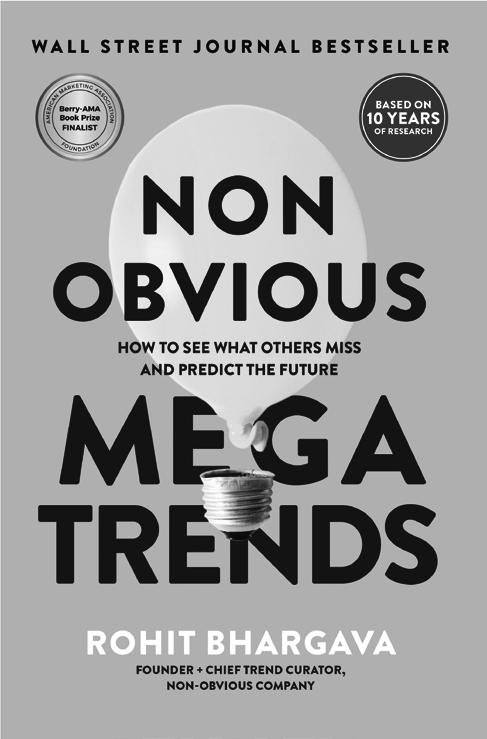
For the past 10 years, the Non-Obvious Trend Report has been one of the most widely read collections of future insights in the world, reaching over 1 million readers. This 10th Edition features ten new megatrends curated from stories, interviews and more than 100 past trend predictions.
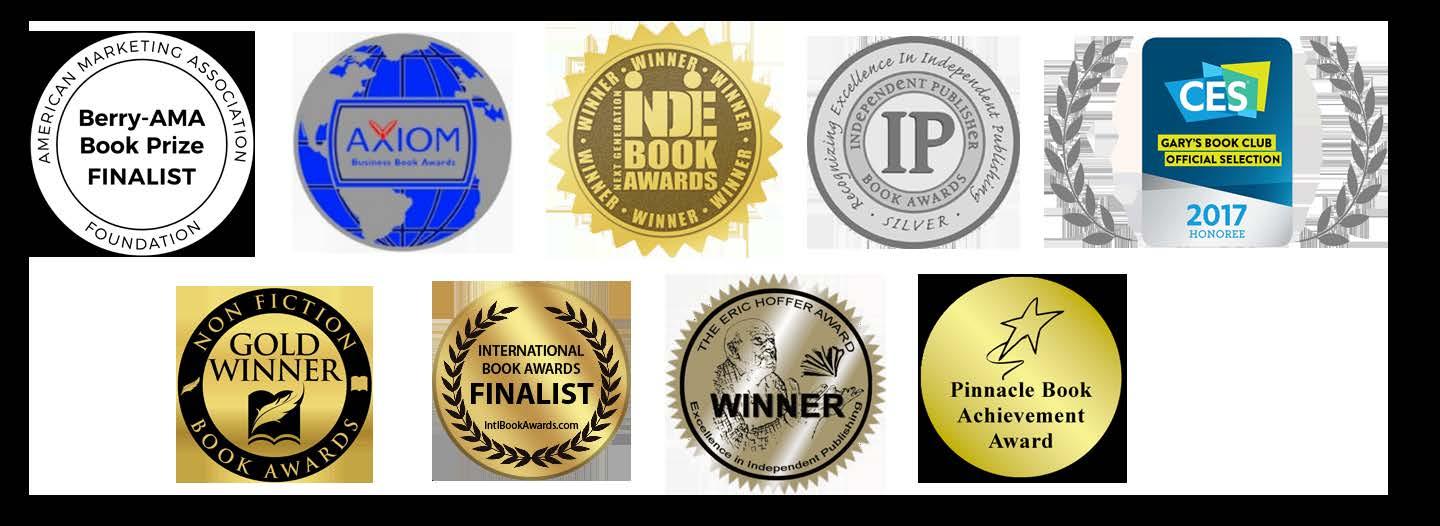
WINNER: Eric Hoffer Book Award (Business Book of the Year)
FINALIST: AMA-Leonard Berry Prize (American Marketing Association)
WINNER: Axiom Award (Silver Medal, Business Theory)
WINNER: INDIE Book Award (Gold Medal, Business)
FINALIST: International Book Award (Best Business Book)
WINNER: Non-Fiction Book Award (Gold Medal)
WINNER: IPPY Award (Silver Medal, Business)
WINNER: Pinnacle Best Business Book Award
OFFICIAL SELECTION: Gary’s Book Club (at the Consumer Electronics Show)
Non-Obvious is a sharp, articulate, and immediately useful book about one of my favorite topics: the future. With actionable advice and entertaining stories, Rohit offers an essential guidebook to using the power of curation to understand and prepare for the future of business.
DANIEL H. PINK, best- selling author of To Sell Is Human and When
Shatter your magic crystal ball and toss out the tea leaves. In this book, Rohit shows us how and where to find the future trends that will shape your business, your brand, and even your own decision-making.
SALLY HOGSHEAD, best- selling author of How the World Sees You
There are very few books I read hoping that no one else around me will. They’re the books that are so insightful, so thought provoking, and so illuminating that they provide a powerful competitive advantage. Non-Obvious is one of those. Pass on it at your own peril.
SHIV SINGH, former senior vice president/global brand, VISA; digital head PepsiCo; co- author of Savvy: Navigating Fake Companies, Fake Leaders, and Fake News
This is one of those rare books that deliver insights that are useful and help illuminate where business is going. It’s a great read.
CHARLES DUHIGG, best-selling author of The Power of Habit
The best books approach their topic with a spirit of generosity. Rohit’s new book offers insight into the business and cultural trends that matter, why they do, and what actions they might inspire. But more than that, it generously teaches how to develop your own process for evaluating the trends that matter and those that don’t. Also, it’s well-written, which makes it a joy and not a chore to read!
ANN HANDLEY, chief content officer, Marketing Profs
PRAISE FOR NON- OBVIOUS
It doesn’t take a crystal ball to predict that digital is the future. Rather than telling you what you already know, Rohit sets his sights on something much more important: helping you adopt a more curious and observant mindset to understand the world around you. If you believe in a lifetime of learning, read this book!
JONATHAN BECHER, president, San Jose Sharks; former chief marketing officer, SAP
A lot of books promise to help you see things differently, but Rohit’s book actually delivers. His insightful blend of visual thinking and business strategy shows you how to find meaningful patterns that others miss. A real mind-opener
SUNNI BROWN, author of Gamestorming and
Non-Obvious is simple, elegant, and powerful: one of those intensely engaging books that I couldn’t put down. Every year, I use the ideas in this book to help my team see new opportunities and out-think our competition.
HOPE FRANK, chief marketing and digital officer + futurist
Rohit provides a gold mine of ideas and trends that will shape the future of marketing and product development. Read this book to get in front of the herd.
GUY KAWASAKI, chief evangelist, Canva; author of The Art of the Start, 2.0
Lots of books tell you to “think different,” but Non-Obvious is one of the few books that actually teaches you how to do it. Whether you are trying to persuade clients, motivate a team, or just impress a demanding boss, Non-Obvious can help you succeed. I’ve already purchased copies for my entire team.
JOHN GERZEMA, best- selling author of The Athena Doctrine
Copyright © 2020 by Rohit Bhargava
All rights reserved.
Published in the United States by Ideapress Publishing. Ideapress Publishing | WWW.IDEAPRESSPUBLISHING.COM
Non-Obvious® is a registered trademark of the Influential Marketing Group. All other trademarks are the property of their respective companies.
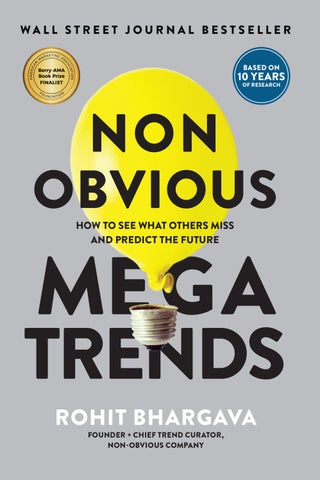
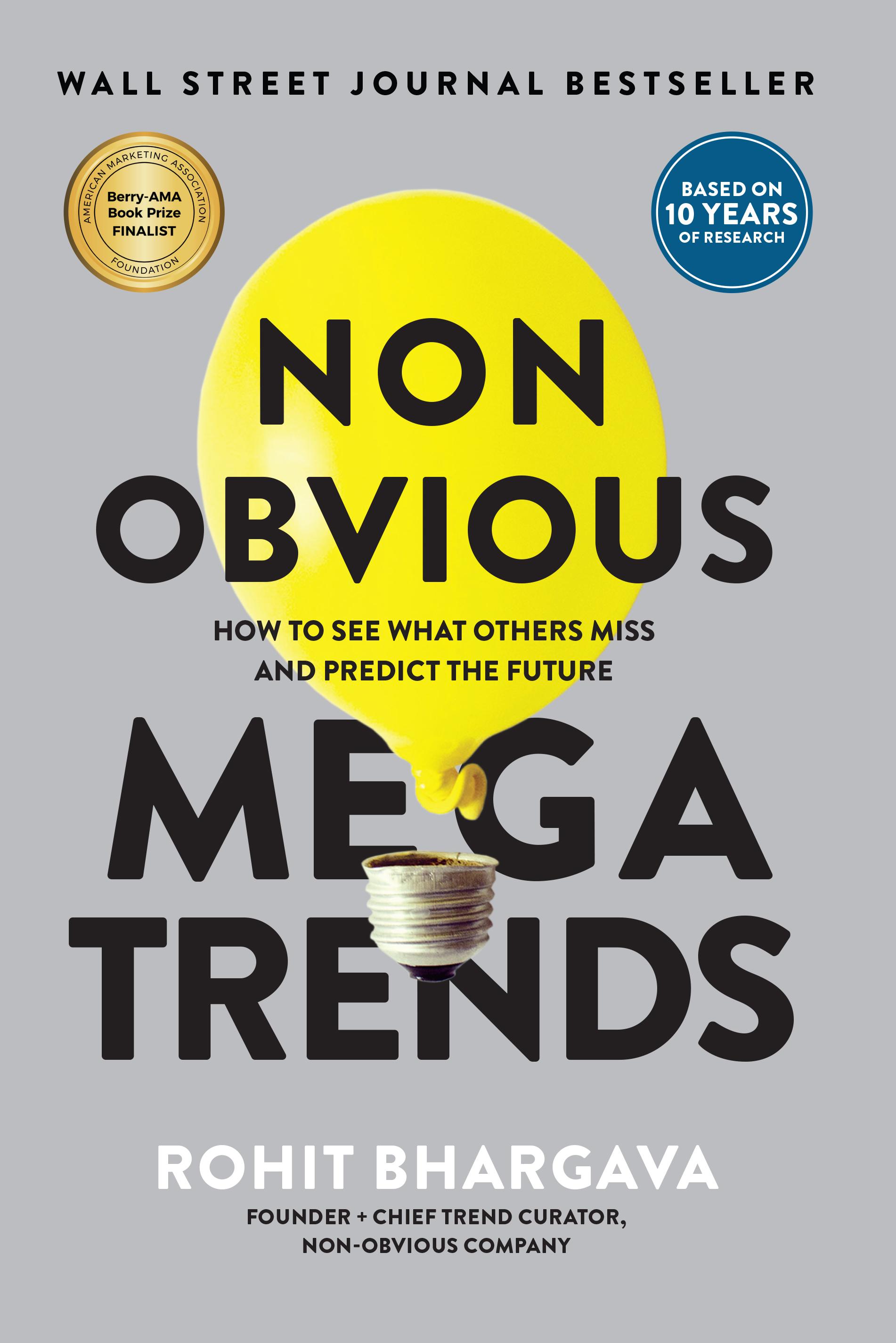
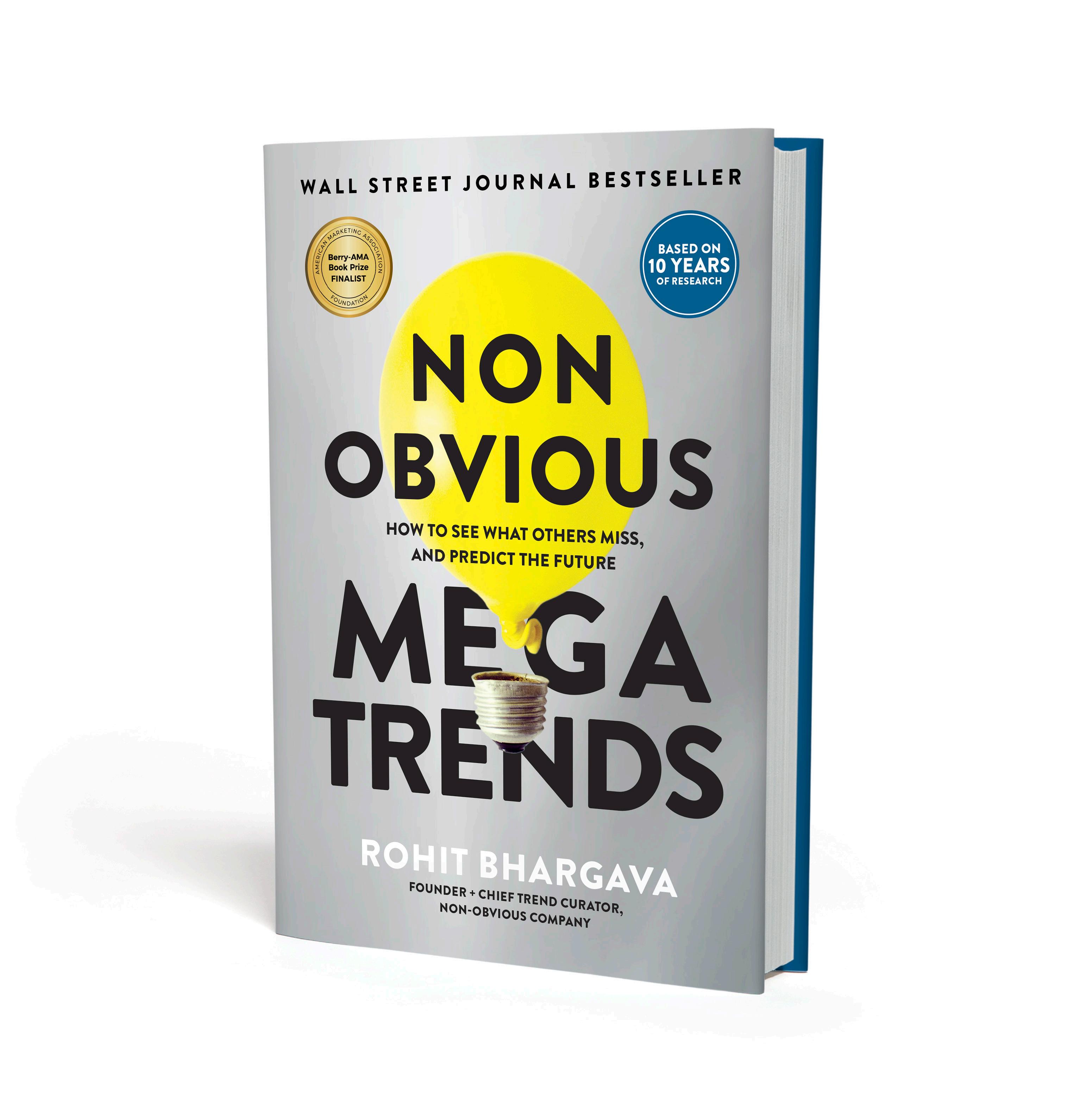
Cover Design by Jeff Miller
Cover Photo by Javier Pérez
Interior Design by Happenstance Type-O-Rama
Library of Congress Control Number: 2019917426.
ISBN: 978-1-94085-896-8 (Hardcover)
ISBN: 978-1-64487-002-8 (Paperback)
SPECIAL SALES
Ideapress books are available at a special discount for bulk purchases for sales promotions or corporate training programs. Special editions, including personalized covers and custom forewords, are also available. For more details, email info@ideapresspublishing.com or contact the author directly.
PART I
The Art of Non-Obvious Thinking
INTRODUCTION
“I am not a speed reader. I am a speed understander.”
ISAAC ASIMOV, author, historian, and biochemist
THE YEAR IS 1962, and a man named Robert Townsend has just fired his entire advertising department.
The company he recently took over hasn’t been profitable in more than a decade and if he expects to reverse its fortune, he needs a big idea but he doesn’t have a big budget. In desperation, he sends a short brief to a handful of creative directors from the hottest ad agencies in New York, asking a single impossible question: “How do we get five million dollars of advertising for one million dollars?”
One agency responds with an unusual proposition. Bill Bernbach, founder of renowned ad giant Doyle Dane Bernbach (DDB), asks for ninety days to study the business and agrees to take the job on one condition: Townsend must promise to run any advertising idea proposed by DDB exactly as written without question.
He agrees.
DDB starts by commissioning a series of focus groups, but the results are disheartening. The brand is a distant second place behind the dominant industry leader and there isn’t much hope of closing the gap. Tasked with finding some insight they might use to build a campaign, an unknown copywriter named Paula Green has an unusual idea.
As a rare female copywriter during the notoriously maledominated golden era of advertising, Green is already accustomed to bringing a different perspective to her work. Inspired by something she hears employees say during the focus groups, she writes a brutally honest new campaign tagline: “Avis We’re only No. 2. We try harder.”
Townsend is skeptical at first.
Why would any brand spend money to advertise being second best especially one struggling as badly as his? But true to his word, he reluctantly approves the campaign as written.
The ads are an instant hit. Less than 12 months after the campaign starts, Avis goes from losing $3.2 million annually to earning $1.2 million. Within a matter of years, some predict the campaign will soon need an update because Avis will no longer be number two. The tagline becomes a rallying cry for employees as well, serving as a manifesto they would use continually for the next fifty years. Today it is widely regarded as one of the best advertising campaigns ever.
Why did it become so iconic?
The question has inspired decades of debate. Some suggest it was the result of a unique trusted relationship between the brand and its agency. Others believe it was the humility in the tagline that helped humanize Avis and inspired their employees to indeed try harder in every customer interaction. Leadership experts instead credit Townsend’s renowned people-first management style.
Green herself suggested the campaign worked because it “went against the notion that you had to brag.” She also noted, with some irony, that as a woman in advertising, having to try harder was “somewhat the story of [her] life.”
Her comment suggests there may be an overlooked detail in this story. Of the dozens of people involved in focus groups, everyone failed to appreciate the significance of that one employee’s comment about trying harder.
Everyone but Paula Green, the one person who saw what everyone else missed.
WHY I WROTE THIS BOO k
This is a book about what it takes to see what no one else sees.
This skill is often described as creativity, and we live in a world that celebrates it. But finding the solution to a particularly tricky problem or discovering a world changing idea takes more than creativity a fact I discovered one fateful day nearly two decades ago while sitting across the table from a man waiting to be inspired by anyone but me.
It is 2001 and I have been working in advertising for less than a year. It’s long enough to understand the hierarchy. There are the creatives who have cool titles like “Wizard of Lightbulb Moments” and there are the rest of us.
I am not a creative.
We’re sitting in a conference room on the top floor of an office building overlooking Darling Harbor in Sydney, outfitted with an enormous table made of Tasmanian oak (as our clients make a point of telling us). It is an intentionally intimidating setup.
As we present our epic game changing campaign idea, I can’t help feeling quietly relieved that no one expects me to say anything. At first the presentation seems to go well. Unfortunately, as our pitch wraps up our client asks the one question we were not expecting: “What else you got?”
This is not good.
We had spent two months preparing for this meeting and our creative team was so convinced it was a winner, that they hadn’t even brought a backup idea.
Our response to his question was truly terrible. Silence.
I slowly realized that the only person who could remember those abandoned ideas was the junior member of the team who had taken notes in all the meetings: me. Summoning my courage, I broke the silence and spoke up. It was a moment that would change my career . . . though not perhaps in the way you might imagine.
I did not pull a million-dollar idea out of my head. In fact, the truth is I don’t remember what I said. But I do remember how I felt.
It was my first taste of what it meant to be on the other side, and I was hooked. I wanted to have that feeling again.
Unfortunately, creativity still wasn’t my job. And judging from our failed client encounter, maybe creativity wasn’t even the right word to describe what our clients actually wanted anyway.
Around that time I found inspiration in the words of an author who was once asked by novelist Kurt Vonnegut what it felt like to be “the man who knows everything.”
WHY SPEED READING DOESN’T MATTER
Isaac Asimov has earned that reputation by writing nearly 500 books in his prolific lifetime. He is most widely known for his groundbreaking work in science fiction, but he also wrote everything from an illustrated children’s guide to dinosaurs to a comprehensive two-volume guide to The Bible.
How could one man have interests and skills so varied that he could write and publish an average of more than ten books every year? Asimov credited his creative thinking to his legendary appetite for reading and learning about everything he could from a young age.
“I am not a speed reader,” he once said. “I am a speed understander.” What if you could be a speed understander too?
It’s hard to imagine following Asimov’s recipe for understanding in today’s world. We are inundated by content, and most of it is not good. It has become nearly impossible to separate the bullshit from the believable. Digital tools have made it easy for everyone to share ideas, even if they are one-dimensional or idiotic. Yet bullshit, no matter how well packaged and easily distributed, remains bullshit.
To face this landslide of bad content, we are increasingly relying on a combination of algorithms and one-dimensional opinions shared on social media to help us filter the noise. And we’ve pioneered new methods of skimming out of sheer desperation. We watch television at accelerated speed, use speed-reading apps that flash a single word at a time, and turn to productivity gurus specializing in “time hacking.”
None of these solutions work for long.
The problem is that expecting to get smarter from processing content faster is a bit like entering a speed-eating contest to enjoy a good meal. Eating 26 hot dogs in 60 seconds might satisfy your hunger, but you’re likely to feel sick afterwards.
You can’t understand the world better simply by reading about it as much as possible. You do so by being intentional about what you pay attention to in the first place. What if you could become a lifelong learner, curious about the world and able to see, understand, and expect things others miss? What if you could use that skill to understand patterns, spot intersections and see around the corner to develop an observation of what the future might hold? And what if, once you put all the pieces together, you could actually learn to predict the future?
You can, and the ambitious aim of this book is to teach you how to do it. I call my approach Non-Obvious Thinking, and it can change your life. It changed mine, as I realized years ago after spending a memorable afternoon in Norway surrounded by 50,000 bottles of alcohol that I couldn’t drink.
WHAT I LEARNED FROM A NORWEGIAN BILLIONAIRE
Christian Ringnes is one of the richest men in Scandinavia. A flamboyant businessman and art collector, he made his fortune in real estate and was the driving force and financier behind the critically acclaimed Ekeberg Sculpture Park in Oslo, Norway. Yet his legacy may come from a far quirkier accomplishment: amassing one of the largest independent collections of miniature liquor bottles in the world.
His decades-long obsession eventually ran into an insurmountable opponent: his wife, Denise. Tired of the clutter, she offered him an ultimatum: Find something to do with the more than 52,000 bottles he had amassed or start selling them. Like any other avid collector, Ringnes couldn’t bear the thought of parting with his beloved bottles, so he did exactly what you might expect a
Norwegian real estate tycoon to do: he commissioned a museum for his bottles.
Today his Mini Bottle Gallery is one of the world’s top weird museum destinations, routinely featured in offbeat travel guides. When I took a tour of the gallery, I was fascinated by how it was organized. Every room featured bottles grouped into quirky themes ranging from a “Room of Sin” inspired by a brothel to a “Horror Room” featuring liquor bottles with trapped objects such as mice or worms floating inside.
More important, like other well-crafted museum experiences, the Mini Bottle Gallery is carefully curated. Only about 20 percent of Ringnes’ collection is on display at any one time. This thoughtful selection creates meaning for the entire gallery because each room tells a story, and those stories bring the experience to life.
As I walked out of the museum that evening, I realized just how important this idea of curation might be to my own work. What if the secret to having better ideas that clients loved was to get better at curating them before I needed them?
HOW I BECAME AN IDEA CURATOR
Back in the middle of 2005, I was part of a team tasked with starting what would become one of the largest and most successful social media teams in the world. At that time, social media basically meant blogging, so our services involved helping large brands find ways to engage bloggers directly.
Writing a blog seemed easy, so I decided to start one myself. My first few posts came easily, but then I ran out of ideas.
How was I going to keep my hastily created blog constantly updated with new stories when I already had a full-time day job? I needed a better method for collecting ideas.
I started seeking ideas everywhere. At first, I gathered them by emailing links of stories to myself. I scribbled possible blog topics on scraps of paper. I saved quotes from books and ripped pages out of magazines. As my collection of potential topics grew, I started saving them in a simple yellow folder with Ideas scrawled on the tab.
Soon worn from use, it was held together at its badly ripped seam by a tired piece of duct tape.
It worked, and I now had plenty of inspiration for what to write about. I did that religiously for four years, at times posting a new article every day.
During that time, I wrote more than a thousand articles and built a readership of hundreds of thousands of people. The blog won several awards, helped grow my network, and eventually helped me land a deal with McGraw-Hill to publish my first book, Personality Not Included, in 2008.
Two years later, I did something that would shape the next decade of my life.
THE BIRTH OF THE NON-OBVIOUS TREND REPORT
Near the end of 2010, I was reading article after article about trends for the coming year. Almost all of them were lazy, uninformed, or self-serving declarations of the obvious. According to one, the hottest trend of the year would be the iPhone 4. Another article suggested that “more people would express themselves on social media.” Yet another predicted that 2011 would be the Year of Drones. Not surprisingly, that one was written by the CEO of a company that made drones.
These weren’t trends they were profoundly obvious observations of the world.
At best they were wishful thinking, and at worst they were veiled pitches for products or services hoping to profit from being considered trendy. In a frustrated bid to do better, I published my own list of 15 trends and called it the Non-Obvious Trend Report, named as a not-so-subtle criticism of all the blatantly obvious trend predictions I had read.
The report went viral as hundreds of thousands of people read and shared it.
Over the next five years, what started as a 20 page PowerPoint presentation shared online evolved into a robust annual trend report with hundreds of pages of research, interviews, panels and
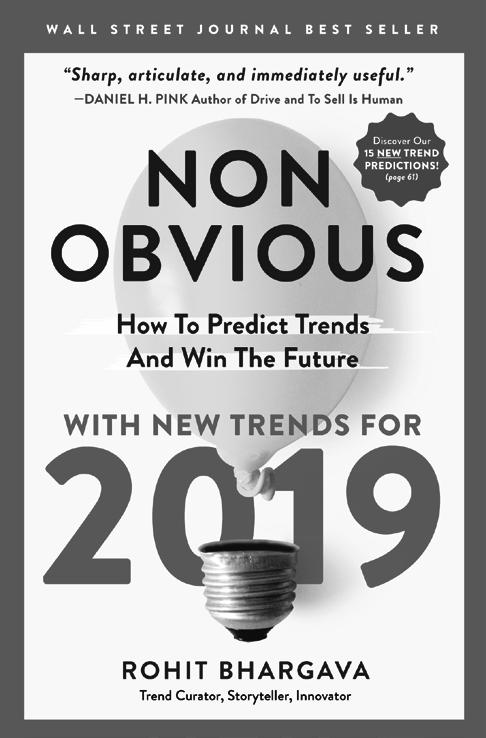
eventually, in 2015, a bestselling print edition of the book you now hold in your hands.
Along the way, I left my job at Ogilvy, became an entrepreneur, spoke on some of the biggest stages in the world and published a new annual edition of the book with updated trends every January.
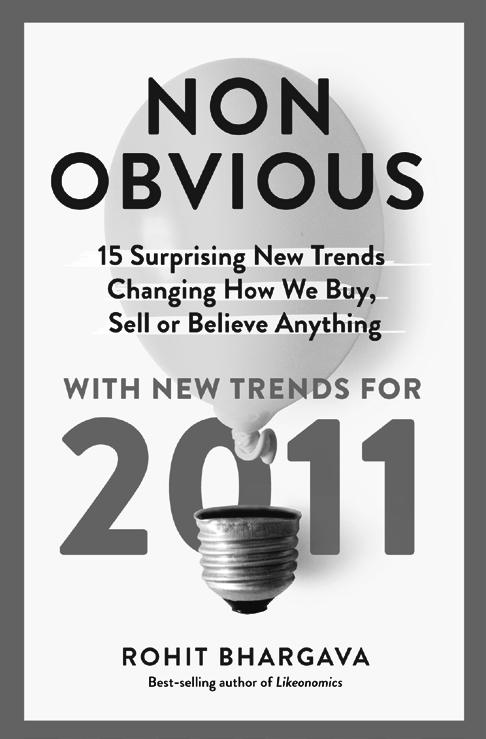
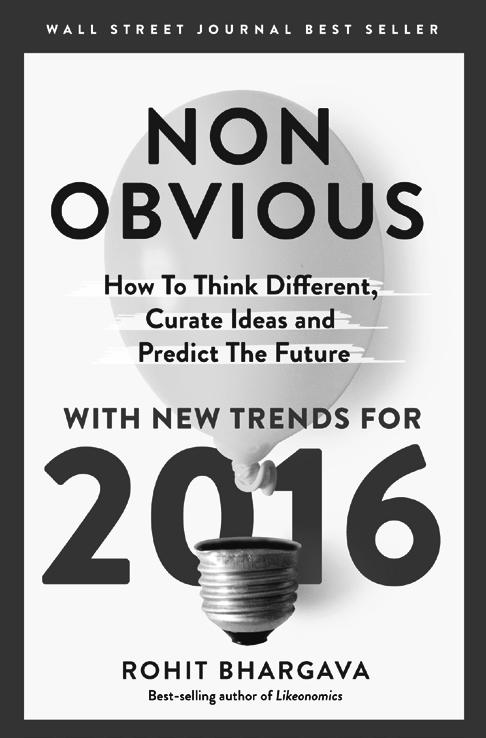
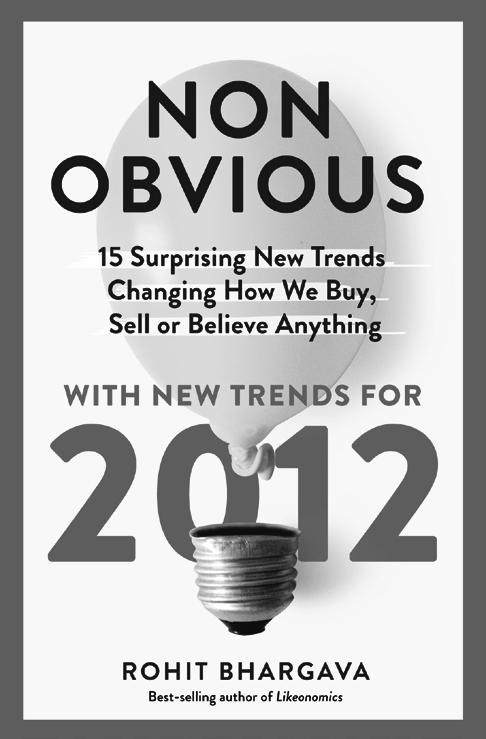
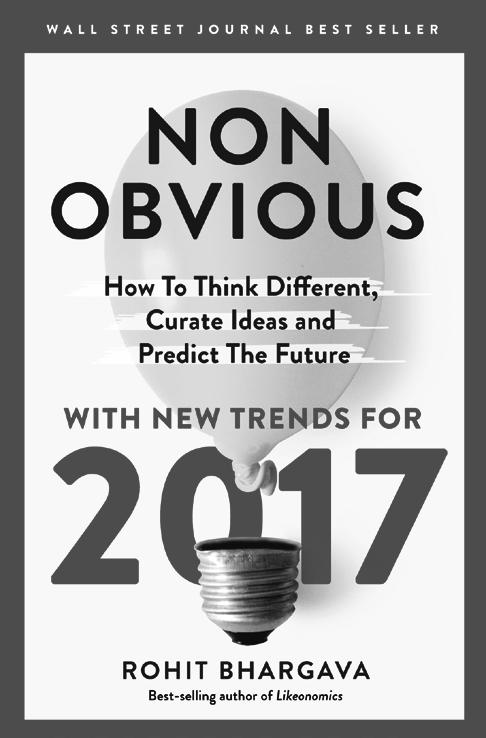
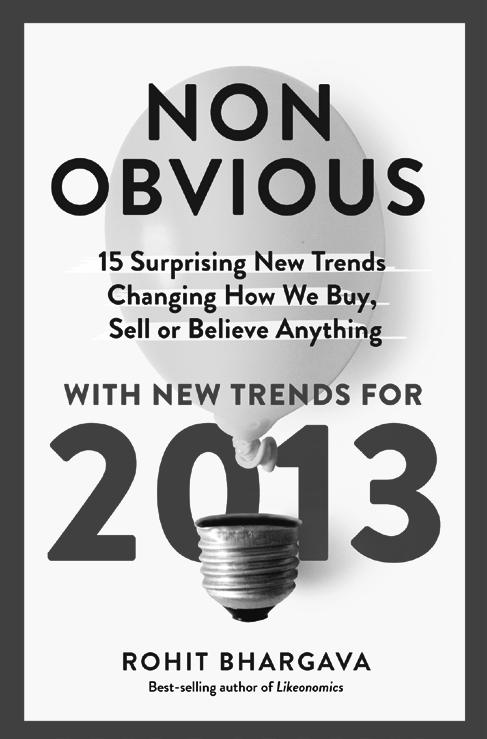
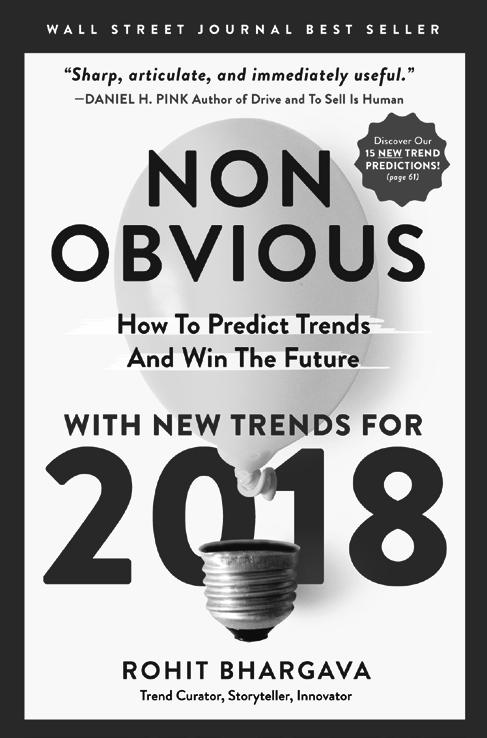
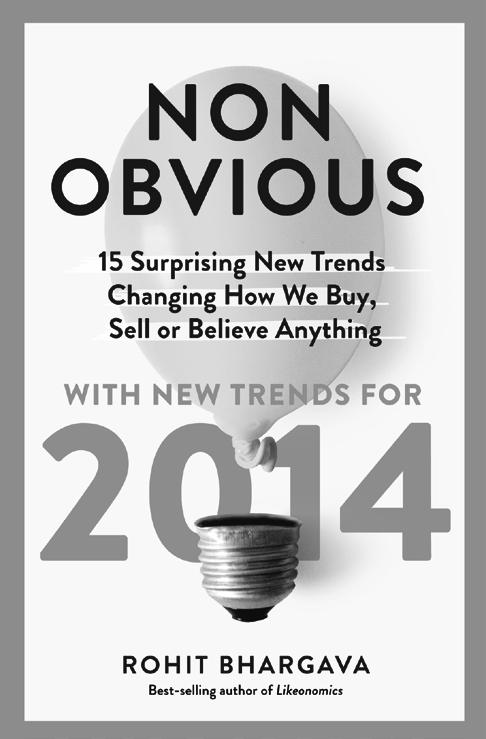
Now, ten years and nine editions later, my library of non-obvious trends has grown to more than a hundred predictions. The books have been translated into eight languages, earned nine prestigious international book awards, and reached well over a million readers. They also have led people to label me with a title I always struggled to embrace: a futurist.
WHY I AM A RELUCTANT FUTURIST
I am inspired by futurists who look at the world today and anticipate what will come. Reading The Next 100 Years by leading futurist George Friedman, for example, is like being engrossed in both a wonderful work of science fiction and a prescient description of potential reality. The year 2060 indeed might begin the “Golden Decade,” as he predicts. That is how futurists think.
In comparison, my team and I research trends to help brands and leaders understand the accelerating present and act on that
knowledge today. That’s why “futurist” always felt like an overstatement to me.
In past interviews, I have described myself instead as a “near futurist.” My lens typically focuses on trends that are affecting our behavior or beliefs right now. However, that doesn’t mean my annual trend predictions expire; instead, if well predicted, they become more obvious over time.
HOW TO READ THIS BOO k
After a decade of making predictions, my team and I have seen some trends evolve into broader cultural or behavioral shifts while others have faded in significance.
In this tenth anniversary edition of Non-Obvious, we will take a look at the past decade of research and incorporate the most significant trends and stories while offering a broader context around the urgent need for more non-obvious thinkers in the world.
In Part 1, you will discover the five key mindsets required for being a non-obvious thinker, followed by a detailed look at my signature Haystack Method for curating trends and techniques for putting insights into action.
Part 2 of the book features predictions of ten powerful megatrends that will shape the coming decade, along with implications for culture, business, careers, and humanity. Each chapter also explores the potential implications each of the megatrends are likely to have in our world.
Finally, Part 3 includes a candid review of every previously predicted trend from the past nine years, along with a curated rating of how each one fared over time and the fascinating backstory of how the report itself evolved from year to year.
As you’ll learn throughout this book, the benefits of learning to be a non-obvious thinker go far beyond just being able to identify trends. Seeing the non-obvious makes you more open minded to change and can help you disrupt instead of getting disrupted.
Non-obvious thinking can make you the most creative person in any room, no matter what your business card says and help solve
your biggest problems. Most importantly, non-obvious thinking can help you anticipate, predict and win the future.
Ultimately the biggest lesson may be that you don’t need to be a speed reader to win the future. Being a speed understander is a far worthier aspiration. It’s my hope that this book will help you get there.
AMPLIFIED IDENTITY
WHAT’S THE MEGATREND?
As individualism rises globally, people are carefully cultivating how they are perceived both online and offline, chasing stardom, and making themselves vulnerable to criticism in the process.
IKUO NAKAMURA HASN’T COME OUT OF HIS ROOM for seven years. He is a hikikomori, a Japanese term to define a reclusive subgenre of mostly men who haven’t left their homes or interacted with others for at least six months. Some are driven to solitary existence by failing to live up to societal or parental expectations. Others retreat after being unable to cope with some big conflict.
When photographer Maika Elan published a rare photo essay and interview of the hikikomori for National Geographic magazine, she noted, “In Japan, where uniformity is still prized, and reputations and outward appearances are paramount, rebellion comes in muted forms, like hikikomori.” Elan may have it right. The existence of the hikikomori, often chronicled in tragic terms, could represent a muted form of individuality expressed by those who can’t meet the exacting demands of Japan’s conforming society.
A healthier response to societal pressures is emerging in South Korea. For years, going out alone was considered something that only a social outcast (wangda) would do. Today a new Korean vocabulary describes individualistic activities that used to be taboo, such as honbap (eating alone) or honsul (drinking alone). A Korean colleague
of mine noted that engaging in these solo activities is growing more common as they become acceptable.
The existence of the Japanese hikikomori and the rising popularity of solitary activities in South Korea are signs of how culture is shifting toward more individualistic identities.
Since 1981, researchers from the groundbreaking World Values Survey (WVS) have measured people’s values and beliefs across seventy-eight countries. One of their key findings in the past two decades is a rising shift toward individualism in nearly every region of the world. This global change is contributing to an amplified sense of the importance of “self.” The boldness with which we craft our identities, especially online, can empower our self-worth or endanger it. You need only to look at what is arguably the most modern form of digital self-expression, the selfie, to see how.
THE TRUTH ABOUT SELFIES
Several years ago during a sunny spring day, my family and I were headed to one of the most popular lookouts in Arizona, called Horseshoe Bend. The site had been in the news several times in previous months for a tragic reason: It was where several tourists fell to their deaths into the canyon.
As I watched the crowd that day, it was easy to understand what made the spot so deadly. A girl was sitting on her boyfriend’s shoulders, holding her camera high above her head, while the boyfriend precariously balanced on the edge of the cliff. They, like many others, were trying to take the perfect selfie with the canyon behind them. Thankfully they did manage to get their picture without fatal consequences. Taking and posting the perfect selfie has become so important that people are literally willing to risk their lives to get the perfect one. One reason it matters so much is that selfies allow us to curate the version of ourselves that we present to distant friends and relatives whom we see rarely in real life. But how real is this presentation? That depends on whom you ask. Some say social media and selfies help us to express our authentic, unique identities, while others blame selfies for making an entire generation deeply narcissistic,
entitled, and insecure. Award-winning journalist Will Storr explores this question in his book simply titled Selfie
In the book, Storr suggests the “self-esteem myth” as the culprit behind the obsession with selfies and ourselves and thinks this has influenced how we curate our identities online. “To get along and get ahead in this new you-saturated social media arena, you had to be a better you than all the other yous that were suddenly surrounding you,” he writes. “You had to be more entertaining, more original, more beautiful, with more friends, have wittier lines and more righteous opinions, and you’d best be doing it looking stylish in interesting places with your breakfast healthy, delicious, and beautifully lit.”
The pressure to reach for an impossible ideal, according to Storr, might be contributing to the disturbingly high rate of depression and elevated rate of suicides and the need for the perfect selfie in the first place. In this view, the selfie represents a dangerous reflection of our growing need for approval.
But not everyone agrees.
A CONFIDENT SELF-PORTRAIT
A more optimistic view is that selfies might actually be a conduit to more authenticity and confidence, rather than an insecure plea for external validation.
Girls Leadership co-founder Rachel Simmons is one such optimist. She describes the selfie as “a tiny pulse of girl pride a shoutout to the self.” In 2015, I introduced the trend of Selfie Confidence and agreed with her argument the selfie was deeply misunderstood. What if it was an undervalued tool for building self-esteem? When seen through this lens, the selfie could be a statement of power.
As Simmons also argued, “if you write off the endless stream of posts as image-conscious narcissism, you’ll miss the chance to watch girls practice promoting themselves a skill that boys are otherwise given more permission to develop, and which serves them later on when they negotiate for raises and promotions. A selfie suggests something in picture form I think I look [beautiful] [happy] [funny] [sexy]. Do you? that a girl could never get away with saying.”
In telling this story about ourselves, it’s easy to assume that most people would portray themselves in an exaggeratedly positive way. However, researchers are finding that people are more truthful with social media than you might expect. In many ways the public nature of social media offers more accountability because someone in your social network is likely to know when you’re lying. Recent data from the Social Media Lab at Cornell University, for example, found that college students seem to be less deceptive when creating LinkedIn profiles than when writing a résumé.
Studies indicate that instead of making us self-centered liars, social media may be giving us the one thing we need to shape our identities in a digital world: power over our stories. And what’s the fun of having power over our stories if we don’t give ourselves the title role?
E v ERYDAY STARDOM AND THE INFLUENCER RE v OLUTION
Dale Carnegie, renowned author of the classic book How to Win Friends & Influence People, once wrote, “A person’s name is to that person the sweetest, most important sound in any language.” His point, made through years of observation, was that we are hardwired to seek out moments of recognition where we feel singled out, understood, and appreciated. In a world where individualism is rising, the online world has made capturing our fifteen seconds (or less) of fame easier than ever: We can create content that portrays us as the stars of our own shows.
Consider the case of the “Bollywood Bride,” a cultural phenomenon I first wrote about while introducing the trend Everyday Stardom the growing expectation that the world ought to treat us like stars. Many Bollywood movies include an over-the-top musical wedding featuring flash mob–style dances and melodramatic courting rituals. These picture-perfect performances of a fantasy wedding are so popular that engaged couples across India are now are hiring film crews to recreate and capture these iconic scenes starring them, as bride and groom.
Plenty of people are finding more lasting fame as the stars of their own social media shows as well. YouTube and Instagram have made it incredibly easy for ordinary people to create content that features them talking and sharing advice about a topic they love offering fashion and beauty product reviews, unboxing toys, playing video games live and building an audience. Those who can build a sizable audience for their content are anointed “influencers,” giving them stardom in a crowded online world and a payoff through advertising and sponsors.
As media personalities continue to emerge through social platforms and people get used to starring in their own narratives, consumers are increasingly expecting brands of all sizes to create personal experiences and make them feel like a VIP too.
This industry around identity is driving more people and brands to focus on it to attract attention and drive revenue, but there is also a downside emerging.
THE DAR k SIDE OF AMPLIFIED IDENTITY
In a world where Amplified Identity thrives and people carefully craft how they are perceived, maintaining control over their story can be tricky. Narratives in the digital world are usually public and can therefore attract attention from unwanted cyberstalkers or lead individuals to become a target of criticism, shaming, or identity theft. Even as we look at controlling the narrative of our constructed identities, we are discovering how easily and destructively they can be dismantled.
In her book It’s Complicated: The Social Lives of Networked Teens (2014), Microsoft principal researcher danah boyd (who spells her name without capital letters) explores how teenagers navigate this tricky online world, where attention has become a commodity. She thinks that the ease of anonymous commenting and a media culture frequently criticizing celebrities and other personalities have made responding with meanness to other people’s online expressions of themselves seem normal. In this world where cyberbullying is all too common, individual identities, especially of those of young people, are under constant attack.
The challenges we face go beyond people who react with meanness to our posts or tweets. If we make a mistake, we can become an even bigger target. In So You’ve Been Publicly Shamed, author and documentary filmmaker Jon Ronson explores why Internet shaming has become commonplace. To understand this phenomenon, he interviewed people who were vilified after committing some transgression. Subjects included author Jonah Lehrer, whose plagiarism was exposed by a journalist, and Justine Sacco, a PR executive who posted a racially insensitive tweet while traveling to South Africa. Ronson concluded that by engaging in public shaming, we are “defining the boundaries of normality by tearing apart the people outside of it.”
Our carefully constructed digital identities are not only vulnerable to criticism and shaming; but also risk being co-opted entirely. Deepfakes, consisting of superrealistic fake images and videos generated by artificial intelligence, offer others the opportunity to produce content that our likeness can be inserted into later.
Some technologists are building questionably ethical re-creation algorithms that could duplicate a person’s voice and allow others to craft messages with it that will appear to be from a loved one after they have died. Others are taking this a step further by using past video footage to develop sophisticated holograms of public figures and even create a new functioning version of them. For example, hologram likenesses for artists such as Michael Jackson and Amy Winehouse have gone on tour, with new shows featuring real-life performers alongside these stand-ins for the dead celebrities.
The rise of questionably ethical innovations is leading to a new industry of people who are tasked with exploring these issues and crafting ground rules about who owns the digital identity of a dead person and how its integrity can be preserved.
Nevertheless, while the Amplified Identity trend does harbor considerable dangers for our identities, there is also a significant upside.
AMPLIFIED HOPE
In 2015, “America’s new obsession,” according to People magazine, was the web series called The Keswanis: A Most Modern Family
The California-based Indian family included “doctor dad” Anil and “momager” Vaishali, who left her career as an optometrist to manage the exploding social media popularity of their son, “Big Nik.” Nik, who has a rare form of dwarfism, built a loyal following of more than 2.5 million fans online. Rounding out the made-for-reality-TV family were his fifteen-year-old sister, Sarina, an aspiring beauty pageant star, and his six-year-old sister, Devina, a “transgender princess.”
The series demonstrated an evolving willingness to embrace those who are different from us or might have been kept on the fringes of our culture in the past. I first wrote about the Keswanis’ series in 2016 as an example of Mainstream Multiculturalism, a trend showing that after years of being viewed as “the other,” diverse groups are finding more acceptance in mainstream culture, especially in entertainment and media.
On the surface, this trend may seem at odds with the disturbing rise of xenophobia across the world. Yet there are signs that the current climate of hate is fueled largely by a contained but loud group of anti-immigrant populists and outrage-wielding politicians who stand to profit from it. Their movements don’t reflect the beliefs of most people. In fact, the evidence shows that people are becoming more accepting of others, not less. One study found that three years after Donald Trump was elected president, racial prejudice in many areas of the United States actually went down. The World Values Survey also found a widespread decrease in the number of people who responded they were uncomfortable living next to someone of a different race, which is one of the most pointed questions the survey asks to isolate racist beliefs.
It makes sense that as we develop an amplified sense of self, embrace our individuality, and share it with others, we can appreciate, accept, and even celebrate the identity of others. This is especially true for those whom our social norms cast as outsiders, an idea we also explored in 2017 with our trend Outrageous Outsiders In this sense, the Amplified Identity megatrend, despite whatever risks it might pose to our sense of worth or the integrity of our identities, is perhaps the most hopeful of the megatrends presented in this book.
AMPLIFIED IDENTITY AT A GLANCE
A growing worldwide shift toward individuality and the means to control our stories is driving us all spend more time thinking about how we present ourselves. From our LinkedIn profiles to our tweets and selfies, our online identities have become the ultimate expression of who we are or perhaps a carefully crafted self-portrait.
Like many of the other megatrends, Amplified Identity anticipates positive and negative changes. On the upside, this greater focus on self is having a ripple effect on people who in the past had little voice or were considered outcasts. They now can express themselves and be perceived positively, whether they are active online or not. On the downside, when our sense of self is outsized, we may become more narcissistic, more targeted for criticism, and more vulnerable to co-opting of our identities.
HOW TO USE AMPLIFIED IDENTITY
➜ 1. OVERCOME THE NARCISSISM BIAS.
The common criticism of the rise of digital identity is that it may be creating a generation of me-first monsters unable to empathize with others . If you don’t fit into what some have called the selfie generation, it is tempting to condemn those who spend so much time in social media as shallow and narcissistic . Instead of judging, look past the digital tools and platforms . Remember that at the core of most social media activities is the normal desire to find one’s own identity and share it with the world . That’s not narcissism . It’s human nature .
➜ 2. CONSIDER THE IDENTITY DIVIDE.
As our identities and relationships move online, it will become commonplace, even necessary, to share more of ourselves through digital platforms Those who are more private and technologically averse may struggle with this new reality, and a cultural divide may arise between those who eschew online identities and those who wholeheartedly embrace the digital world . This will require a new sort of empathy and commitment to include those who are most reluctant to amplify their identities but still want and need to be part of social interactions .
➜ 3. HELP OTHERS MANAGE THEIR IDENTITY.
As our amplified sense of self continues to grow, we will turn to professionals to help us craft our identities, especially online . If you are looking for a new career, consider that a cottage industry of personal coaches, lifestyle gurus, and other self-help advisors will blossom . More unusual professions are emerging, such as “digital embalmers” who work to preserve a person’s digital legacy after death . Software consultants and lawyers are stepping up to create tools or draft legislation to answer questions about online identity and privacy .
THE E v OLUTION OF AMPLIFIED IDENTITY
A review of past trends that relate to this Megatrend:
SELFIE CONFIDENCE (2015)
The ability to share a carefully crafted online personality allows people to use social content such as selfies (yes, selfies) to build their own confidence.
EVERYDAY STARDOM (2015)
The growth of personalization leads more consumers to expect that their everyday interactions will be transformed into celebrity-type experiences.
PERSONALITY MAPPING (2016)
As behavioral measurement tools map the details of our personalities, brands start using such data to bring like-minded people together to engage in unique experiences.
MAINSTREAM MULTICULTURALISM (2016)
After years of being minimized, multicultural citizens find widespread acceptance through a growing integration of diverse ideas and people in entertainment, products, and politics.
AUTHENTIC FAMESEEKERS (2017)
A new generation of creators become authentic fameseekers, turning to social media to establish their brands, build an audience, and become the next big thing.
O UTRAGEOUS OUTSIDERS (2017
)
The rise of outsiders and their increasing willingness to say or do the things we might describe as outrageous to capture attention and influence.
SIDE QUIRKS (2017 + 2019
)
As the global shift toward individualism continues, people of all ages embrace what makes them unique, follow their passion, can start a side business, and increasingly appreciate the quirky di erences in one another.
AMPLIFIED IDENTIT Y
UNGENDERING
WHAT’S THE MEGATREND?
Traditional gender divisions and labels are getting replaced with a more fluid understanding of gender identity, forcing a reevaluation of how we see employees, customers, brands and one another.
I WAS PUTTING THE FINISHING TOUCHES on the seventh edition of Non-Obvious in 2017 when I noticed something unusual in the signature of an email I had just received. Beneath the sender’s name and title was this line: “My preferred pronouns are them/they.” A few days later, I received an email from someone else with a similar signature: “My preferred pronouns are she/her.” I realized immediately that this new signature convention was the latest sign of a shift in gender that I had been tracking for years before I even started the research for the first edition of the trend report back in 2011.
In 2008, as I was completing the research for my first book, Personality Not Included, I discovered it was far easier to find great stories online of pioneering businessmen than similar stories about women. To try to remedy the inequality, I launched something I called the Personality Project to spotlight the stories of forty successful women. The insights I gained in this work eventually led me to publish our first gender-related trend in 2013: Powered by Women.
Since then, our traditional understanding of gender roles has been challenged and broken down. Gender was once a simple binary choice: You were either female or male. Although our traditional understanding of gender roles has evolved since the 1970s, email signature lines like the ones I received would have seemed unfathomable even ten years ago.
But things are changing quickly. In early 2014, Facebook expanded its previously limited gender options for personal profiles to include fifty-eight new ones. Less than a year after that announcement, the social platform list grew to more than seventy options and included a free-form field where users could create their own gender label or forgo adding one altogether.
Three years later, National Geographic magazine devoted an entire issue to “the gender revolution,” which was turned into a documentary film about gender identity, produced, and narrated by journalist Katie Couric. As she interviewed scientists, psychologists, activists, authors, and families about gender, she asked all kinds of questions. What is gender? What is intersex? How many gender classifications do we need?
The documentary didn’t offer any definitive answers to the questions, but it did make clear that many people no longer consider gender to be a label determined at conception. Instead, it is increasingly accepted as a choice that we make for our current selves and maybe even evolve throughout our lifetime. Moreover, the words used to describe gender are expanding and include terms such as nonbinary, genderless, nonconforming, gender fluid, trans, asexual, and polygender
We are living in the time of Ungendering. As the stereotypes of feminine and masculine ideals are supplanted, the traditional labels and roles once prescribed to our identities based on gender are no longer as meaningful. This is leading to an evolved view of what role gender should play in the products we buy, the experiences we enjoy, and even the way we define ourselves.
For a growing number of organizations, this is forcing a fundamental reimagining of basic assumptions and messaging in
marketing, merchandising (men’s and women’s sizes), and how they deliver services or even categorize their products themselves.
A FIERCE FEMININITY MO v EMENT
An increasing number of powerful female characters emerged from the film and publishing industries over the past decade. Best-selling dystopian teen book series such as The Hunger Games and Divergent, for example, feature strong leading women. Girl Rising and other award-winning documentaries are sparking a global conversation about the importance of educating girls. And culture-shifting television series such as Orange Is the New Black and Game of Thrones feature complex female characters going through personal transformations. The emergence of these characters reflects a shift in how women are defining their roles and femininity, a trend I first described in 2017 as Fierce Femininity.
One example is a graphic novel called Priya’s Shakti. Even by superhero back-story standards, Priya’s is extremely violent. Introduced at the Mumbai Comic and Film Convention in 2014, the story centers on a village girl named Priya who survived a gang rape and goes on a mission to stop violence against women. When it first appeared, the novel, which offered a bold model for a fierce heroine who could inspire a new generation of girls, was downloaded more than half a million times.
A matter of months after the book went to print, the #MeToo movement began sweeping the internet. The hashtag became a rallying cry for women who shared their stories of being sexually harassed or assaulted in the workplace. A year after it went viral, the New York Times determined that about two hundred powerful men had been fired after public allegations of sexual harassment were made against them. By the newspaper’s count, women replaced half of those men in their jobs. As best-selling author and screenwriter Gillian Flynn pointed out in an interview, “Ultimately [women] are coming alive because they are finding rage and finding their empowerment and pushing back."
In the 1970s, for many, the ideal of femininity was a woman who “has it all” a job and a family and a household to take care of. Later women were celebrated for being the “jugglers-in-chief” and expected to uphold impossible standards in the workplace and at home. This facade is now falling at breakneck speed, replaced by an unapologetically fierce model of femininity. Women can be and are strong and serious. They can be mothers, or they can choose “otherhood,” a term author Melanie Notkin coined to describe women who by choice or “circumstantial infertility” (never meeting the right person) don’t have children. Women are getting married later if at all, pursuing higher education in greater numbers than men, starting more companies, and “taking their seat at the table,” as Flynn points out, instead of waiting for someone to give it to them.
Yet while this shift in women and femininity has been more than a decade in the making, a corresponding evolution of men and masculinity has only taken hold and started accelerating far more recently.
MUDDLED MASCULINITY
When I was in middle school, my favorite book series was Sweet Valley High, which followed the lives of Jessica and Elizabeth Wakefield, perfect blonde identical twins from the fictional town of Sweet Valley, California. Often called “teen Harlequins,” these books were highly popular in the 1980s and inspired young readers to turn to books instead of TV. Young female readers, that is. As series author Francine Pascal told the Los Angeles Times in an interview, “The truth is, boys read until about age 12, then they go outside and don’t come back in until they are about 18.”
I remember loving to go outside, but every time I came back in, it would be to read another story about the romantic adventures of Jessica and Elizabeth. I also remember, with some embarrassment, how odd it was for a boy to be checking out five or six Sweet Valley High books at a time from the library. On more than one occasion, I’m sure the librarian assumed I was getting them for my
nonexistent sister. A boy reading about love, relationships, and high school drama was out of the ordinary.
In the time since, even as our perspectives on female gender roles have shifted dramatically, how we perceive masculinity and fatherhood remains confused and one-dimensional. There is evidence that this uneasiness is leading to anxiety among men and boys about what it means to be a man today, a trend we described as Muddled Masculinity in the 2019 edition of our trend report.
In June 2018, the opinion-polling website FiveThirtyEight commissioned a survey of 1,615 adults who identify as men. The pollsters wanted to find out whether the recent media attention given to gender inequality and sexual harassment in the workplace after #MeToo had changed men’s thinking on masculinity. The results were conflicted. Fifty-three percent of surveyed men said it was important for them that others see them as masculine. Forty-nine percent reported always trying to pay the bill when out on a date. More than half felt that in the wake of the #MeToo movement, it was a disadvantage to be male at work as men “are at a greater risk of being accused of sexual harassment.” The survey results suggested that even as other parts of our culture face a reckoning over gender roles and inequality at work, many men continue to feel the same pressures of society to adhere to a traditional but outdated ideal of what it means to be a man.
In a powerful piece for the Atlantic, writer Sarah Rich hypothesizes that approaching gender equality by focusing exclusively on empowering girls has unintentionally reinforced the idea that girls who embrace more traditionally masculine behaviors, such as being assertive and courageous, will be more successful, while boys who embrace more traditionally feminine behaviors, such as being kind and cooperative, will not. “When school officials and parents send a message to children that ‘boyish’ girls are badass, but ‘girlish’ boys are embarrassing, they are telling kids that society values and rewards masculinity, but not femininity,” Rich concludes. “When boys get this message, it reinforces the confusing belief that there is only one way to be a boy (and, by extension, only one way to act like
a man). And that way doesn’t involve engaging in any activity that is seen as being ’for girls.’”
What does it mean? Sadly, even today, a young boy checking out Sweet Valley High books at the library probably would raise a few eyebrows.
MALE CONFUSION
The confusion that men feel about what it means to be masculine today is in no small part fueled by media and cultural stereotypes. While women are getting more gender-empowered messages from advertisers (“You can do anything!”), men often see themselves portrayed as the same incompetent, beer-chugging, lovable doofuses interested only in fun. Although there’s widespread dissatisfaction with these stereotypes, the ads endure. A recent survey from MDG Advertising found that 85 percent of fathers said they knew more than advertisers give them credit for, and 74 percent of millennial fathers felt that advertisers and marketers were “out of touch with modern family dynamics.”
Some advertisers are starting to take notice. Barbie dolls are now marketed to girls and boys. Tide detergent featured well-known NFL quarterback Drew Brees doing laundry, cleverly rebranding him as the “equipment manager of the household.” However, these occasionally progressive images in the media have not moved the needle enough. The workplace still hasn’t caught up with modern family dynamics. After several decades of debating and dismissing the stereotype that mothers should stay home and take care of the kids, our culture has yet to grapple seriously with the “stuck-at-work-dad” stereotype of the father who should have the 9-to-5 (or longer) job.
Even today, fathers in dual-income households are expected to be the primary family provider, according to a Pew report. Mothers are disproportionally expected to balance their job with their kids’ doctors’ appointments and grocery shopping. These expectations prevail in many companies, where it is often not culturally acceptable for men to leave early to attend a school function even though the official company policies might allow it.
“Boasting about your latest diaper victory isn’t yet a normal part of guy talk,” writes Brittany Levine Beckman in Mashable. “Even taking paternity leave can still be perceived as weak.” The result is that men are expected, and willing, to be supportively, equal partners and emotionally available fathers, but they struggle to balance those demands with workplaces that don’t accommodate them and instead make it harder to prioritize their family above work.
WHY TESTOSTERONE MAY BE O v ERRATED
For years, the idea that there is an intrinsic difference between men and women was fodder for everything from stand-up comedy routines to marriage counseling approaches. Men and women, to sum up the argument, are born different, or as John Gray titled his popular book from 1992: Men Are from Mars, Women Are from Venus
But what if they aren’t?
Psychologist and professor Cordelia Fine, as well as other prominent researchers, have branded this idea an unacceptable form of neurosexism. In her books Delusions of Gender (2010) and Testosterone Rex: Myths of Sex, Science, and Society (2017), she challenges the assumption that men’s and women’s brains are inherently different. More specifically, she disputes the common theory that testosterone, which is present more abundantly in male brains than female ones, makes men better suited for some tasks and women better suited to others. She believes this theory is the basis of almost every gender stereotype. Men are more logical thinkers; women are more nurturing. Men are more decisive; women are better collaborators.
Fine’s ideas are so unconventional that some read them as a personal attack on gender and perhaps their own identity. Just six months after Testosterone Rex was published, nearly half of the reviews on Amazon gave it a single star an unusually high number that most likely reflects the polarized political response to her research rather than its inherent value. Fine’s work, however, is only one example of the transformation taking place today in how we understand, relate to, and discuss gender issues beyond male and female.
GENDER X
Though the concept of a nonbinary gender identity still might seem like a fringe idea, there are signs that this often-misunderstood label is gaining mainstream acceptance across the world. There is a growing understanding that a person’s gender can differ from that person’s sex.
A newborn’s sex is assigned at birth based on the baby’s genitalia. Gender, however, is to many a question of identity; it’s how you carry yourself and interact socially with the world. For a growing number of people, gender is never described in singular terms but rather along a spectrum depending on how they present themselves to the world. Jonathan Van Ness, one of the stars of the Netflix show Queer Eye, perhaps summed up this perspective on gender best in an interview for Out magazine: “I’m gender nonconforming. Like, some days I feel like a man, but then other days I feel like a woman.”
At the time of this writing, more than ten U.S. states have passed legislation allowing individuals to select a gender-neutral choice of X (this is the letter used instead of M or F) on their driver’s license and ID cards. Over the past decade, about a dozen countries, including Australia, Germany, Canada, and India, also have allowed for a third gender option on passports.
As nations around the world become more accepting of nonbinary gender status, companies and brands are responding by reshaping the products and experiences they sell to fit into this new world of Ungendering.
UNGENDERED CONSUMPTION
In 2016, CoverGirl announced its first male spokesmodel, seventeenyear-old James Charles, whose photo shoots quickly went viral. Just two years later, Chanel released Boy de Chanel, its first makeup line targeted at men. Clinique, Tom Ford, Glossier, and other brands followed suit, and it’s likely the rest of the industry will too. According to Allied Market Research, the value of the men's personal care
market is expected to reach $166 billion by 2022 with an annual growth rate of over 5 percent.
Products made for children, such as clothes, toys, and home goods are all moving away from pointlessly gendering their products. Citing a widespread backlash against pink and blue branding, many toymakers are creating more inclusive packaging and avoiding attaching a gender to products, particularly those targeted at preschool-age children.
The transition to gender-neutral toys hasn’t been entirely smooth, however, as LEGO learned in 2012 when it launched its controversial line LEGO Friends, designed specifically for girls. The criticism was immediate. Parents and journalists alike demanded to know why girls needed special pink LEGOs. Rather than issuing a panicked recall, LEGO started communicating just how much research had gone into developing a special line for girls (four years’ worth of interviews with 4,500 girls and moms globally) and explaining why it was a good idea.
Customers agreed. The LEGO Friends line was a smash hit, driving record profits for the company and successfully attracting more girls to buy and play with the plastic blocks and figures, a challenge for the brand since it was founded more than eighty years ago.
That a product line designed to look so “traditionally girlie” was a hit suggests that untangling gender from products is not easy or straightforward. After all, kids receive social cues about what is acceptable for girls and for boys from infancy. Biases take time, often generations, to change.
Yet there are signs that this process is accelerating. According to a recent survey from the insights group at advertising giant JWT, “82 percent of Gen Zers [people born between 1995 and 2015] think that ‘gender doesn’t define a person as much as it used to.’” This generation of young people seems unwilling to accept the limits traditional gender roles once placed on their identities, not to mention what they choose to enjoy or whom they choose to love.
The future, in other words, belongs to those for whom traditional genders are no longer meaningful and those who think like them.
UNGENDERING AT A GLANCE
Perhaps no other trend confronts something that feels as fundamental to our culture as gender identity or has as much potential to change how we live and relate to one another. When gender is no longer the first question or the framing lens from which we live our lives, it will create confusion as well as opportunities for those who are willing to reinvent themselves, what they make, and how they interact with their teams, their customers, and those around them accordingly.
In some cases, this will lead to controversy as slower-moving leaders and brands will miss opportunities or make missteps that are quickly outed by sensitive consumers. More positively, there will be plenty of new opportunities to open the market for previously gendered products and experiences to more diverse audiences, foster an even more inclusive workplace, and benefit from the diverse perspectives of those who see gender as a spectrum rather than a binary choice.
➜
HOW TO USE UNGENDERING
1. REMOVE UNNECESSARY GENDERING.
In a world where people are rediscovering what role gender identity plays in the experiences they love, the products and services that will succeed are those that are inclusive and empathetic . Look closely at your current products and services, especially how they are packaged and marketed, and consider how you can remove unnecessary gendering and make them more inclusive and expansive .
➜ 2. ENCOURAGE NONTOXIC MASCULINITY.
When men or boys express a passion or curiosity for exploring traditionally feminine things, avoid making quick judgments and instead encourage them . To reinforce these experiences, consider using nonconforming images and messaging when portraying men and their relationships to women to encourage nontoxic views of masculinity and ensure the men, and particularly boys, feel it is acceptable to love what they love, share their emotions more openly, and treat all people with respect regardless of gender identity .
➜ 3. HAVE MORE GENDER EMPATHY.
Shifting one’s thinking to consider gender as being on a spectrum rather than binary is not easy . Yet leaders, teachers, and politicians who do will become far more effective because they will earn the respect and loyalty of those who previously were considered outcasts and finally feel understood
THE E v OLUTION OF UNGENDERING
A review of past trends that relate to this Megatrend:
P OWERED BY WOMEN (2013 )
Business leaders, pop culture, and groundbreaking research intersect to prove that our ideal future will be led by strong and innovative women working on the front lines.
ANTI-STEREOTYPING (2014 + 2016)
Across media and entertainment, gender roles start to reverse, assumptions about alternative lifestyles are challenged, diversity increases, and perceptions of how people are defined continue to evolve.
FIERCE FEMININITY (2017 )
The fierce, independent woman has emerged in recent years, redefining the concept of femininity and reimagining gender roles.
UNGENDERED (2018)
Shifting definitions of traditional gender roles are leading some to reject the notion of gender completely, while others aim to mask gender from products, experiences, and even their own identities.
MUDDLED MASCULINITY (2019)
The rising empowerment of women and the reevaluation of gender are causing widespread confusion and angst about what it means to be a man today.
UNGENDERING
REVIVALISM
WHAT’S THE MEGATREND?
Overwhelmed by technology and a sense that life is now too complex and shallow, people seek out simpler experiences that offer a sense of nostalgia and remind them of a more trustworthy time.
THERE IS A MOMENT during the fourth season of the popular comedy series The Office when bumbling but lovable manager Michael Scott decides to create a TV ad for his company, Dunder Mifflin. The ineffectually hilarious tagline he lands upon for the paper company, “limitless paper for a paperless world,” is at once ironic, silly, and profound.
There are signs that a paperless world may indeed be inevitable. Long-running magazines such as Newsweek and Teen Vogue have announced they are shifting to digital-only publications. According to PwC’s Global Entertainment & Media Outlook 20182022, “sales of physical video games, recorded music, and home video are expected to decline each year, in some instances by double-digit percentages.” Yet one form of media has proven remarkably resistant to this shift: printed books.
The same PwC report also notes that sales of physical books are expected to grow modestly during the next several years. I have seen this reality myself through the preferences of my children. Whenever I ask my kids whether they want to read a book as an ebook or a “real book,” they always pick the latter.
In other product categories, there is a generational gap between the preferences of the young and the old. Studies show that younger people, for instance, prefer texting while older people prefer talking on the phone. But the fondness for physical books seems to cut across ages and demographics. Industry insiders have offered a few logical explanations for this. People like to take notes in the margins of books. Reading physical books causes less eye strain than reading on a screen. And many people do enjoy turning pages by hand and savoring the distinctive smell of a book.
While these arguments make intuitive sense, it’s possible there is a deeper explanation.
Since 2013, I have been tracking the growth in popularity of physical notebooks, online art auctions, board games, vinyl records, and other products that combine tactile elements with a touch of nostalgia. We cataloged these shifts through two trends, Precious Print (2013) and Touchworthy (2018). Both explore how we increasingly value things that we can hold in our hands and experience in a tactile way. These items feel more significant precisely because we spend so much of our lives in the digital realm. The photos we print and display, for example, hold an added significance apart from the thousands we take and then archive in our phones or on the cloud, never to be seen again.
Today we see a broader shift happening. As we become overwhelmed by a general sense that life has become too complex, we are finding solace in items, products, and experiences that are more nostalgic, such as a book or a board game, and reminiscent of a simpler time in our lives.
This shift is at the heart of the megatrend Revivalism, which explains everything from our growing desire for less tech-enabled products, to the resurgent appeal of artisan crafts and iconic retro brands, to our desire to preserve our history and the simpler times and the “good old days” it represents.
SIMPLER TECH FROM A SIMPLER TIME
While technology and design often promise to make things better, faster, and smarter, sometimes the latest version of a product is not
as functional, durable, safe, economical, or simple to use as earlier versions were. Automated self-driving cars promise safety and convenience, but potentially can be hacked. Toys, clothing, dishware, and countless other retail products seem to be manufactured more cheaply than in the past and are therefore far less durable.
There is even a term in technology circles, bricking, that describes a piece of technology being damaged or rendered unusable by an inability to have its software updated. Today anything from a cell phone to a smart car can be turned into an expensive but useless brick.
Sometimes the downside of this overreliance on technology can be deadly, as it was in 2019 with the tragic crashes of two Boeing 737 Max planes. The accidents were apparently caused by a software malfunction of a new feature that took control of the aircraft away from pilots and erroneously pointed the nose of the plane down even as crew members desperately and unsuccessfully tried to get control back from the computer.
Thankfully, the consequences of newer and smarter technology, even if it malfunctions, aren’t typically this dire. However, tragedies such as the Boeing 737 crashes are fueling a growing belief that so-called “upgraded” technology may not always be better. Instead, sometimes it is the older, slower, and dumber option that becomes more desirable
When I first wrote about this shift in 2016, we described it as a trend called Strategic Downgrading. Three years later the trend evolved slightly to Deliberate Downgrading. The insight behind both was the same: In many cases, the downgraded option was actually preferrable. A perfect example of this comes from the agricultural sector, where a growing number of John Deere tractors have smart integrated weather data and software but take far longer to fix when they break down.
For example, while global sales of smartphones increased by just 2 percent in 2017, sales of “dumb phones,” the simple phones without apps or Internet access, rose by 5 percent. In some cases, these featureless phones were sought by people looking to cure their smart phone addiction. In other cases, the growth came from
people frustrated by the downsides of smart phones, such as the batteries that barely making it through a day of use.
Similarly, many people are dumping their wearable devices, with some reports estimating that a third of people who buy wearable fitness trackers stop using them within six months. Users realize quickly that the data they are generating have limited usefulness.
People are reverting to more basic technology not only because they are overwhelmed by sophisticated versions, but also because they fear that advanced technology can make us vulnerable to tampering and manipulation. In April 2018, computer science/engineering professor Alex Halderman at the University of Michigan posted a video showing how easy it was to hack an electronic voting machine. As a small audience watched, he infected the machine with malware that guaranteed a particular result no matter how the votes came in.
This potential for the political process and elections to be hacked is a global concern, and it has become particularly urgent since proof of Russian interference in the 2016 U.S. presidential elections came to light. That fear has led many to call for a decidedly low-tech solution: a return to paper ballots. As Halderman told the Atlanta Journal-Constitution, “Voting is not as safe as it needs to be. The safest technology is to have voters vote on a piece of paper.”
Suspecting that technology is making our way of life vulnerable to attack, we are not only reverting to more basic tech, but also turning to products and brands that remind us of simpler times.
BAC k TO THE BRANDS WE TRUST
In October of 2019, an unexpected advertisement graced the back cover of PhotoKlassik International, a German film photography magazine. The ad featured an illustration of a family driving through old tourist spots from the 1960s along with the tagline: “Add a special ingredient to your days out . . . Shoot film, and relive your memories for generations!”
The surprising company behind the ad was Kodak, which has spent the better part of the past decade quietly reminding people it still exists.
After 131 years in business, Eastman Kodak declared bankruptcy in 2012. The company’s demise became a cautionary tale of the dangers of business short-sightedness. Although legend has it that a Kodak engineer named Steve Sasson invented the digital camera in the 1970s, the company failed to embrace digital photography, choosing instead to protect its core business: selling film. Today the brand is a shadow of its former self. Annual revenues have plummeted nearly 90 percent since 1990. And Kodak has reduced its workforce by more than 100,000 employees during the past decade.
Yet despite its decline and widely assumed death, Kodak is experiencing a minor resurgence.
For those of us who grew up before the rise of all things digital, Kodak is part of our history. We still remember buying Kodak film and trusting it to help us record and relive life’s most important moments. The Kodak logo even appears on the back of many of our old printed photos, underscoring the fact that the brand is literally stamped on our memories.
Since 2017, Kodak has been capitalizing on the growing desire for more analog experiences, as well as our good will for the brand by marketing its heritage and analog products heavily. It has relaunched its iconic Super 8 cameras, resumed production of its Ektachrome film for diehard enthusiasts, launched a print magazine called Kodachrome to celebrate “analog culture,” and partnered with a fashion retailer on a line of retro streetwear featuring its brand logo.
Kodak’s return is just one of many such stories playing out across industries as skeptical consumers increasingly turn to brands they remember from their past.
Across the world from Buenos Aires, Argentina, to Edmonton, Canada, there has been a significant growth in “barcades,” retro arcades that serve alcohol and food, as 30- and 40-somethings try to reconnect with their past by playing games from their youth. Also tapping this shift, video game manufacturers such as Sony, Nintendo, and Sega have all released classic gaming systems, bringing back interfaces and games from the 1980s and ‘90s. Most have been wildly popular. When the Nintendo Entertainment System Classic
with thirty preloaded games initially was released, for example, the $60 console sold out immediately and then appeared for resale on eBay for hundreds of dollars.
Our powerful fascination with the past is infiltrating the entertainment industry as well. Popular movie franchises such as Jurassic Park, Toy Story, and The Matrix have announced or added new sequels. In addition, many actors are coming back to play the roles that defined them. Sir Patrick Stewart is reprising his role as Captain Jean-Luc Picard in a new Star Trek series. Harrison Ford has returned to his iconic portrayals of Star Wars’ Han Solo, Indiana Jones, and Blade Runner’s Rick Deckard.
In a world that overwhelms us with so many choices, we are turning back the clock to the movie franchises, products, and games that we remember and love and more important, that we know won’t disappoint us.
THE CONTINUING APPEAL OF ARTISAN CRAFTS
This same shift is leading consumers to seek things that were made the old-fashioned way and will therefore stand the test of time: artisanal products and traditional crafts. Buying these products offers a more meaningful and valuable purchasing experience as well as an antidote to our consumption of cheap disposable items.
Consider, for example, the world’s best umbrella, which is only sold from a tiny workshop in Naples, Italy, where generations of craftsmen from the Talarico family have made umbrellas for more than 150 years. These umbrellas are hand-carved from local Italian wood by Mario Talarico and his nephew, an apprentice. Each one takes seven hours to make. The shop sells only 220 umbrellas a year for the approachable price of 200 euros each.
A few hours’ drive away, in the Swiss city of Neuchâtel, there is a workshop plus chateau owned by a man who might be described as the best watchmaker in the world. Kari Voutilainen has earned five top prizes at the Grand Prix d’Horlogerie Genève, the Oscars of watchmaking. He produces about 50 watches each year, and his
customers routinely pay anywhere from $75,000 up to $500,000 for his creations.
There are a shrinking number of such artisans across the world making widely beloved products, but they are getting harder and harder to find.
The beautiful objects that these artisans create are steeped in history, tradition, and lore. When we buy them, we feel connected to the past. They take us back to a time when we purchased products handmade by someone we knew, not from a faceless corporate conglomerate or an online store. They are products we can trust precisely because we buy them directly from the person who made them.
Our love affair with artisanal crafts is not only about our desire to connect with products from the past, but also our eagerness to connect with how things were done in the past and how we related to one another.
DIGITAL CONSER vATION AND BRANDED HISTORY
The final element of this megatrend has less to do with the things we buy and more to do with our increasing desire to preserve and learn from the past to cope with our complex present. We are worried that as technology becomes more sophisticated, and we race toward a future we imagined possible only in science fiction, we are leaving too much of our past behind. This fear is manifesting itself in the increasing number of efforts to preserve our past, often in digital form.
In September of 2018 a devastating fire ravaged the 200-yearold National Museum in Brazil. Several years earlier a more intentional destruction of historical artifacts in Iraq and Syria. Both point to a sad reality of cultural destruction and historical devastation that seem impossible to prevent. While we may not be able to anticipate or fight back against such disasters, teams of “digital conservators” have started initiatives over the past decade to use a combination of technology including 3D scanners, satellite imagery, drone
mapping. Small armies of tech-savvy young people are being dispatched to take photos of historical landmarks to preserve their memory before the unthinkable happens.
The desire to save and remember the present has been around for most of recorded human history. In the past 100 years we have gotten far more visual with this desire, thanks to photography and video, The beautiful side effect is that these initiatives also are making the past easier to experience and access on demand, often alongside the present.
This is the final piece of the Revivalism megatrend and a sobering reminder that alongside the pleasantly nostalgic experiences of playing a board game or buying an artisan-made umbrella is the very real and urgent need to find better ways to preserve and protect the past both for ourselves and for future generations.
RE v I vALISM AT A GLANCE
Above all, the Revivalism megatrend describes our widespread desire to revert to simpler times as a coping mechanism for our increasingly fast-moving world. Fueled by nostalgia and our penchant for romanticizing the past, we seek artisanal products, more basic technologies, and historic brands that stood the test of time. In short, we are looking for cultural reminders of that simpler time in a bid to recreate it for ourselves in the present.
Although we gravitate to the past and physical things from it, the irony is that we are using technology to preserve those very artifacts before they disappear entirely. The Revivalism megatrend is as much about reviving the past as it is about preserving it.
➜
HOW TO USE RE v I vALISM
1. SHARE YOUR HISTORY.
Whenever possible, preserve and catalog your company’s history . One way to do so is to capture your employees’ stories about working at your company, building its products, and marketing them . These stories can offer a wealth of content that not only increases engagement with consumers but also yields company lore that contributes to culture building, recruiting and training efforts, and marketing and PR .
➜ 2. OFFER A CLASSIC MODE.
Sometimes consumers want to downgrade the functionality in the products they buy . The best companies offer an easy way to do that . For example, whenever Microsoft launches a new operating system, it allows users to revert the interface to a classic view, one from the previous version they were used to The newest Samsung Galaxy mobile phone allows you to switch to an ultra power-saving mode, which turns off almost all functionality except calling, quickly “dumbing down” your phone to save the battery . Find ways to offer a classic mode for your products or services .
➜
3. MAKE YOUR EXPERIENCE COLLECTIBLE.
Part of the appeal of tactile products such as physical books or art comes from the human desire to collect things . We enjoy the sense of achievement when we complete a collection or add meaningful pieces to it It is the reason that we love getting another stamp in our passports at immigration, or why we like buying products in sets rather than individually . Consider the aspects of your customer experience that you might be able to make collectible in print, so customers come back again and again to collect them
THE E v OLUTION OF RE v I vALISM
A review of past trends that relate to this Megatrend:
PRECIOUS PRINT
(2013 + 2017)
As a result of the digital revolution, people place more value on physical objects in print.
STRATEGIC DOWNGRADING
(2016 )
Consumers selectively skip upgraded versions and opt for simpler, cheaper, and sometimes more functional versions instead.
PRESERVED PAST (2017)
Technology is o ering new ways to preserve history, changing the way we learn from, experience, and remember the past in the process.
DESPERATE DETOX (2017)
As technology, media clutter, and an overload of gadgets make life increasingly stressful, people are seeking moments of reflection and pause.
TOUCHWORTHY (2018
)
Overwhelmed by digital and tired of sitting behind a screen, consumers are seeking products and experiences that they can touch and feel.
DELIBERATE DOWNGRADING (2019)
As tech-enabled products become overbearing, consumers opt to downgrade to simpler, cheaper, or more functional versions instead.
RETROTRUST (2019)
Often unsure of whom to trust, today’s consumers are connecting with brands that have a rich legacy in cultural history, or those for which they have a strong sense of nostalgia.
REVIVALIS
M
PURPOSEFUL PROFIT
WHAT’S THE MEGATREND?
As consumers and employees demand more sustainable and ethical practices from businesses, companies respond by adapting products, taking stands on issues, and putting purpose first.
TWENTY-FIVE YEARS AGO, Yvon Chouinard, founder of outdoor retailer Patagonia, wrote an essay titled “The Next Hundred Years,” outlining his vision for the future.
Patagonia had been growing exponentially, and Chouinard was faced with a difficult choice: Sell the company and start a foundation for the environmental causes he championed or continue to build the brand. He decided to stick with the brand. “Perhaps the real good that we could do was to use the company as a tool for social change,” he wrote, “as a model to show other companies that a company can do well by taking the long view and doing the right thing.”
Patagonia has done both.
In the past decade alone, the brand has sued the U.S. government to reclaim public lands, donated millions of dollars of proceeds to environmental causes, pioneered the idea of “recommerce” by allowing customers to trade in used gear for credit, and published an interactive website where consumers can follow products from the production line all the way through shipment. In late 2018, Chouinard even rewrote the brand’s mission statement to be more ambitious: “Patagonia is in business to save our home planet.”
This militant stewardship of the Earth has been great for business, too. In the past seven years, Patagonia’s revenue has quadrupled, surpassing a billion dollars annually while the brand continues to focus on social impact rather than growth.
Despite its success, for many years the brand was dismissed by the corporate world as a lonely outlier evangelizing an appealing but unrealistic level of corporate altruism. Today the world has shifted. Rising consumer empowerment means people are flocking to buy from and work for brands that make a positive impact in the world. As a result, it is no longer enough for brands to focus on business as usual and measure success solely by financial growth. They are more frequently expected to step forward on social issues and stand up for their beliefs or risk losing both customers and employees. This is a megatrend we call Purposeful Profit, and it reflects a new business reality where companies are not only expected to do business in more ethical ways, but aslo they are finding that doing so pays off in tangible business results.
EMPOWERED CONSUMERS
In the past, consumers had limited information about how the products they bought were made. Sure, they could read ingredient lists on food, cosmetic, and cleaning products. But a curious consumer would quickly run out of sources information.
That is no longer the case. Thanks to the growing transparency of information on the Internet, consumers can learn about and shine a bright light on the practices of individual companies or entire industries. We now know about blood diamonds. The truth about the dangers of sugar and high-fructose corn syrup is common knowledge. In addition, companies have been forced to reveal how they use the data they collect about us online.
In many cases, smart entrepreneurs and organizations have created tools to make information about production processes and company behaviors actionable by offering consumers scorecards on brands, their products, workplace practices, and their own dealings.
Katariina Rantanen is one of those entrepreneurs. Her Helsinkibased team built an app that lets people instantly check the ingredients and ethical practices of cosmetic and beauty companies. Users simply scan the bar code of a product, and the tool, cleverly titled CosmEthics, pulls out data about how that product was made, whether it contains any banned ingredients, and whether it was tested on animals.
A startup bank, aptly called Aspiration, offers a checking account that automatically pulls data on the environmental and ethical practices of the brands you buy and calculates a personal impact assessment of your spending based on the published practices of the companies you are buying from. In 2019 a Swedish financial tech company called Doconomy released the world’s first credit card with a carbon limit, which not only measures the carbon footprint of your consumption, but also cuts you off from any more purchases with the card once you reach your assigned limit.
Companies such as these are fueling the modern concept of voting with your wallet. As its popularity grows, additional consumerempowerment apps will launch, helping consumers make more informed decisions in other industries as well.
v OCAL ABOUT vALUES
In 2018 we introduced a trend we called Enlightened Consumption, which suggested that consumers were increasingly seeing their choices about what they buy, where they work, and how they invest as meaningful expressions of their own values. Since then, we have seen these values personified by activist heroes such as sixteenyear-old Greta Thunberg, whose silent protests outside the Swedish Parliament building ignited a global movement of people mobilizing in support of the environment.
Though the movement was largely framed as an effort to get global government to act, there is a growing realization among consumers that they can also demand transparency from corporations and make an impact through the things they choose to buy or avoid.
For example, the backlash against genetically modified organisms (GMOs), high-fructose corn syrup, and artificial ingredients has led many of the world’s largest brands, from McDonald’s to Mars, to be more transparent about how their ingredients are sourced. The public also has declared war against the plastic straw, driving many restaurants to ban it.
Another way in which consumers are making their ethical stand known is with sustainable investing. The practice of purchasing stock in companies that consider social and environmental causes to bring about social change has been growing significantly. The Global Sustainable Investment Alliance, a group that aggregates data from around the world, measured growth in socially responsible investments of 34 percent to $30.7 trillion from 2017 to 2019. Data from Morgan Stanley’s Institute for Sustainable Investing suggest that millennials are twice as likely as the general population to invest in companies or funds that target social or environmental outcomes.
This wave of consumer and investor interest in companies with sustainable social practices is spurring a corresponding shift in ethical company operations. Corporations are following consumers, just as Chouinard predicted.
BRANDS TA k E A STAND
One way companies are working harder to attract conscious consumers is by taking a stand for what they believe in. We first wrote about this trend, Brand Stand, in 2018. In the next decade, brands that bravely declare what they believe, choose to do good, and step up to protect people and the world around us in unexpected ways will continue to win the hearts of the public.
A watershed moment for this trend came in 2014 when CVS Health, the largest pharmacy chain in America, stopped selling tobacco products. At the time, analysts estimated the decision would cost the brand an estimated $2 billion a year in revenue. In 2019 CEO Larry Merlo credited that bold choice with reshaping the future of the company and perhaps the health care industry. In that five-year span, CVS has acquired a major health insurance company (Aetna),
converted stores to become “health hubs,” focused on health services and products, and nearly doubled its annual revenue in the process.
Sometimes brands make a stand more quietly. Deep inside one of the world’s most famous factories, located in the tiny town of Billund, Denmark, more than a hundred engineers and scientists are collaborating to redesign a product that has worked perfectly for more than eighty years.
The LEGO Sustainable Materials Centre, a well-funded group within LEGO, is dedicated to finding more sustainable materials within the next decade to make the company’s iconic bricks. In 2018 the group launched its first innovation, making flexible pieces such as leaves and palm trees from a plant-based plastic sourced from sugar cane.
This sense of commitment to the environment is deeply felt at LEGO. Its efforts may inspire more such initiatives across the toy industry, especially if consumers take note of LEGO’s efforts and demand similar forward-looking commitments from other companies as well.
UNLI k ELY SOCIAL CHANGE HEROES
Early in her career, English fashion designer Stella McCartney vowed never to use leather, fur, or feathers in her work. Animal rights activists and vocal vegetarians, however, rarely succeed in the world of luxury couture, where products are routinely made with animal products. Not surprisingly, her unorthodox choice initially was ridiculed within the industry.
But McCartney was undeterred. As she learned more about the destructive environmental impact of the fashion and textiles industry which emits an estimated 1.2 billion tons of greenhouse gases annually she set ambitious sustainability targets for her company. Her designs used organic cotton, recycled fibers, sustainably farmed wood, biodegradable plastic packaging, and of course, no leather or fur.
In the process, she became a heroine for customers who saw her as a crusader against the environmental impact of big fashion. Eventually, her success set off a movement in the industry that would have
been unthinkable a decade ago. In 2017 rival luxury brands Gucci, Versace, Burberry, and several others announced their intentions to go fur-free as well.
This is a virtuous cycle. Companies choose to do good, consumers hail them as heroes, and other companies follow suit. And it all usually starts with a single visionary leader such as Stella McCartney or Yvon Chouinard.
The other effect of this cycle is that companies begin to demand more from the vendors they work with, fueling responsible innovation throughout their supply chain partners.
One interesting example of this effect comes from Robertson County, a small area in northern Tennessee that once was dominated by tobacco farms. Today those farmers mostly grow indigo plants thanks to entrepreneur Sarah Bellos and her company, Stony Creek Colors. Those vivid blue indigo plants are used to produce a natural blue dye that can replace the toxic synthetic dye that most denim manufacturers typically use. It is exactly the kind of innovation that sustainable designers like McCartney, and the empowered consumers who buy from her, are demanding.
LEADING AUDACIOUS CHANGE
Encouraged by consumers who support brands that take it upon themselves to be responsible citizens of the world, a slate of entrepreneurs like Bellos are developing similarly audacious plans change the world with their startups a trend we first curated in 2017 and described as Moonshot Entrepreneurship
The concept of a “moonshot” that can change the world is easy to dismiss. To be sure, plenty of hubris and wishful thinking that fuels many such ideas, and they often fail. However, as the problems the world faces grow ever more urgent, the need for big solutions will require this kind of bold entrepreneurship. At the time of this writing, icebergs are melting, the Amazon forest is burning, and extreme weather dominates the global news cycle every week. In response, the world is increasingly ready to accept radical ideas from businesses, a trend we called Good Speed in 2019.
The Ocean Cleanup project is one example of how investors and others are supporting a wildly ambitious concept that many believed had no chance of success. The crazy idea came from a twenty-five-year-old Dutch entrepreneur named Boyan Slat, who dreamed up an idea to install huge floating barriers that could use the ocean’s current to capture plastic waste from an area known as the Great Pacific Garbage Patch (an estimated 1.3 trillion items of plastic floating in the ocean between Hawaii and California).
The idea was hopelessly naïve and indeed did run into a series of problems when it first launched. But then in October of 2019, almost exactly seven years after first sharing his idea on stage at a TEDx conference, the system worked.
THE RISE OF LIFTERS
As we see more purposeful projects supported, they will often come from a more unlikely source: within corporations. As consumers and employees speak up for what matters to them, companies are responding. In 2015, we explored a trend we called Mainstream Mindfulness to describe a growing shift among companies investing in the power of mindfulness to inspire their workforce and solve bigger problems.
Two voices leading the connection between purpose, mindfulness and organizational performance are Dr. Eliza Shah and Paresh Shah, founders of Lifter Leadership. Their groundbreaking research has identified “Lifters,” an emerging segment that spans all age groups and can be trained to drive purpose, innovation, workplace health and change. Lifters are positive, purposeful workers who simultaneously uplift their co-workers, customers, communities and their company. These initiatives are having a tangible business impact. According to business professor Raj Sisodia, organizations that adopt mindful, conscious practices, perform approximately ten times better than those who don’t. Ultimately, the organizations that lead with purpose will not only reinvent themselves by changing their products, doing good, and setting ambitious and purposeful world-changing goals that can also make our world a better place.
PURPOSEFUL PROFIT AT A GLANCE
In the past, brands would limit themselves to “soft branding” of cause-related initiatives preferring to take a quiet role as an invisible supporter rather than taking a public stand. This was once the best way for a corporation to support initiatives that aligned with its core values without feeling overtly promotional.
Today brands are expected to be more vocal. Sitting on the sidelines is not enough. Now companies must work to earn consumers’ trust through positive business models, ethical treatment of workers, charitable good deeds, socially responsible sourcing, and a daily commitment to purpose along with profit. Just as consumers are making intentional choices about what products to buy and brands to support, employees too are seeking workplaces that allow them to have a greater purpose and make a difference in the world.
HOW TO USE PURPOSEFUL PROFIT
➜ 1. TAKE A CREDIBLE POSITION.
As profit and purpose matter more than ever before, brands and leaders alike can fall into the trap of rushing to take a position or make a stand on an issue without thinking through whether others will see their move as credible . An example would be a financial services firm that decides to launch an initiative to support empowering female leaders within the company despite not having any women on their board of directors or in the C-suite As consumers and employees regularly turn to organizations with a strong purpose, they will be more exacting of those who claim to have purpose but don’t back up their words with actions .
➜
2. FOCUS ON IMPACT.
The more real-time tools (such as barcode scanning apps and online reviews) that consumers have to instantly assess corporate practices, the more they will demand not only a commitment to doing good, but also to achieving results . Those who can show demonstrable positive impact on the world will be the ones who can inspire the most loyalty from customers and employees alike, and sustained returns for investors as well .
➜ 3. PRACTICE CONSCIOUS CAPITALISM.
On a more personal side, as consumers the power is in our hands . We may think that a small choice we make perhaps forgoing a product that was produced questionably or paying a few dollars more for a product that was ethically made doesn’t really make a difference . After all, how much impact can one person have? Yet by making socially responsible choices consistently and thinking about the positive and negative impacts of our purchases, we can contribute to a ripple effect . With every decision about what we buy and where we buy it, we demonstrate what is important to us and send a clear message to organizations: the way they make their products and how they do business matters .
THE E v OLUTION OF PURPOSEFUL PROFIT
A review of past trends that relate to this Megatrend:
HEROIC DESIGN (2013)
Design takes a leading role in the introduction of new products, ideas, and campaigns to change the world.
BRANDED BENEVOLENCE (2015
)
Companies increasingly put brand purpose at the center of their organizations to show a deeper commitment to doing good as a part of business.
MOONSHOT ENTREPRENEURSHIP (2017)
Our tendency to celebrate visionary entrepreneurs inspires a new generation of startup founders to think beyond profit and consider how their businesses can make a positive social impact and even save the world.
BRAND STAND (2018)
Reacting to a polarized media atmosphere, more brands feel compelled to take a stand and highlight their core values rather than try to be all things to all people.
ENLIGHTENED CONSUMPTION (2018)
Empowered with more information about products and services, people are choosing to make a statement about their values and the world today through what they buy, where they work, and how they invest.
GOOD SPEED (2019)
The urgency of the problems facing humanity is inspiring corporations, entrepreneurs, and individuals to find ways of doing good (and generating results) faster
PURPOSEFUL PROFIT
WHAT’S THE MEGATREND?
As we increasingly rely on predictive technology that keeps us and our world safe and makes life more convenient, we must contend with the privacy trade-offs required to make it work.
DURING THE PAST DECADE, we have become accustomed to technology protecting us whether we are aware of it or not as we go about our business and daily life. On the way to the airport, we might receive a text message telling us that our flight’s departure time has changed. When we make an unusually large purchase at a store, our bank might call or text to confirm that we actually made the transaction. After we sit at our desk for more than two hours, our wearable fitness tracker might vibrate to remind us to move around. When we get email, algorithms have already removed any suspected spam before it ever hits our inbox. Smart, predictive technology not only helps us lead healthier, easier, safer and more productive lives; it also helps protect the environment and enjoy a more efficient society. However, the more we get used to these devices, the more blindly we rely on them, which has opened up all sorts of questions from whether it’s a good idea to let technology make certain decisions for us to whether we are leaving ourselves and our democratic process vulnerable hackers, fraudsters, manipulators and others who might wish us harm. That’s the heart of the Protective Tech megatrend, which promises
to spark debate for many years about the double-edged trade-offs we must make to benefit from predictive technology.
To understand what’s at stake, there is perhaps no better place to start than health care, where striking the right balance between convenience and privacy can have life-or-death consequences.
ROBOTHERAPY AND INSIDEABLES
Would you consider using a robot as your therapist? Dr. Alison Darcy thinks you should. She believes that people are more honest about themselves and their health when speaking with robots rather than humans. Robots, after all, can’t judge us. A clinical research psychologist at the Stanford School of Medicine, Darcy developed an AI chatbot “therapist” known affectionately as Woebot. The tool is programmed to interact with patients just as cognitive behavioral therapists do: by asking open-ended questions and encouraging their clients to reflect on their emotions. The app-based chat tool is available on demand 24 hours a day and relies on common prompts such as, “How are you feeling?” to encourage people to be more forthcoming about their emotions.
Woebot is just one of many examples of AI-enabled tech being developed to help us better manage our mental health. Some of this predictive technology has live-saving potential. Facebook has been building tools that can detect content indicating that individuals might be considering harming themselves or others. The goal is for these tools to provide early warning signs to friends and family members so they can intervene quickly.
In 2013, researchers at the University of Brescia in Italy found that online gamblers who lost big tended to bet in a predictable sawtooth pattern. A team led by Harvard Medical School psychiatrist Howard Shaffer partnered with online gambling sites to use their data develop data-based algorithms that can intervene when someone engages in behavior that might indicate they could become a problem gambler.
Although the use of predictive technology to protect mental health is fairly new, smart technology has been helping us keep track
of our bodies and how they are doing for a while. Wearable health trackers have experienced explosive growth as we use them to monitor our vital signs, including heart rate, sleep patterns, and even posture. A new wave of devices is even taking self-monitoring to the next level by working from inside our bodies. Often called “insideables,” these microscopic devices, which are swallowed, injected, or implanted, send biometric information via electronic signals to help diagnose problems and track overall health.
PREDICTI v E HEALTHCARE
As the technology advances, these types of sensors will become cheaper to and easier to use, and therefore more commonplace. They’ll go beyond identifying problems and begin to aid treatment by monitoring our health, tracking whether we take our medications, and even identify diseases before we are aware of any symptoms.
Health-tech startup FacePrint, for example, created a tool that can diagnose Parkinson’s disease through using facial recognition software and was inspired by a high-school student’s obsession with the work of psychologist Paul Ekman who studied “micro-expressions.”
This is the future of healthcare, where everything from your facial expression in a selfie to the data streams from a fitness tracker can be used to proactively improve your health, diagnose your ailments and even predict suicide and intervene before it happens.
As tracking devices and predictive tech are used to manage our physical and mental health, the information these devices collect is also starting to be used in ways that make us uncomfortable.
For example, Rhea Vendors, a maker of automated retail machines, released a vending machine that can use facial recognition to refuse to sell certain unhealthy snacks to people based on their age, medical history, or past purchases. This “food-shaming,” candy-denying vending machine is an example of many critics’ worst fears about how personal health data might be misused in overreaching ways.
The tension between the desire for smart tech to help us manage our lives in this case, our health and our worry that it might
infringe on privacy will only grow as this tech becomes more ubiquitous. It raises a natural question: Should we cede so many health and life decisions to machines?
Our homes and all the smart technology in them suggest that, at least in some environments, perhaps we already have.
AUTOMATED ADULTING
Imagine you are staying at a hotel and realize you forgot your toothbrush. You call down to reception to ask for one, and a few minutes later, a robotic butler brings it to your room. That’s what you can expect at more than a dozen hotels working with a San Francisco Bay Area–based robotics start-up, Savioke. Savioke is a pioneer in the fast-emerging utilitarian world of service bots, small, robotic helpers adept at handling domestic tasks as quietly and efficiently as possible. Today you can buy robotic lawn mowers and intelligent ovens, which use cameras to “read” your food and determine how long to cook it. You can buy dirt-sensing vacuum cleaners, smart toilets and person-detecting door locks that anticipate when you are nearing the door or leaving the house.
Consider the many other tech-enabled tools that help us manage our domestic sphere, such as grocery shopping apps that remember our past orders, automatic texts that confirm our prescription refills, and personal finance apps that pay our bills. It’s clear that “adulting” taking care of all the mundane chores that responsible adults handle daily is increasingly automated, a trend we first wrote about in 2016 and called Automated Adulthood. In the modern home, we don’t have to remember to dust, clean, lock the doors, turn off the lights or even remember to flush the toilet: everything is done for us.
The same might soon apply to our workspaces. The Amsterdam headquarters of consulting firm Deloitte (known as the Edge) was described in 2015 as the “smartest building in the world.” The building syncs with your phone and knows when you drive into the parking garage, suggests a desk for you based on the temperature
you like to work in, and features an open atrium design with slight heat variations and air currents to make the inside space feel like the outdoors even when it is raining outside.
As the Protective Tech megatrend plays out over the coming decade, a generation of young consumers will expect technology to optimize every waking moment of their lives. But as they become dependent on technology to take care of the mundane tasks of adulting, will they also lose the ability to handle more nuanced parts of having human relationships and turn to technology for those as well?
One example is the rightfully ridiculed BroApp, designed to help men “outsource” their relationships by automating texts reminding their girlfriends how much they love them and delivering other romantic messages. Less extreme versions of relationship management apps have popped up that help remember a partner’s birthday or send automated greetings. Even the IFTTT (If This Then That) app, which allows users to create “recipes” for a sequence of actions across multiple apps, has a solution for hapless partners of the social media addicted: “Get a notification when your girlfriend posts a new picture so that you can like it before she gets mad.”
There’s no doubt the rise of predictive tech will continue to make our daily lives easier and safer even as we perhaps become too reliant on it for doing things we might be better off doing ourselves. However, the impact of smart technology on our environment has even more significant repercussions.
ANTI-PO ACHING DRONES AND AERIAL SUR v EILLANCE
In 2019 I was lucky to join a team of South African scientists and rangers headed deep into the bush on a mission to help save rhinos. Our task that morning was chasing and tagging a black rhino by notching it removing a small portion of skin from its ear. For decades, notching has been the primary method for tracking these endangered animals and protecting them from poachers. Now
those teams on the ground are getting some help from the skies as well. Across Africa, conservation groups are using drones to police the wilderness, find and arrest poachers before they strike. They are among the many organizations turning to smart devices to automate the task of overseeing the land and protecting animals and the environment.
High above the Yangtze River Basin, the Chinese government is deploying a different kind of technology to impact the environment. The effort, known as the Tianhe (Sky River) Project, involves installing machines that produce silver iodide particles, which artificially induce the formation of clouds and rain. Early estimates suggest that this cloud-seeding process for manipulating the weather eventually could generate as much as 7 percent of China’s overall annual water consumption, a huge boon for the country’s 1.4 billion people.
Cloud seeding it’s always used for noble purposes. For example, in 2008 during the Summer Olympics, China used the technology to make sure that the clouds headed toward Beijing released their rain before getting to the capital. On a more personal level, one European company offers a high-end service targeted to anxious brides that uses that same cloud-seeding technology to dissipate clouds and prevent rain on their wedding day. The service starts at £100,000.
Together these cases raise complicated questions.
Certainly the world might benefit from a rainless Olympics, but is it ethical for a private company or even a government to alter the weather for the benefit of a single person or event? While drones can be used to protect endangered wildlife, what if they are used by paparazzi to capture illicit photos or by terrorists to disrupt air traffic control.
Alongside the benefit these technologies offer our world, there is often a corresponding cost to privacy and civil liberties.
Questions such as these are casting a long shadow on the Protective Tech megatrend. Watchdog groups and concerned citizens alike openly wonder at the true cost of all this protective technology and worry that it makes us vulnerable to opportunistic villains. We are already starting to see some of these villains emerge.
WHAT WE CAN LEARN FROM ESTONIA
Estonia, a former Soviet state along the Baltic Sea, is a nation of just 1.3 million people, but although it is geographically tiny, its technological sophistication is not. The first country in the world to declare access to the internet a basic human right, Estonia has become a case study of how a nation can abandon old systems and run many services online, from banking and taxes to voting.
Estonians are pioneers of digital identifiers, which are unique sets of digits assigned to every citizen, similar to a Social Security number in the United States. Because most significant tasks are done online and tracked with the digital identifier, many cumbersome processes that typically involve long hours completing paperwork such as filing taxes, opening a bank account, or filing for a business license are mostly automated.
HOW HAC k ERS MIGHT SAv E THE WORLD
As more countries digitally transform their governments and rely on smart technology to run them, they also become more attractive targets for cyberattacks. After recovering from several coordinated assaults in 2007, Estonia built tools to prevent them in the future. The country’s approach to protecting its 2019 election from tampering has become an example of how to protect the integrity of the democratic election process.
Keeping tech-enabled election processes safe from bad actors who want to influence the results has become a top priority for most governments around the world, and they are getting help from an unexpected group. A few years ago, a collective of Hamburg-based hackers known as the Chaos Computer Club intentionally exposed security flaws in voting software ahead of an election in Germany. They were widely credited with protecting the integrity of the election process from potential Russian hackers. Today governments recruit these so-called white hat hackers who choose to use their skills for good, challenging them to hack into existing systems and paying them bounties if they succeed. By hacking an election
system, they expose its vulnerabilities to be fixed before the criminally minded exploit it.
This approach to safeguarding tech-enabled election systems is receiving the support of big tech as well. Microsoft recently announced a free open-source election software, ElectionGuard, that promises to help governments better discover and prevent electoral hacking attempts.
While many countries would like to follow Estonia’s example and digitally transform and protect their government systems, most find the prospect daunting. Estonia, after all, is a small country. For larger countries, abandoning behemoth analog systems seems nearly impossible. That’s where private companies are stepping in, making previously challenging aspects of dealing with complex, bureaucratic legal and financial systems both easier and safer for consumers.
ONE-BUT TON LAWSUITS AND ROBOAD v ISORS
In 2015, Joshua Browder, an 18-year-old British American student, wrote software to automatically appeal dozens of parking tickets. In the next four years, his DoNotPay app helped people save more than $25 million and earned him a venture capital–funded deal of nearly $5 million to develop the platform further.
Since then, the app has expanded functionality and relaunched as “the world’s first robot lawyer,” promising to help people “fight corporations, beat bureaucracy, and sue anyone at the press of a button.” It is being used for everything from helping people apply for housing when facing eviction to simplifying the process for consumers to sue large corporations after data breaches. The newest feature is a tool that lets users generate a free virtual credit card number to use when signing up for free trials of any service without using their real name. When the trial ends, the card declines to be charged and the free trial is over, without the need for the user to remember to cancel it.
The message this app and other digital tools that promise to proactively protect consumers send is clear: automation can be a
guardian against predatory services and help consumers stand up for themselves.
Predictive technology will continue to augment the services that professionals provide, protecting consumers from paying exorbitant fees or receiving biased advice. But the same automated technology will lead to a growing tension between the professionals who keep up with tech advances and thus make themselves even more indispensable and those who resist its growing role until the moment they become obsolete.
PROTECTI v E TECH AT A GLANCE
In the future, lights will anticipate our arrival and turn themselves on. Health-tracking devices will silently monitor our vital signs, alerting us when something goes awry. AI-enabled investment trackers will manage our finances, making adjustments as necessary. Drones will protect our wilderness and police our skies. Digitized governments will allow us to file taxes accurately in minutes.
Predictive smart technology already makes our lives more convenient and safer. But in order to provide real-time utility, these technologies have to “listen,” collecting information about us and our environment 24/7. As protective tech becomes more sophisticated, it will lead to more debates about how much of our daily lives should be trackable and how important personal privacy and individual liberties are when weighed against the broader interests of society.
HOW TO USE PROTECTI v E TECH
➜ BE A ROLE MODEL FOR TECHNOLOGY.
Much as children get their first impressions on how to act from their parents, robots are imprinted with their abilities from humans . For example, an early AI chatbot launched to learn how to engage in “casual and playful conversation” on Twitter famously devolved into a “racist asshole” within weeks . As learning technology gets smarter, it’s evolution will largely come from watching humans and parsing the media that humans create which leads to an unusual challenge for humanity . Just as we must serve as role models for our children, increasingly we will need to serve that same role for our technology as well .
➜ RECOGNIZE AND APPRECIATE THE PROTECTION.
Many of the ways that technology protects us can become so well hidden that we forget to even acknowledge, appreciate or value them . In the future, we will need to work harder to remain conscious of where technology offers this protection so we can avoid blind overreliance on it .
➜ DEMAND MORE TECHNOLOGY TRANSPARENCY.
The more potential applications we see for Protective Tech, the more important transparency will become in terms of who has access to provide it on our behalf . The positive or negative benefits to society will increasingly depend on the mission and ethics of those who have earned (or demand) the right to access it .
THE E v OLUTION OF PROTECTIVE TECH
A review of past trends that relate to this Megatrend:
PREDICTIVE PROTECTION (2015
+ 2018 )
Brands are increasingly creating smarter products that monitor our safety and health, alerting us when we need to take action.
AUTOMATED ADULTHOOD (2016)
As it is taking longer to emerge into full adulthood, innovative services are helping us automate common adult tasks.
ROBOT RENAISSANCE (2017 + 2019)
Advances in robotics, including human-like interfaces, are leading us to raise questions about how we relate to that technology.
INVISIBLE TECHNOLOGY (2017)
Technology becomes better at anticipating and predicting what we need while simultaneously blending more seamlessly and unnoticeably into our lives and the world around us.
PROTECTIVE TECH
OVERVIEW: How to Read These Past Trend Reports
“The events of the past can be made to prove anything if they are arranged in a suitable pattern.”
A. J. P. TAYLOR, Historian
IMAGINE FOR A MOMENT that you could go back in time and relive a moment from your life ten years ago. What might you think as you look back on how you used to see the world and what you once believed? Perhaps you have changed dramatically, or perhaps you’re largely the same. Either way, most of us rarely get this sort of keyhole glimpse to witness our own growth.
The journey to write and update this book annually has given me a constant chance to do that. As I look back over the past ten years, I realize what a gift this is. I also have struggled with the temptation to engage in a bit of revisionist history.
Should I leave every word of every trend prediction unchanged from its original state? What would provide the most value for people reading these insights a decade or two or three later? The answer to both questions, I felt, was to update some trends for clarity, but not to change their meaning or intent.
The trends in this section tell a story about an evolving point of view of our culture. Each year I can honestly say based solely on
the feedback of readers the trends have gotten more insightful and enduring. However, they haven’t all been winners.
In the following pages, you will see a visual and detailed compilation of every past trend published since 2011. For each year, I will start with a retrospective to give you a sense of the highlights and themes from that report, followed by a letter grade rating of how every trend fared over the years.
The grades range from A to D. Aside from flipping through this section to see the D graded trends (which I know you will do simply out of curiosity), you might wonder why no trends received an F grade?
I believe an F should be reserved for a trend that was never accurate, a situation that doesn’t really apply to these trends because at the time they were published they were indeed non-obvious.
Those that received a D just failed to last beyond the initial year they were predicted.
It is impossible to grade yourself, so these ratings are not based on my personal assessments. Instead, my team and I gathered feedback from thousands of professionals who have participated in or listened to one of my signature keynotes or one of our workshops around the world. We combined their feedback with insights from readers who wrote to us or commented on the research online.
In addition, I made it a habit within our team to consistently seek out new examples of previously predicted trends so we could build a library and see just how many more relevant examples would come up since a trend was originally published.
This annual ritual of reviewing, grading, and critiquing past trends has made these predictions better. We learn from our mistakes as much as we celebrate our successes, and the book you hold in your hands today is the product of a decade of refinement.
As I shared early in this book, I think the most beautiful thing about well curated trends is that new ones don’t replace old ones. Rather, they all present a collection of observations and insights that I hope will spur your thinking about opportunities today while reminding you that the best way to win the future is to become a student of the accelerating present.
Either way, the trends can be a spark for new ideas and an instigator for innovation. I hope this summary of past trends offers both of these things, as well as an interesting look back at the evolution of the last decade of research and insights.
BROWSE ALL PAST TRENDS AND DOWNLOAD EXCERPTS
www.nonobvious.com/trends
THE 2011 NON- OBVIOUS TRENDS OVERVIEW
Likeonomics
Approachable Celebrity
Desperate Simplification
Essential Integration
Rise of Curation
Visualized Data
App-f ication of the Web
ReImagining Charity
Employees as Heroes
Locationcasting
Brutal Transparency
Addictive Randomness
Culting of Retail
THE 2012 NON- OBVIOUS TRENDS OVERVIEW
Corporate Humanism
Ethnomimicry
Social Loneliness
Pointillist Filmmaking
Measuring Life
Co-Curation
Charitable Engagement
Medici Marketing
Digital Afterlife
Real-Time Logistics
Social Artivism
Civic Engagement 2 0
Tagging Reality
Changesourcing
Retail Theater
THE 2013 NON- OBVIOUS TRENDS OVERVIEW
Optimistic Aging
Human Banking
Mefunding
Branded Inspiration
Backstorytelling
Healthy Content
Degree-Free Learning
Precious Print
Partnership Publishing
Microinnovation
Social Visualization
Heroic Design
Hyper Local Commerce
Powered by Women
Shoptimization
THE 2014 NON- OBVIOUS TRENDS OVERVIEW
Desperate Detox
Media Bingeing
Obsessive Productivity
Lovable Imperfection
Branded Utility
Shareable Humanity
Curated Sensationalism
Distributed Expertise
Anti-stereotyping
Privacy Paranoia
Overquantified Life
Microdesign
Subscription Commerce
Instant Entrepreneurs
Collaborative Economy
THE 2015 NON- OBVIOUS TRENDS OVERVIEW
Everyday Stardom
Selfie Confidence
Mainstream Mindfulness
Branded Benevolence
Reverse Retail
Reluctant Marketer
Glanceable Content
Mood Matching
Experimedia
Unperfection
Predictive Protection
Engineered Addiction
Small Data
Disruptive Distribution
Micro Consumption
THE 2016 NON- OBVIOUS TRENDS OVERVIEW
E-mpulse Buying
Strategic Downgrading
Optimistic Aging
B2Beyond Marketing
Personality Mapping
Branded Utility
Mainstream Multiculturalism
Earned Consumption
Anti-stereotyping
Virtual Empathy
Data Overflow
Heroic Design
Insourced Incubation
Automated Adulthood
Obsessive Productivity
THE 2017 NON- OBVIOUS TRENDS OVERVIEW
Fierce Femininity
Side Quirks
Desperate Detox
Passive Loyalty
Authentic Fameseekers
Lovable Unperfection
Preserved Past
Deep Diving
Precious Print
Invisible Technology
Robot Renaissance
Self-Aware Data
Moonshot Entrepreneurship
Outrageous Outsiders
Mainstream Mindfulness
THE 2018 NON- OBVIOUS TRENDS OVERVIEW
Truthing
Ungendered
Enlightened Consumption
Overtargeting
Brand Stand
Backstorytelling
Manipulated Outrage
Light-Speed Learning
Virtual Empathy
Human Mode
Data Pollution
Predictive Protection
Approachable Luxury
Touchworthy
Disruptive Distribution
THE 2019 NON- OBVIOUS TRENDS OVERVIEW
Strategic Spectacle
Muddled Masculinity
Side Quirks
Artificial Influence
Retrotrust
B2Beyond Marketing
Fad Fatigue
Extreme Uncluttering
Deliberate Downgrading
Enterprise Empathy
Innovation Envy
Robot Renaissance
Good Speed
Overwealthy
Passive Loyalty
THE 2011 NON-OBVIOUS TREND REPORT OVERVIEW
Originally published January 2, 2011
Original Format: Visual presentation
The Backstory + Retrospective
The first edition of the Non-Obvious Trend Report focused solely on marketing and social media trends. The report used a 20-page visual style and included a short description of the trend along with three or four stories to illustrate each one. Despite its limited scope, the report quickly went viral when it was released, being viewed more than 100,000 times in the first several weeks of publication alone.
Some of the most popular trends introduced many firsts. The report was one of the first to predict the Rise of Curation, a precursor to the explosion of content marketing, and Instant PR & Customer Care, the rapid growth of real-time customer service through social media. It also defined the related trends of Brutal Transparency, Corporate Humanity, and Employees as Heroes, which all demonstrated a deeper level of transparency and humanity in marketing campaigns.
The most popular trend from the first report was undoubtedly Likeonomics, the idea that people choose to do business with people they like. That popular concept inspired a book of the same title, which I wrote and published the following year.
THE 2012 NON-OBVIOUS TREND REPORT OVERVIEW
Originally published January 2, 2012
Original Format: Visual presentation
The Backstory + Retrospective
Capitalizing on the success of the first year’s report, the second edition continued the focus on marketing and social media trends and surpassed the original’s popularity. Topics covered in this edition included the sensitive yet emerging field of the Digital Afterlife, the rise of Social Loneliness, and the growth of Corporate Humanism. In contrast to the inaugural report, this update took a more human tone as many of the trends described cultural shifts and consumer behavior.
The second year had a few big hits as well as a few big misses. The overall trends that centered on the growth of humanity in companies and consumers stood the test of time. On the flip side, several trends from this year turned out to be overly quirky niche concepts. Pointillist Filmmaking and Social Artivism did not quantifiably take off as expected.
The mix of trends helped me hone the process and make a big leap the following year in both the quality of the predictions and the detail behind them.
THE 2013 NON-OBVIOUS TREND REPORT OVERVIEW
Originally published December 10, 2012
Original Format: Visual presentation + ebook
The Backstory + Retrospective
In the third year of the trend report, the level of detail expanded to more than 100 pages as the report featured more real-life examples and broader analysis. This edition of the Non-Obvious Trend Report did not originally use the five categories introduced later for alignment with future years, so I retroactively applied them and created the icons. This was also the first year that I produced a companion ebook, which was sold online and included tips on how to put the trends into action.
Thanks to the audience built from the first two editions, this was an instant No. 1 business best seller online. Trends that resonated most from this report included Precious Print, on the importance of physical printed objects; Rise of Women, on growth of female leaders in the workplace; Backstorytelling, on why people trust organizations that tell better stories; and Shoptimization, on the growing focus in retail experiences on making it easier and faster for customers to buy. Many of the ideas and themes introduced this year continued to resonate and affect later years of trend predictions. They even provided early inspiration for some megatrends introduced in this book.
THE 2014 NON-OBVIOUS TREND REPORT OVERVIEW
Originally published February 18, 2014
Original Format: Visual presentation + ebook
The Backstory + Retrospective
The fourth edition of the trend report was heavily influenced by a dramatic growth in my speaking appearances at conferences across the world. The demand and popularity of the report also led me to leave my role at Ogilvy after eight years to become an entrepreneur, start my own consulting business, and launch a publishing business.
For the first time, the trends were broken down into five categories: Culture + Consumer Behavior, Marketing + Social Media, Economics + Entrepreneurship, Technology + Design, and Media + Education. Some of the most popular trends from this year were Desperate Detox, about consumers hungry to escape the ever-present technology around them; Curated Sensationalism, on the increasing use of attention-grabbing headlines; Subscription Commerce, about long-established brands and products shifting to a subscription model; Branded Utility, on brands making their marketing more useful; and Obsessive Productivity, about people’s desire to optimize their time in any way possible. These categories were used for the next five years.
This report also incorporated some of the trend research on health care that co-author Fard Johnmar and I published in our book ePatient 2015.
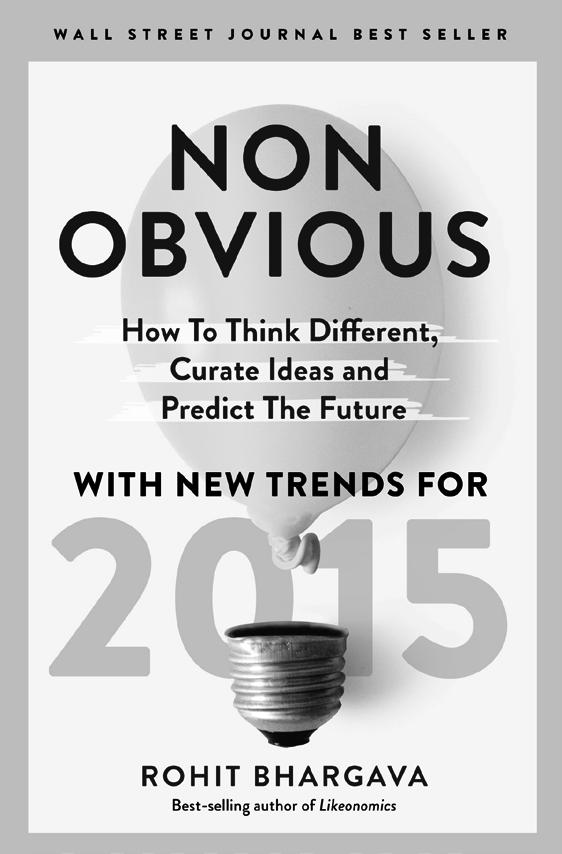
THE 2015 NON-OBVIOUS TREND REPORT OVERVIEW
Originally published March 1, 2015
Original Format: Hardcover + Paperback + ebook
The Backstory + Retrospective
This year Non-Obvious was first published in hardcover format, and the trend report truly took off. The book was an instant Wall Street Journal best seller. For the first time it revealed my full process of trend curation, which I had shared previously only in private corporate workshops.
In addition to the explanations about becoming a trend curator and using my Haystack Method, the report introduced several popular trends that drew worldwide media attention. A few highlights from this report included Unperfection, about the preference people often have for naturally flawed and more human products and leaders; Small Data, on the personal information consumers collect on their own behavior; Everyday Stardom, about sometimes unrealistic consumer expectations that they are always VIPs; and Selfie Confidence, on the counterintuitive idea that taking and sharing selfies may be a form of building self-esteem.
Beyond the trends, the book’s popularity this year introduced trend curation to a much broader audience, and the concept began to resonate globally. The book was contracted for six translated editions, and my speaking and workshop invitations, including more global appearances. The book’s success also allowed the NonObvious Company to bring on more partners and team members, which in turn allowed us to expand the research and curation abilities and make the future reports even stronger.
THE 2016 NON-OBVIOUS TREND REPORT OVERVIEW
Originally published January 25, 2016
Original Format: Paperback + ebook
The Backstory + Retrospective
After releasing the book in print for the first time in 2015, it was tempting to return to digital for the new editions. The volume of my in-person appearances made this impractical, so I chose to publish a paperback update to the book less than 12 months after the original was released. The update followed the convention of previous years by introducing new trends. However, given the compressed time frame, my growing team and I realized that we might abandon some predictions before we explored their significance.
As a result, we decided on a new convention: Every year moving forward, we would curate ten new trends and renew five previous predictions with an update on how those trends had evolved since we first wrote about them.
In the 2016 edition, readers were introduced to the new ideas of Strategic Downgrading, about consumers choosing supposedly inferior earlier versions of products because they often worked better, lasted longer, or were easier to use; Automated Adulthood, on the growing range of technology making things easier for young people launching their independent lives; and Virtual Empathy, about the idea that technology might offer us a path to empathy for others unlike ourselves.
For the first and only time, the book included an ill-advised 2016 update in which each trend from the previous year was revisited with more examples. Most readers thought it was not essential and unnecessarily long. In future editions, we relied instead on a final section similar to this one to analyze past predictions.
THE 2017 NON-OBVIOUS TREND REPORT OVERVIEW
Originally published December 5, 2016 Original Format: Paperback + ebook
The Backstory + Retrospective
If you ever looked at purchasing a new model of a car, you know that manufacturers don’t revamp the entire design every year. Some years the model is relatively unchanged, and some years it is updated significantly. This was a “maintenance” year for the NonObvious Trend series: The interior design and format were largely the same as 2016. The book again had a big release, and for the first time it was distributed widely across desirable locations, such as airport bookstores, which helped broaden the audience.
More readers discovered the report for the first time, and more international translations entered the market. Meanwhile, my speaking dates and workshops continued to grow. From a content perspective, this was a popular year with several standout trends, including Passive Loyalty, about a shift in how brands actually gain loyalty; Fierce Femininity, on the new revolution in how women are portrayed in media and culture; and Invisible Technology, about how technology increasingly anticipates our needs and blends unnoticeably into our lives.
This 2017 edition also won the first of what would be many book honors, a Silver Medal for Business Theory from the highly competitive Axiom Book Awards.
THE 2018 NON-OBVIOUS TREND REPORT OVERVIEW
Originally published December 5, 2017 Original Format: Paperback + ebook
The Backstory + Retrospective
For this edition, I engaged a completely new team and introduced an upgraded and more visual interior design. The book incorporated more photographs and a unique color on the inside to add contrast.
Some of the most popular trends from this report included Truthing, about why we trust in face-to-face interactions more than any other type; Brand Stand, on why consumers buy from brands who are unafraid to share what they believe in; Light-Speed Learning, about why we expect to learn anything faster than ever; and Manipulated Outrage, on what happens when a news media culture of outrage starts to define an individual’s identity.
Thanks in part to the updates, as well as submissions to many more industry book awards, the 2018 edition won six additional business book honors, including selection as a finalist for the prestigious Leonard L. Berry Marketing Book Prize from the American Marketing Association.
THE 2019 NON-OBVIOUS TREND REPORT OVERVIEW
Originally published January 1, 2019
Original Format: Paperback + ebook
The Backstory + Retrospective
Continuing with the design introduced in 2018, this edition featured a similarly visual look and feel. Popular trends from this edition included Innovation Envy, about corporations desperately copying one another instead of truly thinking differently; Muddled Masculinity, on our shifting cultural understanding of what it means to be a man; Artificial Influence, about how we increasingly put our faith in influencers who are fabricated for us; and Retrotrust, on why we trust products and brands that we recognize from our past.
This new edition also included custom illustrations, updated visuals, and a comprehensive appendix reviewing all past trends. In terms of visibility, the audience for the report and trends continued to grow and receive worldwide attention across 2019. Several more foreign language editions were published, more translation deals were finalized and I continued to present the insights on larger stages and deliver more frequent talks. Foreshadowing the publication of this Megatrends edition, these presentations more frequently focused on multi-year insights and shifts curated across the past decade instead of just a single year’s insights.
ABOUT THE AUTHOR
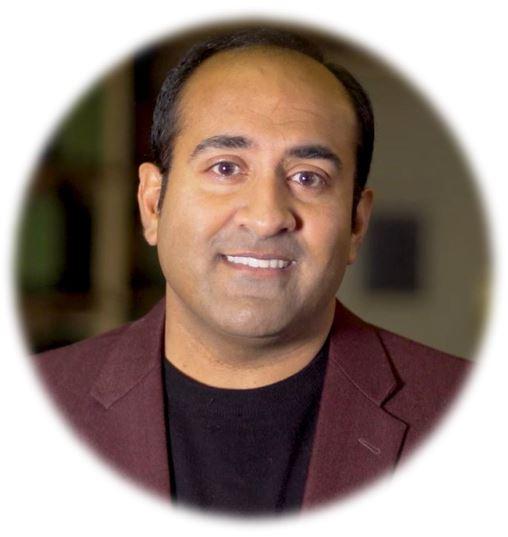
ROHIT BHARGAVA IS ON A MISSION to help the world be more open-minded by teaching others how to be non-obvious thinkers. He is the founder of the Non-Obvious Company and an entertaining, original and “non-boring” keynote speaker on innovation and trust. He previously spent 15 years in leadership roles at two renowned ad agencies: Leo Burnett and Ogilvy. Rohit is the Wall Street Journal bestselling author of six books and has been invited to deliver keynote presentations in 32 countries around the world. His insights have been used by the World Bank, NASA, Intel, Disney, Colgate, Swissotel, Coca-Cola, Schwab, Under Armour, NBC Universal, American Express and hundreds of others to win the future. Rohit is a popular Adjunct Professor of Marketing and Storytelling at Georgetown University and also writes a monthly column for GQ magazine in Brazil. He believes in listening before talking, is a lifelong lover of the Olympics and lives with his wife and two boys in the Washington DC area.