To Bruno With gratitude, affection and respect For his honesty as an industrialist For his humanity as an employer For his true humility With the commitment to safeguard and cultivate his qualities
The Lazzarin family would like to thank all those that shared their stories, helping this book to become a reality. Texts by Norma Follina Introduction by Pietro Zanatta Photo by Cesare Gerolimetto Latteria Montello spa Archive Graphic design and printing Grafiche Antiga spa Crocetta del Montello (TV) Printed in February 2017
Š 2017 Latteria Montello spa Giavera del Montello (TV) www.nonnonanni.it info@latteriamontello.com All rights reserved ISBN 978-88-99657-68-0
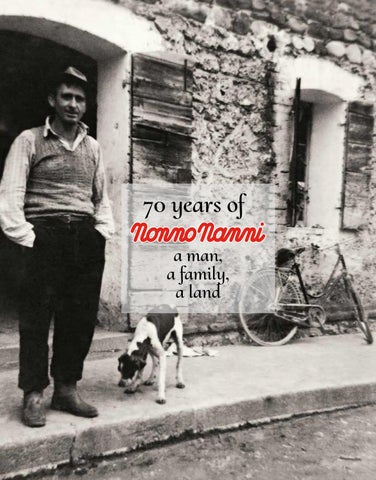
70 years of a man, a family, a land
Index
Introduction Latteria Montello, a resource over time 10 1911 Origins What a shame that four-year-old Nanni can’t stomach milk, because milk and polenta is the best they can offer 20 1947 Founding The first new milk vat arrives, and mother and daughter shake with nerves 38 The Sixties Nanni buys Ferruccio’s share. Work doubles and the steam-heated vats arrive 62 The Seventies The Lazzarin brothers’ dream. The new 1,500 m² facility keeps growing and growing. 88 The Eighties Another leap forward, another extension. Stracchino cheese takes off 112 The Nineties The new 8,000 m² facility and the coagulator 126 The 2000s The plant grows to 30,000 m² Nonno Nanni, the best grandfather there is 138 Today The launch of spreadable cheese The finest facility in the world, the experts say 152
The Lazzarin family
Benedetto
Maria Brunoro
(1882-1949)
Maria
Difendi
(1909-1992)
(1911-2001)
(1937)
Paola (1963)
Emma Marin
(1965)
(1968)
Bentivoglio (Ferruccio) (1918-2012)
(1910-1991)
Diana Baldasso
(1941)
Tiziana
(1914-1955)
Rina Pamio
Armando
(1937)
Gianni
Giusto
(1915-1986)
Giovanni (Nanni)
Luigi
(1882-1954)
Bruno
(1944)
Alessandro (1972)
Mirca (1973)
Nila Bettiol
(1944 - 2016)
Silvia (1976)
(1952)
Elisa
(1979)
Daniela (1982)
Introduction
11
Latteria Montello, a resource over time
When, in early 1971, the Lazzarin brothers Luigi, Arman-
their rare talent for enterprise and business, acquiring the
do and Bruno (who sadly passed away in 2016) presented
dairy in Povegliano and launching a successful pig breeding
their father Giovanni with the project for the first version
business largely overseen by Armando. He also remembered
of what would become the modern-day Latteria Montello,
how he had met with the firm opposition of his own fa-
one of the most modern and advanced cheese production
ther, Benedetto Lazzarin, a grain salesman and farmer, when
companies in Italy and Europe, his reaction was disastrous:
launching the original business in 1947 with his siblings Gi-
“Ve cataré tuti tre su na strada” (“You’ll all end up in the gut-
usto, Difendi, Maria and Ferruccio. He had, however, re-
ter”). The idea of an industrial plant of that size and, above
ceived plenty of support from his mother, Maria Brunoro,
all, that cost, was beyond the comprehension of the elderly
who was passionate about and skilled at transforming milk
“Nanni”, founder of Latteria Lazzarin in 1947. From the co-
into cheese, especially fresh cheese, which she then sold to
operative dairy that he and his siblings had opened 24 years
the families in the local area.
earlier in a 250 m2 site in Via Lavagei, the company would
Benedetto’s opposition was not an episode of generation-
be moving to a 1500 m2 industrial site in Via Fante d’Italia
al conflict but rather stemmed from his understanding of
which, over the next 30 years, would become home to the
the difficulties his children would face in opening and de-
30,000 m2 site of the present day. Rather than a jump in
veloping a cheese-making business in Giavera and the sur-
quality, the new project must have seemed to him a leap in
rounding towns. It would be difficult to get off the ground
the dark.
and there were no guarantees that it would be profitable, as
However, even if the idea of closing down the old site sad-
similar unsuccessful initiatives launched in the towns of the
dened him, Giovanni agreed to the growth plans drawn up
Montello area between the late 1900s and World War Two
by his children who, in previous years, had demonstrated
had proved.
Map of the Montello divided up according to municipality borders and farms, 1893. (Kindly donated by Studio Bastianon).
14
One such institution was the cooperative dairy of Cusignana
tremely precarious social and economic climate of the im-
and Giavera, founded on 2 November 1898 on the initiative
mediate post-war period, a time when investments in such
of the rural credit banks of the two parishes and located in
businesses were expensive, not guaranteed to produce prof-
Cusignana in Via Casa Rossa. It was a shift-type dairy that
its, and very risky. These factors also explain the aforemen-
required the partners to work in shifts and was not found-
tioned opposition of Benedetto Lazzarin and a few early
ed for commercial purposes but rather to produce cheese
doubts on the part of Giovanni who, for this reason, never
and butter for its partners, who numbered 156 in 1910. It is
stopped working in the fields, which represented a source of
unlikely to have survived the First World War as there is no
capital and something to fall back on if the cheese business
further trace of it in the years that followed the conflict.
were to fall through.
A similar fate befell another cheese factory located in Gia-
In fact, times were anything but favourable for the devel-
vera, in the Presa VI road just above the Brentella canal,
opment of new businesses in the province of Treviso, which
between the last few decades of the 19th century and the
registered over 30,000 unemployed in 1946 with thousands
start of the First World War. Documentary evidence of the
more emigrating abroad... and the Lazzarin’s knew that pro-
factory is very scarce and fragmented. All we know is that
ducing cheese wasn’t enough - they also had to sell it. And
in the 1920s the building was sold to the Gastaldo family
this required buyers and consumers.
as a house, while the equipment was sold to Luigi Pastro of
The situation improved very slowly over the next decade
Selva del Montello who, having used it in his own cheese
with the average income in the province among the lowest
factory, sold it on to the Lazzarin siblings in order to focus
in Northern Italy. The essay by B. Buosi and G.P. Nicoletti
on maturing and marketing domestic and foreign cheeses
(A town abroad. Emigration from Volpago between 1870 and 1970)
and cold meats.
describes how: “If the average income per inhabitant in Northern
The closure of this dairy removed a competitor and enabled
Italy was 100, in 1951 the people of Treviso were earning 53, and 10
Giovanni Lazzarin and his siblings to purchase the basic
years later they had only risen to 59. Considering the entire coun-
equipment for the processing of milk and the production
try, with the average income per inhabitant still 100, Treviso was
of fresh and mature cheese in the “Caseificio sociale turnar-
earning 76 in 1951 and still earning 76 in 1960. As such there was
io”, officially opened in Via Lavagei on 7 February 1947, at
no sign of development or growth or so little as to leave the gap to
knockdown prices.
the richest and most developed provinces unchanged”.
The initiative required plenty of courage, dedication and
In the mid-1950s, 75 out of 96 municipalities in the Trev-
commitment on the part of the entrepreneurs given the ex-
iso area were classified as “depressed zones”. In February
Introduction
15
1960, following its split from Arcade, they were joined by
el contadin o l’è malà el polastro!” (“When a peasant eats chicken it
the newly-formed municipality of Giavera, whose wretch-
is because either the peasant is ill or the chicken is ill!”).
ed economic conditions matched those of other Montello
In subsequent years, the payment of milk in cash rather than
area’s municipalities. With the exception of Montebelluna,
cheese products gave the farming families greater economic
industry was struggling to take off in these areas and agri-
resources and freedom. Previously, their income had derived
culture, which employed the majority of the working popu-
from the sale of calves, silk cocoons, poultry and little else,
lation, was backwards and heavily penalised by the excessive
and would sometimes end up halved as a result of tenant
parcelling of the land. The majority of the land plots were
farming practices or due to the payment of rental fees.
rented out and subject to tenant farming, and usually con-
Milk was collected in the villages of Giavera, Selva, Volpago,
stituted of small farms, in some cases entrusted to elderly
Bavaria, Nervesa, Cusignana etc. It was also collected at the
and female labourers because young male workers would go
sparsely distributed houses on Mount Montello, far away
and seek their fortunes abroad. The migration phenomenon
from the site in Via Lavagei, sometimes in quantities that
was particularly long-lasting and intense in the municipali-
made the collection itself an unprofitable process. The Laz-
ty of Giavera, with people leaving up until the early 70s (123
zarin’s – firstly Giovanni and then his children – always held
emigrants in 1970, 111 in 1971).
the “partners of the wood” in high regard, creating a bond
Despite this climate of hardship and very slow growth, the
that was more resistant to the offers of competitor compa-
Lazzarin dairy managed to take flight and prosper, also con-
nies than in other places.
tributing to improving living conditions in the villages of
Excluding a few relatively large farms, milk deliveries con-
the Montello area and to driving the growth of the farm-
sisted of a few dozen litres a day. In fact, up until the early
ing economy through the promotion of a resource, milk,
70s, the stables consisted of 2-3 cows, and sometimes just
which was produced by almost every family. Its textbook
one, because there wasn’t enough hay for more animals. To
processing and transformation into cheese, casatella cheese,
make up for this shortfall, many families went “grass pick-
butter etc., distributed pro rata to the partners in the early
ing” in the wood, along the banks of ditches, at the edges of
years, contributed to improving people’s diets, providing a
roads and even between the furrows of corn which, in this
substantial and healthy accompaniment for bread at a time
way, underwent a weeding process that was as natural as it
when diets were so lacking in fat that there was even a well-
was onerous for those that carried it out. Even the leaves
known proverb which, used until the 60s, is now sadly al-
and the tops of corn were collected and stored using the
most forgotten: “Quando un contadin magna polastro, o l’è malà
basic “fimariol” technique (from the Venetian dialect word
16
‘fime’, meaning “corn tops”). Usually there were only a few
to the north of the hill contributing to it. Firstly located
permanent pastures because the main crops grown up until
close to the church of SS. Angeli and then at the bottom of
the 1960s were wheat, corn and grapes using the ‘piantata’
Via Gorini (Presa VII), in an area that guaranteed a supply
method. These products were destined for consumption by
of water, this cheese factory had up to 130 partners but, in
families and the breeding of domestic poultry and, in the
1991, it moved to Maserada sul Piave in order to meet the
case of tenant farmers and tenants, made up a large amount
hygiene and health regulations prohibiting the dairy from
of the landowner’s share or the food render.
being located alongside the pig farm next door, and because
As well as the difficult and slow-moving social and econom-
the number of partners had fallen dramatically in the pre-
ic context, the Lazzarin’s company also had to face competi-
ceding years.
tion from other operators in the sector. From as early as 1924
A far stronger competitor of the Lazzarin’s was without
the Bolzonello dairy functioned at SS. Angeli with many
doubt the cooperative dairy of Selva and Giavera del Mon-
farmers from the upper area of the Montello and the towns
tello, founded in the early 50s by a number of families in
A shot of the Montello with the old church of Giavera.
Introduction
17
the two villages. It enjoyed strong growth, particularly in
embarked on a journey of remarkable growth that continues
the years between 1955 and 1980, in terms of both quantity
to this day and which is wonderfully described by Norma
of milk processed and number of partners, which reached a
Follina in the pages that follow.
maximum of 537, distributed in the villages of the Montello
In the 1970s the economic boom changed the face of Italy, and
area and elsewhere. In the following years, the drop in the
the Veneto and the Province of Treviso in particular, which
number of partners, down to around 130, a few risky invest-
finally emerged from its long period of deprivation. People’s
ments financed with bank loans, and the imprudent man-
living conditions improved thanks to industrialisation, the
agement of its production and commercial activities saw the
expansion of the services industry and the spread of small
cooperative fall into irreversible decline before it went out
businesses, which generated employment and profits. There
of business in January 1998.
was a drastic drop in the number of people working in agri-
While making sure not to bite off more than they could
culture, who were taken away by other sectors, along with a
chew, as old Giovanni warned his children, the Lazzarin’s
gradual specialisation process in terms of crops and breeding.
A view of Giavera del Montello from the old church. In the background, the Nonno Nanni factory.
18
On taking over the company, Luigi, Armando and Bruno
of Latteria Montello S.p.A. from its foundation until Octo-
Lazzarin immediately understood that they had to keep
ber 2016, helped raise the company’s profile and promote its
pace with the times, that the rural or, at the most, provincial
products all over Italy and in neighbouring countries.
dimension of the business no longer had a future, that new
The company has enjoyed, and continues to enjoy, remark-
ideas were required and that it was important to be able to
able success with “Nonno Nanni”, the stracchino cheese that
compete on the domestic market and, eventually, the inter-
takes the name of the founder of the original dairy and
national market with new, higher-quality products in order
which, before being seen all over Italy in adverts, proved a
to keep up with and, if possible, surpass authentic giants of
major hit in supermarkets and among consumers, becoming
the sector like Galbani, Invernizzi etc. As such, they invest-
the biggest-selling stracchino in Italy and registering excel-
ed all their economic resources and the expertise they had
lent sales in a number of other European countries.
acquired over the years in the factory in Via Fante d’Italia,
This original product has been followed by others equally
known as “Latteria Montello” to underline the bond they
capable of satisfying the increasingly demanding and re-
wished to maintain with the local area.
fined palates of Italian and international consumers. The
1985 marked a key watershed: the company stopped produc-
Lazzarin brothers complemented their fresh cheeses with
ing mature cheese, a product that all cheese factories were
another successful delicacy: the cheese gnocchi of “Nonna
able to churn out, in order to focus solely on fresh cheese,
Rina”, a brand that pays tribute to their mother and her im-
selected in advance and then produced using a method that
portant role in the family and the business.
combined the family’s traditional cheese-making expertise
The expansion of Latteria Montello, particularly in the last
with the latest technology, such as the “always-on coagula-
30 years, has produced significant benefits in terms of em-
tor”, now able to transform 150,000-200,000 kg of milk into
ployment with the company workforce growing from 30
fresh cheese every day.
employees in 1985 to 250-plus at present, and this without
The constant and impassioned research carried out by the
taking its effect on linked industries into account. As in 1947
three brothers, in particular Bruno who was head of produc-
and the years that followed, the enterprise of the Lazzarin
tion, resulted in a product range which, in terms of its fla-
family continues to represent an extraordinary resource for
vours, pleasantness and sensory qualities, went well beyond
the local community and its inhabitants, one that is just as
regular fresh cheese standards. Meanwhile, the robust sales
important today given the testing economic climate and the
network developed by Luigi, sales manager and chairman
shortage of jobs.
19
1911
Origins
What a shame that four-year-old Nanni can’t stomach milk, because milk and polenta is the best they can offer
W
hen he hears the noise of the bolt, Bibi the dog opens his eyes and tears off through the courtyard, his chain attached to the metal wire. The commotion doesn’t go unnoticed by the cat or the cows in the stable, whose lowing
breaks the silence of a new dawn. The slamming of the wooden door against the wall confirms that Benedetto’s day has already begun, with no alarm clock, no warming coffee and no surprises – thank goodness – seeing as the star-studded sky shows no sign of hail on this May morning. The land gives no respite to the farmers. There are vines to water and hay to cut, not to mention the corn and the wheat, which this year is overrun by poppies, damnation. What a beautiful sight, the boys say about the fields; how wonderful, echo the girls. But for 33-year-old Benedetto Lazzarin, born in 1882, with two sons, a daughter and a wife, Maria, it’s a misfortune. He never stops repeating it, but it’s the same story for everyone: when the fields aren’t swathed in red, they’re tinged a pretty cornflower blue. Wonder of wonders, the expanses of colour tempt you to stray a little further to where the flowers abound, where even the daisies grow higher than the wheat. You could even pick a bunch to offer to the Virgin Mary. Just a few steps more – but they’re forbidden steps, you mustn’t tread on the corn. If the farmer sees you, he’ll unleash his dog. So the girls make do with the forget-me-nots along the ditches. They are lapped by the A view of the Piave river from Montello with the Treviso Prealps and the Alps in the distance.
23
24
Opposite page: in front of the shrine of San Rocco, close to home, Granddad Benedetto surrounded by his grandchildren. Clockwise, from left: Armando, Luigi, Bruno and cousins Leonzio and Aldo.
water which, once it’s got past a stubborn branch, hurries on down without a glance or a smile towards Maria, who’s waiting there with the laundry. She is armed with a wooden board for washing, a piece of home-made soap to be used sparingly, a coarse-bristled brush and plenty of elbow grease. By the time the sun comes up, the washing is hanging out on the line by the field. One sheet might be threadbare, the other darned and the trousers patched on the knees, but that’s no excuse for not keeping them clean. Over in the courtyard, Benedetto inspects his meagre stock of machinery: a cart with a broken wheel, an old bicycle propped up under the colonnade and the brand-new, ultra-modern
Below: Bruno (left) with his inseparable cousin Aldo.
wagon the whole village has been talking about. He won’t be lending it to anyone, at least not for now. For now the villagers can make do with the old cart, one stick ready in each corner. It’s still fit to carry who knows how many more loads of sacks, hay and straw. He’s happy. The little ones are still asleep in bed. Damnation: it’s a shame that Giovanni, the eldest at just four, can’t stomach milk. Milk and polenta is the best they can do, so there’s no point him turning up his nose and clamping his mouth shut. Maria has tried and tried to make him open it, but even if she manages to get a drop down him, he spits it back onto her apron. He’s not doing it on purpose, really, Maria.
Origins
28
She wastes no time. A few minutes later her husband finds her milking in the stables, mulling quietly over her thoughts at the start of a new day. The baby that will be here by the autumn, the new cheeses she’s been making for a while now. They are deliciously tasty, and just dry enough. The neighbours certainly appreciate them, and some have been coming to buy them. Maria can’t believe it: she doesn’t think she’s doing anything unusual, but she’s happy to contribute to the family’s limited finances. Both of them are lost in thought there in the stables. Benedetto is irritated, as the cow has just flicked her tail in his face in an attempt to see off the horse-flies; Maria’s making sure the cow doesn’t kick over her bucket. These are the simple concerns of two country people from Giavera, at the foot of the Montello, the hill which gives the villages a small reserve of firewood. Yet in late May 1915, something truly terrible is about to take place. Someone has decided to take Italy to war, the First World War. The people of Montello are unaware, and they pay no attention, even if it’s mentioned. Wars happen in other places, maybe in Tripolitania, but they will never come here. Never. Yet a mere three years later and the voracious jaws of war are swallowing up entire villages. They stain the Montello with the blood of young men from all corners, making the waters of the River Piave run red. Whole families load their tattered belongings onto carts and set out to look for a new place to live. Others are loaded against their will onto trains packed with the desperate. They are sent all over Italy, to the centre and the south, where poverty bites just as hard. People look at them askance for taking away their bread, for the hunger which gripes at their stomachs, and the dialect they don’t understand. Benedetto, Maria and their children have survived the man-made storm and their house is still standing, a tiny oasis on the edge of the desert. By the time the War comes to an end with the Battle of Montello in June 1918, Benedetto has five children: seven-year-old Giovanni is feisty and needs taking in hand, his father thinks. Maria is
Origins
Cows grazing on the Montello.
33
eight, Giusto four, Difendi three and Bentivoglio (Ferruccio) is still in swaddling clothes. Quite literally, because babies are swaddled up to their armpits, wrapped up tight for many reasons, not least the popular belief that it will make their legs grow as straight as a broom handle. Bentivoglio (Ferruccio) is the only one who isn’t on the move. With all that sunshine and fresh air, the others are always running up and down the fields or hunting for birds’ nests, much to their mother’s dismay. Now the War is over, hunger bites even harder. Hundreds of families live in shacks provided by the government; many young men have not returned, and others have emigrated to earn a crust for their parents. The years go by, and the children grow up. Less than thirty years later another War comes along, even worse than the First: but even this new calamity passes. Maria, more persistent than ever, continues to sell her cheese, and several new cows join the stables. There’s milk to sell, and milk in exchange for cheese. But Maria isn’t satisfied. One evening she plucks up the courage to speak to the family, her eyes on her feet. She’s been doing the sums for a while, and her cheeses make them much more money than the milk they sell Opposite page: the Lazzarin cousins; from left to right: Armando, Bruno, Luigi and Aldo.
to the dairy and… and… Benedetto waits for his wife to finish. He’ll never agree to her suggestions, and anyway, women are supposed to just get on with their work. He’s the head of the
34
family after all. Maria looks up and blurts out that they should turn all of their milk into cheese, not send it to the dairy in Povegliano. Heavens above. When women talk, their imaginations run wild. Their children, now grown up with wives and families of their own, listen carefully and agree with their mother’s idea. One evening in late December 1946, men begin to turn up at Benedetto Lazzarin’s house, and eventually there are around twenty of them. They sit in the half gloom of the only lightbulb, which hangs directly above the table. As they wait, they start to talk in muffled voices, like the dull sound of the water flowing through the ditch beyond the courtyard. But as the voices die away, the idea of a dairy cooperative begins to take shape, a place where the farmers can bring their milk and have it turned into cheese to take home. Maria is sitting to one side with her 9-year-old grandson Luigi, Giovanni’s son. She is dressed in her best clothes – the correct way to welcome her fellow villagers. There’s Ferruccio Agnoletti, who’ll be the first chairman; there’s Nani Tabarin, Orazio Agnoletti and the five brothers and sisters: Maria, Giovanni (Nanni), Giusto, Difendi and Bentivoglio (Ferruccio). But not their father Benedetto. Furious at being outvoted, incensed at an idea that will only lead to ruin, utterly convinced that nothing good could come out of his wife’s head, he is wandering between the stables and the courtyard. He is husking ears of corn, preparing the willow trees for pruning, cursing the cows, silencing the dog. While the storm rages outside, inside the house a serious plan is coming together. A month later, under a leaden, snow-filled sky, the Cooperative Creamery is created. Maria smiles quietly. It is the 7th of February 1947. Opposite page: The date Latteria Montello was founded. The inscription was made using progressive numbers that were stamped on the cheeses.
Origins
35
36
The family from the origins
Benedetto, Maria and their five children Grandfather Benedetto is looking down from way on high, cleaning his glasses, convinced his eyes are deceiving him: never in a million years could he have imagined such a dairy. His wife Maria is pointing towards the earth, saying “I told you it would work.” In truth not even she could have hoped for such success, but she’s glad she got the upper hand as they watch their grandchildren and great-grandchildren at work. Benedetto takes off his hat in satisfaction, saying “I don’t know, it’s all so stressful.” He is a man who has always lived amid the peace of the countryside, selling corn seed and firewood.
Benedetto (1882-1949)
Maria Brunoro (1882-1954)
Benedetto was born into a family of country dwellers who passed on their passion for working in the fields and stables. In winter he used to climb the Montello with an axe over his shoulder to chop down firewood, loading it onto a horse-drawn cart and selling it in Treviso and as far away as Mestre.
The grandmother from the mountains, as her grandchildren called her, helped out husband Benedetto as well as looking after their home and five children: Maria, Giovanni, Giusto, Difendi and Bentivoglio (Ferruccio). It’s Maria who makes and sells their first cheeses to bring in some extra money, and Maria who first dreams of opening a dairy.
37
Oldest daughter Maria worked around the house as well as in the fields and dairy. She adored her brothers and her nieces and nephews, knitting them sweaters and woollen hats.
Benedetto and Maria’s youngest child. He sold his small stake in the dairy in 1962; later on he will buy a 50% share of the farm Giovanni has purchased in Lovadina.
The dairyman at the first ever dairy lost his life in a motorbike accident aged just 41.
Maria (1909 - 1992)
Bentivoglio (Ferruccio) (1918-2012)
Giusto (1914-1955)
Giovanni (Nanni) (1911-2001)
Difendi (1915-1986)
Benedetto’s oldest son was passionate about working the fields, just like his father. He took over the dairy in 1957 two years after the death of his brother Giusto. In 1971 he handed the business over to his sons Luigi, Armando and Bruno to dedicate himself full-time to raising pigs in Lovadina. An expert hunter and brilliant boules player.
Difendi didn’t work in the dairy, preferring to tend his land and raise pigs.
1947
Founding
The first new milk vat arrives, and mother and daughter shake with nerves
T
ransformations are underway at Benedetto’s farm. Room must be made for the dairy, a colonnade added, the ground floor extended, and, in a scene beyond their wildest dreams, the equipment arrives. Here’s the golden goose: the brand-new vat,
the first ever for the Lazzarin family, holds 12 hectolitres of milk. Giusto, who’s chosen to work as a dairyman, looks at it anxiously. The vat gets great attention from Giovanni, known as Nanni, who divides his time between working the land and the new business. His mother and sister stop and stare every time they come inside, running their fingers over the vat and wondering about the future. Bentivoglio (Ferruccio) doesn’t, and nor does Difendi. They’ve spent endless nights thinking about it, have consulted the village sages and decided to go their own way, Ferruccio the gobetween and Difendi the farmer. There have been no arguments, just a few complaints. As Maria sees it, everyone must decide for himself, so they do. The milk vat shimmers like a mirage. There is no shortage of fuel here, with the woods just over the way. It seems easy now everything’s ready, as easy as drinking a drop of good wine. But they still need to work out how to heat the milk in the vat. Nanni is restless. Giusto the dairyman
Nonno Nanni with his faithful pointer, Gloria.
41
42
knows his older brother has to work the fields, gather the hay at harvest, prune the vines. He understands that the planting season can’t wait, but they have to come up with a woodburning contraption at all costs. Time is ticking, the farmers are waiting, profit is knocking on the dilapidated door which will be replaced before long. The nights are too short for the brothers, and when their mother Maria goes looking for them, Below: two photos of the old family house of Benedetto Lazzarin, in Giavera del Montello, in which Nanni, his siblings and their children were born.
she often finds them asleep with their heads on the table. They wake up, start again, and solve the problem. A scratch, and the match sets the straw alight, brightening the winter’s morning. The flame flickers like their worries over costs and uncertain profits, then it takes hold. Faces emerge from the shadows and at last the heat beats back the draughts coming in from the cracked windows and beneath the door. The warmth overcomes the bitter cold and everyone’s mood lifts. “This summer we can go to the market in Montebelluna,” says Maria, “and bring back two whole bags of cloth. Our wardrobes will be bursting with clothes.” Their excitement is palpable. “And hats,” her daughter goes on, “and stockings… and highheeled shoes.” “And ribbons and bows, like the ladies at the villa.” The young woman stands straight, her head tilted to the left,
Founding
45
and walks around the room with a snooty look on her face. “No, that’s not right. Real ladies take smaller steps, one foot in front of the other…” Just then the men come in and interrupt their fun, although the women continue to grin at each other. The fire is ready just beyond the new container, where the white milk contrasts with the warm tones of the copper. Nanni pushes the handle with his calloused hands, which bear all the marks of his thirty-six years. He moves the trolley along the track and stops it beneath the vat. Everyone’s heart stops for a moment too, not least Maria’s. Her private dream has come true. A tear appears on her cheek, trickles slowly down to her mouth and down her neck; she wipes it away discretely with her hand. Nanni and Giusto swallow hard. Never before has the Lazzarin family fallen so silent; it’s almost as if they’re praying. A few seconds, or perhaps a minute later, and the silence is broken. Everyone says something, no one is listening: the main thing is to keep talking, to release the tension. Soon the milk reaches the right temperature. The handle is turned again to move the flames beneath a cauldron of water. Heavens, while they’re waiting to warm the milk again, the burning wood mustn’t go to waste. With a new business and such a large family, no end of hot water is needed. Maria is given the great honour of adding the rennet, and she begins to stir the milk. A couple of minutes later and her daughter takes over the job. The mixture is thickening: the cheese is starting to form. The task gets harder, but their hearts are light. It’s ready: the first casatella cheese is already wrapped in its muslin and placed into the wooden mould. Ladies and gentlemen, it’s official: on the 7th of February 1947, the creamery opens with two 1.2 tonne vats. Giusto is ready to be a dairyman. His brother Nanni has been married for eleven years to Rina Pamio, who’s given him Luigi, ten,
Opposite page: two photos of some of the earliest workers at Latteria Montello.
Above: Norma Lazzarin, Aunt Pierina holding the cheese harp, a tool used to break up the curd, Loris (collector), and Bertilla.
Below, from left: Benito (collector), Giusto (cheesemaker), Loris again and two other collectors.
Latteria Montello’s first premises.
48
Anna, taken from them by illness at just eight months old, Armando, six, and Bruno, three. Nanni will never forget the first time they lit the fire. He repeats the story over and over at the dinner table. Rina keeps quiet, but their children exchange impatient glances as they hear the tale of the first cheese yet again. If you want, I’ll tell you the story, Papa, thinks Luigi, the oldest. But he says nothing; in those days the head of the family decides everything. He even serves up the meal to his wife and children. They start out by making semi-hard and hard cheeses, the type their partners prefer as they can take them home and store them in their larders. It isn’t always easy to stop it going off: it takes skill to moisten it with linseed oil and pepper, and turn it often enough. The wheels of hard cheese are much bigger than the wheels of casatella, and the dairyman’s efforts must increase in proportion. “Nanni, will you show me how to make cheese?” a girl from the village asks him one day. He takes her by the hand and leads her inside. They walk across the wet floor of the brining room, reach the workshop and stop. Giusto the dairyman has just put a wheel of cheese into the mould. He is picking up the muslin, one metre by one metre, bringing the two corners together and taking them between his teeth. He grasps an iron rod, wraps the other side of the muslin around it to hold it tight, then lowers it into the vat. Using the full strength of his teeth and arms he pulls out the cheese: a superhuman effort, the young girl comments. By 1950 the dairy is no longer a cooperative; it’s run by the four Lazzarin brothers, who each have their own role. Partners are paid both in money and cheese for their milk. Benedetto dies a year before the new system comes in: it’s another step which would have made him furious. Opposite page: Nonno Nanni with Norma Lazzarin, Latteria Montello’s first secretary.
Founding
The Piave river and the Montello.
Founding
G
iusto is by now the chief dairyman, and he spends his days in the creamery, which continues to expand slowly but steadily. Now that it’s no longer a cooperative, milk is collected from Giavera, Cusignana, Volpago, Nervesa and Mount
Montello, where the fields are fragrant with flowers, the hay smells of wild fruit and the cows produce excellent milk. While the farmers have always brought their milk to the dairy in buckets and pails, now it is the dairy which goes to them to collect their milk. More sleepless nights for Nanni, who is always willing to help his brother, despite his work on the farm. There is no shortage of labour in this deprived area, where not all the houses have electricity, water comes from the pump in the village square, and there is no sign of industry whatsoever. In Santi Angeli, Toni goes from house to house on his mule. In Cusignana and Giavera Vittoria walks slowly along the street with her yoke and two pails, which she fills up with good milk come wind, snow and anything else. By eight o’clock, she has already delivered her white gold to the dairy. So has Bruna, who travels the Selva area with a cart hooked up to her bicycle and a horn on the handlebars so people know she’s coming. It’s not the easiest of jobs, but hunger pushes people to accept the first thing that comes their way. Bruna, who’s just turned 17, should grab the chance as quick as she can, at least according to her mother. Winter mornings are the worst. With the temperature indoors not much higher than outside, simply getting out of bed
53
54
is like carrying a sack of flour on her shoulders. It’s pitch black out, and nothing is moving; the mulberries in the vineyards form shadowy monsters against the sky. She shivers at every frightened cat, at every outline which turns out to be a stump, a cloth on the line or nothing more. They’ve told her to sound her horn outside each house, but she’s timid and embarrassed. She prefers to knock on the doors, and people greet her kindly and look sympathetically at her frozen purple hands and aching knees. One morning, an old man invites her into the stables where his sons are milking. The warmth makes her cheeks glow, and her fingers slowly come back to life in the old man’s grasp. She would love to stay and sit down on the stool, to wait for the sun to come up, but she can’t. She has a job to do, so she says goodbye and returns to the road. Next she heads to the “signora” in the villa, who comes to the door wrapped in her dressing gown with slippers on her feet. Those red slippers with the pom-poms are the stuff of dreams for Bruna: they inspire her to work for a better job. She’ll never forget them, nor will she forget the “signora’s” superior tone as she puts down the pail, waits for it to be emptied and checks the numbers in her delivery book. Her unsympathetic, infuriating ‘bye, dear’ will echo round
55
and round her head. Bruna swallows her anger; her round is nearly over, and soon she’ll be at Nanni’s. There’s work to be done in the fields, but there’ll be also something hot for lunch. Her neighbours Nanni, Rina and Maria never go hungry, and they give work to the local people, even when they don’t need extra hands. Bruna thinks about them as she rides along with her enamelled containers full of milk. She notices the buds on the mulberry trees in the frozen countryside. In a few months, the leaves will have grown back and she imagines herself under the colonnade, cutting them for the Lazzarins’ silkworms as she does every year. She likes doing it, because she feels at home with the family. Grandmother Maria will come to the door and call out, “Do you want a plate of beans?” Bruna recognises every stage in the cooking through the smells: first the onion, then the beans, and next the fried bacon fat which makes her stomach smile. Her mouth waters as her hands move quickly through the branches. Speed is the price to pay for a good lunch from Maria, who’s not known for her generosity. But soon Bruna will switch from collecting the milk to working as a seamstress at Rostolis, which in 1952 opens a workshop right behind the church in Selva del Montello. Families rush to beg a job for their children, hurrying to ask for a secure wage, for what progress has to offer them. That same year, Bruna’s brother Sergio starts collecting milk. The cold doesn’t bother him, and he couldn’t care less about staying warm. Running along the darkened streets, tripping over hidden obstacles, ending up in a frozen field, keeping pace with the coming dawn are all such
57
pleasures that he doesn’t notice his throbbing ears or aching hands. There are still some leaves on the chestnut trees, though the burrs lie empty on the ground, filled with dew. Soon the sun will warm them through a gap in the trees and make them shine. Sergio doesn’t know much about history, but he loves the Montello area. As he reaches the Valley of the Three Springs every morning, he slows down to look for signs of the hermit who lived there centuries before. He thinks he can hear the Gregorian chants coming from the monastery, but there’s nothing there: neither stones nor crosses, just the song of the flowing water. Here the Abbey stands majestic against the blue sky, a favourite place for games and jaunts on the Easter Monday. Majestic is perhaps an exaggeration. The ruins are easier on the heart than on the eye, loved for centuries not least for their link to Monsignor Giovanni della Casa, who wrote his book of etiquette, the Galateo, inside these very walls. Of course, it’s easy to talk about manners, propriety and respect when you live in an oasis surrounded by oak and chestnut trees. The dairy is expanding rapidly despite, despite... There’s no easy way to say it. In 1955, Giusto has a motorbike accident, a terrible crash in Valdobbiadene. The road is clear, he can go. Yes, there’s a group of women standing on the right, but they’re not moving. And two bicycles are coming slowly towards him from the left, but everything is under control. Then suddenly the women set off across the road. The brakes on Giusto’s Guzzi motorbike squeal, the bicycles are right in front of him now. He swerves, but he hasn’t seen what’s in front of him: a cursed concrete post. Giusto’s life is over at just 41. An invisible hand has snapped the thread which he thought would last forever; his wife Antonia, young son Aldo and the whole village are plunged into grief. His mother Maria has passed away the year before, sparing her from heartbreak. At home they talk of the unlucky son, and the anecdotes emerge. Like the day Giusto took Norma, their first secretary, for a motorbike ride to visit Nanni’s eldest son Luigi at his school in Castione di Loria. For the dairy has its own secretary now, along with Virginia, Antonia Opposite page: the chestnuts of Montello.
58
Opposite page: a view of the Montello with the ruins of the abbey of Nervesa della Battaglia.
and the other women who help keep everything spick and span: cleanliness is everything to the Lazzarin family. Four or five people are putting money in their pockets, and that means life to the local families. So here is Norma, getting on the motorbike, happy to feel the wind in her hair, ready for a race along the uneven, stony roads, proud to have such an energetic, brave, daredevil of a boss. They set off and she is enjoying every minute. They’re almost there when Giusto feels something strange. He glances round quickly, not wanting to take his eyes off the road. He reaches back to make sure Norma is still sitting safely on the saddle. But she’s not there. One particularly large jolt has thrown her off the bike a kilometre earlier. This time he’s really done it. He turns round, sending
Young Luigi Lazzarin with his Bianchi bicycle.
up gravel and dust into the air. She’s standing there with a handkerchief in her hand and a big smile on her face, bruised all over but with nothing requiring a doctor or worse. This becomes the main theme of Giusto’s visit to his nephew. There are gales of laughter, wild ideas, and normal chatter gives way to the most ridiculous of jokes. Remembering Giusto eases the pain of their loss a little. Life carries on. They owe it to him too, to the uncle who only the year before had given Luigi a racing bike, a Bianchi no less: the first of its kind in the whole area. It was even admired by Adolfo Grosso, the professional cyclist from Camalò
Founding
59
di Povegliano, well known throughout Italy and Europe and the winner of many prizes and trophies. Grosso used to give Giusto lessons when his parents went for their daily siesta. Of course, Luigi could only keep up with him for a while, being too worried about getting home in time (and too slow for the champ). The bike becomes an object of desire for Nanni’s two other sons, Armando and Bruno. The younger one devours it with his eyes, but all he wants to do is sit on it, forget about riding. He has to tilt it until it’s almost on the ground just to get his leg over the crossbar, then he loses his balance. Luckily, the bike stays upright. One day he decides to put his leg under the crossbar, like he does with his father’s bike. But the handlebars are curved so far downwards and difficult to reach that… crash, it falls over. The bike falls on top of him, thank goodness, without even a scratch. His heart racing wildly, he picks it up and puts it away, checking it all over, then walks dejectedly back indoors.
60
Nanni and Rina’s family Luigi, Armando and Bruno
Giovanni (Nanni) Lazzarin (1911-2001)
Rina Pamio (1910-1991)
Rina married Giovanni in October 1936, going on to work in the dairy with her mother-in-law Maria.
61
Giovanni (Nanni) threw all his energies into starting up the old dairy. He worked alongside his mother Maria and wife Rina, often assigning urgent work in the fields to his sons even though they were still young. Luigi, Armando and Bruno will never forget the orange soda their father bought them, a reward for harvesting the hay while he was working at the dairy. They can still see him coming back from the tavern as if it were yesterday. They hear their mother coming towards them, watch as she fills a container with ditch water and pours in the smallest bottle of orange soda for all five of them to share. In the bluish purple of the night, that insipid water tasted of pure orange, so happy were they to sit on the edge of the ditch.
Luigi
Armando
Bruno
Born in 1937, Giovanni’s oldest son divided his time between cheesemaking and farming from a young age. Luigi was the milk collector, so he knew the local area like the back of his hand. From 1965 to 1969 he ran the dairy in Povegliano bought by his father. In later years he managed the commercial arm of the dairy, becoming company chairman in the 1950s. He married Emma Marin and they had two children: Paola and Gianni. Voted Capitano dell’anno and Businessman of the Year (in November 2016), Luigi is now honorary president of Nonno Nanni and has plenty of time to pursue his hobbies. Just like his father, he visits the company every day.
Born in 1941, Armando began farming the land with his parents as a young boy. He was put in charge of butter making at the dairy. From 1973 to 2006 he worked alongside his uncle Bentivoglio (Ferruccio) on the pig farm in Lovadina. He returned to the dairy in 2006 and still manages the packaging department and workshop to this day. Sometimes Armando would accompany his father on hunting trips on the Montello, and still remembers waiting a whole morning in the spot his father showed him for a hare to appear. In the end it did. He is a practised helice shooter and has won a host of prizes. He married Diana Baldasso and they have three children: Tiziana, Alessandro and Mirca.
The youngest of Giovanni’s children. Quiet and meditative, he began working at the dairy as a boy. Passionate about his work, he was put in charge of production while also overseeing marketing and packaging. He married Nila Bettiol, formerly the dairy’s secretary, and they had three daughters: Silvia, Elisa and Daniela. His meticulousness was legendary, and he would fill the house and office with notebooks written in the minutest detail. He would go clay pigeon shooting in his spare time, and had a keen interest in the figurative arts from childhood. It was Bruno’s idea to commission an outdoor sculpture for the dairy, seconded by his brothers. Bruno passed away on 3rd August 2016.
1957-1968
The Sixties
Nanni buys Ferruccio’s share. Work doubles and the steam-heated vats arrive
A
fter Giusto dies, the brothers sit round the table again. Nanni wants to take over the dairy, and the others agree. Only Bentivoglio (Ferruccio) wants to retain his share, but the oldest brother holds firm. In 1957 he brings in his sons Luigi, 20,
and 15-year-old Armando, who’s put in charge of butter making. It’s a huge job, as they turn out 70-80 kilos a day. The days are long for the boy, as tiring as carrying sacksful of wheat to the granary at harvest, which he’s been doing for some time. Armando dreams of kicking a ball around the fields or the courtyard, of heroic saves. But for now there’s only work. Bruno is taken on, though at his age he can’t do much anymore. And Luigi can get on his bike, seeing as he loves cycling so much. Since 1950 he’s been out at seven sharp to meet the milk collections from Santi Angeli and Bazzichet, beyond the Brentella. He loads the milk onto the cart he pulls behind his bike and takes it home twice a day, seven days a week. In the meantime, in a specially built room in the courtyard, right next door to the pigsties and stables, their first shop opens for business. The tiny store is run by anyone in the family who has the time, but it proves popular with people from the local area and word soon spreads. Pump that distributed steam, water etc. to the various pieces of equipment. Second plant (1957)
65
66
It is summer 1957. Nanni’s children are grown up. He can count more and more on their help, even though the oldest risks being called up for national service. Fifteen months away from home, time stolen away from the family; but one in three sons is exempt, that’s what the law says, word for word. The oldest son stays home, and they’ll think about the other two when the time comes. That year the dairy takes a leap forward with two steam-heated, self-propelled copper vats. It’s goodbye to firewood, and hello to fuel oil. The milk collectors have switched from bicycles to mule-drawn carts. What a difference it makes being able to sit down and ride. It’s life-changing, think Angelo Vidori and Toni Pisan. Bruno, Toni’s son (how lucky to be born a few years later!) even travels by jeep. Yes, it’s a beaten-up old army vehicle, and it takes a huge effort to get it going with the starting handle. But when the air picks up the petrol fumes and carries them right inside the houses, when you go up and down the Montello without the slightest of trouble, you feel like the captain of the woods. Of captains they have seen too many, men who at the height of Venice’s splendour would ride around on horseback punishing anyone who dared to cut down the trees, so precious were they for the city’s Arsenal. The oaks were pruned, bent and shaped to suit the ships under construction. Time has passed, but the echoes remain in the hearts of the ‘bisnent’ (‘twice have-nots’), people forced to sell their share of the woods granted under the Bertolini Law of 1892 to fund their voyage to America. Tossed by the waves, their creaking ships would often end up at the bottom of the Atlantic. Yet no tears were shed as their families would only find out months later, if at all. Such unforgettable times. From a bicycle to a mule, a mule to a jeep, and finally an Ape van, a lorry. Nanni’s business is doing well, but he doesn’t abandon the land. In fact he keeps on buying more. Of course, his hand is always on the brake, because he is a clever man. Such is his nose for business that he can
The Sixties
67
compete with anyone, be it for land, cheese, or stables. His children have nothing to complain about. Now there’s a VW Beetle in the courtyard, the must-have car for an affluent few, the car which turns girls’ heads. There’s always work to do, but on their evenings off, when Luigi and Armando Lazzarin get out from their ‘racer’, the kids in the square all come over and ask for a lift. Bruno, the would-be student who has to do his homework and study for tomorrow’s test, is always in the dairy. Although he Below: early 50s, the first Accounting class of Balbi Valier boarding school of Pieve di Soligo; third from left in the front row is young Bruno Lazzarin.
attends the Balbi Valier Institute in Pieve di Soligo, at 17 he has the experience of an adult. “What are you doing? Haven’t you finished that pile of
From left Aldo, Nanni, Rina, newlyweds Luigi and Emma, Bruno. Behind them two legendary Volkswagen beetles.
70
nonsense yet? Come on, get a move on.” The words are repeated endlessly when he’s supposed to be studying, breaking his concentration. So he decides to leave his books behind and work full time in the dairy. Luigi and Bruno will drive it forward, just like their mother Rina when she would help them onto the cart as children.. Luigi decides to marry Emma, a young girl from Selva. Nanni doesn’t bat an eyelid, in fact he throws himself into organising the wedding: they need an extra pair of hands around the house, as long as she keeps quiet. Armando is doing his national service and seems to be loving it, according to one of the local boys, and the fact that he never comes home. They fix the date for the 14th of October 1961. A year earlier the Municipality of Arcade has lost the village of Giavera, bringing a series of endless debates to a close. The timing couldn’t be worse. The grapes are ripe, the stubble needs cutting and it’s hunting season on the Montello, Nanni’s greatest passion.A day’s lost hunting is a curse, but he swallows the bitter pill, gives up his hares, and the wedding goes ahead. Preparations are in full swing that Saturday morning, but on his way back from a quick delivery in Volpago, Luigi spots some of his friends outside the bar and they call him over. He brakes and swerves expertly, not wanting to disappoint them. As he lingers about chatting, two unfamiliar women come into the bar. One of them comes up to him. “Aren’t you Luigi, the man who’s marrying my niece this morning?” she asks. The relatives from Bassano are already here. “I’ll be on time,” he mutters, rushing out of the bar. And, shortly afterwards, there he is. As handsome as Adonis, he drives his Fiat 130, which can barely fit along one side of Via Lavagei, up to the church square in Selva. A friend has already parked his red Alfa Romeo Giulietta, while Mr Rostolis’s Lancia Flavia pulls up alongside other opulent-looking cars. It’s enough to make the women drop their pails and the men with rakes on their shoulders gasp in surprise.
The Sixties
71
After the church ceremony, Nanni shells out 73 lire a head for lunch and dinner without breathing a word. The next morning Emma wakes up at the Lazzarins’. The following year Nanni becomes grandfather to baby Paola, Luigi and Emma’s daughter, an event which makes him turn up his nose. A girl? It’s men they need around here. But he soon gives in and becomes proud to be called “Nonno Nanni” (Grandfather Nanni) by the family. Around this time Nanni offers his brother Bentivoglio (Ferruccio) the chance to exchange his small share in the dairy for a 50% stake in the Below: the first Volkswagen minivan, late 50s.
farm. He agrees. By now the dairy is fit to burst. Extra walls and rooms are
74
added on everywhere, but there are plans to leave Via Lavagei and move closer to the main road. It’s time to apply the brakes. Expanding is one thing, but moving from their original site is another. Despite their burning desire for modern equipment and buildings, Nonno Nanni keeps them all in check with his eye on another business idea. It is 1964, and Nanni is 53. Less than a year goes by. The dairy in Povegliano is up for sale, the same place which, albeit unwittingly, inspired them to start their own business. Nonno Nanni doesn’t think twice. He buys it with Luigi in mind: let’s see if the farmer, the milk collector, the dairyman, the Beetle driver, the newlywed can run a company. The story of the Povegliano dairy is one of grief and courage. In 1928 an earthquake wipes out whole towns in Friuli, forcing people to move away in order to survive. One family arrives in the Treviso area, and begins to look around for a new business. The father, who has seen his soap factory crumble into dust, holds back his tears: he looks to the future, not to the past. In Carbonera he finds a place where they can make cheese. Everything turns out so well that the business is handed over to his son and moves to better premises. In Povegliano, no less, where twenty years later it catches the Opposite page: Luigi and Emma tie the knot on 14 October 1961.
eye of Nanni Lazzarin and his mediator Nino Menegheto, whose real surname is Bettiol. A handshake with the owner
The Sixties
A little road across the Montello.
78
Domenico Calligaro and the deal is done. Nanni and Domenico get along instantly thanks to their shared passion for hunting. The reins are handed to Luigi, who in the meantime has given Paola a baby brother, Gianni. Nonno Nanni rejoices: a boy at last. Over in Giavera, youngest son Bruno has just returned from military service in Rome with the bomb disposal unit, the ideal occupation for a shy, introspective young man. He’s put in charge of the creamery: thank goodness he’s back, because his father prefers hunting and farming. Thank goodness he’s so precise, calculating and analysing every move. He has a much better vision of the future than his family imagine. Armando continues to make butter. By now he has another task to shoulder: his father has put him in charge of the stables they’ve hired out on both sides of the River Piave. Young Armando has so much to do, what with feed to prepare and deliveries to make, that he even asks his girlfriend Diana to help now and again. She has little experience of stables and dust, but for love she’s willing to break her nails and give up her polish, stirring the feed again and again to keep away the mould. We can’t go on like this, thinks Armando. So he comes up with a way to save himself, his mother and Emma the job of scrubbing down the cheese boards day
79
after day after day. He has a plan but keeps it to himself. While his father takes his afternoon nap, Armando carries out endless experiments and tests at a craftsman’s workshop. When they return to work, he is waiting in the dairy without so much as a word of his invention. His mother and brothers have asked him what he is doing at the workshop. The answer is silence. While Nonno Nanni takes his siestas, the winch would have already been ready if Armando hadn’t had a wedding to plan. Leaving the churner behind for a few days, Armando marries Diana on a beautiful 4th May 1968: a dream come true. They honeymoon in Spain, amid advice and suggestions from all. Go to Seville, don’t miss the Giralda, the Plaza de toros, the Royal Palace of Madrid. It’s a wonderful time, although his thoughts are on the workshop in Giavera and as soon as they return he rushes there. A few adjustments and his secret will be revealed. Ten days later Nonno Nanni is sitting in the courtyard. He hears the van pulling up and looks over. Armando gets out, glancing at Nanni as he struggles to put down a mysterious object: a steel contraption which looks a bit like a packing case. What on earth is going on? Nanni
81
puts his head in his hands, better to find out slowly. Strange that Armando hasn’t said anything, or even looked at him properly. Everything is ready out there opposite the dairy, a stone’s throw from the company store. The engine is running. Nonno Nanni looks up curiously and sees his son pick up a cheese board and put it into the machine. First it is swallowed up, then it is fired out at unimaginable speed and hits the shop door. Nanni puts his head back in his hands. “Wait,” says Armando, “that was just a hitch. Give me a minute and I’ll show you the invention of the century.” He opens the hatch, inverts the belts and starts again. The board passes through the washing machine, is doused in steam and scrubbed with steel brushes, emerging on the other side as nimbly as a ballerina. The Lazzarins have never seen anything so clean. Of course, the shop door is still damaged, and Nonno Nanni has still risked injury, but from then on life is easier and the quality of their products is greatly improved. His mother Rina can leave her scrubbing brush in the corner. Needless to say, the newlyweds’ first child is Tiziana, as cute as a button, but still a girl. “My children never make a good start,” comments Nonno Nanni, gazing affectionately at the baby. On 4 May 1968 it is the turn of Armando and Diana.
Between wheels of cheese and casatella, one delivery van and another, the fields and the store, their secretary Norma leaves
82
her post. Born in 1928, Norma Lazzarin had started out in the dairy aged 19 in 1947, having worked for an order of nuns in Turin. She had found a job away from home with the help of the parish priest in Selva, who knew Norma’s brother Aldo, a bishop in Chile, and her nephew Father Renato, a missionary worker. At the dairy she is secretary and girl-Friday, with accounts to keep on 600 milk collectors. After ten years or so, she gives up her job and emigrates to Canada, where she marries a man she has never met: marriage by proxy, they call it. Just days after meeting, the two young people walk down the aisle. Four years later on she is back, holding her daughter by the hand with another baby on the way. Even though she is expecting, Norma has returned to the dairy, where she’ll stay until 1967. Replacing her couldn’t have been easier. Everyone’s ears are open, listening out for job offers, but Nino Menegheto seizes his chance. “Tomorrow you’re going to work for Nonno Nanni,” he tells his daughter. “Tom... tom.. tomorrow… work for…” Nila can’t stop her stammer, and she has to keep quiet. Well really, just 15 years old, back from the Institute where she’d enrolled on a course of study, speeding home happily on her bicycle. The young girl is unaware that things at home have already been decided for her. And that is that. Nila tries her very best to count the milk, add up the numbers, fill the pay packets for their handful of staff. Every spare minute goes into raking the hay or running the shop. With everyone on hand, including Rina and Emma, the store is thriving, attracting customers from as far away as Venice. “You can’t buy quality,” the master of the house repeats to his children. “Never forget Grandmother Maria’s casatella cheese.” Then he looks grumpily at Luigi, the oldest. “If the oldest one messes up, the others follow suit.” Luigi, now a father and in charge of a creamery, fears Nonno Nanni’s gaze and his disapproval even more. No one breathes a word, not even Rina who is dreaming of a pasta shop where she
The Sixties
83
can make gnocchi, the home-made dish which her children adore: eggs, potatoes and flour. It’s a challenge to her motherin-law, queen of the casatella. Just wait, Grandma Rina, your day will come. The first two sons have now set up home. The third, Bruno, has his mind on other things. As it stands, the creamery will never take off. One feast day he picks up a sheet of paper and sketches his first design for the new building. He’ll do it over and over again. Below: the stable of Nonno Nanni’s dairy in 1965.
It’s not time yet, Bruno, says Nonno Nanni. We have to hurry, thinks his son.
A view of the Montello with the ruins of the abbey of Nervesa della Battaglia, bombed during World War One.
86
Lazzarin Dairy Cooperative 1947-1956 KEY 1 2 3 4 5
6 7
RACK AND PINION HANDLE
8 9
RACK AND PINION MOVEMENT MECHANISM TRAPDOOR
13 14
CHEESE PRESSES CHEESE TABLE
17 18 19
MILK CONTAINERS BUTTER STORAGE ROOM BRINING ROOM
10 11 12
15 16
20
21
This page and opposite page: tools used at Latteria Montello between 1947 and 1956.
TRANSMISSION FLAT CHAIN MOTOR SKIMMER TUMBLER
COPPER WATER VAT BRAZIER CARRIAGE 12-HL COPPER MILK VAT
COOLING WATER OUTLET COOLING WATER INLET
CHEESE MATURING ROOM
FRESH CHEESE AND CASATELLA CHEESE STORAGE ROOM
87
Lazzarin Dairy Cooperative 1957 1
KEY STEAM BOILER
2
CHEESE PRESSES
4 5 6 7 8 9 10 11 12 13 14 15
COPPER MILK VAT STEAM DISTRIBUTOR COPPER MILK VAT SKIMMER TUMBLER COOLING WATER OUTLET COOLING WATER INLET MILK CONTAINERS BUTTER STORAGE ROOM BRINING ROOM CHEESE MATURING ROOM FRESH CHEESE AND CASATELLA CHEESE STORAGE ROOM HOT WATER TANK REFRIGERATION UNIT BUTTER PORTIONING MACHINE
3
16 17 18
CHEESE PRESSING TABLE
1969-1979
The Seventies
The Lazzarin brothers’ dream. The new 1,500 m² facility keeps growing and growing.
I
in the 1950s, change sweeps through the Veneto as the economy moves swiftly from agriculture to industry. Midway through the decade, television makes its debut, and popular quizzes like il Musichiere and Lascia o Raddoppia fill the local bars with
young people (they’re the only places round here which have a television set). Nanni and the whole village are there every evening. The novelty keeps them awake till late, with no thought for tomorrow’s alarm call and the work that awaits them even in winter, when the main task for the local people who still make a living from farming is chopping wood. The fragrant smell of warm milk coming up from the kitchen is a gentle awakening. And the crackling of wood in the stove makes them jump out of bed and dress quickly for breakfast, before venturing out in the dark along shadowy lanes and hidden tracks, shouldering their tools and wheeling a bicycle. When, on the trail of the pioneering Lazzarin family, workshops, small family businesses and warehouses begin to dot the local landscape, the dairy already has a wealth of production and sales experience – the ideal foundation for a great leap forward. Economic conditions are improving for the people of the Montello thanks to its enterprising small industries. Nowadays emigrants are better qualified: instead of ‘twice-have-nots’, it
A Montello road.
91
92
is technicians, specialist labourers and engineers who seek work with Italian corporations and multinationals. The dairy is booming, and so are other activities. In the meantime, Luigi returns from Povegliano. Without raising his voice or falling out with his brothers, Bruno insists: they have to move to bigger premises. Business is thriving, the timing is right, and he doesn’t understand what they’re waiting for. Nonno Nanni stays frustratingly quiet. But for some time now he’s had his eye on the Negrins’ fields, where his sons want to build the new creamery. The days pass agonisingly slowly for the youngsters. They want a yes or a no, some kind of answer for heaven’s sake! One morning when he returns from hunting (perhaps it’s the succulent hare in his game bag, or the sun that’s reappeared after days of rain), Nanni announces that he’s already delivered their building plans to the architect. A miracle. It’s 1969. They buy the land and work begins on the dairy and new houses for everyone. Truth be told, Nanni is planning to split one large house into three apartments. Old habits die Opposite page: 1971, a shot of the Latteria Montello production department showing the third system with the semi-spherical 15-hectolitre vats, used from the early 70s. These were soon joined by the multi-purpose 40-hectolitre vats in the early 80s.
hard, but Luigi explains that, funds permitting, they should each have their own house. Their doors will always be open to brothers, friends and relatives. The family’s plans for expansion cause endless sleepless nights. Bruno brings his innate creativity and practical experience
The Seventies
96
to the table. He and Luigi meet with the surveyor, Gino Bastianon, and discussions go on late into the night. At 2 o’clock one morning, the local carabinieri stop them and ask where they’re going at that ungodly hour, convinced they’ve unearthed some kind of plot. Armando, who works with the livestock in Lovadina, is kept up to speed on every detail. They plan the new layout, including space for the steam machinery, bathrooms, offices and the company store. Luigi is fanatical about the store: he’s convinced it’s a money-maker and wants to open more of them, although Bruno doesn’t agree. Two different viewpoints, two different entrepreneurs. Luigi oversees the commercial side. Having worked as a dairyman for so long, he knows the market better than his brother, who’s always been in production: two different perspectives, one technical, one commercial. Armando listens and gives his opinion. As in all constructive debates, in the end they reach an agreement. The Lazzarin brothers are on the same wavelength. They are emerging as businessmen, a driving force behind the economic boom which revives Italy’s north-east in the 1960s. Amid bulldozers and lorries full of gravel, the walls are going up and the scaffolding has reached the rooftop. Despite their cheesemaking, farming and livestock commitments, Nonno Nanni and his three sons turn up at the building site at the unlikeliest of times. Luigi heads there in the mornings after he’s loaded the van with cheese from the Giavera dairy, ready to sell it in Povegliano: he’s the commercial expert after all. The transition from 250 m² in Via Lavagei to 1,500 m² at the new facility surpasses all future moves in terms of excitement: you never forget the first time, as the old saying goes. All around them are pristine white tiles, brilliant lighting, offices and, over in the lefthand corner, the company store, complete with window displays. The new facility has four multipurpose 4-tonne boilers, the very best cutting-edge technology. From the first wood-fired
The Seventies
97
milk vat to its steam-heated, self-propelled counterparts, the new machinery spares them even more strain. They start out with a handful of staff, and soon find themselves with thirty. Thoughts turn to the old house, to Maria, Giusto and his wife Antonia, Pierina, Nani and Rina. Time has passed, but the people live on in the hearts and minds of the Lazzarin brothers. They draw strength from The Latteria Montello premises designed by Gino Bastianon in 1961 and built by the Bordignon construction company in 1971.
the roots laid down when they were children, grown sturdier over the decades. The paint is barely dry when the doors open to welcome the
99
entire Lazzarin family in July 1971, remembers Nico, the son of Danilo, former owner of the Povegliano dairy. Nico has been working with Luigi for some time, so he’s up-to-speed with developments and rushes over to see the new creamery. Pietro, a dairyman from the age of 15 until he retires, shares exactly the same memory. The Bishop of Treviso himself comes to bless the new creamery, so everyone wants to be there: Bruno, Nonno Nanni and his wife Rina, Luigi and Armando with Emma and Diana, grandchildren Paola, Tiziana and Gianni, who race around mischievously playing games. Even 19-year-old Nila, who works in accounts, joins in the fun. Bruno has had his eye on her for a while now, their love blossoming amid books rather than milk and cheese. Having decided to continue their accountancy studies at Some shots of the company. Top left, the visit of Monsignor Mistrorigo in 1971, to the right the hard cheese warehouse; centre, left: the start of soft cheese production; right: the collection of milk in 50-litre containers. Bottom-left: Luigi Lazzarin collects an award at the Thiene trade fair; right: the production room in the early 80s with the vat in the foreground and the multi-purpose machine in the background.
evening class, the young people meet outside of work, where everything’s different. Their hearts are lighter, and there’s time to take one another in properly. Thank goodness Rina and Nonno Nanni approve of Nila: how could they not? She’s Nino Menegheto’s daughter after all, and the surname is a guarantee in itself. On a visit to the building site, the parish priest don Luigi waits patiently for a chance to ask a family member to pay for the new baptistery. It falls to Armando when he calls at
102
the presbytery to arrange Mirca’s baptism in 1973. “At the moment, we’re the ones who need money the most.” It’s a straightforward response; forget about good things coming to those who wait. They always worked hard when space was tight, and now it’s not different – except for the buzz of excitement. Bruno At the Thiene trade fair, early 70s. Above: the company is awarded another “Spino d’Oro” prize and MP Marcora greets Luigi Lazzarin; below: MP Bernini visits the Latteria Montello stand.
and Luigi are always there to oversee production. When the new creamery opened in late 1969, Luigi returned from Povegliano, where Nico remains to run the store and collect the milk from Camalò, Villorba and Santandrà. Nico liaises with the farmers mornings and evenings and spends his afternoons at the new offices. Years of work go by without them even noticing. There is no grumpiness, no sighing; at the end of the day they’re tired, but they all sleep like logs. Nonno Nanni ploughs ahead with his pig farming plans in Lovadina, where they’ve owned 50 fields since 1961. Luigi was there when he bought them from Pagnossin: a handshake and the deal was done. Nanni rolls up his sleeves, starts digging the tanks and building the barns. A pick and shovel in his hands, he works so hard and so fast, they say, that not even the gravel trucks can keep up with him. It’s probably an urban legend, but knowing him there must be some truth in it. Six barns are up and running at the farm, where Nanni has decided to spend the foreseeable future. He has handed over
The Seventies
103
the dairy to his children in an effortlessly smooth operation, and appoints oldest son Luigi as chairman in 1970. The women in the family are left out of the expansion plans, but they get to relax at last. Happier than ever, they savour their freedom, incredulous at first that life can be like this, without the heavy burden of work. Someone as smart and independent as Nonno Nanni never fails to surprise. He did it in 1970 when he handed over the dairy to the new generation. And he does it again in 1973 when, aged 62, he goes back to his fields. His place alongside Bentivoglio (Ferruccio) at the pig farm is taken up by Armando, who retains his share of ownership and maintains almost daily contact with his brothers. He does it out of love for the job, to keep track of developments and pass on his knowledge. Armando’s commitments increase apace with the farm. They add more land and barns and move towards high-tech equipment. Now they’re rearing eight thousand pigs. He’s up in the dark to reach Parma by dawn, returning with hundreds of new animals, up to meet trucks coming in and trucks going out. The farming business is thriving too. It’s not at all surprising, given Armando’s passion for mechanics and smoothly-run operations. Nearby flows the Piave, the sacred river which has received the blood of endless victims of war. In 1963 it was unable to contain the great mass of water, the 70-metre-high wave which swallowed up the village of Longarone when 270 million cubic metres of rock slid down the valley. The river could do nothing to halt the War or stop the Vajont dam from breaking: everything was in the hands of men. The Piave is like a piazza, a place where people gather on summer Sundays when the wealthy head to the coast, convinced the less fortunate are all at home. But the young people grow up here among the pale-coloured pebbles, their feet in the water and their mopeds on the shore.
104
Armando isn’t interested in going to the river anymore. He has three children now, and even Luigi is too old. Bruno isn’t, but his thoughts have turned to other things. After a six-year engagement and all those battles over his studies and work, he decides to get married. Plans go ahead for a sumptuous wedding, and on a rainy day he arrives at the parish church in Cusignana, shortly before Nila. It’s the 22nd of September 1973, eleven days after President Allende dies and a day before the death of Pablo Neruda, winner of the Nobel prize for literature. The couple move into the first floor of the new house opposite the dairy. Nanni and Rina have taken over the ground-floor apartment a few days earlier, while Luigi already lives next to the creamery. Armando takes a house in the village. On the 6th of October the Yom Kippur War breaks out between the Arab states and Israel. It’s the year of the oil crisis, caused not by shortages but a deliberate strategy on the part of oil-producing countries to penalise the West (and Europe in particular). The rising cost of ‘black gold’ and the dwindling supplies are designed to force the West into neutralising Israel. Italy takes action by introducing energy savings and number plate restrictions, but economic growth slows all the same. Bruno and Nila marry on 22 September 1973.
By 1977, Luigi’s oldest daughter Paola is 15, and a job awaits
The Seventies
107
her in the dairy offices alongside Nico. Sometimes she drives out to customers or wholesalers in the delivery van, other times she stands in for absent staff members. She does a job she loves for twelve years as the company continues to grow. When she discovers to her joy that she is expecting, she decides to stay home and raise her children. She’s firmly convinced that bringing up a family the right way takes dedication and commitment. So she gives up her job, believing she lacks certain skills which would take too long to learn. Nonno Nanni still runs around in his Renault 4, but by now his reflexes aren’t so sharp. His driving is a concern for anyone who crosses his path. Paola sees this, and worries about her grandfather’s dislike of using the indicators, the way he makes turns without warning, forcing other drivers to swerve out of the way. She decides to mention it to him, but there’s no chance Nonno Nanni will change because of what his granddaughter thinks. All she can do is follow him in her car, sticking right behind him and indicating herself every time he turns. Not even the dairy is immune to the economic crisis. Sales have stagnated and the amount of unsold cheese is a worry. So the three brothers meet one evening in 1979 and talk on late into the night: sooner or later an idea will come. An aerial shot of the Latteria Montello premises in the 1970s.
108
Luigi stares at the wall in silence, unnoticed as Armando and Bruno rack their brains for a solution. In the end a feeling of unease pervades, extinguishing the last rays of light on what is already a dark evening. Suddenly Luigi pounds his fist on the table. Paper and pencils fall to the floor and his brothers look up at last. “I’ve got it. I’ll sell that cheese no matter how many kilometres, negotiations and deals it takes,” he promises. Hope returns. They’re going to try and win the contract to supply the Italian army – a Herculean task, Luigi acknowledges. But he’s confident, despite the fierce competition, that improving sales is essential for everyone with the economic crisis nipping at their heels. If we hold our nerve, we can win it, he thinks. Luigi’s experience as a member of the Asiago Cheese Committee gives him a real advantage. He heads for the Army Command in Florence as determined as ever, ready to secure the contract. And he does: against all the odds he manages to sell an impressive 40 tonnes of Asiago from the Giavera dairy. As the cheese leaves the storerooms, cash begins to flow in and they can all breathe a sigh of relief. With this lifeline secured, the Lazzarin brothers now have time to plan sales strategies for their high quality products. They’ve never even heard of market research: what interests them is getting their cheese onto the stock exchange, particularly the one in Thiene, home of dairy products. Luigi goes there every Monday with Emma, Nico, Pietro or his son Gianni. Seeing as it’s on the way, he stops off to deliver to their wholesalers. Production is a big challenge for Bruno, while sales are no less demanding for Luigi. They work in synergy and make progress; each has his own role and their priority is the company they love so dearly. Every morning Nonno Nanni stops at the dairy to chat with his old friends. He turns his
The Seventies
109
nose up at the new machinery, the growing numbers of staff, the gradual shift to soft cheese only. He greets Nico, “Things start from the roof here,” and gives the dairyman Pietro a pat on the back, repeating his observation. He can’t help but criticise, just as he did when his children were younger, even though their business is flourishing while others flounder. And he’ll never praise them, even though he’s pleased with their success and likes seeing them all work As production grows, increasing attention is also focused on promoting the products. A great deal of emphasis is placed on the quality of presentation and image.
together.
110
The Dairy
70 years of history
1947
1950
1957
1965
1968
The dairy opens for business in Via Lavagei, Giavera, on the ground floor of a house bought by Benedetto Lazzarin. It has two 12 hectolitre copper vats (aggiunta “, una di 3 ettolitri per l’acqua calda”) and all that’s needed for brining, seasoning and making butter.
No longer a cooperative, the dairy is now owned by Maria, Giovanni, Difendi, Giusto and Bentivoglio (Ferruccio) Lazzarin, Benedetto’s five children.
Two years earlier, Giusto loses his life in a motorbike accident. Giovanni and Bentivoglio (Ferruccio) take over Giusto, Maria and Difendi’s stakes. Giovanni’s sons Luigi (20) and Armando (16) work in the dairy. Youngest son Bruno (13) also does whatever he can to help out.
Nonno Nanni buys the Povegliano dairy, which he hands over to Luigi. Armando and Bruno remain in Giavera. Più tardi (nel 1970) anche Luigi tornerà a Giavera.
After a series of extensions, the dairy now measures 250 m² and has its own 3x4 m store. Armando invents a cleaning machine for the cheese boards, saving them from having to hand-wash them with a brush.
111
Seventy years and counting, fine-tuned day after day to ensure it lasts another hundred years and more. This is the philosophy behind the Nonno Nanni dairy: to keep on growing and growing, but always in proportion, looking after itself and striving for the best possible efficiency and quality. Quality above all. It has never expanded beyond measure, only to deflate like a balloon at the first obstacle. But the dairy continues to grow, letting the numbers speak for themselves.
1971
1985
1989-1990
1994
2001
The new 1,500 m² facility opens in Via Fante d’Italia, Giavera. The dairy has more than 600 milk suppliers and 30 staff.
Production switches exclusively to fresh “Nonno Nanni” brand cheeses.
The facility expands to 8,000 m² and the staff increase to 60. The number of milk suppliers now reaches one thousand.
The first high-tech coagulator.
A huge leap forward: the dairy expands from 8,000 m² to the current 30,000 m²; a 75 metre robotic coagulator is purchased. It is called “the finest dairy the world” by German experts. Staff numbers reach 250.
2016 The new generation takes over.
1980-1990
The Eighties
Another leap forward, another extension Stracchino cheese takes off
I
t’s late at night, but the lights are still on in the dairy and voices float out into the dark. They go unheard in the village, where everyone’s fast asleep. Luigi, Armando and Bruno, the three entrepreneurs from Giavera, are working late one
evening in 1980. The agreement’s there; now they’re discussing the finer details, but they’ve made their decision. How they’ll tell Nonno Nanni is another matter. If they need more space, they’ll just have to expand left, right and centre. It’s enough to give them more sleepless nights. The early bird catches the worm, so the saying goes, and they’re out to catch worms of all sizes. There’s a market out there which likes their products and would welcome a new direction. They’ve reached the ultimate turning point. The latest recruit to the firm is Luigi’s son Gianni, who’s just finished his studies (about time, thinks his father irritably). The youngest employee is constantly admonished; everyone orders him about and he switches from production to sales, errands at the bank to deliveries. Even though he’s known the place for years, it’s still a hellish situation. Amid production, negotiations and deals, the Lazzarin brothers are increasingly convinced it’s time to start making fresh cheeses. The problem is that they’ll have to attract a whole new customer base and that Luigi, who’s well placed in the mature cheese market, isn’t familiar with the sector. They need an expert, but have
115
116
no idea where to find one. Nobody in a good job would leave the old road for a new one, the three brothers think. Although they just might if they relish a challenge. “I know the sales director at another soft cheese manufacturer. He’s really on the ball, knows everything about the market and the products. It’s worth a try,” Luigi suggests. The brothers agree and a meeting is arranged immediately. Also there is Gianni, a shadowy presence who knows how to speak his mind, if only someone would listen to him. The sales director explains the strategies, outlines his experience, talks about know-how. Turning to the accountant, who’s also on hand, he describes the mechanisms and boasts of potential new customers. He talks easily, shows he’s one step ahead and knows what it’s all about. As good as they are, it’s not these arguments which convince the Lazzarin brothers and their nephew. Their heads are clear, the plans are laid and there’s a huge desire for new markets. Gianni listens, makes a few astute comments, but no one acknowledges him. When the protagonists depart the company store, it appears no decision has been made, leaving the accountant and young Gianni to stare at each other uneasily. Gianni calls out, “We haven’t finalised anything, what shall we do”? Three voices reply “Yes!” from afar. They’ve done it. The date will go down in company history. Soon they’ll switch the entire production process to soft cheeses, complete with their own sales director. It’s early 1985. Gianni can hardly believe it; he’s forced to admit that his father and uncles have the status and courage of businessmen. Though they sell seasoned cheeses all over and families love and trust their products, they decide to leave the old road for the new. They don’t ask whether the road will be narrow or wide: they are sure they’ll succeed. The Nonno Nanni brand is about to make its debut. Around the same time, Luigi and Emma go to see a customer in Florence who’s become a good
The Eighties
117
friend. The atmosphere is a little unsettling that day. Their Florentine friend talks about the good weather and the rain, but surely that’s not worth such a long journey? As they sit by the Ponte Vecchio, the couple watch the glittering city lights reflected in the River Arno. Night is falling, and the road speeds on, getting narrower and narrower until it leaves the earth and disappears far off in the darkness. They sit and watch. Will they have to go home without securing a deal? Another image produced in the mid-80s for Nonno Nanni product promotional materials.
Luigi tries to take the situation in hand several times, describing the delicious stracchino cheese they make at the Giavera dairy.
119
Opposite page: cows grazing on the Montello. The first sketches that led to the definition of the image used on all Nonno Nanni packaging. The salad leaves and tomato underline the wholesomeness of the Mediterranean diet.
They need a name to match such an outstanding product. The conversation returns to the subject again and again until their friend gets up, goes into the bar and comes back out. “I’ve booked you a hotel room. You can’t leave at this time of night. Do you realise its 2.30?” “Nonno Nanni: if we call it that, will you buy our cheese?” Luigi ventures. “It’s a deal. Nonno Nanni sounds old, it conjures up delicious flavours and emotions,” their friend answers. Luigi and Emma love the name, and Bruno and Armando approve of it immediately. Coloured pens to hand, art-lover Bruno puts his ideas for the packaging down on paper. A name with so many affectionate associations could only appear in the salad-green and tomatored of the Mediterranean diet. A few days later, Nonno Nanni stracchino captures the eyes and whets the appetite before you’ve even tasted it. Gianni joins the company just as the sweeping changes are taking place, sending it full speed ahead. He buzzes with energy as he works alongside his father Luigi and the sales director, driving forward each decision. He learns quickly, very quickly. The future is already here, but the past is just behind them. Gianni’s thoughts turn to the times when he’d go with his
121
A few shots of the factory, now increasingly focused on the production of fresh cheese. Above, left: milk collection vehicles at Latteria Montello; right: the curd is poured into the moulds for the production of casatella cheese. Centre, left: production of Asiago doc cheese on multi-purpose machines; right: the casatelle are arranged in their moulds. Below: the launch of Nonno Nanni stracchino cheese. Production is dedicated exclusively to fresh cheese.
father to the Thiene stock exchange in the school holidays. The brokers would be there representing the wholesalers, the real customers for their good Giavera cheese, businessmen who’d gamble on buying then go all out to sell. This relationship built on trust was beneficial for both sides, and their affinity grew and grew. The Lazzarin brothers’ products are approved by consumers, and the wholesalers are keen to push them. It couldn’t be simpler. But it’s all about culture, an ability to put people first and respect one another. If just one of these factors is missing, the whole system collapses. The balance must be maintained at all costs so there’s room for variation, compromise, discussion.
Below: Armando with his uncle Bentivoglio (Ferruccio).
Gianni, Luigi and the sales director no longer deal with the brokers. They have extensive contacts with the wholesalers, businessman to businessman. It’s by far the best channel, and there can be no success without someone to sell the products. The market is different to what they’ve always known. They’ll have to convince customers to buy their fresh cheese, although Nonno Nanni has a sizeable wholesale network running down the whole of Italy as far as Rome, Bari and Naples and over the sea to Sicily and Sardinia. There’s another aspect which needs fine tuning. With their keen eye for quality, the Lazzarin brothers realise immediately that fresh cheese needs a different kind of packaging: a special
122
type of paper which will collect the moisture from the cheese and stop it leaking onto counters or into shopping bags. They soon discover a company across the French border, up near Paris, which makes a special two-layered paper. The layer in contact with the stracchino collects the moisture, while the second stays appealingly dry. Information’s only worth having if you act on it, so that very same day Luigi, Bruno and Gianni jump in the car and clock up the kilometres, stopping as little as possible to speed up their journey. The three men can’t imagine what the French are thinking when they arrive – typical Italians, all talk and no facts. They don’t worry about looking credible, despite their puffy eyes, ruffled hair and smattering of broken French. In the end, like all good entrepreneurs, the French take the risk and supply their paper, though they worry they’ll never be paid. But they’re wrong: the Lazzarin brothers are never in debt. In a matter of days Nonno Nanni stracchino is travelling the country in its handy new packaging: another huge leap forward. Bruno throws himself into production, his time taken up by laboratory tests, trials and experiments. He’s a gastronome, someone who can’t wait to get home for lunch, but here he is with packets of stracchino which need chilling, drying, tasting and cooking in endless different ways. The family are all behind him and somewhat reluctantly agree to put away their pots and pans, but when the cheese is loaded onto the lorries, it’s perfect. They are unanimous: Bruno, his brothers, their sixty or so staff and sales expert Gianni, who has the figures to prove it. Bruno’s fixation with bacteria, the hours he spends looking down a microscope and his determination to combine quality with hygiene are all signs of professionalism, nothing less. There’s an air of satisfaction at the company, and you can see it in Armando when he arrives at the farm after work. Nonno Nanni feigns indifference. Sales director, know-how, bla bla bla: what a waste of time
The Eighties
123
and money. Unless his sons get off the train, they’re heading for a crash, he says without much conviction. He can see the business is thriving and appreciates what they’ve achieved, but he still fears they will fall into lassitude. He wants the business he set up with his brothers forty years ago to keep on growing; he already has one grandson at the company and soon he’ll be joined by Alessandro, who’s already fifteen. It hasn’t crossed his mind that his sons are planning to extend The first “flagship” vehicle dedicated to major retail with the old Latteria logo representing the gentle hills of Montello.
the dairy. It’s out of the question, not least because they’ve just opened Nonna Rina’s pasta shop in Cusignana, his wife’s long-held dream.
124
Packaging and communications 1985-2017 An overview of the main phases in the evolution of the packaging of Nonno Nanni’s most beloved product, its stracchino. Below, all of Nonno Nanni’s products today.
1985
1990
2000
2015
125
Nonno Nanni’s advertising journey began back in 2008. That year saw the launch of its TV adverts with the flying stracchino cheeses, a feature of all the subsequent ads from Nonno Nanni: “the best grandfather there is.� The campaign proved an instant hit for its sense of freedom, happiness and authenticity, all of them found in every advert since. The accompanying jingle has become an essential ingredient of all Nonno Nanni TV advertising. In more recent years the ads have focused on the figure of Nonno Nanni himself, emphasising the line of descent between the much-loved product and its creator.
1991-2000
The Nineties
The new 8,000 m² facility and the coagulator
I
n 1991 the family loses one of its central members: Grandmother Rina, Nanni’s wife, passes away on the 16th of August. She was alongside her mother-in-law Maria when the dairy started out, and she worked there for years alongside the other women in the
family. Flanked by Luigi and Gianni, the new sales director brings his network of contacts on board and the results are outstanding. It’s quite simple: their cheese is so popular that customers now ask for “Nonno Nanni”, not just any old stracchino. One evening Gianni is chatting to his father and uncle Bruno in the dairy when he mentions there’s still a problem with their stracchino. Only a small one, but quality is everything. Though the packaging doesn’t leak like it did at first, a few drops still seep out through the flaps, even though they’re hand-folded. They waste no time. Bruno dashes into the production department to pick up some packets of stracchino, whistles to Luigi and they meet in his office. They open them up and the delicious aroma makes their stomachs rumble. At home the table was set hours ago, their families have
The fifth plant: the modern coagulator designed to preserve the artisan production process and to continue to guarantee the high quality of Nonno Nanni products.
129
130
already eaten, the kids are in front of the television. Who knows if it is hunger, the ridiculously late hour or the certainty they can solve any problem… but there it is, so obvious they can’t believe they haven’t thought of it before: instead of folding down the cheese, the flaps should be folded outwards. Was it Bruno or Luigi? We both came up with the idea, the protagonists say, although some of the older staff champion one or the other. Getting rid of the drops means a boost both to customer numbers and the pride of the wholesalers, who serve their areas with their own means of transport. In the blink of an eye the gravel lorries are back. Cheese production goes on inside while building work resumes outside. “How big are we going to get?” Nonno Nanni asks the architect. “Eight thousand square metres in all,” he mumbles, acting nonchalantly in the hope Nanni won’t overreact. But he says nothing: the rumble of the engine and the whine of the accelerator are all they can hear. Bruno is passionate about cheese production, always on hand with his wealth of experience. He expects only the best from himself, the dairymen, the packaging manager, the salespeople. He is fair and respectful but determined to make the best possible product. It’s all about the quality of the stracchino, its uniqueness, the flavour: he repeats his mantra to everyone. To give the best you need the best ingredients, the best people, the best equipment and a pleasant working environment. Bruno agrees to everything, though he still has doubts over the milk coagulator his brother is planning to buy. Keen to investigate the idea further, the two brothers travel to Germany, just to take a look at the machine, nothing more. The factory owner asks them questions, listens to them carefully and in the end advises them to give up their plans. It goes against his interests, but the machinery is too big for what the
The Nineties
131
Lazzarin brothers need. Luigi takes his advice, but Bruno doesn’t. Back in the office the next day the tensions mount and sparks fly. The brothers argue it out, explain their positions and in the end they agree, showing their distinctive courage. It’s sink or swim: they’ve argued constructively and reached an agreement. When he drops into the office that evening, Armando hears about the new purchase and as ever he approves. On the 1st of January 1994 they unveil their huge new singleAnother shot, from above, of the alwayson coagulator: in the foreground, the portioning machine.
base German coagulator. The only way to fit it into the room is to cut a piece off and reconnect it. The new generation is all grown up by now and they bring their skills to the company. By 1995, Tiziana, Armando’s oldest daughter, is about to graduate in economics and business from Ca’ Foscari University. On the day of her final exam the whole family travel to Venice, uncles, aunts and other relatives included. It’s an outing for them, and it helps make Tiziana’s big moment a little easier. Her thesis on the development of a small to medium sized dairy company combines theory and practice, just as school and business would have it. Everyone is delighted, particularly uncle Bruno, who gives her the weekend off but asks her to join the firm the Monday after. The younger Lazzarins will have to get used to moving so fast.
132
She’s put in charge of personnel, organising everything from interviews to hiring staff. Tiziana will have to get on with it, there’s no other choice. Her father works away from the dairy, her uncles are busy with other things and she’s supposed to stand on her own two feet. Otherwise they’ll think she spent her whole time at university counting gondolas instead of studying financial models. They’ll soon find out what she’s made of. Determined, sensitive, astute and skilled: she’s got more than it takes. So why not put her in charge of finance too? Young Tiziana helps give the company a more modern edge. While they’ve never stopped growing, they’ve reached a point where they need to be on an equal footing with the banks. That way they can make financial decisions without being talked into derivatives and other empty promises. The family’s typical prudence, the skills she learnt at university and her self-confidence make for a winning mix. Her financial strategy helps staff numbers grow from 66 in 1996 to 142 in 2000. Gianni continues to liaise with the sales network, pleased with their new ideas although the sales director isn’t so convinced. Gianni explains that it’s okay to sign unfavourable contracts, give away free samples and promote the product, but only within reason, as a short-term measure. But the sales director doesn’t consider precision, book-keeping or budgetary requirements part of his remit, no matter how well things work. The time has come for them all to meet, including the sales director. Gianni takes the floor, outlining his many ideas and projects. Armando, Bruno and Luigi are quiet, but you can see it in their eyes, their clenched jaws and restless hands: they can’t bear to get rid of the man behind the company’s breakthrough. It’s 1997. Gianni has been planning his September wedding to Stefania for months now. Another year goes by and the problem with the sales director hasn’t gone away. They’ve reached an impasse. One morning Bruno asks his nephew to come to the office as early as possible to discuss the
The Nineties
133
issue. Gianni jumps at the chance. Armando’s son Alessandro, who’s about to finish his degree and will soon join the firm alongside Bruno, closes the door and leaves them alone. “You want to ask the sales director if he’s willing to resign? Fine, go ahead, but you’ll have to shield us from any risks first. Your choice could affect the company’s whole future,” Bruno says, his face dark, so dark in fact that his chin is trembling. There’s a brief silence. A door slams outside, making Gianni The Nonno Nanni trucks form part of a direct transport network: ready to leave the plant to guarantee the fast delivery of the products all over Italy.
jump in his seat: you can cut the tension with a knife. Luigi and Armando are talking in the corridor, Bruno joins them. An amicable yet impenetrable discussion filters through to
134
the office. Gianni realises that the three men are as convinced as ever; there is no way out of this complicated situation. It will be difficult to find the right words for the man who taught him the ropes, but it’s becoming essential. I’ll have to do it, he thinks. When Bruno comes back in and sits down, Gianni stands up, goes to the door and, without turning round, says, “I’ll talk to him.” In 1998 Gianni is appointed commercial director. He’s ready A shot of the tanks at the Nonno Nanni plant used to store milk.
to take on such a decisive role for the dairy with a new sales director by his side. From now on their promoters all over
135
Italy are under his control. They’re part of the workforce, and slowly but surely they become managers and area managers. The large-scale retailers want direct contact with Nonno Nanni, bypassing a link in the chain so they can lower their costs. There’s no other way. If you want to sell your products, the market is in their hands now. The company feels sorry for the wholesalers, really sorry. Things are difficult, but Nonno Nanni won’t abandon them: remembering their dedication, they do what they can. The company gives them the smaller supermarkets and independent stores, and secures contacts with the larger retailers. The wholesalers have the means, they travel all over Italy, so Nonno Nanni offers the large-scale retailers their logistics. Very often they agree to his proposal. The transition to large-scale retailers is essential if they’re to survive in the market, but it isn’t at all straightforward. It’s vital to know the big groups, their strategies and approaches. You always need knowledge if you’re going to succeed. And the people who travel the length and breadth of Italy have knowledge to spare. People like Luigi and Gianni, their commercial director, a role he’s learnt in the field. There’s no shortage of opportunities, with friends willing to recommend them out of personal admiration and for their quality products. Their first contract with supermarket chain Conad marks another unforgettable chapter in the company’s history.
The three Lazzarin brothers with their father Giovanni at the centre, to the left Bruno, to the right Luigi and Armando.
2001-2011
The 2000s
The plant grows to 30,000 m² Nonno Nanni, the best grandfather there is
2
000 marks the end of the world as we know it, like 1900, 1000 and many other years in between. At the start of the last century, rumours abound and people’s imaginations run wild: like children left in the corner, they clamour for attention. It might
be a solar storm, a new interpretation of Nostradamus, a fatal black hole caused by the CERN particle accelerator. Anything. When nothing happens at all, the 21st-century oracles change tack effortlessly and move the end of the world to between 2019 and 2036, when an asteroid will collide with the earth. What actually happens is this: in March 2000 Putin becomes President of Russia, in May cyclist Gino Bartali dies and on 11th September of the following year (2001) the attack on New York’s Twin Towers claims more than 3,000 lives and shakes everyone’s beliefs to the core. On the 1st of January 2002 along comes the Euro, keeping the Lira company until February when it becomes Italy’s official currency. But let’s return home to Giavera. On the 19th of November 2001 the aroma of roast chestnuts fills the air. Sweet potatoes are cooking and the smell of grape marc is irresistible. In the village, grappa is being distilled under the porticoes and in many secret places.
141
142
The Lazzarin brothers’ thoughts are elsewhere. They feel empty inside. They want to close their eyes and capture forever the image of their father, who said goodbye for the last time at dawn from his bed at Bruno and Nila’s. He has played his last game of boules. Nonno Nanni isn’t there anymore. He won’t be there for his children or grandchildren, for the wider world around him. He has hung up his game bag; he will no longer walk the Montello and the fields, fragrant with earth, will call him in vain. At home his hat quivers on the coat hook at the slightest breeze, bringing back memories and making tears flow again. He has left them. “Be honest and simple. Look after your possessions and don’t take advantage of other people’s.” These are his last words to his sons Luigi, 64, Armando, 60, and Bruno, 57. Honesty and simplicity: a brand and a baton to hand over to the new generations. Though everyone has a lump in their throat, the cranes outside the factory (which have never actually come down) start moving again as work begins. Their premises are extended to 30,000 m² and in comes a new double-base 75-metre coagulator. Competitors be warned: you’ll never keep up. Nanni’s sons have inherited his passion, and it serves them well, provides continuity and spurs them on to make such a vital investment. Family above all. By late 2001, at 36 oldest grandson Gianni is already commercial director. Alessandro, 29, oversees production alongside his uncle Bruno, while Tiziana is at ease with budgets, finance and personnel. Armando’s youngest Mirca has already been working at the firm for two years. After high school she’d intended to take a different path, planning to enrol in university while working for the company. Armando is categorical: you either study or work. Mirca gets the message. She chooses her books and speeds ahead like a Formula One racer, graduating in law in four years and offering her services to a racing stable – the family dairy. But wait a moment: first she’ll celebrate her new status with a holiday. She asks her father for advice about work. “You’ll just have to get on with it, like you did at uni-
The 2000s
143
versity,” comes the reply. She goes to her uncles instead. Luigi is sure she’ll be excellent in the procurement department, a role which fits her like a glove. There’s no time to ask if she like the idea: there’s a new job to fill and Mirca wastes no time, overseeing quality standards and liaising both inside and outside of the company. She’s enthusiastic, confident she will grow, dashing from one sector to another and getting to grips with pipes, machinery, packaging and everything else that arrives at the dairy. The company’s purse strings are in her hands. It’s a difficult job, but if you make negotiation and an open mind Artist Paolo Scarpa painting the fresco with Nanni and Bruno. The fresco is located at the entrance of the Nonno Nanni plant in Giavera del Montello.
your lynchpins, everything is easier. Meanwhile Bruno’s family is growing. 1976 sees the birth of Silvia, followed by Elisa and Daniela.
144
Silvia has a degree in languages, but the dream of becoming a German teacher hatched during her studies is beginning to fade. After graduating in Venice she decides to move closer to the heart of Nonno Nanni and joins the company as head of the marketing departement alongside her father Bruno. “Trying won’t cost you anything.” She’s been hearing this advice for some time from her grandfather, who lives downstairs. Just months after she graduates, Silvia is installed in the office with her father Bruno. He says nothing about her choice: he wants her to decide for herself. The decision is easy if you share your passion, if your daughters listen to you and hear about what’s happened during your day. It makes you a role model. As well as overseeing production, Bruno also handles marketing and communication (often by himself, sometimes with Luigi). He deals with catalogues, posters, recipe books and stands for trade fairs with the help of an advertising agency, who follows where he leads. Having his daughter there is a real godsend. She’s put in charge of the whole sector, and will have to show if she’s learnt something at university or has been chasing butterflies. Armed with a sheaf of papers and some telephone numbers, 25-year-old Silvia arrives at the office on the 1st of August. Her father gestures to her to sit down. Goodbye beach, goodbye exotic holidays with her friends, goodbye to relaxing in the garden hammock: work starts here and now. They haven’t given her much of an introduction, so with her head full of thoughts the new recruit starts leafing through her papers. Bruno wants his daughter to make decisions and see them through, even though he’s the first to point out her mistakes. He sees her struggling, standing up and sitting down, thinking, going for a coffee and asking her cousin Mirca’s advice. Let her carry on: she’ll have to untangle those knots for herself. Their graphics and packaging need restyling, and some younger ideas would be perfect. Silvia
The 2000s
145
gives it her utmost, asking Gianni for help since he’s the one in contact with the buyers. The two young people work in synergy, sharing as they do the same future. Meanwhile dairymen Alessandro, Bruno and Piero carry on making their finest products without stopping to dish out any advice. Parents together, children together. Since 1947 their every success has depended on those deep early roots, on the strength of the family. After a four-year apprenticeship, amid Bruno’s praise and criticism, Silvia finds herself in charge of their new advertisThe three Lazzarin brothers, from left Armando, Luigi and Bruno, during the party to mark the 55th anniversary of Latteria Nonno Nanni.
ing strategy. It’s all down to Gianni, who, with the patience of Job, has been talking about it for ages, sure that everyone will love his idea. It’s time for Nonno Nanni’s first TV advert. There are no plans to abandon newspapers and magazines, trade stands and everything else that’s helped them so far. But they need to go the extra mile. While she agrees and wants to take the leap forward, Silvia knows the new strategy will take a great deal of planning. She isn’t willing to ride the tiger and concludes the company isn’t ready. Her intuition needs time before it becomes a decision, without giving in to Rai, Mediaset and all the other Italian broadcasters who are breathing down their necks. Silvia looks at material, contacts advertising agencies, talks to her colleagues. Finally, in 2006 they put the contract out for the campaign. Alongside Bru-
148
no, Luigi, Armando and her cousins, she chooses the two best ideas. They’ll need to be absolutely sure about their choice, otherwise they’ll end up searching for what’s right there in front of them. What comes into play now is the magic circle surrounding Nonno Nanni. Everyone has gathered in the conference room: all the staff and the whole family. There are mothers, wives, children and grandchildren – the best testers – the workshop staff, the salesforce and even their accountSecond row, from left: Mirca, Daniela, Elisa, Silvia, Alessandro, Paola, Gianni, Tiziana. At the front: Armando, Luigi, Bruno.
ant and lawyer. Like the best German teacher, Silvia explains, elaborates, answers questions. In the end the vast majority choose the ad which goes on to become a nationwide success.
149
Nonno Nanni stracchino takes flight and soars over fields, along rivers, into the blue sky. “Nonno Nanni, il nonno più buono che c’è” (“Nonno Nanni, the best grandfather there is”) goes the jingle. Who can forget it? Silvia’s philosophy plays a key part in their choice of advert. There is no brand ambassador, no famous voice, no trendy music. The cheese itself is the only protagonist. All the rest is choreography, scenes of the countryside, smiling faces, children playing: images that become associated with the product. The idea goes against current thinking that you need a famous figure to attract the consumer’s attention and promote the brand. Exactly, Silvia explains, having a famous actor overshadows the product. Discussions go on for a day, and then a week. The debate continues, with everyone convinced they must work together to produce the winning idea. Opinions are weighed up and dissected minutely to establish the pros and cons, but they’re sure they’ll soon all be toasting: one, two, three... cheers to the star, Nonno Nanni! It’s the cheese that’ll be famous, with no persuasion and no ploys. And that’s just what happens. It is 2007, and they’ve made their decision. Everyone is dying to be able to watch the ad at home on TV. Armando retires from farming, looking forward to savouring some leisure time. At the dairy one morning he explains his plans to his brother Bruno. Great, if he leaves the farm, he can come and give me a hand here at last, thinks Bruno, moving some files, clearing the desk and inviting him to sit in his chair. “Retire? Take some time off if you want, but your place is here with us,” Bruno tells him. Pleased that his skills and experience are appreciated, Armando offers to oversee the packaging department. Excellent, there are some details that need sorting out, Bruno reminds him. His brother’s passion for mechanics means he can adjust the machines and build new ones, saving
150
them a ton of money. Together they can design, experiment and create. Together they can grow. Luigi is only too pleased to agree. By now Silvia has already tied the knot with Paolo. Surrounded by catalogues, signs, tests and everything else, she also manages to give birth to baby Giulia. Though plans for the TV ad call the new mum back to work when Giulia is just two months old, everyone at Bruno’s house is bursting with joy. To cut a long story short, anyone longing to see Nonno Nanni take flight on TV will just have to wait. There’s no rush, it’ll appear when the time is right. And what better time than this: it debuts on TV screens in August 2008 during the Beijing Olympics, timing so perfect it’s like winning the lottery. Bolt takes the 100 metres, the 200 metres and then the relay, swimmer Federica Pellegrini starts out well but doesn’t make the grade. It’s gripping, and Italians of all ages feel the tension mounting to unbearable heights. No one wants to miss a single race, and the stress of being a spectator affects everyone regardless of age, sex or religion. That’s all there is to it. A quick ad break with a shampoo or a miracle cream helps slow the heartbeat a little, but what really draws you in is that stracchino, flying through the air and into your home. You recognise yourself in the advert, you smile and decide you just have to get some to eat between one Olympic event and the next. The same thing must have happened in lots of families, given the lorry-loads of Nonno Nanni stracchino on the roads, already paid for – in cash – not on consignment or for display. In 2007 another lawyer joins the dairy: Elisa, Bruno’s 28-year-old daughter. She’ll set up their new legal department. What’s the point? some of them ask. Good practice isn’t enough anymore, explains the new recruit diplomatically. We need watertight contracts so we can avoid litigation and defend the brand. Her father and uncles look at her with a smirk; why so much suspicion? University must have failed this time, they think, they should put handshakes on the curriculum. But Elisa is right: times are changing as fast as the dairy. A handshake is worth less than a pipeful
The 2000s
151
of tobacco, fraudsters are waiting to pounce and everything they do must be perfect. It doesn’t take long for her to prove herself, even though no one admits they were wrong. Oh well, you can see how pleased they are from their faces. It’s not easy to win over the staff members at first. Being the boss’s daughter isn’t enough: you need to prove yourself in the field. Elisa has a fond memory of her relationship with the company. As a child she would run full pelt to the dairy to take her father a roll filled with butter and sugar. Bruno, who’d been at work since daybreak, truly appreciated the gesture, as did his empty stomach.
A frame from the Nonno Nanni TV advert, aired for the first time in 2010.
2012-2017
Today
The launch of spreadable cheese The finest facility in the world, the experts say
F
rom his office window, Bruno loves to look at the tall oak tree which has grown with the company. “Dov’era l’ombra, or sé la quercia spande morta...” (“Now where shade once was, the oak itself sprawls in death”), as the poem by Giovanni Pascoli
goes. Yes, the oak may live for hundreds of years, but sooner or later there will be no trace of it. He looks over to the right, the perfect spot for a sculpture. It could symbolise the transformation of milk, the work of the Lazzarin brothers. He thinks about milk flowing and changing, a drop falling and rising again, an artwork which will give out a positive message and make people think. For an art-lover like Bruno, the sculpture is already there, he can see it: he mulls over where to put it, even surveying the scene from his garden. He confides in Silvia, who lights the touchpaper. Uncle Luigi agrees, and in a flash he has even chosen the type of stone they’ll need. Gianni, Alessandro, Tiziana, Mirca, Elisa and Daniela are nonplussed. Obviously. With budgets, sales, production and all the rest, they can’t focus their attention on a sculpture. Some of them try and back out, some turn a deaf ear, others say exactly what they think. Enthusiasm is somewhat lacking in the younger
The hands of the three brothers, Luigi, Bruno and Armando, around a miniature of the sculpture Evolution of milk, by artist Valter Fingolo.
155
156
family members, but when the timing is right, they listen carefully and take the message on board: at last, they all agree. In the Spring of 2012 Bruno, Luigi and Armando leave for Cansiglio where, Bruno explains, the stone is as white as milk. They have the material and the artist, and soon anyone driving past the factory in the evenings will see a pure white floodlit statue. It’s a homage to the people who have always believed in Nonno Nanni, a sincere thought for the red earth of the Montello and those who love it. It’s fine to think about indoor and outdoor spaces, great to produce the best stracchino there is, perfect to spend time on marketing and advertising, but they always need an idea on the back-burner. It’s been cooking for a while, as Bruno and Alessandro know only too well. They’ve been pouring their hearts and souls into a new product for two years. Surely now the time has come to start making those blessed tubs of spreadable cheese? Everyone is on board: the marketing and advertising staff (with two more people working alongside Silvia) are ready, the commercial division is all set and the sales team is waiting for the off. Times may have changed, but their employees and the wider Nonno Nanni family are still the main testers. The product is ready, the machinery has been serviced and is turning over: Alessandro can’t wait, while Bruno is staying tight-lipped. 2014 is another significant year: they’ll need to conquer the spreadable cheese market. It’s an incredibly difficult, highly risky task, so the three brothers and their children are looking into it very closely. They already know how they’re going to promote the product. They’ll update the flying stracchino advert – the reference is essential – to include a tub of their spreadable cheese. A selfie of the new product will help boost the cheese which the whole country loves.
Today
160
Opposite page: another moment from the sculpture unveiling event with the Lazzarin family in full.
Once again the sales figures back up their choice, and their stracchino flies off the shelves too. It seems they’ve killed two birds with one stone, but the two birds have cost them a lot more. There’s no improvisation or superficiality, but a wealth of experience: one of the secrets kept at Nonno Nanni’s cutting-edge production plant.
Above: the Lazzarin brothers next to the sculpture Evolution of milk, created in 2012 and located in the garden of the plant in Giavera del Montello. Below, critic Paolo Levi during the sculpture’s unveiling ceremony.
Stepping inside the production department is both informative and exciting. “My name is Bond, James Bond,” you feel like saying to the man in charge of all the thermostats and other gizmos. He sits over there beyond the super-high-tech 75-metre coagulator, while other dairy operators and technicians watch you on the screens. It’s like being on the set of a spy film, with you as the star, kitted out with hat, shoe protectors, white coat and earpieces so you can communicate over the noise. Your route starts at the steel vats, where the lorries have just delivered their loads of milk. But before this a sample has been taken from every single stall in every cowshed. There’s no room for any mistakes: samples testing positive for antibiotics mean the whole batch will have to be thrown away. The lab is no less impressive. It’s the domain of Daniela, the latest recruit to the firm. Bruno’s daughter has a degree in food science and technology. She’s the perfect match for the
Today
161
job, though she would have liked to study abroad for a year or so. The family’s silence made her change her plans, and she still regrets it a little. Now her key tasks are quality control and complying with labelling laws, in conjunction with the marketing department. Surrounded by phials, certificates, labels and everything else that goes with the job, Daniela finds time to run guided tours of the plant – a much more relaxing task. Seeing children stare open-mouthed at the coagulator, listening to their incredulous questions and explaining how all the machinery works is simply priceless. Taking round university students or adults isn’t as fun, but it’s rewarding all the same. The guided tours are important for the company. Visitors can see the whole cheese-making process, all the machinery and the skill that goes into the packaging. And Daniela is brilliant at establishing an instant rapport with people. She is flanked by four graduates (who also carry out research) and other members of staff.
Ask a stupid question and you’ll get what you deserve, a shower of certificates. There are far too many for a layperson, and the technician will soon launch into a description of Carbon footprints and EPD, without betraying any emotion. At last, the only ones you’ve heard of, so you start gabbling away to show you know what you’re talking about. Of course, the Carbon footprint, the total quantity of gases produced from stable to end product, including raw materials and energy consumption. It’s not surprising to learn that the stables are the largest producers of gas, and that the plant accounts for very low levels, around 5%. Nonno Nanni offsets this small environmental impact by planting trees, which absorb CO2 from the air. They’ve been doing it for some years now. Their commitment to the environment, to saving energy and raw materials boosts the public’s affection for their stracchino, robiola and spreadable cheeses. They are loved by consumers everywhere for their delicious taste, which is based on a secret recipe. And official figures rank the Nonno Nanni brand as the number one fresh cheese producer. It’s something 44-year-old Alessandro can be proud of, with a degree under his belt and a family – Silvia and their two children – to think off. But he’s the picture of nonchalance, ready to list all their other achievements and show you round every part of the plant with the skill of a true expert. He’s inherited his passion from his grandfather, his father Armando, his uncle Luigi and, above all, his uncle Bruno, who’s been working alongside his (whisper it) favourite nephew since the late 1990s. Following uncle Bruno’s rules was not a walk in the park or even a marathon, but a race over razorsharp stones. Now he’s proud he never gave up, proud to be in charge of production at Italy’s number one cheese producer. From the lab you move on to the control room. About a hundred metres in length, it is full of gleaming surfaces and buzzing with noise. Opening the door to the pasteurising boilers, you see a maze of pipework which seems to go on forever. But climb the steps and there’s
Today
the coagulator; through the glass porthole you can see the milk, ready to become stracchino. The coagulator carries on working relentlessly; it looks as if it has a mind of its own, capturing the eyes and the imagination. A robotic arm lowers in the separators which will form the cells for the milk. It’s child’s play: it stirs the milk, adds the rennet, makes the curd, cuts it, skims off the whey and puts the cheese in the moulds. A game of solitaire. A robot catches the separators, puts them into the milk at the right moment Two production phases, the packaging of the product.
and, when the job’s done, sends them to the washing unit which leaves them spotlessly clean. If you weren’t already familiar with the cycle, you’re in for a very quick lesson. In a matter of minutes, the milk you saw in the vats has been turned into delicious stracchino. You can’t help thinking back to the past, not to Nonno Nanni’s first coagulator (half the size of the new one) but to when these tasks were done manually one by one, requiring immense effort. It gives you goosebumps, and you can imagine you’re James Bond caught in a trap. You realise how far technological progress has come. “Some experts from a huge German tech company were visiting a few weeks ago, and they said we’ve got the best creamery in the whole world,” Alessandro reveals. Their words must have made him burst with pride.
164
Leaving pioneering technology and the brining department behind, you come to the packaging sector. Here Armando reigns supreme. He spends hours on end improving the machinery and designing new instruments, top secret adjustments which are exclusive to Nonno Nanni. James Bond pops back into your head: industrial espionage is rife in this sector too, a threat to competitiveness. But here you feel reassured. Everything seems more normal, and you see lots of people hurrying around just as they must have done many years ago. “Of course,” says Alessandro, smiling warmly. “Some of the cheese is still packed by hand by women. We wanted to keep a link with our past and give our products added value.” Here, value and values go hand-in-hand. At Nonno Nanni, a woman’s job – though fundamental – comes second place to her family. With his brothers’ full approval, Bruno has introduced a degree of flexibility unheard of in other companies. Mothers are given up to a year’s maternity leave, while staff are able to give family members and elderly relatives greater support thanks to flexible working hours. One example says it all. When a staff member is concerned about losing her job because her daughter has leukaemia, Bruno reassures her, “Stay home and look after your little girl for as long as it takes. We’re all here for you.” Heading back the other way along a never-ending corridor, past boardrooms, offices and an auditorium for customers and suppliers, at the main entrance you’re greeted by an allegorical fresco by Paolo Scarpa. Decorating an entire wall, it depicts three generations of the Lazzarin family against the backdrop of the Montello. A flying figure looks down on them from above, a theme found in many of the Venetian artist’s works. Nonno Nanni and grandmother Rina sit happily, enjoying their old age; Luigi, Armando and Bruno stand in the centre of the painting, their active stance reflecting their leadership. On the right, seen
Today
Nonno Nanni today: a few shots of the premises.
167
from behind, a cheery group of children run over the grass, looking up at the hill. Now all grown up, those same children hold key roles at Nonno Nanni and they look ahead to the future. Beyond the windows stands the sculpture, a source of endless emotion for Bruno. It captures the essence of the Lazzarin brothers, the battles they fought as young men, the tenacity which has taken them to the top of the fresh cheese market. But Bruno doesn’t win his last battle, though he gives it his all, convinced he’ll come out on top as always. He never imagined he’d find himself facing such a cruel enemy. There are months of hope, moments of joy when his energy returns, days spent working on the latest advertising campaign, the certainty that courage will pull him through, the courage which stays with him to the end. His wife Nila and his daughters never leave his side. “We nursed him with light in our hearts, giving him a sense of peace and serenity,” they explain. The sculpture in the garden has lost some of its sheen. Bruno’s colleagues, who would always receive a handshake at Christmas, leave in silence. It’s the 3rd of August 2016. There will always be someone to greet the staff at Christmas because Bruno’s example lives on. So does his work with his brothers and the new generation. After losing Bruno, the two brothers decide to hand over the reins completely, a difficult decision at this awful time. In October 2016 Luigi’s son Gianni Lazzarin is appointed chairman, a role his father had always held. Armando and Bruno’s children Alessandro and Silvia are already board members. Other family members have had strategic positions for some time: Tiziana is in charge of Finance and Personnel, Mirca heads up the Purchasing Department, Elisa runs the legal office and Daniela manages the laboratory. Meanwhile, the younger generation are growing fast: Maria Teresa, Alessio and Valentino Nonno Nanni today: a few shots of the production.
170
(Paola’s children), Beatrice, Marco and Vittoria (Gianni’s children), Alberto, Agnese and Alessia (Tiziana’s children), Anna and Alessandro (Mirca’s children); Giovanni and Pietro (Alessandro’s children), Giulia and Nicola (Silvia’s children), Davide and Marco (Elisa’s children) and Daniela’s little boy Leonardo. Day in, day out, Luigi visits the creamery, where he repeats the same reprimands he heard from Nonno Nanni. “Remember you have to respect people and be trustworthy if you want them to respect you. You must be passionate about your job,” he says. Armando remains firmly committed to the packaging department. He is a mainstay for the company; built with The company’s 250 employees gather around the majestic oak tree planted in the factory garden.
the vision and vigour of the Lazzarin family, it now produces the finest quality fresh cheeses. Special thanks must go to the staff whose passion for their work has helped make Nonno Nanni’s dream a reality. People from today, yesterday and the more distant past, talents who have come together to make the most delicious cheeses. People who’ve shown loyalty, feeling and commitment, enabling Nonno Nanni to win its dozens of awards and prizes. Tomorrow will be the same as today, built on honesty and simplicity.
Today
172
The third generation
The children of Luigi, Armando and Bruno
Paola
Gianni
Eldest daughter Paola worked for the company until her children were born, after which she dedicated herself full time to bringing up her family.
Gianni became chairman of Nonno Nanni in October 2016. Born in 1965, he joined the firm after completing his studies, gaining skills in every sector imaginable from production to banking relations. He went on to oversee the commercial side with the help of a sales director. Having built up a wealth of experience, by the late 1990s he was ready to take on the role of commercial director.
Tiziana
Having completed a degree in economics and business, eldest daughter Tiziana joined the dairy in 1995 as personnel and finance director. Her job involves negotiating conditions with the banks, a vital task for any company. She also sources new staff members to support further growth and development for the business.
Alessandro
Born in 1972, qualified vet Alessandro is truly passionate about production. He is responsible for purchasing milk supplies and overseeing production, a sector he knows inside-out after more than 15 years in the job. His department welcomes a constant stream of schoolchildren and groups on guided tours. Alessandro has been executive director since October 2016.
173
The strength of Nonno Nanni, Italy’s leading cheese producer, stems from the family itself. First there were Benedetto’s children, then Nanni’s and now Luigi, Armando and Bruno’s children. Nanni had eight grandchildren; seven of them hold strategic roles within the company. Gianni, Alessandro and Silvia have been Board Members since 2014. When the new generation took over in late September 2016, Gianni was appointed Chairman; Silvia and Alessandro became executive directors.
Mirca
Silvia
Elisa
Daniela
Mirca is purchasing director. Helped by a degree in law and her firm grasp of the needs of every sector, she is a mainstay for all the other directors. Far from leniency, her courteous approach is all about discussing the needs of the company and its suppliers down to the very last detail.
Bruno’s eldest daughter Silvia heads up Communication and Marketing, a strategic sector for the company. Communication gives the products the value they deserve. Silvia proved spot-on in her choice of the company’s famous TV ad, which became a hit with families all over Italy. She has been executive director since October 2016.
Law graduate Elisa is in charge of the legal department, whose main task is to protect the brand. The company’s decision to keep dialogue open to resolve any disputes came from Elisa herself.
Bruno’s youngest daughter Daniela is in charge of the laboratory, and what better role for someone with a degree in food science and technology. She gains great satisfaction from maintaining the quality of the products and is also responsible for leading tours around the company headquarters.
174
Awards Special EY Prize Entrepreneur of the Year 2016
Captains of the Year 2016
The EY Prize was awarded to Luigi Lazzarin, Honorary Chairman of Nonno Nanni, who has led the company from its very beginnings. The Veneto-based company reached this significant milestone thanks to its ability to excel at national and international level with a range of first-class products, always prioritising research, development and innovation.
Nonno Nanni received a “Captains of the Year 2016” award in recognition for its outstanding quality products and close ties to the local area. Over some twenty years and seventeen editions, the Captains of the Year awards have feted almost 200 key Italian entrepreneurs. The 2016 event – the first ever for the Food & Wellbeing sector – was sponsored by the University of Parma.
World Cheese Awards 2016
Voted Product of the Year 2016 in Italy
Nonno Nanni brought home four medals at the World Cheese Awards 2016, the most famous international competition for the dairy sector. Four of its products were winners: Nonno Nanni cow’s milk Caprino was awarded gold, while Nonno Nanni lactose-free cow’s milk Caprino, lactose-free Robiola and lactose-free spreadable Fresh Cheese all took silver medals.
Save the brand prize for Branded Business Profitability - ICM Research The list of outstanding Italian businesses drawn up by market researchers ICM Advisors also includes Nonno Nanni, which was awarded the prestigious “Branded Business Profitability” prize. Of the 1,000 plus companies analysed, Nonno Nanni and 49 other businesses were singled out for their exceptional asset marketing management, including their brands. The award recognises just how well the Dairy has done in recent years, outperforming the rest of the sector and overcoming the downward economic trend by creating value and boosting the profitability of its branded business.
The Nonno Nanni Lactose Free Line has been Voted Product of the Year 2016 in Italy, the most important award for Innovation based exclusively on consumer voting.
Formaggi&Consumi Awards 2016
Nonno Nanni picked up two separate awards at the seventh edition of Formaggi & Consumi, the Italian retail sector’s awards, organised by Tespi Mediagroup’s food magazines: “Best new media campaign”, for the digital campaign promoting Nonno Nanni Fresco Spalmabile and “Best Logistics”, for the efficiency and regularity of the Latteria Montello delivery service.
Food Award 2016
Nonno Nanni Lactose Free Robiola received the Food Award, promoted by Food magazine, in the ‘Cheese’ category, winning all three levels of judging: retail sales performance, the opinion of retailers and that of the experts.
Brands Award 2015
Nonno Nanni Fresco Spalmabile won third prize in the Fresh Food category at Brands Award 2015, the award dedicated to the best consumer products promoted by GdoWeek and Mark Up, and staged in collaboration with IRI, Toluna and Blogmeter. It is the only initiative to reward the best annual brand performance for mass retail goods via verifiable objective criteria involving sales data, end consumers, the judgement of mass retail distribution managers and performance on Social Media.
Formaggi&Consumi Awards 2015
During the 6th Formaggi&Consumi Awards organised by publisher Tespi Mediagroup’s food magazines, Nonno Nanni received an award for Best Trade Press Campaign for the New Nonno Nanni Fresco Spalmabile advertising campaign.
Voted Product of the Year 2015 in Italy
Il Fresco Spalmabile Nonno Nanni has been Voted Product of the Year 2015 in Italy in “diary products” category! Winners are selected via market research involving more than 12,000 consumers (aged between 15 and 65 years old), called upon to vote online their preferred products, divided into product categories. The elected winner in each category is the product with the highest median vote across the two main parameters of innovation and consumer satisfaction.
Certifications
SGS Process Control
UNI EN ISO 14001 and ISO 9001 Certifications
CSQA Certified Carbon Footprint
IFS Certification
BRC Food Safety Certification
175
International Cheese Awards 2014, 2015 e 2016
South West Awards 2014
The International Cheese Awards date back to 1897 and are held annually in Nantwich, England. They represent the UK’s leading cheese event and one of the most important in the world. Nonno Nanni Robiola has won the gold medal in the “Soft&Cream Cheese” category for two years running, beating over 4600 other cheeses from around the world. This year, Nonno Nanni Fresco Spalmabile Lactose Free won the silver medal in the “Cheese spread” category and bronze in the “Soft, semi soft cream cheese” category.
Food Award 2015
Fresco Spalmabile Nonno Nanni came second in the 2015 Premio Food cheese category, established for the first time this year by the magazine with the aim of promoting those new products introduced to the market in the past two years. The competition’s judges scrutinised the no fewer than 171 new products, produced by 86 Italian food companies, both large and small.
Global Cheese Awards 2014
The Global Cheese Awards are the longest running event in Great Britain dedicated to the dairy industry. Since 2011 the event has also welcomed the best cheeses from around the world. Robiola Nonno Nanni won the silver medal for 2014, one of the most prestigious and internationally recognised awards.
The South West Awards are also of considerable significance. They take place as part of the “Mid Somerset Show,” a fair that is held in the region of Somerset, renowned for its tradition in dairy production. Robiola Nonno Nanni came second in the spreadable cheese category.
DM Awards - Best App 2014
The DM Awards are a competition organized by Distribuzione Moderna, the online newspaper dedicated to the consumer goods sector to reward the best online marketing and communication initiatives by companies in the categories of industry and distribution. “Nonno Nanni Piccoli chef” won first prize as best App in the Industry category amongst all the other web projects proposed and voted for by readers of the newspaper.
World Cheese Awards 2014
For over twenty years the World Cheese Awards have been bringing together buyers and sellers from dairy industries all over the world. They are the largest and most prestigious cheese competition worldwide. The Robiola Nonno Nanni won the silver medal in its category amongst more than 3000 cheeses from 33 countries. These were evaluated by more than 250 expert judges from all over the world, from Australia to the United States, from South Africa to Northern Europe.
Social commitment F.I.A.D.D.A.
Great Taste Awards 2013
Nonno Nanni’s Robiola cheese was awarded one star at the “Food Oscars”, namely the Great Taste Awards 2013. Given that all the products entered are all presented anonymously, the judging purely takes into account the flavour and the quality of the ingredients and the products are assessed by a panel of more than 400 judges which include chefs, food critics and journalists, restaurateurs and buyers.
Formaggi&Consumi Awards 2012
The promotional material related to the 2011 launch of Nonno Nanni Robiola received the “Best POP material” award during the third edition of Formaggi & Consumi Awards.
Taste of the year 2012
It is the unique and exclusive quality brand, awarded directly by consumers as a result of tasting events to guarantee the anonymity of the product being tasted. Consumers decreed that Nonno Nanni is “Taste of the year 2012”. Latteria Montello won, among its competitors, the exclusive brand among the whole stracchini and robiole category.
Città Impresa Prize 2012
Luigi Lazzarin received the Città Impresa prize 2012 during the fifth edition of the Città Impresa Festival (“The Ideas Factory”). It recognises the extent to which the company’s creativity has contributed to the economic, social and cultural development of Italy as a whole. The Prize, which selected 1,000 out of 2,500 ideas makers from north-east Italy nominated by university lecturers, trade associations, non-profit organisations, journalists and other commentators, is a prestigious recognition awarded by Corriere della Sera and Nordesteuropa and a further nod to Nonno Nanni’s ongoing success.