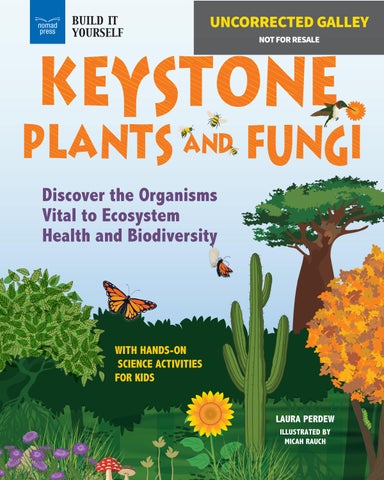
Discover the Organisms
Vital to Ecosystem Health and Biodiversity
WITH HANDS-ON SCIENCE ACTIVITIES FOR KIDS
LAURA PERDEW ILLUSTRATED BY MICAH RAUCH
WITH HANDS-ON SCIENCE ACTIVITIES FOR KIDS

Nomad Press
A division of Nomad Communications
10 9 8 7 6 5 4 3 2 1
Copyright © 2026 by Nomad Press. All rights reserved.
No part of this book may be reproduced in any form without permission in writing from the publisher, except by a reviewer who may quote brief passages in a review or for limited educational use. The trademark “Nomad Press” and the Nomad Press logo are trademarks of Nomad Communications, Inc.
This book was manufactured by Versa Press, East Peoria, Illinois October 2026, Job #FPOFPO
ISBN Softcover: 978-1-6474-1-160-2
ISBN Hardcover: 978-1-6474-1-157-2
This book has been officially leveled using the F&P Text Level Gradient™ Leveling System. Questions regarding the ordering of this book should be addressed to Nomad Press
PO Box 1036, Norwich, VT 05055 www.nomadpress.net
Printed in the United States.
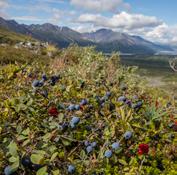
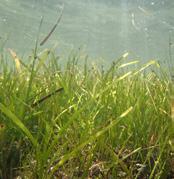
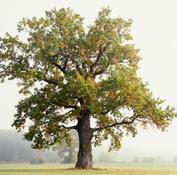
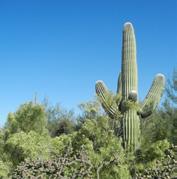
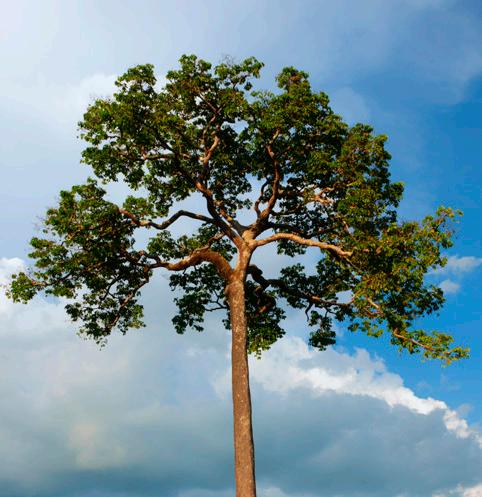
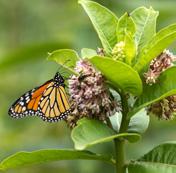
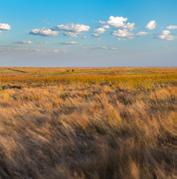
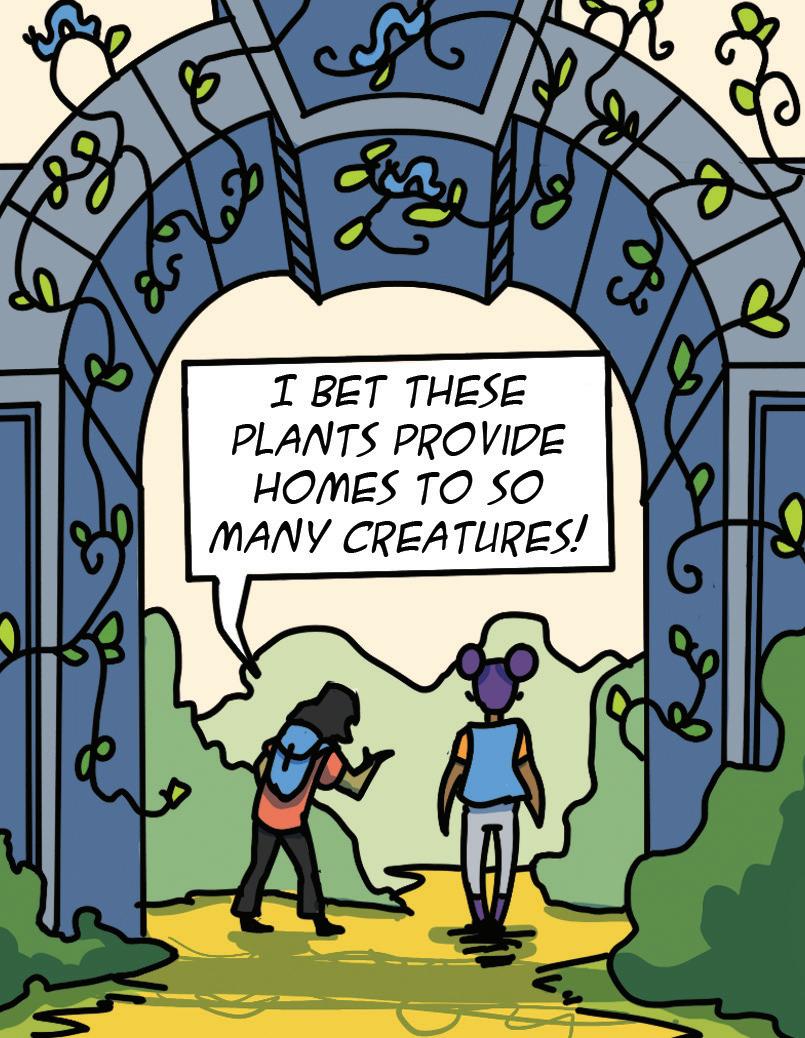
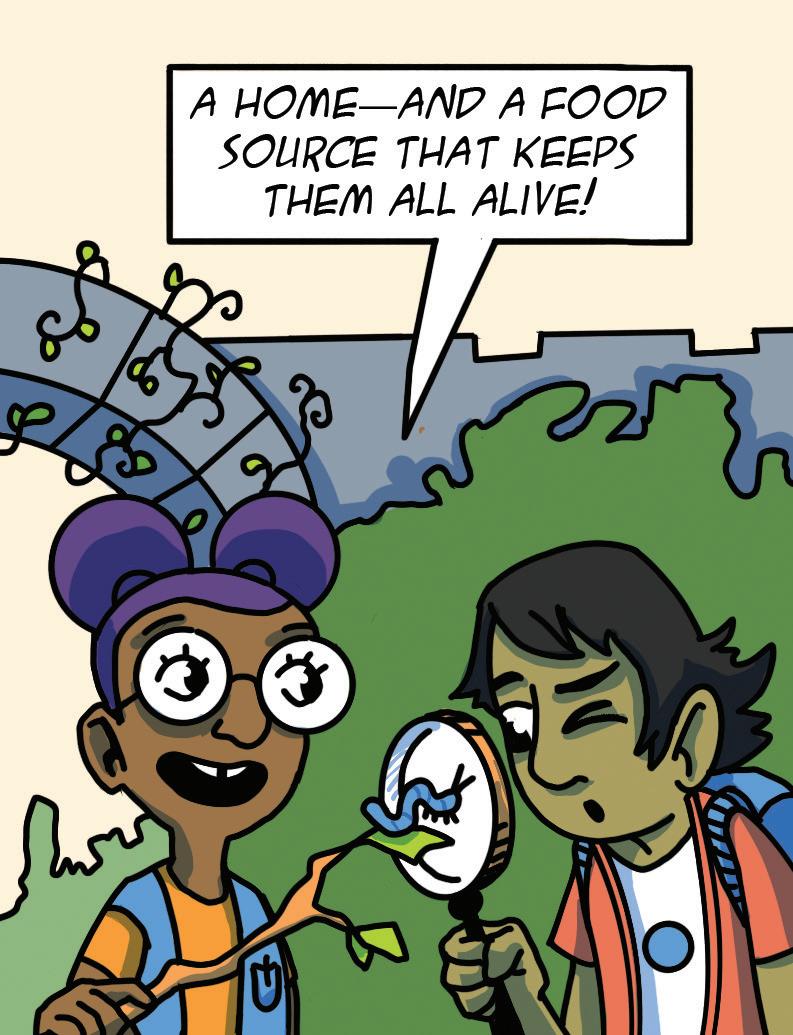
Every plant, fungus , and animal species plays a role in the ecosystem in which it lives. But some species are more important than others! That might seem like an odd idea. Isn’t every species vital to the health of an ecosystem? Actually, no, not to the same degree. In order to understand the extra important role of some species, let’s look at an archway.
What does an archway have to do with a book about ecosystems? Take a look at the arch. It is made of interlocking stones or bricks. At the very top of the arch is the most essential piece. It’s called the keystone. If you remove that piece, the entire arch collapses.
Why are some plants more important to an ecosystem than others?
Scientists discovered that the same is true in ecosystems. Some species are so critical that without them, the ecosystem is at risk of collapse. So, what do we call those very important species? Keystone species!
fungus: a type of living thing, different from animals and plants, that includes yeasts, molds, and muchrooms. Plural is fungi.
species: a group of organisms that share common traits and can reproduce offspring of their own kind.
organism: a living thing, such as an animal or a plant.
ecosystem: an interdependent community of living and nonliving things and their environment.
keystone: the central stone at the top of an arch that locks the whole together. Also, the central part of a system.
keystone species: a species that plays such an essential role in its ecosystem that without it, the ecosystem is at risk of collapse.
zoology: the study of animals.
predator: an organism that survives by eating other organisms.
food web: a network of interconnected food chains.
producer: an organism, such as a plant, that makes its own food
herbivore: an animal that eats only plants.
tidepool: a pool of ocean water that remains after the tide goes out.
food chain: a community of plants and animals where each is eaten by another higher up the chain.
carnivorous: describes a carnivore, an organism that eats only other organisms.
This phenomenon—that some species are more important than others in an ecosystem—was first discovered during the 1960s. A zoology professor named Robert Paine (1933–2016) wanted to run a controlled experiment on a natural ecosystem to test a hypothesis about the role of predators in a food web.
Until that point, scientists thought that the number of producers in an ecosystem limited the number of herbivores. Those herbivores then limited the number of predators. At the time, most scientists thought that entire food webs were regulated by the amount of food available at the bottom of the food chain. But a few scientists wondered why herbivores didn’t eat up all the plants in the ecosystem.
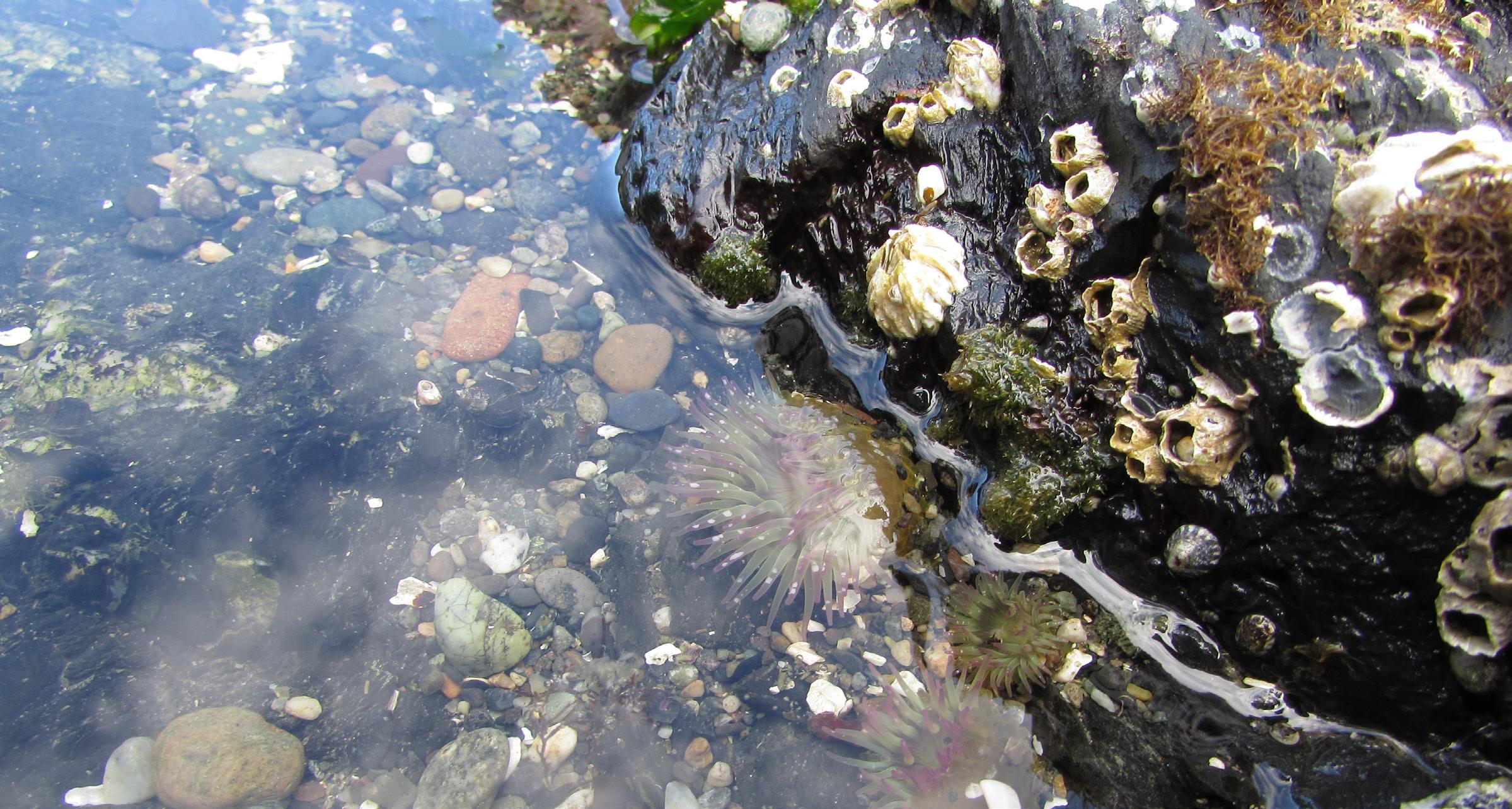
Paine discovered that the tidepools in the state of Washington provided the perfect natural laboratory in which to run an experiment. Each pool was its own tiny ecosystem. Paine began by observing the tidepools. He recorded all the species of plants and animals that lived there, and identified the food chain in that mini ecosystem. At the top of the food chain, he found a carnivorous purple starfish.
Paine wanted to see what would happen to that ecosystem without its top predator.
He removed the purple starfish from one tidepool. He left the starfish in the others. Then, he observed what happened and recorded his findings. If the tide washed a starfish into the experimental tidepool, he removed it.
Purple starfish can grow a new arm if they lose one. Sometimes, they even grow a whole new body from one arm!
Within 18 months, the results were clear. Without the top predator, the ecosystem was drastically different. Where once many different species had lived, few remained. After eight years, mussels were the only species left in the tidepool.
The reason? When the starfish were present in the mini tidepool ecosystem, they ate the mussels. As predators, they kept the population of mussels in check. But without the starfish to eat them, the mussels took over and eventually pushed out all the other species. The ecosystem collapsed.
Paine had discovered that some species play such an important role that removing them from their ecosystem has a devastating impact. Just like removing the keystone from an arch makes the arch collapse, removing certain species makes the ecosystem collapse. That’s why Paine coined the term “keystone species.”
grassland: a large open area of land covered with grasses.
wetland: an area, such as a marsh or swamp, that is covered some or all of the time by water.
biodiversity: the range of living things in an area.
resilient: able to recover quickly from setbacks or difficult conditions.
pollinator: an insect or other animal that moves pollen from plant to plant so new seeds can develop.
entomologist: a scientist who studies insects.
behavioral ecologist: a scientist who studies animal behavior, how that behavior is shaped by the environment, and how an animal interacts with its environment.
native: a species that naturally originates and evolves in a certain area, developing complex relationships with other species in that ecosystem over time.
evolve: to change or develop gradually.
data: recorded facts and observations about something.
A scientific method worksheet is a useful tool for keeping your ideas and observations organized. The scientific method is the process scientists use to ask and answer questions. Use your science notebook to make a scientific method worksheet for each experiment you do.
After Paine’s discovery, other biologists conducted further research and discovered that keystone species are part of all major ecosystems—oceans, grasslands , wetlands , forests, and deserts. There are keystone species all over the world and at every level of the food chain.
Keystone species play a vital role. They maintain and promote biodiversity in an ecosystem. The greater the biodiversity, the healthier
More than 75 percent of flowering plants rely on animal pollinators to reproduce.
Question: What are we trying to find out? What problem are we trying to solve?
Research: What is already known about this topic?
Hypothesis: What do we think the answer will be?
Equipment: What supplies are we using?
Method: What procedure are we following?
Results: What happened and why?
and more resilient an ecosystem is.
At first, researchers focused on other keystone animals. Scientists identified sharks, wolves, beavers, alligators, bees, flying foxes, wildebeests, bison, corals, and more as keystone species. It wasn’t until several decades later that Doug Tallamy, an American entomologist and behavioral ecologist from the University of Delaware, identified plants as keystone species.
During the early 2000s, Tallamy and his team researched the plants in the mid-Atlantic states. They wanted to measure how well native plants support food webs. The team looked at data on moth and butterfly caterpillars, and which plants each species eats. They discovered that a few types of plants supported hundreds of species, while other plants only supported a few. Can you guess what that led to?
Watch this video about Bob Paine’s experiment in the tidepools that led to the discovery of keystone species. In what ways were the tidepools a natural laboratory?
biomass: the total mass of living things, both alive and recently living.
pollinate: to move pollen from one flower to another so a plant can reproduce.
aerate: to allow air to flow through.
decomposer: an organism that breaks down waste, dead plants, and dead animals.
nutrients: substances in food, water, or soil that living things need to grow and live.
ecoregion: an area defined by the environmental conditions there including soil type, landforms, and climate, that determine the plant and animal species that live there.
adaptation: a change that happens in response to the environment, often in terms of physical or behavioral characteristics that help a plant or animal survive.
ecosystem engineer: a species that greatly alters an ecosystem by creating, modifying, maintaining, or destroying it.
mutualist: a species that interacts with another species in an ecosystem in such a way that both benefit.
The discovery of keystone plants!
The scientists’ work revealed that some plants are more important than others in an ecosystem. These keystone plants support not only the greatest diversity of species, but also the greatest insect biomass.
Yes, this is a book about plants and fungi, but let’s pause for a short entomology lesson. Think for a moment about everything you already know about food webs and ecosystems. Everything is connected. And in that web, insects are essential. In fact, we could not live without them. Insects pollinate plants, aerate the soil, work as decomposers , recycle nutrients , eat pests, and provide a source of food for other animals.
Use the American Museum of Natural History’s website to learn more about biodiversity and why it’s important. What can we all do to help protect biodiversity?
Now, consider a bicycle. Many pieces and parts make up a bike. Each part plays a role, some more critical than others. You could probably ride without a seat. You might even be able to make do with only one pedal for a while. But what would happen if you took the chain off? The bike might be able to roll for a short distance, but then it would stop. The same is true for certain species of insects. If we remove those insects, the world stops. That makes them keystone species, too!
To support food webs, we need a large number of insects, as well as a great diversity of insects. Here’s where it gets more complicated. We don’t need just any plants to support insects. We need keystone plants. And not just any keystone plant. We need plants that are native within their range.
Plants can only play a role as a keystone species if they are native to an area. Therefore, different plants. Plants, insects, and other organisms have coevolved in an ecosystem during millions of years. The relationships between the species have shaped their development and adaptation.
Ninety percent of caterpillars are supported by a mere 14 percent of native plants.
The discovery of keystone species started with starfish. Soon after, scientists discovered that sea otters are also keystone species because of their role in maintaining kelp forests. Sea otters prey on sea urchins—without otters, urchins destroy the kelp and the ecosystem collapses. Since then, scientists have discovered many keystone animal species. Some are predators, including the sea otter and the purple starfish. Herbivores such as bison can also be keystone species because they act like nature’s gardeners, trimming and managing the ecosystem.
Other keystone species, such as the beaver, are ecosystem engineers. These species create, modify, and maintain ecosystems. There are also keystone mutualists. In this case, two or more species work together in a way that benefits both species and the ecosystem. If the mutualistic relationship changes in any way, or one species disappears, the entire ecosystem is impacted.
This video reveals the keystone role of beavers. What happens if beavers disappear from an ecosystem?
herbaceous: having green, soft stems.
erosion: the gradual wearing away of rock or soil by water and wind.
foundational species: a species that provides the base on which an entire ecosystem is built.
life cycle: the growth and changes a living thing goes through, from birth to death.
habitat: a plant, animal, or fungus’s home that supplies it with food, water, and shelter.
livestock: animals raised for food and other uses.
crops: plants grown for food and other uses.
Around the same time Doug Tallamy and his team were identifying keystone plants, other scientists recognized that some fungi species also play keystone roles in their ecosystems. Details about fabulous fungi are revealed in Chapter Eight!
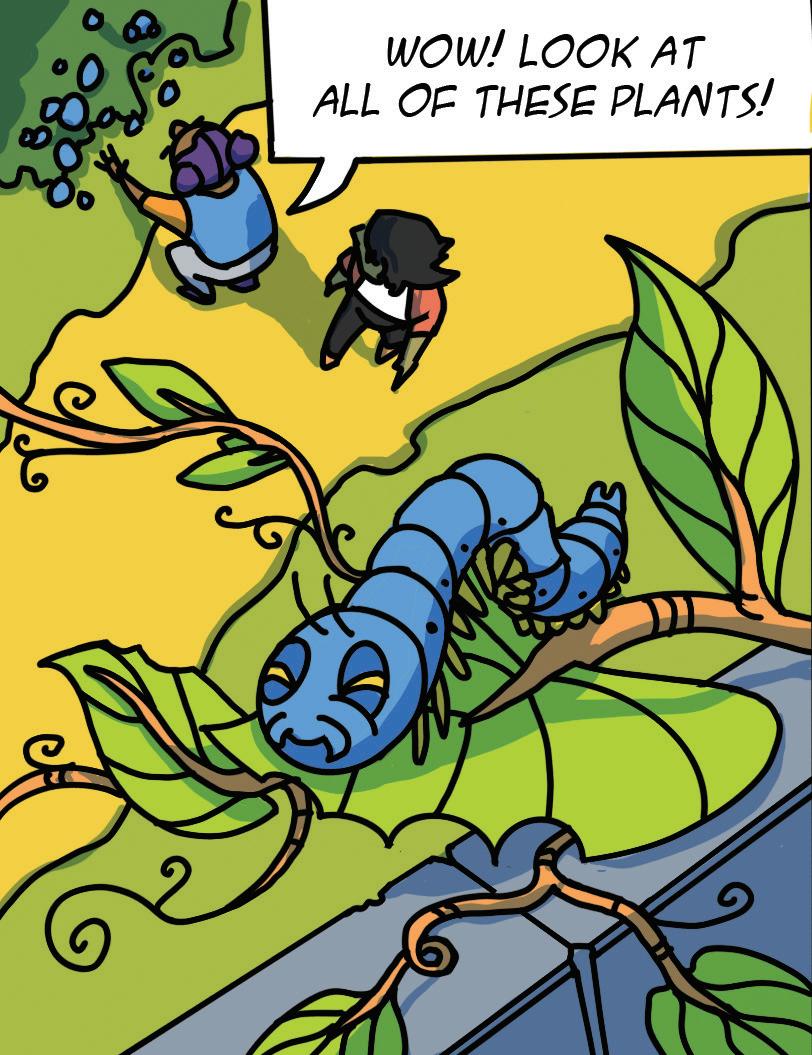
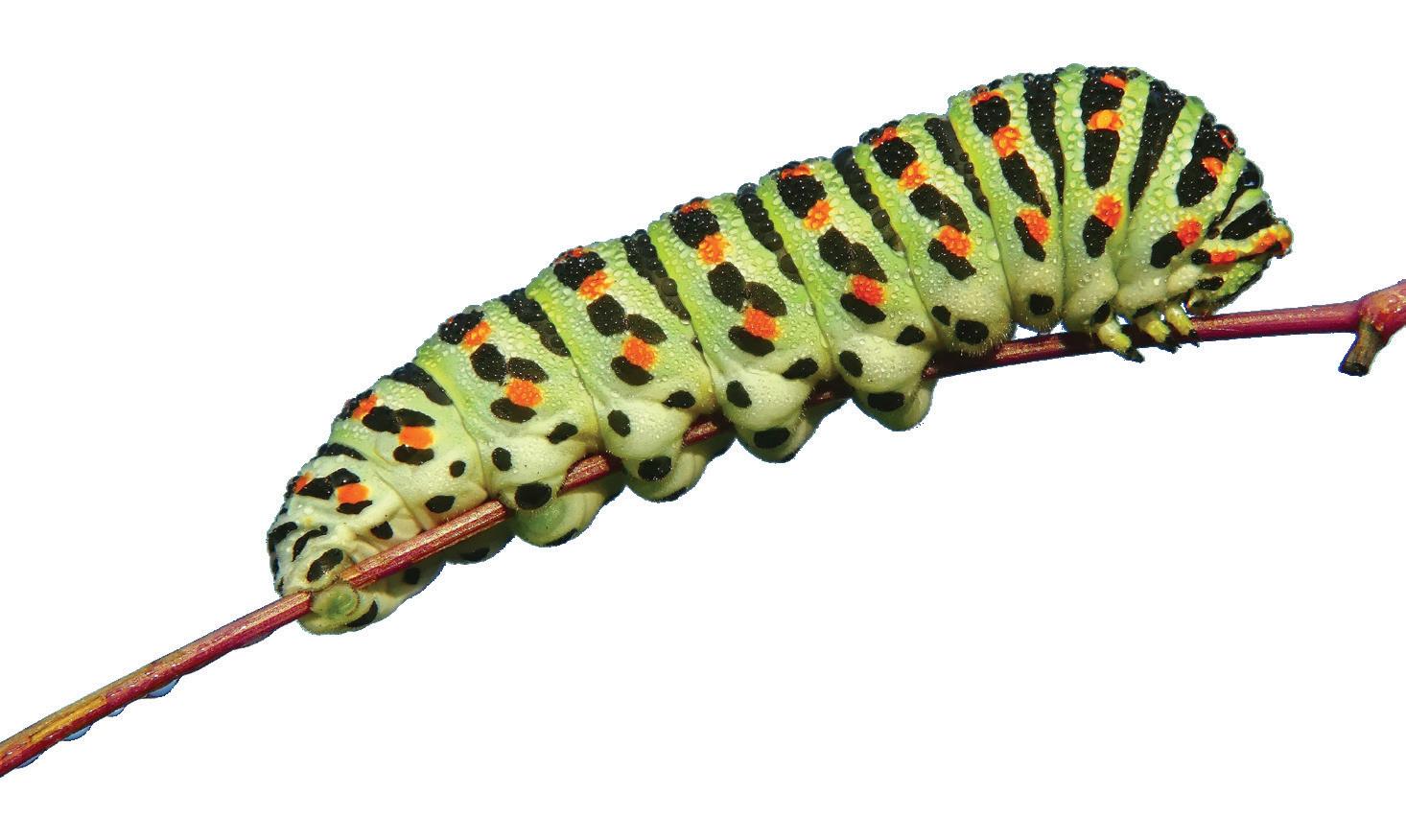
The original study of keystone plants focused on moths and butterflies and how those plants support the caterpillars that become moths and butterflies. You might be wondering: why all the fuss about caterpillars? Because birds love them. More scientifically speaking, caterpillars are essential to food webs because they are the main route by which plant energy is transferred to other animals. In fact, caterpillars transfer more energy from plants than all herbivores combined!
You can see where this is going. If caterpillars support food webs, we need plant species that support a great number and wide diversity of caterpillars. In North America, these keystone plants include oaks, willows, and black cherry trees.
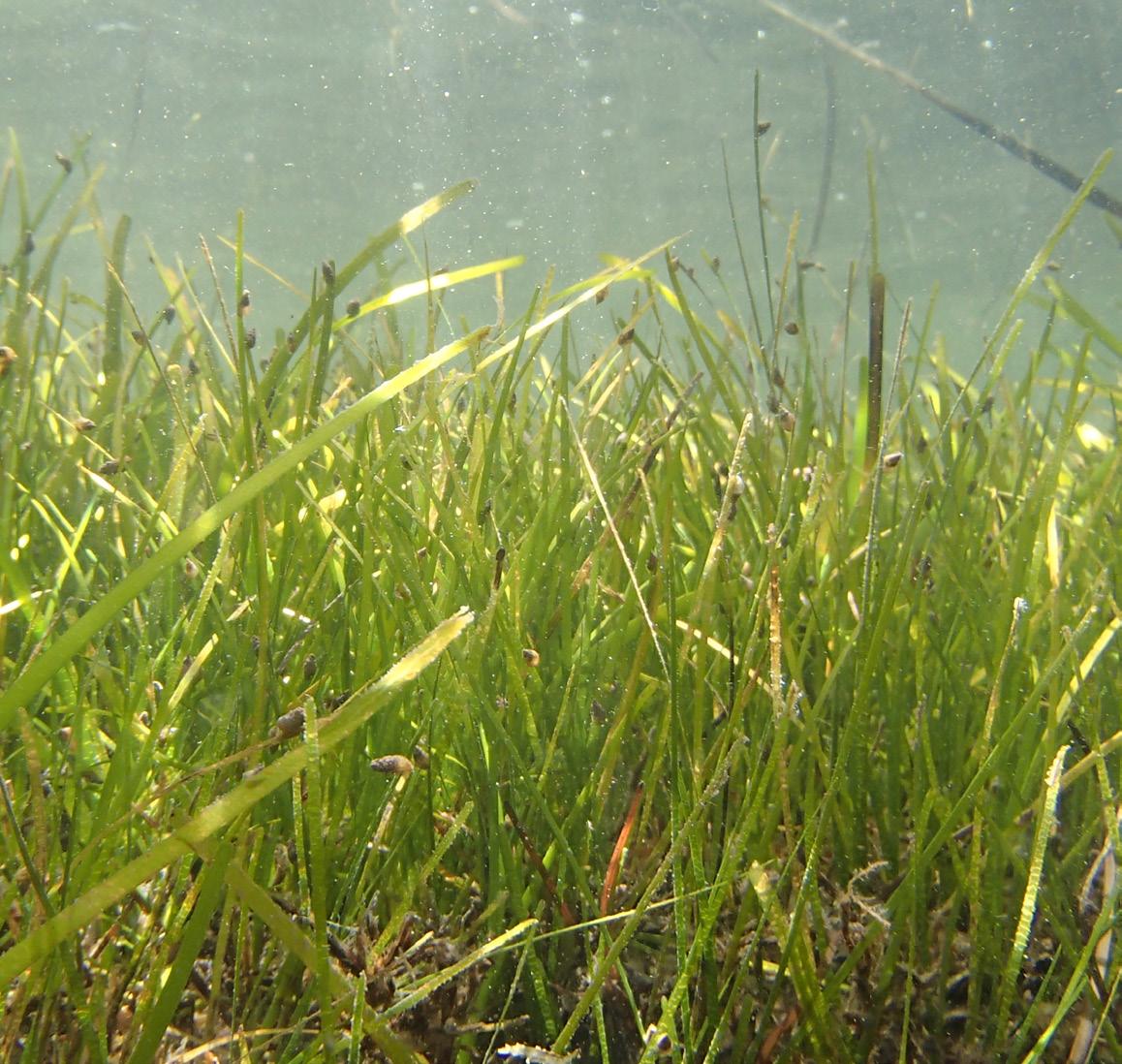
Another valuable role of some keystone plants is to support pollinators. Very few herbaceous plants self-pollinate or use the wind to spread their pollen and reproduce. Most rely on animal pollinators.
Therefore, to maintain ecosystems and biodiversity, we need the plants that support pollinators. We’ll talk more about pollinators and flowering plants in Chapter Six.
The oldest oak trees are more than 1,000 years old!
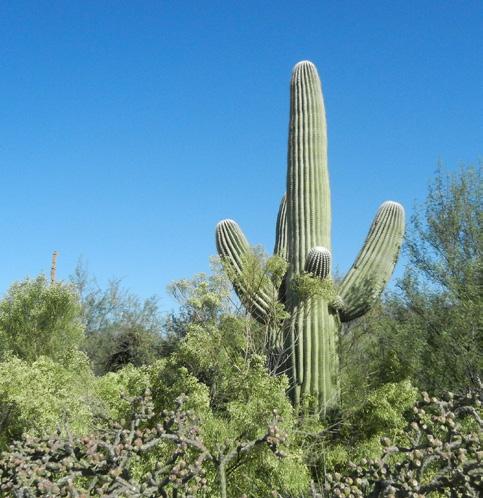
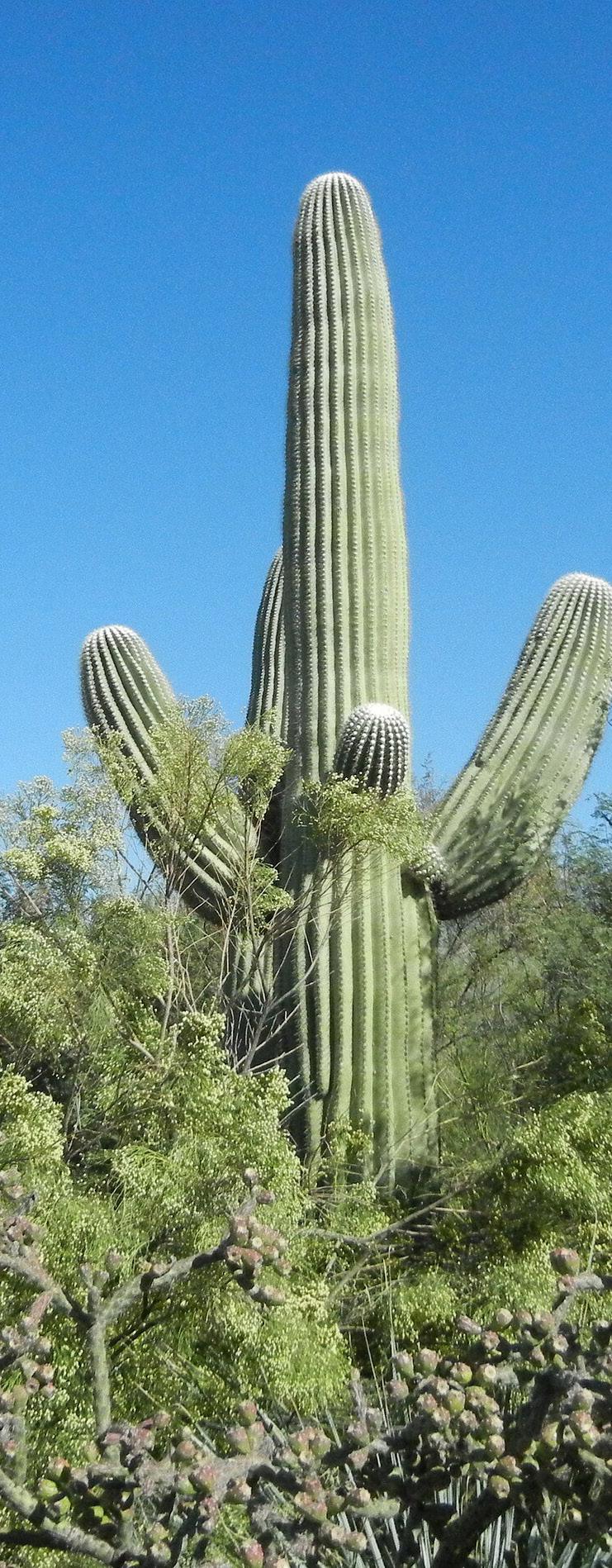
Keystone plants also provide essential food and shelter, especially in ecosystems where animals can’t get these services from other plant species. That is what makes the saguaro cactus a keystone plant—we’ll read more about its role in the ecosystem in Chapter Five. Other keystone plants anchor soil or sand, which prevents erosion. They buffer shorelines from wave energy and improve water quality. Some keystone plants—such as oak trees—are considered foundational species. They are the base on which an entire ecosystem is built.
Interested in insects? Maybe you should think about becoming an entomologist! On Earth, an estimated 900,000 different species of insects make their home. That’s more than 70 percent of all species on the planet! However, most scientists agree there might be millions of insect species not yet described.
Entomologists study insect behaviors, life cycles, habitats, and the essential roles insects play in ecosystems. In addition, entomologists study insects’ relationship to humans, including their role in pollination, and the impacts of pest insects and those that carry diseases. This work helps us keep ourselves, our pets, and livestock safe. The knowledge also helps us protect our crops, our ecosystems, and the insects themselves. Some entomologists use their knowledge to fight crime! When someone has died as a result of a crime, the police want to know when they died. Forensic entomologists look at the insects found on the body, which offer up clues about the time of death.
Watch this BBC video to learn more about the important roles that insects play on Earth. In what ways are insects vital to life on our planet?
hyperkeystone species: a species that can have an ecological impact on the entire planet.
conservation: the science of restoring, protecting, maintaining, and supporting nature.
microorganism: an organism so small it can only be seen under a microscope.
Tallamy describes keystone plants as the framework of an ecological house. Just as wooden boards frame houses, keystone plants support ecosystems. You cannot have an ecosystem without them.
In this book we will examine several different keystone plant species, including trees, the saguaro cactus, flowers and grasses, as well as the keystone role of some fungi species. We’ll look at another kind of keystone species as well— hyperkeystone species. These are organisms that affect all ecosystems on the planet, both directly and indirectly. Can you think of something that has that much influence? How about humans? Scientists consider humans a hyperkeystone species because our behavior has an impact on the entire planet.
It takes between 6,000 and 9,000 caterpillars to raise one clutch of chickadees!
We’ll take a look at how humans impact keystone species. We will also see how people are using science to guide conservation efforts to support keystone plants and restore ecosystems. Ready to look at the plants and fungi around you in a new way? Let’s go!
Each chapter of this book begins with an essential question to help guide your exploration of keystone plants and fungi. Keep this question in mind as you read the chapter. Keep the question in your mind as you read the chapter. At the end of each chapter, use your science journal to record your thoughts and answers.
Why are some plants more important to an ecosystem than others?
• a piece of string at least 6 feet long
• science journal
• magnifying glass
Biodiversity is important to the overall health and resilience of an ecosystem. Biodiversity includes all living species, from the tiniest microorganisms to enormous trees and animals. Scientists measure biodiversity to understand ecosystems, inform conservation efforts, and monitor ecosystem health. But how do they measure biodiversity in an area? They do a biodiversity survey.
By surveying biodiversity in a natural area near you, you can learn firsthand how scientists measure biodiversity.
› Select a small part of a natural area to investigate—a pile of leaves, flowers, rocks, a patch of grass, rotting logs, etc. Use the string to mark the area.
For a look at the origins of life on Earth, watch this TedEd video. How did scientists determine the most likely starting point for life on our planet?
› Observe the environment outside your marked area. Sketch what you see, including trees, water sources, fences, walkways, etc. Label the plants and trees if you know their names. Also, record the season and the weather—temperature, cloud cover, and humidity.
› Now, observe inside your marked area. Look carefully for animals and different plants. You may need to peek among leaves or turn over rocks or logs. Use your magnifying glass! Record and sketch your findings. Label the different species if you know their names. If you don’t, use the sketch and description to research later.
› Count the number of species you recorded. This is the species richness in that area.
Do a survey in the same location at a different time of day, in different weather, or in a different season. Compare the biodiversity you observe at different times. Do you see more species or fewer? Why do you think the number of species varies?
What plants are native to the area in which you live?
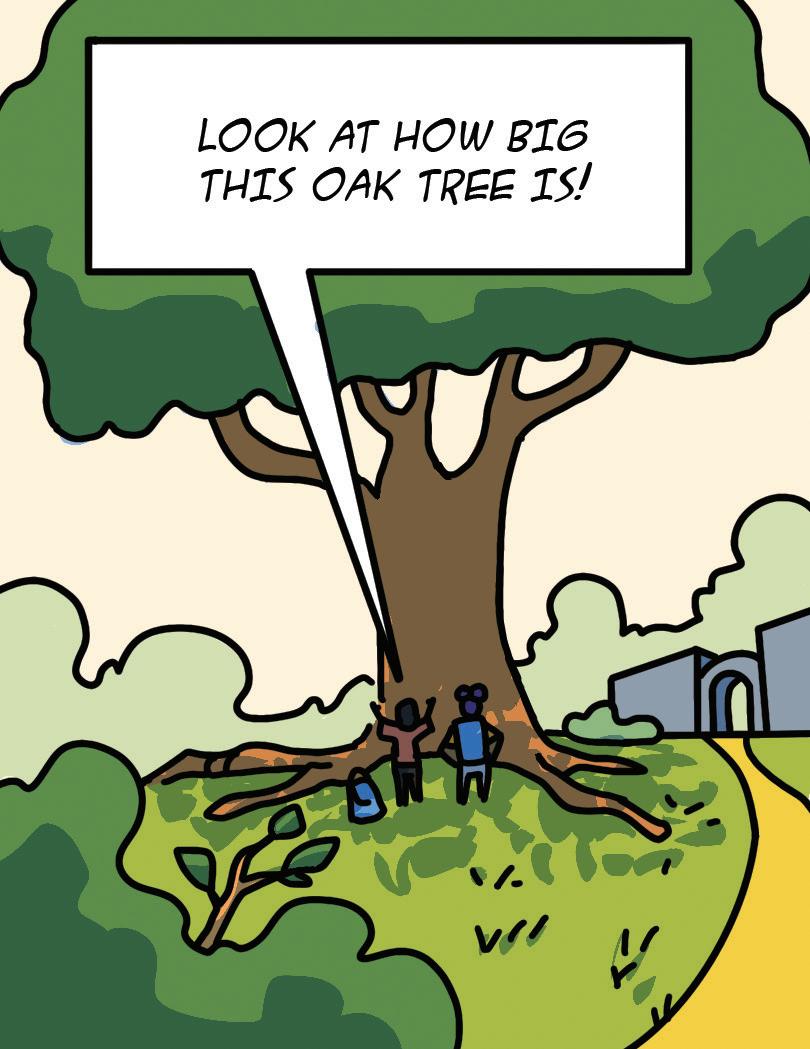
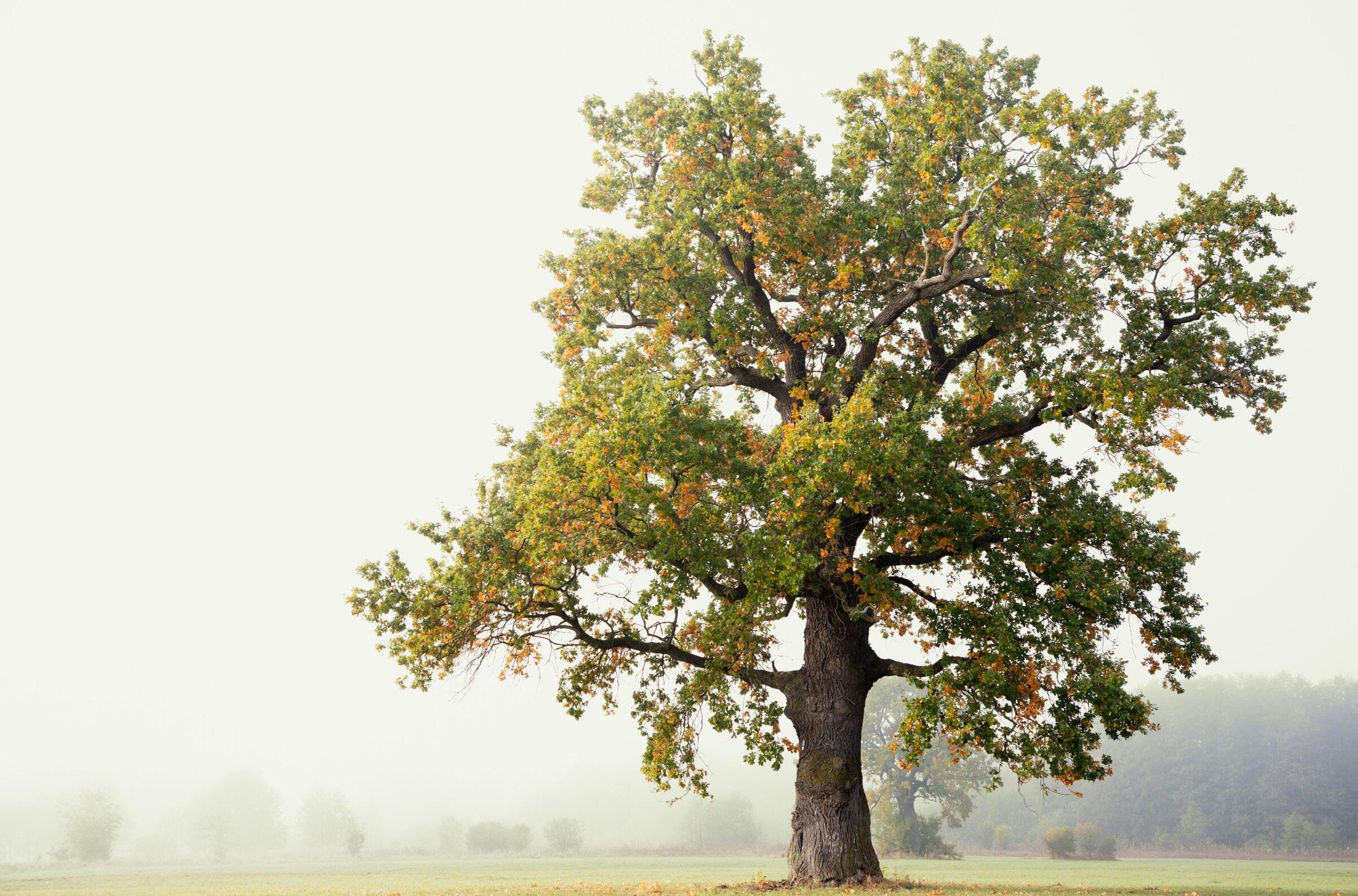
Doug Tallamy’s identification of keystone plants started with oak trees, so that’s where we will begin our investigation. Across 56 million years, oaks have evolved into more than 435 different species. Although they are native to five different continents (all but Antarctica and Australia), 90 percent of oak trees are found in North America.
ESSENTIAL QUESTION
What roles do oaks play as a keystone species?
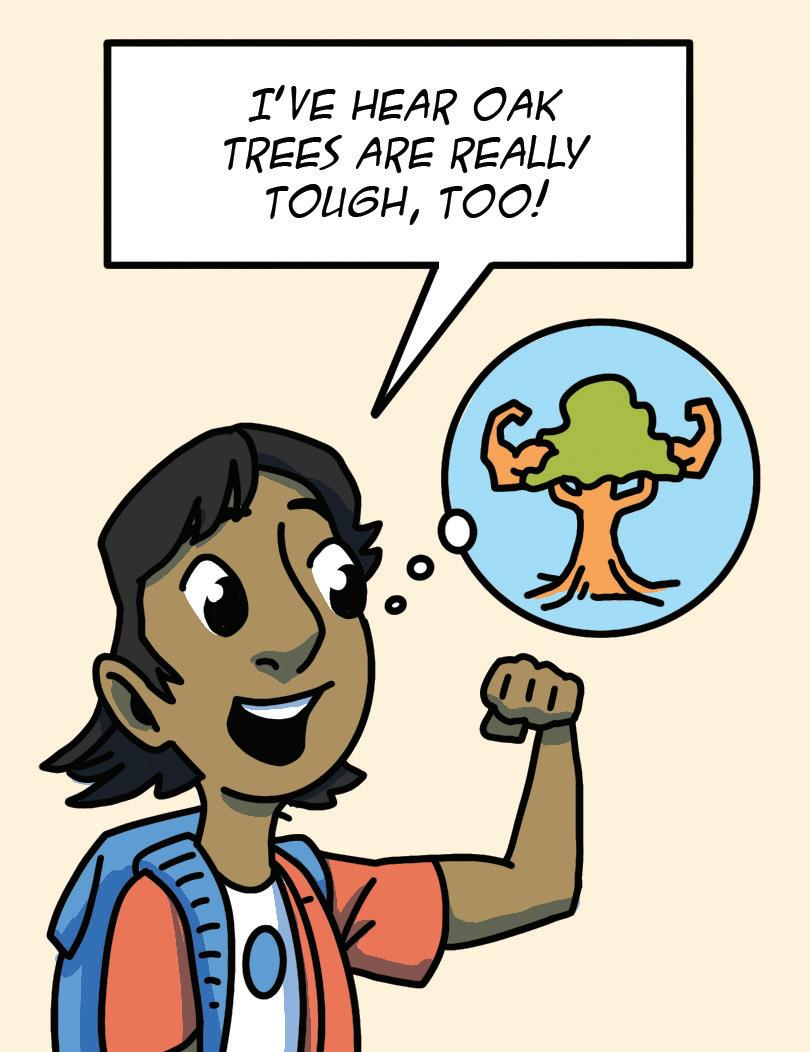
The oak family tree is wide and varied. Some species are small and shrub like. Other oak species are giants, reaching well above 100 feet in height. Despite the differences, they all have one thing in common—they are a mighty keystone plant wherever they grow in their native range. In fact, oaks support the greatest amount of biodiversity of all trees in the United States.
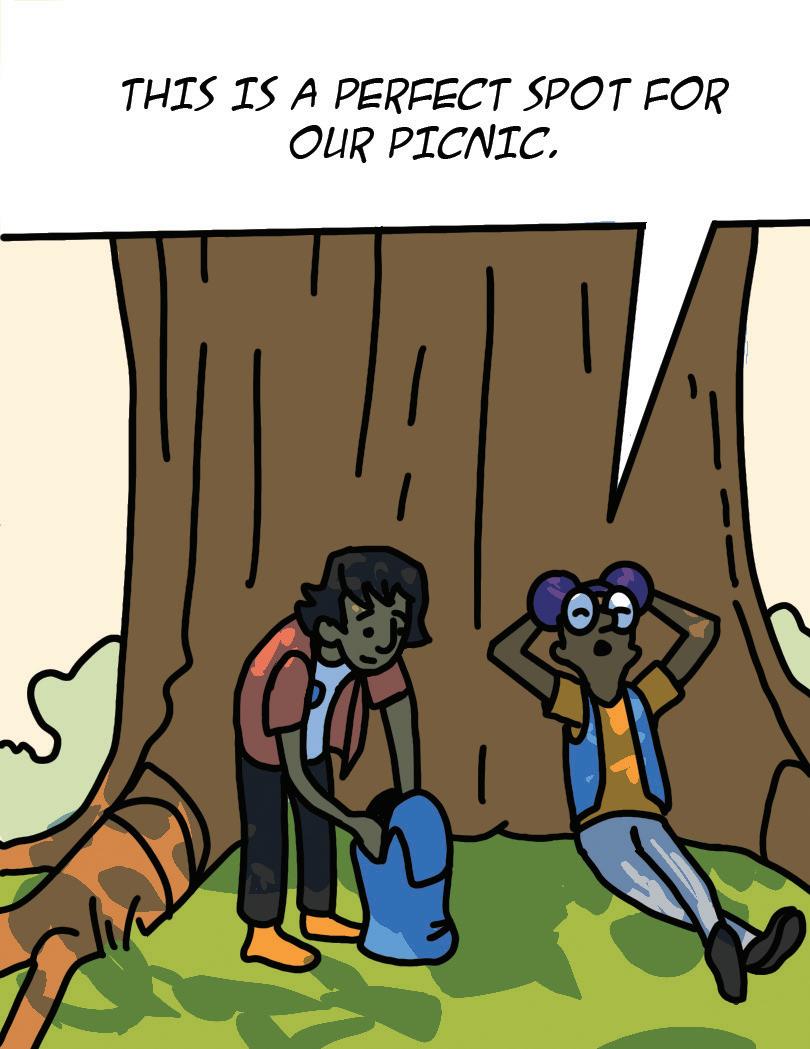
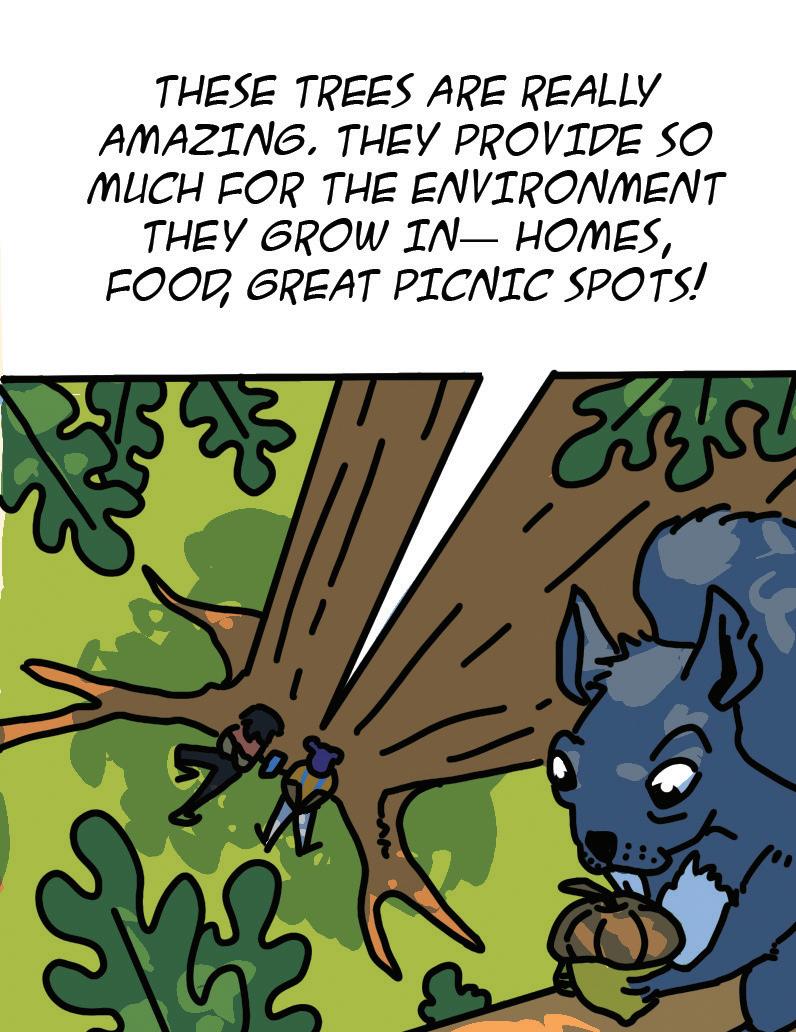
The species of oaks that grow tall and wide are great for climbing. They offer shade. They are the perfect place for a picnic. For the ecosystems where they grow naturally, oaks are essential keystone species.
shrub: a low, stemmed, woody plant.
carbohydrate: one of the main nutrients in food and a primary source of energy mammal: a type of animal, such as a human, dog, or cat. Mammals are born live, feed milk to their young, and usually have hair or fur covering most of their skin..
Let’s start by looking up at an oak. With most species, you’ll see spreading branches, leaves, and acorns. Lots of acorns! Oaks are acorn factories. During its lifetime, an oak produces millions of them. These acorns are a superfood for wildlife, full of fats, protein, and carbohydrates. They feed dozens of species of birds and mammals , including deer, black bears, squirrels, raccoons, turkeys, woodpeckers, and blue jays.
“ Oaks support more forms of life and more fascinating interactions than any other tree genus in North America.”
photosynthesis: the process by which plants use sunlight and water to make their food.
cavity: a hollow space or hole in living or dead trees.
dendrology: the scientific study of woody plants, such as trees, shrubs, and vines.
biology: the study of life and living organisms.
ecology: the study of the relationships between organisms and their environment.
evolution: changing or developing slowly over time. Evolution is the theory of how species develop from earlier forms of life and the belief that humans evolved from lower orders of animals.
sustainable: a process or resource that can be used without being completely used up or destroyed.
climate: the weather patterns in an area during a long period of time.
The leaves of oaks are a buffet for the caterpillars of moths and butterflies. Oaks support more than 1,000 species of caterpillars in North America. When a caterpillar emerges from its egg, it’s hungry. Luckily, it’s already at a caterpillar restaurant, surrounded by food. So, it starts munching!
One of the smallest species of oak is the Harvard oak, which is only about 6 feet tall. It grows in colonies, forming vast miniature forests.
In their role as leaf munchers, caterpillars are an important link in the food chain. The oak captures energy from the sun. Through photosynthesis , it converts this energy into food so the oak can grow. Caterpillars are herbivores that eat the oak leaves to gain that energy. When a caterpillar is eaten by another animal, the energy moves up the food chain.
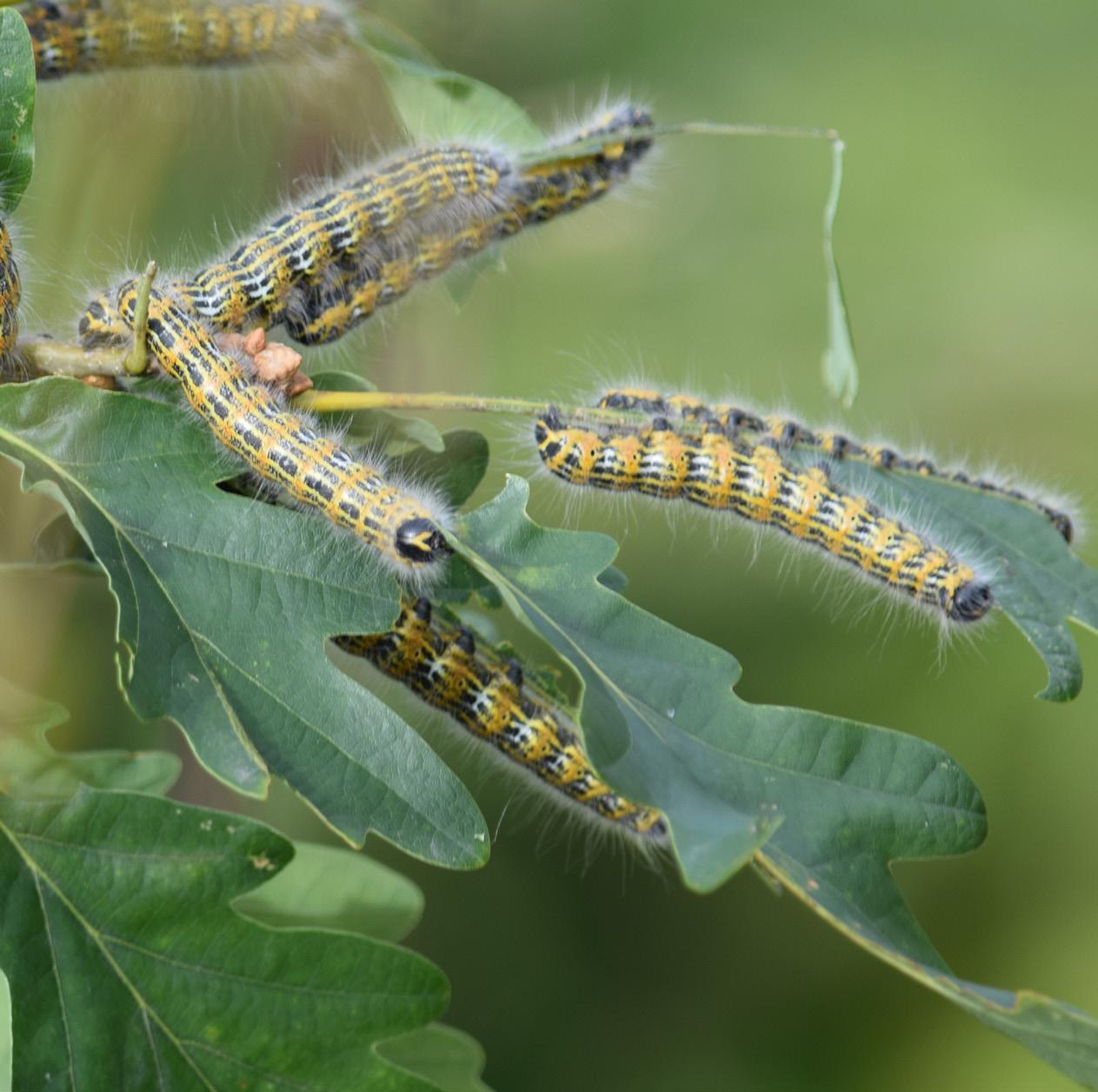
Birds rely on caterpillars supported by the oak. They’re the perfect baby food for a growing bird because caterpillars are soft and easy to eat, and they are rich in calories, fats, and protein.
Watch the video on this web page to learn how to eat acorns like a blue jay. Why might the blue jay need to eat fast? ut Wizard acorns wildlife
Not only do oaks provide food, they also offer shelter and habitat for a variety of insects and other wildlife. If you look among the branches and along the trunk, you might spot bird or squirrel nests among the branches. You might also see cavities in the trunk, which are good for wildlife.
Visit the Conservation Foundation website to read their list of 10 fascinating facts about oaks. Why should people leave the leaves in the fall, instead of raking?
Oaks are pollinated by wind currents that carry the male pollen to the female flower. After pollination, acorns develop.
The cavities in both living and dead oaks are safe hideouts for nesting. Some of the birds that nest in oak cavities are flickers, owls, chickadees, wrens, and downy woodpeckers. Bats and raccoons and other mammals also take advantage of the cavities for nesting and shelter.
If you want to turn your love of trees into a career, consider dendrology. The study of woody plants, including trees, shrubs, and vines, involves research about biology, ecology, and evolution. Dendrologists also identify and distinguish between different species of trees.
Dendrology is used to inform forest management, sustainable use practices, and conservation. Dendrologists identify trees at risk and those that are already endangered. Dendrologists also look at trees in the larger ecosystem, the roles they play there, and the health of forest. They can study the data from tree rings to learn more about the past climate, which helps us understand the current climate.
leaf litter: the layer of fallen, dead leaves and other plant material on the ground. overwintering: surviving the winter.
amphibian: an animal with moist skin that is born in water but lives on land. It is cold blooded and changes its body temperature by moving to warmer or cooler places. Frogs, toads, newts, efts, and salamanders are amphibians.
reptile: a cold-blooded animal such as a snake, lizard, alligator, or turtle that has a spine, lays eggs, has scales or horny places, and breathes air.
pollutant: a substance harmful to living things and the environment.
carbon: an important chemical element that is the key building block for all life on Earth.
atmosphere: the blanket of gases surrounding Earth.
carbon dioxide (CO2): a colorless, odorless gas made up of one atom of carbon and two atoms of oxygen. In the atmosphere, it traps heat, keeping Earth warm and habitable.
deforestation: the act of cutting down and completely clearing a forest of its trees.
greenhouse gas: a gas in the atmosphere that traps heat. We need some amount of greenhouse gases, but too much traps excessive heat and causes climate change.
climate change: a change in long-term weather patterns, which can happen through natural or man-made processes.
carbon sink: a natural or manmade system that pulls and stores more CO2 than it releases.
drought: a long period of time with little or no rain.
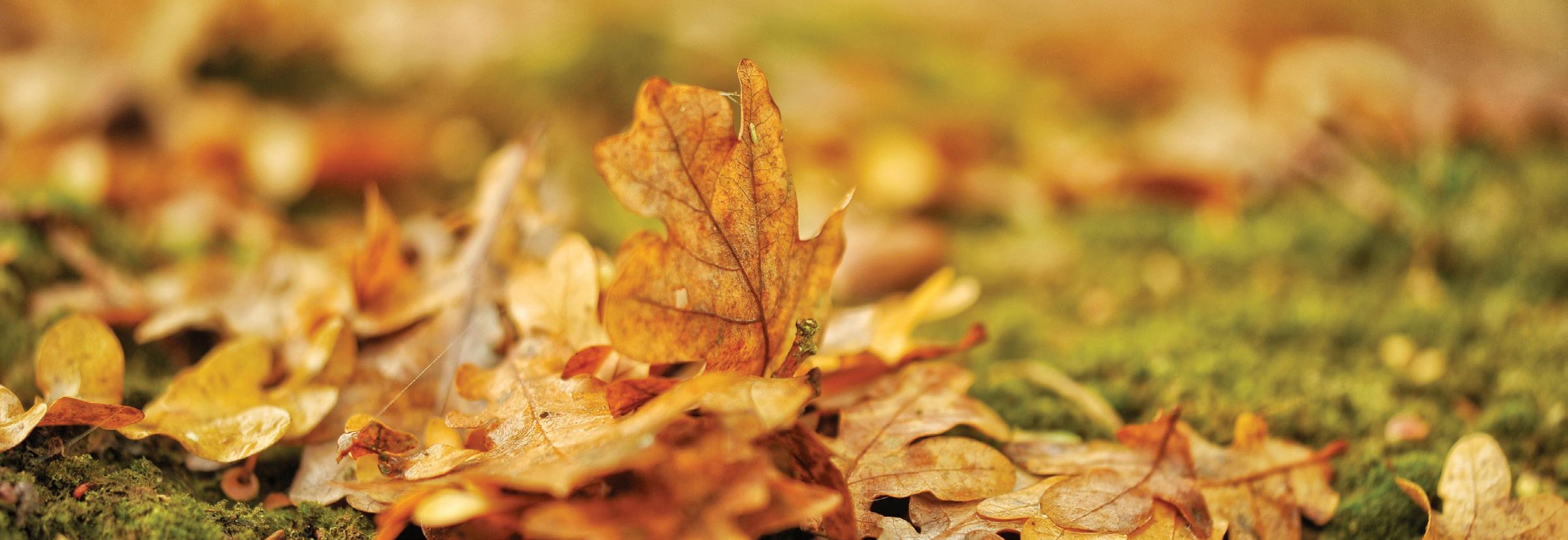
Oaks provide habitat on the ground as well. Every year, oaks drop hundreds of thousands of leaves. This leaf litter offers shelter, food, and overwintering sites for bugs and insects such as slugs, centipedes, moths, and worms. Small mammals, amphibians , and reptiles also use leaf litter for insulation and protection.
As the oak leaves decompose, they feed the soil, providing essential nutrients for microorganisms and fungi. Even when an oak dies and falls to the ground, it continues to offer food and shelter for countless animals.
That’s not all oaks do! The roots of oaks stabilize the soil, reduce erosion, and filter water. The shade of oaks helps keep the soil below from warming up and drying out. Oaks remove pollutants from the air and also store a lot of carbon . Why is that important? Let’s start with a short lesson on carbon.
Carbon is a chemical element and the key building block for all life on Earth—including humans. Earth has a fixed amount of carbon that it moves in a continuous cycle through the atmosphere , land, rocks, water, and living organisms.
On average, an oak tree lives about 900 years. Some oaks live much longer!
The problem is that human activity is releasing too much carbon dioxide (CO2) into the atmosphere. While some release of CO2 is natural, activities such as burning fossil fuels, deforestation , and land development create excess CO2 . As a result, our atmosphere today has more CO2 than it has had for more than 3 million years. Unfortunately, this greenhouse gas acts like a blanket, trapping heat in our atmosphere and causing climate change.
This is why oaks—and other plants and fungi—are so important. During photosynthesis, oak trees absorb massive amounts of CO2 . They use the carbon to grow roots, trunk, branches, and leaves. A mature oak is a valuable carbon sink .
This video has information about the parts of a tree and an oak’s life cycle. What role do each of the four parts of a tree play?
The wood of oaks is resistant to both water loss and decay. During times of drought , this helps the tree stay healthy and retain nutrients. As it turns out, what makes some types of oak strong and mighty also makes for a good building material.
clear-cut: to cut down and remove every tree.
seedling: a young plant grown from seed.
invasive species: a species that is not native to an ecosystem and that is harmful to the ecosystem in some way.
defoliate: to strip the leaves or seeds off trees or other plants.
toxic: poisonous or harmful.
overgraze: when animals eat plants faster than they can grow back.
regenerate: to form again or recover from damage.
Visit a forest in Georgia to learn more about forest ecosystems and the organisms living there. What is the role of microorganisms in a forest?
PBS Georgia Forests
Long ago people discovered that oak is a great wood for making canoes. Before steel and other materials were available, oaks were in high demand for shipbuilding. Humans used oaks for furniture and homes too. Consequently, more and more oak stands were thinned or clear-cut for lumber.
Farmers cleared oaks to plant crops, and developers did the same to build neighborhoods and roads. The oak trees that remain are hampered by roads, pipes, and sewers that get in the way of their roots. The roots can’t stretch and grow as they should, affecting the health of many oak trees.
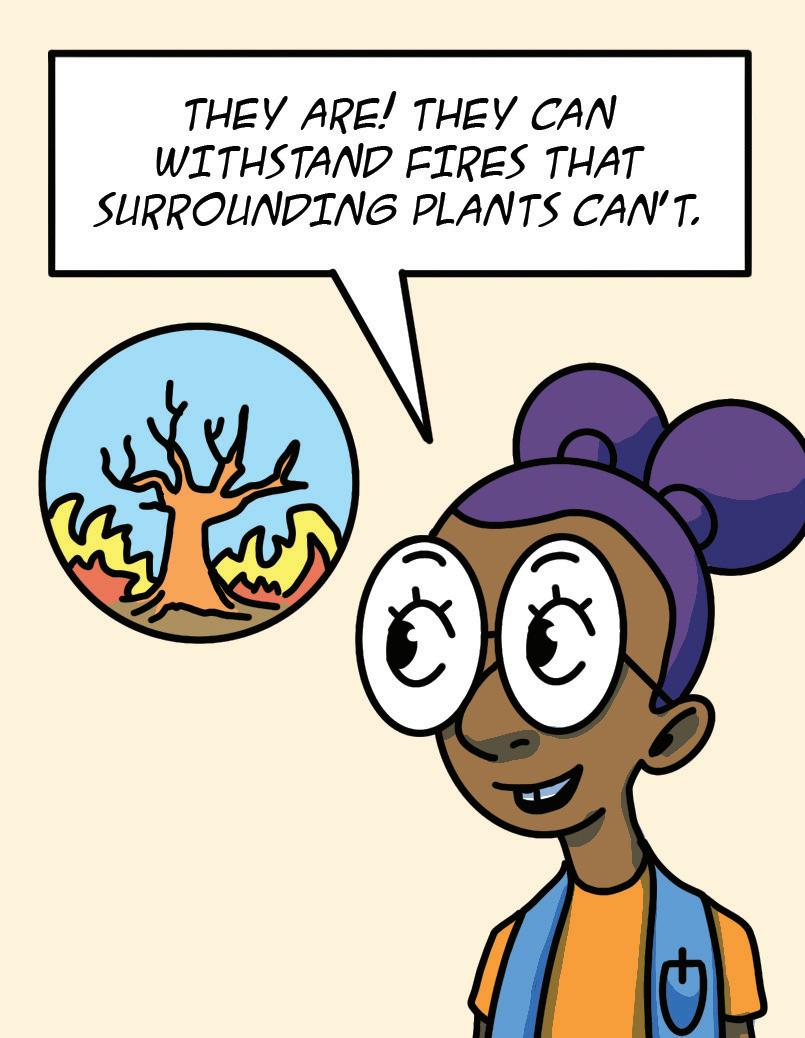
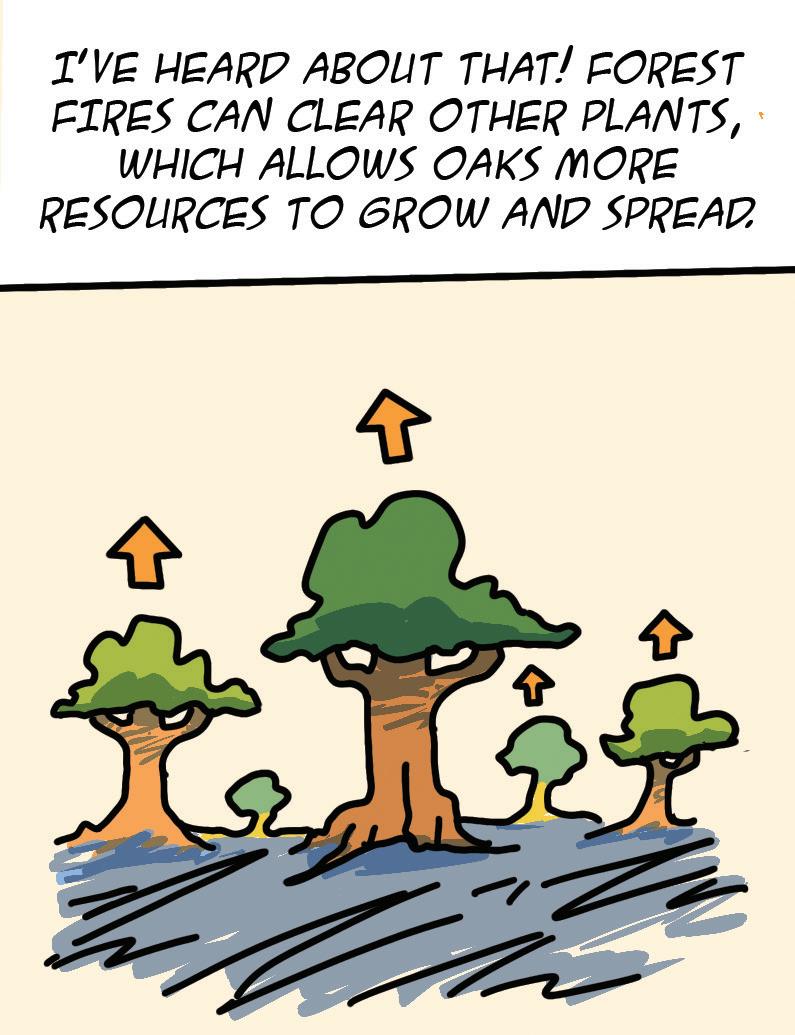
In addition, humans have suppressed wildfires during the past several centuries to protect homes and land. It might not seem logical, but some ecosystems need occasional natural wildfires. Oaks do, too. The oaks themselves are fire resistant, so they usually survive a fire. The plants that compete with oaks for resources are not fire resistant and do not survive. With the competition removed, oaks thrive. Fires also create clearings, which are great places for acorns to sprout and seedlings to grow. Without those fires, the plants that were usually killed by wildfires have taken over, pushing out the oaks.
Invasive species are another challenge facing oaks. When thousands of native species of insects dine on oak trees, they do not typically harm the trees. However, nonnative insects often do harm the trees. The spongy moth, brought to North America from Europe, completely defoliates many different species of trees, including oaks. This reduces the ability of the trees to photosynthesize. The trees weaken and might even die. The spongy moth is responsible for the decline of oak forests in the northeast United States.
Diseases can be invasive, too. A disease called sudden oak death arrived in California from Asia during the 1990s. This fungus has killed thousands of oaks and has spread eastward across the country. Oak wilt and bacterial leaf scorch also impact oaks. Oak trees did not evolve with defenses to fight these disease, so when a new disease hits, the trees are vulnerable.
A long wooden canoe made of white oak was found in Lake Mendota, Wisconsin. It was carved around about 3,000 years ago.
We can learn a lot from studying trees. See what engineers learned from oak trees about how to survive a hurricane. What qualities do oak trees have that allowed them to survive Hurricane Katrina in New Orleans in 2005?
Climate change is another threat. Climate change has caused increased temperatures and drought, as well as extreme storms, all of which stress oaks. The use of pesticides and herbicides, which contain toxic chemicals, poison the trees. Deer are another problem. Because they have fewer natural predators today, deer populations have increased. They overgraze young oaks, which prevents forests from regenerating.
Oaks are not the only keystone tree in North America! Willows also play keystone roles in their native ecosystems. There are more than 400 different species of willows in the Northern Hemisphere. They are usually found in damp habitats. Like oaks, willows support a great number of different butterfly and moth caterpillars—they are the number two caterpillar host, behind oaks. But, in some ecoregions, they support more caterpillar species than oaks!
Plus, various willow species are great hosts to several species of wood boring beetles. These attract woodpeckers because the larvae of the beetles provide food for the birds through the winter. Of course the willows are also habitat and shelter for many animals.
collaborative: working together with other people.
sustainability: the balanced use of Earth’s resources in a way that meets today’s needs yet also maintains a healthy planet now and for the future.
controlled burn: a fire set to burn off extra flammable material, also called a prescribed burn.
decay: to break down or to rot.
Southern Hemisphere: the half of Earth that lies south of the equator.
The knowledge that oaks are under threat inspires action globally, nationally, and locally. The Global Conservation Consortium for Oak (GCCO), for instance, works with a collaborative team of organizations and scientists to assess, monitor, and protect oakspecies.
On the national level, groups such as the White Oak Initiative on the East Coast and California Oaks on the West Coast have similar conservation missions. They work to ensure the long-term sustainability of oaks using a science-based approach. Because each forest has different needs, efforts might include scattering acorns, planting oak seedlings, setting controlled burns , thinning the forest, and even bringing in topsoil from healthy forests. Individuals such as Doug Tallamy are making a difference, too. He speaks to different groups about keystone plants and steps we can take to protect them.
The movement is growing. We’ve learned that, in most cases, we shouldn’t prune our oaks or spray pesticides to get rid of pests. People should avoid digging for pipes or pools near oak trees to preserve their root systems and give them room to grow. People are also encouraged not to mow or rake under oaks. The fallen leaves provide habitats for many creatures and as the leaves decay, they recycle the nutrients into the soil.
A growing number of people are planting and caring for oaks in their own yards. Others are working to include more oaks and native keystone plants when designing parks. We’ll learn more about those efforts in the last chapter.
What roles do oaks play as a keystone species?
But next, we’ll travel to the Southern Hemisphere to look at the roles of Brazil nut trees as a keystone species in the Amazon rainforest.
Oaks and their leaves are important to the ecosystem all year round. Most people don’t know how valuable the fallen leaves are, whether from an oak or other tree. Help spread the word!
• science notebook
• poster board
• art supplies
› Do some research. Check out these websites to learn more about leaf litter. List all the ways leaf litter is valuable not only to bugs and insects, but to other animals, microorganisms, fungi, and the soil.
› Sketch out where your information will go on the poster board. Add a large title and consider adding subheadings, blocks of information, labels, pictures, and captions. Then create your infographic on the poster.
Do you live near oak trees? How do they change with the season?
Share what you’ve learned with friends, family, and classmates to spread the word about leaving the leaves. Ask if you can hang your poster at school or somewhere else in the community. Encourage your friends to make their own posters about the importance of leaf litter.
The oak tree was designated as the national tree of the United States in 2004.
Oaks and other trees are mini habitats. Who lives in the trees near you? Find an oak or other tree in your community to investigate. This activity is best to do in the spring.
› Select a tree to investigate. Try to find a tree with leaves low enough to the ground that you can examine them up close.
› Observe the tree from 12 or more feet away. Look for evidence of other plants or animals around the tree. Are any plants growing at the base of the tree? Piles of leaves? Feathers or fur? Record the evidence and list the plants and animals you see.
• a tree
• science notebook
• pen or pencil
• magnifying glass (optional)
Blue jays are largely responsible for planting oak trees. A blue jay buries an average of 4,500 acorns each fall—but only remembers the location of 25 percent, leaving thousands of forgotten acorns to become oaks!
› Move your eyes up the trunk. Look for missing bark, scratches, cavities in the trunk, spider webs, or nests. Take a close look at the trunk. What do you see? Are plants or fungi growing on the tree? Record your observations.
› Examine the leaves of the tree up close. Is there evidence of them being nibbled on? Turn a few leaves over, looking for caterpillars or eggs. Use the magnifying glass to examine the leaves.
› Examine the ground around the tree. Is there leaf litter? Can you see evidence of animals in the leaf litter? Lift a few leaves to observe the ground. Record your observations.
› How many different species of animals and plants did you find? Draw the tree and all of its inhabitants in your science notebook.
Visit the same tree at different times of day, in different weather, or in different seasons. Investigate it in the same manner each time, recording what you see. Compare and contrast what you observe at different times.
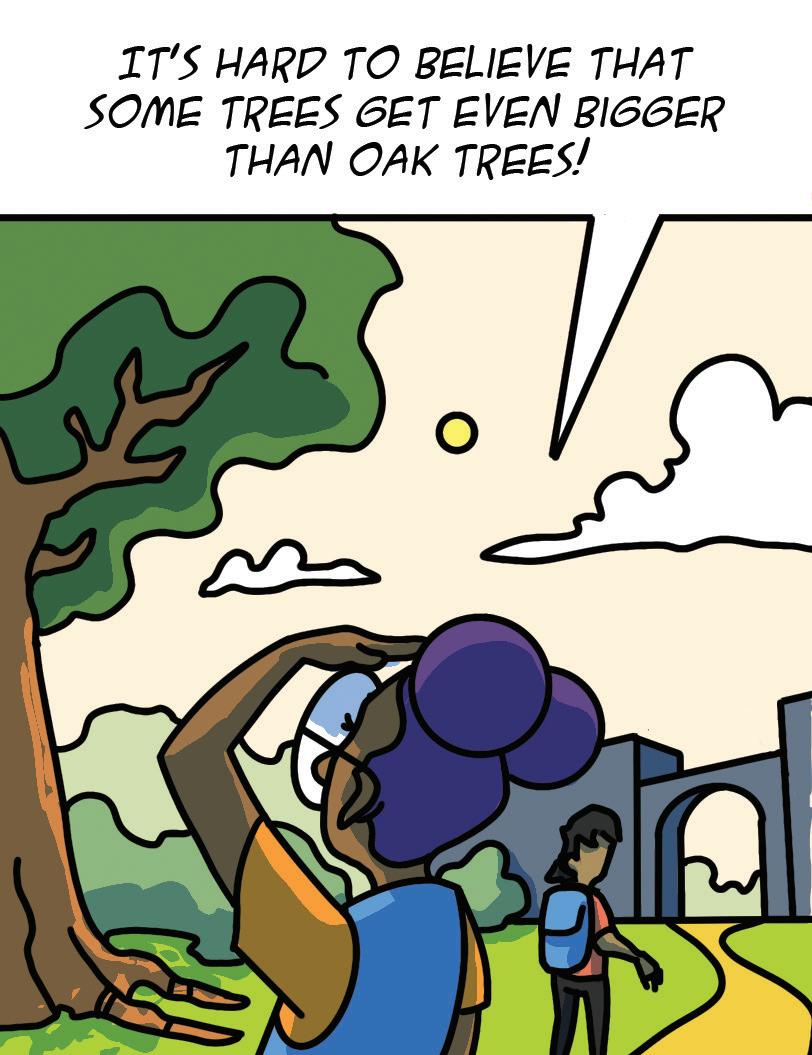
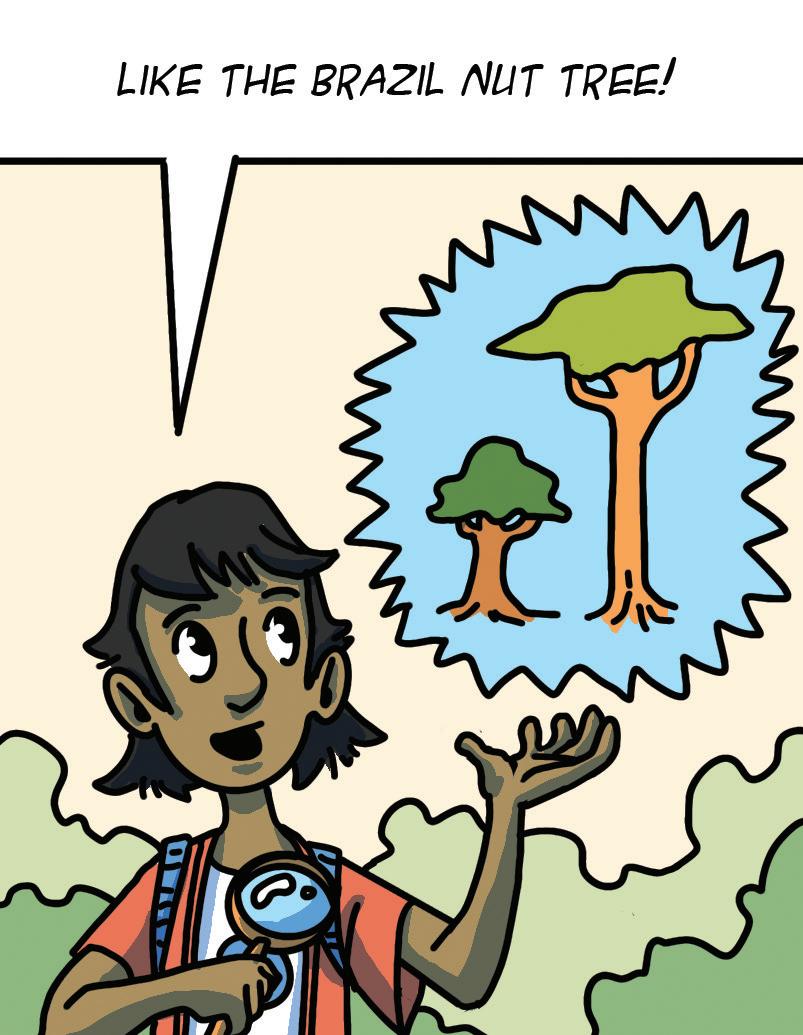
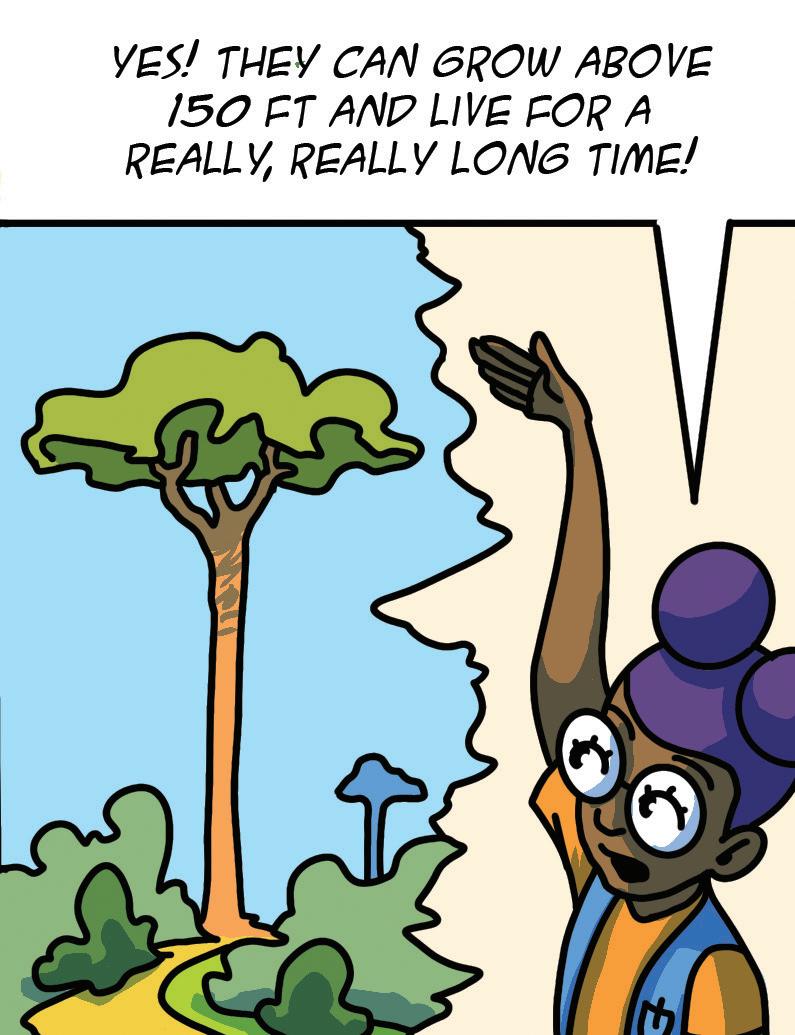
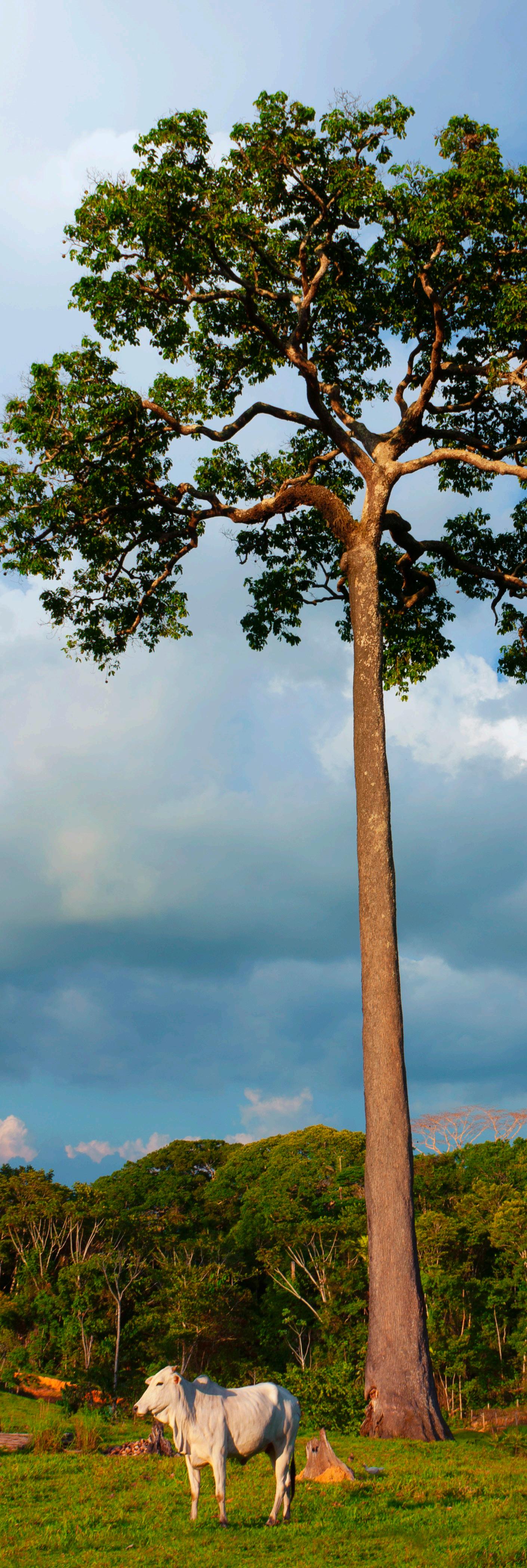
Brazil nut trees are giants. They can grow to more than 150 feet tall, towering over the other trees in the Amazon rainforest of South America. The crowns of mature trees stretch more than 100 feet in diameter. And they live 500 to 1,000 years!
What are the main considerations for creating a sustainable future for Brazil nut trees?
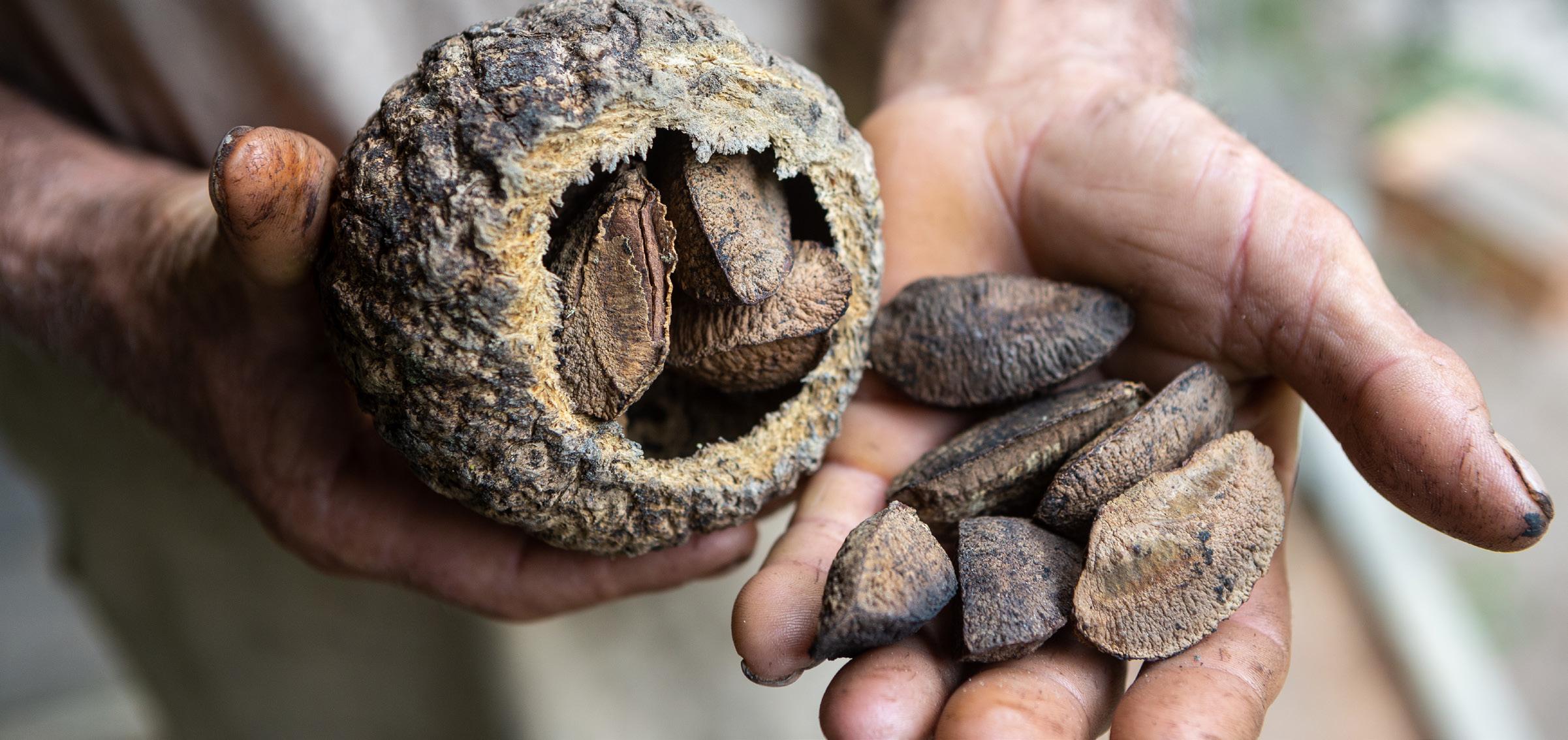
As you probably guessed, these trees produce Brazil nuts. The nuts are found inside a hard, woody pod similar to a coconut shell. Pods grow larger than a softball and weigh up to 5 pounds. Inside, there may be as many as 24 nuts, arranged like sections of an orange. But actually, these nuts are not really nuts. They are seeds that could eventually sprout into a new Brazil nut tree.
crown: the branches and leaves at the top of a tree extending from the main trunk.
diameter: the width of a circle.
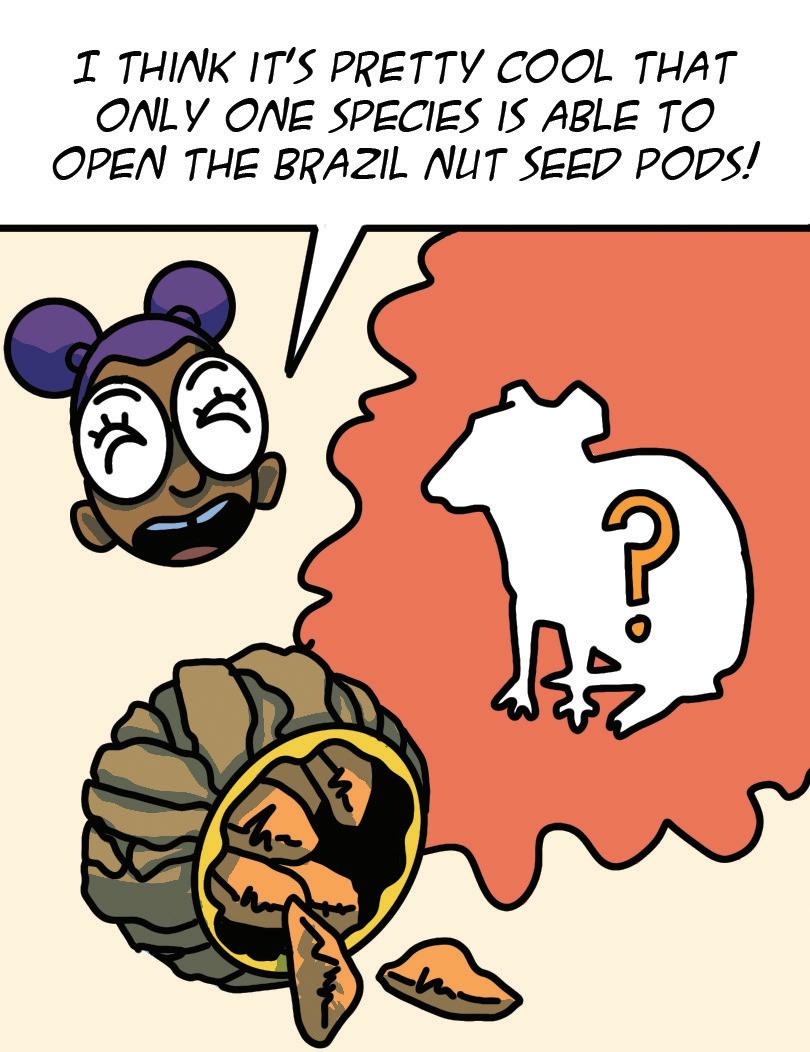
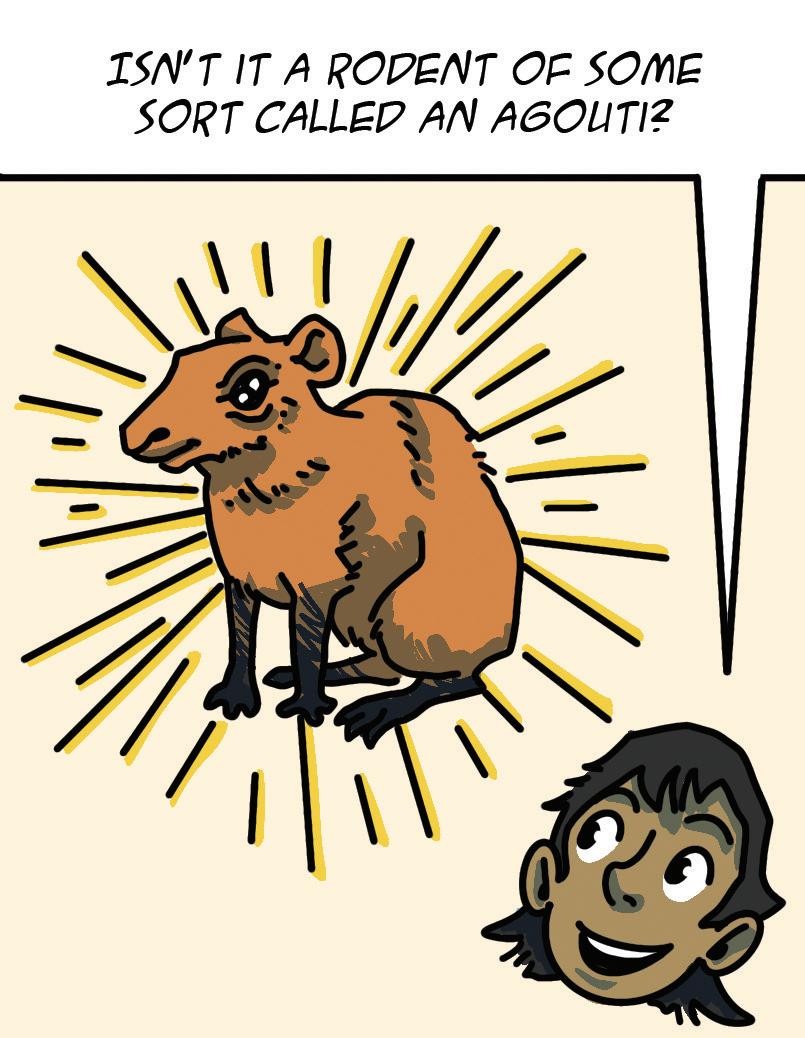
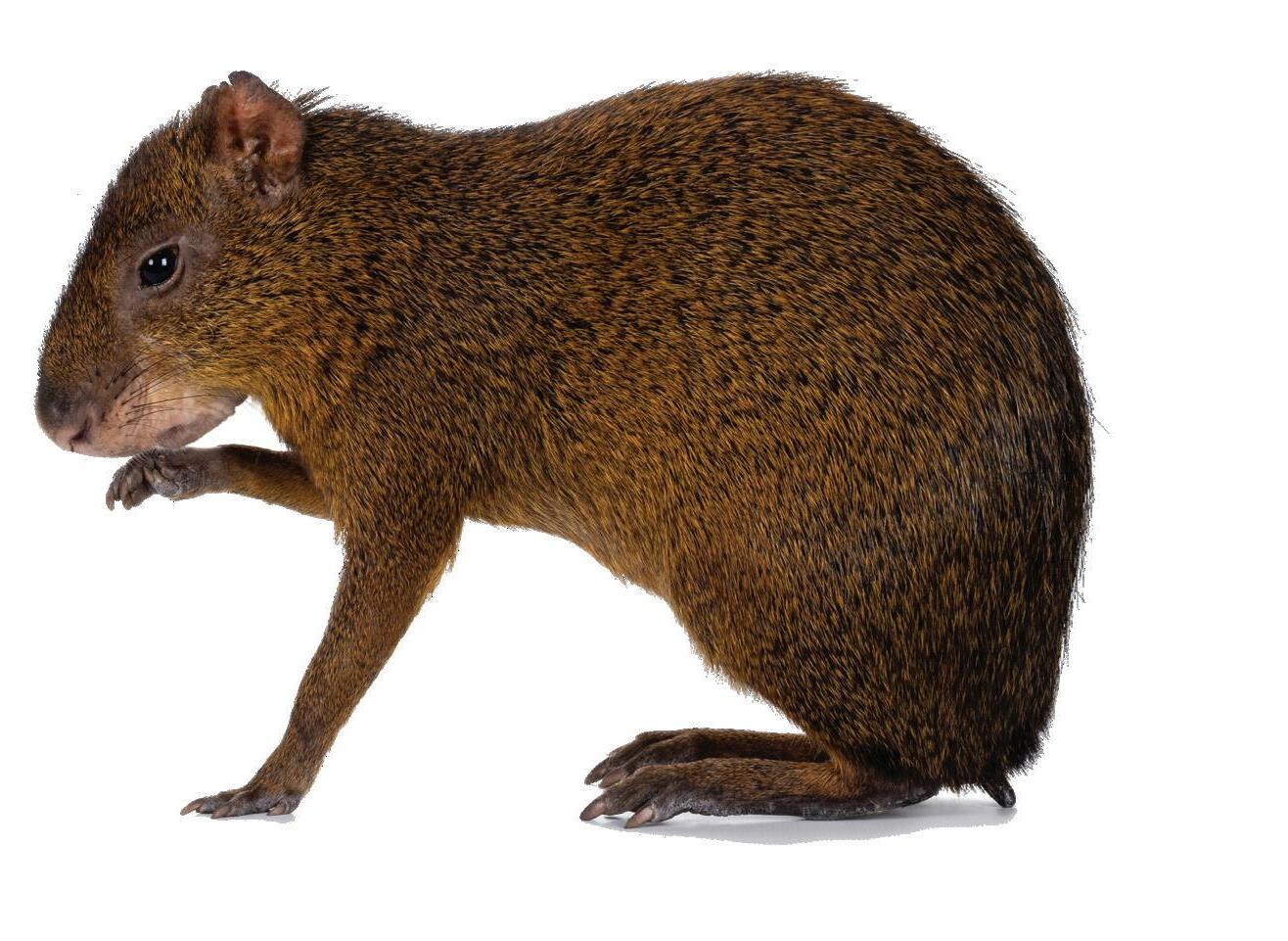
agouti: a large rodent that lives in Central and South America and is related to guinea pigs.
germinate: to begin to grow from a seed.
peccary: a hooved, pig-like animal native to the Americas.
canopy: the uppermost layer of a forest, consisting of a dense layer of leaves and branches that create a kind of umbrella over the forest.
epiphyte: a plant that grows on another plant without causing it harm.
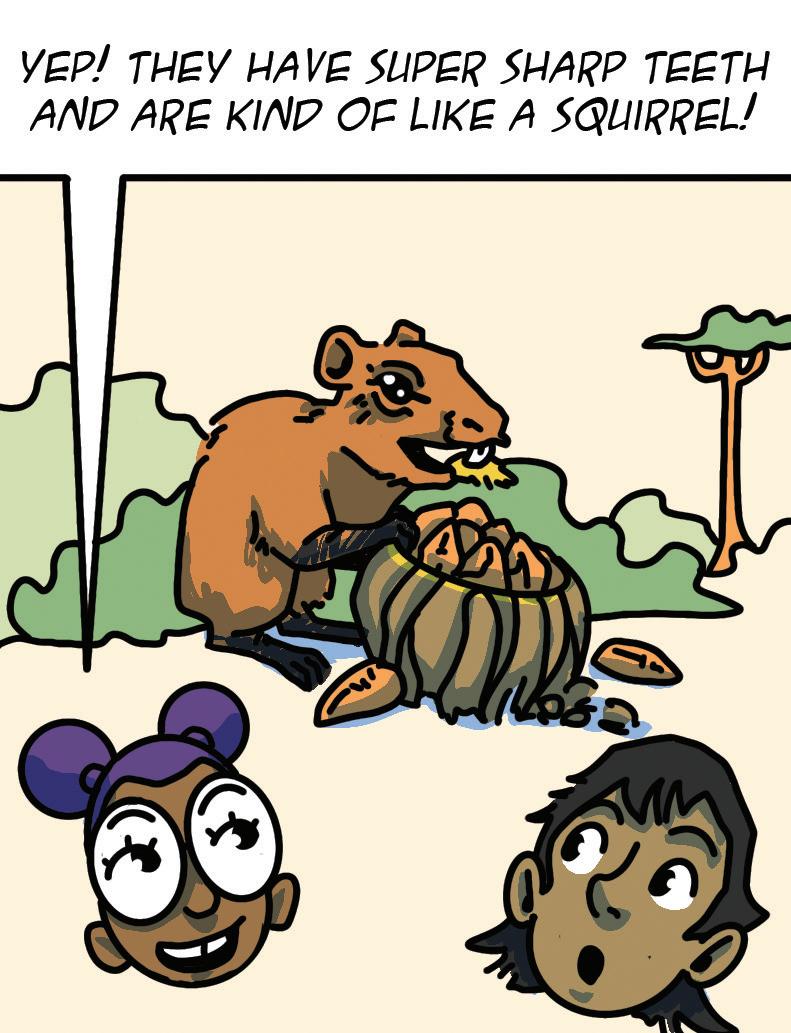
Scientists know of only one animal that can break open these pods—the agouti, a rodent with very, very sharp teeth. Agoutis are similar to squirrels in North America, and they eat some of the Brazil nuts they find. They bury others to store for the future when food is scarce. Luckily for the tree, agoutis forget about some of the buried nuts. These forgotten seeds germinate when the conditions are right and become new trees.
The Brazil nut tree is one of 40,000 species of plants in the Amazon rainforest.
As a keystone species, Brazil nut trees play an essential role in the rainforest ecosystem. To start, Brazil nuts are food. The protein-rich nuts are an important part of the agouti’s diet. Other species rely on Brazil nuts too, but they must wait until the agoutis have opened the pods and buried the nuts. Then, they raid the hidden stashes throughout the forest. These thieves include macaws, peccaries , porcupines, and spiny rats.
Read this San Diego Zoo Wildlife Explorers article to learn about peccaries. How are peccaries similar to pigs? How are they different?
Brazil nut trees are also a key food source for large-bodied bees such as the orchid bee and the carpenter bee. Just as the Brazil nut trees need agoutis to open the pods and disperse the seeds, the trees need the large-bodied bees for pollination. These mutualistic relationships benefit the trees, the bees, and the agoutis, and the greater ecosystem.
For the large-bodied bees, the Brazil nut trees are key fuel stations with a lot of nectar. These bees pollinate other plants as well. Without the Brazil nut trees to support the bees, the bee populations decline. In turn, other plants that need the bees aren’t pollinated, resulting in a cascade of effects.
Many other organisms use the Brazil nut tree as habitat. These trees are the skyscrapers of the rainforest! The Brazil nut tree canopies provide shelter for birds, monkeys, bats, and more. You might see harpy eagles nesting or perching on the high branches. Other birds such as macaws use cavities in the tree for nesting. Look closely at the trunk and you’ll likely spy a variety of insects crawling about or find epiphytes and fungi growing.
Some tree frogs use the rough bark and cavities of the Brazil nut tree for both breeding and perching. Especially important for frogs, water is often trapped in the holes of the tree, creating the perfect mini habitat.
Look out! When those Brazil nut pods drop from the tree, they fall like cannonballs—plunging at speeds up to 50 miles an hour. If you’re unlucky enough to get hit, a pod could crack your skull!
microclimate: the climate in a very small area.
degradation: the act of harming an ecosystem to the point where it does not function properly.
genetic diversity: the variety of genes within a certain species.
gene: inherited material that has the instructions to make an organism with certain traits and characteristics.
trait: a specific characteristic of an organism determined by genes or the environment.
castañero: in Indigenous cultures, a person who collects the fallen nuts of the Brazil nut tree.
Large-bodied bees are the only bees strong enough to open the hood of the Brazil nut tree’s flower to access the nectar inside. Plus, the bees’ tongues are adapted to reach deep into the coilshaped flower of the Brazil nut tree.
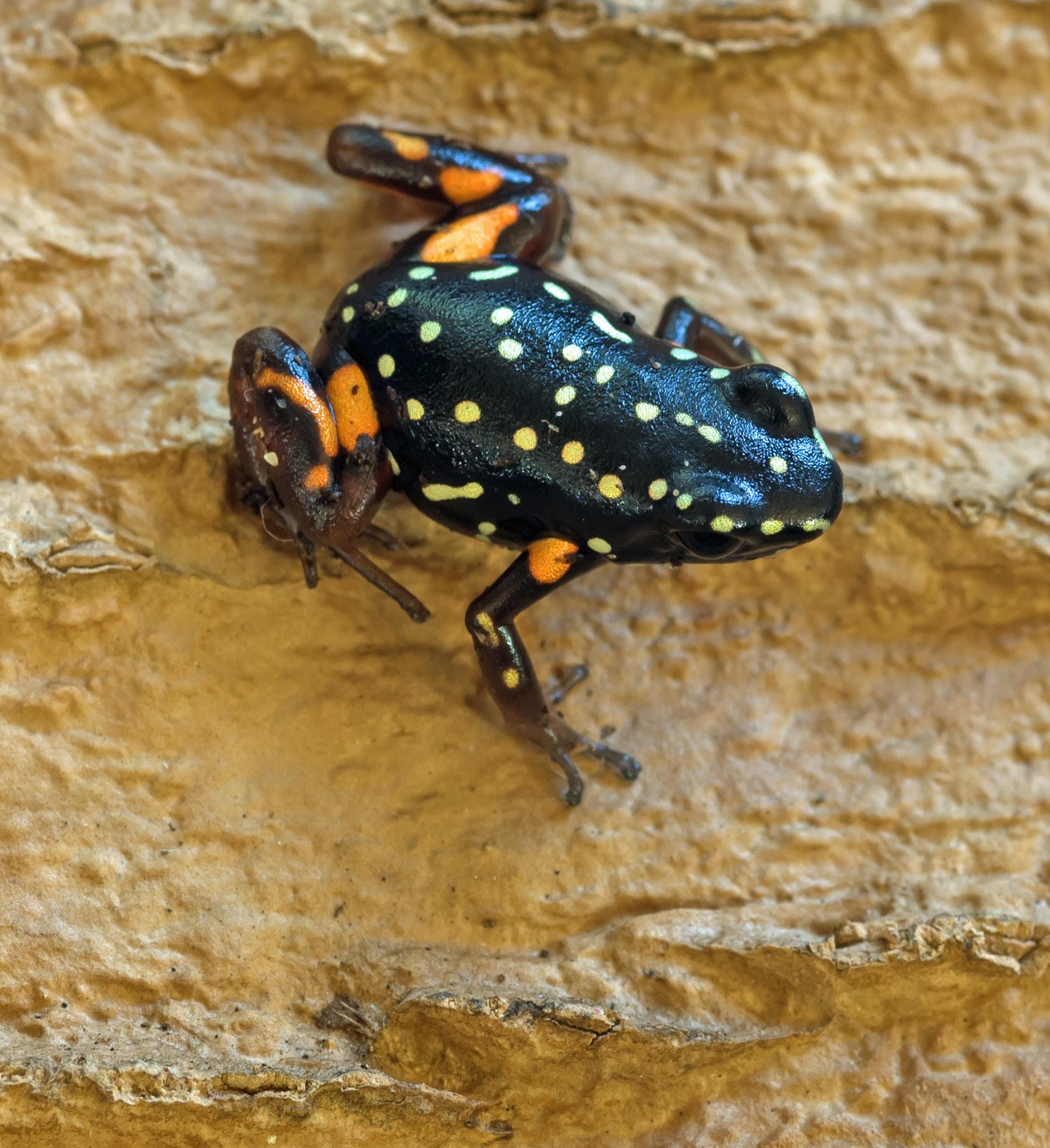
One tiny frog depends almost completely on empty Brazil nut pods. After their eggs hatch, the male Brazil nut poison frog carries his tadpoles to an empty pod that has filled with rainwater. There, he deposits his tadpoles and the pod becomes a nursery.
The roots of the Brazil nut tree play a vital role in the rainforest, too. The deep roots help prevent erosion. The roots also pull nutrients up from the soil, so the nutrients get recycled back into the rainforest ecosystem.
The enormous canopy of the tall Brazil nut trees creates a microclimate below it. The trees limit the amount of light that reaches the forest floor, which shade-loving plants need to thrive. The shade also affects the moisture levels and temperature on the forest floor—nature’s air conditioning!
Despite being tall and mighty, Brazil nut trees are picky. They require undisturbed areas of the rainforest to grow. But undisturbed Amazon ecosystems are becoming harder to find.
One of the biggest threats facing Brazil nut trees—and the Amazon in general—is deforestation and ecosystem degradation . Scientists estimate that as of 2025, 20 percent of the Amazon has been cleared for farming, grazing, logging, and mining. Not only does that reduce the number of trees (obviously!), but scientists have discovered the genetic diversity among remaining Brazil nut trees has also greatly diminished.
Why is that important? Genetic diversity is the variety of genes found within a species population. Genes are the traits passed from parents to their offspring—or, in this case, from a mature tree to a seedling—that affect behavior, growth, and appearance. With greater genetic diversity, some individuals will have traits that better equip them to handle ecosystem changes or fight off new diseases.
Researchers identified nearly 200 different species that interact with Brazil nut trees in some way, from tiny microorganisms to large predators.
When genetic diversity is low, the species as a whole is less healthy and less likely to survive change. The more genetic diversity in a species, the more likely it is that species will adapt to changing conditions in the ecosystem.
The Brazil nut tree is a vital part of Indigenous communities spiritually, nutritionally, and economically. The tree appears in myths and oral traditions as a symbol of strength, survival, and interconnection with nature. People who collect the fallen nuts are called “castañeros.”
To this day, people collect Brazil nuts, a tradition passed down from generation to generation. But it’s a dangerous job! Castañeros have to be on the lookout for falling pods. They may also encounter jaguars or vipers.
Collecting Brazil nuts is an important source of income for many people. The nuts are eaten, made into tea to settle stomachaches, and pressed to extract oils for lip balms, hair products, soaps, and moisturizers.
overharvesting: the collection or removal of a natural resource faster than the population can reproduce.
sapling: a young tree with a thin, flexible trunk that is not yet producing seeds.
migration: the seasonal movement of animals from one place to another.
incisor: a sharp, pointy tooth at the front of the mouth, used for cutting.
Watch this Amazon rainforest Conservancy video and take a journey into the Amazon to see the Brazil nut tree. Why are the Brazil nut pods like cannonballs when they fall to the ground?
Overharvesting of fallen nuts has also impacted Brazil nut trees. When too many nuts are collected, it impacts the trees’ ability to reproduce. In places where nuts are regularly harvested, there are mature and aging trees, but few young saplings. As a result, the trees keep getting older, but a new generation of trees is not growing.
Climate change also impacts Brazil nut trees, though scientists are still working to understand how much. Climate change brings different weather patterns, alters rainfall patterns, causes drought, and increases temperatures. These changes influence the trees’ natural flowering cycle. They also disrupt migration patterns of pollinators, so the Brazil nut tree might produce fewer pods.
Since the main threats to Brazil nut trees are deforestation and overharvesting, conservation efforts focus on combatting these practices. One reason people clear land or overharvest is to make money or provide food for their families. How can we balance those needs with keeping the trees healthy? That’s where sustainability comes in. Brazil nuts contain a compound called selenium that can help prevent cancer.
Agoutis are rodents that look like oversized guinea pigs, weighing roughly the same as a house cat. They are native to the rainforests of Central and South America and are the only known animal that can open a Brazil nut pod. Their razor-sharp incisor teeth keep growing throughout the agoutis’ lifetime. This ensures that their nut-cracking tools are always ready.
Researchers have discovered that each agouti bores into a Brazil nut pod in its own unique way. Scientists have found pods with heart-, oval-, and even starshaped holes. Agoutis make the same unique hole every time they open a pod. They also make the opening at the same place in the pod each time.
Agoutis hide the Brazil nuts or pods among the roots of strangler figs or in rotten logs. Some clever agoutis have been known to store the pods under water, so other animals cannot sniff them out and steal them.
agroforestry: a land use and management practice that integrates native plants and trees with livestock and crops to create a sustainable system.
restoration: the process of actively repairing and recovering a degraded or damaged ecosystem and its natural functions.
steward: to responsibly take care of or manage the land in a sustainable way.
holistic: the belief that the parts of something are interconnected and can be explained only by considering the whole system.
Agroforestry is a way for families to generate income while preserving the forest at the same time. Instead of clearcutting the forest, people raise livestock and a diverse mix of native crops with native plants and trees. This practice maintains soil health, biodiversity, and habitats for wildlife and makes it possible for families to use and sell a variety of different products.
One effort revealed that families using agroforestry practices made five times more money from their land than traditional ranchers. Further, agroforestry restores degraded land and soil in the Amazon rainforest ecosystem.
Environmental scientists study the natural world to understand how it works and how humans interact with it. By examining this relationship, scientists learn how to best address real world issues and reduce human impact while protecting both the environment and people.
Much of the work of environmental scientists is research, both data collection in the field and analyzing that data. This might involve collecting soil or water samples, studying the impacts on animals and plants in an ecosystem, or determining how to best approach restoration of a degraded ecosystem. The work might include raising awareness about conservation needs and providing guidance to ensure environmental laws are enforced. Environmental scientists also work to strengthen environmental protections.
Similarly, Brazil nut harvesting is a profitable alternative to highly destructive traditional farming, logging, and mining. And when harvesters leave some pods on the ground, new trees will grow and maintain the forest. Like agroforestry, sustainable harvesting generates income and preserves the forest ecosystem at the same time.
Watch this video for a deep dive into ecosystem ecology and its different specialties. Based on what you learn, how would you define an ecosystem?
Conservationists have also turned to Indigenous communities that have stewarded the Brazil nut trees and the forest for generations. Scientists discovered that Brazil nut trees managed by Indigenous communities have a higher genetic diversity. This shows that effective conservation must be a collaboration between scientists and Indigenous people. This is a holistic approach to conservation based in traditional knowledge and supported by science. At the same time, it empowers and supports local communities, reestablishes resilient ecosystems, and creates a path toward a sustainable future.
A sustainable future also relies on protecting mangroves, which you’ll learn about in the next chapter.
What are the main considerations for creating a sustainable future for Brazil nut trees?
• science notebook
• pen or pencil
Every ecosystem is filled with its own unique sounds made by the species that live there. By listening to an ecosystem, scientists gather information about the variety of species in a particular area and changes there over time. This is called acoustic monitoring. Create your own sound map of your neighborhood or nearby park. You don’t need any fancy equipment, just your ears and a piece of paper and pencil.
› Find a quiet spot to sit. If possible, find a natural area and avoid places near roads and other human-made noises.
› Draw an X in the middle of your paper—this represents your location. Draw a large circle around the X.
› Close your eyes. What natural sounds do you hear? Try cupping your hands around your ears to help capture sound. Natural sounds may be animals, insects, wind, water, rustling leaves, or something else.
› Mark what you hear and where you hear it on your map. Your mark can be a symbol, picture, or word—whatever works for you! Mark sounds near you close to your X and those in the distance farther away from your X.
› Listen for two minutes. Turn 90 degrees in one direction. Listen for two more minutes. Repeat for a total of four times.
› Take a look at your map when you’re finished. Can you hear more sounds facing one way than in another? How do the sounds vary? Why?
Create a sound map in the same location at different times of day on the same day. Are the sounds similar? Different? Maybe consider creating a sound map at the same time of day once a month. Pay attention to the similarities and differences in the sounds you hear, and how the sounds change.
TO WORLD
The choices that people make every day have an impact on the natural world. You read about sustainable choices people are making in the Amazon rainforest. Design a board game that illustrates the effects of sustainable choices versus unsustainable ones, either in the Amazon rainforest or in another ecosystem.
• poster board
• markers or pencils
• notecards
• dice
• tokens
› Choose an ecosystem. Research the unsustainable choices people make that have a negative impact on that ecosystem. Research the sustainable choices people make that conserve that ecosytem or help its recovery if it has been damaged. Consider clear-cutting, agriculture, nut harvesting, agroforestry, Indigenous knowledge, and the needs of people.
› Design a game in which players make different choices based on a card they draw or a space they land on. Write the rules that will guide the play.
» Will the players lose by making poor choices?
» Will players be able to save the ecosystem?
» Will players be eliminated if they make too many unsustainable choices?
» Will players get a second chance to do the right thing?
› Play a test game to see what works and what needs adjustment. Revise the game as needed. Share your game with friends and family to raise awareness about making sustainable choices.
Research wildlife impacted by threats to the rainforest or other ecosystem. How can sustainable choices help these species? Incorporate the details about these species into your game.
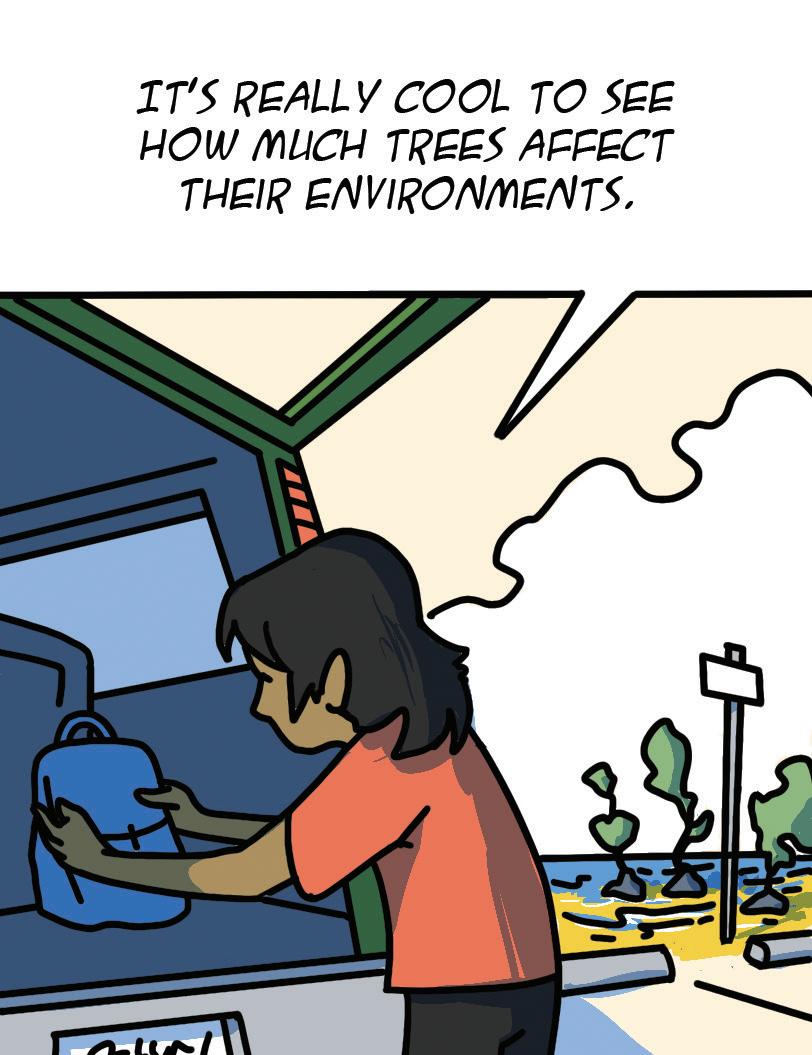
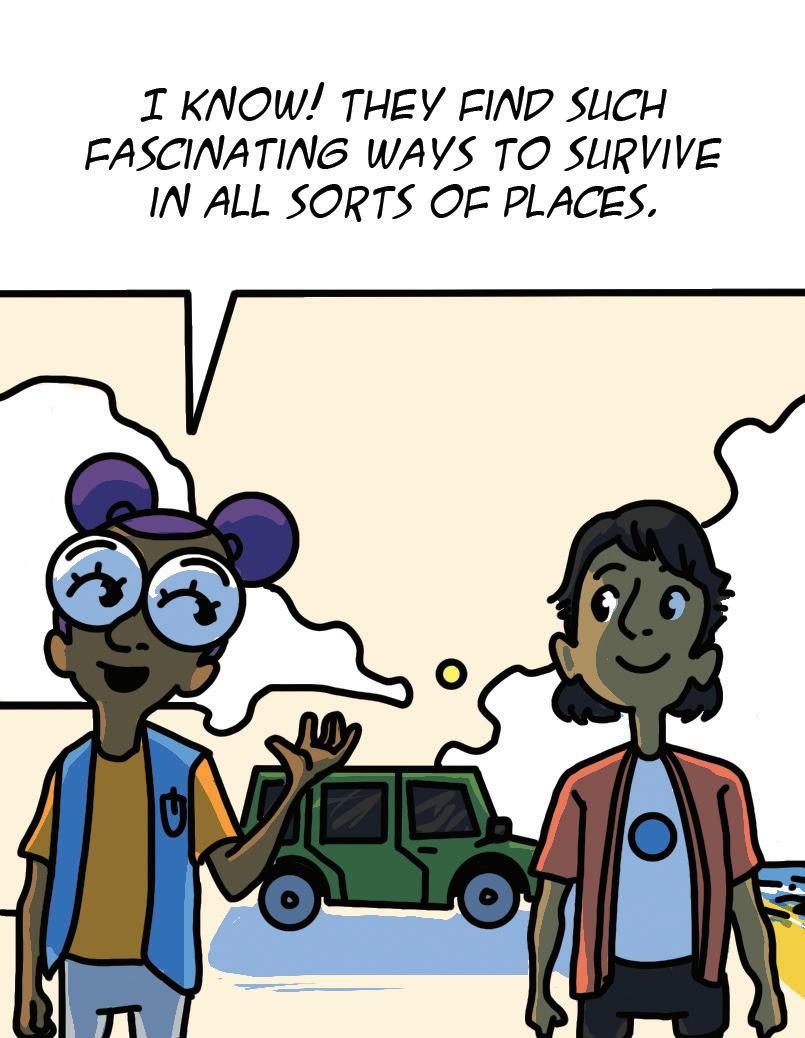
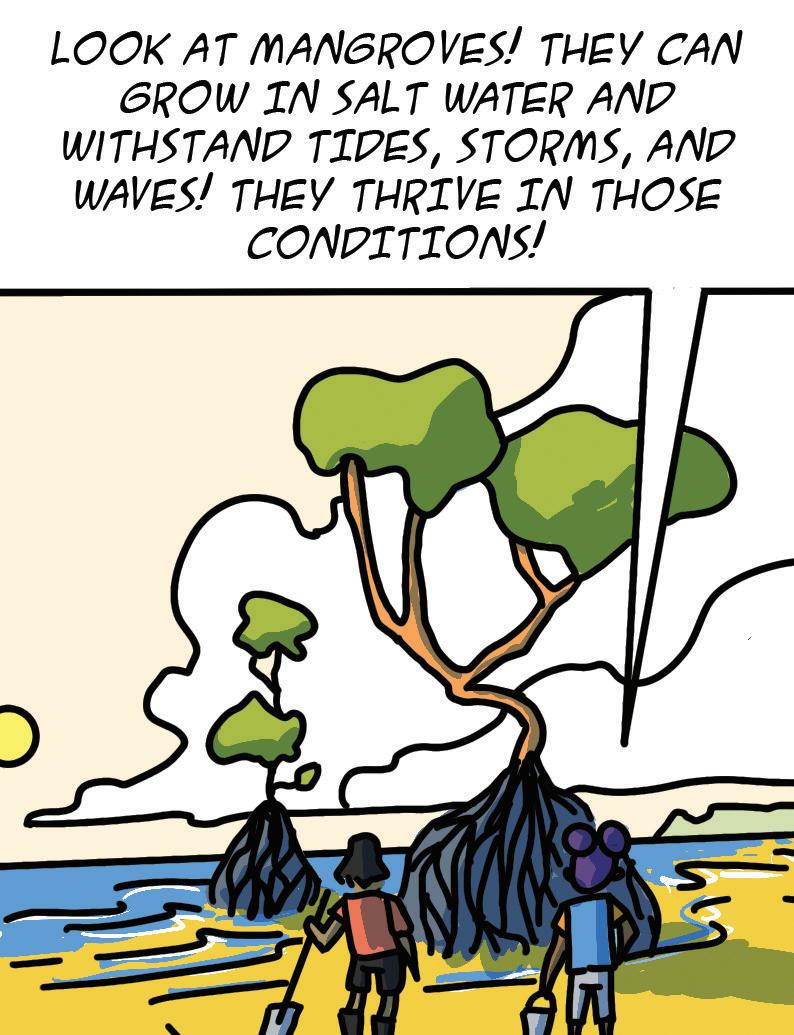
Mangroves are some of the hardiest plants on Earth. Most species of these woody trees and shrubs grow along shorelines in the intertidal zone. They grow around the world in both fresh and salt water, as well as in brackish water, a mix of the two. Mangroves on shorelines endure battering from waves, rising and falling tides, flooding, and storms. The soil they grow in has low oxygen levels and high salt levels.
ESSENTIAL QUESTION
What essential ecosystem services do mangroves provide for coastal ecosystems and the planet?
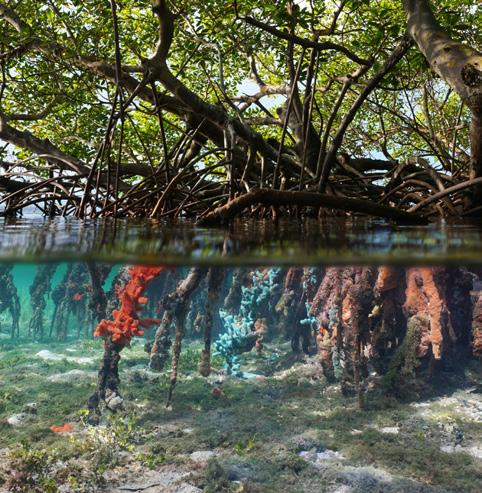
Mangroves thrive in conditions where most other plants could not survive. A dense tangle of roots, similar to stilts, holds the trees up above the water. These roots anchor the trees in place, allowing them to withstand the tides, waves, and shifting sediments. The exposed roots take in oxygen at low tide and transport it to the roots underground.
To deal with the salty water, the roots of some mangrove species act as giant filters. The roots let water in but keep the salt out. Other species of mangrove deal with salty conditions by expelling salt through glands on their leaves. Mangroves provide habitats for many species, as well as numerous ecosystem services.
Imagine you are a small fish, swishing around in the intertidal zone. A shadow crosses over you—a predator! Maybe it’s a bird in the air or a larger fish swimming above you. You must hide—fast! Where do you go?
mangrove: a woody tree or shrub that grows in the intertidal zone in tropical areas.
intertidal zone: an area where the ocean meets land that experiences regular cycles of being underwater and being exposed to air.
brackish: slightly salty due to a mix of seawater and river water.
sediment: bits of rock, sand, or dirt that have been carried to a place by water, wind, or a glacier.
filter: to pass a liquid or gas through another substance to remove unwanted material.
expel: to force out or eject something.
ecosystem service: a benefit provided by an ecosystem to keep the air, water, or soil healthy.
You quickly dart among the submerged, crisscrossed roots of the mangroves. Now you’re safe!
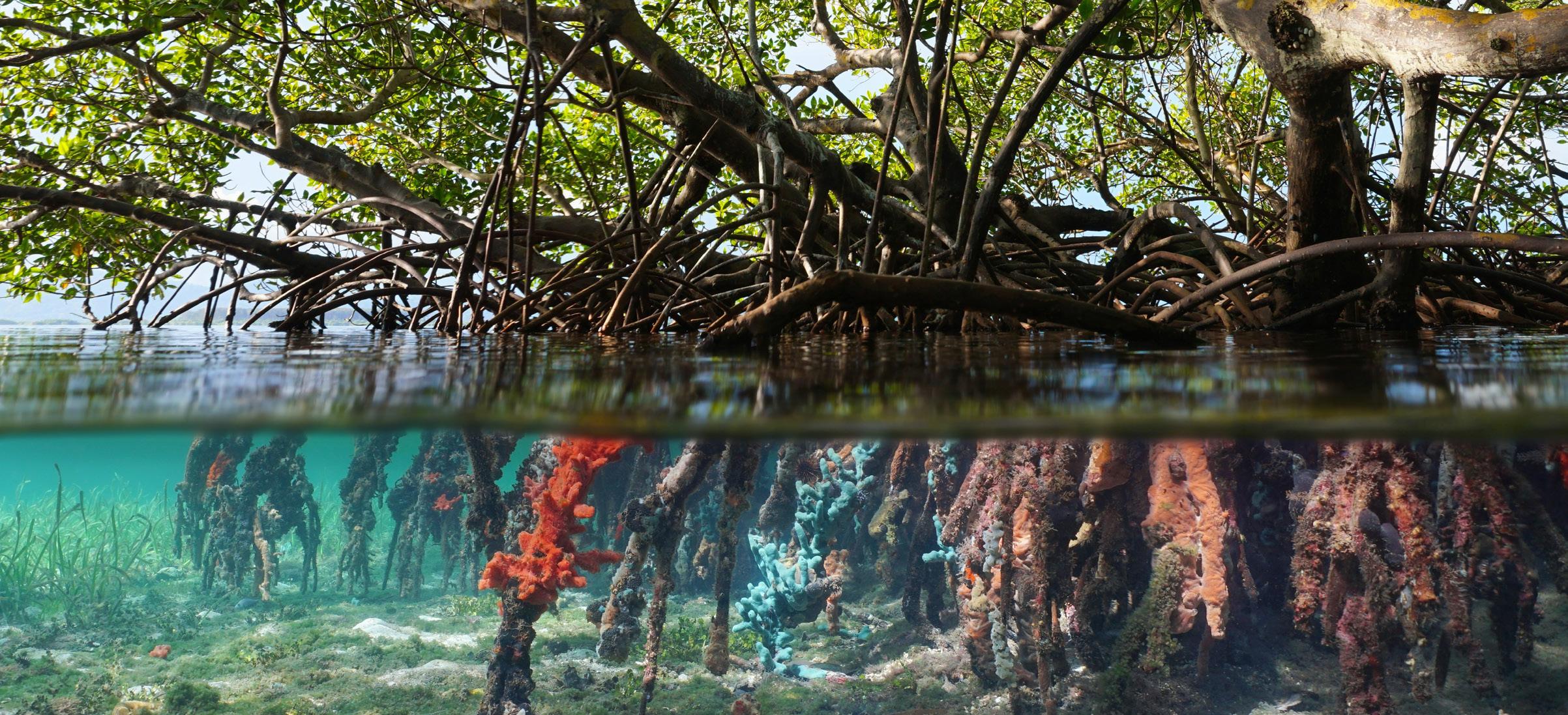
There are about 80 different species of mangroves found around the world.
marine: having to do with the ocean.
microbe: a living thing too small to be seen without a microscope. Also called a microorganism.
runoff: water that flows off the land into bodies of water.
Small fish are not the only marine species to take advantage of mangrove roots for shelter and habitat. Larger fish, shrimp, crabs, and other species use the tangle of roots to hide from predators and as safe nursery sites. Barnacles and oysters attach to the mangrove roots to stay anchored in the safety of the mangrove ecosystem. Snails and clams burrow in the soft soil around the mangrove roots.
Above the water, monkeys, insects, bats, snakes, frogs, or deer—depending on location—gather near mangrove trees. In Asia and Australia, you might see a crocodile lurking the mangroves!
Watch this Next Generation Science video to learn about the adaptations of mangroves that allow them to survive in the intertidal zone. How do these trees disperse their seeds?
Mangrove forests are prime real estate for many bird species.
You might even see a fish in tree! It’s true—mudskippers use their powerful fins to climb mangroves. But how do they breathe out of water? Through their skin! Mudskippers also store water in their mouth and gills, which helps them breathe.
Mangrove forests have plenty of food, too. The leaves that fall from the mangrove trees form the base of the food web here. Some leaves are eaten right away by insects and crabs. As the uneaten leaves decay, microbes , fungi, and other decomposers break them down, recycling nutrients in the mangrove ecosystem.
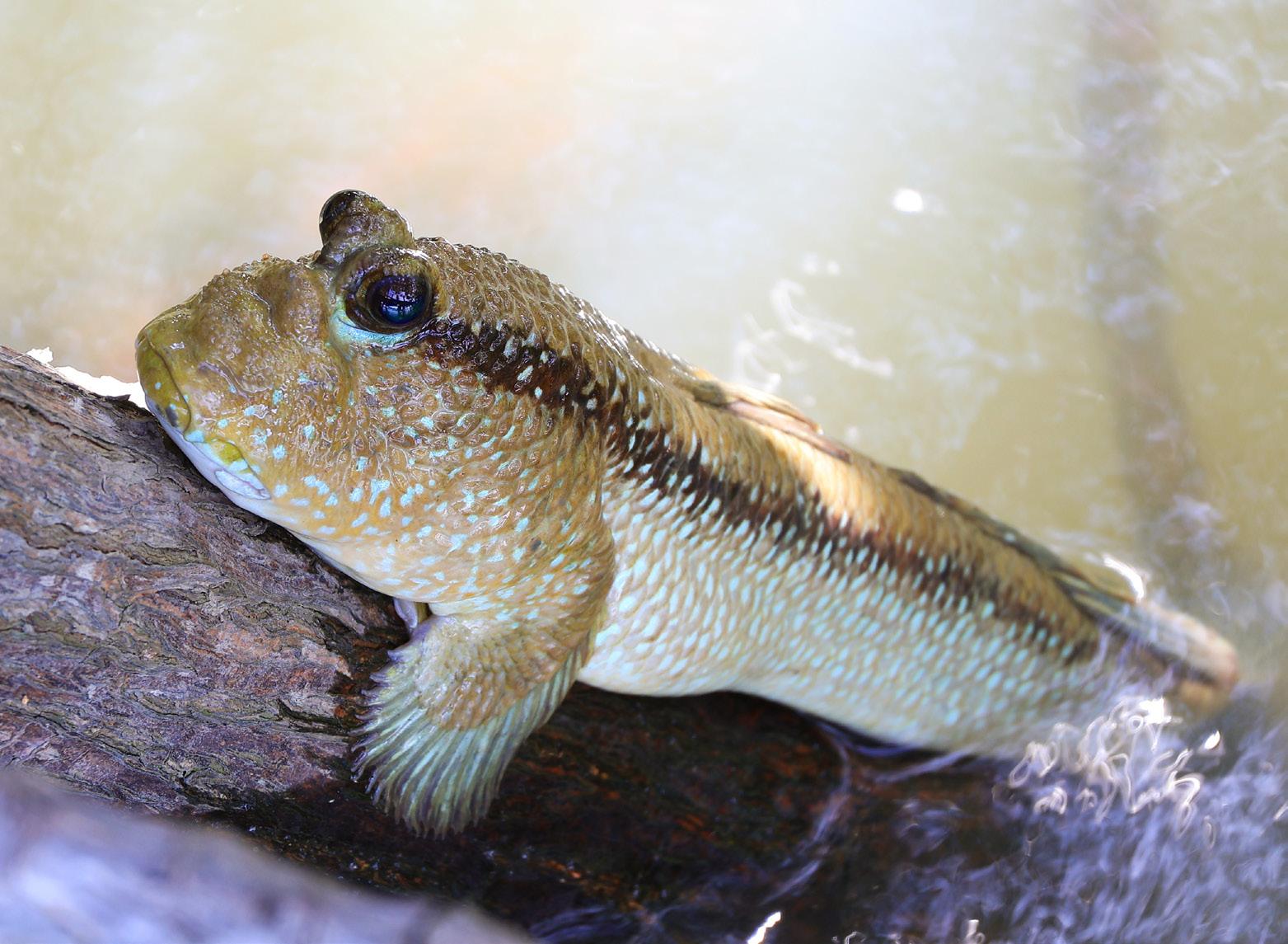
In turn, larger species consume these smaller organisms, and so on through the food web.
Mangrove tree crabs climb trees! They spend most of their time in the trees to avoid being eaten by fish. When threatened by birds or other predators, they drop into the water.
In addition to habitat, mangrove forests offer valuable ecosystem services. Mangrove roots slow waves as they move toward shore. Sediment in the water settles and is held in place by the roots, protecting coastlines from erosion. This also protects nearby corals from being smothered and keeps the water clear. Plus, by slowing the waves, mangroves act as a buffer against storms. They reduce the impact of the crashing water, protecting both the ecosystem and human-made structures.
Mangrove forests are also considered the kidneys of the coast. Just as your kidneys remove toxins and waste from your body, mangroves filter pollutants from coastal runoff, streams, and rivers.
Kelp is another aquatic keystone species. What is kelp? It’s not a plant. Kelp is a large, brown seaweed, a type of algae. It’s found in shallow, cold water in the intertidal zone. Kelp grows in large forests, similar to how trees grow on land. And, like land-based plants, kelp uses the sun’s energy to produce food.
Kelp is considered a keystone species because it is the foundation of an ecosystem. It provides shelter for many marine species. Like mangroves, kelp protects coastlines from erosion. Because they are so dense, kelp forests slow waves as they approach the shore. The waves have less impact on the shore and sediments settle on the ocean floor. In addition, kelp forests are primary producers at the base of the marine food chain. They are also valuable carbon sinks.
Take a look at this live webcam of a kelp forest off the Channel Islands in California. What species do you spot? Does the kelp forest remind you of anything on land?
aquaculture: the farming of fish and plants and other organisms that live in the water.
Mangroves keep the water clean, protecting vital marine ecosystems.
Another key ecosystem service of mangrove forests is their ability to store carbon. In fact, mangroves are vital carbon sinks, absorbing and storing more carbon than tropical forests! Like all trees, mangroves use carbon to grow roots, branches, and leaves. After the leaves fall or the tree dies, this material sinks to the bottom of the ocean, trapping most of the carbon.
When we lose mangrove forests, we lose a valuable carbon sink, as well as shoreline protections and the foundation of many coastal ecosystems.
Long before people understood their importance, mangrove forests were destroyed to make way for human development—to build homes, roads, businesses, dams, and more. People also clear mangrove forests for agriculture and aquaculture. Shrimp farmers clear mangroves to build ponds. Sometimes, these farmers dig channels to supply water to the ponds, damaging mangrove forests.
One innovative approach to conservation is a partnership between the Nature Conservancy and Minecraft. The goal is to raise money and awareness about conservation. Do you think this is a good approach?
Not only does development destroy the mangroves themselves, it changes how water and sediment move in the area. The natural ebb and flow of fresh and salt water changes. This affects the greater ecosystem and the health of any remaining mangroves and other plants.
The use of pesticides, fertilizers, and other chemicals in agriculture and aquaculture is another threat. These and other pollutants that run off from land into mangrove forests can overwhelm the ecosystem and reduce its ability to filter water.
Climate change is affecting mangroves, too. The frequent and more powerful storms that result from warming oceans mean mangrove forests are battered more often. In some places, rising sea levels are drowning mangroves that need low tides to expose their roots.
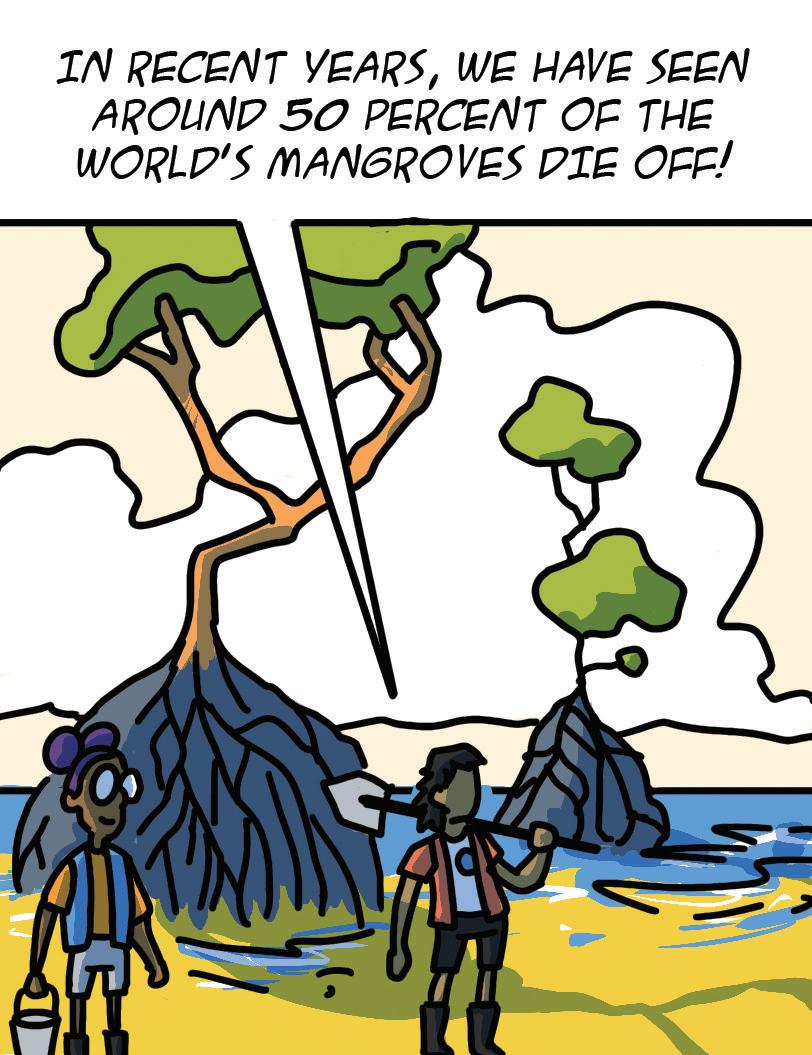
Researchers estimate that between 1970 and 2020, we lost half of the world’s mangroves.
In the past, mangrove forests could gradually move as new trees took root farther inland. Now, human development prevents the forests from moving. Plus, mangroves need to anchor in a buildup of sediment, which takes time. In many cases sea levels are rising too fast, and sediment buildup is not happening fast enough. In other places, severe drought affects mangroves because they rely on the ebb and flow of water.
One more threat to mangroves is invasive species. When a nonnative species is introduced to an ecosystem, either naturally or by humans, it competes with native plants and animals for resources. The invasive plants or animals often have no natural predators, so they spread quickly, disrupting the balance in the ecosystem. One place this is happening is in mangrove forests of China where an invasive marsh grass is taking over.
To learn more about the importance of mangrove trees, visit Kids.Earth.org. Do any of these facts surprise you?
Earth mangrove
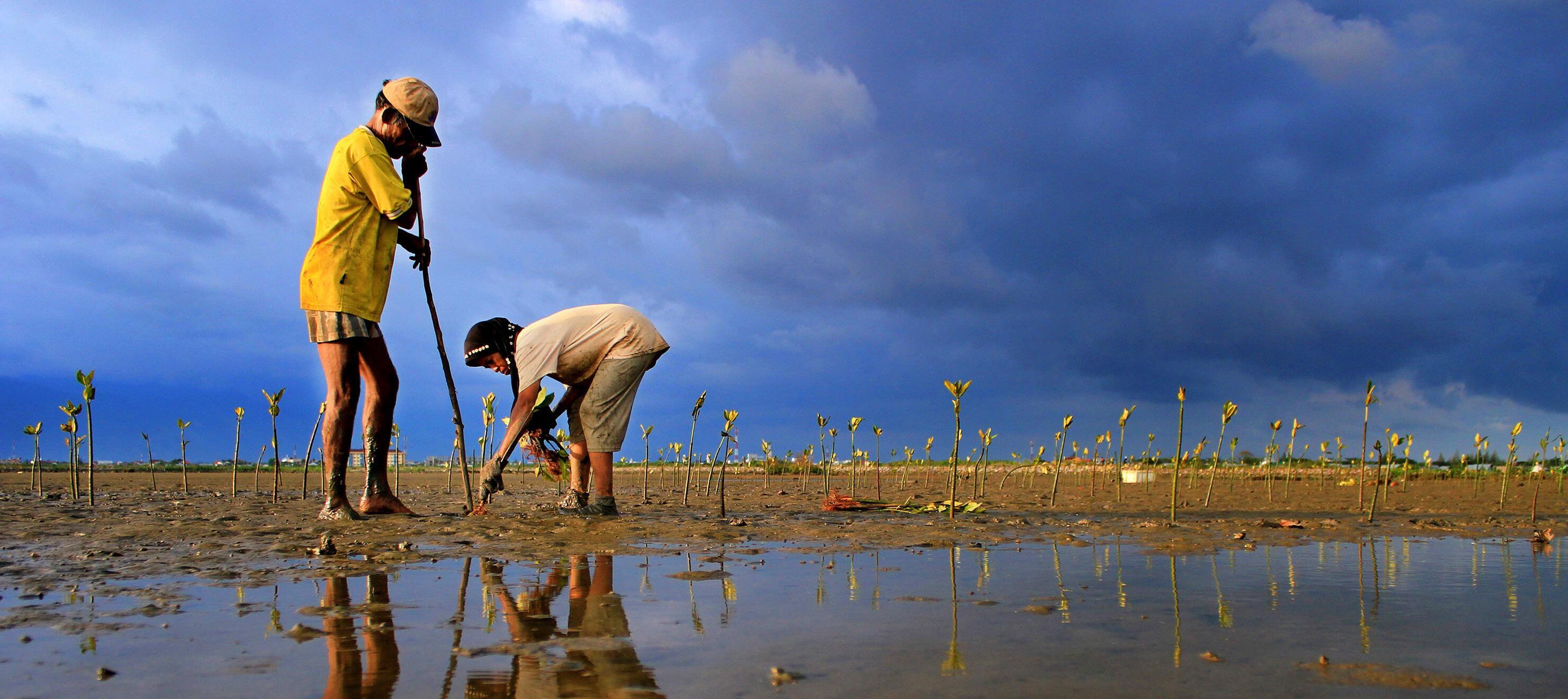
conservation biologist: a scientist who studies how to maintain and restore habitats and protect wildlife.
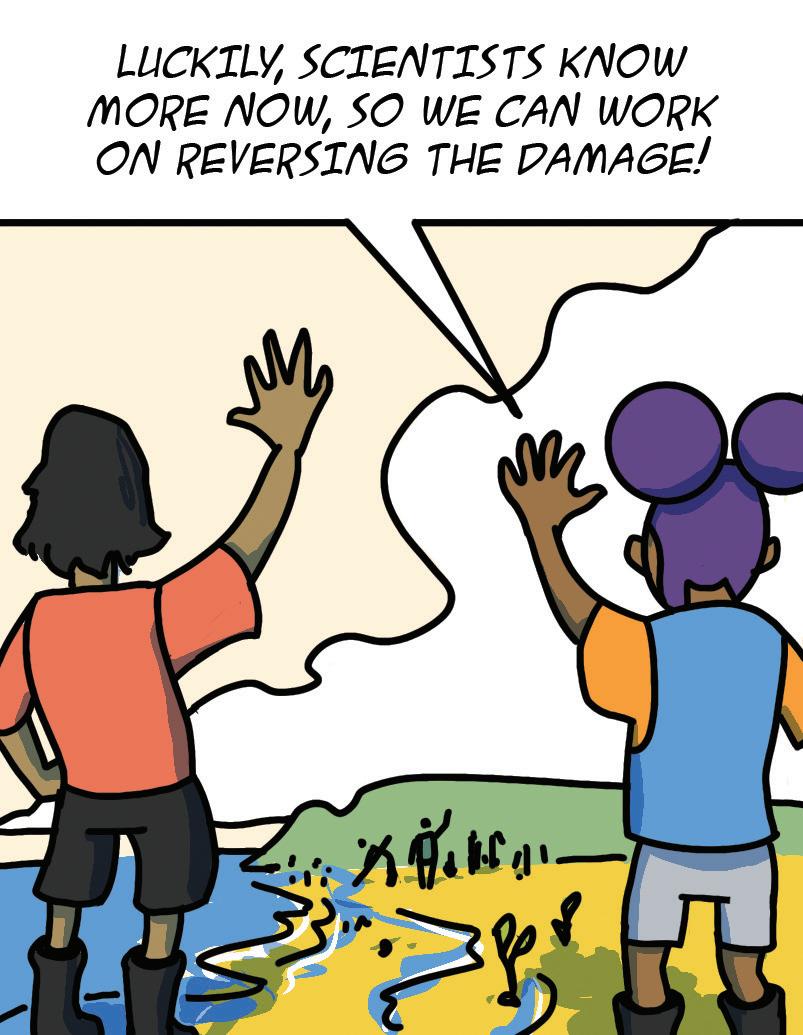
Although many mangroves have been lost, there is still hope. People now understand the key roles that mangroves play in ecosystems. Conservation efforts are underway to protect and restore mangrove forests.
However, planting mangrove seedlings isn’t easy. One project in the Philippines in the later part of the twentieth century planted millions of seedlings—but only 20 percent survived. Around the same time, researcher Robin Lewis (1944–2018) began work to identify the perfect conditions for mangrove seedlings.
Every year, the International Day for the Conservation of the Mangrove Ecosystem is celebrated on July 26 to promote conservation and raise awareness about the importance of mangroves.
If you look at the two words in the name of this scientific field, you might be able to guess what a conservation biologist does. These scientists study Earth’s biodiversity, habitats, and ecosystems. They also identify and analyze human impact on the environment. Using this information, conservation biologists work to protect species and their ecosystems.
Most conservation biologists work in the field. They conduct research and identify problems. Based on their findings and experience, they develop potential solutions and ways to reduce human impact. This work helps educate the public, inform policies and laws, and establish protected areas.
Meet a conservation biologist in this video. What are different ways non-scientists can become part of wildlife conservation?
Lewis discovered that the highest survival rates were among seedlings that stayed dry 70 percent of the time and were submerged by the tide the remaining 30 percent. He and a team used bulldozers and other equipment to build a coastal site with these conditions. In these optimal conditions, the mangroves re-established themselves on their own. This method has been successful in dozens of projects around the world.
Watch the video on this web page to see mangrove conservation in action. Why do you think the creators chose that title?
Through organizations such as Global Mangrove Alliance and Mangroves for the Future, scientists from different fields, governments, and nonprofit organizations collaborate to restore and manage mangrove ecosystems.
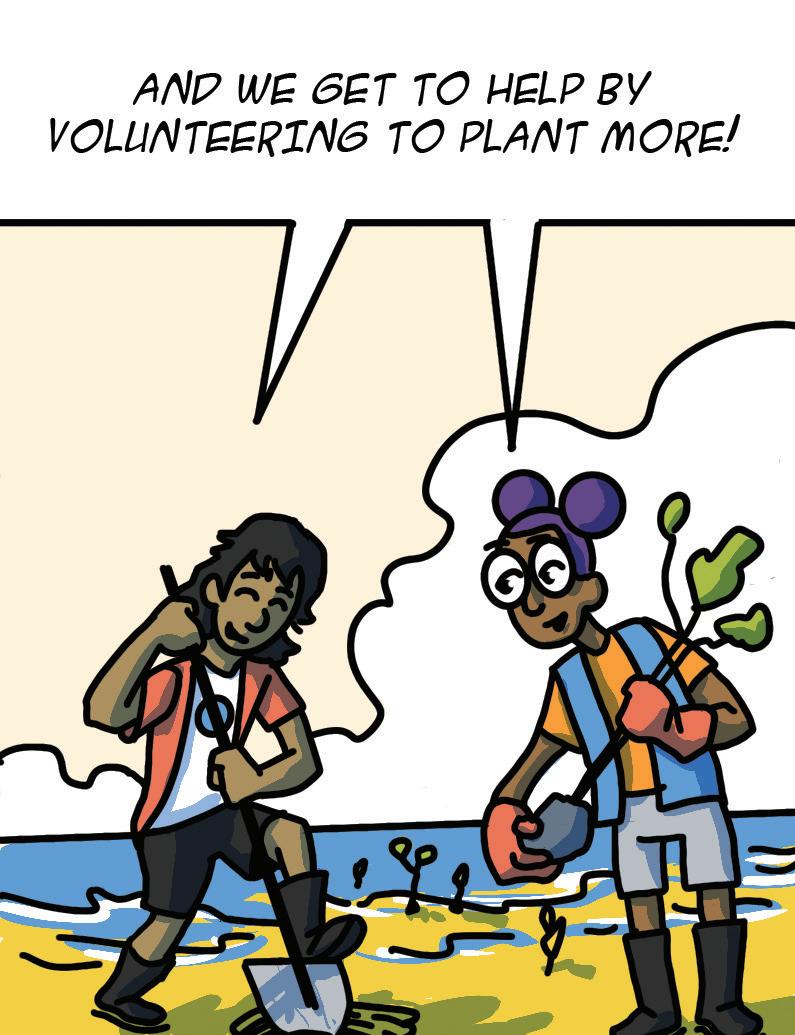
Community-based conservation efforts also help restore mangrove ecosystems and raise awareness about their importance. In Kenya, Papua New Guinea, the Philippines, Nigeria, and elsewhere, local people act on the frontlines of planting mangroves and developing management plans. People also raise awareness and educate others in communities and schools.
treaty: a formal agreement between countries. marine protected area (MPA): a protected wilderness area of the ocean or freshwater system.
Policies, laws, and treaties among governments play a key role in protecting mangrove ecosystems from further deforestation and degradation, and in creating a sustainable future. In Florida, for example, a law regulates when and how mangroves can be trimmed or removed.
Laws also create marine protected areas (MPAs). These are like parks on land, but they are in or near the water. MPAs protect a variety of marine and freshwater ecosystems, including mangrove forests, from development, overuse, and degradation.
Watch this mangrove restoration video series. How should people approach mangrove restoration?
Mangrove Restoration videos
Perhaps the greatest and most challenging thing we can do to protect mangroves and other keystone plants and fungi is to combat climate change.
One way people do this is by bringing science into climate policy. Many countries have set climate goals to reduce greenhouse gas emissions. At the same time, the mangrove ecosystems themselves are one of our greatest tools for removing carbon from the atmosphere and storing it. They are a nature-based solution to climate change. So, if we protect mangroves they will help protect us!
Next, we’ll travel to a very different climate to learn the roles of baobab trees.
What essential ecosystem services do mangroves provide for coastal ecosystems and the planet?
Have you visited an intertidal zone? What did you notice?
Water is polluted by trash, pesticides, factory waste, sewage, and more. In some cases, changes in water’s acidity or temperature can cause an overgrowth of harmful microorganisms. These pollution sources can be toxic. Pollution can harm certain species or whole ecosystems.
Mangroves are known for filtering pollutants out of the water. See for yourself how plants absorb polluted water.
Caution: If you want to use a fertilizer or pesticide in your experiment, ask an adult for help.
› Fill each jar with a ½ cup of water. Set one jar aside—this is your control.
• 6 to 10 white flowers (carnations work well)
• one jar for each flower
• measuring cup
• water
• several pollutants (food coloring, vinegar, dish soap, laundry detergent, fertilizer)
• science notebook
› Add a teaspoon of one pollutant to each of the other jars. Label each jar with the name of the pollutant.
› Place one flower in each jar. Wait 24 hours.
› Observe the petals and stems of each flower. What happened to them? How did the different pollutants affect the flowers?
› Compare the flowers to the one in the control jar with no pollutant. Record your findings. What conclusions can you draw about the different pollutants and how they affect plants in the ecosystem?
Repeat the experiment using water from the tap, filtered water, and water from several different natural sources near you (a pond, stream, ditch, wetland, etc.). What happened to the flowers in these different kinds of water? Which did the best? Which fared the worst? What does this information tell you about the water sources in your area?
• poster board or white paper
• colored markers or pencils
When nonnative species enter an ecosystem, they sometimes take over and crowd out the native species. As you learned, an invasive marsh grass threatens mangroves in China. As our world is increasingly interconnected, invasive species are just about everywhere in every type of habitat. There are likely several invasive species near you!
Time to raise awareness! Law enforcement has used WANTED posters for centuries to try to catch outlaws. In this activity, make a similar poster to identify a different kind of outlaw—invasive species.
› Start with a little research about what appears on a traditional WANTED poster.
Learn more about the harm of invasive species in this TED Ed video. Why aren’t these species a problem in their native habitat? What factors keep their populations in check?
TED-Ed
› Research invasive species in your area. Make a list of four. Find out where these species are found, where they are originally from, what they’re like, and what harm they are causing in your local ecosystem. Make a sketch of each.
› Create an UNWANTED poster that highlights these species. Your poster might include the name and possible alias of the species, their physical description, their “crime,” and the reward offered for eliminating these species. Add your own decorative elements such as borders, special fonts, and pictures.
› Were you surprised by the number of invasive species in your area? Are scientists particularly worried about any of them? What threats do these species pose?
Find out the steps local community, government, or organizations are taking to combat invasive species in your area. What can you do? Share your poster with family, friends, and community to raise awareness. With permission, post your UNWANTED poster to social media. Get involved with volunteer projects to remove invasive species.
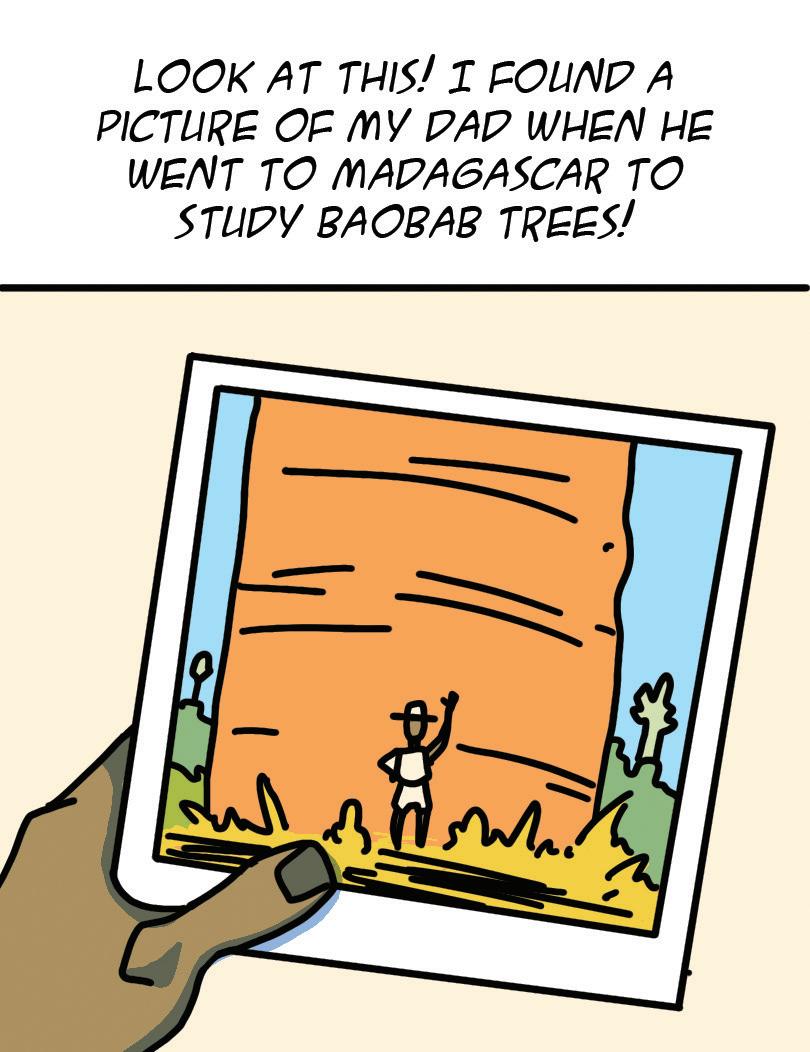

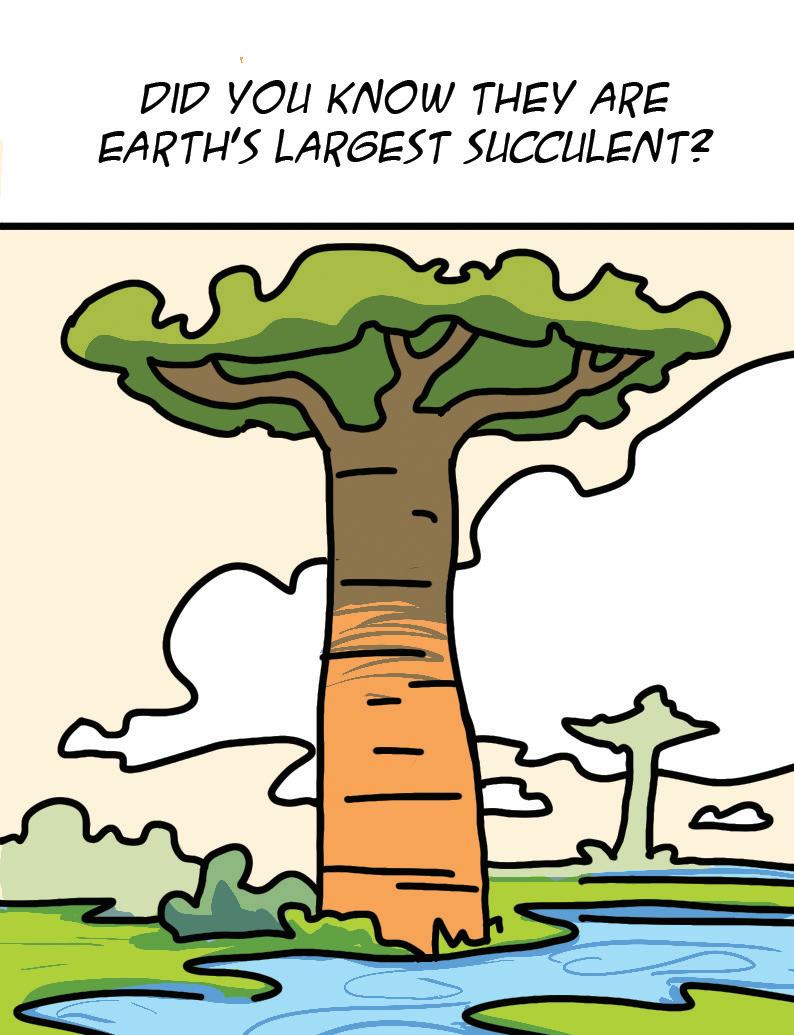
Baobab trees have several different names. They are often called the “tree of life” or the “mother of the forest” because of the many ways they sustain life. Sometimes people refer to a specific baobab as “Grandmother” because of the tree’s age. Baobabs are also nicknamed the “upside-down tree” since their stout, gnarled branches make them look like they’ve been uprooted and planted upside-down.
ESSENTIAL QUESTION
Why are baobabs vital to the health and survival of their ecosystem?
Baobabs are found in the dry forests of Madagascar, on the savannas of Africa, and in savanna woodlands in Australia, where they are called boabs. All of these ecosystems have one thing in common: they have a long, hot dry season and only a short, wet season.
savanna: a grassland ecosystem with a lot of grass and a few trees and shrubs.
deciduous: describes a plant that sheds its leaves each year.
drought deciduous: describes a plant that sheds its leaves during the dry season instead of the fall.
succulent: a plant with thick, fleshy leaves and stems that can store water to help it survive when little water is available.
bulbous: round, fat, or bulging.
bushbaby: a small, nocturnal, African primate that lives in trees.
nocturnal: describes an animal that is active at night.
primate: a mammal belonging to a classification order including humans that shares the following features: a large brain, opposable thumbs, good eyesight, and flexible toes.
While baobabs are deciduous trees, they are different from the deciduous trees of North America. They are what’s called drought deciduous. Instead of dropping their leaves in the fall, baobabs drop theirs during the dry season. This adaptation allows the tree to conserve water when there’s little rain. It also means that baobabs are bare much of the year.
Baobabs are Earth’s largest succulent . Mature baobabs can grow up to 100 feet tall. Their bulbous trunks can be more than 150 feet around! Baobabs can look almost as wide as they are tall. These trunks absorb and store water like a sponge. The stored water helps baobabs survive the long dry season. It also allows baobabs to support many other species.
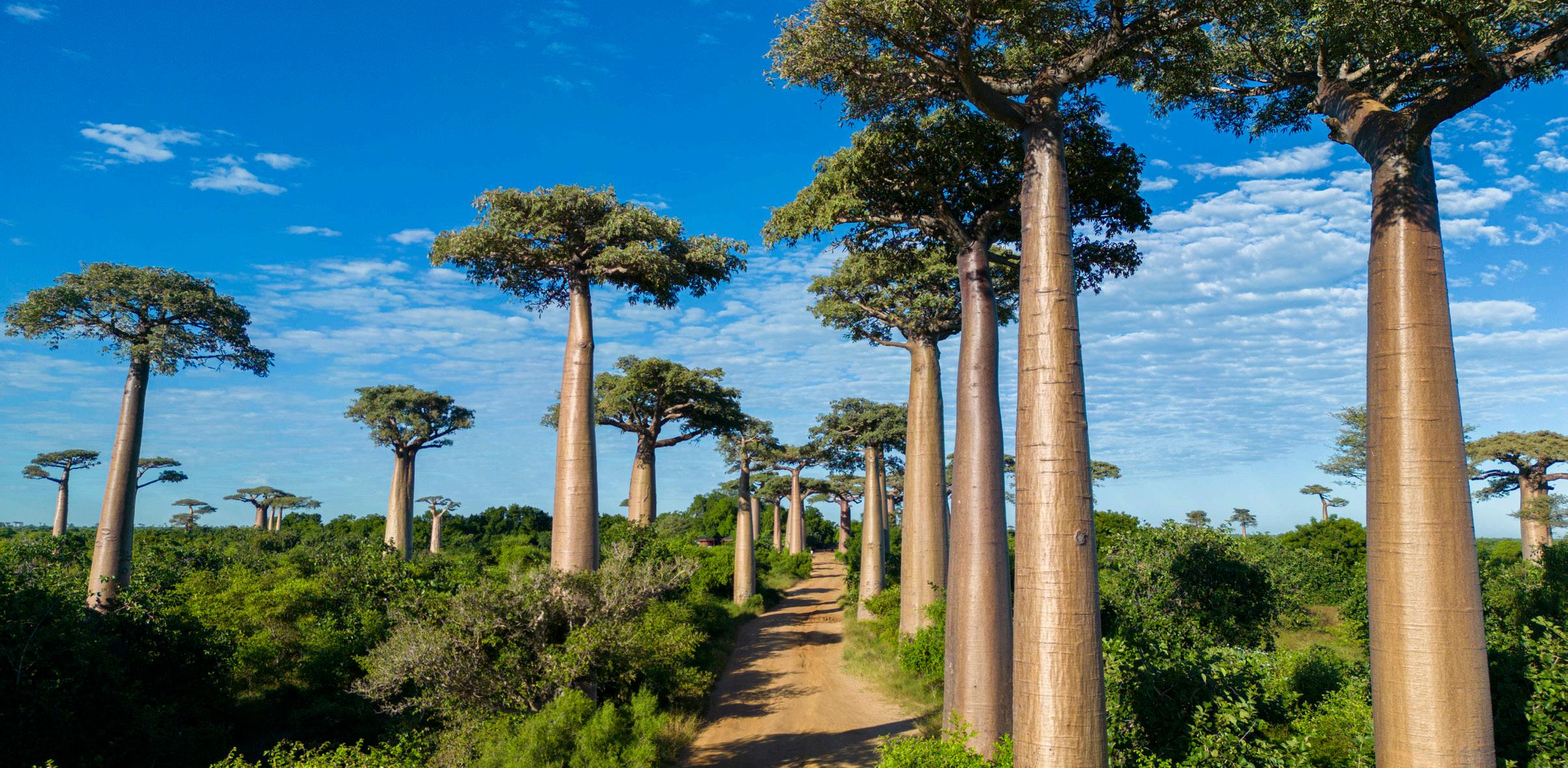
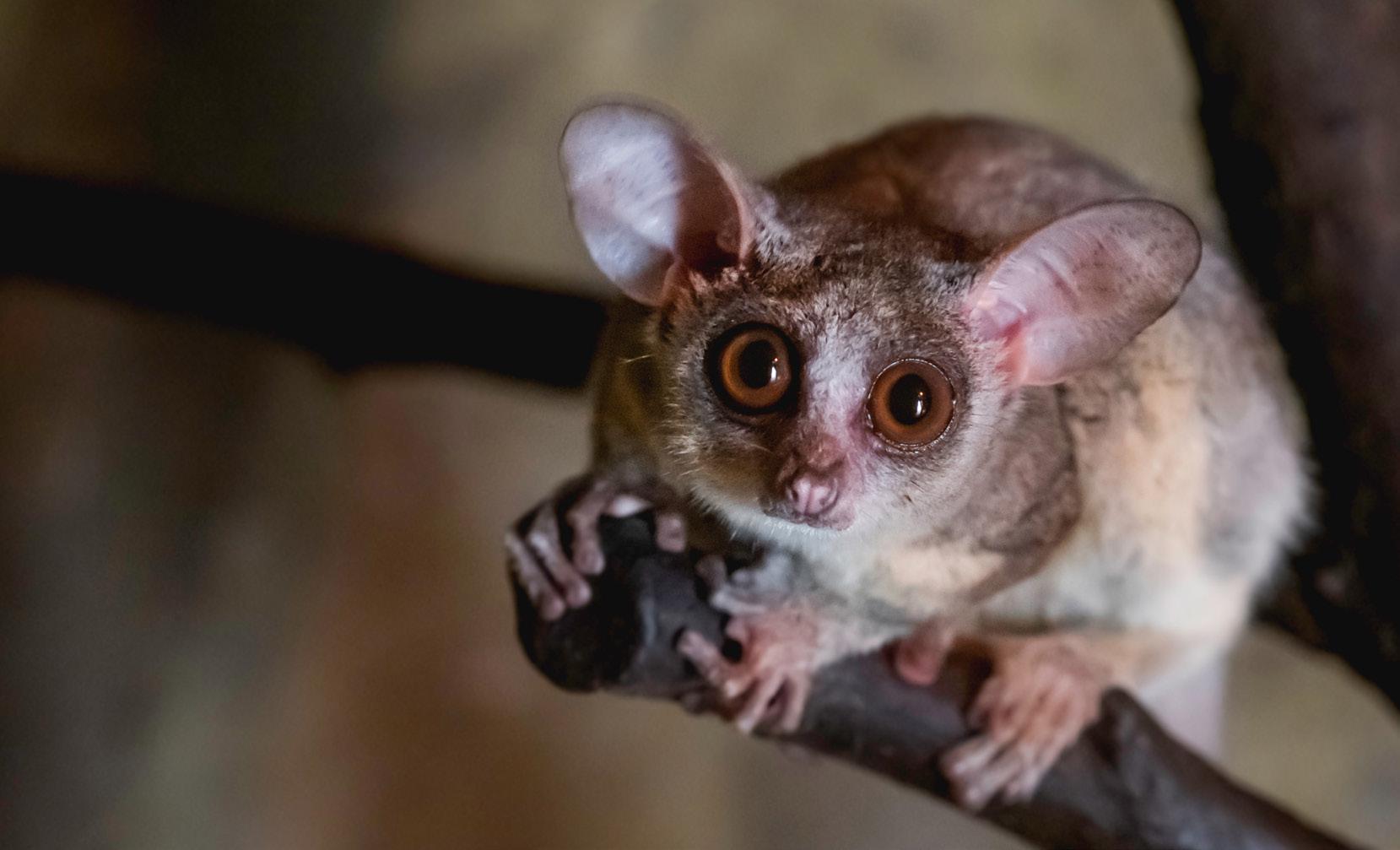
Baobabs create an entire ecosystem. This is why the baobab is a keystone species.
Baobabs are a source of water and food for birds, bats, monkeys, lizards, rodents, insects, and more. Elephants strip bark off the trees during droughts. Once the bark is gone, they eat the spongy, moist wood inside the tree. It’s a lot like a watermelon, soft and full of moisture. The wood beneath the bark of the baobab provides elephants with moisture when they cannot find other water sources.
Elephants also eat the fruit of the baobab. The fruit is full of vitamin C and other important nutrients and minerals and is an essential food for many animals. Warthogs, antelopes, baboons, and monkeys all feast on baobab fruit.
Research revealed that all baobabs originated in Madagascar and evolved about 21 million years ago. Ocean currents carried their seeds to Australia and Africa approximately 12 million years ago.
Another source of food from the baobab tree is the nectar in its flowers. These large, fragrant flowers open at night and bloom for just 24 hours. Bats, moths, and bushbabies lap up the nectar—an essential source of energy in a dry landscape where food is often scarce.
disperse: to spread or distribute over a wide area. dung: animal poop.
extinction: the death of an entire species so that it no longer exists.
The massive baobab trees also offer shade and shelter. Older trees have cavities and folds that are perfect hidey-holes for small animals such as reptiles, bats, and insects. One, the African honey bee, builds hives in the baobab’s hollows. Many birds take advantage of these cavities, too. Others, such as weaver birds, build nests among the branches.
The fruit of a baobab tree can grow to more than a foot long.
Even the soil benefits from baobabs. Their extensive root systems help keep the soil moist during the dry season. They anchor the soil and slow erosion. When the baobab leaves fall, the decomposers get to work. They break down the leaves, which enriches the soil and recycles nutrients.
The African elephants that rely on baobabs for water are also a keystone species. As the largest land animal on Earth, they have a profound impact on the landscape.
Elephants eat fruit, leaves, bark, branches, shrubs, grasses, and even roots. They are nature’s pruners, keeping vegetation from overgrowing and becoming overly dense. In forests, elephants forge pathways that other animals can follow. On the savanna, elephants prevent woody plants from taking over, maintaining the open savanna ecosystem.
In addition, elephants use their tusks to dig in dry riverbeds in search of water. This creates watering holes not only for themselves, but for many other animals as well. They make mini habitats with their large, deep footprints too—the depressions fill with water and are visited by amphibians, birds, and insects.
And, of course, because of the amount of food elephants eat, they poop a lot! But all that manure isn’t a bad thing. Elephant poop disperses the seeds of plants they’ve eaten far and wide, and fertilizes the soil. And, the dung patties themselves are mini habitats for many insects and microorganisms!
As with other keystone plants we’ve learned about, baobab trees are under threat. In Africa, people have witnessed the death of several of the oldest and largest baobab trees. Other trees are dying long before they reach their expected lifespans. Several baobab species are at risk of extinction
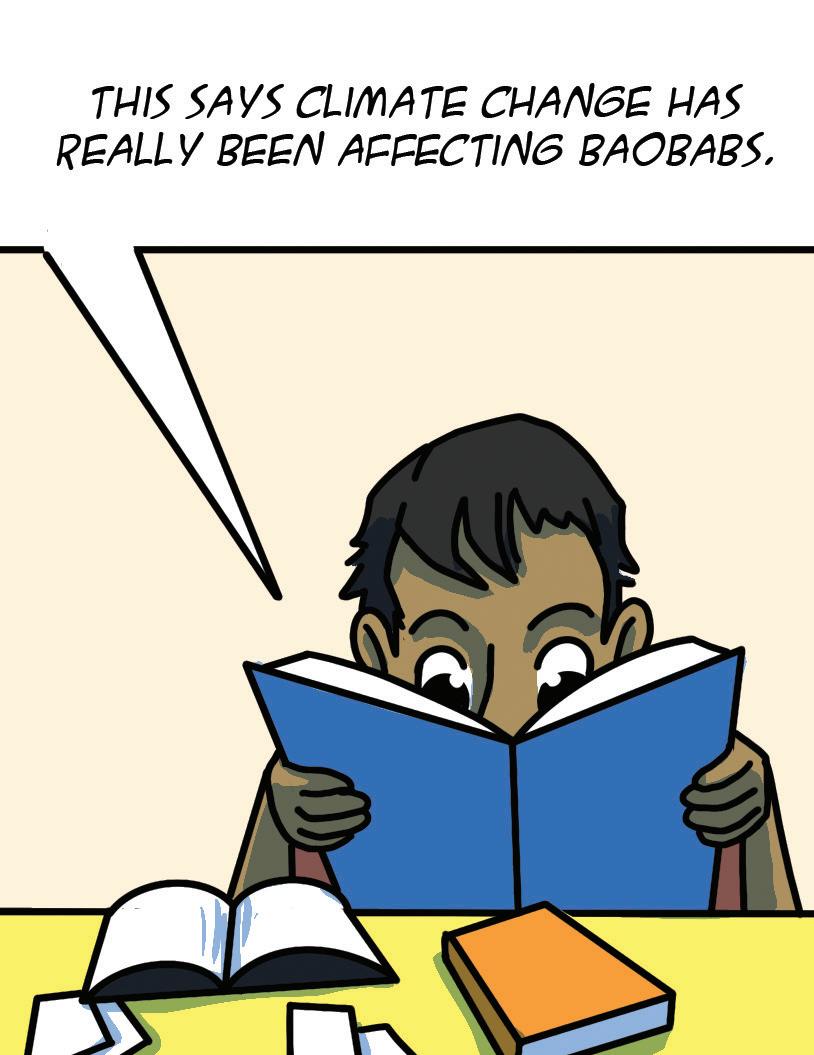
As of 2025, the exact cause of death of the trees was not clear, though scientists believe that global climate change plays a role.
Many species are affected by climate change. Read this article to learn how both animals and plants are on the move. We know how animals move, but how do plants accomplish this?
Baobab fruit is considered a superfood, with more potassium than bananas and more vitamin C than oranges.
Temperatures are getting warmer and droughts are lasting longer. In addition, climate change causes more severe and irregular weather events, such as flooding and storms. These factors stress and weaken the trees, so they are less able to withstand extended drought and are more vulnerable to disease, wind, and wildfires.

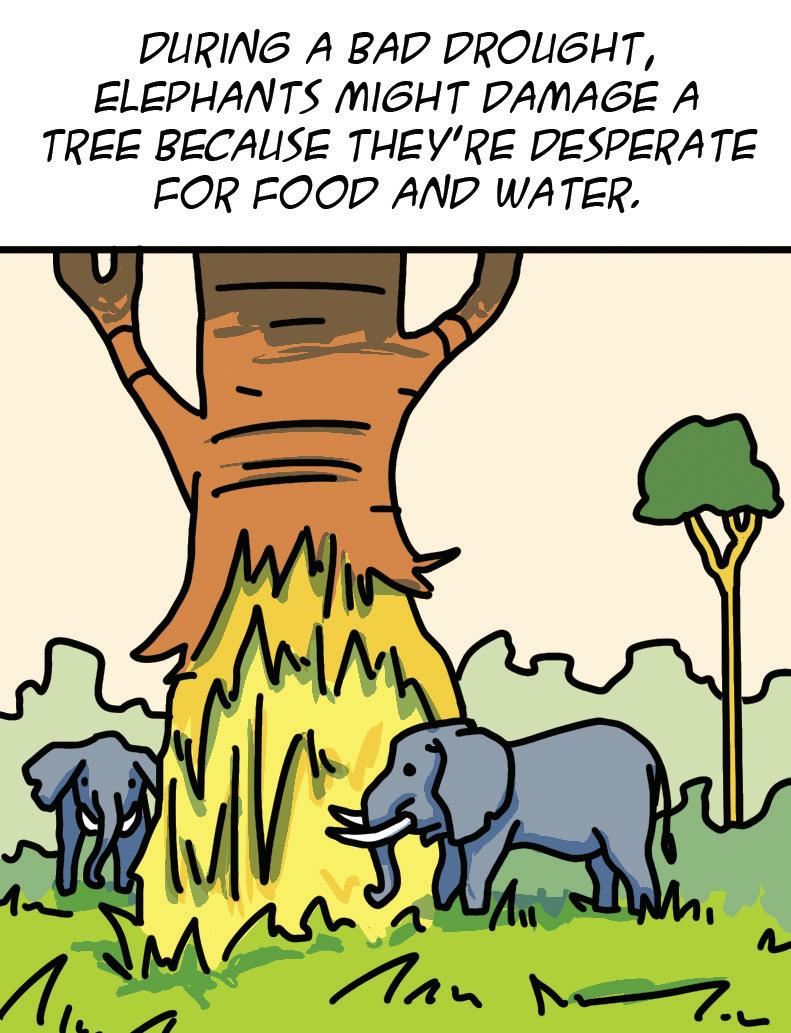
Severe drought is a real problem. Under normal conditions, when elephants eat the spongy wood they do not harm the tree. However, during prolonged drought, elephants become so desperate for water, they gouge deep into the tree and cause severe damage. In some cases, the damage is so great that the tree collapses.
Many people who live among the baobabs are already very poor. Extreme drought makes it worse—water sources dry up, crops fail, livestock dies, and the trees produce less fruit. In these desperate times, people overharvest baobab leaves for food, and bark and branches to make products to sell for money.
Under normal conditions, baobab trees heal after the bark has been stripped by elephants, other herbivores, or people— similar to how your skin heals when you get a cut or scrape. In drought conditions, the damage might go beyond repair.
A full-grown African elephant can weigh more than 6 tons—that’s heavier than the average car. Baby elephants can weigh more than 250 pounds!
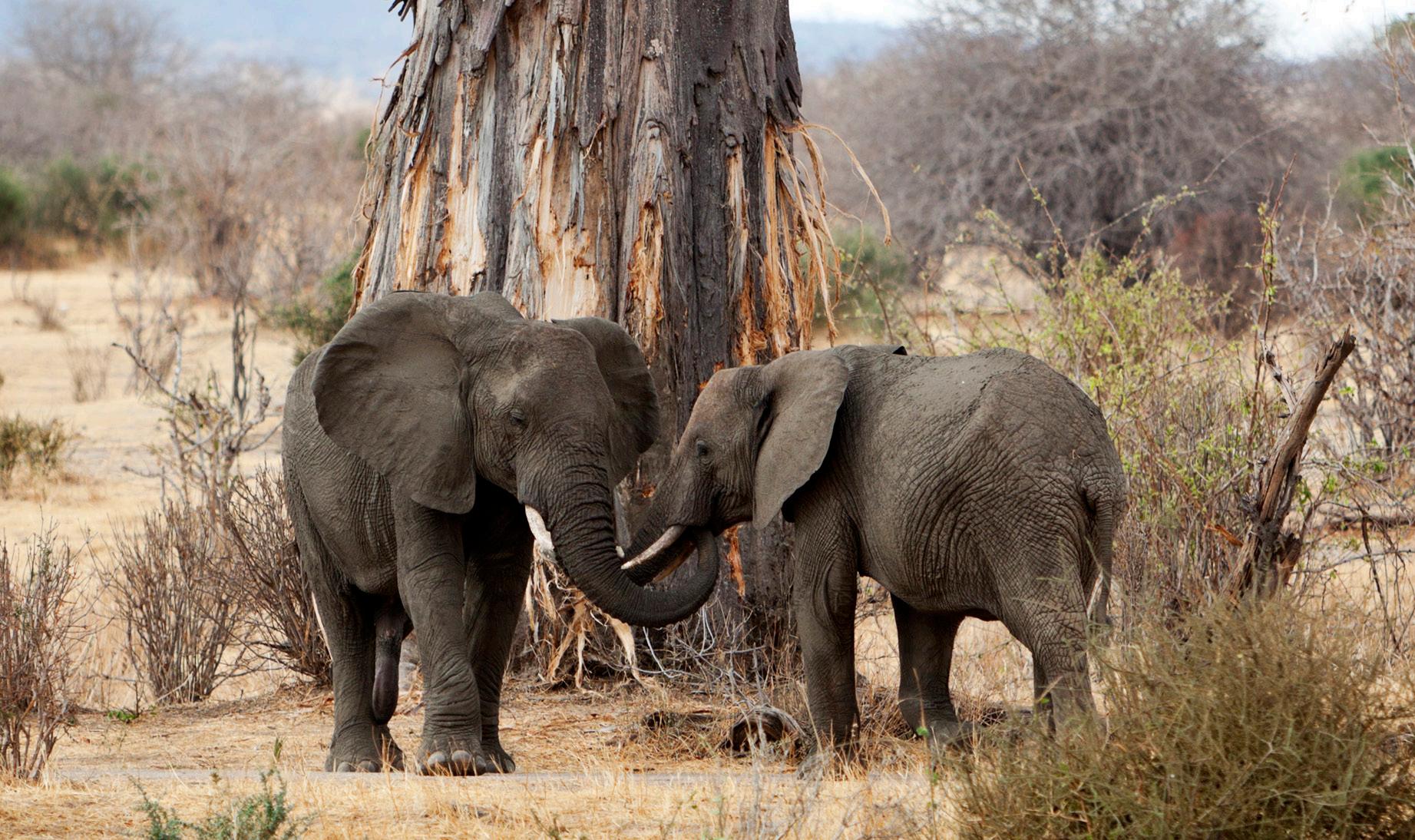
In other cases, people frantic to grow crops to feed their families clear the land. These actions offer short-term relief for families, but they threaten the long-term sustainability of the baobabs.
Finally, baobabs rely on large animals such as giant tortoises and elephants to disperse their seeds, but these populations are declining. With fewer animals carrying baobab seeds far and wide, fewer new baobabs sprout. Scientists are working to understand how this impacts ecosystem health and how other animals might play a role in seed dispersal.
Only a few baobab flowers open at a time. This forces nocturnal pollinators such as fruit bats and hawkmoths to move from tree to tree to find nectar. As they do, they transport pollen, helping the tree reproduce.
Baobab trees play a key role in the culture and traditions of Indigenous peoples across Africa and Australia. These trees are used in hundreds of ways! Almost every part of the tree is edible, from the flowers and leaves to the fruit. The fruit is a superfood because it is full of vitamins and minerals. People mix the pulp with water to make a drink. The fruit seeds make a good snack, or they can be roasted or boiled and then ground to make a paste.
People use baobab bark to make fishing lines, nets, bags, baskets, ropes, strings for instruments, mats, and more. They use the wood for building and as fuel for fires. Traditional medicines are made from different parts of baobab trees. People even use the pollen from baobab flowers to make glue!
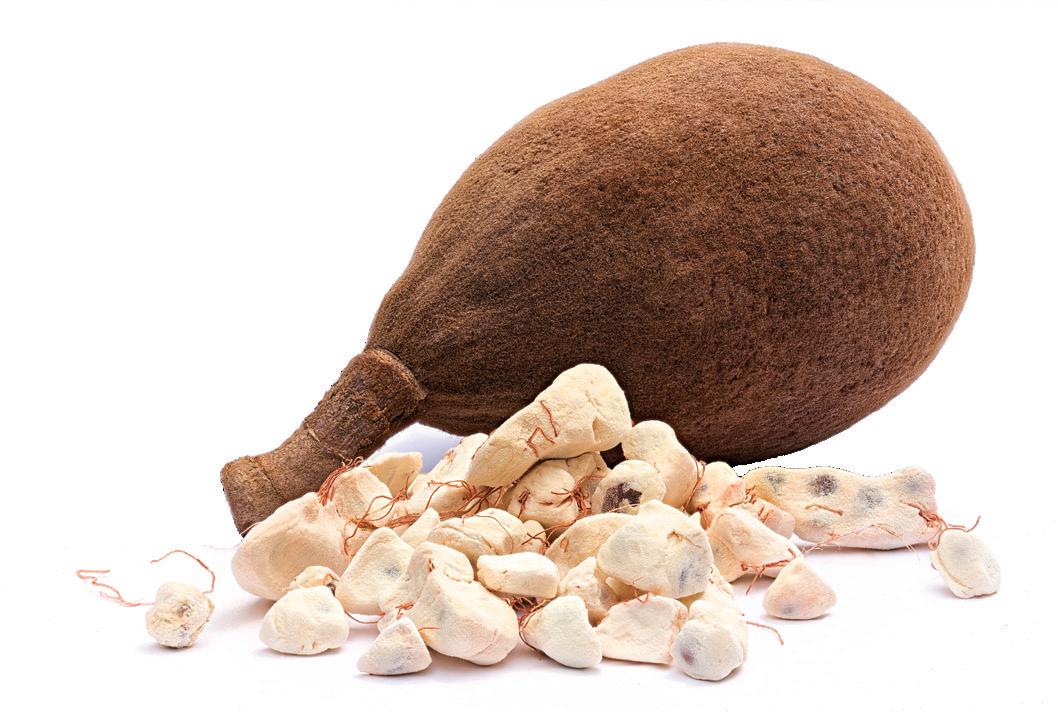
Watch a PBS video to see how local people use and rely on baobabs. What do people have to do to access the water and care for the tree?
interdisciplinary: involving the collaboration between several different fields of study.
restoration ecologist: a scientist who studies ecosystems and determines the best way to make them healthy again.
The baobab is a keystone species, but we don’t know much about it. Scientists continue to research to better understand baobab pollinators, seed dispersal, and the way climate change impacts baobabs.
Like many conservation efforts, baobab projects are interdisciplinary and actively involve local communities. One such program, the Assessment-Research-Outreach (ARO) Baobab Project, began in 2020. The project studied how baobab seeds spread—or fail to spread—in Madagascar with the loss of natural seed dispersers.
In the first quarter of the twenty-first century, Madagascar lost nearly 25 percent of its forest, including baobab habitats.
In Africa and around the world, many damaged or degraded ecosystems need help to recover. This is where the work of a restoration ecologist comes in! These scientists study ecosystems and determine the best approach for restoring that particular place. They are like an ecosystem doctor—diagnosing, prescribing treatment, and monitoring health.
The first step in saving an ecosystem is to stop further harm. Next, scientists devise a treatment plan. Some solutions are simple, such as removing invasive species to allow natives to thrive. Others are more complicated and might involve cleaning up pollutants, removing dams, or reintroducing native species. After a project is complete, restoration ecologists monitor and assess the health of the ecosystem. They also evaluate the conservation efforts to help in future planning.
Learn about biologist Seheno Corduant-Andriantsaralaza and her work leading baobab research and conservation. What research questions guide her work?
The project also investigated how to balance baobab conservation with respecting and supporting the people who depend on the trees for resources and income. ARO set up trade agreements with communities that permit sustainable baobab fruit harvesting—collecting and selling the fruit while also leaving enough behind to generate new baobab growth.
To combat both deforestation and the loss of seed dispersers, efforts are underway to plant baobabs. Scientists have developed nurseries to grow and nurture young baobab seedlings before being planted in the natural ecosystem. Community members work alongside scientists and project leaders.
Visit the Baobab Genome Project to see how citizen scientists are contributing to building a database of baobabs to assist scientists working on baobab conservation.
The success of the ARO project and others demonstrates the power of combining scientific research, community involvement, and active restoration. The scientific research finds nature-based, sustainable solutions. The inclusion of community members empowers people to take active roles in supporting the baobab trees that support them and the ecosystem where they live.
In Chapter 5, we’ll turn to a plant on the other side of the world that is also the foundation of an ecosystem—the saguaro cactus.
Why are baobabs vital to the health and survival of their ecosystem?
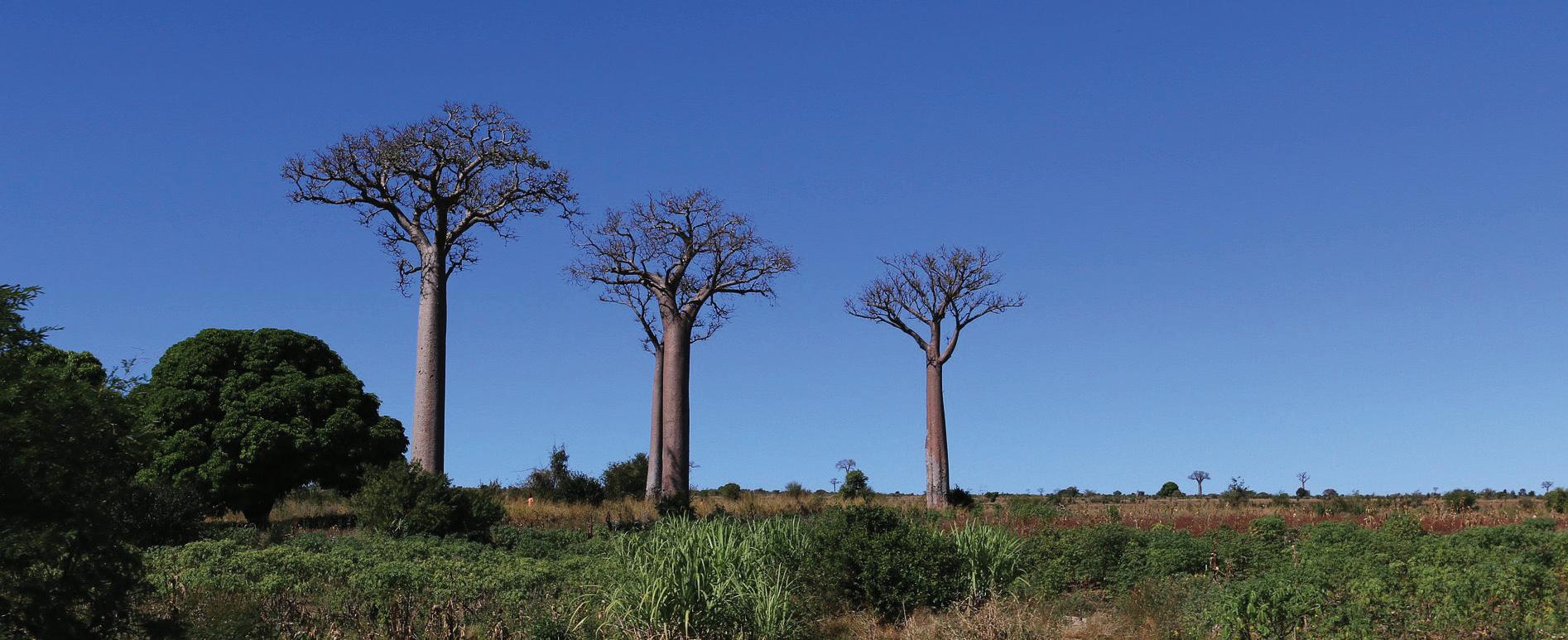
IDEAS FOR SUPPLIES
Baobabs are unique trees with a key role in their ecosystem. Mature baobabs are also massive. To get a better understanding of the size and functions of these trees, build a 3-D model.
› Find an image of a mature baobab tree. Research its average dimensions.
• science notebook
• art supplies
› Do a little math! You want your model to be to scale. How tall do you want your model to be? Based on that, calculate the circumference and the diameter of your model.
› A mature baobab may be 100 feet tall. If you want your model to be 1 foot tall, your model will be a 1:100 scale model. In other words, an actual tree is 100 times taller than your model. Further, the tree’s trunk may be 150 feet around, also known as the circumference. Therefore, your model needs to be 1.5 feet around (or 18 inches).
› Once you have your tree’s dimensions, brainstorm supplies. Possibilities include paper mâché, clay, foam, or play dough. What else could you use to build a thick trunk? What might you use to create that upside-down tree look?
› Using your calculated dimensions, build your baobab and its gnarly branches. Add labels to identify different parts and signs with information about baobabs.
Add people or animals in and around the tree that are also to scale. Use your baobab in a large diorama. Add details and signs that describe the many roles of baobabs as a keystone species and their importance to people. How does adding other elements help reveal the size of baobabs?
Why is it crucial to study how different plants disperse their seeds?
Plants disperse their seeds in many ways. Seeds may be moved by an animal, float on water, catch a breeze, rely on gravity, or be released in a wildfire. Seed dispersal is vital for the survival of a plant species.
› Investigate the various ways that seeds travel. It can be on the fur of an animal, through the air, or on the water, for example.
› Using the engineering design process, brainstorm ways to disperse your “seed.” Sketch a design and build the prototype. Set goals for your seed dispersal. Perhaps your seed will float for more than three minutes, stick to an animal’s fur and be carried 10 feet or farther, or sail on a breeze for more than 15 feet. Test your dispersal method.
REDESIGN
Do you need to redesign? Do you have new ideas?
EVALUATE
How well did it work? Did it work how you wanted it to?
IDENTIFY
Think of a problem or challenge
• science notebook
• a dried bean
• organic materials (wood, leaves, grasses)
• art supplies
TEST Try it out
BRAINSTORM
Come up with possible solutions and ideas for supplies DRAW A PLAN
Sketch out your concept BUILD
Construct according to the plan
› Evaluate your results. What worked? What didn’t? How could you improve on your seed dispersal method? Redesign!
Consider designing a super seed—one that can be dispersed in more than one way. Perhaps design a seed that both floats on water and through the air. Or one that sticks to an animal’s fur and floats on water. Can you design a super seed that can be dispersed all three ways?
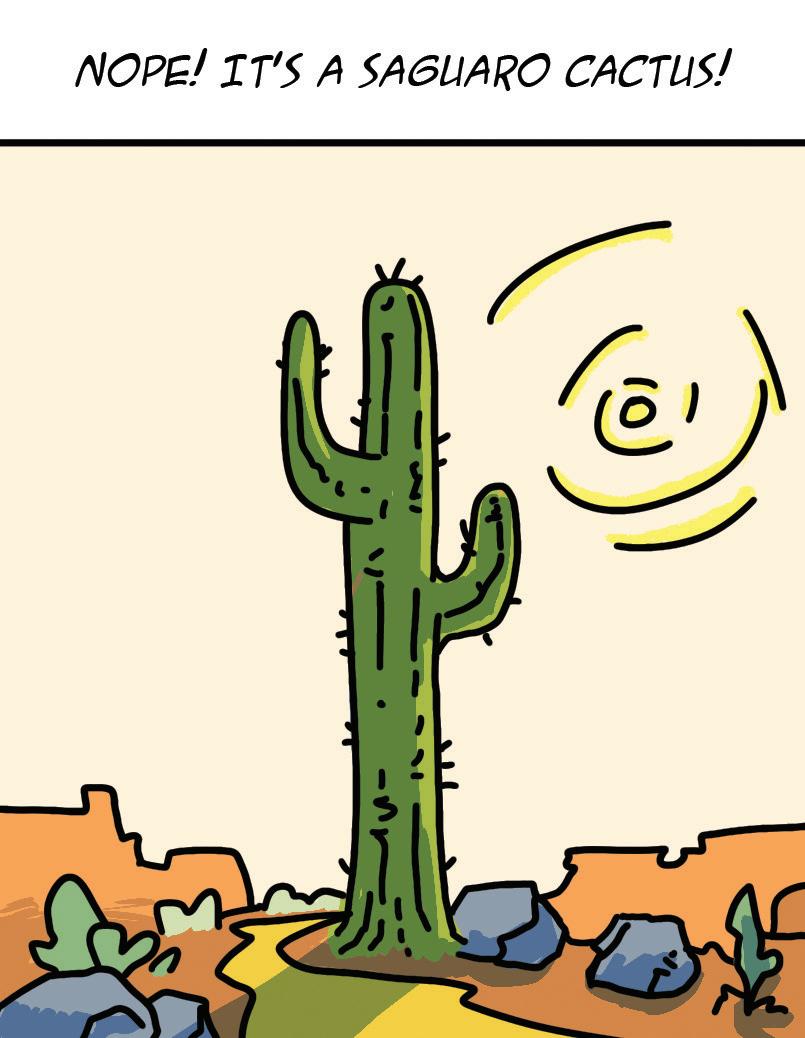
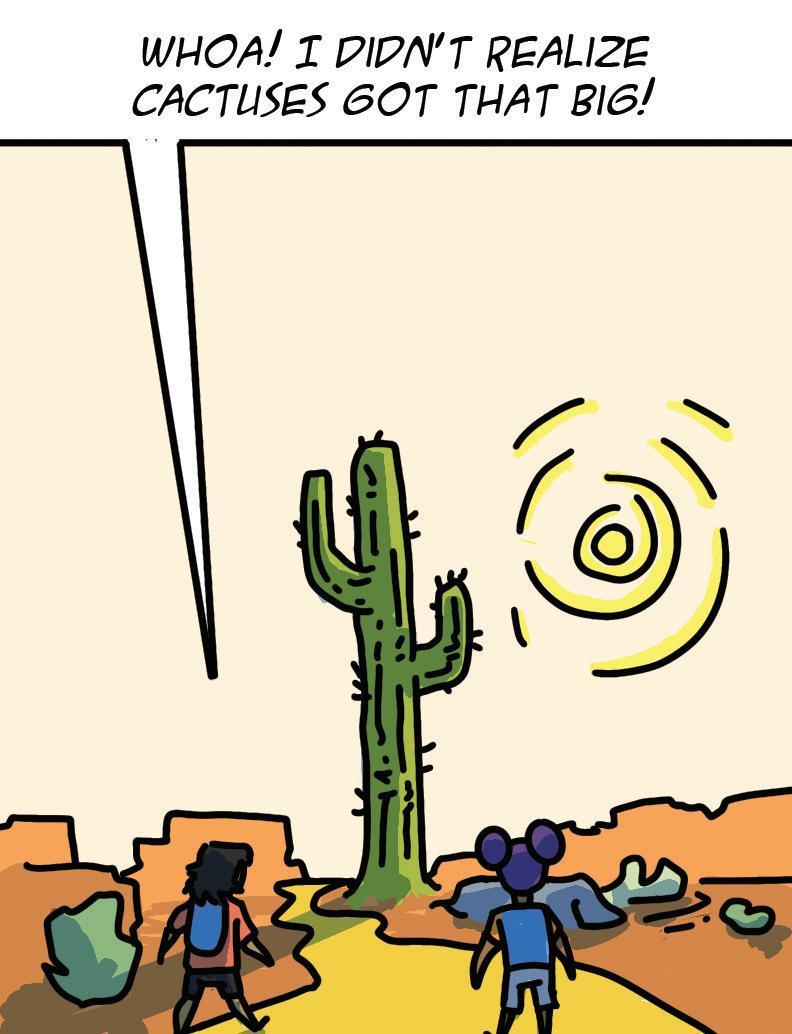
If you were to picture the American Southwest, you might envision a landscape that includes tall cacti with many arm-like branches reaching toward the sky. Those are saguaro (pronounced suh-waa-row) cacti! The saguaro cactus has become a symbol of the American Southwest. These cacti grow only in parts of the Sonoran Desert, found in Mexico, Arizona, and the tip of southeast California.
ESSENTIAL QUESTION
What is the keystone role of saguaros in the Sonoran desert ecosystem?
Giant saguaros may reach 50 feet—the height of a three-story building. They are the tallest cactus species in the United States and the tallest desert plant.
Some saguaros don’t grow arms! The armless saguaros are called spears.
If you see one of these cacti with arms, it is probably more than 75 years old. Saguaros can live to be 200 years old. They grow slowly and are picky about their environment. They like warm temperatures and need to anchor their roots in rocky soil. Saguaros are found at elevations up to 4,500 feet. They need more precipitation than what’s normal in deserts at lower elevations, but they do not like the cold, especially temperatures below freezing.
nurse tree: a tree that shelters, protects, and supports a young plant.
saguaro boot: the hardened shell, often shaped like a boot, in cavities made by nesting birds inside a saguaro.
Young saguaros also need nurse trees to grow. Trees such as palo verde, mesquite, and ironwood protect them from heat, drought, cold, and grazing animals when they are small. When saguaros do grow, they become the foundation of the ecosystem and a keystone species.
Saguaro cacti are part hotel, part rest stop, and part restaurant in the harsh desert ecosystem. In fact, they provide food and shelter for more than 100 different species.
Some bird species, such as gilded flickers and Gila woodpeckers, carve out nesting cavities in saguaros. Once they remove the flesh of the inner cactus, the inside walls harden, kind of like a scab. This forms a saguaro boot , which keeps the cactus from drying out.
Not only are these cavities safe nesting spots, the remaining flesh surrounding the cavity acts as insulation. The residents inside the cactus stay cool on hot days and warm during cool nights.
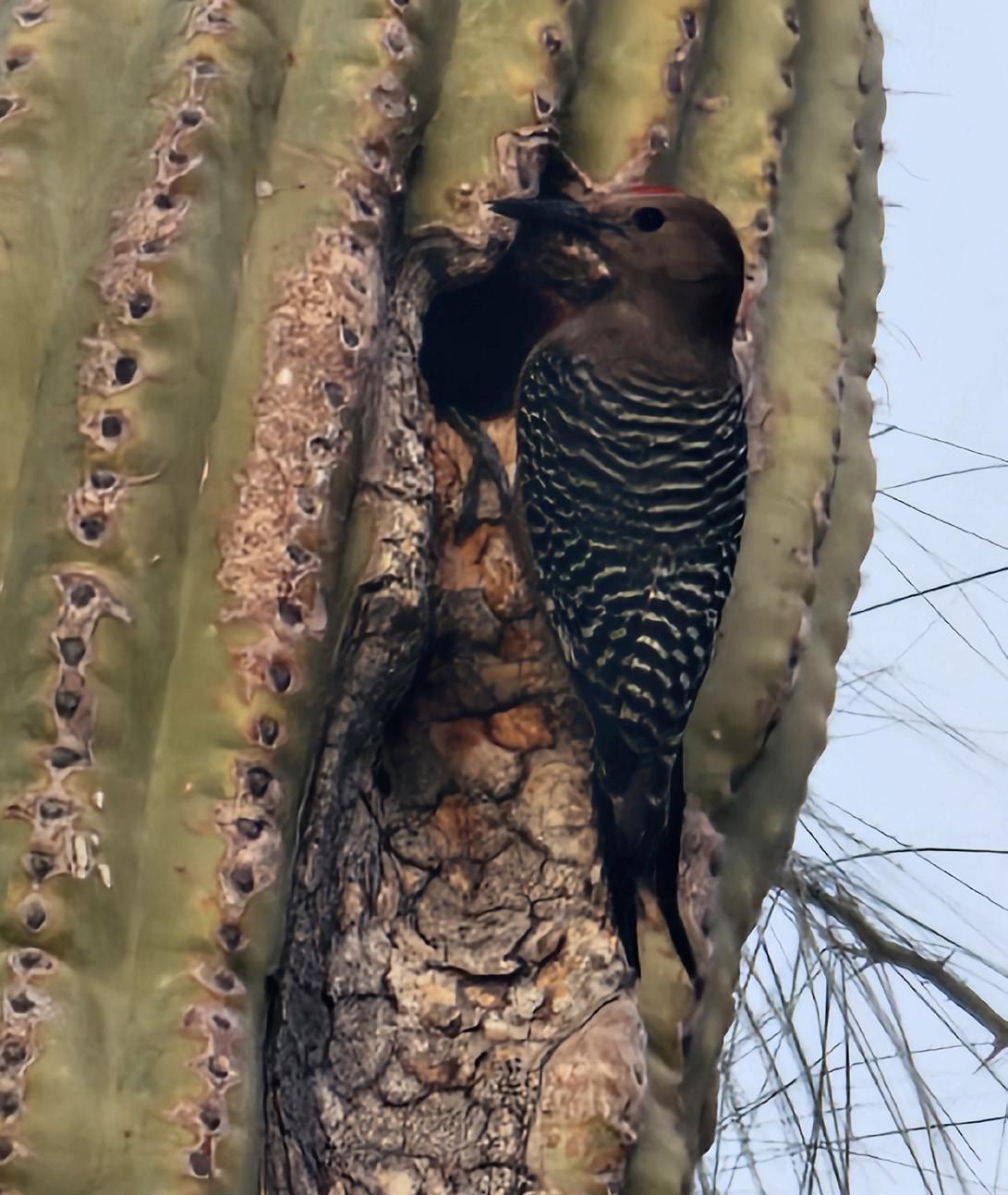
spine: a firm, slender, sharppointed structure on a cactus.
arthropod: an animal with a skeleton on the outside of its body. It has a segmented body and jointed legs. Insects and spiders are arthropods.
evaporate: to convert from a liquid to a gas.
tap root: a long root that extends vertically from the main plant to access water deep underground.
pleat: a vertical, accordion-like ridge on the surface of many cactus species.
contract: to draw together or decrease in size.
When the original guests check out, other species take advantage of the vacancy and move in. Great horned owls, elf owls, purple martins, finches, and ravens are among the species that seek out abandoned saguaro cavities. On the outside of saguaros, large birds such as red-tailed hawks and Harris’s hawks build stick nests in the crooks of the arms.
A tall, heavy saguaro has woody ribs inside to support its weight. For thousands of years, Indigenous peoples have used the saguaro and its ribs for buildings and roofs.
As a rest stop, the top of a tall saguaro is a
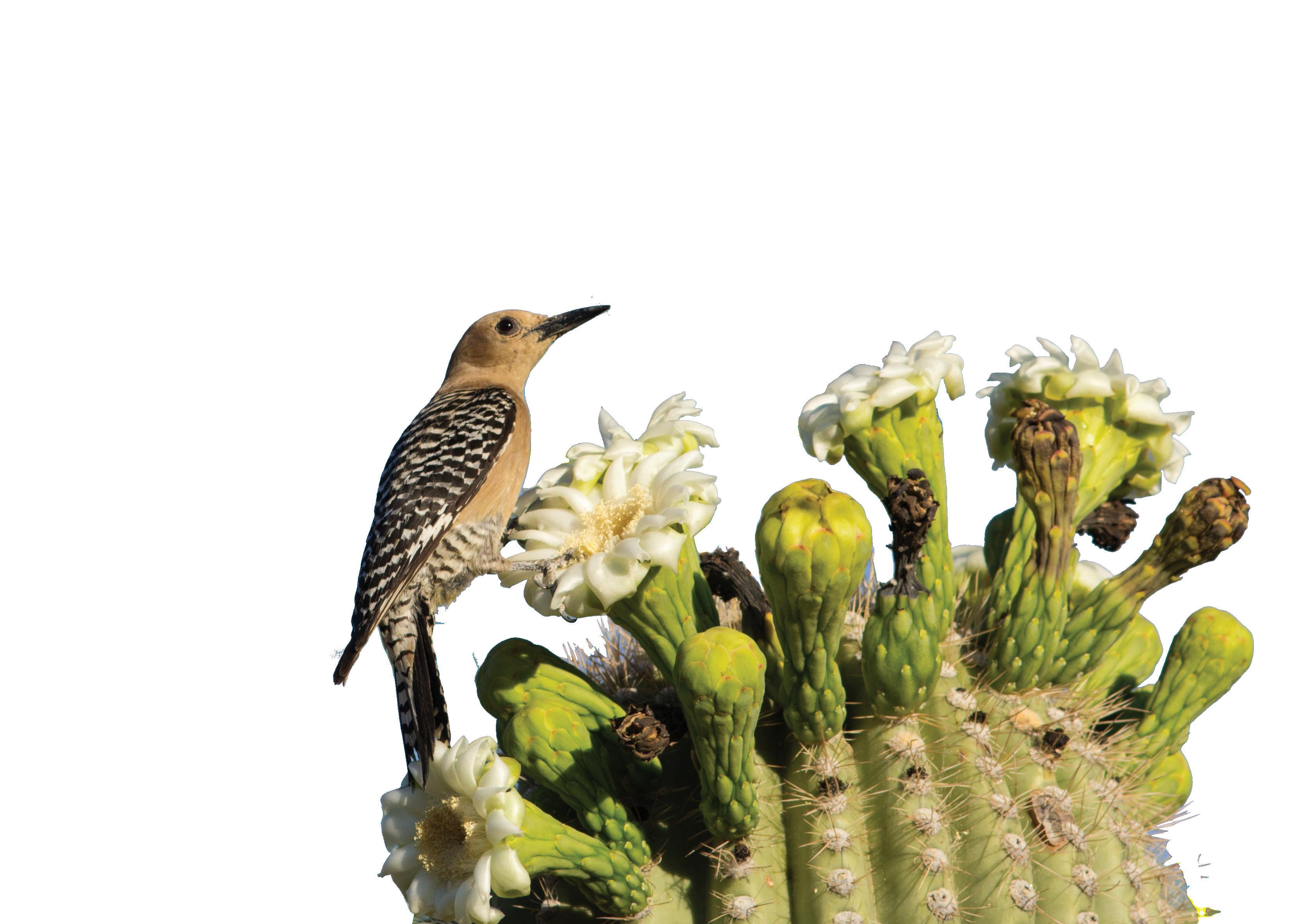

Once pollinated, fruit develops. Ripe fruit is a delicious desert dessert for birds, bats, coyotes, tortoises, javelinas, kangaroo rats, and many more. The large red fruit contains a sweet pulp and thousands of seeds. It is also high in fat and protein, providing essential nutrition for desert animals at the hottest and driest times of the year.
A single mature saguaro may have more than 20 arms!
The ripe saguaro fruit contains moisture as well. When water is scarce, many animals will even eat the flesh of the cactus itself. Pack rats, bighorn sheep, jackrabbits, mule deer, and others carefully nibble around the cactus spines to get to the moist flesh.
The saguaro’s keystone role continues after the cactus dies. While insects such as beetles and termites are found in saguaros when they are alive, other insects and spiders flock to a decaying cactus. It continues to provide shade, shelter, and food for hundreds of different species of arthropods. This, of course, makes the saguaro a restaurant of choice for hungry predators in search of prey.
The saguaro has several tricks for survival in the hot Sonoran Desert, where little rain falls. To start, when the rain does fall, the saguaro is quick to absorb the water. Its roots radiate outward as much as 100 feet and lie only a few inches below the surface. This enables the roots to absorb as much water as possible as quickly as possible before it evaporates. Saguaros also have a long tap root that extends vertically, deep into the ground to access moisture far below the surface. If you look closely at a saguaro, you’ll see pleats in the main trunk and arms. When the cactus absorbs water, the pleats expand like an accordion. This allows the cactus to store more water. As the cactus uses its stored water, the pleats contract. The saguaro’s thick, waxy skin helps keep moisture in and prevents evaporation. Saguaros also have rows of spines, making a would-be predator think twice about taking a bite—though some animals still take their chances, especially during drought. The spines form a net of shade to protect the saguaro from the sun.
fragmented: divided into smaller and smaller disconnected pieces. fire ecology: the study of the role of natural wildfires in shaping an ecosystem.
Finally, saguaros have an impressive root system that stabilizes the soil and helps to prevent erosion. When the roots absorb and hold onto moisture, the soil also stays cooler.
Looking at a 1935 photo of what is now Saguaro National Park and a photo of the exact same location in 2010 reveals a shocking loss of cacti. Where once the landscape was densely populated by saguaros with their arms spread skyward, the more recent photo shows a sparsely populated desert.
Each saguaro fruit contains more than 2,000 seeds. In its lifetime, a single saguaro may produce between 20 and 40 million seeds.
Scientists discovered that most of the saguaro deaths were natural. So, why hadn’t new plants grown in their place? Because most of the nurse trees that young saguaros rely on to protect them from heat, drought, cold, and grazing were gone. During the late 1800s and early 1900s, those trees were cut down for human use. In addition, increased cattle grazing impacted both the nurse trees and the young cacti.
Take a look at the two photographs of the same place, separated by 75 years. What do you notice?
Even after the area became a national park and was protected, the reestablishment of saguaros took decades because these plants grow very, very, very slowly. After 10 years, a saguaro may be only a few inches tall! These cacti don’t hit their growth spurt until they’re between 20 and 40 years old. At that age, they are still only about 2 feet tall. So, the older cacti continued to die of old age, but younger cacti had not taken their place because it took time for the nurse trees to return and the cacti to regenerate.
USGS saguaro 1935 now
Expanding cities and a growing human population have also contributed to the saguaros’ habitat loss and degradation. Saguaros have fewer places to grow. The habitat that does remain is often fragmented . This limits the genetic diversity among individual cacti and threatens their health and longterm survival.
Human development has also brought invasive species to the desert. Specifically, buffelgrass and fountain grass are changing the desert ecosystem. They compete with native plants for water and other resources. They also alter fire ecology.
Watch this TED Ed video to learn more about cacti. How are cacti adapted to desert living?
While some ecosystems need wildfires, the Sonoran Desert does not. The plants and animals there did not evolve with fire. In the past, any fire that did ignite burned out quickly because of a lack of fuel. However, the invasive grasses grow densely and dry out, becoming fuel for wildfires. As a result, fires spread faster and burn hotter than normal. These fires kill the native plants, including saguaros.
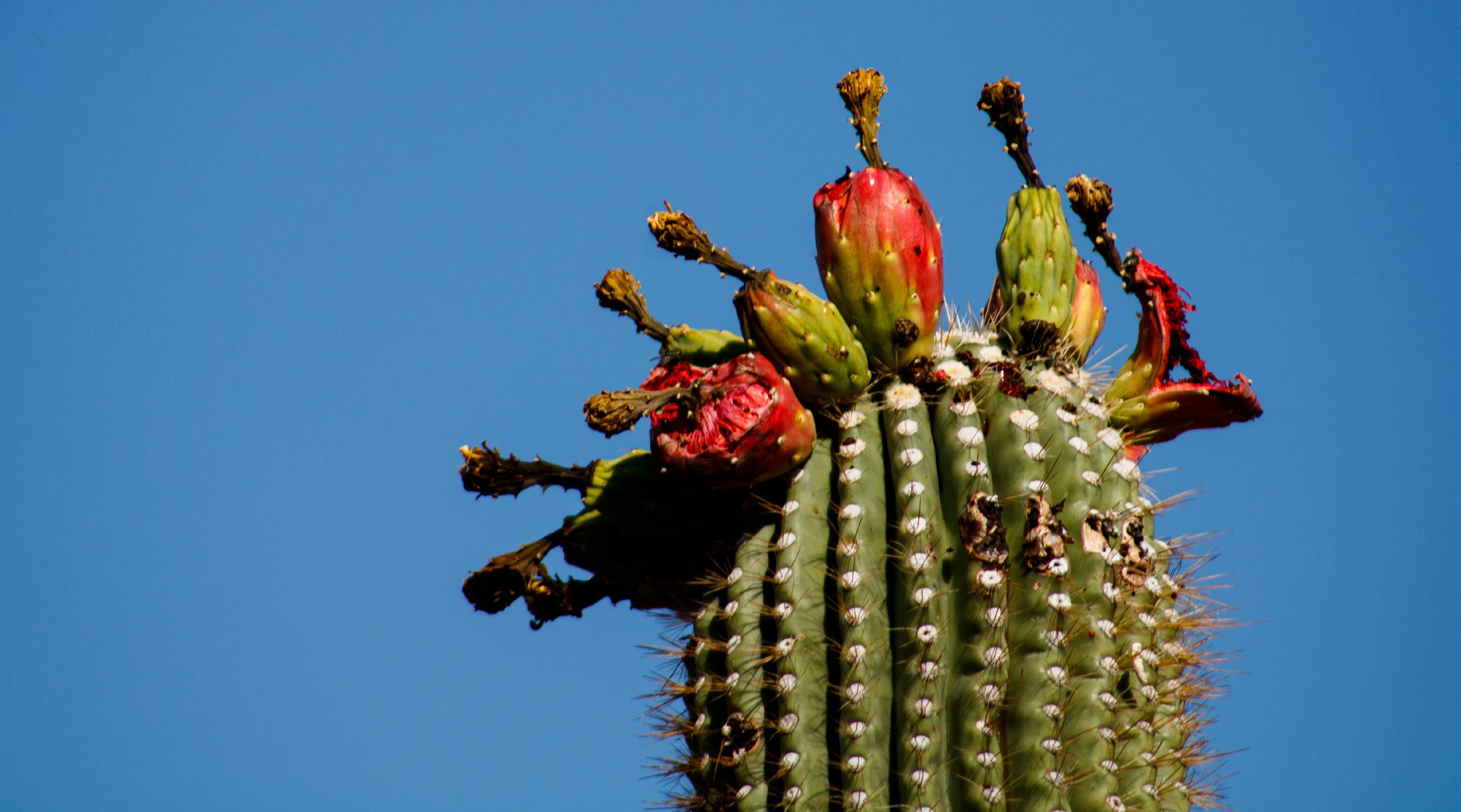
The saguaro flowers open at night and only stay open through the next afternoon.
botanist: a scientist who studies plant life. Botany is the study of plants.
seed bank: a place where seeds from different plant species are stored and protected.
You probably won’t be surprised that climate change affects saguaros, too. Temperatures are increasing and droughts are more severe. Scientists continue to do research, but data shows climate change is partly responsible for the lower survival rates of young cacti and their nurse trees.
Because the saguaro cactus grows only in a limited area, protecting its ecosystem is vital to saguaro conservation. During the early 1900s, botanists , other scientists, and community leaders pushed for protection of this symbol of the American west.
Finally, on March 1, 1933, President Herbert Hoover (1874–1964) established the Saguaro National Monument in Arizona. During the 1950s, a visitor center opened and in 1961, an additional 25 square miles of land was added to the monument. Saguaro became a National Park in 1994.
Today, other parts of the Sonoran Desert are protected by national monuments, reserves, refuges, and other conservation plans. In addition, saguaros are a protected species in the United States and in Mexico. It is illegal to harm them in any way.
The saguaro’s white flowers are the state flower of Arizona.
Scroll down to the bottom of the Arizona-Sonora Desert Museum’s kid page. Click the Daytime Life Around a Saguaro Cactus link for an interactive infographic. Click the Nighttime Life Around a Saguaro Cactus link. What are the differences between day and night around a saguaro?
Protection of saguaros includes battling invasive species. In the United States, efforts involve both using herbicides and removing the invasive grasses by hand. Volunteers use tools to dig out the invasive grasses and they monitor trails to detect invasive species early on.
Several organizations are part of ongoing saguaro conservation. In addition to battling invasive species, conservation efforts include growing saguaro in nurseries, replanting them in degraded areas, educating the public, supporting scientific research, monitoring saguaros, and analyzing data.
Learn more about biodiversity in the desert in this video. Are the plants of the Sonoran Desert what you expected? Why or why not?
Have you heard of seed banks? The Desert Botanic Garden has a seed bank for saguaro seeds, where the seeds are carefully dried and frozen. This saves seeds for the future and protects the genetic diversity of the cacti.
Like the saguaros, desert tortoises are a symbol of the American desert. They’re found throughout the American Southwest and into northern Mexico. Sonoran Desert tortoises are hardy and long-living, surviving the harsh desert climate for 50 to 100 years.
Tortoises, like all reptiles, cannot regulate their own body temperature. They survive extreme desert temperatures by retreating into burrows underground. When the conditions are right, they come out to eat. Tortoises eat a variety of cacti, grasses, and wildflowers.
When it’s dry, tortoises get their water from these plants. During the rainy season, tortoises drink from puddles. They prevent dehydration by storing water in their bladder and staying underground during the heat of the day.
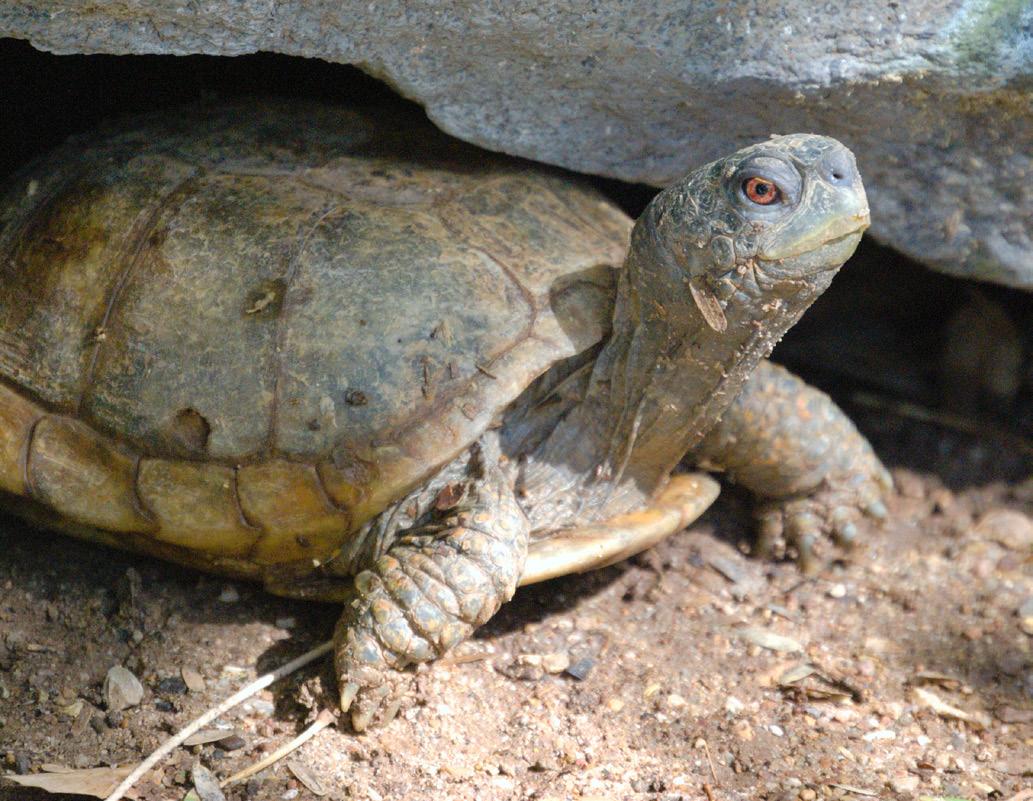
ecological horticulture: the science of using native plants to design, build, and maintain outdoor spaces that provide natural habitats for pollinators and other wildlife.
The saguaro cactus is an important part of the life and culture of the Tohono O’odham Nation.
Research continues so we can better understand the life cycle of the saguaro. Scientists monitor saguaros and their habitats to collect data for planning saguaro conservation efforts in the future.
So far, we’ve looked at larger keystone plants like trees and the saguaro. But smaller plants play keystone roles, too. In the following chapter, you’ll learn about several keystone wildflowers and the roles they play in their ecosystems.
What is the keystone role of saguaros in the Sonoran desert ecosystem?
The term ecological horticulture is a mouthful, but if you break it down into its parts, it’s easier to understand. Ecological stems from the word “ecology,” the branch of science that studies relationships between species and their surroundings. The word “horticulture” has its root in Latin, and means “growing and managing a garden.” So, an ecological horticulturist designs, grows, and manages gardens that mimic and support the natural ecology of an area.
For example, a town or city might want to prioritize native plants in its gardens. An ecological horticulturist then plans gardens that support native wildlife and pollinators, promotes soil health, avoids the use of pesticides and fertilizer, and includes nesting materials for wildlife to use. The work might also involve restoration of degraded areas. Since gardens using native plants may look a little wilder than traditional ornamental gardens, ecological horticulturists also work to ensure that public gardens are attractive and inviting to visitors. These projects create functional gardens, educate the public, and inspire individuals to use native plants in their own gardens.
You learned that saguaros are part hotel, part rest stop, and part restaurant used by a variety of species. Create an infographic that shows the many roles of the saguaro!
› Research wildlife in the Sonoran Desert. Who uses the saguaro as a hotel? A rest stop? A restaurant?
• poster board
• colored pencils or markers
• science notebook
› Sketch your saguaro, including cavities used by different animals. Add windows into the saguaro that allow viewers to peek inside. Remember the birds that nest in the crooks of a saguaro’s arms and those that use the saguaro to perch on as they hunt or stay safe. Others visit the saguaro to eat fruit and flesh.
› Add details about what it looks like around and under the saguaro, including its roots. How does your visual reveal the keystone role of saguaros? Do you need to add more details to further illustrate its foundational role?
The activity in and around a saguaro varies between day and night. Create a visual that compares and contrasts these activities at different times of day. Consider a visual that reveals the use of a saguaro several days, months, and years after it dies.
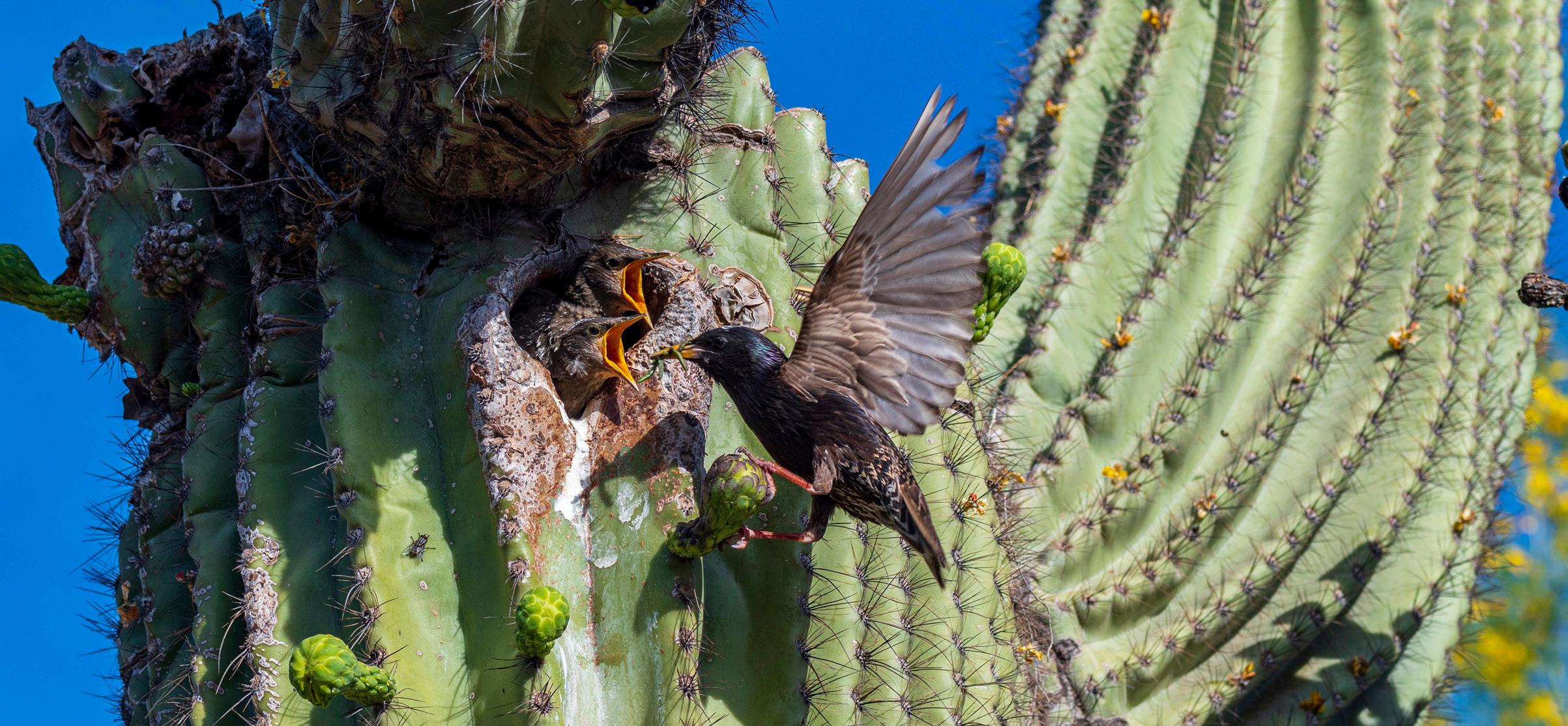
No matter the ecosystem, plant roots help hold soil in place and prevent erosion. This is true of trees in forests, mangroves and seagrasses in the intertidal zone, and saguaros in the desert.
› Poke holes in the bottom of the pans for drainage. Fill both bread pans with soil. Plant seeds fairly close together in one pan. Do not plant any seeds in the second pan.
› Place the pan with the seeds in the window with something underneath to catch water when it drains. Water the seeds according to directions.
• 2 foil breadloaf pans
• enough soil to fill both pans
• fast-growing seeds, such as beans or sunflowers
• watering can with a rain spout
• sunny window for the plants
› When the plants are 3 to 4 inches tall, remove the pan from the window. Take both bread pans outside. On each pan, cut along the corners of one short end and fold down the sides. Place an object 1 to 2 inches tall underneath the non-cut side of both bread pans. The pans should be sitting at an angle with the cut, open end down.
› Fill your watering can. Then, make it rain gently on both bread pans with both pans getting similar rainfall. Let it rain until your watering can is empty.
› What do you observe? Did soil wash out of both trays at the same rate? Based on your experiment, did the plants reduce erosion? How is this similar or different from plants in the real world?
Run the experiment again in several pans with different seeds and space them at different distances. You might also run the experiment using different types of soil, rock, or sand.
Where do you think the term “nurse tree” came from?
The next time you are in a flower garden or out in nature among wildflowers, stop to look. Do you see any bees? Butterflies? Other insects? Is one type of flower more popular than others? Are some flowers more popular with one species of insect? Are different flowers visited by different species of insect?
ESSENTIAL QUESTION
What would happen if native keystone wildflowers disappeared from their ecosystems?
With close observation, you can notice differences between flowers and their visitors. The flowers that are the most popular are likely plants native to the area. They might even be keystone wildflowers!
Before investigating wildflowers and their ecosystem roles, we must pause for another entomology lesson.
specialist bee: a bee that visits only one or a few species of flower for pollen and nectar.
generalist bee: a bee that visits a wide variety of flowers for pollen and nectar.
fertilize: to join male and female cells to produce seeds or offspring.
anthecology: the study of pollination.
In Chapter 1, you learned about oak trees and how they support moth and butterfly caterpillars. Caterpillars are key links in the food chain, a critical food source for birds and other animals. Another group of insects is also key to food webs—pollinators. We’ve talked about pollinators throughout the book, but let’s take a closer look.
More than 80 percent of the flowering plants on Earth depend on animal pollinators. Of these pollinators, bees are among the most important. Like some of the caterpillars you read about in Chapter 1, certain species of bees are picky. They are specialist bees that rely on only a few plants for nectar and pollen. In contrast, generalist bees , including honeybees and bumblebees, visit a much wider variety of flowering plants for both nectar and pollen.
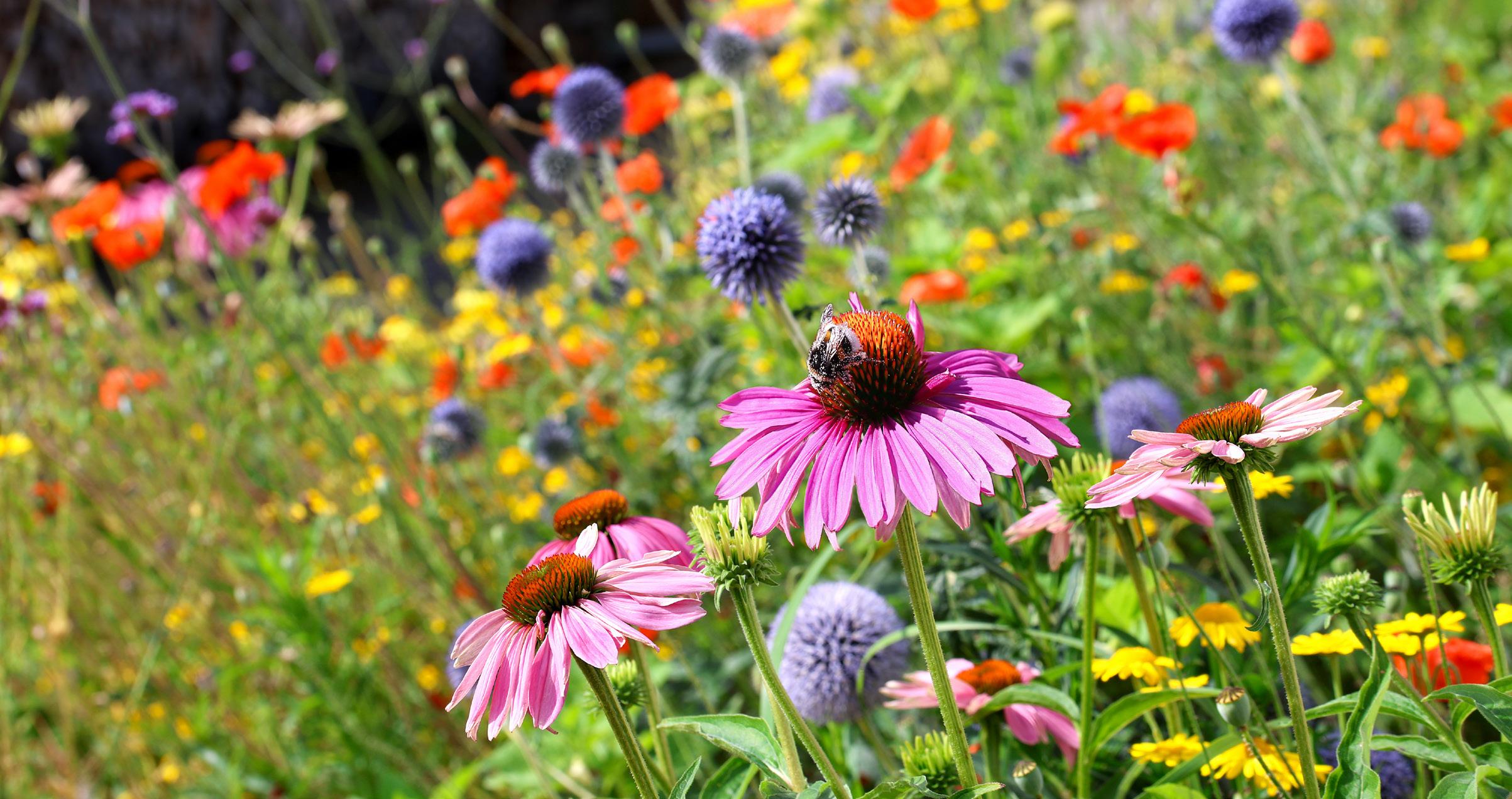
Thinking about those specialist bees, what’s the big deal? A flower is a flower is a flower, right? If you look closely, you’ll see many differences among flowers. They have different shapes and petal arrangements. They bloom at different times. The flowers smell different.
Take a look inside a flower at this website. Based on what you learn, describe how flowers are pollinated.
Even pollen varies from flower to flower. The pollen from different flowers has different nutritional values! If you look at grains of pollen under a microscope, you can see that grains from different species of flower look different. The patterns and spacing of bumps and spines and nooks and crannies vary.
The 20 percent of plants that do not rely on pollinators rely on wind or water to transport their pollen.
During millions and millions of years, insects have co-evolved with these flowering plants. The bees have hairs on their abdomens and legs that are spaced to match grains of pollen from certain plants. When a bee visits the plant, grains of pollen cling to its hairs. When a bee moves to the next flower, some of the pollen drops off and fertilizes the flower. Both the plant and the bee benefit—another mutualistic relationship.
The study of pollination is called anthecology, or pollination biology. Anthecologists research the mutualistic interactions between flowers and pollinators—insects, birds, mammals, and more. Anthecology is an interdisciplinary science involving several different scientific fields, including botany, entomology, and ecology.
Anthecologists study how traits such as flower shape or smell attract different pollinators. Different colors or patterns on a flower also attract pollinators. Some flowers even have stripes that act as a landing strip, showing pollinators where the pollen and nectar are!
The plants rely on the pollinators for reproduction, and the bees rely on the flowers’ pollen to support their developing young. This relationship between flowers and pollinators is the foundation of ecosystems. That’s why ecosystems need native and keystone flowers and the pollinators that support them.
Part of pollination biology involves researching how pollen is transferred. The knowledge helps us better understand how plants reproduce. That information plays a role in both conservation and in agriculture.
While bees and butterflies get most of the attention when it comes to pollination, flies, beetles, and moths are also essential pollinators!
Each ecosystem has its own native and keystone flowers, yet studies have revealed that native species of goldenrod, sunflowers, and asters are among the most important. If you observe any of these when they’re in bloom, you’ll see that they are busy, buzzy places! These plants attract and support a variety of pollinators. Plus, they indirectly support other plants in the ecosystem that rely on those pollinators, too.
Watch this PBS video to learn more about honeybees. How do honeybees communicate to others in the hive that they’ve discovered a good source of nectar or pollen?
Goldenrod, sunflowers, and asters all bloom in late summer and fall. This makes them an important nectar and pollen source after other flowers have already finished blooming. The pollen of these flowers also supports dozens of species of specialist bees. And while monarch caterpillars rely on milkweed for food during their development, monarch butterflies depend on the nectar of goldenrods and asters during their fall migration south.
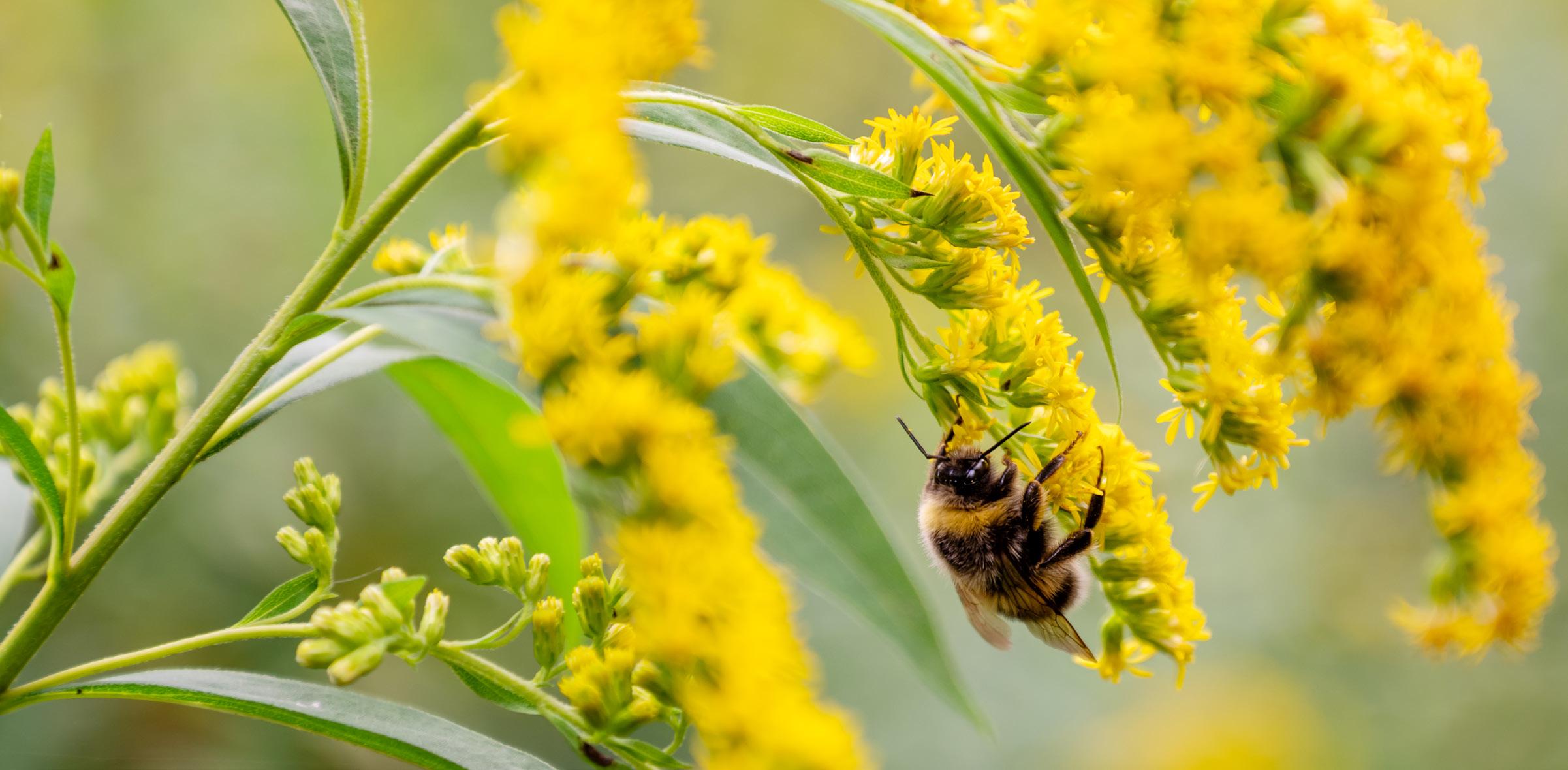
Caterpillars rely on these plants, too. Goldenrod and asters support more than 100 different species of caterpillars and sunflowers support more than 60.
The goldenrod gall fly depends on goldenrod for its entire life cycle!
Other species of insects also depend on these keystone flowers. Goldenrod, for one, supports about 50 different species of insects throughout the year, including flies and midges. The stalks of goldenrod, asters, and sunflowers provide safe overwintering hotels for a variety of insects and larvae.
These flowers are also a delicious buffet. The variety of insect visitors makes for an assortment of snack options for predators—spiders, beetles, and birds all take advantage of the insects. Birds visit the flowers to eat the seeds. Especially as winter approaches, chickadees, finches, nuthatches, and more rely on the high fat content of the seeds to help keep them warm.
Migrating birds make rest stops to fuel up on both seeds and insects found on the keystone flowers. Mammals such as deer, rabbits, squirrels, gophers, and mice also seek out the seeds. Even black bears might eat sunflower heads as they fatten up before hibernation.
ornamental: serving as decoration.
watershed: an area of land that drains into streams, rivers, lakes, and other water sources.
The threats to wildflowers are similar to those affecting other keystone plants. Habitat loss from the building of cities, homes, roads, and other development is the leading threat. Plus, native flowers have been replaced with ornamental plants and lawns in many parks, gardens, and yards. Some urban areas may have natural spaces with a variety of different plants, but often few or none of the plants are native.
The use of pesticides and other chemicals in agriculture, in gardens, and on lawns also threatens native wildflowers. But these chemicals don’t just affect the targeted plants—they affect the whole ecosystem, including pollinators, other insects, birds, and more.
You might have heard that milkweed is vital to monarch butterflies. In fact, it’s the only plant where monarchs will deposit their eggs! Why? Because monarch caterpillars are the pickiest of all picky eaters—they will only eat milkweed.
Milkweed is a perennial flowering plant known for its milky sap. More than 100 species of milkweed are native to North and South America. Different types are native to different regions across the continents.
Scientists and conservationists are concerned about the loss of habitat for milkweed. They are also concerned about the declining numbers of monarchs. That’s why conservation efforts share information about how individuals across the continents can support both monarchs and milkweed.
Check out this resource about milkweed from the U.S. Forest Service. If you wanted to support monarchs in your area, what species should you plant?
Although the chemicals may be applied to target pests or weeds in a certain area, they don’t stay put. The chemicals eventually make their way into the watershed . When it rains, the chemicals are washed into gullies, streams, and rivers. As a result, plants and ecosystems downstream are hurt by the chemicals.
Invasive species also threaten keystone and native wildflowers. Some of these species were introduced accidentally. Others were brought to the United States and elsewhere to be used as ornamental plants. As we discussed in other chapters, invasive species sometimes outcompete native plants for resources—nutrients, water, and space. They end up taking over and pushing out native and keystone
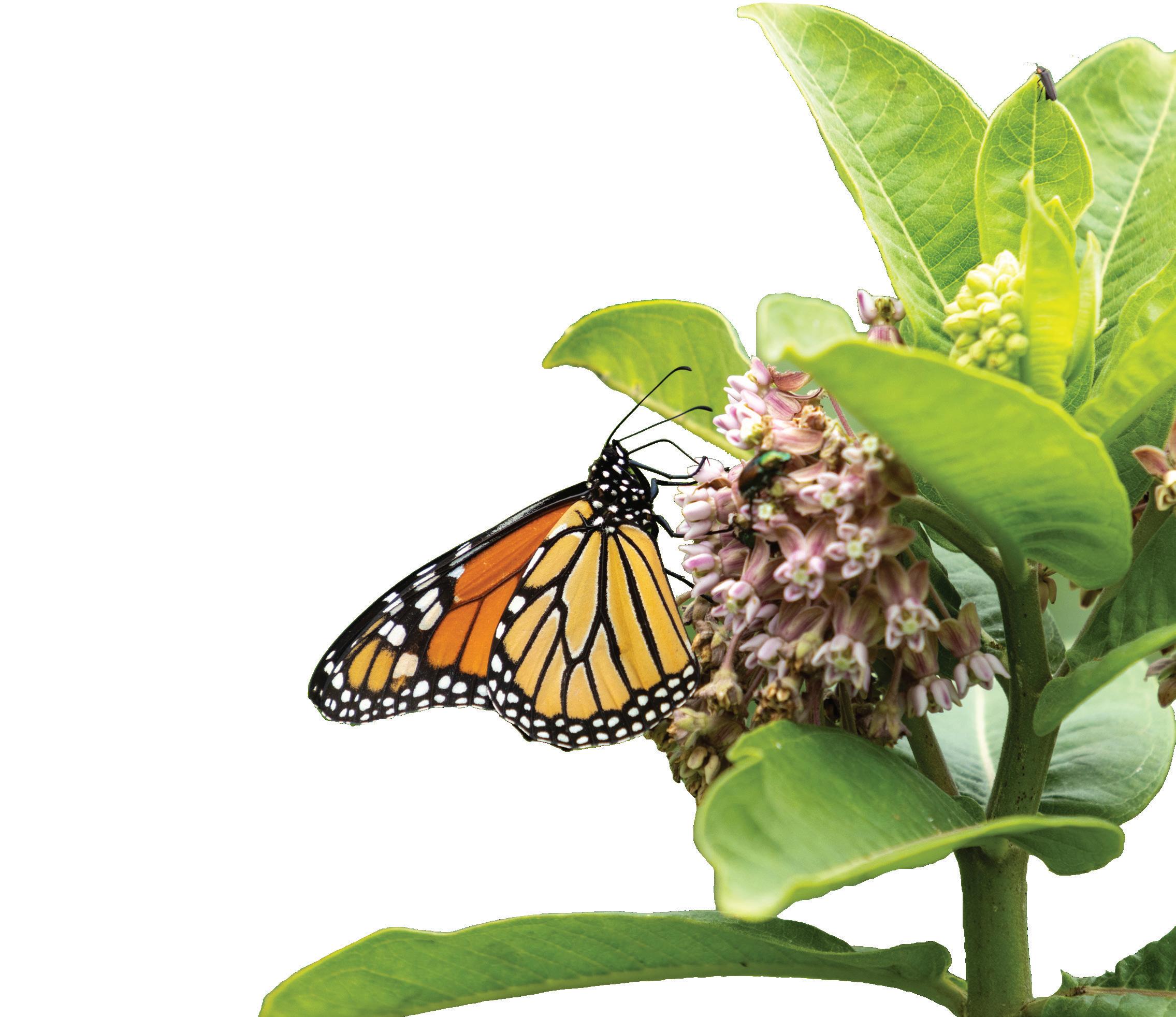
More 400 species of insects rely on milkweed as a food source.
temperate forest: a woodland in a region that experiences four seasons, has moderate precipitation, is not extremely hot or cold, and has trees that lose their leaves every fall
Remember Doug Tallamy from the beginning of the book? He’s the one who first documented keystone plants as he studied oak trees and the caterpillars they host. Tallamy extended his research to other plants, including flowers. His work helped people understand the importance of native and especially keystone plants—he calls them powerhouse plants.
The identification of goldenrod, asters, and sunflowers as powerhouse plants wherever they are native is the first step toward conserving and stabilizing ecosystems. Armed with this knowledge, individuals, conservation groups, and governments are restoring habitats and creating gardens with native wildflowers.
Goldenrod has a bad reputation among people with allergies, but it’s not goldenrod that causes seasonal allergy symptoms—ragweed is the likely culprit.
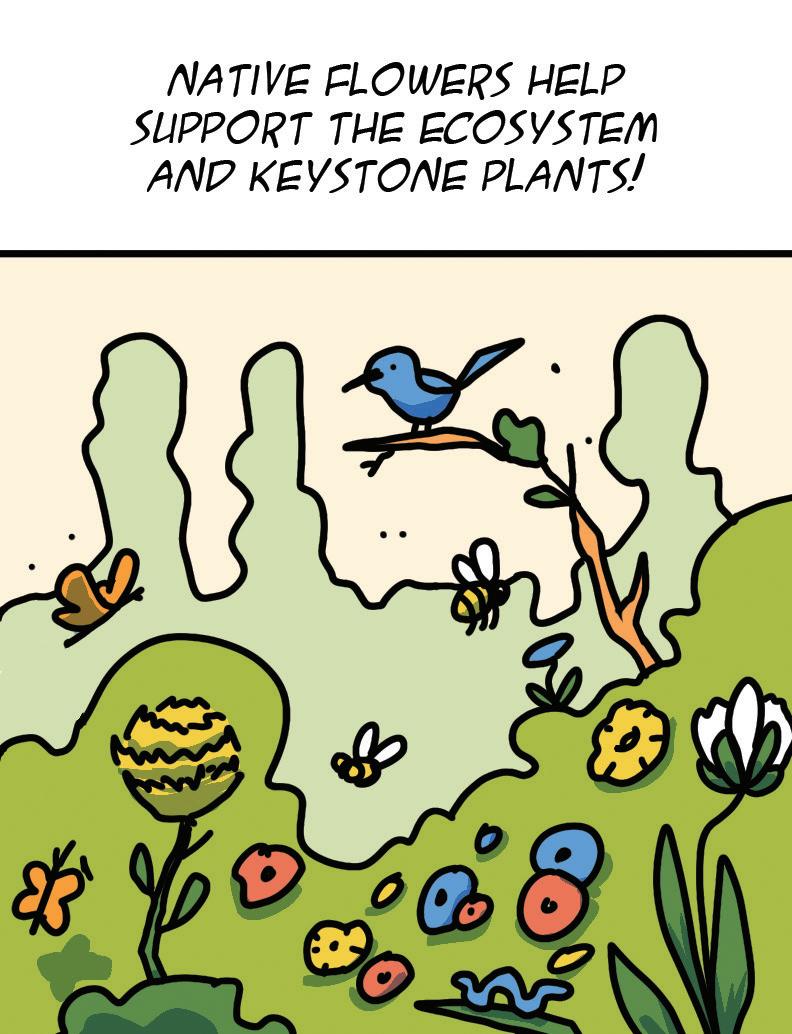
Shrubs can be keystone plants too! Shrubs are woody plants that are like trees but usually smaller. They also have several main branches at or near the ground instead of one main trunk. Different shrubs play keystone roles, depending on their ecoregion.
Native blueberries are keystone shrubs in parts of the United States. For example, in eastern temperate forests, three species of blueberry support more than 200 different caterpillar species. These same three also support more than 20 types of specialist bees.
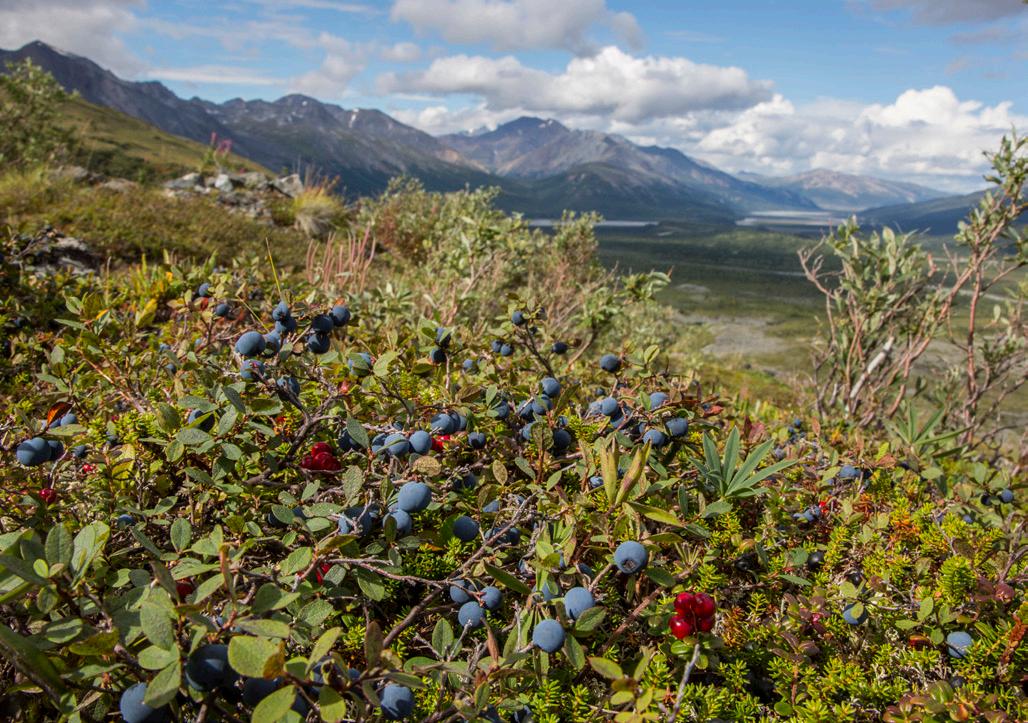
Another keystone species in many regions is the willow shrub, which serves as the backbone of their ecosystem. Chokecherry, wild plum, and yellow rabbitbrush are also keystone shrubs, supporting caterpillars and providing a food source.
For example, in Denver, Colorado, ecological horticulturalist Skyler Smith plans, plants, and maintains the gardens of the city’s central Washington Park. Since he took over, Smith has gradually replaced many of the ornamental plants and much of the lawn with native plants and keystone flowers, such as asters. His work has transformed the park into a thriving oasis and critical year-round pollinator and wildlife habitat.
North America has around 4,000 native bee species— around 30 percent of those are specialist bees.
public outreach: the process of informing, engaging, and building relationships with community members. phenology: the study of seasonal, repeated events in nature related to plants and animals, as well as changes in these events from one year to the next.
A close look at one group of blooming asters in Washington Park reveals dozens and dozens of pollinators. However, not everyone is a fan of going native. For one thing, these gardens don’t always look tidy. Many people still want neatly pruned, non-native ornamental flowers and manicured lawns.
For Smith and others working to restore native wildflower habitats, educating the public is key. Part of Smith’s job is public outreach , building relationships with neighbors and explaining the value of native plants.
Scientists have discovered that the pollen from sunflowers helps protect bees from viruses, bacteria, and other infections.
Planting native keystone plants supports local biodiversity and creates a foundation for local food webs. Native plants require less water because they are adapted to local conditions. This is especially important in arid climates as in Denver. In addition, natives improve soil health and stability. For those who aren’t convinced, natives also need less effort and money to maintain!
People in San Francisco, California; Minneapolis, Minnesota; Austin, Texas; Indianapolis, Indiana; Atlanta, Georgia; and other cities across the United States are turning to native wildflowers, grasses, and trees in their planning. Individuals are even adopting this approach in their own gardens, something we will talk more about in the last chapter.
What would happen if native keystone wildflowers disappeared from their ecosystems?
But before that, we’ll look at another keystone plant that is often overlooked and underappreciated—grass!
IDEAS FOR SUPPLIES
• paper
• scissors
• stapler
• pencil
• science journal
• flower bud
Phenology is the study of seasonal, repeated events in nature related to plants and animals, as well as changes in these events from one year to the next. This study uncovers information about how nature is changing and adapting because of global climate change. Phenologists might study when insects emerge in the spring, or when birds migrate in the spring and fall. Their study includes the blooming of plants, which is something you can do in an outdoor space near you.
› Cut out 10 pieces of paper to around 3 by 3 inches. Stack the pieces together and staple them on the lefthand side to create your flipbook.
› Time this activity when plants begin to bloom in your area. Find a park or other natural space and look for a flower bud. Sketch the bud on the front page of your flipbook, on the right-hand side. In your science journal, note the time and date. Describe the flower bud.
› Visit the bud every day for the next nine days. Each time, sketch the flower as you did on the front page, but include the changes you notice. Also note the date and changes in your science journal each day.
› At the end of the 10 days, flip through your book to see the changes in your bud in action! Did it bloom during your observation window? What did you notice about the development of the flower? Were insects visiting the bud or flower?
What is your favorite wildflower? What role does it play in the ecosystem?
Find another flower bud in your area and make another phenology flipbook. It can be a flower of the same species or a different one. Using your observations in your flipbook and science journal, compare the two flowers. Were the blooming timelines the same? Different? What might cause some flowers to take longer to bloom than others? Did the flowers emerge in similar ways?
To better understand pollination and how flowers reproduce, crawl into a flower yourself!
› Carefully cut open your flower head. Pull it open with the tweezers.
› Using the diagram below, try to identify all the main parts of your flower:
» petals
» anther
» filament
» sepal
» pollen grains
» stigma
» style
» ovary
» stem
› Take photos or make a drawing of your dissected flower in your science journal. Label the parts.
› What do you notice about the flower’s structure? The arrangement and shape of the petals? The smell? The grains of pollen?
• at least one large flower from a garden or florist (note: never take a flower out of a garden without permission)
• scissors or a knife
• tweezers
• paper and pen
• science journal
Different flowers have different shapes, but they all have the same parts. Collect different types of flowers and dissect them as well. Create a visual to show how flowers are different and the same.
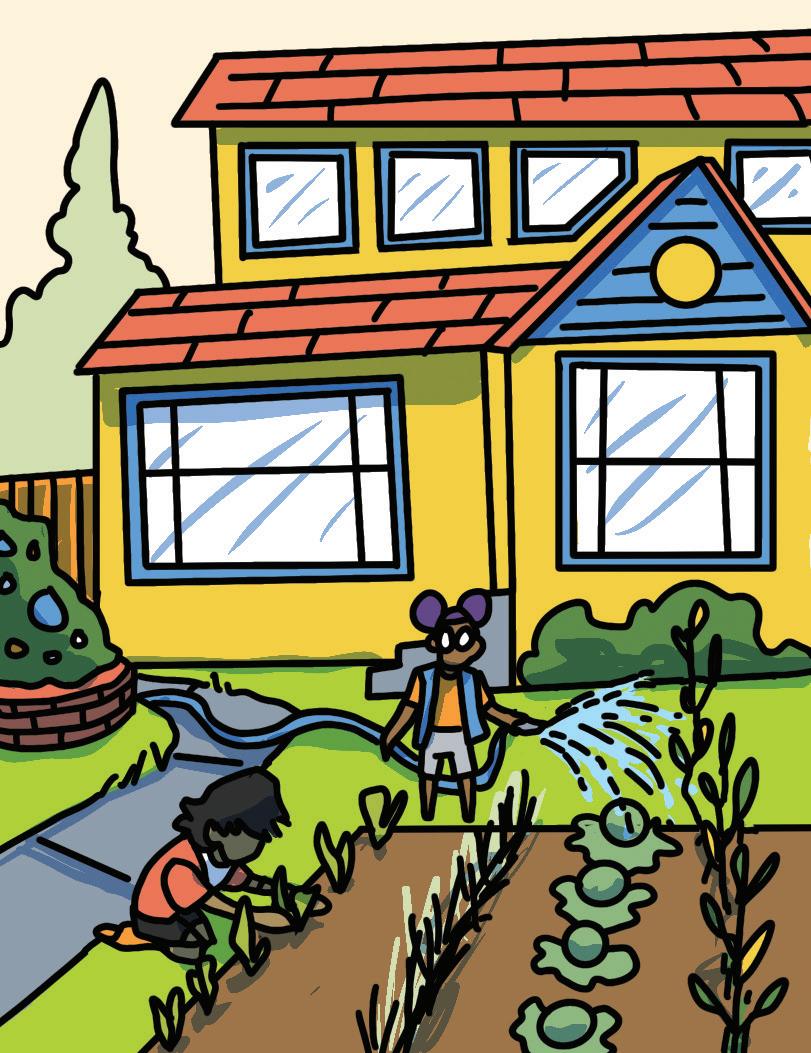
What comes to mind when you hear the word “grass?” Do you picture a lawn? A soccer pitch? A park? These tidy, well-kept green spaces are usually covered in grass. But these grasses represent only a few of the more than 11,000 species of grass! So, when we talk about “grass” we are actually talking about a huge family of plants. Imagine referring to a flower as a flower instead of acknowledging that there are thousands of different types of flowers!
Why is it important to protect and restore grassland ecosystems?
Grasses grow on every continent on the planet and in a wide variety of ecosystems. Prairies and savannas are, of course, dominated by grasses. But they also thrive in forests, deserts, and jungles. We find grasses in high alpine environments, on the tundra , and even in Antarctica! As you probably guessed, some of those grasses are keystone plants.
tundra: a cold, mostly treeless area in very northern and very southern latitudes.
latitude: a measure of distance from the equator, in degrees. The equator is 0 degrees. The North Pole is 90 degrees latitude north and the South Pole is 90 degrees latitude south.
rhizome: a stem of grass that grows underground horizontally.
spikelet: a small cluster of flowers on grasses that grow into seeds.
turf: grass that is maintained on a golf course or sports field.
Great Plains: a vast expanse of temperate grasslands and other ecosystems in central North America.
Before we talk about the keystone role that some grasses play, let’s start by answering the question, “What are grasses?” To start, grasses have stems and long, slender leaves—what you might consider the blades of grass. Underground, grasses have dense rhizomes and roots that grow closely together. Grasses typically grow over a large area.
You might not think so at first glance, but grasses are flowering plants. Their flowers, though, are small and frequently go unnoticed. If you visit an area with uncut grasses during the late spring or summer, look at the tips of the grasses for the flower parts—called spikelets. On these spikelets, you’ll find clusters of small flowers, like a bouquet. But unlike most wildflowers, grasses generally rely on wind pollination, not insect pollination.
The largest type of grass is the giant bamboo. It can grow more than 150 feet tall!
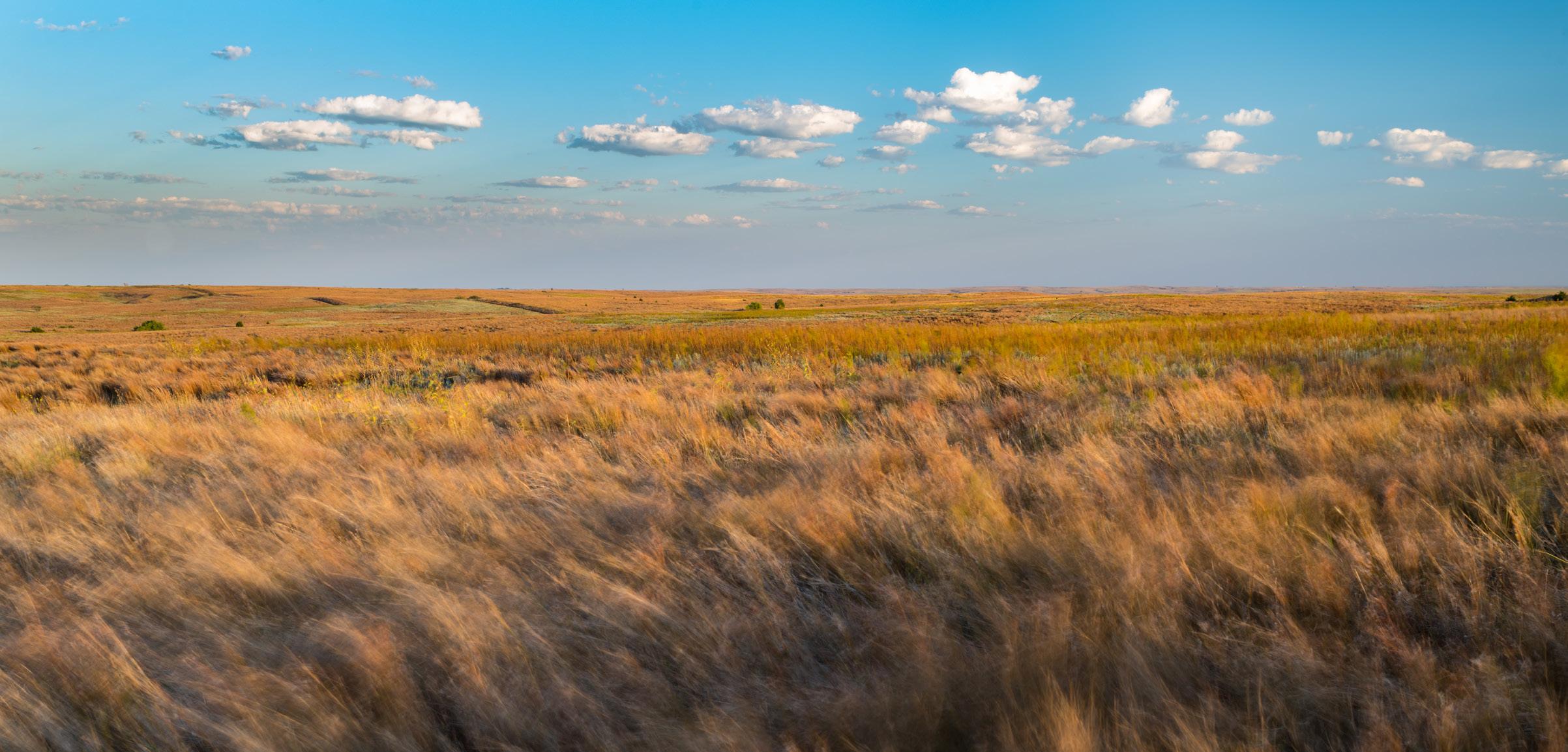
Some species of grass are used for lawns in yards and turf for sports fields. Others are wild grasses, some growing much, much taller than an adult human. But the grass family also includes grasses we use for cereal and bread—oat, wheat, barley, and rye. Guess what else is in the grass family? Rice and corn!
Some of the most important plants on the planet are grasses. Many species are foundational keystone species—they create vast grassland habitats. And each habitat has its own keystone grasses. On the Great Plains of the United States, for example, big blue stem and little blue stem are the keystone species at the foundation of this grassland.
In grassland ecosystems, grasses are the base of the food web. As producers, they harness the sun’s energy to make food. Numerous herbivores on the Great Plains, from tiny insects to rabbits to pronghorn and giant bison, snack on the grasses. These animals may later be eaten by predators such as coyotes, hawks, and other birds.
Read this National Geographic article for additional information about grassland habitats. Where are grasslands found?
Grasses offer shelter, too. Insects hide, eat, and reproduce on the grass itself. Some species of birds such as the mountain plover build nests among the tall blades of grasses, where they are hidden from predators. Small mammals such as voles also use the grasses for protection. Grasslands go by several different names, depending on location and climate: prairies, meadows, pampas, rangelands, steppes, and savannas.
tallgrass prairie: a type of grassland ecosystem where the grasses can grow taller than a person.
The grasses do important work underground as well. Their rhizomes and dense, tangled roots spread far and wide, often making up the majority of the biomass of the plants—more of the plant organism thrives underground than above. In the tallgrass prairie of the Great Plains, 75 percent of the grass biomass is underground.
The grasses’ root systems and rhizomes anchor soil in place and prevent erosion. This benefits not only the grasses, but other plants that grow there, too. The deep roots help retain moisture, keep soil healthy, and recycle nutrients. They are also giant natural water filters! The roots absorb pollutants, cleaning the water.

Grasses’ roots and rhizomes also provide habitats below ground. The community of microorganisms that thrives there plays key roles in nutrient recycling and in soil health.
More than 20 percent of the world’s land area is grassland.
Another ecosystem service grasses provide is carbon storage. Like other plants, grasses absorb carbon dioxide from the air during photosynthesis. The grass moves the carbon below ground, where it’s stored in and around the grass roots and rhizomes. Grasslands are valuable carbon sinks because of the sheer amount of land they cover.
The only grass native to Antarctica is the Antarctic hair grass.
Native and keystone grasses also support natural wildfires, which play an important role in the overall health of some ecosystems. Think of a natural wildfire as a way of cleaning house. Keystone grasses provide the ideal type of fuel for wildfires to sweep through quickly. These kinds of wildfires stay low to the ground and move fast, which is what a prairie needs.
Take a trip to Iowa to visit a tallgrass prairie. Why do you think the focus of the video is on what goes on underground in a tallgrass prairie?
The wildfires help recycle nutrients and keep woody plants— trees and shrubs—from taking over. The grassland stays open and sunny, allowing native plants, insects, and animals adapted to that ecosystem to thrive. Additionally, the belowground rhizome and root systems survive the wildfire and regrow quickly, letting the grassland maintain biodiversity and health.
Grasses face big challenges from human activity. As with wildflowers and other keystone plants, one of the leading threats to grasses is habitat loss due to agriculture, oil and gas production, and urban development. Frequently, remaining grasslands are fragmented into scattered patches that are too small to support an entire ecosystem.
invertebrate: an animal without a backbone.
Remember how natural fires are essential to healthy grassland ecosystems? When humans move into these spaces, they prevent the fires. As a result, woody plants can take over. The grasslands are no longer open and sunny, and the species of plants and animals adapted to those conditions can no longer survive there.
Despite their name and appearance, seagrasses are not true grasses because they grow completely submerged in salty marine environments. However, like grasses that grow on land, seagrasses are flowering plants with grass-like leaves, stems, and roots. They also rely on the sun’s energy for photosynthesis. Seagrasses are a keystone species.
Because seagrasses need the sun, they are found in clear, shallow water where they play a keystone role in the coastal ecosystem. Seagrasses create vital underwater meadows that provide food, shelter, and nursery sites for a wide variety of marine species. In fact, 40,000 individual fish and 50 million invertebrates might live in a single acre of seagrass meadow!
Seagrasses are essential to coastal ecosystems because, like mangroves, they prevent erosion, stabilize the sea floor, and filter pollutants out of the water. Seagrass meadows are also valuable carbon sinks.
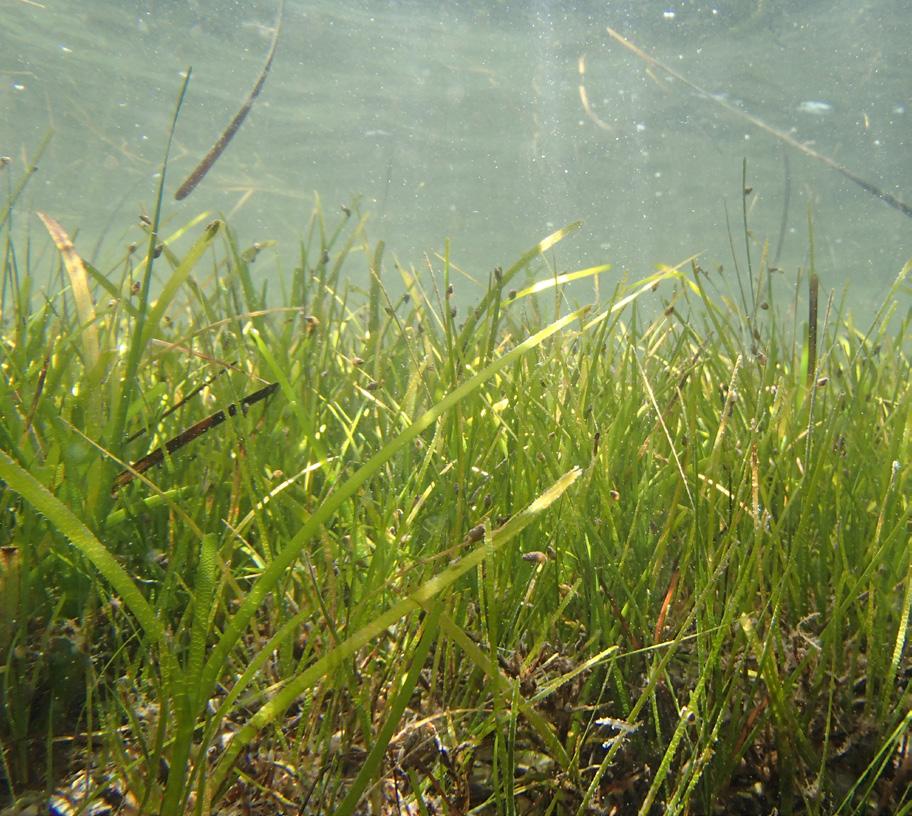
Listen to the NOAA Ocean Podcast about seagrass ecosystems. How do seagrass ecosystems help fight climate change and its impacts?
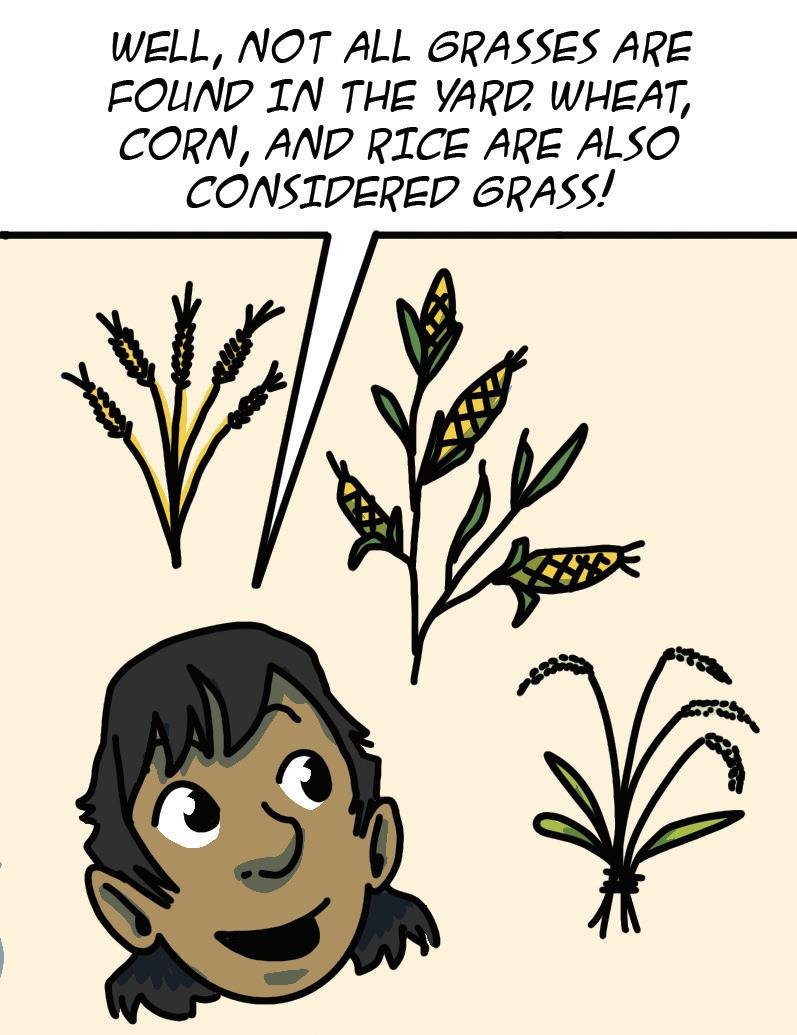
Wildfires in grassland ecosystems are also affected by invasive species. You read in Chapter 5 how invasive plants generate more fuel for wildfires in the Sonoran Desert—the same is true in grasslands. Fires don’t sweep through as they would in a healthy ecosystem. Instead, fires burn hotter and longer, threatening the native grasses.
Big bluestem grasses can reach 10 feet tall!
These conditions create new opportunities for the invasive species, which may recover and grow back more quickly than native ones. Invasive species threaten grasses in other ways. These plants outcompete the native grasses for resources—nutrients, water, light, and space. Eventually, the invasive plants push out the native grasses.
After everything you’ve read, you probably guessed that climate change is another threat to keystone grasses. Hotter temperatures, more severe droughts, and more intense storms all affect native grasses and grassland ecosystems. Some species of grass can no longer survive in their native habitat because of the heat. Extended drought weakens the essential root systems of grasses. This makes the soil more unstable, prone to erosion, and less healthy.
Read the National Geographic article to learn more about the different types of grasslands. What species call different grasslands home?
conservation photographer: a photographer who combines photography, journalism, and conservation to support preservation efforts. poaching: catching, harming, or killing plants or animals illegally.
If you were in charge of conserving keystone grasses, how would you go about it? That’s a question scientists and conservationists face. It’s a complex puzzle!
Many Indigenous tribes, conservation groups, and governments are working together to conserve grasslands. Some efforts are focused on preventing further grassland losses. This includes creating parks, refuges, and other protected areas.
A conservation photographer combines photography, journalism, and conservation to support preservation efforts. Conservation photographers might visit grasslands, forests, mountains, remote jungles, or other ecosystems and spend days, weeks, or years capturing images. Yet their work is more than just taking pictures of nature. They research the ecosystems and animals as well as the threats they face.
Through visual storytelling, conservation photographers reveal the beauty and biodiversity in places that might be at risk due to habitat loss, pollution, poaching , or other threats. Their work educates and raises awareness about both conservation needs and successful conservation efforts. The goal is to inspire people to make positive changes—such as supporting laws and policies that protect ecosystems or animals, taking part in conservation efforts, or donating money.
Visit the Great Plains with a conservation photographer in this Nature Conservancy video. Why do you think Michael Forsberg spent several years photographing that ecosystem?
The Badlands National Park in South Dakota, Oglala National Grasslands in Nebraska, Tallgrass Prairie National Preserve in Kansas, Wichita Mountains Wildlife Refuge in Oklahoma, and more, all protect a variety of grassland ecosystems.
Since keystone grasses are the foundation of ecosystems, some conservation efforts are focused on restoration. Part of the effort on the Great Plains includes planting native keystone grasses.
That brings us to another aspect of keystone grass conservation—seed collection. People collect seeds from native prairies in late summer or early fall, at the end of the growing season. The seeds are dried and used in native grass mixes to restore grasslands.
Another part of the restoration of grasslands in the United States is returning bison to the land. Why would you want to bring in massive animals to trample and eat the very grasses you’re trying to protect? Because bison are keystone species, too! Prior to European settlement, millions of bison roamed the grasslands of North America. For more than 10,000 years, bison herds shaped the prairie landscape.
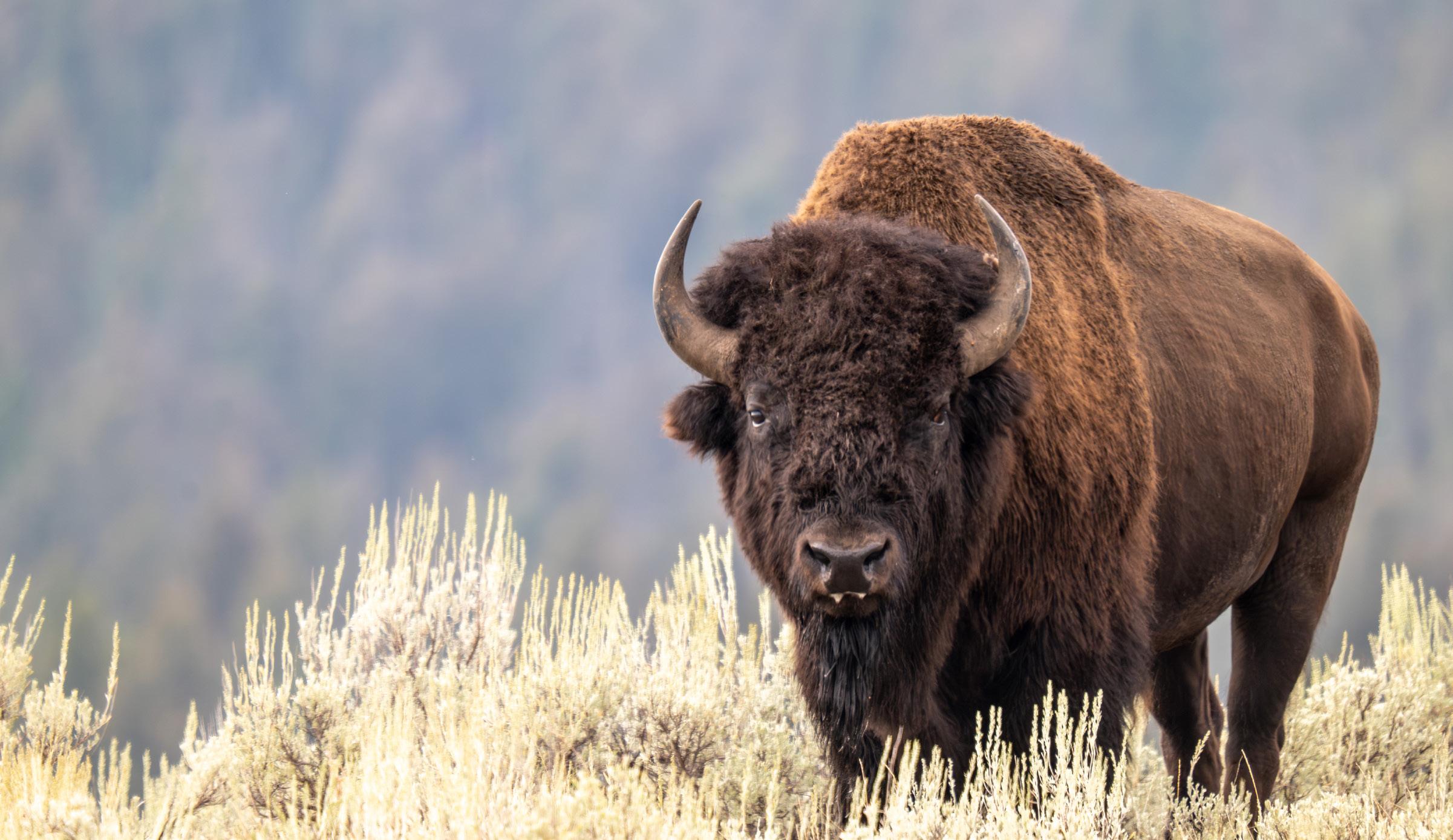
The combined efforts of Native Americans, ranchers, scientists, conservation organizations, and local and federal governments have recovered bison populations to more than 15,000 as of 2023.
Bison prevent woody plants from taking over. They disperse seeds across great distances when the seeds hitch rides on a bison’s fur. Bison manure is essential fertilizer for the prairie soil. Their hooves aerate the soil, allowing more air and water into the ground. Finally, their trampling pushes seeds into the soil and the hoof prints make depressions where water can collect. Just by doing what bison do—grazing, pooping, and moving—they promote greater biodiversity in the grassland ecosystem.
A baby bison is called a red dog because of their reddish-orange fur.
Restoration efforts also include removing invasive species when possible, to keep these plants from taking over. In addition, controlled burns mimic natural wildfires that have been a part of grassland ecology for thousands of years. After a fire, native grasses grow back stronger but woody plants and invasive species are eliminated.
ESSENTIAL QUESTION
Why is it important to protect and restore grassland ecosystems?
Similar conservation efforts are also underway for another keystone species that are not plants nor animals. They are fungi!
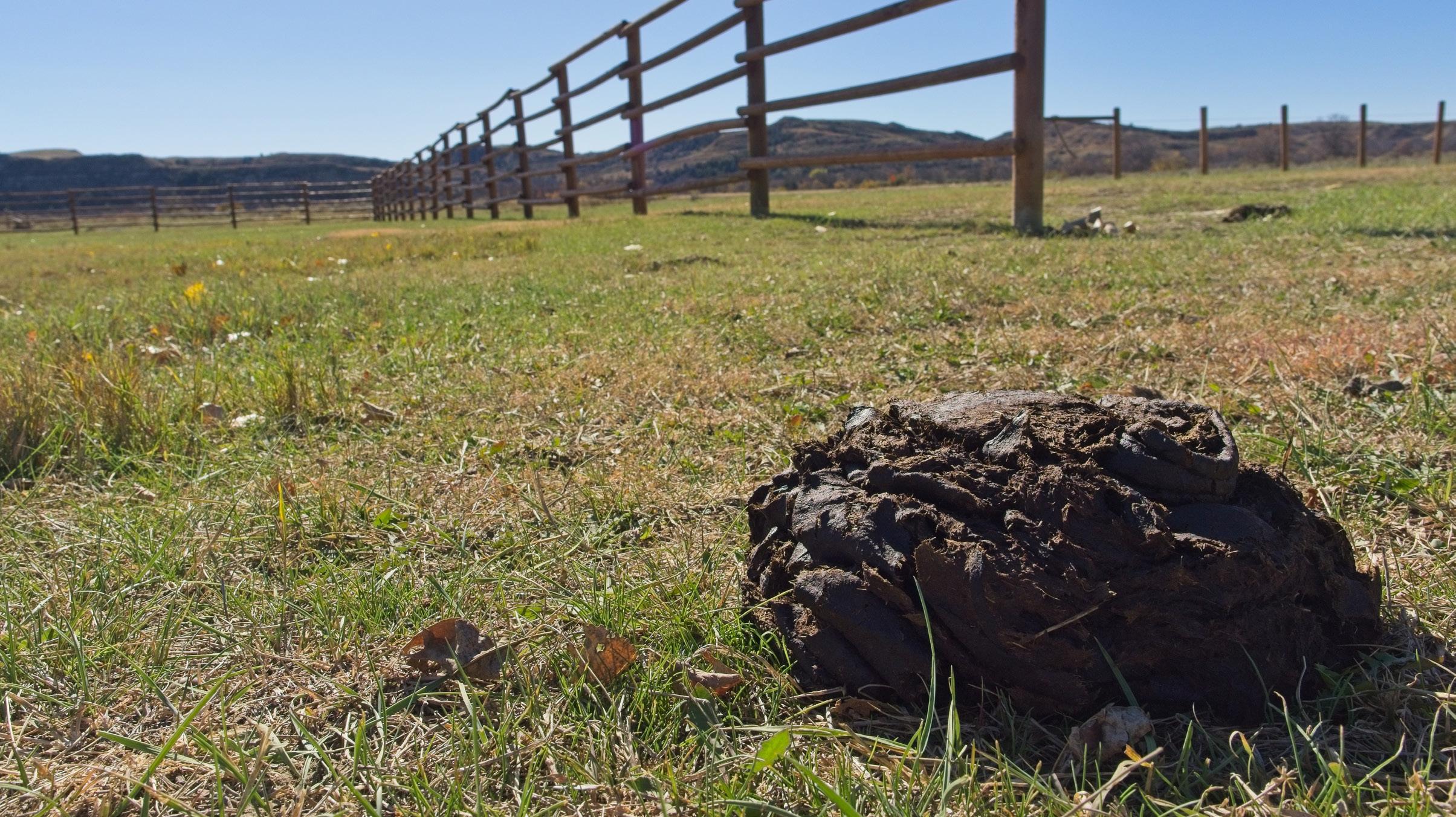
Bison patties become habitats for insects and microorganisms. One patty may be home to nearly 300 different species!
• colored pencils or markers
• notecards
• string
At first glance, grasslands might appear to be vast, open, barren places. But as you’ve learned, they are full of biodiversity. Grasses grow at the foundation of these ecosystems. On the Great Plains, we find three distinct regions: tallgrass prairie, mixed grass prairie, and shortgrass prairie. Investigate one of these regions and create a food web.
› Do some research. Find information about the keystone grasses in one region of the Great Plains. On one side of a notecard, write the name of the grass, draw a picture of it, and label it. On the reverse side, add information about the region, including which animals eat the grass.
› Research other plants and animals in the region. Be sure to record information about both what the animal eats and who are its predators. Collect information about the species at each level of the food chain: producers, herbivores, predators, and decomposers. Start by creating at least 10 notecards.
› Once you have 10 or more notecards, lay them out on a flat surface. Think about how the species on the cards are related to one another. Use pieces of string to make the connections between species. Once you’ve completed the web, make a more permanent display. You can tape notecards and yarn on poster board or a wall (with permission!).
› What would happen if the grasses disappeared?
Add more species to your food web. Go for 20 species in your web. Try 30! What does the food web reveal about the complexity of grassland ecosystems? Consider researching a different region of the Great Plains. Compare and contrast the food webs in the two regions.
What kinds of grass grow where you live?
Grasses are not only the foundation of ecosystems, but they also improve water quality—they are nature’s water filters. Witness the process firsthand by making your own water filter that mimics what grasslands do.
› Cut the bottom off the plastic bottle (ask an adult for help). Turn the top of bottle upside down and place it so the spout of the bottle empties into the jar.
› Layer the filter materials (gravel, sand, cotton balls) in the plastic bottle. Decide what order the materials should go in. What’s the best way to filter larger objects out first and smaller particles last?
› Pour the dirty water in the top of your filter. Observe the filtered water drip into the jar.
› Evaluate your filter. How does the filtered water look compared to the dirty water? Does it smell different? Feel different?
› NOTE: do not drink your filtered water even if it looks clear!
• clear plastic disposable bottle
• clear glass jar
• gravel
• sand
• cotton balls
• grass
• coffee filter
• dirty water (find or make some— water with visible particles is best)
• science journal
Examine your dirty water through a high-powered microscope. Then look at a sample of the filtered water. Do you see a difference? Try making filters with different materials to improve and slow down the filtering process. Compare the results.
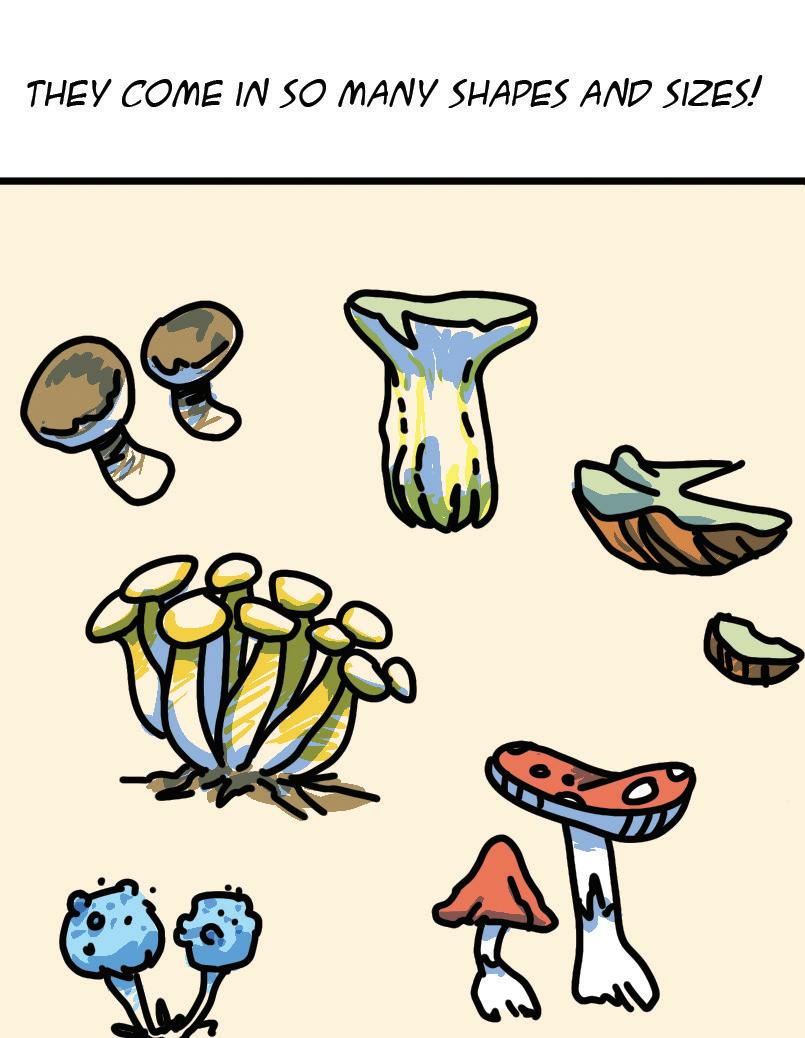
As you walk along almost any natural surface anywhere on the planet, a magical network thrives beneath your feet. It’s a vast, dense network made of microscopic threads, like those in a cobweb. These tiny threads, called hyphae , grow in and around the roots of plants, and reach out into the soil. Some of these networks span thousands of acres. The network is the foundation of food webs, supporting life on Earth. And it’s made of fungi.
ESSENTIAL QUESTION
How can understanding fungi help protect them?
When you think of fungi, mushrooms might come to mind. Mushrooms are the reproductive part of a fungus—the fruit. They are similar to apples on a tree. With fungi, the rest of the organism is hidden from view underground and is almost invisible. The interconnected network of threads in the soil is the main body of fungi—it’s called mycelium.
hyphae: the very long, very thin branches of fungus that grow in and around the roots of plants and spread out in the soil, creating vast fungal networks.
mycelium: the main body of a fungus, made up of an interconnected network of threads called hyphae.
stationary: fixed in one place.
chlorophyll: the green pigment in plants, algae, and cyanobacteria that helps them capture the sun’s energy to make their own food.
enzyme: a protein in an organism that speeds up chemical reactions. external: on the outside.
Fungi includes mold, mildew, yeasts, and plant rust. Not all types of fungi produce mushrooms or have networks of mycelium.
Fungi are not plants. Fungi and plants are similar in that they are both complex, multi-cellular organisms. Both have roots or root-like systems. They are stationary. However, plant cells contain chlorophyll that allows plants to use the sun’s energy to make their own food. Fungi do not make their own food. Instead, they secrete enzymes into their surroundings and digest organic matter—wood, dead leaves, other organisms— externally. Then, the fungi absorb the nutrients.
This process of decomposing and recycling organic matter is one reason many fungi are keystone species.
Many fungi species are critical decomposers. Without fungi, decaying organic matter would not decompose. It would build up and choke the planet. Think of fungi as nature’s recyclers! The decomposition moves nutrients back into the ecosystem, making them available for organisms to use again, which helps keep the soil healthy.
Fungi also renew life. How does that work? Consider a fallen tree.
When a tree dies, mycelia spread into the wood. They begin to break down the dead tree. As the tree decomposes, the nutrients are released back into the environment.
Small organisms such as termites and millipedes move in to eat the tiny wood pieces, other organic tidbits, and even the fungus itself. After that, larger organisms—including salamanders and woodpeckers—dine on the smaller ones, and so on through the food web.
As they break down the organic matter, fungi help create soil. Think of the fallen tree again. As the fungi decompose it, the tree breaks down into smaller and smaller pieces and eventually, it becomes a thick, rich soil. Fungi nourish and support healthy soil, as well as the community of organisms that live there. And if we didn’t have healthy soil, nothing could grow.
Scroll down on the Kew Gardens web page to the video, “What is mycorrhizal fungi?” to learn how scientists study mycorrhizal networks. Why are the scientists at Kew studying mycorrhizal fungi?
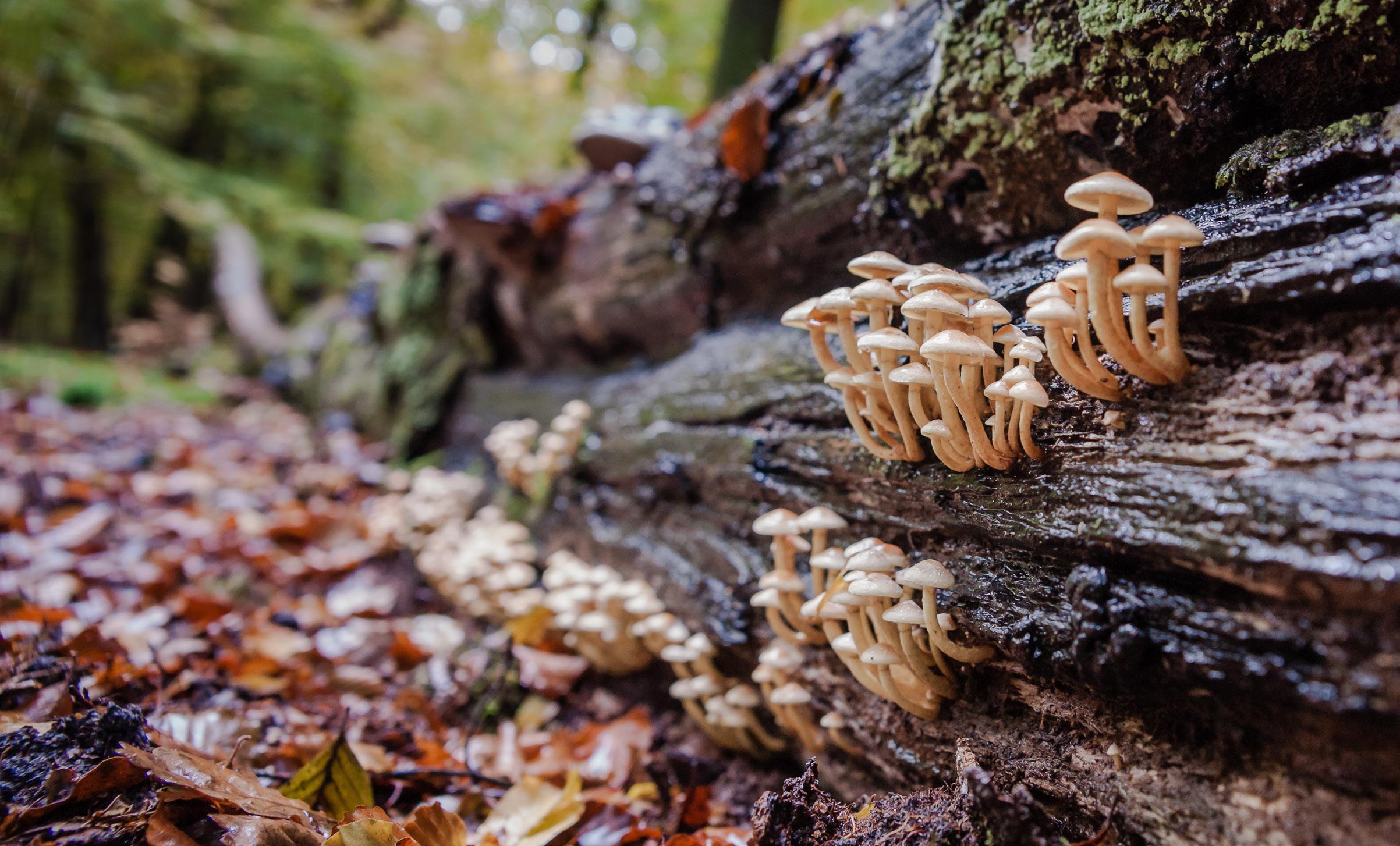
Fungi are found almost everywhere on the planet—in every habitat, on every continent, and even inside you!
mycorrhizal: related to the mutualistic association between fungi and plants. Mycorrhizal fungi form partnerships with plants.
mycologist: a scientist who studies fungi.
biotechnology: the use of living organisms to create or develop new products.
mycoremediation: the use of fungi to clean up a polluted habitat.
The mycorrhizal network has been nicknamed the “wood wide web” because it is how trees and plants communicate and share resources, similar to how humans use the internet.
Watch this short PBS video to see how fungi are used for mycoremediation in Bernheim Forest in Kentucky. Why is fungi used near parking lots?
Fungi are more than nature’s clean-up crew. Ninety percent of living plants rely on a mutualistic partnership with a type of mycelium called mycorrhizal fungi that grows in and around plant roots.
Mycorrhizal fungi also stretch out into the soil, extending the reach of plant roots and their access to water, nutrients, and minerals. In return, plants provide the fungi with sugars and carbon that are essential for growth.
Mycologists are the scientists making new and exciting discoveries about fungi. People began studying fungi with microscopes during the 1600s. It wasn’t until the 1800s, though, that the field of mycology was finally recognized as a science.
A mycologist might work in the field or a lab, conducting research on fungi. Others lead fungi conservation efforts, including using fungi to restore ecosystems. Some mycologists focus their research on the uses of fungi in medicine, food, agriculture, and biotechnology. Mycologists are also exploring new way to use fungi to produce sustainable product packaging and alternatives to plastic. New techniques are even being developed to use fungi in fashion to make fabric and fake leather.
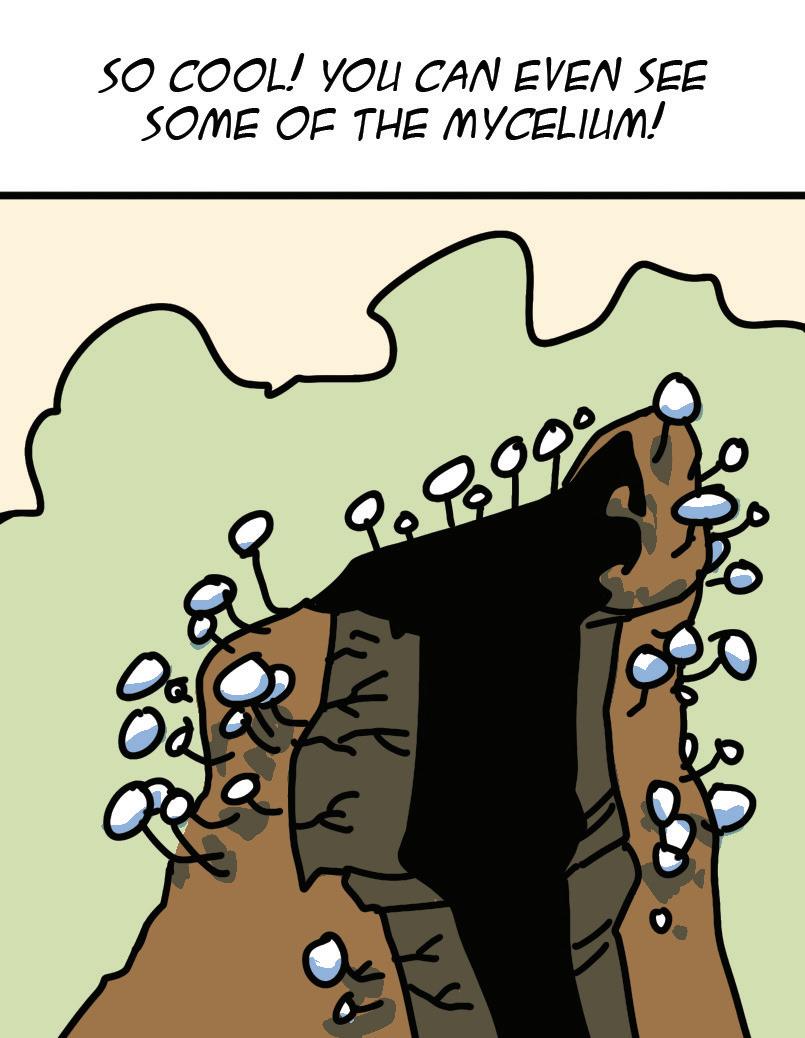
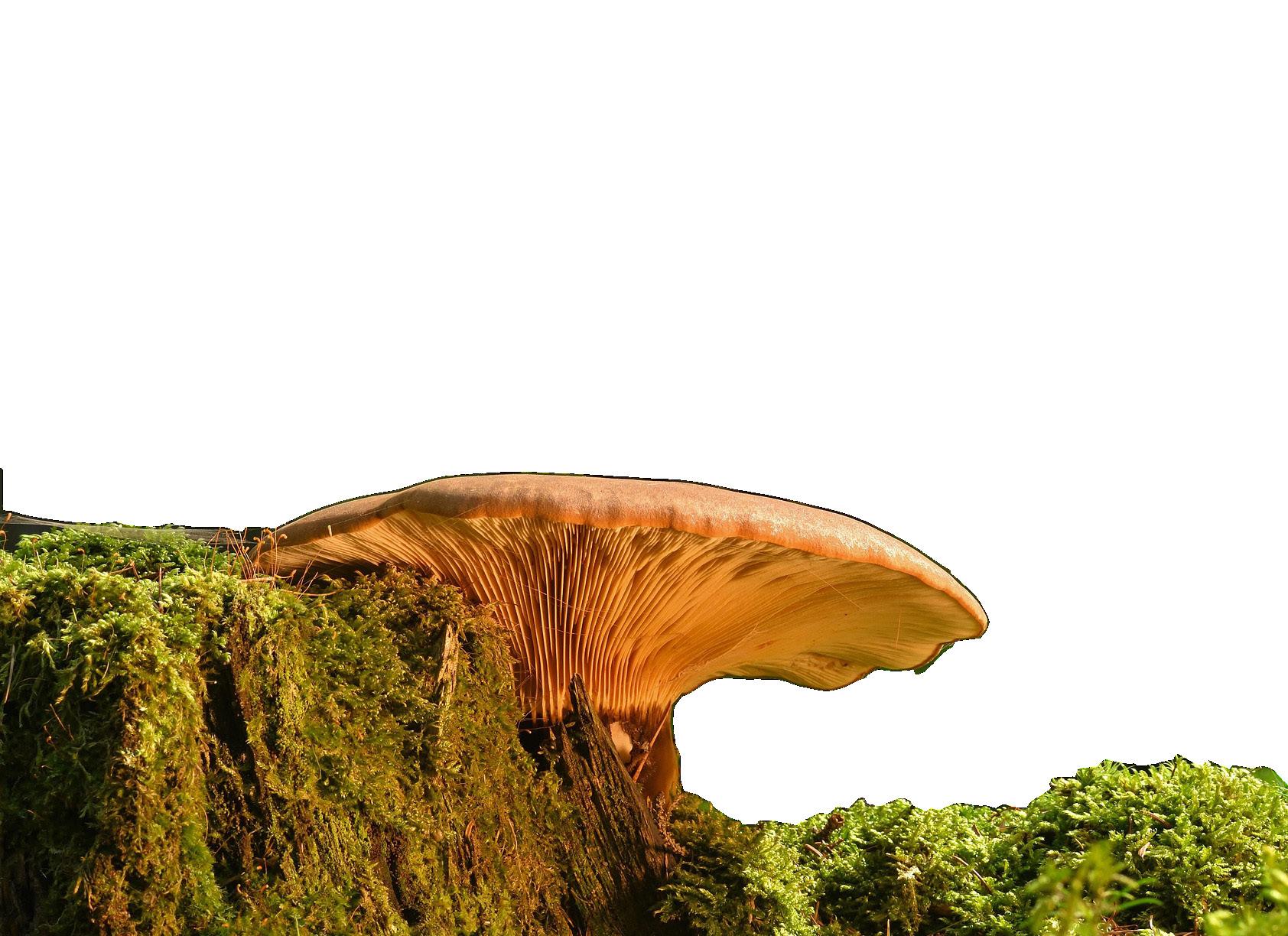
Because of fungi’s ability to break down chemicals and remove pollutants, fungi are used to restore degraded habitats in a process called mycoremediation.
till: to dig into and turn over soil to prepare it for planting.
saturate: to soak with liquid until no more can be absorbed.
advocate: to speak out for.
Many of the known species of fungi are already threatened with extinction. Countless unidentified species may be at risk as well.
Fungi are resilient and adaptable. Still, they cannot withstand habitat loss and degradation, which are the leading threats to fungi. Whenever you see a construction site in a place that used to be natural area, you can be sure that fungi and fungal networks have been destroyed.
Have you ever taken medicine when you’re sick? Some of these medicines, such as penicillin, come from fungi!
Deforestation and the use of land for farming and agriculture also disturb the soil habitat. These activities disrupt the below-ground fungal networks through tilling, digging, using heavy machinery that compacts the soil, and using pesticides and fertilizers. The destruction of the fungal networks leads to increased soil erosion, further impacting the fungi.
Global climate change is another threat. Rising temperatures and longer, more severe droughts affect where and how well some fungi grow. The changes also increase the stress on fungi, making them weaker and more vulnerable to disease.
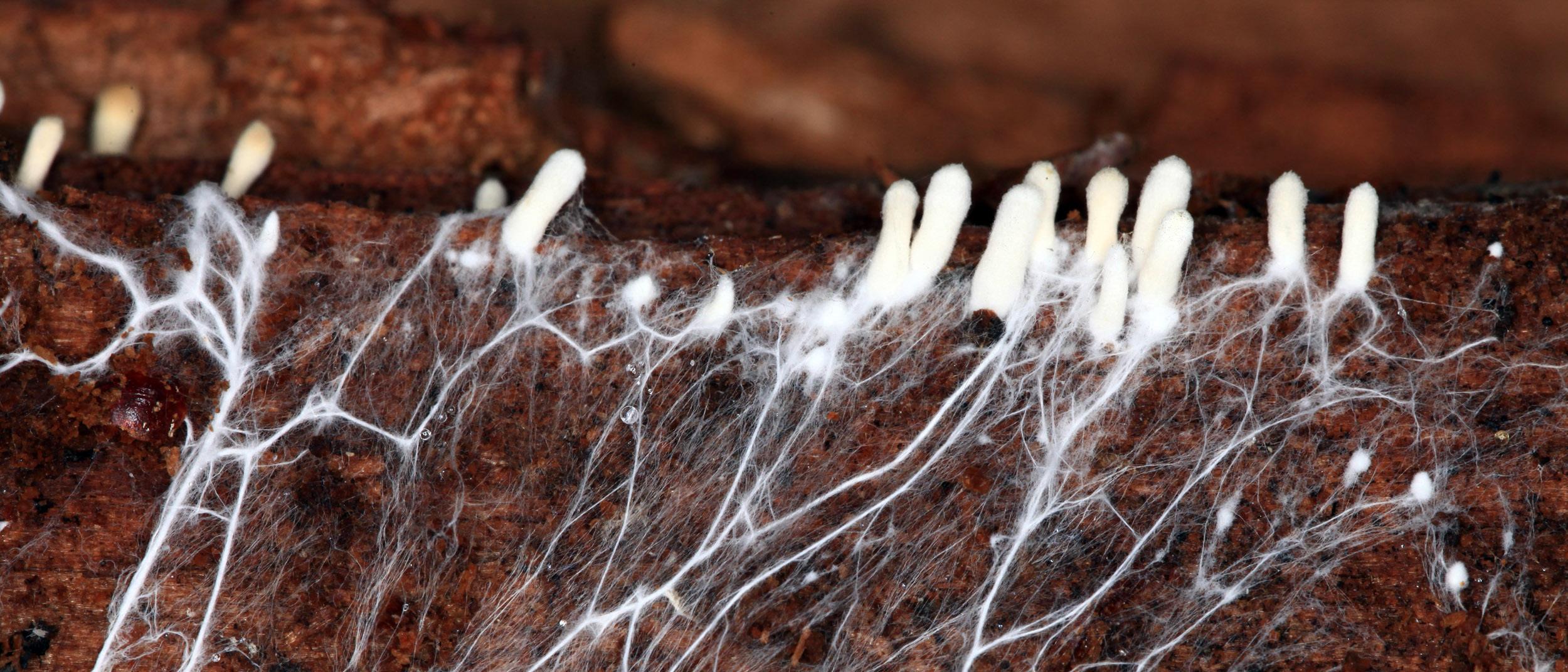
While fungi might be masters at breaking down and eliminating toxins in the environment, they have a limit. Think of cleaning up a spill with a sponge. The sponge can handle a certain amount of liquid, but eventually, it’s saturated and can’t soak up any more. Fungi are regularly overwhelmed by pollution from car exhaust, pesticides, and fertilizers that ends up in runoff.
Around 150,000 different species of fungi have been identified—scientists estimate that there might be 5 million or more.
Historically, fungi have been underappreciated. They lack charm. They are not particularly cute like otters and elephants. Nor are they considered beautiful like plants, though some really are! Most fungi are small, hidden, and hard to study—they simply haven’t captured people’s attention. Because of that, research has been underfunded and fungi are not protected by any laws.
Enter Paul Stamets (1955– ). He studied mycology in college and went on to become fungi’s greatest advocate. Stamets revealed that fungi are not only fascinating, they are also vital to both the health of humans and the planet. He has worked tirelessly throughout his career to promote fungi, including their use in medicine, mycoremediation, pest control, building materials, and more.
Visit the Fungi Foundation website to learn about their conservation efforts. How is the organization making a difference in fungi conservation?
Stamets and other scientists raised awareness about fungi’s role as the foundation of healthy ecosystems. The scientific community recognizes the need for continued research to identify and better understand fungal diversity and functions.
Knowledge and understanding help us figure out the best ways to protect different fungi species.
kingdom: a broad division of living organisms used to organize and classify them.
funga: all the fungi in a certain habitat, area, or geologic period.
How can we protect fungi? Habitat conservation! If habitat loss and degradation are the leading threats to fungi, we should work to protect those habitats. Some habitat restoration projects reintroduce native fungi to ecosystems to repair the disrupted mycorrhizal networks.
Sustainable farming practices are another way to conserve fungi. Sustainable farms rotate crops to increase biodiversity, which is beneficial to fungal networks. Reduced tilling and the use of fewer chemicals lessen the impacts on fungi. Less pollution on farms and elsewhere also improves fungi health and soil biodiversity. Stronger policies that promote sustainable farming will help protect fungi.
Fungi are not just land lovers. They also grow in marine and freshwater habitats— lakes, streams, wetlands, along shorelines, and even in the deep sea. Yet aquatic fungi are more under researched than their counterparts on land.
What we do know is that fungi in the water play key roles similar to fungi on land. Aquatic fungi keep ecosystems healthy. They decompose organic material, support food webs, recycle nutrients, and filter water.
Many of the species of fungi found in the water are usually found on land. That shows how adaptable fungi are! Additionally, marine fungi must be able to handle the salty water, strong waves, low light, and extreme water pressure deep in the ocean.
Because little is known about aquatic fungi, they are often ignored in conservation efforts. Still, aquatic fungi face similar threats as fungi on land: pollution, habitat loss and degradation, and global climate change.
Read this article to learn more about aquatic fungi. How are marine fungi adapted to living in the ocean?
Laws and protections play a key role in all conservation. Yet it wasn’t until 2013 that fungi were first included in an environmental law anywhere in the world! Chile was the first. That country’s laws require that fungi are given the same considerations as plants and animals when assessing environmental impacts and ecosystem health. The law also allows for species of fungi to be listed as endangered.
Another big win has to do with the language we use when talking about fungi. People use the terms “flora and fauna” to refer to plants and animals, but that ignores the entire kingdom of fungi. While that may seem like a minor thing, it leaves fungi out of important conversations and considerations for protection.
One fungi colony in the United States weighs four times more than a blue whale—it is appropriately named the Humongous Fungus.
Following the 2018 publication of a scientific paper defining the fungi kingdom and the need for a new term, the Fauna, Flora, Funga campaign was launched by the Fungi Foundation and other partners. This move will help fungi receive the same protections as plants and animals. The new framework also puts more attention on fungi and secures funding for further research.
Take a walk in a Vermont forest to learn more about the different types of mushrooms and their relationship with trees. Describe the different shapes, colors, and sizes of mushrooms.
You’ve read about the power of knowledge in previous chapters. In this case, knowledge helps fight misconceptions about fungi and spreads the word about the keystone role many fungi play in ecosystems. In addition, continued research about fungi and its habitats, as well as the identification of more species, will guide effective conservation action.
In the next chapter, let’s look at how you can take action right in your own community!
How can understanding fungi help protect them?
You’ve read a lot about fungi and specifically the fungal networks hidden beneath our feet. They support plants and entire communities of microorganisms and other species. But what does this look like? Time to find out.
• science notebook
• poster board
• art supplies
› Research fungal networks in a particular ecosystem. Look for belowground images of roots and mycelium, as well as information on the organisms that live there. Take notes on the fungi, organisms, and the ecosystem.
› On your poster board, draw the surface of the ground. Sketch out the base of the trees and plants above ground.
› Focus on adding the details of the interconnected root system and fungal network below ground. Include five to ten organisms, such as microorganisms and insects, on the poster.
› Add informational labels for the plants and their roots, the fungal networks, and the organisms. What does your drawing reveal about the complexity of fungal networks? What would happen in that ecosystem if the network was disrupted?
Investigate the belowground networks and community of organisms in a different type of ecosystem. How is that ecosystem the same or different from the first one you researched?
Visit this webpage for further information about fungi. What role does fungi play in the food we make and eat?
Kids Frontiers underground heroes
TO WORLD
Why do you think fungi aren’t as popular as many plant species?
Fungi are critical to healthy ecosystems. Yet they are overlooked and misunderstood. We need more research and conservation. Just as importantly, we need to spread the word. This is where you come in—create an advertising campaign to educate people about the value of fungi.
• colored pencils and markers
• science notebook
• video app
› Begin by selecting how you want to advertise. Maybe you’re interested in newspaper ads. How about a video for social media? Maybe you want to try out a radio ad. There are lots of different ways to get the word out.
› Brainstorm advertisement ideas for the media you chose. Print ads require imagery and language that are different from online ads. Social media posts need to be quickly understood. Anything on the radio has to rely on words only!
› Create your ad campaign. Revise your text and images until you’re confident that you are educating the public about fungi. For online advertisements, use poster board to create the visuals.
Create a comic about a fungus character. Give it a name, a home, human-like characteristics, and a voice. What kind of plot can you think up to help educate readers about fungi? How is it different to use a fictional character rather than simply stating true facts?
› Share with family and friends! What do they learn from your campaign?
Some fungi species have fun names like dog vomit slime mold, witch’s butter, and giant puffball.
This book is all about the keystone role of different plants and fungi. These plants and fungi support biodiversity, provide a variety of ecosystem services, and are vital to the health of ecosystems and the planet. At the beginning of the book, you met Doug Tallamy. After his discovery of keystone plants, he began a campaign to raise awareness about these powerhouse plants. He also works to inspire people to take action.
What steps can individuals and communities take to support keystone plants and fungi in their area?
Today, our yards and parks are largely manicured lawns and ornamental gardens. They are not at all wild and natural. Turf grass and ornamental plants don’t support local insects and other wildlife. What’s to be done?
We need to shift our thinking.
manicured: neatly cut or trimmed.
In 1872, the United States established its first national park, Yellowstone. Many other national parks, preserves, refuges, and national forests followed. These lands were set aside and protected from development, logging, mining, and other human activities.
However, unprotected land continued to be developed at a rapid pace. Habitats have been lost, degraded, and fragmented. Many species are now threatened with extinction. The federal, state, and tribal protections did not extend far enough.
Here’s where the first shift in thinking comes in. Instead of the government being the only one protecting spaces, what if individuals, families, and communities used their land to reestablish natural habitats?
You might not be old enough to get a job or consider a career, but you can become a citizen scientist! Citizen scientists are community members who help scientists collect and analyze data about the natural world.
It often takes a few scientists years or even decades to collect the data they need to understand and protect certain species or ecosystems. With today’s technology— smartphones, apps, social media, and the internet— large numbers of everyday people collect data in a fraction of the time and share it with scientists and conservationists. Contributions from citizens also bridge gaps in research. The information shared with scientists and conservationists informs decisions and action.
Find a citizen science project near you that supports the conservation of keystone plants or fungi or find a different conservation effort that interests you.
You can browse current citizen science opportunities at the Zooniverse website! What benefits come from collaboration?
arid: dry, receiving little or no rain.
What if we brought wilderness back into our neighborhoods and towns?
This is Tallamy’s idea—replace lawns and ornamental gardens with native plants to create habitats that support wildlife and provide ecosystem services. Tallamy calculated that if every homeowner in the United States replaced half their existing lawns with native plants, we’d create 20 million new acres of wild habitat. That is equal to the combined size of more than a dozen of our current national parks. He calls it “Homegrown National Park.”
Tallamy said, “Our National Parks, no matter how grand in scale, are too small and separated from one another to preserve (native) species to the levels needed. Thus the concept for Homegrown National Park, a bottom-up call-to-action to restore habitat where we live and work . . . extending national parks to our yards and communities.”
The city of Oslo, Norway, created a bee highway! A collaboration of public officials and private gardeners produced a ribbon of native habitat across the city to support declining bee and insect populations.
It sounds like a great plan. But this leads us to the second shift in thinking—we have to change how people think about lawns and manicured spaces. Our culture sees tidy lawns and gardens as signs of success, importance, and wealth.
Take a look at the interactive biodiversity map to see the number of people involved in Homegrown National Park and how many planted areas your state has. How does your state compare to others?
Homegrown National Park
But why? It doesn’t have to be that way. We should challenge the assumptions we have about what our gardens and yards should look like. Maybe, instead of manicured spaces, we shift our mindset to value wild spaces and gardens full of native plants—make gardening with natives the norm instead.
In some places, these shifts are already taking place. In Arizona and parts of California, landowners were paid to remove lawns, which used up valuable water in those arid climates. As time passed, gardens planted with native plants that look a little bit wild became the new norm.
Here are resources to get you started identifying natives in your area.
People in cities such as in Denver and Minneapolis are slowly transitioning their urban gardens to ones full of native plants.
More than 75 percent of the land in the United States is privately owned.
You can do a lot to support keystone and native plants in your area! The first step is to do some research. Each region has different powerhouse plants that offer habitat for wildlife and support the greater ecosystem.
Find out what’s native in your area by visiting a local garden store. Online resources can also help. You might find an expert in your area who would be willing to answer your questions.
Some species of flowers—asters, goldenrod, and sunflowers—are keystone species everywhere, as long as the particular species is native to the area. If you live somewhere with a yard, ask an adult if you can plant a few of these to support pollinators and caterpillars. If your focus is on pollinators, look for plants that support specialist bees. Those plants will also support generalist bees as well as other species.
If possible, include water in your garden plans to support the needs of the plants. Consider making watering holes for insects, birds, and other animals.
One citizen science project in Florida works in collaboration with scientists to conduct surveys of diamondback terrapins, a threatened keystone species.
This book took a close look at two keystone trees in North America: oaks and mangroves. Yet many other keystone trees support caterpillars, pollinators, and other wildlife.
You also read a little bit about willows in Chapter 1. They are second in the mid-Atlantic region, after oaks, in the number of moth and butterfly caterpillars they support. Other trees such as cherry, aspen, poplar, birch, dogwood, crabapple, and fig trees also serve keystone roles.
Pine trees play keystone roles too! These include Eastern white pines on the East Coast, ponderosa pines in the Southwest, and limber pines on the West Coast.
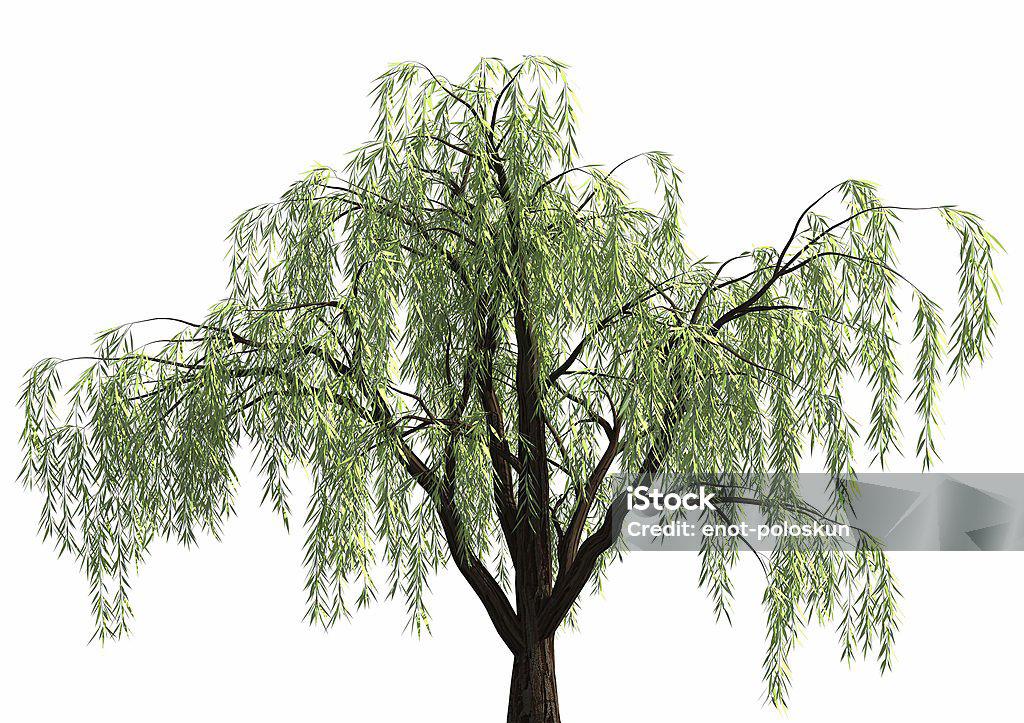
For any gardening you do, use only non-toxic products to fight weeds and pests. This protects the plants, fungi, and other species in your garden, as well as everything downstream. There are lots of natural alternatives to fight pests. And don’t forget, a healthy, biodiverse garden will protect itself!
To support birds in your area, visit the Audubon website to learn what to plant for birds. How can your choices support birds?
No yard? No problem! You can still support native species. Do you have a balcony? A rooftop area? A place for a window box? No matter how little your space, you can plant a garden that supports the local food web. But before you do any work, find out what the rules are in your area. Some developments don’t allow certain kinds of gardens.
If you do have a yard, you can leave the leaves in the fall. Leaves and other organic material are overwintering habitat for many species. Plus, the decomposing organic material supports fungi and soil health. In the spring, leaves underneath trees offer a soft landing place when it’s time for caterpillars to drop from their host plant.
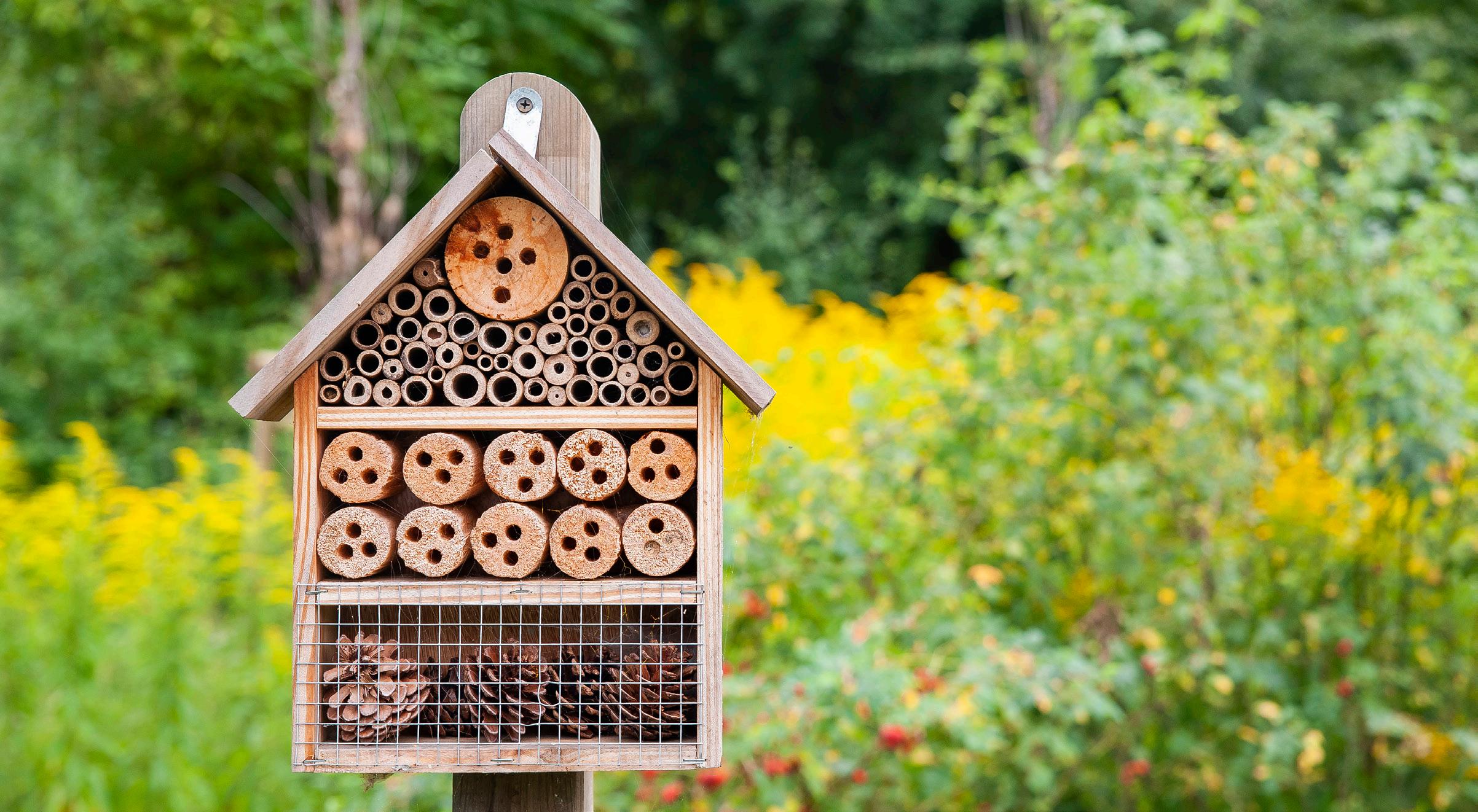
carbon footprint: the amount of carbon dioxide that is emitted because of your daily activities.
To support native and keystone plants and wildlife, we can all take some additional steps. One is to remove invasive plants. Connect with people already doing this work so they can show you how. You might be able to work at removing them in your own yard or volunteer to help at a park, school, or other places in your neighborhood. Wear gloves! Always ask for permission before making any changes on public or private land.
Do your part to combat climate change. Reduce your carbon footprint , or the amount of greenhouse gases generated by your daily activities. These gases are emitted as we burn fossil fuels to make energy. They are one of the leading causes of climate change. Think of ways to use less energy and choose sustainable ways to get around, such as walking, riding your bike, or taking public transportation.
Finally, learn as much as you can about keystone and native plants and fungi, and how to support them. Share what you learn with family and friends. Many people don’t realize that manicured lawns and gardens aren’t good for the ecosystem. People also don’t realize they can do a lot right in their own yards and communities to support native and keystone plants, and local wildlife. So, spread the word!
What steps can individuals and communities take to support keystone plants and fungi in their area?
Some people worry about planting oak trees. Those grow very big! But Tallamy encourages people to shift their thinking. If you plant an oak and it grows for 20 to 25 years before it needs to be cut down because of its size, it will support wildlife and provide ecosystem services to the ecosystem for many years. As the tree grows, a few oak saplings can be nurtured to replace it.
As you now know, not only do we need keystone and native flowers, but we also need to support the insects that support those plants. This includes specialist bees, most of which are solitary. To support these bees, build a bee hotel.
› Measure the height of the can. If you are using paper straws or natural stalks, cut them to a length slightly shorter than the can. If you are using sheets of paper, use a pencil to roll them into straw-like tubes. Tape them together and cut them to a length slightly shorter than the can.
› Fill the can with your paper straws, stalks, or tubes. Your hotel is ready to open!
› Find a suitable location outdoors for your bee hotel. The hotel should be:
» in a sheltered area out of the wind and precipitation
» firmly attached to something – not dangling or swinging by a string
» between 4 and 7 feet off the ground
» close to native flowering plants
» in a sunny location
› Visit the hotel regularly. Make observations and take notes. Who are your guests? Record the different species that visit. If you aren’t getting many guests, what might be the cause?
• clean, empty can or plastic bottle
• paper straws, rolled sheets of paper, or natural stalks such as bamboo (these tubes must be made of natural materials or paper, not plastic)
• scissors
• tape
The best hotels are those with free breakfast and a pool! To provide a buffet for your guests, plant asters, goldenrod, and sunflowers that are native to your area. Even if you don’t have garden space, you can plant these flowers in pots. You can start seeds indoors in late winter so they are ready for the bees in the spring. Place the flowers near the hotel. Then, add a water source. This could be as complicated as designing and building a fountain or as simple as a shallow lid filled with water. If your water is still, be sure to clean the container and refill it every day.
› NOTE: The hotel needs room service every year. This type of room service involves cleaning out the hotel and replacing the tubes in early summer, after the eggs hatch and the bees check out.
You now know a lot about keystone plants and fungi and the roles they play in ecosystems. You’ve learned how everyone can play a role in supporting these plants. Imagine you’ve been invited to be a guest on a podcast to speak about keystone and native plants.
› Think about what you’ve learned and what was surprising to you. Consider what you’d like people to know about keystone plants.
• science notebook
• pen or pencil
• recording device
» What roles can everyday people play in reimagining their yards and gardens to support keystone and native plants and fungi?
» What questions might people have?
» How can we shift our thinking to support these plants?
› Generate five to ten questions for the host of the podcast to ask you. Include one that asks you to define keystone species.
› Research the answers to the questions. Think about what you want people to learn from your podcast and how you can inspire them to take action in their yards and communities. Use the research to add details to your answers.
› Have a friend or adult host the podcast, asking the questions and engaging you in conversation. Record the session.
Consider sharing your podcast with others. Beforehand, edit the recording if possible, and add a few seconds of music at the beginning. Give your podcast a title and add an introduction. Share! Consider posting it online with an adult’s help and permission.
adaptation: a change that happens in response to the environment, often in terms of physical or behavioral characteristics that help a plant or animal survive.
advocate: to speak out for.
aerate: to allow air to flow through.
agouti: a large rodent that lives in Central and South America and is related to guinea pigs.
agroforestry: a land use and management practice that integrates native plants and trees with livestock and crops to create a sustainable system.
amphibian: an animal with moist skin that is born in water but lives on land. It is cold blooded and changes its body temperature by moving to warmer or cooler places. Frogs, toads, newts, efts, and salamanders are amphibians.
anthecology: the study of pollination.
aquaculture: the farming of fish and plants and other organisms that live in the water.
arid: dry, receiving little or no rain.
arthropod: an animal with a skeleton on the outside of its body. It has a segmented body and jointed legs. Insects and spiders are arthropods.
atmosphere: the blanket of gases surrounding Earth.
behavioral ecologist: a scientist who studies animal behavior, how that behavior is shaped by the environment, and how an animal interacts with its environment.
biodiversity: the range of living things in an area.
biology: the study of life and living organisms.
biomass: the total mass of living things, both alive and recently living.
biotechnology: the use of living organisms to create or develop new products.
botanist: a scientist who studies plant life. Botany is the study of plants.
brackish: slightly salty due to a mix of seawater and river water.
bulbous: round, fat, or bulging.
bushbaby: a small, nocturnal, African primate that lives in trees.
canopy: the uppermost layer of a forest, consisting of a dense layer of leaves and branches that create a kind of umbrella over the forest.
carbohydrate: one of the main nutrients in food and a primary source of energy.
carbon: an important chemical element that is the key building block for all life on Earth.
carbon dioxide (CO2): a colorless, odorless gas made up of one atom of carbon and two atoms of oxygen. In the atmosphere, it traps heat, keeping Earth warm and habitable.
carbon footprint: the amount of carbon dioxide that is emitted because of your daily activities.
carbon sink: a natural or manmade system that pulls and stores more CO2 than it releases.
carnivorous: describes a carnivore, an organism that eats only other organisms.
castañero: in Indigenous cultures, a person who collects the fallen nuts of the Brazil nut tree.
cavity: a hollow space or hole in living or dead trees.
chlorophyll: the green pigment in plants, algae, and cyanobacteria that helps them capture the sun’s energy to make their own food.
clear-cut: to cut down and remove every tree.
climate: the weather patterns in an area during a long period of time.
change: a change in long-term weather patterns, which can happen through natural or man-made processes.
collaborative: working together with other people.
conservation: the science of restoring, protecting, maintaining, and supporting nature.
conservation biologist: a scientist who studies how to maintain and restore habitats and protect wildlife.
conservation photographer: a photographer who combines photography, journalism, and conservation to support preservation efforts. contract: to draw together or decrease in size.
controlled burn: a fire set to burn off extra flammable material, also called a prescribed burn.
crops: plants grown for food and other uses.
crown: the branches and leaves at the top of a tree extending from the main trunk.
data: recorded facts and observations about something.
decay: to break down or to rot.
deciduous: describes a plant that sheds its leaves each year.
decomposer: an organism that breaks down waste, dead plants, and dead animals.
defoliate: to strip the leaves or seeds off trees or other plants.
deforestation: the act of cutting down and completely clearing a forest of its trees.
degradation: the act of harming an ecosystem to the point where it does not function properly.
dendrology: the scientific study of woody plants, such as trees, shrubs, and vines.
diameter: the width of a circle.
disperse: to spread or distribute over a wide area.
drought: a long period of time with little or no rain.
drought deciduous: describes a plant that sheds its leaves during the dry season instead of the fall or winter.
dung: animal poop.
ecological horticulture: the science of using native plants to design, build, and maintain outdoor spaces that provide natural habitats for pollinators and other wildlife.
ecology: the study of the relationships between organisms and their environment.
ecoregion: an area defined by the environmental conditions there including soil type, landforms, and climate, that determine the plant and animal species that live there.
ecosystem: an interdependent community of living and nonliving things and their environment.
ecosystem engineer: a species that greatly alters an ecosystem by creating, modifying, maintaining, or destroying it.
ecosystem service: a benefit provided by an ecosystem to keep the air, water, or soil healthy.
entomologist: a scientist who studies insects.
enzyme: a protein in an organism that speeds up chemical reactions.
epiphyte: a plant that grows on another plant without causing it harm.
erosion: the gradual wearing away of rock or soil by water and wind.
evaporate: to convert from a liquid to a gas.
evolution: changing or developing slowly over time. Evolution is the theory of how species develop from earlier forms of life and the belief that humans evolved from lower orders of animals.
evolve: to change or develop gradually. expel: to force out or eject something.
external: on the outside.
extinction: the death of an entire species so that it no longer exists.
fertilize: to join male and female cells to produce seeds or offspring.
filter: to pass a liquid or gas through another substance to remove unwanted material.
fire ecology: the study of the role of natural wildfires in shaping an ecosystem.
food chain: a community of plants and animals where each is eaten by another higher up the chain.
food web: a network of interconnected food chains.
foundational species: a species that provides the base on which an entire ecosystem is built.
fragmented: divided into smaller and smaller disconnected pieces.
funga: all the fungi in a certain habitat, area, or geologic period.
fungus: a type of living thing, different from animals and plants, that includes yeasts, molds, and mushrooms. Plural is fungi.
gene: inherited material that has the instructions to make an organism with certain traits and characteristics.
generalist bee: a bee that visits a wide variety of flowers for pollen and nectar.
genetic diversity: the variety of genes within a certain species.
germinate: to begin to grow from a seed.
grassland: a large open area of land covered with grasses.
Great Plains: a vast expanse of temperate grasslands and other ecosystems in central North America.
greenhouse gas: a gas in the atmosphere that traps heat. We need some amount of greenhouse gases, but too much traps excessive heat and causes climate change.
habitat: a plant, animal, or fungus’s home that provides it with food, water, and shelter.
herbaceous: having green, soft stems.
herbivore: an animal that eats only plants.
holistic: the belief that the parts of something are interconnected and can be explained only by considering the whole system.
hyperkeystone species: a species that can have an ecological impact on the entire planet.
hyphae: the very long, very thin branches of fungus that grow in and around the roots of plants and spread out in the soil, creating vast fungal networks.
incisor: a sharp, pointy tooth at the front of the mouth, used for cutting.
interdisciplinary: involving the collaboration between several different fields of study.
intertidal zone: an area where the ocean meets land that experiences regular cycles of being underwater and being exposed to air.
invertebrate: an animal without a backbone.
invasive species: a species that is not native to an ecosystem and that is harmful to the ecosystem in some way.
latitude: a measure of distance from the equator, in degrees. The equator is 0 degrees. The North Pole is 90 degrees latitude north and the South Pole is 90 degrees latitude south.
keystone: the central stone at the top of an arch that locks the whole together. Also, the central part of a system.
keystone species: a species that plays such an essential role in its ecosystem that without it, the ecosystem is at risk of collapse.
kingdom: a broad division of living organisms used to organize and classify them.
leaf litter: the layer of fallen, dead leaves and other plant material on the ground.
life cycle: the growth and changes a living thing goes through, from birth to death.
livestock: animals raised for food and other uses.
mammal: a type of animal, such as a human, dog, or cat. Mammals are born live, feed milk to their young, and usually have hair or fur covering most of their skin.
mangrove: a woody tree or shrub that grows in the intertidal zone in tropical areas.
manicured: neatly cut or trimmed.
marine: having to do with the ocean.
marine protected area (MPA): a protected wilderness area of the ocean or freshwater system.
microbe: a living thing too small to be seen without a microscope. Also called a microorganism.
microclimate: the climate in a very small area.
microorganism: an organism so small it can only be seen under a microscope.
migration: the seasonal movement of animals from one place to another.
mutualist: a species that interacts with another species in an ecosystem in such a way that both benefit.
mycelium: the main body of a fungus, made up of an interconnected network of threads called hyphae.
mycologist: a scientist who studies fungi.
mycoremediation: the use of fungi to clean up a polluted habitat.
mycorrhizal: related to the mutualistic association between fungi and plants. Mycorrhizal fungi form partnerships with plants.
native: a species that naturally originates and evolves in a certain area, developing complex relationships with other species in that ecosystem over time.
nocturnal: describes an animal that is active at night.
nurse tree: a tree that shelters, protects, and supports a young plant.
nutrients: substances in food, water, or soil that living things need to grow and live.
organism: a living thing, such as an animal or a plant.
ornamental: serving as decoration.
overgraze: when animals eat plants faster than they can grow back.
overharvesting: the collection or removal of a natural resource faster than the population can reproduce.
overwintering: surviving the winter.
peccary: a hooved, pig-like animal native to the Americas.
phenology: the study of seasonal, repeated events in nature related to plants and animals, as well as changes in these events from one year to the next.
photosynthesis: the process by which plants use sunlight and water to make their food.
pleat: a vertical, accordion-like ridge on the surface of many cactus species.
poaching: catching, harming, or killing plants or animals illegally.
pollinate: to move pollen from one flower to another so the plant can reproduce.
pollinator: an insect or other animal that moves pollen from plant to plant so new seeds can develop.
pollutant: a substance harmful to living things and the environment.
predator: an organism that survives by eating other organisms.
primate: a mammal belonging to a classification order including humans that shares the following features: a large brain, opposable thumbs, good eyesight, and flexible toes.
producer: an organism, such as a plant, that makes its own food public outreach: the process of informing, engaging, and building relationships with community members.
reptile: a cold-blooded animal such as a snake, lizard, alligator, or turtle that has a spine, lays eggs, has scales or horny places, and breathes air.
regenerate: to form again or recover from damage.
resilient: able to recover quickly from setbacks or difficult conditions.
restoration: the process of actively repairing and recovering a degraded or damaged ecosystem and its natural functions.
restoration ecologist: a scientist who studies ecosystems and determines the best way to make them healthy again.
rhizome: a stem of grass that grows underground horizontally.
runoff: water that flows off the land into bodies of water.
saguaro boot: the hardened shell, often shaped like a boot, in cavities made by nesting birds inside a saguaro.
sapling: a young tree with a thin, flexible trunk that is not yet producing seeds.
saturate: to soak with liquid until no more can be absorbed.
savanna: a grassland ecosystem with a lot of grass and a few trees and shrubs.
sediment: bits of rock, sand, or dirt that have been carried to a place by water, wind, or a glacier.
seed bank: a place where seeds from different plant species are stored and protected.
seedling: a young plant grown from seed. shrub: a low, stemmed, woody plant.
Southern Hemisphere: the half of Earth that lies south of the equator.
specialist bee: a bee that visits only one or a few species of flower for pollen and nectar.
species: a group of organisms that share common traits and can reproduce offspring of their own kind.
spikelet: a small cluster of flowers on grasses that grow into seeds.
spine: a firm, slender, sharppointed structure on a cactus.
stationary: fixed in one place.
steward: to responsibly take care of or manage the land in a sustainable way.
succulent: a plant with thick, fleshy leaves and stems that can store water to help it survive when little water is available.
sustainable: a process or resource that can be used without being completely used up or destroyed.
sustainability: the balanced use of Earth’s resources in a way that meets today’s needs yet also maintains a healthy planet now and for the future.
tallgrass prairie: a type of grassland ecosystem where the grasses can grow taller than a person.
tap root: a long root that extends vertically from the main plant to access water deep underground.
temperate forest: a woodland in a region that experiences four seasons, has moderate precipitation, is not extremely hot or cold, and has trees that lose their leaves every fall
tidepool: a pool of ocean water that remains after the tide goes out. till: to dig into and turn over soil to prepare it for planting.
toxic: poisonous or harmful.
trait: a specific characteristic of an organism determined by genes or the environment.
treaty: a formal agreement between countries.
tundra: a cold, mostly treeless area in very northern and very southern latitudes.
turf: grass that is maintained on a golf course or sports field.
watershed: an area of land that drains into streams, rivers, lakes, and other water sources.
wetland: an area, such as a marsh or swamp, that is covered some or all of the time by water. zoology: the study of animals.
Boddy, Lynne. Humongous Fungus. DK Publishing, 2021.
Cole, Henry. Mighty: The Story of an Oak Tree Ecosystem. Peachtree Publishing, 2025.
Daniels, Jaret C. Pollinators & Native Plants for Kids: An Introduction to Botany (Simple Introductions to Science). Adventure Publications, 2025.
Sedlackova, Jana, Ivi Niesner, Klara Holik. The Secret Life of the Forest: Trees, Animals, and Fungi. Albatross Media, 2024.
Singer, Marilyn. Whose Tree is This? Millbrook Press, 2026.
Steen, David A. Rewilding: Bringing Wildlife Back Where It Belongs. Neon Squid, 2022.
Thomson, Sarah L. and Douglas Tallamy. Nature’s Best Hope (Young Readers’ Edition): How You Can Save the World in Your Own Yard. Timber Press, 2023.
World of Pollinators: A Guide for Explorers of All Ages: Fun Projects, Over 600 Amazing Facts About Plants, Bees, Beetles, Birds, and Butterflies. Fox Chapel Publishing, 2023.
Native Plant Finder nativeplantfinder.nwf.org
Homegrown National Park homegrownnationalpark.org iNaturalist iNaturalist.org
Merlin Bird ID App merlin.allaboutbirds.org
Wild Hope by Nature on PBS pbs.org/show/nature/collections/wild-hope
www.nature.com
arapahoe.extension.colostate.edu/2025/05/05/keystone-plants-the-key-to-healthy-ecosystems
sweetearthco.com/blog/keystone-plants-101-how-to-identify-vital-species-for-your-eco-region
www.pollinator.org
fs.usda.gov/managing-land/wildflowers/pollinators/importance
sciencebuddies.org/stem-activities/phyla-biodiversity nps.gov/articles/species-spotlight-oaks scientificamerican.com/article/how-oak-trees-evolved-to-rule-theforests-of-the-northern-hemisphere/How Can I Help?
oceanservice.noaa.gov/facts/carbon-cycle
animals.sandiegozoo.org/animals/baobab nationalgeographic.com/animals/mammals/facts/african-elephant
theplantnative.com/faqs/what-is-a-keystone-species homegrownnationalpark.org/keystone-plants
kew.org/read-and-watch/whats-a-fungi
Stamets, Paul, ed. Fantastic Fungi: How Mushrooms Can Heal, Shift Consciousness & Save the Planet. San Rafael, CA: Earth Aware, 2019, p. 19.
Why are some plants more important to an ecosystem than others?
What roles do oaks play as a keystone species?
What are the main considerations for creating a sustainable future for Brazil nut trees?
What essential ecosystem services do mangroves provide for coastal ecosystems and the planet?
Why are baobabs vital to the health and survival of their ecosystem?
What is the keystone role of saguaros in the Sonoran desert ecosystem?
What would happen if native keystone wildflowers disappeared from their ecosystems?
Why is it important to protect and restore grassland ecosystems?
How can understanding fungi help protect them?
What steps can individuals and communities take to support keystone plants and fungi in their area?
Page 5: nhpbs.pbslearningmedia.org/resource/nat38-discovery-ofkeystone-species-vid/the-serengeti-rules-media-gallery/
Page 6: amnh.org/explore/ology/biodiversity/what-is-biodiversity
Page 7: youtube.com/watch?v=Dd-Bslj_bOI
Page 9: www.youtube.com/watch?v=6QwiYfqX1sg
Page 11: ed.ted.com/lessons/the-mysterious-origins-of-life-on-earth-luka-seamus-wright
Page 15: nutwizard.com/blogs/seeds-and-such/acorns-and-wildlife?srsltid=AfmBOooElb0seBiV8x9USwMexS0UAv-rN8qIfbxgoPtsQGnBpOBgtAy
Page 18: nhpbs.pbslearningmedia.org/resource/76505303-9ca8-4211-8f00d83ea85ab245/wildlife-forest-layers-and-food-webs-georgia-forests/
Page 19: ed.ted.com/best_of_web/dKKIiKsz
Page 21: nps.gov/articles/000/idkt_leave-the-leaves.htm wildseedproject.net/blog/leave-the-leaves xerces.org/leave-the-leaves#:~:text=Fall%20Cleanup%20in%20 Moderation,retain%20moisture%2C%20and%20boost%20nutrition
Page 24: sdzwildlifeexplorers.org/animals/peccary
Page 28: youtube.com/watch?v=Bh10qoIbGmk
Page 31: nhpbs.pbslearningmedia.org/resource/5a7a7f90-b216-47ff-96bf9a4e7feb04a9/ecosystem-ecology-links-in-the-chain-crash-course-ecology-7
Page 36: youtube.com/watch?v=4YiL6JRgcmk
Page 37: nps.gov/chis/learn/photosmultimedia/ocean-webcam.htm
Page 38: nature.org/en-us/about-us/who-we-are/how-we-work/ working-with-companies/cause-marketing/minecraft
Page 39: kids.earth.org/life-on-land/facts-about-mangrove-trees
Page 40: nhpbs.pbslearningmedia.org/resource/ctv21-conservation-biology-video/camp-tv/
Page 41: kids.earth.org/life-on-land/facts-about-mangrove-trees/
Page 42: youtube.com/playlist?list=PLBeZj3LBu_VfaURxEV7QQ2pwuJ5zultOm
Page 44: ed.ted.com/lessons/the-threat-of-invasive-species-jennifer-klos
Page 49: kids.frontiersin.org/articles/10.3389/frym.2023.999231
Page 51: pbssocal.org/shows/islands-wonder/clip/baobab-tree-8rmaic
Page 52: kids.mongabay.com/seheno-tells-us-about-the-mighty-baobabs-of-madagascar/
Page 53: baobabgenomeproject.com/baobab-map/
Page 60: usgs.gov/media/slideshows/repeat-photographs-saguaro-national-monument-eastnow-saguaro-national-park-rincon#:~:text=Here’s%20some%20information%20about%20 historic%20photos%20of,because%20they%20were%20harvested%20during%20that%20time.
Page 61: ed.ted.com/lessons/nature-s-fortress-how-cacti-keepwater-in-and-predators-out-lucas-c-majure
Page 62: desertmuseum.org/kids/oz
Page 63: nhpbs.pbslearningmedia.org/resource/biodiversity-in-the-desert-video/trail-mixd
Page 69: hhmi.org/beautifulbiology/scroll-and-tell/pollination
Page 70: nhpbs.pbslearningmedia.org/resource/8edf0fc7-2959-4d1e961f-746e56dbbd23/but-why-adventures-northeast-nature
Page 72: fs.usda.gov/wildflowers/pollinators/Monarch_Butterfly/documents/MilkweedInfoSheet.pdf
Page 75: thespruce.com/the-difference-between-trees-and-shrubs-3269804
Page 81: kids.nationalgeographic.com/nature/habitats/article/grassland
Page 83: nhpbs.pbslearningmedia.org/resource/tallgrass-prairies-video/find-iowa-prairies
Page 84: oceanservice.noaa.gov/podcast/mar23/nop63-seagrass
Page 85: kids.nationalgeographic.com/nature/habitats/article/grassland
Page 86: youtube.com/watch?v=pQKwzhEXLEo&t=5s
Page 93: kew.org/read-and-watch/fungi-hidden-dimension
Page 94: nhpbs.pbslearningmedia.org/resource/watsol.sci.ess.water.mycore/mycoremediation
Page 97: ffungi.org/en/conservation
Page 99: nhpbs.pbslearningmedia.org/resource/ed908c89-de69-414082fb-921928bb6fe1/but-why-adventures-northeast-nature
Page 104: map.homegrownnationalpark.org
Page 105: sweetearthco.com/blog/keystone-plants-101-howto-identify-vital-species-for-your-eco-region nativeplantfinder.nwf.org/Plants
homegrownnationalpark.org/keystone-plants
Page 107: audubon.org/plantsforbirds
WHY ARE SOME PLANTS MORE IMPORTANT TO AN ECOSYSTEM THAN OTHERS?
Every species has a role to play in an ecosystem, but some roles are more significant than others. In Keystone Plants and Fungi: Discover the Organisms Vital to Ecosystem Health and Biodiversity, young botanists examine the keystone plants that make the difference between a thriving ecosystem and a collapsing one. Oak trees, baobab trees, Brazil nut trees, mangroves, saguaro cacti, and certain flowers, grasses, and fungi are all considered keystone species that other species depend upon.
Keystone Plants and Fungi includes hands-on activities and critical thinking exercises to help all types of learners gain a deeper understanding of keystone plants’ critical roles. These activities, a narrative writing style, fun facts, words-to-know, and links to online resources combine to take readers on an exploration of keystone species around the world.
Try these STEM activities!
• Investigate solutions to deforestation
• Model pollution uptake by plants using celery
• Design a pollinator garden
• Make a phenology flipbook
• Fight flooding and pollution with a garden
Praise for Keystone Species by Laura Perdew
2025 Green Earth Book Award Recommended Reading
“This book is a fabulous way for children to learn about animals and develop a passion for protecting the environment.”
—Children’s Literature
$19.95