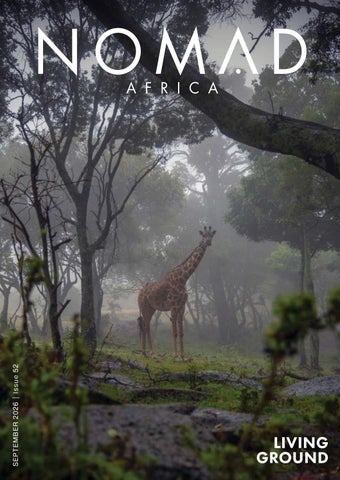
SEPTEMBER 2026 | Issue 52
LIVING GROUND
1
M e s By
Join
M e s
Artcaffé’s loyalty programme.
Sign up today
Unlock a World of Exclusive Rewards
Dine & Delight
Shop & Save
Personalised Treats
From sunrise specials to midnight treats, members benefit from exclusive rates all day long.
From Monday essentials to Sunday feasts, members enjoy exclusive savings on their favorite categories.
From birthday surprises to "just because" treats, members unlock rewards tailored just for them.
2
Turn your daily dining and shopping into rewarding experiences. Be part of our community and enjoy exclusive benefits.
Art an · Inspired · D icious
GRAB. GO. EXPLORE. THE JOURNEY STARTS AT ARTCAFFÉ
Artcaffé Market is your destination for fresh, travel-ready food and essentials. From handcrafted sandwiches and freshly baked pastries to premium snacks, salads, coffee and on-the-go favourites, you'll find everything you need for the road ahead. Whether you're heading on safari, taking a road trip, or catching a flight, stop by any Artcaffé and travel well.
www.artcaffemarket.co.ke
Stop by Artc fé b ore you go.
3
TSAVORITE TSAVORITE KENYA'S BEST-KEPT GEM SECRET
Introducing Hanly Mutsune
Hanly Mutsune, founder and designer of Hatatian Jewelry, has spent seven years building a bespoke house rooted in one philosophy: stewardship of ethics for African gemstones.
The Craft
Every Hatatian piece begins with a stone traced back to its origin, ethically sourced through women-led mining communities, cut by hand, and set with a level of transparency rare in the industry. Nothing is mass-produced.
Green Garnet Collection This collection is Hatatian’s tribute to the gemstone itself: rare, deeply Kenyan, and largely unknown even at home. Each piece is made to order, designed around the person who will wear it.
TWO HUNDRED TIMES RARER THAN EMERALD
4
Discover the Green Garnet Collection and start a custom piece hatatianjewelry.online | hatatianjewelry@gmail.com | +254 796 888 365
LIVING GROUND SEPTEMBER 2026 | Issue 52
Contents 06 Message from the Guest Editor / Feature Contributors 10
Guest Perspective
Whose Land, Whose Decisions?
12 Sustainable brands
Conscious to its core, these are brands we can’t help but love 14 Hot Shots
Top pictures by local talent
20
Broken Ground Protecting Kenya’s giant ground pangolins in fragmenting landscape
28
Lagos Through Memory Exploring regeneration across water, culture
44
and diaspora
34
Seeds of Renewal
Cultivating a resilient future in Comoros
Nomad Junior
46 Events Worth Travelling for 2027
5
NOMAD AFRICA TRAVEL & MAGAZINE Issue 52 | September 2026 PUBLISHED BY PURPLE NOMAD, ALL RIGHTS RESERVED
CEO
Message from the Guest Editor Dear Readers,
Thom Wallace OPERATIONS & FINANCE Wambui Everlyne, Linet Wangui GUEST EDITOR Paige McClanahan editor@nomad.africa GRAPHIC DESIGN Viola Kup PARTNERSHIPS & MARKETING Charlotte Breuking, Femke Gow, Susan Njoki TRAVEL - ADVISORY & EXPERIENCE Sonja Schroeder, Michael Scott, Carol Soi, Ann Wambui
Send Us Feedback: editor@nomad.africa To Advertise: advertise@nomad.africa Inspired to travel? Connect with our travel team at
In 2018, I moved with my family from Nairobi to a small village in the French Alps that’s popular with tourists. Over the five years we lived there, I saw first-hand how visitors directly supported the community. I also saw how tourism, if not managed properly, could cause strain. Whether in an Alpine village, a Kenyan forest, or an island in the Indian Ocean, communities around the world are navigating this question: How and where can travel actually help sustain the people and places that welcome us? That’s the core of the September issue of Nomad, Living Ground, where we bring a wide lens to this conversation. We kick things off with a guest essay from a forwardthinking tourism official in Kenya who wants to help us think about how we can leave a positive impact on the communities and landscapes we visit. Our cover story then takes us into the world of the giant ground pangolin, and a new initiative to protect its habitat in a region that’s beloved by travelers. A thoughtful personal essay then brings us to Lagos to explore the regenerative power of a vibrant African metropolis. A photo essay from Comoros invites us into the communities that are restoring the stunning coastal forests and mangroves they depend on — and that offer a haven for eco-conscious travelers. Finally, a reported feature takes us into the world of Tunisian cuisine, demonstrating how travel is helping to sustain a key part of Tunisia’s cultural heritage.
travel@nomad.africa
I hope you’ll find the issue equal parts inspiring and thoughtprovoking. Happy reading – and happy nomad-ing! nomad.africa
NomadAfricaTravel Nomad Africa @nomadafricatravel
6
Paige McClanahan Paige McClanahan is a writer and author based in France. As a travel journalist, Paige has contributed to The New York Times and The Washington Post, among other outlets. Her book, The New Tourist: Waking Up to the Power and Perils of Travel, was published in 2024.
Feature Contributors Doreen Nyamweya is a Tourism Officer for Nyamira County, Kenya. She Doreen also a travel writer focused on making tourism work for residents and Nyamweya isvisitors alike.
Kacie Morgan
Dr Tunji Offeyi
Denise Nicolau
Georgina Goodwin
Kacie Morgan is an award-winning food and travel writer, photographer and founder of The Rare Welsh Bit, specialising in food-led travel stories that explore destinations through their people, culture and cuisine.
Dr Tunji Offeyi is an award‑winning Nigerian‑British journalist, poet, and heritage researcher and Cambridge Press/Routledge peer reviewer. He holds a doctorate in Heritage from the University of Wales Trinity Saint David and is a Salzburg Global Fellow. His work spans creative practice, public scholarship, and political organising.
Denise Nicolau is a Mozambican ecologist and photographer who explores the connections between people, nature, and ocean conservation. Through her lens, she tells stories of Africa’s landscapes, seascapes, and communities capturing their beauty, resilience, and the often-unseen bonds that connect people to the natural world.
Georgina Goodwin is a Kenyan documentary and conservation photographer whose work explores the relationships between people, wildlife and changing landscapes across Africa. An Associate Fellow of the International League of Conservation Photographers and founder of GGI Media, she has spent more than two decades telling stories that connect conservation, community and place.
7
GUEST PERSPECTIVE
Whose Land, Whose Decisions? Empowering communities is the key to truly regenerative travel
By Doreen Nyamweya
During one of my field visits to a community in Kenya, a
Under what conditions can travel genuinely give back?
member asked me a question that I struggled to answer:
Increasingly, the industry is embracing the language of
Why should they work to make their land more attractive
regenerative travel, which is an important step. To fol-
to visitors, when tourism had never made anything better
low through on that language, we need to see tourism
for them? The question has stayed with me, because it
officials and travel operators who are ready to let com-
points to something the whole industry should confront.
munities set the terms of their development, decide their own conservation priorities, and manage their own re-
Communities are the hosts, custodians, and storytellers of
sources. This kind of approach can deliver an important
the places visitors come to experience. Yet the decisions
double win: we can heal ecosystems while empowering
that shape communities’ futures are often made far from
the very people and communities who have stewarded
the villages and forests where the impacts are felt. That’s
them for generations.
why, if travel is to meaningfully give back to communities, we cannot rely on sustainability checklists alone – we
As travelers, we have an important role to play as well.
must see a real shift in power. Communities must be em-
We can think about arriving as learners, not consumers.
powered to set the terms of the tourism that happens on
We can listen more. We can ask before photographing,
their doorstep.
and we can recognize that our presence is a privilege, not an entitlement. The most meaningful exchanges happen when communities lead and visitors participate respectfully.
We can heal ecosystems while empowering the very people and communities who have stewarded them for generations
Under these conditions, travel is more than a transaction. It becomes what it was always meant to be: a living, reciprocal relationship between the visitor, the community, and the natural environment. Benefits are shared more equitably, culture and heritage are respected rather than performed, and restoration becomes a possibility. This is the vision of travel we should all aim for. Because the future of tourism lies both in preserving what remains, and rebuilding what has already been lost.
Doreen Nyamweya is a Tourism Officer for Nyamira County, Kenya. She is also a travel writer focused on making tourism work for residents and visitors alike.
8
NOMAD AFRICA IS NOW B CORP CERTIFIED
TRAVEL AFRICA, BETTER.
Achieving the rigorous B Corp certification affirms Nomad Africa’s commitment to practices and operations that ensure travel and storytelling are a force for good—supporting the people, places, cultures, and ecosystems that make Africa extraordinary and keep it that way.
A F R I C A
R W E N ZO R I M O U N TA I N S N AT I O N A L PA R K , U G A N DA
For a nomad, travel is not just about the destination; it’s about the deeper connections made with people and places along the journey.
T R A V E L
9
WITH RWANDA’S GORILL AS
10
ADVERTORIAL
SPECIAL FEATURE ITINERARY FROM NOMAD AFRICA TRAVEL Rwanda offers a powerful example of regenerative travel: tourism that not only protects endangered gorillas and their habitats, but also creates economic transformation. Home to more than half of the world’s remaining mountain gorillas, Rwanda has made sustained investments in conservation in and around Volcanoes National Park in the North of the country.
These efforts have helped protect critical habitat while strengthening cooperation and economic opportunity in the region. . Rwanda directs 10% of the tourism income generated by permits and national park fees towards community initiatives, including schools, healthcare facilities, housing, water systems and livelihood projects.
A F R I C A
T R A V E L
To reduce strain on the mountain gorilla population, Rwanda only releases a limited number of gorilla treking permits every year. Often thought of as too expense for most outside of Rwanda ($1,500 for international visitors) East African citizens and residents enjoy special low-season permit rates, released at the end of each year. In 2026, treking permits US$200 for EA citizens and US$500 for EA residents.
EXPERIENCE RWANDA’S GORILL A CONSERVATION STORY IN A WKND EXPLORE THE TRIP AT WKND.NOMAD.AFRICA
Amani Nation /Unsplash
The Nomad Africa travel experts have curated a four-day, customisable itinerary that includes flights, transfers, accomodations and East Africa resident rates to make the long awaited dream of treking with gorillas easier.
THURSDAY
FRIDAY
SATURDAY
SUNDAY
KIGALI
MUSANZE
GORILLAS
NAIROBI
Arrive in Kigali and settle into The Governor’s Residence before dining in the garden or exploring the city.
Spend the morning exploring Kigali before heading to Five Volcanoes Boutique Hotel to prepare for Saturday’s trek.
Meet the mountain gorillas on a trek through Volcanoes National Park, then return for an evening by the fire.
Enjoy a cultural experience in Musanze before returning to Kigali for your evening flight home to Nairobi.
WKND ITINERARY (INCLUDES FLIGHT, ACCOMODATION, TRANSFERS, TREKKING PERMIITS)
11
Sustainable brands Conscious to its core, these are brands we can’t help but love
Urban Ranch
URBAN RANCH Urban Ranch sources its leather from Kenyan conservancies where cattle and wildlife share the same land, then hands it to master artisans at the foot of Mount Kenya who shape each piece entirely by hand. Rural beading cooperatives add intricate patterns to every panel, earning fair wages through ongoing skillsharing rather than aid. No two pieces are alike: each carries the subtle variations in grain and stitch of the artisan who made it.
LILA BARE Founded in 2017 by Ria Ana Sejpal, who began reworking clothes at thirteen, Nairobi-based Lilabare turns agricultural waste, remnants, reclaimed denim, and vintage saris into lasting fashion using natural dyes and handcrafted techniques. Lilabare works with an East African network of farmers, weavers, and artisans, ensuring fair wages and healthcare access.
Provisions
12
Lila Bare
PROVISIONS Provisions was founded by sisters Nancy and Susie Kinyanjui, raised by an agroforester father and a conservationist mother. The brand curates handmade goods made almost entirely in Kenya. Their Rift Valley Yarn line reflects that ethos: farmers supply wool once left unused as synthetic yarn took over the market, and a cooperative of women hand-card, spin, and dye it with foraged plants like blackjack seeds and bougainvillea.
80%
of recorded visits to African protected areas are concentrated in just 10% of destinations.
70% of Africaʼs conservation areas are underfunded.
Regenerating landscapes. Empowering communities.
Africaʼs conservation areas need more than protection. They need viable economies.
Safari Defenders Initiative is an Africa-based non-profit that works with underfunded and under-visited conservation areas to turn tourism potential into lasting revenue, meaningful local opportunities, and stronger conservation.
www.safaridefenders.com 13
M A I N F E AT U R E
14
HOTSHOTS
The photo Three male mountain bongo antelope share pellets in a trough at Mount Kenya Wildlife Conservancy in April 2026. Critically endangered, with fewer than 100 individuals left in the wild, the mountain bongo is the focus of an ongoing repatriation and breeding program aimed at restoring the species to its native forest habitat.
The artist Anthony Ochieng Onyango is a Kenyan conservation photographer, filmmaker, and wildlife ecologist, and a National Geographic Explorer whose work has appeared in National Geographic, The Guardian, BBC Earth, and CNN. He is the founder of the TonyWild Foundation, using visual storytelling to advance conservation awareness across Africa.
Scan the QR code to view Anthony’s photograhy
15
HOTSHOTS
Following the Floods:
The photo At Westgate Community Conservancy in northern Kenya, women-led grass seed banks are By Anna Songhurst
helping bring degraded rangelands back to life, while supporting livestock and women’s livelihoods. Their work forms part of the Samburu regreening story told in The Land Smiles Back film, coproduced by The Safari Collection and Justdiggit.
The artist Klein Nettoh is a Nairobi-based photographer, filmmaker and Resident Creator at The Safari Collection and its Footprint Trust. Self-taught and raised in Maralal, he documents wildlife, culture and conservation across Kenya, with a strong focus on the people and landscapes behind those stories.
Scan the QR code to follow Klein on Instagram
16
HOTSHOTS
hotshot
17
18
HOTSHOTS
The photo Faulu. Tiny, but mighty. Faulu is one of the Maasai Mara’s well-known leopards, and she reminded me just how unpredictable nature can be. We watched her quietly approach a termite mound. Aardvarks often dig into termite mounds to feed, leaving behind burrows that are later used by many other animals as shelter. To our surprise, Faulu disappeared into one of those burrows and emerged carrying a bat-eared fox. She then took her catch to a nearby tree. Nature never follows a script, and that’s what makes every sighting unforgettable.
The artist Imara Njeri is a Kenyan wildlife photographer, filmmaker, WildEarth TV presenter and guide, and conservation storyteller passionate about sharing Africa through an authentic local lens. Her work captures the connection between people, wildlife, and wild places, using photography and film to inspire curiosity, deepen appreciation for nature, and amplify African voices. Scan the QR code to explore Imara’s full portfolio
19
COVER STORY
Broken Ground Protecting Kenya’s giant ground pangolins in a fragmenting landscape Words and photographs by Georgina Goodwin
20
At night, Nyekweri Forest reveals itself only in fragments.
Nyekweri lies along the western edge of Kenya’s Greater
Torchlight catches wet leaves and narrow paths as
Mara ecosystem. It is forest, grazing land, farmland and
pangolin monitors move beneath the canopy. Somewhere
home: a living landscape shaped by people, livestock
ahead, almost invisible in the darkness, a giant ground
and wildlife. Yet land subdivision, agriculture, settlement
pangolin moves through a landscape changing around it.
and fencing are breaking connected habitat into
Nyekweri, the most biodiverse area in the Mara, is home
individually owned plots.
to Kenya’s only known population of the species.
21
For families, a boundary can carry the promise of security, inheritance and a future. For wildlife, that same line can fracture the routes on which survival depends. Dependent on forest cover and abundant ants and termites, the giant ground pangolin must navigate cultivated land, shrinking corridors and new fences. Some fences are electrified to protect crops and livestock, creating another threat for an animal whose instinct is to curl into a defensive ball. Through round-the-clock monitoring, research, land leasing and the de-electrification of lower fence wires, a new initiative is offering this rare species a chance to survive. The work is a testament to what sustained cooperation can make possible.
A new initiative is offering this rare species a chance to survive
But the wider battle is far from won. With less than ten per cent of the original forest left, protecting these pangolins requires the ongoing commitment of community landowners and Kimintet Forest Trust Conservancy, alongside Kenya Wildlife Service rangers and The Pangolin Project’s rangers, monitors and wider conservation team. The protection effort continues day and night and depends on substantial donor funding. You may never see a pangolin, and Nyekweri may never appear on your itinerary. Yet every journey into the Greater Mara reaches beyond the road beneath your wheels. Where you stay, what you support, the questions you ask and the stories you carry home can ripple into places you may never visit. Regenerative travel begins with the belief that a landscape should be stronger, not simply less harmed, because we passed through it. That means choosing tourism businesses that invest transparently in conservation, asking how communities benefit, and supporting organisations protecting habitat beyond reserve boundaries. The Mara is more than its famous grasslands and wildlife sightings. Its future also depends on the forests, corridors and communities beyond the places most visitors see.
22
Regenerative travel begins with the belief that a landscape should be stronger, not simply less harmed, because we passed through it.
23
Nyekweri is not untouched wilderness. Children herd livestock through clearings that carry the memory of trees. Families weigh what the land must provide today against what can be preserved for tomorrow. At night, monitors search for an almost-invisible animal that few people will ever encounter. What happens next in Nyekweri, as in wild landscapes everywhere, will be decided by those whose lives depend on it, those working to protect it, those entrusted with governing it and those who come to experience it. Their choices and their impacts overlap within the same living system. The ground may be divided, but its future remains shared.
24
“The cover photograph was made in Nyekweri, on the western edge of Kenya’s Maasai Mara, on a misty, rainy afternoon in December 2025. For nearly ten minutes, this giraffe stood quietly among the trees as rain fell through the canopy. It was an extraordinarily peaceful encounter, but the image has come to represent something much larger: the beauty that remains in this increasingly fragmented landscape, and what could still be lost.” Georgina Goodwin
d small-batch clothing, distinctive textiles and one-of-a-kind pieces, made in
ans. My interest lies not so much in following trends, but in unexpected colour
by An van den Bos
ering fabrics and allowing the hand of the maker to remain visible. The same
ADVERTORIAL
g and everyday creative inspiration from our Nairobi home. A piece of cloth
fect finish can become the most interesting surface in a room. Objects do not
THE CONVERSATION BETWEEN A HOME & A WARDROBE Where fashion, interiors & craft meet The body is the first place we inhabit. The home is simply the next. For me, clothes and interiors have always been part of the same conversation. Both begin with colour, texture and proportion. Both become more interesting when things are not perfectly matched. And both, I believe, should feelpersonal rather than prescribed by trends. I have always loved the idea of a home as a conversation starter. Not simply a beautiful space, but one that makes people curious. A textile on a wall, an object given a new purpose, an imperfect surface, something collected on a journey or two things placed together that were never really meant to match. Living between Europe and Kenya has deepened that instinct. Nairobi in particular has made me look differently at craftsmanship, textiles and materials, and at the value we attach to things made by hand. My creative world has gradually become shaped by my European background, life in Kenya and a deep appreciation for the makers and materials around me.
@the_moyostore www.themoyostore.com Interiors, styling & creative living @an.vandenbos
25
One expression of that world is MOYO, the fashion label I created around smallbatch clothing, distinctive textiles and one-of-a-kind pieces, made in Kenya in collaboration with small-scale workshops and independent artisans. My interest lies not so much in following trends, but in unexpected colour combinations, prints that ref lect the different worlds I move between, layering fabrics and allowing the hand of the maker to remain visible. The same philosophy runs through @an.vandenbos, where I share interiors, styling and everyday creative inspiration from our Nairobi home. A piece of cloth might become window art. A vase can find its way onto a wall. An imperfect finish can become the most interesting surface in a room. Objects do not always have to fulfil the purpose originally intended for them.
For me, styling a room and styling an outfit are surprisingly similar. You layer, shift proportions, combine things that were not necessarily meant to go together — and then let the conversation unfold. A life between continents has also made me increasingly aware of how differently craftsmanship can be valued. In parts of Europe, the handmade is being rediscovered as a form of luxury - something slow, individual and increasingly precious in a world of mass production. In Kenya and elsewhere across the African continent, many traditions of making by hand have remained much closer to everyday life, supported by remarkable skills carried between makers, workshops and generations. What fascinates me is that aspirations can sometimes move in opposite directions. In Europe, there is a renewed appreciation for irregularity, individuality and the visible hand of the maker. At the same time, in many rapidly developing markets, precision and contemporary finishes understandably carry their own sense of aspiration. Neither is more valuable than the other. The most interesting space, I find, lies in the conversation between them: preserving the character, skill and individuality of the handmade while bringing the same confidence, finish and design consideration to its presentation. Perhaps that is why the textile on my wall can find its echo in the textile I wear. A home and a wardrobe do not need to match. But they can speak the same language. Across fashion and interiors, the idea is ultimately quite simple: beauty does not have to be overly polished. It can be tactile, collected, imperfect and deeply personal. And ideally, it should always give people something to talk about.
25
exclusively reserved for those who dream higher ndutu. seronera. ikoma. kirawira. kogatende reservations@flyingodyssey.com reservations@flyingodyssey.com +255-741 584 467 +255-741 584 467
ADVERTORIAL
DONATE HERE
Endurance with Purpose EMBRACING A CHALLENGE WHERE EVERY KILOMETRE COUNTS The UltraMARAthon is about more than pushing physical limits. It’s about making a lasting difference to the people, wildlife, and landscapes that make the Maasai Mara so extraordinary. We run the marathon in support of outstanding beneficiaries whose work is helping to protect and strengthen the Mara for generations to come.
MARA ELEPHANT PROJECT works to protect one of the Mara’s most iconic species while helping to reduce human-wildlife conflict. The project helps create a safer future for both elephants and the communities that share their landscape. AFRICA MISSION SERVICES (AMS) provides essential healthcare to communities in the Mara. Its facilities include a health clinic, birth centre, and dental clinic, which offer vital care to people who may otherwise have limited access to these services. THE LEMEK, MARA NORTH and OL CHORRO CONSERVANCIES are at the heart of wildlife conservation in the Mara. Their dedicated rangers work to protect wildlife, safeguard the land, and support the conservation of this remarkable ecosystem.
Together, these beneficiaries represent the true spirit of the UltraMARAthon, endurance with purpose. Every runner who takes on the challenge is helping to support conservation, protect wildlife, improve access to healthcare, and strengthen local communities. Every kilometre counts. You don’t have to run to make a difference. Whether you’re cheering from the sidelines, supporting a runner, or simply passionate about the future of the Mara, you can help. Scan the QR code to make a donation and support our beneficiaries. Every contribution, big or small, helps protect wildlife, support communities, and keep the spirit of the Mara alive. Nomad Africa is proud media sponsor of the ultra MARAthon
27
Exploring regeneration across water, culture, and diaspora By Tunji Offeyi 28
Photo: Pexels / d flamez
Lagos Through Memory
Lagos’s identity begins with water. In 1472, the Portuguese navigator Ruy de Sequeira reached the coast and recorded the wetland area as Lago de Curamo. The name pointed to the lagoon network, creeks, barrier Photo: Pexels / aj collins artistr y
islands, and wetlands that shaped the coastline. But the place already had a name long before any European ship came near the Bight of Benin: it was Eko, settled and governed by the Awori, a Yoruba subgroup who fished the creeks and farmed the land there. Historians note that the Portuguese name Lagos also echoed Lagos in the Algarve, a maritime town that served as a launch base for Atlantic expeditions. Whichever interpretation one follows, the core truth is clear: Lagos was named through its waterways. The Lagos State Government records that about 22%
creeks, rivers, wetlands and the barrier islands along its
of the state’s 3,577-square-kilometre area is water — a
Atlantic coast. This watery landscape continues to shape
geography shaped by the Lagos and Lekki lagoons,
Lagos’s culture, economy, and imagination. From fishing communities to ferry routes, from Tarkwa Bay weekends to the skyline rising over the lagoon, Lagos remains a city that moves with the tide. I was born in Lagos, at a hospital in the Trinity neighbourhood, spent a few months in Ajegunle, and later moved to my grandmother’s home in another part of Lagos State. I left the city in 2009, at the age of 29, but Lagos still shapes how I think, create, and understand the world. Growing up across different parts of Lagos State gave me a layered sense of the city’s rhythms, contradictions, and relentless drive. Lagos is
Photo: Pexels / Opeyemi Adisa
Lagos was named through its waterways
29
often described as a city that never sleeps, but that phrase barely captures its emotional temperature. In his 1968 study Urbanization in Nigeria, urban scholar Akin L. Mabogunje examined Lagos’s emergence as a modern metropolis, exploring its neighbourhoods, economic activity and changing urban structure. His work illuminates the complexity of a city where different ways of living, working and moving overlap — a tension that continues to Photo: Pexels / delightnations
fuel Lagos’s energy, adaptability and cultural force. The act of celebration is a powerful cultural engine in Lagos. The city’s social calendar seems to reset every Friday afternoon, when work gives way to club nights, street gatherings, and the weekend owambe parties that have become a defining feature of Yoruba social life in Lagos. As Adwoa Owusuaa Bobie records in her 2020 study of Lagos fashion and social life, one participant, Rhoda, put it simply: “every weekend we have parties … every weekend is for parties, owambe.” Today, owambe has travelled into diaspora communities from Peckham to the Bronx, becoming a regenerative thread that keeps Lagos alive far from home.
The act of celebration is a powerful cultural engine in Lagos
Another engine is Nollywood. My early career unfolded inside Lagos’s entertainment ecosystem, where I worked as a correspondent covering film and culture. In the 2000s, Winis Hotel in Surulere was our informal newsroom — a place where actors gathered before the era of Instagram and online casting platforms. I interviewed stars like Mike Ezuruonye, Ashley Nwosu, Robert Peters and Mr Ibu, among many others, in its corridors. Film scholar Jonathan Haynes has written extensively about the relationship between Lagos and Nollywood, examining how the city’s social, economic and cultural realities became intertwined with its film industry. Winis embodied that improvisational world: careers were built through presence, persistence and community. By 2010, Lagos-born Nollywood creativity was already Photo: Unsplah / Ben Iwara
entering international conversations. In Berlin that year,
30
Kunle Afolayan joined filmmakers and industry figures to discuss the future of African cinema at the Berlinale Talents event. Years later, I found myself in Frankfurt, Germany, at the Nollywood Film Festival Germany, where I officially spoke on the red carpet and contributed to the intellectual conversations around Nollywood and its global reach. More recently, at Nollywood Week Paris, I again encountered the expanding international
conversation around a cinema whose creative pulse
Lagos is a city that never dies. Its immortality is nourished
remains deeply connected to Lagos.
by the newcomers who arrive with ambition – and it has little patience for idleness. It asks something of you: to
These experiences reinforced something I had understood
participate, adapt, find your way, and keep moving.
in Lagos years earlier: the city is both a backdrop to Nollywood and part of its creative engine. The improvisation, ambition, networks and restless energy that shape Lagos travel with its stories, its filmmakers and its audiences. Even in Europe, I can feel Lagos in the room.
Travel through Memory The photographs I carry from those years form a visual
Lagos welcomes you, but it also challenges you
arc: birth in Trinity, early months in Ajegunle, Lagos birthdays, owambe ceremonies, journalism business cards, Nollywood interviews, and diaspora film festivals. The images allow me to return to Lagos without boarding
Perhaps that is why its official motto, “Centre of
a plane. They remind me that you don’t need to return
Excellence,” feels less like a slogan than a lived
to a place to reconnect with it. You can return through
philosophy. Lagos welcomes you, but it also challenges
heritage, through storytelling, and through the cultural
you. For those who have called it home — and for those
ecosystems that shaped you. Lagos has taught me that
who arrive in pursuit of its opportunities — the city leaves
a city can be revisited through memory as powerfully
something behind: a way of seeing, a way of striving,
as through a real, in-person trip. It’s also taught me that
and a sense that there is always another horizon to reach.
revisiting and reliving my culture, even far from home, Cities change. People leave. Generations move on. Yet
regenerative journey we can take is the one that leads us
Lagos lingers – in photographs, in memories, and in the
back to ourselves.
lives of those it has touched.
Photo: Unsplah / Muhammad Taha Ibrahim
can be a powerful form of healing. Perhaps the most
31
32
Making every ingredient count
ADVERTORIAL
INSIDE ARTCAFFÉ’S ROOT-TO-STEM PHILOSOPHY The croutons on your Ceasar Salad. The seasoning on your favourite fries. The syrup in your Pineapple Spicy Cooler. Chances are, at Artcaffé, none of them started life as what you’d call an “ingredient”, they started as a peel, a stem, a perfectly baked artisanal bread. That’s not a coincidence. It’s a system. Artcaffé runs less like a collection of single kitchens and more like a hospitality ecosystem: every part of every ingredient is accounted for before it’s ever used, with a role planned for whatever the main dish leaves behind. Weather it becomes a product sold in our Gourmet Markets or an ingredient in your favourite meal at our restaurants. Nothing is trimmed without a second purpose already waiting for it. It’s a philosophy the world’s top chefs have lived by for decades. Our contribution is making it work every day, at the scale of a 60-location, multi-concept hospitality group. It’s also, deliberately, a business strategy rather than a sustainability add-on. Every by-product carries embedded cost, it was grown, harvested and paid for before it reached a chopping board. Recovering that value, without compromising taste or experience, is where creativity meets commercial discipline, protecting full-cost margins while still innovating. Root to stem, in practice: Herb stems, basil, coriander, mint, usually discarded - carry more concen-
trated flavour than the leaves. Our culinary teams dehydrate them into seasoning salts and sauce bases. Cold-press juice becomes three products from one fruit: pure juice, pulp turned into fruit rolls, and peels turned into house marmalade and citrus salt. In front of house, the bar makes its own mint and pineapple syrups from peels that would otherwise be binned, with mango peels transformed the same way. Unsold bread becomes breadcrumbs, then a house seasoning that adds flavour customers actually taste. Vegetable trim across the central kitchen becomes a dado, deepening every soup and stock, keeping kitchen waste negligible. The in-house butchery plans for by-products before processing even begins, treating every cut as accounted for from the start. Whatever genuinely can’t be reused goes back to nature, local farmers use the remainder to feed and fertilise their own land, closing the loop that started with the produce they supplied. A truly circular system. This is also a way of honouring the people behind the ingredients. Farmers put in the work to grow and deliver fresh produce every day; using everything they provide, root to stem, is a form of respect, not just efficiency. With scale comes responsibility: making proper, mindful use of everything the business is given. Everything has value. Creating something magical out of it, without ever compromising on taste, is what Artcaffé is built to do.
33
T R AV E L E S S AY
Seeds of Renewal Cultivating a resilient future in Comoros, where community stewardship, coastal restoration, and responsible tourism are helping to sustain the health of the islands Words and photographs by Denise Nicolau
34
Upon my arrival in Comoros, I was met with a postcard of incredible beauty: clear waters, white sand, volcanic mountains and rivers of black lava reaching the sea. The islands are like scattered points on the map of the Indian Ocean – so unique, so exposed, so vulnerable. They lie in the Mozambique Channel, bathed by marine richness that has sustained people for generations. From Moroni, a busy city that winds its way around the island, I flew to paradise, Moheli. I was welcomed with orchids and ylang-ylang, with an unforgettable fragrance. The scent stayed with me, mixed with the salt of the sea and the feeling that I had arrived somewhere where life seemed to move at another rhythm.
In Comoros, I found myself.
I was met with a postcard of incredible beauty
I felt at home as I have in few places in the world. I made some of the purest connections I have ever experienced, even without sharing a language. A look, a smile, an outstretched hand was enough. There was a common language: the language of love. In the fishing communities, I understood that the ocean is not only what we see. It is what sustains.
35
It is a boat, net, fish. It is the path travelled every morning, and the horizon people look towards when thinking about the future. But the same ocean that gives can also take away. In the mangroves, I saw the marks of a landscape that is changing. Cyclones and sedimentation transform shores, alter channels, reshaping places. And the ecosystems are responding to the forces that pass through them. And then I saw the hands. Hands in the mud. Hands planting. Hands caring. I saw people transforming vulnerability into action. There were no speeches. There was work. Persistence. Hope written in their eyes. And I saw, in practice, that protecting a place is not only about saving a landscape. It is about protecting what allows people to continue calling it home. In Comoros, the past is everywhere.
The ecosystems are responding to the forces that pass through them
In the ruins of ancient castles, you can feel the mark of an Arab kingdom that crossed these islands. In the mosques, in the architecture and in the stories told and retold, the past remains present. But there is an even older story. In the museum, I discovered Comoros beyond the people and landscapes I had been photographing. A story written millions of years ago by stone, fire and ocean. These islands were born from volcanoes.
36
Millions of years of memory. Suddenly, the mountains that had seemed simply part of that postcard became witnesses to deep time, long before me. Could that be the strength of Comoros? To make us realise that we belong to a much greater story. At a café table, I heard about cultural tourism. People who want to show their territory through their own identity. I saw people creating opportunities through the blue economy.
I saw people who look at the visitor as a piece of diamond yet to be shaped
But above all, I carried the hearts, eyes and hands of the people.
I saw hope. I saw people who look at the visitor as a piece of diamond yet to be shaped. I saw a thirst to live, to create, to be seen. A desire to say: we are here. This is our story. When I left, I carried with me the sea, the scent of ylang-ylang, the songs and the volcanic mountains.
Perhaps the future of Comoros is not written only in the sea or in the stones that tell its story. It is in the hands of those who today plant, fish, work, protect and dream. Those small islands, scattered across the Indian Ocean, no longer look like points on a map to me. I see them as seeds, full of dreams.
37
The Office Is No Longer the Destination
38
ADVERTORIAL
HOW BUSINESS TRAVEL IS CHANGING AFRICA For decades, business travel meant one thing: a flight, a hotel, a meeting room and a return flight home. The city outside the window was incidental and just a backdrop to the real reason for the trip. That model is changing and Africa is at the centre of the shift.Regenerative travel asks what a trip leaves behind: for leisure travellers, that’s environmental footprint or local communities; for business travellers, the stakes are higher. A well-designed trip doesn’t just consume a destination’s resources; it can strengthen its economy, transfer knowledge, and build relationships that outlast the itinerary.
Anchoring KOFISI’s expansion was about more than a new market; it placed an African-founded brand inside one of the world’s most ambitious districts, and built connective tissue between the UAE and Africa. Regenerative travel and enterprise hospitality overlap here: at KOFISI Expo City, a traveller isn’t occupying a desk but part of a flow of relationships, capital and expertise between Africa and the Gulf that, done well, creates value on both ends.
That’s the thinking behind KOFISI Expo City, our newest hospitality centre in Dubai’s Expo City — an award-winning Green Innovation District on the former Expo 2020 site, and a departure from business-travel infrastructure as usual that signals where the industry is heading, across the UAE and Africa.
KOFISI treats the workplace as part of that exchange: rather than a functional office floor, our centres are built around hospitality, and spaces that encourage people to meet, not sit at adjacent desks. Infrastructure built for connection outvalues infrastructure that houses people.
BEYOND THE MEETING ROOM Expo City Dubai wasn’t built as a business park but as a city: walkable, green, sustainable from energy systems to public spaces.
HOSPITALITY AS INFRASTRUCTURE
For businesses moving between Africa and the Gulf, that connective function matters: a shared, high-quality base in Dubai lowers the barrier to doing business across the region, and every relationship there can translate into investment, partnerships, or knowledge flowing back into African markets.
A NEW KIND OF DESTINATION The old idea of a business trip where it is to get in, get the meeting done, get out — undersells what travel for work can actually do. When the space itself is designed to bring people together and when it sits inside a district built around genuine sustainability principles, the trip becomes something closer to what regenerative travel asks of leisure tourism: an exchange that leaves both sides better off. KOFISI Expo City is one example of what that looks like in practice. But it points to a broader shift already underway across the continent and its trading partners: business travel is no longer just about reaching a destination. It’s about what gets built economically, relationally and sustainably while you’re there. The office, in other words, is no longer just the destination. It’s becoming part of the journey.
Email sales@kofisi.com for office space in Dubai.
39
F E AT U R E S T O R Y
Food For Good Immersive food experiences are helping Tunisian producers turn their culinary knowledge into new opportunities
By Kacie Morgan
40
Floral waters, fiery harissa, freshly ground spices and syrup-soaked sweets might be what first draws you into Tunisia’s food culture, but behind those sensory delights lie generations of knowledge traditionally passed down through families. Increasingly, that knowledge is becoming part of the experience for travellers, too. In 2028, Cap Bon – a fertile Tunisian peninsula that juts toward Sicily – is set to become Africa’s first World Region of Gastronomy.
In 2028, Cap Bon – a fertile Tunisian peninsula that juts toward Sicily – is set to become Africa’s first World Region of Gastronomy
Tunisian tour operators are already getting in on the game. When I visited Tunisia, I travelled with culinary tour company Sawa Taste of Tunisia, and got to meet small-scale producers and artisans who opened their kitchens, workshops and homes to visitors. Rather than simply buying the finished product, we were invited to discover how it was made, get hands-on with traditional techniques and, most importantly, meet the people keeping those traditions alive. For Sawa co-founder Jamie Furniss, that distinction is fundamental. “It’s not just selling, but also sharing,” he tells me. Many of the artisans Sawa works with already had food products, he explains, but weren’t necessarily offering experiences around them. Working with local co-founder Lamia Temimi has helped some turn their existing skills and knowledge into an additional source of income through tourism. The holy city of Kairouan might be synonymous with sticky, syrup-soaked makroudh, but there’s more to its culinary repertoire than its famous date-filled pastries. For sisters Soulaima and Khadija Omrani, spices are another important part of the story. The sisters founded Afawih in their family kitchen in 2016, inspired by their mother’s love of traditional Tunisian cooking. Today, they produce everything from spices and seasonal jams to floral waters and herbal teas. After meeting Lamia and Jamie in 2024, while participating in the USAID-supported Visit Tunisia
41
September, they’re preparing to take another step with the opening of their first shop in Kairouan. Around 100 miles south-east in Sfax, Dalinda Ellouze is discovering similar possibilities through Dose et D’mi, a business born from a desire to preserve Tunisia’s culinary heritage and pass traditional recipes from one generation to the next.
programme, Soulaima and Khadija began welcoming Sawa groups to their spice-blending workshops, showing visitors how traditional spice mixes are made. “Welcoming visitors has pushed us to look at our own heritage from a different perspective,” they tell me. “Things that may seem ordinary to us – our spices, our cooking techniques, our utensils, our recipes – can be fascinating discoveries for someone visiting Tunisia for the first time.” Visitor feedback has since inspired cooking demonstrations and more immersive experiences. And now, the sisters are turning their attention back to the pastry for which their home city is famous. Their next collaboration with Sawa will see guests make makroudh from start to finish, preparing the dough and date filling and working with traditional utensils. The benefits are financial, too. The sisters say working with Sawa has increased revenue, attracted new customers and strengthened their tourism offering. This
“Welcoming visitors has pushed us to look at our own heritage”
42
Among the experiences she offers is a workshop centred around laklouka, a traditional raisin-based sweet from Sfax. Dalinda says working with Sawa has created a new source of income, raised her profile and helped showcase Tunisia’s culinary heritage. She also sees opportunities to partner with other female artisans, spreading the economic benefits beyond her own business. Further north, in Nabeul on the Cap Bon peninsula, floral-water distillation is deeply rooted in local culture. It was here that I met Rania Mansour, who runs Ezemnia, and showed us how she distils fragrant geranium flowers using traditional copper stills. The resulting floral waters are bottled for sale, while Rania also uses them to make condiments, jams, preserves and beauty products. Since my visit, Rania has invested in larger distillation equipment and improved her set-up. Her workshops are now offered to travel agencies and media, while the experience itself has expanded to include the option of staying for lunch. Sawa is also exploring experiences around the Kerkennah Islands’ UNESCO-listed charfia fishing tradition, an age-old technique using palm-frond barriers embedded in the seabed to channel fish with the tides.
43
Come Birding with Adarsh Adarsh Nagda, living in Nairobi, 17 years old @adarsh.nagda
Adarsh Nairobi, Kenya Age 17
I first became interested in wildlife photography when I was 9 years old, but I only started birding seriously when I was 14. Nairobi National Park is where I discovered birding and is still my favourite destination because it is so close to my home and has such an incredible variety of species. Spending so much time in the park really developed my birding skills and, more importantly, my passion for birds. Since then, I have travelled across many different parts of Kenya and recorded 900 different bird species.
What I love about birding is that they are everywhere! You can find them in forests, parks, gardens and even in the middle of cities, so there is always something to look for. You can never really be bored when you are a birder: birding is a bit like solving a mystery. Sometimes you spot a bird immediately, but other times you might hear a strange call coming from somewhere in the trees and have to figure out what made it. Then comes the fun part: trying to find it! Free apps such as eBird and Merlin help tremendously with learning about birds. The more you practise, the better you get at recognising birds by their calls, behaviour and appearance. So, where to start? Just go outside, look around and listen. You do not need to know hundreds of species or have expensive equipment to start. Once you start paying attention, you will probably realise that there are far more birds around you than you ever noticed before. And if you want to help those birds, one simple piece of conservation advice is to plant indigenous trees. These are tree species that naturally occur in your area, and they provide food, shelter and nesting sites for local wildlife. Even planting a few indigenous trees in your garden will help. The next generation will have an important role in protecting our planet. I think the more you experience and understand nature, the more you will want to protect it.
44
@THESOULTRAVELLERKE
Created by Nilpa Shah, a Kenyan travel blogger with a focus on family travel, mom of 2, and long-time friend of Nomad Africa. Nilpa developed the Junior Ranger Journal as a fun activity for kids while on safari. Connect with her on Instagram to order yours:
45
Events Worth Travelling For 31 January
Marrakech Marathon Marrakech, Morocco
27 February – 6 March
FESPACO (Pan-African Film & Television Festival) Bamako, Mali
4 -31 March
Cape Town International Jazz Festival Cape Town, South Africa
A flat, fast course through the Red City’s palm groves and medina walls, finishing inside the historic ramparts. A favourite for runners chasing a personal best with a side of souks.
Africa’s oldest and largest film festival marks its 30th edition, drawing filmmakers and cinephiles from across the continent and diaspora for its famous Yennenga Stallion award.
Cape Town’s jazz festival expands from a weekend to the whole of March, with concerts, masterclasses and community events building toward two flagship festival weekends.
19 - 21 March
19 June - 17 July
September
Sauti za Busara
46
2027
CAF AFCON
Stone Town, Zanzibar, Tanzania
Kenya, Uganda and Tanzania
Stone Town hosts three nights of live African music across genres and artists, plus a street carnival parade, for the festival’s 24th edition in March.
Africa’s premier football tournament returns to East Africa, spread across Kenya, Uganda and Tanzania in new and historic stadiums, marking AFCON’s 70th anniversary this July.
Kwita Izina In Rwanda Volcanoes National Park, Rwanda
Rwanda names newborn mountain gorillas in a ceremony rooted in tradition, raising conservation funds and drawing visitors to pair it with gorilla trekking in September.
47
E S S AY
The supermarket that makes your life easy Use code N200 for free 45 minute delivery
Kenya's #1 rated online supermarket 48