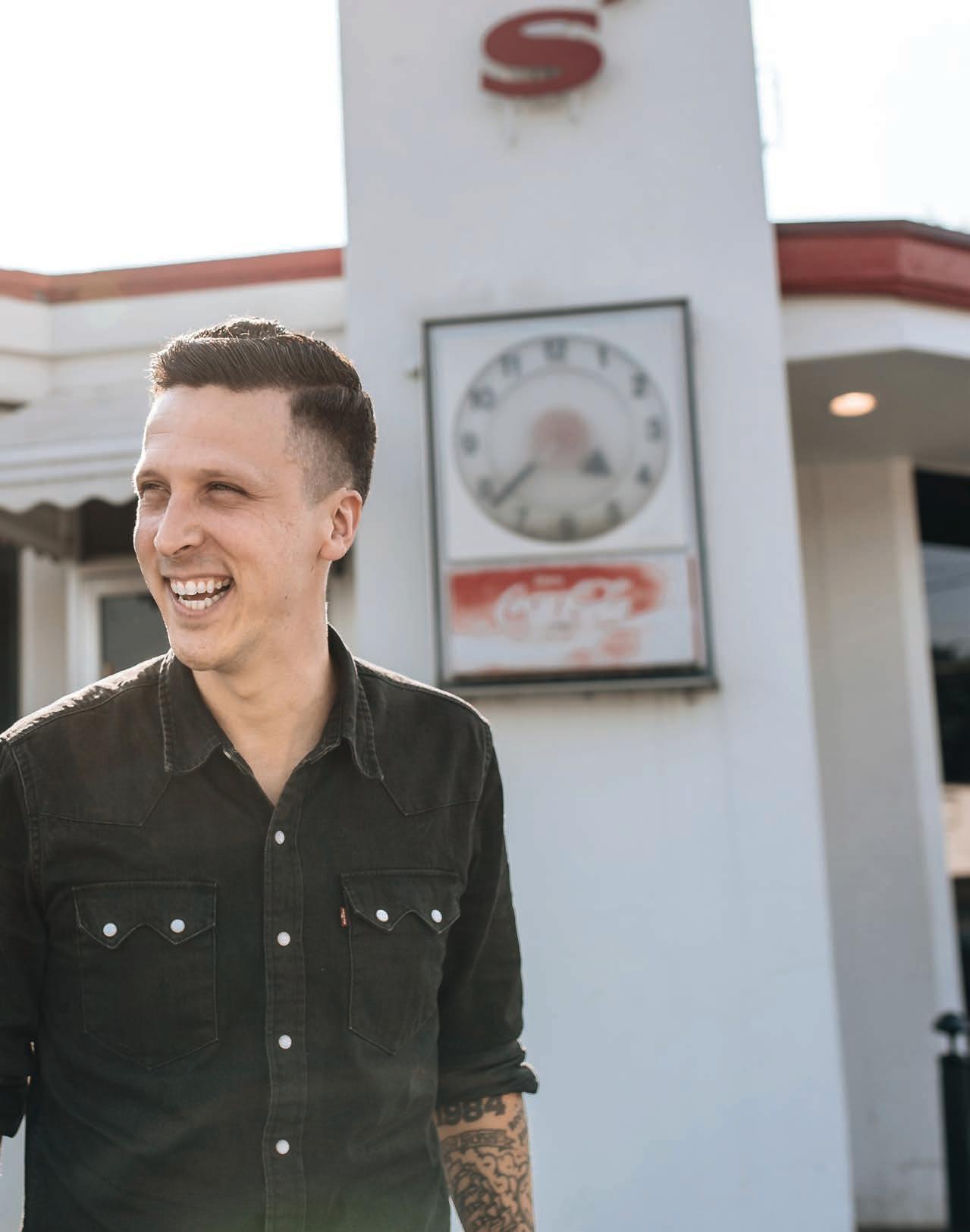
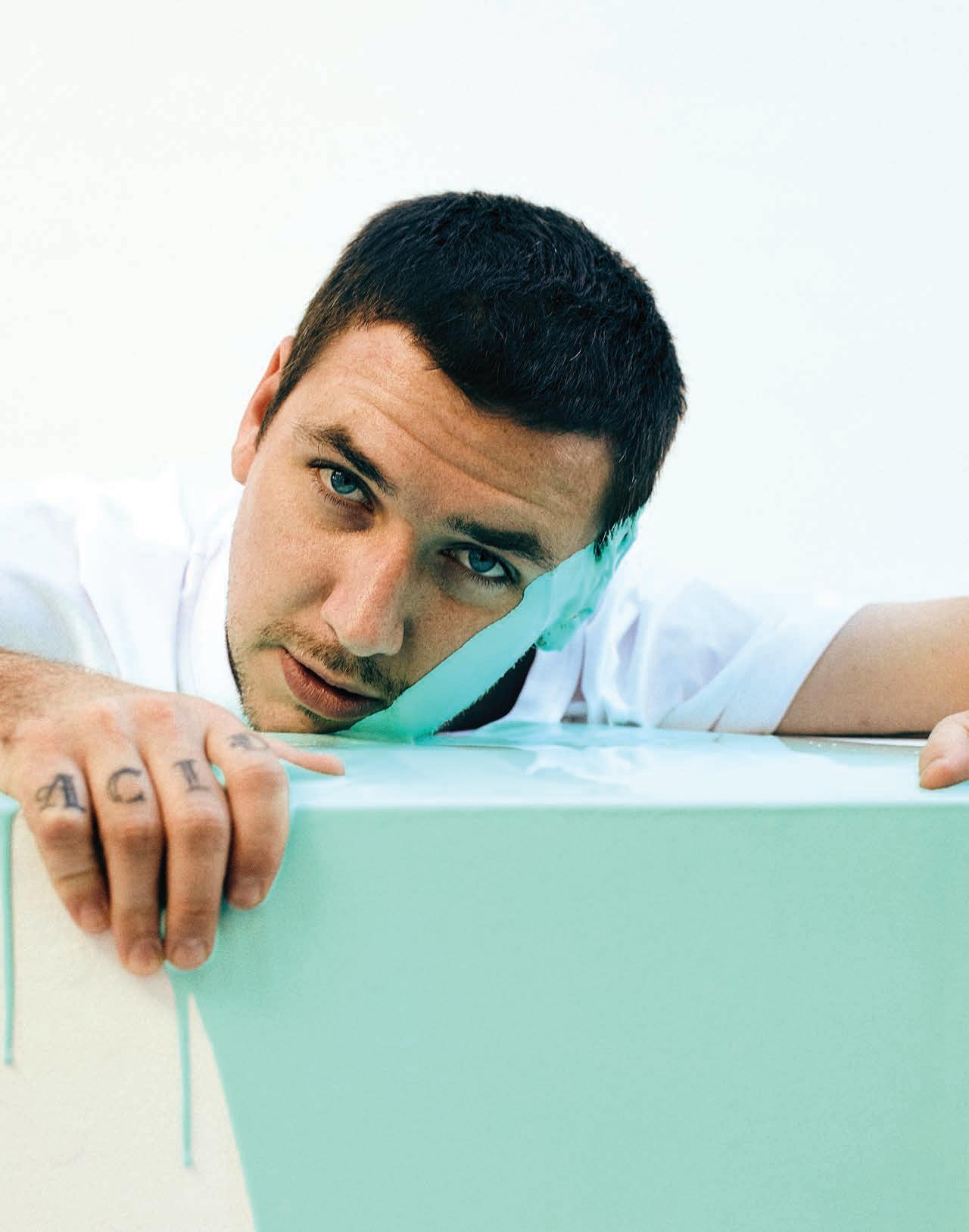
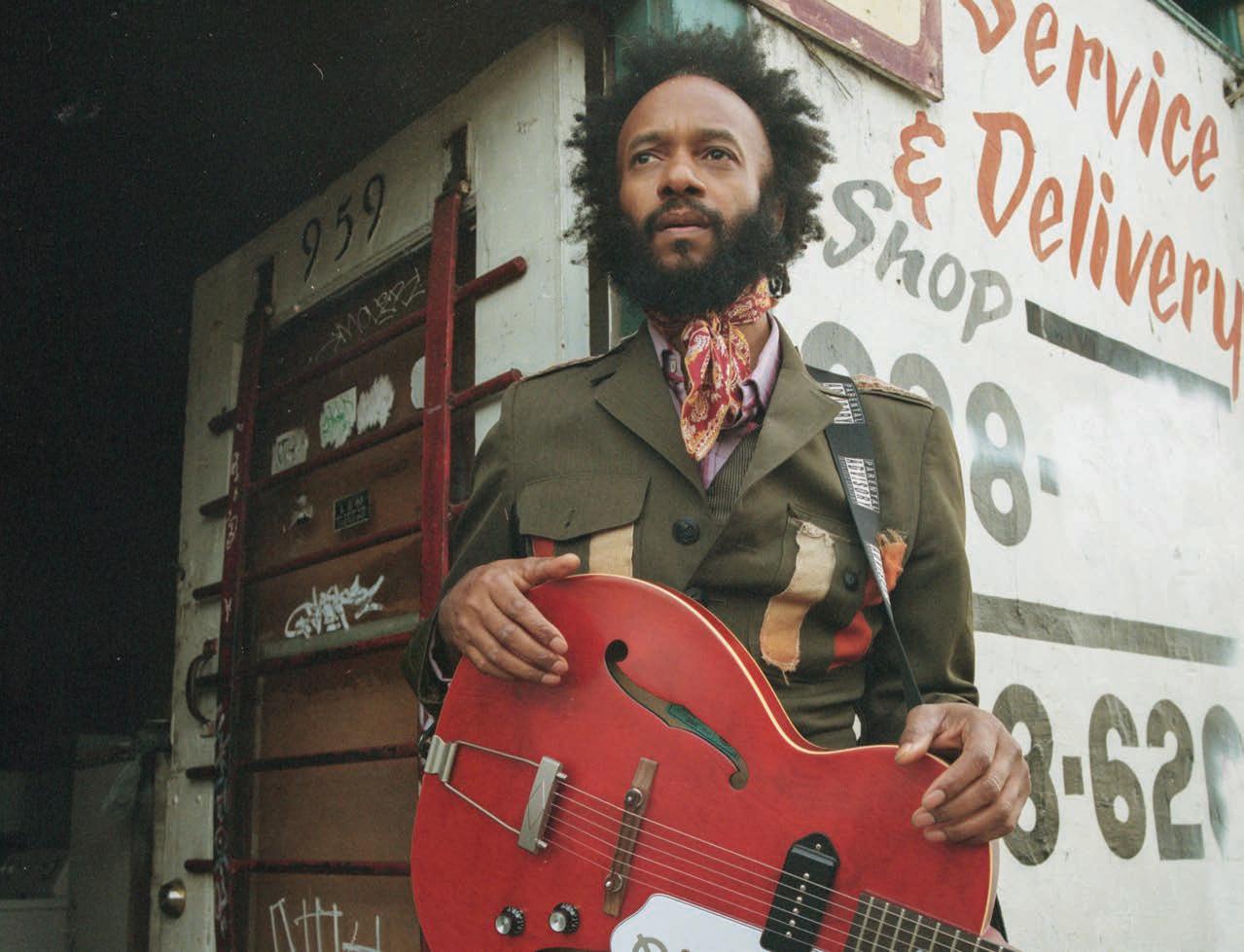
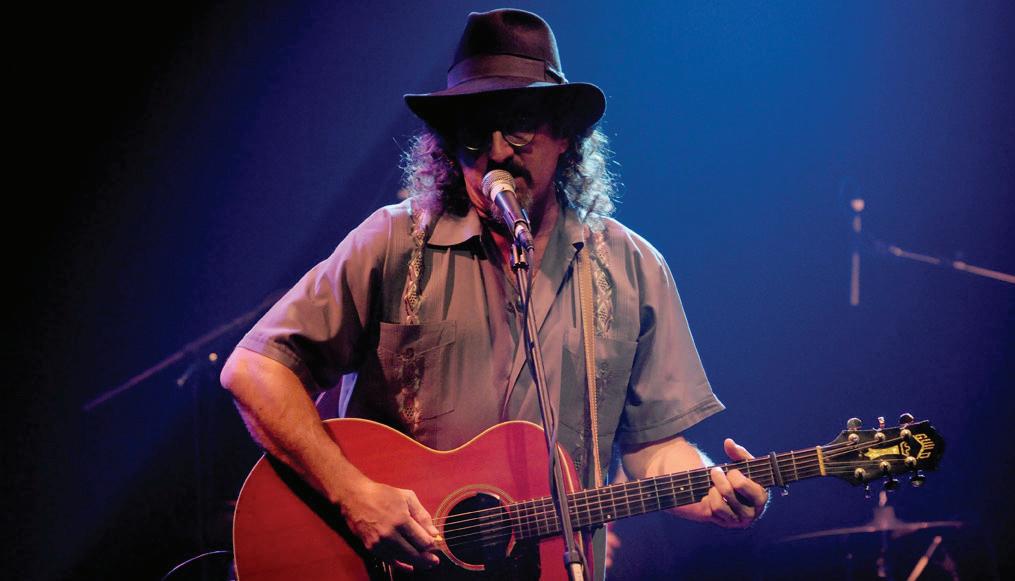
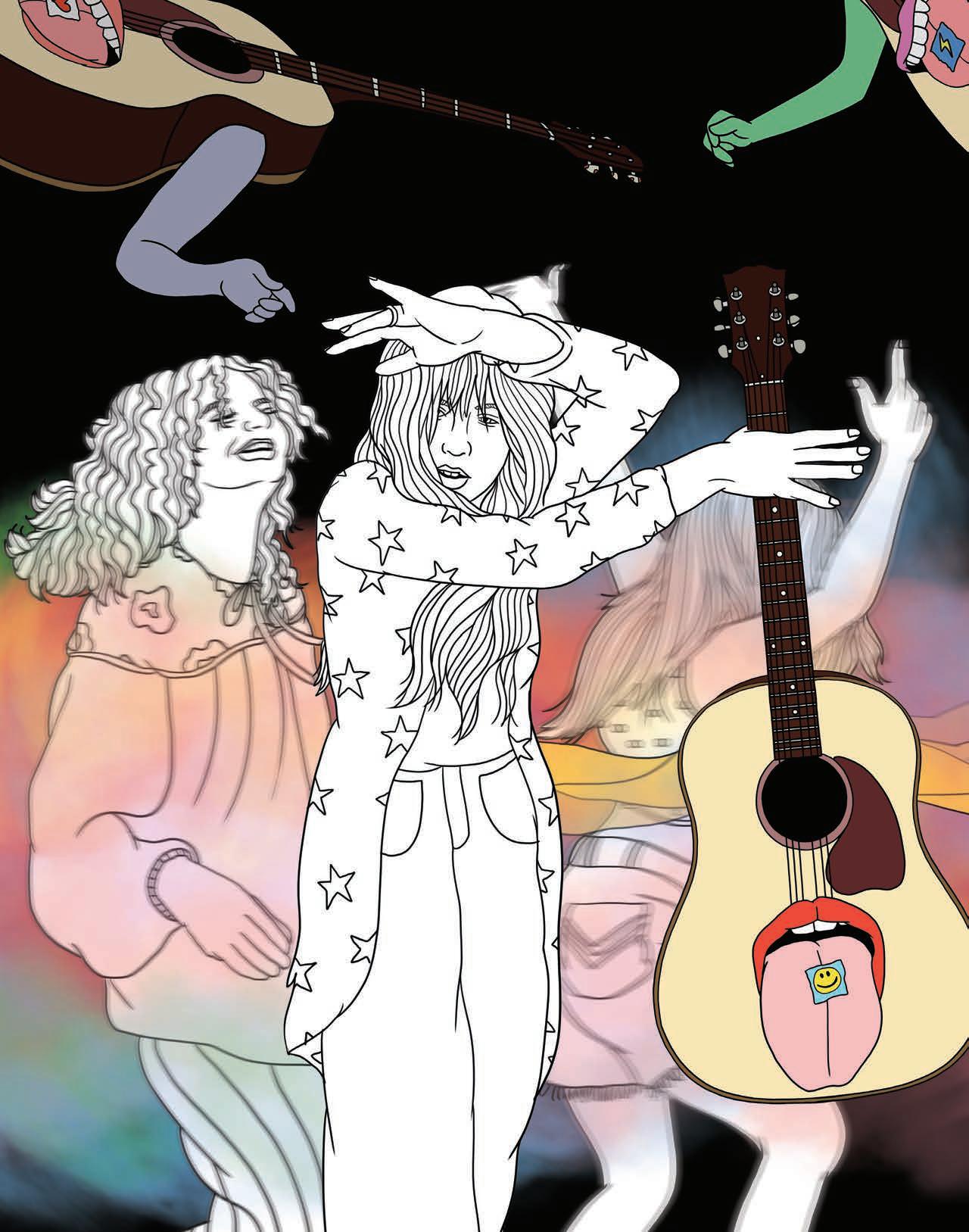
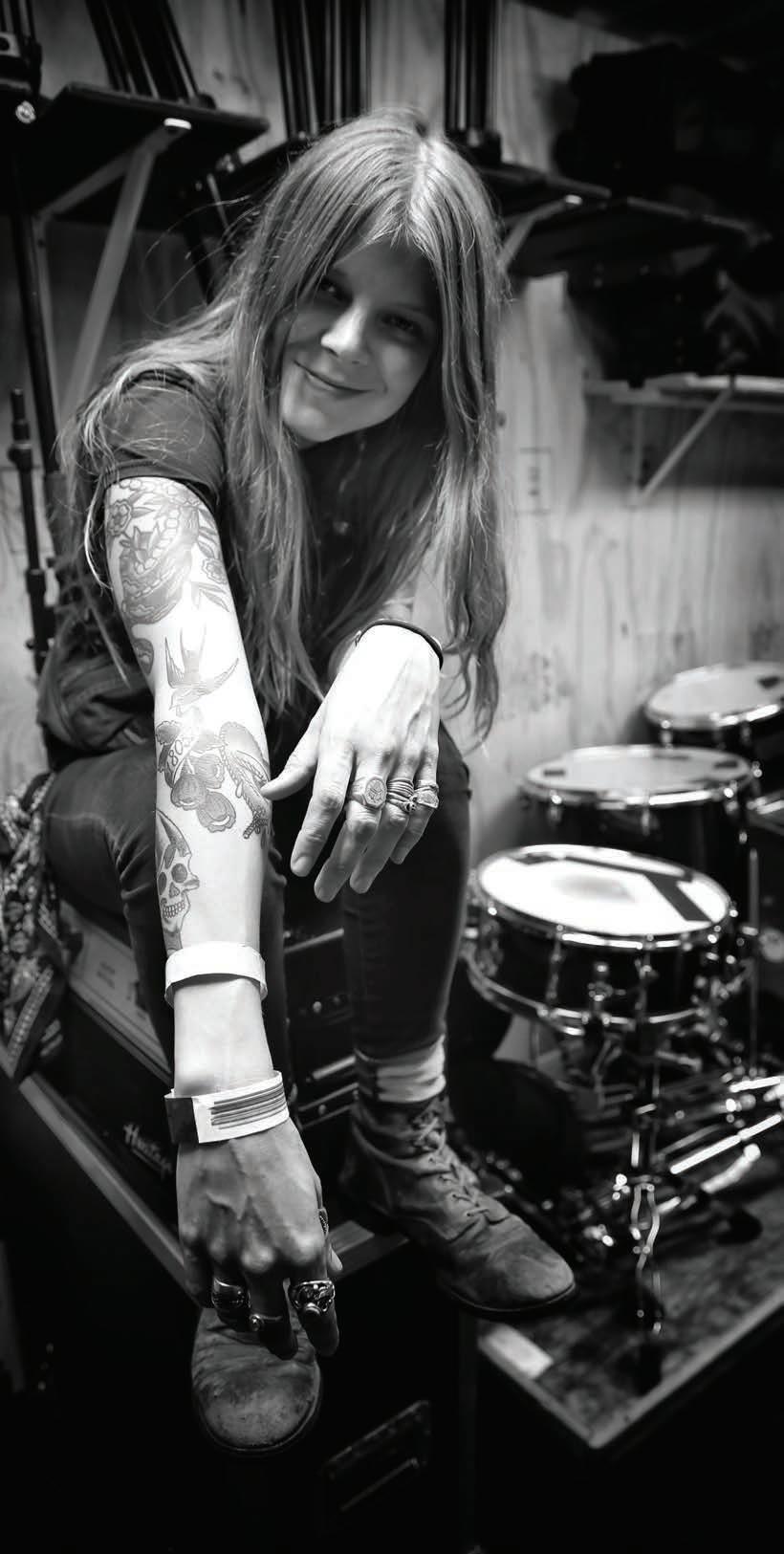
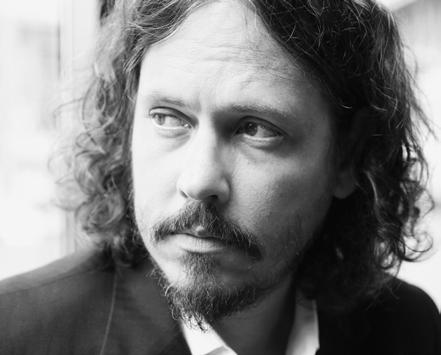
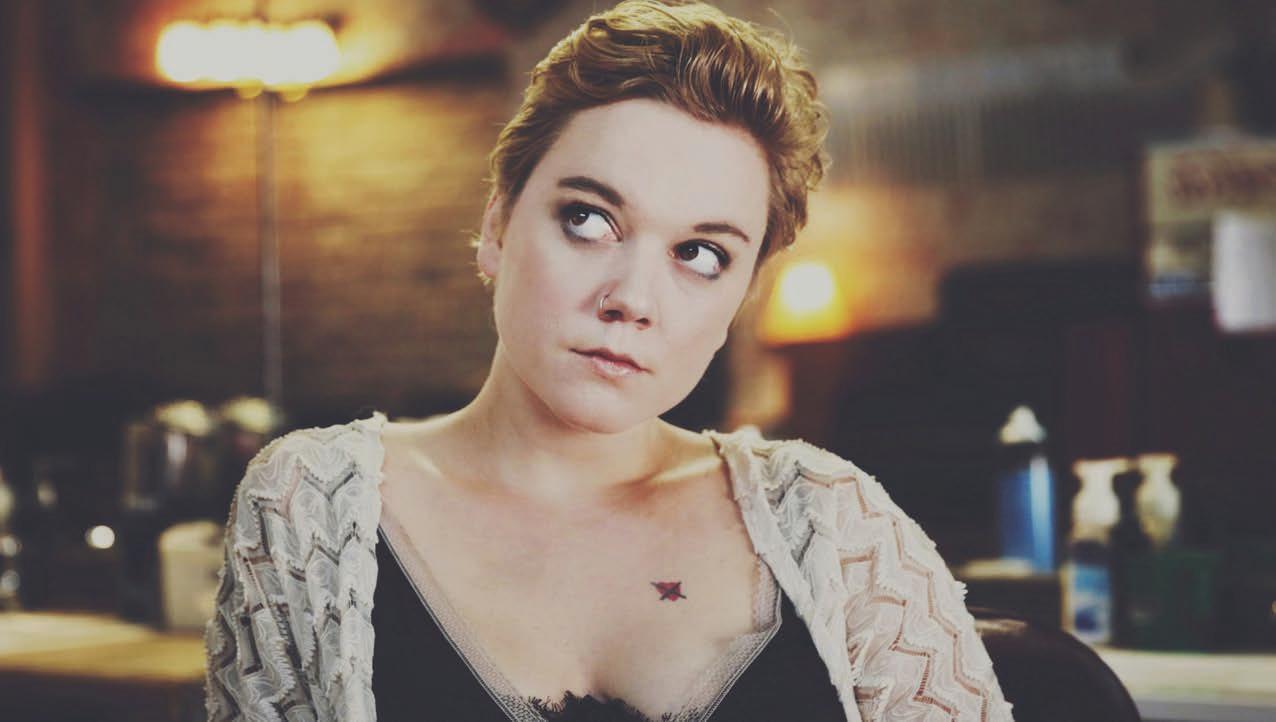
“Creating art in tiny ways every single day has helped me to work through my issues and keep me semi-balanced on this crazy tightrope we call life. It’s all just a balancing act.”
Steve Poltz, p. 99
by
Hilary Saunders
Meditation as a means for quiet, creativity, and connection by Kelly McCartney
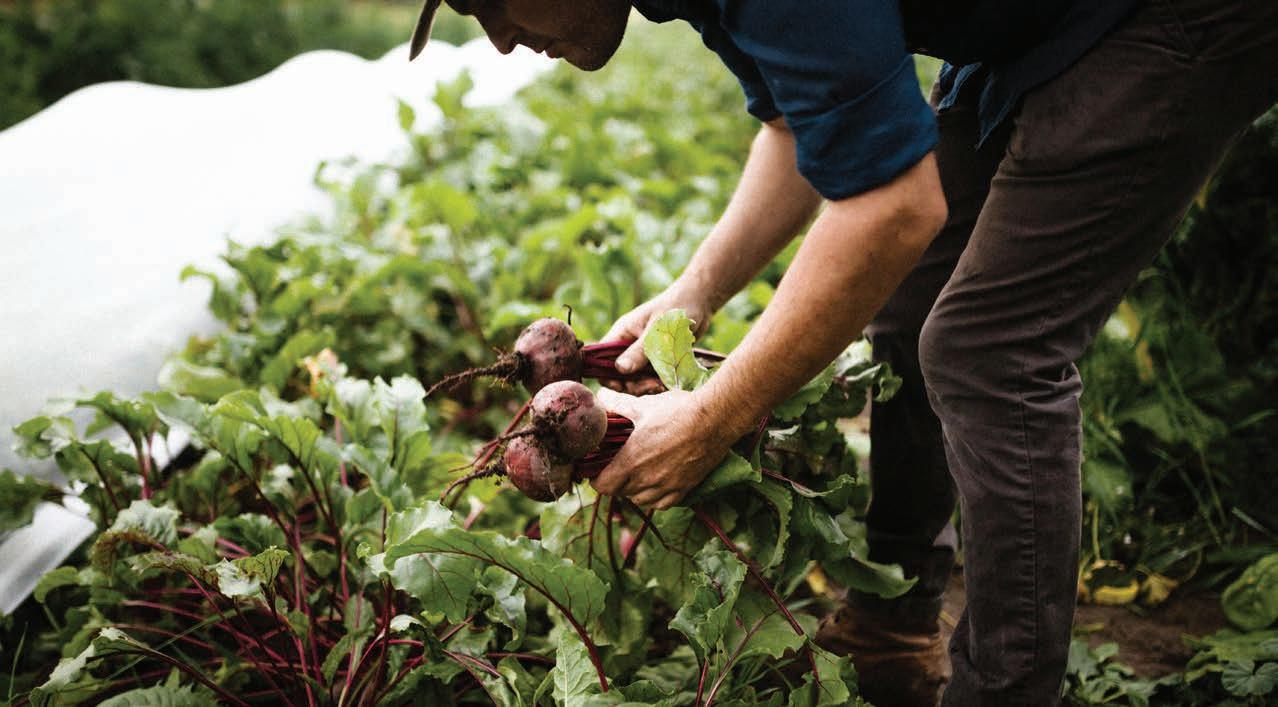
Eating well in the wilderness with Sean Rowe by Erin Lyndal Martin
Fly fishing with artists who use rivers as a respite from the road by Kim Ruehl
Inside the struggles and successes of sobriety by Laura Scholz
Family and forest help Daniel Norgren find balance by Corbie Hill
Frank Solivan cooks up connections with music, food, and the great outdoors by Stacy Chandler 48 FARM TO TABLE
Roots musicians connect to their local communities through food by Will Hodge
by Aoife O’Donovan
Tamari and Curry Sri Lankan Veggie Stir-Fry by JD Edwards
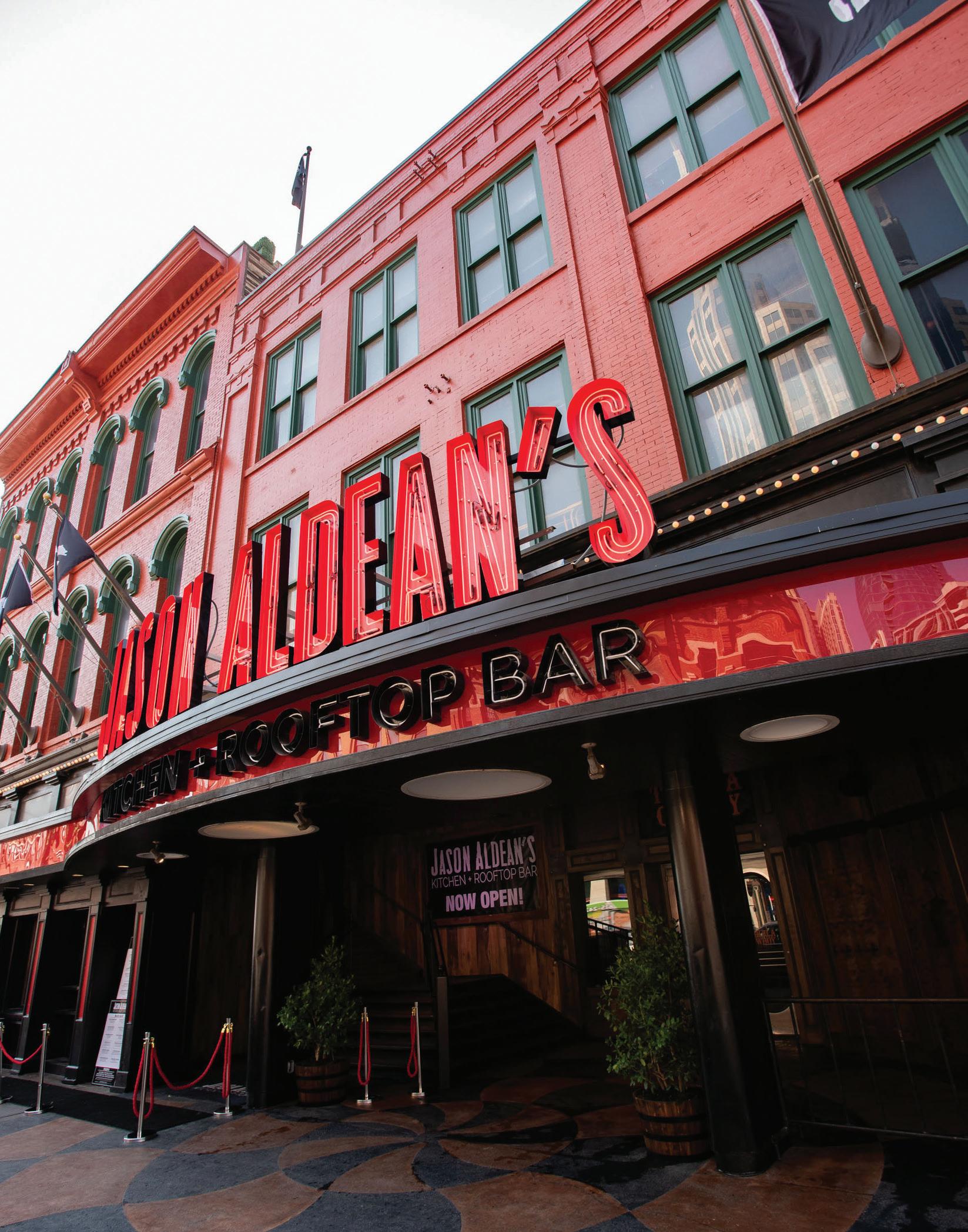
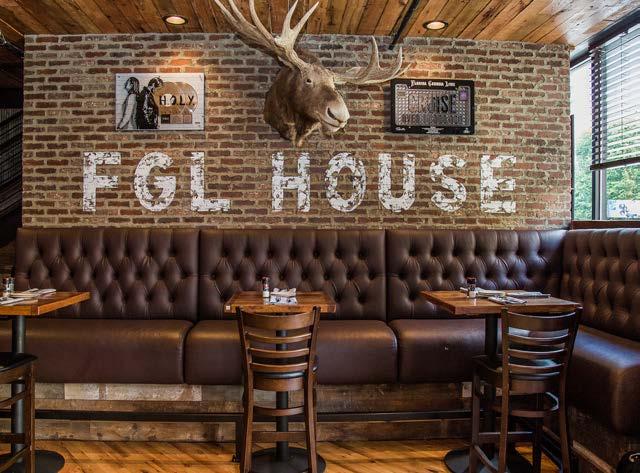
Music is on the menu in many of Nashville’s themed restaurants by Lorie Liebig
60 COME ON IN MY KITCHEN
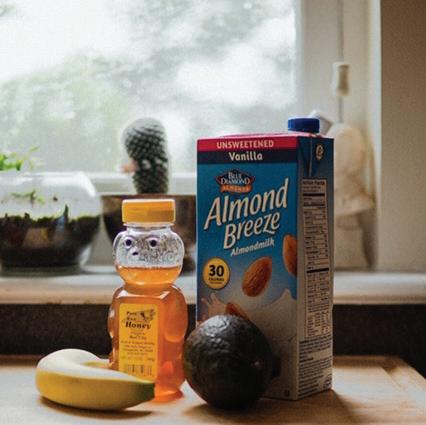
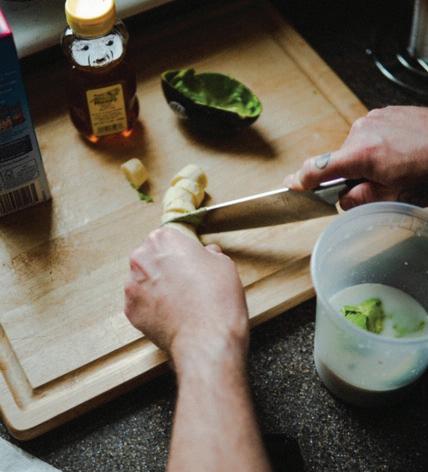
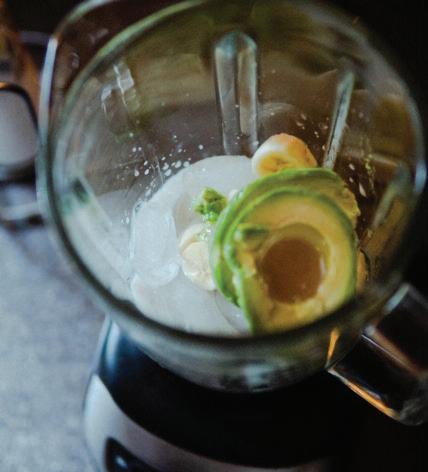
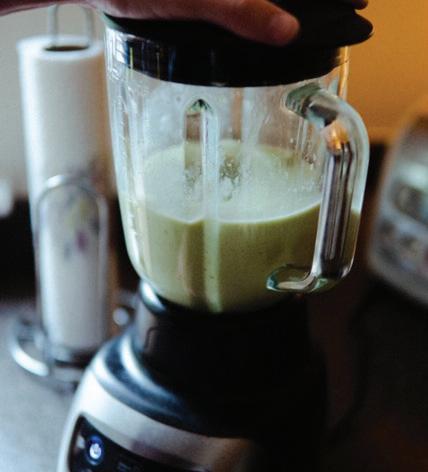
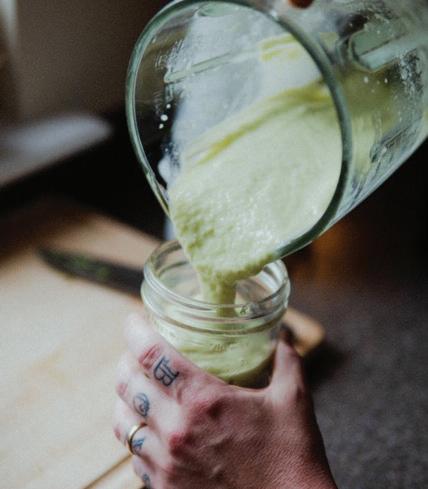
Avocado-Banana Smoothie by Justin Osborne
62 MESSAGE IN A BOTTLE
Lagunitas Brewing founder Tony Magee built an empire on roots music and beer by Greg Cahill
70 TAKING A TRIP
Seeking understanding through psychedelics by Allison Hussey
76 SOMETHING IN THE WATER
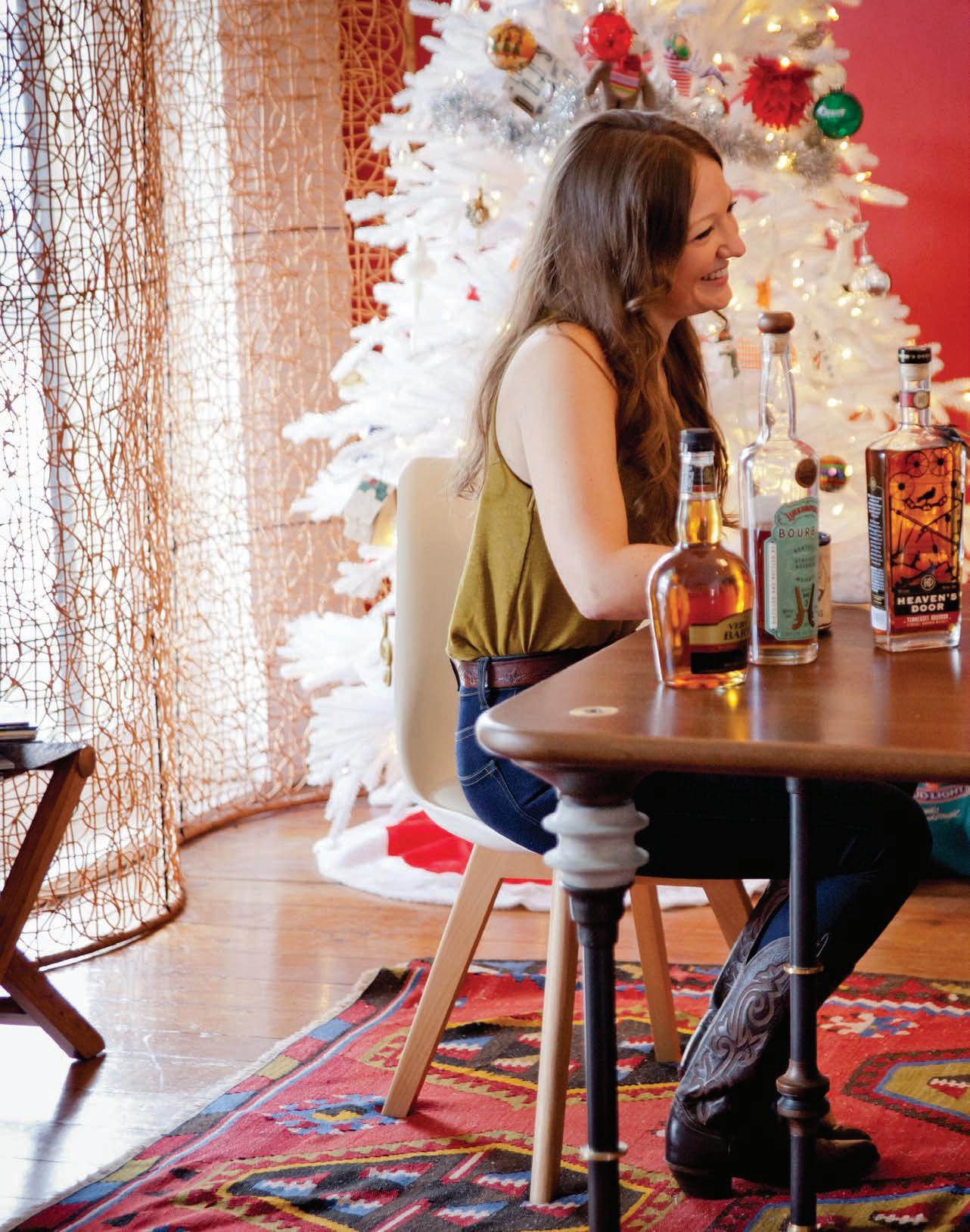
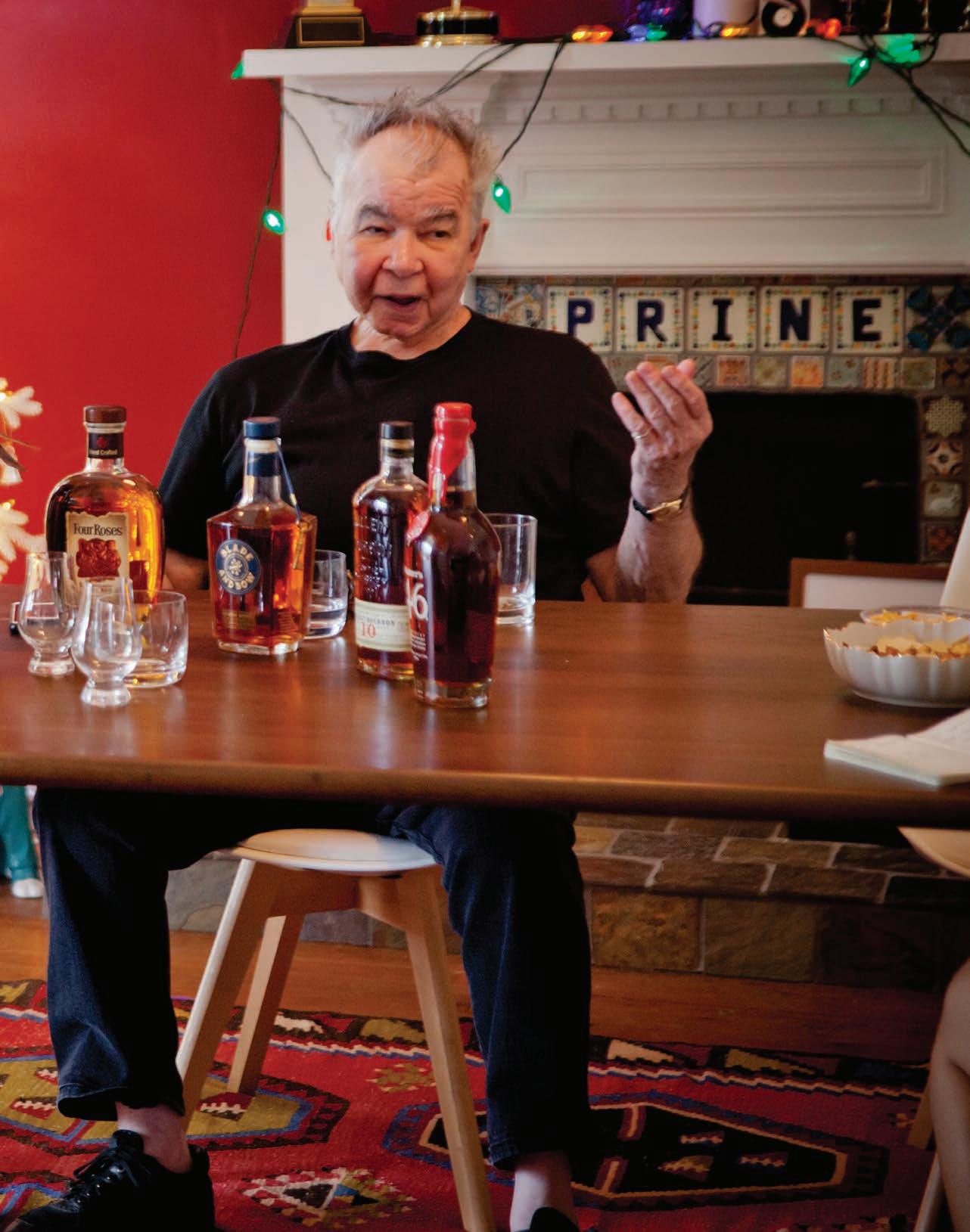
A bourbon tasting with John Prine and Kelsey Waldon by Hilary Saunders
82 CANNABIS QUEENS
Women in country are leading the latest pro-marijuana charge by Erin Osmon
88 COME ON IN MY KITCHEN
Big Raw Burrito by Rodrigo Sanchez
90 SINGING TO LIVE
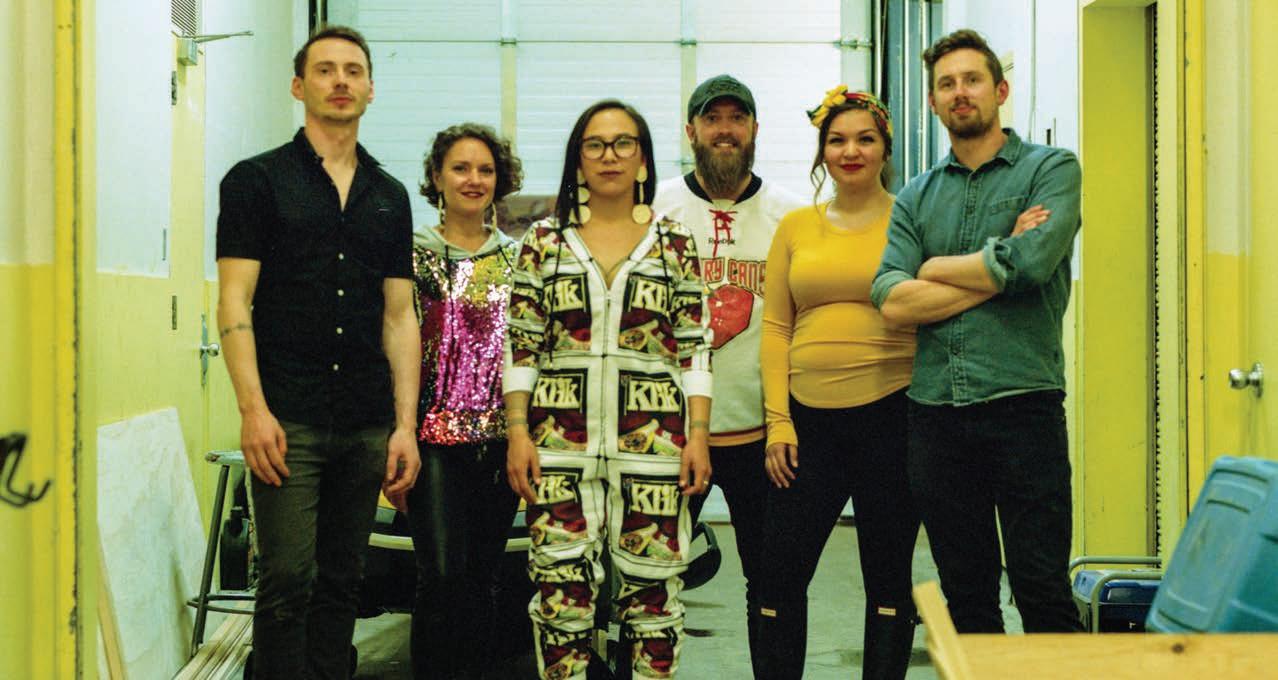
Inuit musicians in Nunavut draw upon tradition for modern survival by Stephen Deusner
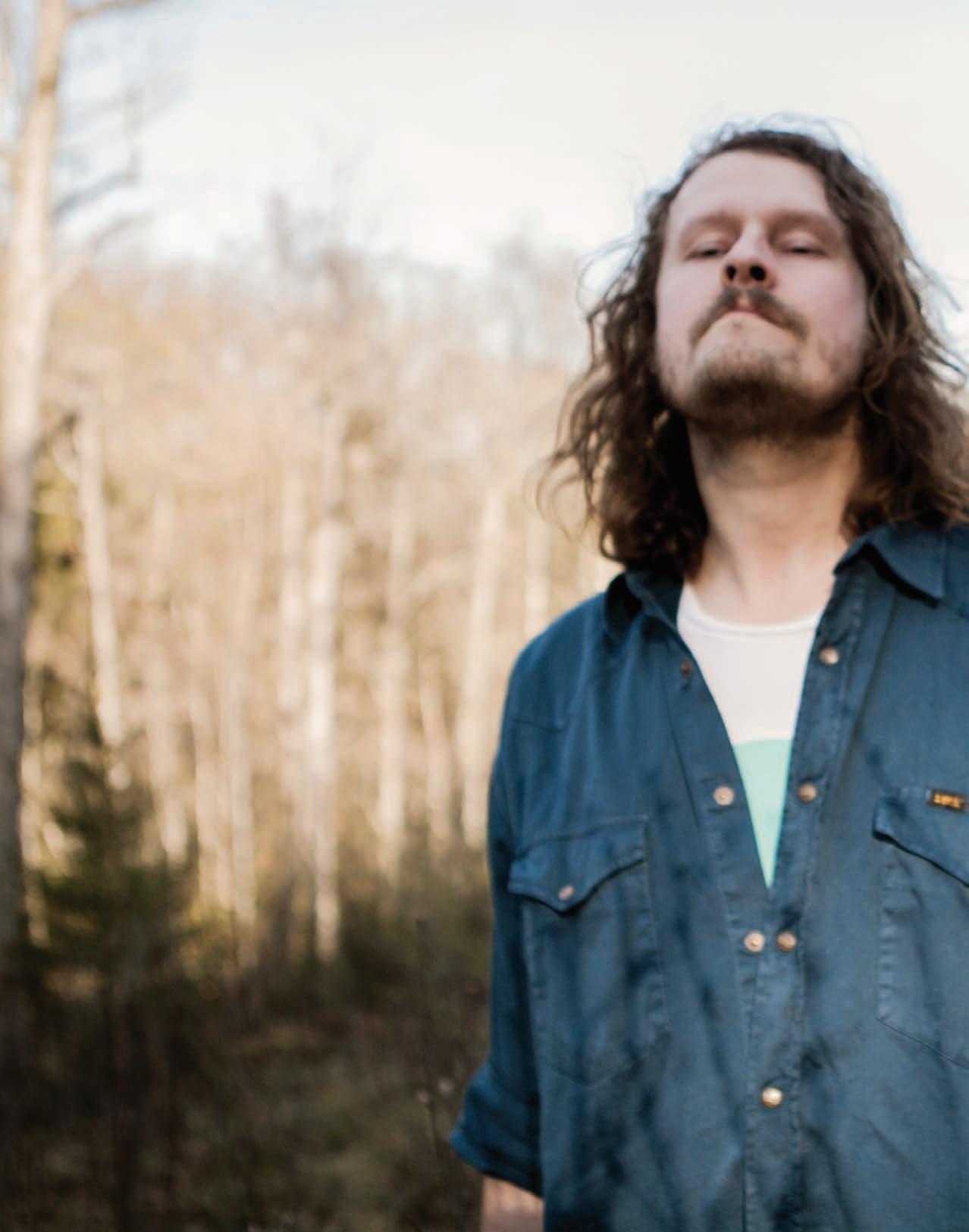
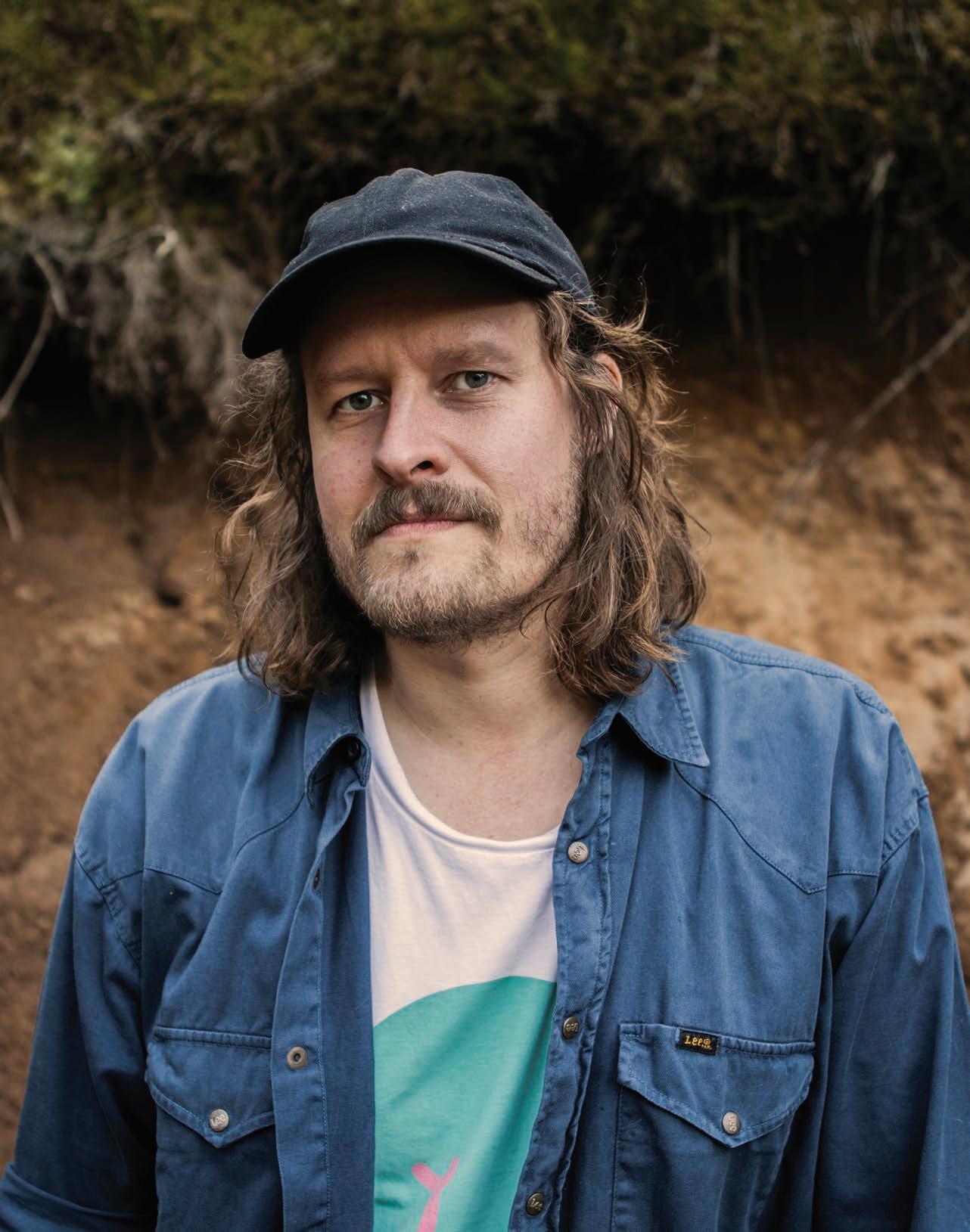
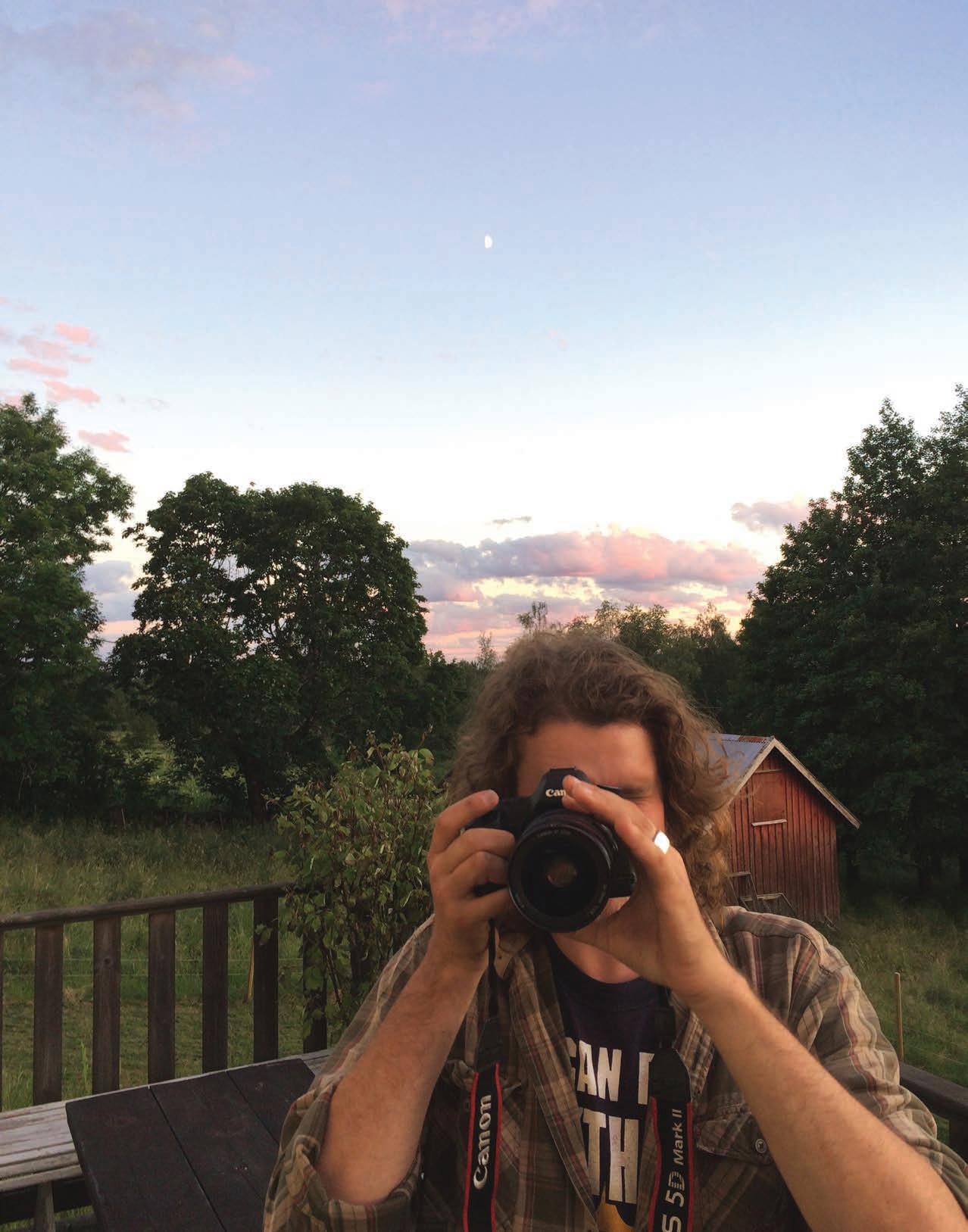
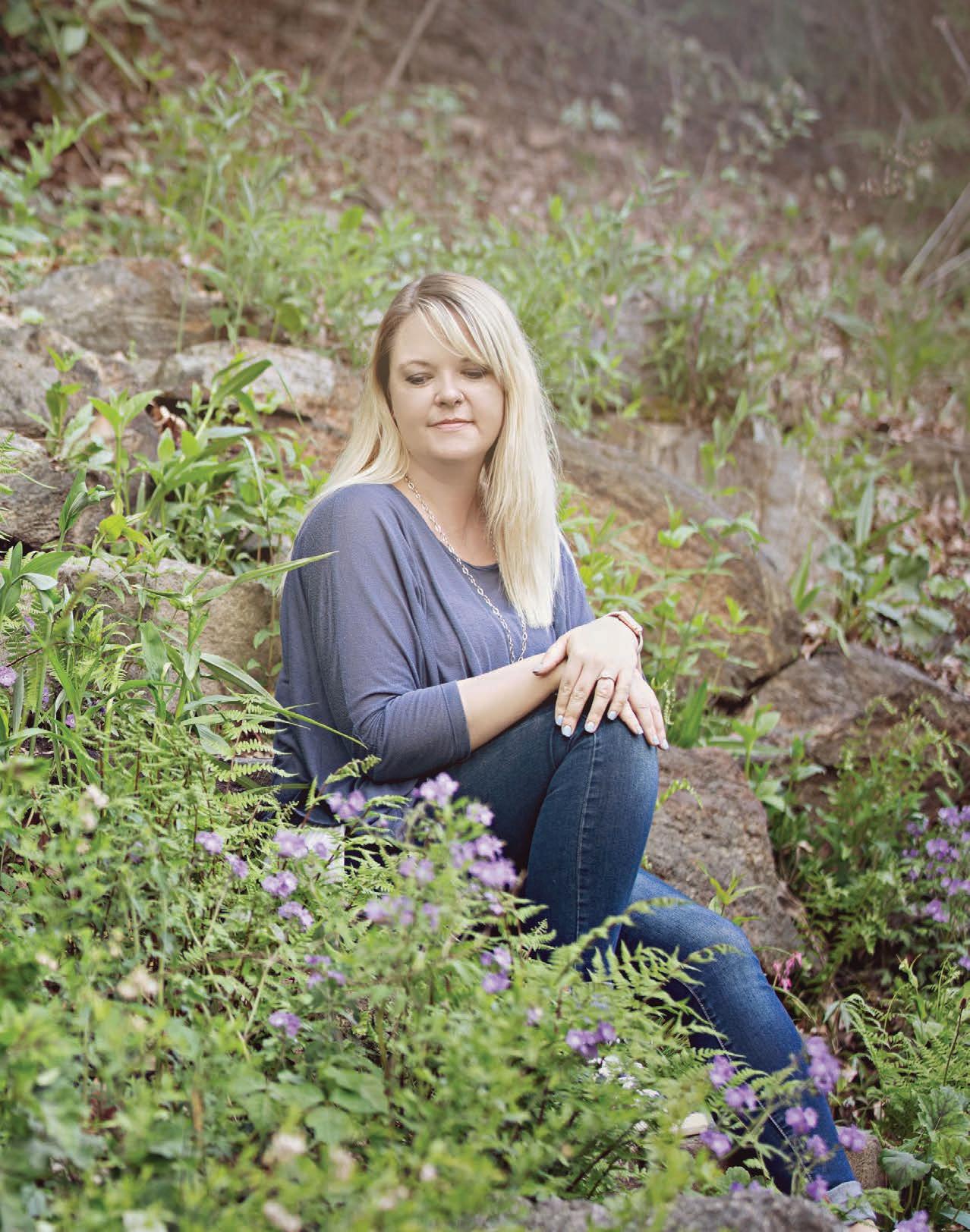
98 I DIDN’T WANT TO TELL YOU
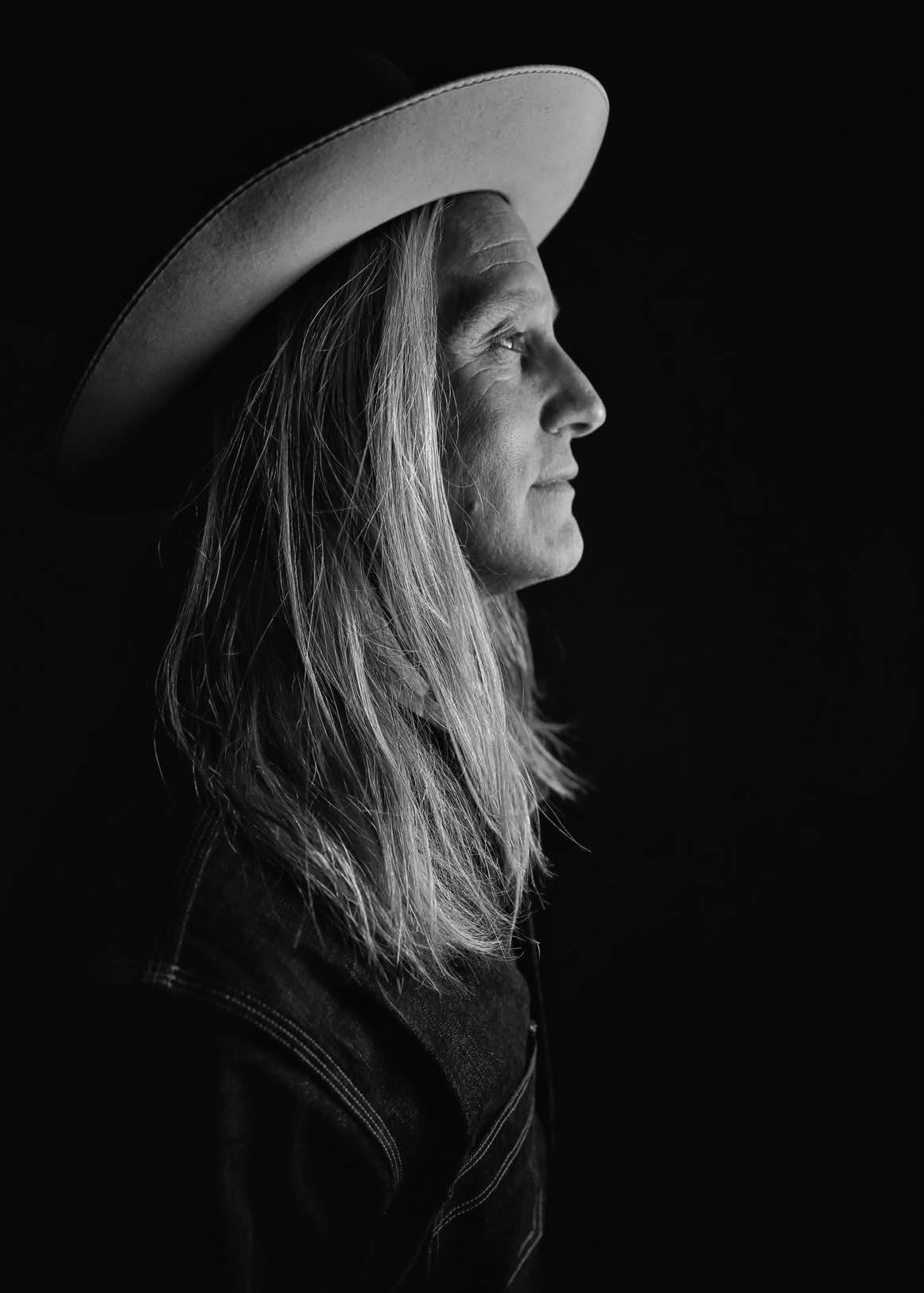
Portraits of roots musicians and the stories behind the eyes
Photo essay by Chad Cochran
104 BALLAD THERAPY
The healing power of a traditional tune by Liz Tracy
111 CONTRIBUTORS
112 SCREEN DOOR
Skills and philosophy by Chris Wadsworth
ON THE COVER
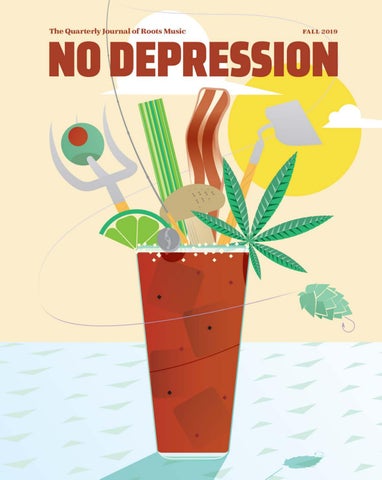
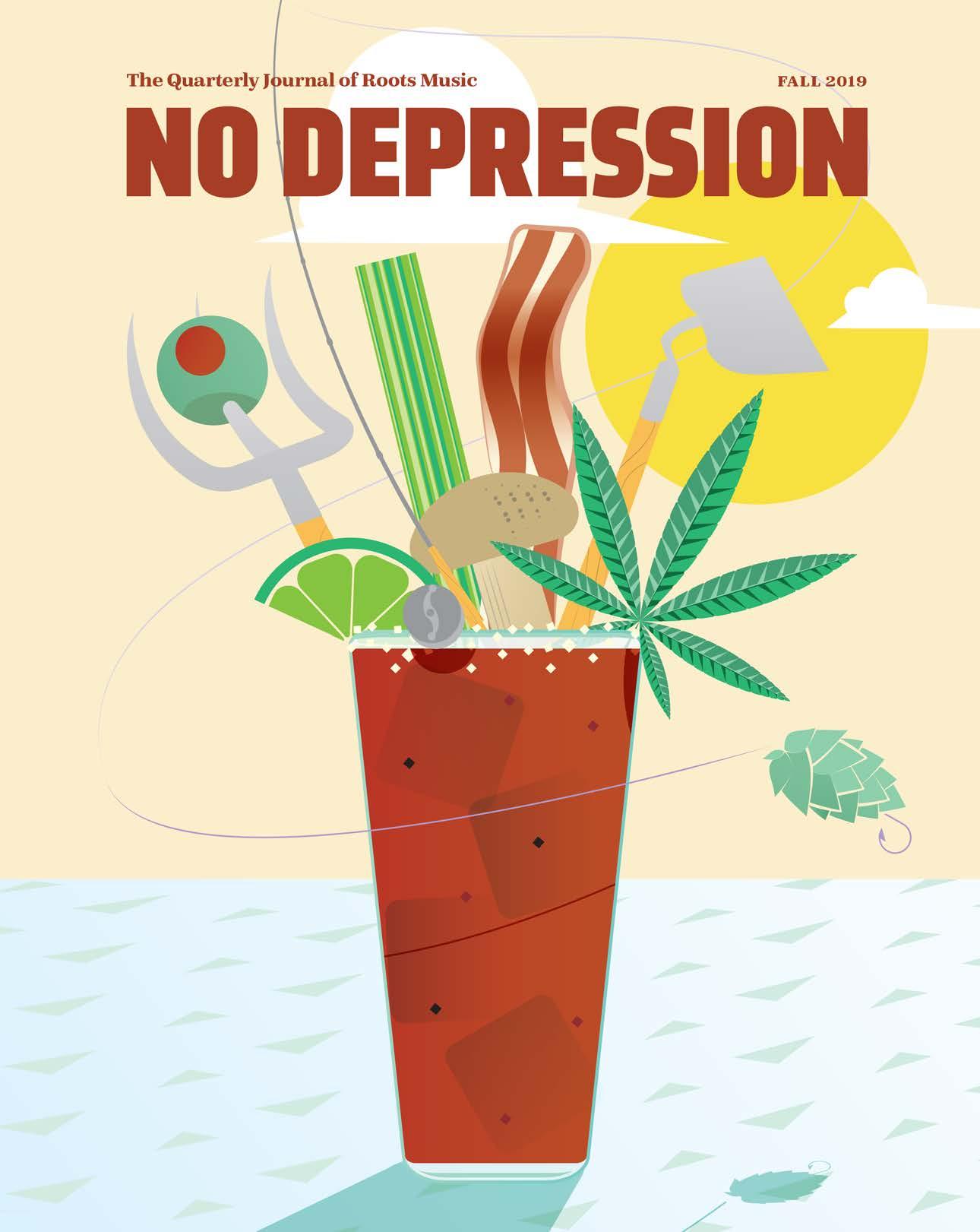
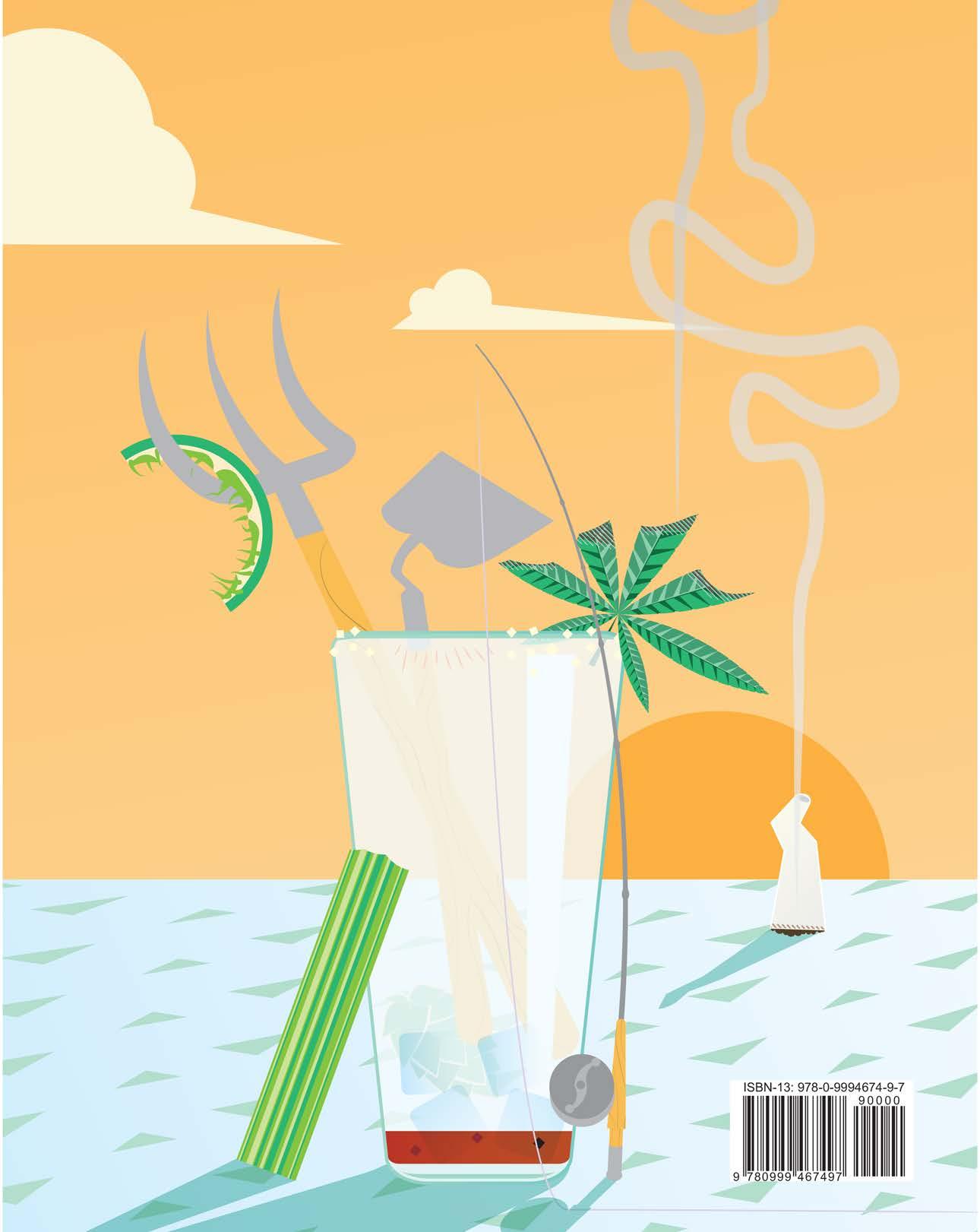
The cover of the “Wellness” issue features the work of Ivan Lima, a Portland, Oregon-based illustrator, graphic designer, and No Depression’s own webmaster. The concept of an overstuffed Bloody Mary cocktail represents many elements ripe for our take on a “food and drink” issue — beer hops, farming tools, fresh veggies, and a blunt butt. Stories in this issue tackle these topics of beer, weed, farming, and foraging in roots music, and much more.
It’s pretty standard practice in the magazine industry to do a “food and drink” issue, on top of the many entire publications devoted to the topic, such as Food & Wine, Saveur, and Bon Appétit, just to name a few. They’re effective in both content and sales; folks have gotta eat, and there’s always somewhere new and exciting to do so. Like musicians, many of those independent establishments often depend on such coverage to reach potential patrons.
But when we at No Depression started thinking about what a “food and drink” issue would mean in the context of roots music, the theme took on a broader scope — we’re calling it “Wellness.” Our metaphorical Slack channel cup overfloweth with discussions about whether roots musicians can eat it, drink it, smoke it, foster it, farm it, forage it, brew it, distill it, or completely abstain from it, and how else our community practices self-care.
Of course, there’s the trope of “sex, drugs, and rock and roll” (or in our case, roots music), and we wanted to make sure that stories in the “Wellness” issue fearlessly explore the use of psilocybin and help normalize the conversation about cannabis (especially in hopes that normalization leads to reparations for current and previously incarcerated people on possession charges for a nowlegal substance).
As a vegetarian for 23 years — in second grade, our spelling word of the week was “hamburger,” and as soon as I found out where hamburgers came from, I decided I wasn’t going to eat
animals anymore — sustainability and conscientious food sourcing were other important topics I wanted to cover. I’m thrilled this issue includes stories about Gregory Alan Isakov’s farm and Jade Jackson’s family restaurant and how their work on opposite sides of the food service industry impacts their musical careers and mental and physical wellbeing. There’s also a profile on Sean Rowe, who forages in the forest of his backyard to stock his kitchen with wild veggies and edible plants. And former No Depression Editor-in-Chief Kim Ruehl even got to go fly fishing with Woody Platt of The Steep Canyon
Rangers for some on-the-ground (or should I say in-the-water?!) reporting on how he, as well as members of Infamous Stringdusters and Trampled by Turtles, fish for sustenance, a sense of connection to the earth, and mental clarity.
Indeed, mental health is also a timely, necessary topic to address in this age of anxiety. “Self-care” can’t just be a word we put in air-quotes or memes and toss around like internet confetti. For roots musicians especially, tools like yoga, meditation, and sobriety have been literal lifesavers, and No Depression spoke with BJ Barham, Molly Tuttle, Liz Brasher, Jaimee Harris, and others about their practices. In another way of taking care, indigenous musicians in what’s now referred to as the Canadian Arctic are returning to generational musical traditions like throat singing and blending them with modern stylings, creating a celebratory, communal combatant to the rising number of suicides in the isolated region. It’s one of the most important, inspiring stories I’ve had the honor of publishing during my tenure at No Depression
I’m constantly in awe of the power of roots music to fuel us, heal us, and unite us, and that it’s literally my job to find, write, and share these stories with you. I hope you feel the same way and that you tell your friends! No Depression is dependent on readers like you to stay independent and keep fulfilling such a vital civic duty. Your subscription helps us share the musical stories that matter most.
ACTS OF LISTENING
Meditation as a means for quiet, creativity, and connection
by Kelly McCartney
Natalia Zukerman
“There was always that quiet after a song — that one second before anyone moved or made a noise — and that second felt like God to me. It still does. That second is breath. That’s meditation.”
Amilia K. Spicer
Singer-songwriter Peter Bradley Adams meditates for 20 minutes every morning. Sometimes he uses a mantra, but usually he sits and focuses on his breath in a practice that was first described to him as simply “letting the breath act upon you.”
“It’s sort of like if you were just looking at a painting or a flower, you let it act on you,” he explains. “And that could lead to many different experiences or sensations — or nothing — but you just follow it.” When he was 20, Adams’ aunt and uncle introduced him to this form of Vedantic meditation, as taught by Ramana Maharshi, an Indian ascetic, sage, and poet who amassed followers from around the world before he passed away in 1950, and he’s been practicing ever since.
The first documented records of meditation, or dhyana in Sanskrit, as a spiritual practice can be found in the Vedas, the oldest scriptures of
Hinduism, in India circa 1500 BCE. Though meditation may have been originally formalized in Hinduism, it quickly became part of Buddhism, Sikhism, and Jainism in India, eventually making its way farther east and west into Taoism, Baha’i faith, and the Abrahamic religions of Islam, Judaism, and Christianity. Many pagan, indigenous, and new age philosophies also incorporate some form of meditation, which is why the myriad ways to practice it reflect the many paths that embrace it.
Whether mantra or metta, sitting or singing, whirling or walking, there is no right or wrong way to meditate. If your intention is to meditate, then you are meditating. And its benefits are numerous, ranging from inner calm to enhanced creativity, which may be why so many musicians turn to it.
A seeker’s questioning spirit has always been present in the music that Adams makes, from songs like “The
Longer I Run” to “Good Man,” with Ramana Maharshi even being honored directly in “Chant,” off his 2006 LP, Gather Up. For Adams, meditating “brings an awareness which draws me out of thinking of myself and my life being so singular and separate.”
“Of course,” he continues, “it’s difficult to walk around all day with that awareness, but to just have glimpses of it and to keep turning back for more glimpses has changed how I interact with the people around me.”
Adams appreciates the direct experience of his spiritual beliefs that meditation offers. “I’ve always been taught not to view it as a way toward self-improvement. That kind of defeats the purpose. So I try not to ‘use’ it,” he says. “But, then again, it’s given me a sort of detachment, which can help me not take myself or any of this too seriously.”
Most contemporary practitioners do build goals in, though they are generally far less lofty than the samadhi (enlightenment) sought by lauded Yogic philosophers and practitioners in centuries past. These days, achieving some degree of mental clarity and/or emotional calm in such stressful, chaotic times is often enough. For many artists, an added bonus is the creative channel that opens up as a byproduct of entering those still, centered states of being. From quiet comes lucidity. Adams draws the parallel this way: “I feel like meditating and creating are both really just acts of listening.”
Making a Connection
Irish singer-songwriter Ben Glover started dabbling with meditation about eight years ago. After some fits and starts, he eventually fell into a daily
routine of sitting for up to an hour thanks to some formal guidance from “Cosmic” Clive Culbertson, an Irish musician who is also a Druid priest. Glover’s practice was a natural unfolding, as he believes we all meditate, in some form or another, whether we know it or not. To him, it’s something in our inherent nature — it’s happening in the moments where we feel connected and respond with a knowing smile, if only internally. In his estimation, taking a walk is meditating. Enjoying a view is meditating. Listening to music is meditating.
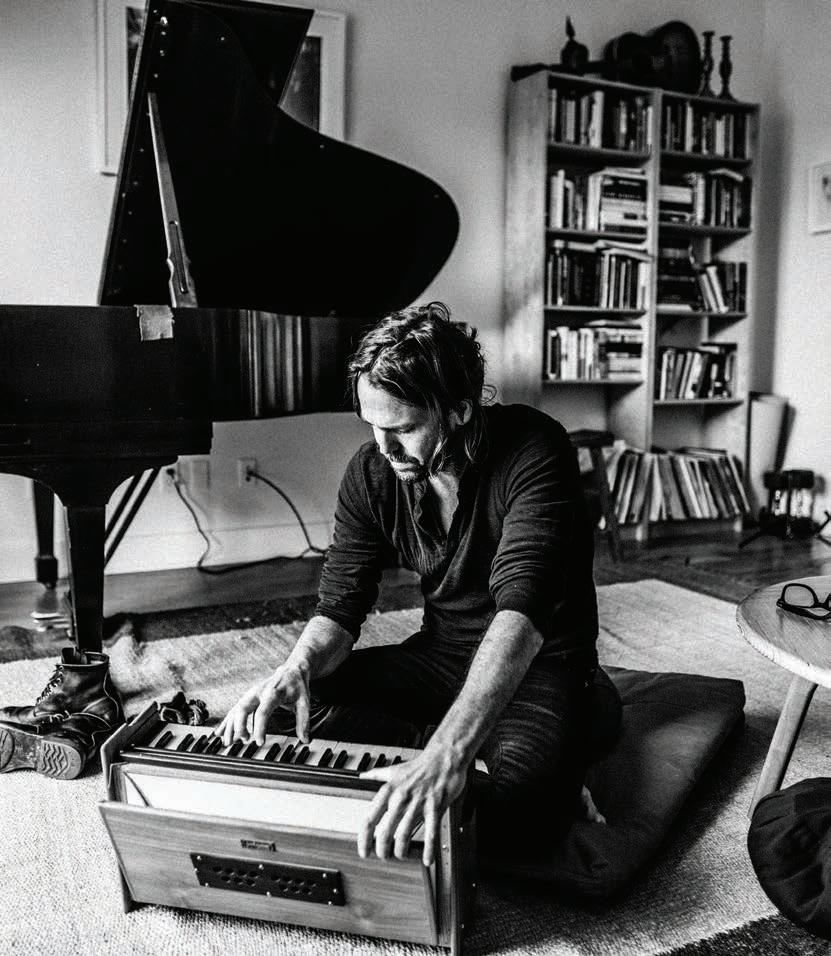
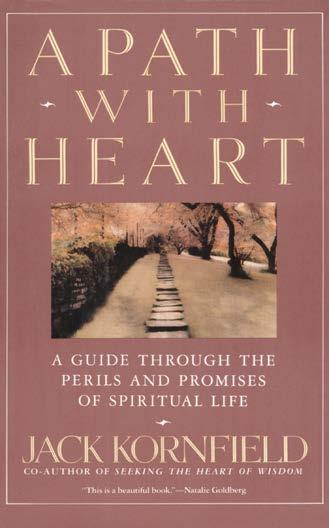
After searching around for a path to follow, Glover felt drawn to vipassana, also known as insight meditation, which is the oldest Buddhist meditation practice, the goal of which is to chip away at the walls of illusion that surround us. During his studies, Glover came upon Buddhist mindfulness masters Tara Brach and Jack Kornfield. He loved Kornfield‘s guided meditations and use of language in his book, A Path with Heart, so much that he recently began the Mindfulness Meditation Teacher Certification Program with the pair.
Glover views meditation as an integral part of his connection with a
Peter Bradley Adams
Molly Tuttle
force that is both more omnipotent and more precise than he is, seeing it intrinsically linked with creativity in much the same way that Adams does. “They both come from the same source and the intent is the same — the intent being to drop into that state of flow, presence, and connection,” he says.
Glover’s work, both as a solo artist and as part of The Orphan Brigade, evidences that he is very much open to whatever connections come his way, whether from the kindness of strangers or the legacies of saints. “I do believe in the sacred, the holy, an invisible connection that binds us all,” says Glover. “You can call this Christ, God, Buddha, love, energy, flow, etc. It’s a mystery. Meditation is a way for me to apply focused awareness to this mystery. It helps me accept the knowing and the not knowing, the waves of the ever-changing human and spiritual condition.”
His songs, then, become his explorations of those mysteries in which all of us are entangled — a search for his place in the geographic world, as on his 2016 album, The Emigrant; a look at his role within his creative community, as on 2017’s Shorebound; and an examination of life, death, and faith, as on The Orphan Brigade’s Heart of the Cave. The prayer of hope wishing goodness for the world offered in Shorebound’s “Kindness” is an especially puissant link between his spirituality and his creativity. It is, according to Glover, the purest expression of metta, which translates roughly as “loving kindness,” that he’s incorporated into his work so far.
Singer-songwriter and guitarist Natalia Zukerman echoes Glover’s
points. “I definitely view meditation as the way I connect to something bigger than myself, and the way I find authentic voice in my creative life,” she says, adding, “I take time to sit, to connect to the greater ‘out there,’ and the smaller and bigger ‘in here,’ too.”
An “anxious New Yorker,” Zukerman primarily does breath work meditation for 10-20 minutes a day, most days, and practices a guided relaxation technique called yoga nidra most nights to help her sleep. Jewish by birth and by culture, Zukerman took a Transcendental Meditation (TM) class in college, though she doesn’t really practice that or formal Judaism these days. On her latest project, The Women Who Rode Away, Zukerman recounts the ways various women have impacted her life at the intersection of spirituality, creativity, and sexuality with nearreligious experiences of everything from Georgia O’Keeffe’s paintings to Sister Rosetta Tharpe’s music.
Indeed, the spiritual component of meditation is a big part of it for her, though meditation’s more mundane benefits come in handy, as well. “I believe a conscious contact with God, as I understand God, has become my spiritual belief,” she says. “I often ‘meditate on’ choices I’m making — whether they’re creative, personal, or professional. Taking that time always leads me to a more thoughtful choice. Always. When I don’t, I can be reactive.”
Individual Paths
Meditation, by nature, is a singular, internal experience. So each person’s reason for practicing is just as individual. Having started her practice
about four years ago after a book by Tibetan Buddhist nun Pema Chödrön helped her through a painful breakup, folk phenom Molly Tuttle leans primarily on its practical applications, finding that it gives her more confidence and less anxiety both on stage and off. “It really helps me connect to my inner self,” she explains.
“Writing songs and playing music feels like meditation to me, in a way. It’s hard to separate which songs were helped by meditation because I think they are all written by connecting to myself and grounding down into what I was feeling at the time. A lot of times I have to give up ‘trying’ to write a good song and just go with what wants to come out of my heart. I think that practice of releasing is something I became aware of through meditation.”
It’s not just Tuttle’s music that benefits from her practice, though. She also finds that being able to curb her anxiety is a vital tool, especially now that her life regularly involves traveling, talking, and performing in unfamiliar places with unfamiliar people in support of her latest release, When You’re Ready.
“When I meditate every day, I feel kinder and more compassionate to others and to myself. I have less anxiety, so I can spend that energy on others or on fully enjoying myself,” Tuttle says. “I was also anxious about how my album would be received. Going to meditation classes and groups when I was home really helped me have a break from it all and unwind during my time off. It feels good to put aside that time for myself.”
Having dabbled with TM and breath work, Tuttle uses guided meditation apps — including Headspace and Calm
almost every morning for 10 minutes. Such is meditation’s flexibility, Tuttle engages with her practice in a metaphysical way, while also being an atheist. “I think meditation helps me find spirituality that aligns with my beliefs and doesn’t hold me to any organized religion.”
Blues/soul singer Liz Brasher, on the other hand, knows all about organized religion, having grown up in a fairly strict Southern Baptist household. To do something as simple as listen to the radio, she had to hide in the closet. Her introduction to meditation came about a year ago, after her husband, Joe, started exploring it. Brasher saw the difference it made in his life and gave it a try, settling into a 10-to-15-minute daily practice of meditative prayer and mindfulness, often using the Headspace app as well.
“Meditation is a way for me to clear my mind to be able to tune into a spiritual frequency that I’m usually not able to do,” she says, referencing her often loud, adrenaline-filled life on the road. “Our world is so busy and highly stimulated that taking a few moments to be still and commune with our spiritual selves and God is really difficult. In prayerful meditation, it’s a special moment when I get to listen to God, not just talk to or at God.”
While meditation seems to have a strong tie to creativity, it can benefit
those who simply want some peace in their lives as well. Los Angeles-based singer-songwriter Amilia K. Spicer found her way into meditation through that path. An intense practice of hatha yoga eventually led her to seek out other yogic exercises and begin meditating. “I’ve started over and over again with meditation in the last 10 years,” she confesses. “I say it that way because, frankly, I kept feeling like I was failing at it. I’d get frustrated when it didn’t come easily, and all the monkeys up there in my mind were swinging from trees, throwing crap at me while I tried to sit quietly. But I kept at it.”
Much like physical exercise, spiritual disciplines do get easier with practice, though they never get easy . If either ever does, then the stakes need to be raised, for in the tension lies the progress. “It’s still a challenge for me,” Spicer says. “It turns out the word ‘practice’ is key, and the practice of meditation is worth doing, wherever you are on the path.”
A lover of science, Spicer also thought her way into taking the plunge that has led to a breath-based practice of anywhere from 15 to 60 minutes a day. “I read studies of well-documented health benefits, talked to friends who seemed to be calm and balanced, and I started to feel like I was missing out on a superpower,” she says. “The rewiring of neurons in our brains, that’s the holy
grail for personal evolution. How do we change, become, grow into what we wish to be?”
Spicer grew up in the Methodist church, but has long since abandoned religion for spirituality. Still, she fondly remembers the moments of real connection that music made between her and a higher power, all courtesy of the church choirs. “There was always that quiet after a song — that one second before anyone moved or made a noise — and that second felt like God to me. It still does,” she says. “That second is breath. That’s meditation. I get to sing songs now and experience that on stage, so that pin-drop second is still the most beautiful and calming thing in the world to me ... though my church now resides in the white pines or the Shenandoah Mountains or the Mojave Desert.”
That tiny moment of union with the universe, to put it in the broadest of terms, is what seekers of all faiths have sought for centuries, hoping, praying, and practicing their way toward an eternal connection. The key to keeping at it is knowing that the eternal is already there in the tiny.
“For me, meditation, like music, lowers a ladder from the ether and, if I’m lucky, I get to climb up for awhile and see things from an ego-less view. That is where the air is best,” Spicer says. “It is usually a fleeting moment that
transcends troubles and worries, but that’s exactly the point — you get it for even a second and it’s like a gateway drug to finding real evolution as a human.”
Each person’s starting point, path, and practice are different. None of that matters as much as just taking the time. Because he’s currently studying to teach meditation, Glover has as committed a practice as any, and it’s still malleable. “Most days, I’ll sit for 45-60 minutes. If that is not doable, then I’ll still make sure I sit, even if it’s for 15 or 20 minutes,” he says. “It’s vital for me that I carve out time every day for it, and I’ve found that the daily repetition of it is more important than the actual length of time.”
Whether for stress management or creative muse, meditation benefits all who give it a go. “The more I practice, the more I learn to let go and trust the meditation process, and when I apply that same trust and acceptance in my life, I have seen things fall into place more,” Glover explains. “It has also helped me to stop chasing stuff that I thought was important, and has taught me to be at ease with what I have right here, right now.
“It’s my reset button,” he says. “Every time I sit, it’s like a coming home to myself, a reconnection. Having that in my life is huge and it enriches the quality of everything.” ■
The artists interviewed recommend these resources:
Books
• A Path with Heart by Jack Kornfield
• Falling Awake: How to Practice Mindfulness in Everyday Life by Jon Kabat-Zinn
• Healing Emotions: Conversations with the Dalai Lama on Mindfulness, Emotions, and Health by Daniel Goleman and the Dalai Lama
• How to Sit by Thich Nhat Hanh
• Radical Acceptance by Tara Brach
• The Autobiography of a Yogi by Paramahansa Yogananda
• The Four Agreements by Don Miguel Ruiz
• The Illumination Process by Alberto Villoldo
• The Joy of Living by Yongey Mingyur Rinpoche
• The Places That Scare You by Pema Chödrön
• The Power of Now by Eckhart Tolle
• The Power Path by José and Lena Stevens
• The Writings of Nichiren Daishonin by Nichiren Daishonin
Apps
10% Happier (also a podcast) Calm Headspace
NATURAL FLAVORS
Eating well in the wilderness with Sean Rowe
by Erin Lyndal Martin
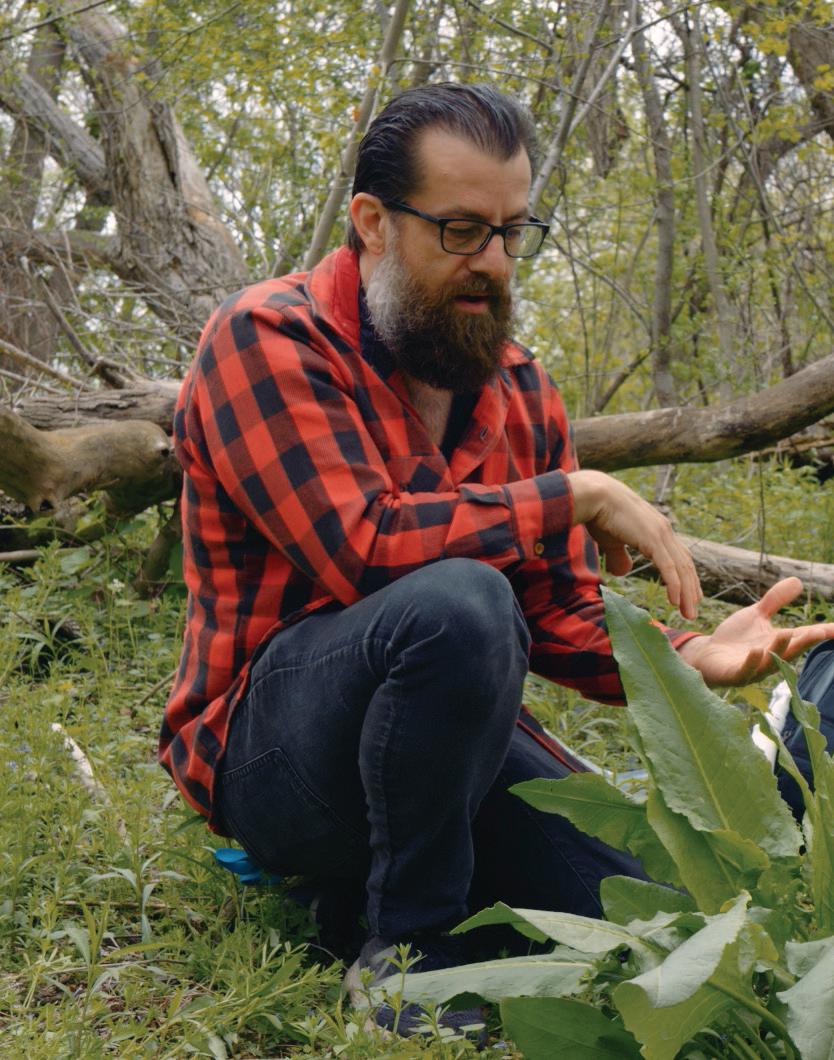
If you’re going to follow a burly man into the woods, Sean Rowe is a pretty good choice. Not only will you hear his beautiful baritone reverberate off the forest trees, but he can probably cook you a gourmet meal out of the wild plants he finds. That’s because, in addition to releasing a stream of five alt-folk LPs and three EPs (including this year’s collection of covers, Used Songs), Rowe is a forager who leads wilderness survival classes, blogs about wild plants, and even has a web video series, Can I Eat This?, that introduces viewers to such naturally occurring delicacies and how to cook them. In 2007, Rowe did a yearlong live-in survival course at Hawk Circle in Cherry Valley, New York, that culminated in spending 24 days alone in the woods. During that time, Rowe journaled everything from feeling like a rag doll during torrential rain to the sense that his shelter had become a living friend.
That Rowe could conjure such evocative imagery under extreme
circumstances is unsurprising to anyone who’s heard his songs. The Troy, New York-native crafts songs full of poignant imagery that connect the individual to the world, and that connection also informs his work with wild plants.
Playing music and learning about wilderness survival both came during high school for Rowe, who’d grown up sitting alone in his room listening endlessly to The Beach Boys and, with inspiration from Otis Redding, felt finally ready to sing. At 18, he wrote his first complete song, “Turtles.” That same year, he read Tom Brown’s The Tracker, a memoir of wilderness survival, which prompted Rowe to start his own blog and later attend Brown’s survival school in New Jersey. Being a professional musician came later; the singer-songwriter’s label debut happened when he was 34. Bearing his resonant baritone and gift for storytelling, Magic, released on Anti-, showcases all the ways listeners survive in our own personal wildernesses.
For Rowe, music and foraging work well together because each provides an escape from the other. Both passions, however, require deep observational skills. Looking for plants requires close vision to what may be hidden among other plants, under rocks, behind trees, and this necessary mindfulness means Rowe refers to foraging as a living meditation. “When you look at a plant and you think you know what it is, you better be damn sure that you’re right. The real way to do that is to start describing what you’re seeing, what you’re really seeing,” he says, adding that songwriting is no different. “That’s what it’s about, peeling the onion, trying to say something that you know is going to connect with somebody. You really have to peel that onion to remove the layers and get down to the core of what you’re trying to say.”
When Rowe talks about onions, there’s usually a good chance he means the leeks he finds in the forest. Or another spicy plant, like the invasive garlic mustard that kills off native
plants but provides nutrients and delicious culinary possibilities for humans. “The big thing is that it’s not only edible but it has the highest nutritional density of any wild green in North America. You eat that and get rid of it at the same time,” Rowe says with a laugh. As with all plants, he emphasizes that the taste of garlic mustard depends on when and where it’s harvested. “When I come across garlic mustard at the right stage, I’ll peel the stems and eat the stems raw and they’re a little bitter and potent. It’s a mustard green and it’s spicy. It’s really good boiled if you boil the stems at the right stage and you can make a pesto out of the leaves. It’s really strong but it’s really good.”
Rowe is also partial to the variety of leafy greens that grow in the spring. “You don’t have to go to the market at all for greens,” he says, praising wood nettle, which cooks up like asparagus, and patience dock, which tastes like “a combination of really tender spinach with this lemon quality.” He features
patience dock on the first episode of Can I Eat This? , a web video series that arose when Rowe realized similar shows weren’t all that entertaining to watch. “There’s a lot of backyard filming, and the information could be presented in a more appealing way. If you want to get other people excited about it, it needs to be presented in a different way,” he says, which is why his series comes with quality production value and an adorable theme song he wrote and performed.
Rowe reached out to Chromoscope Pictures, a Troy-based independent production company, in summer 2017. Over the next two summers, producer Zach Durocher and his team worked with Rowe to film whenever he went out foraging. Rowe then took the footage and edited each episode himself.
There’s a natural easiness to the show, highlighted by Rowe’s amiable personality; his aim is to share the world of wild plants with others rather than grow his own reputation.
“ Everything is unscripted,” Durocher says. “Sean knows the points and elaborations he wants to make about each plant, with little comedic interjections along the way to keep people engaged.”
Existing in Harmony
When foraging, the singer-songwriter’s philosophy is to take only what he needs, so the plant can sustain. This creed evokes Rowe’s 2013 song “To Leave Something Behind.” “This whole world is a foreign land / We swallow the moon but we don’t know our own hand,” Rowe sings, blending angst and hope in an effort to make a better world for his young son. A desire to co-exist has always been present in Rowe’s music, including lines like in “Madman”: “When the road takes me to the other side of the world / Let a walnut tree replace me, give my body back to the birds.”
Though Rowe has sought out wild plants in a few regions, he mostly sticks
around the upstate New York area he calls home because he knows those plants well enough to avoid poisoning and be sure of when to harvest them and how to prepare them. However, there’s one item left on his foraging bucket list, and that’s to harvest wild rice, which, in the US, happens primarily in Wisconsin. Wild rice — actually the seeds of wetland grass — is gathered there in the fall, only after the tops of the grasses have turned a dark purple. Harvesters still go out to the wetlands by canoe, tapping grains of rice into a blanket with cedar sticks, a method that has been used for generations. Rowe hasn’t participated in that just yet, but he makes sure to buy authentic wild rice for its holistic benefits and flavor.
While wilderness survival and music are comprised of very different activities,
both require keen observational skills. Even when Rowe is making music, he’s clearly listening and sharing notes he’s been taking. In 2015, he released the Her Songs EP on which he covered songs by women. Tackling such sacraments as Neko Case’s “Hold On, Hold On” and Cat Power’s “Colors and the Kids,” it’s clear that this project arose from a deep reverence for these artists’ songwriting rather than an attempt to overtake them. On his official Facebook page, Rowe shared a quote from Lucinda Williams praising his version of “Soldier’s Song” as “the best cover of any of my songs that anyone has ever done.”
For all its booming sonority, Rowe’s voice frequently mirrors the loneliness and dissatisfaction many of the lyrics convey. “Signs,” off 2012’s The Salesman and the Shark, distills the grief of losing a
father, and “Gas Station Rose,” off his last full-length album, 2017’s New Lore, laments having to be away from his family. Yet, even his sad lyrics include evocative images of marvel, whether it’s the glowing green stone he pulls from his pocket in “Signs” or the gas station rose mounted to his dashboard while touring. There’s something infinitely trustworthy about the way his resounding, aching voice wraps around lyrics of wonder and vulnerability.
What listeners get from Rowe’s music parallels what viewers get from watching him introduce wild plants in episodes of Can I Eat This?. Through both his music and his teachings on foraging, Rowe acknowledges that while many things in this world are dangerous, you can make the best of what you find if you only pay attention. ■
Recipe from Sean Rowe:
Garlic Mustard Shoots
For this you need garlic mustard, preferably just before it flowers, and you are looking for thick, juicy, stout stems. Remove the leaves. Feel with your fingers from the tip top of the shoot, down the stem until you feel where the stem starts to get stiff. Back up just before that point and snap the stem with your fingers. The upper portion is what you want. That will make for an awesome vegetable!
In a pot of heavily salted boiling water, drop the stems in and blanch them for 2-3 minutes tops. Then immediately shock them in ice water. Drain and put back in a hot pan with olive oil. Season with salt and pepper. Simple but delicious!
CREATING WHILE CLEAN
Inside the struggles and successes of sobriety
by Laura Scholz
BJ Barham
For a long time, american Aquarium frontman BJ Barham bought into the myth of the tortured artist.
Now five years sober, he admits his early career — both his songwriting and his onstage performances — was fueled by alcohol and drugs.
“I was one of those people who thought the only way I could be creative was by using substances,” he explains.
He’s not alone. The “sex, drugs, and rock and roll” ethos has long pervaded the music industry, with alcohol and substance use considered both a rite of passage and a portal to next-level creativity.
Coupled with a job that Texas-born and Nashville-based singer-songwriter Jaimee Harris describes as “high stress, with weird hours, and built around the temptation of not only working in places where people drink, but feeling like you have to drink to be a part of the scene,” the risk of addiction is high.
In a 2015 report, the US government’s Substance Abuse and Mental Health Services Administration’s National Survey on Drug Use and Health cited the arts and entertainment profession as one of the top industries for alcohol
abuse and illicit drug use, with 11.5% of employees reporting heavy alcohol use (fourth among all professions) and 13.7% reporting drug use (second only to the accommodations and food services industry).
But Barham and Harris are a part of a growing cohort of musicians who have chosen sobriety — and are being public about that choice in a business still largely funded and fueled by alcohol.
Finding Clarity
For Barham, seeing other musicians like Jason Isbell get sober — and find success as a result — was a huge inspiration for him to follow suit.
“Jason and I made a record together [Isbell produced American Aquarium’s 2012 album Burn], and six months later he got sober. So watching a friend of mine get sober, find happiness, find true love, and find his true voice as a writer was pretty inspiring,” he recalls.
Barham experienced that same professional success once he quit drinking.
“I think I was overlooked for a long time as a drunk singer-songwriter,” he explains, citing the clarity of sobriety as the “linchpin” in his career. “I got sober
on August 31, 2014. We put out a record [Wolves] in February 2015, and our career changed. I wrote a record about being sober, and people started taking my songs seriously and me seriously as a writer.”
He says the band’s latest record, last year’s Things Change, is also its most critically and commercially successful, and that the record wouldn’t have been possible if he had still been drinking.
“I couldn’t have made that record drunk. I would have let my own fears and limitations get in the way, but there’s something remarkable about the clarity sobriety brings to you.”
He also says the quality of his singing voice improved once he gave up alcohol.
“Not only I was getting dehydrated, but I was throwing my voice out every night and ruining my vocal cords, straining and oversinging to get over the deficit alcohol was giving me,” Barham says, joking that even on a good day, sans alcohol, his voice sounds like “cocktails and gravel.”
Indie rock/alt-country musician Brad Byrd experienced a similar professional and vocal breakthrough when he quit drinking and doing drugs six years ago.
“When I moved to Los Angeles when I was 28, I really got into the whole
lifestyle. I was a wannabe rocker, having everyone telling me I was going to be huge,” he says. “I was always drinking, drugging, partying, and feeling like I needed to be out all the time to meet people to help me with my career. But the reality was nothing ever came of it. I spent so many years at bars talking about making art, but not actually doing it.”
Now 45, he released a new album, Phases, in May and says he’s writing the best songs of his life — no mind-altering substances needed.
“Most people think you need to be in this huge state of depression or alteration to write a good song,” he says. “Well, you’ll write an even better song if you’re wide awake and clear-headed.”
Harris also found the success she’d always craved after she battled her addictions.
While she started gigging as a kid and got her first big professional break touring with Matt Nathanson when she was in college, her early success was short-lived.
After a stint back home in Waco, Texas, she moved to Austin to improve her chances for a professional breakthrough.
“In some ways, it was the idealized thing like you see in the movies. I was doing a lot of background vocal work, staying up all night recording, drinking until 5 a.m., and doing it all over again and thinking I had it made,” she says.
“But eventually, I spent all my money on alcohol and cocaine, I wasn’t getting the gigs I want, I never made a record.”
Now sober for five years, she credits getting clean with helping her raise funds for her first record, improving her songwriting, and most of all, being able to make a living doing the thing she loves.
Healthier Habits
In addition to improving their instrument and craft, Barham, Byrd, and others credit sobriety with increasing their overall professionalism, productivity, and physical health — but
not without a learning curve.
“ There was an awkward two- to threeweek phase of having to relearn how to do my job,” explains Barham. “But once I learned I could stand on stage and have as much if not more of an impact on my crowd [sober], that’s when I realized I’m 10 times the entertainer I was drunk,” he says.
Byrd also says it was challenging to cope with his brain and body recalibrating chemically without alcohol, combined with lingering anxiety, depression, and stage fright.
“Once I entered my sober phase, it was hard to be in these bars and clubs completely sober with nothing to lean on,” he says.
Today, he says he’s much more present in his shows and got much more productive as a writer and performer in recovery.
“ There’s no way you can make it as an artist in today’s world unless you are very disciplined about time management. Well, I have a lot more time on my hands
Jaimee Harris
Laura Reed
“I have a lot of young fans and they look up to what I’m doing. People watch what you drink on stage and how you behave after. For things to change, we need to have the conversation, to deglamorize false narratives about what it means to be a working artist.”
Laura Reed
now,” he says.
Barham agrees. “I’ve definitely found a new work ethic with sobriety. I went from being the drunk guy staying out all night and waking up at 2 p.m. to the sober dad going to bed at 10 p.m. and waking up at 7 a.m. It’s amazing how much work you can get done when you’re fully rested, not hungover, totally clear-headed and can take advantage of a full work day, not the last three hours of one.”
South African-born and North Carolina-bred singer Laura Reed, who’s been sober since last December, says her post-show life is more likely to involve meetings than parties these days.
“I recently had a show at Exit/In in Nashville I was really nervous about, and normally I would have been partying before or after. Instead, I drank water during my set, put on one of the best shows of my life, met with my manager and record label after, and thought, ‘This is how I want to feel at work and at the end of every night — clear-headed and fulfilled.’”
Reed also says sobriety was just a capstone to other things she was doing in her life for self-care.
“I was eating clean food, practicing yoga, drinking tea before I performed, and doing all these things to take care of myself, but after the show, I was drinking half a bottle of whiskey,” she says.
“Now I look at doing a show as an
athletic event. I want to be as clearheaded and healthy as I can for life and career longevity.”
North Carolina-based singer Caleb Caudle, who recently wrapped up recording a new crowdfunded album, credits sobriety with helping him keep up with a grueling touring and performing schedule and establishing healthier life habits.
“Quitting drinking was a basic fundamental step I needed to take to get healthy,” he says. “Without that, I wouldn’t have been able to last in this game as long as I have.”
With almost half of his year spent touring, he says he and the band always load their van with water and fruit and granola for healthy snacking. And when they get to a new town, he says, “We’re all about finding the Whole Foods and not the fast food.”
He also prioritizes rest. “When our show’s over, we hang out at the merch table, say hi, then go home and sleep. We’re not staying out late or trying to make the next day’s work harder than we need to.”
Barham has swapped bar-hopping for running, putting in 20 miles a week even while touring.
“So much of my day is spent waiting,” he explains. “Running keeps me mentally fresh and helps me learn to appreciate being on the road. I take the
down time and make it something fruitful and productive, and it’s when I’m most creative.”
Byrd has been a vegan for three years and sugar-free for several months, and he meditates regularly, while Harris credits sobriety with helping her lose 120 pounds.
Paying It Forward
Fear of relapse or appearing “preachy,” the anonymity practices of traditional support programs like Alcoholics Anonymous, or simply trying to maintain a sense of privacy about one’s personal life in a very public, social media-driven world leads many musicians to stay silent about their sobriety. So why are these artists so public about their choice?
For Nashville-based singersongwriter Emily Otteson, speaking publicly about sobriety is easy because she never struggled with substance abuse.
At 29, her choice mirrors a global trend of millennials choosing substancefree living due to personal and health reasons rather than addiction.
Raised in the Pacific Northwest with a stepfather who was an addiction therapist and parents who provided a straightforward education about substances, she says she “never had that
teenage curiosity about alcohol and was the kid at the party just observing while all my friends were drinking.”
While she drank from time to time, Otteson, now 29, hasn’t had a drink in a few years. “I just gradually phased it out. For me, it’s something that never added any value to my life, so it was easy to live without it. If I go on stage and I’m nervous and insecure, I would rather get to the root of that issue in a deep therapy session rather than drink.”
For Barham, it’s about helping others who may be struggling or in recovery feel less alone.
“A lot of people feel it’s embarrassing, they feel like it means they’re weaker than everyone else,” he explains. “And especially in the music business, people think they need to get you drunk or that you can’t be a good performer unless you loosen up with a drink. I’m trying to normalize it and make it not such a weird thing.”
The singer gets an average of 10 to 15 social media messages a day asking him about sobriety, and he takes the time to respond to every one of them.
In addition, talking about it on stage and in his songs — like the deeply personal “One Day at a Time” — holds him accountable.
The track’s sparse instrumentation highlights Barham’s raw voice and confessional lyrics, like this opening verse about using alcohol to mask his insecurity and performance anxiety:
Wide-eyed and twenty-one, ’nother shot of Jameson
To calm my nerves before this nightly masquerade. W hat people saw as nonchalant,
a complex conditioned response
A chemical reaction, brown liquor and self-doubt.
While the song’s title is a reference to an Alcoholics Anonymous motto, Barham doesn’t participate in the 12-step program.
“I think it’s funny because our band is American Aquarium, and lot of people call it their AA meeting, but it’s true. I don’t do traditional AA, but being on stage every night and being open about it, that’s my daily affirmation. That’s my meeting,” he says.
New Orleans blues artist Anders Osborne, 52, gives back by helping other sober musicians who might need support as they deal with the temptations of getting back on the road and performing in venues with alcohol. Coined from the title of one of his songs, Send Me a Friend is a national network of on-call “sober friends” who attend shows and offer support to newly sober musicians transitioning back to work, just as Osborne’s friends did for him.
For Harris, having a network of sober friends plays a huge role in her recovery. She tours with her partner, Mary Gauthier, who’s also in recovery, and says “you wouldn’t believe how many sober musicians are out there, and that’s such an important network to have, to know there are other people who share your value system.”
In addition, Harris is passionate about reforming the criminal justice system and giving other women with substance abuse issues hope.
“It’s ridiculous we lock up addicts instead of treating them,” she says. When touring and at home, Harris devotes her
free time to volunteering and performing at women’s recovery centers and prisons, where she shares her story. “Even though I went to jail and dealt with addiction, I didn’t die. It could have been so much worse. In the early stages of sobriety your goals can feel so far-fetched. I want to show people that I get to do what I love, and I hope that seeing that can be inspiring to someone who’s struggling.”
The song “Snow White Knuckles” from her 2018 debut album, Red Rescue, touches on these themes, with Harris’ bluesy voice and direct delivery shining on verses like, “Well, I never thought I could be free / After all those nights in the D.O.C. / I’m thankful God’s forgiven me / ’Cause I never thought I could be free.”
She also shares her story to help combat stereotypes and let younger artists know they don’t need substances to be successful. “By navigating the world sober, my writer’s voice has gotten stronger. Songwriting became a life raft for me,” she explains. “I want people to know you don’t need to create extra chaos in your life to be a good writer or performer.”
Reed, who felt pressured into drinking to fit into the scene when she was younger, agrees.
“I have a lot of young fans and they look up to what I’m doing. People watch what you drink on stage and how you behave after. For things to change, we need to have the conversation, to deglamorize false narratives about what it means to be a working artist.”
And as these artists are proving daily, creating and performing while clean can be every bit as fulfilling and professionally rewarding, if not more, as a substance-fueled lifestyle. ■
Emily Otteson
Aoife O’Donovan, left, and Sarah Jarosz at the Brooklyn Half Marathon.
Finding my stride
by Aoife O’Donovan
It was at the intersection of three all-too-similarly named streets — West Blakely Avenue, Blakely Avenue Northeast, and North Blakely Avenue — that I found myself utterly lost. I was on Bainbridge Island, the idyllic island retreat off the coast of Seattle. I had set out for a fivemiler, written some directions on my hand, and figured that it would be hard to get lost on an island. The water is always in sight, right? After running through roughly four miles of old growth wilderness, I flagged down an old Subaru and asked for a lift to the coast. Forty-five minutes later, I was back where I started, blistered, bruised, and content.
Running is a way of life. People often ask me about my calming rituals and how I manage the crazy travel of a touring musician. It’s a simple answer: running. I started in seventh grade on the middle school track team. I was never a star athlete, but I loved being a part of a team. In high school, I ran cross-country and track, somehow also making time for school musicals and part-time jobs. The calm I felt at the starting line was similar to the feeling I now have before walking on stage. That’s not to say that a show is a race to the finish line, but there’s a distinct similarity in how I feel before every show or run, and the euphoria that follows. I don’t race often these days — maybe once or twice a year — but it makes me feel like a kid again.
Finding time to run was never an issue for me. On tour, I would wake up early and find the local greenway, using apps like
AllTrails and following local running blogs in whatever town I happened to be in. These mornings were magic. The Best Western on the side of the highway in Utica is right next to a glorious dusty river trail. I remember memorizing the lyrics to “It Makes No Difference” by The Band on that trail in preparation for the tribute set at the FreshGrass Festival. I made friends with a local runner in Anchorage and together we did an eight-mile stretch of frozen coastline, the glaciers looming in the distance. I have logged countless miles in Victoria Park in London and along Regent’s Canal, imagining what my life would be like if I lived in one of those houseboats. Running is how I learn cities, how I track my memories of them, and it settles me like nothing else.
Of course, this changed when I became a parent in late 2017. Suddenly, any moment I took for myself felt frivolous. It was hard enough to find the time to practice and write, so how could I justify an hour in Prospect Park? I quietly mourned the loss of my daily ritual. What had been non-negotiable was now something that I did once or twice a week, and never for longer than a halfhour. As the weeks wore on, I realized that the absence of this routine was taking its toll on me. I was rapidly losing the mental clarity and physical strength needed to be a touring musician with an infant. So I signed up for a half marathon in January, when my daughter, Ivy Jo, was just eight weeks old.
The Brooklyn Half Marathon was not until May, but I’m With Her, my band with
Sara Watkins and Sarah Jarosz, had a steady touring schedule right up until the day before the race. In fact, we flew home from London less than 24 hours before it started. I somehow managed to do enough training and, along with Sarah, completed the course on a stormy Brooklyn morning. Although we started the half side-by-side, Sarah and I quickly lost each other in the shuffle of more than 25,000 people. When I spotted her on Ocean Parkway around mile 8, I knew I wanted to finish the race with her. We crossed the finish line while my daughter, held by her grandparents, cheered us on. It was an incredibly special moment.
Team. Band. Family. As a touring musician, these three words have become synonymous. My band is my family and my family is my team. We encourage, we commiserate, and we listen. Over the past 18 months, I have learned how to be a mother while living on a tour bus with friends and comrades, while simultaneously maintaining relationships and commitments at home. There is an art in knowing when to hold close and when to give space, and I am so lucky to be surrounded by people who excel at it. There are mornings where the entire band will run together, and others where we will pass each other with a wave. The beauty of true companionship is never having to explain your desire for solitude.
Aoife O’Donovan completed the Brooklyn Half Marathon on May 18, 2019. It was her seventh time running the race.
Come on in my kitchen
Many of us might grumble about having to cook a meal after a long day at work, but when your work takes you on the road for weeks or months at a time, that chore becomes a treasured opportunity. In the kitchen — whether it’s their own or someone else’s — musicians find another outlet for their creative spirit, a way to feed bodies just like they feed souls with their songs. We asked a few culinary-minded musicians for some of their food stories and recipes, and they were happy to serve them.
— Stacy Chandler
JD Edwards, The Small Glories
I first learned how cook from my mother. She taught me how to read recipes and use my hands to measure ingredients. We spent weekday evenings and Sunday afternoons in the kitchen preparing simple meals for our family. After graduating from high school, I was shipped off to university and later lived on my own in Toronto. I worked in kitchens all over the city to supplement my music career. I learned how to properly hold and use a chef’s knife and the importance of keeping a kitchen clean. I was introduced to myriad other styles of cooking and fell in love with food and preparing it for others. Below is a recipe I learned from a Sri Lankan man when I worked in a vegetarian restaurant on Bloor Street in downtown Toronto many years ago.
Tamari and Curry Sri Lankan Veggie Stir-Fry
This dish is best with vegetables, fruit, and/or nuts mixed in. I will sometimes add meat depending on who I’m eating with or what I have in the fridge. I like to have this dish over rice, but noodles will also taste good.
Preparation: 20 min.
Cooking time: 10 min.
Ingredients:
Vegetables are a must, like onions, garlic, carrots, peppers, beans, cooked sweet potatoes, peas, bok choy, asparagus, corn, broccoli, and/or celery ... basically whatever veggies you want.
It’s nice to add apple, mango, or pineapple pieces. Seeds are great too, like pumpkin seeds or sunflower seeds, and nuts like cashews and peanuts are also a great addition.
Tamari: This is a thicker, less salty fermented soy sauce that contains less wheat (or none, depending on the brand).
Curry powder: Any kind will do, or you can make your own.
Water: Just a splash of water to help steam the veggies in the pan.
Instructions:
1. Heat a pan or wok to medium heat.
2. Add the cooking oil of your choice. I like coconut oil but olive oil works well too.
3. Add onions and the other veggies and cook for a few minutes.
4. Add tamari. I usually do this by feel, making sure I get it all over the veggies. Add as much or as little as you like.
5. Add the curry powder. Again, I do this by feel and by taste. Add as little or as much as you like.
6. Add a splash of water .
7. Cook the lot and stir or flip as much as you want. I like my veggies with still a little bit of crunch.
8. When finished, serve over rice and finish with coriander leaves.
The Small Glories
LEARNING TO FLY
Fly fishing with artists who use rivers as a respite from the road
by Kim Ruehl
“You’re not gonna do like Brad Pitt,” Woody Platt says, referencing A River Runs Through It as he demonstrates how to wield a fly rod for about three casts before handing it to me. We’re standing by a pond in the middle of rural Western North Carolina, not long after sunrise one morning last May. Platt wanted to take about three minutes to run through what was going to have to pass as my casting skill before we headed for the river.
Growing up, I fished for fluke and flounder off a boat in the Great South Bay, just off Long Island, sitting still for several hours in a dry chair with a fridge and toilet nearby. Trout fishing in a mountain stream is completely different, and it’s in Platt’s bones.
The Steep Canyon Rangers singer and guitarist started working at a fly shop when he was a teenager, guiding people on fishing tours of the waters that flow from the Appalachian Mountains. He continued during summer breaks in his college years and even after his Grammywinning bluegrass band started touring, between stints. It’s been years since he’s had to pick up fishing tours for the cash,
but he has some longtime clients he still takes out a few times a year.
These days, Platt just as often fishes at home with his son, or he’ll take a pole with him on the road in case he has a few hours in Colorado, Montana, or the Dakotas to hop in a river and wade upstream a while.
Chris Pandolfi, banjoist for Infamous Stringdusters, has been talking with Platt for years about getting out on a river together, but the stars — and the schedules — haven’t yet aligned. “Making time for it when we’re on the road is a bit of a challenge,” Pandolfi says, “but I’ve done some fishing with Adam Aijala from Yonder Mountain String Band. It’s one of those things — when two fishermen come together, they have a lifetime of things to talk about, stories to tell. It’s cool. The camaraderie is a really special part of it.”
Another bluegrasser who runs for the streams any chance he can get is Dave Simonett, the Minneapolis-based frontman for Trampled by Turtles.
Minnesota is known as the Land of 10,000 Lakes, and Simonett grew up fishing on them in a boat with his family. He enjoys taking his kids to the lake dock for some sitting-and-waiting (his son
recently asked, “Dad, is fishing more about just spending time together?”), but Simonett has more recently gotten the hang of stealing away to the streams that are about an hour from his house.
“I don’t own a boat myself,” he says, “so the last few years I’ve taken up trout fishing in streams. In that way, I’m in waders in the river. That’s been a wonderful, really convenient way for me to fish. I can get out for a couple hours. You don’t have to own a lot of stuff. You can just walk in a stream.”
Like Platt and Pandolfi, Simonett has been known to bring his rods on the road, though as his band has become more proficient at filling dates, heading out for shorter stints, there’s less time for fishing on tour these days. Nonetheless, it remains an important part of his routine back home, whenever he needs to get away for a few hours and quiet his mind from the rush of the rest of his life.
Fly fishing, he says, is “such a focused activity. From the outside, it might seem a little bit mellow or boring. But once you catch a fish you know that, at any second, that can happen. Your mind is on this one particular thing instead of what maybe is more common for me, where it’s just racing around all the time. It
Infamous Stringdusters
really slows me down. Catching fish is great, but it’s not necessary.”
Feeling that subtle nip on the line is like receiving a tap on the shoulder that yanks you back to the present — a sentiment Brandi Carlile, who’s been known to hit the streams on tour and off for trout and salmon, echoed in a recent interview with Rolling Stone. “It’s kind of rednecky,” she says, “but as they say, ‘The tug is the drug.’ You don’t know what’s down there, but you can connect with something at any time. And, when you do, it’s always a surprise. But [even] if I never connect, I still leave happy.”
“It’s just like a meditation,” Pandolfi says. “It’s something that really brings me to the present moment in a very natural and easy way. I’m someone who tries to practice as much mindfulness as I can. I meditate and use that as a tool to improve both my musicality and also my life in general, and fishing is just really, for me, one of the natural routes to that sort of vibe, that state of being.”
Sharing the Experience
At 6:45 in the morning, Platt and I, and
photographer David Simchock, wound through the mountain roads outside Brevard, North Carolina, to find our perfect fishing spot. Platt had assured me a few days earlier that I just needed to wear quick-dry pants and he’d take care of the gear and any other details. Indeed, ever the consummate guide, he’d tossed a couple of fly rods and pairs of boots in the truck bed, along with a bag full of dry-rub ribs and flavored soda water — snacks for later.
Onstage, Platt straps on a guitar and plays rhythm against his crack band’s lightning-fast instrumentalism. But on the river, he had a bag slung over his shoulder with a couple pairs of special scissors, three or four extra reels of line, various little plastic boxes full of fishing flies, and assorted tools and accessories. He shoved a net through his belt and carried our two poles in one hand as he beelined through the bushes and trees like a kid let loose at a carnival. I speedwalked to keep up, my borrowed hiking boots — still damp from whoever used them last — clomping against the forest floor. I would be a terrible hunter or Boy Scout; I crack every branch and twig in
my way.
Suddenly the brush ended and my feet were in the river, the cool ancient water quickly flooding into my boots. The French Broad is one of the oldest rivers on Earth, but this fork we were standing in felt fresh and young enough to have just been laid yesterday. Platt, the passionate naturalist, pointed out otter and raccoon tracks along the bank, noting that the Western North Carolina river otters will kill fish for sport and not even eat them. As the morning unfolded, it became clear to me that fishing with Platt was, more than just an opportunity to hook some trout, a lesson in the natural environment of the region and the myriad ways its inhabitants — wild animal and human alike — can contribute to or detract from nature’s delicate balance.
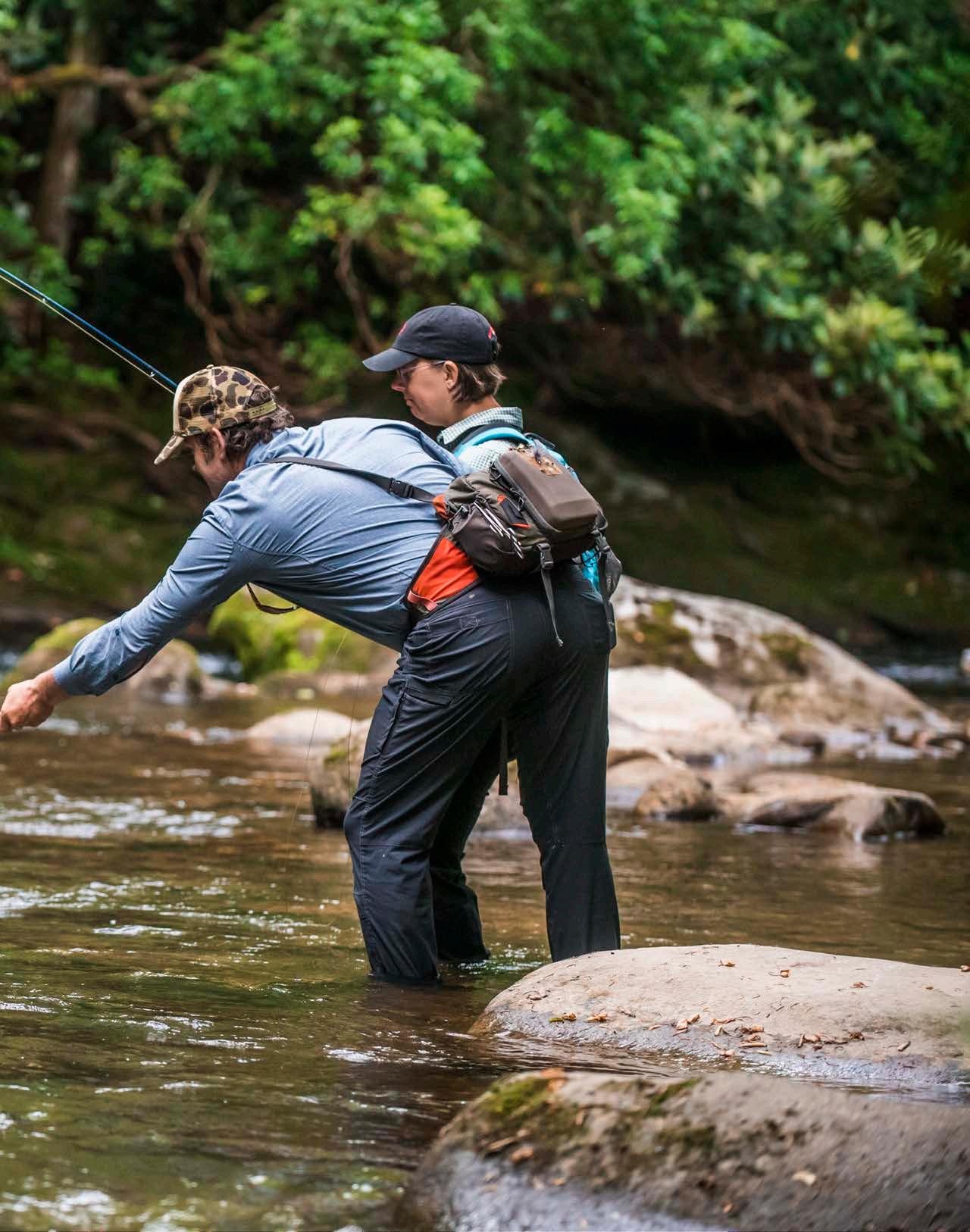
We waded into a river pool, the gentle nudge of the current rippling around my calves. Platt pointed to a spot about threequarters of the way across the river, between a couple of rocks. “Cast there,” he said, as if it’s a thing someone can just do. I moved my shoulder and wrist through the trajectory he’d tutored me on
Dave Simonett of Trampled by Turtles
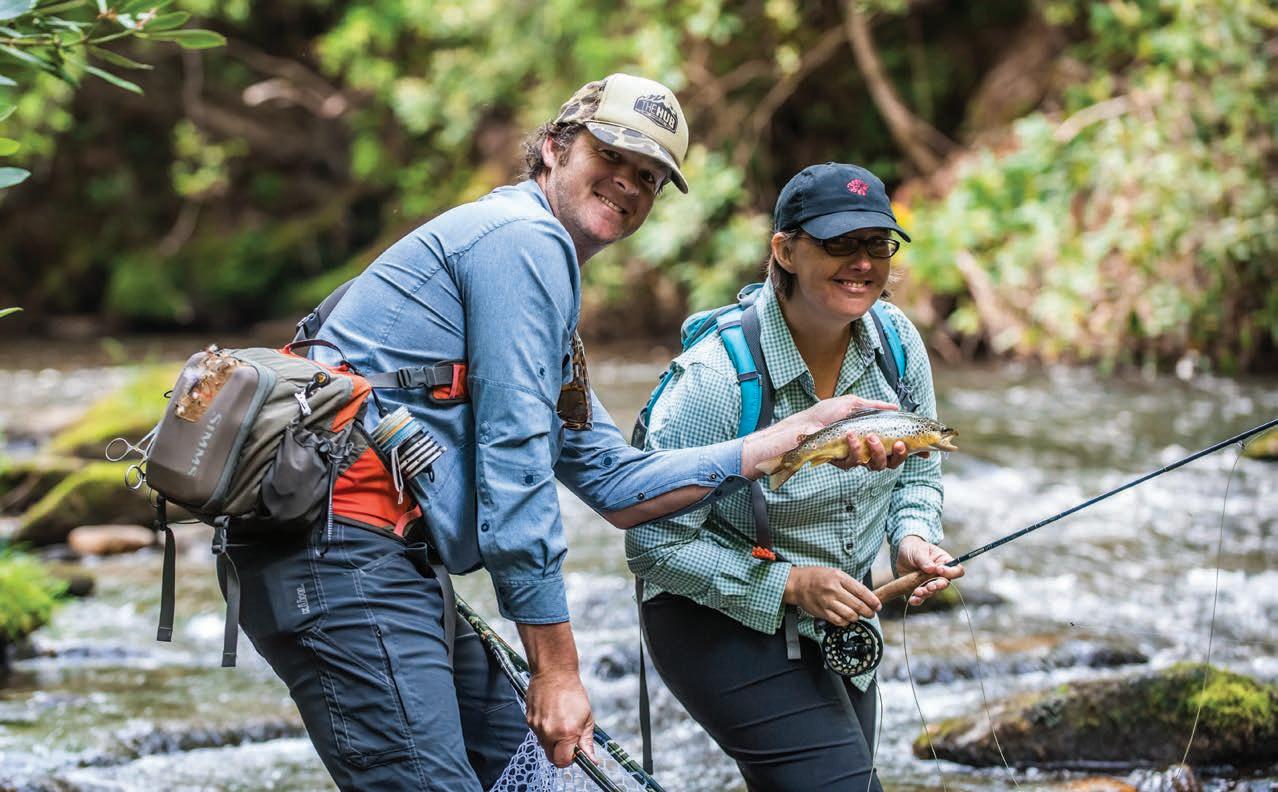
back by the truck, and magically the line fell right where he pointed. Within a few minutes, there was a fish on my line — a decent-sized brown trout.
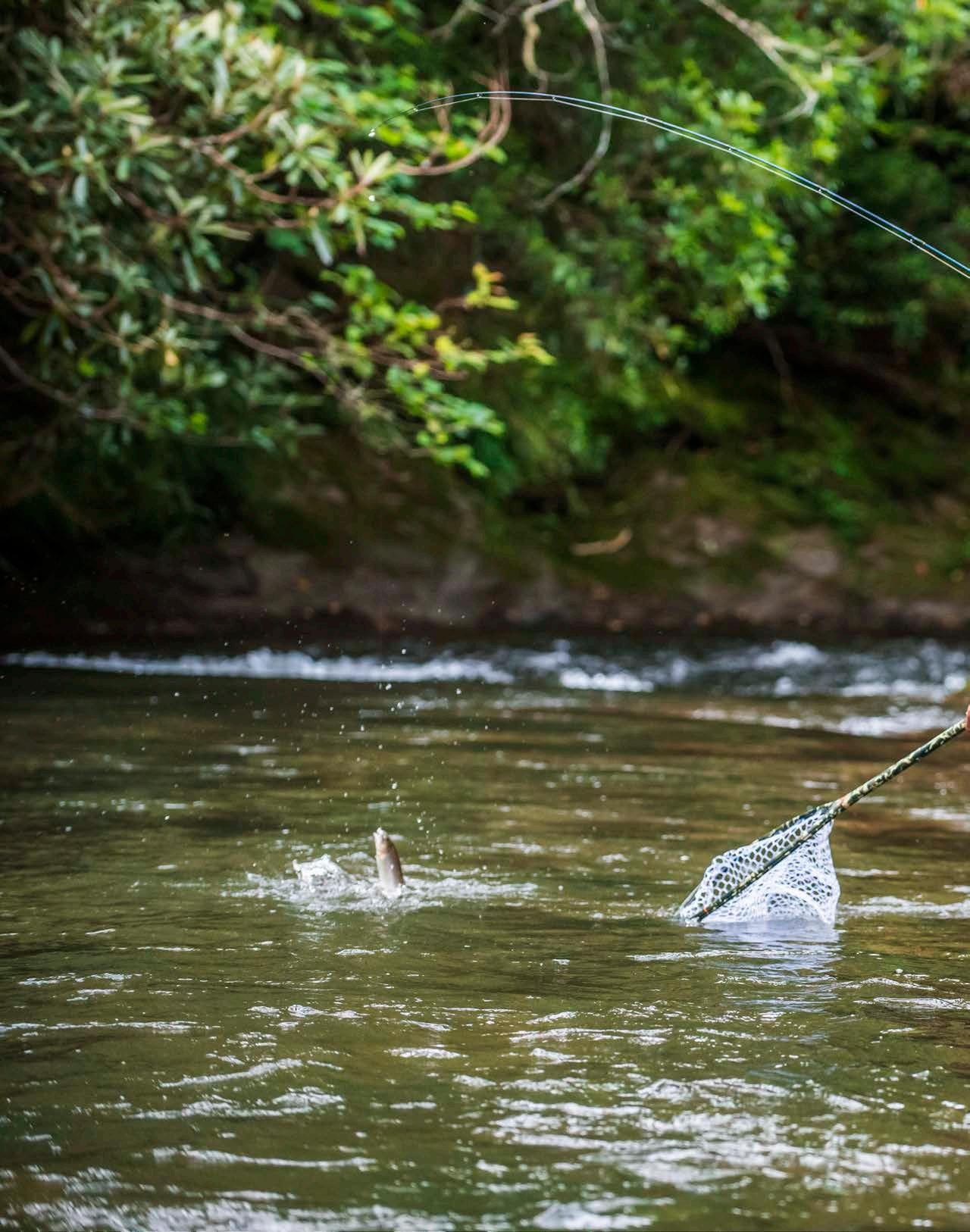
Before we were done, in about four and a half hours, Platt had guided me through around half a dozen bites — all catch-and-release, most of them wild rainbow trout, most of them not much bigger than my hand. More often, as evidence of my novice status, I hooked trees. Once my hook landed on Platt’s back. He seemed entirely unfazed and untangled my line every time — all part of guiding newcomers up the stream.
When the pool we were fishing stopped producing nibbles, he led me further upriver, one step around the rocks at a time. We would pause and cast a while. “Be ready,” he told me every time my line hit the water. “Pole up, be ready.” When a fish got hooked, Platt got giddy like that kid at the carnival again, like he won a giant stuffed animal from tossing a ring around a Coke bottle.
“If you noticed, I’d rather you catch the fish than me,” he told me later, in the truck, as we headed to another fishing spot, eating the ribs he’d packed for breakfast.
“ There’s something about sharing the experience of fishing — the joy. I just love watching other people. I absolutely love it. I like to watch people fish when I’m fishing with them, because I’m kind of fishing with my brain while you’re fishing. I’m thinking about every drift, where the fish are, what the flies are, which we should change to next, where we’re going to go next, when should we take another step forward, and when should we switch flies. I’m constantly fishing, just through [other people]. I love that. I fished so much this spring and winter. … I say I fished a lot, that means I take people. I’ve netted a lot more big fish for people than I’ve netted for myself.”
We hiked upriver until we could see a waterfall in the distance, and Platt noted that’s where he proposed to his wife, singer-songwriter Shannon Whitworth. “We got engaged in our waders,” he says, grinning again.
They still fish together, too. “She has a great cast and a lot of our early courtship was on the water. Literally our first date was going fishing together. … She loves it. We’ve fished out West and spots around Western North Carolina.”
Protecting What You Love
Back in the truck, Platt ruminated on his inner conflict around taking tourists to some of the untouched waters of the lower Appalachians.
“When I used to guide heavily in the summers,” he says, “I’d worry about taking people to the beautiful places in our county. People from out of town. I worried about someday I’m going to go back there to fish and there’s going to be some guy standing there that I showed how to get there. And one way I could justify it was if I can share an incredible outdoor, environmental experience with this person and they get into fly fishing, ultimately they’ll get into conservation and trout conservation and the importance of protecting the watersheds.”
Indeed, all the artists consulted for this article brought up the importance of conservation. Pandolfi has long been affiliated with Trout Unlimited, and the Stringdusters have given their time to Idaho River Adventures, doing seven-day immersive bluegrass fan experiences to raise awareness of the conservation effort around the Middle Fork of the Salmon River. Over the past couple of years,
Pandolfi has developed an affinity for salmon fishing in the Northwest and has recently become associated with the Wild Steelhead Coalition, with whom the Stringdusters have discussed joining forces to raise awareness of the need to protect our natural waterways.
“In terms of the conservation world,” he says, “it’s really just laden with everything — big issues around hatcheries and native populations, dams, dam removal, water rights. All these things are rolled up into the conservation side. I connected with the Wild Steelhead Coalition and they came out to some shows. We got a day of fishing in and just started a cool, organic relationship where hopefully we can use our platform to raise some awareness around what they’re trying to do.”
A few years ago, when a mine disaster flooded a local river with sediment, The Infamous Stringdusters showed up for their natural habitat to bring attention to the recovery effort.
“They were doing some work on a mine in Southwest Colorado,” Pandolfi explains. “They broke the wall of a retention pond and the Animas River ran totally thick, yellow-brown with sediment for almost a week. The river recovered
really well, thanks to a lot of strong conservation efforts. We did a pop-up [show] with Trout Unlimited in town there in Durango when we were there. I got out the next day and caught the fish of a lifetime with Jimmy [Largent], who’s a bass player and a local musician down in Durango. Those memories, those are things you’ll never forget.
“When I set out to do this career and I was eating PB and J for dinner and sleeping in a van,” he adds, “it wasn’t necessarily designed around creating opportunities in these outdoor realms that I’m so passionate about. But it’s been a cool byproduct. [I’ve had] a lot of great human connections, a lot of great experiences, and now I’m loving getting a little bit more into the conservation side of things and spreading the word to our fanbase, … hipping them to what’s going on out there and how they might be able to help.”
Near his home in North Carolina, Platt has invested a great deal of time and money toward restoring a stretch of wilderness along the river at the back of his property. The grass we waded through to fish there was waist high as we approached the water, making what’s essentially his backyard feel like a wild
landscape untouched by humans. He pointed out pieces of the habitat that he was responsible for bringing back with the same pride and care that a guitarist might use to tell about the instruments they’ve acquired.
And while fly fishing is an excellent avenue for learning about natural preservation, it is also, for all these artists, a beloved avenue for personal restoration — a far cry from the lights and bustle and crowds of screaming fans on the concert and festival circuit.
Though fishing was one of their first loves, it’s become the thing each of these people does to reconnect with home, to stay grounded when life might just as soon have them flapping about in the wind.
Back in North Carolina, driving down the mountain, Platt struggled to articulate why he loves fishing so much, why he’s more drawn to guiding others on the river than to catching fish by himself, when his friends’ band came on the radio. “Mipso!” he exclaimed and reached for the dial, midsentence. With that, the conversation paused as we wound back down the road, the river off to the right, some darn good homegrown bluegrass booming from the speakers. ■
PHOTOS
SURRENDERING TO THE MOMENT
Family and forest help Daniel Norgren find balance
by Corbie Hill
Daniel norgren wasn’t the first person to record an album in a 150-year-old farmhouse, and he won’t be the last. But it’s hard to find an artist for whom a big white farmhouse on the outskirts of the rural wilds of southern Sweden is a more perfect fit.
The sessions in that farmhouse, owned by the family of Norgren’s best friend and Superpuma label owner Pelle Nyhage, were playful and loose, Nyhage recalls. In fact, some of the final recordings featured the band rehearsing, learning Norgren’s songs that they had never heard before. The vibe was right, though, so the rough takes became keepers. To stay in that headspace during the Wooh Dang sessions, the musicians simply left the house as needed to take a walk in the surrounding forest.
Norgren, too, drew inspiration from the natural setting. One image that sticks in his mind is of the gigantic maples that surround the house, and how the brilliant gold of their leaves passed through the wobble of ancient windowpanes and colored the room.
“ The house, it’s pretty much untouched,” Norgren says. “When you enter a place like that you enter a different world. That sets your head spinning, it gets your mind going. To find the flow in that house with my best friends, surrounded by golden maples and big sun, what could go wrong? It was
a very beautiful experience — almost too good.”
Yet for Norgren there’s usually even less separation between the songwriter and the natural world — no window separating him from the forest. The Swedish songwriter lives down a onelane road in rural Rude, Sweden, in a house surrounded by forest. When Norgren is home, he regularly vanishes into the wilds, leaving technology behind but bringing along his young son, Martin. This is how Norgren meditates. It’s how he grounds himself, recharges his batteries. And it’s how he writes music.
In terms of his previous oeuvre — six studio albums and a compilation LP released in Sweden and Europe over the span of a dozen years — maybe half the songs came to him during long rambles in the natural world. “On Wooh Dang, all the songs were written in the woods,” he says.
For an album that clocks in at fewer than 40 minutes, it’s a document of diverse emotions and styles, as well as natural references, punctuated by the creak of ancient floors. “The Flow” is a slow, delicate lament, reminiscent of a stripped-to-the-bones War on Drugs song. Other cuts, like backwoods blues stomp “Dandelion Time,” could have tumbled out of the same busted nickelodeon as Dylan’s Time Out of Mind. On “Rolling Rolling Rolling,” Norgren exudes bittersweet ’60s soul. Wooh Dang
is steeped in hope and bliss, too: Norgren belts the titular chorus on the jubilant “Let Love Run the Game,” with one of the verses taking the form of a conversation between Norgren and a songbird.
The songs came to Norgren as he wandered the forest with his son, seeking spiders and snakes and stepping over roots. He’s a person with two halves — the touring musician with international ambition and the rural dad who craves quiet time outdoors with his son. And he sees no reason why his musical career should separate him from the most important people in his life.
“We’ve been touring for over 10 years, me and Petra, my wife, so it would be devastating not to be able to do that just because we have a child,” he says. Martin joined them on an early 2019 tour and Norgren is ecstatic that he will travel with them to the US and Canada for a late summer/early fall run of dates.
“When we started touring, we had this dream, in the future someday, of being able to do this,” he says. “Without even reflecting, suddenly you just realize we’re doing what we’ve been planning to do and what we’ve been dreaming about doing.”
Like an Orchid
Norgren had a fairly normal middleclass Swedish upbringing, he says. He was raised in the countryside and was
“There [are] greater universal forces at play. We are the mere instrument if we surrender to it, let it flow through us. Daniel does this thing where he just surrenders. He surrenders to the moment.”
Phil Cook
always drawn to wild spaces. He and Petra found their home in Rude by coincidence. The couple was invited to live there by a kindly old farmer whose memory Norgren cherishes.
“He was 94 when he died,” says Norgren. “He died with dirt under his nails. … His name was Martin. That’s a connection.”
Like in other developed countries, urbanization is a fact of Swedish life. Cities are growing and rural populations are decreasing. Most people are aware of the impact living in a stressful environment has on them, but Norgren remains an outlier in terms of his dedication to and comfort in the natural world. It fits the rhythms of his mind.
“He really ruminates. It’s a beautiful thing to watch. It’s a longer, slower crest and trough vibration,” says his friend Phil Cook. “It’s beautiful and rare. He’s like an orchid, man.”
Cook, a North Carolina-based musician, splits his time between performing with funky folk outfit Hiss Golden Messenger and a solo career. Like Norgren, he grew up away from the American South, but is also drawn to its music. The two met in 2014, when Cook opened for a Norgren show in the Netherlands. Cook retired to his merch table as Norgren and longtime collaborator Anders Grahn started a duo set, but he was quickly intrigued. He left the merch table and stood at the back of the crowd. As the show progressed, Cook was drawn forward, eventually ending up
at the front of the crowd.
“I hate the front row,” Cook admits. “The sound is terrible in the front row, but I just haven’t ever had that happen to me. I just surrendered. I hadn’t had music knock me over this much in what felt like a decade at that point.”
Afterward, Cook, Norgren, and Norgren’s collaborators shared a bottle of whiskey in a hotel room. They stayed up all night listening to songs on an iPhone speaker and talking music. Cook recalls these Swedes’ encyclopedic knowledge of and reverence for American music, but also Norgren’s sheer sincerity and magnetism as a performer.
“I want to believe people when they perform,” says Cook. “I walk away a lot of times [thinking], ‘They don’t believe it yet, so I don’t.’
“ They’ve gotta surrender and they have to realize that they are not the pinnacle,” Cook continues. “There [are] greater universal forces at play. We are the mere instrument if we surrender to it, let it flow through us. Daniel does this thing where he just surrenders. He surrenders to the moment.”
This metaphysical surrender goes beyond Norgren’s onstage time, says Nyhage. “You can dream with Daniel,” he says. “You can dream and connect with him in an abstract way and just dream and plan and move forward with him in a very nice way.”
Now, moving forward means taking Norgren’s music beyond Europe, with Wooh Dang his first global release. It’s
been a long, slow build since Nyhage recorded Norgren’s first demo when the friends were still teenagers. There’s been no hurry, no master plan, Nyhage and Norgren say — now simply feels like the right time.
It can be easy to run out of energy in the music business, Norgren says. He compares label Superpuma’s approach to a three-stage rocket. The first stage just dropped, and now he has access to a fresh fuel tank, one full of energy. And by growing slowly, organically, Norgren has achieved this without sacrificing the balance he seeks between touring and vanishing into the woods.
“I just want to turn this thing into my life,” says Norgren. “I don’t want to separate my life, my personal and private life, from touring and writing music. It’s always been my goal, from the beginning.”
As we talk, Norgren regularly mentions his lawn. For two weeks he’s been thinking of mowing it and, true to his connection to the land, he’s thrilled that after the interview he gets to go outside to be in the sun, among the smells of grass, surrounded by the sounds of the Swedish woods. Maybe he’ll see a spider or a snake. Maybe he’ll write a fresh song. Or maybe he’ll simply slip into a meditative state for hours. No phone, no tech, no crowds — just a human and the land.
“I think about him all the time. I do,” says Cook. “I know he’s out there doing his thing. I know he’s walking his land, ruminating and thinking.” ■
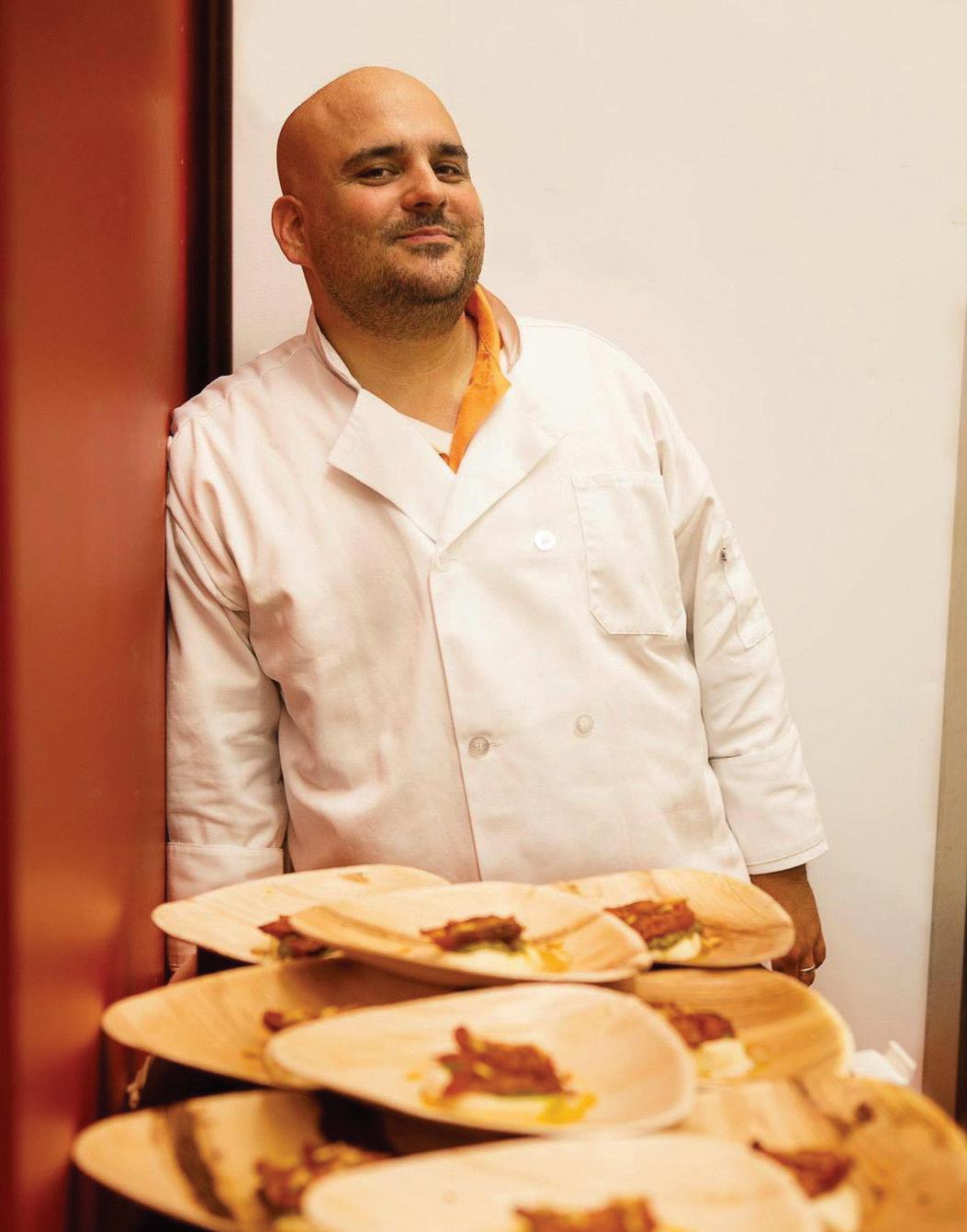
Frank Solivan prepared an ovenroasted tomato caprese with toasted pine nut pesto as one of three courses for a dinner and concert for nearly 100 people for the release of his 2013 album, On the Edge.
Frank Solivan cooks up connections with music, food, and the great outdoors
by Stacy Chandler
A MIXING INGREDIENTS
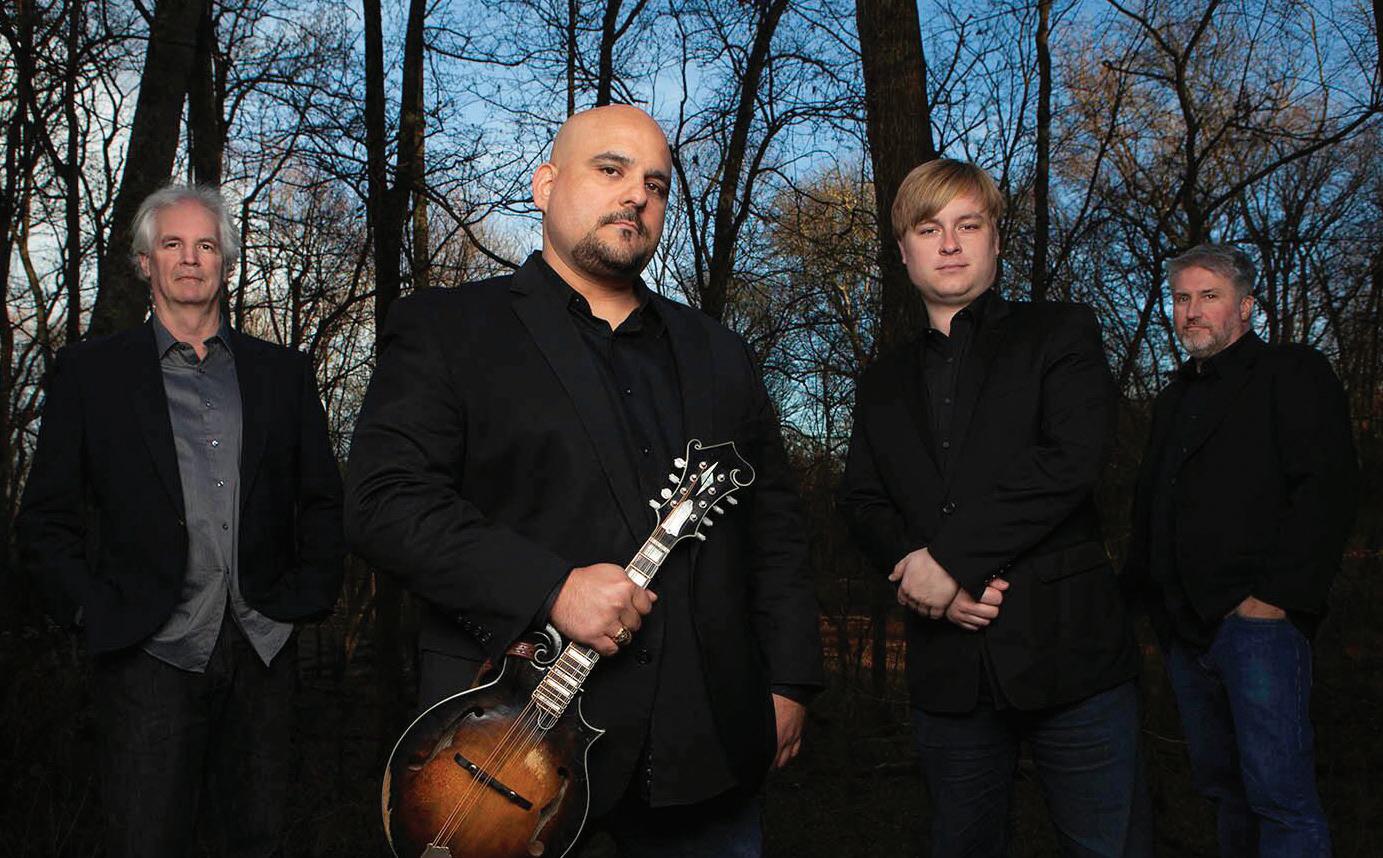
long with his instruments, clothes, and other road gear, singer-songwriter and mandolinist Frank Solivan always brings knives along when he travels. But don’t be scared: He loves cooking and his knife roll ensures he’s ready whenever an opportunity to prepare a meal comes around.
Just like music, cooking is a family tradition for Solivan, deeply embedded in his DNA and expressed at countless family gatherings throughout his life.
“My mom would sit me up on the kitchen counter while she was cooking and would get me involved with, like, ‘Hand me this,’ or ‘Would you stir this,’ even as a little toddler,” he recalls. “It turned into ‘Here, you cut this now,’ ‘You do this’ — and I was always into it. I just wanted to be there hanging out because I loved it.”
By the time he was 10, Solivan was
cooking whole meals for his family. And before long he expanded that service to friends, who called him “Chef BoyarFrank.” After school, he says, “they’d go home and they’d put something in the microwave or have a bowl of cereal or something, and I’d go home and make a pot of spaghetti sauce and have some noodles or hamburgers or whatever. … My friends growing up, they wanted to come over to my house after school for snack.”
As an adult, Solivan, whose latest album with Frank Solivan & Dirty Kitchen, If You Can’t Stand the Heat, came out in January, brought his passion for cooking (and those knives) with him when he embarked on a music career. In early house concerts billed “The Dirty Kitchen Experience,” Solivan, sometimes aided by his mom and some friends, would start the evening by cooking dinner for the hosts and audience. His aim was to re-create the role that music
and cooking, especially in tandem, had in his family.
“It kind of pays homage to my childhood where we’d have these big meals,” he says. “Growing up, you don’t realize that that’s not the norm … where you have these big meals and then everybody starts playing music.”
More than the meal — more than the music, even — the point, he says, was connection.
“When you share a meal with people, you’re actually really connecting with them in some way. You’re wearing your heart on your sleeve,” he says. “Even if I wasn’t playing music, if I’m inviting people to my house and we’re having dinner together, you’re learning about that person. The common denominator wherever you go in the world, too, if you share a meal with somebody or they cook for you, and they want you to experience their culture through their food, they’re
sharing that with you, and that is a connector.”
Connecting the Dots
Solivan is hoping to keep that connection going — and to share it more widely — with a web series in the works called Smokin & Pick’n. The show will weave together three of Solivan’s favorite things in life: cooking, music, and outdoors activities like hunting and fishing. Each of those pursuits, he says, have been “connectors” in his life.
“For me, I’ve got all of these friends through all of those experiences that are kind of like family, I guess is the only way to explain it,” he says. “Through music, food, and the outdoors … you have a different connection with those people somehow. You go fishing with somebody, either you’re going to have a really great time or you’re not. Typically it’s a really great time, even if you’re not catching anything,” he says with a laugh.
The series will have a “cooking show vibe,” Solivan says, with an emphasis on grilling and other methods of cooking
outside. He also plans to include interviews with local outdoors guides as well as music from guests who share his interest in cooking and the outdoors.
With the show, Solivan aims to connect people with the food we eat in a way that’s increasingly rare in the modern world. He grew up hunting and fishing, especially after moving to Alaska as a teenager, and preparing, cooking, and eating the animals he took.
“People don’t really know where their meat comes from,” he says. “They get it in a package at the grocery store. It’s like, ‘Oh, there’s a steak,’ but they don’t realize that was an actual living creature. There’s a disconnect with that sometimes. There’s a lot of people out there who don’t like the idea of going to kill an animal or whatever, but I kind of want to be connected to it a little more.”
Another way he hopes to bring that connection to more people is through a cookbook he’s writing that shares his personal style of cooking, which is big on improvisation and includes influences from Mexico, which flavored his youth in California; Italy from his mom’s heritage; and the Philippines
from his dad’s side of the family. The goal, he says, is to make cooking less intimidating.
“Everybody goes, ‘Oh, I gotta follow the recipe.’ ‘Ooooh, the recipe.’ ‘Oh, that makes me nervous because I don’t know if I can do this.’ But the thing about a recipe is it’s just a guide. It’s one of these things where it’s okay to kind of mess up now and again, you know? Musicians, too, like, sometimes if you’re learning and instrument it’s like, ‘Oh my God, I don’t want to take a solo, I’m gonna mess it up.’ Well, that’s how you learn. That’s exactly how you progress. You have to make those little mistakes.”
Cooking can be a lot like music in other ways too. While Frank Solivan & Dirty Kitchen uses the traditional bluegrass instrumentation, and bluegrass standards certainly find their way into their sets, they also play other styles, from Allman Brothers covers to Solivan’s often rock-tinged originals. Whether he’s on stage or in the kitchen, Solivan says, “there are a lot of ingredients, a lot of variables, to be able to put together to make something taste or sound good.” ■
COURTNEY
Frank Solivan & Dirty Kitchen
PHOTOS BY FRANK SOLIVAN
Chile Verde Made Easy
by Frank Solivan
Ingredients:
2 lbs of free range/local/organic pork shoulder, 1” cubed
1 medium size chopped onion
5-6 4 oz. cans chopped Hatch fire-roasted green chiles (canned Anaheim and/or poblano chiles can substitute)
1 15 oz. can Hatch green chile enchilada sauce
1 15 oz. can crushed tomatillos
4 cloves minced garlic
1 pinch dried Mexican oregano
1 bay leaf
1/4 cup olive oil for browning
1 Mexican beer and/or equal amount of chicken stock for deglazing
Salt and pepper to taste
Garnish ingredients:
Lime wedges
Chopped green onion/scallion
Chopped cilantro
Tortilla chips
Guide:
1. Use a large thick-bottomed pot like a Dutch oven.
2. Lightly salt and pepper cubed pork. Coat the bottom of pot liberally with olive oil. Brown pork in stages if need be on medium high heat. Do not crowd pork in the pot. Remove all browned meat and set aside.
3. Add onion and garlic while pot is hot and cook until translucent, stirring often with a wooden spoon to help dislodge the flavorful brown bits. This is called deglazing.
4. Slowly add Mexican beer and/or
chicken stock to continue getting those wonderful flavor bits off the bottom.
5. While onions, garlic, and beer are boiling, add all ingredients. Bring to a medium boil, stirring often.
6. Bring heat down to medium low. Slow simmer uncovered, stirring occasionally until pork is fork tender, about 1.5 hours. Cooking uncovered ensures that the liquid will reduce, intensifying the sauce.
7. Salt to taste.
Plating:
Serve in a bowl over steamed rice and squeeze wedge of lime all over. Garnish with chopped green onion/scallion, and tortilla chips.
Recommended utensil: Spoon
Meat and peppers are prepped before becoming part of a chile verde made by Frank Solivan.
FARM TO TABLE
Roots musicians connect to their local communities through food
by Will Hodge
Renowned irish Poet
Seamus Heaney was famous for infusing his poetry with a deftly astute understanding and evocation of nature and environment. His award-winning debut collection of poems,1966’s Death of a Naturalist, contains 34 works with titles like “Blackberry-Picking,” “At a Potato Digging,” “Waterfall,” “Turkeys Observed,” and “The Barn.” Death of a Naturalist also features one of the Nobel Prize winner’s most famous poems, “Digging,” in which Heaney sits down to write, hears his father spading in the potato garden, is reminded of his grandfather’s larger-than-life farming abilities among Ireland’s peat bogs, is enlightened to his own shift in the lineage, and ultimately determines:
But I’ve no spade to follow men like them.
Between my finger and my thumb
The squat pen rests.
I’ ll dig with it.
Today, that infusion of earth and existence is frequently echoed within the roots music community, with a variety of artists and songwriters drawing inspiration from the real-world practicalities of food and farming. Many of these musicians also use their passion for naturalism and environmentalism as an additional means of connecting with their audiences and with their local communities. For years, Neko Case provided fresh produce from her farm to a local restaurant in St. Johnsbury, Vermont, and was even awarded her own
namesake dish (“Neko Case’s Heirloom Tomato Salad”) on the menu rotation. Holly Williams stocks her White’s Mercantile modern-day general stores with unique, locally sourced food items that are native to the region of each location in Tennessee, Arkansas, South Carolina, and Kentucky. Jack Johnson’s social action network called All At Once promotes a variety of sustainable local food systems in his home state of Hawaii (and all across the globe) with resources like Farm to School (healthy, locally grown school food), community garden projects, food waste reduction programs, and many other agricultural initiatives. Singer-songwriter Gregory Alan Isakov and folk-punk up-and-comer Jade Jackson balance their music careers with their food lives — not always an easy
Jade Jackson
prospect — on opposite sides of the supply chain. Isakov manages the fouracre Starling Farm near Boulder, Colorado, and Jackson helps her family run The Range, a French-inspired, yet homey restaurant in Santa Margarita, California.
Isakov has been making music since he was 13, and in the past two-and-a-half decades he has released seven solo albums (including last year’s enrapturing Evening Machines), performed with the Colorado Symphony, synced songs in a number of TV shows (Girls, Californication, Veronica Mars), and even licensed his song “Big Black Car” for a McDonald’s commercial. (Isakov donated the proceeds from the McAdvertisement to Seed Saver Exchange and other nonprofit
organizations that focus on organic seeds and sustainable farming).
Throughout his many years as a musician, he has also been deeply invested in farming. “Man, I’ve always been a grower,” says Isakov. “I’ve worked on farms my whole adolescence and adulthood. I went to college for horticulture. Both music and farming have always been in my life.”
For Isakov, it almost seems inevitable that he would somehow end up doing something with agriculture, as it was a consistent presence throughout his upbringing. “I grew up in Pennsylvania, where there’s a lot farming, and I worked in a lot of nurseries in high school. I familiarized myself with plants really early on. My grandmother was a big gardener too.”
The mixture of music and food service has familial origins for Jackson as well. “I wrote my first song at 13, which was around the same time as my family was opening the restaurant,” she recalls. “I’m so proud of my parents. My dad never went to cooking school. When he joined the Army at 18, they made him a chef and he really enjoyed it. When he got out, he started working under some really amazing chefs in San Diego at some bigger French restaurants. My mom’s background is like punk-rock vegan, so even though she eats meat now, her heart about those things inspired my dad to be really mindful of using grassfed beef and sustainably grown vegetables from local sources. We opened the restaurant 14 years ago and I’ve worked there the whole time.”
Gregory Alan Isakov
When Jackson’s family first purchased the restaurant, it was essentially just a hamburger stand that they converted into a sandwich shop as they worked through the extensive licensing and permit processes to build it out into a fully-functioning restaurant. Before Jackson could legally start serving at 16, she worked as an order-taker, busser, hostess, and anything else that was needed each day: “Cleaning the floors, scrubbing the toilets, I’ve done it all. Growing up around it, you care about it, and you’re always there helping and doing whatever needs to be done.”
Since the release of her 2017 debut album, Gilded, Jackson has toured the country with punk rock legends Social Distortion, opened shows for roots-rock artists like Shooter Jennings and Chris Shiflett, and played a variety of festivals. She released her sophomore album, Wilderness, on Anti- in June.
However, when she’s not on the road or in the studio, Jackson can be found helping her family out at The Range. “Working at the restaurant is how I make a living. I’ve literally finished a tour and gotten home at like 5 in the morning and then worked that night,” she says.
For Jackson, playing her songs to large audiences one night and then waiting tables the next is far more about opportunity than obligation: “I choose to think about it as a blessing because there are other people in my band who have to find jobs each time we get back, then quit them to go back out, and then have to find another one again. That cycle is gnarly.”
Down on the Farm
The lines between Isakov’s farm life and musical life get blurred as well. The day of our interview, he was finishing up washing a big batch of arugula that needed to be delivered before he was about to head out on the road. “I’m growing for eight restaurants right now,” says Isakov. “I can email them when I’m headed out of town and set up to give
them double beforehand or just let them know when I’ll be back for them to order again.” For a touring musician who spends about six months out of the year on the road, growing for local restaurants is a far more manageable arrangement than plugging into the farmers market circuit. “I’ve got enough food to sell at a farmers market, but I don’t have enough hands to help me yet,” Isakov says. “Plus, it can be a hassle having to cancel your booth at the farmers market when you’re traveling. It can be pretty expensive to get those weekly spots.”
On his farm, Isakov currently grows about 47 cultivars of market vegetables in almost 70 beds, each around 50-feet long. Every week he updates his fresh sheet and sends it out to the restaurants he supplies: “Fresh beets this week!” he says with a chuckle.
Sometimes he delivers the product himself and sometimes the chefs visit his farm to pick up their orders and hang out for a bit. “Some of the fancier spots are more particular. They like their carrots to be a certain size or they require delivery by a certain time, stuff like that. For them I just try to do a good job because I’m honored to be working with such highend places. Then there’s some super chill family restaurants that are like ‘Whatever you’ve got, I’ll take it.’ They come to the farm to pick everything up and we hang for a bit.”
This broad mixture of culinary clientele is key to Isakov’s sustainability, efficiency, and optimization. “I like the balance because it gets me to a place where I’m running out of stuff, and that’s a good feeling,” he says. “I know that I’m growing at my capacity, which is really nice for a farmer.”
Along with the incredible assortment of specialty greens, vegetables, and herbs he grows for his restaurant partners, Isakov also farms medical cannabis, herds sheep, and cultivates a selection of flowers for a neighbor who works as a wedding florist. However, the part of the farm he
is most passionate about may be his heirloom seeds of corn and beans that he supplies to a small seed company in Taos, New Mexico. “I do a blue flower corn called Chihuahua Blue that’s an old heirloom variety from Chihuahua, Mexico,” gushes Isakov. “This is my seventh generation with this corn and it has a genetic memory, so each year the corn grows stronger and more acclimated to my soil and to my specific environment. For example, I get a late frost here sometimes, but every year the crop gets better and better.”
Isakov also points out the individualities and unique characteristics of each crop and how quickly (or not) they can turn from initial seed to sellable final product. “In Colorado, growing medical cannabis is rampant, so last season I actually made more on turnips than I did on cannabis. My East Coast friends think that’s crazy, but it makes perfect sense to a grower,” he says. Getting into the numbers, he points out, “I can get 100 to 300 bunches of radishes per bed every 40 days, whereas cannabis takes about 200 to 300 days from start to finish. A crop of medical cannabis takes up its bed all year, so whatever that individual round of cannabis makes is what that bed makes for the whole season. By contrast, a single bed of arugula can give me 40 pounds of product every 10 days.”
The animals at his farm are far less diverse; Isakov says he’s fine with just keeping it to sheep for now. “I currently have 10 sheep, but they are pretty much just our vibe-y lawnmowers at this point. I don’t breed them or sell lamb or anything,” he explains. “I inherited five and every time we went on tour I’d come back to more. I finally sold most of the males, except for two — Jack White and José — and we got them fixed. They are really easy and awesome animals.”
When asked if he’s ever had other animals on his farm, Isakov is quick to note with a laugh, “I also used to have chickens, but I don’t like them at all. As
soon as I got rid of the chickens, my life got easier.”
Home at The Range
When Jackson is home at The Range, her absolute favorite menu item is subject to change. “Oh man, I eat like 10 things every time I’m there. Our most popular item is probably our beef filet with blue cheese over top of it and this really wonderful reduction. It’s Frenchinspired, so there’s also a lot of butter. It’s outrageously delicious.” After thinking for another moment, though, she adds decisively, “I’ve had pretty much everything on the menu but my favorite dish is the “stinking rose” pizzette — it’s whole-clove garlic, local feta cheese, coriander pesto sauce, and fire-roasted red peppers, all on top of a thin crust. Yeah, that’s my all-time favorite.”
The surrounding community keeps business continually steady, but restaurant critics have also praised The Range’s adventurous menu and homespun atmosphere. An early Los Angeles Times review heralded it as “a cowboy steakhouse with a nostalgic vibe and fine country cooking deep in the hills of the Central Coast” and celebrated its crawfish cakes (“plump and full of that crawdad flavor ... served with vinegary crisp, pickled okra and a punchy, orange Tabasco sauce”), a “particularly good” beet salad (“baby red and gold beets with tender, peppery arugula leaves and nuggets of blue cheese with sugared walnuts and thinly sliced red onions strewn on top”), tomato soup (“pure nostalgia, oldfashioned and creamy with the comforting taste of real tomato”), and rib-eye steak with red-eye gravy (“the red-eye referring to the coffee that’s stirred into the pan juices. Coffee with the beef’s char is a great match”).
From the moment her parents bought the spot 14 years ago, The Range has been a tried-and-true family affair. “Since we first opened as a restaurant,
my dad and brother would be in the kitchen and my mom and I would be out on the floor,” Jackson says. “My younger sister would switch back and forth — she would serve and then also go back to the kitchen because she’s a fantastic baker.”
As her interest in pursuing a music career developed, Jackson’s father wove that into the atmosphere of the restaurant. “Early on, my dad was like, ‘You should play here every Saturday night,’” Jackson recalls. “Up until I went to college at Cal Arts when I was 19, I played out on the patio every Saturday night. I was just background music but occasionally I could tell people were listening.” Playing at The Range every week helped kickstart her ability to get other shows: “I slowly started getting gigs from that Saturday night residency and got offers to play at wineries and other events in the area. It was also cool for people to come back in on a Tuesday and see me in my apron serving their food.”
As Jackson started working with punk icon Mike Ness (Social Distortion) on pre-production for her debut album, the solo residency morphed into a fullband one. “After I started working with Mike and he had me put a band together, we thought, ‘Instead of just practicing in a garage a couple blocks away, why don’t we go do a live practice, get a free meal, and make a little money?’ So we started doing that every Thursday for a couple of years.”
While playing weekly shows at her family’s restaurant certainly helped Jackson hone her craft, waiting tables there also provided an incredible amount of inspiration and songwriting fodder: “In a restaurant, people usually forget that the servers can hear everything,” she says. “I’ve seen couples fighting, breaking up, and getting engaged. I’ve seen families yelling at their children and loving on them. I’ve seen so many snapshots into people’s lives and I’ve been very inspired by
putting myself in other people’s shoes and imagining what the rest of their life is like. Then I just put all of that stuff into my songwriting.”
Community Connections
For both Isakov and Jackson, the creative talents that allow them to connect with their fans through music mirror their keen abilities to connect with their local communities through food. “My parents are super selfless and do so many things for the community. They just give so much and it’s really inspiring,” gushes Jackson. When listing some examples, her warmth toward her parents and her local community is infectious: “My parents are connected with the community to source the restaurant. From something as simple as using local honey because it helps with people’s allergies to working a lot with our [local] dairy farm for our cheeses. We have people in the community that raise goats on their property, and they’ll bring a whole goat and my dad will handle all the processing — skinning it, draining it, and all that — and then cook it up. I’ve seen him smoke a pig’s head for hours. He’s very respectful of the animals and the products that we get from local sources.”
The Jackson family fingerprint within the town of Santa Margarita is growing as well, as they recently purchased an old bar across the street from The Range with dreams of turning it into another full-service restaurant. “My dad has already redesigned the kitchen in this super-efficient way and there’s a couple wonderful chefs back there already. They recently started serving food, which my dad calls ‘barrio soul food’ because he grew up super poor and was inspired to make authentic street food at a gourmet level.” The space also doubles as her younger sister’s art gallery and the whole establishment is lovingly named Rosalina, in honor of her grandmother.
In much the same vein, Isakov’s
connections to his local community manifest themselves in a lot of different ways. Alongside the relationships he has fostered with the restaurants in his area and with the heirloom seed company he grows for, Isakov also works and shares resources with a community of other farmers. “My neighbors are great,” he says, “and we all work together to help each other out by sharing tools and lending each other a hand on projects. My one neighbor just helped me put up a greenhouse earlier in the season, and then I helped her with her greenhouse. Another neighbor has a tractor that we all share. I rarely use a tractor, but it’s nice to know there’s one around the corner. Community is such a big part of this, and it never gets competitive.”
Isakov’s farm is also home to a converted barn that houses his 450-square-foot living space and a fully functioning recording studio. Isakov uses the studio as a means of connection to his other community, his creative
network of musical friends and collaborators: “My buddy Nathaniel Rateliff stores a bunch of gear in there and my bandmates rehearse in there a lot.” However, Isakov notes that some pre-planning is required if the studio is being used during daylight hours.
“Recording in there has to be very intentional because it’s right next to my nursery and my washing station, which can get pretty loud and disruptive when I’m in full production.”
Another integral piece of Isakov’s community, and one that overlaps across both his music and farming endeavors, is his longtime friend and manager, Sarah Levin. Not only does she manage most of the business aspects of his music career, but for the farm she also helps organize the deliveries, takes care of invoicing, and manages his fresh sheet. “I can remember early on, 15 years ago or so, we would be side-by-side making CD cases at Kinko’s, so it’s been fun to capture that spirit again in a totally new business
adventure. The same person who gets excited about booking an Iron & Wine tour is the same person that gets excited about a restaurant ordering 50 pounds of arugula,” he says with a laugh.
Staying Grounded
When they’re away from their food communities, both Isakov and Jackson say they feel the separation deeply.
“As hard as farming is, it’s way more laborious to be on tour — on the body and on the mind,” Isakov says. “Touring is draining in this whole different way.
Maybe it’s because you’re seeing the world so fast and these natural elements are stripped away from you. You might be able to go for a walk outside after soundcheck but you’re not really there. It’s like you’re living in another dimension.”
For someone like Isakov who loves the outdoors, physical activity, and having freedom of movement, life on the road can get quite constricting. “I love getting to
play music for a living, but when I get off the road, I’m really happy to just get out in the garden and have those 14-hour days of just being able to work and be outside,” he says. “I know that might not make sense to most people, but I’ve noticed it in myself over and over again.”
Jackson echoes the bittersweet balance of truly enjoying playing shows for audiences but having to put a lot of time and energy into maintaining her physical and mental well-being: “I bring a juicer on the road and I have a little cooler I keep stocked with fresh celery to do celery juice every morning. If I ever get any fruit or vegetables in the green room, I’ll juice those too. It’s a process and it takes time, but I try and start my morning off with that and a workout routine every day. That way, whatever happens the rest of the day, I’m okay with it because I got some healthy choices in at the beginning.”
Jackson also uses an app called Happy Cow to help her locate the best food options when she’s in unfamiliar places.
“It’s brilliant for traveling,” she raves. “It’ll show you all the Whole Foods, Trader Joe’s, and natural co-ops in your surrounding area. If you’re looking for vegan, gluten-free, or vegetarian options, it’ll show you those too. I can usually always find healthy choices with it when I’m out on the road.”
Like Isakov, Jackson also emphasizes the difficulties of maintaining physical activity while on tour. “Back home, there’s a train that runs through the town and I like to run the trail by the tracks early in the mornings. On our most recent tour, we started off with a drive from California straight to New York with no shows in between. It was 55 hours total. That’ll mess anybody up.”
In hearing Isakov and Jackson talk through the particulars of harmonizing their musical careers with their agricultural aspirations, certain common threads surface, even at different milestones in their careers.
“I don’t care about having a ton of
money or fame,” confesses Jackson. “My dream is to buy a little piece of land where I can grow my own food, have a couple dogs, and have music be my job. That’s the goal.” And while Isakov already seems to embody much of what Jackson is working toward, the seasoned songwriter seems to contain the same depth of dream and wonder as the up-and-comer: “I never thought in a million years that I could make a living making music. It still blows my mind. But also, I had been saving for my own farm since I was about 15 because my goal was always to get my own place. A few years ago, I realized you really don’t need a lot of space to make a living as a farmer. Right now, I can almost see every one of my beds from my bedroom window when I wake up. There’s a lot of value in being really close to what you’re growing so that you can stay on top of everything and make sure it’s not getting out of your hands. It’s been a hustle, but it’s also been extremely rewarding in so many different ways.” ■
Jason Aldean’s Kitchen and Rooftop Bar
BRIGHT LIGHTS, BIG NAMES
Music is on the menu in many of Nashville’s themed restaurants
by Lorie Liebig
If you take a walk down Nashville’s Lower Broadway, you’ll be bombarded by neon signs aglow with some of modern country music’s biggest names. In the last three years, Luke Bryan, Jason Aldean, Dierks Bentley, Big & Rich member John Rich, and Blake Shelton have opened their own restaurants and bars on this infamous street. It’s a sight that brings joy to the thousands of country music fans who flock to the area each month, but it also rouses concern for some about the trend’s lasting impact on the city.
Over the past decade, Nashville’s tourism industry has exploded. It is now widely ranked as the top destination for bachelor and bachelorette parties, thanks to its easily accessible bars, celebrated restaurants, and specialized museums. As more and more out-of-towners set their sights on the downtown Nashville area, investors are constantly searching for the next big thing that will catch their
interest — and their dollars.
Nowhere is the change in Nashville tourism more apparent than along Lower Broadway, which began as one of the city’s main business hubs, anchored by auto shops, furniture, and hardware stores. Although famed attractions like the Ernest Tubb Record Shop and bars like Tootsie’s Orchid Lounge have been up and running for decades, most of the honkytonks lining the street today only opened in the new millennium.
In the 1980s, Lower Broadway hit a low note. When the Grand Ole Opry moved from the nearby Ryman Auditorium to a new building on the east side of town, the tourists moved with it. The area became an unsafe eyesore, filled with pawn shops and seedy bars. It was a place mostly avoided by tourists, who had turned their attention toward the now-defunct Opryland theme park.
But since the mid-’90s, the area has undergone a slow, yet steady resurgence.
The development of Bridgestone Arena in 1996 spurred a revitalization of the area. The Country Music Hall of Fame moved from Music Row to a brand new building just a few blocks from Broadway. Buildings that long sat empty began to fill with new businesses, like the short-lived NASCAR Café and Planet Hollywood, before bankruptcy closed its doors. Longstanding businesses like Tootsie’s, which spent years barely staying afloat, began to welcome tourists by the thousands.
When the Music City Center, a 2.1 million-square-foot convention center that cost more than $600 million to build opened in 2013, interest in investing in the area intensified. Hundreds of young adults made their way to the city, hoping Nashville’s “It City” status would bring more jobs and better opportunities. The influx created a snowball of immense, rapid growth that the city in many ways is still figuring out how to handle.
Dollars and Sense
Fans’ craving for a closer connection with their favorite artists is something that runs deep in the country music culture — and in country fans’ spending habits. According to a market research study by GfK MRI that was published by the Country Music Association (CMA) in 2014, country fans spent $17.8 billion on trips to restaurants with friends and family. In general, country fans were found to be more likely than the general US population to dine out.
And the ranks of country music fans are growing: The CMA shared statistics this year showing that 51% of American adults listen to country music. For investors, targeting that growing and highly loyal market likely seems like a sure thing. The same listeners who will pay top dollar for flights, hotels, and passes to attend CMA Fest probably won’t hesitate to spend a few extra dollars on a cocktail named after their favorite Luke Bryan song. It’s more than just a drink; it’s an experience they can tell their friends and family about back home.
Country fans are also known for their deep loyalty to artists, spending millions on concert tickets and merch each year. When artists open their own restaurants and bars, they are given another opportunity to sell branded merchandise that fans can’t get anywhere else, bringing in a whole new line of profit. If you walk down Broadway during a busy weekend afternoon, you’ll be hard pressed to find a pedestrian without at least one bag of souvenirs from a nearby business.
Some of the more established, rootsadjacent offerings include Jimmy Buffett’s
island-themed Margaritaville chain, which has had a location on Lower Broadway since 2010, and B.B. King’s Blues Club & Restaurant, which opened in 2003.
But one of the first country musicians to extend into the restaurant business was Alan Jackson. In 2014, the star bought the Acme Farm Supply Building located at the very end of Lower Broadway. The threestory building, which was built in 1890 and is now listed on the National Register of Historic Places, was home to a farm supply store for decades, until 1999. Teaming up with a group of developers, Jackson created Acme Feed & Seed, a restaurant, bar, and venue that paid homage to the building’s retail history. Instead of filling the walls with photos of a cowboy hat-clad Jackson, the interior features a mixture of modern art and objects that would have been found at the old farm supply store.
Jackson’s creative investment paid off quickly. The Tennessean reported in 2017 that Acme was making almost $20 million a year in revenue and welcomed 25,000 customers a week. Three years after opening Acme, Jackson opened AJ’s Good Time Bar just two blocks away, which is themed more around Jackson’s music career.
That same year, Florida Georgia Line’s FGL House opened, representing the peak of Nashville’s music-themed eateries. The grand opening celebration cleverly coincided with the annual CMA Music Festival, which brings tens of thousands of people into downtown Nashville. The neon-lit four-level complex is filled with retro signs, reclaimed wood, and, yes, quite a few photos of the country duo. In many ways, the interior mixes classiness
with a welcoming kitschiness, largely reflective of the band’s own style. It’s custom-made to make fans feel like they are walking into an experience created for them personally by their favorite artists.
FGL House was created in partnership with T.C. Restaurant Group, which already operated multiple restaurants and bars along Broadway before joining forces with Florida Georgia Line. Just months after FGL House opened, the same company inked licensing deals with Jason Aldean, Luke Bryan, and Sun Records to create themed businesses located just steps from each other. This quickly spurred the opening of new locations from country stars whose feet were already planted in the service and entertainment industries. Blake Shelton’s Ole Red bar and restaurant opened in 2018 and also has locations in his hometown of Tishomingo, Oklahoma, along with Gatlinburg, Tennessee. An Orlando, Florida, location is set to open in 2020. Dierks Bentley’s “American gastropub” chain Whiskey Row also opened in 2018, joining three locations in the country star’s home state of Arizona.
Cash’s Kitchen
Considering the cost of property along Lower Broadway, being able to attach a globally recognized name to a new business is almost essential. With property costs in the millions, it takes a lot of upfront investment to create just one of these new establishments.
Bill Miller, CEO of Icon Entertainment, has spent millions opening an array of themed bars and restaurants in downtown Nashville. He owns and
COURTESY OF T.C. RESTAURANT GROUP
COURTESY OF JOHNNY
operates both the Johnny Cash and Patsy Cline museums, as well as Nudie’s Honky Tonk (themed around the fashions of famed Western wear tailor Nudie Cohn) and the upscale, magic-themed restaurant and bar House of Cards.
Miller’s latest venture is Johnny Cash’s Kitchen & Saloon, a 15,000-square-foot restaurant and venue that, at the time of publication, was set to open July 1.
“We have about 450,000 people a year who pay to come to see the Johnny Cash Museum, and there are all these ‘celebrity’ bars opening all up and down Broadway,” says Miller. “I just thought, let’s get the biggest brand, not only in country music but in all genres of music. Let’s open something different and compelling in honor of Johnny Cash.”
Miller, who was a close friend of Cash’s for nearly 30 years, says his goal is to transform the nearly 100-year-old building into something that “will reflect Johnny’s wants and likes and loves, both in food and aesthetically.”
“Nobody liked to eat like Johnny liked to eat,” Miller notes. To create this new business venture, Miller has partnered with the Swett family, who have owned and operated a Southern “meat and three” restaurant in Nashville for more than 60 years and even catered meals at the Cash family home.
“We didn’t just want to have a bar with Johnny Cash’s name on it, we wanted a real-deal, sit-down restaurant where you can enjoy all things Johnny Cash,” Miller explains. The building’s bottom floor will feature the main restaurant, a stage for live performances, and two bars with a “rustic and comfortable” interior that gives a nod to Cash’s younger years in his
humble hometown of Dyess, Arkansas. Upstairs, the decor will represent Cash’s later life, featuring many of the elements found in his house in nearby Hendersonville, Tennessee. Elements like barn beams, stone-framed stained-glass windows, and log timber will welcome visitors on the second level, which will include a bar and performance venue for ticketed performances and events.
“When you walk out, I want you to feel like you knew Johnny Cash a little bit better than when you walked in,” Miller said.
Leaving a Sour Taste
Not all of these band-centric brands have been well-received, though. One of the most recent and most controversial additions to Broadway’s restaurant and bar mix is rapper Kid Rock’s Big Ass Honky Tonk Rock N’ Roll Steakhouse. The three-story building, which features live music daily, is adorned with a 20-foot-tall neon sign designed to look like a woman’s buttocks. Although some in the city voiced concern about the tastefulness of the sign, a Nashville Metropolitan Council board approved its installation by a vote of 27-3.
The choice highlights another issue that has sparked discussion within the country music community. Even though there are restaurants and bars sporting the names of nearly a dozen country stars, not a single one of them is female. The country music industry’s lack of support for women artists on the airwaves in recent years has been widely reported. But with the names of country legends such as George Jones and Johnny Cash being used to bring in thousands to Music City,
you have to wonder why there aren’t neon signs beaming the names of trailblazers like Tammy Wynette or Loretta Lynn, or of modern superstars like Miranda Lambert, Shania Twain, or Carrie Underwood.
And while the pairings of country musicians and food service industries may have established the trend, its not the only type of music being represented through food and drink in downtown Nashville. Earlier this year, it was announced that Nashville will also be the home of Bob Dylan’s Heaven’s Door Distillery and Center for the Arts, a whiskey distillery and music venue that will open in a renovated 160-year-old church. Dylan fans who visit the location will also be able to view some of the music icon’s artwork and metal sculptures. And by 2020, after Johnny Cash’s Kitchen & Saloon opens, Miller plans to focus his sights on finishing a Frank Sinatrathemed restaurant.
But with Lower Broadway so saturated by the side ventures of today’s so-called “bro-country” stars, some have voiced concern over the fiscal longevity of these businesses. While artists like Cash and Jackson have already proven their staying power, it’s unclear how long fans will be rushing to dine alongside the encased ball cap that Luke Bryan once wore on tour.
As Nashville continues to try to maneuver its ever-increasing status as a top tourism destination, the future of this music-themed bar and restaurant trend is hard to predict. What’s clear is that downtown Nashville is always changing, reliant on the passions and palates of the tourists who come in search of a honkytonk and a good time. ■
COURTESY OF FRENZEL STUDIOS
Come on in my kitchen
Justin Osborne, SUSTO
I first came across avocado smoothies in 2013 when I was living in Havana, Cuba. I had never heard of or even imagined using avocado in a smoothie, but for me it was love at first taste! There was a DIY hamburger restaurant in my neighborhood called Fatima’s. Fatima was an older lady with an incredibly warm smile, and her restaurant was just a makeshift kitchen and counter behind her family home, with some tables and chairs set up for people to eat their food. They were famous for their hamburgers (pretty sure they were pork burgers because beef is scarce in Cuba), but what I loved the most were the batidos (Spanish for milkshake/smoothie). They had several flavors that I tried — guava, mango, etc. — but my favorite was avocado. When I returned to the US I would crave these avocado shakes, so I did some research, tried a couple things, and came up with this recipe. Probably not exactly the same as Fatima’s, but the taste is very close!
Avocado-Banana Smoothie
Ingredients:
Ice (at least 1/2 cup, more if needed)
1 ripe avocado (peeled and pitted)
1 small banana (sliced)
Honey (at least 1 tsp., more if desired)
Vanilla almond milk (at least 1.5 cups; dairy or coconut milk also work)
Instructions:
Blend all the ingredients listed above, pour, and enjoy!
Justin Osborne of SUSTO
MESSAGE IN A BOTTLE
Lagunitas Brewing founder Tony Magee built an empire on roots music and beer
by Greg Cahill
Tony Magee
Ask tony m agee about the connection between beer and music, and the Lagunitas Brewing Co. founder waxes philosophical. “If you’re a player looking at musical notation with dots on it, that piece of paper does not contain music any more than a clock contains time,” says Magee. “The same is true for a beer recipe. It’s a map to the beer in the same way that sheet music is a map to the music. It leads you to where you want to go. With beer, you have the malt — that’s the bass notes. The middle notes are the little fermentation flavors that appear with
differences in yeast making different fermentation flavors. And, finally, there are the hops, which are the soprano notes that sit on top of it all.
“ You end up with a little etude in the form of a beer.”
The company, built batch-by-batch by Magee, has been putting those sudsy ballads on tap for 25 years, with a line of craft beers that includes the popular Lagunitas India pale ale and the recent THC-infused Hi-Fi Hops, a nod to the brand’s long history with weed.
Ma gee’s efforts have paid off. Today, he is successful and wealthy, an icon of the craft beer industry. In 2015, the Dutch beverage company Heineken
International purchased a 50 % stake in Lagunitas Brewing, which Forbes values at $1 billion. Two years ago, Heineken purchased the remaining shares to become the sole owner.
Ma gee, now 59, has stayed on for a spell to develop international sales, but without financial concerns, he’s now largely focusing on his other love: music.
Roo ts music — especially bluegrass, blues, rock, and soul — is a key component in Lagunitas’ laidback, stoner ethos. The company’s flagship brewery in Petaluma, California, boasts a cozy amphitheater with a grassy lawn and state-of-the-art
Live At Lagunitas
lighting and sound system. Every day there’s a show, with gates opening at 4:20 p.m. Each year, it presents about a dozen free summer concerts, with artists like Mavis Staples with Tom Waits, Emmylou Harris, Shakey Graves, Dave Alvin, Peter Rowan, St. Paul and The Broken Bones, and Fantastic Negrito performing in previous seasons. The shows draw packed houses and are widely regarded as the highlight of the local concert season. This year, roots musicians like The War and Treaty and James McMurtry were on the schedule, with country singer Paul Cauthen coming up Sept. 24 and Americana-turned-
pop-rock star Caroline Rose closing out the season Oct. 7. An event in collaboration with Newport Folk Festival called “Folkin’ Friends” is planned for Sept. 23.
“ It’s a sensory experience,” Magee says of the melding of music, beer, and weed, “and it’s a shared experience between people, which is the very definition of community.”
Humble Beginnings
Magee’s success is impressive for a college dropout who started brewing beer in the kitchen of his modest home in Lagunitas, California, a sleepy rural
hamlet 40 minutes north of San Francisco and a short drive from the West Marin coast.
Born on the North Side of Chicago and raised in the city’s suburbs, Magee was surrounded by music at a young age. He started playing saxophone in the fifth grade, and, he recalls, “My dad always had albums by Woody Herman and Duke Ellington and that era of bigband music, but he also had The Beatles. ... I remember when Sgt. Pepper’s came out; I listened to that LP until there was no more black left. As a kid, and even later, I found music to be the most fascinating thing in the whole world.”
Ma gee took up piano next, and as a
student at Illinois State University in Chicago played bass in a reggae band. “The reggae band was the thing that ended my college career,” he says. “I was majoring in perfecting my buzz. I was taking mushrooms and speed and smoking weed all day long. We didn’t really make any money. You’d get back home and find out your rent was overdue, your car didn’t run, and your girlfriend had left.”
So, in 1987, Magee headed to the San Francisco Bay Area “to dry out” and take a job with a commercial printer. “My father had operated a printing press,” he says, “so I knew something about it. It turns out I was a good salesman.”
Four years later, the printing company folded. Newly married, Magee struggled to get by and to find inspiration for a career. That’s when he heard the call of microbrewing. “My wife
and I were going to Marin Brewing all the time — one of the few microbrew pubs anywhere at the time,” he recalls.
“I liked the way the gear looked and I wondered if I could do that. One thing led to another and the opportunity appeared to buy brewery equipment. I hadn’t even home brewed. For Christmas, in 1992, I got a homebrewing kit from my brother [who worked for a brewery]. I brewed it in
Fantastic Negrito
January, drank it in February, and by December of 1993 the brewery was open.”
He made an initial investment of $35,000 and didn’t draw a salary for five years. The business soon outgrew its digs in a 750-square-foot space behind an old grocery store in Forest Knolls, so Magee moved the brewery 20 miles away to a small industrial park on the edge of Petaluma, a city of 60,000 known for its Victorian houses, sprint-car races, and use as a location for the 1973 movie American Graffiti. He still lives on a ranch a few miles outside of town and not far from Tom Waits.
Musician’s Friend
As the business grew, roots music increasingly became a part of the Lagunitas scene. Rockabilly girls grace
the bottles of the Little Sumpin’ Sumpin’ Ale, and Magee even brewed a Wilco Tango Foxtrot Ale as a hoppy homage to the band Wilco’s singer and songwriter, Jeff Tweedy. (Lagunitas has other band beers for non-roots musicians like Waldos’ Special Ale in honor of ’80s punk band The Waldos and Hop Stoopid Ale for the alternative reggae-funk band Slightly Stoopid.)
Blues guitarist Steve James was the first musician to play at the brewery. He was squeezed into the corner of the tiny taproom and performed solo for a boisterous crowd. James later recommended singer-songwriter James McMurtry, who drew an even larger and noisier crowd. “It was like a scrum in the room,” Magee says. “That made me realize that if we were going to have concerts then we had to create a venue where people were focused on
the stage.”
That first big amphitheater show was held July 3, 2014. It was billed as the Festival for Dogs and featured Emmylou Harris with Sioux City Kid and Mississippi Mike Wolf. Proceeds went to a pair of rescue-dog agencies — Harris’ own Bonaparte’s Retreat and San Francisco-based Rocket Dog Rescue.
“ I suggested to our booking agent that we try to get Emmylou,” Magee recalls. “She said, ‘What!?’ I said, ‘Just ask her.’ She called Emmylou’s manager and he said, ‘Well, if you do an animal benefit, Emmy would love to support that.’ Her people suggested Rocket Dog Rescue. We said, ‘Let’s go.’ We paid to fly her band out and she played for free. All the proceeds went to the dogs.”
One reason Lagunitas continues to
James McMurtry
land such high-profile artists is that the company treats musicians with a degree of respect that borders on reverence. And Magee has come to the aid of musicians caught in a bind. When Oakland singer and songwriter Fantastic Negrito was booted from the 2015 Outside Lands after police cited a cohort for selling festival wristbands, a bust that generated a lot of negative press, Magee invited him to play the next night at the Petaluma amphitheater. “The truth is we want Lagunitas to be a place that musicians want to come and play,” Magee says. “It’s a selfish motive that has a virtuous backbone.”
For Fantastic Negrito (whose given name is Xavier Dphrepaulezz), that gesture at a crucial juncture, and Magee’s subsequent show of support, helped pave the way to a successful career that led to a 2017 Grammy Award for Best Contemporary Blues Album for The Last Days of Oakland “ Tony and the team at Lagunitas played an important role just as we were
getting started,” Dphrepaulezz says. “They hosted our first SXSW appearance after we won NPR’s Tiny Desk Contest, and we’ve played at the brewery twice. We won’t ever forget that.”
For Austin musician McMurtry, Lagunitas has become a regular stop on his annual West Coast tours: “They pay well, they promote well. They do a great job,” he says. “It’s really different from doing a club gig where we’re trying to sell seats and they’re trying to sell liquor. It’s not like a bar gig. It does us a lot of good. I hope it does them a lot of good, too,” he says.
Music and Management
Indeed, it was Magee’s admiration for McMurtry and other top artists that led him back to playing music himself. “I had the brewery, and I would tell people I had been a musician in another life, but I had gotten so far away from it that I couldn’t play a song all the way through,” he says. “I figured
that if I was going to keep telling people I was a musician, I’d better learn something.”
So, Magee asked a Chicago friend to show him how to play finger-style acoustic guitar like country blues artists Mississippi John Hurt, Blind Blake, and Reverend Gary Davis. “I fell in love with it. I understood that style as piano music, because those early blues players were emulating ragtime piano. I liked and understood it,” he says. “I could feel the counterpoint in it and it was like playing three instruments at a time with your thumb providing the alternating bass lines, your middle finger playing rhythm and then your little finger playing the soprano parts. It was a fascinating exercise, so I chased it.”
In f act, last spring Magee traveled to Nashville to collaborate with songwriter Danny Flowers (whose biggest hits, “Tulsa Time” and “Gulf Coast Highway,” were made famous by musicians like Don Williams, Eric
Live At Lagunitas
“What I liked about that experience was that here’s a guy who has a lot of money and could do absolutely anything, foolish or not, but instead he chooses to do something that’s been a passion since he was a kid. I just think it’s wonderful that he has the sense to make that decision.”
Danny Flowers
Clapton, Willie Nelson, and Emmylou Harris). “We spent a couple of days writing together,” Magee says. “Really, it was a chance for me to learn from him.
I’m just trying to learn whatever I can from whoever will show me what they will.”
Magee’s passion for roots music impressed Flowers. “What I liked about that experience was that here’s a guy who has a lot of money and could do absolutely anything, foolish or not, but instead he chooses to do something that’s been a passion since he was a kid,” Flowers says. “I just think it’s wonderful that he has the sense to make that decision.”
Magee even plays in his own band, a bluesy trio called Alice Drinks the KoolAid. Although they haven’t recorded, the group has toured as an opening act for the Paul Thorn Band and White Buffalo, as well as for McMurtry. Magee, who plays guitar and sings, joins bandmates Jim Widlowski on drums and Alan Berliant on bass — two college buddies
who went on to become professional musicians. Widlowski plays in the Chicago company of the hit stage musical Hamilton and is a substitute with the Chicago Symphony Orchestra; Berliant is a commercial composer whose “cues” will be heard on promotions for MTV’s fall lineup.
“ You know how they say, some are good and some are great? I knew my strengths lay elsewhere. I got to be a brewer,” Magee says. “But playing in this band presents unbridled learning opportunities. Music is a thousand miles deep. You’ll never plumb its depths in one lifetime. I had to give it up [in my 20s] so I could earn a living and pay the rent, while my friends went on to become virtuosos. But they’re very generous musicians and they bring me up.”
Magee no longer handles day-to-day operations at the brewery, but he still provides guidance to employees, and his experience as a musician and bandleader continues to inform his
management style. “Last summer, we went out with James [McMurtry] and ended up playing near Mount Vernon, George Washington’s Virginia home,” says Magee. “I learned something I didn’t know about George. He ran for two terms. The people would have elected him to 10 terms, if he’d gone for it. But he said for a democracy to work the people had to elect somebody else and figure out how to come to terms with the process of new leadership.
At Lagunitas, if I don’t step away that won’t happen. I want Lagunitas to stand on its own two feet and do things without me. You know, in a band, if you micro-manage the drummer you’re going to end up with a different drummer. He’s gonna quit. You want to respect the artistic integrity of people you are working with. When I was in there, everybody would check in with me and ask, ‘Is this cool? Is that cool?’ After a while, I said, ‘You guys have gotta go find cool. You gotta be cool.
“And it’s going well.” ■
TAKING A TRIP
Seeking understanding through psychedelics
by Allison Hussey
On may 7, 2019, the PeoPle of Denver, Colorado, headed to the polls to vote on an important issue. By the next morning, their decision was official: They’d voted to decriminalize the subset of fungi commonly known as “magic mushrooms.”
The “magic” part of “magic mushrooms” is psilocybin, a naturally occurring compound that generates increased sensory perception and hallucinations. Psilocybin, along with psychoactive cousins like LSD, DMT, ayahuasca, and peyote, is listed as a
Schedule I drug under the 1970 Controlled Substances Act.
As states including Colorado, Washington, and Vermont have embraced full legalization of recreational cannabis, American cultural taboos around psychedelics have likewise begun to dissolve in recent years. At the same time, new research has given scientific credence to the once-anecdotal healing powers of psychedelics, with hard data about how they can help with depression, anxiety, and other mental health issues. More than just a good time for some, psychedelics can be a legitimate part of a
person’s wellness toolkit. And everyone from artists to Silicon Valley tech entrepreneurs are taking notice.
The big tent of roots music has had its spikes in psychedelia over the years. The psychedelic folk-rock of groups like Holy Modal Rounders and The Incredible String Band dabbled with chemicals in the 1960s and ’70s, for example, as did members of the “freak folk” boom of the early-aughts like Megafaun, Devendra Banhart, and others.
But more recently, two of the biggest contemporary names in roots-adjacent genres have embraced psychedelics,
Sarah Louise Henson
integrating their lessons and concepts into their work. In 2014, country singersongwriter Sturgill Simpson opened Metamodern Sounds in Country Music with “Turtles All the Way Down,” which features a passage about how marijuana, LSD, psilocybin, and DMT taught him how “love’s the only thing that ever saved my life.” Four years later, country-pop star Kacey Musgraves was crooning about “plants that grow and open your mind” on her Grammy-winning LP Golden Hour. Musgraves luxuriates in psychedelia-heavy aesthetics, from filling her Instagram page with softfocused sparkles and rainbows to populating the video for “Oh, What a World” with kaleidoscopic jellyfish and a CGI rendering of her as a centaur. Musgraves and Simpson are both thoroughly psychedelic stars, yet their stances come off as completely uncontroversial.
“I think the message [Kacey Musgraves] is sending is not just, ‘Oh hey, I do psychedelics.’ Her music is very openhearted, and is in awe of the natural world. Those are very psychedelic qualities, and I feel like it’s an antidote to the very un-psychedelic reality that we’re living in right now. I think that people are hungry for that,” says Sarah Louise Henson, a fingerpicking guitarist who has used psychedelics as she sought growth both as a person and a musician. That growth is profoundly reflected on her ethereal instrumental album Nighttime Birds and Morning Stars, which came out in January.
Research and Renaissance
In his 2018 book How to Change Your Mind: What the New Science of Psychedelics Teaches Us About Consciousness, Dying, Addiction, Depression, and Transcendence, Michael Pollan traces the current psychedelic resurgence to a handful of events in 2006 — the 100th birthday celebration of the chemist Albert Hoffman, who
accidentally discovered LSD in Switzerland; a Supreme Court decision that allowed a new religious exception for ayahuasca; and the publication of a clinical study that seriously investigated the psychological effects of psilocybin.
But it’s not as though psychedelics disappeared at the end of the ’70s before spontaneously reappearing decades later. They’ve been around, for those who know where to look. In Heads: A Biography of Psychedelic America, published in 2016, journalist and avowed Deadhead Jesse Jarnow chronicles the more nuanced ebbs and flows of psychedelics in the US. The “psychedelic renaissance” has actually been going on since the late 1950s, he says.
“All of this scientific research has happened, and psychedelics are acceptable again, and they’re happening in all these new places. But if you think about a renaissance as a confluence of science, the arts, and multidisciplinary practices, that’s been going on for [more than] half a century,” he says. “The only thing that I think is new, really, is the scientific — the fact that it’s now being researched in these proper ways, which in turn is making it a bit more mainstream.”
In addition to cannabis becoming more acceptable in the mainstream, Jarnow also cites the public’s reckoning with draconian drug policies of the 1980s and ’90s as a reason for shifting attitudes toward psychedelics.
“ There’s been a wide-scale rethinking of the drug war, and the implications of class and race, and why the drug war was happening to begin with, which I think had a lot to do with the demonization of psychedelics over the course of the decades previous to that,” Jarnow says. “I think with the lightening of that, there’s been a loosening. Like, ‘Wait, maybe these aren’t as crazy-making as society thought they were.’”
Rather than crazy-making, more and
more people — plenty of musicians among them — have found psychedelics to be healing, including Henson. Her relationships with psychedelics stem from her childhood interests; she remembers her fascination when she first learned about ayahuasca as a second-grader, and maintained an active interest in ethnobotany for much of her youth. In adulthood, she’s expanded her affection for the natural world, including an understanding of how plants can be used for healing.
“I have only ever approached [psychedelics] as medicines, and as sacred. I can’t speak to other peoples’ experiences, but I think it does give a very different experience if you’re going into it honoring the medicine, which, in my case, is mushrooms,” she says. Her mycological knowledge has contributed to her understanding of how “magic” mushrooms can work in the brain, too.
“[Mushrooms’] ecological role in the forest is that the mycelium, which is the main body of a mushroom, is underground. They will penetrate the root tips of trees in the forest, and connect the forest. I think it’s magical and amazing that [mushrooms] make connections in our minds. They connect everything, and they allow for this hyper-perception in terms of seeing connections between things. That’s part of what allows for the healing as well,” she says.
Like Henson, Heartless Bastards frontwoman Erika Wennerstrom, who issued her twangy solo debut Sweet Unknown in 2018, has had profound experiences with plant-based psychedelic healing. As Heartless Bastards was completing its fifth LP, she felt like she was at an impasse with herself and the pressure she’d applied to her career.
“I had a team, a band, and I wanted to keep everybody working and employed. Maybe there was part of me that felt like I couldn’t take a break, because it’s a business, and you can’t just shut your
business down for a bit if other people are counting on you,” she says.
In retrospect, Wennerstrom says she realizes those expectations were selfimposed. She probably could’ve just talked to her band about it, she says. Still, she was deeply unhappy, and needed a massive shake-up. So in the spring before Heartless Bastards issued Restless Ones in June 2015, she embarked to the Amazon to immerse herself in a traditional ayahuasca ceremony. The plant has a centurieslong standing in indigenous cultures of South and Central America, and she wanted to be as close to a traditional experience as she could.
“I think I just needed to confront myself, in a lot of ways. I think as much as the idea of trying something like ayahuasca frightened me, I think what frightened me more was staying the same. I needed to take a chance and a leap of faith on a better future,” she says. Wennerstrom left her first retreat feeling “a little freaked out,” she says, but having to confront her own psyche was valuable in helping her reassess her priorities and recognize she needed to love herself better.
“It allows you to see things within yourself that you might have not let yourself see before. And that can be the challenging part with ayahuasca,” she says. “It can be very easy for us to sort of avoid ourselves and look at truths within ourselves. But with ayahuasca, you really can’t avoid it.”
Wennerstrom and Henson have had profound, life-altering experiences
through psychedelics, but one need not fly to a faraway land or go off-grid in the woods to get the picture. Though guitarist William Tyler, whose latest record Goes West came out in January, counts himself as a “novice” with psychedelics (he’s been more inclined toward cannabis, he says), he’s also found worthwhile insights through psychedelics.
“For me, one of the main things I’ve had to work through with being in therapy, and also being medicated, is anxiety based on a lack of control. I think that with certain kinds of cannabis products, and psychedelics in lower doses, you have to surrender a little bit of control,” he says. “But that process is almost an actual exercise in retraining your active mind to be okay with certain things that are outside of your direct, perceived control. That sort of acceptance can lead to a better way of coping with pretty normal fears and reactions that a lot of us have, especially more sensitive people.”
Unfolding Lessons
The lessons of psychedelics will almost never be immediate or concrete, though an individual session can yield specific messages. Jarnow likens psychedelic experiences to research and development processes, something Wennerstrom found true after trying ayahuasca.
“[After] my first ayahuasca experience, over the next year, what unfolded for me was a lot of selfawareness of things that I had kind of
buried deep, from very early on in my life,” Wennerstrom says. When she embarked on other ayahuasca retreats in Ecuador, Columbia, and the United States, the lessons she got from her first retreat continued to expand.
“For me, going back to do another retreat, and then another one, was I had developed self-awareness of the issues that I had, but then I felt like I needed to go back to then face them and deal with them with the new awareness.”
And for Henson, it’s changed how she approaches writing and performing. Her albums have grown from intricate acoustic affairs to more wide-lens and ambitious multi-instrumental compositions, as demonstrated on Nighttime Birds and Morning Stars.
“I’ve had trauma removed from my body, I’ve had my brain rewired. It’s been profound,” Henson says of her experiences. “I feel like the music I’m making now is a lot freer. I think I’ve always used my intuition, and I’ve always tapped into my subconscious — that’s sort of been my way of operating, giving things space and trusting things to emerge. But my level of trust in myself to just go for something has really been affected.”
Beyond intimate personal revelations, using psychedelics can lead to a renewed sense of personal openness. Henson, Jarnow, Tyler, and Wennerstrom spoke independently of one another for this piece, and they all cited a similar sense of peace from their different experiences with these substances.
“I think it completely shapes the way I look at art, because it also shapes the way
I look at spirituality, which is actually pretty important to me in the creative process — not even an actual belief system that I can expound upon, just sort of a general openness to the possibility of it all being true, or none of it being true,” Tyler says.
And even the pure practical aspects of using psychedelics — understanding your state of mind, knowing your limits and personal boundaries — can have implications that reach much further than a single trip.
“Being intentional and thinking through what you’re doing are a really important part of the psychedelic experience that I think can carry over to lots of other extremely non-psychedelic activities,” Jarnow says.
Despite the benefits that many users report, the same people will almost never issue a blanket recommendation for psychedelic use. Different substances have different effects on people. Mitigating factors can include one’s present mental state, family mental health history, the physical setting of the trip, and the intention for the experience. Curious explorers-to-be should proceed with well-informed caution.
Meanwhile, back in Denver, magic mushrooms aren’t technically legal, but the city’s legislation is a fresh high-water mark for new psychedelic possibilities in the 21st century. There’s still a long way to go: They’re still highly verboten, according to the federal government, after all. But the door to psychedelic exploration is opening wider every day. One need only reach for the knob. ■
William Tyler
PHOTOS BY STACIE HUCKEBA
SOMETHING IN THE WATER
by
Hilary Saunders
A bourbon tasting with John Prine and Kelsey Waldon
John Prine’s signature drink is vodka-based. Dubbed “The Handsome Johnny,” the twoingredient cocktail consists of just Smirnoff and ginger ale, prepared any way you like it.
The cheap vodka is important, says the 72-year-old, who was inducted in the Songwriters Hall of Fame in June, for a key reason: “It doesn’t kill the bubbles in the ginger ale.”
Even though his go-to is vodka, Prine sat down in his Oh Boy Records office one sweltering summer day to sample some bourbon with up-and-coming singer-songwriter Kelsey Waldon. A Kentucky native, Waldon writes vivid country songs, singing them with a thick drawl and contagious confidence.
Prine co-founded the independent record label back in 1981, which has since released more than 40 records. Earlier this year, The Nashville-based label announced Waldon as its latest signee, with her third album White Noise, White Lines, due out on Oct. 4.
Below is an excerpt of their conversation at Oh Boy Records, as Prine and Waldon taste three different bourbons, discuss songwriting, and reminisce on their respective connections to Old Kentucky.
Heaven’s Door
Out of the seven bourbons pre-selected for possible sampling, Prine and Waldon initially gravitated toward Bob Dylan’s new line of American spirits called Heaven’s Door. Two of the most important factors of bourbon categorization are that 51% of the mash has to be from corn and the spirit has to be distilled in Kentucky (any bourbonstyle spirit not made in Kentucky has to be specified as such). The fact that the Heaven’s Door Tennessee Bourbon isn’t native to Kentucky made it ripe for trial and discussion between the two Nashville-based musicians, who
connected the bourbon aging process to their songwriting and co-writing processes.
JOHN PRINE: What can you tell me about bourbon, Kelsey?
KELSEY WALDON: Anything you don’t know about bourbon?
JP: All I know is that you unscrew the cap and take a drink.
KW: I’m gonna end up sounding like a big nerd!
JP: A bourbon nerd!
KW: I’m not! I don’t know how I even know that much about it! I think I just gathered information. I’m a Kentuckian, you know! Bourbon is a historical [spirit], starting in the 1700s. You could call this a pure American product, which actually came over from the settlers in Kentucky from Ireland, Scotland, and Germany. I’m pretty sure they had the whiskey first! ... Ireland is like Kentucky Sr.!
JP: “Kentucky Sr.!”
KW: Within the hills of Kentucky, I feel like there’s so many of the distilleries and the stones [that they used to build the buildings] — it’s all still there from the settlers. The limestone water does make it special. That’s partly what makes it bourbon is because of the limestone water.
I was a little confused by [Heaven’s Door] because I’ve never heard of anything called “Tennessee bourbon,” but I’m sure it’s fine!
JP: Have you tasted it?
KW: I have not! Would you like to?
JP: Yeah! In a Jerry Garcia glass!
KW: Should we just do a little?
JP: I guess so. It’s just the afternoon!
KW: That’s actually not hard to drink.
JP: Does it say anything about limestone water?
KW: No! It was distilled in Columbia, Tennessee. ... The Kentucky limestone and the corn content I would say are what makes it bourbon. It actually adds a sweet mineral to it. That’s why it tastes
different, because of the sweet minerals in the limestone water.
I know a lot of bourbon snobs out there just being from Kentucky, you know, especially up in Bourbon Country like Clermont and stuff. There’s all kinds of bourbon snobs up in Paris, Kentucky. And I don’t mean that in a negative way! I just mean they know a lot, a lot more than I do. But I agree with all of them when all of us would say that it’s much like songwriting, you know? A lot of these take a lot of time, a lot of patience. It takes a lot of patience to age a lot of the barrels to get the exact right taste that you want. It’s like art in a way! I think that’s why people take so much pride in their craft that make all of these.
JP: Fifty years I’ve been writing songs and I got no idea what I do! There’s no set pattern. It’s patience. I’ve tried to write when there’s nothing there. You can do that when you’re co-writing because you wanna bring something to the party and maybe the other person has an idea to run with. But when I’m not writing on an idea or I get some kind of drive going, I might as well be doing something else, not wasting my time thinking I can write songs. Either it comes to me or it doesn’t. I like titles. Titles will do it for me, like if it’s an interesting title, then maybe I can figure out a way to fill up that space that gets to that emotion. If not, I’ll just be here drinkin’ bourbon!
KW: [Laughs.] It’s very similar. I feel like there’s been times I’ve been a little better about my discipline in that way. ... Right now I feel like I’m in such a different mode for this record. I haven’t written a lot in the past couple weeks, but like three months ago, you might just sit down and spit out five or something because you just sit down and worked on it.
So you know, it comes to me in a lot of different ways. Sometimes I might be chewing on something for like, forever, and it’s just up there and it’s up there and it’s up there. And then finally I sit down and it’s like, “Wow.” Sometimes you don’t
even know that you had to say all these things. Like, where in the world did that come from?!
But yeah, titles are something for me too, and phrases. If I hear something really interesting or I think about something really interesting, you can really run off that.
JP: Definitely.
KW: I’m trying to get better about co-writing because that’s something that I’ve never done, but I feel like with some people I really respect, it might be really cool and I’d love to challenge myself in
that way.
This record that we’re about to put out, I think it’s the most personal thing I’ve done yet and it’s getting closer and closer to what I want. But obviously, I feel like I have a lot more songs on me, a lot more records to be made!
JP: It took me a long time to warm up to co-writing. ... Steve Goodman and me, years ago when I was first starting out — ’cause Steve was writing all the time, constantly — we’d be sharing hotel rooms and so I couldn’t help but write a few with him. But I was really shy about
writing with anyone else until I got moved down here and that’s what everybody does here. I didn’t move here particularly to write, but all my friends turned out to be songwriters.
The first four or five co-writes I did in Nashville all seemed like gifts to me; it didn’t seem like I had much to do with it. I guess I did otherwise they wouldn’t have included me!
After this last record [Tree of Forgiveness] — I had a lot of co-writes on it — I was really grateful that these songs were there. I thought that we were writing
for Dan Auerbach when the four of us got together. And Dan was gonna do a solo record, so he said, “Hey come on over, we’re gonna do a big writing thing!” So it was four guys writing one song. And I thought, “Wow! Why does it take four guys to write one song?!” And we just started writing — boom boom — one song after another. Then when I got around to doing my record, two of the five songs we cut and I thought, “Well, I’ll try them out,” and they fit me perfectly, just like it was a jacket made for me.
Very Old Barton
In addition to being the name of a very cheap, very local bourbon (it’s only available regionally around Kentucky), “Very Old Barton” is also the name of a song on Waldon’s forthcoming album, White Noise, White Lines. Her story of writing that song reminded Prine of times that he and his siblings spent in the same area, taking road trips from outside Chicago to his parents’ homes in Muhlenberg County, Kentucky.
JP: I was just gonna suggest [we try another] because Kelsey told me that it was a really cheap one! I just know that my tastes run — I usually like cheap stuff!
KW: I don’t know if you’ll like it! Well,
we’ll see.
JP: Should we set it on fire first? See what color flame it burns?!
KW: If you smell it, you can smell what this is about to taste like.
JP: It was actually smoother than Heaven’s Door. But my tongue is on fire right now! Having said that, it went down pretty easy.
KW: [The song “Very Old Barton”] was actually based on a true story. I went up to Kentucky Lake to write songs. I locked myself up in my dad’s cabin up there for the weekend and I went up there to write because no one would be up there. And at the time, I didn’t live out in the country in Nashville; I lived right in town in Woodbine. It was super noisy and I had these super noisy neighbors and sometimes I feel like there’s not a lot of room to think. ... So I went up to lock myself up there to write songs and I just had a bottle of Very Old Barton up there and I was thinking about the title, it kind of reminded me of the Guy Clark song “Old No. 1” ... I kind of wrote something based around that.
Another song [on White Noise, White Lines] called “Kentucky 1988” has a voicemail from my dad. So actually he was calling me from Muhlenberg County, he was turkey hunting there and he was
saying that he heard that I was playing somewhere in Owensboro.
I got the title kinda inspired by a Tom T. Hall kind of thing. Larry Sparks has a song called “Tennessee 1949.”
JP: Tom T. is from Olive Hill?
KW: Yeah, Olive Hill, Kentucky!
JP: Me and my guitar player one time we saw an exit for it and we just went over there. It was about 20 miles out of our way and we just wanted to say that we drove through Olive Hill!
KW: It’s super cool up there because that’s the Country Music Highway.
JP: Yeah that’s it!
KW: Highway 23 in East Kentucky. So there’s literally like everybody on there: Patty Loveless, Keith Whitley, Ricky Skaggs, Dwight Yoakam, Gary Stuart, The Judds —something in the water there! Definitely.
JP: I was born and raised in a western suburb of Chicago, me and all my brothers, but our dad and mom were both from Muhlenberg County. Our mom grew up in Paradise. She was born and raised there. Our dad just migrated there. ... His three favorite cousins were like uncles to me. They might as well have been my dad’s brothers.
They moved up to Chicago in the
’30s for factory work and our mom kind of missed Kentucky and missed her sisters, but she liked living up north. Where our dad couldn’t wait. You could see it in his eyes when he’d drive us down, and it took about 15 hours back then because there were no interstates to drive down to Muhlenberg from Chicago. And he just became like a kid as soon as we crossed the Ohio River. It all just came back to him and washed over him and we could see that. That’s why I wrote [“Paradise”]. He wrote me in the Army and told me that they tore down that town, the coal company did. And so I wrote the song for two reasons — so my dad would have a song about his hometown and so he’d know I was a songwriter. I didn’t even think I’d record it because people couldn’t pronounce “Muhlenberg”! They’d call it “Mullenburg.” So we just recorded it at the last minute for the first record.
KW: I don’t think I knew all that story about “Paradise.” My dad loves that song.
JP: I gotta say, that Very Old Barton?
KW: Not that bad?
JP: No! The other stuff is smooth, but I don’t know if I want smooth when it’s bourbon!
Bulleit Bourbon 10 Year Old
The final bourbon tasting of the afternoon was one of the fanciest of the day. The longer a bourbon ages in wooden barrels, the more flavor it gains and the easier it goes down. Inevitably, talking about songwriting while sampling bourbons led to a conversation about drinking songs, and Prine and Waldon readily shared some of their favorites.
KW: It’s aged 10 years!
JP: It’ll make us more mature.
KW: It’s seen some things.
JP: Okay, down the hatch?
KW: If you say so!
JP: Oh yeah. Mmmm.
KW: It’s definitely smooth. You definitely don’t need a chaser. It’s just goin’ down.
With “Very Old Barton,” my song on my album, it ended up just kinda being the way it was. I didn’t think, “Oh I need a bourbon song.” I feel like in this day and age, it’s hard to write about things in your own unique way because there are so many drinking songs — for good and bad reasons!
JP: Some other drinking songs? “The Lord Knows I’m Drinking”!
KW: By Cal Smith.
JP: That’s such a good one!
KW: “The lord knows I’m drinkin’,” which is basically about hypocrites.
JP: [Starts singing.] Me and Mac Wiseman almost cut that! “The lord knows I’m drinkin’ and runnin’ around!”
KW: Gary Stewart has some of my favorites, [like] “I Got This Drinkin’ Thing.” That’s real honky-tonk! I feel like he was really ahead of his time. I heard Bob Dylan say that Gary Stewart was one of his favorite singers in the ’70s.
JP: I met Gary in the late-’70s. I had this ’51 Ford I brought down from Chicago and I painted it toolbox red and I parked in front of this restaurant where he was having a meeting with his record company. Gary comes running out wanting to look under the hood and everything. He was a neat guy.
KW: That is awesome! To meet Gary Stewart!
JP: What is it, “drinking singles and seeing double?”
KW: “She’s acting single...”
JP: ... “and I’m drinking doubles!”
KW: See that’s a little twist!
JP: That’s a good one. Same guy. And I’ve had my fill of bourbon for now!
The conversation has been lightly edited for clarity and length.
Pistol Annies
CANNABIS QUEENS
Women in country are leading the latest pro-marijuana charge
by Erin Osmon
In 1969 ray stevens hit the Billboard hot country singles chart with a song by a new writer on the Nashville scene. Kris
Kristofferson’s “Sunday Mornin’ Comin’ Down” was a maudlin trip through a rambler’s morning arc, from beer for breakfast to a stroll through empty streets where the scent of fried chicken filled the air. “On a Sunday morning sidewalk / I’m wishing, Lord, that I was stoned / ’Cause there’s something in a Sunday / That makes a body feel alone,” Stevens sang over a crescendo of drums, silken strings, and female backing vocals, a sophisticated and tender transmission of abject lonesomeness.
A year later, Johnny Cash took the song to No. 1. His version was recorded live in a stripped-down format, just acoustic guitar and his solemn baritone. It was a more poignant representation of the song’s posture than Stevens’
countrypolitan take, and it propelled the tune to its icon status. Today, it’s been covered by artists from Willie Nelson to Trisha Yearwood, and has become a standard in the canon of classic country.
“I suppose all of us been at one time or another a drifter at heart, and today like yesterday there’s many that are on that road headin’ out,” Cash explained before he played the tune, preamble that was edited out of the final version of the single. “Not searchin’ maybe for work, as much as for self-fulfillment, or understanding of their life ... trying to find a meaning for their life.”
“Sunday Mornin’ Comin’ Down” is an empathetic depiction of lost souls and the universality of the search for self. It’s fitting that Cash played the song to a rapt audience at Folsom Prison two years before cutting the version that became a hit for his 1970 LP The Johnny Cash Show. It’s a reckoning with self, but it’s also an open plea for an escape from
such a thing — via the calming, mind massaging effects of cannabis. “Sunday Mornin’ Comin’ Down” reinforced Cash’s support not only for marginalized people, but also for criminalized recreation.
Since the 1970s, founding fathers of outlaw country like Cash, Kristofferson, Merle Haggard, Waylon Jennings, David Allan Coe, Hank Williams Jr., Guy Clark, and, most famously, Willie Nelson have been the most vocal mouthpieces for marijuana in country music, defiantly singing the raw truths the Nashville sound glossed over. Drug use was a notch in the tooled leather belts of these songwriters, who operated outside the expectations of Music Row — from Haggard’s satirical swipe at small town America, “Okie from Muskogee,” to Jennings and Nelson’s entirely unsubtle 1978 duet, “I Can Get Off On You.” Hank Williams Jr.’s “Stoned at the Jukebox” replaces the classic image of a drunk,
broken-hearted fool fumbling with quarters with one who’s had too many tokes.
All manner of illicit tonics were pro forma for these men, who often doubled down on the therapeutic effects of marijuana after their dance with booze and amphetamines was over. “At the time I wrote ‘Okie From Muskogee,’ I didn’t smoke. It was ’68. I had been brainwashed like most of America about what marijuana would and wouldn’t do,” Haggard told Men’s Journal in 2015, a year before he died. “I thought it was responsible for the flower children walking around with their mouths open. It was not so. But if a guy doesn’t learn anything in 50 years, there’s something wrong with him. I’ve learned a lot about it, and America has, too.”
Before he died, Haggard created his own recreational strain of marijuana called Merle’s Girls in conjunction with Colorado Weed Co., and it hit the market in 2016. The next year, Nelson founded Willie’s Reserve, his line of custom cannabis and cannabis-infused products sold at dispensaries throughout the US. Today, it’s one of the most recognized purveyors of legal, recreational marijuana.
Carrying the Torch
Fifty years after “Sunday Mornin’ Comin’ Down” hit the charts, the women of
country have taken the torch for cannabis and run with it. Kacey Musgraves, Ashley Monroe, Margo Price, Brandy Clark, Angeleena Presley, Miranda Lambert, and others have canonized marijuana in song and in life. “I’m not ashamed that I smoke weed, and I don’t think people should be,” says Price. “The more we talk about it the more it breaks down the barriers. It was made by God. It’s a medicine.”
Price is a figurehead of the new outlaw movement. Her studio albums Midwest Farmer’s Daughter (2016) and All American Made (2017), both released on the independent Third Man Records, ranked in the top of the US and UK country charts upon their releases. The songs are rooted in the no-holds-barred traditions of outlaw, but also echo touchstones of soul, country rock, and gospel. Her lyrics speak of hard drinking and broken hearts, but they’re also astute and poetic observations on income inequality, American identity, and the shadowy side of politics.
Cannabis helps get Price into a creative mindset, she says, and also aids with aches and pains like menstrual cramps. In February, she launched cannabis line called All American Made through Willie’s Reserve. Price’s first strain, a sativa-based one called Pineapple Wonder, sold out quickly upon its initial release. Today, it’s stocked in more than 80 dispensaries across
California. Due to its success, Price is exploring other avenues for cannabis distribution and sales, including a line of edibles, including honey, mints, and trail mix, she’s developing with a partner in Illinois.
Another group of women in country music openly using recreational marijuana is the Pistol Annies, a power trio comprised of country superstar Miranda Lambert and singersongwriters Ashley Monroe and Angeleena Presley. They debuted in 2011 with Hell on Heels, a record of fullthroated feminist anthems that indict men of disrepute and subvert many country clichés.
The group rarely sings of drinking; their drug of choice is weed. “So I snuck behind the barn / And took myself a toke / Since everybody here hates everybody here / Hell I might as well be the joke,” Monroe sings on 2015 single “Hush, Hush,” a song about the ruse of family Sunday supper. The group’s “Stop, Drop and Roll One,” released last year on their latest album, Interstate Gospel, is an empowerment anthem, ode to female friendship, and sly nod to a favored pastime.
Some of Monroe’s fondest cannabisinfused memories are with one of the original outlaws. She recalls getting high with Guy Clark, whom she wrote with for her 2013 album Like a Rose. “You go over and he rolls up one,” she says. “We just
Margo Price
Ashley Monroe
Brandy Clark
sat there and laughed and had the sweetest time.” According to Monroe, there’s a wide network of likeminded writers and performers on board with her point of view. “I haven’t seen or heard any negative feedback when I use my little vape pen,” she says. “When I use that, I hear melodies and I feel like the people I work with get it. People who are musical and artistic get it.”
Brandy Clark, another powerhouse songwriter and solo artist who has written two of the most beloved procannabis ditties of the last decade, agrees. “Get High,” from her debut solo album 12 Stories, chronicles the exploits of a bored housewife. Written as a composite character of women from Clark’s life, it’s the oldest song in her live set and remains a fan favorite. “It saves me in any crowd situation,” she says. “It’s a great friend that’s always there when you need them.”
“Get High” endures as her most beloved song because it mirrors universal experiences. “Fans say, ‘Hey that’s me or my brother or my sister,’” she says. Clark also believes it’s the reason she got to co-write her next cannabisinfused hit.
She met Grammy award-winning country star Kacey Musgraves through her friend and songwriting partner Shane McAnally. “She didn’t know who I was [at the time],” Clark says. “But he played her ‘Get High’ and she said, ‘Oh, I’d love to write with her,’ based on that song.” A few years later Musgraves released “Follow Your Arrow,” a ClarkMcAnally-Musgraves co-write, on her heralded major label debut album Same
Trailer, Different Park. “When the straight and narrow / Gets a little too straight / Roll up a joint, or don’t / Just follow your arrow / Wherever it points,” Musgraves sings in the chorus, a jaunty 4/4 that’s as sweet as it is poignant.
Personal and Political
While weed is becoming more prevalent in certain circles — and legal in certain places — it’s still illegal and highly controversial in others. That’s why Price has become one of the most vocal modern proponents of normalizing recreational marijuana and addressing some of the social justice problems surrounding the issue.
“I hope that our country takes steps to decriminalize it everywhere because it’s really unfair that people, especially minorities and people who can’t afford a lawyer, end up spending 25 years in jail for having a pound of weed. It’s absolutely insane,” she says.
Price donates 10% of her revenue from cannabis sales to The Bail Project, a national nonprofit that maintains a fund that pays bail for people in need. “I didn’t want to just have this designer weed in my white-privilege world because there are people, especially people of color, who are wasting away in jail,” she says.
Likewise, Monroe has become involved in cannabis advocacy in the contemporary landscape of country music. In 2013, she released “Weed Instead of Roses,” dedicated to her preferred romantic gestures, from Like a Rose. And more recently, with her work
with Pistol Annies, she says, “I do talk openly about [cannabis], because I don’t feel like it’s a big deal. It’s a plant.”
Growing up in a strong church environment in Knoxville, Tennessee, Monroe was raised to think cannabis use was negative. “I always thought it was different than what it actually is, that it made people do terrible things,” she says of those times. “But today I find that it calms anxiety, it helps with any kind of ache and pain, it helps nausea, and it seems to make people pretty chill. I’ve never seen anyone fight while high.”
Brandy Clark is also proud to be part of the movement of women working to remove the stigma surrounding cannabis. She doesn’t smoke (“These lungs were not made to inhale anything but fresh air,” she says), but she enjoys the calming effects of a gummy infused with indica, a strain of weed that promotes relaxation (as opposed to sativa, which is more energizing). “I like a little indica when I’m gettin’ in the sofa,” she jokes. More seriously, she recognizes its positive effects, like that it can alleviate nausea for cancer patients undergoing chemotherapy treatments. “Even if it just relieves a little anxiety, I don’t see the problem with that,” she says.
Willie Nelson has often proclaimed that he remains alive because of marijuana, and that he’s never known anyone who’s died from smoking pot. With the help of these women, cannabis usage will continue to normalize, so that one day, it may be as ubiquitous to country music as whiskey and heartbreak. ■
Come on in my kitchen
Rodrigo Sanchez, Rodrigo y Gabriela
La Raiz de la Tierra is the restaurant that I opened in Ixtapa Zihuatanejo, Mexico. All of the food we make there is plant-based. We don’t use any animal products at all. The vision is that I want it to be everyday food; just the vegan version of it — burgers, tacos, chilaquiles, etc. I don’t want it to be just for vegans. I want it to be for everybody. It’s important to me to have alternatives for everybody and not exclude anybody. Besides food, we also sell LPs and books. And we have a stage for performances and events. The idea is to have a social place to create awareness of this kind of food and this way of living in the community.
Big Raw Burrito
Rodrigo y Gabriela
JEN SQUIRES
Josh Q
SINGING TO LIVE
Inuit musicians in Nunavut draw upon tradition for modern survival
by Stephen Deusner
“Thirty years ago, throat singing almost vanished. There were only a handful of people who knew how to do it. But now when you’re up north, it’s everywhere. You see little 3-year-old girls and even little boys trying to throat sing. That makes my heart so happy.”
Riit
The village of Pangnirtung sits on the arc of the Arctic Circle, nestled near Cumberland Sound in the territory of Nunavut, one of the northernmost settlements in Canada. There are no roads in or out, but there is a very small airport and there are snowmobile paths and hiking trails through the surrounding countryside. There’s snow most of the year, darkness most of the winter, and light most of the summer. On clear nights you can see the shimmering drapery of the northern lights. Roughly 1,400 people call Pangnirtung home, most of them Inuit. “If you can imagine a community that small,” says singer Rita Claire MikeMurphy, better known throughout Canada as Riit, “there’s not a lot to do except be with family and friends, go camping, and spend a lot of time in nature.”
And listen to pop music. Riit has long been a huge fan of Rihanna, singing her
songs incessantly. When she was 13, Riit and her best friend wrote a song called “Best of Friends,” which they posted on YouTube. Instant stardom never arrived, so they started a band called No More Joiners — which she now deems “such a lame band name!” Pop music spoke of a big world that existed beyond the mountains around her small village. “It’s something that was very close to my heart. I can’t imagine where I would be without music, because that’s where I normally go when I’m feeling shitty — or in any kind of mood, really. For me music was always a way to express what I was feeling.”
What left an even bigger impression on the teenager, however, was the music camp she attended each summer. It’s an annual tradition in the region, with musicians and educators traveling to remote villages around northern Canada and teaching classes on guitar, fiddle, accordion, dance, and traditional Inuit music. “With not much to do in smaller
communities, those camps were something that I always looked forward to. It was a chance to explore music and learn how to play instruments,” Riit says.
One summer Riit signed up for a class on Inuit throat singing. She was already somewhat familiar with the practice and was curious to learn more about this practice unique to young women. Dating back possibly centuries — the Inuit kept no written records before white settlement of the north — the practice is essentially a game, almost like a staring contest with voices: Usually two women (but sometimes more) huddle close together, often touching foreheads and holding elbows, and deliver an intricate back-and-forth of grunts and yelps and sighs and sounds that can’t be named with English words. Each mimics the other, until one breaks the rhythm. Whoever breaks loses the game, but more often than not, throat singing ends in laughter and smiles, as though the concept of “losing” has no place between the singers. Instead, their sounds coalesce into mind-bogglingly complex rhythms that shift and build dramatically, tying the two women together into something larger than themselves. Such intensity requires an immense amount of control and concentration.
Today Riit has become one of the most popular throat singers in Nunavut, with a melancholy hit single called “Qaumajuapik” that blends throat singing with electronic soundscapes, usefully blurring the boundary between pop and indigenous music of the region. Her fulllength debut, produced by Graham Walsh of the Toronto experimental band Holy Fuck, will be released this fall.
“ That camp was where I started,” she says. “I have a cousin who is an awesome throat singer, one of the best I know. When I started, she would always teach me sounds. One thing that she told me was, ‘Don’t ever be afraid to make sounds that are guttural or deep or manly.’ Because that’s what throat
singing is all about. It’s very melodic, but it’s also guttural. It’s a special thing for me. I can never find that same intimacy and connection that I get from my throat-singing partner anywhere else.”
‘Our Land’
Nunavut is an unlikely place to find one of Canada’s most inventive, passionate, and diverse music scenes. The name means “our land” in the Inuit language of
Inuktitut, and there is a lot of land there: The territory encompasses some 800,000 square miles of tundra, ice, and water. Yet its population is disproportionately small, with only approximately 36,000 people living in 25 communities. The largest of those is Iqaluit, overlooking Frobisher Bay on Baffin Island. Its population is roughly 8,000 people. It was formerly the site of an American military base established during the Cold War, but has now become
“Music and suicide prevention are closely linked, and being able to travel to communities to do a concert and tell people that there are health resources open to them — it’s quite powerful. Someone said to me that you can reach areas in your music that the government will never be able to reach.”
Colleen Nakashuk
a hub for transportation and shipping.
Getting to and from Iqaluit, however, can be difficult. Only one airline operates at the local airport, and Canadian North only flies to one southern destination, the Ottawa International Airport. Tickets are both scarce and expensive, which means that almost no national touring acts make the trip to Nunavut. It’s much more financially feasible to stick to the southeastern and southwestern circuits around Toronto and Vancouver. That leaves a void that regional musicians, most of them Inuit, are more than happy to fill. The first and most famous, at least in Nunavut, was Northern Haze, a rock band based in the village of Igloolik. In 1985 they released their self-titled debut, which is said to be the first indigenouslanguage rock album recorded in North America. They toured the north for two decades and became rock stars in the far-flung Arctic communities.
More recently, Nunavut-born Tanya Tagaq introduced throat singing to an international audience, first collaborating with the Kronos Quartet and later winning the Polaris Prize for her 2014 album Animism. However, Tagaq takes a very different approach to the practice, performing solo rather than with a partner and using those guttural sounds and rhythms to construct experimental vocal sculptures not unlike those of Meredith Monk. Her popularity in southern Canada and around the
world inspired a wave of younger artists and proved that their music might reach ears far beyond Nunavut.
“When I first started performing, it was right around the time Tanya was putting her style of throat singing out into the world,” says Nancy Mike, a singer-songwriter based in Apex, just outside Iqaluit. Mike also works with The Jerry Cans, a mixed-race band whose bilingual songs blend traditional Inuit music with contemporary folk-rock sounds. Albums like 2012’s Nunavuttitut and 2016’s Inuusiq/Life showed how those traditions might be melded with different pop forms and how music might speak very directly to Nunavummiut concerns, whether it’s the inefficiency of local government (“GN Song”) or the cultural importance of seal meat (“Dear PETA”).
Like Riit (who has performed with The Jerry Cans in the past), Mike learned throat singing as a teenager at a summer music camp. When she performs — almost always with a partner — “there’s a moment of feeling like you are one with the other person. It’s almost like meditating, where I don’t think about anything in the world. I only focus on my breathing and the sounds I’m making and the other person. I’m making sure I’m making the exact sounds as my partner. With the breathing techniques and vibrations coming up from the diaphragm, from the very core of your
body, I find those things together put me into a trance. You go into a space you don’t normally go.”
Initially The Jerry Cans had little ambition beyond playing the Legion in Iqaluit a few times a month. “We weren’t thinking about playing festivals,” says Mike. “We weren’t thinking about expanding. We just loved playing music.” Not everyone was happy to see their new take on traditional music, and criticism intensified as the band made commercial headway in the south. “I remember some people talking about how awful it was,” she says, “or that we should never throat sing in any way that wasn’t traditional. We did get some feedback that wasn’t great, but the majority of it was positive. We were all questioning, ‘Is this appropriate? Are we going to offend anybody if we do it a different way?’ It was always in the back of my mind, wondering how people would respond. But nowadays, it’s fun and free and beautiful that so many people love it.”
Struggle and Survival
Those summer camp experiences not only directed Mike and Riit toward careers in music, but also planted the idea that music might be more than merely a career. For so many Nunavut artists, it is a means of communing with their Inuit ancestors, a way to help
preserve a culture that has long been endangered by Western encroachment into the Arctic, and a vehicle for expressing themselves — perhaps even saving themselves. Even as its music scene thrives and diversifies, the territory faces an epidemic of mental illness and depression, with a suicide rate more than 10 times the national average. For men between 15 and 29 years of age, the rate is closer to 40 times the national average. In fact, according to a 2015 study published by the Canadian Journal of Psychiatry, Inuit suicide rates are among the highest in the world.
“Suicide is so relevant to everybody’s lives,” says Josh Q, who sings with a deep, emotive voice and fronts the Arctic soul group The Trade-Offs (The Q is for Qaumariaq.) “You grow up with it. I was named after someone who did suicide, my mom’s little sister. Everybody up here relates. It’s just too common. On one hand, we are a naturally welcoming people. But I think that’s probably why with suicide that you don’t notice people being sad, because they want you to be happy. We always ask ourselves what we could have done better, because it’s so hard to tell sometimes. People want to be nice. They don’t want to put their problems in other people’s heads. So it becomes really painful to talk about, but we need to talk about it. If we don’t, it’s just going to keep happening.”
Suicide has become a grim part of the
culture of Nunavut. Everybody has lost friends or beloved family members. Yet, the remoteness of these small settlements makes it difficult to provide consistent and effective mental health to those who need it, and the lasting effects of colonization make many of those who need it unwilling to seek out government programs. For a new generation of artists, music can initiate long-overdue conversations about depression, poverty, and abuse. Often that begins with simply expressing those darker thoughts. On The Trade-Offs’ recent single, the bluesy “Dancing with the Wind,” Josh Q incorporates images of the natural world as metaphors for his own inner turmoil. “My mind’s been dancing like the wind on the road, I’ve been drifting like the snow,” he sings. “Sun in the sky, still really cold.” It doesn’t incorporate any traditional Inuit musical elements, yet it’s unmistakably, indelibly a product of this place and this culture.
Music — whether he’s playing his own songs or listening to his favorite Ray Charles record — is ballast for Josh Q, as it is for so many Inuit. “If I don’t play for a while, I get antsy and don’t feel good. But once I play a show or even just rehearse with my band, I immediately feel better. I’m sure that goes on with a lot of people in the north, whether they’re performing or doing any kind of art. It’s very healing to people.”
Riit saw the suffering all around her
— and even inside her. “Suicide is such a common thing back home that it’s become normalized. I’ve had suicidal thoughts myself, and I’ve gone to see counselors. But it’s hard, because I’ve had two or three different counselors within the past year, and you are constantly expected to retell your story. Instead of moving forward, you keep telling your story over and over.”
Making music allowed her to break that cycle and tell her story through songs that address heartbreak, colonization, intergenerational trauma, #MeToo, even the eradication of Inuit culture. If music can be used to combat those darker consequences of colonization, the remarkable thing may be how well it seems to be working.
“Thirty years ago, throat singing almost vanished. There were only a handful of people who knew how to do it,” Riit says.
“But now when you’re up north, it’s everywhere. You see little 3-year-old girls and even little boys trying to throat sing. That makes my heart so happy.”
Building Community
In the wake of the success of Tanya Tagaq and The Jerry Cans, the Nunavut music scene has intensified and diversified. Colleen Nakashuk performs gracefully minimalist ukulele pop as Aasiva.
MisterLee Cloutier-Ellsworth raps about suicide and isolation under the name
FXCKMR (pronounced “fuck mister”). Silla + Rise add throat singing to carefully constructed drum loops and sound collages. There are rock bands, folk singers, avant-garde collectives. “I think of it like the dam finally breaking,” says Andrew Morrison, The Jerry Cans’ singer-guitarist. “There was always talent. There have always been worldclass musicians up here. The one thing that changed in the dynamic is that people in the south and outside Nunavut have started to realize that.”
Taking advantage of Canada’s piqued interest in indigenous music can be difficult for Nunavut artists. Even getting supplies and equipment in Iqaluit can be nearly impossible. There is only one professional studio in the entire territory — Nuvu Music in Iqaluit — and even fewer music stores. “I always buy lots of guitar strings whenever I’m in the south,” says Josh Q. “Or I order them online and wait forever for them to arrive in the mail. Some of the places we play don’t have proper amps or proper sound systems. Sometimes we play shows without monitors.”
Since 2016, Nunavut has had one record label, Aakuluk Music, which was founded by The Jerry Cans to release their own albums as well as those by other regional acts. “It’s first and foremost our close friends,” says Morrison. “We’re all part of this larger
music community together, but a lot of our friends live in smaller communities and face challenges that are very typical for northern artists but aren’t well understood in the south. Since The Jerry Cans had made a lot of contacts, we felt we were in a place to help others with the business side of things. We wanted to help them not only share their music, but make a living from it. That allows people the freedom to dig deep into their communities, speak out about issues, and bring them to light.”
One of those people is Nakashuk, who released her first album as Aasiva in 2018 and garnered two Indigenous Music Award nominations for Best New Artist and Best Folk Album. One of her most popular songs is called “Play in the Snow,” which offers a sunny invitation to escape your troubles, even if just for a few beautiful moments. “Hey you, how’s it going over there? I was wondering if life is treating you fair,” she sings over throat-sung rhythms and ukulele strums. “If you’re okay is what I want to know. If not let’s go play in the snow.”
It’s a song she sings to herself as well as to other people. “When I wrote that song, I was working at the Frobisher Inn in Iqaluit, and it happened to be snowing that day. I remember feeling quite down, so I was thinking to myself that the world is really a big place. There are opportunities out there, and I just have to
go out and search for them and catch them as I find them. Writing that song helped remind myself of that, and I hope it inspires others to remember that as well.”
Her mission is to extend that invitation to every Inuk. “Inuit are very musical on their own,” she says. “We hear stories of our ancestors coming together in a big igloolik to sing songs, especially in the wintertime, the hunting time, when it was really dark. The days were shorter, and daylight was so scarce. So they would come together and sing these songs to help get through those dark times.”
Until recently, she worked for the Nunavut government, specializing in suicide prevention, and traveled the territory conducting grant writing workshops. But she made sure there was a musical component to her programs. “I would also facilitate free concerts so we could get communities together to sing. Music and suicide prevention are closely linked, and being able to travel to communities to do a concert and tell people that there are health resources open to them — it’s quite powerful. Someone said to me that you can reach areas in your music that the government will never be able to reach.”
Many artists have built an educational component into their music, like Kelly Fraser. A native of Sanikiluaq, a
The Jerry Cans
small community of 1,000 on Flaherty Island in Hudson Bay, she records music that has one foot in the dance club and another in the indigenous festival circuit, but she also co-founded and operates an organization called Nunavut Hitmakerz. Along with a Greenland-born DJ named Thor Simonsen, Fraser travels throughout the north holding music workshops for Inuit children. “We teach them how to write lyrics, how to make music on a computer,” she says. “We all make a song in our language using traditional instruments, and on the last night we present it to the community at a talent show and feast.”
Speaking Up
Music offers the Inuit community an opportunity to commune with ancestors and participate in a long heritage that has helped them survive and even thrive in the hard landscape of the north. When those traditions were taken away, when those connections to the past were severed, the Inuit suffered. Catholic and Protestant missionaries came to the region in the 1800s, providing health care and converting entire communities to Christianity. That practice continued well into the 20th century, curdling into hostile discrimination during World War II and the Cold War. As the American and Canadian militaries established strategic
bases throughout the provinces now called the Northwestern Territories and Nunavut, the Inuit were further displaced.
“My parents were told not to throat sing by missionaries,” says Mike of The Jerry Cans. “The music almost died off completely, but luckily a few elders kept it alive and taught the younger people. When you see a generation that’s annoyed by throat singing, it’s usually because of that past trauma, when they were forced not to do it. I won’t say they were brainwashed, but they were told it wasn’t godly. It didn’t follow the rules of the Bible. When you’re told that your culture isn’t proper in the eyes of God, that’s going to be traumatic for anybody. You’re losing a part of who you are.”
“Imagine your family living nomadically and freely,” says Riit, “then they’re moved into communities. The RCMP [Royal Canadian Mounted Police] kill your sled dogs so you can’t leave the community. Your children are forced into modern schools and forced to live a southern lifestyle. Those people went through that, and they’re angry, and they pass it on to their own children. I can still see that intergenerational trauma everywhere. It’s very real. Our own schools don’t teach our own history, so not a lot of young people know about that colonization process. So there was always this question of, ‘Why don’t I have
the same relationship with my parents as my white friends do?’ You don’t want to mess with my generation, because we’re not afraid to say shit. We’re speaking up now.”
This is a generation that is demanding to have this conversation, that is outraged at the problems afflicting the Inuit populace and the national ambivalence toward their suffering. And they see music as a megaphone — not just traditional music, but pop music, rock music, hip-hop, electronica, anything and everything that might accommodate throat singing, or traditional drums, or lyrics about dancing with the wind or playing in the snow.
“ Throat singing is a medium that allows me to do two different things,” says Kathleen Ivaluarjuk Merritt, a throat singer and cultural activist who is raising money for a performing arts center in Nunavut. “It allows me to share our culture with the world, and it educates Inuit about our culture and history. That’s how we break down stereotypes that we’re just the silent, smiling Eskimos in the isolated Arctic. There’s so much talk about the negative, about the high suicide rates and unemployment, so it’s really important to also show the beauty and the strength of our people. Music is a great way to tell that story.” ■
I DIDN’T WANT TO TELL YOU
Several years ago, sitting in a hotel room in Nashville, I came up with the idea of “I Didn’t Want to Tell You.” I had just started taking portraits of musicians, and as I conversed with them during our sessions I started to piece together underlying themes surrounding struggles with mental health and addiction. At the same time, I was also watching my dad wrestle with an opioid dependency and I felt like I needed to find a way to tell these stories. My objective with this series — the beginning of which is presented here — is to normalize the conversation around mental health, to let people know there are others out there battling, and also to identify resources within the music community for assistance. Thank you to the musicians who trusted me with their photos and their stories.
— Chad Cochran
STEVE POLTZ
I lost my mom my on Dec. 13, 2018, and it still stings. She suffered from depression through much of my youth. I used to try to cheer her up by playing sad instrumental songs on a classical guitar. I didn’t think of the songs as sad when I was young, but now when I hear them I’m amazed at how depressing they sound. She was a tough audience. I feel like in some ways the audience has always been about me trying make my mom happy. It’s probably made me
a better entertainer in some respects and less sincere in other ways. I’m still trying to figure it all out and be as honest as possible in my writing and live shows. I still wish I could’ve said a few more things to my ma before she died. I always seem to have regrets. Creating art in tiny ways every single day has helped me to work through my issues and keep me semi-balanced on this crazy tightrope we call life. It’s all just a balancing act.
SARAH SHOOK
I was homeschooled for my entire education in an extremely sheltered and isolated environment. I was raised to believe that the world was full of “sinners” and dangerous people, that women exist for the sole purpose of being wives, mothers, and housekeepers, and that homosexuals go to hell. (I knew I was bisexual when I was 8.) Separately and collectively, these world views had a profoundly negative effect on my mental health. While I’m glad to say my parents have come a long damn way over the years, I’m still dealing with the long-term effects of an oppressive, toxic, and patriarchal Christian belief system.
I’ve been depressed my entire life but after years of almost constant suicidal depression in my mid-teens, I made a conscious decision to view depression as a part of my natural chemical makeup in order to better moderate it with mindfulness techniques and instigated even more mental gymnastics to deal with extreme social anxiety. Working up the motivation to do the things I know help me feel balanced, going for a run, cooking nourishing food, reading a book, is the hardest part. The first step is always the toughest. Being vigilant in checking in with myself, knowing the signs of an anxiety attack, practicing as much selfcare as possible, all these things help a great deal as well.
When the stigma surrounding mental health issues is removed, we can be transparent about ourselves and supportive of each other. We can recognize others’ life experiences as being just as valid as our own. We can dedicate time and emotional energy to intentionally fostering moments of joy. Depression is a part of me and always will be. But it’s a part of me I can live with because I had to learn how.
JOHN PAUL WHITE
I’ve fought with depression and anxiety for quite a bit of my adult life. More often than not, it comes just before and after really pivotal moments in my life. Anticipation overwhelms and then the comedown after the high is quite precipitous. Thankfully, the understanding of mental health in my extended family has gone from “get over it” to a much more healthy, compassionate place. Exercise, better sleep, and a better diet (and sometimes anxiety meds) have become necessities, especially in tour mode. I once tried antidepressants but got severe, debilitating migraines for my troubles. It left a scarring, yet healing, impression. It showed me a painful alternative to whatever I was feeling, and some small glimmer of “Well, this isn’t as bad as that.” I don’t know how healthy that is, but it has been helpful. Leave it to me to find solace in pain.
LYDIA LOVELESS
I do not remember a time before anxiety, and I have always been quite a melancholy person. For a long time I lived my life just assuming I would completely lose my mind at some point and walk off into the woods naked after a bender, never to be seen again. Especially with touring, I can go through periods of feeling like I am falling out of the sky and things are simply happening to me. Only recently have I begun to think about steps I can take to make sure I don’t get there. Yoga, intense
exercise, and lots of time to myself to write and read and rest my mind help, as does the Lexapro I started taking about a year ago. At this point in my life I realize I have to view myself as a sensitive being and make sure I take care of that and don’t feel embarrassed not to “party” or be “outgoing.” I haven’t figured it all out yet and I will never be “cured,” but I am on the path to management and that feels good to me.
JAIMEE HARRIS
In bouts of depression, I feel like I’m a prisoner of my mind. It’s so hard to discern reality from the lies my brain tells me when I’m in the thick of it. All I want to do is hide away from the world because I feel like no one wants to be around me when I’m this miserable, and I can’t really handle being around anyone either. I find a lot of comfort in zoning out to true crime shows, because there’s a comfortable pattern in their narrative. Songwriting helps me to carefully express what I want to say in times when I can’t make sense of anything in my head. I like having a formula — verses, chorus, bridge. When I put it all down on paper, the song typically informs me of my experience,
which helps me to process my pain and release the poison inside. Then, I can take my power back. There are times I’ve been on stage during bouts of depression when I’m unable to speak in complete, coherent sentences. It’s just me and a guitar up there, and I have to connect with an audience. Terrifying. But, when I share those vulnerable songs, others come up to me and say “me, too,” and I know that I’m not alone. The songs have saved my life time and time again. In order to help explain what living with depression is like to my loved ones, I show them www.depressionquest.com. I’ve never seen something so accurately describe what it feels like to live with depression.
ELIZABETH COOK
I have dealt with mental health about every way you can deal with it. I’ve abused substances, tried to ignore it, went to therapy, gone ham on diet, supplements, and exercise, worked myself into madness, and rode the medication slo-mo roller coaster at the hands of well-intended doctors. For me it’s accepting this unending dance as part of my reality. I’ve tried to learn from the mistakes I’ve made coping in the past, note the better efforts, and keep it all in mind as I maneuver through the future. I still make mistakes. But the pressure and fear of it has subsided some by the sheer product of my survival.
RESOURCES
Music Health Alliance www.musichealthalliance.com
Sweet Relief sweetrelief.org
MusiCares www.grammy.com/musicares
National Suicide Prevention Hotline 1-800-273-8255 suicidepreventionlifeline.org
Mental Health America www.mentalhealthamerica.net/ finding-help
BALLAD THERAPY
The healing power of a traditional tune
by Liz Tracy
Donna Ray Norton
Soaked in the beauty of the Blue Ridge Mountains, Donna Ray Norton was raised by a community of ballad singers in the rural SodomLaurel area of Madison County, North Carolina. But the Asheville-based, eighth-generation ballad singer and teacher wasn’t moved by the haunting oral narratives performed by her ancestors when she was a kid. “It didn’t mean anything to me when I was younger. It was just something I heard all the time. It was like having the TV on in the background,” she says.
When she was 18, she rediscovered a tune she knew from childhood, “Come All Ye Fair and Tender Ladies.” With its enlightening message to young women, the ballad offered her perspective and comfort after a romantic breakup and helped her work through some of life’s hard truths: “Take warning how you court your men / They’re like a star on a summer morning / They first appear and then they’re gone.”
Norton got into singing ballads her senior year of high school. She found a book by famed British folklorist Cecil Sharp who, nearly a century earlier, had procured songs from her family. When she recognized names in the book, she excitedly showed her classmates. “Ever
since I started singing,” Norton says, “I can feel a connection with my family. [Sodom-Laurel is] such a lonesome place and a lot of these songs just kept people company, too. In a way, they’re like soap operas.”
Families like Norton’s that have carried these dramatic musical stories through many generations offer modern listeners a portal into another time and place. Through that lens, listeners find that their feelings are not unique to themselves, but the result of a longer chain of challenging human experiences.
John Fenn, head of research and programs at the Library of Congress’ American Folklife Center, describes the essential elements of traditional ballads as narrative-driven songs, with or without music, that exist in a certain time and a place. He sees them as a sort of reporting on the news of the day. “It’s kind of value neutral, ‘I’m going to give you the facts,’ but you can hear into those narratives more than just reporting,” he says.
A Long History
European ballads, known as serious or classic ballads, have been sung as part of an oral tradition since the Middle Ages. Some came to the British Isles through Scandinavia. Ballads were written down
as part of a literary tradition as early as the 1500s. European ballads from the Old World have war or supernatural themes, or they can be darkly humorous and include scatological or sexually explicit content. In the 18th century, some of those printed ballads came to be called broadside ballads, named for the single sheets of paper used. Some are still sung today, including “Fair Margaret and Sweet William,” which is also known as “Little Margaret.” It tells the story of a woman who dies of heartbreak when she sees her lover marrying another and then haunts him as a ghost.
To that oral canon, those living in the United States added what are known as native American ballads, meaning they are native to the Americas, not related to indigenous Americans. These songs told stories about actual murders, as heard in “Frankie and Johnny,” about a St. Louis woman who killed her lover in a jealous rage in 1899. They documented disasters like the “The Sinking of the Titanic” and even paid tribute to the bugs that ravaged cotton crops in “Boll Weevil.” In the Appalachian ballad tradition, religious songs were called meeting house songs and meant for church, while “love songs” were an umbrella term for everything else, including murder ballads or funny ballads with dark themes. In addition, there are blues ballads or African
“It’s like an individual form of group therapy because you don’t actually need a group of people, you have this historical group of people who have these stories that you already share.”
Dr. Stephen D. Winick
American ballads and Mexican border ballads called corridos, which still thrive in the drug war at the border as narcocorridos.
In the 1930s, there was a bit of a scramble to record old ballads before they faded into history, which, in effect, popularized the tradition. Cecil Sharp’s collection of songs from the British Isles and Southern Appalachia fueled that interest and new recording technology let researchers collect the song’s tunes in addition to ballad literature. Also well known for collecting folk tunes are three generations of the Lomax family, who, because they were associated with the Library of Congress, had authority, a place to store recordings, and a major publisher to circulate their findings. Since then, ballads have been passed not just through families, but also through books and audio, and have gained a much larger audience.
That tension between the familiarity of ballads and the historical aspect of the songs continues to draw in listeners. Ballads, Fenn believes, can bridge generations and allow people to explore and learn about embodied cultural values. “You’re participating in the tradition,” he says. “The continuation of singing ballads and creating new ballads is part of addressing and engaging with someone’s lived cultural experience. That
can be healing; that can be exploring.”
Building Connections
In terms of healing, research has shown that sorrowful music or music with dark themes can soothe and result in a grounding or pleasurable experience. As Dr. Tuomas Eerola, music cognition professor at Durham University in the United Kingdom explains, people listen to “miserable or sad music” to make them feel better. The sad music reflects their mood and can facilitate them working through their feelings.
Additionally, says Eerola, “We are known to get profound satisfaction [out] of the situations when we realize how lucky we are with our problems compared to the ones presented by the truly bleak narratives of the ballads.” In fact, Eerola says he loves ballads like these, “especially the dark and gloomy ones that are able to convey a sense of dread but also continuity and history at the same time.”
In a recent study, “How Listening to Music and Engagement with Other Media Provide a Sense of Belonging: An Exploratory Study of Social Surrogacy,” co-authored by Eerola, researchers compared different kinds of media — television or film, fiction, and music — to find out the roles they played in social
surrogacy, the act of identifying other forms of emotional connection when direct social interaction isn’t an option. While all media provided a sense of belonging, the researchers found that only music evokes memories of relationships and elicits nostalgia.
“ The idea is that when we listen to music, we feel as if we are in a company of familiar people,” Eerola says. “It may be the artist performing or the characters of the songs, but in any event, we are able to relate to them as if they were real beings. This connection is valuable. It can be reliably turned on — which is more that can be said of the connections in the real world — and over time, many of the virtual beings become our dear friends that seem to talk directly to us even though the actual connection is one direction and not interactive.”
Ballad narratives offer that built-in opportunity for interaction with characters. Dr. Stephen D. Winick, writer and editor at the American Folklife Center at the Library of Congress, observes something similar in his research on, and experience with, ballads. “It’s like an individual form of group therapy because you don’t actually need a group of people, you have this historical group of people who have these stories that you already share,” he
says, “[People] recognize that their troubles are permutations of general troubles that have been had by people throughout history and they sing their ballads to connect to that stratum of feeling. And to say, ‘Look, we’ve all gone through this, it’s terrible, but people get through it,’ and ballads are a way to recognize that.”
Another means of connection through ballads comes from the oral tradition of learning them. Ballad singers learn the songs through personal instruction, so they will vary over time, but one goal of the ballad singer and teacher is to keep language consistent so that the songs maintain a familiar narrative and structure.
“Ballad singing should be heartfelt,” says Norton, who teaches ballads both in person and via FaceTime. “You should be able to feel that emotion. If you can’t, then [the singer is] not doing their job. It’s important that you don’t change the words. It has to be done a certain way to be considered traditional.”
Therapeutic Songs
Lydia Violet Harutoonian, a violinist and banjoist who is a daughter of Iranian immigrants, uses roots music — particularly ballads — as a healing tool. Based in Berkeley, California and New Orleans, she works with those suffering from trauma through the transient nonprofit Music as Medicine. “I found a lot of the medicinal qualities ... in roots music, in gospel music, in folk music, in these communal singing traditions,” she says. “I love meeting groups of people and singing together.” She sees in this
“relief, joy, connection.” With Music as Medicine, people reconnect with their voices through singing.
There’s a physicality of singing that is also therapeutic. Ballad singers may not have experienced the exact feelings the characters they’re singing about did, but they share their own feelings through song.
“A good song, a song I personally connect to, can take a difficult truth about my life and it metabolizes it through beauty in this redemptive way,” Harutoonian says. “There is a way that beauty, the poetry, the stories, and the songs resonate across human experience. They bring you out of isolation, they soothe your nervous system.”
One reason Harutoonian thinks that ballads can be therapeutic is “the inheritance of it. We like inheritance. We don’t want to be orphaned in time. And music can be a beautiful way that we inherit and pass things through generations. To say, ‘I know that story, too.’”
And in inheriting music, we inherit the tragic, messy, and horrible aspects of its history, too. “Music can be a way that we can invite back people in the conversation who have been left out,” she says, referencing blues ballads, which merged ballads native to the Americas and African American music in the late 19th century. She notes that these ballads are “a confluence of a few different influences, which can be a beautiful and painful part of American history, and I think music helps us look at and talk about both and accept all of it. There’s a way that we can acknowledge
and invite back into these genres the people who have a place in them who have been ostracized for one reason or another. Allow all the people who have inheritance in this music to have it.”
Laura Boosinger is executive director of the Madison County Arts Council near Asheville, North Carolina, and has performed as a multi-instrumentalist, with a focus on the banjo, and singer for 40 years. Through her work, she introduces school-aged kids to music from the Appalachian Mountains, including ballads. She remembers one time when ballads from a different time and circumstance helped a group of African American sixth graders — mostly boys — understand the confused feelings they were experiencing during the 1995 O.J. Simpson trial.
The famed football star was accused of murdering his ex-wife and her friend, and in Boosinger’s class, the children were struggling to deal with seeing their hero on trial. After she introduced them to the sweetheart murder ballad “Tom Dooley,” Boosinger found that the kids were better able to work through some of their feelings. The ballad tells the story of a historical figure, former Confederate soldier Tom Dula, who was accused of stabbing his pregnant lover, Laura Foster.
Like O.J.’s trial, Dula’s was long, peppered with shocking details, and widely covered by the media at the time. “There were all these parallels. It was an interesting way to meet these kids who were suffering a lot for their hero,” Boosinger says. “It was an interesting way to communicate with them.”
Boosinger first remembers being
introduced to an Irish ballad herself as a fifth grader when she heard an old record decorated with unicorns. It told the story of a stepmother who cooks her stepson in a soup and tries to serve it to the family at dinner. A visiting friend says urgently, “Don’t eat the soup! Don’t eat the soup!” “Even as a 10-year-old kid, I was like, ‘Oh, my God, that’s amazing,’” she says.
When she sings the ballad “Pretty Saro,” about a boy who leaves Ireland to
come to the US at around the same time her late great-grandmother did, during the Great Famine in the mid-19th century, it connects Boosinger to her great-grandmother’s tragic story. Her great-grandmother’s mother died during their passage, her father and brothers died in Louisiana, at 10 she was sold into servitude, and at 12 was bought by her husband. The lyrics get to the heart of that emotional and familiar
immigrant’s tale: “Farewell my dear father, likewise my mother too / I’m a-going to ramble this country all through.”
Boosinger adds that there’s a saying in the music community, “Ballads are like Prozac.” Her reasoning echoes that of the experts: “Ballads are a way to take you out of the place where you’re at and put your brain somewhere else, and to just try to keep on keeping on.” ■
Lydia Violet Harutoonian
NO DEPRESSION
Part of the FreshGrass Foundation
No Depression is brought to you by the FreshGrass Foundation, a 501(c)(3) nonprofit organization dedicated to preserving and promoting the past, present, and future of American roots music. In addition to publishing No Depression and presenting the annual FreshGrass Festival at Mass MoCA in Western Massachusetts each September, the Foundation funds cash awards for up-and-coming musicians, the No Depression Singer-Songwriter Award, and more. Visit freshgrass.org for more information.
Winter 2019: Vision
No Depression will take a more visual approach to understanding roots music in the Winter 2019 issue. Even though music is primarily an auditory experience, there are so many visual elements that go into presenting, performing, consuming, and engaging with this particular art form. Through No Depression’s exceptional print medium, the issue will highlight the photos, comics, graphics, and more that help both musicians and fans see new ideas through the sounds.
Included in this issue: Jeff Buckley, Scott Avett, Rebecca Loebe, Nicole Atkins, non-traditional tour merch, and more
Spring 2020: Live and in Person
Festival season starts in earnest in the spring, but of course, live music happens all year round. This issue of No Depression will explore all facets of the live music experience. We’ll compile the most important roots music festivals and go behind the scenes at some legendary venues. Additionally, stories will look at the challenges that live music curators and attendees face and dig into how roots musicians transform their recorded music into live presentations.
DAVID GAHR
Jeff Buckley
Contributors
ALLISON HUSSEY is a North Carolina native whose favorite things include record shopping, critters, biscuits, folklore, and social justice. Before departing for a freelance career in Brooklyn, she was the music editor at the alt-weekly INDY Week. Her other work appears in Pitchfork, Bandcamp, NPR Music, and other outlets.
Called “a vocalist of unerring instinct” by The New York Times, AOIFE O’DONOVAN is one of the most sought-after vocalists and songwriters of her generation. Co-founder of the bands Crooked Still and I’m With Her, O’Donovan is the featured vocalist on The Goat Rodeo Sessions, the Grammy awardwinning album by Yo-Yo Ma, Stuart Duncan, Edgar Meyer, and Chris Thile. Aoife also sings in the house band on the radio variety show Live From Here.
CHAD COCHRAN started as a rural Ohio photographer and found his way into the music community by shooting live shows and doing artist portraits. His work has been featured in Rolling Stone, Guitar Player, Billboard, and No Depression. He now resides in the Cleveland area and you can find him on all social media under his “cowtownchad” moniker.
CHRIS WADSWORTH is a lifelong musician and founder of the FreshGrass Foundation. The Freshgrass Foundation produces the FreshGrass Festival in North Adams, Massachusetts; publishes No Depression, the quarterly journal of roots music; publishes and streams Folk Alley, the 24-hour online listening source for roots music; and offers a variety of grants, commissions, and awards to roots musicians.
CORBIE HILL is a journalist, editor, and musician who lives in Pittsboro, North Carolina, with his wife and two daughters.
DREW CHRISTIE is a Seattle-based animator and illustrator. His work has been featured by The New York Times, Huffington Post, The Atlantic, and others.
ERIN LYNDAL MARTIN received her MFA in poetry from the University of Alabama. Her work has appeared in The Rumpus, Salon, The Quietus, and elsewhere. Her favorite things are birthday cake and napping with the air conditioner on.
ERIN OSMON is a music journalist based in Los Angeles. She’s the author of Jason Molina: Riding with the Ghost, an authorized biography of the late musician. Her new book, Give Me a Beat, is forthcoming.
GREG CAHILL is a San Francisco Bay Area writer. He is the former editor of Acoustic Guitar magazine and once listened for 10 minutes while Ramblin’ Jack Elliott described his favorite milkshake (it’s all about the viscosity).
HILARY SAUNDERS is the managing editor at No Depression and her previous work has appeared in Paste, ESPN, Next City, The Jewish Daily Forward, and more. She’s a proud alumna of the University of Miami and a firm believer that rock and roll can save the world.
IVAN LIMA is owner and creative director of Ivan Lima Design, an independent studio working out of Portland, Oregon; Oakland, California; and Charleston, South Carolina. His work runs the full gamut of graphic and web design, specializing in vector illustration and branding. When he’s away from the screen he’s happily making sourdough in his kitchen.
JESS ROTTER was first inspired by her father’s vinyl covers and comic books growing up in New York. Now based in Los Angeles, her art and whimsical illustrations have appeared on public murals, books, album covers, and a whole lot of T-shirts, featuring artists like , T, Yusuf/, Nirvana, , and more. Rotter’s own book, I’m Bored — part art book and part comic book compilation — is available now via Hat and Beard Press.
KELLY MCCARTNEY is the producer/host of Hangin’ & Sangin’, as well as a freelance writer for No Depression, Folk Alley, and others. She lives in upstate New York.
KIM RUEHL was an editor of No Depression from 2008 to 2017, bringing the magazine back into print in 2015. She has also written for Billboard, NPR, Yes Magazine, and others. She is working on a book about labor and civil rights organizer and folk song collector Zilphia Horton, to be published by the University of Texas Press. She lives in Asheville, North Carolina, with her wife and daughter.
LAURA SCHOLZ is a recovering music publicist and freelance journalist whose articles about food and drink, wellness, and travel have appeared in the Atlanta JournalConstitution, Atlanta magazine, Eater Atlanta, Liquor.com, and VinePair. She spends her free time running marathons (for fun!), hiking with her dog, and fumbling through Beethoven sonatas on her childhood piano.
LIZ TRACY is a Washington, D.C.-based writer and editor. She has written for publications such as The New York Times, The Atlantic, Refinery29, W, Glamour, and Miami New Times. She spends her time playing monster with her 2-year-old son and obsessively watching British mysteries. You can read more of her work at theliztracy.com.
LORIE LIEBIG is a freelance music journalist based in East Nashville, Tennessee. She previously worked as managing editor for Wide Open Country and has been published at NPR Music, Rolling Stone Country, and the Nashville Scene.
MARCUS AMAKER is Charleston, South Carolina’s first poet laureate, an award-winning graphic designer and an electronic musician. His poetry has been featured on PBS Newshour, TEDxCharleston, Alaska Airwaves magazine, and more. His latest book, empath, is also an album collaboration with Grammy-nominated musician/producer Quentin E. Baxter of Ranky Tanky.
STACY CHANDLER is the assistant editor for No Depression. She is a freelance journalist living in Raleigh, North Carolina, with her husband, their daughter, a big dumb yellow dog, and an underused fiddle.
STEPHEN DEUSNER is a Tennessee native now living in Bloomington, Indiana. His work appears regularly in Uncut, Pitchfork, Stereogum, Bluegrass Situation, and American Songwriter, among other publications. He is currently working on a book about the Drive-By Truckers.
WILL HODGE is an Atlanta-based journalist who has contributed to Rolling Stone, Paste, CMT Edge, NoiseTrade and various other outlets. When he’s not writing about the folk music foundations of classic country and punk rock, he can be found daydreaming about the hip-hop/new wave sonic wonderland of late-’70s/early-’80s New York City.
Screen Door
SKILLS AND PHILOSOPHY
BY CHRIS WADSWORTH
My wilderness-loving parents taught me the law of the woods at a young age. The law is a close-to-the-earth life guide of sorts that lights spiritual lamps from a central fire of beauty, truth, fortitude, and love. This simple but powerful metaphor and philosophy resonated with me and led to lifelong interest in trying to connect with wilderness and nature.
Yet, with the passage of time and the constant drone of our modern world, my interest became more lip service, and much of the law’s essence became lost on me. I still visited the woods often, but often felt like a complete stranger in them. Stepping into the wild was more akin to walking on the moon, complete with a shiny protective (rain) suit, a backpack full of connections to the front country, and an overall feeling that if anything went wrong, I’d be in deep trouble.
The term “wilderness survival” often conjures unflattering images of bunkers and stockpiles of emergency provisions, but, in actuality, wilderness survival is an elegant set of mostly forgotten skills and a profound personal journey to (re)connect with the earth and with ourselves. For buried deep within our DNA is a fundamental understanding that we are part of, not visitors to, the natural world around us — an understanding that is less science and more instinct, and awakening that instinct is, to put it simply, a life changer.
For as long as I can remember, I have known of Tom Brown. He is America’s most renowned tracker and wilderness survival expert as well as a teacher and author of 16 books on the subject. Starting at age 7, Tom was taught traditional ways by an Apache elder, scout, and shaman. And over five decades, Tom became famous by solving hundreds of cases of lost hikers, fugitives, and children, and for training military and law enforcement. He also opened a tracker school to the public in 1978, and it has grown to be the largest and most revered of its kind. Back in April, I spent three weeks at his camp learning survival skills and tracking.
Tom teaches that wilderness survival is a combination of skills and philosophy. On one level, there are the physical skills of building a shelter, making fire, tracking animals, and so on. Each one of these skills is developed through a combination of learned technique and “dirt time” where you actually learn, practice, and repeat. Like any art, mastering these skills can take a lifetime. On another level, in applying ourselves we become both deeply selfaware and cognizant of the inherent connection between all living things. This is the philosophy: We cannot separate the skill from the awareness, the physical from the spiritual, or ourselves from our surroundings.
A core skill taught at the school is making fire through friction. To do this, there are a number of methods and a variety of tools required. The
basic method requires a bow, cordage, spindle, fire board, and handhold. Each of these items needs to be found, so we either need to know where to look or how to ask the earth for help in finding them. It’s a combination of skill and philosophy.
Learning to read tracks and signs is another core skill. Every track leaves clues called pressure releases. And each of these releases reveals something about the animal (or person) who left them. To be able to decipher the personality of the track, we need to read releases, but also observe the nature and circumstances of our surroundings and connect with them. Again, skills and philosophy.
Fittingly, this is an issue about wellness, and reconnecting with the natural world has been essential to my health. In a larger sense, this time in the wilderness reminded me of why we made certain decisions for No Depression. We print on 100% recycled paper because it’s better for the environment. Our printer only uses non-toxic inks. Our T-shirts, tote bags, and merch are all sustainably sourced. And this is just the beginning for us, as we will continue to reduce our environmental impact throughout all branches of the FreshGrass Foundation. One of Tom Brown’s parting messages to his students was that it is no longer enough to simply be caretakers of the earth. We have to become warriors to save it. Here at No Depression, we intend to take that philosophy to heart.