“I suppose roots music and photography and art and film go together because tradition and preservation become more important. They become more and more important as time goes on.” Cody Dickinson, p. 41
Contents
5
26
by Hilary Saunders
Inside the world of Elvis Presley memorabilia collectors
HELLO STRANGER
6
'ETERNAL LIFE’
The making of the graphic novel celebrating Jeff Buckley’s legacy by Sean Edgar
12
THE WEIRD AND WONDERFUL WORLD OF WES FREED
Book highlights the artist’s iconic album covers, posters, and more
RELICS FOR SALE by Katie Moulton
34
EVERY PICTURE TELLS A STORY Rediscovered photos inspired The North Mississippi Allstars’ new album by Joshua M. Miller
42
POINT OF DEPARTURE by Andrew Combs
by Laura Scholz
18
COLORING OUTSIDE THE LINES by Rebecca Loebe
46
NO LONGER ‘INVISIBLE’
Museum showcases visual art by Scott Avett
20
54
Merch table treasures
Don McLean and the enduring power of ‘Vincent’
WILD WARES
COLORS CHANGING HUE by Erin Lyndal Martin
3
60
100
Concert posters elevate from ad to art form
Set design and lighting help connect artist and audience
ONE NIGHT ONLY by Corbie Hill
68
COVERED, NOT HIDING Orville Peck’s masks allow him to be his truest self by Bonnie Stiernberg
74
COATS OF MANY COLORS Women in roots music are changing the fashion game by Liz Tracy
84
OUT OF SIGHT
Concerts in the dark take visuals out of the equation by Hilary Saunders
90
ACOUSTIC REVOLUTION
How ‘MTV Unplugged’ redefined music through television by Will Hodge
SETTING THE STAGE by Allison Hussey
104
FANTASY AND REALITY
The Mountain Goats’ John Darnielle channels Magic from both the tabletop and the stage by David Greenwald
111
CONTRIBUTORS
112
SCREEN DOOR
Always performing by Robert Ellis
SUBSCRIBE TO NO DEPRESSION IN PRINT
STORE.NODEPRESSION.COM ON THE COVER
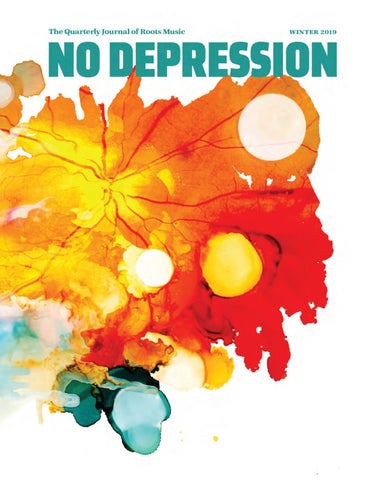
For No Depression’s “Vision” issue, I took a section from one of my ink paintings, combining it with a retinal image of my own eyeball that I asked my optometrist to send me. For me, combining these two images represents the connection between our art and our own existence — microuniverses that exist within our art and inside ourselves. — Nicole Atkins
NO D EPRESSIO N TE AM
Chris Wadsworth Publisher Hilary Saunders Managing Editor Stacy Chandler Assistant Editor Sonja Nelson Advertising Adam Kirr Marketing and Social Media Manager Maureen Cross Finance/Operations WEB nodepression.com T WITTER & INSTAGR AM @nodepression FAC EB OOK facebook.com/nodepressionmag G ENER A L INQUI RI E S
info@nodepression.com ONLINE A DV ERTI SI N G
advertising@nodepression.com SU B SC RIP TIONS
store.nodepression.com
INSIDE COVERS:
Illustrations by Dylan Goldberger inspired by Townes Van Zandt, Guy Clark, Waylon Jennings, and Willie Nelson and appearing in the new book, Four Legs, Wings, and Six Strings.
JOU RNA L D ESIGN & P RODUCTI ON
Marcus Amaker Printed in Nashville, Tennessee, by Lithographics Inc. No Depression is part of the FreshGrass Foundation. freshgrass.org ISBN-13: 978-1-7340223-0-8 ©2019, FreshGrass, LLC
5
Hello Stranger BY HILARY SAUNDERS
PHOTO BY RAYE ZARAGOZA
N
ot to brag or anything, but I’ve always had perfect vision. Better than perfect, really. Even though both of my parents got glasses as children, I sauntered through some genetic loophole to enjoy 20/15 vision. Ironically, I actually wanted glasses as a kid. Thick frames and colorful lenses have always accentuated my face pretty well, and the concept of one regular statement piece accessory appealed to my lazy (lack of) fashion. But mostly I think I just wanted some physical marker to show me how to see the world in different ways. These days, a polarized pair of RayBan sunnies is my go-to for glasses, but I consciously try to keep my eyes — and ears — open for new stories, sounds, ideas, and ways of thinking. And for this issue of No Depression, we embraced all of these topics under the auspices of “Vision.” At first, it might seem strange to focus on the visual elements of roots music, a primarily aural medium. We first engage with songs through our ears. We hear plucked strings, tapped percussion, and projected voices carrying melodies or harmonizing together. If it’s loud, we can feel rumbling or reverberations from our feet to our cores; if we’re lucky, we might enjoy a fleeting sense of peace emanating from within. Sight adds a whole other dimension to the way we experience roots music. As patrons and concertgoers, we read liner notes and lyrics, study album art, and watch performances happen in real
time right in front of us. Musicians, too, see their visual choices as part of their identities, both on records and on stage. The “Vision” issue explores these concepts and so much more. Visually, we made a conscious effort to find exclusive photos (like those by Wyatt McSpadden for the new North Mississippi Allstars record) and innovative illustrators (like Dylan Goldberger, whose pun-filled takes on country musicians are featured on the inside of this issue’s covers) and share them our 100% recycled pages for an especially aesthetically pleasing book. Editorially, the issue highlights other facets of roots music that require our eyes, as well as one that takes away that
visual element. Some songwriters, like cover artist Nicole Atkins, Scott Avett, and Andrew Combs, make visual art in addition to their music. Others, like Yola, Lillie Mae, Mary Gauthier, Kaia Kater, and Orville Peck, use fashion to help heighten the messages of their music. Stories in this issue also dig into set design, television shows, comic books, board and video games, and even tour merch featuring submissions from No Depression readers! Still, there’s a metaphorical element to “Vision” that also warrants consideration. During a strange and fortuitous crossing of tour routes this summer just days before this photo was taken, I found myself at a bar in in Copenhagen with members of the rock band Eels, singer-songwriters Robert Ellis and Raye Zaragoza, and a few tour managers and road techs. Pretty quickly, conversation turned to how crazy it is to exist and create as a human being in the music industry these days. The fears and hopes we all shared, albeit from slightly different perspectives, stuck with me after I returned stateside, inspiring me once again to challenge the breadth of this issue’s theme. Luckily, Ellis, the Texas Piano Man himself, expanded on his thoughts from that smoky Danish bar to close this issue with his vision for roots music today. Literally or figuratively, the concept of vision serves as a good reminder: Even though we all go through life seeing things our own ways, we can learn so much about each other just by sitting back and listening.
6
7
‘ETERNAL LIFE’ The making of the graphic novel celebrating Jeff Buckley’s legacy by Sean Edgar
ILLUSTRATIONS FROM THE BOOK, GRACE: BASED ON THE JEFF BUCKLEY STORY.
W
riter and record label co-founder Tiffanie DeBartolo and Mary Guibert met on the corner of Leonard and Broadway in New York City circa 2000, three years after Guibert’s son with folk musician Tim Buckley — troubadour icon Jeff Buckley — drowned in a Memphis river at just 30 years old. Like many ’90s musicphiles, DeBartolo was still enraptured by Buckley’s intoxicating voice years after the release of his only studio album, 1994’s Grace. Guibert was hesitant to connect. “I was so weary of young women coming and telling me things I did not want to know about my son, like that they’ve actually met, and there’s a child, and I was like, ‘Ahh!’,” Guibert recalls with a laugh. But Buckley’s former road manager, Gene Bowen, vouched for DeBartolo, who had devoted her debut novel, God-Shaped Hole, to the late singer-songwriter. DeBartolo and Guibert immediately cultivated an emotional chemistry, cemented by a mutual love of Bob Dylan and Joni Mitchell. Seven years later, Mark
Siegel — the editorial director of the thenfledgling book imprint First Second — approached Guibert about publishing a graphic novel biography of Buckley. Guibert blessed the project, requesting that DeBartolo assume scripting duties. The resulting tome, Grace: Based on the Jeff Buckley Story, took the better part of a decade to produce and was eventually published last April, in time for the 25th anniversary of Buckley’s record this year. The team’s obsessive, respectful attention to detail bleeds through every panel. Artists Pascal Dizin and Lisa Reist channel Buckley’s journey from Hollywood dreamer to romantic luminary, festooned in expressive linework and duo-chromatic tones that veer from sky blue to rich turquoise blankets. Aside from canvassing the minute details of Buckley’s life, Grace visually matches the octave-spiraling vocals of the album that inspired its name. Music staves and notes careen heavenward, winding around Buckley and his band to convey the ethereal air that marked the musician’s all-too-brief career. The
creative team chose to bookend Buckley’s journey with the fictional tale of Henry, a high-school musician who shows that musical legacies can last forever. Like other First Second musical biographies California Dreamin’: Cass Elliot Before The Mamas & the Papas and Monk!, Grace nimbly immerses readers into the most intimate recesses of its subject’s life while translating music into two dimensions. It’s a bold encapsulation of a trailblazer’s life that could only work in the comic medium. No Depression spoke with DeBartolo and Guibert to discuss the process of reconstructing Buckley’s life and music into 150 pages of sterling sequential art. NO DEPRESSION: You both spent a month in Los Angeles going through Jeff’s demos and journals. What was that excavation like? TIFFANIE DeBARTOLO: I spent a month in L.A. and went to Mary’s house every day, and asked her questions and did research. That was a pretty amazing experience. MARY GUIBERT: I had purchased this
8
museum-quality storage unit, with drawers and compartments for all of Jeff’s ephemera, the flotsam and jetsam and tapes, even down to clothing and keys. His microphone, his vinyl collection, and his journals. ND: What was the most surprising thing you found in those journals? TD: The thing that struck me the most was just getting this feeling about who Jeff was and seeing this spirit emerge. There were so many times when Jeff would write in his journals about the things he wanted to accomplish, and he would make lists of “This is what I’m going to do at this age,” and “This is what I’m going to do and at this age,” and what struck me the most was that he had done everything he said he was going to do. He was just so unbelievably focused, and so openhearted. And that really moved me, because I felt all of those things in his music. I feel like that’s one of the things that people gravitate toward his music for. There’s the spirit in it — this is the kind of person you want on the planet. I think that’s why I was so devastated when he died, because he just seems like the kind of person who belongs here. Why didn’t we get to keep him longer? MG: Of course, as a mother I miss him, but when I saw him emerging as an artist of respected craft … he wasn’t someone who was going for that gold record. He was really going for an audience he could enlighten. An audience that he could love, and an audience that he could shower with whatever was coming out of
his soul to connect with theirs. And that’s why at both of his memorial services in New York, I gave a little speech called “The Golden Promise.” I said, paraphrasing, it’s going to take all of us to make up for what is missing now because of his tremendous kindness, his selfawareness, and how clearly he saw us and loved us anyway. I have a bone to pick with God, but who am I to question? It is what it is. And so it was left to us to lift that up. As much as it moves us, and as long as it moves us, to do things that keep him in memory. ND: What were the hardest parts of Jeff’s life to reconstruct? Where did you have to do the most archaeology? MG: There were two things. The first thing I wanted to be most vigilant about was not putting words and emotions into his mouth that were not his. And number two was portraying his passing. Not only are we using words, but we’re using pictures. How do we do that? And there are so many myths and rumors out in the world, especially now with heightened social media, that suggest that [Jeff] committed suicide, that it was not an accident, that he was depressed, or that he was using drugs, or that somehow alcohol was involved. I have an autopsy that proves that none of that was true, and an eyewitness to prove that none of that was true. So portraying those moments, before he walked into the water and the moment when he passed, was a very touchy subject. I was like the surgeon who couldn’t operate on the
relative. I had to rely on Pascal, his art, and the support from Tiffanie and Mark, for everyone in the project to say, “No, Mary, this is good, we feel good about it, too.” It was hard to be specific about that, but in the end, I’m at peace with what I see on the page. If I were the artist, that’s how I would have portrayed it. Those are the two big things I feel good about. Everything else is frosting. ND: There was a decade-long gap between handing in the manuscript and the final product ... MG: [Laughs] It took us a while to pin down what Jeff would look like. In the early sketches, he looked a lot like Jughead and I just … I couldn’t let it go. “No, that’s not his nose. And you see the hair, where it flips up? That looks like Jughead.” I did get a bit of a lecture from Pascal about cartoon faces and how to show emotion in a graphic visual like that. I had to concede — there are some pages that still look a little Jughead-ish, but he’s getting something across that’s very cartoonish in the expression, and then it goes back to having a more “sensitive” or “normal” face for Jeff. Those are the ones I struggled with. He’d patiently go back to the drawing board and redo things. And then there were edits. An edit would change the way a picture would look, or we had a struggle over which way to portray Jeff not being at his father’s funeral. How do you do that? You have a picture of the funeral and Jeff is not there. Do you put a little
9
“The real flow-through here is how art is an organic part of being human. It lifts us and heals us and brings us together and helps us break through parts of humanity that are unbearable — something to tap your toe to, or something to just cry to. So we leave the book with the torch being passed. ” Mary Guibert
dotted line around a child’s figure and make it empty? Or do you put a ghostlike figure of a child, and him hovering over it? I have to tell you, that was weeks. But everyone was giving thought to it. They weren’t trying to dash out a solution. ND: How difficult was it to fit an entire life into 150 pages? TD: When I turned my original manuscript in I remember Mark saying, “You’ve got to cut around 100 pages from this.” ND: What were the most painful cuts? TD: It was just about making a choice between showing more of his personal life versus more of the life he led with his band. We decided to go more with the band stuff and less of who he dated. That made a lot of sense to all of us. It wasn’t even that big of an issue. MG: There were some stories that Tiffanie and I fought to keep in. One of them was the one about the perfume, where Jeff had this talent of being able to name women’s perfume. He would kiss their hand and smell their perfume and name it. There was a time there, up until Jeff was “discovered,” when he was looked upon as a nerd by the girls he was attracted to. He was not considered a catch at all. He was always playing his guitar and kind of pale because he never went out in the sun. He was not a surfer dude and he grew up in Anaheim, California. He went to New York and was suddenly embraced by all these downtown and East Village chicks,
women who fell in love with him and followed him home, and created problems for his relationship with Rebecca [Moore] — leaving notes and underwear at his door. It was terrible. But when they broke up, he was kind of like a kid in a candy store. There were plenty of [temptations for young males], and it fits in with that line [from the song “Lover You Should’ve Come Over”], “Sometimes a man gets carried away when he thinks he should be having his fun. Much too blind to see the damage he’s done.” And that’s why he touches us. We all do that. ND: What were your first impressions on reading Grace: Based on the Jeff Buckley Story after it had been illustrated and lettered? MG: I think the genius part was the addition of the fictional character [Henry]. The real flow-through here is how art is an organic part of being human. It lifts us and heals us and brings us together and helps us break through parts of humanity that are unbearable — something to tap your toe to, or something to just cry to. So we leave the book with the torch being passed. I thought that was genius — the little deus ex machina at the end. It makes it not so sad. The last thing that I want people to feel is sorrow. In the days following Jeff’s passing, I did a lot of interviews, hundreds of interviews. Often people would say, “It’s so awful because he was taken so soon
and it’s shocking!” I’d say, “I’m not the only mother who’s mourning a child today. People will die today. Are you ready to die? You could die tomorrow, sir. Are you ready? Are you enjoying life? Are you doing something meaningful? When you go, will people remember you? Will they sing your songs? Will you have touched anybody will you have left anything of any meaning behind?” Don’t ask me if it’s a shock that my son has gone. Many other mothers will lose a son today, and I’m only one of them. ND: How did you develop the character of Henry? TD: There had already been a biography published about Jeff’s life. You can Google his name and find out the plot points of his life, and I thought, “How can I capture what I really want to capture here?”, which is (a) Jeff’s spirit and (b) his effect on people whose lives were touched by his music. As somebody who felt like it was my life that was changed by his music, I wanted to capture that. So I just came up with this idea of this fictional character who has this parallel storyline going, and gets to interact with Jeff. I was really afraid when I turned in the book that Mark was just going to be like, “What is this nonsense?” And he really responded to it. I knew it was a big, big risk, but it just felt like the right thing to do. This conversation has been lightly edited for clarity and length. ■
12
THE WEIRD AND WONDERFUL WORLD OF WES FREED New book highlights the artist’s iconic album covers, posters, and more IMAGES COURTESY OF WES FREED
by Laura Scholz
13
14
15
G
rowing up on a farm in Virginia’s Shenandoah Valley in the shadow of Civil War battlefields, Wes Freed’s fascination with the macabre began at an early age. Using drawing paper and other supplies he pilfered from school, the artist spent his childhood doodling battle scenes, spooky rural landscapes, skeletons, and other images that would come to shape his signature Southern gothic style. Freed sold his first piece of art — a portrait of either Gene Simmons or Peter Criss, he can’t remember — in high school, about the same time he joined his first band, two acts that cemented his destiny as an artist with serious rockand-roll roots. While that high school print didn’t quite make the cut, more than two decades of Freed’s other work will be showcased in his upcoming hardcover book, The Art of Wes Freed: Paintings, Posters, Pin-ups and Possums. Scheduled for release this month and featuring a foreword from Drive-by Truckers co-founder and longtime collaborator Patterson Hood, the 160-page anthology of Freed’s art includes his iconic album covers for the Truckers, portraits of music legends like Hank Williams, concert bills, his Willard’s Garage comic strip series, and more.
The Richmond Scene When not doodling Civil War soldiers or painting moody landscapes, young Freed
spent his formative years surrounded by music. “No one in my family played music that much, but we played a lot of records,” he says. “This was 1975 and 1976, so we were listening to folk musicians like John Denver and Gordon Lightfoot, plus lots of outlaw country from Waylon and Willie,” he continues, citing the latter as foundational musical influences. By the time he attended high school in the early 1980s, his tastes had turned to punk rock. He spent hours listening to The Clash and The Stranglers and, in spite of not playing an instrument, was determined to join a band. “Luckily, this guy who lived down the road from me, David Powers, played guitar, and he taught me how to play, and let me sing a little,” Freed recalls. Later, Freed, Powers, Powers’ brother Danny, and C.J Botkin formed a band called The Victims. Freed jokes his first official “recording” with that band was a cover of The Rolling Stones’ “Emotional Rescue,” made using “parts and pieces of Frankensteined cassette players.” Freed eventually learned to play the fiddle and attended art school at Virginia Commonwealth University in Richmond, studying painting and printmaking and immersing himself in the fantastical works of Hieronymus Bosch, Francisco Goya, and Edward Gorey as well as the city’s emerging music scene. “Everyone in Richmond at that time was a musician or artist or both,” says Freed, who thrived in the hypercreative
community. He stayed in the city after he graduated, playing with a string of bands ranging from the metal-influenced Mutant Drones to the country-tinged Mudd Helmet — which eventually morphed into Dirtball — and continued to pursue his art while painting houses to pay the bills. In 1991, a local independent paper commissioned him to create a comic strip series, and the famed Willard’s Garage world was born. Using a garage he passed every day growing up for inspiration, he developed elaborate backstories for his characters, whom he envisioned as mechanics and moonshiners, thus creating the framework of what grew to be his definitive style — eerie pastorals, an otherworld inhabited by skeletons, barren landscapes, looming bats and crows. It was dark, but always with a hint of humor and whimsy. It was these artistic qualities that captured the attention of other local musicians, notably upcoming singersongwriter Lauren Hoffman and David Lowery and Johnny Hickman of the alt-rock band Cracker in the mid-to-late 1990s. Hoffman, drawn to Freed’s art because of its combination of “spookiness” with a “traditional Southern folk element,” commissioned the artist to design the cover of her 1997 LP The Chemist Said It Would Be Alright But I’ve Never Been the Same, which Hickman and Lowery produced. “I love the way Wes creates these
16
totally signature characters and creatures and places them in his spooky, wonderful rural landscapes,” says Hickman, who along with Lowery commissioned Freed to design the cover for what would become the band’s 1998 album, Gentleman’s Blues. With stark trees, moody moonscapes, and a winged black cat that has become such a calling card for the band that several fans have gotten tattoos of it, the artwork is signature Freed.
Drive-by Truckers Days Freed’s art might have stayed a local phenomenon if not for a chance meeting with The Drive-by Truckers at Bubbapalooza, an annual roots music festival at the storied Star Community Bar in Atlanta in 1997. As Freed recalls, he was impressed by the band’s music and wanted to introduce himself, but was a bit hungover and “couldn’t muster up the gumption” to approach them. So his then-wife and bandmate Jyl did, inviting the Truckers to attend one of the couple’s monthly Capital City Barndance gatherings, an event Freed describes as “Hee-Haw meets The Grand Ole Opry” and “alt-country with a punk rock attitude.” The band crashed with the Freeds, and, as Hood recalls it, walking into the Freeds’ home that fall was like walking straight into one of Wes’ paintings, with foster animals, overgrown grass in the yard, and his otherworldly paintings covering every surface of the home’s interior. “It was kind of like a miniature haunted house, like the Boo Radley house in To Kill a Mockingbird, where kids in the neighborhood walk to the other side of the street,” he says. Hood and Mike Cooley were
immediately taken with the Freeds’ aesthetic, which Hood describes like this: “Its own universe — old-timey, but timely, incorporating what’s current into what’s old.” The band tapped Freed to collaborate with them on their ambitious Southern Rock Opera project, a double LP the band released in 2001. Back before the era of digital files, the band would send Freed rough mixes of tapes as they worked on the record, which Freed would then listen to as he sketched and developed thematic ideas for the cover. The result was the now-iconic largewinged bat flying over mythic and desolate Highway 72. Freed worked dilligently with Hood’s sister, Lilia, a digital graphic designer, to develop the complete album package. “She vowed early on to be true to his work and never alter it, which cemented his trust. We’ve been working with him ever since,” says Hood of the partnership. That fateful collaboration launched a decades-long relationship and resulted in other notable covers like 2003’s Decoration Day, with its massive cranes looming large over a graveyard, and 2011’s Go-Go Boots, with the namesake boots in siren red in the foreground. Freed’s personal favorite, however, is 2004’s The Dirty South, which was an entire painting turned into a foldover sleeve for the album cover. In addition to the crane and the tornado — which he and Hood agreed were central to the record’s themes — Freed wanted to illustrate this line — “my Daddy played poker on a stump in the woods back when the world was gray” — from “Where the Devil Won’t Stay,” which led to cover’s central image.
Art, Music, and Legacy These days, Freed still pursues music, but
in his own way. He fronts a band called The Mag Bats, which performs regularly in venues in and around Richmond, and for him, it’s the best of both worlds. “I’m lucky enough to be able to do the rock star kind of thing without having to tour,” he remarks, also noting that the time at home gives him the opportunity to paint and create. In addition to designing albums, posters, and concert flyers for the Truckers, Freed also creates watercolors, builds custom frames, and accepts commissioned projects. An animal lover and proud owner of Betsy, a Schnauzer rescue, and Ella, a West Highland terrier, he’s found a niche painting pet and yes, even family portraits. “I do them in my own weird-ass way, but the people who get it, get it,” he remarks, noting he’s often too busy to work on “the stuff that comes right out of my head, because it doesn’t pay the bills.” While Freed had a solo art show at the Jacksonville Center for the Arts in Floyd, Virginia, in 2015, this book will be the first time his life’s work will be featured in print. According to Freed, the book will include work “from 2006 to whenever we run out of time to put new things in there,” and he’s excited to see the project come together. “It’s cool to see your life’s work crammed together in one spot.” When asked if he considers himself more a writer or an artist, Freed responds, “I spend a lot more time making paintings than I do writing or playing music, but I don’t really separate the two in my mind. When I write songs they are like word paintings, and my paintings, to me anyway, are kind of like songs. Not even two sides of the same coin so much as the coin being melted down so both sides are intermingled.” ■
17
Color inside — or outside — the lines and post your best photos online, tagging @nodepression and @rebeccaloebe and using the hashtag #NDWinter19.
ILLUSTRATIONS BY DAN GRISSOM
18
19
Coloring Outside the Lines
P
ersonally, I think it’s an exciting time for the music business. It may be hard for folks who remember what it was like to sell CDs in the ’90s, but by the time I made my first record in 2004, the MP3 was here to stay. The industry has been running scared for my entire career, but I’ve always enjoyed the challenge of figuring it out. I believe there is money to be made; it’s just being made differently than it was 20, 10, or even two years ago. In early 2017, I was searching for an extra item to sell to offset the slow decline in the sale of compact discs. Shirts and tank tops were selling well, but I wanted something more directly related to my music. I spent months brainstorming, and one night after a show, the idea of printing a coloring book to accompany my new album popped into my mind and wouldn’t leave. As soon as it occurred to me, I knew it ticked all the boxes: It’s interactive, cathartic, and not too terribly expensive to manufacture. I commissioned a beloved Austin-based illustrator named Dan Grissom to create line drawings for each song on my newest album, which at the time was an 11-song record called Blink.
by Rebecca Loebe We worked together on a layout that included lyrics and an illustration for each song. I had specific ideas of what I wanted the illustrations to look like for about half of the songs, and for the other half Dan listened and pulled inspiration from the lyrics. In some ways, the idea came together backwards. It wasn’t until the first run came back from the printer and I was actually holding the coloring book in my hands that I realized a few things: 1. I absolutely loved it! 2. Coloring books usually cost around $5, but I needed to figure out a way to charge enough so as not to undercut the other items on the merch table. 3. By including an album download with the coloring book, I could sell it for the same price as a physical album. I learned that Bandcamp sells unique album download codes for three cents each, and BOOM! The coloring book became an alternative way to purchase the record. The night before the tour started I stayed up late copying-and-pasting download codes into a sheet of Avery address labels that I printed at home and pressed into the back of each
coloring book by hand. They were an immediate success at the merch table, coming at a time when more and more people no longer own or use CD players. I love to talk about them from stage — the line “My new album also comes in coloring-book form!” never fails to get a laugh. As an added bonus, I’ve noticed people buying them as gifts for the kids in their lives, opening up a whole new possible revenue stream. In short, these suckers have been a dream merch item: They’re lightweight, compact, great conversation starters, fun for all ages, and, unlike most merch items, require no minimum order. I’m planning to make one for every album I’ve released and I’d encourage any musician who’s curious to give it a try. Artists today have a historically unprecedented ability to connect directly with their audience and manufacture almost anything they can dream up. My foray into the world of musical coloring books has been an important reminder that for independent musicians the only rule is that there are no rules … and sometimes it pays to color outside the lines.
20
WILD WARES
These days, the best way to support the musicians you love is by seeing them on tour or buying their swag. Most bands tour with a fairly standard combination of CDs and vinyl records and T-shirts. Some might even give away stickers if you sign up for an email list. But some roots musicians have been exploring other means of getting their names and music out into the world. It’s not a new phenomenon, of course: John Prine has fly swatters available as a reference to a line in “Angel from Montgomery,” and after Johnny Cash’s posthumous American V: A Hundred Highways release, license plates with his name and album artwork were sold in support of the record. In an effort to find some of the most unusual, nontraditional merchandise slung out on the road today, No Depression polled our readers on the most out-there items they’ve picked up at shows and interviewed a few bands on what they’ve conjured up to sell. — Hilary Saunders
21
THE YAWPERS
I’m not exactly sure what the genesis of the cutout idea was. Either a fan online suggested it on Instagram, or I provided this most important revelation. Regardless, the picture was taken by my long-suffering roommate, Nate (of In the Whale), on a lark. We were discussing the agency of suicide on the couch, and I had just received copies of the new record. Possessed by the moment, I ran to the bathroom, disrobed, and ran out, much to his shock, demanding a photograph with Human Question mercifully obscuring my nethers. The pose, with one arm ironically positioned in a vulnerable position behind my head was actually done out of necessity, as health issues forced my arm to remain elevated behind my head to avoid pain at the time. Initially, we offered these for sale to the public as a joke, but the demand was surprising, if not overwhelming. Some people ordered two. And now I will forever live with the notion that someday, when I’ve been relegated to a place where I’ll die alone, having alienated everyone I love, a piece of my sneering, hateful heart will live on in someone’s garage. And I take delight in the questions it may raise in the generation that uncovers my fading likeness after I’ve made my exeunt.
— Nate Cook
22
BONNIE “PRINCE” BILLY I bought this leather “Let Go” fob at Bonnie “Prince” Billy’s December 2013 show at the Cedar Cultural Center in Minneapolis. The cost ($7), sentiment, and subtle reference to Bonnie Prince Billy’s [2006 album] The Letting Go appealed to me. I love how it’s aged over the years, but sometimes people ask if it refers to the song “Let it Go” from the Disney film Frozen. — Tom Flynn, Minneapolis, Minnesota
KATIE TOUPIN I sell CDs but realized lots of people don’t have CD players anymore. So many people use this excuse to stream music instead of pay me for music and they tell me so every night at the merch table. So I decided to fix that problem! $40 later they get a portable CD player that I pre-load with batteries for their immediate listening sanity. It comes with Walkman-style headphones too! Everybody wins! — Katie Toupin
23
CAROLINA CHOCOLATE DROPS The piece [from around 2013] caught our eyes right away as being representative of the music and the character of the band. Handmade by Kim & Pete McWhirter, Burnsville, North Carolina. — Holly Paul, Moore, South Carolina
24
ilyAIMY
Two years ago, my band decided to offer a cookbook alongside our CDs and T-shirts; it’s sold out three times and become our most successful merch. Our personal recipes celebrate the ethnic and cultural diversity of our group, along with foods discovered on tour or this one cookie recipe kept alive from a shuttered venue. Recently, fans who own a restaurant/music venue surprised us by making multiple dishes from the book as menu specials during our performance there. — Heather Aubrey Lloyd
JON BROOKS AND THE OUTSKIRTS OF APPROVAL
[I got this] eyeglass cloth [at] Summerfolk Festival 2019. After seeing them play and hearing the lyrics, it was obvious the bond of commonality between all Jon Brooks and The Outskirts of Approval fans is that they’re all adult passionate readers. Adult readers need clean glasses. — Sandra Tilson, Toronto, Canada
25
SCI-FI ROMANCE In support of our album The Ghost of John Henry in 2012, we rehabbed a bunch of old railroad spikes and stamped them with the band and album name. Because John Henry. Even though the AV Club named it one of their most useless pieces of merch for the year, the spikes sold out. — Vance Kotrla
PHOTOS BY KATIE MOULTON
26
27
RELICS FOR SALE Inside the world of Elvis Presley memorabilia collectors by Katie Moulton
28
Jimmy Velvet
Coe called “Did You Know Elvis?” Velvet’s main merchandise today is his 2007 coffee table book, Inside the Dream. It’s a 288-page tome featuring thousands of Velvet’s personal photos, mostly of his slight frame posing beside heroes of rock and roll and the entertainment industry, stretching back to the first photos he ever snapped — backstage in 1956 in Jacksonville, Florida, goofing around with a 20-yearold musician. Velvet’s high-school teacher, Mae Boren Axton, who also worked as a local show promoter, had gotten the 15-year-old into a Hank Snow jamboree concert at the Gator Bowl when she knew he couldn’t afford the ticket. Velvet aimed to meet June Carter, but ended up chatting with a guitar player with a dirty blond pompadour. “After about an hour, he sticks out his hand and says, ‘By the way, I’m Elvis Presley,’” Velvet recalls. “And my first thought was, ‘What’s an Elvis Presley?’ Then Mama Mae walks up and says, ‘I see you’ve met Elvis. He just recorded my song, ‘Heartbreak Hotel.’” This is the way all of Velvet’s stories go: One music icon leads to the next. On
the edge of the frame is Velvet, a Forrest Gump-like figure who kept showing up with his camera, who straddled the line between fan and insider. Velvet had a long friendship with Presley and his family, but he also predicted the market value of celebrity artifacts. In fact, Velvet’s career trajectory is inextricably bound up with the evolution of Presley’s posthumous image and the material culture of Elvis fandom. Where Velvet is now also points to how the market of Elvis iconography is still shifting.
Big Business The King of Rock and Roll has been dead now for as long as he was alive. In the 42 years since his death, Presley’s seedy secular sainthood ballooned among his legion fans, and the physical trappings of his performance — his replicated image, his costumes — gained nearly as much influence and ubiquity as recordings of his voice. In the coming months and year, we can expect a renewed wave of Elvis representation in pop culture: Famed director Baz Luhrmann is working on
PHOTO COURTESY OF JIMMY VELVET
F
or a one-time preeminent dealer of Elvis Presley artifacts, Jimmy Velvet doesn’t have much to sell. It’s Elvis Week 2019, which takes place in Memphis every August leading up to the anniversary of the singer’s death, and Velvet sits alone behind a corral of folding tables in a low-ceilinged conference room of a Travelodge near the airport. The man who opened the first Elvis Presley Museum in 1978 is now 80, sporting suspenders, a soft smile, and the deferential accent of a Southern boy raised by grandmothers. He holds down a prime spot at the 41st Elvis Presley Fan & Collector Show, and his table is scattered with random items, such as Elvis-branded plastic drink stirrers and a rare live recording from the 1956 Mississippi-Alabama Fair & Dairy Show, for which he took the cover photo. Propped against the wall is an original vinyl of his own album, A Touch of Velvet, from 1968; the sleeve shows a young Velvet with his jacket tossed over his shoulder. There’s a CD featuring Velvet’s 2006 single with David Allan
29
an feature film starring Tom Hanks as Colonel Tom Parker, and in November the original TCB band (the core rhythm players in Presley’s band from 1969 to 1977) will present a live concert experience, playing with video footage of Presley performing. Presley combined roots music, R&B, and country with pop tempos and preternatural swagger to bring something called rock and roll to the white masses; even if the casual listener couldn’t hum the tune of a Presley hit, they’d likely able to identify the black pompadour and sideburns, the curled lip, the gyrating hips, the flamboyant white jumpsuit. The image has been sold on merchandise from velvet canvases to porcelain plates to trashcans. Elvis was always big business, but his fans began this material-based devotion organically. These fans also gave names to each of the opulent jumpsuits Presley wore during his 1970s performances — names like Mad Tiger, American Eagle, Chicken Bone, and Blue Phoenix. Since his earliest hits, Presley had been associated with adornment — teddy
bears, limousines, blue suede shoes — and that materiality associated with his excess of sensuality, wealth, and star power. At shows, Presley received homemade gifts from fans who approached the stage and gave them sweaty sacraments of scarves (and sometimes kisses) in return. These exchanges have been viewed as a performance extension of his renowned and childlike generosity; he gave lavish, spontaneous gifts. Sometimes he’d trade his diamond watch or hand over the keys to a luxury car. Sometimes, as with Velvet, he gave the shirt off his back. When Presley died, he left behind the gift of his powerful voice. That twoand-a-third-octave instrument was recorded on more than 150 gold, platinum, and multiplatinum albums and singles, and sold more than one billion copies worldwide. The absence was of Presley’s body — the famous image he struck, particularly during his return-to-the-stage era between 1969 and 1977, when he played nearly 1,100 concerts. What was Presley without the trappings of his performance? How could fans get that close to the King
again, to touch the hem of his garment? In early 1978, Jimmy Velvet and his band were playing a two-week residency at a Ramada Inn also near the Memphis airport. In between sets, he was watching the local news when he heard that the city was considering opening a museum dedicated to Presley. “I thought, ‘Considering? You should’ve already been building it!’” Velvet recounts. “It wore on my mind. So in the middle of my next set, I announced that this would be my last show. I said, ‘I’m going to open an Elvis Presley museum myself,’” he laughs. The next day, Velvet says he received permission from Presley’s father, Vernon, with whom Velvet was close. In June, 10 months after Presley’s death, Velvet opened the Elvis Presley “Mini Museum” directly across the street from Graceland, which would not open to the public until 1982. Velvet’s museum featured 21 items from his own collection — jackets and jewelry that Presley had given to him over the years. For $1 admission, Velvet took eight guests at a time into the small back room, where they could examine the
30
“We had Elvis’s underwear — well, his dance briefs. I’ll never forget this one gal who asked me to take a picture of her with them. She counts, ‘one, two, three!’ then puts the underwear over her head!” Jimmy Velvet
precious relics in three display cases. One of Velvet’s favorite pieces in the collection was a gold ring given to Presley by the shah of Iran. According to Velvet, Presley threw it in the toilet after learning of the regime’s human rights violations, but his grandmother, Minnie Mae, whom he called “Dodger,” spotted the glittering object in the toilet bowl, “fished it out, cleaned it off,” and gave it to Velvet for safekeeping. He recalls another anecdote: “We had Elvis’s underwear — well, his dance briefs. I’ll never forget this one gal who asked me to take a picture of her with them. She counts, ‘one, two, three!’ then puts the underwear over her head!” Velvet saw the opening of the Presley museum as both an opportunity and a service to the audience who felt so connected with the singer’s life. “I felt what the fans felt,” he says. “I wasn’t just a friend, and I was never an employee. I was also a fan.” Still, with his museum business booming, Velvet began “buying everything Elvis.” By early 1982, he
opened a second Presley museum in Honolulu, then others in Orlando and Nashville. He had amassed 5,200 collectible pieces that had belonged to Presley. Originally, Velvet manufactured his own Presley souvenirs to sell in his museums, and other gift shops with bootleg items opened in the plaza across from Graceland. Soon enough, Colonel Tom Parker, who was still entitled to 50 percent of Presley’s income, began to pressure these vendors into licensing deals to control the Presley merchandise. Velvet was the first — and only, he says — one to sign, compelled by the belief that a percentage should benefit Presley’s daughter, Lisa Marie. By the early 1980s, Elvis Presley Enterprises (EPE) had wrested control of Presley recordings and visual images from Parker, but Velvet still got out of his contract with the estate. “I didn’t like being under their thumb like that,” he says. Instead, Velvet ventured further into the realm of big-ticket memorabilia. He organized auctions of items from his
large collection, including Presley’s wedding band, birth certificate, and a revolver with “TCB” inscribed in gold on the handle. A 1994 New York Times article on a Velvet auction quotes the creative director of Hard Rock International, which owns a huge collection of rock memorabilia, as saying, “We were probably responsible for spiking Elvis prices,” but also worrying over “the emphasis on the cult of personality instead of Elvis the musician.” Velvet sent his collection on the road, setting up touring displays in shopping malls across the country and to places Presley himself never went. In the mid-1990s, Velvet sent a collection of artifacts to tour and sell at auction in Japan, where the Presley fervor was high. At the end of the tour, however, all the items, including rings, jackets, and a karate uniform, disappeared. This is another pattern in Velvet’s stories: For the thousands of Presley relics he collected and kept safe, he also lost many to fire, theft, swindle, or simply being forced to sell because he
31
needed money. Meanwhile, Graceland became a major tourist destination, the secondmost-visited home in the United States after the White House, hosting 600,000 guests per year — and helping EPE escape bankruptcy. EPE has also stringently controlled Presley merchandise, the use of his name, and his mass-produced image — barring, for example, any image of an overweight Presley. “If you haven’t been to Graceland recently, you haven’t been to Graceland,” said Joel Weinshanker, managing partner of Graceland Holdings LLC, in 2017. The latest majority owners of EPE have made huge strides in updating the Presley brand for the contemporary era, expanding into new properties on Elvis Presley Boulevard, including a $45-million, 200,000-square-foot entertainment complex. The vibe is a cross between Hard Rock and Disney World, where you can observe and consume a swept-clean version of Presley’s loves and triumphs. At the
sold-out Ultimate Elvis Tribute Artists competition at the 2,000-seat Graceland Soundstage, the crowd nursed white wine from sippy cups while watching last year’s champ, Ben Thompson, give an encore performance. Thompson gained a new level of meta-fame recently when he portrayed a futuristic hologram of Presley in the movie Blade Runner 2049. The finalists were remarkably young, which only added to the uncanny sensation. In big-screen video clips, the singers gushed about their grandparents turning them on to Presley’s music, and how they had grown to admire him as a generous man of faith.
The Value of Preservation As for the shopping center across from Graceland that once housed Velvet’s first museum and other independent souvenir vendors, EPE long ago purchased it and shuttered the shops, except for one, which it owns. The lot serves as blocked-off employee parking.
It’s an obvious metaphor for the chasm between independent vendors and the estate. In graying hotel lobbies along Elvis Presley Boulevard, devotees who built this specific fan culture expressed alienation as EPE successfully consolidates the Presley brand for a new era. These were the fans who traded photos through the mail, hunted down collectibles, created shrines in their homes, and started grassroots fan clubs like the one that sponsors the Candlelight Vigil on the anniversary of Presley’s death. According to historian Erika Doss, “Fans repeatedly say that by collecting and displaying Elvis memorabilia they are ‘taking care’ of Elvis, keeping his memory alive and rescuing him from historical oblivion.” But when the image changes, “It’s not quite as fun anymore,” Velvet admits. “It’s not as busy, and every week I hear of somebody else from this community passing away.” Over and over during Elvis Week, collectors expressed deep anxiety over who will care for their Presley
32
memorabilia when they’re gone. They worried that their families not only would not care, but also that they would not recognize the cash value of certain items. Velvet heard that someone bought the contents of Mae Axton’s archive for only $1,000 when she died. “She was still my neighbor and so important to me,” he says. “If I had known, I would have helped her take care of it and get what she deserved.” Elsewhere, at the Holiday Inn Express, Jon Daly held ElvisCon, another alternative trade show, featuring photo ops with Presley cousins, co-stars, and staff. Daly is a dealer of Presley memorabilia who’s still deep in the hunt. “I’ll take everything,” he says, noting he just purchased a 4,000-piece collection. Though most of his business is online, lower-end souvenirs end up in his “Elvis Pawn Shop” inside Marlowe’s barbecue restaurant, about a mile south of
Graceland. He also sells rare items to high-end bidders. “Who do you think provides pieces to the Graceland auction?” he says. In 2017, The Guardian reported that the value of Presley records had plummeted, with items going for less than half of what they were valued only five years earlier. Sometimes they didn’t even sell at all. According to Velvet, however, rare relics, especially luxury and custom items owned by Presley, still draw high prices. Velvet recounts that he eventually purchased 11 of Presley’s jumpsuits, at prices ranging from $1,200 to $15,000, and then sold them at auction for between $100,000 and $150,000. More recently, he claims that he sold Presley’s Bible for $8,000, and that buyer in turn sold the book for $108,000. “There’s a lot of new money in the world,” Velvet says. “And they’re coming around on Elvis.” The Auction at Graceland occurs
during Elvis Week in a half-empty auditorium at the Guest House, an adjacent luxury hotel. Run by third party Graceland Auctions, it has become the central event for dealing authentic Elvis artifacts, according to managing director Laura Pickett. Sometimes EPE even uses this opportunity to buy back items to add to its permanent on-site collection. This year’s auction opened with vinyl records, but didn’t see much action. Everyone seemed to be waiting for the more outlandish items, such as an opal ring given to Linda Thompson (sold for $19,000) or a contract granting Parker a portion of Presley’s earnings (sold for $7,500; “It’s like buying a Horcrux,” another attendee commented). The bidding wars started in earnest when it came to personal photographs of Presley: In one, he’s kicked back at a county fair, his arm slung around a young woman. In another, he’s caught off-guard at a house party, blinded by the flash, and still the
33
most blinding presence in the room. This piqued interest indicated that people still crave images of Presley — not necessarily the mass-produced heartthrob, but some human trace that doesn’t quite fit the frame. Presley has long functioned as the spectacular receptacle of mass projections of what it means to be American, to search, to dream, to struggle, to transcend, to live excessively, creatively, and destructively. As the Elvis fans who have kept his memory alive through these images and collectibles pass away, it’s becoming more and more muddled which version of the star will be valued. In the Travelodge, Velvet admits his career doesn’t have the glitz it used to. However, as he waves to fans who call out to him across the lobby, he says he’d prefer a life without so much stuff. He’s still got a storage unit full of collectibles, but he’s only made a dent in sorting and
cataloging. He says what he misses isn’t the money made off Elvis artifacts, but the ability to give back, to help folks in the fan network who needed it. “Elvis fans are loyal and they’re good,” Velvet says. “They’re not always the prettiest, the sexiest, or dressed the most beautiful, but inside is what matters.” As we speak, Velvet’s phone dings with text messages. After 25 years, someone may have found a few of the lost Elvis artifacts from Japan. He did not confirm because the situation is delicate, but he’s hopeful that these pieces of Presley will soon be returned to his care. Of course, he’ll sell the artifacts once again — because there is demand, and because he is short on space and time. “My priority is making sure my wife is taken care of, and she does not want that stuff left behind,” Velvet laughs. “She wants it gone yesterday.” ■
34
EVERY PICTURE TELLS A STORY
Rediscovered photos inspired The North Mississippi Allstars’ new album by Joshua M. Miller
35
PHOTOS BY WYATT McSPADDEN
Cody and Luther Dickinson of The North Mississippi Allstars
36
Otha Turner
37
I
n 2016, Texas-based photographer Wyatt McSpadden reached out to North Mississippi Allstars singer-songwriter Luther Dickinson about a collection of old photos he thought would interest him and his brother Cody, the band’s drummer. McSpadden was putting together an art show that fall in Austin, Texas, based on the photographs, which he had rediscovered one day while looking through his archives. The photos were from his 1996 trip to Mississippi with music writer John Morthland to cover the Delta blues scene. Some of the photos included the brothers, who had given them a tour of the northern Mississippi music community in which their band was just starting to come together. “John and I were talking that we should look through these and do something with them,” recalls McSpadden. “So we had decided that we’d make a bunch of prints and have a show and John would write some text. And so, when he passed, my wife, who’s a graphic designer, and I decided we’d go ahead and do the show and dedicate it to John.”
While Luther couldn’t make the show, they were able to get together the following year during a North Mississippi Allstars tour stop in Dallas, where McSpadden showed the brothers the photos. While some of the photos were familiar, such as the ones Luther used when producing the 1998 album Everybody Hollerin’ Goat by Otha Turner — one of the last well-known musicians to carry on the fife-and-drum blues tradition — and for The North Mississippi Allstars’ 2005 album Electric Blue Watermelon, many were not. “I was familiar with a couple of them, but when I saw all of them it just blew my mind, because it just brought so many memories, and so much of our original mission,” Luther says. “The day he took those pictures, we had started the band and we were practicing, [but] we had yet to play our first show.” The photos served as a key inspiration in the creation of The North Mississippi Allstars’ latest album, Up and Rolling, released by New West Records in October. Looking at the photos, which are included in a booklet that comes with the album, the brothers were reminded of the strong communal spirit they felt
growing up in the region. So for this record, in particular, they sought to blend Mississippi’s past and present, weaving together styles such as blues, Southern rock, and folk traditions. “It inspired Luther to create a concept for this record, and Wyatt’s photographs and that whole time period in our lives created a setting for us to write and record our new record,” says Cody. “I really like it when music and visual arts, whether it be music video or movies or photographs, work in tandem and they start to inspire, inform each other.” Citing foundational Delta bluesman Robert Johnson as an example, Cody continues, “There are only like two or three photographs of him, but it fills in so many blanks just to see him and see his fingers. Like the way he holds the guitar and everything, it informs but also creates more mystery in a way.” Luther feels the band achieved a similar result on their album. “The photographs are so intimate and captured the feeling of what it was like back then,” he said. “I was like, ‘Wow, the energy of this time changed my life and it’s why I’m here doing what I do today.’ It was very healthy to reconnect to
38
something, such a direct line to that power.”
Mississippi Memories On a Sunday in 1996, McSpadden and Morthland arrived in the hills of northern Mississippi looking to photograph and write about local musicians in the area. Morthland was writing an article for a travel magazine called Escape that was published in October of that year. “It was an amazing trip, tons of pictures,” McSpadden recalls. “I moved to Austin from Amarillo, Texas, which is just a flatland farm, cattle ranch, oil town. And I’d never experienced anything like what I was experiencing on that whole trip. Going to Otha [Turner]’s place and Junior Kimbrough’s and just the whole scene was incredible to me, and it was a great gift as a photographer to just sort of be dropped into a place like that.” Morthland had arranged for Luther
and Cody’s father, the famed producer, vocalist, and multi-instrumentalist Jim Dickinson, to take them on a tour around the area. But when they arrived, they found out that the elder Dickinson had instead recruited his sons to show them around. “That’s a good example of my old man looking out for us, kind of going above and beyond to help us get started,” says Cody. “Luther was 20, maybe a little bit more than 20, and Cody was 19 or so, and they took us over to Otha Turner’s and we waited around there until he showed up from church in his Sunday clothes, Sunday best,” McSpadden says. “So really [for] a lot of it, Morthland was interviewing and Luther was joining in the conversation and I was just burning through film like a crazy man, because it was just all so incredible and beautiful.” From Turner’s house, the Dickinson brothers took McSpadden and Morthland to Junior Kimbrough’s juke joint, a place McSpadden says he had no clue even existed. After an eventful day
together, everyone went their separate ways. It was “a perfect Sunday,” says Luther, where “everyone in the Mississippi music community was home and playing music.” Everyone was instantly treated like family. “The Mississippi musical community, they always have open arms,” he says. “Otha Turner calls it being open-hearted. They were always welcoming. Otha would sometimes be very suspicious of photographers, but we were really good friends and he trusted me. And Wyatt actually carried himself nearly invisible. He exuded a trustinspiring vibe.” Adds Cody, “Wyatt has that real gift for not altering what he’s observing and being able to really capture it as it is.” In addition to growing up in their own musical family, the Dickinson brothers were surrounded in adolescence by the major music families in the area after moving there from Memphis, Tennessee, in 1985.
39
Luther Dickinson and R.L. Burnside
“We befriended these musical families and it was a community,” says Luther. “The scene was easy and authentic and funky. The music was so funky, and the families were so nice. … We had a recording studio and the Kimbroughs and the Burnsides and the Turners would throw parties and picnics and had a nightclub. Together we made some really, really unique, modern music — modern Mississippi music — and we had some really good times. We had a lot of fun.” The families were instrumental in the brothers’ musical growth. “R.L. Burnside was fun. He would sing the saddest lyric with the slyest grin on
his face,” Luther recalls. “Otha Turner’s picnics were so fun. Junior took over this gin joint. People came from all over the world to come to Junior’s nightclub because it was fun and unique.” He continues, “These families were so kind to us, and they welcomed us into their music and taught us how to play their music, embraced us.” Burnside later hired Luther and took him on his first tour in 1997. Burnside’s son Garry and grandson Cedric have toured and recorded with The North Mississippi Allstars since the band’s 2000 debut, Shake Hands with Shorty. “These guys changed my life and they’re still our greatest collaborators,” says Luther.
Old and New History The influence of these old Mississippi bluesmen and that tight-knit Mississippi community continues to affect The North Mississippi Allstars. And with the rediscovered photos from McSpadden, Up and Rolling serves as a cross-section of modern Mississippi music. “We had already begun recording, but the images really inspired the original songs, pulling the lyrics together, as well as curating the Hill Country traditionals,” says Luther. “[My lyrics] didn’t come directly from the photos. They were there because I’ve been working on them for a long time, but they’re all about
40
Opener Hed Tk Opener Dek and Bylines Tk
Cody Dickinson
Mississippi. They’re all about growing up in Mississippi, in modern-day Mississippi. I didn’t write about the photos, but the lyrics are about what the photos are of.” Additionally, several special guests, many of whom hail from the region, helped the band bridge past and present on Up and Rolling. Jason Isbell and Duane Betts guest on the six-and-a-halfminute bluesy electric guitar jam “Mean Old World” (also recorded by Jim Dickinson, with Duane Allman and Eric Clapton, during the Layla sessions in 1970). Most notably, the inclusion of Cedric Burnside on vocals and guitar on the
blues boogie of “Out on the Road” and hymn-like “Take My Hand,” Garry Burnside on bass on the breezy blues of “Lonesome in My Home,” and Turner’s granddaughter Shardé Thomas on fife and backing vocals on blues stomper “Bump that Mother” bring both historical authenticity and contemporary relevance to the record. Mavis Staples also provides guest vocals on The Staple Singers’ “What You Gonna Do?”, and her influence seeps into the rest of the record. “Living Free,” for example, is a protest song Luther wrote trying to follow the example set by The Staple Singers. “Their song ‘Freedom Highway’ brought us together years ago,
and Mavis is my queen and endless inspiration,” he says. “I do not want to be guilty of keeping quiet and not letting how I feel about our world be known. If one is fortunate enough to play and sing music for people around the world, there is a responsibility to be a good example.” Musically and in conjunction with the visuals, the traditional songs and deep cuts on Up and Rolling hold particular significance to the band. For example, “Peaches” and “Out on the Road” are songs R.L. taught Luther while on his first tour. And Junior Kimbrough’s “Lonesome Road” was mindfully chosen as well. “We needed a Junior song to round
41
out the package,” says Luther. “That’s always been a favorite, and we invited Garry Burnside to play bass with us because he was Junior’s bass player.” “Call That Gone,” on the other hand, is a hybrid of original and traditional, based on Luther’s improvised sessions with Turner on the elder bluesman’s front porch. “He and I would sit and improvise, me riffing in the Hill Country style and Otha would sing his heart out, thrilling anyone who could hear the front porch foot-stomping music,” he recalls. “I would often record these improvised lyrics and later go back and edit the lyrics.”
This sense of community and collaboration is present on the band’s original material. “The band has always been a collective,” says Luther. “This whole idea of the band is let’s use as many different musicians as want to play. Mississippi music is like an artifact of the community.” And that music also aims to represent the multifaceted elements of modern Mississippi. There are songs about the time R.L. Burnside hired the brothers to play his wife’s birthday party (“Up and Rolling”), but also burning the state flag in protest (“Bump That Mother”). But the combination of music and photos is what makes Up and Rolling
such a special record. Cody emphasizes how thankful he is to have McSpadden’s photos and include them with this record release because many of the people they knew and places they frequented aren’t around anymore. “The only thing left really is the North Mississippi Hill Country Picnic, which happens once a year, which is beautiful. But it’s also really sad,” he says. “Without Wyatt’s photos we wouldn’t have that captured. So, I suppose roots music and photography and art and film go together because tradition and preservation become more important. They become more and more important as time goes on.” ■
KRISTIN STOUT
42
43
Point of Departure by Andrew Combs
PHOTOS BY ANDREW COMBS
J
oan Miró, the famed Spanish painter, sculptor, and ceramicist, talked briefly in his book, I Work Like a Gardener, of the need for a “point of departure” before he began a piece. For him, it could be as simple as a fingerprint on the table or a bare thread protruding from the canvas — anything that sparked his mind. From there the form spiraled into an avalanche that, as he said, “set a world in motion.” It struck me that my own point of departure, a turning point for many things in my life, happened when my wife became pregnant with our daughter three years ago. Not the actual birth (no doubt that was the most amazing thing I’ve ever witnessed), but our daughter literally growing inside of my wife’s womb gave me a new perspective of inspiration and wonder. I thought about it all the time: Where she lived was warm, comfortable, and nourishing, while outside, the world could be cold, hard, and heartbreaking. It’s cliché, I know, but the whole process evoked a feeling that life itself is absurd and beautiful at the same time. From that point on, my outlook on what made me happy tilted, my worries shifted from less personal to more global, my music became more reliant on an internal feeling rather than an outside story. And, among other things, I began painting. I had never explored the world of visual art at any length, although it is in my blood. My father and mother are both designers by trade and I am thankful that they instilled in me an appreciation for
44
“Of All You Could’ve Chosen”
fine art. But my time growing up was too consumed with music, girls, getting drunk, and debauchery to ever even think about painting or drawing. So when I started three years ago, needless to say, I had no clue what I was doing. I still don’t, but that’s not the point. Painting is spiritual to me. It is spontaneous and unselfconscious. It’s like singing in the shower. There are no worries about how I look doing it, or if I am doing it right. With most ventures that people can master, it is easy to visualize a long and treacherous path, full of tests one must pass before they achieve anything of worth. I fall victim to this for most endeavors (music, friendships, love), but with painting, I’ve never seen a roadblock. I just plow on through. I set out to paint pieces that were inspired by songs on my new record, Ideal Man, because, well, it was an easy point of departure. Those lyrics and
melodies are ingrained in my being, so the well to tap into was effortlessly accessible. I consider myself inarticulate when conversing about the so-called “meaning” of my music, so this seemed like a nice way to try to illustrate and expound upon the ideas behind each song. Some of the connections between the music and canvas are obvious. For example, the female genitalia and womb like figures in “Fat Man and His Mountain” are directly inspired by the song “Born Without A Clue,” and the hand reaching to remove the rock in “Of All You Could’ve Chosen” is a literal representation of “The Stone.” Others might leave you scratching your head. A few are hardly even explainable to myself. There is only some sort of gutlevel connection, an intangible tangibility. If anything, I hope these paintings give folks something pleasant to look at, if not a deeper look into my creative process.
45
LEFT TO RIGHT “Thirsty Bull at Sunset” “Much to Bear” “Fat Man and His Mountain” “Floating in the Swamp” “The Future is Not What It Used to Be”
NO LONGER ‘INVISIBLE’
Scott Avett considers himself a visual artist just as much as a musician. Even though he’s best known for The Avett Brothers — the folk rock band that he and his brother Seth formed in the early 2000s and that just released a new record, Closer than Together, on American/Republic Records — he told No Depression back in May that his music and his visual art shouldn’t be separated. “They’re all the same,” he said. “I try to speak in plain terms, I try to write in plain and true-to-form terms to myself, and I try to paint true-to-form of myself.” Just eight days after Closer than Together came out, the North Carolina Museum of Art (NCMA) in Raleigh opened “Scott Avett: I N V I S I B L E,” a collection his visual art from the last 20 years. The exhibit, which is Avett’s first major solo museum showing, contains about 50 original pieces of artwork — including sketchbooks, works from private collections, and even the original painting that graced the cover of the band’s breakthrough 2009 album, I and Love and You, as well as an ambient audio competent dubbed “an audio sketchbook.” It runs through Feb. 2, 2020. According to Linda Dougherty, chief curator and curator of contemporary art at NCMA, the decision to exhibit Avett’s visual work was based on an organizational interest in local contemporary art — the Avetts are from Concord, North Carolina — as well as pure artistic merit. “We are always thinking about and looking at North Carolina artists, [but] that’s not our primary focus; we have an encyclopedic museum,” she says. “I feel like it’s important to show the artists that are in the region and in the state and show their work in comparison to other contemporary artists around the world.” And interestingly, while most of Avett’s work will be displayed in its own special exhibit, some pieces will appear in other locations throughout the museum. The cover art for I and Love and You,
for example, which Dougherty describes as looking like “a 17th century old master painting,” will hang in the European galleries (signs in the special exhibit will point guests toward Avett’s work in such locations). North Carolina was the first state to use public funds to start a permanent collection of European and American art, in 1947, and NCMA has grown to amass a rich collection of works. The thematic and historical connections between Avett’s newer works and the museum’s diverse art are especially appealing to Dougherty. “Even though [Scott is] a contemporary artist, he’s very interested in art history,” she says. “And it turns out that when he was studying art history at [East Carolina University] in Greenville that he would come to the museum and look at the old master paintings — not the contemporary art, the old European collection. To me, that connection with our work and his work, and to look at what’s inspired him and what he’s looking at in the past and interpreting as a contemporary artist ... is a really interesting story to tell here.” The museum hopes to draw both fans of the band and fans of North Carolina contemporary art through “Scott Avett: I N V I S I B L E.” And even more, Dougherty hopes that will spark an overlap between supporters of creative expression in all its forms. Avett, too, has big goals for the exhibit. “I would be excited if young people … saw [the exhibition] and were moved by it and said, ‘Wait a second, I can do this. It doesn’t have to be an end-all, makeit-or-break-it career thing, it can be something that I do, that I live,” he told No Depression for an online story last spring. “I have a faith in the importance in each of us expressing ourselves and making what we’re called to make, and I hope that I can exemplify that though showing what I’ve made along the way and am making.” — Hilary Saunders
COURTESY OF THE NORTH CAROLINA MUSEUM OF ART
Museum showcases visual art by Scott Avett
47
Scott Avett setting up “I N V I S I B L E”
COURTESY OF THE ARTIST
“Fatherhood,” 2013
“Motherhood,” 2012
52
“Jump the Boy,” 2017
Opener Hed Tk Opener Dek and Bylines Tk
53
“Sheep Wolf,” 2013
PHOTO COURTESY OF DON McLEAN
Don McLean
VINCENT VAN GOGH. “THE STARRY NIGHT.” SAINT RÉMY, JUNE 1889. OIL ON CANVAS. 29 X 36 1/4 IN. (73.7 X 92.1 CM). THE MUSEUM OF MODERN ART, NEW YORK. ACQUIRED THROUGH THE LILLIE P. BLISS BEQUEST.
COLORS CHANGING HUE Don McLean and the enduring power of ‘Vincent’
by Erin Lyndal Martin
55
56
visitors at the Van Gogh Museum in Amsterdam with an unannounced performance. With just his guitar and a single microphone, he performed “Vincent” surrounded by Van Gogh’s paintings as museum visitors quickly gathered. In the video of the event, McLean seems lost in the song, barely seeming to notice the audience at all. “Vincent” appears on McLean’s 1971 American Pie album and was written in the throes of marital strife. He read a book about Van Gogh and knew he had to share the compassion he felt for the painter. The vocals and the guitar arpeggio start exactly at the same time, putting listeners in the middle of the song as soon as it’s begun. Lyrics refer to imagery from Van Gogh’s artwork while McLean opines on the artist’s loneliness
and eventual suicide. McLean says realizing that Van Gogh’s art would hold the song together was the key to its existence. “When I have a song idea, I have to have a vehicle to make the song interesting to me,” McLean says by phone from his California home. “Otherwise, it’s just another idea. It’s not something that I can envision as a song. The idea of writing this song came to me, but also using the imagery and the colors from the ‘Starry Night’ painting as a roadmap to his inner life.” The rich skies and luscious blooms of Van Gogh’s art are familiar enough that it’s easy to picture them as McLean describes them in song. When McLean sings, “paint your palette blue and gray,” the image of that starry sky immediately
KEITH PERRY
V
incent Van Gogh’s “The Starry Night,” painted in 1889 and currently housed in the Museum of Modern Art in New York City, is one of the most recognized paintings in the world. The swirling style of the sky has only become more familiar as the painting has been commercialized and reprinted on everything from onesies to flip-flops. In part, Van Gogh’s work is so ubiquitous because singer-songwriter Don McLean celebrated it in his beloved ballad “Vincent,” inspired by Van Gogh’s life and imagery. The song, released in 1971, has proven timeless, with McLean and other artists performing it often since then. Last August, McLean surprised
57
comes to mind. Even using neutral colors, Van Gogh created an otherworldly depiction of an otherwise mundane landscape. Below the sky, a church sleeps, a whole village sleeps, with just a cypress tree to bridge the ordinary and the sublime.
On the Edge of Crazy
was permitted to go outside to paint. In letters to his brother Theo, Van Gogh described his fellow patients as a “refined and courteous lot.” They included a stressed-out law student and someone exhausted by a family quarrel. One patient would only grunt and nod, and Van Gogh found him to be an excellent listener because this patient wasn’t afraid of him. In SaintRémy-de-Provence, Van Gogh found relief from the pressures of an everyday life in which he felt like a misfit. Moreover, by surrounding himself with those society deemed “crazy,” he lost the fear of his own illness: “By seeing the reality of the life of the various madmen and lunatics in this menagerie, I am losing the dread, the fear of the thing,” he wrote to Theo,
JAN KEES STEENMAN
One common misinterpretation of “The Starry Night” reduces Van Gogh to his mental illness. It’s well known that the artist, who ended his own life in 1890, cut off his own ear, and a popular legend is that he ate yellow paint to feel happy. (The Van Gogh Museum disputes that Van Gogh ate paint, though his psychiatrist, Théophile Peyron, referenced it in letters.) Especially when
people learn that Van Gogh painted “The Starry Night” at his room in an asylum in Saint-Rémy-de-Provence, it’s all too easy for some to dismiss the painting as the happy accident of a madman. McLean believes that sky stood in for the turbulence that many have mistaken for madness (some now believe Van Gogh had a form of epilepsy). “It was all that circularity, swirling energy, the ‘craziness.’ I don’t like that word. Great artists, a lot of times, are right on the edge of being ‘crazy,’ but they’re not.” According to Van Gogh: The Life by Steven Naifeh and Gregory White Smith, Van Gogh enjoyed some amount of freedom in Saint-Rémy-deProvence. He had a separate studio and
Van Gogh Museum in Amsterdam
JAN KEES STEENMAN
58
Van Gogh Museum in Amsterdam
as documented in Van Gogh: The Life. In McLean’s musical tribute to the painter, the singer-songwriter casts Van Gogh not as a mentally ill man, but a sensitive, awkward soul trying to live and create beauty in a harsh world. “When no hope was left inside on that starry, starry night, you took your life as lovers often do,” McLean sings. Though listeners know the suicide is coming, this line somehow always surprises. It breaks the wistful reverie with a single line that humanizes Van Gogh in the most tragic way. Listening to the song, McLean’s own life comes through in glimpses. He references “eyes that know the darkness in my soul,” as if to say that Van Gogh’s darkness is akin to his own. The singersongwriter identifies with Van Gogh’s creativity and sensitivity. “All my songs, including ‘Vincent,’ are autobiographical. I don’t know anything about anything
except what I know about. That’s why my songs are real. They’re from my life, my experiences, my aspirations,” he says. That immediacy is also what captivates the songwriter about Van Gogh’s paintings. “There’s something that’s more physical, and the emotion seems more real and accessible. It’s not covered up with any kind of phony artistic bullshit. It’s right in your face,” McLean says. “It’s like any fine piece of art — a song, a painting, a poem — the minute you hear it, the minute you see it, it strikes you. It’s not something where you have to explain the backstory. It hits you right in the head, and you love it.”
Connecting the Dots Much like how Van Gogh felt compelled to paint, McLean feels compelled to write songs, including the one about Van Gogh. McLean also pays more silent homage to
Van Gogh, always amazed to see the artist’s works in person. The singer is struck that Van Gogh “uses a lot of paint. It’s very thick, like stucco in paintings of flowers. It’s almost got a 3D quality. Of course, the use of color. It’s like when you hear a performer that you’ve followed on records, and you hear that person live. It’s exciting because you hear the way he really sounds, as opposed to a recording studio or a camera lens in the case of a painter. A lot of things can happen between your eye and that painting when the camera’s not in the middle of it,” he says. That 3D quality, the impasto texture of Van Gogh’s paint, is so crucial that it’s inspired The Van Gogh Museum in Amsterdam to offer a “Feeling Van Gogh” program. Visitors can touch 3D printed copies of several Van Gogh paintings. Visually impaired guests, in particular, benefit from that, as well as from other
59
sensory experiences like the smell of wet grass after a thunderstorm or a headset bringing Van Gogh’s own words to life. Of course, McLean has brought “Vincent” to life in his own way, and that in turn has brought Van Gogh to others. The Van Gogh Museum declined to comment extensively; a press officer said via email, “It is not our core business to look into the popular culture around Vincent Van Gogh. If some people might first learn about Van Gogh through this song of course is a possibility, but it is a question the public can answer, not the museum.” Undoubtedly, the song has reached people all over the world, in a wide variety of age groups, thanks in part to being covered so much. “Among younger listeners, Don McLean feels at constant risk of being known as ‘The American Pie Guy’ — so
dominant is his biggest hit,” says Ray Padgett, founder of the “Cover Me” blog and author of the accompanying book, Cover Me: The Stories Behind the Greatest Cover Songs of All Time. “What has saved his rich catalog from suffering that sad fate has been in large part covers by hip young artists. ‘American Pie’ actually doesn’t get covered much. Maybe Madonna scared everyone away. But ‘Vincent’ does. Ellie Goulding reinvents it for the pop world; Passenger does it for the indie fans. James Blake’s cover straddles both.” Additionally, Tori Amos frequently performs the song live, sometimes introducing it as one of her late brother’s favorites. There are even more peculiar covers, such as a perky one by Rick Astley. And sometimes the song appears in more
grim headlines — “Vincent” was Tupac Shakur’s favorite song, and his girlfriend put it on as he lay dying in a hospital bed. While other musicians contribute to the mythos of the song, it helps that McLean still loves performing it himself after all these years. Every time he does, he takes himself back to looking at the painting and everything he felt as he wrote the song. “Each time I perform a song, I go inside of it,” he says. “I don’t really think about anything other than being inside that song and making it come to life. It’s not like ‘I’m gonna do this now.’ It’s ‘I’m gonna bring this to life in front of you, and you’re gonna have the very dynamic experience of hearing this because I’m gonna lose myself inside of this thing.” ■
61
ONE NIGHT ONLY Concert posters elevate from ad to art form
ALEX LAHR
by Corbie Hill
62
“What Hatch was able to do for people who appeared on the Grand Ole Opry and then went out and toured under the banner of the Opry was that we got to put their faces on their posters. We’re the ones who introduced these faces to America.” Celene Aubry, Hatch Show Print
B
rothers Charles and Herbert Hatch opened C.R. and H.H. Hatch Printers in 1879. Their first job was a handbill for an April 12, 1879, speech by Henry Ward Beecher, brother of Uncle Tom’s Cabin author Harriet Beecher Stowe. The Nashville shop worked with tent revivals, minstrel shows, circuses, fairs, and variety shows during its early years. It wasn’t until the 1920s that Hatch became a major player in publicizing country music to the nation. Starting in 1925, the local AM station, WSM, began broadcasting music played in the Ryman Auditorium (the name “Grand Ole Opry” would come later). WSM’s powerful transmitter could reach 30 states, providing a substantial audience for these early radio barn dances. The postwar years saw the rise of rock and roll and R&B, and Hatch worked with Elvis Presley, B.B. King, and
Chubby Checker — not to mention genre-straddlers like Johnny Cash and Jerry Lee Lewis. As successive generations of country music stars arose, including Dolly Parton, Waylon Jennings, Willie Nelson, Hatch put their faces on posters as well. “One of the things they don’t get to see on the radio are people’s faces,” says Hatch Show Print Associate Director and Shop Manager Celene Aubry. “What Hatch was able to do for people who appeared on the Grand Ole Opry and then went out and toured under the banner of the Opry was that we got to put their faces on their posters. We’re the ones who introduced these faces to America.” Hatch remains in Nashville, its indelible connection to country music’s past and present evidenced by its location in the Country Music Hall of Fame and Museum. The shop still has 40-inch-tall hand-carved blocks depicting Bill Monroe, Minnie Pearl,
63
PHOTO COURTESY OF THE COUNTRY MUSIC HALL OF FAME AND MUSEUM
Hatch Show Print
Curly Fox, Texas Ruby, and a slew of performers from that era. These were based on the musicians’ press kit photos, which second-generation owner Will T. Hatch simplified into vivid twotone. Anywhere these artists toured, these images were printed and slapped on barns, billboards, and grocery store walls. “When we carved Dolly Parton’s face, we used the latest and greatest technology post-World War II, which was a photo plate,” Aubry says. “In this screen-saturated era, that may seem passé, but back then it was pretty spectacular, pretty cutting-edge.” Hatch has made posters for all genres of music, including classic rock bands like Led Zeppelin. The company printed art for Zeppelin’s first Nashville show in 1970 and maintained a relationship with frontman Robert Plant, working with him again in the ’90s and early ’00s, when he moved to Nashville and started collaborating with Alison Krauss. Today, Hatch works with modern superstars like Taylor Swift and Ed Sheeran, but its technique has not been updated since the introduction of
the photo plate. In fact, this style of relief printing isn’t all that different from the technique Johannes Gutenberg invented in the mid-1400s. Hatch Show Print celebrated its 140th anniversary of hand-printing posters — concert and otherwise — this year. As part of the celebration, Hatch used a steamroller to print on the street — just a very large form of letterpress printing. Hatch also published a book, the retrospective Hatch Show Print: Letterpress Print and Design Since 1879. Also in 2019, the National Football League turned 100, and the NFL commissioned posters from Hatch, too. To be clear, Hatch is a working press, not a museum, and its 120-year-old letterpresses still churn out posters for upcoming events. “Honestly, when you hit 140 — it’s kind of like when you hit 75,” Aubry says. “Every year that you’re still living is pretty fabulous.”
Expanding the Story The concert poster is a distinctive art form with as much variety as the music
it promotes and represents. There are pop-art prints and posters that echo comic book imagery. Posters can be full-color photos or text-only. There are the Xeroxed flyers for DIY punk shows and the psychedelic posters from the Haight-Ashbury era. And while in some contexts the terms “poster” and “flyer” are used interchangeably, the music/ media industry understanding is that a flyer is typically smaller and passed out to promote a show, while a poster is larger and printed on nicer stock. For designers, concert posters are a way to engage the broader music industry. Some are musicians themselves, while others can’t play a note. Some are newcomers to the poster design and screen-printing profession, while others work for vaunted 140-yearold letterpress studios. For artists, a good poster expands their story, promoting a show, a tour, or an album while simultaneously building — or even creating — a band’s visual aesthetic. “If album art is the yearly press release, I guess posters are the tweet version of art,” says Joseph Terrell,
64
Mipso’s Wood Robinson holding a band poster designed by Steve Oliva.
STEVE OLIVA
65
guitarist in the North Carolina progressive roots band Mipso. Aside from the obvious promotional aspect, concert posters are a chance to put more art about music into the world, he says, and put the band’s personality into a visual language. Beyond that, there’s an element of continuity, of tradition, says Mipso’s fiddler, Libby Rodenbough. She mentions Hatch Show Print and Chapel Hill, North Carolina’s Ron Liberti, whose work has been highly visible in the region since the early ’90s. “Wilson Library had a Ron Liberti exhibit up when we were in college at [University of North Carolina – Chapel Hill], and I was just starting to play shows with Mipso at that time,” says Rodenbough. “That archive of Triangle shows over decades before me gave me a sense of the depth of this scene — a history lesson for a basically uninitiated show-goer like I was fresh out of high school.” Liberti’s work is full of rich, eyecatching, slightly disconcerting, and sly elements, all of which appeals to Rodenbough. Working with a poster artist, Terrell says, can be a satisfying collaboration. He enjoys trusting the poster artist’s ideas, and compares allowing them to visually depict Mipso to having one’s portrait done. “It’s one of those things you can do to counterbalance the isolation of the creative process of making music — placing these totems of yourself right alongside your friends and heroes,”
Rodenbough says. “It’s always good to feel less like you’re out there trying to sell your special singular product and more like you’re part of a constellation.”
More Posters, More Often For its long history, the poster art scene as we know it today expanded relatively recently, with a groundswell of new artists and approaches in the 1990s. Atlanta artist Robert Lee has been making posters with partner Mark McDevitt since 1995 or 1996, when it was rare for there to be a distinct poster for each show, and they officially incorporated as Methane Studios in 1998. The first show posters Lee and McDevitt made were for Lee’s band at the time, an indie shoegaze outfit called King Lear Jet. Soon, the two were making posters for an Atlanta club, designing posters for acts like Jack White and Guided by Voices. Lee and McDevitt didn’t ask to be paid for the early Methane prints — all they asked was for the right to sell 30 or 40 of them on their website. Lee worked for NASCAR at the time and made posters on the side. In fact, Lee’s boss at NASCAR allowed Lee and McDevitt to print in the back warehouse of the NASCAR shop. During that period, some of Lee’s and McDevitt’s work made its way into books with names like The Art of Modern Rock, which is how Dave Matthews Band found out about Methane Studios. Matthews became a
regular client, which helped Methane become fully solvent. In 1998, Lee started making posters full-time. McDevitt followed suit a few years later. “There weren’t any bands really doing huge quantities of posters for their shows at that point,” says Lee. “Maybe your jam bands like Phish and some of those.” The standard at the time was to do a single tour poster with multiple dates on it. Pearl Jam was an early adopter of making a new poster for each show, most likely because Pearl Jam bassist Jeff Ament is also co-founder of art production company Ames Bros. Soon, this was the Dave Matthews Band model as well, thanks to Methane Studios. In the 21 years since Methane Studios began, this has become an industry-wide model; posters have become much more than just ads. Now they’re also sold at the merch table, and bands like having input on the designs that bear their names. “These posters will sell at the show for $40 or $50,” says Lee. “It’s a chunk of change, so they want to make sure that they make their money [and] make the fans happy.” Country musician Eric Church likes his posters to have a distinctly American look, says Lee. They need to be a little rock and roll, a little vintage. The Black Keys, too, like a throwback feel, and especially with the blues-rock duo’s most recent material, its members like a ’70s-influenced rock-and-roll look. In designing posters for Rhiannon Giddens, Lee went with a rootsy, natural
66
aesthetic. “You have to study the band you’re doing work for,” Lee says. “Make sure it’s appropriate.”
Collecting and Community North Carolina’s George Hage has been drawing all his life, but art has been his career for two and a half years. Like Lee, music was Hage’s gateway. He’s played guitar since 13 and has toured with bands since 2005 (currently he plays in Raleigh roots-rock outfit Jack the Radio). At first, Hage made concert posters out of necessity. “When you start a band, you don’t have a lot of money for flyers, artwork, merch designs. So there was a need,” Hage says. “You need art if you want to do a T-shirt for your band, if you want to do a sticker. At that time, I rediscovered comic books. I kind of fell in love with art again and had the desire to start creating stuff.” Other musicians took notice and started asking Hage to design posters for
them, which was Hage’s “a-ha!” moment. Eventually, he had enough contracts to sustain himself as an artist and went full-time. The work isn’t always steady, Hage admits, but he’s made it thus far. And he’s gotten some exciting contacts in the roots music world. One of his “coolest” jobs so far, he says, is creating an illustration for the International Bluegrass Music Association’s 2019 World of Bluegrass event. For that Raleigh street festival and conference, he gave the city’s namesake, English adventurer Sir Walter Raleigh, a mandolin and presented him as an old-style street barker. His illustration was featured on posters and flyers all over town guiding thousands of locals and visitors to the festival’s events. Sometimes the impact from his work is smaller in scale, but much more personal. Hage also designed a poster for a local Charlie Parr and Phil Cook show, and about once a year he’ll get contacted by a Parr fan who simply must
own every screen print poster related to a Parr show. “They weren’t even at the show, but they have to have it [in their] collection,” Hage says. “That is such a cool thing as an artist. This person I have never met, just because I worked with an artist that they love, wants the artwork.” As president of the American Poster Institute, Andy Vastagh has encountered collectors of every stripe. Vastagh grew up in Memphis, where he listened to Gang Starr, Black Sabbath, and Johnny Cash and was surrounded by musicians. He graduated college during the postdot-com and 9/11 recession and found himself with a graphic design degree and no job prospects. So Vastagh drew upon his love of music and his fascination with skateboarding culture, DIY punk culture, hand-carved letterpress art, and World War II propaganda posters and began making gig posters on the side. “Making gig posters was my way to contribute and give back to the musical
GEORGE HAGE
A poster by George Hage showcasing coming events at North Carolina venue The Rooster’s Wife
67
community I love so much,” Vastagh says. “That kind of snowballed into what it is now. … This week I did Backstreet Boys and Chris Stapleton in the space of a few days.” Now Vastagh works as the one-person design, illustration, and screen print company Boss Construction in Nashville, and in his role as president of the American Poster Institute, a community of poster artists that holds regular poster shows internationally, Vastagh is surrounded by his peers, who are poster artists at the top of their game. Some collectors buy posters because of the musicians featured on them, while others have simply sniffed out a market and buy to resell. Some collectors will buy posters only for shows they’ve attended, while others genuinely love the art form and want to be a part of it. “I get the people that come to me and say, ‘Oh my gosh. My first date was at this show and you did the poster for it,
this War on Drugs poster. We’re getting married next month. I’d love to give this to my to-be wife as a gift,’” Vastagh says. “That’s awesome.”
Lasting Memories The concert poster has survived and perhaps even thrived through the first two decades of the millennium for many of the same reasons vinyl has. For musicians reeling from streaming services’ notoriously low pay, posters provide another revenue stream. For fans, posters provide a tangible, tactile artifact of something inherently ephemeral — a few hours of music. “The nature of what we do is it is limited edition,” says Aubry. “Just like the performance, you have to experience it to experience it, in my opinion.” Hatch Show Print’s original Elvis Presley posters, for instance, were meant to be temporary. They were made to be posted, hung on telephone poles, taped in
windows, and pasted to the side of buildings, but they were going to be torn down or covered over once the show was done. The few that survive (of one especially sought-after Elvis poster, Aubry believes maybe three originals still exist — if that) are incredibly valuable, but Aubry doesn’t seem to dedicate much mental space to thoughts of value on the collectors market. Rather, she talks about what certain posters mean on a personal level. “In working on the history book … one of my counterparts here that I was working with is a huge fan of Brooks & Dunn, and we included in the book the poster from their final show, which was here in Nashville at the Bridgestone Arena,” says Aubry. “To her, that was a really important poster because it was the final poster for the final show that they played live together. The attachment that people have to things is not something we can ever predict or plan for.” ■
68
COVERED, NOT HIDING Orville Peck’s masks allow him to be his truest self
PHOTOS BY CARLOS SANTOLALLA
by Bonnie Stiernberg
69
70
O
rville Peck is far from the first masked cowboy. He’s certainly not the first performer to incorporate a mask into his work, either — that predates even the Lone Ranger by several thousand years. From ancient Greek theater to the heavy leather of the Romans’ commedia dell’arte or the Japanese noh masks and kabuki theater, obscuring one’s face in service of performance is a long, rich tradition. But Peck’s visuals — not just the mask, but also his elaborate costumes and music videos that offer a modern twist on classic cowboy iconography — have rightfully caught the attention of country fans, enhancing the noir moods and stories he presents in his debut album, Pony, which was released via Sub Pop earlier this year. He won’t reveal his true identity (“Orville Peck” is a stage name) or how he selects which of his many leather-and-fringe masks (they vary in length and color and are occasionally braided to resemble a long, flowing beard) to wear for any given performance (“I just wake up and it’s on
my face,” he deflects coyly). But Peck, who is fascinated by masks as an art form, insists his motivation isn’t to hide. “People think that masks are supposed to conceal something or hide something, or that I’m trying to conceal my identity with it or whatever,” he says. “But it’s used as a performance tool, not in place of a performance. I think it both enhances my performance and also reveals me the person a lot more than if I wasn’t [wearing it]. I mean, there’s the fact that everybody technically walks around wearing a mask. I think it reveals a lot more than it conceals. And I also think people get too hung up about why I wear a mask or why I have it, and I don’t really understand that either, because it’s just a part of who I am as an artist and the performance. I think it’s misconstrued quite a bit.” Peck studied the work of French theater/movement instructor and mime Jacques Lecoq, particularly his theory of the neutral mask. As Lecoq wrote in his book The Moving Body: Teaching Creative Theatre, “A neutral mask puts the actor in a state of perfect balance
and economy of movement. Its moves have a truthfulness, its gestures and actions are economical. ... Having experienced perfect balance, the actor is better equipped to express a character’s imbalance or conflictual states. And for those who, in life, are always in conflict with themselves, with their own bodies, the neutral mask helps them to find a stable position where they can breathe freely.” In other words, a performer like Peck can actually be his true self when wearing a mask. Peck says he writes his music “from a very visual place” and has always been enamored with the cowboy aesthetic. “It’s just always kind of been that way,” he says. “I grew up as a cowboy in kind of many different ways — in a philosophical kind of way, but I also really loved the imagery of the classic cowboy, and I loved Westerns and antiheroes, so there’s that kind of aspect of it, and then there’s also my attachment to country music my whole life. So I think I’ve always been a cowboy.” However, the singer, who is gay,
71
72
“People think that masks are supposed to conceal something or hide something, or that I’m trying to conceal my identity with it or whatever. But it’s used as a performance tool, not in place of a performance. I think it both enhances my performance and also reveals me the person a lot more than if I wasn’t [wearing it].” Orville Peck
insists he’s not consciously using his visuals to challenge stereotypes about traditional masculinity. “I’m just being myself,” he explains. “There are aspects of everybody’s personality that are both masculine and feminine. I think there’s parts of my personality that are both. “The idea that cowboys are associated with masculinity is kind of bullshit,” he continues. “I mean, I know a lot of women who are tougher cowboys than [anyone] else. So I think that whole idea to me has got nothing to do with gender, it’s got nothing to do with the norms of masculinity or femininity. I suppose my stance on it might seem like it’s different, like subversive to the norm, but I quite frankly think that my stance is a lot more normal than people assuming that it has to be related to if somebody’s feminine or not.”
Aesthetic and Attitude Peck’s fashion choices are highlighted in all of the visuals associated with this album cycle, matched perfectly to the Roy Orbison-style croon and shoegaze guitars found throughout Pony. His look continues to gain notoriety too; in
September 2019, Peck graced the cover of British GQ, becoming the first country artist to do so, and at an AmericanaFest showcase that same month— a set the Nashville Scene called “a star turn” — fans sported masks of their own in the crowd. His music videos especially are full of striking imagery that has earned comparisons to the work of David Lynch — a parallel Peck says he appreciates but doesn’t quite agree with. “I’m mostly a fan of his movies, but I don’t try and reference anything that David Lynch has done or try and pull a reference,” he says. “I hear people talk about Twin Peaks a lot and everything, but I think the similarity is the things that David Lynch references in his films and his art are similar to the things that I find interesting and I reference in my art. I mean, they’re both just essentially steeped in the mundane weirdness of American culture.” The opening shot of his “Hope to Die” music video, directed by Blake Mawson, pays homage to Vivienne Westwood’s famous “Two Cowboys” T-shirt design, a nod perhaps to Peck’s history playing in punk bands. He says he doesn’t have a problem blending his influences because he sees the two genres as having
a lot in common. Peck cites the similarities among cowboy culture, outlaw country, and punk — noting that “outlaws and punks are essentially the same thing.” There’s a rebelliousness and a tendency toward myth-making that he sees in both genres. “The country musicians I loved were kind of the golden age of country, you know, Merle Haggard and Johnny Cash and Dolly Parton and these people that would build these bold, dramatic, almost caricatures of themselves but it was still sincere and genuine ... [and] the exact same thing can be said about punk,” he says. “Punk and country — the main thing they have in common is that they’re both heavily story-driven, and there’s a lot of myth and legend and story put into the lyrics of the songs.” In a genre that often seeks to weed out posers, the idea of performers’ onstage looks being costumes may not sit right with some, but Peck sees little difference between Nudie suit-sporting country stars and leather-clad punks. “Sid Vicious wasn’t born Sid Vicious. Darby Crash wasn’t born Darby Crash,” he says. “I think they’re wearing a costume too, essentially, and they’re kind of building a legend about
73
themselves.” And while punk’s rebelliousness might be easier to spot, Peck cites the ’60s and ’70s output of country legends like Willie Nelson and Merle Haggard (who pioneered outlaw country), Loretta Lynn (who sang the praises of birth control and body autonomy in “The Pill”), and Bobbie Gentry (who rallied for women’s liberation and equal pay in “Fancy”) as being especially subversive. Lately that subversion seems to be striking a chord with people again, as country aesthetics and the so-called “yeehaw agenda” — the term originally coined on Twitter by Bri Malandro (@brimalandro) to refer to black pop cultural figures dressing in cowboy attire — have found their way into the mainstream. “I think country music fans, of which I am one first and foremost, most country fans you speak to are sick of the kind of snap, vending-machine country that comes on the radio these days,” Peck says. “It’s really lifeless, it’s really soulless, and I’ve found that most country fans are now going back to people like Willie, people like Merle, all the old country because they really miss that bold storytelling and that artistry.
And people like Kacey Musgraves, even Lil Nas X — there’s a lot of younger, new country artists whose references are from those older musicians and they’re maybe doing it in their own way, just like I do country in my own way.” That way comes packaged with bold visuals and eye-catching costumes, but ultimately it’s about the music, where Peck defies genre expectations, singing openly about male love interests and addressing tough topics like domestic violence on “Big Sky.” (“I like him best when he’s not around,” he sings, adding in the next verse, “Heartbreak is a warm sensation / when the only feeling that you know is fear.”) Donning his mask and embracing cowboy aesthetics helps him “breathe freely,” as Lecoq said, and connect with his audience in a powerful way. Generally people have been feeling pretty let down, pretty powerless over the past few years, and it kind of all feels a bit bleak,” Peck says. “I think adopting this kind of philosophy of a cowboy where you just kind of get on your horse and go and blaze your own trail and find the power or adventure in solitude or in helplessness, that definitely also societally has an impact on people.” ■
74
COATS OF MANY COLORS
Women in roots music are changing the fashion game by Liz Tracy
ALYSSE GAFKJEN
Yola
75
RAEZ ARGULLA
Kaia Kater
76
“The move to cowboy clothes increased the image of country. No kid wants to grow up and be a mountaineer or hillbilly, but every kid wants to be a cowboy.” Don Cusic
W
hether it’s a perfectly rolled brim of a cowboy hat or a huge halo of teased blond hair, country artists’ looks have always been part of the message they send from the stage. Generally, those visuals — and those messages — have been heavily gendered, white, and American throughout the music’s history. But as artists with different backgrounds enter the spotlight of modern roots music, they bring with them, in their music and in their appearance, their own cultures, values, resources, gender identities, and sexual orientations. To understand just how revolutionary their seemingly simple fashion choices are, first we need to look at the past. Arguably, no archetype has had as big an impact on a genre as the cowboy has had on country music. “It is such a potent visual symbol,” explains Emma McClendon, the associate curator of costume at the Fashion Institute of Technology in New York and author of
Denim: Fashion’s Frontier, “that lone figure, a man in the West, against the elements, the iconic romanticized notion of American-ness.” A key part of the cowboy look is denim jeans. Before the 1920s and ’30s, denim was advertised as workwear for hard laboring men. Once the 50-year patent on Levi’s 501 denim pants ran out in 1923, other brands, like Lee, started making their own versions. The rise of Western films and television programs solidified both the popularity of denim and the appeal of the cowboy persona. Across US consumer culture, the look took off. McClendon references a 1935 cowgirl-heavy spread in Vogue instructing women on how to best dress for vacations at then-popular dude ranches. According to Don Cusic, author of Gene Autry: His Life and Career, the “Singing Cowboy,” as Autry was known, popularized the Western look in country music. While some performers before Autry dressed in suits, Cusic says, “the previous look for country was denim
77
overalls, the look of a mountaineer or a hillbilly, which had a very limited appeal. The move to cowboy clothes increased the image of country. No kid wants to grow up and be a mountaineer or hillbilly, but every kid wants to be a cowboy.” Two Jewish tailors then put a shiny gloss on the rugged look for country stars like Autry, Roy Rogers, and Hank Williams. Bernard Lichtenstein, aka Rodeo Ben, a Polish man who lived in Philadelphia, created fancy ensembles that wouldn’t hold up on the prairie but shimmered onstage. And a Russianborn, Los Angeles-based designer known as Nudie Cohn crafted the rhinestoneladen “Nudie suits” made iconic by Porter Wagoner, Elvis Presley, and Gram Parsons. Many early country music stars “came out of poverty,” Cusic observes, “and when you’re poor, thread count doesn’t mean much. You’ve got a little money, you want people to know you’ve got money.” Part of dressing up as touring performer, he says, was about being flashier than the audience and putting on a show. No one camps up their country style more than Dolly Parton, who grew up “dirt poor” with 11 siblings. The prolific and clever singer and songwriter told Jimmy Fallon on The Tonight Show in
2016 that she modeled her look after “the town trollop” of her childhood hometown. There are few performers in the history of music who match Parton’s commitment to excess. Even so, she told Vogue, “I don’t want people to try to look like me, I just want ’em to listen to me.” Country and roots music isn’t all glitz and glam, though. “There’s [also] that sort of rejection of flashy and trying to go back to a folky, almost art teacher look,” McClendon observes. Cusic notes that the efforts by folk musicians of the 1960s who tried to look like their audiences are reflected today by indie rock bands who dress casually onstage. Many alt-country artists and even pop country stars like Garth Brooks have embraced this populist appeal. He also observes that there have been certain rules over the years that seem to apply only to female performers. Kitty Wells, one of the first solo female country stars, wore simple, frilly dresses you might see on a wealthy farmer’s wife; Patsy Cline had an upscale cowgirl look; and Loretta Lynn, the coal miner’s daughter, donned the gowns of a Southern debutante. “They wanted to look Sunday best,” Cusic says. He believes that’s because they had to appeal to a female crowd, their core audiences, and thus lay off the sex appeal. That is until 1967, when Jeannie Seely wore a
miniskirt for her debut at the Grand Ole Opry. “It was certainly a pioneer effort ... to become more contemporary in an old-fashioned format,” he says. Whether a modern performer’s look goes for authenticity or high glam, their appearance often does align with the traditions of their genre, branding their identity. “In the second half of the 20th century, with the advent of TV and visual media, a very strong aesthetic and a sartorial sort of language that immediately — before a performer even opens their mouth — will kind of code them visually in what kind of performance they are going to offer and what kind of category they will fit into,” observes McClendon. As country artists become more famous or as they enter into crossover pop territory, she often sees their garments gain more opulence, color, and ornamentation. She references Elvis, who went from outlaw country boy to Vegas big shot, both in real life and in fashion choices, as an example. And while the old cowboy look has yet to die out, she says, it is changing. “The great American cowboy is white, he is male, and is very exclusionary. This is something that is being scrutinized and played with and revolutionized. … Artists play with and rebel against the typical vernacular of the country star and use clothing to signal that they’re not what
78
Kaia Kater
79
you expect.” A popular example of this is country and pop superstar Lil Nas X, who, McClendon says, is challenging what a country artist and a black artist looks like and how they sound. In that same vein, many contemporary roots musicians are pushing the fashion boundaries and changing what it means to dress like a country music star. No Depression spoke with four female performers about honoring their personal styles in an industry that isn’t always open to any aberration from the expected. They revealed the way their fashions have been influenced by race, gender, and their upbringings, and how finding and honoring their authentic style has been a powerful, freeing experience.
RAEZ ARGULLA
Old-Time in a New Era Along with a photo of herself as a young girl in a bright red wraparound skirt, banjo player Kaia Kater tweeted, “Stealing my mum’s clothes since ’98.” Even as a child, she always tried to add a little pizazz to her outfits with a handkerchief or some other piece of flair. It wasn’t until high school that the now26-year-old Canadian musician started thinking more seriously about fashion as
a form of expression — right around the time her mom told her to lay off her wardrobe. Finding her look as a performer didn’t come automatically. Kater started out writing music in the old-time Appalachian tradition. When she attended college in West Virginia, she performed in a traditional stringband and percussive dance troupe in which the women wore dresses evocative of that time. Soon after, she abandoned that performance look for black dresses on stage. Those clothes, she says, were “things that didn’t say anything, because I didn’t know what I wanted to say yet.” One thing Kater did know is she didn’t look like most of the banjo players she saw on television. “I already feel so alien to that entire culture because I am Canadian, I’m biracial, I don’t have straight hair. I’m not Caucasian, so immediately I found myself to be outside that. To go into that felt uncomfortable. It almost felt like a denial of self.” As her music became less conventional in its instrumentation — her 2016 album Nine Pin included a trumpet, synthesizer, and electric guitar, and last year’s Grenades continues that musical exploration — she began to embrace her own colorful style. Kater
recalls a transformative photo shoot where she wore her hair in cornrows, printed pumps, and a long printed jacket. “When I wore them, I felt this sort of power I never felt before,” she says. Now she’s found a style and clothes that work for her, ones that are of good quality and in which she can move onstage. She is inspired by the vibrancy and beauty of her father’s home country of Grenada in the Caribbean and by West African prints. She’s influenced by the unapologetic styles of the Harlem Renaissance and of Afrofuturism. “Fashionwise,” she says, “I would like to take from the past, but in my music, I want to lean into the future. I’m not interested in nostalgia for comfort’s sake.” She’s also glad to be able to support black- and women-owned clothing businesses, like those of Guinean craftswomen and of one her preferred designers, Megan Kinney. Kater also has made efforts to visually represent her values in her work, including a performance with dancer and percussionist Katherine Manor in front of a backdrop with the words “Black Lives Matter” on it. She won’t, however, wear a BLM T-shirt on stage. “I think being biracial on stage is enough for me. I’m
putting myself in a vulnerable enough position,” she says. “Taking on these ideas of race and of who I should be or how I should present myself, feeling totally wrong because I played the banjo but I wasn’t white — this selfactualization is what happens on stage. And the act of putting on clothes that I feel powerful and comfortable in is my way of taking off that really heavy cloak of what I ‘should’ be. That is the act of rebellion. I’m going to be all of these contradictions, and you just have to deal with it. And I don’t have to explain it to you.”
Androgyny at the Opry “Finding your style is a lot like finding your sound,” says Louisiana-native singer-songwriter Mary Gauthier. “You have to go through a lot of not-you to get to you. I sure did.” Gauthier’s first career was as a Cajun chef who opened a restaurant in Boston called Dixie Kitchen. “It’s harder to be a Southerner in Boston than to be a dyke at the Opry,” she jokes of her time in Beantown. She struggled with a substance use disorder in her younger years and, after committing to her recovery, wrote her first song at 35 years old. “Songs have given me a platform to
speak my truth in a way that gets into the complexity of telling a difficult story in an honest way. How that can take away the sorrow and the pain,” she says. “It’s really alchemy. It’s magic.” Gauthier, 57, is currently writing a book, Saved by a Song, about using songs to transform trauma. Just as she did for her 2018 album, Rifles and Rosary Beads, she is continuing to work with veterans on writing retreats to help them use their words to create music. Gauthier is androgynous and calls herself two-spirit; she doesn’t want to play up her feminine side or look too masculine. “I’m right down the middle, half and half, in terms of how I feel about my gender and how I want my look to reflect my relationship with gender,” she says. In the early aughts, when she released Mercy Now with the Lost Highway label, she was provided a celebrity stylist, Trish Townsend. “She helped me find stuff that suited me and felt good on me. She never pushed me to look like anything I didn’t feel like looking like,” Gauthier says. Most significantly, Townsend introduced her to the benefits of a good tailor. Before that, it was a challenge to find clothing she was comfortable in that fit her body. “Men’s clothes aren’t cut for
me,” she observes. “[The pants] are too big in the crotch. They’re made to accommodate a man.” She loves men’s suit jackets, but they bunch up in the neck area. “I’ve got to get clothes I like, then I have to get them cut to fit my body.” Still, Gauthier faced social pushback for her fashion choices, especially in country music’s more traditional spaces. The first time Gauthier played the Grand Ole Opry, for example, the makeup artist asked her if she wanted false eyelashes. “I thought, ‘Oh boy, I’m in danger here,’” she says. “How I look is a challenge to that audience, and I know it. I’m down with that.” Luckily, Gauthier also believes her presence at the Opry can help people change their perceptions of what a country artist should look like. “I think the songs have the power to do that.” She’s excited to see new looks hitting country stages. Gauthier notes that Brandi Carlile has helped normalize the androgynous style she first started wearing and that Lil Nas X, another gay country performer, has helped bust down gendered and racial norms. She continues, “He dresses real gay. His clothes are fantastic. He’s a trendsetter little fella, just blowing the doors off of everything. ... I encourage people to be playful and be themselves and be a leader.”
LAURA PARTAIN
80
81
Mary Gauthier
82
Dressing for Herself When fiddler-singer Lillie Mae Rische, who goes by Lillie Mae, was preparing for her solo debut at the Grand Ole Opry, she couldn’t decide what to wear. After changing many times, she finally hit the stage in a lingerie top from Victoria’s Secret and a $6 miniskirt she bought that day. “I had to go with my mood,” she explains. Rische hasn’t always been able to choose her performance outfits. She started playing music at preschool-age in Jypsi, a family band with her siblings Frank, Scarlett, and Amber-Dawn. The children grew up in a strict, religious family where the girls wore dresses from their necks to the floor made by their grandmother, and they weren’t allowed to cut their hair. At 11, her parents divorced, and everything changed. “When our dad left, and as soon as we started supporting ourselves, it was like, ‘Bam! We’re free,’” Rische says. “A little freedom goes a long way.” The children used that freedom to express themselves through fashion. Rische remembers being 14 years old and
wearing sequined underwear for the band’s first promo photo shoot. “Maybe that was a little much, because I was so young. But nobody was doing that in Nashville [at the time]. … People really didn’t know how to handle it. We were all crazier. We had no limits.” A record label that signed the group tried to put the siblings in cowboy hats and matching denim outfits. She couldn’t understand why they wanted to alter their image, because part of the reason they were signed in the first place was for their original style. “We went through the wringer about [our style]. It was such a problem, having that look in country music, that it hindered our gigs.” At the same time, she wondered, “We’re playing music, we’re not models. What’s the matter?” After the band broke up, she started working with Third Man Records, appearing on all of Jack White’s solo albums and The Raconteurs’ 2019 release, as well as playing and singing on a couple of White’s tours. “When I played for Jack, I was so toned down those years,” she says. Most of the other female performers on tour wore long dresses, and she felt
pressured to keep it simple herself. “I regret doing that very much. I feel like I went down a hole where I started then not dressing for myself,” Rische says. “I’m so glad that I’m in a place now that it just doesn’t matter. I have love and support around me. I have my confidence back.” A year and a half before she started recording her third studio album, Other Girls, Rische found a pair of bright, multicolored shoes at a thrift store and decided the album would be colorthemed. At the time, she had been feeling down. “My spirit was just broken and I remember the day when I snapped out of it,” she says. She started buying colorful clothing to get out of her funk. To promote the album’s release last summer, along with her boyfriend as photographer and sister as cohort and stylist, Rische did a photoshoot in a parking garage in downtown Nashville where they often park for gigs. The floors and walls are painted with different colors, and her sister brought heaps of colorful clothing. Rische’s vision was realized and the three matched the clothes to the walls to produce a perfect shoot.
MISAEL ARRIAGA
Lillie Mae
83
“Everything has a purpose for me,” she says. That includes buying clothes and other items intentionally. For a period of time, Rische boycotted items made where conditions are not ideal for workers. “It’s hard if you don’t have money, you can’t pick and choose,” she admits. She even gave up her iPhone for a period in protest. “People are jumping out of buildings working in factories producing these phones that we so love. It just feels so wrong.” She’s currently not as hardline and had to retrieve her iPhone for business purposes, but she makes sure all of her merch is made in America, despite the higher price tag. As someone who has had her ability to express themselves through fashion hindered in the past, Rische is preserving her right to dress as she pleases. “You dress up for everything, even if you’re going nowhere,” she says. “You dress up for yourself.”
Boho Beauty With a halo of black curls and a long flowing dress, Yolanda Quartey, who goes by Yola, is a British country singersongwriter who found her distinctive style after years of exploring. The Bristol native has been working more recently in Nashville around the release this year of her Dan Auerbachproduced debut album, Walk Through Fire. Quartey has had an impressive career, performing with trip-hop legends Massive Attack; opening for James
Brown, The Killers, Sheryl Crow, and Kacey Musgraves; and appearing on The Highwomen’s album. She grew up poor, clad in hand-medowns that didn’t always reflect her tastes. Once fashions in the UK started trending toward looks from the late ’60s and early ’70s, she was able to choose clothes she actually liked by diving into her mother’s closet. “I had this limited clothing expression, but I was always an expressive person with my fashion, so I had to make do with what was at hand,” she recalls. The first time she wore an item of clothing that felt tailored to fit her curves, she was 16 years old. While heading home from her Saturday job at a hair salon, she spotted an elegant eggshell halter dress with an empire waist in a store window. She bought it for a school dance with money earned at her weekend work and from selling her school dinner tokens. “It was the first time I purchased something when I felt like I had some autonomy over my look,” she says. When Quartey started performing and making money at 18, she began designing her own looks, but they didn’t match her genuine style. “I think I was just in a mind space of trying to fit into what people expected me to be as a woman of color in the UK,” she says. “I was exploring, but through the prism of someone who wasn’t quite mentally free enough to revisit that childhood part of herself, the part of herself she’d started exploring then was talked out of
exploring somehow.” She courted seamstresses, hunted for interesting fabrics, and designed her own gowns and suits. “The environment I was in was a quiet kind of misogynistic and prejudiced,” she says, so these costumes were like her armor against that energy. “Like I was going into battle and needed to take up as much space as possible.” Things changed at the end of her time singing with the band Phantom Limb. Flowing boho styles with patterns and colors were entering her wardrobe as soon-to-be staples, and other stylistic decisions were evolving as well. “The final step of figuring out who I was was hair related. … Hair is massively political and massively personal,” she says. “Everything in society tells you that your natural hair texture is bad.” In 2012, she started taking baby steps to transition from weaves with European textured hair to a look that’s natural to her locks. She has since embraced her inner hippie and authentic look, without regard for the expectations of the country music business or anyone else. “It takes a long time to get to that point, that feeling, that you can just do you and be who you are and not a trope,” she says. “I had to wear my feelings: My ’fro got bigger, my colors got brighter. I have to repel all the douchebags like this.” Quartey now makes less effort to explain herself or her look. And there’s no need to say anything because anyone can see she’s simply a star in full boho bloom. ■
84
Opener Hed Tk Opener Dek and Bylines Tk
SERENA JAE
Lowland Hum
85
OUT OF SIGHT
Concerts in the dark take visuals out of the equation by Hilary Saunders
O
n a particularly warm August day in southwestern Denmark, singersongwriter Emily Barker sits under a tent next to a wooden box not much bigger than a child’s playhouse. She rarely gets a chance to stay seated, though. Something, or someone, always seems to call her attention back to the box. Barker is at the 44th annual Tønder Festival, a music festival that has grown to represent some of the best in contemporary and traditional folk traditions in Europe, on behalf of Folk in a Box. She doesn’t have an official showcase at the festival, but carries her acoustic guitar with her as well as a smart, affable demeanor. Gravel paves the strip where Barker and the box sit under the tent. Across the way, there’s a coffee cart — one of the blessed few that serves iced coffee — and farther down the path are other food and drink stalls. The box, surrounded by a quaint white picket fence, looks and feels slightly out of place, but the foot traffic from hungry
and thirsty festival-goers draws a constant stream of attention. Other than the outlandish sight of the box itself, a small folding chalkboard sign filled with colorful messages encourages attendees to indulge their curiosity: “one-on-one song in a box” “12-4pm / 6-8pm” “FREE!” “add some music to your day!” It’s working, too. At least three people are in line in front of me to hear a folksinger play a song directly to them, while sitting inside a small, wooden, nearly pitch-black box.
Thinking Inside the Box Barker, originally from western Australia and now living in southern England, came up with the idea for Folk in a Box in 2009. She and friends were
at an English festival called Stanton Calling when they happened upon an unlocked, unused garden shed. As theatrical and musical individuals, they decided to take over the dark space and start performing for each other inside of it without the pressure of a spotlight. As Barker recalls, they soon started “shouting out to passersby, ‘Hey do you want to hear a song?!’ People loved it! They responded really well, [so] I decided to develop that further.” At first, Barker and friends of Folk in a Box would build the box from scratch every time they wanted to share the project. They’d hammer together pieces of plywood and other scraps to recreate the rustic look of the original shed. When that became too messy and timeconsuming, as well as too susceptible to sound bleeding, Barker sought funding to build a better box and share it with more people. These days, the UK-based Joyce Carr Doughty Trust funds Folk in a Box with support from the Battersea Arts Centre. They helped forge a connection with DK-CM, an architectural studio based in
SAKIKO KOHASHI
86
87
Emily Barker Folk in a Box
East London, to create the current offwhite, wooden, flat packable, soundproof box. Barker describes this iteration of the box as a mix between Alice in Wonderland and a confession booth, with a touch of inspiration from Horace Walpole’s gothic architecture. There’s an artist entrance on the back side of the box, a Hobbit-sized door for listeners, and a wheelchair access ramp that folds out from the right side. At around 8 feet (2.4 meters) long and 4 feet (1.2 meters) wide, its physical size is small enough to be mobile, but the staircase motif etched onto the outside walls encourages huge imaginative spaces for its pitch-black inside. Opening the front door of the box lets in enough light to guide visitors to the lone folding chair to the right. Thick velvet curtains shroud the tiny space in darkness, cascading over every wall and covering the door as it closes. Once the musician and the “audient” — the term Barker coined for a single audience member — have both settled, the performance begins.
For the duration of an approximately three-minute tune, both the songwriter and listener can block out all kinds of emotional and visual distractions from the outside world. By the end of the song, your eyes have adjusted enough to make out the form of the performer, but just barely. “As a performer,” says Barker, “it’s an incredible experience because you don’t have to think about any of the visual aspects of your performance. You don’t have to think about your gestures or what you’re wearing or if you’ve got puffy, hungover eyes. ... Basically all you are presenting is your song. And it’s not even like you can dress it up with any instrumentation. It’s just the bare bones of the song that you wrote.” And from the “audient” perspective, she continues, “They love that aspect as well because they can lose themselves to the song so that they’re not looking at anything.” By the time we speak on the final day of Tønder Festival, Barker has already performed in the box for three hours. She’s barely repeated any songs, many
of which came from her 2019 collaborative record with English folksinger Marry Waterson, A Window to Other Ways, or her last solo record, 2017’s sometimes soulful, sometimes jazzy Sweet Kind of Blue. About 20 other musicians from the festival lineup — including Allison Russell from Birds of Chicago and Our Native Daughters and members of the British folk band The Blue Highways — were also booked to play 30-minute Folk in a Box sets. English singer-songwriter John Smith, whose last album, Hummingbird, was released stateside in 2019, has known Barker for ages, and readily agreed to play in between his official festival sets. “We live in a time when people bring phones into a gig and take selfies or update their social media while you’re standing in front of them singing your guts out,” Smith writes after the festival. “It can get a little frustrating, as a performer. So, to play to an audience who is completely present feels like a very genuine shared experience.” This intimate, pure musical
88
experience that Smith describes can turn into quite the political act, as well. Running what Barker refers to as “the smallest music venue in the world” enables Folk in a Box to bring such magical moments to underserved areas, especially those with limited engagement with the arts. Folk in a Box has been to the Sydney Festival, Venice Biennale, Tate Britain, Barbican Centre, and more, though not yet to the United States; after Tønder Festival, Barker and the box headed to The Long Road festival back in England. But Barker recalls one of the most powerful experiences she’s had with Folk in a Box was a tour produced in conjunction with the Battersea Arts Centre. Barker built the box in bus stations in low-income neighborhoods across Britain, offering free live music to anyone who wanted to duck inside the box. “By the end of each day,” she says, “we’d have this community of people hanging out with us and lots of people who had never heard live music before.” Oftentimes, children and younger “audient” members would be the most brave and enter the box first, but once they did, older audiences would often
follow. “It’s quite a political thing, in some ways,” says Barker. “It’s about breaking down barriers inside the box where as the artist there’s no distance between you and the audient.”
Leave Vision at the Door Although Barker describes experiencing live music with limited vision “like being hugged by a song,” Lauren Goans — one half of Charlottesville, Virginia-based art-folk duo Lowland Hum with her husband, Daniel Goans — acknowledges the scarier and more uncomfortable elements of such a nontraditional format. A few years ago, Lowland Hum hosted a dinner party in the dark, inspired by recent low-light and limitedsight restaurant trends. Guests were blindfolded at the door and led to their seats at the table, where they could eat finger-foods before removing the sight barriers for dessert. “It was fun, but a little awkward for people to eat and engage in conversation without sight,” Goans recalls. “We didn’t anticipate how difficult interacting could be when you can’t see the faces of those
with whom you are talking. People kept accidentally interrupting each other, and while some enjoyed the experience, others were clearly uncomfortable with the awkwardness of fumbling for their wine glass and the feeling of being a little bit out of control.” While discussing the dinner afterward with guests and musical friends like David Wax and Suz Slezak of David Wax Museum — a fellow Charlottesville duo that blends Americana roots with Mexican folk traditions — they all realized that while blindfolded dining presented a number of challenges, blindfolded musical experiences might be a more entertaining event. Those brainstorm sessions ultimately yielded a series dubbed Concerts in the Blind. In early 2018, Lowland Hum and David Wax Museum began touring the show, playing select dates in their hometown of Charlottesville and throughout the Northeast, inviting a special musical guest to join them at each event. Like at the Goans’ dinner party, audience members at these Concerts in the Blind received blindfolds when entering the venue. Volunteers guided
VIVIAN WANG
“We live in a time when people bring phones into a gig and take selfies or update their social media while you’re standing in front of them singing your guts out. It can get a little frustrating, as a performer. So, to play to an audience who is completely present feels like a very genuine shared experience.” John Smith
89
David Wax Museum
them to their seats, which were arranged with space for band members to move around among them during the set. Both duos played each other’s songs together acoustically and all four members moved about the venue while performing, thereby manipulating the sound, acoustics, and effects for their vision-deprived audience members. “We ... found it so powerful to remove the sense of sight from our audience, Wax and Slezak share in an email. “In a normal concert, one takes in an overwhelming amount of sensory information, much like in our overstimulated daily lives. As a response to this age of distraction, we wanted to create an immersive, surround-sound musical experience for people seeking something deeper from live music.” According to Goans, the audience members especially appreciated the way this sensory deprivation connected them with the music. She recalls, “Many guests describe [Concerts in the Blind] as a meditative and solitary experience, that they are able to be present, feel more free in their bodies, and released from the subconscious social navigations that are often required in public settings. People have described it as therapeutic, even
healing.” With new studio albums released in 2019 — Lowland Hum’s Glyphonic came out in May and David Wax Museum’s Line of Light debuted in August — the duos are working on writing a collaborative EP based on these performances and booking more Concerts in the Blind shows together for 2020. Regardless of venue — whether it’s in a tiny box made for two people or a theater that can accommodate hundreds — experiencing live music without visual input completely changes how we process this art form. And in an industry that often capitalizes on aesthetics, retracting those visual elements to heighten vulnerability and share pure musical experiences with people who otherwise wouldn’t have them is both subversive and radical. “It feels incredibly intimate and so much more about the songs themselves, less about hype, charisma, personality, or appearances,” says Goans. “Somehow, the addition of blindfolds negates many of the concerns that are typical to performing live, so that at the end of every show we feel a deep sense of ‘mission accomplished.’ ” ■
90
How ‘MTV Unplugged’ redefined music through television by Will Hodge Lowland Hum
SERENA JAE
ACOUSTIC REVOLUTION
PHOTO ILLUSTRATION BY WILL HODGE
91
92
“What ‘Unplugged’ did with the concept was brilliant. The show was a true test of an artist’s talent and it really helped introduce a whole new generation to acoustic music.” Recording engineer David Hewitt
Oh, MTV Unplugged There amidst our human complexities I sense a lack of sensitivity I need your acoustic clarity To strip away the noise and pose Of these so-called artists in their tight-fitting clothes Pull out their plugs and in this way We can see if these folks can really play — Henry Rollins, “Ode to MTV Unplugged”
A
s far as pop cultural touchstones of the 1990s go, MTV Unplugged was a game-changer. Its premise was deceptively simple — get musicians to play a live show with acoustic instruments in an intimate setting and record it for TV. Then and still today, its uncluttered framework draws out one-of-a-kind performances from a diverse array of artists across an expansive spectrum of genres. Rock, hip-hop, folk, R&B, grunge, jazz, hair metal, spoken word poetry, and more have all been transformed through the Unplugged ethos, generating an impressive amount of cultural, critical, and commercial success over the last three decades. While MTV has always generated its fair share of criticism for the way music videos place aesthetics over artistry, through Unplugged, it
flipped its own formula by creating a television show that captures the spontaneous magic of stripped-down, artifice-free musical performances. Unplugged celebrates its 30th anniversary this year (its pilot episode aired on Nov. 26, 1989), and the show’s continually evolving existence — from a regularly-scheduled television show throughout the ’90s to its Unplugged 2.0 reboot in the ’00s to one-off specials throughout the ’10s — highlights its immense cultural impact. While usually remembered for its ’90s-era heyday, in just the last few years, Unplugged has generated widely celebrated shows-turned-albums from Shawn Mendes, Bleachers, and a-ha. Throughout its revolutionary run, Unplugged has generated multiple Billboard-charting singles (including Mariah Carey’s cover of the Jackson 5’s
93
“I’ll Be There,” which went all the way to No. 1 on the Billboard Hot 100 singles chart), many of its album releases went multi-platinum, it won multiple Emmy and Grammy awards, and Eric Clapton’s Unplugged album from 1992 still remains the best-selling live album of all time, with certified worldwide sales of more than 26 million copies. Along the way, Unplugged also recontextualized seasoned veterans like Bob Dylan, Tony Bennett, and Neil Young to a new generation of fans. It produced career-defining performances for artists like Nirvana, Oasis, and Jay-Z and created the perfect environment for some of rock’s most anticipated reunions (Robert Plant and Jimmy Page reunited for the 1994 UnLedded show and KISS’ Unplugged in 1995 featured the original lineup playing together for the first time since 1979). It also provided a platform for some explosively legitimizing early career shows from Mariah Carey, Pearl Jam, Shakira, Adele, and others. Unplugged was responsible for capturing some of the most memorable images of the ’90s and ’00s music scenes, such as LL Cool J’s meteoric bombast of “Mama Said Knock You Out,” Lauryn Hill’s tearful catharsis of “I Gotta Find Peace of Mind,” Maxwell jumping
up and down on a couch while covering Nine Inch Nails’ “Closer,” Noel Gallagher singing lead for the entire Oasis show as his brother Liam mocked him from the balcony, Jay-Z and The Roots’ reinvention of hip-hop via live acoustic sampling, and Nirvana’s subdued, endto-end masterpiece that serves as the shared high-water mark of both what the band and also the show could be at their most transcendent moments.
Humble Beginnings Though Unplugged became a pop culture proving ground for artistic authenticity, it was originally envisioned as a more low-key affair by its creators, Jim Burns and Robert Small. The duo pitched it to MTV as a “Sunday morning having coffee with MTV on in the background”-style show. Instead of the single artist showcase that it would eventually grow into, their pitch was for each episode to feature two acts co-mingling with a host. They even had someone specific in mind for that role. “Bob and Jim knew singersongwriter Jules Shear from working with him on a music video,” says longtime Unplugged producer Alex Coletti. “Plus, Jules was already doing something very similar in the clubs
around New York City — hosting acoustic, singer-songwriter jam session kind of things.” After their initial pitch meeting at MTV, Burns and Small were walked across the hall to Coletti’s office, and he ended up producing Unplugged throughout its entire ’90s run and directing episodes into the ’00s and ’10s as well. “I was involved with Unplugged from the day it walked in the door at MTV in 1989 and I think the last episode I directed was maybe Miley Cyrus in 2014,” Coletti says. “When we started the show, MTV was Milli Vanilli and Paula Abdul and artists who maybe their voices weren’t the first thing you thought of. It was more about their music video package. The idea of Unplugged, being invited into an intimate space and knowing that the exact sounds you’re hearing are coming from the exact individuals you’re seeing, was a pretty revolutionary thought at that moment.” While there were various predecessors that may have helped prime the pump for the acoustic-based format of Unplugged — the ’60s folk music revival, the singer-songwriter boom of the ’70s, hair metal power ballads of the ’80s — there’s one specific moment that incorrectly gets attributed as the inspirational spark for the
94
invention of the show: Jon Bon Jovi and Richie Sambora playing “Living on a Prayer” and “Wanted Dead or Alive” as an acoustic duo at the 1989 MTV Video Music Awards. However, as Small requested in the 2011 oral history book I Want My MTV, “Please do not credit Bon Jovi for creating Unplugged.” Asked to clear up the apocryphal story, Coletti happily clarifies: “Bon Jovi had nothing to do with Unplugged and it’s sad that someone told him they did. We were already heavy into developing our show that spring and summer, and their VMA performance didn’t happen until September. Since we already had the pilot booked and set to record on Halloween night, someone from MTV wanted to capitalize on the moment and said something to the effect of, ‘That Bon Jovi performance was so great that we’re going to do a whole series like that.’ It was just great kismet that they got all that attention for an acoustic duet a month before we shot our pilot of an acoustic music show. It worked out well for us.” The Unplugged pilot featuring Squeeze, Syd Straw, Elliot Easton of The Cars, DJ Bonebrake of X, and host Jules Shear was recorded at National Video Center in New York City on Oct. 31, 1989,
and it aired on MTV just shy of a month later. For Coletti, the magical possibilities of Unplugged were evident from the very beginning: “I was in the dressing room with Chris Difford and Glenn Tilbrook from Squeeze, Robert Small, and Syd Straw, and we were just kicking around ideas for a song that everyone could play to close out the show. Someone mentioned Neil Diamond’s ‘I’m a Believer’ and it was fantastic to hear them run through it. That’s when I knew Unplugged was something really special and that it was going to be a hit.”
Evolution to Revolution Before the show even completed 10 episodes, Unplugged morphed from a loose-knit multi-artist jam session to more of a single artist showcase. This change allowed the show to expand from a half-hour to an hour (and sometimes longer), and it also created an atmosphere where a host seemed a bit out of place. But while all of these changes coalesced around a single show (the ninth episode, featuring Don Henley), they can actually be traced back to an earlier one with Joe Walsh and Dr. John.
Walsh opened the taping of that show with his take on The Eagles’ hit “Desperado,” but Henley wouldn’t give MTV permission to air it. As Coletti tells it, Henley’s camp sent them a three-page fax that essentially said, “If you want ‘Desperado’ on Unplugged, then Don Henley will do ‘Desperado’ on Unplugged.” The offer turned out to be a huge stepping stone in the show’s maturation. “We went to L.A. to record that one and, while Jules was the glue that held those first few episodes together and got musicians to jam and play cool covers, it was at that point, when you have someone of Don’s stature, it was clear that the show didn’t need a host any longer,” says Coletti. Another important alteration in the show’s development took place as it was celebrating its first year on the air. For the first 20 episodes or so, the show’s audio was recorded directly onto the videotapes. That meant no remixing or overdubbing of anything. However, when The Allman Brothers showed up to do their episode in November 1990, they brought a multi-track recorder with them because they wanted to capture a song or two to potentially use as a B-side for an upcoming single. The day after
95
their taping, Coletti joined Allmans guitarist Dickey Betts in a recording studio to remix the track and had a bit of an epiphany: “I immediately realized that we should be recording all of our shows like that. Soon after, when Mariah Carey decided that she wanted to release her episode as an EP, we were able to remix it and put it out properly. It generated our first No. 1 single and we decided that would be exactly how we would be doing it from there on out.” To help with this new facet of the show, MTV hired a remote recording team to capture the multi-track audio of every Unplugged performance. From that point through almost the whole duration of its initial run, seasoned engineer David Hewitt handled the task from the inside of his mobile recording truck. “Back when I first started in the remote recording truck business, it was all just live albums and radio broadcasts, so recording live music for television was a completely different animal,” says Hewitt. “There’s the inherent complexities of synching the audio and video together, as well as the continual struggle to make sure the music doesn’t become secondary to the visuals.” Before recording the majority of the
Unplugged episodes that aired in the ’90s, Hewitt worked on a variety of notable live albums, including Chuck Berry’s Hail! Hail! Rock ‘n’ Roll, U2’s Rattle and Hum, Simon and Garfunkel’s The Concert in Central Park, and Neil Young’s Rust Never Sleeps. “By the time Unplugged rolled around, the idea of recording live music to release as an album certainly wasn’t a new thing,” Hewitt says. “But what Unplugged did with the concept was brilliant. The show was a true test of an artist’s talent and it really helped introduce a whole new generation to acoustic music.” The ability to record the audio of Unplugged episodes for potential album releases coincided with some of the most beloved and iconic performances in the show’s history. For the next few years, it seemed that every third or fourth show proved special enough to make the jump from TV to CD. Paul McCartney, Mariah Carey, Eric Clapton, Arrested Development, Neil Young, Bruce Springsteen, Rod Stewart, 10,000 Maniacs, Tony Bennett, Nirvana, Bob Dylan, and Alice in Chains got official album releases, with many of them going platinum. This cycle was repeated in the 2000s with Shakira, Jay-Z, Lauryn Hill, Dashboard Confessional, Alicia
Keys, Ricky Martin, Korn, Katy Perry, and others, again with many of them selling a million copies or more. Over the last decade, some of the ’90s-era episodes that didn’t get albums released around their initial airings have been popping up as standalone albums or as bonus discs attached to notable album reissues, including Pearl Jam, George Michael, Stone Temple Pilots, and R.E.M.’s episodes from both 1991 and 2001 (they were the only band to have two complete standalone Unplugged episodes). Much of the revolutionary magic of Unplugged lies not just in the more conventional abilities of rock, metal, and alternative acts to translate their songs from loud guitar-and-drum arrangements to quieter acoustic instruments, but also in the way it pushed artists in some of the not-soobvious genres to reinterpret their songs through the acoustic format. One of the most notable examples of this can be found in the Unplugged shows featuring hip-hop artists. Starting with the early Yo! Unplugged Rap episode from 1991 featuring A Tribe Called Quest, MC Lyte, De La Soul, and LL Cool J, the Unplugged format highlighted the raw power and musical ingenuity of hip-hop through
96
“Today, when you ask Miley Cyrus or Lorde or someone like that to do an ‘Unplugged,’ odds are they’re writing their songs on a laptop with six other people. To them, stripping their songs back doesn’t involve an acoustic guitar. What ‘Unplugged’ should be today, if anything at all, is a laptop or whatever electronic device they used to create the song. It should be ‘Unplugged’ in spirit more than in the instrumentation.” Producer Alex Coletti
live acoustic sampling. From A Tribe Called Quest opening the show with “Can I Kick It?” (based on a bass sample snippet of Lou Reed’s “Walk on the Wild Side”) to LL Cool J’s “Jingling Baby” (built around Dennis Coffey’s “Scorpio”), the organic acoustic looping provided by the episode’s backing band Pop’s Cool Love accentuated the magpie brilliance of hip-hop to deconstruct existing musical phrases and refashion them into new musical spaces to rap over. LL Cool J was so inspired by performing with a band for the first time that he even threw a new live sample — this time the main riff to Otis Redding’s “Hard to Handle” — into the breakdown of his unforgettably frenzied Unplugged performance of “Mama Said Knock You Out.” A decade later, the show masterfully tackled hip-hop again with Jay-Z’s Unplugged 2.0 episode. Recorded just a couple of months after the release of his double-platinum album The Blueprint, Jay-Z called on The Roots as his backing band to rework his sample-heavy hits through an acoustic music filter. Not only did Jay-Z’s songs not lose any of their propulsive thump or musical playfulness, but The Roots easily
elevated the dynamic intensity and melodic nuance of every single track. During the Unplugged taping, The Roots impeccably interpolated The Jackson 5’s “I Want You Back” for “Izzo (H.O.V.A.),” The Doors’ “Five to One” for “Takeover,” Rick James’ “Give it to Me Baby” and Carl Thomas’ “I Wish” on “I Just Wanna Love U (Give It 2 Me),” and more as their transformative musical accompaniment played against Jay-Z’s charismatically deft lyricism. Additional Unplugged moments of hip-hop inventiveness with live acoustic sampling can be found on the Uptown MTV Unplugged label showcase, the R&B Unplugged multiartist episode, and single-artist episodes from Blackstreet and Arrested Development. Another surprising genre that Unplugged explored was spoken word poetry. Across three separate episodes devoted to spoken word (one airing in July 1993 and the other two airing in June 1994), Unplugged pulled the performative art form from the poetry slams of cafés and coffee houses directly into mainstream America’s living rooms by featuring some of the biggest names in the spoken word community, including Maggie Estep, Gil Scott-Heron,
MC Lyte, Jim Carroll, Henry Rollins, Edwin Torres, and John S. Hall. The house band Huge Voodoo backed many of the performers on these three shows, which enlivened the intensity and variance of the poets’ assorted delivery styles. Some highlights included Estep’s witty punk grit on “The Stupid Jerk I’m Obsessed With,” Scott-Heron’s prophetic wordplay on “Work for Peace,” Reg E. Gaines’ narrative take on materialism and violence on “Please Don’t Take My Air Jordans,” and Rollins’ tongue-incheek charge on “Ode to MTV Unplugged.”
Acoustics and Set Design Due to its multi-decade tenure, Unplugged has gone through a variety of aesthetic changes in its performances spaces. Hewitt recalls that as the show’s popularity grew, so did the size of the rooms, moving from the smaller Kaufman Astoria Studios into the cavernous Sony Studios. “You could still tell some of the bands felt a little out of their element trying to play intimately in those larger spaces,” he says. “For some it came a bit more natural, and there were others who really had to work for it.”
97
Additionally, episodes were captured in intimate rooms, concert halls, the Ed Sullivan Theater, the MTV Times Square studio, one-off stops at London’s Royal Festival Hall, Switzerland’s Montreux Jazz Festival, Sweden’s The Circus, Norway’s Harbour Hall, and more. For all of those locations, an incredible amount of creative thought went into how the performances would look on a television screen. “Our original vision was for Unplugged to look like it was taking place on a rooftop,” says Coletti. “There was a club called Danceteria that we were referencing. But the sketch show In Living Color already had a rooftop set, so we backed away from that idea and went with a softer, more intimate design.” “For the first handful of shows, Carol Fields did the original set drawings and used curtains and hanging drapes in artful ways,” continues Coletti. “But when we flew to the UK for the Paul McCartney episode, we hired a Londonbased designer named Tom McPhillips, who I then ended up working with for almost the entire run of the show.” It was Phillips who created some of the more notable backdrops for Unplugged, including hanging painted camouflage
netting from trusses and dyeing a bunch of different parachutes to drape behind the stage. Some of the bands even had some customized pieces added to their stage setups. Kurt Cobain specifically requested the funeral-esque stargazer lilies that adorned the Nirvana stage, The Cranberries episode featured a junk shop vibe with hanging dining chairs and vintage mannequin dress forms, Hole’s song “Doll Parts” inspired their stage setup to be littered with plastic baby dolls, and KISS (who were on tour with their traveling museum at the time) featured full-size mannequins wearing their classic ’70s-era stage outfits and makeup. “For the Stone Temple Pilots show, I was inspired by the lyrics to ‘Plush’ to try and evoke a kind of backwoods cabin feel,” says Coletti. “So, we brought in these creepylooking trees and a rocking chair for Scott Weiland to make things feel really swampy.” Sometimes the performers themselves provided outside-of-thenorm visuals with unconventional instrument choices. Both Sheryl Crow and Nirvana bassist Krist Novoselic played accordions during their
respective sets, The Cure handed out kazoos to the audience to play along with during “The Walk,” Rod Stewart whipped out a banjo for “Mandolin Wind,” one of Arrested Development’s backing musicians played a horn made out of a Quaker Oats can on “Fishin’ 4 Religion,” Lenny Kravitz tucked the Washington Temple Concert Choir into the audience for a surprise reveal during his last two songs, and Neil Young even had Larry Cragg hop up on stage during “Harvest Moon” and rhythmically sweep a broom for percussion. Regarding the more conventional acoustic instruments that anchored the show’s performances, the bookends of that spectrum can be found with Paul McCartney and Bruce Springsteen. McCartney took the Unplugged ethos all the way and (so far) has been the only artist to perform completely Unplugged, as none of his acoustic instruments were plugged into amplifiers and instead were all captured by standalone microphones. Representing the opposite pole, Springsteen only performed his opening song on an acoustic guitar and then strapped on an electric guitar, invited his band out to join him, and proceeded to play the rest
of the episode in a wholly electrified setting to promote his most recent rock records at the time, Human Touch and Lucky Town. It was such a departure from the intended outcome that Springsteen’s accompanying album was released as In Concert/MTV Plugged (with the “Un” portion of the logo crossed out).
Impact and Legacy As Unplugged celebrates its 30th year with a continued, albeit sporadic, presence — former Oasis lead singer Liam Gallagher recorded a solo episode of Unplugged this summer and Nirvana’s multiplatinum, Grammywinning MTV Unplugged in New York album got a 25th anniversary expanded vinyl reissue treatment this fall— it’s impossible to deny that the show has impacted popular culture, fans, artists, and the music industry as a whole in immeasurable ways. As NPR’s Linda Holmes wrote in her 2013 article “MTV’s Musical Legacy: How ‘Unplugged’ Sold the Radio Star,” “If the channel really contributed anything to the way we now think about popular music, it was probably MTV Unplugged ... [which spawned] performances that either
bestowed or underscored the credibility associated with serious musicianship.” As it turns out, Unplugged’s focus on authenticity over artifice was also responsible for shaping a new generation of musicians who are currently carrying that same adventurous ethos into their art today. Members of Murder by Death, for example, who released their last fulllength album, The Other Shore, in 2018, cite Unplugged as an influence for how they approach music. “Unplugged was such a big thing when I was a teenager and it made me think about music in a totally different way,” says frontman and guitarist Adam Turla. “As a young musician, I thought that songs only existed in one form, but watching Unplugged completely rewired my brain. For our band, it has allowed me to branch out and try different approaches and concepts by reworking songs or stripping them down.” Turla continues, “As a young kid I always assumed acoustic groups were lame, but Unplugged pushed me toward checking out a lot more acoustic acts and it made me reconsider my preconceptions.” As far as the broader scope of Unplugged’s influence, Coletti points to
the transformations it inspired in various corners of the music business, notably within acoustic instrument production and touring. “Unplugged changed the economics of the business a bit,” says Coletti. “When we started, acoustic guitar manufacturing wasn’t very sophisticated and hardly anyone was making acoustic basses. That all started changing by the mid-’90s, thanks in no small part to the success of Unplugged. Also, it’s cheaper to tour acoustically and audiences feel special when you do it. We didn’t want to oversaturate the market with Unplugged shows, but labels saw how often we played them and it cost them nothing. It became a great career retrospective for a lot of artists.” However, when asked if the show could ever be revitalized in a way that measures up to its former glory, Coletti has a startlingly clear analysis of what made the show special and what it would take to recapture that same spirit. Surprisingly enough, it doesn’t involve acoustic instruments at all. “The vast majority of memorable Unplugged shows happened with a generation of musicians who mostly wrote their songs on acoustic guitars and then developed them into bigger, louder final products,” says Coletti. “So, when
TALL JAMES PHOTOGRAPHY
98
99
Murder by Death
they performed acoustically, we were being taken into a very intimate place where these songs were kind of born. Today, when you ask Miley Cyrus or Lorde or someone like that to do an Unplugged, odds are they’re writing their songs on a laptop with six other people. To them, stripping their songs back doesn’t involve an acoustic guitar. What Unplugged should be today, if anything at all, is a laptop or whatever electronic device they used to create the song. It should be Unplugged in spirit more than in the instrumentation.” While it can almost seem ironic that MTV created a show that pulled away all
of the extraneous aesthetic noise it had built its empire on, Unplugged stands as one of the most genuine embodiments of the “Music Television” part of the channel’s moniker. It showed, episode after episode, when that removal process happens organically, what you’re left with is the truest essence of a song — lyric, melody, instrumentation, emotion, talent, and heart. “Unplugged put the focus back on performance,” says Coletti. “At the end of the day, it’s all about the song. A silly song gets exposed, lyrically and melodically, much easier when you take away the distorted guitars and the music videos.” ■
100
Andrew Bird
101
SETTING THE STAGE
Set design and lighting help connect artist and audience by Allison Hussey
KEITH KLENOWSKI
A
fter releasing their album Fandango! in 1975, the three men of ZZ Top were plotting their next move. The band — Billy Gibbons, Dusty Hill, and Frank Beard — were riding high on momentum from the success of 1973’s Tres Hombres and were itching to outdo themselves once again. They wanted to do something bigger and bolder than any other rock band before. So they decided to take their beloved home state of Texas on tour with them. Props like wagon wheels and cattle skulls joined the trio on the stage, which was built in the shape of Texas and spanned 75 feet. It was on an incline to ensure the entire audience got the message. The band and crew chugged it all across the United States and back again in seven semi trucks, four of which were painted with a massive, rolling panorama of Texas scenery. They brought along a live Lone Star menagerie, including a longhorn steer, a bison,
buzzards, an armadillo, a javelina, rattlesnakes, and tarantulas. (And yes, the critters occasionally got out.) Few tours have ever been as massive or outrageous as the Worldwide Texas Tour, and indeed, even ZZ Top has admitted that the 18-month run almost broke them; they all took a two-year break once it ended. But even on a smaller scale, stage design remains an essential tool for artists to project their values — aesthetic and otherwise — while drawing in audience members even further. Most stage designs begin with a backdrop. It might be as DIY as some paint splashed across a thrifted bed sheet, or as expansive and dramatic as those that Scott Avett has designed for his band, The Avett Brothers. But even a simple banner can help set the mood for an entire tour. Darryl Norsen is a Boston-based graphic designer who’s recently entered the arena of large-scale backdrops with designs for Fruit Bats and Hiss Golden Messenger. His banner accompanied Hiss
Golden Messenger on their fall 2019 tour in support of their new album, Terms of Surrender. The project stemmed from a years-old relationship that began through the exploratory music website Aquarium Drunkard. Over time, Norsen and Hiss Golden Messenger’s MC Taylor discovered multiple overlapping interests in their lives and in music, including (but hardly limited to) counterculture imagery from the 1960s and ’70s. Norsen has since designed several posters and tour announcements for the band. A significant influence on the design decisions for Hiss Golden Messenger’s Terms of Surrender tour was the Martin Scorsese Netflix film Rolling Thunder Revue: A Bob Dylan Story, about Dylan’s famed 1975 tour. Another, Norsen says, were old posters for livestock competitions at county fairs. But their aim was to evoke a feeling rather than any specific influences. “[Taylor’s] ultimate goal was to have a backdrop that felt kind of carnivalesque,
102
Know It When You See It While some artists use their stage designs to extend colors, ideas, or themes from an album, Andrew Bird and artist Abigail Portner (who’s worked with the likes of John Cale and Animal Collective) decided to go in a different direction for Bird’s tour around 2019’s My Finest Work Yet. The album cover was inspired by a 1793 painting by Jacques-Louis David called “The Death of Marat.” The famous portrait depicts the assassination of Jean-Paul Marat, a French revolutionary and journalist, but for the cover of My Finest Work Yet, an unbloodied Bird, instead of the radical French hero, lies prone in the tub. Bird found that continuing to draw inspiration from the painting for his live set design was a little too literal. “It was a little too baroque, or something, for my
taste. It just looked a little gaudy when we tried it. You just kind of know it when you see it,” he says. “We started with an idea of doing a big gilded picture frame, but it just kind of looked like a bad coffeehouse.” Instead, Bird ended up with a life-size door on stage, designed by Portner. The piece stemmed from an early idea to make the stage recall the design of ’60sera studios, like a picture window into a recording booth and a “Recording” light. Bird and his band had recorded My Finest Work Yet live to tape in a studio, and he wanted to bring that same feeling on stage. But the pair found that a more holistic studio look felt too static. Thus, the lone door took on a new gravitas. “It’s turned out to be this kind of ceremonial, Mister Rogers moment, where I come in and the show begins, even though the door is just standing in the middle of nowhere with no walls,” he says. Portner also worked up clever projections to accompany Bird: Shadows that seem to follow him as he first appears on stage, but gradually begin to indulge in other antics. “I’ve always liked the idea of having set pieces that are sort of trying to create a theatrical set. I’ve never been one for the passive concert experience for the audience, where you smoke a joint and just let these lights and everything wash over you,” he says. For Bird, the stage design around My Finest Work Yet dovetails with his general preference for prioritizing utility over aesthetics on stage, what he called a “Chicago ethic” of not being too ostentatious. Even the florid, spinning double speaker he’s used for more than a decade marries form and function, adding a Doppler effect to his electrified violin. “I always thought of the stage like a
35-millimeter film, the letterbox kind of thing. Everything within that frame, I want it to be functional,” he says. “I want it to be beautiful looking, but I also want things to be not just a set piece. So this door is kind of a compromise: It’s a ceremonious set piece.”
Mood Lighting Of course, a production design doesn’t end with the items on stage. Big-budget acts can go all in on other set pieces, like the LED screens projecting live video of a Nashville Waffle House storefront behind Hootie and the Blowfish on their 2019 summer tour. And unless you’re watching a band like Phish, you may not always pay close attention to the artful details of a performer’s lighting arrangements. But that, too, is an essential part of how a performance leaves a lasting impact. Mikey Cumming has worked in the lighting design field for nearly 30 years. He’s created designs for Brandi Carlile, Old Crow Medicine Show, Willie Nelson’s Outlaw Music Festival tour, The Carolina Chocolate Drops, John Prine, and more. He begins his design process by closely examining an artist’s music, reading the lyrics as works of poetry before digging into listening. He examines the themes of the work in addition to how the musical key of a song indicates a particular mood. Cumming adds that he has synesthesia, which for him translates into seeing different colors in his periphery as he listens. That too, guides his thinking. Cumming estimates that, on average, it takes about three hours of work to program a single “content minute.” That means a 90-minute headlining set could take nearly 300 hours of work. “Every design starts with a conversation with the artist — where this
COURTESY OF DARRYL NORSEN
but also down home — basically, we’re kind of rolling up in town, throwing up our show, and then we’re gonna roll right back out of town,” he says. Over the last few years, Norsen and Taylor have developed a creative relationship built on mutually enthusiastic exchanges about art, ideas, family, and more. But that’s not to say that the sun-and-moon design of the Terms of Surrender project was business as usual. For one, a 20-by-12-foot banner needs different attention to detail than a standard gig poster. “Things that I can leave super rough and nobody will really notice on a small scale, I had to give it a more conscious cleaning up, and not try to take away from the look — but also be conscious that that little error or that little nook and cranny could be a foot wide when it’s on stage,” Norsen says.
103
Hiss Golden Messenger’s stage backdrop
piece of music is coming from in this new endeavor and chapter — when we do new designs for new record cycles,” he says. “But it’s also important for me to be able to tie in the stuff from the older material so that it all fits seamlessly.” The designs that this process yields are both meaningful and stunning. Cumming says that he’s had a particularly strong connection to Jason Isbell’s music, extending back to Isbell’s days with The Drive-by Truckers. “I’m from South Carolina, so I know a lot of the places he’s talking about. The very Southern Gothic nature of his writing appealed to the nostalgia of me growing up in that area,” he says. The first design he did for Isbell was around the time Isbell became a father. Being a road dog himself, Cumming knew how hard it was to leave family behind on tour. So he built three lighted windows, one to represent each member of Isbell’s nuclear family. He incorporated the design of the matching tattoos Isbell and Amanda Shires got to mark their marriage. But most important, the completed design meant that any time Isbell looked over his shoulder during a show, he could see a reminder of his family behind him. “We always try to tie our designs into something that connects with the artist emotionally. We feel like it’s our job to visually translate their lyrics. When we can connect the emotions of the design
and the individuals and the music all together, we feel like it translates much greater,” Cumming says. And while Cumming might not be the one signing merchandise after the show, he gets his feedback from fans another way. “One of the things I love to do is to see which song people take pictures of on Instagram and post, because I know those are moments that captured them,” he says. “As much as I would love for them to just pay attention the show, I do love the references to be able to look at.”
Open Communication Regardless of whatever other elements are in the mix, the not-so-secret ingredient to great stage design is simple: teamwork. Some of the best, most impactful stage designs are the ones where designers and artists communicate openly, Cumming says. Trust is crucial to that, as he notes of his working relationship with Brandi Carlile. “Her favorite thing to say to me is, ‘When you hear the songs, you’ll know what to do.’ And she’s right, for the most part,” he says. For Norsen, his mutual interests and multiple projects with Taylor have shaped his overall thinking about his work as a designer. “We definitely have a very similar visual eye when it comes to things that are
a little more ’60s-looking, maybe a little bit of Bread and Puppet influence from Vermont. More hand-drawn, more downto-earth art,” he says. “That’s something I’m really influenced by these days, just not overthinking design, and more just going with your gut and putting more emotion and less time into something. Sometimes it can stick pretty quickly.” Production design remains a dynamic field thanks in large part to technological developments that give musicians more options than ever for dressing their stages. Even budgetary limitations can lead to a team finding inventive paths toward executing an artist’s creative vision. These continued advancements have been one of the things that Cumming still finds so enrapturing about the job. “It’s exciting to me to be able to use [lighting design] as art, because it’s everchanging,” he says. “Paint is paint. It’s been paint for thousands of years. The light that we’re able to paint with — the quality of the light is improving, the type of light is improving. The types of fixtures we can use with LED technology is going through the roof. That the medium is ever-evolving, and you’re constantly getting to do new stuff with it, is great.” So while it may no longer be possible to get away with bringing a buffalo and a couple of rattlesnakes on tour, it’s probably for the best. A good designer could arrange a less troublesome stand-in anyway. ■
104
The Mountain Goats’ John Darnielle at Guardian Games in Portland, Oregon.
105
FANTASY AND REALITY
The Mountain Goats’ John Darnielle channels Magic from both the tabletop and the stage by David Greenwald
PHOTOS BY DAVID GREENWALD
“T
hey know me here already,” John Darnielle says, heading for the counter of Guardian Games in Portland, Oregon. It’s not because The Mountain Goats frontman is an acclaimed and increasingly well-known musician, just months removed from playing signature anthem “This Year” on The Late Show alongside a singing Stephen Colbert. No, on this drowsy September afternoon, Darnielle is just another customer, here to play collectible card game Magic: The Gathering. The songwriter has already been at the gaming shop for a few hours by the time I arrive for our interview, long enough to stash his stage clothes for the night’s concert at the Crystal Ballroom in a store locker, befriend the staff, and tweet about Guardian’s main attraction: a glass-covered display of individual Magic cards for sale. “Straight up holding a wake when Dominaria rotates out of standard,” he
tweeted, a reference, respectively, to a card set and a playing format for the fantasy-themed game, which has spent the last several decades since its 1993 origins dominating the tabletop world the way Game of Thrones took over Sunday night television. Sprawling across more than 10,000 square feet, Guardian Games is a megastore for all manner of board games, colorful dice, and unpainted Warhammer figures, but for practical purposes, on most days, it’s a Magic store. That there are several such gaming stores in Portland, and hundreds across the country, and enough people to routinely show up to keep them in business in the era of the Apple Arcade and Fortnite and Disney+, is kind of amazing. The lead Mountain Goat and I sat down to talk over a few rounds of Magic because, it turns out, he is always playing Magic now. Or, at least, as much as he can. Darnielle is as industrious an artistic force as anyone. He has released a new studio album almost every other
year since 1994; he’s published two novels and counting; and he’s up to almost a full 24 hours of episodes of his podcast, I Only Listen to The Mountain Goats, which tracked the making the band’s latest album, In League with Dragons, released last spring on Merge Records. And that’s just for work. “It sounds like you’re playing every day,” I say after he confirms our table reservation. “Pretty much!” he says, laughing.
Finding Magic Darnielle wears so many of his passions on his record sleeves. Recently, that’s included the wrestlers of 2015’s Beat the Champ, the ’80s rock history of 2017’s Goths, and 2019’s Boris Vallejoreferencing, wizard-centric In League with Dragons. I wanted to see what he would be like in a rare moment of nonworking life, or if this, too, would be fodder for his prolific creativity. “I actually do a lot of things I’m kind of dilettante-y about,” he says. “But
106
Magic, as has been observed by a lot of people, is really addictive.” In the game, players choose from a constantly growing library of cards to construct a deck of mythical beasts and spell-casting might. Gamers start with a hand of seven cards and take turns drawing more cards, waging battle as each new character and enchantment enters the field. Its appeal has as many angles as a prism: There’s the collecting aspect (the rarest cards, such as the iconic “Black Lotus,” are worth thousands of dollars); the strategic possibilities of deck construction and competitive play, as each new set presents new abilities and synergies; and the enveloping narrative of Magic’s many fictional worlds, vividly portrayed in each card by visual artists such as Seb McKinnon, one of Darnielle’s favorites. But it took The Mountain Goats’ new album, the title of which embraces Darnielle’s childhood love of dragons, for the now-father-of-two to discover the world’s foremost card game about them. Darnielle struck up a relationship with the game’s maker, Wizards of the Coast, in 2019 to partner on a unique announcement for In League With Dragons: He debuted the album news with a livestream from the company’s offices in Renton, Washington, performing on their Dungeons & Dragons Twitch channel in front of an imposing statue of Magic’s Shivan
Dragon, its red wings glaring under the harsh indoor lighting. Dungeons & Dragons Darnielle knows well — he frequently plays tabletop roleplaying games, and his debut as a novelist, the National Book Award-nominated 2014’s Wolf in White Van, centers on a game designer. (Wizards of the Coast, under toy behemoth Hasbro, owns both Magic and Dungeons & Dragons.) Yet Magic had somehow passed him by until his trip to Wizards; he left the office with some gifted cards, and a friend offered to teach him. Now they play at lunch every day when he’s home in Durham, North Carolina. “You kind of know how John’s brain works, if you’ve read Wolf in White Van,” Owen Pallett says via phone a few days later. The longtime Mountain Goats collaborator and Oscar-nominated composer produced In League with Dragons, and is a former Magic player himself. “John was a true Magician waiting to happen. I’m really happy he’s into it. I hope he doesn’t lose his shirt. Magic’s an expensive habit. I think it’s the exact right mix of stimulation for the dude.” The game has become a full-blown pursuit for Darnielle. As we talk about the particulars of the game, he slips into the Magic community vernacular: He calls the card “Massacre Girl” a “board wipe,” a term for a card that will remove the rest of the cards in play; attacking is dubbed
“swinging.” It’s not surprising that Darnielle, professional writer, has soaked this all up like a slang sponge, but it also speaks to his dedication: You can’t learn the lingo without hours and hours in card shops, being a humble student of the game. We decide to play sealed, a format where each player opens six packs of random cards and builds a mini-deck. It’s a tournament staple — a way to level the playing field by avoiding the price action of constructed formats, where often the player who spent the most money on a deck filled with more powerful rare cards has the advantage. “It’s not a good curve,” Darnielle says, sorting through his picks, dropping more Magic slang. “Where are my one-drops?” He seems pleased I brought 20-sided dice to keep track of our life points and admires a foil “Evolving Wilds” that emerges from one of my packs. “I’m not here to perform,” he says. “I’m here to lose,” he adds, laughing. “And I kind of love that.” And he does, at first: I take the first round with my blue and green deck, attacking quickly with a merfolk army. Magic divides its spells and creatures into five thematic colors — red, fire and dragons; black, pestilence and vampires; blue, merfolk and illusions; white, knights and angels; and green, elves and beasts. The guilds, introduced in 2005’s “Ravnica” set, offer pairings of these.
107
An illustration by Elton D’Souza is the cover of The Mountain Goats’ In League with Dragons.
True to his Twitter profile, Darnielle is playing white and black, the house colors of the ghostly Orzhov guild. “All right, good game,” he says. “Let’s do it again.” Darnielle, for all his humility, is no slouch, and soon I am the one being “rolled over,” as he dubs a tough loss, by his vampires and destruction spells. He plays slowly and calmly, considering the cards in his hand, gingerly announcing his moves, offering a take-back when I make a mistake. “I like being a novice,” he says. “I’m 52. The stuff that I do every day, I’m pretty good, right? I’m good at touring. I’m good at playing live, I’m good at writing songs. I’ve been working this gig for 20-some years. I love being good at it, but the thrill of being the novitiate — it’s funny, if I show up at [a] draft and somebody knows who I am, and they’re like, ‘You’re John Darnielle!’ That’s cool. [They’re] about to kick my ass. [They’re] about to absolutely roll over me. “The beginner’s mind is something really worth keeping,” he muses. “And it’s hard to do because your life, as you roll on, requires more and more of your expertise.” While we sit, we’re interrupted, albeit politely, by three different autograph and selfie-seekers, because it’s not easy for Darnielle to go incognito. (In July, for example, on a tour day off, he showed up at a tournament sponsored by the
popular online store Star City Games and wound up the weekend’s inadvertent celebrity guest. He even sat in for a YouTube interview with one of the tournament’s commentators because, yes, Magic: The Gathering tournaments have play-by-play sports commentators.) “I do wind up doing interviews and stuff, and I do fret a little,” he says. “This is a leisure activity I am enjoying. I don’t want it to become about The Mountain Goats for me. I love The Mountain Goats, but … I haven’t had a new leisure activity in a long time. I have been raising very young children. Most of your leisure time goes away.”
Deck-Building This may be a leisure activity for Darnielle, but it’s never a mindless one: As we talk, he keeps finding ways to see the game as a source of narrative excitement, of life lessons, of creative metaphor. “There’s a thing about Magic that’s really interesting,” he says. “Because Magic is kind of ruthless. If you have better cards than me, you’re probably going to beat me.” In deck-building, this can mean putting aside interesting or beloved cards that won’t be competitive in a larger strategy, a lesson Darnielle says can be brought to bear on writing. “Here’s a line you love,” he says,
referring the songwriting process. “The whole song started with this line, right? Doesn’t belong anymore, you have to throw it out now. And deck-building teaches you that sort of thing: You will not succeed unless you are relentlessly focused. “Like, learning that ‘death touch’ is a defensive ability took me months and months and months,” he continues, describing an ability that gives creatures a special power to kill off others. “And then you learn. And think about that poetically.” Darnielle is probably the first person to say, “Think about that poetically” regarding a potentially mortal combat mechanic in a dragon-related card game. But that’s what makes him a singular writer, the kind of person who sees a through line on In League with Dragons between songs about an aging wizard, metal hero Ozzy Osbourne, and a boozy arms dealer at a Waylon Jennings concert. Talking to Darnielle, it starts to make sense, the way these characters of his imagination don’t just co-exist, but really relate, rub shoulders, and share inner lives. In fact, while multitasking and trying to put together our decks, he ended up delivering an entirely-too-humble clinic on his creative perspective and the unique role of fantasy within genre fiction. “All genre fiction tropes — the wizard,
108
the detective, the killer, all these people, they’re types,” he says. “It’s ways of looking at your humanity, right? Some of us are drawn to the ones that take place in some magical universe for whatever reason. I think they’re safer. You know, when you think about killers, well, they exist. If you’re spending all your time thinking about killers, you could cross over there, you could do that. Whereas you can’t actually become a wizard. That does make it a safe place to really explore yourself. “It is pretty exciting stuff,” he says, laughing again. “So, for me, the wizard is an artist.” Musically, In League with Dragons is a showcase for the band, which has evolved from a duo (with bassist Peter Hughes) to a trio (with drummer Jon Wurster, also of Superchunk and Bob Mould) and now a quartet, with Matt Douglas on keyboards, guitars, saxophone, and whatever the moment requires. “It’s much more about the music than it used to be,” Darnielle says. “It’s equal with the lyrics now. I really think you could listen to a Mountain Goats album and not give a shit about the lyrics now and still enjoy it. That’s not true of my early tapes. If you’re not there for the lyrics, I don’t know what you’re doing
there.” It’s fair to say The Mountain Goats have become a more musically sophisticated band over the years. As they’ve added members, Darnielle has also expanded his chord choices. But in his role as producer, Pallett wanted them to embrace an old technique, sections of song where the rhythm section played through without any flourishes. “I had an epiphany when I realized John would sing a verse and a chorus and then just bang through the chords one more time,” Pallett says of the band’s early work. “With nothing on top of it, [it] was an opportunity for the listener to create their own guitar solo.” That sense of space is there on songs such as the funny, ambling “Waylon Jennings Live!” and “Younger.” “I told John and Shani [Gandhi, the mixing engineer], I wanted [‘Younger’] to be the sonic equivalent of hiding on a porch with a friend in the middle of a rainstorm, and having a friend tell you something in the rain,” continues Pallett. The album is perhaps The Mountain Goats’ most roots-leaning, unafraid of slide guitars and tasteful blues licks, but there’s also darker stuff: Pallett’s string arrangement brings a Hitchcockian drama to “Cadaver Sniffing Dog,” and the solemn “Going Invisible 2” feels like a
Stephen King villain’s unhinged inner monologue. Some of these tracks — “Cadaver Sniffing Dog” or “Sicilian Crest” — could double as the names of Magic cards, a reflection of the porous line between Darnielle’s recreational activities and his writing inspirations. “Three-quarters of them would be like Mountain Goats song titles,” Darnielle says of his growing card collection. “‘Sunrise Seeker’ ... ‘Needletooth Raptor,’ 100%. These sound like things that I would, if I saw the phrase, write it down and then make a song out of it.” The imagery that fleshes out the cards’ limited textual universe seems just as compelling to him, an extension of a childhood fascination with fantasy and particularly horror art. “Like, I liked comics, but the cover of the DAW [Books] horror anthologies? Oh, my God. Horror posters, too ... I like horror art. I like [Frank] Frazetta, I like [Boris] Vallejo. I also like the Brothers Hildebrandt a lot; I had a [J.R.R.] Tolkien calendar of theirs. But it really was Eerie magazine, Creepy magazine, and to some extent, Heavy Metal. That’s the art that inspired me very deeply, the bat gargoyle coming to life. ... It was the color palette, it was the reds and the blacks and the play of light. You know, bats against the moon.
109
The Mountain Goats perform at the Aladdin Theater in Portland, Oregon.
That stuff was really super important to me as a kid.” Darnielle’s albums have touched on this aesthetic before, most notably the cover of 2012’s Transcendental Youth, drawn by Aaron Alfrey, a North Carolina artist whose current portfolio includes more than 60 pen-and-ink sketches of demons and a particularly nightmarish image dubbed “space vampires.” For In League with Dragons, Darnielle found the Australia-based Elton D’Souza, who said he worked through dozens of drafts to come up with the final image. The cover is the album’s most intensely fantastical element, its hero spotlit from sunlight shining through a dragon’s wounded wings. “They really loved that,” D’Souza says from Perth. “I was thinking the dragon should be injured, but he’s so big and so far away you shouldn’t be able to see arrows. I’ve also drawn dragons with the wings a bit cut, a bit rough, because they’ve aged.” One suggestion from The Mountain Goats was the taxonomy of the dragon itself: “They wanted specifically an English, Welsh dragon, which has six limbs,” D’Souza says, rather than the familiar two legs and two wings of, say, a Game of Thrones fire-breather. Darnielle is nothing if not attentive to
mythological detail.
In the Cards Back at Guardian, Darnielle and I finish our best-of-three game. For the record, Darnielle won, and played long enough to be late to soundcheck for the first night of a two-night run in Portland — The Mountain Goats’ biggest shows in the city yet. Even after 25-plus years, people are still finding their way to the band, including the Guardian clerk who approached him for an autograph and promised to listen to his music after a co-worker in the know pointed him out. On stage at the Aladdin Theater the following night, he becomes the Darnielle his fans know — an energetic, commanding performer, given to punkstyle pogoing and songs driven by urgent vocals. He plays with his usual fervor, but there is another vibe at play — glimmers of the card-store hobbyist enjoying an afternoon off. When Douglas plays a guitar solo on “In League with Dragons,” Darnielle is visibly relaxed and smiling. Another highlight of the new songs is “An Antidote for Strychnine,” spacious and somber, with Darnielle’s vocals reaching the softness of a jazz crooner. The show turned between the fictive new material and some of The Mountain
Goats’ more confessional songs. They encored with divorce drama “No Children,” and in a solo run of rarely played, vintage songs, Darnielle offered “Running Away with What Freud Said,” a poignant song he wrote about encountering new flowers after blacking out in Portland — his home during a bleak, substance-abusing period in the mid1980s, before he became one of the most tireless people in underground music. Darnielle hasn’t shied away from telling his own stories, and beneath the scaled sheen of In League with Dragons, he’s still often there — as a metaphorical magician wrestling with aging on “Younger” and a sympathetic channeler of Ozzy Osbourne’s self-destructive excess on “Passaic 1975.” Under it all, that’s the through line, the human experience wizards, rock stars, and the rest of us all share, however fantastical our surroundings and wardrobes. It’s a perspective Darnielle can’t see without. In Magic, players are supposed to envision themselves as “planeswalkers” — entities of vast magical power, capable of summoning the game’s menagerie of creatures and spells. Darnielle may visit the realm of imagination as much as he can, but he always comes back to this plane bearing something real: a lesson, a story, a song. ■
110
NO DEPRESSION Part of the FreshGrass Foundation
No Depression is brought to you by the FreshGrass Foundation, a 501(c)(3) nonprofit organization dedicated to preserving and promoting the past, present, and future of American roots music. In addition to publishing No Depression and presenting the annual FreshGrass Festival at Mass MoCA in Western Massachusetts each September, the Foundation funds cash awards for up-and-coming musicians, the No Depression Singer-Songwriter Award, and more. Visit freshgrass.org for more information.
Spring 2020: Live and in Person
Summer 2020: Tools of the Trade
Festival season starts in earnest in the spring, but of course, live music happens all year round. This issue of No Depression will explore all facets of the live music experience. We’ll compile the most important roots music festivals and go behind the scenes at some legendary venues. Additionally, stories will look at the challenges that live music curators and attendees face and dig into how roots musicians transform their recorded music into live presentations.
Roots music wouldn’t happen at all without a certain tool kit. Musicians need instruments to make acoustic music and all kinds of wires and technologies to project that music and transfer it to eager listeners. The Summer 2020 issue of No Depression will explore these raw materials and digital innovations by sharing stories of luthiers, amplifiers, pedals, engineers, and even less tangible songwriting tools to better understand how exactly roots music is made.
Included in this issue: Aaron West and The Roaring Twenties, Gaelynn Lea, the Grand Ole Opry, the best roots music festivals, and more
NODEPRESSION.COM/SUBSCRIBE
By subscribing to No Depression, you’re helping support independent media and the future of roots music!
Contributors ALLISON HUSSEY is a North Carolina native whose favorite things include record shopping, critters, biscuits, folklore, and social justice. Before departing for a freelance career in Brooklyn, she was the music editor at the alt-weekly INDY Week. Her other work appears in Pitchfork, Bandcamp, NPR Music, and other outlets. ANDREW COMBS is a critically acclaimed musician who NPR has hailed as “one of Nashville’s most poetically gifted young singer-songwriters.” His fourth album, Ideal Man, was released in September by New West Records.
PHOTO BY CHRIS HOLLO, COURTESY OF THE GRAND OLE OPRY
BONNIE STIERNBERG is an associate editor at InsideHook based in Brooklyn by way of Chicago, covering music, television, and pop culture. She was formerly music editor at Paste, and recently her work has appeared in outlets like Billboard, Rolling Stone, Grammy.com, Noisey, and more.
111
HILARY SAUNDERS is the managing editor at No Depression and her previous work has appeared in Paste, ESPN, Next City, The Jewish Daily Forward, and more. She’s a proud alumna of the University of Miami and a firm believer that rock and roll can save the world. JOSHUA M. MILLER is a freelance writer from Wisconsin. His work has been published in a variety of publications, including the Chicago Sun-Times, Milwaukee Magazine, Paste, and Under the Radar. KATIE MOULTON is a writer and music critic from St. Louis. Her work appears in Oxford American, Tin House, Village Voice, Catapult, Consequence of Sound, and elsewhere. She is a 2019 Tulsa Artist Fellow at work on a memoir called Dad Rock.
CORBIE HILL is a staff writer at Duke Magazine and a freelance writer for No Depression. His work has also appeared in the (Raleigh) News & Observer, Bandcamp Daily, startrek.com, and a host of other publications. Corbie lives on three wooded acres in Pittsboro, North Carolina, with his wife and two daughters.
LAURA SCHOLZ is a recovering music publicist and freelance journalist whose articles about food and drink, wellness, and travel have appeared in the Atlanta Journal-Constitution, Atlanta magazine, Eater Atlanta, Liquor.com and VinePair. She spends her free time running marathons (for fun!), hiking with her dog, and fumbling through Beethoven sonatas on her childhood piano.
DAVID GREENWALD was a music critic and photographer for The Oregonian, Rolling Stone, Billboard, and others before leaving journalism for the world of open-source web development. He lives in Portland, Oregon, with his family and still has opinions about bands on Twitter @davidegreenwald and a website at davidgreenwald.com.
LIZ TRACY is a Washington, D.C.-based writer and editor. She has written for publications such as The New York Times, The Atlantic, Refinery29, W, Glamour, and Miami New Times. She spends her time playing monster with her 2-year-old son and obsessively watching British mysteries. Read more of her work at theliztracy.com.
DYLAN GOLDBERGER is an illustrator and printmaker based in Brooklyn, New York. He creates detailed, bold-lined images that reflect his love of animals, country music, and skateboarding. When he’s not in the studio, he can be found exploring the streets of New York City with his dog, Townes. You can see more of his work at dylangoldberger.com or on Instagram @dylanjg.
MARCUS AMAKER is Charleston, South Carolina’s first poet laureate and an award-winning graphic designer. His poetry has been featured on PBS Newshour, TEDxCharleston, Alaska Airwaves magazine, and more. His latest book, empath, is also an album collaboration with Grammy-nominated musician/producer Quentin E. Baxter of Ranky Tanky.
ERIN LYNDAL MARTIN received her MFA in poetry from the University of Alabama. Her work has appeared in The Rumpus, Salon, The Quietus, and elsewhere. Her favorite things are birthday cake and napping with the air conditioner on.
NICOLE ATKINS is a singer, songwriter, and visual artist — a psychedelic classicist, the Fonz for a new generation. She is a creator of genre-blending songs, sounds, and artworks inspired and informed by her life — growing up by the Asbury Park boardwalk and then traveling the world as
a performer and collaborator. She is currently putting the finishing touches on her fifth solo album, Forever, to be released in Spring 2020, as well as a duets record with Bad Seeds drummer and longtime songwriting collaborator Jim Sclavunos. Nicole’s artwork is for sale at her shows, as she is constantly drawing in the van. Find more of her drawings, comics, and paintings on Instagram @nicoleatkinsartworks and music @nicoleatkins. REBECCA LOEBE is a Washington, DC-born, Georgia-bred singer-songwriter currently based in Austin, Texas. Over the past 15 years, she’s built a grassroots following by playing an average of 150 shows per year across the US, Canada, Europe, and Japan. She’s released five full-length studio albums and is a founding member of the Austin glam-folk band Nobody’s Girl. Her newest solo album, Give Up Your Ghosts, was released on Blue Corn Music in February. ROBERT ELLIS has done his best to set wide parameters for his musical expression over the course of four albums. His latest, Texas Piano Man, showcases a wide projection of his wilder inclinations — like a Rocket Man from Space City — and is out now via New West Records. SEAN EDGAR is a nomadic editor, writer, and photographer who has contributed to Playboy, The Atlantic, NPR, and Paste. He’s also the author of The Art of Over the Garden Wall, published by Dark Horse Comics. STACY CHANDLER is the assistant editor for No Depression. She is a freelance journalist living in Raleigh, North Carolina, with her husband, their daughter, a big dumb yellow dog, and an underused fiddle. WILL HODGE is an Atlanta-based journalist who has contributed to Rolling Stone, Paste, CMT Edge, NoiseTrade, and various other outlets. When he’s not writing about the folk music foundations of classic country and punk rock, he can be found daydreaming about the hip-hop/ new wave sonic wonderland of late-’70s/ early-’80s New York City.
I
Screen Door
remember early Sunday mornings at Grandad’s house. He’d pick out a suit from the closet. Shoes, shirt, a tie. He always had to help me with mine. A Full Windsor is what they call the knot. It’s a bit harder to tie, but it’s what he preferred. Then I’d splash aftershave on my 8-year-old cheeks and slick my hair to one side with a little black comb. It was our ritual. My grandfather got dressed up often, not just for church. He wore a suit and tie every time he flew on an airplane. I think the clothes he chose telegraphed to the world how important something was to him. Or maybe it just helped him get into the right frame of mind. “Look good, feel good.” Either way, it’s a gene I inherited, both in my personal life and as a performer. When it comes to making albums, and playing shows, the visual aspects of the project are often just as important to me as the music itself. I like to have an idea of who I am when delivering and singing the songs, and the visual rules of that character. Since I released Texas Piano Man in February, I’ve worn the same outfit onstage — a solid white tuxedo, white cowboy hat, white boots, and a gold chain. It’s the outfit I wore on the album cover, in every music video, and at every single live show. It’s the uniform of The Texas Piano Man. And despite the insane commitment to dry cleaning, I don’t leave home without it. When I’m on the road, it can be difficult to keep my energy up. Endless hours spent in the van, junk food from gas stations, and a general feeling of malaise from lack of sleep. But every day before we get on stage, I put on the uniform. It helps me shake all that shit off and get into character. The Texas Piano Man isn’t tired. He’s confident. He doesn’t take himself too seriously. He laughs a lot. He’s a performer. He’s
ALWAYS PERFORMING BY ROBERT ELLIS
always honored and excited to get to play music for people. He is me, but he’s better than me. He’s the best parts of me, and that’s what I want to give to people. During pre-production for this record, I created a mood board. I was really interested in trying to find places where Texas iconography overlapped visually with some of my less obvious influences. I tacked up photos of great entertainers I wanted to channel — Liberace, Jerry Lee Lewis, Bob Wills, Frank Sinatra. I added pictures of Donald Judd sculptures, Georgia O’Keeffe paintings, pieces of Memphis design-era furniture, and various articles of clothing that aesthetically grabbed me. The mood board allowed me to take all these seemingly disparate objects and discover their similarities. I asked myself, “Does what I’m creating fit within this group?” Touchstones started to emerge. The look needed panache, confidence, and a sense of humor. I wanted it to be quirky and unique, yet familiar. Recognizable, even in its silhouette. Clean lines. Monochromatic. The white tuxedo —
given to me as a birthday gift from Chris Ryan of Deer Tick years ago — was the perfect foundation. I bought a solid white felt hat and cut the brim down to 3¼ inches. I then used the excess felt to make a solid white hatband, held on by gold brads. I dipped the tip of a small white feather in gold ink, and stuck it to one side (and called it macaroni). I wore cowboy boots instead of tuxedo shoes. I wore a cummerbund and a bow tie, but also a cheap gold chain and a yellow rose on my lapel for the yellow rose of Texas. I know this may be murky territory for some people — the idea that an artist would be calculated when creating their image. I hear words like “authenticity” thrown around often when describing music, as if wearing jeans and a T-shirt is somehow more honest than wearing something else. But I would argue that when anyone organizes a body of work for an album or live show, they must be selective about which parts of themselves are highlighted and which parts are not. Whether it’s conscious or not, everyone is performing.
ALEXANDRA VALENTI
112